What one highland ma[?]an do for his people
pp. 52-53 · Read in the full issue
Development
By Bill Winkley
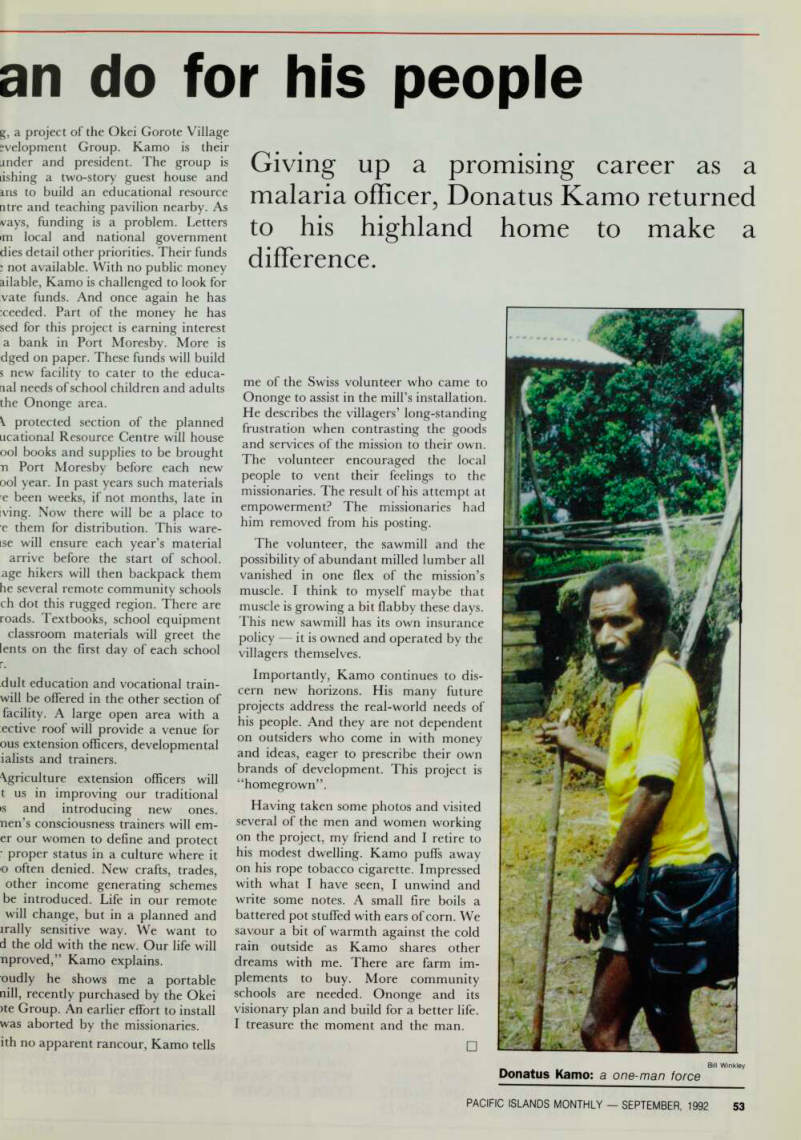
DONATUS Kamo is a small, wiry sort of guy, the kind of person you would likely overlook in a crowd. His quiet, unassuming manner belies his active and
aggressive leadership in promoting the
development of his remote patch of Papua New Guinea. My trip to this mountainous region in the central prov ince is to take a first hand look at “what one man can do”, as the balladeer John Denver has acclaimed.
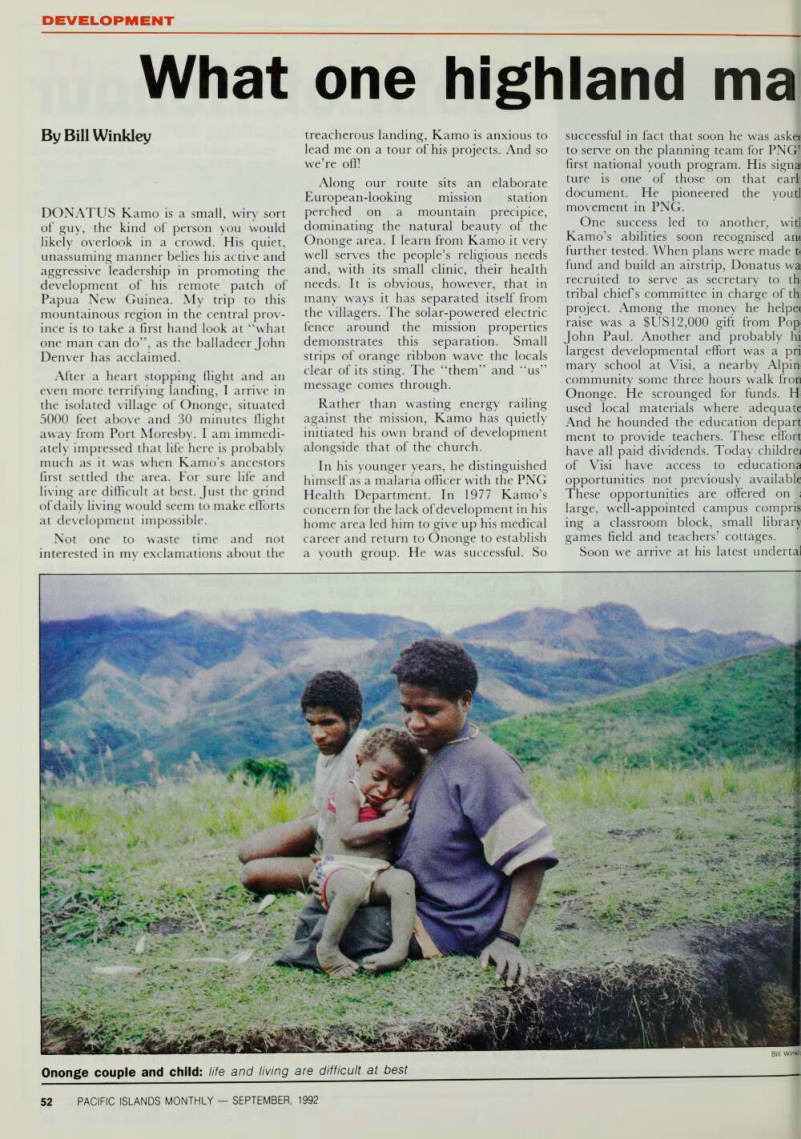
After a heart stopping flight and an even more terrifying landing, I arrive in the isolated village of Ononge, situated 5000 feet above and 30 minutes flight away from Port Moresby. I am immedi ately impressed that life here is probably much as it was when Kamo’s ancestors first settled the area. For sure life and living are difficult at best. Just the grind of daily living would seem to make efforts
at development impossible.
Not one to waste time and not interested in my exclamations about the
treacherous landing, Kamo is anxious to lead me on a tour of his projects. And so we’re off Along our route sits an elaborate European-looking mission station perched on a mountain precipice, dominating the natural beauty of the Ononge area. I learn from Kamo it very well serves the people’s religious needs and, with its small clinic, their health needs. It is obvious, however, that in many ways it has separated itself from the villagers. The solar-powered electric fence around the mission properties demonstrates this separation. Small strips of orange ribbon wave the locals clear of its sting. The “them” and “us” message comes through.
Rather than wasting jenergy railing against the mission, Kamo has quietly initiated his own brand of development alongside that of the church.
In his younger years, he distinguished himself as a malaria officer with the PNG Health Department. In 1977 Kamo’s concern for the lack of development in his home area led him to give up his medical career and return to Ononge to establish a youth group. He was successful. So
successful in fact that soon he was askef to serve on the planning team for PNG* first national youth program. His signa ture is one of those on that earl 1 , document. He pioneered the youtl movement in PNG.
One success led to another, witl Kamo’s abilities soon recognised an« further tested. When plans were made tt fund and build an airstrip, Donatus wa recruited to serve as secretary to th tribal chiefs committee in charge of th project. Among the money he helpe( raise was a SUS 12,000 gift from Pop John Paul. Another and probably hi largest developmental effort was a pri mary school at Visi, a nearby Alpin community some three hours walk fron Ononge. He scrounged for funds. H used local materials where adequate And he hounded the education depart ment to provide teachers. These effort have all paid dividends. Today childrei of Visi have access to educationa
opportunities not previously available
These opportunities are offered on ; large, well-appointed campus compris ing a classroom block, small library games field and teachers’ cottages.
Soon we arrive at his latest undertal
Ononge couple and child: life and living are difficult at best
g, a project of the Okei Gorote Village “velopment Group. Kamo is their under and president. The group is lishing a two-story guest house and ms to build an educational resource atre and teaching pavilion nearby. As
vays, funding is a problem. Letters
im local and national government dies detail other priorities. Their funds ; not available. With no public money ailable, Kamo is challenged to look for vate funds. And once again he has :ceeded. Part of the money he has sed for this project is earning interest a bank in Port Moresby. More is dged on paper. These funds will build s new facility to cater to the educa nal needs of school children and adults
the Ononge area.
V protected section of the planned acational Resource Centre will house 00l books and supplies to be brought n Port Moresby before each new 00l year. In past years such materials e been weeks, if not months, late in iving. Now there will be a place to e them for distribution. This ware ise will ensure each year’s material arrive before the start of school, age hikers will then backpack them he several remote community schools ch dot this rugged region. There are
roads. Textbooks, school equipment
classroom materials will greet the lents on the first day of each school dult education and vocational train will be offered in the other section of facility. A large open area with a ective roof will provide a venue for
ous extension officers, developmental
ialists and trainers. \griculture extension officers will t us in improving our traditional •s and introducing new ones, nen’s consciousness trainers will em er our women to define and protect ' proper status in a culture where it o often denied. New crafts, trades, other income generating schemes be introduced. Life in our remote will change, but in a planned and irally sensitive way. We want to d the old with the new. Our life will nproved,” Kamo explains, oudly he shows me a portable
nill, recently purchased by the Okei
)te Group. An earlier effort to install was aborted by the missionaries, ith no apparent rancour, Kamo tells
Giving up a promising career as a malaria officer, Donatus Kamo returned to his highland home to make a difference.
me of the Swiss volunteer who came to Ononge to assist in the mill’s installation.
He describes the villagers’ long-standing frustration when contrasting the goods and services of the mission to their own.
The volunteer encouraged the local people to vent their feelings to the missionaries. The result of his attempt at empowerment? The missionaries had him removed from his posting.
The volunteer, the sawmill and the possibility of abundant milled lumber all vanished in one flex of the mission’s muscle. I think to myself maybe that muscle is growing a bit flabby these days.
This new sawmill has its own insurance policy it is owned and operated by the villagers themselves.
Importantly, Kamo continues to dis cern new horizons. His many future projects address the real-world needs of his people. And they are not dependent on outsiders who come in with money and ideas, eager to prescribe their own brands of development. This project is
“homegrown”.
Having taken some photos and visited several of the men and women working on the project, my friend and I retire to his modest dwelling. Kamo puffs away on his rope tobacco cigarette. Impressed with what I have seen, I unwind and write some notes. A small fire boils a battered pot stuffed with ears of corn. We savour a bit of warmth against the cold rain outside as Kamo shares other dreams with me. There are farm im plements to buy. More community schools are needed. Ononge and its visionary plan and build for a better life.
I treasure the moment and the man.
Bill Winkley Donatus Kamo: a one-man force