Facing the crunch
pp. 16-19 · Read in the full issue

Cover Stories
By Roman Grynberg
DESPITE the much bigger press gar ments and tourism get in Fiji it is sugar which remains the nation’s bread and butter, or perhaps more appropriately dalo and roti. In 1990, for example, Fiji exported 380,000 tonnes of sugar at a total value of $223 million. Sugar is twice as big as garments, three times the size of gold exports and six times bigger than tuna exports. In 1990 sugar exports were a third of total exports and despite all the difficulties, sugar is still king in Fiji.
While tourism may be bigger and garments may be newer, there is no industry like sugar that brings so much money directly into the pockets of the average Fiji citizen.
It is this widespread distribution of earnings from sugar which has made Fiji unique among island states in that from those earnings it has developed a fairly integrated economy. The sugar industry has always been a rock-solid foundation of Fiji’s futuure. However negotiations in Geneva, Brussels and Washington to reform Europe’s Common Agricultural Policy (CAP) and thereby close what is known as the Uruguay Round of GATT (General Agreement on Trade and Tariffs) may bring the roof down on Fiji’s economy Moreover the global repercussions of the changes in European sugar pricing
policy may have serious effects on relations between sugar producing countries which have peferential access to the European sugar market and those other signatories to the Lome Conven tion which do not produce sugar.
At present CAP is under unpreceden ted pressure. The greatest* pressure is coming from the US which must sustain its own system of subsidy to its agricul tural sector, in large part to give US farmers a chance to be able to compete with their highly subsidized European competitors. In 1992 alone, these subsidies will cost EC and its consumers US$l34 billion while US subsidies cost SUS7S billion. In Europe the richest 20 per cent of farmers get 80 per cent of CAP subsidies and in the US the top one per cent of farmers get 30 per cent of the subsidies, the same amount received by the poorest 80 per cent of farmers.
Thus, while both the US and EC have claimed their respective systems of agri cultural subsidy benefit mid-Western grain farmers and French peasants they are in fact massive subsidies to their millionaires.
The US has put the brakes on the Uruguay Round of negotiations of the GATT until the Europeans agree to reforms to the CAP which are acceptable to Washington. In late December of 'ast year GATT director general Arthur Dunkel prepared the Draft Final Agree ment on Agriculture which was based on
36 per cent average reduction in tariffs across products. The Dunkel plan alsc called for reductions in direct subsidies tc farmers. The US response was a grudg ing acceptance of the principle while the EC and Japan rejected it outright.
Nevertheless in late May the Eur opeans, under pressure from within by the UK and not wishing to appear tc have made the entire reform under US pressure have unilaterally proceeded with a major reform of the CAP as it applies to the trade in gain. The Europeans have moved to lower support prices and have introduced direct income supports for the compulsory setting aside of land. In other words the EC will pay farmers to set aside land and not produce grain.
The irony, if not sheer immorality, of returning to the situation of paying farmers not to produce grain while a good portion of sub-Saharan Africa starves in front of our eyes on the evening news might not even be lost on the most ardent supporters of free trade.
The US pressure for reform has been essentially in the area of grain but the CAP, as all such systems has its own internal logic. If the EC lower prices and offers to pay “set-aside” payments to stop producing grain then it is only a matter of time before the EC must reform the entire price system or farmers will simply shift production to other crops. So while the EC has not yet announced the
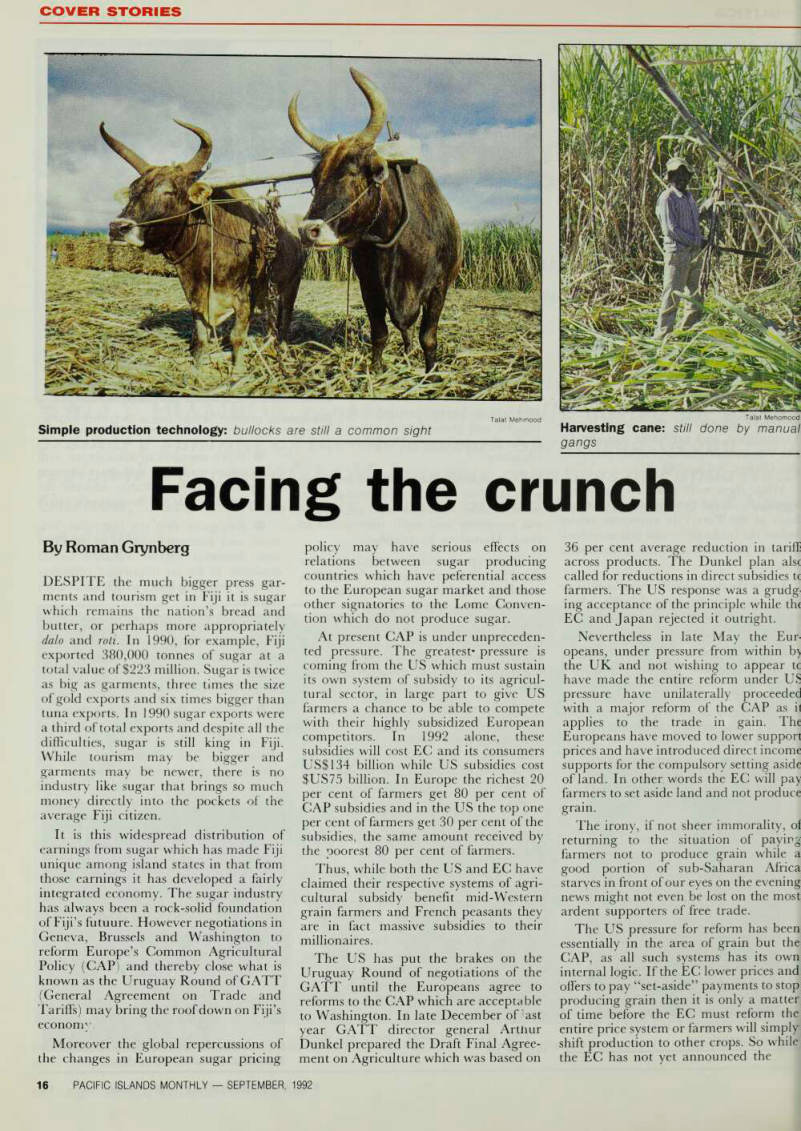
Talat Mehmood Simple production technology: bullocks are still a common sight
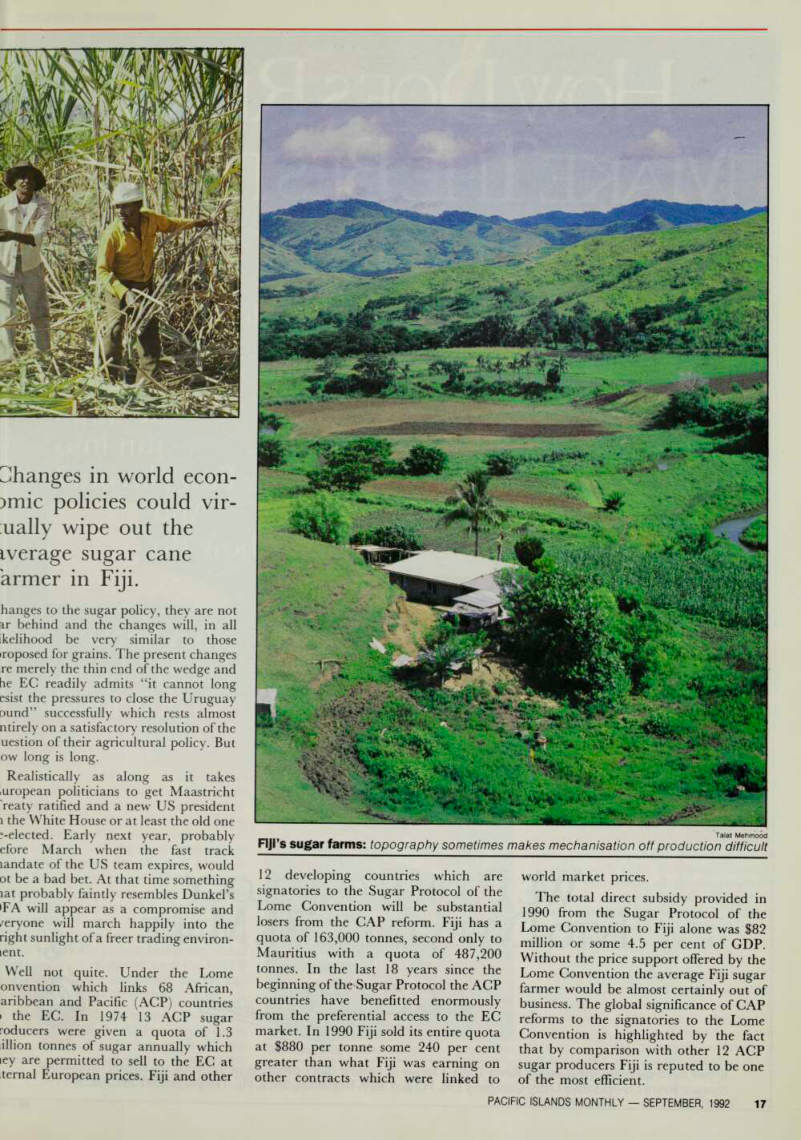
Talat Mehomood Harvesting cane: still done by manual gangs
Changes in world econ omic policies could vir
ually wipe out the
iverage sugar cane armer in Fiji.
hanges to the sugar policy, they are not ar behind and the changes will, in all ikelihood be very similar to those •roposed for grains. The present changes re merely the thin end of the wedge and be EC readily admits “it cannot long esist the pressures to close the Uruguay ound” successfully which rests almost ntirely on a satisfactory resolution of the uestion of their agricultural policy. But
ow long is long.
Realistically as along as it takes uropean politicians to get Maastricht reaty ratified and a new US president i the White House or at least the old one selected. Early next year, probably efore March when the fast track landate of the US team expires, would ot be a bad bet. At that time something lat probably faintly resembles Dunkel’s •FA will appear as a compromise and /eryone will march happily into the right sunlight of a freer trading environ ment.
Well not quite. Under the Lome onvention which links 68 African, aribbean and Pacific (AGP) countries > the EC. In 1974 13 AGP sugar roducers were given a quota of 1.3 illion tonnes of sugar annually which mey are permitted to sell to the EC at ternal European prices. Fiji and other
12 developing countries which are signatories to the Sugar Protocol of the Lome Convention will be substantial iosers from the CAP reform. Fiji has a quota of 163,000 tonnes, second only to Mauritius with a quota of 487,200 tonnes. In the last 18 years since the beginning of the Sugar Protocol the AGP countries have benefitted enormously from the preferential access to the EC market. In 1990 Fiji sold its entire quota at $BBO per tonne some 240 per cent greater than what Fiji was earning on other contracts which were linked to
world market prices.
Xhe total direct subsid ided in 1990 from the s Prot £ col of the Lome Convention to Fiji alone was $B2 million or some 4 5 cent of GDP Without the price support offered by the Lome Convention the average Fiji sugar farmer would be almost certainly out of business. The global significance of CAP reforms to the signatories to the Lome Convention is highlighted by the fact that by comparison with other 12 AGP sugar producers Fiji is reputed to be one of the most efficient.
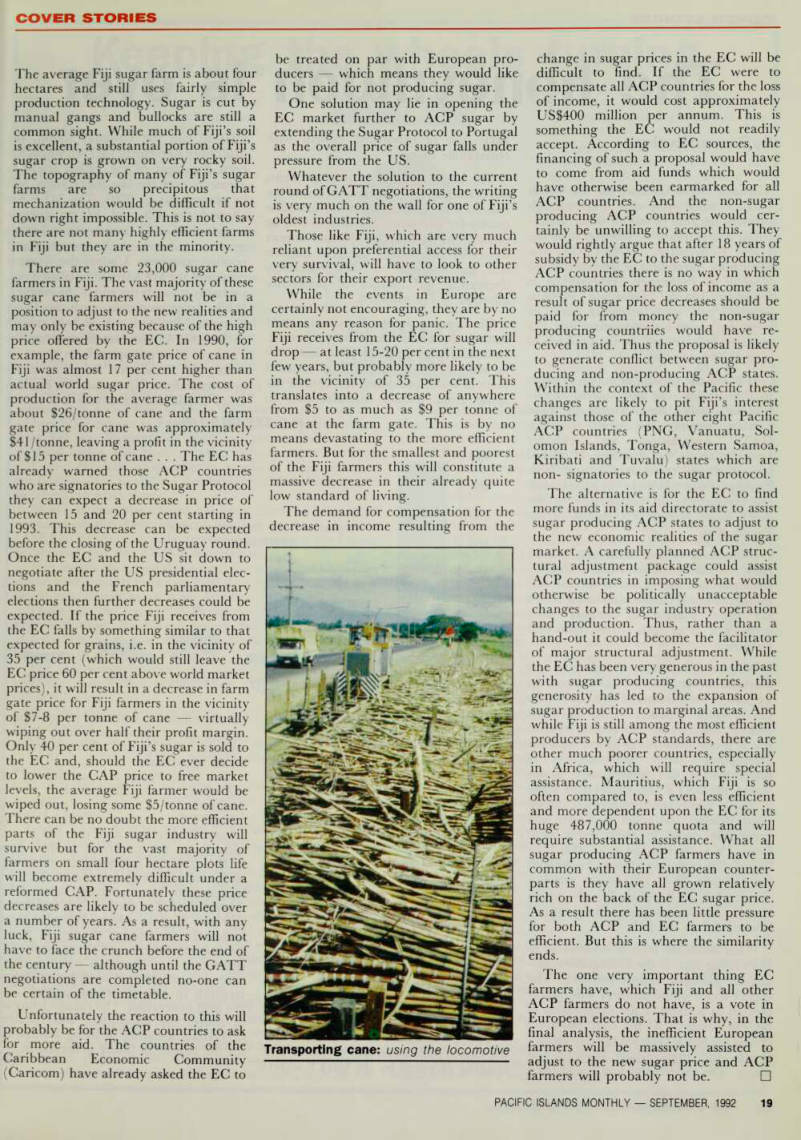
Talat Mehmood Fiji s sugar farms: topography sometimes makes mechanisation off production difficult
The average Fiji sugar farm is about four hectares and still uses fairly simple production technology. Sugar is cut by manual gangs and bullocks are still a common sight. While much of Fiji’s soil is excellent, a substantial portion of Fiji’s sugar crop is grown on very rocky soil.
The topography of many of Fiji’s sugar farms are so precipitous that mechanization would be difficult if not down right impossible. This is not to say there are not many highly efficient farms in Fiji but they are in the minority.
There are some 23,000 sugar cane farmers in Fiji. The vast majority of these sugar cane farmers will not be in a position to adjust to the new realities and may only be existing because of the high price offered by the EC. In 1990, for example, the farm gate price of cane in Fiji was almost 17 per cent higher than actual world sugar price. The cost of production for the average farmer was about $26/tonne of cane and the farm gate price for cane was approximately $4l /tonne, leaving a profit in the vicinity of $l5 per tonne of cane . . . The EC has already warned those ACP countries who are signatories to the Sugar Protocol they can expect a decrease in price of between 15 and 20 per cent starting in 1993. This decrease can be expected before the closing of the Uruguay round.
Once the EC and the US sit down to negotiate after the US presidential elec tions and the French parliamentary elections then further decreases could be expected. If the price Fiji receives from the EC falls by something similar to that expected for grains, i.e. in the vicinity of 35 per cent (which would still leave the EC price 60 per cent above world market prices), it will result in a decrease in farm gate price for Fiji farmers in the vicinity of $7-8 per tonne of cane virtually wiping out over half their profit margin.
Only 40 per cent of Fiji’s sugar is sold to the EC and, should the EC ever decide to lower the CAP price to free market levels, the average Fiji farmer would be wiped out, losing some $5/tonne of cane.
There can be no doubt the more efficient parts of the Fiji sugar industry will survive but for the vast majority of farmers on small four hectare plots life will become extremely difficult under a reformed CAP. Fortunately these price decreases are likely to be scheduled over a number of years. As a result, with any luck, Fiji sugar cane farmers will not have to face the crunch before the end of the century although until the GATT negotiations are completed no-one can be certain of the timetable.
Unfortunately the reaction to this will probably be for the ACP countries to ask for more aid. The countries of the Caribbean Economic Community (Caricom) have already asked the EC to
be treated on par with European pro ducers which means they would like to be paid for not producing sugar.
One solution may lie in opening the EC market further to ACP sugar by extending the Sugar Protocol to Portugal as the overall price of sugar falls under pressure from the US.
Whatever the solution to the current round of GATT negotiations, the writing is very much on the wall for one of Fiji’s oldest industries.
Those like Fiji, which are very much reliant upon preferential access for their very survival, will have to look to other sectors for their export revenue.
While the events in Europe are certainly not encouraging, they are by no means any reason for panic. The price Fiji receives from the EC for sugar will drop at least 15-20 per cent in the next few years, but probably more likely to be in the vicinity of 35 per cent. This translates into a decrease of anywhere from $5 to as much as $9 per tonne of cane at the farm gate. This is by no means devastating to the more efficient farmers. But for the smallest and poorest of the Fiji farmers this will constitute a massive decrease in their already quite low standard of living.
The demand for compensation for the decrease in income resulting from the
change in sugar prices in the EC will be difficult to find. If the EC were to compensate all ACP countries for the loss of income, it would cost approximately US$4OO million per annum. This is something the EC would not readily accept. According to EC sources, the financing of such a proposal would have to come from aid funds which would have otherwise been earmarked for all ACP countries. And the non-sugar producing ACP countries would cer tainly be unwilling to accept this. They would rightly argue that after 18 years of subsidy by the EC to the sugar producing ACP countries there is no way in which compensation for the loss of income as a result of sugar price decreases should be paid for from money the non-sugar producing countriies would have re ceived in aid. Thus the proposal is likely to generate conflict between sugar pro ducing and non-producing ACP states.
Within the context of the Pacific these changes are likely to pit Fiji’s interest against those of the other eight Pacific ACP countries (PNG, Vanuatu, Sol omon Islands, Tonga, Western Samoa, Kiribati and Tuvalu) states which are non- signatories to the sugar protocol.
The alternative is for the EC to find more funds in its aid directorate to assist sugar producing ACP states to adjust to the new economic realities of the sugar market. A carefully planned ACP struc tural adjustment package could assist ACP countries in imposing what would
otherwise be politically unacceptable
changes to the sugar industry operation and production. Thus, rather than a hand-out it could become the facilitator of major structural adjustment. While the EC has been very generous in the past with sugar producing countries, this generosity has led to the expansion of sugar production to marginal areas. And while Fiji is still among the most efficient producers by ACP standards, there are other much poorer countries, especially in Africa, which will require special assistance. Mauritius, which Fiji is so often compared to, is even less efficient and more dependent upon the EC for its huge 487,000 tonne quota and will require substantial assistance. What all sugar producing ACP farmers have in common with their European counter parts is they have all grown relatively rich on the back of the EC sugar price.
As a result there has been little pressure for both ACP and EC farmers to be efficient. But this is where the similarity ends.
The one very important thing EC farmers have, which Fiji and all other ACP farmers do not have, is a vote in European elections. That is why, in the final analysis, the inefficient European farmers will be massively assisted to adjust to the new sugar price and ACP farmers will probably not be. □
Transporting cane: using the locomotive