France and Tahiti clash over budgetary control
pp. 12-15 · Read in the full issue
Politics
By Karin von Strokirch
IN French Polynesia relations between the state and the territory have reached an all-time low following a decision by the French high commissioner to seize control of the territorial budget. This action was taken on the advice of the Territorial Audit Chamber which had determined the government was unable to balance the 1992 budget. An inter vention of this kind by the state is unprecedented since the granting of internal autonomy to the territory in 1984.
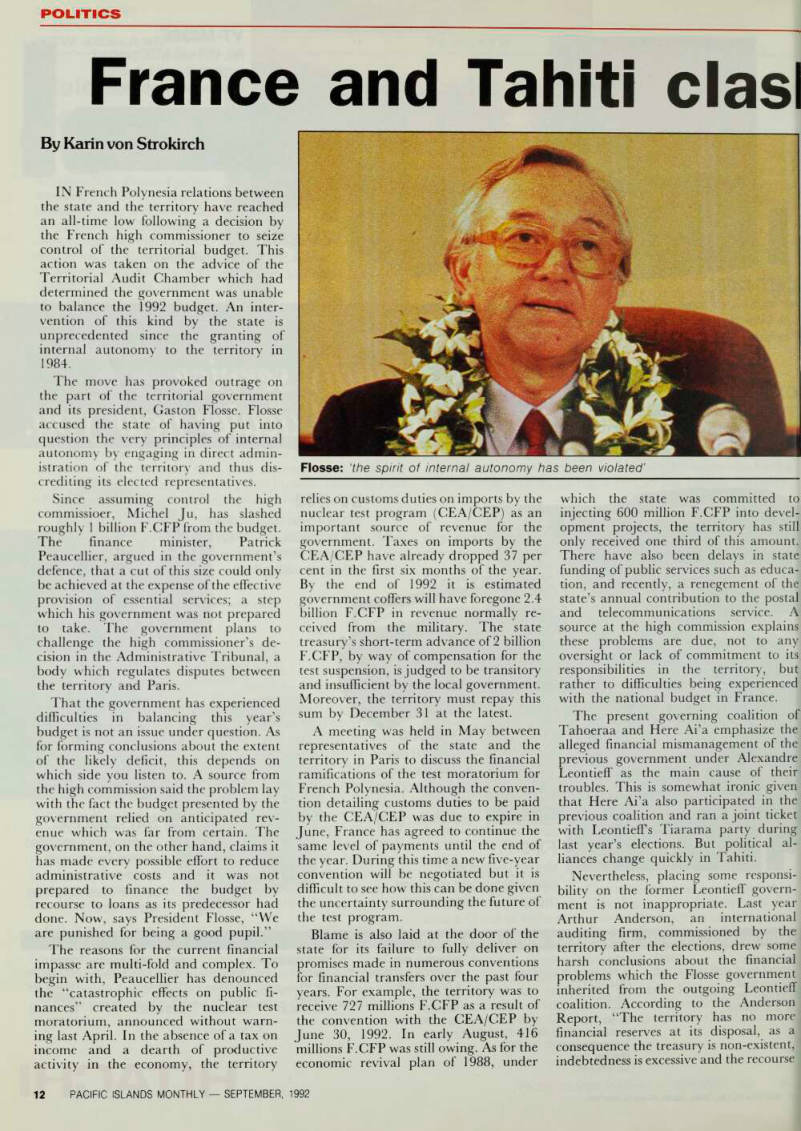
The move has provoked outrage on the part of the territorial government and its president, Gaston Flosse. Flosse accused the state of having put into question the very principles of internal autonomy by engaging in direct admin istration of the territory and thus dis crediting its elected representatives.
Since assuming control the high commissioer, Michel Ju, has slashed roughly 1 billion F.CFP from the budget.
The finance minister, Patrick Peaucellier, argued in the government’s defence, that a cut of this size could only be achieved at the expense of the effective provision of essential services; a step which his government was not prepared to take. The government plans to challenge the high commissioner’s de cision in the Administrative Tribunal, a body which regulates disputes between the territory and Paris.
That the government has experienced difficulties in balancing this year’s budget is not an issue under question. As for forming conclusions about the extent of the likely deficit, this depends on which side you listen to. A source from the high commission said the problem lay with the fact the budget presented by the government relied on anticipated rev enue which was far from certain. The government, on the other hand, claims it has made every possible effort to reduce administrative costs and it was not prepared to finance the budget by recourse to loans as its predecessor had done. Now, says President Flosse, “We are punished for being a good pupil.”
The reasons for the current financial impasse are multi-fold and complex. To begin with, Peaucellier has denounced the “catastrophic effects on public fi nances” created by the nuclear test moratorium, announced without warn ing last April. In the absence of a tax on income and a dearth of productive activity in the economy, the territory
relies on customs duties on imports by the nuclear test program (CEA/CEP) as an important source of revenue for the government. Taxes on imports by the CEA/CEP have already dropped 37 per cent in the first six months of the year.
By the end of 1992 it is estimated government coffers will have foregone 2.4 billion F.CFP in revenue normally re ceived from the military. The state treasury’s short-term advance of 2 billion F.CFP, by way of compensation for the test suspension, is judged to be transitory and insufficient by the local government.
Moreover, the territory must repay this sum by December 31 at the latest.
A meeting was held in May between representatives of the state and the territory in Paris to discuss the financial ramifications of the test moratorium for French Polynesia. Although the conven tion detailing customs duties to be paid by the CEA/CEP was due to expire in June, France has agreed to continue the same level of payments until the end of the year. During this time a new five-year convention will be negotiated but it is difficult to see how this can be done given the uncertainty surrounding the future of the test program.
Blame is also laid at the door of the state for its failure to fully deliver on promises made in numerous conventions for financial transfers over the past four years. For example, the territory was to receive 727 millions F.CFP as a result of the convention with the CEA/CEP by June 30, 1992. In early August, 416 millions F.CFP was still owing. As for the economic revival plan of 1988, under
which the state was committed to injecting 600 million F.CFP into devel opment projects, the territory has still only received one third of this amount.
There have also been delays in state funding of public services such as educa tion, and recently, a renegement of the state’s annual contribution to the postal and telecommunications service. A source at the high commission explains these problems are due, not to any oversight or lack of commitment to its responsibilities in the territory, but rather to difficulties being experienced with the national budget in France.
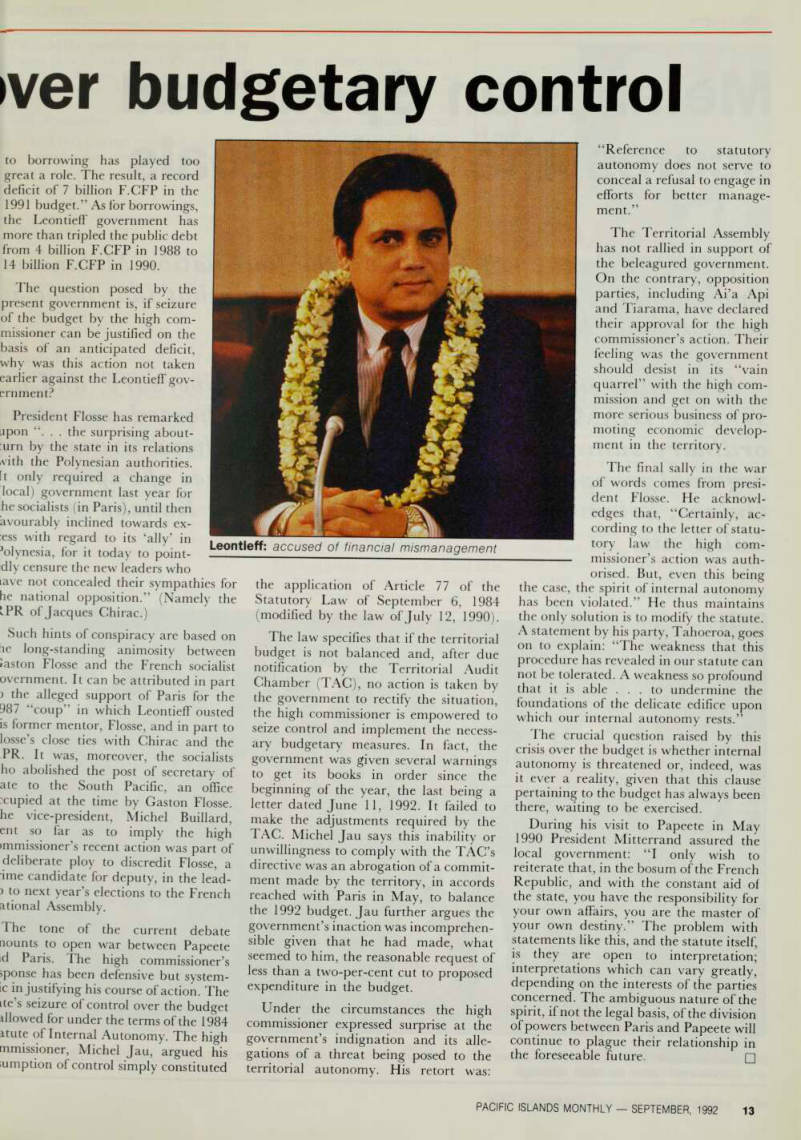
The present governing coalition of Tahoeraa and Here Ai’a emphasize the alleged financial mismanagement of the previous government under Alexandre Leontieff as the main cause of their troubles. This is somewhat ironic given that Here Ai’a also participated in the previous coalition and ran a joint ticket with LeontiefTs Tiarama party during last year’s elections. But political al liances change quickly in Tahiti.
Nevertheless, placing some responsi
bility on the former Leontieff govern ment is not inappropriate. Last year Arthur Anderson, an international auditing firm, commissioned by the territory after the elections, drew some harsh conclusions about the financial problems which the Flosse government inherited from the outgoing Leontieff coalition. According to the Anderson Report, “The territory has no more financial reserves at its disposal, as a consequence the treasury is non-existent, j indebtedness is excessive and the recourse
Flosse: 'the spirit of internal autonomy has been violated’
to borrowing has played too great a role. The result, a record deficit of 7 billion F.CFP in the 1991 budget.” As for borrowings, the Leontieff government has more than tripled the public debt from 4 billion F.CFP in 1988 to 14 billion F.CFP in 1990.
The question posed by the present government is, if seizure of the budget by the high com missioner can be justified on the basis of an anticipated deficit, why was this action not taken earlier against the Leontieff gov ernment?
President Flosse has remarked upon “. . . the surprising about ;urn by the state in its relations vith the Polynesian authorities. [t only required a change in local) government last year for he socialists (in Paris), until then avourably inclined towards ex ess with regard to its ‘ally’ in ’olynesia, for it today to point dly censure the new leaders who
lave not concealed their sympathies for he national opposition.” (Namely the LPR of Jacques Chirac.) Such hints of conspiracy are based on
ic long-standing animosity between
laston Flosse and the French socialist overnment. It can be attributed in part ) the alleged support of Paris for the 987 “coup” in which Leontieff ousted is former mentor, Flosse, and in part to losse’s close ties with Chirac and the PR. It was, moreover, the socialists ho abolished the post of secretary of ate to the South Pacific, an office xupied at the time by Gaston Flosse. he vice-president, Michel Buillard, ent so far as to imply the high •mmissioner’s recent action was part of deliberate ploy to discredit Flosse, a ime candidate for deputy, in the lead ) to next year’s elections to the French
ational Assembly.
The tone of the current debate riounts to open war between Papeete d Paris. The high commissioner’s jponse has been defensive but system ic in justifying his course of action. The ite’s seizure of control over the budget illowed for under the terms of the 1984 itute of Internal Autonomy. The high mmissioner, Michel Jau, argued his lumption of control simply constituted
the application of Article 77 of the Statutory Law of September 6, 1984 (modified by the law of July 12, 1990).
The law specifies that if the territorial budget is not balanced and, after due notification by the Territorial Audit Chamber (TAG), no action is taken by the government to rectify the situation, the high commissioner is empowered to seize control and implement the necess ary budgetary measures. In fact, the government was given several warnings to get its books in order since the beginning of the year, the last being a letter dated June 11, 1992. It failed to make the adjustments required by the TAG. Michel Jau says this inability or unwillingness to comply with the TAC’s directive was an abrogation of a commit ment made by the territory, in accords reached with Paris in May, to balance the 1992 budget. Jau further argues the government’s inaction was incomprehen sible given that he had made, what seemed to him, the reasonable request of less than a two-per-cent cut to proposed expenditure in the budget.
Under the circumstances the high commissioner expressed surprise at the government’s indignation and its alle gations of a threat being posed to the territorial autonomy. His retort was:
“Reference to statutory autonomy does not serve to conceal a refusal to engage in efforts for better manage ment.”
The Territorial Assembly has not rallied in support of the beleagured government.
On the contrary, opposition parties, including Ai’a Api and Tiarama, have declared their approval for the high commissioner’s action. Their feeling was the government should desist in its “vain quarrel” with the high com mission and get on with the more serious business of pro moting economic develop ment in the territory.
The final sally in the war of words comes from presi dent Flosse. He acknowl edges that, “Certainly, ac cording to the letter of statu tory law the high com missioner’s action was auth orised. But, even this being
the case, the spirit of internal autonomy has been violated.” He thus maintains the only solution is to modify the statute.
A stateme " t . b y party, Tahoeroa, goes u in ' Th f weakness that this P dure has J v^ aled our statu js ca n J lOl be t ? lera^ ed - A weakness so profound foundations of the dehca^edifTce'upon which our internal autonomy rests.” tl • , • , , . . ■ cructal quest,on raised by this crisis over the budget is whether internal autonomy is threatened or, indeed, was it ever a reality, given that this clause pertaining to the budget has always been there, waiting to be exercised, During his visit to Papeete in Mav 1990 President Mitterrand assured the local government: “I only wish to reiterate that, in the bosum of the French Republic, and with the constant aid of the state, you have the responsibility for your own affairs, you are the master of your own destiny.” The problem with statements like this, and the statute itself, ! s the y ar e open to interpretation; interpretations which can vary greatly, depending on the interests of the parties spirit, if not the legal of powers between Paris and Papeete will continue to plague their relationship in the foreseeable future. n
Leontieff: accused of financial mismanagement
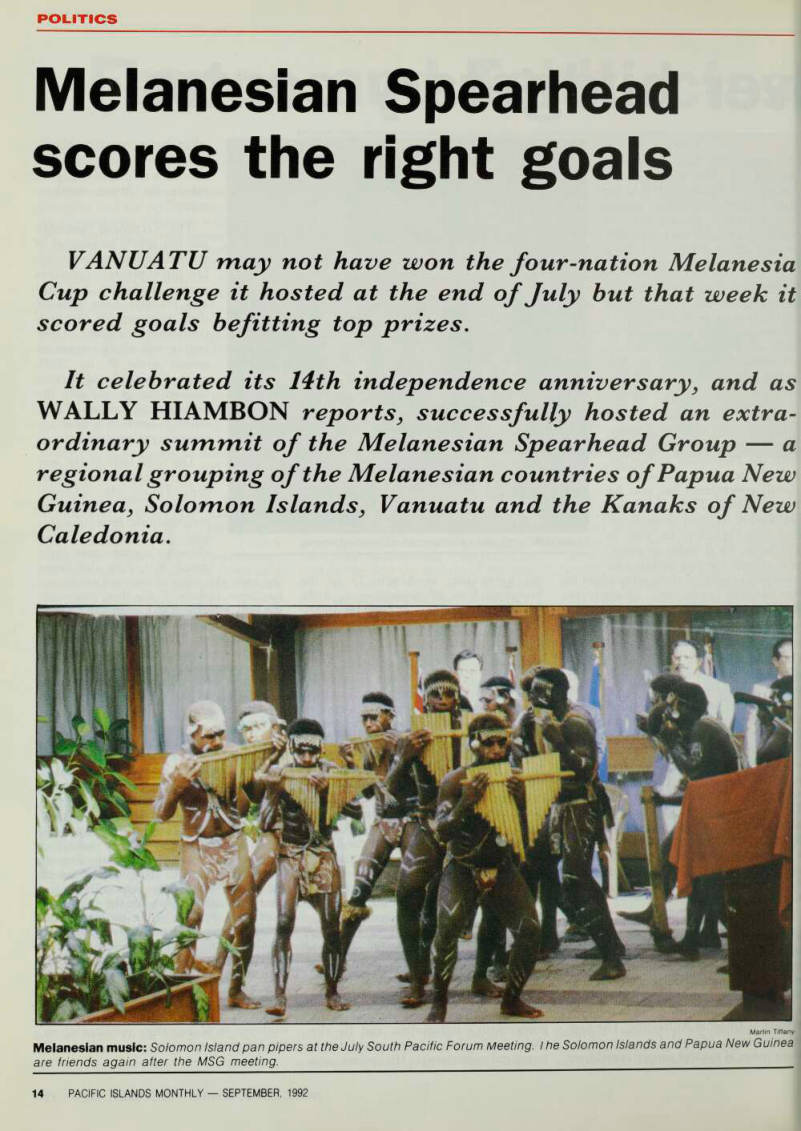
THE MSG meeting was attended by Papua New Guinea’s new Prime Minis ter Piais Wingti, Vanuatu’s Maxime Carlot Korman, Solomon Islands’ Sol omon Mamaloni and FLNKS President
Paul Neuontyine.
The MSG summit reviewed, discussed and noted developments in the areas of general political and institutional devel opments within the South Pacific region, and potential trade and economic co operation and arrangements amongst the MSG members.
Developments in New Caledonia were also noted, and leaders agreed that this issue should continue to be addressed.
They noted a request by the FLNKS to see that the South Pacific Forum Minis terial Committee continue its visit to New Caledonia after the Matignon Accords Review towards the end of this year and before the next Forum meeting.
MSG leaders also agreed to maintain a united position on a candidate for secretary general of the South Pacific Commission and expressed support for the Vanuatu candidate, former president
Ati George Sokomanu.
While these were issues on the formal agenda it took the leaders a record one aour at the Port Vila university centre before the broke off — one side issue took greater prominence, with a successful )utcome.
It was the Bougainville crisis’ spill-over Beet into the Solomon Islands which :aused an impasse in its relations with s apua New Guinea.
Following raids by PNG security forces •n two villages in the Solomon’s Portland Group which borders Bou ainville, Mamaloni’s government sent everal diplomatic protests to PNG efore cutting off any communication at olitical level.
His position then was to refrain from dealing with the then government of Rabbie Namaliu until after PNG’s na tional election in June because he feared there may be a change in government.
Mamaloni’s fears of a change of government were well founded.
Rabbie Namaliu lost PNG’s top job to Paias Wingti on July 17 with a 55-54 vote in Parlia ment.
The new prime minister wasted no time in re establishing contact with the Solomons and was on the plane to Port Vila, via Honiara on
July 28.
When Messrs Wingti and Mamaloni met on Honiara’s Henderson Airport tarmac and hugged and greeted each other it was like two long lost brothers
reuniting.
They shared jokes and were bubbling
with laughter, a totally different time to when Rabbie Namaliu tried on numer ous occasions and each time failed to reach Mamaloni by telephone.
The two prime ministers declared after this “first contact” that the “misunder standings” had been resolved and both countries were friends again.
Said Wingti of the coldness - “I understand the feeling of the Solomon Islands. I would have felt the same if a big country with a lot of resources moved
into our territory and destroyed villages.
Mamaloni said, “The suspension of talks is now over. With the new (Wingti) administration I have great hope. We would like to remain as a mediator, we don’t want to interfere (in. the Bougain
ville crisis).
“Through talking and developing
understanding, we will be able to convince the Bougainville people to lay down their arms.”
As a sign of goodwill, Wingti, after the Honiara stop-over, offered Mamaloni and his family and Solomon Islands officials a lift to Vanuatu in his plane.
During the two days in Port Vila they had extensive discussions on how to go about addressing the spill-over effect, at the end of which they produced the “Vila Statement” which signalled a new ap proach to the issue.
This statement was based on their resolve to:
• Work together in accordance with Melanesian traditions and share interests to speedily and amicably address the spill-over effects of the Bougainville crisis; • Recognise that the historical, cul tural and human interactions of PNG and Solomon Island citizens would continue to be an important consider ation in resolving issues which affect both countries; • Adopt a comprehensive and mutu ally agreed approach to effectively deal with the crisis on Bougainville in as far as the Crisis affects both countries na tional interests and; • Reaffirm their governments’ view that the Bougainville crisis is an internal matter for PNG to resolve given the constitutional, moral and human dimen sions associated with the crisis. □
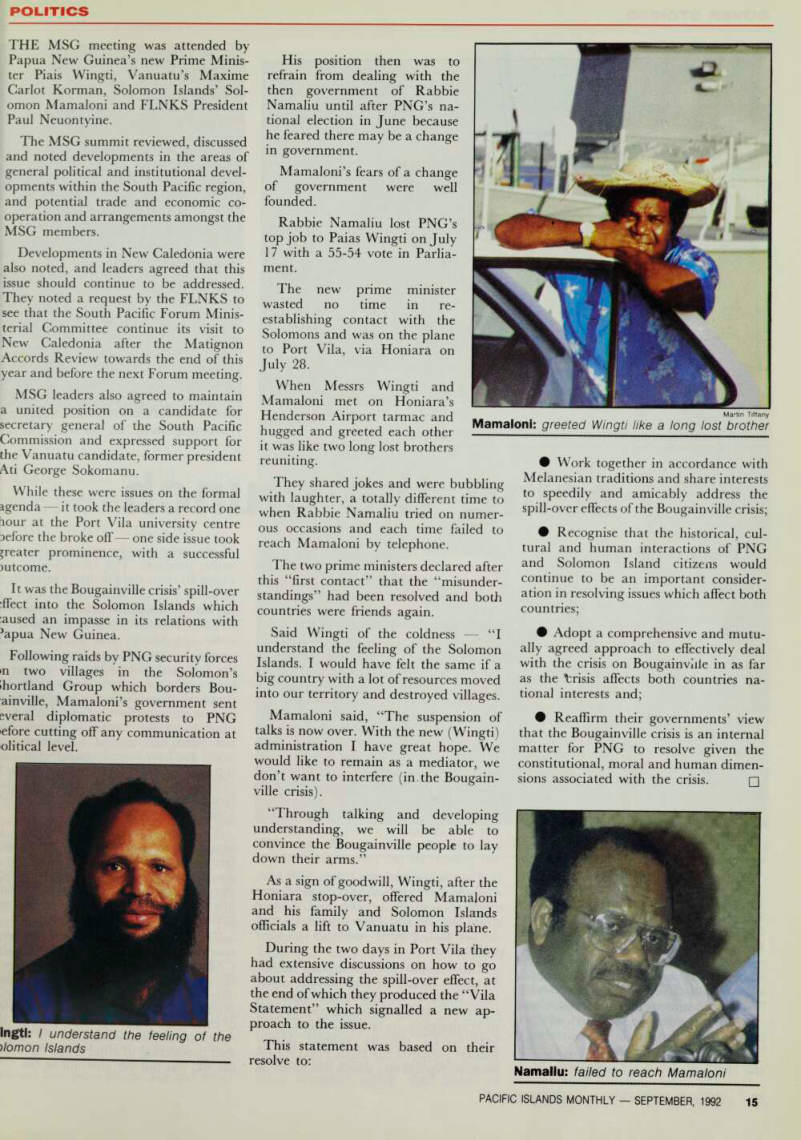
[?]ngtl: I understand the feeling of the [?]lomon Islands
Martin Tiffany Mamaloni: greeted Wingti like a long lost brother
Namallu: failed to reach Mamaloni