The honeymoon is over
p. 20 · Read in the full issue
By Roman Grynberg
Virtually every industry in the South Pacific, when you dig deep enough survives because of one or other prefer ential access treaty whether it be the Lome Convention, SPARTECA, the Multifiber Agreement or the Generalised System of Preference. Whether it is Solomon Islands’ tuna, or Western Samoa’s new parts assembly plant or even the region’s success story, the Fiji garment industry, all are the products of someone’s generosity.
It is not the change of policy towards us that acts as the basic threat to our survival; rather the lowering of trade barriers around the world through GATT negotiations and changes brought about by lowering of global import duties by Australia and New Zealand which will make the islands even less competitive in comparison to the much lower labour cost regions of the Pacific Rim.
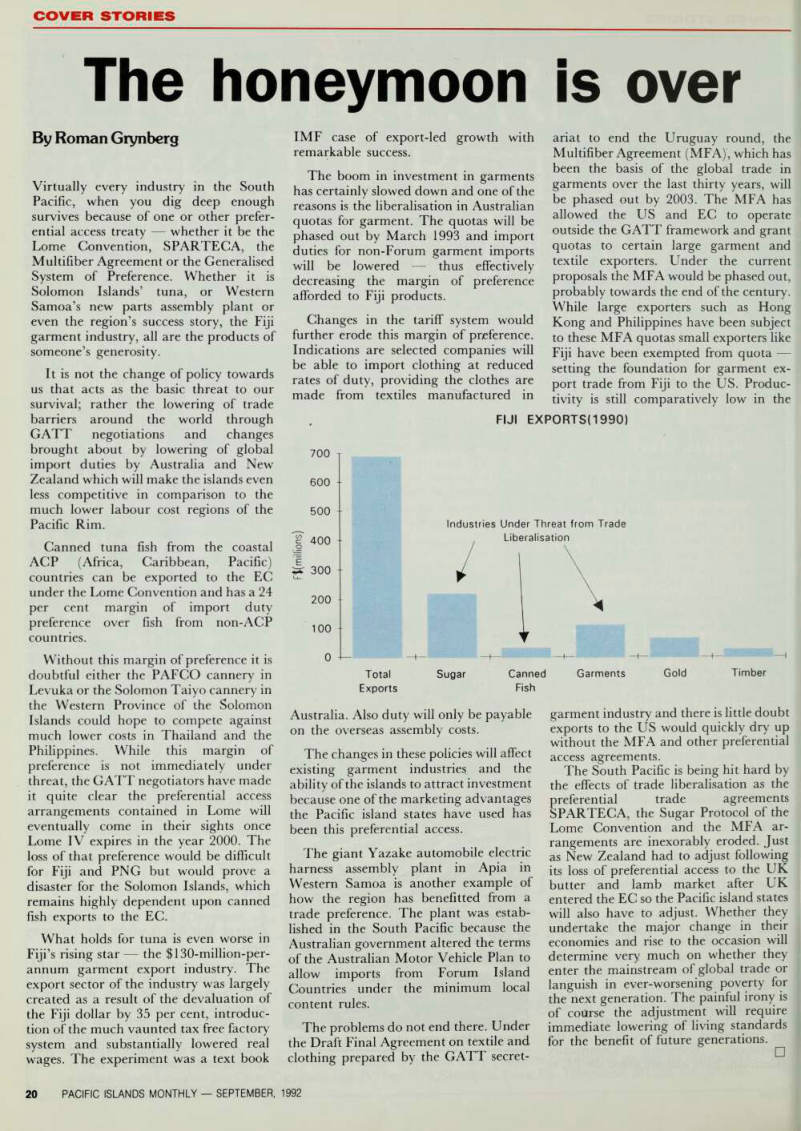
Canned tuna fish from the coastal AGP (Africa, Caribbean, Pacific) countries can be exported to the EC under the Lome Convention and has a 24 per cent margin of import duty preference over fish from non-ACP countries.
Without this margin of preference it is doubtful either the PAFCO cannery in Levuka or the Solomon Taiyo cannery in the Western Province of the Solomon Islands could hope to compete against much lower costs in Thailand and the Philippines. While this margin of preference is not immediately under threat, the GATT negotiators have made it quite clear the preferential access arrangements contained in Lome will eventually come in their sights once Lome IV expires in the year 2000. The loss of that preference would be difficult for Fiji and PNG but would prove a disaster for the Solomon Islands, which remains highly dependent upon canned fish exports to the EC.
What holds for tuna is even worse in Fiji’s rising star the Sl3O-million-per annum garment export industry. The export sector of the industry was largely created as a result of the devaluation of the Fiji dollar by 35 per cent, introduc tion of the much vaunted tax free factory system and substantially lowered real wages. The experiment was a text book
IMF case of export-led growth with remarkable success.
The boom in investment in garments has certainly slowed down and one of the reasons is the liberalisation in Australian quotas for garment. The quotas will be phased out by March 1993 and import duties for non-Forum garment imports will be lowered thus effectively decreasing the margin of preference afforded to Fiji products.
Changes in the tariff system would further erode this margin of preference.
Indications are selected companies will be able to import clothing at reduced rates of duty, providing the clothes are made from textiles manufactured in
ariat to end the Uruguay round, the Multifiber Agreement (MFA)', which has been the basis of the global trade in garments over the last thirty years, will be phased out by 2003. The MFA has allowed the US and EC to operate outside the GATT framework and grant quotas to certain large garment and textile exporters. Under the current proposals the MFA would be phased out, probably towards the end of the century.
While large exporters such as Hong Kong and Philippines have been subject to these MFA quotas small exporters like Fiji have been exempted from quota setting the foundation for garment ex port trade from Fiji to the US. Produc tivity is still comparatively low in the
Fiji Exports(I99O)
Australia. Also duty will only be payable on the overseas assembly costs.
The changes in these policies will affect existing garment industries and the ability of the islands to attract investment because one of the marketing advantages the Pacific island states have used has been this preferential access.
The giant Yazake automobile electric harness assembly plant in Apia in Western Samoa is another example of how the region has benefitted from a trade preference. The plant was estab lished in the South Pacific because the Australian government altered the terms of the Australian Motor Vehicle Plan to allow imports from Forum Island Countries under the minimum local content rules.
The problems do not end there. Under the Draft Final Agreement on textile and clothing prepared by the GATT secret
garment industry and there is little doubt exports to the US would quickly dry up without the MFA and other preferential access agreements.
The South Pacific is being hit hard by the effects of trade liberalisation as the preferential trade agreements SPARTECA, the Sugar Protocol of the Lome Convention and the MFA ar rangements are inexorably eroded. Just as New Zealand had to adjust following its loss of preferential access to the UK butter and lamb market after UK entered the EC so the Pacific island states will also have to adjust. Whether they undertake the major change in their economies and rise to the occasion will determine very much on whether they enter the mainstream of global trade or languish in ever-worsening poverty for the next generation. The painful irony is of coilrse the adjustment will require immediate lowering of living standards for the benefit of future generations.
I —l