of Irian Jaya
p. 43 · Read in the full issue
The lost world of Irian Jaya
IRIAN JAVA - or West Papua - is a corner of our planet conducive to superlatives because of its natural and cultural wonders. But it often falls victim to cliches about man emerging from the stone-age and over-simplifications.
The western part of the island of New Guinea - taken over by Indonesia from the Dutch during the 1960 s - embraces unique cultures and a fantastic array of flora and fauna. But man, beast and plant alike are all threatened by outside pressures. For example, virtually all of Irian Jaya is covered by logging licences.
The shortcomings of the Indonesian :olonists - whether arising from indiffer ence, ethnocentricity or greed - are only Dartly balanced by more positive influ ences.
Tian Jaya’s rugged central mountain ange - 2000 kilometres long with peaks nore than 4500 metres high - was formed >nly a few million years ago, as tectonic dates on the earth’s surface collided. As result of those geological events, it is ►ossible today to stand on the snow overed glacier of thhe Cartensz Pyramid only four degrees south of the equator and view the Arafura Sea in the istance. lUstralian Robert Mitton, whose family osthumously compiled the marvelous ook The Lost World of Irian Jaya from his
writings, was captivated by the natural beauty of these mountains. He wrote of bare grey summits rupturing the green skin of the forest. Mitton also became engrossed with the land’s peoples. The rich cultural tapestry ranges from penis gourd wearing highlanders with sophis ticated agricultural irrigation systems to wood-carving lowland Asmat gatherers of the sago palm, who traditionally lived their lives totally naked.
While Asian neighbours had long-traded with the Papuan people of the coast, and the Dutch explorer Jan Carstenz made contact in 1623, it was not until 1848 that the Dutch East Indies government claimed the western half of the island of New Guinea. And it was only in 1938 that the first expedition reached the densely populated Grand Baliem Valley off the central plateau. Dutch colonial rule was largely confined to the coast until World War 11, with Christian missionaries - some of whom fell victim to cannibalism - constituting the only substantive influence in parts of the interior. Other areas remained free of outside contact until the 1970 s and there are still isolated peoples in Irian Jaya who live lifestyles largely unaffected by the 20th century.
The Dutch colonialists, having suc cumbed to Indonesian nationalists further west, tried in vain to hold on to
Dutch New Guinea, which they said was being prepared for democracy and inde pendence. A 1969 United Nations demanded act of self-determination for the people of Irian Jaya to decide their future political status was manipulated by Indonesia to the point where it became a farce. In the 20-odd years since, there have been bow-and-arrow supported guerilla activity and the movement of more than 12,000 refugees into neighbouring Papua New Guinea.
Isolated raids on remote Indonesian outposts and international protests seem unlikely to convince Jakarta to pack up their neo-colonial administration in Irian Jaya, and go home. In the 1980 s there had been fears that expanding official trans-migration of settlers from other parts of Indonesia would numerically
submerge the indigenous populations,
alienating their land and resources; swamping their cultures. This threat has been eased by the economic failure of many trans-migration projects - with tragic consequences for the settlers them selves - and loss of financial backing.
Cultural dilemmas remain. While some Irian Jayans cling tenaciously to life in inaccessible areas of forest or swamp, others live urban lives in the Indonesianised northern capital, Jayapura. In between are the bulk of Irian Jaya’s estimated 1.2 million Melanesian inhabitants who straddle the cultural divide.
Back in the early 1980 s, indigenous academic Dr Arnold Ap was building the Mambesak cultural movement, high lighting traditional dance and song, and building a museum at Cenderawasih
University, While cooking and sowing
had become the stuff of village-based training activities for women, Ap and his supporters promoted teaching of tra ditional crafts such as pottery and weaving. But the drive to retain cultural roots in the face of an overwhelming Indonesian administrative presence in evitably became politicised. Revitalised interest in indigenous culture spurred demands for a greater says in land-use
and development planning. Ap - ident
ified by ruthless elements in the Indon esian military as a trouble-maker - was arrested. Authorities said he was killed after escaping from prison, but family and supporters say he was tortured and murdered. His wife, Cory Ap, became a refugee at the now closed Blackwater refugee camp near Vanimo in PNG, but later resettled in Europe where she draws attention to the need to defend the cultural integrity of her homeland.
The museum Ap founded has since suffered from neglect and lack of funding.
Recent visitors say many of the exhibits - including intricate and rare carvings are deteriorating through lack of re sources for proper conservation and that other exhibits seem to be missing. □
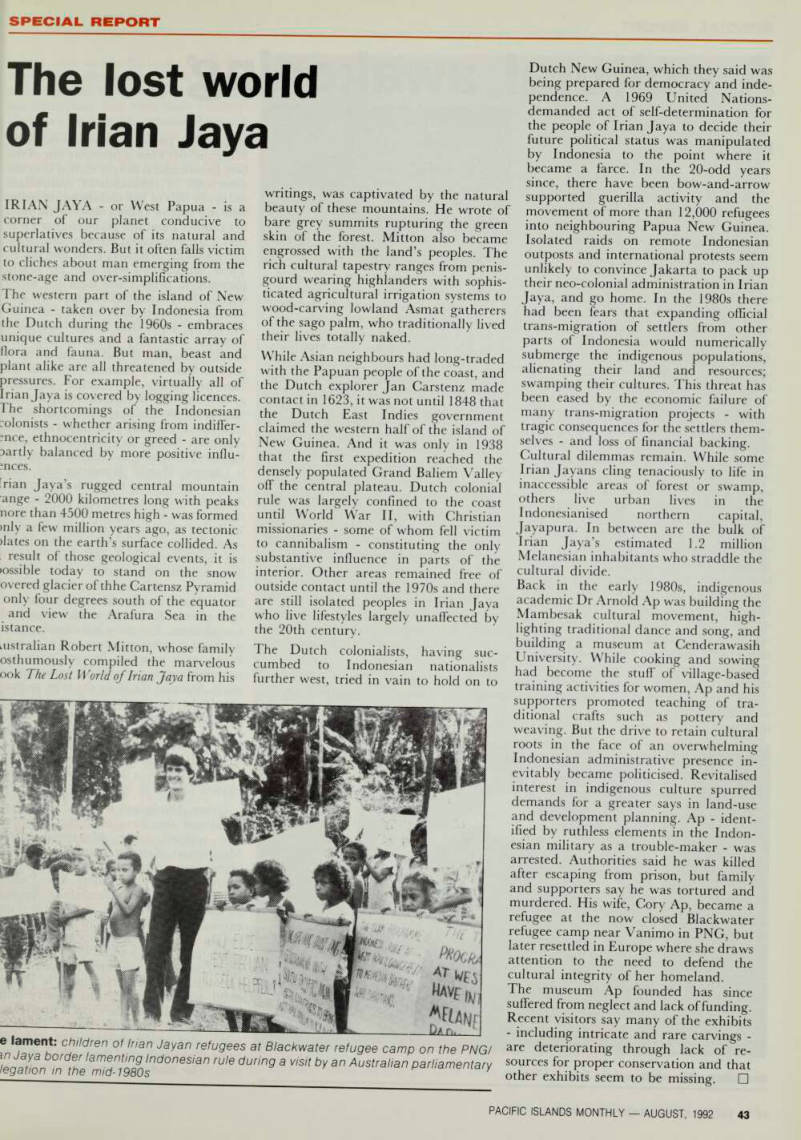
[?] lament: children of Irian Jayan refugees at Blackwater refugee camp on the PNG/ [?]n Jaya border lamenting Indonesian rule during a visit by an AuStralian parliamentary [?]egation in the mid-1980s