A cultural awakening
pp. 44-45 · Read in the full issue
By Liz Thompson
THERE IS a piercing cry from one of the leading actresses, the audience sits mesemerised in the darkness, many of them crying. The actors stand, still, staring straight ahead, holding wreathes.
There is a haunting, painful feeling carried throughout the theatre. They are mourning another Aboriginal death in custody. The play is Jack Davis’ Barungin or Smell the Wind. Davis is one of Australia’s leading playwrights and of Aboriginal descent. All his work looks at or draws on Aboriginal experience, culture and history. The audience is visibly moved by the performance; both through the convincing portrayal of pain and injustice by the actors and by the discomfort provoked in being confronted by some of the many horrors of modern Australian history. The majority of the audience is white. Plays like Davis’ are part of an increasingly powerful creative force which is fundamental to the rewriting of Australian history. Many of those Aboriginals who suffered at the hands of the shocking Australian assimi lation policy are describing their experi ences through the arts. An inhumane and barbaric policy, it advocated the removal of any mixed race children from their Aboriginal mothers, to be reared in white missions for their own benefit. The white Australian community are only being confronted with the reality of this official policy today and largely through artistic expression rather than dense, inaccess ible, historical accounts.
Obviously work produced by people of Aboriginal descent is hugely varied and, ln fact > « 15 probably wrong to continue to cla ?f lf V 11 °. r separate it as Aboriginal art - Tbe wor J k ls . Part °£ contemporary Australian identity and part of the mainstream Australian art scene. To dasslf >' >* as Aboriginal is to continue to marginalise it and is something which has bee " criticised by many Aboriginal artlsts - Des P‘ te tbls a S r f at deal ofartlstlc expression has focused on a common experience for it s inspiration. That is he colomalisation of Australia and the assimilation policy. This work is drawn together by a common thread and it is undeniably Aboriginal. It is about Australian history from an Aboriginal perspective and it has been a P. owe . rful P ohtlcal fOT . ce m this country for the last . two decades. I has proved
extremely challenging to prevailing
white attitude and has perhaps done „ , K E, .i- „ more to challenge them than anything 5 7 & On a literary level there have been a number of hugely influential books, Whilst there has been a great variety of styles, many have told, in the first person,
of people’s personal experiences. Sally Morgans’ My Place is probably one of the best known and is deeply etched into the conscience of thousands of Australians today. It tells of her childhood; of being told she was of Indian descent through her mother’s and her grandmother’s fear that if she announced she was Aboriginal she might be removed from her home.
Their fabrication was also no doubt partially to protect her from the social stigma that Aboriginal heritage brought with it. Morgan talks about her con fusion, her sense that things were more complex than they appeared and her ensuing struggles to find out the truth. A process that was extremely painful for her, her sister, her mother and her grandmother. It is extraordinary to read this as an oral history and understand that it is actually the experience of someone living in Australia today.
Equally disturbing and similar in content is Glenyse Wards’ Wandering Girl. Her story is about being taken away from her mother at the age of one literally sneaked out of the back door of a clinic while her mother waited in the waiting room. She grew up in missions, was hired out as a domestic servant and didn’t discover who her mother was until she was 18 years old. Her father had already died and she met her brother for the first time after he had a car accident, he died a week later. The story is harrowing and it is hard to believe it’s true and so recent.
Ward, now living in Broome with her two children, is remarkably generous in spirit. She told the story she says, so that people have a better understanding of what she and many others went through.
Not, she insists, out of bitterness, but that it is important that people understand what Aboriginal people went through.
Ward writes in a light narrative style, formed almost in verses.
Other Aboriginal writers have never developed this form of linear narrative and utilised what Aboriginal critic Mudrooroo Narogin considers a more ‘dreamtime consciousness’ type of style.
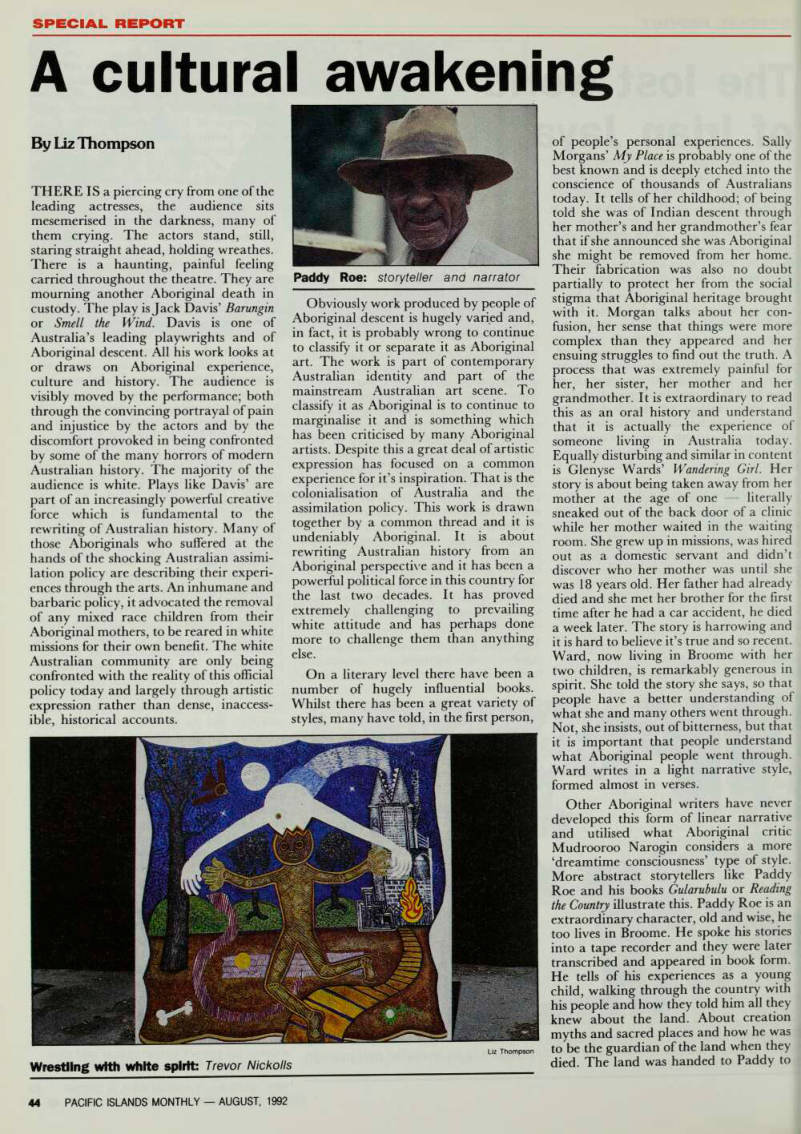
More abstract storytellers like Paddy Roe and his books Gularubulu or Reading the Country illustrate this. Paddy Roe is an extraordinary character, old and wise, he too lives in Broome. He spoke his stories into a tape recorder and they were later transcribed and appeared in book form.
He tells of his experiences as a young child, walking through the country with his people and how they told him all they knew about the land. About creation myths and sacred places and how he was to be the guardian of the land when they died. The land was handed to Paddy to
Liz Thompson
Wrestling with white spirit: Trevor Nickolls
Paddy Roe: storyteller and narrator
look after and in his books he gives us a greater understanding of the powerful and respectful relationship the Aborigi nal custodians had with their country.
He talks about the importance of passing this information to all people, white and black, that we must come together to look after the land. His books are his way of contributing to this process. They introduce many white Australians to ideas about land and relationships with it.
Magabala Publishing Company in Broome has published both Glenyse Ward and Paddy Roe’s books. An Aboriginal publishing house, it is the only one of it’s kind in Australia at present. It is committed not only to publishing the work of Aboriginal authors but also collecting traditional stories from elders before they die.
Theatre has been an equally powerful force. Davis’ Barungin is the third of a trilogy which included the The First Born and The Dreamers. The first contempor ary Aboriginal musical took to the stage in 1990 with Bran Nue Dae, one of the nost successfuul and widely publicised aroductions to date. Written by Jimmy 3hi, it traces his experiences and those of nany of his contemporaries. Bran Nue Dae celebrates Chi’s looking forward to i brand new day which is typified by
greater understanding, compassion and
icceptance.
Contemporary visual artists have been requently concerned not about posing >lack against white but about building
»ridges of greater understanding through
•resenting real experience. Artists like Tevor Nickolls, Les Griggs and Gordon •ennett all examine their experiences of eing of Aboriginal descent in what they ;e as a Eurocentric Australia. None of icm were actually placed in missions, lough Griggs spent several years in istitutions, including some time in rison. All of them paint the conflicts and Dnfusion they have experienced in Dming to terms with their heritage, ickolls expresses the conflict he feels
etween his Aboriginal spirit related to
ic land and a sense of harmony and ring with nature and his reality of living a small flat in a busy town and feeling ienated. Bennet often paints about ying to deconstruct his own ideas and ejudices towards ideas of boriginality. He didn’t discover he was Aboriginal descent until later in life id talks about how horrified he was. He id, he says, by the time he found out, ken on board prevalent white attitudes
tiich essentially saw Aboriginals as
tchetty grub eating ‘primitives’. He
plains how long it took him to eakdown those ideas and to come to
terms with and take pride in his own heritage. Both Nickolls and Bennet paint of other things too. Their work is constantly evolving and they are both powerful and influential artists in Austra lia, However, much of their early work is caught up in exploring these issues and communicating these explorations to the public at large.
While artists of Aboriginal descent are moving in as many directions as any other artists, this core of work based on a common theme has made a formidable and specific impact on the Australian psyche. Not only white but Aboriginal
Australia. Many people of Aboriginal
descent talk of a greater pride and sense of identity being forged in their own
community through the telling of these stories and the strength found in common experience. Australia has often been seen as culturally nebulous, suffering from a ‘cultural cringe’ and continuing to draw its sense of identify from Europe. Many speculate that this is because it hasn’t yet come to terms with some of the uglier sides of its own history until recently steeped in heroic white folklore. The work of many of these artists has assisted in providing the other side of the story and so marks the beginnings of Australia coming to terms with its past. There is no doubt these contemporary art forms are one of the most potent commentaries to have come out of modern Australia to date. □
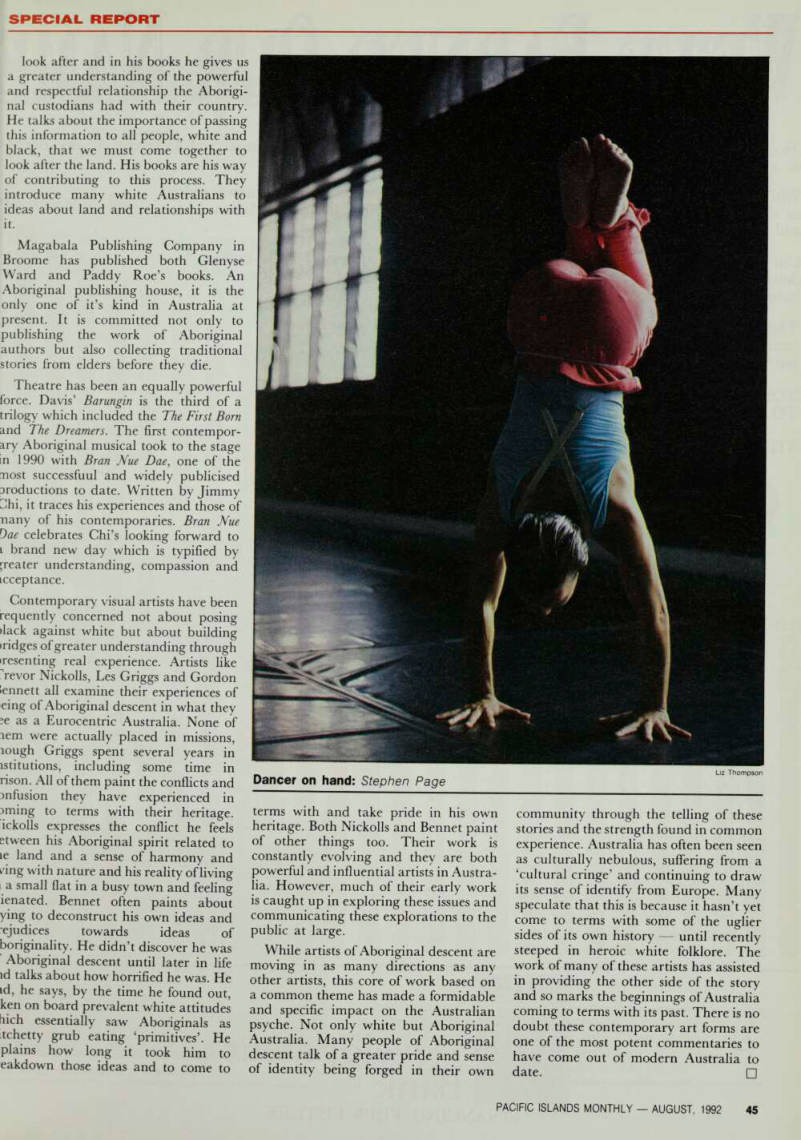
Dancer on hand: Stephen Page
Liz Thompson