sovereignty
pp. 41-42 · Read in the full issue
Chamorro rights groups seek sovereignty
By David North
During the 1987 coups in Fiji, the Guam political status commission’s executive director publicly expressed sympathy and support for the coup leaders. Simon Sanchez Jr., a Harvard-educated leader from a prominent Guam family, said the island’s Chamorro people those who regard themselves as tthe descendants of the indigenous inhabitants of the island felt solidarity with Fijians who were rying to regain political control of their lomeland. The endorsement shocked ;ome observers in the prosperous, multi :ultural, U.S. territory because it could )e interpreted as condoning force as a neans of resolving political disputes imong ethnic groups. Though Sanchez lenied his statement endorsed violence, lis views accurately reflected the increas ngly pointed and outspoken politics of he Chamorro indigenous rights move nent on Guam.
That campaign, begun in the early 970’s as a Chamorro studies and ultural awareness effort, has evolved ver the past two decades into a force
lat has significantly shaped Guam’s
olitical status negotiations with the Inited States and forced legal and olitical concessions from the island’s ected leadership. Many of the move icnt’s leaders are young US-educated ttorneys, educators, environmentalists id activists. A number of elected Guam aders avidly support Chamorro right sues, while others fear to oppose the digenous groups of highly emotional isitions. While no purely Chamorro leader has been elected to office on at form a conscioueness-raising effort ntred on a University of Guam hamorro studies program. It was fed by
several streams, including the U.S. civil rights and anti-Vietnam War protests of the late ’6os and early 70’s, the de colonisation movement in the South Pacific, and the self-determination pro cess that led to the dissolution of the US trusteeship of Mirconesia. Among the major founding projects at the University of Guam were Chamorro language and cultural preservation classes, rewriting island history from an indigenous per spective, as well as comparative studies of other Pacific island peoples and cultures.
Through local legislation these studies were spread to the secondary and elementary schools, annual cultural fairs
were begun, programs were created to encourage indigenous artists, and Chamorro was mandated as a language of government.
In the early 1980’s the movement reached out for a broader spectrum of support, including those concerned about burgeoning tourism, environ mental issues, and the nuclear-free Pa cific movement. Environmental quality has become a popular, island-wide issue as Japanese-driven tourism growth has placed increasing pressure on land, ocean resources, and public utilities. Ironically, Japanese tourism also helped generate increased interest in the Chamorro past.
As excavations for hotel foundations dug
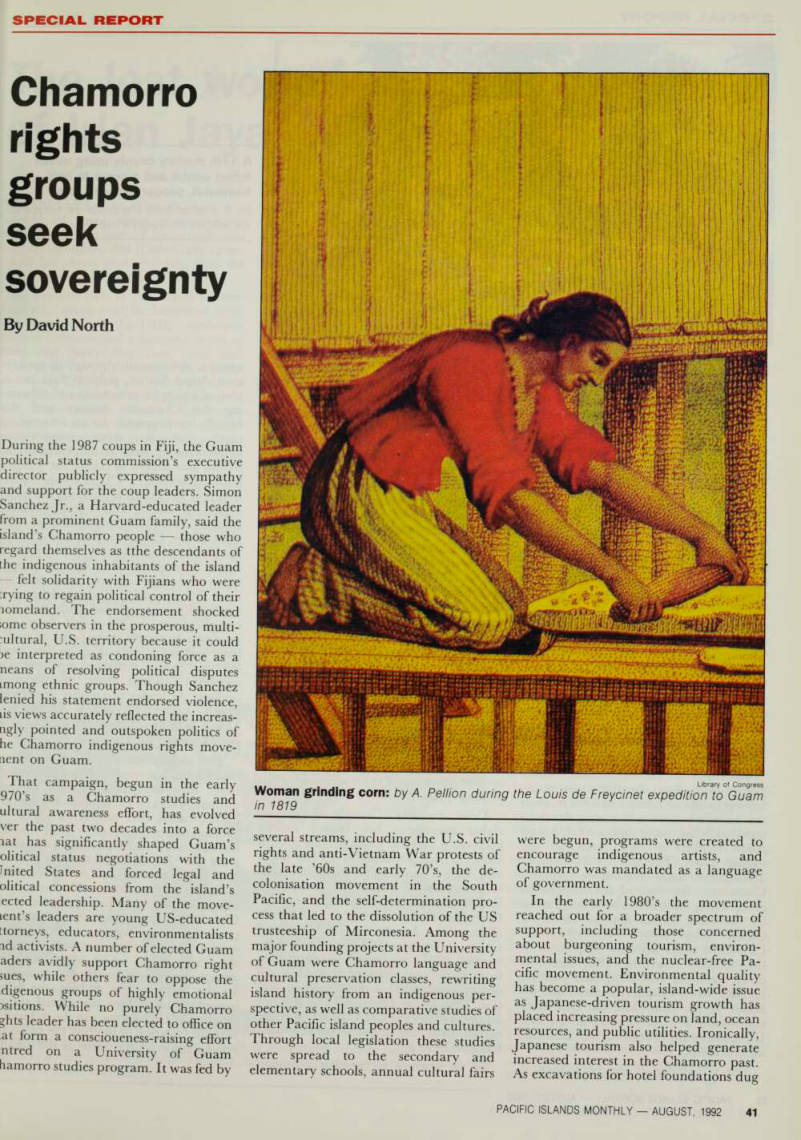
Library of Congress Woman grinding corn: by A. Pellion during the Louis de Freycinet expedition to Guam in 1819
up traditional village and grave sites, archaeologists and anthropologists were able to gather impressive new knowledge about the ancient Chamorro people.
The most tangible accomplishment of the movement in the 1980 s was its push for political self-determination for the indigenous Chamorros and its influence on Guam’s Draft Commonwealth Bill, a measure which local leaders have pres ented to the US Congress as a blueprint for a new political relationship. The bill outlines a commonwealth status for the island, with some of the provisions calling
for unprecedented political autonomy.
One of the measure’s most critical provisions would limit the ultimate choice of a political status for Guam (at some unspecified future date) to only Chamorro voters, excluding Filipino- Americans, state-siders and other non- Chamorro US citizens. US leaders have said that provision would violate US constitutional protection which guaran tees the voting rights of all US citizens
and prohibits ethnically discriminatory
voter registration laws.
The core issue for the Chamorro rights groups throughout the 1980 s was main taining political control of Guam amid the island’s booming economic develop ment and the rapid influx of US and Asian workers to build and run the tourist hotels. Though the 21-member unicameral local legislature remains Chamorro, the fear of the indigenous group losing control has been heightened by the 1990 census figures. Those on Guam who regard themselves as Chamorro make up only 37 percent of the 135,000 residents. That figure is down eight per cent from their position in 1980, when Chamorros accounted for about 45 per cent. The last time they constituted a majority was in the late 1970 s before the tourism-driven develop ment took off.
The remainder of the population is
about 22 per cent Filipino-Americans, 15 per cent state-siders, including about 20,000 US militry personnel and depen dents. The Filipino community began to grow after World War 11, when thou sands of Tagalog and Visayan workers were brought to Guam to rebuild the war-devastated island. Taiwanese, South Koreans, Japanese, and Micronesians, who have come to Guam to fill tourism and construction jobs, complete the multi-ethnic spectrum on the island.
The Chamorros are still the single largest ethnic group and voting block on Guam and control the local government. Their close-knit extended family systems guarantee high voter turnouts, while most of the state-siders
primarily transient military personnel
and dependents do not normally participate in local elections. The Filipino-American community, however, does vote in large numbers and has elected several representatives to political office in the island. Yet, in stark numerical terms, the Chamorros have been a minority on the island for more than a decade and are becoming a smaller per cent of the whole with each
passing year.
Until recently Guam’s indigenous rights movement has lacked unified leadership. Several small private groups have carried the torch on ad hoc issues and special causes. These include the Organisation of People for Indigenous Rights, the Guam National Party for Free Association, Protehi I Tano’ta (Protect the Land), Para PADA, and Chamoru Grassroots Movement. In Sep tember 1991, however, representatives from these organisations formed a co ordinating group the Chamoru Na tion Traditional Council. (The group’s founders prefer the CHAMORU spelling rather than the more generally used
Chamorro.)
In an attempt to develop a unified
agenda, the council, through its spokes man Angel Santos, publicly, laid out a plan of action for preserving and enhanc ing the Chamorro culture and the island’s environment. In an attempt to reach out to more conservative Chamorros as well as non-Chamorros, Santos also sought to clarify the group’s political agenda “It is a misconcep tion that the group is pursuing indepen dence, he said. “Our quest is sover eignty,” which the group defines as “the right of the Chamoru people to decide the destiny of our nation ...” Sovereignty means “the rights of the Chamoru people to protect their culture and environ ment,” Santos said. “Independence is a totally different political path that has complications ... We don’t have the resources to rectify those political prob lems and we’ll leave it up to our local leaders.” Santos’ statement represented a significant change from his previous outlook. As leader of another grassroots group called CHELUS (Brothers), Santos as late as 1990 had urged political independence for Guam.
The indigenous rights co-ordinating council also has tried to dispel the notion that the indigenous rights group ultimately seeks a Chamorro-only island.
Santos called that notion “a myth propaganda perpetrated by those who do not have a full understanding of what our goals are.” He explained that the group’s goal is “a constitution ... to protect the indigenous rights of the Chamoru and safeguard the civil rights of the non- Chamoru. Force is not the proper way to promote these concerns. We attest mutual respect of one another/’ Despite these assurances, many non-Chamorro groups see critical questions remaining for the movement to address, the most important being how the special rights sought for Chamorros can be achieved without violating or limiting the rights of non-Chamorro US citizens on the island.
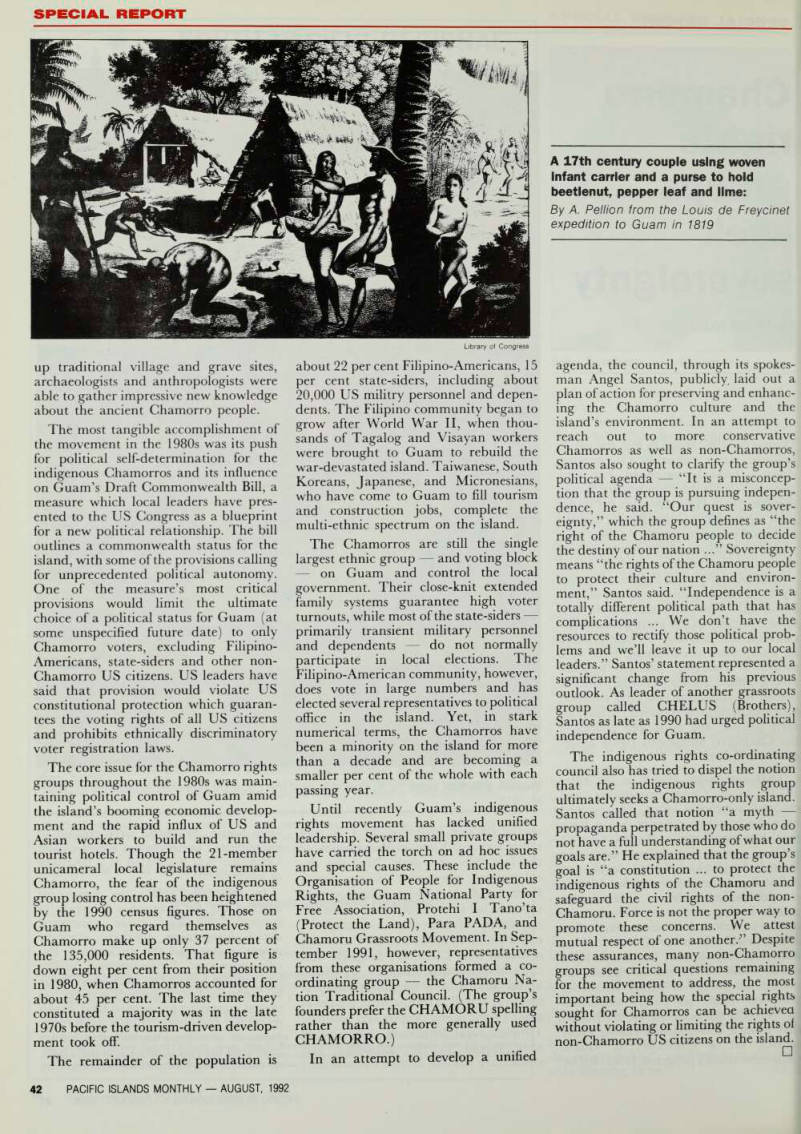
Library of Congress
A 17th century couple using woven Infant carrier and a purse to hold beetlenut, pepper leaf and lime: By A. Pellion from the Louis de Freycinet expedition to Guam in 1819