Culture and Commerce
pp. 39-40 · Read in the full issue
the double-edged sword of the Maori fight-back
By Karen Mangnal
JOHN TAMIHERE is a renaissance man. He’s in the vanguard of a Maori awakening. As the chief executive of West Auckland’s Te Whanau o Waipareira Trust, John Tamihere, goes into battle clad in a natty business suit, wielding his law degree and the corpor ate plan. Local Maori are “clients” who achieve “successful outcomes” by “ac cessing” the trust’s “outputs”.
“For us to be around in five or 10 years, there’s nothing better than talking back to the powers-that-be in their own language.” Tamihere gives a saboteur’s grin. “It excites them to see a clone.”
Tamihere admits his vocabulary is a
shock to some Maori. “They’re happy
hiding on a mattress at a hui on a marae,” he says. “But when they get around a conference table they’re not up to it,”
Tamihere says. “We must always hold true to the traditions handed down by Dur ancestors... but have to learn the skills of the Pakeha.”
Te Whanau o Waipareira is learning Bose skills so well, and training Maori so dfectively, the trust is beginning to erode he monopoly of education and skills raining held by state schools and polytechnics. So far 680 trainees have
passed through Waipareira’s vocational
raining programs ranging from agricul ure, bone carving, catering and compu ers to telemarketing and panel beating.
“We say the polytechs are imposters,” ays Tamihere. “So started our own raining. This year Waipareira filled half
he 260 jobs created nationally from
daori ACCESS programs.” Tamiheere ays Waipareira has an 85 per cent pass ate on its own vocational schemes ompared to the massive attrition Maori tudents suffer at polytechnics. “We train eople, not just Maori either, ranging om illiterates to those wanting to start neir own businesses.”
The trust has an above average success ate in its MANA venture capital fund. )f the 60 entrepreneurs put through nail business training, 30 are now in usiness. They are kept under close
lonthly scrutiny by Waipareira’s ac
puntancy and legal units, plus an
advisory group of 15 successful retired business people from West Auckland.
“We are now the only Maori organis ation in the country contracted by the Labour Department to provide this range and level of skills training,” says Tamihere. Waipareira has taken the program one step further and now employs some of its graduates to provide contract services, like garbage collection, for local authorites and other agencies.
Waipareira and the nearby Hoani
Waititi Marae are pan-tribal, reflecting the 85 per cent of Maori who now live in urban areas. John Tamihere says Waipareira is putting together the pieces of Maori social and economic structures shattered by decades of relocating Maori workers to manual labour in the cities, and by “pepper-potting” Maori families in Pakeha suburbs. The appalling stat istics on health, unemployment, crime and imprisonment bear witness to the lost generations of Maori.
“Everybody calls them Maori, but do they know who they are? No,” says Tamihere. “So we need to bridge that lack of self-esteem and language is the key component in that.”
In 1983, Aroha Sharpies helped set up at Hoani Waititi Marae one of the first kohanga reo , or Maori pre-schools, in New Zealand. Aroha Sharpies says initially kohanga reo graduates would get to a state primary school and be assessed as illiterate in English. “But because no-one measured their competancy in Maori language, these children were considered to be completely illiterate. So we had parents refusing to send their five-year olds to primary school. That’s why we
started the kura kaupapa in 1985.”
The country’s first Maori primary and intermediate school has enabled kohanga reo graduates to continue their education using Maori as the sole language of instruction and directly involving the children’s extended families in their
schooling. As kura kaupapa principal from
1988 to the end of 1991, Aroha Sharpies says the benefits of the system are now evident as the first crop of graduates entered state secondary schools this year.
“I see those students being very confident about furthering their educa tion at higher levels,” she says. “All five graduates are in the third form but two of them are studying for School Certifi cate Maori and the other three are
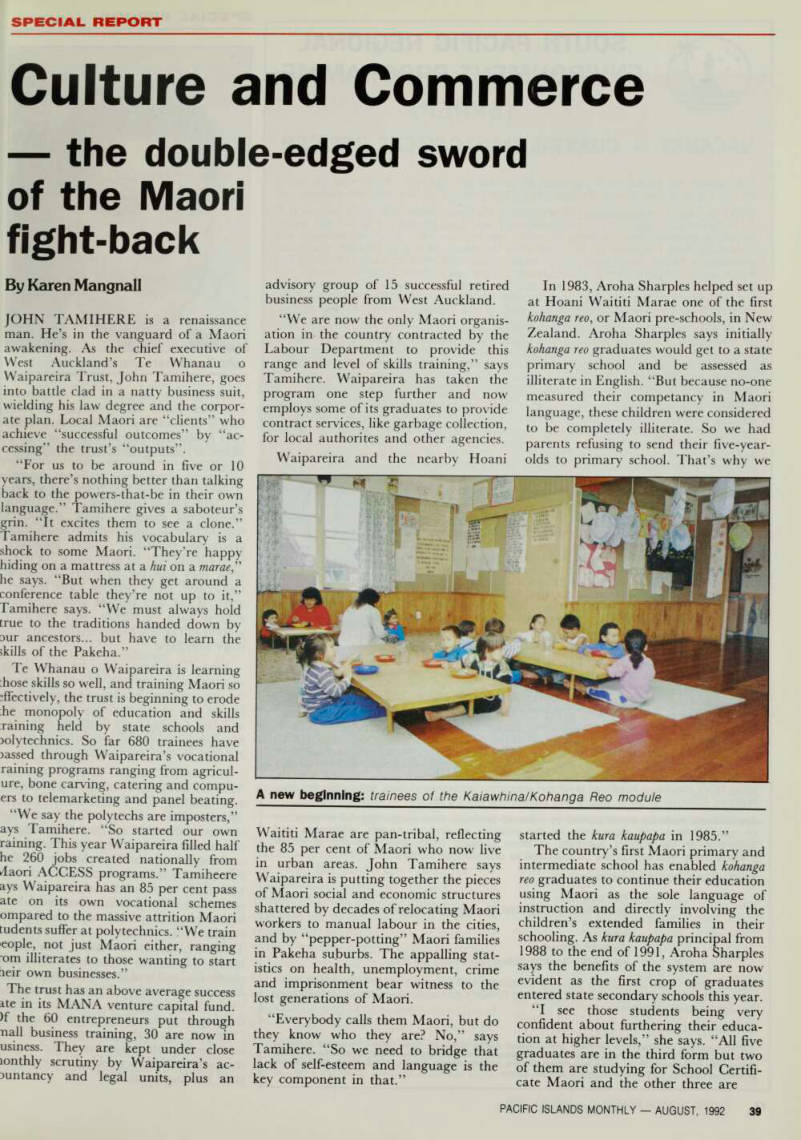
A new beginning: trainees of the Kaiawhina/Kohanga Reo module
studying the language at University Entrance level. In a couple of years they’ll be studying Maori at university.
And Aroha Sharpies says their success at Maori is rubbing off in overall academic excellence.
Aroha Sharpies says these five gradu ates pose a huge challenge to the existing educational system. “State secondary schools have nothing more to teach these graduates regarding Maori language.
Why should they have to waste five years until they can get to study Maori at university?” And perhaps more import antly, if the kura kaupapa graduates can achieve such excellence, why are state schools still failing Maori students in such huge numbers?
John Tamihere says for too long society has blamed poor Maori parenting for their children’s failure at school. “But 85 per cent of our students at kohanga reo and kura kaupapa have domestic difficult ies. But they are still performing above average in core curriculum areas.”
Waipareira has just asked Education Minister Lockwood Smith for permission and funding for a wharekura kaupapa Maori , a full secondary school teaching the standard core curriculum, using a mixture of Maori language immersion and English. Aroha Sharpies says by the third year, students would be receiving two-thirds of their education in subjects specific to their chosen vocations. It’s a
logical progression in Waipareira’s phil
osophy of self-development. John Tamihere says while most New Zea landers focus on Waitangi Tribunal claims for land and assets, the proportion of assets returned to Maori is minimal.
“What’s exciting here is we can fund development ourselves,” says Tamihere.
“We can say to the government, ‘Look at those imposters out there’. We’ve got this program that’s working, so re-direct your funding to us.” O
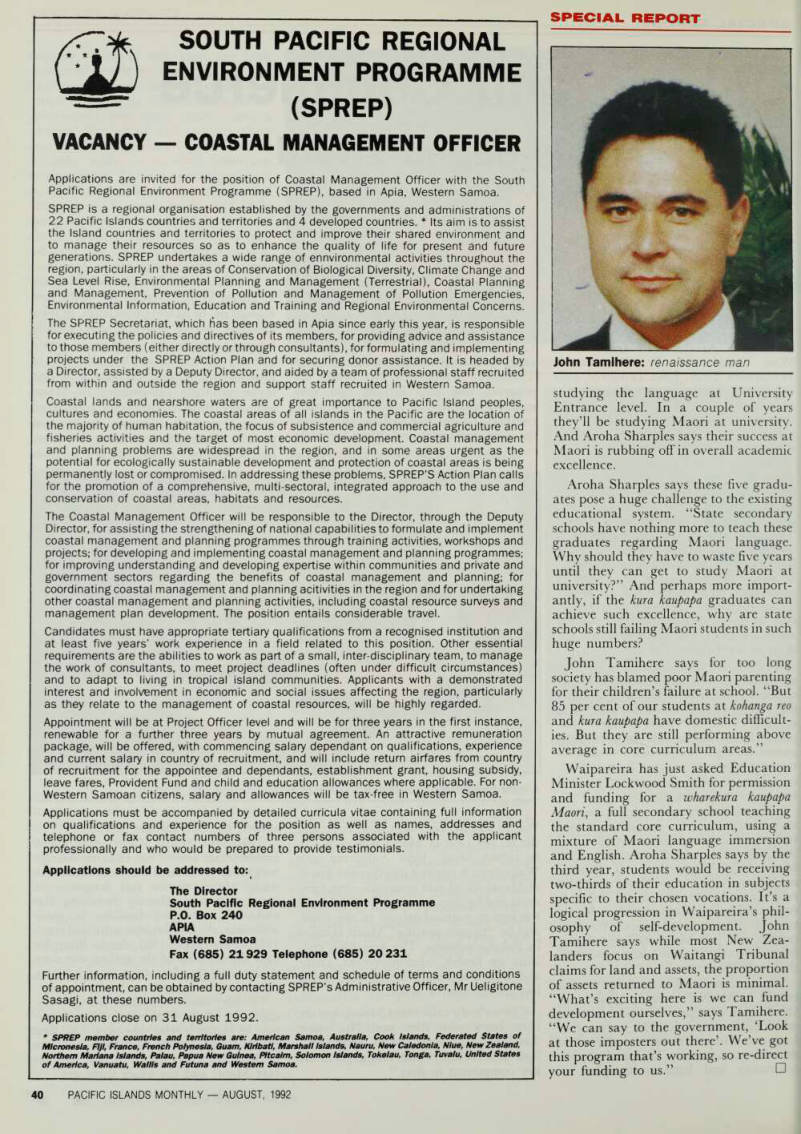
John Tamihere: renaissance man