The art of survival
pp. 37-38 · Read in the full issue
By Liz Thompson
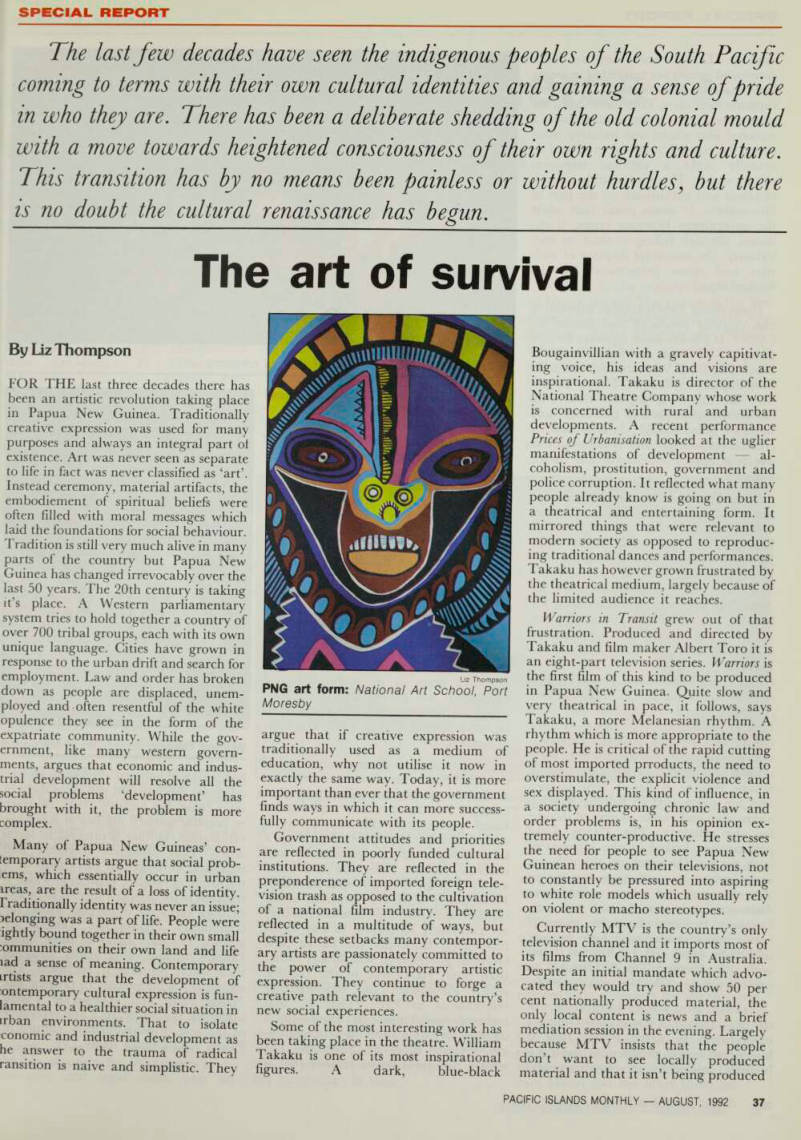
FOR THE last three decades there has been an artistic revolution taking place in Papua New Guinea. Traditionally creative expression was used for many purposes and always an integral part ol existence. Art was never seen as separate to life in fact was never classified as ‘art’.
Instead ceremony, material artifacts, the embodiement of spiritual beliefs were often filled with moral messages which laid the foundations for social behaviour.
Tradition is still very much alive in many parts of the country but Papua New Guinea has changed irrevocably over the last 50 years. The 20th century is taking it’s place. A Western parliamentary system tries to hold together a country of over 700 tribal groups, each with its own unique language. Cities have grown in response to the urban drift and search for employment. Law and order has broken down as people are displaced, unem ployed and often resentful of the white opulence they see in the form of the expatriate community. While the gov ernment, like many western govern ments, argues that economic and indus trial development will resolve all the
social problems ‘development’ has
brought with it, the problem is more complex.
Many of Papua New Guineas’ con temporary artists argue that social prob ems, which essentially occur in urban ireas, are the result of a loss of identity.
Fraditionally identity was never an issue; belonging was a part of life. People were ightly bound together in their own small immunities on their own land and life
lad a sense of meaning. Contemporary
irtists argue that the development of :ontemporary cultural expression is fun lamental to a healthier social situation in irban environments. That to isolate conomic and industrial development as he answer to the trauma of radical
ransition is naive and simplistic. They
argue that if creative expression was traditionally used as a medium of education, why not utilise it now in exactly the same way. Today, it is more important than ever that the government finds ways in which it can more success fully communicate with its people.
Government attitudes and priorities are reflected in poorly funded cultural institutions. They are reflected in the preponderence of imported foreign tele vision trash as opposed to the cultivation of a national film industry. They are reflected in a multitude of ways, but despite these setbacks many contempor ary artists are passionately committed to the power of contemporary artistic expression. They continue to forge a creative path relevant to the country’s new social experiences.
Some of the most interesting work has been taking place in the theatre. William Takaku is one of its most inspirational figures. A dark, blue-black
Bougainvillian with a gravely capitivat ing voice, his ideas and visions are inspirational. Takaku is director of the National Theatre Company whose work is concerned with rural and urban
developments. A recent performance
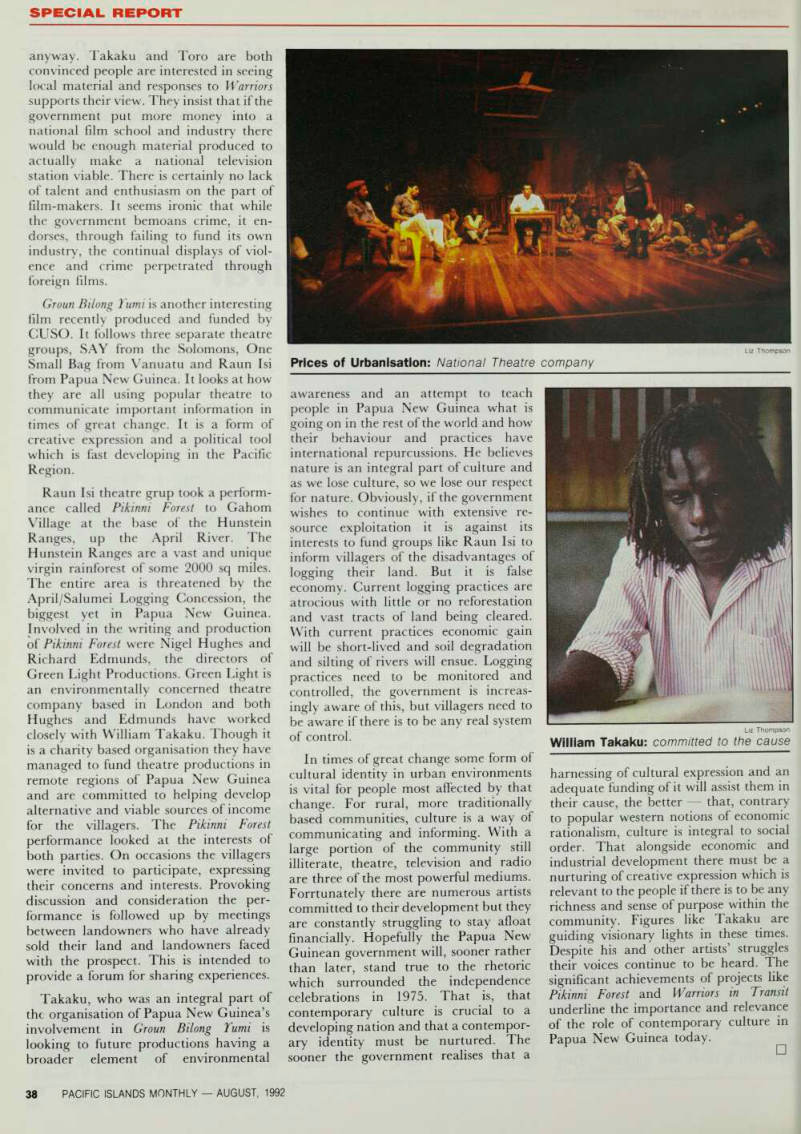
Prices of Urbanisation looked at the uglier manifestations of development al coholism, prostitution, government and police corruption. It reflected what many people already know is going on but in a theatrical and entertaining form. It mirrored things that were relevant to modern society as opposed to reproduc ing traditional dances and performances.
Takaku has however grown frustrated by the theatrical medium, largely because of the limited audience it reaches.
Warriors in Transit grew out of that frustration. Produced and directed by Takaku and film maker Albert Toro it is an eight-part television series. Warriors is the first film of this kind to be produced in Papua New Guinea. Quite slow and very theatrical in pace, it follows, says Takaku, a more Melanesian rhythm. A rhythm which is more appropriate to the people. He is critical of the rapid cutting of most imported prroducts, the need to overstimulate, the explicit violence and sex displayed. This kind of influence, in a society undergoing chronic law and order problems is, in his opinion ex tremely counter-productive. He stresses the need for people to see Papua New Guinean heroes on their televisions, not to constantly be pressured into aspiring to white role models which usually rely on violent or macho stereotypes.
Currently MTV is the country’s only television channel and it imports most of its films from Channel 9 in Australia.
Despite an initial mandate which advo cated they would try and show 50 per cent nationally produced material, the only local content is news and a brief mediation session in the evening. Largely because MTV insists that the people don’t want to see locally produced material and that it isn’t being produced
Liz Thompson PNG art form: National Art School, Port Moresby
anyway. Takaku and Toro are both convinced people are interested in seeing local material and responses to Warriors supports their view. They insist that if the government put more money into a national film school and industry there would be enough material produced to actually make a national television station viable. There is certainly no lack of talent and enthusiasm on the part of film-makers. It seems ironic that while the government bemoans crime, it en dorses, through failing to fund its own industry, the continual displays of viol ence and crime perpetrated through foreign films.
Groun Bilong Tumi is another interesting film recently produced and funded by CUSO. It follows three separate theatre groups, SAY from the Solomons, One Small Bag from Vanuatu and Raun Isi from Papua New Guinea. It looks at how they are all using popular theatre to communicate important information in times of great change. It is a form of creative expression and a political tool which is fast developing in the Pacific Region.
Raun Isi theatre grup took a perform ance called Pikinni Forest to Gahom Village at the base of the Hunstein Ranges, up the April River. The Hunstein Ranges are a vast and unique virgin rainforest of some 2000 sq miles.
The entire area is threatened by the April/Salumei Logging Concession, the biggest yet in Papua New Guinea.
Involved in the writing and production of Pikinni Forest were Nigel Hughes and Richard Edmunds, the directors of Green Light Productions. Green Light is an environmentally concerned theatre company based in London and both Hughes and Edmunds have worked closely with William Takaku. Though it is a charity based organisation they have managed to fund theatre productions in remote regions of Papua New Guinea and are committed to helping develop alternative and viable sources of income for the villagers. The Pikinni Forest performance looked at the interests of both parties. On occasions the villagers were invited to participate, expressing their concerns and interests. Provoking discussion and consideration the per formance is followed up by meetings between landowners who have already sold their land and landowners faced with the prospect. This is intended to provide a forum for sharing experiences.
Takaku, who was an integral part of the organisation of Papua New Guinea’s involvement in Groun Bilong Tumi is looking to future productions having a broader element of environmental
awareness and an attempt to teach people in Papua New Guinea what is going on in the rest of the world and how their behaviour and practices have international repurcussions. He believes nature is an integral part of culture and as we lose culture, so we lose our respect for nature. Obviously, if the government wishes to continue with extensive re source exploitation it is against its interests to fund groups like Raun Isi to inform villagers of the disadvantages of logging their land. But it is false economy. Current logging practices are atrocious with little or no reforestation and vast tracts of land being cleared.
With current practices economic gain will be short-lived and soil degradation and silting of rivers will ensue. Logging practices need to be monitored and controlled, the government is increas ingly aware of this, but villagers need to be aware if there is to be any real system of control.
In times of great change some form of cultural identity in urban environments is vital for people most affected by that change. For rural, more traditionally based communities, culture is a way of communicating and informing. With a large portion of the community still illiterate, theatre, television and radio are three of the most powerful mediums.
Forrtunately there are numerous artists committed to their development but they are constantly struggling to stay afloat financially. Hopefully the Papua New Guinean government will, sooner rather than later, stand true to the rhetoric which surrounded the independence celebrations in 1975. That is, that contemporary culture is crucial to a developing nation and that a contempor ary identity must be nurtured. The sooner the government realises that a
harnessing of cultural expression and an adequate funding of it will assist them in their cause, the better that, contrary to popular western notions of economic rationalism, culture is integral to social order. That alongside economic and industrial development there must be a nurturing of creative expression which is relevant to the people if there is to be any richness and sense of purpose within the community. Figures like Takaku are guiding visionary lights in these times.
Despite his and other artists’ struggles their voices continue to be heard. The significant achievements of projects like Pikinni Forest and Warriors in Transit underline the importance and relevance of the role of contemporary culture in Papua New Guinea today.
Prices of Urbanisation: National Theatre company
Liz Thompson
Liz Thompson William Takaku: committed to the cause