Fiji’s new tax proposal,
pp. 13-15 · Read in the full issue
Business
Fiji’s new tax proposal, and what it means
Fiji implemented its
Value Added Tax scheme in July, but the fight against it continues
By Asha Lakhan
A GENERAL consumption tax hit the stores of Fiji last month despite heavy pressure on the new Rabuka government to at least defer its implementation, if not scrap it altogether. Known as the Value Added Tax, it imposes a levy on almost all goods and services in the country, with a few exemptions. It came into effect after a year of government publicity describing it as “good for you, me and Fiji”.
With the implementation of VAT, Fiji ;wallows yet another dose of the Interna ional Monetarey Fund/World Bank Drescription for Third World countries in
inancial problems.
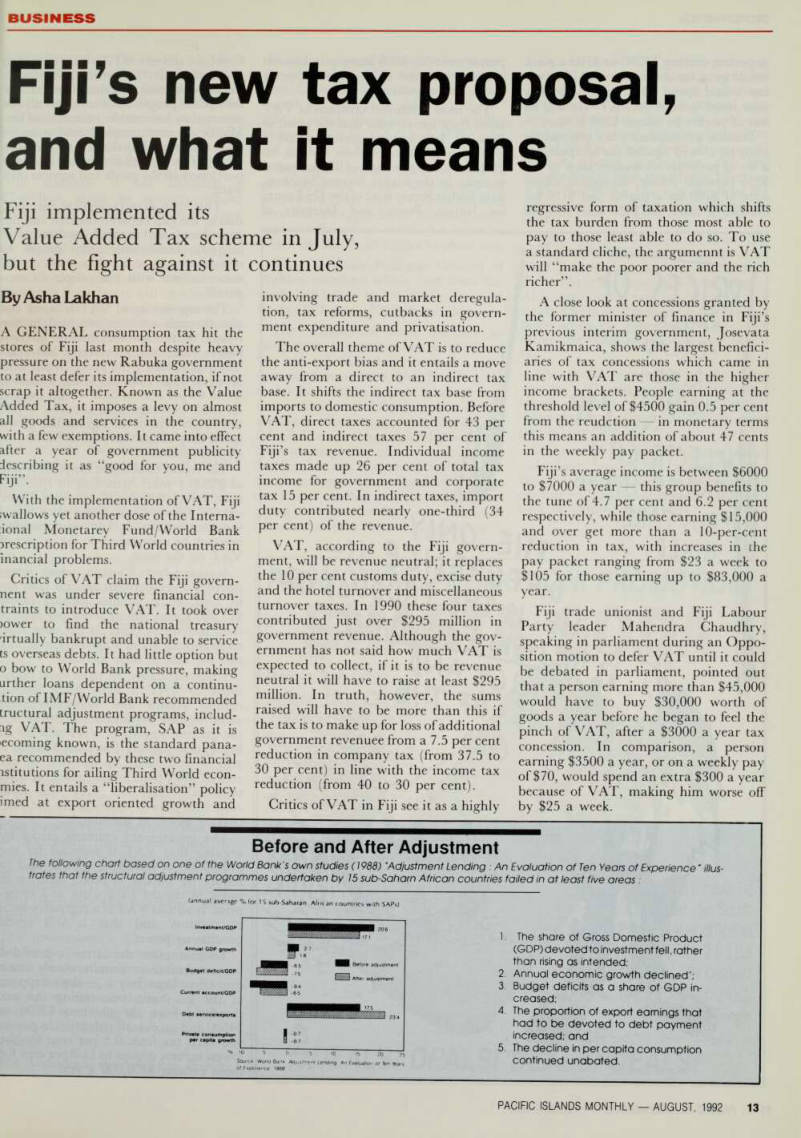
Critics of VAT claim the Fiji govern nent was under severe financial con traints to introduce VAT. It took over >ower to find the national treasury drtually bankrupt and unable to service ts overseas debts. It had little option but o bow to World Bank pressure, making arther loans dependent on a continu tion of IMF/World Bank recommended tructural adjustment programs, includ ig VAT. The program, SAP as it is ecoming known, is the standard pana ea recommended by these two financial istitutions for ailing Third World econ mies. It entails a “liberalisation” policy imed at export oriented growth and
involving trade and market deregulation, tax reforms, cutbacks in government expenditure and privatisation.
The overall theme of VAT is to reduce the anti-export bias and it entails a move away from a direct to an indirect tax base. It shifts the indirect tax base from imports to domestic consumption. Before VAT, direct taxes accounted for 43 per cent and indirect taxes 57 per cent of Fiji’s tax revenue. Individual income taxes made up 26 per cent of total tax mco ™ e for government and corporate ' ax 15 P er “ nt In ‘"direct taxes, import “ ut y contributed nearly one-third (34 P er cent ) °* t ” e revenue - VAT, according to the Fiji government, will be revenue neutral; it replaces tlie 10 per cent customs duty, excise duty and the hotel turnover and miscellaneous turnover taxes. In 1990 these four taxes contributed just over $295 million in government revenue Although the governmen t has not said how much VAT is expected to collect, if it is to be revenue ne ‘' tral ltwlll have to raise at least $295 m ! lh ° n . l I " truth > however, the sums raised will have to be more than this if the tax is to make up for loss of additional government revenuee from a 7.5 per cent reduction m company tax (from 37.5 to 30 per cent) in line with the income tax reductlon ( from 40 to 30 per cent).
Critics of VAT in Fiji see it as a highly
regressive form of taxation which shifts the tax burden from those most able to pay to those least able to do so. To use a standard cliche, the argumennt is VAT will “make the poor poorer and the rich richer”, A close look at concessions granted by the former minister of finance in Fiji’s previous interim government, Josevata Kamikmaica, shows the largest benefici aries of tax concessions which came in line with VAT are those in the higher income brackets. People earning at the threshold level of $4500 gain 0.5 per cent from the reudction in monetary terms this means an addition of about 47 cents in the weekly pay packet.
Fiji’s average income is between $6OOO to $7OOO a year this group benefits to the tune of 4.7 per cent and 6.2 per cent respectively, while those earning 515,000 and over get more than a 10-per-cent reduction in tax, with increases in the pay packet ranging from 523 a week to SIOS for those earning up to 583,000 a year.
Fiji trade unionist and Fiji Labour
Party leader Mahendra Chaudhry,
speaking in parliament during an Oppo sition motion to defer VAT until it could be debated in parliament, pointed out that a person earning more than 545,000 would have to buy 530,000 worth of goods a year before he began to feel the pinch of VAT, after a S3OOO a year tax concession. In comparison, a person earning 53500 a year, or on a weekly pay of $7O, would spend an extra S3OO a year because of VAT, making him worse off by 525 a week.
A person earning $5200 or SIOO a week would get a tax concession of SI 15 a year but would spend S 8 a week or $4OO a year more because of VAT. He will be ou * P oc^et b Y about S3OO a year.
Besides, government s tax concessions must be viewed against the scrapping of a lot of previous allowances such as the 5255 personal rebate, dependent allowance of SlOO for a parent and Sl5O for brother or sister, the $750 allowance for
people over 55, $5OO home purchase on interests and the $5OO cyclone reserve cover, among others.
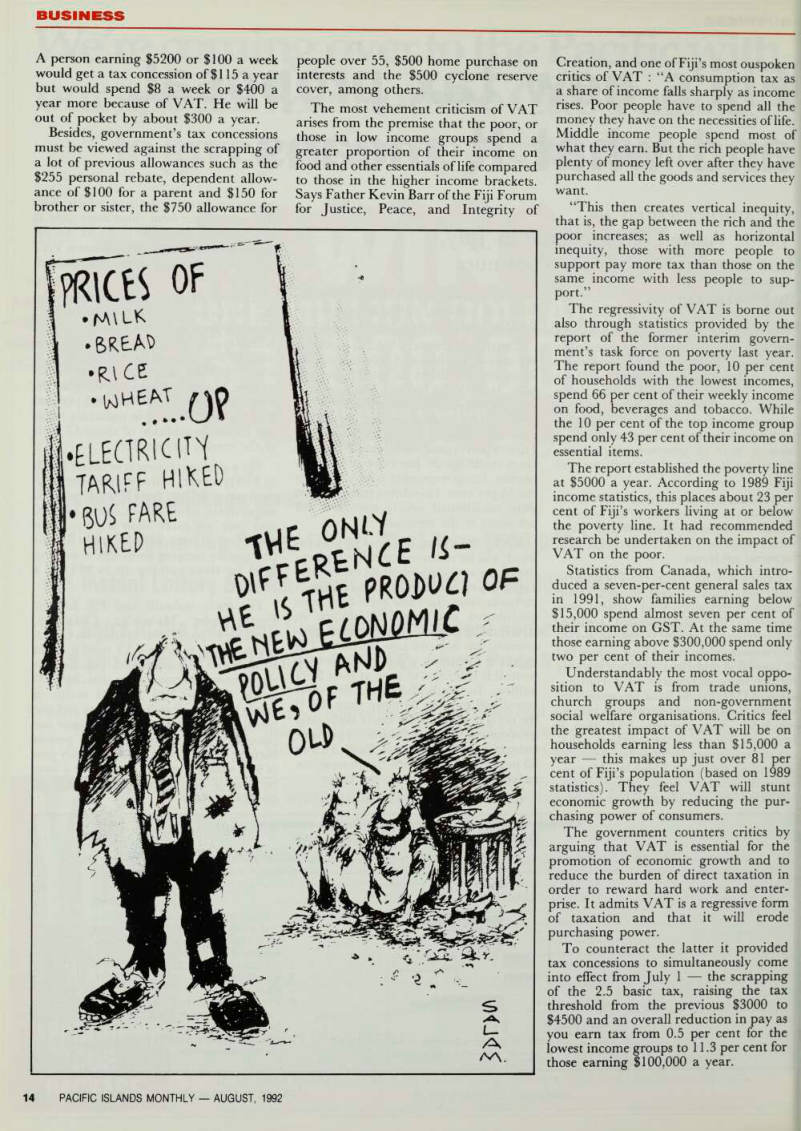
The most vehement criticism of VAT arises from the premise that the poor, or those in low income groups spend a greater proportion of their income on food and other essentials of life compared to those in the higher income brackets.
Says Father Kevin Barr of the Fiji Forum for Justice, Peace, and Integrity of
Creation, and one of Fiji’s most ouspoken critics of VAT : “A consumption tax as a share of income falls sharply as income rises. Poor people have to spend all the money they have on the necessities of life.
Middle income people spend most of what they earn. But the rich people have plenty of money left over after they have purchased all the goods and services they want.
“This then creates vertical inequity, that is, the gap between the rich and the poor increases; as well as horizontal inequity, those with more people to support pay more tax than those on the same income with less people to sup port.”
The regressivity of VAT is borne out also through statistics provided by the report of the former interim govern ment’s task force on poverty last year.
The report found the poor, 10 per cent of households with the lowest incomes, spend 66 per cent of their weekly income on food, beverages and tobacco. While the 10 per cent of the top income group spend only 43 per cent of their income on essential items.
The report established the poverty line at $5OOO a year. According to 1989 Fiji income statistics, this places about 23 per cent of Fiji’s workers living at or below the poverty line. It had recommended research be undertaken on the impact of VAT on the poor.
Statistics from Canada, which intro duced a seven-per-cent general sales tax in 1991, show families earning below 515,000 spend almost seven per cent of their income on GST. At the same time those earning above $300,000 spend only two per cent of their incomes.
Understandably the most vocal oppo sition to VAT is from trade unions, church groups and non-government social welfare organisations. Critics feel the greatest impact of VAT will be on households earning less than $15,000 a year this makes up just over 81 per cent of Fiji’s population (based on 1989 statistics). They feel VAT will stunt economic growth by reducing the pur chasing power of consumers.
The government counters critics by arguing that VAT is essential for the promotion of economic growth and to reduce the burden of direct taxation in order to reward hard work and enter prise. It admits VAT is a regressive form of taxation and that it will erode purchasing power.
To counteract the latter it provided tax concessions to simultaneously come into effect from July 1 the scrapping of the 2.5 basic tax, raising the tax threshold from the previous $3OOO to $4500 and an overall reduction in pay as you earn tax from 0.5 per cent for the lowest income groups to 11.3 per cent for those earning $lOO,OOO a year.
To further cushion the impact of VAT on the poor, it has made certain items VAT free such as fresh farm produce or unprocessed local foods, including fish and fresh poultry, school fees and general school-related items such as text books, uniforms, etc. Prescription medicine and bus fares are also exempted items.
In addiiton, it has allocated a $7-million grant to non-government organisations for distribution to the poor Government argues that because of
the neutralising effects of scrapping the
10 per cent customs and excise duties, the actual overall impact of VAT on the Consumer Price Index will be a minimal two to three per cent. A survey of lupermarket shelves, however, shows arices of most essential everyday house lold items have risen more than five per :ent since July 1. In a few cases price ncreases have escalated as much as 28 to !0 per cent.
Opponents of VAT argue the initial ►rice increase will be as high as seven to ight per cent and, despite government iropaganda, even the cost of VAT xempted items, such as market produce nd bus fares will rise because of the hike i cost of transporting goods, the cost of iputs such as petrol, spare parts, tyres, tc.
Petrol prices have gone up by five mts a litre - a close to seven-per-cent icrease as a result of VAT. Critics see second tier of price increases after about year of VAT with escalating wage miands forced by higher cost of living id increased cost of input in pro iction.
Trdae unions see increased wage ;mands being met by a spate of union ishing tactics from both government
id employers.
The government’s price monitoring is ing done by the Prices and Incomes ►ard. Board secretary Vishnu Baldeo id his office carries out spot-checks on ms at will. Traders have to submit all icing documentation for inspection. He most small traders had opted to sorb the 10 per cent increase from July on items such as apparel, shoes and icr non-essential general merchandise skip the hassle and paperwork con ned to VAT.
Fhe government’s S 7 million allo
ion for the poor has already prompted ticism at the manner in which it is ng implemented, or not implemented, such, no criteria have been an mced for identifying the poor and the ;dy who would qualify to benefit from fund. fhe Canadian example has shown
that such schemes do not really counter the regressivity of a consumption tax.
The Canadian government has intro duced a “refundable sales tax credit” scheme which allows low income families to apply for a refund of part of the sales tax paid.
But experience has shown at least 15 per cent of low income families will get no benefits from such a scheme because they will not apply for it. Secondly, they expect inflaiton to erode the value at which the threshold begins to phase out.
The Canadian National Council of Welfare estimates within two years the credit will be lost to 100,000 families and by the fifth year, 500,000 families.
The wisdom of such schemes to compensate the poor is best summed up by one of Canada’s foremost anti consumption activists, Neil Brooks : “It makes no sense to impose a tax on low income families and then try to relieve its regressive effects by giving them a cash refund. For one thing, this adds substan tially to complexity of the tax system for families that can least afford to deal with the compliance costs of correctly filling out forms, sending in notices and then trying to reconcile their tax bill with refunds that they might have received.”
Opponents of VAT in Fiji point out that if in countries like Canada and New Zealand, which have pretty advanced social welfare programs, a general sales and services tax has such profound impact on the poor, the situation will be worse in Fiji where there is no social welfare scheme to cushion the low income family from the adverse effects of VAT. No scheme, that is, apart from the government’s pathetic destitute allow ance.
Although the Fiji government im plemented VAT from July 1, the anti- VAT groups have not abandoned their fight to have the unpopular tax scrapped.
An attmept to have the tax deferred until it could be at least debated in parliament failed when the governemnt side closed ranks and voted en bloc in favour of the tax.
The success or failure of the fight against VAT will no doubt have pro found effects on the entire “liberalisation” program Fiji is now putting into action.
When more than 70 countries world wide have already succumbed to the World Bank/IMF pressure for stringent reforms what chance does little Fiji have of warding them off? □