Swallowing the pitter pill of reform
pp. 16-17 · Read in the full issue
By Asha Lakhan
medicine, reports show countries of Africa, Latin America and the Central America are worse off economically with serious social dislocations and environ mental devastation. Africa’s Gross Na tional Product fell by an average of 2.2 per cent in the 1980 s and is now back to what it was at the time of independence in the 19605.
A United Nations advisory group has reported that throughout the continent health systems are collapsing for lack of medicine, schools are without books and universities lack library and laboratory facilities.
In Latin America, per capita income in 1990 was at the same level it was a decade ago and rural areas are reported to be suffering from severe malnutrition.
In Chile, wages have declined 40 per cent in real terms since the early ’7os.
In Mexico 50 per cent of the popu lation is unemployed and the real purchasing power is reported to be down to two-thirds of what it was in 1970.
World Bank/IMF experts view this social devastation as the bitter medicine that southern countries have to swallow
to regain economic health, says Walden Bello, executive director of the Institute for Food and Development Policy.
He contends the structural adjustment policies were never intended “as a transition to prosperity but as a perma nent conditiion of economic suffering to ensure the South would never rises again to challenge the North”.
Bello says the policy emerged after the 1975 Conference on International Econ omic Co-operation in Paris when there was a real threat of Southern govern ments, including the OPEC countries, aligning against the North in a New International Economic Order.
The threat didn’t eventuate “because OPEC did not deliver but even the near emergence of a unified Southern econ omic bloc controlling strategic commodi ties gave the Northern countries a bad scare”.
The event contributed to the Reagan election victory in the United States with his coming to power on the agenda to discipline the Third World.
“While the US military adventures against radical Third World movements
THE IMF/World Bank “panacea” known as the structural adjustment policy is coming under increasing fire from concerned groups of economists and academics.
After almost two decades of the bitter
and governments dominated the news, perhaps more lethal was the economic warfare the US unleashed against the South on a global level,” he argues in a paper for Christianity and Crisis.
The US-dominated World Bank spearheaded the effort and the main weapon used was aid. The World Bank, the IMF and even Northern commercial banks pinned loans on the agreement to carry out the economic restructuring.
The Third World countries are today heavily in debt to the North... the repayment of these loans has resulted in a massive flight of capital from the South to the North and triggered the virtual collapse of Third World economies.
Between 1984 and 1990 a staggering $l5O billion was transferred from the South to the North and Bello believes this owed its roots to the deliberate policy of Northern states and economic insti tutions under the leadership of the
Reagan administration.
Structural adjustment programs are today being implemented in over 70 Third World and East European countries according to critics “with
devastating results.”
“The 1980 s will be remembered as the decade of global impoverishment linked to this IMF and World Bank infamous medicine,” says the Public Interest Research Group of India which has done considerable research on the topic.
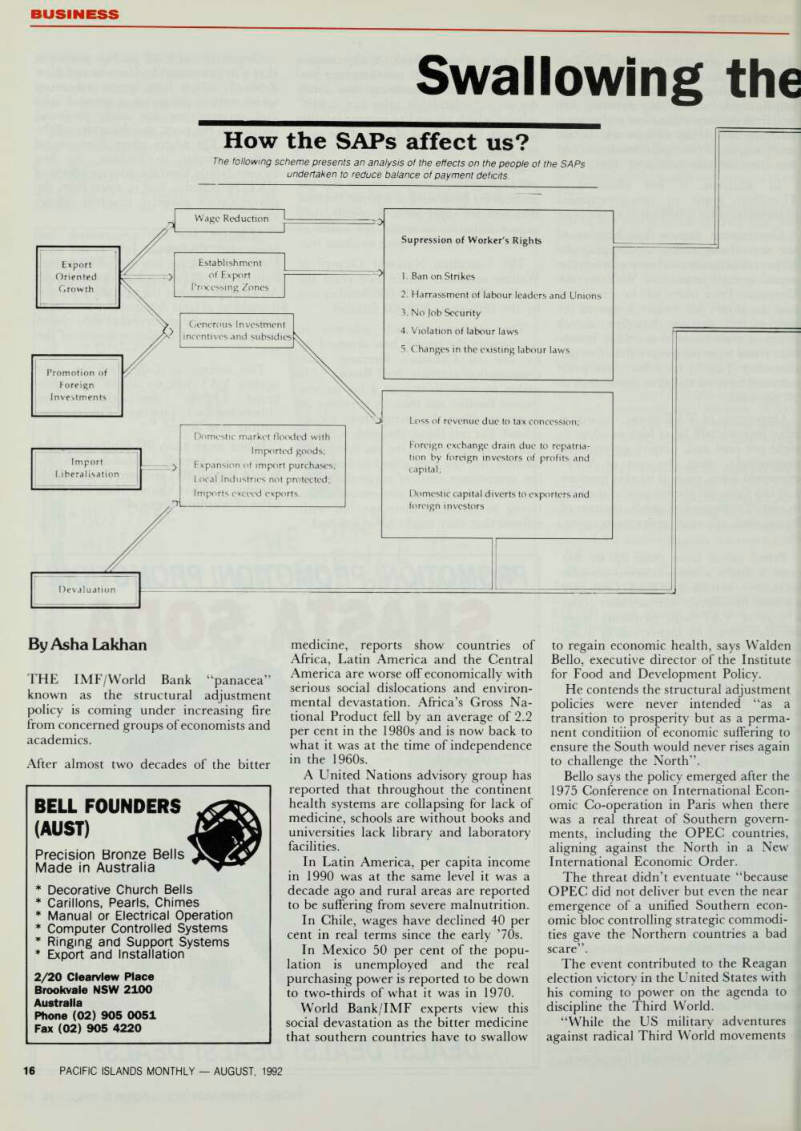
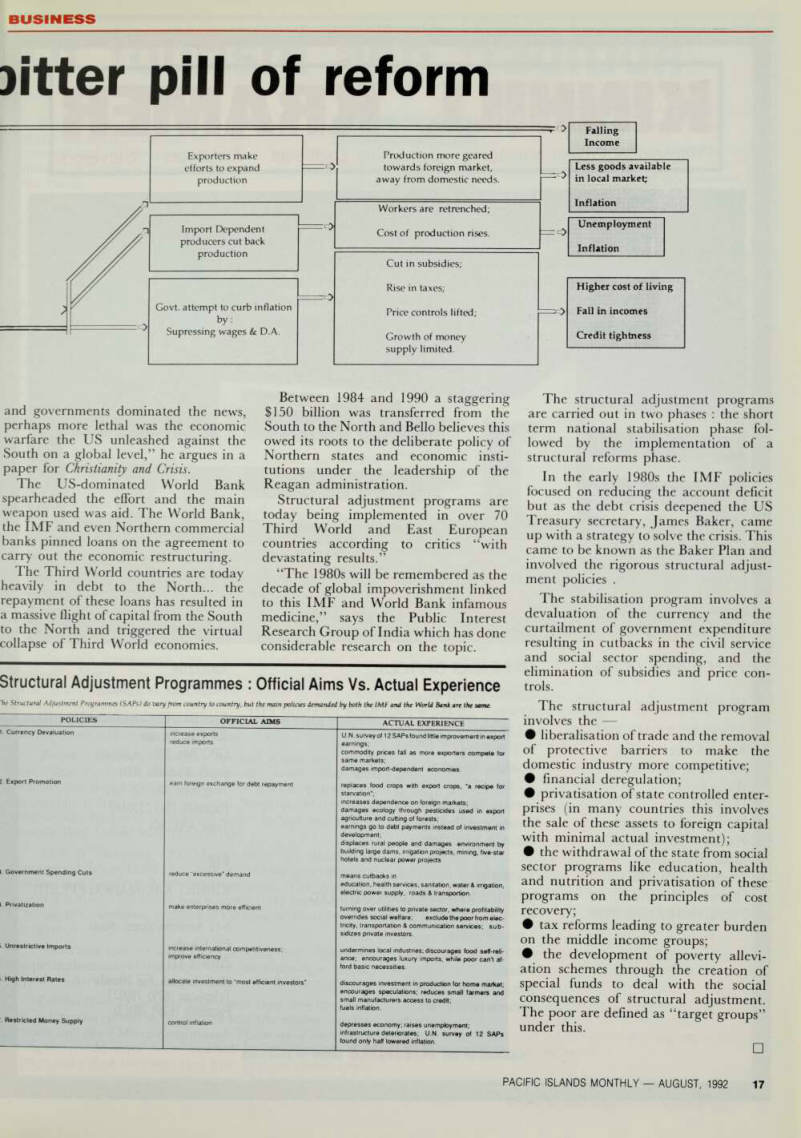
The structural adjustment programs are carried out in two phases : the short term national stabilisation phase fol lowed by the implementation of a structural reforms phase.
In the early 1980s the IMF policies focused on reducing the account deficit but as the debt crisis deepened the US Treasury secretary, James Baker, came up with a strategy to solve the crisis. This came to be known as the Baker Plan and involved the rigorous structural adjust
ment policies .
The stabilisation program involves a devaluation of the currency and the curtailment of government expenditure resulting in cutbacks in the civil service and social sector spending, and the elimination of subsidies and price con trols.
The structural adjustment program involves the — • liberalisation of trade and the removal of protective barriers to make the domestic industry more competitive; • financial deregulation; • privatisation of state controlled enter prises (in many countries this involves the sale of these assets to foreign capital with minimal actual investment); • the withdrawal of the state from social sector programs like education, health and nutrition and privatisation of these programs on the principles of cost recovery; • tax reforms leading to greater burden on the middle income groups; • the development of poverty allevi ation schemes through the creation of special funds to deal with the social consequences of structural adjustment.
The poor are defined as “target groups” under this. □