Firing up the smoke debate
pp. 51-52 · Read in the full issue
Health
By Ulafala Aiavao
WESTERN Samoa’s smoking popu lation, and the country’s sole cigarette factory, is under increasing pressure from a pro-health lobby that wants to restrict the availability and advertising of ciga rettes.
The group knows a complete ban on smoking is unworkable and that reduc ing consumption comes up against politi cal, economic and social factors.
A few victories can be claimed by the lobbyists in the slow spread of smoke-free offices and education programmes. Diffi culties remain.
In 1990 Health Department staff placed a large ‘SMOKING RUINS YOUR PLAY’ banner below the Rothmans-donated scoreboard at Apia
Park, resulting in a classic front-page photograph in the Samoa Observer news paper which helped anti-tobacco pub licity. Pressure from the company shifted the banner to a less provocative position on the side of the field.
Last February, the Department and its non-smoking Health Minister an nounced a sudden ban on smoking inside the buildings and compounds of all medical centres. The move, which ap plied to staff, patients and visitors, had some effect but was so rigid (no smokers’ zone was set aside) it could not be enforced.
Such setbacks have not stopped the pro-health lobby from expanding on the establishment of annual Anti-Tobacco Days and awareness campaigns.
There is no accurate estimate of how many of Western Samoa’s 160,000 people smoke cigarettes. Manager of the local Rothmans Tobacco Company Lim ited branch, Mike Tamati, thinks about 40 per cent of the total population smokes.
The Health Department thinks more than half Samoan males smoke and a smaller percentage of females, but is not sure yet. A national health survey covering several areas, including smok ing, was carrried out in 1987 and 1991, but the raw data has still not been analysed because of a lack of resources.
The tobacco industry, and smokers, count on several factors to keep lighting up. Nicotine is a powerful stimulant and cigarettes can have a relaxing effect.
Others may smoke to counter stress, reduce weight, bow to peer pressure or,
more likely, because they are addicted.
The health risks from smoking ciga rettes, or of non-smokers inhaling ciga rette smoke, are fairly well known by the medical field (and the tobacco industry).
World Health Organisation consult ant Dr Harley Stanton told a workshop in Apia that while some people might adapt better to smoke than others, “you can’t fool the statistics”.
“Smoking is a death-style disease, not a lifestyle disease,” he said, adding that
declining smoking rates in developed
countries were being offset by increasing consumption in developing countries.
Such information means little without motivation to stop puffing. A group set up recently to pursue legislation against cigarette sales to children, and controls on advertising, noted that many adult role models smoked. These included politicians, teachers, medical staff, and pastors of major religious denominations.
If they can do it, why can’t others? The issue of freedom of choice is one of the tobacco industry’s strongest arguments.
The counter-argument is that con sumers should have more awareness of the risks involved before making their decision. Similarly, that non-smokers have protection from passive smoke.
Since the tobacco industry will not voluntarily spell out the health risks, the pro-health lobby wants legislation to force the issue.
Among the proposals are : • starker, bilingual health warnings on packets along the lines of SMOKING
Kills.
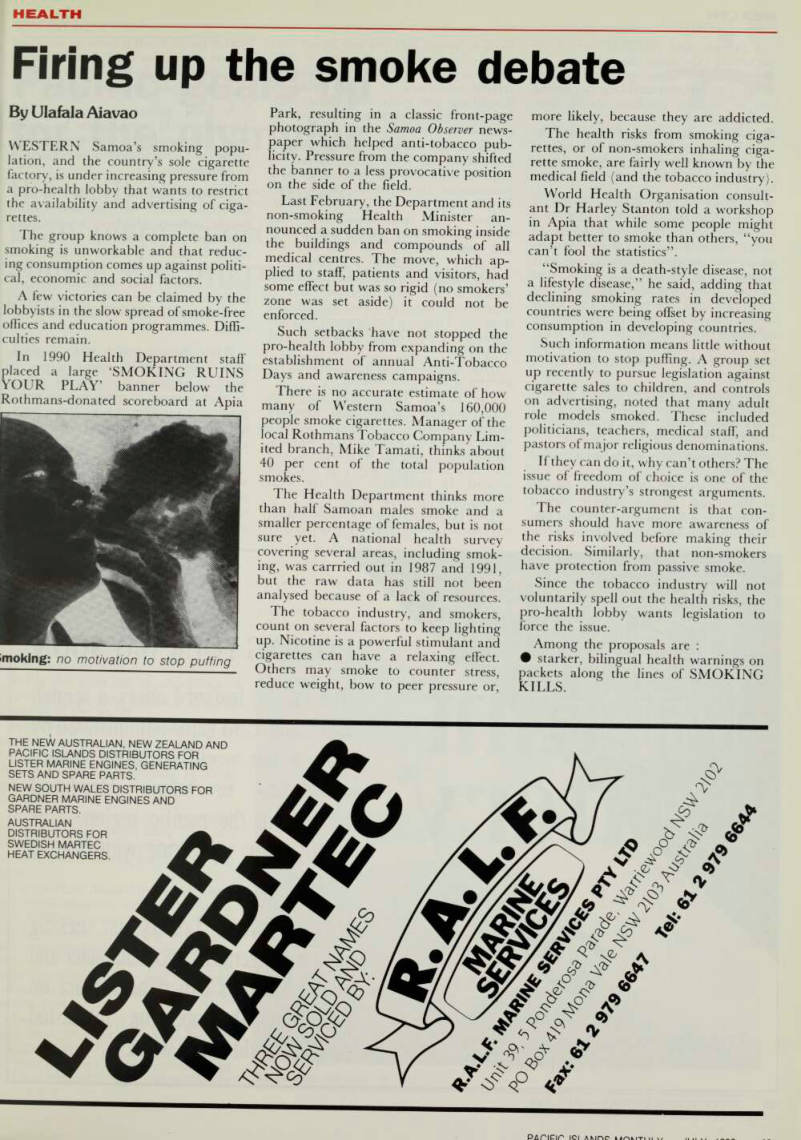
Smoking: no motivation to stop puffing
a boring, and standard, layout on packets to take away the glamour. • increasing taxes on cigarettes to reduce consumption and help pay for the cost of treating smoking-related com-
plaints.
• banning cigarette advertising. (The
local Rothmans factory has little adverrising, possibly because it has a small, captive market and there is no competition.) • printing tar and nicotine levels on packets. The New Zealand standard is favoured because 1) it is well developed and, 2) the local cigarette factory imports all its raw materials (tobacco, cigarette papers, filters, packets, plastic wrap and cartons; from New Zealand These are then packaged before sale. The lobby beheves that if the industry can print the necessary information for New Zealanders, they can do the same lor the Samoan branch without too much trouble n . wr c Rothmans m Western Samoa imports u t r , ■ r . • , about four containers of raw _materia s 40*000 to r 6o 000 cartons r month"" 1 40,000 to 60,000 cartons a month.
The company says this is just ahead of demand.
There is a small export trade, largely to the Cook Islands, which ’ earned Western Samoa 5W5691,000 (5U5283,000) last year. The Central
Bank of Samoa said this was 18 per cent up on the previous year, however, 1990 production was affected by a cyclone related shutdown of three weeks. A flourishing gift trade also exists, with travellers taking cartons with them to relatives overseas.
The Rothmans factory, which began production 12 years ago, enjoyed 10 years of duty and tax concessions as a government incentive to locate here.
New Zealand aid helped set up the plant.
Since the concessions ran out,
Rothmans has been paying import duty
and other charges, but can still sell cheaply about SUSI a packet.
The Western Samoan government has shares in the joint venture, and is represented on the board by officials from the Treasury Department and the department of Trade, Commerce and Industry.
This poses a potential conflict of interest within government.
The Health Department hopes to
reduce cigarette consumption. Treasury
officials, mindful of Western Samoa’s small economy, wants every tax and tariff dollar it can get its hands on, and the TCI is always happy to see jobs created. In Rothmans case, the local
factory employs 52 people.
The Treasury might loosen its stance if it can be convinced that a much higher
level of public funds is spent on smoking related complaints than the community gets from a tobacco industry. Such statistics are not available yet.
A local economist suggested the Treasury could cover its bets by raising taxes on cigarettes, while dropping the excise tax on the imported raw materials to compensate.
Tackling the sale of cigarettes to children faces an unusual social hurdle. Samoan children usually buy cigarettes because they are sent by their elders to the local store. Refusing the child effectively refuses the elder, which poses a conflict that village shopkeepers prefer to avoid. Education programmes work better in this area than enforce ment.
While the pro-health lobby is confi dent that cigarette consumption in Western Samoa will eventually reduce through a range of measures, no one is predicting a sudden change. Estimates at the Apia workshop ranged from “some
years” to 20 years”
Progress will rely on whether people
want to listen to the pro-health message, and the counter-arguments the lobby can expect from the tobbaco industry and tens of thousands of smokers. □