revisited
pp. 47-50 · Read in the full issue

A royal monument
revisited [?]Iolanipalace of [?]leasure and [?]mprison ment
By Norman and Ngaire Douglas
and gentlemen, a toast. God ; ve the King!” The assembled guests ise glasses of the finest crystal, filled th the best French champagnne. “To s Royal Highness, the King!” The air filled with the swish and rustle of silks d satins as the ladies resume their ices at the lavishly set table, gallantly ised by escorts who wear either heavy ick wool dinner suits with stiffstarched lars or bright military uniforms liber-
ally adorned with ribbons and medals.
The soft waltzes drifting through the open windows are played by an orchestra discreetly positioned on the balcony outside. The delicate light bathing the splendid scene is provided by a wonder ful new invention of one Mr Thomas Edison. Such style! Such splendour! This must surely be the dinner party of one of Europe’s most sophisticated monarchs of
the late nineteenth century!
But observe carefully. Isn’t that the heady perfume of tropical flowers? Aren’t the bronze complexions and statuesque physiques of the liveried attendants unexpected in such surroundings? And what of the host and hostess? No petty monarchs of some obscure European state these, but the ruler of the Poly nesian kingdom of Hawai’i and his lovely
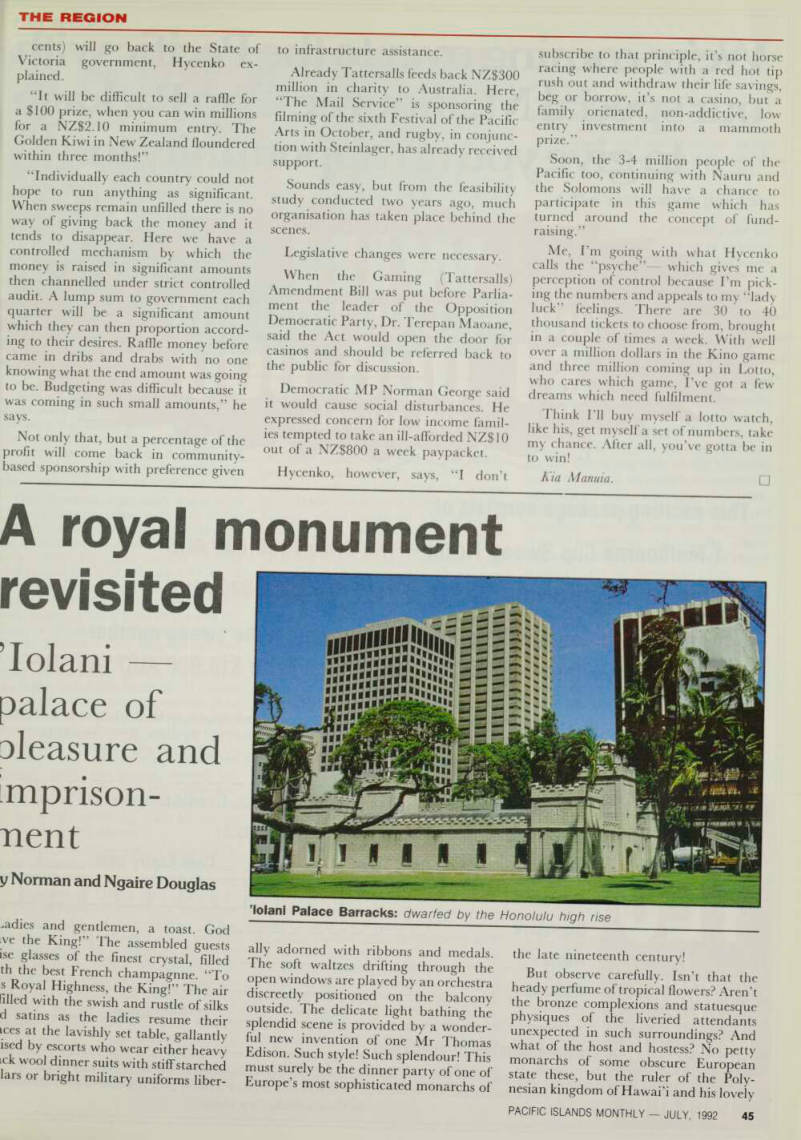
’ lolani Palace Barracks: dwarfed by the Honolulu high rise
wife; King Kalakaua and Queen Kapi’olani. The time is the 1880 s and the setting is the Tolani Palace in Honolulu, the home of Hawaiian royalty from 1882 to 1893, and a building of style and quality quite unlike any other edifice in the South Seas, then as now.
One hundred years after many such glorious state occasions were held in this palace, ordinary, uninvited citizens may, for a small fee, be escorted through the very rooms Hawaiian royalty worked and played in. Well rehearsed docents (a term Americans use to describe volunteer guides) vividly describe the history of the anly palace in the United States and the nost ambitious royal palace in the Pacific Islands the gingerbread cot age of the King of Tonga is the only )ther official Pacific palace. To preserve he highly polished wooden floors visitors ire asked to put cotton slippers over their hoes high heels are forbidden and equested not to touch anything unless pecifically invited. “No smoking, no hewing and no straying from the ;roup,” insists our hostess, dressed ap iropriately in long flowing gown and >etite straw hat, and off we shuffle for one •f the most interesting tours offered in ourist-saturated Hawai’i.
The Hawaiian monarchy began with Ling Kamehameha I in 1796, and ndured through some eight reigns until
be deposing of Queen Liliu’okalani in
893. The royal residence was moved to lonolulu in 1845 when King kamehameha HI chose it as the capital f his kingdom. He moved into the finest ouse in town, which belonged at the me to the governor of Oahu, and which as located within the present palace rounds. In the spirit of Polynesia a umber of residences were built within ic grounds for various family members ad their retainers. It was Kamehameha in 1863 who bestowed the name olani (which in one usage means Royal
Hawk) upon the most royal of these residences.
At this point in our tour we have moved through the grand hall and into the blue room. The hall is the family portrait gallery, and location of a majestic staircase leading to the second floor. Hawaiian timbers feature in all the fittings, many enhanced with inlays of walnut. San Franciscan etched glass panels, custom made to delight the king, grace the double-doored entrance, add ing a light and airy touch to complement the rich timbers. Our docent describes how the king and queen could make gracious descents down the staircase to greet their guests, who would be assembled in the blue room to the left of the hall. For a few moments of fantasy we are the guests awaiting our royal hosts. Today this room is empty while the Friends of Tolani Palace, an organisation dedicated to the restoration and upkeep of the palace, continues its search for the original furniture. When we are told that this is where Queen Liliu’okalani pres ented her cabinet with a new constitution in 1893, a move which precipitated the eventual downfall of the monarchy, the empty room takes on a sad quality, although it once echoed with the happy music produced by a family of skilled musicians.
Beyond doors which glide silently aside, we enter the state dining room.
The table is set for dinner; a crisp white linen cloth is the backdrop for a dinner set of fine French china emblazoned with the royal crest, elegant English silver, Bohemian crystal, candelabra and cruets. Peering down from imposing portraits are Napoleon HI of France, Frederick William HI of Prussia (recipi ent of several feathered cloaks from Kamehameha HI) and Admiral Richard D. Thomas of England. Rich red velvet drapes, huge, ornately carved sideboards and a luxurious carpet complete the
illusion of European grandeur. This is a beautiful room. Exiting to the right we file past the wood-panelled water closet and the dumb waiter; the former cer tainly a “throne” fit for a king and his guests, the latter a modern convenience of the times. And now it is time to tip toe up the grand staircase to glimpse the private premises of the royal family. ,* P The restoration process For the first and probably the last time in the collective lives of our little group, we enter a king’s bedroom.
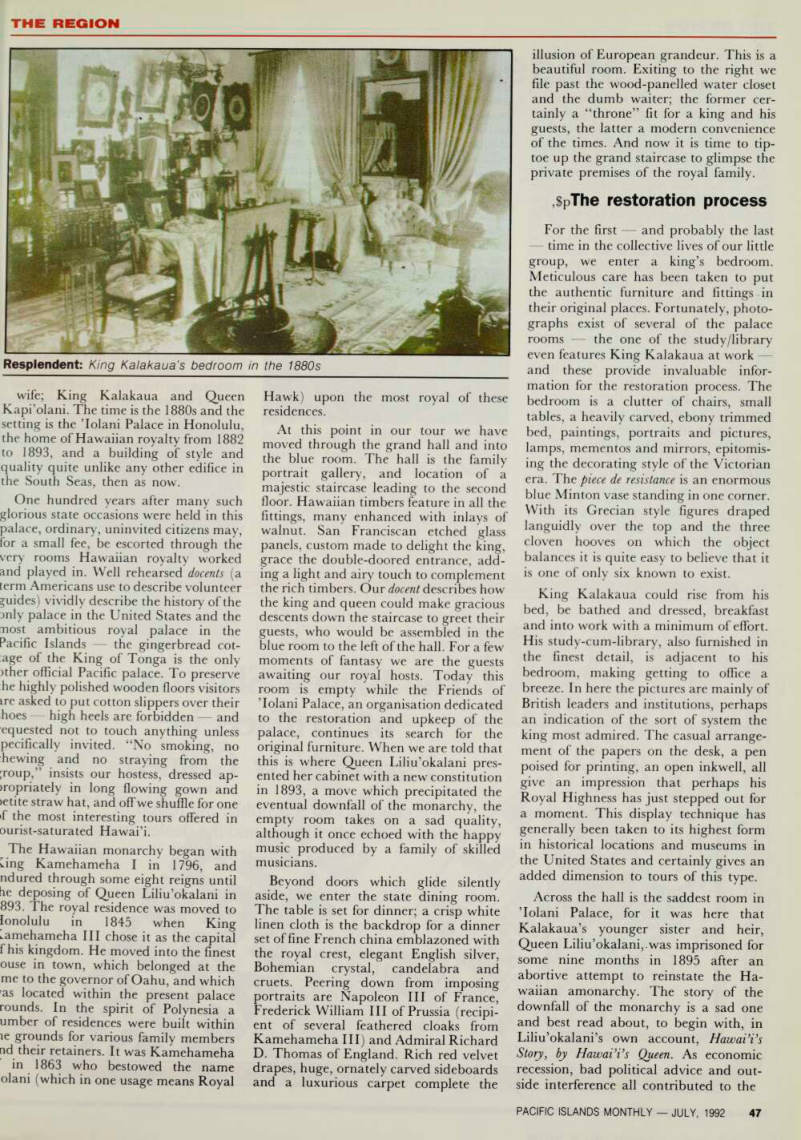
Meticulous care has been taken to put the authentic furniture and fittings in their original places. Fortunately, photo graphs exist of several of the palace rooms the one of the study/library even features King Kalakaua at work and these provide invaluable infor mation for the restoration process. The bedroom is a clutter of chairs, small tables, a heavily carved, ebony trimmed bed, paintings, portraits and pictures, lamps, mementos and mirrors, epitomis ing the decorating style of the Victorian era. The piece de resistance is an enormous blue Minton vase standing in one corner.
With its Grecian style figures draped languidly over the top and the three cloven hooves on which the object balances it is quite easy to believe that it is one of only six known to exist.
King Kalakaua could rise from his bed, be bathed and dressed, breakfast and into work with a minimum of effort.
His study-cum-library, also furnished in the finest detail, is adjacent to his bedroom, making getting to office a breeze. In here the pictures are mainly of British leaders and institutions, perhaps an indication of the sort of system the king most admired. The casual arrange ment of the papers on the desk, a pen poised for printing, an open inkwell, all give an impression that perhaps his Royal Highness has just stepped out for a moment. This display technique has generally been taken to its highest form in historical locations and museums in the United States and certainly gives an added dimension to tours of this type.
Across the hall is the saddest room in Tolani Palace, for it was here that Kalakaua’s younger sister and heir, Queen Liliu’okalani,was imprisoned for some nine months in 1895 after an abortive attempt to reinstate the Ha waiian amonarchy. The story of the downfall of the monarchy is a sad one and best read about, to begin with, in Liliu’okalani’s own account, Hawai’i’s Story, by Hawai’i’s Queen. As economic recession, bad political advice and out side interference all contributed to the
Resplendent: King Kalakaua’s bedroom in the 1880s
declaration of Hawai’i as a republic in 1893. In this front bedroom, the deposed queen was kept in isolation with only a lady in awaiting as aide and companion.
Today the room is shuttered and bare and the walls seem to whisper their sorrow at what they witnessed. When she was finally released in February 1896, Queen Liliu’okalani moved across the road to her own original home now the governor’s mansion where she lived in quiet dignity until her death in 1917.
Before her reign, the three rooms on this upper right level had been the suite of Queen Kapi’olani, various members of her family who acted as her assistants and some of their children; the royal couple had no children of their own. A “queen” sized bed with a lavishly embroidered and tasseled cover is the only furniture at present but the Friends of Tolani Palace continues its search to locate and acquire other authentic pieces. Each bedroom has its own ensuite and dressing room. The bathrooms were regarded as modern beyond belief in their time; in 1992 they are quaint. The corner rooms have an added little turret room in which the queen liked to play cards or sit sewing as proper Victorian ladies did. Large verandahs on all sides were perfect for strolling in the cool of the evening or for avoiding the heat of the
tropical noonday sun.
The grand finale of the tour is the throne room which occupies the full lower right side of the palace. In this beautifully restored room of gilt, crystal and velvet we are invited by our hostess to close our eyes and imagine a grand ball it’s easy to “hear” the waltzes and polkas of the Royal Hawaiian Band drifting in from their verandah location.
King Kalakaua, an accomplished musician and composer, loved to dance and no guest was allowed to leave until the king chose to retire. The throne room was also used for more solemn state
occasions such as the receiving of official credentials from new diplomats, meeting people’s representatives with petitions or making royal proclamations. In display cases on the walls are the symbols of royal orders worn by both Hawaiian and
European monarchs of the time. Our docent captures the spitit of this regal room with her enthusiastic description of its uses and the tour is complete. As we leave the room by one door, the next group is being allowed entry by another, by a lady with a large key hanging from a chain around her neck, one of several unobtrusive assistants located in the fully restored rooms to controlk the visitor flow.
Everybody enthusiastically thanks our guide, commending her for an informa tive and well presented tour. A few people want to know where they can buy the cotton slippers as protection for their own floors at home! Some of us go over to the inevitable gift shop located in the palace barracks. Others wander around the spacious grounds, posing for pictures before the coronation pavilion or be neath the giant banyan trees which once provided shade for royal picnics. Re splendent within its fenced grounds, Tolani Palace is an endearing monument to a monarchy which lasted barely one hundred years, and which has been gone for almost another one hundred years, but which is still loved and respected by the Hawaiian people. To walk within its walls helps visitors to understand a part of Hawaii’s heritage that the bustle of downtown Honolulu and the hustle of Waikiki have not yet been able to obliterate. D
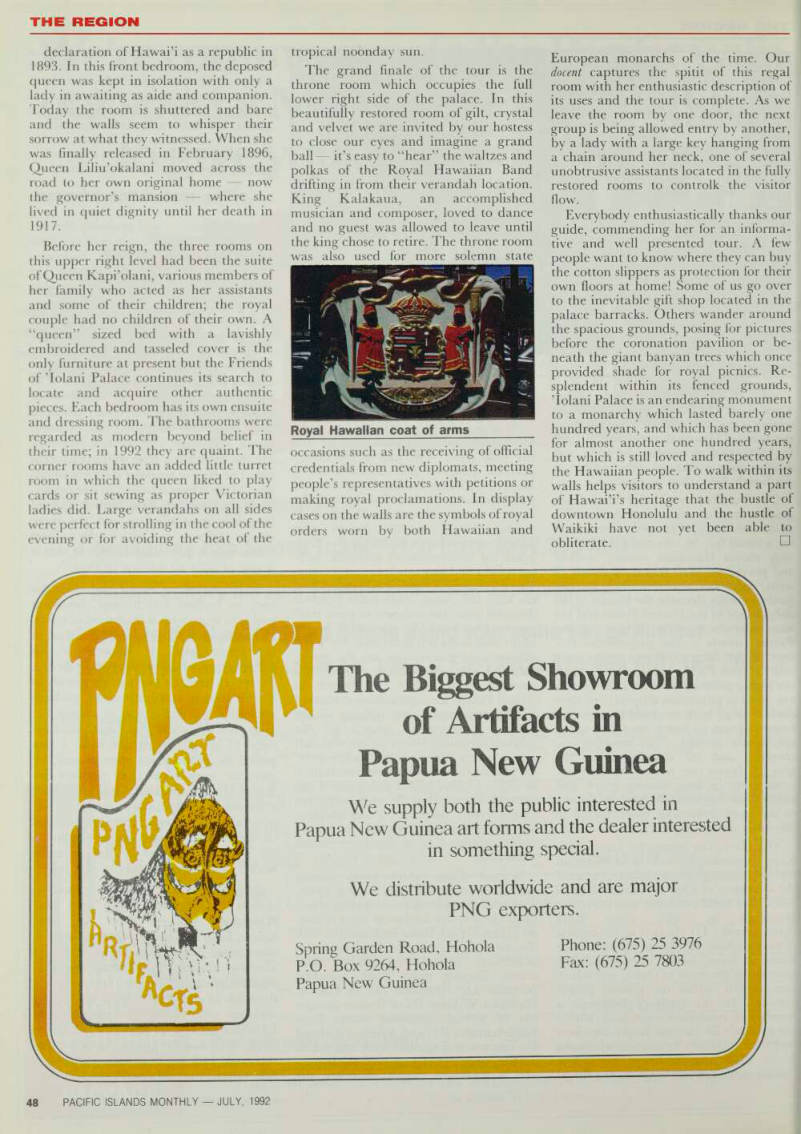
Royal Hawaiian coat of arms