Pacific gears up
pp. 53-55 · Read in the full issue

Sports
for the Olympics
But will they be more than mere ‘sports tourists’ among the international teams?
By Brian Wightman
WITH THE exception of Fiji and Papua New Guinea it is only in the last decade that Pacific countries have been accepted into the Olympic movement.
Until 1987 there was a definite ‘push’ to expand the number of countries in membership of the international Olym pic Committee (IOC).
Following Olympic boycotts in Mon treal (1976), Moscow (1980) and Los Angeles (1984) and the advent of big profits from television rights, the lOC now pays all expenses for six competitors and two officials from all countries in the world with National Olympic Commit tees (NOC) to participate in the Olym pics.
This system ensures full participation md means no one can use the excuse of no money’ to boycott the games. It is )articularly helpful in the Pacific region vhere countries have limited funds.
But it also gives rise to accusations of sports tourists’ from many of the big ountries of the world.
What this means is that some of the mailer countries, such as from the ‘acific islands, can compete at the
Mympics without qualifying perform
nces, and what is more, have their xpenses paid for by the lOC.
In the meantime, the system requires lat if a country enters more than one thlete in an event then all must achieve
ie Olympic qualifying standard in that
/ent.
It is therefore claimed that competitors om small countries such as the Pacific
ave things too easy. Competitors with
tie or no hope of winning medals are nd to go to the Olympics while athletes ith much better performances from rger countries have to pay their own rfares and accommodation or their •untry does.
Consider the case of Fiji, w hich is the dest NOC apart from Australia and “w Zealand in Oceania. Fiji was cepted into the Olympic movement in 55 and began Olympic competition in
the Melbourne games of 1956.
Prior to the assistance with fares and accommodation, when all expenses had to be paid, Fiji never sent more than four or five people and this included officials.
Papua New Guinea was admitted to the Olympic movement in 1974. 1983 saw Solomon Islands and Western Samoa accepted. Tonga was recognised in 1984 (when the Eastern Bloc boycott was known) so all these teams plus Fiji competed in Los Angeles.
Vanuatu, American Samoa, Cook Islands and Guam all became NOCs in 1987 which means Barcelona will be the second Olympic Games for all the eligible Pacific countries they first competed in Seoul in 1988.
Current indications are that most of these countries will send their full complement of six competitors and two officials, although there are indications
that some countries will send more. Fiji is likely to send one of the largest Pacific contingents, with its team of 33, includ ing medical staff.
It can be argued that Pacific island teams may be too big when comparing them with the size of the Fiji teams over the years.
Bearing in mind the current problems of excessive numbers and overcrowding in Barcelona and the results of the South Pacific Games where performances are well below Olympic standards, perhaps there is some truth in the accusations, of teams who are paid expenses to attend the Olympics as being ‘sports tourists’.
Then again, other events in the world have had a bearing on the situation and perhaps the Pacific Islands are being wrongly accused.
Firstly, the inclusion of South Africa and Namibia and then the breakdown of the Iron Curtain has meant almost 20 new teams, resulting in a rise in numbers.
And several Pacific countries have been waiting two or three years now to be included in the Olympic family. Their papers are in order but they are still
Barcelona: Olympic city 92
denied the chance of participating in the Olympics. Notable among these are Nauru and Northern Marianas. Ironi cally, these two countries have probably two of the top performers from the Pacific area.
We should remember the words of Baron Pierre de Coubertin, the founder of the modern Olympic Games, “They are worldwide all people should be admitted. The important thing in the Olympic Games is not to win, but to take part.”
It is important to realise that various new schemes have been instituted during the last four years to help athletes develop. Some are specifically geared for the Pacific.
All countries have a measure, having competed in Olympics before, and their administrators, while still relatively new, have increased experience.
Olympic scholarships have seen Pacific islanders going overseas. The Oceania
Olympic Training Centre (OOTC), set
up at the Australian Institute of Sport (AIS) in Canberra, has taken 25 people a year from the Pacific.
Olympic solidarity courses have con tinued and, in some cases, there have been exchanges between countries.
In other words there should be improved awareness all round.
Following is a brief on the participat ng Pacific countries.
American Samoa: Expected to send iround 10 people, they could be a urprise. They are the only country to lave been awarded an lOC scholarship n the Pacific. Their boxers have been tudying in the USA for some months.
Cook Islands: As the smallest NOC a the world (18,000 population) their ask is not easy. They do have the benefit f at least one athlete having attended tie OOTC.
Fiji: The team of 33 may seem mbitious. But they are trying new things 11 the time and currently have all their thletes in Europe where they are ivolved in top international compe tion and have top coaching.
Failure to perform will see them ithdraw from the Olympics. An excel nt way to overcome the lack of impetition in the Pacific.
One prospect is Tony Philp Junior ho is second in the world in boardsail g- Guam: Patrick Sagisi (on a swimming
holarship at university in USA) and
en Allred, who won all the women’s stance races at the South Pacific
Games, have been to the OOTC and should be Guam’s best prospects.
Papua New Guinea: Following their success in the South Pacific Games, PNG might be expected to do best. Their team is expected to be about 20-strong.
Solomon Islands: Their team is expected to feature only eight. They did not win a gold medal in the SPG so their prospects are rather bleak.
Tonga: A team of eight is going in athletics, weightlifting and boxing. The athletes have followed Fiji’s example and headed for Europe and competition, but they do not have the same restrictions on lack of performance. Two athletes have attended the OOTC.
Vanuatu: Vanuatu is expecting to send a team of eight. Two members have been to the OOTC and won medals at the SPG, but their prospects must be rated as limited.
Western Samoa: Western Samoa is expected to send about a dozen. Its record in weightlifting is good in the SPG, but for Olympic competition their best chance is probably Jerry Wallwork.
Traditionally the Pacific countries have centred on athletics and boxing.
Most people have turned in personal best
performances at the Olympics.
Probably the three most likely pros pects from the Pacific are:
Tony Philp Junior (Fiji), boardsailing,
current windsurfing world champion.
Jonathan Sakovich (Northern Mari anas), swimming. Jonathan has qualified to be part of the USA team training camp. He is on a swimming scholarship in Florida but he cannot represent Northern Marianas who are not yet a
Nog.
Marcus Stephen (Nauru), weightlift ing. He holds the SPG and Common wealth Games records. He won medals at the last Commonwealth Games but he too may not be able to compete as Nauru has no NOG, although it is understood that efforts may be being made for him to compete under another country’s flag.
The same may hold good for Sakovich.
Whatever happens each country wants to raise its flag before the world. The 30 seconds opening ceremony coverage on :elevision would have cost one country >USSOO,OOO as advertising rates are !USI million per minute. Taking their place and flying their flag is probably uppermost for most countries and just doing their best.
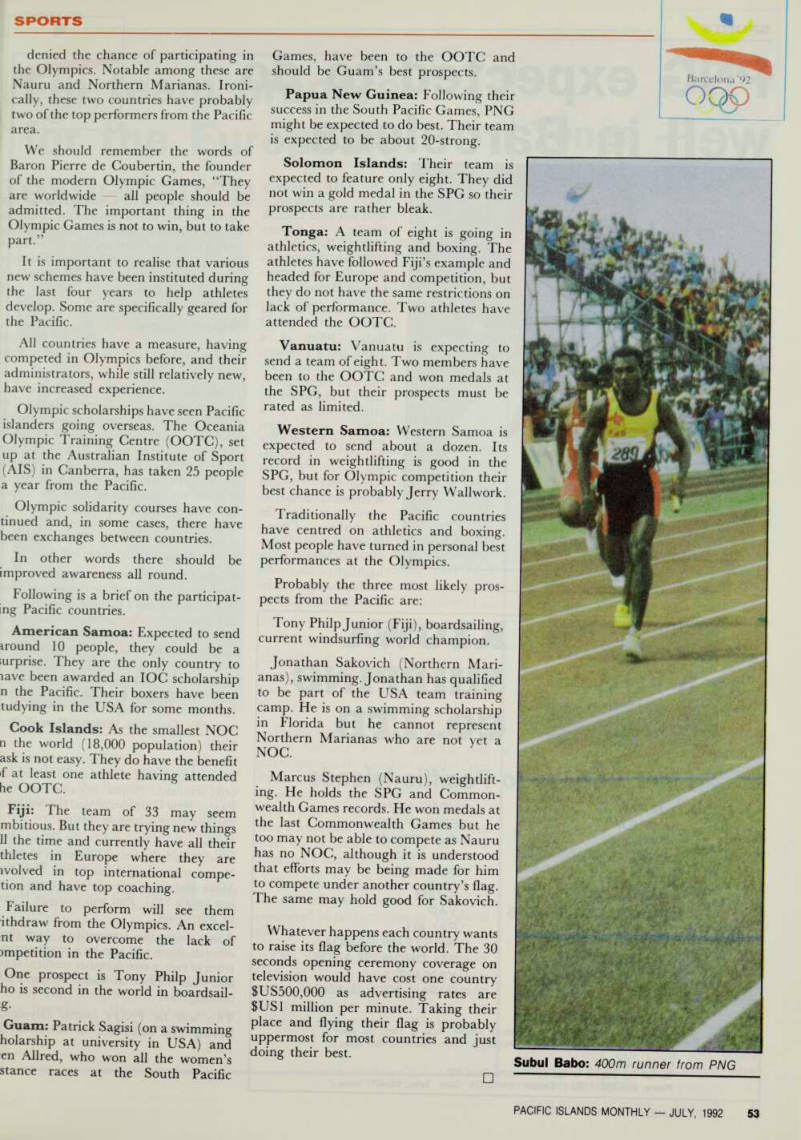
Subul Babo: 400m runner from PNG