PNG relaxes investment policy
p. 31 · Read in the full issue
bUbINbbb
PAPUA New Guinea has relaxed its investment policy and set up a new statutory agency which is expected to cut through bureaucratic red tape halving the time taken for potential investors to have projects certified.
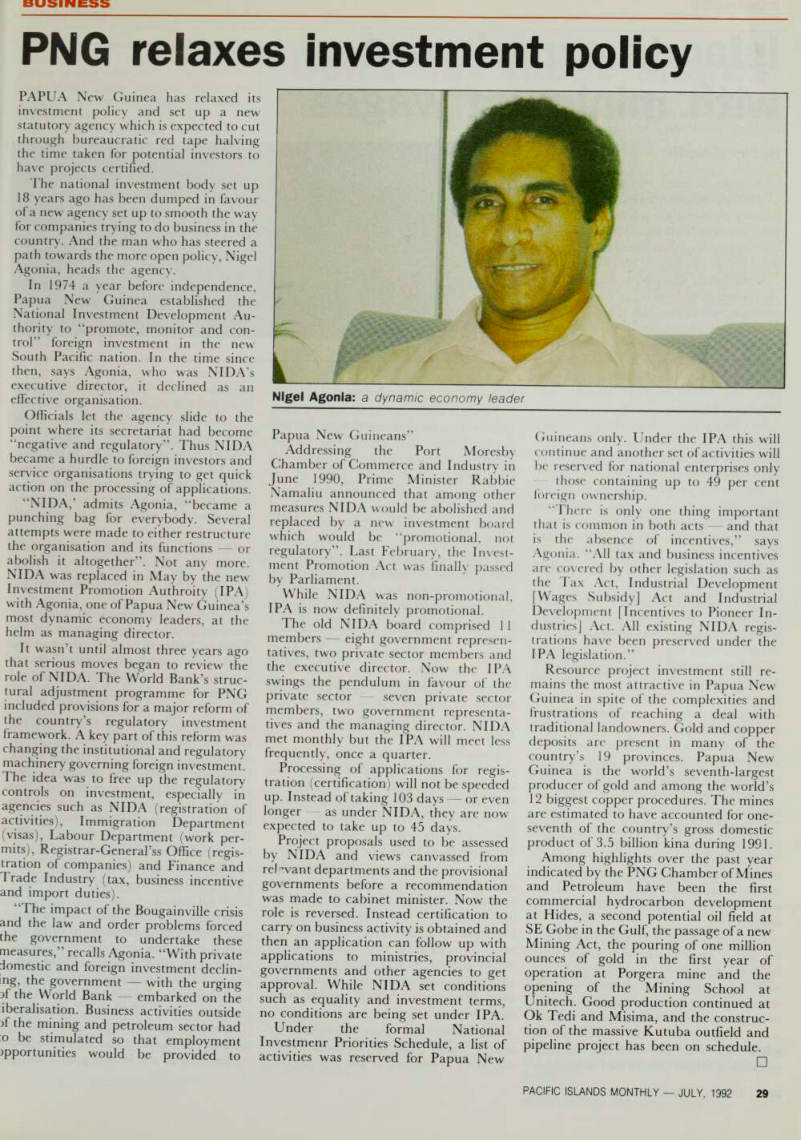
The national investment body set up 18 years ago has been dumped in favour of a new agency set up to smooth the way for companies trying to do business in the country. And the man who has steered a path towards the more open policy, Nigel Agonia, heads the agency.
In 1974 a year before independence, Papua New Guinea established the National Investment Development Au thority to “promote, monitor and con trol” foreign investment in the new South Pacific nation. In the time since then, says Agonia, who was NIDA’s executive director, it declined as an effective organisation.
Officials let the agency slide to the point where its secretariat had become “negative and regulatory”. Thus NIDA became a hurdle to foreign investors and service organisations trying to get quick action on the processing of applications.
“NIDA,’ admits Agonia, “became a punching bag for everybody. Several attempts were made to either restructure the organisation and its functions or abolish it altogether”. Not any more.
NIDA was replaced in May by the new Investment Promotion Authroity (IPA) with Agonia, one of Papua New Guinea’s most dynamic economy leaders, at the helm as managing director.
It wasn’t until almost three years ago that serious moves began to review the role of NIDA. The World Bank’s struc tural adjustment programme for PNG included provisions for a major reform of the country’s regulatory investment framework. A key part of this reform was changing the institutional and regulatory
machinery governing foreign investment.
The idea was to free up the regulatory controls on investment, especially in agencies such as NIDA (registration of
activities), Immigration Department
(visas), Labour Department (work per
mits), Registrar-General’ss Office (regis
tration of companies) and Finance and Trade Industry (tax, business incentive
and import duties).
The impact of the Bougainville crisis and the law and order problems forced the government to undertake these measures, recalls Agonia. “With private domestic and foreign investment declin mg, the government with the urging af the World Bank embarked on the iberalisation. Business activities outside af the mining and petroleum sector had o be stimulated so that employment )pportunities would be provided to
Papua New Guineans”
Addressing the Port Moresby Chamber of Commerce and Industry in June 1990, Prime Minister Rabbie Namaliu announced that among other measures NIDA would be abolished and replaced by a new investment board which would be “promotional, not regulatory”. Last February, the Invest ment Promotion Act was finally passed by Parliament.
While NIDA was non-promotional, IPA is now definitely promotional.
The old NIDA board comprised 11 members eight government represen tatives, two private sector members and the executive director. Now the IPA swings the pendulum in favour of the private sector seven private sector members, two government representa tives and the managing director. NIDA met monthly but the IPA will meet less frequently, once a quarter.
Processing of applications for regis tration (certification) will not be speeded up. Instead of taking 103 days or even longer as under NIDA, they are now expected to take up to 45 days.
Project proposals used to be assessed by NIDA and views canvassed from relevant departments and the provisional governments before a recommendation was made to cabinet minister. Now the role is reversed. Instead certification to carry on business activity is obtained and then an application can follow up with applications to ministries, provincial governments and other agencies to get approval. While NIDA set conditions such as equality and investment terms, no conditions are being set under IPA.
Under the formal National Investmenr Priorities Schedule, a list of activities was reserved for Papua New
Guineans only. Under the IPA this will continue and another set of activities will be reserved for national enterprises only those containing up to 49 per cent foreign ownership.
“There is only one thing important that is common in both acts and that is the absence of incentives,” says Agonia. “All tax and business incentives are covered by other legislation such as the Tax Act, Industrial Development [Wages Subsidy] Act and Industrial Development [lncentives to Pioneer In
dustries] Act. All existing NIDA regis
trations have been preserved under the
IPA legislation.”
Resource project investment still re mains the most attractive in Papua New Guinea in spite of the complexities and frustrations of reaching a deal with traditional landowners. Gold and copper deposits are present in many of the country’s 19 provinces. Papua New Guinea is the world’s seventh-largest producer of gold and among the world’s 12 biggest copper procedures. The mines are estimated to have accounted for one seventh of the country’s gross domestic product of 3.5 billion kina during 1991.
Among highlights over the past year indicated by the PNG Chamber of Mines and Petroleum have been the first
commercial hydrocarbon development
at Hides, a second potential oil field at SE Gobe in the Gulf, the passage of a new Mining Act, the pouring of one million ounces of gold in the first year of operation at Porgera mine and the opening of the Mining School at Unitech. Good production continued at Ok Tedi and Misima, and the construc tion of the massive Kutuba outfield and pipeline project has been on schedule. □
Nigel Agonia: a dynamic economy leader