Islands experiment
pp. 32-33 · Read in the full issue
with minimum wages
By David North
HOW much money should the island’s rank-and-file workers earn for an hour’s work? This is a basic economic and equity question that can be asked throughout the South Pacific.
Some island states let the market take its course, which can be hard on the workers involved, but three US flag islands are experimenting with quite different approaches to the question.
In American Samoa there’s a vigorous effort underway to get Washington to raise the wages of tuna workers and others to Mainland levels.
In Guam, where prevailing wages are higher, there is a drive in the Territorial Legislature to raise the minimum wage above the federal level, $4.25 an hour.
Meanwhile, a few miles away in the Commonwealth of the Northern Mariana Islands (CNMI) a Hong Kong based sports clothes entrepreneur, Willie Tan, is in serious trouble for failing to pay the CNMI minimum wage, which is only $2.15 an hour.
The central questions in the three jurisdictions are similar how high should it be, how vigorously should it be enforced, and, sometimes, what agency should set the minimum wage? There’s another theme, however, that is rarely discussed if many of the affected workers are voters (as they are in Guam) the politicians’ interest in their pay is stronger than in cases where most of the workers are from off-island (as in the case of American Samoa and CNMI), The best-publicised of these battles has taken place in Saipan, between Willie Tan and his numerous lawyers and political allies on one hand, and the Mainland Labor Department on the other. Here the question is enforcement, not the level of the wage. (CNMI sets its own minimum wage, but federal agents enforce it.) Garment maker Tan was charged by the Labor Department with a blistering list of exploitive practices, such as working his people 74.5 hours a week without paying overtime, making a series of large and illegal deductions from their wages, keeping the workers behind fences when they were not working, coercing workers to return checks for back-wages
due, fiddling with the books, and the like.
Tan has since settled with the Labor Department by agreeing to obey the law in the future, and to pay his largely Mainland Chinese workers $9 million in back wages. For these 1500 or so operators of sewing machines, now mostly back in China, it will mean about $6,000 each, a small fortune in a rural Chinese village.
Tan’s busy public relations machine said that the $9 million payment was a moral victory for the employer, because the figure was lower than one used in the past by the Labor Department, and because the criminal charges were dropped. Labor Department insiders make two points yes, Willie Tan stayed out ofjail, but $9 million is a hefty sum to be extracted from an employer,
particularly during the pro-business
Bush Administration.
Meanwhile, the adverse Mainland publicity received by Tan’s labour viol ation probably cost him more money than the $9 million settlement. Many top-ranking US clothing houses Liz Claiborne, Levi Strauss and others simply stopped buying clothes from Tan.
Most of the island establishment, however, rallied around Tan, in an effort to limit damage to the important cloth ing industry. The Governor, Larry
Guerrero (Republican), publicly ex
pressed his pleasure with the settlement which showed, he said “that the adverse allegations concerning the labour situ ation here in the CNMI missed their mark.”
The minimum wage situation in nearby Guam could not be more differ ent. Here a member of the Democratic
majority in the Territorial Legislature, Senator Don Parkinson, has introduced legislation which will supplant the Main land minimum wage of $4.25 an hour with a Guam-only rate of $7.00 per hour.
The Chamber of Commerce is opposed, and if the bill were to be passed, which is unlikely at the $7.00 level, it might be vetoed by Governor Joe Ada (Republi can).
Would George Bush do the same for a higher minimum wage in American Samoa? That’s a somewhat distant
possibility.
The Bush Administration has never been supportive of higher wages for the Western Samoans who do most of the hard, dirty work in American Samoa’s two tuna canneries. While the Mainland minimum wage level applies to Guam, and the US Caribbean islands, a differ ent and less generous mechanism sets the rates in Pago Pago. Currently a six member board, appointed by US Labor Department, sets these wages at two year-intervals; in recent years the board has held down wages in response to pleas from the Governor of American Samoa, Peter Tali Coleman, a Republican, and by the two big tuna canneries. (Ameri can Samoa wage rates vary by occu pation, but most are currently set below $3.00 an hour.) In June, however, there was a first ever hearing on a proposal to bring the Samoa minimum wage up to the Main land level. Held by a House of Represen tatives Labor Committee panel, it paid attention to comments made by Con gressman Eni F.H. Faleomaveaga (Democrat-American Samoan) about the inequities of the Samoan wage scale.
Presiding at the Washington hearing
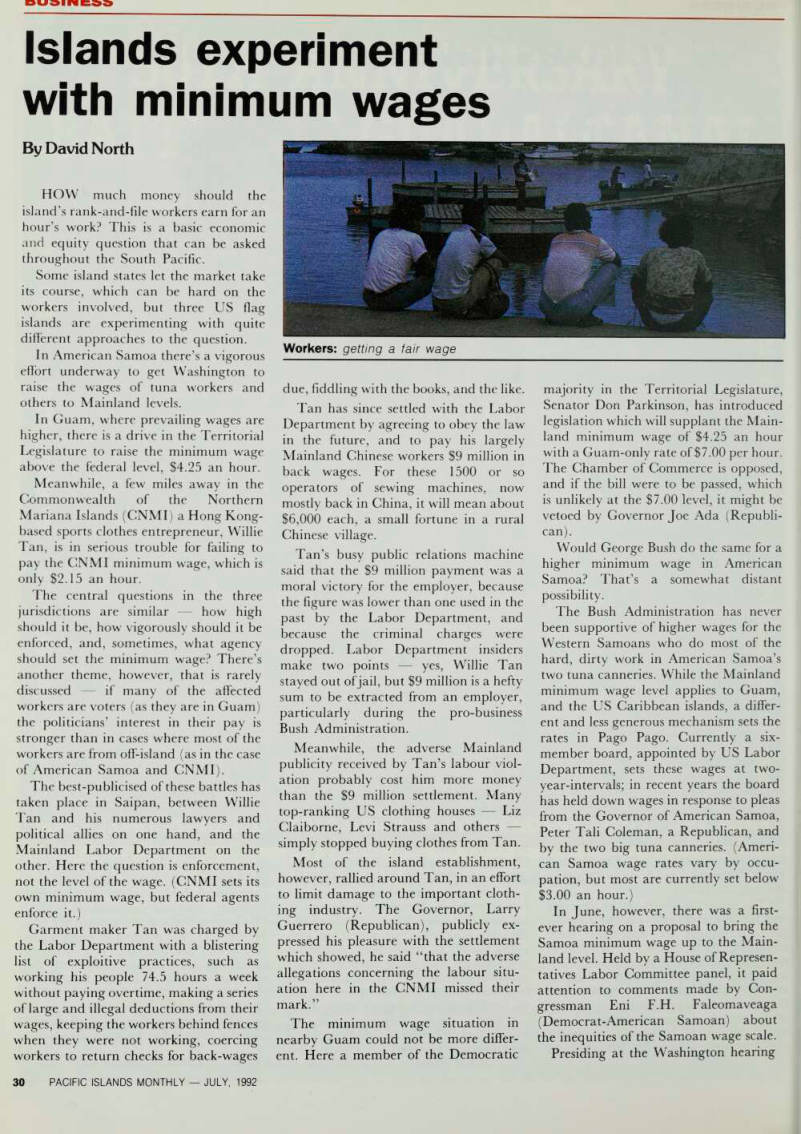
Workers: getting a fair wage
was Congressman Austin Murphy, a Democrat from Pennsylvania. The bill before it was Murphy’s own creation, and would bring Samoan minimum wages up to the Mainland level over a period of years.
Representatives of the Bush Admin istration, and of the tuna, industry argued against its passage. The tuna lobbyists were hampered, however, by news accounts in Pacific Islands Monthly (March, 1992), and in the Samoa News that the boss of H.J. Heinz, owner of one of the tuna plants, earned $75,000,000 in 1990, more than four times as much money as the 2500 workers in the Pago Pago plant.
The president of Van Camp Sea foods, which owns the other tuna factory on Pago Pago Harbour, made it very clear to the Congressmen that he was not paid $75,000,000 a year.
Faleomaveaga is concerned about the level of wages paid to the tuna workers, but has not devised a position on Murphy’s bill; his position on this matter will be important to the Labor Committee.
The House Labor Committee is considering another hearing on the same subject in Pago pago. (Con gressional hearings are sometimes held outside of Washington, but no one can remember one in American Samoa.) With the election coming up in Novem ber, time is running short; often bills introduced in one Congress do not pass on their first try, and are passed in a
later Congress.
Meanwhile, a major threat to Sai pan’s clothing industry may be on the horizon an effort in Congress to eliminate the “Made in USA” label from garments made there.
A powerful collection of 30 Congress men have asked the House of Represen tatives’ Interior and Insular Affairs Committee to hold a hearing on whether or not clothes made in the Commonwealth of Northern Mariana Islands should continue to be allowed to show the label. Without the label, it would be more difficult to sell the clothes on the Mainland.
The argument of the Congressmen, most of whom have clothing factories in their districts, is that since Washington does not control immigration to the islands, does not set the minimum wage there, and does not (they argue) effectively assure the payment of a decent wage scale why should Saipan be able to claim clothes are ‘Made in the USA?” Given the wages Daid in CNMI, its clothes compete well
vith Mainland-produced clothes.
CNMI, unlike American Samoa and juam, does not have a delegate sitting n the Congress because the local eadership has not wanted such a lelegate. It may rue that decision after
he July 9 hearing. □