Nauru’s experience
p. 29 · Read in the full issue
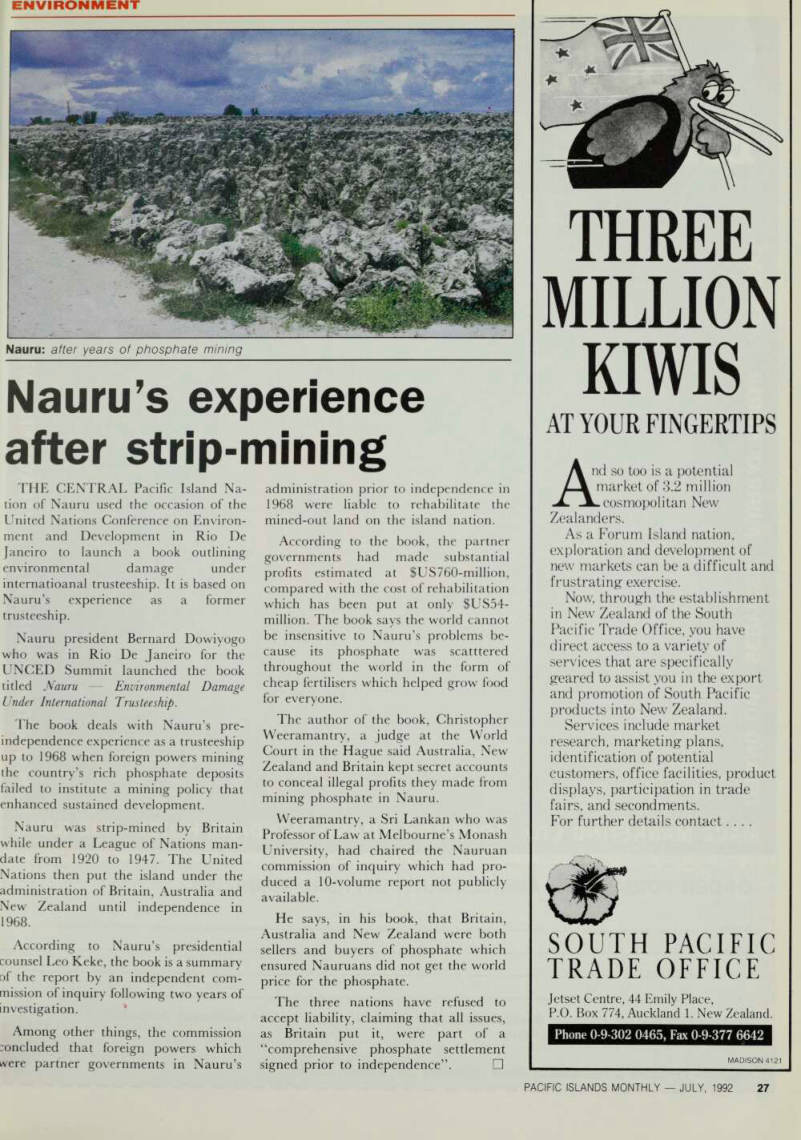
after strip-mining
THE CENTRAL Pacific Island Na tion of Nauru used the occasion of the United Nations Conference on Environ ment and Development in Rio De Janeiro to launch a book outlining environmental damage under internatioanal trusteeship. It is based on Nauru’s experience as a former
trusteeship.
Nauru president Bernard Dowiyogo who was in Rio De Janeiro for the UNCED Summit launched the book titled Nauru Environmental Damage Under International Trusteeship.
The book deals with Nauru’s pre independence experience as a trusteeship up to 1968 when foreign powers mining the country’s rich phosphate deposits failed to institute a mining policy that enhanced sustained development.
Nauru was strip-mined by Britain while under a League of Nations man date from 1920 to 1947. The United Nations then put the island under the administration of Britain, Australia and New Zealand until independence in 1968.
According to Nauru’s presidential counsel Leo Keke, the book is a summary of the report by an independent com mission of inquiry following two years of
investigation.
Among other things, the commission concluded that foreign powers which were partner governments in Nauru’s
administration prior to independence in 1968 were liable to rehabilitate the mined-out land on the island nation.
According to the book, the partner governments had made substantial profits estimated at SUS76O-million, compared with the cost of rehabilitation which has been put at only SUSS4million. The book says the world cannot be insensitive to Nauru’s problems be cause its phosphate was scatttered throughout the world in the form of cheap fertilisers which helped grow food for everyone.
The author of the book, Christopher Weeramantry, a judge at the World Court in the Hague said Australia, New Zealand and Britain kept secret accounts to conceal illegal profits they made from mining phosphate in Nauru.
Weeramantry, a Sri Lankan who was Professor of Law at Melbourne’s Monash University, had chaired the Nauruan commission of inquiry which had pro duced a 10-volume report not publicly available.
He says, in his book, that Britain, Australia and New Zealand were both sellers and buyers of phosphate which ensured Nauruans did not get the world
price for the phosphate.
The three nations have refused to accept liability, claiming that all issues, as Britain put it, were part of a “comprehensive phosphate settlement signed prior to independence”. □
Nauru: after years of phosphate mining