for Pacific
p. 27 · Read in the full issue
Environment
Success for Pacific nations at Rio Now, to put that into action
By Ian Williams
Apart from the Bazilian hoteliers and taxi drivers, who made a killing, few people came away from the Earth Summit entirely satisfied. Even President Bush whose insistence on watering down the Climate Change Convention and refusal to sign the Bio-diversity Convention was such bad news for everybody else, could draw little comfort.
In an election year, the American media ridiculed his pretensions to being the “Green President” and seemed to give general support to Friends of the Earth’s claims that his message is “Industry first, the environment last”. In fact several American-based organizations got together to prepare a school report on the President giving him an overall grade of “D”.
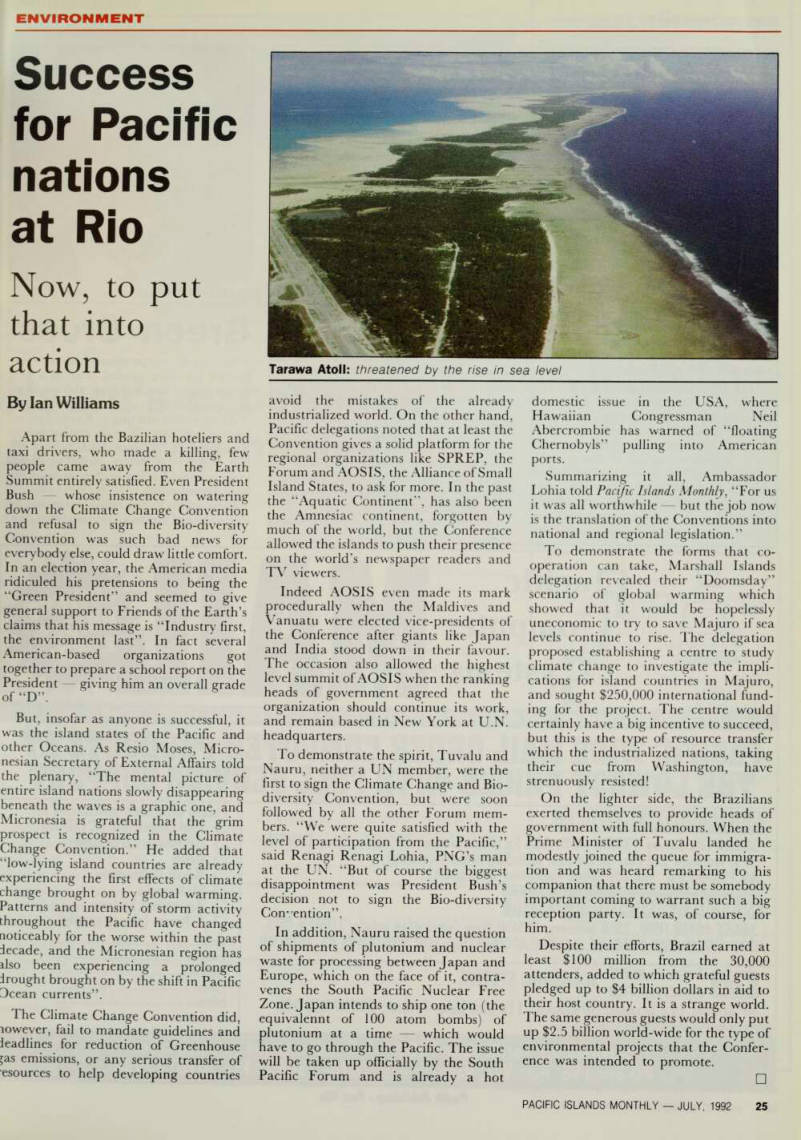
But, insofar as anyone is successful, it was the island states of the Pacific and other Oceans. As Resio Moses, Micro nesian Secretary of External Affairs told the plenary, “The mental picture of entire island nations slowly disappearing beneath the waves is a graphic one, and Micronesia is grateful that the grim prospect is recognized in the Climate Change Convention.” He added that “low-lying island countries are already experiencing the first effects of climate change brought on by global warming.
Patterns and intensity of storm activity
throughout the Pacific have changed noticeably for the worse within the past decade, and the Micronesian region has
also been experiencing a prolonged
drought brought on by the shift in Pacific Tcean currents”.
The Climate Change Convention did, lowever, fail to mandate guidelines and leadlines for reduction of Greenhouse > as emissions, or any serious transfer of esources to help developing countries
avoid the mistakes of the already industrialized world. On the other hand, Pacific delegations noted that at least the Convention gives a solid platform for the regional organizations like SPREP, the Forum and AOSIS, the Alliance of Small Island States, to ask for more. In the past the “Aquatic Continent", has also been the Amnesiac continent, forgotten by much of the world, but the Conference allowed the islands to push their presence on the world’s newspaper readers and TV viewers.
Indeed AOSIS even made its mark procedurally when the Maldives and Vanuatu were elected vice-presidents of the Conference after giants like Japan and India stood down in their favour.
The occasion also allowed the highest level summit of AOSIS when the ranking heads of government agreed that the organization should continue its work, and remain based in New York at U.N.
headquarters.
To demonstrate the spirit, Tuvalu and Nauru, neither a UN member, were the first to sign the Climate Change and Bio diversity Convention, but were soon followed by all the other Forum mem bers. “We were quite satisfied with the level of participation from the Pacific,” said Renagi Renagi Lohia, PNG’s man at the UN. “But of course the biggest disappointment was President Bush’s decision not to sign the Bio-diversity Convention”.
In addition, Nauru raised the question of shipments of plutonium and nuclear waste for processing between Japan and Europe, which on the face of it, contra venes the South Pacific Nuclear Free Zone. Japan intends to ship one ton (the equivalennt of 100 atom bombs) of plutonium at a time which would have to go through the Pacific. The issue will be taken up officially by the South Pacific Forum and is already a hot
domestic issue in the USA, where Hawaiian Congressman Neil Abercrombie has warned of “floating
Chernobyls” pulling into American
ports.
Summarizing it all, Ambassador Lohia told Pacific Islands Monthly , “For us it was all worthwhile but the job now is the translation of the Conventions into national and regional legislation.”
To demonstrate the forms that co operation can take, Marshall Islands delegation revealed their “Doomsday” scenario of global warming which showed that it would be hopelessly uneconomic to try to save Majuro if sea levels continue to rise. The delegation proposed establishing a centre to study climate change to investigate the impli cations for island countries in Majuro, and sought $250,000 international fund ing for the project. The centre would certainly have a big incentive to succeed, but this is the type of resource transfer which the industrialized nations, taking their cue from Washington, have strenuously resisted!
On the lighter side, the Brazilians exerted themselves to provide heads of government with full honours. When the Prime Minister of Tuvalu landed he modestly joined the queue for immigra tion and was heard remarking to his companion that there must be somebody important coming to warrant such a big reception party. It was, of course, for him.
Despite their efforts, Brazil earned at least $lOO million from the 30,000 attenders, added to which grateful guests pledged up to $4 billion dollars in aid to their host country. It is a strange world.
The same generous guests would only put up $2.5 billion world-wide for the type of environmental projects that the Confer ence was intended to promote. □
Tarawa Atoll: threatened by the rise in sea level