political will
pp. 23-25 · Read in the full issue

It’s a matter of political will
Are governments sufficiently committed to protecting the world?
By Martin Tiffany
“Man loses sight of the fact that he is the most short term occupant of the earth to date. There are many other species who have managed to survive on earth for millions of years longer than man and yet man is the one animal that has been able to transform the entire earth on his own in such a rapid amount of time.
“He is really jeopardising the survival of the species.”
These sobering thoughts from Stuart Chape, manager of Fiji’s National En vironment Management Project
(Nemp).
According to Chape, Fiji is at an environment crossroad. A junction where it must make the right decisions or suffer the consequences.
“The country is very fortunate com pared to many others in the world in terms of the environment. Its environ ment problems are not at a point where it is confronted with total devastation or massive pollution. But the warning signs are definitely there and if the country continues on the present path it will be confronted with some major environ mental problems in the not too distant future, ” Chape cautioned.
Chape recently co-compiled a report on Fiji’s environment titled Environment : Fiji The National State of Environment Report. Dick Wading of lUCN The World Conservation Union for NEMP compiled the report with Chape.
While the two are not doom and gloom merchants they point out many of Fiji’s environmental failings. Perhaps one of the most important issues it brings to light is the country’s pollution laws or rather their ineffectiveness.
According to the report, prosecution of anyone causing pollution is practically impossible and has never been carried
through. This allows some of the most blatant offenders to operate effectively uncontrolled, despite many years of muted public concern.
A fine example of this is the cement factory on the outskirts of Suva. For years it has been spewing smoke from its chimneys and covering everything in the vicinity with a fine white coating.
Apart from a few sporadic outbursts via the Letters-to-the-Editor columns in Fiji’s two dailies from the cements factory’s neighbours there has been little
other opposition.
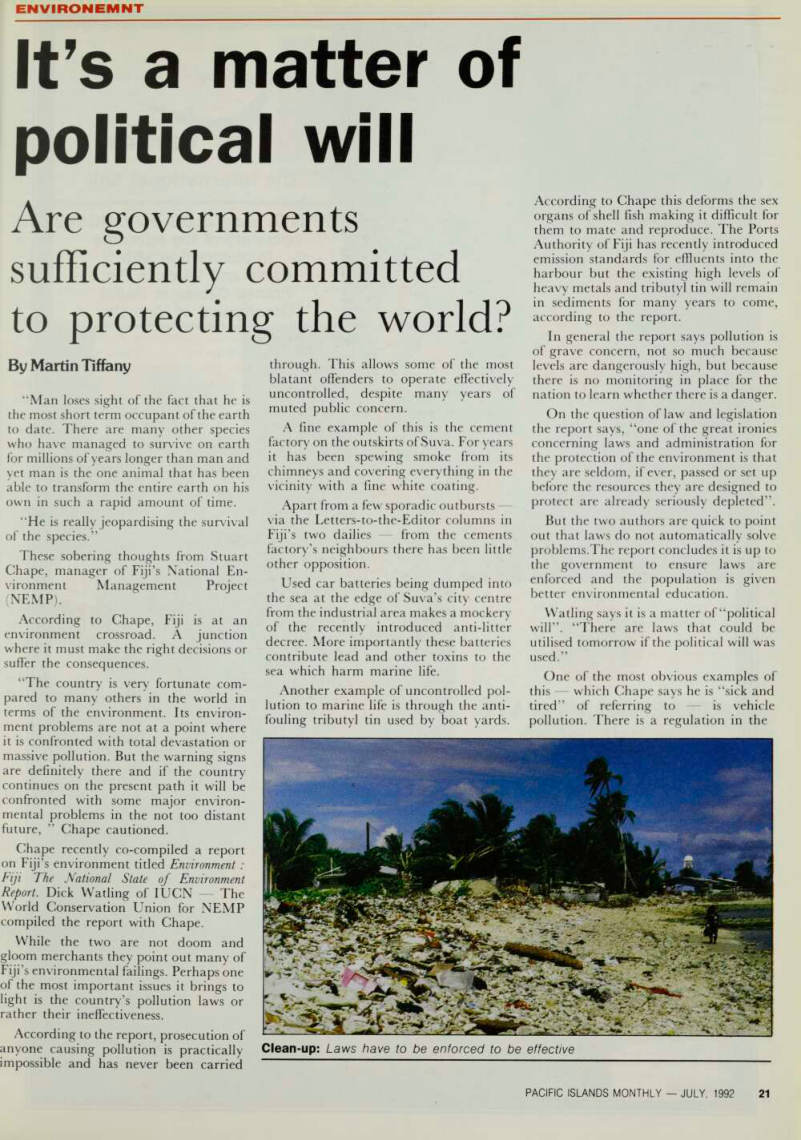
Used car batteries being dumped into the sea at the edge of Suva’s city centre from the industrial area makes a mockery of the recently introduced anti-litter decree. More importantly these batteries contribute lead and other toxins to the sea which harm marine life.
Another example of uncontrolled pol lution to marine life is through the anti fouling tributyl tin used by boat yards.
According to Chape this deforms the sex organs of shell fish making it difficult for them to mate and reproduce. The Ports
Authority of Fiji has recently introduced
emission standards for effluents into the harbour but the existing high levels of heavy metals and tributyl tin will remain in sediments for many years to come, according to the report.
In general the report says pollution is of grave concern, not so much because levels are dangerously high, but because there is no monitoring in place for the nation to learn whether there is a danger.
On the question of law and legislation the report says, “one of the great ironies concerning laws and administration for the protection of the environment is that they are seldom, if ever, passed or set up before the resources they are designed to
protect are already seriously depleted”.
But the two authors are quick to point out that laws do not automatically solve problems. The report concludes it is up to the government to ensure laws are enforced and the population is given better environmental education.
VVatling says it is a matter of “political will”. “There are laws that could be utilised tomorrow if the political will was used.”
One of the most obvious examples of this which Chape says he is “sick and tired” of referring to is vehicle pollution. There is a regulation in the
Clean-up: Laws have to be enforced to be effective
Traffic Act to control that problem which carries a fine of SIOO or three months jail for offenders. Little heed has been paid to the penalty and the authorities turn a blind eye as cars, trucks and buses continue to belch black exhaust.
An effort was made last year under the program “Operation Countdown” when vehicles were randomly checked for road-worthiness and exhaust emission but it seems to have been little more than a token effort as anyone who walks or drives around the streets of Suva can tell you.
One bright spot for Fiji is the appoint ment of a Minister of State for the Environment by the recently elected Fiji government which is hopefully an indi cation of their concern for the environ ment. The minister, Joeli Kalou, last month attended the Earth Summit in Rio De Janeiro. The gradual introduc tion of unleaded petrol is one way that could help protect the environment not to mention the people but, according to the report, there is no programme in place for gradual conver sion to lead-free petrol. Despite the fact that unleaded petrol is widely available elsewhere in the world.
Chape has had discussions with the Fiji National Petroleum Company about the possible phasing-in of unleaded fuel. If Fiji is serious about doing this it will take at least 10 years for the transformation as the cars themselves will have to be converted or replaced.
All petrol sold in Fiji contains lead additives. Compared to lead-free petrol it is extremely toxic and studies in Austra lia have shown a marked decrease in intellectual capacity of children who have been exposed to high lead levels from vehicle emission.
The decision to convert to unleaded petrol again comes back to political will.
Deforestation is an issue that usually raises the hackles of environmentalists like nothing else. The National Environ ment Management Project has under taken a specific study on deforestation in
Fiji.
Chape says it is quite clear that deforestation is occuring at a rate of about 0.5 per cent to 0.8 per cent per year. Chape said it is generally supposed that logging is one of the major causes of deforestation in Fiji when in fact it is not.
He said it facilitates deforestation but it does not necessarily cause deforestation.
According to Chape fire is one of the major causes of deforestation. Agricul-
tural activity at the subsistence level and clearing areas for cash crops also contrib ute to deforestation.
He said there was a need to address the question of annual burning getting out of control and destroying forest and inter
mediate foliage.
Warning was also made by the report in the area of agriculture and fisheries.
Over the past thirty years there has been a small but steady loss of good arable land to non-agricultural uses. The report says there are now basically no extensive areas of unused agricultural land and the major drive is currently to increase productivity. One problem that can arise from this is soil erosion.
Ginger cultivation, for example, is associated with severe erosion as it is almost entirely grown on slopes. The ginger industry should provide a test case for the government’s resolution to pro mote sustainable agriculture and curb land —degradation.
Perhaps if people were able to see the relationship between soil loss and econ omic loss to the country there might be a change of attitude.
The report cites the example of sugarcane farmers who have complained of declining yield and have blamed this on the quality of the fertilizers imported.
Tests on the fertilizer showed little or no change had occured. A more logical explanation for the decline in yields is the impact of erosion on soil productivity.
Given that agriculture remains the single largest sector of the Fiji economy, accounting for some 20 per cent of the Gross Domestic Product and 80 per cent of employment, this problem should be taken seriously.
Fisheries is another important sector of Fiji’s economy. This industry too is
facing problems.
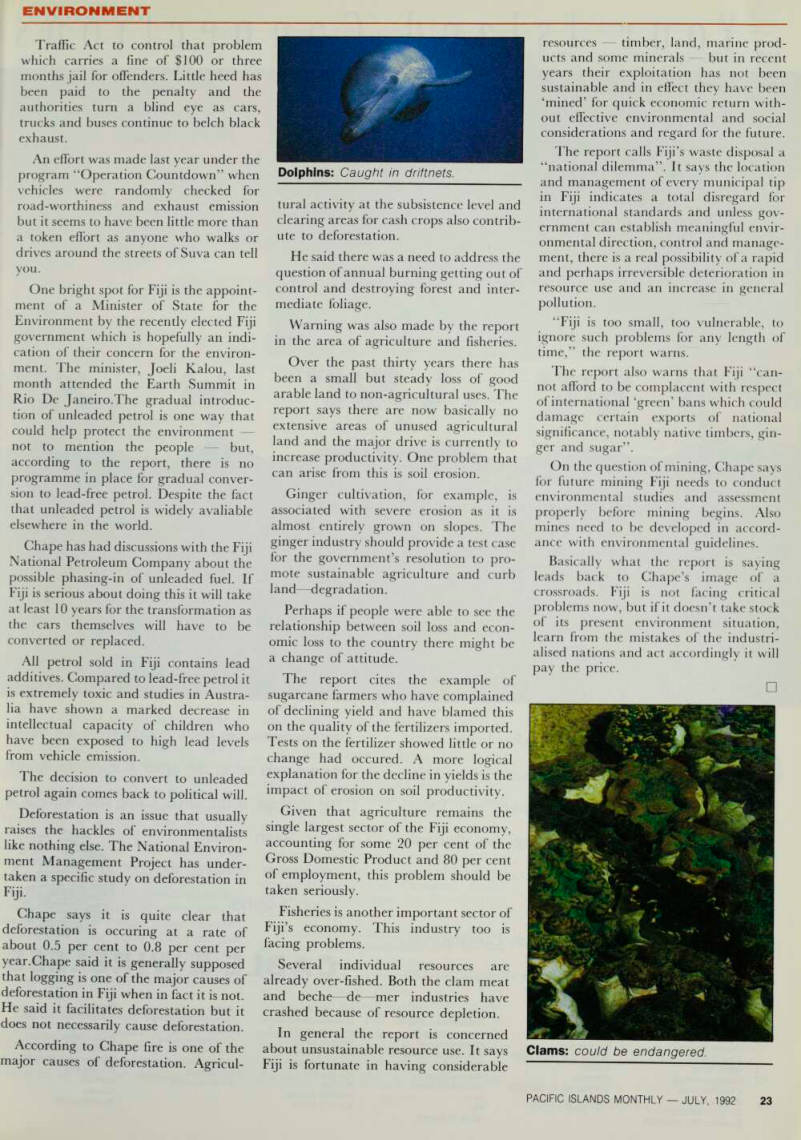
Several individual resources are already over-fished. Both the clam meat and beche —de —mer industries have crashed because of resource depletion.
In general the report is concerned about unsustainable resource use. It says Fiji is fortunate in having considerable
resources timber, land, marine prod ucts and some minerals but in recent years their exploitation has not been sustainable and in effect they have been ‘mined’ for quick economic return with out effective environmental and social considerations and regard for the future.
The report calls Fiji’s waste disposal a “national dilemma”. It says the location and management of every municipal tip in Fiji indicates a total disregard for international standards and unless gov ernment can establish meaningful envir onmental direction, control and manage ment, there is a real possibility of a rapid and perhaps irreversible deterioration in resource use and an increase in general pollution.
“Fiji is too small, too vulnerable, to ignore such problems for any length of time,” the report warns.
The report also warns that Fiji “can not afford to be complacent with respect of international ‘green’ bans which could damage certain exports of national significance, notably native timbers, gin ger and sugar”.
On the question of mining, Chape says for future mining Fiji needs to conduct environmental studies and assessment properly before mining begins. Also mines need to be developed in accord ance with environmental guidelines.
Basically what the report is saying leads back to Chape’s image of a crossroads. Fiji is not facing critical problems now, but if it doesn’t take stock of its present environment situation, learn from the mistakes of the industri alised nations and act accordingly it will pay the price.
Dolphins: Caught in driftnets.
Clams: could be endangered.