once again
p. 46 · Read in the full issue
Books
Venus passes by once again
By Nicolas Rothwell
INTRICATELY written, compellingly plotted. Transit of Venus marks a drastic, perhaps even a final step in the evolution of that long-familiar European genre the Pacific travel memoir. This record of a journey through the islands of the great ocean doubles as a personal voyage of discovery; the author exorcises his own dreams of a remote paradise while travelling toward the ultimate target of
Westernn opportunity the dispersed,
straggling atoll of Kwajalein in the Marshall Islands, America’s testing ground for inter-continental ballistic missiles.
Along the wa). he experiences the lilting, infectious sense of decay and self dissolution that afflicts many a Pacific wanderer, and finds his own certainties withered by the implacable sun and the constant, crashing pressure of the wave.
In style eclectic and self-indulgent, in content austere and analytical, Transit of Venus has the feel of a labour deliberately undertaken; the author was as much testing himself as the myths of his own society. The result is a meditation on certain core images; the fatal missile re entry vehicles streaking across the semi darkened skies of Kwajalein, which first sparked his desire to make this pilgrim age; the memory of his childhood in a sun-bleached Australia, which he revisits at the outset of the journey; and the ‘tree of life’, the coconut palm, which punctu ates the wilderness of beaches and corals through which he wanders.
Bored with his life as a London publisher ‘in a newly flowering atmos phere of corporate take-overs and well paid suspicion,’Julian Evans decided to journey to the opposite extreme of experience. His way-stations are Fiji, New Caledonia, Vanuatu, Tonga, West ern Samoa, Tuvalu, Kiribati and at last the Marshalls. Strangely, his perception of the islands is at its sharpest towards the outset of his journey; by the time he has reached the Marshallese capital of Ma juro. which he dismissed as 'the most unspeakable dump I had ever seen,’ self obsession and the struggle for sanity have taken over from conventional travel writing.
The backdrop for his reflections is often familiar; days and nights are whiled away in Suva’s Grand Pacific, the Surf Novotel in Noumea, the Rossi in Port Vila, the Kiribati Hotel on Tarawa. The local informants, too, are regular guests
in the copy of Western journalists; Miles Johnson and Adi Kuini Bavadra explain Fiji, a brother of Jean-Marie Tjibaou offers the low-down on New Caledonia’s politics, while Akilisi Pohiva is on standby to say to say his piece in Tonga.
But Transit of Venus does not aim to provide a dispassionate political history of the colonial and modern Pacific, rather a feast of subjectivity.
Evans follows in the footsteps of a noble company of Pacific self-explorers, from Robert Louis Stevenson, at whose Samoan grave he pays homage, to those ghosts of Vanuatu, Bernard Deacon and Robert Fletcher.
The most memorable passages of his book contain brief flashes of insight wrapped up in descriptive prose as purple as a Polynesian sunset. On Tanna, he catches well the deep unease the island can breed in its visitors. Port Vila radiates a ‘gentle chaos and disre pair’ while the ni-Vanuatu shows an ‘unblinking solemn gravity’. Other spots please him less Fiji strikes him as insipid and dull, Tonga, which he visits just as the ‘extra-terrestrials’ affair is breaking, seems a shambles, while Kiri bati, probably the most elegant country in th entire Pacific, eludes him entirely.
In part this may be because of illness.
Evans, a traveller made for misfortune, picks up a dash of kerosene poisoning in Apia, and soon after grazes his leg on coral. The injured knee festers violently throughout the second half of his journey, reducing him to near-invalid condition for several purgatorial weeks until he arrives in Majuro hospital.
In all this, the heart of Evans’ inquiry is not so much the polarity between the palm-tree of life and the deathly atom, nor the relations between colonised and colonisers, but rather the motive that draws Westerners so insistently to the ocean’s desert. As he experiences the flavours of boredom in different island states, he laments piteously that ‘I had found exactly the same tedium I had been unable to dispel at home.’
In this way, the author hears the prompts of the internal, not the external world, and neatly recapitulates the first
Pacific explorers’ journeys, discovering
his own imaginings as much as the new world’s before his eyes. If there is enlightenment in this trajectory, it comes to the author upon the tip of Espiritu Santo, where the quest of Western visitors to the islands is nicely compacted; ‘They wanted somewhere to bring their psychological baggage and dump it.
Espiritu Santo was beautiful and enig matic and rich . . . and they longed for some sudden paradise to flower there, some sudden liberation from neurosis and desire.’
Evans discovers all the futility of solitude in these profoundly social islands, and plumbs the depths of weary derangement whilst transiting through such cloyingly spectacular landscapes as Tuvalu’s Funafuti and a nameless Marshallese atoll.
The theme of the mermaid surfaces insistently as do tempting island women, until the author finds himself finally undone by a mysterious Western girl, who stands as a symbol of the Pacific’s mirage-like delights. At the end of his
journey, inspiration and enthusiasm
leached by the unceasing heat and the depradations of the travelling life, Evans discovers the unconfessed agenda of his pilgrimage; it is a voyage ‘into contact with the meaning of solitude’ what he terms the ‘inside-out passion of solitude’.
If this, as much as the discovery of the ‘monotony of paradise’ on Tuvalu, constituted the true meaning of Transit of Venues , it is Evans’ chief insight to grasp, and to convey through his spasmodic, ornate style of writing, that he himself has corroded and destroyed his own fantasy. At the death, this is a book on the foreign view of the Pacific, rather than a book about the peoples of the ocean. As such, it stands at the end of an illustrious tradition; beauty has failed to assuage the disquieting sense of strange ness. Venus has passed by once again, and deserted her suitors. □
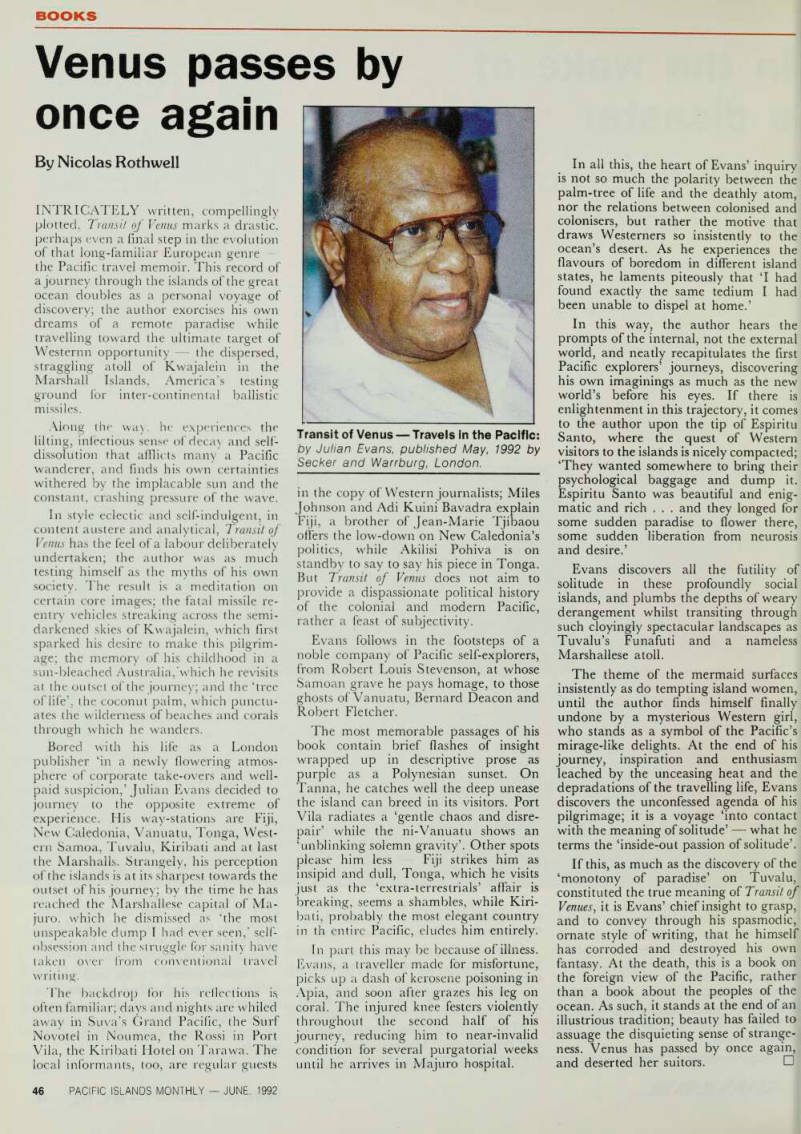
Transit of Venus Travels in the Pacific: by Julian Evans, published May, 1992 by Seeker and Warrburg, London.