Shades of
pp. 48-49 · Read in the full issue
Arts
Shades of Samoa
A New York artist finds inspiration in Samoan folklore and culture
By Ian Williams
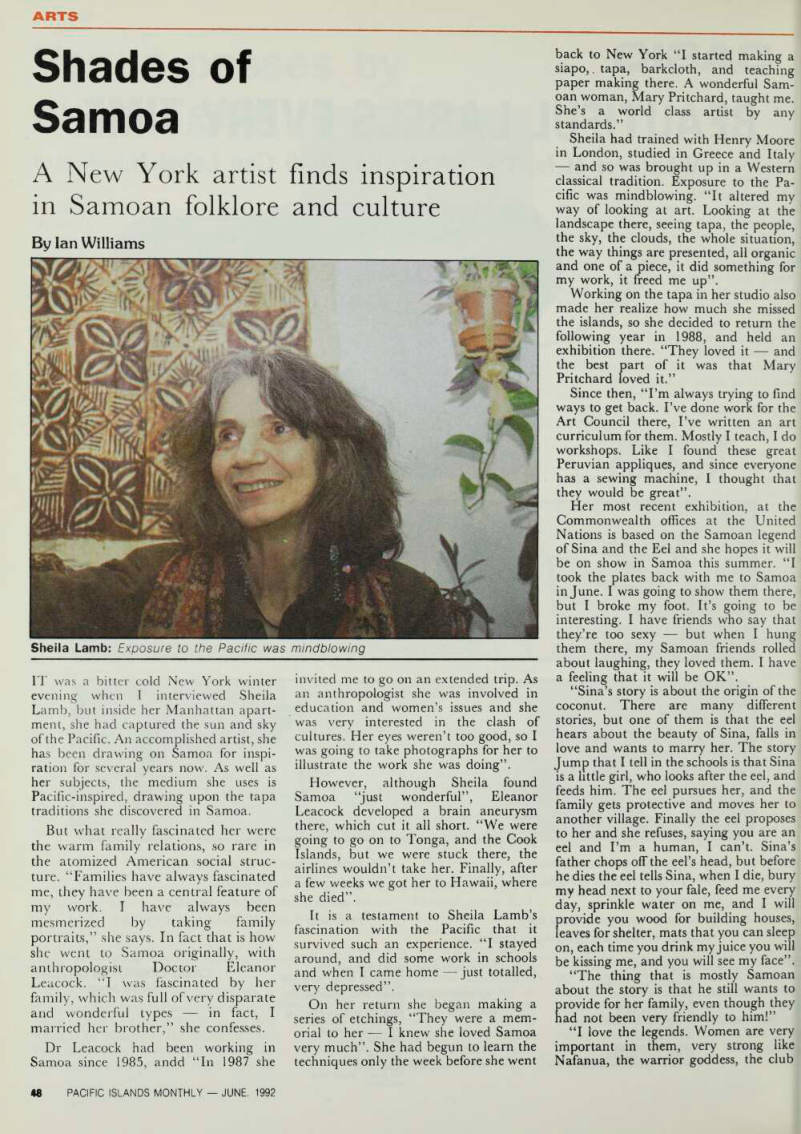
IT was a bitter cold New York winter evening when I interviewed Sheila Lamb, but inside her Manhattan apart ment, she had captured the sun and sky of the Pacific. An accomplished artist, she has been drawing on Samoa for inspi ration for several years now. As well as her subjects, the medium she uses is Pacific-inspired, drawing upon the tapa traditions she discovered in Samoa.
But what really fascinated her were the warm family relations, so rare in the atomized American social struc ture. “Families have always fascinated me, they have been a central feature of my work. T have always been
mesmerized by taking family
portraits,” she says. In fact that is how she went to Samoa originally, with anthropologist Doctor Eleanor Leacock, “I was fascinated by her family, which was full of very disparate and wonderful types in fact, I married her brother,” she confesses.
Dr Leacock had been working in Samoa since 1985, andd “In 1987 she
invited me to go on an extended trip. As an anthropologist she was involved in education and women’s issues and she was very interested in the clash of cultures. Her eyes weren’t too good, so I was going to take photographs for her to illustrate the work she was doing”.
However, although Sheila found Samoa “just wonderful”, Eleanor Leacock developed a brain aneurysm there, which cut it all short. “We were going to go on to Tonga, and the Cook Islands, but we were stuck there, the airlines wouldn’t take her. Finally, after a few weeks we got her to Hawaii, where she died”.
It is a testament to Sheila Lamb’s fascination with the Pacific that it survived such an experience. “I stayed around, and did some work in schools and when I came home —just totalled, very depressed”.
On her return she began making a series of etchings, “They were a mem orial to her I knew she loved Samoa very much”. She had begun to learn the techniques only the week before she went
back to New York “I started making a siapo,. tapa, barkcloth, and teaching paper making there. A wonderful Sam oan woman, Mary Pritchard, taught me.
She’s a world class artist by any standards.”
Sheila had trained with Henry Moore in London, studied in Greece and Italy and so was brought up in a Western classical tradition. Exposure to the Pa cific was mindblowing. “It altered my way of looking at art. Looking at the
landscape there, seeing tapa, the people,
the sky, the clouds, the whole situation, the way things are presented, all organic and one of a piece, it did something for my work, it freed me up”.
Working on the tapa in her studio also made her realize how much she missed the islands, so she decided to return the following year in 1988, and held an exhibition there. “They loved it and the best part of it was that Mary Pritchard loved it.”
Since then, “I’m always trying to find ways to get back. I’ve done work for the Art Council there, I’ve written an art curriculum for them. Mostly I teach, I do workshops. Like I found these great Peruvian appliques, and since everyone has a sewing machine, I thought that
they would be great”.
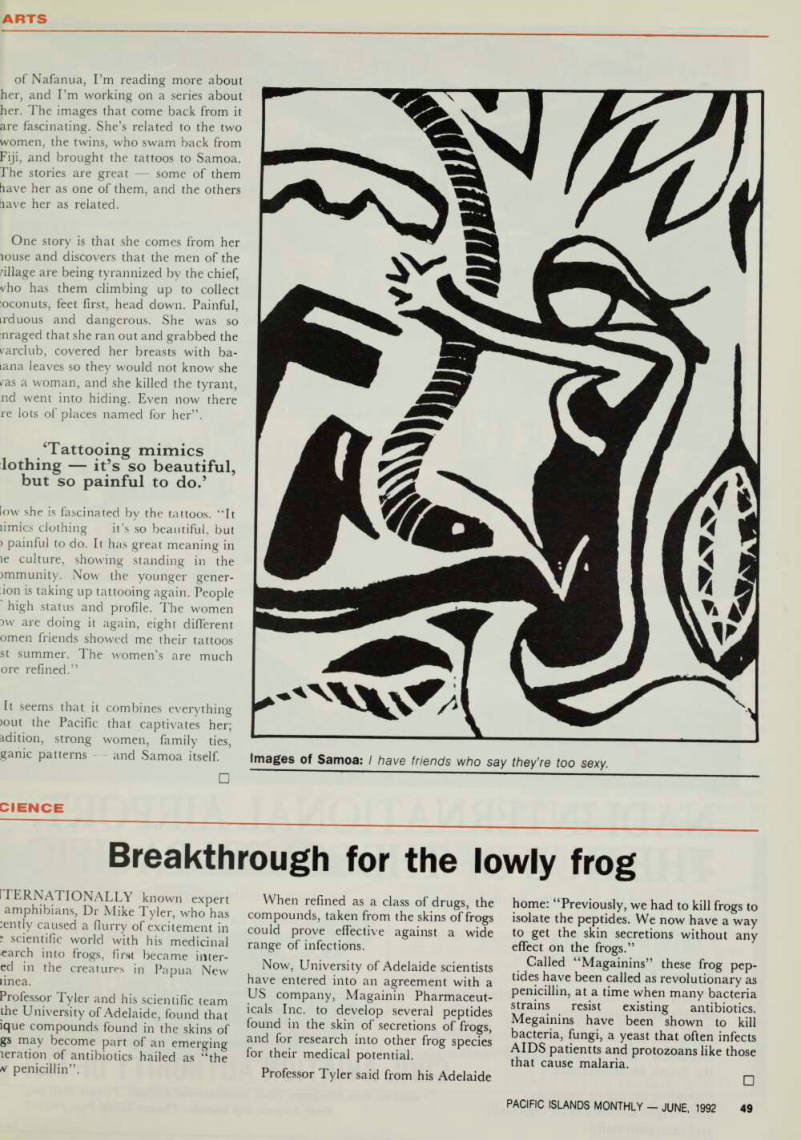
Her most recent exhibition, at the Commonwealth offices at the United Nations is based on the Samoan legend of Sina and the Eel and she hopes it will be on show in Samoa this summer. “I took the plates back with me to Samoa in June. I was going to show them there, but I broke my foot. It’s going to be interesting. I have friends who say that they’re too sexy but when I hung them there, my Samoan friends rolled about laughing, they loved them. I have a feeling that it will be OK”.
“Sina’s story is about the origin of the coconut. There are many different stories, but one of them is that the eel hears about the beauty of Sina, falls in love and wants to marry her. The story Jump that I tell in the schools is that Sina is a little girl, who looks after the eel, and feeds him. The eel pursues her, and the family gets protective and moves her to another village. Finally the eel proposes to her and she refuses, saying you are an eel and I’m a human, I can’t. Sina’s father chops off the eel’s head, but before he dies the eel tells Sina, when I die, bury my head next to your fale, feed me every day, sprinkle water on me, and I will provide you wood for building houses, leaves for shelter, mats that you can sleep on, each time you drink my juice you will be kissing me, and you will see my face”.
“The thing that is mostly Samoan about the story is that he still wants to provide for her family, even though they had not been very friendly to him!”
“I love the legends. Women are very important in them, very strong like Nafanua, the warrior goddess, the club
Sheila Lamb: Exposure to the Pacific was mindblowing
of Nafanua, I’m reading more about her, and I’m working on a series about her. The images that come back from it are fascinating. She’s related to the two women, the twins, who swam back from Fiji, and brought the tattoos to Samoa.
The stories are great some of them have her as one of them, and the others have her as related.
One story is that she comes from her louse and discovers that the men of the dllage are being tyrannized by the chief, vho has them climbing up to collect :oconuts, feet first, head down. Painful, irduous and dangerous. She was so nraged that she ran out and grabbed the /arclub, covered her breasts with ba nana leaves so they would not know she /as a woman, and she killed the tyrant, nd went into hiding. Even now there re lots of places named for her”.
‘Tattooing mimics
lothing it’s so beautiful,
but so painful to do. 5 iow she is fascinated by the tattoos. “It limics clothing it’s so beautiful, but ) painful to do. It has great meaning in
le culture, showing standing in the
immunity. Now the younger gener al! is taking up tattooing again. People high status and profile. The women dw are doing it again, eight different omen friends showed me their tattoos st summer. The women’s are much ore refined.”
It seems that it combines everything >out the Pacific that captivates her; adition, strong women, family ties, ganic patterns and Samoa itself.
images of Samoa: I have friends who say they're too sexy.