prepares for elections
pp. 11-12 · Read in the full issue
Poliitcs
Papua New Guinea prepares for elections
As the country gets ready for the polls corruption has become a central issue
By Wally Hiambohn
PRIME Minister Rabbie Namaliu came in this afternoon looking tired and worn out.
When he spoke to reporters you would have thought he had a cold and was losing his voice.
And the government jet had arrived in Port Moresby at 7.05 pm, an hour behind schedule.
Earlier this morning one of Namaliu’s staunch Pangu Pati MPs, Menu
Hessingut, collapsed and died.
foreign Affairs Minister Sir Michael Somare was resting at his Port Moresby home with swollen feet. He had to drag himself on crutches to meet a visiting Solomon Islands parliamentary del egation.
Opposition leader Paias Wingti is hardly in Port Moresby to sign his press statements so it is done by the office girl.
Yes, it is hectic. This is the time of the
tough PNG national election the fourth since independence in 1975.
The election dates are: March 26 issue of writs and nominations open, April 24 close of nominations, June 13 polling begins, June 27 end of polling, July 15 return of writs.
As the past three had proven, the jungle law of survival of the fittest rings true in these elections a philosophy that is forcing current and intending politicians to comb the remotest jungles, walk the toughest terrains and swim the biggest rivers to get to that extra voter who in this intense battle could cast the
winning vote.
As in the past three, it is expected again that half the current MPs will lose their seats.
Except for those vying for the city’s four seats, Port Moresby, home to the politicians for the past five years, has been deserted by them.
Government ministers drop in for a day or two to sort out official business and disappear for weeks before they are
seen again.
But despite their absence from Port Moresby, media organisations are bom barded with press statements on almost every issue.
Namaliu has in the past two months
gone on regualar provincial campaign
ing visits In fact, in the last week he has flown to six different provinces, leaving as early as 6am and returning at dusk.
A total of 1653 candidates have been nominated to contest the country’s 109 seats in Parliament, an average of 16 candidates per electorate.
The number of candidates is 40 more than in the last election in 1987 despite an increase in the nomintion fee from KlOO to KlOOO a candidatee. It proved beyond doubt that a Supreme Court challenge by the Ombudsman Commission that the fee increase im pinged on the rights of people was
unnecessary.
The largest number of candidates for any one electorate is 48 for the Sinasina- Youngumgi seat in the Highlands. Only two, on the other hand, have been nominated for Namatanai in New Ire land.
Namaliu and his five-party coalition have pledged to stick together to form the government after the election while the
three-party Opposition has given a
similar undertaking.
Both sides are confident of forming the government in July.
A total of 16 parties have put up candidates, the major parties being Namaliu’s Pangu, Wingti’s People’s Democratic Movement, the People’s
Action Party, People’s Progress Party,
Melanesian Alliance and National Party.
While all parties have raised key issues such as agricultural development, em ployment, education and health in their election platforms, these all have been pushed to the background with the emergence of another more current issue.
Corruption is on the lips of almost every politician. It stems from very recent cases where several politicians have been prosecuted on corruption
charges.
Former deputy prime minister Ted Diro’s celebrated case was one of them.
In the term of this parliament 10 MPs have been prosecuted for corruption and have subsequently resigned their offices to escape penalty.
All except Diro are recontesting their seats, a move which would have wide ranging implications. If any of them wins his seat would automatically be subject to reprosecution.
Prime Minister Namaliu and his Finance Minister Paul Pora have been implicated in several such cases for their parts in approving hundreds of thou sands of public funds for private use by MPs.
A leadership tribunal which found one of Namaliu’s ministers guilty of corrup tion recommended that both be investi
gated.
The case has been referred to police for invesitgation and possible criminal chargescould be laid.
Namaliu has denied any wrong-doing.
Almost every day the two sides are issuing statements accusing the each other of corruption.
Opposition leader Paias Wingti has vowed to investigate, prosecute and jail all leaders who have misused public
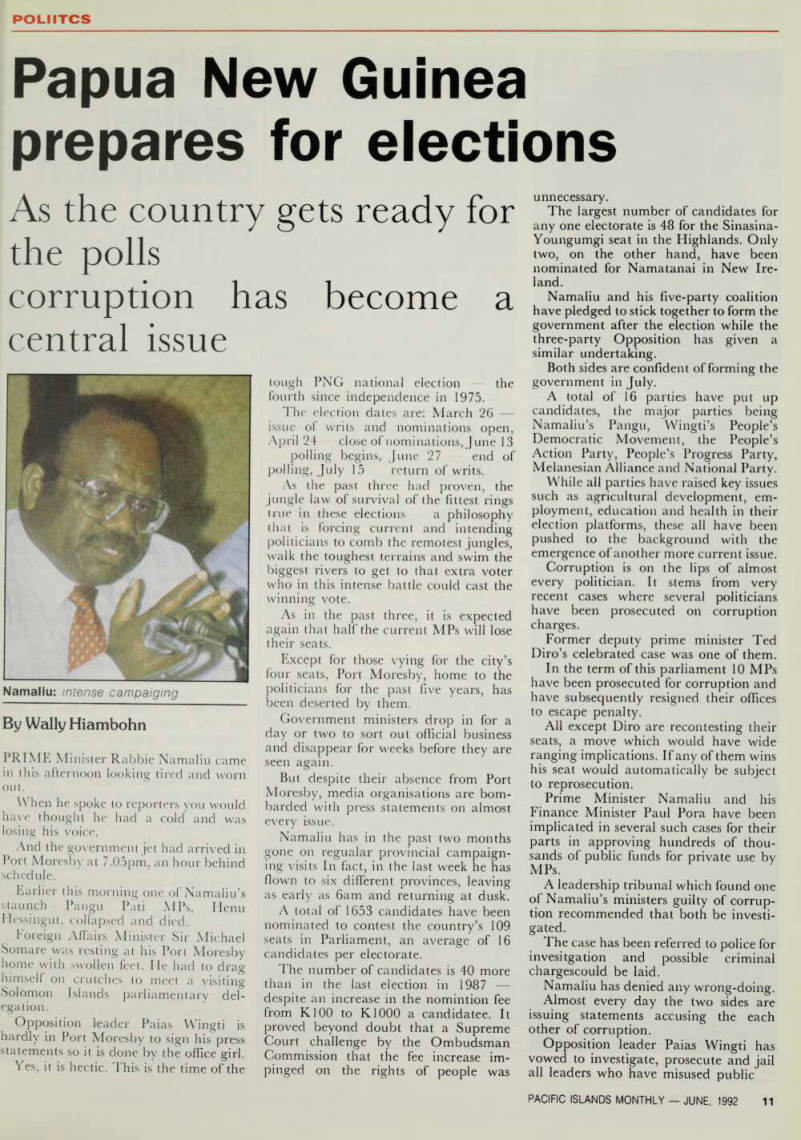
Namaliu: intense campaiging
,Sp money if he wins government.
“I will make sure they are all behind bars,” Wingti said at the height of the debate on corruption.
“This election will be about good and evil, good government and bad govern ment, it will be about corruption in high places and accountability,” he said.
Wingti’s deputy, Peoples Progress
Party leader Sir Julius Chan, a former prime minister, told university students this month; “Whether anyone likes it or not, the central issue being addressed during this campaignn is the scary one — corruption in high places.”
“We are so close to a grass-roots revolution that quite frankly, I’m scared.”
Sir Julius said greed and corruption had broken the political party system down to “almost beyond redemption” and politicians had no loyalty to party policies and platforms which they en dorsed during elections.
“They come and go from one party to another like fleas switching dogs,” he said.
In a move to gain electoral support, Prime Minister Namaliu announced on May 14 that he would, if he retained power, establish an anti-corruption au thority with independent powers to investigate and prosecute leaders in volved in corruption.
“The recent focus on the misuse of public money has resulted in bribery related corruption of public officials by
businessmen being largely ignored.” He
spoke of extending investigations to those who offered bribes.
He also accused the Opposition of
corruption saying they were the “worst
culprits”.
“While they were in power they dished out thousands of kina in public funds,” he said.
“They squandered millions of kina earmarked for civic action programs and transport sectoral funds. These funds are still unaccounted for today.
“Who can believe Chan and Wingti to be clean.
“They are using the election campaign to cover up for their corrupt deals when they were in power.” □
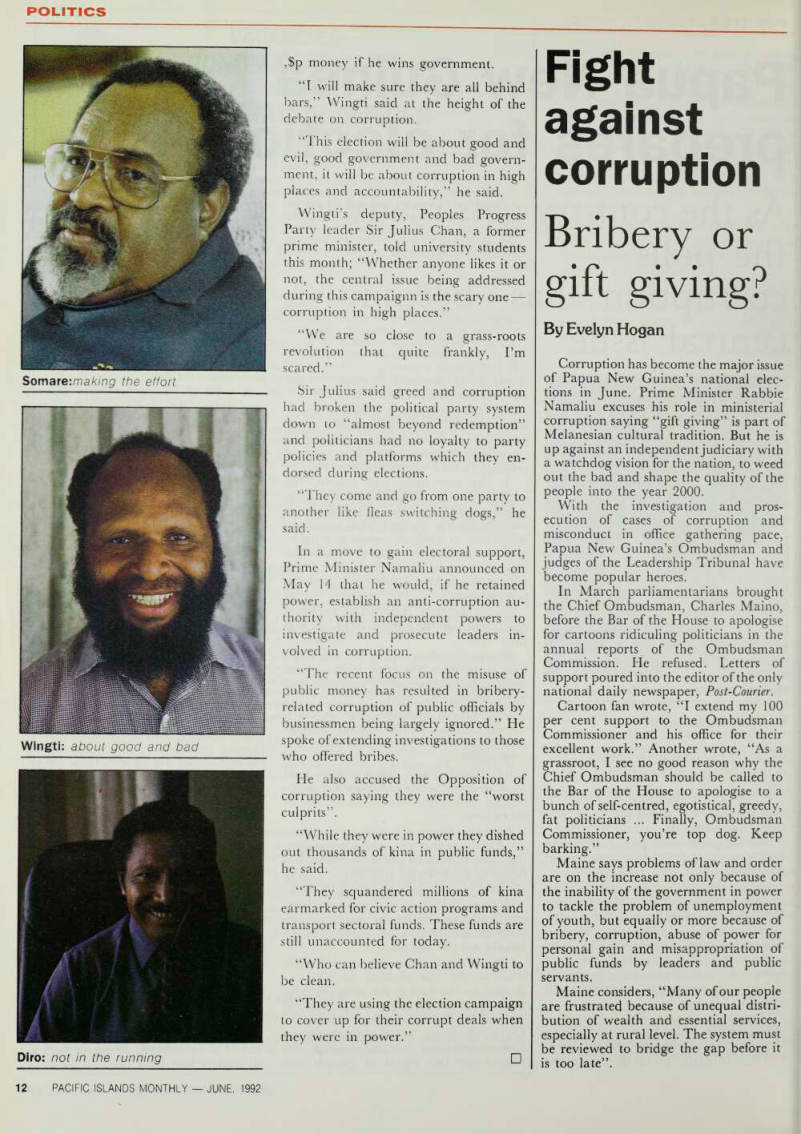
Soma re: making the effort
Wingti: about good and bad
Diro: not in the running