Bribery or
pp. 12-13 · Read in the full issue
Fight against corruption Bribery or gift giving?
By Evelyn Hogan
Corruption has become the major issue of Papua New Guinea’s national elec tions in June. Prime Minister Rabbie Namaliu excuses his role in ministerial corruption saying “gift giving” is part of Melanesian cultural tradition. But he is up against an independent judiciary with a watchdog vision for the nation, to weed out the bad and shape the quality of the people into the year 2000.
With the investigation and pros ecution of cases of corruption and misconduct in office gathering pace, Papua New Guinea’s Ombudsman and judges of the Leadership Tribunal have become popular heroes.
In March parliamentarians brought the Chief Ombudsman, Charles Maine, before the Bar of the House to apologise for cartoons ridiculing politicians in the annual reports of the Ombudsman Commission. He refused. Letters of support poured into the editor of the only national daily newspaper, Post-Courier.
Cartoon fan wrote, “I extend my 100 per cent support to the Ombudsman Commissioner and his office for their excellent work.” Another wrote, “As a grassroot, I see no good reason why the Chief Ombudsman should be called to the Bar of the House to apologise to a bunch of self-centred, egotistical, greedy, fat politicians ... Finally, Ombudsman Commissioner, you’re top dog. Keep barking.”
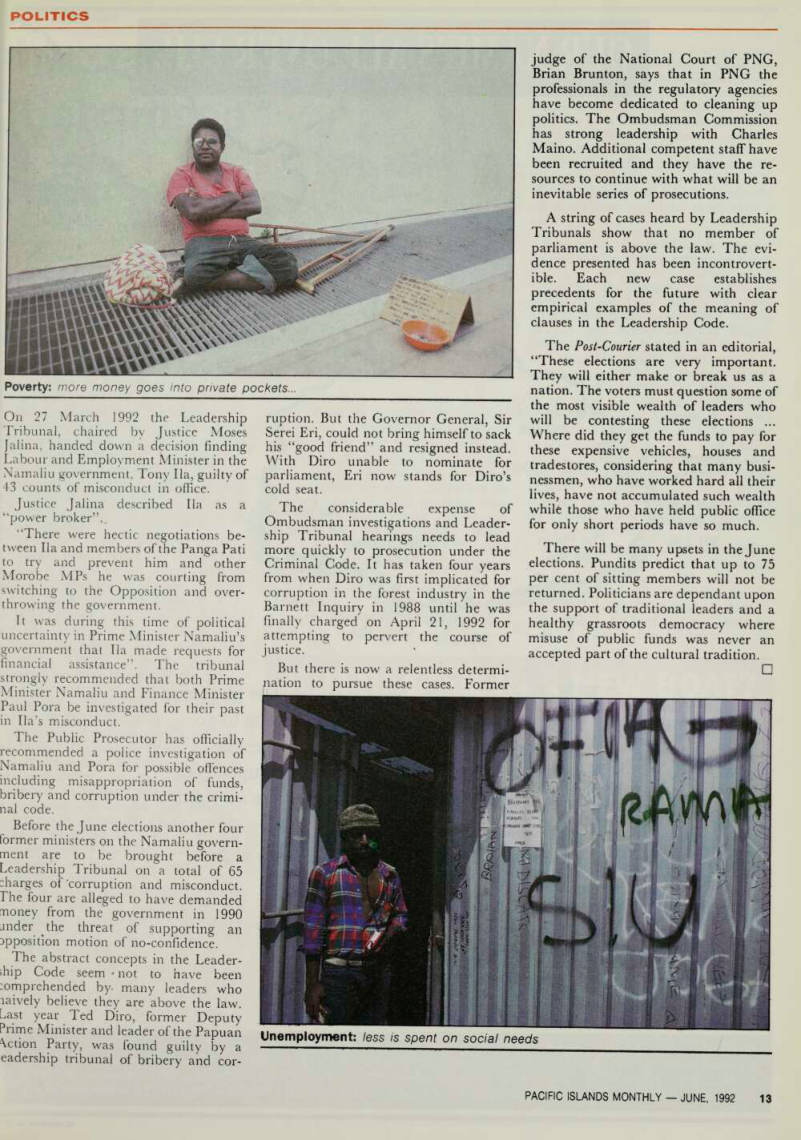
Maine says problems of law and order are on the increase not only because of the inability of the government in power to tackle the problem of unemployment of youth, but equally or more because of bribery, corruption, abuse of power for personal gain and misappropriation of public funds by leaders and public servants.
Maine considers, “Many of our people are frustrated because of unequal distri bution of wealth and essential services, especially at rural level. The system must be reviewed to bridge the gap before it is too late”.
On 27 March 1992 the Leadership Tribunal, chaired by Justice Moses Jalina. handed down a decision finding Labour and Employment Minister in the Namaliu government. Tony Ila, guilty of 43 counts of misconduct in office.
Justice Jalina described Ila as a “power broker”., “There were hectic negotiations be tween Ila and members of the Panga Pati to try and prevent him and other Morobe MPs he was courting from switching to the Opposition and over throwing the government.
It was during this time of political uncertainty in Prime Minister Namaliu’s government that Ila made requests for financial assistance”. The tribunal strongly recommended that both Prime Minister Namaliu and Finance Minister Paul Pora be investigated for their past in Ha’s misconduct.
The Public Prosecutor has officially recommended a police investigation of Namaliu and Pora for possible offences including misappropriation of funds, bribery and corruption under the crimi nal code.
Before the June elections another four former ministers on the Namaliu govern ment are to be brought before a Leadership Tribunal on a total of 65 ;harges of corruption and misconduct, fhe four are alleged to have demanded money from the government in 1990 jnder the threat of supporting an opposition motion of no-confidence.
The abstract concepts in the Leader ship Code seem • not to have been :omprehended by- many leaders who laively believe they are above the law.
Last year Ted Diro, former Deputy Prime Minister and leader of the Papuan \ction Party, was found guilty by a eadership tribunal of bribery and cor
ruption. But the Governor General, Sir Serei Eri, could not bring himself to sack his “good friend” and resigned instead.
With Diro unable to nominate for parliament, Eri now stands for Diro’s cold seat.
The considerable expense of Ombudsman investigations and Leader ship Tribunal hearings needs to lead more quickly to prosecution under the Criminal Code. It has taken four years from when Diro was first implicated for corruption in the forest industry in the Barnett Inquiry in 1988 until he was finally charged on April 21, 1992 for attempting to pervert the course of
justice.
But there is now a relentless determi nation to pursue these cases. Former
judge of the National Court of PNG, Brian Brunton, says that in PNG the professionals in the regulatory agencies have become dedicated to cleaning up politics. The Ombudsman Commission has strong leadership with Charles Maino. Additional competent staff have been recruited and they have the re sources to continue with what will be an inevitable series of prosecutions.
A string of cases heard by Leadership Tribunals show that no member of parliament is above the law. The evi dence presented has been incontrovert ible. Each new case establishes precedents for the future with clear empirical examples of the meaning of clauses in the Leadership Code.
The Post-Courier stated in an editorial, “These elections are very important.
They will either make or break us as a nation. The voters must question some of the most visible wealth of leaders who will be contesting these elections ...
Where did they get the funds to pay for these expensive vehicles, houses and tradestores, considering that many busi nessmen, who have worked hard all their lives, have not accumulated such wealth white those who have held public office for only short periods have so much.
There will be many upsets in the June elections. Pundits predict that up to 75 per cent of sitting members will not be returned. Politicians are dependant upon the support of traditional leaders and a
healthy grassroots democracy where
misuse of public funds was never an accepted part of the cultural tradition. □
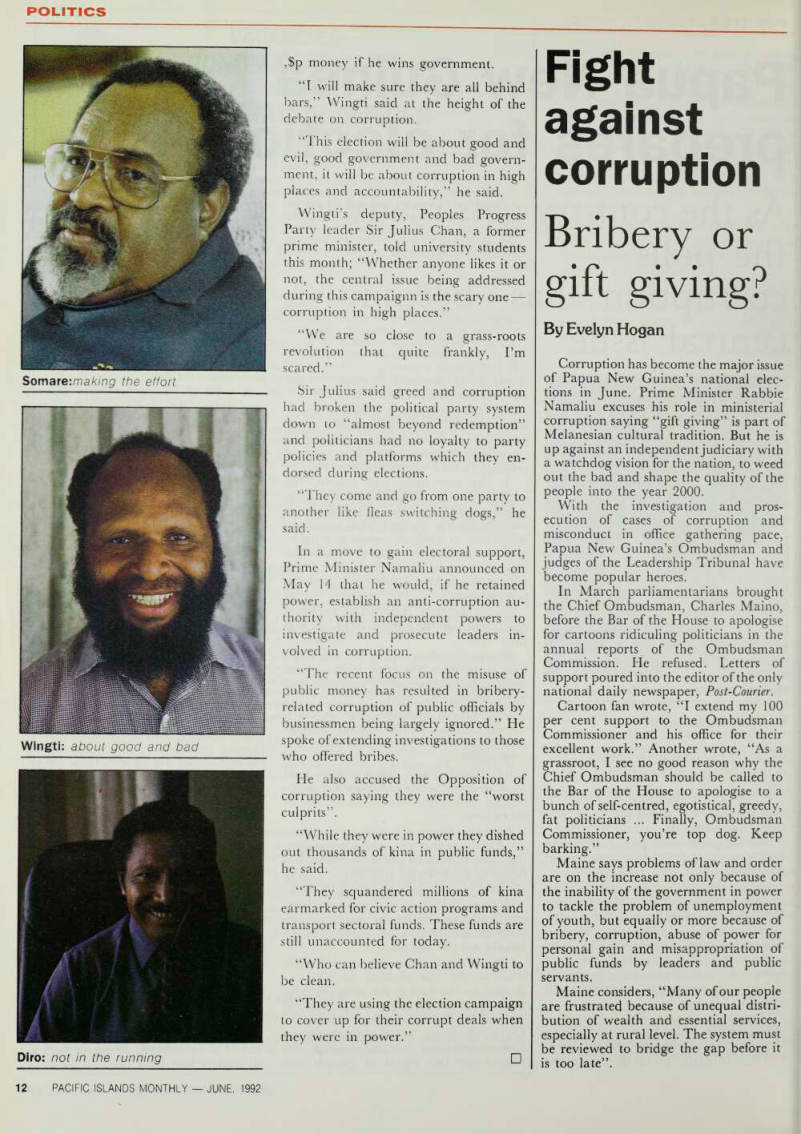
Poverty: more money goes into private pockets...
Unemployment: less is spent on social needs