Springing a surprise
or two
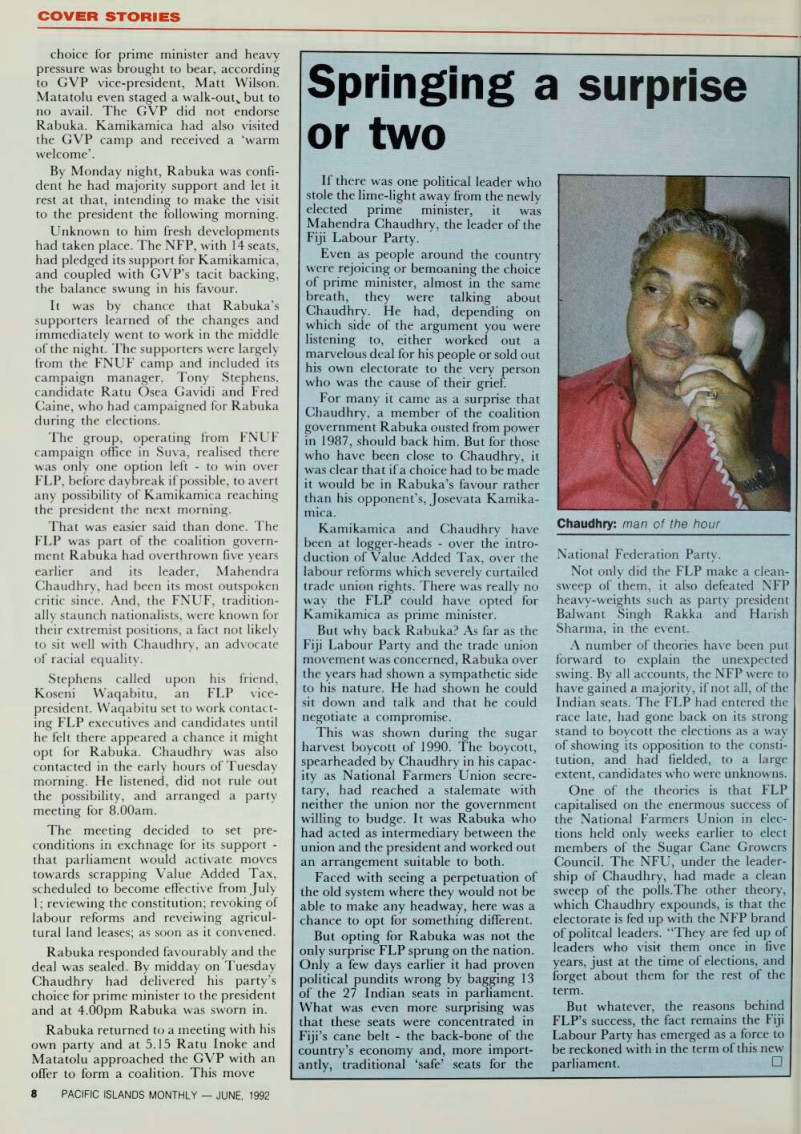
If there was one political leader who stole the lime-light away from the newly elected prime minister, it was Mahendra Chaudhry, the leader of the Fiji Labour Party.
Even as people around the country were rejoicing or bemoaning the choice of prime minister, almost in the same breath, they were talking about Chaudhry. He had, depending on which side of the argument you were listening to, either worked out a marvelous deal for his people or sold out his own electorate to the very person who was the cause of their grief.
For many it came as a surprise that Chaudhry, a member of the coalition government Rabuka ousted from power in 1987, should back him. But for those who have been close to Chaudhry, it was clear that if a choice had to be made it would be in Rabuka’s favour rather than his opponent’s, Josevata Kamika mica.
Kamikamica and Chaudhry have been at logger-heads - over the intro duction of Value Added Tax, over the labour reforms which severely curtailed trade union rights. There was really no way the FLP could have opted for Kamikamica as prime minister.
But why back Rabuka? As far as the Fiji Labour Party and the trade union movement was concerned, Rabuka over the years had shown a sympathetic side to his nature. He had shown he could sit down and talk and that he could negotiate a compromise.
This was shown during the sugar harvest boycott of 1990. The boycott, spearheaded by Chaudhry in his capac ity as National Farmers Union secre tary, had reached a stalemate with neither the union nor the government willing to budge. It was Rabuka who had acted as intermediary between the union and the president and worked out an arrangement suitable to both.
Faced with seeing a perpetuation of the old system where they would not be able to make any headway, here was a chance to opt for something different.
But opting for Rabuka was not the only surprise FLP sprung on the nation.
Only a few days earlier it had proven
political pundits wrong by bagging 13
of the 27 Indian seats in parliament.
What was even more surprising was that these seats were concentrated in Fiji’s cane belt - the back-bone of the country’s economy and, more import antly, traditional ‘safe’ seats for the
National Federation Party.
Not only did the FLP make a clean sweep of them, it also defeated NFP heavy-weights such as party president Balwant Singh Rakka and Harish Sharma, in the event, A number of theories have been put forward to explain the unexpected swing. By all accounts, the NFP were to have gained a majority, if not all, of the Indian seats. The FLP had entered the race late, had gone back on its strong stand to boycott the elections as a way of showing its opposition to the consti tution, and had fielded, to a large extent, candidates who were unknowns.
One of the theories is that FLP capitalised on the enermous success of the National Farmers Union in elec tions held only weeks earlier to elect members of the Sugar Cane Growers Council. The NFU, under the leader ship of Chaudhry, had made a clean sweep of the polls. The other theory, which Chaudhry expounds, is that the electorate is fed up with the NFP brand of politcal leaders. “They are fed up of leaders who visit them once in five years, just at the time of elections, and forget about them for the rest of the term.
But whatever, the reasons behind FLP’s success, the fact remains the Fiji Labour Party has emerged as a force to be reckoned with in the term of this new
parliament. O
Chaudhry: man of the hour