Making
pp. 7-10 · Read in the full issue
Cover Stories
The Making of a Prime Minister
After Fiji’s first
post-coup polls
coup leader Rabuka re turns as the
people’s
choice
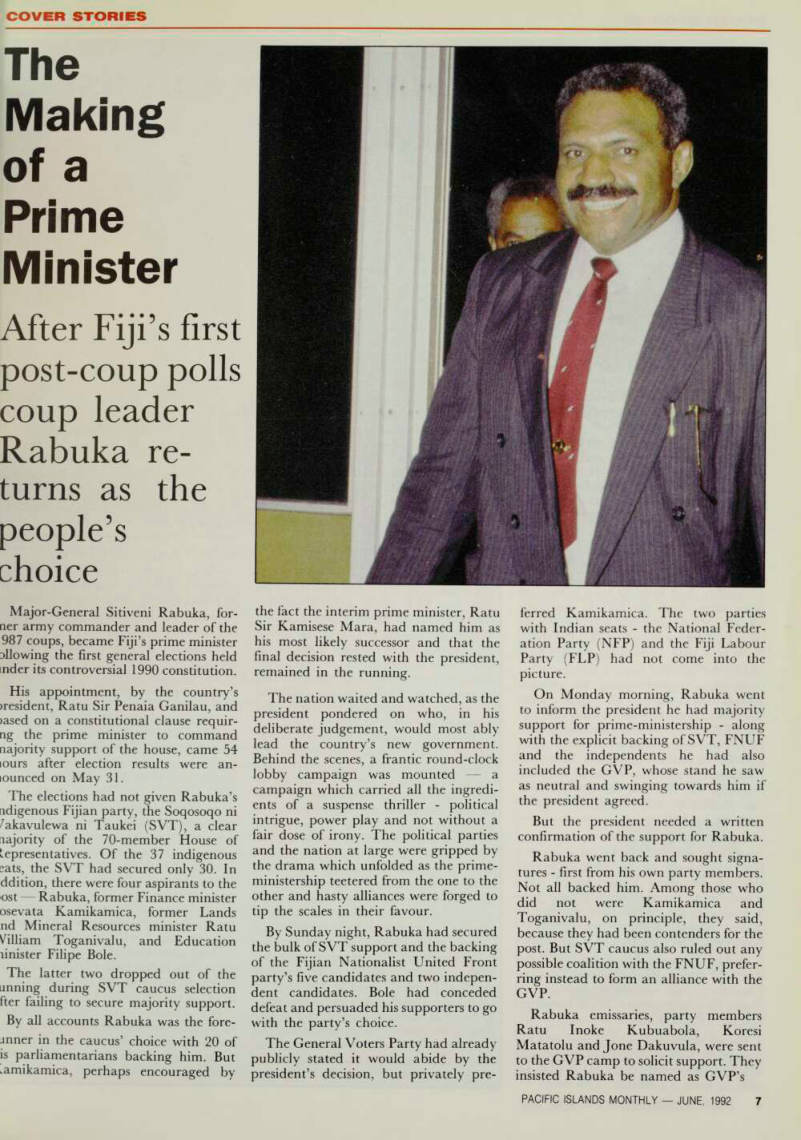
Major-General Sitiveni Rabuka, for ner army commander and leader of the 987 coups, became Fiji’s prime minister Dllowing the first general elections held inder its controversial 1990 constitution.
His appointment, by the country’s resident, Ratu Sir Penaia Ganilau, and >ased on a constitutional clause requir ng the prime minister to command najority support of the house, came 54 lours after election results were an lounced on May 31.
The elections had not given Rabuka’s idigenous Fijian party, the Soqosoqo ni ni Taukei (SVT), a clear lajority of the 70-member House of t.epresentatives. Of the 37 indigenous sats, the SVT had secured only 30. In ddition, there were four aspirants to the ost Rabuka, former Finance minister osevata Kamikamica, former Lands nd Mineral Resources minister Ratu William Toganivalu, and Education linister Filipe Bole.
The latter two dropped out of the inning during SVT caucus selection
fter failing to secure majority support.
By all accounts Rabuka was the fore inner in the caucus’ choice with 20 of is parliamentarians backing him. But
.amikamica, perhaps encouraged by
the fact the interim prime minister, Ratu Sir Kamisese Mara, had named him as his most likely successor and that the final decision rested with the president, remained in the running.
The nation waited and watched, as the president pondered on who, in his deliberate judgement, would most ably lead the country’s new government.
Behind the scenes, a frantic round-clock lobby campaign was mounted a campaign which carried all the ingredi ents of a suspense thriller - political intrigue, power play and not without a fair dose of irony. The political parties and the nation at large were gripped by the drama which unfolded as the prime ministership teetered from the one to the other and hasty alliances were forged to tip the scales in their favour.
By Sunday night, Rabuka had secured the bulk of SVT support and the backing of the Fijian Nationalist United Front party’s five candidates and two indepen dent candidates. Bole had conceded defeat and persuaded his supporters to go with the party’s choice.
The General Voters Party had already publicly stated it would abide by the president’s decision, but privately pre
ferred Kamikamica. The two parties with Indian seats - the National Feder ation Party (NFP) and the Fiji Labour Party (FLP) had not come into the picture.
On Monday morning, Rabuka went to inform the president he had majority support for prime-ministership - along with the explicit backing of SVT, FNUF and the independents he had also included the GVP, whose stand he saw as neutral and swinging towards him if the president agreed.
But the president needed a written confirmation of the support for Rabuka.
Rabuka went back and sought signa tures - first from his own party members.
Not all backed him. Among those who did not were Kamikamica and Toganivalu, on principle, they said, because they had been contenders for the post. But SVT caucus also ruled out any possible coalition with the FNUF, prefer ring instead to form an alliance with the
Gvp.
Rabuka emissaries, party members Ratu Inoke Kubuabola, Koresi Matatolu and Jone Dakuvula, were sent to the GVP camp to solicit support. They insisted Rabuka be named as GVP’s
choice for prime minister and heavy pressure was brought to bear, according to GVP vice-president, Matt Wilson.
Matatolu even staged a walk-out % but to no avail. The GVP did not endorse Rabuka. Kamikamica had also visited the GVP camp and received a ‘warm welcome’.
By Monday night, Rabuka was confi dent he had majority support and let it rest at that, intending to make the visit to the president the following morning.
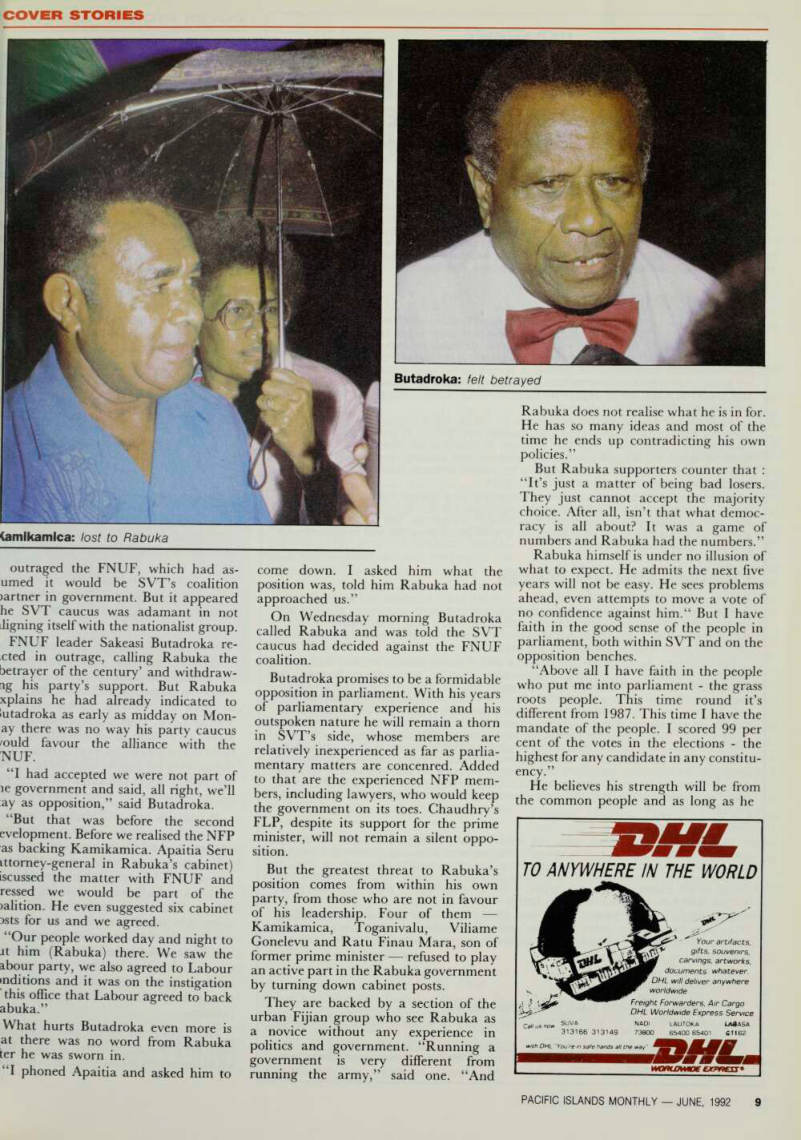
Unknown to him fresh developments had taken place. The NFP, with 14 seats, had pledged its support for Kamikamica, and coupled with GVP’s tacit backing, the balance swung in his favour.
It was by chance that Rabuka’s supporters learned of the changes and immediately went to work in the middle of the night. The supporters were largely from the FNUF camp and included its campaign manager, Tony Stephens, candidate Ratu Osea Gavidi and Fred Caine, who had campaigned for Rabuka during the elections.
The group, operating from FNUF campaign office in Suva, realised there was only one option left - to win over FLP, before daybreak if possible, to avert any possibility of Kamikamica reaching the president the next morning.
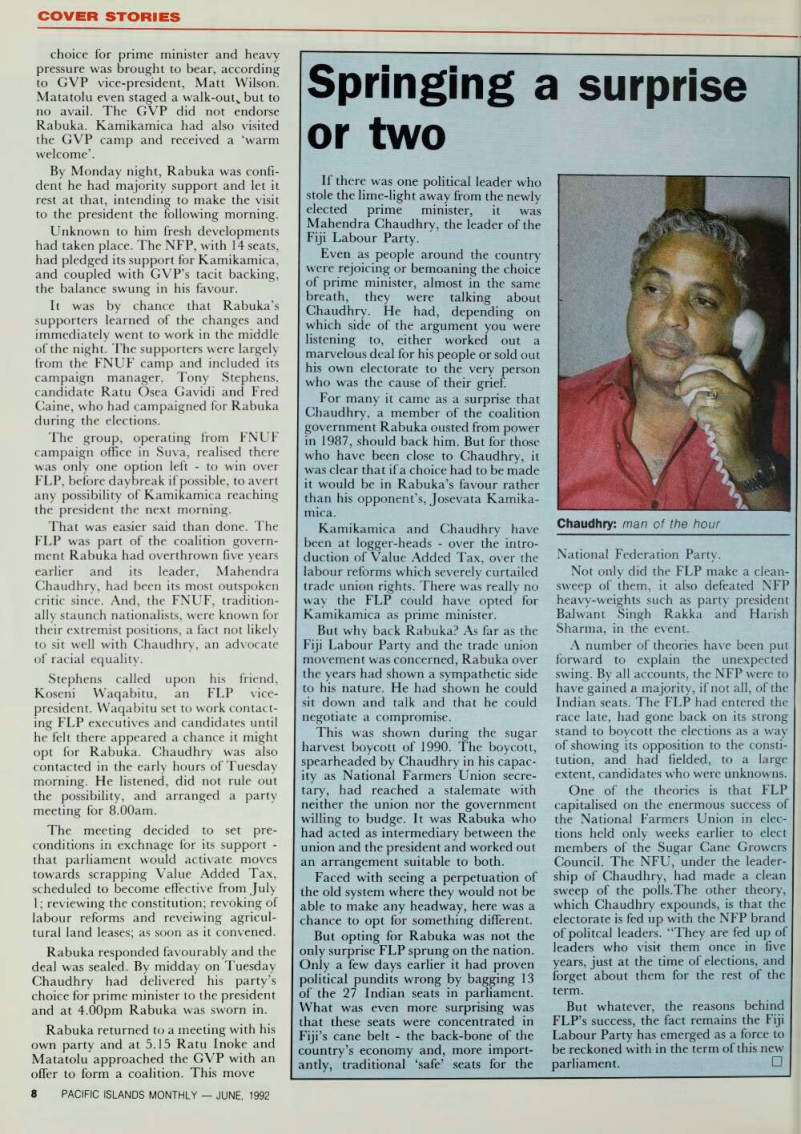
That was easier said than done. The FLP was part of the coalition govern ment Rabuka had overthrown five years earlier and its leader, Mahendra Chaudhry, had been its most outspoken critic since. And, the FNUF, tradition ally staunch nationalists, were known for their extremist positions, a fact not likely to sit well with Chaudhry, an advocate of racial equality.
Stephens called upon his friend, Koseni Waqabitu, an FLP vice president. Waqabitu set to work contact ing FLP executives and candidates until he felt there appeared a chance it might opt for Rabuka. Chaudhry was also contacted in the early hours of Tuesday morning. He listened, did not rule out the possibility, and arranged a party meeting for B.ooam.
The meeting decided to set pre conditions in exchnage for its support that parliament would activate moves towards scrapping Value Added Tax, scheduled to become effective from July 1; reviewing the constitution; revoking of labour reforms and reveiwing agricul tural land leases; as soon as it convened.
Rabuka responded favourably and the deal was sealed. By midday on Tuesday Chaudhry had delivered his party’s choice for prime minister to the president and at 4.00 pm Rabuka was sworn in.
Rabuka returned to a meeting with his own party and at 5.15 Ratu Inoke and Matatolu approached the GVP with an offer to form a coalition. This move
outraged the FNUF, which had as umed it would be SVT’s coalition >artner in government. But it appeared he SVT caucus was adamant in not iligning itself with the nationalist group.
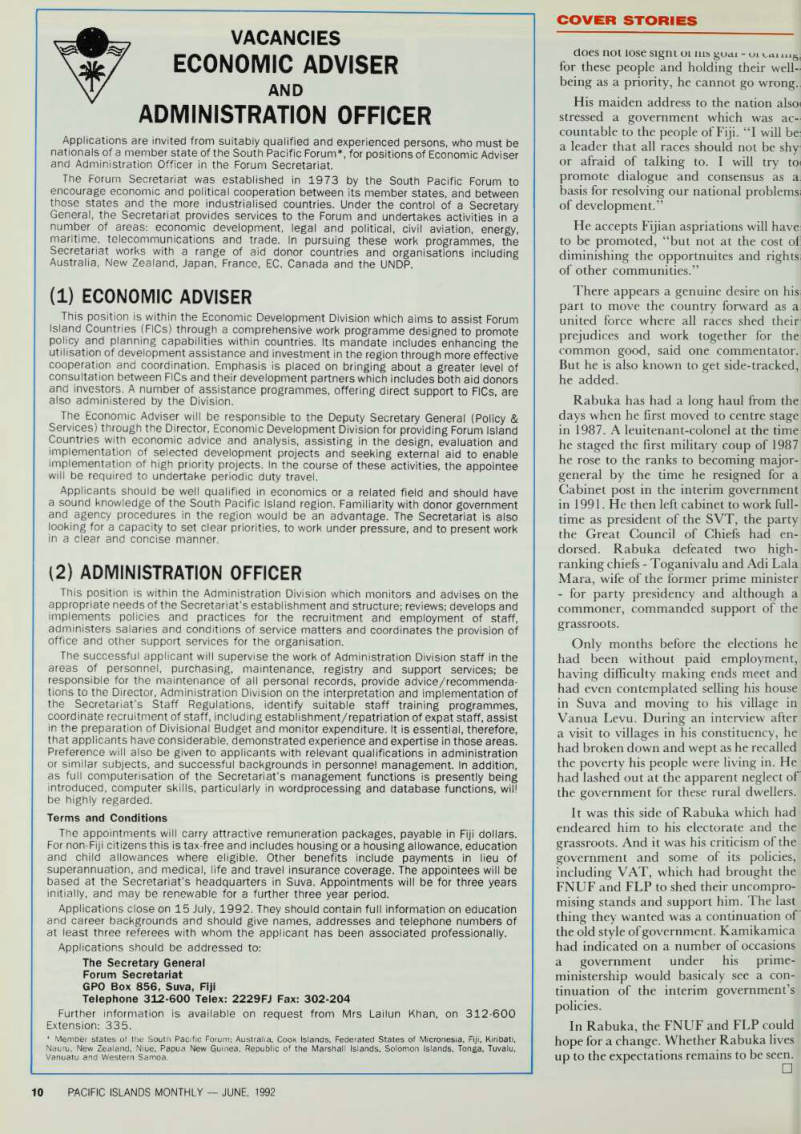
FNUF leader Sakeasi Butadroka re nted in outrage, calling Rabuka the betrayer of the century’ and withdraw ng his party’s support. But Rabuka xplains he had already indicated to lutadroka as early as midday on Mon ay there was no way his party caucus fould favour the alliance with the
Nuf.
“I had accepted we were not part of ic government and said, all right, we’ll ay as opposition,” said Butadroka.
“But that was before the second evelopment. Before we realised the NFP as backing Kamikamica. Apaitia Seru ittorney-general in Rabuka’s cabinet) iscussed the matter with FNUF and ressed we would be part of the >alition. He even suggested six cabinet Dsts for us and we agreed.
“Our people worked day and night to Jt him (Rabuka) there. We saw the a hour party, we also agreed to Labour •nditions and it was on the instigation this office that Labour agreed to back abuka.”
What hurts Butadroka even more is at there was no word from Rabuka ter he was sworn in.
“I phoned Apaitia and asked him to
come down. I asked him what the position was, told him Rabuka had not approached us.”
On Wednesday morning Butadroka
called Rabuka and was told the SVT caucus had decided against the FNUF coalition.
Butadroka promises to be a formidable opposition in parliament. With his years of parliamentary experience and his outspoken nature he will remain a thorn in SVT’s side, whose members are relatively inexperienced as far as parlia mentary matters are concenred. Added to that are the experienced NFP mem bers, including lawyers, who would keep the government on its toes. Chaudhry’s FLP, despite its support for the prime minister, will not remain a silent oppo sition.
But the greatest threat to Rabuka’s position comes from within his own party, from those who are not in favour of his leadership. Four of them Kamikamica, Toganivalu, Viliame Gonelevu and Ratu Finau Mara, son of former prime minister refused to play an active part in the Rabuka government by turning down cabinet posts.
They are backed by a section of the urban Fijian group who see Rabuka as a novice without any experience in politics and government. “Running a government is very different from running the army,” said one. “And
Rabuka does not realise what he is in for.
He has so many ideas and most of the time he ends up contradicting his own policies.”
But Rabuka supporters counter that : “It’s just a matter of being bad losers.
They just cannot accept the majority choice. After all, isn’t that what democ racy is all about? It was a game of numbers and Rabuka had the numbers.”
Rabuka himself is under no illusion of what to expect. He admits the next five years will not be easy. He sees problems ahead, even attempts to move a vote of no confidence against him.“ But I have faith in the good sense of the people in parliament, both within SVT and on the
opposition benches.
“Above all I have faith in the people who put me into parliament - the grass roots people. This time round it’s different from 1987. This time I have the mandate of the people. I scored 99 per cent of the votes in the elections - the highest for any candidate in any constitu ency,”
He believes his strength will be from the common people and as long as he
Kamikamica: lost to Rabuka
Butadroka: felt betrayed
does not lose signt 01 ms gum - ui taimJ for these people and holding their well being as a priority, he cannot go wrong.
His maiden address to the nation also' stressed a government which was ac countable to the people of Fiji. “I will be a leader that all races should not be shy or afraid of talking to. I will try to promote dialogue and consensus as a basis for resolving our national problems of development.”
He accepts Fijian aspriations will have to be promoted, “but not at the cost of diminishing the opportnuites and rights of other communities,”
There appears a genuine desire on his part to move the country forward as a united force where all races shed their prejudices and work together for the common good, said one commentator.
But he is also known to get side-tracked, he added.
Rabuka has had a long haul from the days when he first moved to centre stage in 1987. A leuitenant-colonel at the time he staged the first military coup of 1987 he rose to the ranks to becoming major general by the time he resigned for a Cabinet post in the interim government in 1991. He then left cabinet to work full time as president of the SVT, the party the Great Council of Chiefs had en dorsed. Rabuka defeated two high ranking chiefs - Toganivalu and Adi Lala Mara, wife of the former prime minister - for party presidency and although a commoner, commanded support of the grassroots.
Only months before the elections he had been without paid employment, having difficulty making ends meet and had even contemplated selling his house in Suva and moving to his village in Vanua Levu. During an interview after a visit to villages in his constituency, he had broken down and wept as he recalled the poverty his people were living in. He had lashed out at the apparent neglect of the government for these rural dwellers.
It was this side of Rabuka which had endeared him to his electorate and the grassroots. And it was his criticism of the government and some of its policies, including VAT, which had brought the FNUF and FTP to shed their uncompro mising stands and support him. The last thing they wanted was a continuation of the old style of government. Kamikamica had indicated on a number of occasions a government under his prime ministership would basicaly see a con tinuation of the interim government’s policies.
In Rabuka, the FNUF and FTP could hope for a change. Whether Rabuka lives up to the expectations remains to be seen.