of politics
pp. 12-13 · Read in the full issue
Post-coup elections - new brand
By Mala Jagmohan
FIVE years after the military coup which toppled the last democratically elected government, Fiji is going to the polls later this month.
The elections, spread over eight days
from May 23, already promise to be an interesting test case for the contro versial new Constitution, for political parties based largely along racial lines and for the system of government that will eventuate.
A record number of political parties are contesting the 70 seats in the House
of Representatives.
Leading the line-up of parties is the Great Council of Chiels-sponsorcd Soqosoqo n i Vakavulewa ni Taukei party which is fielding candidates for all of the 37 Fijian seals.
It is led by none other than former army commander and coup leader Major-General Sitivcni Rabuka.
The National Federation Party, tra ditionally based on Indian support, is contesting all the 27 Indian seats. It had been expected to win most, if not all, Indian seals until the Fiji Labour Party reversed its stand to boycott elections at the eleventh hour. The change in stand is seen by many to work to against the Indians - serving only to split their votes.
Last ditch attempts to form an alliance between the two Indian-dominated par lies failed, bringing about a campaign strategy that is more bent on gunning for the other rather than looking at issues.
The Fijian Nationalist United Front, the All National Congress, the New Labour Movement, the General Voters
Party, Fiji Indian Congress, Fiji Liberal
Party could pick up some seats, but do not pose a threat to the big three.
An interesting development has been that despite criticisms against the Consti tution with its racial overtones, no party has shown itself to be truly multi-racial.
Fiji Labour Tarty for all its multi
racial policy is fielding mainly Indian
candidates. Apisai Tora’s All National Congress, once claiming to be the only multi-racial party contesting the elec tions, has also not managed to muster enough Indian candidates.
Even though it appears fairly clear at this stage that the majority of the Fijian scats will go to the SVT, and the Indian votes to NFP and some to the FLP, the
nature of the new government is uncer tain. For a start, the prime-ministership; battle is split three ways within SVT - Rabuka as partry leader expects to geti the job, but veteran politician Rati®, William Toganivalu has expressed inter est and so has former Finance Minister!
Josevata Kamikamica.
Assuming the three do nol give their aspirations for the high office, thein parliamentarians will definitely be split! over the choice.
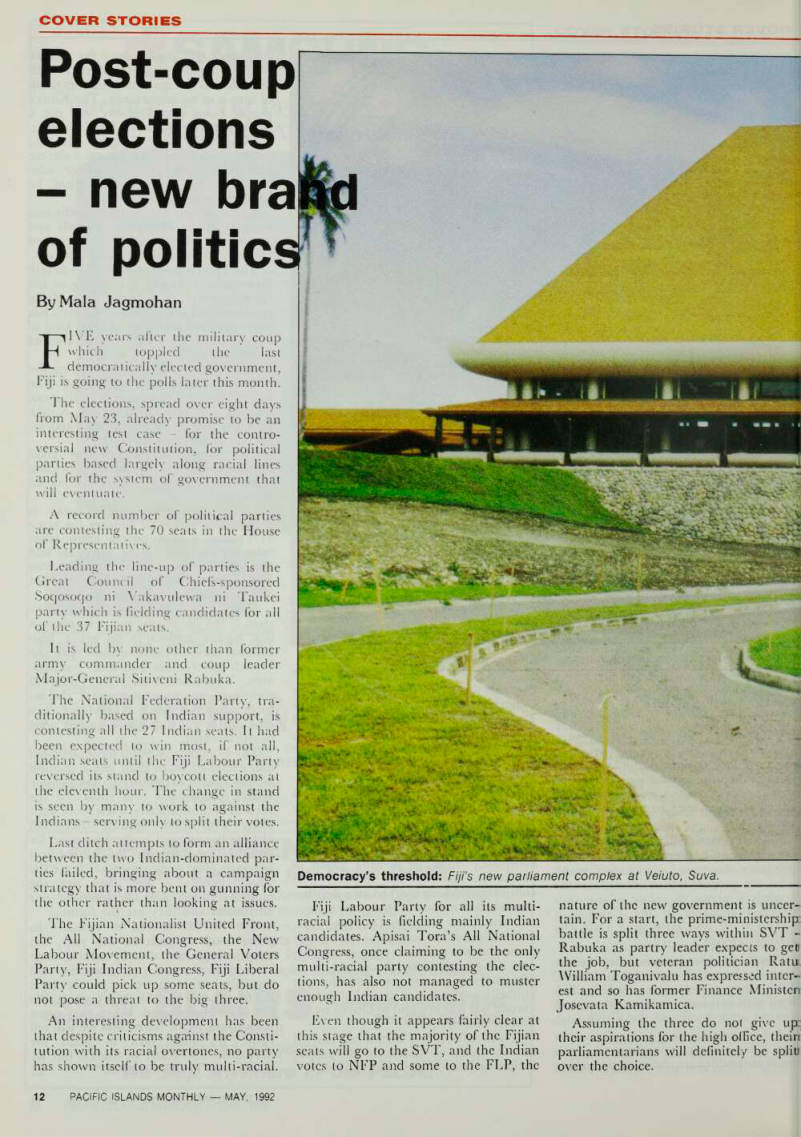
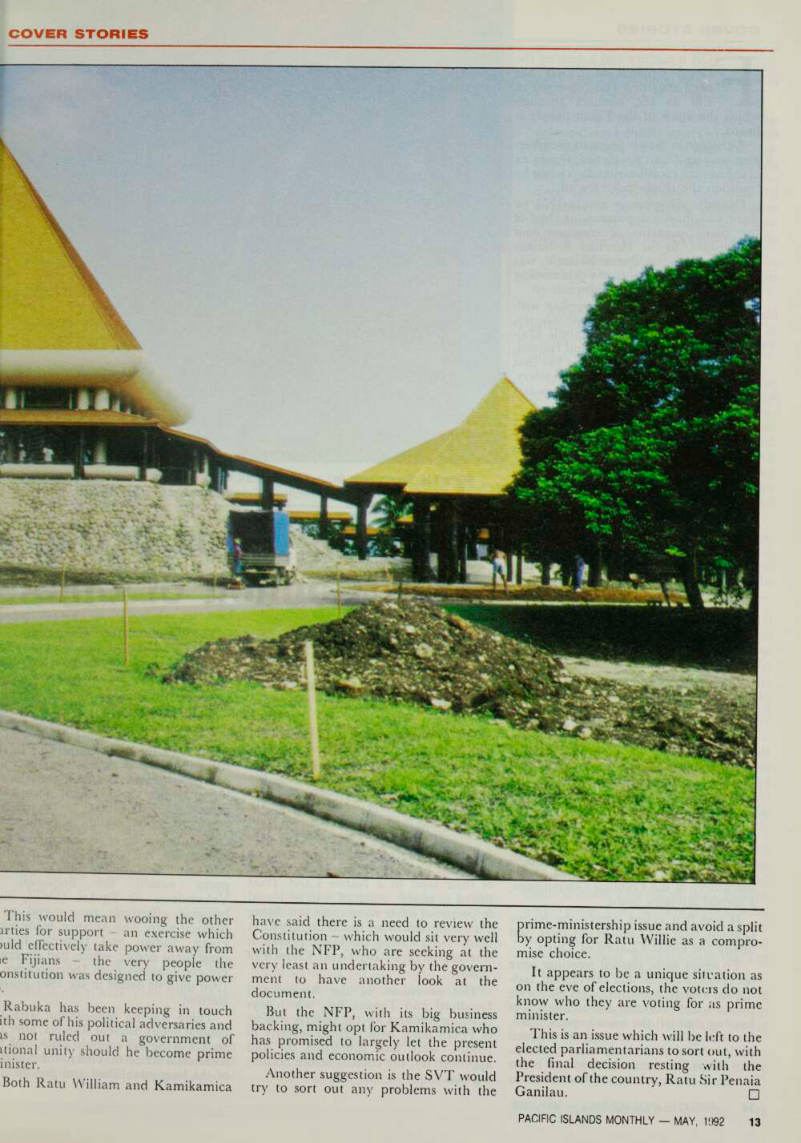
Democracy’s threshold: Fiji’s new parliament complex at Veiuto, Suva.
This would mean wooing the other irties for support - an exercise which >uld effectively take power away from ie Fijians - the very people the onstitution was designed to give power Rabuka has been keeping in touch ith some of his political adversaries and is not ruled out a government of itional unity should he become prime mister.
Both Ratu William and Kamikamica
have said there is a need to review the Constitution - which would sit very well with the NFP, who are seeking at the very least an undertaking by the govern ment to have another look at the document.
But the NFP, with its big business backing, might opt for Kamikamica who has promised to largely let the present policies and economic outlook continue.
Another suggestion is the SVT would try to sort out any problems with the
prime-ministership issue and avoid a split by opting for Ratu Willie as a compro mise choice.
It appears to be a unique situation as on the eve of elections, the voters do not know who they are voting for as prime minister.
This is an issue which will be left to the elected parliamentarians to sort out, with the final decision resting with the President of the country, Ratu Sir Penaia Ganilau. n