ploy
pp. 8-11 · Read in the full issue
Cover Stories
Kanak laments French ploy
THE FLNKS Is due to evaluate Its position on the accords this year.
But, writes Susana Ounel, disil lusioned young Kanaks are already deciding.
The writer was born Into a family of 15 children on the island of Ouvea in New Caledonia in 1945. She has been active in the movement for Kanak liberation since 1969, and was a founding member of the group Atsai, the parties Pa Ilka and Kanak Socialist Liberation (LKS), and the Kanak and Exploited Workers Union
(Ustke).
She was publisher of the FLNKS newspaper, Bwenando. As founding president of the Kanak women’s group. GFKEL, she served on the political bureau of the FLNKS. Ex pelled from the French education system at the age of 15, she has just completed a degree in sociology at New Zealand’s Canterbury Univer sity.
Until recently she has been forced to live in exile because the French government banned her New Zea land husband, David Small, from entering New Caledonia with her.
The restriction has now been lifted.
In this article, an edited extract from a new book published last month. Tu Galaia: Social Change in the Pacific, Susanna Ounel reveals the impact of the Matignon Accords on her people.
IN August 1988, when then French Prime Minister Michel Rocard concluded the Matignon Accords with the presidents of the pro independence FLNKS, Jean-Marie Tjibaou, and the anti-independence RPCR, Jacques Lafleur, a clear, if written, part of the agreement was to isolate the so-called extremists on both sides.
How is it that our independence movement can have some elements acceptable to France and others that must be excluded?
The history of Kanak liberation ~,r . . , struggle shows that many of the political aims and strategies that earned myself and others the extremist label have since gamed wide support among our people.
Contrary to popular myth, the Matignon Accords have never been
accepted by the Kanak people. The
Accords might be isolating the so-called extremists from the French government, but they are also beginning to isolate the people who support the Accords from the v i i -n mass of the Kanak population, especially the y° uth ' Frustrated by the slow reformism of our parents’ generation in the Galedonian Union (UC, later the major party
in the FLNKS), young Kanaks in the late 1960 s and the 1970 s began to build our own political groups, We began by reasserting our culture fnd demanding the return of our stolen land - and then began to call lor ind ndence . But whe * we , ooked more clo J at the sort o fneocolonial indepen dence iven to other former co)onies in , he Pacific and around the world, we decided that a flag and a national anthem were not enough for us.
We were certainly not interested in encouraging our people to struggle and suffer, only to end up with neocolonialism - formal independence ™. th aH the and economic power bein ,f controlled by foreign capital and a small Kanak elite of well-paid poll civi| servants and jun £ r business partners.
We wanted Kanak Socialist Indepen dence - full political, economic and cultural sovereignty.
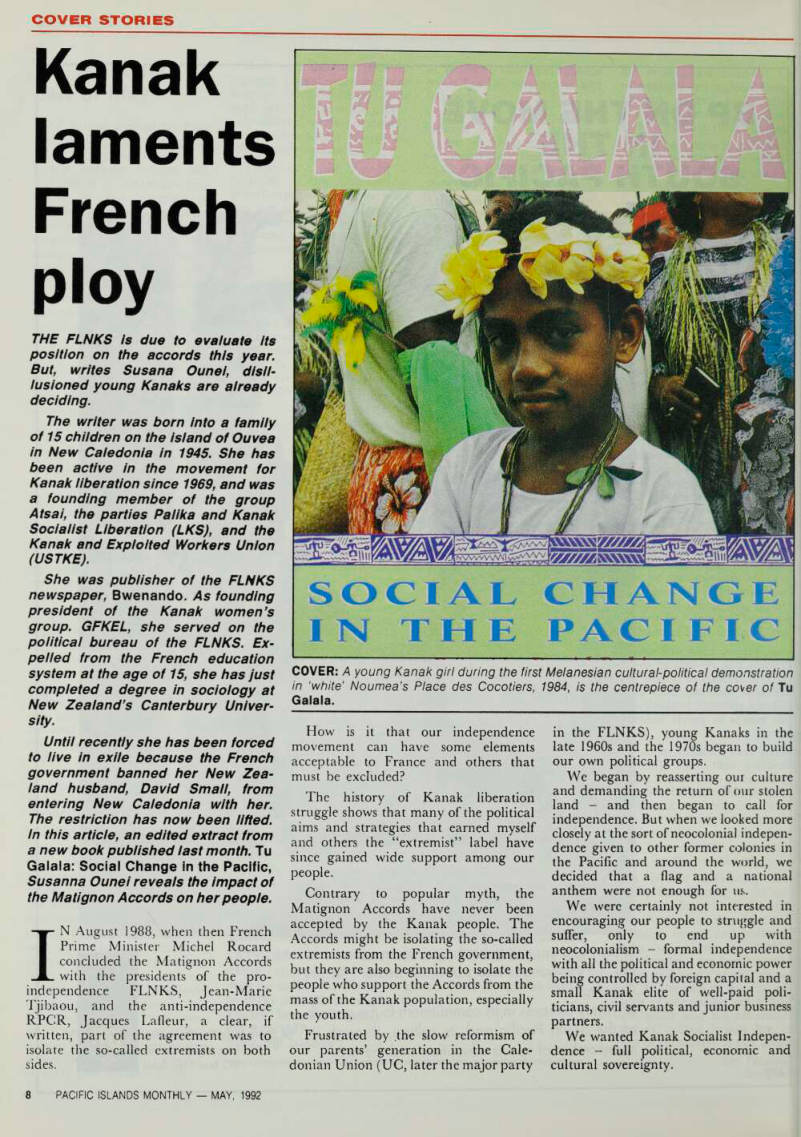
COVER: A young Kanak girl during the first Melanesian cultural-political demonstration in 'white' Noumea's Place des Cocotiers, 1984, is the centrepiece of the cover of Tu Galala.
dthough we were branded as extremists, /e quickly attracted a big following specially among Kanak youth.
Our hope for the
UtUTG comes from
vhat we do for ourselves,
ln f ...u-* . .
101 wnat France decides
t will give us/
Some of us also raised the issue of the eatment of women in our society, ;enage pregnancy, rape and violence gainst women are common. And in the lovement women are expected to be ■cretaries, cooks, cleaners and mistresses hile the men make all the important cisions.
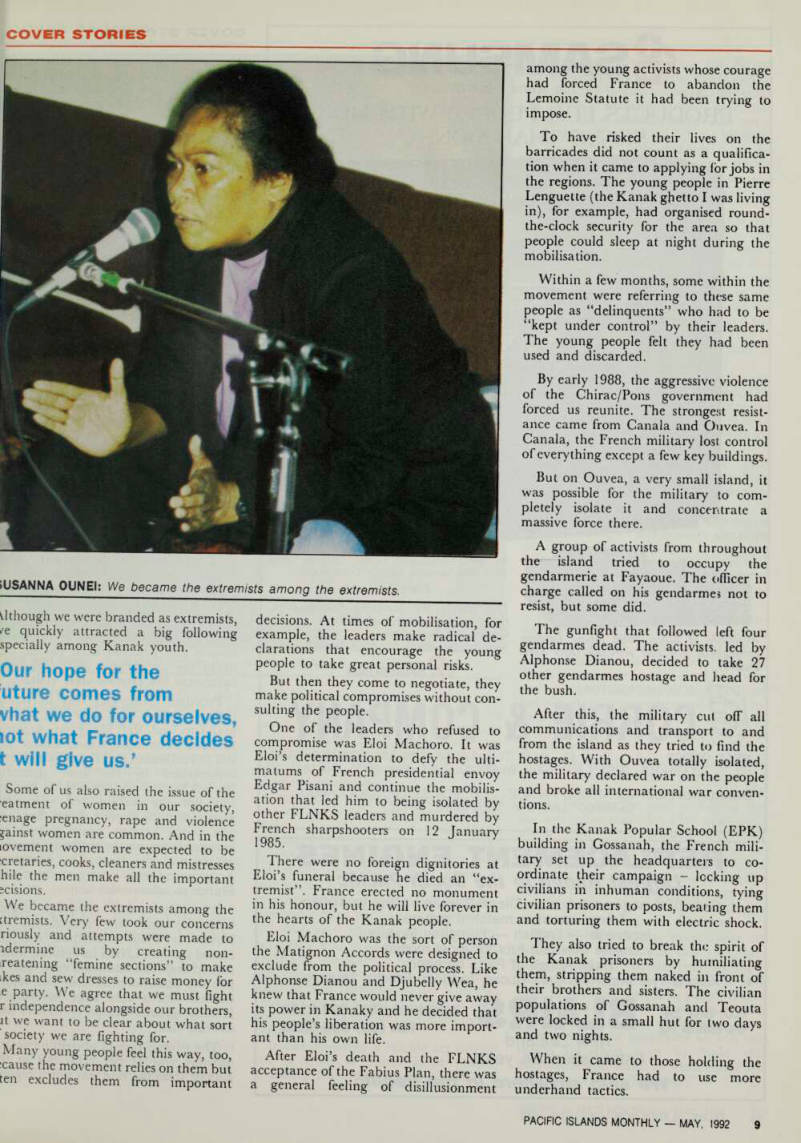
We became the extremists among the :tremists. Very few took our concerns riously and attempts were made to idermine us by creating nonreatenmg “femine sections” to make ikes and sew dresses to raise money for e party. We agree that we must fight r independence alongside our brothers, it we want to be clear about what sort society we are fighting for.
Many young people feel this way, too, ir s^r ve r nt r r ies ° n them but ten excludes them from important
decisions. At times of mobilisation, for example, the leaders make radical de clarations that encourage the young pe ° ple '° take great personal risks nut then they come to negotiate, they make political compromises without con sul!!ng the P eo P le ° ne of the leaders who refused to compromise was Eloi Machoro. It was Elois to defy the ulti matums of French presidential envoy Ebgar Pisani and continue the mobilis a!!°n , hin ] t 0 bei , n § isolated by 2. ther u L V KS Ileaders 1 l eaders and murdered by shar P shooters on 12 January There were no foreign dignitories at Eloi’s funeral because he died an “ex tremist”. France erected no monument * n b i s honour, but he will live forever in tbe hearts of the Kanak people, Eloi Machoro was the sort of person the Matignon Accords were designed to exclude from the political process. Like Alphonse Dianou and Djubelly Wea, he knew that France would never give away its power in Kanaky and he decided that his people’s liberation was more import ant than his own life.
After Eloi’s death and the FLNKS acce P tance of the Fabius Plan, there was a general feeling of disillusionment
among the young activists whose courage had forced France to abandon the Lemoine Statute it had been trying to impose.
To have risked their lives on the barricades did not count as a qualifica tion when it came to applying lor jobs in the regions. The young people in Pierre Lenguette (the Kanak ghetto I was living in), for example, had organised round the-clock security for the area so that people could sleep at night during the mobilisation.
Within a few months, some within the movement were referring to these same people as “delinquents” who had to be “kept under control” by their leaders.
The young people felt they had been used and discarded.
By early 1988, the aggressive violence of the Chirac/Pons government had forced us reunite. The strongest resist ance came from Canala and Ouvea. In Canala, the French military lost control of everything except a few key buildings.
But on Ouvea, a very small island, it was possible for the military to com pletely isolate it and concentrate a massive force there.
A group of activists from throughout the island tried to occupy the gendarmerie at Fayaoue. The ofiicer in charge called on his gendarmes not to resist, but some did.
The gunfight that followed left four gendarmes dead. The activists, led by Alphonse Dianou, decided to take 27 other gendarmes hostage and head for the bush.
After this, the military cut off all communications and transport to and from the island as they tried to find the hostages. With Ouvea totally isolated, the military declared war on the people and broke all international war conven tions.
In the Kanak Popular School (EPK) building in Gossanah, the French mili tary set up the headquarters to co ordinate their campaign - locking up civilians in inhuman conditions, tying civilian prisoners to posts, beating them and torturing them with electric shock.
They also tried to break the spirit of the Kanak prisoners by humiliating them, stripping them naked in front of their brothers and sisters. The civilian populations of Gossanah and Teouta were locked in a small hut for two days and two nights.
When it came to those holding the hostages, France had to use more underhand tactics.
[?]USANNA OUNEI: We became the extremists among the extremists.
Alphonse Dianou and the others had engaged in negotiations in good faith and agreed on a date (just after the French
presidential elections) for releasing the
hostages.
But France had only used the “nego tiations” - like its control of the news media - as a means of preparing for its real goal of treating our people with such barbarity that no one would dare challenge the French again. Their assault on the cave on 5 May, 1938, was designed to the maximum casualties.
Four activists (Alphonse Dianour, Vince LavHua, Samuel Wamo and Martin Haiwe) were executed after they had surrendered and so was Ammossa Waina who was only there (with French permission) to bring food to the cave.
The bodies were dumped in a tin shed at the airport and left there for three days.
Most were burnt and/or mutilated almost beyond recognition. They were buried in a mass grave in Hwadrilla.
When Saddam Hussein pul his pris oners of war on television France joined the chorus calling for him to be tried for war crimes. Where was the international outrage about French war crimes on Ouvea? It was covered over by the
Matignon Accords.
The blood of our brothers killed by the French military had barely died. And, without even visiting Ouvea or consult ing the movement, a few leaders made a deal with France.
The Matignon Accords were signed in blood the blood of my brothers and cousins and nephews from Ouvea. Be neath the appearance of the peaceful agreement lies extreme state violence.
President Mitterand was in power before, during and after the Ouvea massacre and the Matignon Accords.
Bernard Pons and Jacques Chirac are still in Parliament and the military is still commanded by the same generals.
Michel Rocard was not directly respon sible for the torture and executions himself, but the implicit threat that such acts could happen again helped his government to regain authority over my people and our land. The Matignon Accords are simply a more subtle way for France to achieve this aim.
A massive media campaign urging voters to back the accords in the November 1988 referendum was en dorsed by the FLNKS leadership, which argued that Kanaks should vote “yes” to free the political prisoners. The results showed that a very large numbers of Kanaks ignored the party leaders and did not vote.
The overall rate of abstention in the territory was 37 per cent, but in the Kanak areas the rate was much higher.
rhe highest of all was Ouvea (97 per cent Canak), when more than 54 per cent of egistered voters did not vote and a jrther six per cent voted “no”.
Even some of the prisoners’ wives told le they had boycotted the vote. And 3me of the prisoners themselves told me hat they opposed the accords and were ngry at being used to push people to ote.’
Since the Matignon Accords, there has een growing concern within the inde endence movement - including many ho are prepared to work within the ccords - about the close relationship etween elements in the Caledonian hiion (UC) and right-wing Caldoche ettler) groups.
These concerns came to a head in the iimicipal council elections in March, )89, when in some areas the UC allied sell with anti-independence groups and gainst other parties in the FLNKS.
While there are very real splits within ie independence movement, the col lial authorities are also actively seeking
to divide us even further. One of the most important state agencies involved in this psychological warfare is the Studies and Liaison Bureau (BEL), which was set up during the Algerian war of independence with the aim of “contaminating” the liberation movement.
One ofßEL’s most effective campaigns was to convince people that Djubelly Wea’s assassination of Jean-Marie Tjibaou and Yeiwene Yeiwene on May 4, 1989, was the result of a complex conspiracy involving a wide group of people in Kanaky and abroad. The conspiracy rumour sparked off a destruc tive witch-hunt within the movement.
I was very close to Djubelly Wea, politically and personally he was my uncle and was married to my cousin. No one, not even his wife or brothers, knew what he was planning to do. The gun Djubelly used was not smuggled in from abroad but was brought to Ouvea by the
French military.
It was obviously a suicide act carried out in front of hundreds of people, including Jean-Marie’s bodyguards.
History will decide how the Kanak
people will judge Djubelly. What French
officials and foreign commentators think of him is of no importance. The Kanak people know that Djubelly was not a nobody and he was not a hired hit-man.
Even those who disagree with his action cannot deny that he was a sincere and committed political leader who sacrificed his own life for what he believed in increasingly.
Kanak people are recognising the real dangers in the Matignon Accords and are coming to understand what pushed Djubelly Wea to his last sacrificial act.
The French governnment likes to talk about all the money it is giving to aid “development” in Kaiiaky. One of the weaknesses of our movement is that it has never resolved this issue of what kind of development we want - what kind of future society we want to build.
The Kanak people are not paying the price for these issues being ignored. The money from the Matignon Accords is not meeting the real needs of the Kanak people - it is going on big contracts for French multinationals.
The Matignon Accords are good business for the big companies, providing them with political stability and financial subsidies.
If the development of Kanaky is designed to make our country the same as France, Kanak people know what roles arc reserved for us - beggars and servants! Our hope for the future comes from what we do for ourselves not what France decides it will give us.
Kanak youth are now highly politi cised - loo politically aware to allow a few Kanak leaders to set up a neo colonial state in collaboration with the French government and local business men. There are hardly any political people of my generation who are re spected by the youth. The young ones took all the risks and have gained none of the rewards.
The Matignon Accords have alienated and excluded more than just a handful of so-called “extremists”. Among the Kanak people, few ever embraced the accords enthusiastically, a few more went along with them because (hey had already been signed, and others voted for them out of a concern for the political prisoners. The most cynical of all are the young people - and they are the majority. They are the force of our movement and they are the future.
The FLNKS is due to evaluate its position on the accords (his year, but young people are already making (heir assessment. As one young activist told me: “Every time the young people die, it is a few leaders who fill their pockels* We are sick of being used. When they come back to see us for barricades we will tell them, it’s their turn to build the barricades and stand in front - but we will not go to die for them.” □
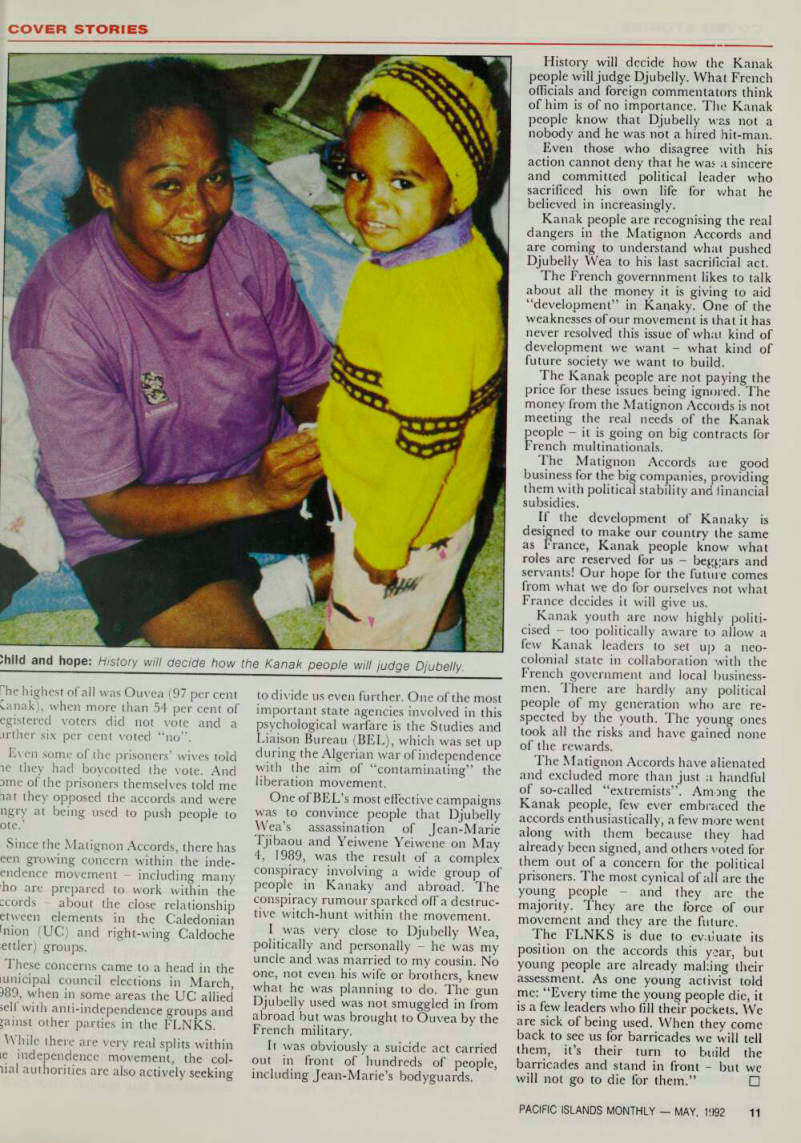
Child and hope: History will decide how the Kanak people will judge Djubelly.