Changing roles of Fiji’s
pp. 14-15 · Read in the full issue
Great Council of Chiefs
FOR a century and a quarter the Great Council of Chiefs has been regarded and respected in Fiji as the channel through which the voice of the Fijian people is heard.
Although in recent years its member ship has significantly widened, the name of the council recalls earlier days when by tradition the chiefs spoke for all.
Consider the message sent in 1874 by Ratu Cakobau, the paramount chief of the time by virtue of conquest and recognition, to Sir Hercules Robinson who, on behalf of Queen Victoria, was
discussing the possibility of Fiji becoming
a Colony of the British Crown.
“We, the King of Fiji, together with other high chiefs of Fiji, give our country, Fiji, unreservedly to Her Britannic Maj esty, Queen of Great Britain and Ireland, and we trust and fully repose in her that she will rule us justly and affectionately, that we may continue to live in peace and prosperity.”
The group from which this message came could be considered a predecessor of the Great Council of Chiefs. It was a gathering of the heads of the chiefly kingdoms which the Deed of Cession combined to create Fiji as a national entity with defined boundaries.
The kingdoms were rivals that were frequently at war. Groupings of them changed from time to time as a result of the wars and of dynastic alliances among the chiefly families. The influence of these ancient kingdoms, and the loyalty they command among their people,
remain powerful today when, following
one of the measures taken by the first British Governor, Sir Arthur Gordon, they have the name of provinces.
Cession brought peace, and a unity born of common loyalty and allegiance to Queen Victoria as a chief above those of any of the individual kingdoms or the groupings into what have become known as confederacies.
The high chiefs of all the kingdoms gathered at Ba after Cession to instal Gordon as Governor, representing Queen Victoria in Fiji.
He saw the advantage of periodic meetings as an opportunity to consult the chiefs on matters concerning the Fijian people, and he created, as part of the machinery of the Colonial Government, a formal advisory body.
It was first called simply the Native Council, later the Council of Chiefs, and finally the Great Council of Chiefs.
To begin with, council meetings were occasions of spectacular ceremonial, last ing for nearly a month, with elaborate presentations, dancing and an amount of feasting that left the hosts impoverished, but this phase passed and the council settled down to annual, more business like affairs. The council no longer meets at fixed intervals, but is convened as
By Sir Leonard Usher
required. Throughout the colonial
period, the council remained almost solely advistory but the advice was a two way affair.
The Governor asked the Council of Chiefs what they thought about Govern ment proposals that would particularly affect Fijians. The council drew the attention of the Governor and his advisers to matters, sometimes small, sometimes of high significance, that were of concern to Fijians somewhere in Fiji.
The act of extraordinary generosity and faith by which Fijians gave control of their land to a Native Land Trust Board to enable much of it to be leased to people of other races came into being only after, following much discussion at many levels among the Fijian people, it was approved by the Great Council of Chiefs.
The provisions of the Agricultural Landlord and Tenant Act, which lays down procedures for the orderly leasing of Fijian land, with defined security of tenure, were also submitted to, and approved by, the council before becom
ing law.
The Fijians members of the Legislative Council who went to London in the late 1960 s for the conferences which resulted in Fiji becoming an independent natiom reported to the Great Council of Chiefs both before and after the two confer ences.
The council was called together aftei the first of the 1987 coups and in the succeeding years considered and ap proved successive drafts of the Consti tution which in its final form was,
promulgated in 1990, giving Fijians
enhanced representation in Parliament.: In anticipation of the election of that Parliament, the Great Council of
created anew, solely Fijian, political
party named the Soqosoqo n;i Vakavulewa ni Taukei (SVT), thus bringing effectively to an end as as political party The Alliance, made up oa Fijian, Indian and General Elector constituent bodies, which had governed) Fiji continuously from Independence in 1970 until its defeat in the 1987 general! election.
There was no consultation with the council before Sitiveni Rabuka, after the second of the two coups in 1987, took the dictatorial action that led to the breaking of the long-established and greatly
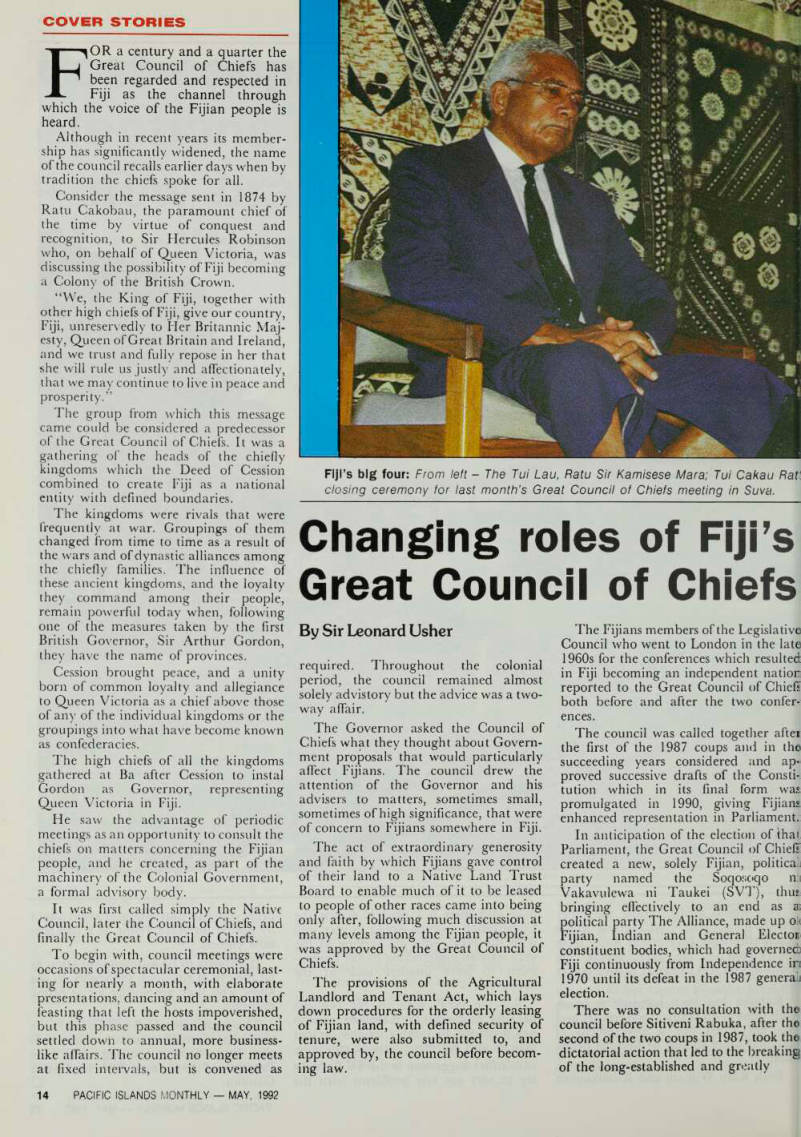
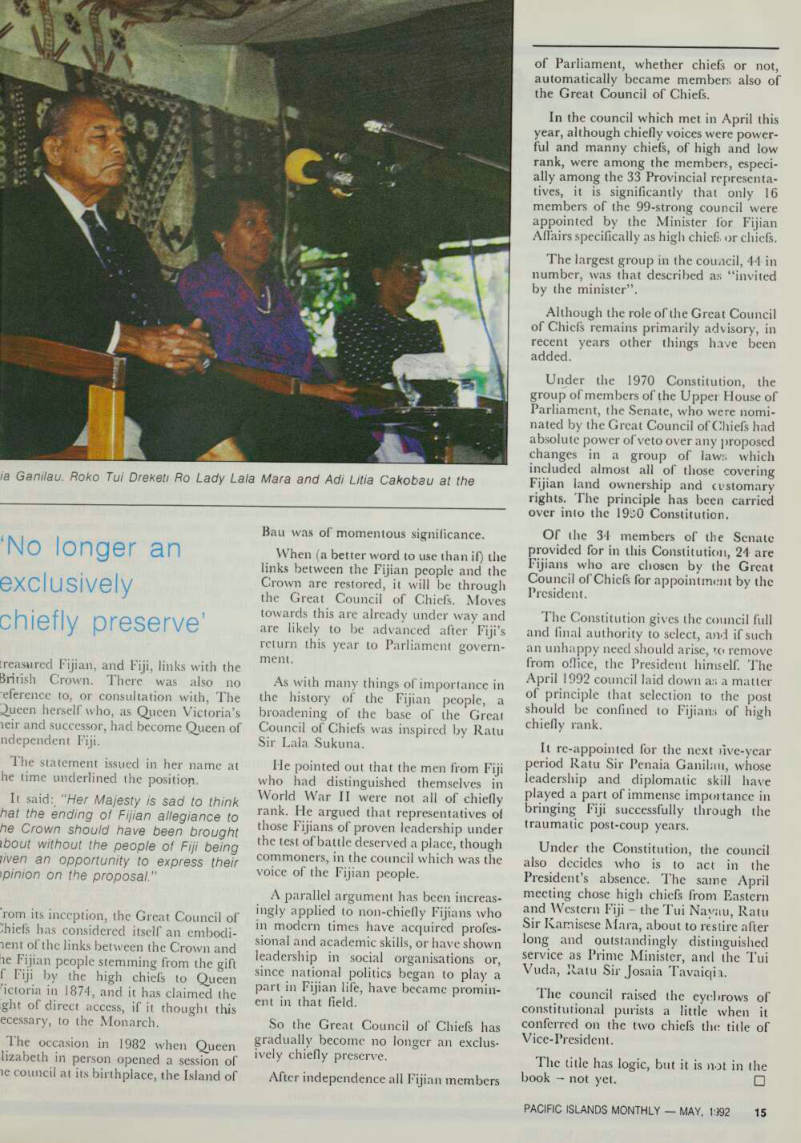
Fiji’s big four: From left - The Tui Lau, Ratu Sir Kamisese Mara; Tui Cakau Rat closing ceremony for last month's Great Council of Chiefs meeting in Suva.
‘No longer an exclusively chiefly preserve’
treasured Fijian, and Fiji, links with the British Crown. There was also no 'eferencc to, or consultation with, The iueen herself who, as Queen Victoria’s icir and successor, had become Queen of independent Fiji.
The statement issued in her name at he time underlined the position.
It said:. “Her Majesty is sad to think hat the ending of Fijian allegiance to he Crown should have been brought 'bout without the people of Fiji being liven an opportunity to express their > pinion on the proposal."
Vom its inception, the Great Council of chiefs has considered itself an embodi icnt of the links between the Crown and le Fijian people stemming from the gift f Fiji by the high chiefs to Queen Victoria in 1874, and it has claimed the ght of direct access, if it thought this ecessary, to the Monarch. 1 he occasion in 1982 when Queen lizabeth in person opened a session of ie council at its birthplace, the Island of
Ban was of momentous significance.
When (a better word to use than if) the links between the Fijian people and the Crown are restored, it will be through the Great Council of Chiefs. Moves towards this are already under way and are likely to be advanced after Fiji’s return this year to Parliament govern ment.
As with many things of importance in the history of the Fijian people, a broadening of the base of the Great Council of Chiefs was inspired by Ratu Sir Lala Sukuna.
He pointed out that the men from Fiji who had distinguished themselves in World War II were not all of chiefly rank. He argued that representatives of those Fijians of proven leadership under the test of battle deserved a place, though commoners, in the council which was the voice of the Fijian people.
A parallel argument has been increas ingly applied to non-chiefly Fijians who in modern times have acquired profes sional and academic skills, or have shown leadership in social organisations or, since national politics began to play a part in Fijian life, have became promin ent in that field.
So the Great Council of Chiefs has gradually become no longer an exclus ively chiefly preserve.
After independence all Fijian members
of Parliament, whether chiefs or not, automatically became members also of the Great Council of Chiefs.
In the council which met in April this year, although chiefly voices were power ful and manny chiefs, of high and low rank, were among the members, especi ally among the 33 Provincial representa tives, it is significantly that only 16 members of the 99-strong council were appointed by the Minister for Fijian Affairs specifically as high chief, or chiefs.
The largest group in the council, 44 in number, was that described as “invited by the minister”.
Although the role of the Great Council of Chiefs remains primarily advisory, in recent years other things have been added.
Under the 1970 Constitution, the group of members of the Upper House of Parliament, the Senate, who were nomi nated by the Great Council of Chiefs had absolute power of veto over any proposed changes in a group of laws which included almost all of those covering Fijian land ownership and customary rights. The principle has been carried over into the 19c0 Constitution.
Of the 34 members of the Senate provided for in this Constitution, 24 are Fijians who arc chosen by the Great Council of Chiefs for appointment by the President.
The Constitution gives the council full and final authority to select, and if such an unhappy need should arise, to remove from oflice, the President himself. The April 1992 council laid down as a matter of principle that selection to the post should be confined to Fijians of high chiefly rank.
It re-appointed for the next five-year period Ratu Sir Penaia Ganilau, whose leadership and diplomatic skill have played a part of immense importance in bringing Fiji successfully through the traumatic post-coup years.
Under the Constitution, the council also decides who is to act in the President’s absence. The same April meeting chose high chiefs from Eastern and Western Fiji - the Tui Nayau, Ratu Sir Kamisese Mara, about to restire after
long and outstandingly distinguished
service as Prime Minister, and the Tui Vuda, Ratu Sir Josaia Tavaiqia.
The council raised the eyebrows of constitutional purists a little when it conferred on the two chiefs the title of Vice-President.
The title has logic, but it is not in the book - not yet. □
[?]a Ganilau. Roko Tui DreKeti Ro Lady Lala Mara and Adi Litia Cakobau at the