A land of many faces
pp. 68-70 · Read in the full issue
By Liz Thompson
PAPUA New Guinea is one of the few countries which brings life to the jingoes designed by the tourist industry to promote it.
Lines like, “Land of the Unexpec ted”, pasted across images of dense green rainforest can only begin to prepare you for the country’s cultural wealth and physical beauty.
The media continually provides nega tive images of Papua New Guinea, but it fails to put them in context. A country undergoing the most radical social, political and technological changes in evitably confronts enormous social problems. However, alongside these problems culture remains, as do many areas of great beauty.
Extravagant and incredibly diverse body decoration is a well-known and continued practice. Posters display faces painted with vivid reds, ochres and umbers. Men wander with pig tusks through their noses, hats made of human hair and decorated with dried yellow daisies on their heads. Women wear strands of tiny grey seeds, or jobs tears around their necks, huge ivory
white kina shells sit upon their pendui lous breasts.
Cascades of cassowary feathers, irii descent blue Bird of Paradise wings ano emerald green beetles are all used t« decorate their headdresses. Bodies arc painted with charcoal and pig fat or oill from local trees and dances follow thu sounds of flutes or the beat drums.
The annual Gor6ka Show is an evenr once seen, never forgotten. A performr ance in which representatives frorr many of Papua New Guinea’s tribaE groups come together to dance for twc solid days.
The smell of sweat and pig fat mingl.J in the air as the dust rises and bodies move to the rythmic sound of snake skiu drums.
Equally beautiful and diverse is th*i environment. The winding Sepik Rives in the heart of East Sepik Province meanders through numerous villages and the homes of some of the countries most rewarding diving spots.
Underwater coral gardens anoi schools of tropical fish introduce you to] another dimension of the landscape) Bensbach in Western Province trans-<
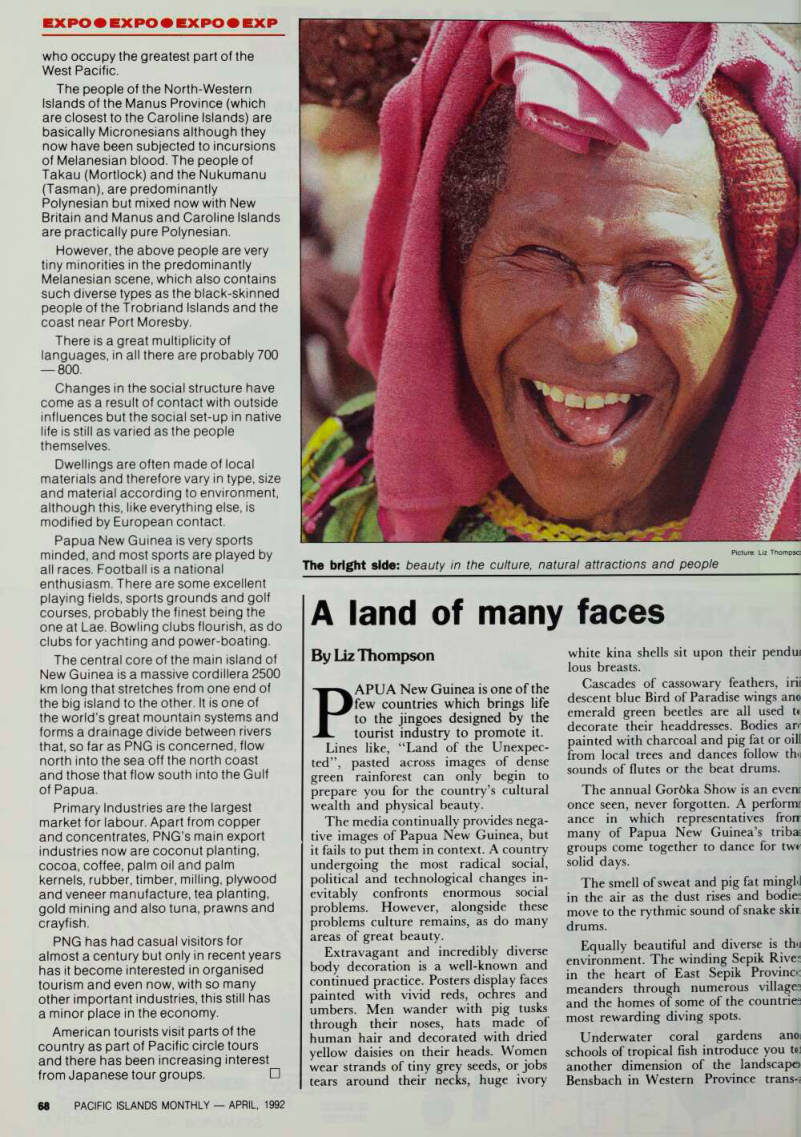
Picture: Liz Thompson
The bright side: beauty in the culture, natural attractions and people
ports you to other parts of the globe.
Reknowned for its trout fishing, you could be in Scotland as you cast your line. Wallabies hopping across the sur rounding planes recall Australia.
Green grass and trees neatly trimmec by deer look almost British, while white egrets and herons rise from the grass on the river banks as fishing boats pass.
In Central Province, the famouj Kokoda trail leads you through moun tainous terrain. Numerous Highlanc climbs lead you above the clouds to look out across the country’s spinal ridge.
Hidden pockets provide rest anc relaxation. Waitapi, 1500 ft in the moun tains, sits in a green valley. The lodge houses a roaring wooden fire, strawberry dacquiries are made with locally grown produce, and food is superb and endless; Islands are easily accessible. Golden.j palm-fringed beaches and aquamarine ocean are another of PNG’s many faces; Amidst all this a nation is constructing a new identity, building, amongst scat tered tribes and over 700 tribal lan guages, a sense of unity. There is a great sense of pride in Papua New Guinea. It struggles in the face of unemployment urbanisation and it’s ensuing alienation, a new urban poor and numerous ©then problems change brings. But the country is rich and vibrant and very beautiful. Q