Papua New
pp. 66-68 · Read in the full issue
Guinea ...
PAPUA New Guinea lies wholly within the southern tropics. It consists of the eastern half of the island of New Guinea and many other offshore islands including i New Britain, New Ireland and Bougainville. The total land area is 461,690.33 sq. km.
It is an independent state and a member of the Commonwealth and its; capital is Port Moresby.
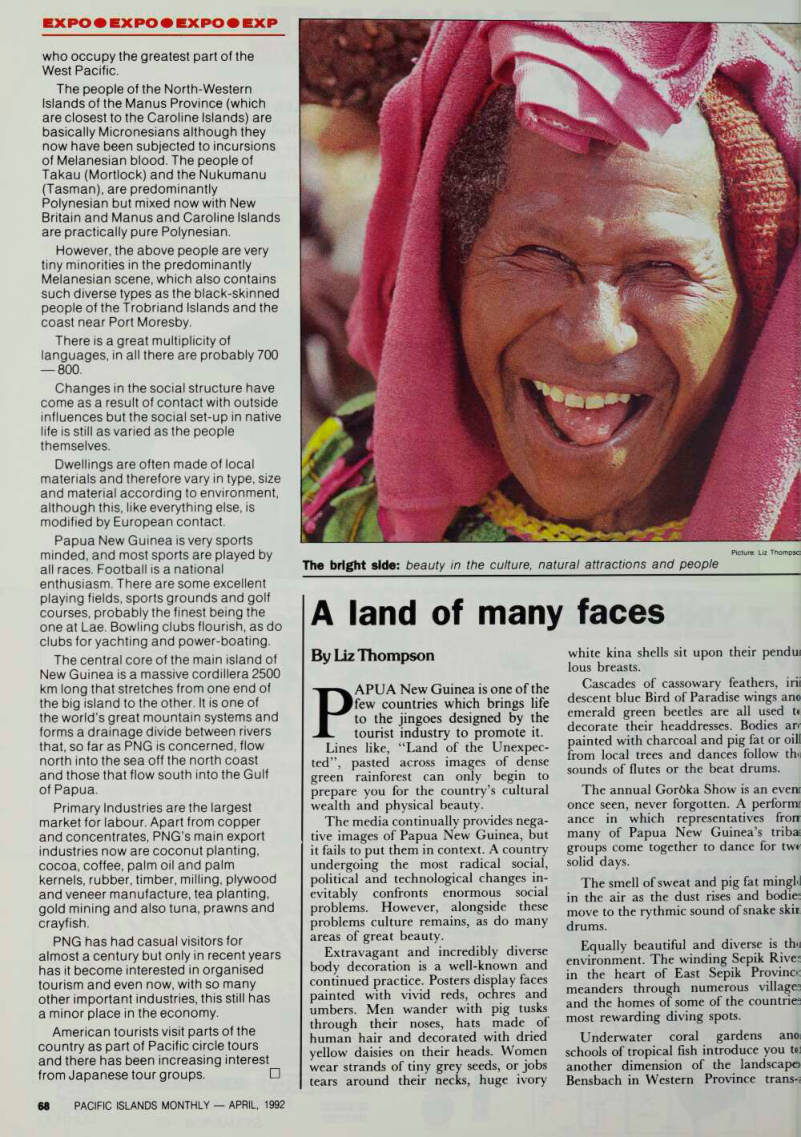
The inhabitants include a large diversity of types although some ethnologists make a distinction between the Papuan-type people, wha are believed to have been the first arrivals, and who now tend to inhabit the interiors of the mainland and big islands: and the Melanesians who are the people of the coasts and offshore islands.
But there had been much mixing of people before Europeans made their first contacts, and the indigenous people of PNG can be considered to be related to those other Melanesians
who occupy the greatest part of the West Pacific.
The people of the North-Western Islands of the Manus Province (which are closest to the Caroline Islands) are basically Micronesians although they now have been subjected to incursions of Melanesian blood. The people of Takau (Mortlock) and the Nukumanu (Tasman), are predominantly Polynesian but mixed now with New Britain and Manus and Caroline Islands are practically pure Polynesian.
However, the above people are very tiny minorities in the predominantly Melanesian scene, which also contains such diverse types as the black-skinned people of the Trobriand Islands and the coast near Port Moresby.
There is a great multiplicity of languages, in all there are probably 700 800.
Changes in the social structure have come as a result of contact with outside influences but the social set-up in native life is still as varied as the people themselves.
Dwellings are often made of local materials and therefore vary in type, size and material according to environment, although this, like everything else, is modified by European contact.
Papua New Guinea is very sports minded, and most sports are played by all races. Football is a national enthusiasm. There are some excellent playing fields, sports grounds and golf courses, probably the finest being the one at Lae. Bowling clubs flourish, as do clubs for yachting and power-boating.
The central core of the main island of New Guinea is a massive cordillera 2500 km long that stretches from one end of the big island to the other. It is one of the world’s great mountain systems and forms a drainage divide between rivers that, so far as PNG is concerned, flow north into the sea off the north coast and those that flow south into the Gulf of Papua.
Primary Industries are the largest market for labour. Apart from copper and concentrates, PNG’s main export industries now are coconut planting, cocoa, coffee, palm oil and palm kernels, rubber, timber, milling, plywood and veneer manufacture, tea planting, gold mining and also tuna, prawns and crayfish.
PNG has had casual visitors for almost a century but only in recent years has it become interested in organised tourism and even now, with so many other important industries, this still has a minor place in the economy.
American tourists visit parts of the country as part of Pacific circle tours and there has been increasing interest from Japanese tour groups. □