Helping hand from within
p. 71 · Read in the full issue
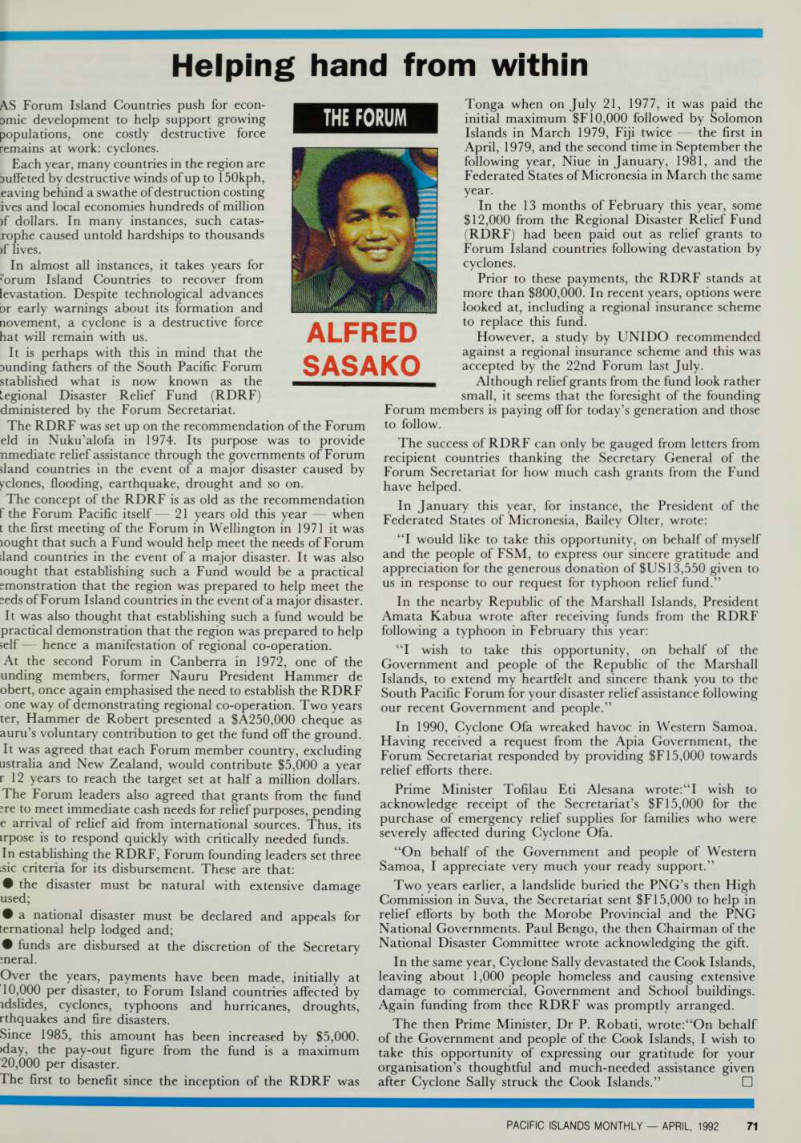
AS Forum Island Countries push for econ omic development to help support growing populations, one costly destructive force remains at work: cyclones.
Each year, many countries in the region are ouffeted by destructive winds of up to 150 kph, caving behind a swathe of destruction costing ives and local economies hundreds of million )f dollars. In many instances, such catas rophe caused untold hardships to thousands )f lives.
In almost all instances, it takes years for r orum Island Countries to recover from levastation. Despite technological advances or early warnings about its formation and novement, a cyclone is a destructive force hat will remain with us.
It is perhaps with this in mind that the ounding fathers of the South Pacific Forum stablished what is now known as the Legional Disaster Relief Fund (RDRF) dministered by the Forum Secretariat.
The RDRF was set up on the recommendation of the Forum eld in Nuku’alofa in 1974. Its purpose was to provide nmediate relief assistance through the governments of Forum sland countries in the event of a major disaster caused by flooding, earthquake, drought and so on.
The concept of the RDRF is as old as the recommendation f the Forum Pacific itself — 21 years old this year when t the first meeting of the Forum in Wellington in 1971 it was lought that such a Fund would help meet the needs of Forum iland countries in the event of a major disaster. It was also lought that establishing such a Fund would be a practical emonstration that the region was prepared to help meet the “eds of Forum Island countries in the event ofa major disaster.
It was also thought that establishing such a fund would be practical demonstration that the region was prepared to help self hence a manifestation of regional co-operation.
At the second Forum in Canberra in 1972, one of the unding members, former Nauru President Hammer de obert, once again emphasised the need to establish the RDRF one way of demonstrating regional co-operation. Two years ter, Hammer de Robert presented a $A250,000 cheque as auru’s voluntary contribution to get the fund off the ground.
It was agreed that each Forum member country, excluding astralia and New Zealand, would contribute $5,000 a year r 12 years to reach the target set at half a million dollars.
The Forum leaders also agreed that grants from the fund :re to meet immediate cash needs for relief purposes, pending e arrival of relief aid from international sources. Thus, its irpose is to respond quickly with critically needed funds.
In establishing the RDRF, Forum founding leaders set three tsic criteria for its disbursement. These are that: • the disaster must be natural with extensive damage used; • a national disaster must be declared and appeals for
ternational help lodged and;
• funds are disbursed at the discretion of the Secretary meral.
Over the years, payments have been made, initially at 10.000 per disaster, to Forum Island countries affected by idslides, cyclones, typhoons and hurricanes, droughts, rthquakes and fire disasters.
Since 1985, this amount has been increased by $5,000. >day, the pay-out figure from the fund is a maximum 20.000 per disaster.
The first to benefit since the inception of the RDRF was
The Forum
Tonga when on July 21, 1977, it was paid the initial maximum $F 10,000 followed by Solomon Islands in March 1979, Fiji twice the first in April, 1979, and the second time in September the following year, Niue in January, 1981, and the Federated States of Micronesia in March the same year.
In the 13 months of February this year, some $12,000 from the Regional Disaster Relief Fund (RDRF) had been paid out as relief grants to Forum Island countries following devastation by cyclones.
Prior to these payments, the RDRF stands at more than $BOO,OOO. In recent years, options were looked at, including a regional insurance scheme to replace this fund.
However, a study by UNIDO recommended against a regional insurance scheme and this was accepted by the 22nd Forum last July.
Although relief grants from the fund look rather small, it seems that the foresight of the founding
Forum members is paying off for today’s generation and those to follow.
The success of RDRF can only be gauged from letters from recipient countries thanking the Secretary General of the Forum Secretariat for how much cash grants from the Fund
have helped.
In January this year, for instance, the President of the Federated States of Micronesia, Bailey Olter, wrote; “I would like to take this opportunity, on behalf of myself and the people of FSM, to express our sincere gratitude and appreciation for the generous donation of SUS 13,550 given to us in response to our request for typhoon relief fund.”
In the nearby Republic of the Marshall Islands, President Amata Kabua wrote after receiving funds from the RDRF following a typhoon in February this year: “I wish to take this opportunity, on behalf of the Government and people of the Republic of the Marshall Islands, to extend my heartfelt and sincere thank you to the South Pacific Forum for your disaster relief assistance following our recent Government and people.”
In 1990, Cyclone Ofa wreaked havoc in Western Samoa.
Having received a request from the Apia Government, the Forum Secretariat responded by providing $F 15,000 towards relief efforts there.
Prime Minister Tofilau Eti Alesana wrote:‘T wish to acknowledge receipt of the Secretariat’s $F 15,000 for the purchase of emergency relief supplies for families who were severely affected during Cyclone Ofa.
“On behalf of the Government and people of Western Samoa, I appreciate very much your ready support.”
Two years earlier, a landslide buried the PNG’s then High Commission in Suva, the Secretariat sent $F 15,000 to help in relief efforts by both the Morobe Provincial and the PNG National Governments. Paul Bengo, the then Chairman of the National Disaster Committee wrote acknowledging the gift.
In the same year, Cyclone Sally devastated the Cook Islands, leaving about 1,000 people homeless and causing extensive damage to commercial, Government and School buildings.
Again funding from thee RDRF was promptly arranged.
The then Prime Minister, Dr P. Robati, wrote:“On behalf of the Government and people of the Cook Islands, I wish to take this opportunity of expressing our gratitude for your organisation’s thoughtful and much-needed assistance given after Cyclone Sally struck the Cook Islands.” □