Kiribati...
pp. 56-58 · Read in the full issue
THIS group of 33 islands, lying astride of the equator over an area of five million sq km of ocean, was named the Gilbert Islands in the 1820 s.
It was administered by Britain from 1892 until July 12,1979, when it became an independent republic with the name of Kiribati (pronounced Kiribas, the nearest pronunciation in the indigenous tongue to the word “Gilberts”).
It consists of three main groups the Gilberts proper, Phoenix, Northern and Southern Line Islands with Ocean Island.
The people are known as l-Kiribati.
There are only 13 letters in the language, and ‘s’ is not one of them, so Kiribati is the nearest one can get to the phonetic sound of Gilberts. A T followed by an ‘i’ becomes an ‘s’ hence Kiribas.
The name Gilbert Islands was given to the group by the Russian hydrographer A.I. Krusenstern in the 1820 s. From then until about 1870, many British and American whaling vessels sought sperm whales in Gilbertese waters.
Seamen from some of these vessels began visiting the islands and became beachcombers, while adventurous Gilbertese were taken as crewmen.
Until October 1975, the Gilbert Islands were joined with the Ellice Islands in a single British colony. On that date, the Polynesian inhabitants of the Ellice Islands withdrew to form Tuvalu.
The l-Kiribati (Gilbert Islanders) are Micronesians who use a Micronesian dialect and English.
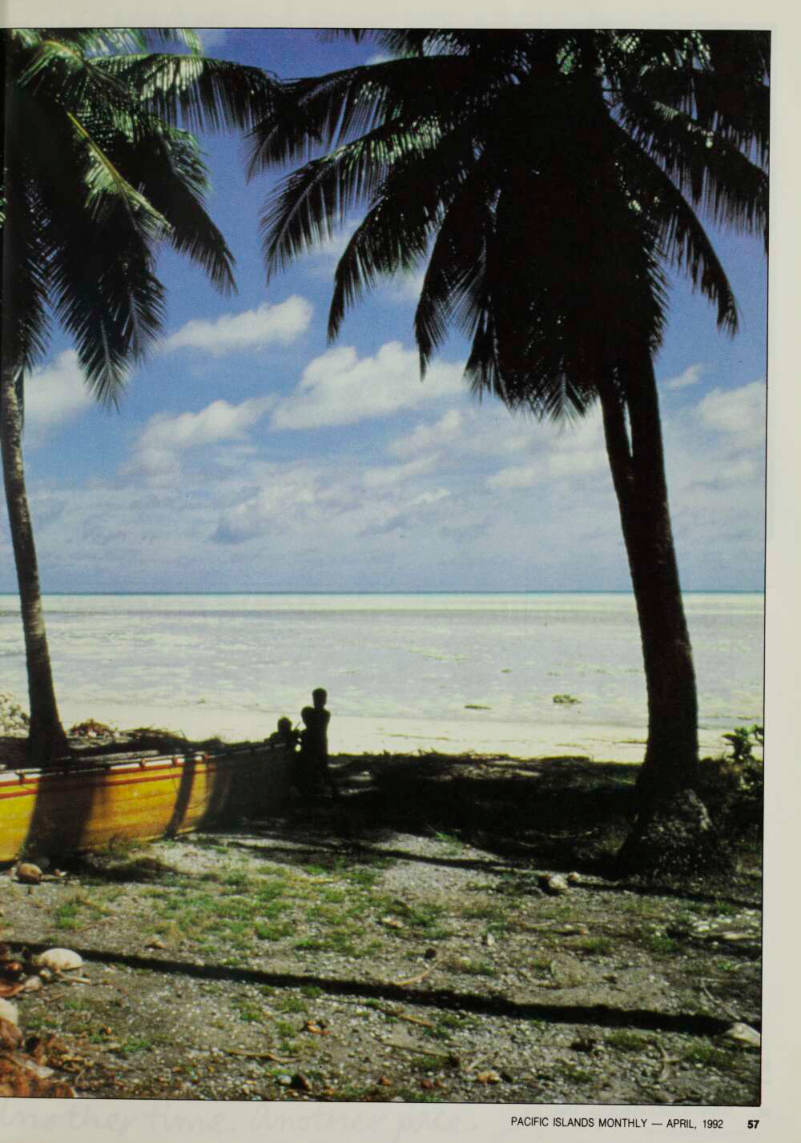
The l-Kiribati are very much men of the sea. Traditional skills include cultivating babal fishing, and making and sailing canoes.
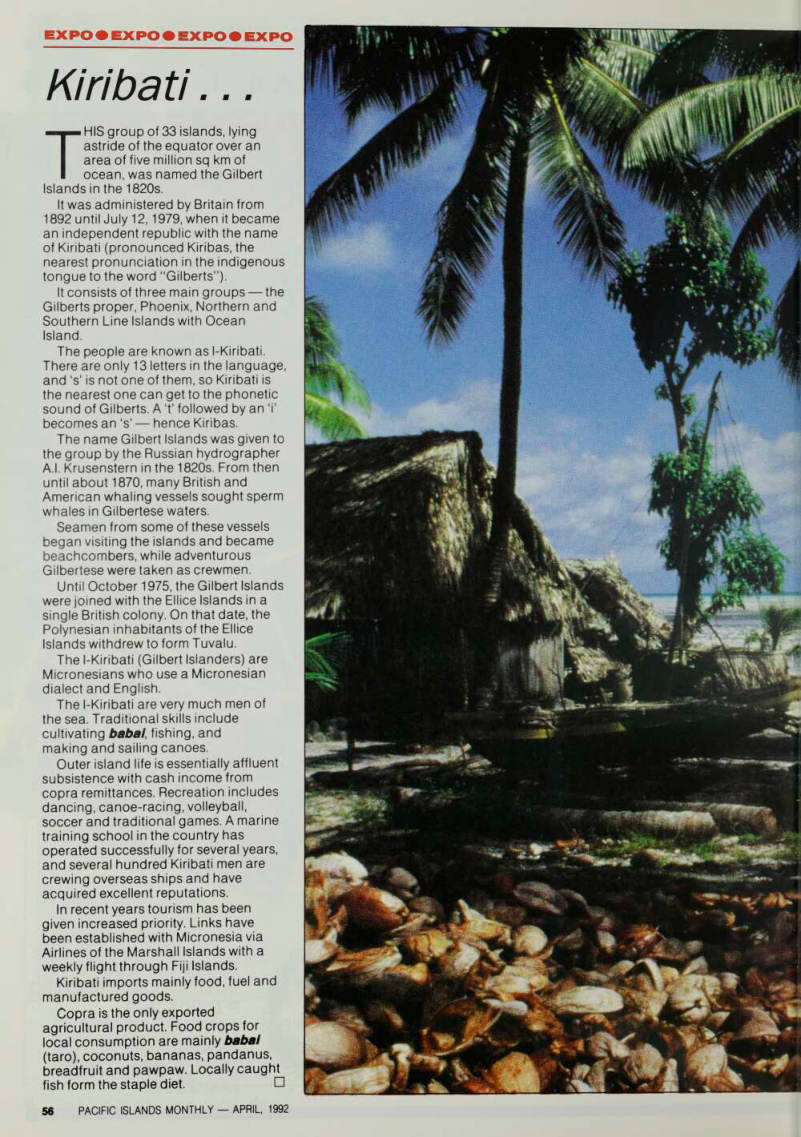
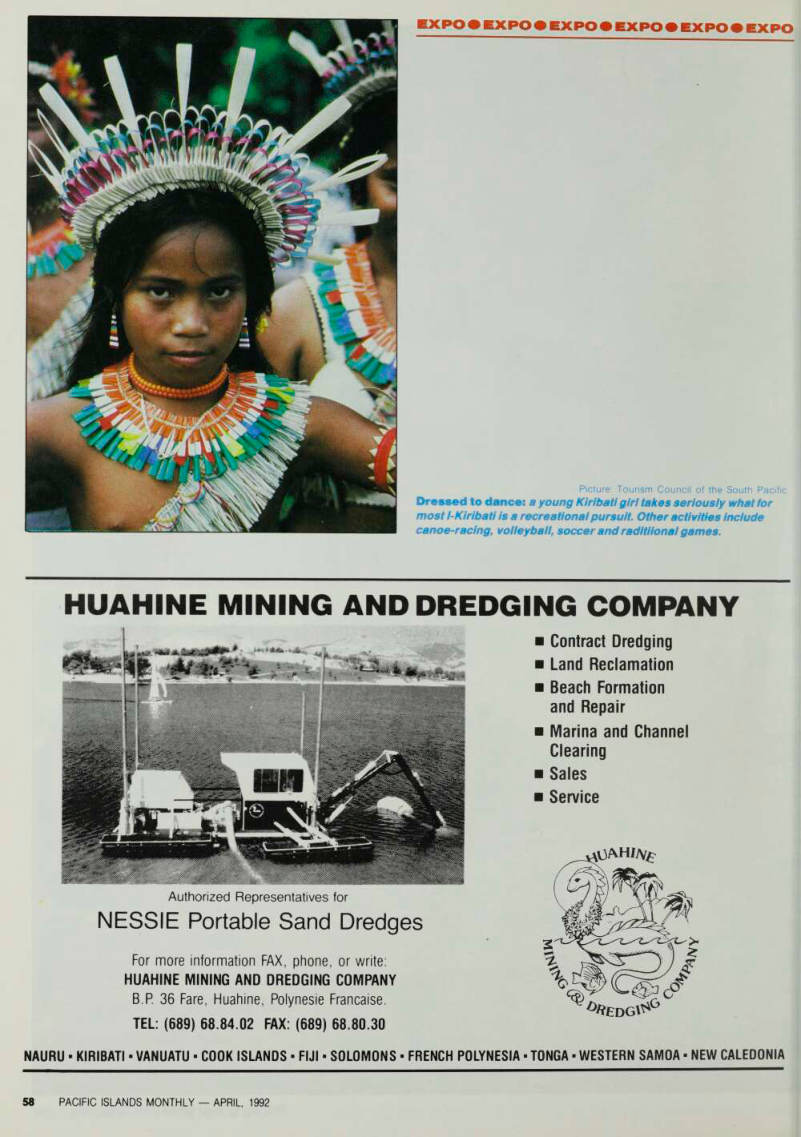
Outer island life is essentially affluent subsistence with cash income from copra remittances. Recreation includes dancing, canoe-racing, volleyball, soccer and traditional games. A marine training school in the country has operated successfully for several years, and several hundred Kiribati men are crewing overseas ships and have acquired excellent reputations.
In recent years tourism has been given increased priority. Links have been established with Micronesia via Airlines of the Marshall Islands with a weekly flight through Fiji Islands.
Kiribati imports mainly food, fuel and manufactured goods.
Copra is the only exported agricultural product. Food crops for local consumption are mainly babal (taro), coconuts, bananas, pandanus, breadfruit and pawpaw. Locally caught fish form the staple diet. □
Picture: Tourism Council of the South Pacific Dressed to dance: a young Kiribati girl takes seriously what for most I-Kiribati is a recreational pursuit. Other activities include canoe-racing, volleyball, soccer and raditiionai games.