Vanuatu ...
pp. 52-54 · Read in the full issue
VANUATU is a double chain of 80 islands with a total land area of 11,880 sq. km. The largest single island, Santo, is 3947 sq. km.
Efate, with the capital Vila, is 915 sq. km.
Vanuatu gained independence on July 30, 1980, as the New Hebrides.
The new name of Vanuatu, meaning Our Land, was given to the group by the Vanua’aku Party (formerly the New Hebrides National Party) which became the government on independence. After elections last year, the Vanua’aku Party and the Union of Moderate Parties formed a coalition government.
The indigenous people, known as ni- Vanuatu, are racially classed as Melanesians. There are also European, Micronesian/Polynesian, other Melanesian, Chinese and Vietnamese living in Vanuatu.
The people speak more than 100 Melanesian languages with Bislama being the national language. The “official” languages are Bislama, English and French. About 80 per cent of the islanders live in rural communities.
Chief activity for rural dwellers is traditional subsistence agriculture.
Recreation includes soccer, which is the main sport, cricket, golf, yachting, boxing, netball, tennis, basketball and rugby union.
Within the Vanuatu Group there are active volcanos. Yasur (Yahuwei) crater on Tanna continues to produce periodic ash. Two volcanos on Ambrym emit showers of ash also and occasionally this is accompanied by lava.
Copra, fish and beef are still the main exports of Vanuatu.
The coconut is the source of the major export. The total area under coconuts is about 70,000 ha but about 82 per cent of the copra produced comes from smallholders rather than large plantations.
The secondary industry which includes manufacturing and mining is on a small scale, catering almost exclusively for local consumption. The only exceptions are the small meat canneries and fish-freezing works and sawmills, which have a limited export trade.
The government is taking an increasingly positive part in the future of tourism policy.
An average of 60 per cent of Vanuatu’s visitors come from Australia while New Caledonia provides the next largest number, followed by New Zealand and Japan. The first European to see Vanuatu was Spanish explorer Pedro Fernandez de Quiros. He saw several islands in the Banks Group and Maewo on April 25,1606. □
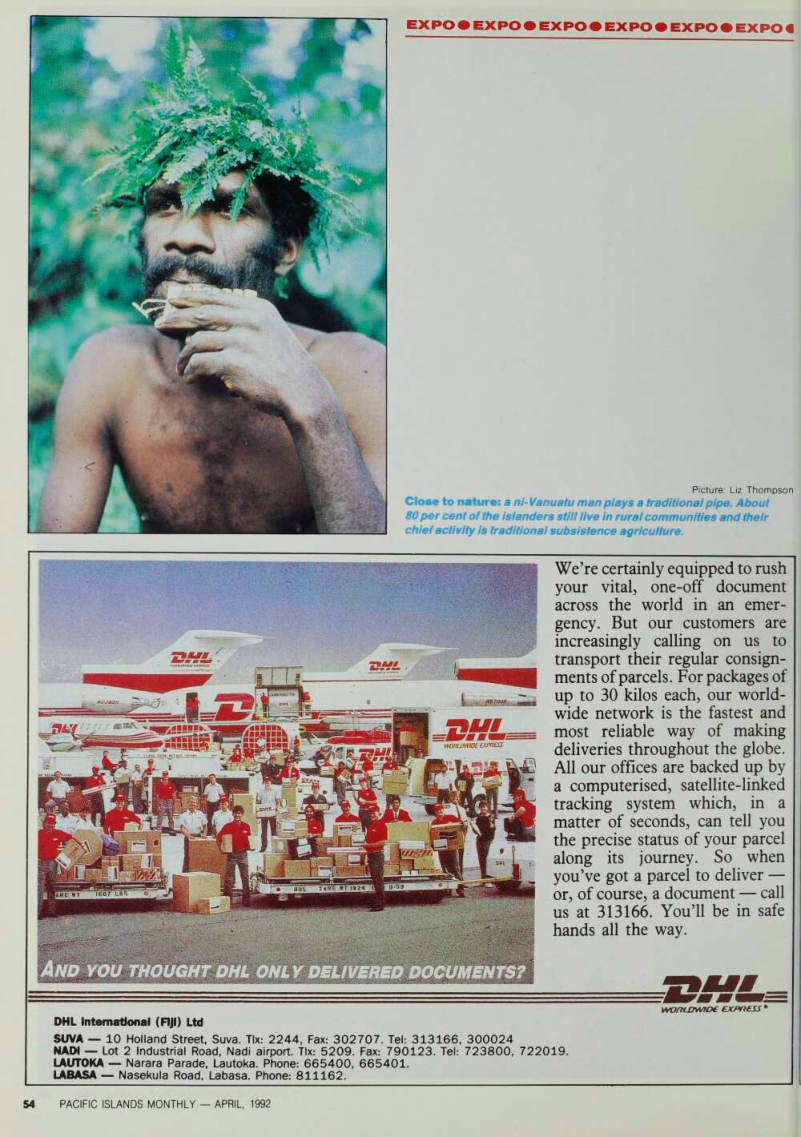
Picture: Liz Thompson Close to nature: a ni-Vanuatu man plays a traditional pipe. About 80 per cent of the islanders still live in rural communities and their chief activity is traditional subsistence agriculture.