Solomon
pp. 60-62 · Read in the full issue
Islands..
THE Solomon Islands extend over some 600,000 sq. km of sea, lying as a scattered archipelago in a south-easterly direction from Bougainville to the Santa Cruz Islands.
The group has a total land area of 29,785 sq. km.
The group consists of a double chain of six large islands and many smaller ones including those of the Lord Howe, Santa Cruz, Duff and Reef groups.
The main island is Guadalcanal and the capital is Honiara.
The Solomon Islands gained independence from Britain on July 7, 1978, and became a republic on the tenth anniversary of its independence.
The 1970 census showed a total population of 160,998 of whom 94 per cent were Melanesians. The Polynesians, who have mainly settled on small islands or atolls such as Ontong, Java, Sikaiana, Rennell, Bellona, the Reef Islands and Tikopia, are the second largest group.
The Solomons is a constitutional monarchy with the British monarch as Head of State, and represented in the Solomons by a Governor-General appointed on the recommendation of the legislature every five years.
The official language is English although the most effective lingua franca is Pidgin. About 87 different vernacular forms of speech are used, with Melanesians living in villages only a few miles apart unable to understand each other. There is no vernacular common to the whole country.
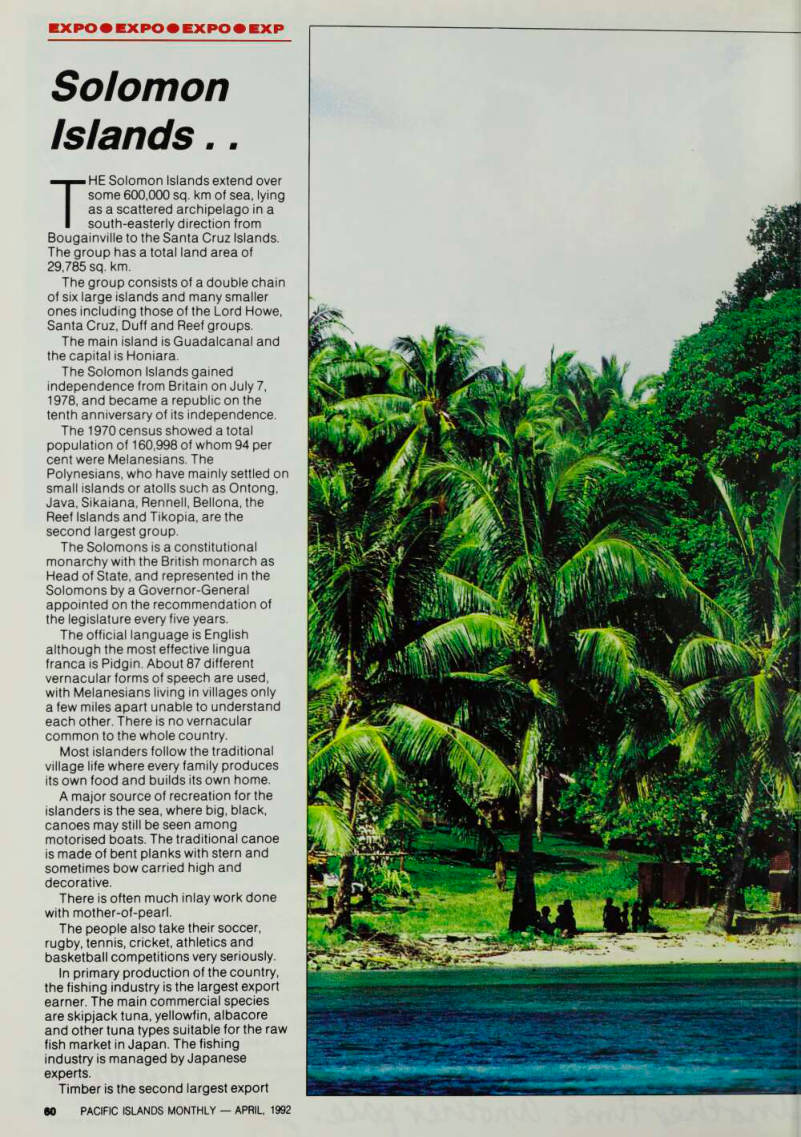
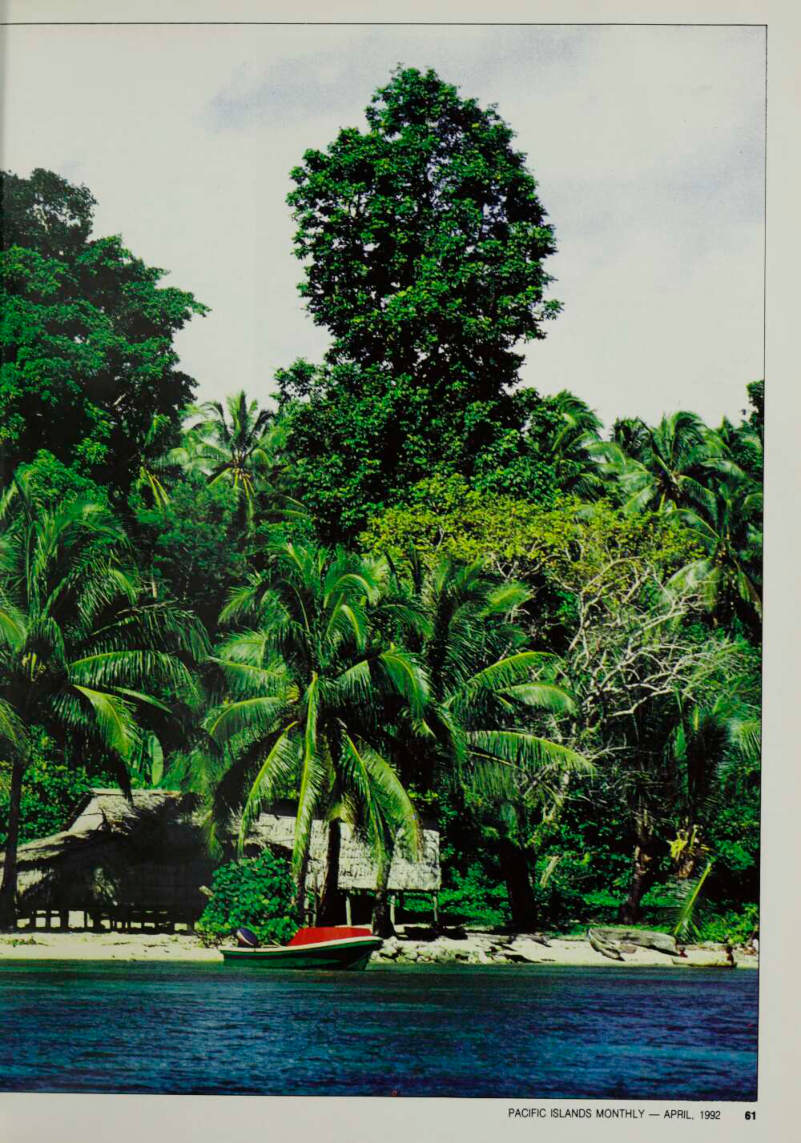
Most islanders follow the traditional village life where every family produces its own food and builds its own home.
A major source of recreation for the islanders is the sea, where big, black, canoes may still be seen among motorised boats. The traditional canoe is made of bent planks with stern and sometimes bow carried high and decorative.
There is often much inlay work done with mother-of-pearl.
The people also take their soccer, rugby, tennis, cricket, athletics and basketball competitions very seriously.
In primary production of the country, the fishing industry is the largest export earner. The main commercial species are skipjack tuna, yellowfin, albacore and other tuna types suitable for the raw fish market in Japan. The fishing industry is managed by Japanese experts.
Timber is the second largest export
earner for the country.
Logs form the bulk of exports with 95 per cent going to Japan and the rest to Korea, France and Germany. Sawn timber goes to Australia, United Kingdom, New Zealand and some of the South Pacific Islands. Cocoa is exported by a few individuals and organisations.
Tourism also is an important earner, drawing on plane and cruise ship services from Australia, Papua New Guinea, the US and New Zealand. Chief interest in recent years has been to see the major theatre of US operations in World War 11, but conflict dates back earlier.
The Solomon Islands was discovered by Spanish explorer Alvaro de Mendana, who set out from Peru with two ships in 1567 to seek the legendary Isles of Solomon, believed to lie to the west of South America, and said to have been visited by the Incas.
Spanish and Dutch colonisation efforts failed after dissension and difficulties with the islanders. The fate of French explorer La Perouse in January 1788 generated an interesting mystery for 40 years until Irishman Captain Peter Dillon chanced on some articles on Tikopia in 1826. He learned that the two ships had been wrecked in a storm, the survivors had lived on shore for a time, and sailed away in a boat made from local timber, never to be heard of again.
Several months after Dillon’s discoveries, French explorer Dumont d’Urville recovered several cannon and other relics from the inner wreck of the Astrolabe. In 1962 Reece
Discombe of Vila, New Hebrides, discovered the remains of La Perouse’s other vessel, the Boussole.
The discoveries focused some European attention on the Solomons, but there was little European contact with the area until the mid-19th century. Seven priests and six lay brothers of the French Marist order attempted to establish themselves, but four murders and one death of malaria led to abandonment of the mission in 1848.
In the 1850 s the Anglicans persuaded islanders to go to New Zealand or Norfolk Island for training, and made progress after settling in the group themselves in the late 1870 s. Meanwhile, labour recruiters had moved into the Solomons seeking labour for plantations in Fiji, Queensland and occasionally New Caledonia and Samoa.
Abuses by the labour recruiters, known as blackbirders, frequently led to murder. The evils of the labour trade prompted Great Britain to declare a protectorate over the southern Solomon Islands (Guadalcanal, Savo, Malaita, San Cristobal, and the New Georgia group) in 1893. The islands of the Santa Cruz group were added in 1898 and 1899, and others in 1900 by a treaty with
Germany.
The economic development of the Solomons progressed sluggishly before World War 11. The Japanese occupied the Islands soon after the outbreak of war. From May 1942, when the Battle of the Coral Sea was fought, until December 1943, the Solomons were almost constantly a scene of combat. This year the 50th anniversary of the landing at Guadalcanal will be commemorated. □ Compiled using the Pacific Islands Yearbook
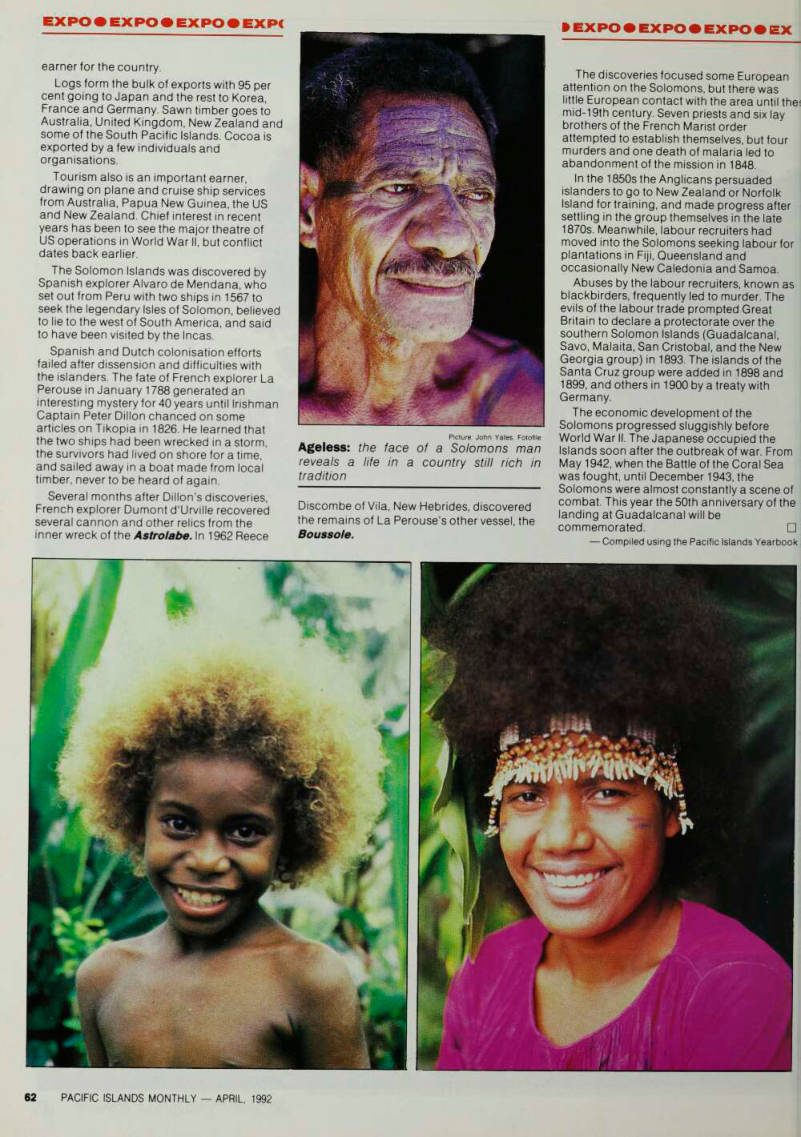
Picture: John Yates, Fotofile Ageless: the face of a Solomons man reveals a life in a country still rich in tradition