Milestone for Melanesians
p. 22 · Read in the full issue
The Region
By Beryl Cook
JACQUES leneic lekawe views his appointment to the position of Secretary General of the South Pacific Commission (SPC) as a symbolic step for the Melanesians of New Cale donia. lekawe, from Tiga (New Caledonia), the smallest of the Loyalty Islands, said he would be honoured to serve the SPC because it was the oldest and most important regional organisation, but also
because it was important to his country.
“In New Caledonia this is very important because this is the first time a Melanesian from a franco phone country has applied for the position and attained it. It is one of the several steps of the inte gration of New Caledonia into its regional environment,” lekawe said. “The decision demonstrates a better consideration of New Caledonia, of its role in the SPC family. It is a gesture to New Caledonia to enter more and more and be a part of the SPC family.”
The SPC headquarters has been based in New Caledonia, but New Caledonia had not really been able to play a complete part in the SPC, he said.
“We started, in New Cale donia, regional cooperation to achieve better regional under standing and to be more included in the regional environment, and to have a better rapport with our neighbours .. . this appointment at the SPC means New Caledonia will really be a part of the 27 countries.
“This is the external manifes
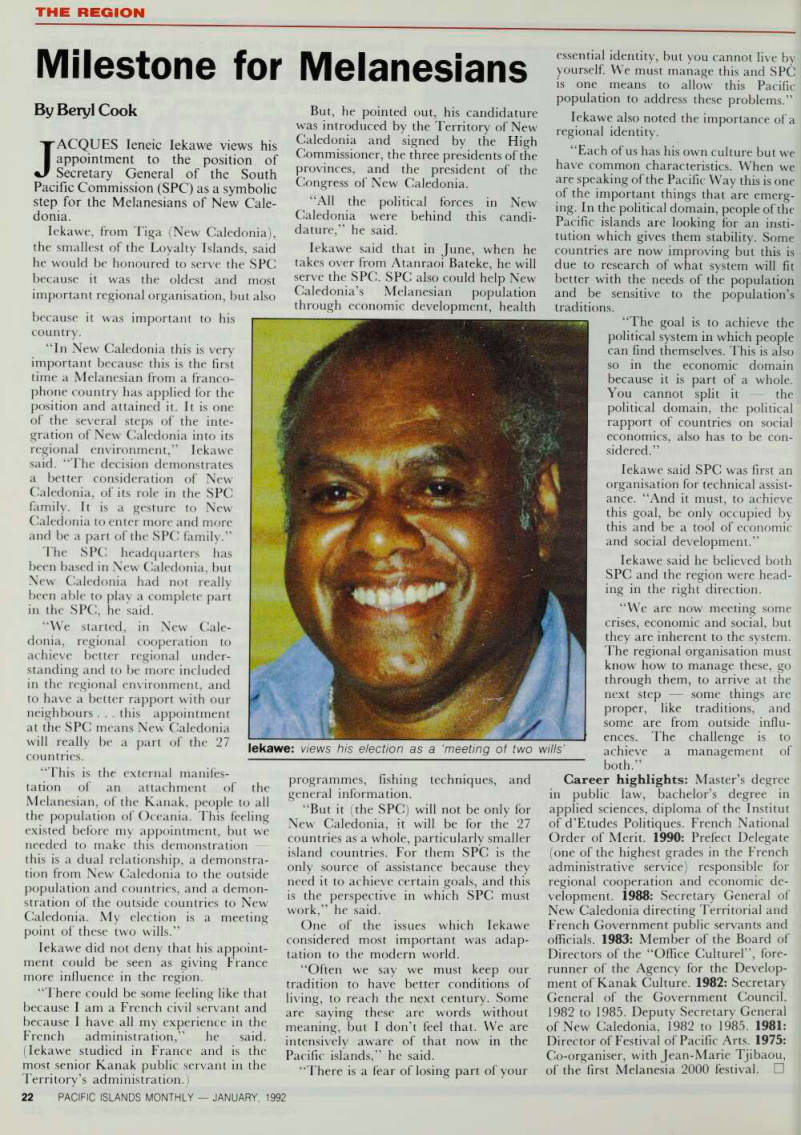
tation of an attachment of the Melanesian, of the Kanak, people to all the population of Oceania. This feeling existed before my appointment, but we needed to make this demonstration this is a dual relationship, a demonstra tion from New Caledonia to the outside population and countries, and a demon stration of the outside countries to New Caledonia. My election is a meeting point of these two wills.” lekawe did not deny that his appoint ment could be seen as giving France more influence in the region.
“There could be some feeling like that because I am a French civil servant and because I have all my experience in the French administration,” he said, (lekawe studied in France and is the most senior Kanak public servant in the Territory’s administration.)
But, he pointed out, his candidature was introduced by the Territory of New Caledonia and signed by the High Commissioner, the three presidents of the provinces, and the president of the Congress of New Caledonia.
“All the political forces in New Caledonia were behind this candi dature,” he said. lekawe said that in June, when he takes over from Atanraoi Bateke, he will serve the SPC. SPC also could help New Caledonia’s Melanesian population
through economic development, health
programmes, fishing techniques, and
general information.
“But it (the SPG) will not be only for New Caledonia, it will be for the 27 countries as a whole, particularly smaller island countries. For them SPG is the only source of assistance because they need it to achieve certain goals, and this is the perspective in which SPG must work,” he said.
One of the issues which lekawe considered most important was adap tation to the modern world.
“Often we say we must keep our tradition to have better conditions of living, to reach the next century. Some are saying these are words without meaning, but I don’t feel that. We are intensively aware of that now in the Pacific islands,” he said.
“There is a fear of losing part of your
essential identity, but you cannot live by yourself. We must manage this and SPC is one means to allow this Pacific population to address these problems.” lekawe also noted the importance of a
regional identity.
“Each of us has his own culture but we have common characteristics. When we are speaking of the Pacific Way this is one of the important things that are emerg ing. In the political domain, people of the Pacific islands are looking for an insti tution which gives them stability. Some countries are now improving but this is due to research of what system will fit better with the needs of the population and be sensitive to the population’s traditions.
“The goal is to achieve the political system in which people can find themselves. This is also so in the economic domain because it is part of a whole.
You cannot split it the political domain, the political rapport of countries on social economics, also has to be con sidered.” lekawe said SPC was first an organisation for technical assist ance. “And it must, to achieve this goal, be only occupied by this and be a tool of economic and social development.” lekawe said he believed both SPC and the region were head ing in the right direction.
“We are now meeting some crises, economic and social, but they are inherent to the system.
The regional organisation must know how to manage these, go through them, to arrive at the next step some things are proper, like traditions, and some are from outside influ ences. The challenge is to achieve a management of both.”
Career highlights: Master’s degree in public law, bachelor’s degree in applied sciences, diploma of the Institut of d’Etudes Politiques. French National Order of Merit. 1990: Prefect Delegate (one of the highest grades in the French administrative service) responsible for regional cooperation and economic de velopment. 1988: Secretary General of New Caledonia directing Territorial and French Government public servants and officials. 1983: Member of the Board of Directors of the “Office Culturel”, fore runner of the Agency for the Develop ment of Kanak Culture. 1982: Secretary General of the Government Council, 1982 to 1985. Deputy Secretary General of New Caledonia, 1982 to 1985. 1981: Director of Festival of Pacific Arts. 1975: Co-organiser, with Jean-Marie Tjibaou, of the first Melanesia 2000 festival. □
lekawe: views his election as a ‘meeting of two wills’