find consensus?
pp. 24-25 · Read in the full issue
Can New Caledonia find consensus?
By Brendon Bums
THREE years after the signing of the Matignon Accords which ended a near civil war in New Caledonia, the peace is shattered only by the sounds of development. France is pouring hundreds of millions of dollars into the territory each year, as it attempts to “rebalance” the territory’s economy to give a greater share of resources to Kanaks.
But beyond the din of earthmoving machines and hammers, a different noise can now be heard. It is the early and
sometimes ritualistic response to the word “consensus”.
The Matignon Accords are a process for developing New Caledonia’s econ omic and political infrastructure, not a solution on whether the territory should stay with France or become independent.
All it provides on this score is the legal framework for a 1998 referendum, with scant detail on what voters will be asked to decide.
Jacques Lafleur, leader of the RCPR, Rally for Caledonia within the Republic, raised the issue of a consensus last April.
Reputedly France’s fifth richest man, Lafleur has enormous mana in New
Caledonia with white voters. His op ponents also hold him in some respect fc his role in negotiating in the Matignoi
Accords with Jean-Marie Tjibaou
FLNKS president until his assassinatioi by a Kanak extremist in 1989.
In a recent press conference wit; visiting New Zealand journalists, Lafleu said the scheduled 1998 seli determination referendum will not settl the issue which divides Kanaks am Caledonians. At present, about 45 pe cent of the population are Kanak, a thin claim French ancestry. Whatever thi result of the 1998 vote, Lafleur said decision cannot be imposed on a sizabll minority of people.
Still noted for his sometimes hardlim position, Lafleur does not now seem t automatically recoil from the won “independence”. He said he is not afrah of independence but is trying to under stand what it might mean. “We ar trying to be wise,” he told journalists ii English at his waterfront office in th territorial assembly building in Noumea “At one time words would mean mud more than we thought.”
A constitutional model suggested fo post-1998 New Caledonia has been tha of the Cook Islands. It is independent bui Cook Islanders are citizens of Nev Zealand, which retains nominal respom sibility for foreign affairs and defence.
“It would be possible if everybody wants it,” said Lafleur, although thi model is not quite what he would wish “I have to tell you I am not willinj independence. I am not going to lose rm culture”.
Lafleur thereby signals the fears oi many whites in New Caledonia. Tha under an independent New Caledonia (which would become Kanaky), they would lose their French lifestyle anc culture.
“People who think they have right! because they are first in a country are going to have to stop saying because o:i this reason they have all the rights.”
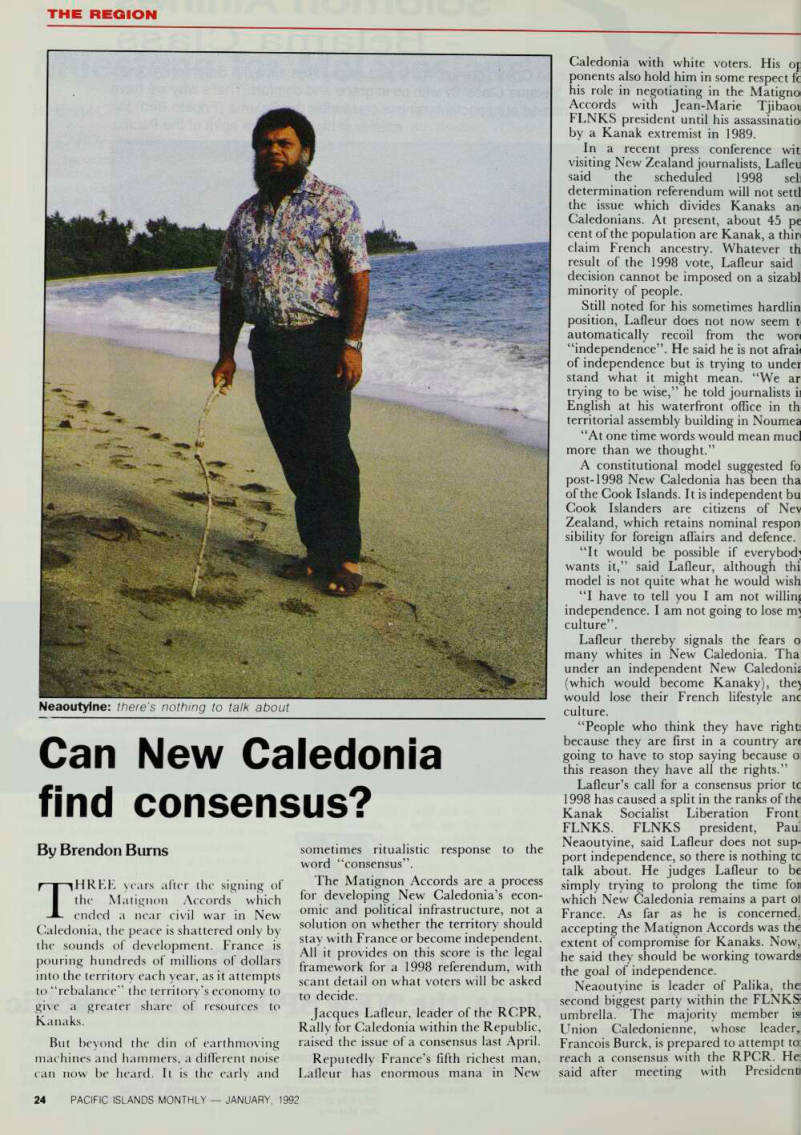
Lafleur’s call for a consensus prior tc 1998 has caused a split in the ranks of the Kanak Socialist Liberation Front FLNKS. FLNKS president, Paul Neaoutyine, said Lafleur does not sup port independence, so there is nothing tc talk about. He judges Lafleur to be simply trying to prolong the time fan which New Caledonia remains a part of France. As far as he is concerned, accepting the Matignon Accords was the extent of compromise for Kanaks. Now, he said they should be working towards
the goal of independence.
Neaoutyine is leader of Palika, the second biggest party within the FLNKS* umbrella. The majority member is Union Caledonienne, whose leader* Francois Burck, is prepared to attempt toe reach a consensus with the RPCR. He said after meeting with President!
Neaoutyine: there's nothing to talk about
Mitterrand earlier this year (hat the concept of independence had “evolved and is no longer taken as meaning a break with France but rather a partner ship.
One interpretation is that the diller ences are more in public than private.
Jacques lekawe is a Kanak and senior administrator lor economic develop ment. Testifying to his broad ac ceptability is his recent appointment as the next Secretary-General of the South Pacific Commission, whic h oversees aid
and development projects throughout
the region. He said a confluence ol opinion was emerging. No one wanted to go through another bout of civil war.
Each side had to speak publicly to placate its militants, he said. But pri vately things were moving towards ronsensus. lekawe sees a fragmentation of the FLNKS as perhaps the biggest barrier to mine negotiated settlement emerging.
Flic potential for this can already be seen n the different positions towards coliseu ms adopted by the more moderate Union Ailedonienne and the somewhat Radically-inclined Palika, although both
upport independence.
Through strength of personality, acques Lafleur has masked the disquiet n the white community about the iccords and the on-set of the 1998 ((dependence v ote. The presence of three National Front members in the Southern rovince assembly indicates these con erns. National Front leader Guy George lismisscs the Accords process as bullshit”.
“I do not believe in miracles that make : possible to suddenly shake hands with
our enemy.”
Many more people in New Caledonia uestion whether the process could antinue if Jacques Lafleur were to quit rdie. He has already had a heart attack,
fhile being photographed on his office
alcony he confessed to complete rangers a wish to stop working, some ling he has repeatedly voiced.
On a horsestud near La Foa, an hour ad halfs drive from Noumea, Michel ethezer said it would be a bad thing for afleur to quit or die. His respect for the PCR leader is obvious, although he lid if he were Lafleur he would get out politics and enjoy the fortune amassed om nickel mining and investments.
Sporting a Penrith Panthers c ap and asters t-shirt, this fifth-generation Cale mian could be Australian but for the nguage difference.
Lcthczer looked for a farm in Qiteens nd during the 1984 uprising. But his 'art and need to converse in his native
tongue brought him back to Ness Caledonia, where he noss breeds some ol the (errilors s best racehorses. I .ethe/er is slaunchlv loyalist, yet the onls lime he has been to France ssas to do his year's compulsors military set s ice.
While (he Matignon Accords were working well. he thinks there is the potential for things to go bad again in I lie future. Pointing to the drs earth, he said this ssas sshere he intended to die. Even ssith (he language barrier, his point ssas clear. Matching that determination is Paul Neaoutyine, svho said svhile the FLNKS ss anted to achieve the creation ol Kanaks. a return to thy unrest ol the past is possible. “. . . il we don’t obtain this, sse ssill continue' our struggle lor
independence."
In the interim, much of his energy is taken watching the process towards the self-determination vote. He holds fears that participation mas extend beyond the proposal to limit voters to those living in New Caledonia in 1998 and their descendants.
In spite* of the potential for further conflict, a sense of hope has to be accorded Ness Caledonia. It has wealth unknosvn in other parts of the South Pacific. The supposed risk posed bs an FLNKS policy to nationalise the lucra tive nickel mines is not the bogey it mas
seem. The mining companies only lease
their licences from the state, rather than own them. W ith a third of the world's nickel output. New Caledonia has a valuable dimension to its economy which many countries would envy.
Already, the Kanak-controlled North ern Province has bought Jacques Lafleur's huge mine at a give-away price that he proclaims as a symbol of what could happen more widely. The mine is
helping fund other development projects
such as a new Club Med at Hicnghene.
For all their generosity, the Matignon Accords have created a division which may need to be addressed in next year's scheduled review.
Union Oceanienne represents those from Wallis Island, a French territory, and other minorities. Until recently, the Wallisians had solidly backed the RPCR.
But Union Oceanienne leader Michel Hema said the Matignon Accords have excluded Wallisians from the fruits of development. Now. he proclaims very good relations with the FLNKS, al though he remains hesitant about
fulsomely supporting independence. Es
sentially, if either of the two main alliances, FLNKS or RPCR, do not look after the interests of Wallisians. they will lose the support of this significant third force within New Caledonian politics.
lii flic interim. Michel llcma said his people, whom he insists are the poorest in the territory, want some ol the benefits which the Matignon Accords are bring ing to Kanaks.
Even il lhe\ have not healed all the divisions in New Caledonia. the Matignon Accords are an extraordinai v process. Where else in the world has a colonial power been able to convince parties to put (low n their arms and spend 10 scars work hit;' peace fulls towards an
independence sole.*
Although sometimes dubbed “victims ofhistorv . there is wide acceptance bs Kanaks of the rights of those descended from french settlers to call Ness Cale donia (heir home, svhile retaining links with 1 raiuc. The form of this future linkage is the kes to whatever consensus emerges. I ranee s attitude to the possible loss ol its territory are unclear but Paris mas be Ibrced to show its hand on what plans it has lor New Caledonia.
Michel Roeard. the French Prime Minister who signed the Accords, was doing more than playing for time and being nice to the Kanaks. He was trying to maintain France as a mid-si/ed power with a worldwide presence, including territories in the South Pacific, Carib bean and Indian C)ccan. Equal Iv. he was recognising France could no longer ignore the Kanak call for independence and continue to listen only to those svho wish to remain loyal.
The French government also wants Ness Caledonia to look more to its own region and less to France. This would improve France's standing in the* South Pacific and reduce dependence on Paris.
But so far, only Kanak leaders base shown any inclination to identify ssith their home region. Most whites in Ness Caledonia, not the least Jacques halleur. feel some identity with New Zealand and Australia, but look disdainfully at other South Pacific nations.
France’s global ambitions already clash ss ith its efforts to improve relations with the South Pacific. The determi nation to have a nuclear deterrent does not accord svith the region’s wishes to be nuclear free.
Clearly, the hope in Paris is that 10 years of c atch-up largesse will produce a majority vote in Ness Caledonia to remain French in the 1998 poll.
The Matignon Accords bas e created a 10-year breathing space for France, Caledonians and Kanaks. But no amount of “rebalancing’' can deliver a
political equilibrium acceptable to all.
Then again, neither will a simple vole.
For now at least. New Caledonia has time on its side and an inherent ssish to avoid reliving its recent history.