Pacific
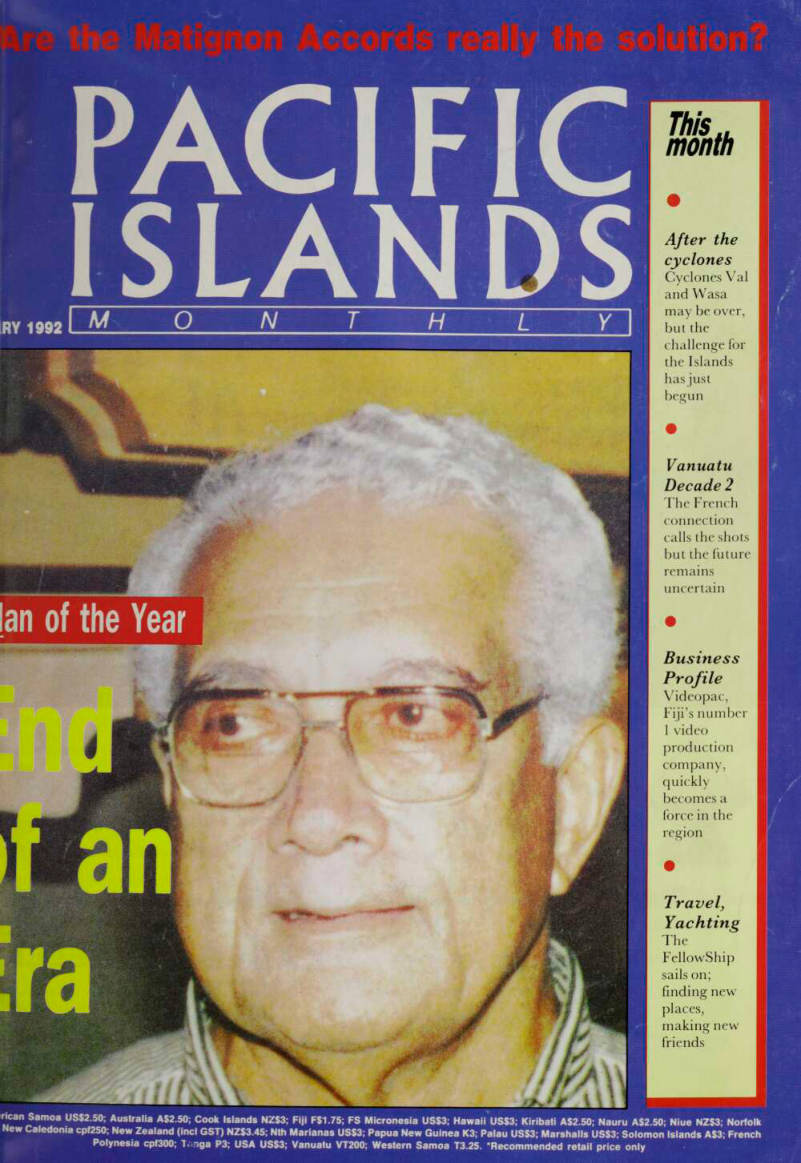
Islands
Monthly
t
RY 1992
lan of the Year
Kr ira
month
After the
cyclones
Cyclones Val and Wasa may be over, but the challenge for the Islands has just begun • Vanuatu Decade 2 The French connection calls the shots but the future remains uncertain • Business
Profile
Videopac, Fiji’s number 1 video production company, quickly becomes a force in the region • Travel,
Yachting
The Fellowship sails on; finding new places, making new friends
- a " Sam ° a us 52.50; Australia A 52.50; Cook Islands NZ$3; Fiji F 51.75; FS Micronesia US$3; Hawaii US$3; Kiribati A 52.50; Nauru A 52.50; Niue NZ$3; Norfolk New Caledonia cpf2so; New Zealand (incl GST) NZ53.45; Nth Marianas US$3; Papua New Guinea K 3; Palau US$3; Marshalls US$3; Solomon Islands As 3; French Polynesia cpfSOO; l. nga P 3; USA US$3; Vanuatu VT2OO; Western Samoa T 3.25. 'Recommended retail price only
Advertisements & other items, p. 2 (1 item)
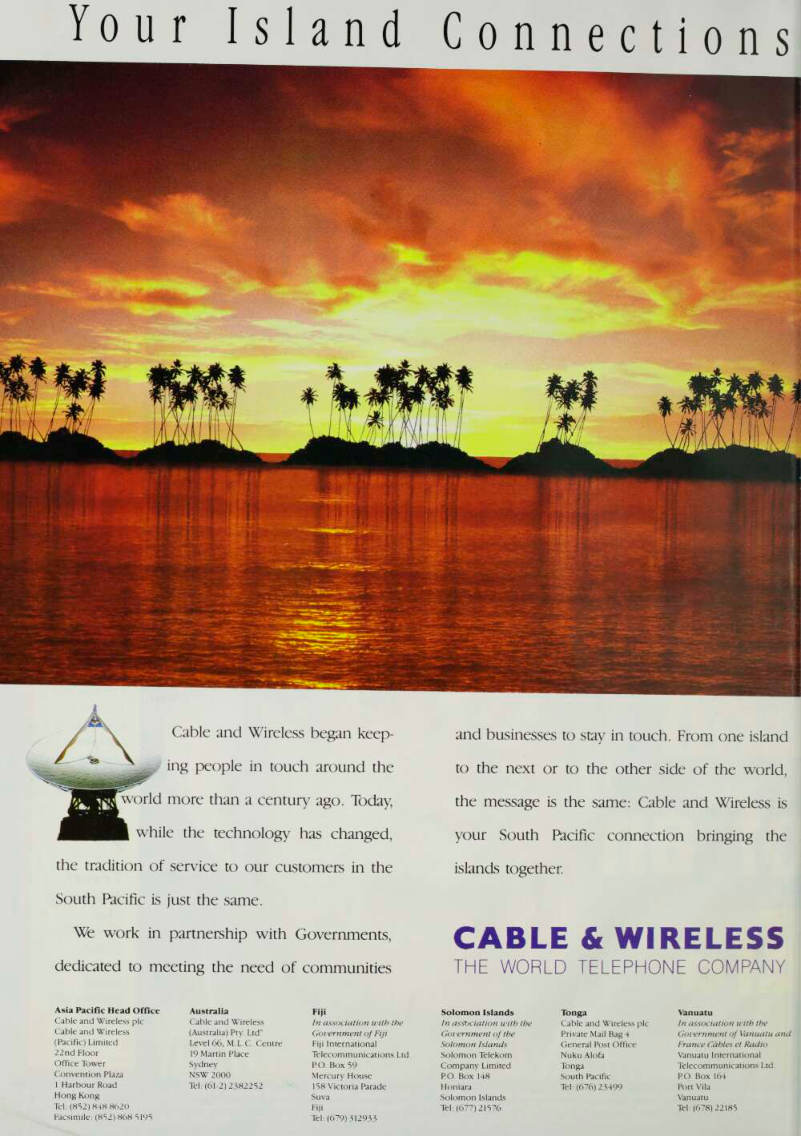
Your Island Connections
» * 4 m fia
Cable and Wireless began keep-
ing people in touch around the
fflHl world more than a century ago. Today,
IHIB while the technology has changed,
the tradition of service to our customers in the
South Pacific is just the same.
We work in partnership with Governments,
dedicated to meeting the need of communities and businesses to stay in touch. From one island to the next or to the other side of the world, the message is the same: Cable and Wireless is
your South Pacific connection bringing the
islands together.
CABLE & WIRELESS
THE WORLD TELEPHONE COMPANY
Asia Pacific Head Office Cable and Wireless pic Cable and Wireless (Pacific) Limited 22 nd Floor Office Tower Convention Plaza 1 Harbour Road Hong Kong Tel: (852) 848 8620 Facsimile: (852) 868 5195 Australia Cable and Wireless (Australia) Pty. Ltd' Level 66, M.L.C. Centre 19 Martin Place Sydney
NSW 2000
Tel: (61-2) 2382252 Fiji In association with the Government of Fiji Fiji International Telecommunications Ltd.
P.O, Box 59 Mercury House 158 Victoria Parade Suva Fiji Tel: (679) 312933 Solomon Islands In association with the Government of the Solomon Islands Solomon Telekom Company Limited RO. Box 148 Honiara Solomon Islands Tel: (677) 21576 Tonga Cable and Wireless pic Private Mail Bag 4 General Post Office Nuku Alofa Tonga South Pacific Tel: (676) 23499 Vanuatu In association with the Government of Vanuatu and France Cables et Radio Vanuatu International Telecommunications Ltd.
P.O. Box 164 Port Vila Vanuatu Tel: (678)22185
Pacific
Islands
Monthly
Vo I. 62 No.l
The News Magazine
January 1992
Fiji:
Ratu Mara, Man of the Year 8 South Pacific Renaissance The miracle in Suva
Vanuatu:
God bless the coalition 12 Vietnamese boat people, they could have been a new import 14
East Timor:
Back on the agenda 15 From the Portuguese pan into the Indonesian fire 15 ‘Betrayal’ by the South Pacific 19
Bougainville:
Still an island of death 20
New Caledonia:
Can New Caledonia find consensus 9 24
Jacques lekawe, recently appointed secretary general of the South Pacific Commission 22
New Zealand:
Winston Peters has been sacked but not silenced 32 A dream sours, as recession dispels the myth of the land of opportunity 33
Fsm;
Bailey Olter’s big catch with tuna-canning rights 35
Western Samoa:
After Cyclone Val, the struggle to rebuild the economy begins 36 Tougher building standards: would they have helped? 37
French Polynesia:
Cyclone Wasa, the return of the El Nino factors? 39
Solomons:
On the tourism trail 43 A new, but modest spirit for the airline 44
Tourism;
Cracking the European market, is Expo the go? 45 Trash or treasure; the under water relics of American Samoa and Palau 51
Yachting:
More tales from The Fellowship, as two Finns cruise the waters of Fiji 52
Environment:
Eco-fix that needs fixing 54
Business:
Crackdown on Fiji VAT offenders 41 On the agenda for the new Fiji government 41
Columnists:
Jemima Garrett: 20 David Barber: 26 Margot O’Neill: 30
Letters: 4
Shipping: 48
Headlines: 40
WIN a trip to Tonga! 16 Pacific Islands Monthly photographers use Fuji films.
Publisher: Geoffrey Hussey Editor: jale Moala Assistant Editor: Beryl Cook Senior Writer: Martin Tiffany Correspondents: Al Prince, Angela McCarthy, David North, David Robie, Diana McManus, Dykes Angiki, Frank Kolma, Franck Madoeuf, lan Williams, Irene Nisbet, John Hunter, Karen Mangnall, Lovenia Enari, Lito Vilisom, Macel Manua. Nicholas Rothwell, Pesi Fonua, Richard Dinnen, Ulafala Aiavao, Wally Hiambohn
Columnists: David Barber (Welling ton), Futa Helu (Tonga, covering the Pacific Islands), Jemima Garrett (Syd ney), Margot O'Neill (Washington) Business and Advertising Man ager: Charlotte Thomas Advertising Sales: • Regional sales representative (South Pacific): Salendra Narayan, Tel (679) 304111, Fx (679) 303809 • Sydney. Melbourne: Fergus Maclagan, Tel (61-2) 4134689, Fx (61-2) 4123918 • Brisbane: Robert Walker, Tel (61-7)
3710533, Fx (61-7) 8798964 • Adelaide. Hastwell Williamsons Rep resentations, Tel (61-8) 799522, Fx (61-8) 799735 • Auckland: McKay International Me dia Reps Ltd, Tel (64-9) 4190561. Fx (64-9) 4192243 • Japan: Universal Media Corporation, Tokyo. Tel (3) 6663036, 6663094, Cable: UNIMEDIA Tokyo, Tx 2524665 Founded 1930 (USPS 952480). A Fiji Times Limited production.
Cover prices are recommended retail
only. Registered by Australia Post, Publication No NBP 1210. C Copyright Fiji Times Limited, 177 Victoria Parade, Suva. Fiji. Tel (679) 304111, Fx (679)
303809, Tx Fj2124
Pacific Islands Monthly is published monthly by Fiji Times Limited, a division of Nationwide News, 2 Holt Street, Surry Hills, Sydney, NSW 2010.
Send address changes to: • Pacific Islands Monthly. PO Box 1167, Suva Fiji, Typeset and printed by Fiji Times Limited, 177 Victoria Parade, Suva, Fiji.
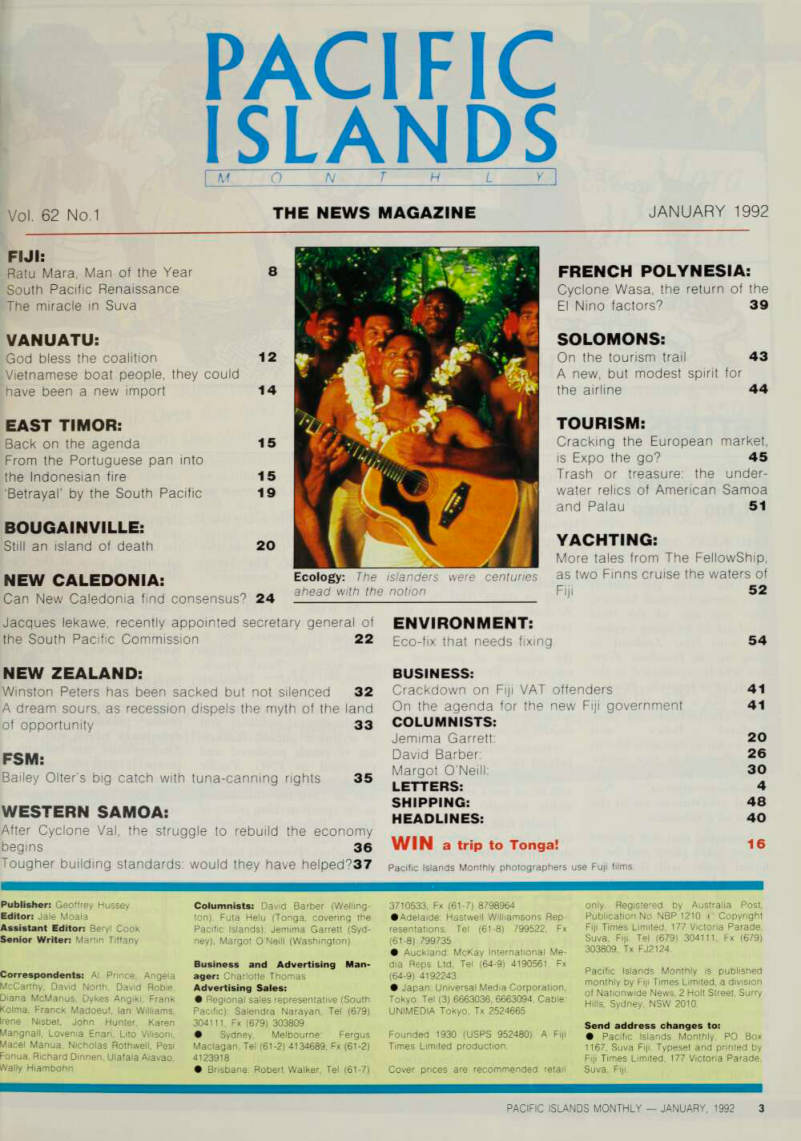
Ecology: The islanders were centuries ahead with the notion
Letters

French getting
off too ‘cheep’
CHICKENS come home to roost! Deja vu! The news on television on November 26 that the Swiss government have arrested Gerald Andries, who was one of the men involved in bringing explos ives into New Zealand to blow up the Rainbow War rior which eventuated in the death of Fernando Pereira, comes like a bolt out of the blue! The fact that the New Zealand Police will endeavour to extradite him to New Zealand to face justice must now put the present “non-interventionist' Na tional government on to the horns of a dilemma.
Assuming that due process of law takes place and he is found guilty will thev suc cumb to French political pres sure and release him to Ho Ho. er Hao or w ill they allow justice to take precedence over trade? Faking on the gallic goliath and standing up for justice would mean the loss of considerable trade for New Zealand and under the heavy breath of La Belle France the New Zealand gov ernment once having wilted, will will again.
Will Prime Minister Jim Bolger and his laissez-faire
government merely let things take their natural course?
Oui, Oui! France will nat urally get her own way, the course of justice will expire and the New Zealand police in the process of extraditing Gerald Andries from Switzer land to stand trial in New Zealand will teeter on the verge of extreme frustration!
Why bother going through the motions of pursuing a suspected French terrorist when the New Zealand gov ernment will only end up releasing the man to France should he be found guilty?
History repeats itself and behind the scenes New Zea land and French diplomacy will be at work ironing out a
public scenario.
Justice falls by the wavside, but what is justice when sheepbrains are at stake?
Martin Leo Auckland
At that time, in addition to a general lack of interest on the potential, I was also facing a ferocious antagonism by Japanese who were fearful of losing their pearl industry (as detailed in “The Torres Strait Pearl Conspiracy”, PIM, August 1982).
As result of PI M’s con structive articles and by SP Bulletin (4th quarters 1968 & 1969); processing/exports from Sydney (“Pearls, Pearls, Pearls”; PIM , February 1966); village-level pearl farmers in PNG; volume of developmental publicity and of technical papers; market ing of pearls produced and processed in PNG; Pacific people were becoming aw r are and by 1970 this culminated to the epoch-making policy of French Polynesia to develop the pearl cultivation for themselves (Polynesia had the advantage of previous rel evant research).
Gradually more Pacific governments were motivated and 25 years after PlM’s pioneering article, pearl farms mushroomed in the Pacific and the “prognostication” for a major economic benefit from “Pacific’s White Gold”, was fulfilled to the letter.
As fundamental factors contributing to development, PIM is instrumental in pres enting it and myself for motiv ating and supporting it in
Editor’s note: New Zealand an nounced on December 17 It would not pursue the extradition.
It’s proved a pearler!
In September 1965, PIM published the article “Pearl Expert Sees Rich Future for Pacific's ‘While Gold' aim ing to motivate Pacific Islanders to major economic potential readily available at their doorstep of which they were unaware: cultivation of pearls.
various ways. PI M's article; “There is Gold for Islander’s in a Neglected Industry” (Sept. 1971), remains a blue print of development and of the direction to stabilise it as an integral part of the Pa cific’s people economy.
PI M's articles are monu mental for promoting the highly complex development in an accurate and positive manner. However, while to day’s consensus on the indus try is a rosy one by the persons involved, evaluation of over all performance on pearl ex pertise points to alarming drawbacks which will affect detrimentally the industry’s prospects and the people’s economic benefit.
If these are not rectified urgently, the Pacific will re main a cheap source of pearls for Japanese and the real benefit will be lost, as already the case is with all other pearl-farmers dependent on Japanese. Australia is a classi cal example of dependence.
I would suggest that you take again the initiative should you consider a merit in my evaluation. Someone from the persons involved in the industry admits the existence of drawbacks but the enthusi astic majority, more or less, remains ignorant and/or in different.
C. Denis George Queensland
Samoa phone story
out of order
ATTENTION is called to an article in your August 1991 edition, “America’s Wasted Millions” and particularly the insert entitled “The Sam oan Telephone with the right connections” by David North.
I find the content of your insert totally false and slan derous. It is a clear case of character assassination in a slanted fashion. Fortunately, your magazine is printed out side of the United States.
Obviously, the author did not research the subject mat ter to get both sides of the story before printing. He did, however, ask the question why the director was not fired for not following the IG Inspector’s recommenda tions. The following, there fore, will answer some of the questions he has in mind ...
The Office of Communica tions is a branch of the American Samoa Govern ment charged with the re sponsibility of providing the people of American Samoa with telecommunications cir cuits and facilities for the conduct of their daily affairs.
The Office of Communica tions handles both local and overseas telephone as well as other telecommunications services commonly found in industrialised countries. Pres ent assets of the office of communications amounted to 20 million dollars in tangible holdings.
Annual Revenues collected from telecommunications ser vices amounted to 9.5 million dollars in Fiscal Year 1991.
Approximately 20 per cent of this amount is given to the local Government to pay for their debt services and other expenses. The office of com munications does not receive any money or grant from the Federal Government nor the local government. It has no debts and all of its tangible assets are paid for and owned by the office of communica tions. The office of communi cations operates as a business and generates its own funds for capital improvements and equipment modernisation projects.
The American Samoa tele phone network is fully digital and all telephone instruments
are of tone-dial type. It oper ates a Cellular Telephone System with four cell sites and over 500 subscribers profit ably, in spite (of) harsh criti cisms from outsiders that a cellular system is not viable in American Samoa. Specifi cally, your article quoted that cellular phones arc only afforded by people earning SUS3O,OOO to $50,000 annu ally. It also quoted that American Samoa has only 15 miles of roads and 212 famil ies earning $25,000 per year.
The fact of the matter is that there arc twice as many miles of roads in American Samoa and 10 times as many families earning $25,000 per year. We have many families owning cellular phones with income less than $lO,OOO per annum.
Portable cellular tele phones used to cost $2,000 per unit five years ago are now costing $5OO or less. This is the trend that the office of
communications projected
five years ago that the author of the IG Report was very ignorant of. In fact he was totally unqualified to write or even express an opinion in an area foreign to him. To put it bluntly, he was very jealous that the native Samoans may
someday own cellular phones
and he tried unsuccessfully to stop this inevitable course of events. Fortunately, both elected Governors saw this and ignored the report.
When the author of the IG Report failed to stop the Cellular Project, he went on to link the Director of Com munications to a conflict of interest issue. This was
prompted by a disgruntled
vendor who went to the IG to complain when he lost the bid because his equipment did
not meet published equip
ment specifications ...
I appreciate the fact that you mentioned in your clos ing sentence that American Samoa Cellular system
played a major role during
and after Hurricane Ofa, a fact the IG Report did not foresee.
I trust that your readers can best be served by giving them the other side of the story in a factual manner. As a point of information, the Director of Communications has served continuously in this capacity since 1967 and (is) partly responsible for the development of telecommuni
cations in American Samoa.
Aleki Sene
Director of Communications American Samoa Government Basic human right I HAVE a few comments about Michael Anderson’s letter in the November edition of PIM. It does not deserve more.
The basic argument ad vanced by Anderson is that Pacific island countries should be grateful that they were colonised and hence arrived at their present devel opment status solely because of this undignified and de grading act. We must never lose sight of the fact that the right of self-determination is a basic human right. No one race has the right to decide what is right or wrong for another. In the end, one can never honestly justify col onialism.
Anderson forgets that sys tems and structures which were inherited by Pacific na tions were those imposed by the colonial powers. In many cases these were not geared towards meeting the needs of locals but to satisfy those of expatriates. That they did not endure is therefore not sur prising. It seems illogical to talk about “handing back free” assets which were
wrongfully possessed by the
colonial powers. The assets were not theirs in the first place. This is typical colonial
mentality.
The Pacific will remember its colonial experience al though we still have to rid ourselves totally of this bar baric violation of basic hu man dignity. There is no need for Anderson to remind us Pacific islanders of it.
Dr Pa’o Luteru Western Samoa
Unsporting comments
MY goodness, hasn’t Paul Wallwork got a big ego, and doesn’t it get in the way of his judgement!
The newly elected President of the South Pacific Games council gives Papua New Guinea 10 out of 10 for facilities, for food and accom modation, for friendship [PIM Oct 91) but only three out of 10 to the organisers becuase they showed neglect, almost disregard, for the in terest not only of athletes and
officials, but sports adminis trators of the various? countries.
Apparently too few Papua/
New Guineans fell on the tarmac to kiss the hem of Mr Wallwork’s tunic when he arrived in Port Moresby.
Many of the organisers, al most all of us volunteers Tor the Games Oranising Gom mittecj, were disgusted at Mr Wallwork’s bleating about chauffeur-driven cars, VIP' tickets etc etc for himself and his wife. If he’s such an egalitarian, so sports minded,
why didn’t he just jump on
the shuttle bus with the ath letes and most of the other visiting officials.
All the leaders of national
teams, speaking directly for
their athletes, were fullsome in their praise of the way sportsmen and women, and sport in the Pacific, were treated by Papua New Guinea. We all met, officially every morning of the Games, specifically to discuss any
problems that might arise.
There were few, and they were dealt with as the highest priority each day.
Apart from your esteemed self of course, Paul, specifically which athletes, officials and sports administrators were treated with neglect and dis regard? Certainly not your fellow-Western Samoa Gisa Gaupa, speaking on behalf of all team managers on depar ture, who said: “We have been well looked after, and we will be doing injustice to our South Pacific ancestors if we do not sing your praises. The food and venues have been superb. We were given every assistance.
You even had transport or ganised for each team man ager to go out whenever we needed to. We thank your from the bottom of our hearts, and we leave with the spirit of brotherhood.”
Papua New Guinea's Games have, quite simply, set a new standard to which future events can aspire. But organ isers of future Games would be advised to keep Mr W ail work well away from the
good-hearted, sports-minded
sponsors and volunteers whose generosity of spirit, and selflessness, will always be needed to stage this wonderfully successful re gional event.
Frank Mills Port Moresby
Advertisements & other items, pp. 4-7 (1 item)
happy holidays
/ V I Us y m & &
We take this opportunity in thanking our
Prime Minister Ratu Sir Kamisese Mara
for his dedicated services and worth while
contribution to Fiji.
1 ZTThp middle to low-income Our committed objective is we shall be committing with earners of Fiji. nex ' Asian Development Bank a total o oint funding from the Wo Id Bank andl As and house constructlon , mil lion towards land development for resident, a P com mercially To realise our objective our aim 'S to home builders to provide r::: zxzz —„ bouses .*. -.mg - 45-55 square metres two bedroom 65-75 square metres - three bedroom . 65-75 square metres - three oeoruum could W ° r ° k " rS ° f Rji ’ Ph ° ne " n ° W " ppointment! - “
Housing Authority
Head Office: Housing Authority Bldg, Valelevu Regional Centre, Private Bag Nasinu, Fiji. Tel: 392 977 Fax: (679) 340 092.
Lautoka: 14 Tavewa Avenue, Lautoka. Tel: 660 299. P.O. Box 262 Lautoka.
Labasa Civic Centre Complex, Labasa. Tel: 811 977. P.O. Box 78 Labasa.
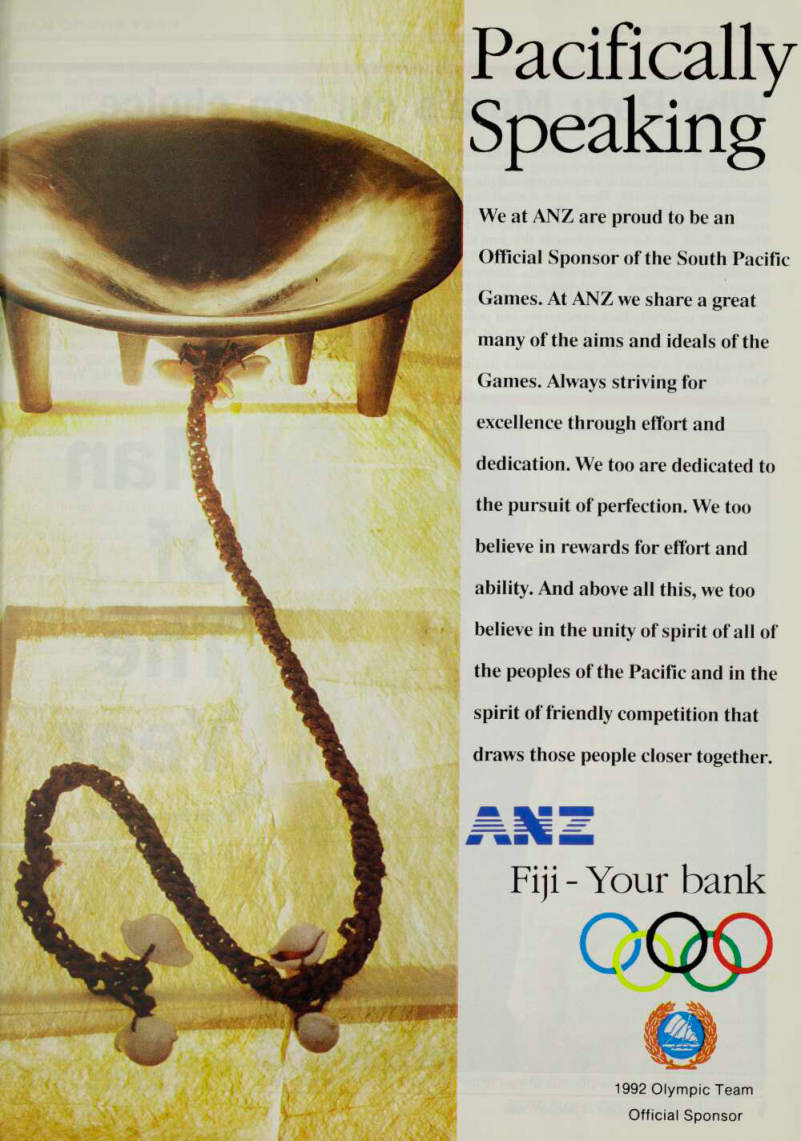
Pacifically
We at ANZ are proud to be an Official Sponsor of the South Pacific Games. At ANZ we share a great many of the aims and ideals of the Games. Always striving for excellence through effort and dedication. We too are dedicated to the pursuit of perfection. We too believe in rewards for effort and ability. And above all this, we too believe in the unity of spirit of all of the peoples of the Pacific and in the spirit of friendly competition that draws those people closer together.
Fiji - Your bank
OQO
1992 Olympic Team Official Sponsor
Why Ratu Mara’s our top choice
Man Of The Year
In the past few decades the Island nations have moved from colonialism to independence, developing a new sense of identity as individual nations and as a unified regional player in today’s modern, complex world. There were a small band of Island leaders who could be said to have been active engineers of this transition. Pacific Islands Monthly has chosen Fiji’s Prime Minister Ratu Sir Kamisese Mara as this year’s Man of the Year because of the role he has played in this transition.
Although his critics may see him as a master manipulator managing a post-coup, non-democratically elected govern ment, his supporters say he acted out of a sense of duty, to guide the country peacefully back to economic and political health.
In any case, there is no doubt he has been the region’s most influential leader in the past 25 years.
Ratu Mara is a university graduate and a traditional leader who was groomed to become an administrator and political
leader. He began influencing the region in 1964 when he was allocated a portfolio, and began to influence the wider region when he attended his first South Pacific Commission (SPC) meeting in 1965 and called for greater self-determination for the Islands in directing the policies which would affect them.
Ratu Mara’s criticism of the exclusion of politics from the SPC also led to establishment of the South Pacific Forum, of which he is hailed as the father. He was influential in the economic development of the region when he used personal diplomacy and contacts to break a deadlock in Lome Convention negotiations on sugar price increases.
Pacific Islands Monthly has chosen Sir Leonard Usher, who also has a long association with the region as former publisher of The Fiji Times and a journalist who covered the constitutional crisis and the early South Pacific Commission meetings, to trace the path of our Man of the Year. □
Year
Man Of The Year
By Sir Leonard Usher
THE same sort of wisdom and foresight that made Ratu Sir Lala Sukuna an outstanding leader of his people in colonial Fiji pre pared Ratu Sir Kamisese Mara to become, later in the same century, the honoured political leader of an independent, multiracial nation and a figure of high importance in the regional South Pacific.
Ratu Sukuna’s father, Ratu Joni Madraiwiwi, foresaw that contact with the outside world would have an impact that would profoundly change the Fijian way of life. So he sent his son to school in New Zealand and later to Wadham
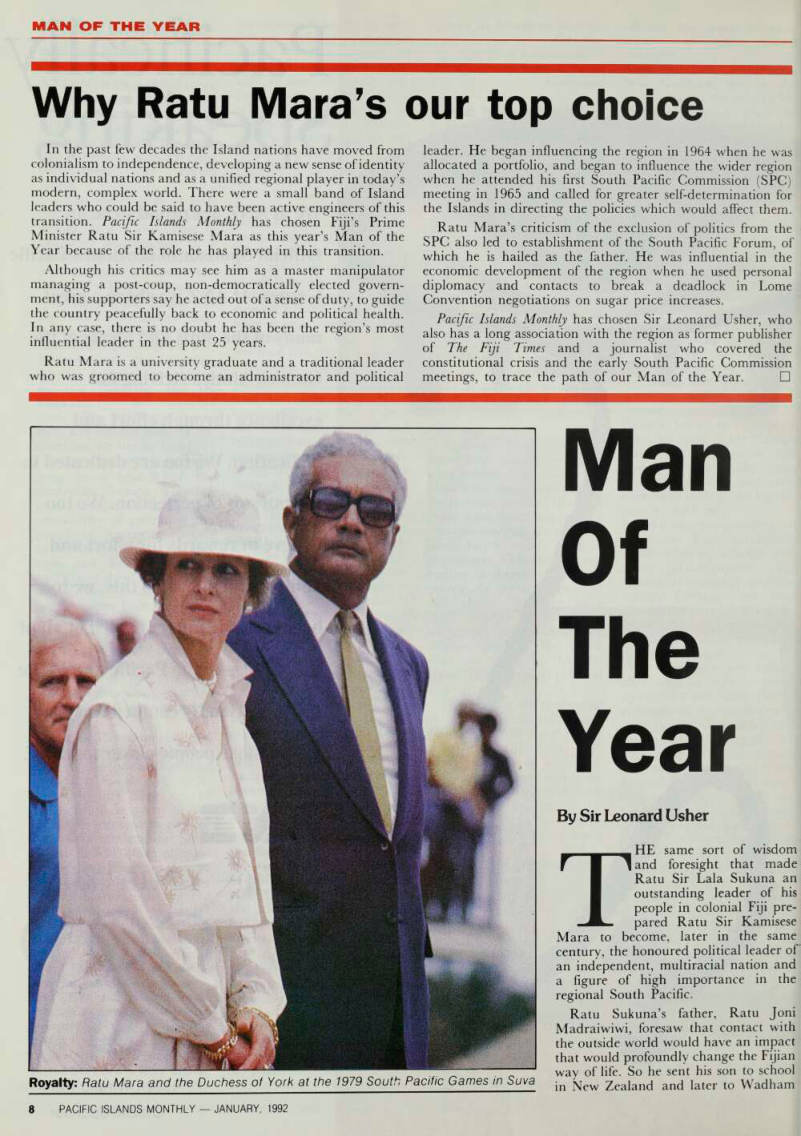
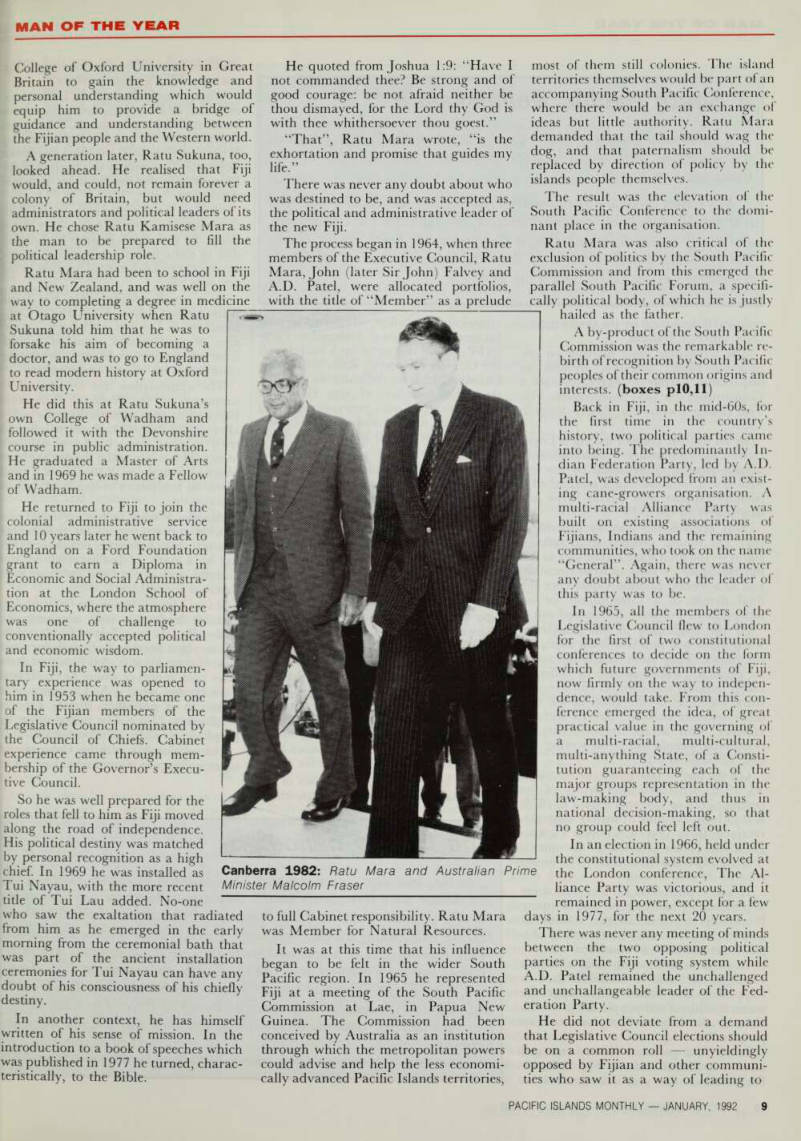
Royalty: Ratu Mara and the Duchess of York at the 1979 South Pacific Games in Suva
College of Oxford University in Great Britain to gain the knowledge and personal understanding which would equip him to provide a bridge of guidance and understanding between the Fijian people and the Western world.
A generation later, Ratu Sukuna, too, looked ahead. He realised that Fiji would, and could, not remain forever a colony of Britain, but would need administrators and political leaders of its own. He chose Ratu Kamisese Mara as the man to be prepared to fill the political leadership role.
Ratu Mara had been to school in Fiji and New Zealand, and was well on the way to completing a degree in medicine
at Otago University when Ratu Sukuna told him that he was to forsake his aim of becoming a doctor, and was to go to England to read modern history at Oxford University.
He did this at Ratu Sukuna’s own College of Wadham and followed it with the Devonshire course in public administration.
He graduated a Master of Arts and in 1969 he was made a Fellow of Wadham.
He returned to Fiji to join the colonial administrative service and 10 years later he went back to England on a Ford Foundation grant to earn a Diploma in Economic and Social Administra tion at the London School of Economics, where the atmosphere was one of challenge to
conventionally accepted political
and economic wisdom.
In Fiji, the way to parliamen tary experience was opened to him in 1953 when he became one of the Fijian members of the Legislative Council nominated by the Council of Chiefs. Cabinet experience came through mem bership of the Governor’s Execu tive Council.
So he was well prepared for the roles that fell to him as Fiji moved along the road of independence.
His political destiny was matched by personal recognition as a high chief. In 1969 he was installed as Tui Nayau, with the more recent title of Tui Lau added. No-one
who saw the exaltation that radiated from him as he emerged in the early morning from the ceremonial bath that was part of the ancient installation ceremonies for Tui Nayau can have any doubt of his consciousness of his chiefly
destiny.
In another context, he has himself written of his sense of mission. In the introduction to a book of speeches which was published in 1977 he turned, charac teristically, to the Bible.
He quoted from Joshua 1:9: “Have I not commanded thee? Be strong and of good courage: be not afraid neither be thou dismayed, for the Lord thy God is with thee whithersoever thou goest.”
“That”, Ratu Mara wrote, “is the exhortation and promise that guides my life.”
There was never any doubt about who was destined to be, and was accepted as, the political and administrative leader of the new Fiji.
The process began in 1964, when three members of the Executive Council, Ratu Mara, John (later Sir John) Falvey and A.D. Patel, were allocated portfolios, with the title of “Member” as a prelude
to full Cabinet responsibility. Ratu Mara was Member for Natural Resources.
It was at this time that his influence began to be felt in the wider South Pacific region. In 1965 he represented Fiji at a meeting of the South Pacific Commission at Lae, in Papua New Guinea. The Commission had been conceived by Australia as an institution through which the metropolitan powers could advise and help the less economi cally advanced Pacific Islands territories,
most of them still colonies. The island territories themselves would be part of an accompanying South Pacific Conference, where there would be an exchange of ideas but little authority. Ratu Mara demanded that the tail should wag the dog, and that paternalism should be replaced by direction of policy by the islands people themselves.
The result was the elevation of the South Pacific Conference to the domi nant place in the organisation.
Ratu Mara was also critical of the exclusion of politics by the South Pacific Commission and from this emerged the parallel South Pacific Forum, a specifi cally political body, of which he is justly
hailed as the father.
A by-product of the South Pacific Commission was the remarkable re birth of recognition by South Pacific peoples of their common origins and interests, (boxes plO,ll) Back in Fiji, in the mid-60s, for the first time in the country’s history, two political parties came into being. The predominantly In dian Federation Party, led by A.D.
Patel, was developed from an exist ing cane-growers organisation. A multi-racial Alliance Party was built on existing associations of Fijians, Indians and the remaining communities, who took on the name “General”. Again, there was never any doubt about who the leader of this party was to be.
In 1965, all the members of the Legislative Council flew to London for the first of two constitutional conferences to decide on the form which future governments of Fiji, now firmly on the way to indepen dence, would take. From this con ference emerged the idea, of great practical value in the governing of a multi-racial, multi-cultural, multi-anything State, of a Consti tution guaranteeing each of the major groups representation in the law-making body, and thus in national decision-making, so that no group could feel left out.
In an election in 1966, held under the constitutional system evolved at the London conference, The Al liance Party was victorious, and it remained in power, except for a few
days in 1977, for the next 20 years.
There was never any meeting of minds between the two opposing political parties on the Fiji voting system while A.D. Patel remained the unchallenged and unchallangeable leader of the Fed eration Party.
He did not deviate from a demand that Legislative Council elections should be on a common roll unyieldingly opposed by Fijian and other communi ties who saw it as a way of leading to
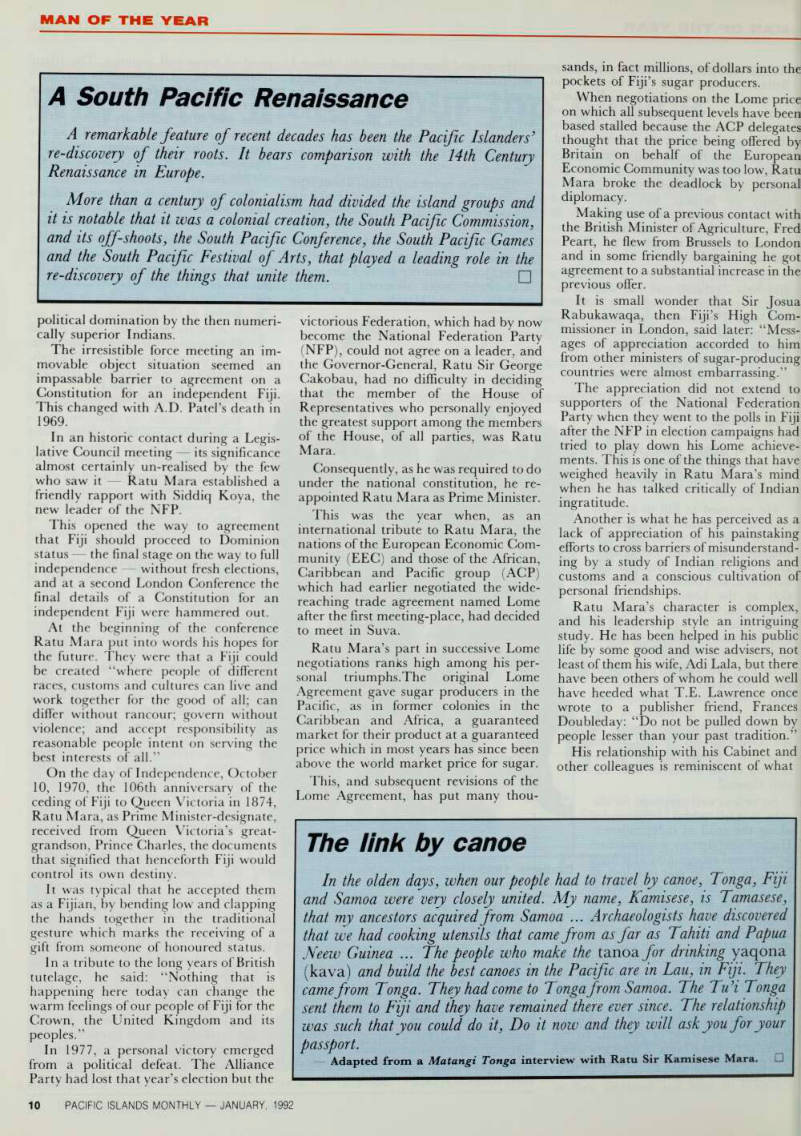
Canberra 1982: Ratu Mara and Australian Prime Minister Malcolm Fraser
political domination by the then numeri cally superior Indians.
The irresistible force meeting an im movable object situation seemed an impassable barrier to agreement on a Constitution for an independent Fiji.
This changed with A.D. Patel’s death in 1969.
In an historic contact during a Legis lative Council meeting - its significance almost certainly un-realised by the few who saw it Ratu Mara established a friendly rapport with Siddiq Koya, the new leader of the NFP.
This opened the way to agreement that Fiji should proceed to Dominion status the final stage on the way to full independence - without fresh elections, and at a second London Conference the final details of a Constitution for an independent Fiji were hammered out.
At the beginning of the conference Ratu Mara put into words his hopes for the future. They were that a Fiji could be created “where people of different races, customs and cultures can live and work together for the good of all; can differ without rancour; govern without violence; and accept responsibility as reasonable people intent on serving the best interests of all.”
On the day of Independence, October 10, 1970, the 106th anniversary of the ceding of Fiji to Queen Victoria in 1874, Ratu Mara, as Prime Minister-designate, received from Queen Victoria’s great grandson, Prince Charles, the documents that signified that henceforth Fiji would control its own destiny.
It was typical that he accepted them as a Fijian, by bending low and clapping the hands together in the traditional gesture which marks the receiving of a gift from someone of honoured status.
In a tribute to the long years of British tutelage, he said; “Nothing that is happening here today can change the warm feelings of our people of Fiji for the Crown, the United Kingdom and its
peoples.”
In 1977, a personal victory emerged from a political defeat. The Alliance Party had lost that year’s election but the
victorious Federation, which had by now become the National Federation Party (NFP), could not agree on a leader, and the Governor-General, Ratu Sir George Cakobau, had no difficulty in deciding that the member of the House of Representatives who personally enjoyed the greatest support among the members of the House, of all parties, was Ratu Mara.
Consequently, as he was required to do under the national constitution, he re appointed Ratu Mara as Prime Minister.
This was the year when, as an international tribute to Ratu Mara, the nations of the European Economic Com munity (EEC) and those of the African, Caribbean and Pacific group (ACP) which had earlier negotiated the wide reaching trade agreement named Lome after the first meeting-place, had decided to meet in Suva.
Ratu Mara’s part in successive Lome negotiations ranks high among his per sonal triumphs. The original Lome Agreement gave sugar producers in the Pacific, as in former colonies in the Caribbean and Africa, a guaranteed market for their product at a guaranteed price which in most years has since been above the world market price for sugar.
This, and subsequent revisions of the Lome Agreement, has put many thou
sands, in fact millions, of dollars into the pockets of Fiji’s sugar producers.
When negotiations on the Lome price on which all subsequent levels have been based stalled because the AGP delegates thought that the price being offered by Britain on behalf of the European Economic Community was too low, Ratu Mara broke the deadlock by personal! diplomacy.
Making use of a previous contact with the British Minister of Agriculture, Fred Peart, he flew from Brussels to London and in some friendly bargaining he got agreement to a substantial increase in the previous offer.
It is small wonder that Sir Josua Rabukawaqa, then Fiji’s High Com missioner in London, said later: “Mess ages of appreciation accorded to him from other ministers of sugar-producing countries were almost embarrassing.”
The appreciation did not extend to supporters of the National Federation Party when they went to the polls in Fiji after the NFP in election campaigns had tried to play down his Lome achieve ments. This is one of the things that have weighed heavily in Ratu Mara’s mind when he has talked critically of Indian
ingratitude.
Another is what he has perceived as a lack of appreciation of his painstaking efforts to cross barriers of misunderstand ing by a study of Indian religions and customs and a conscious cultivation of
personal friendships.
Ratu Mara’s character is complex, and his leadership style an intriguing study. He has been helped in his public life by some good and wise advisers, not least of them his wife, Adi Lala, but there have been others of whom he could well have heeded what T.E. Lawrence once wrote to a publisher friend, Frances Doubleday: “Do not be pulled down by people lesser than your past tradition.”
His relationship with his Cabinet and other colleagues is reminiscent of what
Ben Bolt was told about Sweet Alice: She wept with delight when you gave her a smile, And she trembled with fear at your
frown.
But Ratu Mara is far from being a dictatorial tyrant. There is an illuminat ing passage in his personal introduction to a book of his collected speeches. He says: “The more power and authority we ire given the more need for us to remain humble, to be ready to admit our jhortcomings, to be ready to learn, and :o be tolerant of others. To know and relieve this is not always easy to achieve, nit the knowledge is a constant re ninder, and chastening when we fail.”
But he adds a practical and perceptive ider: “But I do not believe humility neans softness or indecision,”
Ratu Mara often finds it difficult to >ut thanks into words, but he is likely to ignal gratitude later by some act of pecial kindness or consideration.
He is essentially practical. When he ilks of fishing or shipping it is as a sherman or a sailor. When he talks of re use of land it is as someone who has ctually grown the crops he talks about nd has learned at first-hand about their ossibilities and problems.
If forestry is the subject, he has itablished forests on his home island of akeba and has himself joined in the [anting of trees. In sport, there are few imes or competitive activities in which ; has not himself taken part and in any of them he has excelled.
He has won blues in athletics and icket at Otago University and in hletics at Oxford. He played rugby and icket for the province of Otago in New ;aland.
Ratu Mara is never pompous. He is o much a man of the Pacific Islands id has too great a sense of humour for at to happen. He is likely to relieve en the most serious moments with a uckle and a humorous or quick witty mment.
The only time his sense of humour or fun fails him is when he nurses icntment of a slight or a personal )uff. When he is hurt or frustrated he nts to hit back. This is characteristic many people perhaps most. Psy- Dlogists speak of it as varying degrees paranoia an aspect of the mind ich is far from being an illness but :omes of concern when it is allowed to /e a serious effect on judgment, fhe full story of what happened in Fiji ore and after the first 1987 coup has to be told and much of what has been Dlished about Ratu Mara’s role is
:orted or often deliberately
rue. But some things are beyond ibt. One is that he had no part in the spiracy that led to the recruitment of third-ranking officer of the Fiji
Military Forces, Lt. Col Sitiveni Ra buka, to organise and carry out the coup.
He may well have understood some of the feelings and aims of the conspirators but the methods they employed to achieve their aims were totally foreign to the philosophy and practice he had pursued throughout his political life.
His agreement to join the post-coup government stemmed from his sense of mission, supported by knowledge of his own 20 years of experience and service, and a conviction that although the coup itself had been conducted with high efficiency and without bloodshed Lt. Col.
Rabuka was not capable of assembling and leading a civilian government that would bring political and economic health back to Fiji.
It can never be claimed that such a many-sided man has never been without fault. But some of his most strident critics
have grossly misjudged him and he is justified in claiming that they do not understand the Pacific or its people.
On the credit side, he has gathered about him a host of friends and has a record of leadership achievement un matched by any other man of his generation in Fiji, and indeed in the South Pacific.
Whatever his future when he steps down as Prime Minister early in 1992, whether it be translation to Government House as President, or to the quiet of a university to write his memoirs; or whether he plans to be host at a resort he has established at Lomaloma; or whether he will just settle peacefully at Lakeba to tend his gardens and his trees between excursions to a golf course or supervision of his cane plantation at Seaqaqa, his place of honour in the annals of the people he has served well is assured. □
A South Pacific Renaissance
A remarkable feature of recent decades has been the Pacific Islanders' re-discovery of their roots. It bears comparison with the 14th Century Renaissance in Europe.
More than a century of colonialism had divided the island groups and it is notable that it was a colonial creation, the South Pacific Commission, and its off-shoots, the South Pacific Conference, the South Pacific Games and the South Pacific Festival of Arts, that played a leading role in the re-discovery of the things that unite them. □
The link by canoe
In the olden days, when our people had to travel by canoe, Tonga, Fiji and Samoa were very closely united. My name, Kamisese, is Tamasese, that my ancestors acquired from Samoa ... Archaeologists have discovered that we had cooking utensils that came from as far as Tahiti and Papua JVeew Guinea ... The people who make the tanoa for drinking yaqona (kava) and build the best canoes in the Pacific are in Lau, in Fiji. They came from Tonga. They had come to Tonga from Samoa. The Tu’i Tonga sent them to Fiji and they have remained there ever since. The relationship was such that you could do it, Do it now and they will ask you for your passport.
Adapted from a Matangi Tonga interview with Ratu Sir Kamisese Mara. □
The miracle in Suva
There was a South Pacific communication miracle in Suva in 1950, the year of the first South Pacific Conference. The conference was an offshoot of the South Pacific Commission, created in 1947 by metropolitan governments with colonial interests in the South Pacific to promote the welfare of the people of their territories.
The commission was basically paternalistic, and at the first South Pacific Conference, which was the means chosen to give the inhabitants of the territories a chance to say their piece without first seeking consent, official advisers sat behind each one of the delegates who were ostensibily their country’s mouthpiece. Thus the conference proceedings were very largely an exercise in benevolent puppetry.
But it was not in the conference room that the miracle occurred. It took place in the dining rooms and recreation halls, in the dormitories, on the verandahs and lawns where the delegates gathered in the off hours, and in the homes of Fijians in Suva where they were entertained.
In all these places, to their growing surprise and great delight, the delegates began to realise how much they had in common. As they talked together, sang together and danced together or for each other, they discovered exciting links of languages and music and culture and ancestral origins and the delegates carried back with them to their scattered homes the glimmering of a revelation that has helped to produce a revolution.
This has transformed the people of the Pacific territories from powerless puppets into vocal and forceful spokesmen for themselves and for the increasing number of independent nations they reperesent. - From a paper included in Mainly About Fiji Len Usher. □ □ □ The process begun at the first South Pacific Conference continued at the first South Pacific Games in 1963 and the first South Pacific Festival of Arts in 1972, both also held in Suva. It was accelerated at Lae, Papua New Guinea, in 1965 when Fiji delegate Ratu K.K. T. Mara led a demand for a greater direct voice of the people of the region in the South Pacific Commission. - Mainly About Fiji.
God bless
Vanuatu
God bless the coalition
The churches pray for unity as Carlot tries to keep his promises for a better future
By Davendra Sharma
ON the eve of Vanuatu’s fourth general election, the churches called for a na tional prayer. They asked God for a government which would cherish Christian values and respect ni- Vanuatu customs and traditions.
Their prayers, it seemed, were answered.
The election results gave the French-aligned Union of Moder ate Parties 19 seats, the same number it won in 1987. Three smaller parties which some church leaders believed “had worked for their money”, won a seat each.
The factions of former premier Father Walter Lini’s Vanua’aku Party won 24 seats.
If the Vanua’aku Party (VP) was united it would have been back in power without a sweat.
Too bad for them they were not. In the place of that once powerful organisation were: • Lini’s National United Party, formed after Lini was ousted from power through a vote of no confidence in September. • The Vanua’aku Party, or what remained of it. This was led by Donald Kalpokas, the former party general secretary who took over as prime minister after Lini’s ouster
• The Melanesian Progressive Party. This was formed by former Cabinet minister Barak Sope and former Vanuatu President George Sokomanu after a failed attempt in 1988 to oust Lini through a constitutional coup “God has answered our prayers,” said influential Presbyterian pastor Allan Nafuki, a senior government political secretary, a week after the December 2 elections. “He has reacted in a mysteri ous way ... He has left it to the divided VP groups to come together.”
But how could a merger be organised of factions who were divided on personalities? Anglican church priest Father Lini wanted VP finance minister
Sela Molisa out of any coalition govern ment. Lini claimed Molisa instigated his ousting. But VP claimed they dumped Lini amid charges of corruption and
incompetence.
The power-play between Kalpokas’s moderate and Lini’s left-wing Vanua’aku Party factions opened the door for the third group, Sope’s Melanesian Progressive Party (MPP), to join in the talks. MPP said it would join the coalition and return Vanua’aku Party to power if Sope was the prime minister.
“We have no problems with NUP or with VP but the two of them have many personality problems,” Sope’s deputy, William Edgel, told Pacific Islands
Monthly. “So for the sake of compromiii and getting in, we pushed our leader \ be prime minister.” Lini and Kalpok; said: no deal.
Edgell, Pastor Nafuki and Sokoman spearheaded the reconciliation talks ths tried to bridge the personality gaps an return the anglophone Vanua’aku Part to office. But the mainstream churc groups that worked under the umbrell of the Vanuatu Council of Christiai Churches wanted a change of goverr ment. It preferred the Union of Model ate Parties (UMP), which had won th most seats in the election, to form th government. VCCC secretary-generz Pastor Nippy Aiong said the council di not believe a coalition of reunited V factions could remain united for long.
“As we claim to be a Christia: country, we should allow the majorit party to rule with one of the others,” hi said. “Those who have lost power shoul* move aside and let’s see some new ideas
new developments.”
The UMP needed five seats to form ; majority government. On December 1C Lini offered a coalition. UMP agreed.
“We didn’t have any conditions, w< just took what they offered,” said NUP’ 1 chief negotiator, party assistant secretary Charles Bice. “It was not like othe; parties the VP and MP demanded portfolios.” MPP had wanted the finano and education portfolios while VI wanted finance and foreign affairs.
UMP agreed that NUP will fill fom out of the 10 portfolios and provide the deputy prime minister, a post Lini hac created in his last few months in office: Lini opted to stay out of cabinet and his family sources said he even turned dowr an offer to be the Speaker a post which would have given him enormous powei in the house, considering the fact that nc party had absolute majority in parlia ment.
“He wanted to be out of the coalition government for personal and health reasons,” said Bice. “He prefers to stay out of the limelight but will probably concentrate on consolidating the party.”
Long-time Lini loyalist Sethy Regenvanu became Deputy Prime Min ister and Minister for Justice. Othen NUP people in Cabinet are: former Speaker Onneyan Tahi, agriculture,, livestock and fisheries; Hilda Lini (Lini’s? sister), health; Edward Tambisiri, tele communications.
The UMP took the key jobs: party\
vice-president Maxime Carlot, prime;
minister; party president Serge Vohor,< foreign affairs; party treasurer Willie; Jimmy, finance. Carlot, though UMP’s?
longest-serving parliamentary leader, t
did not have it all his way. Vohor alsot
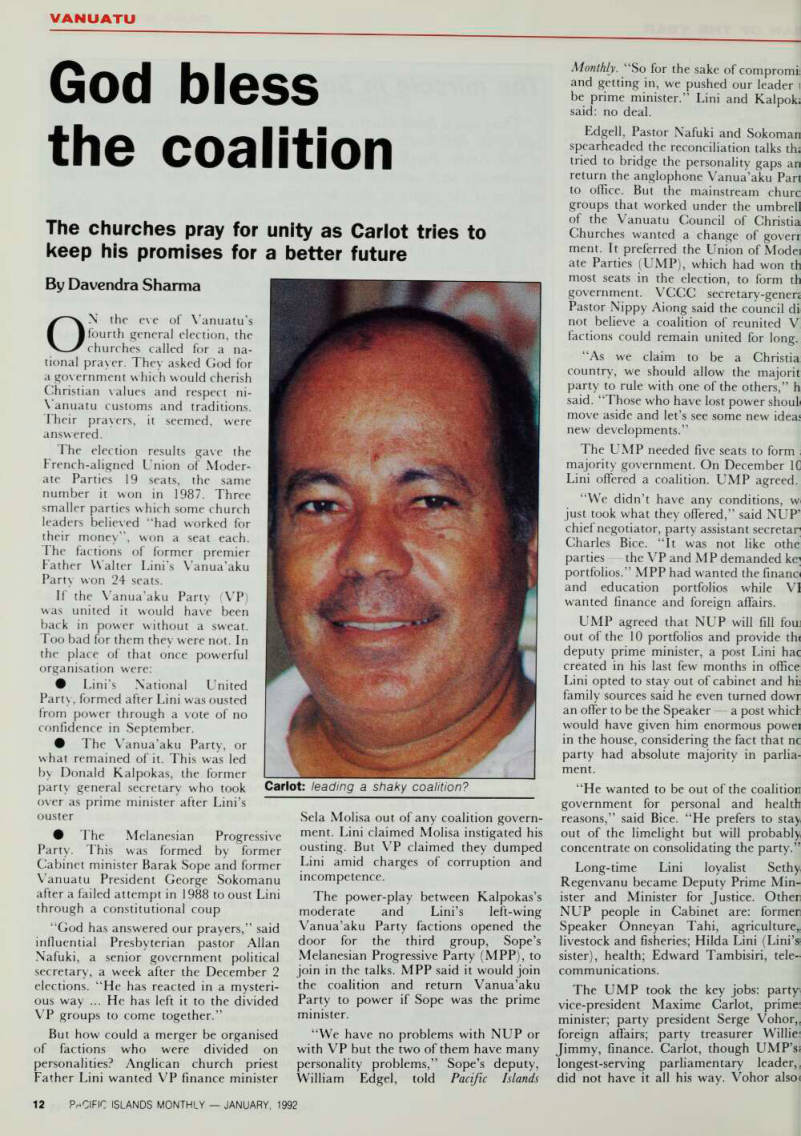
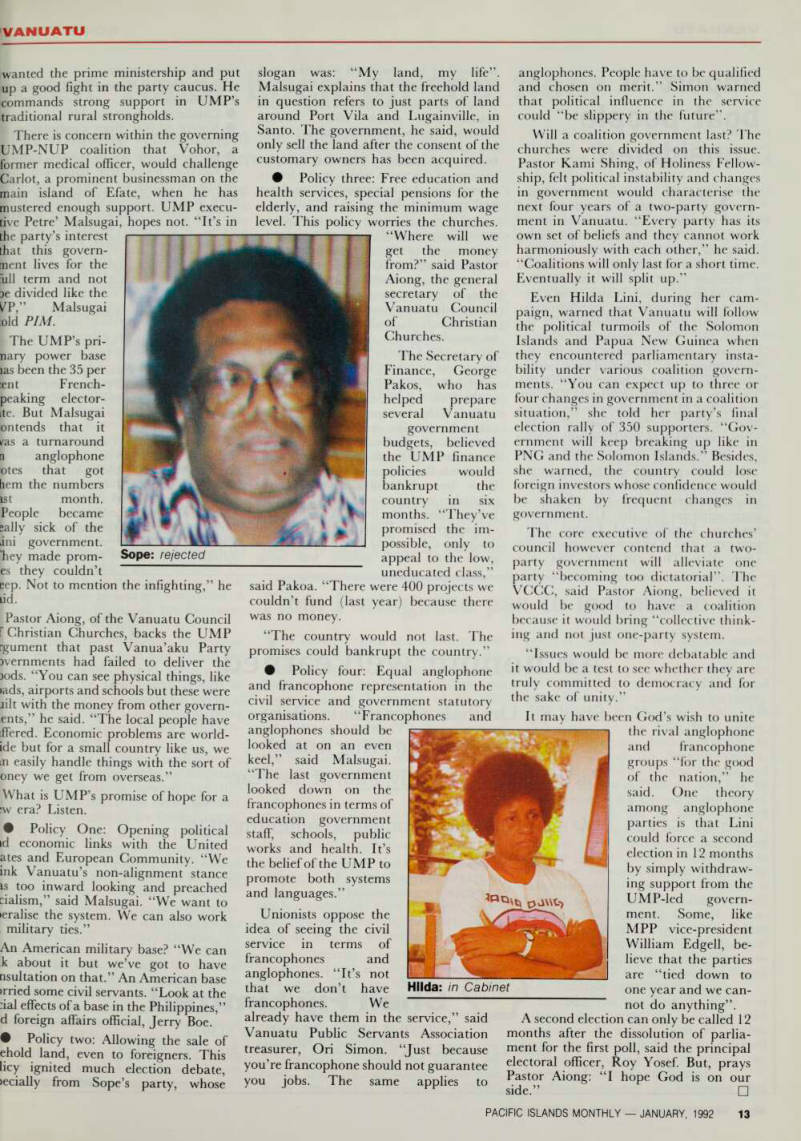
Carlot: leading a shaky coalition?
wanted the prime ministership and put up a good fight in the party caucus. He commands strong support in UMP’s traditional rural strongholds.
There is concern within the governing UMP-NUP coalition that Vohor, a former medical officer, would challenge Carlot, a prominent businessman on the main island of Efate, when he has mustered enough support. UMP execu tive Petre’ Malsugai, hopes not. “It’s in
the party’s interest that this govern ment lives for the full term and not je divided like the ITP,” Malsugai old PIM.
The UMP’s pri nary power base las been the 35 per :ent French
peaking elector
ite. But Malsugai ontends that it /as a turnaround n anglophone otes that got bem the numbers ist month.
People became
tally sick of the ini government, ’hey made profil es they couldn’t
eep. Not to mention the infighting,” he lid.
Pastor Aiong, of the Vanuatu Council f Christian Churches, backs the UMP rgument that past Vanua’aku Party jvernments had failed to deliver the )ods. “You can see physical things, like »ads, airports and schools but these were jilt with the money from other govern ents,” he said. “The local people have ffered. Economic problems are world ide but for a small country like us, we in easily handle things with the sort of oney we get from overseas.”
What is UMP’s promise of hope for a :w era? Listen. • Policy One: Opening political id economic links with the United
ates and European Community. “We
ink Vanuatu’s non-alignment stance is too inward looking and preached cialism,” said Malsugai. “We want to leralise the system. We can also work
military ties.”
An American military base? “We can k about it but we’ve got to have nsultation on that.” An American base ►rried some civil servants. “Look at the dal effects of a base in the Philippines,” d foreign affairs official, Jerry Boe. • Policy two: Allowing the sale of ehold land, even to foreigners. This licy ignited much election debate, >ecially from Sope’s party, whose
slogan was: “My land, my life”.
Malsugai explains that the freehold land in question refers to just parts of land around Port Vila and Lugainville, in Santo. The government, he said, would only sell the land after the consent of the customary owners has been acquired. • Policy three: Free education and health services, special pensions for the elderly, and raising the minimum wage level. This policy worries the churches.
“Where will we get the money from?” said Pastor Aiong, the general secretary of the Vanuatu Council of Christian Churches.
The Secretary of Finance, George Pakos, who has
helped prepare
several Vanuatu government budgets, believed the UMP finance
policies would
bankrupt the
country in six months. “They’ve promised the im possible, only to appeal to the low, uneducated class,”
said Pakoa. “There were 400 projects we couldn’t fund (last year) because there was no money.
“The country would not last. The promises could bankrupt the country.” • Policy four: Equal anglophone and francophone representation in the civil service and government statutory organisations. “Francophones and
anglophones should be looked at on an even keel,” said Malsugai.
“The last government looked down on the francophones in terms of education government staff, schools, public works and health. It’s the belief of the UMP to promote both systems and languages.”
Unionists oppose the idea of seeing the civil service in terms of
francophones and
anglophones. “It’s not that we don’t have
francophones. We
already have them in the service,” said Vanuatu Public Servants Association treasurer, Ori Simon. “Just because you’re francophone should not guarantee you jobs. The same applies to
anglophones. People have to be qualified and chosen on merit.” Simon warned that political influence in the service could “be slippery in the future”.
Will a coalition government last? The churches were divided on this issue.
Pastor Kami Shing, of Holiness Fellow
ship, felt political instability and changes
in government would characterise the next four years of a two-party govern ment in Vanuatu. “Every party has its own set of beliefs and they cannot work harmoniously with each other,” he said.
“Coalitions will only last for a short time.
Eventually it will split up.”
Even Hilda Lini, during her cam paign, warned that Vanuatu will follow the political turmoils of the Solomon Islands and Papua New Guinea when
they encountered parliamentary insta
bility under various coalition govern ments. “You can expect up to three or four changes in government in a coalition situation,” she told her party’s final election rally of 350 supporters. “Gov ernment will keep breaking up like in PNG and the Solomon Islands.” Besides, she warned, the country could lose foreign investors whose confidence would be shaken by frequent changes in government.
The core executive of the churches’ council however contend that a two party government will alleviate one party “becoming too dictatorial”. The VCCC, said Pastor Aiong, believed it would be good to have a coalition because it would bring “collective think ing and not just one-party system.
“Issues would be more debatable and it would be a test to see whether they are truly committed to democracy and for the sake of unity.”
It may have been God’s wish to unite
the rival anglophone
and francophone
groups “for the good of the nation,” he said. One theory
among anglophone
parties is that Lini could force a second election in 12 months by simply withdraw ing support from the UMP-led govern ment. Some, like
MPP vice-president
William Edgell, be lieve that the parties are “tied down to one year and we can not do anything”.
A second election can only be called 12 months after the dissolution of parlia ment for the first poll, said the principal electoral officer, Roy Yosef. But, prays Pastor Aiong: “I hope God is on our side.” □
Sope: rejected
Hilda: in Cabinet
Import of boat people considered
boat people considered
DURING elections, the former Lini government was accused of plotting to import thousands of Vietnamese boat people from Hong Kong for resettling in Vanuatu.
“They were looking at Vietnamese on a business point of view rather than humanitarian,” said Walter Lini’s for mer political secretary Joe Natuman.
Documents leaked by Natuman at the Vanua’aku Pati’s swansong election campaign revealed plans to settle the Vietnamese on Father Lini’s native island of Pentecost, home of 9000 ni- Vanuatu. Natuman claimed Vanuatu was to get SUSI 2 million from a scam deal negotiated by Selwyn Leotoro, former secretary to the President, acting as a special envoy in the United States.
Leotoro reportedly was liaising with a California-based Vietnam Foundation, which reportedly had the blessing of some quarters of the United States congress. Lini/National United Party supporter and Vietnamese businessman Dinh Van Than of Port Vila was
believed to be associated with the deal, Natuman claimed.
Natuman also promised a review of the controversial green letter scheme whereby citizenship of naturalised Vanu atu citizens is revoked. Vanuatu was being overlooked by potential investors because of the name which green letters, issued even to longstanding residents, had generated, he told a VP rally.
Pacific Islands Monthly was told prior to the election that in the final days of the government of Prime Minister Donald Kalpokas about 50 applications were processed and mostly approved for foreign business enquiries. ‘Tve had a whole pile of applications from Ameri cans, French, Australian and some Chin ese people,” Pastor Allan Nafuki, secre tary to the Citizenship Commission in the prime minister’s office told PIM.
“Some investors are scared about what could happen if UMP came into power.”
The Kalpokas government also re voked deportation orders on two French nationals who had to leave Port Vila in November 1990 under Father Lini’s rule Claude Boudier and Robert Albanese.
Dinh became prime subject in the campaign leadup to what was Vanuatu’s hottest general elections. A commission of inquiry into Father Lini’s business dealings that would have included a probe into Dinh’s empire was being
mooted by one party.
Statistics on Vanuatu’s Decembe: 2 elections: • Candidates: a record 140. • Voters: 87,000 (from a population a 143,000). • Election costs: six-10 million vatu. • Election issues: free education, frei health, subsidies for copra prices, free; dom of press, citizenship, freehold landl foreign policy, inflation, stable goverm ment, democracy, economic reforms raising minimum wages, pension allow ances, amnesty to political prisoners equality to Franco and Anglophom cultures and recognising new Christiai revivalist groups. • Voter turnout 71.69 per cent (80.8: per cent in 1987), • Winners: Union of Moderate Partie; 19 (19 in 1987); Vanua’aku Pad 10 (26 in 1987); National United Part} - 10; Melanesian Progressive Party 4; Tan Union one; Friend Melanesiar Party one (one in 1987); Nagriame one. • Upsets: Ruling Vanua’aku Pad un able to clinch a majority and defeat o former President, George Ad Sokomanu • Polling petitions: voter rigging, failure of about 5000 voters to vote because o non-registration, money and rice given tc buy votes, campaigning inside the 24-hour embargo, campaign posters within 100 metres of polling stations. □
Advertisements & other items, p. 14 (1 item)
An honour well earned
Shell Fiji Limited congratulates Ratu Sir Kamisese Mara on being named Pacific Island Monthly Man of the Year. •/ We share his unquestionable commitment to the well-being of Fiji. ©
Shell Fiji Limited
GPO Box 168 Suva. Telephone: 313933 Telex: 2274 SHELL FJ, Suva. Cable: "SHELL” Suva. Fax: 302279
GEORGE RUBINE 8536
East Timor back on the floor
East Timor
lan Williams reports from the United Nations, New York, on new concern over an old issue
IN November, Portugal filed its first memorial against Australia at the International Court of Justice over the Timor Gap treaty. But even outside the courtroom, the issue of East Timor began to hit the headlines again, after years of being swept under the carpet of the New World Order.
In January, Portugal assumes Presi dency of the European Community. It will undoubtedly use its position to give the question thorough ventilation.
On November 11, Indonesian troops fired on a crowd of Timorese in a cemetery where they were commemorat ing the earlier killing of one of their
compatriots, Roman Catholic Apostolic
Administrator, Monsignor Ximenes Belo, said the Indonesians were mount ing a show of strength to dissuade public shows of resistance during the Portuguese delegation’s visit scheduled for Novem ber. He claims the Timorese were threatened with deadly reprisals after the departure of the delegation. Indeed one American journalist reported being held on the ground with a gun to his head. He would never have risen if it weren’t that he could prove he was not Australian. A New Zealand journalist, less fortunate, died from his wounds.
Ironically the Portuguese parliamen tary delegation, which had caused the Indonesian build-up, had already been cancelled. The Indonesians refused to accept Australian journalist Jill Jolliffe as part of the media team accompanying the delegation as provided for in the UN brokered agreement.
The UN has for years avoided action on the issue by referring to the Secretary General’s efforts to arrange this del egation. Now that it has been cancelled, pressure will build up for further action.
UN sources say that the Indonesians were legally within the agreement by refusing a visa to Jolliffe, a well-known supporter of East Timor. But in public relations terms it did little for them.
Even the mooted candidacy of Indon esian Foreign Minister Ali Alatas for the position of UN Secretary General, re vived talk about East Timor, He did not mention it in his address to the General Assembly, but several commentators pointed out that his candidacy would not
be helped by having outstanding con
demnations of his country at the General
Assembly and Security Council.
At the ICJ, Portugal had joined Nauru in the queue to sue Australia, which is on the verge of getting “most sued nation”
status. This time the case is Australia’s ratification of the Timor Gap Treaty with Indonesia, which provides for joint exploitation of off-shore oil under the sea between what the treaty provocatively calls “The Indonesian Province of East Timor” and Australia.
The treaty took effect on February 9, 1990. Two days later in Bali the joint Australian and Indonesian Ministerial Council was discussing implementation.
This gave Portugal, which since 1985 had been firing diplomatic warnings at Australia, the opportunity to file charges with the ICJ at the Hague on February 22. Portugal claims that under Interna tional Law, East Timor is still a Portuguese responsibility, so Australia has no business making agreements with Indonesia, which invaded and incorpor ated East Timor in 1975.
The suit charges that Australia, by signing, ratifying and implementing the treaty, caused serious “legal and moral damage to the people of East Timor and
to Portugal, which will become material damage also if the exploitation of hydrocarbon resources begins”. Portugal also asked for reparations.
Professor Roger Clark of Rutgers University explained to PIM , “In ordi
nary legal terms, Portugal is accusing
Australia of receiving stolen property, and of being an accessory after the fact.
Far from giving away its own resources, it is engaged with an aggressor in sharing out somebody else’s”. He pointed out with topical relish that the first country to recognise the annexation was Iraq.
Unlike Australia, Indonesia has not joined the ICJ which “does not accom modate the laws of the world, which fact is reflected in its composition”, an Indonesian spokesman in Washington told PIM. But, he said, “We assume the ICC will look into the UN’s decision and verify implementation of the right of self determination. The East Timorese exer cised their legitimate right of self determination in 1976”.
Then, an Indonesian-controlled “People’s Assembly of East Timor de cided to formally request the Indonesian government to accept the integration of the territory”, □
From Portuguese pan to Indonesian fire

IN 1974 Portugal had a radical mili tary uprising, in part against dictator Salazar’s futile but costly attempts to hold onto empire. The new rulers were eager to divest themselves of the 5700 square mile colony of East Timor and set a date of October 1976, but after four centuries of colonialism its mostly Cath olic population of around 600,000 had little political experience.
A variety of parties and groups were soon vying for power. One of the main movements was Fretilin, (Frente Revolucionaria de Timor Leste Independente) which was to the Left.
The anti-leftists tried to seize power in August, but Fretilin effectively beat them and declared independence unilaterally on November 28, 1975. In reply, oppo sition groups called on the Indonesians, who invaded on December 7.
The Security Council unanimously condemned the invasion in resolutions 384 and 389, as did the General Assembly, where the voting was 72 to 10 with 43 abstentions, but international opposition began to diminish under pressures of expediency.
Neighbours, OPEC and Islamic na tions, and anti-communist countries, either abstained or supported Jakarta’s
position. While the non-aligned move ment generally supported East Timor, even India supported Indonesia. (In 1961 India had itself annexed Goa, and other Portuguese enclaves on its coast).
As Daniel P Moynihan, then US ambassador to the UN, later wrote, “China altogether backed Fretilin in Timor, and lost. In Spanish Sahara, Russia completedly backed Algeria and its front, known as Polisario, and lost. In both instances the United States wished things to turn out as they did, and worked to bring this about. The Depart ment of State desired that the United Nations prove utterly ineffective in whatever measures it undertook. The task was given to me, and I carried it forward with no inconsiderable success”.
When the Security Council recon sidered the issue in April 1976, Japan and the US abstained. In the General Assembly, Australia voted against In donesia in 1975, but soon joined US and New Zealand support for Jakarta.
In 1982, the last time the issue was raised, the voting was 50 for the resolution, 46 against, and 50 absten tions. Since then it has been deferred annually, awaiting the results of the Secretary General’s mediation.
Adroit lobbying by Indonesia has
stopped the issue being raised at the UN Human Rights Commission, de spite evidence of violations. Up to one third of East Timor’s people are estimated to have died in the years after the occupation. Amnesty International has since reported torture, extrajudicial executions, and hundreds of unresolved cases of “disappearances”. While In donesia claims that East Timor is open to foreign visitors, Amnesty and similar organisations have been refused entry.
Vanuatu is one of the few neighbours of Indonesia opposing it on the issue. Its UN Ambassador Robert Van Lierop stresses that, despite its friendship with Indonesia, “It’s a matter of public record that Vanuatu doesn’t accept the illegal occupation and annexation of East Timor, any more than it accepted the attempted annexation of Kuwait. It is also a matter of public record that Vanuatu does not accept attempts to legitimise Indonesia’s actions in East Timor through economic ventures, and more than it accepted South African attempts to legitimise its occupation of Namibia through economic ventures.”
It seems the change of Vanuatu government does not imply change in
foreign policy.
Australian Foreign Minister, Senator Gareth Evans, distinguished in 1989 between approval of the circumstances of the acquisition of the territory, whose “possible illegality” he accepts, and subsequent treaty relations by a third party with the occupying power.
Similarly, a US State Department spokesman told PIM “The US accepts the incorporation of East Timor by Indonesia, without maintaining that a valid act of self-determination has taken place. The US is also fully supportive of discussions between Por tugal and Indonesia under the auspices of the Secretary General, to resolve the issue”. In contrast, the British question the treaty’s legality while accepting there was little chance of getting the Indonesians out.
However there may be some hope.
Last year the Pope went to East Timor.
His remarks on Human Rights have been backed by the Bishop of Dili who called for a UN-supervised referendum.
In January last year, US ambassador John Monjo condemned the violent break-up of a peaceful demonstration outside his hotel, and later visited injured demonstrators.
Bonus for Marshalls, FSM
Following Federated States of Micro nesia and Marshall Islands indepen dence, the two are getting an “indepen dence bonus” from the United Nations
Development Programme the bud
get for FSM will rise by US$BOO,OOO to about US$2.3 million for the next five years, and for the Marshalls by $700,000 to US$l.7 million. □
Advertisements & other items, pp. 16-17 (1 item)
Here’S Your
For 61 years
PACIFIC ISLANDS MONTHLY
has brought the Pacific Islands to you...
HERE’S YOUR
CHANCE TO
r 4 y,f as * s • ■' : 4P *
Tmi*"
ROWII TOHOA**_
W ns ‘t •* ?*» X MiliffWW*
BBS
: 4 » Get away: on a Royal Tonga Airlines flight ... it might even be free!
Be pampered: at the Ramanlal Hotel Every month Pacific Islands Monthly keeps you up to date with what’s happening in the Pacific Islands, and how major events overseas affect the island countries.
It’s a must for anyone living in the region, or interested in the region.
We are the only magazine which gives you full colour coverage and reliable, extensive editorial on a full r ange of topics from politics and business to history and culture. And, or fun, we take you off the beaten rack with yachting and tourism.
Now’s your chance to subscribe to he magazine which has covered the slands for 61 years, through a letwork of contributors living in the egion, and analysts in many capital Jities of the world.
This month, you can take idvantage of us through our special fishing and handicraft connoisseurs.
Subscribe now... you could WIN!
No employees of the Fiji Times Ltd or their immediate family are eligible to enter.
Christmas subscription offer... as an added bonus, we’ll throw in a chance for you to win a trip to Tonga. You can either extend your visit to Fiji and fly from Nadi to Sense the history: The Ha’amonga’a Maui coral trilithon Nuku’alofa, or fly from Auckland to Nuku’alofa.
You’ll fly Royal Tongan Airlines and enjoy one week at the Ramanlal Hotel in the heart of Nuku’alofa.
You’ll be enchanted by this unspoiled ancient Kingdom, a Garden of Eden for boating, .
V ? - •**> ‘ -• > fV r :
igfel
9 please send me RIM at the special Christmas rate and enter me in the Trip to Tonga competition. I would tike to take advantage of the following offer: □ 15 magazines for the price of 12 □ 32 magazines for the price of 24 (tick one box only) Please debit my credit card indicated below □ Visa □ Master Card Expiry date ..
Card number x Name Signature x Address x
USUAL RATES
Post to: Pacific Islands Monthly PC Box 1167 Suva, Fiji or Fax: (679) 303809 This offer ends on March 15, 1992 -
'Betrayal’ by the South Pacific
By David Robie
AN East Timorese human rights campaigner who toured New Zealand last month seeking tougher gov ernment action over the Dili massacre in November believes South Pacific countries have failed to heed the plight of Melanesians in the Indonesian colony.
Francisco Pang, Melbourne-based representative of the Fretilin resistance movement, singles out the Papua New Guinea government’s attitude as particu
larly deplorable: “PNG is betraying the
East Timorese people by not coming out with a strong condemnation and demand for an independent inquiry. They regard our plight as an ‘internal problem’ for the Indonesians to deal with.”
He appealed for a more supportive stance by Pacific nations. “Our Melanesian brothers in the Papua New Guinea government should support us in our struggle,” he told Pacific Islands
Monthly. “Demo cratic countries such as PNG, Aus tralia and New Zealand should play a more con structive role in pushing for our right to self
determination not only for the East Timorese people but also the indigenous people of West Papua, South Moluccas
and Kanaky.
“Human dignity is freedom. It is the same principle that Pacific governments upheld to defend Kuwait and peace in Cambodia yet they ignore the plight of the indigenous people on their own doorstep who are seeking self determination. For us this is a double standard.”
In spite of the Timorese resistance groups gaining a “historic” (10-minute) meeting with Australian Prime Minister Bob Hawke and a two-hour session with Foreign Minister Senator Gareth Evans last month, Pang was snubbed by the New Zealand government. Both Foreign Affairs Don McKinnon and Defence Minister Warren Cooper refused to see him.
The snub stirred bitter criticism by human rights and pro-Timorese groups at protest rallies marking the 16th anniversary of the Indonesian invasion of East Timor on December 7, 1975. A 20-year-old New Zealand student, Ahmed Bamadhaj, was among the vic tims killed by Indonesian soldiers during the Dili massacre on November 12.
While the official Indonesian death toll
The South Pacific has failed to heed the plight of Melanesians in the Indonesian colony
for the massacre is 19, international! human rights groups and eyewitnessesi put the number closer to 100.
Pang accused New Zealand of being the only country in the Western alliance that appeared to be condoning the massacre. He called on Pacific nations to support an independent inquiry involv ing the United Nations and to pressure the Indonesians to begin a dialogue with the Timorese towards self-determination.
He said most Pacific countries with the important exceptions of the Solomon Islands and Vanuatu had been too influenced by Australia and New Zea land over Indonesian colonialism in the region. Although the UN still officially
recognises Portugal as the administering
country in East Timor, Australia signed the Timor Gap Treaty with Indonesia in December 1989 to gain illegal access to oil a move being contested before the International Court of Justice by the Portuguese. Now Pang believes the massacre has severely undermined In
donesian credibility among Pacific leaders.
“Indonesia’s so
called inquiry
with a former mili tary man as the head is not cred ible. It lacks any
independent person,” says Pang. “Also, for any inquiry to be credible it must involve the UN. As it has been set up by Jakarta, the inquiry is rather like asking Pol Pot to investigate the Khmer Rouge, or Hitler to inquiry into Nazi war crimes.”
Amnesty International and other hu man rights groups estimate more than 200,000 people in East Timor a third of the population died in the fighting, or from hunger or execution after the Indonesian invasion, genocide said to be comparable on a per capita basis with that of the Khmer Rouge in Cambodia.
Last January, Western countries sup ported with enthusiasm the US-led Coalition forces which went to war because oil-rich Iraq invaded its neigh bour, Kuwait, and declared it a prov ince. Yet ironically most of the same countries said little when Indonesia, also oil-rich, did the same thing against East Timor in 1975 and many have remained pragmatic ever since.
Kamal Bamadhaj, one of scores who died in the massacre in Dili’s Santa Cruz cemetery, is the second New Zealander to die brutally at the hands of the Indon esian troops.
The full circumstances of his death are probably no more likely to be unearthed
from any inquiry than the first victim.
On October 16, 1975, during a border “probe” by Indonesian troops before the full military onslaught, 27-year-old tele vision cameraman Gary Cunningham was killed along with two Australians and two Britons, all working for Austra lian TV networks, at Balibo.
Refugees and other sources said the reporters had painted an Australian flag and the slogan “Australia” on the wall of the house where they were sheltering.
One or more of the journalists were machine-gunned and the rest were ex ecuted with their hands in the air.
During a memorial service in Auck land for Bamadhaj his father is Malaysian, his mother a former New Zealand journalist relatives said he was in Dili with a group of six foreign journalists. He had hoped their presence would prevent violence against people taking part in a mourning protest for a Timorese student, Sebastiao Rangel, shot on October 28.
Two days before the Santa Cruz massacre, Bamadhaj wrote to friends in Australia, where he was studying at a
Sydney university, claiming that the
Timorese people faced genocide if the international community did not try to protect them. Only “the will of us all” could stop another wave of aggression against the East Timorese people, he
wrote. Parts of his letter were read to the mourners.
Bamadhaj’s uncle, John Todd, said his nephew travelled in mid-October to East Timor with the Australian aid agency Community Aid Abroad. He was to be an interpreter for Timorese who wanted to speak to a joint United Nations-
Portuguese parliamentary peacekeeping
mission due to visit in November.
In his letter to friends in Australia, Bamadhaj spoke of the despair of the Timorese after Jakarta forced the cancel-
Only the will of us all could stop another wave of aggression
lation of a visit to East Timor by
Portuguese parliamentarians. The inci
dent was sparked off by Indonesia’s refusal to allow Lisbon-based Australian
journalist, Jill Joliffe, a specialist writer
and author of East Timor: Nationalism and Colonialism , to join the group.
An International Red Cross aid worker found Bamadhaj in the street about 500 metres from the massacre site, with a bullet wound in his chest. Despite
Red Cross markings on the “ambulance” he was driving, it was stopped repeatedly enroute to the hospital.
Amnesty International’s New Zealand executive director, Colin Chiles, has appealed to Foreign Minister Don McKinnon to urgently raise the issue in the United Nations General Assembly.
Chiles say only “urgent, highly public concerted international action is likely to stop these atrocities.” Australia, Britain, Canada, Netherlands, Portugal, Sweden and the United States have also con demned the killings.
Despite attempts by Indonesian au thorities to project an “open door” image of East Timor in the past two years, reports of persecution and brutal re pression have persisted. Shortly before the Portuguese visit was called off Xanana Gusmao, leader of the Fretilin nationalist resistance, said Indonesian military authorities had been “creating an atmosphere of insecurity and panic”.
Preparations were being made in other towns, such as Laleia and Same, for “receptions” with threats to the popu lation if they failed to comply, he said.
“You must all have a flag and when I give the order you must raise them high,” the Timorese were told by authorities. “Anyone who shouts words like ‘Maubere [Timorese] people’, ‘inde pendence’, ‘Portugal’ or ‘Fretilin’ will be shot after the MPs leave,” □
Advertisements & other items, p. 19 (1 item)
Vacancy:Project Officer (Trade Development)
B
FORUM SECRETARIAT
Applications are invited from suitably qualified and experienced persons, who must be nationals of a member state of the South Pacific Forum*, for the position of Project Officer (Trade Development), Trade & Investment Division.
The Forum Secretariat was established in 1973 by the South Pacific Forum to encourage economic and political cooperation between its member states, and between those states and the more industrialised countries. Under the control of a Secretary General, the Secretariat undertakes a number of regional work programmes for the benefit of Forum Island countries covering economic development, legal and political services and the civil aviation, energy, maritime, telecommunications and trade sectors. In pursing these work programmes, the Secretariat works with a range of aid donor countries and organisations including Australia, New Zealand, Japan, EC, Canada and the UNDP.
The Trade and Investment Division aims to assist Forum Island Countries (FICs) through developing a work programme to encourage investment in the FICs and in the promotion of regional and international trade. All aspects of the marketing and export of Forum Island products are considered although emphasis is placed on developing a regional approach to common issues and problems in promoting trade and industrial development.
The Project Officer (Trade Development), will be directly responsible to the Director, Trade & Investment Division and is responsible for the development and administration of initiatives and projects associated with enhancing trade prospects between the Forum Island Countries and the rest of the world. More specifically, the Officer will monitor, review and report on the operations of SPARTECA and investigate options for further widening of the Agreement; provide advice and assistance to FICs as required on matters relating to the administration and operations of SPARTECA; monitor, review and report on developments in ANZCERTA and advise implications for FIC trade development; be responsible for research into the development of intra-regional trade agreements and, where appropriate their implementation in association with FICs; monitor and report to FICs on developments in, and implications to the region of, Multilateral Trade Negotiations carried out through the GATT process; and advise FICs of developments in regional and international trading patterns and their possible effects on the region.
The appointment will carry an attractive remuneration package, payable in Fiji dollars. For non-Fiji citizens this is tax-free and includes housing or a housing allowance and education and child allowances where eligible. Other benefits include payments in lieu of superannuation, and medical, life and travel insurance coverage. The appointee will be based at the Secretariat’s headquarters in Suva.
The appointment will be for three years initially, and is renewable by mutual agreement.
Applications close on 15 February 1992. They should contain full information on education and career backgrounds and should give names, addresses and telephone numbers of at least three referees with whom the applicant has been associated professionally.
Applications shouid be addressed to: The Secretary General Forum Secretariat GPO Box 856, Suva, Fiji Telephone 312-600 Telex: 2229FJ Fax: 302-204 Further information is available on request from Mrs Lailun Khan, Administration Officer, on 312-600 Extension: 218. * Member states of the South Pacific Forum: Australia, Cook Islands, Federated States of Micronesia, Fiji, Kiribati, Nauru, New Zealand, Niue, Papua New Guinea, Republic of the Marshall Islands, Solomon Islands, Tonga, Tuvalu, Vanuatu and Western Samoa.
Bougainville:
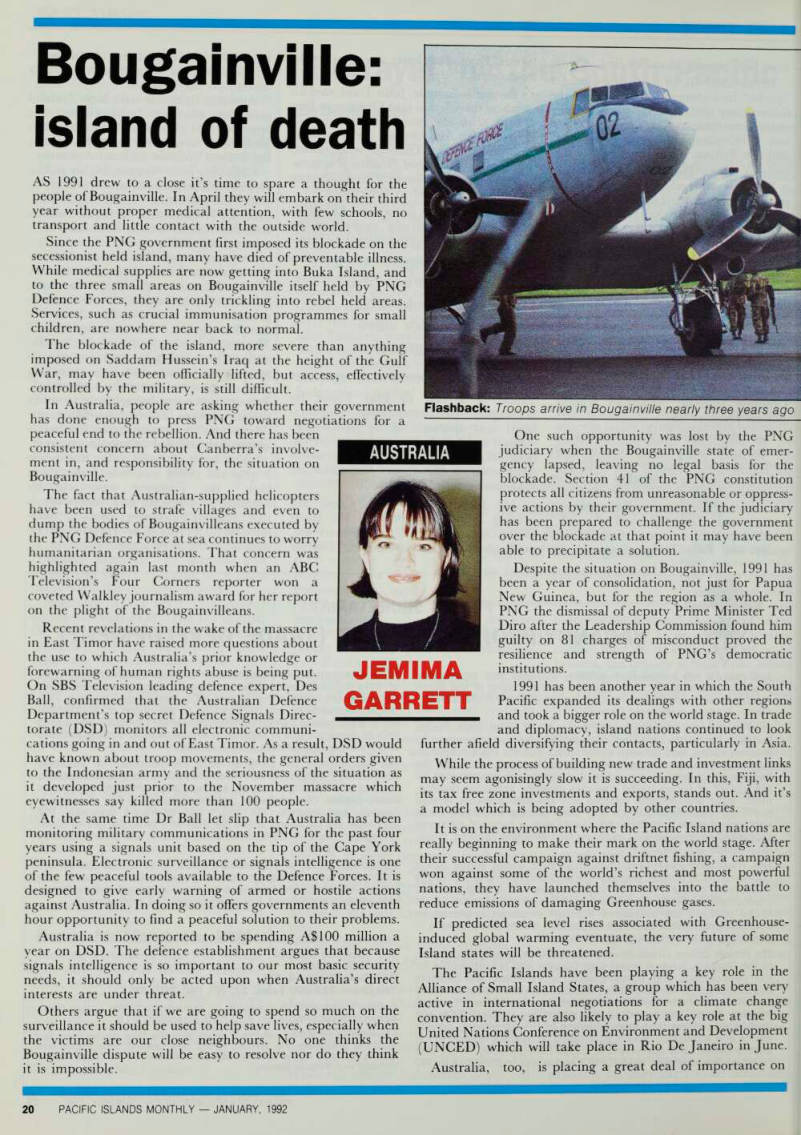
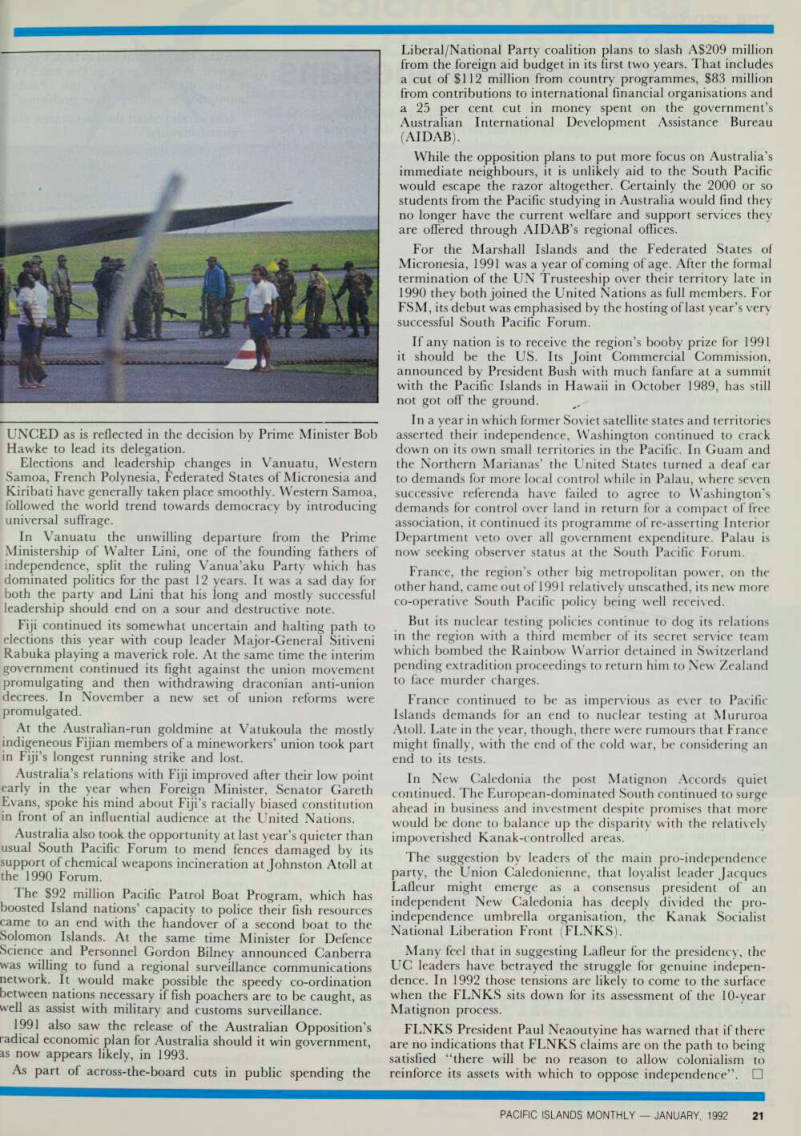
island of death
AS 1991 drew to a close it’s time to spare a thought for the people of Bougainville. In April they will embark on their third year without proper medical attention, with few schools, no transport and little contact with the outside world.
Since the PNG government first imposed its blockade on the secessionist held island, many have died of preventable illness.
While medical supplies are now getting into Buka Island, and to the three small areas on Bougainville itself held by PNG Defence Forces, they are only trickling into rebel held areas.
Services, such as crucial immunisation programmes for small children, are nowhere near back to normal.
The blockade of the island, more severe than anything imposed on Saddam Hussein’s Iraq at the height of the Gulf War, may have been officially lifted, but access, effectively controlled by the military, is still difficult.
In Australia, people are asking whether their government has done enough to press PNG toward negotiations for a
peaceful end to the rebellion. And there has been consistent concern about Canberra’s involve ment in, and responsibility for, the situation on
Bougainville.
The fact that Australian-supplied helicopters have been used to strafe villages and even to dump the bodies of Bougainvilleans executed by the PNG Defence Force at sea continues to worry humanitarian organisations. That concern was highlighted again last month when an ABC Television’s Four Corners reporter won a coveted VValkley journalism award for her report on the plight of the Bougainvilleans.
Recent revelations in the wake of the massacre in East Timor have raised more questions about the use to which Australia’s prior knowledge or forewarning of human rights abuse is being put.
On SBS Television leading defence expert, Des Ball, confirmed that the Australian Defence Department’s top secret Defence Signals Direc torate (DSD) monitors all electronic communi
cations going in and out of East Timor. As a result, DSD would have known about troop movements, the general orders given to the Indonesian army and the seriousness of the situation as it developed just prior to the November massacre which eyewitnesses say killed more than 100 people.
At the same time Dr Ball let slip that Australia has been monitoring military communications in PNG for the past four years using a signals unit based on the tip of the Cape York peninsula. Electronic surveillance or signals intelligence is one of the few peaceful tools available to the Defence Forces. It is designed to give early warning of armed or hostile actions against Australia. In doing so it offers governments an eleventh hour opportunity to find a peaceful solution to their problems.
Australia is now reported to be spending Asloo million a year on DSD. The defence establishment argues that because signals intelligence is so important to our most basic security needs, it should only be acted upon when Australia’s direct interests are under threat.
Others argue that if we are going to spend so much on the surveillance it should be used to help save lives, especially when the victims are our close neighbours. No one thinks the Bougainville dispute will be easy to resolve nor do they think it is impossible.
One such opportunity was lost by the PNG judiciary when the Bougainville state of emer gency lapsed, leaving no legal basis for the blockade. Section 41 of the PNG constitution protects all citizens from unreasonable or oppress ive actions by their government. If the judiciary has been prepared to challenge the government over the blockade at that point it may have been able to precipitate a solution.
Despite the situation on Bougainville, 1991 has been a year of consolidation, not just for Papua New Guinea, but for the region as a whole. In PNG the dismissal of deputy Prime Minister Ted Diro after the Leadership Commission found him guilty on 81 charges of misconduct proved the resilience and strength of PNG’s democratic institutions. 1991 has been another year in which the South Pacific expanded its dealings with other regions and took a bigger role on the world stage. In trade and diplomacy, island nations continued to look
further afield diversifying their contacts, particularly in Asia.
While the process of building new trade and investment links may seem agonisingly slow it is succeeding. In this, Fiji, with its tax free zone investments and exports, stands out. And it’s a model which is being adopted by other countries.
It is on the environment where the Pacific Island nations are really beginning to make their mark on the world stage. After their successful campaign against driftnet fishing, a campaign won against some of the world’s richest and most powerful nations, they have launched themselves into the battle to reduce emissions of damaging Greenhouse gases.
If predicted sea level rises associated with Greenhouse induced global warming eventuate, the very future of some Island states will be threatened.
The Pacific Islands have been playing a key role in the Alliance of Small Island States, a group which has been very active in international negotiations for a climate change convention. They are also likely to play a key role at the big United Nations Conference on Environment and Development (UNCED) which will take place in Rio De Janeiro in June.
Australia, too, is placing a great deal of importance on
Australia
Jemima
Garrett
Flashback: Troops arrive in Bougainville nearly three years ago
UNCED as is reflected in the decision by Prime Minister Bob Hawke to lead its delegation.
Elections and leadership changes in Vanuatu, Western Samoa, French Polynesia, Federated States of Micronesia and Kiribati have generally taken place smoothly. Western Samoa, followed the world trend towards democracy by introducing
universal suffrage.
In Vanuatu the unwilling departure from the Prime Ministership of Walter Lini, one of the founding fathers of independence, split the ruling Vanua’aku Party which has dominated politics for the past 12 years. It was a sad day for both the party and Lini that his long and mostly successful leadership should end on a sour and destructive note.
Fiji continued its somewhat uncertain and halting path to elections this year with coup leader Major-General Sitiveni Rabuka playing a maverick role. At the same time the interim government continued its fight against the union movement promulgating and then withdrawing draconian anti-union decrees. In November a new set of union reforms were promulgated.
At the Australian-run goldmine at Vatukoula the mostly indigeneous Fijian members of a mineworkers’ union took part in Fiji’s longest running strike and lost.
Australia’s relations with Fiji improved after their low point early in the year when Foreign Minister, Senator Gareth Evans, spoke his mind about Fiji’s racially biased constitution in front of an influential audience at the United Nations.
Australia also took the opportunity at last year’s quieter than usual South Pacific Forum to mend fences damaged by its support of chemical weapons incineration at Johnston Atoll at the 1990 Forum.
The 592 million Pacific Patrol Boat Program, which has boosted Island nations’ capacity to police their fish resources came to an end with the handover of a second boat to the Solomon Islands. At the same time Minister for Defence Science and Personnel Gordon Bilney announced Canberra was willing to fund a regional surveillance communications network. It would make possible the speedy co-ordination between nations necessary if fish poachers are to be caught, as well as assist with military and customs surveillance. 1991 also saw the release of the Australian Opposition’s radical economic plan for Australia should it win government, as now appears likely, in 1993.
As part of across-the-board cuts in public spending the
Liberal/National Party coalition plans to slash AS2O9 million from the foreign aid budget in its first two years. That includes a cut of SI 12 million from country programmes, SB3 million from contributions to international financial organisations and a 25 per cent cut in money spent on the government’s Australian International Development Assistance Bureau
(Aidab).
While the opposition plans to put more focus on Australia’s immediate neighbours, it is unlikely aid to the South Pacific would escape the razor altogether. Certainly the 2000 or so students from the Pacific studying in Australia would find they no longer have the current welfare and support services they are offered through AIDAB’s regional offices.
For the Marshall Islands and the Federated States of Micronesia, 1991 was a year of coming of age. After the formal termination of the UN Trusteeship over their territory late in 1990 they both joined the United Nations as full members. For FSM, its debut was emphasised by the hosting of last year’s very successful South Pacific Forum.
If any nation is to receive the region’s booby prize for 1991 it should be the US. Its Joint Commercial Commission, announced by President Bush with much fanfare at a summit with the Pacific Islands in Hawaii in October 1989, has still not got off the ground.
In a year in which former Soviet satellite states and territories asserted their independence, Washington continued to crack down on its own small territories in the Pacific. In Guam and the Northern Marianas’ the United States turned a deaf ear to demands for more local control while in Palau, where seven successive referenda have failed to agree to Washington’s demands for control over land in return for a compact of free association, it continued its programme of re-asserting Interior Department veto over all government expenditure. Palau is now seeking observer status at the South Pacific Forum.
France, the region’s other big metropolitan power, on the other hand, came out of 1991 relatively unscathed, its new more co-operative South Pacific policy being well received.
But its nuclear testing policies continue to dog its relations in the region with a third member of its secret service team which bombed the Rainbow Warrior detained in Switzerland pending extradition proceedings to return him to New Zealand to face murder charges.
France continued to be as impervious as ever to Pacific Islands demands for an end to nuclear testing at Mururoa Atoll. Late in the year, though, there were rumours that France might finally, with the end of the cold war, be considering an end to its tests.
In New Caledonia the post Matignon Accords quiet continued. The European-dominated South continued to surge ahead in business and investment despite promises that more would be done to balance up the disparity with the relatively impoverished Kanak-controlled areas.
The suggestion by leaders of the main pro-independence party, the Union Caledonienne, that loyalist leader Jacques Lafleur might emerge as a consensus president of an independent New Caledonia has deeply divided the pro independence umbrella organisation, the Kanak Socialist National Liberation Front (FLNKS).
Many feel that in suggesting Lafleur for the presidency, the UC leaders have betrayed the struggle for genuine indepen dence. In 1992 those tensions are likely to come to the surface when the FLNKS sits down for its assessment of the 10-year Matignon process.
FLNKS President Paul Neaoutyine has warned that if there are no indications that FLNKS claims are on the path to being satisfied “there will be no reason to allow colonialism to reinforce its assets with which to oppose independence”. □
Milestone for Melanesians
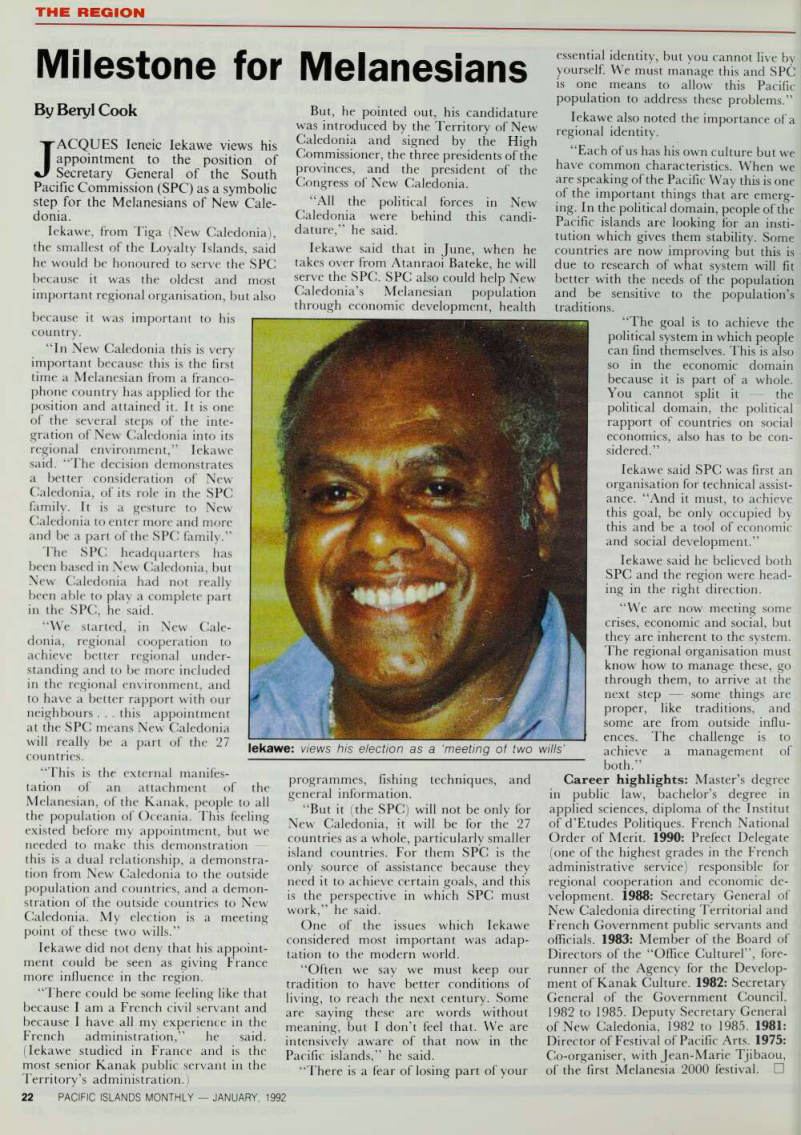
The Region
By Beryl Cook
JACQUES leneic lekawe views his appointment to the position of Secretary General of the South Pacific Commission (SPC) as a symbolic step for the Melanesians of New Cale donia. lekawe, from Tiga (New Caledonia), the smallest of the Loyalty Islands, said he would be honoured to serve the SPC because it was the oldest and most important regional organisation, but also
because it was important to his country.
“In New Caledonia this is very important because this is the first time a Melanesian from a franco phone country has applied for the position and attained it. It is one of the several steps of the inte gration of New Caledonia into its regional environment,” lekawe said. “The decision demonstrates a better consideration of New Caledonia, of its role in the SPC family. It is a gesture to New Caledonia to enter more and more and be a part of the SPC family.”
The SPC headquarters has been based in New Caledonia, but New Caledonia had not really been able to play a complete part in the SPC, he said.
“We started, in New Cale donia, regional cooperation to achieve better regional under standing and to be more included in the regional environment, and to have a better rapport with our neighbours .. . this appointment at the SPC means New Caledonia will really be a part of the 27 countries.
“This is the external manifes
tation of an attachment of the Melanesian, of the Kanak, people to all the population of Oceania. This feeling existed before my appointment, but we needed to make this demonstration this is a dual relationship, a demonstra tion from New Caledonia to the outside population and countries, and a demon stration of the outside countries to New Caledonia. My election is a meeting point of these two wills.” lekawe did not deny that his appoint ment could be seen as giving France more influence in the region.
“There could be some feeling like that because I am a French civil servant and because I have all my experience in the French administration,” he said, (lekawe studied in France and is the most senior Kanak public servant in the Territory’s administration.)
But, he pointed out, his candidature was introduced by the Territory of New Caledonia and signed by the High Commissioner, the three presidents of the provinces, and the president of the Congress of New Caledonia.
“All the political forces in New Caledonia were behind this candi dature,” he said. lekawe said that in June, when he takes over from Atanraoi Bateke, he will serve the SPC. SPC also could help New Caledonia’s Melanesian population
through economic development, health
programmes, fishing techniques, and
general information.
“But it (the SPG) will not be only for New Caledonia, it will be for the 27 countries as a whole, particularly smaller island countries. For them SPG is the only source of assistance because they need it to achieve certain goals, and this is the perspective in which SPG must work,” he said.
One of the issues which lekawe considered most important was adap tation to the modern world.
“Often we say we must keep our tradition to have better conditions of living, to reach the next century. Some are saying these are words without meaning, but I don’t feel that. We are intensively aware of that now in the Pacific islands,” he said.
“There is a fear of losing part of your
essential identity, but you cannot live by yourself. We must manage this and SPC is one means to allow this Pacific population to address these problems.” lekawe also noted the importance of a
regional identity.
“Each of us has his own culture but we have common characteristics. When we are speaking of the Pacific Way this is one of the important things that are emerg ing. In the political domain, people of the Pacific islands are looking for an insti tution which gives them stability. Some countries are now improving but this is due to research of what system will fit better with the needs of the population and be sensitive to the population’s traditions.
“The goal is to achieve the political system in which people can find themselves. This is also so in the economic domain because it is part of a whole.
You cannot split it the political domain, the political rapport of countries on social economics, also has to be con sidered.” lekawe said SPC was first an organisation for technical assist ance. “And it must, to achieve this goal, be only occupied by this and be a tool of economic and social development.” lekawe said he believed both SPC and the region were head ing in the right direction.
“We are now meeting some crises, economic and social, but they are inherent to the system.
The regional organisation must know how to manage these, go through them, to arrive at the next step some things are proper, like traditions, and some are from outside influ ences. The challenge is to achieve a management of both.”
Career highlights: Master’s degree in public law, bachelor’s degree in applied sciences, diploma of the Institut of d’Etudes Politiques. French National Order of Merit. 1990: Prefect Delegate (one of the highest grades in the French administrative service) responsible for regional cooperation and economic de velopment. 1988: Secretary General of New Caledonia directing Territorial and French Government public servants and officials. 1983: Member of the Board of Directors of the “Office Culturel”, fore runner of the Agency for the Develop ment of Kanak Culture. 1982: Secretary General of the Government Council, 1982 to 1985. Deputy Secretary General of New Caledonia, 1982 to 1985. 1981: Director of Festival of Pacific Arts. 1975: Co-organiser, with Jean-Marie Tjibaou, of the first Melanesia 2000 festival. □
lekawe: views his election as a ‘meeting of two wills’
Advertisements & other items, p. 23 (1 item)
Solomon Airlines
ooiomon Amines
- Bel am a Class
Like an Ocean going bird, feel at ease in the air. With Solomon Airline's 'Belama Class' fly with us in grace and comfort. That's why we have named our special business class after the Belama (Frigate Bird) the master of flight, the new spirit of the Pacific.
Solomons
Solomon Airlines
Fly Solomon Airlines the‘NEW SPIRIT’of the Pacific
GSA OFFICES
FUI NEW ZEALAND VANUATU PAPUA NEW GUINEA Fiji Air Ltd World Aviation Systems Air Vanuatu Ltd Air Niuginl Office Tel: 31 4666 Tel: (09) 79 4455 Tel: (678) 3838 Tel: (675) 27 3200 Suva Auckland Port Vila Solomon Airlines Office Tel: (675) 25 5724 Port Moresby
AUSTRALIA
World Aviation Systems Brisbane; (07) 229 7813 Sydney: (02) 239 1722 Melbourne: (03) 321 6860
find consensus?
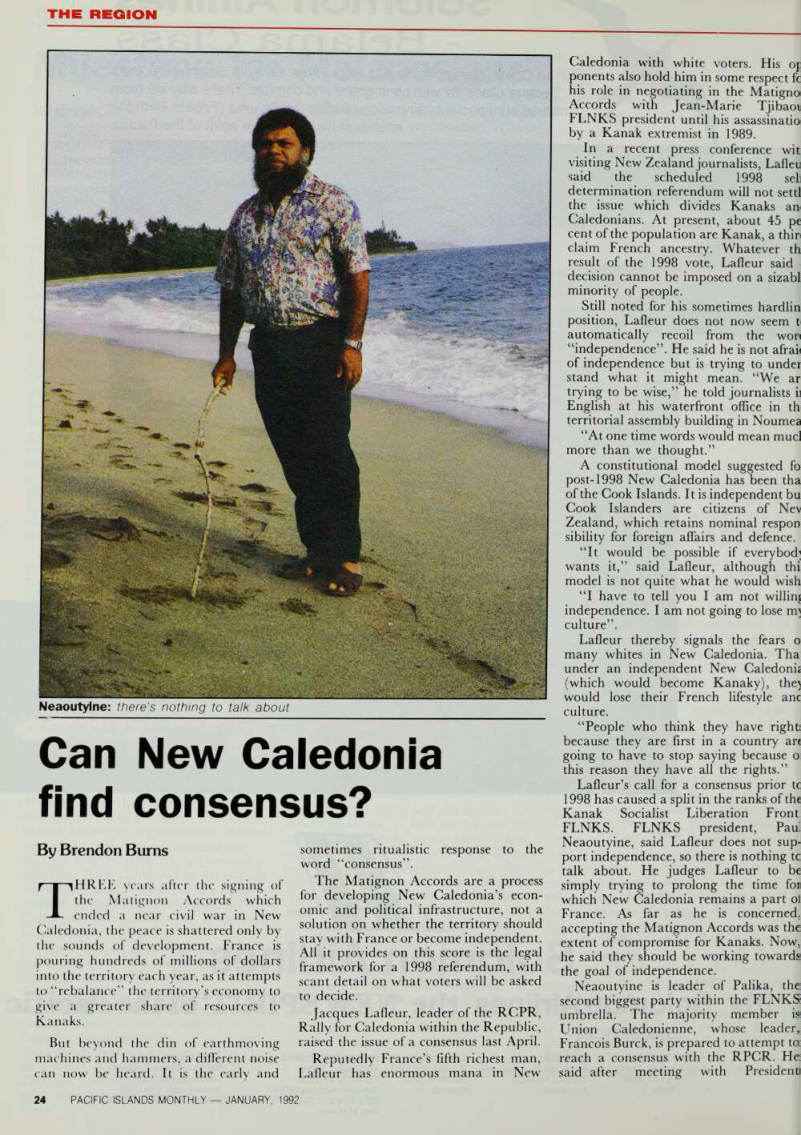
Can New Caledonia find consensus?
By Brendon Bums
THREE years after the signing of the Matignon Accords which ended a near civil war in New Caledonia, the peace is shattered only by the sounds of development. France is pouring hundreds of millions of dollars into the territory each year, as it attempts to “rebalance” the territory’s economy to give a greater share of resources to Kanaks.
But beyond the din of earthmoving machines and hammers, a different noise can now be heard. It is the early and
sometimes ritualistic response to the word “consensus”.
The Matignon Accords are a process for developing New Caledonia’s econ omic and political infrastructure, not a solution on whether the territory should stay with France or become independent.
All it provides on this score is the legal framework for a 1998 referendum, with scant detail on what voters will be asked to decide.
Jacques Lafleur, leader of the RCPR, Rally for Caledonia within the Republic, raised the issue of a consensus last April.
Reputedly France’s fifth richest man, Lafleur has enormous mana in New
Caledonia with white voters. His op ponents also hold him in some respect fc his role in negotiating in the Matignoi
Accords with Jean-Marie Tjibaou
FLNKS president until his assassinatioi by a Kanak extremist in 1989.
In a recent press conference wit; visiting New Zealand journalists, Lafleu said the scheduled 1998 seli determination referendum will not settl the issue which divides Kanaks am Caledonians. At present, about 45 pe cent of the population are Kanak, a thin claim French ancestry. Whatever thi result of the 1998 vote, Lafleur said decision cannot be imposed on a sizabll minority of people.
Still noted for his sometimes hardlim position, Lafleur does not now seem t automatically recoil from the won “independence”. He said he is not afrah of independence but is trying to under stand what it might mean. “We ar trying to be wise,” he told journalists ii English at his waterfront office in th territorial assembly building in Noumea “At one time words would mean mud more than we thought.”
A constitutional model suggested fo post-1998 New Caledonia has been tha of the Cook Islands. It is independent bui Cook Islanders are citizens of Nev Zealand, which retains nominal respom sibility for foreign affairs and defence.
“It would be possible if everybody wants it,” said Lafleur, although thi model is not quite what he would wish “I have to tell you I am not willinj independence. I am not going to lose rm culture”.
Lafleur thereby signals the fears oi many whites in New Caledonia. Tha under an independent New Caledonia (which would become Kanaky), they would lose their French lifestyle anc culture.
“People who think they have right! because they are first in a country are going to have to stop saying because o:i this reason they have all the rights.”
Lafleur’s call for a consensus prior tc 1998 has caused a split in the ranks of the Kanak Socialist Liberation Front FLNKS. FLNKS president, Paul Neaoutyine, said Lafleur does not sup port independence, so there is nothing tc talk about. He judges Lafleur to be simply trying to prolong the time fan which New Caledonia remains a part of France. As far as he is concerned, accepting the Matignon Accords was the extent of compromise for Kanaks. Now, he said they should be working towards
the goal of independence.
Neaoutyine is leader of Palika, the second biggest party within the FLNKS* umbrella. The majority member is Union Caledonienne, whose leader* Francois Burck, is prepared to attempt toe reach a consensus with the RPCR. He said after meeting with President!
Neaoutyine: there's nothing to talk about
Mitterrand earlier this year (hat the concept of independence had “evolved and is no longer taken as meaning a break with France but rather a partner ship.
One interpretation is that the diller ences are more in public than private.
Jacques lekawe is a Kanak and senior administrator lor economic develop ment. Testifying to his broad ac ceptability is his recent appointment as the next Secretary-General of the South Pacific Commission, whic h oversees aid
and development projects throughout
the region. He said a confluence ol opinion was emerging. No one wanted to go through another bout of civil war.
Each side had to speak publicly to placate its militants, he said. But pri vately things were moving towards ronsensus. lekawe sees a fragmentation of the FLNKS as perhaps the biggest barrier to mine negotiated settlement emerging.
Flic potential for this can already be seen n the different positions towards coliseu ms adopted by the more moderate Union Ailedonienne and the somewhat Radically-inclined Palika, although both
upport independence.
Through strength of personality, acques Lafleur has masked the disquiet n the white community about the iccords and the on-set of the 1998 ((dependence v ote. The presence of three National Front members in the Southern rovince assembly indicates these con erns. National Front leader Guy George lismisscs the Accords process as bullshit”.
“I do not believe in miracles that make : possible to suddenly shake hands with
our enemy.”
Many more people in New Caledonia uestion whether the process could antinue if Jacques Lafleur were to quit rdie. He has already had a heart attack,
fhile being photographed on his office
alcony he confessed to complete rangers a wish to stop working, some ling he has repeatedly voiced.
On a horsestud near La Foa, an hour ad halfs drive from Noumea, Michel ethezer said it would be a bad thing for afleur to quit or die. His respect for the PCR leader is obvious, although he lid if he were Lafleur he would get out politics and enjoy the fortune amassed om nickel mining and investments.
Sporting a Penrith Panthers c ap and asters t-shirt, this fifth-generation Cale mian could be Australian but for the nguage difference.
Lcthczer looked for a farm in Qiteens nd during the 1984 uprising. But his 'art and need to converse in his native
tongue brought him back to Ness Caledonia, where he noss breeds some ol the (errilors s best racehorses. I .ethe/er is slaunchlv loyalist, yet the onls lime he has been to France ssas to do his year's compulsors military set s ice.
While (he Matignon Accords were working well. he thinks there is the potential for things to go bad again in I lie future. Pointing to the drs earth, he said this ssas sshere he intended to die. Even ssith (he language barrier, his point ssas clear. Matching that determination is Paul Neaoutyine, svho said svhile the FLNKS ss anted to achieve the creation ol Kanaks. a return to thy unrest ol the past is possible. “. . . il we don’t obtain this, sse ssill continue' our struggle lor
independence."
In the interim, much of his energy is taken watching the process towards the self-determination vote. He holds fears that participation mas extend beyond the proposal to limit voters to those living in New Caledonia in 1998 and their descendants.
In spite* of the potential for further conflict, a sense of hope has to be accorded Ness Caledonia. It has wealth unknosvn in other parts of the South Pacific. The supposed risk posed bs an FLNKS policy to nationalise the lucra tive nickel mines is not the bogey it mas
seem. The mining companies only lease
their licences from the state, rather than own them. W ith a third of the world's nickel output. New Caledonia has a valuable dimension to its economy which many countries would envy.
Already, the Kanak-controlled North ern Province has bought Jacques Lafleur's huge mine at a give-away price that he proclaims as a symbol of what could happen more widely. The mine is
helping fund other development projects
such as a new Club Med at Hicnghene.
For all their generosity, the Matignon Accords have created a division which may need to be addressed in next year's scheduled review.
Union Oceanienne represents those from Wallis Island, a French territory, and other minorities. Until recently, the Wallisians had solidly backed the RPCR.
But Union Oceanienne leader Michel Hema said the Matignon Accords have excluded Wallisians from the fruits of development. Now. he proclaims very good relations with the FLNKS, al though he remains hesitant about
fulsomely supporting independence. Es
sentially, if either of the two main alliances, FLNKS or RPCR, do not look after the interests of Wallisians. they will lose the support of this significant third force within New Caledonian politics.
lii flic interim. Michel llcma said his people, whom he insists are the poorest in the territory, want some ol the benefits which the Matignon Accords are bring ing to Kanaks.
Even il lhe\ have not healed all the divisions in New Caledonia. the Matignon Accords are an extraordinai v process. Where else in the world has a colonial power been able to convince parties to put (low n their arms and spend 10 scars work hit;' peace fulls towards an
independence sole.*
Although sometimes dubbed “victims ofhistorv . there is wide acceptance bs Kanaks of the rights of those descended from french settlers to call Ness Cale donia (heir home, svhile retaining links with 1 raiuc. The form of this future linkage is the kes to whatever consensus emerges. I ranee s attitude to the possible loss ol its territory are unclear but Paris mas be Ibrced to show its hand on what plans it has lor New Caledonia.
Michel Roeard. the French Prime Minister who signed the Accords, was doing more than playing for time and being nice to the Kanaks. He was trying to maintain France as a mid-si/ed power with a worldwide presence, including territories in the South Pacific, Carib bean and Indian C)ccan. Equal Iv. he was recognising France could no longer ignore the Kanak call for independence and continue to listen only to those svho wish to remain loyal.
The French government also wants Ness Caledonia to look more to its own region and less to France. This would improve France's standing in the* South Pacific and reduce dependence on Paris.
But so far, only Kanak leaders base shown any inclination to identify ssith their home region. Most whites in Ness Caledonia, not the least Jacques halleur. feel some identity with New Zealand and Australia, but look disdainfully at other South Pacific nations.
France’s global ambitions already clash ss ith its efforts to improve relations with the South Pacific. The determi nation to have a nuclear deterrent does not accord svith the region’s wishes to be nuclear free.
Clearly, the hope in Paris is that 10 years of c atch-up largesse will produce a majority vote in Ness Caledonia to remain French in the 1998 poll.
The Matignon Accords bas e created a 10-year breathing space for France, Caledonians and Kanaks. But no amount of “rebalancing’' can deliver a
political equilibrium acceptable to all.
Then again, neither will a simple vole.
For now at least. New Caledonia has time on its side and an inherent ssish to avoid reliving its recent history.
The return of Rainbow Warrior
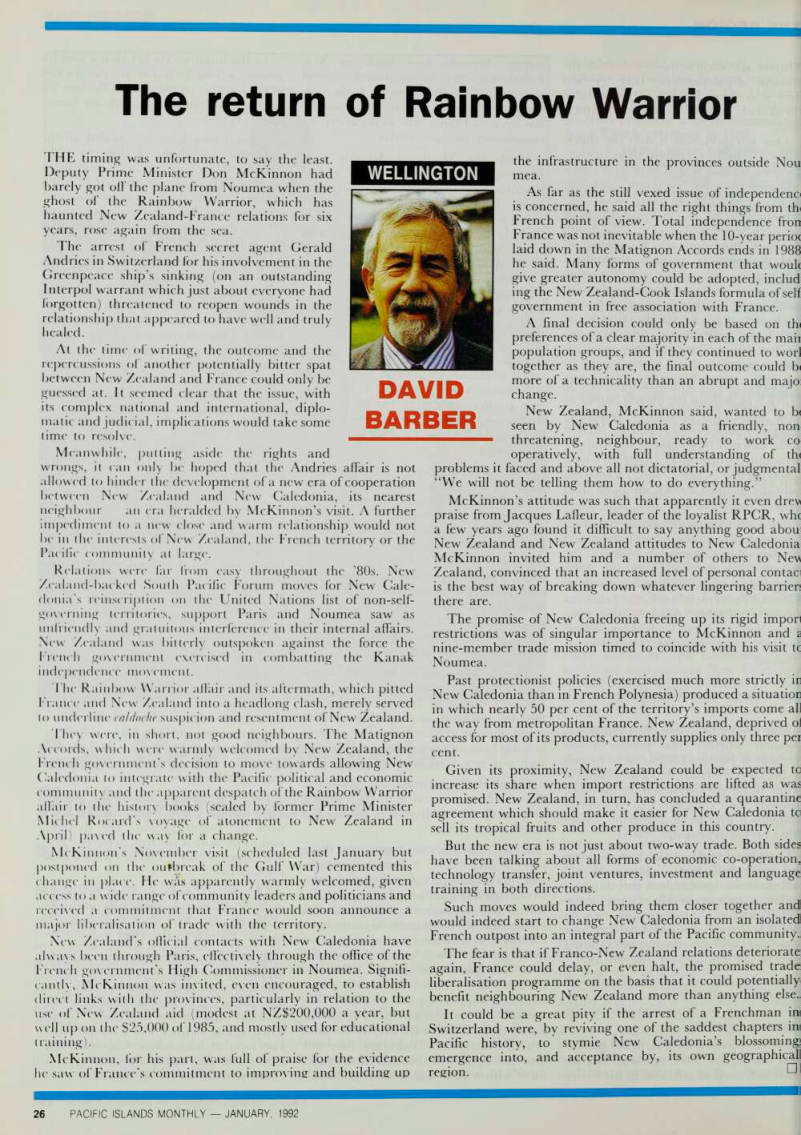
THE timing was unfortunate, to say the least.
Deputy Prime Minister Don McKinnon had barely got of! the plane from Noumea when the ghost ol the Rainbow Warrior, which has haunted New Zealand-France relations for six years, rose again from the sea.
The arrest of French secret agent Gerald Andries in Switzerland for his involvement in the Greenpeace ship’s sinking (on an outstanding Interpol warrant which just about everyone had forgotten) threatened to reopen wounds in the relationship that appeared to have well and truly healed.
At the time of writing, the outcome and the repercussions of another potentially bitter spat between New Zealand and France could only be guessed at. It seemed clear that the issue, with its complex national and international, diplo matic and judicial, implications would take some time to resolve.
Meanwhile, putting aside the rights and
wrongs, it can only be hoped that the Andries affair is not allowed to hinder the development of a new era of cooperation between New Zealand and New Caledonia, its nearest neighbour an era heralded by McKinnon’s visit. A further impediment to a new close and warm relationship would not be in the interests of New Zealand, the French territory or the Pacific community at large.
Relations were far from easy throughout the ’Bos. New Zealand-backed South Pacific Forum moves for New Cale donia's reinscription on the United Nations list of non-self governing territories, support Paris and Noumea saw as unfriendly and gratuitous interference in their internal affairs.
New Zealand was bitterly outspoken against the force the French government exercised in combatting the Kanak
independence movement.
The Rainbow Warrior affair and its aftermath, which pitted France and New Zealand into a headlong clash, merely served to underline caldoche suspicion and resentment of New Zealand.
They were, in short, not good neighbours. The Matignon Accords, w hich were w armly welcomed by New Zealand, the French government’s decision to move towards allowing New Caledonia to integrate with the Pacific political and economic community and the apparent despatch of the Rainbow Warrior alfair to the history books (scaled by former Prime Minister Michel Rocard’s voyage of atonement to New Zealand in April) paved the way for a change.
McKinnon's November visit (scheduled last January but postponed on the outbreak of the Gulf War) cemented this change in place. He was apparently warmly welcomed, given access to a wide range of community leaders and politicians and received a commitment that France would soon announce a major liberalisation ol' trade with the territory.
New Zealand's official contacts with New Caledonia have always been through Paris, effectively through the office of the f rench government's High Commissioner in Noumea. Signifi cantly, McKinnon was invited, even encouraged, to establish direct links with the provinces, particularly in relation to the use of New Zealand aid (modest at NZS2OO,OOO a year, but well up on the 525,000 of 1985, and mostly used for educational training).
McKinnon, for his part, was full of praise for the evidence lie saw of France's commitment to improving and building up
the infrastructure in the provinces outside Nou mea.
As far as the still vexed issue of independeno is concerned, he said all the right things from th( French point of view. Total independence fron France was not inevitable when the 10-year perkx laid down in the Matignon Accords ends in 1988 he said. Many forms of government that woulc give greater autonomy could be adopted, includ ing the New Zealand-Cook Islands formula of self government in free association with France.
A final decision could only be based on th< preferences of a clear majority in each of the mail population groups, and if they continued to worl together as they are, the final outcome could b< more of a technicality than an abrupt and majo
change.
New Zealand, McKinnon said, wanted to bi seen by New Caledonia as a friendly, non
threatening, neighbour, ready to work co
operatively, with full understanding of thi
problems it faced and above all not dictatorial, or judgmental “We will not be telling them how to do everything.”
McKinnon’s attitude was such that apparently it even drew praise from Jacques Lafleur, leader of the loyalist RPCR, whc a few years ago found it difficult to say anything good aboui New Zealand and New Zealand attitudes to New Caledonia McKinnon invited him and a number of others to New Zealand, convinced that an increased level of personal contact is the best way of breaking down whatever lingering barrier: there are.
The promise of New Caledonia freeing up its rigid import restrictions was of singular importance to McKinnon and a nine-member trade mission timed to coincide with his visit tc Noumea.
Past protectionist policies (exercised much more strictly in New Caledonia than in French Polynesia) produced a situation in which nearly 50 per cent of the territory’s imports come all the way from metropolitan France. New Zealand, deprived ol access for most of its products, currently supplies only three per cent.
Given its proximity, New Zealand could be expected tc increase its share when import restrictions are lifted as was promised. New Zealand, in turn, has concluded a quarantine agreement which should make it easier for New Caledonia to sell its tropical fruits and other produce in this country.
But the new era is not just about two-way trade. Both sides have been talking about all forms of economic co-operation, technology transfer, joint ventures, investment and language training in both directions.
Such moves would indeed bring them closer together andl would indeed start to change New Caledonia from an isolated!
French outpost into an integral part of the Pacific community..
The fear is that if Franco-New Zealand relations deteriorate again, France could delay, or even halt, the promised trade liberalisation programme on the basis that it could benefit neighbouring New Zealand more than anything else..
It could be a great pity if the arrest of a Frenchman ini Switzerland were, by reviving one of the saddest chapters ini Pacific history, to stymie New Caledonia’s emergence into, and acceptance by, its own geographical! region.
Wellington
David
Barber
Advertisements & other items, pp. 27-29 (1 item)
Regal
SERVICE
ROYAL TONGAN BUSINESS CLASS
Royal Tongan Business Class, a new style and standard of service from a country renowned for its friendliness and hospitality.
Domestic services throughout the Kingdom of Tonga.
International services linking Tonga with New Zealand and Fiji. Book with us and experience service that’s normally reserved for Royalty. mm mm ..." tXrv.
fj ROYALTONG AN AIRLINES
THE NATIONAL AIRLINE OF THE KINGDOM OF TONGA
OFFICES AND REPRESENTATIVES:
Nukualofa Royal Tongan Airlines: Tel-(676) 23 414 Fax-(676) 24 056 Auckland World Aviation Systems: Tel-(09) 794 454 Fax-(09) 775 648 Sydney World Aviation Systems: Tel-(02) 239 1722 Fax-(02) 290 3641 Nadi Sunflower Airlines: Tel-(679) 723 016, 723 408 Suva Sunflower Airlines: Tel-(679) 315 755 MEMBER OF THE INTERNATIONAL AIR TRANSPORT ASSOCIATION
r The new Toyota brand mark. Three ellipses forming a “T” which stand for our customer, our commitment to the satisfaction of that customer through our product and for our spirit of creativity. t I f¥ It’s not often that you hear descriptions like rugged or durable combined with refined and elegant. But then there’s never been a vehicle quite like the new Toyota Land Cruiser Station Wagon. The unrivalled legend of off-road reliability is now unsurpassed in comfort and sophistication as well. Attention to detail is found everywhere, from the fine trim to the instrument panel to the graceful lines of its exterior. Even in places you can’t see, like the heavy-duty ladder frame and suspension design that add to the superb
luxury-car ride.
But Toyota’s innovation goes beyond providing luxury and durability. The new Land Cruiser Station Wagon, and all of our cars, are designed to create a harmony between car and driver, and to provide you with the ultimate
driving experience.
The new Toyota Land Cruiser Station Wagon. Think of it as much more than a spacious luxury sedan with fourwheel drive. i m a m ' *
* T ■/ ? 1 I ■ ' « ■ *£7s* 31 il
III-
• ■ • »'' ‘ s ■* ' «SKa sm jEr*m *• PH 312666 PH 282848 PH 234-5911 PH 23673
® TOYOTA
From Washington with love
WHEN United States Congressman Stephen Solarz took a holiday recently, he decided to fly down to Papua New Guinea to raft the Watut River. Given Solarz’s prestigious standing in American politics, his choice was a surprise in more ways than one. The 51-year-old New York representative is one of the few national political figures in the US savvy enough to consider such a far-flung Pacific destination.
While the South Pacific barely registers on the radar of most Washington power brokers, Solarz’s unique and avid interest in the region has turned it into a discernible blip. But Solarz himself was surprised when he, his wife, Nina, and a group of colleagues on the rafting trip including the US Assistant Secretary of State for East Asian and Pacific Affairs, Richard Solomon were accosted by an apparently fierce group of tribesmen, their spears at the ready.
“It turned out to be the welcoming party of the village. It reminded me of the reception I receive before some of the Democratic clubs in New York,” Solarz said. Despite, or perhaps because, of such unpredictable Pacific intrigues, Solarz has become increasingly involved in the concerns of the island states since first dealing with legislation for Micronesia’s Compact of Free Association with the US in 1985.
He is not the only congressman with a special interest in the region Senator Daniel Innouye from Hawaii and American Samoa delegate Eni Hunkin Faleomavaega, are both fulltime Pacific activists. But Solarz enjoys a unique status in Washington as one of the few congressmen who has a significant impact on a variety of foreign affairs policies. He can command a one-on-one meeting with virtually any foreign leader in the world, including the Pope. He played a key role in the downfall of Philippines dictator Ferdinand Marcos. His personal imprint is evident on the recent Cambodian peace settlement.
And as a member of the US House of Representatives Foreign Affairs Committee, and particularly as chairman of the subcommittee on Asian and Pacific Affairs, he has been able to elevate island concerns out of the Pacific backwater.
“We’re very lucky to have him,” said one regional diplomat.
“We only have positive feelings about his role and what he does he is an activist and he is thoughtful. Because of him we’ve been able to tackle some real problems that we may not have been able to if someone like him was not in charge.”
Solarz took the first congressional delegation on a compre hensive regional tour in 1989, he supervised the first congressional review of US foreign policy toward the island states which criticised Washington’s benign neglect of the region and was accorded the rare honour, especially since he is a Democrat and President George Bush is a Republican, of having his policy recommendations largely adopted by the White House.
His considerable influence can be seen in US opposition to driftnet fishing, the unprecedented access South Pacific leaders have to the White House and the summit that President George Bush held with Pacific leaders earlier this year. He also had US$5 million earmarked to build a new parliament house in the Solomon Islands. He has urged President George Bush’s administration to drop its ban on political contact with the New Zealand government (which it did) and to ratify the South Pacific Nuclear Free Zone Treaty (which it did not).
Solarz “is the staunchest friend we’ve got in Washington,” said a South Pacific island diplomat. “He is pivotal.”
Given the gentle rhythm of South Pacific culture, it may confound some of Solarz’s congressional colleagues to hear such lavish praise about a man they often regard as too abrasive.
None of them doubt Solarz’s effectiveness but given the enormous respect he generates for his diplomatic achievements, it is ironic that the most oft-cited criticism from his colleagues is that Solarz lacks personal diplomacy. They have accused him of being condescending and aloof, someone who prefers talking to listening and is at times
downright rude.
Perhaps in a bid to humanise his image and reconcile his detachment from people with his devotion to intellectual excellence, Solarz revealed to The Washington Post earlier this year that as a child he was abandoned by two mothers including his biological mother, who left his father shortly after his birth, and his beloved stepmother, who
left him when he was 10 years old.
Solarz was then raised by an aunt. With the single-minded determination which became his hallmark, Solarz tracked down his real mother, whom he had assumed was dead, when he was 19. He conceded that his childhood trauma “probably created a need on my part to enhance my own sense of self esteem ... I was always running for some office or other.”
He was president of his junior high school class and vice president of the student body at Brandeis University. In 1968 he was elected to the New York State Assembly. In 1974, he was elected to the House of Representatives where he has served ever since including as a member of four committees Foreign Affairs, Merchant Marine and Fisheries, Intelligence and the Joint Economic Committee.
But the drive to prove himself because of maternal abandonment was “superseded by other motivations which have more to do with what I feel obligated to do with my life to leave the world a better place.” Fie was also philosophical about his colleagues’ complaints. “I think there are some members who are respected and there are others who are liked.
It would be nice to have both respect and affection. But if I were to make a choice, I would rather respect.”
Part of that respect is born of his prodigious work schedule which carried over even to his rafting trip in Papua New Guinea where he was frustrated to find he could not tune in a radio to find an international news service. He had to switch off the radio but not himself. Back in Port Moresby, he spent several hours discussing the region and the world with Prime Minister Rabbie Namaliu. “He is one of the most constantly curious people I’ve ever met. He has made a concerted effort to get out and know the region,” says a South Pacific diplomat.
These days Solarz and his committee are pushing to resolve the financial problems that have stalled the establishment of the Joint Commercial Commission designed to enhance business development in the Pacific; continue to argue for more aid and diplomatic representation to the region including opening a United States embassy in Vanuatu and establishing a US$2 million South Pacific scholarship fund; and continue to argue that the US administration should sign the South Pacific Nuclear Free Zone Treaty.
Says another official from the region: "He spends a disproportionate amount of time on the South Pacific given the scope of his committee and all his other work. That’s a great thing for us.” □
Washington
Margot
O’Neill
Advertisements & other items, p. 31 (1 item)
for his contribution to Fiji
We thank the Prime Minister
and to civil aviation.
- This country has been priviledged to have as its leader Ratu Sir Kamisese Mara.
For he has provided the direction and inspiration to make this country the most developed in the South Pacific.
And no organization has benefited more from his leadership than the Civil Aviation Authority of Fiji.
We thank Ratu Mara for his outstanding contribution to Fiji and to civil aviation.
CIVIL AVIATION AUTHORITY OF FIJI
Private Mail Bag, Nadi Airport, Fiji. Tele; (679) 723055 Telex: FJ5299 Fax: (679) 790325
GEORGE RUBINE 8535
After the sacking, Peters
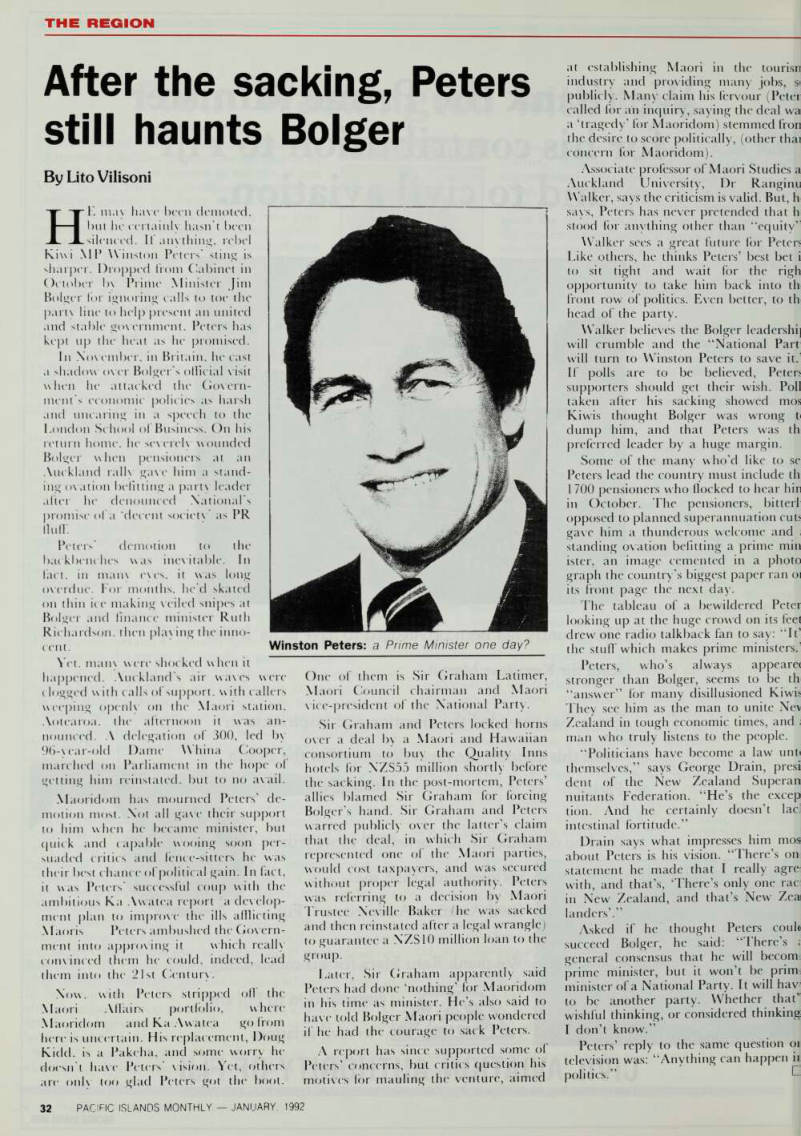
still haunts Bolger
By Lito Vilisoni
HE may have been demoted, but he certainly hasn't been silenced. If anything, rebel Kiwi MP Winston Peters' sting is sharper. Dropped from Cabinet in October by Prime Minister Jim Bolger for ignoring calls to toe the partv line to help present an united and stable government. Peters has kept up the heat as he promised.
In November, in Britain, lie cast a shadow over Bolger s official visit when he attacked the Govern ment's economic policies as harsh and uncaring in a speech to the London School of Business. On his return home, he severely wounded Bolger when pensioners at an Auckland rally gave him a stand ing ovation befitting a party leader after he denounced National's promise of a ’decent societv" as PR fluff.
Peters' demotion to the backbenches was inevitable. In fact, in mam eyes, it was long overdue. For months, he'd skated on thin ice making veiled snipes at Bolger and finance minister Ruth Richardson, then playing the inno cent.
Vet. many were shocked when it happened. Auckland's air waves were clogged with calls of support, with callers weeping openly on the Maori station.
Aotearoa. the afternoon it was an nounced. A delegation of 300, led by
96-year-old Dame Whina Cooper,
marched on Parliament in the hope of getting him reinstated, but to no avail.
Maoridom has mourned Peters' de motion most. Not all gave their support to him when he became minister, but quick and capable wooing soon per suaded critics and fence-sitters he was their best chance of political gain. In fact, it was Peters' successful coup with the ambitious Ka Awatea report a develop ment plan to improve the ills afflicting Maoris Peters ambushed the Gov ern ment into approving it which really convinced them he could, indeed, lead them into the 21st Century.
Now. with Peters stripped off the Maori Affairs portfolio, where Maoridom and Ka Awatea go from here is uncertain. His replacement, Doug Kidd, is a Pakeha, and some worry he doesn't have Peters' vision. Vet, others are only too glad Peters got the boot.
One of them is Sir Graham Latimer, Maori Council chairman and Maori vice-president of the National Party.
Sir Graham and Peters locked horns over a deal by a Maori and Hawaiian consortium to buy the Quality Inns hotels for NZSSS million shortly before the sacking. In the post-mortem, Peters’ allies blamed Sir Graham for forcing Bolgers hand. Sir Graham and Peters warred publicly over the latter’s claim that the deal, in which Sir Graham represented one of the Maori parties, would cost taxpayers, and was secured without proper legal authority. Peters was referring to a decision by Maori Trustee Neville Baker fhe was sacked and then reinstated after a legal wrangle) to guarantee a NZSIO million loan to the group.
Later, Sir Graham apparently said Peters had done ‘nothing’ for Maoridom in his time as minister. He’s also said to have told Bolger Maori people wondered if he had the courage to sack Peters.
A report has since supported some of Peters’ concerns, but critics question his motives for mauling the venture, aimed
at establishing Maori in the tourisn industry and providing many jobs, si publicly. Many claim his fervour (Peter called for an inquiry, saying the deal wa a ‘tragedy’ for Maoridom) stemmed fron the desire to score politically, (other thai concern for Maoridom).
Associate professor of Maori Studies a
Auckland University, Dr Ranginu
Walker, says the criticism is valid. But, h says, Peters has never pretended that h stood for anything other than “equity’' Walker sees a great future for Peters Like others, he thinks Peters’ best bet i to sit tight and wait for the righ opportunity to take him back into th front row of politics. Even better, to th head of the party.
W alker believes the Bolger leadershi] will crumble and the “National Part will turn to Winston Peters to save it.
If polls arc to be believed, Peters supporters should get their wish. Poll taken after his sacking showed mos Kiwis thought Bolger was wrong t dump him, and that Peters was th
preferred leader by a huge margin.
Some of the many who’d like to se Peters lead the country must include th 1 700 pensioners who flocked to hear hiri in October. The pensioners, bitter!
opposed to planned superannuation cuts
gave him a thunderous welcome and standing ovation befitting a prime min ister, an image cemented in a photo graph the country's biggest paper ran 01 its front page the next day.
The tableau of a bewildered Peter looking up at the huge crowd on its feel drew one radio talkback fan to say: “It’ the stuff which makes prime ministers. 1 Peters, who’s always appeam stronger than Bolger, seems to be th “answer” for many disillusioned Kiwis They see him as the man to unite Nev Zealand in tough economic times, and : man who truly listens to the people.
“Politicians have become a law unti themselves,” says George Drain, presi dent of the New Zealand Superan nuitants Federation. “He’s the excep tion. And he certainly doesn’t lad intestinal fortitude.”
Drain says what impresses him mos about Peters is his vision. “There’s on statement he made that I really agre with, and that’s, ‘There’s only one rac in New Zealand, and that’s New Zeai landers’.”
Asked if he thought Peters coulc succeed Bolger, he said: “There’s ; general consensus that he will becom prime minister, but it won’t be prim minister of a National Party. It will haw to be another party. Whether that’' wishful thinking, or considered thinking I don’t know.”
Peters’ reply to the same question oi television was: “Anything can happen ii
politics.” I
Winston Peters: a Prime Minister one day?
When a dream turns
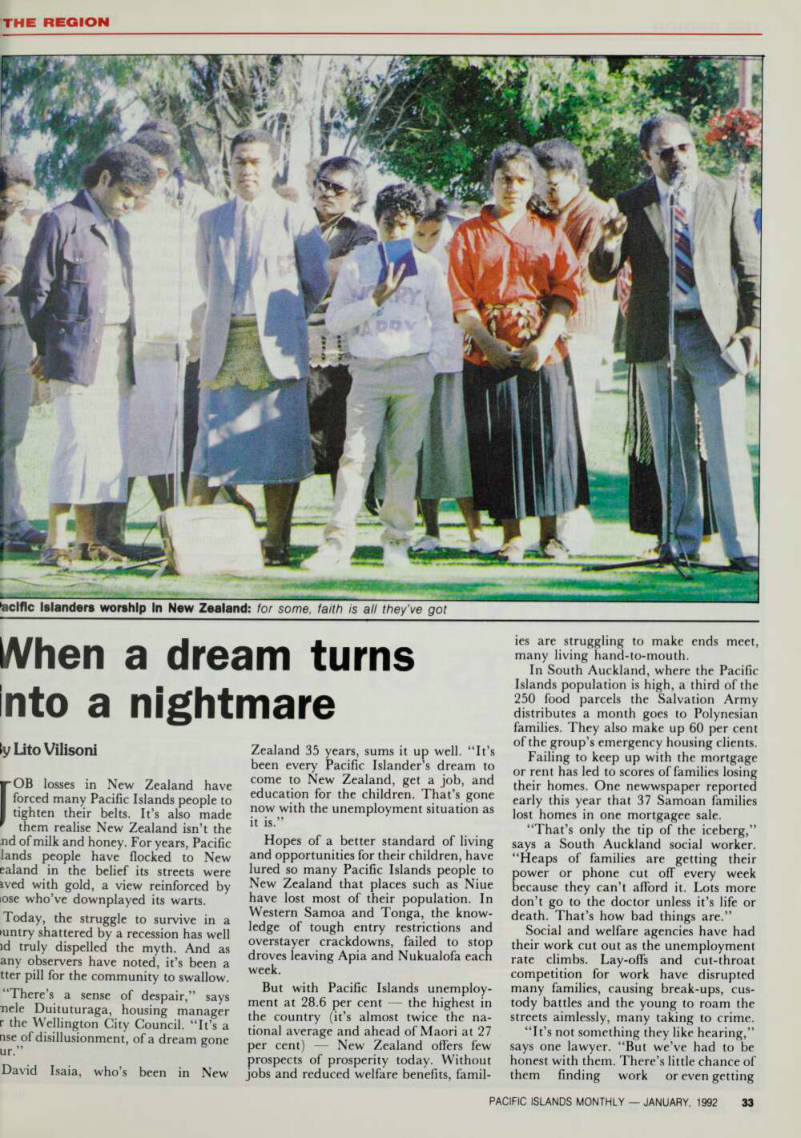

into a nightmare
By Lito Vilisoni
|-OB losses in New Zealand have I forced many Pacific Islands people to I tighten their belts. It’s also made them realise New Zealand isn’t the nd of milk and honey. For years, Pacific lands people have flocked to New ealand in the belief its streets were ived with gold, a view reinforced by iose who’ve downplayed its warts.
Today, the struggle to survive in a .untry shattered by a recession has well id truly dispelled the myth And as any observers have noted, it’s been a tter pill for the community to swallow. <iTu r p> c 0 „ nele Duituturaga, manager r n 8 1 ttr 8 ur >» ’ g ?
David Isaia, who’s been in New
Zealand 35 years sum, it up well. “It’s been every Pacific Islander s dream to c ° me t 0 N r ew Z eala " d > « et a J°, b . and educat !° 1 n [ or the ch'ldren. That s gone I ; ow , wlth the unemployment situation as 1 IS ' Hopes of a better standard of living and opportunities for their children, have lured 80 many Pacific Islands people to New Zealand that places such as Niue have lost most of their population. In Western Samoa and Tonga, the know ledge of tough , ™ try re r st " c j lons and overstayer crackdowns failed to stop dr °T eS leavm S A P ia and Nukualofa each wee ** But with Pacific Islands unemploy ™ent at P" c( j nt “ the hi in the country it s almost twice the na per cent) New Zealand offers few prospects of prosperity today. Without jobs and reduced welfare benefits, famil
ies are struggling to make ends meet, many living hand-to-mouth.
In South Auckland, where the Pacific Islands population is high, a third of the 250 food parcels the Salvation Army distributes a month goes to Polynesian families. They also make up 60 per cent of the group’s emergency housing clients.
Failing to keep up with the mortgage or rent has led to scores of families losing their homes. One newwspaper reported early this year that 37 Samoan families lost homes in one mortgagee sale.
“That’s only the tip of the iceberg,” says a South Auckland social worker.
“Heaps of families are getting their power or phone cut off every week because they can’t afford it. Lots more don’t go to the doctor unless it’s life or death. That’s how bad things are.”
Social and welfare agencies have had their work cut out as the unemployment rate climbs. Lay-offs and cut-throat competition for work have disrupted many families, causing break-ups, cus tody battles and the young to roam the streets aimlessly, many taking to crime.
“It’s not something they like hearing,” says one lawyer. “But we’ve had to be honest with them. There’s little chance of them finding work or even getting
Pecific Islanders worship In New Zealand: for some, faith is all they’ve got
residency at the moment. In the end, some of them are just a burden to their families. Unfortunately, New Zealand is so hard at the moment, that I think people would be better off at home.”
Isaia, an advisory officer to Social Welfare’s head office in Wellington, agrees. In fact, he recently braved the wrath off the Cook Islands community by publicly urging those out of work to return home.
In a story which led to an editorial titled ‘Better Off At Home’ in the New Zealand Herald (the country’s biggest paper), Isaia called on fellow countrymen to consider resettling in the Cooks as an alternative to struggling on in New Zealand. Isaia said people who had been laid off and who were unlikely to work again because of their age and lack of skills, could lead quite a comfortable life at home. With money from their redundancy they could work the land or sea, and enjoy the bonus of a stress-free life.
“We are not trying to push people, or make the decisions for them,” he told Parific Islands Monthly. “All we’re saying is consider the option. We’ve got to face
reality,”
Isaia, who’s offended some people with
his comments, says several Cook Islands people have returned home, in the hope of making a fresh start. They, and others who follow, have been asked to open the eyes of those at home to the realities in New Zealand.
“To the people who return home we say, ‘Please take this message with you to those at home New Zealand is not the land of milk and honey.’ Please, also try to discourage them from coming here because there are no jobs.”
Folks at home can’t have missed the money troubles of their New Zealand kin. Remittances have dropped mark edly and are expected to keep falling for some time. Western Samoa is apparently expecting a 10 per cent drop this year.
Yet, Pacific Islands people continue to flock to New Zealand. And those already there find the idea of going home inconceivable. Many feel they have nothing to return to, and others worry about going empty handed. And many would rather be poor in New Zealand, than in the islands.
“It’s a really tough thing to ask of people,” says one Auckland journalist.
“Pacific islanders came here for oppor tunity, not only for themselves, but for the future generation. Things are tough,
but that dream is still alive for man) people. You can’t take that away frorr them.”
Auckland trade union official Phillip Field agrees. He says Pacific Islands people should ride out the economic downturn, and build on what they’ve already achieved to provide a secure future for the coming generation.
“Our expectations of life in Nev\ Zealand have been high,” he says. “Bui I still believe New Zealand offers the potential of great advancement foi Pacific Islands people. This is a transi tional period we are going through Things should be better for the nexi generation. What we need to do now is harness our skills so that we are no longei considered expendable as workers.”
Duituturaga sees a similar rosy future A member of an advisory committee tc Employment Minister Bill Birch Duituturaga is spearheading a study into the place of Pacific Islands workers especially women, today and where the) want to be by the year 2000. Much of the study is still being fine-tuned, but its airr is to push Pacific Islands people up the work ladder. Says Duituturaga: “It’: revitalising that dream our parents came with that somehow got lost in thi: economic crisis.” G
Advertisements & other items, p. 34 (1 item)
e Pacific
9m jLJHI
JL JL.
W Lj |L w ■* Fu
1. rlu
•AIRY
e Pacific
Rewa Dairy produce a wide variety of natural dairy products that are good for you, and can service all areas of the Pacific.
Rewa Dairy not only have the ability to produce U.H.T. milk, but they also have the latest Technology to pack almost any liquid into Tetrapak cartons. So if you need more information on Rewa Dairy's range of natural dairy products or their packaging capabilities contact; Rewa Co-operative Dairy Company Limited, P.O. Box 3678, Samabula, Suva, Fiji. Tel: 381288.
Fax: 370190
FUILQREAM
4S
miFimm
STRAWBERRY
ran
nmm i i iau Pure Creamery
BUTTER
•• >' B . i
NONFAT
I I I
ft
SUM
MOK ™
POWDER I B I I
mvnmovß mmm ivxmtwvß l w. ■ P, : * ■fl|| |M chocolate banana IWIIII
Big catch for new FSM head
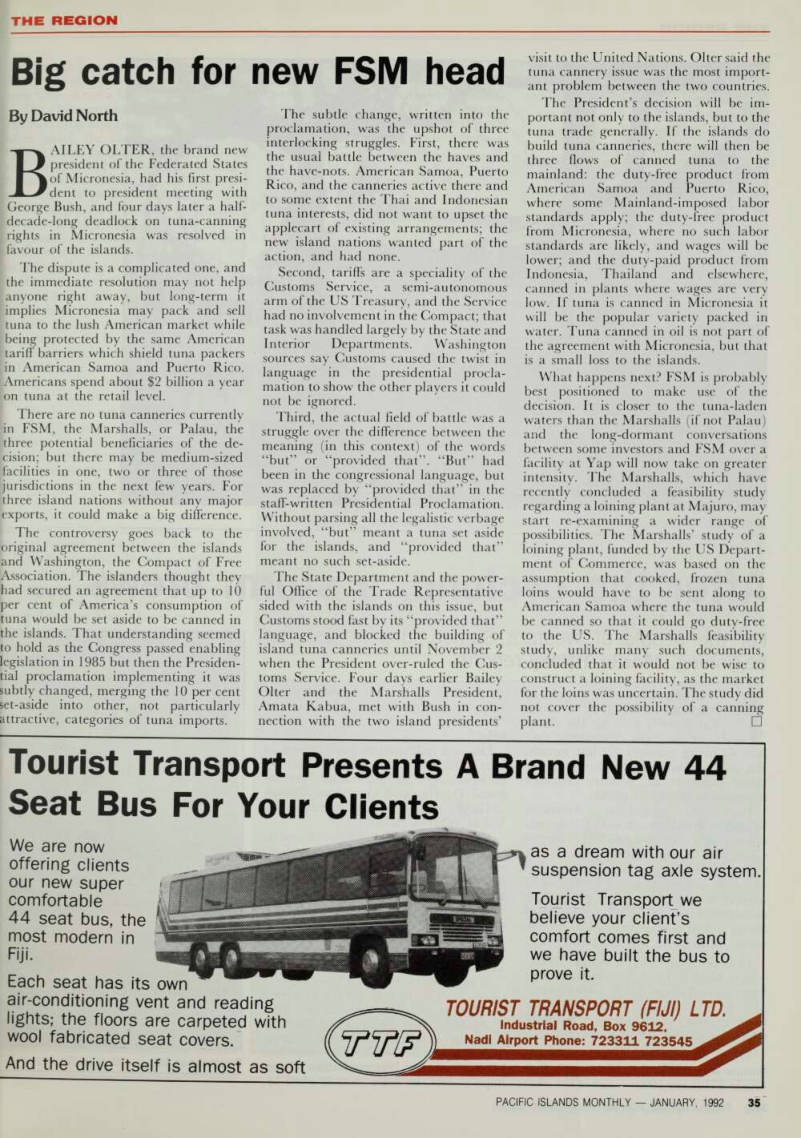
By David North
BAILEY OLTER, the brand new president of the Federated States of Micronesia, had his first presi dent to president meeting with George Bush, and four days later a half decade-long deadlock on tuna-canning rights in Micronesia was resolved in favour of the islands.
The dispute is a complicated one, and the immediate resolution may not help anyone right away, but long-term it implies Micronesia may pack and sell tuna to the lush American market while being protected by the same American tariff barriers which shield tuna packers in American Samoa and Puerto Rico. [Americans spend about $2 billion a year [on tuna at the retail level.
There are no tuna canneries currently in FSM, the Marshalls, or Palau, the three potential beneficiaries of the de cision; but there may be medium-sized facilities in one, two or three of those jurisdictions in the next few years. For three island nations without any major exports, it could make a big difference.
The controversy goes back to the original agreement between the islands and Washington, the Compact of Free Association. The islanders thought they had secured an agreement that up to 10 per cent of America’s consumption of tuna would be set aside to be canned in the islands. That understanding seemed to hold as the Congress passed enabling legislation in 1985 but then the Presiden tial proclamation implementing it was subtly changed, merging the 10 per cent set-aside into other, not particularly attractive, categories of tuna imports.
The subtle change, written into the proclamation, was the upshot of three interlocking struggles. First, there was the usual battle between the haves and the have-nots. American Samoa, Puerto Rico, and the canneries active there and to some extent the Thai and Indonesian tuna interests, did not want to upset the applecart of existing arrangements; the new island nations wanted part of the action, and had none.
Second, tariffs are a speciality of the Customs Service, a semi-autonomous arm of the US Treasury, and the Service had no involvement in the Compact; that task was handled largely by the State and Interior Departments. Washington sources say Customs caused the twist in language in the presidential procla mation to show the other players it could not be ignored.
Third, the actual field of battle was a struggle over the difference between the meaning (in this context) of the words “but” or “provided that”. “But” had been in the congressional language, but was replaced by “provided that” in the staff-written Presidential Proclamation.
Without parsing all the legalistic verbage involved, “but” meant a tuna set aside for the islands, and “provided that” meant no such set-aside.
The State Department and the power ful Office of the Trade Representative sided with the islands on this issue, but Customs stood fast by its “provided that” language, and blocked the building of island tuna canneries until November 2 when the President over-ruled the Cus toms Service. Four days earlier Bailey Olter and the Marshalls President, Amata Kabua, met with Bush in con nection with the two island presidents’
visit to the United Nations. Olter said the tuna cannery issue was the most import ant problem between the two countries.
The President’s decision will be im portant not only to the islands, but to the tuna trade generally. If the islands do build tuna canneries, there will then be three flows of canned tuna to the mainland: the duty-free product from American Samoa and Puerto Rico, where some Mainland-imposed labor
standards apply; the duty-free product
from Micronesia, where no such labor standards are likely, and wages will be lower; and the duty-paid product from Indonesia, Thailand and elsewhere, canned in plants where wages are very low. If tuna is canned in Micronesia it will be the popular variety packed in water. Tuna canned in oil is not part of the agreement with Micronesia, but that is a small loss to the islands.
What happens next? FSM is probably best positioned to make use of the decision. It is closer to the tuna-laden waters than the Marshalls (if not Palau) and the long-dormant conversations between some investors and FSM over a facility at Yap will now take on greater intensity. The Marshalls, which have
recently concluded a feasibility study
regarding a Joining plant at Majuro, may start re-examining a wider range of possibilities. The Marshalls’ study of a joining plant, funded by the US Depart ment of Commerce, was based on the assumption that cooked, frozen tuna loins would have to be sent along to American Samoa where the tuna would be canned so that it could go duty-free to the US. The Marshalls feasibility study, unlike many such documents, concluded that it would not be wise to construct a Joining facility, as the market for the loins was uncertain. The study did not cover the possibility of a canning
plant. □
Advertisements & other items, p. 35 (1 item)
Seat Bus For Your Clients
Tourist Transport Presents A Brand New 44
We are now
offering clients
our new super comfortable 44 seat bus, the most modern in Fiji.
Each seat has its own air-conditioning vent and reading lights; the floors are carpeted with wool fabricated seat covers.
And the drive itself is almost as soft as a dream with our air suspension tag axle system.
Tourist Transport we believe your client’s comfort comes first and we have built the bus to prove it.
TOURIST TRANSPORT (FIJI) LTD.
Industrial Road, Box 9612.
Nadi Airport Phone: 723311 723545 *
After the cyclone, a storm brews ...
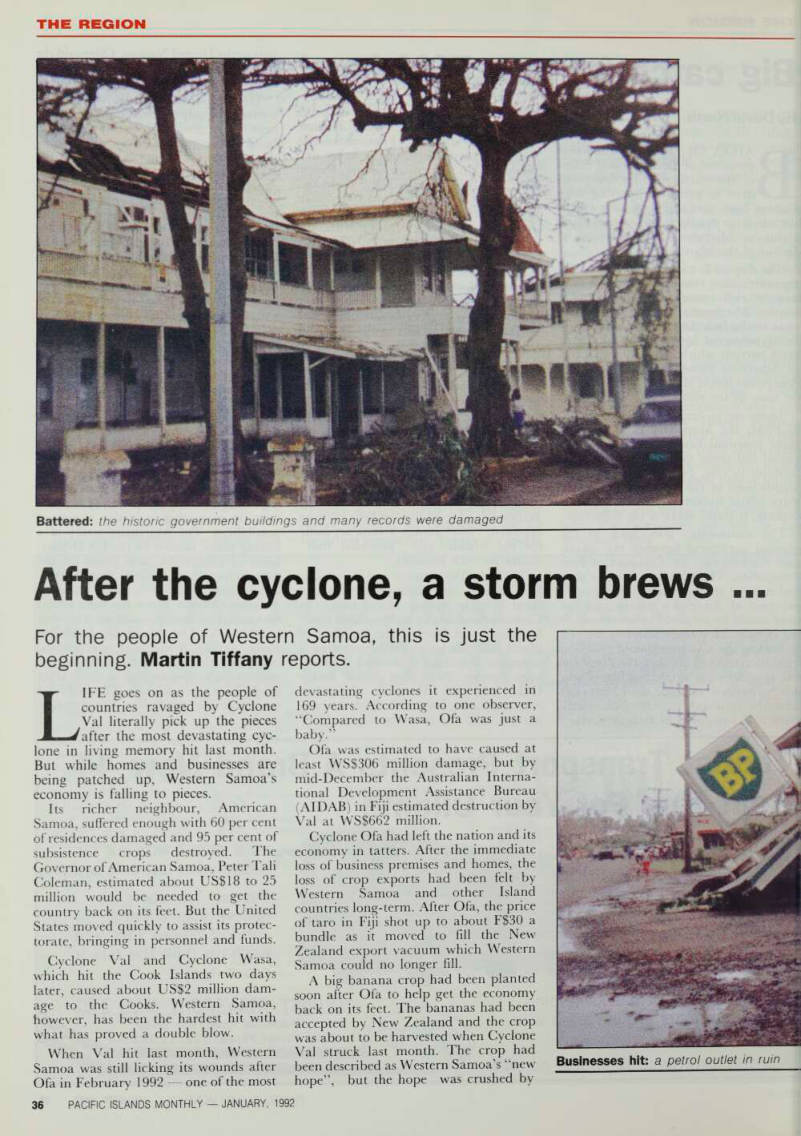
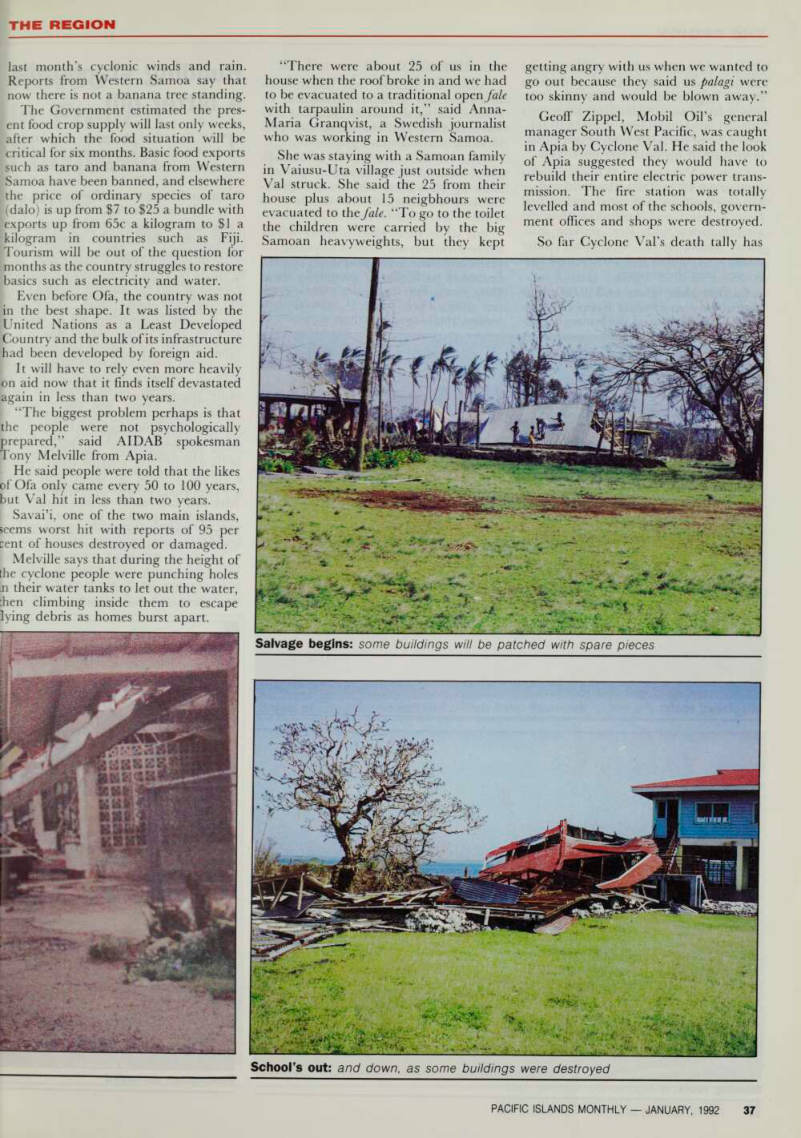
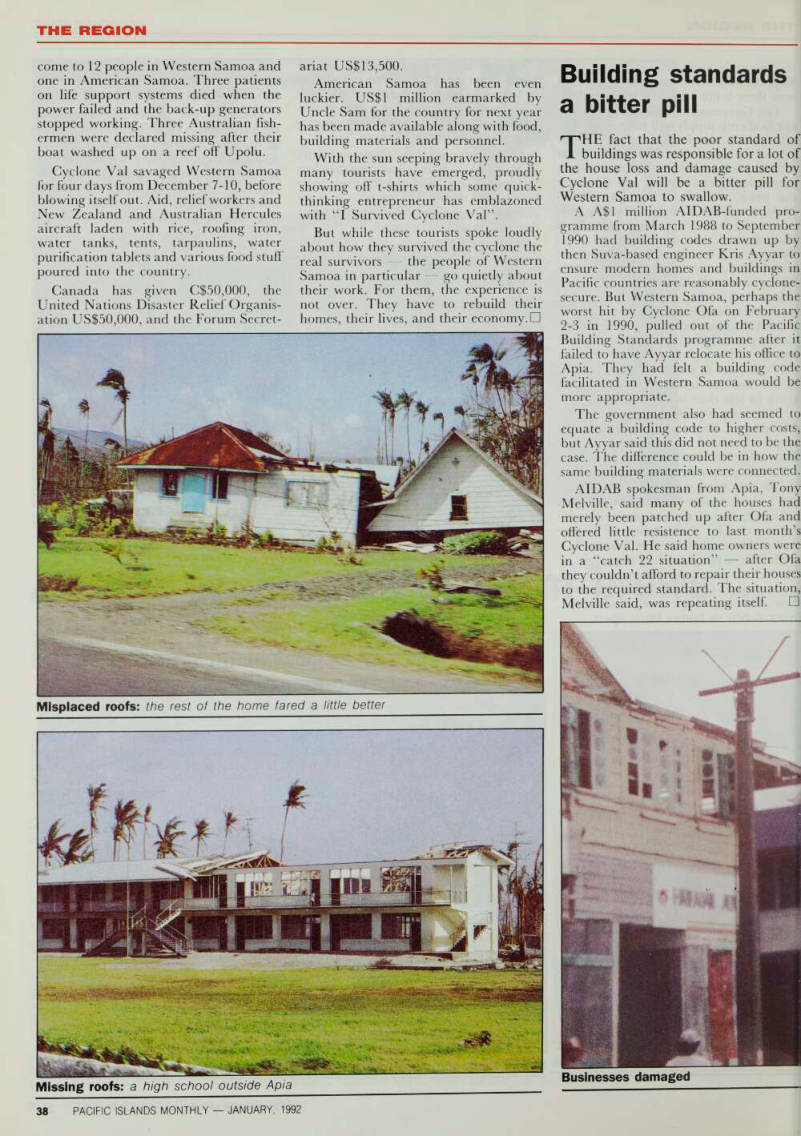
For the people of Western Samoa, this is just the beginning. Martin Tiffany reports.
LIFE goes on as the people of countries ravaged by Cyclone Val literally pick up the pieces after the most devastating cyc lone in living memory hit last month.
But while homes and businesses are being patched up, Western Samoa’s economy is falling to pieces.
Its richer neighbour, American Samoa, suffered enough with 60 per cent of residences damaged and 95 per cent of subsistence crops destroyed. The Governor of American Samoa, Peter Tali Coleman, estimated about US$lB to 25 million would be needed to get the country back on its feet. But the United States moved quickly to assist its protec torate, bringing in personnel and funds.
Cyclone Val and Cyclone Wasa, which hit the Cook Islands two days later, caused about US$2 million dam age to the Cooks. Western Samoa, however, has been the hardest hit with what has proved a double blow.
When Val hit last month, Western Samoa was still licking its wounds after Ofa in February 1992 one of the most
devastating cyclones it experienced in 169 years. According to one observer, '■‘Compared to Wasa, Ofa was just a baby.”
Ofa was estimated to have caused at least VVSS3O6 million damage, but by mid-December the Australian Interna tional Development Assistance Bureau (AIDAB) in Fiji estimated destruction by Val at WSS662 million.
Cyclone Ofa had left the nation and its economy in tatters. After the immediate loss of business premises and homes, the loss of crop exports had been felt by Western Samoa and other Island countries long-term. After Ofa, the price of taro in Fiji shot up to about Fs3o a bundle as it moved to fill the New Zealand export vacuum which Western Samoa could no longer fill.
A big banana crop had been planted soon after Ofa to help get the economy back on its feet. The bananas had been accepted by New Zealand and the crop was about to be harvested when Cyclone Val struck last month. The crop had been described as Western Samoa’s “new hope”, but the hope was crushed by
Battered: the historic government buildings and many records were damaged
Businesses hit: a petrol outlet in ruin
last month’s cyclonic winds and rain.
Reports from Western Samoa say that now there is not a banana tree standing.
The Government estimated the pres ent food crop supply will last only weeks, after which the food situation will be critical for six months. Basic food exports such as taro and banana from Western Samoa have been banned, and elsewhere the price of ordinary species of taro (dalo) is up from $7 to $25 a bundle with exports up from 65c a kilogram to $1 a kilogram in countries such as Fiji.
Tourism will be out of the question for months as the country struggles to restore basics such as electricity and water.
Even before Ofa, the country was not in the best shape. It was listed by the United Nations as a Least Developed Country and the bulk of its infrastructure had been developed by foreign aid.
It will have to rely even more heavily on aid now that it finds itself devastated again in less than two years.
“The biggest problem perhaps is that the people were not psychologically prepared,” said AIDAB spokesman Tony Melville from Apia.
He said people were told that the likes of Ofa only came every 50 to 100 years, but Val hit in less than two years.
Savai’i, one of the two main islands, seems worst hit with reports of 95 per
cent of houses destroyed or damaged.
Melville says that during the height of the cyclone people were punching holes n their water tanks to let out the water, hen climbing inside them to escape lying debris as homes burst apart.
“There were about 25 of us in the house when the roof broke in and we had to be evacuated to a traditional open fale with tarpaulin around it,” said Anna- Maria Granqvist, a Swedish journalist who was working in Western Samoa.
She was staying with a Samoan family in Vaiusu-Uta village just outside when Val struck. She said the 25 from their house plus about 15 neighbours were evacuated to the fale. “To go to the toilet the children were carried by the big Samoan heavyweights, but they kept
getting angry with us when we wanted to go out because they said us palagi were too skinny and would be blown away.”
Geoff Zippel, Mobil Oil’s general manager South West Pacific, was caught in Apia by Cyclone Val. He said the look of Apia suggested they would have to rebuild their entire electric power trans mission. The fire station was totally levelled and most of the schools, govern ment offices and shops were destroyed.
So far Cyclone Val’s death tally has
Salvage begins: some buildings will be patched with spare pieces
School’s out: and down, as some buildings were destroyed
come to 12 people in Western Samoa and one in American Samoa. Three patients on life support systems died when the power failed and the back-up generators stopped working. Three Australian fishermen were declared missing after their boat washed up on a reef off Upolu.
Cyclone Val savaged Western Samoa for four days from December 7-10, before blowing itself out. Aid, relief workers and New Zealand and Australian Hercules aircraft laden with rice, roofing iron, water tanks, tents, tarpaulins, water purification tablets and various food stuff poured into the country.
Canada has given C 550,000, the United Nations Disaster Relief Organisation US$5O,OOO, and the Forum Secret-
ariat USS 13,500.
American Samoa has been even luckier. US$l million earmarked by Uncle Sam for the country for next year has been made available along with food, building materials and personnel.
With the sun seeping bravely through many tourists have emerged, proudly showing off t-shirts which some quick thinking entrepreneur has emblazoned with “I Survived Cyclone Val”.
But while these tourists spoke loudly about how they survived the cyclone the real survivors the people of Western Samoa in particular go quietly about their work. For them, the experience is not over. They have to rebuild their homes, their lives, and their economy. □
Misplaced roofs: the rest of the home fared a little better
Missing roofs: a high school outside Apia
Building standards
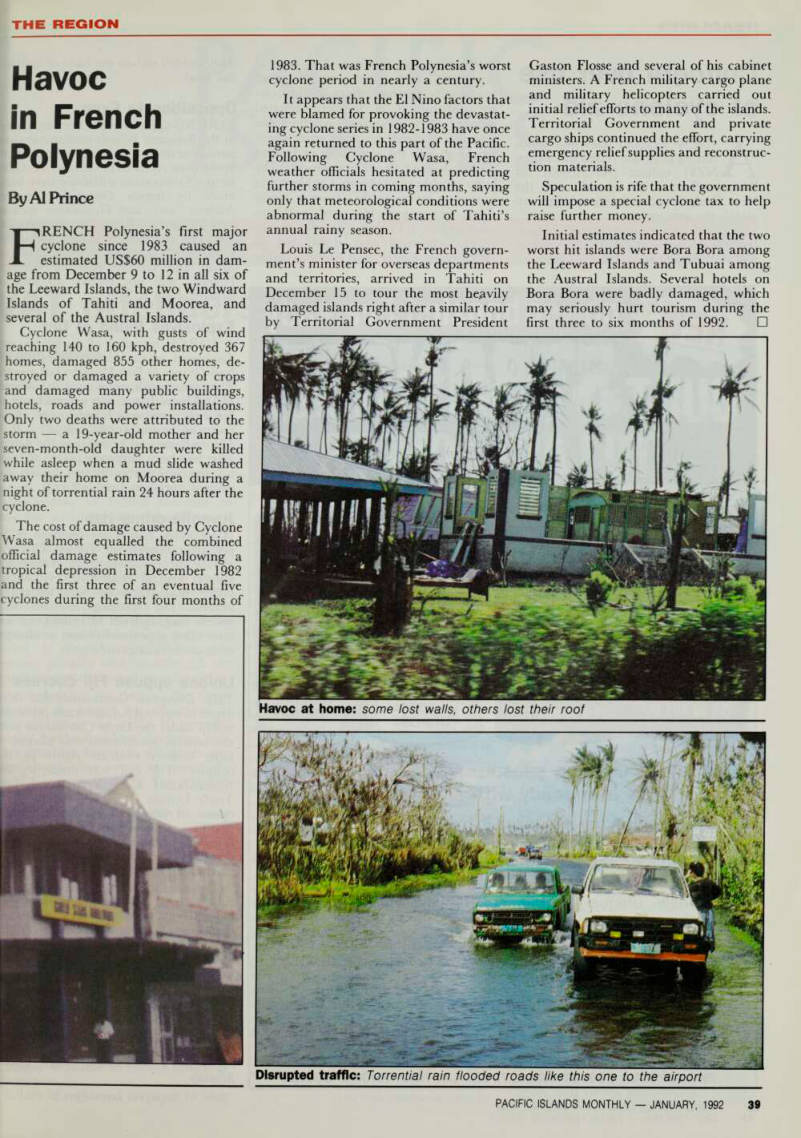
a bitter pill
THE fact that the poor standard of buildings was responsible for a lot of the house loss and damage caused by Cyclone Val will be a bitter pill for Western Samoa to swallow.
A ASI million AIDAB-funded pro gramme from March 1988 to September 1990 had building codes drawn up by then Suva-based engineer Kris Ayyar to ensure modern homes and buildings in Pacific countries are reasonably cyclone secure. But Western Samoa, perhaps the worst hit by Cyclone Ofa on February 2-3 in 1990, pulled out of the Pacific Building Standards programme after it failed to have Ayyar relocate his office to Apia. They had felt a building code facilitated in Western Samoa would be
more appropriate.
The government also had seemed to equate a building code to higher costs, but Ayyar said this did not need to be the case. The difference could be in how the same building materials were connected.
AIDAB spokesman from Apia, Tony Melville, said many of the houses had merely been patched up after Ofa and offered little resistence to last month’s Cyclone Val. He said home owners were in a “catch 22 situation” after Ofa they couldn’t afford to repair their houses to the required standard. The situation,!
Melville said, was repeating itself. □!
Businesses damaged
Polynesia
Havoc in French Polynesia
By Al Prince
FRENCH Polynesia’s first major cyclone since 1983 caused an estimated US$6O million in dam age from December 9 to 12 in all six of the Leeward Islands, the two Windward Islands of Tahiti and Moorea, and several of the Austral Islands.
Cyclone Wasa, with gusts of wind reaching 140 to 160 kph, destroyed 367 homes, damaged 855 other homes, de stroyed or damaged a variety of crops and damaged many public buildings, hotels, roads and power installations.
Only two deaths were attributed to the storm a 19-year-old mother and her seven-month-old daughter were killed while asleep when a mud slide washed away their home on Moorea during a night of torrential rain 24 hours after the cyclone.
The cost of damage caused by Cyclone Wasa almost equalled the combined official damage estimates following a tropical depression in December 1982 and the first three of an eventual five cyclones during the first four months of
1983. That was French Polynesia’s worst cyclone period in nearly a century.
It appears that the El Nino factors that were blamed for provoking the devastat ing cyclone series in 1982-1983 have once again returned to this part of the Pacific.
Following Cyclone Wasa, French
weather officials hesitated at predicting further storms in coming months, saying only that meteorological conditions were abnormal during the start of Tahiti’s annual rainy season.
Louis Le Pensec, the French govern ment’s minister for overseas departments and territories, arrived in Tahiti on December 15 to tour the most heavily damaged islands right after a similar tour by Territorial Government President
Gaston Flosse and several of his cabinet ministers. A French military cargo plane and military helicopters carried out initial relief efforts to many of the islands.
Territorial Government and private cargo ships continued the effort, carrying emergency relief supplies and reconstruc tion materials.
Speculation is rife that the government will impose a special cyclone tax to help raise further money.
Initial estimates indicated that the two worst hit islands were Bora Bora among the Leeward Islands and Tubuai among the Austral Islands. Several hotels on Bora Bora were badly damaged, which may seriously hurt tourism during the first three to six months of 1992. □
Havoc at home: some lost walls, others lost their roof
Disrupted traffic: Torrential rain flooded roads like this one to the airport
of cyclone aid

Headlines
Concern over use of cyclone aid
ANEW Zealand television fund raising program raised more than NZ$l million (A 5720,000) for Western Samoa last month, and the New Zealand government pledged to match the amount.
But critics have voiced concern about how the government’s share of the money will be distributed. David Cuthbert,
spokesman for Cyclone Val appeal organisers, said appeal and Samoan community representatives would over see distribution of publicly donated money. It was unclear whether the amount pledged by the government would go into the same pool or be sent directly to the Samoan government. The latter would raise concern, Cuthbert was quoted as saying in the Dominion Sunday Times newspaper. He cited problems associated with Cyclone Ofa relief money which reportedly was distributed to villagers just before local elections rather
than handed out on the basis of individl ual need.
Opposition to Expo
STRONG opposition has been expressec in the Solomon Islands parliament ove; participation in the world exposition ii Spain from April 20 to October 12. Call for the Solomons to withdraw have beei made by former Opposition leader Andrew Nori, and Opposition spokes man for foreign affairs, Francis Saemala Nori said the country cannot afford th< U 55230,000 needed to participate ii Spain, and Saemala said the Solomoi Islands “will not receive an iota o benefit” from it.
Explosives found at Uni A LARGE quantity of explosives wa discovered at the University of Papu; New Guinea in Port Moresby last month The university’s chief security officer Mike Moore-Bassy, says several boxes o live explosives were found in one of th( rooms of the education faculty.
Moore-Bassy said he believed the deton ators had been purposely placed to blov up the university library during th< student unrest in June last year.
Juvenile-crime rise JUVENILE crimes are reported to b( prevalent throughout Tonga. This wa: one of the concerns raised during th< annual general conference of Tonga’: police magistrates in Nuku’alofa las month. The meeting revealed tha youths ranging from 11 to 20 years ok have often appeared in court on charge; of house-breaking and theft.
Unions oppose Fiji decrees THE European Community has beer urged to suspend aid and trade privilege; to Fiji under the Lome Convention aftei the interim government was alleged tc have violated human rights in the country. The call was made by the International Confederation of Free Trade Unions (ICFTU) and the Eur opean Trade Union Confederatior (ECTU) as the overseas unions continue to mount pressure on the interim admin istration to rescind the decree: promulgating the new labour legislation The new legislation was enforced ai the start of November. According tc government gave a greater degree o;< democracy to unions, but the Fiji Trades Union Congress says the new legislation has been enforced to destroy the trade union movement in Fiji.
Fijian editor
JALE MOALA has been appointed the first Fijian editor of the Fiji Times daily newspaper. Moala has been editor ol< News Ltd’s Suva-based Pacific Islands'.
Monthly C
Advertisements & other items, p. 40 (1 item)
Built D
power-boosted Eveready
TO LAST LONGER
GENERAL
PURPOSE
WERIAOT W
q r i
This is the Cyclone season.
Be ever ready with general
PURPOSE
‘II Now Eveready is power-packed in metal to give you benefits you can both see and feel. • up to 13% more active ingredients give you a battery that lasts an average of 13% longer! • a new unique double sealing system ensures no leakage. • new tough metal jacket protects battery making it moreboosted performance get New Eveready. Built stronger to last longer and longer...
Distributed by:
CORRIE & COMPANY
CARPENTER street, raiwai PHONE: SUVA 386777 FAX: 370010 LAUTOKA PHONE: 660137
Pacific
Islands
M O N T Hl Y
Business
[?]AT offenders targeted
By Ron Barden
THE Fiji government has taken a tougher stance on Value Added Tax (VAT) offenders in its VAT Decree 1991, effective July 1.
The government has extended the me for lodgement and payment and ;duced some penalties, but removed the ption of offenders applying to the lommissioner of Inland Revenue to ave the initial penalty reduced.
The draft legislation had required the iturn lodged and tax paid by the 15th f the subsequent month, and imposed a at 10 per cent penalty for each month le tax became outstanding. Lodgement f returns and payment of the tax must dw be made by the last day of the ibsequent month for which the return :lates. If not, an extra 10 per cent ecomes payable with another 2.5 per ;nt for every additional month’s delay.
According to the decree, the Com lissioner no longer has discretion to :mit or reduce the initial 10 per cent malty, but he does have discretion over her penalties. However, the decree also ates that he has power to extend the me for any requirement. The penalties e not tax-deductible.
Some offences are subject to court :tion and significant penalties.
Major offences include: 1 failure to keep or properly maintain cords, ' lodging a false return or statement, or tentionally misleading the Com issioner, falsifying records or receiving goods lowing the tax has been evaded.
Penalties for the above are a fine of up $l5OO and/or one year in jail for first nvictions, and a fine of up to $3OOO id/or two years in jail for subsequent nvictions.
Other offences include: failure to apply for registration, refusal or failure to furnish return or formation, failure of registered taxpayer to issue
a tax invoice, • failure to notify change of status within 21 days, and • knowingly advising the tax office of
tax payable.
Penalties for the above are a fine up to $5OO and/or three months jail for a first offence, a fine up to $lOOO and/or three months jail for a second offence, and a fine up to $l5OO and/or one years jail for subsequent offences.
The winners • Businesses carrying trading stock are the big winners because of credit ex tended to all customs and excise duties paid on stock acquired in the previous 12 months and on hand atjuly 1, 1992. The draft legislation had only allowed for three months credit. • Public bus services and sugar cane farmers are now categorised as zero rated rather than exempt, so they can now claim back VAT paid on inputs. • Low income earners will be given a rebate up to $3OOO on VAT paid on new
housing.
• Approved educational institutions will no longer pay VAT on importation of educational and teaching materials. • Taxpayers with turnover of less than $lOO,OOO per annum are now permitted to adopt the cash payments method of accounting and lodging of three-monthly returns.
Other changes include: • Raw and unprocessed food is now taxable if bought from a registered supplier. Therefore all produce sold through normal retail outlets will be taxable. But because agriculture and fishing industries do not have to be registered, tax may not payable if the goods are bought from an outlet dealing only with fresh agriculture or fishing
produce. This applies, for example, to
street market stallholders who have not opted to register. • Credits for VAT paid on motor vehicle purchases and running costs, and entertainment expenditure is allowed, if it is incurred in making taxable supplies.
Ron Barden is Business Services Manager for Price Waterhouse, Suva, Fiji
Suggestions
for next government
INTRODUCTION of a capital gains tax and a rent resource tax, reforms to government ministries, and legislation to cover fair trading, quality assurance and standards and anti-dumping are likely to be con sidered by Fiji’s democratically elected government next year.
In his budget presented on Novem ber 26, Deputy Prime Minister and Minister of Finance and Economic Planning Josevata Kamikamica said he would make the recommendations to the next government.
Kamikamica also outlined measures in direct and indirect tax and licence control, deregulation, reductions to
government expenditure, wage/labour
reform and specific industry incen tives. Many of the reforms are subject to future government confirmation, but Kamikamica said the budget consisted of final major policy changes that should ensure Fiji’s future as it heads into the 21st Century.
The budgeted gross deficit for 1992 is estimated to be 5F74.9 million or, after adjustment for loan repayments, a net of $F22.5 million one per cent of projected Gross Domestic Product.
The introduction of Value Added Tax (VAT) and corresponding cuts in direct taxes are stated to be revenue neutral. The cost of the tax cuts (consisting of increasing the tax-free threshold to $4,500, reducing the number of tax brackets and reducing the maximum tax rate to 35 per cent) estimated to be $34 million in 1992, is financed by $13.5 million additional revenue from Customs and Excise measures, $3.5 million in a review of fees and charges and $l7 million from
Vat.
He also announced the removal of price controls on most goods. □
Advertisements & other items, p. 42 (1 item)
Aientcincr^
At Air Pacific we’re doing our part in creating more jobs in the community over a surprising range of areas. Naturally new aircraft like our wide bodied 767 mean extra jobs within the airline, but also because we’re bringing in more visitors, jobs are created down the line at the rate of one new job for every additional 32 visitors. There’s expansion in all areas of the hospitality and building industries; finance and manufacturing, motor, retail and much more.
In fact, estimates are that Fiji are employed in tourism related jods.
In an economy that’s increasingly counting on tourism, we’re setting our sights on future expansion because we know there’ll be always people wanting to land a job. Air Pacific. The rainbow from Fiji. over 20,000 people in w
Aientcincr^
FIJI’S INTERNATIONAL AIRLINE
On the tourism trail
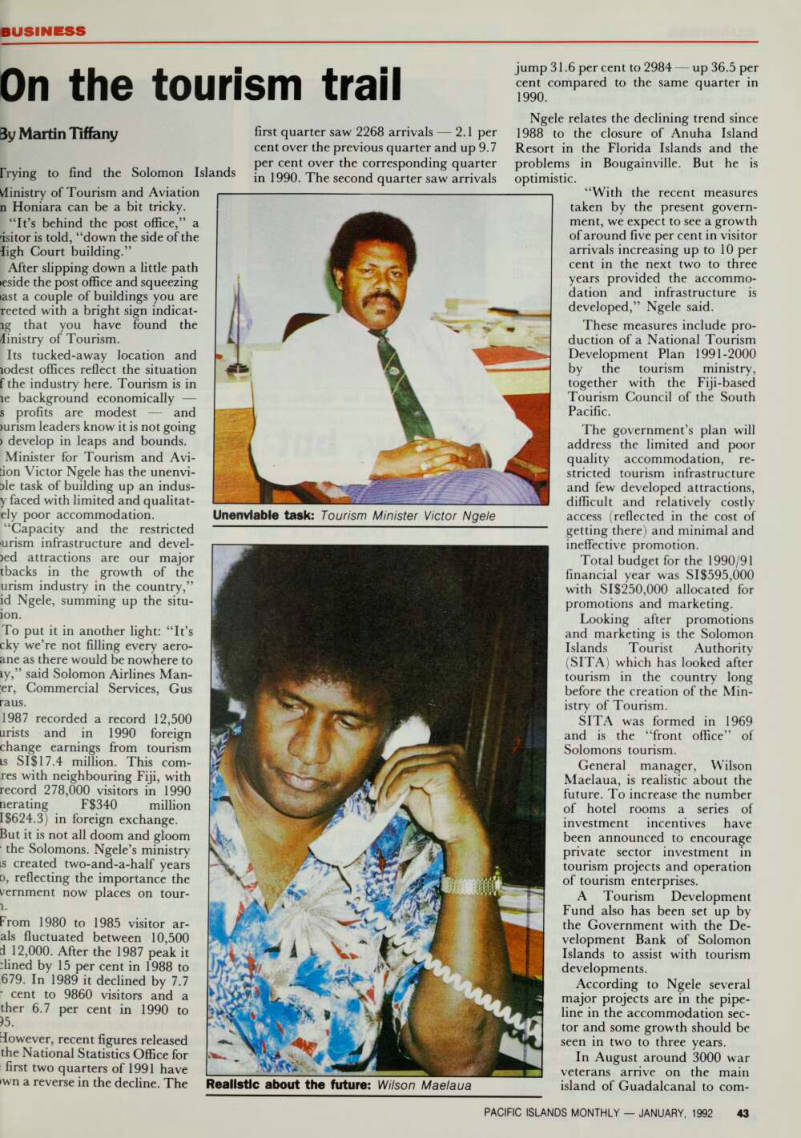
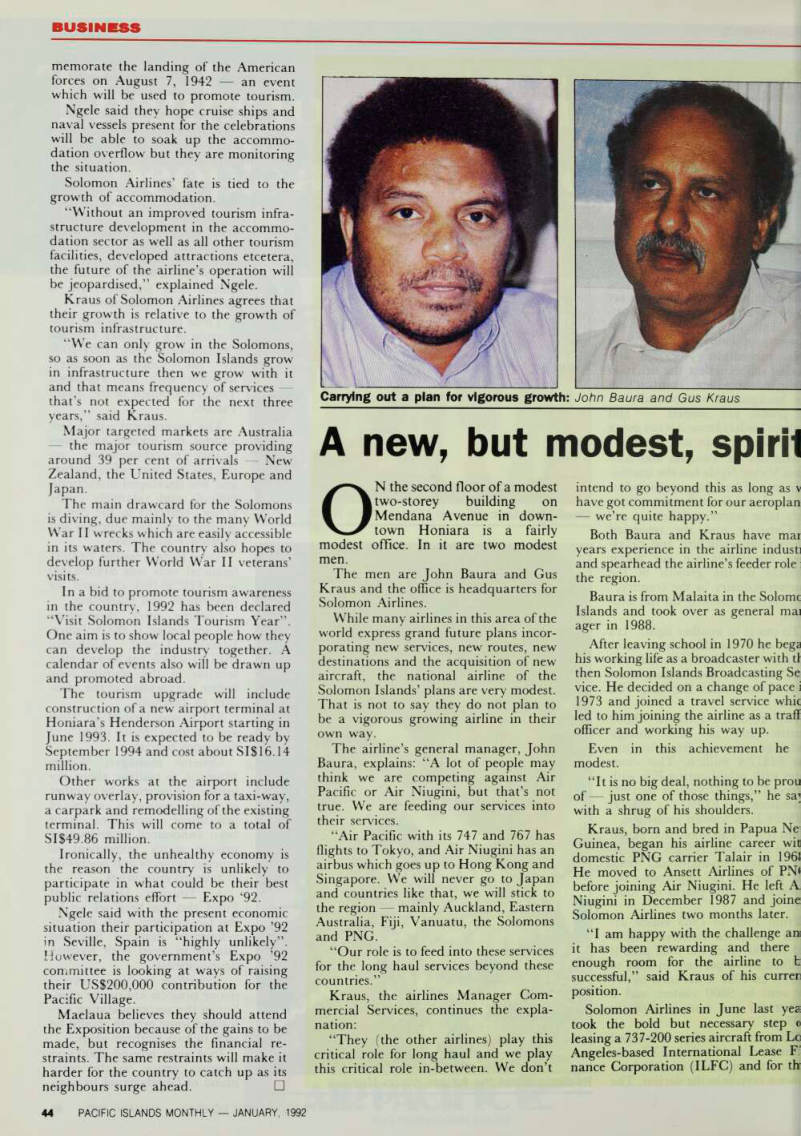
Business
By Martin Tiffany
Frying to find the Solomon Islands
Ministry of Tourism and Aviation n Honiara can be a bit tricky.
“It’s behind the post office,” a isitor is told, “down the side of the
figh Court building.”
After slipping down a little path ►eside the post office and squeezing last a couple of buildings you are reeled with a bright sign indicat ig that you have found the Ministry of Tourism.
Its tucked-away location and lodest offices reflect the situation f the industry here. Tourism is in
le background economically
s profits are modest and mrism leaders know it is not going ) develop in leaps and bounds.
Minister for Tourism and A vi sion Victor Ngele has the unenvi- Dle task of building up an indus y faced with limited and qualitat ely poor accommodation.
“Capacity and the restricted urism infrastructure and devel )ed attractions are our major tbacks in the growth of the urism industry in the country,”
id Ngele, summing up the situ
ion.
To put it in another light: “It’s cky we’re not filling every aero ane as there would be nowhere to ly,” said Solomon Airlines Man er, Commercial Services, Gus raus. 1987 recorded a record 12,500 Lirists and in 1990 foreign change earnings from tourism is SIS 17.4 million. This corn
res with neighbouring Fiji, with
record 278,000 visitors in 1990 tierating Fs34o million
15624.3) in foreign exchange.
But it is not all doom and gloom the Solomons. Ngele’s ministry is created two-and-a-half years
0, reflecting the importance the
vernment now places on tour 1, From 1980 to 1985 visitor ar als fluctuated between 10,500 d 12,000. After the 1987 peak it dined by 15 per cent in 1988 to 679. In 1989 it declined by 7.7 cent to 9860 visitors and a ther 6.7 per cent in 1990 to )5.
riowever, recent figures released
the National Statistics Office for first two quarters of 1991 have iwn a reverse in the decline. The
first quarter saw 2268 arrivals 2.1 per cent over the previous quarter and up 9.7 per cent over the corresponding quarter in 1990. The second quarter saw arrivals
jump 31.6 per cent to 2984 —up 36.5 per cent compared to the same quarter in 1990.
Ngele relates the declining trend since 1988 to the closure of Anuha Island Resort in the Florida Islands and the problems in Bougainville. But he is
optimistic.
“With the recent measures taken by the present govern ment, we expect to see a growth of around five per cent in visitor arrivals increasing up to 10 per cent in the next two to three years provided the accommo dation and infrastructure is developed,” Ngele said.
These measures include pro duction of a National Tourism Development Plan 1991-2000 by the tourism ministry, together with the Fiji-based Tourism Council of the South Pacific.
The government’s plan will address the limited and poor quality accommodation, re stricted tourism infrastructure and few developed attractions, difficult and relatively costly access (reflected in the cost of getting there) and minimal and ineffective promotion.
Total budget for the 1990/91 financial year was 515595,000 with 515250,000 allocated for
promotions and marketing.
Looking after promotions and marketing is the Solomon Islands Tourist Authority (SITA) which has looked after tourism in the country long before the creation of the Min istry of Tourism.
SITA was formed in 1969 and is the “front office” of Solomons tourism.
General manager, Wilson Maelaua, is realistic about the future. To increase the number of hotel rooms a series of investment incentives have been announced to encourage private sector investment in tourism projects and operation of tourism enterprises.
A Tourism Development Fund also has been set up by the Government with the De velopment Bank of Solomon Islands to assist with tourism
developments.
According to Ngele several major projects are in the pipe line in the accommodation sec tor and some growth should be seen in two to three years.
In August around 3000 war veterans arrive on the main island of Guadalcanal to com
Unenviable task: Tourism Minister Victor Ngele
Realistic about the future: Wilson Maelaua
memorate the landing of the American forces on August 7, 1942 an event which will be used to promote tourism.
Ngele said they hope cruise ships and naval vessels present for the celebrations will be able to soak up the accommo dation overflow but they are monitoring the situation.
Solomon Airlines’ fate is tied to the growth of accommodation.
“Without an improved tourism infra structure development in the accommo dation sector as well as all other tourism facilities, developed attractions etcetera, the future of the airline’s operation will
be jeopardised,” explained Ngele.
Kraus of Solomon Airlines agrees that their growth is relative to the growth of tourism infrastructure.
“We can only grow in the Solomons, so as soon as the Solomon Islands grow in infrastructure then we grow with it and that means frequency of services that’s not expected for the next three years,” said Kraus.
Major targeted markets are Australia the major tourism source providing around 39 per cent of arrivals New Zealand, the United States, Europe and
japan.
The main drawcard for the Solomons is diving, due mainly to the many World War II wrecks which are easily accessible in its waters. The country also hopes to develop further World War II veterans’ visits.
In a bid to promote tourism awareness in the country, 1992 has been declared “Visit Solomon Islands Tourism Year”.
One aim is to show local people how they can develop the industry together. A calendar of events also will be drawn up and promoted abroad.
The tourism upgrade will include construction of a new airport terminal at Honiara’s Henderson Airport starting in June 1993. It is expected to be ready by September 1994 and cost about SIS 16.14 million.
Other works at the airport include runway overlay, provision for a taxi-way, a carpark and remodelling of the existing terminal. This will come to a total of 51549.86 million.
Ironically, the unhealthy economy is the reason the country is unlikely to participate in what could be their best public relations effort Expo ‘92.
Ngele said with the present economic situation their participation at Expo ’92 in Seville, Spain is “highly unlikely”.
However, the government’s Expo ’92 committee is looking at ways of raising their US$2OO,OOO contribution for the
Pacific Village.
Maelaua believes they should attend the Exposition because of the gains to be made, but recognises the financial re straints. The same restraints will make it harder for the country to catch up as its neighbours surge ahead. □
A new, but modest, spirit
ON the second floor of a modest two-storey building on Mendana Avenue in down town Honiara is a fairly modest office. In it are two modest men.
The men are John Baura and Gus Kraus and the office is headquarters for Solomon Airlines.
While many airlines in this area of the world express grand future plans incor porating new services, new routes, new destinations and the acquisition of new aircraft, the national airline of the Solomon Islands’ plans are very modest.
That is not to say they do not plan to be a vigorous growing airline in their own way.
The airline’s general manager, John Baura, explains: “A lot of people may think we are competing against Air Pacific or Air Niugini, but that’s not true. We are feeding our services into their services.
“Air Pacific with its 747 and 767 has flights to Tokyo, and Air Niugini has an airbus which goes up to Hong Kong and Singapore. We will never go to Japan and countries like that, we will stick to the region mainly Auckland, Eastern Australia, Fiji, Vanuatu, the Solomons and PNG.
“Our role is to feed into these services for the long haul services beyond these countries.”
Kraus, the airlines Manager Com mercial Services, continues the expla nation: “They (the other airlines) play this critical role for long haul and we play this critical role in-between. We don’t
intend to go beyond this as long as v have got commitment for our aeroplan we’re quite happy.”
Both Baura and Kraus have mar years experience in the airline industi and spearhead the airline’s feeder role i the region.
Baura is from Malaita in the Solomc Islands and took over as general mai ager in 1988.
After leaving school in 1970 he bega his working life as a broadcaster with tl then Solomon Islands Broadcasting Se vice. He decided on a change of pace i 1973 and joined a travel service whic led to him joining the airline as a trail officer and working his way up.
Even in this achievement he modest.
“It is no big deal, nothing to be prou of just one of those things,” he with a shrug of his shoulders.
Kraus, born and bred in Papua Ne’
Guinea, began his airline career witl domestic PNG carrier Talair in 1961 He moved to Ansett Airlines of PNf before joining Air Niugini. He left A.
Niugini in December 1987 and joine Solomon Airlines two months later.
“I am happy with the challenge am it has been rewarding and there enough room for the airline to h successful,” said Kraus of his curren
position.
Solomon Airlines in June last yea took the bold but necessary step o leasing a 737-200 series aircraft from Lc Angeles-based International Lease F' nance Corporation (ILFC) and for thr
Carrying out a plan for vigorous growth: John Baura and Gus Kraus
first time began running a jet in its own right- They were forced into this decision by \ir Pacific’s expansion. In 1988 the iirline entered into a wet-lease arrange nent with Air Pacific along with using Air Pacific’s 737 to do the floniara-Brisbane run.
Air Pacific then decided to sell its 737 n order to purchase the bigger Boeing f 67 and concentrate more on markets mtside the region. This left Solomon Urlines with less than 12 months to find in alternative to their major service. [ “We were forced into making a [ecision, we went to Australia to all lomestic carriers, we went to PNG, Vanuatu and New Zealand even Air ’acific offered us their ATR-42 but obody could meet our needs. So we had 5 look at leasing,” explained Kraus.
“We scouted around, contacted ILFC nd nine months later we had a 737.”
The arrival of the aircraft meant that nally the airline’s international destiny as in its own hands, although the early ays were far from easy.
In its first month of operation, in June » July 1990, the service to Fiji lost loney as they were in competition with ir Pacific who still had their 737.
Prior to its inaugural flight the airline id the problem of going from running win Otters to running a Boeing 737 jet. nd they had just eight months to do it.
This left them very little time to get up and running on time, and no time r marketing. The result was initial ghts flying fairly empty, but business is now picked up to a profitable level, evenue rose to $l2 million in 1988, 5.5 million in 1989 and $23 million 5t year.
The airline also leases seats to Air icific, Air Vanuatu and Air Niugini on services to Nadi, Port Vila, Honiara d Port Moresby. It also has recently tered a wet-lease agreement with
)yal Tongan Airlines.
Solomon Airlines under this agree mt leases its 737, complete with crew,
Royal Tongan for a once weekly
vice to Auckland, Nadi and iku’alofa. These services combined th its flights to Cairns, Brisbane and dney leaves the airline about where it nts to be. Its 737 is being run
momically without being stretched
d they are not searching for any new portunities. \part from the airline’s 737, its fleet d has a Twin Otter, two Britten rman Islanders and a Piper Aztec. A fin Otter was recently lost by the line in a crash.
Fhese smaller aircraft are used on the line’s extensive domestic network, n May, Solomon Airlines will return 737-200 and lease the bigger 737-400
series aircraft. This will give it an additional 34 seats from 12 business class and 86 economy to 16 business class and 116 economy plus the fact that it will be more economical to run.
This will also cater for expected growth with planned accommodation growth expected to develop in 1993-94.
However, the growth of the airline is very much restricted to the growth of tourism infrastructure.
“We cannot grow any further around us, we can only grow in Solomons. So as soon as Solomon Islands grow in infrastructure then we grow with it and that means frequency of services which then develops to another type of air craft,” explained Kraus.
“That’s not expected in the next three years, so maybe in the next three to five years is decision time for another compatible aircraft even a 300 series.”
Solomon Islands Minister of Tourism and Aviation, Victor Ngele is also aware of the limiting effect of the current tourism infrastructure. He believes that without an improved tourism infrastruc ture the future of the airline’s operation could be jeopardised. (See story page Kraus added that as it is one of the
government’s philosophies to develop
small-holder resorts in the outer islands they also would have to look at domestic
reflecting.
For the future Baura and Kraus have no grand vision. They realise that at US$3O million (Ssloo million) the airline cannot hope to own its own 737, especially in light of the Solomon Island’s troubled economy.
The best they can hope for is to purchase a further domestic fleet aircraft which entails a much smaller capital outlay.
They are also mindful of the fact that they can only succeed as much as the bigger airlines let them.
“We are not forgetful of the fact that if they apply the squeezers we will feel the pinch. We serve a need left by Air Pacific and the needs are being met,” said Kraus.
Both are happy with the position the airline is in.
“We’re here to connect with our bigger brothers like Air Pacific and Air Niugini beyond Australia. We are not here to expand to fly 747 s unless something drastic happens,” said Baura.
“We will grow into hopefully a renowned Pacific niche carrier.”
Flying under the banner “The New Spirit of the Pacific” the airline plans to continue what it is doing playing a focal part in bridging the Pacific in its own modest way. □
Europe’s on
New markets?
Europe’s on everyone’s mind
GEORGE Pakoa has been quizzed more than often. Why do we have to go to Spain when the core of our tourism and trade are with Australia? He responds: We’ve got to reach new markets and Europe is on everyone’s mind.
Vanuatu’s mission at the world’s largest Expo in Seville from April to October is two-fold: tourists and entre preneurs. The level of european visitors to Vanuatu as been almost negligible, as with investors and trade.
“We feel strongly about Expo it will open our doors to Europeans,” says Pakoa, secretary of finance and chairman of the Expo Committee.
Vanuatu in some ways is more alluring to investors than other places in the region. But few investors know of the attractions: a 20-year-old tax haven scheme and finance centre.
“The difference between us and (the rest of the) Pacific is that we have no income tax and there is easy repatriation of profits,” said Pakoa. “We encourage companies to register here and operate overseas. In return we protect and manage people’s money.”
Vanuatu’s “untouched paradise” im age, promoted in New Zealand and Australia, will be taken to Seville.
Europeans would give tourism in Vanu atu a new twist and a wider base for tapping visitors.
Tourism is badly affected now with a recession in main source markets, Austra lia and New Zealand. “Europe will help us fill the gap,” said the National Tourism Office’s administration man ager, Linda Kalpoi. A study showed that European travellers like to explore Vanuatu’s unique and exotic spots.
“Vanuatu is always a special appeal.
It has volcanoes on Tanna, custom dances on outer islands, diving on Santo and the Pentecost jumps which has been copied in Fiji, New Zealand and others,” she said.
European tourists are Vanuatu’s tar get under a five-year master plan, not just because they are big spenders but also they take group tours, which are easier to sell. For years tourism managers in Vanuatu are worried about the small number of Europeans who get to Port
Vila through New Caledonia.
“Europeans reaching us were the extending stays in Noumea,” sa Kalpoi. But a lift of 6000 Europeans forecast in a couple of years to hit a targ of 40,000 arrivals by 1993.
After a brief recession in 1988, tour arrivals rose to 34,000 in 1990.
“Expo will be our starting point Europe,” said Kalpoi. “We’ve been London and Munich with TCSP befo but it won’t be like doing it on our ov in Spain.”
A government committee on Wor Expo has another plan: to mark Vanuatu’s exports to Spanish impor and into Europe. Vanuatu has rights use the preferential access rules in
European Community countries as
member of the Lome Convention. I current European market is only Franc which takes copra and cocoa for makir chocolates. But government trade office are enthusiastic about finding marke for Vanuatu’s quality beef, coffee, ga ments, kava (to be used for makir pharmaceuticals in Europe), garment veneer, tropical soap and furniture j
Europe.
Principal trade officer Roy Mickey h; done overseas market researches. “Oi export base is quite small and one of tt problems, has been poor infrastructm and government bureaucracy but as w prepare for Expo and Europe we’ll hav to do all it takes to promote oi potential,” Mickey told Pacific Islam
Monthly.
Mickey said Vanuatu is the only thir of eight island countries, invited by th European Community to be in th Pacific village at Expo, to pay v SUS 150,000. “We’re raising anothe $U570,000.” Several firms includin hotels, leading stylish garment manufac turer Michoutouchkine and the nei government National Bank of Vanuat will carry the republic’s name in Seville C
Expo on target
THE region’s Expo ’92 project is o target, despite the fact that the b event is just a few months away and on three countries have paid part of theii contributions.
Pavilion director and managing directoi of Pacific Discoveries Peter Colton saie Fiji, Vanuatu and Papua New Guine: had come forward with their contrii butions. The Forum Secretariat also hao assisted with an allocation of F$ 167,000 He said other countries were expected to come forward with their contribution! early in 1992. He said progress waj satisfactory in preparation for the Pacific Village pavilion, which will be a feature of the Seville Universal Expo ’92 in Spain from April to October. C
Advertisements & other items, p. 46 (1 item)
Vacancies
WILL THE
JEWS & ARABS
EVER LIVE IN
PEACE?
For this FREE booklets ‘The Arabs in Bible Prophecy”
Writeto-.-
THE CHRISTADELPHIANS
G.P.O. BOX 881
ADELAIDE
S.A. 5001
AUSTRALIA.
Rent A Car
THE WORLD’S NO. 1
WHERE QUALITY AND SAFETY COUNT.
To drive the roads of Fiji is to experience some of the most beautiful scenery of the South Pacific, especially with Hertz.
A For Reservations Phone: Nadi Airport 722146 Suva 383150,383411,383677 Telex; 2237, Fax: 370212 With Hertz you get more than just a car.
m
FORUM SECRETARIAT
VACANCIES
ENERGY POSITIONS
Applications are invited from suitably qualified and experienced persons for positions in the Petroleum Section of the Forum Secretariat’s Energy Division. These positions are at advisor levels and appointments will be made according to qualifications and experience.
The Energy Division has recently been reorganised and expanded to comply with the wishes of the Forum that, at the conclusion of the current funding cycle for the United Nations Pacific Energy Development Programme (PEDP) at the end of 1991, all regional energy activities be brought under the management of the Forum Secretariat. Accordingly the Division now has three sections, Petroleum (formerly the Regional Petroleum Unit), Power (incorporating many of the activities formerly carried out by PEDP) and Renewables. The Division provides policy advice, planning and technical assistance to member countriees in all these areas, including a substantial training element.
Activities covered by the Petroleum Section include: (i) establishment of a comprehensive data base of petroleum supply and demand, pricing operations, storage, shipping, etc in the region; (ii) provision of advice to member governments on engineering and safety standards of installations for both ground and aviation fuels, quality control procedures and the environmental impact and consequences of petroleum related activities; (iii) planning, directing and participating in studies concerning the supply of petroleum and petroleum operations in the Pacific; and (iv) provision of advice to member governments on issues relating to price surveillance, price control and contract negotiations.
The appointees will be required to develop appropriate managerial and technical training programmes and identify training opportunities for island nationals. Duties also include representing the Secretariat on committees and meetings and maintaining liaison with other groups working on the related issues in the Pacific.
Applicants should have relevant tertiary qualifications in economics, engineering or management with a minimum of five years experience in the petroleum or a related industry, preferably with some involvement in the Forum Island Countries.
Candidates must have the ability ot relate to people from a wide range of backgrounds, be able to train Forum Island personnel and must have good written and oral communication skills. The positions will entail extensive travel throughout the region.
The appointments will carry attractive remuneration packages, payble in Fiji dollars. For non Fiji citizen this is tax free and include superannuation payments and medical, life and travel insurance. The appointees will be based in Suva at Secretariat Headquaters. Appointments would be for three years initially, subject to a six month probationary period, with the option to renew for a further three years by mutual agreement.
Applications, which close on 31 January, 1992, should contain full information of education and career background and should include names, addresses and telephone numbers of three referees with whom the applicant has been associated in a professional capacity.
Applications should be addressed to.- The Secretary General Forum Secretariat GPO Box 856, Suva, Fiji Tel: 312600; Telex: 2229FJ; Fax: 302204/301102 Further information is available on request and all enquiries should be addressed to Mrs Lailun Khan, Administration Officer on 312600 Extn. 218.
Fast forward for Videopac
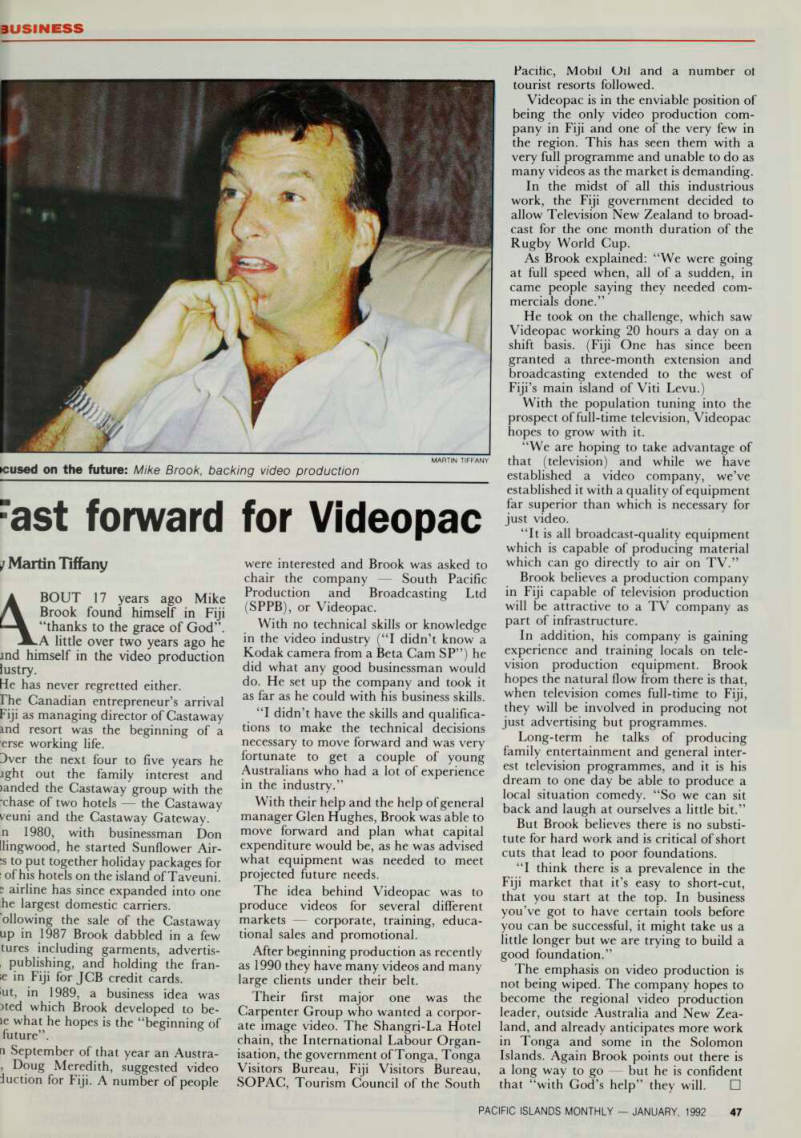
By Martin Tiffany
A BOUT 17 years ago Mike Brook found himself in Fiji % “thanks to the grace of God”.
JLA little over two years ago he md himself in the video production
lustry.
He has never regretted either.
Fhe Canadian entrepreneur’s arrival Fiji as managing director of Castaway md resort was the beginning of a erse working life.
Dver the next four to five years he jght out the family interest and >anded the Castaway group with the "chase of two hotels the Castaway
veuni and the Castaway Gateway,
n 1980, with businessman Don ilingwood, he started Sunflower Air 's to put together holiday packages for : of his hotels on the island of Taveuni.
“ airline has since expanded into one he largest domestic carriers. ©flowing the sale of the Castaway up in 1987 Brook dabbled in a few tures including garments, advertis pu Wishing, and holding the fran ie in Fiji for JCB credit cards, ht, in 1989, a business idea was )ted which Brook developed to be le what he hopes is the “beginning of future”. n September of that year an Austra , Doug Meredith, suggested video Juction for Fiji. A number of people
were interested and Brook was asked to chair the company South Pacific Production and Broadcasting Ltd
(SPPB), or Videopac.
With no technical skills or knowledge in the video industry (“I didn’t know a Kodak camera from a Beta Cam SP”) he did what any good businessman would do. He set up the company and took it as far as he could with his business skills.
“I didn’t have the skills and qualifica tions to make the technical decisions necessary to move forward and was very fortunate to get a couple of young Australians who had a lot of experience in the industry.”
With their help and the help of general manager Glen Hughes, Brook was able to move forward and plan what capital expenditure would be, as he was advised what equipment was needed to meet projected future needs.
The idea behind Videopac was to produce videos for several different markets corporate, training, educa tional sales and promotional.
After beginning production as recently as 1990 they have many videos and many large clients under their belt.
Their first major one was the Carpenter Group who wanted a corpor ate image video. The Shangri-La Hotel chain, the International Labour Organ isation, the government of Tonga, Tonga Visitors Bureau, Fiji Visitors Bureau, SOPAC, Tourism Council of the South
Pacific, Mobil Oil and a number ol tourist resorts followed.
Videopac is in the enviable position of being the only video production com pany in Fiji and one of the very few in the region. This has seen them with a very full programme and unable to do as many videos as the market is demanding.
In the midst of all this industrious work, the Fiji government decided to allow Television New Zealand to broad cast for the one month duration of the
Rugby World Cup.
As Brook explained: “We were going at full speed when, all of a sudden, in came people saying they needed com mercials done.”
He took on the challenge, which saw Videopac working 20 hours a day on a shift basis. (Fiji One has since been granted a three-month extension and broadcasting extended to the west of Fiji’s main island of Viti Levu.) With the population tuning into the prospect of full-time television, Videopac hopes to grow with it.
“We are hoping to take advantage of that (television) and while we have established a video company, we’ve established it with a quality of equipment far superior than which is necessary for
just video.
“It is all broadcast-quality equipment which is capable of producing material which can go directly to air on TV.”
Brook believes a production company in Fiji capable of television production will be attractive to a TV company as part of infrastructure.
In addition, his company is gaining experience and training locals on tele
vision production equipment. Brook
hopes the natural flow from there is that, when television comes full-time to Fiji, they will be involved in producing not
just advertising but programmes.
Long-term he talks of producing family entertainment and general inter est television programmes, and it is his dream to one day be able to produce a local situation comedy. “So we can sit back and laugh at ourselves a little bit.”
But Brook believes there is no substi tute for hard work and is critical of short cuts that lead to poor foundations.
“I think there is a prevalence in the Fiji market that it’s easy to short-cut, that you start at the top. In business you’ve got to have certain tools before you can be successful, it might take us a little longer but we are trying to build a good foundation.”
The emphasis on video production is not being wiped. The company hopes to become the regional video production leader, outside Australia and New Zea land, and already anticipates more work in Tonga and some in the Solomon Islands. Again Brook points out there is a long way to go but he is confident that “with God’s help” they will. □
[?] eused on the future: Mike Brook, backing video production
Shipping
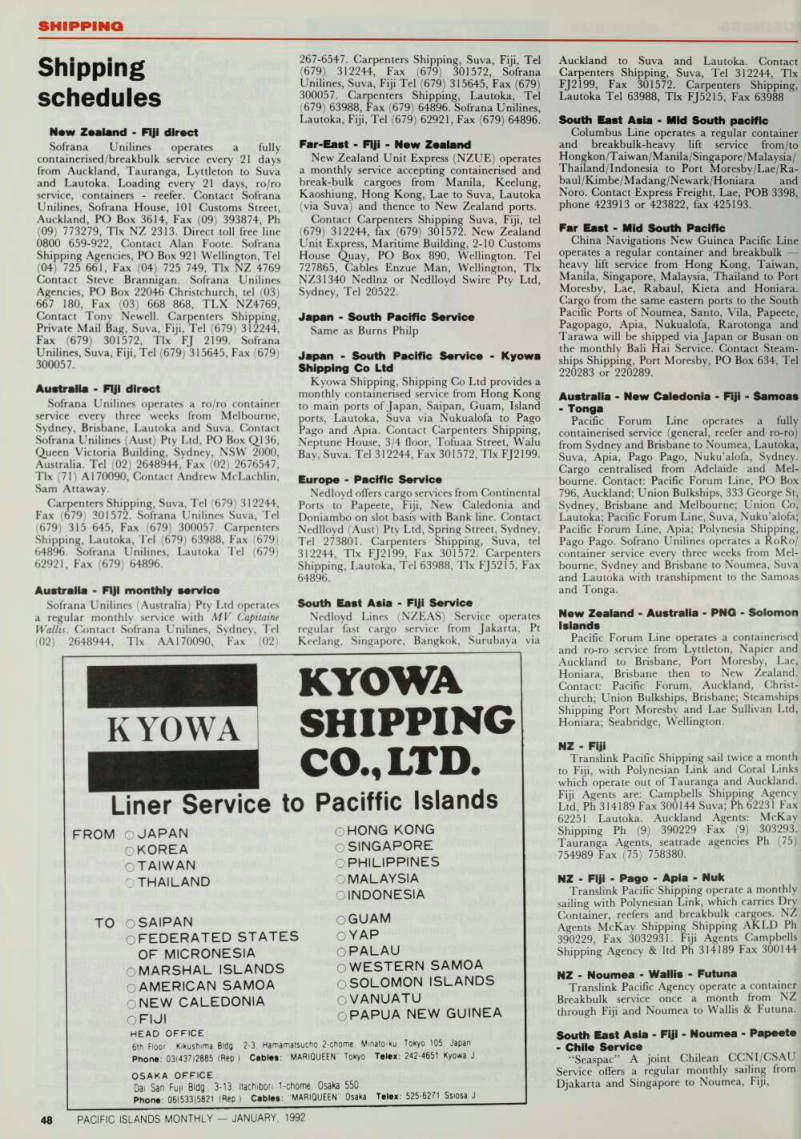
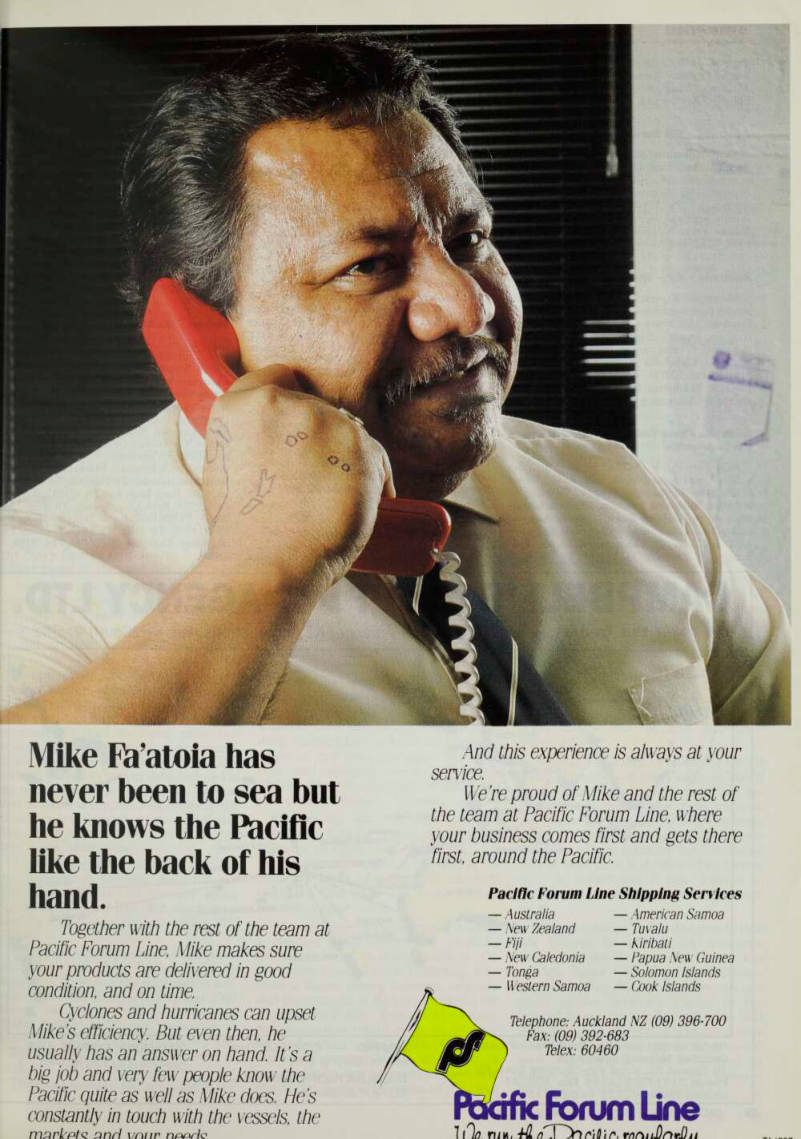
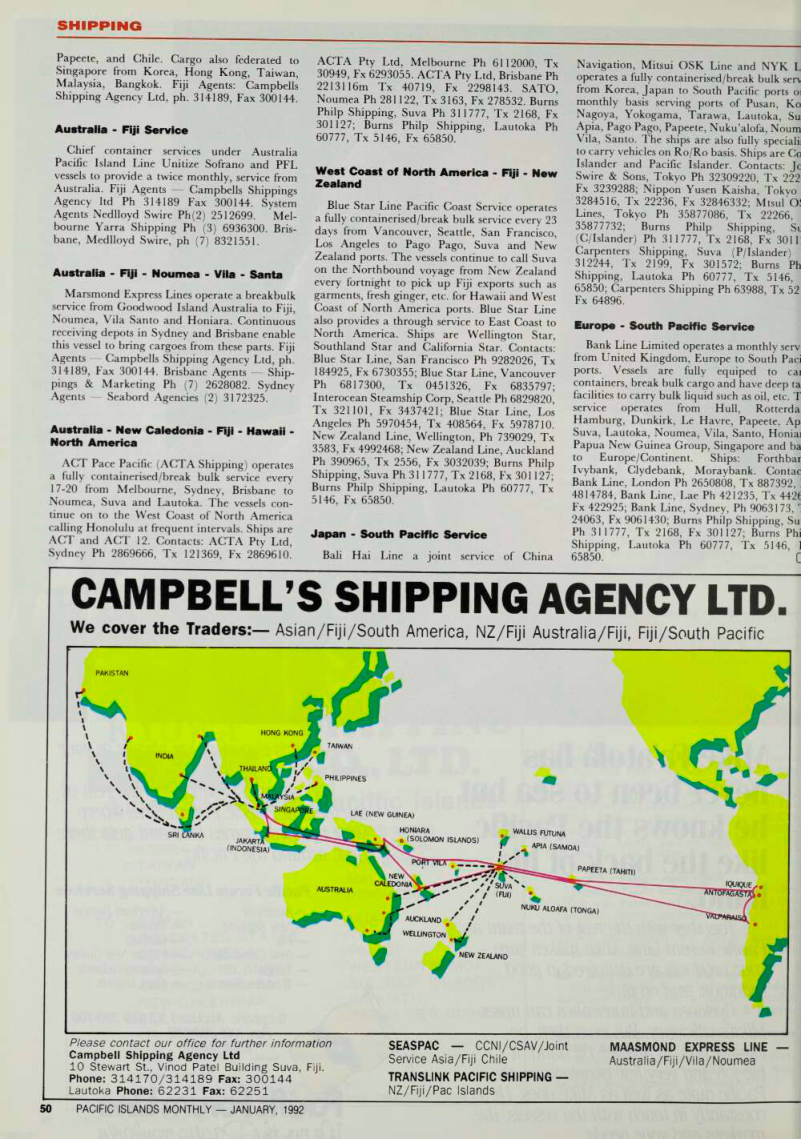
schedules
New Zealand - Fiji direct Sofrana Unilines operates a fully containerised/breakbulk service every 21 days from Auckland, Tauranga, Lyttleton to Suva and Lautoka. Loading every 21 days, ro/ro service, containers - reefer. Contact Sofrana Unilines, Sofrana House, 101 Customs Street, Auckland, PO Box 3614, Fax (09) 393874, Ph (09) 773279, Tlx NZ 2313. Direct toll free line 0800 659-922, Contact Alan Foote. Sofrana Shipping Agencies, PO Box 921 Wellington, Tel (04) 725 661, Fax (04) 725 749, Tlx NZ 4769 Contact Steve Brannigan. Sofrana Unilines Agencies, PO Box 22046 Christchurch, tel (03) 667 180, Fax (03) 668 868, TLX NZ4769,
Contact Tony Newell. Carpenters Shipping,
Private Mail Bag, Suva, Fiji, Tel (679) 312244, Fax (679) 301572, Tlx FJ 2199. Sofrana Unilines, Suva, Fiji, Tel (679) 315645, Fax (679) 300057.
Australia - FIJI direct Sofrana Unilines operates a ro/ro container service every three weeks from Melbourne, Sydney, Brisbane, Lautoka and Suva. Contact Sofrana Unilines (Aust) Pty Ltd, PO Box Q 136,
Queen Victoria Building, Sydney, NSW 2000,
Australia. Tel (02) 2648944, Fax (02) 2676547, Tlx (71) A 170090, Contact Andrew McLachlin, Sam Attaway.
Carpenters Shipping, Suva, Tel (679) 312244, Fax (679) 301572. Sofrana Unilines Suva, Tel (679) 315 645, Fax (679) 300057. Carpenters Shipping, Lautoka, Tel (679) 63988, Fax (679) 64896. Sofrana Unilines, Lautoka Tel (679) 62921, Fax (679) 64896.
Australia - Fiji monthly sarvica Sofrana Unilines (Australia) Pty Ltd operates a regular monthly service with MV Capitaine Wallis. Contact Sofrana Unilines, Sydney, Tel (02) 2648944, Tlx AA170090, Fax (02)
267-6547. Carpenters Shipping, Suva, Fiji, Tel (679) 312244, Fax (679) 301572, Sofrana Unilines, Suva, Fiji Tel (679) 315645, Fax (679) 300057. Carpenters Shipping, Lautoka, Tel (679) 63988, Fax (679) 64896. Sofrana Unilines, Lautoka, Fiji, Tel (679) 62921, Fax (679) 64896.
Far-East - Fiji - New Zealand New Zealand Unit Express (NZUE) operates a monthly service accepting containerised and break-bulk cargoes from Manila, Keelung, Kaoshiung, Hong Kong, Lae to Suva, Lautoka (via Suva) and thence to New Zealand ports.
Contact Carpenters Shipping Suva, Fiji, tel (679) 312244, fax (679) 301572. New Zealand Unit Express, Maritime Building, 2-10 Customs House Quay, PO Box 890, Wellington. Tel 727865, Cables Enzue Man, Wellington, Tlx NZ31340 Nedlnz or Nedlloyd Swire Pty Ltd, Sydney, Tel 20522.
Japan - South Pacific Service Same as Burns Philp Japan - South Pacific Service - Kyowa Shipping Co Ltd Kyowa Shipping, Shipping Co Ltd provides a monthly containerised service from Hong Kong to main ports of Japan, Saipan, Guam, Island ports, Lautoka, Suva via Nukualofa to Pago
Pago and Apia. Contact Carpenters Shipping,
Neptune House, 3/4 floor, Tofuaa Street, Walu Bay, Suva. Tel 312244, Fax 301572, Tlx FJ2199.
Europe - Pacific Service Nedloyd offers cargo services from Continental Ports to Papeete, Fiji, New Caledonia and Doniambo on slot basis with Bank line. Contact Nedlloyd (Aust) Pty Ltd, Spring Street, Sydney, Tel 273801. Carpenters Shipping, Suva, tel 312244, Tlx FJ2199, Fax 301572. Carpenters Shipping, Lautoka, Tel 63988, Tlx FJ5215, Fax 64896.
South East Asia - Fiji Service Nedloyd Lines (NZEAS) Service operates regular fast cargo service from Jakarta, Pt Keelang, Singapore, Bangkok, Surubaya via
Auckland to Suva and Lautoka. Contact Carpenters Shipping, Suva, Tel 312244, Tlx FJ2199, Fax 301572. Carpenters Shipping, Lautoka Tel 63988, Tlx FJ5215, Fax 63988 South East Asia - Mid South pacific Columbus Line operates a regular container and breakbulk-heavy lift service from/to
Hongkon/Taiwan/Manila/Singapore/Malaysia/
Thailand/Indonesia to Port Moresby/Lae/Ra
baul/Kimbe/Madang/Newark/Honiara and
Noro. Contact Express Freight, Lae, POB 3398, phone 423913 or 423822, fax 425193.
Far East - Mid South Pacific China Navigations New Guinea Pacific Line operates a regular container and breakbulk heavy lift service from Hong Kong, Taiwan, Manila, Singapore, Malaysia, Thailand to Port Moresby, Lae, Rabaul, Kieta and Honiara.
Cargo from the same eastern ports to the South Pacific Ports of Noumea, Santo, Vila, Papeete, Pagopago, Apia, Nukualofa, Rarotonga and Tarawa will be shipped via Japan or Busan on the monthly Bali Hai Service. Contact Steam ships Shipping, Port Moresby, PO Box 634, Tel 220283 or 220289.
Australia - New Caledonia - Fiji - Samoas - Tonga Pacific Forum Line operates a fully containerised service (general, reefer and ro-ro) from Sydney and Brisbane to Noumea, Lautoka, Suva, Apia, Pago Pago, Nuku’alofa, Sydney.
Cargo centralised from Adelaide and Mel bourne. Contact; Pacific Forum Line, PO Box 796, Auckland; Union Bulkships, 333 George St, Sydney, Brisbane and Melbourne; Union Co, Lautoka; Pacific Forum Line, Suva, Nuku’alofa; Pacific Forum Line, Apia; Polynesia Shipping, Pago Pago. Sofrano Unilines operates a Roßo/ container service every three weeks from Mel bourne, Sydney and Brisbane to Noumea, Suva and Lautoka with transhipment to the Samoas and Tonga.
New Zealand - Australia - PNG - Solomon Islands Pacific Forum Line operates a containerised and ro-ro service from Lyttleton, Napier and Auckland to Brisbane, Port Moresby, Lae, Honiara, Brisbane then to New Zealand.
Contact: Pacific Forum, Auckland, Christ church; Union Bulkships, Brisbane; Steamships Shipping Port Moresby and Lae Sullivan Ltd, Honiara; Seabridge, Wellington.
NZ - Fiji Translink Pacific Shipping sail twice a month to Fiji, with Polynesian Link and Coral Links which operate out of Tauranga and Auckland.
Fiji Agents are: Campbells Shipping Agency Ltd, Ph 314189 Fax 300144 Suva; Ph 62231 Fax 62251 Lautoka. Auckland Agents: McKay Shipping Ph (9) 390229 Fax (9) 303293.
Tauranga Agents, seatrade agencies Ph (75) 754989 Fax (75) 758380.
NZ - Fiji - Pago - Apia - Nuk Translink Pacific Shipping operate a monthly sailing with Polynesian Link, which carries Dry Container, reefers and breakbulk cargoes. NZ Agents McKay Shipping Shipping AKLD Ph 390229, Fax 3032931. Fiji Agents Campbells Shipping Agency & ltd Ph 314189 Fax 300144 NZ - Noumea - Wallis - Futuna Translink Pacific Agency operate a container Breakbulk service once a month from NZ through Fiji and Noumea to Wallis & Futuna.
South East Asia - Fiji - Noumea - Papeete - Chile Service “Seaspac” A joint Chilean CCNI/CSAU Service offers a regular monthly sailing from Djakarta and Singapore to Noumea, Fiji,
Papeete, and Chile. Cargo also federated to Singapore from Korea, Hong Kong, Taiwan,
Malaysia, Bangkok. Fiji Agents: Campbells
Shipping Agency Ltd, ph. 314189, Fax 300144.
Australia - Fiji Service Chief container services under Australia Pacific Island Line Unitize Sofrano and PFL vessels to provide a twice monthly, service from
Australia. Fiji Agents Campbells Shippings
Agency ltd Ph 314189 Fax 300144. System Agents Nedlloyd Swire Ph(2) 2512699. Mel bourne Yarra Shipping Ph (3) 6936300. Bris bane, Medlloyd Swire, ph (7) 8321551.
Australia - Fiji - Noumea - Vila - Santa Marsmond Express Lines operate a breakbulk service from Goodwood Island Australia to Fiji, Noumea, Vila Santo and Honiara. Continuous receiving depots in Sydney and Brisbane enable this vessel to bring cargoes from these parts. Fiji
Agents Campbells Shipping Agency Ltd, ph.
314189, Fax 300144. Brisbane Agents Ship pings & Marketing Ph (7) 2628082. Sydney Agents Seabord Agencies (2) 3172325.
Australia - New Caledonia - Fiji - Hawaii - North America ACT Pace Pacific (ACTA Shipping) operates a fully containerised/break bulk service every 17-20 from Melbourne, Sydney, Brisbane to Noumea, Suva and Lautoka. The vessels con tinue on to the West Coast of North America calling Honolulu at frequent intervals. Ships are ACT and ACT 12. Contacts: ACTA Pty Ltd, Sydney Ph 2869666, Tx 121369, Fx 2869610.
ACTA Pty Ltd, Melbourne Ph 6112000, Tx 30949, Fx 6293055. ACTA Pty Ltd, Brisbane Ph 2213116 m Tx 40719, Fx 2298143. SATO, Noumea Ph 281122, Tx 3163, Fx 278532. Burns Philp Shipping, Suva Ph 311777, Tx 2168, Fx 301127; Burns Philp Shipping, Lautoka Ph 60777, Tx 5146, Fx 65850.
West Coast off North America - Fiji - New Zealand Blue Star Line Pacific Coast Service operates a fully containerised/break bulk service every 23 days from Vancouver, Seattle, San Francisco, Los Angeles to Pago Pago, Suva and New Zealand ports. The vessels continue to call Suva on the Northbound voyage from New Zealand every fortnight to pick up Fiji exports such as garments, fresh ginger, etc. for Hawaii and West Coast of North America ports. Blue Star Line also provides a through service to East Coast to North America. Ships are Wellington Star, Southland Star and California Star. Contacts: Blue Star Line, San Francisco Ph 9282026, Tx 184925, Fx 6730355; Blue Star Line, Vancouver Ph 6817300, Tx 0451326, Fx 6835797; Interocean Steamship Corp, Seattle Ph 6829820, Tx 321101, Fx 3437421; Blue Star Line, Los Angeles Ph 5970454, Tx 408564, Fx 5978710.
New Zealand Line, Wellington, Ph 739029, Tx 3583, Fx 4992468; New Zealand Line, Auckland Ph 390965, Tx 2556, Fx 3032039; Burns Philp Shipping, Suva Ph 311777, Tx 2168, Fx 301127; Burns Philp Shipping, Lautoka Ph 60777, Tx 5146, Fx 65850.
Japan - South Pacific Service Bali Hai Line a joint service of China
Navigation, Mitsui OSK Line and NYK L operates a fully containerised/break bulk ser\ from Korea, Japan to South Pacific ports 01 monthly basis serving ports of Pusan, Ko Nagoya, Yokogama, Tarawa, Lautoka, Su Apia, Pago Pago, Papeete, Nukualofa, Noum Vila, Santo. The ships are also fully special!: to carry vehicles on Ro/Ro basis. Ships are Cc Islander and Pacific Islander. Contacts: Jc Swire & Sons, Tokyo Ph 32309220, Tx 222 Fx 3239288; Nippon Yusen Kaisha, Tokyo 3284516, Tx 22236, Fx 32846332; Mtsul O: Lines, Tokyo Ph 35877086, Tx 22266, 35877732; Burns Philp Shipping, Si (C/Islander) Ph 311777, Tx 2168, Fx 3011
Carpenters Shipping, Suva (P/Islander)
312244, Tx 2199, Fx 301572: Burns Ph Shipping, Lautoka Ph 60777, Tx 5146, 65850; Carpenters Shipping Ph 63988, Tx 52 Fx 64896.
Europe - South Pacific Service Bank Line Limited operates a monthly serv from United Kingdom, Europe to South Pad ports. Vessels are fully equiped to cai containers, break bulk cargo and have deep ta facilities to carry bulk liquid such as oil, etc. T service operates from Hull, Rotterda Hamburg, Dunkirk, Le Havre, Papeete, Ap Suva, Lautoka, Noumea, Vila, Santo, Honiai Papua New Guinea Group, Singapore and ba to Europe/Continent. Ships; Forthbai Ivybank, Clydebank, Moraybank. Contac Bank Line, London Ph 2650808, Tx 887392, 4814784, Bank Line, Lae Ph 421235, Tx 442 f Fx 422925; Bank Line, Sydney, Ph 9063173, r 24063, Fx 9061430; Burns Philp Shipping, Su Ph 31 1777, Tx 2168, Fx 301127; Burns Phi Shipping, Lautoka Ph 60777, Tx 5146, ] 65850. C
Advertisements & other items, pp. 48-50 (1 item)
Co., Ltd.
KYOWA
Liner Service
FROM OJAPAN
OKOREA
OTAIWAN
G THAILAND
TO O SAIPAN
OFEDERATED STATES
OF MICRONESIA
OMARSHAL ISLANDS
OAMERICAN SAMOA
ONEW CALEDONIA
O FIJI
KYOWA
SHIPPING
CO., LTD.
to Paciffic Islands
OHONG KONG
OSINGAPORE
OPHILIPPINES
OMALAYSIA
©INDONESIA
OGUAM
OYAP
OPALAU
©WESTERN SAMOA
©SOLOMON ISLANDS
©VANUATU
©PAPUA NEW GUINEA
HEAD OFFICE
6th Floor , Kikushima Bldg 2-3, Hamamatsucho 2-chome Mmato-ku, Tokyo 105. Japan Phone: 03(437)2885 (Rep ) Cables: MARIQUEEN Tokyo Telex: 242-4651 Kyowa J
OSAKA OFFICE
Dai San Fuji Bldg. 3-13 Itachibon 1-chome. Osaka 550 Phone: 06(533)5821 (Rep ) Cables: MARIQUEEN" Osaka Telex: 525-6271 Ssiosa J
r I s: o
Mike Faatoia has
never been to sea but
he knows the Pacific
like the back of his
hand.
And this experience is always at your service.
We’re proud of Mike and the rest of the team at Pacific Forum Line, where your business comes first and gets there first, around the Pacific.
Pacific Forum Line Shipping Services Together with the rest of the team at Pacific Forum Line, Mike makes sure your products are delivered in good condition, and on time.
Cyclones and hurricanes can upset Mike’s efficiency. But even then, he usually has an answer on hand. It a big job and very few people know the Pacific quite as well as Mike does. He’s constantly in touch with the vessels, the marlcptQ pnrl \/nnr n/mrh I Australia New Zealand Fiji New Caledonia Tonga Western Samoa American Samoa Tuvalu Kiribati Fapua New Guinea Solomon Islands Cook Islands Telephone: Auckland NZ (09) 396-700 Fax: (09) 392-683 Telex: 60460
Forum Line
1 lln mu, FH rnrmDnrUn
CAMPBELL’S SHIPPING AGENCY LTD.
We cover the Traders:— Asian/Fijj/South America, NZ/Fiji Australia/Fiji, Fiji/South Pacific
PAKISTAN
HONG KONG
TAIWAN
'NOW
THAI LAN
I ** w V \
PHILIPPINES
V \ t I V \
LAE (NEW GUINEA)
HONIARA WALI
• (SOLOMON ISLANDS)
» yl
WALLIS FUTUNA
APIA (SAMOA)
JAKARTA
(INDONESIA)
PAPEETA (TAHITI)
NUKU ALOAFA (TONGA)
NEW \
edonia
IQUKDUE
AUSTRALIA
AUCKLAND / /
10* m * WELUNGTON
j ANEW ZEALAND
Please contact our office for further information Campbell Shipping Agency Ltd 10 Stewart St., Vinod Patel Building Suva, Fiji.
Phone: 314170/314189 Fax: 300144 Lautoka Phone: 62231 Fax: 62251
SEASPAC CCNI/CSAV/Joint
Service Asia/Fiji Chile
TRANSLINK PACIFIC SHIPPING
NZ/Fiji/Pac Islands
MAASMOND EXPRESS LINE
Australia/Fiji/Vila/Noumea
Trash or treasure beneath
Tourism
Trash or treasure beneath a tale of two harbours
By David North
THE American flag flies over both harbours, and at the bot tom of both harbours lie relics of World War 11. Some powerful actors want to raise them to the surface, and others want to keep them right where they are.
This tale of two harbours is developing along different lines in Pago Pago, American Samoa, and in Koror, Palau.
In Samoa the underwater relic is regarded as a menace to the health and happiness of the people living around its edge. Congressman Eni F.H.
Faleomavaega wants it removed quickly, and at Uncle Sam’s expense.
In Palau, one faction wants to keep the relic under water as a specialised tourist attraction, while the other wants to vaise it and ship it off to a Mainland desert community, also as a tourist attraction.
In Samoa it is a US Navy ship which the Navy scuttled in the harbour shortly after World War II; the vessel exploded, caught fire, killed a couple of sailors and the Navy figured that sinking it was the wisest move at the time.
In Palau the relic also reached its watery grave through US military ac tion, but of a more violent kind. The Zero fighter plane was shot down in one of the air battles over Palau during World War 11.
Congressman Faleomavaega pays at
tention to the once-clear, now badly polluted Pago Pago Bay. The tuna canneries vital to the territory’s economy used to dump their raw sewage, mostly the innards of dead tuna, in the Bay. Now the most foul-smelling refuse is placed in barges then dumped in the ocean, several miles off shore. At least that is what is supposed to happen; the :anneries are slapped on the wrist with ines, from time to time, for failing to
neet these obligations.
The Congressman, wanting to keep he canneries in business, must balance hat concern with his worries about iegradation of the Bay. But there is no iced for restraint on the issue of the USS Chehalis.
Faleomavaega argues the old ship is a ource of pollution, harmful t 3 A the mvironment. When the ship sank it had arge quantities of oil on board, and 2000 ounds of 3-inch artillery shells and 6,000 rounds of 20 mm ammunition; hus there was a lot of lead on board and t has had more than four decades to each into the water of the bay.
The Congressman has appealed to the
US Environmental Protection Adminis tration (EPA) for help in the cleanup.
Maybe he should also address his request to the US Navy, which a) has much more money than EPA, and b) was in charge of Samoa when the sinking occurred. (Navy captains served as Governor of Samoa from the arrival of the US at the end of the 19th Century until the Department of Interior took over in 1951.) The Congressman’s call for help in cleaning up the harbour came after several press reports on the toxic con ditions in the inner harbour, and warn ings from the territorial government not to eat fish caught in the inner harbour.
They are likely to carry high levels of metals, and to be particularly dangerous to children; mental retardation and cancer can result from eating too many of them.
While the political establishment in Samoa is not divided by the USS Chehalis issue, the question of the proper resting place for the Zero is at the heart of a very Palauan political controversy.
The person wanting to lift the plane from the depths is Shallum Etpison, son of the embattled Presi dent of the Re public of Palau,
Ngiratkel
Etpison; the son owns Neco Mar ine Corp; which
wants to move the plane from its 60-foot deep resting place in Malakai Harbour.
Once on dry land, the plane would be sold and shipped to the Champlin Fighter Museum, located in the desert just outside Phoenix, Arizona.
One of the elder Etpison’s cabinet members, Okada Techitong, Palau’s Minister of Commerce and Trade, ap proved the recovery, and the sale, of the plane by Neco Marine. One rationale might be that it would boost Palau’s anaemic export totals.
The decision by the Minister created a two-tier local controversy, partially commercial and partially political. On the former level, Francis Toribiong, who owns a Koror diving business, objected that the removal of the plane violated the Republic of Palau’s Lagoon Monument Act, legislation which seeks to preserve the underwater relics of World War 11.
Toribiong presumably is interested in renting diving equipment to tourists, and one of the many attractions of the clear
A menace to the health and happiness of the people or a special tourist attraction
water around Palau is the underwater Zero.
Toribiong took Neco Marine Gorp into Palau’s Supreme Court seeking an injunction against the removal of the
plane.
Meanwhile, Senator Joshua Koshiba, president of the upper house of Palau’s Congress, the Olbiil Era Kelulau, and perhaps a future candidate for the presidency of the Republic, waded into the issue at the political level.
He appealed both to Stella Guerra, the US Assistant Secretary of Interior for Territorial and International Affairs, and to the Special Prosecutor of the Trust Territory of the Pacific to investi gate. In his letter to Guerra Koshiba, said that President Etpison “has at tempted to abuse his discretion by allowing his son to take this aircraft from the monument”.
The Senator continued: "I am confi dent that the Champlin Fighter Museum either paid or was going to pay Shallum Etpison for this aircraft. This situation appears to be another example o( government corruption and self
dealing.”
There are a couple of ironies implicit in the Senator's statement. First, a few months earlier he and every other
ranking Palau politician objected
vehemently when Ms Guerra ex tended her powers, and limited the freedom of action,
particularly in
financial affairs,
previously enjoyed
by the Republic.
The Senator is ask ing for just the kind of intervention in
local affairs that he had previously protested.
Second, the Special Prosecutor for the Trust Territory of the Pacific is David Webster, an official who owes his ap pointment to the Mainland government, not to that of Palau. The Trust Territory, which formerly governed all ihe once- Japanese islands taken by the US during World War 11, is a shadow of its former self. Its jurisdiction is now limited to Palau, and its staff has shrunk to a dozen or so.
The speculation in Washington is that Ms Guerra is unlikely to intervene directly in the Zero matter she has enough issues with President Etpison without adding this one. Further, she can point to the Senator’s appeal to the Special Prosecutor, and say that the ball is in his court. Besides, a squabble over who owns a waterlogged, 50-year-old used airplane may not be viewed as serious enough to warrant an Assistant Secretary’s time and attention. □
Advertisements & other items, p. 52 (1 item)
Yachting
Sunset on Suva Harbour: friendships, adventures and spectacular scenery
More than fair weather friendships
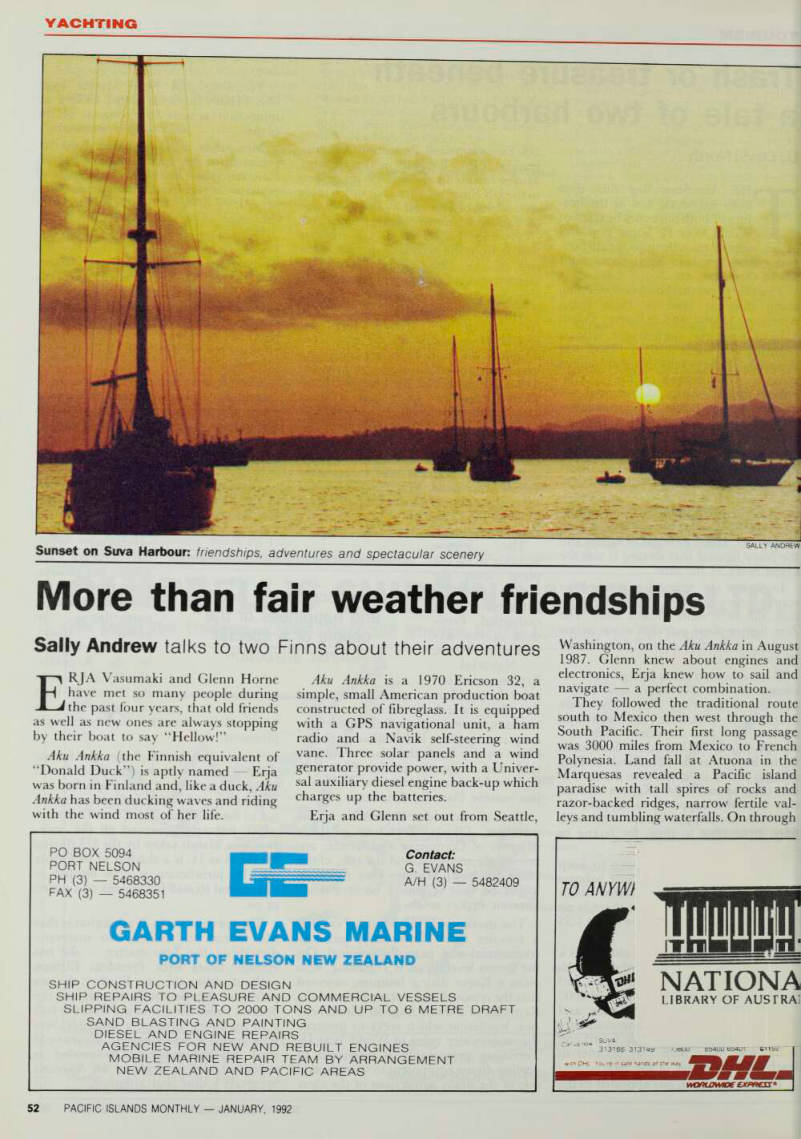
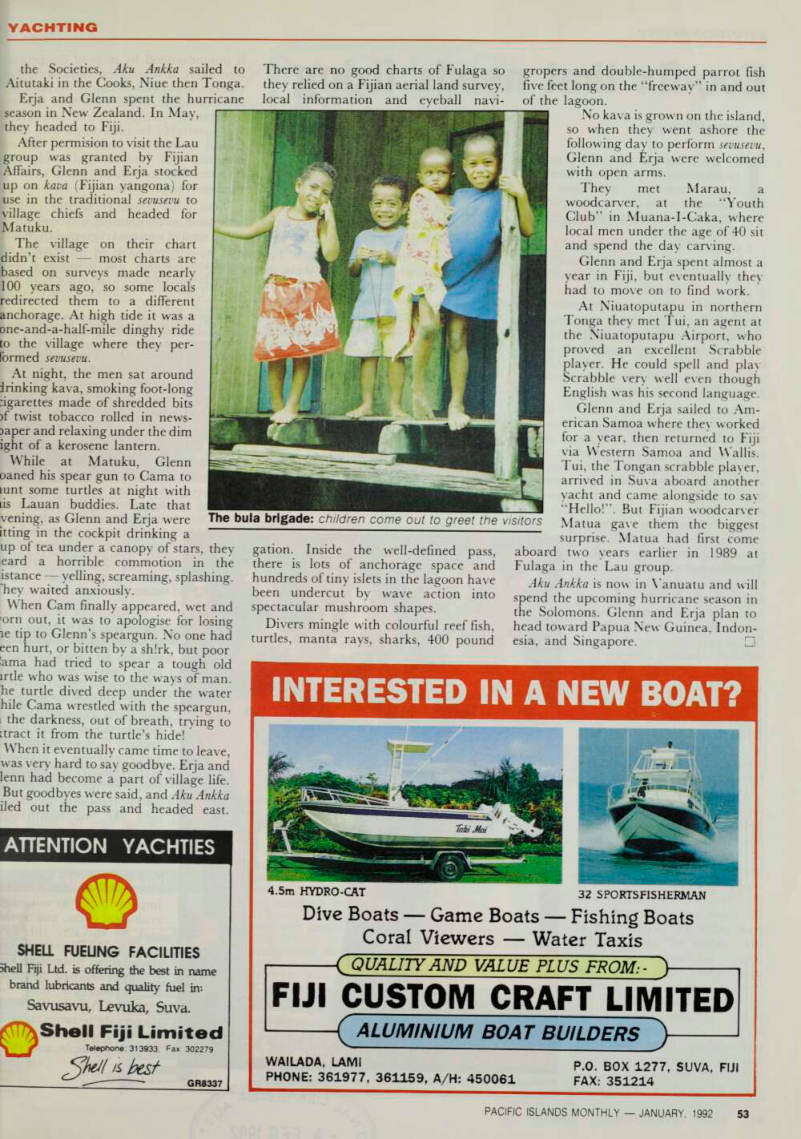
Sally Andrew talks to two Finns about their adventures
ERJA Vasumaki and Glenn Horne have met so many people during the past four years, that old friends as well as new ones are always stopping by their boat to say "Mellow!”
Aku Ankka (the Finnish equivalent of “Donald Duck") is aptly named - Erja was born in Finland and, like a duck, Aku Ankko. has been ducking waves and riding with the wind most of her life.
Aku Ankka is a 1970 Ericson 32, a simple, small American production boat constructed of fibreglass It is equipped with a GPS navigational unit, a ham radio and a Navik self-steering wind >-pi , , , 5 • , vane - Three solar panels and a wind generator provide power, with a Un.ver sal auxiliary diesel engine back-up which charges up the batteries.
Erja and Glenn set out from Seattle,
Washington, on the Mu Ankka in August 1987. Glenn knew about engines and tlcctronics ’ Er J a k r nevv h< T. t 0 sail and na ~Jf ate f „ a t combination, TEe y f °! lowed ' he tradltl ° nal rou‘e S e OU p M " xlc ° ‘ hcn p west , throu B h the T was 3000 miles from Mexico to French Polynesia Land fall at Atuona in the Marquesas revealed a Pacific island 3 ise with taU ires of rocks and razor-backed ridges, narrow fertile val leys and tumbling waterfalls. On through
the Societies, Aku Ankka sailed to Aitutaki in the Cooks, Niue then Tonga.
Erja and Glenn spent the hurricane
season in New Zealand. In May, they headed to Fiji.
After permision to visit the Lau group was granted by Fijian Affairs, Glenn and Erja stocked up on kava (Fijian yangona) for use in the traditional sevusevu to village chiefs and headed for Matuku.
The village on their chart didn’t exist most charts are based on surveys made nearly 100 years ago, so some locals redirected them to a different anchorage. At high tide it was a
one-and-a-half-mile dinghy ride
to the village where they per formed sevusevu.
At night, the men sat around
irinking kava, smoking foot-long
:igarettes made of shredded bits )f twist tobacco rolled in news japer and relaxing under the dim ight of a kerosene lantern.
While at Matuku, Glenn oaned his spear gun to Cama to lunt some turtles at night with iis Lauan buddies. Late that vening, as Glenn and Erja were itting in the cockpit drinking a
up of tea under a canopy of stars, they card a horrible commotion in the
istance yelling, screaming, splashing,
’hey waited anxiously.
When Cam finally appeared, wet and r orn out, it was to apologise for losing le tip to Glenn’s speargun. No one had een hurt, or bitten by a shirk, but poor lama had tried to spear a tough old irtle who was wise to the ways of man. he turtle dived deep under the water hile Cama wrestled with the speargun, i the darkness, out of breath, trying to Ltract it from the turtle’s hide!
When it eventually came time to leave, was very hard to say goodbye. Erja and lenn had become a part of village life.
But goodbyes were said, and Aku Ankka iled out the pass and headed east.
There are no good charts of Fulaga so they relied on a Fijian aerial land survey, local information and eyeball navi-
gation. Inside the well-defined pass, there is lots of anchorage space and hundreds of tiny islets in the lagoon have been undercut by wave action into spectacular mushroom shapes.
Divers mingle with colourful reef fish, turtles, manta rays, sharks, 400 pound
gropers and double-humped parrot fish five feet long on the “freeway” in and out of the lagoon.
No kava is grown on the island, so when they went ashore the following day to perform sevusevu, Glenn and Erja were welcomed with open arms.
They met Marau, a woodcarver, at the “Youth Club” in Muana-I-Caka, where local men under the age of 40 sit and spend the day carving.
Glenn and Erja spent almost a year in Fiji, but eventually they had to move on to find work.
At Niuatoputapu in northern Tonga they met Tui, an agent at
the Niuatoputapu Airport, who
proved an excellent Scrabble player. He could spell and play Scrabble very well even though English was his second language.
Glenn and Erja sailed to Am erican Samoa where they worked for a year, then returned to Fiji via Western Samoa and Wallis.
Tui, the Tongan scrabble player, arrived in Suva aboard another yacht and came alongside to sav “Hello!”. But Fijian woodcarver Matua gave them the biggest surprise. Matua had first come
aboard two years earlier in 1989 at Fulaga in the Lau group.
Aku Ankka is now in Vanuatu and will spend the upcoming hurricane season in the Solomons. Glenn and Erja plan to head toward Papua New Guinea, Indon esia, and Singapore.
The bula brigade: children come out to greet the visitors
Advertisements & other items, pp. 52-53 (1 item)
Garth Evans Marine
TO ANYW!
tjH*
m
NAT lONA
LIBRARY OF AUSFRAI
313166 3131« a /auuo BS4UUBSWi Cttbs i»-th DHL You re m sate hands all cue may wohlowkx express*
PO BOX 5094
PORT NELSON
PH (3) 5468330
FAX (3) 5468351
Eb Contact:
G. EVANS
A/H (3) 5482409
GARTH EVANS MARINE
PORT OF NELSON NEW ZEALAND
SHIP CONSTRUCTION AND DESIGN
SHIP REPAIRS TO PLEASURE AND COMMERCIAL VESSELS SLIPPING FACILITIES TO 2000 TONS AND UP TO 6 METRE DRAFT
SAND BLASTING AND PAINTING
DIESEL AND ENGINE REPAIRS
AGENCIES FOR NEW AND REBUILT ENGINES
MOBILE MARINE REPAIR TEAM BY ARRANGEMENT
NEW ZEALAND AND PACIFIC AREAS
INTERESTED IN A NEW BOAT?
» ~i . f 7
4.5 m HYDRO-CAT
■1
32 SPORTSFISHERMAN
Dive Boats Game Boats Fishing Boats
Coral Viewers Water Taxis
-C QUALITY AND VALUE PLUS FROM:- >
FIJI CUSTOM CRAFT LIMITED
( ALUMINIUM BOAT
WAILADA. LAMI
PHONE: 361977, 361159, A/H: 450061
P.O. BOX 1277, SUVA, FIJI
FAX: 351214
ATTENTION YACHTIES
SHELL FUEUNG FACILITIES
shell Fiji Ltd. is offering the best in name brand lubricants and quality fuel in*.
Savusavu, Levuka, Suva.
Shell Fiji Limited Telephone 313933, Fax 302279
/£ best
GR8337
Eco-fix that needs fixing
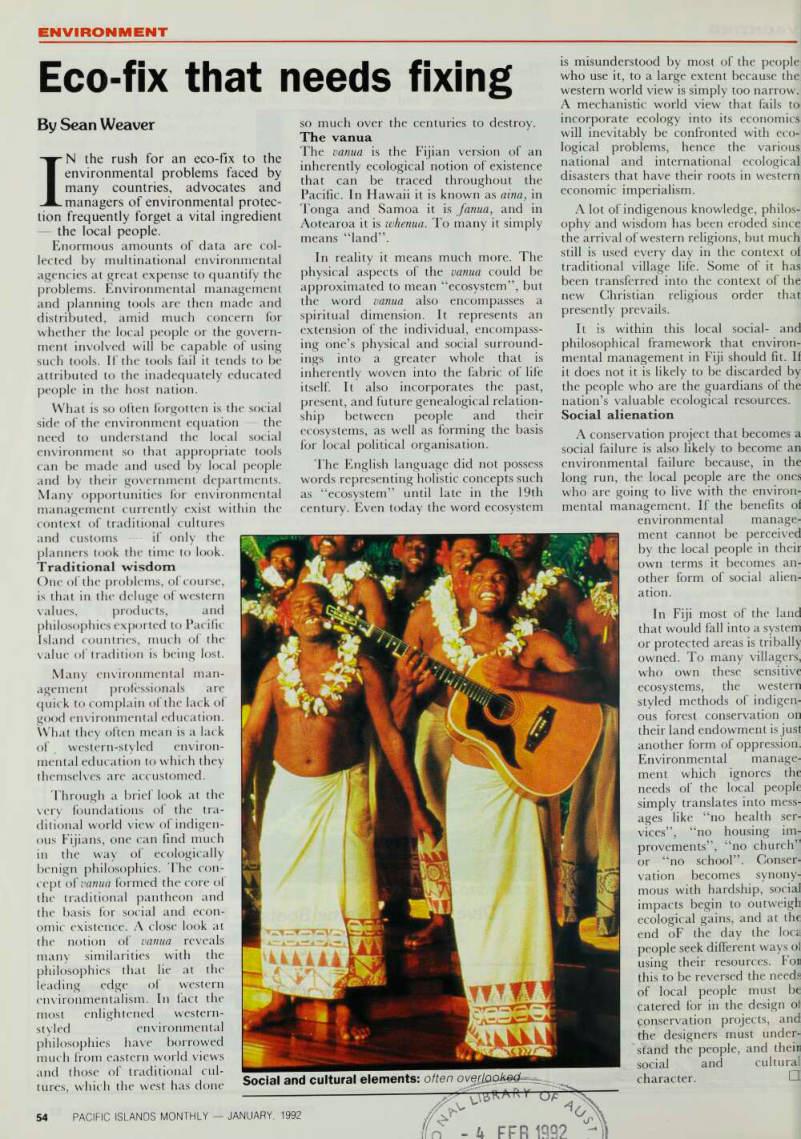
By Sean Weaver
IN the rush for an eco-fix to the environmental problems faced by many countries, advocates and managers of environmental protec tion frequently forget a vital ingredient the local people.
Enormous amounts of data are col lected by multinational environmental agencies at great expense to quantify the problems. Environmental management and planning tools are then made and distributed, amid much concern for whether the local people or the govern ment involved will be capable of using such tools. If the tools fail it tends to be attributed to the inadequately educated people in the host nation.
What is so often forgotten is the social side of the environment equation the need to understand the local social environment so that appropriate tools can be made and used by local people and by their government departments.
Many opportunities for environmental management currently exist within the context of traditional cultures
and customs if only the planners took the time to look.
Traditional wisdom One of the problems, of course, is that in the deluge of western values, products, and
philosophies exported to Pacific
Island countries, much of the value of tradition is being lost.
Many environmental man agement professionals are quick to complain of the lack of good environmental education.
What they often mean is a lack of western-styled environ mental education to which they themselves are accustomed.
Through a brief look at the very foundations of the tra ditional world view of indigen ous Fijians, one can find much in the way of ecologically
benign philosophies. The con
cept of vanua formed the core of the traditional pantheon and the basis for social and econ omic existence. A close look at the notion of vanua reveals many similarities with the philosophies that lie at the leading edge of western environmentalism. In fact the most enlightened western
styled environmental
philosophies have borrowed much from eastern world views and those of traditional cul tures, which the west has done
so much over the centuries to destroy.
The vanua The vanua is the Fijian version of an inherently ecological notion of existence that can be traced throughout the Pacific. In Hawaii it is known as aina, in Tonga and Samoa it is fanua, and in Aotearoa it is whenua. To many it simply means “land”.
In reality it means much more. The physical aspects of the vanua could be approximated to mean “ecosystem”, but the word vanua also encompasses a spiritual dimension. It represents an extension of the individual, encompass ing one’s physical and social surround ings into a greater whole that is inherently woven into the fabric of life itself. It also incorporates the past, present, and future genealogical relation ship between people and their ecosystems, as well as forming the basis for local political organisation.
The English language did not possess words representing holistic concepts such as “ecosystem” until late in the 19th century. Even today the word ecosystem
is misunderstood by most of the people who use it, to a large extent because the western world view is simply too narrow.
A mechanistic world view that fails U> incorporate ecology into its economics will inevitably be confronted with eco logical problems, hence the various national and international ecological disasters that have their roots in western
economic imperialism.
A lot of indigenous knowledge, philos ophy and wisdom has been eroded since the arrival of western religions, but much still is used every day in the context of traditional village life. Some of it has been transferred into the context of the new Christian religious order that
presently prevails.
It is within this local social- and philosophical framework that environ mental management in Fiji should fit. If it does not it is likely to be discarded by the people who are the guardians of the nation’s valuable ecological resources.
Social alienation A conservation project that becomes a social failure is also likely to become an environmental failure because, in the long run, the local people are the ones who are going to live with the environ mental management. If the benefits ol
environmental manage ment cannot be perceived by the local people in their own terms it becomes an other form of social alien ation.
In Fiji most of the land that would fall into a system or protected areas is tribally owned. To many villagers, who own these sensitive ecosystems, the western styled methods of indigen ous forest conservation on their land endowment is just another form of oppression.
Environmental manage ment which ignores the needs of the local people simply translates into mess ages like “no health ser vices”, “no housing im provements”, “no church” or “no school”. Conser vation becomes synony mous with hardship, social impacts begin to outweigh ecological gains, and at the end oF the day the loca people seek different ways ol using their resources. Fod this to be reversed the needs of local people must be catered for in the design ol
conservation projects, and
the designers must under stand the people, and thein social and cultural character.
Social and cultural elements: often overlooked
Advertisements & other items, pp. 55-56 (1 item)
Pacific
ACIFI
ISLANDS
M
fIRK€T PLfiC
For the benefit of our readers who would like to place a small classified advertisement in our magazine, Market Place will assist you in selling personal items, accommodation, real estate, boating or a service ... in fact anything you would like to sell to our over 50,000 readers.
Market Place Advertising Rates are structured to allow you to place as many advertisements as you wish, economically.
MANUIA” OF NUKUALOFA
Steel dry cargo ship. Length 53m 660 tonnes deadweight. 492 gross capacity 820 cubic m.
Fwo x 3 tonne derricks. Engine MWM 500 BHP. 1.6 tonnes/day speed 9 knots. Built Holland 1958 in class BUREAU BERITAS. This ship has seen well maintained and crossed the Tasman sea 3 times last year. Very suitable for intersland work. Lying Auckland. Price US$l9O,OOO. Phone NZ 649 445 7252 or NZ 649 2928035.
SCRAP METAL
sood prices paid for your clean scrap Aluninium, Brass, Copper, Lead, etc. Contact Jonferral Pty. Ltd. 23 Davis Rd. Wetherill Park JSW 2164 Australia. Fax 612 604 1304 for •rompt reply. Our Company is a long estabshed smelter and a leading metals buyer rom the Pacific region. Telephone II 2 604 8855.
TRAVEL GUIDES
COOK ISLANDS COMPANION...The Visitors’
iuide to Rarotonga and The Outer Islands,” 124 pages, 40 color photos; US$2O (airreight): Pacific Publishing, Box 8031, meryville, California, 94608, USA.
FISHING LINE
ookin >urs, 3Com
i PAC
id, Br 096.
Z 4 > H o sZ » * n
COMMERCIAL PRINTING
Top quality four colour printing, brochures, posters, packaging, product labels, fabric labels, billboards, books, magazines, stickers, books. Export quality. Contact Fiji’s most experienced Commercial Printers. FIJI TIMES COMMER- CIAL PRINTING, P.O. Box 1167, Suva. Fiji.
Phone: 304111 Fax. 301521.
PUMP DISTRIBUTORS WANTED
Excellent profit available. As a Pacific Pump Dealer you would have access to some of the world’s finest agricultural and industrial pump products. The product range includes: — HIGH
PRESSURE WASHERS SUBMERSIBLES
Tsurumi Toyo PRESSURE SYSTEMS
Espa GEAR PUMPS Cat TRASH
Gorman Rupp OP GENERATORS. We provide sales literature, full technical support, price lists and a discount structure which enables generous profit margins when selling Pacific Products. Phone or Fax or full distributorship details:-THE MARKETING MAN-
AGER, PACIFIC PUMP COMPANY, 2 SOUTH
STREET, RYDALMERE, NSW, 2116, NSW
AUSTRALIA. PHONE (02) 638 5600 FAX (02) 684 2184.
SELF ADHESIVE LABELS
FORUM LABELS (FIJI) LTD
P.O. Box 1167, Suva., Fiji. Phone: 304111 We print self-adhesive labels in rolls, multi-coloured labels with hot foil, and die cut to shape, tickets and tags in rolls. We also supply labelling machines and fabric labels.
POSITION WANTED
PLANT MANAGER/CHIEF ENGINEER
Bored and frustrated, would like another challenge. 38 years old. Married with school age children. EXPERIENCE: 19 years Processing Industries. Has experience with all facets of management. Ability to effectively train and work with people from developing countries.
Able to work in difficult Industrial Relations Environment. Would prefer a position near the coast in the tropics. For a CV please fax/ phone to (INTL 675) 931158
SCRAP METAL
Tall ingots operate from Brisbane, Australia and make frequent visits to the Pacific Islands, as they have done for twenty-five years. We are buyers of Copper, Brass. Aluminium, Lead, Cable etc. Inspection for big lots no problem.
Telephone 61 7 8922033. Fax 617 8922077.
DISTRIBUTOR WANTED
Manufacturer of Ball Point and Pens Disposable Gas Lighters.
Please contact JNJ CORPORATION (FUI) LTD, G.P.O. Box 285, Suva, Fiji. Ph 394000, Fax: (679) 411898.
OPTICIANS AND OPTOMETRISTS
Spectacles, Contact Lenses, Sunglasses, See JEKISHAN & JEKISHAN, Epworth House, G.P.O.
Box 285, Suva, Fiji. Ph 311002 Fax: (679) 411898.
PACIFIC
SLANDS
I MON T H L Y~ l
MRRK€T PLRC€ CRN UJORK
UJONDCRS FOR VOU ...
Promote your business, or service, sell your household
items, cars or heavy machinery
etc.
ONLY AUSSI PER WORD.
NO COMPANY LOGO. NO
DISPLAY. NO BOLD TYPE.
Just forward your Advertisement together with payment to: PACIFIC ISLANDS MONTHLY "Market Place", P.O. Box 1167, Suva, Fiji.
CONDITIONS:
1. All Advertisements are subject to acceptance and approval of publisher. 2. Advertisements are published as space permits; we cannot guarantee date of insertion. 3. All advertisements must be prepaid and should be typed or printed clearly. 4. Deadline for receipt of advertisements is the 10th of the month prior to issue.
5. PACIFIC ISLANDS MONTHLY
assumes no responsibility for any service other than publishing paid advertisements in this section.
Designed to be DL h & Proven in Every Comer of the World.
Stylish elegance and luxurious detail are the first things you’ll notice about the new Galant. So you might be surprised to learn that Galants have driven to victory in more than 10 major rally raid events — from the snowy slopes of Sweden, to the African savannah. And you’ll be pleased to know that the same performance features keeping those rally cars competitive on the course are also what make your Galant one of the best performance saloons on the road today.
For years, Mitsubishi engineers have known that motorsports are an ideal place for testing new and improved technologies.
The hard, fast driving required to win a rally strains every part of a car—generating pressures that exceed the demands of normal driving. Here, as drivers push their cars to the limit, the rigidity and strength of new space-age constructions can be checked and proven reliable.
The new Galant’s advanced triplelink torsion axle rear suspension is a good example. It is the result of many small yet critical refinements, ultimately designed to grip the road for safer, more comfortable control when changing lanes and cornering.
The severe demands of international motorsport competition: just further proof of how far Mitsubishi will go to build the best cars for you.
MITSUBISHI GPLANT
AMERICAN SAMOA: MORRIS SCANLAN SERVICE INC. P.O. Box 367, Pago Pago. Tel. 633 5520/AUSIHAUA: Miiuuoiam wiuno 7^77'7 “7 '‘7’ , T ~: «/ MF w CALEDONIA- SOCIETE 275 7223/FIJI: NIVIS MOTOR & MACHINERY CO., LTD. G.P.O. Box 150. Suva, Tel. l/FRENCH F^ERES^TFIL^PjO^Box Drive. Private Bag, Ponrua, Tel 370 109/ DTMPORTATION D'AUTO DU PACIFIOUE SUD S.A. B P 438 Rond Point du Pacifique, Noumea, Tel 274144/NEW ZEALAND. MITSUB SHI MOTORS NEW ZEALANU LI u oaa • pAC|RC LTD GP O Box 88 Honiara, NORFOLK ISLAND: BORRYS LTD. P.O. Box 169, Norfolk Island Tel 2114/PAPUA NEW GUINEA: TOBA PTY. LTD. P-CTBoxK)3. Port Moresby Tel. LTD Guadalcanal, Tel 30128/TONGA: SITANI MAPI CO.. LTD. P.O Box 83, Nuku’ALOFA. T el. 21 044/VANUATU: SOCOMETRA B P 06 Route de Lagon. Port-Vila TeL 23 1 4/WESTERN SAMOA . A M MACDONALD P.O. Box 576, Apia, Tel 22022/SAIPAN/POHNPEI/MAJURO/KOSRAE/TRUK/YAP/BELAU: MICRONESIAN MOTORS, INC. 997 South Mamne Drive, Tamuning. Guam 96911, Tel 646-6827
MITSUBISh
MOTORS