Pacific

Islands
Monthly
t
December 1991
Tuhanuku vs Mamaloni k. A
things
*" e ?- a "i a . m ? a USi2 - 5 -°: *“•**«» *s2 50; Cook Islands NZ$3; Fiji F 51.75; FS Micronesia US$3; Hawaii US$3; Kiribati A 52.50; Nauru A 52.50; Niue NZ$3 Norfolk *s3 New Caledon,a CP ( To C oa/p3 *""2 Pap “ a Na » G “'"“ «; »■- US$3; Marshalls US$3; Solomon Islands As 3; French Polynesia cpf3oo. Tonga P 3, USA US$3; Vanuatu VT2OO; Western Samoa T 3.25. ‘Recommended retail price only
Advertisements & other items, pp. 2-3 (1 item)
Pacific
ACIFI
ISLANDS
0 N T H L 7~|
fiRK€T PlflC€
For the benefit of our readers who would like to place a small classified advertisement in our magazine, Market Place will assist you in selling personal items, accommodation, real estate, boating or a service ... in fact anything you would like to sell to our over 50,000 readers.
Market Place Advertising Rates are structured to allow you to place as many advertisements as you wish, economically.
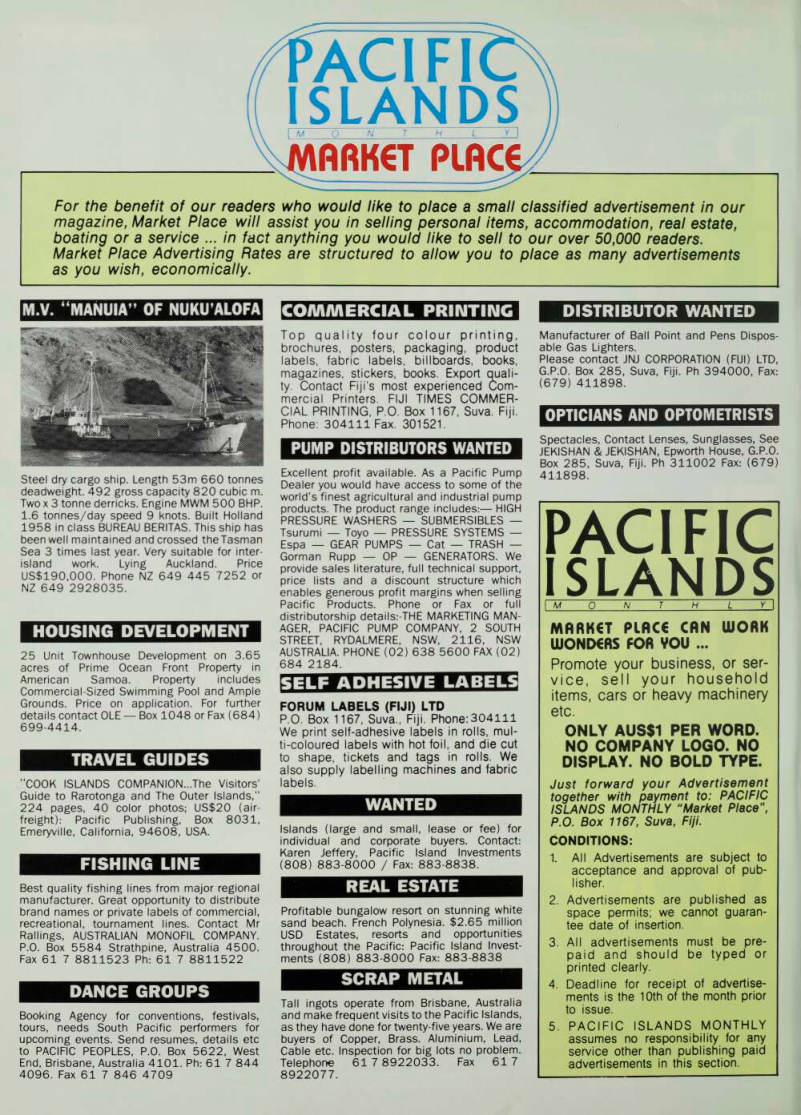
M.V. “MANUIA” OF NUKU ALOFA
Steel dry cargo ship. Length 53m 660 tonnes deadweight. 492 gross capacity 820 cubic m.
Two x 3 tonne derricks. Engine MWM 500 BHP. 1.6 tonnes/day speed 9 knots. Built Holland 1958 in class BUREAU BERITAS. This ship has been well maintained and crossed theTasman Sea 3 times last year. Very suitable for interisland work. Lying Auckland. Price US$l9O,OOO. Phone NZ 649 445 7252 or NZ 649 2928035.
HOUSING DEVELOPMENT
25 Unit Townhouse Development on 3.65 acres of Prime Ocean Front Property in American Samoa. Property includes Commercial-Sized Swimming Pool and Ample Grounds. Price on application. For further details contact OLE Box 1048 or Fax (684) 699-4414.
TRAVEL GUIDES
"COOK ISLANDS COMPANION...The Visitors’
Guide to Rarotonga and The Outer Islands,” 224 pages, 40 color photos; US$2O (airfreight): Pacific Publishing, Box 8031, Emeryville, California, 94608, USA.
FISHING LINE
Best quality fishing lines from major regional manufacturer. Great opportunity to distribute brand names or private labels of commercial, recreational, tournament lines. Contact Mr
Railings, AUSTRALIAN MONOFIL COMPANY.
P.O. Box 5584 Strathpine, Australia 4500.
Fax 61 7 8811523 Ph: 61 7 8811522
DANCE GROUPS
Booking Agency for conventions, festivals, tours, needs South Pacific performers for upcoming events. Send resumes, details etc to PACIFIC PEOPLES, P.O. Box 5622, West End, Brisbane, Australia 4101. Ph; 61 7 844 4096. Fax 61 7 846 4709
COMMERCIAL PRINTING
Top quality four colour printing,
brochures, posters, packaging, product
labels, fabric labels, billboards, books,
magazines, stickers, books. Export quali-
ty. Contact Fiji’s most experienced Com-
mercial Printers. FIJI TIMES COMMER- CIAL PRINTING. P.O. Box 1167, Suva. Fiji.
Phone; 304111 Fax. 301521.
PUMP DISTRIBUTORS WANTED
Excellent profit available. As a Pacific Pump Dealer you would have access to some of the world’s finest agricultural and industrial pump products. The product range includes: — HIGH
PRESSURE WASHERS SUBMERSIBLES
Tsurumi Toyo PRESSURE SYSTEMS
Espa GEAR PUMPS Cat TRASH
Gorman Rupp OP GENERATORS. We provide sales literature, full technical support, price lists and a discount structure which enables generous profit margins when selling Pacific Products. Phone or Fax or full distributorship details:-THE MARKETING MAN-
AGER, PACIFIC PUMP COMPANY, 2 SOUTH
STREET, RYDALMERE, NSW, 2116, NSW
AUSTRALIA. PHONE (02) 638 5600 FAX (02) 684 2184.
SELF ADHESIVE LABELS
FORUM LABELS (FIJI) LTD
P.O. Box 1167, Suva., Fiji. Phone:3o4lll We print self-adhesive labels in rolls, multi-coloured labels with hot foil, and die cut to shape, tickets and tags in rolls. We also supply labelling machines and fabric labels.
WANTED
Islands (large and small, lease or fee) for individual and corporate buyers. Contact: Karen Jeffery, Pacific Island Investments (808) 883-8000 / Fax: 883-8838.
REAL ESTATE
Profitable bungalow resort on stunning white sand beach. French Polynesia. $2.65 million USD Estates, resorts and opportunities throughout the Pacific: Pacific Island Investments (808) 883-8000 Fax: 883-8838
SCRAP METAL
Tall ingots operate from Brisbane, Australia and make frequent visits to the Pacific Islands, as they have done for twenty-five years. We are buyers of Copper, Brass. Aluminium, Lead, Cable etc. Inspection for big lots no problem.
Telephone 61 7 8922033. Fax 61 7 8922077.
DISTRIBUTOR WANTED
Manufacturer of Ball Point and Pens Disposable Gas Lighters.
Please contact JNJ CORPORATION (FUI) LTD, G.P.O. Box 285, Suva, Fiji. Ph 394000, Fax: (679) 411898.
OPTICIANS AND OPTOMETRISTS
Spectacles, Contact Lenses, Sunglasses, See JEKISHAN & JEKISHAN, Epworth House, G.P.O.
Box 285, Suva, Fiji. Ph 311002 Fax: (679) 411898.
PACIFIC
SLANDS
I M O N T H L Y~ l
MRRKCT PLRC€ CRN WORK
WONDCRS FOR VOU ...
Promote your business, or service, sell your household items, cars or heavy machinery etc.
ONLY AUSSI PER WORD.
NO COMPANY LOGO. NO
DISPLAY. NO BOLD TYPE.
Just forward your Advertisement together with payment to: PACIFIC ISLANDS MONTHLY “Market Place", P.O. Box 1167, Suva, Fiji.
CONDITIONS:
1. All Advertisements are subject to acceptance and approval of publisher. 2. Advertisements are published as space permits: we cannot guarantee date of insertion. 3. All advertisements must be prepaid and should be typed or printed clearly. 4. Deadline for receipt of advertisements is the 10th of the month prior to issue.
5. PACIFIC ISLANDS MONTHLY
assumes no responsibility for any service other than publishing paid advertisements in this section.
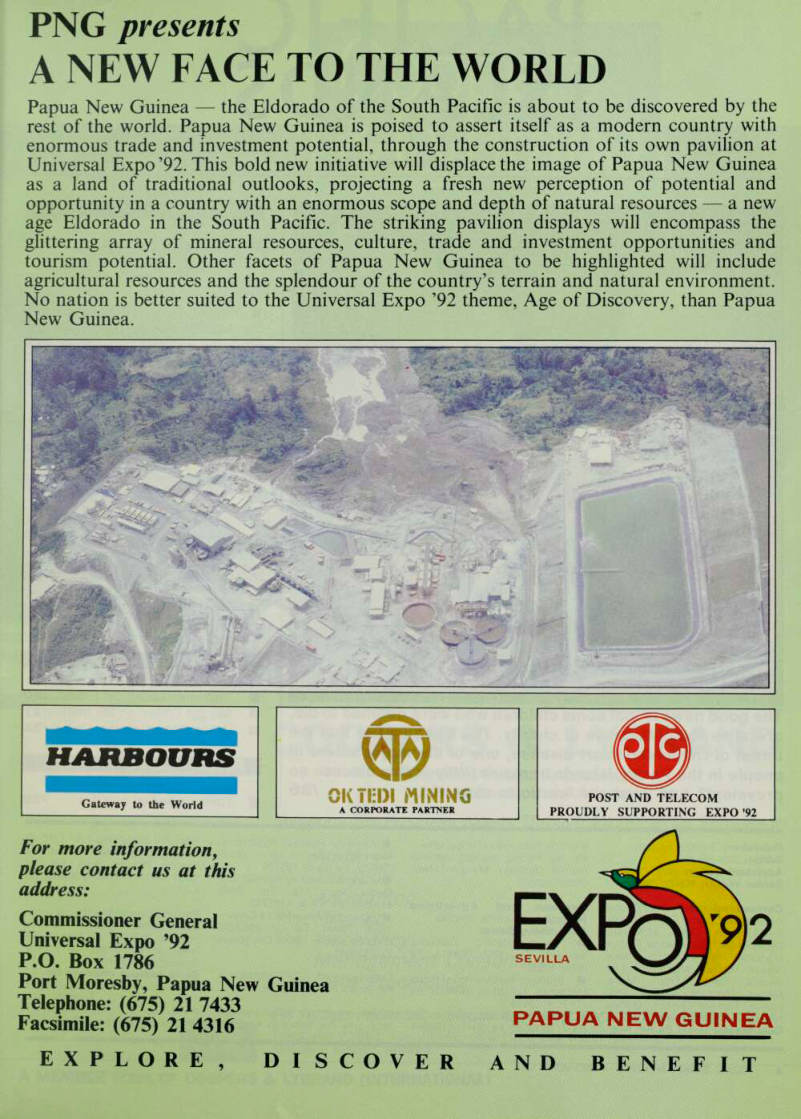
PNG presents
A NEW FACE TO THE WORLD
Papua New Guinea the Eldorado of the South Pacific is about to be discovered by the rest of the world. Papua New Guinea is poised to assert itself as a modern country with enormous trade and investment potential, through the construction of its own pavilion at Universal Expo’92. This bold new initiative will displace the image of Papua New Guinea as a land of traditional outlooks, projecting a fresh new perception of potential and opportunity in a country with an enormous scope and depth of natural resources a new age Eldorado in the South Pacific. The striking pavilion displays will encompass the glittering array of mineral resources, culture, trade and investment opportunities and tourism potential. Other facets of Papua New Guinea to be highlighted will include agricultural resources and the splendour of the country’s terrain and natural environment.
No nation is better suited to the Universal Expo ’92 theme, Age of Discovery, than Papua New Guinea. - * w & < rm
HARBOURS
Gateway to the World For more information, please contact us at this address: Commissioner General Universal Expo ’92 P.O. Box 1786 Port Moresby, Papua New Guinea Telephone: (675) 21 7433 Facsimile: (675) 21 4316
EXFnOT 2
SEVILLA /
PAPUA NEW GUINEA
EXPLORE, DISCOVER AND BENEFIT
Islands
Pacific
Monthly
Vo I. 61, No. 12
The News Magazine
December 1991
The Region
■ Ratu Mara talks about Pacific Islands cooperation, defence and future /8 ■ Tuhanuku fuels the campign to oust Mamaloni as the Solomons faces economic hardship /13
Business
■ The airlines industry is becoming one of the fast expanding sectors of the region /41
The Environment
■ Tourism can get off the beaches and into hidden forests /54
Sport
■ What the World Cup did for rugby in the Pacific Islands / 24
Viewpoints
■ Jemima Garrett on Evans /20 ■ Margot O’Neill on US market/27 ■ David Barber on the Cooks /35
Focus
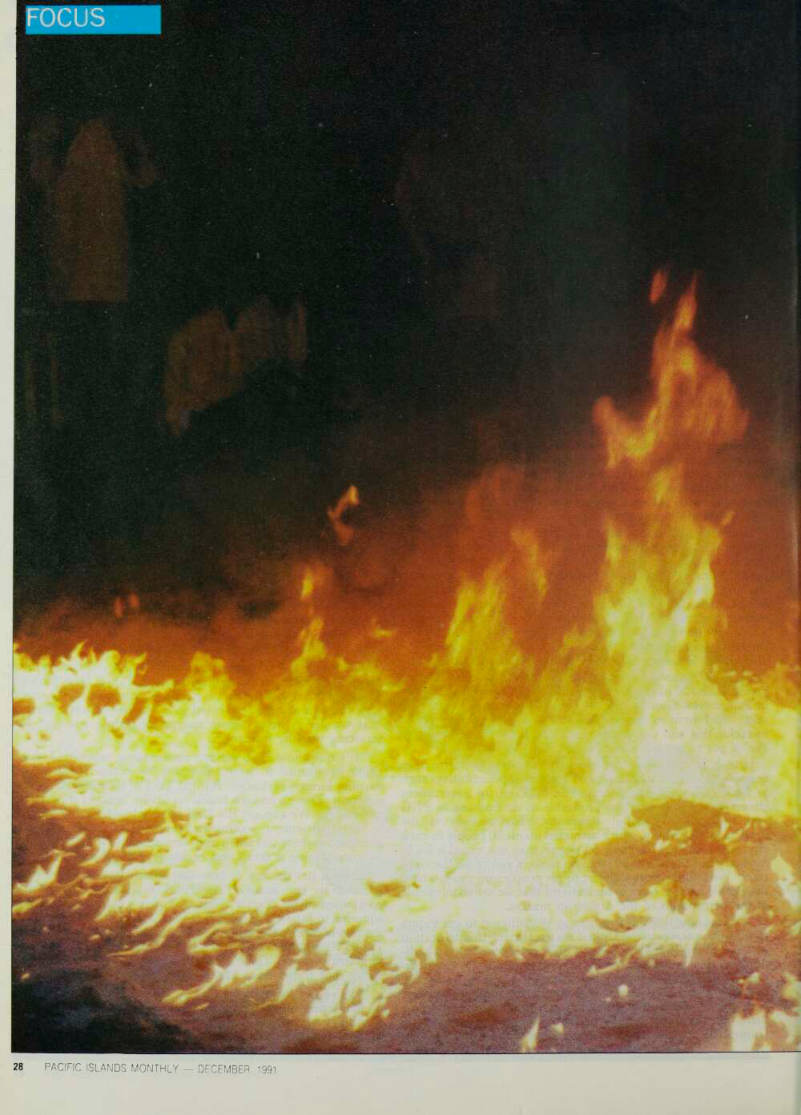
■ Gaining power over fire /28
Publisher: Geoffrey Hussey Editor: Jale Moala Assistant Editor: Beryl Cook Senior Writer: Martin Tiffany Correspondents: Al Prince, Angela McCarthy, David North, David Robie, Diana McManus, Dykes Angiki, Frank Senge, Franck Madoeuf, lan Williams, Irene Nisbet, Karen Mangnall, Lito Vilisoni, Loveni Enari, Macel Manua, Nicholas Rothwell, Pesi Fonua, Richard Dinnen, Ulafala Aiavao, Wally Hiambohn Columnists: David Barber (Wei
lington), Futa Helu (Tonga, cover ing the Pacific Islands), Jemima Garrett (Sydney), Margot O’Neill (Washington) Business and Advertising Manager: Charlotte Thomas Advertising Sales: • South Pacific: Salendra Narayan, Tel (679) 304111, Fx (679) 303809 • Sydney, Melbourne: Fergus Maclagan, Tel (61-2) 4134689, Fx (61-2) 4123918 • Brisbane: Robert Walker, Tel (61-7) 3710533, Fx (61-7) 8798964
Adelaide: Hastwell Williamsons Representations, Tel (61-8) 799522, Fx (61-8) 799735 Auckland: McKay International Media Reps Ltd, Tel (64-9) 4190561, Fx (64-9) 4192243 Japan: Universal Media Corpor ation, Tokyo. Tel (3) 6663036, 6663094, Cable: UNIMEDIA Tokyo, Tx 2524665 Founded 1930 (USPS 952480). A Fiji Times Limited production.
Cover prices are recommended retail only. Registered by Australia
Post, Publication No. NBP 1210. © Copyright Fiji Times Limited, 117 Victoria Parade, Suva, Fiji. Tel (679) 304111, Fx (679) 303809, Tx FJ2124.
Pacific Islands Monthly is pub lished monthly by Fiji Times Lim ited, a division of Nationwide News, 2 Holt Street, Surry Hills, Sydney, NSW 2010.
Send address changes to: Pacific Islands Monthly, PO Box 1167, Suva Fiji. Typeset and printed by Fiji Times Limited, 177 Victoria Parade, Suva, Fiji.
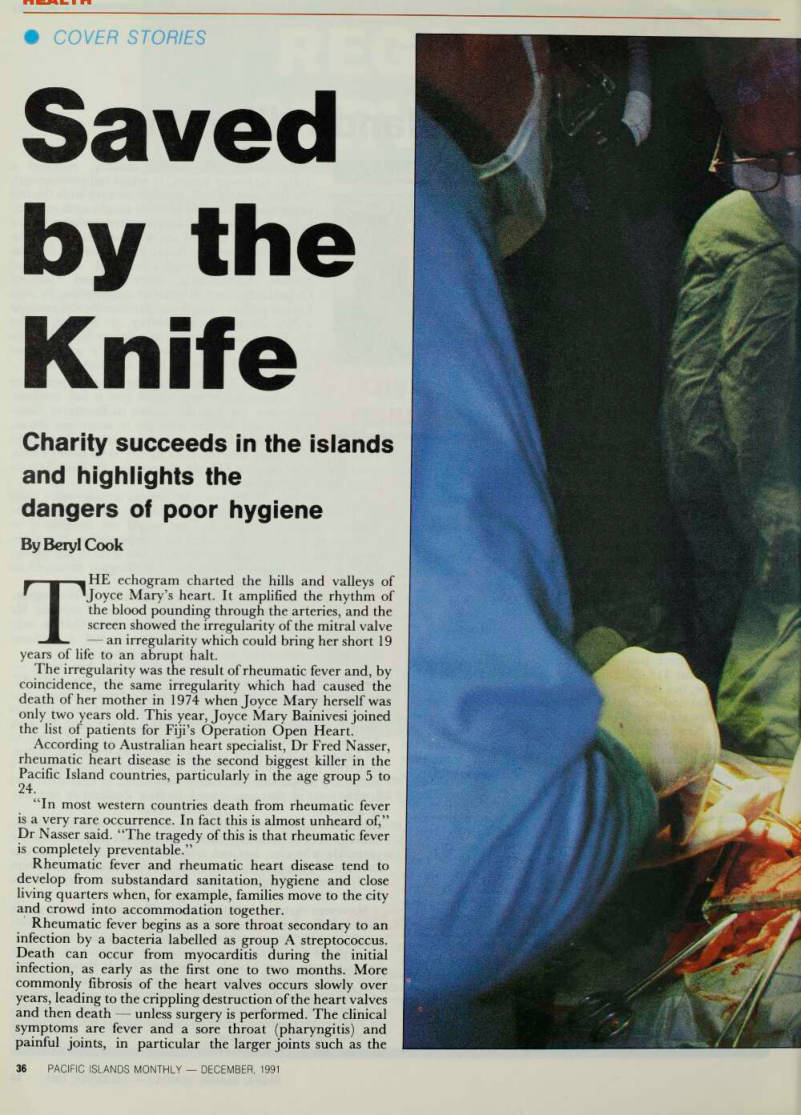
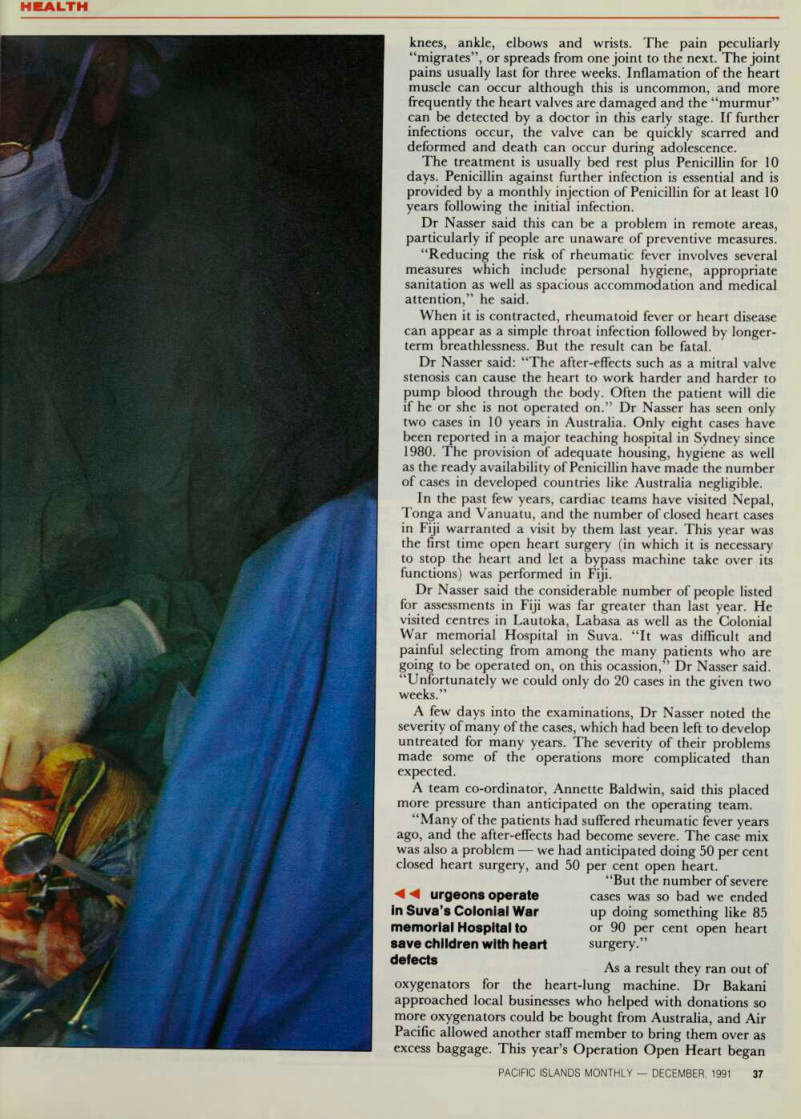
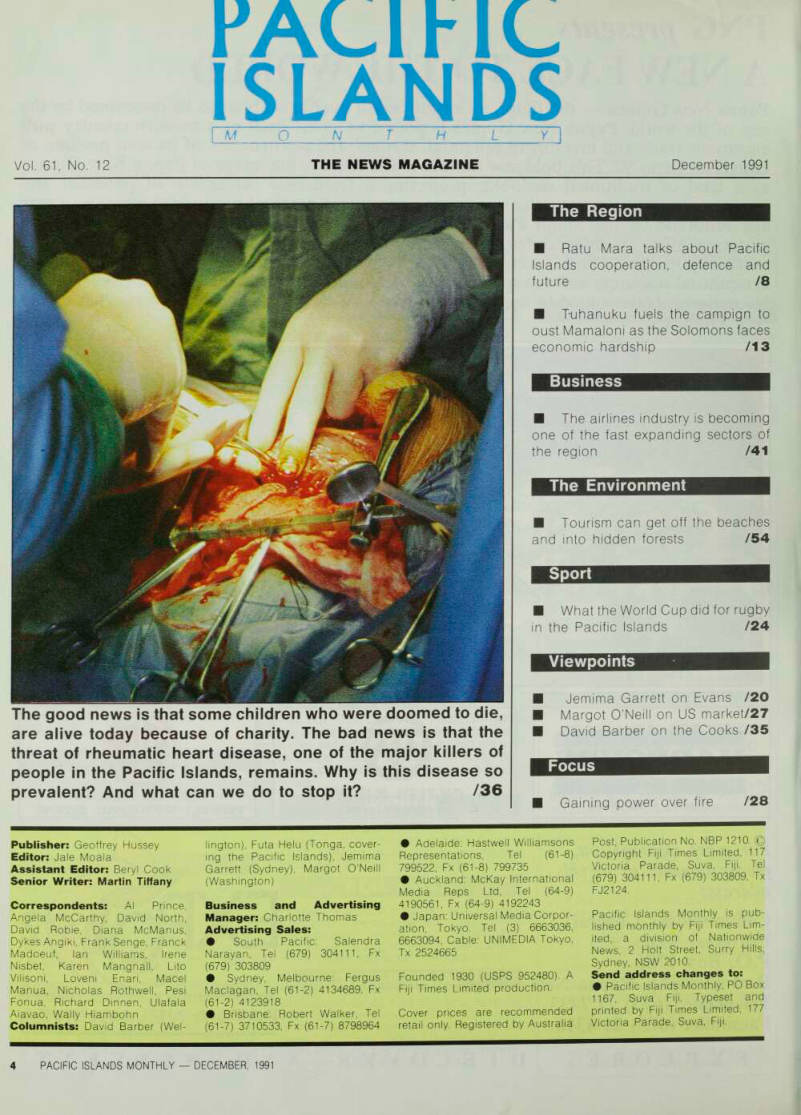
The good news is that some children who were doomed to die, are alive today because of charity. The bad news is that the threat of rheumatic heart disease, one of the major killers of people in the Pacific Islands, remains. Why is this disease so prevalent? And what can we do to stop it? /36
Advertisements & other items, p. 5 (1 item)
Cooners
rand
Solutions for business
m > -; .V «s sa ■- ,4 J4§ ; tx »?aa*8 *
COOPERS & LYBRAND
Certified Public Accountants Accountants and Advisers Solutions For Business Needs Through Professional Services in Audit Taxation
Accounting
Finance
Insolvency
Management Consulting
Data Processing
Coopers
&Lybrand
For further information please contact the resident partners Telephone 21851, Fax 23342, 1st Floor, City Centre Building, Mendana Avenue, Honiara.
A MEMBER FIRM OF COOPERS & LYBRAND (INTERNATIONAL)
Letters
Wall work
under fire
THE-NEWLY elected Presi dent of the South Pacific Games Council, Paul Wallwork, criticises the or ganisers of the 9th South Pacific Games for paying more attention to sponsors than to sport (PIM Oct. 91).
This I utterly refute.
It is true that the PNG Games were supported by a generous and regionally minded private sector. Sport at this level deserves the best facilities that money can buy, and sponsorship is an essential ingredient of any successful international sporting event today. All participants, in cluding Mr Wallwork, greatly enjoyed the facilities,
equipment, hospitality and
other benefits provided by the generosity of our sponsors.
But having made their con tribution, our sponsors gener ally withdraw to the back ground, to enable the sports men and women of the South Pacific to have the two weeks of glory they had worked for.
Sport was given top pri ority. Visiting team man agers, our sports directors, venue managers and the full organising committee of the Games met on a daily basis to
ensure that the needs of sport were met ... the needs of the athletes, managers, technical officials, spectators and the media.
Similar committees dealt with the needs of the visiting VIPs, and the officials of the SP Games Council.
No such attention was paid to sponsorrs. If we inadver
tently neglected to provide
any courtesy to anyone de serving of it, then of course we apologise. But to suggest that this was because we were paying undue attention to our sponsors is simply not sup ported by the facts.
We modestly believe that the 9th South Pacific Games set 21st Century standards for this great Pacific event.
Countless happy visitors agree with us. The success was achieved by our volunteers, our professional adminis trators, our crowds, our gov ernment, and our sponsors.
But it was first and foremost an achievement of the people for whom the Games are held ... the sportsmen and women of the South Pacific, and the officiials who support them.
We in Papua New Guinea never lost sight of that.
Bart Philemon
Chairman, 9th S.P. Games, Papua New Guinea.
Helu’s comment IN Mr Futa Helu’s recent commentary {Aid aiding cor ruption, PIM, October, 91), he states that “US aid very rarely, if every (sic), supports postgraduate studies by Pa cific Islanders.” This charge is blatantly false. Likewise, Mr Helu’s assertion that through its educational programmes the US Governent aims to monopolise “the rarefied
world of. . . imported advice”
by “bar (ring) islanders” from obtaining advanced de grees is ridiculous. Had Mr Helu checked his facts he would have easily found his accusations were unfounded.
In the educational pro grammes which the US Gov ernment funds directly for the Pacific, the vast majority of the candidates study for mas ters’ or doctorate degrees.
Under the Fulbright pro gramme which the United States Information Service administers, all guarantees from the Pacific are studying for masters of doctorate de grees. In the case of East-West Center which is largely funded by the US Govern ment, the majority of individ ual applicants vie for post
graduate placement.
The US Agency for Inter national Development (USAID) focuses most of its
training efforts on postgradu ate programmes for Pacific Islanders as well. Since 1985, 24 islanders have undertaken postgraduate studies at Am erican universities for mas ters, doctorates or postgradu ate diplomas. USAID has undertaken the funding of only a few undergraduate students. In addition to five undergraduate students who were sent to the US for specialised study programmes not available in the region, several undergraduate candi dates supported by USAID have undertaken their studies at regional universities. This is because USAID feels that where regional programmes can meet the needs of individ ual students, USAID’s re sources should remain in the region and support those in stitutions. USAID’s training programmes, which also in clude postgraduate non degree studies, are directly linked to its projects which are developed in cooperation with the island nations’ gov ernments.
There are many viewpoints concerning the merits and drawbacks of aid pro grammes. A thoughtful dis cussion of aid programmes in the region would be welcome.
Judith A Moon
Director, Information Service US Embassy, Suva
Advertisements & other items, p. 7 (1 item)
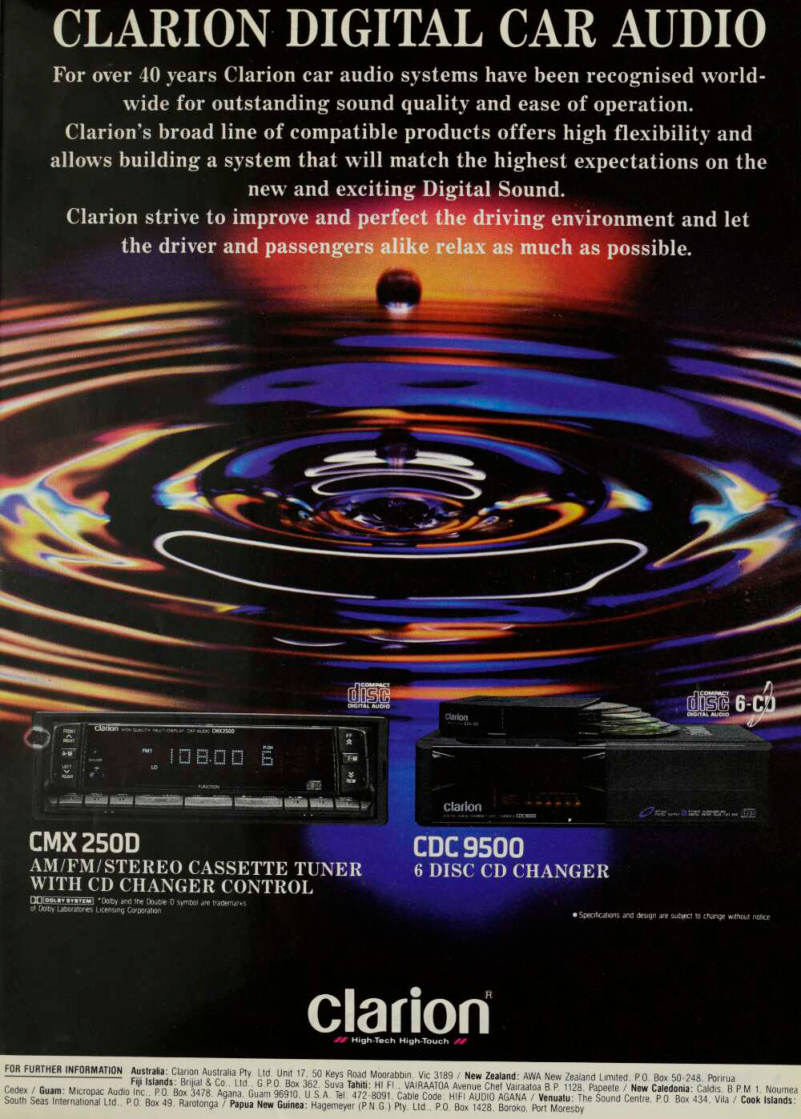
clarion
DIGITAL CAR AUDIO
For over 40 years Clarion car audio systems have been recognised worldwide for outstanding sound quality and ease of operation.
Clarion’s broad line of compatible products offers high flexibility and allows building a system that will match the highest expectations on the new and exciting Digital Sound.
Clarion strive to improve and perfect the driving environment and let the driver and passengers alike relax as much as possible. ■ ♦
_nCOMB*CT
6digital audio clarion clarion
CMX 250 D
AM/FM/STEREO CASSETTE TUNER
WITH CD CHANGER CONTROL
□OfeofYDYDflM] 'Dolby and the Double-0 symbol are trademarks of Dolby Laboratories Licensing Corporation
CDC9SOO
6 DISC CD CHANGER
i Specifications and design are subject to change without notice
clarion
High-Tech High-Touch FOR FURTHER INFORMATION jtelraja. C'artor■ Australia Pty Ltd Ural 17 50 Keys Road Moorabbin Vic 3189 / New Zealand: AWA New Zealand Limited, P.O, Box 50-248, Porirua
An Era
The Region
Fiji
An Era Ends
And Ratu Mara tells what it was like from the start and what the future might hold
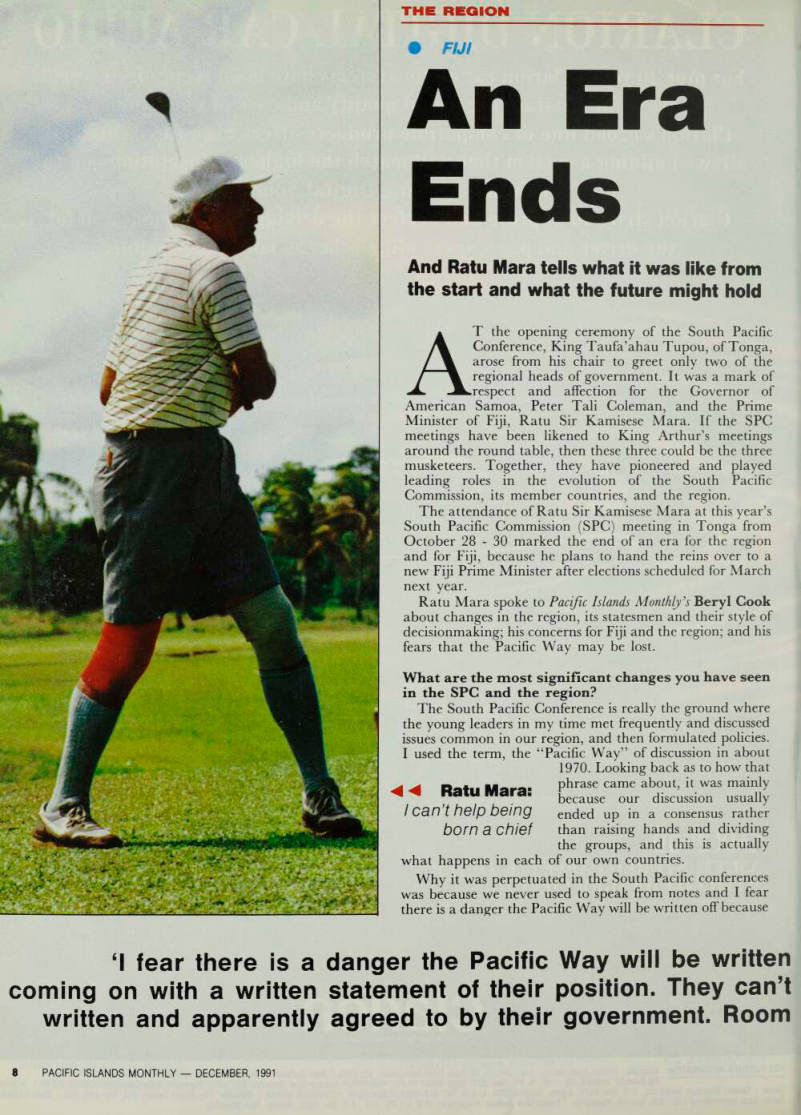
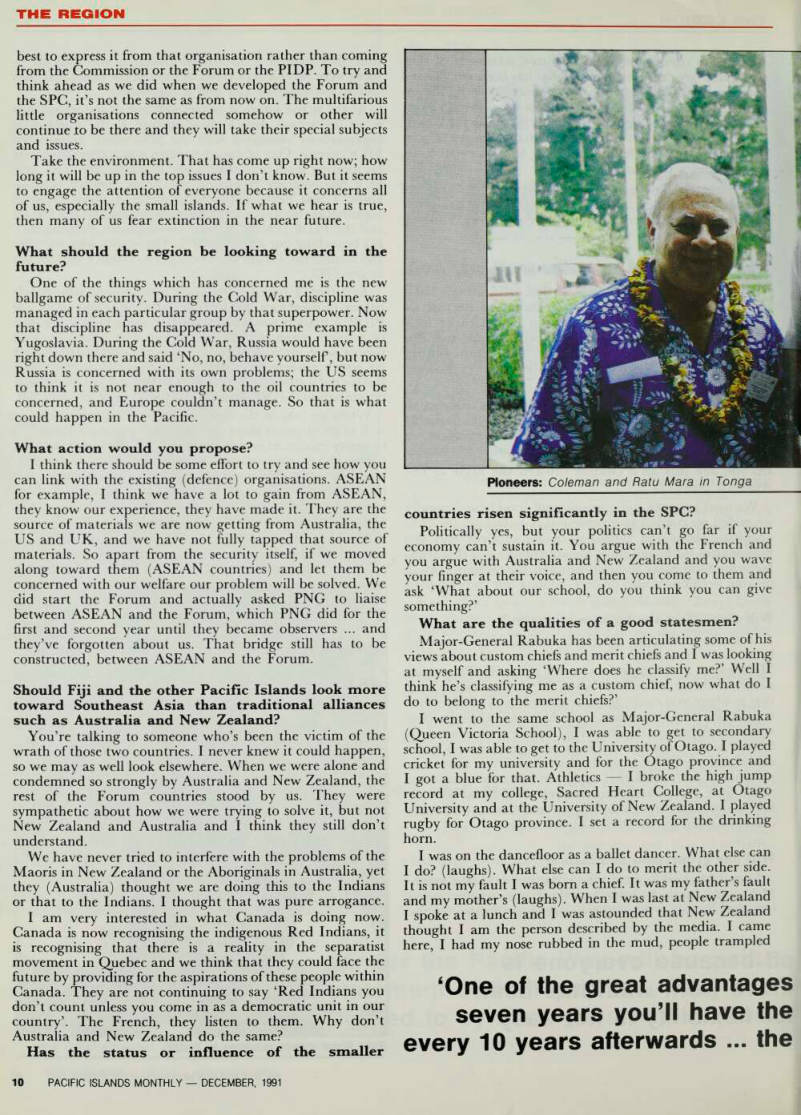
AT the opening ceremony of the South Pacific Conference, King Taufa’ahau Tupou, of Tonga, arose from his chair to greet only two of the regional heads of government. It was a mark of respect and affection for the Governor of American Samoa, Peter Tali Coleman, and the Prime Minister of Fiji, Ratu Sir Kamisese Mara. If the SPC meetings have been likened to King Arthur’s meetings around the round table, then these three could be the three musketeers. Together, they have pioneered and played leading roles in the evolution of the South Pacific Commission, its member countries, and the region.
The attendance of Ratu Sir Kamisese Mara at this year’s South Pacific Commission (SPC) meeting in Tonga from October 28 - 30 marked the end of an era for the region and for Fiji, because he plans to hand the reins over to a new Fiji Prime Minister after elections scheduled for March next year.
Ratu Mara spoke to Pacific Islands Monthly’s Beryl Cook about changes in the region, its statesmen and their style of decisionmaking; his concerns for Fiji and the region; and his fears that the Pacific Way may be lost.
What are the most significant changes you have seen in the SPC and the region?
The South Pacific Conference is really the ground where the young leaders in my time met frequently and discussed issues common in our region, and then formulated policies.
I used the term, the “Pacific Way” of discussion in about
1970. Looking back as to how that phrase came about, it was mainly because our discussion usually ended up in a consensus rather than raising hands and dividing the groups, and this is actually
what happens in each of our own countries.
Why it was perpetuated in the South Pacific conferences was because we never used to speak from notes and I fear there is a danger the Pacific Way will be written off because
‘I fear there is a danger the Pacific Way will be written coming on with a written statement of their position. They can’t written and apparently agreed to by their government. Room
Ratu Mara: I can’t help being born a chief
everyone is coming on with a written statement of their position. They can’t move from what has been written and apparently agreed to by their government. Room for flexibility is not easy. I don’t know how they manage to get their consensus because they are simply following the United Nations system you come and read a statement of your government and you let someone else, the chairman or so, try and find a consensus.
And that is now gone right down to the selection of officials where voting is a must. It never used to be; in our day it was by a consensus. Now you go lobbying and you count the number of votes.
What effect will this new style of reaching agree ments have?
I think that will have its affect on the future. Because we (the SPG) are larger in size there is bound to be little enclaves of views, and I think this will become manifest particularly when you select officials. The groups will try and coalesce in order to get the numbers to elect whoever it is.
And I see that the original founders, the Polynesian countries, are now in the minority, and you will probably find this also will be reflected in the official positions.
Do you see this as a change toward the style of the western powers?
We used to speak quite openly and frankly and usually we ended up coming to a consensus. I talked (at the SPG opening) about the intrusion of the traders and the missionaries. Although there are advantages and disadvan tages the total effect was divisive, and this western way of making decisions is also divisive (among our own people).
Will this affect the balance of power?
It is a new ballgame altogether as far as I’m concerned because we now have a larger number of Micronesians.
Melanesians and Polynesians and I think the Polynesian nature of things is you have a structure of leadership, and that is where you easily get your consensus. The difference is that for the Polynesian, you have an all-embracing structure. Although I’m from Fiji, if there is someone from Samoa and someone from Tonga we soon find who is the eldest and we put him as the leader and you have that pyramid. I don t think that applies in Melanesia; there are many little groups and they themselves make an effort to find a consensus through their Spearhead Group, and that’s only instigated by the New Caledonia issue.
Will one group gain dominance?
I know Michael Somare, who represented the first purely Melanesian group to come into the Forum easilly melled into the consensus. When there were more of them, by the
3ff because everyone is move from what has been or flexibility is not easy’
time they formed a Spearhead Group it was difficult there were two distinct views in most of the issues and they had to get together and find a consensus.
As far as the future is concerned, one of the things that is an advantage and a disadvantage is the number of organisations associated with the SPG which necessitated SPOC over it. One of the advantages was it provides places for aspiring leaders to play a role in leadership. This may be a disadvantage in having one single regional organis ation. I was never enthusiastic about a single regional organisation because I have been responsible for the Forum and the PIDP (Pacific Islands Development Programme).
It’s branching out from the SPG. The reason why we went and formed the Forum was because we couldn’t talk politics in the SPG.
And then I found there were little groups who didn’t belong to these two organisations and they came in on the PIDP. I think it was when the PIDP came in that the idea of a single regional organisation was also voiced because people were afraid there were so many organisations that we were spending time and money trying to attend them.
But we did a study in the PIDP as to the number of regional organisations that we have and we found there are over 300.
When we take in the non-governmental organisations as well as government there are others such as choir groups so many groups in which the people of the region wanted to organise themselves into reegional organisations. So there was therefore a need for many regional organisations the choir master wouldn’t be anywhere in the society if there wasn’t any competition. PASOWA, the women’s organis ation, women come up through there.
And that is one advantage. And as we see, as each issue comes up, the number of these organisations compete to carry the baton and you will then find leaders who are the
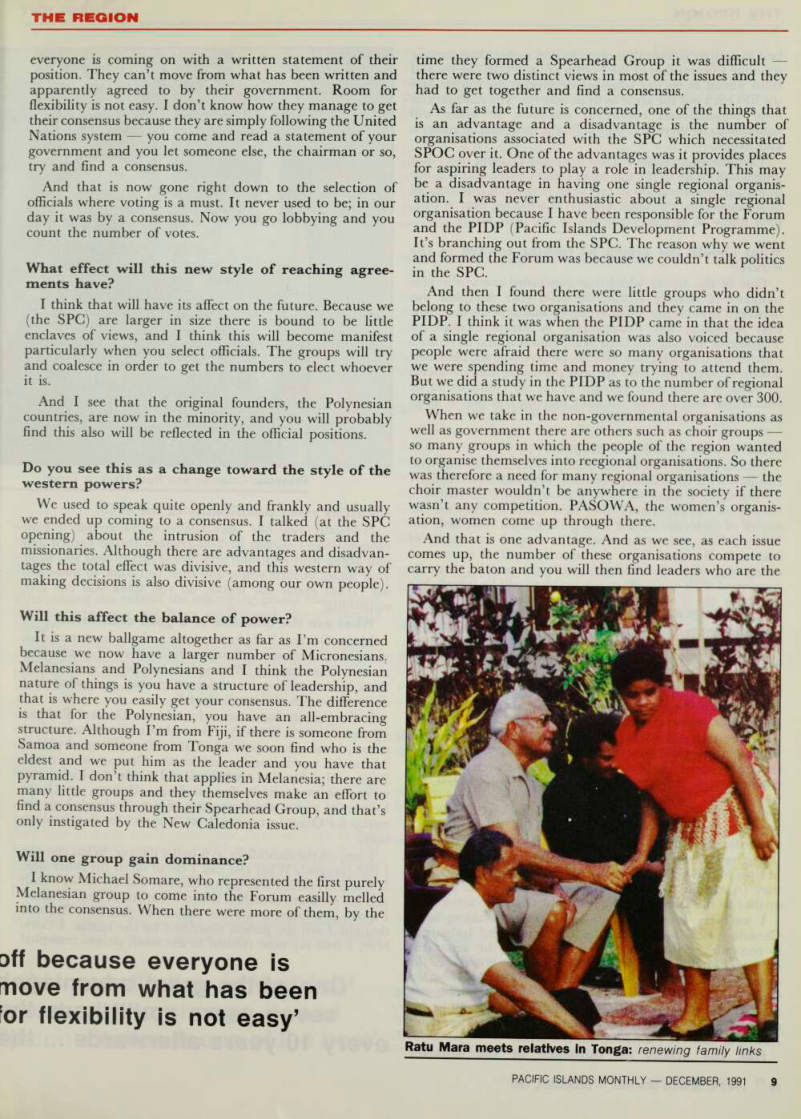
Ratu Mara meets relatives in Tonga: renewing family links
best to express it from that organisation rather than coming from the Commission or the Forum or the PIDP. To try and think ahead as we did when we developed the Forum and the SPC, it’s not the same as from now on. The multifarious little organisations connected somehow or other will continue to be there and they will take their special subjects and issues.
Take the environment. That has come up right now; how long it will be up in the top issues I don’t know. But it seems to engage the attention of everyone because it concerns all of us, especially the small islands. If what we hear is true, then many of us fear extinction in the near future.
What should the region be looking toward in the future?
One of the things which has concerned me is the new ballgame of security. During the Cold War, discipline was managed in each particular group by that superpower. Now that discipline has disappeared. A prime example is Yugoslavia. During the Cold War, Russia would have been right down there and said ‘No, no, behave yourself, but now Russia is concerned with its own problems; the US seems to think it is not near enough to the oil countries to be concerned, and Europe couldn’t manage. So that is what could happen in the Pacific.
What action would you propose?
I think there should be some effort to try and see how you can link with the existing (defence) organisations. ASEAN for example, I think we have a lot to gain from ASEAN, they know our experience, they have made it. They are the source of materials we are now getting from Australia, the US and UK, and we have not fully tapped that source of materials. So apart from the security itself, if we moved along toward them (ASEAN countries) and let them be concerned with our welfare our problem will be solved. We did start the Forum and actually asked PNG to liaise between ASEAN and the Forum, which PNG did for the first and second year until they became observers ... and they’ve forgotten about us. That bridge still has to be constructed, between ASEAN and the Forum.
Should Fiji and the other Pacific Islands look more toward Southeast Asia than traditional alliances such as Australia and New Zealand?
You’re talking to someone who’s been the victim of the wrath of those two countries. I never knew it could happen, so we may as well look elsewhere. When we were alone and condemned so strongly by Australia and New Zealand, the rest of the Forum countries stood by us. They were sympathetic about how we were trying to solve it, but not New Zealand and Australia and I think they still don’t understand.
We have never tried to interfere with the problems of the Maoris in New Zealand or the Aboriginals in Australia, yet they (Australia) thought we are doing this to the Indians or that to the Indians. I thought that was pure arrogance.
I am very interested in what Canada is doing now.
Canada is now recognising the indigenous Red Indians, it is recognising that there is a reality in the separatist movement in Quebec and we think that they could face the future by providing for the aspirations of these people within Canada. They are not continuing to say ‘Red Indians you don’t count unless you come in as a democratic unit in our country’. The French, they listen to them. Why don’t Australia and New Zealand do the same?
Has the status or influence of the smaller
countries risen significantly in the SPC?
Politically yes, but your politics can’t go far if your economy can’t sustain it. You argue with the French and you argue with Australia and New Zealand and you wave your finger at their voice, and then you come to them and ask ‘What about our school, do you think you can give
something?’
What are the qualities of a good statesmen?
Major-General Rabuka has been articulating some of his views about custom chiefs and merit chiefs and I was looking at myself and asking ‘Where does he classify me?’ Well I think he’s classifying me as a custom chief, now what do I do to belong to the merit chiefs?’
I went to the same school as Major-General Rabuka (Queen Victoria School), I was able to get to secondary school, I was able to get to the University of Otago. I played cricket for my university and for the Otago province and I got a blue for that. Athletics I broke the high jump record at my college, Sacred Heart College, at Otago University and at the University of New Zealand. I played rugby for Otago province. I set a record for the drinking horn.
I was on the dancefloor as a ballet dancer. What else can I do? (laughs). What else can I do to merit the other side.
It is not my fault I was born a chief. It was my father’s fault and my mother’s (laughs). When I was last at New Zealand I spoke at a lunch and I was astounded that New Zealand thought I am the person described by the media. I came here, I had my nose rubbed in the mud, people trampled
‘One of the great advantages seven years you’ll have the every 10 years afterwards ... the
Pioneers: Coleman and Ratu Mara in Tonga
f this constitution is that in pportunity to change it, and iji constitution is one of the best’
over me. They made a man out of me. And that is part of my character, and now I am a ‘traditional chief, a ‘conservative’ and I don’t know anything about it. Where do we stand. What do we have to do?”
What about the role of the emerging group of educated leaders who may not have traditional ties or chiefly blood?
We the cheifs, in the olden days, would recognise a warrior, a good one who sails and saved the people of the fleet, a good producer of dalo and other things. We recognise them. There are more opportunities to recognise them now. If they have done well as a doctor or scientist, yes. Someone must do something well, and someone must do something else well. So what is the distinction between tradition and merit? Where is the country which is run by meritocracy.
What are your plans for the future?
I want to retire. I have had enough. I have worked for 20 years to try and bring the two races (in Fiji) together. I thought I succeeded. I went through the colonies in 1967 and I came back from that tour really enthusiastic, thinking T can fix this, I can get the races together’. And I worked hard for it. The result of it is the Indians blame me for breing pro-Fijian and the Fijians blame me for being pro-Indian. So you’re not honoured in your own country (laughs).
Was the coup in Fiji in 1987 a Ratu Mara initiative?
I cannot lead a country that does not accept a leader who
will serve both sides. I have done my best, I’m rejected as such.
This constitution is not the type of constitution I’d like to serve under. Because I’ve served for 20 years under a constitution that has been displaced. I had to come in to help bring things back to normal.
One great advantage of this constitution is that in seven years you’ll have an opportunity to change it, and every 10 years afterwards. I think this is a feature which makes the Fiji constitution one of the best in the world. They boast about the US constitution which is 200 years old, and they only got to about the fifth amendment. Well I think it’s long overdue for overhauling.
What about negatives of the constitution?
They say that it shouldn’t have racial divisions. I think if you don’t have that you’d have the instability that Gyana has, Trinidad has, Mauritius no longer has because they’re completely dominated by the Indians. But you don’t have it in Malaysia because they’re in the minority, in Singapore because they’re in the minority. But whenever they get up to almost a majority you have problems. You have it in Sri Lanka.
Are you only talking about political power?
This is the danger of the Fijian constitution and I think Rabuka is trying to express it in another way. He didn’t expect economic power to be obtained in about four years or overnight when he took over power. Your political power will not go very far if it is not sustained by economic power, and there is some economic power as far as the Fijian is concerned in the ownership of the land, but they have not flexed their muscles in that.
Will we always be tied to relations with Australia a nd New Zealand?
I hope not, I sincerely hope not. If we, are tied to anyone at all I would like to be tied to Asian countries, Southeast Asian
countries, Malaysia, Singapore, Indonesia. Their people
understand our mind. The Australians and New Zealanders I think they prefer not to understand our minds. They want their way to be the way we live by rather than trying to understand us.
Will we have to rely on them for some years to come though because of economic considerations?
If they buy our goods then we buy theirs. But we now want to get out of the dependence on oil and look at the row they’ve kicked up.
What are your plans for the future?
I have to hand over to the new Prime Minister after the next election.
And what then?
That’s my problem ... a trade secret (laughs). (Fiji’s Prime Minister slipped on the black sandals which one of his aides had put beside him, and headed toward the same garden where he had been guest of honour in a traditional ceremony with his mother’s Tongan relatives just an hour before. The woven mats had been replaced by a temporary cocktail bar, and the elder statesman merged into the throng of today’s regional heads of government.) □
Advertisements & other items, p. 12 (1 item)
Telek
People and Technology working hand in hand.
Solomon Islands through TELEKOM is bringing people together.
* V
VAV
V w V w J V
NATIONAL AND INTERNATIONAL TELECOMMUNICATIONS
SERVICES
♦Telephone *Facsimile *Telex Circuits *Data TOTAL COMMUNICATIONS A
TELEKwM
SOLOMON TELEKOM
P.O. Box 148 Honiara, Guadalcanal, Solomon Islands.
Phone: 21 576. Telex; 66 301. Fax: 23 110.
A JOINT VENTURE COMPANY BETWEEN
SOLOMON ISLANDS GOVERNMENT AND
€ Cable and Wireless pic
THE WORLD TELEPHONE COMPANY
Tuhanuku
Solomon Islands
Tuhanuku VS Mamaloni
After making money on a horse, the new Opposition Leader now looks at greater economic issues
By Martin Tiffany
JOSES Tuhanuku has been getting many surprises lately. Last month, at the Honiara Golf Club on Mel bourne Cup day, he bet $2O on favorite Let’s Elope and won $lOO. From a man who doesn’t usually gamble, that was real beginner’s luck and a nice surprise.
Two week before making money on Just Elope, Tuhanuku received a really,
small constituency of Rennell and Bellona and is a member of the Labour Party, whose two members in Parliament represent a minority in the Opposition group. He said he was surprised to have been chosen ahead of experienced poli ticians like former Prime Minister Ezekiel Alebua. “I expected the Alliance members to put up a leader, ” Tuhanuku said, referring to the seven former members of the ruling Alliance Party who are in the Opposition as indepen dents. (Five Alliance members joined the Opposition after being dropped from Cabinet by Prime Minister Solomon Mamaloni in October 1990. Two others later crossed the floor.) While Tuhanuku supported Nori as Opposition Leader he felt that Nori did not have the total support of the parties in the Opposition. “There are 16 of us in the Opposition and seven of these are from the Alliance camp. For whatever reason they don’t seem to work well with the former Leader of the Opposition and Andrew started to talk about a change of leadership,” said Tuhanuku.
“After the resignation and my takeover the 16, including Andrew Nori, are all consolidated in the Opposition.”
really big surprise: he was asked to take over the reigns as Oppostion Leader in parliament. “I was surprised when they asked me, I expected the Alliance members to put up a leader, ”
Tuhanuku. Nevertheless, he said yes and took over command from Andrew Nori who stepped down, saying he did not think he had the support of the 16-member Opposition which comprises members from Labour Party, United, Liberal, National Front for Progress, and independents. Tuhanuku represents the
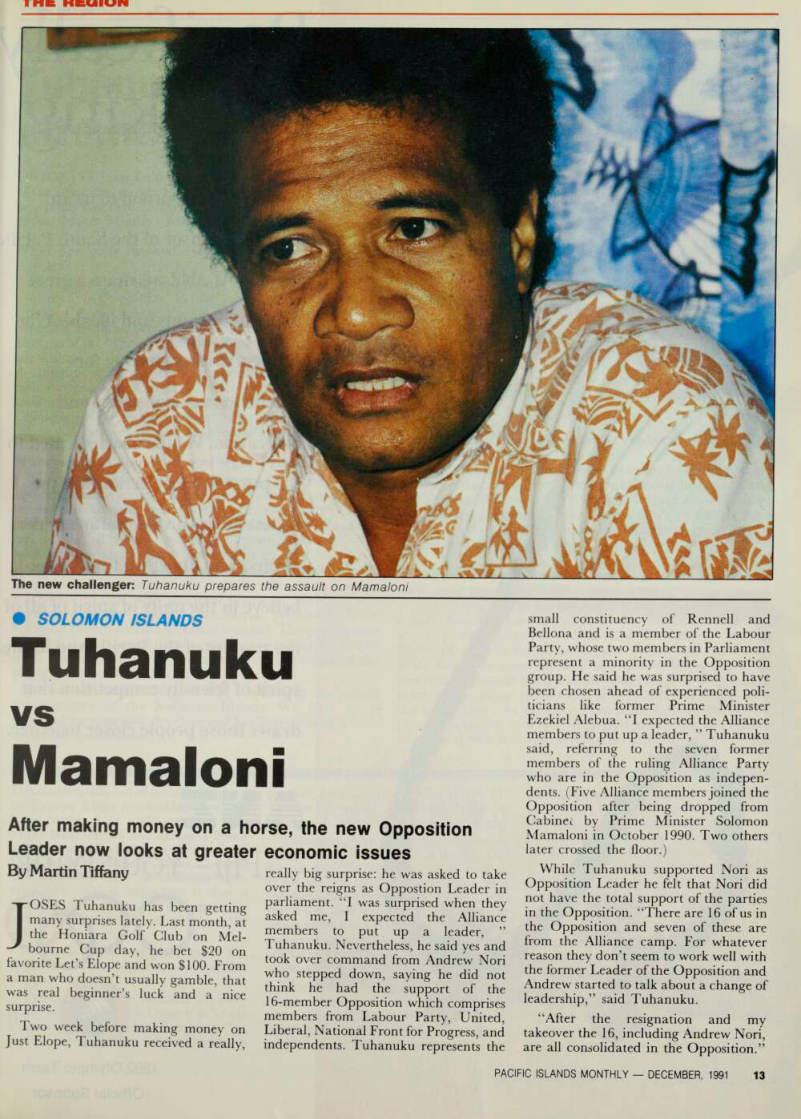
The new challenger: Tuhanuku prepares the assault on Mamaloni
Advertisements & other items, p. 14 (1 item)
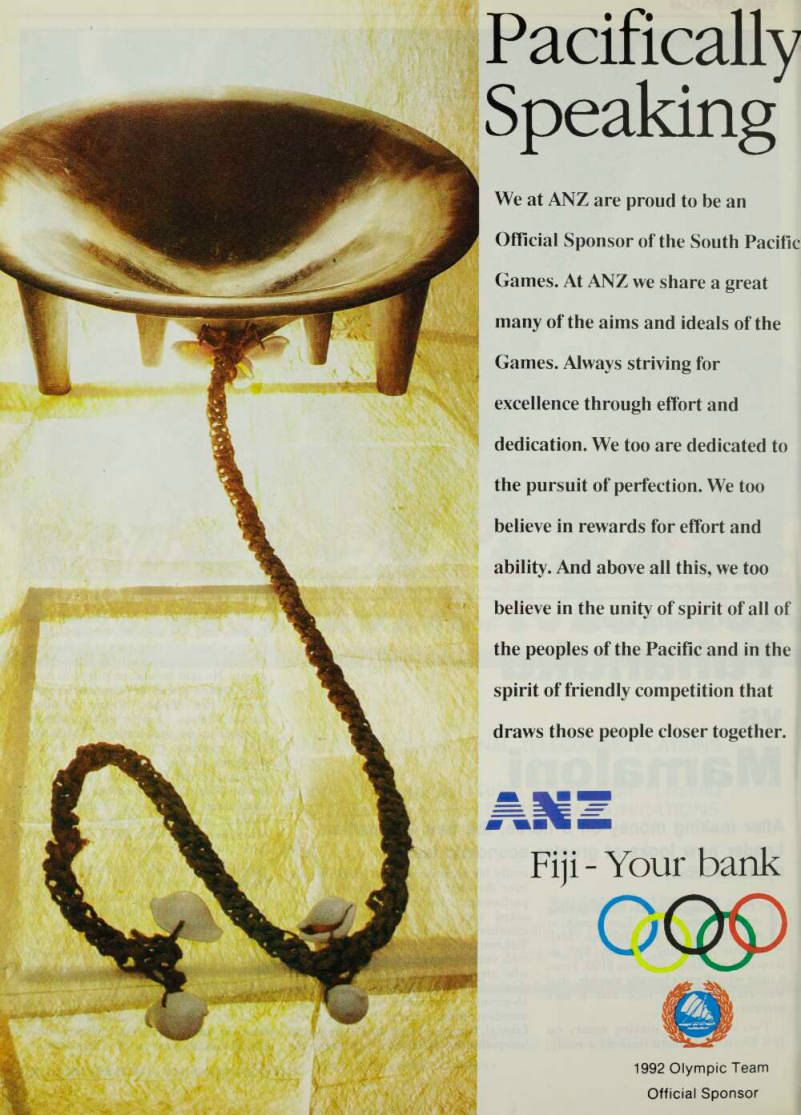
Pacifically
We at ANZ are proud to be an Official Sponsor of the South Pacific Games. At ANZ we share a great many of the aims and ideals of the Games. Always striving for excellence through effort and dedication. We too are dedicated to the pursuit of perfection. We too believe in rewards for effort and ability. And above all this, we too believe in the unity of spirit of all of the peoples of the Pacific and in the spirit of friendly competition that draws those people closer together.
Fiji - Your bank
OQO
1992 Olympic Team Official Sponsor
Tuhanuku’s
alternative
UNIONIST Joses Tuhanuku is the new Opposition Leader of the Solomon Islands. He is a member of the Labour Party which has two members in Parliament. Tuhanuku spoke to Pacific Islands Monthly's Martin Tiffany in Honiara: What are your immediate plans for the opposition
parties?
To consolidate the party and to continue to provide constructive Opposition to the government. Technically speaking if you are in the Opposition you are naturally expected to oppose everything the government does. But the attitude of the Opposition is that if the government is doing something in the interest of the country the Opposition should support it. At the same time we must develop our own alternative policies and if there’s a need for us to form an alternative government we should be in a position and I believe we are in the position to form an alternative cabinet if the present government collapses or resigns.
What wwould you do if you were Prime Minister?
The main concern of any government is to develop the economy, which means we have to attract investment. The present government hasn’t done enough to attract invest ment. Fishing is the best developed industry but a lot more can be done. The same is with the agricultural sector and a lot of other areas. What is needed is to create economic growth in the private sector which means attracting a lot of growth from outside. We must also improve the machinery to deal with potential investors. We must also have an effective system of industrial relations the Solomon Islands needs a tripartite summit. The government should come to some general agreement with employers and trade unions on a lot of principle matters relating to the
private and public sector.
I don’t believe in asking for aid, I believe in developing the economy of the Solomon Islands. We have great potential for economic development but first we need a well organised government.
Should Mamaloni resign unconditionally?
If Mamaloni has any moral conscience he should resign immediately. The country is in a mess and this is connected directly with his leadership. He has a Cabinet that is so undemocratic he does not call on Cabinet to make a collective decision, he dictates and that is why many things are going wrong. He should allow for the formation of a new government.
Why is Mamaloni continuing to be absent from
regional leaders’ meetings?
Even with the Forum meeting here next year I have my doubts whether he will attend and chair it. There is no doubt of the importance of his attending. Why he doesn’t attend he has no good reason. When he did not go to CHOGM (in Zimbabwe in October) he was back home not doing anything he was playing cricket and darts this reflects his priorities.
It is important for him as Prime Minister to talk to other leaders about the problems we have as they also exist in those places. He may learn something and may even get some assistance. The people are very disappointed and very angry that their PM has not been attending any of these
meetings.
Is he worried that he might be replaced while out of
the country?
I don’t think so this is a very democratic country, there will never be a coup here. He should realise he is not going to be Prime Minister of the Solomons forever anyway. Once he loses the support of the people he will not be PM. If there is a vote of no confidence but he has the support of the people he will still be PM.
What would you like your voters to know about you and your party?
The Labour Party is not built around a personality, it is a party based on ideological position looking at how best we can distribute our goods and services to people.
Especially to low income and poor people and ensure we don’t live a luxurious life at their expense. It is going to be one of the strongest parties in the long-run. The people have tried all the other parties and if they want anything new the group they can expect it from is the Labour Party. We present ourselves as a well organised group who is capable of running the country. We are an alternative. □
Tuhanuku works out of an office high up on Vavaya Ridge overlooking Honiara.
He is confident he could continue from where Nori left off and create a better Opposition in Parliament. “Andrew and I are two different personalities,” he said, “his approach may be different from mine but what is important is that it doesn’t matter about our different style of doing things as long as we deliver the result.
“Andrew was a very good leader but at the same time I believe I am capable of doing the job.”
Tuhanuku was the national secretary of the Solomon Islands Council of Trade
Unions (SICTU) before becoming Op
position Leader. He resigned and his
brother, David, replaces him at SICTU the powerful umbrella body of Solomon Islands trade union movement.
Tuhanuku, 44, is from Ghongau village on Bellona Island in the Central Province. He has been a union man most of his life. In 1975, while working as a training manager for an exporting firm, there was talk about forming a trade union movement. He resigned the follow ing year to become a fulltime union official and in 1977 and 1978 he did trade union training in Denmark.
This union connection and experience makes Tuhanuku a formidable Oppo sition Leader at a time when the Solomon Islands is facing big economic problems and pressure is mounting on
Mamaloni to resign. SICTU, Tuhanuku and former Prime Minister Alebua have called bn Mamaloni to resign because of his failure to redress the country’s diving economy. Similarly Mamaloni’s former private secretary and secretary to the People’s Alliance Party, Edward Kingmele, said the worsening economic situation demands that Mamaloni re
signs.
SICTU members met on November 6 and two days later presented a number of resolutions to government, demanding among other things, for Mamaloni’s resignation. The SICTU also called for the government to restore the salaries of constitutional post holders like the Com missioner of Police, Speaker of Parlia
ment and Attorney General to levels before they were awarded hefty pay rises this year. The 15 permanent secretaries have also recently been given lucrative pay packages, from 51527,000 to SlsBo,ooo, Tuhanuku said. The SICTU wants the massive pay hike to be revoked because it is adding pressure on the ailing economy.
“In this very difficult time the Prime Minister decided to move all permanent secretaries from $27,000 to $BO,OOO per annum. This has no relevance or con nection to their work output it is irresponsible,” Tuhanuku said. “The PM is doing it to buy political loyalty, it has nothing to do with the economy or the effective management of government finances.”
Tuhanuku has publicly called on Mamaloni to resign. In a front page story in the weekly newspaper Solomon Star of November 8, Tuhanuku said that “if
Mamaloni and his government do not have the moral con sent for the country, they should step down and give way for a new govern ment to run the country.”
So far Mamaloni has remained silent.
He has stopped go ing to the office everyday and works out of his new resi dence at Lengakiki, which is being reno vated to the tune of over SIS 1 million.
He has not replied to the . SICTU de
mands. Attempts
by Pacific Islands
Monthly magazine to interview Mamaloni were unsuccessful. Two PIM appointments were cancelled and several calls after failed to secure a meeting. /VMjoins a growing list of people who have been promised a meeting with the Prime Minister only to find the appoint ments cancelled at the last moment.
Those unfortunate to have been turned away by Mamaloni include Australian Foreign Affairs Minister Gareth Evans and New Zealand Deputy Prime Minister and Minister for Exter nal Relations, Don McKinnon. This year, the South Pacific Forum voiced disappointment at Mamaloni’s continu ing absence from regional leaders’ meet ings.
The Solomon Islands Government’s cashflow problem has reached what has been described as “crisis level” although in a press statement Mamaloni said the government’s financial position is still manageable and looks brighter than
most countries. “In fact the govern ment’s financial statement as of today is much healthier than the unnecessary panic,” said the Prime Minister’s state ment. He said the government is confi dent that although certain fiscal measures have been put in force the government still has the money to support the services up to the end of the year.
Tuhanuku disagrees and said the government’s cashflow problem is very serious. He claims that the government has used up more than 60 per cent of the country’s total net credit facilities which does not leave much for the private sector. He says the private sector can’t expand because there is no money.
Before he resigned, Nori threatened to take out a high court injunction prevent ing the country’s three commercial banks ANZ, Westpac and the National Bank of Solomon Islands from giving
anymore overdraft to the government.
He said the government had reached its borrowing limit provided for in the 1991 Appropriation Act. Nori added that more overdraft would lead the govern ment into financial disaster.
Nori did not go ahead with his threat, saying it might affect the welfare of the families of public servants.
In a press statement released on November 5, Mamaloni warned that “any move by any of the existing foreign owned commercial banks to support Nori will be severely counteracted even to the extent of closing the bank involved and deporting its management.”
Mamaloni said one bank manager, whom he did not name, has “helped in creating the widely-publicised rumour that the government has gone broke.”
The three commercial banks refused to comment on Mamaloni’s threat.
Mamaloni said that comments by Nori and Opposition MP Nathaniel Waena
that the government is broke were made
without proof.
Again Tuhanuku disagrees: “Our foreign reserves at the end of 1988 stood at $B3 million, at the end of 1989 they were down to $6O million, at the end of 1990 they were down to $4O and now they are about $23 million. This is cover for about two weeks which is very serious.
Figures released in the first week of November put the country’s foreign reserves at Sls23 million, a drop from Sls34 million four weeks previous. And Finance Minister Christopher Abe said that the government had surpassed the $53.4 million borrowing limit it has with the Central Bank of Solomon Islands
(Cbsi).
He said the government still has money to pay public servants and run essential services, but it did not have enough money to cover overseas debts and non-essential services. Abe said this
critical shortage of funds had led to the
government borrowing
from other monetary institutions and
stopped borrowing
from commercial banks.
He said that the gov ernment had surpassed its borrowing limit with CBSI because of a huge overseas debt payment made last month. The government had to make that payment be cause it would lose credibility if it did not service overseas debts.
The government has introduced measures to help ease the cashflow problem. All overseas
trips by ministers, constitutional post holders and government employees have been cancelled from the first of this month until the new year. Local travel, seminars, workshops and fuel for motor vehicles for ministers and other senior government post holders have all been stopped. Overtime claims by non essential workers have been stopped and after-hour allowances for police officers reduced. Police officers are now angry and have threatened not to work after hours because the reduction in allowance is a breach of an agreement signed with the government, their association said.
Warren Paia, the president of the Business Federation of Solomon Islands, said the worsening economic situation is creating a feeling of hopelessness among the people. He called on the government to introduce an economic recovery plan.
Failing, he said, the economy will collapse in a matter of a few weeks. □
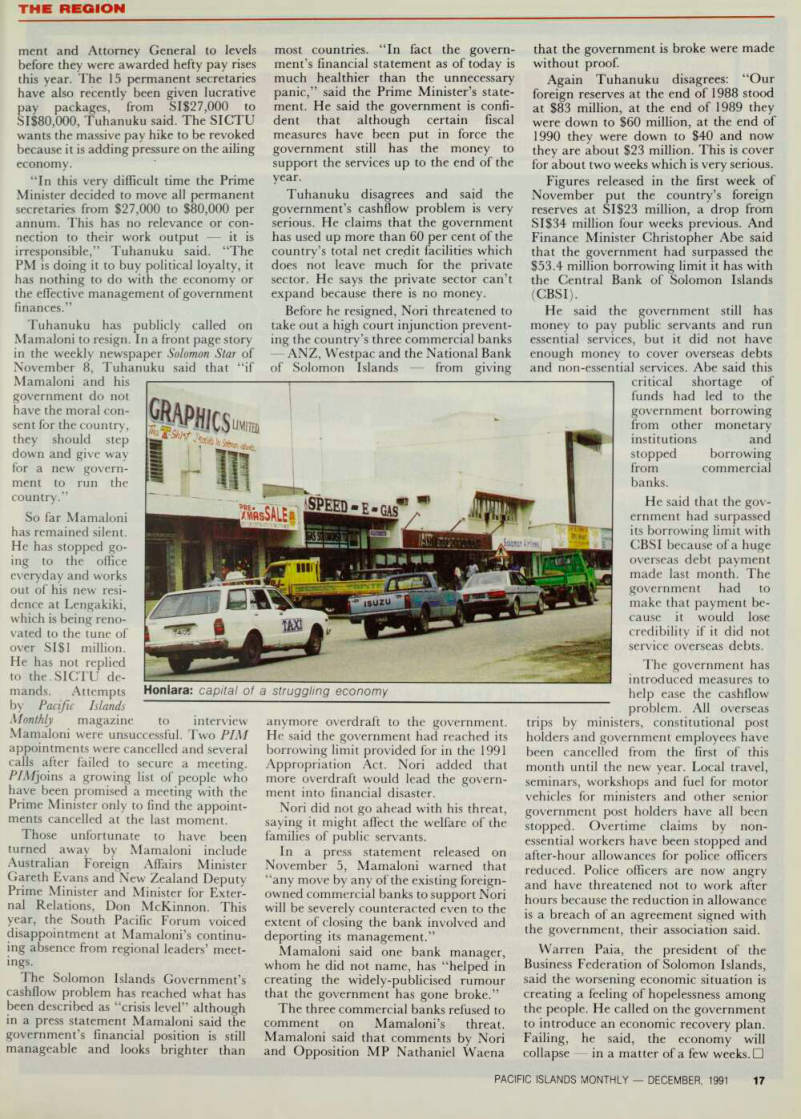
Honiara: capital of a struggling economy
Company Director/Commerciai Adviser, Tuvalu
Applications are invited for the position of Company Director/Commercial Adviser based in the Ministry of Finance Commerce and Trade, Funafuti. The duration of the appointment is 2 years.
Candidates should be professionally quali fied and experienced in private sector commercial financial management and ac counting and should have a working know ledge of commercial and company law and procedures in the Pacific region. They should have the ability to personally oversee installations of accounting and reporting systems and to teach staff and managers to use these. An interest in Pacific cultures and peoples is essential and candidates should be well informed on the politics and economics of the region. The ability to get along with people of widely varying cultural and educational attain ments is necessary and some ability with language (able to pick up and use basic phrases and courtesies) is desirable.
Specific duties are: 1) To advise the Ministry of Finance Commerce and Trade and Tuvalu Govern ment on the further development of commercialisation policy including clari fication of Government policy on capital cost recovery by statutory authorities, the valuation of assets and their ownership, the regulatory framework and the need for operating agreements to be drawn up as a basis for corporatisation. 2) To develop a strategy for implementing a commercialisation policy for commer cial activities currently on the Govern ment budget. This should include an action plan identifying the steps to be taken and a timetable for their im plementation for each activity and the identification of any other inputs that may be needed to achieve the objectives set. 3) To clarify Governments requirements for monitoring existing Statutory bodies and Corporations and to set up
and operate a monitoring and reporting system within the Ministry of Finance Commerce and Trade. 4) To serve as a Government appointed director on all boards of public enterprise statutory corporations including the De velopment Bank of Tuvalu in order to ensure compliance with Government policy and monitoring requirements and to improve management generally. 5) To provide advice and assistance in commercialisation of the accounting, control, reporting and management sys tems in Statutory Corporations and the on-budget public enterprises. 6) To assist the Tuvalu Government with planning and setting up administrative systems for the operation of any outward looking companies Registry in close consultation with the Attorney General. 7) To perform such other tasks in developing complementaries on commercialisation between private sec tor and public enterprises.
The appointment will carry a salary of around A 550,000 after tax. Benefits for non Tuvalu citizens will include free accommo dation, passages, freight and if eligible childrens education allowances.
Application should be sent to: The Secretary for Finance and Commerce Tuvalu Government Ministry of Finance Vaiaku Funafuti
Tuvalu
Closing date for receipt of applications 5 January 1992.
Advertisements & other items, p. 18 (1 item)
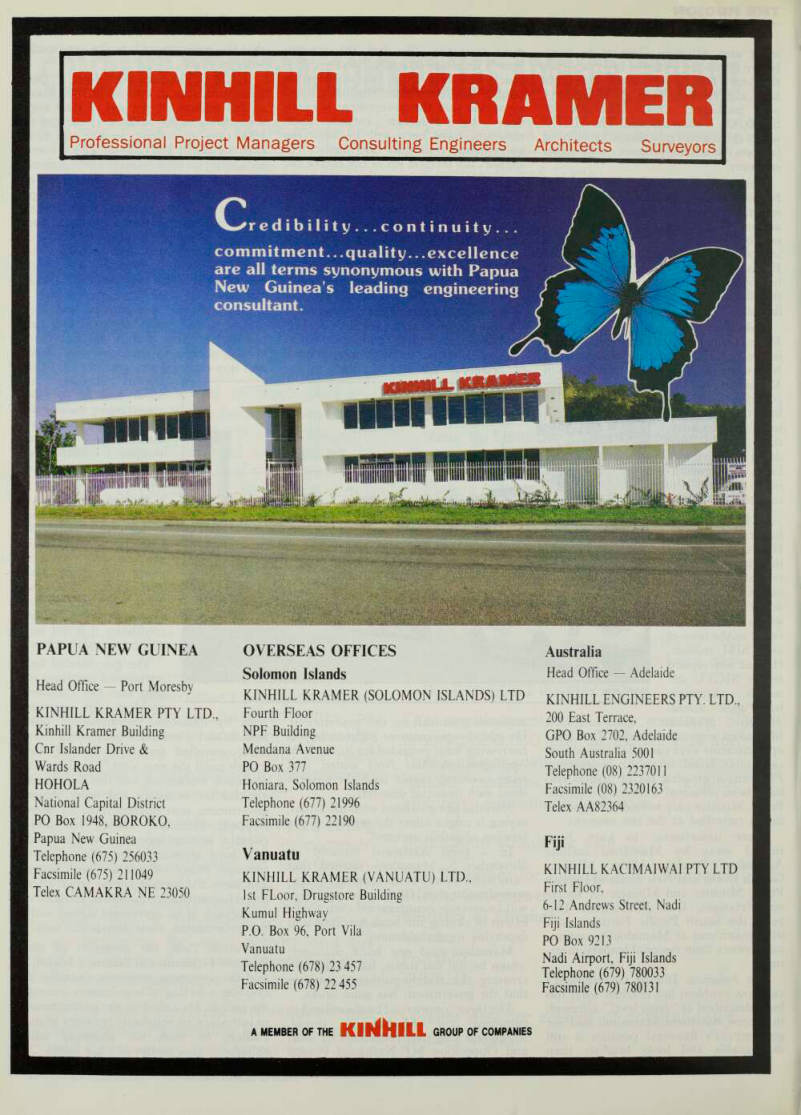
Kinhill Kramer
Professional Project Managers Consulting Engineers Architects Surveyors
edibility. ..continuity.. .
commitment. ..quality., .excellence are all terms synonymous with Papua
New Guinea's leading engineering
consultant.
'M IP Hill mm -
PAPUA NEW GUINEA
Head Office Port Moresby
KINHILL KRAMER PTY LTD.,
Kinhill Kramer Building Cnr Islander Drive & Wards Road
HOHOLA
National Capital District
PO Box 1948, BOROKO,
Papua New Guinea Telephone (675) 256033 Facsimile (675) 211049
Telex CAMAKRA NE 23050
OVERSEAS OFFICES Australia Solomon Islands Head Office Adelaide KINHILL KRAMER (SOLOMON ISLANDS) LTD KINHILL ENGINEERS PTY. LTD., Fourth Floor
NPF Building
Mendana Avenue PO Box 377 Honiara, Solomon Islands Telephone (677) 21996 Facsimile (677) 22190 Vanuatu
KINHILL KRAMER (VANUATU) LTD.,
Ist FLoor, Drugstore Building Kumul Highway P.O. Box 96, Port Vila Vanuatu Telephone (678) 23 457 Facsimile (678) 22 455 200 East Terrace, GPO Box 2702, Adelaide South Australia 5001 Telephone (08) 2237011 Facsimile (08) 2320163 Telex AA82364
Fiji
KINHILL KACIMAIWAI PTY LTD
First Floor, 6-12 Andrews Street, Nadi Fiji Islands PO Box 9213 Nadi Airport, Fiji Islands Telephone (679) 780033 Facsimile (679) 780131 A MEMBER OF THE KllllfllLL GROUP OF COMPANIES
election offer
Boulekone’s election offer
THE Tan Union party, ofVanuatu, could join with the ruling Vanuaaku Party to form a govern ment after December’s general election, Tan Union president Vincent Boulekone said. “If the results of the elections are that the Vanuaaku Party of (Prime Minister Donald) Kalpokas does not have a majority, it is taken for granted that we would be able to work with him to form a coalition government within the parliament,” he said.
On September 6, Tan Union helped Kalpokas and his supporters pass a motion of no-confidence in Prime Min ister Walter Lini, who had led Vanuatu since independence from France and Britain in 1980. Boulekone said his party would win four to six seats at the elections. But if added to the 18 to 20 seats he expected the Vanuaaku Party to win, the coalition would achieve the necessary majority of 24 in the 46-seat house.
If the two parties fail to win enough seats, he said, it would still be possible to attain the necessary number with the
help of some francophone parties quitt
ing the Union of Moderate Parties. □ Help, help UNESCO is complaining that its Re
gional Warning System for the South
West Pacific is suffering from lack of political support, and consequently of funds. It may be on the verge of abandonment.
UNESCO wants UNDP to fund the project but the latter’s resources are already stretched in other directions. A UNESCO spokesman says that if cash doesn’t come through in two years, the project will have to be dropped. □ Tuvalu trust THE Tuvalu Government is to receive A 55.88 million from the Tuvalu Trust Fund. The fund achieved a 23 per cent return last year. The Fund as at 30 September 1991 had a market value of A 541.609 million which represented an average 11.7 per cent return per annum for its four-year life, a period in which it had to weather the 1987 stock market collapse, the Gulf crisis and unpreceden ted turbulence in the financial markets.
Tuvalu is seeking further contributions to the fund from other nations. Following a promotional visit to three Asian countries, a visit to European aid donors is planned for June 1992. □ Telecom profit TELECOM Services of Kiribati Limited (TSKL), has recorded an after tax profit
of AS 106,000 in its first five months of operation. □ Great achiever ELIZABETH “Betty” Silverstein, Foun der and President of the Foundation for the People’s of the South Pacific has won the 1991 US presidential “End Hunger Award” for individual achievement. She will receive the medal at the White House on 12 December.
During World War 11, she became “Red Cross Queen” of Australia, and was “spotted” for a career as a film star.
Then she toured the South Pacific and fundraising drives before Japan entered the War and the South Pacific. Later she married Mo "Red” Silverstein and she recalled for PIM their flight was on a flying boat which made frequent, island hopping stops across the Pacific.
“I fell in love with it, and its people” she says.
In the sixties, when her children were grown up, she decided that she wanted to help the islands. Her husband, President of Metro Goldwyn Mayer, came on board to help and the FSP was set up shortly afterwards. The Marist Fathers released one of their missionary priests, Father Stan Hosie, to run the Foundation. “We wanted to promote socio-economic development, while al lowing the people to keep their own identity”
Over a quarter of a century later, Stan Hosie is still acting as director. This year FSP has USSS million worth of support for its programmes which cover a range of bottom up projects like “wokabout” saw mills in the Solomons, and Vitamin A programmes to combat child blindness in Kiribati. FSP is also working in Tonga, Vanuatu, Fiji, FSM, Cook Islands, PNG and Guam. USAID has now offered 50 per cent self-support grant to match any funds that FSP itself can raise. □ Language hope THE Australian Federal government is funding a project to produce dictionaries for 40 Aboriginal languages, including several no longer spoken. Aboriginal Affairs Minister Robert Tickner said the AS 150,000 project was in response to studies showing a desperate need for Aboriginal language materials.
“The 40 languages will include a handful from capital city areas which are no longer spoken, researched from ar chives and other historcial sources,”
Tickner said. “In some cases the pro duction of the dictionary may be the first time the language has been written down.”
Tickner said there had been a dra matic reduction in the number of Aboriginal languages since white settle ment in 1788, when between 200 and 250 languages involving 700 dialects were
spoken. All 40 dictionaries would be both
english/aboriginal and aboriginal/eng
lish, he said. The project would be completed next year. □ Quota on tuna AUSTRALIA, Japan and New Zealand have agreed not to raise their global catch of Southern Bluefin Tuna for 1991-92 above quotas for the previous year, Federal Primary Industries Minis ter Simon Crean announced said. The global limit of 11,750 tonnes was set at the annual voluntary trilateral nego tiations for management of Southern Bluefin Tuna in Wellington recently.
Crean said the latest decision meant individual allocations would remain at last year’s levels 0f6065 tonnes for Japan, 5265 for Australia and 420 tonnes for New Zealand. Scientific evidence indi cated there were unacceptable risks associated with any increase in catch levels. □ Getting stronger AOSIS, the Alliance of Small Island States, is going from strength to strength.
It now has 36 members, 29 of which are United Nations members. New members include Cape Verde and Sao Tome, island states off West Africa, Cook Islands, and Trinidad and Tobago, while recently the Cayman Islands expressed interest in joining.
Its clout is respected by other partici pants in the International Negotiating Committee on climate change. When the non-aligned “Group of 77” nations met in Nairobi last September, an OPEC spokesman ridiculed the idea that small islands representing a mere three million people could stand in the way of human progress by which he meant oil sales.
After AOSIS protests, Saudi Arabia and Kuwait, two of OPEC’s most important members, dissociated them selves from his report. “The last session was really quite positive,” said Robert Van Lierop, Vanuatu’s UN ambassador, and chairman of AOSIS. When AOSIS was set up, he anticipated it being a bridge between the environmental con cerns of the industrial countries, and the devdopmental concerns of the rest of the world. Had those hopes been matched by the reality of AOSIS’s first year? “Yes, very much so. We are frontline states.”
Many observers reported that the US delegation was holding up the drawing of an effective Convention against Climate Change. Was that his impression? “The US is not so much stalling as having fundamental differences. There is a big gap between its perception of the prob lem and that of the developing world,” he says. “Economic development is as important as the environment for many developing countries, but the US recog nises the imperative of economic issues from a very different perspective”. □
Evans Third World diplomacy
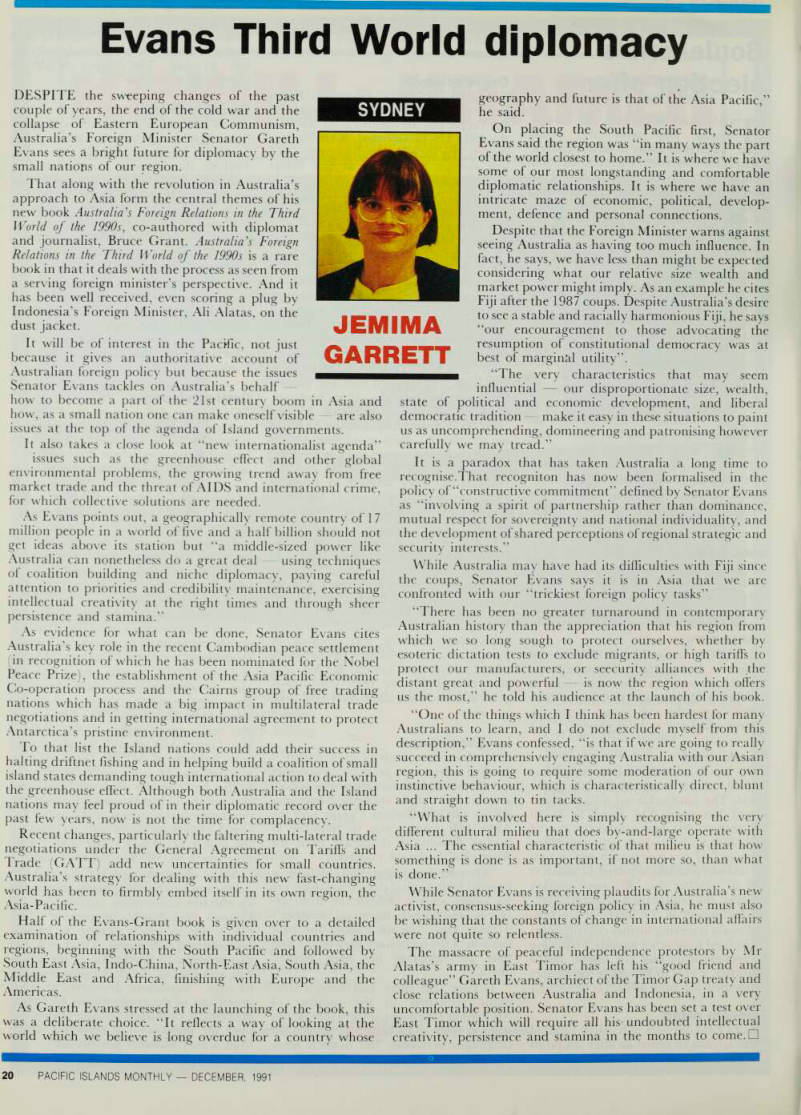
DESPITE the sweeping changes of the past couple of years, the end of the cold war and the collapse of Eastern European Communism, Australia’s Foreign Minister Senator Gareth Evans sees a bright future for diplomacy by the small nations of our region.
That along with the revolution in Australia’s approach to Asia form the central themes of his new book Australia’s Foreign Relations in the Third World of the 19905, co-authored with diplomat and journalist, Bruce Grant. Australia’s Foreign Relations in the Third World of the 1990 s is a rare book in that it deals with the process as seen from a serving foreign minister’s perspective. And it has been well received, even scoring a plug by Indonesia’s Foreign Minister, Ali Alatas, on the dust jacket.
It will be of interest in the Pacific, not just because it gives an authoritative account of Australian foreign policy but because the issues Senator Evans tackles on Australia’s behalf
how to become a part of the 21st century boom in Asia and how, as a small nation one can make oneself visible are also issues at the top of the agenda of Island governments.
It also takes a close look at “new internationalist agenda” issues such as the greenhouse effect and other global environmental problems, the growing trend away from free market trade and the threat of AIDS and international crime, for which collective solutions are needed.
As Evans points out, a geographically remote country of 17 million people in a world of five and a half billion should not get ideas above its station but “a middle-sized power like Australia can nonetheless do a great deal using techniques of coalition building and niche diplomacy, paying careful attention to priorities and credibility maintenance, exercising intellectual creativity at the right times and through sheer persistence and stamina.”
As evidence for what can be done, Senator Evans cites Australia’s key role in the recent Cambodian peace settlement (in recognition of which he has been nominated for the Nobel Peace Prize), the establishment of the Asia Pacific Economic Co-operation process and the Cairns group of free trading nations which has made a big impact in multilateral trade negotiations and in getting international agreement to protect Antarctica’s pristine environment.
To that list the Island nations could add their success in halting driftnet fishing and in helping build a coalition of small island states demanding tough international action to deal with the greenhouse effect. Although both Australia and the Island nations may feel proud of in their diplomatic record over the past few years, now is not the time for complacency.
Recent changes, particularly the faltering multi-lateral trade negotiations under the General Agreement on Tariffs and Trade (GATT) add new uncertainties for small countries.
Australia’s strategy for dealing with this new fast-changing world has been to firmbly embed itself in its own region, the Asia-Pacific.
Half of the Evans-Grant book is given over to a detailed examination of relationships with individual countries and regions, beginning with the South Pacific and followed by South East Asia, Indo-China, North-East Asia, South Asia, the Middle East and Africa, finishing with Europe and the Americas.
As Gareth Evans stressed at the launching of the book, this was a deliberate choice. “It reflects a way of looking at the world which we believe is long overdue for a country whose
geography and future is that of the Asia Pacific,” he said.
On placing the South Pacific first, Senator Evans said the region was “in many ways the part of the world closest to home.” It is where we have some of our most longstanding and comfortable diplomatic relationships. It is where we have an intricate maze of economic, political, develop ment, defence and personal connections.
Despite that the Foreign Minister warns against seeing Australia as having too much influence. In fact, he says, we have less than might be expected considering what our relative size wealth and market power might imply. As an example he cites Fiji after the 1987 coups. Despite Australia’s desire to see a stable and racially harmonious Fiji, he says “our encouragement to those advocating the resumption of constitutional democracy was at best of marginal utility”.
“The very characteristics that may seem influential our disproportionate size, wealth,
state of political and economic development, and liberal democratic tradition make it easy in these situations to paint us as uncomprehending, domineering and patronising however carefully we may tread.”
It is a paradox that has taken Australia a long time to recognise.That recogniton has now been formalised in the policy of “constructive commitment” defined by Senator Evans as “involving a spirit of partnership rather than dominance, mutual respect for sovereignty and national individuality, and the development of shared perceptions of regional strategic and
security interests.”
While Australia may have had its difficulties with Fiji since the coups, Senator Evans says it is in Asia that we are confronted with our “trickiest foreign policy tasks”
“There has been no greater turnaround in contemporary Australian history than the appreciation that his region from which we so long sough to protect ourselves, whether by esoteric dictation tests to exclude migrants, or high tariffs to protect our manufacturers, or seecurity alliances with the distant great and powerful is now the region which offers us the most,” he told his audience at the launch of his book.
“One of the things which I think has been hardest for many Australians to learn, and I do not exclude myself from this description,” Evans confessed, “is that if we are going to really succeed in comprehensively engaging Australia with our Asian region, this is going to require some moderation of our own instinctive behaviour, which is characteristically direct, blunt and straight down to tin tacks.
“What is involved here is simply recognising the very different cultural milieu that does by-and-large operate with Asia ... The essential characteristic of that milieu is that how something is done is as important, if not more so, than what is done.”
While Senator Evans is receiving plaudits for Australia’s new activist, consensus-seeking foreign policy in Asia, he must also be wishing that the constants of change in international affairs were not quite so relentless.
The massacre of peaceful independence protestors by Mr Alatas’s army in East Timor has left his “good friend and colleague” Gareth Evans, archiect of the Timor Gap treaty and close relations between Australia and Indonesia, in a very uncomfortable position. Senator Evans has been set a test over East Timor which will require all his- undoubted intellectual creativity, persistence and stamina in the months to come.D
Sydney
Jemima
Garrett
Advertisements & other items, p. 21 (1 item)
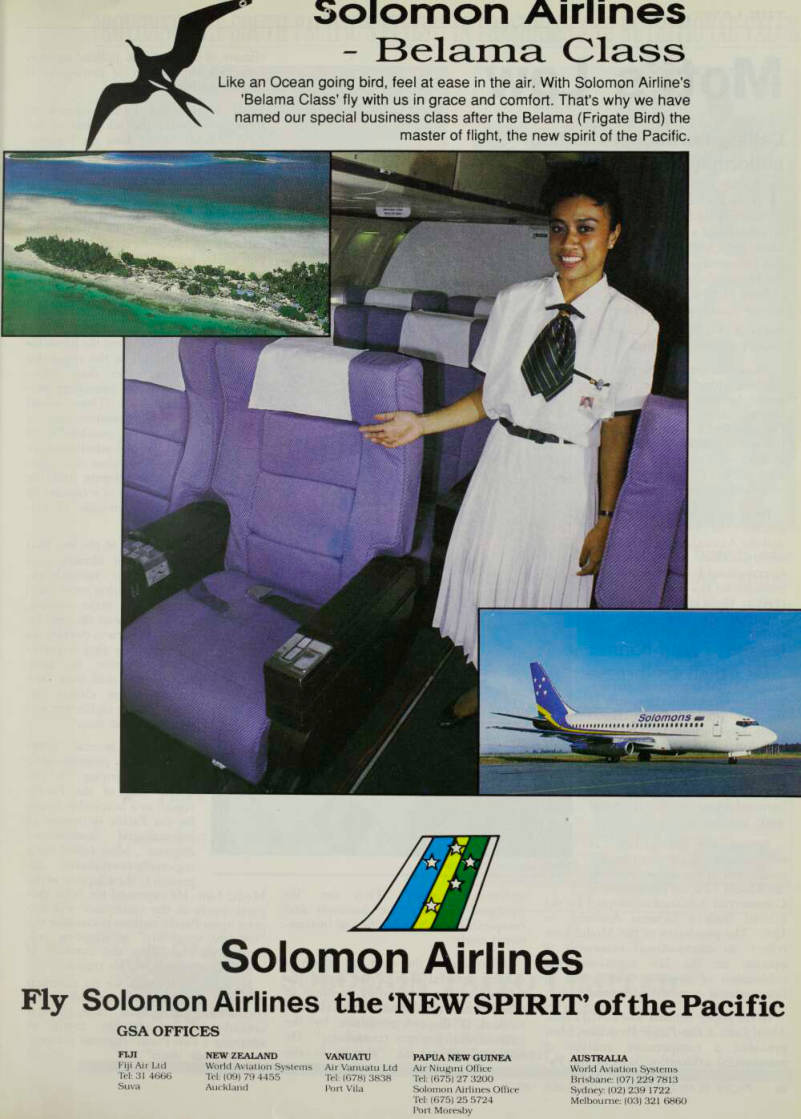
Solomon Airlines
- Belama Class
Like an Ocean going bird, feel at ease in the air. With Solomon Airline's 'Belama Class' fly with us in grace and comfort. That's why we have named our special business class after the Belama (Frigate Bird) the master of flight, the new spirit of the Pacific.
Solomons
Solomon Airlines
Fly Solomon Airlines the‘NEW SPIRIT’of the Pacific
GSA OFFICES
FIJI
Fiji Air Ltd Tel: 31 4666 Suva
NEW ZEALAND VANUATU PAPUA NEW GUINEA
World Aviation Systems Air Vanuatu Ltd Air Niugini Office Tel: (09) 79 4455 Tel; (678) 3838 Tel: (675) 27 3200 Auckland Port Vila Solomon Airlines Office Tel: (675) 25 5724 Port Moresby
AUSTRALIA
World Aviation Systems Brisbane: (07) 229 7813 Sydney: (02) 239 1722 Melbourne: (03) 321 6860
Moti’s Law
Calling for changes to find uniformity in modern day Pacific
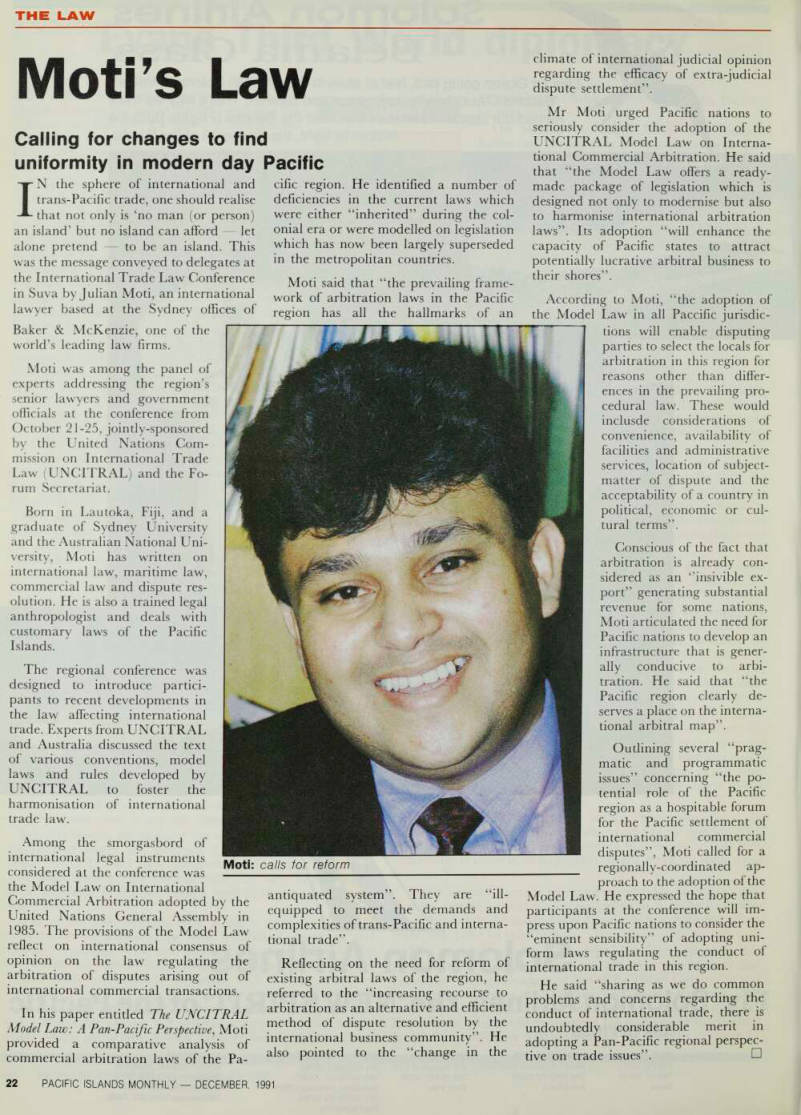
IN the sphere of international and trans-Pacific trade, one should realise that not only is ‘no man (or person) an island’ but no island can afford let alone pretend to be an island. This was the message conveyed to delegates at the International Trade Law Conference in Suva by Julian Moti, an international lawyer based at the Sydney offices of
Baker & McKenzie, one of the world’s leading law firms.
Moti was among the panel of experts addressing the region’s senior lawyers and government officials at the conference from October 21-25, jointly-sponsored by the United Nations Com mission on International Trade Law (UNCITRAL) and the Fo rum Secretariat, Born in Lautoka, Fiji, and a
graduate of Sydney University
and the Australian National Uni versity, Moti has written on international law, maritime law, commercial law and dispute res olution. He is also a trained legal anthropologist and deals with customary laws of the Pacific Islands.
The regional conference was designed to introduce partici pants to recent developments in the law affecting international trade. Experts from UNCITRAL and Australia discussed the text of various conventions, model laws and rules developed by UNCITRAL to foster the harmonisation of international trade law.
Among the smorgasbord of international legal instruments considered at the conference was the Model Law on International
Commercial Arbitration adopted by the United Nations General Assembly in 1985. The provisions of the Model Law reflect on international consensus of opinion on the law regulating the arbitration of disputes arising out of international commercial transactions.
In his paper entitled The UNCITRAL Model Law: A Pan-Pacific Perspective , Moti provided a comparative analysis of commercial arbitration laws of the Pa
cific region. He identified a number of deficiencies in the current laws which were either “inherited” during the col onial era or were modelled on legislation which has now been largely superseded m t^ie metropolitan countries.
Moti said that “ the preva ii ing f rame .
WO rk of arbitration laws in the Pacific region has all the hallmarks of an
antiquated system”. They are “ill equipped to meet the demands and complexities of trans-Pacific and interna tional trade”.
Reflecting on the need for reform of existing arbitral laws of the region, he referred to the “increasing recourse to arbitration as an alternative and efficient method of dispute resolution by the international business community”. He also pointed to the “change in the
climate of international judicial opinion regarding the efficacy of extra-judicial
dispute settlement”.
Mr Moti urged Pacific nations to seriously consider the adoption of the UNCITRAL Model Law on Interna tional Commercial Arbitration. He said that “the Model Law offers a ready made package of legislation which is designed not only to modernise but also to harmonise international arbitration laws”. Its adoption “will enhance the capacity of Pacific states to attract potentially lucrative arbitral business to their shores”.
According to Moti, “the adoption of the Model Law in all Pacciflc jurisdic
tions will enable disputing parties to select the locals for arbitration in this region for reasons other than differ ences in the prevailing pro cedural law. These would inclusde considerations of convenience, availability of facilities and administrative services, location of subject matter of dispute and the acceptability of a country in political, economic or cul tural terms”.
Conscious of the fact that arbitration is already con sidered as an °insivible ex port” generating substantial revenue for some nations, Moti articulated the need for Pacific nations to develop an infrastructure that is gener ally conducive to arbi tration. He said that “the Pacific region clearly de serves a place on the interna tional arbitral map”.
Outlining several “prag matic and programmatic issues” concerning “the po tential role of the Pacific region as a hospitable forum for the Pacific settlement of international commercial disputes”, Moti called for a
regionally-coordinated ap
proach to the adoption of the
Model Law. He expressed the hope that participants at the conference will im press upon Pacific nations to consider the “eminent sensibility” of adopting uni form laws regulating the conduct of international trade in this region.
He said “sharing as we do common problems and concerns regarding the conduct of international trade, there is undoubtedly considerable merit in adopting a Pan-Pacific regional perspec tive on trade issues”. □
Moti: calls for reform
Advertisements & other items, p. 23 (1 item)
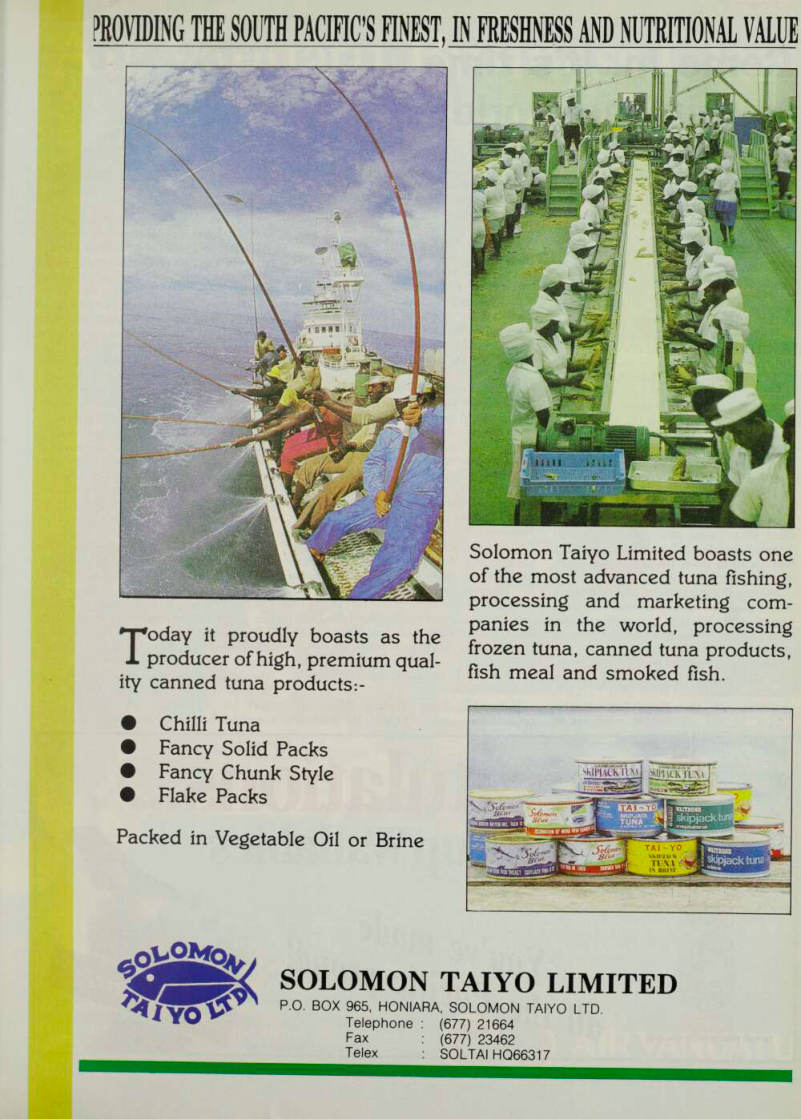
Providing Till South Pacific’S Finest, In Freshness And Nutritional Value
m i & Today it proudly boasts as the producer of high, premium quality canned tuna products:- Chilli Tuna Fancy Solid Packs Fancy Chunk Style Flake Packs Packed in Vegetable Oil or Brine 'L 4 V is 1 ■ Solomon Taiyo Limited boasts one of the most advanced tuna fishing, processing and marketing companies in the world, processing frozen tuna, canned tuna products, fish meal and smoked fish. wwxiiwi *imcvii,\i V mgm
SOLOMON TAIYO LIMITED
P-O. BOX 965, HONIARA, SOLOMON TAIYO LTD.
Telephone Fax Telex (677) 21664 (677) 23462
SOLTAI H 066317
Come in, it’s time
Sports
Come in, it’s time to join the world
By Loveni Enari
THANKS to Western Samoa’s per formances at the recently com pleted World Cup, the Pacific, as a rugby force, though not yet in the spotlight of the international stage, has emerged from the wings to take on one of the minor starring roles.
Whether it as represented by Samoa, Fiji and Tonga - can progress to one of the leading lights by the time World Cup 1995 rolls on, remains to be seen. But the road ahead doesn’t seem as difficult as it has been in the past.
As the only Pacific Islands Journalist covering the Samoan’s progress in the United Kingdom, their successes were as much a joy to behold as the the Fijians’ losses were an exercise in frustration.
But where to for Samoa and Fiji from here? And where does it leave Tonga who failed to qualify for the tournament and yet who are traditionally one of the big three in Pacific rugby? Sitting by a gas heater surrounded by sports papers filled with soccer news, while the rain drizzled outside my London flat is not the best location from which to pass com ment on the game in the islands.
But one thing is certain: administrators of the game in all three countries must become more vocal to gain international competition to capitalise on the ground
gained by Samoa’s success.
And any complacency from the Sam oans should have been hit hard on the head by a comment from Don Furnley, chairman of the Australian Rugby Union, in the immediate wash-up to
Australia’s victory over England in the final. Proposing a Southern Hemisphere competition similar to the Five Nations in the North, Fernley said he thought Australia, New Zealand, Fiji and Argen tina could provide the basis for it.
It was a hypothetical statement and didn’t grab much attention. But the fact someone in his position could mention Fiji ahead of Western Samoa, in light of the two side’s contrasting performances, should serve as a sharp reminder to the Samoans that their results, hailed as heroic in Apia, were only glimpses of glory on an international scale and should never be taken for granted.
There is still much to be done and the Fijians must feel that most. Seeded eighth in the world going into the competition and finishing with three poor perform ances from three matches was a bitter pill for them to swallow. They were built up by the British media as superb sevens players deficient in the more technical aspects of the 15-man game and the dark men in white played as if guided by the headlines.
Coming from a nation whose most well known personality is the gung-ho Siti veni Rabuka, they struggled to live up to his fearsome reputation and their im pressions of hailing a taxi when going in for the tackle were schoolboyish. Their lack of aggression and unwillingness to confront their opponents in the forwards, while relying on their flamboyant style to see them safely through , was never going to be enough.
But unlike Tonga their problems are on-field ones and, judging by the number
of times the Fijian side is overhauled and injected with new blood, the pool of talent is still flowing strongly.
The Tongans are faced with a more difficult proposition. Despite their ab sence from the tournament, Tongan born Australian flanker Viliami Ofahengaue, ensured all that is admir able about Tongan rugby power, pace, and tremendous ball skills were on display in his man-of-the-match performance in the final.
Ofahengaue received his rugby educa tion in New Zealand’s rugby capital, Auckland, and there-in could lie the key to a rejuvenation of Tongan rugby for there are any number of budding ‘Ofahengaues’ waiting to be discovered in Auckland. Players the like of Daniel Manu and Sakeasi Taumalolo, both included. in the Auckland squad this year, are just two examples. And just below players of their calibre the num bers of big Tongan schoolboys and club players with names that have Palagi match commentators speaking in short hand are even more impressive.
To be fair to the Tongan Rugby Union it has not overtly discouraged New Zealand-based players. But their system of recruitment is by no means as organised as the Samoans, with the latter’s success this year closely linked with the increasing influence from New Zealand.
However while they struggle to come to terms with the issue, administrators in the islands must not wait for an edict to be handed down to them. Samoa, and Fiji before them, have proven the Pacific can stand tall amongst the more estab lished unions of the world on the field.
Whether or not Tonga, Fiji and Samoa feature in the opening credits when the curtain goes up on World Cup ’95 will depend much on the off-field work of administrators of all three countries in the intervening years. □
Advertisements & other items, pp. 24-26 (1 item)
Congratulations
World Cup Wallabies □23
You’ve 'ftoud!
OFFICIAL SPONSOR OF THE WALLABIES
all the Pfldjic f° Klti (Parson Crossan CP/1228 6& 1 * MV
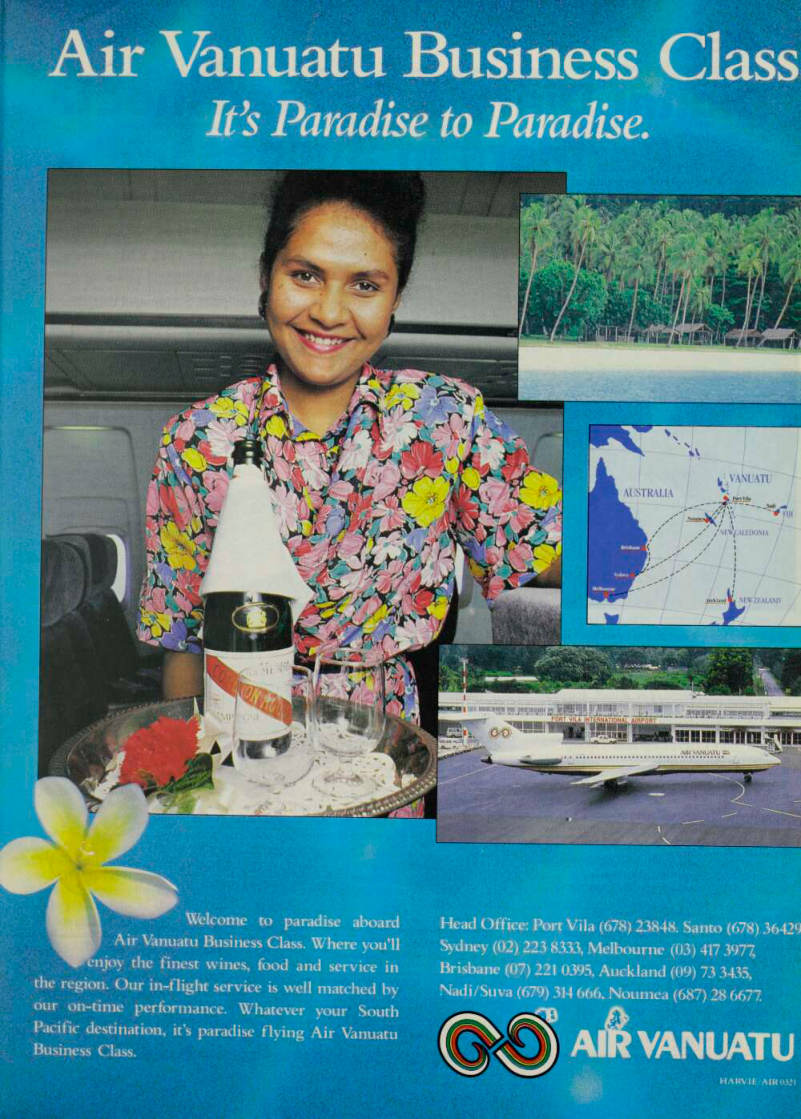
Air Vanuatu Business Class
It’s Paradise to Paradise.
m m A m ■ m m t r Welcome to paradise aboard Air Vanuatu Business Class. Where you’ll 'enjoy the finest wines, food and service in the region. Our in-flight service is well matched by our on-time performance. Whatever your South Pacific destination, it’s paradise flying Air Vanuatu Business Class.
Head Office: Port Vila (678) 23848. Santo (678) 3642 Sydney (02) 223 8333, Melbourne (03) 417 3977, Brisbane (07) 221 0395, Auckland (09) 73 3435, Nadi/Suva (679) 314 666, Noumea (687) 28 6677.
HARVIE/A1R0321
Digital Diary & Spreadsheet
Partners in Success.
The ES-630 1C Card gives the SF-9500
powerful spreadsheet capabilities. With
26 columns and 999 rows, it has almost the same data processing power as a
personal computer. Simply input the data
for price lists, stock lists or sales figures,
and the CASIO Power Spreadsheet quick-
ly performs the calculations.
Digital Diary and Spreadsheet. The two
partners you need for successful busi-
ness. an 43 t\ -- M SF-9500
IC CARD SYSTEM
A flat-key version Sf-9000 is also available
Digital Diary SF-9500
Power Spreadsheet ES-630 ES-630 CASIO Power Spreadsheet by Lucid ? 3-D* • 26-column by 999-row spreadsheet capabilities • 51 scientific functions including sum and mean • 3-D linking of any cell • Reads and writes Lotus 1-2-3 and Lucid 3-D files (requires optional FA-100/FA-150) • Large 64K8 user’s memory • 8 built-in templates for finance and other applications A Variety of ■ ES-100 ■ ES-105 ■ ES-110 ■ ES-600**" ■ ES-610**" ■ ES-620*** ■ ES-650 ■ ES-700 ■ ES-800 ■ ES-810 ■ ES-820 IC Cards for Extended Applicability 64K8 RAM card with memory backup 128 KB RAM card with memory backup 256K8 RAM card with memory backup Spelling checker and Thesaurus dictionary Spelling checker with financial and legal terms Spelling checker with medical terms Powerful Scientific Wine Guide Travel Conversations (Spanish 1 - English) Multi-lingual Translation Dictionary Asia Travel Conversations (9 languages) cp&ose
The special package combining
the SF-9500 and ES-630 is now available.
SF-9500 S 3 (SF-9500 T ES-630)
* Lucid® 3-D is a registered trademark of PCSG, Inc.
“Lotus 1-2-3 is a registered trademark of Lotus Development Corporation. ti.—... •“International Correct Spell system. Electronic Thesaurus, Right Word Usage Alert and Abbreviation Expander developed by Houghton Mifflin Company, publishers of The American Heritage Dictionary and Roget s II: The New Thesaurus.
AUSTRALIA : MOBEX PTY. LTD.
UNIT 1, GIBBES STREET
CHATSWOOD N S W. 2067
FIJI ISLANDS BRULAL & CO., LTD.
G.P.O. BOX NO. 362
SUVA, FIJI ISLANDS
NEW CALEDONIA BRECKWOLDT SARL
8P2369 NOUMEA
NEW CALEDONIA
MENARD PACIFIQUE
10 RUE JEAN JAURES
8P3899 NOUMEA, NEW CALEDONIA
NEW ZEALAND MONACO CORP. LTD.
41 POLAND ROAD, GLENFIELD
AUCKLAND, NEW ZEALAND
NORFOLK ISLANDS BURNT PINE TRADERS LTD.
P.0.80X21, NORFOLK ISLANDS
PAPUA NEW GUINEA SENGCO NIUGINI PTY. LTD.
P.0.80X 1886, BOROKU
PAPUA NEW GUINEA
TAHITI MAISON AUROSE
30, RUE COLLETTE
PAPEETE, TAHITI
VANUATU FUNG KUEI
P.0.80X51, PORT VILA
VANUATU
CASIO COMPUTER CO., LTD.
Tokyo, Japan
Cracking the American market
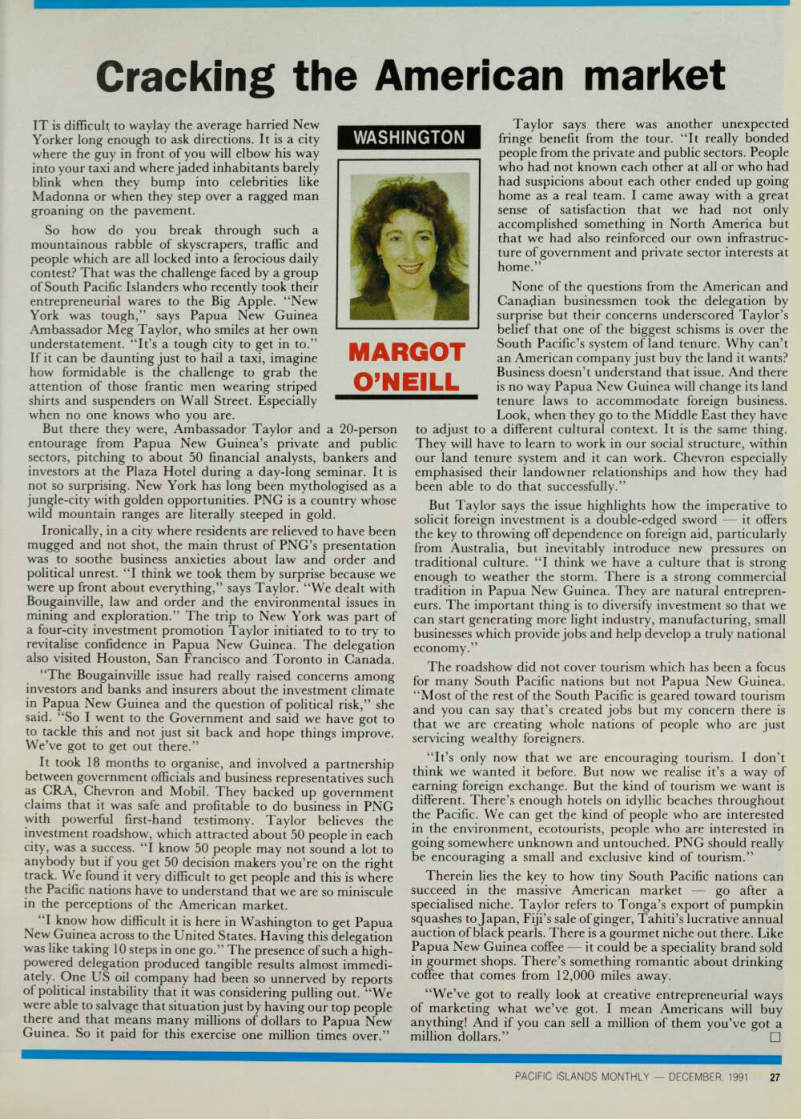
IT is difficult to waylay the average harried New Yorker long enough to ask directions. It is a city where the guy in front of you will elbow his way into your taxi and where jaded inhabitants barely blink when they bump into celebrities like Madonna or when they step over a ragged man groaning on the pavement.
So how do you break through such a mountainous rabble of skyscrapers, traffic and people which are all locked into a ferocious daily contest? That was the challenge faced by a group of South Pacific Islanders who recently took their entrepreneurial wares to the Big Apple. “New York was tough,” says Papua New Guinea Ambassador Meg Taylor, who smiles at her own understatement. “It’s a tough city to get in to.”
If it can be daunting just to hail a taxi, imagine how formidable is the challenge to grab the attention of those frantic men wearing striped shirts and suspenders on Wall Street. Especially when no one knows who you are.
But there they were, Ambassador Taylor and a 20-person entourage from Papua New Guinea’s private and public sectors, pitching to about 50 financial analysts, bankers and investors at the Plaza Hotel during a day-long seminar. It is not so surprising. New York has long been mythologised as a jungle-city with golden opportunities. PNG is a country whose wild mountain ranges are literally steeped in gold.
Ironically, in a city where residents are relieved to have been mugged and not shot, the main thrust of PNG’s presentation was to soothe business anxieties about law and order and political unrest. “I think we took them by surprise because we were up front about everything,” says Taylor. “We dealt with Bougainville, law and order and the environmental issues in mining and exploration.” The trip to New York was part of a four-city investment promotion Taylor initiated to to try to revitalise confidence in Papua New Guinea. The delegation also visited Houston, San Francisco and Toronto in Canada.
“The Bougainville issue had really raised concerns among investors and banks and insurers about the investment climate in Papua New Guinea and the question of political risk,” she said. “So I went to the Government and said we have got to to tackle this and not just sit back and hope things improve.
We’ve got to get out there.”
It took 18 months to organise, and involved a partnership between government officials and business representatives such as CRA, Chevron and Mobil. They backed up government claims that it was safe and profitable to do business in PNG with powerful first-hand testimony. Taylor believes the investment roadshow, which attracted about 50 people in each city, was a success. “I know 50 people may not sound a lot to anybody but if you get 50 decision makers you’re on the right track. We found it very difficult to get people and this is where the Pacific nations have to understand that we are so miniscule in the perceptions of the American market.
“I know how difficult it is here in Washington to get Papua New Guinea across to the United States. Having this delegation was like taking 10 steps in one go.” The presence of such a high powered delegation produced tangible results almost immedi ately. One US oil company had been so unnerved by reports of political instability that it was considering pulling out. “We were able to salvage that situation just by having our top people there and that means many millions of dollars to Papua New Guinea. So it paid for this exercise one million times over.”
Taylor says there was another unexpected fringe benefit from the tour. “It really bonded people from the private and public sectors. People who had not known each other at all or who had had suspicions about each other ended up going home as a real team. I came away with a great sense of satisfaction that we had not only accomplished something in North America but that we had also reinforced our own infrastruc ture of government and private sector interests at home.”
None of the questions from the American and Canadian businessmen took the delegation by surprise but their concerns underscored Taylor’s belief that one of the biggest schisms is over the South Pacific’s system of land tenure. Why can’t an American company just buy the land it wants?
Business doesn’t understand that issue. And there is no way Papua New Guinea will change its land tenure laws to accommodate foreign business.
Look, when they go to the Middle East they have
to adjust to a different cultural context. It is the same thing.
They will have to learn to work in our social structure, within our land tenure system and it can work. Chevron especially emphasised their landowner relationships and how they had been able to do that successfully.”
But Taylor says the issue highlights how the imperative to solicit foreign investment is a double-edged sword it offers the key to throwing off dependence on foreign aid, particularly from Australia, but inevitably introduce new pressures on traditional culture. “I think we have a culture that is strong enough to weather the storm. There is a strong commercial tradition in Papua New Guinea. They are natural entrepren eurs. The important thing is to diversify investment so that we can start generating more light industry, manufacturing, small businesses which provide jobs and help develop a truly national economy.”
The roadshow did not cover tourism which has been a focus for many South Pacific nations but not Papua New Guinea.
“Most of the rest of the South Pacific is geared toward tourism and you can say that’s created jobs but my concern there is that we are creating whole nations of people who are just
servicing wealthy foreigners.
“It’s only now that we are encouraging tourism. I don’t think we wanted it before. But now we realise it’s a way of earning foreign exchange. But the kind of tourism we want is different. There’s enough hotels on idyllic beaches throughout the Pacific. We can get the kind of people who are interested in the environment, ecotourists, people who are interested in going somewhere unknown and untouched. PNG should really be encouraging a small and exclusive kind of tourism.”
Therein lies the key to how tiny South Pacific nations can succeed in the massive American market go after a specialised niche. Taylor refers to Tonga’s export of pumpkin squashes to Japan, Fiji’s sale of ginger, Tahiti’s lucrative annual auction of black pearls. There is a gourmet niche out there. Like Papua New Guinea coffee it could be a speciality brand sold in gourmet shops. There’s something romantic about drinking coffee that comes from 12,000 miles away.
“We’ve got to really look at creative entrepreneurial ways of marketing what we’ve got. I mean Americans will buy anything! And if you can sell a million of them you’ve got a million dollars.” □
Washington
Margot
O’Neill
Advertisements & other items, p. 28 (1 item)
Focus
Fire
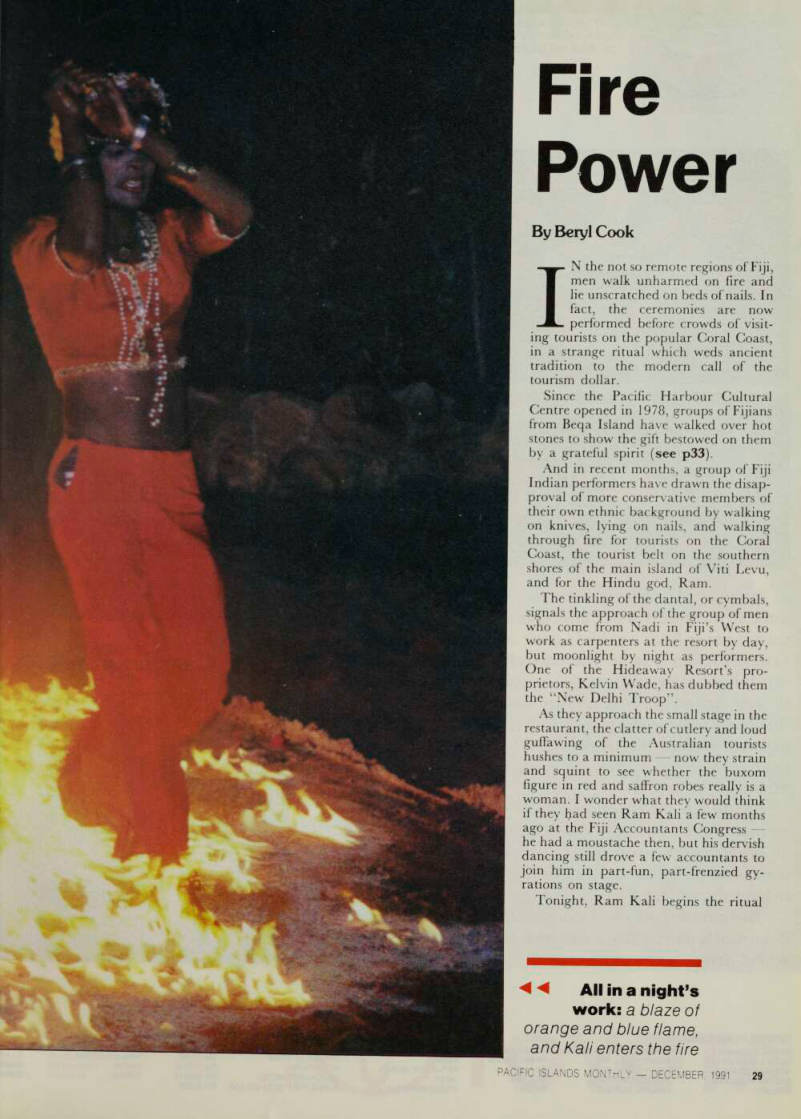
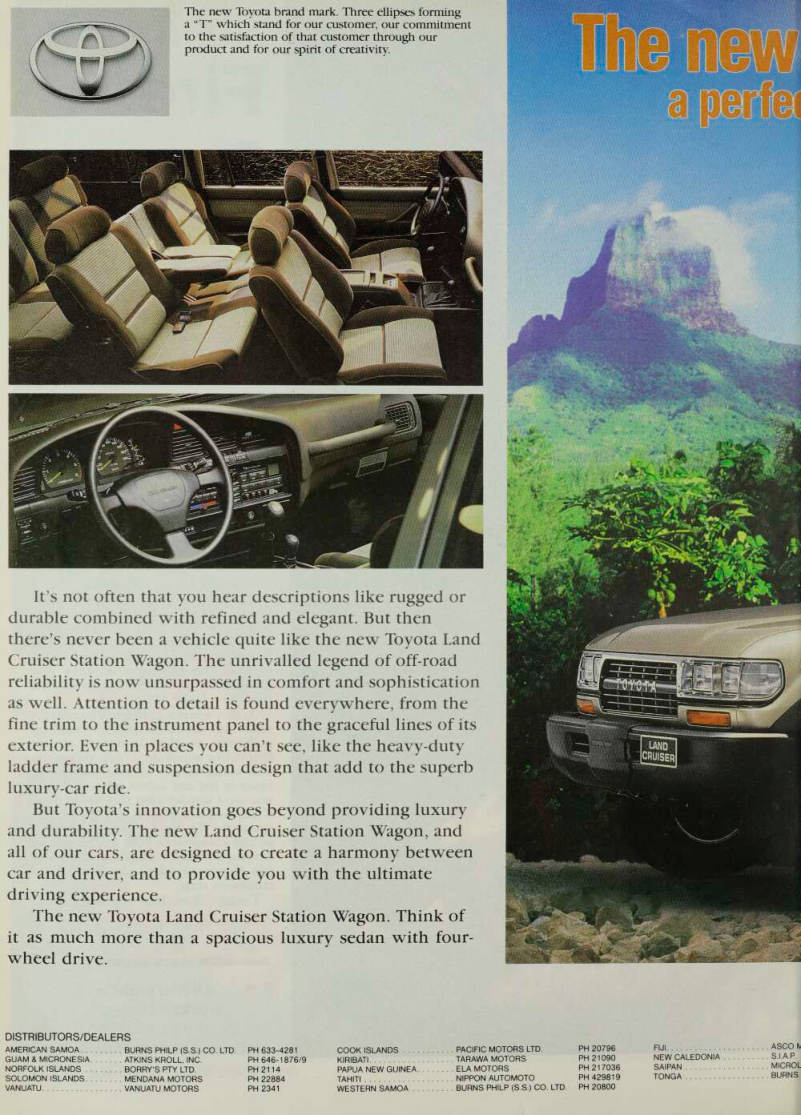
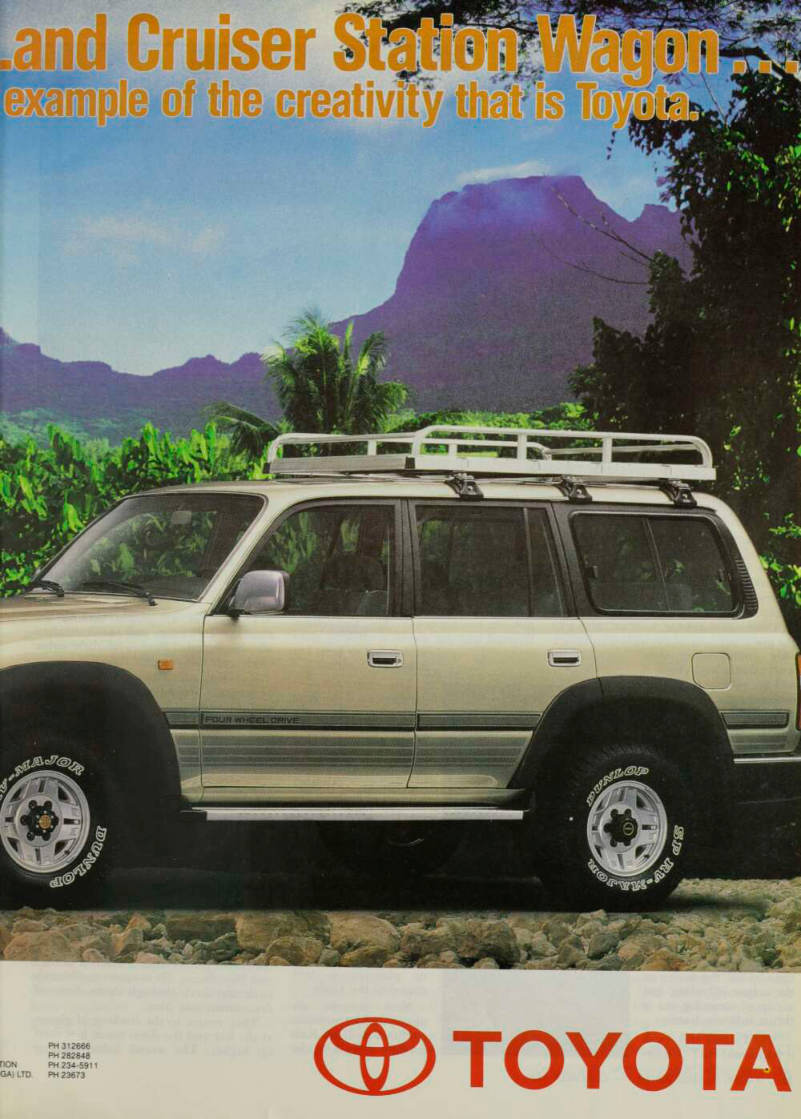
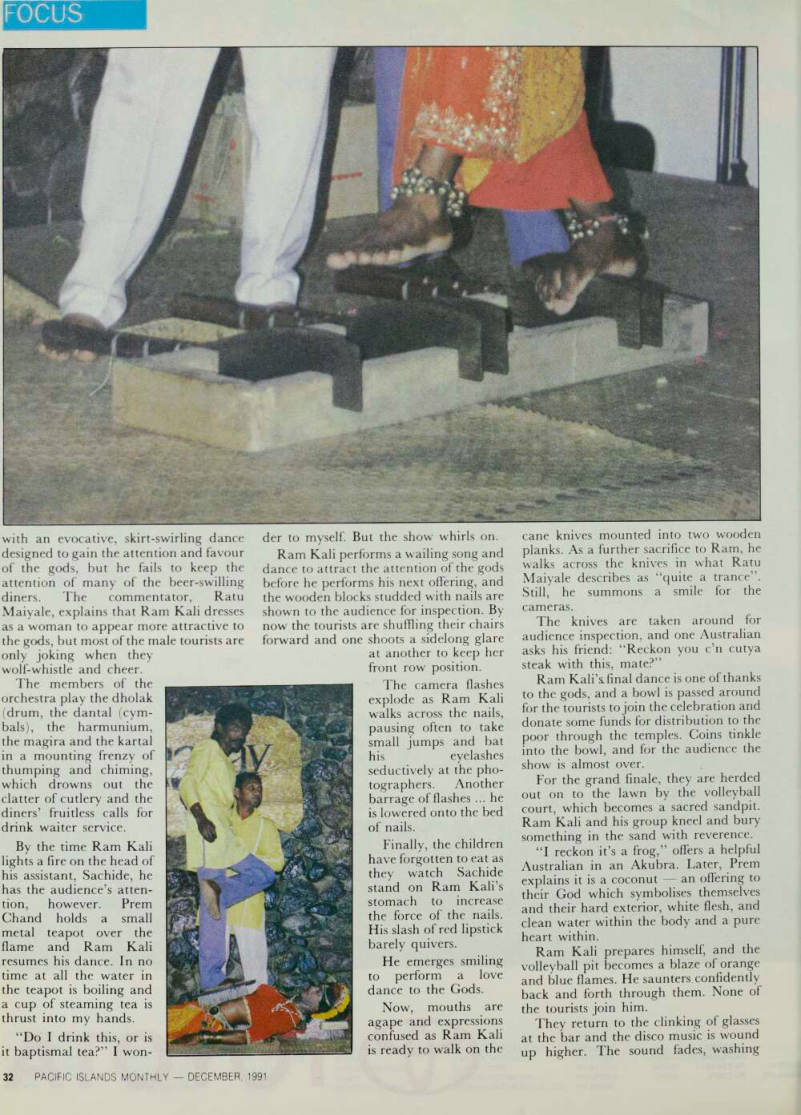
Power
By Beryl Cook
IN the not so remote regions of Fiji, men walk unharmed on fire and lie unscratched on beds of nails. In fact, the ceremonies are now performed before crowds of visit ing tourists on the popular Coral Coast, in a strange ritual which weds ancient tradition to the modern call of the tourism dollar.
Since the Pacific Harbour Cultural Centre opened in 1978, groups of Fijians from Beqa Island have walked over hot stones to show the gift bestowed on them by a grateful spirit (see p 33).
And in recent months, a group of Fiji Indian performers have drawn the disap proval of more conservative members of their own ethnic background by walking on knives, lying on nails, and walking through fire for tourists on the Coral Coast, the tourist belt on the southern shores of the main island of Viti Levu, and for the Hindu god, Ram.
The tinkling of the dantal, or cymbals, signals the approach of the group of men who come from Nadi in Fiji’s West to work as carpenters at the resort by day, but moonlight by night as performers.
One of the Hideaway Resort’s pro prietors, Kelvin Wade, has dubbed them the “New Delhi Troop”.
As they approach the small stage in the restaurant, the clatter of cutlery and loud guffawing of the Australian tourists hushes to a minimum now they strain and squint to see whether the buxom figure in red and saffron robes really is a woman. I wonder what they would think if they fyad seen Ram Kali a few months ago at the Fiji Accountants Congress he had a moustache then, but his dervish dancing still drove a few accountants to join him in part-fun, part-frenzied gy rations on stage.
Tonight, Ram Kali begins the ritual
All in a night’s work: a blaze of orange and blue flame, and Kali enters the fire
with an evocative, skirt-swirling dance designed to gain the attention and favour of the gods, but he fails to keep the attention of many of the beer-swilling diners. The commentator, Ratu Maiyale, explains that Ram Kali dresses as a woman to appear more attractive to the gods, but most of the male tourists are
only joking when they wolf-whistle and cheer.
The members of the orchestra play the dholak (drum, the dantal (cym bals), the harmunium, the magira and the kartal in a mounting frenzy of thumping and chiming, which drowns out the clatter of cutlery and the diners’ fruitless calls for drink waiter service.
By the time Ram Kali lights a fire on the head of his assistant, Sachide, he has the audience’s atten tion, however. Prem Chand holds a small metal teapot over the flame and Ram Kali resumes his dance. In no time at all the water in the teapot is boiling and a cup of steaming tea is thrust into my hands.
“Do I drink this, or is it baptismal tea?” I won
der to myself. But the show whirls on.
Ram Kali performs a wailing song and dance to attract the attention of the gods before he performs his next offering, and the wooden blocks studded with nails are shown to the audience for inspection. By now the tourists are shuffling their chairs forward and one shoots a sidelong glare
at another to keep her front row position.
The camera flashes explode as Ram Kali walks across the nails, pausing often to take small jumps and bat
his eyelashes
seductively at the pho
tographers. Another
barrage of flashes ... he is lowered onto the bed of nails.
Finally, the children have forgotten to eat as they watch Sachide stand on Ram Kali’s stomach to increase the force of the nails.
His slash of red lipstick
barely quivers.
He emerges smiling to perform a love dance to the Gods.
Now, mouths are agape and expressions confused as Ram Kali is ready to walk on the
cane knives mounted into two wooden planks. As a further sacrifice to Ram, he walks across the knives in what Ratu Maiyale describes as “quite a trance”.
Still, he summons a smile for the cameras.
The knives are taken around for audience inspection, and one Australian asks his friend: “Reckon you c’n cutya steak with this, mate?”
Ram Kali’sTmal dance is one of thanks to the gods, and a bowl is passed around for the tourists to join the celebration and donate some funds for distribution to the poor through the temples. Coins tinkle into the bowl, and for the audience the show is almost over.
For the grand finale, they are herded out on to the lawn by the volleyball court, which becomes a sacred sandpit.
Ram Kali and his group kneel and bury something in the sand with reverence.
“I reckon it’s a frog,” offers a helpful Australian in an Akubra. Later, Prem explains it is a coconut an offering to their God which symbolises themselves and their hard exterior, white flesh, and clean water within the body and a pure heart within.
Ram Kali prepares himself, and the volleyball pit becomes a blaze of orange and blue flames. He saunters confidently back and forth through them. None of the tourists join him.
They return to the clinking of glasses at the bar and the disco music is wound up higher. The sound fades, washing
away by the swssshing of waves as I follow the group down to the sea.
Here, Prem explains, they will finish their dedication and prayers. Few words are spoken, but the purple bougainvillea blooms are laid gently on the sea, where they bob in the light of flickering candles floating on small plates.
“The flowers are offerings. They are perfect. They must not be allowed to be stood on or bruised in any way,” Prem explains.
We walk back into the dim kerosene lamp light of the galvanised iron shed, where I had tried to interview Ram Kali before the show. He and his followers, who had been squatting on the bare floor of the shack, had not been too welcoming then. Now, they are relaxed and happy to talk.
“We prepare right up to just before the show. We fast for a day and we have to pray for at least 15 minutes beforehand to make our god, Durga Mata, happy,”
Prem Chand explained. “Then the priest will know that she is happy and allow us to walk on the nails, knives and fire.”
The preparations for the performance were sacred, and it was a privilege to be allowed to witness the final rites by the sea. The bit in the middle may well prove to be a tourism attraction, but the group seem to believe it can retain an untar nished place in the deeper, spiritual aspects of their lives.
This belief has been with the Fiji Indians since they arrived in Fiji as indentured labourers more than 100 years ago, and it still is evident in the life of the high priest himself today.
By day 22-year-old Satish Raj cuts cane, but by night he is Rami Kali one of Fiji’s three Singh High Priests. The ritual he leads as a priest is thousands of years old, introduced by the indentured labourers who were brought in from India in the 1880 s and 1890 s to do the same work on the British-owned sugarcane fields which Satish does today.
The indentured labourers of last centuij fared little better than slaves, receiving minimal wages and living in conditions of poverty, but held tight to their customs and religion for commun ity, strength and survival. By the time their indenture was finished, the Govern ment encouraged them to stay in Fiji by offering them attractive leases. Today, about 43 per cent of the population are descendants of these labourers and many have expanded new businesses and prospered. □
Advertisements & other items, pp. 30-31 (1 item)
luxury-car ride.
The new Toyota brand mark. Three ellipses forming a “T” which stand for our customer, our commitment to the satisfaction of that customer through our product and for our spirit of creativity.
It’s not often that you hear descriptions like rugged or durable combined with refined and elegant. But then there’s never been a vehicle quite like the new Toyota Land Cruiser Station Wagon. The unrivalled legend of off-road reliability is now unsurpassed in comfort and sophistication as well. Attention to detail is found everywhere, from the fine trim to the instrument panel to the graceful lines of its exterior. Even in places you can’t see, like the heavy-duty ladder frame and suspension design that add to the superb
But Toyota’s innovation goes beyond providing luxury and durability. The new Land Cruiser Station Wagon, and all of our cars, are designed to create a harmony between car and driver, and to provide you with the ultimate
driving experience.
The new Toyota Land Cruiser Station Wagon. Think of it as much more than a spacious luxury sedan with fourwheel drive.
HI ■
Din
i *
DISTRIBUTORS/DEALERS
AMERICAN SAMOA BURNS PHILP (S.S.) CO. LTD. PH 633-4281 GUAM & MICRONESIA ATKINS KROLL, INC. PH 646-1876/9 NORFOLK ISLANDS BORRY'S PTY LTD. PH 2114
SOLOMON ISLANDS MENDANA MOTORS PH 22884
VANUATU VANUATU MOTORS PH 2341
COOK ISLANDS PACIFIC MOTORS LTD. PH 20796
KIRIBATI TARAWA MOTORS PH 21090
PAPUA NEW GUINEA ELA MOTORS PH 217036
TAHITI NIPPON AUTOMOTO PH 429819
WESTERN SAMOA BURNS PHILP (S.S.) CO. LTD. PH 20800
FIJI ASCO N/
NEW CALEDONIA S.I.A.P.
SAIPAN MICROL
TONGA BURNS
Cruiser
id - 1?^
Bwßmlb
cr is ' * L_ 1 m*L PH 312666 PH 282848
HON PH 234-591'
GA) LTD. PH 23673
TOYOTA
The power of the Eel
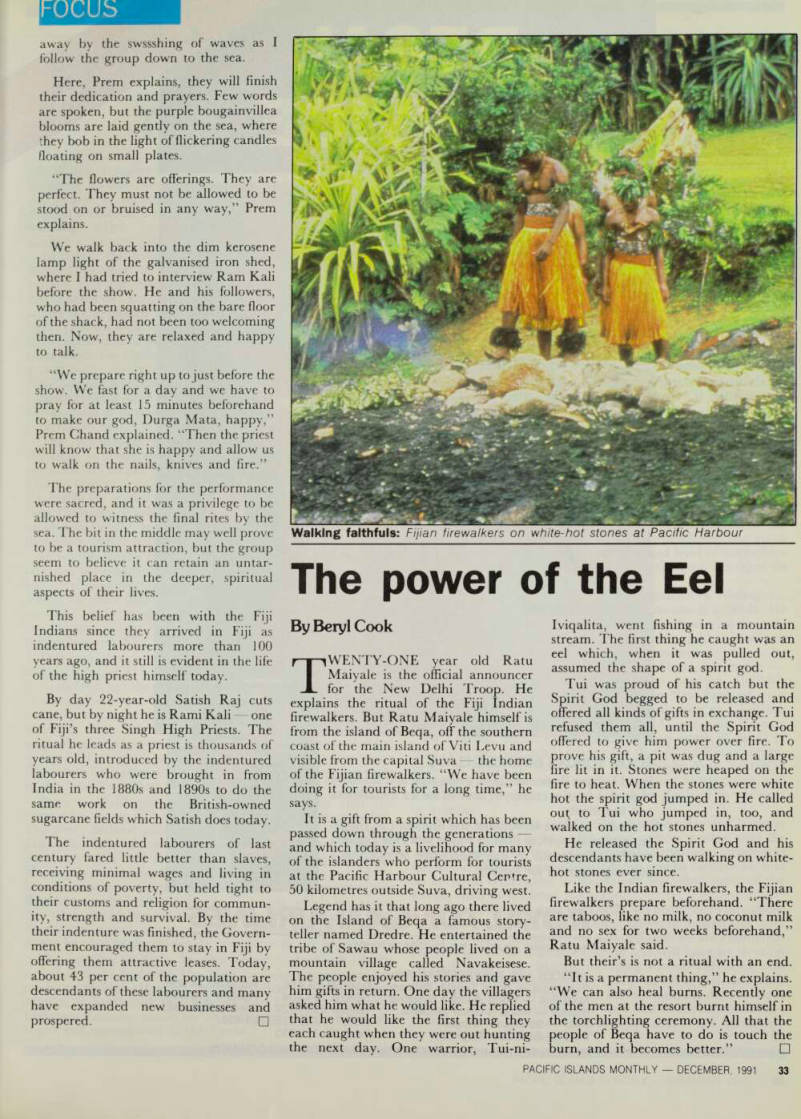
By Beryl Cook
Twenty-one year old Ratu Maiyale is the official announcer for the New Delhi Troop. He explains the ritual of the Fiji Indian firewalkers. But Ratu Maiyale himself is from the island of Beqa, off the southern coast of the main island ofViti Levu and visible from the capital Suva the home of the Fijian firewalkers. “We have been doing it for tourists for a long time,” he says.
It is a gift from a spirit which has been passed down through the generations and which today is a livelihood for many of the islanders who perform for tourists at the Pacific Harbour Cultural Centre, 50 kilometres outside Suva, driving west.
Legend has it that long ago there lived on the Island of Beqa a famous story teller named Dredre. He entertained the tribe of Sawau whose people lived on a mountain village called Navakeisese.
The people enjoyed his stories and gave him gifts in return. One day the villagers asked him what he would like. He replied that he would like the first thing they each caught when they were out hunting the next day. One warrior, Tui-ni-
Iviqalita, went fishing in a mountain stream. The first thing he caught was an eel wh j w . hen h , was . P out> assumed the shape of a spirit god. . \ ° t , Tul was proud of his catch but the S P lnt , G «! b< =gg ed ,‘° be re eased and ofbr,;d al [ kinds pf gifts in exchange. Tui refused them all, until the Spirit God ofrered to « lve hlm P ower over flre - To P rov e hls ? lft - a P u was and a lar g e £ ire 11 m lt- Stones were heaped on the |* re Beat. When the stones were white hot the spirit god jumped m. He called out ;, * n ’ to °’ anc * wa ‘ ked ° n th ' h °' s ‘° nes released the Spirit God and his descendants have been walking on white hot stones ever since.
Like the Indian firewalkers, the Fijian firewalkers prepare beforehand. “There are taboos, like no milk, no coconut milk no se . x fi° r wee^s beforehand, Ratu Maiyale said, But their’s is not a ritual with an end.
“It is a permanent thing,” he explains, “We can also heal burns. Recently one of the men at the resort burnt himself in the torchlighting ceremony. All that the people of Beqa have to do is touch the burn, and it becomes better.” □
Walking faithfuls: Fijian firewalkers on white-hot stones at Pacific Harbour
Advertisements & other items, p. 34 (1 item)
Regal
SERVICE
'*■ m 4. - Wm MM
ROYAL TONGAN BUSINESS CLASS
Royal Tongan Business Class, a new style and standard of service from a country renowned for its friendliness
and hospitality.
Domestic services throughout the Kingdom of Tonga.
International services linking Tonga with New Zealand and Fiji. Book with us and experience service that’s normally reserved for Royalty.
■ ROYAL TONGAN AIRLINES
\. THE NATIONAL AIRLINE OF THE KINGDOM OF TONGA
OFFICES AND REPRESENTATIVES:
Nukualofa Royal Tongan Airlines: Tel-(676) 23 414 Fax-(676) 24 056 Auckland World Aviation Systems: Tel-(09) 794 454 Fax-(09) 775 648 Sydney World Aviation Systems: Tel-(02) 239 1722 Fax-(02) 290 3641 Nadi Sunflower Airlines: Tel-(679) 723 016, 723 408 Suva Sunflower Airlines: Tel-(679) 315 755 MEMBER OF THE INTERNATIONAL AIR TRANSPORT ASSOCIATION
The Cook Islands dilemma
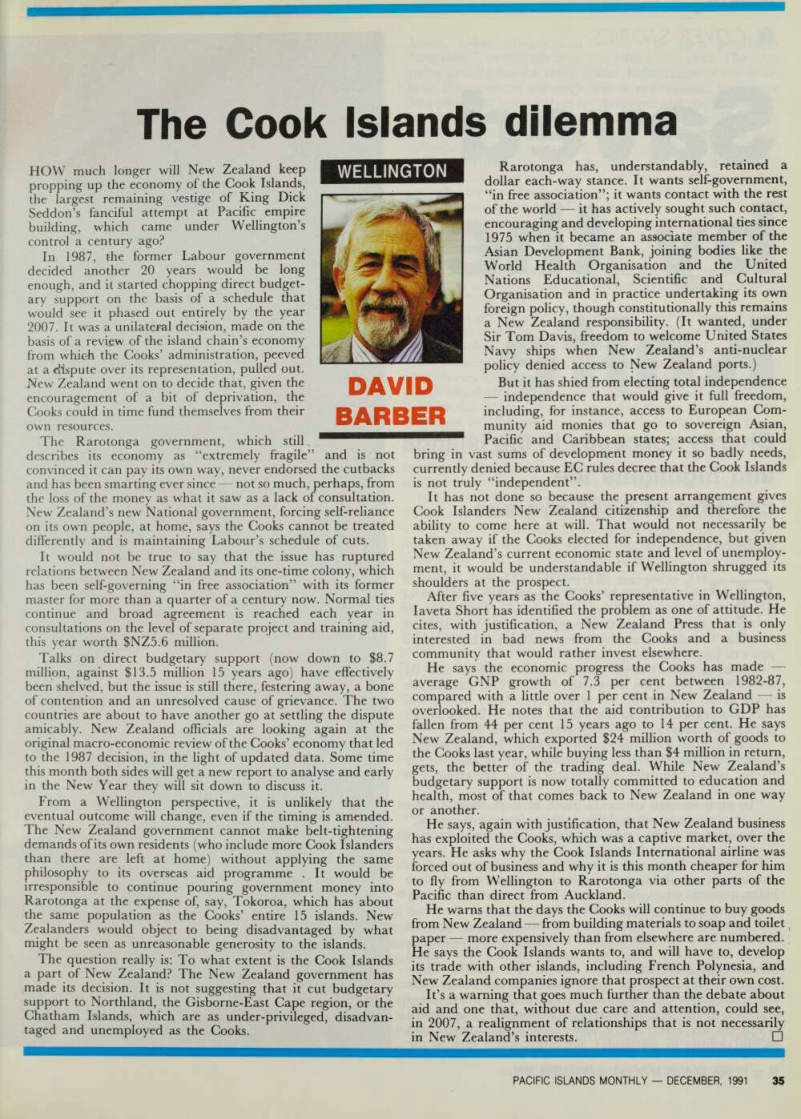
HOW much longer will New Zealand keep propping up the economy of the Cook Islands, the largest remaining vestige of King Dick Seddon’s fanciful attempt at Pacific empire building, which came under Wellington’s control a century ago?
In 1987, the former Labour government decided another 20 years would be long enough, and it started chopping direct budget ary support on the basis of a schedule that would see it phased out entirely by the year 2007. It was a unilateral decision, made on the basis of a review of the island chain’s economy from which the Cooks’ administration, peeved at a dispute over its representation, pulled out.
New Zealand went on to decide that, given the encouragement of a bit of deprivation, the Cooks could in time fund themselves from their own resources.
The Rarotonga government, which still
describes its economy as “extremely fragile” and is not convinced it can pay its own way, never endorsed the cutbacks and has been smarting ever since not so much, perhaps, from the loss of the money as what it saw as a lack of consultation.
New Zealand’s new National government, forcing self-reliance on its own people, at home, says the Cooks cannot be treated differently and is maintaining Labour’s schedule of cuts.
It would not be true to say that the issue has ruptured relations between New Zealand and its one-time colony, which has been self-governing “in free association” with its former master for more than a quarter of a century now. Normal ties continue and broad agreement is reached each year in consultations on the level of separate project and training aid, this year worth SNZS.6 million.
Talks on direct budgetary support (now down to $8.7 million, against $13.5 million 15 years ago) have effectively been shelved, but the issue is still there, festering away, a bone of contention and an unresolved cause of grievance. The two countries are about to have another go at settling the dispute amicably. New Zealand officials are looking again at the original macro-economic review of the Cooks’ economy that led to the 1987 decision, in the light of updated data. Some time this month both sides will get a new report to analyse and early in the New Year they will sit down to discuss it.
From a Wellington perspective, it is unlikely that the eventual outcome will change, even if the timing is amended.
The New Zealand government cannot make belt-tightening demands of its own residents (who include more Cook Islanders than there are left at home) without applying the same philosophy to its overseas aid programme . It would be irresponsible to continue pouring government money into Rarotonga at the expense of, say, Tokoroa, which has about the same population as the Cooks’ entire 15 islands. New Zealanders would object to being disadvantaged by what might be seen as unreasonable generosity to the islands.
The question really is: To what extent is the Cook Islands a part of New Zealand? The New Zealand government has made its decision. It is not suggesting that it cut budgetary support to Northland, the Gisborne-East Cape region, or the Chatham Islands, which are as under-privileged, disadvan taged and unemployed as the Cooks.
Rarotonga has, understandably, retained a dollar each-way stance. It wants self-government, “in free association”; it wants contact with the rest of the world it has actively sought such contact, encouraging and developing international ties since 1975 when it became an associate member of the Asian Development Bank, joining bodies like the World Health Organisation and the United Nations Educational, Scientific and Cultural Organisation and in practice undertaking its own foreign policy, though constitutionally this remains a New Zealand responsibility. (It wanted, under Sir Tom Davis, freedom to welcome United States Navy ships when New Zealand’s anti-nuclear policy denied access to New Zealand ports.) But it has shied from electing total independence independence that would give it full freedom, including, for instance, access to European Com munity aid monies that go to sovereign Asian, Pacific and Caribbean states; access that could
bring in vast sums of development money it so badly needs, currently denied because EC rules decree that the Cook Islands is not truly “independent”.
It has not done so because the present arrangement gives Cook Islanders New Zealand citizenship and therefore the ability to come here at will. That would not necessarily be taken away if the Cooks elected for independence, but given New Zealand’s current economic state and level of unemploy ment, it would be understandable if Wellington shrugged its shoulders at the prospect.
After five years as the Cooks’ representative in Wellington, laveta Short has identified the problem as one of attitude. He cites, with justification, a New Zealand Press that is only interested in bad news from the Cooks and a business community that would rather invest elsewhere.
He says the economic progress the Cooks has made average GNP growth of 7.3 per cent between 1982-87, compared with a little over 1 per cent in New Zealand is overlooked. He notes that the aid contribution to GDP has fallen from 44 per cent 15 years ago to 14 per cent. He says New Zealand, which exported 524 million worth of goods to the Cooks last year, while buying less than $4 million in return, gets, the better of the trading deal. While New Zealand’s budgetary support is now totally committed to education and health, most of that comes back to New Zealand in one way or another.
He says, again with justification, that New Zealand business has exploited the Cooks, which was a captive market, over the years. He asks why the Cook Islands International airline was forced out of business and why it is this month cheaper for him to fly from Wellington to Rarotonga via other parts of the Pacific than direct from Auckland.
He warns that the days the Cooks will continue to buy goods from New Zealand from building materials to soap and toilet paper more expensively than from elsewhere are numbered.
He says the Cook Islands wants to, and will have to, develop its trade with other islands, including French Polynesia, and New Zealand companies ignore that prospect at their own cost.
It’s a warning that goes much further than the debate about aid and one that, without due care and attention, could see, in 2007, a realignment of relationships that is not necessarily in New Zealand’s interests. □
Wellington
David
Barber
Advertisements & other items, pp. 36-38 (1 item)
by the
HEALTH
COVER STORIES
Saved by the Knife
Charity succeeds in the islands and highlights the dangers of poor hygiene
By Beryl Cook
THE echogram charted the hills and valleys of Joyce Mary’s heart. It amplified the rhythm of the blood pounding through the arteries, and the screen showed the irregularity of the mitral valve an irregularity which could bring her short 19 years of life to an abrupt halt.
The irregularity was the result of rheumatic fever and, by coincidence, the same irregularity which had caused the death of her mother in 1974 when Joyce Mary herself was only two years old. This year, Joyce Mary Bainivesi joined the list of patients for Fiji’s Operation Open Heart.
According to Australian heart specialist, Dr Fred Nasser, rheumatic heart disease is the second biggest killer in the Pacific Island countries, particularly in the age group 5 to 24.
“In most western countries death from rheumatic fever is a very rare occurrence. In fact this is almost unheard of,”
Dr Nasser said. “The tragedy of this is that rheumatic fever is completely preventable.”
Rheumatic fever and rheumatic heart disease tend to develop from substandard sanitation, hygiene and close living quarters when, for example, families move to the city and crowd into accommodation together.
Rheumatic fever begins as a sore throat secondary to an infection by a bacteria labelled as group A streptococcus.
Death can occur from myocarditis during the initial infection, as early as the first one to two months. More commonly fibrosis of the heart valves occurs slowly over years, leading to the crippling destruction of the heart valves and then death unless surgery is performed. The clinical symptoms are fever and a sore throat (pharyngitis) and painful joints, in particular the larger joints such as the
knees, ankle, elbows and wrists. The pain peculiarly “migrates”, or spreads from one joint to the next. The joint pains usually last for three weeks. Inflamation of the heart muscle can occur although this is uncommon, and more frequently the heart valves are damaged and the “murmur” can be detected by a doctor in this early stage. If further infections occur, the valve can be quickly scarred and deformed and death can occur during adolescence.
The treatment is usually bed rest plus Penicillin for 10 days. Penicillin against further infection is essential and is provided by a monthly injection of Penicillin for at least 10 years following the initial infection.
Dr Nasser said this can be a problem in remote areas, particularly if people are unaware of preventive measures.
“Reducing the risk of rheumatic fever involves several
measures which include personal hygiene, appropriate
sanitation as well as spacious accommodation and medical attention,” he said.
When it is contracted, rheumatoid fever or heart disease can appear as a simple throat infection followed by longer term breathlessness. But the result can be fatal.
Dr Nasser said: “The after-effects such as a mitral valve stenosis can cause the heart to work harder and harder to pump blood through the body. Often the patient will die if he or she is not operated on.” Dr Nasser has seen only two cases in 10 years in Australia. Only eight cases have been reported in a major teaching hospital in Sydney since 1980. The provision of adequate housing, hygiene as well as the ready availability of Penicillin have made the number of cases in developed countries like Australia negligible.
In the past few years, cardiac teams have visited Nepal, Tonga and Vanuatu, and the number of closed heart cases in Fiji warranted a visit by them last year. This year was the first time open heart surgery (in which it is necessary to stop the heart and let a bypass machine take over its
functions) was performed in Fiji.
Dr Nasser said the considerable number of people listed for assessments in Fiji was far greater than last year. He visited centres in Lautoka, Labasa as well as the Colonial War memorial Hospital in Suva. “It was difficult and painful selecting from among the many patients who are going to be operated on, on this ocassion,” Dr Nasser said.
“Unfortunately we could only do 20 cases in the given two weeks.”
A few days into the examinations, Dr Nasser noted the severity of many of the cases, which had been left to develop untreated for many years. The severity of their problems made some of the operations more complicated than
expected.
A team co-ordinator, Annette Baldwin, said this placed more pressure than anticipated on the operating team.
“Many of the patients had suffered rheumatic fever years ago, and the after-effects had become severe. The case mix was also a problem we had anticipated doing 50 per cent closed heart surgery, and 50 per cent open heart.
“But the number of severe cases was so bad we ended up doing something like 85 or 90 per cent open heart
surgery.”
As a result they ran out of
oxygenators for the heart-lung machine. Dr Bakani approached local businesses who helped with donations so more oxygenators could be bought from Australia, and Air Pacific allowed another staff member to bring them over as excess baggage. This year’s Operation Open Heart began
urgeons operate in Suva’s Colonial War memorial Hospital to save children with heart defects
with discussions between cardiac authorities in Fiji and Australia.
Funding for accommodation and meals for the team was secured from the Fiji Government and the Fiji Sixes, (a lotto run by Fiji Times Ltd,
publishers of Pacific. Islands Monthly
and The Fiji Times) . The Australian Embassy agreed to pay for the freight of the team’s 120 boxes of
equipment everything from high
technology monitoring equipment
to drapes.
The negotiations and ground
work started to become reality when the setting-up contingent of the 40-member team arrived on Sep tember 22.
“They came in and basically set up their own heart surgery. They brought with them everything from the bandaid to the scalpel to the pacemaker,” Dr Nasser said.
The complicated machinery was
begged and borrowed from different hospitals and businesses in Austra lia. This will be returned, but many of the left-over disposable items will be left for use in Fiji.
The benefits are ongoing. Pa tients are given an increased chance
of living longer, more active lives; and Fiji medical staff gain more experience. The Australian team members, who paid their own airfares and took holidays from their jobs in different hospitals in Australia to donate their time, also gained experience. But this is not the principle motive of the team.
Dr Nasser explains: “It’s basically something to do with a crazy love of humanity. How can you just tell a mother her child will die, if there is something you might be able to do for the child.” He and the Fiji medical authorities hope sponsors can be attracted for more visits of this kind, because of the number of patients still to be treated.
But expanded medical back-up in remote islands could have longer-term benefits. The Australian team has made every effort to repair the heart valves because replacement requires special drugs, such as doses of anti-coagulants, and frequent blood tests which are unavailable in remote areas.
“Realistically, this just
doesn’t happen when people live a relaxed lifestyle on a remote island,”
Dr Nasser said.
But they also stress educa tional initiatives to help islanders live healthier lifestyles and minimise the incidents of heart disease.
“We would rather not have to operate and in many cases it shouldn’t be necess ary. Preventive measures are much better than a big scar on the chest,” Dr Nasser said. □
you can play again
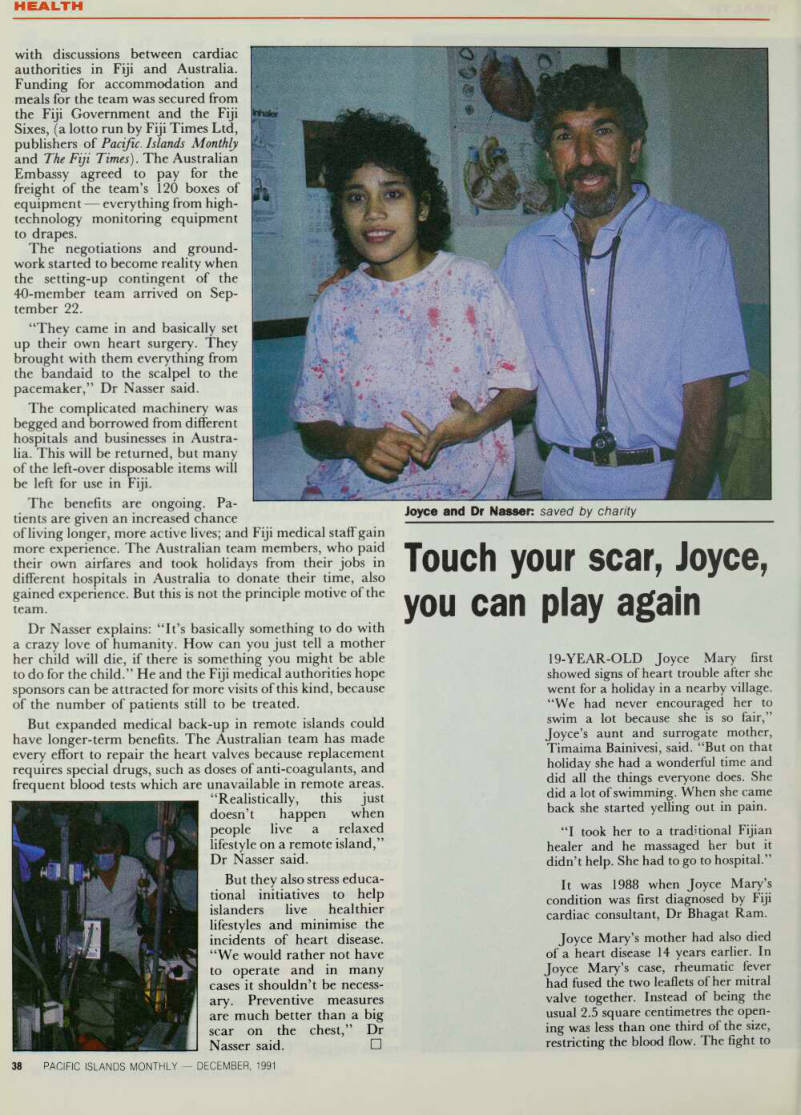
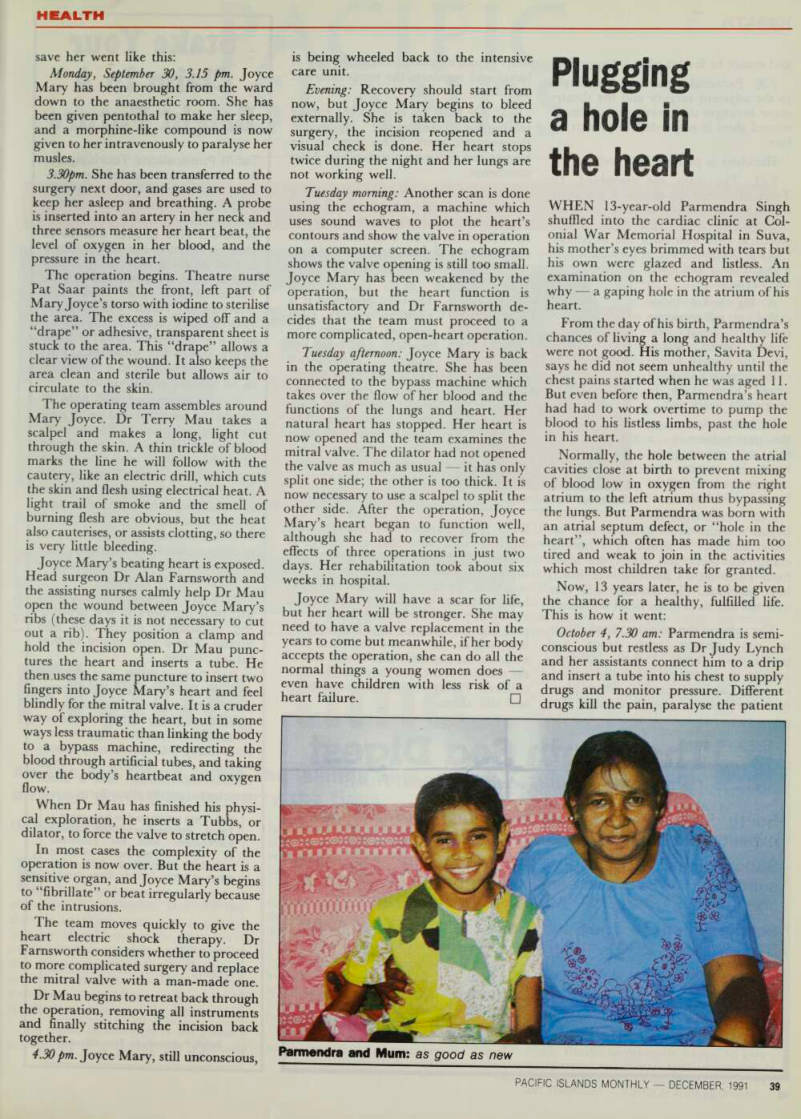
Touch your scar, Joyce, you can play again
19-YEAR-OLD Joyce Mary first showed signs of heart trouble after she went for a holiday in a nearby village.
“We had never encouraged her to swim a lot because she is so fair,”
Joyce’s aunt and surrogate mother, Timaima Bainivesi, said. “But on that holiday she had a wonderful time and did all the things everyone does. She did a lot of swimming. When she came back she started yelling out in pain.
“I took her to a traditional Fijian healer and he massaged her but it didn’t help. She had to go to hospital.”
It was 1988 when Joyce Mary’s condition was first diagnosed by Fiji cardiac consultant, Dr Bhagat Ram.
Joyce Mary’s mother had also died of a heart disease 14 years earlier. In Joyce Mary’s case, rheumatic fever had fused the two leaflets of her mitral valve together. Instead of being the usual 2.5 square centimetres the open ing was less than one third of the size, restricting the blood flow. The fight to
Joyce and Dr Nasser: saved by charity
save her went like this: Monday, September 30, 3.15 pm. Joyce Mary has been brought from the ward down to the anaesthetic room. She has been given pentothal to make her sleep, and a morphine-like compound is now given to her intravenously to paralyse her musics, 3.30 pm. She has been transferred to the surgery next door, and gases are used to keep her asleep and breathing. A probe is inserted into an artery in her neck and three sensors measure her heart beat, the level of oxygen in her blood, and the pressure in the heart.
The operation begins. Theatre nurse Pat Saar paints the front, left part of Mary Joyce’s torso with iodine to sterilise the area. The excess is wiped off and a “drape” or adhesive, transparent sheet is stuck to the area. This “drape” allows a clear view of the wound. It also keeps the area clean and sterile but allows air to circulate to the skin.
The operating team assembles around Mary Joyce. Dr Terry Mau takes a scalpel and makes a long, light cut through the skin. A thin trickle of blood marks the line he will follow with the cautery, like an electric drill, which cuts the skin and flesh using electrical heat. A light trail of smoke and the smell of burning flesh are obvious, but the heat also cauterises, or assists clotting, so there is very little bleeding.
Joyce Mary’s beating heart is exposed.
Head surgeon Dr Alan Farnsworth and the assisting nurses calmly help Dr Mau open the wound between Joyce Mary’s ribs (these days it is not necessary to cut out a rib). They position a clamp and hold the incision open. Dr Mau punc tures the heart and inserts a tube. He then.uses the same puncture to insert two fingers into Joyce Mary’s heart and feel blindly for the mitral valve. It is a cruder way of exploring the heart, but in some ways less traumatic than linking the body to a bypass machine, redirecting the blood through artificial tubes, and taking over the body’s heartbeat and oxygen flow.
When Dr Mau has finished his physi cal exploration, he inserts a Tubbs, or dilator, to force the valve to stretch open.
In most cases the complexity of the operation is now over. But the heart is a sensitive organ, and Joyce Mary’s begins to “fibrillate” or beat irregularly because of the intrusions.
The team moves quickly to give the heart electric shock therapy. Dr Farnsworth considers whether to proceed to more complicated surgery and replace the mitral valve with a man-made one.
Dr Mau begins to retreat back through the operation, removing all instruments and finally stitching the incision back together. 4.30 pm. Joyce Mary, still unconscious,
is being wheeled back to the intensive care unit.
Evening: Recovery should start from now, but Joyce Mary begins to bleed externally. She is taken back to the surgery, the incision reopened and a visual check is done. Her heart stops twice during the night and her lungs are not working well.
Tuesday morning: Another scan is done using the echogram, a machine which uses sound waves to plot the heart’s contours and show the valve in operation on a computer screen. The echogram shows the valve opening is still too small.
Joyce Mary has been weakened by the operation, but the heart function is unsatisfactory and Dr Farnsworth de cides that the team must proceed to a
more complicated, open-heart operation.
Tuesday afternoon: Joyce Mary is back in the operating theatre. She has been connected to the bypass machine which takes over the flow of her blood and the functions of the lungs and heart. Her natural heart has stopped. Her heart is now opened and the team examines the mitral valve. The dilator had not opened the valve as much as usual it has only split one side; the other is too thick. It is now necessary to use a scalpel to split the other side. After the operation, Joyce Mary’s heart began to function well, although she had to recover from the effects of three operations in just two days. Her rehabilitation took about six weeks in hospital.
Joyce Mary will have a scar for life, but her heart will be stronger. She may need to have a valve replacement in the years to come but meanwhile, if her body accepts the operation, she can do all the normal things a young women does even have children with less risk of a heart failure. □
Plugging
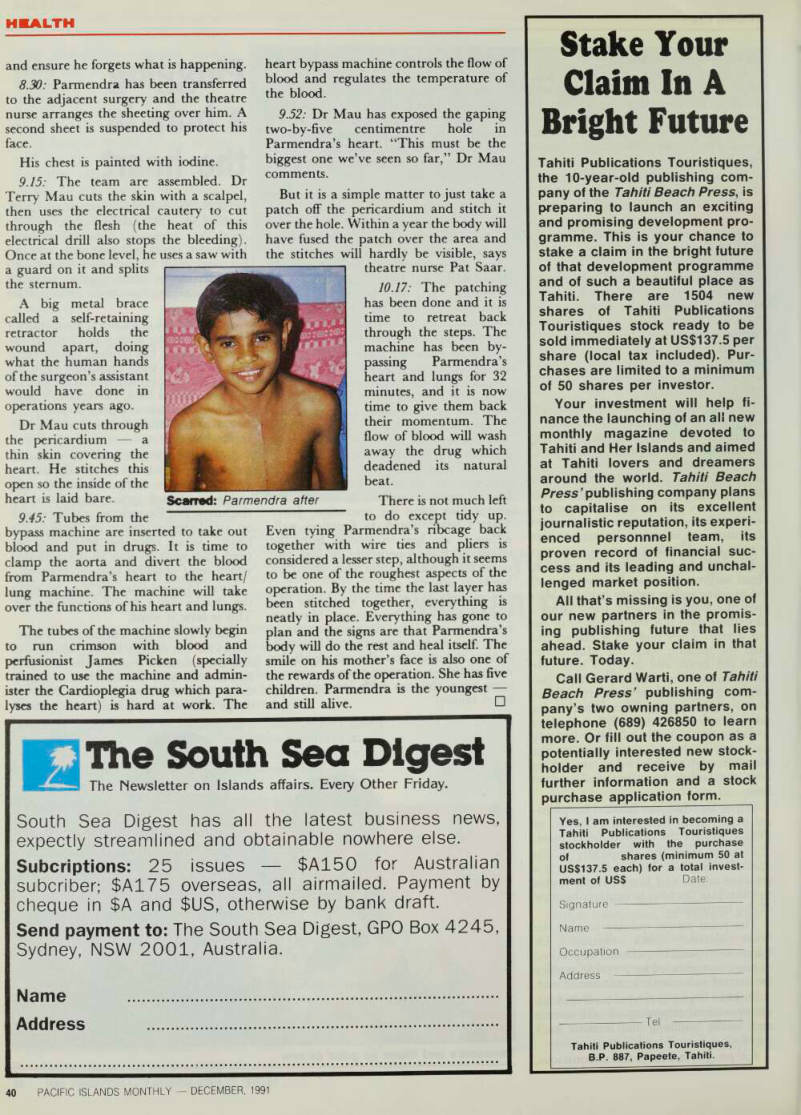
a hole in the heart
WHEN 13-year-old Parmendra Singh shuffled into the cardiac clinic at Col onial War Memorial Hospital in Suva, his mother’s eyes brimmed with tears but his own were glazed and listless. An examination on the echogram revealed why a gaping hole in the atrium of his heart.
From the day of his birth, Parmendra’s chances of living a long and healthy life were not good. His mother, Savita Devi, says he did not seem unhealthy until the chest pains started when he was aged 11.
But even before then, Parmendra’s heart had had to work overtime to pump the blood to his listless limbs, past the hole in his heart.
Normally, the hole between the atrial cavities close at birth to prevent mixing of blood low in oxygen from the right atrium to the left atrium thus bypassing the lungs. But Parmendra was born with an atrial septum defect, or “hole in the heart”, which often has made him too tired and weak to join in the activities which most children take for granted.
Now, 13 years later, he is to be given the chance for a healthy, fulfilled life.
This is how it went: October 4, 7.30 am: Parmendra is semi conscious but restless as Dr Judy Lynch and her assistants connect him to a drip and insert a tube into his chest to supply drugs and monitor pressure. Different drugs kill the pain, paralyse the patient
Parmendra and Mum: as good as new
and ensure he forgets what is happening. 8.30: Parmendra has been transferred to the adjacent surgery and the theatre nurse arranges the sheeting over him. A second sheet is suspended to protect his face.
His chest is painted with iodine. 9.15: The team are assembled. Dr Terry Mau cuts the skin with a scalpel, then uses the electrical cautery to cut through the flesh (the heat of this electrical drill also stops the bleeding).
Once at the bone level, he uses a saw with
a guard on it and splits the sternum.
A big metal brace called a self-retaining retractor holds the wound apart, doing what the human hands of the surgeon’s assistant would have done in operations years ago.
Dr Mau cuts through the pericardium a thin skin covering the heart. He stitches this open so the inside of the heart is laid bare.
9.45: Tubes from the bypass machine are inserted to take out blood and put in drugs. It is time to clamp the aorta and divert the blood from Parmendra’s heart to the heart/ lung machine. The machine will take over the functions of his heart and lungs.
The tubes of the machine slowly begin to run crimson with blood and
perfusionist James Picken (specially
trained to use the machine and admin ister the Cardioplegia drug which para lyses the heart) is hard at work. The
heart bypass machine controls the flow of blood and regulates the temperature of the blood. 9.52: Dr Mau has exposed the gaping two-by-five centimentre hole in Parmendra’s heart. “This must be the biggest one we’ve seen so far,” Dr Mau comments.
But it is a simple matter to just take a patch off the pericardium and stitch it over the hole. Within a year the body will have fused the patch over the area and the stitches will hardly be visible, says
theatre nurse Pat Saar. 10.17: The patching has been done and it is time to retreat back through the steps. The machine has been by
passing Parmendra’s
heart and lungs for 32 minutes, and it is now time to give them back their momentum. The flow of blood will wash away the drug which deadened its natural beat.
There is not much left to do except tidy up.
Even tying Parmendra’s ribcage back together with wire ties and pliers is considered a lesser step, although it seems to be one of the roughest aspects of the operation. By the time the last layer has been stitched together, everything is neady in place. Everything has gone to plan and the signs are that Parmendra’s body will do the rest and heal itself. The smile on his mother’s face is also one of the rewards of the operation. She has five children. Parmendra is the youngest and still alive. D
Scarred: Parmendra after
Advertisements & other items, p. 40 (1 item)
Bright Future
Stake Your
Claim In A
Tahiti Publications Touristiques, the 10-year-old publishing company of the Tahiti Beach Press, is preparing to launch an exciting and promising development programme. This is your chance to stake a claim in the bright future of that development programme and of such a beautiful place as Tahiti. There are 1504 new shares of Tahiti Publications Touristiques stock ready to be sold immediately at U 55137.5 per share (local tax included). Purchases are limited to a minimum of 50 shares per investor.
Your investment will help finance the launching of an all new monthly magazine devoted to Tahiti and Her Islands and aimed at Tahiti lovers and dreamers around the world. Tahiti Beach Press’ publishing company plans to capitalise on its excellent journalistic reputation, its experienced personnnel team, its proven record of financial success and its leading and unchallenged market position.
All that’s missing is you, one of our new partners in the promising publishing future that lies ahead. Stake your claim in that future. Today.
Call Gerard Warti, one of Tahiti Beach Press’ publishing company’s two owning partners, on telephone (689) 426850 to learn more. Or fill out the coupon as a potentially interested new stockholder and receive by mail further information and a stock purchase application form.
Yes, I am interested In becoming a Tahiti Publications Touristiques stockholder with the purchase of shares (minimum 50 at U 55137.5 each) for a total investment of US$ Date: Signature Name Occupation Address Tel Tahiti Publications Touristiques, B.P. 887, Papeete, Tahiti.
J*
The South Sea Digest
The Newsletter on Islands affairs. Every Other Friday.
South Sea Digest has all the latest business news, expectly streamlined and obtainable nowhere else.
Subcriptions: 25 issues SAISO for Australian subcriber; SAI7S overseas, all airmailed. Payment by cheque in $A and SUS, otherwise by bank draft.
Send payment to: The South Sea Digest, GPO Box 4245, Sydney, NSW 2001, Australia.
Name Address
Flying time
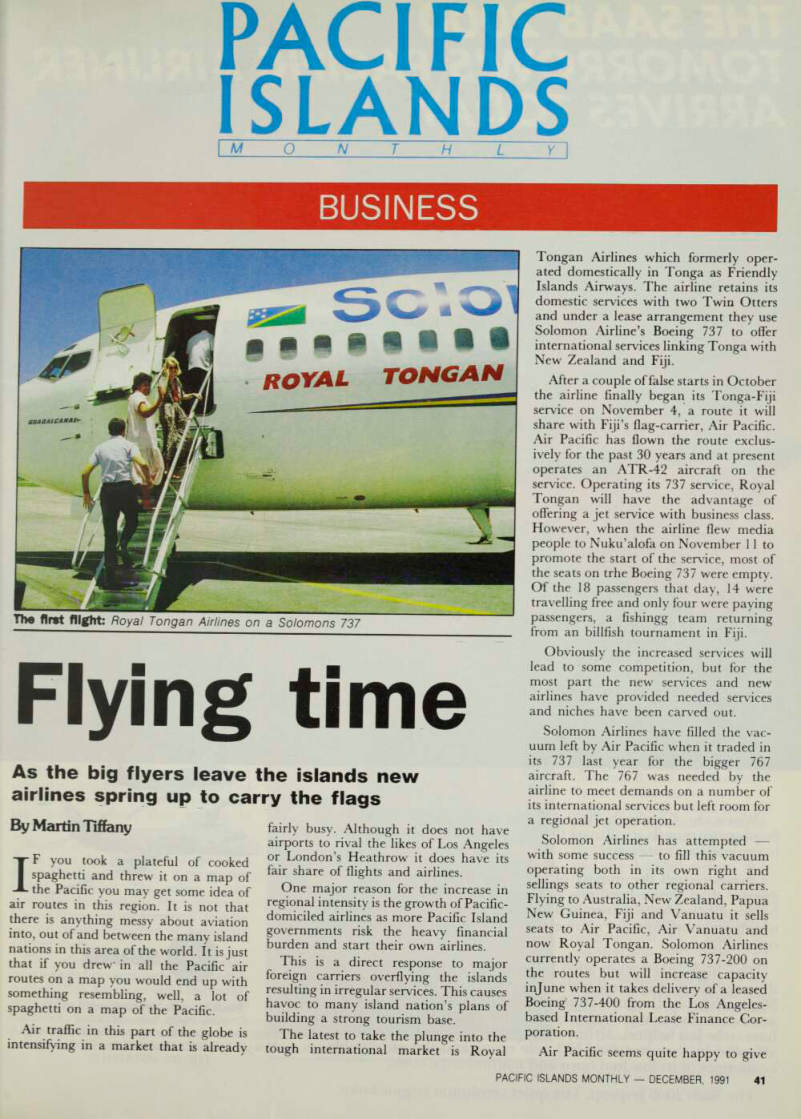
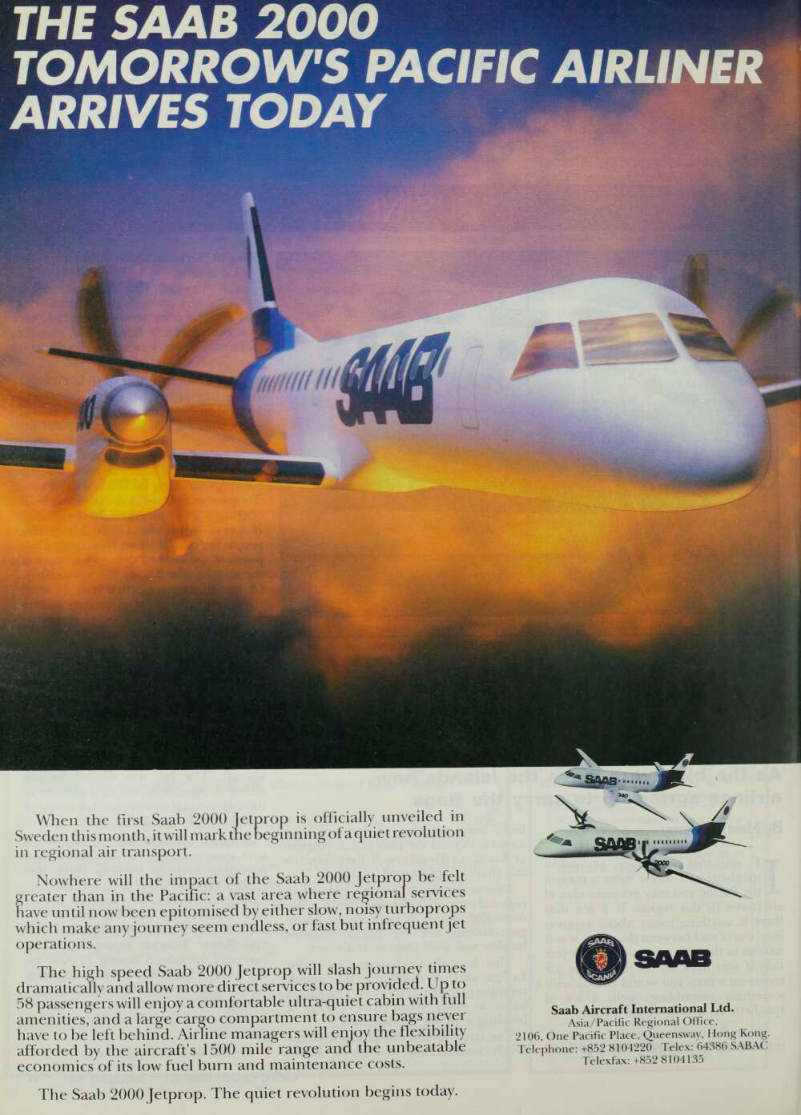
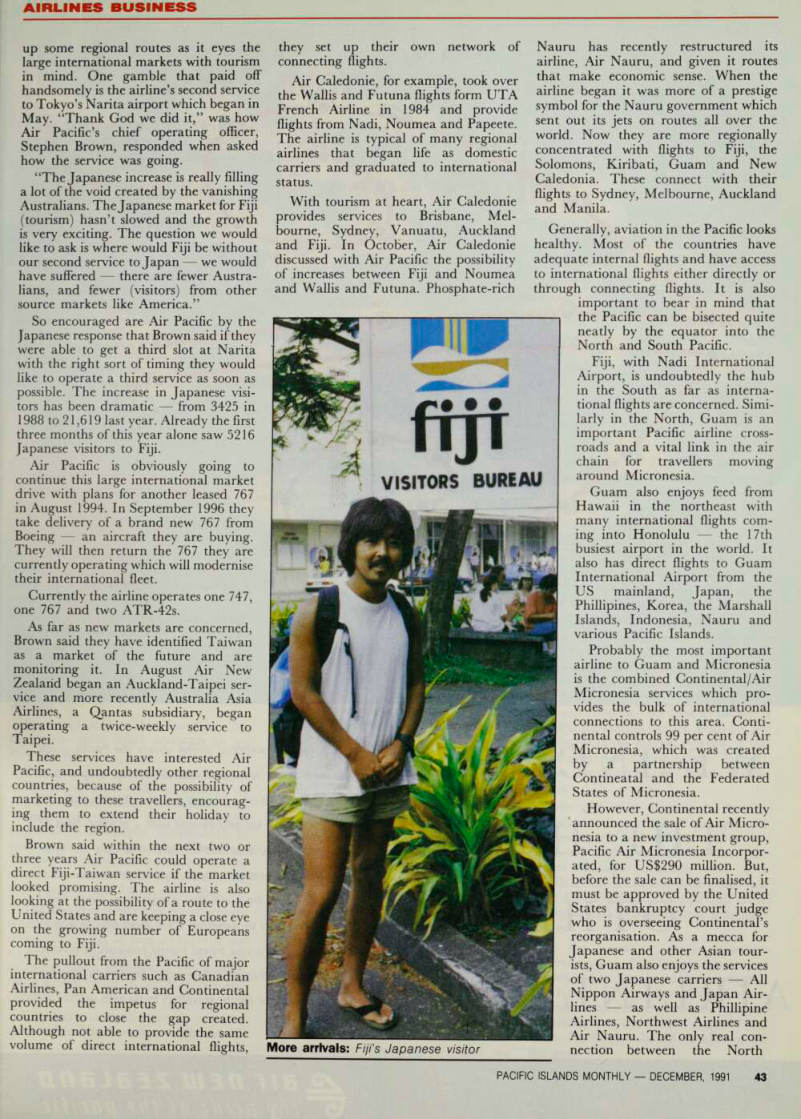
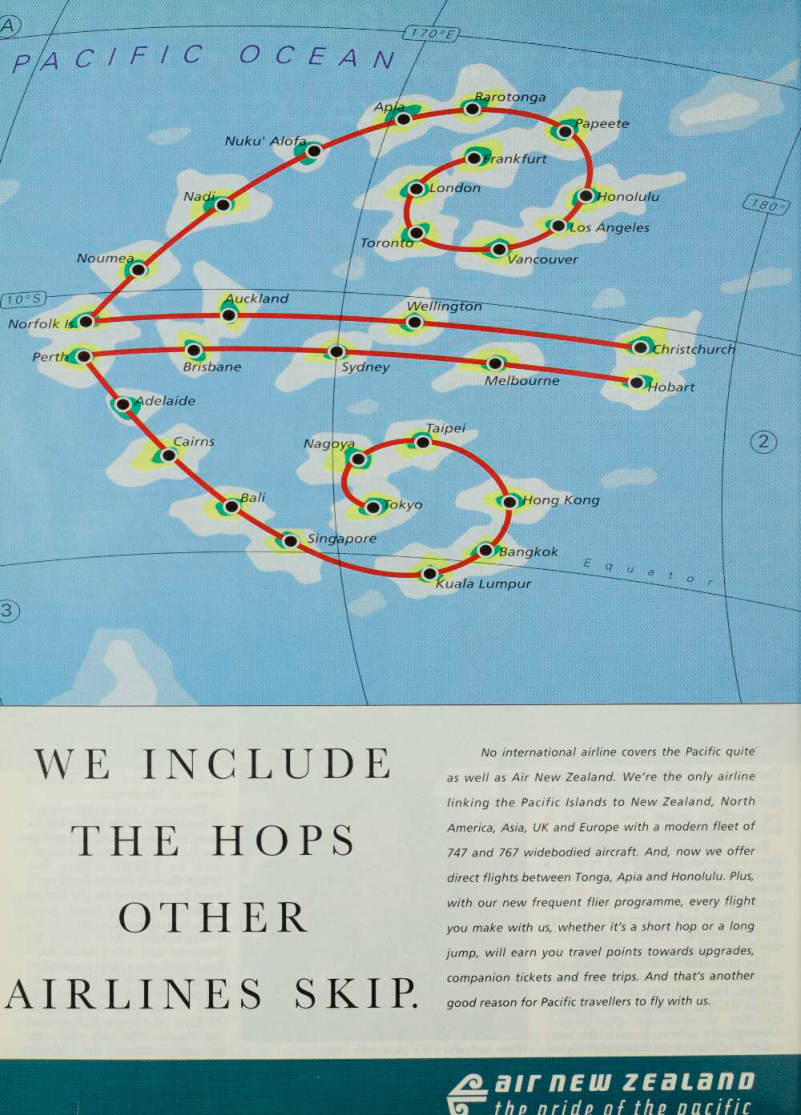
Pacific
Islands
Monthly
Business
Flying time
As the big flyers leave the islands new airlines spring up to carry the flags
By Martin Tiffany
IF you took a plateful of cooked spaghetti and threw it on a map of the Pacific you may get some idea of air routes in this region. It is not that there is anything messy about aviation into, out of and between the many island nations in this area of the world. It is just that if you drew in all the Pacific air routes on a map you would end up with something resembling, well, a lot of spaghetti on a map of the Pacific.
Air traffic in this part of the globe is intensifying in a market that is already
fairly busy. Although it does not have airports to rival the likes of Los Angeles or London’s Heathrow it does have its fair share of flights and airlines.
One major reason for the increase in regional intensity is the growth of Pacific domiciled airlines as more Pacific Island governments risk the heavy financial burden and start their own airlines.
This is a direct response to major foreign carriers overflying the islands resulting in irregular services. This causes havoc to many island nation’s plans of building a strong tourism base.
The latest to take the plunge into the tough international market is Royal
Tongan Airlines which formerly oper ated domestically in Tonga as Friendly Islands Airways. The airline retains its domestic services with two Twin Otters and under a lease arrangement they use Solomon Airline’s Boeing 737 to offer international services linking Tonga with New Zealand and Fiji.
After a couple of false starts in October
the airline finally began its Tonga-Fiji
service on November 4, a route it will share with Fiji’s flag-carrier, Air Pacific.
Air Pacific has flown the route exclus ively for the past 30 years and at present operates an ATR-42 aircraft on the service. Operating its 737 service, Royal Tongan will have the advantage of offering a jet service with business class.
However, when the airline flew media people to Nuku’alofa on November 11 to promote the start of the service, most of the seats on trhe Boeing 737 were empty.
Of the 18 passengers that day, 14 were travelling free and only four were paying passengers, a fishingg team returning from an billfish tournament in Fiji.
Obviously the increased services will lead to some competition, but for the most part the new services and new airlines have provided needed services and niches have been carved out.
Solomon Airlines have filled the vac uum left by Air Pacific when it traded in its 737 last year for the bigger 767 aircraft. The 767 was needed by the airline to meet demands on a number of its international services but left room for a regional jet operation.
Solomon Airlines has attempted with some success to fill this vacuum operating both in its own right and sellings seats to other regional carriers.
Flying to Australia, New Zealand, Papua New Guinea, Fiji and Vanuatu it sells seats to Air Pacific, Air Vanuatu and now Royal Tongan. Solomon Airlines currently operates a Boeing 737-200 on the routes but will increase capacity injune when it takes delivery of a leased Boeing 737-400 from the Los Angeles based International Lease Finance Cor poration.
Air Pacific seems quite happy to give
The first flight: Royal Tongan Airlines on a Solomons 737
up some regional routes as it eyes the large international markets with tourism in mind. One gamble that paid off handsomely is the airline’s second service to Tokyo’s Narita airport which began in May. “Thank God we did it,” was how Air Pacific’s chief operating officer, Stephen Brown, responded when asked how the service was going.
“The Japanese increase is really filling a lot of the void created by the vanishing Australians. The Japanese market for Fiji (tourism) hasn’t slowed and the growth is very exciting. The question we would like to ask is where would Fiji be without our second service to Japan we would have suffered there are fewer Austra lians, and fewer (visitors) from other source markets like America.”
So encouraged are Air Pacific by the Japanese response that Brown said if they were able to get a third slot at Narita with the right sort of timing they would like to operate a third service as soon as possible. The increase in Japanese visi tors has been dramatic from 3425 in 1988 to 21,619 last year. Already the first three months of this year alone saw 5216 Japanese visitors to Fiji.
Air Pacific is obviously going to continue this large international market drive with plans for another leased 767 in August 1994. In September 1996 they take delivery of a brand new 767 from Boeing an aircraft they are buying.
They will then return the 767 they are currently operating which will modernise their international fleet.
Currently the airline operates one 747, one 767 and two ATR-425.
As far as new markets are concerned, Brown said they have identified Taiwan as a market of the future and are monitoring it. In August Air New Zealand began an Auckland-Taipei ser vice and more recently Australia Asia Airlines, a Qantas subsidiary, began operating a twice-weekly service to
Taipei.
These services have interested Air Pacific, and undoubtedly other regional countries, because of the possibility of marketing to these travellers, encourag ing them to extend their holiday to include the region.
Brown said within the next two or three years Air Pacific could operate a direct Fiji-Taiwan service if the market looked promising. The airline is also looking at the possibility of a route to the United States and are keeping a close eye on the growing number of Europeans coming to Fiji.
The pullout from the Pacific of major international carriers such as Canadian Airlines, Pan American and Continental provided the impetus for regional countries to close the gap created.
Although not able to provide the same volume of direct international flights,
they set up their own network of connecting flights.
Air Caledonie, for example, took over the Wallis and Futuna flights form UTA French Airline in 1984 and provide flights from Nadi, Noumea and Papeete.
The airline is typical of many regional airlines that began life as domestic carriers and graduated to international status.
With tourism at heart, Air Caledonie provides services to Brisbane, Mel bourne, Sydney, Vanuatu, Auckland and Fiji. In October, Air Caledonie discussed with Air Pacific the possibility of increases between Fiji and Noumea and Wallis and Futuna. Phosphate-rich
Nauru has recently restructured its airline, Air Nauru, and given it routes that make economic sense. When the airline began it was more of a prestige symbol for the Nauru government which sent out its jets on routes all over the world. Now they are more regionally concentrated with flights to Fiji, the Solomons, Kiribati, Guam and New Caledonia. These connect with their flights to Sydney, Melbourne, Auckland and Manila.
Generally, aviation in the Pacific looks healthy. Most of the countries have adequate internal flights and have access to international flights either directly or through connecting flights. It is also
important to bear in mind that the Pacific can be bisected quite neatly by the equator into the North and South Pacific.
Fiji, with Nadi International Airport, is undoubtedly the hub in the South as far as interna tional flights are concerned. Simi larly in the North, Guam is an important Pacific airline cross roads and a vital link in the air chain for travellers moving around Micronesia.
Guam also enjoys feed from Hawaii in the northeast with many international flights com ing into Honolulu the 17th busiest airport in the world. It also has direct flights to Guam International Airport from the US mainland, Japan, the Phillipines, Korea, the Marshall Islands, Indonesia, Nauru and various Pacific Islands.
Probably the most important airline to Guam and Micronesia is the combined Continental/Air Micronesia services which pro vides the bulk of international connections to this area. Conti nental controls 99 per cent of Air Micronesia, which was created by a partnership between Contineatal and the Federated States of Micronesia.
However, Continental recently announced the sale of Air Micro nesia to a new investment group, Pacific Air Micronesia Incorpor ated, for US$29O million. But, before the sale can be finalised, it must be approved by the United
States bankruptcy court judge
who is overseeing Continental’s reorganisation. As a mecca for Japanese and other Asian tour ists, Guam also enjoys the services of two Japanese carriers All
Nippon Airways and Japan Air
lines as well as Phillipine Airlines, Northwest Airlines and Air Nauru. The only real con nection between the North
More arrivals: Fiji's Japanese visitor
Pacific and the South is the twice weekly Air Marshall Islands flight between the Marshalls and Fiji via Kiribati and Tuvalu. This is a vital link to the Nadi hub.
Air Marshalls also provides a jet service between Majuro and Honolulu.
The forward-looking, 10-year-old airline plans to seek landing rights in other Pacific Rim countries and has implemen ted a five-year plan which includes the acquisition of new aircraft.
Air Marshalls already has an order with Swedish company SAAB Aircraft International for a SAAB-2000 jetprop aircraft, due for delivery in 1994. It has an option for two more. The airline will be the first in the region to use the 58-seater plane and plans to fly it on both its domestic and international routes.
As mentioned, tourism plays a major role in the establisment of routes with even small nations like Tuvalu getting in on the act now that it has regular services. Apart from the Air Marshall service it also has a weekly service from Nadi provided by Fiji domestic airline,
Fiji Air.
The hopes of the tiny atoll are high following its inclusion in package tours of the South Pacific.
In August a group of 14 Italian tourists visited Tuvalu as part of a tour which included Tonga and Western Samoa.
However, the total number of visitors is expected to be modest. The country has one hotel with 16 rooms.
Tuvalu’s neighbour Kiribati is also anticipating heavier air traffic. It re cently obtained a US$6.3 million dollar loan from China to develop Bonriki International Airport. The runway is being lengthened to accommodate 767 aircraft.
Kiribati’s airline, Air Tungaru, flies internally after failed attempts to go international.
The potential in the Pacific is obvi ously being seen with a number of private airlines being established. The Tongan government recently granted approval to a Tongan businessman to operate an air service from Hawaii to Tonga via American Samoa. So the list of new routes, new airlines, new aircraft, new markets and future plans goes on.
The Pacific is seeing a lot more activity which potentially will lead to more competition. But as long as there is not an excess of capacity, which could lead to routes being abandoned, the compe tition should result in better service and
cheaper fares.
Hopefully, this will open up many of the smaller island nations to the world. □
Advertisements & other items, pp. 42-44 (1 item)
Arrives Today
THE SAAB 2000
TOMORROW'S PACIFIC AIRLINER
•••»•• i When the first Saab 2000 Jetprop is officially unveiled in the b< )egmning of a quiet revolution Sweden this month, it will mark in regional air transport.
Nowhere will the impact of the Saab 2000 Jetprop be felt greater than in the Pacific: a vast area where regional services have until now been epitomised by either slow, noisy turboprops which make any journey seem endless, or fast but infrequent jet
operations.
The high speed Saab 2000 Jetprop will slash journey times dramatically and allow more direct services to be provided. Up to 58 passengers will enjoy a comfortable ultra-quiet cabin with full amenities, and a large cargo compartment to ensure bags never have to be left behind. Airline managers will enjoy the flexibility afforded by the aircraft's 1500 mile range and. the unbeatable economics of its low fuel burn and maintenance costs. v Saab Aircraft International Ltd.
Asia/Pacific Regional Office, 2106, One Pacific Place, Queensway, Hong Kong Telephone: +852 8104220 Telex: 64386 SABAC Telexfax: +852 8104135 The Saab 2000 Jetprop. The quiet revolution begins today.
p A C / F/ C OCEAN rotonga apeete Nuku' Alof Ta m rankfurt London Honolui / ] fLos Angeles
Na WS&
Tor on Noumea ancouver uckland C.
Wellington Norfolk Is. 9Mlhristchurc ® Hobart Perth Brisbane Sydney Melbourne delaide aipei Cairns Nag ay Bah ong Kong bkyo Singapore
JBfßangkok
Lumpur uala
WE INCLUDE
THE HOPS
OTHER
AIRLINES SKIP.
No international airline covers the Pacific quite ' as well as Air New Zealand. We're the only airline linking the Pacific Islands to New Zealand, North America, Asia, UK and Europe with a modern fleet of 747 and 767 widebodied aircraft. And, now we offer direct flights between Tonga, Apia and Honolulu. Plus, with our new frequent flier programme, every flight you make with us, whether it's a short hop or a long jump, will earn you travel points towards upgrades, companion tickets and free trips. And that's another good reason for Pacific travellers to fly with us.
big plans
Northwest has big plans
for the Pacific
By Ian Williams
NORTHWEST Airlines still has big plans for the South Pacific.
Speaking to Pacific Islands Monthly at the company’s Minneapolis
headquarters, in Minnesota, Joseph
Francht, the Senior vice-president fi nance and treasurer said that Northwest was still interested in a deal with Continental: “It has Air Micronesia, which would be a very good fit for our route map. We would still like to talk to them if they came back. We will be moving into the South Pacific, either with Air Micronesia, or by building our own network whichever is the most effective.”
Since Northwest was taken private by a consortium including the Australian Elders group, the company has persued a mixture of deals to expand its network.
But the emphasis has clearly been on moving Southwards from its strong North Pacific position. Francht com ments: “Last year we entered a market ing agreement with America West and we are strong in the North Pacific.”
Following an agreement with Hawaiian Air in December last year, which also gave it 25 per cent of the company, Northwest took over new route author ities. This year it opened the Hawaii- Australia route, and Japan to Saipan and Guam.
One of the airlines’ biggest assets is its “fifth freedom” rights. By US/Japanese treaty since the early fifties, Northwest can function as a domestic Japanese airline. It has a major hub in Tokyo, allowing it to tap into the fastest growing segment of Pacific air travel.
“The trearty gives us flexible authori ties, and we have unused authorities in the Pacific which we think will become profitable when we get delivery of the Airbus 340 from 1993 onwards,” said Francht. Those routes include Portland, Cleveland and Washington to Tokyo.
Indeed, Northwest has its eyes even further South on Qantas. Francht says: “We have applications in with the Australian government we would consider part ownership and we
would consider a deal to manage its operations as well.”
So confident is the airline that Francht was even prepared to consider a deal that swallowed Qantas and Continental together. “It’s a function of how the deal was structured,” he said, when aslced if this would tax the company’s resources. He pointed proudly to the company’s growing strength in comparison with other US airlines. The first half of 1991 saw it with the second rank for operating margin in the US.
Indeed, Francht told PIM that the airline might be floated again a surprisingly bold thought bearing in mind the current parlous state of the industry.
A steady stream of new aircraft, financed on advantageous terms, has allowed it to consider expansion of its route network taking advantage of weaker competitors. “We have no major outflows for the next sixteen months,”
Francht points out.
But the expansion is not aimless. Said Francht: “The destiny of the company lies in the Pacific. Currently 31 per cent of our revenue is from the Pacific, and 64.3 per cent domestic and a mere 4.3 per cent Atlantic. We look at ourselves as a Pacific Region carrier. With 3.1 per cent share of the market Northwest was the biggest US Pacific carrier in 1990, before we added our South Pacific routes.
“We still have to play in the US market to ensure that we get the economies of scale of the other US airlines.” But Francht felt that the recent through ticketing deal with Dutch airline KLM and their joint route from Minneapolis to Europe had given enough access to transatlantic passenger routes.
In the meantime route expansion preceeds space. In October Northwest started its Los Angeles to Sydney flights, and has plans to go from New York to Sydney soon after. Between Japan, Australia, and the Pacific states of the USA, Northwest should be able to fill the gaps. □
Royal Tongan seeks a place in the sky
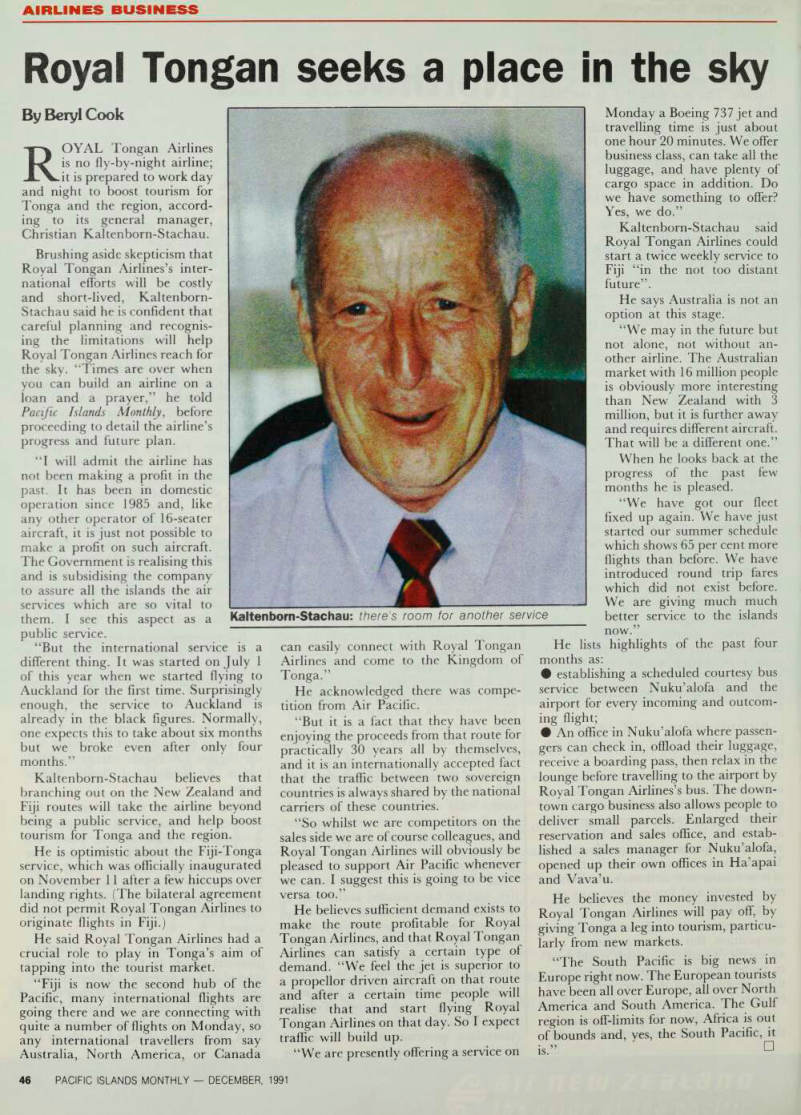
By Beryl Cook
ROYAL Tongan Airlines is no fly-by-night airline; it is prepared to work day and night to boost tourism for Tonga and the region, accord ing to its general manager, Christian Kaltenborn-Stachau.
Brushing aside skepticism that Royal Tongan Airlines’s inter national efforts will be costly and short-lived, Kaltenborn- Stachau said he is confident that careful planning and recognis ing the limitations will help Royal Tongan Airlines reach for the sky. “Times are over when you can build an airline on a loan and a prayer,” he told
Pacific Islands Monthly, before
proceeding to detail the airline’s progress and future plan.
“I will admit the airline has not been making a profit in the past. It has been in domestic operation since 1985 and, like any other operator of 16-seater aircraft, it is just not possible to make a profit on such aircraft.
The Government is realising this and is subsidising the company to assure all the islands the air services which are so vital to them. I see this aspect as a public service.
“But the international service is a different thing. It was started on July 1 of this year when we started flying to Auckland for the first time. Surprisingly enough, the service to Auckland is already in the black figures. Normally, one expects this to take about six months but we broke even after only four months.”
Kaltenborn-Stachau believes that branching out on the New Zealand and Fiji routes will take the airline beyond being a public service, and help boost tourism for Tonga and the region.
He is optimistic about the Fiji-Tonga service, which was officially inaugurated on November 11 after a few hiccups over landing rights. (The bilateral agreement did not permit Royal Tongan Airlines to
originate flights in Fiji.)
He said Royal Tongan Airlines had a crucial role to play in Tonga’s aim of tapping into the tourist market.
“Fiji is now the second hub of the Pacific, many international flights are going there and we are connecting with quite a number of flights on Monday, so any international travellers from say Australia, North America, or Canada
can easily connect with Royal Tongan Airlines and come to the Kingdom of
Tonga.”
He acknowledged there was competition from Air Pacific.
“But it is a fact that they have been enjoying the proceeds from that route for practically 30 years all by themselves, anc j i t i s an internationally accepted fact that the traffic between two sovereign countries is always shared by the national carriers of these countries.
“So whilst we are competitors on the sales side we are of course colleagues, and Royal Tongan Airlines will obviously be pleased to support Air Pacific whenever we can. I suggest this is going to be vice versa too.”
He believes sufficient demand exists to make the route profitable for Royal Tongan Airlines, and that Royal Tongan Airlines can satisfy a certain type of demand. “We feel the jet is superior to a propeller driven aircraft on that route and after a certain time people w.l realise that and start flying Royal Tongan Airlines on that day. So I expect traffic will build up.
“We are presently offering a service on
Monday a Boeing 737 jet and travelling time is just about one hour 20 minutes. We offer business class, can take all the luggage, and have plenty of cargo space in addition. Do we have something to offer?
Yes, we do,”
Kaltenborn-Stachau said Royal Tongan Airlines could start a twice weekly service to Fiji “in the not too distant future”.
He says Australia is not an option at this stage.
“We may in the future but not alone, not without an other airline. The Australian market with 16 million people is obviously more interesting than New Zealand with 3 million, but it is further away and requires different aircraft.
That will be a different one.”
When he looks back at the progress of the past few months he is pleased.
“We have got our fleet fixed up again. We have just started our summer schedule which shows 65 per cent more flights than before. We have introduced round trip fares which did not exist before.
We are giving much much better service to the islands now.”
He lists highlights of the past four months as: B establishing a scheduled courtesy bus service between Nuku’alofa and the airport for every incoming and outcom ing flight; • An office in Nuku’alofa where passen gers can check in, offload their luggage, receive a boarding pass, then relax in the lounge before travelling to the airport by Royal Tongan Airlines’s bus. The down town cargo business also allows people to deliver small parcels. Enlarged their reservation and sales office, and estab lished a sales manager for Nukualofa, opened up their own offices in Ha apai and Vava’u.
He believes the money invested by R j Tongan Airlines will pay off, by -j Tonga a leg into tourism, particuj a rly from new markets, , „ . u- The South aciic is ig news i Europe right now. The European touns s have been all over Europe all over Nor h America an ou me i • region is off-limits for now, Africa is out of and, yes, t e ou aci i , is.
Kaltenborn-Stachau: there's room for another service
The question of origin
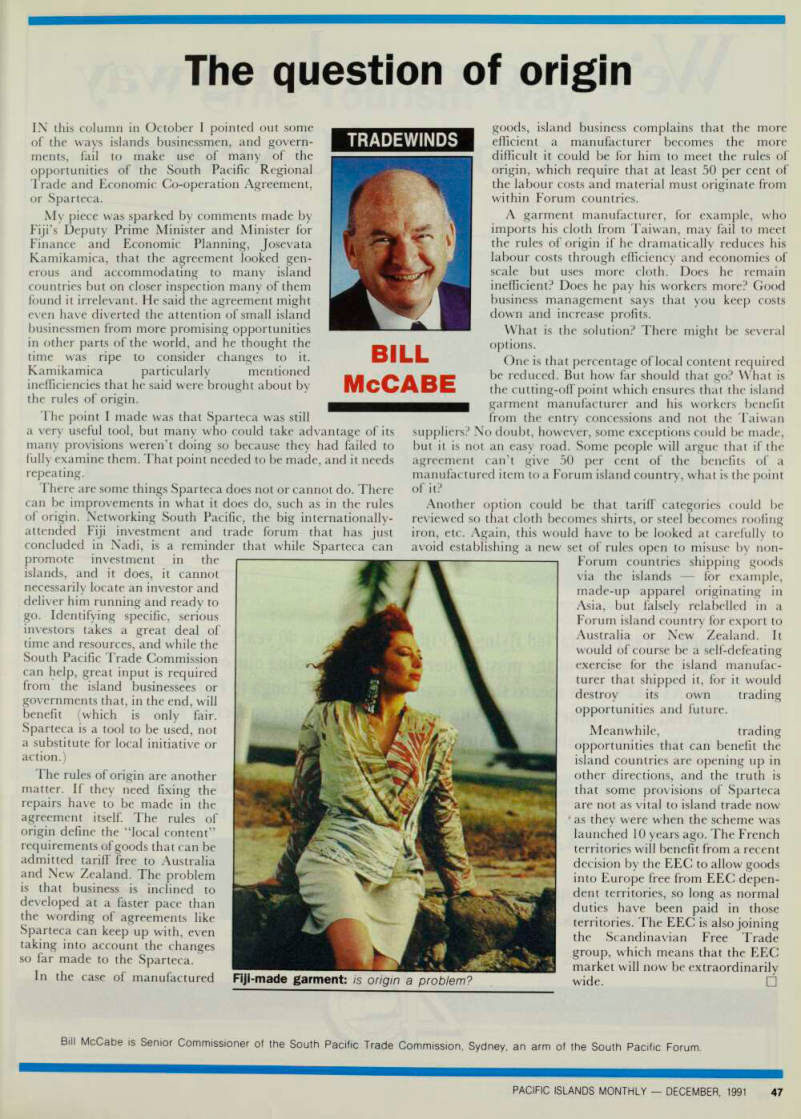
IN this column in October I pointed out some of the ways islands businessmen, and govern ments, fail to make use of many of the opportunities of the South Pacific Regional Trade and Economic Co-operation Agreement,
or Sparteca.
My piece was sparked by comments made by Fiji’s Deputy Prime Minister and Minister for Finance and Economic Planning, Josevata Kamikamica, that the agreement looked gen erous and accommodating to many island countries but on closer inspection many of them found it irrelevant. He said the agreement might even have diverted the attention of small island businessmen from more promising opportunities in other parts of the world, and he thought the time was ripe to consider changes to it.
Kamikamica particularly mentioned inefficiencies that he said were brought about by the rules of origin.
The point I made was that Sparteca was still a very useful tool, but many who could take advantage of its many provisions weren’t doing so because they had failed to fully examine them. That point needed to be made, and it needs
repeating.
There are some things Sparteca does not or cannot do. There can be improvements in what it does do, such as in the rules of origin. Networking South Pacific, the big internationally attended Fiji investment and trade forum that has just concluded in Nadi, is a reminder that while Sparteca can
promote investment in the islands, and it does, it cannot necessarily locate an investor and deliver him running and ready to go. Identifying specific, serious investors takes a great deal of time and resources, and while the South Pacific Trade Commission can help, great input is required from the island businessees or governments that, in the end, will benefit (which is only fair.
Sparteca is a tool to be used, not a substitute for local initiative or
action.)
The rules of origin are another matter. If they need fixing the repairs have to be made in the agreement itself. The rules of origin define the “local content” requirements of goods that can be admitted tariff free to Australia and New Zealand. The problem is that business is inclined to developed at a faster pace than the wording of agreements like Sparteca can keep up with, even taking into account the changes so far made to the Sparteca.
In the case of manufactured
goods, island business complains that the more efficient a manufacturer becomes the more difficult it could be for him to meet the rules of origin, which require that at least 50 per cent of the labour costs and material must originate from within Forum countries.
A garment manufacturer, for example, who imports his cloth from Taiwan, may fail to meet the rules of origin if he dramatically reduces his labour costs through efficiency and economies of scale but uses more cloth. Does he remain inefficient? Does he pay his workers more? Good business management says that you keep costs down and increase profits.
What is the solution? There might be several options.
One is that percentage of local content required be reduced. But how far should that go? What is the cutting-off point which ensures that the island garment manufacturer and his workers benefit from the entry concessions and not the Taiwan
suppliers? No doubt, however, some exceptions could be made, but it is not an easy road. Some people will argue that if the agreement can’t give 50 per cent of the benefits of a manufactured item to a Forum island country, what is the point of it?
Another option could be that tariff categories could be reviewed so that cloth becomes shirts, or steel becomes roofing iron, etc. Again, this would have to be looked at carefully to avoid establishing a new set of rules open to misuse by non-
Forum countries shipping goods via the islands for example, made-up apparel originating in Asia, but falsely relabelled in a Forum island country for export to Australia or New Zealand. It would of course be a self-defeating exercise for the island manufac turer that shipped it, for it would
destroy its own trading
opportunities and future.
Meanwhile, trading opportunities that can benefit the island countries are opening up in other directions, and the truth is that some provisions of Sparteca are not as vital to island trade now as they were when the scheme was launched 10 years ago. The French territories will benefit from a recent decision by the EEC to allow goods into Europe free from EEC depen dent territories, so long as normal duties have been paid in those territories. The EEC is also joining the Scandinavian Free Trade group, which means that the EEC market will now be extraordinarily wide. □
Bill McCabe is Senior Commissioner of the South Pacific Trade Commission, Sydney, an arm of the South Pacific Forum.
Tradewinds
Bill
Mccabe
Fiji-made garment: is origin a problem?
Advertisements & other items, p. 48 (1 item)
in tlie past 40 years.
Wove come a lon <4 way
m \ * ¥ \ •» Back in 1951 we started flying as Fiji Airways. Now 40 years later Air Pacific has a fleet of the most modern aircraft including our own 767,747 and ATR42’s. This means that we can now fly from Tonga to Fiji 7 times a week, Apia 5 times a week, Vila 3 times a week, with connecting flights to Japan, New Zealand and Australia.
So let Air Pacific connect you with the world through Fiji. Our friendly, convenient service, frequent flights, and great airfares make travelling the Pacific easy on Air Pacific.
Air Pacific are proud to have serviced Tonga, Samoa and Vila over the years.
mane
FIJI'S INTERNATIONAL AIRLINE
PAC/^,
7 / 9 9\.
The Tourism Way
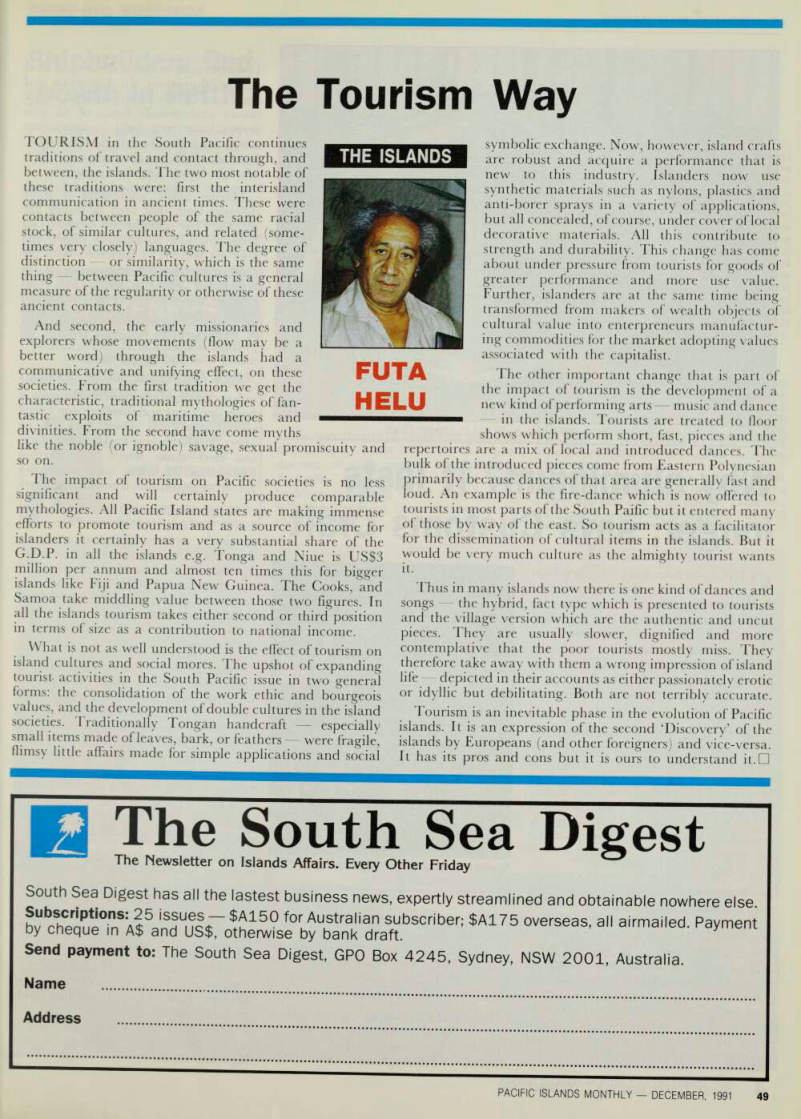
TOURISM in the South Pacific continues traditions of travel and contact through, and between, the islands. The two most notable of these traditions were: first the interisland communication in ancient times. These were contacts between people of the same racial stock, of similar cultures, and related (some times very closely) languages. The degree of distinction -or similarity, which is the same thing between Pacific cultures is a general measure of the regularity or otherwise of these ancient contacts.
And second, the early missionaries and explorers whose movements (flow may be a better word) through the islands had a communicative and unifying effect, on these societies. From the first tradition we get the characteristic, traditional mythologies of fan tastic exploits of maritime heroes and divinities. From the second have come myths
like the noble (or ignoble) savage, sexual promiscuity and so on.
The impact of tourism on Pacific societies is no less significant and will certainly produce comparable mythologies. All Pacific Island states are making immense efforts to promote tourism and as a source of income for islanders it certainly has a very substantial share of the G.D.P. in all the islands e.g. Tonga and Niue is USS 3 million per annum and almost ten times this for bigger islands like Fiji and Papua New Guinea. The Cooks, and Samoa take middling value between those two figures. In all the islands tourism takes either second or third position in terms of size as a contribution to national income.
What is not as well understood is the effect of tourism on island cultures and social mores. The upshot of expanding tourist- activities in the South Pacific issue in two general forms: the consolidation of the work ethic and bourgeois values, and the development of double cultures in the island
societies. Traditionally Tongan handcraft especially
small items made of leaves, bark, or feathers were fragile, flimsy little affairs made for simple applications and social
symbolic exchange. Now, however, island crafts are robust and acquire a performance that is new to this industry. Islanders now use synthetic materials such as nylons, plastics and anti-borer sprays in a variety of applications, but all concealed, of course, under cover of local decorative materials. All this contribute to strength and durability. This change has come about under pressure from tourists for goods of greater performance and more use value.
Further, islanders are at the same time being transformed from makers of wealth objects of cultural value into enterpreneurs manufactur ing commodities for the market adopting values associated with the capitalist.
The other important change that is part of the impact of tourism is the development of a new kind of performing arts music and dance - in the islands. Tourists are treated to floor shows which perform short, fast, pieces and the
repertoires are a mix of local and introduced dances. The bulk of the introduced pieces come from Eastern Polynesian primarily because dances of that area are generally fast and loud. An example is the fire-dance which is now offered to tourists in most parts of the South Paific but it entered many of those by way of the east. So tourism acts as a facilitator for the dissemination of cultural items in the islands. But it would be very much culture as the almighty tourist wants it.
Thus in many islands now there is one kind of dances and songs the hybrid, fact type which is presented to tourists and the village version which are the authentic and uncut pieces. They are usually slower, dignified and more contemplative that the poor tourists mostly miss. They therefore take away with them a wrong impression of island life depicted in their accounts as either passionately erotic or idyllic but debilitating. Both are not terribly accurate.
Tourism is an inevitable phase in the evolution of Pacific islands. It is an expression of the second ‘Discovery’ of the islands by Europeans (and other foreigners) and vice-versa.
It has its pros and cons but it is ours to understand it.D
The Islands
Futa
Helu
Advertisements & other items, p. 49 (1 item)
The South Sea Digest
p
The Newsletter on Islands Affairs. Every Other Friday South Sea Digest has all the lastest business news, expertly streamlined and obtainable nowhere else. bv ch^mie°in S A^a U |?l^h 150 for . Au . stralian subscriber : SAI7S overseas, all airmailed. Payment oy cneque in A$ and US$, otherwise by bank draft.
Send payment to: The South Sea Digest, GPO Box 4245, Sydney, NSW 2001, Australia.
Name Address
Why aluminium? it lasts

Shipping Business
Why aluminium? it lasts longer, says Customs Craft
SINCE the launching of his first boat at the age of six, Rob McLauchlan, Managing Director of Fiji Customs Craft Limited, has had a long and close connection with boats and the sea. From the first, a tin boat built of a beaten out sheet of corrugated iron for fishing in the river, he has progressed through timber, plywood and fibreglass to the present 32-foot aluminium gameboat.
Owner also, with his wife Brenda, of Fiji Machinery Limited, dealing in heavy equipment since 1976, the economic downturn of 1987 and 1988 forced a need to diversify from reliance on a drastically reduced market where capital cost had doubled and demand had virtually disappeared to one that showed potential
for growth.
The Fiji interim government’s move to encourage investment for manufacturing and the promotion of tourism and fishing has provided the opportunity to diver sify, said McLaughlan. “What to diver sify into was logical,” he added. “With Fiji a country of islands, boats would be needed for inter-island transport and the potential for growth lay in the tourism and fishing sectors. The export potential to other Pacific Island countries, where conditions similar to Fiji existed, was another area of consideration.”
With the financial backing of the National Bank of Fiji and the Fiji Development Bank, it was possible for McLaughlan to diversify and Fiji Cus tom Craft Limited started building its first boat on October 1, 1989.
Why aluminium boats? “Aluminium is the best building material for boats to around 12 metres for Fiji the tropics,” McLaughlan said. “The
12-metre mark is based on cost of steel against aluminium. In European and American yards multi-million dollar luxury custom-built boats of 45 plus metres have been built in aluminium when cost is not the criteria. Oceanfast, Australia, built the aluminium 49-metre Mystique for an American owner.”
Marine grade aluminium is quite different from that used in things like utentils. The aluminium specified for boats contains magnesium alloys and does not corrode in saltwater. With the right alloy the life expectancy of an aluminium boat is nearly 50 years without maintenance, even if the boat is left in saltwater. The bottom of the boat is painted with anti-fouling paint to prevent the growth of weeds and bar nacles which affect performance.
Steel boats will rust from the inside
unless thoroughly protected. Aluminium
boats don’t rust and therefore don’t need special protection. Diesel fuel has no affect on aluminium tanks unlike stain less steel tanks which can develop pinholes or black iron tanks which can rust from the outside if not kept painted.
Aluminium will not blister, crack or have “osmosis” problems. It is non
magnetic, non-sparkling and relatively
fireproof. An aluminium boat is much less likely to be extensively damaged by fire than wooden or fibreglass craft. The latter is built with petroleum-based resins which are flammable and would unevitably burn to the waterline in a serious fire.
Aluminium has the advantage of
lightweight and strength, giving it a
strength/weight ratio of 205-209 com pared to mild steel (123-145) and fibreglass (180-190). The tensile strength for welded aluminium is 35,000 to 39,000 psi, mild steel 58,000 to 68,000 psi and fibreglass 18,000 psi. Aluminium has the ability to stretch so that the hull plating can bend or dent in case of collision. It is difficult for aluminium to tear or fracture like fibreglass and wood.
The weight advantage of an alu minium boat allows more fuel-carrying capacity and longer cruise range or higher speeds with a given power.
Fishing boats can get to the fishing grounds faster, using less fuel, and carry a heavier catch home.
Said McLaughlan: “Having made the decision to build in aluminium, Fiji Custom Craft Limited are justifiably proud of the boats built to-date. One of our 9.6-metre gameboats was mistaken for a fibreglass boat, proving the highclass finish.
Special: an aluminium fishing boat being built Fiji Customs Craft
Special: a tourist dive boat being built by Fiji Customs Craft
Shipbuilders find
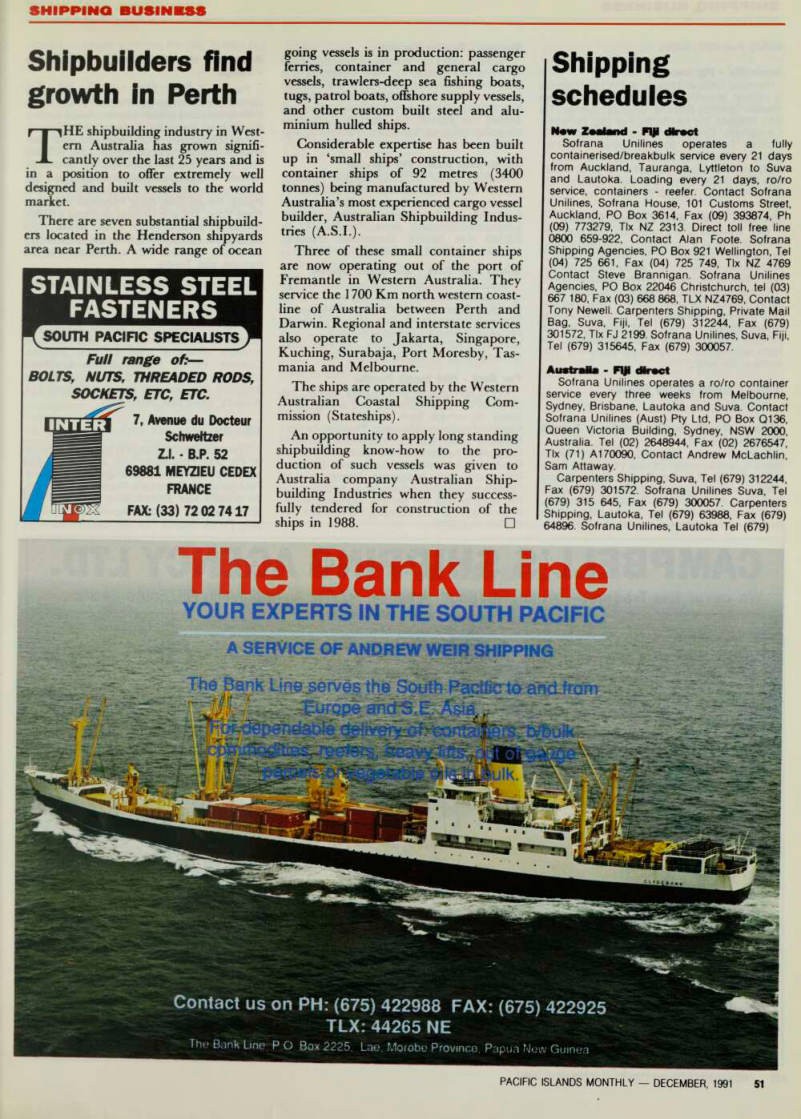
growth in Perth
THE shipbuilding industry in West
ern Australia has grown signifi cantly over the last 25 years and is in a position to offer extremely well designed and built vessels to the world market.
There are seven substantial shipbuild ers located in the Henderson shipyards area near Perth. A wide range of ocean
going vessels is in production: passenger ferries, container and general cargo vessels, trawlers-deep sea fishing boats, tugs, patrol boats, offshore supply vessels, and other custom built steel and alu minium hulled ships.
Considerable expertise has been built up in ‘small ships’ construction, with container ships of 92 metres (3400 tonnes) being manufactured by Western Australia’s most experienced cargo vessel builder, Australian Shipbuilding Indus tries (A.S.I.).
Three of these small container ships are now operating out of the port of Fremantle in Western Australia. They service the 1700 Km north western coast line of Australia between Perth and Darwin. Regional and interstate services also operate to Jakarta, Singapore, Kuching, Surabaja, Port Moresby, Tas mania and Melbourne.
The ships are operated by the Western Australian Coastal Shipping Com
mission (Stateships).
An opportunity to apply long standing shipbuilding know-how to the pro duction of such vessels was given to Australia company Australian Ship building Industries when they success fully tendered for construction of the ships in 1988. □
Shipping
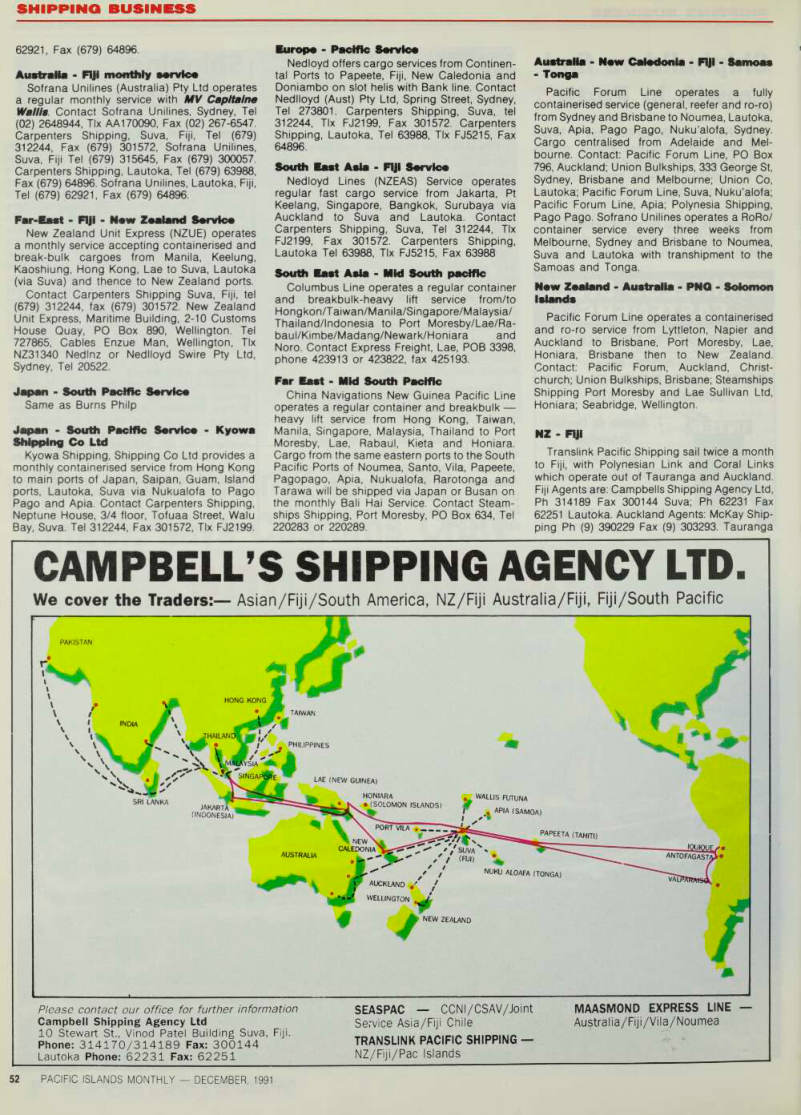
schedules
N*w 7««l«nd - FIJI direct Sofrana Unilines operates a fully containerised/breakbulk service every 21 days from Auckland, Tauranga, Lyttleton to Suva and Lautoka. Loading every 21 days, ro/ro service, containers - reefer. Contact Sofrana Unilines, Sofrana House, 101 Customs Street, Auckland, PC Box 3614, Fax (09) 393874, Ph (09) 773279, Tlx NZ 2313. Direct toll free line 0800 659-922, Contact Alan Foote. Sofrana Shipping Agencies, PC Box 921 Wellington, Tel (04) 725 661, Fax (04) 725 749, Tlx NZ 4769 Contact Steve Brannigan. Sofrana Unilines Agencies, PO Box 22046 Christchurch, tel (03) 667 180, Fax (03) 668 868, TLX NZ4769, Contact Tony Newell. Carpenters Shipping, Private Mail Bag, Suva, Fiji. Tel (679) 312244, Fax (679) 301572, Tlx FJ 2199. Sofrana Unilines, Suva, Fiji, Tel (679) 315645, Fax (679) 300057.
Australia - Fiji direct Sofrana Unilines operates a ro/ro container service every three weeks from Melbourne, Sydney, Brisbane, Lautoka and Suva. Contact Sofrana Unilines (Aust) Pty Ltd. PO Box Q136, Queen Victoria Building. Sydney, NSW 2000, Australia. Tel (02) 2648944. Fax (02) 2676547, Tlx (71) A170090, Contact Andrew McLachlin, Sam Attaway.
Carpenters Shipping. Suva, Tel (679) 312244, Fax (679) 301572. Sofrana Unilines Suva, Tel (679) 315 645, Fax (679) 300057. Carpenters Shipping. Lautoka. Tel (679) 63988, Fax (679) 64896. Sofrana Unilines, Lautoka Tel (679)
62921, Fax (679) 64896.
Australia - FIJI monthly service Sofrana Unilines (Australia) Pty Ltd operates a regular monthly service with MV Capltalne Wallis Contact Sofrana Unilines, Sydney, Tel (02) 2648944, Tlx AA170090, Fax (02) 267-6547.
Carpenters Shipping, Suva, Fiji, Tel (679) 312244, Fax (679) 301572, Sofrana Unilines, Suva, Fiji Tel (679) 315645, Fax (679) 300057.
Carpenters Shipping, Lautoka, Tel (679) 63988, Fax (679) 64896. Sofrana Unilines, Lautoka, Fiji, Tel (679) 62921, Fax (679) 64896.
Far-East - FIJI - Nsw Zealand Service New Zealand Unit Express (NZUE) operates a monthly service accepting containerised and break-bulk cargoes from Manila, Keelung, Kaoshiung, Hong Kong, Lae to Suva, Lautoka (via Suva) and thence to New Zealand ports.
Contact Carpenters Shipping Suva. Fiji, tel (679) 312244, fax (679) 301572. New Zealand Unit Express, Maritime Building, 2-10 Customs House Quay, PO Box 890, Wellington. Tel 727865, Cables Enzue Man, Wellington, Tlx NZ31340 Nedlnz or Nedlloyd Swire Pty Ltd, Sydney. Tel 20522.
Japan - South Pacific Service Same as Burns Philp Japan - South Pacific Service - Kyowa Shipping Cos Ltd Kyowa Shipping, Shipping Cos Ltd provides a monthly containerised service from Hong Kong to main ports of Japan, Saipan, Guam, Island ports, Lautoka, Suva via Nukualofa to Pago Pago and Apia. Contact Carpenters Shipping, Neptune House, 3/4 floor, Tofuaa Street, Walu Bay, Suva. Tel 312244, Fax 301572, Tlx FJ2199.
Europe - Pacific Service Nedloyd offers cargo services from Continen tal Ports to Papeete, Fiji, New Caledonia and Doniambo on slot helis with Bank line. Contact Nedlloyd (Aust) Pty Ltd, Spring Street, Sydney, Tel 273801. Carpenters Shipping, Suva, tel 312244, Tlx FJ2199, Fax 301572. Carpenters Shipping, Lautoka, Tel 63988, Tlx FJ5215, Fax 64896.
South East Asia - FIJI Service Nedloyd Lines (NZEAS) Service operates regular fast cargo service from Jakarta, Pt Keelang, Singapore, Bangkok, Surubaya via Auckland to Suva and Lautoka. Contact Carpenters Shipping, Suva, Tel 312244, Tlx FJ2199, Fax 301572. Carpenters Shipping, Lautoka Tel 63988, Tlx FJ5215, Fax 63988 South Bast Asia - MM South pacific Columbus Line operates a regular container and breakbulk-heavy lift service from/to Hongkon/Taiwan/Manila/Singapore/Malaysia/ Thailand/lndonesia to Port Moresby/Lae/Ra baul/Kimbe/Madang/Newark/Honiara and Noro. Contact Express Freight, Lae, POB 3398, phone 423913 or 423822, fax 425193.
Far East - MM South Pacific China Navigations New Guinea Pacific Line operates a regular container and breakbulk heavy lift service from Hong Kong, Taiwan, Manila, Singapore, Malaysia, Thailand to Port Moresby, Lae, Rabaul, Kieta and Honiara.
Cargo from the same eastern ports to the South Pacific Ports of Noumea, Santo, Vila, Papeete, Pagopago, Apia, Nukualofa, Rarotonga and Tarawa will be shipped via Japan or Busan on the monthly Bali Hai Service. Contact Steam ships Shipping, Port Moresby, PO Box 634, Tel 220283 or 220289.
Australia - Naw Caladonia - FIJI - Samoa* - Tonga Pacific Forum Line operates a fully containerised service (general, reefer and ro-ro) from Sydney and Brisbane to Noumea, Lautoka, Suva, Apia, Pago Pago, Nukualofa, Sydney.
Cargo centralised from Adelaide and Mel bourne. Contact: Pacific Forum Line, PC Box 796, Auckland; Union Bulkships, 333 George St, Sydney, Brisbane and Melbourne: Union Cos, Lautoka: Pacific Forum Line, Suva, Nukualofa; Pacific Forum Line, Apia; Polynesia Shipping, Pago Pago. Sofrano Unilines operates a Roßo/ container service every three weeks from Melbourne, Sydney and Brisbane to Noumea, Suva and Lautoka with transhipment to the Samoas and Tonga.
Nsw Zealand - Australia - PNQ - Solomon Islands Pacific Forum Line operates a containerised and ro-ro service from Lyttleton, Napier and Auckland to Brisbane, Port Moresby, Lae, Honiara, Brisbane then to New Zealand.
Contact: Pacific Forum, Auckland, Christ church; Union Bulkships, Brisbane; Steamships Shipping Port Moresby and Lae Sullivan Ltd, Honiara; Seabridge, Wellington.
Nz - Fiji
Translink Pacific Shipping sail twice a month to Fiji, with Polynesian Link and Coral Links which operate out of Tauranga and Auckland.
Fiji Agents are: Campbells Shipping Agency Ltd, Ph 314189 Fax 300144 Suva; Ph 62231 Fax 62251 Lautoka. Auckland Agents: McKay Ship ping Ph (9) 390229 Fax (9) 303293. Tauranga
Agents, seatrade agencies Ph (75) 754989 Fax (75) 758380.
NZ - Fiji - Pago - Apia - Nuk Translink Pacific Shipping operate a monthly sailing with Polynesian Link, which carries Dry Container, reefers and breakbulk cargoes. NZ Agents McKay Shipping AKLD Ph 390229, Fax 3032931. Fiji Agents Campbells Shipping Agency & ltd Ph 314189 Fax 300144 NZ - Noumea - Wallis - Futuna Translink Pacific Agency operate a container Breakbulk service once a month from NZ through Fiji and Noumea to Wallis & Futuna.
South East Asia - Fiji - Noumea - Papeete - Chile Service “Seaspac" A joint Chilean CCNI/CSAU Ser vice offers a regular monthly sailing from Djakarta and Singapore to Noumea, Fiji, Papeete, and Chile. Cargo also federated to Singapore from Korea, Hong Kong, Taiwan, Malaysia, Bangkok. Fiji Agents: Campbells Shipping Agency Ltd, ph. 314189, Fax 300144.
Australia - Fiji Service Chief container services under Australia Pacific Island Line Unitize Sofrano and PFL vessels to provide a twice monthly, service from Australia. Fiji Agents Campbells Shippings Agency ltd Ph 314189 Fax 300144. System Agents Nedlloyd Swire Ph(2) 2512699. Mel bourne Yarra Shipping Ph (3) 6936300. Bris bane, Medlloyd Swire, ph (7) 8321551.
Australia - Fiji - Noumea - Vila - Santa
Marsmond Express Lines operate a breakbulk service from Goodwood Island Aus tralia to Fiji, Noumea, Vila Santo and Honiara.
Continuous receiving depots in Sydney and Brisbane enable this vessel to bring cargoes from these parts. Fiji Agents Campbells Shipping Agency Ltd, ph. 314189, Fax 300144.
Brisbane Agents Shippings & Marketing Ph (7) 2628082. Sydney Agents Seabord Agencies (2) 3172325.
Australia - New Caledonia - Fiji - Hawaii - North America ACT Pace Pacific (ACTA Shipping) operates a fully containerised/break bulk service every 17-20 from Melbourne, Sydney, Brisbane to Noumea, Suva and Lautoka. The vessels continue on to the West Coast of North America calling Honolulu at frequent intervals. Ships are ACT and ACT 12. Contacts; ACTA Pty Ltd, Sydney Ph 2869666, Tx 121369, Fx 2869610.
ACTA Pty Ltd, Melbourne Ph 6112000, Tx 30949, Fx 6293055. ACTA Pty Ltd, Brisbane Ph 2213116 m Tx 40719, Fx 2298143. SATO, Nou mea Ph 281122, Tx 3163, Fx 278532. Burns Philp Shipping, Suva Ph 311777, Tx 2168, Fx 301127; Burns Philp Shipping, Lautoka Ph 60777, Tx 5146. Fx 65850.
West Coast of North America - Fiji - New Zealand Blue Star Line Pacific Coast Service operates a fully containerised/break bulk service every 23 days from Vancouver, Seattle, San Francisco, Los Angeles to Pago Pago, Suva and New Zealand ports. The vessels continue to call Suva on the Northbound voyage from New Zealand every fortnight to pick up Fiji exports such as
garments, fresh ginger, etc. for Hawaii and West Coast of North America ports. Blue Star Line also provides a through service to East Coast to North America. Ships are Wellington Star, Southland Star and California Star. Contacts: Blue Star Line, San Francisco Ph 9282026, Tx 184925, Fx 6730355; Blue Star Line, Vancouver Ph 6817300, Tx 0451326, Fx 6835797; Interocean Steamship Corp, Seattle Ph 6829820, Tx 321101, Fx 3437421; Blue Star Line, Los Angeles Ph 5970454, Tx 408564, Fx 5978710. New Zealand Line, Wellington, Ph 739029, Tx 3583, Fx 4992468; New Zealand Line, Auckland Ph 390965, Tx 2556, Fx 3032039; Burns Philp Shipping, Suva Ph 311777, Tx 2168, Fx 301127; Burns Philp Shipping, Lautoka Ph 60777, Tx 5146, Fx 65850.
Japan - South Pacific Service Bali Hai Line a joint service of China Navigation, Mitsui OSK Line and NYK Line operates a fully containerised/break bulk ser vice from Korea, Japan to South Pacific ports on a monthly helis serving ports of Pusan, Kobe, Nagoya, Yokogama, Tarawa, Lautoka, Suva, Apia, Pago Pago, Papeete, Nukualofa, Nou mea, Vila, Santo. The ships are also fully specialised to carry vehicles on Ro/Ro helis.
Ships are Coral Islander and Pacific Islander.
Contacts: John Swire & Sons, Tokyo Ph 32309220, Tx 22248, Fx 3239288; Nippon Yusen Kaisha. Tokyo Ph 3284516, Tx 22236, Fx 32846332; Mtsul OSK Lines, Tokyo Ph 35877086, Tx 22266, Fx 35877732; Burns Philp Shipping, Suva (C/lslander) Ph 311777, Tx 2168, Fx 301127; Carpenters Shipping, Suva (P/lslander) Ph 312244, Tx 2199, Fx 301572; Burns Philp Shipping, Lautoka Ph 60777, Tx 5146, Fx 65850; Carpenters Shipping Ph 63988, Tx 5215, Fx 64896. r 1
Advertisements & other items, pp. 51-53 (2 items)
Stainless Steel
FASTENERS
SOUTH PACIFIC SPECIALISTS P
Full range oh —
BOLTS, NUTS, THREADED RODS,
SOCKETS, ETC, ETC.
INTER
7, Avenue du Docteur Schweitzer
Z.I. • B.P. 52
69881 MEYZIEU CEDEX
FRANCE
FAX: (33) 72 02 74 17
The Bank Line
YOUR EXPERTS IN THE SOUTH PACIFIC
A SERVICE OF ANDREW WEIR SHIPPING
The Bank the Sowlh Pacffioto ahdifom wsmases -■ .
Ik -i i Contact us on PH: (675) 422988 FAX: (675) 422925
TLX: 44265 NE
The Bank Lino P O Box 2225. Lae. Morobe Province Papua New Guinea
CAMPBELL’S SHIPPING AGENCY LTD
We cover the Traders: — Asian/Fiji/South America, NZ/Fiji Australia/Fiji, Fiji/South Pacific \ f*
INDIA
HA LAN
V ll s \
S>INGAPI»E
- WALLIS arruNA
I APIA (SAMOA)
■vi
PORT
VILA
NEW
1000) antofagast,
CALEDONIA
AUSTRALIA
' / auckund m ' /
WELLINGTON
NEW Zealand / Please contact our office for further information
Campbell Shipping Agency Ltd
10 Stewart St., Vinod Patel Building Suva, Fiji.
Phone: 314170/314189 Fax: 300144 Lautoka Phone: 62231 Fax: 62251
SEASPAC CCNI/CSAV/Joint
Service Asia/Fiji Chile
TRANSLINK PACIFIC SHIPPING
NZ/Fiji/Pac Islands
MAASMOND EXPRESS LINE
Australia/Fiji/Vila/Noumea
TONGA
KIRIBATI
VANUATU
COOK ISLAND
SOLOMON ISLANDS
NEW CALEDONIA
U.S. SAMOA
WESTERN SAMOA
FRENCH POLYNESIA
JAPAN . KOREA
YOU’LL FIND IT,
WHERE THE SKY MEETS
THE SEA
ROM. CONTAINER &
B.BULK SHIPPING
BALI
HAI SERVICE
AGENTS
and
PHONE
SUVA:Burns Philp(B P) 311777 Carpenter Shipping (C.S) 31 2244 LAUTOKA:B P 60777 C.S 63988 APIA;B P 22611 PAGOPAGO tPolynesia Shipping Services Ltd 633-1211 PAPEETE:Compagnie Maritime Polynesienne 42 84 02 NOUMEA:Etablissements Ballande 687-283384 VILA:B P 2456 SANTO;B P 230 HONlARA:Sullivans (Solomon Islands) Ltd 21645 TARAWArShipping Corporation of Kiribati 26195 NUKUALOFA:B P 21500 BUSANrfor general cargo Young Chang Shipping Co, Ltd 753-0451 for vehicle Pan Continental Shipping Co , Ltd 778-7680 Soyang Shipping Co., Ltd 752-7755 JAPANrfor general cargo Swire 03-230-9245 for vehicle NYK Lines 03-284-5506 Mitsui O S K 03-587-7123
Taking
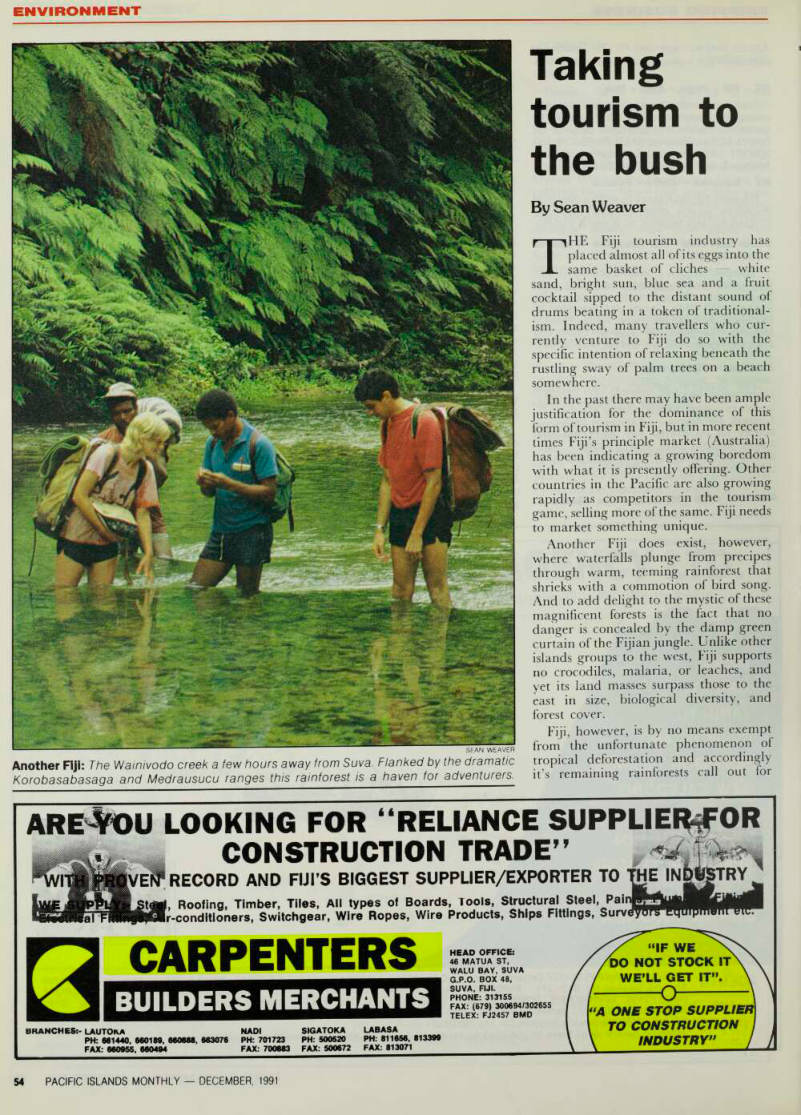
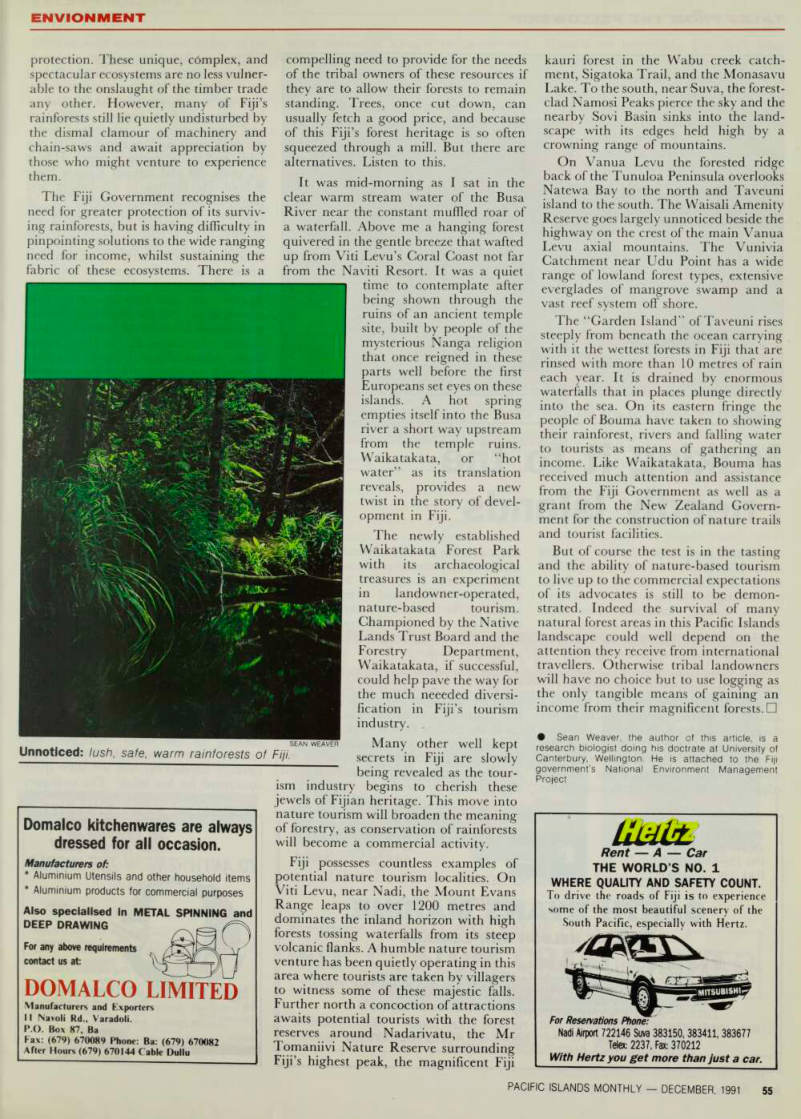
Environment
Taking tourism to the bush
By Sean Weaver
THE Fiji tourism industry has placed almost all of its eggs into the same basket of cliches white sand, bright sun, blue sea and a fruit cocktail sipped to the distant sound of drums beating in a token of traditional ism. Indeed, many travellers who cur rently venture to Fiji do so with the specific intention of relaxing beneath the rustling sway of palm trees on a beach somewhere.
In the past there may have been ample justification for the dominance of this form of tourism in Fiji, but in more recent times Fiji’s principle market (Australia) has been indicating a growing boredom with what it is presently offering. Other countries in the Pacific are also growing rapidly as competitors in the tourism game, selling more of the same. Fiji needs to market something unique.
Another Fiji does exist, however, where waterfalls plunge from precipes through warm, teeming rainforest that shrieks with a commotion of bird song.
And to add delight to the mystic of these magnificent forests is the fact that no danger is concealed by the damp green curtain of the Fijian jungle. Unlike other islands groups to the west, Fiji supports no crocodiles, malaria, or leaches, and yet its land masses surpass those to the east in size, biological diversity, and forest cover.
Fiji, however, is by no means exempt from the unfortunate phenomenon of tropical deforestation and accordingly it’s remaining rainforests call out for
Sean Weaver
Another Fiji: The Wainivodo creek a few hours away from Suva. Flanked by the dramatic Korobasabasaga and Medrausucu ranges this rainforest is a haven for adventurers.
protection. These unique, complex, and spectacular ecosystems are no less vulner able to the onslaught of the timber trade any other. However, many of Fiji’s rainforests still lie quietly undisturbed by the dismal clamour of machinery and chain-saws and await appreciation by those who might venture to experience them.
The Fiji Government recognises the need for greater protection of its surviv ing rainforests, but is having difficulty in pinpointing solutions to the wide ranging need for income, whilst sustaining the fabric of these ecosystems. There is a
compelling need to provide for the needs of the tribal owners of these resources if they are to allow their forests to remain standing. Trees, once cut down, can usually fetch a good price, and because of this Fiji’s forest heritage is so often squeezed through a mill. But there are alternatives. Listen to this.
It was mid-morning as I sat in the clear warm stream water of the Busa River near the constant muffled roar of a waterfall. Above me a hanging forest quivered in the gentle breeze that wafted up from Viti Levu’s Coral Coast not far from the Naviti Resort. It was a quiet
time to contemplate after being shown through the ruins of an ancient temple site, built by people of the mysterious Nanga religion that once reigned in these parts well before the first Europeans set eyes on these islands. A hot spring empties itself into the Busa river a short way upstream from the temple ruins.
Waikatakata, or “hot water” as its translation reveals, provides a new twist in the story of devel opment in Fiji.
The newly established Waikatakata Forest Park with its archaeological treasures is an experiment
in landowner-operated,
nature-based tourism.
Championed by the Native Lands Trust Board and the
Forestry Department,
Waikatakata, if successful, could help pave the way for the much neeeded diversi fication in Fiji’s tourism industry.
Many other well kept
secrets in Fiji are slowly being revealed as the tour
ism industry begins to cherish these jewels of Fijian heritage. This move into nature tourism will broaden the meaning of forestry, as conservation of rainforests will become a commercial activity.
Fiji possesses countless examples of potential nature tourism localities. On Viti Levu, near Nadi, the Mount Evans Range leaps to over 1200 metres and dominates the inland horizon with high forests tossing waterfalls from its steep volcanic flanks. A humble nature tourism venture has been quietly operating in this area where tourists are taken by villagers to witness some of these majestic falls.
Further north a concoction of attractions awaits potential tourists with the forest reserves around Nadarivatu, the Mr Tomaniivi Nature Reserve surrounding Fiji’s highest peak, the magnificent Fiji
kauri forest in the Wabu creek catch ment, Sigatoka Trail, and the Monasavu Lake. To the south, near Suva, the forest clad Namosi Peaks pierce the sky and the nearby Sovi Basin sinks into the land scape with its edges held high by a crowning range of mountains.
On Vanua Levu the forested ridge back of the Tunuloa Peninsula overlooks Natewa Bay to the north and Taveuni island to the south. The Waisali Amenity Reserve goes largely unnoticed beside the highway on the crest of the main Vanua Levu axial mountains. The Vunivia Catchment near Udu Point has a wide range of lowland forest types, extensive everglades of mangrove swamp and a vast reef system off shore.
The “Garden Island" of Taveuni rises steeply from beneath the ocean carrying with it the wettest forests in Fiji that are rinsed with more than 10 metres of rain each year. It is drained by enormous waterfalls that in places plunge directly into the sea. On its eastern fringe the people of Bouma have taken to showing their rainforest, rivers and falling water to tourists as means of gathering an income. Like Waikatakata, Bouma has received much attention and assistance from the Fiji Government as well as a grant from the New Zealand Govern ment for the construction of nature trails and tourist facilities.
But of course the test is in the tasting and the ability of nature-based tourism to live up to the commercial expectations of its advocates is still to be demon strated. Indeed the survival of many natural forest areas in this Pacific Islands landscape could well depend on the attention they receive from international travellers. Otherwise tribal landowners will have no choice but to use logging as the only tangible means of gaining an income from their magnificent forests. □ • Sean Weaver, the author of this article, is a research biologist doing his doctrate at University of Canterbury, Wellington. He is attached to the Fiji government's National Environment Management Project
Sean Weaver
Unnoticed: lush, safe, warm rainforests of Fiji.
Advertisements & other items, pp. 54-55 (1 item)
Carpenters
ARE-YOU LOOKING FOR “RELIANCE SUPPLIER#OR
CONSTRUCTION TRADE”
'Efl* RECORD AND FIJI’S BIGGEST SUPPLIER/EXPORTER TO I, Roofing, Timber, Tiles, All types of Boards, Tools, Structural Steel, Pai r-conditioners, Switchgear, Wire Ropes, Wire Products, Ships Fittings, Surv
CARPENTERS
BUILDERS MERCHANTS
HEAD OFFICE:
46 MATUA ST,
WALU BAY, SUVA
G.P.O. BOX 48,
SUVA, FIJI.
PHONE: 313155
FAX: (679) 300694/302655
TELEX: FJ2457 BMD
BRANCHES:- LAUTOKA NADI SIGATOKA
PH; 661440, 660189, 660888, 663076 PH: 701723 PH; 500520 FAX: 660955, 660494 FAX: 700883 FAX; 500672
LABASA
PH: 811656, 813399
FAX: 813071
TRY
IN WE “IF
STOCK
NOT
IT DO
GET
IT”
WE LL o
E STOP SUPPUE
CONSTRUCTION
INDUSTRY "
\“A
ONE
TO
Domalco kitchenwares are always
dressed for all occasion.
Manufacturers of: * Aluminium Utensils and other household items * Aluminium products for commercial purposes Also specialised in METAL SPINNING and
DEEP DRAWING
DOMALCO LIMITED
Manufacturers and Exporters II Navoli Rd., Varadoli.
P.O. Box 87, Ba Pax: (679) 670089 Phone: Ba: (679) 670082 After Hours (679) 670144 Cable Dullu For any above requirements contact us at:
quit'
Rent A Car
THE WORLD’S NO. 1
WHERE QUALITY AND SAFETY COUNT.
To drive the roads of Fiji is to experience some of the most beautiful scenery of the South Pacific, especially with Hertz.
For Reservations Phone: Nadi Airport 722146 Suva 383150, 383411, 383677 Telex; 2237, Fax: 370212 With Hertz you get more than just a car.
Friendly Islands
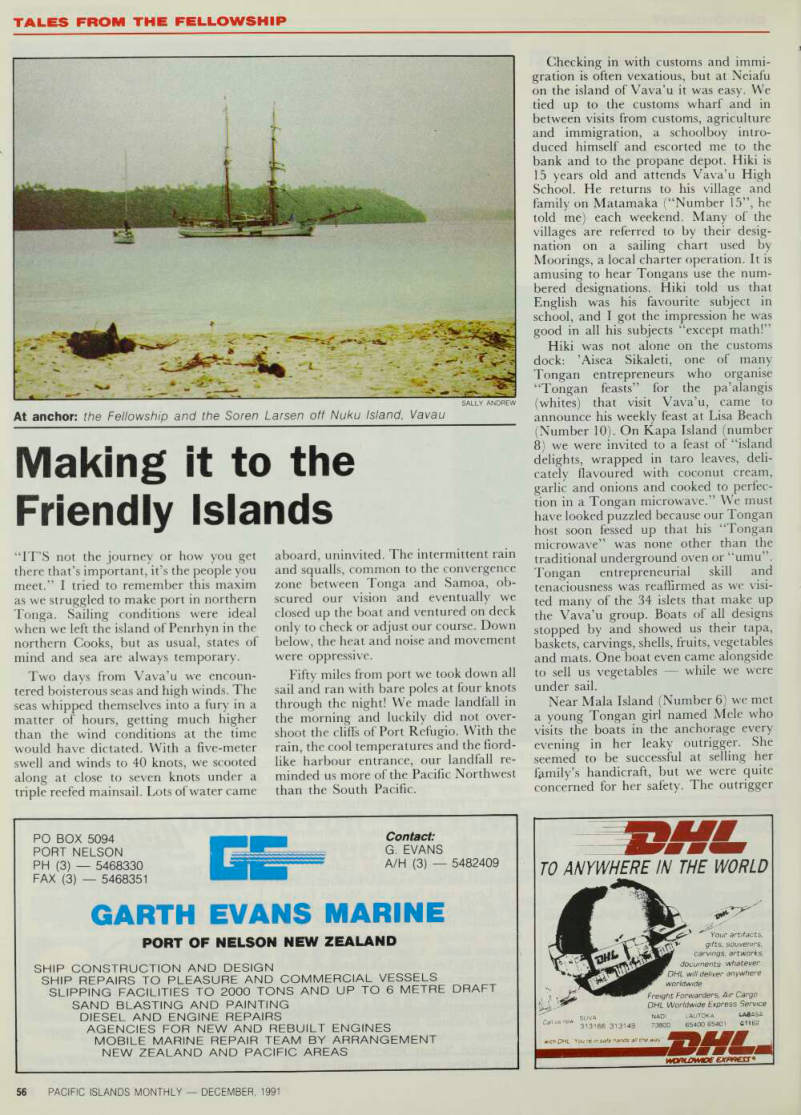
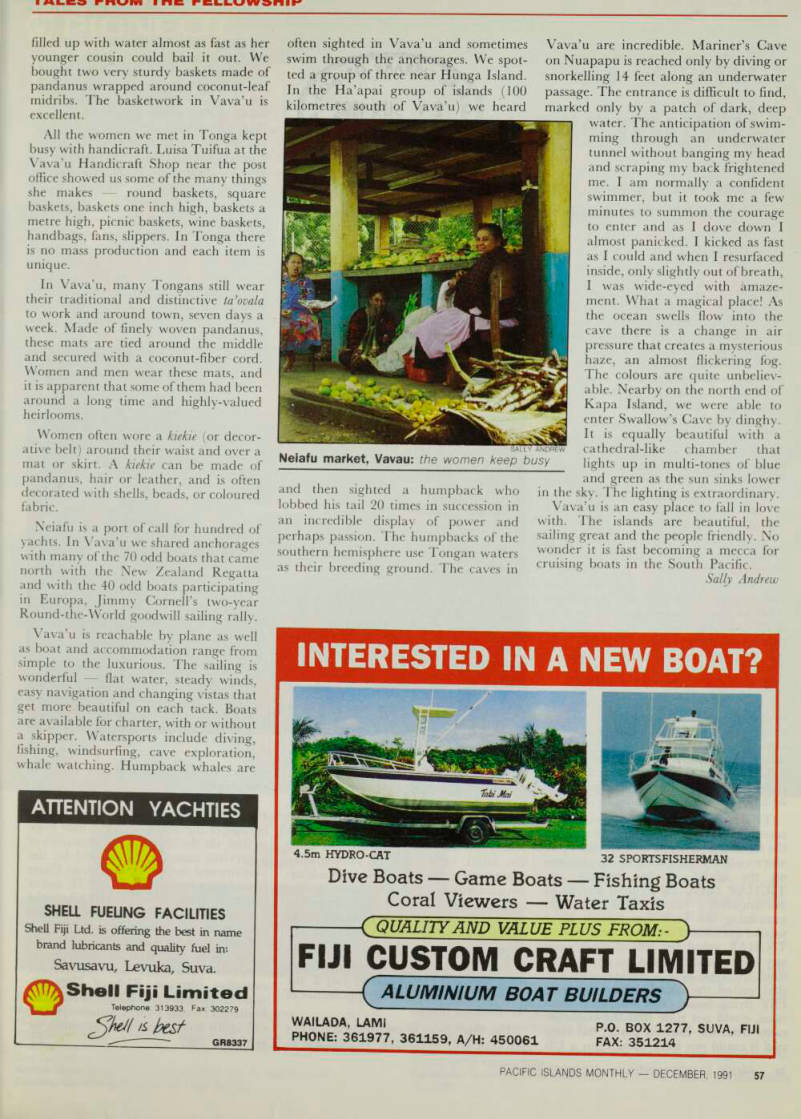
Tales From The Fellowship
Making it to the Friendly Islands
“IT’S not the journey or how you get there that’s important, it’s the people you meet.” I tried to remember this maxim as we struggled to make port in northern Tonga. Sailing conditions were ideal when we left the island of Penrhyn in the northern Cooks, but as usual, states of mind and sea are always temporary.
Two days from Vava’u we encoun tered boisterous seas and high winds. The seas whipped themselves into a fury in a matter of hours, getting much higher than the wind conditions at the time would have dictated. With a five-meter swell and winds to 40 knots, we scooted along at close to seven knots under a triple reefed mainsail. Lots of water came
aboard, uninvited. The intermittent rain and squalls, common to the convergence zone between Tonga and Samoa, ob scured our vision and eventually we closed up the boat and ventured on deck only to check or adjust our course. Down below, the heat and noise and movement
were oppressive.
Fifty miles from port we took down all sail and ran with bare poles at four knots through the night! We made landfall in the morning and luckily did not over shoot the cliffs of Port Refugio. With the rain, the cool temperatures and the fiord like harbour entrance, our landfall re minded us more of the Pacific Northwest than the South Pacific.
Checking in with customs and immi gration is often vexatious, but at Neiafu on the island of Vava’u it was easy. We tied up to the customs wharf and in between visits from customs, agriculture and immigration, a schoolboy intro duced himself and escorted me to the bank and to the propane depot. Hiki is 15 years old and attends Vava’u High School. He returns to his village and family on Matamaka (“Number 15”, he told me) each weekend. Many of the villages are referred to by their desig nation on a sailing chart used by Moorings, a local charter operation. It is amusing to hear Tongans use the num bered designations. Hiki told us that English was his favourite subject in school, and I got the impression he was good in all his subjects “except math!”
Hiki was not alone on the customs dock; ’Aisea Sikaleti, one of many Tongan entrepreneurs who organise “Tongan feasts” for the pa’alangis (whites) that visit Vava’u, came to announce his weekly feast at Lisa Beach (Number 10). On Kapa Island (number 8) we were invited to a feast of “island delights, wrapped in taro leaves, deli cately flavoured with coconut cream, garlic and onions and cooked to perfec tion in a Tongan microwave.” We must have looked puzzled because our Tongan host soon fessed up that his “Tongan microwave” was none other than the traditional underground oven or “umu”.
Tongan entrepreneurial skill and tenaciousness was reaffirmed as we visi ted many of the 34 islets that make up the Vava’u group. Boats of all designs stopped by and showed us their tapa, baskets, carvings, shells, fruits, vegetables and mats. One boat even came alongside to sell us vegetables while we were under sail.
Near Mala Island (Number 6) we met a young Tongan girl named Mele who visits the boats in the anchorage every evening in her leaky outrigger. She seemed to be successful at selling her family’s handicraft, but we were quite concerned for her safety. The outrigger
Sally Andrew
At anchor: the Fellowship and the Soren Larsen off Nuku Island, Vavau
filled up with water almost as fast as her younger cousin could bail it out. We bought two very sturdy baskets made of pandanus wrapped around coconut-leaf midribs. The basketwork in Vava’u is excellent.
All the women we met in Tonga kept busy with handicraft. Luisa Tuifua at the Vava’u Handicraft Shop near the post office showed us some of the many things she makes round baskets, square baskets, baskets one inch high, baskets a metre high, picnic baskets, wine baskets, handbags, fans, slippers. In Tonga there is no mass production and each item is unique.
In Vava’u, many Tongans still wear their traditional and distinctive ta’ovala to work and around town, seven days a week. Made of finely woven pandanus, these mats are tied around the middle and secured with a coconut-fiber cord.
Women and men wear these mats, and it is apparent that some of them had been around a long time and highly-valued heirlooms.
Women often wore a kiekie (or decor ative belt) around their waist and over a mat or skirt. A kiekie can be made of pandanus, hair or leather, and is often decorated with shells, beads, or coloured fabric.
Neiafu is a port of call for hundred of yachts. In Vava’u we shared anchorages with many of the 70 odd boats that came north with the New Zealand Regatta and with the 40 odd boats participating in Europa, Jimmy Cornell’s two-year
Round-the-World goodwill sailing rally.
Vava’u is reachable by plane as well as boat and accommodation range from simple to the luxurious. The sailing is wonderful flat water, steady winds, easy navigation and changing vistas that get more beautiful on each tack. Boats are available for charter, with or without
a skipper. Watersports include diving,
fishing, windsurfing, cave exploration,
whale watching. Humpback whales are
often sighted in Vava’u and sometimes swim through the anchorages. We spot ted a group of three near Hunga Island.
In the Ha’apai group of islands (100 kilometres south of Vava’u) we heard
and then sighted a humpback who lobbed his tail 20 times in succession in an incredible display of power and perhaps passion. The humpbacks of the southern hemisphere use Tongan waters as their breeding ground. The caves in
Vava’u are incredible. Mariner’s Cave on Nuapapu is reached only by diving or snorkelling 14 feet along an underwater passage. The entrance is difficult to find, marked only by a patch of dark, deep
water. The anticipation of swim ming through an underwater tunnel without banging my head and scraping my back frightened me. I am normally a confident swimmer, but it took me a few minutes to summon the courage to enter and as I dove down I almost panicked. I kicked as fast as I could and when I resurfaced inside, only slightly out of breath, I was wide-eyed with amaze ment. What a magical place! As the ocean swells flow into the cave there is a change in air pressure that creates a mysterious haze, an almost flickering fog.
The colours are quite unbeliev able. Nearby on the north end of Kapa Island, we were able to enter Swallow’s Cave by dinghy.
It is equally beautiful with a cathedral-like chamber that lights up in multi-tones of blue and green as the sun sinks lower
in the sky. The lighting is extraordinary.
Vava’u is an easy place to fall in love with. The islands are beautiful, the sailing great and the people friendly. No wonder it is fast becoming a mecca for cruising boats in the South Pacific.
Sally Andrew
Sally Andrew
Neiafu market, Vavau: the women keep busy
Advertisements & other items, pp. 56-57 (2 items)
Garth Evans Marine
TO ANYWHERE IN THE WORLD
a* 313166 313149 Your artifacts, gifts, souvenirs, carvings, artworks, documents whatever DHL will deliver anywhere worldwide Freight Forwarders. Air Cargo DHL Worldwide Express Service
NADI LAUTOKA lABASA
73000 65400 65401 Ctl62 th DHL You 're in sale hands all Che way hchlowkx express*
PO BOX 5094
PORT NELSON
PH (3) 5468330
FAX (3) 5468351
B Contact:
G. EVANS
A/H (3)
GARTH EVANS MARINE
PORT OF NELSON NEW ZEALAND
SHIP CONSTRUCTION AND DESIGN
SHIP REPAIRS TO PLEASURE AND COMMERCIAL VESSELS SLIPPING FACILITIES TO 2000 TONS AND UP TO 6 METRE
SAND BLASTING AND PAINTING
DIESEL AND ENGINE REPAIRS
AGENCIES FOR NEW AND REBUILT ENGINES
MOBILE MARINE REPAIR TEAM BY ARRANGEMENT
NEW ZEALAND AND PACIFIC AREAS
5482409
DRAFT
INTERESTED IN A NEW BOAT?
If m -i •'i Taki Mai
32 SPORTSFISHERMAN
4.5 m HYDRO-CAT
Dive Boats Game Boats Fishing Boats
Coral Viewers Water Taxis
< QUALITY AND VALUE PLUS FROM:- >
FIJI CUSTOM CRAFT LIMITED
( ALUMINIUM BOAT BUILDERS
WAILADA, LAMi
PHONE: 361977, 361159, A/H: 450061
P.O. BOX 1277, SUVA, FIJI
FAX: 351214
ATTENTION YACHTIES
SHELL FUEUNG FACILITIES
Shell Fiji Ltd. is offering the best in name brand lubricants and quality fuel in: Savusavu, Levuka, Suva. © I Shell Fiji Limited Telephone 313933, Fax 302279 is best
GRB337
57
■ MkEo rrtvswi inc rcLLuwamr
PACIFIC ISLANDS MONTHLY DECEMBER, 1991
Nikumaroro
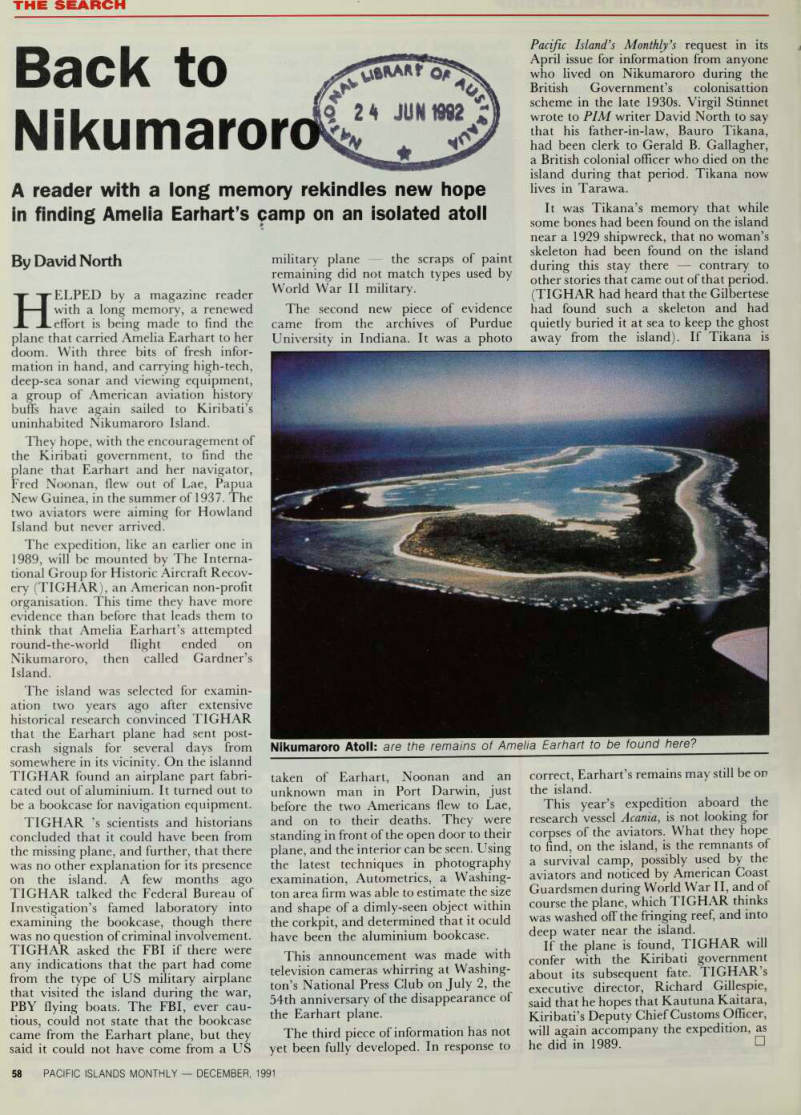
The Search
Back to Nikumaroro
A reader with a long memory rekindles new hope in finding Amelia Earhart’s camp on an isolated atoll
By David North
HELPED by a magazine reader
with a long memory, a renewed effort is being made to find the plane that carried Amelia Earhart to her doom. With three bits of fresh infor mation in hand, and carrying high-tech, deep-sea sonar and viewing equipment, a group of American aviation history buffs have again sailed to Kiribati’s uninhabited Nikumaroro Island.
They hope, with the encouragement of the Kiribati government, to find the plane that Earhart and her navigator, Fred Noonan, flew out of Lae, Papua New Guinea, in the summer of 1937. The two aviators were aiming for Howland Island but never arrived.
The expedition, like an earlier one in 1989, will be mounted by The Interna tional Group for Historic Aircraft Recov ery (TIGHAR), an American non-profit organisation. This time they have more evidence than before that leads them to think that Amelia Earhart’s attempted round-the-world flight ended on Nikumaroro, then called Gardner’s Island.
The island was selected for examin ation two years ago after extensive historical research convinced TIGHAR that the Earhart plane had sent post crash signals for several days from somewhere in its vicinity. On the islannd TIGHAR found an airplane part fabri cated out of aluminium. It turned out to be a bookcase for navigation equipment.
TIGHAR ’s scientists and historians concluded that it could have been from the missing plane, and further, that there was no other explanation for its presence on the island. A few months ago TIGHAR talked the Federal Bureau of Investigation’s famed laboratory into examining the bookcase, though there was no question of criminal involvement.
TIGHAR asked the FBI if there were any indications that the part had come from the type of US military airplane that visited the island during the war, PBY flying boats. The FBI, ever cau tious, could not state that the bookcase came from the Earhart plane, but they said it could not have come from a US
military plane the scraps of paint remaining did not match types used by World War II military.
The second new piece of evidence came from the archives of Purdue University in Indiana. It was a photo
taken of Earhart, Noonan and an unknown man in Port Darwin, just before the two Americans flew to Lae, and on to their deaths. They were standing in front of the open door to their plane, and the interior can be seen. Using the latest techniques in photography examination, Autometrics, a Washington area firm was able to estimate the size and shape of a dimly-seen object within the corkpit, and determined that it oculd have been the aluminium bookcase.
This announcement was made with television cameras whirring at Washington’s National Press Club on July 2, the 54th anniversary of the disappearance of the Earhart plane.
The third piece of information has not yet been fully developed. In response to
Pacific Island’s Monthly’s request in its April issue for information from anyone who lived on Nikumaroro during the British Government’s colonisattion scheme in the late 19305. Virgil Stinnet wrote to PIM writer David North to say that his father-in-law, Bauro Tikana, had been clerk to Gerald B. Gallagher, a British colonial officer who died on the island during that period. Tikana now lives in Tarawa.
It was Tikana’s memory that while some bones had been found on the island near a 1929 shipwreck, that no woman’s skeleton had been found on the island during this stay there contrary to other stories that came out of that period. (TIGHAR had heard that the Gilbertese had found such a skeleton and had quietly buried it at sea to keep the ghost away from the island). If Tikana is
correct, Earhart’s remains may still be on the island.
This year’s expedition aboard the research vessel Acania, is not looking for corpses of the aviators. What they hope to find, on the island, is the remnants of a survival camp, possibly used by the aviators and noticed by Ame:ncan Coast Guardsmen during WorW War 11, and o course the plane which TIGHAR thinks was washed off the fringing reef, and into de< ~P water near the island.
If the plane is found, 11GHAK will con f er w i t h t h e Kiribati government about its subsequent fate. TIGHAR’s execut i V e director, Richard Gillespie, said tbat he hopes that Kautuna Kaitara, Kiribati’s Deputy Chief Customs Officer, will again accompany the expedition, as he did in 1989. LJ
Nikumaroro Atoll: are the remains of Amelia Earhart to be found here?
Advertisements & other items, pp. 59-60 (1 item)
Ch) Pioneer
The Art of Entertainment
In today’s active society, a compact and modular Hi-Fi component stereo system is the perfect answer to home entertainment. The Contempo series gives you all you could ask for in both convenience and sound quality, as well as a stylish design that complements your living space.
Hi-Fi Compact System
■■mu I JIIH ■ .
f -r- ... j
1(11.1
mmmrnmmm*
In spile of its compact design, Contempo is pack ed with a varietv of high-tech features that prod uce high-qualil\ sound in almost any listening s pace. Cimlempo s specially engineered function s compensate fur the loss of sound presence in I imited spaces. As a result, Contempo sound is c risp and clear, no matter where you arc in the r oom. What's more. Pioneer Smart Operation c apabililies make the Contempo system simple to use. A touch of the START/SET button and I he system delivers quality hi-fi sound. Various Contempo models will suit almost any taste with a choice of Single. Twin and Multi-play CD capabilities. And all of the Contempo m odels employ 1 -Bit DEC (Direct Linear Con ycrsion) technology for extremely high-qu alily sound. Add to this an ASES (Auto Sy nchronized Editing System) provided on t he Double Auto-Reverse Cassette Deck th at lets you program Contempo to automat
ically create professional-sounding cassett
e recordings. All of this makes Contempo I he ideal personal entertainment system. In spite of its compact design, Contempo is p acked with a variety of high-tech features that produce high-quality sound in almos t any listening space. Contempo V specia lly engineered functions compensate for the loss of sound presence in limited sp aces. As a result, Contempo sound is cr isp and clear, no matter w here vou are in the room. What s more. Pioneer Sm art Operation capabilities make the C ontempo system simple to use. A touch of t he START/SET button and the system deliv ers quality hi-fi sound. Various Contempo models will suit almost any taste with a c hoice of Single, Twin and Multi-play CD capabilities. And all of the Contempo models employ I -Bit DEC (Direct Li near Conversion) technology for e xlremely high-quality sound. Add to this an ASES (Auto Synchroniz ed Editing System) provided on t he Double Auto-Reverse Casse tte Deck that lets you progr am Contempo to automat icallv creal professionalsounding cassette recor dings. All of this makes Contempo the ideal pc rsonal entertainment sy stem. In spite of its co mpact design. Conlemp o is packed with a variet y of high-tech features that
produce high-quality sound in
almost any listening space. Coni empo'i specially engineered fundi ons compensate for the loss of sou nd presence in limited spaces. As a result, Contempo sound is crisp an d clear, no matter where you are in the room .W'hal's more. Pioneer Smart Operation capa bililies make the Contempo system simple to u se. A touch of the START/SET button and the sv stem delivers quality hi-fi sound. Various Conte mpo models wiH suit almost any taste with a cho ice of Single. Twin and Multi-play CD capabilities And all of (he Contempo models employ 1 -Bit D EC (Direct Linear Conversion) technology for extr emely high-qualitv sound. Add to this an ASES (A uto Synchronized Editing System) provided on t he Double Auto-Reverse Cassette Deck that let s vou program Contempo to automatically ere
ate professional-sounding cassette recordings.
All of this makes Contempo the ideal personal e ntertainment system. In spite of its compact des ign, Contempo is packed with a variety of high-t ech features that produce high-qualitv sound in almost any listening space. Contempo 's specially engineered functions compensate for the loss of sound presence in limited spaces. As a re suit, Contempo sound is crisp and clear, no matter where vou are in the room.
W'hal's more. Pioneer Smart Opera tion capabilities make the Conte mpo system simple to use. A t ouch of the START/SET b utlon and the system
delivers quality
hi-fi sound.
Various Co X-P77 305 W
(PMPO)
t i will suit almost any taste with a choice of Singl e, Twin and Multi-play CO capabilities. And all of the Contempo models employ 1-Bil DEC iDi reel Linear Conversion) technology for exlrem ely high-qualitv sound. Add to this an ASES (A uto Synchronized Editing System) provided o n the Double Auto-Reverse Cassette Deck Ih at lets you program Contempo to automatic ally create professional-sounding cassette r ecordings. All of this makes Contempo the ideal personal entertainment system. In sp ite of its compact design, Contempo is pa eked with a variety of high-tech features that produce high-quality sound in aim ost any listening space. Contempo's sp eciallv engineered functions compensa te for the loss of sound presence in lim ited spaces. As a result, Contempo sou nd is crisp and clear, no matter where you are in the room. What's more, Pion eer Smart Operation capabilities make t he Contempo system simple to use. In s pile of its compact design, Contempo is pack ed with a variety of high-tech fea tures that produce high-qualitv sound i n almost any listening space. Conlemp o's specially engineered functions com pensate for the loss of sound presence in limited spaces. As a result, Conte mpo sound is crisp and clear, no ma
For further information, please contact:
Australia: Pioneer Electronics Australia Pty. Ltd. (Incorporated in Victoria) 178- 184 Boundary Road, Braeside Victoria 3195 Tel: 580-9911 Fiji Islands: Brijlal & Company, G.P.O. Box No. 362, Suva, Fiji Islands Tel: 22258 New Zealand: Monaco Corporation Ltd., 41 Poland Road, Glenfield, Auckland
New Zealand Tel: (09)444-9144
Norfolk Island: Burnt Pine Traders Ltd., P.O. Box 21, Norfolk Island Vanuatu: Burns Philp (Vanuatu) Ltd., Vila, Vanuatu ■ 305 W (PMPO) ■ Digital sound field
processor ■ L.P.S. (Listening Point
Selector) ■ One-touch KARAOKE (Vocal
Cancel) ■ Sound jog dial for sound image
control and S.F.C. effect ■ Auto
Synchronized Editing System (A.S.E.S.)
ready ■ P.Bass (Power Bass)
* X-P55/X-PSSM (305 W PMPO), X-P33 (210 W PMPO) and X-Pll (200 W PMPO) Contempo models are also available.
Nauru Island: Jacob Enterprises, P.O. Box N 0.4, Republic of Nauru Tahiti: Tahiti Hi-Fi, P.O. Box 848, Papeete, Tahiti New Caledonia: Menard Pacifique Sari, B.P. 3899, Noumea, New Caledonia
Tel: 27-62-23
American Samoa: Transpac Corporation, P.O. Box 1477, Pago Pago, American
Samoa 96799 Tel: 633-5224
Rarotonga: South Seas International Ltd., P.O. Box 49, Rarotonga, Cook Islands
Tel; 2327
Designed to be Driven. . m IK i & By* «|ilß I - & % O 0 Proven in Every Comer of the World.
Stylish elegance and luxurious detail are the first things you’ll notice about the new Galant. So you might be surprised to learn that Galants have driven to victory in more than 10 major rally raid events — from the snowy slopes of Sweden, to the African savannah. And you’ll be pleased to know that the same performance features keeping those rally cars competitive on the course are also what make your Galant one of the best performance saloons on the road today.
For years, Mitsubishi engineers have known that motorsports are an ideal place for testing new and improved technologies.
The hard, fast driving required to win a rally strains every part of a car—generating pressures that exceed the demands of normal driving. Here, as drivers push their cars to the limit, the rigidity and strength of new space-age constructions can be checked and proven reliable.
The new Galant’s advanced triplelink torsion axle rear suspension is a good example. It is the result of many small yet critical refinements, ultimately designed to grip the road for safer, more comfortable control when changing lanes and cornering.
The severe demands of international motorsport competition: just further proof of how far Mitsubishi will go to build the best cars for you.
MITSUBISHI GRLRNT
if » NC P 0 BoX 367 Pa9 ° Pa9 °' Tel 633-5520/AUSTRALIA: MITSUBISHI MOTORS AUSTRALIA LTD. Box 1284. South Road. Clovelly Park, South Australia 5042. Tel. (08) 5°- LTD G P 0 Box 150 ' Suva - Tel 383411/FRENCH POLYNESIA (TAHITI): ETS-BREDIN FRERES ET FILS P.O. Box 21, Papeete. Tahiti. Tel 4-202 58/NEW CALEDONIA: SOCIETE .1 SUD S.A. B P 438 Rond Point du Paclfique, Noumea, Tel. 274144/NEW ZEALAND; MITSUBISHI MOTORS NEW ZEALAND LTD. Todd Park. Heriot Drive, Private Bag, Ponrua, Tel. 370-109/ NORFOLK ISLAND: BORRYS LTD. PX> Box 169. Norfolk Island Tel 2114/PAPUA NEW GUINEA: TOBA PTY. LTD. P.O. Box 503, Port Moresby, Tel. 21 7874/SOLOMON ISLANDS: HARVEST PACIFIC LTD, G.P.O. Box 88, Honiara, Guadalcanal, Tel. 30128/TONGA: SITANI MAPI CO , LTD. P.O. Box 83, NukuALOFA. T el 21044/VANUATU: SOCOMETRA B.P. 06 Route de Lagon. Port-Vila, Tel. 2314/WESTERN SAMOA: A.M. MACDONALD HOLDINGS LTD.
P.O. Box 576, Apia, Tel 22022/SAIPAN/POHNPEI/MAJURO/KOSRAE/TRUK/YAP/BELAU: MICRONESIAN MOTORS, INC. 997 South Manine Drive. Tamuning. Guam 96911 . Tel, 646-6827 A
MITSUBISHI
MOTORS