Pacific
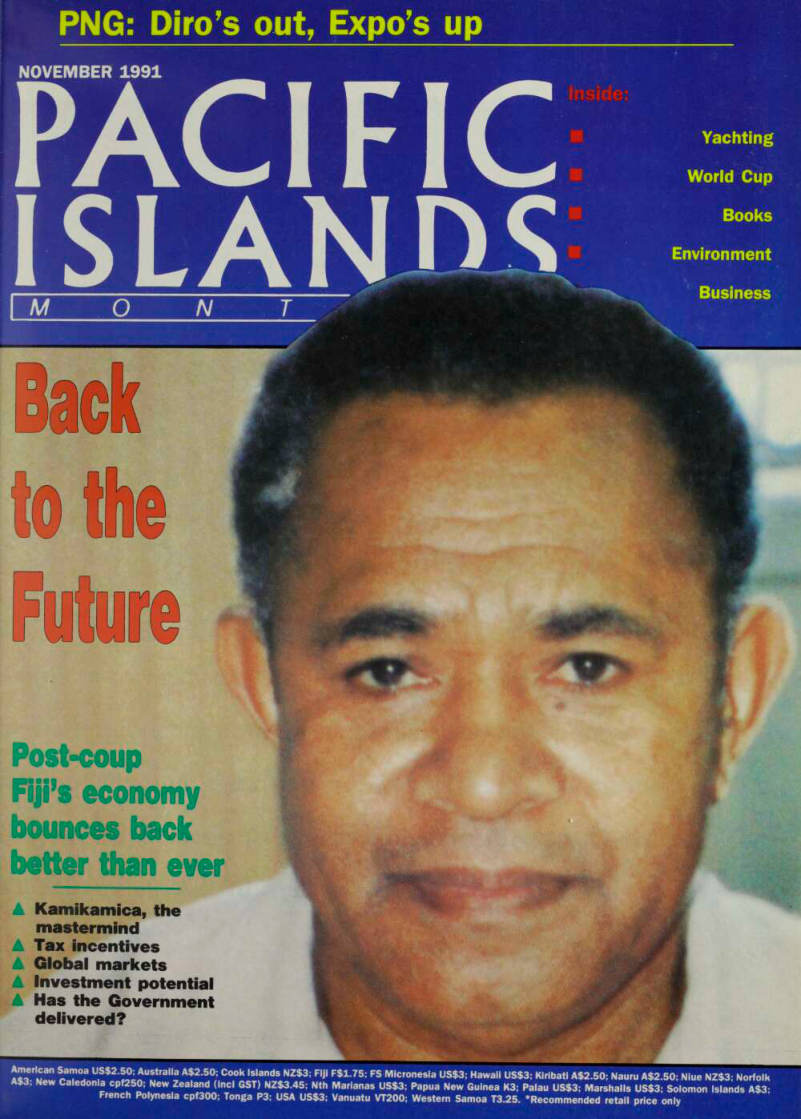
Islands
Monthly
PNG: Diro’s out. Expo’s up
November 1991
lack to the
Post-coup Fiji’s economy bounces back better than ever
A Kamikamica, the mastermind A Tax incentives A Global markets A Investment potential A Has the Government delivered?
inside Yachting World Books Environment Business
America Samoa US$2.5O: Australia A 52.50; Cook Islands NZ$3; FIJI F 51.75; FS Micronesia US$3; Hawaii US$3; Kiribati A 52.50; Nauru A 52.50; Niue NZ$3: Norfolk As 3: New Caledonia cpf2so; New Zealand (Incl GST) NZ53.45: Nth Marianas US$3; Papua New Guinea K 3; Palau US$3; Marshalls US$3; Solomon Islands As - French Polynesia cpf3oo; Tonga P 3; USA US$3; Vanuatu VT2OO; Western Samoa T 3.25. ‘Recommended retail price only
Advertisements & other items, pp. 2-4 (1 item)
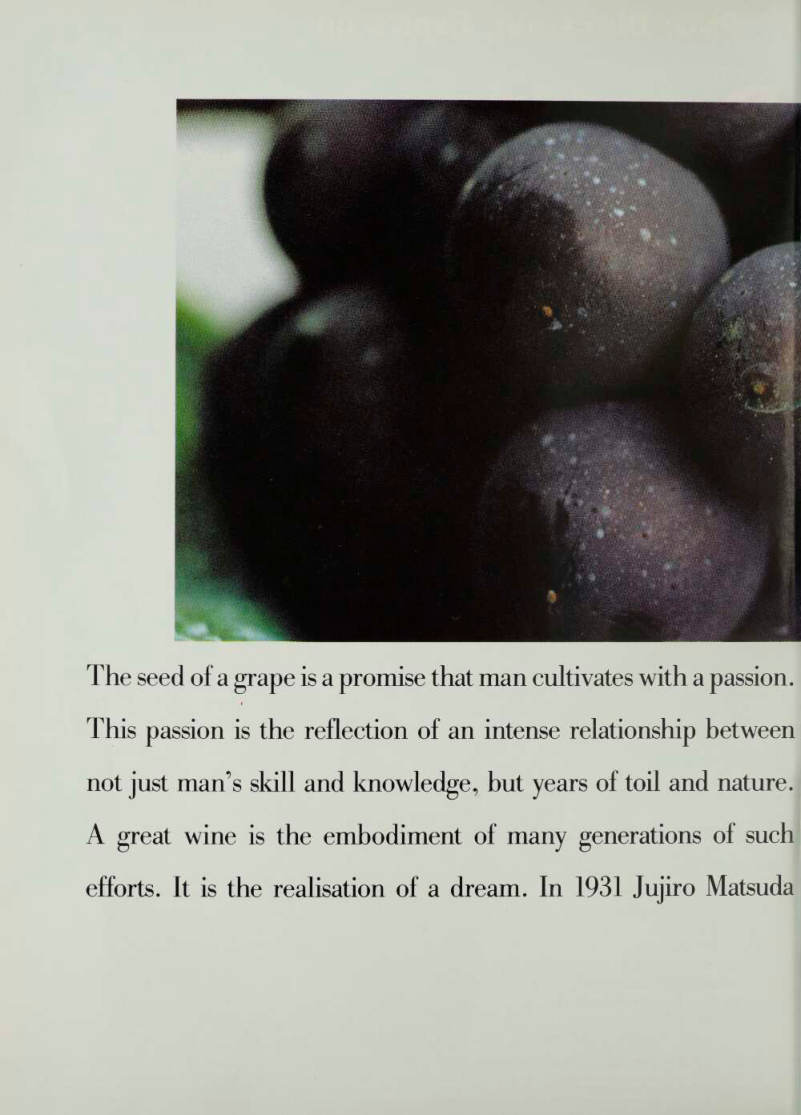
The seed of a grape is a promise that man cultivates with a passion.
This passion is the reflection of an intense relationship between not just man’s skill and knowledge, but years of toil and nature.
A great wine is the embodiment of many generations of such efforts. It is the realisation of a dream. In 1931 Jujiro Matsuda
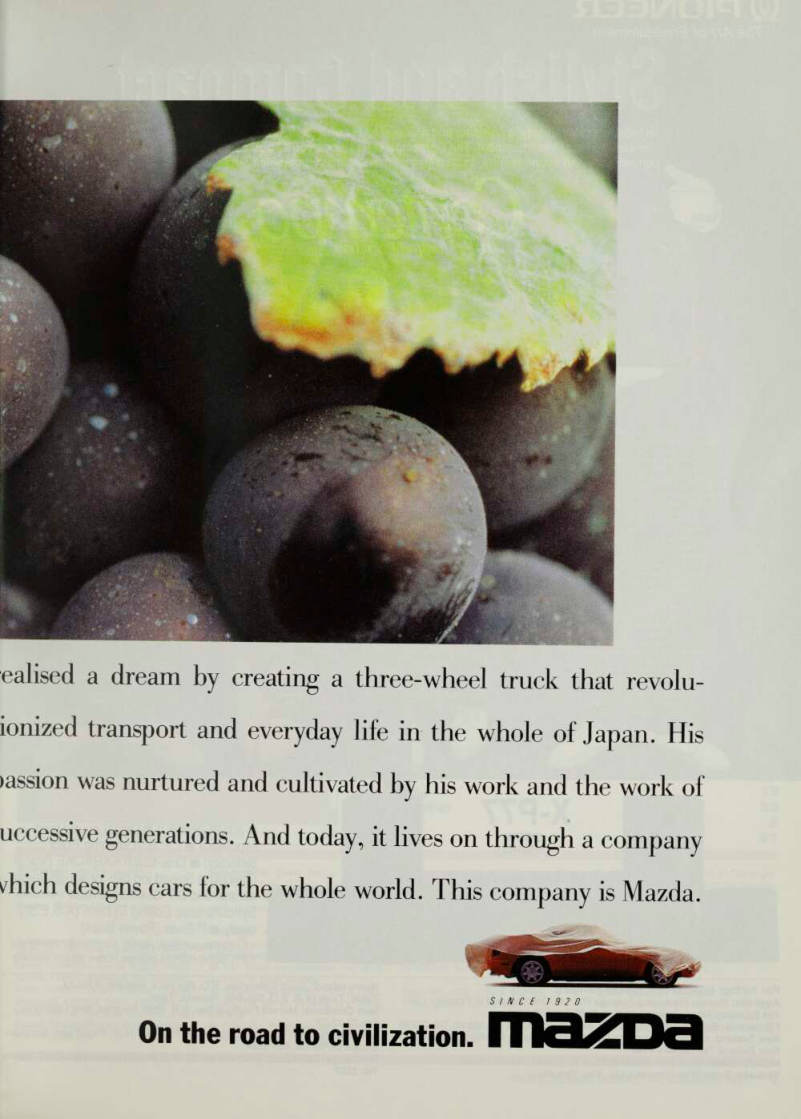
ealised a dream by creating a three-wheel truck that revoluionized transport and everyday life in the whole of Japan. His >assion was nurtured and cultivated by his work and the work of uccessive generations. And today, it lives on through a company diich designs cars for the whole world. This company is Mazda On the road to civilization.
M PIONEER
The Art of Entertainment
Stylish and Compact
In today's active society, a compact and modular Hi-Fi component stereo system is the perfect answer to home entertainment. The Contempo series gives you all you could ask for in both convenience and sound quality, as well as a stylish design that complements your living space.
Hi-Fi Compact System
- ■ nil . - ■ -- - - -- - ■ ...
In spite of its compact design, Contempo is pack ed with a variety of high-tech features that prod uce high-quality sound in almost any listening s pace. Contempo's specially engineered function s compensate for the loss of sound presence in I imited spaces. As a result, Contempo sound is c risp and clear, no matter where vou are in the r oom. What's more, Pioneer Smart Operation c
apabilities make the Contempo svstem simple
to use. A touch of the START/SET button and I he system delivers quality hi-fi sound. Various Contempo models will suit almost anv taste with a choice of Single, Twin and Multi-play CD capabilities. And all of the Contempo m odels employ 1-Bit DEC (Direct Linear Con version) technology for extremely high-qu ality sound. Add to this an ASES (Auto Sy nchronized Editing Svstem) provided on t he Double Auto-Reverse Cassette Deck th at lets you program Contempo to automat ically create professional-sounding cassetl e recordings. All of this makes Contempo t he ideal personal entertainment svstem. In spite of its compact design, Contempo is p acked with a variety of high-tech features that produce high-quality sound in almos t anv listening space. Contempo 'sspecia lly engineered functions compensate for. the loss of sound presence in limited sp aces. As a result, Contempo sound is cr isp and clear, no matter where you are in the room. W'hat s more. Pioneer Sm art Operation capabilities make the C ontempo system simple to use. A touch of t he START/SET button and the system deliv ers quality hi-fi sound. Various Contempo models will suit almost any taste with a c hoice of Single, Twin and Multi-play CD capabilities. And all of the Contempo models employ 1 -Bit DLC (Direct Li near Conversion) technology for e
xtremely high-quality sound. Add
to this an ASES (Auto Synchroniz
cd Editing System) provided on t
he Double Auto-Reverse Casse Ite Deck that lets you progr am Contempo to automat ically creat professionalsounding cassette recor dings. All of this makes Contempo the ideal pe rsonal entertainment sy stem. In spile of its co mpact design, Contemp ois packed with a variet y of high-tech features that
produce high-quality sound in
almost any listening space. Coni empo's specially engineered functi ons compensate for the loss of sou nd presence in limited spaces. As a result. Contempo sound is crisp an t) clear, no matter where you are in the room . What's more. Pioneer Smart Operation capa bililies make the Contempo system simple to u se. A touch of the START/SET button and the sy stem delivers quality hi-fi sound. Various Conte mpo models will suit almost any taste with a cho ice of Single, Twin and Multi-play CD capabilities And all of the Contempo models employ 1-Bit D LC (Direct Linear Conversion) technology for extr emely high-quality sound. Add to this an ASES (A ulo Synchronized Editing System) provided on t he Double Auto-Reverse Cassette Deck that let s you program Contempo to automatically ere
ate professional-sounding cassette recordings.
All of this makes Contempo the ideal personal e ntertainment system. In spite of its compact des ign, Contempo is packed with a variety of high-t ech features that produce high-quality sound in almost any listening space. Conlempo's specially engineered functions compensate for the loss of sound presence in limited spaces. As a re suit, Contempo sound is crisp and clear, no matter where you are in the room.
What's more. Pioneer Smart Opera tion capabilities make the Conte mpo system simple to use. A t ouch of the START/SET b utfon and the system
delivers qualil'
hi-fi sound.
Various Co X-P77 305 W
(PMPO)
m .. i 3 will suit almost any taste with a choice of Singl e. Twin and Multi-play CD capabilities. And all of the Contempo models employ l-Bil DLC (Di rect linear Conversion) technology for extrem ely high-quality sound. Add to this an ASES (A uto Synchronized Editing System) provided o n the Double Auto-Reverse Cassette Deck th at lets you program Contempo to automatic ally create professional-sounding cassette r ecordings. All of this makes Contempo the ideal personal entertainment system. In sp ite of its compact design, Contempo is pa eked with a variety of high-tech features that produce high-quality sound in aim ost any listening space. Conlempo's sp ecially engineered functions compensa te for the loss of sound presence in lim ited spaces. As a result, Contempo sou nd is crisp and clear, no matter where you are in the room. What's more, Pion ccr Smart Operation capabilities make t he Contempo system simple to use. In s pite of its compact design, Contempo is pack ed with a variety of high-tech fea
lures that produce high-quality sound i
n almost any listening space. Contemp o’s specially engineered functions com pensale for the loss of sound presence in limited spaces. As a result, Conte mpo sound is crisp and clear, no ma
For further information, please contact:
Australia: Pioneer Electronics Australia Pty. Ltd. (Incorporated in Victoria), 178- 184 Boundary Road, Braeside Victoria 3195 Tel; 580-9911 Fiji Islands: Brijlal & Company, G.P.O. Box No. 362, Suva, Fiji Islands Tel: 22258 New Zealand: Monaco Corporation Ltd., 41 Poland Road, Glenfield, Auckland,
New Zealand Tel: (09)444-9144
Norfolk Island: Burnt Pine Traders Ltd., P.O. Box 21, Norfolk Island Vanuatu: Burns Philp (Vanuatu) Ltd., Vila, Vanuatu ■ 305 W (PMPO) ■ Digital sound field
processor ■ L.P.S. (Listening Point
Selector) ■ One-touch KARAOKE (Vocal
Cancel) ■ Sound jog dial for sound image
control and S.F.C. effect ■ Auto
Synchronized Editing System (A.S.E.S.)
ready ■ P.Bass (Power Bass)
* X-P55/X-PSSM (305 W PMPO), X-P33 (210 W PMPO) and X-Pll (200 W PMPO) Contempo models are also available.
Nauru Island: Jacob Enterprises, P.O. Box N 0.4, Republic of Nauru Tahiti: Tahiti Hi-Fi, P.O. Box 848, Papeete, Tahiti New Caledonia: Menard Pacifique Sari, B.P. 3899, Noumea, New Caledonia
Tel: 27-62-23
American Samoa: Transpac Corporation, P.O. Box 1477, Pago Pago, American
Samoa 96799 Tel: 633-5224
Rarotonga: South Seas International Ltd., P.O. Box 49, Rarotonga, Cook Islands
Tel; 2327
Pacific
Islands
Monthly
Vol. 61 No. 11
The News Magazine
November 1991
COVER STORIES: starts on 35 Fiji’s economy bounces back Kamikamica, the mastermind Investment potential Tax incentives Has the interim Government delivered?
THE REGION: starts on 8 Papua New Guinea: Giro’s demise Namaliu looks back .. and forward Expo ’92 Guam: Move toward Commonwealth status loses steam 24 Aid to reduce dependence on aid 32 UN ASSEMBLY: starts on 16 Points made and scored for the Pacific
Environment:
A deadly new arrival 24
Health:
No-frills childbirth in remote areas of PNG 56 SPORT: Samoans stir up a storm in World Cup 49
Pacific People:
NZ’s Sir Paul Reeves is a bishop in a coat of many colours 58 FOCUS: Collecting combat relics has tied one Australian man to Kiribati 28 BOOKS: There’s little new for the Pacific in the post-Gulf War New World Order 55 Futa Helu 18 David Barber 33 Letters 6 Shipping 51
Publisher: Geoffrey Hussey Editor? Jale Moala Assistant Editor? Beryl Cook Sonlor Writer? Martin Tiffany Correspondents: Al Prince, Angela McCarthy, David North, David Robie, Diana McManus, Dykes Angiki, Frank Kolma, Franck Madoeuf, lan Williams, Irene Nisbet, John Hunter, Karen Mangnall, Lovenia Enari, Lito Vilisoni, Macel Manua, Nicholas Rothwell, Pesi Fonua, Richard Dinnen, Ulafala Aiavao, Wally Hiambohn
Columnists: David Barber (Welling ton), Futa Helu (Tonga, covering the Pacific Islands), Jemima Garrett (Syd ney), Margot O’Neill (Washington) Business and Advertising Man ager: Charlotte Thomas Advertising Sales: Fiji: Salendra Narayan, Tel (679) 304111, Fx (679) 303809 Sydney, Melbourne: Fergus Mac lagan, Tel (61-2) 4134689, Fx (61-2) 4123918 Brisbane; Robert Walker, Tel (61-7) 3710533, Fx (61-7) 8798964
• Adelaide: Hastwell Williamsons Rep resentations, Tel (61-8) 799522, Fx (61-8) 799735 • Auckland: McKay International Me dia Reps Ltd. Tel (64-9) 4190561, Fx (64-9) 4192243 • Japan: Universal Media Corporation, Tokyo. Tel (3) 6663036, 6663094, Cable: UNIMEDIA Tokyo, Tx 2524665 Founded 1930 (USPS 952480). A Fiji Times Limited production.
Cover prices are recommended retail only. Registered by Australia Post,
Publication No. NBP 1210. © Copyright Fiji Times Limited, 177 Victoria Parade, Suva, Fiji. Tel (679) 304111, Fx (679)
303809, Tx Fj2124.
Pacific Islands Monthly is published monthly by Fiji Times Limited, a division of Nationwide News, 2 Holt Street, Surry Hills, Sydney, NSW 2010.
Send address changes to: • Pacific Islands Monthly, PO Box 1167, Suva Fiji. Typeset and printed by Fiji Times Limited, 177 Victoria Parade, Suva, Fiji.
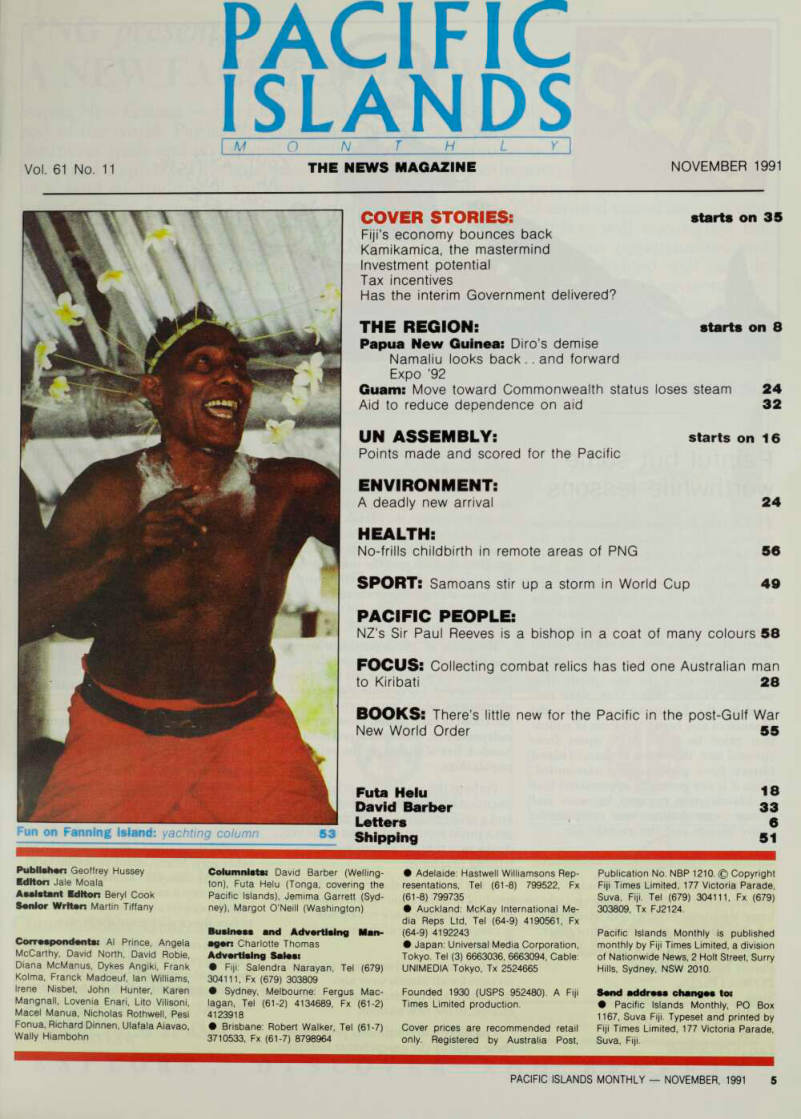
Fun on Fanning Island: yachting column 53
Painful but some
Letters
Painful but some worthwhile lessons
FUTA HELU in the September edition repeats, parrot fashion, fears of the terrible “Yoke of Colonialism” borne by the Pacific Island nations. It has been fashionable to comment as such by the educated elite, however I have yet to see in any of these one sided criticisms any vestige of thought as to what were the alternatives and where would the islands be today if the colonial era not occurred?
Islanders cling to the myth that paradise existed before they were rav aged by the European powers. In the absence of any organised form of educa tion prior to those days, apart from cultural lore, thousands of years of island history have gone largely unrecorded.
Thus it is not generally appreciated that all islands were ravaged by wars and disease, cannibalism was rampant in many islands and the average life
Letters To The Editor Must
include writer’s full name, address and home telephone number. All letters may be edited for purposes of clarity or space.
Letters should be addressed to: Pacific Islands Monthly PO Box 1167 Suva Fiji Islands OR Fax: (679) 303809
expectancy perhaps twenty five years.
Some Paradise!
Do Futa and his ilk think that natural evolution, without outside influence, would have taken the islands to the standard of development they have reached today from societies that had not progressed much past the stone age by the beginning of the twentieth century?
Sophisticated societies existed but these were adapted to the needs of the almost total isolation of each island.
He speaks of “the departing masters had stripped their islands bone-dry of resources”; I would have felt the opposite had occurred. Large scale commercial plantations, which have been the backbone of each islands economy since independence, were developed then handed, free of charge, to the indigenous populations.
Perhaps this was not the original intention in developing these plantations and a profit motive was the driving force, yet a profit motive is the basis of the very democracy that the islands are now striving to achieve It has been a sad thing to watch the gradual deterioration of these assets over the post-independence era by mis management of one of the few major available resources.
Infrastructure, educational and health services for all islands were also developed and handed, again free of charge, to the new nations.
The success in continuing progress in these areas by the independent countries
has been much more encouraging than the agricultural achievements but these fields provide little revenue to sustain independence.
I do not propose that the colonial era
was an easy period or that the original intention of the colonial powers was to better the lot of
the indigenes.
Many mistakes
were made along the way and the benefits accrued varied between islands.
The indignity of
being controlled by
another race is also not to be belittled.
However, colonialism must be considered as an oft painful learning process that brought the islands through some one thousand years of development in half a century. I do not think this development could have occurred in any other way. Many, many problems face the newly emergent nations and life has become much more complicated but the islands peoples are now better prepared to face the challenges of the future.
Let us remember colonialism as a learning process, sometimes painful, but then what learning process is not. It was not altogether the evil that it is vogue to think it.
Michael Anderson,
Western Samoa
Futa Helu
Advertisements & other items, pp. 6-7 (2 items)
#
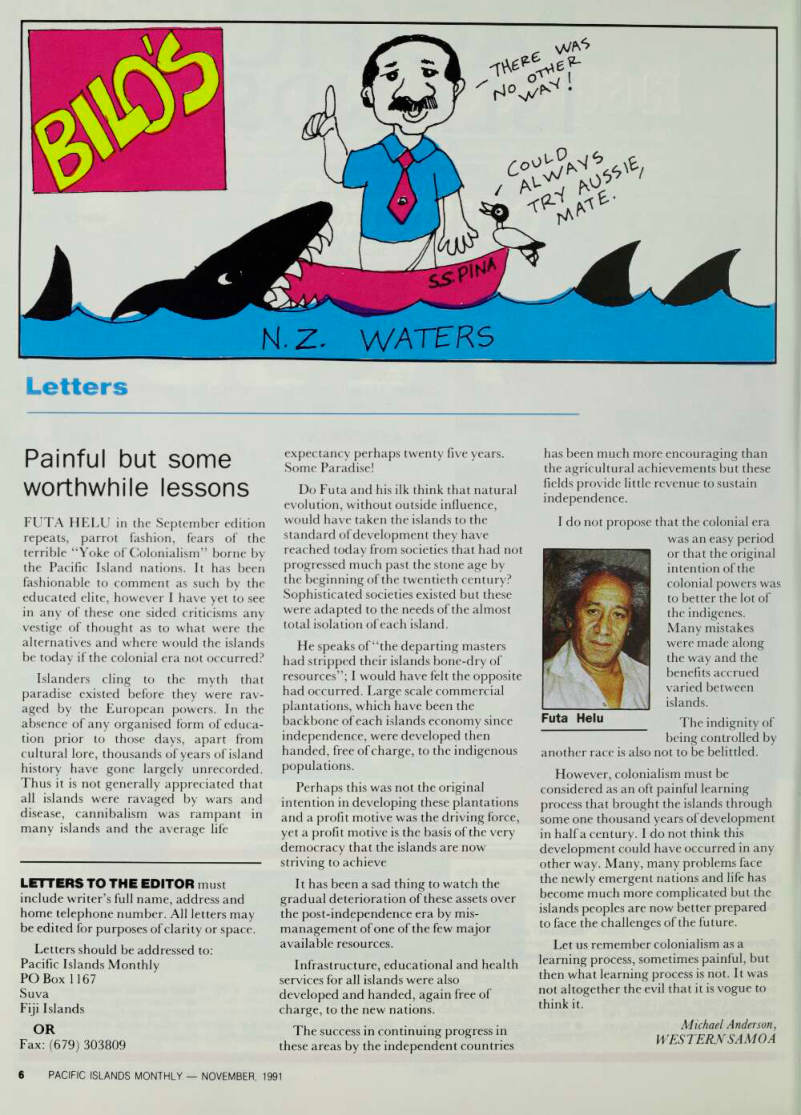
o N.Z. * plH* S5
WATERS
EXFKfc
PNG presents
A NEW FACE TO THE WORLD
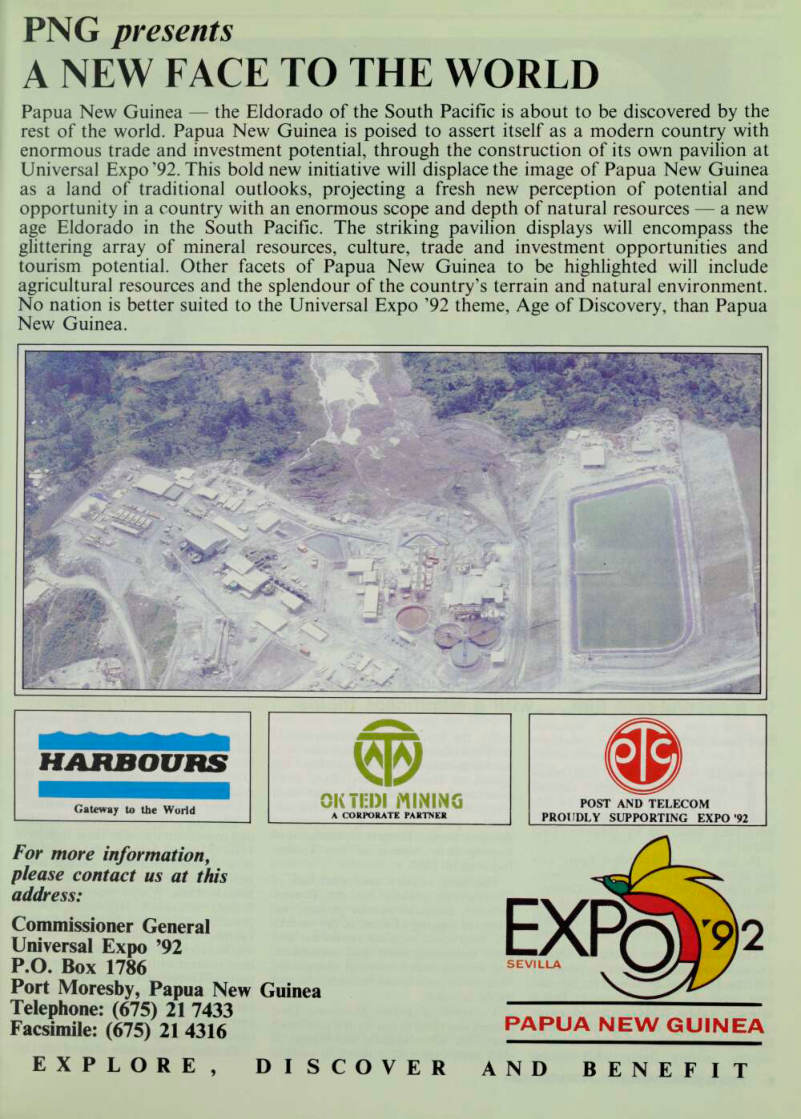
Papua New Guinea the Eldorado of the South Pacific is about to be discovered by the rest of the world. Papua New Guinea is poised to assert itself as a modern country with enormous trade and investment potential, through the construction of its own pavilion at Universal Expo ’92. This bold new initiative will displace the image of Papua New Guinea as a land of traditional outlooks, projecting a fresh new perception of potential and opportunity in a country with an enormous scope and depth of natural resources a new age Eldorado in the South Pacific. The striking pavilion displays will encompass the glittering array of mineral resources, culture, trade and investment opportunities and tourism potential. Other facets of Papua New Guinea to be highlighted will include agricultural resources and the splendour of the country’s terrain and natural environment.
No nation is better suited to the Universal Expo ’92 theme, Age of Discovery, than Papua New Guinea. ■ ' • ■ y -s . =s* - ■r t "*■ •-v - y .
I r: r ' - P I %• I 1 I
HARBOURS
Gateway to the World For more information, please contact us at this address: Commissioner General Universal Expo ’92 P.O. Box 1786 Port Moresby, Papua New Guinea
Telephone: (675) 21 7433
Facsimile: (675) 21 4316
EXFKfc
SEVILLA /
PAPUA NEW GUINEA
EXPLORE, DISCOVER AND BENEFIT
Triumph of justice
The Region
Ted Diro’s turbulent exit from power has been likened to a second-rate film ... with a significant theme
By Frank Kolma
THE story has been told many times. Papua New Guinea turned 16 on September 16 this year. Four of those 16 years have been taken up by Edward (Ted) Ramu Diro.
He has been a prominent figure, not just in terms of exposure and controversy, but in determining the course of Govern ments and, longer-term, for highlighting the weaknesses in the political and legal framework of the nation if by default.
The man who now heads the Oppo sition, Paias Wingti, was put in power in 1987 by Diro and dethroned in July the next year by Diro. Current Prime Minister Rabbie Namaliu gained power with Diro’s help and kept it through Diro. Laws pertaining to Commissions of inquiry, perjury (lying while under
oath), the functions and jurisdiction of the Ombudsmen Commission, and even the Constitutional provision to have the Queen as Head of State, have been questioned, reviewed and in most cases loopholees identified, and moves are afoot to plug them during the course of the now famous Barnett Commission of Inquiry into Aspects of the Timber Industry in 1987.
The same inquiry uncovered lack of Government policies for the forestry industry, rampant transfer pricing, un hindered logging of some of the world’s last reserves of tropical rainforest, and gross mismanagement and corruption, and recommended criminal charges for Diro and a number of businessmen and
public servants.
A maker of Prime Ministers, Diro himself was third in line for the post come June 1992, after Namaliu and Wingti. If such news comes as a shock to outside
watchers of PNG politics, it was an inevitable outcome in the intricate, delicate world of PNG politics.
In a nation divided by internal regionalism and held in balance by careful distribution of top jobs in Papua New Guinea, the region represented by Diro (the entire southern half of the country) has never been represented by a prime minister since independence.
The past and present Prime Ministers had come from the other three regions of PNG. Michael Somare represented the New Guinea mainland coastal area; Julius Chan represented New Guinea Islands; Paias Wingti represented New Guinea mainland Highlands Rabbie Namaliu again comes from New Guinea Islands, when really it was due the southern region of Papua. Papua had been content with the mostly ceremonial posts of Governor General and Deputy Prime Ministership in the past, mostly because Papuan MPs had petty differ ences and none had the national vision of charism to gain many supporters.
The first Commander of the PNG De
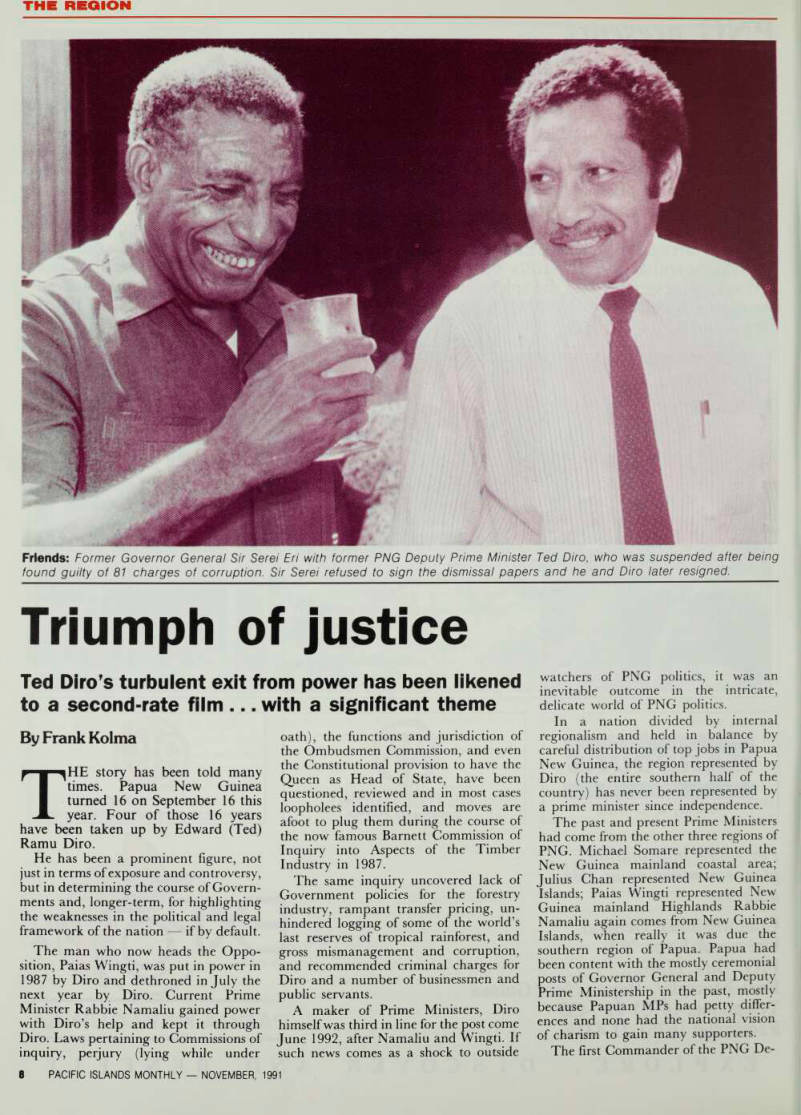
Friends: Former Governor General Sir Serei Eri with former PNG Deputy Prime Minister Ted Diro, who was suspended after being found guilty of 81 charges of corruption. Sir Serei refused to sign the dismissal papers and he and Diro later resigned.
fence Forces, Ted Diro entered national politics in 1982. He rose above the rest of Papuan leaders and, by the next elections in 1987, had formed his People’s Action Party and banded Papuan leaders under one leadership to present a formidable force in Parliament.
His aspirations disappeared at B.oBam on Friday September 27 when the National and Supreme Court judge, an Australian, pronounced Diro guilty on 81 charges of corruption, bribery and misuse of office and recommended dis missal from office for each of 71 counts.
The convictions included an attempt to prevent the course of justice, that he accepted K 140,000 in political donations from Indonesian Armed Forces Chief Benny Murdani without declaring it; and that he secretly held directorships in
several companies against the leadership
code and the Constitution.
The conviction, his recommended dismissal and the Governor General Sir Serei Eri’s refusal to sign the instruments dismissing him have been described by one observer as scenes from a second rate film. Diro supporters see it as the culmination of a sinister plot perpetrated by outsiders to destroy a prominent Papuan leader. But mostly, the tale of the turbulent passing of Ted Diro from Papua New Guinea’s political life is the story of the triumph of justice a story forgotten in all the excitement, but worth telling.
Since the Barnett Inquiry recom mended Diro and others for criminal prosecution in early 1988 many efforts have been made to pervert the course of justice, by everyone from Diro supporters to the man himself to the Governor General of Papua New Guinea.
In 1987 he was cleared on a technical ity in six counts of perjury which carries 14 years imprisonment but Diro claimed he was cleared of every thing. “It’s a victory for justice,” he said.
On March 9, 1988, when it was evident the Barnett Inquiry would table its final report, Diro supporters met and put an ultimatum to then Prime Minis
ter, Pias Wingti. Amongst other things
Wingti was told “that Tedi Diro’s case be done away with” and that this be done “within seven days, no later”.
Wingti responded in a statement: “No Prime Minister should interfere with the course of justice; he should not interfere with police matters, he should not interfere with the public prosecutor’s office and he should not interfere with the proceedings of a commission of inquiry.”
He was to lose Government for those words.
Eleven days later Diro, then a Minister in Wingti’s Government, wrote to an Opposition member offering the support
of his People’s Action Party (PAP).
His conditions, paraphrased, were: Forestry Inquiry be done away with; and
Deputy Prime Minister comes to People’s Action Party on day one of new Government.
“Whoever satisfies these demands will get PAP and (Papuan) bloc support. (People’s Democratic Movement) PDM and Wingti are now caught,” he wrote, and asked that it be passed to opposition leader Sir Michael Somare.
Mr Diro has admitted to the leader ship tribunal that he wrote the letter and claimed Parliamentary privilege. Tri bunal chairman Justice Ellis found the claim to be “misconceived”.
Justice Ellis wrote in his judgement: “Parliamentary privilege is the principle which enables Members of Parliament to speak on matters of public and national importance in Parliament without fear... of defamation.
“This was not a letter which had the public interest or national interest in mind: it was motivated by purely personal considerations and unworthy ones at that.”
Pias Wingti fell in a vote of no confidence in July 1988. Diro’s PAP supported the Opposition to gain Gov ernment. It secured the Deputy Prime
The fight for a Papuan Prime Minister has been set back many years
Ministership but the inquiry was not stopped. The final report was submitted and Prime Minister Rabbie Namaliu referred it to the fraud squad. 1989 saw a change in Police Com missioners after former Commissioner Paul Tohian’s farcical “coup”. New Commissioner Ila Geno declared there was “no case” in persuing the forestry file.
When victory seemed in sight for Diro, the Ombudsmen Commission pounced.
Early in 1991 it submitted to the Public Prosecutor, Kina Bona, to have Diro charged with 73 counts of bribery, corruption and misuse of office. Bona duplicated the charges further to 86 and wrote the Chief Justice to appoint a leadership tribunal to hear them.
The leadership tribunal was subject to delay tactics by Diro who first claimed the Ombudsmen Commission did not have jurisdiction. When that was over ruled, Diro forced a change of com missioners on grounds that chairman, Justice Arnold Amet, was a friend of Forestry Inquiry chairman, Justice Tos Barnett.
When new chairman Graham Ellis took the chair, Diro charged that the Barnett evidence should not be admitted to the Tribunal as they presumed him
guilty. That was also over-ruled.
Having exhausted legal means, more powerful friends were brought in. On September 3 Sir Serei Eri, the Governor General of PNG, long time friend of Diro and former PAP president, wrote to Chief Justice Sir Buri Kidu twice, hinting and then requesting outright that charges against Diro be dropped.
He said: “From what I hear, more than half of the charges against Mr Diro that the Ombudsman has referred to the courts for Tribunal to deal with, is based on the Barnett Report and if this is the case, then the Ombudsmen should do the right and fair thing and have them withdrawn.”
The Chief Justice wrote back: “Your first letter to me was most improper and your second letter to me is not only improper, it should not have been written at all.
“When I took my oath as Chiefjustice 13 years ago I promised to uphold the Constitution and the Law of Papua New Guinea. You did the same when I swore you in as Governor General of Papua New Guinea. Your letter on the third instant is an attempt to induce me to breach my oath of office. It is not my intention to violate my oath of office.”
If the Chiefjustice did not intend to violate his oath, Diro went ahead and broke it. On September 9 he refused to go before the tribunal and ordered his lawyer not to represent him there. He told a media briefing: “I refuse to submit myself to the jurisdiction of this Leader ship Tribunal. The Leadership Tribunal can go ahead and hear the charges against me if it wishes but I will not appear nor will my counsel appear to defend the charges against me . . ..”
The tribunal took heed of Diro’s counsel, proceeded and pronounced him guilty within a matter of weeks.
There was one last attempt to buck the system. Sir Serei refused to sign the dismissal papers and reinstated the suspended Diro to full status as Deputy Prime Minister, only fining him K 3,000.
The resulting furore ended in Sir Serei himself resigning from office.
To top off Diro’s disregard for the procedures and the legal process in the country, he himself resigned from an office he no longer occupied by effect of the Tribunal decision.
Again the law exerted itself, when the Acting Governor General signed the instruments dismissing him from office
and, by some legal interpretation, bar
ring him from contesting elections next year. Fears of a Papuan uprising for Diro’s sake have passed, but the fight for a Papuan Prime Minister has been set back many years. There appears no leader with the money, charisma and vision to keep and build on what Diro left behind. The party divided after he left, over who should replace Diro and PAP split three ways. □
Sir Erl’s swanswong
By James Grubel
PAPUA New Guinea’s Governor- General Sir Serei Eri has had successful careers as an author, teacher and diplomat, but he is likely to be remembered for his role in PNG ’s recent constitutional crisis. Sir Serei’s
correspondence to judges and politicians
over the past month has opened a new chapter in the colourful life of a man who has seen his country grow from an
Australian colony to a fiercely indepen
dent nation.
Now he is Governor-General no more.
He resigned on October 1, only hours before the Queen was expected to rectify his sacking on the recommendation of the Prime Minister, after he refused to comply with the PNG constitution by sacking his close friend and former political ally Ted Diro. (Diro has been found guilty of 81 corruption charges.) The move has plunged PNG into its own version of The Dismissal , the consti tutional crisis in Australia in 1975 which saw the queen’s representative sack the elected Labor government. Ironically, Sir Serei was stationed in Australia as PNG’s consul general at the time of the
Whitlam sacking.
Serei Vincent Eri was born in the Gulf Province of PNG in 1936 and educated at Catholic mission schools until he was 14. After a brief stint in the workforce in 1950, Sir Serei returned to study and undertook a teacher’s training course.
From 1956 the young Eri taught part time across PNG while studying to complete tertiary qualifications.
In the early 19605, Eri travelled widely throughout the Middle East, Malaysia and Australia. He was one of the first students to enter the newly-created University of PNG in 1967 and he graduated three years later with a BA with a special interest in creative writing.
Also in 1970, Eri made history when
a short story he had written at university was published as a novel, The Crocodile.
It was the first published novel by a Papua New Guinean and it won critical acclaim throughout the Pacific. The book jacket says the story is of a man who “knows he must come to terms with the unfamiliar and often brutal ways of the Europeans”.
The plot resembles the conflict Sir Serei faced as the vice-regal head of a Westminster democracy in a country where tribal loyalties remain strong. Sir Serei’s writing skills have led to some entertaining letters over the past month.
On September 3, he wrote to his Chief
Justice Sir Buri Kidu to ask for up to half the
charges against
Diro to be drop ped. In a letter
to Leadership
Tribunal Chair man Justice Graham Ellis, after the tri bunal found Diro guilty, Sir Serei flatly re jected the find ings but thank ed the tribunal chairman for “a job well done”.
In a final let ter to Prime Minister Rab bie Namaliu on
September 30,
Sir Serei spent two pages justi fying his actions and criticising the government for causing the crisis. While ad
mitting Diro
was his friend,
Sir Serei said he would gladly sign Diro’s death warrant if the circumstances were right.
Again he displayed a sense of humour with the closing paragraph: “Sorry for this long and possibly meaningless let ter . .
In 1986 Eri was named president of Diro’s People’s Action Party and he was appointed Governor-General in January 1990, on Diro’s recommendation.
One month after taking over the vice regal role, Eri was made a Knight in the most Distinguished Order of St Michael and St George and Knight of the Order of St John in a ceremony in London.
He is married with six children. □
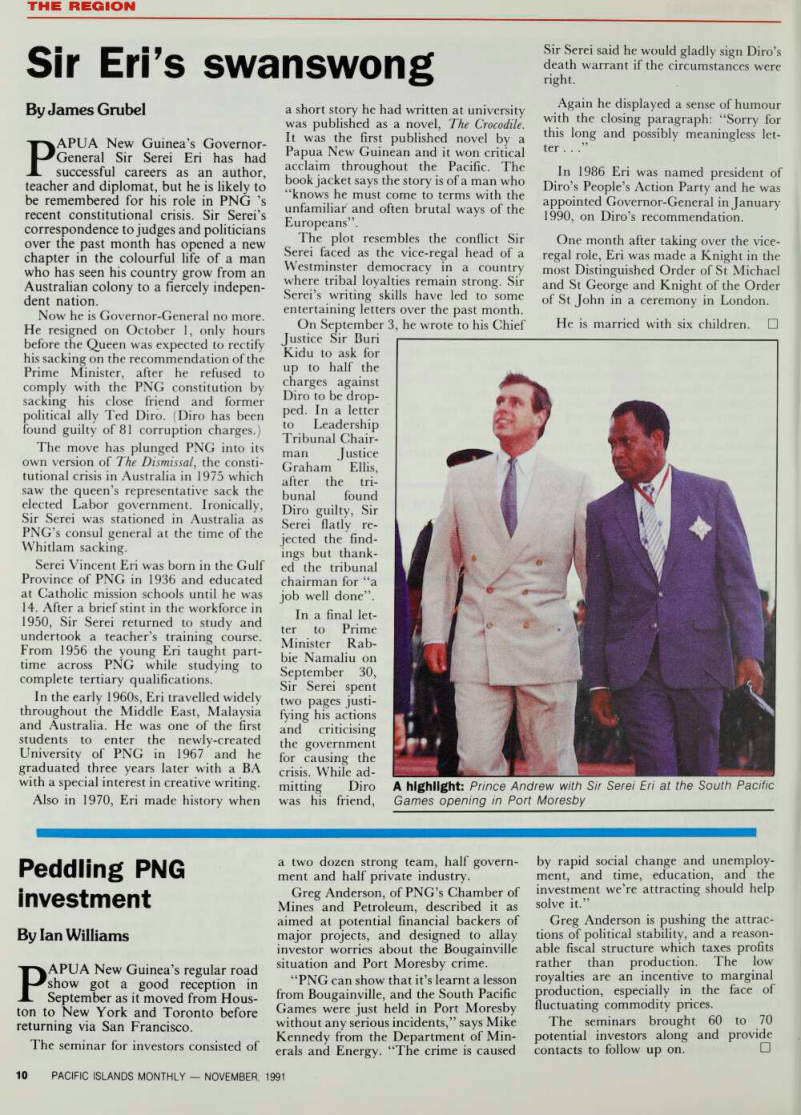
A highlight: Prince Andrew with Sir Serei Eri at the South Pacific Games opening in Port Moresby
Peddling PNG
investment
By Ian Williams
PAPUA New Guinea’s regular road show got a good reception in September as it moved from Hous ton to New York and Toronto before returning via San Francisco.
The seminar for investors consisted of
a two dozen strong team, half govern ment and half private industry.
Greg Anderson, of PNG’s Chamber of Mines and Petroleum, described it as aimed at potential financial backers of major projects, and designed to allay investor worries about the Bougainville situation and Port Moresby crime.
“PNG can show that it’s learnt a lesson from Bougainville, and the South Pacific Games were just held in Port Moresby without any serious incidents,” says Mike Kennedy from the Department of Min erals and Energy. “The crime is caused
by rapid social change and unemploy ment, and time, education, and the investment we’re attracting should help solve it.”
Greg Anderson is pushing the attrac tions of political stability, and a reason able fiscal structure which taxes profits rather than production. The low royalties are an incentive to marginal production, especially in the face of fluctuating commodity prices.
The seminars brought 60 to 70 potential investors along and provide contacts to follow up on. □
Looking
back, then moving on
By Jale Moala
ON a warm Friday morning three years ago, a former aca demic stood at the National Parliament at Waigani in Port Moresby and said the people of Papua New Guinea “deserve an honest govern
ment leadership”.
The speech by Rabbie Namaliu, Opposition Leader at the time with little international reputation, was the begin ning of the overhaul of his country’s political system.
“Mr Speaker,” he said, “a strong choice for an alternative government for the citizens and residents of Papua New Guinea exist on the floor of this house.
The Opposition that I lead stands ready to lead Papua New Guinea out of the moral rot and the ethical corruption that has become synonymous with political leadership in this country.”
That was July 1, 1988, the day Paias
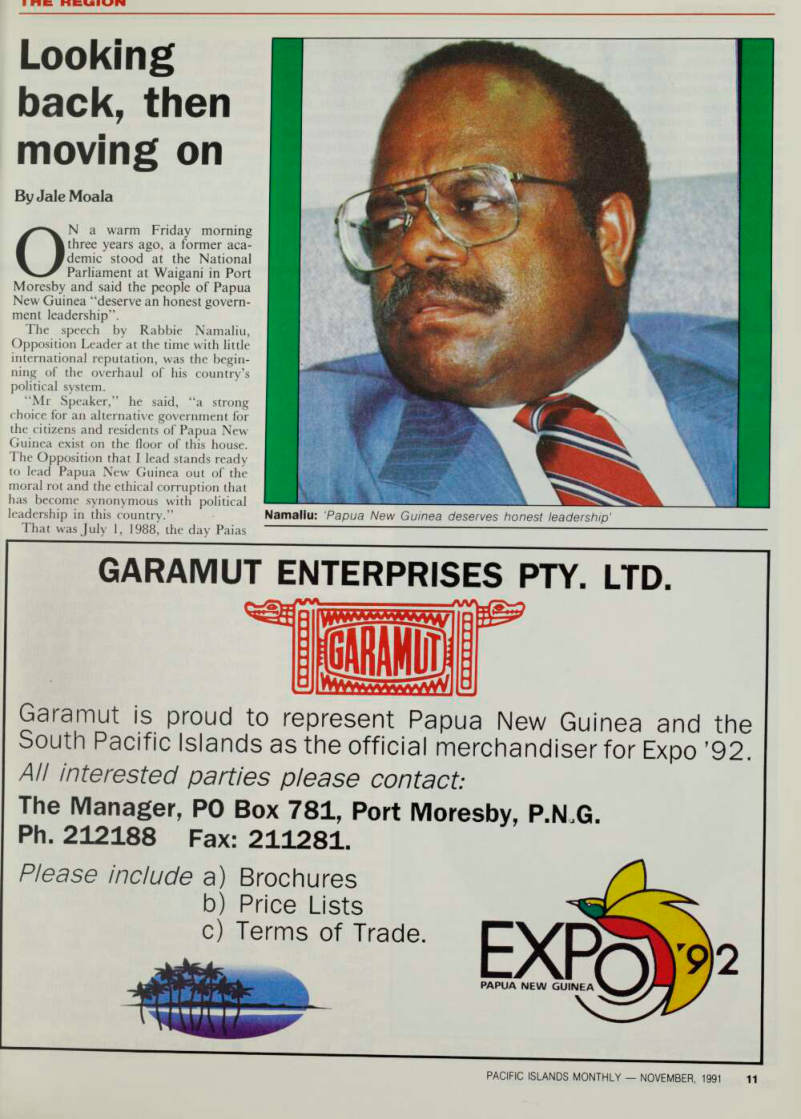
Namaliu: 'Papua New Guinea deserves honest leadership'
Wingti was ousted from power in a noconfidence vote, allowing Namaliu to become his country’s fourth Prime Minister since independence in 1975.
Since then Namaliu has weathered some of his country’s worst political storms, survived the Bougainville crisis, hosted a happy South Pacific Games, and celebrated 16 years of independence for Papua New Guinea.
F In Port Moresby, Namaliu spoke to Pacific Islands Monthly’s Jale Moala on the past, the present and the future: What has been Papua New
Guinea’s greatest achievement
since independence?
We have matured to the point where we can hold events like the South Pacific Games (in September) and host them successfully. We have demonstrated to ourselves that we can organise and arrange these things as an independent country and obviously we are grateful for the assistance that other countries have , . , r •, • provided, including of course within our own region and the South Pacific Games Council.
We have made significant changes to
our own political structures. . . consti tutional changes. It is important, par ticularly in our case, that we have political stability and the best way of getting that is to have a stable political party system where members of parka ment or provincial governments are committed to a political party and remain so for the rest of hpr political life.
Th ‘ s mmimises pol.tica instability Once we achieve political stability a lot ofother things aren’t impossible. The economic development can then be promoted and those who want to invest money will have confidence in the
country. Our people will have more confidence in the system.
We have achieved a lot in the past 16 years. In education, although we still have about 60 per cent of the population who are illiterate, more and more people are now literate and better educated.
Unemployment is another of our bigger challenges and will remain so for the future. Fortunately we will be able to address a number of critical problems effectively in the future because of the resources that are now at our disposal.
But that will depend a lot on the political
direction of the government of the day.
What areas of development need emphasis?
Infrastructure is one. Obviously we need to build more roads, more bridges into the rural sectors to bring more people in the rural sectors into the cash economy to sell their produce.
We must put more resources into education, into health and into agricul ture, The non-mining sector will remain the key to the future of this country because that’s where the bulk of our people are and will continue to be. We have to develop the agricultural sector, get more people involved in it. The fisheries sector is undeveloped at the moment. We also need to develop the forestry sector.
One area in which we have not put much emphasis in the past is tourism.
Our country has got a lot of tourism potential which we have never realised in the past and we’d like to put some emphasis into that. All these areas have the greatest potential for job creation in the rural areas. That’s the way I’d like to see the revenue coming in from the mining sector being put in.
Would that mean elevating tourism to a more senior status in Cabinet?
That has to be the case eventually if we are to be serious about it . . . we’ll have to give it a higher status.
What has been the key to your success as a leader?
In our case, where the government is built on a coalition, it is very, very important that you consult as much as possible with your coalition partners . . . But it is always understood that where agreement is not possible then the person who is in charge makes the final decision and is accepted as long as they know that they’ve been involved in the discussions.
What about human rights?
Generally, we’ve had a relatively free society in Papua New Guinea where the constitutional rights are guaranteed and have been exercised quite freely by the people, from voting to freedom of expression to freedom of movement and a host of other things. We’ve never really had a major abuse of those rights in the sense that a government in power had either abused them or had taken steps to refuse them. We’ve succeeded a lot in making sure the constitution works.
Of course, there are blots, like the Bougainville situation. But the Bougain ville situation has got to be seen as an exceptional situation where certain things happened because of the circum stances surrounding those incidents.
Once we have found a permanent
solution to Bougainville we are prepared to establish a judicial enquiry into those abuses that were allegedly committed on both sides on the national government side and on the side of the Bougainville
Republican Army.
Did Amnesty International mis judge the events in Bougainville?
I think they made hasty conclusions without really understanding the situ ation in Papua New Guinea. People have a tendency to make all sorts of criticisms because they sound good from the point of view of their organisational objectives but really with no appreciation and understanding of the local situation.
How well has the economy re covered since the Bougainville crisis started in 1988?
The past two years, 1990 and 1989, were the toughest years for us and we have had to take some very drastic steps, particu larly in the beginning of last year. We put together an economic package of measures to assist us with the economic management. We got the help of the World Bank to introduce a major structural adjustment programme. This involved, among other things, the de valuation of the kina by 10 per cent so that we can maintain a reasonable level of foreign reserves and also make our export more competitive.
We had to cut expenditure in the public sector and we had to cut the budget by about a million kina. We had to make some drastic decisions in rationalising functions and responsibil ities in the public sector and, in the process, cut out any form of duplication.
We rationalised government investments in the private and public sectors where the government had been losing money.
We had a major privatisation pro gramme because of that.
We took drastic steps to liberalise the investment policies and trade policies.
We abolished the National Investment Development Authority and in its place we have set up the Investment Promo
tion Authority which will assist us attract investment both domestically and from overseas ... We changed the forestry legislation because of the abuse of the previous forestry legislation. We made changes in some of the commodity boards and industries like coffee. All of these were geared to making Papua New Guinea more competitive, more export oriented and efficient in terms of cost.
The lessons of Bougainville made us introduce new policies in relation to mining and petroleum. We now have landowners and provincial governments
much more closely involved in the negotiations or discussions in relations to the development of a mine or a pet roleum project. The landowners and the provincial governments are now entitled to equity. We have increased the royalty payments to landowners from 5 per cent to 20 per cent. We have specified in the agreements that the priorities, in rela tions to jobs and spinoffs, must first be given to the landowners and the people of that province before anyone else. We have provided for infrastructure develop ments that the company must fulfil as
well as the national government.
These have all helped in the past three years to see at least three major projects: • Misima, in Milne Bay. This is a gold and silver mine which is in full production; • Porgcra goldmine, in the High lands. This will be its first year of full production; • Kutubu oil project. This is under construction.
All of these are multi-billion dollar projects which . . . (have) placed us in a much stronger position in terms of the economy of the future. We had negative growth in 1989 and again last year. This year it will be reversed and will be sustained on a very good level in future years. When the Bougainville copper mine comes back into production it will be a bonus. Even without Bougainville now the country can move toward a period of sustained prosperity.
Were you saddened by Sir Michael Somare’s loss at the United Nations* presidential elections?
In a way we were very disappointed that Sir Michael’s candidature didn’t come off the way we thought it would. There were a number of countries that told us they would support us and didn’t. We are appreciative of the support we got from the South Pacific countries and ASEAN and Australia, New Zealand, Japan.
We knew the United States would be a major influence in this. And because of what happened in the Gulf War, the continuing efforts in the Middle East to resolve the Palestinian question and the outstanding issue regarding Iraq, there was a lot of pressure from the United States on the Western countries to support Saudi Arabia. And Saudi Arabia is a major country in the Arab world and in the Muslim world. They’ve got the petro dollars to also mount an effective campaign.
It is unfortunate that at a time when the United States was showing increasing interest in the South Pacific they couldn’t have offered and used this opportunity in a tangible way to demonstrate that commitment to the Pacific by supporting our candidature. We are pleased that Sir Michael got the support he received.
Forty-five is still a substantial number of countries in the United Nations system and it helped Papua New Guinea and the Pacific to be put on the map.
What are your chances like in the general elections due June next year?
Pretty good. We are pretty optimistic but in Papua New Guinea, you know, politics is quite fluid. It will be a very interesting, very challenging election for all concerned. I rate our chances as pretty good at this point. □
Advertisements & other items, p. 11 (1 item)
Garamut Enterprises Pty, Ltd
Garamut is proud to represent Papua New Guinea and the South Pacific Islands as the official merchandiser for Expo ’92.
AH interested parties please contact: The Manager, PO Box 781, Port Moresby, P.NLG.
Ph. 212188 Fax: 211281.
Please include a) Brochures b) Price Lists c) Terms of Trade.
PAPUA NEW GUINEA
Let's go
Expo!
By Jale Moala
A T a lunch in Suva, someone /\ was asking why Pacific Islands / 1 countries were attending the Z. 5. World Expo in Spain next year.
It seemed to some at the table) that the Pacific was spending too much money in Spain and getting little back in return.
Some months later, half-way across the Pa cific in down town Port
Moresby, Cam
illus Narokobi tried to answer
that question.
The Expo, he said, is more than just mak ing an appear ance: “We are not there just for tourism. We are there for trade, we are there for
everything. We
are there to make contact and then de velop those con tacts.”
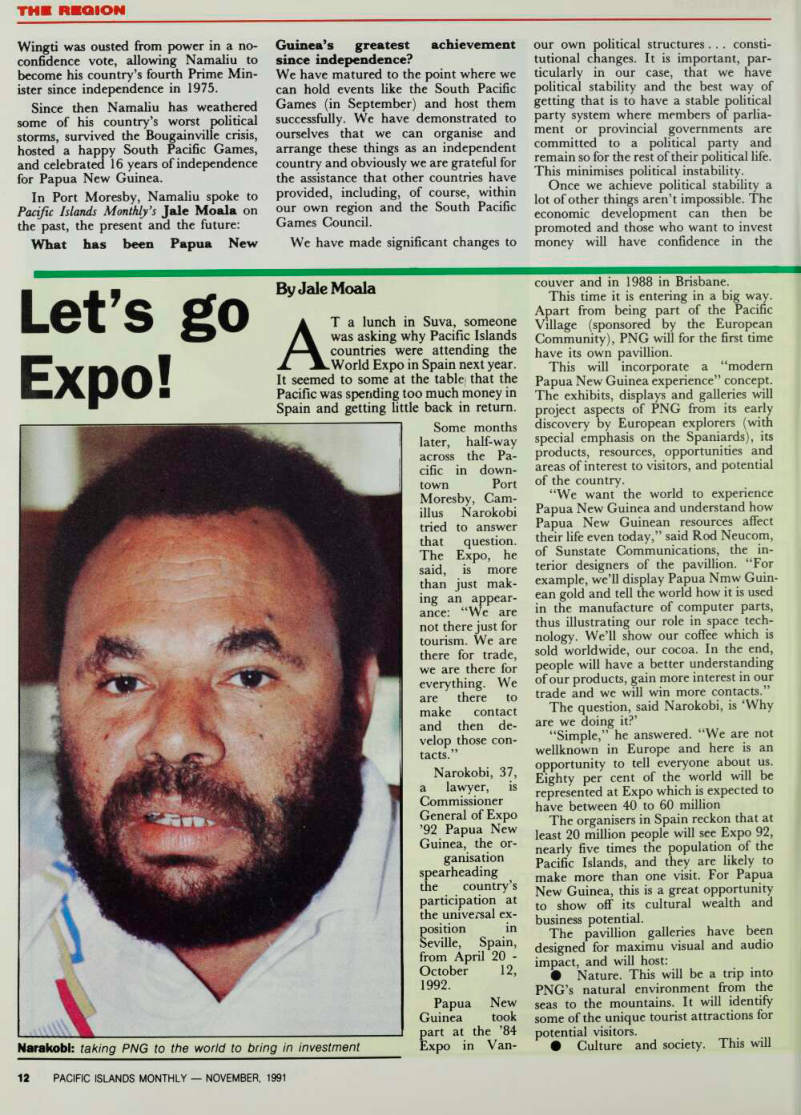
Narokobi, 37, a lawyer, is Commissioner General of Expo ’92 Papua New Guinea, the or
ganisation
spearheading
the country’s
participation at
the universal ex
position in
Seville, Spain,
from April 20 - October 12, 1992.
Papua New Guinea took part at the ’B4 Expo in Van
couver and in 1988 in Brisbane.
This time it is entering in a big way.
Apart from being part of the Pacific Village (sponsored by the European Community), PNG will for the first time have its own pavillion.
This will incorporate a “modern Papua New Guinea experience” concept.
The exhibits, displays and galleries will project aspects of PNG from its early discovery by European explorers (with
special emphasis on the Spaniards), its
products, resources, opportunities and
areas of interest to visitors, and potential of the country.
“We want the world to experience Papua New Guinea and understand how Papua New Guinean resources affect their life even today,” said Rod Neucom, of Sunstate Communications, the in terior designers of the pavillion. “For
example, we’ll display Papua Nmw Guin
ean gold and tell the world how it is used in the manufacture of computer parts, thus illustrating our role in space tech nology. We’ll show our coffee which is sold worldwide, our cocoa. In the end, people will have a better understanding of our products, gain more interest in our trade and we will win more contacts.”
The question, said Narokobi, is ‘Why are we doing it?’
“Simple,” he answered. “We are not wellknown in Europe and here is an opportunity to tell everyone about us.
Eighty per cent of the world will be represented at Expo which is expected to have between 40 to 60 million The organisers in Spain reckon that at least 20 million people will see Expo 92, nearly five times the population of the Pacific Islands, and they are likely to make more than one visit. For Papua New Guinea, this is a great opportunity to show off its cultural wealth and
business potential.
The pavillion galleries have been designed for maximu visual and audio impact, and will host: • Nature. This will be a trip into PNG’s natural environment from the seas to the mountains. It will identify some of the unique tourist attractions for
potential visitors.
• Culture and society. This will
Narakobl: taking PNG to the world to bring in investment
show the coun try’s rich and diverse culture and the peo ple. • Pot of gold will por tray Papua
New Guinea as natural resource-rich, highlighting the mineral and petroleum industry boom to attract foreign interest. • Primary products. The aim is to promote and sell primary agricultural products such as coffee, cocoa, tea, sugar, palm oil, rubber and spices. • Forestry and fisheries. Its aim will be foreign investment and markets, and publicising PNG’s tuna fishing grounds. • Exports. Promote export prod ucts to secure new overseas markets.
Narokobi is looking for K 7.2 million (US$7.6 million) to fund his Expo campaign. K 1.2 million will go towards the Pacific Village being organised in Suva by Pacific Discoveries, the com pany set up for that purpose.
Corporate sponsorship is being en couraged through a double taxation policy similar to that for the South Pacific Games. This time, however, it has been refined to only apply to 75 per cent of the assessed income of the sponsor, but regardless of whether the sponsorship is in kind or in cash.
The government proposed three levels of sponsorships: corporate partner, cor porate, and individual. Corporate part ners are the big ones and eight were being sought. By the end of September, Harbours Board and Post & Telecom munication Corporation had paid K 500,000 each, and Ok Tedi goldmine had paid K 250,000. The government paid K 500,000 to help establish the Expo ’92 office in Port Moresby.
“92 is a big year in Europe,” said Narokobi. “It’s the year of the Olympic Games in Barcelona, it’s the year when Europc~will dismantle all trade barriers, and it’s the year when Madrid will be designated the Cultural Capital of Eur ope. It is also the year when the world will see Papua New Guinea like they’ve never seen them before. □
Advertisements & other items, pp. 13-18 (1 item)
To Anywhere In The World
-BHI’
m ** Your artifacts.
' gifts, souvenirs, carvings, artworks, documents whatever.
DHL will deliver anywhere worldwide Freight Forwarders. Air Cargo DHL Worldwide Express Service
NADI LAUTOKA CAOASA
73000 65400 65401 CH62
*MLm
i'jtt s g #4
Take home
the taste of
PNGI
Cowka
Cofftt
100% Pure Arabic a Coffee From the Highlands of Papua New Guinea Goroka Coffee Producers Ltd P.O. Box 555, Eugene St., Goroka, Phone: 72 1245/72 72 2945, Fax: 72 2692
Four Basic Colours
YELLOW BLACK
Plus
Fiji Times Commercial Printin
ÜBf&SJB
Equals
Printing Excellence
f U It is quite amazing what our experienced master printers, with the latest in printing technology, can produce from four basic colours.
Full colour packaging and food labels that look good enough to eat; award winning full colour brochures and posters; magazines, calendars, books, stickers, fabric labels and billboards with pictures that leap right out of the printed pages.
II y °n r * pr ? duct rec l uires export-quality, high impact four colour printing, then you should be talking to us first.
You II find our prices very competitive and our paper stock quite extensive.
FIJI TIMES
COMMERCIAL PRINTING DIVISION
Printing Excellence
20 GORDON STREET, SUVA. PHONE; SUVA 304111. FAX; 301521 LAUTOKA 660352. LABASA 812649,
i y
ALONGSIDE
SUVA
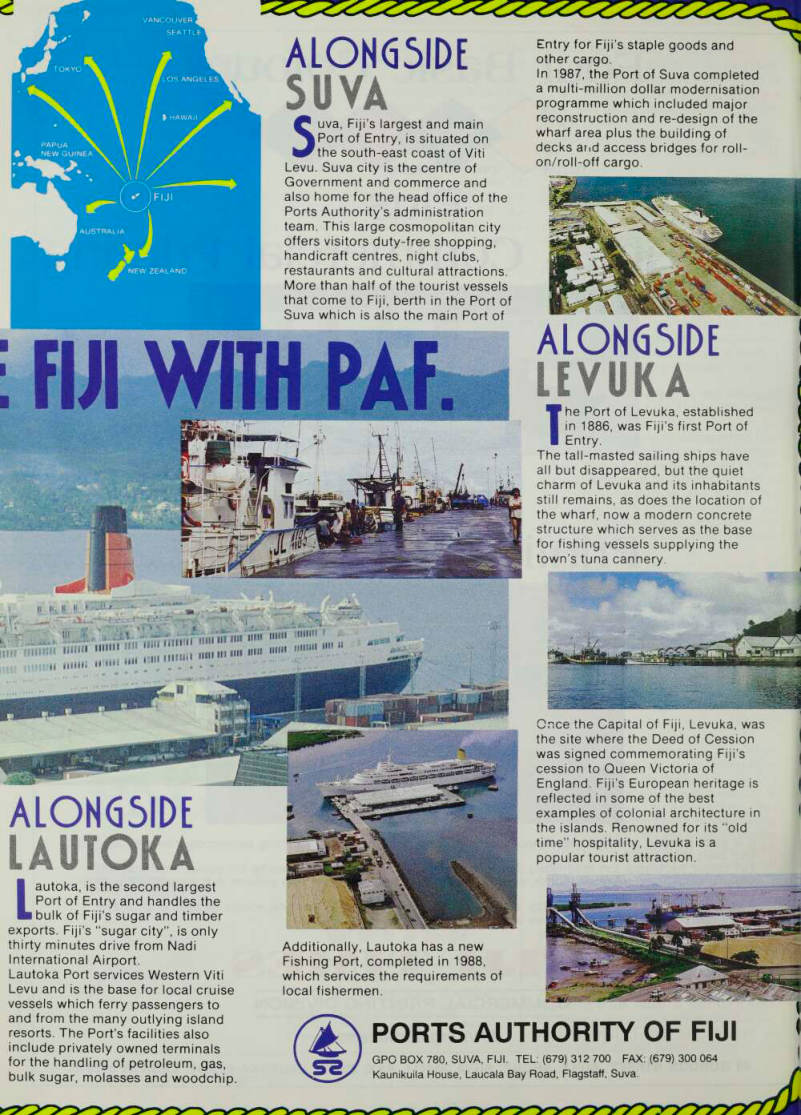
Suva, Fiji’s largest and main Port of Entry, is situated on the south-east coast of Viti Levu. Suva city is the centre of Government and commerce and also home for the head office of the Ports Authority’s administration team. This large cosmopolitan city offers visitors duty-free shopping, handicraft centres, night clubs, restaurants and cultural attractions.
More than half of the tourist vessels that come to Fiji, berth in the Port of Suva which is also the main Port of
! FIJI WITH RAF
- > saw U H H |i » .Ji.t.. til %
-- limnin'
"""“S !""" inn riftit nwi# 1 Hill lllttl IIIH» H ““ "
ALONGSIDE
JTOKA
Lautoka, is the second largest Port of Entry and handles the bulk of Fiji’s sugar and timber exports. Fiji’s “sugar city”, is only thirty minutes drive from Nadi International Airport.
Lautoka Port services Western Viti Levu and is the base for local cruise vessels which ferry passengers to and from the many outlying island resorts. The Port’s facilities also include privately owned terminals for the handling of petroleum, gas, bulk sugar, molasses and woodchip. % Additionally, Lautoka has a new Fishing Port, completed in 1988, which services the requirements of local fishermen.
Entry for Fiji’s staple goods and other cargo.
In 1987, the Port of Suva completed a multi-million dollar modernisation programme which included major reconstruction and re-design of the wharf area plus the building of decks arid access bridges for rollon/roll-off cargo. -v m
ALONGSIDE
LEYUKA
The Port of Levuka, established in 1886, was Fiji’s first Port of Entry.
The tall-masted sailing ships have all but disappeared, but the quiet charm of Levuka and its inhabitants still remains, as does the location of the wharf, now a modern concrete structure which serves as the base for fishing vessels supplying the town’s tuna cannery. •Si Once the Capital of Fiji, Levuka, was the site where the Deed of Cession was signed commemorating Fiji’s cession to Queen Victoria of England. Fiji’s European heritage is reflected in some of the best examples of colonial architecture in the islands. Renowned for its “old time” hospitality, Levuka is a popular tourist attraction.
PORTS AUTHORITY OF FIJI
GPO BOX 780, SUVA, FIJI. TEL; (679) 312 700 FAX: (679) 300 064 Kaunikuila House, Laucala Bay Road, Flagstaff, Suva.
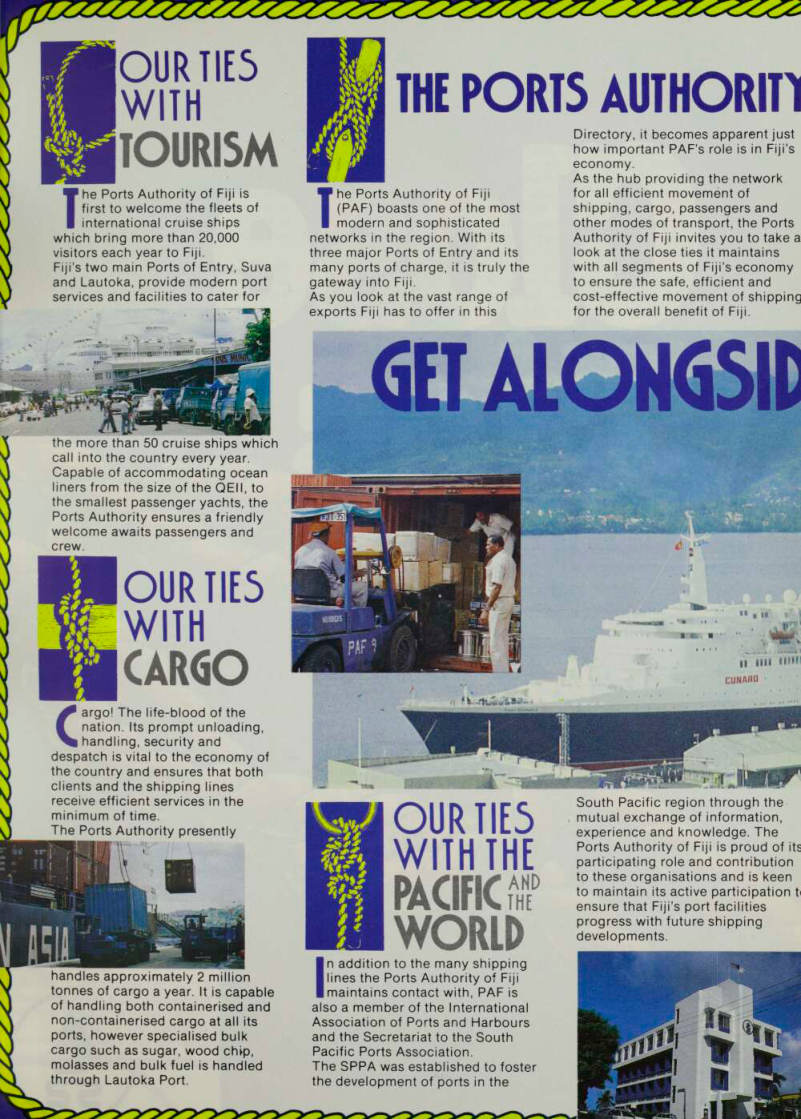
OUR TIES
WITH
TOURISM
The Ports Authority of Fiji is first to welcome the fleets of international cruise ships which bring more than 20,000 visitors each year to Fiji.
Fiji’s two main Ports of Entry, Suva and Lautoka, provide modern port services and facilities to cater for ■' . 1 - ' ... the more than 50 cruise ships which call into the country every year.
Capable of accommodating ocean liners from the size of the OEM, to the smallest passenger yachts, the Ports Authority ensures a friendly welcome awaits passengers and crew.
OURTIES
WITH
CARGO
Cargo! The life-blood of the nation. Its prompt unloading, handling, security and despatch is vital to the economy of the country and ensures that both clients and the shipping lines receive efficient services in the minimum of time.
The Ports Authority presently handles approximately 2 million tonnes of cargo a year. It is capable of handling both containerised and non-containerised cargo at all its ports, however specialised bulk cargo such as sugar, wood chip, molasses and bulk fuel is handled through Lautoka Port.
IHE PORTS AUTHORHI
The Ports Authority of Fiji (PAF) boasts one of the most modern and sophisticated networks in the region. With its three major Ports of Entry and its many ports of charge, it is truly the gateway into Fiji.
As you look at the vast range of exports Fiji has to offer in this Directory, it becomes apparent just how important PAF’s role is in Fiji’s economy.
As the hub providing the network for all efficient movement of shipping, cargo, passengers and other modes of transport, the Ports Authority of Fiji invites you to take a look at the close ties it maintains with all segments of Fiji’s economy to ensure the safe, efficient and cost-effective movement of shipping for the overall benefit of Fiji.
GET ALOMGSID
* »» .11 K ( 1' I ii mi ill”'
CUNAHO
*k . ‘4'tU Wse i •A
OUR TIES
WITH THE
PACIFIC AN >
THE
WORLD
South Pacific region through the mutual exchange of information, experience and knowledge. The Ports Authority of Fiji is proud of its participating role and contribution to these organisations and is keen to maintain its active participation h ensure that Fiji’s port facilities progress with future shipping developments.
In addition to the many shipping lines the Ports Authority of Fiji maintains contact with, PAF is also a member of the International Association of Ports and Harbours and the Secretariat to the South Pacific Ports Association.
The SPPA was established to foster the development of ports in the
jssti
1 il
VJ
The offshore alternative
IN March, the Australian government released a major industry statement which now seems to be offering Pacific Island nations the prospect of much sought after new investment.
Already the giant Melbourne-based Yazaki automotive manufacturer has decided to move one of its major component plants off-shore to Western Samoa. Other manufacturers are considering following suit.
Essentially, what Australian Prime Minister Bob Hawke did in the March 12 statement was to speed up Canberra’s tariff reductions. As a result Australia is now aiming at a general tariff level of just 5 per cent on most manufacturing and agricultural imports by 1996.
Although clothing, textiles and car parts will retain their relatively high levels of protection for longer, those levels, too, will come down faster than originally anticipated under specific
industry plans.
In the Island nations, with their special
preferential access to the Australian market, lower tariffs have been seen as a threat. Many Pacific businesspeople fear increased competition from big producers in Asia may wipe out the Pacific’s fledgling export industries.
There is no doubt lower tariffs will make it tougher for Island manufacturers who have enjoyed duty free access under Sparteca (the South Pacific Regional Trade and Economic Co operation Agreement), but it will be possible for Island exporters to meet the challenge.
At the same time the industry statement holds out the promise of more investment in island economies.
The lowering of tariffs makes it much more attractive for Australian manufacturers, now paying high Australian wage rates, to go off-shore. At the moment Australian garment manufacturers are looking at the possibility of relocating in the Solomons, Vanuatu, Fiji, Tonga and Western Samoa. Other manufacturers are interested in part processing in the Island nations.
Although the Island nations have the advantage of being close to Australia, generally stable, and in many cases with their own preferential access to markets in the United States and Europe, (under the Lome Convention), the competition to win investment is still tough.
Australian manufacturers are also examining opportunities in the bigger low wage countries in Asia, most of which have more years of experience in attracting this sort of investment.
Some are investigating possibilities in places closer to target markets. Garment manufacturers exporting to the US, for instance, have been looking at prospects in the Caribbean.
So what are Australian investors looking for when they consider off-shore investment?
For those I have spoken to, by far the most important element is predictability in government policies. It is not so much the sort of requirements that government place on business but the ability of business to accurately predict the outcome of its own decisions which influences the original decision to invest.
Many Island nations are now offering attractiive investment incentives. What is most important to investors is to know that company law and licensing requirements are easily understood and not subject to the whims of various public servants or ministers, that there will not be catastrophic hidden costs and
that the ground rules will not change, suddenly, once they are established. Although some investors are holding back until after upcoming elections before making their decision to invest in Fiji and Vanuatu, they are optimistic about the future in both countries.
In Australia, Fiji’s Finance Minister and co- Deputy Prime Minister, Josevata Kamikamica, has won wide respect for his efforts to set the interim government’s relations with foreign investors on a sound footing. And Vanuatu’s prospects under new Prime Minister, Donald Kalpokas, are seen as bright.
While some still have concerns about political stability, particularly in Fiji, there is a growing feeling of confidence. In Fiji that confidence has been boosted by Major General Sitiveni Rabuka leaving the army and joining the interim government. Rabuka, the leader of the 1987 coups, is now joint Deputy Prime Minister with Kamikamica.
Just at present Australia’s own recession, now admitted by Treasurer John Kerin to be the worst for sixty years, is dampening investor’s enthusiasm. Australia’s Trade and Overseas Development Minister, Neil Blewett, has warned that the rate of recovery in the retail sector, so important to Island exporters, is expected to be “quite slow”.
In the longer term, however, because the industry statement is about restructuring, Australian investment in the Pacific is likely to be unaffected. And some companies are moving off shore despite the recession.
That can be seen in Yazaki’s decision to invest in Western Samoa. Yazaki, a big car part manufacturer, will be making automotive wire looms, a lightweight labour intensive component which links the car battery to lights indicators and other accessories. Yazaki’s decision to move to Western Samoa was based on its good experiences with Samoan workers in New Zealand and its increasing concerns about high labour costs in Australia.
The Australian government’s decision to exempt car components made in Forum island countries from duty means more investment in that area is likely. Other manufacturers, too, in a wide range of industries are considering the island nations as a site for part processing.
In the longer term interest is still strong in investment in tourism. Australian investors are aware that with the dawn of the Pacific century much of the wealth and therefore the people most able to spend on tourisjn will be located just a short air hop from the Island nations, in Asia.
Other long term investment prospects lie in more high tech industries.
With its proximity to Australia and its lower wages the South Pacific has a natural advantage for producing small lightweight components which are easy to transport.
A recent joint meeting of the Fiji-Australia and Australia- Fiji business councils nominated opportunities in communica tion and data processing, health and educational services, component manufacturing and consultancy services serving the region as potential growth areas for the next 5 years. In relation to health services the councils were envisaging investment in high grade hospitals selling operation and recuperation packages for wealthy people seeking a pleasant way of dealing with their non-acute ailments.
At the moment many travel to Australia for treatment. □
Sydney
Jemima
Garrett
Locals get the break
LOCALISATION as a slogan entered the islands round about the early 19605. It had a political ring to it though not too strident then.
It was also the beginning of independence for former colonies with Western Samoa leading the way in 1962. Educated islanders began to see that they could not only enter professional areas therefore considered rightful domains of expatriates only, but also take up top posts in national as well as regional organisations regarded, up to that time, as
impregnable and fiercely guarded
fortresses of the foreign expert. It was also a time that saw the establishment of regional educational institutions staffed by foreigners who were more broad-minded than the common run of expatriates. The most import ant of these were the University of the South Pacific and University of Papua New Guinea.
Faculty and students in these institutions talked about localisation and it found a way in one form on another into the official policies of Pacific Islands governments even though it did not always appear in them in black and white.
Localisation then is an aspect of the modernisation process in the South Pacific tinged with a nationalism and anti- Europeanism on the personal level only, please note that gets more and more menacing as you move through the islands in a northwest direction.
By the mid-80s the process was in full swing, and at different levels. Not only jobs formerly regarded as out of bounds for islanders were taken by islanders themselves and discharging their duties effectively but new organisations were created with the express purpose of bringing together just island people to talk among themselves, to wit the Forum, etc. And most were formed because of dissatisfaction with the way older organis ations e.g. South Pacific Conference, were restrictive on vital issues like politics.
Australia and New Zealand are members of the Forum but this had to be allowed by the islanders, some of whom were bitterly opposed to the idea. Those in favour argued that remaining close to the Kiwis and the Aussies was an economic virtue. And they won. The argument has force, but the deduction that economic decisions are not political propositions at the same time is quite baseless both in theory and practice.
The same economist, Milton Friedman, who said there’s no such thing as a free lunch also elaborated the thesis that the road to political power is economic power, a point overwhelm ingly backed by experience.
Although all island states have accepted localisation they all have different corresponding policies. In relation to regional organisations, the smaller microstates (Kiribati, Tuvalu, the Cooks etc.) seem to be the most enthusiastic in pushing their countrymen to take up posts in them. Their share of posts in
these seem out of proportion in terms of size.
They should be congratulated, however, for the experience these people acquire in manning those jobs will translate back to their communities as real and tangible blessings.
Tuvalu, right now, has a monopoly on the Secretary General of the Forum Secretariat just as Tonga is in the case of the Pacific Islands Development programme. And West ern Samoans are so numerous in these organisations that when a SPREP post was recently advertised carrying the sentence “An appointee who is recruited from outside W.
Samoa will also be eligible for the following etc”, one’s immediate reaction was that this is to keep down the number of Samoans in
these organisations.
But then one realises that SPREP head
quarters are now being relocated to Apia. In academia also Samoans constitute an emergent force. Albert Wendt, writer poet, is Professor of English at Auckland University, Dr Pau Luteru is Director of Planning at USP, and the historian Dr M. Meleisea heads the McMillan Brown Centre for Pacific Studies, University of Canterbury, New Zealand. The list is long.
Fijians dominate the USP faculty, and Papua New Guineans UPNG, with many of both in other regional bodies. But again, a Samoan, Esekia Solofa, is the next Vice-Chancellor of USP.
It is hoped that the Tonga government will strongly back S.
Kite, Tonga’s candidate for Secretary-General of SPC to take over from Kiribati’s Atanraoi Baiteke. For the least ardent in supporting local expertise to work in organisations outside the country is most certainly Tonga. There are at present only eleven Tongans on the permanent staffs of these organisations and none of them got his/her appointment through government recommendation.
The fact is Tonga and Fiji, as the most “British” of Pacific Islands states, regard these appointments as political ones and would never support the application of someone from outside the public service and, within public service, only those who have proved strict fidelity to state interests vis-a-vis non-State or popular interests. In other words, Fiji and Tonga treat these appointments as extension of internal politics.
There have been little corruption or malfeasance of office on the part of islanders in the regional bodies. In SPC, for example, only one case of islander office abuse has been recorded as against about two or three Australian and US citizens. All resulted in dismissal or demand for resignation. But as the halcyon days of the early period draw to a close, the Pacific Way is bound to show its darker side, though it has a positive side and the only one publicised. But that is the subject of a different comment.
The Islands
Futa
Helu
Advertisements & other items, p. 21 (1 item)
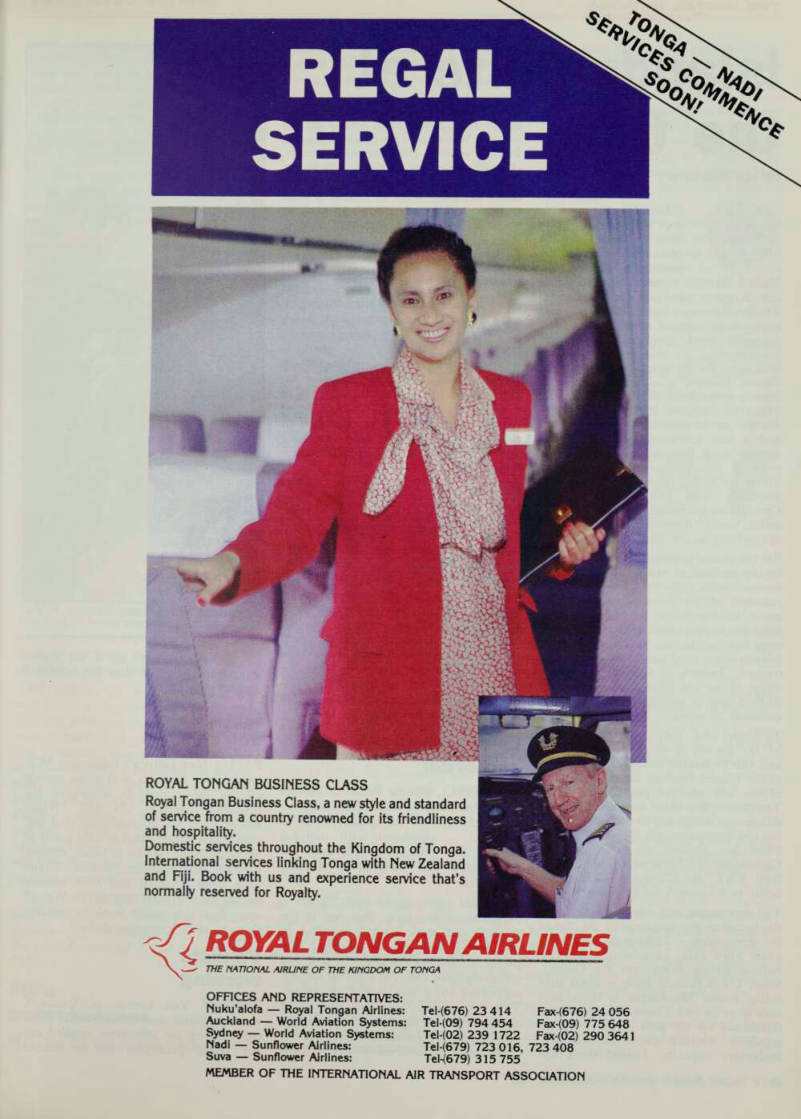
Regal
SERVICE
- V' n \ * i vW'v. \i- :vc W&sc Wt
ROYAL TONGAN BUSINESS CLASS
Royal Tongan Business Class, a new style and standard of service from a country renowned for its friendliness
and hospitality.
Domestic services throughout the Kingdom of Tonga.
International services linking Tonga with New Zealand and Fiji. Book with us and experience service that’s
normally reserved for Royalty.
SROYALTONGAN AIRLINES
THE HAHOHAL AIRUHE OF THE KIHCDOM OF TOHGA
OFFICES AND REPRESENTATIVES:
Nukualofa Royal Tongan Airlines: Tel-(676) 23 414 Fax-(676) 24 056 Auckland World Aviation Systems: Tel-(09) 794 454 Fax-(09) 775 648 Sydney World Aviation Systems: Tel-(02) 239 1722 Fax-(02) 290 3641 Nadi Sunflower Airlines: Tel-(679) 723 016, 723 408 Suva Sunflower Airlines: Tel-(679) 315 755 MEMBER OF THE INTERNATIONAL AIR TRANSPORT ASSOCIATION
the U.N.
The United Nations
Islands unite at
By Ian Willaims
DESPITE the unfore seen defeat of Papua New Guinea’s Sir Michael Somare for the presidency of the 46th
United Nations General Assembly, the session was a good one for the Pacific.
The breakdown of the Cold War allowed many more original contributions from delegates freed from party lines and point-scoring. In that constructive at mosphere, Pacific states reiterated shared Forum themes; qualified approval of French cooperation in implementing the Matignon Accords in New Caledonia; distress at continuing nuclear testing, and a firm concentration on environ mental issues. Frequent references to the work of the Alliance of Small Island States (AOSIS), reminded the General Assembly who paid the price for Greenhouse gas emissions in the industri alised world. Attention was drawn to driftnetting in the Pacific.
But the shared policies were dealt with in highly individual ways, and with ad ditions reflecting the foreign policy concerns of the states. Frequent refer ences to the need for an equitable solution to the Middle East question were but one demonstration that Pacific Islands states need not be insular in their outlook. Indeed, in face of the break down of the old blocs, the Forum and AOSIS may be among some of the more coherent alliances.
To begin with, they were strengthened
by the arrival of the Marshall Islands and the Federated States of Micronesia at the United Nations, marking the end of the old era for the former Trust Territories. But there are signs that the differences which led to the break-up of the old federation still linger on. While FSM has opened an office at the Commonwealth Secretariat’s building in New York, the Marshalls have set up home in a commercial building.
The seriousness with which they treated the occasion was apparent in the size of the delegations 35 from the Marshalls alone (pro rata, that would mean a million strong delegation for China).
Some US diplomats were worried that riding round Manhattan in limousines may have excited a taste for hyperactive diplomacy on the part of the fledgling republics - which may be beyond their budgetary capacity. Indeed there are
some suggestions that the Marshalls asked the US for aid in setting up the mission. While the US welcomes two new friendly votes in the General Assembly, it is unlikely to pay for them. Less happy will be France, whose ambassador sprang to his feet three times to exercise a right to reply to Forum nations complaining about French nuclear testing.
Greening
the U.N.
AS Forum chairman, after hitting at nuclear testing, FSM President Bailey Olter welcomed the US’s attention to the Forum’s concerns over the chemical weapons destruction programme on Johnston Atoll. “We hope the point has been made effectively that our region cannot be considered by the larger nations as a convenient empty space for the disposal of toxic and hazardous waste and chemicals and radioactive ma terials,” he said.
His main thrust was on global warming.
Pointing out that FSM’s sovereign terri tory was approaching the size of the continental US, he said: “We do not think of ourselves as small islands separated by great empty spaces. The ocean has been and always will be our great provider. Its bounty alone is our principle resource for economic survival, and we are conscious of our need to live in constant harmony with it. Until recently we believed that we were too few in number for our actions to affect the great ocean.” But no longer, he con tinued, since the discovery of the global warming effect and rising sea levels.
Law
and order
MARSHALL Islands President Amata Kabua said the most fundamental issue facing the UN is “the quality of life of mankind ... consistent with national agendas and policies, people need the opportunity and freedom to develop themselves.”
On global warming, he said: “There is very little if anything, that one of the smallest and most isolated countries in the world can do to alleviate the problem.” Kabua called for “a new and
comprehensive vision of a global society,
supported by a new system of values.
This recognition does not imply the abondonment of legitimate loyalties, the suppression of cultural diversity, nor the abolition of national autonomy. It calls
for a wider loyalty, for a far higher aspiration than has thus far animated human efforts”.
Lone
voice
PAPUA New Guinea’s Education Min ister, Utula Samana, was alone among all the 166 nations in addressing the problems besetting UN staff. “Never before have the international civil ser vants been called upon to help guide so many different peoples to peace, democ racy and independence,” he said: “Many have been detained and held hostage during the courses of their duties. We call upon those responsible to release and free them to their important duties”.
Vanuatu
warning
ROBERT Van Lierop, of Vanuatu, warned against double standards, “Prin ciples which are selectively applied are not really principles but are instead
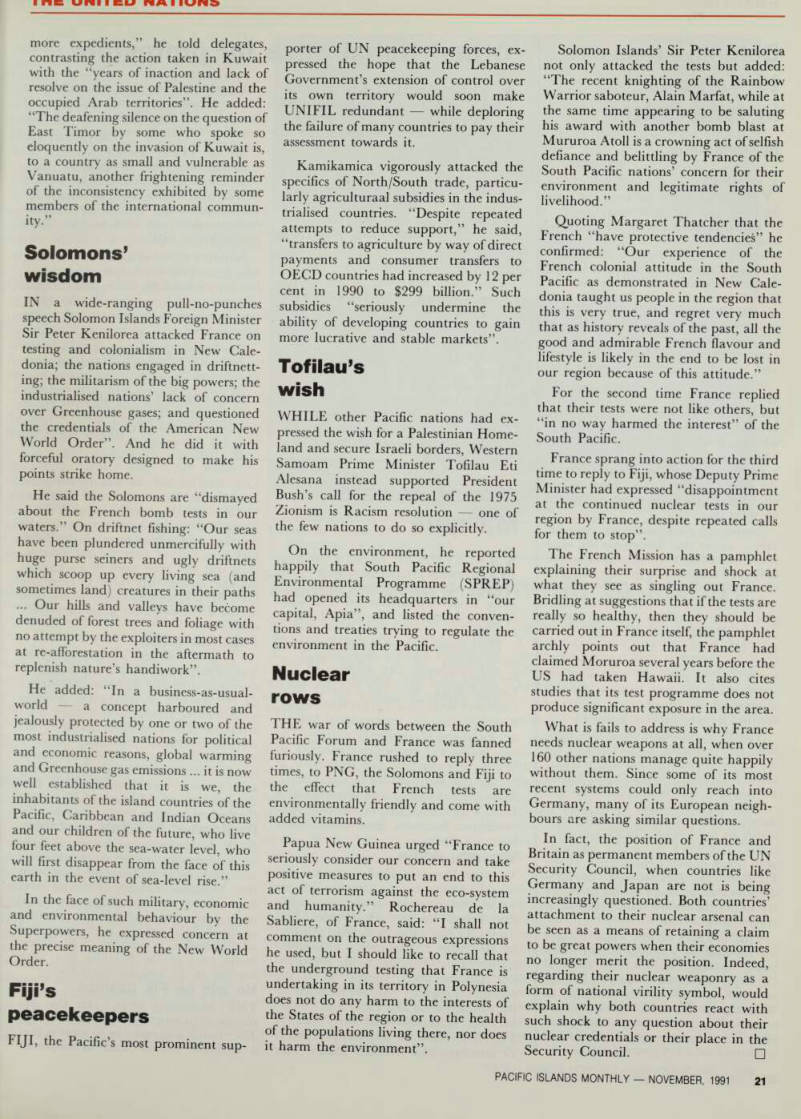
Dangerous playground: children in the Marshalls
more expedients,” he told delegates, contrasting the action taken in Kuwait with the “years of inaction and lack of resolve on the issue of Palestine and the occupied Arab territories”. He added: “The deafening silence on the question of East Timor by some who spoke so eloquently on the invasion of Kuwait is, to a country as small and vulnerable as Vanuatu, another frightening reminder of the inconsistency exhibited by some members of the international commun
ity.”
Solomons’
wisdom
IN a wide-ranging pull-no-punches
speech Solomon Islands Foreign Minister Sir Peter Kenilorea attacked France on testing and colonialism in New Cale donia; the nations engaged in driftnett ing; the militarism of the big powers; the industrialised nations’ lack of concern over Greenhouse gases; and questioned the credentials of the American New World Order”. And he did it with forceful oratory designed to make his points strike home.
He said the Solomons are “dismayed about the French bomb tests in our waters.” On driftnet fishing: “Our seas have been plundered unmercifully with huge purse seiners and ugly driftnets which scoop up every living sea (and sometimes land) creatures in their paths ... Our hills and valleys have become denuded of forest trees and foliage with no attempt by the exploiters in most cases at re-afforestation in the aftermath to replenish nature’s handiwork”.
He added: “In a business-as-usual world a concept harboured and jealously protected by one or two of the most industrialised nations for political and economic reasons, global warming and Greenhouse gas emissions ... it is now well established that it is we, the inhabitants of the island countries of the Pacific, Caribbean and Indian Oceans and our children of the future, who live four feet above the sea-water level, who will first disappear from the face of this earth in the event of sea-level rise.”
In the face of such military, economic and environmental behaviour by the Superpowers, he expressed concern at the precise meaning of the New World Order. ■■■
Fiji’s
peacekeepers
FIJI, the Pacific’s most prominent sup
porter of UN peacekeeping forces, ex pressed the hope that the Lebanese Government’s extension of control over its own territory would soon make UNIFIL redundant while deploring the failure of many countries to pay their assessment towards it.
Kamikamica vigorously attacked the specifics of North/South trade, particu larly agriculturaal subsidies in the indus trialised countries. “Despite repeated attempts to reduce support,” he said, “transfers to agriculture by way of direct payments and consumer transfers to OECD countries had increased by 12 per cent in 1990 to $299 billion.” Such subsidies “seriously undermine the ability of developing countries to gain more lucrative and stable markets”.
Tofilau’s
wish
WHILE other Pacific nations had ex pressed the wish for a Palestinian Home land and secure Israeli borders, Western Samoam Prime Minister Tofilau Eti Alesana instead supported President Bush’s call for the repeal of the 1975 Zionism is Racism resolution one of the few nations to do so explicitly.
On the environment, he reported happily that South Pacific Regional
Environmental Programme (SPREP)
had opened its headquarters in “our capital, Apia”, and listed the conven tions and treaties trying to regulate the environment in the Pacific.
Nuclear
rows THE war of words between the South Pacific Forum and France was fanned furiously. France rushed to reply three times, to PNG, the Solomons and Fiji to the effect that French tests are environmentally friendly and come with added vitamins.
Papua New Guinea urged “France to seriously consider our concern and take positive measures to put an end to this act of terrorism against the eco-system and humanity.” Rochereau de la Sabliere, of France, said: “I shall not comment on the outrageous expressions he used, but I should like to recall that the underground testing that France is
undertaking in its territory in Polynesia
does not do any harm to the interests of the States of the region or to the health of the populations living there, nor does it harm the environment”.
Solomon Islands’ Sir Peter Kenilorea not only attacked the tests but added: “The recent knighting of the Rainbow Warrior saboteur, Alain Marfat, while at the same time appearing to be saluting his award with another bomb blast at Mururoa Atoll is a crowning act of selfish defiance and belittling by France of the South Pacific nations’ concern for their environment and legitimate rights of livelihood.”
Quoting Margaret Thatcher that the French “have protective tendencies” he confirmed: “Our experience of the French colonial attitude in the South Pacific as demonstrated in New Cale donia taught us people in the region that this is very true, and regret very much that as history reveals of the past, all the good and admirable French flavour and lifestyle is likely in the end to be lost in our region because of this attitude.”
For the second time France replied that their tests were not like others, but “in no way harmed the interest” of the South Pacific.
France sprang into action for the third time to reply to Fiji, whose Deputy Prime Minister had expressed “disappointment at the continued nuclear tests in our region by France, despite repeated calls for them to stop”.
The French Mission has a pamphlet explaining their surprise and shock at what they see as singling out France.
Bridling at suggestions that if the tests are really so healthy, then they should be carried out in France itself, the pamphlet archly points out that France had claimed Moruroa several years before the US had taken Hawaii. It also cites studies that its test programme does not produce significant exposure in the area.
What is fails to address is why France needs nuclear weapons at all, when over 160 other nations manage quite happily without them. Since some of its most recent systems could only reach into Germany, many of its European neigh bours are asking similar questions.
In fact, the position of France and Britain as permanent members of the UN Security Council, when countries like Germany and Japan are not is being increasingly questioned. Both countries’ attachment to their nuclear arsenal can be seen as a means of retaining a claim to be great powers when their economies no longer merit the position. Indeed, regarding their nuclear weaponry as a form of national virility symbol, would explain why both countries react with such shock to any question about their nuclear credentials or their place in the Security Council. □
Advertisements & other items, p. 23 (1 item)
21
■ nc um i cu nAiiuro
PACIFIC ISLANDS MONTHLY NOVEMBER, 1991
Dolphins lose
Headlines
Dolphins lose to Vanuatu in tuna battle
By David North
VANUATU won and dolphins lost the latest battle between the tuna industry and the environmentalists.
This time the scene of the decision making was Geneva, Switzerland, where an international trade agency overruled an earlier vote by the United States Congress. The Congress had barred from the lush American tuna market all tuna caught by fleets that kill more dolphins than the more careful US fleet, so tuna caught by boats carrying the flags of Mexico, Venezuela and Vanuatu could not enter the US.
Recently US tuna packers, notably HJ. Heinz with its Starkist brand packed in American Samoa, have avoided buying fish from purse seiners who work the Eastern Tropical Pacific, where tuna are usually found swim
ming below schools of dolphin. Despite
the efforts of the crews, dolphins are often killed when the seines are closed on the tuna.
American environmental organis ations, aware that foreign-packed tuna often was caught by ships fishing “on dolphin” managed to get the congress to bar such fish from the US market.
The decision to overrule the Con gress came from the General Agree ment on Tariffs and Trade (GATT) the international body housed in Geneva. GATT ruled that the US could not impose its environmental standards in this way because this was intervening in the internal affairs of another nation, such as Vanuatu.
The Bush Administration now finds itself in an interesting pickle. On the one hand, it does not like any interna tional body telling it what to do, but on the other it has limited time for the environmentalists and even less for dolphins. But since the Administration wants to work with GATT on other issues, and since it usually identifies with other nation’s elites (such as the President of Mexico who is anti dolphin on this issue) it will probably try to get the Democratic Congress to reverse its position.
That this may benefit Vanuatu, and the handful of Vanuatu-flagged tuna boats working the Eastern Tropical Pacific, is fortuitous; Vanuatu’s feelings on this are of small moment to Washington. The GATT decision is not self-enforcing, and it may be months or years before tuna caught “on dolphin” is allowed into US grocery stores. □
NUCLEAR-TESTING protesters
'Other’ Nobel prize for protesters
in the Pacific, Brazilian land reform groups, and Indian and British ecologists were named as winners of the “alternative Nobel prize” in Stockholm last month.
The annual 1 million kronor ($A207,619) prize from the Right Liveli hood Awards, founded in 1980 by Swedish-German writer Jakob von Uexkull, is to support individuals and groups doing practical work to solve modern day problems.
This year’s prize was shared by the Commissao Pastoral Da Terra (pastoral land commission) and Movimiento Dos Trabalhadores Rurais Sem Terra (move ment of landless workers) for winning land for peasants in Brazil; the Save Narmada Movement in India, which is trying to block a huge river-damming project which would displace 300,000 people; Bengt and Marie-Therese Danielsson of French Polynesia for cam paigning against French nuclear tests in
the region since the 19605; and Senator Jeton Anjain and the people of Rongelap, in the Marshall Islands, for opposing us “nuclear colonialism in the
pacific”.
Anjain and (he Ro , were cited for repeated demands to the US Con to F make full reparations for heal f h blems caused by nudear radiation from the 1954 nudear bomb test at Bikini Atoll Anjain, a victim of radiation poisoning who doctors say has little time left to live. has been a k ] obbyist on behalf of the isl a nders, said Von Uexkull, who sold a private stamp collection to endow the annual prize The Rongelapese were evacuated from ‘ h f! r . lsl f" d , 50 hours after the blast on Bikini, 160 km away, They were told it was safe to return in 1957 but after decades of suffering health problems related to radiation exposure, they left Rongelap. □
Malaysia
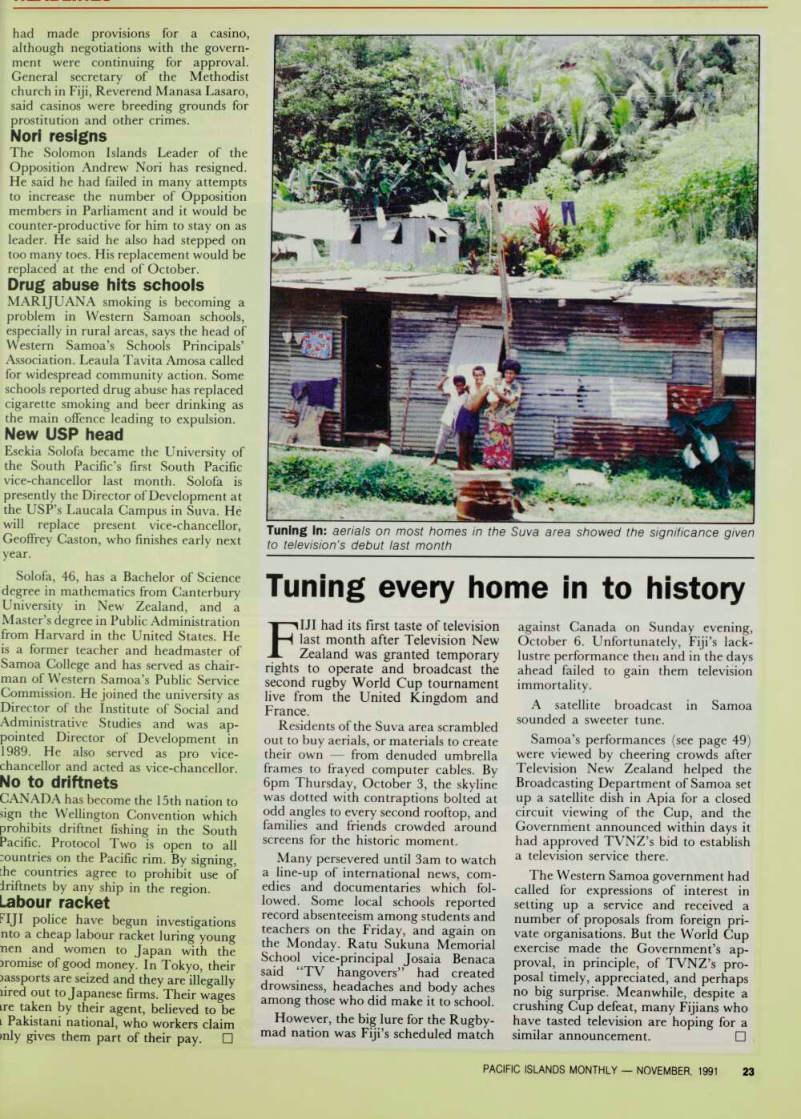
Moving toward Malaysia
MALAYSIA has signed a bilateral payments arrangement with Fiji to develop new trading links and move away from dependence on The Eur opean Community, the United States and Japan.
The agreement was signed in Bangkok on October 12 by Jaffar Hussein, Governor of Bank Negara, Malaysia’s Central Bank, and Fiji Central Bank Governor Ratu Jone Yavala Kubuabola, during the annual International Monet ary Fund and World Bank meetings. The two banks will guarantee payments on behalf of exporters and importers to reduce risk and enhance bilateral trade.
Malaysia has similar arrangements with Iran, Venezuela, Nigeria, Mexico, Mo zambique, Romania, Botswana, Zimba bwe and Chile.
Vanuatu riddle Vanuatu President Fred Timakata dis solved parliament on October 14, six weeks after the dismissal of the country’s first prime minister Fr Walder Lini.
Timakata has called a general election for December 2. Meanwhile, Fr Lini has claimed that according to the Westmin ster parliamentary system he is the opposition leader he was dumped by the ruling Vanua’aku Party and formed his own National United Party (NUP).
The NUP is now the majority party with 22 members after William Mahit, who
Lini had sacked as Lands Minister, crossed the floor to join the NUP on October 11. However, the Tan Union’s Vincent Boulekone, who also is the Speaker of Parliament, said the NUP had been formed after the last election, so it did not even exist in Parliament because no-one had voted to elect any NUP MPs. Boulekone said he would only accept a decision after a parliamentary debate.
Fatal air crash All 15 people aboard a Solomon Islands Twin Otter plane died when it crashed during a domestic flight on September 27. It crashed in mountains 40-miles south east of Honiara on a flight from Kirakira. The passengers included the recently recruited expatriate pilot, a mother and her two children, an Austra lian volunteer teacher, a prisoner serving a life sentence and his police escort, and the principal of a Church of Melanesia theological training centre and his wife.
Parliament building unstable NEW Zealand contractors are working on a new piling system to stabilise the new parliament building on Majuro in the Marshall Islands. Building was suspended at the end of last year when large cracks were found in the structure of the US$l6 million parliament and administration complex. Engineers found part of the building had sunk because of the unstable coral reef.
No win on Fiji casinos THE Methodist church in Fiji has reiterated its stand against casinos in Fiji.
The church was reacting to reports that a US$l2.2 million hotel development
had made provisions for a casino, although negotiations with the govern ment were continuing for approval.
General secretary of the Methodist church in Fiji, Reverend Manasa Lasaro, said casinos were breeding grounds for prostitution and other crimes.
Nori resigns
The Solomon Islands Leader of the Opposition Andrew Nori has resigned.
He said he had failed in many attempts to increase the number of Opposition members in Parliament and it would be counter-productive for him to stay on as leader. He said he also had stepped on too many toes. His replacement would be replaced at the end of October.
Drug abuse hits schools
MARIJUANA smoking is becoming a
problem in Western Samoan schools, especially in rural areas, says the head of Western Samoa’s Schools Principals’
Association. Leaula Tavita Amosa called for widespread community action. Some schools reported drug abuse has replaced cigarette smoking and beer drinking as the main offence leading to expulsion.
New USP head Esekia Solofa became the University of the South Pacific’s first South Pacific vice-chancellor last month. Solofa is presently the Director of Development at the USP’s Laucala Campus in Suva. He will replace present vice-chancellor, Geoffrey Gaston, who finishes early next year.
Solofa, 46, has a Bachelor of Science degree in mathematics from Canterbury University in New Zealand, and a Master’s degree in Public Administration from Harvard in the United States. He is a former teacher and headmaster of Samoa College and has served as chair man of Western Samoa’s Public Service Commission. He joined the university as Director of the Institute of Social and Administrative Studies and was ap pointed Director of Development in 1989. He also served as pro vice chancellor and acted as vice-chancellor.
No to driftnets
CANADA has become the 15th nation to sign the Wellington Convention which prohibits driftnet fishing in the South Pacific. Protocol Two is open to all xmntries on the Pacific rim. By signing, the countries agree to prohibit use of iriftnets by any ship in the region.
Labour racket
FIJI police have begun investigations
nto a cheap labour racket luring young nen and women to Japan with the promise of good money. In Tokyo, their lassports are seized and they are illegally lired out to Japanese firms. Their wages ire taken by their agent, believed to be i Pakistani national, who workers claim >nly gives them part of their pay. □
Tuning every home in to history
FIJI had its first taste of television last month after Television New Zealand was granted temporary rights to operate and broadcast the second rugby World Cup tournament live from the United Kingdom and France.
Residents of the Suva area scrambled out to buy aerials, or materials to create their own from denuded umbrella frames to frayed computer cables. By
6pm Thursday, October 3, the skyline
was dotted with contraptions bolted at odd angles to every second rooftop, and families and friends crowded around screens for the historic moment.
Many persevered until Sam to watch a line-up of international news, com edies and documentaries which fol lowed. Some local schools reported record absenteeism among students and teachers on the Friday, and again on the Monday. Ratu Sukuna Memorial School vice-principal Josaia Benaca said “TV hangovers” had created drowsiness, headaches and body aches among those who did make it to school.
However, the big lure for the Rugby mad nation was Fiji’s scheduled match
against Canada on Sunday evening,
October 6. Unfortunately, Fiji’s lack lustre performance then and in the days ahead failed to gain them television
immortality.
A satellite broadcast in Samoa sounded a sweeter tune.
Samoa’s performances (see page 49) were viewed by cheering crowds after Television New Zealand helped the Broadcasting Department of Samoa set up a satellite dish in Apia for a closed circuit viewing of the Cup, and the Government announced within days it had approved TVNZ’s bid to establish a television service there.
The Western Samoa government had called for expressions of interest in setting up a service and received a number of proposals from foreign pri vate organisations. But the World Cup exercise made the Government’s ap proval, in principle, of TVNZ’s pro posal timely, appreciated, and perhaps
no big surprise. Meanwhile, despite a
crushing Cup defeat, many Fijians who
have tasted television are hoping for a similar announcement. □
Tuning In: aerials on most homes in the Suva area showed the significance given to television’s debut last month
Status move losing steam
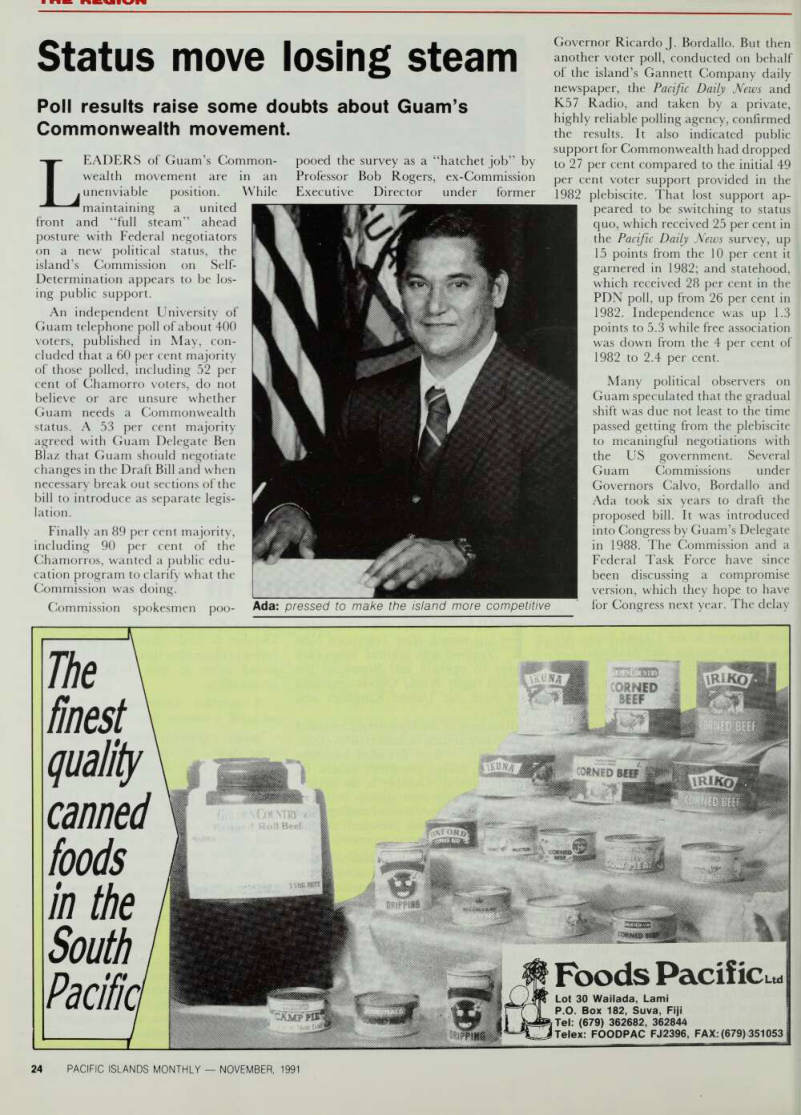
The Region
Poll results raise some doubts about Guam’s Commonwealth movement.
LEADERS of Guam’s Common wealth movement are in an unenviable position. While maintaining a united
front and “full steam” ahead posture with Federal negotiators on a new political status, the island’s Commission on Self- Determination appears to be los
ing public support.
An independent University of
Guam telephone poll of about 400 voters, published in May, con cluded that a 60 per cent majority of those polled, including 52 per cent of Chamorro voters, do not believe or are unsure whether Guam needs a Commonwealth status. A 53 per cent majority agreed with Guam Delegate Ben Blaz that Guam should negotiate changes in the Draft Bill and when necessary break out sections of the bill to introduce as separate legis lation.
Finally an 89 per cent majority, including 90 per cent of the Chamorros, wanted a public edu cation program to clarify what the Commission was doing.
Commission spokesmen poo
pooed the survey as a “hatchet job” by Professor Bob Rogers, ex-Commission Executive Director under former
Governor Ricardo J. Bordallo. But then another voter poll, conducted on behalf of the island’s Gannett Company daily newspaper, the Pacific Daily News and K 57 Radio, and taken by a private, highly reliable polling agency, confirmed the results. It also indicated public support for Commonwealth had dropped to 27 per cent compared to the initial 49 per cent voter support provided in the 1982 plebiscite. That lost support ap
peared to be switching to status quo, which received 25 per cent in the Pacific Daily News survey, up 15 points from the 10 per cent it garnered in 1982; and statehood, which received 28 per cent in the PDN poll, up from 26 per cent in 1982. Independence was up 1.3 points to 5.3 while free association was down from the 4 per cent of 1982 to 2.4 per cent.
Many political observers on Guam speculated that the gradual shift was due not least to the time passed getting from the plebiscite to meaningful negotiations with the US government. Several Guam Commissions under Governors Calvo, Bordallo and Ada took six years to draft the proposed bill. It was introduced into Congress by Guam’s Delegate in 1988. The Commission and a Federal Task Force have since been discussing a compromise version, which they hope to have for Congress next year. The delay
Ada: pressed to make the island more competitive
was partly caused by the Commission’s original position that it could not negotiate any part of the bill.
After a heated face-off with a Con gressional sub-committee in December 1989, the Commission resolved that it could negotiate “technical changes” but that the principles of the bill’s provisions could not be changed. Talks were resumed but the Commission’s uncom promising stance also confused voters.
Another aspect of the problem may be that during that six-year period, and the three years since the bill’s introduction, Guam has experienced unprecedented economic growth. Since Guam leaders envisioned and touted the Common wealth movement primarily as a way to remove federal constraints on the island’s commercial expansion, some segments of the population are asking why Common wealth is needed. Moreover political conservatism normally runs wide and deep during healthy economic times.
Then, there always has been a segment of Guam’s population, coalesced around the Filipino-American minority, that feared provisions of the Bill that would confer some exclusive political and econ omic rights on the Chamorro indigenous group. This group appears to be gaining economic allies and others who are tired of the drawn-out process or confused about it.
Disunity continued to grow in July as the Guam Chamber of Commerce reignited a bitter feud between the Commission and Delegate Blaz. The Chamber, concerned about what it saw as declining quality of service in the tourism industry, asked for the immigra tion section to be taken out of the Commonwealth Bill and given expedited treatment by separate track legislation in
the US-Congress.
The immigration compromise worked out by the Commission and the feds provides for a special guest worker program that would allow non-US citizen, alien, skilled, unskilled and professionals to come to Guam for six year periods. They could full permanent as well as temporary jobs and the Governor could control their numbers.
But the guest workers would not be allowed to use their Guam time toward eventual naturalisation. The US govern ment, under the proposal, would retain overall authority under Commonwealth for Guam’s immigration.
The Chamber had pressed Ada throughout the summer to address the changing nature ofjapanese tourism and make the island more competitive. “ITwe don t manage to raise our level of service, we will suffer more and more,” said Manfred Piper, president of the Guam Hotel and Restaurant Association. Piper and other tourism leaders believe the dearth of skilled labor on the island is the
main reason for low quality of tourism service.
Several Commission members ex pressed dismay and alarm at the pros pect. The Governor and the Commission have been engaged in a nasty little public dispute over the past two years with Guam Delegate to Congress Ben Blaz who had proposed a similar “separate track approach” to other section of the Draft Commonwealth Bill. Blaz wanted to move quickly and separately on the return of excess federal land, the exten sion of Supplemental Security Income to Guam residents, and war reparations.
As Commission member David Lujan said, “Where are we going to draw the line when it comes to introducing separate bills. Congress is going to be faced with one major bill and many sub bills. Congress will say ‘Let’s put this big bill aside and put attention to the smaller ones’.”
But Ada, in a surprise mood that caught the Commission offguard, dis
agreed. Perhaps partly in response to business community criticism that his administration was not adequately res ponding to changing trends in Japanese tourism, Ada supported the Chamber’s request. “It’s important to note that if there are certain problems that need to be attended to immediately, then we can’t be steadfast,” Ada told the Com mission on July 28. “We’ll have to be open-minded. I’ll advise tthe Chamber the Commission does not like the idea, but is willing to discuss it.”
The Guam Commission continues its schedule of meetings with federal officials and has not publicly indicated any need to change its strategy or tactics. But public disillusionment with the process of status change, and growing economic pressures for separate track solutions to current problems will continue to com plicate the Commission’s task. It also may delay an already drawn-out process and, after all, the next gubernatorial election is only three years away. □
Advertisements & other items, p. 26 (1 item)
quality
The
finest
canned
foods
in the
South
Pacific!
X mm mum iff 'i mum mw mm
. ifl
Foods Pacific i
Lot 30 Wailada, Lami P.O. Box 182, Suva, Fiji Tel: (679) 362682, 362844
Telex: FOODPAC FJ2396, FAX; (679) 351053
off track,
White House off track, out of touch
By David North
A POLITE letter from George Bush’s White House has Guam’s teeth on edge.
It was a thank-you note to the Governor, and it was signed by the Director of White House Personnel, Constance Horner, a powerful figure in
Washington.
The problems were: the Governor to whom it was addressed, Ricky Bordallo, had not been governor for four and a half years; and he is no longer alive.
The White House had lost track of Guam’s political calendar and, worse, had missed the widely reported suicide of Bordallo, who chained himself to a statue of an ancient Chamorro chieftain on a public square and shot himself, rather than spend a few months in a Mainland prison camp.
He had earlier been convicted of corruption in a federal court and was scheduled to report to prison the day after he killed himself.
The White House letter thanked the Governor for his recommendations of some persons for presidential appoint ments, and assured him that they still were under consideration. The note apparently was a routine form letter, and related to recommendations which must have been sent to the White House years earlier. Bordallo left office in early 1987,
and died on January 30, 1990.
As luck would have it, the letter came to Bordallo’s widow, Madeleine, a scrappy and successful Democratic poli tician in her own right. She was recently elected to fill a vacancy in the Territorial Senate after losing a race for the Governorship in November, 1990.
Her spokesperson said “she really thinks the White House should keep up on who they’re writing.”
The Pacific Daily News grumbled editorially about the letter indicating, yet
again, the “not always benign neglect”
that so often characterises Washington’s treatment of Guam. □
Bordallo: scrappy and successful too
have landed
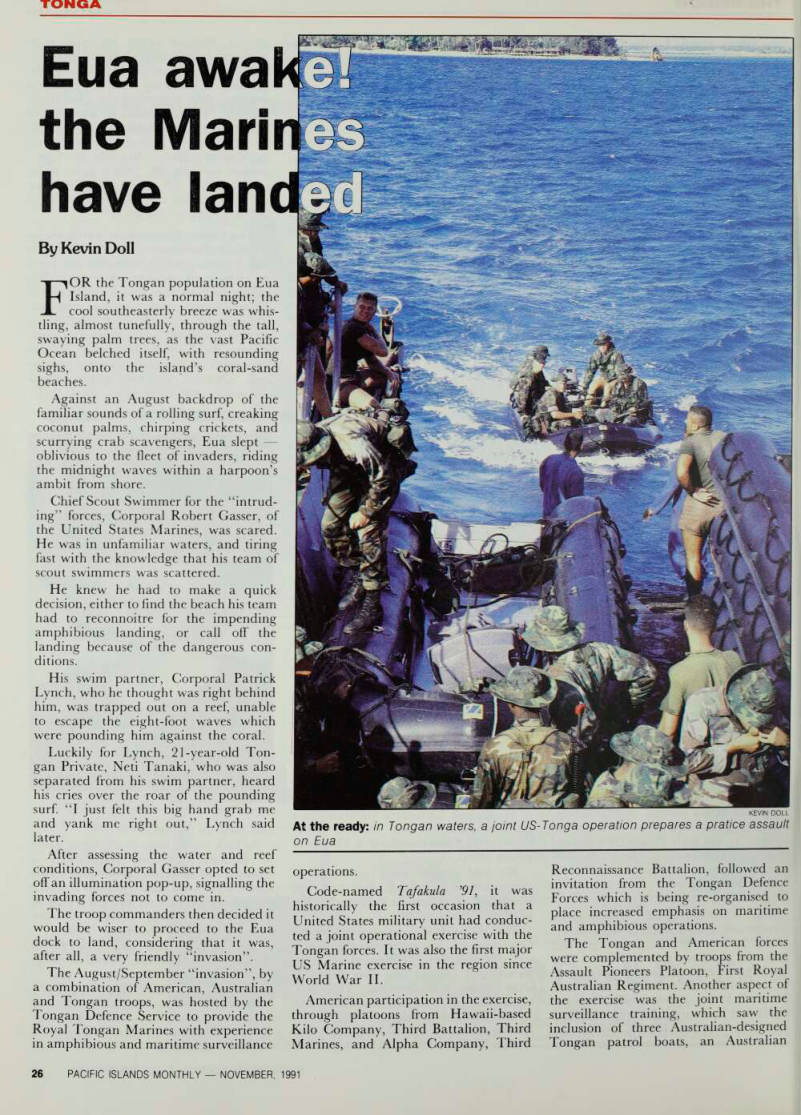
Tonga
Eua awake! the Marines
By Kevin Doll
FOR the Tongan population on Eua Island, it was a normal night; the cool southeasterly breeze was whis
tling, almost tunefully, through the tall,
swaying palm trees, as the vast Pacific Ocean belched itself, with resounding sighs, onto the island’s coral-sand beaches.
Against an August backdrop of the familiar sounds of a rolling surf, creaking coconut palms, chirping crickets, and scurrying crab scavengers, Eua slept oblivious to the fleet of invaders, riding the midnight waves within a harpoon’s ambit from shore.
Chief Scout Swimmer for the “intrud ing” forces, Corporal Robert Gasser, of the United States Marines, was scared.
He was in unfamiliar waters, and tiring fast with the knowledge that his team of scout swimmers was scattered.
He knew he had to make a quick decision, either to find the beach his team had to reconnoitre for the impending amphibious landing, or call olf the landing because of the dangerous con ditions.
His swim partner, Corporal Patrick Lynch, who he thought was right behind him, was trapped out on a reef, unable to escape the eight-foot waves which were pounding him against the coral.
Luckily for Lynch, 21-year-old Ton gan Private, Neti Tanaki, who was also separated from his swim partner, heard his cries over the roar of the pounding surf. “I just felt this big hand grab me and yank me right out,” Lynch said later.
After assessing the water and reef conditions, Corporal Gasser opted to set off an illumination pop-up, signalling the invading forces not to come in.
The troop commanders then decided it would be wiser to proceed to the Eua dock to land, considering that it was, after all, a very friendly “invasion”.
The August/September “invasion”, by a combination of American, Australian and Tongan troops, was hosted by the Tongan Defence Service to provide the Royal Tongan Marines with experience in amphibious and maritime surveillance
operations.
Code-named Tafakula ’9l, it was historically the first occasion that a United States military unit had conduc ted a joint operational exercise with the Tongan forces. It was also the first major US Marine exercise in the region since World War 11.
American participation in the exercise, through platoons from Hawaii-based Kilo Company, Third Battalion, Third Marines, and Alpha Company, Third
Reconnaissance Battalion, followed an invitation from the Tongan Defence Forces which is being re-organised to place increased emphasis on maritime
and amphibious operations.
The Tongan and American forces were complemented by troops from the Assault Pioneers Platoon, First Royal Australian Regiment. Another aspect of the exercise was the joint maritime surveillance training, which saw the inclusion of three Australian-designed Tongan patrol boats, an Australian
Kevin Doll
At the ready: in Tongan waters, a joint US-Tonga operation prepares a pratice assault on Eua
patrol boat and an Australian Orion aircraft.
The US Marine contingent, led by Captain Leon Pappa, was tasked with assisting in the various amphibious operations Tafakula ’9l required. This included the training of a scout swimmer team composed of Tongans and Austra lians, and led by Corporal Gasser and other Kilo Company scout swimmers.
“Last year, during exercise Late Tofua ’9O, the emphasis was maritime,”
Lieutenant Colonel Fetu’utolu Tupou, the Commander of the Tonga Defence Services said. “This year Tafakula ’9l also emphasised ground training.”
The Tongans and Australians were the driving force behind the ground ma noeuvres of Tafakula ’9l, with the island of Eua as the battlefield. The multi national forces found the jungle, hills, grasslands and sheer cliffs of Eua a foe in itself.
Beginning with the midnight amphibi ous landing, platoons from the three participating countries conducted day and night patrols to neutralise the “enemy” forces of a similar but smaller, mulfi-national group, composed of US Marines, Australians and Tongans.
Neutral judges roamed Eua, and
during firefights, designated the “dead”
and “captured”
The final assault of Tafakula ’9l came in a pre-dawn raid as the friendly forces attacked the stronghold of the “enemy”, an abandoned house on a cliff overlook ing the ocean. Firing blanks at the fleeing forces with illumination rounds lighting up the sky, the “fight” was brought quickly to an end.
Tupou and Pappa said the exercise was a success. “The familiarisation of equipment at the start was a very good move,” Tupou said. “The training teams must be congratulated for their efforts.”
For the Americans, Pappa said most of their training objectives had been achieved. “We were able to provide some basis for future operating procedures for the Tongans in ship-to-shore transfers.”
The Kilo Company commander ex plained this was of vital importance to the Tongans due to their available resources and the need for a high state of readiness in amphibious-styled oper ations.
He said the training and subsequent amphibious operations also showed the pitfalls and dangers of such training, evident in high surf and coral obstacles in the region. “We gained good learning experiences from the Tongans and Aus tralian, because of their different training and patrolling techniques,” Captain Pappa said. “The Tongans know how to
stay alive in the jungle ... what to eat and what not to eat.”
Tafakula however, was not all camouflagedj ri fl e -wielding, Rambo . t pe tower i n g giants, as seven- Q , d aro||n( . H alahala found out.
Although she needed a translator to understand what the tall American was sayingj her re lief at having an ingrown toenail removed was a credit to the Medical Civil Action Program (MedCAP), that coincided with Tafakula >gj -p, „ , D , , Three Kanehoe Bay Navy doctors and SIX cor helped local medical work ers FC f , lu, ? Ca S c that perform MedCAP
Camaln Rohm' Knudson '“Therearea
u P Robert Knudson. Ihere are a shortage of doctors m Tonga; medical a cc,cfanK take nn the slack ”
P He most of the illnesses treated were similar to those in the United ® tates ' “J he nutriti ° nal balance.of the Ton p n dlet . ls ? ood and „ th fV hav , e a good immunisation plan, he added.
Illnesse , s . ' reated ran g ed from skln lnfec tlons > diabetes and tumors, to ear and viral inf ections.
The medical team donated five tons of antibiotics and medications to the Ton gan government. □
Advertisements & other items, pp. 29-30 (2 items)
On The Energy Of Boral.
THE PACIFIC ISLANDS RELY
All through the Pacific Islands, people rely on Boral Speed-E-Gas LP Gas for their energy needs.
Boral has terminals throughout the area, and is proud to be a leading supplier.
Speed-E-Gas is clean, efficient and low in cost.
It’s the ideal energy source for cooking and water heating in homes, motels and hotels, and for a wide range of industrial uses.
So call Boral. We have the energy you’re looking for. m jsz Norfolk Islands Norfolk Island 2419 Papna New Guinea Port Moresby 214248 Lae 422574 Rabaul 921225 Wewak 862125 Cook Islands Rarotonga 24460 American Samoa Pago Pago 699 2948 Tonga Nukualofa 24035 Suva 315522 Lautoka 60088 Sigatoka 50578 Labasa 82973 Vanuatu Santo 36455 Solomon Islands Port Vila 22046 Honiara 21833 Boral Gas Pacific, John Oxley Centre, 339 Coronation Dave, Brisbane, Tel: (07) 3671365
BORAL GAS
Focus
Saved: Stan Gajda with the 90-year-old naval gun he helped restore on Betio in Kiribati
Gajda’s Guns of Betio
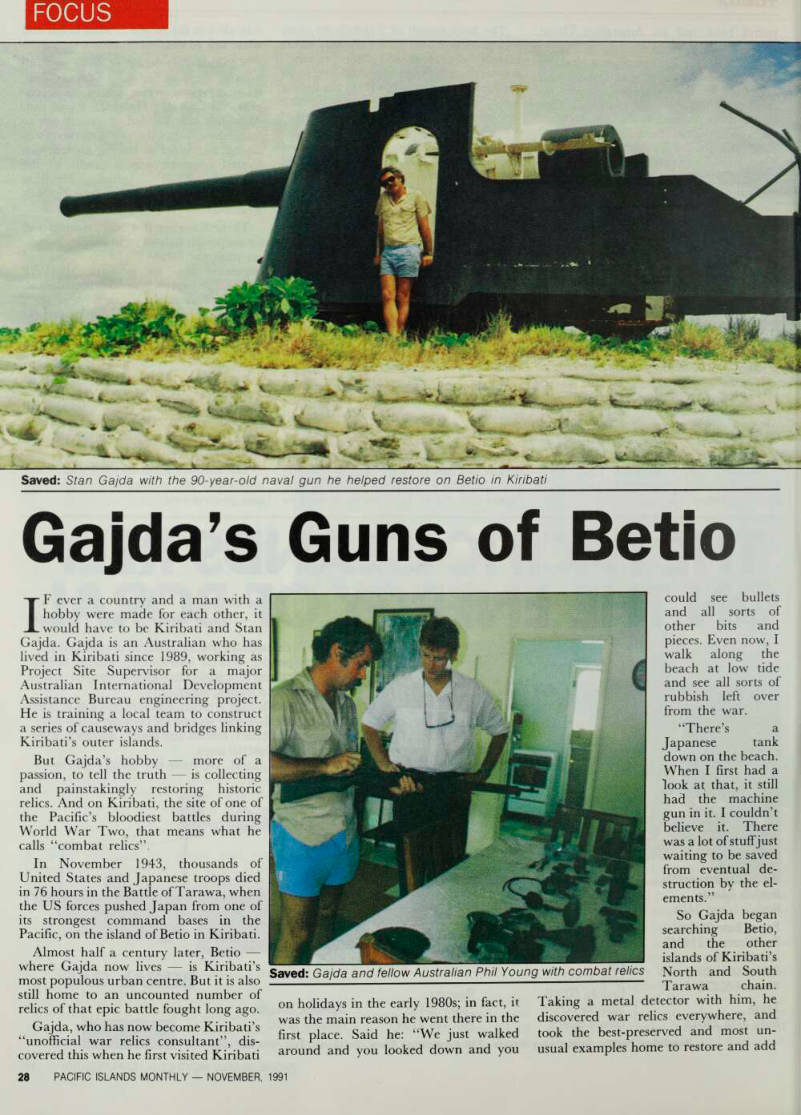
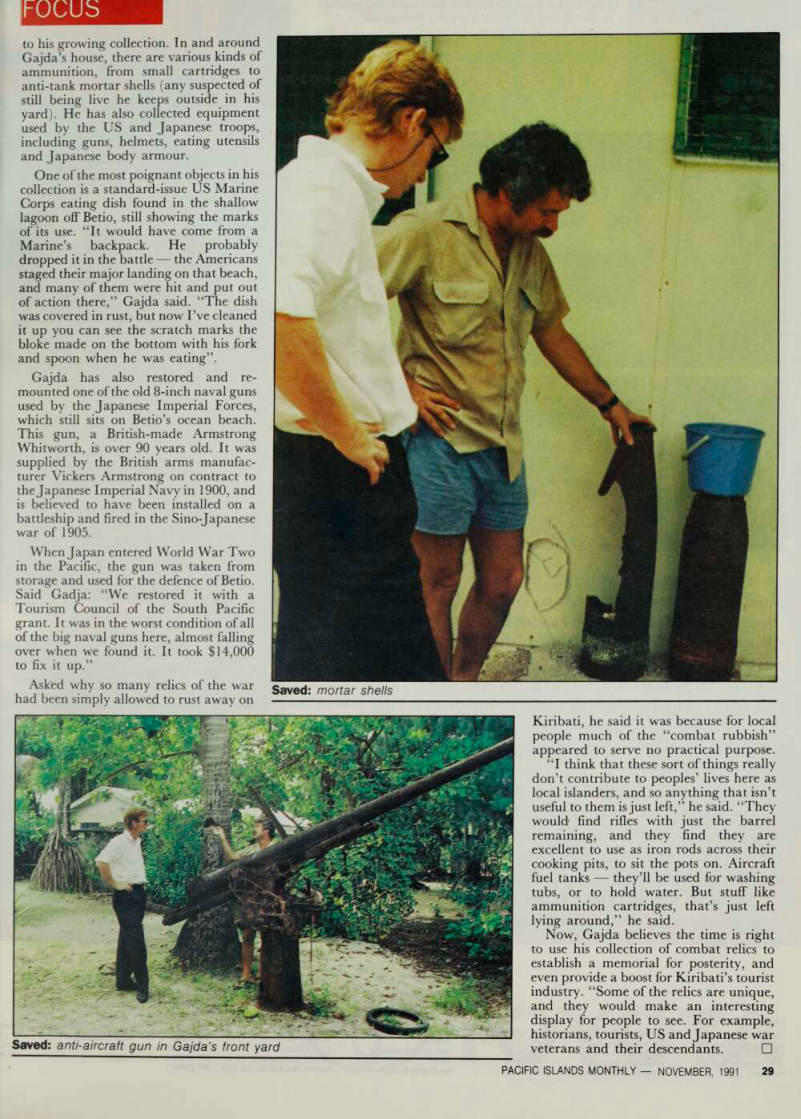
IF ever a country and a man with a hobby were made for each other, it would have to be Kiribati and Stan Gajda. Gajda is an Australian who has lived in Kiribati since 1989, working as Project Site Supervisor for a major Australian International Development
Assistance Bureau engineering project.
He is training a local team to construct a series of causeways and bridges linking Kiribati’s outer islands.
But Gajda’s hobby more of a passion, to tell the truth is collecting
and painstakingly restoring historic
relics. And on Kiribati, the site of one of the Pacific’s bloodiest battles during World War Two, that means what he calls “combat relics”.
In November 1943, thousands of United States and Japanese troops died in 76 hours in the Battle of Tarawa, when the US forces pushed Japan from one of its strongest command bases in the Pacific, on the island of Betio in Kiribati.
Almost half a century later, Betio where Gajda now lives is Kiribati’s most populous urban centre. But it is also still home to an uncounted number of relics of that epic battle fought long ago.
Gajda, who has now become Kiribati’s “unofficial war relics consultant”, dis covered this when he first visited Kiribati
on holidays in the early 1980 s; in fact, it was the main reason he went there in the first place. Said he: “We just walked around and you looked down and you
could see bullets and all sorts of other bits and pieces. Even now, I walk along the beach at low tide and see all sorts of rubbish left over from the war.
“There’s a Japanese tank down on the beach.
When I first had a look at that, it still had the machine gun in it. I couldn’t believe it. There was a lot of stuff just waiting to be saved from eventual de struction by the el ements.”
So Gajda began searching Betio, and the other islands of Kiribati’s North and South Tarawa chain.
Taking a metal detector with him, he discovered war relics everywhere, and took the best-preserved and most un usual examples home to restore and add
Saved: Gajda and fellow Australian Phil Young with combat relics
to his growing collection. In and around Gajda’s house, there are various kinds of ammunition, from small cartridges to anti-tank mortar shells (any suspected of still being live he keeps outside in his yard). He has also collected equipment used by the US and Japanese troops, including guns, helmets, eating utensils and Japanese body armour.
One of the most poignant objects in his collection is a standard-issue US Marine Corps eating dish found in the shallow lagoon off Betio, still showing the marks of its use. “It would have come from a Marine’s backpack. He probably dropped it in the battle the Americans staged their major landing on that beach, and many of them were hit and put out of action there,” Gajda said. “The dish was covered in rust, but now I’ve cleaned it up you can see the scratch marks the bloke made on the bottom with his fork and spoon when he was eating”.
Gajda has also restored and re mounted one of the old 8-inch naval guns used by the Japanese Imperial Forces, which still sits on Betio’s ocean beach.
This gun, a British-made Armstrong Whitworth, is over 90 years old. It was supplied by the British arms manufac turer Vickers Armstrong on contract to the Japanese Imperial Navy in 1900, and is believed to have been installed on a battleship and fired in the Sino-Japanese war of 1905.
When Japan entered World War Two in the Pacific, the gun was taken from storage and used for the defence of Betio.
Said Gadja: “We restored it with a Tourism Council of the South Pacific grant. It was in the worst condition of all of the big naval guns here, almost falling over when we found it. It took $14,000 to fix it up.”
Asked why so many relics of the war had been simply allowed to rust away on
Kiribati, he said it was because for local people much of the “combat rubbish” appeared to serve no practical purpose.
“I think that these sort of things really don’t contribute to peoples’ lives here as local islanders, and so anything that isn’t useful to them is just left,” he said. “They would find rifles with just the barrel remaining, and they find they are excellent to use as iron rods across their cooking pits, to sit the pots on. Aircraft fuel tanks they’ll be used for washing tubs, or to hold water. But stuff like ammunition cartridges, that’s just left lying around,” he said.
Now, Gajda believes the time is right to use his collection of combat relics to establish a memorial for posterity, and even provide a boost for Kiribati’s tourist industry. “Some of the relics are unique, and they would make an interesting display for people to see. For example, historians, tourists, US and Japanese war veterans and their descendants. □
Saved: mortar shells
Saved: anti-aircraft gun in Gajda's front yard
Advertisements & other items, pp. 31-33 (2 items)
Focus
a “T” which stand for our customer, our commitment
to the satisfaction of that customer through our product and for our spirit of creativity. if It’s not often that you hear descriptions like rugged or durable combined with refined and elegant. But then there’s never been a vehicle quite like the new Toyota Land Cruiser Station Wagon. The unrivalled legend of off-road reliability is now unsurpassed in comfort and sophistication as well. Attention to detail is found everywhere, from the fine trim to the instrument panel to the graceful lines of its exterior. Even in places you can’t see, like the heavy-duty ladder frame and suspension design that add to the superb
luxury-car ride.
But Toyota’s innovation goes beyond providing luxury and durability. The new Land Cruiser Station Wagon, and all of our cars, are designed to create a harmony between car and driver, and to provide you with the ultimate
driving experience.
The new Toyota Land Cruiser Station Wagon. Think of it as much more than a spacious luxury sedan with fourwheel drive. e e <*■ • % tF- - * *■/■-**' '- ■ * ft* * ;■ "
' % ■ '*&&&*■ ' 14
e
ativi
0 ;r r. m % . u
~JICO
OJJS.
* tzZ i 1 - a*r:*jz* ! se PH 312666 PH 282848
)N PH 234-5911
M LTD. PH 23673
@) TOYOTA
Women and the environment
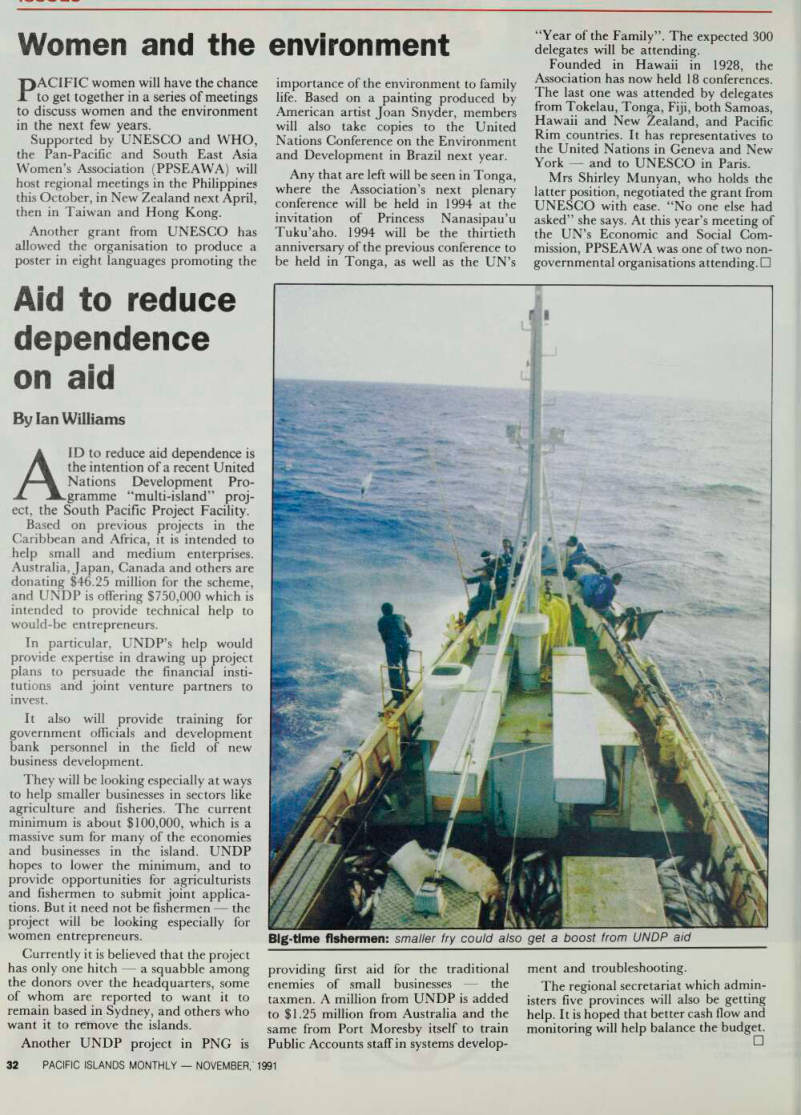
PACIFIC women will have the chance to get together in a series of meetings to discuss women and the environment in the next few years.
Supported by UNESCO and WHO, the Pan-Pacific and South East Asia Women’s Association (PPSEAWA) will host regional meetings in the Philippines this October, in New Zealand next April, then in Taiwan and Hong Kong.
Another grant from UNESCO has allowed the organisation to produce a poster in eight languages promoting the
importance of the environment to family life. Based on a painting produced by American artist Joan Snyder, members will also take copies to the United Nations Conference on the Environment and Development in Brazil next year.
Any that are left will be seen in Tonga, where the Association’s next plenary conference will be held in 1994 at the invitation of Princess Nanasipau’u Tuku’aho. 1994 will be the thirtieth anniversary of the previous conference to be held in Tonga, as well as the UN’s
“Year of the Family”. The expected 300
delegates will be attending.
Founded in Hawaii in 1928, the Association has now held 18 conferences, ast . °, ne attei l d .^ d delegates J^ om Tokelau, Tonga, Fiji, both Samoas, £. awail and . Ne T w L Zealand > and Pacifi c * lm T U has representatives to Mrs Shirley Munyan, who holds the latter position, negotiated the grant from UNESCO with ease. “No one else had asked” she says. At this year’s meeting of the UN’s Economic and Social Corn mission, PPSEAWA was one of two non governmental organisations attending. □
dependence
Aid to reduce dependence on aid
By Ian Williams
AID to reduce aid dependence is the intention of a recent United Nations Development Pro gramme “multi-island” proj ect, the South Pacific Project Facility.
Based on previous projects in the Caribbean and Africa, it is intended to help small and medium enterprises.
Australia, Japan, Canada and others are donating $46.25 million for the scheme, and UNDP is offering $750,000 which is intended to provide technical help to would-be entrepreneurs.
In particular, UNDP’s help would provide expertise in drawing up project plans to persuade the financial insti tutions and joint venture partners to invest.
It also will provide training for government officials and development bank personnel in the field of new
business development.
They will be looking especially at ways to help smaller businesses in sectors like agriculture and fisheries. The current minimum is about $lOO,OOO, which is a massive sum for many of the economies and businesses in the island. UNDP hopes to lower the minimum, and to provide opportunities for agriculturists and fishermen to submit joint applica tions. But it need not be fishermen the project will be looking especially for women entrepreneurs.
Currently it is believed that the project has only one hitch a squabble among the donors over the headquarters, some of whom are reported to want it to remain based in Sydney, and others who want it to remove the islands.
Another UNDP project in PNG is
providing first aid for the traditional enemies of small businesses the taxmen. A million from UNDP is added to 51.25 million from Australia and the same from Port Moresby itself to train Public Accounts staff in systems develop
ment and troubleshooting, The regional secretariat which admin isters five provinces will also be getting help. It is hoped that better cash flow and monitoring will help balance the budget.
D
Big-time fishermen: smaller fry could also get a boost from UNDP aid
Defence within ... or without
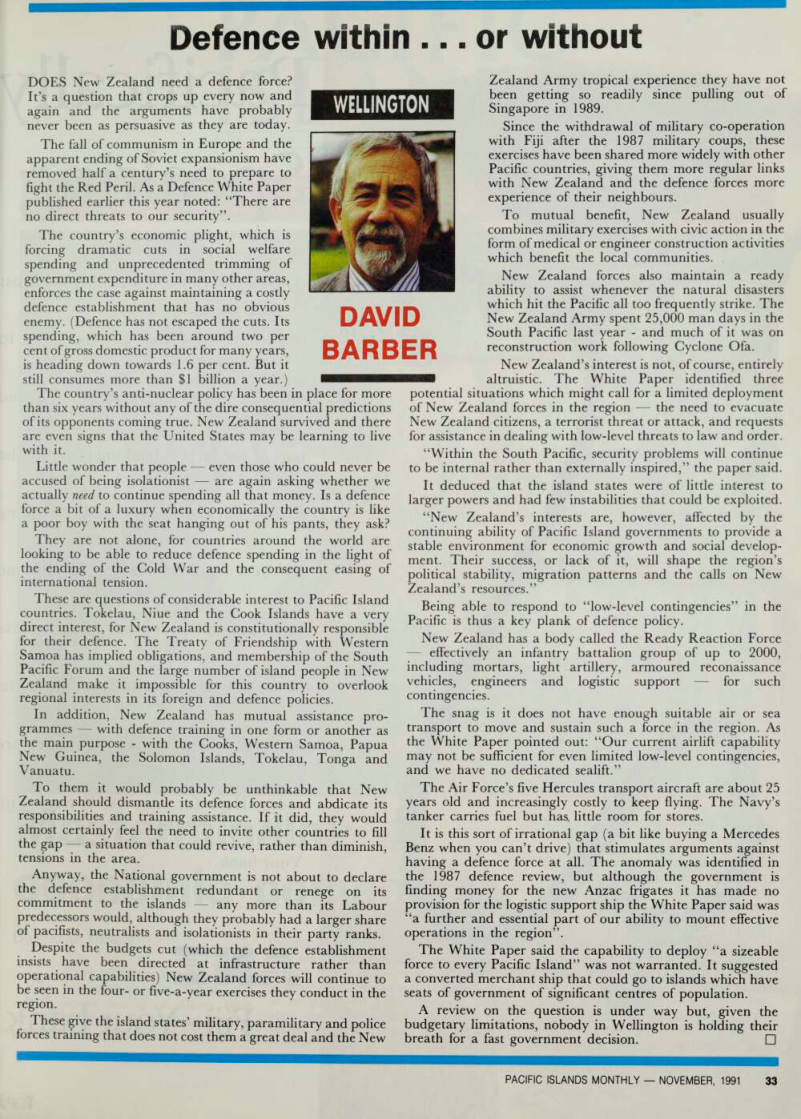
DOES New Zealand need a defence force?
It’s a question that crops up every now and again and the arguments have probably never been as persuasive as they are today.
The fall of communism in Europe and the apparent ending of Soviet expansionism have removed half a century’s need to prepare to fight the Red Peril. As a Defence White Paper published earlier this year noted: “There are no direct threats to our security”.
The country’s economic plight, which is forcing dramatic cuts in social welfare spending and unprecedented trimming of government expenditure in many other areas, enforces the case against maintaining a costly defence establishment that has no obvious enemy. (Defence has not escaped the cuts. Its spending, which has been around two per cent of gross domestic product for many years, is heading down towards 1.6 per cent. But it still consumes more than $1 billion a year.)
The country’s anti-nuclear policy has been in place for more than six years without any of the dire consequential predictions of its opponents coming true. New Zealand survived and there are even signs that the United States may be learning to live with it.
Little wonder that people even those who could never be accused of being isolationist are again asking whether we actually need to continue spending all that money. Is a defence force a bit of a luxury when economically the country is like a poor boy with the seat hanging out of his pants, they ask?
They are not alone, for countries around the world are looking to be able to reduce defence spending in the light of the ending of the Cold War and the consequent easing of international tension.
These are questions of considerable interest to Pacific Island countries. Tokelau, Niue and the Cook Islands have a very direct interest, for New Zealand is constitutionally responsible for their defence. The Treaty of Friendship with Western Samoa has implied obligations, and membership of the South Pacific Forum and the large number of island people in New Zealand make it impossible for this country to overlook regional interests in its foreign and defence policies.
In addition, New Zealand has mutual assistance pro grammes with defence training in one form or another as the main purpose - with the Cooks, Western Samoa, Papua New Guinea, the Solomon Islands, Tokelau, Tonga and Vanuatu.
To them it would probably be unthinkable that New Zealand should dismantle its defence forces and abdicate its responsibilities and training assistance. If it did, they would almost certainly feel the need to invite other countries to fill the gap a situation that could revive, rather than diminish, tensions in the area.
Anyway, the National government is not about to declare the defence establishment redundant or renege on its commitment to the islands any more than its Labour predecessors would, although they probably had a larger share of pacifists, neutralists and isolationists in their party ranks.
Despite the budgets cut (which the defence establishment insists have been directed at infrastructure rather than operational capabilities) New Zealand forces will continue to be seen in the four- or five-a-year exercises they conduct in the
region.
These give the island states’ military, paramilitary and police forces training that does not cost them a great deal and the New
Zealand Army tropical experience they have not been getting so readily since pulling out of Singapore in 1989.
Since the withdrawal of military co-operation with Fiji after the 1987 military coups, these exercises have been shared more widely with other Pacific countries, giving them more regular links with New Zealand and the defence forces more experience of their neighbours.
To mutual benefit, New Zealand usually combines military exercises with civic action in the form of medical or engineer construction activities which benefit the local communities.
New Zealand forces also maintain a ready ability to assist whenever the natural disasters which hit the Pacific all too frequently strike. The New Zealand Army spent 25,000 man days in the South Pacific last year - and much of it was on reconstruction work following Cyclone Ofa.
New Zealand’s interest is not, of course, entirely altruistic. The White Paper identified three
potential situations which might call for a limited deployment of New Zealand forces in the region the need to evacuate New Zealand citizens, a terrorist threat or attack, and requests for assistance in dealing with low-level threats to law and order.
“Within the South Pacific, security problems will continue to be internal rather than externally inspired,” the paper said.
It deduced that the island states were of little interest to larger powers and had few instabilities that could be exploited.
“New Zealand’s interests are, however, affected by the continuing ability of Pacific Island governments to provide a stable environment for economic growth and social develop ment. Their success, or lack of it, will shape the region’s political stability, migration patterns and the calls on New Zealand’s resources.”
Being able to respond to “low-level contingencies” in the Pacific is thus a key plank of defence policy.
New Zealand has a body called the Ready Reaction Force - effectively an infantry battalion group of up to 2000, including mortars, light artillery, armoured reconaissance vehicles, engineers and logistic support for such
contingencies.
The snag is it does not have enough suitable air or sea transport to move and sustain such a force in the region. As the White Paper pointed out: “Our current airlift capability may not be sufficient for even limited low-level contingencies, and we have no dedicated sealift.”
The Air Force’s five Hercules transport aircraft are about 25 years old and increasingly costly to keep flying. The Navy’s tanker carries fuel but has. little room for stores.
It is this sort of irrational gap (a bit like buying a Mercedes Benz when you can’t drive) that stimulates arguments against having a defence force at all. The anomaly was identified in the 1987 defence review, but although the government is finding money for the new Anzac frigates it has made no provision for the logistic support ship the White Paper said was “a further and essential part of our ability to mount effective operations in the region”.
The White Paper said the capability to deploy “a sizeable force to every Pacific Island” was not warranted. It suggested a converted merchant ship that could go to islands which have seats of government of significant centres of population.
A review on the question is under way but, given the budgetary limitations, nobody in Wellington is holding their breath for a fast government decision. □
Wellington
David
Barber
Advertisements & other items, p. 36 (1 item)
Pacifically
A warm welcome is probably the most important thing that any bank has to offer. Being the biggest bank in Fiji and part of the largest banking group in the Pacific may give us the edge in providing the best facilities for you locally and internationally, but never at the expense of our individual personal service. After all, that is why we are where we are today. Here for you, ANZ Bank Fiji, Your bank.
N!
Fiji - Your bank
TOPA(
Pacific
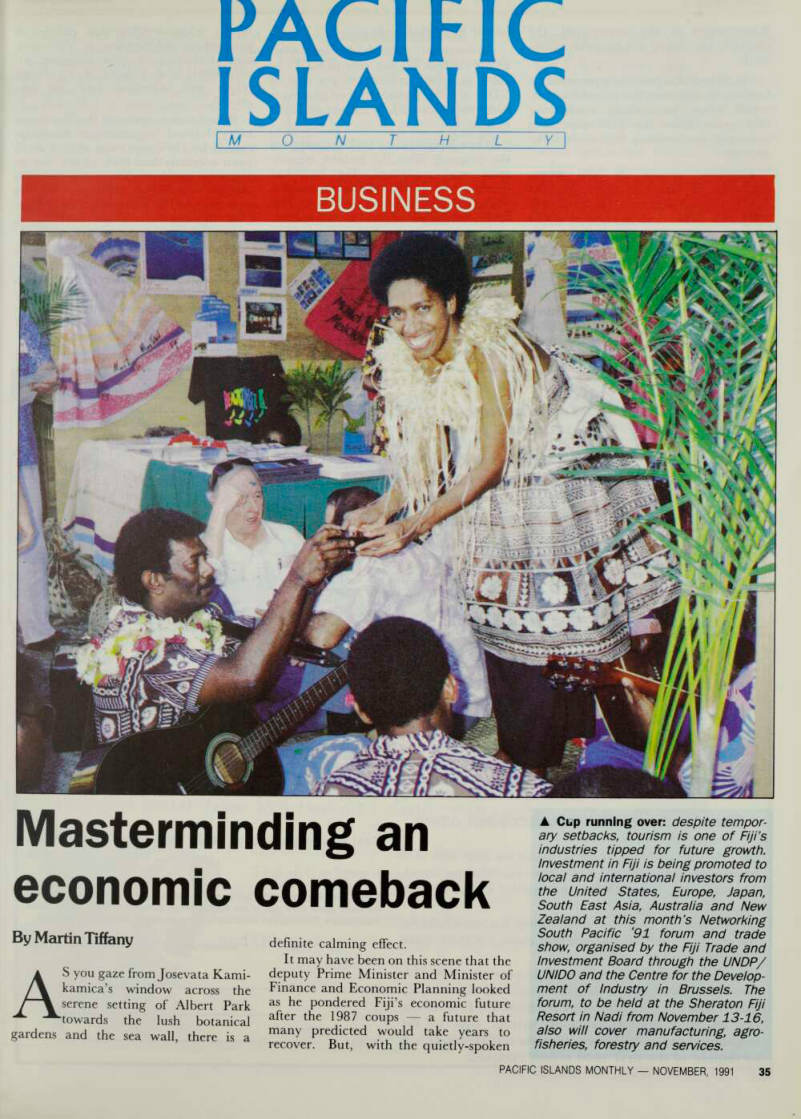

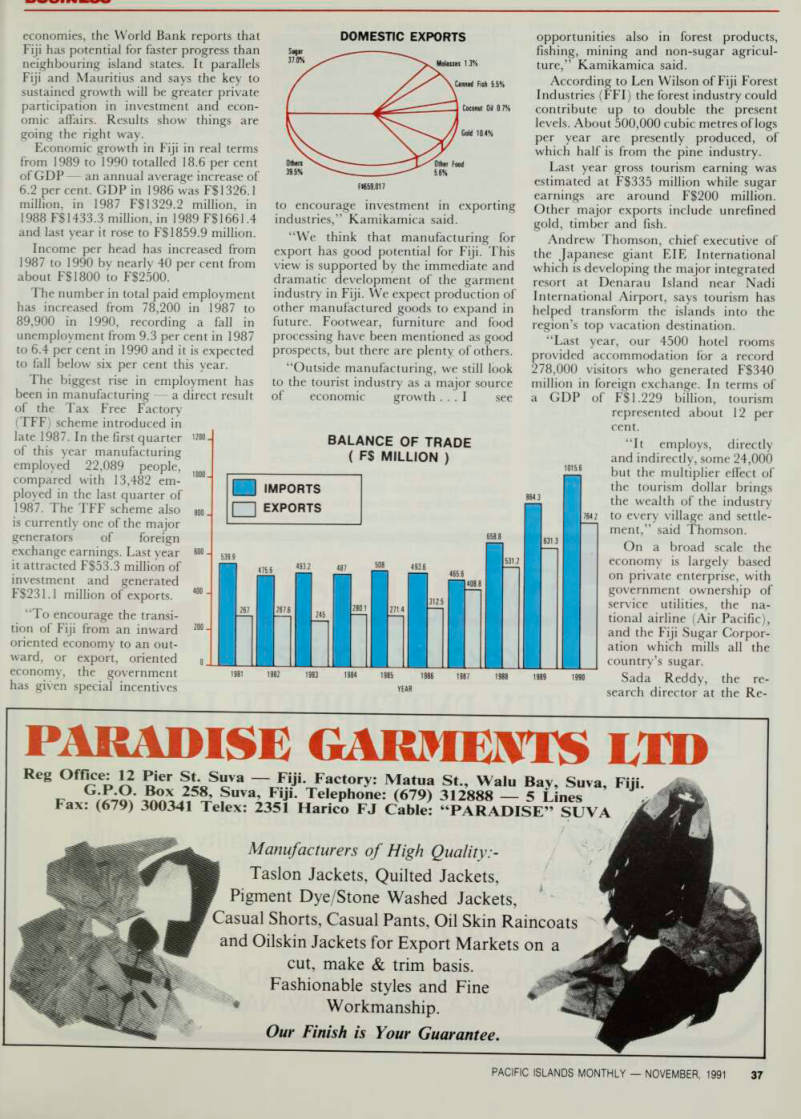

Islands
Monthly
Business
Masterminding an economic comeback
By Martin Tiffany
AS you gaze from Josevata Kami kamica’s window across the serene setting of Albert Park towards the lush botanical gardens and the sea wall, there is a
definite calming effect.
It may have been on this scene that the deputy Prime Minister and Minister of Finance and Economic Planning looked as he pondered Fiji’s economic future after the 1987 coups a future that many predicted would take years to recover. But, with the quietly-spoken
▲ Cup running over: despite tempor ary setbacks, tourism is one of Fiji’s industries tipped for future growth.
Investment in Fiji is being promoted to local and international investors from the United States, Europe, Japan, South East Asia, Australia and New Zealand at this month’s Networking South Pacific ‘91 forum and trade show, organised by the Fiji Trade and Investment Board through the UNDP/ UNIDO and the Centre for the Develop ment of industry in Brussels. The forum, to be held at the Sheraton Fiji Resort in Nadi from November 13-16, also will cover manufacturing, agro fisheries, forestry and services.
Kamikamica as the mastermind, the economy has staged a remarkable come back.
Fiji already has proved its potential by holding its own over the past three-and a-half years, particularly considering that even before the 1987 events its economic performance left much to be desired.
Economic growth, in real terms, measured by Gross Domestic Product (GDP) totalled only six per cent between 1981 and 1986 an average of about one per cent per annum. Per capita growth in real incomes was negative between 1980 and 1986. Average real income per capita fell by seven per cent during this time.
Numbers in total paid employment declined from 81,406 in 1981 to 79,854 in 1986. This was at a time when about 11,000 young people were joining the
labour force each year.
Government debt had risen from FS26B million (27 per cent of GDP) in 1980, to FSSBI million (40 per cent of GDP) in 1986. Annual interest payments had risen from Fsl6 million to FS49 million.
When Kamikamica took the reigns of the economy after the interim govern ment was appointed, Fiji had lost international friends, its foreign reserves were depleted, business confidence had fallen, the inflow of tourists had halved, and unemployment had soared. The interim-government commissioned a “stocktake” of the economy.
“The unavoidable conclusion from the economic stocktake was that what was required was not a strategy to correct the immediate impact of the coups, but to put the economy on a path of sustained
growth,” Kamikamica explained. “This
meant acknowledging that policies of government intervention in the econ omy, including its own economic in volvement, and policies of regulating wages and industries, had not suc ceeded.”
Kamikamica explained that the lesson to be learned (regardless of hardships caused by the coups) was that a small open economy has little choice but to adjust to world conditions if it wants to improve its living standards. Policies were designed to change Fiji from a high cost, high-tax and slow-growth country, to an efficient and competitive producer.
The idea is to put the country’s resources into efficient domestic pro duction and export-oriented production rather than inefficient production for local markets. Consequently, many im port duties and fiscal duties were reduced in the 1989 and 1990 budgets.
In a recent appraisal of Pacific island
economies, the World Bank reports that Fiji has potential for faster progress than neighbouring island states. It parallels Fiji and Mauritius and says the key to sustained growth will be greater private participation in investment and econ omic affairs. Results show things are going the right way.
Economic growth in Fiji in real terms from 1989 to 1990 totalled 18.6 per cent of GDP an annual average increase of 6.2 per cent. GDP in 1986 was F$ 1326.1 million, in 1987 FS 1329.2 million, in 1988 F 51433.3 million, in 1989 F 51661.4 and last year it rose to FS 1859.9 million.
Income per head has increased from 1987 to 1990 by nearly 40 per cent from about FSIBOO to F 52500.
The number in total paid employment has increased from 78,200 in 1987 to 89,900 in 1990, recording a fall in unemployment from 9.3 per cent in 1987 to 6.4 per cent in 1990 and it is expected to fall below six per cent this year.
The biggest rise in employment has been in manufacturing a direct result
of the Tax Free Factory (TFF) scheme introduced in late 1987. In the first quarter of this year manufacturing employed 22,089 people, compared with 13,482 em ployed in the last quarter of 1987. The TFF scheme also is currently one of the major generators of foreign
exchange earnings. Last year
it attracted F 553.3 million of investment and generated F 5231.1 million of exports.
“To encourage the transi tion of Fiji from an inward oriented economy to an out ward, or export, oriented economy, the government has given special incentives
to encourage investment in exporting industries,” Kamikamica said.
“We think that manufacturing for export has good potential for Fiji. This view is supported by the immediate and dramatic development of the garment industry in Fiji. We expect production of other manufactured goods to expand in future. Footwear, furniture and food processing have been mentioned as good prospects, but there are plenty of others.
“Outside manufacturing, we still look to the tourist industry as a major source of economic growth... I see
opportunities also in forest products, fishing, mining and non-sugar agricul ture,” Kamikamica said.
According to Len Wilson of Fiji Forest Industries (FFI) the forest industry could contribute up to double the present levels. About 500,000 cubic metres of logs per year are presently produced, of which half is from the pine industry.
Last year gross tourism earning was estimated at F 5335 million while sugar earnings are around FS2OO million.
Other major exports include unrefined gold, timber and fish.
Andrew Thomson, chief executive of the Japanese giant LIE International which is developing the major integrated resort at Denarau Island near Nadi International Airport, says tourism has helped transform the islands into the region’s top vacation destination.
“Last year, our 4500 hotel rooms provided accommodation for a record 278,000 visitors who generated FS34O million in foreign exchange. In terms of a GDP of F$ 1.229 billion, tourism
represented about 12 per cent.
“It employs, directly
and indirectly, some 24,000 but the multiplier effect of the tourism dollar brings the wealth of the industry to every village and settle ment,” said Thomson.
On a broad scale the economy is largely based
on private enterprise, with
government ownership of service utilities, the na tional airline (Air Pacific), and the Fiji Sugar Corpor ation which mills all the country’s sugar.
Sada Reddy, the re search director at the Re
serve Bank of Fiji (RBF), says at present Fiji businesses rely predominantly on overdraft and term lending from the commercial banks and the non-banks.
He said alternatives need to be developed like greater equity participation and raising funds in the market place through issues of various debt instruments.
“But to move on these fronts it may require institutional strengthening. For instance, this may mean strengthening the Suva Stock Exchange. Various finance legislations will need to be reviewed so that they provide the right legal framework to undertake financial reforms,” Reddy explained.
Reddy said the RBF already has undertaken a major organisational restructuring. The bank is strengthening its supervisory capabilities to help main tain a stable financial system in a more deregulated economy.
Meanwhile, the RBF says the drop in foreign reserves and continued high demand for private sector credit has seen further contraction in liquidity.
Fiji’s external reserves fell to U 55203.8 million at the end ofjuly, from U 55239.4 million at the end of June and U 55215.5 million at the end ofjuly last year.
Kamikamica said most of the invest ment in Fiji was by local businessmen so a study had been taken to develop new types and sources of finance. But invest ment from overseas still would be
required, preferably in joint ventures.
He offered investors assurances about next year’s elections.
“It is widely recognised in Fiji, and has been for many years, that investment is essential to the well-being of our people.
I do not think that it will be possible to form a government in Fiji that does not have a clear commitment to the encour agement of investment.”
Despite the fine comeback staged by the Fiji economy it faces some problems and criticism. For example, the Fiji Manufacturers Association says the country’s contradictory economic re forms are discouraging potential invest ment from Asia, especially Hong Kong and Taiwan.
Association president, Padam Lala, says the interim government is deregulat ing selected industries in Fiji, but not following suit in infrastructure and labour costs. Lala, a garment manufac turer, says changes to labour laws promised October 1 have not happened and instead, delays in labour reforms and the government’s contradictory policies are hampering manufacturing from ex panding and upgrading businesses.
Lala says investors from Hong Kong, Taiwan, Australia and the United States are postponing operations in Fiji.
Another problem faced is the lack of skilled workers to meet the needs of investors, but Kamikamica said if invest
ment grows at 10 to 20 per cent per annum or less it will not be a problem.
Meanwhile, they had opened a garment training school, were establishing a tourism training school in Nadi, and were bringing in skilled expatriates to address the outflow after 1987.
Looking at the economy as a whole, Kamikamica said strike threats and world recession have combined to rob Fiji of a projected 3.4 per cent economic growth this year. He now predicts the growth to be around 1.5 per cent.
But, in the longer term, Kamikamica sees a rosy future if Fiji pursues financial
stability, economy-wide competitiveness,
a price structure which reflects world market opportunities, and a regulatory framework that encourages competition.
“In the next five years, if we pursue these policies, we can look forward to growth of up to six per cent per annum, provided that both non-traditional ex ports and tourism grow at about 9-10 per cent per year. We are hoping that our imports of capital goods and raw ma terials will grow at a similar pace, to finance expansion in both the traditional and the new export-oriented sector,”
Kamikamica said.
The key to all this? “If we are to achieve the accelerated growth rates we are looking for, we need very substantial additional investment.” □
Advertisements & other items, pp. 38-40 (1 item)
Free Trip
% tyN€€ LTD Manufacturers of Exclusive Fashion Garments for Ladies and Gentlemen We specialise in Woven and Knitted Garments: Ladies Dresses, Blouses, Skirts, Ladies Shorts, Mens Casual Shirts, Mens and Boys . elasticated Shorts and Mens T/Shirt.
Presently Exporting to Australia, New Zealand, U.S.A.
For further Export Enquiries Contact:
RINEE GARMENTS LTD
VISUAL ARCADE, WAIMANU ROAD SUVA FIJI
G.P.O. BOX 234, SUVA FIJI
PH: (679) 312 028/302 002 FAX: (679) 302 009 %
WIN
FREE TRIP
TO TAHITI
Enter the Tahiti Sun Press sweepstakes drawing. Win one of two free one-week vacation for two in Tahiti as a privileged subscriber to the new monthly Tahiti Sun Press scheduled to be launched in early 1992.
Choose one of these subscription offers O A charter one-year subscription for only $5O. (US Mainland residents only. For other countries see rates).
The regular 12-month subscription price will be US$6O.
So save $lO now.
Q A charter two-year subscription for only US$9O.
A regular 24-month subscription costs US$l2O. Save $3O now.
O A one-time lifetime subscription for only US$35O.
After six years you will continue receiving the monthly Tahiti Sun Press 12 times a year absolutely free for the rest of your life! A fantastic saving! Due to the substantial savings involved, lifetime subscriptions will be limited to the first 1000 orders received.
Fill out the coupon and send it with your credit card information, personal cheque or money order to: Monthly Tahiti Sun Press Contest, B.P. 887, Papeete, Tahiti.
Yes! Sign me up for a Tahiti Sun Press subscription: □ lyr □ 2 yrs □ Lifetime Enclosed is $ ( O personal cheque □ money order Uncertified bank cheque) Note: Credit card payments are possible, but may cost you more or less than the rates listed here due to the fluctuation in foreign exchange rates. Tahiti Publications Touristiques assumes no responsibility for such accurences. □ Visa □ Mastercard □ American Express Card No: Signature Expiry Date Name Adress
PARADISE GARMENTS LTD
Reg Office: 12 Pier St. Suva Fiji. Factory: Matua St., Walu Bay, Suva, Fiji r ?. ? uva ’ F| J' Telephone: (679) 312888 5 Lines Fax: (679) 300341 Telex: 2351 Harico FJ Cable: “PARADISE” SUVA Manufacturers of High Quality Taslon Jackets, Quilted Jackets, Pigment Dye/Stone Washed Jackets, Casual Shorts, Casual Pants, Oil Skin Raincoats and Oilskin Jackets for Export Markets on a cut, make & trim basis.
Fashionable styles and Fine 4
* Workmanship.
Our Finish is Your Guarantee.
Manufacturers of Quality Knitted Fabrics Exclusively designed quality knitted fabrics.
Manufactured to exacting standards, Quality controlled through all stages and exported to top-of-the market Customers designs also welcome
PHONE NADI 723 200/723295
TELEX 5300 RAINTEX FJ FAX NADI 790 472
NAMAKA IND SUB-DIV NADI
For the future?
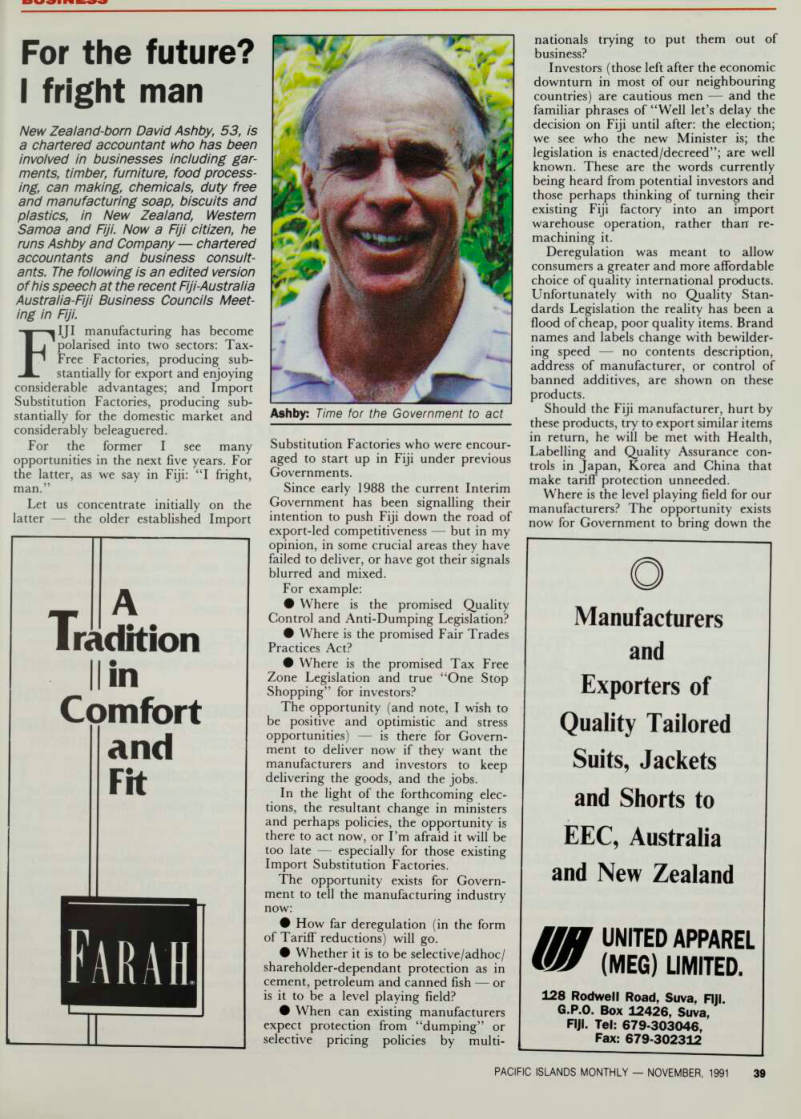

I fright man
New Zealand-born David Ashby, 53, is a chartered accountant who has been involved in businesses including gar ments, timber, furniture, food process ing, can making, chemicals, duty free and manufacturing soap, biscuits and plastics, in New Zealand, Western Samoa and Fiji. Now a Fiji citizen, he runs Ashby and Company chartered accountants and business consult ants. The following is an edited version of his speech at the recent Fiji-Australia Australia-Fiji Business Councils Meet ing in Fiji.
FIJI manufacturing has become polarised into two sectors: Tax- Free Factories, producing sub stantially for export and enjoying considerable advantages; and Import Substitution Factories, producing sub stantially for the domestic market and considerably beleaguered.
For the former I see many opportunities in the next five years. For the latter, as we say in Fiji: “I fright, man.”
Let us concentrate initially on the latter the older established Import
Substitution Factories who were encour aged to start up in Fiji under previous Governments.
Since early 1988 the current Interim Government has been signalling their intention to push Fiji down the road of export-led competitiveness but in my opinion, in some crucial areas they have failed to deliver, or have got their signals blurred and mixed.
For example:
• Where is the promised Quality
Control and Anti-Dumping Legislation?
• Where is the promised Fair Trades Practices Act? • Where is the promised Tax Free Zone Legislation and true “One Stop Shopping” for investors?
The opportunity (and note, I wish to be positive and optimistic and stress opportunities) is there for Govern ment to deliver now if they want the manufacturers and investors to keep delivering the goods, and the jobs.
In the light of the forthcoming elec tions, the resultant change in ministers
and perhaps policies, the opportunity is
there to act now, or I’m afraid it will be too late especially for those existing Import Substitution Factories.
The opportunity exists for Govern ment to tell the manufacturing industry now: • How far deregulation (in the form of Tariff reductions) will go. • Whether it is to be selective/adhoc/ shareholder-dependant protection as in cement, petroleum and canned fish or is it to be a level playing field? • When can existing manufacturers expect protection from “dumping” or selective pricing policies by multi
nationals trying to put them out of business?
Investors (those left after the economic downturn in most of our neighbouring countries) are cautious men and the familiar phrases of “Well let’s delay the decision on Fiji until after: the election; we see who the new Minister is; the legislation is enacted/decreed”; are well known. These are the words currently being heard from potential investors and
those perhaps thinking of turning their
existing Fiji factory into an import warehouse operation, rather than re
machining it.
Deregulation was meant to allow consumers a greater and more affordable choice of quality international products.
Unfortunately with no Quality Stan dards Legislation the reality has been a flood of cheap, poor quality items. Brand names and labels change with bewilder ing speed no contents description, address of manufacturer, or control of banned additives, are shown on these
products.
Should the Fiji manufacturer, hurt by these products, try to export similar items in return, he will be met with Health, Labelling and Quality Assurance con trols in Japan, Korea and China that make tariff protection unneeded.
Where is the level playing field for our manufacturers? The opportunity exists now for Government to bring down the
Ashby: Time for the Government to act
decrees they have promised, to alleviate the nervousness and uncertainty. As quite a percentage of our existing Import Substitution Factories have Australian shareholders then time is running out.
What can be done? The Customs Department should be moved from Finance into the Ministry of Trade and Commerce. Our Government must start using tariffs as an instrument of develop ment rather than as a source of revenue.
I recommend that 40 per cent nett protection across the board be the norm: duty on raw materials 10 per cent, excise duty on finished goods 10 per cent, nett protection 40 per cent, duty on competi tive imports 60 per cent.
Why? With all the world trying madly to export and all our Pacific Rim neighbours having economies of scale, what chance does a small manufacturer, 1500 kilometres into the wide blue Pacific, with a domestic buying popu lation of a medium size Australian town, have to offer against them? But if he had Customs on his side, what a boost.
Let’s level up the teams and the playing field. With Customs reporting to the Minister of Trade and Commerce there would be much more consultation with manufacturers before tariffs were set (or reduced). Our Minister could surely be counted on to “blow the whistle” on the professional fouls the dumping and the standards avoidance, the “ex porters at any price” to get foreign
exchange.
Five years ahead of our Import Substitution Factories, without a halt to tariff reductions until the Fair Trade
Practices Act and Quality Assurance/ Consumers Rights Legislation is in place, I don’t like what I see! That said for import substitution factories what do I see five years ahead for manufacturing?
I see concern for political stability and for continuation of previously announced economic policies to which manufactur ers are now slowly starting to adopt. I see rising wage costs fuelled by demands for better living standards, rising social welfare costs with staffing costs rising in concert with those of Australia, rising energy costs, rising freight costs and clearance charges, and the current freight war leaving fewer players.
I see increased competition from leaner, hungrier manufacturers in Aus tralia and New Zealand and from imports from our Asian neighbours as shipping routes open to follow the political desire for less dependence on Australia and New Zealand.
But (and I leave the most optimistic for last), I see more use made of Australian raw materials converted and shipped back, as an alternative to fully made-up imports from Asia. I see increased opportunities for progressively higher technologies to use our educated labour pool and our export advantages under LOME into the European Com munity and GSP into the United States.
This is where Fiji manufacturing must go over the next five years, with opportunities for Government to stop prevaricating and implement the tax free zone legislation, to make the FTIB truly a one-stop shop, to get one clear message to incoming investors “We want you
and your money, and we will make it very easy for you to start your new business here”.
The contradictory messages from Cus toms, Reserve Bank, and Immigration at present are making Trade and Com merce a joke in trying to encourage investment in manufacturing in Fiji.
Deregulation today. With Reserve
Bank of Fiji regulations, Customs, Stat istics and Inland Revenue Department Regulations the Manufacturing investor finds that Fiji has one of the most regulated business environments in the region. There is more form filling, monetary returns and exchange controls than in the Colonial era “hay-day”.
Opportunities exist and will expand for manufacturing in jewellery, fashion accessory and leisure equipment: any thing with fast changing styles, fads or fashions; anything requiring small runs, quick delivery, personal selection/super vision from Australia; anybody requiring low inventory, fast stock turns, flexible production scheduling. Downstream products of the sugar industry phar maceutical as well as alcohol based. The furniture and fashion hardwood products industry, after a hesitant start is just beginning to settle down. Peripherals of the sewing industry: sails, towels, leather goods, sports goods all are just beginning!
In the terminology of the sports minded: “Government, after preparing the pitch, setting the boundaries and appointing a fair referee, should stand back and let the game flow with the ticket collector letting the players in free for the overall benefit of the spectators.” □
Advertisements & other items, pp. 41-42 (1 item)
Fa Rah
Tradition
ll in Comfort and Fit
111
Manufacturers and Exporters of Quality Tailored Suits, Jackets and Shorts to EEC, Australia and New Zealand
HU UNITED APPAREL
(MEG) LIMITED.
128 Rodwell Road, Suva, FIJI.
G.P.O. Box 12426, Suva,
FIJI. Tel: 679-303046,
Fax: 679-302312
mmji
NAND’S CONSULTANCY & MANAGEMENT SERVICES LTD.
Management, Marketing and Financial Consultants, Project Analysts, Garment Industry, Shipping and Fishing Industry Consultants.
International Finance Consultants and Commodity Traders.
FOR YOUR BUSINESS INVESTMENT REQUIREMENTS
WE HAVE HELPED MANY START THEIR BUSINESSES IN TRADE, MANUFACTURING AND MANAGEMENT. WE CAN HELP YOU SET UP BUSINESS OR FACTORY OR RECONSTRUCT YOUR EXISTING BUSINESS. FOR GREATER PROFIT
& SUCCESS CONSULT THE EXPERTS.
TAX FREE FACTORIES. FISHING. MANUFACTURING OR JOINT VENTURES IN THE FORUM ISLANDS: We undertake feasibility studies, make submissions to Governments, form companies and advice on types of industries, size, structure, marketing, financing & management. We specialize in obtaining advantages from exports under SPARTECA, EEC, GSP AND LOME IV Conventions.
CURRENT INVESTMENT OPPORTUNITIES:
CONFECTIONERY & BUBBLE GUM PRODUCTION PLANT: “TURNKEY” PROJECT. Fully operational confectionery plant for producing toffees, lollies, coconut drops, ginger drops, bubble gums. Ingredients available to produce 10 tonnes of finished products. Capacity 200 tonnes per annum. Profitable for any FORUM ISLAND country enjoying concessions under SPARTECA, EEC & LOME IV. PRICE: F 559,000 plus costs of transport, installation, trial running & training. Master manufacturer available for manufacturing and training.
TAX FREE GARMENT FACTORY:
Fully operational. Employing up to 60 persons, using up to 50 machines, with cutting tables, benches, irons, fans & many extras. Producing T Shirts, shirts, ladies’ skirts, vests, school uniforms, sleeping dresses etc. Trained personal, Going cheap; $87,000 ‘walk in walk out’ plus rent of premises or cost of removal and relocation, training & trial runs anywhere in FORUM ISLANDS.
CONTACT. S. Nand JP, MBA (Bradford), FBIM.
NCMS Ltd. PO Box 1360, SUVA.
Tel: (679) 387256/387599 FAX: (679 370099.
Fitted for a big future
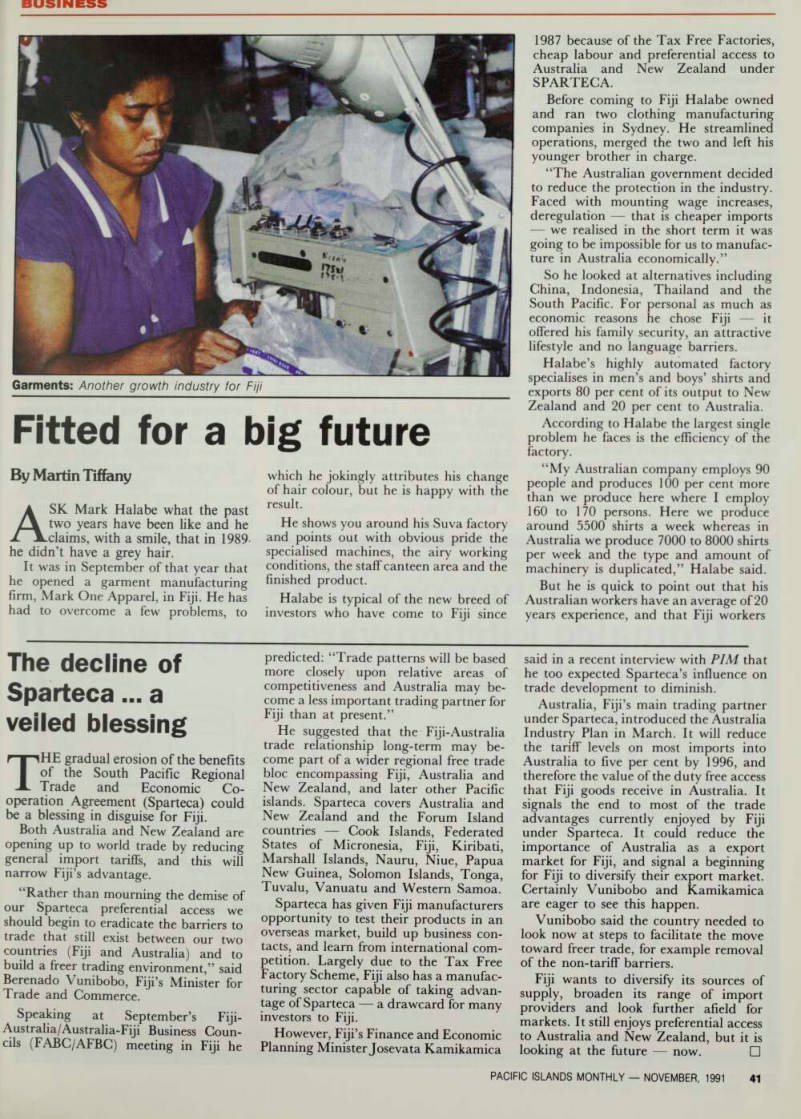

By Martin Tiffany
ASK Mark Halabe what the past two years have been like and he claims, with a smile, that in 1989 he didn’t have a grey hair.
It was in September of that year that he opened a garment manufacturing firm, Mark One Apparel, in Fiji. He has had to overcome a few problems, to
which he jokingly attributes his change of hair colour, but he is happy with the result.
He shows you around his Suva factory and points out with obvious pride the
specialised machines, the airy working
conditions, the staff canteen area and the
finished product.
Halabe is typical of the new breed of investors who have come to Fiji since
1987 because of the Tax Free Factories, cheap labour and preferential access to Australia and New Zealand under
Sparteca.
Before coming to Fiji Halabe owned and ran two clothing manufacturing companies in Sydney. He streamlined operations, merged the two and left his younger brother in charge.
“The Australian government decided to reduce the protection in the industry.
Faced with mounting wage increases, deregulation that is cheaper imports we realised in the short term it was going to be impossible for us to manufac ture in Australia economically.”
So he looked at alternatives including China, Indonesia, Thailand and the South Pacific. For personal as much as economic reasons he chose Fiji it offered his family security, an attractive lifestyle and no language barriers.
Halabe’s highly automated factory
specialises in men’s and boys’ shirts and exports 80 per cent of its output to New Zealand and 20 per cent to Australia.
According to Halabe the largest single
problem he faces is the efficiency of the
factory.
“My Australian company employs 90 people and produces 100 per cent more than we produce here where I employ 160 to 170 persons. Here we produce around 5500 shirts a week whereas in Australia we produce 7000 to 8000 shirts per week and the type and amount of machinery is duplicated,” Halabe said.
But he is quick to point out that his Australian workers have an average of 20 years experience, and that Fiji workers
Garments: Another growth industry for Fiji
already are expanding their experience with time. The Fiji government also has established a garment training school in Suva to upgrade skills.
Halabe also faced problems from unexpected quarters. He said after being asked to come to Fiji to invest, the Fiji government did its best to ensure every thing went smoothly but three depart ments gave him problems.
“Customs don’t like Tax Free Factor ies because they’ve lost income from them and they give a lot more work to them with no real benefit. It’s also hard to convince Customs that things have to be done quickly samples passed, spare parts handled as any delay in manufacturing causes us to be less efficient.
“As far as the Immigration Depart ment is concerned, we were promised we would be allowed to bring in our own expats we feel are required. What we weren’t told is we had to advertise locally first, prove there was nobody available locally then apply for somebody overseas and leave it up to their discretion to give us a work visa.
“I also found it very hard to convince the Reserve Bank of Fiji I was not a carpet-bagger and was here not only to improve my business but the garment industry in Fiji.”
Halabe said he now has developed a
better rapport with the departments.
He, like other investors, also pointed out too that the Fiji Trade and Invest ment Board (FTIB) are helpful but limited.
Fiji’s Deputy Prime Minister and Minister of Finance and Economic Planning, Josevata Kamikamica, ac knowledges that there are some prob lems. “Incentives for investors have been significantly improved in recent years and the procedures by which the incen tives are granted have been simplified.
However, we have to acknowledge that there remain bottlenecks and inefficiencies in the investment approvals process. We need to review the situation to establish what is going wrong and what needs to be done.”
However, despite a few blemishes the garment industry in Fiji looks healthy.
For the first six months of this year garment export from Tax Free Factories (TFF) is FSBO million. For the year it is estimated to be about FSIBO million.
Most of the garments exported are from the TFF sector. Last year the TFF garment sector had exports worth F 5159.4 million compared to F 5100.7 million in 1989 and F 530.1 million in 1988. Numbers employed have increased with 3022 employed in 1988, 6434 in 1989 and 7829 last year.
Padam Lala, the president of the Fiji Garment Manufacturers Association,
predicts that the garment industry will employ 25,000 people and its exports will be worth FSSOO million in four or five years. Predictions for the year 2000 are exports of F$ 1000 million, To date there are about 115 garment factories operating about 13 are wholly foreign owned. As of June this year, 81 of these enjoyed Tax Free
Factory status.
The garment sector continues to dominate the TFF sector in terms of employment generation. It increased its share in the total TFF employment from 71.8 per cent in 1988 to 81.1 per cent in 1989 to 82.4 per cent last year. Of the 9503 people employed by the TFF sector at the end of last year, 7829 were employed in the garment industry.
Exports to Australia and New Zealand hav e fallen off with the recession, but W ‘ U P lck , U P- Current figures show N f w Zealand as < he la rgest market taking 50 per cent of output, the United estimated States takes 24 per cent goes, Australia 22 per cent, Britain two per cent and the remaining two per cent is shared between Pacific Islands. Some manufacturers are looking to Europe, but to avoid duty they must buy expensive European cloth. ' The future looks bright. The Austra lian Industry Plan, which will see removal of import quotas into Australia from next year, is expected to produce a boom for Fiji manufacturers. □
veiled blessing
The decline of Sparteca ... a veiled blessing
THE gradual erosion of the benefits of the South Pacific Regional Trade and Economic Co operation Agreement (Sparteca) could be a blessing in disguise for Fiji.
Both Australia and New Zealand are opening up to world trade by reducing general import tariffs, and this will
narrow Fiji’s advantage.
“Rather than mourning the demise of our Sparteca preferential access we should begin to eradicate the barriers to trade that still exist between our two countries (Fiji and Australia) and to build a freer trading environment,” said Berenado Vunibobo, Fiji’s Minister for Trade and Commerce.
Speaking at September’s Fiji-
Australia/Australia-Fiji Business Coun cils (FABC/AFBC) meeting in Fiji he
predicted: “Trade patterns will be based more closely upon relative areas of competitiveness and Australia may be come a less important trading partner for Fiji than at present.”
He suggested that the Fiji-Australia trade relationship long-term may be come part of a wider regional free trade bloc encompassing Fiji, Australia and New Zealand, and later other Pacific islands. Sparteca covers Australia and New Zealand and the Forum Island countries Cook Islands, Federated States of Micronesia, Fiji, Kiribati, Marshall Islands, Nauru, Niue, Papua New Guinea, Solomon Islands, Tonga, Tuvalu, Vanuatu and Western Samoa.
Sparteca has given Fiji manufacturers opportunity to test their products in an overseas market, build up business con tacts, and learn from international com petition. Largely due to the Tax Free Factory Scheme, Fiji also has a manufac turing sector capable of taking advan tage of Sparteca a drawcard for many investors to Fiji.
However, Fiji’s Finance and Economic Planning Minister Josevata Kamikamica
said in a recent interview with PIM that he too expected Sparteca’s influence on trade development to diminish.
Australia, Fiji’s main trading partner under Sparteca, introduced the Australia Industry Plan in March. It will reduce the tariff levels on most imports into Australia to five per cent by 1996, and therefore the value of the duty free access that Fiji goods receive in Australia. It signals the end to most of the trade
advantages currently enjoyed by Fiji
under Sparteca. It could reduce the importance of Australia as a export market for Fiji, and signal a beginning for Fiji to diversify their export market.
Certainly Vunibobo and Kamikamica are eager to see this happen.
Vunibobo said the country needed to look now at steps to facilitate the move toward freer trade, for example removal of the non-tariff barriers.
Fiji wants to diversify its sources of supply, broaden its range of import providers and look further afield for markets. It still enjoys preferential access to Australia and New Zealand, but it is looking at the future now. □
Advertisements & other items, pp. 43-44 (2 items)
Business
Domalco kitchenwares are always
In the kitchen or on the table,
dressed for all occasion.
Manufacturers of: “"Aluminium Utensils and other household items * Aluminium products for commecial purposes-
" Display Stands, etc
"Stainless Steel Utensils "Plasticware "Pressure Cookers I NV Also specialised in METAL SPINNING and DEEP DRAWING.
For any of above requirements contact us at:
DOMALCO LIMITED
Manufacturers and Exporters 11 Navoli Rd., Varadoli. P.0.80x 87, Ba.
Fax: (679) 670089 Phone: Ba: (679) 670082 After Hours (679) 670144 Cable Dullu Telex FJ6245 GR7946
A taste of paradise

sweeteners added
By Rupak Saha
“A paradise of sun drenched islands what* nicer than such a physical location for your enterprise?” asks the Fiji Trade and Investment Board in their brochure An Investor’s Guide to Fiji. However, for a hard-nosed investor a “tropical para dise” may not be attractive enough, so Fiji has offered some economic candies for overseas entrepreneurs.
A limited domestic market and a substantial annual import bill has forced Fiji to gear its economy towards con tinued export growth. The Government has realised that sale of sugar to restricted overseas markets sheltered by trade bloc memberships will not by itself sustain an effective export growth, so it has pro vided a package of tax incentives to encourage exports of local value added products and services.
Tax Free Factory (TFF)/Tax Free Zone (TFZ) Scheme In the forefront of the Government incentives has been the TFF/TFZ
scheme established to stimulate the country . s . Wu<; added „ d . ucts. The types of enterprises which are considered x f or TFF/TFZ status are: manufacturi . mixi ' g> blending and narka£rintr assem h lv - and certain exoort- P J>’ ional se^ices P P Such enterprises exporting 95 per cent or more of their annual production can be designated as a TFF. The Govern ment also is in the process of designating certain areas in Fiji as Tax Free Zones (TFZ) where qualifying industries would be established. Currently, the incentives available to TFF/TFZ enterprises are: ® Exemption from income tax for a period of 13 years, ® Waiver of import duties and excise taxes on certain materials and equip r Exem ption from withholding tax on van ° us forms of remittances to non ' residents ... 9 EaSe ° f re P atnatlon of capital and f . . . • Relaxation of immigration regu lations for necessary employment of
expatriates.
To provide the resultant downstream industries with a necessary boost, any enterprise providing 95 per cent or more of its output to a TFF also may be designated as a TFF.
Tax relief on exports To encourage exporters who do not qualify for TFF status, the following income tax concession is granted to
resident companies exporting certain
approved products (the products which may be approved for this purpose range from manufacturing to agricultural pro cessing and also include produce of commercial fishing): Where the local value added of such a
product is:
• at least 30 per cent, a rebate of one half of the tax on the export profits is
granted;
• between 40 per cent and 50 per cent, a rebate of three quarters of the tax on the export profits is granted; • more than 50 per cent, the full amount of tax on the export profits is exempt from tax.
Specific industry concessions Tourism: Substantial efforts have expanded the country’s export base, but the traditional foreign exchange earners like sugar and tourism still lead the way as contributors to the country’s foreign exchange coffers. Tourism recently took the top spot as the country’s major
foreign exchange earner, surpassing sug
ar exports. To attract further investment in tourism, 55 per cent of capital expenditure incurred on construction or extension of a hotel, or on a tourist vessel or approved tourism support project, is allowed as a tax-deductible expense above the normal depreciation allow ance. This can make a hotel’s formative years tax-free.
Mining: Fiji has gold deposits in Vatukoula and gold mining is one of the major industries, along with tourism, sugar and garments. Gold production was 4221 kgs in 1989, as against 4272 kgs in 1988. To encourage further mineral exploration, mining ventures are grant ed accelerated depreciation on capital
expenditure on acquisition and develop
ment of mines, or they can offset prospecting expenditure against other income. The Minister of Finance may exempt the company’s income from tax or reduce the rate if he deems it
economically beneficial.
Others: In the agricultural sector, a tax holiday for five years is available to companies in specified agricultural ac tivities. Losses incurred by a group company in some prescribed agricul tural ventures may be offset against profits derived by other companies in the same group.
Under the “Scheme for Pioneer Enterprises”, a new company con
sidered important to economic develop ment may be granted, on application, a restricted tax exemption limited to a percentage of its total fixed capital investment (the percentage depends on the numbers of people it employs).
Apart from income tax exemptions or reductions, accelerated write-offs (nor mally over five years) of capital expen ditures are permitted in certain cases e.g. when expenditure is aimed at economising fuel consumption and pro moting alternative sources of energy.
Other concessions In addition to direct tax concessions, import tariff concessions are provided in appropriate instances through duty drawbacks, exemptions and reductions.
On appropriate payments of withhold ing taxes, profits can be repatriated overseas subject to exchange control approval from the Reserve Bank of Fiji.
The tax concessions are designed to promote Fiji as a viable investment alternative to Asia and other traditional exporters. To achieve this, the Govern ment of the country is increasingly shifting towards a market economy, removing import licensing and other protectionist devices. In the process it hopes to attract more foreign investment and accelerate Fiji’s progress in the industrial development race. □ Rupak Saha is Taxation Manager for Price Waterhouse chartered accountants in Suva, Fiji
Advertisements & other items, p. 45 (1 item)
Products Of The Pacific
The Natural Dairy
Rewa Dairy produce a wide variety of natural dairy products that are good for you, and can service all areas of the Pacific.
Rewa Dairy not only have the ability to produce U.H.T. milk, but they also have the latest Technology to pack almost any liquid into Tetrapak cartons. So if 1 '^.TTrjjsmssnitrim: Rewa Co-operative Dairy Company Limited, P.O. Box 3678, Samabula, Suva, Fiji. Tel: 381288.
Fax: 370190 n rrrry CM
SKM
MILK
If*.
FULL
REAM
POWDER
"EIGHT
111
fVNFimvm )
m SHttvn i
STRAWBERRY
LITRE
FUN FLAVOUR
CHOCOLATE
FUMFLAWUR
STRAWBERftv
tOQHUSr
II/ 1 111 111 til*" «• U\
nii» oiraii
s flfiwvr runovß .
Fi t h i ll •v Pure Cre&MfV m* »• >*>
IHJ FJO22
TFF scheme,

it’s part of a winning hand
By Martin Tiffany
THEIR ace up their sleeve, their wild card, their winning hand call it what you like Fiji’s Tax Free Factory (TFF) scheme is proving it’s no
joker.
Just over three and a half years have passed since the scheme was introduced but it has risen to become one of the major generators of employment and
foreign exchange earnings.
Since it was introduced in 1988 the scheme has progressed in leaps and bounds. To date 313 projects have been approved for Tax Free Factory Status - 87 in 1988, 115 in 1989, 71 in 1990 and 40 in the first six months of this year.
It has been remarkably successful in attracting new export industries, even to the extent of creating a whole new industry the garment industry in a very short space of time.
At the end of last year the TFF sector employed 9503 and its exports totalled F 5231.1 million. This compares with
7935 employed in 1989 and exports totalling F$ 160.8 million.
Total investment in the sector was FS 13.7 million in 1988 rising to F 534.3 million in 1989, an increase of 157 per cent. Last year total investment in creased by 55.4 per cent to F 553.3 million.
The TFF scheme was one of several measures implemented by the interim government to develop export industries.
The devaluation of the Fiji dollar by 33 per cent in 1987 provided the initial stimulus to the TFF sector and in particular to che garment industry.
Last year the garment sector employed 7829 people or 82.4 per cent of total TFF employment and exported FS 159.4 mil lion of the total TFF exports of F 5231.1 million.
Other industries which developed un der the scheme are wood related indus tries, in particular furniture, footwear, buttons, food processing and other mis cellaneous industries such as plastics, fibreglass boats, sails, computer softwear and cans.
However, according to the Fiji Trade and Investment Board (FTIB), these sectors are small and have a lot of capacity for expansion especially in the areas of wood related industries, leather and footwear and food processing.
Fiji’s deputy Prime Minister and
Minister of Finance and Economic Planning, Josevata Kamikamica, says the government continue to monitor the impact of the TFF/Tax Free Zone (TFZ) scheme, both from the point of view of its attraction of investment and its cost to government in foregone revenue.
“At the moment, the priority is the get a Tax Free Zone established and work is going ahead on this. To date all concessions have been in relation to Tax Free Factories.
“Those who have invested under the scheme need have no concern but that they will continue to benefit from the agreed concessions. But they are likely to be modifications to the scheme as circumstance change,” said Kamikami ca.
Earlier this year there was some concern by foreign firms that the Fiji government was reneging on TFF prom ises made in 1988 - these included a 13-year tax holiday, cheap electricity and freedom to bring in specialised expatriate staff.
To counter this and stress that it would honour all promised incentives to foreign investors, the government took out a press advertisement in New Zealand.
Kamikamica described the scheme as “remarkably successfully” and said it emphasised also the commitment of the interim government to the pursuit of
export orientation - a major break with previous economic policy.
“The TFF/TFZ scheme has also been remarkable successful in creating em ployment. Much of the growth in employment that has been achieved over the last three years has been in manufac turing and directly related to the oper ation of the TFF/TFZ scheme,” said Kamikamica.
In the TFF sector local firms dominate in terms of equity participation. 58 firms out of 114 are locally owned with 20 firms in joint-venture with foreign companies.
This gives a total of 78 firms or 68.4 per cent of the firms with local interest.
On the other hand 36 or 31.6 per cent of the firms were wholly foreign owned.
The breakdown of the 36 are: New Zealand 16, Australia 13, Singapore 3, Malaysia 2, Taiwan 1 and the United
Kingdom 1.
While the TFF scheme has seen many successes there have also been some failures.
Twelve firms ceased operation last year which makes a total of 23 firms that have closed since the scheme was intro duced. However, the loss in foreign
exchange earnings and employment
have been more than compensated for by expansion of existing TFFs and establish ment of new ones.
For example, at the end of June this year 113 TFF projects were in operation which compares with 114 projects in operation last year.
Of this 114, 12 projects closed oper ations during the latter part of 1990 and in early 1991. But 11 new projects were implemented in the first six months of this year to give a total of 113 projects in
operation.
According to the FTIB two major reasons which are inter-linked have been responsible for a number of firms closing down. These are markets and availability of finance.
Almost all the firms which closed down were small firms with Jess than 50 employees. They were involved in gar ments, furniture and other miscellaneous industries.
These small firms with weak market links (small orders on ad hoc basis, exporting to one country and one company) were greatly affected by cur rent recessions in export markets.
Lack of export orders created cash flow problems leading to financial crisis which forced close downs. The difficulty to raise local finance compounded the problem.
A button factory closed down due to difficulty in procuring raw material (trochus shells). The shells are sold to Japanese and Koreans at prices higher than local firms can afford.
Another factory closed down simply because the factory to which it was supplying also ceased operation.
For the future new locations around the country are being examined to meet the expected future demand of TFFs.
Future progress includes the develop ment of industrial sites, greater inter departmental co-ordination and clear cut policies and guidelines which will further enhance the industrialisation efforts under the TFF scheme.
Which ever way you look at it the cards certainly seem to be falling in Fiji’s favour. □
Advertisements & other items, pp. 46-48 (1 item)
Do You Need Galvanised Pipes
OR BLACK TUBING?
Contact the only steel pipe manufacturer in South Pacific.
STEEL TUBES (FIJI) LIMITED
~o
(FDB Joint Venture)
We also manufacture steel tubing furniture like plywood Chairs for Schools, Bar Stools, Cloth Line Hoist, and Trolleys
ENQUIRIES WELCOME
CONTACT WORKS MANAGER
PHONE: 664024 AFTER HOURS: 663318
ALWAYS RELY ON FIJI MADE PRODUCTS
STEEL PIPE WELDING IN PROGRESS
NETWORKING
mm I■VE S T H EIT AID fra I E Foil A very warm welcome to delegates attending the FT IB Investment and Trade Forum at the Sheraton Resort.
FT I B
For all your enquiries contact:- Fiji Trade and Investment Board 3rd Floor. Civic House, Town Hall Road, Suva Telephone Suva 315988 Facsimile (679) 301783 P.O. Box 2303, Govt Bldg., Suva. Telex FJ2355 FTIB
Queens Rd. Cnr Cawa Rd., Martintar, Nadi Tel: (679) 790-290 Fax: (679) 790-303 P.O. Dox 9417 Nadi Airport. Fyi Island
ONE CHANNEL
II
PRESS
CONTROLLER
REMOTE CONTROLLER PMT 201
Electronic Designing,
Manufacturing and
Assembly, incl. SMD Technology and Micro
Controller Programming
Specialising in the Designing of Radio Remote Controls, PCB Assembly and Testing. ★ Remote Control Transmitters ★ Remote Control Receivers ★ Control Boards ★ Custom Assemblies ★ Transformers ★ Batteries We offer competitive rates together with other benefits and welcome inquiries for 100 to 100,000 pieces.
J V First Electronic Manufacturing Company in the South Pacific.
ELSEMA
o vN* nd o'*- %
TOYS
(fljlj ITO.
(nji) no,
AND * TEACHING aids
* 4/ZXS FO/? DISABLED PEOPLE
* HANDCRAFTS OF MUSEUM QUALITY
(TI3IJ LTD.
G*°
AND
3-4 NAKAUVADRA RD
DELAINAVESI,
LAMI
PHONE 361-860/A/H 362-865
* WOODEN TOYS * SOFT TOYS
CHRIS SAUMAIWAI, DIRECTOR
P.O. BOX 1206
SUVA
FIJI
Reshaping the investment climate
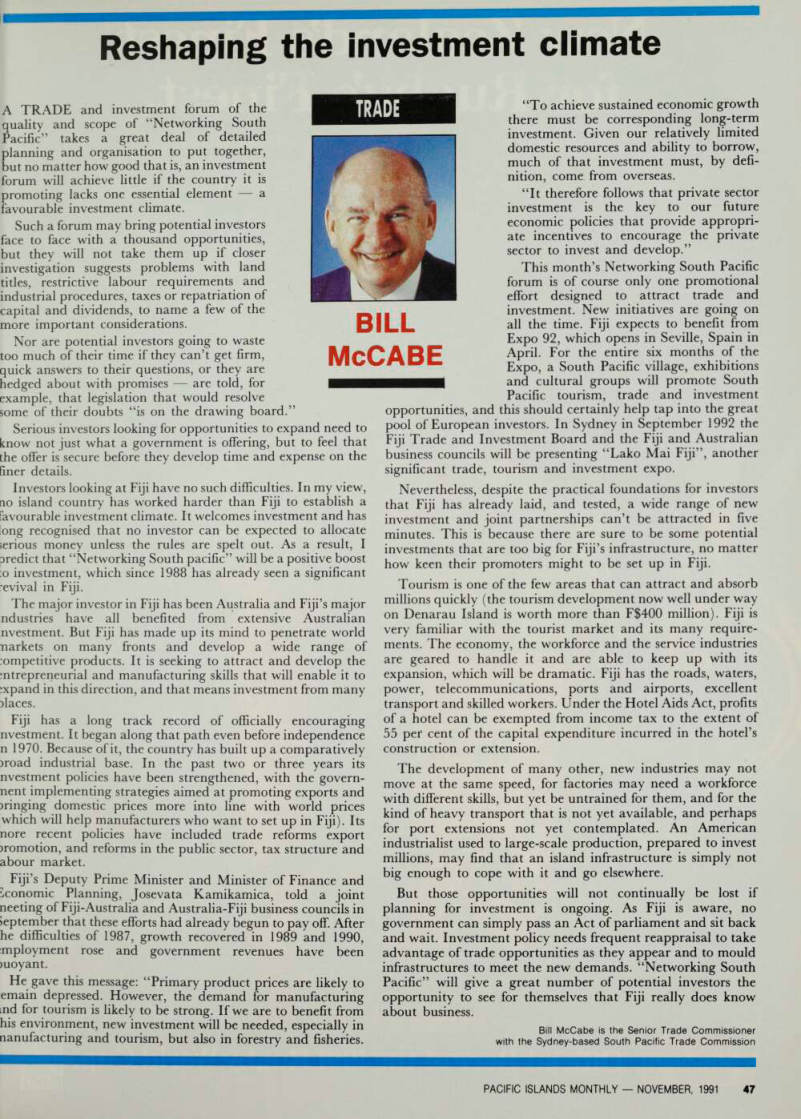
A TRADE and investment forum of the quality and scope of “Networking South Pacific” takes a great deal of detailed planning and organisation to put together, but no matter how good that is, an investment forum will achieve little if the country it is promoting lacks one essential element a favourable investment climate.
Such a forum may bring potential investors face to face with a thousand opportunities, but they will not take them up if closer investigation suggests problems with land titles, restrictive labour requirements and
industrial procedures, taxes or repatriation of
capital and dividends, to name a few of the
more important considerations.
Nor are potential investors going to waste too much of their time if they can’t get firm, quick answers to their questions, or they are hedged about with promises are told, for example, that legislation that would resolve
some of their doubts “is on the drawing board.”
Serious investors looking for opportunities to expand need to know not just what a government is offering, but to feel that the offer is secure before they develop time and expense on the finer details.
Investors looking at Fiji have no such difficulties. In my view, 10 island country has worked harder than Fiji to establish a favourable investment climate. It welcomes investment and has 'ong recognised that no investor can be expected to allocate serious money unless the rules are spelt out. As a result, I Dredict that “Networking South pacific” will be a positive boost :o investment, which since 1988 has already seen a significant
•evival in Fiji.
The major investor in Fiji has been Australia and Fiji’s major ndustries have all benefited from extensive Australian nvestment. But Fiji has made up its mind to penetrate world narkets on many fronts and develop a wide range of :ompetitive products. It is seeking to attract and develop the mtrepreneurial and manufacturing skills that will enable it to expand in this direction, and that means investment from many )laces.
Fiji has a long track record of officially encouraging nvestment. It began along that path even before independence n 1970. Because of it, the country has built up a comparatively >road industrial base. In the past two or three years its nvestment policies have been strengthened, with the govern nent implementing strategies aimed at promoting exports and Diinging domestic prices more into line with world prices which will help manufacturers who want to set up in Fiji). Its nore recent policies have included trade reforms export jromotion, and reforms in the public sector, tax structure and abour market.
Fiji’s Deputy Prime Minister and Minister of Finance and Economic Planning, Josevata Kamikamica, told a joint neeting of Fiji-Australia and Australia-Fiji business councils in September that these efforts had already begun to pay off. After he difficulties of 1987, growth recovered in 1989 and 1990, mployment rose and government revenues have been moyant.
He gave this message: “Primary product prices are likely to emain depressed. However, the demand for manufacturing md for tourism is likely to be strong. If we are to benefit from his environment, new investment will be needed, especially in nanufacturing and tourism, but also in forestry and fisheries.
“To achieve sustained economic growth there must be corresponding long-term investment. Given our relatively limited domestic resources and ability to borrow, much of that investment must, by defi nition, come from overseas.
“It therefore follows that private sector investment is the key to our future
economic policies that provide appropri
ate incentives to encourage the private sector to invest and develop.”
This month’s Networking South Pacific forum is of course only one promotional effort designed to attract trade and investment. New initiatives are going on all the time. Fiji expects to benefit from Expo 92, which opens in Seville, Spain in April. For the entire six months of the Expo, a South Pacific village, exhibitions and cultural groups will promote South Pacific tourism, trade and investment
opportunities, and this should certainly help tap into the great pool of European investors. In Sydney in September 1992 the Fiji Trade and Investment Board and the Fiji and Australian business councils will be presenting “Lako Mai Fiji”, another significant trade, tourism and investment expo.
Nevertheless, despite the practical foundations for investors that Fiji has already laid, and tested, a wide range of new investment and joint partnerships can’t be attracted in five minutes. This is because there are sure to be some potential investments that are too big for Fiji’s infrastructure, no matter how keen their promoters might to be set up in Fiji.
Tourism is one of the few areas that can attract and absorb millions quickly (the tourism development now well under way on Denarau Island is worth more than Fs4oo million). Fiji is very familiar with the tourist market and its many require ments. The economy, the workforce and the service industries are geared to handle it and are able to keep up with its expansion, which will be dramatic. Fiji has the roads, waters, power, telecommunications, ports and airports, excellent transport and skilled workers. Under the Hotel Aids Act, profits of a hotel can be exempted from income tax to the extent of 55 per cent of the capital expenditure incurred in the hotel’s construction or extension.
The development of many other, new industries may not move at the same speed, for factories may need a workforce with different skills, but yet be untrained for them, and for the kind of heavy transport that is not yet available, and perhaps for port extensions not yet contemplated. An American industrialist used to large-scale production, prepared to invest millions, may find that an island infrastructure is simply not big enough to cope with it and go elsewhere.
But those opportunities will not continually be lost if planning for investment is ongoing. As Fiji is aware, no government can simply pass an Act of parliament and sit back and wait. Investment policy needs frequent reappraisal to take advantage of trade opportunities as they appear and to mould infrastructures to meet the new demands, “Networking South Pacific” will give a great number of potential investors the opportunity to see for themselves that Fiji really does know about business.
Bill McCabe is the Senior Trade Commissioner with the Sydney-based South Pacific Trade Commission
Trade
Bill
Mccabe
Advertisements & other items, p. 50 (1 item)
for Rugby’s Finest.
New Zealand’s Finest
In the face of intense competition from some of the finest brewing houses in the world, Steinlager has again emerged the victor and been awarded the status of official beer to the 1991 Rugby World Cup. ■ v ' 0-2 w -safe z K in o r* * K O Vx ,Ft-
IPS
c A? 2! , ,y / /!* *'5V ••a* / O * /■ r'y /■ /; -> ■ 4/
NNBOOOS
Official Beer of the 1991 Rugby World Cup.
Thank you for the Memories
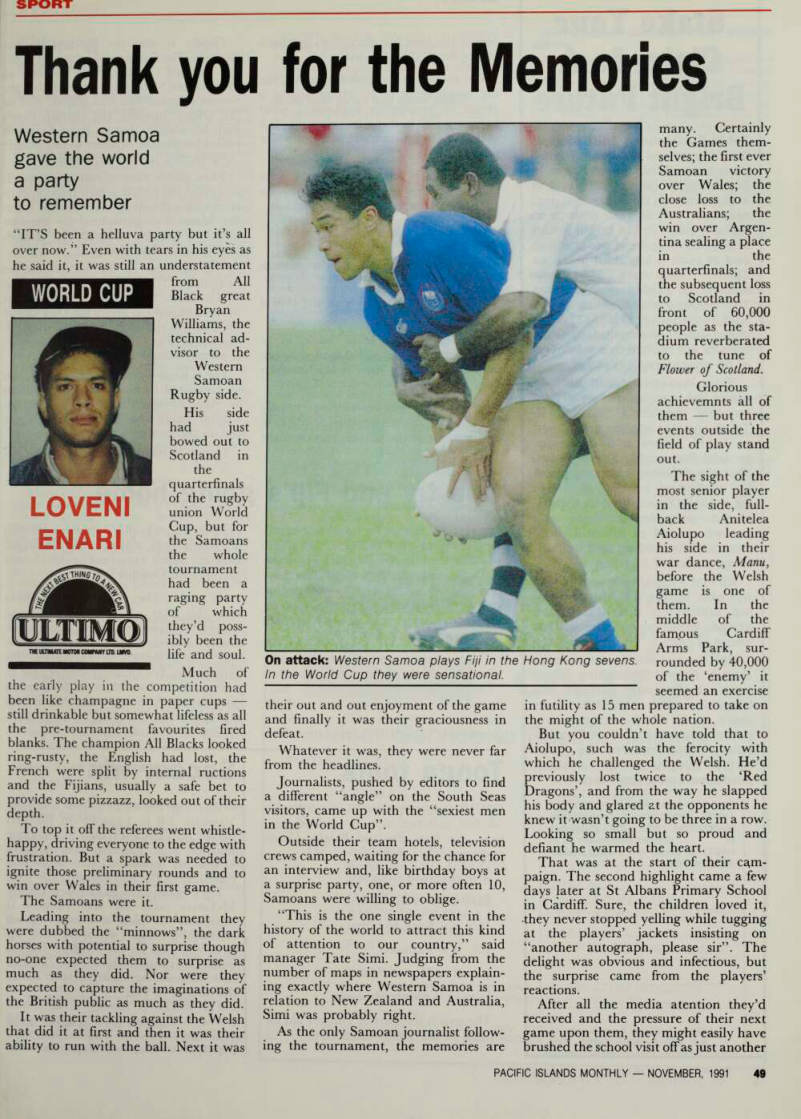
Sport
Western Samoa gave the world a party to remember
“IT’S been a helluva party but it’s all over now.” Even with tears in his eyes as he said it, it was still an understatement
from All Black great Bryan Williams, the technical ad visor to the Western Samoan Rugby side.
His side
had just
bowed out to Scotland in the
quarterfinals
of the rugby union World Cup, but for the Samoans the whole tournament had been a
raging party
of which they’d poss ibly been the life and soul.
Much of
the early play in the competition had been like champagne in paper cups still drinkable but somewhat lifeless as all the pre-tournament favourites fired blanks. The champion All Blacks looked ring-rusty, the English had lost, the French were split by internal ructions and the Fijians, usually a safe bet to provide some pizzazz, looked out of their
depth.
To top it off the referees went whistle happy, driving everyone to the edge with frustration. But a spark was needed to ignite those preliminary rounds and to win over Wales in their first game.
The Samoans were it.
Leading into the tournament they were dubbed the “minnows”, the dark horses with potential to surprise though no-one expected them to surprise as much as they did. Nor were they expected to capture the imaginations of the British public as much as they did.
It was their tackling against the Welsh that did it at first and then it was their ability to run with the ball. Next it was
their out and out enjoyment of the game and finally it was their graciousness in defeat.
Whatever it was, they were never far from the headlines.
Journalists, pushed by editors to find a different “angle” on the South Seas visitors, came up with the “sexiest men in the World Cup”.
Outside their team hotels, television crews camped, waiting for the chance for an interview and, like birthday boys at a surprise party, one, or more often 10, Samoans were willing to oblige.
“This is the one single event in the history of the world to attract this kind of attention to our country,” said manager Tate Simi. Judging from the number of maps in newspapers explain ing exactly where Western Samoa is in relation to New Zealand and Australia, Simi was probably right.
As the only Samoan journalist follow ing the tournament, the memories are
many. Certainly the Games them selves; the first ever
Samoan victory
over Wales; the close loss to the Australians; the win over Argen
tina sealing a place
in the
quarterfinals; and
the subsequent loss to Scotland in front of 60,000 people as the sta dium reverberated to the tune of Flower of Scotland.
Glorious achievemnts all of them but three events outside the field of play stand out.
The sight of the most senior player in the side, full back Anitelea
Aiolupo leading
his side in their war dance, Mam, before the Welsh game is one of them. In the middle of the famous Cardiff Arms Park, sur rounded by 40,000 of the ‘enemy’ it seemed an exercise
in futility as 15 men prepared to take on the might of the whole nation.
But you couldn’t have told that to Aiolupo, such was the ferocity with which he challenged the Welsh. He’d Piously lost twice to the ‘Red P ra g° ns - and from the way he slapped p s bod >' and , g |ared at f he opponents he knew li wasn 1 g om g to be three m a row - Looking so small but so proud and deflant s he warmed the heart *; That was at the start of their cam . • xhe second highlight came a few 5 “ )ater at St A ba s ns p rimary School in 'Cardiff. Sure, the children loved it,
.they never stopped yelling while tugging
a t the players’ jackets insisting On “another autograph, please sir”. The delight was obvious and infectious, but t h e surprise came from the players’ reactions.
After all the media atention they’d received and the pressure of their next game upon them, they might easily have brushed the school visit off as just another
World Cup
Loveni
Enari
On attack: Western Samoa plays Fiji in the Hong Kong sevens.
In the World Cup they were sensational.
one in the long line and “let’s get back to the hotel”.
But there was Palemia Lilomiava, the big no-nonsense prop, sitting amidst a group of youngsters explaining what palusami was and the fact that raw fish with coconut cream is actually quite nice to eat.
Then there was Filipo Saena, who delighted in leading the kids in a private chant he’d invented for them.
“Who’s going to win the World Cup?” he’d ask.
“Western Samoa!” they’d scream back.
“Who’s the best player in the World
Cup?”
“Phillip!” they’d shout back, as he rewarded those who yelled loudest by not only autographing their books but their bags as well.
It was a trip that was supposed to only last an hour but stretched to nearly two, and not one of the players regretted the delay.
Finally it was the by-now famous farewell. The Samoan players and Scot tish crowd bade each other at
Murrayfield Stadium in Edinburgh.
Samoa’s dream run had ended, and as the referee brought the curtain down with his whistle, skipper Peter Fatialofa pulled his players together to begin their “non-victory lap” as he called it.
They ran to each corner of the pitch waving to the crowd, which responded in kind with a standing ovation. And when the Manu was performed for the last time, the hordes accompanied it with
rhythmic hand-clapping.
“It was one of the nicest touches imaginable,” said Scottish coach lan McGeechan. “Western Samoa gave a lot to the competition and what they did at the end was the nicest finish to a match you could hope for. It left everyone with a warm feeling.”
For a Rugby-mad country which has long awaited its moment of recognition on the international stage, Western Samoa couldn’t have hoped for a better end to the party.
Here’s to many more. □
One try and Fiji's going home
FIJI left France for home last month blaming their excellence at sevens for their rugby World Cup white wash. Seeded fifth after their impressive performance in the first tournament four years ago, they were a severe disappoint ment, managing only one try in their three games.
George Simpkin, the New Zealander who advises fiji on coaching, commented: “They’re all so disappointed to have finished the World Cup with nothing, but their game is still too sevens orientated.” Simpkin’s compatriot, Ross
Cooper, who occupies a similar post with the Romanians, was in a happier mood after his side’s entertaining 17-15 win over Fiji on October 12.
TT ££ „, . . .. f He sald: r The y dese L rve , d something from f hls after what dlc >' ve achieved struggling against enormous odds. I just couldn’t believe the appalling conditions they had to endure preparing for this tournament. It’s amazing they’re able to perform at the level they do. It wasn’t a glorious victory, but it was a World Cup win and I feel it’s going to help them develop their game.” □
Tonga tours
THE tongan national team will play five matches in new Zealand next year, the New Zealand Rugby Union announced last month.
The proposed itinerary: June 27 v Horowhenua.
July 1 v King Country.
July 4 v Taranaki.
July 8 v Thames Valley.
July 12 v North Harbour.
The tour is the start of Tonga’s bid for a place in the 1995 World Cup. □
Soccer win
The Fiji Under-23 soccer side beat Vanuatu 1-0 in Lautoka on the first match of Vanuatu’s their three-game tour of Fiji. Vanuatu coach Terry O’Donnell protested the goal was scored after Fiji had handled the ball.
Fiji’s soccer technical adviser, Danny McLenan, said the host country is beginning to play a lot of “good, technical football”. Fiji is building up its soccer team for the Olympic Games qualifying rounds against New Zealand and Australia beginning on the 7th of this month in Fiji.
Fiji soccer is having a successful season with wins including the gold medal at the South Pacific Games in Papua New Guinea in September. □
Advertisements & other items, p. 52 (1 item)
Bright Future
Stake Your
Claim In A
Tahiti Publications Touristiques, the 10-year-old publishing company of the Tahiti Beach Press, is preparing to launch an exciting and promising development programme. This is your chance to stake a claim in the bright future of that development programme and of such a beautiful place as Tahiti. There are 1504 new shares of Tahiti Publications Touristiques stock ready to be sold immediately at U 55137.5 per share (local tax included). Purchases are limited to a minimum of 50 shares per investor.
Your investment will help finance the launching of an all new monthly magazine devoted to Tahiti and Her Islands and aimed at Tahiti lovers and dreamers around the world. Tahiti Beach Press'publishing company plans to capitalise on its excellent journalistic reputation, its experienced personnnel team, its proven record of financial success and its leading and unchallenged market position.
All that’s missing is you, one of our new partners in the promising publishing future that lies ahead. Stake your claim in that future. Today.
Call Gerard Warti, one of Tahiti Beach Press’ publishing company’s two owning partners, on telephone (689) 426850 to learn more. Or fill out the coupon as a potentially interested new stockholder and receive by mail further information and a stock purchase application form.
Yes, I am interested in becoming a Tahiti Publications Touristiques stockholder with the purchase of shares (minimum 50 at U 55137.5 each) for a total investment of US$ . Date Signature Name Occupation Address Tel Tahiti Publications Touristiques, B.P. 887, Papeete, Tahiti.
Shipping
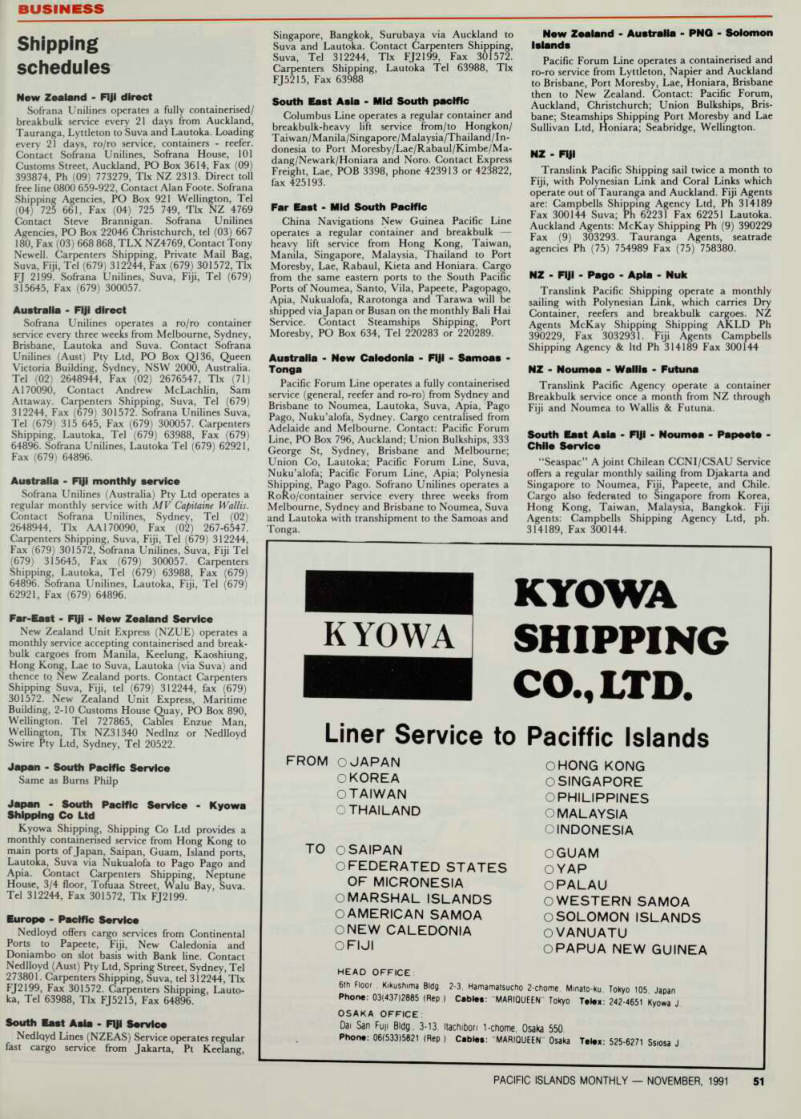
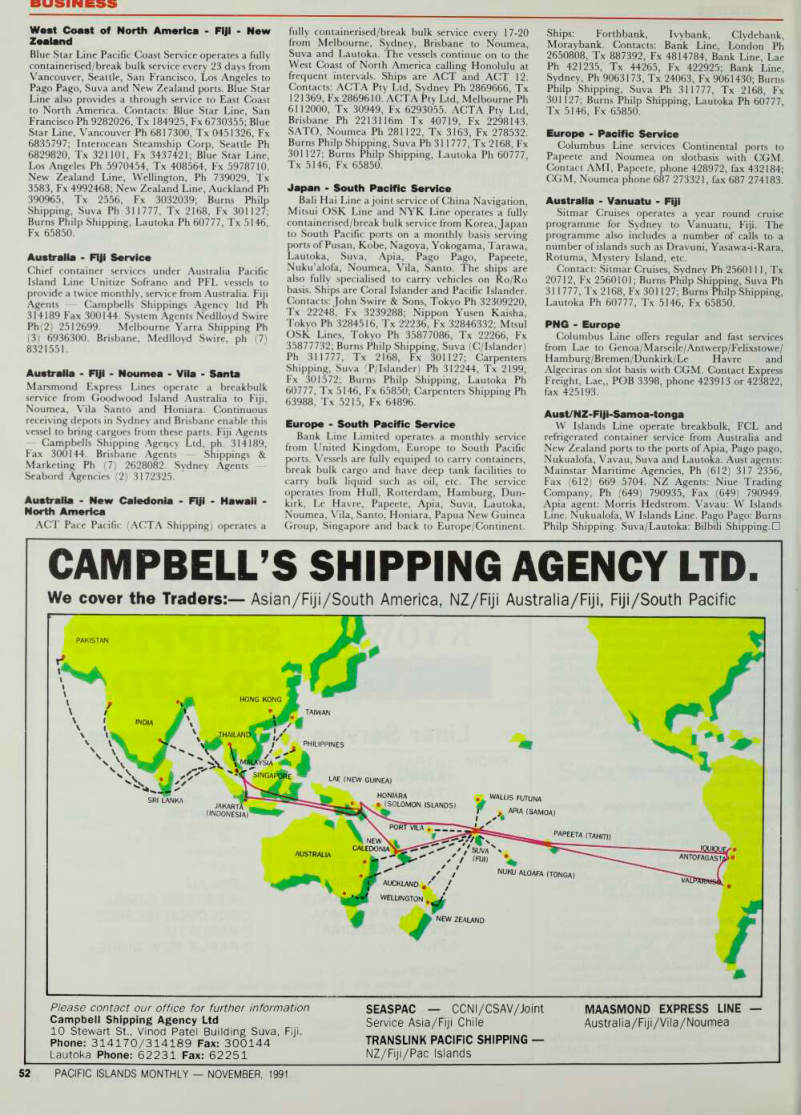
schedules
New Zealand - Fiji direct Sofrana Unilines operates a fully containerised/ breakbulk service every 21 days from Auckland, Tauranga, Lyttleton to Suva and Lautoka. Loading every 21 days, ro/ro service, containers - reefer.
Contact Sofrana Unilines, Sofrana House, 101 Customs Street, Auckland, PO Box 3614, Fax (09) 393874, Ph (09) 773279, Tlx NZ 2313. Direct toll free line 0800 659-922, Contact Alan Foote. Sofrana Shipping Agencies, PO Box 921 Wellington, Tel (04) 725 661, Fax (04) 725 749, Tlx NZ 4769 Contact Steve Brannigan. Sofrana Unilines Agencies, PO Box 22046 Christchurch, tel (03) 667 180, Fax (03) 668 868, TLX NZ4769, Contact Tony Newell. Carpenters Shipping, Private Mail Bag, Suva, Fiji, Tel (679) 312244, Fax (679) 301572, Tlx FJ 2199. Sofrana Unilines, Suva, Fiji, Tel (679) 315645, Fax (679) 300057.
Australia - Fiji direct Sofrana Unilines operates a ro/ro container service every three weeks from Melbourne, Sydney, Brisbane, Lautoka and Suva. Contact Sofrana Unilines (Aust) Pty Ltd, PO Box Q 136, Queen Victoria Building, Sydney, NSW 2000, Australia.
Tel (02) 2648944, Fax (02) 2676547, Tlx (71) A 170090, Contact Andrew McLachlin, Sam Attaway. Carpenters Shipping, Suva, Tel (679) 312244, Fax (679) 301572. Sofrana Unilines Suva, Tel (679) 315 645, Fax (679) 300057. Carpenters Shipping, Lautoka, Tel (679) 63988, Fax (679) 64896. Sofrana Unilines, Lautoka Tel (679) 62921, Fax (679) 64896.
Australia - Fiji monthly service Sofrana Unilines (Australia) Pty Ltd operates a regular monthly service with MV Capitaine Wallis.
Contact Sofrana Unilines, Sydney, Tel (02) 2648944, Tlx AA170090, Fax (02) 267-6547.
Carpenters Shipping, Suva, Fiji, Tel (679) 312244, Fax (679) 301572, Sofrana Unilines, Suva, Fiji Tel (679) 315645, Fax (679) 300057. Carpenters Shipping, Lautoka, Tel (679) 63988, Fax (679) 64896. Sofrana Unilines, Lautoka, Fiji, Tel (679) 62921, Fax (679) 64896.
Far-East - Fiji - New Zealand Service New Zealand Unit Express (NZUE) operates a monthly service accepting containerised and break bulk cargoes from Manila, Keelung, Kaoshiung, Hong Kong, Lae to Suva, Lautoka (via Suva) and thence to New Zealand ports. Contact Carpenters Shipping Suva, Fiji, tel (679) 312244, fax (679) 301572. New Zealand Unit Express, Maritime Building, 2-10 Customs House Quay, PO Box 890, Wellington. Tel 727865, Cables Enzue Man, Wellington, Tlx NZ31340 Nedlnz or Nedlloyd Swire Pty Ltd, Sydney, Tel 20522.
Japan - South Pacific Service Same as Bums Philp Japan - South Pacific Service - Kyowa Shipping Co Ltd Kyowa Shipping, Shipping Co Ltd provides a monthly containerised service from Hong Kong to main ports of Japan, Saipan, Guam, Island ports, Lautoka, Suva via Nukualofa to Pago Pago and
Apia. Contact Carpenters Shipping, Neptune
House, 3/4 floor, Tofuaa Street, Walu Bay, Suva.
Tel 312244, Fax 301572, Tlx FJ2199.
Europe - Pacific Service Nedloyd offers cargo services from Continental Ports to Papeete, Fiji, New Caledonia and Doniambo on slot basis with Bank line. Contact Nedlloyd (Aust) Pty Ltd, Spring Street, Sydney, Tel 273801. Carpenters Shipping, Suva, tel 312244, Tlx FJ2199, Fax 301572. Carpenters Shipping, Lauto ka, Tel 63988, Tlx FJ5215, Fax 64896.
South East Asia - FIJI Service Nedlqyd Lines (NZEAS) Service operates regular fast cargo service from Jakarta, Pt Keelang,
Singapore, Bangkok, Surubaya via Auckland to
Suva and Lautoka. Contact Carpenters Shipping, Suva, Tel 312244, Tlx FJ2199, Fax 301572.
Carpenters Shipping, Lautoka Tel 63988, Tlx FJ5215, Fax 63988 South East Asia - Mid South pacific Columbus Line operates a regular container and breakbulk-heavy lift service from/to Hongkon/
Taiwan/Manila/Singapore/Malaysia/Thailand/In
donesia to Port Moresby/Lae/Rabaul/Kimbe/Ma dang/Newark/Honiara and Noro. Contact Express Freight, Lae, POB 3398, phone 423913 or 423822, fax 425193.
Far East - Mid South Pacific China Navigations New Guinea Pacific Line operates a regular container and breakbulk heavy lift service from Hong Kong, Taiwan, Manila, Singapore, Malaysia, Thailand to Port Moresby, Lae, Rabaul, Kieta and Honiara. Cargo from the same eastern ports to the South Pacific Ports of Noumea, Santo, Vila, Papeete, Pagopago, Apia, Nukualofa, Rarotonga and Tarawa will be shipped via Japan or Busan on the monthly Bali Hai Service. Contact Steamships Shipping, Port Moresby, PO Box 634, Tel 220283 or 220289.
Australia - New Caledonia - FIJI - Samoas - Tonga Pacific Forum Line operates a fully containerised service (general, reefer and ro-ro) from Sydney and Brisbane to Noumea, Lautoka, Suva, Apia, Pago
Pago, Nukualofa, Sydney. Cargo centralised from
Adelaide and Melbourne. Contact: Pacific Forum Line, PO Box 796, Auckland; Union Bulkships, 333 George St, Sydney, Brisbane and Melbourne; Union Co, Lautoka; Pacific Forum Line, Suva, Nuku’alofa; Pacific Forum Line, Apia; Polynesia Shipping, Pago Pago. Sofrano Unilines operates a Roßo/container service every three weeks from Melbourne, Sydney and Brisbane to Noumea, Suva and Lautoka with transhipment to the Samoas and Tonga.
New Zealand - Australia - PNQ - Solomon Islands Pacific Forum Line operates a containerised and ro-ro service from Lyttleton, Napier and Auckland to Brisbane, Port Moresby, Lae, Honiara, Brisbane then to New Zealand. Contact: Pacific Forum, Auckland, Christchurch; Union Bulkships, Bris bane; Steamships Shipping Port Moresby and Lae Sullivan Ltd, Honiara; Seabridge, Wellington.
Nz - Fiji
Translink Pacific Shipping sail twice a month to Fiji, with Polynesian Link and Coral Links which operate out of Tauranga and Auckland. Fiji Agents are: Campbells Shipping Agency Ltd, Ph 314189 Fax 300144 Suva; Ph 62231 Fax 62251 Lautoka.
Auckland Agents; McKay Shipping Ph (9) 390229 Fax (9) 303293. Tauranga Agents, seatrade agencies Ph (75) 754989 Fax (75) 758380.
NZ - FIJI - Pago - Apia - Nuk Translink Pacific Shipping operate a monthly sailing with Polynesian Link, which carries Dry Container, reefers and breakbulk cargoes. NZ Agents McKay Shipping Shipping AKLD Ph 390229, Fax 3032931. Fiji Agents Campbells Shipping Agency & ltd Ph 314189 Fax 300144 NZ - Noumea - Wallis - Futuna Translink Pacific Agency operate a container Breakbulk service once a month from NZ through Fiji and Noumea to Wallis & Futuna.
South East Asia - FIJI - Noumea - Papeete - Chile Service “Seaspac” A joint Chilean CCNI/CSAU Service offers a regular monthly sailing from Djakarta and Singapore to Noumea, Fiji, Papeete, and Chile.
Cargo also federated to Singapore from Korea, Hong Kong, Taiwan, Malaysia, Bangkok. Fiji
Agents: Campbells Shipping Agency Ltd, ph.
314189, Fax 300144.
West Coast of North America - Fiji - New Zealand Blue Star Line Pacific Coast Service operates a fully containerised/break bulk service every 23 days from Vancouver, Seattle, San Francisco, Los Angeles to Pago Pago, Suva and New Zealand ports. Blue Star Line also provides a through service to East Coast to North America. Contacts: Blue Star Line, San Francisco Ph 9282026, Tx 184925, Fx 6730355; Blue Star Line, Vancouver Ph 6817300, Tx 0451326, Fx 6835797; Interocean Steamship Corp, Seattle Ph 6829820, Tx 321101, Fx 3437421; Blue Star Line, Los Angeles Ph 5970454, Tx 408564, Fx 5978710.
New Zealand Line, Wellington, Ph 739029, Tx 3583, Fx 4992468; New Zealand Line, Auckland Ph 390965, Tx 2556, Fx 3032039; Burns Philp Shipping, Suva Ph 311777, Tx 2168, Fx 301127; Burns Philp Shipping, Lautoka Ph 60777, Tx 5146, Fx 65850.
Australia - Fiji Service Chief container services under Australia Pacific Island Line Unitize Sofrano and PFL vessels to provide a twice monthly, service from Australia. Fiji Agents Campbells Shippings Agency ltd Ph 314189 Fax 300144. System Agents Nedlloyd Swire Ph(2) 2512699. Melbourne Yarra Shipping Ph (3) 6936300. Brisbane, Medlloyd Swire, ph (7) 8321551.
Australia - Fiji - Noumea - Vila - Santa Marsmond Express Lines operate a breakbulk service from Goodwood Island Australia to Fiji, Noumea, Vila Santo and Honiara. Continuous receiving depots in Sydney and Brisbane enable this vessel to bring cargoes from these parts. Fiji Agents
Campbells Shipping Agerjcy Ltd, ph. 314189,
Fax 300144. Brisbane Agents Shippings & Marketing Ph (7) 2628082. Sydney Agents Seabord Agencies (2) 3172325.
Australia - New Caledonia - Fiji - Hawaii - North America ACT Pace Pacific (ACTA Shipping) operates a
fully containerised/break bulk service every 17-20 from Melbourne, Sydney, Brisbane to Noumea, Suva and Lautoka. The vessels continue on to the West Coast of North America calling Honolulu at frequent intervals. Ships are ACT and ACT 12.
Contacts: ACTA Pty Ltd, Sydney Ph 2869666, Tx 121369, Fx 2869610. ACTA Pty Ltd, Melbourne Ph 6112000, Tx 30949, Fx 6293055. ACTA Pty Ltd, Brisbane Ph 2213116 m Tx 40719, Fx 2298143.
SATO, Noumea Ph 281122, Tx 3163, Fx 278532.
Burns Philp Shipping, Suva Ph 31 1777, Tx 2168, Fx 301127; Burns Philp Shipping, Lautoka Ph 60777, Tx 5146, Fx 65850.
Japan - South Pacific Service Bali Hai Line a joint service of China Navigation, Mitsui OSK Line and NYK Line operates a fully containerised/break bulk service from Korea, Japan to South Pacific ports on a monthly basis serving ports of Pusan, Kobe, Nagoya, Yokogama, Tarawa, Lautoka, Suva, Apia, Pago Pago, Papeete, Nuku’alofa, Noumea, Vila, Santo. The ships are also fully specialised to carry vehicles on Ro/Ro basis. Ships are Coral Islander and Pacific Islander.
Contacts: John Swire & Sons, Tokyo Ph 32309220, Tx 22248, Fx 3239288; Nippon Yusen Kaisha, Tokyo Ph 3284516, Tx 22236, Fx 32846332; Mtsul OSK Lines, Tokyo Ph 35877086, Tx 22266, Fx 35877732; Burns Philp Shipping, Suva (C/Islander) Ph 31 1777, Tx 2168, Fx 301127; Carpenters Shipping, Suva (P/Islander) Ph 312244, Tx 2199, Fx 301572; Burns Philp Shipping, Lautoka Ph 60777, Tx 5146, Fx 65850; Carpenters Shipping Ph 63988, Tx 5215, Fx 64896.
Europe - South Pacific Service Bank Line Limited operates a monthly service from United Kingdom, Europe to South Pacific ports. Vessels are fully equiped to carry containers, break bulk cargo and have deep tank facilities to carry bulk liquid such as oil, etc. The service operates from Hull, Rotterdam, Hamburg, Dun kirk, Le Havre, Papeete, Apia, Suva, Lautoka, Noumea, Vila, Santo, Honiara, Papua New Guinea Group, Singapore and back to Europe/Continent.
Ships: Forthbank, Ivybank, Clydebank,
Moraybank. Contacts: Bank Line, London Ph 2650808, Tx 887392, Fx 4814784, Bank Line, Lae Ph 421235, Tx 44265, Fx 422925; Bank Line, Sydney, Ph 9063173, Tx 24063, Fx 9061430; Burns Philp Shipping, Suva Ph 311777, Tx 2168, Fx 301127; Burns Philp Shipping, Lautoka Ph 60777, Tx 5146, Fx 65850.
Europe - Pacific Service Columbus Line services Continental ports to Papeete and Noumea on slotbasis with CGM.
Contact AMI, Papeete, phone 428972, fax 432184; CGM, Noumea phone 687 273321, fax 687 274183.
Australia - Vanuatu - Fiji Sitmar Cruises operates a year round cruise programme for Sydney to Vanuatu, Fiji. The programme also includes a number of calls to a number of islands such as Dravuni, Yasawa-i-Rara, Rotuma, Mystery Island, etc.
Contact: Sitmar Cruises, Sydney Ph 2560111, Tx 20712, Fx 2560101; Burns Philp Shipping, Suva Ph 311777, Tx 2168, Fx 301127; Burns Philp Shipping, Lautoka Ph 60777, Tx 5146, Fx 65850.
PNG - Europe Columbus Line offers regular and fast services from Lae to Genoa/Marseile/Antwerp/Felixstowe/ Hamburg/Bremen/Dunkirk/Le Havre and Algeciras on slot basis with CGM. Contact Express Freight, Lae,, POB 3398, phone 423913 or 423822, fax 425193.
Aust/NZ-Fiji-Samoa-tonga W Islands Line operate breakbulk, FCL and refrigerated container service from Australia and New Zealand ports to the ports of Apia, Pago pago, Nukualofa, Vavau, Suva and Lautoka. Aust agents: Mainstar Maritime Agencies, Ph (612) 317 2356, Fax (612) 669 5704. NZ Agents: Niue Trading Company, Ph (649) 790935, Fax (649) 790949.
Apia agent: Morris Hedstrom. Vavau: W Islands Line. Nukualofa, W Islands Line. Pago Pago: Burns
Philp Shipping. Suva/Lautoka; Bilbili Shipping. □
Advertisements & other items, pp. 53-54 (2 items)
Business
Co., Ltd.
KYOWA
KYOWA
SHIPPING
CO., LTD.
Liner Service to Paciffic Islands
FROM OJAPAN
OKOREA
OTAIWAN
OTHAILAND
TO OSAIPAN
©FEDERATED STATES
OF MICRONESIA
©MARSHAL ISLANDS
©AMERICAN SAMOA
©NEW CALEDONIA
©FIJI
©HONG KONG
©SINGAPORE
©PHILIPPINES
©MALAYSIA
©INDONESIA
©GUAM
©YAP
©PALAU
©WESTERN SAMOA
©SOLOMON ISLANDS
©VANUATU
©PAPUA NEW GUINEA
HEAD OFFICE
6th Floor , Kikushima Bldg 2-3, Hamamatsucho 2-chome. Mmato-ku. Tokyo 105 Japan Phone: 03(437)2885 (Rep ) Cables; "MARIQUEEN" Tokyo Telex: 242-4651 Kyowa J
OSAKA OFFICE
Dai San Fuji Bldg. 3-13. Itachibon 1-chome, Osaka 550.
Phone: 06(533)5821 (Rep ) Cables: MARIQUEEN Osaka Telex: 525-6271 Ssiosa J
CAMPBELL’S SHIPPING AGENCY LTD.
We cover the Traders:— Asian/Fiji/South America, NZ/Fiji Australia/Fiji, Fiji/South Pacific x r
INDIA
I +
THAI LAN
X / - • /y
. WALLIS FUTUNA
t , APIA (SAA
I \
PORT
VILA
s NEW \
CALEDONIA
AUSTRALIA
i> //
AUCKLAND ,/ f
* WELLINGTON ,
I
PAPEETA (TAHITI)
NUKU ALOAFA (TONGA)
NEW ZEALAND
/ Please contact our office for further information Campbell Shipping Agency Ltd 10 Stewart St., Vinod Patel Building Suva, Fiji.
Phone: 314170/314189 Fax: 300144 Lautoka Phone: 62231 Fax: 62251
SEASPAC CCNI/CSAV/Joint
Service Asia/Fiji Chile
TRANSLINK PACIFIC SHIPPING
NZ/Fiji/Pac Islands
MAASMOND EXPRESS LINE
Australia/Fiji/Vila/Noumea
Yachting
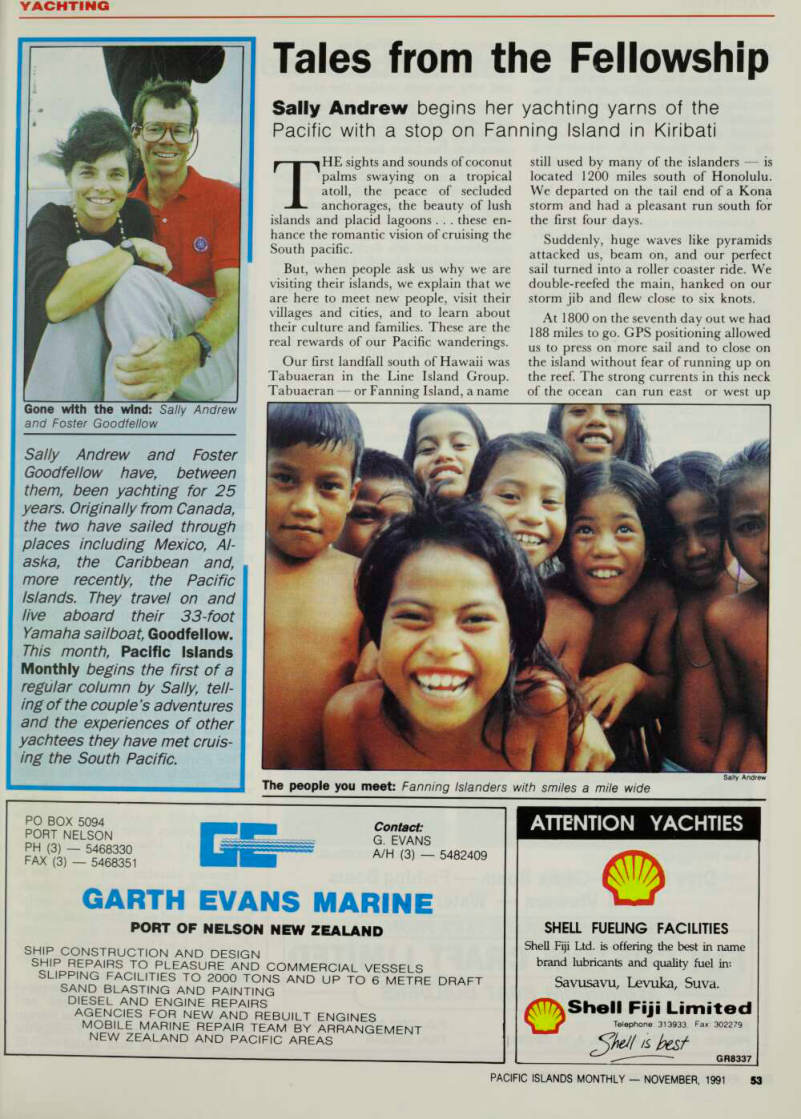
Sally Andrew and Foster Goodfellow have, between them, been yachting for 25 years. Originally from Canada, the two have sailed through places including Mexico, Al aska, the Caribbean and, more recently, the Pacific Islands. They travel on and live aboard their 33-foot Yamaha sailboat, Goodfellow.
This month, Pacific Islands Monthly begins the first of a regular column by Sally, tell ing of the couple's adventures and the experiences of other yachtees they have met cruis ing the South Pacific.
Gone with the wind: Sally Andrew and Foster Goodfellow
Tales from the Fellowship
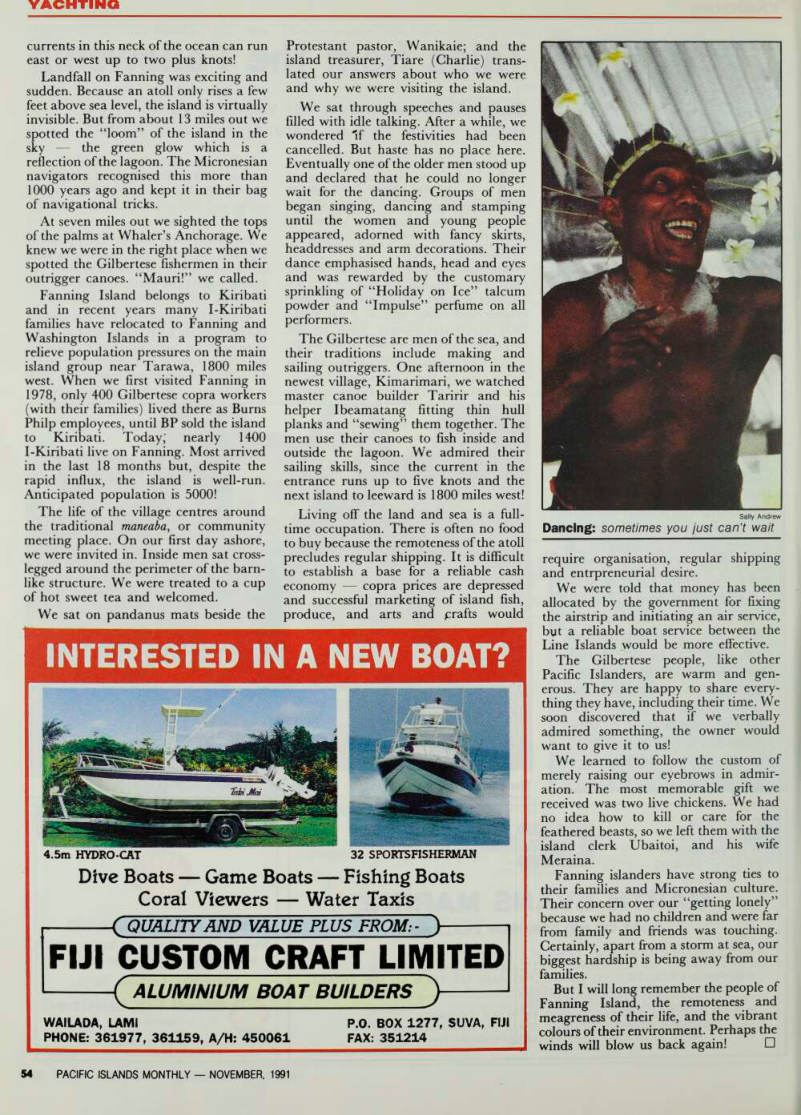
Sally Andrew begins her yachting yarns of the Pacific with a stop on Fanning Island in Kiribati
THE sights and sounds of coconut palms swaying on a tropical atoll, the peace of secluded anchorages, the beauty of lush islands and placid lagoons . . . these en hance the romantic vision of cruising the
South pacific.
But, when people ask us why we are visiting their islands, we explain that we are here to meet new people, visit their villages and cities, and to learn about their culture and families. These are the real rewards of our Pacific wanderings.
Our first landfall south of Hawaii was Tabuaeran in the Line Island Group.
Tabuaeran or Fanning Island, a name
still used by many of the islanders is located 1200 miles south of Honolulu.
We departed on the tail end of a Kona storm and had a pleasant run south for the first four days.
Suddenly, huge waves like pyramids attacked us, beam on, and our perfect sail turned into a roller coaster ride. We double-reefed the main, hanked on our storm jib and flew close to six knots.
At 1800 on the seventh day out we had 188 miles to go. GPS positioning allowed us to press on more sail and to close on the island without fear of running up on the reef. The strong currents in this neck of the ocean can run east or west up
Sally Andrew The people you meet: Fanning Islanders with smiles a mile wide
currents in this neck of the ocean can run east or west up to two plus knots!
Landfall on Fanning was exciting and sudden. Because an atoll only rises a few feet above sea level, the island is virtually invisible. But from about 13 miles out we spotted the “loom” of the island in the sky the green glow which is a reflection of the lagoon. The Micronesian navigators recognised this more than 1000 years ago and kept it in their bag of navigational tricks.
At seven miles out we sighted the tops of the palms at Whaler’s Anchorage. We knew we were in the right place when we spotted the Gilbertese fishermen in their outrigger canoes. “Mauri!” we called.
Fanning Island belongs to Kiribati and in recent years many I-Kiribati families have relocated to Fanning and Washington Islands in a program to relieve population pressures on the main island group near Tarawa, 1800 miles west. When we first visited Fanning in 1978, only 400 Gilbertese copra workers (with their families) lived there as Burns Philp employees, until BP sold the island to Kiribati. Today,' nearly 1400 I-Kiribati live on Fanning. Most arrived in the last 18 months but, despite the rapid influx, the island is well-run.
Anticipated population is 5000!
The life of the village centres around the traditional maneaba, or community meeting place. On our first day ashore, we were invited in. Inside men sat cross legged around the perimeter of the barn like structure. We were treated to a cup of hot sweet tea and welcomed.
We sat on pandanus mats beside the
Protestant pastor, Wanikaie; and the island treasurer, Tiare (Charlie) trans lated our answers about who we were and why we were visiting the island, We sat through speeches and pauses filled with idle talking. After a while, we wondered “if the festivities had been cancelled. But haste has no place here, Eventually one of the older men stood up and declared that he could no longer wait for the dancing. Groups of men began singing, dancing and stamping until the women and young people appeared, adorned with fancy skirts, headdresses and arm decorations. Their dance emphasised hands, head and eyes and was rewarded by the customary sprinkling of “Holiday on Ice” talcum
powder and Impulse perfume on all
performers.
The Gilbertese are men of the sea, and their traditions include making and sailing outriggers. One afternoon in the newest village, Kimarimari, we watched master canoe builder Taririr and his
helper Ibeamatang fitting thin hull
planks and “sewing” them together. The men use their canoes to fish inside and outside the lagoon. We admired their sailing skills, since the current in the entrance runs up to five knots and the next island to leeward is 1800 miles west!
Living off the land and sea is a full time occupation. There is often no food to buy because the remoteness of the atoll
precludes regular shipping. It is difficult
to establish a base for a reliable cash economy copra prices are depressed and successful marketing of island fish, produce, and arts and prafts would
require organisation, regular shipping
and entrpreneurial desire.
We were told that money has been allocated by the government for fixing the airstrip and initiating an air service, but a reliable boat service between the Line Islands would be more effective.
The Gilbertese people, like other Pacific Islanders, are warm and gen erous. They are happy to share every thing they have, including their time. We soon discovered that if we verbally admired something, the owner would want to give it to us!
We learned to follow the custom of merely raising our eyebrows in admir ation. The most memorable gift we received was two live chickens. We had no idea how to kill or care for the feathered beasts, so we left them with the island clerk Übaitoi, and his wife Meraina.
Fanning islanders have strong ties to their families and Micronesian culture.
Their concern over our “getting lonely” because we had no children and were far from family and friends was touching.
Certainly, apart from a storm at sea, our biggest hardship is being away from our families.
But I will long remember the people of Fanning Island, the remoteness and meagreness of their life, and the vibrant colours of their environment. Perhaps the winds will blow us back again! □
Sally Andrew Dancing: sometimes you just can’t wait
Advertisements & other items, pp. 55-56 (1 item)
Garth Evans Marine
ATTENTION YACHTIES
SHELL FUELING FACILITIES
Shell Fiji Ltd. is offering the best in name brand lubricants and quality fuel in: Savusavu, Levuka, Suva.
Fiji Limited
\ / Telephone 313933. Fax 302279
fJheJI * best
GR8337
PO BOX 5094
PORT NELSON
PH (3) 5468330
FAX (3) 5468351
Contact:
G. EVANS
A/H (3)
GARTH EVANS MARINE
PORT OF NELSON NEW ZEALAND
SHIP CONSTRUCTION AND DESIGN
repairs to pleasure and commercial vessels SLIPPING FACILITIES TO 2000 TONS AND UP TO 6 METRE
SAND BLASTING AND PAINTING
DIESEL AND ENGINE REPAIRS
AGENCIES FOR NEW AND REBUILT ENGINES
MOBILE MARINE REPAIR TEAM BY ARRANGEMENT
NEW ZEALAND AND PACIFIC AREAS
5482409
DRAFT
INTERESTED IN A NEW BOAT?
*v
4.5 m HYDRO-CAT
32 SPORTSFISHERMAN
Dive Boats Game Boats Fishing Boats
Coral Viewers Water Taxis
-C QUALITY AND VALUE PLUS FROM.- >
FIJI CUSTOM CRAFT LIMITED
( ALUMINIUM BOAT BUILDERS )
WAILADA, LA Ml
PHONE: 361977, 361159, A/H: 450061
P.O. BOX 1277, SUVA, FIJI
FAX: 351214
Little new in New World Order
THE so-called New World Order ushered in by the Gulf War has little to offer the Pacific. In fact, there is barely any difference from the Old Order.
The liberaton of Kuwait hasn’t brought any fresh responses over East Timor, which was invaded by Indon esian colonial forces 15 years ago in a far more brutal manner than the Iraqi invasion. Bougainville is no closer to a long-term solution. The political stale mate which has hounded Palau since it adopted the world’s first nuclear-free constitution in 1979 still remains.
In Resisting the Serpent , a Palauan now living in the United States proves remarkably symbolic of Western, par ticularly American, military and econ
omic hegemony. Depicting the “Escape
from the Sea Serpent of Oikuul”, the cover illustration is fitting for both books as they narrate a tragic David and Goliath story “of disinheritance, a journey toward freedom, and a people’s struggle with a ‘serpent’.”
Although Aldridge and Myers record a traditional people’s commitment to preserve their islands against the “ser pent” the Pentagon and its plans for a strategic military base they stress that it is far more than that. They believe it is a metaphor for the global struggle for survival against militarism, of which the Pacific islands have borne the brunt.
Aldridge and Myers criticise their countrymen for allowing the world’s largest debtor nation to continue accept ing and subsidising such huge levels of
military spending. Militarism, they say,
has “colonised our minds”. And already they have had the predictable defensive response to their book from the US establishment.
In a nutshell, the events in Palau are bizarre: over 10 years the people have voted 10 times on the issue of whether or
Resisting the Serpent: Palau’s Struggle for Setf-Determination, Bob Aldridge and Ched Myers (Fortkamp Publishing Co, Baltimore, 1990); Overreaching in Paradise: US Policy in Palau Since 1#45, Sue Babbitt Roff (Dnali Press, 1991.) Reviewed by David Robie not they should ban nuclear substances from their islands. Under pressure from Washington, they twice voted to reaffirm their nuclear-free constitution. The US then proposed a Compact of Free Association which was incompatible with the constitution because it would allow nuclear substances into Palauan terri tory. Seven times since 1983 variations of the compact have been submitted to referendum as required in the consitution and seven times the Palauan people have refused to override their nuclear free clauses.
The UN Trusteeship Agreement gov erning Micronesia was terminated last December for the Federated States of Micronesia, Northern Marianas and Marshall Islands, leaving just Palau.
It is unlikely any comparison of Palau under the Japanese mandate before the Second World War and the US admin istration under the trusteeship would show that Washington has fulfilled its obligations. Why, for example, did the US after the war destroy many of the Japanese improvements to the islands and allow the rest to deteriorate? Accord ing to Resisting the Serpent, after 43 years of trusteeship, “there are currently only 16 miles of paved roads”.
Both books are dedicated to the memory of Bedor Bins, the elderly father of anti-nuclear activists Roman Bedor and Bernie Keldermans, who was mur dered on September 7, 1987. Bedor was gunned down at the Belau Pacific Centre where Roman has his law office. It is believed he was mistaken for Roman who was at the time helping 20 women elders who had filed a lawsuit challenging a
constitutional amendment neutralising the nuclear-free clauses.
All three authors have impeccable credentials in decolonisation issues.
Australian-born Sue Rabbit Rolf worked with the Fretilin delegation from East Timor to the United Nations. She has been a freelance journalist specialising in decolonisation issues and has petitioned the Trusteeship Council and Decolonisation Committee on Micro nesia.
Aldridge, a critical authority on US military strategic policy and author of three books on the theme, first visited Palau during the First World War.
Myers is a Quaker activist and a freelance investigative journalist on Pa cific issues. He served on the Nuclear- Free and Independent (NFIP) move ment steering committee between 1980 and 1983.
Overreaching in Paradise is perhaps the more scholarly of the two books, and has an advantage in having an index. But Resisting the Serpent is probably more evocative.
As Rabbit Roff points out, the process of self-determination in Palau has been marred by three violent deaths during the 1980 s. Besides Bedor Bins, the first president, Haruo Remeliik, was assassin ated in 1985, and the second president, Lazarus Salii, committed suicide in 1988.
Tragic events for any community, but for the 15,000 Palauans they are a reminder of the pressures that have ravaged their island for more than a decade.
“It is to be hoped that in the 1990 s there emerges a solution by consensus, a process that would be in the best traditions of both Palau and the US. The courage of those 2000 voters (who have defiantly stood by the nuclear-free clauses) and their leaders and the fact that there are still no nuclear substances in Palau is a beacon to all of us who want to work our way out of the global nuclear mindset.” □
Advertisements & other items, p. 57 (1 item)
The South Sea Digest
The Newsletter on Islands Affairs. Every Other Friday South Sea Digest has all the latest business news, expertly streamlined and obtainable nowhere else.
Subscriptions: 25 issues SAISO for Australian subscriber; Asl7s overseas, all airmailed. Payment by cheque in A$ and US$, otherwise by bank draft.
Ssnd payment to: The South Sea Digest, GPO Box 4245, Sydney NSW 2001, Australia.
Name Address
UidtL
Rent A Car
THE WORLD’S NO. 1
WHERE QUALITY AND SAFETY COUNT.
To drive the roads of Fiji is to experience some of the most beautiful scenery of the South Pacific, especially with Hertz.
A For Reservations Phone: Nadi Airport 722146 Suva 383150, 383411, 383677 Telex: 2237, Fax: 370212 With Hertz you get more than just a car.
SSSir, there’s a stowaway aboard
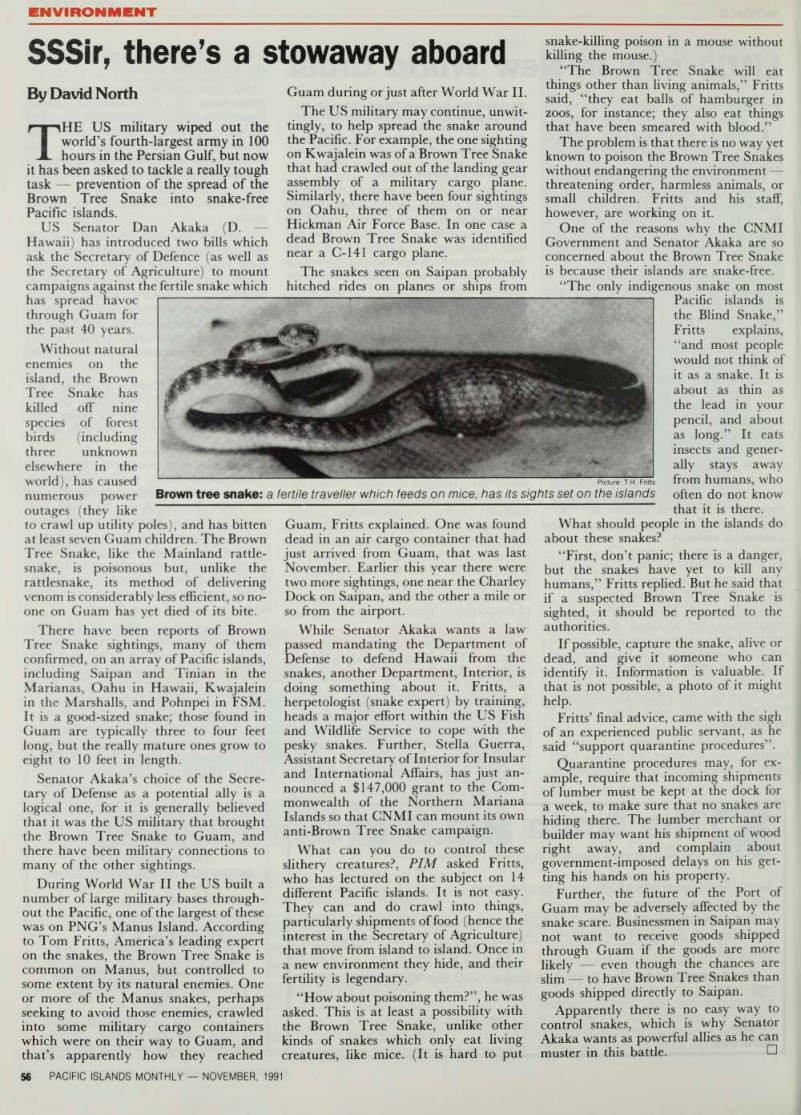
Environment
By David North
THE US military wiped out the world’s fourth-largest army in 100 hours in the Persian Gulf, but now it has been asked to tackle a really tough task prevention of the spread of the Brown Tree Snake into snake-free Pacific islands.
US Senator Dan Akaka (D.
Hawaii) has introduced two bills which ask the Secretary of Defence (as well as the Secretary of Agriculture) to mount campaigns against the fertile snake which
has spread havoc through Guam for the past 40 years.
Without natural enemies on the island, the Brown Tree Snake has killed off nine species of forest birds (including three unknown elsewhere in the world), has caused numerous power outages (they like
to crawl up utility poles), and has bitten at least seven Guam children. The Brown Tree Snake, like the Mainland rattle snake, is poisonous but, unlike the rattlesnake, its method of delivering venom is considerably less efficient, so no one on Guam has yet died of its bite.
There have been reports of Brown Tree Snake sightings, many of them confirmed, on an array of Pacific islands, including Saipan and Tinian in the Marianas, Oahu in Hawaii, Kwajalein in the Marshalls, and Pohnpei in FSM.
It is a good-sized snake; those found in Guam are typically three to four feet long, but the really mature ones grow to eight to 10 feet in length.
Senator Akaka’s choice of the Secre tary of Defense as a potential ally is a logical one, for it is generally believed that it was the US military that brought the Brown Tree Snake to Guam, and there have been military connections to many of the other sightings.
During World War II the US built a number of large military bases through out the Pacific, one of the largest of these was on PNG’s Manus Island. According to Tom Fritts, America’s leading expert on the snakes, the Brown Tree Snake is common on Manus, but controlled to some extent by its natural enemies. One or more of the Manus snakes, perhaps seeking to avoid those enemies, crawled into some military cargo containers which were on their way to Guam, and that’s apparently how they reached
Guam during or just after World War 11.
The US military may continue, unwit tingly, to help spread the snake around the Pacific. For example, the one sighting on Kwajalein was of a Brown Tree Snake that had crawled out of the landing gear assembly of a military cargo plane.
Similarly, there have been four sightings on Oahu, three of them on or near Hickman Air Force Base. In one case a dead Brown Tree Snake was identified near a C-141 cargo plane.
The snakes seen on Saipan probably hitched rides on planes or ships from
Guam, Fritts explained. One was found dead in an air cargo container that had just arrived from Guam, that was last November. Earlier this year there were two more sightings, one near the Charley Dock on Saipan, and the other a mile or so from the airport.
While Senator Akaka wants a law
passed mandating the Department of
Defense to defend Hawaii from the snakes, another Department, Interior, is doing something about it. Fritts, a herpetologist (snake expert) by training, heads a major effort within the US Fish and Wildlife Service to cope with the pesky snakes. Further, Stella Guerra, Assistant Secretary of Interior for Insular and iHtcmational Affairs, has just an nounced a $147,000 grant to the Com monwealth of the Northern Manana Elands so that CNMI can mount its own a nti-Brown Tree Snake campaign.
What can you do to control these slithery creatures?, PIM asked Fritts, «*L° has ‘ ectu / ed , on the subject on 14 d f erent Pac,f ‘ c * slands - ‘ 15 not , eas >'' The y f" a " d do ct ™} ' nt ° thin f’ particularly shipments of food (hence the interest m the Secretary of Agriculture) that move from island to island. Once in a ne , w environment they hide, and their fertlllt y 15 legendary.
“How about poisoning them?”, he was asked. This is at least a possibility with the Brown Tree Snake, unlike other kinds of snakes which only eat living creatures, like mice. (It is hard to put
snake-killing poison in a mouse without killing the mouse.) “The Brown Tree Snake will eat things other than living animals,” Fritts said, “they eat balls of hamburger in zoos, for instance; they also eat things that have been smeared with blood.”
The problem is that there is no way yet known to poison the Brown Tree Snakes without endangering the environment threatening order, harmless animals, or small children. Fritts and his staff, however, are working on it.
One of the reasons why the CNMI Government and Senator Akaka are so concerned about the Brown Tree Snake is because their islands are snake-free.
“The only indigenous snake on most
Pacific islands is the Blind Snake,”
Fritts explains,
“and most people would not think of it as a snake. It is about as thin as the lead in your pencil, and about as long.” It eats insects and gener ally stays away from humans, who often do not know that it is there.
What should people in the islands do about these snakes?
“First, don’t panic; there is a danger, but the snakes have yet to kill any humans,” Fritts replied. But he said that if a suspected Brown Tree Snake is sighted, it should be reported to the authorities.
If possible, capture the snake, alive or dead, and give it someone who can identify it. Information is valuable. If that is not possible, a photo of it might help.
Fritts’ final advice, came with the sigh G f an experienced public servant, as he
said “support quarantine procedures”,
Quarantine procedures may, for ex ample, require that incoming shipments G f lumber must be kept at the dock for a wee k, to make sure that no snakes are hiding ther e. Xhe i um ber merchant or builder may want his shipment of wood right away, and complain about government-imposed delays on his get ting his hands on his property, Further, the future of the Port of Guam may be adversely affected by the snake scare. Businessmen in Saipan may not want to receive goods shipped through Guam if the goods are more 1 kely - even though the chances are slim to have Brown Tree Snakes than goods shipped direct yto aipan.
Apparently there is no easy way to control snakes, which is why Senator Akaka wants as powerful allies as he can muster in this battle.
Picture: T.H. Fritts Brown tree snake: a fertile traveller which feeds on mice, has its sights set on the islands
Childbirth, without frills
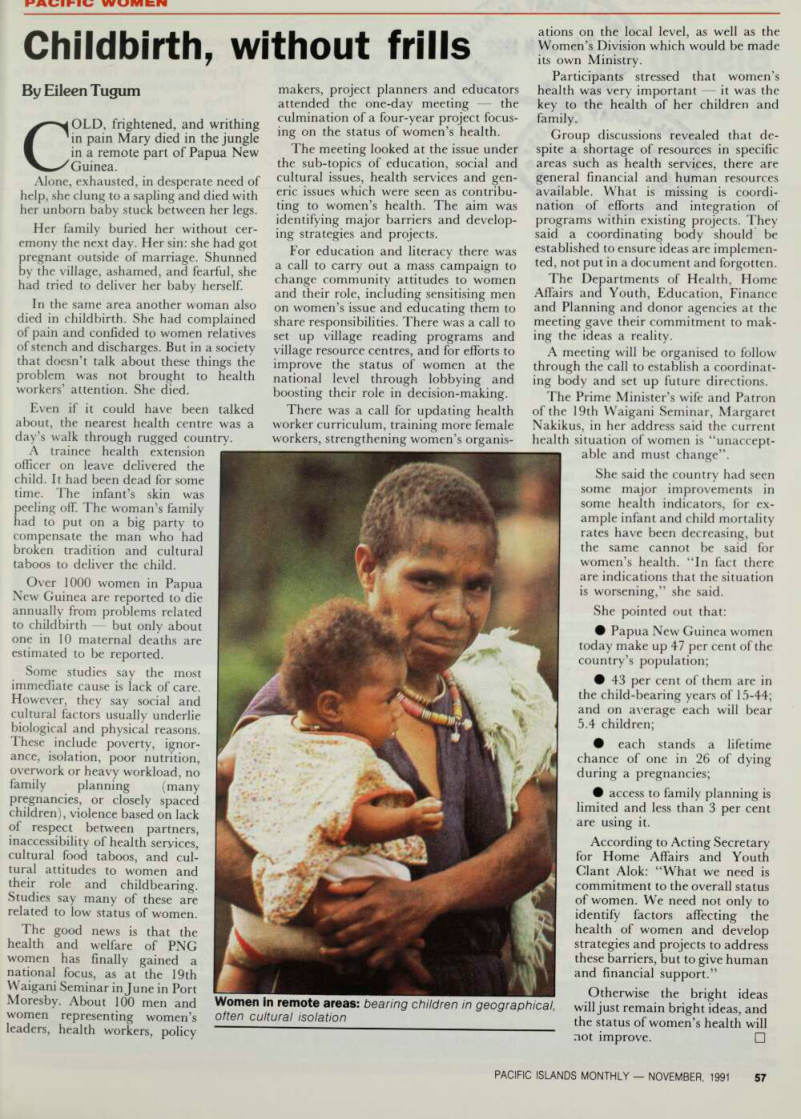
Pacific Women
By Eileen Tugum
COLD, frightened, and writhing in pain Mary died in the jungle in a remote part of Papua New Guinea.
Alone, exhausted, in desperate need of help, she clung to a sapling and died with her unborn baby stuck between her legs.
Her family buried her without cer emony the next day. Her sin: she had got pregnant outside of marriage. Shunned by the village, ashamed, and fearful, she had tried to deliver her baby herself.
In the same area another woman also died in childbirth. She had complained of pain and confided to women relatives of stench and discharges. But in a society that doesn’t talk about these things the problem was not brought to health workers’ attention. She died.
Even if it could have been talked about, the nearest health centre was a day’s walk through rugged country.
A trainee health extension officer on leave delivered the child. It had been dead for some time. The infant’s skin was peeling off. The woman’s family had to put on a big party to compensate the man who had broken tradition and cultural taboos to deliver the child.
Over 1000 women in Papua New Guinea are reported to die annually from problems related to childbirth but only about one in 10 maternal deaths are estimated to be reported.
Some studies say the most immediate cause is lack of care.
However, they say social and cultural factors usually underlie biological and physical reasons.
These include poverty, ignor ance, isolation, poor nutrition, overwork or heavy workload, no
family planning (many
pregnancies, or closely spaced children), violence based on lack of respect between partners, inaccessibility of health services, cultural food taboos, and cul tural attitudes to women and their role and childbearing.
Studies say many of these are related to low status of women.
The good news is that the health and welfare of PNG women has finally gained a national focus, as at the 19th Waigani Seminar in June in Port Moresby. About 100 men and women representing women’s leaders, health workers, policy
makers, project planners and educators attended the one-day meeting the culmination of a four-year project focus ing on the status of women’s health.
The meeting looked at the issue under the sub-topics of education, social and cultural issues, health services and gen eric issues which were seen as contribu ting to women’s health. The aim was
identifying major barriers and develop
ing strategies and projects.
For education and literacy there was a call to carry out a mass campaign to change community attitudes to women and their role, including sensitising men on women’s issue and educating them to share responsibilities. There was a call to set up village reading programs and village resource centres, and for efforts to improve the status of women at the national level through lobbying and boosting their role in decision-making.
There was a call for updating health worker curriculum, training more female workers, strengthening women’s organis-
ations on the local level, as well as the Women’s Division which would be made its own Ministry.
Participants stressed that women’s health was very important it was the key to the health of her children and family.
Group discussions revealed that de spite a shortage of resources in specific areas such as health services, there are general financial and human resources available. What is missing is coordi nation of efforts and integration of programs within existing projects. They said a coordinating body should be established to ensure ideas are implemen ted, not put in a document and forgotten.
The Departments of Health, Home Affairs and Youth, Education, Finance and Planning and donor agencies at the meeting gave their commitment to mak ing the ideas a reality.
A meeting will be organised to follow through the call to establish a coordinat ing body and set up future directions.
The Prime Minister’s wife and Patron of the 19th Waigani Seminar, Margaret Nakikus, in her address said the current health situation of women is “unaccept
able and must change”.
She said the country had seen some major improvements in some health indicators, for ex ample infant and child mortality rates have been decreasing, but the same cannot be said for women’s health. “In fact there are indications that the situation is worsening,” she said.
She pointed out that: • Papua New Guinea women today make up 47 per cent of the
country’s population;
• 43 per cent of them are in the child-bearing years of 15-44; and on average each will bear 5.4 children; • each stands a lifetime chance of one in 26 of dying during a pregnancies; • access to family planning is limited and less than 3 per cent are using it.
According to Acting Secretary
for Home Affairs and Youth Giant Alok: “What we need is commitment to the overall status of women. We need not only to identify factors affecting the health of women and develop strategies and projects to address these barriers, but to give human and financial support.”
Otherwise the bright ideas will just remain bright ideas, and the status of women’s health will not improve. □
Women in remote areas: bearing children in geographical, often cultural isolation
Bishop in
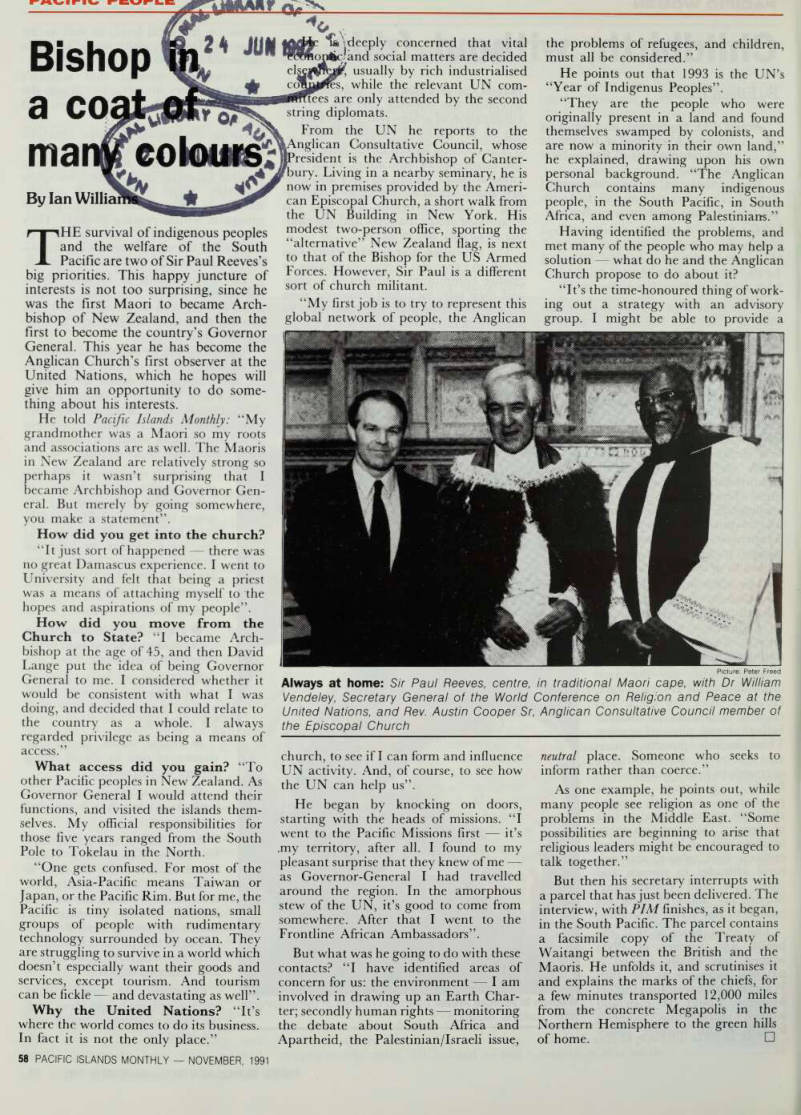
Pacific People
Bishop in a coat of many colours
By Ian Williams
THE survival of indigenous peoples and the welfare of the South Pacific are two of Sir Paul Reeves’s big priorities. This happy juncture of interests is not too surprising, since he was the first Maori to became Arch bishop of New Zealand, and then the first to become the country’s Governor General. This year he has become the Anglican Church’s first observer at the United Nations, which he hopes will give him an opportunity to do some thing about his interests.
He told Pacific Islands Monthly: “My grandmother was a Maori so my roots and associations are as well. The Maoris in New Zealand are relatively strong so perhaps it wasn’t surprising that I became Archbishop and Governor Gen eral. But merely by going somewhere, you make a statement”.
How did you get into the church?
“It just sort of happened there was no great Damascus experience. I went to University and felt that being a priest was a means of attaching myself to the hopes and aspirations of my people”.
How did you move from the Church to State? “I became Arch bishop at the age of 45, and then David Lange put the idea of being Governor General to me. I considered whether it would be consistent with what I was doing, and decided that I could relate to the country as a whole. I always regarded privilege as being a means of access.”
What access did you gain? “To other Pacific peoples in New Zealand. As Governor General I would attend their functions, and visited the islands them selves. My official responsibilities for those five years ranged from the South Pole to Tokelau in the North.
“One gets confused. For most of the world, Asia-Pacific means Taiwan or Japan, or the Pacific Rim. But for me, the Pacific is tiny isolated nations, small groups of people with rudimentary technology surrounded by ocean. They are struggling to survive in a world which doesn’t especially want their goods and services, except tourism. And tourism can be fickle and devastating as well”.
Why the United Nations? “It’s where the world comes to do its business.
In fact it is not the only place.”
’.deeply concerned that vital *f(Tmon<*'?and social matters are decided dsefptmf, usually by rich industrialised while the relevant UN com rfntees are only attended by the second string diplomats.
From the UN he reports to the Consultative Council, whose liPresident is the Archbishop of Canter pbury. Living in a nearby seminary, he is now in premises provided by the Ameri can Episcopal Church, a short walk from the UN Building in New York. His modest two-person office, sporting the “alternative” New Zealand flag, is next to that of the Bishop for the US Armed Forces. However, Sir Paul is a different sort of church militant.
“My first job is to try to represent this global network of people, the Anglican
church, to see if I can form and influence UN activity. And, of course, to see how the UN can help us”.
He began by knocking on doors,
starting with the heads of missions. “I went to the Pacific Missions first it’s .my territory, after all. I found to my pleasant surprise that they knew of me as Governor-General I had travelled around the region. In the amorphous stew of the UN, it’s good to come from somewhere. After that I went to the Frontline African Ambassadors”.
But what was he going to do with these contacts? “I have identified areas of concern for us: the environment I am involved in drawing up an Earth Char ter; secondly human rights monitoring the debate about South Africa and Apartheid, the Palestinian/Israeli issue,
the problems of refugees, and children, must all be considered.”
He points out that 1993 is the UN’s
“Year of Indigenus Peoples”.
“They are the people who were originally present in a land and found themselves swamped by colonists, and are now a minority in their own land,” he explained, drawing upon his own personal background. “The Anglican Church contains many indigenous people, in the South Pacific, in South Africa, and even among Palestinians.”
Having identified the problems, and met many of the people who may help a solution what do he and the Anglican Church propose to do about it?
“It’s the time-honoured thing of work ing out a strategy with an advisory group. I might be able to provide a
neutral place. Someone who seeks to inform rather than coerce.”
As one example, he points out, while many people see religion as one of the problems in the Middle East. “Some possibilities are beginning to arise that
religious leaders might be encouraged to
talk together.”
But t j ien secretary interrupts with a parcel that has just been delivered. The interv iew, with PIM finishes, as it began, i n the South Pacific. The parcel contains a facsimile copy of the Treaty of Waitangi between the British and the Maoris. He unfolds it, and scrutinises it and explains the marks of the chiefs, for a few minutes transported 12,000 miles from the concrete Megapolis in the Northern Hemisphere to the green hills of home. □
Always at home: Sir Paul Reeves, centre, in traditional Maori cape, with Dr William Vendeley, Secretary General of the World Conference on Religion and Peace at the United Nations, and Rev. Austin Cooper Sr, Anglican Consultative Council member of the Episcopal Church
Advertisements & other items, pp. 61-62 (1 item)
Ac1Fk
ISLANDS
O N T H L Y I
RRK€T PLflC
PENFRIEND
An International Society for friendly contacts seeks friends for letter-friendship and further contacts, especially to Germany. All Pacific Islanders shall write to: Mr. Manfred Assmann, Hauptstr. 38, 0-6124 Sachsenbrunn, Germany.
REAL ESTATE
Profitable bungalow resort on stunning white sand beach. French Polynesia. $2.65 million USD Estates, resorts and opportunities throughout the Pacific: Pacific Island Investments (808) 883-8000 Fax: 883-8838
WANTED
Islands (large and small, lease or fee) for individual and corporate buyers. Contact: Karen Jeffery, Pacific Island Investments (808) 883-8000 / Fax: 883-8838.
OPTICIANS AND OPTOMETRISTS
Spectacles, Contact Lenses, Sunglasses, See JEKISHAN & JEKISHAN, Epworth House, G.P.O.
Box 285, Suva, Fiji. Ph 311002 Fax: (679) 411898.
DISTRIBUTOR WANTED
Manufacturer of Ball Point and Pens Disposable Gas Lighters.
Please contact JNJ CORPORATION (FIJI) LTD, G.P.O. Box 285, Suva, Fiji. Ph 394000, Fax: (679) 411898.
COMMERCIAL PRINTING
Top quality four colour printing, brochures, posters, packaging, product labels, fabric labels, billboards, books, magazines, stickers, books. Export quality. Contact Fiji’s most experienced Commercial Printers. FIJI TIMES COMMER- CIAL PRINTING. P.O. Box 1167, Suva. Fiji.
Phone: 304111 Fax. 301521.
SELF ADHESIVE LABEL!
FORUM LABELS (FIJI) LTD
P.O. Box 1167, Suva., Fiji. Phone:304111 We print self-adhesive labels in rolls, multi-coloured labels with hot foil, and die cut to shape, tickets and tags in rolls. We also supply labelling machines and fabric labels.
SCRAP METAL
Tall ingots operate from Brisbane, Australia and make frequent visits to the Pacific Islands, as they have done for twenty-five years. We are buyers of Copper, Brass. Aluminium, Lead, Cable etc. Inspection for big lots no problem.
Telephone 61 7 8922033. Fax 61 7 8922077.
PUMP DISTRIBUTORS WANTED
Excellent profit available. As a Pacific Pump Dealer you would have access to some of the world’s finest agricultural and industrial pump products. The product range includes: — HIGH
PRESSURE WASHERS — SUBMERSIBLES —
Tsurumi — Toyo — PRESSURE SYSTEMS — Espa — GEAR PUMPS — Cat — TRASH — Gorman Rupp — OP — GENERATORS. We provide sales literature, full technical support, price lists and a discount structure which enables generous profit margins when selling Pacific Products. Phone or Fax or full distributorship details:-THE MARKETING MAN-
AGER, PACIFIC PUMP COMPANY, 2 SOUTH
STREET, RYDALMERE, NSW, 2116, NSW
AUSTRALIA. PHONE (02) 638 5600 FAX (02) 684 2184.
AUCTION
GOLD
MINING
PLANT
On site Wau - Morobe Province
Papua New Guinea
THURSDAY 21st NOVEMBER 11am
©Under Instructions from RGC (Papua New Guinea) Pty Limited.
Due to cessation of mining at Wau.
INSPECTION
Wednesday 20th November 9am-4pm.
PRIOR OFFERS INVITED
MODERN 500,000 TPA CIP PLANT.
Incl. Feeders, Conveyors, Marcy 5'x 12'6"
SAG Mill, Vickers Ruwolt 10'x 14' Ball Mill, Warman Pumps, (5) 450M 3 Leach Tanks, (6) 110m 3 CIP Tanks, Zadra 3 Ton Stripping Circuit, Gold Room, Reagent & Electrical Equip.
To be offered firstly as a whole then major component lots.
MOBILE CRANES
Grove RT58B 15T Rough Terrain Crane.
BHB TC38 8T Yard Crane.
WORKSHOP EQUIPMENT
Incl. Lathes, Drills, Mills, Welders, Compressors, Tools, Woodworking, Stores & Spares.
INDUSTRIAL BUILDINGS
Workshop 30M x 36M x 6M. CIP 22M x 11M x 12M withIT OHT Crane. Electrical 14M x 8M x 4M.
SUNDRY PLANT
Incl. Piping, Steel, Elec. Cable, Office Equip etc.
COLLIERS
international
PLANT & APPRAISALS
409 FRANCIS STREET,
BROOKLYN, VIC. 3025, AUSTRALIA.
Fax: (61-3) 314 6943 Ph; (61-3) 315 1555
Designed to be Driven. -.a ■ * tmm Wmlm & ■ ' ■' i m Proven in Every Comer of the World.
Stylish elegance and luxurious detail are the first things you’ll notice about the new Galant. So you might be surprised to learn that Galants have driven to victory in more than 10 major rally raid events — from the snowy slopes of Sweden, to the African savannah. And you’ll be pleased to know that the same performance features keeping those rally cars competitive on the course are also what make your Galant one of the best performance saloons on the road today.
For years, Mitsubishi engineers have known that motorsports are an ideal place for testing new and improved technologies.
The hard, fast driving required to win a rally strains every part of a car—generating pressures that exceed the demands of normal driving. Here, as drivers push their cars to the limit, the rigidity and strength of new space-age constructions can be checked and proven reliable.
The new Galant’s advanced triplelink torsion axle rear suspension is a good example. It is the result of many small yet critical refinements, ultimately designed to grip the road for safer, more comfortable control when changing lanes and cornering.
The severe demands of international motorsport competition: just further proof of how far Mitsubishi will go to build the best cars for you.
MITSUBISHI QRLRNT
AMERICAN SAMOA: MORRIS SCANLAN SERVICE INC. PO Box 367, Pago Pago, Tel 633 5520/AUSTRALIA: MITSUBISHI MOTORS AUSTRALIA LTD. Box 1284, South Road, Clovelly Park, South Australia 5042, Tel. (08) 275-7223/FIJI: NIVIS MOTOR & MACHINERY CO., LTD. G P.O Box 150. Suva, Tel. 383411/FRENCH POLYNESIA (TAHITI): ETS-BREDIN FRERES ET FILS P.O. Box 21, Papeete. Tahiti, Tel 4-202 58/NEW CALEDONIA: SOCIETE DTMPORTATION D'AUTO DU PACIFIQUE SUD S.A. B.P. 438 Rond Point du Pacifique, Noumea, Tel. 274144/NEW ZEALAND: MITSUBISHI MOTORS NEW ZEALAND LTD. Todd Park, Heriot Drive, Private Bag, Porirua, Tel. 370-109/ NORFOLK ISLAND: BORRYS LTD. P.O. Box 169, Norfolk Island. Tel 2114/PAPUA NEW GUINEA; TOBA PTY. LTD. P O. Box 503, Port Moresby. Tel. 21 7874/SOLOMON ISLANDS: HARVEST PACIFIC LTD. G.P.O, Box 88, Honiara, Guadalcanal, Tel 30128/TONGA: SITANI MAPI CO., LTD. P.O, Box 83, Nuku ALOFA, T el. 21 044/VANUATU: SOCOMETRA B P 06 Route de Lagon, Port-Vila, Tel. 2314/WESTERN SAMOA; A M. MACDONALD HOLDINGS LTD.
P.O Box 576, Apia, Tel 22022/SAIPAN/POHNPEI/MAJURO/KOSRAE/TRUK/YAP/BELAU: MICRONESIAN MOTORS. INC. 997 South Manine Drive, Tamuning, Guam 96911 , Tel 646-6827
JTW
MITSUBISHI
MOTORS