Pacific

Islands
Monthly
D
October 1991
R
Okl 1
American Samoa US$2.5O; Australia A 52.50; Cook Islands NZ$3; Fiji F 51.75; FS Micronesia US$3; Hawaii US$3; Kiribati A 52.50; Nauru A 52.50; Niue NZ$3; Norfolk As 3; New Caledonia cpf2so; New Zealand (incl GST) NZ53.45; Nth Marianas US$3; Papua New Guinea K 3; Palau US$3; Marshalls US$3; Solomon Islands As 3; French Polynesia cpf3oo; Tonga P 3; USA US$3; Vanuatu VT2OO; Western Samoa T 3.25. ‘Recommended retail price only
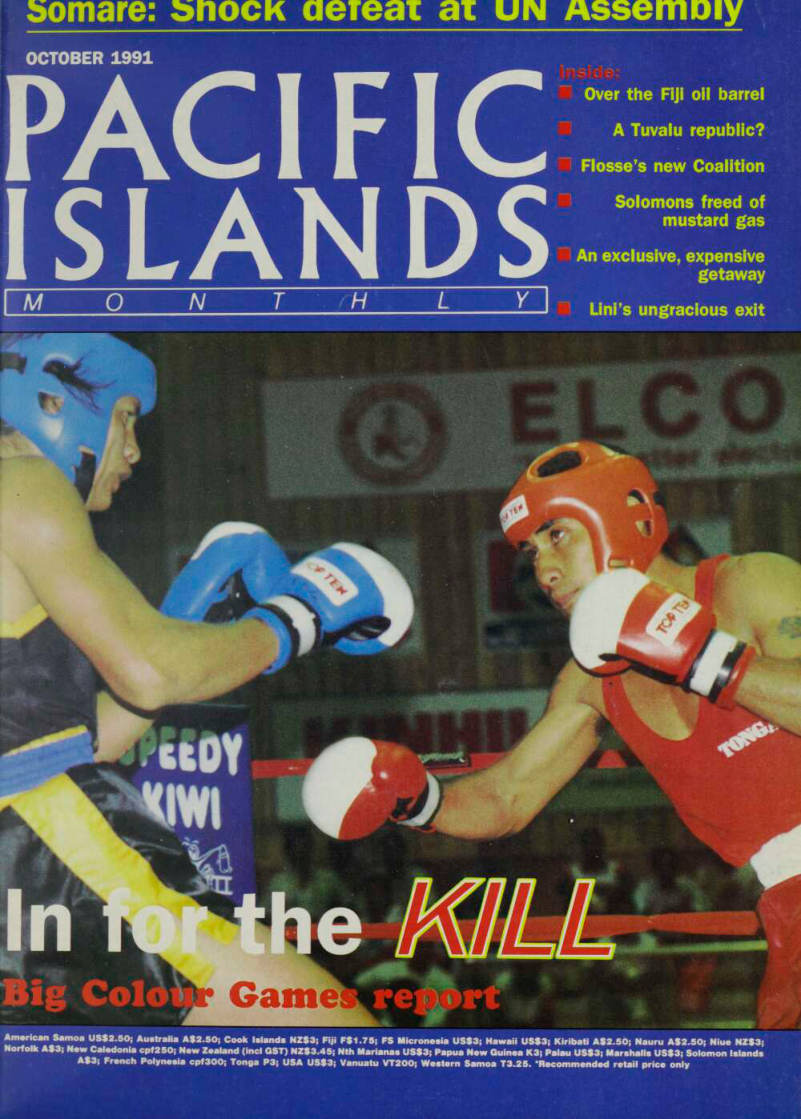
Cover photo: Tonga’s Siketi Palaki goes in for the kill against Guam s James Nanta in the lightweight boxing event at the South Pacific Games. (Jale Moala photo on Fujicoior).
Advertisements & other items, p. 2 (1 item)
Stylish and Compact
AD PIONEER
The Art of Entertainment
In today's active society, a compact and modular Hi-Fi component stereo system is the perfect answer to home entertainment. The Contempo series gives you all you could ask for in both convenience and sound quality, as well as a stylish design that complements your living space.
Hi-Fi Compact System
In spite of its compact design, Contempo is pack ed with a variety of high-tech features that prod uce high-quality sound in almost anv listening s pace. Contempo's specially engineered function s compensate for the loss of sound presence in I imiled spaces. As a result, Contempo sound is c risp and clear, no matter where you are in the r oom. What's more. Pioneer Smart Operation c apabilities make the Contempo system simple to use. A touch of the START/SET button and t he system delivers quality hi-fi sound. Various Contempo models will suit almost anv taste with a choice of Single, Twin and Multi-play CD capabilities. And all of the Contempo m odels employ 1 -Bit DLC (Direct Linear Con version) technology for extremely high-qu ality sound. Add to this an ASES (Auto Sy nchronized Editing Svslem) provided on t he Double Auto-Reverse Cassette Deck Ih at lets you program Contempo to automat
ically create professional-sounding cassett
e recordings. All of this makes Contempo t he ideal personal entertainment system. In spite of its compact design, Contempo is p acked with a variety of high-tech features that produce high-quality sound in almos
t any listening space. Contempo's specia
lly engineered functions compensate for the loss of sound presence in limited sp aces. As a result, Contempo sound is cr isp and clear, no matter where you are in the room. What's more. Pioneer Sm art Operation capabilities make the C ontempo system simple to use. A touch of t he START/SET button and the system deliv ers quality hi-fi sound. Various Contempo ■ models will suit almost any taste with a c hoice of Single, Twin and Multi-play CD capabilities. And all of the Contempo models emplov 1 -Bit DLC (Direct Li near Conversion) technology for e xtremely high-quality sound. Add to this an ASES (Auto Synchroniz ed Editing System) provided on t he Double Auto-Reverse Casse Ite Deck that lets you progr am Contempo to automat ically creat professionalsounding cassette recor dings. All of this makes Contempo the ideal pe rsonal entertainment sy stem. In spite of its co mpact design, Contemp o is packed with a variet y of high-tech features that
produce high-quality sound in
almost any listening space. Cont empo's specially engineered functi ons compensate for the loss of sou nd presence in limited spaces. As a result, Contempo sound is crisp an A k A
■ispi
d clear, no matter where you are in the room . What's more. Pioneer Smart Operation capa bilities make the Contempo system simple to u se. A touch of the START/SET button and the sy stem delivers quality hi-fi sound. Various Conte mpo models will suit almost any taste with a cho ice of Single, Twin and Multi-play CD capabilities And all of the Contempo models employ 1-Bil D LC (Direct Linear Conversion) technology for extr emely high-quality sound. Add to this an ASES (A uto Synchronized Editing System) provided on t he Double Auto-Reverse Cassette Deck that let s you program Contempo to automatically ere
ate professional-sounding cassette recordings.
All of this makes Contempo the ideal personal e ntertainment system. In spite of its compact des ign, Contempo is packed with a variety of high-t ech features that produce high-quality sound in almost any listening space. Contempo's specially engineered functions compensate for the loss of sound presence in limited spaces. As a re suit, Contempo sound is crisp and clear, no matter where you are in the room.
What's more. Pioneer Smart Opera tion capabilities make the Conte mpo system simple to use. A t ouch of the START/SET b utton and the system
delivers quality
hi-fi sound.
Various Co nlempo models X-P77 305 W
(PMPO)
t i will suit almost any taste with a choice of Singl e. Twin and Multi-play CD capabilities. And all of the Contempo models employ 1-Bit DLC (Di rect Linear Conversion) technology for extrem ely high-quality sound. Add to this an ASES (A uto Synchronized Editing System) provided o n the Double Auto-Reverse Cassette Deck th at lets you program Contempo to automatic ally create professional-sounding cassette r ecordings. All of this makes Contempo the ideal personal entertainment system. In sp ite of its compact design, Contempo is pa eked with a variety of high-tech features that produce high-quality sound in aim osl any listening space. Contempo's sp
ecially engineered functions compensa
te for the loss of sound presence in lim ited spaces. As a result, Contempo sou nd is crisp and clear, no matter where you are in the room. What's more, Pion eer Smart Operation capabilities make t he Contempo system simple to use. In s pile of its compact design, Contempo is pack ed with a variety of high-tech fea
tures that produce high-quality sound i
n almost any listening space. Contemp o's specially engineered functions com pensate for the loss of sound presence in limited spaces. As a result, Conte mpo sound is crisp and clear, no ma
For further information, please contact:
Australia: Pioneer Electronics Australia Pty. Ltd. (Incorporated in Victoria), 178- 184 Boundary Road, Braeside Victoria 3195 Tel: 580-9911 Fiji Islands: Brijlal & Company, G.P.O. Box No. 362, Suva, Fiji Islands Tel: 22258 New Zealand: Monaco Corporation Ltd., 41 Poland Road, Glenfield, Auckland,
New Zealand Tel: (09)444-9144
Norfolk Island: Burnt Pine Traders Ltd., P.O. Box 21, Norfolk Island Vanuatu: Burns Philp (Vanuatu) Ltd., Vila, Vanuatu ■ 305 W (PMPO) ■ Digital sound field
processor ■ L.P.S. (Listening Point
Selector) ■ One-touch KARAOKE (Vocal
Cancel) ■ Sound jog dial for sound image
control and S.F.C. effect ■ Auto
Synchronized Editing System (A.S.E.S.)
ready ■ P.Bass (Power Bass)
* X-P55/X-PSSM (305 W PMPO), X-P33 (210 W PMPO) and X-Pll (200 W PMPO) Contempo models are also available.
Nauru Island: Jacob Enterprises, P.O. Box N 0.4, Republic of Nauru Tahiti: Tahiti Hi-Fi, P.O. Box 848, Papeete, Tahiti New Caledonia: Menard Pacifique Sari, B.P. 3899, Noumea, New Caledonia
Tel: 27-62-23
American Samoa: Transpac Corporation, P.O. Box 1477, Pago Pago, American
Samoa 96799 Tel: 633-5224
Rarotonga: South Seas International Ltd., P.O. Box 49, Rarotonga, Cook Islands
Tel: 2327
Islands
Pacific
Monthly
Vol. 61 No. 10
October 1991
Cover Stories;
Glory of the Games; on the track, in the ring, on the greens Starts on 24 Big colour coverage of the South Pacific Games
United Nations:
Defeated: Saudi Arabia squashes Pacific hopes for Somare to be UN president 6 Full membership: for the Federated States of Micronesia and the Republic of the Marshall Islands 7 France praised over New Caledonia efforts, but still on the decolonisation watch list 7 Portuguese parliamentary delegation for East Timor 7
The Region:
Who’s holding who over the oil barrel? What the Fiji Government says, what the oil companies say, and what it all means for the other Pacific nations 11 TONGA: No gold stars: a US report criticises the government and despairs for Tonga’s future 13 Prince Tu’ipelehake steps down as PM 14
TUVALU: To be or not to be a Republic 16 The PM ... on Fiji’s fish, sheep and taxes 17 TAHITI: Flosse forms a new coalition 20 PAPUA NEW GUINEA: Despite recent unrest, it’s top of a human freedom scale 21 ART; Maori art takes part in an exhibition which could help mend the Irish rift 45
Business:
Troubled waters: Pacific Forum Line makes its first loss in six years, but it’s all part of the plan 47
Travel;
One man and his island; David Gilmour and the expensive, exclusive Wakaya Club 50 Resort fit for a PM: Ratu Mara’s own creation 51 FOCUS: The US army removes mustard gas shells, the remnants of chemical warfare, from the Solomons 40
Agriculture: Tack
ling plant diseases 57 Bleak banana future 58
Environment: South
Pacific Environments conference 15 Futa Helu 39 Margot O’Neill 10 David Barber 19 Jemima Garrett 8 Letters 4 Shipping 53
Publisher: Geoffrey Hussey Editor: Jale Moala Assistant Editor: Beryl Cook Senior Writer: Martin Tiffany Correspondents: Al Prince, Angela McCarthy, David North, David Robie, Diana McManus, Dykes Angiki, Frank Senge, Franck Madoeuf. lan Williams, Irene Nisbet, John Hunter, Karen Mangnall, Lovenia Enari, Lito Vilisoni, Macel Manua, Nicholas Rothwell, Pesi Fonua, Richard Dinnen, Ulafala Aiavao, Wally Hiambohn
Columnists: David Barber (Welling ton), Futa Helu (Tonga, covering the Pacific Islands), Jemima Garrett (Syd ney), Margot O'Neill (Washington) Business and Advertising Man ager: Charlotte Thomas Advertising Sales: • Fiji: Salendra Narayan, Tel (679) 304111, Fx (679) 303809 • Sydney, Melbourne: Fergus Maclagan, Tel (61-2) 4134689, Fx (61-2) 4123918 • Brisbane: Robert Walker, Tel (61-7)
3710533, Fx (61-7) 8798964 • Adelaide: Hastwell Williamsons Rep resentations, Tel (61-8) 799522, Fx (61-8) 799735 • Auckland: McKay International Me dia Reps Ltd, Tel (64-9) 4190561, Fx (64-9) 4192243 • Japan: Universal Media Corporation, Tokyo. Tel (3) 6663036, 6663094, Cable: UNIMEDIA Tokyo, Tx 2524665 Founded 1930 (USPS 952480). A Fiji Times Limited production.
Cover prices are recommended retail
only. Registered by Australia Post, Publication No. NBP 1210. © Copyright Fiji Times Limited, 177 Victoria Parade, Suva, Fiji. Tel (679) 304111, Fx (679)
303809, Tx Fj2124.
Pacific Islands Monthly is published monthly by Fiji Times Limited, a division of Nationwide News, 2 Holt Street, Surry Hills, Sydney, NSW 2010.
Send address changes to: • Pacific Islands Monthly, PO Box 1167, Suva Fiji. Typeset and printed by Fiji Times Limited, 177 Victoria Parade, Suva, Fiji.
Somare: defeated in UN
Lini: ousted at home
Paeniu: survived a challenge
Advertisements & other items, p. 3 (1 item)
3
PACIRC ISLANDS MONTHLY OCTOBER, 1991
Airfare special
Letters
Airfare special 'no big deal’
idays to the islands.
The unfortunate result of this is that tourists get ripped off through the exorbitant prices charged by the oper ators of the island resorts and ordinary Fijians receive little of the tourists’ money.
If the airfare discount were to apply to all tourists going to Fiji then the money would be more evenly spread throughout the community.
Another unfortunate side effect is that foreigners see little of the real Fiji encaserated as they are in the “plastic”
WE recently returned to Australia after a short holiday in Fiji. Whilst we enjoyed our first visit to your country we must say that we were disappointed in one respect.
I refer to the fact that the discount airfare (Air Pacific’s 40th birthday cel ebration offer of $499 for Australia/Fiji return) applies only to “package” hoi
world created by the island operators.
I have sent a copy of this letter to the (Fiji) Minister for Tourism in the hope that something may be done to improve this situation.
Cliff Reece
Arncliffe, NSW Australia
Long-time reader
offers some praise
I HAVE been a reader of Pacific Island Monthly and its major competitor for more than a decade. While its competitor has degenerated into the patronising and cranky propaganda rag that it is today, we are fortunate that Pacific Islands Monthly has kept up its standards of
objective and professional journalism.
It’s no wonder that more and more people I know in business, government and academia are turning to PIM for coverage of Pacific island news. Keep up the good work and happy 61st birthday!
Robert Churney
American Samoa
LETTERS TO THE EDITOR must include writer’s full name, address and home telephone number. All letters may be edited for purposes of clarity or space.
Letters should be addressed to: Pacific Islands Monthly PO Box 1167 Suva
Fiji Islands
OR Fax: (679) 303809
Advertisements & other items, pp. 4-5 (1 item)
( Aluminium Bqat~Builders )
INTERESTED IN A NEW BOAT?
Taki JKa.
4.5 m HYDRO-CAT
32 SPORTSFISHERMAN
Dive Boats Game Boats Fishing Boats Coral Viewers Water Taxis < QUALITY AND VALUE PLUS FROM.- >
FIJI CUSTOM CRAFT LIMITED
( ALUMINIUM BQAT~BUILDERS )
WAILADA, LA Ml
PHONE: 361977, 361159, A/H: 450061
P.O. BOX 1277, SUVA, FIJI
FAX: 351214
Invest 4 days at our
conference and well
de id
eas.
NETWORKING
SOUTH
Invest in Fiji.
Invest 4 days at the Sheraton Fiji Resort and find out why Fiji offers one of the best investment enviroments in the South Pacific.
Trade ideas and discover new business
opportunities.
NETWORKING
SOUTH PACIFIC
’9l - Fiji Investment and Trade Forum will
bring together
business people
from all over the world to talk and do business in Fiji and to see Fiji’s
potential and
capability as an investment centre.
NETWORKING SOUTH PACIFIC ’9l is the biggest investment forum to be held in Fiji under the auspices of the Fiji Trade and Investment Board with assistance from UNDP/UNIDO and the centre for the Development of Industry (GDI) in Brussels.
Who should attend?
Key Decision Makers, Chief Executives, Financial Investment and Legal Advisors, Company Directors, Corporate Planners, Entreprenuers, Institutional
Investors, Marketing and Purchasing
Managers, etc.
P A A U M ME Why you should be there Over 150 overseas
business people
seeking new investment and
trade opportunities
will be there. * Over 100 Fiji based companies in key sectors have provided profiles for
prospective overseas
investors. * All Fiji’s top businessmen, executives and entreprenuers will
be attending.
* Seminars and clinics on how to do business in Fiji, particularly in key areas such as taxation, land availability and laws, company laws, monetary and fiscal
policy, indigenous
issues regarding
fishing and
immigration regulations by experts. * Immpressive lineup of international speakers from US, Europe, Japan, South East Asia, Australia 8c New Zealand with key policy statements from senior Fiji Government Ministers.
Sheraton Fiji Resort November 13 - 16, 1991
REGISTER NOW
Contact: Fiji Trade and Investment Board PO Box 2303 Government Buildings Suva.
Telephone (679) 315988 Fax (679) 301783 r...
Fiji
Fiji Trade and I nvesiment board
New World Order
at a price
Saudi Arabia crushes hopes for Somare to lead the UN. lan Williams reports.
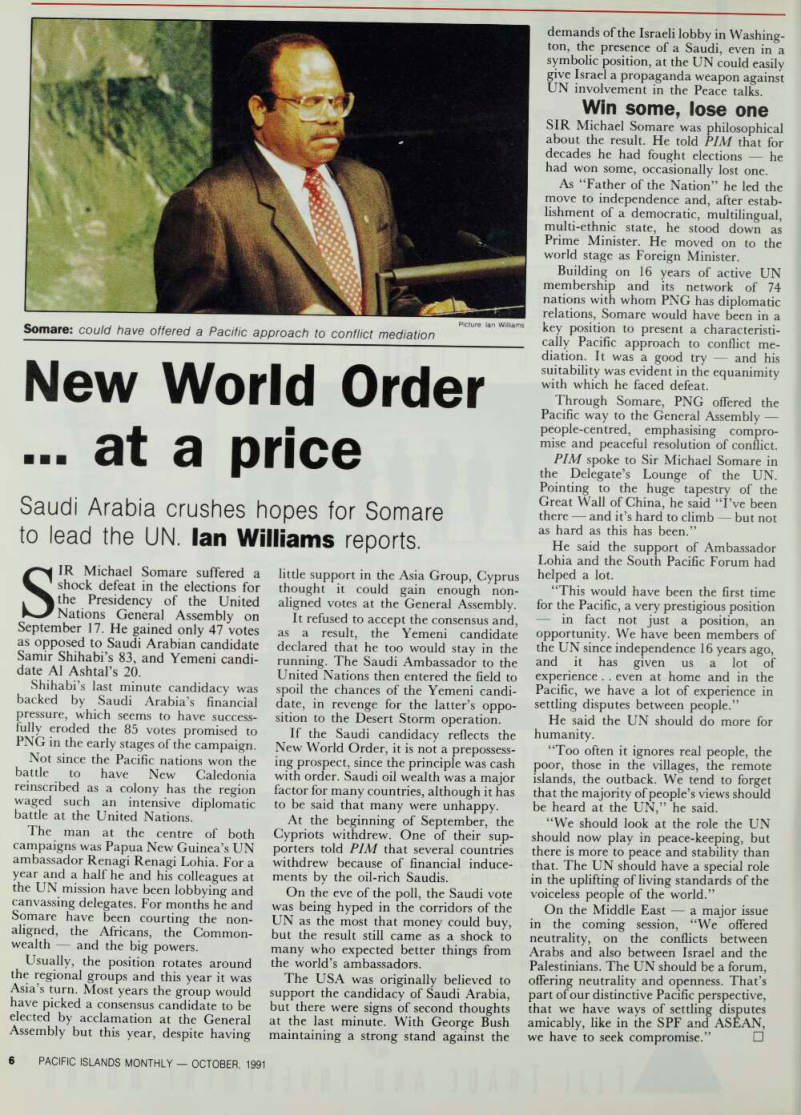
SIR Michael Somare suffered a shock defeat in the elections for the Presidency of the United Nations General Assembly on September 17. He gained only 47 votes as opposed to Saudi Arabian candidate Samir Shihabi’s 83, and Yemeni candi date A 1 Ashtal’s 20.
Shihabi’s last minute candidacy was backed by Saudi Arabia’s financial pressure, which seems to have success fully eroded the 85 votes promised to PNG in the early stages of the campaign.
Not since the Pacific nations won the battle to have New Caledonia reinscribed as a colony has the region waged such an intensive diplomatic battle at the United Nations.
The man at the centre of both campaigns was Papua New Guinea’s UN ambassador Renagi Renagi Lohia. For a year and a half he and his colleagues at the UN mission have been lobbying and canvassing delegates. For months he and Somare have been courting the non aligned, the Africans, the Common wealth and the big powers.
Usually, the position rotates around the regional groups and this year it was Asia’s turn. Most years the group would have picked a consensus candidate to be elected by acclamation at the General Assembly but this year, despite having
little support in the Asia Group, Cyprus thought it could gain enough non aligned votes at the General Assembly.
It refused to accept the consensus and, as a result, the Yemeni candidate declared that he too would stay in the running. The Saudi Ambassador to the United Nations then entered the field to spoil the chances of the Yemeni candi date, in revenge for the latter’s oppo sition to the Desert Storm operation.
If the Saudi candidacy reflects the New World Order, it is not a prepossess ing prospect, since the principle was cash with order. Saudi oil wealth was a major factor for many countries, although it has to be said that many were unhappy.
At the beginning of September, the Cypriots withdrew. One of their sup porters told PIM that several countries withdrew because of financial induce ments by the oil-rich Saudis.
On the eve of the poll, the Saudi vote was being hyped in the corridors of the UN as the most that money could buy, but the result still came as a shock to many who expected better things from the world’s ambassadors.
The USA was originally believed to support the candidacy of Saudi Arabia, but there were signs of second thoughts at the last minute. With George Bush maintaining a strong stand against the
demands of the Israeli lobby in Washing ton, the presence of a Saudi, even in a symbolic position, at the UN could easily give Israel a propaganda weapon against UN involvement in the Peace talks.
Win some, lose one
SIR Michael Somare was philosophical about the result. He told PIM that for decades he had fought elections he had won some, occasionally lost one.
As “Father of the Nation” he led the move to independence and, after estab lishment of a democratic, multilingual, multi-ethnic state, he stood down as Prime Minister. He moved on to the world stage as Foreign Minister.
Building on 16 years of active UN membership and its network of 74 nations with whom PNG has diplomatic relations, Somare would have been in a key position to present a characteristi cally Pacific approach to conflict me diation. It was a good try and his suitability was evident in the equanimity with which he faced defeat.
Through Somare, PNG offered the Pacific way to the General Assembly people-centred, emphasising compro mise and peaceful resolution of conflict.
PIM spoke to Sir Michael Somare in the Delegate’s Lounge of the UN.
Pointing to the huge tapestry of the Great Wall of China, he said “I ’ve been there and it’s hard to climb but not as hard as this has been.”
He said the support of Ambassador Lohia and the South Pacific Forum had helped a lot.
“This would have been the first time for the Pacific, a very prestigious position in fact not just a position, an opportunity. We have been members of the UN since independence 16 years ago, and it has given us a lot of experience . . even at home and in the Pacific, we have a lot of experience in
settling disputes between people.”
He said the UN should do more for
humanity.
“Too often it ignores real people, the poor, those in the villages, the remote islands, the outback. We tend to forget that the majority of people’s views should be heard at the UN,” he said.
“We should look at the role the UN should now play in peace-keeping, but there is more to peace and stability than that. The UN should have a special role in the uplifting of living standards of the voiceless people of the world.”
On the Middle East a major issue in the coming session, “We offered neutrality, on the conflicts between Arabs and also between Israel and the Palestinians. The UN should be a forum, offering neutrality and openness. That’s part of our distinctive Pacific perspective, that we have ways of settling disputes amicably, like in the SPF and ASEAN, we have to seek compromise.” □
Picture Ian Williams Somare: could have offered a Pacific approach to conflict mediation
A high note for the Pacific
By Ian Williams
THE opening of the UN General Assembly on September 17 was a big day for the Pacific. The Federated States of Micronesia and the Republic of the Marshall Islands were promoted from UN trust territories to full UN members in their own right.
In August the UN Security Council approved their applications without a vote. Approval by the General assembly was then a formality since there were, for example, no objections from Yemen and Cuba, who it was feared might object to the intimate US connection implied by the Compacts of Free Association.
Among the permanent five members, the British were indeed unhappy with the applications. London’s view is that the two states do not have the legal attributes of sovereignty since the Compact restricts their control of defence and foreign affairs. Perhaps anxious to make friends in the Pacific, France not only supported the application it obligingly adver tised the British objections.
London decided finally that it was not worth upsetting Washington.
More substantial objections came from the Soviets. After North and South Korea had both been accepted, there was an adjournment for a day to consider a formula which would meet their objec tions. In the end, on August 9, the applications were accepted but the President of the Security Council, Jose Ayala Lasso of Ecuador, issued a state ment that it was not to be taken as a precedent but was decided “on the basis of the merits of that request”.
While the Soviets shared the legalistic objections of the British, they were believed to be worried about the impli cations for future attempts by Soviet Republics to apply. Indeed it is now likely that the member republics of whichever form of union emerges from the USSR will be citing the Pacific precedent for their own membership applications.
Wilfred Kendall, Marshall Islands ambassador to Washington, has watched the position of the former trust territories change from neglected dependency to
full independence.
He was a member of the old Micro nesian Congress, and then for a time the Minister for External Affairs of the Marshalls. Later he was representative in Hawaii before becoming representative to the US. In 1989 the Compact was altered to change his title to ambassador.
In his view that symbolised how the relationship had changed over the years
of negotiations.
“The Compact is a good example of how small nations can cooperate with big nations and still have a large role for themselves. After all, the UN approved Free Association as an option for countries.”
At the beginning, some form of commonwealth status was the best that was envisaged. “Nauru was the trailblazer, even though it never joined the UN. In the early days, Hammer deßoburt came to us and said that there was no substitute for independence”, acknowledges Kendall.
How did he justify the heavy expense of joining the UN? “We want to cut down the number of our overseas offices, and at the UN we can maintain contact with everybody else in the world it’s a diplomatic bargain,” he joked. But he admitted, “We are still exploring the costs.”
He added that “There are a lot of areas, like direct access to UN agencies
like UNESCO, UNDP, and UNFPA which are very important to us. And of course we want to play an active part in the Climate Change Convention since we will be one of the worst affected. There are a lot of issues on which our interests are best represented by ourselves”.
Agreeing that there were still some reservations about the degree of sover eignty allowed under Compact of Free Association, he was quick to parry them.
“Nowadays everyone wants to break down the barriers like the EC, moving towards the same passport, same cur rency, so the concept of sovereignty is changing. The thing that matters is diversity in unity. On defence we are delegating the responsibilities to the US.
There are provisions in the CFA for termination. In this day and age, it’s best to give responsibility to the specialists.
We make love, the US makes war.
“For a small country like us, we can’t afford to have enemies. We are genuinely non-aligned self interest comes first.
Our foreign policy is malice to none.”D
Tepid moves by France, East Timor
France, East Timor
THE UN’s Special Committee on Decolonisation does not often praise colonial powers, but France’s “Positive measures... to promote political, economic, and social development” were noted in a resol ution to be moved by Fiji and PNG at the General Assembly.
“Acknowledging the close links be tween New Caledonia and the peoples of the South Pacific, and the positive action being taken by the French authorities to facilitate the further development of those links, including the development of closer relations with the member countries of the South Pacific Forum,” the resolution calls upon all parties to continue their
dialogue in a “spirit of harmony”.
The sting in the tail was to recom mend that it be kept on the decolonisation watch list. France still does not transmit information to the committee, despite a 1986 UN resol ution declaring New Caledonia to be a non-self governing territory.
Jacques Boengki of FLNKS ad dressed the committee to point out that the continuing flow of immigrants to New Caledonia, and the short period of residency required, allowed the con tinuing flow of immigrants to tip the balance against the Kanaks. He called
for keeping the territory on the list of non-self governing territories and for a UN visiting mission.
Another Pacific territory considered was East Timor. This attracted a wide range of petitioners representing the Timorese Democratic Union, FRETILINM, Portugal and Cape Verde on behalf of the Portuguese speaking African countries, and organ isations and parliamentarians from Canada, Japan, Australia, Portugal.
International organisations like Am nesty International and Asia Watch also came to support the East Timorese.
Indonesia was unimpressed, it op posed allowing petitioners into the Committee and allowing the question onto the agenda.
However, next month should see the
long delayed Portuguese parliamentary
delegation to East Timor actually get under way. UN Secretary General Perez De Cuellar reported that both sides had ratified an agreement he brokered on June 27.
In return for the Portuguese stopping off in Jakarta and meeting the Speaker of the Indonesia House of Representa tives, the Indonesians would waive visa requirements. The Portuguese claim that in accordance with UN resolutions, East Timor still is a Portuguese terri tory, so they should not need visas.
The party, with UN staff, will spend 10 days obtaining “first-hand infor mation on the situation in the territory, on the understanding that the visit will not be investigative in nature”. □
Question mark over Soviet spin-offs
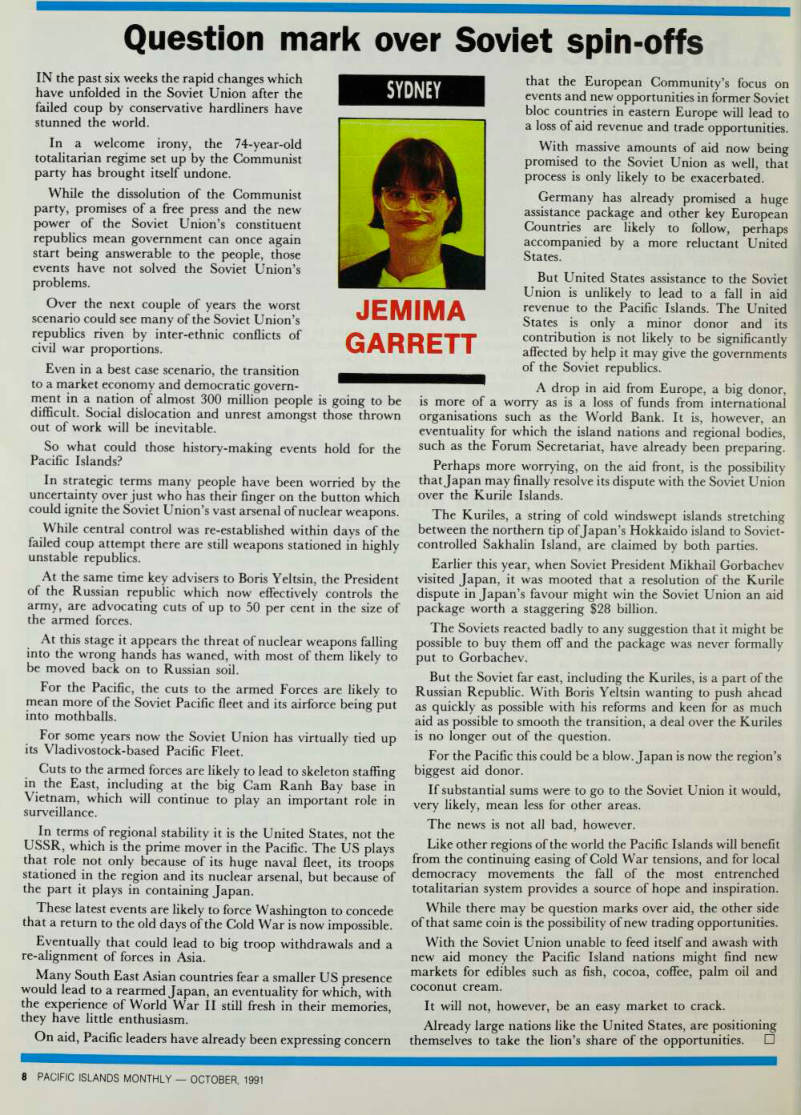
IN the past six weeks the rapid changes which have unfolded in the Soviet Union after the failed coup by conservative hardliners have stunned the world.
In a welcome irony, the 74-year-old totalitarian regime set up by the Communist party has brought itself undone.
While the dissolution of the Communist party, promises of a free press and the new power of the Soviet Union’s constituent republics mean government can once again start being answerable to the people, those events have not solved the Soviet Union’s problems.
Over the next couple of years the worst scenario could see many of the Soviet Union’s republics riven by inter-ethnic conflicts of civil war proportions.
Even in a best case scenario, the transition to a market economy and democratic govern
ment in a nation of almost 300 million people is going to be difficult. Social dislocation and unrest amongst those thrown out of work will be inevitable.
So what could those history-making events hold for the Pacific Islands?
In strategic terms many people have been worried by the uncertainty over just who has their finger on the button which could ignite the Soviet Union’s vast arsenal of nuclear weapons.
While central control was re-established within days of the failed coup attempt there are still weapons stationed in highly unstable republics.
At the same time key advisers to Boris Yeltsin, the President of the Russian republic which now effectively controls the army, are advocating cuts of up to 50 per cent in the size of the armed forces.
At this stage it appears the threat of nuclear weapons falling into the wrong hands has waned, with most of them likely to be moved back on to Russian soil.
For the Pacific, the cuts to the armed Forces are likely to mean more of the Soviet Pacific fleet and its airforce being put into mothballs.
For some years now the Soviet Union has virtually tied up its Vladivostock-based Pacific Fleet.
Cuts to the armed forces are likely to lead to skeleton staffing in the East, including at the big Cam Ranh Bay base in Vietnam, which will continue to play an important role in surveillance.
In terms of regional stability it is the United States, not the USSR, which is the prime mover in the Pacific. The US plays that role not only because of its huge naval fleet, its troops stationed in the region and its nuclear arsenal, but because of the part it plays in containing Japan.
These latest events are likely to force Washington to concede that a return to the old days of the Cold War is now impossible.
Eventually that could lead to big troop withdrawals and a re-alignment of forces in Asia.
Many South East Asian countries fear a smaller US presence would lead to a rearmed Japan, an eventuality for which, with the experience of World War II still fresh in their memories, they have little enthusiasm.
On aid, Pacific leaders have already been expressing concern
that the European Community’s focus on events and new opportunities in former Soviet bloc countries in eastern Europe will lead to a loss of aid revenue and trade opportunities.
With massive amounts of aid now being promised to the Soviet Union as well, that process is only likely to be exacerbated.
Germany has already promised a huge assistance package and other key European Countries are likely to follow, perhaps accompanied by a more reluctant United States.
But United States assistance to the Soviet Union is unlikely to lead to a fall in aid revenue to the Pacific Islands. The United States is only a minor donor and its contribution is not likely to be significantly affected by help it may give the governments of the Soviet republics.
A drop in aid from Europe, a big donor,
is more of a worry as is a loss of funds from international organisations such as the World Bank. It is, however, an eventuality for which the island nations and regional bodies, such as the Forum Secretariat, have already been preparing.
Perhaps more worrying, on the aid front, is the possibility that Japan may finally resolve its dispute with the Soviet Union over the Kurile Islands.
The Kuriles, a string of cold windswept islands stretching between the northern tip ofjapan’s Hokkaido island to Soviet controlled Sakhalin Island, are claimed by both parties.
Earlier this year, when Soviet President Mikhail Gorbachev visited Japan, it was mooted that a resolution of the Kurile dispute in Japan’s favour might win the Soviet Union an aid package worth a staggering $2B billion.
The Soviets reacted badly to any suggestion that it might be possible to buy them off and the package was never formally put to Gorbachev.
But the Soviet far east, including the Kuriles, is a part of the Russian Republic. With Boris Yeltsin wanting to push ahead as quickly as possible with his reforms and keen for as much aid as possible to smooth the transition, a deal over the Kuriles is no longer out of the question.
For the Pacific this could be a blow. Japan is now the region’s biggest aid donor.
If substantial sums were to go to the Soviet Union it would, very likely, mean less for other areas.
The news is not all bad, however.
Like other regions of the world the Pacific Islands will benefit from the continuing easing of Cold War tensions, and for local democracy movements the fall of the most entrenched totalitarian system provides a source of hope and inspiration.
While there may be question marks over aid, the other side of that same coin is the possibility of new trading opportunities.
With the Soviet Union unable to feed itself and awash with new aid money the Pacific Island nations might find new markets for edibles such as fish, cocoa, coffee, palm oil and coconut cream.
It will not, however, be an easy market to crack.
Already large nations like the United States, are positioning themselves to take the lion’s share of the opportunities. □
Sydney
Jemima
Garrett
Advertisements & other items, p. 9 (1 item)
racmcaiiy
We at ANZ are proud to be an Official Sponsor of the South Pacific Games. At ANZ we share a great many of the aims and ideals of the Games. Always striving for excellence through effort and dedication. We too are dedicated to the pursuit of perfection. We too believe in rewards for effort and ability. And above all this, we too believe in the unity of spirit of all of the peoples of the Pacific and in the spirit of friendly competition that draws those people closer together.
Fiji - Your bank
or L Official Sponsor
OQP
9th SOUTH WCIFIC GAMES
fAPUA NEW GUINEA 1991
1992 Olympic Team Top Art
A lifetime of waiting
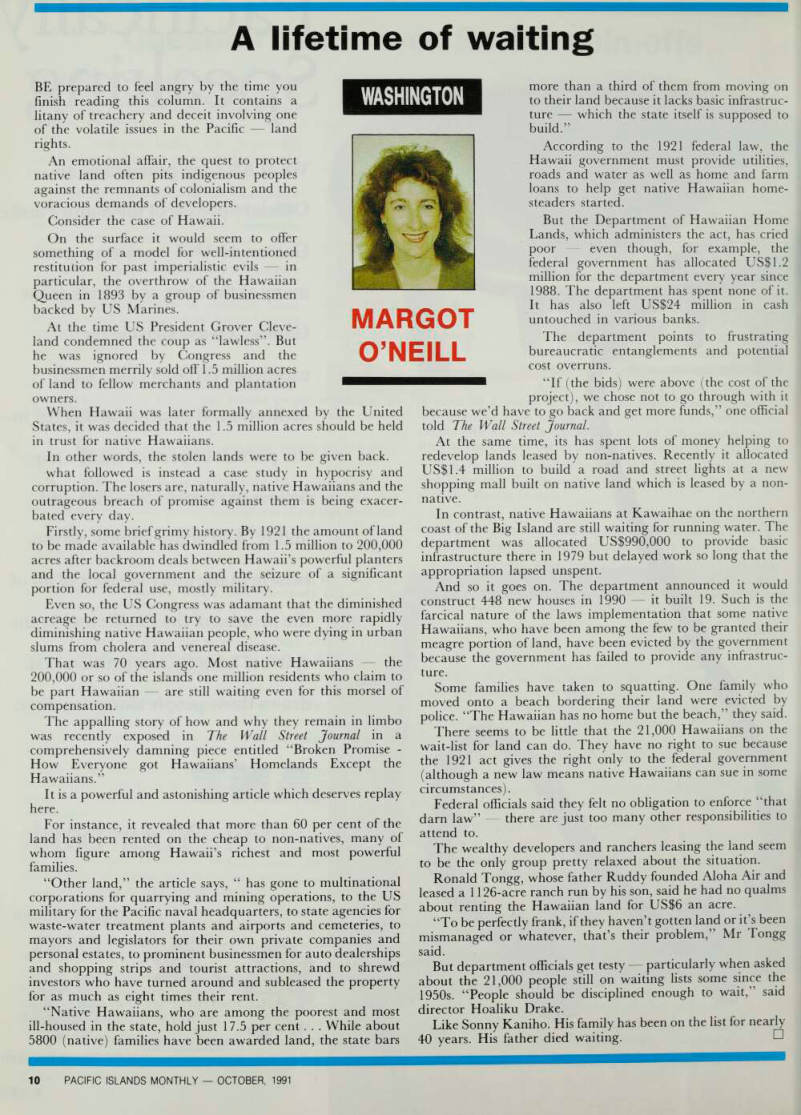
BE prepared to feel angry by the time you finish reading this column. It contains a litany of treachery and deceit involving one of the volatile issues in the Pacific land rights.
An emotional affair, the quest to protect native land often pits indigenous peoples against the remnants of colonialism and the voracious demands of developers.
Consider the case of Hawaii.
On the surface it would seem to offer something of a model for well-intentioned restitution for past imperialistic evils in particular, the overthrow of the Hawaiian Queen in 1893 by a group of businessmen backed by US Marines.
At the time US President Grover Cleve land condemned the coup as “lawless”. But he was ignored by Congress and the businessmen merrily sold off 1.5 million acres of land to fellow merchants and plantation owners.
When Hawaii was later formally annexed by the United States, it was decided that the 1.5 million acres should be held in trust for native Hawaiians.
In other words, the stolen lands were to be given back. what followed is instead a case study in hypocrisy and corruption. The losers are, naturally, native Hawaiians and the outrageous breach of promise against them is being exacer bated every day.
Firstly, some brief grimy history. By 1921 the amount of land to be made available has dwindled from 1.5 million to 200,000 acres after backroom deals between Hawaii’s powerful planters and the local government and the seizure of a significant portion for federal use, mostly military.
Even so, the US Congress was adamant that the diminished acreage be returned to try to save the even more rapidly diminishing native Hawaiian people, who were dying in urban slums from cholera and venereal disease.
That was 70 years ago. Most native Hawaiians the 200,000 or so of the islands one million residents who claim to be part Hawaiian are still waiting even for this morsel of
compensation.
The appalling story of how and why they remain in limbo was recently exposed in The Wall Street Journal in a comprehensively damning piece entitled “Broken Promise - How Everyone got Hawaiians’ Homelands Except the Hawaiians.”
It is a powerful and astonishing article which deserves replay here.
For instance, it revealed that more than 60 per cent of the land has been rented on the cheap to non-natives, many of whom figure among Hawaii’s richest and most powerful families.
“Other land,” the article says, “ has gone to multinational corporations for quarrying and mining operations, to the US military for the Pacific naval headquarters, to state agencies for waste-water treatment plants and airports and cemeteries, to mayors and legislators for their own private companies and personal estates, to prominent businessmen for auto dealerships and shopping strips and tourist attractions, and to shrewd investors who have turned around and subleased the property for as much as eight times their rent.
“Native Hawaiians, who are among the poorest and most ill-housed in the state, hold just 17.5 per cent. . . While about 5800 (native) families have been awarded land, the state bars
more than a third of them from moving on to their land because it lacks basic infrastruc ture which the state itself is supposed to build.”
According to the 1921 federal law, the Hawaii government must provide utilities, roads and water as well as home and farm loans to help get native Hawaiian home steaders started.
But the Department of Hawaiian Home Lands, which administers the act, has cried poor even though, for example, the federal government has allocated US$l.2 million for the department every year since 1988. The department has spent none of it.
It has also left US$24 million in cash untouched in various banks.
The department points to frustrating bureaucratic entanglements and potential cost overruns.
“If (the bids) were above (the cost of the project), we chose not to go through with it
because we’d have to go back and get more funds,” one official told The Wall Street Journal.
At the same time, its has spent lots of money helping to redevelop lands leased by non-natives. Recently it allocated US$l.4 million to build a road and street lights at a new shopping mall built on native land which is leased by a non native.
In contrast, native Hawaiians at Kawaihae on the northern coast of the Big Island are still waiting for running water. The department was allocated U 55990,000 to provide basic infrastructure there in 1979 but delayed work so long that the
appropriation lapsed unspent.
And so it goes on. The department announced it would construct 448 new houses in 1990 it built 19. Such is the farcical nature of the laws implementation that some native Hawaiians, who have been among the few to be granted their meagre portion of land, have been evicted by the government because the government has failed to provide any infrastruc ture.
Some families have taken to squatting. One family who moved onto a beach bordering their land were evicted by police. “The Hawaiian has no home but the beach,” they said.
There seems to be little that the 21,000 Hawaiians on the wait-list for land can do. They have no right to sue because the 1921 act gives the right only to the federal government (although a new law means native Hawaiians can sue in some circumstances).
Federal officials said they felt no obligation to enforce “that darn law” there are just too many other responsibilities to attend to.
The wealthy developers and ranchers leasing the land seem to be the only group pretty relaxed about the situation.
Ronald Tongg, whose father Ruddy founded Aloha Air and leased a 1126-acre ranch run by his son, said he had no qualms about renting the Hawaiian land for US$6 an acre.
“To be perfectly frank, if they haven’t gotten land or it’s been mismanaged or whatever, that’s their problem,” Mr Tongg said.
But department officials get testy particularly when asked about the 21,000 people still on waiting lists some since the 19505. “People should be disciplined enough to wait,” said director Hoaliku Drake.
Like Sonny Kaniho. His family has been on the list for nearly 40 years. His father died waiting. D
Washington
Margot
O’Neill
Over the oil barrel
FINAPECO strikes troubled waters before its first shipment is launched. Penny Gibson reports
THE Fiji Government’s entry into the South Pacific petroleum market seems certain to raise prices for regional countries already burdened with high fuel bills and external debt.
The Fiji National Petroleum Com pany (FINAPECO) was established by Fiji’s interim government in December 1990 to be the sole importer of petroleum products into Fiji, for internal use and supply to smaller regional countries.
Fiji imports 30 per cent of the region’s fuel. The Government-owned company will buy 10,000 barrels a day of crude oil from Malaysia’s PETCO, a division of Petronas Trading Corporation itself a subsidiary of the Malaysian state-owned Petroleum Nasional Berhad. ESSO will refine it in Singapore and ship 210,000 barrels to Fiji each month. FINAPECO expects to import 2.52 million barrels a year, worth about Fslss million.
British Petroleum, Mobil and Shell believe that fuel from FINAPECO will cost them more, so they will charge buyer countries more. The price question and other problems have led them to reassess Fiji as a central depot for shipping fuel to Kiribati, Niue, Tonga, Cook Islands and Tuvalu if they shift their base, regional buyers will face a price rise to cover costs of the move.
FINAPECO has yet to prove itself on the supply question. Its first shipment into Fiji has been delayed by negotiations over the Product Supply Agreement with the oil companies. Unresolved differences include pricing formula, demurrages (costs of staying in port), security for aviation fuels, quality specifications, and some handling and shipping operations.
The Chief Executive of FINAPECO, Akuila Savu, said that when FINAPECO, the oil companies, the Reserve Bank and the Ministry of Finance finalise the price, the way should be clear to resolve other problems.
The question of whether prices will increase and by how much, both in Fiji and regional countries, is not clear.
Savu is confident. “Where costings are available and where comparisons can be made, FINAPECO can bring the prod ucts into Fiji, on an appropriate GIF (Cost, Insurance and Freight) basis, at prices equal to or lower than the oil companies,” he said.
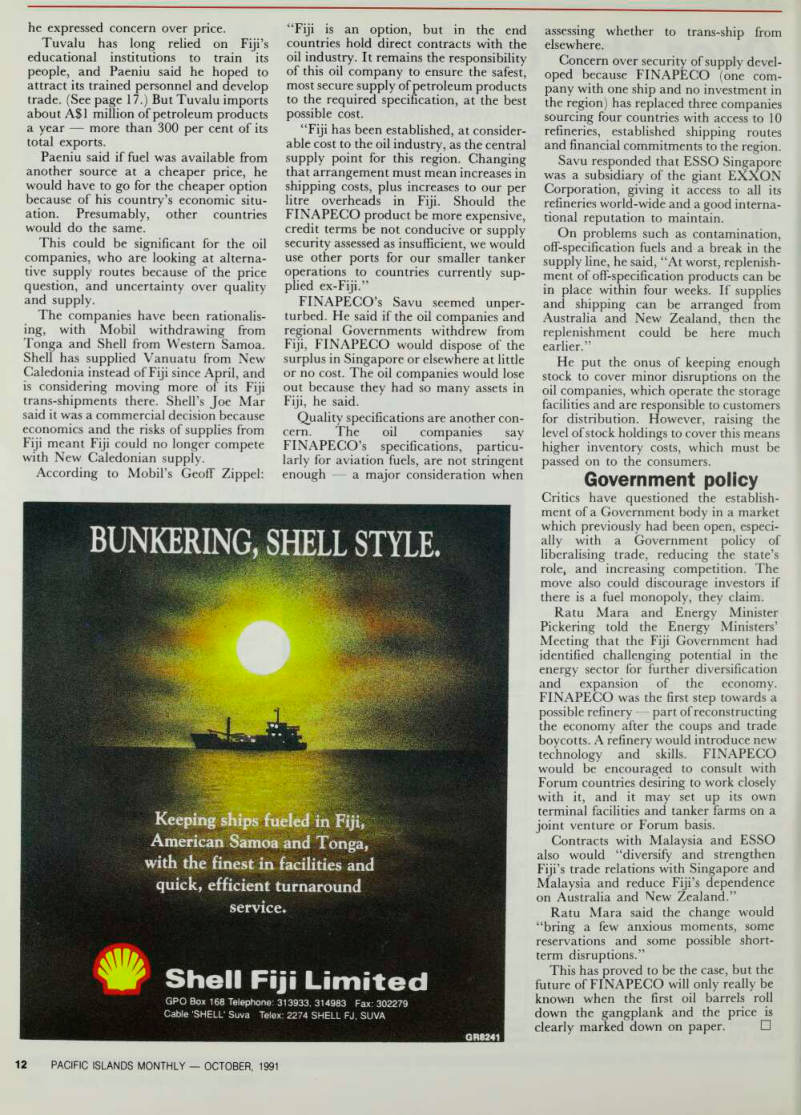
However, the General Manager of Shell Fiji, Joe Mar, questions this.
“If it was such a good deal (from ESSO) how come we are still negotiating for a more competitive set of prices ten months later?”
Fiji’s Minister for Finance, Josevata Kamikamica, is on record as saying prices should not be higher in Fiji and if FINAPECO made a profit, it would be passed on to consumers through reduced fuel tax, currently about 50 per cent of the bowser price. PIM understands this
is unlikely in the short-term.
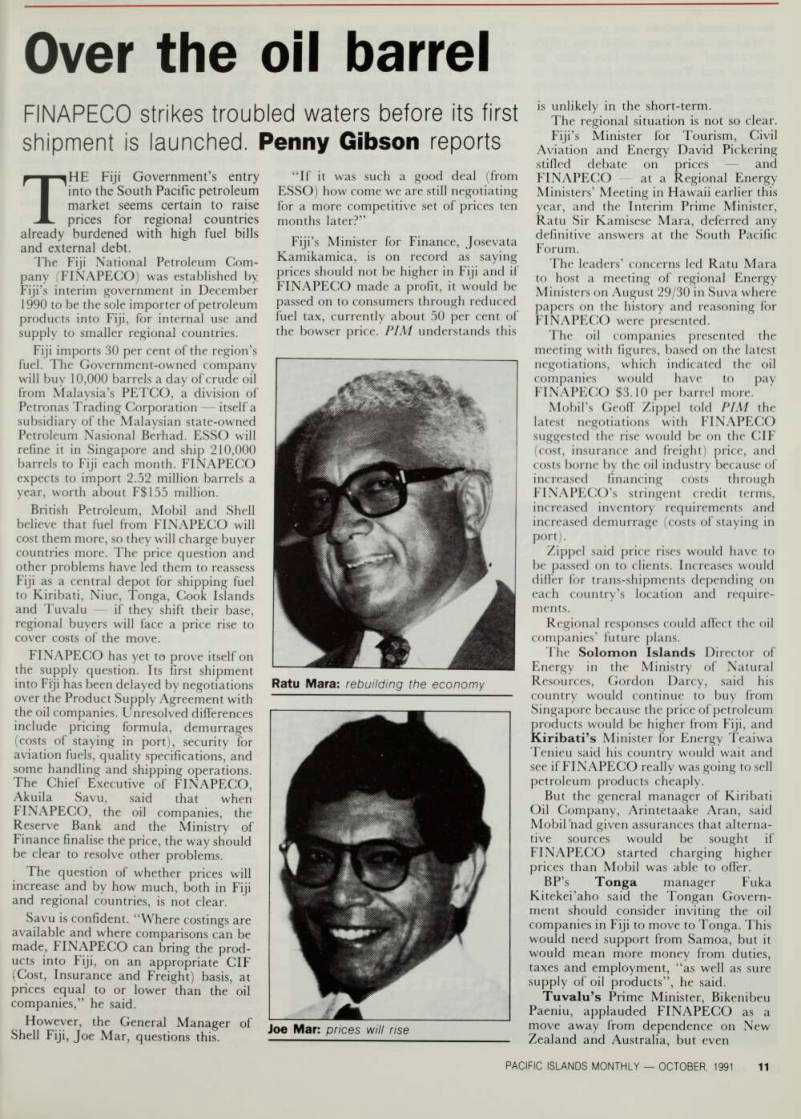
The regional situation is not so clear, Fiji’s Minister for Tourism, Civil Aviation and Energy David Pickering stifled debate on prices and FINAPECO at a Regional Energy Ministers’ Meeting in Hawaii earlier this year, and the Interim Prime Minister, Ratu Sir Kamisese Mara, deferred any definitive answers at the South Pacific Forum.
The leaders’ concerns led Ratu Mara to host a meeting of regional Energy Ministers on August 29/30 in Suva where papers on the history and reasoning for FINAPECO were presented.
The oil companies presented the meeting with figures, based on the latest negotiations, which indicated the oil companies would have to pay FINAPECO $3.10 per barrel more.
Mobil’s Geoff Zippel told PIM the latest negotiations with FINAPECO suggested the rise would be on the GIF (cost, insurance and freight) price, and costs borne by the oil industry because of increased financing costs through FINAPECO’s stringent credit terms, increased inventory requirements and increased demurrage (costs of staying in port).
Zippel said price rises would have to be passed on to clients. Increases would differ for trans-shipments depending on each country’s location and require ments.
Regional responses could affect the oil companies’ future plans.
The Solomon Islands Director of Energy in the Ministry of Natural Resources, Gordon Darcy, said his country would continue to buy from Singapore because the price of petroleum products would be higher from Fiji, and Kiribati’s Minister for Energy Teaiwa Tenieu said his country would wait and see if FINAPECO really was going to sell petroleum products cheaply.
But the general manager of Kiribati Oil Company, Arintetaake Aran, said Mobilnad given assurances that alterna tive sources would be sought if FINAPECO started charging higher prices than Mobil was able to offer.
BP’s Tonga manager Fuka Kitekei’aho said the Tongan Govern ment should consider inviting the oil companies in Fiji to move to Tonga. This would need support from Samoa, but it would mean more money from duties, taxes and employment, “as well as sure supply of oil products”, he said.
Tuvalu’s Prime Minister, Bikenibeu Paeniu, applauded FINAPECO as a move away from dependence on New Zealand and Australia, but even
Ratu Mara: rebuilding the economy
Joe Mar: prices will rise
he expressed concern over price.
Tuvalu has long relied on Fiji’s educational institutions to train its people, and Paeniu said he hoped to attract its trained personnel and develop trade. (See page 17.) But Tuvalu imports about ASI million of petroleum products a year more than 300 per cent of its total exports.
Paeniu said if fuel was available from another source at a cheaper price, he would have to go for the cheaper option because of his country’s economic situ ation. Presumably, other countries would do the same.
This could be significant for the oil companies, who are looking at alterna tive supply routes because of the price question, and uncertainty over quality
and supply.
The companies have been rationalis ing, with Mobil withdrawing from Tonga and Shell from Western Samoa.
Shell has supplied Vanuatu from New Caledonia instead of Fiji since April, and is considering moving more of its Fiji trans-shipments there. Shell’s Joe Mar said it was a commercial decision because economics and the risks of supplies from Fiji meant Fiji could no longer compete with New Caledonian supply.
According to Mobil’s Geoff Zippel:
“Fiji is an option, but in the end countries hold direct contracts with the oil industry. It remains the responsibility of this oil company to ensure the safest, most secure supply of petroleum products to the required specification, at the best
possible cost.
“Fiji has been established, at consider able cost to the oil industry, as the central
supply point for this region. Changing
that arrangement must mean increases in shipping costs, plus increases to our per litre overheads in Fiji. Should the FINAPECO product be more expensive, credit terms be not conducive or supply security assessed as insufficient, we would use other ports for our smaller tanker operations to countries currently sup
plied ex-Fiji.”
FINAPECO’s Savu seemed unper turbed. He said if the oil companies and regional Governments withdrew from Fiji, FINAPECO would dispose of the surplus in Singapore or elsewhere at little or no cost. The oil companies would lose out because they had so many assets in Fiji, he said.
Quality specifications are another con cern. The oil companies say
FINAPECO’s specifications, particu
larly for aviation fuels, are not stringent enough a major consideration when
assessing whether to trans-ship from elsewhere.
Concern over security of supply devel oped because FINAPECO (one com pany with one ship and no investment in the region) has replaced three companies sourcing four countries with access to 10 refineries, established shipping routes and financial commitments to the region.
Savu responded that ESSO Singapore was a subsidiary of the giant EXXON Corporation, giving it access to all its refineries world-wide and a good interna tional reputation to maintain.
On problems such as contamination, off-specification fuels and a break in the supply line, he said, “At worst, replenish ment of off-specification products can be in place within four weeks. If supplies and shipping can be arranged from Australia and New Zealand, then the replenishment could be here much earlier.”
He put the onus of keeping enough stock to cover minor disruptions on the oil companies, which operate the storage facilities and are responsible to customers for distribution. However, raising the level of stock holdings to cover this means higher inventory costs, which must be passed on to the consumers.
Government policy
Critics have questioned the establish ment of a Government body in a market which previously had been open, especi ally with a Government policy of liberalising trade, reducing the state’s role, and increasing competition. The move also could discourage investors if there is a fuel monopoly, they claim.
Ratu Mara and Energy Minister Pickering told the Energy Ministers’
Meeting that the Fiji Government had identified challenging potential in the energy sector for further diversification and expansion of the economy.
FINAPECO was the first step towards a possible refinery part of reconstructing the economy after the coups and trade boycotts. A refinery would introduce new technology and skills. FINAPECO would be encouraged to consult with Forum countries desiring to work closely with it, and it may set up its own terminal facilities and tanker farms on a joint venture or Forum basis.
Contracts with Malaysia and ESSO also would “diversify and strengthen Fiji’s trade relations with Singapore and Malaysia and reduce Fiji’s dependence on Australia and New Zealand.”
Ratu Mara said the change would “bring a few anxious moments, some reservations and some possible short
term disruptions.”
This has proved to be the case, but the future of FINAPECO will only really be known when the first oil barrels roll down the gangplank and the price is clearly marked down on paper. □
Advertisements & other items, p. 12 (1 item)
Bunkering, Shell Style.
' Keeping ships fueled in Fiji, American Samoa and Tonga, with the finest in facilities and quick, efficient turnaround service.
Shell Fiji Limited
GPO Box 168 Telephone: 313933. 314983 Fax: 302279 Cable ’SHELL’ Suva Telex: 2274 SHELL FJ, SUVA GR8241
No gold stars for the
The Region
No gold stars for the Prince and the nobles
“Some view him (the Crown Prince of Tonga) as too Westernised, too often away from home, and too interested in women some of whom the King does not approve.”
“Ministers travel frequently and usually first class, which entitles them to US$7OO per diem in the Unites States. Allegedly one received $200,000 in travel expenses in one year alone.”
“The Wesleyans resent the Mormons and accuse them of ‘buying members’ because of their recruitment activities.”
WHO is writing these things? A sensational supermarket tab loid? An enflamed political opponent of Tonga’s Estab lishment?
None of the above. The quotations are from a report submitted to America’s Pentagon by a highly respected US think tank, the Rand Corporation. Labeled “A Rand Note” and entitled The Kingdom of Tonga , it was written by George K.
Tanham and was, according to its preface, “sponsored by the Office of the Secretary of Defence ... (as) part of a larger study on security trends in the South Pacific.”
California-based Rand, a multi million dollar non-profit entity, was for decades the brains behind the US Air Force. It later expanded into social science and foreign relations. Its findings are taken seriously in Washington.
Tanham’s report, written in 1988 but having limited circulation until now, criticises Tonga’s government and de spairs for the nation’s future.
The report is gentle with the King, Taufau’ahau Tupou IV, who is “liked and respected. He is the country’s traditional spiritual leader and head of the Free Wesley Church, the kingdom’s official church.”
It is harsher on the Crown Prince and the nobles. The former “disturbs his father . . . and perhaps even violates the law when he goes out on Sundays to a small island to enjoy himself with his friends. The sabbath is a legal day of rest in Tonga and no commercial activities or entertainment are allowed.”
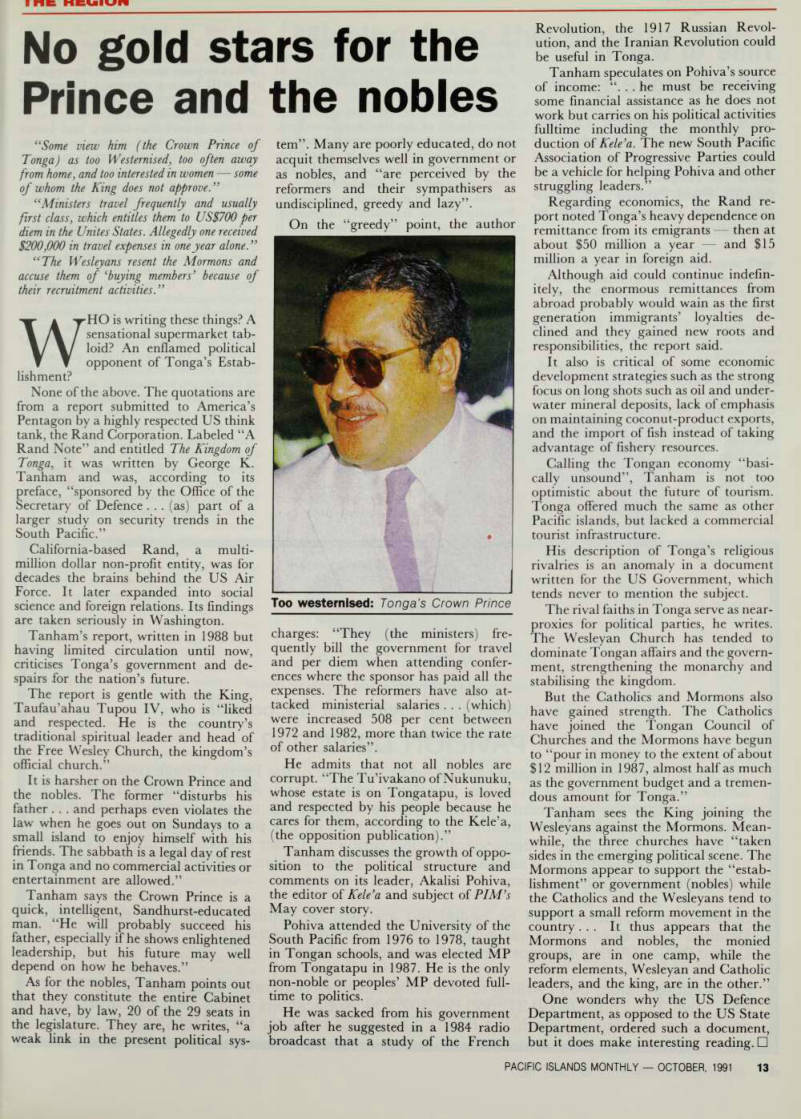
Tanham says the Crown Prince is a
quick, intelligent, Sandhurst-educated
man. “He will probably succeed his father, especially if he shows enlightened leadership, but his future may well depend on how he behaves.”
As for the nobles, Tanham points out that they constitute the entire Cabinet and have, by law, 20 of the 29 seats in the legislature. They are, he writes, “a weak link in the present political sys
tern”. Many are poorly educated, do not acquit themselves well in government or as nobles, and “are perceived by the reformers and their sympathisers as undisciplined, greedy and lazy”.
On the “greedy” point, the author
charges: “They (the ministers) fre quently bill the government for travel and per diem when attending confer ences where the sponsor has paid all the expenses. The reformers have also at tacked ministerial salaries .. . (which) were increased 508 per cent between 1972 and 1982, more than twice the rate of other salaries”.
He admits that not all nobles are corrupt. “The Tu’ivakano ofNukunuku, whose estate is on Tongatapu, is loved and respected by his people because he cares for them, according to the Kele’a, (the opposition publication).”
Tanham discusses the growth of oppo sition to the political structure and comments on its leader, Akalisi Pohiva, the editor of Kele’a and subject of PlM’s May cover story.
Pohiva attended the University of the South Pacific from 1976 to 1978, taught in Tongan schools, and was elected MP from Tongatapu in 1987. He is the only non-noble or peoples’ MP devoted full time to politics.
He was sacked from his government job after he suggested in a 1984 radio broadcast that a study of the French
Revolution, the 1917 Russian Revol ution, and the Iranian Revolution could be useful in Tonga.
Tanham speculates on Pohiva’s source of income: . . he must be receiving some financial assistance as he does not work but carries on his political activities fulltime including the monthly pro duction of Kele’a. The new South Pacific Association of Progressive Parties could be a vehicle for helping Pohiva and other struggling leaders.”
Regarding economics, the Rand re port noted Tonga’s heavy dependence on remittance from its emigrants then at about $5O million a year and $l5 million a year in foreign aid.
Although aid could continue indefin itely, the enormous remittances from abroad probably would wain as the first
generation immigrants’ loyalties de
clined and they gained new roots and responsibilities, the report said.
It also is critical of some economic development strategies such as the strong focus on long shots such as oil and under water mineral deposits, lack of emphasis on maintaining coconut-product exports, and the import of fish instead of taking advantage of fishery resources.
Calling the Tongan economy “basi cally unsound”, Tanham is not too optimistic about the future of tourism.
Tonga offered much the same as other Pacific islands, but lacked a commercial tourist infrastructure.
His description of Tonga’s religious rivalries is an anomaly in a document written for the US Government, which tends never to mention the subject.
The rival faiths in Tonga serve as near
proxies for political parties, he writes.
The Wesleyan Church has tended to dominate Tongan affairs and the govern ment, strengthening the monarchy and stabilising the kingdom.
But the Catholics and Mormons also have gained strength. The Catholics have joined the Tongan Council of Churches and the Mormons have begun to “pour in money to the extent of about $l2 million in 1987, almost half as much as the government budget and a tremen dous amount for Tonga.”
Tanham sees the King joining the Wesleyans against the Mormons. Mean while, the three churches have “taken sides in the emerging political scene. The Mormons appear to support the “estab lishment” or government (nobles) while the Catholics and the Wesleyans tend to support a small reform movement in the country... It thus appears that the Mormons and nobles, the monied groups, are in one camp, while the reform elements, Wesleyan and Catholic leaders, and the king, are in the other.”
One wonders why the US Defence Department, as opposed to the US State Department, ordered such a document, but it does make interesting reading. □
Too westernised: Tonga's Crown Prince
Time to watch
the manioke grow
HRH Prince Fatafehi Tu’ipei ehake, Prime Minister of Tonga for over 25 years , re tired on August 21 due to Hi health. Pesi Fonua spoke to the Prince on the first day of his retirement.
IT must have been a very difficult decision for you to make, to step down as Prime Minister and go into retirement.
It was not difficult, I made the decision when I finally realised that I was getting very weak physically.
What are some of the major devel opments which have taken place in the region and in Tonga while you were Prime Minister?
I think some of the major develop ments have been our becoming indepen dent from Britain, and the increasing amount of aid we are receiving from foreign countries. And more recently is the marked increase of the Japanese aid to Tonga, in the building of primary
schools, the Nuku’alofa foreshore, and the roads, and there is still more to come.
I am not claiming responsibility for all these because it was already set in motion by Tupou IV when he was Prime Minister. When we were no longer under the umbrella of the British government, it became known by the world that we are independent, and we are responsible for whatever we are doing. I think those
were very important developments.
With regard to the South Pacific Forum, it was started by Tamasese, Albert Henry and myself. We started it here in the first meeting of the Forum at the Dateline Hotel. We were the foun dation members.
Has the Forum changed its course?
The reason why we established the Forum was because we knew that once countries in the region become indepen dent they would have to move out from the South Pacific Commission (SPC) and therefore there was a need to form another group for the independent countries of the region. In the SPC the power was still vested with the colonial powers, but in the Forum we were independent to discuss and to criticise issues which are of importance to us and the region. One new change that has been made by the Forum was the formation of the Forum Fisheries Agency. It was realised that there is a
need for a body to represent the whole region.
What is your view on the theory that we will have a stronger Cabinet if Cabinet members are representa tives elected by the people?
I am against that theory, and I may be against the wishes of some people, but I would like to point out that this is probably the best system for Tonga.
There are not many of us who have a clear understanding of what is going on beyond Tonga. Our local politicians are only good enough within Tonga, when we move out to the international arena I think this is the best approach for government to call in only our capable people. We realise that most of our people have left for overseas. There may be somebody who is very very clever but he does not want to come back.
What is Tonga’s economic position?
We are in a very stable position ...
Before we used to say that if we had a lot of foreign reserve then our economy was sound, but now we have discovered that even if our foreign reserve is high we still need to get out and build the country.
The choice is whether to have the chicken or the egg first. Also the Treasury must file a monthly report on the state of our economy to the Privy Council, and that will enable govern ment to keep a close watch.
What do you think is the best system for us to adopt?
One thing that we should always remember is that no-one else knows what is best for us other than ourselves. We all talk about democracy but we do not know what it looks like. It has a different shape and a different colour for different countries ... Here it is different, people are just going about in their daily lives, and when the breadfruit is in season they are very happy. I do not know what would you call that, carefree or what, but you can’t talk to people like that about democracy.
On the land issue, there was a Royal Land Commission. Has there been any definite move to change our present land tenure?
I think the important thing that has happened while I was the Minister of Land, is that the whole country was divided up into plots and distributed to the people, and you probably know just as well as I do, that there is still a lot of uncultivated land around the place. In Tongatapu alone there are about 10,000 registered tax allotments.
About two or three years ago when we were trying to revive the banana indus try, there were less than 2000 growers who were interested. What is happening to the rest? So it is difficult for us to say that landlessness is causing the poverty of the people. The same question can be applied to the squash growers. There are only about 1000 squash growers, but what happened to the rest?
It appears that we do not really know which direction we are going do we want to embrace modernisation or not?
Do we want to get into tourism or not?
Because Tongans do not like serving other people, and it seems they do not want anybody pressuring them to do anything. Looking at it in general, I think Tonga is one place where the average citizen has a reasonable stan dard of living . . . the Tongans who know how to make use of their freedom and independence are better off.
I think we are only just beginning to see the results of our education system.
Education has been compulsory in Tonga for over 100 years ... In pro portion to our population we have more university graduates than any other country in the South Pacific.
What are your retirement plans?
I will be very happy to be in the plantation and watch the manioke grow ing (laughs). I would much prefer to do that than to be in town. I think I have spent too many years in an office. □ The King has appointed his cousin, Baron Vaea, as Prime Minister. Baron Vaea has been an aide-de-camp for Queen Salote Tupou 111, a former Governor of Ha’apai, the first Tongan High Commission to the UK, Minister of Labour Commerce and Industries, Minister of Tourism, and presently is first chairman of the board of the National Reserve Bank of Tonga.
Advertisements & other items, p. 14 (1 item)
Pavilion Director
PACIFIC EXPO 92
THE PACIFIC ISLAND COUNTRIES AT SEVILLE UNIVERSAL EXPO 92 Applications are invited for the post of
The work involves the management and administration of the Pacific Village pavilion at the Seville Universal Expo 92 in Spain. The Expo will run from April to October 1992. It is envisaged that the successful applicant will be engaged for up to 12 months, of which approximately the first three months will be spent in Fiji. The position requires a high level of initiative, a capacity to independently solve problems under stressful circumstances and an ability to deal effectively with a wide variety of people from different cultures, many of whom occupy senior positions.
Salaries and conditions will be negotiated and will be commensurate with experience.
Detailed terms of reference are available from the Forum Secretariat please contact Mr Dennis Miller, Acting Director, Trade & Investment Division.
Applications should be in writing to The Commissioner General, Pacific Expo 92, GPO Box 856, Suva, Fiji, Phone (679) 312600 Fax 302 204. Applications will be dealt with in strictest confidence and should reach the Forum Secretariat not later than 31st October 1991. 106291v2
Missing from the climate map
By David Robie
ONE big thing was missing at
last month’s South Pacific Environments conference in New Zealand the Pacific.
When it came to the greenhouse effect, the region wasn’t on the map.
Some delegates were stunned when Professor Ann Henderson-Sellers, direc tor of the Climatic Impacts Centre at Macquarie University, Sydney, said that virtually all 30 nations represented at the conference were missing from computer models of the world climate.
None of the island states were there, nor was New Zealand. The reason? The models on even the most advanced super-computers break the world into 500-kilometre squares, missing the tiny islands and atolls of the Pacific. The crude model representations are due to
the large number of climatic variables needed for the com puter formula.
However, the roughness of the models does not dis prove the green house theory.
Professor Hen derson-Sellers said the Intergovern mental Panel on Climate Changes (IPCC) report indi cated “that emiss ions resulting from human activities are substantially in creasing the atmos pheric concen trations of the greenhouse gases carbon dioxide, methane, chloro fluorocarbons and
nitrous oxides and that these in creases will cause an additional warm ing of the Earth’s surface; that current models predict a one-degree Celsius increase in temperature above 1990 temperatures by 2025, and a three degree Celsius increase in temperature by 2100 ... we calculate with confidence that immediate reductions of over 60 per cent would achieve atmospheric stabil isation at the level of equivalent doub ling of carbon dioxide over pre industrial levels by 2100.”
Some delegates at Auckland Univer sity criticised the “doomsday” scenarios that global warming and rising oceans would engulf low-lying atoll nations
such as Kiribati and Tuvalu by early next century.
Professor Roger McLean, a New Zealand geographer attached to the Australian Defence Force Academy, believes that most Pacific islands will still be above the sea in 100 years. He stressed the coral base of atolls coral needs water to grow and, as the sea rises, so would the land. He based his argument on evidence gathered in eastern Polynesia, where many islands have survived big rises in the sea level caused by changes in ocean currents.
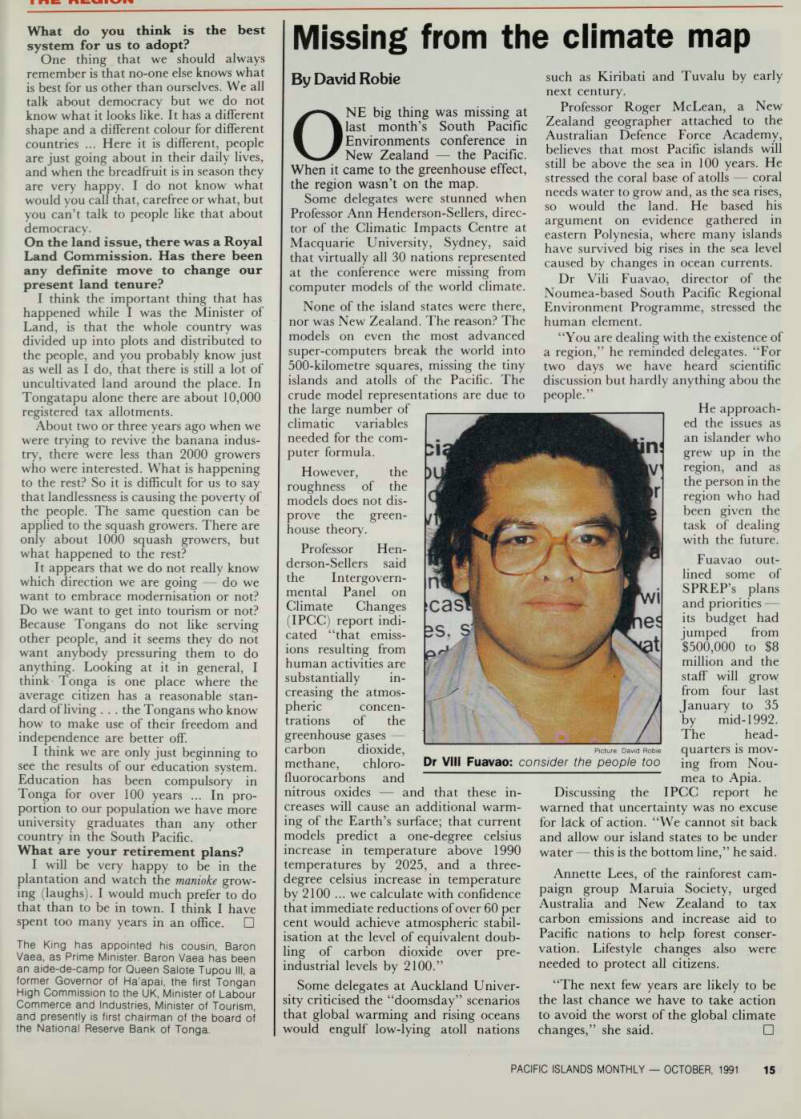
Dr Vili Fuavao, director of the Noumea-based South Pacific Regional Environment Programme, stressed the human element.
“You are dealing with the existence of a region,” he reminded delegates. “For two days we have heard scientific discussion but hardly anything abou the people.”
He approach
ed the issues as an islander who grew up in the region, and as the person in the region who had been given the task of dealing with the future.
Fuavao out lined some of SPREP’s plans
and priorities
its budget had
jumped from
5500,000 to S 8 million and the staff will grow from four last January to 35 by mid-1992.
The head quarters is mov ing from Nou mea to Apia.
Discussing the IPCC report he warned that uncertainty was no excuse for lack of action. “We cannot sit back and allow our island states to be under water this is the bottom line,” he said.
Annette Lees, of the rainforest cam paign group Maruia Society, urged Australia and New Zealand to tax carbon emissions and increase aid to Pacific nations to help forest conser vation. Lifestyle changes also were needed to protect all citizens.
“The next few years are likely to be the last chance we have to take action to avoid the worst of the global climate changes,” she said. □
Picture: David Robie Dr Vili Fuavao: consider the people too
Rumble of republicanism
IN Tuvalu, the Government of Bikenibeu Paeniu emerged un scathed from their recent Parlia
mentary sitting, despite intensive
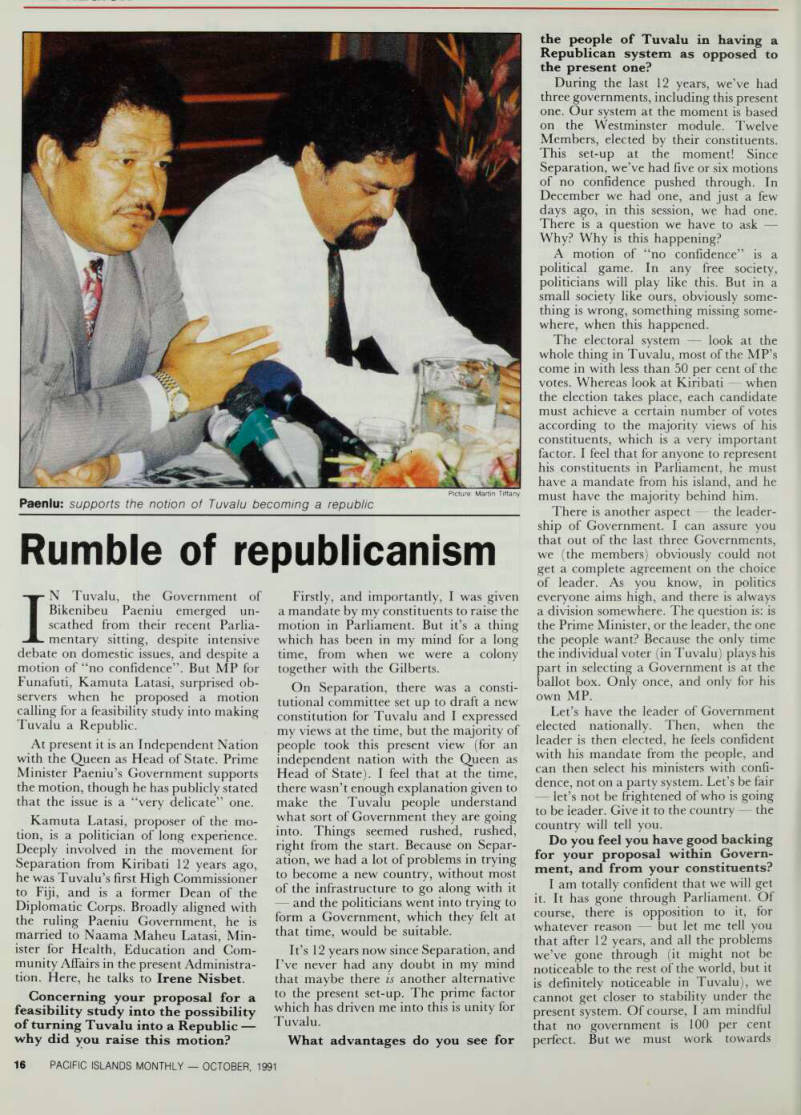
debate on domestic issues, and despite a motion of “no confidence”. But MP for Funafuti, Kamuta Latasi, surprised ob servers when he proposed a motion calling for a feasibility study into making Tuvalu a Republic.
At present it is an Independent Nation with the Queen as Head of State. Prime Minister Paeniu’s Government supports the motion, though he has publicly stated that the issue is a “very delicate” one.
Kamuta Latasi, proposer of the mo tion, is a politician of long experience.
Deeply involved in the movement for Separation from Kiribati 12 years ago, he was Tuvalu’s first High Commissioner to Fiji, and is a former Dean of the Diplomatic Corps. Broadly aligned with the ruling Paeniu Government, he is married to Naama Maheu Latasi, Min ister for Health, Education and Com munity Affairs in the present Administra tion. Here, he talks to Irene Nisbet.
Concerning your proposal for a feasibility study into the possibility of turning Tuvalu into a Republic why did you raise this motion?
Firstly, and importantly, I was given
a mandate by my constituents to raise the motion in Parliament. But it’s a thing which has been in my mind for a long time, from when we were a colony together with the Gilberts.
On Separation, there was a consti tutional committee set up to draft a new constitution for Tuvalu and I expressed my views at the time, but the majority of people took this present view (for an independent nation with the Queen as Head of State). I feel that at the time, there wasn’t enough explanation given to make the Tuvalu people understand what sort of Government they are going into. Things seemed rushed, rushed, right from the start. Because on Separ ation, we had a lot of problems in trying to become a new country, without most of the infrastructure to go along with it and the politicians went into trying to form a Government, which they felt at that time, would be suitable.
It’s 12 years now since Separation, and I’ve never had any doubt in my mind that maybe there is another alternative to the present set-up. The prime factor which has driven me into this is unity for Tuvalu.
What advantages do you see for
the people of Tuvalu in having a Republican system as opposed to the present one?
During the last 12 years, we’ve had three governments, including this present one. Our system at the moment is based on the Westminster module. Twelve Members, elected by their constituents.
This set-up at the moment! Since Separation, we’ve had five or six motions of no confidence pushed through. In December we had one, and just a few days ago, in this session, we had one.
There is a question we have to ask Why? Why is this happening?
A motion of “no confidence” is a political game. In any free society, politicians will play like this. But in a small society like ours, obviously some thing is wrong, something missing some where, when this happened.
The electoral system look at the whole thing in Tuvalu, most of the MP’s come in with less than 50 per cent of the votes. Whereas look at Kiribati when the election takes place, each candidate must achieve a certain number of votes according to the majority views of his constituents, which is a very important factor. I feel that for anyone to represent his constituents in Parliament, he must have a mandate from his island, and he must have the majority behind him.
There is another aspect - the leader ship of Government. I can assure you that out of the last three Governments, we (the members) obviously could not get a complete agreement on the choice of leader. As you know, in politics everyone aims high, and there is always a division somewhere. The question is: is the Prime Minister, or the leader, the one the people want? Because the only time the individual voter (in Tuvalu) plays his part in selecting a Government is at the ballot box. Only once, and only for his own MP.
Let’s have the leader of Government elected nationally. Then, when the leader is then elected, he feels confident with his mandate from the people, and can then select his ministers with confi dence, not on a party system. Let’s be fair let’s not be frightened of who is going to be leader. Give it to the country the country will tell you.
Do you feel you have good backing for your proposal within Govern ment, and from your constituents?
I am totally confident that we will get it. It has gone through Parliament. Of course, there is opposition to it, for whatever reason but let me tell you that after 12 years, and all the problems we’ve gone through (it might not be noticeable to the rest of the world, but it is definitely noticeable in Tuvalu), we cannot get closer to stability under the present system. Of course, I am mindful that no government is 100 per cent perfect. But we must work towards
Picture: Marlin Tiffany Paenlu: supports the notion of Tuvalu becoming a republic
something that is closer, and more acceptable to the people.
If the report is ready by the next Parliamentary sitting, where do you go from there?
I hope that the Government will meet the target date. Of course I would not put the Government into an awkward position, but if it’s ready for the first sitting in 1992 and it shows that the people agree to my suggestion as ap proved by Parliament at this stage, then the plan I feel is right is that we have to endorse in Parliament that we will accept a Republican type of democracy. If that happens, obviously a new Constitution has to be written. If the people say “yes”, we will try to work the programme so that the next general elections will be based on the new Constitution. As you see from my motion, I requested that government consult as widely as possible inside and outside Tuvalu. What I have in mind is that we get some experts and consultants in so that the whole thing is properly worked out, and not rushed into. If it happens that the report is not ready by the last session, I won’t mind, provided that the chance has been given as widely as possible for the people to give their views. In my own mind, it wouldn’t require a drastic change in the consti tution. I hope the constitution would be based on something like the module in Kiribati, where candidates for the lead ership are chosen by the people.
Do you think that changing to a Republican system would alter the way in which traditional aid donors like Australia, Britain and New Zealand would view Tuvalu?
I do not think that our traditional friends, aid donors, would look at it in this way, that for us to give up the Queen as Head of State would cause them any problems. The move to a Republic is purely for the stability of the country.
Look at the Commonwealth there are 48 members, and only 16 have the Queen as Head of State. I do not want this to be misinterpreted. As everyone knows, our main aid comes from our good friends, and I hope that for us to become a Republic would not in any way be interpreted as a rejection of them. But they have to look, and understand the situation we are in.
There is another important point that is, concerning the position of the Governor-General (in Tuvaluan so ciety). Already, we are a small poor country with many problems. The financial burden of having a representa tive of the Queen the British are not prepared to pay for maintaining the Representative, and it’s costing us a great deal of money every year, which could be utilised elsewhere. Also we want to eliminate feelings of discontent maybe jealousy is too strong a word amongst the islands of Tuvalu concerning the
appointment... I don’t think that this (system) is all that workable or import ant right now. The fact is that Tuvalu is independent. If Tuvalu can handle her own internal affairs, why do we have to have a Governor-General? ... To elim inate all this, we must turn into a Republic, and change the Constitution, and the model of self-Government at which we are aiming.
Do Tuvaluans still tend to think of their island first, and national
identity second?
My personal view is that very few politicians classify national interests first, and island interest second. The trend I have seen is always island interests first.
It will take time for people to feel, “we are Tuvaluan People” instead of “We are Funafuti, or Namumanga, or Vaitupu people”. Each island has its own pride, of course and individual traditions must be preserved. But everyone must take the national interest first.
Dr Tomasi Pua Pua, Leader of the Opposition, has said that he be lieves the people of Tuvalu “prefer the kind of Democracy presently used in the Country”. How do you view his comments is he out of touch with public opinion?
Of course, I don’t speak for him, but as I said to him in Parliament, “Look, why do you object to this motion? There
is one question you have to answer are you frightened to go to the electors?” I think he may be out of touch. He’s very popular in his own constituency (Vaitupu) but a politician who’s fright ened to go to the people well, there is obviously something wrong somewhere.
Where do you see your own role and future in a newly-created Re public of Tuvalu?
At the moment, I am seriously con sidering bowing out from politics at the end of the present Parliament term, but if my constituents still want me to represent them, then I have to get over the first hurdle just like anyone else. It may be wrong, but I think I know what your question implies. Who doesn’t want to be at the top? But there are certain limits which one has to know of oneself before going into it it’s not just as simple as becoming President, you know.
You have to go through the process.
Changing to a Republic does not change much in relation to the election of members based on a democratic system . . . Even though the present sys tem is democratic, I feel that it hasn’t gone far enough to achieve what democ racy really is in our society. In Parlia ment, we must look, and make sure that the national interest is served first.
Because uppermost, at all times in my mind, is trying to get as close as possible to the wishes of the people. □
A future ... of fish,
sheep and taxes
By Beryl Cook
TUVALU’S Prime Minister Bikenibeu Paeniu voiced thanks for the past and hopes for the future during his visit to Fiji last month.
Paeniu said Fiji was Tuvalu’s gateway to the rest of the world, it was Tuvalu’s biggest trading partner, and he hoped to develop this trade further. Fiji had helped educate and train his people, and he hoped it also would supply trained and professional people, he said.
Big catch in fishing
While in Fiji, Paeniu signed a $950,000 fisheries aid package deal with United States Ambassador Evelyn Teegen. This deal was mainly for marketing and pilot projects to develop sea resources for domestic and export markets, and would mainly cover deep sea snapper projects.
But Prime Minister Paeniu also has hopes for Tuvalu’s skipjack, yellowfin and bigeye tuna. He expressed a hope
Fiji’s Pacific Fishing Company
(PAFCO) might fish in Tuvalu waters, as it did in the Solomon Islands, to take
up the demand which Fiji waters could not satisfy. This may be particularly attractive to PAFCO in the tuna off season in Fiji. Paeniu said this arrange ment could boost employment for Tu valu’s population of 8400.
On the sheep trail There was more than a multitude of fish on Paeniu’s mind. He also was impressed
with the sheep-rearing project on Fiji’s
Makogai island. The no-wool sheep, which are suitable to hot climates, probably could survive on Tuvalu’s flat lands provided the grass was available.
This had definite potential as a way to expand Tuvalu’s agriculture, he said.
New tax likely Diverting from the natural wonders of the world, Paeniu turned to Fiji’s Value Added Tax proposal. He was as decisive on the touchy tax topic as he was on Fiji’s
petroleum supply plans (see page 12).
Regarding VAT, he said he would like to see it introduced in Tuvalu “as soon as possible”.
“This tax system, which is a fair one, could help our low income-earning civil servants, who’d have their income tax reduced,” he said. “By lowering income tax the dollar would be worth more to them and at the same time create more income and revenue from tax by diver sifying the tax base.” □
Death penalty
passed in PNG
THE Papua New Guinea parlia ment voted 48 to 19 on August 28 to impose the death penalty for violent crimes, including murder, rape and pack rape. The new law was part of an anti-lawlessness package announced by Prime Minister Rabbie Namaliu in May. Amnesty International condemned the penalty and said no scientific proof existed to show it would be a deterrent.
Rabuka visit opposed AN invitation to Fiji coup leader Sitiveni Rabuka to address a media conferehce in New Zealand this month has sparked opposition from some newspapers and journalists. The Pacific Islands News Association, which represents owners, broadcasters and publishers, said the visit would give journalists a chance to interview a “controversial person whose actions had a profound, lasting impact” on the region. The Pacific Journalists’
Association, which represents working journalists in the region, condemned it because Major-General Rabuka had suspended media freedoms during the coups. The Major-General is now Fiji’s Deputy Prime Minister.
Student spies
THE Palestine Liberation Organisation is claiming that the Israeli secret intelli gence service, Mossad, has recruited Pacific islands students to work as agents in their home countries. PLO South Pacific representative, Ali Kazak, says the students are recruited while studying in Israel, but he declined to name the countries involved. He says the PLO is aware of recruits in the South Pacific.
Clean-up on laundering
FIJI is drafting legislation to combat
increasing money laundering through
small island countries. The announce ment came at a Forum Islands seminar on drug trafficking, terrorism and mutual assistance in criminal matters held in Fiji. The Fiji Times reported that Attorney-General and Minister for Jus tice Sailosi Kepa said the fall in Fiji’s economy and the plummeting balance of trade after the coups had led Fiji to open all the borders to attract foreign investors and allow capital to move freely “with out much restriction and scrutiny”.
He said money laundering under cover of foreign investment in Tax Free Zones or in the tourism industry was “a real possibility, if not already a fact”. Draft
legislation giving Fiji courts power to
seize property bought from “dirty money” should be ready next month.
Drug gangs monitored FEDERAL police in Australia are monitoring some South Pacific islands which they say are being increasingly used by
gangs importing illegal drugs. Drugs
reportedly are being offloaded onto the islands before being smuggled into Australia. Some members of the Australian Federal Police have been sent to the South Pacific to monitoring and train local officers. A spokesman declined to say which islands were being monitored.
Forest resource seminar FIJI will host a week-long international workshop on exploitation of tropical forest resources starting November 4. It is being organised by the United Nations Centre for Transnational Corporation through the Ministry of Forests. The workshop will help 45 participants from 13 countries handle negotiations with transnational corporations, who operate as trading partners, competitors and business venture partners to wood processors m the Asia-Pacific region.
Meanwhile, foreign timber companies in Papua New Guinea have been warned they face losing permits and licences, and being deported, if they deliberately incite
conflicts among landowners. The warn ing from Forests Minister, Jack Genia, came amid reports of unscrupulous manipulation by foreign timber com panies and middle men posing as land owners’ agents. Anyone engaging in the forest industry will now have to register details with the Forest Department.
No clout in constitution SOLOMON Islands Prime Minister, Solomon Mamaloni, has described his country’s constitution as lousy and very inadequate 12 years after indepen dence from British rule. Mamaloni said the Solomon Islands had spent the last 12 years trying to improve the economic sector. He said it was now time to review the constitution and make it truly represent the people’s aspirations.
Marshall embassies for Asia THE Republic of the Marshall Islands will open embassies in China and Japan by the end of the year. Laurence Edwards, who recently finished a three year term as ambassador to Fiji, will be the first ambassador to China. The Marshalls also have an embassy in Washington. □
Changing of the old guard
New leaders: Fiji’s Deputy Prime Minister Major-General Sitiveni Rabuka crowns the 1991 Miss Hibiscus in Suva on August 24. The woman who donned the crown is Miss Fiji Trade and Investment Board, 22-year-old schoolteacher Sala Toganivalu. Major-General Rabuka gave up his crown as Fiji Military Forces commander on July 16, to become Home Affairs Minister and co-Deputy Prime Minister with Finance Minister Josevata Kamikamica. The new military head is Brigadier Ratu Epeli Ganilau, son of Fiji President Ratu Sir Penaia Ganilau. July was a month of political changes for Fiji, with Apisai Tora also stepping into the limelight when he was sacked from the interim government as Minister for Infrastructure and Public Utilities on July 25. He had refused to hang up his hat as AH National Congress party president. □
Talat Mehmood
From riches to rags
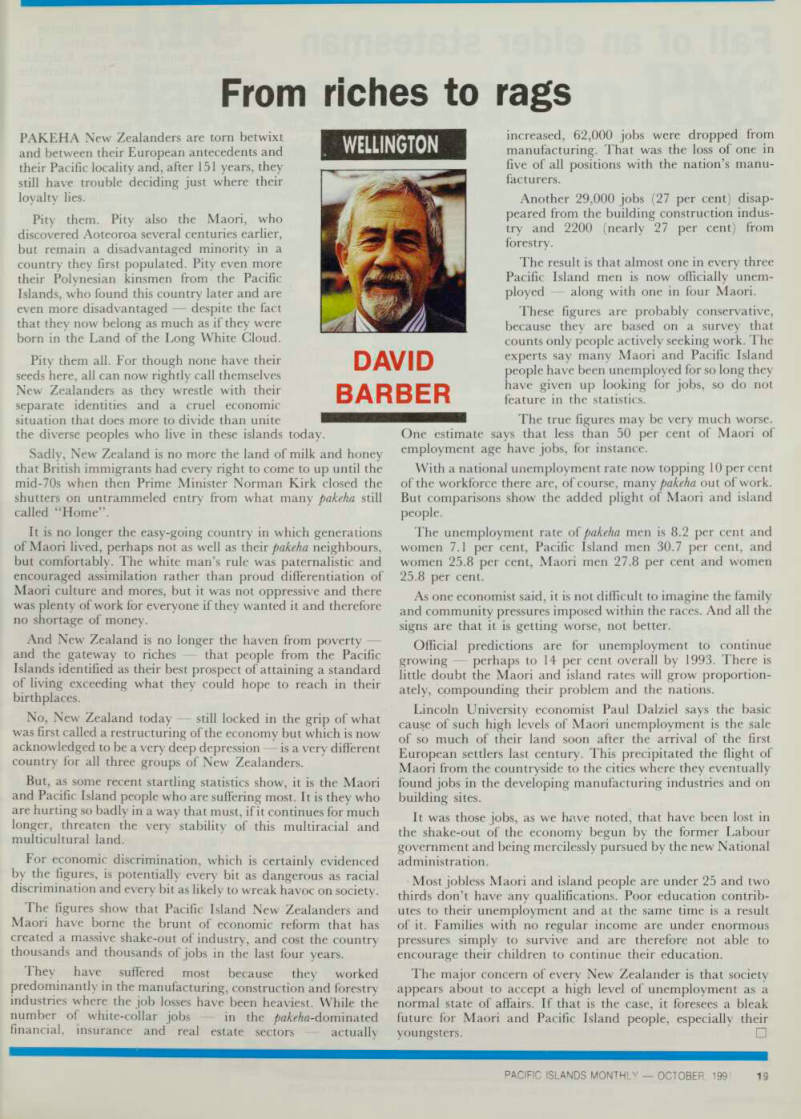
PAKEHA New Zealanders are torn betwixt and between their European antecedents and their Pacific locality and, after 151 years, they still have trouble deciding just where their loyalty lies.
Pity them. Pity also the Maori, who discovered Aoteoroa several centuries earlier, but remain a disadvantaged minority in a country they first populated. Pity even more their Polynesian kinsmen from the Pacific Islands, who found this country later and are even more disadvantaged despite the fact that they now belong as much as if they were born in the Land of the Long White Cloud.
Pity them all. For though none have their seeds here, all can now rightly call themselves New Zealanders as they wrestle with their separate identities and a cruel economic situation that does more to divide than unite
the diverse peoples who live in these islands today.
Sadly, New Zealand is no more the land of milk and honey that British immigrants had every right to come to up until the mid-70s when then Prime Minister Norman Kirk closed the shutters on untrammeled entry from what many pakeha still called “Home”.
It is no longer the easy-going country in which generations of Maori lived, perhaps not as well as their pakeha neighbours, but comfortably. The white man’s rule was paternalistic and encouraged assimilation rather than proud differentiation of Maori culture and mores, but it was not oppressive and there was plenty of work for everyone if they wanted it and therefore no shortage of money.
And New Zealand is no longer the haven from poverty and the gateway to riches that people from the Pacific Islands identified as their best prospect of attaining a standard of living exceeding what they could hope to reach in their birthplaces.
No, New Zealand today still locked in the grip of what was first called a restructuring of the economy but which is now acknowledged to be a very deep depression is a very different country for all three groups of New Zealanders.
But, as some recent startling statistics show, it is the Maori and Pacific Island people who are suffering most. It is they who are hurting so badly in a way that must, if it continues for much longer, threaten the very stability of this multiracial and multicultural land.
For economic discrimination, which is certainly evidenced by the figures, is potentially every bit as dangerous as racial discrimination and every bit as likely to wreak havoc on society.
The figures show that Pacific Island New Zealanders and Maori have borne the brunt of economic reform that has created a massive shake-out of industry, and cost the country thousands and thousands of jobs in the last four years.
They have suffered most because they worked predominantly in the manufacturing, construction and forestry industries where the job losses have been heaviest. While the number of white-collar jobs in the financial, insurance and real estate sectors actually
increased, 62,000 jobs were dropped from manufacturing. That was the loss of one in five of all positions with the nation’s manu facturers.
Another 29,000 jobs (27 per cent) disap peared from the building construction indus try and 2200 (nearly 27 per cent) from forestry.
The result is that almost one in every three Pacific Island men is now officially unem ployed along with one in four Maori.
These figures are probably conservative, because they are based on a survey that counts only people actively seeking work. The experts say many Maori and Pacific Island people have been unemployed for so long they have given up looking for jobs, so do not feature in the statistics.
The true figures may be very much worse.
One estimate says that less than 50 per cent of Maori of employment age have jobs, for instance.
With a national unemployment rate now topping 10 per cent of the workforce there are, of course, many pakeha out of work.
But comparisons show the added plight of Maori and island
people.
The unemployment rate of pakeha men is 8.2 per cent and women 7.1 per cent, Pacific Island men 30.7 per cent, and women 25.8 per cent, Maori men 27.8 per cent and women 25.8 per cent.
As one economist said, it is not difficult to imagine the family and community pressures imposed within the races. And all the signs are that it is getting worse, not better.
Official predictions are for unemployment to continue growing perhaps to 14 per cent overall by 1993. There is little doubt the Maori and island rates will grow proportion ately, compounding their problem and the nations.
Lincoln University economist Paul Dalziel says the basic cause of such high levels of Maori unemployment is the sale of so much of their land soon after the arrival of the first European settlers last century. This precipitated the flight of Maori from the countryside to the cities where they eventually found jobs in the developing manufacturing industries and on building sites.
It was those jobs, as we have noted, that have been lost in the shake-out of the economy begun by the former Labour government and being mercilessly pursued by the new National administration.
Most jobless Maori and island people are under 25 and two thirds don’t have any qualifications. Poor education contrib utes to their unemployment and at the same time is a result of it. Families with no regular income are under enormous pressures simply to survive and are therefore not able to encourage their children to continue their education.
The major concern of every New Zealander is that society appears about to accept a high level of unemployment as a normal state of affairs. If that is the case, it foresees a bleak future for Maori and Pacific Island people, especially their youngsters. □
Wellington
David
Barber
Advertisements & other items, p. 19 (1 item)
19
PACIFIC ISLANDS MONTHL v OCTOBER, 199
Fall of an elder statesman
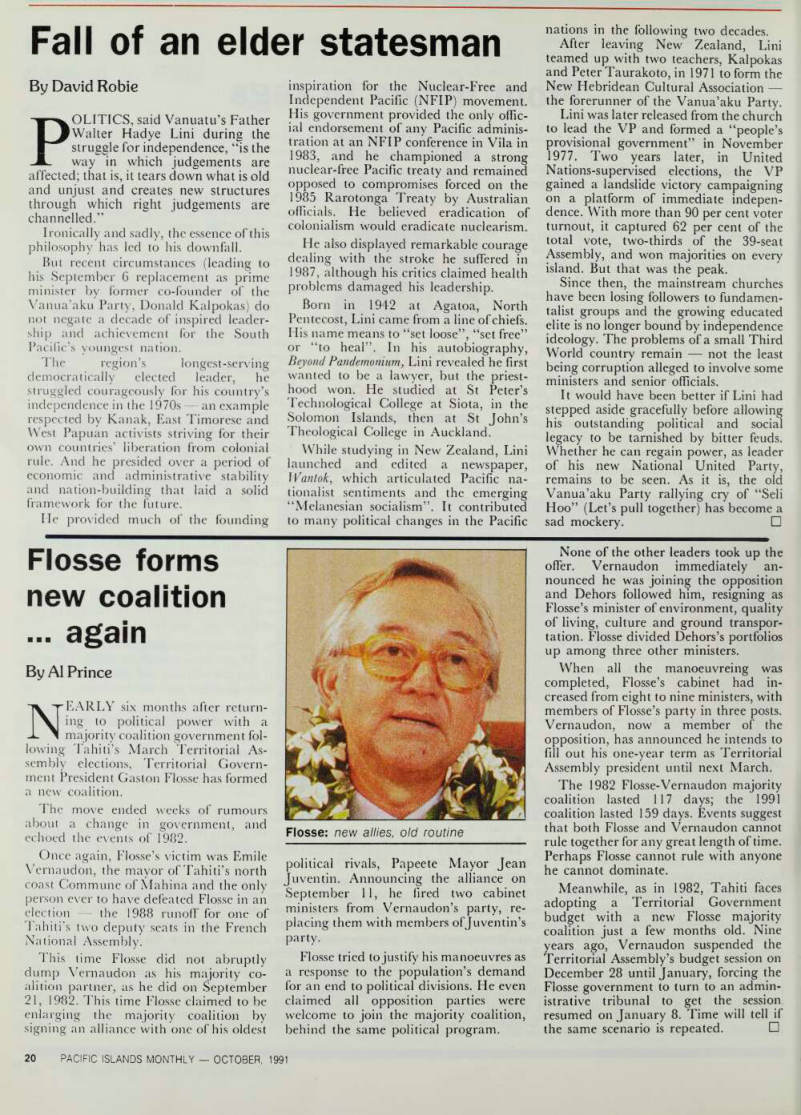
By David Robie
POLITICS, said Vanuatu’s Father Walter Hadye Lini during the struggle for independence, “is the way in which judgements are affected; that is, it tears down what is old and unjust and creates new structures through which right judgements are channelled.”
Ironically and sadly, the essence of this philosophy has led to his downfall.
But recent circumstances (leading to his September 6 replacement as prime minister by former co-founder of the Vanua’aku Party, Donald Kalpokas) do not negate a decade of inspired leader ship and achievement for the South Pacific’s youngest nation.
The region’s longest-serving democratically elected leader, he struggled courageously for his country’s independence in the 1970 s an example respected by Kanak, East Timorese and West Papuan activists striving for their own countries’ liberation from colonial rule. And he presided over a period of economic and administrative stability and nation-building that laid a solid framework for the future.
He provided much of the founding
inspiration for the Nuclear-Free and
Independent Pacific (NFIP) movement,
H , is S° vm ' mem Provided the only offic ial endorsement of any Pacific admmis ‘radon at , an I NF[ P conference in Vila in l98 ?’ a ™ championed a strong nuclear-free Pacific treaty and remained ?gP? sed “ compromises forced on the
1985 Treaty by Australian
officials. He believed eradication of colonialism would eradicate nuclearism.
He also displayed remarkable courage dealin S with the stroke he suffered in ,987 ’ though his critics claimed health
Problems damaged his leadership.
t) .Ain a mi Born m 1942 at Agatoa, North Pentecost, Lin, came from a line of chiefs His name means o set loose “set free” or to heal . In his autobiography, Beyond Pandemonium, Lin, revealed he first wanted to be a lawyer but the priest hood won. He studied at St Peters Technological College at Siota, in the Solomon Islands, then at St Johns
Theological College in Auckland,
While studying in New Zealand, Lini launched and edited a newspaper, Want ok , which articulated Pacific na tionalist sentiments and the emerging “Melanesian socialism”. It contributed to many political changes in the Pacific
nations in the following two decades.
After leaving New Zealand, Lini teamed up with two teachers, Kalpokas and Peter Taurakoto, in 1971 to form the New Hebridean Cultural Association the forerunner of the Vanua’aku Party.
Lini was later released from the church to lead the VP and formed a “people’s provisional government” in November 1977. Two years later, in United Nations-supervised elections, the VP gained a landslide victory campaigning on a platform of immediate indepen dence. With more than 90 per cent voter turnout, it captured 62 per cent of the total vote, two-thirds of the 39-seat Assembly, and won majorities on every island. But that was the peak.
Since then, the mainstream churches have been losing followers to fundamen talist groups and the growing educated elite is no longer bound by independence ideology. The problems of a small Third World country remain not the least being corruption alleged to involve some ministers and senior officials.
It would have been better if Lini had stepped aside gracefully before allowing his outstanding political and social legacy to be tarnished by bitter feuds.
Whether he can regain power, as leader of his new National United Party, remains to be seen. As it is, the old Vanua’aku Party rallying cry of “Seli Hoo” (Let’s pull together) has become a sad mockery. □
... again
Flosse forms new coalition ... again
By Al Prince
NEARLY six months after return ing to political power with a majority coalition government fol lowing Tahiti’s March Territorial As sembly elections, Territorial Govern ment President Gaston Flosse has formed a new coalition.
The move ended weeks of rumours about a change in government, and echoed the events of 1982.
Once again, Flosse’s victim was Emile Vernaudon, the mayor of Tahiti’s north coast Commune of Mahina and the only person ever to have defeated Flosse in an election the 1988 runoff for one of Tahiti’s two deputy seats in the French National Assembly.
This time Flosse did not abruptly dump Vernaudon as his majority co alition partner, as he did on September 21, 1982. This time Flosse claimed to be enlarging the majority coalition by signing an alliance with one of his oldest
political rivals, Papeete Mayor Jean Juventin. Announcing the alliance on September 11, he fired two cabinet ministers from Vernaudon’s party, re placing them with members ofjuventin’s party.
Flosse tried to justify his manoeuvres as a response to the population’s demand for an end to political divisions. He even claimed all opposition parties were welcome to join the majority coalition, behind the same political program.
None of the other leaders took up the offer. Vernaudon immediately an nounced he was joining the opposition and Dehors followed him, resigning as Flosse’s minister of environment, quality of living, culture and ground transpor tation. Flosse divided Dehors’s portfolios up among three other ministers.
When all the manoeuvring was completed, Flosse’s cabinet had in creased from eight to nine ministers, with members of Flosse’s party in three posts.
Vernaudon, now a member of the opposition, has announced he intends to fill out his one-year term as Territorial Assembly president until next March.
The 1982 Flosse-Vernaudon majority coalition lasted 117 days; the 1991 coalition lasted 159 days. Events suggest that both Flosse and Vernaudon cannot rule together for any great length of time.
Perhaps Flosse cannot rule with anyone he cannot dominate.
Meanwhile, as in 1982, Tahiti faces adopting a Territorial Government budget with a new Flosse majority coalition just a few months old. Nine years ago, Vernaudon suspended the Territorial Assembly’s budget session on December 28 until January, forcing the Flosse government to turn to an admin istrative tribunal to get the session resumed on January 8. Time will tell if the same scenario is repeated. □
Flosse: new allies, old routine
Advertisements & other items, p. 21 (1 item)
largest bank in PNG
me
ANGCO
m ■br i J T r L I £ m
is the
)ank that knows PNG
msiness best
For enquiries, call: Leon Chappie cecutive Manager - Corporate & International The Papua New Guinea Banking Corporation is not only PNG's largest bank, it's also the only one with branch representation in all 19 provinces.
When you're looking at doing business in PNG, we can help with trade finance and foreign exchange facilities, business introduction, money transfers, travellers requirements and the comprehensive range of services you expect from an international bank.
Whatever your business or personal banking needs, come to the
PNGBC.
(675) 22 9731 Jim Forrester Manager - International Francis Gubag Assistant Manager - International (675) 22 9731 We re the bank that knows PNG best.
APUA NEW GUINEA BANKING CORPORATION
P.0.80x 78, Port Moresby. Telephone 21 1999. Fax 22 9867 / 21 1954 Samudson Talbot 25
Quiet compliment for PNG
on its human freedom record
PAPUA New Guinea received a quiet but important compliment from a United Nations agency recently in recognition of its extra ordinary human freedom record.
According to a complex scale devised by the United Nations Development Program, PNG has the best human freedom record for an Eastern Hemi sphere developing nation and, among Third World nations globally, it is second only to Costa Rica in Central America.
The scale ranges from 0 for the worst human freedom record possible (only Iraq scored 0) to 40 for the best possible Sweden, with 38, was the top-ranked nation. PNG’s score was 30, one point behind Costa Rica, two behind Great Britain, and three behind the United States and Australia (at 33).
Indonesia, with whom PNG shares the island of New Guinea, came in with a dismal five, the same score secured by
such hard-line com munist nations as Cuba and North Korea.
PNG’s record, on the other hand, was better than that of several European na tions, such as Italy with 29, Ireland with
27, and Spain with 26. None of the independent island nations in the Pacific were given scores by UNDP on the Human Freedom Index.
Typically these UN rankings attract little attention, but the Human Freedom Index set off a storm of protests, all from dictatorships, mostly in Africa, who felt that no UN agency should pay attention to domestic civil and political rights of member states.
The Freedom Index is based on 40 specific rights such as freedom to travel,
lack of capital punishment, independent
court systems, and freedom of religion.
The lack of effective rights for tribal women cost PNG points, as did some concerns about the workings of the court system.
PNG’s outlawing the death penalty, at the time the data were collected, gave it a leg up on the US which executes
prisoners regularly.
At the same time that the UNDP was announcing its new Freedom Index, it
- . , TGCOrd SGCOfld only to Costa Rica in the Third World rio 4.: />rio nations Of the WOfld
also printed another ranking.
This one, called the Human Develop ment Index (HDI), considers such mat ters as life expectancy, the adult literacy rate, and the average number of years of school attendance. PNG, given the cost of providing medical and educational services to many inaccessible areas, did not do as well on this index as the other.
The rankings of nations in the Pacific can be seen in the adjoining box.
Without listing all 160 rankings sup plied by UNDP, it is possible to illustrate the HDI neighborhoods inhabited by the island nations. Fiji, for instance, has roughly the some HDI ranking as Turkey and Syria; the Solomons do not do quite as well, on this scale, as Iran, but better than wealthy Indonesia. PNG’s score is close to that of both over crowded Egypt and less-crowded Paki stan.
PNG’s relatively low score on the HDI
index relates to its low life-expectancy rate (54.9 years) compared to these rates for other Pacific nations: Fiji 64.8 years, Western Samoa 66.5 years, Sol omons 69.5 years, Vanuatu 69.5 years.
The HDI index re
lates, essentially, to how effectively a nation funds its health and education programs, and how much per capita income is available.
If two nations have the same per capita income, but one invests more than the other in better schools and better hospitals, it secures a higher HDI
ranking.
The Human Freedoms Index, men tioned earlier, relates to political ar rangements rather than financial ones.
Providing people with civil and legal rights is not necessarily expensive.
The United Nations Development Program recently released Human De velopment Index Scores for Pacific nations. Generally, the higher the rank ing (and the lower the number), the longer the life expectancy and the higher the incidence of adult literacy. UNDP issued rankings for 160 nations, with Japan getting the number one position.
Others: 2 Canada; 7 USA; 9 Australia; 15 New Zealand; 71 Fiji; 96 Solomon Islands; 101 Vanuatu; 117 PNG. See text for an explanation of the rankings. □
Advertisements & other items, pp. 22-23 (1 item)
Bright Future
Stake Your
Claim In A
Tahiti Publications Touristiques, the 10-year-old publishing company of the Tahiti Beach Press, is preparing to launch an exciting and promising development programme. This is your chance to stake a claim in the bright future of that development programme and of such a beautiful place as Tahiti. There are 1504 new shares of Tahiti Publications Touristiques stock ready to be sold immediately at U 55137.5 per share (local tax included). Purchases are limited to a minimum of 50 shares per investor.
Your investment will help finance the launching of an all new monthly magazine devoted to Tahiti and Her Islands and aimed at Tahiti lovers and dreamers around the world. Tahiti Beach Press’publishing company plans to capitalise on its excellent journalistic reputation, its experienced personnnel team, its proven record of financial success and its leading and unchallenged market position.
All that’s missing is you, one of our new partners in the promising publishing future that lies ahead. Stake your claim in that future. Today.
Call Gerard Warti, one of Tahiti Beach Press’ publishing company’s two owning partners, on telephone (689) 426850 to learn more. Or fill out the coupon as a potentially interested new stockholder and receive by mail further information and a stock purchase application form.
Yes, I am interested in becoming a Tahiti Publications Touristiques stockholder with the purchase of shares (minimum 50 at U 55137.5 each) for a total investment of US$ Date: Signature Name Occupation Address Tel - Tahiti Publications Touristiques, B.P. 887, Papeete, Tahiti.
South Pacific Games (1991) Foundation
Proudly acknowledges: • THE OFFICIAL SPONSOR
I • PNG TEAM SPONSOR
• 17 MAJOR SPONSORS
OF THE 9TH SOUTH
PACIFIC GAMES
PAPUA NEW GUINEA
9th SOUTH PACIFIC GAMES
PAPUA NEW GUINEA 1991
SI’HOI DINGS OKMMAI SPONSOR
Glory
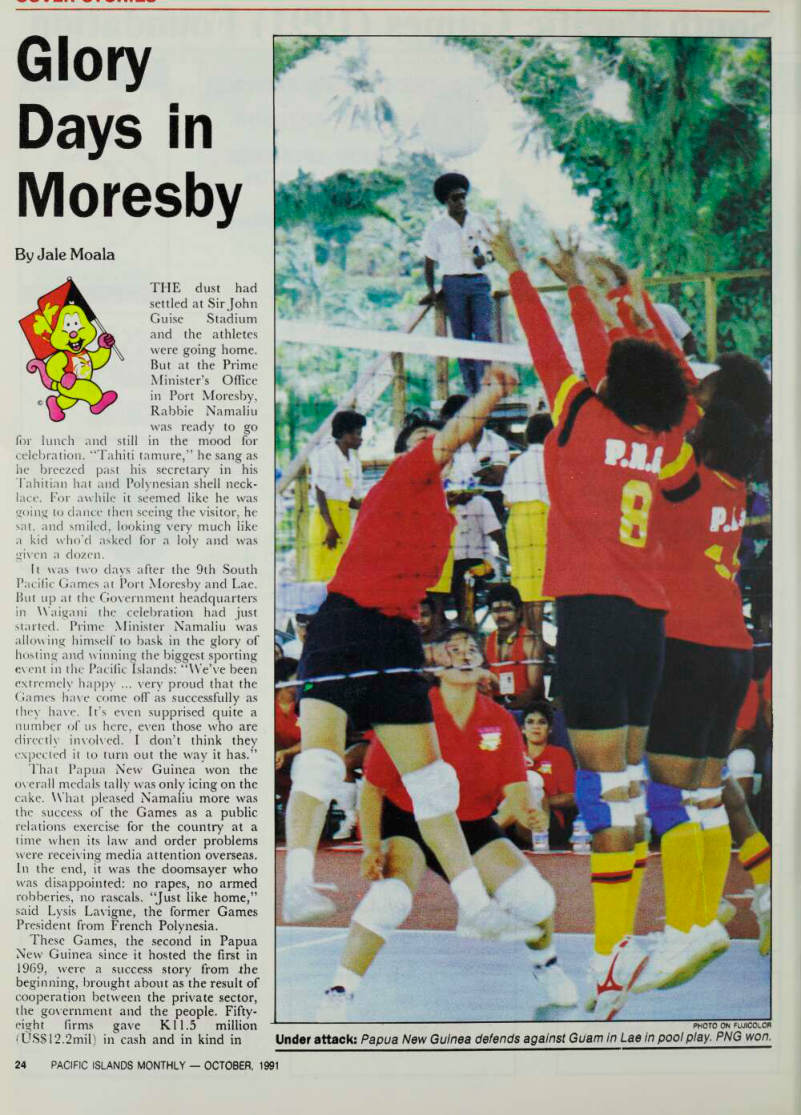
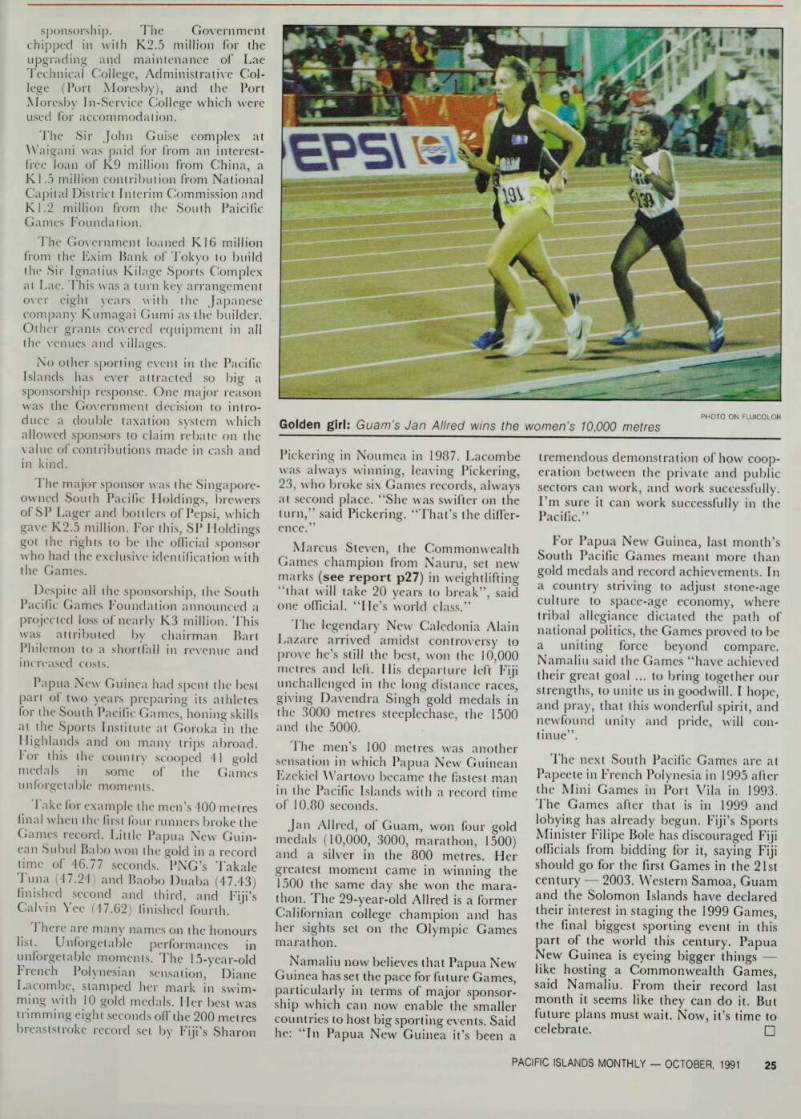
Days in Moresby
By Jale Moala
THE dust had settled at Sir John Guise Stadium and the athletes were going home.
But at the Prime Minister’s Office in Port Moresby, Rabbie Namaliu was ready to go
for lunch and still in the mood for celebration, “Tahiti tamure,” he sang as he breezed past his secretary in his Tahitian hat and Polynesian shell neck lace. For awhile it seemed like he was going to dance then seeing the visitor, he sat, and smiled, looking very much like a kid who’d asked for a loly and was given a dozen.
It was two days after the 9th South Pacific Games at Port Moresby and Lae.
But up at the Government headquarters in Waigani the celebration had just started. Prime Minister Namaliu was allowing himself to bask in the glory of
hosting and winning the biggest sporting
event in the Pacific Islands: “We’ve been extremely happy ... very proud that the Games have come ofT as successfully as they have. It’s even supprised quite a number of us here, even those who are directly involved. I don’t think they expected it to turn out the way it has.”
That Papua New Guinea won the overall medals tally was only icing on the cake. What pleased Namaliu more was the success of the Games as a public relations exercise for the country at a time when its law and order problems were receiving media attention overseas.
In the end, it was the doomsayer who was disappointed: no rapes, no armed robberies, no rascals. “Just like home,” said Lysis Lavigne, the former Games President from French Polynesia.
These Games, the second in Papua New Guinea since it hosted the first in 1969, were a success story from rhe beginning, brought about as the result of cooperation between the private sector, the government and the people. Fifty eight firms gave K 11.5 million (USsl2.2mil) in cash and in kind in
Photo On Fujicolor
Under attack: Papua New Guinea defends against Guam in Lae in pool play. PNG won.
sponsorship. The Government chipped in with K 2.5 million for the upgrading and maintenance of Lae Technical College, Administrative Col lege (Port Moresby), and the Port Moresby In-Service College which were used for accommodation.
The Sir John Guise complex at Waigani was paid for from an interest free loan of K 9 million from China, a K 1.5 million contribution from National Capital District Interim Commission and K 1.2 million from the South Paicific Games Foundation.
The Government loaned Kl 6 million from the Exim Bank of Tokyo to build
the Sir Ignatius Kilage Sports Complex
at Lac. This was a turn key arrangement over eight years with the Japanese company Kumagai Gumi as the builder.
Other grants covered equipment in all the venues and villages.
No other sporting event in the Pacific Islands has ever attracted so big a sponsorship response. One major reason was the Government decision to intro duce a double taxation system which allowed sponsors to claim rebate on the value of contributions made in cash and in kind.
The major sponsor was the Singapore owned South Pacific Holdings, brewers of SP Lager and bottlers of Pepsi, which gave K 2.5 million. For this, SP Holdings got the rights to be the official sponsor who had the exclusive identification with the Games.
Despite all the sponsorship, the South Pacific Games Foundation announced a projected loss of nearly K 3 million. This was attributed by chairman Bart Philemon to a shortfall in revenue and increased costs, Papua New Guinea had spent the best part of two years preparing its athletes for the South Pacific Games, honing skills at the Sports Institute at Goroka in the Highlands and on many trips abroad.
For this the country scooped 41 gold medals in some of the Games
unforgctable moments.
Take for example the men’s 400 metres final when the first four runners broke the Games record. Little Papua New Guin ean Subul Babo won the gold in a record time of 46.77 seconds. PNG’s Takale Tuna (47.24) and Baobo Duaba (47.43) finished second and third, and Fiji’s Calvin Yce (47.62) finished fourth.
There are many names on the honours list. Unforgetable performances in unforgetablc moments. The 15-year-old French Polynesian sensation, Diane Lacombc, stamped her mark in swim ming with 10 gold medals. Her best was trimming eight seconds off the 200 metres breaststroke record set by Fiji’s Sharon
Pickering in Noumea in 1987. Lacombe was always winning, leaving Pickering, 23, who broke six Games records, always at second place. “She was swifter on the turn,” said Pickering. “That’s the differ ence.”
Marcus Steven, the Commonwealth Games champion from Nauru, set new marks (see report p 27) in weightlifting “that will take 20 years to break”, said one official. “He’s world class.”
The legendary New Caledonia Alain Lazare arrived amidst controversy to prove he’s still the best, won the 10,000 metres and left. 11 is departure left Fiji unchallenged in the long distance races, giving Davendra Singh gold medals in the 3000 metres steeplechase, the 1500 and the 5000.
The men’s 100 metres was another sensation in which Papua New Guinean Ezekiel Wartovo became the fastest man in the Pacific Islands with a record time of 10,80 seconds.
Jan Allred, of Guam, won four gold medals (10,000, 3000, marathon, 1500) and a silver in the 800 metres. Her greatest moment came in winning the 1500 the same day she won the mara thon. The 29-year-old Allred is a former Californian college champion and has her sights set on the Olympic Games marathon.
Namaliu now believes that Papua New Guinea has set the pace for future Games, particularly in terms of major sponsor ship which can now enable the smaller countries to host big sporting events. Said he: “In Papua New Guinea it’s been a
tremendous demonstration of how coop eration between the private and public sectors can work, and work successfully, I’m sure it can work successfully in the Pacific.” s F ° r Papua t l ew Guinea > las ‘ mon ‘ h ’ s S °, u ,' h PaC , ,flC Games meant more than g ° ld medals andrccord achievements. In a , coulUr >’ s,rlvm S lo ad J ust stonc ' a g e Cl l lu , re 0 s P a ce-age economy, where tribal allegiance dictated the path of national politics, the Games proved to be a uniting rorce beyond compare, Namaliu said lhe Games “have achieved lhcir , t 0 brin (oge(her our streng B ths> to B unite us in go ° dw iM. I hope, . ’ , t 4, . j r i • • , T Sp 'u ’ a newfound unity and pride, will con tinue .
The next South Pacific Games are at Papeete in French Polynesia in 1995 after tbe Mini Games in Port Vila in 1993.
The Games after that is in 1999 and '°>! R S has already begun. Fiji’s Sports er F >hpe Bole has discouraged Fiji °/ nclals fr ° m bidding for it, saying Fiji should go for the first Games in the 21st century 2003. Western Samoa, Guam and the Solomon Islands have declared their interest in staging the 1999 Games, the fmal bi §§ est sporting event in this P art of the world this century. Papua is eing bigge , r ‘ hb 'g s llk " h ° S,mg . 3 Commonwealth Games, Sald Namahu. From their record last !^ onth 11 seems like they can do it. But , u . re Pl ans must wait. Now, it’s time to ce * ebrate - □
Photo On Fujicolor
Golden girl: Guam’s Jan Allred wins the women's 10,000 metres
Advertisements & other items, p. 26 (1 item)
a
%*w \ \ ( \ i t\
fir
n; Vs-, xr C?V xa m -a/ .y j
;jvJ , s '
\r* '7, ry x& V n ■M& y .-vl-vSN. c/ .i v :i m k \:.j* MM.
The 9th South Pacific Games will be an international showcase of the achievements of the people of Papua New Guinea.
The Games will be a unique opportunity to show the world the pride we share in Papua New Guinea.
9th SOUTH PACIFIC GAMI
PAPUA NEW GUINEA 199
Victorious athletes will be rewarded with gold medals from the Ok Tedi mine, crafted and presented as part of our sponsorship of the Games.
Medals symbolizing Ok Tedi’s commitment to education, training, health and overall economic development.
A MAJOR SPONSOR
Because we believe that, working together, we can show the world what Papua New Guinea can do.
No time to be
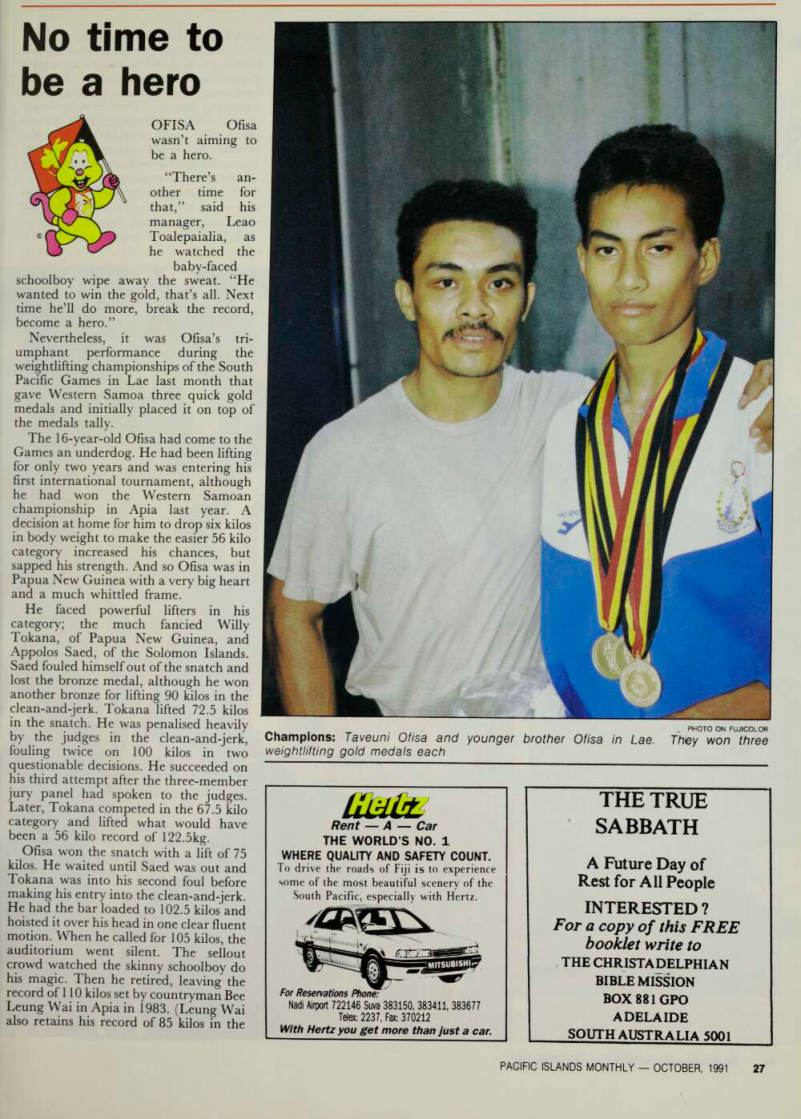
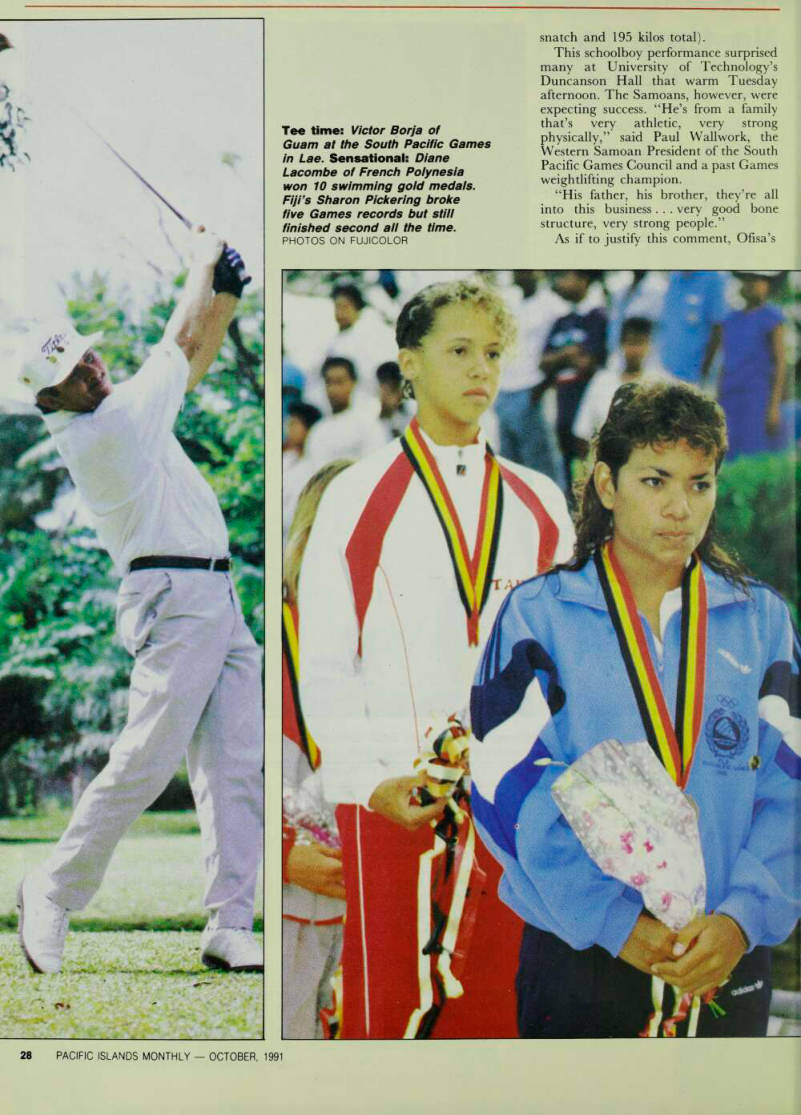
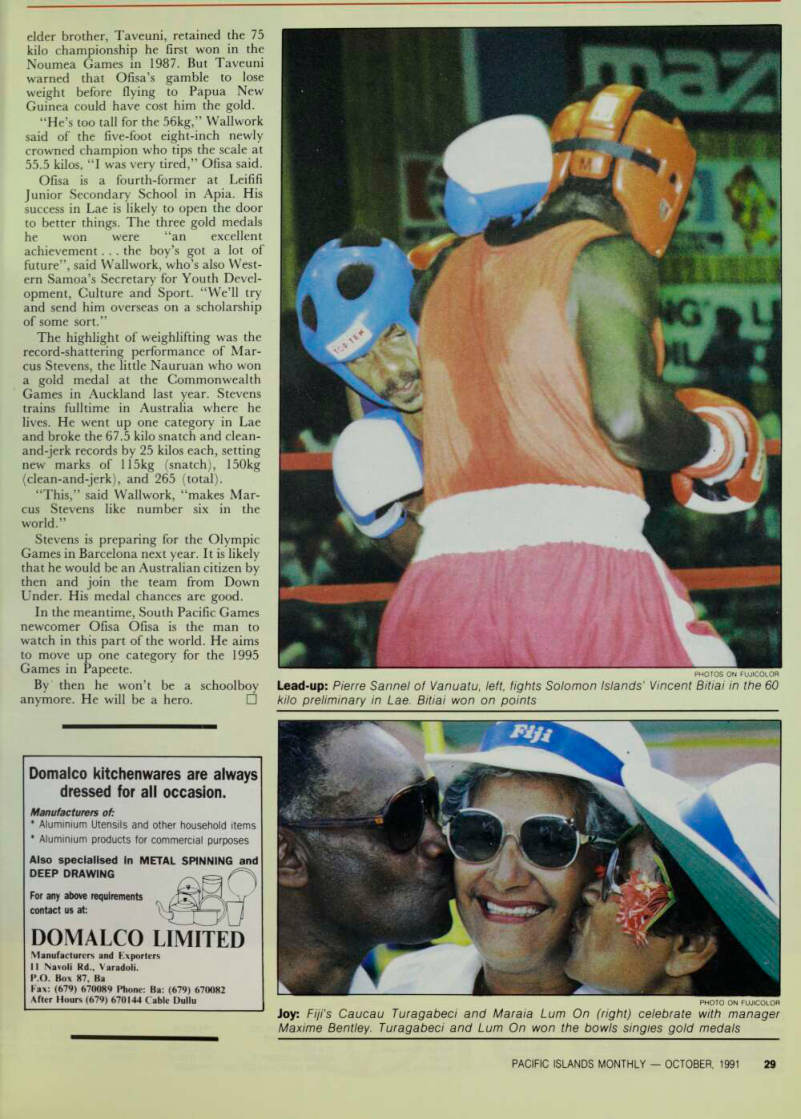
be a hero
OFISA Ofisa wasn’t aiming to be a hero.
“There’s an other time for that,” said his manager, Leao Toalepaialia, as he watched the
baby-faced
schoolboy wipe away the sweat. “He wanted to win the gold, that’s all. Next time he’ll do more, break the record, become a hero.”
Nevertheless, it was Ofisa’s tri
umphant performance during the
weightlifting championships of the South Pacific Games in Lae last month that gave Western Samoa three quick gold medals and initially placed it on top of the medals tally.
The 16-year-old Ofisa had come to the Games an underdog. He had been lifting for only two years and was entering his first international tournament, although he had won the Western Samoan championship in Apia last year. A decision at home for him to drop six kilos in body weight to make the easier 56 kilo category increased his chances, but sapped his strength. And so Ofisa was in Papua New Guinea with a very big heart and a much whittled frame.
He faced powerful lifters in his category; the much fancied Willy Tokana, of Papua New Guinea, and Appolos Saed, of the Solomon Islands.
Saed fouled himself out of the snatch and lost the bronze medal, although he won another bronze for lifting 90 kilos in the dean-and-jerk. Tokana lifted 72.5 kilos in the snatch. He was penalised heavily
by the judges in the dean-and-jerk,
fouling twice on 100 kilos in two questionable decisions. He succeeded on his third attempt after the three-member jury panel had spoken to the judges.
Later, Tokana competed in the 67.5 kilo category and lifted what would have been a 56 kilo record of 122.5 kg.
Ofisa won the snatch with a lift of 75 kilos. He waited until Saed was out and Tokana was into his second foul before making his entry into the dean-and-jerk.
He had the bar loaded to 102.5 kilos and hoisted it over his head in one clear fluent motion. When he called for 105 kilos, the auditorium went silent. The sellout crowd watched the skinny schoolboy do his magic. Then he retired, leaving the record of 110 kilos set by countryman Bee Leung Wai in Apia in 1983. (Leung Wai also retains his record of 85 kilos in the
Photo On Fujicolor
Champions: Taveuni Ofisa and younger brother Ofisa in Lae. They won three weightlifting gold medals each
snatch and 195 kilos total).
This schoolboy performance surprised many at University of Technology’s Duncanson Hall that warm Tuesday afternoon. The Samoans, however, were expecting success. “He’s from a family that’s very athletic, very strong physically,” said Paul Wallwork, the Western Samoan President of the South Pacific Games Council and a past Games
weightlifting champion.
“His father, his brother, they’re all into this business . . . very good bone structure, very strong people.”
As if to justify this comment, Oflsa’s
Tee time: Victor Borja of Guam at the South Pacific Games in Lae. Sensational: Diane Lacombe of French Polynesia won 10 swimming gold medals.
Fiji's Sharon Pickering broke five Games records but still finished second all the time.
Photos On Fujicolor
elder brother, Taveuni, retained the 75 kilo championship he first won in the Noumea Games in 1987. But Taveuni warned that Ofisa’s gamble to lose weight before flying to Papua New Guinea could have cost him the gold.
“He’s too tall for the 56kg,” Wallwork said of the five-foot eight-inch newly crowned champion who tips the scale at 55.5 kilos, “I was very tired,” Ofisa said.
Ofisa is a fourth-former at Leififi Junior Secondary School in Apia. His success in Lae is likely to open the door to better things. The three gold medals he won were “an excellent achievement. . . the boy’s got a lot of future”, said Wallwork, who’s also West ern Samoa’s Secretary for Youth Devel opment, Culture and Sport. “We’ll try and send him overseas on a scholarship of some sort.”
The highlight of weighlifting was the record-shattering performance of Mar cus Stevens, the little Nauruan who won a gold medal at the Commonwealth Games in Auckland last year. Stevens trains fulltime in Australia where he lives. He went up one category in Lae and broke the 67.5 kilo snatch and clean and-jerk records by 25 kilos each, setting new marks of 115 kg (snatch), 150 kg (dean-and-jerk), and 265 (total).
“This,” said Wallwork, “makes Mar cus Stevens like number six in the world.”
Stevens is preparing for the Olympic Games in Barcelona next year. It is likely that he would be an Australian citizen by then and join the team from Down Under. His medal chances are good.
In the meantime, South Pacific Games newcomer Ofisa Ofisa is the man to watch in this part of the world. He aims to move up one category for the 1995 Games in Papeete.
By then he won’t be a schoolboy anymore. He will be a hero. □
Photos On Fujicolor
Lead-up: Pierre Sannel of Vanuatu, left, fights Solomon Islands' Vincent Bitiai in the 60 kilo preliminary in Lae. Bitiai won on points
Photo On Fujicolor
Joy: Fiji's Caucau Turagabeci and Maraia Lum On (right) celebrate with manager Maxime Bentley. Turagabeci and Lum On won the bowls singles gold medals
Advertisements & other items, pp. 27-32 (1 item)
Sabbath
mat
Rent A Car
THE WORLD’S NO. 1
WHERE QUALITY AND SAFETY COUNT.
To drive the roads of Fiji is to experience some of the most beautiful scenery of the South Pacific, especially with Hertz.
For Reservations Phone: Nadi Airport 722146 Suva 383150,383411,383677 Telex; 2237, Fax; 370212 With Hertz you get more than just a car.
THE TRUE
SABBATH
A Future Day of Rest for All People
INTERESTED?
For a copy of FREE booklet write to
THE CHRISTADELPHIAN
BIBLE MISSION
BOX 881 GPO
ADELAIDE
SOUTH AUSTRALIA 5001
Domalco kitchenwares are always
dressed for all occasion.
Manufacturers of: * Aluminium Utensils and other household items * Aluminium products for commercial purposes Also specialised in METAL SPINNING and
DOMALCO LIMITED
Manufacturers and Exporters II Navoli Rd., V aradoli.
P.O. Box 87, Ba Fax: (679) 670089 Phone: Ba: (679) 670082 After Hours (679) 670144 Cable Dullu For any above requirements contact us at:
DEEP DRAWING
a i wmcn siana ror our customer, our commitment to the satisfaction of that customer through our product and for our spirit of creativity.
FT' It’s not often that you hear descriptions like rugged or durable combined with refined and elegant. But then there’s never been a vehicle quite like the new Toyota Land Cruiser Station Wagon. The unrivalled legend of off-road reliability is now unsurpassed in comfort and sophistication as well. Attention to detail is found everywhere, from the fine trim to the instrument panel to the graceful lines of its exterior. Even in places you can’t see, like the heavy-duty ladder frame and suspension design that add to the superb
luxury-car ride.
But Toyota’s innovation goes beyond providing luxury and durability. The new Land Cruiser Station Wagon, and all of our cars, are designed to create a harmony between car and driver, and to provide you with the ultimate
driving experience.
The new Toyota Land Cruiser Station Wagon. Think of it as much more than a spacious luxury sedan with fourwheel drive. r V. am '5
DISTRIBUTORS/DEALERS
TOYOTA
KINHILL KRAMER
Professional Project Managers Consulting Engineers Architects Surveyors
edibility...continuity..
commitment.. .quality.. .excellence arc all terms synonymous with Papua
New Guinea's leading engineering
consultant.
mifMni
.j m .'at. ■ -
PAPUA NEW GUINEA
Head Office Port Moresby
KINHILL KRAMER PTY LTD.,
Kinhill Kramer Building Cnr Islander Drive & Wards Road
HOHOLA
National Capital District
PO Box 1948, BOROKO,
Papua New Guinea Telephone (675) 256033 Facsimile (675) 211049
Telex CAMAKRA NE 23050
9th SOUTH PACIFIC GAMES
PAPUA NEW GUINEA 1991
A MAJOR SPONSOR AND
OFFICIAL PROJECT MANAGER
OVERSEAS OFFICES
Solomon Islands
KINHILL KRAMER (SI) LIMITED
Fourth Floor NPF Building Mendana Avenue PO Box 377 Honiara, Solomon Islands Telephone (677) 21996 Facsimile (677) 22190 Fiji
KINHILL KACIMAIWAI PTY LTD
First Floor, 6-12 Andrews Street, Nadi Fiji Islands PO Box 9213
Nadi Airport, Fiji Islands
Telephone (679) 780033 Facsimile (679) 780131 Australia Head Office Adelaide
KINHILL ENGINEERS PTY. LTD.,
200 East Terrace, GPO Box 2702, Adelaide South Australia 5001 Telephone (08) 2237011 Facsimile (08) 2320163 Telex AA82364
A MEMBER OF THE
Kikluii
GROUP OF COMPANIES
O
New face, new ideas
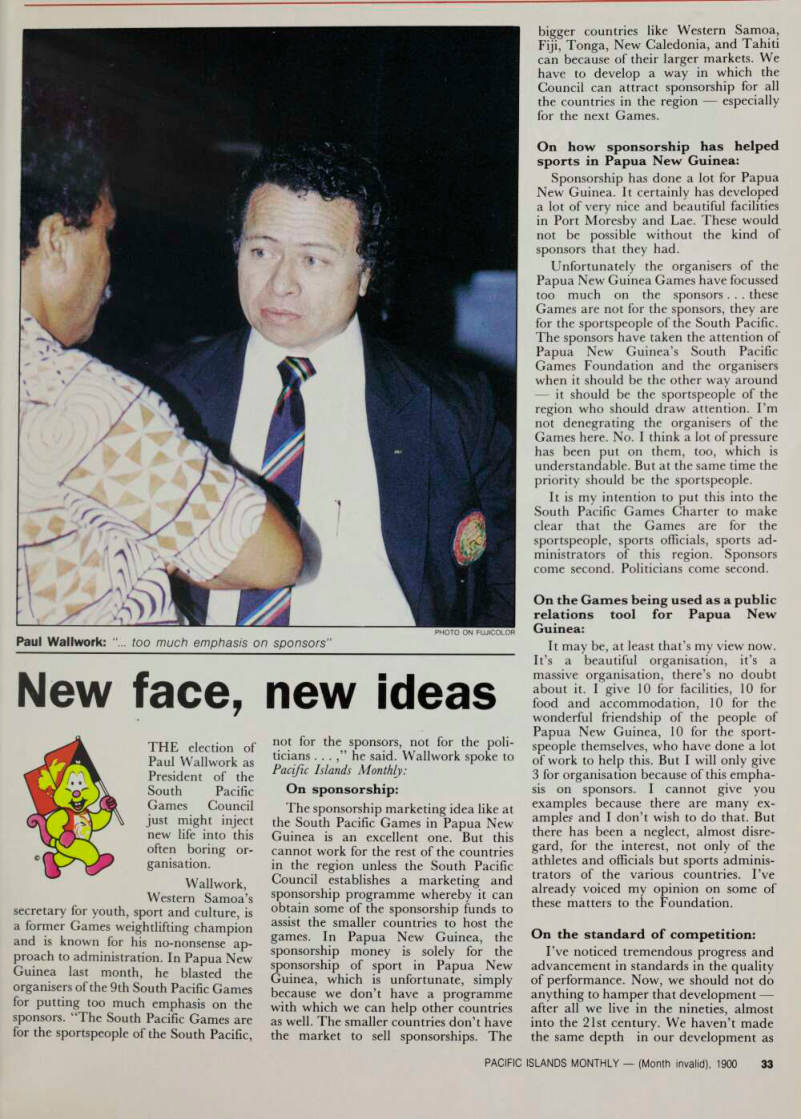

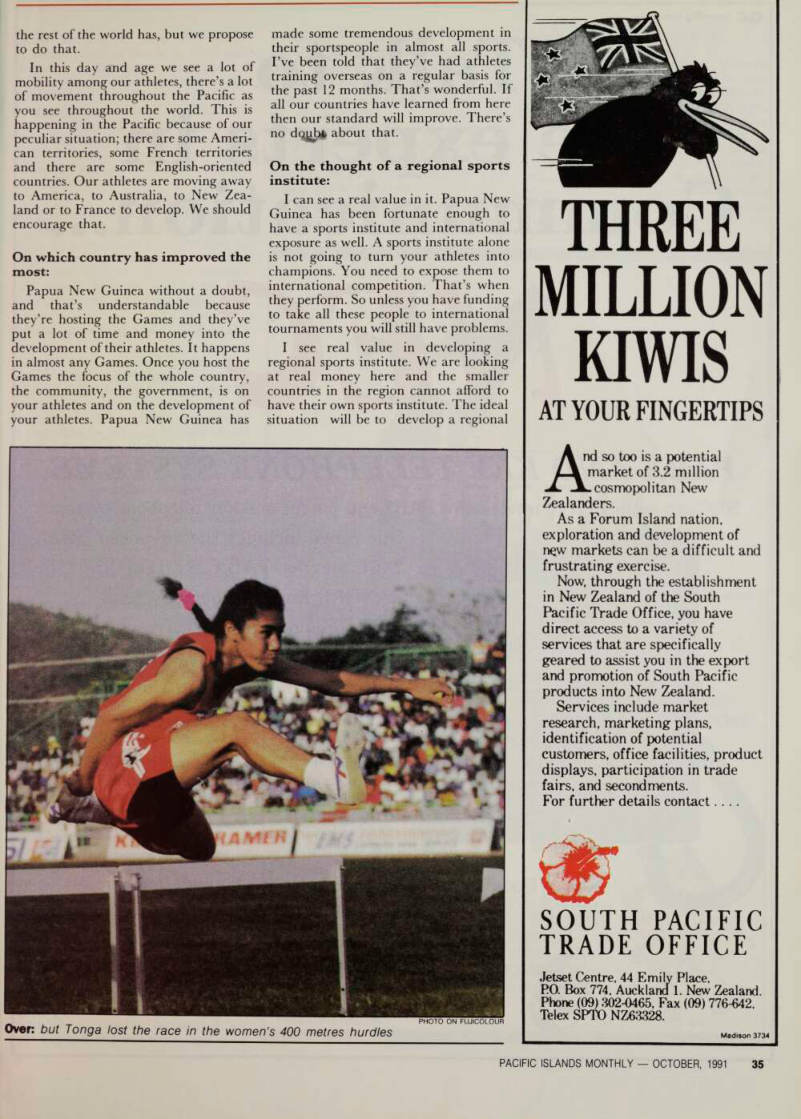
THE election of Paul Wallwork as President of the South Pacific Games Council just might inject new life into this often boring or ganisation.
Wallwork, Western Samoa’s
secretary for youth, sport and culture, is a former Games weightlifting champion and is known for his no-nonsense ap proach to administration. In Papua New Guinea last month, he blasted the organisers of the 9th South Pacific Games for putting too much emphasis on the sponsors. “The South Pacific Games are for the sportspeople of the South Pacific,
not for the sponsors, not for the poli ticians . . . ,” he said. Wallwork spoke to Pacific Islands Monthly: On sponsorship: The sponsorship marketing idea like at the South Pacific Games in Papua New Guinea is an excellent one. But this cannot work for the rest of the countries in the region unless the South Pacific Council establishes a marketing and sponsorship programme whereby it can obtain some of the sponsorship funds to assist the smaller countries to host the games. In Papua New Guinea, the sponsorship money is solely for the sponsorship of sport in Papua New Guinea, which is unfortunate, simply because we don’t have a programme with which we can help other countries as well. The smaller countries don’t have the market to sell sponsorships. The
bigger countries like Western Samoa, Fiji, Tonga, New Caledonia, and Tahiti can because of their larger markets. We have to develop a way in which the Council can attract sponsorship for all the countries in the region especially for the next Games.
On how sponsorship has helped sports in Papua New Guinea: Sponsorship has done a lot for Papua New Guinea, It certainly has developed a lot of very nice and beautiful facilities in Port Moresby and Lae. These would not be possible without the kind of sponsors that they had.
Unfortunately the organisers of the Papua New Guinea Games have focussed too much on the sponsors. . . these Games are not for the sponsors, they are for the sportspeople of the South Pacific.
The sponsors have taken the attention of Papua New Guinea’s South Pacific Games Foundation and the organisers when it should be the other way around it should be the sportspeople of the region who should draw attention. I’m not denegrating the organisers of the Games here. No. I think a lot of pressure has been put on them, too, which is understandable. But at the same time the priority should be the sportspeople.
It is my intention to put this into the South Pacific Games Charter to make clear that the Games are for the sportspeople, sports officials, sports ad ministrators of this region. Sponsors come second. Politicians come second.
On the Games being used as a public relations tool for Papua New Guinea: It may be, at least that’s my view now.
It’s a beautiful organisation, it’s a massive organisation, there’s no doubt about it. I give 10 for facilities, 10 for food and accommodation, 10 for the wonderful friendship of the people of Papua New Guinea, 10 for the sport speople themselves, who have done a lot of work to help this. But I will only give 3 for organisation because of this empha sis on sponsors. I cannot give you examples because there are many ex ample? and I don’t wish to do that. But there has been a neglect, almost disre gard, for the interest, not only of the athletes and officials but sports adminis trators of the various countries. I’ve already voiced my opinion on some of these matters to the Foundation.
On the standard of competition: I’ve noticed tremendous progress and advancement in standards in the quality of performance. Now, we should not do
anything to hamper that development
after all we live in the nineties, almost into the 21st century. We haven’t made the same depth in our development as
Photo On Fujicolor
Paul Wallwork: "... too much emphasis on sponsors”
the rest of the world has, but we propose to do that.
In this day and age we see a lot of mobility among our athletes, there’s a lot of movement throughout the Pacific as you see throughout the world. This is happening in the Pacific because of our peculiar situation; there are some Ameri can territories, some French territories and there are some English-oriented countries. Our athletes are moving away to America, to Australia, to New Zea land or to France to develop. We should encourage that.
On which country has improved the most: Papua New Guinea without a doubt, and that’s understandable because they’re hosting the Games and they’ve put a lot of time and money into the development of their athletes. It happens in almost any Games. Once you host the Games the focus of the whole country, the community, the government, is on your athletes and on the development of your athletes. Papua New Guinea has
made some tremendous development in their sportspeople in almost all sports.
I’ve been told that they’ve had athletes tram.ng overseas on a regular basts for P ast 12 mont ’ s - Tl J at s w °" derfu '- If a '> our countries have learned from here the " ou u r standard will improve. There s no about t at.
On the thought of a regional sports institute: j can see a rea i va i ue m it, p apua New Guinea has been fortunate enough to have a sports institute and international exposure as well. A sports institute alone is not going to turn your athletes into champions. You need to expose them to international competition. That’s when they perform. So unless you have funding to take all these P^P 1 ?,,*? "Uernational tournaments you will still have problems, I see real value in developing a regional sports institute. We are looking at real money here and the smaller countries in the region cannot afford to have their own sports institute. The ideal situation will be to develop a regional
Photo On Fujicolour
Over: but Tonga lost the race in the women’s 400 metres hurdles
sports institute to help the smaller countries come to par with the bigger countries in the region, particularly if there is a move to include Australia and New Zealand into these Games.
There is a move to bring in Australia and New Zealand and it is good for us to be involved in their level of compe tition. It will automatically raise our standards and we will be recognised internationally.
On government support for sports: I can only speak for Western Samoa where the government has given more for the development of sports this year than in the past 10 years. The government’s view now is that sport plays a big part in development of young people.
On the sport that has developed the most: If we take individual performances then I would say Marcus Steven from Nauru in weightlifting has performed better than any other athlete in the South Pacific Games. In his performance in these Games, Marcus Stevens would be placed sixth or seventh in the world.
There is no other athlete here, no matter in what sport, who went near that. In the other sports the standards are not as good compared to world standard. Marcus Steven is the athlete of these Games because of the very high standard he has obtained. The other sports have done very well in breaking records but on the world level we are still not good enough.
The way in which we can improve is to be exposed internationally and that’s why I am interested in seeing Australia and New Zealand compete in the Games.
They are interested and we are going to keep talking about it. I hope it’s going to be in the next three or four years.
On the big issues during his 12-month term as President: We are going to review the South Pacific Games Charter. In fact we have established a Commission for the review of the Charter, Many aspects of the Charter need to be reviewed and we hope to present a reviewed Charter for adoption at the meeting of the Council in Vanuatu by March next year.
The outdated situation is the eligibility situation for athletes. We are now almost into the 21st century but we are still working on issues from the 1970 s as to how people can be eligible to compete.
It’s an obstacle to mobility. It’s restrict ing athletes in trying to be better by travelling overseas to work there and try to improve their performances. Now, the demands of the Charter on residential status is disruptive to an athlete’s train ing programme overseas and it is one reason why our standard is restricted. We want to promote participation and good
standards. We can only do that if we allow our athletes the full opportunity to train anywhere and come back and represent their countries.
We need to look at the organisation of the Games. As I said these are like sponsors’ Games. The focus from the point of view of the people in Papua New Guinea is to first satisfy the needs of the sponsors, the politicians, and so on. That should not be the case.
There are many other little things we need to look at: residency, protocol,
funding, marketing programmes.
On the 1999 Games:lt is Western Samoa’s intention to bid for that because we’re central. One of the biggest difficult ies we had was paying to bring our team to Papua New Guinea. Of course they find the same problem in coming to Samoa but Western Samoa is in the central part of the Pacific and that makes it easier for the rest of the region to get there. We have to make a presentation at the Council meeting in Vanuatu during the Mini Games there in 1993. □
Advertisements & other items, pp. 34-38 (1 item)
m
% i ■ * X ■« “s^l^: •m 'V -
ajoii
ii
THREE
MILLION
KIWIS
AT YOUR FINGERTIPS
cosmopolitan New Zealanders.
As a Forum Island nation, exploration and development of new markets can be a difficult and frustrating exercise.
Now, through the establishment in New Zealand of the South Pacific Trade Office, you have direct access to a variety of services that are specifically geared to assist you in the export and promotion of South Pacific products into New Zealand.
Services include market research, marketing plans, identification of potential customers, office facilities, product displays, participation in trade fairs, and secondments.
For further details contact...
SOUTH PACIFIC
TRADE OFFICE
Jetset Centre, 44 Emily Place.
PO. Box 774. Auckland 1. New Zealand.
Phone (09) 802-0465, Fax (09) 776-642.
Telex SPTO NZ68328. nd so too is a potential market of 3.2 million
CaC Computers and Communications
Talk to
the experts in
Communication...
NEC
PABX AND KEY TELEPHONE SYSTEMS
NEC can supply all your needs for PABX equipment and key telephone systems.
Our range includes the advanced NEAX 2400 Series PABX System and the RANGER Key Telephone System.
NEC provides rapid sales response, after sales support, deliveries and upgrades for clients throughout the South Pacific region. r~ r~ r~~ . r • , In Papua New Guinea contact: Trevor Dainty (25 2644) Fax: (25 2948) Enquiries outside PNG contact: George Charalambakis (+ 61 3 262 1076), Fax: (+ 61 3 262 1332) NEC A Sponsor of the 9th South Pacific Games
9th SOUTH PACIFIC GAMES
f (|| PAPUA NEW GUINEA 1991
if\
PORGERA
JOINT VENTURE
RENISON GOLDFIELDS CONSOLIDATED
PLACER NIUGINI HIGHLANDS GOLD
PORGERA IN THE ENGA PROVINCE OF PNG IS ONE OF THE WORLDS GREAT GOLD MINES. THE PORGERA JOINT VENTURE AS A PARTNER IN DEVELOPMENT OF PNG IS AT THE FOREFRONT OF PRIVATE SECTOR SPONSORSHIP OF THE 1991 SOUTH
PACIFIC GAMES.
AS THE OFFICIAL PNG TEAM SPONSOR WE CONTRIBUTED K 600,000.00 IN CASH TO COVER COACHING TRAVEL UNIFORMS AND EQUIPMENT FOR THE PNG ATHLETES
TRAINING PROGRAMME.
Wi SOUTH MCIFIC GAMES
PAPUA NEW GUINEA W 1
WE ARE PROUD TO BE PART
OF PNG’S QUEST FOR GOLD
AND ALSO TO EXTEND A
WELCOME AND SAY GOOD
LUCKTO ALL COMPETING
SOUTH PACIFIC NATIONS.
o &
Air Vanuatu Business Class
It’s Paradise to Paradise.
mmmmm
P!ral&
611 i • ■
W jVTM
m - M”: A I 41 r ; :■ - 5S* Welcome to paradise aboard Air Vanuatu Business Class. Where you’ll ;tijoy the finest wines, food and service in the region. Our in-flight service is well matched by our on-time performance. Whatever your South Pacific destination, it’s paradise flying Air Vanuatu Business Class.
Head Office: Port Vila (678) 23848. Santo (678) 3642< Sydney (02) 223 8333, Melbourne (03) 417 3977, Brisbane (07) 221 0395, Auckland (09) 73 3435, Nadi/Suva (679) 314 666, Noumea (687) 28 6677.
AIR VANUATU
HARVIE/AIR 0321
Aid aiding corruption
THE question “Who benefits from aid?” is posed, and answered thus: only the players in the aid game viz. the autocrats and the plutocrats. The poor, grassroots people simply miss out. More: they are worsted in the process.
Nothing is truer of the poor and working peoples of the South Pacific islands: they are harmed by aid. Apart from its demoralising effects, robbing them of ardour and iniative for work, substituting guilt and submission for natural pride, we now find aid contributes to corruption, deception, and fraud on the part of islanders in high places.
Most islands now publish statements of revenue intakes. But the so-called “rev enues” are ultimately realised in aid thus freeing up the locally-generated funds for immoral and unlawful allocations. This is the fate of aid in the islands it abets
corruption, erodes morale, and permanently cheapens people’s lives. For even if, assuming for argument’s sake, aid donors are sincere, they simply do not know who are the real recipients of aid.
For this category, in rigidly traditional societies like those of the South Pacific, is determined not by the donors’ directions but by the traditions of the receiving community of which the donor knows, and will always know, nothing.
The donor usually takes the position that this is an area in which she cannot help (“interfere” is the term employed). This shows the donor takes an irresponsible attitude in relation to the recipients and total lack of concern for her taxpayers’ sacrifices.
But the Pacific islands are to be blamed also. None has a theory of aid. None has a vision in relation to aid. Such a vision would necessarily be tied to what is best in their cultures.
But precious little of aid is spent on real culture. A case in point is the South Pacific Arts Festival.
Exactly how does this festival promote and develop Pacific arts? It’s certainly beyond me ifit’s other than herding together of innocent peoples to attract a pretty penny for the host city, and more than a pretty penny for the TV multinationals and all the network of beneficiaries in such events.
I have been a student of our dances for quite some time, and presenting dancers to the camera lens of unprincipled businessmen who pay next to nothing is certainly not my idea of developing our dances. And the costs in man-hours that these groups pay!
Months of labour and preparations, endless rehearsals, costs of processing and curing of materials, weaving, dyeing, etcetera, etcetera. And what do they, especially the masters and composers, get for it? Just well-rehearsed mouthfuls of — if the combination is possible insincere gratitude! The point is: culture is that which donors must avoid since it takes them into terra incognita , and if they venture there it’s only to gratify their
capitalistic aims.
The islands must ask themselves the questions “Where will we be 30 years hence?”, “What happens after the dust of change settles down?” If the islanders fail to construct a vision
of their future they’ll all be eaten up by to put it mildly that barbaric notion of development sponsored by aid donors.
According to The Australian Aid Program 1989-90 Australian Aid has this for its objective: “To promote the economic and social advance ment of the peoples of developing countries in response to Australia’s humanitarian concerns, as well as Australia’s foreign policy and commercial interests.”
Aid objectives everywhere are listed similarly.
First are the high-sounding but meaningless aims (for they can be interpreted in any way you like), with the real aim of the aid effort last of all.
What, for example, can “humanitarian concerns” mean in this context? Are they felt by the donor in pangs like the lion hankering for meat or the poor or the Third World the need to shake off squalor, disease and debilitating
poverty? The whole cult of infrastructure development is associated with a fetish of professionalism that masks utter incompetence, sharp practices, and blatant disregard for
taxpayers’ hardships.
There is a major project in Tonga which is now undergoing its fourth “revision” involving each time scrapping of plans, tearing down of work already done, and harassment for the Tongan support, non-expert staff. This is typical and what a waste!
The worship of professionals has shown them up as they really are experts in wastage who line their pockets while so engaged. As for the foreign policy part, an ACFOA 1986 paper stated “ADAB and aid issues are not really the stuff of diplomacy and Foreign Affairs”. Though this statement needs careful interpretation, I believe the general relationships stated are still the same. That leaves us with commercial interests as the only motive for the aid exercise in the islands.
Foreign Aid may make two contributions to islanders. First, training in utilisation of what they already have. I dare state, against the materialistic but attractive aid philosophy (Freud it was, I think, who says evil is attractive), that what islanders need most is a feel for proper and full utilisation of existing resources, the creative us of what they have. Introduction of raw materials must wait for attitudes, and outlooks should be the first to be adapted. The islands now have trained people who know the situation better in a number of areas, but are shunted off to other minor tasks when foreign “experts” swarm into the land.
The other area for aid is’education. Again, in opposition to the wicked aid doctrine, I say the education Pacific islanders need now is one to make them think much more than to give them manual skills. The latter and economic ability are ultimately frustrating if independent thinking and critical understanding are absent.
And aid is mostly available for low-level studies only. US aid very rarely, if every, supports postgraduate studies by Pacific islanders. The idea is to bar islanders from entering the exclusive and rarefied world of R. Callick’s “glitz of imported advice” (Islands Business, August). This must remain the monopoly of Uncle Sam.
Why can’t aid be used to develop advisers and experts from the islands? The Hungarian proverb should apply here too, “What one fool can do, another can!” □
The Islands
Futa
Helu
clean-up
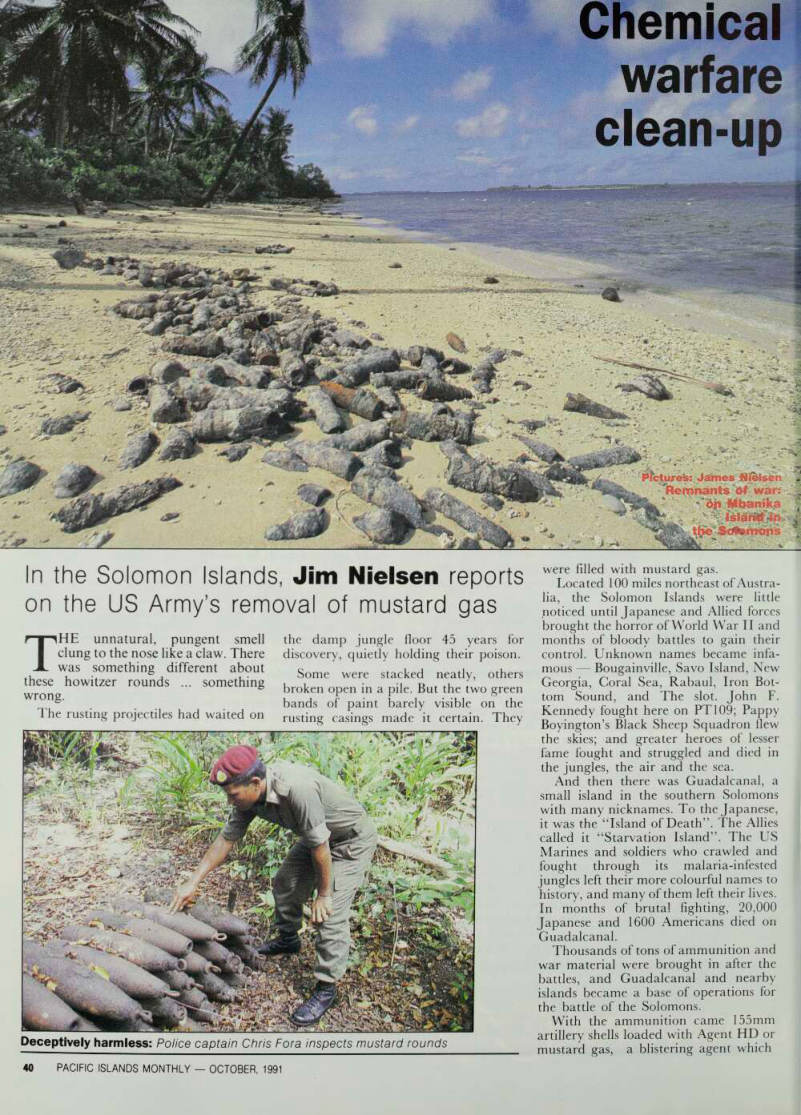
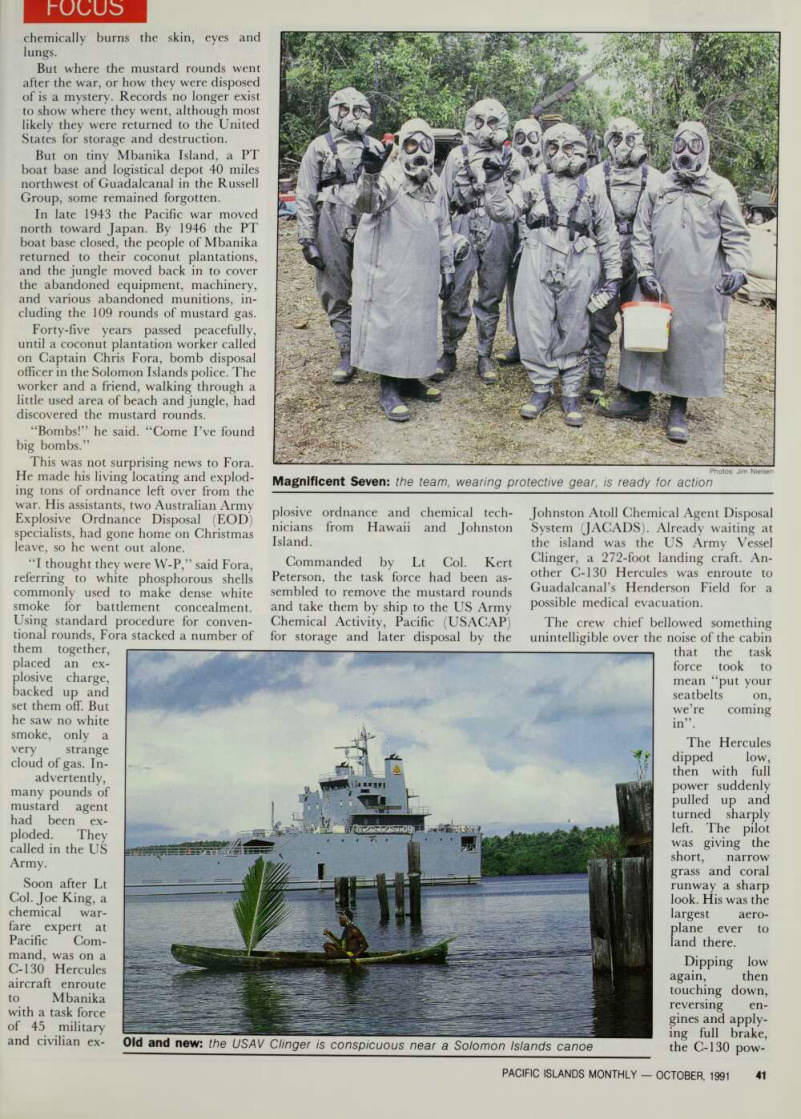
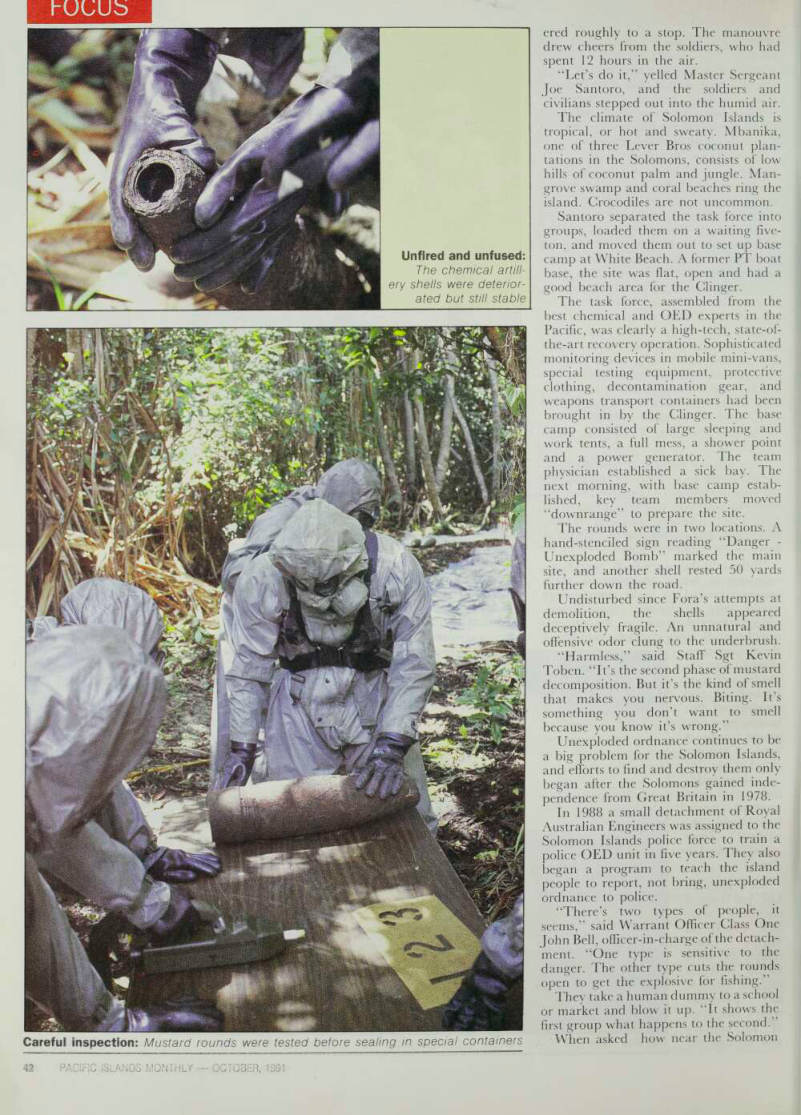
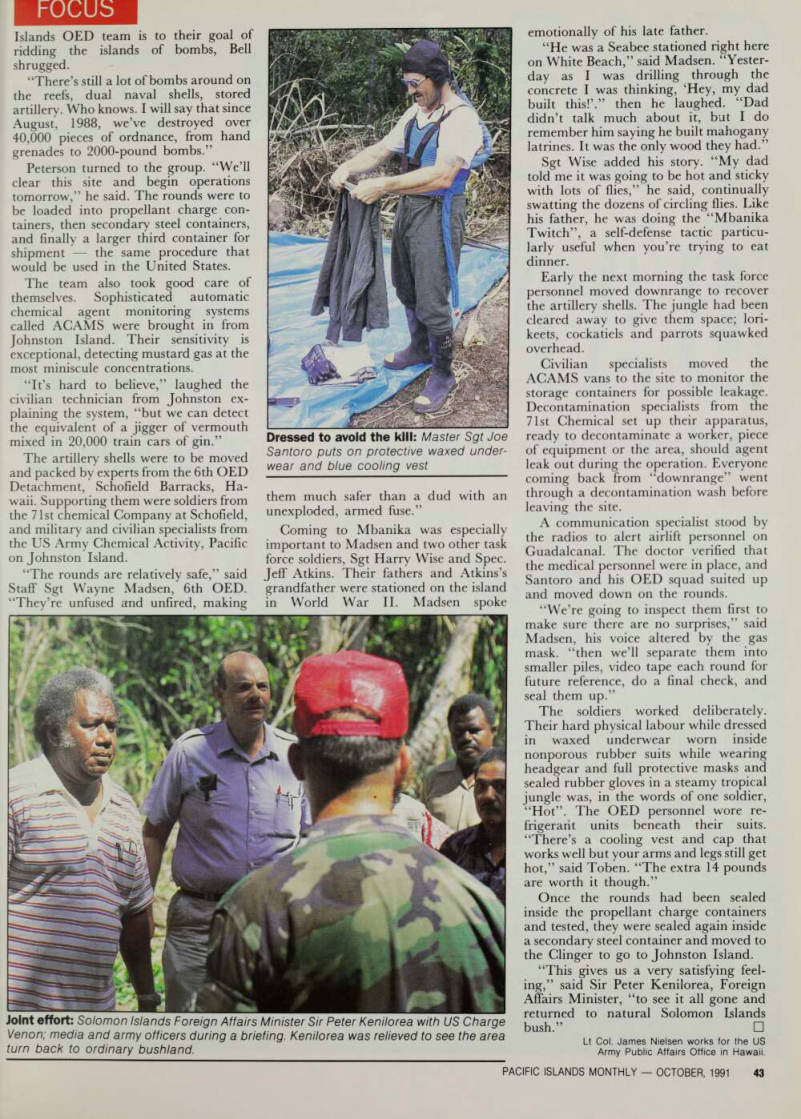
Chemical warfare clean-up
In the Solomon Islands, Jim Nielsen reports on the US Army’s removal of mustard gas
THE unnatural, pungent smell clung to the nose like a claw. There was something different about these howitzer rounds ... something wrong.
The rusting projectiles had waited on
the damp jungle floor 45 years for
discovery, quietly holding their poison.
Some were stacked neatly, others broken open in a pile. But the two green bands of paint barely visible on the rusting casings made it certain. They
were filled with mustard gas.
Located 100 miles northeast of Austra lia, the Solomon Islands were little noticed until Japanese and Allied forces brought the horror of World War II and months of bloody battles to gain their control. Unknown names became infa mous Bougainville, Savo Island, New Georgia, Coral Sea, Rabaul, Iron Bot tom Sound, and The slot. John F.
Kennedy fought here on PTIO9; Pappy Boyington’s Black Sheep Squadron flew the skies; and greater heroes of lesser fame fought and struggled and died in the jungles, the air and the sea.
And then there was Guadalcanal, a small island in the southern Solomons with many nicknames. To the Japanese, it was the “Island of Death”. The Allies called it “Starvation Island”. The US Marines and soldiers who crawled and fought through its malaria-infested jungles left their more colourful names to history, and many of them left their lives.
In months of brutal fighting, 20,000 Japanese and 1600 Americans died on Guadalcanal.
Thousands of tons of ammunition and war material were brought in after the battles, and Guadalcanal and nearby islands became a base of operations for the battle of the Solomons.
With the ammunition came 155 mm artillery shells loaded with Agent HD or mustard gas, a blistering agent which
Pictured: James Nieisen Remnants of war: on Mbanika
Islands in
the Solomons
Deceptively harmless: Police captain Chris Fora inspects mustard rounds
chemically burns the skin, eyes and lungs.
But where the mustard rounds went after the war, or how they were disposed of is a mystery. Records no longer exist to show where they went, although most likely they were returned to the United States for storage and destruction.
But on tiny Mbanika Island, a PT boat base and logistical depot 40 miles northwest of Guadalcanal in the Russell Group, some remained forgotten.
In late 1943 the Pacific war moved north toward Japan. By 1946 the PT boat base closed, the people of Mbanika returned to their coconut plantations, and the jungle moved back in to cover the abandoned equipment, machinery, and various abandoned munitions, in cluding the 109 rounds of mustard gas.
Forty-five years passed peacefully,
until a coconut plantation worker called on Captain Chris Fora, bomb disposal officer in the Solomon Islands police. The worker and a friend, walking through a little used area of beach and jungle, had discovered the mustard rounds.
“Bombs!” he said. “Come I’ve found big bombs.”
This was not surprising news to Fora.
He made his living locating and explod ing tons of ordnance left over from the war. His assistants, two Australian Army
Explosive Ordnance Disposal (EOD)
specialists, had gone home on Christmas leave, so he went out alone.
“I thought they were W-P,” said Fora, referring to white phosphorous shells commonly used to make dense white smoke for battlement concealment.
Using standard procedure for conven tional rounds, Fora stacked a number of
them together, placed an ex plosive charge, backed up and set them off. But he saw no white smoke, only a very strange cloud of gas. In advertently, many pounds of mustard agent had been ex ploded. They called in the US Army.
Soon after Lt Col. Joe King, a chemical war fare expert at Pacific Com mand, was on a C-130 Hercules aircraft enroute to Mbanika with a task force of 45 military and civilian ex-
plosive ordnance and chemical tech nicians from Hawaii and Johnston Island.
Commanded by Lt Col. Kert Peterson, the task force had been as sembled to remove the mustard rounds and take them by ship to the US Army
Chemical Activity, Pacific (USACAP)
for storage and later disposal by the
Johnston Atoll Chemical Agent Disposal System (JACADS). Already waiting at the island was the US Army Vessel Clinger, a 272-foot landing craft. An other C-130 Hercules was enroute to Guadalcanal’s Henderson Field for a possible medical evacuation.
The crew chief bellowed something unintelligible over the noise of the cabin
that the task force took to mean “put your seatbelts on, we’re coming in”.
The Hercules dipped low, then with full power suddenly pulled up and turned sharply left. The pilot was giving the short, narrow grass and coral runway a sharp look. His was the largest aero plane ever to land there.
Dipping low again, then
touching down,
reversing en gines and apply ing full brake, the C-130 pow-
Old and new: the USAV Clinger is conspicuous near a Solomon Islands canoe
Photos: Jim Nielsen Magnificent Seven: the team, wearing protective gear, is ready for action
ered roughly to a stop. The manouvre drew cheers from the soldiers, who had spent 12 hours in the air.
“Let’s do it,” yelled Master Sergeant Joe Santoro, and the soldiers and civilians stepped out into the humid air.
The climate of Solomon Islands is tropical, or hot and sweaty. Mbanika, one of three Lever Bros coconut plan tations in the Solomons, consists of low hills of coconut palm and jungle. Man grove swamp and coral beaches ring the island. Crocodiles are not uncommon.
Santoro separated the task force into groups, loaded them on a waiting five ton, and moved them out to set up base camp at White Beach. A former PT boat base, the site was flat, open and had a good beach area for the Clinger.
The task force, assembled from the best chemical and OLD experts in the Pacific, was clearly a high-tech, state-of the-art recovery operation. Sophisticated monitoring devices in mobile mini-vans, special testing equipment, protective clothing, decontamination gear, and weapons transport containers had been brought in by the Clinger. The base camp consisted of large sleeping and work tents, a full mess, a shower point and a power generator. The team physician established a sick bay. The next morning, with base camp estab lished, key team members moved “downrange” to prepare the site.
The rounds were in two locations. A hand-stenciled sign reading “Danger - Unexploded Bomb” marked the main site, and another shell rested 50 yards further down the road.
Undisturbed since Fora’s attempts at demolition, the shells appeared deceptively fragile. An unnatural and offensive odor clung to the underbrush.
“Harmless,” said Staff Sgt Kevin Toben. “It’s the second phase of mustard decomposition. But it’s the kind of smell that makes you nervous. Biting. It’s something you don’t want to smell because you know it’s wrong.”
Unexploded ordnance continues to be a big problem for the Solomon Islands, and efforts to find and destroy them only began after the Solomons gained inde pendence from Great Britain in 1978.
In 1988 a small detachment of Royal Australian Engineers was assigned to the Solomon Islands police force to train a police OED unit in five years. They also began a program to teach the island people to report, not bring, unexploded ordnance to police.
“There’s two types of people, it seems,” said Warrant Officer Class One John Bell, officer-in-charge of the detach ment. “One type is sensitive to the danger. The other type cuts the rounds open to get the explosive for fishing.”
They take a human dummy to a school or market and blow it up. “It shows the first group what happens to the second.”
When asked how near the Solomon
Careful inspection: Mustard rounds were tested before sealing in special containers
Unfired and unfused: The chemical artill ery shells were deterior ated but still stable
Islands OED team is to their goal of ridding the islands of bombs, Bell
shrugged.
“There’s still a lot of bombs around on the reefs, dual naval shells, stored artillery. Who knows. I will say that since August, 1988, we’ve destroyed over 40,000 pieces of ordnance, from hand grenades to 2000-pound bombs.”
Peterson turned to the group. “We’ll clear this site and begin operations tomorrow,” he said. The rounds were to be loaded into propellant charge con tainers, then secondary steel containers, and finally a larger third container for shipment the same procedure that would be used in the United States.
The team also took good care of themselves. Sophisticated automatic chemical agent monitoring systems called ACAMS were brought in from Johnston Island. Their sensitivity is exceptional, detecting mustard gas at the most miniscule concentrations.
“It’s hard to believe,” laughed the civilian technician from Johnston ex plaining the system, “but we can detect the equivalent of a jigger of vermouth mixed in 20,000 train cars of gin.”
The artillery shells were to be moved and packed by experts from the 6th OED Detachment, Schofield Barracks, Ha waii. Supporting them were soldiers from the 71st chemical Company at Schofield, and military and civilian specialists from the US Army Chemical Activity, Pacific on Johnston Island.
“The rounds are relatively safe,” said Staff Sgt Wayne Madsen, 6th OED.
“They’re unfused and unfired, making
them much safer than a dud with an unexploded, armed fuse.”
Coming to Mbanika was especially important to Madsen and two other task force soldiers, Sgt Harry Wise and Spec.
Jeff Atkins. Their fathers and Atkins’s grandfather were stationed on the island in World War 11. Madsen spoke
emotionally of his late father.
“He was a Seabee stationed right here on White Beach,” said Madsen. “Yester day as I was drilling through the concrete I was thinking, ‘Hey, my dad built this!’.” then he laughed. “Dad didn’t talk much about it, but I do remember him saying he built mahogany latrines. It was the only wood they had.”
Sgt Wise added his story. “My dad told me it was going to be hot and sticky with lots of flies,” he said, continually swatting the dozens of circling flies. Like his father, he was doing the “Mbanika Twitch”, a self-defense tactic particu larly useful when you’re trying to eat dinner.
Early the next morning the task force personnel moved downrange to recover the artillery shells. The jungle had been cleared away to give them space; lori keets, cockatiels and parrots squawked overhead.
Civilian specialists moved the ACAMS vans to the site to monitor the storage containers for possible leakage.
Decontamination specialists from the 71st Chemical set up their apparatus, ready to decontaminate a worker, piece of equipment or the area, should agent leak out during the operation. Everyone coming back from “downrange” went through a decontamination wash before leaving the site.
A communication specialist stood by the radios to alert airlift personnel on Guadalcanal. The doctor verified that the medical personnel were in place, and Santoro and his OED squad suited up and moved down on the rounds.
“We’re going to inspect them first to make sure there are no surprises,” said Madsen, his voice altered by the gas mask, “then we’ll separate them into smaller piles, video tape each round for future reference, do a final check, and seal them up.”
The soldiers worked deliberately.
Their hard physical labour while dressed in waxed underwear worn inside nonporous rubber suits while wearing headgear and full protective masks and sealed rubber gloves in a steamy tropical jungle was, in the words of one soldier, “Hot”. The OED personnel wore re frigerant units beneath their suits.
“There’s a cooling vest and cap that works well but your arms and legs still get hot,” said Toben. “The extra 14 pounds are worth it though.”
Once the rounds had been sealed inside the propellant charge containers and tested, they were sealed again inside a secondary steel container and moved to the Clinger to go to Johnston Island.
“This gives us a very satisfying feel ing,” said Sir Peter Kenilorea, Foreign Affairs Minister, “to see it all gone and returned to natural Solomon Islands bush.” □ Lt Col. James Nielsen works for the US Army Public Affairs Office in Hawaii.
Joint effort: Solomon Islands Foreign Affairs Minister Sir Peter Kenilorea with US Charge Venon; media and army officers during a briefing. Kenilorea was relieved to see the area turn back to ordinary bush land.
Dressed to avoid the kill: Master Sgt Joe Santoro puts on protective waxed under wear and blue cooling vest
Advertisements & other items, p. 44 (1 item)
A Service of Andrew Weir Shipping Limited
B B A Service of Andrew Weir Shipping Limited
The Bank Line
YOUR EXPERTS IN THE SOUTH PACIFIC
A SERVICE OF ANDREW WEIR SHIPPING
The Bank Line serves the South Pacific to ahctfrom ■ SB K ' -■* 4 TTi sa -r m
Message of peace
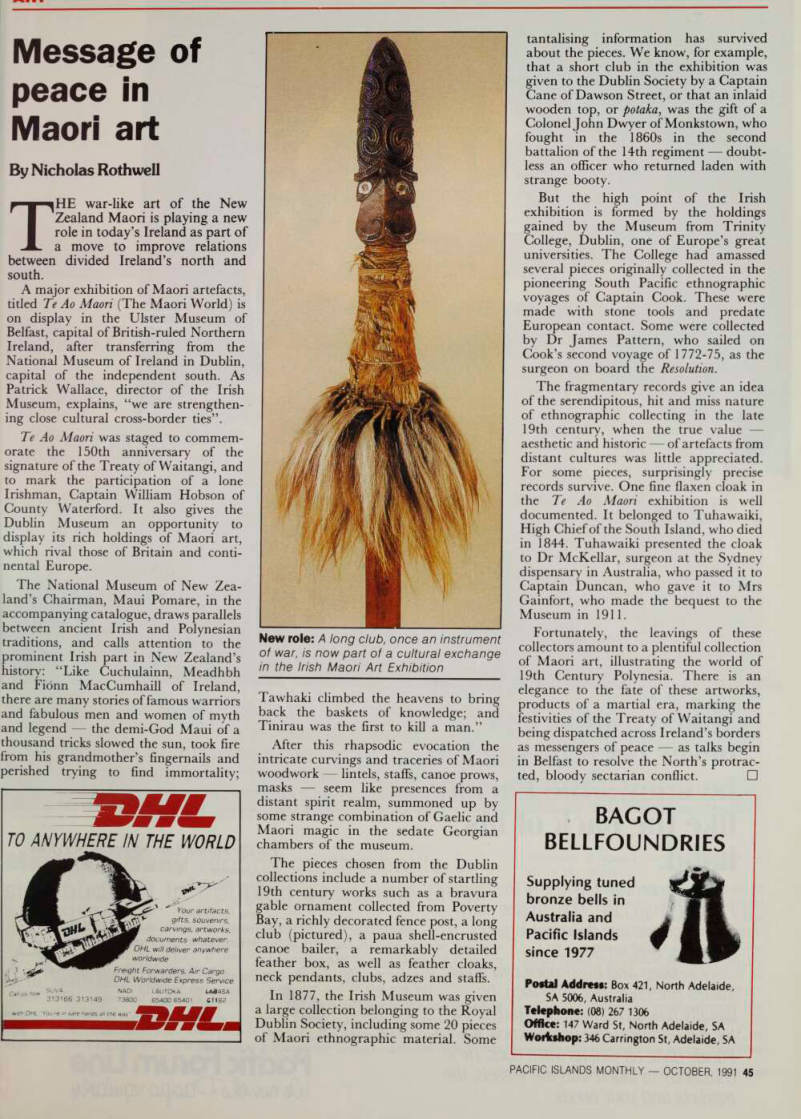
peace in Maori art
By Nicholas Rothwell
THE war-like art of the New Zealand Maori is playing a new role in today’s Ireland as part of a move to improve relations between divided Ireland’s north and south.
A major exhibition of Maori artefacts, titled Te Ao Maori (The Maori World) is on display in the Ulster Museum of Belfast, capital of British-ruled Northern Ireland, after transferring from the National Museum of Ireland in Dublin, capital of the independent south. As Patrick Wallace, director of the Irish Museum, explains, “we are strengthen ing close cultural cross-border ties”.
Te Ao Maori was staged to commem orate the 150th anniversary of the signature of the Treaty of Waitangi, and to mark the participation of a lone Irishman, Captain William Hobson of County Waterford. It also gives the Dublin Museum an opportunity to display its rich holdings of Maori art, which rival those of Britain and conti
nental Europe.
The National Museum of New Zea land’s Chairman, Maui Pomare, in the
accompanying catalogue, draws parallels
between ancient Irish and Polynesian traditions, and calls attention to the prominent Irish part in New Zealand’s history: “Like Cuchulainn, Meadhbh and Fionn MacCumhaill of Ireland, there are many stories of famous warriors and fabulous men and women of myth and legend the demi-God Maui of a thousand tricks slowed the sun, took fire from his grandmother’s fingernails and perished trying to find immortality;
Tawhaki climbed the heavens to bring back the baskets of knowledge; and Tinirau was the first to kill a man.”
After this rhapsodic evocation the intricate curvings and traceries of Maori woodwork lintels, staffs, canoe prows, masks seem like presences from a distant spirit realm, summoned up by some strange combination of Gaelic and Maori magic in the sedate Georgian chambers of the museum.
The pieces chosen from the Dublin collections include a number of startling 19th century works such as a bravura gable ornament collected from Poverty Bay, a richly decorated fence post, a long club (pictured), a paua shell-encrusted canoe bailer, a remarkably detailed feather box, as well as feather cloaks, neck pendants, clubs, adzes and staffs.
In 1877, the Irish Museum was given a large collection belonging to the Royal Dublin Society, including some 20 pieces of Maori ethnographic material. Some
tantalising information has survived about the pieces. We know, for example, that a short club in the exhibition was given to the Dublin Society by a Captain Cane of Dawson Street, or that an inlaid wooden top, or potaka , was the gift of a Colonel John Dwyer of Monkstown, who fought in the 1860 s in the second battalion of the 14th regiment doubt less an officer who returned laden with strange booty.
But the high point of the Irish exhibition is formed by the holdings gained by the Museum from Trinity College, Dublin, one of Europe’s great universities. The College had amassed several pieces originally collected in the pioneering South Pacific ethnographic voyages of Captain Cook. These were made with stone tools and predate European contact. Some were collected by Dr James Pattern, who sailed on Cook’s second voyage of 1772-75, as the surgeon on board the Resolution.
The fragmentary records give an idea of the serendipitous, hit and miss nature of ethnographic collecting in the late 19th century, when the true value aesthetic and historic of artefacts from distant cultures was little appreciated.
For some pieces, surprisingly precise
records survive. One fine flaxen cloak in the Te Ao Maori exhibition is well documented. It belonged to Tuhawaiki, High Chief of the South Island, who died in 1844. Tuhawaiki presented the cloak to Dr McKellar, surgeon at the Sydney dispensary in Australia, who passed it to Captain Duncan, who gave it to Mrs Gainfort, who made the bequest to the Museum in 1911.
Fortunately, the leavings of these collectors amount to a plentiful collection of Maori art, illustrating the world of 19th Century Polynesia. There is an elegance to the fate of these artworks, products of a martial era, marking the festivities of the Treaty of Waitangi and being dispatched across Ireland’s borders as messengers of peace as talks begin in Belfast to resolve the North’s protrac ted, bloody sectarian conflict. □
New role: A long club, once an instrument of war, is now part of a cultural exchange in the Irish Maori Art Exhibition
Advertisements & other items, pp. 45-46 (1 item)
Bellfoundries
TO ANYWHERE THE WORLD
m 313166 313149 Your artifacts, gifts, souvenirs, carvings, artworks, documents whatever.
DHL will deliver anywhere worldwide Freight Forwarders. Air Cargo DHL Worldwide Express Service
NADI LAUTOKA tAfIASA
73800 65400 65401 6M62 nth DHL "You're >n sate hands all Che way
BAGOT
BELLFOUNDRIES
Supplying tuned
bronze bells in Australia and Pacific Islands since 1977 Postal Address: Box 421, North Adelaide, SA 5006, Australia Telephone: (08) 267 1306 Office: 147 Ward St, North Adelaide, SA WoHtshop: 346 Carrington St, Adelaide, SA
Mike Pa’atoia has
never been to sea but
he knows the Pacific
like the back of his
hand.
Together with the rest of the team at Pacific Forum Line, Mike makes sure your products are delivered in good condition, and on time.
Cyclones and hurricanes can upset Mike’s efficiency. But even then, he usually has an answer on hand. It’s a big job and very few people know the Pacific quite as well as Mike does. He’s constantly in touch with the vessels, the markets and your needs.
And this experience is always at your service.
We’re proud of Mike and the rest of the team at Pacific Forum Line, where your business comes first and gets there first, around the Pacific.
Pacific Forum Line Shipping Services Australia New Zealand Fiji New Caledonia Tonga Western Samoa American Samoa Tuvalu Kiribati Papua New Guinea Solomon Islands Cook Islands Telephone: Auckland NZ (09) 396-700 Fax: (09) 392-683 Telex: 60460
Forum Line
hOc requhrty.
TA4B
Pacific
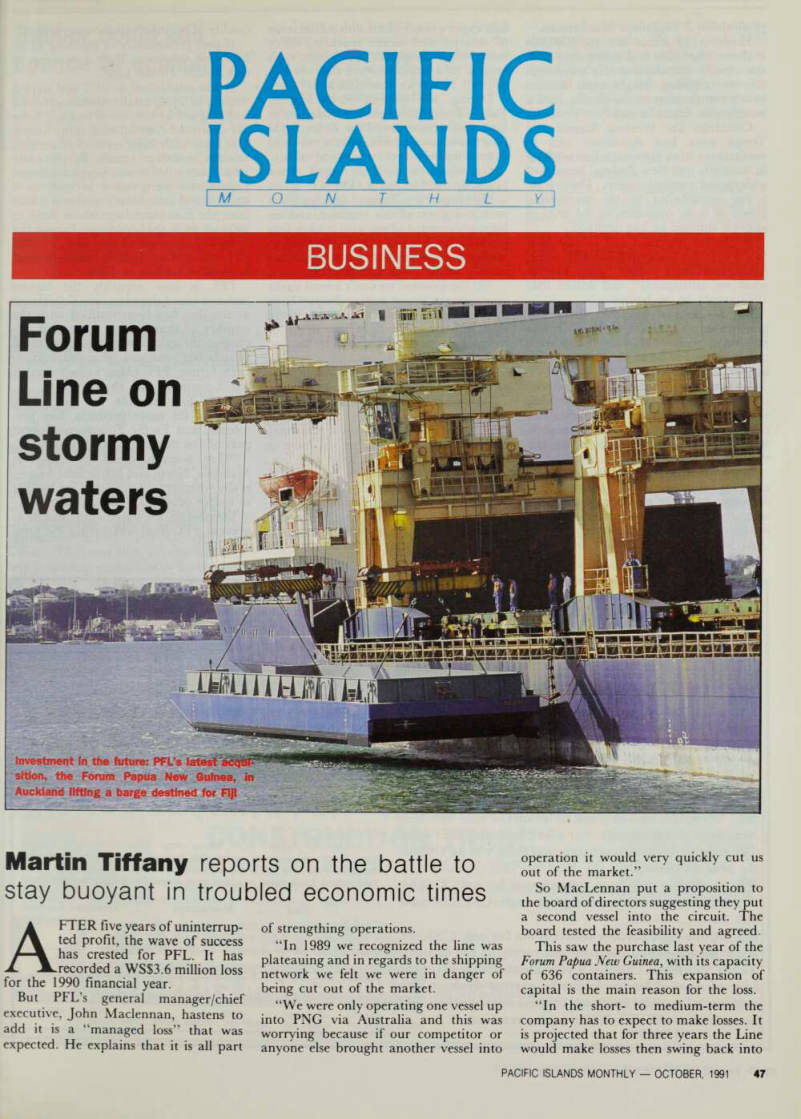
Islands
Monthly
Business
Forum Line on stormy waters
Martin Tiffany reports on the battle to stay buoyant in troubled economic times
AFTER five years of uninterrup ted profit, the wave of success has crested for PFL. It has recorded a WSS3.6 million loss for the 1990 financial year.
But PFL’s general manager/chief executive, John Maclennan, hastens to add it is a “managed loss” that was expected. He explains that it is all part
of strengthing operations.
“In 1989 we recognized the line was plateauing and in regards to the shipping network we felt we were in danger of being cut out of the market.
“We were only operating one vessel up into PNG via Australia and this was worrying because if our competitor or anyone else brought another vessel into
operation it would very quickly cut us out of the market.”
So MacLennan put a proposition to the board of directors suggesting they put a second vessel into the circuit. The board tested the feasibility and agreed.
This saw the purchase last year of the Forum Papua New Guinea, with its capacity of 636 containers. This expansion of capital is the main reason for the loss.
“In the short- to medium-term the company has to expect to make losses. It is projected that for three years the Line would make losses then swing back into
Investment In the future: PFL’s latest sition, the Forum Papua New Guinea, in Auckland lifting a barge destined for FIJI
profitability,” explained MacLennan.
However, he admits that the 1990 loss is above what they had anticipated with the vessel s introduction. He attributed this to tumbling freight rates due to heavy competition m the Pacific, and a recession m Australia and New Zealand.
Countries like Western Samoa and longa have had significant cuts m remittances from their islanders working in Australia and New Zealand because of widespread unemployment. These were a big contributor to the purchasing power ol those countries, so the level of imports shipped m has declined.
While he preferred not to say how much over the budgetted loss PFL went, MacLennan said it had “gone beyond ™ hat we a ntici P ated ” and added that 991 would be no better.
But he pointed out that there was hardly a shipping line operating that was not losing money. He said things were tough in the Pacific at the moment with
intense competition.
“When other shipping lines feel the pinch they look at the Pacific and think there s a huge dollar to be made. The cake is only a certain size and, as it is carved jip by more operators, we feel the eff ects.”
MacLennan said many of these operators called at their own convenience, diverting en route to other destinations when tonnages are low. Immediately the situation changed, they moved on.
As MacLennan points out, importers
and exporters get lulled into a false sense of security and secure markets. When competitors disappear and freight rates return to a realistic level they find it difficult to service these markets.
During the present rough patch,
Pacific Forum Line plan to consolidate, Last year s purchase of the Forum Papua New Guinea boosted PFL’s list of vessels to three chartered and two owned ones.
Optimistically the Line hopes to see profit by 1993 or early 1994.
“We hope New Zealand and Australia soon swing out of this recession and we hope to be swept along with it back into profitability, but as I said, in the short to medium term things have impacted heavily on us,” MacLennan said.
“At the moment we don’t intend to cut operations or prune services but we have to be careful as all our reserves are in the ship. But this is the right way to go, to have a balance of ships owned by the line and those chartered.”
MacLennan knows things may not go
as planned.
“We planned for losses but not of that magnitude. Whilst the line can cope with those losses for the moment if the trend continues for a long time we will have to look at funding them in some way.”
He said this may be done by a capital injection or by selling the vessels PFL owns and leasing them back.
“This is only a last resort, we are praying that tonnage, which is cargo, will increase, and at the same time the
quality of revenue will increase with it ”
If past performance is anything to go by it will take more than a recession to sink Pacific Forum Line It was established in 1977 and started trading in 1978, totally undercapitalised and plagued by the cost of running three old chartered conventional cargo vessels and later with high costs of chartering modern container vessels By the early 1980 s many felt it was beyond salvage Consultants were called in and, as a result, the shareholders negotiated a loan from the European Investment Bank to increase their shareholdings. It gave the company a stronger capital base. By 1985 PFL was making a profit, which jumped to WSS6.6 million in 1986.
PFL is now arguably the biggest
regional-based shipping line. Confidence
in the line has been instilled with the number of shareholders increasing, in eluding the government of the Marshall Islands last year and Niue this year, In future, PFL plans to look further afield, working with shareholders,
“Fiji, for example, is looking to
Malaysia for more products, like pet roleum, and Pacific Forum could form part of the thrust in that direction.
“Our horizon could be more to Malaysia, North and South East Asia really wherever the countries are looking to source products,” MacLennan said, Meanwhile, a few swells are unlikely to prevent PFL from weathering the pres ent storm. □
Advertisements & other items, p. 48 (1 item)
TTli'l to TAHITI
Enter the Tahiti Sun Press sweepstakes drawing. Win one of two free one-week vacation for two in Tahiti as a privileged subscriber to the new monthly Tahiti Sun Press scheduled to be launched in early 1992.
Choose one of these subscription offers O A charter one-year subscription for only $5O. (US Mainland residents only. For other countries see rates).
The regular 12-month subscription price will be US$6O.
So save $lO now.
B A charter two-year subscription for only US$9O.
A regular 24-month subscription costs US$l2O. Save $3O now.
B A one-time lifetime subscription for only US$35O.
After six years you will continue receiving the monthly Tahiti Sun Press 12 times a year absolutely free for the rest of your life! A fantastic saving! Due to the substantial savings involved, lifetime subscriptions will be limited to the first 1000 orders received.
Fill out the coupon and send it with your credit card information, personal cheque or money order to: Monthly Tahiti Sun Press Contest, B.P. 887, Papeete, Tahiti.
Yes! Sign me up for a Tahiti Sun Press subscription: □ Iyr □ 2 yrs □ Lifetime Enclosed is $ ( □ personal cheque □ money order Uncertified bank cheque) Note: Credit card payments are possible, but may cost you more or less than the rates listed here due to the fluctuation in foreign exchange rates. Tahiti Publications Touristiques assumes no responsibility for such accurences. □ Visa □ Mastercard □ American Express Card No: Signature Expiry Date Name Adress
Rubber could add

bounce to economy
THE Solomon Islands entered the rubber industry with the arrival of 3500 rubber plant stems recently. The Prime Minister, Solomon Mamaloni, said the planting of the trees will be the beginning of a commodity to help boost the country’s economy with a product that’s not too technical. The rubber project is being undertaken by an Indonesian company, Mega Corporation Limited, and the Solomon Ministry of Agriculture and Lands.
Nieu
Cutback on expatriates NIUE is to cut back the number of expatriate New Zealand contract work ers on the island. Finance Minister, Young Vivian, says he hopes to save nearly U 55285,000 by speeding up a programme to replace expatriates with
local people.
Micronesia
Study on ecotourism AN international study in Kosrae is trying to determine how to reap the benefits of tourism while protecting the mangrove forests, coral reefs, and virtu ally untouched natural beauty of the Micronesia island. The Governor of Kosare, Thurston Siba, says he wants to
help it develop economically by enhanc
ing natural resources, environmental beauty and cultural values. The 16-member assessment team from Pohnpei, Guam, New Caledonia, Aus tralia and Hawaii, will submit their recommendations next month.
Cook Islands
New notes THE Cook Islands Government is con sidering printing currency notes with new designs. The new designs for the $3, $lO, $2O and $5O notes were submitted
by Thomas De La Rue and the British American Banknote Company. The de signs, based on environmental, historical and cultural themes, will be put to cabinet for approval.
No aid for compensation COOK Islands Prime Minister, Geoffrey Henry, has dismissed suggestions that New Zealand aid money could help fund his Government’s compensation payout to the British Cable and Wireless com pany. The Cook Islands Government terminated the company’s telecommuni cation franchise at the end of June, almost four years before it was due. He said New Zealand’s budgetary assistance was directed by his Government specifi cally to health and education.
Western Samoa
Bank warning WESTERN Samoa’s Central Bank has warned that falling payments from overseas mean the country will have to curtail imports and find other ways of boosting foreign income. The bank’s
general manager, Papalii Tommy
Scanlan, says due largely to the recession in New Zealand, payments are expected to drop from a record of over US$37 million in 1990 to about US$34 million this year.
Papua New Guinea
Looking to Japan PAPUA New Guinea’s Prime Minister, Rabbie Namaliu, has urged the Japanese private sector to invest in the country. He said PNG must attract investments which will allow the country to build the economic base for its future, despite competition from many industrialised countries which are targeting Japanese investors. Namaliu said this is why his Government is putting more emphasis in the processing of PNG’s agricultural,
forestry and fisheries products.
Growth forecast PAPUA New Guinea’s Prime Minister, Rabbie Namiliu, has forecast that PNG will have one of the world’s highest levels
of economic growth during the remain der of the decade. He said with PNG about to become a significant oil pro ducer and the development of new mineral deposits, the country’s economy would continue to expand at a rate which other nations could only dream about.
Marshall Islands
Fisheries advisor A FISHERIES development advisor for the Republic of the Marshall Islands has been funded by a technical assistance grant from the United States. He will assist the Marshall Islands Marine Re
sources Authority in developing plans for
fisheries management.
Fiji
investors to meet INVESTORS from around the world are expected to gather in Fiji for Networking South Pacific ’9l from November 13 to 16. The investment and trade forum has been designed to show what Fiji has to offer and enable delegates to exchange ideas on invest ment in Fiji. It is the first of its kind, and has been organised under the auspices of the Fiji Trade and Investment Board and the united Nations Development Pro gramme/United Nations Industrial De
velopment Organisation with assistance
from the Centre for the Development of Industry in Brussels. Pacific Islands Monthly will include a special look at investment in next month’s edition.
Down to business THE South Pacific Trade Commission last month launched a series of tapes aimed at people starting their own business. Titled “Getting Down to Busi ness”, the 26-tape set was produced by Radio Australia to suit the South Pacific.
The initial series is for the Fiji market but future series are planned for other South Pacific countries. Work on tapes in Pidgin and French has started. The tapes are available on subscription. □
Advertisements & other items, p. 49 (1 item)
Carpenters
ARE-YOU LOOKING FOR “RELIANCE SUPPLIERJFOR
CONSTRUCTION TRADE”
RECORD AND FIJI’S BIGGEST SUPPLIER/EXPORTER TO
Roofing, Timber, Tiles, All types of Boards, Tools, Structural Steel, Pain ■conditioners, Switchgear, Wire Ropes, Wire Products, Ships Fittings, Surv
CARPENTERS
BUILDERS MERCHANTS
BRANCHES:- LAUTOKA
PH: 661440, 660189, 660868, 663076
FAX: 660955, 660494
HEAD OFFICE:
46 MATUA ST,
WALU BAY, SUVA
G.P.O. BOX 48,
SUVA, FIJI.
PHONE: 313155
FAX: (679) 300694/302655
TELEX: FJ2457 BMD
NADI
PH: 701723
FAX: 700883
BIQATOKA
PH: 500520
FAX: 500672
LABABA
PH: 811656, 813399
FAX: 813071
HE IN RY “IF WE DO
NOT
STOCK
IT WE LL
GET
IT” o
ONE
E STOP SUPPLIEi
CONSTRUCTION
INDUSTRY "
TO
and his island
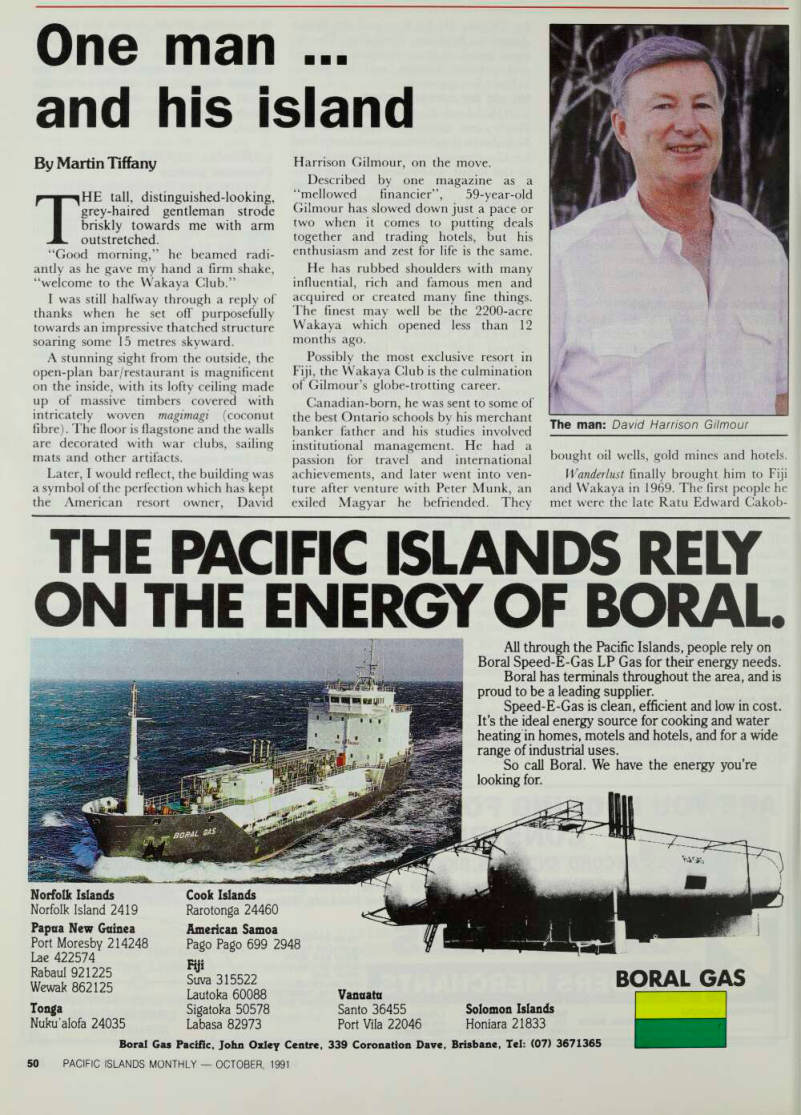
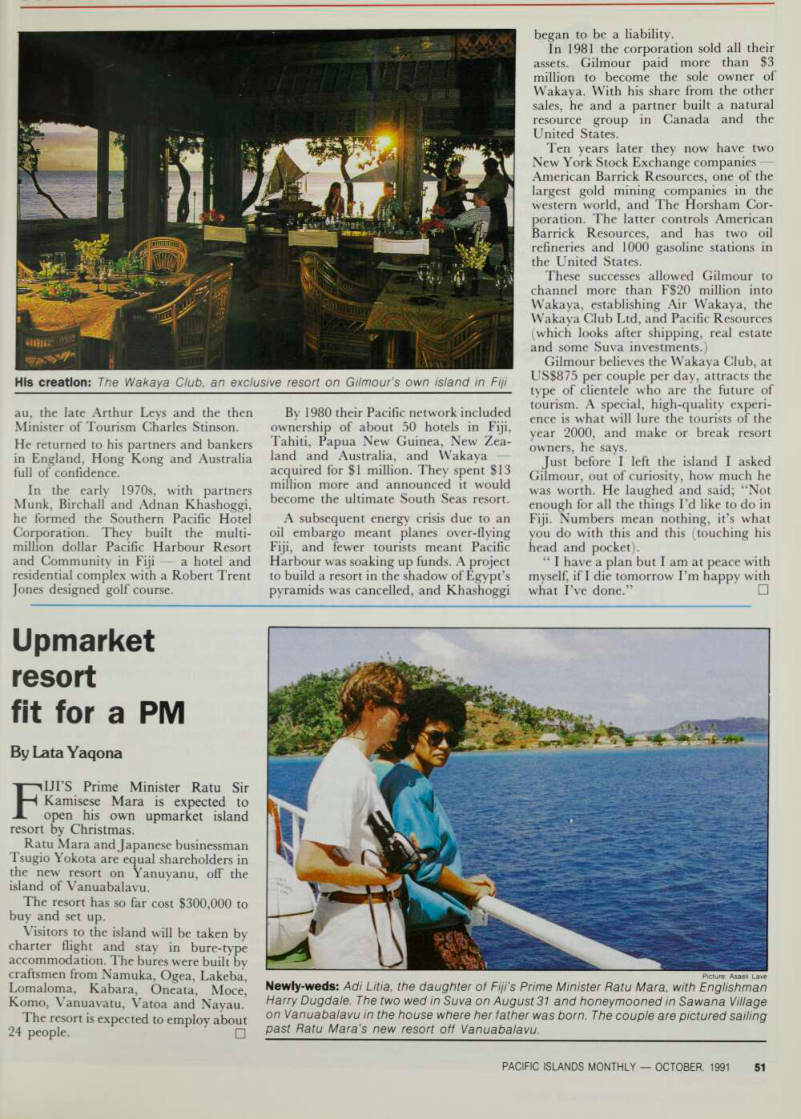
One man ... and his island
By Martin Tiffany
THE tall, distinguished-looking,
grey-haired gentleman strode briskly towards me with arm outstretched.
“Good morning,” he beamed radi antly as he gave my hand a firm shake, “welcome to the Wakaya Club.”
I was still halfway through a reply of thanks when he set off purposefully towards an impressive thatched structure soaring some 15 metres skyward.
A stunning sight from the outside, the
open-plan bar/restaurant is magnificent
on the inside, with its lofty ceiling made up of massive timbers covered with intricately woven magimagi (coconut fibre). The floor is flagstone and the walls are decorated with war clubs, sailing mats and other artifacts.
Later, I would reflect, the building was a symbol of the perfection which has kept the American resort owner, David
Harrison Gilmour, on the move.
Described by one magazine as a “mellowed financier”, 59-year-old Gilmour has slowed down just a pace or two when it comes to putting deals together and trading hotels, but his enthusiasm and zest for life is the same.
He has rubbed shoulders with many influential, rich and famous men and acquired or created many fine things.
The finest may well be the 2200-acre Wakaya which opened less than 12 months ago.
Possibly the most exclusive resort in Fiji, the Wakaya Club is the culmination of Gilmour’s globe-trotting career.
Canadian-born, he was sent to some of the best Ontario schools by his merchant banker father and his studies involved institutional management. He had a passion for travel and international achievements, and later went into ven ture after venture with Peter Munk, an exiled Magyar he befriended. They
bought oil wells, gold mines and hotels.
Wanderlust finally brought him to Fiji and Wakaya in 1969. The first people he met were the late Ratu Edward Cakob-
The man: David Harrison Gilmour
au, the late Arthur Leys and the then Minister of Tourism Charles Stinson.
He returned to his partners and bankers in England, Hong Kong and Australia full of confidence.
In the early 19705, with partners Munk, Birchall and Adnan Khashoggi, he formed the Southern Pacific Hotel Corporation. They built the multi million dollar Pacific Harbour Resort and Community in Fiji a hotel and residential complex with a Robert Trent Jones designed golf course.
By 1980 their Pacific network included ownership of about 50 hotels in Fiji, Tahiti, Papua New Guinea, New Zea land and Australia, and Wakaya acquired for $1 million. They spent $l3 million more and announced it would become the ultimate South Seas resort.
A subsequent energy crisis due to an oil embargo meant planes over-flying Fiji, and fewer tourists meant Pacific Harbour was soaking up funds. A project to build a resort in the shadow of Egypt’s pyramids was cancelled, and Khashoggi
began to be a liability.
In 1981 the corporation sold all their assets. Gilmour paid more than S 3 million to become the sole owner of Wakaya. With his share from the other sales, he and a partner built a natural resource group in Canada and the United States.
Ten years later they now have two New York Stock Exchange companies American Barrick Resources, one of the largest gold mining companies in the western world, and The Horsham Cor poration. The latter controls American Barrick Resources, and has two oil refineries and 1000 gasoline stations in the United States.
These successes allowed Gilmour to channel more than Fs2o million into Wakaya, establishing Air Wakaya, the Wakaya Club Ltd, and Pacific Resources (which looks after shipping, real estate and some Suva investments.) Gilmour believes the Wakaya Club, at US$B75 per couple per day, attracts the type of clientele who are the future of
tourism. A special, high-quality experi
ence is what will lure the tourists of the year 2000, and make or break resort owners, he says.
Just before I left the island I asked Gilmour, out of curiosity, how much he was worth. He laughed and said; “Not enough for all the things Td like to do in Fiji. Numbers mean nothing, it’s what you do with this and this (touching his head and pocket).
“ I have a plan but I am at peace with myself, if I die tomorrow I’m happy with what I’ve done.” □
His creation: The Wakaya Club, an exclusive resort on Gilmour’s own island in Fiji
Advertisements & other items, p. 50 (1 item)
The Racifk Islands Rely
ON THE ENERGY OF BORAL
Norfolk Islands Norfolk Island 2419 Papua New Guinea Port Moresby 214248 Lae 422574 Rabaul 921225 Wewak 862125 Tonga Nukualofa 24035 All through the Pacific Islands, people rely on Boral Speed-E-Gas LP Gas for their energy needs.
Boral has terminals throughout the area, and is proud to be a leading supplier.
Speed-E-Gas is clean, efficient and low in cost.
It's the ideal energy source for cooking and water heating in homes, motels and hotels, and for a wide range of industrial uses.
So call Boral. We have the energy you're looking for. mb*S Cook Islands Rarotonga 24460 American Samoa Pago Pago 699 2948 Fiji Suva 315522 Lautoka 60088 Vanuatu Sigatoka 50578 Santo 36455 Solomon Islands Labasa 82973 Port Vila 22046 Honiara 21833 Boral Gas Pacific, John Oxley Centre, 339 Coronation Dave, Brisbane, Tel: (07) 3671365
BORAL GAS
Upmarket
resort fit for a PM
By Lata Yaqona
FIJI’S Prime Minister Ratu Sir Kamisese Mara is expected to open his own upmarket island resort by Christmas.
Ratu Mara and Japanese businessman Tsugio Yokota are equal shareholders in the new resort on Yanuyanu, off the island of Vanuabalavu.
The resort has so far cost $300,000 to buy and set up.
Visitors to the island will be taken by charter flight and stay in bure-type accommodation. The bures were built by craftsmen from Namuka, Ogea, Lakeba, Lomaloma, Kabara, Oneata, Moce, Komo, Vanuavatu, Vatoa and Nayau.
The resort is expected to employ about 24 people. □
Picture: Asaeli Lave Newly-weds: Adi Litia, the daughter of Fiji’s Prime Minister Ratu Mara, with Englishman Harry Dugdale. The two wed in Suva on August 31 and honeymooned in Sawana Village on Vanuabalavu in the house where her father was born. The couple are pictured sailing past Ratu Mara's new resort off Vanuabalavu.
Advertisements & other items, p. 52 (1 item)
Vacancies
FORUM SECRETARIAT
SENIOR ADVISOR, PLANNING AND EVALUATION
The Senior Advisor, Planning and Evaluation, is a senior management position reporting directly to the Deputy Secretaiy General (Policy & Services), and is responsible for undertaking on-going corporate analysis, planning and review of Secretariat programmes and operations. This includes undertaking critical assessments of the effectiveness of programmes and working closely with Secretariat divisions in the development of strategies to respond to programme objectives. The Advisor is also required to provide advice to management on the setting of operational targets and to monitor the efficiency of management systems and controls and the adequacy of operational resources. The Advisor’s responsibilities also include policy analysis and advice relating to meetings of the South Pacific Forum and its SC c?' a * ne^wor * < regional advisory and technical committees. From time to time the Advisor is required to represent the Secretariat at regional and international meetings and to undertake other periodic duty travel as directed.
Preference will be given to applicants with relevant senior level experience and a demonstrated knowledge and appreciation of the economic, social and political aspirations of the Forum’s member countries. The ability to write, in English, clearly and concisely on a range of policy and technical issues and a corresponding analytical ability are prerequisites. Relevant tertiary qualifications in an appropriate discipline, will also be highly regarded.
The Development Cooperation Advisor will be responsible to the Director, Economic Development Division and will work with a small team of professionals in providing advice on improving coordination of development programmes in the region, enhancing policy dialogue in Forum Island Countries and upgrading national planning capacities. The appointee to the position will have appropriate qualifications and a strong background in development policy formulation with appropriate knowledge of donor activities and operating procedures.
The Advisor will be required to represent the Secretary General at international and regional meetings and present the regional position in negotiations with donors. This will include playing a key role in the organisation of annual high level economic discussions between Forum Island Countries and the region’s major development partners. In the course of carrying out the activities of this position, the appointee will be required to undertake periodic duty travel.
General Information These appointments will carry attractive remuneration packages, payable in Fiji dollars. For non-Fiji citizens this is tax-free and includes housing or a housing allowance and education and child allowances where eligible. Other benefits for all employees include superannuation and medical, life and travel insurance coverage. The appointees will be based at the Secretariat’s headquarters in Suva. Appointment will be for three years initially, and is renewable by mutual agreement.
Applications close on 15 November, 1991. They should contain full information on education and career backgrounds and should give names, addresses and telephone numbers of at least three referees with whom the applicant has been associated professionally.
Applications should be addressed to: The Secretary General Forum Secretariat GPO Box 856, Suva, Fiji Telephone 312-600 Telex: 2229FJ Fax: 302-204 Further information is available on request from Mrs Lailun Khan, Administration Officer, on 312-600 Extension: 218. * Member states of the South Pacific Forum: Australia, Cook Islands, Federated States of Micronesia, Fiji, Kiribati, Nauru, New Zealand, Niue, Papua New Guinea, Republic of the Marshall Islands, Solomon Islands, Tonga, Tuvalu, Vanuatu and Western Samoa.
DEVELOPMENT COOPERATION ADVISOR
services study

Grant for Vanuatu services study
VANUATU is to get a technical assistance grant of U 55525,000 from the Asian Development Bank for a study of its inter-island shipping services. The Malaysian-based bank said the grant will help the Vanuatu Government decide on the best policy for sustainable and efficient inter-island shipping services. □ Storage inspections THE Solomon Islands Government is taking measures to ensure export of good quality fish. From August the Fisheries Division of the Ministry of Natural Resources required that all fish-exporting businesses have
Government-approved inplant quality
management programs. It will employ inspectors to check fishing vessels’ storage facilities, handling and holding areas, and transport vehicles. □
Deep-sea funding
A DEEP-SEA fishing project in Tuvalu funded by the US Agency for Interna tional Development is to receive U 55730,000, taking the total to U 55930,000. The project is for develop ment of bottom-fishing in the southern waters of Tuvalu. □
Shipping schedules
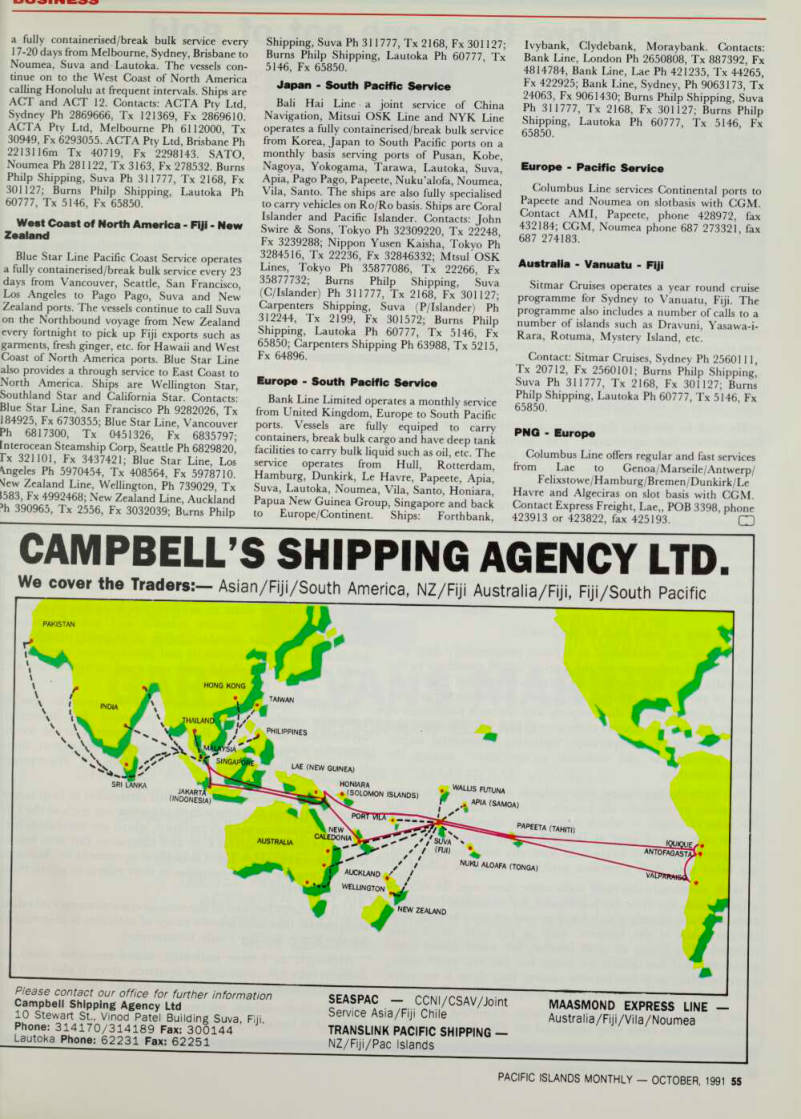
New Zealand - Fiji direct Sofrana Unilines operates a fully containerised/breakbulk service every 21 days from Auckland, Tauranga, Lyttleton to Suva and Lautoka. Loading every 21 days, ro/ro service, containers - reefer. Contact Sofrana Unilines, Sofrana House, 101 Customs Street, Auckland, PO Box 3614, Fax (09) 393874, Ph (09) 773279, Tlx NZ 2313. Direct toll free line 0800 659-922, Contact Alan Foote. Sofrana Shipping Agencies, PO Box 921 Wellington, Tel (04) 725 661, Fax (04) 725 749, Tlx NZ 4769 Contact Steve Brannigan. Sofrana Unilines Agencies, PO Box 22046 Christchurch, tel (03) 667 180, Fax (03) 668 868, TLX NZ4769, Contact Tony Newell. Carpenters Shipping, Private Mail Bag, Suva, Fiji, Tel (679) 312244, Fax (679) 301572, Tlx FJ 2199. Sofrana Unilines, Suva, Fiji, Tel (679) 315645, Fax (679) 300057.
Australia - Fiji direct Sofrana Unilines operates a ro/ro container service every three weeks from Melbourne, Sydney, Brisbane, Lautoka and Suva. Contact Sofrana Unilines (Aust) Pty Ltd, PO Box Q 136,
Queen Victoria Building, Sydney, NSW 2000,
Australia. Tel (02) 2648944, Fax (02) 2676547, Tlx (71) A 170090, Contact Andrew McLachlin,
Sam Attaway. Carpenters Shipping, Suva, Tel
(679) 312244, Fax (679) 301572. Sofrana Unilines Suva, Tel (679) 315 645, Fax (679) 300057. Carpenters Shipping, Lautoka, Tel (679) 63988, Fax (679) 64896. Sofrana Unilines, Lautoka Tel (679) 62921, Fax (679) 64896.
Australia - Fiji monthly service
Sofrana Unilines (Australia) Pty Ltd operates a regular monthly service with MV Capitaine Wallis. Contact Sofrana Unilines, Sydney, Tel (02) 2648944, Tlx AA170090, Fax (02) 267-6547. Carpenters Shipping, Suva, Fiji, Tel (679) 312244, Fax (679) 301572, Sofrana Unilines, Suva, Fiji Tel (679) 315645, Fax (679) 300057. Carpenters Shipping, Lautoka, Tel (679) 63988, Fax (679) 64896. Sofrana Unilines, Lautoka, Fiji, Tel (679) 62921, Fax (679) 64896.
Far-East - Fiji - New Zealand Service New Zealand Unit Express (NZUE) operates a monthly service accepting containerised and break-bulk cargoes from Manila, Keelung, Kaoshiung, Hong Kong, Lae to Suva, Lautoka (via Suva) and thence to New Zealand ports.
Contact Carpenters Shipping Suva, Fiji, tel
(679) 312244, fax (679) 301572. New Zealand Unit Express, Maritime Building, 2-10 Customs House Quay, PO Box 890, Wellington. Tel 727865, Cables Enzue Man, Wellington, Tlx NZ31340 Nedlnz or Nedlloyd Swire Pty Ltd, Sydney, Tel 20522.
Japan - South Pacific Service Same as Burns Philp Japan - South Pacific Service - Kyowa Shipping Co Ltd Kyowa Shipping, Shipping Co Ltd provides a monthly containerised service from Hong Kong to main ports of Japan, Saipan, Guam, Island ports, Lautoka, Suva via Nukualofa to
Pago Pago and Apia. Contact Carpenters
Shipping, Neptune House, 3/4 floor, Tofuaa Street, Walu Bay, Suva. Tel 312244, Fax 301572, Tlx FJ2199.
Europe - Pacific Service Nedloyd offers cargo services from Continental Ports to Papeete, Fiji, New Caledonia and Doniambo on slot basis with Bank line. Contact Nedlloyd (Aust) Pty Ltd, Spring Street, Sydney, Tel 273801. Carpenters Shipping, Suva, tel 312244, Tlx FJ2199, Fax 301572. Carpenters Shipping, Lautoka, Tel 63988, Tlx FJ5215, Fax 64896.
South East Asia - FIJI Service Nedloyd Lines (NZEAS) Service operates regular fast cargo service from Jakarta, Pt
Keelang, Singapore, Bangkok, Surubaya via
Auckland to Suva and Lautoka. Contact Carpenters Shipping, Suva, Tel 312244, Tlx
FJ2199, Fax 301572. Carpenters Shipping,
Lautoka Tel 63988, Tlx FJ5215, Fax 63988 South East Asia - Mid South pacific Columbus Line operates a regular container and breakbulk-heavy lift service from/to
Hongkon/Taiwan/Manila/Singapore/Malaysia/
Thailand/Indonesia to Port Moresby/Lae/Ra
baul/Kimbe/Madang/Newark/Honiara and
Noro. Contact Express Freight, Lae, POB 3398, phone 423913 or 423822, fax 425193.
Far East - Mid South Pacific China Navigations New Guinea Pacific Line operates a regular container and breakbulk heavy lift service from Hong Kong, Taiwan, Manila, Singapore, Malaysia, Thailand to Port Moresby, Lae, Rabaul, Kieta and Honiara.
Cargo from the same eastern ports to the South Pacific Ports of Noumea, Santo, Vila, Papeete,
Pagopago, Apia, Nukualofa, Rarotonga and
Tarawa will be shipped via Japan or Busan on the monthly Bali Hai Service. Contact Steam
ships Shipping, Port Moresby, PO Box 634, Tel 220283 or 220289.
Australia - New Caledonia - Fiji - Samoas - Tonga Pacific Forum Line operates a fully containerised service (general, reefer and ro-ro) from Sydney and Brisbane to Noumea, Lautoka,
Suva, Apia, Pago Pago, Nukualofa, Sydney.
Cargo centralised from Adelaide and Mel bourne. Contact: Pacific Forum Line, PO Box 796, Auckland; Union Bulkships, 333 George St, Sydney, Brisbane and Melbourne; Union Co, Lautoka; Pacific Forum Line, Suva, Nuku’alofa;
Pacific Forum Line, Apia; Polynesia Shipping,
Pago Pago. Sofrano Unilines operates a Roßo/ container service every three weeks from Mel bourne, Sydney and Brisbane to Noumea, Suva and Lautoka with transhipment to the Samoas
and Tonga.
New Zealand - Australia - PNG - Solomon Islands Pacific Forum Line operates a containerised and ro-ro service from Lyttleton, Napier and Auckland to Brisbane, Port Moresby, Lae, Honiara, Brisbane then to New Zealand.
Contact: Pacific Forum, Auckland, Christ church; Union Bulkships, Brisbane; Steamships Shipping Port Moresby and Lae Sullivan Ltd,
Honiara; Seabridge, Wellington.
NZ - Fiji Translink Pacific Shipping sail twice a month to Fiji, with Polynesian Link and Coral Links out of Tauranga and Auckland. Fiji Agents are: Campbells Shipping Agency Ltd, Ph 314189 Fax 300144 Suva; Ph 62231 Fax 62251 Lautoka.
Auckland Agents: McKay Shipping Ph (9)
390229 Fax (9) 303293. Tauranga Agents, seatrade Ph (75) 754989 Fax (75) 758380.
NZ - Fiji - Pago - Apia - Nuk Translink Pacific Shipping operate a monthly
sailing with Polynesian Link, which carries Dry Container, reefers and breakbulk cargoes. NZ
Agents McKay Shipping Shipping AKLD Ph
390229, Fax 3032931. Fiji Agents Campbells Shipping Agency & ltd Ph 314189 Fax 300144 NZ - Noumea - Wallis - Futuna Translink Pacific Agency operate a container Breakbulk service once a month from NZ through Fiji and Noumea to Wallis & Futuna.
South East Asia - Fiji - Noumea - Papeete - Chile Service
“Seaspac” A joint Chilean CCNI/CSAU
Service offers a regular monthly sailing from
Djakarta and Singapore to Noumea, Fiji,
Papeete, and Chile. Cargo also federated to
Singapore from Korea, Hong Kong, Taiwan,
Malaysia, Bangkok. Fiji Agents: Campbells
Shipping Agency Ltd, ph. 314189, Fax 300144.
Australia - Fiji Service Chief container services under Australia Pacific Island Line Unitize Sofrano and PFL vessels to provide a twice monthly, service from
Australia. Fiji Agents Campbells Shippings
Agency ltd Ph 314189 Fax 300144. System
Agents Nedlloyd Swire Ph(2) 2512699. Mel
bourne Yarra Shipping Ph (3) 6936300. Bris
bane, Medlloyd Swire, ph (7) 8321551.
elAustralia - Fiji - Noumea - Vila - Santa Marsmond Express Lines operate a breakbulk service from Goodwood Island Australia to Fiji, Noumea, Vila Santo and Honiara. Continuous receiving depots in Sydney and Brisbane enable this vessel to bring cargoes from these parts. Fiji
Agents Campbells Shipping Agency Ltd, ph.
314189, Fax 300144. Brisbane Agents Ship pings & Marketing Ph (7) 2628082. Sydney
Agents Seabord Agencies (2) 3172325.
Australia - New Caledonia - Fiji - Hawaii - North America ACT Pace Pacific (ACTA Shipping) operates
a fully containerised/break bulk service every 17-20 days from Melbourne, Sydney, Brisbane to Noumea, Suva and Lautoka. The vessels con tinue on to the West Coast of North America calling Honolulu at frequent intervals. Ships are ACT and ACT 12. Contacts: ACTA Pty Ltd, Sydney Ph 2869666, Tx 121369, Fx 2869610.
ACTA Pty Ltd, Melbourne Ph 6112000, Tx 30949, Fx 6293055. ACTA Pty Ltd, Brisbane Ph 2213116 m Tx 40719, Fx 2298143. SATO, Noumea Ph 281122, Tx 3163, Fx 278532. Burns Philp Shipping, Suva Ph 311777, Tx 2168, Fx 301127; Bums Philp Shipping, Lautoka Ph 60777, Tx 5146, Fx 65850.
West Coast of North America - Fiji - New Zealand Blue Star Line Pacific Coast Service operates a fully containerised/break bulk service every 23 days from Vancouver, Seattle, San Francisco, Los Angeles to Pago Pago, Suva and New Zealand ports. The vessels continue to call Suva on the Northbound voyage from New Zealand every fortnight to pick up Fiji exports such as garments, fresh ginger, etc. for Hawaii and West Coast of North America ports. Blue Star Line also provides a through service to East Coast to
North America. Ships are Wellington Star,
Southland Star and California Star. Contacts: Blue Star Line, San Francisco Ph 9282026, Tx 184925, Fx 6730355; Blue Star Line, Vancouver Ph 6817300, Tx 0451326, Fx 6835797;
Interocean Steamship Corp, Seattle Ph 6829820
Fx 321101, Fx 3437421; Blue Star Line, Los \ngeles Ph 5970454, Tx 408564, Fx 5978710.
Zealand Line, Wellington, Ph 739029, Tx 1583, Fx 4992468; New Zealand Line, Auckland >h 390965, Tx 2556, Fx 3032039; Burns Philp
Shipping, Suva Ph 311777, Tx 2168, Fx 301127; Burns Philp Shipping, Lautoka Ph 60777, Tx 5146, Fx 65850.
Japan - South Pacific Service Bali Hai Line a joint service of China Navigation, Mitsui OSK Line and NYK Line operates a fully containerised/break bulk service from Korea, Japan to South Pacific ports on a monthly basis serving ports of Pusan, Kobe, Nagoya, Yokogama, Tarawa, Lautoka, Suva, Apia, Pago Pago, Papeete, Nukualofa, Noumea, Vila, Santo. The ships are also fully specialised to carry vehicles on Ro/Ro basis. Ships are Coral Islander and Pacific Islander. Contacts: John Swire & Sons, Tokyo Ph 32309220, Tx 22248, Fx 3239288; Nippon Yusen Kaisha, Tokyo Ph 3284516, Tx 22236, Fx 32846332; Mtsul OSK Lines, Tokyo Ph 35877086, Tx 22266, Fx 35877732; Burns Philp Shipping, Suva (C/Islander) Ph 311777, Tx 2168, Fx 301127; Carpenters Shipping, Suva (P/Islander) Ph 312244, Tx 2199, Fx 301572; Burns Philp Shipping, Lautoka Ph 60777, Tx 5146, Fx 65850; Carpenters Shipping Ph 63988, Tx 5215, Fx 64896.
Europe - South Pacific Service Bank Line Limited operates a monthly service from United Kingdom, Europe to South Pacific ports. Vessels are fully equiped to carry containers, break bulk cargo and have deep tank facilities to carry bulk liquid such as oil, etc. The service operates from Hull, Rotterdam, Hamburg, Dunkirk, Le Havre, Papeete, Apia, Suva, Lautoka, Noumea, Vila, Santo, Honiara, Papua New Guinea Group, Singapore and back to Europe/Continent. Ships: Forthbank,
Ivybank, Clydebank, Moraybank. Contacts:
Bank Line, London Ph 2650808, Tx 887392, Fx 4814784, Bank Line, Lae Ph 421235, Tx 44265, Fx 422925; Bank Line, Sydney, Ph 9063173, Tx 24063, Fx 9061430; Burns Philp Shipping, Suva Ph 311777, Tx 2168, Fx 301127; Burns Philp Shipping, Lautoka Ph 60777, Tx 5146, Fx 65850.
Europe - Pacific Service Columbus Line services Continental ports to Papeete and Noumea on slotbasis with CGM.
Contact AMI, Papeete, phone 428972, fax 432184; CGM, Noumea phone 687 273321, fax 687 274183.
Australia - Vanuatu - Fiji Sitmar Cruises operates a year round cruise programme for Sydney to Vanuatu, Fiji. The programme also includes a number of calls to a number of islands such as Dravuni, Yasawa-i- Rara, Rotuma, Mystery Island, etc.
Contact: Sitmar Cruises, Sydney Ph 2560111, Tx 20712, Fx 2560101; Burns Philp Shipping, Suva Ph 311777, Tx 2168, Fx 301127; Burns Philp Shipping, Lautoka Ph 60777, Tx 5146, Fx 65850.
PNG - Europe Columbus Line offers regular and fast services from Lae to Genoa/Marseile/Antwerp/
Felixstowe/Hamburg/Bremen/Dunkirk/Le
Havre and Algeciras on slot basis with CGM.
Contact Express Freight, Lae,, POB 3398, phone 423913 or 423822, fax 425193. Q
Advertisements & other items, pp. 53-55 (1 item)
The Natural Dairy
Products Of The Pacific
Rewa Dairy produce a wide variety of natural dairy products that are good for you, and can service all areas of the Pacific.
Rewa Dairy not only
have the ability to produce U.H.T. milk, but they also have the latest Technology to pack almost any liquid into Tetrapak cartons. So if you need more information on Rewa Dairy's range of natural dairy products or their packaging capabilities contact: Rewa Co-operative Dairy Company Limited, P.O. Box 3678, Samabula, Suva, Fiji. Tel: 381288.
Fax: 370190 Trrm
NONFAT
SKEW
n.
FULL
REAM
T> mvnmvvßi
STRAWBERRY
I I
1 LITRE
m flavour sii iwr?
giran : •
FLAVOUR FLAVOUR
inniiii -
A Pure Creamer}
BUTTER
IHJ FJO22
TONGA
KIRIBATI
VANUATU
COOK ISLAND
SOLOMON ISLANDS
NEW CALEDONIA
U.S. SAMOA
WESTERN SAMOA
FRENCH POLYNESIA
JAPAN . KOREA
YOU’LL FIND IT,
WHERE THE SKY MEETS
THE SEA
RORO, CONTAINER &
B.BULK SHIPPING
BALI
HAI SERVICE
AGENTS
and
PHONE
SUVArßurns Philp(B P) 311 777 Carpenter Shipping (C S) 312244 LAUTOKA:B P 60777 C S 63988 APIA;B P 22611 PAGOPAGO :Polynesia Shipping Services Ltd 633-1211 PAPEETErCompagnie Maritime Polynesienne 42 84 02 NOUMEA:Etablissements Ballande 687-283384 VILArB P 2456 SANTO:B P 230 HONlARArSullivans (Solomon Islands) Ltd 21645 TARAWA;Shipping Corporation of Kiribati 26195 NUKUALOFArB P 21500 BUSANrfor general cargo Young Chang Shipping Co., Ltd 753-0451 for vehicle Pan Continental Shipping Co , Ltd 778-7680 Soyang Shipping Co , Ltd 752-7755 JAPAN:tor general cargo Swire 03-230-9245 for vehicle NYK Lines 03-284-5506 Mitsui O S.K 03-587-7123
CAMPBELL’S SHIPPING AGENCY LTD.
We cover the Traders;— Asian/Fiji/South America, NZ/Fiji Australia/Fiji, Fiji/South Pacific
PAKISTAN
HONG KONG
TAIWAN
f*
INDIA
X \
HAILAN
PHILIPPINES
/ * :A / - 1
DAE (NEW GUINEA)
SRI LANKA
HONIARA
• (SOLOMON ISLANDS)
WALLIS FUTUNA
, JAKARTA
(INDONESIA)
APIA (SAMOA)
I * *
CALE
[ "APEETA (TAHITI)
NUKU ALOAFA (TONGA)
NEW
DONIA
AUSTRALIA
IQUIOU,
•m jr * / (nji //
mr AUCKLAND / t
* WELLINGTON
N EW ZEALAND
antofagast / Please contact our office for further information
Campbell Shipping Agency Ltd
10 Stewart St., Vinod Patel Building Suva, Fiji Phone: 314170/314189 Fax: 300144 Lautoka Phone: 62231 Fax: 62251
SEASPAC CCNI/CSAV/Joint
Service Asia/Fiji Chile
TRANSLINK PACIFIC SHIPPING
NZ/Fiji/Pac Islands
MAASMOND EXPRESS LINE
Australia/Fiji/Vila/Noumea
More than one pot of gold
JOSEVATA Kamikamica, Fiji’s Deputy Prime Minister and Minister for Finance and Economic Planning, raised interesting points on the value of Sparteca when addressing a meeting of businessmen and government officials in Sydney recently.
He said that Sparteca, the South Pacific Regional Trade and Economic Co-operation Agreement, had been “very beneficial” for Fiji, but he thought many island countries would be disappointed with it.
“It looks generous and accommodating,” he said, “but on closer inspection many of them have found it irrelevant. They do not produce many of the products that Austra lians want to buy. And in general the Australian markets they can supply are small and stagnant. It might even be that Sparteca has diverted the attention of small island businessmen from more promising
opportunities in other parts of the world, under the Lome Convention or the Generalised System of Preferences.”
He said he thought the time was appropriate to consider changes to the agreement, and particularly mentioned inefficiencies that he said were brought about by the rules of origin.
There have been a number of changes made to Sparteca, including some very important ones during its 10 years of operation, and as altered circumstances generate inefficiencies its provisions should and no doubt will continue to be reviewed.
But since I work, as it were, at the coal face of Sparteca, encouraging businessmen and governments to take advantage of this very useful tool, I am also aware that many who could take advantage of it are not, because they have put blinkers on.
Let’s take a quick look at the reason.
Sparteca was established to achieve progressively duty-free and unrestricted access by the Forum island countries to the Australian and NZ markets; to accelerate and foster develop ment of the islands through expansion, development, promo tion and marketing of their exports and through promotion of investment in the islands themselves; and to “promote and facilitate economic co-operation, including commercial, indus trial, agricultural and technical co-operation” among the forum countries.
But from the beginning, many islands saw Sparteca’s access provisions, particularly the promise of unrestricted access, and the rules of origin which define what island goods are as the only pot of gold at the end of the rainbow. If their products could move freely into Australia and New Zealand, the belief was, their economic problems would be solved.
Well, eventually the tariff walls came down and the rules of origin eased. But that did not resolve the economic problems, even for those islands which have gained greatest benefit from the dropping of the barriers, such as Fiji with its clothing industry. The lifting of tariff barriers has eased island trade problems, but the debate on entry has become more sober, more realistic, as it has become clearer that there is no quick and simple formula for economic prosperity anywhere.
As Kamikamica said, the agreement, including the entry concessions, has been very beneficial for Fiji. But it could be
equally good for the smaller islands if they put aside their fixation about getting goods into Australia and NZ and look more closely at the provisions on promotion, co-operation and investment.
Article 8, for example, offers economic, commercial and technical help, and I doubt if all its potential opportunities have been examined. Fiji has certainly used many.
Kamikamica again: “Article 8 of Sparteca has been highly effective in assisting us with promotional efforts. Australian funding un der the agreement has been very efficiently handled, providing us with reliable and timely finance for trade missions and the preparation of promotional materials, in cluding publications, video tapes and inter active information systems.”
Help is available under Article 8 to improve local technology and knowledge of
markets, to broaden the scope of manufacturers and small businesses, to help people develop competitive products for overseas markets not necessarily Australia and NZ.
Businessmen and governments who continue to sit on their hands and believe there are no opportunities for them under Sparteca because they have nothing Australia or NZ will buy, are missing great opportunities in other directions.
For example, the very first item in Article 8 provides for facilitation of co-operation between commercial and industrial organisations in the region, and the simplification of trade procedures and formalities, but this has not penetrated all levels of the business communities in Australia, NZ or the Forum countries. Many business people are unaware even of
Sparteca’s existence.
Much could be done to achieve simplification in customs control, quarantine, money transfer and communications.
Things such as the standardisation of shipping documents, formation of shippers councils and pre-shipment certification could be explored, probably with very good savings in time and money.
Another Sparteca commitment is to provide specific assistance within bilateral aid programs for industrial, agricultural, forestry and fisheries development in the forum countries. Even if these products are destined for export, there is a commitment to help development of appropriate businesses.
Australia and NZ have committed themselves to help forum countries approach international organisations such as the UN and the Commonwealth Secretariat, which are sometimes best placed to provide special help and assistance. But who knows this help is available? There is implicit agreement by Australia and NZ to assist island countries in their efforts to sell to third country markets.
It is precisely because of the various commitments embodied in Sparteca that such a wide range of activities is undertaken by the South Pacific Trade Commission.
Although, as I have indicated, island countries could do more to take full advantage of Sparteca, there is also need for individual business people or firms to take the initiative.
In the final analysis, governments can only set the stage for trade. It is business people who do the business.
Trade
Bill
Mccabe
Picking on plant diseases
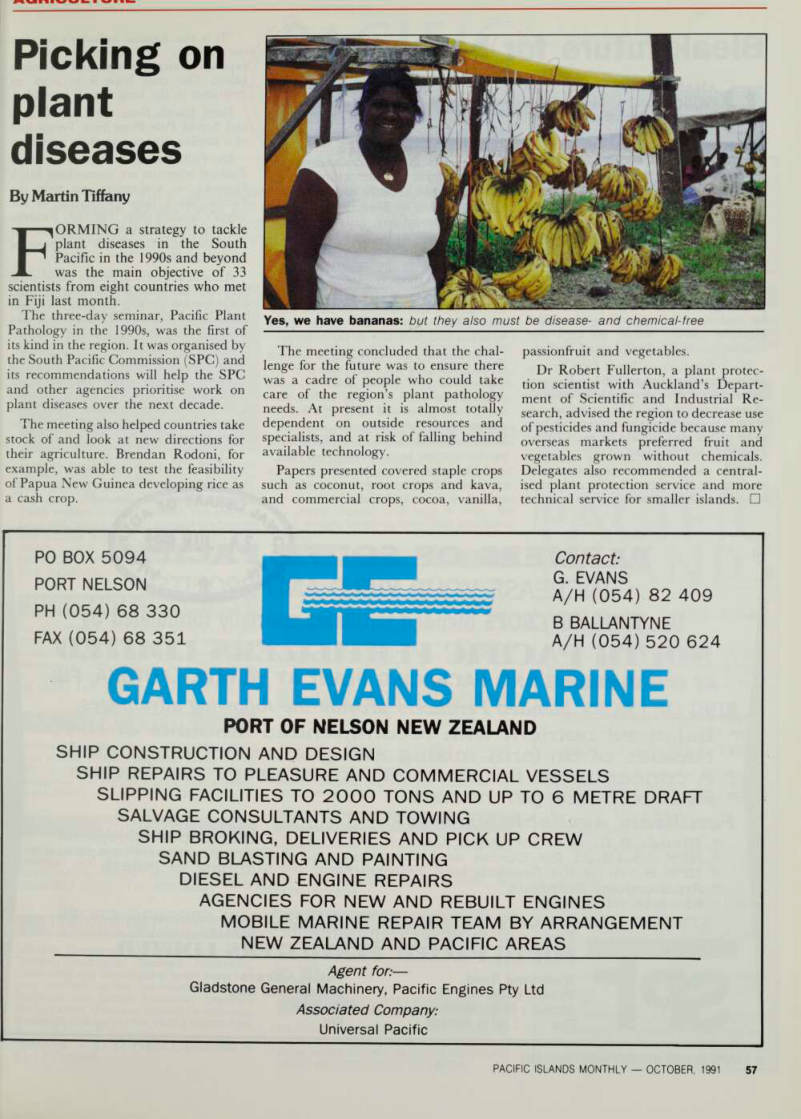
plant diseases
By Martin Tiffany
FORMING a strategy to tackle plant diseases in the South Pacific in the 1990 s and beyond was the main objective of 33 scientists from eight countries who met in Fiji last month.
The three-day seminar, Pacific Plant Pathology in the 19905, was the first of its kind in the region. It was organised by the South Pacific Commission (SPC) and its recommendations will help the SPC and other agencies prioritise work on plant diseases over the next decade.
The meeting also helped countries take stock of and look at new directions for their agriculture. Brendan Rodoni, for example, was able to test the feasibility of Papua New Guinea developing rice as a cash crop.
The meeting concluded that the chal lenge for the future was to ensure there was a cadre of people who could take care of the region’s plant pathology needs. At present it is almost totally dependent on outside resources and specialists, and at risk of falling behind
available technology.
Papers presented covered staple crops such as coconut, root crops and kava, and commercial crops, cocoa, vanilla,
passionfruit and vegetables.
Dr Robert Fullerton, a plant protec tion scientist with Auckland’s Depart ment of Scientific and Industrial Re search, advised the region to decrease use of pesticides and fungicide because many overseas markets preferred fruit and vegetables grown without chemicals.
Delegates also recommended a central ised plant protection service and more technical service for smaller islands. □
Yes, we have bananas: but they also must be disease- and chemical-free
Advertisements & other items, p. 57 (1 item)
Garth Evans Marine
PO BOX 5094
PORT NELSON
PH (054) 68 330
FAX (054) 68 351
Contact:
G. EVANS
A/H (054) 82 409
B BALLANTYNE
A/H (054)520 624
GARTH EVANS MARINE
PORT OF NELSON NEW ZEALAND
SHIP CONSTRUCTION AND DESIGN
SHIP REPAIRS TO PLEASURE AND COMMERCIAL VESSELS SLIPPING FACILITIES TO 2000 TONS AND UP TO 6 METRE DRAFT
SALVAGE CONSULTANTS AND TOWING
SHIP BROKING, DELIVERIES AND PICK UP CREW
SAND BLASTING AND PAINTING
DIESEL AND ENGINE REPAIRS
AGENCIES FOR NEW AND REBUILT ENGINES
MOBILE MARINE REPAIR TEAM BY ARRANGEMENT
NEW ZEALAND AND PACIFIC AREAS
Agent for: — Gladstone General Machinery, Pacific Engines Pty Ltd Associated Company: Universal Pacific
Bleak future for bananas

BANANA export in the South Pacific faces a bleak future because of disease and interna tional competition.
The region’s three banana-exporting
countries Tonga, Western Samoa and the Cook Islands now have to tackle an incurable fungal disease and the
might of banana-producing giants.
“The prospects are not very good at all . . . the Pacific hasn’t got a show,” said Dr Robert Fullerton, a plant protection scientist at Auckland’s De partment of Scientific and Industrial Research. Speaking at a Pacific plant pathology seminar in Suva last month, he said costs of controlling the Black Sigatoka disease would be high and uneconomical for Pacific small farmers.
Black Sigatoka or Black Leaf Streak, which was identified in 1964 in Fiji, can be controlled by successful but expensive chemical fungicides. The practical sol ution is to develop resistant varieties but, as he points out, it could be years before a suitable one is found.
While the production level continues to drop in the three Pacific countries, Ecuador and Central American banana
giants have muscled in on New Zealand the main Pacific market.
They are edging the Pacific countries out with glossy advertising and high fruit quality. As the two giants compete with each other in the New Zealand market, their price war is undercutting Tonga, the Cooks and Western Samoa.
In the 1960 s Tonga, the Cooks, Western Samoa and Fiji were major banana exporters. In the late 1960 s Fiji stopped exporting due to administrative difficulties within the industry.
The other three countries continued but, into the 19705, yield and quality deteriorated due mainly to Black Siga toka. Many farmers have given up on bananas and switched to other crops.
The disease kills the leaves on banana trees, weakening the plant and prevent ing normal production of fruit. It can cause premature ripening which pro duces some green and some ripe fruit unsuitable for exporting.
“Since the disease hit us in the 70s our production has been cut to 30 per cent,” said Dr Semisi Semisi, associate Director of Western Samoa’s department of Agri culture, Forests and Fisheries.
“It is our banana industry’s number one threat... to control it is very expensive, fungicide is around 700 tala a gallon. Our only hope is to work on resistance in the long term,” he said.
Parei Joseph from the Cook Islands and Semisi Pule Pone from Tonga told of a similar situation in their countries.
Dr Fullerton and a team of New Zealand scientists are researching Black Sigatoka a threaten not only the Pacific but a large percentage of the world’s banana crop. The only banana growing countries free of the disease are Australia, the Caribbean and parts of Latin America.
Around 400 million people world-wide rely on bananas for subsistence and scientists are working on disease control short-term. However, Dr Fullerton said the only solution was to find varieties which were resistant.
He admits there will be years of research to get some indication of resistance. For now the main weapon against this fast-spreading disease is strategic use of fungicide and disease
monitoring.
As Tonga’s Pone said : “We are looking at reviving the banana industry, with the high costs idisease?” □
Advertisements & other items, pp. 58-60 (1 item)
South Pacific Fertilizers Limited
FARMERS OF SOUT# PACIFIC
INCREASE YOUR YIELD ANtfr&EQEII
Use KING OF CROPS blended fertilizers specially formulated by
SOUTH PACIFIC FERTILIZERS LIMITED
AT IT’S BLENDING AND PACKAGING PLANT AT VEITARI, LAUTOKA, FIJI KING OF CROPS Blended Fertilizers provide the following advantages: * Balanced nutrient with recommended amounts of NPK. * Hassles of on-farm mixing and guess-work eliminated. * A concentrated fertilizer with lower usage per hectare. * Reduced cost per hectare.
Fertilizers available ex-stock: — * Blends A,B, & C for Sugar Cane * NPK 13:13:21 for Cocoa and Ginger * NPK 8:14:13 for Squash and Pumpkins * Ammonium Sulphate * Muriate of Potash * Triple Super Phosphate * Diammonium Phosphate * Sulphate of Potash * Urea SPECIAL BLENDS CAN BE FORMULATED FOR YOUR SPECIFIC CROPS
spF
For Y our fertilizer requirements contact:
SOUTH PACIFIC FERTILIZERS LIMITED
Waterfront Road Postal Address Veitari, Lautoka, Fiji. Private Mail Bag Phone : (679) 665988 Lautoka Fax : (679) 665900 Fiji
/PACIFICA
ISLANDS
\\ |l MONTH L Y_ J jj
MflfiK€T PLflC£
For the benefit of our readers who would like to place a small classified advertisement in our magazine, Market Place will assist you in selling personal items, accommodation, real estate, boating or a service ... in fact anything you would like to sell to our over 50,000 readers.
Market Place Advertising Rates are structured to allow you to place as many advertisements as you wish, economically.
M.V. MANUIA” OF NUKU ALOFA
Steel dry cargo ship. Length 53m 660 tonnes deadweight. 492 gross capacity 820 cubic m.
Two x 3 tonne derricks. 1.6 tonnes/day speed t s.*#3 uft /Mi an til 1958 in class BURSICiafiRfTAS. This smcrnas been well maintaii Sea 3 times lasti island work.
US$2OO,OOO. Ph<
649 2928035. iprid crossed the Tasman * v tQ£* Jl tt t H* for ter '
Jbgpg Pri#e
I*fc649 445 7252 or NZ
MERCHANTS/IMPORTERS
For your Western Red Cedar Shingle or Shake Roof or Sidewall Natural or Preservative treated requirements contact us we specialize.
Westmount Forest Products Ltd. 12601 Hardy St., Maple Ridge, Bristish Columbia Canada Tel (604) 467-9161 Fax (604) 467-0661.
REAL ESTATE
Profitable bungalow resort on stunning white sand beach. French Polynesia. $2.65 million USD Estates, resorts and opportunities throughout the Pacific: Pacific Island Investments (808) 883-8000 Fax: 883-8838
WANTED
Islands (large and small, lease or fee) for individual and corporate buyers. Contact: Karen Jeffery, Pacific Island Investments (808) 883-8000 / Fax: 883-8838.
TECHNICAL TRAINING
Full-time Government Accredited Courses in
Tourism, Hospitality, Business Accounting,
Computing and Hairdressing begin each January and July at the Townsville College of Technical and Further Education. Enquiries: Ms Avis Sohn, Overseas Student Co-ordinator, Townsville College of Tafe, PMB 1 Hermit Park, Townsville 4812 Australia.
Telephone: + 61 77 718211, Facsimile: + 61 77 718268.
COMMERCIAL PRINTING
Top quality four colour printing, brochures, posters, packaging, product labels, fabric labels, billboards, books, magazines, stickers, books. Export quality. Contact Fiji’s most experienced Commercial Printers. FIJI TIMES COMMER- CIAL PRINTING, P.O. Box 1167, Suva. Fiji.
Phone: 304111 Fax. 301521.
SELF ADHESIVE LABEL
FORUM LABELS (FIJI) LTD
P.O. Box 1167, Suva., Fiji. Phone: 304111 We print self-adhesive labels in rolls, multi-coloured labels with hot foil, and die cut •to shape, tickets and tags in rolls. We ■?|p supply labelling machines and fabric faftels.
SCRAP METAL
Good prices paid for your clean scrap Aluminium, Brass, Copper, Lead, etc. Contact Nonferral Pty. Ltd., 23 Davis Rd., Wetherill Park, NSW 2164 Australia. Fax 61 2 604 1304 for prompt reply. Our Company is a long established smelter and a leading metals buyer from the Pacific region.
Telephone 61 2 604 8855.
HOUSING DEVELOPMENT
25 UNIT Townhouse development on 2.65 acres of prime ocean front property in American Samoa. Property includes commercial-sized swimming pool and ample grounds. Price on application. For further details contact OLE P.O. Box 1048 or fax (684) 699-1441.
DISTRIBUTOR WANTED
Manufacturer of Ball Point and Pens Disposable Gas Lighters.
Please contact JNJ CORPORATION (FUI) LTD, G.P.O. Box 285, Suva, Fiji. Ph 394000, Fax: (679) 411898.
OPTICIANS AND OPTOMETRISTS
Spectacles, Contact Lenses, Sunglasses, See JEKISHAN & JEKISHAN, Epworth House, G.P.O.
Box 285, Suva, Fiji. Ph 311002 Fax: (679) 411898.
WANTED
ISLANDS (large and small, lease or fee) for individual and corporate buyers. Contact:
Karen Jeffery, PACIFIC ISLAND INVESTMENTS
(808) 883-8000/FAX: 883-8838.
HUMANITARIAN GRANTS
Anyone qualifies. Apply in writing. State purpose and amount. Enclose US$l5.OO (money order) admin, fee. Jacob Philipa, POB
1334, Mt Hagen. PAPUA NEW GUINEA.
REAL ESTATE
Profitable bungalow resort on stunning white sand beach. French Polynesia. $2.65 million USD Estates, resorts and opportunities throughout the Pacific; PACIFIC
ISLAND INVESTMENTS (808) 883-8000
fax: 883-8838
PACIFIC
SLANDS
Imp n t h l y 1
MRRK6T PLRC€ CRN WORK
WONDCRS FOR VOU ...
Promote your business, or service, sell your household items, cars or heavy machinery etc.
ONLY AUSSI PER WORD.
NO COMPANY LOGO. NO
DISPLAY. NO BOLD TYPE.
Just forward your Advertisement together with payment to: PACIFIC ISLANDS MONTHLY "Market Place", P.O. Box 1167, Suva, Fiji.
CONDITIONS:
1. All Advertisements are subject to acceptance and approval of publisher. 2. Advertisements are published as space permits; we cannot guarantee date of insertion. 3. All advertisements must be prepaid and should be typed or printed clearly. 4. Deadline for receipt of advertisements is the 10th of the month prior to issue.
5. PACIFIC ISLANDS MONTHLY
assumes no responsibility for any service other than publishing paid advertisements in this section.
Designed to be Driven. & & m m
MITSUBISHI
MOTORS
Proven in Every Comer of the World.
Stylish elegance and luxurious detail are the first things you’ll notice about the new Galant. So you might be surprised to learn that Galants have driven to victory in more than 10 major rally raid events — from the snowy slopes of Sweden, to the African savannah. And you’ll be pleased to know that the same performance features keeping those rally cars competitive on the course are also what make your Galant one of the best performance saloons on the road today.
For years, Mitsubishi engineers have known that motorsports are an ideal place for testing new and improved technologies.
The hard, fast driving required to win a rally strains every part of a car —generating pressures that exceed the demands of normal driving. Here, as drivers push their cars to the limit, the rigidity and strength of new space-age constructions can be checked and proven reliable.
The new Galant’s advanced triplelink torsion axle rear suspension is a good example. It is the result of many small yet critical refinements, ultimately designed to grip the road for safer, more comfortable control when changing lanes and cornering.
The severe demands of international motorsport competition: just further proof of how far Mitsubishi will go to build the best cars for you.
MITSUBISHI GRLRNT
AMERICAN SAMOA: MORRIS SCANLAN SERVICE INC. P.O. Box 367, Pago Pago. Tel 633 5520/AUSTRALIA; MITSUBISHI MOTORS AUSTRALIA LTD. Box 1284, South Road, Clovelly Park, South Australia 5042, Tel. (08) 275-7223/FIJI: NIVIS MOTOR & MACHINERY CO., LTD. G.P.O. Box 150, Suva, Tel. 383411/FRENCH POLYNESIA (TAHITI): ETS-BREDIN FRERES ET FILS P.O. Box 21, Papeete, Tahiti, Tel. 4-202-58/NEW CALEDONIA: SOCIETE DTMPORTATION D'AUTO DU PACIFIQUE SUD S.A. B P. 438 Rond Point du Paoifique, Noumea, Tel. 274144/NEW ZEALAND: MITSUBISHI MOTORS NEW ZEALAND LTD. Todd Park. Heriot Drive, Private Bag, Ponrua, Tel. 370-109/ NORFOLK ISLAND: BORRYS LTD. P.O. Box 169, Norfolk Island. Tel. 2114/PAPUA NEW GUINEA: TOBA PTY. LTD. P.O. Box 503, Port Moresby, Tel. 21 7874/SOLOMON ISLANDS: HARVEST PACIFIC LTD. G.P.O. Box 88, Honiara, Guadalcanal, Tel 30128/TONGA: SITANI MAPI CO., LTD. P.O. Box 83, Nuku ALOFA, T el 21 044/VANUATU: SOCOMETRA B P. 06 Route de Lagon, Port-Vila. Tel. 2314/WESTERN SAMOA: A.M. MACDONALD HOLDINGS LTD.
P.O. Box 576. Apia, Tel 22022/SAIPAN/POHNPEI/MAJURO/KOSRAE/TRUK/YAP/BELAU: MICRONESIAN MOTORS, INC. 997 South Manine Drive, Tamuning, Guam 96911 , Tel. 646-6827