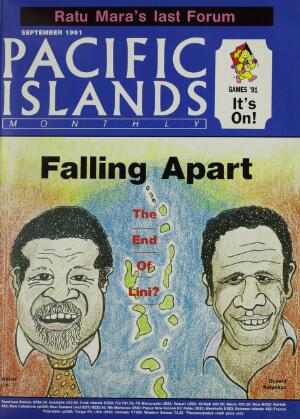
Pacific
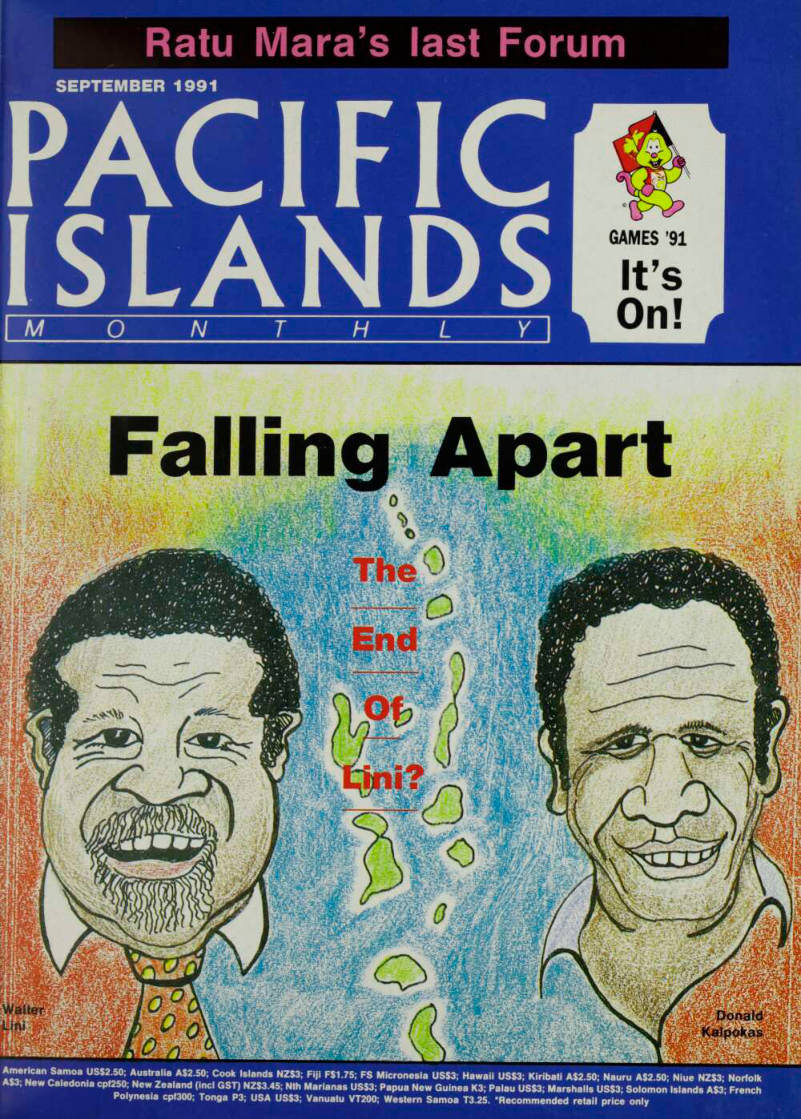
Islands
Monthly
t
September 1991
Games ’9L
It’s On!
Falling Apart
it wlv ' ■ M mmm®m Mb
>ln_F
Msm
■ s fl ■
Americ an Samo a US$2 50; Australia A 52.50; Cook Islands NZ$3; Fiji F 51.75; FS Micronesia US$3; Hawaii US$3; Kiribati A 52.50; Nauru A 52.50; Niue NZ$3; Norfolk $3, New Caledonia cpf2so; New Zealand (mcl GST) NZ53.45; Nth Marianas US$3; Papua New Guinea K 3; Palau US$3; Marshalls US$3; Solomon Islands As 3; French Polynesia cpf3oo; Tonga P 3; USA US$3; Vanuatu VT2OO; Western Samoa T 3.25. ‘Recommended retail price only
Advertisements & other items, pp. 2-4 (1 item)
ear’s Le Mans,
BiBWWSWIi*
ite a following.
1. Mazda 7878
2. Jaguar
3. Jaguar
Ml M
rii
4. Jaguar
5. Mercedes
6. Mazda 7878
8. Mazda 787
. . ■ ' *■ *" ° ' '• -5 v ■ f- *■ *i h t . *
Jaguar,Mercedes,
L *“ r ” ! 1 1 r *"' * ’ ‘' r ‘ 1 line. :mseives louowing the Mazda 7878 at this year s Le Mans nnisn line, surprise to many, for Mazda’s multinational team, it was the realization of a dream that began over 17 years ago. Since our first Le Mans experience, tally every car function has been analyzed, altered and improved upon. iazda has been able to refine its unique rotary engine as well as its suspension and is to create some of the finest automotive technology in the world. Technology that, ihirpd fhp wnrlHV mncf rnvptpri rarincr win rrw/prino a rlicfanrp r\f 7 Lm anrl
m Jr \ * p * / & / ' ■ r. rz m<mmm ~,... . ‘ k t. mm Biliffil ; : SW » a ?*—• a mi fm to "*'- ' i V>.-^-'-.;y:':^.:' : . ... - • ■ ■•- • ' --- -
~- N CMX23O
\v STEREO (
v K ’ r WITH FM
> 4 S . %
STEREO CASSETTE DECK
STEREO/MW TUNER
& CD CHANGER CONTROL
-xc CMXZ3O CATS
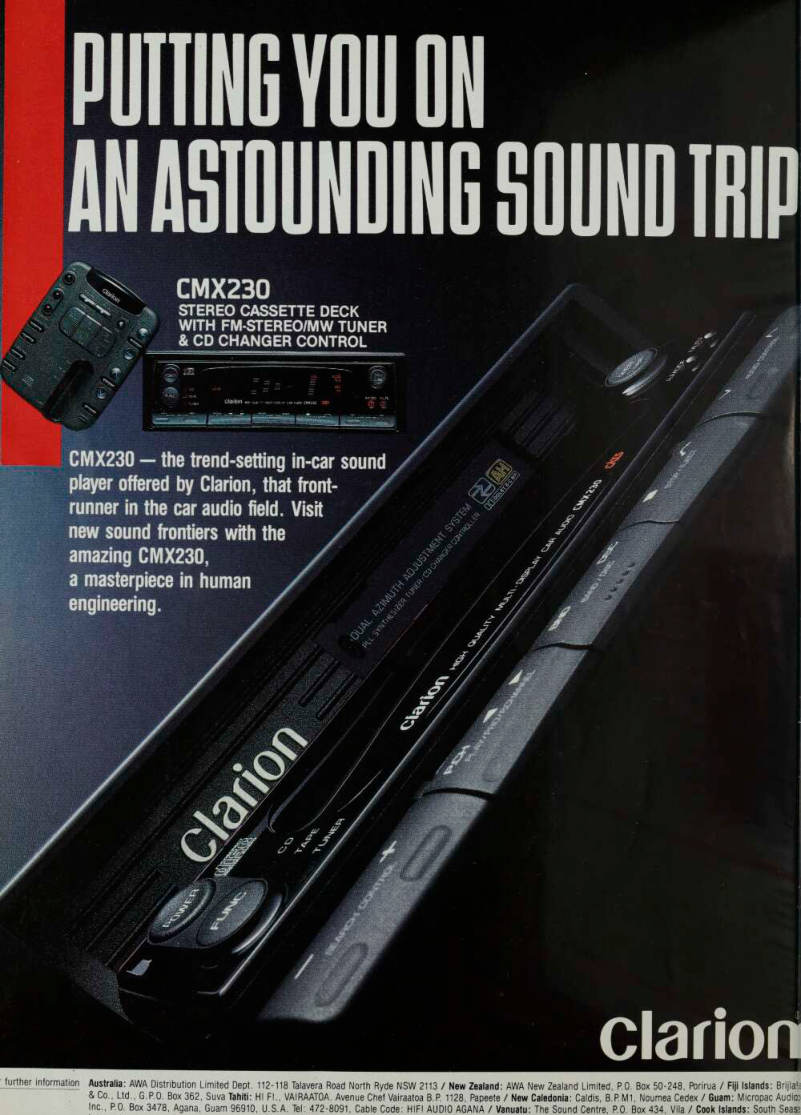
CMX23O the trend-setting in-car sound
player offered by Clarion, that front-
runner in the car audio field. Visit new sound frontiers with the
amazing CMX23O,
a masterpiece in human
engineering.
■ ✓ £ / / £ £ cr .0 <P a % / ■ ■
clarion
further information Australia: AWA Distribution Limited Dept. 112-118 Talavera Road North Ryde NSW 2113 / New Zealand: AWA New Zealand Limited, P.O. Box 50-248, Porirua / Fiji Islands: Brijlali & Co., Ltd., G.P.O. Box 362, Suva Tahiti: HI FI., VAIRAATOA. Avenue Chef Vairaatoa B.P 1128, Papeete / New Caledonia: Caldis, B.PMI, Noumea Cedex / Guam: Micropac Audio: Inc., PO. Box 3478, Agana, Guam 96910, U.S.A. Tel: 472-8091, Cable Code: HIFI AUDIO AGANA / Vanuatu: The Sound Centre, PO. Box 434, Vila / Cook Islands: South Seas:
Pacific
Islands
Monthly
Vol. 61 No. 9
The News Magazine
September 1991
COVER STORY: Pride in Vanuatu’s leadership crisis could lead to an election downfall. The prospects for foreign and economic policies. The men who would be PM. Jimmy Stevens is free! 9
Games Warm-Up: 35
:Tips on the tussle for top spots :Western Samoa’s Jerry Wallwork aims to tread in his father’s footsteps .For Fiji javelin champ Mereoni Vibose, a trip down memory lane and a shot at a last gold medal :Six-months pregnant, New Caledonia’s Nadia Prasad still will run the marathon :Dodging crab holes on the training track, Jerry Jeremiah may still shine THE FORUM: Twenty years old, it has a mature, respected voice 22 ;Ratu Mara’s swansong, with a few stings. :Nuclear testing still explosive/Environmental issues overgrow traditional loyalties.
Tackling the sticky oil-import issue. ;Red rag for Caledonia’s Right-wing rally. :Call to bag carpetbaggers, withdraw drug smugglers, and send money launderers to the cleaners. ;A nod for Somare’s UN bid/Thumbs up for FSM and Marshall Islands’ full membership.
FRENCH CONNECTION: Maxim Carlot, he could be Vanuatu's next PM
BUSINESS: When things are hurtin’
Hawaii’s tourism tumbles, hit by war, recession and image fatigue 45 COOK ISLANDS: New blood for a tax haven, as the offshore financial centre heads a Pacific drive 50 WESTERN SAMOA: An old warning on spending gains a new urgency 57 FIJI; Air Marshalls has engines fired for the future 49 LURE OF SILVER: Fiji enters the China/Taiwan diplomatic duel 55 MBf IS HERE: with factoring, leasing and Master Card for Fiji 47
David Barber: 17
Jemima Garrett: 27
Margot O’Neill: 25
Futa Helu: 21
Shipping: 51
FOCUS: Showtime in PNG 28
Publisher: Geoffrey Hussey Editor: Jale Moala Assistant Editor: Beryl Cook Senior Writer: Martin Tiffany Correspondents: Al Prince, Angela McCarthy, David North, David Robie, Diana McManus, Dykes Angiki, Frank Senge, Franck Madoeuf, lan Williams, Irene Nisbet, John Hunter, Karen Mangnall, Lovenia Enari, Lito Vilisoni, Macel Manua, Nicholas Rothwell, Pesi Fonua, Richard Dinnen, Ulafala Aiavao, Wally Hiambohn
Columnists: David Barber (Welling ton), Futa Helu (Tonga, covering the Pacific Islands), Jemima Garrett (Syd ney), Margot O'Neill (Washington) Business and Advertising Man ager: Charlotte Thomas Advertising Sales: • Fiji: Salendra Narayan, Tel (679) 304111, Fx (679) 303809 • Sydney, Melbourne: Fergus Maclagan, Tel (61-2) 4134689, Fx (61-2) 4123918 • Brisbane: Robert Walker, Tel (61-7)
3710533, Fx (61-7) 8798964 • Adelaide: Hastwell Williamsons Rep resentations, Tel (61-8) 799522, Fx (61-8) 799735 • Auckland: McKay International Me dia Reps Ltd, Tel (64-9) 4190561, Fx (64-9) 4192243 • Japan: Universal Media Corporation, Tokyo. Tel (3) 6663036, 6663094, Cable: UNIMEDIA Tokyo, Tx 2524665 Founded 1930 (USPS 952480). A Fiji Times Limited production. Cover prices are recommended retail only. Regis
tered by Australia Post, Publication No.
NBP 1210. © Copyright Fiji Times Limited, IT7 Victoria Parade, Suva, Fiji.
Tel (679) 304111, Fx (679) 303809, Tx FJ2124.
Pacific Islands Monthly is published monthly by Fiji Times Limited, a division of Nationwide News, 2 Holt Street, Surry Hills, Sydney, NSW 2010.
Send address changes to: • Pacific Islands Monthly, PO Box 1167, Suva Fiji. Typeset and printed by Fiji Times Limited, 177 Victoria Parade, Suva, Fiji.
GAMES: Cook Islands, head and shoulder above the rest for a netball gold
Have lifejacket,

Letters
Have lifejacket, will travel
I WAS more than interested to read Douglas M. Thorsen’s article on the ‘Traps and Trappings on the Ferries of Tonga’ in the June edition of PIM in which he has an interesting rundown of a voyage on the Fokololo-oe Hau, an inter-island cargo-passenger vessel.
Being a keen ship-lover and traveller I was most absorbed in the article until mention was made of the fact that the ship carried two well-equipped 50-person life boats plus six 20-persons life-rafts which, according to my math ematics, adds up to 220 people and yet Mr Thorsen made mention that when he went up on deck he found about 500
men, women and children camped out on their mats under makeshift awnings between mooring-bollards, engine room casings and hatch coamings on the boat deck and upper deck.
Under these circumstances it would appear that if, for any reason, the ship went down, up to 280 people would be left without life-saving equipment and it
LETTERS TO THE EDITOR must include writer’s full name, address and home telephone number. All letters may be edited for purposes of clarity or space.
Letters should be addressed to: Pacific Islands Monthly PO Box 1167 Suva Fiji Islands OR Fax: (679) 303809
leaves one wondering about his final statement whereby he advised that if and when he makes another trip to the Kingdom of Tonga he will “surely travel in this one” I hope he carries his own lifejacket!
Michael Brown, Browns Plains, Queensland
Competing for
development
I WAS interested to read the article in March’s issue by David North entitled Tutting a price tag on development’.
THE idea of levying developers for additional infrastructure costs directly necessitated by their developments is not new to Fiji. Suva City Council does it already in the form of carparking contributions payable for certain areas of Central Suva and in lieu of physically providing carparking. This forms part of a condition of Development Permission and when paid, goes into a special fund to be used for the acquisition of land for
carparking purposes.
However Suva, like the rest of Fiji and I suspect other islands in this part of the Pacific, are limited in the amount they can charge and on the range of infra structure they can charge for.
This is because Suva and other parts of Fiji are strongly competing for devel opment and high levies act as a deterrent unless market conditions are favourable to the city or to the authority.
The result is Suva, like other parts of Fiji, are in a quandary. If the full costs are charged for all additional infrastruc ture necessary, development will prob ably not take place. However, if these are not charged then development is being subsidised.
D. Carswell, Suva, Fiji
Advertisements & other items, pp. 6-7 (2 items)
Bllo,
WHAT5 WPnH(r
WITH 006?
He Wto 6-01M6- to 4PWY fop IHe <,opAC.
JoB y Ecrr photOD
THeY H/£ep 60ME0HB
BAPlX.
1°o 8AP Hl3 S Pother
u) OPK THsPE ■
He: Sb /m Pot
‘SOPB.
The South Sea Digest
11 9 The Newsletter on Islands Affairs. Every Other Friday.
South Sea Digest has all the latest business news, expertly streamlined and obtainable nowhere else.
Subscriptions: 25 issues SAISO for Australian subscriber; Asl7s overseas, all airmailed. Payment by cheque in A$ and US$, otherwise by bank draft.
Ssnd payment to: The South Sea Digest, GPO Box 4245, Sydney, NSW 2001, Australia.
Nam# Address
Who can you
bank on to help
serve 11 key
Pacific Island
markets?
The South Pacific is a vast area of ocean covering almost 8 million square miles.
It’s also an area which is rich in potential.
But how do you tap this potential? Through Westpac.
This part of the world has been home to us for almost 90 years now, and our presence is a strong one. With representation in 11 Pacific Island countries, we service every major developing business market in the region.
We see our role as one of being closely involved in the development of the Pacific. Not only through multi-nationals and major companies, but also small local business people and entrepreneurs.
Westpac is here to serve your banking needs.
And that’s a service you can bank on, all over the South Pacific. 11# You can bank on Westpac Pacific Branches: Cook Islands • Fiji • French Polynesia • New Caledonia • Niue • Solomon Islands • Vanuatu • Subsidiary: Kiribati (Bank of Kiribati., Tarawa) Affiliates: Tonga (Bank of Tonga. Nukualofa) • Tuvalu (National Bank of Tuvalu. Funafuti) • Western Samoa (Pacific Commercial Bank Ltd., Apia) • International Representation: Beijing • Chicago • Columbus • Frankfurt • Hong Kong • Houston • Jakarta • Kuala Lumpur • London • Los Angeles • New York • San Francisco • Sinpanore • Svdnpu • Tair t TKaiUnrl A Ta A
Divided They Fall
Vanuatu Divided They Fall
Vanuatu’s ruling Vanua’aku Party splits again and plunges into another crisis.
Could this division be the beginning of the fall of the House of Uni?
By Beryl Cook
A Divided Van
ua’aku Party could sound its own death knell at an election in
Vanuatu in November, ushering into power a new ruling party, a new Prime Minister, and new foreign and economic
policies.
The Vanua’aku Party (VP) has been keen to portray its leadership wrangle as a temporary, internal party problem. But the dispute has dragged on so long that the local churches are calling for a peaceful resolution, the chiefs are offering to help, and the citizens'of Vanuatu themselves are wondering who, what and even when they will vote.
The rift in the party has been brewing
since at least February when Prime Minister Father Walter Lini, an Angli
can priest, began sacking ministers,
political appointees and civil servants to replace them with friends and relatives he claimed were more competent and loyal. But some of Lini’s old opponents say the rift has grown from the same seeds that led to the 1988 constitutional crisis and that, if it follows the same pattern, Lini will dig his heels hard into the Vanuatu turf to retain leadership of the party and the country.
Lini’s opposition are also proving stubborn, however, and this time could be different. His critics claim that the sackings are nepotistic and dictatorial, and a strong party faction believes a new leader is needed to lead the Vanua’aku Party to an election victory.
They called an extraordinary congress
of the Vanua’aku Party Congress at Mele Village outside the capital Port Vila on August 7 to hold an executive election.
Executive members voted Lini out of the party presidency and voted in party
General Secretary Donald Kalpokas,
who Lini had sacked as Education and Foreign Affairs Minister on June 27. Sela Molisa, who had been sacked as Lini’s Finance Minister in February, was voted in as secretary general. lolu Abil, who had been sacked as Minister of Home Affairs in April, was voted in as party vice president, and Foreign Affairs Min ister Edward Natapei was voted in as Treasurer. (Natapei was later sacked on
August 13).
The Congress intended Lini to be replaced as Prime Minister at the next sitting of Parliament. However, the questions of whether Parliament will sit
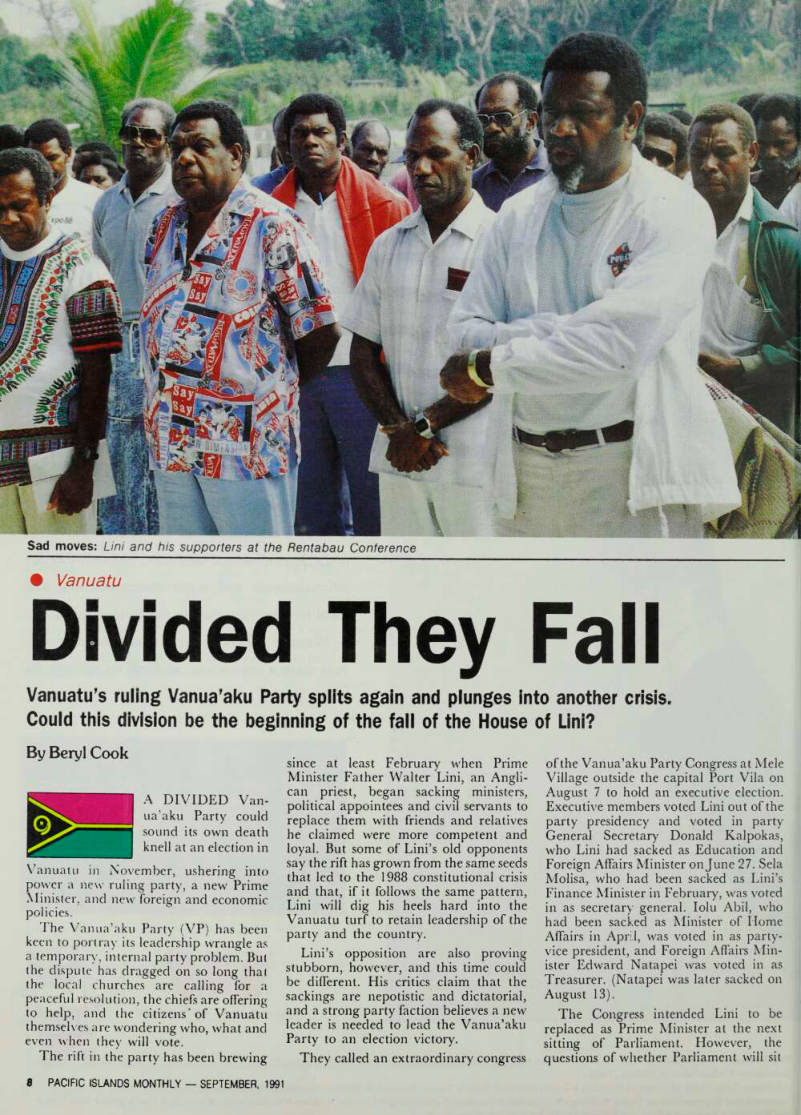
Sad moves: Lini and his supporters at the Rentabau Conference
before the election scheduled for November, and whether an election will even be held then, have become bogged down in political manouvring and technical wrangling. Former Speaker of Parliament Onnyn Tahi, the one who instructs Parliament to sit, resigned recently to become Public Works Minister in Lini’s Government a vacancy created by Lini’s sackings. Whether the Prime Minister can and/or will call Parliament himself, whether the other Members of Parliament can/will call it, and whether the Deputy Speaker or Chiefjustice can/
will instruct Parliament to sit in the Speaker’s absence, also are questions as yet unresolved.
Deputy Speaker Tele Taun instructed Parliament to sit on August 27 to elect a new speaker, who would then be able to instruct Parliament to sit after a seven-day break. But Lini claims Taun has no right to call Parliament, particularly without consulting the Prime Minister. Lini has asked At torney General Silas Hakwa to resign, after Hakwa authorised the notice calling on all MPs to convene the special session.
Lini says Hakwa also should have consulted him, and said he no longer received legal advice from the Attorney Gen eral, Deputy Prime Minister Sethy Regenvanu said earlier in the month that Parliament would sit provided a Speaker could be found. If not, it could be up to the Chief Justice to set a date. (Since then Vanuatu’s Judicial Service Commission, the ac ting secretary of which is Lini’s private secretary Shem Rama, has agreed to appoint a new Chief Justice to replace acting Chief Justice Edwin
Goldsborough before the High
Court hears the appeal case
against the Mele Congress.)
The national Opposition, however, has joined the push for Parliament to sit. Oppo
sition leader Vincent Boulekone said the Deputy Speaker, the Clerk to Parliament and the Attorney General acted accord ing to proper parliamentary procedures calling Parliament to meet. He said Parliament was supreme and he opposed any attempts to boycott the sitting.
Barak Sope, the Melanesian Progress ive Party (MPP) leader who had chal lenged then broken away from Lini and the Vanua’aku Party in 1988, predicted that Lini would try to prevent Parlia ment sitting. But, he says, Kalpokas still has enough support that Parliament may have to sit if half the Members call for it.
The likelihood of this is decreasing, however, because Lini has continued the sackings to install his supporters in Parliament. On August 13 he sacked three more ministers and at least 10 ministerial aides, bringing the oppo sition’s estimate of total sackings since February to eight ministers and more than 50 political appointees and civil servants. The latest sackings have in eluded Edward Natapei, Education Minister Jimmy Meto Chilia, and Agri culture Forestry and Fisheries Minister Jack Hopa all said to be Kalpokas
supporters who attended the Mele congress. (The three are considering taking court action over their dismissal because the dismissal letters said they were sacked for attending the Mele Congress. They claim the Prime Minister can only sack them citing powers vested in him under the constitution.) Willie Jimmy, (who is national treasurer of Vanua’aku Party’s biggest challenger, the Union of Moderate Parties, and an experienced player from 1988), believes Lini may let the election date lapse even though it is normally expected to happen on or before the
expiration of Parliament’s four-year
term.
“Lini would then have to call an election no less than 30 days from that date and no more than 90 days after, That would allow time for the party tc regain its unity for an election by
February,” Jimmy said.
But the MPP’s Sope says there is nc chance Lini can string the election date out because constitutionally the Parlia ment ceases to exist on November 29.
“If he tries to do that we will challenge him in court. We have all the documents
showing Parliament dissolves at the end of its term, so after November 29 it is finished,”
Sope said.
Despite the possibility of an election, the Vanua’aku Party has continued to haggle over the Mele Congress. Unity within the party and a solid campaign effort may not be possible in time for a Novem ber election, judging by the lengthy process of parry and thrust which has dragged on in the legal, political and cultural arenas.
On August 4, Acting Chief Justice Edwin Goldsborough dismissed the bid by Lini supporter and lawyer Kalkot Mataskelekele to have the Mele Congress declared illegal before it was held. Unhappy with the court’s ruling, Lini described it as the “white man’s court”. Mataskelekele is now seeking a Supreme Court injunction to prevent Kalpokas and Abil performing as party president and vice president, convening executive meetings, or enforcing any of the Mele resolutions until the Appeal Court hears a case against the Supreme Court decision.
Lini has also argued against the validity of the Congress on the grounds that it must be opened by the Party president, while his opposition say the
party constitution requires firstly that a Congress have a quorum of half the executive plus one member of each subcommittee, and secondly that either the president or vice-president attend.
As far as Kalpokas is concerned, he was democratically elected the president of the party at Mele. As far as Lini is concerned, he has parliamentary support and the Congress electing Kalpokas was invalid and illegal. Both men claim to have majority party support. The effect on the general public has been confusion and to some extent disillusionment with the Vanua’aku Party as a ruling
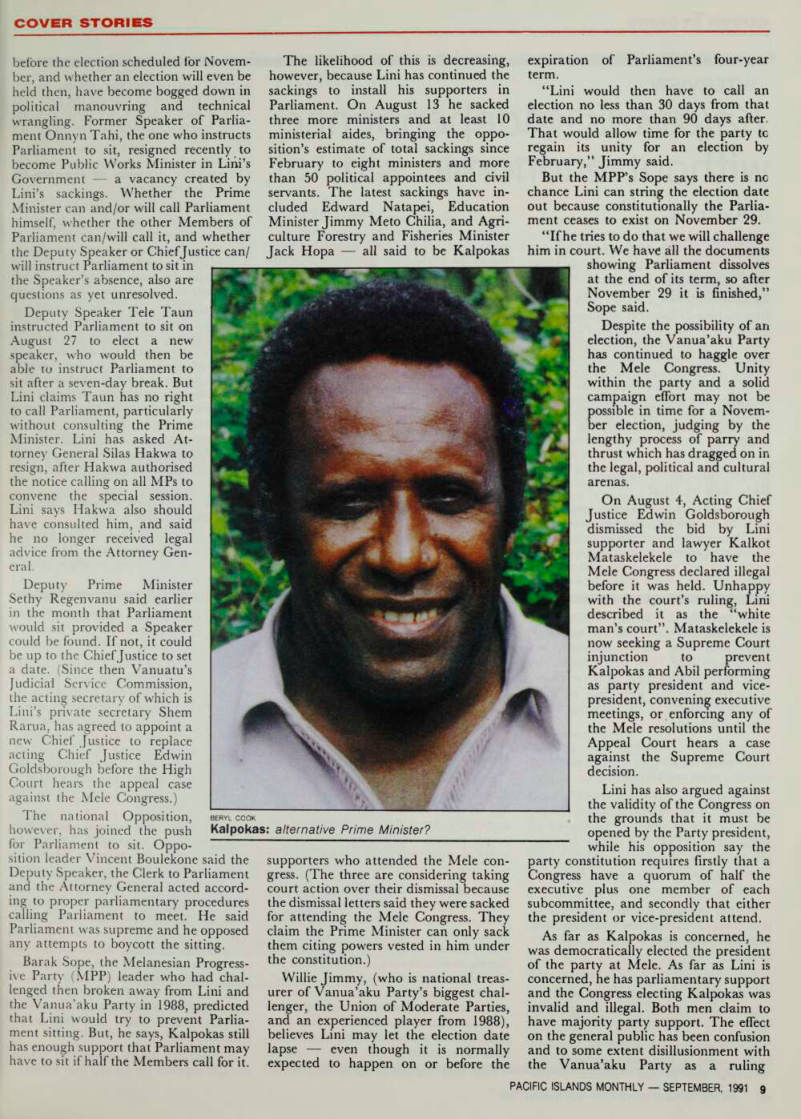
Beryl Cook
Kalpokas: alternative Prime Minister?
body leading the country. While the Mele Congress proceeded on August 7, Lini held his own conference at Rentabau, near Port Vila. Both sides have since claimed their supporters were taken to either the Rentabau or Mele meetings without really knowing where they were headed.
The public confusion and perhaps disillusionment has been made worse by erratic communication lines.
Lini lifted his ban on Radio Vanuatu coverage of the Mele Congress a day before it started. But on August 13 he again ordered publicity on the congress to cease, an instruction which staff interpreted as a ban on the Kalpokas faction.
Within one hour Radio Vanuatu head Bob Makin had defied the ban and broadcast a statement from Kalpokas’s group.
“At this critical time in the period leading up to national elections we feel it is especially expected of us to report all sides and political tendencies,” he said.
Consequently, the voters of Vanuatu have gained a first-hand earful of the “internal and private” dispute of the
ruling party.
Lini’s opposition outside government are also taking steps to keep their information lines flowing. They have been boating to the outer islands and beating the bush tracks on the election campaign trail one way to get around the Government’s traditional monopoly on Radio Vanuatu and the Vanuatu Weekly.
Some churches also have been used to disseminate information such as the book by Grace Molisa, Wea Road, which reportedly listed Lini’s relationship to people he had installed as ministers and
political appointees. (The publication
was later banned.) The split in the party has lasted too long to be viewed as simply an internal party matter, and even the churches have spoken out on the issue. The Presbyterian Church of Vanuatu, the biggest in the country, attacked Lini for the political turmoil resulting from what it called “unchristian and undemocratic nepotism” and Lini’s own church, the Anglican Church, has called on him and Kalpokas to come together and settle their differences.
Lini and Kalpokas have both indi
cated they will stand their ground, even though this could threaten Vanua’aku Party victory at a November election.
Both hope for a resolution before then.
Kalpokas says the Disciplinary Board is bound by an instruction from the Mele Congress to “take any disciplinary action it considers right and proper against an) members who boycotted the Congress”
A party statement said the Disciplinar) Board would work toward uniting the party, and Kalpokas has indicated it is considering Lini’s suspension from the party.
“Clearly the man does not want to step down. He wants to hang on,” he said of Lini. “But at the moment he is not working in the party’s interest. He does not have the majority support.”
Kalpokas believes Lini does not have majority support in his home region either.
“His own island of Pentecost is even split. Central to South Pentecost commit tee members were there with us and voted for the changes. Every decision taken there was unanimous. There was no abstention and no objection,”
Kalpokas said.
He said the party could still retain enough support for an election victory,
although a united party would have a better chance. Kalpokas has witnessed Lini’s resilience in 1988, and must know he is also unlikely to back down. But Kalpokas seems determined to take up the position of party and country leader which he was tipped to eventually fill, after remaining loyal to Lini in the 1988 crisis.
“The sooner the other split is got rid of, in other words identify or get it out as being labelled the Vanua’aku Party, the better,” he said. “But we might be forced to unite before the election, it could be best. Either they come to us, or we get rid of them.”
Asked whether the current conflict could escalate to physical violence Kalpokas said; “No, not at this stage, but things should be sorted out before the election.”
On the final day of the Rentabau meeting Lini still declined to be inter viewed by Pacific Islands Monthly , but Deputy Prime Minister Sethy
Regenvanu stressed the im portance of an early resolution and a unified party for an election, “I personally do not want to see the party split into two it is bad for the party and it is bad for the nation. (This) involves very few people who are holding the leadership in trust for the rest of the party and they should always take into account the feeling, the view and the position of the people, so I would hope the people concerned would be able to take the necessary steps to help re solve their differ ences,” he said.
Regenvanu be
lieves the National Council of Chiefs, which has indi cated it could de cide the issue,
might help rec
oncile personal dif ferences between
leaders. But Regenvanue believes the best solution is a “proper” congress. “In terms of the development that has taken place within the party it would be good for a congress to be held and address
Kalpokas: independence
Interview
Kalpokas: independence without economic aid
By Beryl Cook
DONALD Kalpokas
was sacked as Lini’s Education and Foreign Affairs Min
ister on June 27 this year, and was elected President of the Vanua’aku Party at a Mele Congress on August 7 which Lini says is illegal and invalid. He is a father of five who was a teacher for four years until 1971, when he became an educa tion administrator. His supporters expect him to become Prime Minister at the next Parliamentary sitting or at the election.
What would Vanuatu under Kalpokas be like?
Our priorities since Independence have been to consolidate the administration.
On Independence we really didn’t have a system of administration in the govern ment and we set that up and consoli dated it. Now we are trying to work out
the cost effectiveness of that administra tion versus our economic development what those services could provide under the strain of the bare minimum of what the country can generate in itself.
We would try to pursue more vigorous economic development to get the country to be more self-reliant rather than reliant on aid for capital development. We want to emphasise that more and the way to do that is to create an atmosphere which is favourable for investors, i.e. more liberal in the press and more open in the government. I think we have put a lot of emphasis in the past in regard to foreign policies in regard to decolonisation and freedom fighters, that had affected a lot of our foreign relations.
Now we must look to foreign policy to boost our trade, to mutual cooperation with other countries rather than trying to go against them because of their foreign policies or their colonial policies.
On nuclear testing: We have our stand: that we would like
a total ban on nuclear testing in the Pacific. We have to reassess the pros and cons of such a policy, we have to draw a line where it’s beneficial and where it’s not.
On specific projects or changes he would introduce?
Our immediate income earner is tourism.
It is quite important that it be given more consideration as far as looking at more benefit that could come out of it possibilities of developing more resorts or hotels and the kinds of activities which the people of Vanuatu can participate in.
We would put a lot more emphasis on economic development and if we have enough money we can look into areas of social development. That does not mean we should restrain on social development projects, there is a lot of room for that, but we need to sustain the recurrent cost ... otherwise we build up a lot of projects and cannot sustain them.
There is also a lot to brush up in education administration, law, profes sional development and curriculum.
On the difference between his ad ministration and Lini’s?
Basically we would have an open govern ment in which everything is laid out for members of the public to know exactly what is going on. □
Carlot: a better deal
for the landowners
By Beryl Cook
MAXIM Carlot was leader of the Union of Moderate Parties when they boycotted
Parliament and the by-election of 1988, against Prime Minister Walter Lini.
Carlot no longer holds an executive position. He is 50 years old, married with two children, was born on Erakor island but later moved to Efate.
He attended English and French schools in French/British condominium
days. He studied ad ministration in French Polynesia, worked as an administrat or before
turning poli
tician in 1977. He worked in the French dis trict adminis tration, and was District Administra tor for City One and City Two. In 1979 he became Minister of Internal Af fairs in the Government of National
Unity, the
country’s first
post-Indepe =
ndence gov ernment.
He was elected the
first Speaker
of Parliament in 1980 and remained un til 1983, when he was
re-elected as an Opposition MP until the crisis of 1988. He is chairman of the local chapter of the World Anti Communist League. He will contest the next election
as one of three candidates in Vila town and haas been tipped as a key contender for Prime Minister, along with Party president Serge Vohor, of Santo. At the last UMP Congress, constitutional regu lations were introduced that require party candidates who become ministers or Prime Minister to surrender executive positions. Members of Parliament have the responsibility of forming a govern ment, although the leadership issue may be discussed at a meeting in October.
What changes would you introduce if you become Prime Minister?
We would concentrate on the econ omy. We will have a more liberal and democratic government. The land policy will change slightly we will give the right to Custom owners to choose whether to sell or lease their land ... the government now tries to push the people, and holds and develops the land and gains money without giving back the result to the people.
On nuclear-testing:
In principle UMP is already saying it is against nuclear testing in the region and of course we would not accept testing in Vanuatu, but this Muroroa problem is a problem of nearby island countries.
For many reasons I think we have to be
careful before intervening directly.
On investment: We feel the country has no money so we need investment. We need new policies for ni-Vanuatu to invest but this government is so discriminating. They involve business and politics. When we have money we would have citizens to invest, but the government must first help. For the international investor, we will be just. We will give freedom of investment in Vanuatu, free competition and not preference for any countries.
On foreign relations We would put France back on the same level as Australia, New Zealand and Britain. For regional reasons we would do more with Australia ... In education we would elevate French to equal English. It is a privilege having two international languages and a national language (bislama), and it can work for us internationally. □
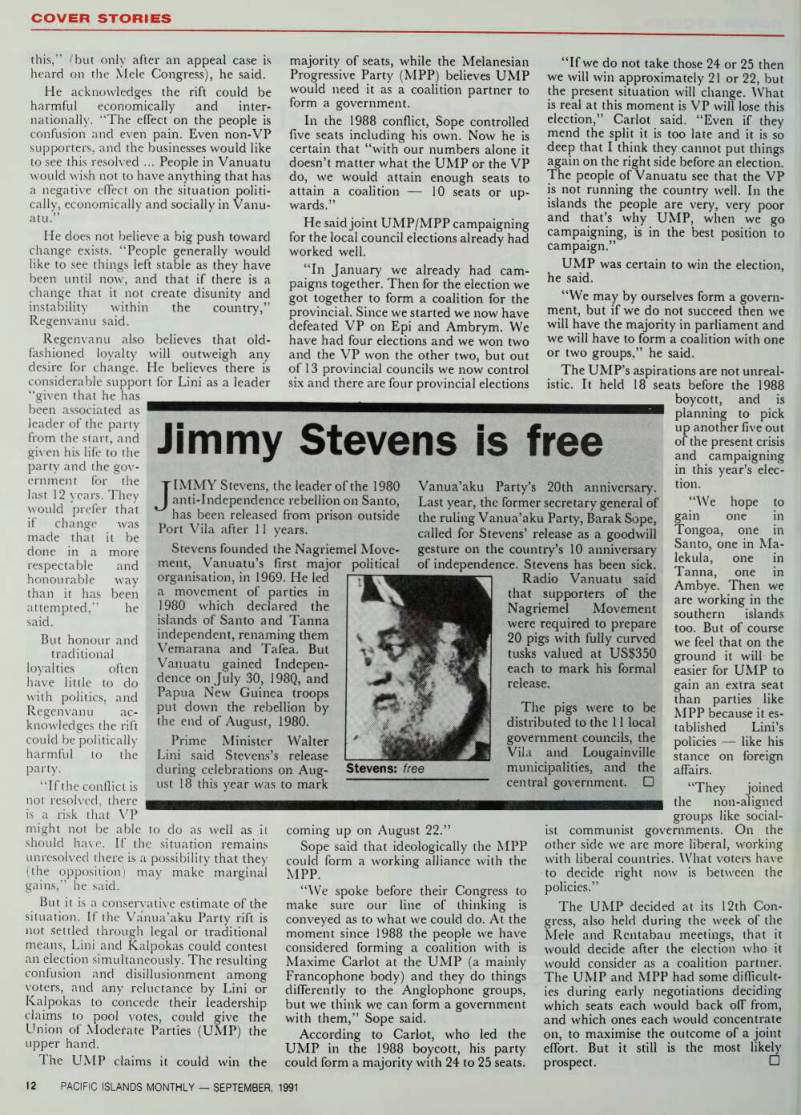
Beryl Cook
Carlot: in the running
this,” (but only after an appeal case is heard on the Mele Congress), he said.
He acknowledges the rift could be harmful economically and inter nationally. “The effect on the people is confusion and even pain. Even non-VP supporters, and the businesses would like to see this resolved ... People in Vanuatu would wish not to have anything that has a negative effect on the situation politi cally, economically and socially in Vanu atu.”
He does not believe a big push toward change exists. “People generally would like to see things left stable as they have been until now, and that if there is a change that it not create disunity and instability within the country,”
Regenvanu said.
Regenvanu also believes that old fashioned loyalty will outweigh any desire for change. He believes there is considerable support for Lini as a leader
“given that he has been associated as leader of the party from the start, and given his life to the party and the gov ernment for the last 12 years. They would prefer that if change was made that it be done in a more respectable and honourable way than it has been
attempted,” he
said.
But honour and traditional
loyalties often
have little to do with politics, and
Regenvanu ac
knowledges the rift could be politically harmful to the party.
“If the conflict is not resolved, there is a risk that VP
might not be able to do as well as it should have. If the situation remains unresolved there is a possibility that they (the opposition) may make marginal gains,” he said.
But it is a conservative estimate of the situation. If the Vanua’aku Party rift is not settled through legal or traditional means, Lini and Kalpokas could contest an election simultaneously. The resulting confusion and disillusionment among voters, and any reluctance by Lini or Kalpokas to concede their leadership claims to pool votes, could give the Union of Moderate Parties (UMP) the upper hand.
The UMP claims it could win the
majority of seats, while the Melanesian Progressive Party (MPP) believes UMP would need it as a coalition partner to form a government.
In the 1988 conflict, Sope controlled five seats including his own. Now he is certain that “with our numbers alone it doesn’t matter what the UMP or the VP do, we would attain enough seals to attain a coalition 10 seats or up wards.”
He said joint UMP/MPP campaigning for the local council elections already had worked well.
“In January we already had cam paigns together. Then for the election we got together to form a coalition for the provincial. Since we started we now have defeated VP on Epi and Ambrym. We have had four elections and we won two and the VP won the other two, but out of 13 provincial councils we now control six and there are four provincial elections
coming up on August 22.”
Sope said that ideologically the MPP could form a working alliance with the
Mpp.
“We spoke before their Congress to make sure our line of thinking is conveyed as to what we could do. At the moment since 1988 the people we have considered forming a coalition with is Maxime Carlot at the UMP (a mainly Francophone body) and they do things differently to the Anglophone groups, but we think we can form a government with them,” Sope said.
According to Carlot, who led the UMP in the 1988 boycott, his party could form a majority with 24 to 25 seats.
“If we do not take those 24 or 25 then we will win approximately 21 or 22, but the present situation will change. What is real at this moment is VP will lose this election,” Carlot said. “Even if they mend the split it is too late and it is so deep that I think they cannot put things again on the right side before an election.
The people of Vanuatu see that the VP is not running the country well. In the islands the people are very, very poor and that’s why UMP, when we go campaigning, is in the best position to
campaign.”
UMP was certain to win the election, he said.
“We may by ourselves form a govern ment, but if we do not succeed then we will have the majority in parliament and we will have to form a coalition with one or two groups,” he said.
The UMP’s aspirations are not unreal istic. It held 18 seats before the 1988
boycott, and is
planning to pick
up another five out of the present crisis
and campaigning
in this year’s elec tion.
“We hope to gain one in Tongoa, one in Santo, one in Ma lekula, one in Tanna, one in Ambye. Then we are working in the southern islands too. But of course we feel that on the ground it will be easier for UMP to gain an extra seat than parties like MPP because it es tablished Lini’s policies like his stance on foreign affairs.
“They joined
the non-aligned
groups like social
ist communist governments. On the other side we are more liberal, working with liberal countries. What voters have to decide right now is between the policies.”
The UMP decided at its 12th Con gress, also held during the week of the Mele and Rcntabau meetings, that it would decide after the election who it would consider as a coalition partner.
The UMP and MPP had some difficult ies during early negotiations deciding which seats each would back off from, and which ones each would concentrate on, to maximise the outcome of a joint effort. But it still is the most likely prospect. □
Jimmy Stevens is free
JIMMY Stevens, the leader of the 1980 anti-Independence rebellion on Santo, has been released from prison outside Port Vila after 11 years.
Stevens founded the Nagriemel Move ment, Vanuatu’s first major political
organisation, in 1969. He led a movement of parties in 1980 which declared the islands of Santo and Tanna independent, renaming them Vemarana and Tafea. But Vanuatu gained Indepen dence on July 30, 198 Q, and Papua New Guinea troops put down the rebellion by the end of August, 1980.
Prime Minister Walter Lini said Stevens’s release during celebrations on Aug ust 18 this year was to mark
Vanua’aku Party’s 20th anniversary.
Last year, the former secretary general of the ruling Vanua’aku Party, Barak Sope, called for Stevens’ release as a goodwill gesture on the country’s 10 anniversary of independence. Stevens has been sick.
Radio Vanuatu said that supporters of the Nagriemel Movement were required to prepare 20 pigs with fully curved tusks valued at US$35O each to mark his formal release.
The pigs were to be distributed to the 11 local government councils, the Vila and Lougainville municipalities, and the central government. □
Stevens: free
Advertisements & other items, p. 13 (1 item)
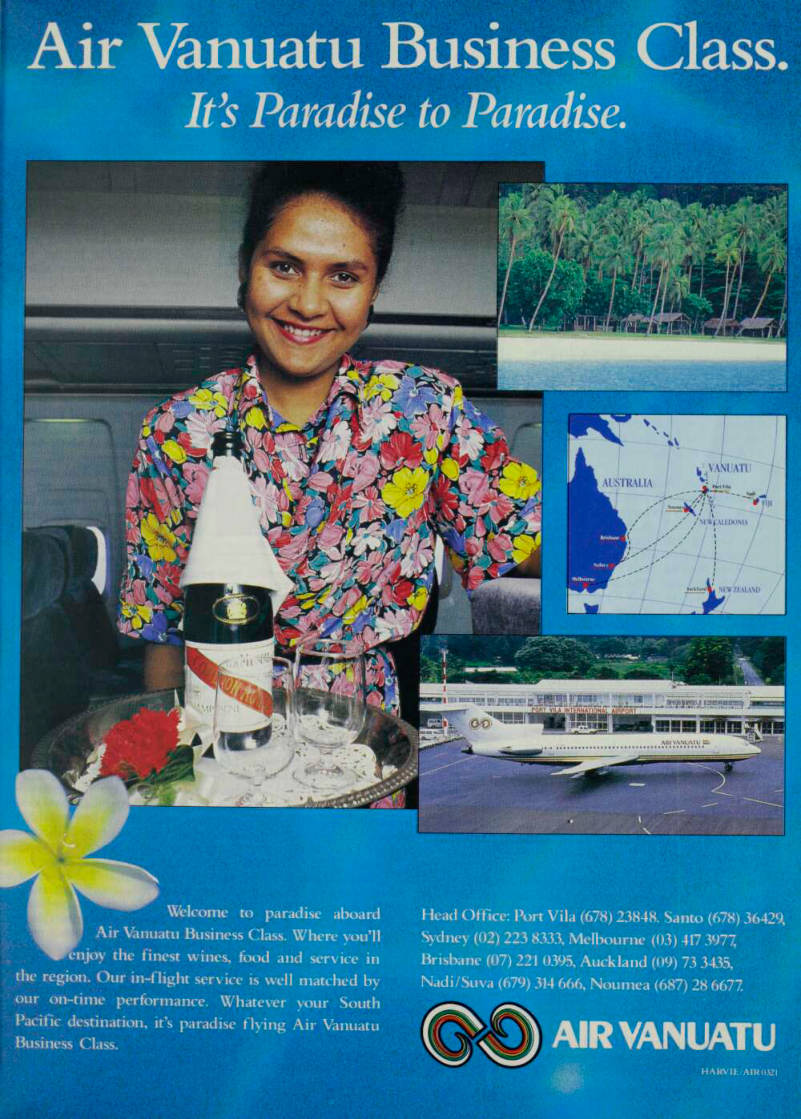
Air Vanuatu Business Class
It’s Paradise to Paradise.
v.
"f A m * A X US m ? til «■> », I 1 V Welcome to paradise aboard Air Vanuatu Business Class. Where you’ll enjoy the finest wines, food and service in the region. Our in-flight service is well matched by our on-time performance. Whatever your South Pacific destination, it’s paradise flying Air Vanuatu Business Class.
Head Office: Port Vila (678) 23848. Santo (678) 36429, Sydney (02) 223 8333, Melbourne (03) 417 3977, Brisbane (07) 221 0395, Auckland (09) 73 3435, Nadi/Suva (679) 314 666, Noumea (687) 28 6677.
AIR VANUATU
HARVIE/A1R0321
Hilda
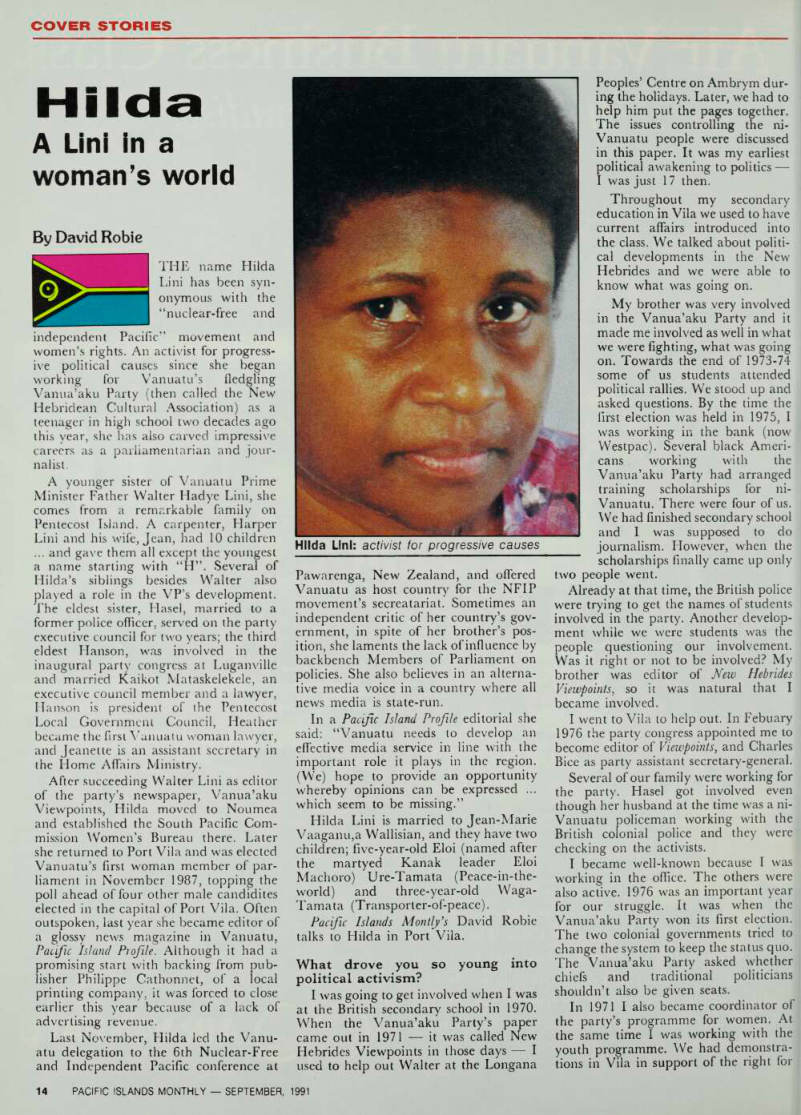

A Lini in a woman’s world
By David Robie
THE name Hilda Lini has been syn onymous with the “nuclear-free and
independent Pacific” movement and women’s rights. An activist for progress ive political causes since she began working for Vanuatu’s fledgling Vanua’aku Party (then called the New Hebridean Cultural Association) as a teenager in high school two decades ago this year, she has also carved impressive careers as a parliamentarian and jour nalist.
A younger sister of Vanuatu Prime Minister Father Walter Hadye Lini, she comes from a remarkable family on Pentecost Island. A carpenter, Harper Lini and his wife, Jean, had 10 children ... and gave them all except the youngest a name starting with “H”. Several of Hilda’s siblings besides Walter also played a role in the VP’s development.
The eldest sister, Hasel, married to a former police officer, served on the party executive council for two years; the third eldest Hanson, was involved in the inaugural party congress at Luganville and married Kaikot Mataskelekele, an executive council member and a lawyer, Hanson is president of the Pentecost Local Government Council, Heather became the first Vanuatu woman lawyer, and Jeanette is an assistant secretary in the Home Affairs Ministry.
After succeeding Walter Lini as editor of the party’s newspaper, Vanua’aku Viewpoints, Hilda moved to Noumea and established the South Pacific Com mission Women’s Bureau there. Later she returned to Port Vila and was elected Vanuatu’s first woman member of par liament in November 1987, topping the poll ahead of four other male candidites elected in the capital of Port Vila. Often outspoken, last year she became editor of a glossy news magazine in Vanuatu, Pacific Island Profile. Although it had a promising start with backing from pub lisher Philippe Cathonnet, of a local printing company, it was forced to close earlier this year because of a lack of
advertising revenue.
Last November, Hilda led the Vanu atu delegation to the 6th Nuclear-Free and Independent Pacific conference at
Pawarenga, New Zealand, and offered Vanuatu as host country for the NFIP movement’s secreatariat. Sometimes an independent critic of her country’s gov ernment, in spite of her brother’s pos ition, she laments the lack of influence by backbench Members of Parliament on policies. She also believes in an alterna tive media voice in a country where all news media is state-run.
In a Pacific Island Profile editorial she said: “Vanuatu needs to develop an effective media service in line with the important role it plays in the region. (We) hope to provide an opportunity whereby opinions can be expressed ... which seem to be missing.”
Hilda Lini is married to Jean-Marie Vaaganu,a Wallisian, and they have two children; five-year-old Eloi (named after the martyed Kanak leader Eloi Machoro) Ure-Tamata (Peace-in-the
world) and three-year-old Waga-
Tamata (Transporler-of-peace).
Pacific Islands Montly’s David Robie talks to Hilda in Port Vila.
What drove you so young into political activism?
I was going to get involved when I was at the British secondary school in 1970.
When the Vanua’aku Party’s paper came out in 1971 it was called New Hebrides Viewpoints in those days I used to help out Walter at the Longana
Peoples’ Centre on Ambrym dur ing the holidays. Later, we had to help him put the pages together.
The issues controlling the ni- Vanuatu people were discussed in this paper. It was my earliest
political awakening to politics
I was just 17 then.
Throughout my secondary education in Vila we used to have current affairs introduced into the class. We talked about politi cal developments in the New Hebrides and we were able to know what was going on.
My brother was very involved in the Vanua’aku Party and it made me involved as well in what we were fighting, what was going on. Towards the end of 1973-74 some of us students attended political rallies. We stood up and asked questions. By the time the first election was held in 1975, I was working in the bank (now Westpac). Several black Ameri cans working with the
Vanua’aku Party had arranged
training scholarships for ni-
Vanuatu. There were four of us.
We had finished secondary school and I was supposed to do journalism. However, when the scholarships finally came up only
two people went.
Already at that time, the British police were trying to get the names of students involved in the party. Another develop ment while we were students was the people questioning our involvement.
Was it right or not to be involved? My brother was editor of New Hebrides Viewpoints , so it was natural that I became involved.
I went to Vila to help out. In Febuary 1976 the party congress appointed me to become editor of Viewpoints , and Charles Bice as party assistant secretary-general.
Several of our family were working for the party. Hasel got involved even though her husband at the time was a ni- Vanuatu policeman working with the British colonial police and they were checking on the activists.
I became well-known because I was working in the office. The others were also active. 1976 was an important year for our struggle. It was when the Vanua’aku Party won its first election.
The two colonial governments tried to change the system to keep the status quo.
The Vanua’aku Party asked whether chiefs and traditional politicians shouldn’t also be given seats.
In 1971 I also became coordinator of the party’s programme for women. At the same time I was working with the youth programme. We had demonstra tions in Vila in support of the right for
Hilda Linl: activist for progressive causes
18-year-olds to vote. Later that year we formed the provisional people’s govern ment. I believe that a lot of us were working for the mobilisation of women.
Have you been penalised in politics because you are a woman?
In September 1979 I interrupted my studies and came back to contest the elections in Port Vila. I found a lot of discussion involving some leaders that I should not be a candidate they tried to oppose me. These men used the women to go against my candidacy. One of the reasons for the opposition was I was sister of the (then Chief Minister).
What happened then represented a weakeness of women. They didn’t suggest another woman to take my place so the men grabbed the position. So I re enrolled at university although I re turned for the campaign in November.
I have proved a lot of people wrong in their assumptions about my being a sister of the Prime Minister. They find I don’t do what they expect. I critise a lot of things that are not done the right way both within the government and in the party. I speak out on issues such as the enviroment, different policies, women.
What about the new generation of ni-Vanuatu?
People don’t know what we fought for.
We need ni-Vanuatu writers to write about our struggle so our people know their history. At the 19th anniversary of the party, the Prime Minister called for people to write our history. Parents should also be talking about what and who took part in the struggle.
Our leaders need to set down their recollections of the tactics and achieve ments in gaining our independence in 1980. Last year we produced a big birthday book, Vanuatu: 10 Years of Independence, but I was surprised that it didn’t touch much on our indepen dence struggle. There could have been a special section on the struggle.
How do you see the development of Nuclear Free and Independent Pa cific issues?
Ld always taken a strong position on nuclear testing by the time we became independent in 1980. And the Vanua’aku Party had always correctly addressed the nuclear issue as being connected to the colonial issue. You cannot separate the enviromental issues from the political context.
It was in the 1980 conference in Hawaii that what had at first been the nuclear-free Pacific movement became the Nuclear-Free and Independence Pacific (NFIP) movement. But Vanuatu had always stood firm on the issue of colonialism and nuclear-free they go together. That is why we contributed so much to supporting the NFIP ideals. □
Advertisements & other items, pp. 15-16 (1 item)
Qaqa! Gagne! Gagner! Manumalo!
INI
TATTERSALLS
1991 MELBOURNE CUP LOTTERY
Ist
Prize:
Australian
IJJJ Dollars
DOLLARS
0 N E
LL I 0
MANY THOUSANDS
OF
CONSOLATION
PRIZES!
* w*
DRAWN ON
TUESDAY
NOVEMBER 5T H
it •i* I Ir- II tU I ■
• II (HI
I 17.1 Ml I
APPLICATION FORM
Yes, I wish to play this year's Melbourne Cup Lottery. Please send me
PLEASE PRINT
NAME:
ADDRESS:
NUMBER
TRADE MARK
CAUTIONARY
NOTICE
IN NAURU
Notice is hereby given that Matsushita Electric Industrial Co. Ltd., a corporation duly organized and existing under the laws of Japan, of 1006, Oaza Kadoma, Kadoma-shi, Osaka Prefecture, Japan, Manufacturers, is the sole proprietor in Nauru and elsewhere of the following trade marks: used in respect of:- machines and machine tools; motors; scientific, nautical, surveying and electrical apparatus and instruments (including wireless), photographic, cinematographic, optical, weighing, measuring, signalling, checking (supervision), lifesaving and teaching apparatus and instruments; coin or counter-freed apparatus: talking machines; fire-extinguishing apparatus; installations for lighting, heating, steam generating, cooking, refrigerating, drying, ventilating, water supply and sanitary purposes. used in respect of:- machines and machine tools; motors; scientific, nautical, surveying and electrical apparatus and instruments (including wireless), weighing, measuring, signalling, checking (supervision), lifesaving and teaching apparatus and instruments; coin or counter-freed apparatus, talking machines, cash registers; calculating machines; fire-extinguishing apparatus, installations for lighting, heating, steam generating, cooking, refrigerating, drying, ventilating, water supply and sanitary purposes.
The said proprietor claims all rights in respect of the above trade mark and will take all necessary legal steps against any person or company infringing their said rights.
National
Panasonic PANA
DAVIES & COLLISON
Patent Attorneys 1 Little Collins Street Melbourne Victoria 3000
AUSTRALIA
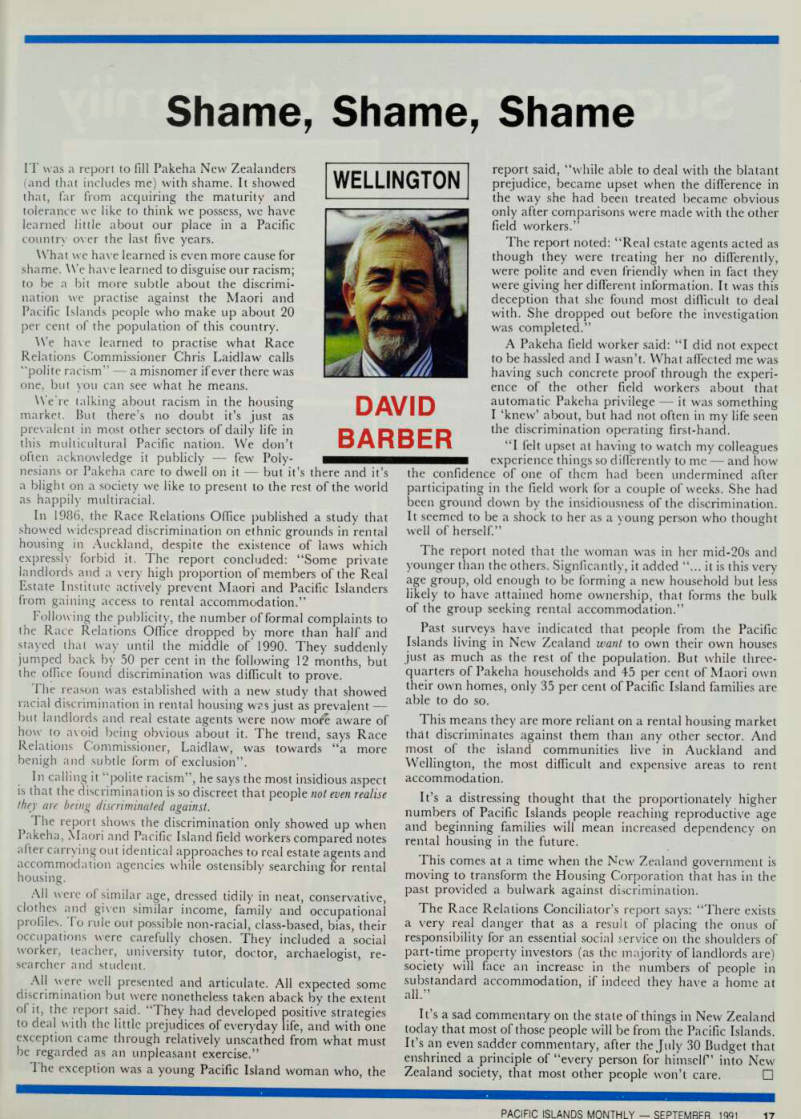
Shame, Shame, Shame
IT was a report to fill Pakeha New Zealanders (and that includes me) with shame. It showed that, far from acquiring the maturity and tolerance we like to think we possess, we have learned little about our place in a Pacific country over the last five years.
What we have learned is even more cause for shame. We have learned to disguise our racism; to be a bit more subtle about the discrimi nation we practise against the Maori and Pacific Islands people who make up about 20 per cent of the population of this country.
We have learned to practise what Race Relations Commissioner Chris Laidlaw calls “polite racism” a misnomer if ever there was one, but you can see what he means.
We’re talking about racism in the housing market. But there’s no doubt it’s just as prevalent in most other sectors of daily life in this multicultural Pacific nation. We don’t often acknowledge it publicly few Poly
nesians or Pakeha care to dwell on it but it’s there and it’s a blight on a society we like to present to the rest of the world as happily multiracial.
In 1986, the Race Relations Office published a study that showed widespread discrimination on ethnic grounds in rental housing in Auckland, despite the existence of laws which expressly forbid it. The report concluded: “Some private landlords and a very high proportion of members of the Real Estate Institute actively prevent Maori and Pacific Islanders from gaining access to rental accommodation.”
Following the publicity, the number of formal complaints to the Race Relations Office dropped by more than half and stayed that way until the middle of 1990. They suddenly jumped back by 50 per cent in the following 12 months, but the office found discrimination was difficult to prove.
The reason was established with a new study that showed racial discrimination in rental housing was just as prevalent but landlords and real estate agents were now mofe aware of how to avoid being obvious about it. The trend, says Race Relations Commissioner, Laidlaw, was towards “a more benigh and subtle form of exclusion”.
In calling it “polite racism”, he says the most insidious aspect is that the discrimination is so discreet that people not even realise they are being discriminated against.
The report shows the discrimination only showed up when Pakeha, Maori and Pacific Island field workers compared notes after carrying out identical approaches to real estate agents and accommodation agencies while ostensibly searching for rental
housing.
All were of similar age, dressed tidily in neat, conservative, clothes and given similar income, family and occupational profiles. Fo rule out possible non-racial, class-based, bias, their occupations were carefully chosen. They included a social worker, teacher, university tutor, doctor, archaelogist, re searcher and student.
All were well presented and articulate. All expected some discrimination but were nonetheless taken aback by the extent of it, the report said. “They had developed positive strategies to deal with the little prejudices of everyday life, and with one exception came through relatively unscathed from what must be regarded as an unpleasant exercise.” 1 he exception was a young Pacific Island woman who, the
report said, “while able to deal with the blatant prejudice, became upset when the difference in the way she had been treated became obvious only after comparisons were made with the other field workers.”
The report noted: “Real estate agents acted as though (hey were treating her no differently, were polite and even friendly when in fact they were giving her different information. It was this deception that she found most difficult to deal with. She dropped out before the investigation was completed.”
A Pakeha field worker said: “I did not expect to be hassled and I wasn’t. What affected me was having such concrete proof through the experi ence of the other field workers about that automatic Pakeha privilege it was something I ‘knew’ about, but had not often in my life seen the discrimination operating first-hand.
“I felt upset at having to watch my colleagues experience things so differently to me and how
the confidence of one of them had been undermined after participating in the field work for a couple of weeks. She had been ground down by the insidiousness of the discrimination.
It seemed to be a shock to her as a young person who thought well of herself.”
The report noted that the woman was in her mid-20s and younger than the others. Signficantly, it added “... it is (his very age group, old enough to be forming a new household but less likely to have attained home ownership, that forms the bulk of the group seeking rental accommodation.”
Past surveys have indicated that people from the Pacific Islands living in New Zealand want to own their own houses just as much as the rest of the population. But while three quarters of Pakeha households and 45 per cent of Maori own their own homes, only 35 per cent of Pacific Island families are able to do so.
This means they are more reliant on a rental housing market that discriminates against them than any other sector. And most of the island communities live in Auckland and Wellington, the most difficult and expensive areas to rent accommodation.
It’s a distressing thought that the proportionately higher numbers of Pacific Islands people reaching reproductive age and beginning families will mean increased dependency on rental housing in the future.
This comes at a time when the New Zealand government is moving to transform the Housing Corporation that has in the past provided a bulwark against discrimination.
The Race Relations Conciliator’s report says: “There exists a very real danger that as a result of placing the onus of responsibility for an essential social service on the shoulders of part-time property investors (as the majority of landlords are) society will face an increase in the numbers of people in substandard accommodation, if indeed they have a home at all.”
It’s a sad commentary on the stale of things in New Zealand today that most of those people will be from the Pacific Islands.
It’s an even sadder commentary, after the July 30 Budget that enshrined a principle of “every person for himself’ into New Zealand society, that most other people won’t care. □
Wellington
David
Barber
Advertisements & other items, p. 18 (1 item)
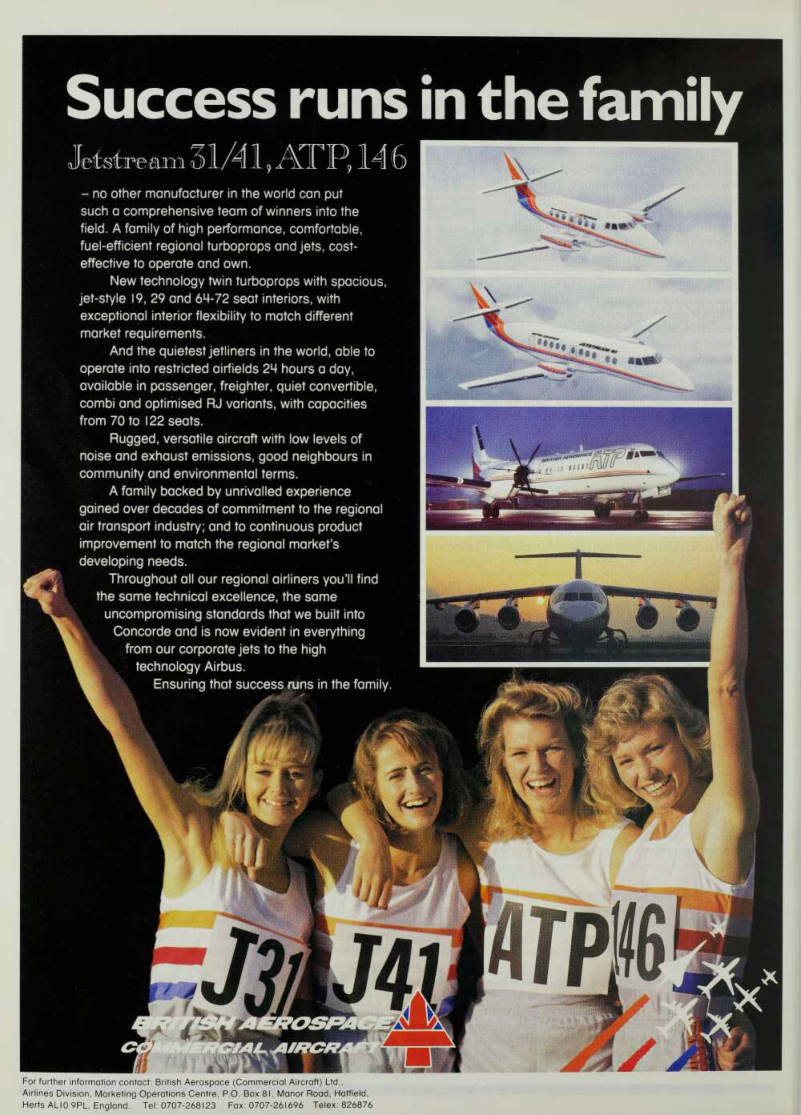
Success runs in the family
Jetstream 31/41, .ATP, 14 6
- no other manufacturer in the world can put such a comprehensive team of winners into the field. A family of high performance, comfortable, fuel-efficient regional turboprops and jets, costeffective to operate and own.
New technology twin turboprops with spacious, jet-style 19, 29 and 64-72 seat interiors, with exceptional interior flexibility to match different market requirements.
And the quietest jetliners in the world, able to operate into restricted airfields 24 hours a day, available in passenger, freighter, quiet convertible, combi and optimised RJ variants, with capacities from 70 to 122 seats.
Rugged, versatile aircraft with low levels of noise and exhaust emissions, good neighbours in community and environmental terms.
A family backed by unrivalled experience gained over decades of commitment to the regional air transport industry; and to continuous product improvement to match the regional market’s developing needs.
Throughout all our regional airliners you’ll find the same technical excellence, the same uncompromising standards that we built into Concorde and is now evident in everything from our corporate jets to the high technology Airbus.
Ensuring that success runs in the family.
I For further information contact: British Aerospace (Commercial Aircraft) Ltd., Airlines Division, Marketing Operations Centre, P.O. Box 81, Manor Road, Hatfield, Herts ALIO 9PL, England. Tel: 0707-268123 Fax: 0707-261696 Telex: 826876 > > rr % m f a. men.
Getting bigger by
The United Nations
Getting bigger by the millions
By Ian Williams
Increasingly,
United Nations agencies are issuing annual reports on the
state of (he world as seen through particular fields of vision and work. Even though one sometimes suspects that the motives include the greater glory of the agencies and their directors, there is no doubt that the figures and the compari sons, no matter how odious, are often extremely useful.
Unfortunately many Pacific nations are too small to warrant the separate attention of the statisticians. This is perhaps more surprising lor the United Nations Population Fund (UNFPA), since they should presumably hold up small populations as an example to the rest of the world.
However, UNFPA looks at growth rales rather than crude size, and on that count the Pacific has problems, in the
next 35 years, they anticipate Papua
New Guinea's population rising at 2.3 per cent a year, from 3.9 million to 7.3 million, and Melanesia’s (New Cale donia, Solomons and Vanuatu; rising at 2.2 per cent a year from 5.3 million to 9.7 million. Micronesia and Polynesia are more restrained, with rises from 0.4 to 0.6 million 1.5 per cent annual growth) and 0.6 to 0.8 million (1.3 per cent annual growth). By comparison, China at 1.4 per cent annual growth rate is doing very well and even then will have 1500 million people in 2025.
A UNFPA spokesperson apologised for the lack of coverage of the area, but pointed out that a recent mission had discovered that the Marshalls had the highest growth rate in the world, at 4.2 per cent and the Solomon Islands had 3.5 per cent. The Marshalls population is expected at current rales lo double within 15 years, because of its tradition ally large families and a high rate of teenage pregnancies.
But even in others with smaller growth rates, “There’s been a lot of outmigration to Australia and New Zealand from many of these countries, and now that has been halted the population pressures will be much greater”, the UNFPA spokeswoman cautioned. UNFPA had funded censuses in 14 South Pacific countries, to help governments assess the scale of' the problem. “So far our programme has been very small.
Originallky there was extreme oppo sition from some governments, but gen
erally the churches have assisted, and they and other non governmental organ isations and community groups have done some very good work”, she said. In the Marshalls, the number of people
using family planning services trebled
from 10 to 30 per cent of the fertile age population between 1988 and 1989.
The organisation will be paying more attention to the islands in future and if the Marshalls’ productivity spreads, they will have a lot of work to do.
Once children have been born, they fall into the territory of UNICEF, the United Nations Children’s Fund whose report takes as a key indicator the Under Five Mortality Rate (USMR) the number of children who die before the age of five out of each thousand born. These range form a catastrophic 297 in Mozambique almost one in three, to a mere six in
Japan.
It shows the progress made over the past past years. Papua New Guinea’s rate has dropped from 248 in 1960 to 83 in 1989. UNICEF also has a table of “Basic Indicators on Less Populous Countries”, which mostly only indicate the infant (first year) mortality rate. This indicates how far many Pacific states have to go to reach Japanese levels. In Kiribati it is 62 per 1000, Vanuatu 56, Samoa 50, Solomon Islands 43, Tonga and Fiji 26, Marshalls, FSM, and Palau all 23, and Cook Islands 22 per thousand. This puls them in the range between the Philip pines (44) and Jamaica (16).
UNICEF emphasises the relationship
between women’s place in society and children’s survival, and the high school enrolment rates of most Pacific slates is reflected in the declining infant death rate. UNICEF has set a target of reducing the figures by one third in the next decade. If that seems to contradict the idea of holding the population down, the organisation is at pains to point out that the more children survive, the fewer children parents feel the need for.
Societies in which the death of child is a rare event are the societies with the lowest birth rates.
And societies with the longest life expectancies are generally the most developed, says the United Nations Development Programme in the Human Development Report 1991.
The report demonstrates that a big GNP is not the only target for develop ment agencies. It says that “there are far too many examples of wasted resources
and wasted opportunities: rising military
expenditures, inefficient public enter
prises, numerous prestige projects, grow
ing capital flight, and extensive corrup tion” and claims that human develop ment is possible if there is the political will and freedom to develop it.
The Human Development Index is a composite figure based on life expectancy at birth, educational attainment, and national income. This year UNDP has refined the figures to give more weight to national income, and length of time at school, which has, coincidentally, caused the United States to soar from 19th place in the tables to 7th. This must have been very reassuring for UNDP’s adminis trator, William Draper 111, an American nominee.
Japan still comes out on top, with a life expectancy off 78.6 years, an adult literacy rate of 99 per cent and an “educational attainment” score of 69.5.
One again many Pacific nations are missed since the index is mostly confined to UN members. Australia at 9th, New Zealand 15th, are both counted as High Human Development and then, in the category of Medium Human Develop ment, Fiji comes 71st with a life expectancy of 64.8, 80 per cent adult literacy rate, and 4.9 years of schooling.
Samoa is 81st with a life expectancy of 66.5, 90 per cent literacy, and five years of schooling, while the Solomon Islands come in at 96th, with 69.5 years life expectancy, 45 per cent literacy and one year average schooling.
In the Low Human Development category arc Vanuatu, 69.5 years, 53 per cent literacy and 3.7 years schooling, and Papua New Guinea, at 117th with a life expectancy of 54.9 years, a literacy rate of 4 6.7 per cent and average schooling of 0.9 years.
In fact, the figures seriously under represent most Pacific Islands; the life expectancy figures are for 1990, but the figures for literacy are five years, and for average school years, 10 years out of dale. A young population with an
increasing percentage attending school
will be reflected in later figures So what is the point of all these tables, other than to advertise the agencies which compile them? They do provide a measure of what is possible, and they avoid a free market emphasis on econ omic growth in its own right being a measure of humai happiness or even mere satisfaction. dby showing what neighbours are ac ving, it does allow strategic planning ) take place in the realms of the possi . Small investments in things like ino ations for children can produce such results that govern ments’ failures o do so appear inexcusable. □ Readings: • The State of World Population 1991 pub by UNFPA May 13 1991. • The Stale of The World’s Children 1991 pub by UNICEF & GUP January 1991. • The Human Development Report 1991 pub by UNDP & OUP May 22 1991. □
Advertisements & other items, p. 20 (1 item)
Vacancy
FORUM SECRETARIAT
DIRECTOR, TRADE AND INVESTMENT DIVISION
Applications are invited from suitably qualified and experienced persons, who must be nationals of a member state of the South Pacific Forum*, for the position of Director, Trade and Investment Division, in the Forum Secretariat.
The Forum Secretariat was established in 1973 by the South Pacific Forum to encourage economic and political cooperation between its member states, and between those states and the more industrialised countries. Under the control of a Secretary General, the Secretariat undertakes a number of regional work programmes covering economic development, legal anc political services and the civil aviation, energy, maritime, telecommunications and trade sectors.
In pursuing these work programmes, the Secretariat works with a range of aid donor countries and organisations including Australia, New Zealand, Japan, EC, Canada and the UNDP.
The Trade and Investment Division aims to assist Forum Island Countries (FICs) through developing a work programme to encourage investment in the FICs and in the promotion o regional and international trade. All aspects of the marketing and export of Forum Island products are considered although emphasis is place on developing a regional approach to common issues and problems in promoting trade and industrial development.
The Director will be responsible for the efficient operation of the Division and the effective implementation of its projects. More specifically, the Director will be responsible for forwarc planning of the work programme, trade representation, liasion with South Pacific Trade Commission, Sydney and South Pacific Trade Office, Auckland, coordination, monitoring and reporting on the Division's Work Programme and overall supervision and management of the Division. In the course of these activities, the appointee will be required to undertake periodic duty travel Applicants should have appropriate qualifications and extensive experience in trade, especially : n the marketing, trade and investment promotion fields. Knowledge of existing regional/international trade agreements, commodity markets, regional projects and develop ment problems is essential.
The appointment will carry an attractive remuneration package, payble in Fiji dollars. For non Fiji citizen this is tax-free and includes housing or a housing allowance and education and child allowances where eligible. Other benefits include payments in lieu of supernnuation, and medical, life and travel insurance coverage. The appointment will be for three years initially, and is renewable by mutual agreement.
Applications close on 31 October, 1991. They should contain full information on education and career backgrounds and should give names, addresses and telephone numbers of at least three referees with whom the applicant has been associated professionally.
Applications should be addressed to: The Secretary General Forum Secretariat GPO Box 856, Suva, Fiji Telephone 312-600 Telex: 2229FJ Fax: 302-204 Further information is available on request from Mrs Lailun Khan, Administration Officer, on 312-600 Extension: 219. * Member states of the South Pacific Forum: Australia, Cook Islands, Federated States of Micronesia, Fiji, Kiribati, Nauru, New Zealand, Niue, Papua New Guinea, Republic of the Marshall Islands, Solomon Islands, Tonga, Tuvalu, Vanuatu and Western Samoa.
The democracy bug bites
TWO decades the 60s and 70s will go down in the historical annals of the Pacific Islands as having special meaning. It was then that the first phase of Captivity ended and the Handover took place. The former colonial powers except the irremovable French, of course bowed out after bestowing the gift of self-determination on their former island colonies. Sounds of revelry were wafted from island to island as the peoples celebrated the ‘Great Liberation’.
Many of them didn’t mind the fact that the departing masters had stripped their islands bone-dry of resources before they left, as long as they believed they have become free. And little did they realise that was premeditated provision for a more sinister scenario servile dependancy on foreign aid.
It took only a few years of sovereignty for the differing responses to self-governmental to
surface. It has been said that Melanesian communities are more democratic while Polynesian societies are more totalitarian.
Thus the leaders of the new Melanesia are from the common people themselves, while Polynesia continues the tradition of recruiting their leaders predominantly from the chiefly classes.
The political exuberance which is becoming characteristic of most Pacific Island groups is due to a really big change in these ncieties. The bottom line of all this is a localised awareness of the need for public participation by the commoners combined with the tailwind effects of the global pro-democracy movement. As I said in an earlier instalment, only Islamic communities are still immune to liberal-democratic institutions because their resistance to same is built-in to their cultures. But the democracy bug has stung the South Pacific islands, though they may not call it by that name.
In the land where democracy was born, ancient Greece, popular tyrants presaged the coming of democracy. Hitler thought the reverse was the case. Anyway Vanuatu seems to be moving along the Hellenic line of development. And PNG strikingly exemplifies a country whose government is at a loss as to what to do to a whole population on the move for the sake of moving because something is ‘in the air’. To a lesser extent the Solomons are having the same experience though one might believe democracy there is a more refined brand of politics.
In the Polynesian contexts of Fiji and Tonga, we witness a characteristic reaction. Here the population is divided into two groups a very large one made up of the commoner classes and a small chiefly class. Sentiments, as well as challenges and responses, are aligned and made along these divisions.
In the case of Fiji a new heterogeneous, multiracial population confronts a traditionally dominant though small chiefly class whose interests always lie with keeping the masses down. Most members of the latter class belong to a Great Council of Chiefs, a body which comes in very useful in the political manouvres of the most powerful and ambitious members of this small group. They have thought it worth their
while to tolerate two military coups to firm up their hold on power. And with Sitiveni Rabuka out of the way as a Cabinet Minister really his demise the dominant chiefs are firmly in place again now that they have the real control of the military also. One wonders whether there will be a democratic general election in Fiji again. But easy stability in the Pacific seems to be out of the question and not only because the populations are small-sized.
The circumstances in Tonga are similar to Fiji but still with important differences. Some kind of opposition has been taking shape in parliament in recent years. This opposition is provided by some Representatives of the People led by ‘Akilisi Pohiva. The movement has been created in response to popular needs and it has decreed that its main tasks are to monitor what the establish ment is up to at any given moment and also to work for a more democratic government and
social relationship. Pohiva and Co. claim to have discovered positive evidence of widespread office abuse, stark corruption, misuse of public funds, and gross imcompetence. They have also taken Ministers of the crown and the Government to court on some of these allegations.
What is new in the Tongan situation is that the majority of the people and church leaders, conservatives as they have been heretofore, are very sympathetic to the new developments. The most vocal sector of the population, however, apart from the pro-democracy group, is that minority which is able, through the traditional system of privilege and status, to syphon off resources and labour from the producing sectors. But when it comes to a real show of hands e.g. in a general election the majority show in the clearest terms that they want their rights asserted and maximum engagement in public affairs.
And so the motions of a struggle are being gone through by the parties, which include even changes to the constitution. The last move of Government has been initiated by the Premier’s resignation from office for health reasons. It was the occasion for four promotions within Cabinet and the appointment of a new-comer to the civil service to a Cabinet post.
There have been talk by the pro-democracy group of moving for the Premier’s resignation though they had not put a motion to that effect in the House. Parts of the changes are welcome in some quarters, though they may have been a move to appease popular feelings and forestall the political effects of an official demand for the resignation in the iorm of a motion. At the same time a letter carrying a motion Pohiva to impeach the Minister of Police lies with Parliam it now but the date for deliberation still has to be fixed. The Premier’s resignation may spark off other resignations. We n er know.
As for Samoa, I said she is still down the road a bit. But she is a nation full of surprises and it is possible that she might speed up her pace in the future. There is really no need to panic; there is time enough to clear our eyes, as we stand at the cross-road of the ages. On the other hand, as the song says, que sara, sara whatever will be, will be. □
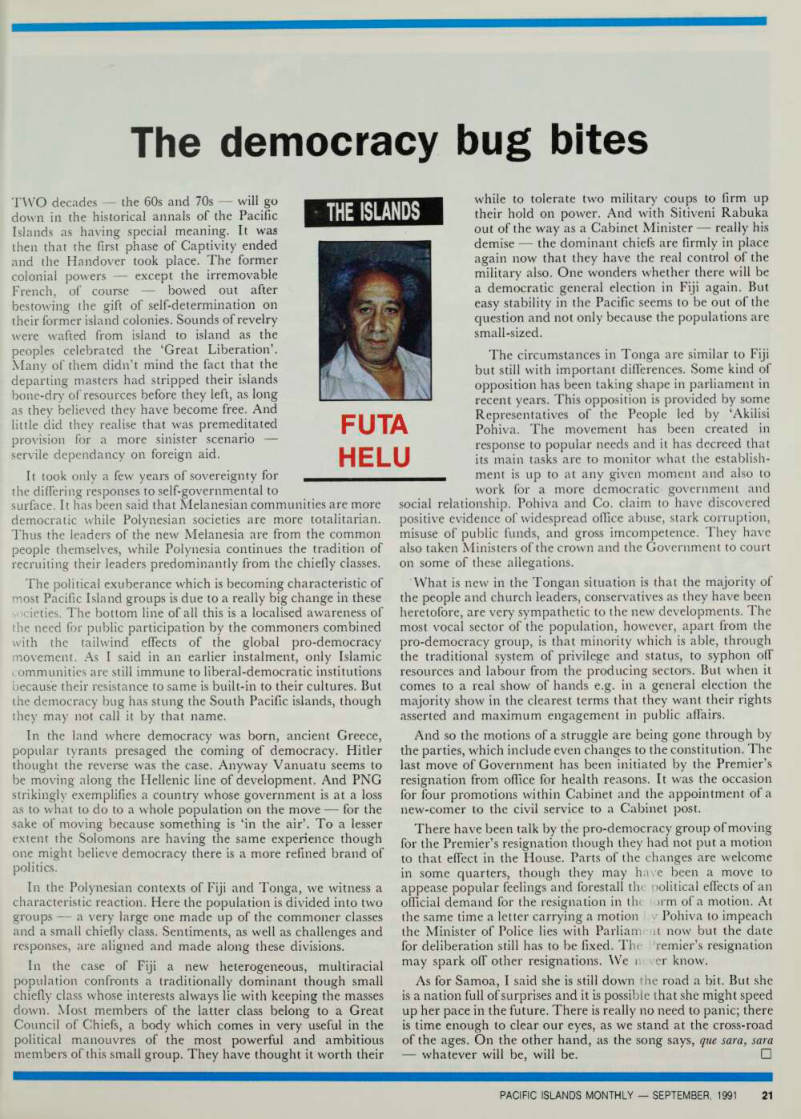
The Islands
Futa
Helu
20 years later

The Forum Is acting with the confidence of an organisation that is taken seriously
By Brendon Burns
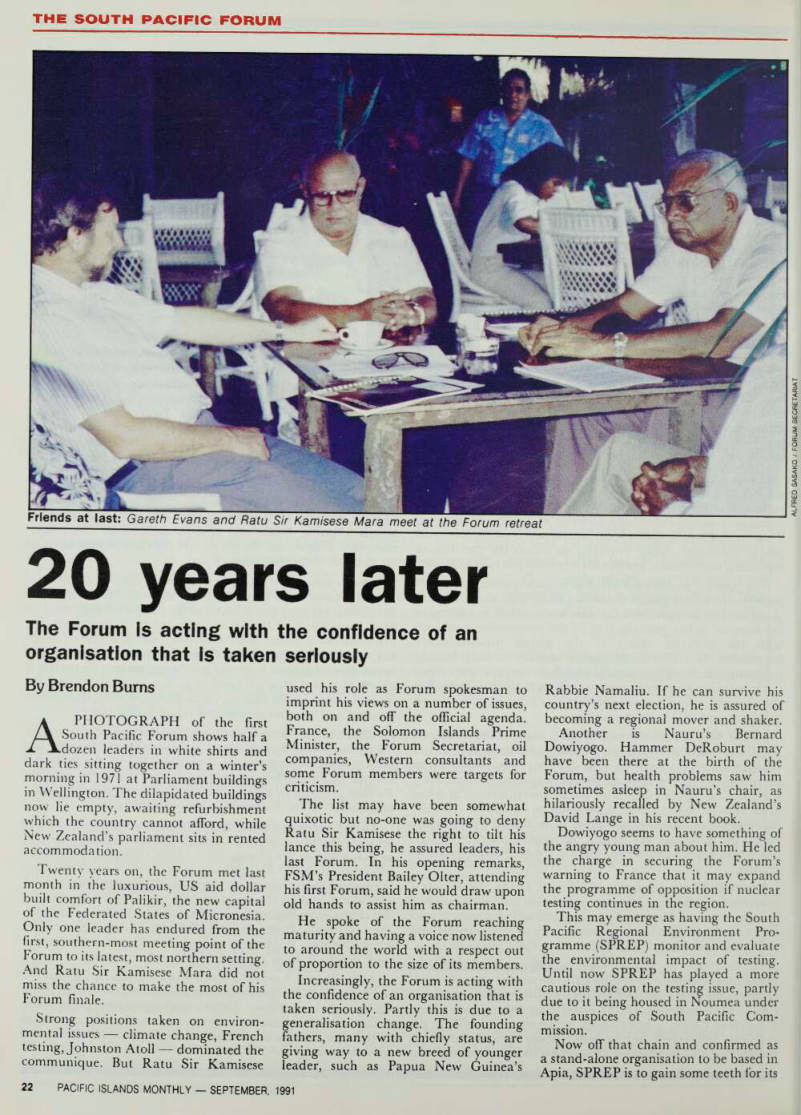
A PHOTOGRAPH of the first South Pacific Forum shows half a dozen leaders in white shirts and dark ties sitting together on a winter’s morning in 1971 at Parliament buildings
in Wellington. The dilapidated buildings
now lie empty, awaiting refurbishment which the country cannot afford, while New Zealand’s parliament sits in rented accommodation.
Twenty years on, the Forum met last month in the luxurious, US aid dollar built comfort of Palikir, the new capital of the Federated States of Micronesia.
Only one leader has endured from the first, southern-most meeting point of the Forum to its latest, most northern setting.
And Ratu Sir Kamisese Mara did not miss the chance to make the most of his Forum finale.
Strong positions taken on environ mental issues climate change, French testing, Johnston Atoll dominated the communique. But Ratu Sir Kamisese
used his role as Forum spokesman to imprint his views on a number of issues, both on and off the official agenda.
France, the Solomon Islands Prime Minister, the Forum Secretariat, oil companies, Western consultants and some Forum members were targets for criticism.
The list may have been somewhat quixotic but no-one was going to deny Ratu Sir Kamisese the right to tilt his lance this being, he assured leaders, his last Forum. In his opening remarks, FSM’s President Bailey Olter, attending his first Forum, said he would draw upon old hands to assist him as chairman.
He spoke of the Forum reaching maturity and having a voice now listened to around the world with a respect out of proportion to the size of its members.
Increasingly, the Forum is acting with the confidence of an organisation that is taken seriously. Partly this is due to a
generalisation change. The founding
fathers, many with chiefly status, are giving way to a new breed of younger leader, such as Papua New Guinea’s
Rabbie Namaliu. If he can survive his country’s next election, he is assured of becoming a regional mover and shaker.
Another is Nauru’s Bernard Dowiyogo. Hammer Deßoburt may have been there at the birth of the Forum, but health problems saw him sometimes asleep in Nauru’s chair, as hilariously recalled by New Zealand’s David Lange in his recent book.
Dowiyogo seems to have something of the angry young man about him. He led the charge in securing the Forum’s warning to France that it may expand the programme of opposition if nuclear testing continues in the region.
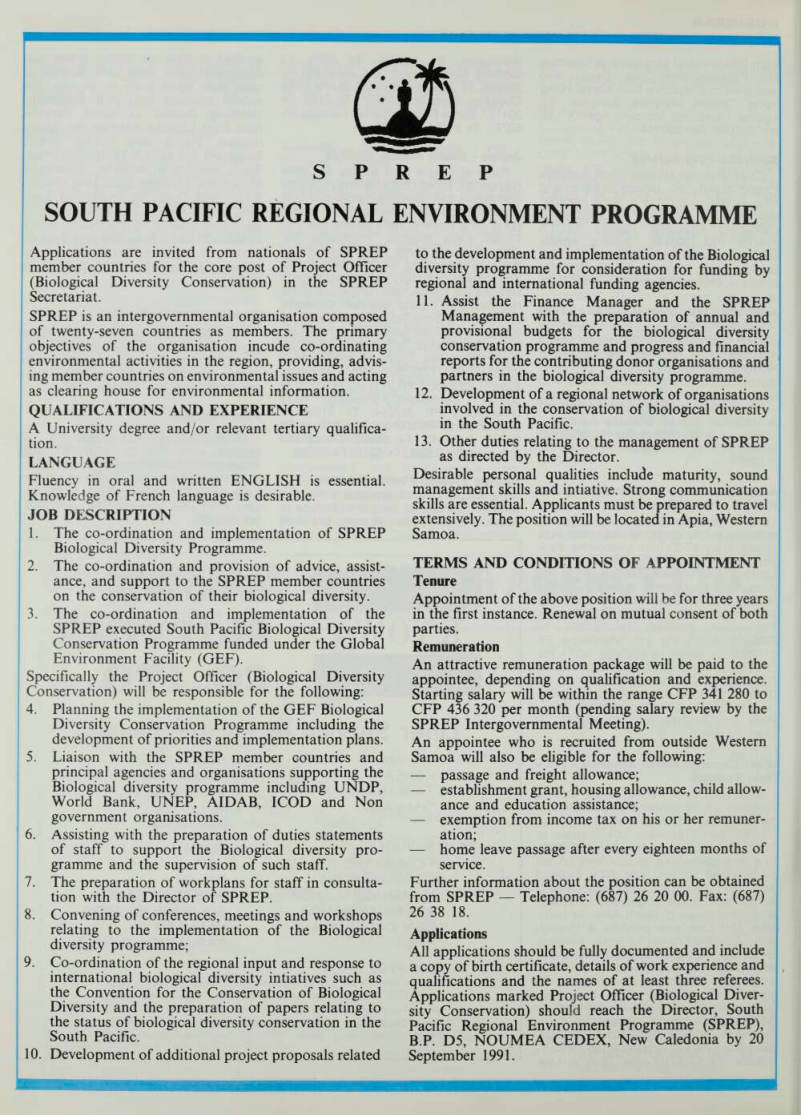
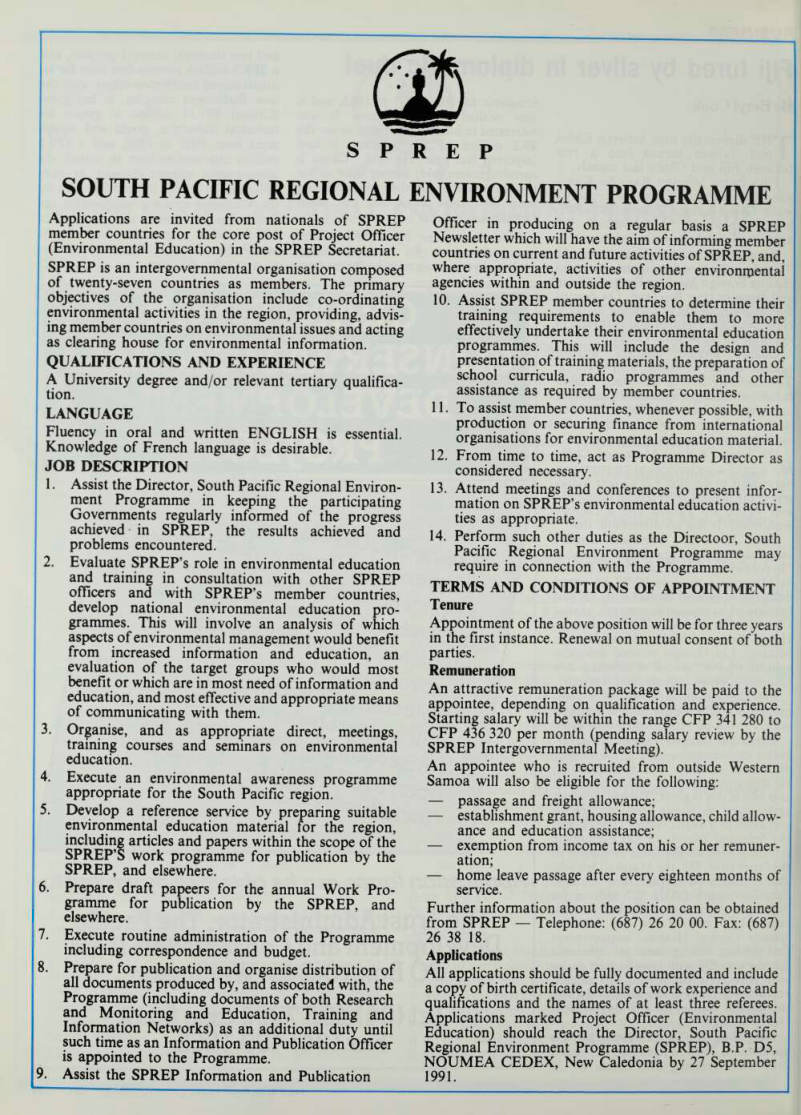
This may emerge as having the South Pacific Regional Environment Pro gramme (SPREP) monitor and evaluate the environmental impact of testing.
Until now SPREP has played a more cautious role on the testing issue, partly due to it being housed in Noumea under the auspices of South Pacific Com mission.
Now off that chain and confirmed as a stand-alone organisation to be based in Apia, SPREP is to gain some teeth for its
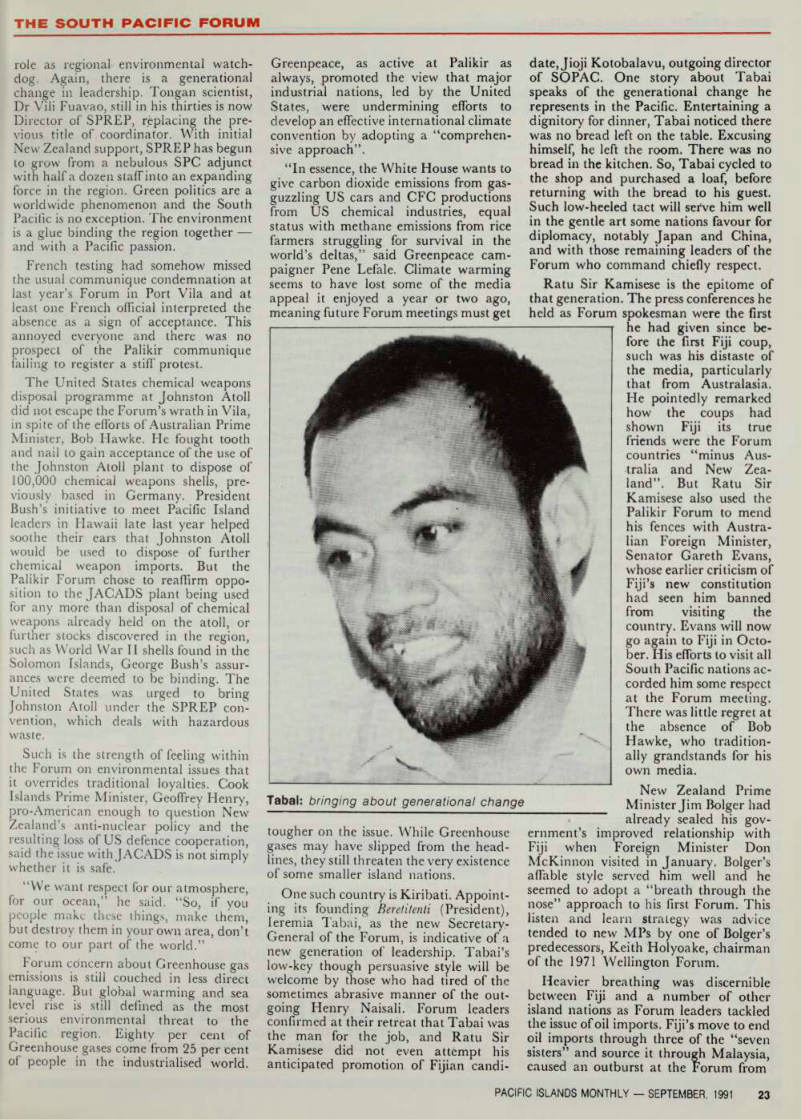
Friends at last: Gareth Evans and Ratu Sir Kamisese Mara meet at the Forum retreat
role as regional environmental watch dog. Again, there is a generational change in leadership. Tongan scientist, Dr Vili Fuavao, still in his thirties is now Director of SPREP, replacing the pre vious title of coordinator. With initial New Zealand support, SPREP has begun to grow from a nebulous SPC adjunct with half a dozen staff into an expanding force in the region. Green politics are a worldwide phenomenon and the South Pacific is no exception. The environment is a glue binding the region together and with a Pacific passion.
French testing had somehow missed the usual communique condemnation at last year’s Forum in Port Vila and at least one French official interpreted the absence as a sign of acceptance. This annoyed everyone and there was no prospect of the Palikir communique failing to register a stiff protest.
The United States chemical weapons disposal programme at Johnston Atoll did not escape the Forum’s wrath in Vila, in spite of the efforts of Australian Prime Minister, Bob Hawke. He fought tooth and nail to gain acceptance of the use of the Johnston Atoll plant to dispose of 100,000 chemical weapons shells, pre viously based in Germany. President Bush’s initiative to meet Pacific Island leaders in Hawaii late last year helped soothe their ears that Johnston Atoll would be used to dispose of further chemical weapon imports. But the Palikir Forum chose to reaffirm oppo sition to the JACADS plant being used for any more than disposal of chemical weapons already held on the atoll, or further stocks discovered in the region, such as World War II shells found in the Solomon Islands, George Bush’s assur ances were deemed to be binding. The United States was urged to bring Johnston Atoll under the SPREP con vention, which deals with hazardous waste.
Such is the strength of feeling within the Forum on environmental issues that it overrides traditional loyalties. Cook Islands Prime Minister, Geoffrey Henry, pro-American enough to question New Zealand’s anti-nuclear policy and the resulting loss of US defence cooperation, said the issue with JACADS is not simply whether it is safe.
“We want respect for our atmosphere, for our ocean,” he said. “So, if you people make these things, make them, but destroy them in your own area, don’t come to our part of the world.”
Forum concern about Greenhouse gas emissions is still couched in less direct
language. But global warming and sea
level rise is still defined as the most serious environmental threat to the Pacific region. Eighty per cent of Greenhouse gases come from 25 per cent of people in the industrialised world.
Greenpeace, as active at Palikir as always, promoted the view that major industrial nations, led by the United States, were undermining efforts to develop an effective international climate convention by adopting a “comprehen sive approach”.
“In essence, the White House wants to give carbon dioxide emissions from gas guzzling US cars and CFG productions from US chemical industries, equal status with methane emissions from rice farmers struggling for survival in the world’s deltas,” said Greenpeace cam paigner Pene Lefale. Climate warming seems to have lost some of the media appeal it enjoyed a year or two ago, meaning future Forum meetings must get
tougher on the issue. While Greenhouse gases may have slipped from the head lines, they still threaten the very existence of some smaller island nations.
One such country is Kiribati. Appoint ing its founding Beretitenti (President), leremia Tabai, as the new Secretary- General of the Forum, is indicative of a new generation of leadership. Tabai’s low-key though persuasive style will be welcome by those who had tired of the sometimes abrasive manner of the out going Henry Naisali. Forum leaders confirmed at their retreat that Tabai was the man for the job, and Ratu Sir Kamisese did not even attempt his anticipated promotion of Fijian candi
date,Jioji Kotobalavu, outgoing director of SOPAC. One stoi7 about Tabai speaks of the generational change he represents in the Pacific. Entertaining a dignitory for dinner, Tabai noticed there was no bread left on the table. Excusing himself, he left the room. There was no bread in the kitchen. So, Tabai cycled to the shop and purchased a loaf, before returning with the bread to his guest.
Such low-heeled tact will sefve him well in the gentle art some nations favour for diplomacy, notably Japan and China, and with those remaining leaders of the Forum who command chiefly respect.
Ratu Sir Kamisese is the epitome of that generation. The press conferences he held as Forum spokesman were the first
he had given since be fore the first Fiji coup, such was his distaste of the media, particularly that from Australasia.
He pointedly remarked how the coups had shown Fiji its true friends were the Forum countries “minus Aus tralia and New Zea land”. But Ratu Sir Kamisese also used the Palikir Forum to mend his fences with Austra lian Foreign Minister, Senator Gareth Evans, whose earlier criticism of Fiji’s new constitution had seen him banned from visiting the country. Evans will now go again to Fiji in Octo ber. His efforts to visit all South Pacific nations ac corded him some respect at the Forum meeting.
There was little regret at the absence of Bob Hawke, who tradition ally grandstands for his own media.
New Zealand Prime Minister Jim Bolger had already sealed his gov
ernment’s improved relationship with Fiji when Foreign Minister Don McKinnon visited in January. Bolger’s affable style served him well and he seemed to adopt a “breath through the nose” approach to his first Forum. This listen and learn strategy was advice tended to new MPs by one of Bolger’s
predecessors, Keith Holyoake, chairman
of the 1971 Wellington Forum.
Heavier breathing was discernible between Fiji and a number of other island nations as Forum leaders tackled the issue of oil imports. Fiji’s move to end oil imports through three of the “seven sisters” and source it through Malaysia, caused an outburst at the Forum from
Tabal: bringing about generational change
countries fearing oil prices increases from their regional supplier. Ratu Sir Kami sese turned the concern into an attack on the oil companies, accusing them of secretly spreading tales about price rises, while for 20 years they had been systematically robbing Fiji. He further diffused the reaction to his government’s move by promising Fiji would host a meeting of regional energy ministers and the ugly oil companies with the aim of getting to the facts.
With that oil-well fire capped, Ratu Sir Kamisese fanned another with France. The communique expressed a wish to have the Forum assist the FLNKS ensure its objectives are met through the Matignon Accords. How ever, Ratu Sir Kamisese expanded this to include assisting the FLNKS to persuade minority populations in New Caledonia to support independence or self government. This is red rag to a bull stuff lor the Right-Wing rally for Caledonia in the Republic, (RPCR) whose leader, Jacques Lafleur, spurned an offer to be an observer at the Forum. Due to RPCR opposition, France had delayed until July the admission of a Forum delegation to New Caledonia to observe Kanak advancement, in a restrained response to the Forum’s wish for continued involve ment, Louis le Pensec, the French deputy responsible for overseas territories, said it was up to New Caledonians to monitor the Matignon Accords. Access for Forum
delegations is hardly likely to improve
when there appears to be an expressed wish to play a role in New Caledonia’s future.
Jealous guardianship of sovereignty is
not an exclusively French trait, Australia and New Zealand had promoted to the Palikir Forum a wish for much strength ened cooperation in law enforcement.
The bigger members fear drug smugglers and their money launderers, Asian triads and carpetbaggers may target vulnerable small island nations. But there are concerns about how cooperation may
infringe how each country deals with such problems. Officials are to work through these issues and what resources might be necessary to combat such criminal incursions. Action can be ex pected at next year’s Forum in Honiara.
The sovereignty of FSM and the Marshall Islands was affirmed at Palikir, with the bids of these nations to join the United Nations as full members given Forum support. Britain, with Security Council membership, has been reticent to accept the two nations while the free association compacts see the United States responsible for defence, and nominally, foreign affairs.
The bid by Michael Somare for presidency of the United Nations Gen eral Assembly was given Forum endorse ment. If Papua New Guinea’s founding Prime Minister, now Foreign Minister, is successful, the region as a whole will see this as a sign of its acceptance of the international stage.
Any hope Taiwan had of gaining another token of recognition by being accepted at the post-Forum dialogue was dashed. Ratu Sir Kamisese disclosed that Chinese Premier, Li Peng, had lobbied since the Vila Forum against any Taiwanese presence. Ratu Sir Kamisese was scrutably annoyed with Chinese
duplicity trading vigorously with Taiwan but not allowing others political contact. Separate talks with Taiwan, outside the post-Forum setting, are to be considered by the Forum Secretariat, but that proposal comes amid calls for less regional meetings. The construction of the post-Forum meeting came in for some criticism by Ratu Sir Kamisese, who fulminated about the cost of the region of hosting the talks for the convenience of wealthier nations. What seemed to escape him for the moment was that the dialogue is the chance for the South Pacific to set the agenda for a meeting, held in familiar surroundings.
Certainly, the post-Forum dialogue indicated the world is waking up to the South Pacific. The European Commun ity was represented for the first time, if only by officials. Established dialogue partners sent more senior representatives than those at Vila, extending to assistant US Secretary of State, Richard Solomon, Britain’s junior Foreign Minister, Lord Caithness and Japanese Vice-Minister, Muneo Suzuki. While these men are not James Baker, Douglas Hurd or Dr Nakayama, they are beyond the level of diplomats. In 20 years, the Forum has become a voice listened to with attention beyond its size. The challenge for a new generation of leaders is to expand reception without becoming shrill. □
Advertisements & other items, p. 24 (1 item)
UMfc
Domalco kitchenwares are always
dressed for all occasion.
Manufacturers of: * Aluminium Utensils and other household items * Aluminium products for commercial purposes Also specialised in METAL SPINNING and
DEEP DRAWING
DOMALCO LIMITED
Manufacturers and Exporters II Navoli Rd., Varadoli.
P.O. Box 87, Ba Fax: (679) 670089 Phone: Ba: (679) 670082 After Hours (679) 670144 Cable Dullu For any above requirements contact us at:
UMfc
Rent A Car
THE WORLD S NO. 1
WHERE QUALITY AND SAFETY COUNT.
To drive the roads of Fiji is to experience some of the most beautiful scenery of the South Pacific, especially with Hertz.
A For Reservations Phone.
Nadi Airport 722146 Suva 383150,383411,383677 Telex: 2237, Fax; 370212 With Hertz you get more than just a car.
TO ANYWHERE IN THE WORLD
tjMfc
313166 313149 Your artifacts, ' gifts, souvenirs, carvings, artworks, documents whatever DHL will deliver anywhere worldwide Freight Forwarders, Air Cargo DHL Worldwide Express Service
NADI LAUTOKA CAfIASA
73800 65400 65401 C 1162 nth DHL "You're m sate hands all Che May"
WOffLOWKX express*
FOR SALE
Allen 6 cylinder diesel generator set. (Alternator). 810 h.p., 707 KVA, 3 phase 50 cycles, 415 volts, 985 amps with switchboard. Located 60 miles from Melbourne. A 550,000 as is where is.
ENQUIRE:
P. GUNNERSEN
112 SALMON STREET, PORT MELBOURNE, VICTORIA 3207, AUSTRALIA
FAX: 61-3-6462732, PHONE: 61-3-6479911
Naturally attractive
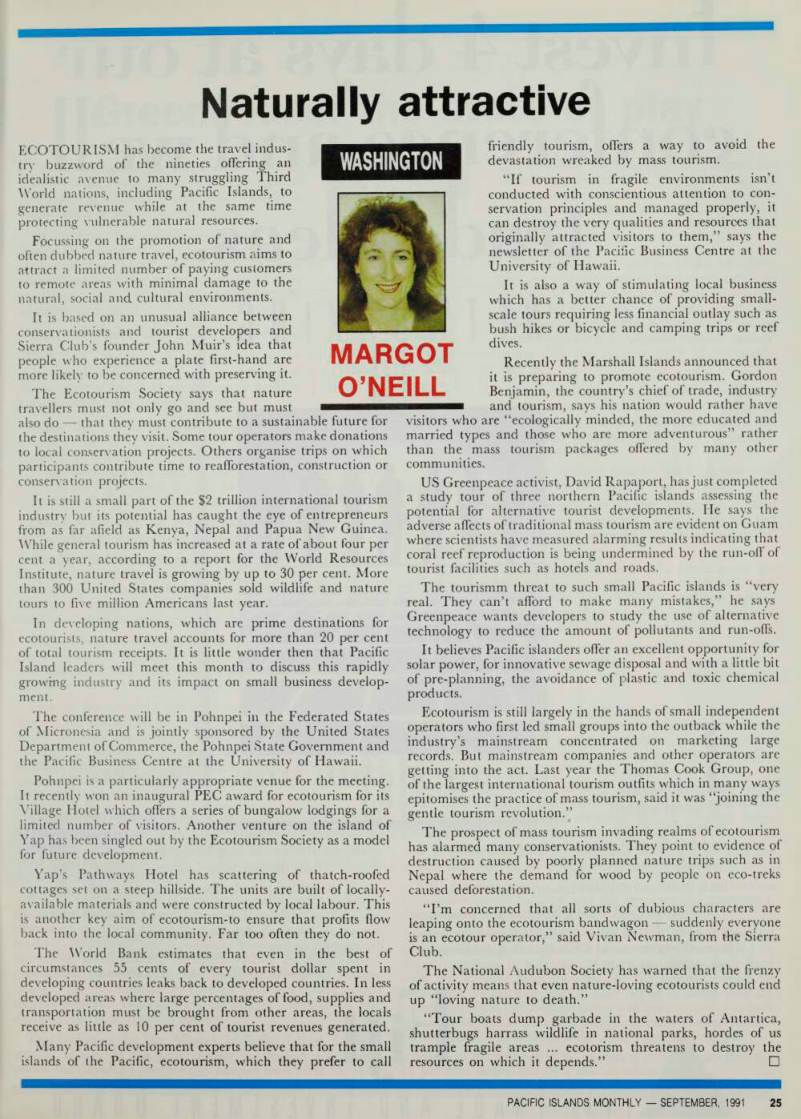
ECOTOURISM has become the travel indus try buzzword of the nineties offering an idealistic avenue to many struggling Third World nations, including Pacific Islands, to generate revenue while at the same time protecting vulnerable natural resources.
Focussing on the promotion of nature and often dubbed nature travel, ecotourism aims to attract a limited number of paying customers to remote areas with minimal damage to the natural, social and cultural environments.
It is based on an unusual alliance between conservationists and tourist developers and Sierra Club’s founder John Muir’s idea that people who experience a plate first-hand are more likely to be concerned with preserving it.
The Ecotourism Society says that nature travellers must not only go and see but must
also do that they must contribute to a sustainable future for the destinations they visit. Some tour operators make donations to local conservation projects. Others organise trips on which participants contribute time to reafforestation, construction or conservation projects.
It is still a small part of the S 2 trillion international tourism industry but its potential has caught the eye of entrepreneurs from as far afield as Kenya, Nepal and Papua New Guinea.
While general tourism has increased at a rate of about four per cent a year, according to a report for the World Resources Institute, nature travel is growing by up to 30 per cent. More than 300 United States companies sold wildlife and nature tours to five million Americans last year.
In developing nations, which are prime destinations for ecotourists, nature travel accounts for more than 20 per cent of total tourism receipts. It is little wonder then that Pacific Island leaders will meet this month to discuss this rapidly growing industry and its impact on small business develop ment.
The conference will be in Pohnpei in the Federated States of Micronesia and is jointly sponsored by the United States Department of Commerce, the Pohnpei State Government and the Pacific Business Centre at the University of Hawaii.
Pohnpei is a particularly appropriate venue for the meeting.
It recently won an inaugural PEC award for ecotourism for its Village Hotel which offers a series of bungalow lodgings for a limited number of visitors. Another venture on the island of Yap has been singled out by the Ecotourism Society as a model for future development.
Yap’s Pathways Hotel has scattering of thatch-roofed cottages set on a steep hillside. The units are built of locally available materials and were constructed by local labour. This is another key aim of ecotourism-to ensure that profits flow back into the local community. Far too often they do not.
The World Bank estimates that even in the best of circumstances 55 cents of every tourist dollar spent in developing countries leaks back to developed countries. In less developed areas where large percentages of food, supplies and transportation must be brought from other areas, the locals receive as little as 10 per cent of tourist revenues generated.
Many Pacific development experts believe that for the small islands of the Pacific, ecotourism, which they prefer to call
friendly tourism, offers a way to avoid the devastation wreaked by mass tourism.
“If tourism in fragile environments isn’t conducted with conscientious attention to con
servation principles and managed properly, it
can destroy the very qualities and resources that originally attracted visitors to them,” says the newsletter of the Pacific Business Centre at the University of Hawaii, It is also a way of stimulating local business which has a better chance of providing small scale tours requiring less financial outlay such as bush hikes or bicycle and camping trips or reef dives.
Recently the Marshall Islands announced that it is preparing to promote ecotourism. Gordon Benjamin, the country’s chief of trade, industry and tourism, says his nation would rather have
visitors who are “ecologically minded, the more educated and married types and those who are more adventurous” rather than the mass tourism packages offered by many other communities.
US Greenpeace activist, David Rapaport, has just completed a study tour of three northern Pacific islands assessing the potential for alternative tourist developments. He says the adverse affects of traditional mass tourism are evident on Guam where scientists have measured alarming results indicating that coral reef reproduction is being undermined by the run-off of tourist facilities such as hotels and roads.
The tourismm threat to such small Pacific islands is “very real. They can’t afford to make many mistakes,” he says Greenpeace wants developers to study the use of alternative technology to reduce the amount of pollutants and run-offs.
It believes Pacific islanders offer an excellent opportunity for solar power, for innovative sewage disposal and with a little bit of pre-planning, the avoidance of plastic and toxic chemical
products.
Ecotourism is still largely in the hands of small independent operators who first led small groups into the outback while the
industry’s mainstream concentrated on marketing large
records. But mainstream companies and other operators are getting into the act. Last year the Thomas Cook Group, one of the largest international tourism outfits which in many ways epitomises the practice of mass tourism, said it was “joining the gentle tourism revolution.”
The prospect of mass tourism invading realms of ecotourism has alarmed many conservationists. They point to evidence of destruction caused by poorly planned nature trips such as in Nepal where the demand for wood by people on cco-treks caused deforestation.
“I’m concerned that all sorts of dubious characters are leaping onto the ecotourism bandwagon suddenly everyone is an ecotour operator,” said Vivan Newman, from the Sierra Club.
The National Audubon Society has warned that the frenzy of activity means that even nature-loving ecotourists could end up “loving nature to death.”
“Tour boats dump garbade in the waters of Antartica, shutterbugs harrass wildlife in national parks, hordes of us trample fragile areas ... ecotorism threatens to destroy the resources on which it depends.” □
Washington
Margot
O’Neill
Advertisements & other items, p. 26 (1 item)
conference and well
Invest 4 a
trade id
eas.
ETWORKING
Invest 4 days at the Sheraton Fiji Resort and find out why Fiji offers
Investment And Trade Forum
io v E 131 H M B E fl
HID
one of the best investment environments in the South Pacific, Trade ideas and discover business opportunities.
NETWORKING SOUTH PACIFIC - Fiji Investment and Trade Forum will bring together business people from all over the world with a list of impressive international speakers to talk trade and investment in Fiji.
Sheraton Fiji Resort - November 13-16, 1991.
An opportunity not to be missed by serious investors looking for opportunities to expand their horizon, meet new partners under Fiji’s favourable and attractive investment climate.
Register now.
Contact: Fiji Trade and Investment Board, PO Box 2303, Government Buildings, Suva, Fiji.
Telephone (679) 315988. Fax (679) 301783.
F T F 3 yi
Em Trade and I nvestment Board
Greenhouse: the state of play
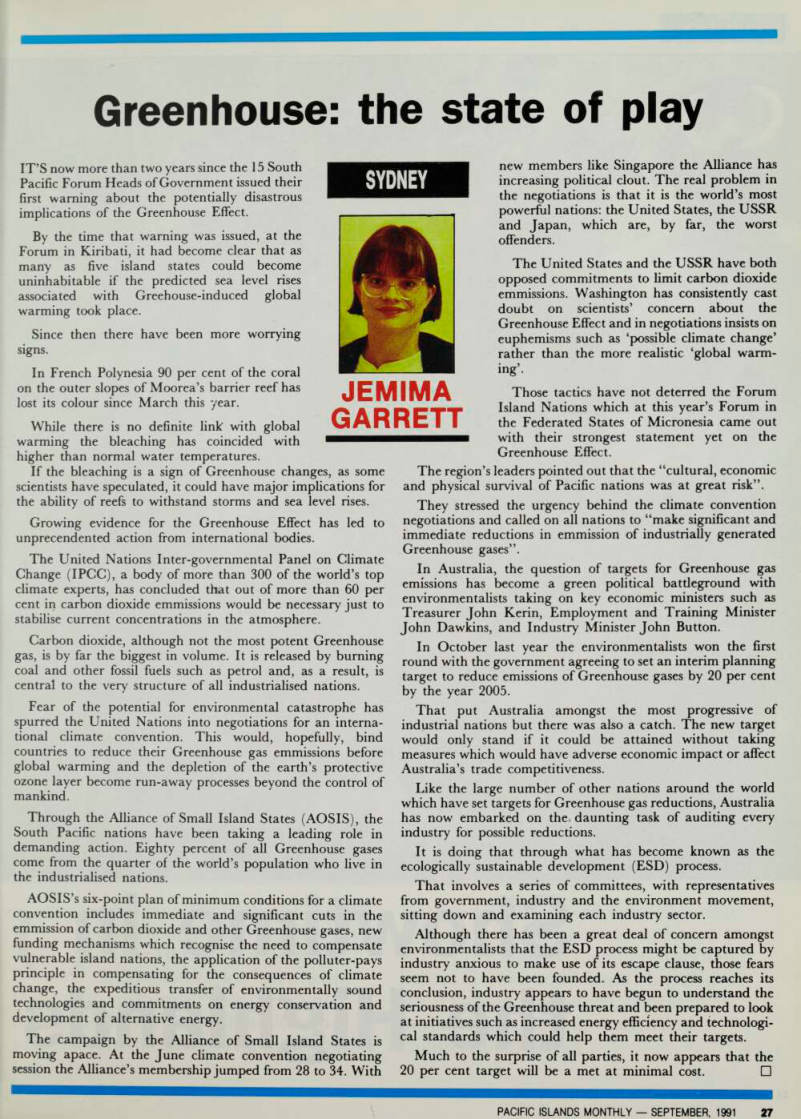
IT’S now more than two years since the 15 South Pacific Forum Heads of Government issued their first warning about the potentially disastrous implications of the Greenhouse Effect.
By the time that warning was issued, at the Forum in Kiribati, it had become clear that as many as five island states could become uninhabitable if the predicted sea level rises associated with Greehouse-induced global warming took place.
Since then there have been more worrying
signs.
In French Polynesia 90 per cent of the coral on the outer slopes of Moorea’s barrier reef has lost its colour since March this year.
While there is no definite link with global warming the bleaching has coincided with higher than normal water temperatures.
If the bleaching is a sign of Greenhouse changes, as some scientists have speculated, it could have major implications for the ability of reefs to withstand storms and sea level rises.
Growing evidence for the Greenhouse Effect has led to unprecendented action from international bodies.
The United Nations Inter-governmental Panel on Climate Change (IPCC), a body of more than 300 of the world’s top climate experts, has concluded that out of more than 60 per cent in carbon dioxide emmissions would be necessary just to stabilise current concentrations in the atmosphere.
Carbon dioxide, although not the most potent Greenhouse gas, is by far the biggest in volume. It is released by burning coal and other fossil fuels such as petrol and, as a result, is central to the very structure of all industrialised nations.
Fear of the potential for environmental catastrophe has spurred the United Nations into negotiations for an interna tional climate convention. This would, hopefully, bind countries to reduce their Greenhouse gas emmissions before global warming and the depletion of the earth’s protective ozone layer become run-away processes beyond the control of mankind.
Through the Alliance of Small Island States (AOSIS), the South Pacific nations have been taking a leading role in demanding action. Eighty percent of all Greenhouse gases come from the quarter of the world’s population who live in the industrialised nations.
AOSIS’s six-point plan of minimum conditions for a climate convention includes immediate and significant cuts in the emmission of carbon dioxide and other Greenhouse gases, new funding mechanisms which recognise the need to compensate vulnerable island nations, the application of the polluter-pays principle in compensating for the consequences of climate change, the expeditious transfer of environmentally sound technologies and commitments on energy conservation and development of alternative energy.
The campaign by the Alliance of Small Island States is moving apace. At the June climate convention negotiating session the Alliance’s membership jumped from 28 to 34. With
new members like Singapore the Alliance has increasing political clout. The real problem in the negotiations is that it is the world’s most powerful nations: the United States, the USSR and Japan, which are, by far, the worst offenders.
The United States and the USSR have both opposed commitments to limit carbon dioxide emmissions. Washington has consistendy cast doubt on scientists’ concern about the Greenhouse Effect and in negotiations insists on
euphemisms such as ‘possible climate change’
rather than the more realistic ‘global warm
ing’.
Those tactics have not deterred the Forum Island Nations which at this year’s Forum in the Federated States of Micronesia came out with their strongest statement yet on the Greenhouse Effect.
The region’s leaders pointed out that the “cultural, economic and physical survival of Pacific nations was at great risk”.
They stressed the urgency behind the climate convention negotiations and called on all nations to “make significant and immediate reductions in emmission of industrially generated
Greenhouse gases”.
In Australia, the question of targets for Greenhouse gas emissions has become a green political battleground with environmentalists taking on key economic ministers such as Treasurer John Kerin, Employment and Training Minister John Dawkins, and Industry Minister John Button.
In October last year the environmentalists won the first round with the government agreeing to set an interim planning target to reduce emissions of Greenhouse gases by 20 per cent by the year 2005.
That put Australia amongst the most progressive of industrial nations but there was also a catch. The new target would only stand if it could be attained without taking measures which would have adverse economic impact or affect Australia’s trade competitiveness.
Like the large number of other nations around the world which have set targets for Greenhouse gas reductions, Australia has now embarked on the daunting task of auditing every industry for possible reductions.
It is doing that through what has become known as the
ecologically sustainable development (ESD) process.
That involves a series of committees, with representatives from government, industry and the environment movement, sitting down and examining each industry sector.
Although there has been a great deal of concern amongst environmentalists that the ESD process might be captured by industry anxious to make use of its escape clause, those fears seem not to have been founded. As the process reaches its conclusion, industry appears to have begun to understand the seriousness of the Greenhouse threat and been prepared to look at initiatives such as increased energy efficiency and technologi cal standards which could help them meet their targets.
Much to the surprise of all parties, it now appears that the 20 per cent target will be a met at minimal cost. □
Sydney
Jemima
Garrett
Focus
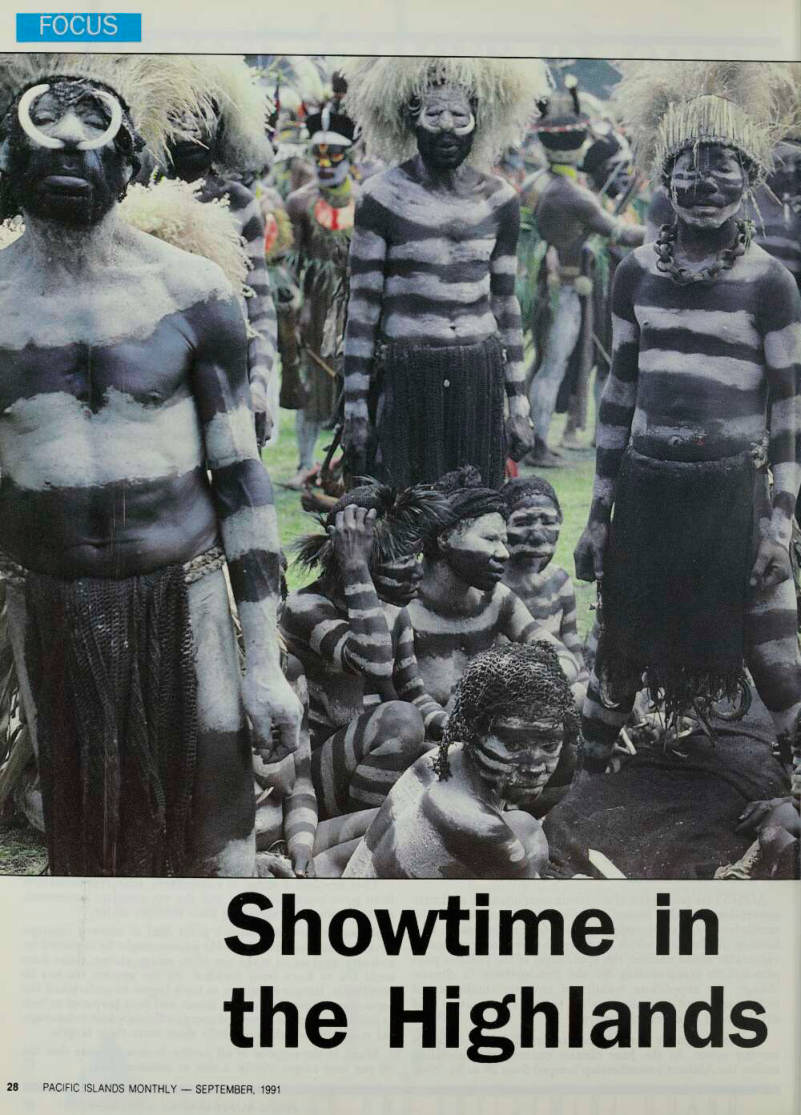
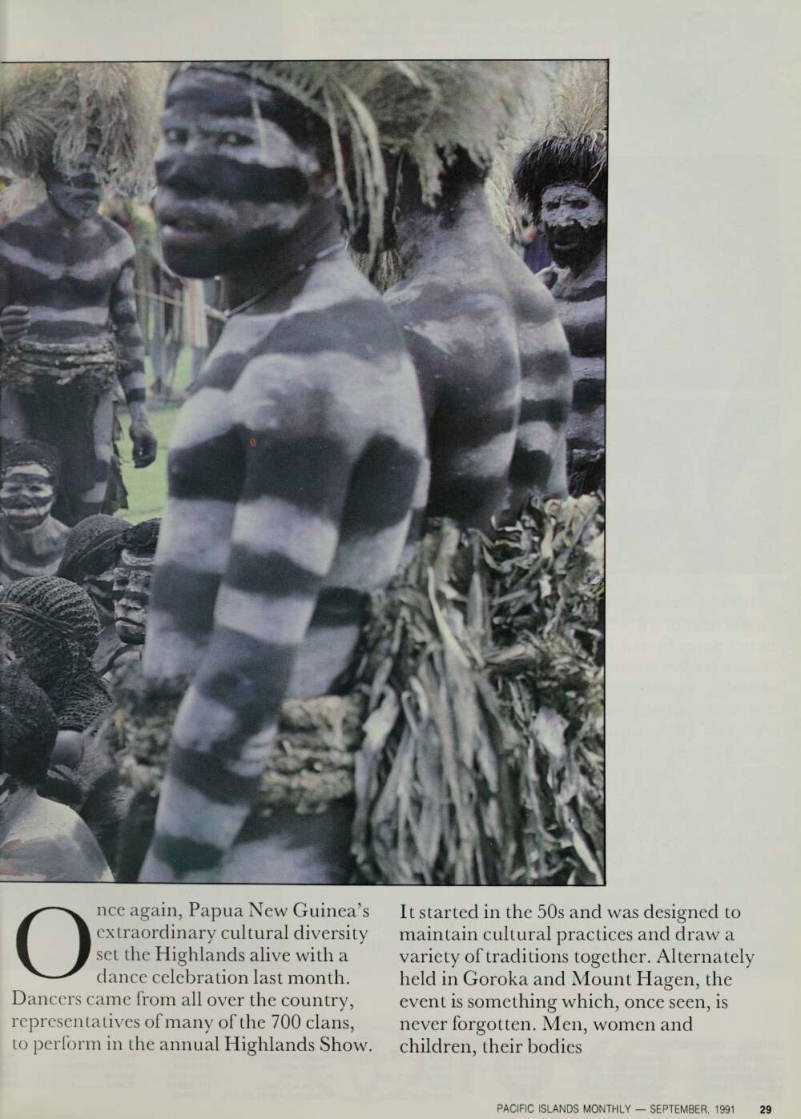


Showtime in the Highlands
Once again, Papua New Guinea’s
extraordinary cultural diversity
set the Highlands alive with a dance celebration last month.
Dancers came from all over the country, representatives of many of the 700 clans, to perform in the annual Highlands Show.
It started in the 50s and was designed to maintain cultural practices and draw a
variety of traditions together. Alternately
held in Goroka and Mount Hagen, the event is something which, once seen, is never forgotten. Men, women and children, their bodies
covered in coloured ocres and powder paints move rythmically to the beat of snake-skin drums. Decorated with leaves and feathers, dried yellow daisies and the bright blue bodies of the Bird of Paradise, the dust surrounds them as they stamp their feet.
Everywhere hangs the smell of pig fat, sweat and the superb smoky odour of grass skirts dried over fire. The day wears on and the heat of the afternoon sun turns cool with dusk. It’s like nothing I’ve seen before. The power of excitement and the incredible wealth and richness of Papua New Guinean culture is breathtaking. □
Advertisements & other items, pp. 30-33 (2 items)
The new Toyota brand mark. Three ellipses forming
a “T” which stand for our customer, our commitment to the satisfaction of that customer through our product and for our spirit of creativity.
It’s not often that you hear descriptions like rugged or durable combined with refined and elegant. But then there’s never been a vehicle quite like the new Toyota Land Cruiser Station Wagon. The unrivalled legend of off-road reliability is now unsurpassed in comfort and sophistication as well. Attention to detail is found everywhere, from the fine trim to the instrument panel to the graceful lines of its exterior. Even in places you can’t see, like the heavy-duty ladder frame and suspension design that add to the superb
luxury-car ride.
But Toyota’s innovation goes beyond providing luxury and durability. The new Land Cruiser Station Wagon, and all of our cars, are designed to create a harmony between car and driver, and to provide you with the ultimate
driving experience.
The new Toyota Land Cruiser Station Wagon. Think of it as much more than a spacious luxury sedan with fourwheel drive. i
inf
m % «iW : . v- a:. *
DISTRIBUTORS/DEALERS
TOYOTA
South Pacific Games (1991) Foundation
Proudly acknowledges:
THE OFFICIAL SPONSOR
PNG TEAM SPONSOR
17 MAJOR SPONSORS
OF THE 9TH SOUTH
PACIFIC GAMES
PAPUA NEW GUINEA
9ih SOUTH PACIFIC GAMES
PAPUA NEW GUINEA 1991
Sl* HOLDINGS OFFICIAL SPONSOR
Umak oa
POST AND TELECOMMUNICATION
Coopers
& Lybrand For advice - worth its weight in gold
HAHBOUHS
PAPUA NEW GUINEA
HARBOURS BOARD
Focus
Ready
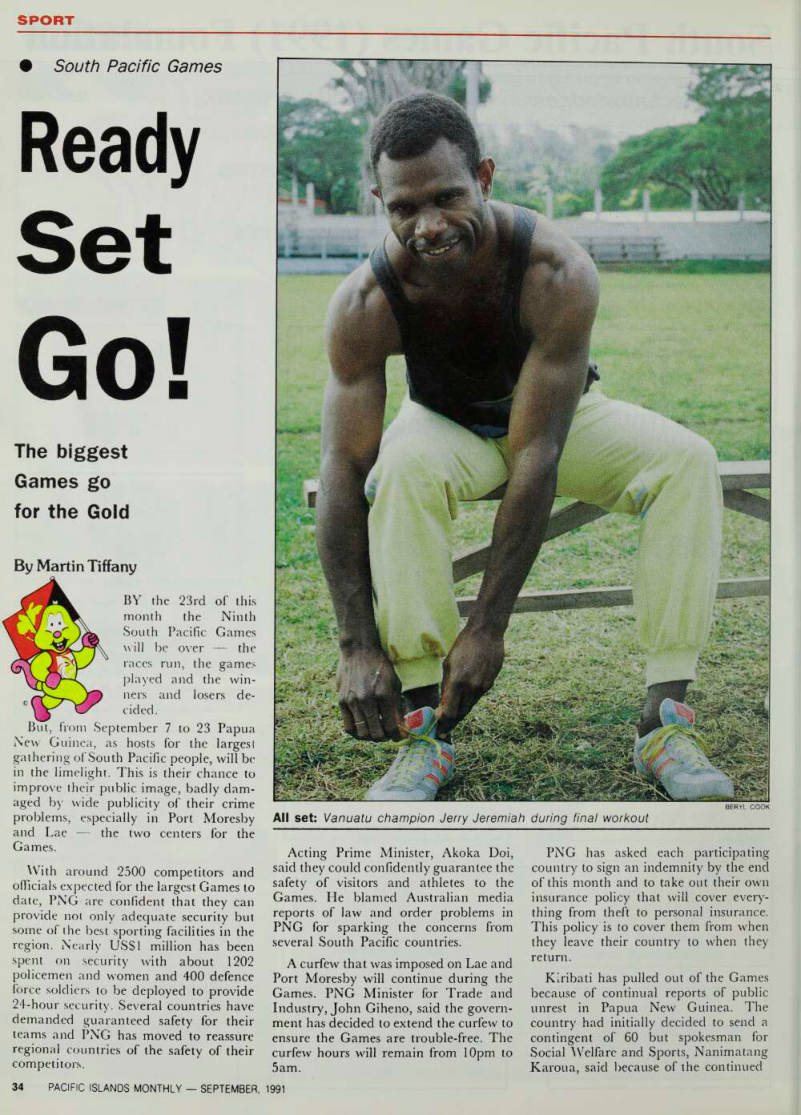
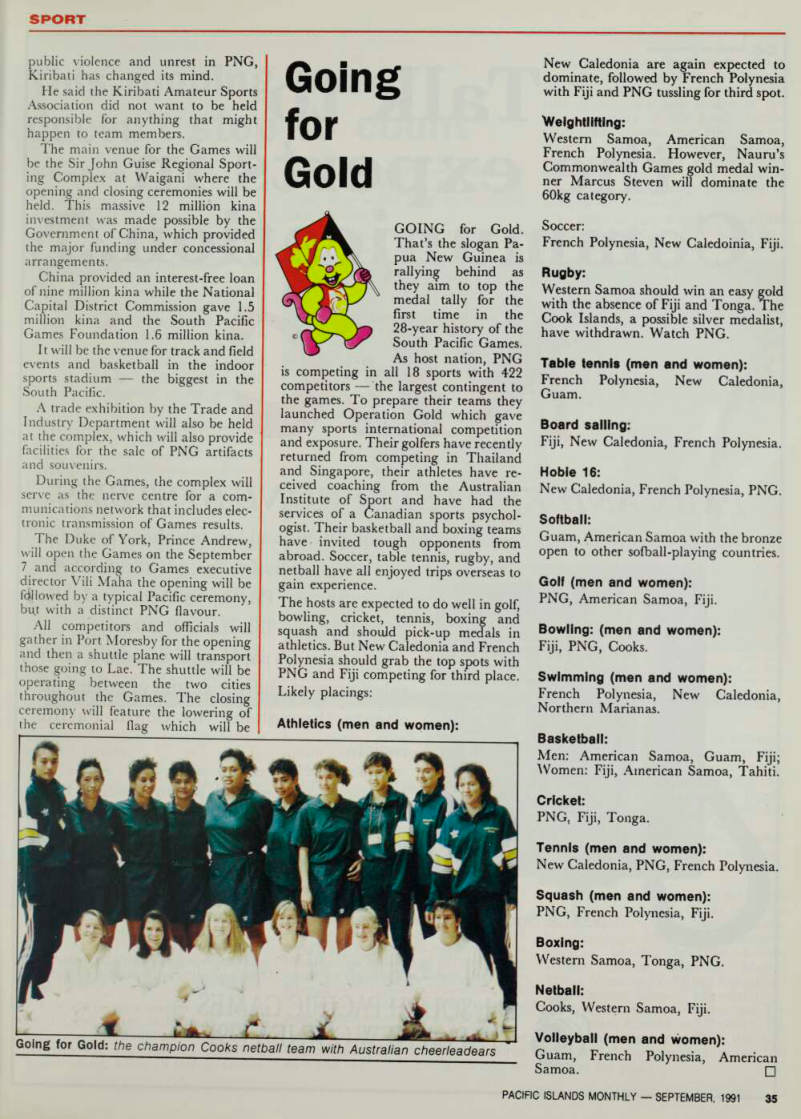

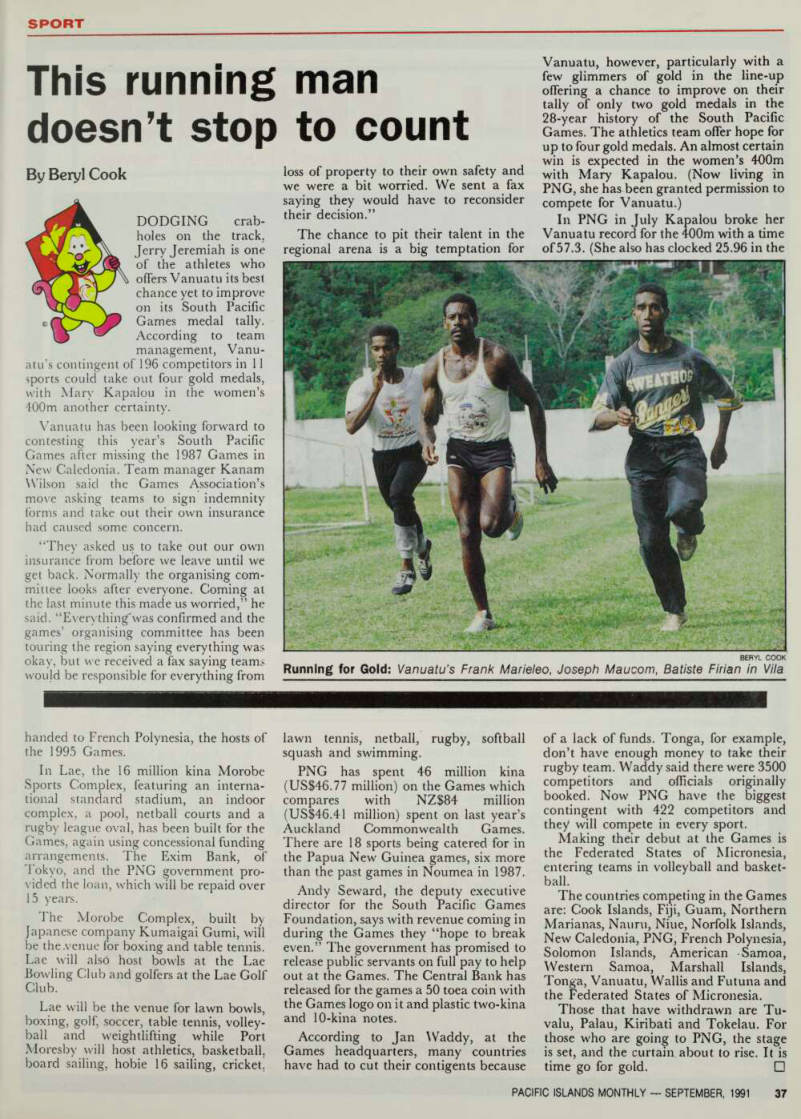
Sport
South Pacific Games Ready Set Go!
The biggest Games go for the Gold
By Martin Tiffany
BY the 23rd of this month the Ninth South Pacific Games will be over the races run, the games played and the win ners and losers de cided.
But, from September 7 to 23 Papua New Guinea, as hosts for the largest gathering of South Pacific people, will be in the limelight. This is their chance to improve their public image, badly dam aged by wide publicity of their crime problems, especially in Port Moresby and Lae the two centers for the Games.
With around 2500 competitors and officials expected for the largest Games to date, PNG are confident that they can provide not only adequate security but some of the best sporting facilities in the region. Nearly USSI million has been spent on security with about 1202 policemen and women and 400 defence force soldiers to be deployed to provide 24-hour security. Several countries have demanded guaranteed safety for their teams and PNG has moved to reassure regional countries of the safety of their competitors.
Acting Prime Minister, Akoka Doi, said they could confidently guarantee the safety of visitors and athletes to the Games. He blamed Australian media reports of law and order problems in PNG for sparking the concerns from several South Pacific countries.
A curfew that was imposed on Lae and Port Moresby will continue during the Games. PNG Minister for Trade and Industry, John Giheno, said the govern ment has decided to extend the curfew to ensure the Games are trouble-free. The curfew hours will remain from 10pm to sam.
PNG has asked each participating country to sign an indemnity by the end of this month and to take out their own insurance policy that will cover every thing from theft to personal insurance.
This policy is (o cover them from when they leave their country to when they return.
Kiribati has pulled out of the Games because of continual reports of public unrest in Papua New Guinea. The country had initially decided to send a contingent of 60 but spokesman for Social Welfare and Sports, Nanimatang Karon a, said because of the continued
Beryl Cook
All set: Vanuatu champion Jerry Jeremiah during final workout
public violence and unrest in PNG, Kiribati has changed its mind.
He said the Kiribati Amateur Sports Association did not want to be held responsible for anything that might happen to team members.
The main venue for the Games will be the Sir John Guise Regional Sport ing Complex at Waigani where the opening and closing ceremonies will be held. This massive 12 million kina investment was made possible by the Government of China, which provided the major funding under concessional arrangements.
China provided an interest-free loan of nine million kina while the National Capital District Commission gave 1.5 million kina and the South Pacific Games Foundation 1.6 million kina.
It will be the venue for track and field events and basketball in the indoor sports stadium the biggest in the South Pacific.
A trade exhibition by the Trade and Industry Department will also be held at the complex, which will also provide facilities for the sale of PNG artifacts and souvenirs.
During the Games, the complex will serve as the nerve centre for a com munications network that includes elec tronic transmission of Games results.
The Duke of York, Prince Andrew, will open the Games on the September 7 and according to Games executive director Vili Maha the opening will be fell lowed by a typical Pacific ceremony, but with a distinct PNG flavour.
All competitors and officials will gather in Port Moresby for the opening and then a shuttle plane will transport those going to Lae. The shuttle will be operating between the two cities throughout the Games. The closing ceremony will feature the lowering of the ceremonial flag which will be
Going for Gold: the champion Cooks netball team with Australian cheerleadears
Athletics (men and women):
handed to French Polynesia, the hosts of the 1995 Games.
In Lae, the 16 million kina Morobe Sports Complex, featuring an interna tional standard stadium, an indoor complex, a pool, netball courts and a rugby league oval, has been built for the Games, again using concessional funding arrangements. The Exim Bank, of Tokyo, and the PNG government pro vided the loan, which will be repaid over 15 years.
The Morobe Complex, built by Japanese company Kumaigai Gumi, will be the .venue for boxing and table tennis.
Lae will also host bowls at the Lae Bowling Club and golfers at the Lae Golf Club.
Lae will be the venue for lawn bowls, boxing, golf, soccer, table tennis, volley ball and weightlifting while Port Moresby will host athletics, basketball, board sailing, hobie 16 sailing, cricket.
lawn tennis, netball, rugby, softball squash and swimming.
PNG has spent 46 million kina (U 5546.77 million) on the Games which compares with NZ$B4 million (U 5546.41 million) spent on last year’s Auckland Commonwealth Games.
There are 18 sports being catered for in the Papua New Guinea games, six more than the past games in Noumea in 1987.
Andy Seward, the deputy executive director for the South Pacific Games Foundation, says with revenue coming in during the Games they ‘‘hope to break even.” The government has promised to release public servants on full pay to help out at the Games. The Central Bank has released for the games a 50 toea coin with the Games logo on it and plastic two-kina and 10-kina notes.
According to Jan Waddy, at the Games headquarters, many countries have had to cut their contigents because
of a lack of funds. Tonga, for example, don’t have enough money to take their rugby team. Waddy said there were 3500 competitors and officials originally booked. Now PNG have the biggest contingent with 422 competitors and they will compete in every sport.
Making their debut at the Games is the Federated States of Micronesia, entering teams in volleyball and basket ball.
The countries competing in the Games are: Cook Islands, Fiji, Guam, Northern Marianas, Nauru, Niue, Norfolk Islands, New Caledonia, PNG, French Polynesia, Solomon Islands, American Samoa, Western Samoa, Marshall Islands, Tonga, Vanuatu, Wallis and Futuna and the Federated States of Micronesia.
Those that have withdrawn are Tu valu, Palau, Kiribati and Tokelau. For those who are going to PNG, the stage is set, and the curtain about to rise. It is time go for gold. □
Going
for Gold
GOING for Gold.
That’s the slogan Pa pua New Guinea is rallying behind as they aim to top the medal tally for the first time in the 28-year history of the South Pacific Games.
As host nation, PNG
is competing in all 18 sports with 422 competitors the largest contingent to the games. To prepare their teams they launched Operation Gold which gave many sports international competition and exposure. Their golfers have recendy returned from competing in Thailand and Singapore, their athletes have re ceived coaching from the Australian Institute of Sport and have had the services of a Canadian sports psychol ogist. Their basketball and boxing teams have invited tough opponents from abroad. Soccer, table tennis, rugby, and netball have all enjoyed trips overseas to gain experience.
The hosts are expected to do well in golf, bowling, cricket, tennis, boxing and squash and should pick-up medals in athletics. But New Caledonia and French Polynesia should grab the top spots with PNG and Fiji competing for third place.
Likely placings:
New Caledonia are again expected to dominate, followed by French Polynesia with Fiji and PNG tussling for third spot.
'Weightlifting: Western Samoa, American Samoa, French Polynesia. However, Nauru’s Commonwealth Games gold medal win ner Marcus Steven will dominate the 60kg category.
Soccer: French Polynesia, New Caledoinia, Fiji.
Rugby: Western Samoa should win an easy gold with the absence of Fiji and Tonga. The Cook Islands, a possible silver medalist, have withdrawn. Watch PNG.
Table tennis (men and women): French Polynesia, New Caledonia, Guam.
Board sailing: Fiji, New Caledonia, French Polynesia.
Hoble 16: New Caledonia, French Polynesia, PNG.
Softball: Guam, American Samoa with the bronze open to other sofball-playing countries.
Golf (men and women): PNG, American Samoa, Fiji.
Bowling: (men and women): Fiji, PNG, Cooks.
Swimming (men and women): French Polynesia, New Caledonia, Northern Marianas.
Basketball: Men: American Samoa, Guam, Fiji; Women: Fiji, American Samoa, Tahiti.
Cricket: PNG, Fiji, Tonga.
Tennis (men and women): New Caledonia, PNG, French Polynesia.
Squash (men and women): PNG, French Polynesia, Fiji.
Boxing: Western Samoa, Tonga, PNG.
Netball: Cooks, Western Samoa, Fiji.
Volleyball (men and women): Guam, French Polynesia, American Samoa. Q
Advertisements & other items, p. 36 (1 item)
Communication...
Talk to
the experts in
NEC
PABX AND KEY TELEPHONE SYSTEMS
NEC can suppy all your needs for PABX equipment and key telephone systems.
Our range includes the advanced NEAX 2400 Series PABX System and the RANGER Key Telephone System.
NEC provides rapid sales response, after sales support, deliveries and upgrades for clients throughout the South Pacific region. m m rn m m m In Papua New Guinea contact: Trevor Dainty (25 2644) Fax: (25 2948) Enquiries outside PNG contact: George Charalambakis (+ 61 3 262 1076), Fax: (+ 61 3 262 1332) NEC A Sponsor of the 9th South Pacific Games
9th SOUTH PACIFIC GAMES
\m PAPUA NEW GUINEA 1991
doesn’t stop to count

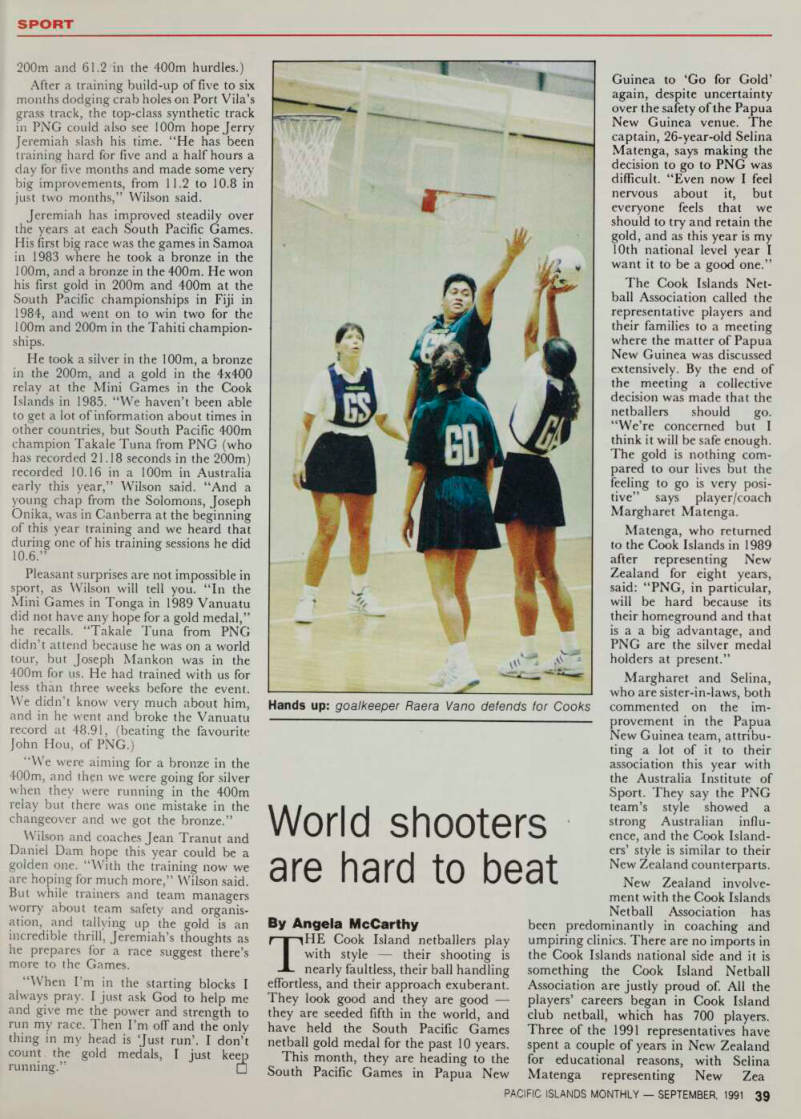
This running man doesn’t stop to count
By Beryl Cook
DODGING crab holes on the track, Jerry Jeremiah is one of the athletes who offers Vanuatu its best chance yet to improve on its South Pacific Games medal tally.
According to team management, Vanu
atu’s contingent of 196 competitors in 11 sports could take out four gold medals, with Mary Kapalou in the women’s
400 m another certainty.
Vanuatu has been looking forward to contesting this year’s South Pacific Games after missing the 1987 Games in New Caledonia. Team manager Kanam Wilson said the Games Association’s move asking teams to sign indemnity forms and take out their own insurance had caused some concern.
“They asked us to take out our own insurance from before we leave until we get back. Normally the organising com mittee looks after everyone. Coming at the last minute this made us worried,” he said. “Everything"was confirmed and the games’ organising committee has been
touring the region saying everything was
okay, but we received a fax saying teams would be responsible for everything from
loss of property to their own safety and we were a bit worried. We sent a fax saying they would have to reconsider their decision.”
The chance to pit their talent in the regional arena is a big temptation for
Vanuatu, however, particularly with a few glimmers of gold in the line-up offering a chance to improve on their tally of only two gold medals in the 28-year history of the South Pacific Games. The athletics team offer hope for up to four gold medals. An almost certain win is expected in the women’s 400 m with Mary Kapalou. (Now living in PNG, she has been granted permission to compete for Vanuatu.) In PNG in July Kapalou broke her Vanuatu record for the 400 m with a time of 57.3. (She also has clocked 25.96 in the
Beryl Cook
Running for Gold: Vanuatu’s Frank Marieleo, Joseph Maucom, Batiste Firian in Vila
200 m and 61.2 in the 400 m hurdles.) After a training build-up of five to six months dodging crab holes on Port Vila’s grass track, the top-class synthetic track in PNG could also see 100 m hope Jerry Jeremiah slash his time. “He has been training hard for five and a half hours a day for five months and made some very’ big improvements, from 11.2 to 10.8 in just two months,” Wilson said.
Jeremiah has improved steadily over the years at each South Pacific Games.
His first big race was the games in Samoa in 1983 where he took a bronze in the 100 m, and a bronze in the 400 m. He won his first gold in 200 m and 400 m at the South Pacific championships in Fiji in 1984, and went on to win two for the 100 m and 200 m in the Tahiti champion
ships.
He took a silver in the 100 m, a bronze in the 200 m, and a gold in the 4x400 relay at the Mini Games in the Cook Islands in 1985. “We haven’t been able to get a lot of information about times in other countries, but South Pacific 400 m champion Takale Tuna from PNG (who has recorded 21.18 seconds in the 200 m) recorded 10.16 in a 100 m in Australia early this year,” Wilson said. “And a young chap from the Solomons, Joseph Onika, was in Canberra at the beginning of this year training and we heard that during one of his training sessions he did 10.6.”
Pleasant surprises are not impossible in sport, as Wilson will tell you. “In the Mini Games in Tonga in 1989 Vanuatu did not have any hope for a gold medal,” he recalls. “Takale Tuna from PNG didn’t attend because he was on a world tour, but Joseph Mankon was in the 400 m for us. He had trained with us for less than three weeks before the event.
We didn’t know very much about him, and in he went and broke the Vanuatu record at 48.91, (beating the favourite John Hou, of PNG.) “We were aiming for a bronze in the 400 m, and then we were going for silver when they were running in the 400 m relay but there was one mistake in the changeover and we got the bronze.”
Wilson and coaches Jean Tranut and Daniel Dam hope this year could be a golden one. “With the training now we are hoping for much more,” Wilson said.
But while trainers and team managers worry about team safety and organis ation, and tallying up the gold is an incredible thrill', Jeremiah’s thoughts as he prepares for a race suggest there’s more to the Games.
“When I’m in the starting blocks I always pray. I just ask God to help me and give me the power and strength to run my race. Then I’m off and the only thing in my head is Just run’. I don’t count, the gold medals, I just keep
running.” (j
Advertisements & other items, p. 38 (1 item)
Kinhill Kramer
Professional Project Managers Consulting Engineers Architects Surveyors
edibility. ..continuity...
commitment... quality... excellence are all terms synonymous with Papua
New Guinea's leading engineering
consultant.
miiiiiiii
kiiiih
SB! lllllllliill wr an s *£
PAPUA NEW GUINEA
Head Office Port Moresby
KINHILL KRAMER PTY LTD.,
Kinhill Kramer Building Cnr Islander Drive & Wards Road
HOHOLA
National Capital District
PO Box 1948, BOROKO,
Papua New Guinea Telephone (675) 256033 Facsimile (675) 211049
Telex CAMAKRA NE 23050
OVERSEAS OFFICES
Solomon Islands
KINHILL KRAMER (SI) LIMITED
Fourth Floor NPF Building Mendana Avenue PO Box 377 Honiara, Solomon Islands Telephone (677) 21996 Facsimile (677) 22190 Australia Fiji
KINHILL KACIMAIWAI PTY LTD
First Floor, 6-12 Andrews Street, Nadi
Fiji Islands
PO Box 9213 Nadi Airport, Fiji Islands Telephone (679) 780033 Facsimile (679) 780131 or a
9th SOUTH PACIFIC GAMES
PAPUA NEW GUINEA 1991
A MAJOR SPONSOR AND
OFFICIAL PROJECT MANAGER
Head Office Adelaide
KINHILL ENGINEERS PTY. LTD.,
200 East Terrace, GPO Box 2702, Adelaide South Australia 5001 Telephone (08) 2237011 Facsimile (08) 2320163 Telex AA82364
A MEMBER OF THE KllllllU
GROUP OF COMPANIES
O
World shooters
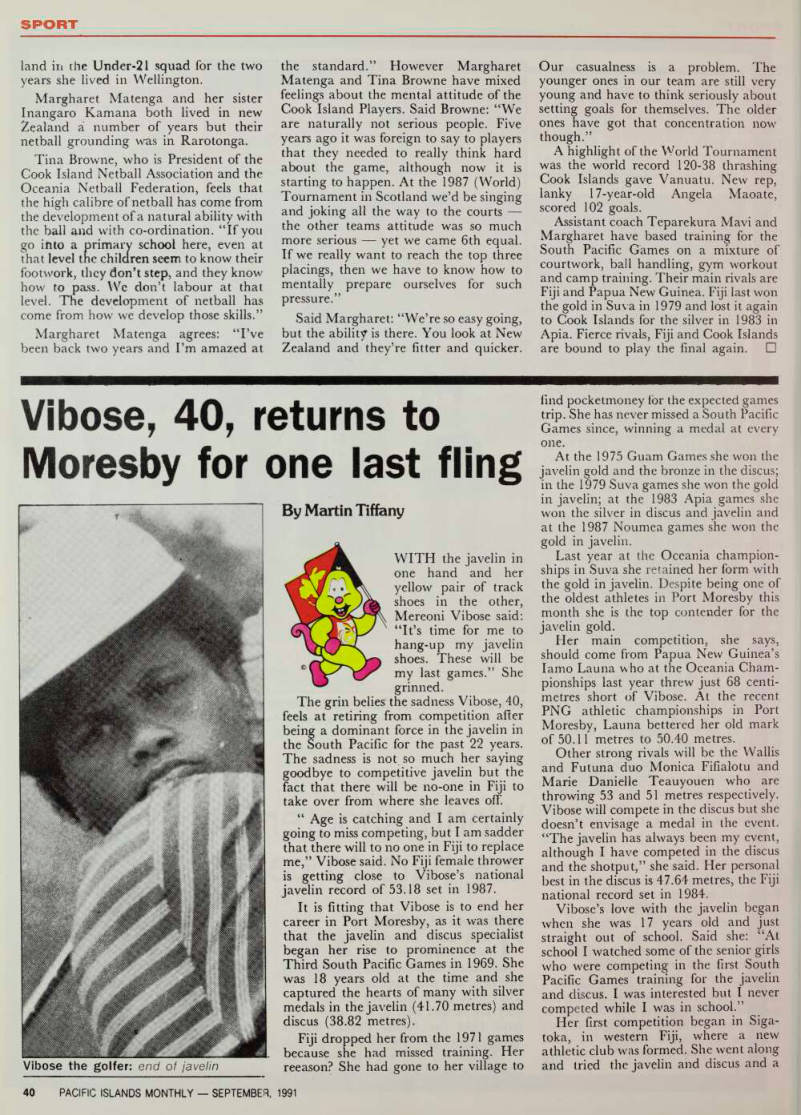
are hard to beat
By Angela McCarthy
THE Cook Island netballers play with style their shooting is nearly faultless, their ball handling effortless, and their approach exuberant.
They look good and they are good they are seeded fifth in the world, and have held the South Pacific Games netball gold medal for the past 10 years, This month, they are heading to the South Pacific Games in Papua New
Guinea to ‘Go for Gold’
again, despite uncertainty
over the safety of the Papua New Guinea venue. The
captain, 26-year-old Selina
Matenga, says making the decision to go to PNG was difficult. “Even now I feel nervous about it, but everyone feels that we should to try and retain the gold, and as this year is my 10th national level year I want it to be a good one.”
The Cook Islands Net ball Association called the representative players and their families to a meeting where the matter of Papua New Guinea was discussed extensively. By the end of the meeting a collective decision was made that the netballers should go.
“WeTe concerned but I think it will be safe enough.
The gold is nothing com pared to our lives but the feeling to go is very posi tive” says player/coach
Margharet Matenga.
Matenga, who returned to the Cook Islands in 1989 after representing New Zealand for eight years, said: “PNG, in particular, will be hard because its their homeground and that is a a big advantage, and PNG are the silver medal holders at present.”
Margharet and Selina, who are sister-in-laws, both commented on the im provement in the Papua New Guinea team, attribu ting a lot of it to their association this year with the Australia Institute of Sport. They say the PNG team’s style showed a strong Australian influ ence, and the Cook Island ers’ style is similar to their New Zealand counterparts.
New Zealand involve ment with the Cook Islands Netball Association has
been predominantly in coaching and umpiring clinics. There are no imports in the Cook Islands national side and it is something the Cook Island Netball Association are justly proud of. All the players’ careers began in Cook Island club netball, which has 700 players, Three of the 1991 representatives have spent a couple of years in New Zealand for educational reasons, with Selina Matenga representing New Zea
Hands up: goalkeeper Raera Vano defends for Cooks
land in the Under-21 squad for the two years she lived in Wellington.
Margharet Matenga and her sister Inangaro Kamana both lived in new Zealand a number of years but their netball grounding was in Rarotonga.
Tina Browne, who is President of the Cook Island Netball Association and the Oceania Netball Federation, feels that the high calibre of netball has come from the development of a natural ability with the ball and with co-ordination. “If you go ihto a primary school here, even at that level the children seem to know their footwork, they don’t step, and they know how to pass. Wc don’t labour at that level. The development of netball has come from how we develop those skills.”
Margharet Matenga agrees: “I’ve
been back two years and I’m amazed at
the standard.” However Margharet Matenga and Tina Browne have mixed feelings about the mental attitude of the Cook Island Players. Said Browne: “We are naturally not serious people. Five years ago it was foreign to say to players that they needed to really think hard about the game, although now it is starting to happen. At the 1987 (World) Tournament in Scotland we’d be singing and joking all the way to the courts the other teams attitude was so much more serious yet we came 6th equal.
If we really want to reach the top three placings, then we have to know how to mentally prepare ourselves for such
pressure.”
Said Margharet: “We’re so easy going, but the ability is there. You look at New Zealand and they’re fitter and quicker.
Our casualness is a problem. The younger ones in our team are still very young and have to think seriously about setting goals for themselves. The older ones have got that concentration now
though.”
A highlight of the World Tournament was the world record 120-38 thrashing Cook Islands gave Vanuatu. New rep,
lanky 17-year-old Angela Maoate,
scored 102 goals.
Assistant coach Teparekura Mavi and Margharet have based training for the South Pacific Games on a mixture of courtwork, ball handling, gym workout and camp training. Their main rivals are Fiji and Papua New Guinea. Fiji last won the gold in Suva in 1979 and lost it again to Cook Islands for the silver in 1983 in Apia. Fierce rivals, Fiji and Cook Islands are bound to play the final again. □
Vibose, 40, returns to Moresby

Moresby for one last fling
By Martin Tiffany
WITH the javelin in one hand and her yellow pair of track shoes in the other, Mereoni Vibose said: “It’s time for me to hang-up my javelin shoes. These will be my last games.” She grinned.
The grin belies the sadness Vibose, 40, feels at retiring from competition afier being a dominant force in the javelin in the South Pacific for the past 22 years.
The sadness is not so much her saying
goodbye to competitive javelin but the
fact that there will be no-one in Fiji to take over from where she leaves off.
“ Age is catching and I am certainly going to miss competing, but I am sadder that there will to no one in Fiji to replace me,” Vibose said. No Fiji female thrower is getting close to Vibose’s national javelin record of 53.18 set in 1987.
It is fitting that Vibose is to end her career in Port Moresby, as it was there that the javelin and discus specialist began her rise to prominence at the Third South Pacific Games in 1969. She was 18 years old at the time and she captured the hearts of many with silver medals in the javelin (41.70 metres) and discus (38.82 metres).
Fiji dropped her from the 1971 games because she had missed training. Her reeason? She had gone to her village to
find pocketmoney tor the expected games trip. She has never missed a South Pacific Games since, winning a medal at every one.
At the 1975 Guam Games she won the javelin gold and the bronze in the discus; in the 1979 Suva games she won the gold in javelin; at the 1983 Apia games she won the silver in discus and javelin and at the 1987 Noumea games she won the gold in javelin.
Last year at the Oceania champion ships in Suva she retained her form with the gold in javelin. Despite being one of the oldest athletes in Port Moresby this month she is the top contender for the
javelin gold.
Her main competition, she says, should come from Papua New Guinea’s lamo Launa who at the Oceania Cham pionships last year threw just 68 centi metres short of Vibose. At the recent PNG athletic championships in Port Moresby, Launa bettered her old mark of 50.11 metres to 50.40 metres.
Other strong rivals will be the Wallis and Futuna duo Monica Fifialotu and Marie Danielle Teauyouen who are throwing 53 and 51 metres respectively.
Vibose will compete in the discus but she doesn’t envisage a medal in the event.
“The javelin has always been my event, although I have competed in the discus and the shotput,” she said. Her personal best in the discus is 47.64 metres, the Fiji national record set in 1984.
Vibose’s love with the javelin began when she was 17 years old and just straight out of school. Said she: “At school I watched some of the senior girls who were competing in the first South Pacific Games training for the javelin and discus. I was interested but I never competed while I was in school.”
Her first competition began in Siga
toka, in western Fiji, where a new athletic club was formed. She went along and tried the javelin and discus and a
Vibose the golfer: end of javelin
year later she was representing the countr)' in the two events. Ever since has, like wine, been getting better with age. How? “I read booklets about throwing and watch video tapes and practice a lot. The javelin is a complicated event because you have to combine running and throwing and at the same time maintain your balance.” 7 Vibose has competed in two Commonmonwealth Games; at Christchurch in 1974 when she was placed seventh and at the Brisbane Games in 1982 when she was placed ninth. She
competed in the World Championships in Helsinki in 1983 and in Rome in 1987. She was unplaced, Vibose is also a keen golfer, having taken up the sport a few years ago, and ma y dedicate more time to reducing her handicap. Javelin? “I think it is time I should rest.”
A . r-.. , , , Another veteran Fiji athlete who is almost definite to call it quits after the PNG Games is the 37-year-old, 400 metres specialist Joe Rodan. Rodan’s first games was in Guam in 1975. He’s never missed any since then. □
Advertisements & other items, pp. 41-42 (1 item)
More power to the people, that's exactly what Elcom
is doing under our rural electrification programme and with our new(Minimum Supply Kit) a power box designed especially for the Papua New Guinean village house, we will give villagers an easier and cheaper access to electricity.
The Minimum Supply Kit, a new Elcom concept to boost rural electrification.
PORGERA
JOINT VENTURE
RENISON GOLDFIELDS CONSOLIDATED -
PLACER NIUGINI HIGHLANDS GOLD
PORGERA IN THE ENGA PROVINCE OF PNG IS ONE OF THE WORLDS GREAT GOLD MINES. THE PORGERA JOINT VENTURE AS A PARTNER IN DEVELOPMENT OF PNG IS AT THE FOREFRONT OF PRIVATE SECTOR SPONSORSHIP OF THE 1991 SOUTH
PACIFIC GAMES.
AS THE OFFICIAL PNG TEAM SPONSOR WE CONTRIBUTED K 600,000.00 IN CASH TO COVER COACHING TRAVEL UNIFORMS AND EQUIPMENT FOR THE PNG ATHLETES
TRAINING PROGRAMME.
f*
9th SOUTH PACIFIC GAMES
PAPUA NEW (
WE ARE PROUD TO BE PART
OF PNG’S QUEST FOR GOLD
AND ALSO TO EXTEND A
WELCOME AND SAY GOOD
LUCK TO ALL COMPETING
SOUTH PACIFIC NATIONS'.
o
is running
Nadia (6 months pregnant) is running
ONE of the most suc cessful South Pacific athletes, Nadia Pra sad (nee Bernard), will compete in Port Moresby despite being six months pregnant. The New Caledonian middle and long distance
track sensation has confirmed her partici pation to Games officials although she is likely to rule out the shorter distances.
She is likely to compete in the 10,000 metres and the marathon and possibly the 3000 metres.The pace in the 800 and 1500 metres could prove too fast. In her first Games appearance in Apia in 1983, she won gold in the 1500 m (4:44.71) and 3000 metres (10:51.47). In the 1989 Tonga mini-Games she won three gold in the 1500 m (4:52.45), 3000 m (10:27.46) and 10,000, (39:48.42). At the Oceania championships last year she won the half marathon in Ihr 20.32 minutes.
She is studying at Cedar City, Utah, in the United States with her husband, Fiji 10,000 and marathon medal hope, Binesh Prasad. Despite her pregnancy, Nadia is still favourite to win the events she enters and add to New Caledonia’s expected dominance of athletics.
Another gold medal hope for New Caledonia is Ann Albertine, who had to pull out of the 1989 Tonga mini-Games injured. She will be favorite to win the women’s 100 and 200 metres although
tough competition is expected from Fiji
schoolgirl Vaciceva Tavaga who has been clocking fast times.
French-trained sprinter Albert Chambonier is a medal prospect for New Caledoia and he is expected to clash with Papua New Guinea’s Takale Tuna for the 100 metre title. Recently Chambonier beat members of athletics development squads in Australia and New Zealand.
After hosts PNG, New Caledonia have the next largest team as they chase their eighth consecutive Games win. They have won all the games except for the first one in Suva in 1963 wwhich Fiji won. As hosts for the last Games in 1987 they totalled an impressive 82 gold medals. Second place getters French Polynesia managed 35 gold. □
Advertisements & other items, pp. 43-45 (2 items)
The 9th South Pacific Games will be an international showcase
international showcase of the achievements of the people of Papua New Guinea. r,r- The Games will be a unique opportunity to show the world the pride we share in Papua New Guinea.
Victorious athletes will be rewarded with gold medals from the Ok Tedi mine, crafted and presented as part of our sponsorship of the Games.
9ih SOUTH PACIFIC GAMES
PAPCA NEW GCINEA 1991
Medals symbolizing Ok Tedi’s commitment to education, training, health and overall economic development.
A MAJOR SPONSOR
Because we believe that, working together, we can show the world what Papua New Guinea can do.
Pacificalh
We at ANZ are proud to be an Official Sponsor of the South Pacif Games. At ANZ we share a great many of the aims and ideals of the Games. Always striving for excellence through effort and dedication. We too are dedicated to the pursuit of perfection. We too believe in rewards for effort and ability. And above all this, we too believe in the unity of spirit of all of the peoples of the Pacific and in the spirit of friendly competition that draws those people closer together.
Fiji - Your bank
Official Sponsor <rr L
9th SOUTH PACIFIC GAMES
PAPUA NEW GUINEA 1991
1992 Olympic lean
Pacific
ISLANDS
MONTHLY
BUSINESS
Japanese family on Waikiki Beach: “too many bad people”
When things
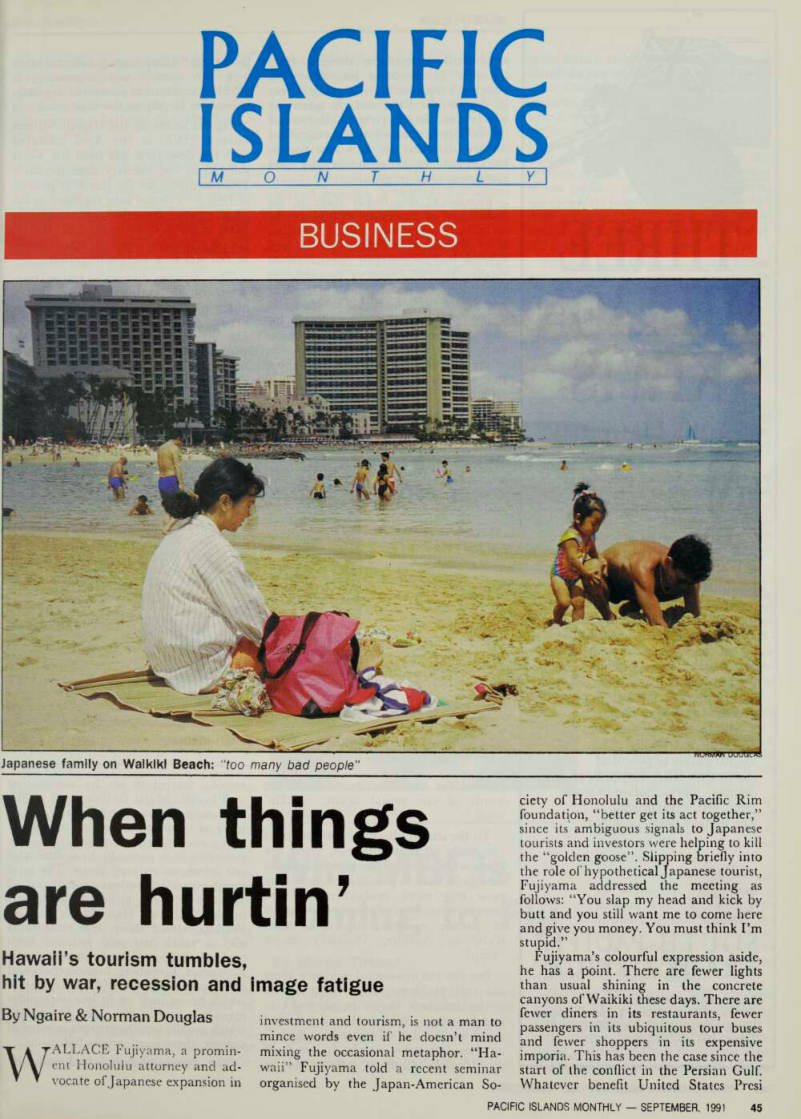
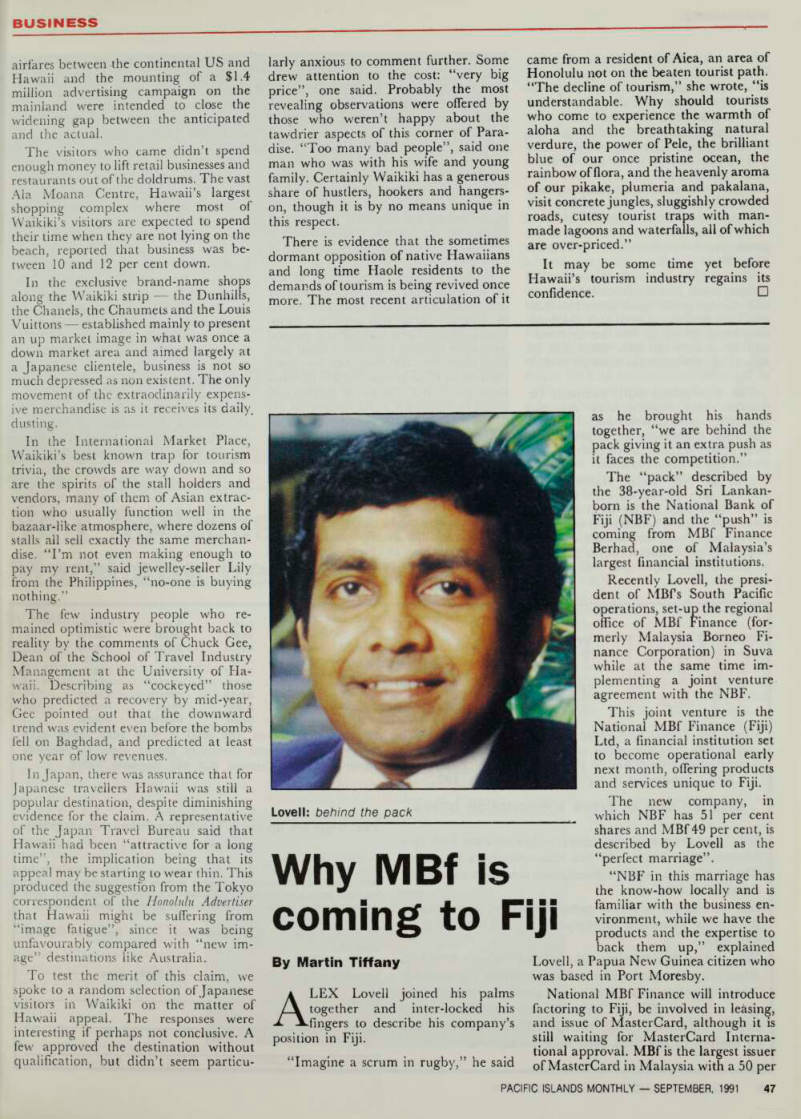
are hurtin’
Hawaii’s tourism tumbles, hit by war, recession and image fatigue
By Ngaire & Norman Douglas
W ALL ACE Fujiyama, a promin ent Honolulu attorney and ad vocate of Japanese expansion in
investment and tourism, is not a man to mince words even if he doesn’t mind mixing the occasional metaphor. “Ha waii” Fujiyama told a recent seminar organised by the Japan-American So
ciety of Honolulu and the Pacific Rim foundation, “better get its act together,” since its ambiguous signals to Japanese tourists and investors were helping to kill the “golden goose”. Slipping briefly into the role of hypothetical Japanese tourist, Fujiyama addressed the meeting as follows: “You slap my head and kick by butt and you still want me to come here and give you money. You must think I’m stupid.”
Fujiyama’s colourful expression aside, he has a point. There are fewer lights than usual shining in the concrete canyons of Waikiki these days. There are fewer diners in its restaurants, fewer passengers in its übiquitous tour buses and fewer shoppers in its expensive imporia. This has been the case since the start of the conflict in the Persian Gulf.
Whatever benefit United States Prcsi
dent Bush may have derived from virtually guaranteeing his victory at America’s next elections by going to war in the Middle East, and no matter to what extent the American public has had its confidence restored by the ease of the victory, the effect on the visitor flow to the US state which depends heavily upon tourism is close to disastrous.
Because at this fragile stage in the restoration of American enthusiasm for its military endeavours it would seem less than patriotic to complain that the Gulf exercise had been largely responsible for eroding Hawaii’s number two industry (the military is number one). The other reasons for the remarkable downturn in visitor numbers have also been found: the national economic recession, seasonal shifts in the visitor market, the fickleness of the Japanese traveller and something that one newspaper described as “image
fatigue.”
But whichever way it is explained, one
thing is very certain; the visitor business in Hawaii is, as they say there, “hurtin”. This is so not simply in overdeveloped Waikiki and the main island of Oahu, but in those neigh bour islands - Maui, Kaui and the “big island” Hawaii which have also come to depend in large measure on the transmission of the tourist dollar. As far as industry source are concerned, too many hotel rooms are empty, and the short term apart ment rental business another vital as
pect of the tourist economy is, in the words of one rental agent, “suckin’ wind.”
To the casual observer, a lot of this is not really all that apparent. There are times when Waikiki Beach still looks as though it couldn’t possibly accommodate even one more sunbather, and an impressive number of people still appear to parade endlessly up and down Kalakaua Avenue, Waikiki’s major
“strip”.
But the circumstantial evidence blurs the real problems. The Aloha State’s visitor numbers began to plummet in mid-January. While the downward trend has levelled off somewhat, there is no immediate relief in sight. In late April the Honolulu Advertiser declared on its
front page “Ailing tourism industry takes turn for worse” and announced a US$459 million loss in tourist expendi tures, due largely to the Gulf crisis.
Figures issued by the Hawaii Visitors Bureau (HVB) in late April indicated that the downturn has been the worst suffered by the industry since the early 1960 s and that for the first four months of 1991 a period long regarded as the “high season” there the toursit count was likely to be down by at least 205,000 on the previous year, almost as many visitors as Fiji sees in a 12-month period.
The visitors bureau’s senior vice president of marketing, Gene Cotter, observed: “Anyone who thinks that we are out of the woods is sadly mistaken.”
Coming from the generally optimistic, promotionally aggressive and high pro filed bureau, the observation must be taken seriously.
In late January, when the first effects of the war, hotels and services devoted to
tourism started to act by announcing staff layoffs. Major facilities such as the Sheratons, Hiltons and Hyatts closed some of their rooms and some restaur ants, encouraged employees to take vacations in a normally busy time and put others on reduced hours. The total number of hotel workers actually put off seems to be vague, but the state’s largest hotel, the Hilton Hawaiian Village in Waikiki, closed down two restaurants and a snack bar and reduced both cocktail bar staff and entertainment show times. Elsewhere, housekeepers and restaurant staff were laid off. In a state which prides itself on its low unemploy ment rate and in February, the month which usually sees the greatest number of visitors, these were serious indicators.
The announcement of discounted
Waikiki’s International Marketplace: " no-one is buying nothing"
airfares between the continental US and Hawaii and the mounting of a 51.4 million advertising campaign on the mainland were intended to close the widening gap between the anticipated and the actual.
The visitors who came didn’t spend enough money to lift retail businesses and restaurants out of the doldrums. The vast Ala Moana Centre, Hawaii’s largest shopping complex where most of Waikiki’s visitors are expected to spend their time when they are not lying on the beach, reported that business was be tween 10 and 12 per cent down.
In the exclusive brand-name shops along the Waikiki strip the Dunhills, the Chanels, the Chaumets and the Louis Vuittons established mainly to present an up market image in what was once a down market area and aimed largely at a Japanese clientele, business is not so much depressed as non existent. The only movement of the extraodinarily expens ive merchandise is as it receives its daily,
dusting.
In the International Market Place, Waikiki’s best known trap for tourism trivia, the crowds are way down and so are the spirits of the stall holders and vendors, many of them of Asian extrac tion who usually function well in the bazaar-like atmosphere, where dozens of stalls all sell exactly the same merchan dise. “I’m not even making enough to pay my rent,” said jewelley-seller Lily from the Philippines, “no-one is buying
nothing.”
The few industry people who re mained optimistic were brought back to reality by the comments of Chuck Gee, Dean of the School of Travel Industry Management at the University of Ha waii. Describing as “cockeyed” those who predicted a recovery by mid-year, Gee pointed out that the downward trend was evident even before the bombs fell on Baghdad, and predicted at least one year of low revenues.
In Japan, there was assurance that for Japanese travellers Llawaii was still a
popular destination, despite diminishing
evidence for the claim. A representative of the Japan Travel Bureau said that Hawaii had been “attractive for a long time”, the implication being that its appeal may be starting to wear thin. This produced the suggestion from the Tokyo correspondent of the Honolulu Advertiser that Hawaii might be suffering from “image fatigue”, since it was being unfavourably compared with “new im age” destinations like Australia.
To test the merit of this claim, we spoke to a random selection of Japanese visitors in Waikiki on the matter of Hawaii appeal. The responses were interesting if perhaps not conclusive. A few approved the destination without qualification, but didn’t seem particu
larly anxious to comment further. Some drew attention to the cost: “very big price”, one said. Probably the most revealing observations were offered by those who weren’t happy about the tawdrier aspects of this corner of Para dise. “Too many bad people”, said one man who was with his wife and young family. Certainly Waikiki has a generous share of hustlers, hookers and hangers on, though it is by no means unique in this respect.
There is evidence that the sometimes dormant opposition of native Hawaiians and long time Haole residents to the demands of tourism is being revived once more. The most recent articulation of it
came from a resident of Aiea, an area of Honolulu not on the beaten tourist path.
“The decline of tourism,” she wrote, “is understandable. Why should tourists who come to experience the warmth of aloha and the breathtaking natural verdure, the power of Pele, the brilliant blue of our once pristine ocean, the rainbow of flora, and the heavenly aroma
of our pikake, plumeria and pakalana,
visit concrete jungles, sluggishly crowded roads, cutesy tourist traps with man made lagoons and waterfalls, all of which
are over-priced.”
It may be some time yet before Hawaii’s tourism industry regains its confidence. □
Advertisements & other items, p. 46 (1 item)
Million
THREE
KIWIS
AT YOUR FINGERTIPS
cosmopolitan New Zealanders.
As a Forum Island nation, exploration and development of new markets can be a difficult and frustrating exercise.
Now, through the establishment in New Zealand of the South Pacific Trade Office, you have direct access to a variety of services that are specifically geared to assist you in the export and promotion of South Pacific products into New Zealand, Services include market research, marketing plans, identification of potential customers, office facilities, product displays, participation in trade fairs, and secondments.
For further details contact...
SOUTH PACIFIC
TRADE OFFICE
Jetset Centre, 44 Emily Place.
PO. Box 774. Auckland 1. New Zealand.
Phone (09) 802-0465, Fax (09) 776-642.
Telex SPTO NZ63328. nd so too is a potential market of 3.2 million Madison 3734
coming to Fiji
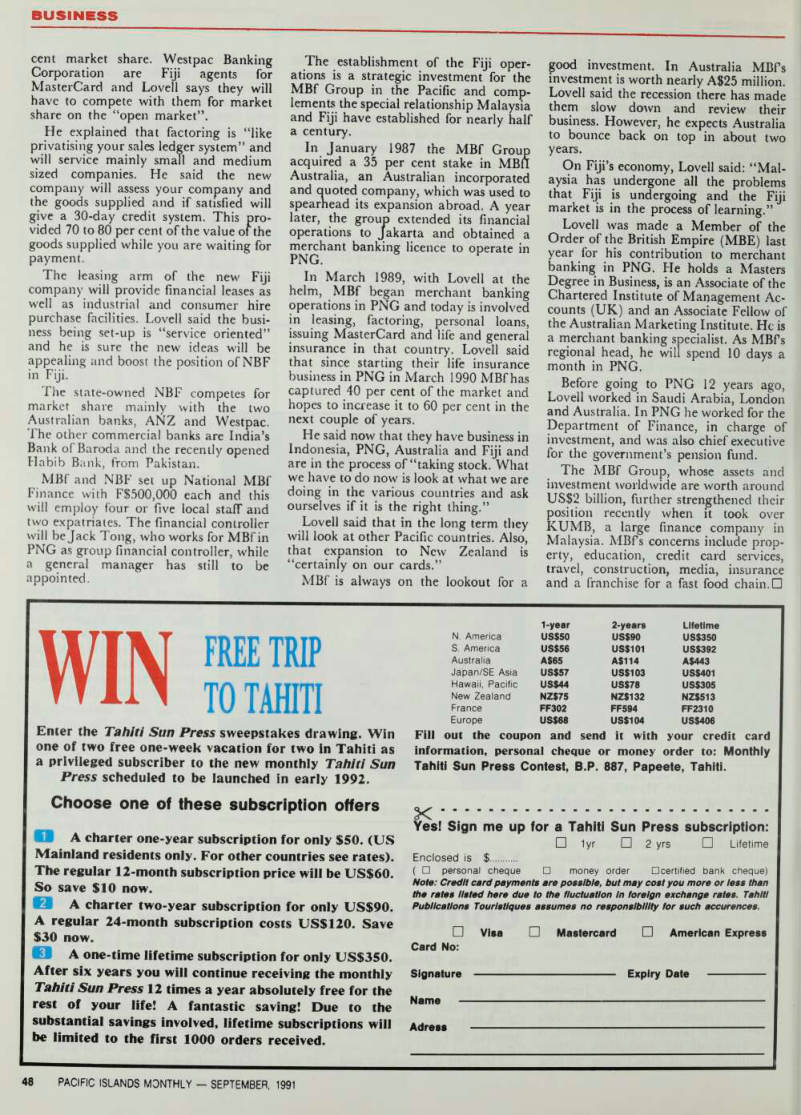
Why MBf is coming to Fiji
By Martin Tiffany
ALEX Lovell joined his palms together and inter-locked his fingers to describe his company’s position in Fiji.
“Imagine a scrum in rugby,” he said
as he brought his hands together, “we are behind the pack giving it an extra push as it faces the competition.”
The “pack” described by the 38-year-old Sri Lankan born is the National Bank of Fiji (NBF) and the “push” is coming from MBf Finance Berhad, one of Malaysia’s largest financial institutions.
Recently Lovell, the presi dent of MBfs South Pacific
operations, set-up the regional
office of MBf Finance (for merly Malaysia Borneo Fi nance Corporation) in Suva while at the same time im
plementing a joint venture
agreement with the NBF.
This joint venture is the National MBf Finance (Fiji) Ltd, a financial institution set to become operational early next month, offering products and services unique to Fiji.
The new company, in which NBF has 51 per cent shares and MBf 49 per cent, is described by Lovell as the “perfect marriage”.
“NBF in this marriage has the know-how locally and is familiar with the business en vironment, while we have the products and the expertise to back them up,” explained
Lovell, a Papua New Guinea citizen who was based in Port Moresby.
National MBf Finance will introduce factoring to Fiji, be involved in leasing, and issue of Master Card, although it is still waiting for Master Card Interna tional approval. MBf is the largest issuer of Master Card in Malaysia with a 50 per
Lovell: behind the pack
cent market share. Westpac Banking Corporation are Fiji agents for Master Card and Lovell says they will have to compete with them for market share on the “open market”.
He explained that factoring is “like privatising your sales ledger system” and will service mainly small and medium sized companies. He said the new company will assess your company and the goods supplied and if satisfied will give a 30-day credit system. This pro vided 70 to 80 per cent of the value of the goods supplied while you are waiting for payment.
The leasing arm of the new Fiji company will provide financial leases as well as industrial and consumer hire purchase facilities. Lovell said the busi ness being set-up is “service oriented” and he is sure the new ideas will be appealing and boost the position of NBF
in Fiji.
The state-owned NBF competes for market share mainly with the two Australian banks, ANZ and Westpac.
The other commercial banks are India’s Bank of Baroda and the recently opened Habib Bank, from Pakistan.
MBf and NBF set up National MBf Finance with F 5500,000 each and this will employ four or five local staff and two expatriates. The financial controller will be Jack Tong, who works for MBf in PNG as group financial controller, while a general manager has still to be appointed.
The establishment of the Fiji oper ations is a strategic investment for the MBf Group in the Pacific and comp lements the special relationship Malaysia and Fiji have established for nearly half a century.
In January 1987 the MBf Group acquired a 35 per cent stake in MBA Australia, an Australian incorporated and Quoted company, which was used to spearhead its expansion abroad. A year later, the group extended its financial operations to Jakarta and obtained a merchant banking licence to operate in
Png.
In March 1989, with Lovell at the helm, MBf began merchant banking operations in PNG and today is involved in leasing, factoring, personal loans, issuing Master Card and life and general insurance in that country. Lovell said that since starting their life insurance business in PNG in March 1990 MBf has captured 40 per cent of the market and hopes to increase it to 60 per cent in the next couple of years.
He said now that they have business in Indonesia, PNG, Australia and Fiji and are in the process of “taking stock. What we have to do now is look at what we are doing in the various countries and ask ourselves if it is the right thing.”
Lovell said that in the long term they will look at other Pacific countries. Also, that expansion to New Zealand is “certainly on our cards.”
MBf is always on the lookout for a
good investment. In Australia MBPs investment is worth nearly As2s million.
Lovell said the recession there has made them slow down and review their business. However, he expects Australia to bounce back on top in about two years.
On Fiji’s economy, Lovell said: “Mal aysia has undergone all the problems that Fiji is undergoing and the Fiji market is in the process of learning.”
Lovell was made a Member of the Order of the British Empire (MBE) last year for his contribution to merchant banking in PNG. Fie holds a Masters Degree in Business, is an Associate of the Chartered Institute of Management Ac counts (UK) and an Associate Fellow of the Australian Marketing Institute. He is a merchant banking specialist. As MBPs regional head, he will spend 10 days a month in PNG.
Before going to PNG 12 years ago, Lovell worked in Saudi Arabia, London and Australia. In PNG he worked for the Department of Finance, in charge of investment, and was also chief executive for the government’s pension fund.
The MBf Group, whose assets and investment worldwide are worth around
USS 2 billion, further strengthened their
position recently when it took over KUMB, a large finance company in Malaysia. MBPs concerns include prop erty, education, credit card services, travel, construction, media, insurance and a franchise for a fast food chain. □
Advertisements & other items, p. 48 (1 item)
Ttih To Tahiti
Enter the Tahiti Sun Press sweepstakes drawing. Win one of two free one-week vacation for two in Tahiti as a privileged subscriber to the new monthly Tahiti Sun Press scheduled to be launched in early 1992.
Choose one of these subscription offers B A charter one-year subscription for only $5O. (US Mainland residents only. For other countries see rates).
The regular 12-month subscription price will be US$6O.
So save $lO now.
B A charter two-year subscription for only US$9O.
A regular 24-month subscription costs US$l2O. Save $3O now.
B A one-time lifetime subscription for only US$35O.
After six years you will continue receiving the monthly Tahiti Sun Press 12 times a year absolutely free for the rest of your life! A fantastic saving! Due to the substantial savings involved, lifetime subscriptions will be limited to the first 1000 orders received.
Fill out the coupon and send it with your credit card information, personal cheque or money order to: Monthly Tahiti Sun Press Contest, B.P. 887, Papeete, Tahiti.
Yes! Sign me up for a Tahiti Sun Press subscription: □ Iyr □ 2 yrs □ Lifetime Enclosed is $ ( □ personal cheque □ money order Dcertified bank cheque) Note: Credit card payments are possible, but may cost you more or less than the rates listed here due to the fluctuation In foreign exchange rates. Tahiti Publications Tourlstlques assumes no responsibility for such accurences. □ Visa □ Mastercard □ American Express Card No: Signature Expiry Date Name Adress
New horizons give Air
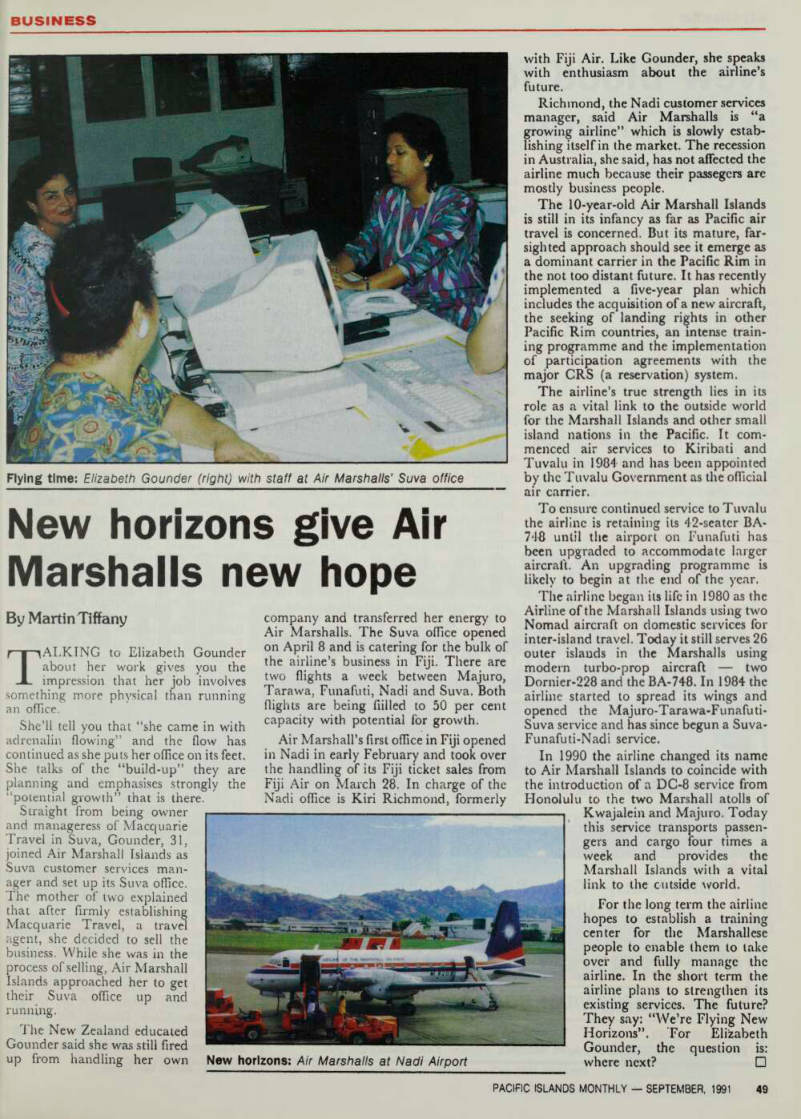
Marshalls new hope
By Martin Tiffany
TALKING to Elizabeth Gounder about her work gives you the impression that her job involves something more physical than running an office.
She’ll tell you that “she came in with adrenalin flowing” and the flow has continued as she puts her office on its feet.
She talks of the “build-up” they are planning and emphasises strongly the “potential growth” that is there.
Straight from being owner and manageress of Macquarie Travel in Suva, Gounder, 31, joined Air Marshall Islands as Suva customer services man ager and set up its Suva office.
The mother of two explained that after firmly establishing Macquarie Travel, a travel agent, she decided to sell the business. While she was in the process of selling, Air Marshall Islands approached her to get their Suva office up and
running.
The New Zealand educated Gounder said she was still fired up from handling her own
company and transferred her energy to Air Marshalls. The Suva office opened on April 8 and is catering for the bulk of the airline’s business in Fiji. There are two flights a week between Majuro, Tarawa, Funafuti, Nadi and Suva. Both flights are being fulled to 50 per cent capacity with potential for growth.
Air Marshall’s first office in Fiji opened in Nadi in early February and took over the handling of its Fiji ticket sales from Fiji Air on March 28. In charge of the Nadi office is Kiri Richmond, formerly
with Fiji Air. Like Gounder, she speaks with enthusiasm about the airline’s future.
Richmond, the Nadi customer services manager, said Air Marshalls is “a growing airline” which is slowly estab lishing itself in the market. The recession in Australia, she said, has not affected the airline much because their passegers arc mostly business people.
The 10-year-old Air Marshall Islands is still in its infancy as far as Pacific air travel is concerned. But its mature, far sighted approach should see it emerge as a dominant carrier in the Pacific Rim in the not too distant future. It has recently implemented a five-year plan which includes the acquisition of a new aircraft, the seeking of landing rights in other Pacific Rim countries, an intense train ing programme and the implementation of participation agreements with the major CRS (a reservation) system.
The airline’s true strength lies in its role as a vital link to the outside world for the Marshall Islands and other small island nations in the Pacific. It com menced air services to Kiribati and Tuvalu in 1904 and has been appointed by the Tuvalu Government as the official air carrier.
To ensure continued service to Tuvalu the airline is retaining its 42-seatcr BA -740 until the airport on Funafuti has been upgraded to accommodate larger aircraft. An upgrading programme is likely to begin at the end of the year.
The airline began its life in 1980 as the Airline of the Marshall Islands using two Nomad aircraft on domestic services for inter-island travel. Today it still serves 26 outer islands in the Marshalls using modern turbo-prop aircraft two Dornier-228 and the BA-748. In 1984 the airline started to spread its wings and opened the Majuro-Tarawa-Funafuti- Suva service and has since begun a Suva- Funafuti-Nadi service.
In 1990 the airline changed its name to Air Marshall Islands to coincide with the introduction of a DC-8 service from Honolulu to the two Marshall atolls of
Kwajalein and Majuro. Today
this service transports passen gers and cargo four times a week and provides the Marshall Islands with a vital link to the outside world.
For the long term the airline hopes to establish a training center for the Marshallese people to enable them to take over and fully manage the airline. In the short term the airline plans to strengthen its existing services. The future?
They say: “We’re Flying New Horizons”. For Elizabeth Gounder, the question is: where next? □
Flying time: Elizabeth Gounder (right) with staff at Air Marshalls' Suva office
New horizons: Air Marshalls at Nadi Airport
New blood for
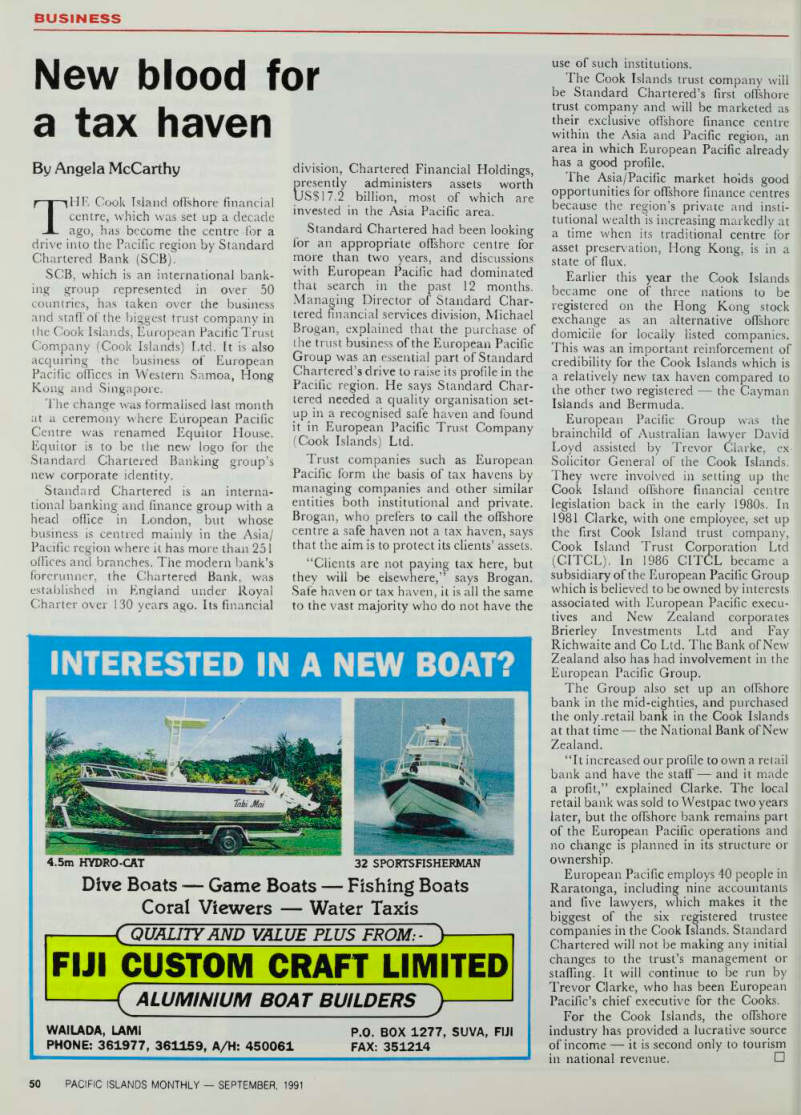
a tax haven
By Angela McCarthy
THE Cook Island offshore financial centre, which was set up a decade ago, has become the centre for a drive into the Pacific region by Standard Chartered Bank (SCB).
SCB, which is an international bank ing group represented in over 50 countries, has taken over the business and staff'of the biggest trust company in the Cook Islands, European Pacific Trust Company (Cook Islands) Ltd. It is also acquiring the business of European Pacific offices in Western Samoa, Hong
Kong and Singapore.
The change was formalised last month at a ceremony where European Pacific Centre was renamed Equitor House.
Equitor is to be the new logo for the
Standard Chartered Banking group’s
new corporate identity.
Standard Chartered is an interna tional banking and finance group with a head office in London, but whose business is centred mainly in the Asia/ Pacific region where it has more than 231 offices and branches. The modern bank’s forerunner, the Chartered Bank, was established in England under Royal Charter over 130 years ago. Its financial
division, Chartered Financial Holdings, presently administers assets worth US$l7.2 billion, most of which are invested in the Asia Pacific area.
Standard Chartered had been looking for an appropriate offshore centre for more than two years, and discussions with European Pacific had dominated that search in the past 12 months.
Managing Director of Standard Char tered financial services division, Michael Brogan, explained that the purchase of the trust business of the European Pacific Group was an essential part of Standard Chartered’s drive to raise its profile in the Pacific region. He says Standard Char tered needed a quality organisation set up in a recognised safe haven and found it in European Pacific Trust Company (Cook Islands) Ltd.
Trust companies such as European Pacific form the basis of tax havens by managing companies and other similar entities both institutional and private.
Brogan, who prefers to call the offshore centre a safe haven not a tax haven, says that the aim is to protect its clients’ assets.
“Clients are not paying tax here, but they will be elsewhere,” says Brogan.
Safe haven or tax haven, it is all the same to the vast majority who do not have the
use of such institutions.
The Cook Islands trust company will be Standard Chartered’s first offshore trust company and will be marketed as their exclusive offshore finance centre within the Asia and Pacific region, an area in which European Pacific already has a good profile.
The Asia/Pacific market holds good opportunities for offshore finance centres because the region’s private and insti tutional wealth is increasing markedly at a time when its traditional centre for asset preservation, Hong Kong, is in a state of flux.
Earlier this year the Cook Islands became one of three nations to be
registered on the Hong Kong stock
exchange as an alternative offshore domicile for locally listed companies.
This was an important reinforcement of credibility for the Cook Islands which is a relatively new tax haven compared to the other two registered the Cayman Islands and Bermuda.
European Pacific Group was the brainchild of Australian lawyer David Loyd assisted by Trevor Clarke, ex Solicitor General of the Cook Islands.
They were involved in setting up the Cook Island offshore financial centre legislation back in the early 1980 s. In 1981 Clarke, with one employee, set up the first Cook Island trust company, Cook Island Trust Corporation Ltd (CITCL). In 1986 CITCL became a subsidiary of the European Pacific Group which is believed to be owned by interests associated with European Pacific execu tives and New Zealand corporates Brierley Investments Ltd and Fay Richwaite and Co Ltd. The Bank of New Zealand also has had involvement in the European Pacific Group.
The Group also set up an offshore bank in the mid-eighties, and purchased the only .retail bank in the Cook Islands at that time — the National Bank of New Zealand.
“It increased our profile to own a retail bank and have the staff — and it made a profit,” explained Clarke. The local retail bank was sold to Westpac two years later, but the offshore bank remains part of the European Pacific operations and no change is planned in its structure or
ownership.
European Pacific employs 40 people in
Raratonga, including nine accountants and five lawyers, which makes it the biggest of the six registered trustee companies in the Cook Islands. Standard Chartered will not be making any initial changes to the trust’s management or staffing. It will continue to be run by Trevor Clarke, who has been European Pacific’s chief executive for the Cooks.
For the Cook Islands, the offshore industry has provided a lucrative source of income it is second only to tourism in national revenue. □
Advertisements & other items, p. 50 (1 item)
( Aluminium Boat Builders )
INTERESTED IN A NEW
Hl7‘ Tain Mai
4.5 m HYDRO-CAT
32 SPORTSF SHERMAN
Dive Boats Game Boats Fishing Boats Coral Viewers Water Taxis C QUALITY AND VALUE PLUSFROM. ~) 1
FIJI CUSTOM CRAFT LIMITED
( ALUMINIUM BOAT BUILDERS )
WAILADA, LAMI P.O. BOX 1277, SUVA, FIJI PHONE: 361977, 361159, A/H: 450061 FAX: 351214
Shipping
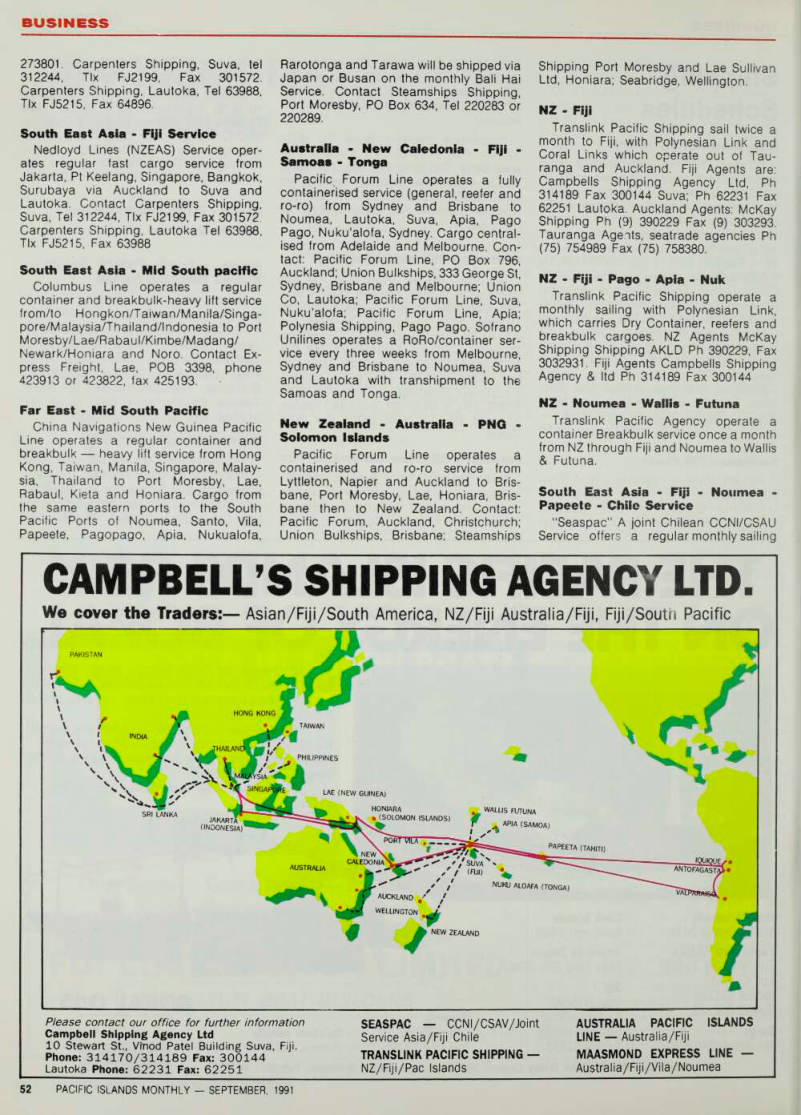
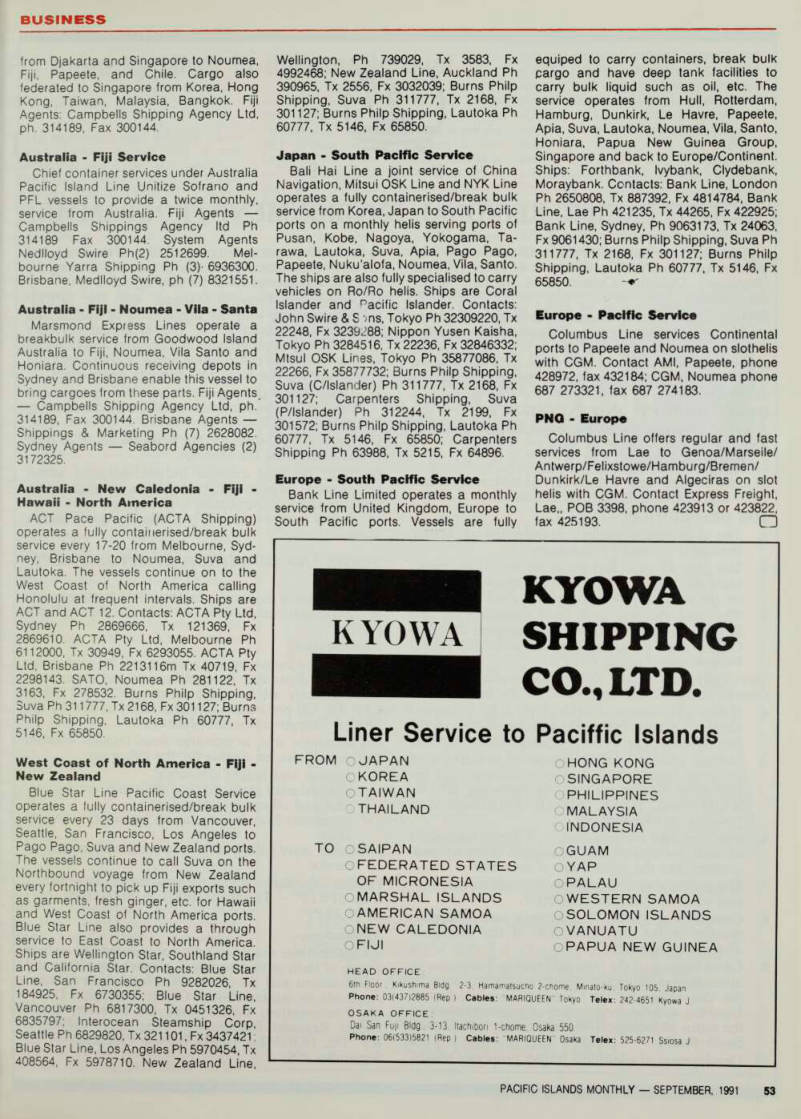
Schedules
New Zealand - Fiji direct Sofrana Unilines operates a fully containerised/breakbulk service every 21 days from Auckland, Tauranga, Lyttleton to Suva and Lautoka. Loading every 21 days, ro/ro service, containers - reefer.
Contact Sofrana Unilines, Sofrana House, 101 Customs Street, Auckland, PO Box 3614, Fax (09) 393874, Ph (09) 773279. Tlx NZ 2313. Direct toll free line 0800 659-922, Contact Alan Foote. Sofrana Shipping Agencies, PO Box 921 Wellington, Tel (04) 725 661, Fax (04) 725 749, Tlx NZ 4769 Contact Steve Brannigan. Sofrana Uni lines Agencies, PO Box 22046 Christ church, tel (03) 667 180, Fax (03) 668 868, TLX NZ4769, Contact Tony Newell.
Carpenters Shipping, Private Mail Bag, Suva. Fiji, Tel (679) 312244, Fax (679) 301572, Tlx FJ 2199. Sofrana Unilines, Suva, Fiji, Tel (679) 315645, Fax (679) 300057 Australia - Fiji direct Sofrana Unilines operates a ro/ro con tainer service every three weeks from Melbourne, Sydney, Brisbane, Lautoka and Suva. Contact Sofrana Unilines (Aust)
Pty Ltd. PO Box Q 136, Queen Victoria Building, Sydney. NSW 2000, Australia. Tel (02) 2648944, Fax (02) 2676547, Tlx (71) A 170090, Contact Andrew McLachlin, Sam Attaway.
Carpenters Shipping, Suva, Tel (679) 312244. Fax (679) 301572. Sofrana Uni lines Suva, Tel (679) 315 645. Fax (679) 300057. Carpenters Shipping, Lautoka, Tel (679) 63988, Fax (679) 64896. Sofrana Unilines, Lautoka Tel (679) 62921, Fax (679) 64896.
Australia - Fiji monthly service Sofrana Unilines (Australia) Pty Ltd operates a regular monthly service with MV Capitalne Wallis Contact Sofrana Unilines, Sydr -y, Tel (02) 2648944, Tlx AA170090, Fax (02) 267-6547. Carpenters Shipping, Suva, Fiji, Tel (679) 312244, Fax (679) 301572, Sofrana Unilines, Suva. Fiji Tel (679) 315645, Fax (679) 300057.
Carpenters Shipping, Lautoka, Tel (679) 63988, Fax (6 7 9) 64896. Sofrana Unilines, Lautoka. Fiji, Tel (679) 62921, Fax (679) 64896.
Far-East - Fiji - New Zealand Service New Zealand Unit Express (NZUE) operates a monthly service accepting containerised and break-bulk cargoes from Manila, Keelung, Kaoshiung, Hong
Kong, Lae to Suva, Lautoka (via Suva) and thence to New Zealand ports.
Contact Carpenters Shipping Suva, Fiji, tel (679) 312244, fax (679) 301572. New Zealand Unit Express. Maritime Building, 2-10 Customs House Quay, PO Box 890.
Wellington. Tel 727865, Cables Enzue Man, Wellington, Tlx NZ31340 Nedlnz or Nedlloyd Swire Pty Ltd, Sydney, Tel 20522.
Japan - South Pacific Service Same as Burns Philp Japan - South Pacific Service - Kyowa Shipping Co Ltd Kyowa Shipping, Shipping Co Ltd provides a monthly containerised ser vice from Hong Kong to main ports of Japan, Saipan, Guam. Island ports, Lautoka, Suva via Nukualofa to Pago Pago and Apia. Contact Carpenters Shipping, Neptune House, 3/4 floor, Tofuaa Street. Walu Bay, Suva. Tel 312244. Fax 301572, Tlx FJ2199.
Europe - Pacific Service Nedloyd offers cargo services from Continental Ports to Papeete, Fiji, New Caledonia and Doniambo on slot helis with Bank line. Contact Nedlloyd (Aust) Pty Ltd, Spring Street, Sydney, Tel
273801. Carpenters Shipping, Suva, tel 312244, Tlx FJ2199, Fax 301572.
Carpenters Shipping, Lautoka, Tel 63988, Tlx FJ5215, Fax 64896.
South East Asia - Fiji Service Nedloyd Lines (NZEAS) Service oper ates regular fast cargo service from Jakarta. Pt Keelang, Singapore. Bangkok.
Surubaya via Auckland to Suva and Lautoka. Contact Carpenters Shipping, Suva. Tel 312244, Tlx FJ2199. Fax 301572.
Carpenters Shipping, Lautoka Tel 63988, Tlx FJ5215. Fax 63988 South East Asia - Mid South pacific Columbus Line operates a regular container and breakbulk-heavy lift service from/to Hongkon/Taiwan/Manila/Singa pore/Malaysia/Thailand/Indonesia to Port Moresby/Lae/Rabaul/Kimbe/Madang/ Newark/Honiara and Noro. Contact Ex press Freight, Lae, POB 3398, phone 423913 or 423822. fax 425193.
Far East - Mid South Pacific China Navigations New Guinea Pacific Line operates a regular container and breakbulk heavy lift service from Hong Kong, Taiwan, Manila. Singapore, Malay sia, Thailand to Port Moresby. Lae, Rabaul, Kieta and Honiara. Cargo from the same eastern ports to the South Pacific Ports of Noumea. Santo, Vila, Papeete. Pagopago, Apia, Nukualofa,
Rarotonga and Tarawa will be shipped via Japan or Busan on the monthly Bali Hai Service. Contact Steamships Shipping, Port Moresby, PO Box 634, Tel 220283 or 220289.
Australia - New Caledonia - Fiji - Samoas - Tonga Pacific Forum Line operates a fully containerised service (general, reefer and ro-ro) from Sydney and Brisbane to Noumea, Lautoka, Suva, Apia, Pago Pago, Nukualofa, Sydney. Cargo central ised from Adelaide and Melbourne. Con tact: Pacific Forum Line, PO Box 796, Auckland; Union Bulkships. 333 George St, Sydney. Brisbane and Melbourne: Union Co, Lautoka: Pacific Forum Line, Suva.
Nukualofa; Pacific Forum Line, Apia; Polynesia Shipping, Pago Pago. Sofrano Unilines operates a Roßo/container ser vice every three weeks from Melbourne, Sydney and Brisbane to Noumea, Suva and Lautoka with transhipment to the Samoas and Tonga.
New Zealand - Australia - PNG - Solomon Islands Pacific Forum Line operates a containerised and ro-ro service from Lyttleton, Napier and Auckland to Bris bane. Port Moresby, Lae, Honiara, Bris bane then to New Zealand. Contact: Pacific Forum, Auckland, Christchurch: Union Bulkships, Brisbane: Steamships
Shipping Port Moresby and Lae Sullivan Ltd, Honiara; Seabridge, Wellington.
NZ - Fiji Translink Pacific Shipping sail twice a month to Fiji, with Polynesian Link and Coral Links which operate out of Tau ranga and Auckland. Fiji Agents are: Campbells Shipping Agency Ltd, Ph 314189 Fax 300144 Suva; Ph 62231 Fax 62251 Lautoka. Auckland Agents: McKay Shipping Ph (9) 390229 Fax (9) 303293.
Tauranga Agents, seatrade agencies Ph (75) 754989 Fax (75) 758380.
NZ - Fiji - Pago - Apia - Nuk Translink Pacific Shipping operate a monthly sailing with Polynesian Link, which carries Dry Container, reefers and breakbulk cargoes. NZ Agents McKay Shipping Shipping AKLD Ph 390229. Fax 3032931. Fiji Agents Campbells Shipping Agency & ltd Ph 314189 Fax 300144 NZ - Noumea - Wallis - Futuna Translink Pacific Agency operate a container Breakbulk service once a month from NZ through Fiji and Noumea to Wallis & Futuna.
South East Asia - Fiji - Noumea - Papeete - Chile Service “Seaspac” A joint Chilean CCNI/CSAU Service offers a regular monthly sailing
from Djakarta and Singapore to Noumea.
Fiji, Papeete, and Chile. Cargo also federated to Singapore from Korea, Hong Kong, Taiwan, Malaysia, Bangkok. Fiji Agents. Campbells Shipping Agency Ltd, ph. 314189. Fax 300144.
Australia - Fiji Service Chief container services under Australia Pacific Island Line Unitize Sofrano and PFL vessels to provide a twice monthly, service from Australia. Fiji Agents Campbells Shippings Agency ltd Ph 314189 Fax 300144. System Agents Nedlloyd Swire Ph(2) 2512699. Mel bourne Yarra Shipping Ph (3L 6936300.
Brisbane, Medlloyd Swire, ph (7) 8321551.
Australia - Fiji - Noumea - Vila - Santa Marsmond Express Lines operate a breakbulk service from Goodwood Island Australia to Fiji, Noumea, Vila Santo and Honiara. Continuous receiving depots in Sydney and Brisbane enable this vessel to bring cargoes from these parts. Fiji Agents, Campbells Shipping Agency Ltd, ph." 314189, Fax 300144. Brisbane Agents Shippings & Marketing Ph (7) 2628082.
Sydney Agents Seabord Agencies (2) 3172325.
Australia - New Caledonia - Fiji - Hawaii - North America ACT Pace Pacific (ACTA Shipping) operates a fully containerised/break bulk service every 17-20 from Melbourne, Syd ney, Brisbane to Noumea, Suva and Lautoka. The vessels continue on to the West Coast of North America calling Honolulu at frequent intervals. Ships are ACT and ACT 12. Contacts: ACTA Pty Ltd, Sydney Ph 2869666. Tx 121369. Fx 2869610. ACTA Pty Ltd, Melbourne Ph 6112000, Tx 30949, Fx 6293055. ACTA Pty Ltd, Brisbane Ph 2213116 m Tx 40719. Fx 2298143. SATO. Noumea Ph 281122, Tx 3163, Fx 278532. Burns Philp Shipping, Suva Ph 311777, Tx 2168, Fx 301127; Burns Philp Shipping. Lautoka Ph 60777. Tx 5146, Fx 65850.
West Coast of North America - Fiji - New Zealand Blue Star Line Pacific Coast Service operates a fully containerised/break bulk service every 23 days from Vancouver, Seattle. San Francisco, Los Angeles to Pago Pago, Suva and New Zealand ports.
The vessels continue to call Suva on the Northbound voyage from New Zealand every fortnight to pick up Fiji exports such as garments, fresh ginger, etc. for Hawaii and West Coast of North America ports.
Blue Star Line also provides a through service to East Coast to North America.
Ships are Wellington Star. Southland Star and California Star. Contacts: Blue Star Line, San Francisco Ph 9282026. Tx 184925, Fx 6730355; Blue Star Line, Vancouver Ph 6817300. Tx 0451326. Fx 6835797; Interocean Steamship Corp, Seattle Ph 6829820, Tx 321101, Fx 3437421: Blue Star Line, Los Angeles Ph 5970454. Tx 408564, Fx 5978710. New Zealand Line,
Wellington. Ph 739029. Tx 3583. Fx 4992468; New Zealand Line. Auckland Ph 390965, Tx 2556, Fx 3032039; Burns Philp Shipping. Suva Ph 311777, Tx 2168, Fx 301127; Burns Philp Shipping. Lautoka Ph 60777, Tx 5146. Fx 65850.
Japan - South Pacific Service Bali Hai Line a joint service of China Navigation, Mitsui OSK Line and NYK Line operates a fully containerised/break bulk service from Korea, Japan to South Pacific ports on a monthly helis serving ports of Pusan, Kobe. Nagoya, Yokogama, Ta rawa, Lautoka, Suva. Apia, Pago Pago, Papeete, Nukualofa, Noumea, Vila. Santo.
The ships are also fully specialised to carry vehicles on Ro/Ro helis. Ships are Coral Islander and p acific Islander. Contacts: John Swire & S ms, Tokyo Ph 32309220, Tx 22248, Fx 3239288; Nippon Yusen Kaisha.
Tokyo Ph 3284516, Tx 22236, Fx 32846332; Mtsul OSK Lines. Tokyo Ph 35877086. Tx 22266, Fx 35877732; Burns Philp Shipping, Suva (C/lslander) Ph 311777. Tx 2168, Fx 301127; Carpenters Shipping. Suva (P/lslander) Ph 312244, Tx 2199, Fx 301572; Burns Philp Shipping, Lautoka Ph 60777. Tx 5146, Fx 65850; Carpenters Shipping Ph 63988. Tx 5215, Fx 64896.
Europe - South Pacific Service Bank Line Limited operates a monthly service from United Kingdom. Europe to South Pacific ports. Vessels are fully
equiped to carry containers, break bulk cargo and have deep tank facilities to carry bulk liquid such as oil, etc. The service operates from Hull, Rotterdam, Hamburg. Dunkirk, Le Havre. Papeete.
Apia, Suva, Lautoka, Noumea. Vila, Santo.
Honiara, Papua New Guinea Group, Singapore and back to Europe/Continent.
Ships: Forthbank, Ivybank, Clydebank, Moraybank. Contacts: Bank Line, London Ph 2650808, Tx 887392, Fx 4814784. Bank Line. Lae Ph 421235. Tx 44265. Fx 422925; Bank Line, Sydney, Ph 9063173, Tx 24063, Fx 9061430; Burns Philp Shipping. Suva Ph 311777. Tx 2168. Fx 301127; Burns Philp Shipping, Lautoka Ph 60777. Tx 5146, Fx 65850.
Europe - Pacific Service Columbus Line services Continental ports to Papeete and Noumea on slothelis with CGM. Contact AMI. Papeete, phone 428972, fax 432184; CGM, Noumea phone 687 273321. fax 687 274183.
PNQ - Europe Columbus Line offers regular and fast services from Lae to Genoa/Marseile/ Antwerp/Felixstowe/Hamburg/Bremen/ Dunkirk/Le Havre and Algeciras on slot helis with CGM. Contact Express Freight, Lae,, POB 3398, phone 423913 or 423822. fax 425193. □
Advertisements & other items, pp. 51-54 (1 item)
On The Energy Of Boral.
THE PACIFIC ISLANDS RELY
Norfolk Islands Norfolk Island 2419 Papua New Guinea Port Moresby 214248 Lae 422574 Rabaul 921225 Wewak 862125 Tonga Nukualofa 24035 All through the Pacific Islands, people rely on Boral Speed-E-Gas LP Gas for their energy needs.
Bora! has terminals throughout the area, and is proud to be a leading supplier.
Speed-E-Gas is clean, efficient and low in cost.
It’s the ideal energy source for cooking and water heating in homes, motels and hotels, and for a wide range of industrial uses.
So call Boral. We have the energy you’re looking for. si* 5 wm Cook Islands Rarotonga 24460 American Samoa Pago Pago 699 2948 Fyi Suva 315522 Lautoka 60088 Sigatoka 50578 Labasa 82973 Boral Gas Pacific, John Oxley Centre Vanuatu Santo 36455 Solomon Islands Port Vila 22046 Honiara 21833 339 Coronation Dave, Brisbane, Tel: (07) 3671365
BORAL GAS
CAMPBELL’S SHIPPING AGENCY LTD.
We cover the Traders:— Asian/Fiji/South America, NZ/Fiji Australia/Fiji, Fiji/Soutn Pacific r
INDIA
I *• A ¥
HAILAN
it i V s s ' \
HONIARA
ISLANDS)
, wallis futuna
I mA (SAMOA)
PAPEETA (TAHITI)
NEW
CALEDONIA
AUSTRALIA
ANTOFAGASTA* •
, / (Fill) * /
W AUCKLAND / f
f WELLINGTON .
NEW ZEALAND
Please contact our office for further information Campbell Shipping Agency Ltd 10 Stewart St., Vrnod Patel Building Suva, Fiji.
Phone: 314170/314189 Fax: 300144 Lautoka Phone: 62231 Fax: 62251
SEASPAC CCNI/CSAV/Joint
Service Asia/Fiji Chile
TRANSLINK PACIFIC SHIPPING
NZ/Fiji/Pac Islands
AUSTRALIA PACIFIC ISLANDS
LINE Australia/Fiji
MAASMOND EXPRESS LINE
Australia/Fiji/Vila/Noumea
KYOWA
KYOWA
SHIPPING
CO., LTD.
Liner Service to Paciffic Islands
FROM OJAPAN
C KOREA
OTAIWAN
THAILAND
TO OSAIPAN
OFEDERATED STATES
OF MICRONESIA
OMARSHAL ISLANDS
OAMERICAN SAMOA
ONEW CALEDONIA
O FIJI
CHONG KONG
OSINGAPORE
OPHILIPPINES
O MALAYSIA
INDONESIA
OGUAM
OYAP
OPALAU
OWESTERN SAMOA
OSOLOMON ISLANDS
OVANUATU
OPAPUA NEW GUINEA
HEAD OFFICE:
6th Floor Kikushima Bldg 2-3, Hamamatsucho 2-chome Mmato-ku, Tokyo 105, Japan Phone: 03(437)2885 (Rep ) Cables: MARIQUEEN Tokyo Telex: 242-4651 Kyowa J
OSAKA OFFICE
Dai San Fuji Bldg, 3-13, Itachibon 1-chome, Osaka 550.
Phone: 06(533)5821 (Rep ) Cables: MARIQUEEN Osaka Telex: 525-6271 Ssiosa J
SPR E P
SOUTH PACIFIC REGIONAL ENVIRONMENT PROGRAMME
Applications are invited from nationals of SPREP member countries for the core post of Project Officer (Biological Diversity Conservation) in the SPREP Secretariat.
SPREP is an intergovernmental organisation composed of twenty-seven countries as members. The primary objectives of the organisation incude co-ordinating environmental activities in the region, providing, advising member countries on environmental issues and acting as clearing house for environmental information.
QUALIFICATIONS AND EXPERIENCE
A University degree and/or relevant tertiary qualification.
LANGUAGE
Fluency in oral and written ENGLISH is essential.
Knowledge of French language is desirable.
JOB DESCRIPTION
1. The co-ordination and implementation of SPREP Biological Diversity Programme. 2. The co-ordination and provision of advice, assistance, and support to the SPREP member countries on the conservation of their biological diversity. 3. The co-ordination and implementation of the SPREP executed South Pacific Biological Diversity Conservation Programme funded under the Global Environment Facility (GEE), Specifically the Project Officer (Biological Diversity Conservation) will be responsible for the following: 4. Planning the implementation of the GEE Biological Diversity Conservation Programme including the development of priorities and implementation plans.
Liaison with the SPREP member countries and principal agencies and organisations supporting the Biological diversity programme including UNDP, World Bank, UNEP, AIDAB, ICOD and Non government organisations. 6. Assisting with the preparation of duties statements of staff to support the Biological diversity programme and the supervision of such staff. 7. The preparation of workplans for staff in consultation with the Director of SPREP. 8. Convening of conferences, meetings and workshops relating to the implementation of the Biological diversity programme; Co-ordination of the regional input and response to international biological diversity intiatives such as the Convention for the Conservation of Biological Diversity and the preparation of papers relating to the status of biological diversity conservation in the South Pacific. 10. Development of additional project proposals related to the development and implementation of the Biological diversity programme for consideration for funding by regional and international funding agencies. 11. Assist the Finance Manager and the SPREP Management with the preparation of annual and provisional budgets for the biological diversity conservation programme and progress and financial reports for the contributing donor organisations and partners in the biological diversity programme. 12. Development of a regional network of organisations involved in the conservation of biological diversity in the South Pacific. 13. Other duties relating to the management of SPREP as directed by the Director.
Desirable personal qualities include maturity, sound management skills and intiative. Strong communication skills are essential. Applicants must be prepared to travel extensively. The position will be located in Apia, Western Samoa.
TERMS AND CONDITIONS OF APPOINTMENT
Tenure Appointment of the above position will be for three years in the first instance. Renewal on mutual consent of both parties.
Remuneration An attractive remuneration package will be paid to the appointee, depending on qualification and experience.
Starting salary will be within the range CEP 341 280 to CEP 436 320 per month (pending salary review by the SPREP Intergovernmental Meeting).
An appointee who is recruited from outside Western Samoa will also be eligible for the following: passage and freight allowance; establishment grant, housing allowance, child allowance and education assistance; exemption from income tax on his or her remuneration; home leave passage after every eighteen months of service.
Further information about the position can be obtained from SPREP Telephone: (687) 26 20 00. Fax: (687) 26 38 18.
Applications All applications should be fully documented and include a copy of birth certificate, details of work experience and qualifications and the names of at least three referees.
Applications marked Project Officer (Biological Diversity Conservation) should reach the Director, South Pacific Regional Environment Programme (SPREP), B.P. D 5, NOUMEA CEDEX, New Caledonia by 20 September 1991.
Fiji lured by silver In diplomatic duel

By Beryl Cook
THE diplomatic duel between China and Taiwan turned into a row between Fiji and China last month.
Fiji’s Prime Minister Ratu Sir Kami sese Mara accused China of hypocrisy while China accused Taiwan of “silver bullet diplomacy” and warned Fiji against official links with Taiwan.
Ratu Mara, on a “private” visit to Taiwan, met government ministers in cluding Foreign Minister Fredrick Chien and Premier Plan Pei-Tsun. On August 5 he announced Fiji was willing to follow New Zealand, Vietnam and Australia to establish air links with Taipei.
China’s foreign ministry warned against official relations with Taiwan.
The embassy in Fiji condoned “unof ficial” or non-governmental economic and trade contacts but said air links to its “Taiwan province” should be dis cussed with the central government.
On August 6 Ratu Mara and Chien also signed a technological co-operation agreement to develop Fiji’s sugar indus try the highest-level official document ever signed by Taiwan and a country with which it has no diplomatic ties.
Ratu Mara has dismissed China’s complaints and its ‘one-China’ policy as “hypocrisy”. At the South Pacific Forum in Micronesia on July 29/30 he urged delegates to expand contact with Taiwan because of its economic strength, saying China itself traded with Taiwan through Hong Kong. Chinese Vice Foreign Minister Liu Huaqiu warned delegates against moves “aimed at creating two Chinas .-. . or an independent Taiwan”.
But the Forum later issued a com munique that it would hold a dialogue with Taiwan on economic co-operation.
China has accused Taiwan of “silver bullet diplomacy” using aid to buy diplomatic relations, but the temptation for developing nations to put hands up and hands out is great. Taiwan provides agricultural assistance, training, grants and loans to Tuvalu, Nauru, Tonga, and the Solomon tslands (it has diplomatic relations with all four and embassies in the latter two), Fiji, the Marshall Islands, Palau, and soon Papua New Guinea.
Specifics include: SUS 3.7 million for Solomons Agricultural Technical Mis sion, SUSS million for the Solomon Islands Central Hospital improvement first phase; fishing fees to American Samoa and Fiji with negotiations under way with New Caledonia; SFI million economic aid for Fiji annually, and a SF2 million soft loan to-the Fiji Government two years ago.
According to a Taiwan Trade Mission spokesman, Taiwan itself had developed only after receiving 51.5 billion in US
economic aid from 1951 to 1965, and it now wished to help others. It was interested in business relations, as per the »9-2 million in Fiji products it had . . , . J u r •, €<r , u • . imported last year He said China is s P endm « more (aid) money than us yet ' he >' "t afford it; they are borrowing [rom the World Bank and the Asian Development Bank.
China has given Fiji a SF7 million interest-free loan for a rural energy project covering two mini-hydro projects
and two electrical network projects, and a 5F9.3 million interest-free loan for an international conference centre near the new Parliament complex. It has given Kiribati SF 1.14 million in grants for technical assistance, goods and equip ment from 1985 to 1990, and a SF3.I million interest-free loan to extend the international airport runway. It gave PNG a SFI4 million interest-free loan for
the Waigania sporting complex for the
South Pacific Games, and Vanuatu a 5F7.3 million interest-free loan for its new Parliament complex, with payments to start after 10 years. □
Advertisements & other items, pp. 55-56 (1 item)
ssSasss-
GRANTS FOR
CONSERVATION AND
DEVELOPMENT
PROJECTS
indW' dua l co nsetva« on ' ptoieclion-' ° r w«h
ssSasss-
Application forms can be obtained by writing to The Trust Administrator, The Pacific Development and Conservation Trust, PO Box 10-345, Wellington.
Tel (04) 495 7200 extn 8012 Fax (04) 499 1865
m
SPR E P
SOUTH PACIFIC REGIONAL ENVIRONMENT PROGRAMME
Applications are invited from nationals of SPREP member countries for the core post of Project Officer (Environmental Education) in the SPREP Secretariat.
SPREP is an intergovernmental organisation composed of twenty-seven countries as members. The primary objectives of the organisation include co-ordinating environmental activities in the region, providing, advising member countries on environmental issues and acting as clearing house for environmental information.
QUALIFICATIONS AND EXPERIENCE
A University degree and/or relevant tertiary qualification.
LANGUAGE
Fluency in oral and written ENGLISH is essential.
Knowledge of French language is desirable.
JOB DESCRIPTION
1. Assist the Director, South Pacific Regional Environment Programme in keeping the participating Governments regularly informed of the progress achieved in SPREP, the results achieved and problems encountered. 2. Evaluate SPREP’s role in environmental education and training in consultation with other SPREP officers and with SPREP’s member countries, develop national environmental education programmes. This will involve an analysis of which aspects of environmental management would benefit from increased information and education, an evaluation of the target groups who would most benefit or which are in most need of information and education, and most effective and appropriate means of communicating with them. 3. Organise, and as appropriate direct, meetings, training courses and seminars on environmental education. 4. Execute an environmental awareness programme appropriate for the South Pacific region. 5. Develop a reference service by preparing suitable environmental education material for the region, including articles and papers within the scope of the SPREP’S work programme for publication by the SPREP, and elsewhere. 6. Prepare draft papeers for the annual Work Programme for publication by the SPREP, and elsewhere. 7. Execute routine administration of the Programme including correspondence and budget. 8. Prepare for publication and organise distribution of all documents produced by, and associated with, the Programme (including documents of both Research and Monitoring and Education, Training and Information Networks) as an additional duty until such time as an Information and Publication Officer is appointed to the Programme. 9. Assist the SPREP Information and Publication Officer in producing on a regular basis a SPREP Newsletter which will have the aim of informing member countries on current and future activities of SPREP, and, where appropriate, activities of other environmental agencies within and outside the region. 10. Assist SPREP member countries to determine their training requirements to enable them to more effectively undertake their environmental education programmes. This will include the design and presentation of training materials, the preparation of school curricula, radio programmes and other assistance as required by member countries. 11. To assist member countries, whenever possible, with production or securing finance from international organisations for environmental education material. 12. From time to time, act as Programme Director as considered necessary, 13. Attend meetings and conferences to present information on SPREP’s environmental education activities as appropriate. 14. Perform such other duties as the Directoor, South Pacific Regional Environment Programme may require in connection with the Programme.
TERMS AND CONDITIONS OF APPOINTMENT
Tenure Appointment of the above position will be for three years in the first instance. Renewal on mutual consent of both parties.
Remuneration An attractive remuneration package will be paid to the appointee, depending on qualification and experience.
Starting salary will be within the range CFP 341 280 to CFP 436 320 per month (pending salary review by the SPREP Intergovernmental Meeting).
An appointee who is recruited from outside Western Samoa will also be eligible for the following: passage and freight allowance; establishment grant, housing allowance, child allowance and education assistance; exemption from income tax on his or her remuneration; home leave passage after every eighteen months of service.
Further information about the position can be obtained from SPREP Telephone: (687) 26 20 00. Fax: (687) 26 38 18.
Applications All applications should be fully documented and include a copy of birth certificate, details of work experience and qualifications and the names of at least three referees.
Applications marked Project Officer (Environmental Education) should reach the Director, South Pacific Regional Environment Programme (SPREP), B.P. D 5, NOUMEA CEDEX, New Caledonia by 27 September 1991.
Ban on drinks
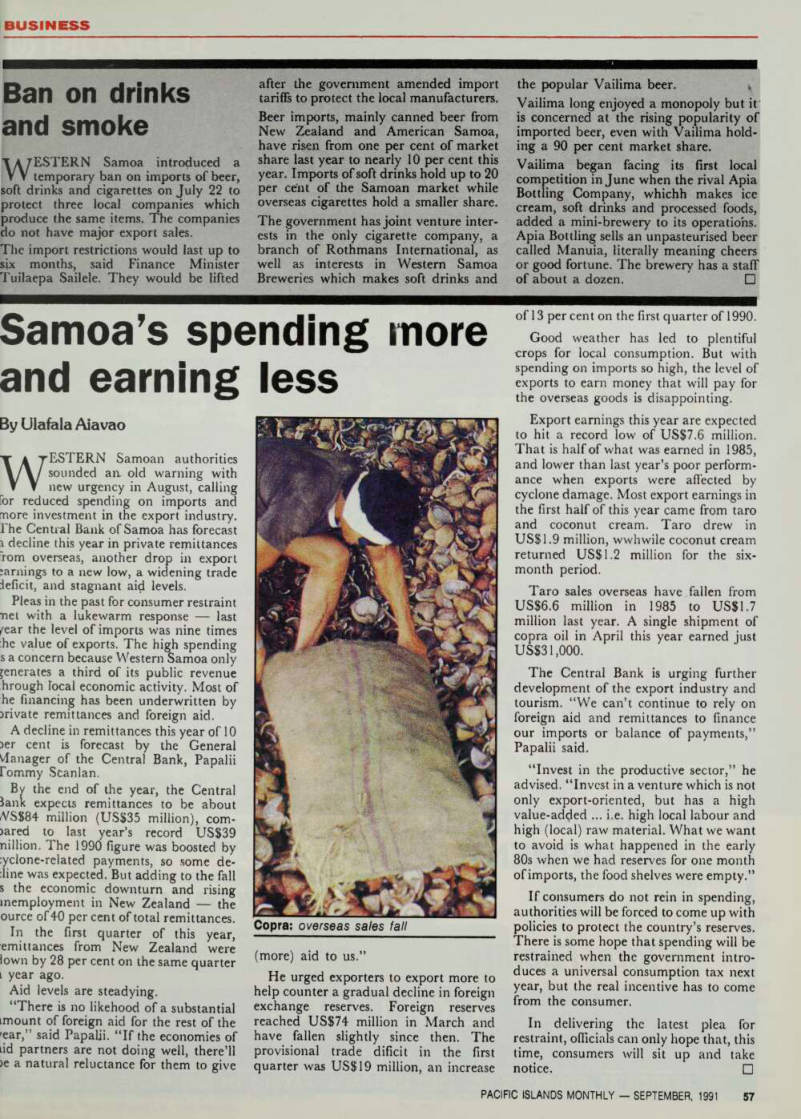
and smoke
WESTERN Samoa introduced a temporary ban on imports of beer, soft drinks and cigarettes on July 22 to protect three local companies which produce the same items. The companies do not have major export sales.
The import restrictions would last up to six months, said Finance Minister Tuilaepa Sailele. They would be lifted
after the government amended import tariffs to protect the local manufacturers.
Beer imports, mainly canned beer from New Zealand and American Samoa, have risen from one per cent of market share last year to nearly 10 per cent this year. Imports of soft drinks hold up to 20 per cent of the Samoan market while overseas cigarettes hold a smaller share.
The government has joint venture inter ests in the only cigarette company, a branch of Rothmans International, as well as interests in Western Samoa Breweries which makes soft drinks and
the popular Vailima beer.
Vailima long enjoyed a monopoly but it is concerned at the rising popularity of imported beer, even with Vailima hold ing a 90 per cent market share.
Vailima began facing its first local competition in June when the rival Apia Bottling Company, whichh makes ice cream, soft drinks and processed foods, added a mini-brewery to its operations.
Apia Bottling sells an unpasteurised beer called Manuia, literally meaning cheers or good fortune. The brewery has a staff of about a dozen. □
Samoa’s spending more
and earning less
By Ulafala Aiavao
WESTERN Samoan authorities sounded an old warning with new urgency in August, calling
for reduced spending on imports and
more investment in the export industry, fhe Central Bank of Samoa has forecast \ decline this year in private remittances rom overseas, another drop in export warnings to a new low, a widening trade deficit, and stagnant aid levels.
Pleas in the past for consumer restraint met with a lukewarm response last fear the level of imports was nine times he value of exports. The high spending s a concern because Western Samoa only generates a third of its public revenue hrough local economic activity. Most of he financing has been underwritten by private remittances and foreign aid.
A decline in remittances this year of 10 )er cent is forecast by the General Manager of the Central Bank, Papalii
fommy Scanlan.
By the end of the year, the Central Sank expects remittances to be about A'SsB4 million (US$35 million), com )ared to last year’s record US$39 nillion. The 1990 figure was boosted by :yclone-related payments, so some de fine was expected. But adding to the fall s the economic downturn and rising inemployment in New Zealand the ource of 40 per cent of total remittances.
In the first quarter of this year, emittances from New Zealand were lown by 28 per cent on the same quarter l year ago.
Aid levels are steadying.
“There is no Hkehood of a substantial imount of foreign aid for the rest of the 'ear,” said Papalii. “If the economies of tid partners are not doing well, there’ll >e a natural reluctance for them to give
(more) aid to us.”
He urged exporters to export more to help counter a gradual decline in foreign exchange reserves. Foreign reserves reached US$74 million in March and have fallen slightly since then. The provisional trade dificit in the first quarter was US$l9 million, an increase
of 13 per cent on the first quarter of 1990.
Good weather has led to plentiful crops for local consumption. But with spending on imports so high, the level of exports to earn money that will pay for the overseas goods is disappointing.
Export earnings this year are expected to hit a record low of US$7.6 million.
That is half of what was earned in 1985, and lower than last year’s poor perform ance when exports were affected by cyclone damage. Most export earnings in the first half of this year came from taro and coconut cream. Taro drew in US$l.9 million, wwhwile coconut cream returned US$l.2 million for the six month period.
Taro sales overseas have fallen from US$6.6 million in 1985 to US$l.7 million last year. A single shipment of copra oil in April this year earned just
Us$3L,Ooo.
The Central Bank is urging further development of the export industry and tourism. “We can’t continue to rely on foreign aid and remittances to finance our imports or balance of payments,”
Papalii said.
“Invest in the productive sector,” he advised. “Invest in a venture which is not only export-oriented, but has a high value-added ... i.e. high local labour and high (local) raw material. What we want to avoid is what happened in the early 80s when we had reserves for one month of imports, the food shelves were empty.”
If consumers do not rein in spending, authorities will be forced to come up with policies to protect the country’s reserves.
There is some hope that spending will be restrained when the government intro duces a universal consumption tax next year, but the real incentive has to come from the consumer.
In delivering the latest plea for restraint, officials can only hope that, this time, consumers will sit up and take notice. □
Copra: overseas sales fall
Advertisements & other items, pp. 58-60 (1 item)
Acifi
VJftftA*
Ofi
JUNI992
o ■»> ✓ u -V s' ★
ACIFI
ISLANDS
0 N T H L
fiRKCT PLRC
SCRAP METAL
Good prices paid for your clean scrap Aluminium, Brass, Copper, Lead, etc. Contact Nonferral Pty. Ltd.. 23 Davis Rd., Wetherill Park, NSW 2164 Australia. Fax 61 2 604 1304 for prompt reply. Our Company is a long established smelter and a leading metals buyer from the Pacific region.
Telephone 61 2 604 8855.
MARINE ENGINES
Gardner diesel engines, parts, new/second hand, reconditioned engines, fuel pumps, injectors, twin disc and tonanco gearboxes Cummins and Detroit Diesels. J.L. Diesel Services Pty. Limited, 2 Leonard Pde, Currumbin 4223, Queensland, Australia 61-75-341698. Fax 61-75-347544.
DISTRIBUTOR WANTED
Manufacturer of Ball point pens and disposable Gas Lighters.
Please contact JNJ CORPORATION (FUI) LTD G.P.O. Box 285, Suva, Fiji. Ph 394000 Fax (679) 411898.
SELF ADHESIVE LABEL« HOUSING DEVELOPMENT
FORUM LABELS (FIJI) LTD
P-0- Box 1167, Suva., Fiji. Phone: 304111 We print self-adhesive labels in rolls multi-coloured labels with hot foil, and die cut to shape, tickets and tags in rolls. We also supply labelling machines and fabric labels.
OPTICIANS AND OPTOMETRISTS
Spectacles, Contact Lenses, Sunglasses.
See JEKISHAN & JEKISHAN, Epworth House, G.P.O. Box 285, Suva, Fiji. Ph 311002 Fax (679) 411898.
COAAAAERCIAL PRINTING
Top quality four colour printing, brochures, posters, packaging, product labels, fabric labels, billboards, books, magazines, stickers, books. Export quality. Contact Fiji’s most experienced Commercial Printers. FIJI TIMES COMMER- CIAL PRINTING, P.O. Box 1167. Suva. Fiji.
Phone: 304111 Fax. 301521. 25 UNIT Townhouse development on 2.65 acres of prime ocean front property in American Samoa. Property includes commercial-sized swimming pool and ample grounds. Price on application. For further details contact OLE P.O. Box 1048 or fax (684) 699-1441.
REAL ESTATE
Profitable bungalow resort on stunning white sand beach. French Polynesia. $2.65 million USD Estates, resorts and opportunities throughout the Pacific; PACIFIC
ISLAND INVESTMENTS (808) 883-8000
fax: 883-8838
WANTED
ISLANDS (large and small, lease or fee) for individual and corporate buyers. Contact:
Karen Jeffery, PACIFIC ISLAND INVESTMENTS
(808) 883-8000/FAX: 883-8838.
FOR SALE-AUSTRALIA
11.8 MEGAWATT
POWER HOUSE
MODERN DIESEL
EQUIPMENT
Total Facility
Comprises 5 Mirlees Blackstone diesel generator sets in excellent condition throughout, together with all power station
equipment, control boards, transformers,
readily demountable building 43m x 17m with 16 tonne full travelling crane.
All engines and units have full service histories and some spares are included.
Total replacement value is
around US$lO MILL
Full removal quotations available.
NOW AVAILABLE
Offers around US$2 MILL will be considered by our clients. Fax us now for full specifications and details.
COLLIERS
INTERNATIONAL
PLANT APPR AISALS
409 FRANCIS ST BROOKLYN VIC 3025 AUSTRALIA FAX 61-3-314 6943 PHONE 61-3-3151555
flfl PIONEER
The Art of Entertainment
Stylish and Compact
In today's active society, a compact and modular Hi-Fi component stereo system is the perfect answer to home entertainment. The Contempo series gives you all you could ask for in both convenience and sound quality, as well as a stylish design that complements your living space.
Hi-Fi Compact System
% In spite of its compact design. Conlempo is pack ed with a variety of high-tech features that prod uce high-qualitv sound in almost any listening s pace. Conlempo * specially engineered function s compensate for the loss of sound presence in I imited spaces. As a result. Contempo sound is c risp and clear, no matter where vou are in the r oom. What $ more. Pioneer Smart Operation c apabilities make the Contempo system simple to use. A touch of the START/SET button and t he system delivers quality hi-fi sound. Various Contempo models will suit almost any taste with a choice of Single. Twin and Multi-play CD capabilities. And all of the Contempo m odels employ 1-Bit DIC (Direct Linear Con version) technology for extremely high-qu alitv sound. Add to this an ASES (Auto Sy
nchronized Editing System) provided on t
he Double Auto-Reverse Cassette Deck th at lets you program Conlempo to automat ically create professional-sounding cassett e recordings. All of this makes Conlempo t he ideal personal entertainment system. In spite of its compact design, Contempo is p acked with a variety of high-tech features that produce high-qualitv sound in almos t any listening space. Contempo s s'pecia IK engineered functions compensate for the loss of sound presence in limited sp aces. As a result, Contempo sound is cr isp and clear, no matter where vou are' in the room. What s more. Pioneer Sm art Operation capabilities make the C onlempo sy stem simple to use. A touch of I he START/SET button and the system deliv ers quality hi-fi sound. Various Contempo models will suit almost any taste with a c hoice of Single, Twin and Multi-play CD capabilities. And all of the Contempo models employ 1 -Bit DIC (Direct Li near Conversion) technology for e xtremely high-quality sound. Add to this an ASES (Auto Synchroniz
ed Editing System) provided on t
he Double Auto-Reverse Casse fte Deck that lets vou progr am Contempo to automat ically creal professionalsounding cassette recor dings. All of this makes Contempo the ideal pe rsonal entertainment sy stem. In spite of its co
mpact design, Contemp
ois packed with a variel y of high-tech features that
produce high-quality sound in
almost any listening space. Coni empo's specially engineered fundi ons compensate for the loss of sou nd presence in limited spaces. As a result, Contempo sound is crisp an < c d clear, no matter where you are in the room . What's more. Pioneer Smart Operation capa bilities make the Contempo system simple to u se. A touch of the START/SET button and the sv stem delivers quality hi-fi sound. Various Conte mpo models will suit almost am taste with a cho ice of Single, Twin and Multi-play CO capabilities And all of the Contempo models employ 1 -Bit D LC (Direct Linear Conversion) technology for extr emely high-quality sound. Add to this an ASES (A uto Synchronized Editing System) provided on t he Double Auto-Reverse Cassette Deck that let s you program Conlempo to automatically ere
ale professional-sounding cassette recordings.
All of this makes Conlempo the ideal personal e ntertainment system. In spite of its compact des ign, Conlempo is packed with a variety of high-t ech features that produce high-quality sound in almost any listening space. Conlempo 's specially engineered functions compensate for the loss of sound presence in limited spaces. As a re suit. Conlempo sound is crisp and clear, no matter where vou are in the room.
What s more. Pioneer Smart Opera lion capabilities make the Conte mpo system simple to use. A t ouch of the START/SET b ulton and the system delivers quality hi-fi sound.
Various Co n tempo models X-P77 305 W
(PMPO)
will suit almost any taste with a choice of Singl e. Twin and Multi-plav CD capabilities. And all of the Contempo models employ 1-Bit DLC (Di reel Linear Conversion) technology for extrem elv high-qualitv sound. Add to this an ASES (A uto Svnchronized Editing System) provided o n the Double Auto-Reverse Cassette Deck th at lets you program Conlempo to automatic ally create professional-sounding cassette r ecordings. All of this makes Conlempo the ideal personal entertainment system. In sp ile of its compact design. Conlempo is pa eked with a variety of high-tech features that produce high-qualitv sound in aim ost anv listening space. Conlempo's sp eciallv engineered functions compensa te for the loss of sound presence in lim ited spaces. As a result, Conlempo sou nd is crisp and clear, no matter where you are in the room. What s more, Pion eer Smart Operation capabilities make I he Contempo system simple to use. In s pile of its compact design. Contempo is pack ed with a variety of high-tech fea
tures that produce high-quality sound i
n almost any listening space. Contemp o's specially engineered functions com pensate for the loss of sound presence in limited spaces. As a result. Conte mpo sound is crisp and clear, no ma
For further Information, please contact:
Australia: Pioneer Electronics Australia Pty. Ltd. (Incorporated in Victoria), 178- 184 Boundary Road, Braeside Victoria 3195 Tel: 580-9911 Fiji Islands: Brijlal & Company, G.P.O. Box No. 362, Suva, Fiji Islands Tel: 22258 New Zealand: Monaco Corporation Ltd., 41 Poland Road, Glenfield, Auckland,
New Zealand Tel: (09)444-9144
Norfolk Island: Burnt Pine Traders Ltd., P.O. Box 21, Norfolk Island Vanuatu: Burns Philp (Vanuatu) Ltd., Vila, Vanuatu ■ 305 W (PMPO) ■ Digital sound field
processor* L.P.S. (Listening Point
Selector) ■ One-touch KARAOKE (Vocal
Cancel) ■ Sound jog dial for sound image
control and S.F.C. effect ■ Auto
Synchronized Editing System (A.S.E.S.)
ready ■ P.Bass (Power Bass)
* X-P55/X-PSSM (305 W PMPO), X-P33 (210 W PMPO) and X-Pll (200 W PMPO) Contempo models are also available.
Nauru island: Jacob Enterprises, P.O. Box N 0.4, Republic of Nauru Tahiti: Tahiti Hi-Fi, P.O. Box 848, Papeete, Tahiti New Caledonia: Menard Pacifique Sari, B.P. 3899, Noumea, New Caledonia
Tel: 27-62-23
American Samoa: Transpac Corporation, P.O. Box 1477, Pago Pago, American
Samoa 96799 Tel: 633-5224
Rarotonga: South Seas International Ltd., P.O. Box 49, Rarotonga, Cook Islands
Tel: 2327
Designed to be Driven.
Wm mm&
& r I
MOTO
Proven in Every Comer of the World.
Stylish elegance and luxurious detail are the first things you’ll notice about the new Galant. So you might be surprised to learn that Galants have driven to victory in more than 10 major rally raid events — from the snowy slopes of Sweden, to the African savannah. And you’ll be pleased to know that the same performance features keeping those rally cars competitive on the course are also what make your Galant one of the best performance saloons on the road today.
For years, Mitsubishi engineers have known that motorsports are an ideal place for testing new and improved technologies.
The hard, fast driving required to win a rally strains every part of a car—generating pressures that exceed the demands of normal driving. Here, as drivers push their cars to the limit, the rigidity and strength of new space-age constructions can be checked and proven reliable.
The new Galant’s advanced triplelink torsion axle rear suspension is a good example. It is the result of many small yet critical refinements, ultimately designed to grip the road for safer, more comfortable control when changing lanes and cornering.
The severe demands of international motorsport competition: just further proof of how far Mitsubishi will go to build the best cars for you.
MITSUBISHI C3RLHNT
AMERICAN SAMOA: MORRIS SCANLAN SERVICE INC PO Box 367, Pago Pago, Tel 633 5520/AUSTRALIA: MITSUBISHI MOTORS AUSTRALIA LTD. Box 1284, South Road, Clovelly Park, South Australia 5042, Tel (08) 275-7223/FIJI: NIVIS MOTOR & MACHINERY CO., LTD. G.P.O, Box 150, Suva. Tel. 383411/FRENCH POLYNESIA (TAHITI): ETS-BREDIN FRERES ET FILS P 0. Box 21, Papeete, Tahiti, Tel 4-202-58/NEW CALEDONIA: SOCIETE D’IMPORTATION D’AUTO DU PACIFIQUE SUD S.A. B.P. 438 Rond Point du Pacifique, Noumea, Tel 274144/NEW ZEALAND; MITSUBISHI MOTORS NEW ZEALAND LTD. Todd Park, Heriot Drive, Private Bag. Porirua, Tel. 370-109/ NORFOLK ISLAND: BORRYS LTD. P O Box 169, Norfolk Island. Tel 2114/PAPUA NEW GUINEA: TOBA PTY. LTD. P.O. Box 503, Port Moresby, Tel 21 7874/SOLOMON ISLANDS; HARVEST PACIFIC LTD. G.P.O Box 88, Honiara, Guadalcanal. Tel 30128/TONGA; SITANI MAPI CO., LTD. P.O. Box 83, Nuku'ALOFA, Tel 21 044/VANUATU: SOCOMETRA B.P. 06 Route de Lagon, Port-Vila, Tel. 2314/WESTERN SAMOA: A M. MACDONALD HOLDINGS LTD.
P.O. Box 576, Apia, Tel 22022/SAIPAN/POHNPEI/MAJURO/KOSRAE/TRUK/YAP/BELAU: MICRONESIAN MOTORS, INC. 997 South Mamne Drive, Tamuning, Guam 96911 , Tel. 646-6827