Pacific

Islands
Monthly
Tahiti: Testing times for Flosse
August 1991
Games ’9L
Samoa’s Fists of Fury
sfd
The Crisis Now
y B * 2 ! s * AustraUa A 52.50; Cook Islands NZ$3; Fiji F 51.75; FS Micronesia US$3; Hawaii US$3; Kiribati A 52.50; Nauru A 52.50; Niue NZ$3; Norfolk $3. New Caledonia cpf2so; New Zealand (Incl GST) NZ53.45; Nth Marianas US$3; Papua New Guinea K 3; Palau US$3; Marshalls US$3; Solomon Islands As 3; French Polynesia cpf3oo; Tonga P 3; USA US$3; Vanuatu VT2OO; Western Samoa T 3.25. ‘Recommended retail price only
Advertisements & other items, pp. 2-4 (1 item)
/
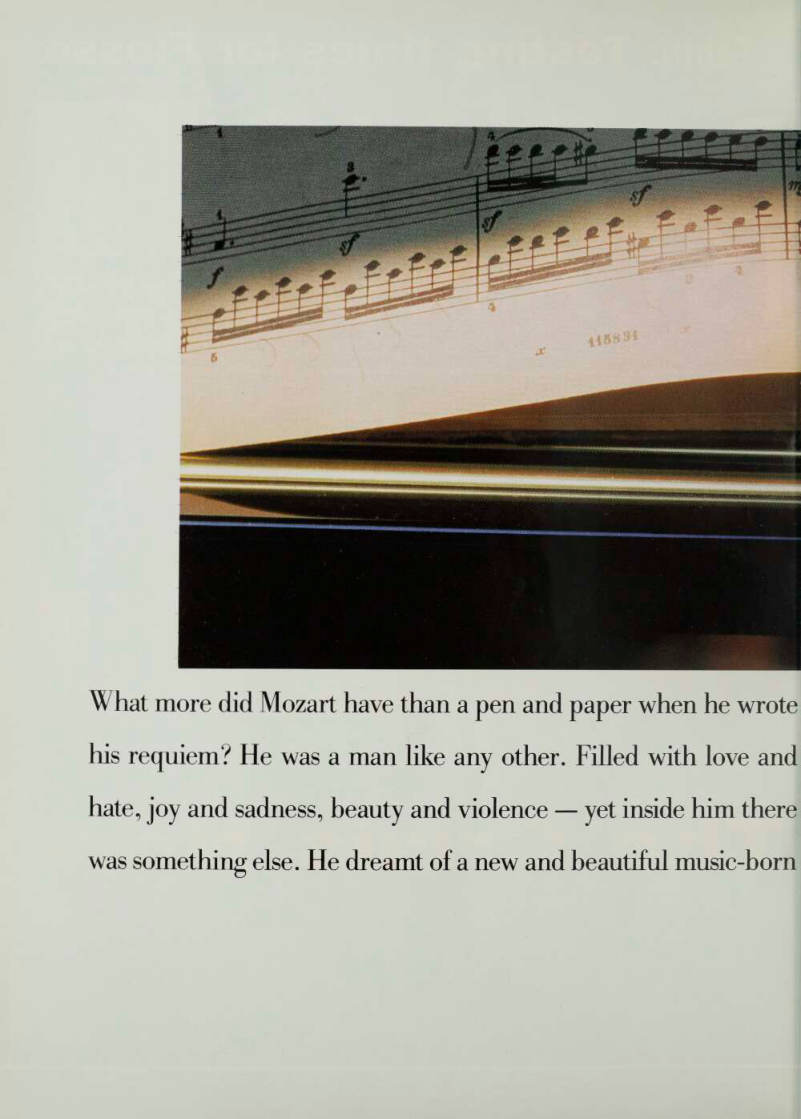
What more did Mozart have than a pen and paper when he wrote his requiem? He was a man like any other. Filled with love and hate, joy and sadness, beauty and violence yet inside him there was something else. He dreamt of a new and beautiful music-born
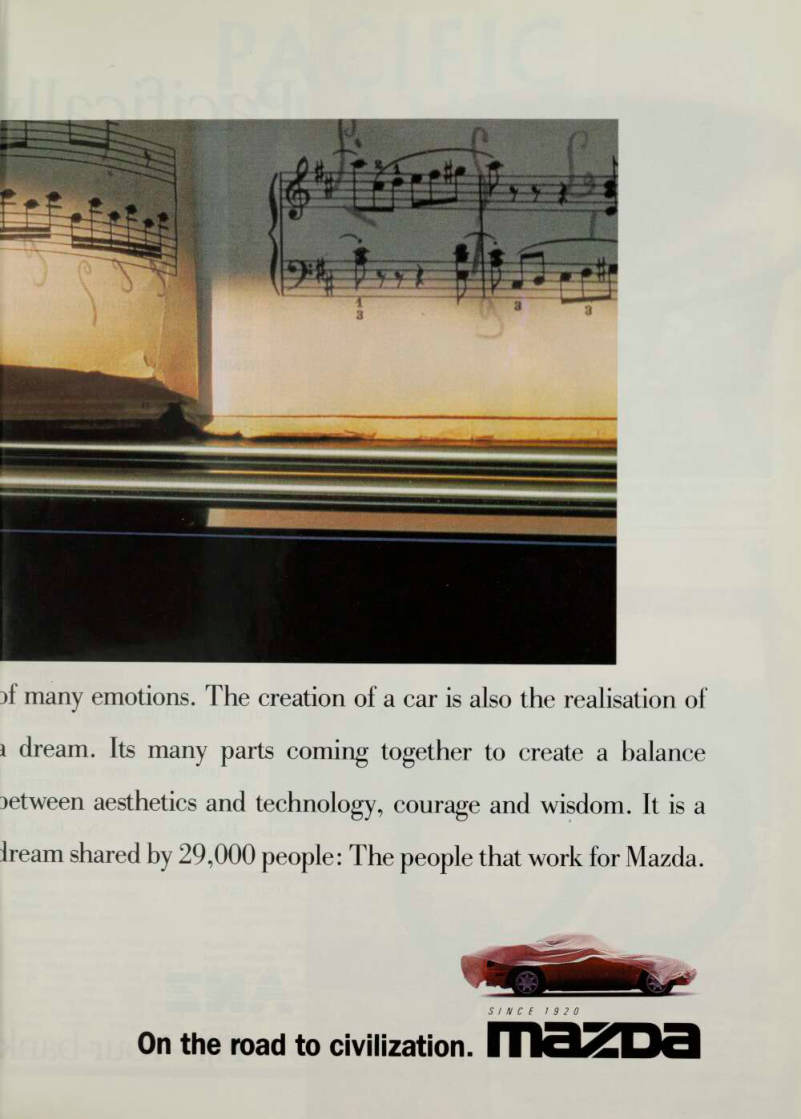
)f many emotions. The creation of a car is also the realisation of i dream. Its many parts coming together to create a balance between aesthetics and technology, courage and wisdom. It is a Iream shared by 29,000 people: The people that work for Mazda.
SINCE 1920
On the road to civilization. ITI3ZD3
Pacifically
■ A warm welcome is probably the mo< B important thing that any bank has t offer. Being the biggest bank in Fiji an part of the largest banking group in th Pacific may give us the edge in providin the best facilities for you locally an internationally, but never at the expens of our individual personal service. Aftc all, that is why we are where we ar today. Here for you, ANZ Bank Fij Your bank.
Fiji - Your bank
Pacific
Islands
Monthly
Vol. 61 No. 8
The News Magazine
August 1991
BUSINESS: Close to US$25O million has been stolen, wasted or mispent in the US island territories 50 : Despite Manihiki’s $3 million harvest, the pearl industry has problems 43 : Air Pacific’s making money 46 : Fiji’s new no-wool sheep 56 : New legislation forces Cable and Wireless out of the Cooks 47 VANUATU: August 7 may be the end of an era for Uni 16 FRENCH POLYNESIA: time for growing up and leaving the French cradle 11 FOCUS: Wrestling with White Spirit, a battle to reconcile traditional culture and the white ethos in art 28 SPORT: Western Samoa’s ‘Fists of Fury’ 26 TOURISM: An ecotourism award for a FSM hotel 45 ; Castaways’ 25th birthday 45 FUTA HELU: Islanders, an en dangered species 13 DAVID BARBER: Overstayers create resentment in both camps 27 JEMIMA GARRETT: Bougainville tragedy comes to life 19 MARGOT O’NEILL: Lessons from the 80s’ poor economic growth 49
Letters: 6
BOOKS: Foreign corespondent Simon Winchester’s bizarre tales and tantalising scraps of memory about the Pacific 42
COVER STORY: Increasing drug traffick ing and organised crime pose a crisis for the region now 35
SPORT: The buildup for the World Cup has begun with most Pacific islands sports people keen to strut their stuff 25
LOSING THE BATTLE: Anti-tax blockates rock Flosse’s coalition and highlight French Polynesia's financial plight 8
Publisher: Geoffrey Hussey Editor: Jale Moala Assistant Editor: Beryl Cook Correspondents: Al Prince, Angela McCarthy, David North, David Robie, Diana McManus, Dykes Angiki, Frank Senge, Franck Madoeuf, lan Williams.
Irene Nisbel, John Hunter. Karen Mangnall. Lito Vilisoni, Macel Manua, Nicholas Rolhwell, Pesi Fonua, Richard Dinnen, Ulafala Aiavao, Wally Hiambohn Columnists; David Barber (Welling
ton), Futa Helu (Tonga, covering the Pacific Islands), Jemima Garrett (Syd ney), Margot O'Neill (Washington) Business and Advertising Man ager; Charlotte Thomas Advertising Salas: • Fiji: Salendra Narayan, Tel (679) 304111, Fx (679) 303809 • Sydney, Melbourne: Fergus Maclagan, Tel (61-2) 4134689, Fx (61-2) 4123918 • Brisbane: Robert Walker, Tel (61-7) 3710533, Fx (61-7) 8798964
• Adelaide: Hastwell Williamsons Rep resentations, Tel (61-8) 799522, Fx (61-8) 799735 • Auckland: McKay International Me dia Reps Ltd, Tel (64-9) 4190561, Fx (64-9) 4192243 • Japan: Universal Media Corporation, Tokyo. Tel (3) 6663036, 6663094, Cable: UNIMEDIA Tokyo, Tx 2524665 Founded 1930 (USPS 952480). A Fiji Times Limited production.
Cover prices are recommended retail
only. Registered by Australia Post, Publication No, NBP 1210. © Copyright Fiji Times Limited, 117 Victoria Parade, Suva, Fiji. Tel (679) 304111, Fx (679)
303809, Tx Fj2124,
Pacific Islands Monthly is published monthly by Fiji Times Limited, a division of Nationwide News, 2 Holt Street, Surry Hills, Sydney, NSW 2010.
Sand address changas to: • Pacific Islands Monthly, PO Box 1167, Suva Fiji. Typeset and printed by Fiji Times Limited, 177 Victoria Parade, Suva, Fiji.
Chaudhry’s
Letters
Chaudhry’s boycott
MAHENDRA Chaudhry’s sugarcane harvest boycott in Fiji was wrong. His demand was not just and the method he used was harsh and out of date. It was wrong of Chaudhry to use the farmers and let them suffer for a theoretical price which he made them believe he could win for them. He lured them into accepting the price and, being in a bad financial situation which was also created by Chaudhry in the 1990 boycott, they grabbed the price hook, line and sinker.
If Chaudhry really believed the money he talked about rightly belonged to the farmers and could prove to the nation that it was justly so, why make the farmers suffer for it? If Chaudhry was really sincere, smart and strong he could have left the farmers alone to harvest their cane, get the money which he claimed was there for them and arrange for its payment to them to supplement their full 1991 sugarcane money.
The money, sadly enough, has now been reduced through lack of sugar in the cane that should have been harvested but is still standing out there. Much more of it has been lost through fire.
It was wrong to use the farmers. Their being kept together was a draconian exercise of exploitation. It was also wrong to use the farmers to force any change in the Sugar Cane Growers’
Council. While there are weaknesses in ther council which need ratification, the existing one did not deprive the farmers any money. The boycott did. Any newly elected council in a newly-structured one should only be allowed to function with the newly-elected Government.
Now the boycott is lifted and Chaudhry has got the satisfaction he wanted, one asks; What about the farmers? Now they must tell Chaudhry to deliver the goods.
This year’s boycott was a face-saving exercise, an attempt to justify the 1990 boycott.
S Finau
Nausori, Fiji.
Domestic
violence
THE article Door opened on domestic violence by Robin Bromby in your January 1991 issue airs an issue that is increasingly important in Pacific societies, and all around the world, as Bromby notes.
Unfortunately, the article is flawed. To cite particulars, the work referred to is not a “... study just published by the Institute for Polynesian Studies” but is rather a special issue of volume 13 number 3 (1990) of the journal Pacific Studies for which I was guest editor. The volume is titled Domestic Violence in Oceania , and available as a book through the University Press of Hawaii. The cost
of the volume is US$ 10. This information may be of value to your readers and should have been mentioned in the article by Bromby. The author appears to have read the book carefully, and to feel that its appearance marks an import ant breakthrough in the work of anthro pologists in the region. The volume was the product of three years of discussion by the contributors at symposia held under the auspices of the Association for Social Anthropology in Oceania. Finally, as not only guest editor of the work but as author of three of the pieces in it, some of which are quoted or paraphrased in Bromby’s article, it would have been appropriate for me to receive credit for my work.
The issue of domestic violence is important and Bromby has given it wider play than would have been the case otherwise. I appreciate the attention that PIM has given the book. Nevertheless, a book review should at least cite the work on which it draws and not give the appearance of being merely another news item. A large number of people, including the fine staff of Pacific Studies and the anthropologist contributors who dared to tackle a thorny and politically dangerous issue, worked very hard to bring this work into being. Good journal istic ethics require that they be recog nised.
Dorothy A. Counts
Professor and Chair, Dept of Anthropology University of Waterloo Ontario, Canada
Advertisements & other items, p. 7 (1 item)
Casio
SL-220 m MS-7 a e '3? o -.*#
SL-300L
Introducing Casio's New Concept In Calculators.
Designed To Work Just As Good As f hey Look.
FR-5200 BEST VIEW Larger Display for Easier Reading SL-300L • 8 digits (16-digit approximations) • Independent memory • Profit margin percent • Function command signs • 3-digit comma markers MS-7 • 8 digits (16-digit approximations) • Independent memory • Profit margin percent • “C-Power” Solar+ battery system works with or without light DUAL LEAF Handy Hard-Compact Body with Stroke Keys SL-220 •12 digits (24-digit approximations) • Sure-touch stroke keys • Function command signs • 3-digit comma markers • Full decimal system • Works with or without light DESIGN PRINTER Features New "Curvaceous" Design FR-5200 •12 digits (24-digit approximations) • Full decimal system • Subtotal, total, grand total • 3-digit comma markers
AUSTRALIA MOBEX PTY. LTD.
UNIT 1. GIBBES STREET
CHATSWOOD N S W. 2067
FIJI ISLANDS BRULAL & CO., LTD.
G.P.O. BOX NO. 362
SUVA, FIJI ISLANDS
NEW CALEDONIA BRECKWOLDT SARL
8P2369 NOUMEA
NEW CALEDONIA
MENARD PACIFIQUE
10 RUE JEAN JAURES
8P3899 NOUMEA, NEW CALEDONIA
NEW ZEALAND MONACO CORP. LTD.
41 POLAND ROAD, GLENFIELD
AUCKLAND, NEW ZEALAND
NORFOLK ISLANDS BURNT PtNE TRADERS LTD.
P.0.80X21, NORFOLK ISLANDS
PAPUA NEW GUINEA SENGCO NIUGINI PTY. LTD.
PO. BOX 1886, BOROKU
PAPUA NEW GUINEA
TAHITI MAISON AUROSE
30, RUE COLLETTE
PAPEETE, TAHITI
VANUATU FUNG KUEI
P.0.80X51, PORT VILA
VANUATU
CASIO COMPUTER CO., LTD
Tokyo, Japan
Losing the Battles
• The Region / French Polynesia
Anti-tax blockades rock Flosse’s coalition and highlight French Polynesia’s ever-present financial difficulties
By Al Prince
PRESIDENT Gaston Flosse’s majority coalition government has lost two major political battles among several skirmishes during its first four months in office. As a result, the ultimate question is whether this government, indirectly elected in March by voters seeking a definite political change in French Polynesia and a restoration of confidence, can now hang on to win the war during the remaining four years and seven months before the next scheduled elections.
The first battle, with potential cata strophic long-term effects on all future foreign investments, particularly in the tourist industry, occurred on June 17 on
Tahiti’s sister island of Moorea. By a vote of 1900 1449, Moorea residents effectively killed for the timebeing a
Japanese developer’s proposed U 5594.3
million combination 147-room deluxe Sheraton Hotel and a championship international golf course.
But that vote did not involve a legal referendum on a project for which the developer, Mitsuhiro Nishikawa, had signed with the previous government a USSI3O,OOO-a-year, 30-year lease of Ter ritorial Government-owned land and made the first of four scheduled pay ments totalling U 55940,000 for relocat ing farmers for the golf course.
Instead, the vote involved what the French call a consultation populaire. This, in effect, is a non-legal-binding opinion poll that the Flosse government reportedly expected to easily win by an 80 per cent
margin. The clear defeat was Flosse’s first since returning to power on April 5 after a four-year absence. The vote also posed a major threat of undermining any future government decisions by opponents of any project with enough muscle to
organise a concultation populaire.
The second and most devastating battle defeat for the Flosse government occurred on the night of July 10, briefly threatening to turn into a repeat of the October 23, 1987 night of rioting, burning and looting that left French
Polynesia’s capital of Papeete with war
like scars.
The latest battle occurred on July 10 as an inter-union movement protested the Flosse government’s proposed new and increased indirect taxes. Thee pro testers blocked off the two west coast roads leading into and out of downtown
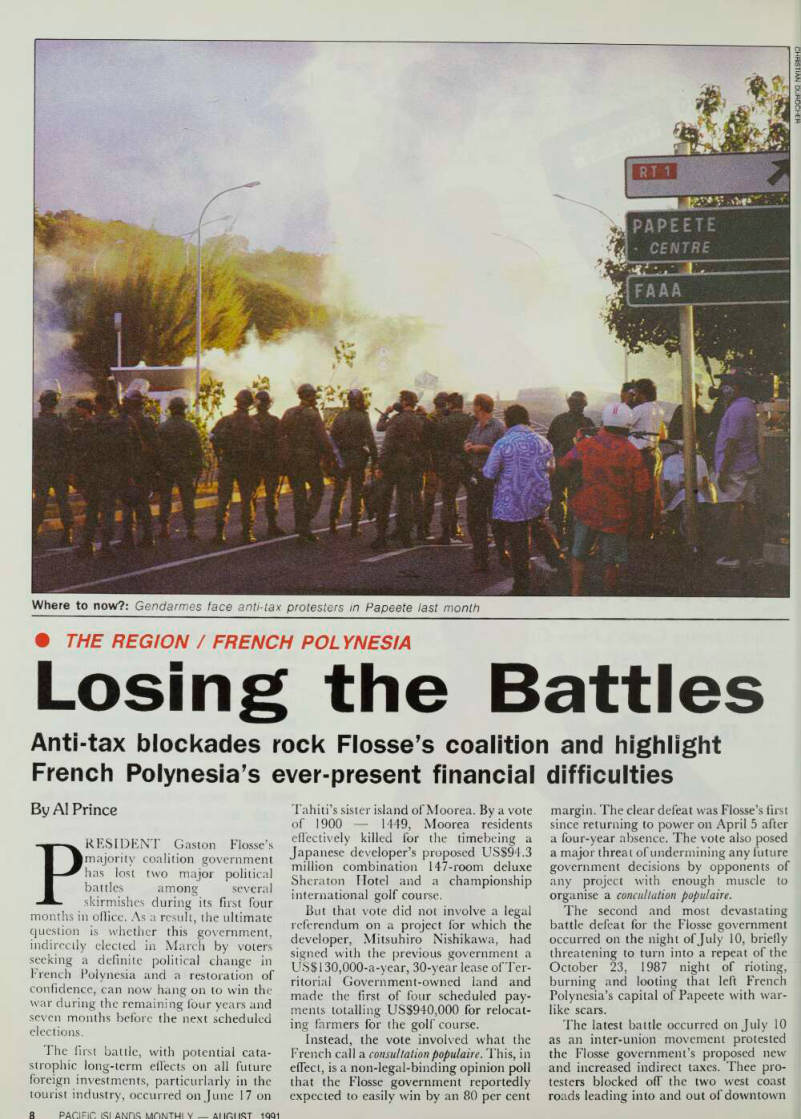
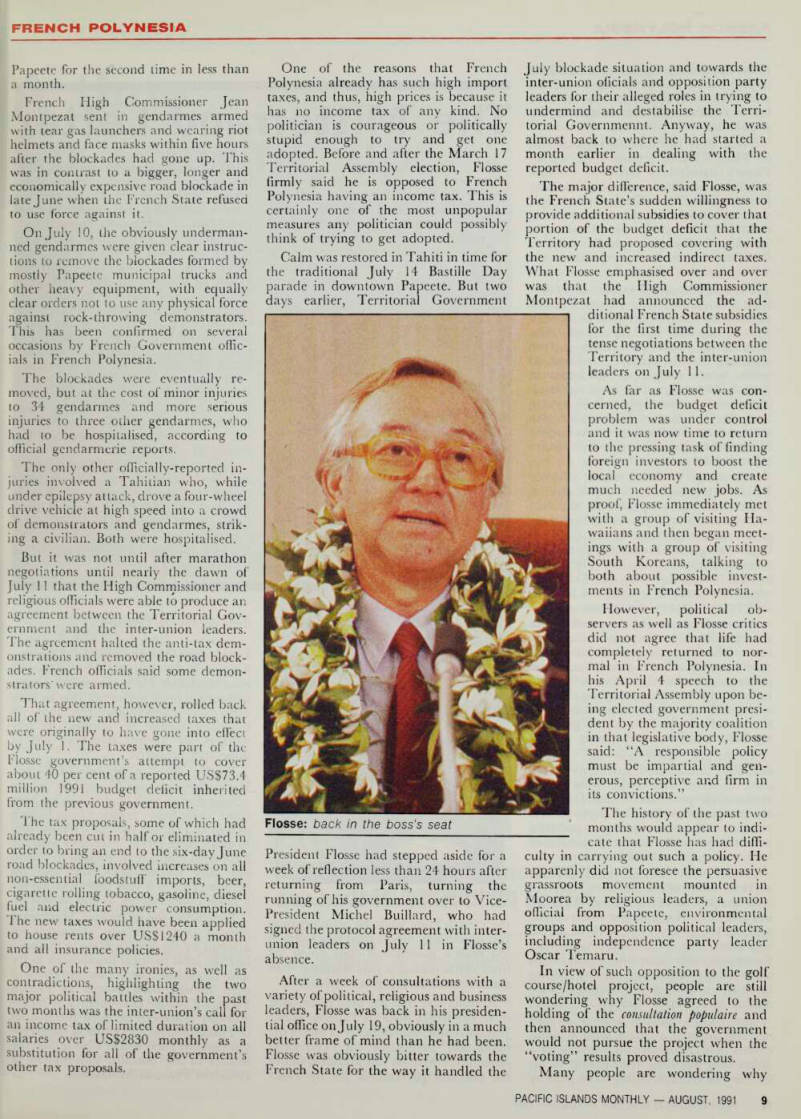
Where to now?: Gendarmes face anti-tax protesters in Papeete last month
Papeete for the second time in less than a month.
French High Commissioner Jean Montpezat sent in gendarmes armed with tear gas launchers and wearing riot helmets and face masks within five hours after the blockades had gone up. This was in contrast to a bigger, longer and economically expensive road blockade in late June when the French State refused to use force against it.
On July 10, the obviously underman ned gendarmes were given clear instruc tions to remove the blockades formed by mostly Papeete municipal trucks and other heavy equipment, with equally clear orders not to use any physical force against rock-throwing demonstrators.
This has been confirmed on several occasions by French Government offic ials in French Polynesia.
The blockades were eventually re moved, but at the cost of minor injuries to 34 gendarmes and more serious injuries to three other gendarmes, who had to be hospitalised, according to official gendarmerie reports.
The only other officially-reported in juries involved a Tahitian who, while under epilepsy attack, drove a four-wheel drive vehicle at high speed into a crowd of demonstrators and gendarmes, strik ing a civilian. Both were hospitalised.
But it was not until after marathon negotiations until nearly the dawn of July 11 that the High Commissioner and religious officials were able to produce an agreement between the Territorial Gov ernment and the inter-union leaders.
The agreement halted the anti-tax dem onstrations and removed the road block ades. French officials said some demon strators'were armed.
That agreement, however, rolled back all of the new and increased taxes that were originally to have gone into effect by July 1. The taxes were part of the Flosse government’s attempt to cover about 40 per cent of a reported U 5573.4 million 1991 budget deficit inherited from the previous government.
The tax proposals, some of which had already been cut in half or eliminated in order to bring an end to the six-day June road blockades, involved increases on all non-essential foodstuff imports, beer, cigarette rolling tobacco, gasoline, diesel fuel and electric power consumption. 1 he new taxes would have been applied to house rents over USSI24O a month and all insurance policies.
One of the many ironies, as well as contradictions, highlighting the two major political battles within the past two months was the inter-union’s call for an income tax of limited duration on all salaries over USS2B3O monthly as a substitution for all of the government’s other tax proposals.
One of the reasons that French
Polynesia already has such high import
taxes, and thus, high prices is because it has no income tax of any kind. No politician is courageous or politically stupid enough to try and get one adopted. Before and after the March 17 Territorial Assembly election, Flosse firmly said he is opposed to French Polynesia having an income tax. This is certainly one of the most unpopular measures any politician could possibly think of trying to get adopted.
Calm was restored in Tahiti in time for the traditional July 14 Bastille Day parade in downtown Papeete. But two days earlier, Territorial Government
President Flosse had stepped aside for a week of reflection less than 24 hours after returning from Paris, turning the running of his government over to Vice- President Michel Buillard, who had signed the protocol agreement with inter union leaders on July 11 in Flosse’s absence.
After a week of consultations with a variety of political, religious and business leaders, Flosse was back in his presiden tial office on July 19, obviously in a much better frame of mind than he had been.
Flosse was obviously bitter towards the French State for the way it handled the
July blockade situation and towards the inter-union oficials and opposition party leaders for their alleged roles in trying to undermind and destabilise the Terri torial Governmennt. Anyway, he was almost back to where he had started a month earlier in dealing with the reported budget deficit, xhe ma j or difrerence) said Flosse, was ( b e p rcnch State’s sudden willingness to provide additional subsidies to cover that portion of , he blldget de r lc it that the
Territory had proposed covering with
the new and increased indirect taxes, What Flosse emphasised over and over was that the High Commissioner Montpezat had announced the ad
ditional French State subsidies for the first time during the tense negotiations between the Territory and the inter-union leaders on July 11.
As far as Flosse was con cerned, the budget deficit problem was under control and it was now time to return to die pressing task of finding foreign investors to boost the local economy and create much needed new jobs. As
proof, Flosse immediately met
with a group of visiting Ha waiians and then began meet ings with a group of visiting South Koreans, talking to both about possible invest ments in French Polynesia.
However, political ob servers as well as Flosse critics did not agree that life had completely returned to nor mal in French Polynesia. In his April 4 speech to the Territorial Assembly upon be ing elected government presi dent by the majority coalition in that legislative body, Flosse
said: “A responsible policy
must be impartial and gen erous, perceptive and firm in its convictions.”
The history of the past two months would appear to indi cate that Flosse has had diffi
culty in carrying out such a policy. Fie apparenly did not foresee the persuasive grassroots movement mounted in Moorea by religious leaders, a union official from Papeete, environmental groups and opposition political leaders, including independence party leader Oscar Temaru.
In view of such opposition to the golf course/hotel project, people are still wondering why Flosse agreed to the holding of the consultation populaire and then announced that the government would not pursue the project when the “voting” results proved disastrous.
Many people are wondering why
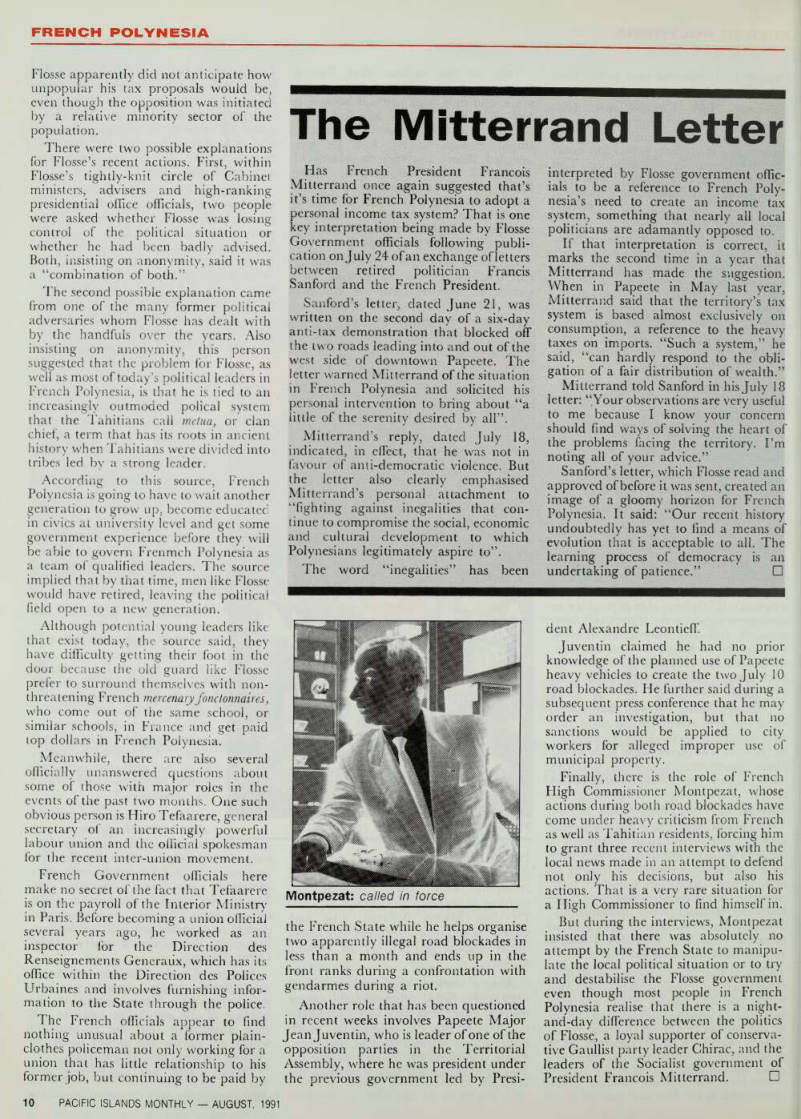
Flosse: back in the boss's seat
Flosse apparently did not anticipate how unpopular his tax proposals would be, even though the opposition was initiated by a relative minority sector of the population.
There were two possible explanations for Flosse’s recent actions. First, within Flosse’s tightly-knit circle of Cabinet ministers, advisers and high-ranking presidential office officials, two people were asked whether Flosse was losing control of the political situation or whether he had been badly advised.
Both, insisting on anonymity, said it was a “combination of both.”
The second possible explanation came from one of the many former political adversaries whom Flosse has dealt with by the handfuls over the years. Also insisting on anonymity, this person suggested that the problem for Flosse, as well as most of today’s political leaders in French Polynesia, is that he is tied to an
increasingly outmoded polical system
that the Tahitians call metua, or clan chief, a term that has its roots in ancient history when Tahitians were divided into tribes led by a strong leader.
According to this source, French Polynesia is going to have to wait another generation to grow up, become educated in civics at university level and get some government experience before they will be able to govern Frenmch Polynesia as a team of qualified leaders. The source implied that by that time, men like Flosse would have retired, leaving the political field open to a new generation.
Although potential young leaders like that exist today, the source said, they have difficulty getting their foot in the door because the old guard like Flosse prefer to surround themselves with non threatening French mercenary fonclonnaires, who come out of the same school, or similar schools, in France and get paid top dollars in French Polynesia.
Meanwhile, there are also several officially unanswered questions about some of those with major roles in the events of the past two months. One such obvious person is Hiro Tefaarere, general secretary of an increasingly powerful labour union and the official spokesman for the recent inter-union movement.
French Government officials here make no secret of the fact that Tefaarere is on the payroll of the Interior Ministry in Paris. Before becoming a union official several years ago, he worked as an inspector for the Direction des Renseignements Generaux, which has its office within the Direction des Polices Urbaines and involves furnishing infor mation to the State through the police, The French officials appear to find nothing unusual about a former plain clothes policeman not only working for a union that has little relationship to his former job, but continuing to be paid by
the French State while he helps organise two apparently illegal road blockades in less than a month and ends up in the front ranks during a confrontation with gendarmes during a riot.
Another role that has been questioned in recent weeks involves Papeete Major Jean Juventin, who is leader of one of the opposition parties in the Territorial Assembly, where he was president under the previous government led by Presi
dent Alexandre Leontieff.
Juventin claimed he had no prior knowledge of the planned use of Papeete heavy vehicles to create the two July 10 road blockades. He further said during a subsequent press conference that he may order an investigation, but that no sanctions would be applied to city workers for alleged improper use of
municipal property.
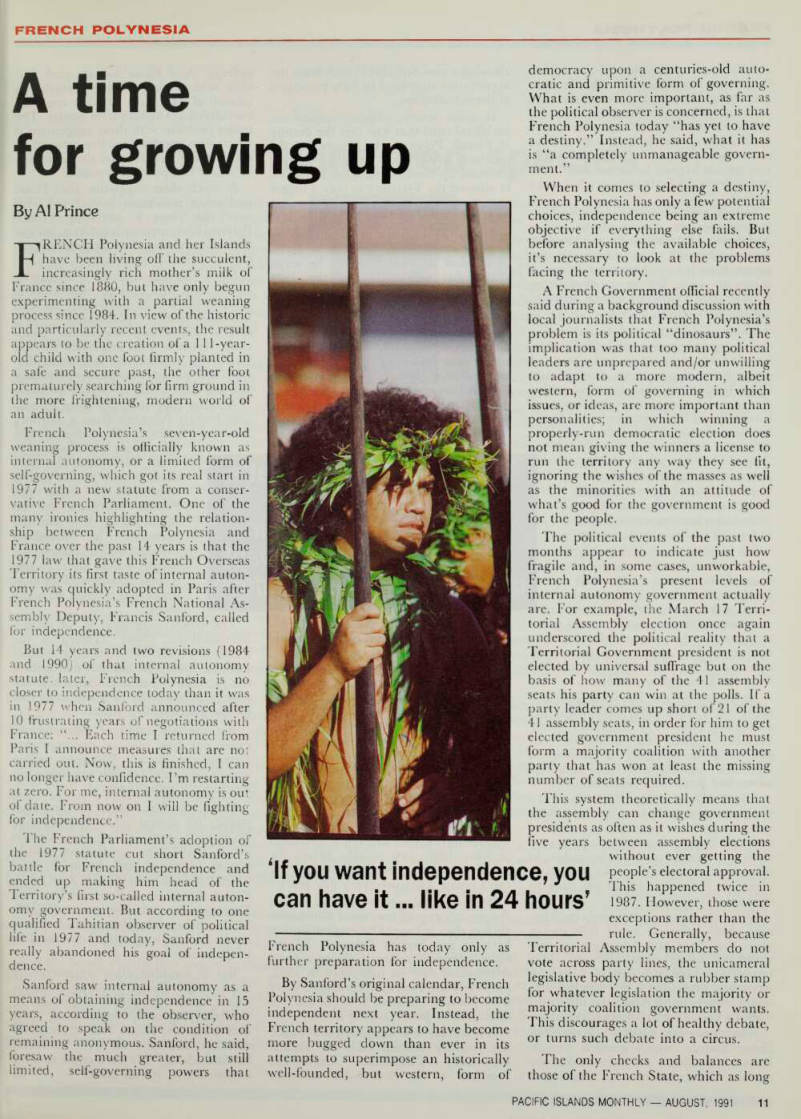
Finally, there is the role of French High Commissioner Montpezat, whose actions during both road blockades have come under heavy criticism from French as well as Tahitian residents, forcing him to grant three recent interviews with the local news made in an attempt to defend not only his decisions, but also his actions. That is a very rare situation for a High Commissioner to find himself in.
But during the interviews, Montpezat insisted that there was absolutely no attempt by the French State to manipu late the local political situation or to try and destabilise the Flosse government even though most people in French Polynesia realise that there is a night and-day difference between the politics of Flosse, a loyal supporter of conserva tive Gaullist party leader Chirac, and the leaders of the Socialist government of President Francois Mitterrand. □
Montpezat: called in force
Advertisements & other items, pp. 8-9 (2 items)
8
PACIFIC ISI AN lIS MOMTHI Y Al ICI IST IQQI
French Polynesia
The Mitterrand Letter
Has French President Francois Mitterrand once again suggested that’s it’s time for French Polynesia to adopt a personal income tax system? That is one
key interpretation being made by Flosse
Government officials following publi cation on July 24 of an exchange ofletters between retired politician Francis Sanford and the French President.
Sanford’s letter, dated June 21, was written on the second day of a six-day anti-tax demonstration that blocked off the two roads leading into and out of the west side of downtown Papeete. The letter warned Mitterrand of the situation in French Polynesia and solicited his personal intervention to bring about “a little of the serenity desired by all”.
Mitterrand’s reply, dated July 18, indicated, in effect, that he was not in favour of anti-democratic violence. But the letter also clearly emphasised Mitterrand’s personal attachment to
“fighting against illegalities that con
tinue to compromise the social, economic and cultural development to which Polynesians legitimately aspire to”.
The word “inegalities” has been
interpreted by Flosse government offic ials to be a reference to French Poly nesia’s need to create an income tax system, something that nearly all local politicians are adamantly opposed to.
If that interpretation is correct, it marks the second time in a year that Mitterrand has made the suggestion.
When in Papeete in May last year, Mitterrand said that the territory’s tax system is based almost exclusively on consumption, a reference to the heavy taxes on imports. “Such a system,” he said, “can hardly respond to the obli gation of a fair distribution of wealth.”
Mitterrand told Sanford in his July 18 letter: “Your observations are very useful to me because I know your concern should find ways of solving the heart of
the problems facing the territory. I’m
noting all of your advice.”
Sanford’s letter, which Flosse read and approved of before it was sent, created an image of a gloomy horizon for French Polynesia. It said: “Our recent history undoubtedly has yet to find a means of evolution that is acceptable to all. The learning process of democracy is an undertaking of patience.” □
for growing up
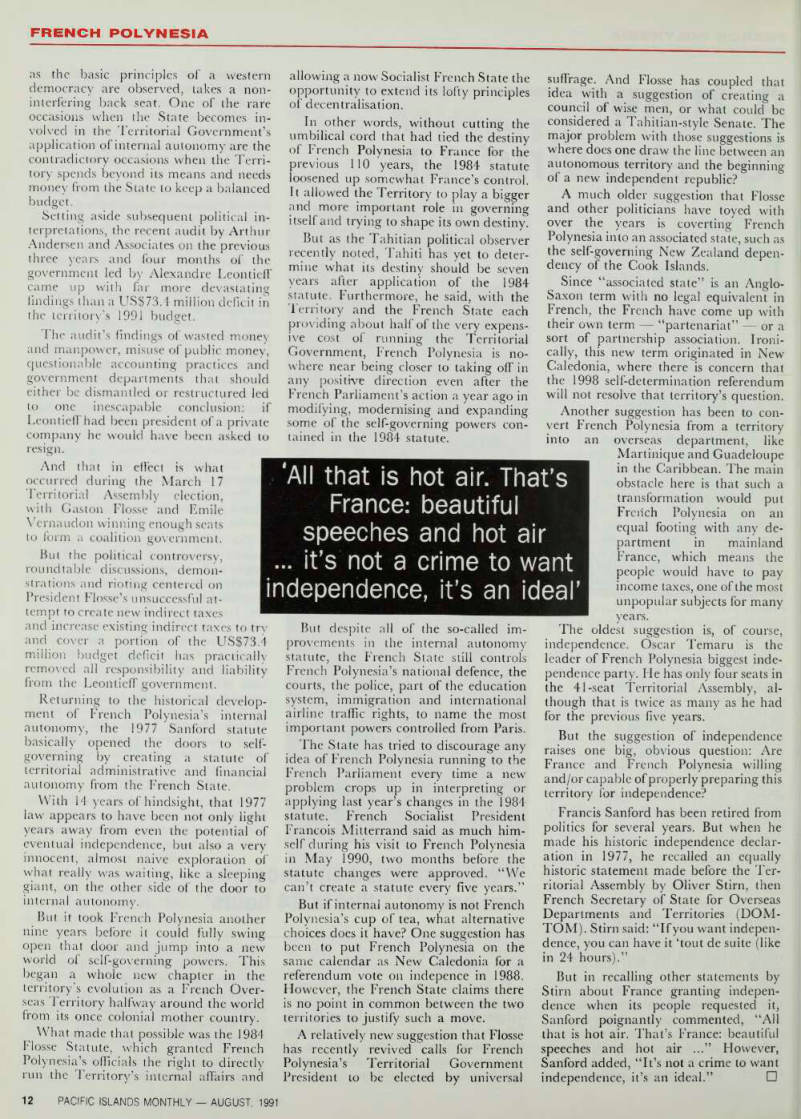
A time for growing up
By Al Prince
FRENCH Polynesia and her Islands have been living off the succulent, increasingly rich mother’s milk of France since 1880, but have only begun experimenting with a partial weaning process since 1984. In view of the historic and particularly recent events, the result appears to be the creation of a 111-year old child with one foot firmly planted in a safe and secure past, the other foot
prematurely searching for firm ground in
the more frightening, modern world of an adult.
French Polynesia’s seven-year-old weaning process is officially known as internal autonomy, or a limited form of self-governing, which got its real start in 1977 with a new statute from a conser vative French Parliament. One of the many ironies highlighting the relation ship between French Polynesia and France over the past 14 years is that the 1977 law that gave this French Overseas Territory its first taste of internal auton omy was quickly adopted in Paris after French Polynesia’s French National As sembly Deputy, Francis Sanford, called
for independence.
But 14 years and two revisions (1984 and 1990) of that internal autonomy statute, later, French Polynesia is no closer to independence today than it was in 1977 when Sanford announced after 10 frustrating years of negotiations with France: “... Each time I returned from Paris I announce measures that are not carried out. Now, this is finished, I can no longer have confidence. I’m restarting at zero. For me, internal autonomy is out of date. From now on I will be fighting
for independence.”
The French Parliament’s adoption of the 1977 statute cut short Sanford’s battle for French independence and ended up making him head of the Territory’s first so-called internal auton omy government. But according to one qualified Tahitian observer of political life in 1977 and today, Sanford never really abandoned his goal of indepen dence.
Sanford saw internal autonomy as a means of obtaining independence in 15 years, according to the observer, who agreed to speak on the condition of remaining anonymous. Sanford, he said, foresaw the much greater, but still limited, self-governing powers that
‘lf you want independence, you can have it... like In 24 hours'
French Polynesia has today only as further preparation for independence.
By Sanford’s original calendar, French Polynesia should be preparing to become independent next year. Instead, the French territory appears to have become more bugged down than ever in its attempts to superimpose an historically well-founded, but western, form of
democracy upon a centuries-old auto cratic and primitive form of governing.
What is even more important, as far as the political observer is concerned, is that French Polynesia today “has yet to have a destiny.” Instead, he said, what it has is “a completely unmanageable govern ment.”
When it comes to selecting a destiny, French Polynesia has only a few potential choices, independence being an extreme objective if everything else fails. But before analysing the available choices, it’s necessary to look at the problems facing the territory.
A French Government official recently said during a background discussion with local journalists that French Polynesia’s problem is its political “dinosaurs”. The implication was that too many political leaders are unprepared and/or unwilling to adapt to a more modern, albeit western, form of governing in which issues, or ideas, arc more important than personalities; in which winning a properly-run democratic election does not mean giving the winners a license to run the territory any way they see fit, ignoring the wishes of the masses as well as the minorities with an attitude of what’s good for the government is good for the people.
The political events of the past two months appear to indicate just how fragile and, in some cases, unworkable, French Polynesia’s present levels of internal autonomy government actually are. For example, the March 17 Terri torial Assembly election once again underscored the political reality that a Territorial Government president is not elected by universal suffrage but on the basis of how many of the 41 assembly seats his party can win at the polls. If a party leader comes up short of 21 of the 41 assembly seats, in order for him to get elected government president he must form a majority coalition with another party that has won at least the missing number of seats required.
This system theoretically means that the assembly can change government presidents as often as it wishes during the five years between assembly elections
without ever getting the people’s electoral approval.
This happened twice in 1987. However, those were exceptions rather than the rule. Generally, because
Territorial Assembly members do not vote across party lines, the unicameral legislative body becomes a rubber stamp for whatever legislation the majority or majority coalition government wants.
This discourages a lot of healthy debate, or turns such debate into a circus.
The only checks and balances are those of the French State, which as long
as the basic principles of a western democracy are observed, takes a non interfering back seat. One of the rare occasions when the State becomes in volved in the Territorial Government’s application of internal autonomy are the contradictory occasions when the Terri tory spends beyond its means and needs money from the State to keep a balanced budget.
Setting aside subsequent political in terpretations, the recent audit by Arthur Andersen and Associates on the previous three years and four months of the government led by Alexandre Leontieff came up with far more devastating findings than a U 5573.4 million deficit in
the territory’s 1991 budget.
The audit’s findings of wasted money and manpower, misuse of public money, questionable accounting practices and government departments that should either be dismantled or restructured led to one inescapable conclusion: if Leontieff had been president of a private company he would have been asked to resign.
And that in effect is what occurred during the March 17 Territorial Assembly election, with Gaston Flosse and Emile
Vernaudon winning enough seats
to form a coalition government.
But the political controversy, roundtable discussions, demon strations and rioting centered on President Flosse’s unsuccessful at tempt to create new indirect taxes
and increase existing indirect taxes to try and cover a portion of the U 5573.4 million budget deficit has practically removed all responsibility and liability from the Leontieff government.
Returning to the historical develop ment of French Polynesia’s internal autonomy, the 1977 Sanford statute basically opened the doors to self governing by creating a statute of territorial administrative and financial autonomy from the French State.
With 14 years of hindsight, that 1977 law appears to have been not only light years away from even the potential of eventual independence, but also a very innocent, almost naive exploration of what really was waiting, like a sleeping giant, on the other side of the door to internal autonomy.
But it took French Polynesia another nine years before it could fully swing open that door and jump into a new world of self-governing powers. This began a whole new chapter in the territory's evolution as a French Over seas Territory halfway around the world from its once colonial mother country.
What made that possible was the 1984 Flosse Statute, which granted French
Polynesia’s officials the right to directly
run the Territory’s internal affairs and
allowing a now Socialist French State the opportunity to extend its lofty principles of decentralisation.
In other words, without cutting the umbilical cord that had tied the destiny of French Polynesia to France for the previous 110 years, the 1984 statute loosened up somewhat France’s control.
It allowed the Territory to play a bigger and more important role in governing itself and trying to shape its own destiny.
But as the Tahitian political observer recently noted, Tahiti has yet to deter mine what its destiny should be seven years after application of the 1984 statute. Furthermore, he said, with the Territory and the French State each providing about half of the very expens ive cost of running the Territorial Government, French Polynesia is no where near being closer to taking off in any positive direction even after the French Parliament’s action a year ago in
modifying, modernising and expanding
some of the self-governing powers con tained in the 1984 statute.
‘All that is hot air. That’s France: beautiful speeches and hot air ... it’s not a crime to want independence, it’s an ideal’
But despite all of the so-called im provements in the internal autonomy statute, the French State still controls French Polynesia’s national defence, the courts, the police, part of the education system, immigration and international airline traffic rights, to name the most important powers controlled from Paris.
The State has tried to discourage any idea of French Polynesia running to the French Parliament every time a new problem crops up in interpreting or applying last year’s changes in the 1984 statute. French Socialist President Francois Mitterrand said as much him self during his visit to French Polynesia in May 1990, two months before the statute changes were approved. “We can’t create a statute every five years.”
But if internal autonomy is not French Polynesia’s cup of tea, what alternative choices does it have? One suggestion has been to put French Polynesia on the same calendar as New Caledonia for a referendum vote on indepence in 1988.
However, the French State claims there is no point in common between the two territories to justify such a move.
A relatively new suggestion that Flosse has recently revived calls for French Polynesia’s Territorial Government President to be elected by universal
suffrage. And Flosse has coupled that idea with a suggestion of creating a council of wise men, or what could be considered a Tahitian-style Senate. The major problem with those suggestions is where does one draw the line between an autonomous territory and the beginning of a new independent republic?
A much older suggestion that Flosse and other politicians have toyed with over the years is coverting French Polynesia into an associated state, such as the self-governing New Zealand depen dency of the Cook Islands.
Since “associated state” is an Anglo- Saxon term with no legal equivalent in French, the French have come up with their own term “partenariat” or a sort of partnership association. Ironi cally, this new term originated in New Caledonia, where there is concern that the 1998 self-determination referendum will not resolve that territory’s question.
Another suggestion has been to con vert French Polynesia from a territory into an overseas department, like
Martinique and Guadeloupe in the Caribbean. The main obstacle here is that such a transformation would put French Polynesia on an equal footing with any de partment in mainland France, which means the people would have to pay income taxes, one of the most unpopular subjects for many years.
The oldest suggestion is, of course, independence. Oscar Temaru is the leader of French Polynesia biggest inde pendence party. He has only four seats in the 41-seat Territorial Assembly, al though that is twice as many as he had for the previous five years.
But the suggestion of independence raises one big, obvious question: Are France and French Polynesia willing and/or capable of properly preparing this
territory for independence?
Francis Sanford has been retired from politics for several years. But when he made his historic independence declar ation in 1977, he recalled an equally historic statement made before the Ter ritorial Assembly by Oliver Stirn, then French Secretary of State for Overseas
Departments and Territories (DOM
TOM). Stirn said: “Ifyou want indepen dence, you can have it ‘tout de suite (like in 24 hours).”
But in recalling other statements by Stirn about France granting indepen dence when its people requested it, Sanford poignantly commented, “All that is hot air. That’s France: beautiful speeches and hot air ...” However, Sanford added, “It’s not a crime to want independence, it’s an ideal.” □
The endangered species
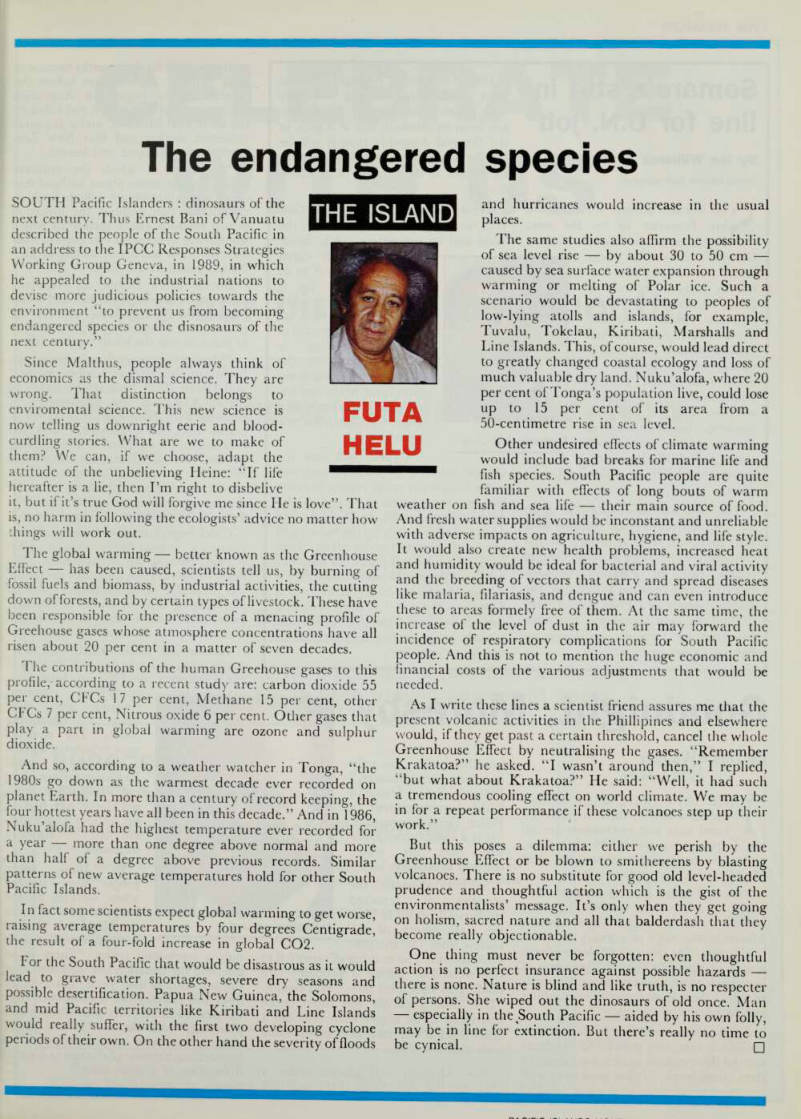
SOUTH Pacific Islanders : dinosaurs of the next century. Thus Ernest Bani of Vanuatu described the people of the South Pacific in an address to the IPCC Responses Strategies Working Group Geneva, in 1989, in which he appealed to the industrial nations to devise more judicious policies towards the environment “to prevent us from becoming endangered species or the disnosaurs of the
next century,”
Since Malthus, people always think of economics as the dismal science. They are wrong. That distinction belongs to enviromental science. This new science is now telling us downright eerie and blood curdling stories. What are we to make of them? We can, if we choose, adapt the attitude of the unbelieving Heine: “If life hereafter is a lie, then I’m right to disbelive
it, but if it’s true God will forgive me since He is love”. That is, no harm in following the ecologists’ advice no matter how things will work out.
The global warming better known as the Greenhouse Effect has been caused, scientists tell us, by burning of fossil fuels and biomass, by industrial activities, the cutting down of forests, and by certain types of livestock. These have been responsible for the presence of a menacing profile of Greehouse gases whose atmosphere concentrations have all risen about 20 per cent in a matter of seven decades.
The contributions of the human Greehouse gases to this profile,-according to a recent study are: carbon dioxide 55 per cent, CFCs 17 per cent, Methane 15 per cent, other CFCs 7 per cent, Nitrous oxide 6 per cent. Other gases that play a part in global warming are ozone and sulphur dioxide.
And so, according to a weather watcher in Tonga, “the 1980 s go down as the warmest decade ever recorded on planet Earth. In more than a century of record keeping, the four hottest years have all been in this decade.” And in 1986, Nukualofa had the highest temperature ever recorded for a year more than one degree above normal and more than half of a degree above previous records. Similar patterns of new average temperatures hold for other South Pacific Islands.
In fact some scientists expect global warming to get worse, raising average temperatures by four degrees Centigrade, the result of a four-fold increase in global CO2.
For the South Pacific that would be disastrous as it would lead to grave water shortages, severe dry seasons and possible desertification. Papua New Guinea, the Solomons, and mid Pacific territories like Kiribati and Line Islands would really suffer, with the first two developing cyclone periods of their own. On the other hand the severity of floods
and hurricanes would increase in the usual
places.
The same studies also affirm the possibility of sea level rise by about 30 to 50 cm caused by sea surface water expansion through warming or melting of Polar ice. Such a scenario would be devastating to peoples of low-lying atolls and islands, for example, Tuvalu, Tokelau, Kiribati, Marshalls and Line Islands. This, of course, would lead direct to greatly changed coastal ecology and loss of much valuable dry land. Nuku’alofa, where 20 per cent of Tonga’s population live, could lose up to 15 per cent of its area from a 50-centimetre rise in sea level.
Other undesired effects of climate warming would include bad breaks for marine life and fish species. South Pacific people are quite familiar with effects of long bouts of warm
weather on fish and sea life their main source of food.
And fresh water supplies would be inconstant and unreliable with adverse impacts on agriculture, hygiene, and life style.
It would also create new health problems, increased heat and humidity would be ideal for bacterial and viral activity and the breeding of vectors that carry and spread diseases like malaria, filariasis, and dengue and can even introduce these to areas formely free of them. At the same time, the increase of the level of dust in the air may forward the incidence of respiratory complications for South Pacific people. And this is not to mention the huge economic and financial costs of the various adjustments that would be needed.
As I write these lines a scientist friend assures me that the present volcanic activities in the Phillipines and elsewhere would, if they get past a certain threshold, cancel the whole Greenhouse Effect by neutralising the gases. “Remember Krakatoa?” he asked. “I wasn’t around then,” I replied, “but what about Krakatoa?” He said: “Well, it had such a tremendous cooling effect on world climate. We may be in for a repeat performance if these volcanoes step up their work.”
But this poses a dilemma: either we perish by the Greenhouse Effect or be blown to smithereens by blasting volcanoes. There is no substitute for good old level-headed prudence and thoughtful action which is the gist of the environmentalists’ message. It’s only when they get going on holism, sacred nature and all that balderdash that they become really objectionable.
One thing must never be forgotten: even thoughtful action is no perfect insurance against possible hazards there is none. Nature is blind and like truth, is no respecter of persons. She wiped out the dinosaurs of old once. Man especially in Pacific aided by his own folly, may be in line for extinction. But there’s really no time to be cynical. □
The Island
Futa
Helu
Advertisements & other items, p. 13 (1 item)
sd
line for U.N. job
Somare’s still in line for U.N. job
By Ian Williams
United Nations correspondent SIR Michael Somare of PNG is still hot favourite to be the next President of the United Nations
General Assembly next month despite the last minute entry in the race of Saudi Arabia’s UN Am bassador Samir Shihabi.
That in turn was provoked because after a long silence which many assumed to mean withdrawal, Yemeni Ambassador Al-Ashtal an nounced that he was still running. Saudi dislike of Yemen knows no bounds since the Gulf War saw
newly united Yemen criticising Desert Storm.
The two will now split the Arab vote, while Cyprus is still running with little or no declared cup-port. By the consensus rules of the Asia Group, which call for rotation between countries and regional subgroups, the Pacific Islands and PNG should have it. But the usual consensus has been thwarted by Cyprus’s insistence on fighting it to the bitter end.
PNG Ambassador Renagi Lohia has
been assiduously courting waverers
with charts showing that the Pacific has been overlooked. But if it goes to the General Assembly then it will be PNG’s lack of enemies which will be as significant as the support of its active friends.
Yemen went on a limb over the Gulf War, and will pay the price with the West and its supporters, while Saudi
Arabia’s human rights record is not such as to inspire support for it heading the world’s highest body. Both of them will be suspected of partiality during a session in which the Middle East’s problems, both inter-Arab, and be tween Arabs, Israel and Iran, will dominate the agenda.
Cyprus will face the
intense hostility of Turkey, and will suffer from what many regard as being the less than glorious record of the current President Guido De Marco, of Malta. “After watching the showing of one small Mediterranean island, there won’t be much support for another one”, a Western Diplomat told Pacific Islands Monthly, adding: “It looks as if Somare will get it.” It is an optimism shared by Port Moresby, which has already been selecting support staff for the new President. □
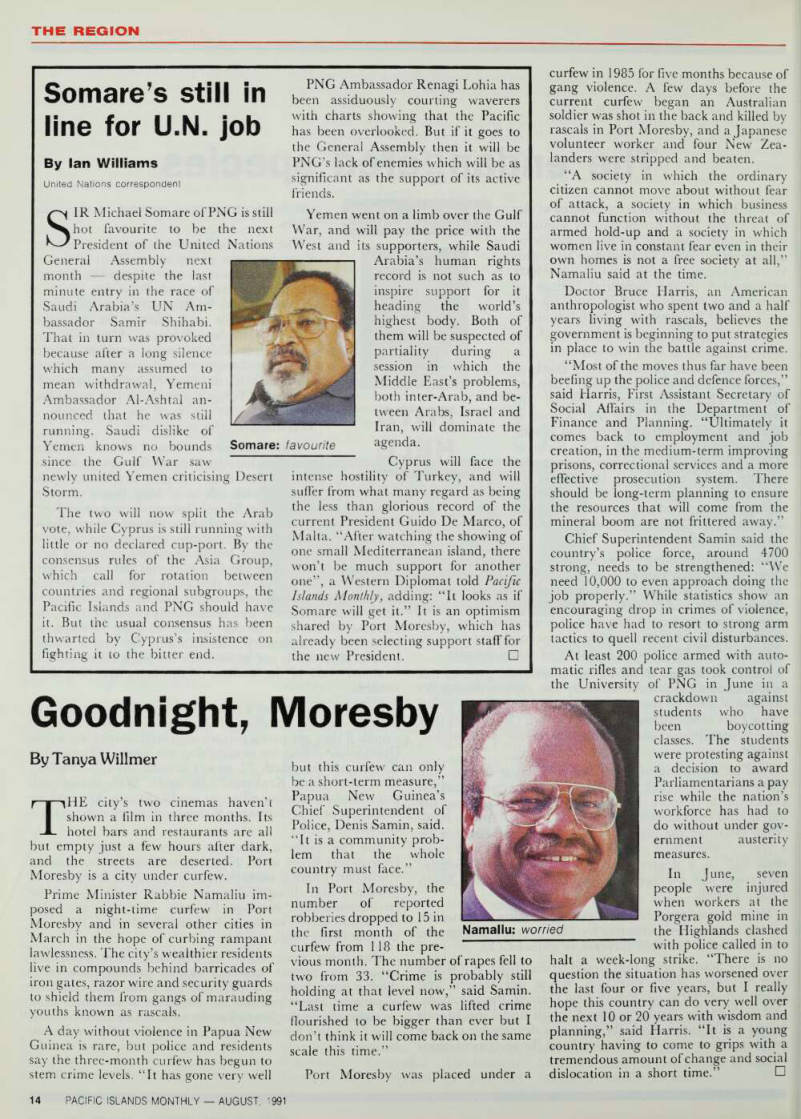
Somare: favourite
Goodnight, Moresby
The Region
By Tanya Willmer
THE city’s two cinemas haven’t shown a film in three months. Its hotel bars and restaurants are all but empty just a few hours after dark, and the streets are deserted. Port Moresby is a city under curfew.
Prime Minister Rabbie Namaliu im posed a night-time curfew in Port Moresby and in several other cities in March in the hope of curbing rampant lawlessness. The city’s wealthier residents live in compounds behind barricades of iron gates, razor wire and security guards to shield them from gangs of marauding youths known as rascals.
A day without violence in Papua New Guinea is rare, but police and residents say the three-month curfew has begun to stem crime levels. “It has gone very well
but this curfew can only be a short-term measure,”
Papua New Guinea’s Chief Superintendent of Police, Denis Samin, said.
“It is a community prob lem that the whole country must face.”
In Port Moresby, the number of reported robberies dropped to 15 in the first month of the curfew from 118 the pre
vious month. The number of rapes fell to two from 33. “Crime is probably still holding at that level now,” said Samin.
“Last time a curfew was lifted crime flourished to be bigger than ever but I don’t think it will come back on the same scale this time.”
Port Moresby was placed under a
curfew in 1985 for five months because of gang violence. A few days before the current curfew began an Australian soldier was shot in the back and killed by rascals in Port Moresby, and a Japanese volunteer worker and four New Zea landers were stripped and beaten.
“A society in which the ordinary citizen cannot move about without fear of attack, a society in which business cannot function without the threat of armed hold-up and a society in which women live in constant fear even in their own homes is not a free society at all,”
Namaliu said at the time.
Doctor Bruce Harris, an American anthropologist who spent two and a half years living with rascals, believes the government is beginning to put strategies in place to win the battle against crime.
“Most of the moves thus far have been beefing up the police and defence forces,” said Flarris, First Assistant Secretary of Social Affairs in the Department of Finance and Planning. “Ultimately it comes back to employment and job creation, in the medium-term improving prisons, correctional services and a more effective prosecution system. There should be long-term planning to ensure the resources that will come from the mineral boom are not frittered away.”
Chief Superintendent Samin said the country’s police force, around 4700 strong, needs to be strengthened: “We need 10,000 to even approach doing the job properly.” While statistics show an encouraging drop in crimes of violence, police have had to resort to strong arm tactics to quell recent civil disturbances.
At least 200 police armed with auto matic rifles and tear gas took control of the University of PNG in June in a
crackdown against students who have
been boycotting
classes. The students
were protesting against
a decision to award Parliamentarians a pay rise while the nation’s workforce has had to do without under gov ernment austerity measures.
In June, seven
people were injured
when workers at the
Porgera gold mine in
the Highlands clashed with police called in to
halt a week-long strike. “There is no question the situation has worsened over the last four or five years, but I really hope this country can do very well over the next 10 or 20 years with wisdom and planning,” said Harris. “It is a young country having to come to grips with a tremendous amount of change and social dislocation in a short time.” □
Namaliu: worried
Advertisements & other items, p. 15 (1 item)
Celebrate
WITH US
It’s our birthday this month
So take these special offers. Now.
15 magazines for the price of 12 32 magazines for the price of 24 This offer ends on August 31 No other news magazine covers the Pacific like we do. We’ve been around now for 61 years.
SUBSCRIBE
NOW!
Yes, send me Pacific Islands Monthly. Now.
Please tick one box only 15 months for the price of 12 EH 32months for the price of 24 Here is a cheque/money order CH Debit my credit card, indicated below □ Visa (Z 3 Master Card Expiry Date Card Number Name Signature Address
RATES
Post to: Pacific Islands Monthly, PO Box 1167, Suva, Fiji. OR fax: (679) 303809
D-Day
for Lini
By Beryl Cook
AUGUST 7 has been tipped as the end of an era for Vanuatu. On that day the position of Prime Minister, held by Father Walter Lini since the former Anglo-French Condominium gained Independence in 1980, is ex pected to be put to the vote at a
Vanua’aku Party Congress.
If it goes ahead, the Congress will vote on a new executive including the presi dency position held by Lini. If it does not go ahead, mainly due to pressure from Lini himself, it could still be the spark for a backlash following months of mounting unrest in the party.
In the last month Lini has continued sackings designed to firm the ground around his feet ... and his critics have patiently continued preparations to slip the rug gently out from under him.
His critics say they want him replaced because of his recent health problems and political moves. Political manouevr ing would be enough to wither any individual’s health, but some observers suggest a reverse process his political
insecurity may have grown out of his insecurity over his health. In 1987 Lini suffered a stroke which partially para lysed his right side. As reported in Pacific Islands Monthly last month, some irregularities sur faced as early as last year with his “green letter” de
portations against two long-standing respected New Zealand residents appar ently for no reason; the sacking of his private secretary Grace Molisa when she expressed concern over the expulsions; his taking over of the portfolios of five top ministers despite his health; his sacking of former Finance Minister Sela Molisa in February and a further portfolio reshuffle.
At the April congress of the ruling Vanua’aku Party a leadership vote
returned Lini with a reasonably decisive margin, but opposition that could not be ignored. In early May, he left to undergo tests in Australia after a mild heart attack. He resumed work on June 14 and began sacking those ministers and civil servants who did not respond to his demand for pledges of loyalty. The calendar of events which have led up to the August 7 showdown began.
June 27: Lini sacks Lands Minister William Mahit and Minister for Trade Harold Qualao, referring to complaints from party members about aspects of their public social behaviour which could later be used against the party at the election. Education and Foreign Affairs Minister Donald Kalpokas and Home Affairs Minister lolu Abbil also sacked
for alleged disloyalty consisting of pub
lishing “confidential letters”. (The letters were sent from Lini threatening them and other ministers with dismissal if they did not pledge loyalty to him. Foreign Affairs Minister Edward Natapei sought support from his constituency for his plan to resign in protest again the PM’s demand for pledges of loyalty. Natapei is still in the position.) Kalpokas retains his position as ruling Vanua’aku Party General Secretary and Abbil retains his position as Party Executive President.
June 28: Lini announces the appoint ment of five new cabinet ministers the former Speaker of Parliament who re signed two days earlier, Onneyn Tahi, as the Transport, Public Works, Ports and Marine portfolio; Sice Sinker as the new
Minister for Health; Daniel lamiam as Min ister for Lands; David Tanar ango as Minister for Home Af fairs; and Kav cor Wass for Commerce, In dustry and co
operatives. Lini
also takes back the telecom munications, ci vil aviation, ju dicial services and energy port folios which he had allocated to other ministers before he went to Australia for medical treat ment.
July 3: Offic ials discount re ports the party seems set
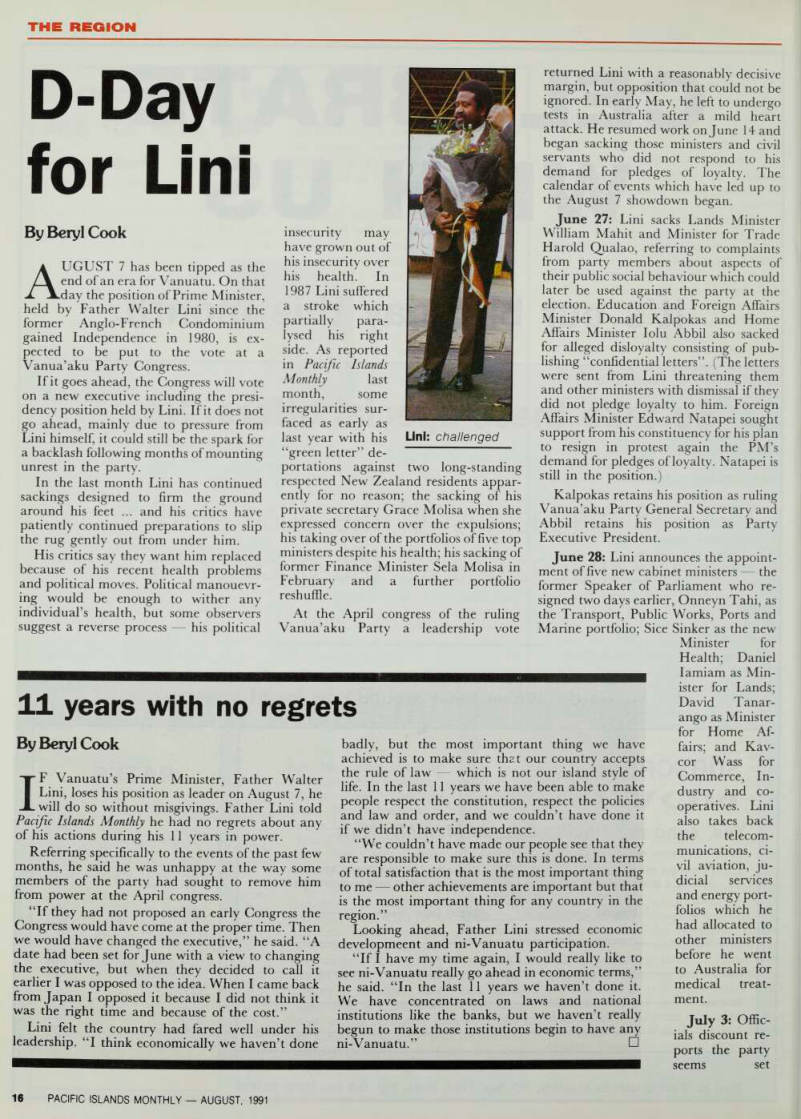
Lini: challenged
to drop Father Lini, saying the decision can only be made at a congress of members which is to be held in August.
Party officials say if Lini is deposed as party president, he could still remain Prime Minister until the elections be cause the holder of that post is elected by the Parliament.
July 3: The opposition Melanesian Progressive Party welcomes the sackings.
Party vice-president William Edgel says the Prime Minister should have taken the move after the 1987 general elections.
Edgel describes the sacked ministers and secretaries as stumbling blocks in negotiations between the Melanesian Progressive Party led by rebel politician Barak Sope and the Vanua’aku Party.
Both Edgel and Sope are former leading members of the Vanua’aku Party.
July 8: Lini’s critics suffer a setback when a meeting of the interim executive of the ruling Vanua’aku party has to be postponed because of lack of a quorum.
Only 14 of the 15 members needed are present with sacked Lands Minister William Mahit still in his constitutency explaining the reasons for his dismissal.
Under Vanua’aku Party rules, only a congress can depose Lini, who has held the position of party president since leading the country into independence in 1980. He is reported to be opposed to a congress with party officials saying it cannot take place without his presence.
July 10: Lini bans the state-run Radio Vanuatu from running a media state ment confirming a challenge to his party leadership. The edict is issued after the executive of the Vanua’aku Party en dorses holding the August 7 special congress to decide leadership positions, including that of president. Lini stated earlier that such a congress was uncon stitutional under Vanua’aku rules.
He unsuccessfully tries to suspend two of four ministers he had sacked for alleged disloyalty, Donald Kalpokas and lolu Abbil, from their party positions of secretary and vice-president.
According to a report in Vanuatu Weekly, the party’s executive resolved on July 10 that Lini’s move to suspend Kalpokas from the party post the day before is null and void.
The executive also backs Kalpokas’ stand that Lini has no right to suspend him only the party’s disciplinary committee and its congress has this authority. According to a statement from
the Vanua’aku Party, signed by
Kalpokas, the extra-ordinary congress at Mele village will elect members of the party’s new executive, including the presidency position held by Lini.
July 11: Speaking on Radio Vanuatu, Lini’s private secretary Shem Rarua reiterates Lini’s comments that it would
be too expensive for the party to hold a mini-congress, and that the Aneityum Congress in April had agreed on a congress on Emae.
July 12: The Party General Secretary, Donald Kalpokas, dismisses claims by Lini’s private secretary that the problem is caused by a power-hungry minority group. Kalpokas says in a radio broad cast that party leaders are elected by the people during Party congress meetings, so they can not be accused of being hungry for power.
He in turn accuses Lini’s private
secretary, Shem Rarua, of breaching party policies by
making public state
ments about the party. Kalpokas says according to party rules, only officebearers in the party executive could make public statements about
party policies,
whereas Rarua is only an ordinary member of the party executive.
The latest: Lini has sacked five senior ministers and re placed more than a dozen heads of de partments by his relatives and friends.
The number of pol itical appointees and civil servants who have been sacked has been estimated at 40, and rumours are rife in Port Vila that Lini’s offsiders are working on the mechanics to execute a hit list of 40 more, including the At torney General and his assistant, and the head of immigration.
Lini’s latest move has been to instruct delegates to stay away from next month’s congress, and that the party would not pay for subcommittees travelling ex penses from outer islands. The directive came in a message broadcast on July 29 by Radio Vanuatu. The radio’s director of media services said Lini also had ordered the radio not to report anything about the congress.
The Vanua’aku Party General Secre tary has acknowledged there is instability within the government and a crisis within the party but they, like most people, believe the right place to sort things out is at the August 7 congress.
Most of the expatriate community have taken their opinions underground, wary perhaps of the uncertain motives behind last year’s “green letters” deport ing two New Zealand citizens. A number of expatriates criticised outside media for covering the issue at all.
“It’s a problem in the party and that’s where it ought to be discussed. Journal ists shouldn’t go trying to whip up some action,” one said.
The ni-Vanuatu themselves are more willing to discuss the issue. But, custom arily polite, they also would rather wait
It is said Lini’s offsiders are working on a hit list of 40, including the Attorney General, his assistant, and the head of immigration
and see what the party decides rather than speculate about the identity of a new Prime Minister.
The general feeling is that Lini has served the country well in broad brushstroke terms and there is still a great deal of respect for his achievements, particularly at the grassroots level in outlying areas. But it may be that his own insecurities have goaded him into actions which, ironically, have eroded support for him staying in power. The general feeling in the streets and sidewalk cafes of Port Vila seems to be that, without malice, this could be the time for a change and a new era. □
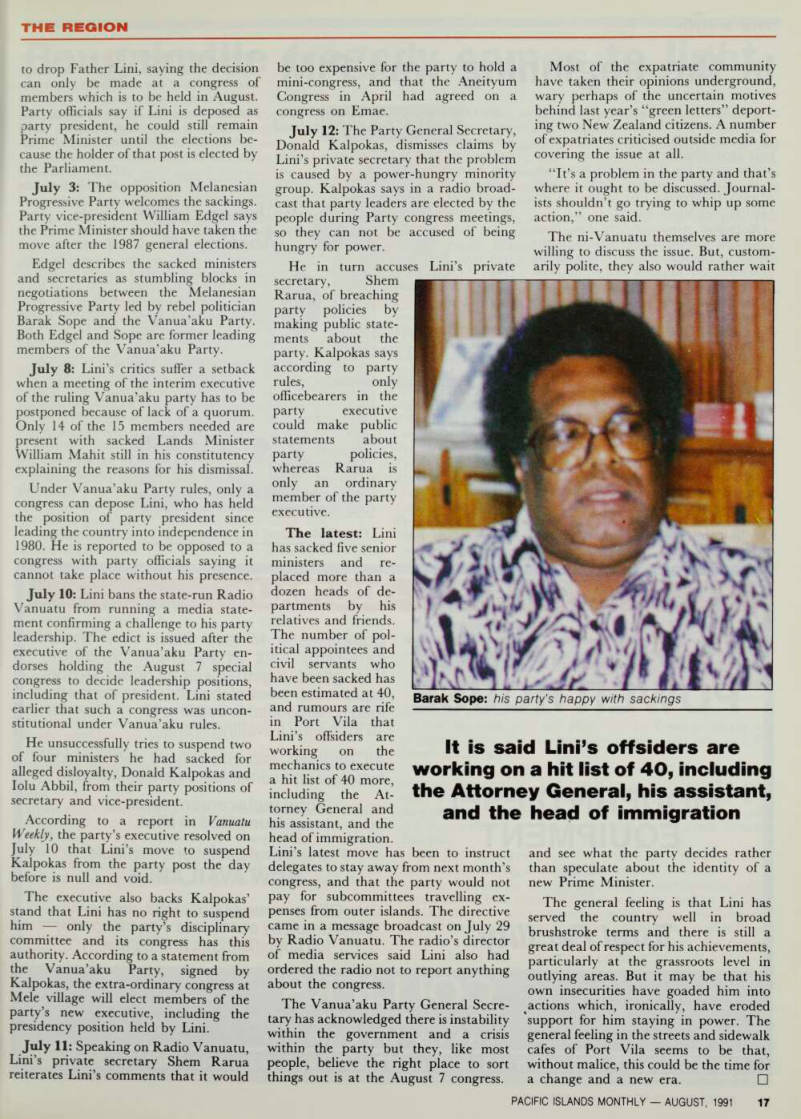
Barak Sope: his party's happy with sackings
11 years with no regrets
By Beryl Cook
IF Vanuatu’s Prime Minister, Father Walter Lini, loses his position as leader on August 7, he will do so without misgivings. Father Lini told Pacific Islands Monthly he had no regrets about any of his actions during his 11 years in power.
Referring specifically to the events of the past few months, he said he was unhappy at the way some members of the party had sought to remove him from power at the April congress.
“If they had not proposed an early Congress the Congress would have come at the proper time. Then we would have changed the executive,” he said. “A date had been set for June with a view to changing the executive, but when they decided to call it earlier I was opposed to the idea. When I came back from Japan I opposed it because I did not think it was the right time and because of the cost.”
Lini felt the country had fared well under his leadership. “I think economically we haven’t done
badly, but the most important thing we have achieved is to make sure that our country accepts the rule of law which is not our island style of life. In the last 11 years we have been able to make people respect the constitution, respect the policies and law and order, and we couldn’t have done it if we didn’t have independence.
“We couldn’t have made our people see that they are responsible to make sure this is done. In terms of total satisfaction that is the most important thing to me other achievements are important but that is the most important thing for any country in the
region.”
Looking ahead, Father Lini stressed economic
developmeent and ni-Vanuatu participation.
“If I have my time again, I would really like to see ni-Vanuatu really go ahead in economic terms,” he said. “In the last 11 years we haven’t done it.
We have concentrated on laws and national institutions like the banks, but we haven’t really begun to make those institutions begin to have any ni-Vanuatu.” □
In the beginning was PIM

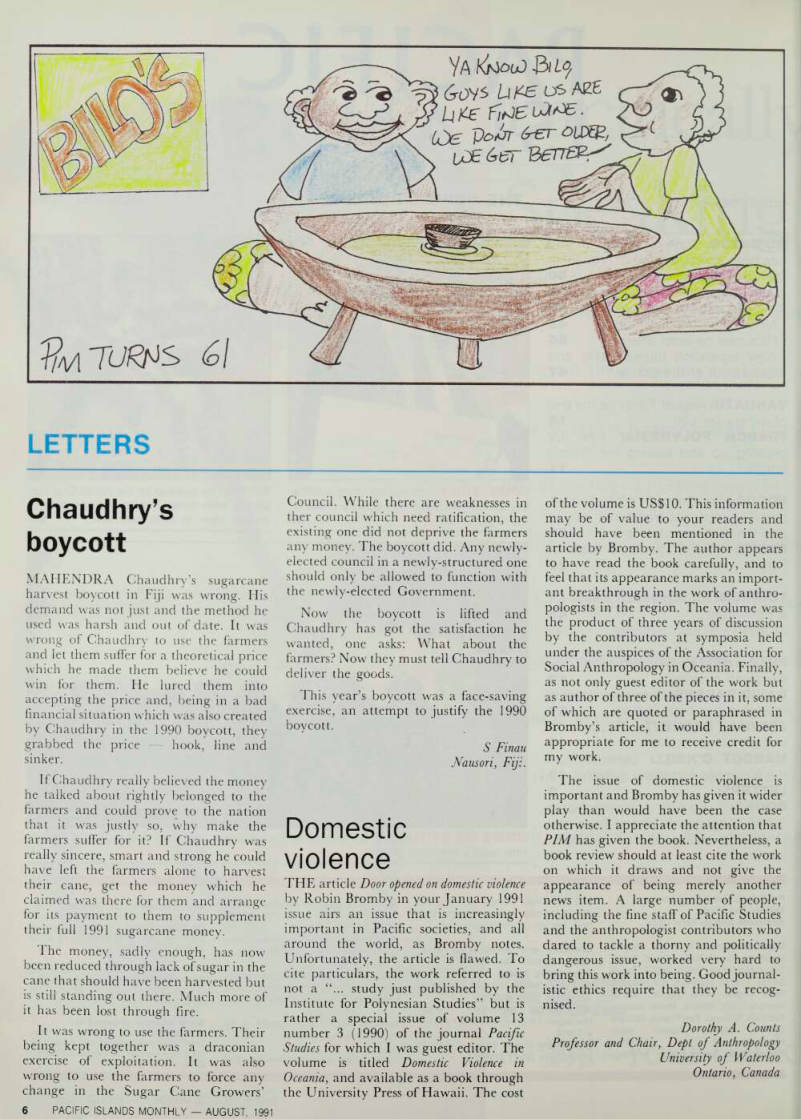
ACCORDING to media veteran Sir Leonard Usher, August 16, 1930, was the day South Pacific people began to rediscover their common origins and interests. On that day, 61 years ago, R.W. Robson founded Pacific Islands Monthly [PIM), the first journal in the Central and South Pacific.
A former editor of The Fiji Times (1958-73) and organising director of the Pacific Islands News Association (1974-85), Sir Leonard said in his book Mainly About Fiji : “A powerful new element was introduced into the 20th Century history of the South Pacific when the people of the various island nations rediscovered common origins and interests.”
He said: “It is not too fanciful to compare what happened to the 14th
Century Renaissance in Europe.”
Sir Leonard, 84, who came to Fiji from New Zealand in 1930, said island countries saw themselves as individuals, mainly due to colonial rule. PIM helped them reflect on their origins and common heritage, and fostered events including the South Pacific Games and the South Pacific Festival of Arts, and bodies including the South Pacific Commission.
Sir Leonard said Robson travelled the region constantly to build up a first-hand knowledge for PIM.
The first issue was a 12-page tabloid
size, newspaper-style
publication covering issues from trade to personality profiles.
On July 1, 1988, Fiji Times Limited took over PIM from News Limited in Sydney and moved
headquarters to
Suva. The first Suva published issue was August 1988 and editorial was trans ferred in June 1989.
At the time PlM’s
publisher Geoffrey
Hussey said; “Its new horizons will reach to the extremities of the Pa cific Rim and be yond. Now that it is in Fiji the “hub” of the Pacific Pa cific Islands Monthly is
better placed to offer broader and more up-to-the-moment editorial coverage and analysis of events and developments throughout the Pacific. We plan to broaden the scope of our coverage, too, with greater emphasis on business, travel and people, while maintaining the tra ditional editorial values that have made
Pacific Islands Monthly the most authoritative and reliable publi cation of Pacific affairs.”
Today Hussey believes those aims have been achieved, but that PIM will de velop and grow with the region.
It is the most widely read news
magazine exclus
ively covering the
Pacific Islands
and circulating
worldwide. He thanked readers, especially sub scribers outside the region, for their support. □.
First PIM: August 16, 1930
Advertisements & other items, p. 18 (1 item)
df
Bougainville tragedy comes to light
AS limited traffic again begins to flow to Papua New Guinea’s secessionist island of Bougain ville Australians are, for the first time, seeing the extent of the human tragedy created by the civil strife and the seven-month blockade by the national government.
Estimates suggest thousands of people have died of preventable diseases. With all services cut the 4000 children born since the blockade began in May 1990 have not been vaccinated.
Malaria, leprosy and yaws are on the increase and many women have died giving birth. The total blockade of the island meant there have been few medicines available and almost no petrol or transport. In some places people are reported to be short of clothes and other basic necessities.
Because of a lack of batteries to power their radios many people have lost contct with the outside world and, in the tense situation of standoff between the Bougainville Revolution
ary Army and the PNG Defence Force, have become prey to wild rumours which periodically sweep the island.
Schools and hospitals are now beginning to open again with volunteer labour but they are still without electricity.
Revelations of Bougainville’s plight, including a recent ABC Television Four Corners program documenting human rights abuses by the PNG army, have intensified demands on the Australian government for humanitarian assistance.
For almost a year a consortium of non-government aid and church organisations (NGO’s) has been pressing the federal government for action to alleviate the human suffering on our doorstep. Since the lifting of the blockade the delicate task of negotiating entry to Bougainville has become somewhat easier and the Australian government has contributed over a quarter of a million dollars to the NGO’s relief efforts.
Along with the International Red Cross the consortium is the only group to have gained the approval of both the PNG government and the Bougainville Revolutionary Army for their activities. Until now the burden of relief efforts has been taken by the Solomon Islands Christian Association, an ecumenical organisation which has arranged for desperately needed medicines to be smuggled into Bougainville through Solomon Islands’ neighbouring Western Province.
Many Australians feel Australia, with big commercial interests on Bougainville and its SASO million a year defence aid to PNG, is partly responsible for the Bougainvilleans’
plight.
In the Four Corners program Blood on the Bougainvillea screened at the end of June Colonel Lee Nuia, the Commander of the PNG Defence Force responsible for Bougainville, confirmed claims that Australian supplied helicopters had been used as gunships to strafe villages on Bougainville and that one had been used to dump the bodies of six executed Bougainvilleans at sea.
The Colonel also confirmed reports that it was the PNG Defence Force which was responsible for the executions. The six victims, of what has now become known as the St Valentine’s Day massacre, included a United Church Pastor.
Until the Four Corners interview Colonel Nuia had told the PNG government that he had been unable to find evidence that the massacre took place.
In PNG the revelations led to the sacking of Colonel Nuia as Bougainville Commander. In Australia they renewed questions over Australia’s military aid program to PNG.
Western Australian Green’s Senator Jo Valentine called for
the scraping of Australia’s entire Defence Co
operation Program.
Instead of channelling military aid to fuel PNG’s internal crisis, Senator Valentine said, “Australia should be developing regional forums and training programmes to use negotiation and mediation skills to resolve conflict.”
Its a sobering fact that over the past year Australia’s military aid to PNG increased by around 30 per cent. Like Senator Valentine, many Australians see that simply as fuel for the fire.
The Australian chapter of Amnesty Interna tional has asked the Australian government to ensure that any further military aid cannot be used to violate human rights and has called for legislation which would specifically prohibit transfers which might contribute to human rights violations.
Despite the reaction to the Four Comers program there has overall been little debate over
Australia’s response to the Bougainville crisis.
While literally thousands of hours of television and radio have been given over to Australia’s role in the gulf war, the plight of the kurds or the Bangladeshi flood victims, very little time has been given to Bougainville.
Although the Bougainville crisis is clearly not on the same scale, one would have thought that given Bougainville’s proximity to Australia, PNG’s strategic importance and the fact that the secessionist rebellion was re-ignited by the activities of an Australian company mining on the copper rich island, there would have been more public comment.
So why the silence?
Certainly one reason is the lack of television footage showing
the plight of Bougainvilleans.
Viewers in Australia watched every shocking detail of the Kurds flight from Saddam Hussein’s Iraq, they saw old people and babies dying in their loved ones’ arms in the freezing and filthy conditions in the camps high in the mountains on the Turkish border.
The response was huge public concern and generous donations to relief funds.
Over the past year the plight of the Bougainvilleans has prompted just a few television news items and only two TV
documentary pieces.
Undoubtedly the blockade, which banned journalists from entering Bougainville, had much to do with that. For more than six months not one journalist went to Bougainville. Even then reports on conditions on the island were only heard after a few reporters crept in through Solomon Islands Western Province.
The lack of coverage is also a reflection of the priorities of Australian news organisations and editors.
While editors are prepared to follow international media organisations into detailed coverage of the politics of other regions, they are not prepared to strike out on their own and provide similar coverage of our near and important neighbours.
Costs and difficulties getting the necessary government approvals are only part of thee problem.
The other is editors’ perceptions. Many see Papua New Guinea’s complex politics as impenetrable and Australia’s relations with PNG as little more than a hangover of the past.
Perhaps it is time Australia’s media organisations plucked up the courage to break away from the herd mentality and look seriously and sympathetically at the difficult decisions being made in PNG. □
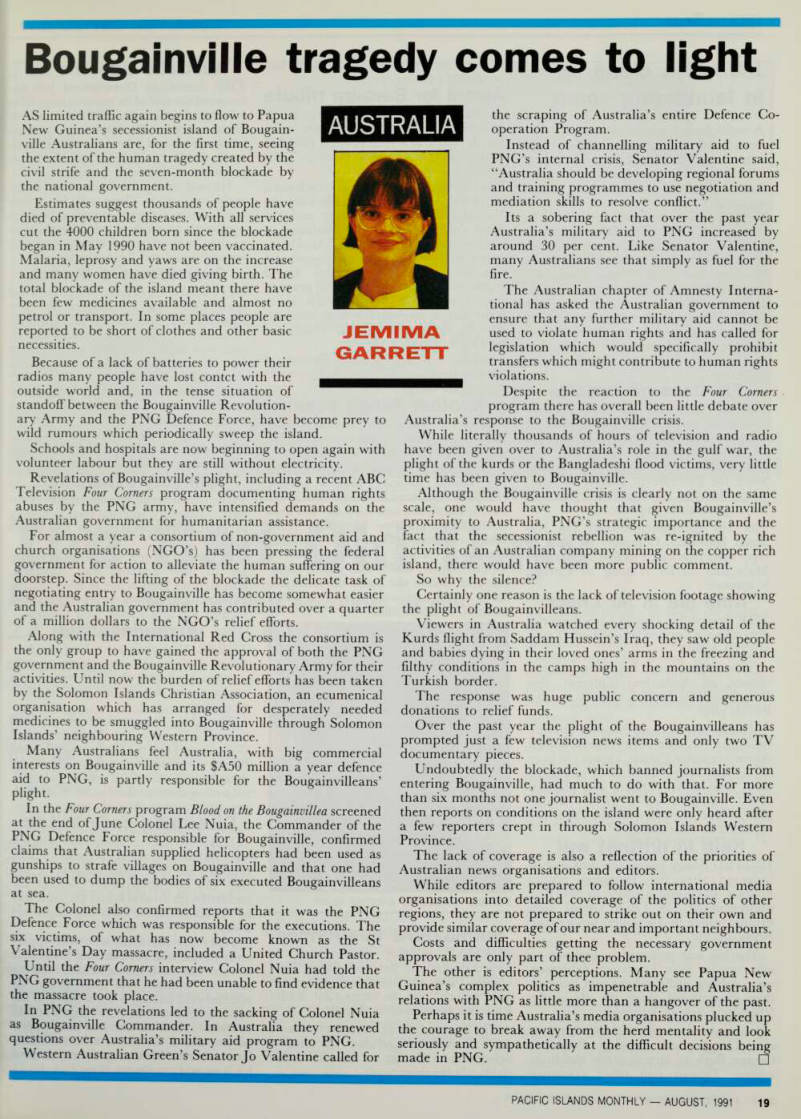
Australia
Jemima
Garrett
Fiji bans oil imports
Headlines
Jailmates clean up in laundering scam
A confidential prison report says two inmates of an Australian jail have been organising the laundering of about US$lOO million of counterfeit notes from Kuwait and Pacific Island countries.
The prisoners at the minimum security Monwell River Prison, 150 km south east of Melbourne, used a telephone in the jail to operate the trade in fake US currency.
The contents of the report have been confirmed by the Director General of Prisons in the state of Victoria John Griffin. He said the money was coming into the country via Sydney from Kuwait and the Pacific Islands and the plan was to swap the fake notes for Australian currency.
Fiji bans oil imports
FIJI has banned oil and petrol imports, backdated to July 4, in preparation for a supply deal with Malaysia. Last month the three oil companies in Fiji, BP, Shell and Mobil, were caught by surprise when the government gazette included oil products in the Customs regulations list of prohibited imports.
The Fiji government-owned Fiji Na tional Petroleum Company on June 30 reportedly purchased its first shipment of Malaysian oil for refining by Esso in
Singapore.
Nine die in air crash
THE nine people aboard a small aircraft died when it crashed in northern Vanu atu last month.
Those killed were four Vanuatu na tionals, an Australian diplomat, two Frenchmen, an English women and the
British pilot.
The British Norman Islander aircraft, belonging to the Government-owned domestic carrier Vanair, appears to have hit a Banyan tree soon after taking off from West Coast Airfield, and plunged 20-30 metres down a gully. Investi gations into the cause of the crash are expected to start shortly.
Help in driftnet war
UNITED States lawmakers last month proposed that the Pentagon supply military ships and aircraft to help the undermanned US Coast Guard stop driftnet fishing by Taiwanese boats in the North Pacific.
The bill was proposed in response to new reports that Taiwanese fishermen were defying driftnet bans and lying to their government about the use of the 50km-long nets in forbidden zones.
Lawmakers in Alaska, Washington and Oregon are pressing President George Bush to impose trade sanctions against Taiwan and other countries
whose fishermen continue to defy the ban on driftnet fishing.
Award for Bavadra tribute
A NEW book about peace, social, environmental and political issues in the South Pacific is among projects awarded grants by the Rainbow Warrior Trust Fund.
The largest grants of US$6OOO each went to several groups, including the Vanuatu National Council of Women and the New Zealand Rainforest Coalition to develop resource materials. Auckland based Asia-Pacific Network, owned and run by prominent journalist David Robie, was awarded a US$2OOO grant to help complete a book written by a collection of nuclear free and indepen dent Pacific activists from the Phillipines to Tahiti.
The book is dedicated to the memory of the late deposed Fiji Prime Minister, Dr Timoci Bavadra.
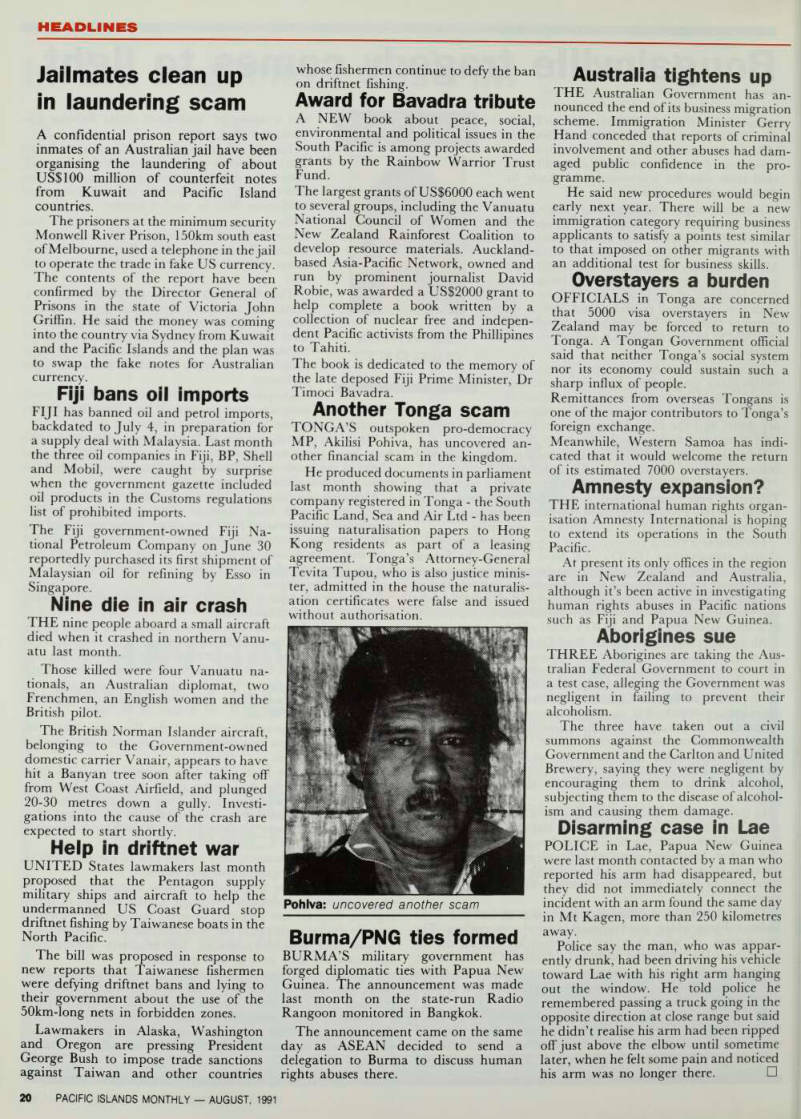
Another Tonga scam
TONGA’S outspoken pro-democracy
MP, Akilisi Pohiva, has uncovered an other financial scam in the kingdom.
He produced documents in parliament last month showing that a private company registered in Tonga - the South Pacific Land, Sea and Air Ltd - has been issuing naturalisation papers to Hong Kong residents as part of a leasing
agreement. Tonga’s Attorney-General
Tevita Tupou, who is also justice minis ter, admitted in the house the naturalis ation certificates were false and issued without authorisation.
Burma/PNG ties formed
BURMA’S military government has forged diplomatic ties with Papua New Guinea. The announcement was made last month on the state-run Radio Rangoon monitored in Bangkok.
The announcement came on the same day as ASEAN decided to send a delegation to Burma to discuss human rights abuses there.
Australia tightens up
THE Australian Government has an nounced the end of its business migration scheme. Immigration Minister Gerry Hand conceded that reports of criminal involvement and other abuses had dam aged public confidence in the pro gramme.
He said new procedures would begin early next year. There will be a new
immigration category requiring business
applicants to satisfy a points test similar to that imposed on other migrants with an additional test for business skills.
Overstayers a burden
OFFICIALS in Tonga are concerned that 5000 visa overstayers in New Zealand may be forced to return to Tonga. A Tongan Government official said that neither Tonga’s social system nor its economy could sustain such a sharp influx of people.
Remittances from overseas Tongans is one of the major contributors to Tonga’s
foreign exchange.
Meanwhile, Western Samoa has indi cated that it would welcome the return of its estimated 7000 overstayers.
Amnesty expansion?
THE international human rights organ isation Amnesty International is hoping to extend its operations in the South Pacific.
At present its only offices in the region are in New Zealand and Australia, although it’s been active in investigating human rights abuses in Pacific nations such as Fiji and Papua New Guinea.
Aborigines sue
THREE Aborigines are taking the Aus tralian Federal Government to court in a test case, alleging the Government was negligent in failing to prevent their alcoholism.
The three have taken out a civil summons against the Commonwealth Government and the Carlton and United Brewery, saying they were negligent by encouraging them to drink alcohol, subjecting them to the disease of alcohol ism and causing them damage.
Disarming case in Lae
POLICE in Lae, Papua New Guinea were last month contacted by a man who reported his arm had disappeared, but they did not immediately connect the incident with an arm found the same day in Mt Kagen, more than 250 kilometres away.
Police say the man, who was appar ently drunk, had been driving his vehicle toward Lae with his right arm hanging out the window. He told police he remembered passing a truck going in the opposite direction at close range but said he didn’t realise his arm had been ripped off just above the elbow until sometime later, when he felt some pain and noticed his arm was no longer there. □
Pohiva: uncovered another scam
The Bad Old Days
The United Nations
A new book tells chilling accounts of why 2.4 million people will die from nuclear tests
By Ian Williams
United Nations correspondent
IF the first casualty of war is truth, then the first casualty of nu clear weapons seems to be the conscience of their possessors.
This principle is demonstrated in Radioactive Heaven and Earth , a book published in May just as France exploded three more bombs in French Polynesia. The book estimates that some 2.4 million people (430,000 of them by the end of this century), will die as a result of radioactivity unleashed by the 1900 nuclear tests which have taken place since the first atom bomb lit the skies over Alamagordo in 1945.
For 45 years, the nuclear powers have waged a relentless war against our environment, averaging an explosion a week. They have exploded bombs in space, in the air, underwater, under ground, and on the surface littering the
environment with long-lasting carcino gens like plutonium-239 which has a half life of 24,000 years.
The book details the cavalier attitude taken by nuclear powers towards their own personnel. Servicemen were sent unproteected into highly radioactive areas to clean up. Aircrew were ordered to fly through the mushroom clouds, infantry to march towards ground zero, and sailors to stand on deck with their backs to the explosion. The degree of their exposuree was concealed through a mixture of negligence and obsessive secrecy.
It is hardly surprising that govern ments so casual with the lives of their own citizens were uncaring about the welfare of people like Australian Aborigines and Pacific Islanders who lived in the vicin ity. In 1982, even a United Nations report on the effect of radiation did not take into account local fall out “as tests have generally been conducted in iso lated areas”.
A pity about the “isolated” inhabi
tants of regions like the Pacific, which has the dubious honour of being the site for the most wide-ranging tests; the 1.2 megatons exploded in space above Johnston Atoll, the several very “dirty” underwater tests; the largest US test, Bravo weighing in at 15 megatons; the continuing French underground tests at Moruroa Atoll.
In all, the US exploded 106 bombs in the Pacific because of what a priceless memo for the Army Chief of Staff in 1949 referred to as “an unhealthy, dangerous and unjustified fear of atomic deton ations” at home. The US has now exploded no fewer than 814 bombs in Nevada, 700 of them underground. It exploded over a hundred, mostly tacti cal, bombs in the atmosphere there, even though prevailing westerly winds en sured that the fallout would spread over much of the country. Indeed it did, causing one ferocious hot spot as far away as Albany, New York, where in 1954 a thunderstorm intersected the high flying fallout cloud.
Working on the NIMBY (not in my back yard) principle, the US has decided to test its really big weapons in the Marshall Islands. The fact that as a “strategic trust territory”, it was under unfettered US control meant it was chosen even though it also “did
Victims: The Rainbow Worrior evacuates irradicated Islanders from Rongelap Atoll, Marshall Islands, In 1985
not meet the meteorogical require ments”. As a result, instead of being dispersed, the radioactive debris from the explosions came back to haunt both the personnel at the site and the local inhabitants. During the Bravo test, the islanders on Rongelap thought that the fallout was snow, and their children went out to play in it.
In 1956, an Atomic Energy Official noted that the people in the Northern Marshall Islands provided a unique research opportunity because the area “is by far one of the most contaminated in the world”, and “while it is true that these people do not live, I would say, the way the Westerners do, civilised people, it is nevertheless true that they are now more like us than mice”.
After being returned, no less than 19 of the 22 exposed “uncivilsed” children of Rongelap have since had nodules surgically removed from their thyroids.
It is not over yet, the monitoring of the health of the islanders is now adminis tered under Safeguard C, which, the authors point out, is a continuing programme to retain the capability for surface testing if the Partial Test Ban Treaty ever breaks down. It is now responsible for monitoring the health of the islanders of Rongelap.
Another exclusively Pacific problem
the book highlights is Ciguatera poison
ing a serious ailment which, it suggests, is caused by the destruction of reefs, both by the explosions themselves, and the associated construction damage.
Once kicked out of Algeria, the French moved to the Pacific, where they have now exploded about 170 bombs, to the chagrin of all those who live in the region. France seems to have had predilection for exploding bombs despite adverse weather reports because of the presence of VIPs. For example, in 1966, the Betelguese test went ahead despite weather reports, because De Gaulle had
to come to see-grandeur in action. The cost of his good impressions was paid the following day in Samoa, where beta activity rose almost 200,000 per cent as a result.
And of course, eloquently symbolic of the amorality induced in the testers was the sabotage by French tests was the sabotage by French agents of the Green peace boat Rainbow Warrior.
The British picked on Malden Island and Kirimati (Christmas) Island in what is now Kiribati, because it was far away from anyone with a voice or a vote. They tested nine British bombs, and allowed the US to test a further 24 there. Malden was uninhabited, but the inhabitants of Kirimati were taken olfshore while the bombs went off, and returned immedi ately afterwards. “Evacuation was thought unnecessary” during the later US tests, which included underwater detonations, but many islanders had the good sense to leave anyway.
Almost 100 Fijian servicemen took part in the tests, and their leader, Ratu Inoke Bainimarama, is quoted as saying the men had been given “name tags and
numbers to hang around their necks in case they were killed during the ex
plosion.”
While the Western Powers were re sponsible for much of the effects in the Pacific, their overall insouciance was shared by other nuclear powers. A commission in the USSR reported locals who were told to stay in the vicinity of the tests, and afterwards given a check up and “some vodka as protection against radiation” while a Chinese offic ial has admitted that “a few deaths have occurred” as a result of their test programme.
The book is deadpan, quoting official sources wherever possible. It lets the enormities speak themselves and leaves readers to decide themselves how out raged they should be. It is profoundly chilling that regardless of political sys tem, the people who made these de cisions, who continue to hide their effects, are not escaped characters from Doctor Strangelove. They are real people, who would be appalled if they accidentally ran over a dog, but saw no serious problems in encompassing the deaths of hundreds of thousands of people, includ ing many of their own citizens. □
To be or not to be
SHOULD Pitcairn, Palau, Tokelau, Guam and American Samoa be indepen dent? That was the question raised at the
United Nation’s Decolonization sub committee on small territories when it met during May and June.
Unnoticed by most of the world, this is the International Decade for the Eradication of Colonialism. The work is in the hands of the Special Committee set up as a result of the 1960 UN Declaration on Decolonization (It actually has 25 mem bers now since Papua New Guinea joined). However, most of the 18 remain ing colonies are seen by many as minute and marginal. Ranging from Pitcairn to New Caledonia, between them, they can muster 1.5 million people.
The Western powers have seen the committee as a place where political hobby horses are put through their places in public. Each year resolutions would appear asserting the “inalienable rights,” to self determination of tiny territories which had evinced no such interest themselves. Last year for example, a
Minister from the British Virgin Islands asserted that they “would not be bullied, provoked, coerced or sweetmouthed into
independence”.
The sub-committee on small territories is now the busiest part of the Special Committee, and deals with places like Pitcairn Island, where 48 descendants of the mutineers from the Bounty live under the light hand of the British Governor who is based several thousand miles in New Zealand, where he doubles up as British Envoy to Auckland. In May a petitioner from Puerto Rico pushed their case for independence without a mandate from the islanders themselves.
In the case of American Samoa, American representative Shirin Tahir- Kheli told the committee that “Ameri can Samoa is proud to be under the American Flag and wishes to continue”, pointing out that 500 soldiers from the territory had fought in the Gulf. In addition federal grants to the territory had totalled USSBO million. Despite an intensive grilling by the Cuban delegate, there was no one from the territory to refute the US’s claims of satisfaction.
In May, a Chamorro, Hope Cristobal,
for the Organisation of People for Indigenous Rights, petitioned for recog nition of Guam’s right to independence.
A few years ago, her arguments might have appeared almost as pointless as the Pitcairn petitioner’s, but as Guam weighs the benefits of Japanese tourism against landhungry US bases, her points may be taken more seriously.
She complained that the “Guam Commonwealth Act was a document based on the choice of all US citizens including the military and their depen dents stationed in the territory. She compared the state of the Chamorros with that of the American Indians, and Eskimos, claiming that whereas Guam’s population was 90 per cent indigenous in 1940, it has since shrunk to about half, while she welcomed the Act’s involve ment of the Chamorros in their own affairs, she said it was only “a significant prelude” to the eventual exercise of self determination.
She asked for the committee to continue its annual reviews of the status of Guam since the US government finds objectionable the Chamorro self determi nation and mutual consent provision of the Commonwealth Act. She claimed there would be significant resistance by the Chamorros to any attempt to water down these provisions in the US Con gress.
As the Palauans, the last remaining clients of the Trusteeship Council, have demonstrated, having an international forum to vent ones problems, is indeed an effective way to press the administering powers for a better deal.
It is cases like these which make Norway feel there is a genuine role for it.
Its representative, Hans Lehne, has been instrumental in steering through sugges tions to reduce what some see as the ritualistic aspect of the committee’s work.
“I think the committee has lost a lot of its credibility in the last four years, because of extraneous matters being brought in like the Israeli occupied territories, and apartheid”, he told Pacific Islands Monthly. “Apart from that, I think that there is a real potential for the committee to do a good job, if it reforms itself. It may appear like a ritual to some, but is is very important to some of the people of these territories.” His suggestions, now adopted, call for one omnibus resolution to go from the committee, rather than the long series of
separate, repetitive resolutions which have traditionally cluttered the agenda of the General Assembly.
He has been supported in his reform efforts by Ambassador Renagi Lohia, of Papua New Guinea, who vigorously defends the Committee’s work on small territories . “ If the Pi tC airners are happy, they should say so, and we can take them D ff the list. The list is of territories where t here has not been a referendum on the
options, independence, association, or
integration, a decision has to be taken.”
The first draft omnibus resolution on a p the territories calls for self determi nation by the year 2000. With intrac table problems like East Timor and the Falklands, let alone New Caledonia, on its books, few expect the committee’s work to be completely finished by the end of the century! □
Advertisements & other items, p. 22 (1 item)
To Anywhere In The World
•ail'
Call us no* SUVM 313166 313149 Your artifacts, gifts, souvenirs, carvings, artworks, documents whatever.
DHL will deliver anywhere worldwide Freight Forwarders. Air Cargo DHL Worldwide Express Service
NADI LAUTDKA LABASA
73800 65400 65401 Si 162 with DHL "You're m safe hands all Che way" wontowKX expftess*
$10m boost for the environment
By Ian Williams
SPREP, the South Pa cific Regional Envir onmental Programme, is to get a USSIO
million boost from UNDP, the United Nations Development Programme. Be ginning in August/September, the grant from the organisation’s Global Environ mental Facility is targeted at identifying and establishing conservation areas in South Pacific countries.
Among proposed sites to be surveyed are Lake Lanatoo and Mt Silisili, in Samoa; Ambye, Ambryn and Malekula islands, Vanuatu; and Babeldaup in Palau. In Fiji, Taveuni and Sovi Basin and marine areas around Yadua Taba are proposed for surveying.
In addition the funding will be used to help existing and planned biodiversity conservation programmes such as for estry seed banks, marine turtle pro
grammes and bird conservation areas, and to boost the regions’s awareness of the need for conservation. There are serious weaknesses in research on ecosystems in the South Pacific and in the identification and classification of its marine species. The programme includes eight internships for local scientists to gain expertise in these areas.
Justifying the large allocation, UNDP point out that 75 per cent of the mammal and bird species to become extinct in recent years were island dwellers. A change of habitat through tourism, forestry or mining, or the introduction of predators can devastate an island’s fauna within weeks or months, eliminating species “that help maintain the stability of island ecosystems which provide the water suppliers, soils and land on which human survival depends.”
It stresses that the Conservation Areas will not be “national parks” taken out of normal use. They will be areas “in which
sustainable development practices are
undertaken which respect and enhance critical habitats, while providing for the economic well-being of the local land owners and communities”. It adds that the unique patterns of customary owner ship of land and marine resources call for close co-operation with rural communi ties if conservation is to work.
Natsuki Haratsuki from UNDP ident ified two key issues for success. “It will depend on the governments harmonising biodiversity with economic development
objectives.
“The key aspects will be what income generating schemes can be established to take advantage of the Conservation Areas in the short term, and in the long term, by fostering public appreciation of the need for biodiversity.”
Papua New Guinea will not benefit from this project. “There is a specific project for PNG which will be closely linked to this. Papua New Guinea already has the Forest Action Plan and other initiatives, and it will soon have its own Global Environment Facility allo cation,” says Hiratsuka. □
Advertisements & other items, pp. 23-24 (1 item)
Research and Visiting Fellow Programme for 1992
Macmillan Brown Centre for Pacific Studies
University of Canterbury
Research and Visiting Fellow Programme for 1992 The Centre invites applications from those interested in its Research and Visiting Fellows programme for 1992. Successful Applicants will be selected on the relevance of their interests to the Centre’s activities. Applicants without conventional qualifications will be considered on the basis of experience and research interest. The closing date for applications is 30 September 1991. For more information about the Centre’s research programme and Fellowships please write to: The Director Macmillan Brown Centre for Pacific Studies University of Canterbury Private Bag Christchurch 1, New Zealand
WITH US
It’s our birthday this month.
So take these special offers. Now.
15 magazines for the price of 12 32 magazines for the price of 24 This offer ends on August 31 No other news magazine covers the Pacific like we do. We’ve been around now for 61 years.
SUBSCRIBE
NOW!
Yes, send me Pacific Islands Monthly. Now.
Please lick one box only jEE 15 months for the price of 12 EH 32months for the price of 24 Here is a cheque/money order EE Debit my credit card, indicated below EE Visa EE Master Card Expiry Date Card Number Name Signature Address
RATES
Post to; Pacific Islands Monthly, PO Box 1167, Suva, Fiji. OR fax; (679) 303809
Samoan
Sports
Samoan shredders
FOR Western Samoa there will be no pot of gold at the end of the rainbow. The reward they seek at October’s rugby World Cup is recog nition. At the end of the day they simply want to be known as the best rugby union team in the Pacific Islands.
The best, they are. Earlier this year they soundly beat Fiji and Tonga to win the Pacific Three Nations championship.
After a successful tour of New Zealand in May, they went to Australia last month and hammered the Barbarians 36-24 in Sydney on the 25th. Even though they were beaten 31-15 by Australian Capital Territory five days later, they outscored ACT four tries to two and led 10-3 at halftime.
“To me they look ripe and ready to perform at the World Cup,” said former Argentine and Wallaby test player Topo Rodriguez. “They are very fit, very fast and strong, the backrow is superb.”
Western Samoa’s success is due mainly to the presence of New Zealand-based players brought back especially for the country’s first participation in the World
Cup.
Success, however, continues to elude the Pacific Islands’ only other World
Cup entrant Fiji. With time running
out very fast, the once mighty Fijians were still having too much worries last month trying to sort out too few chances.
A World Cup squad was to have been named on July 21 after nearly 20,000 people watched England hammer Fiji 28-12 in Suva. But there was no squad by the end of the month.
England went on to Australia and got thumped 40-15 by the Wallabies who also beat Wales 63-6.
Fiji play France, Canada and Ro mania in the World Cup. Western Samoa, now expected to put up a better showing than Fiji, play Australia, Argen tina and Wales. And Rodriguez believes that the Samoans will trouble Australia and scare the life out of Argentina and
down-at-heel Wales.
Against the Australian Barbarians, Western Samoa came back from 13-15 down at halftime and 16-24 shortly after against a classy Barbarian team to dominate the second half. And a measure of their exciting and effective style was the two tries apiece to wingers Timo Tagalo, a former US college American football player, and Brian Lima.
“I would say they are a 30-point better side than Wales,” said Rodriguez Rodriguez was especially taken with the athleticism of back rowers Apollo Perelini and Par Lam, who cut the Barbarian defence to shreds with some tremendous charges. The team, superbly led from the front by All Black triallist Pita Fatialofa, comprises almost half New Zealand-based players, most with provincial experience. It showed. □
Talat Mehmood
World Cup trail: Fiji runs against England in Suva. England won 28-12
Advertisements & other items, p. 25 (1 item)
B" Hie South Sea Digest
Q|J|Q OWNERS
onir BUILDERS
QUALITY ASSURANCE
ANYWHERE • ANYTIME
JACK BARRETT & ASSOCIATES
MARINE CONSULTANTS
RICK JAMES
NAVAL ARCHITECT WILL PROVIDE
THESE SERVICES:
Small Ship, Tug & Barge Design Ship Construction Supervision Ship Repair Supervision Machinery Evaluation & Selection Surveys & Damage reports Valuations Transport Studies.
QUALITY ASSURANCE
at rates which will appeal to any ship-owner For further information contact & Australia 4103 Phone/ Fax International (61) (7) 891 5981 PO Box 1 Annerley Brisbane
B" Hie South Sea Digest
The Newsletter on Islands Affairs. Every Other Friday South Sea Digest has all the latest business news, expertly streamlined and obtainable nowhere else.
Subscriptions: 25 issues SAISO for Australian subscriber; Asl7s overseas, all airmailed. Payment by cheque in A$ and US$, otherwise by bank draft.
Ssnd payment to: The South Sea Digest, GPO Box 4245, Sydney, NSW 2001, Australia.
Name Address
The Fist of Fury
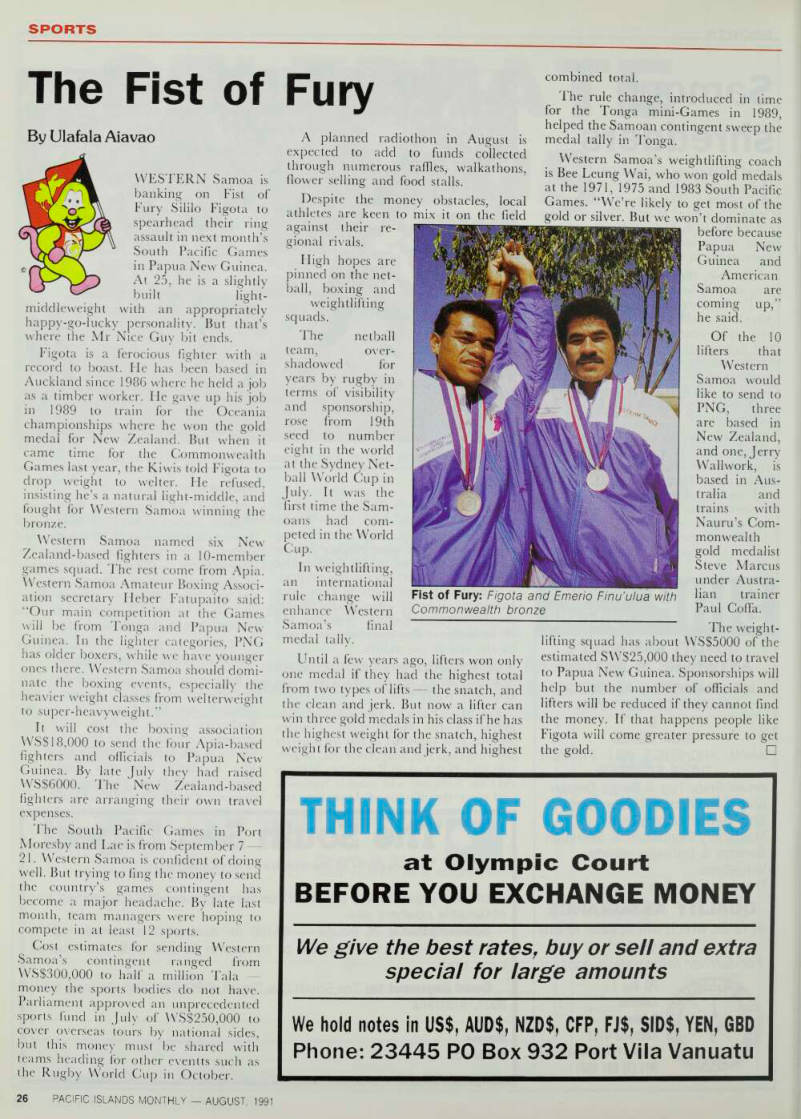
By Ulafala Aiavao
WESTERN Samoa is banking on Fist of Fury Sililo Figota to spearhead their ring assault in next month’s South Pacific Games in Papua New Guinea.
At 25, he is a slightly built light
middleweight with an appropriately happy-go-lucky personality. But that’s where the Mr Nice Guy bit ends.
Figota is a ferocious fighter with a record to boast. He has been based in Auckland since 1986 where he held a job as a timber worker. He gave up his job in 1989 to train for the Oceania championships where he won the gold medal for New Zealand. But when it came time for the Commonwealth Games last year, the Kiwis told Figota to drop weight to welter. He refused, insisting he’s a natural light-middle, and fought for Western Samoa winning the bronze.
Western Samoa named six New Zealand-based fighters in a 10-member games squad. The rest come from Apia, Western Samoa Amateur Boxing Associ ation secretary Heber Fatupaito said: “Our main competition at the Games will be from Tonga and Papua New Guinea. In the lighter categories, PNG has older boxers, while we have younger ones there. Western Samoa should domi nate the boxing events, especially the heavier weight classes from welterweight
to super-heavyweight.”
It will cost the boxing association WSS 18,000 to send the four Apia-based fighters and officials to Papua New Guinea, By late July they had raised WSS6OOO. The New Zealand-based fighters are arranging their own travel expenses.
The South Pacific Games in Port Moresby and Lae is from September 7 21. Western Samoa is confident of doing well. But trying to fing the money to send the country’s games contingent has become a major headache. By late last month, team managers were hoping to compete in at least 12 sports.
Cost estimates for sending Western Samoa’s contingent ranged from WSS3OO,OOO to half a million Tala money the sports bodies do not have.
Parliament approved an unprecedented sports fund in July of W 55250,000 to cover overseas tours by national sides, but this money must be shared with teams heading for other cventts such as the Rugby World Cup in October.
A planned radiothon in August is expected to add to funds collected through numerous rallies, walkathons, flower selling and food stalls.
Despite the money obstacles, local athletes are keen to mix it on the field
against their re gional rivals.
High hopes are pinned on the net ball, boxing and
weightlifting
squads.
The netball team, over shadowed for years by rugby in terms of visibility and sponsorship, rose from 19th seed to number eight in the world at the Sydney Net ball World Cup in July. It was the first time the Sam oans had com peted in the World
Cup.
In weightlifting, an international rule change will enhance Western Samoa’s final medal tally.
Until a few years ago, lifters won only one medal if they had the highest total from two types of lifts the snatch, and the clean and jerk. But now a lifter can win three gold medals in his class if he has the highest weight for the snatch, highest weight for the clean and jerk, and highest
combined total.
The rule change, introduced in time for the Tonga mini-Games in 1989, helped the Samoan contingent sweep the medal tally in Tonga.
Western Samoa’s weightlifting coach is Bee Leung Wai, who won gold medals at the 1971, 1975 and 1983 South Pacific Games. “We’re likely to get most of the gold or silver. But we won’t dominate as
before because Papua New Guinea and American Samoa are coming up,” he said.
Of the 10 lifters that W estern Samoa would like to send to PNG, three are based in New Zealand, and one, Jerry Wallwork, is based in Aus tralia and trains with Nauru’s Com monwealth gold medalist Steve Marcus under Austra lian trainer Paul Coffa.
The weight-
lifting squad has about WSSSOOO of the estimated 5W525,000 they need to travel to Papua New Guinea. Sponsorships will help but the number of officials and lifters will be reduced if they cannot find the money. If that happens people like Figota will come greater pressure to get the gold. □
Fist of Fury: Figota and Emerio Finu'ulua with Commonwealth bronze
Advertisements & other items, p. 26 (1 item)
Think Of Goodies
at Olympic Court
BEFORE YOU EXCHANGE MONEY
We give the best rates, buy or sell and extra special for large amounts We hold notes in US$, AUDI, NZDI, CFP, FJ$, SIDI, YEN, GBD Phone: 23445 PO Box 932 Port Vila Vanuatu
When visitors are not welcome
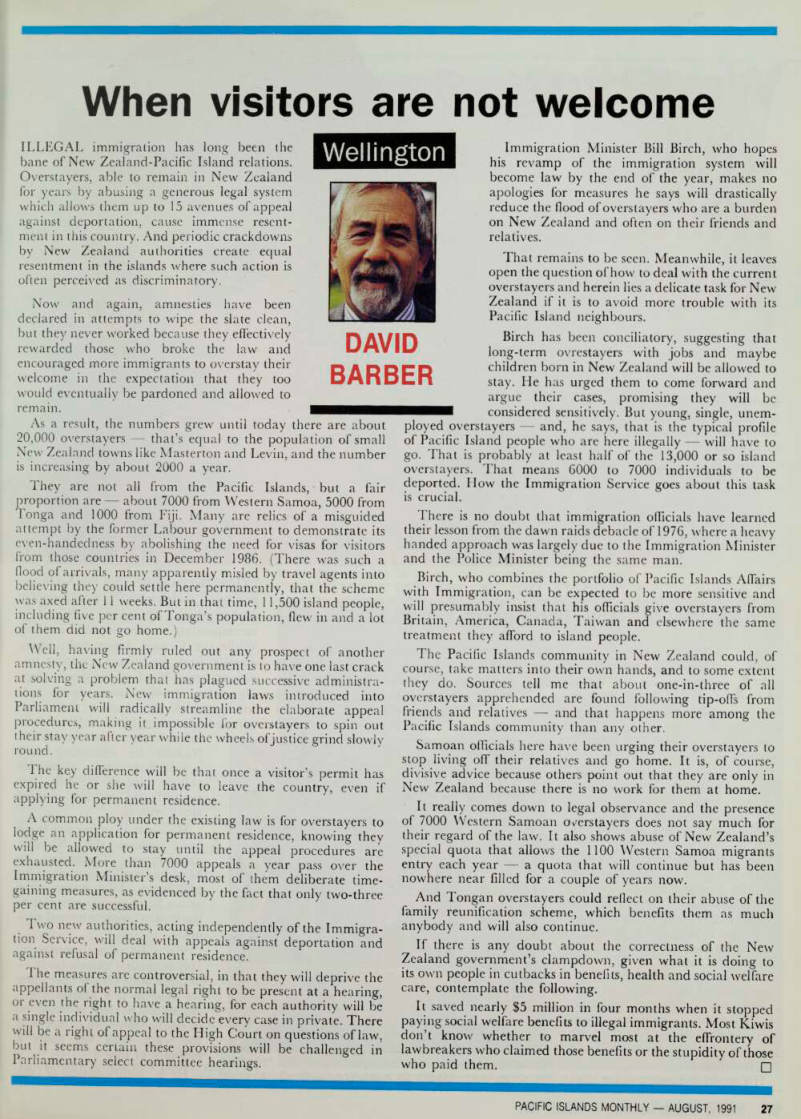
ILLEGAL immigration has long been the bane of New Zealand-Pacific Island relations.
Overstayers, able to remain in New Zealand for years by abusing a generous legal system which allows them up to 15 avenues of appeal against deportation, cause immense resent ment in this country. And periodic crackdowns by New Zealand authorities create equal resentment in the islands where such action is often perceived as discriminatory.
Now and again, amnesties have been declared in attempts to wipe the slate clean, but they never worked because they effectively rewarded those who broke the law and encouraged more immigrants to overstay their welcome in the expectation that they too would eventually be pardoned and allowed to remain.
As a result, the numbers grew until today there are about 20,000 overstayers that’s equal to the population of small New Zealand towns like Masterton and Levin, and the number is increasing by about 2000 a year.
They are not all from the Pacific Islands, but a fair proportion are about 7000 from Western Samoa, 5000 from Tonga and 1000 from Fiji. Many are relics of a misguided attempt by the former Labour government to demonstrate its even-handedness by abolishing the need for visas for visitors from those countries in December 1986. (There was such a flood of arrivals, many apparently misled by travel agents into believing they could settle here permanently, that the scheme was axed after 11 weeks. But in that time, 11,500 island people, including five per cent of Tonga’s population, flew in and a lot of them did not go home.) Well, having firmly ruled out any prospect of another amnesty, the New Zealand government is to have one last crack at solving a problem that has plagued successive administra tions for years. New immigration laws introduced into Parliament will radically streamline the elaborate appeal procedures, making it impossible for overstayers to spin out their stay year after year while the wheels of justice grind slowly round.
The key difference will be that once a visitor’s permit has expired lie or she will have to leave the country, even if applying for permanent residence.
A common ploy under the existing law is for overstayers to lodge an application for permanent residence, knowing they will be allowed to stay until the appeal procedures are exhausted. More than 7000 appeals a year pass over the Immigration Minister’s desk, most of them deliberate time gaining measures, as evidenced by the fact that only two-three per cent are successful.
Two new authorities, acting independently of the Immigra tion Service, will deal with appeals against deportation and against refusal of permanent residence.
The measures are controversial, in that they will deprive the appellants of the normal legal right to be present at a hearing, or even the right to have a hearing, for each authority will be a single individual who will decide every case in private. There will be a right of appeal to the High Court on questions of law, but it seems certain these provisions will be challenged in
Parliamentary select committee hearings.
Immigration Minister Bill Birch, who hopes his revamp of the immigration system will become law by the end of the year, makes no apologies for measures he says will drastically reduce the flood of overstayers who are a burden on New Zealand and often on their friends and relatives.
That remains to be seen. Meanwhile, it leaves open the question of how to deal with the current overstayers and herein lies a delicate task for New Zealand if it is to avoid more trouble with its Pacific Island neighbours.
Birch has been conciliatory, suggesting that
long-term ovrestayers with jobs and maybe
children born in New Zealand will be allowed to stay. He has urged them to come forward and argue their cases, promising they will be considered sensitively. But young, single, unem
ployed overstayers and, he says, that is the typical profile of Pacific Island people who are here illegally will have to go. That is probably at least half of the 13,000 or so island overstayers. That means 6000 to 7000 individuals to be deported. How the Immigration Service goes about this task is crucial.
There is no doubt that immigration officials have learned their lesson from the dawn raids debacle of 1976, where a heavy handed approach was largely due to the Immigration Minister and the Police Minister being the same man.
Birch, who combines the portfolio of Pacific Islands Affairs with Immigration, can be expected to be more sensitive and will presumably insist that his officials give overstayers from Britain, America, Canada, Taiwan and elsewhere the same treatment they afford to island people.
The Pacific Islands community in New Zealand could, of course, take matters into their own hands, and to some extent they do. Sources tell me that about one-in-three of all overstayers apprehended are found following tip-offs from friends and relatives - and that happens more among the Pacific Islands community than any other.
Samoan officials here have been urging their overstayers to stop living off their relatives and go home. It is, of course, divisive advice because others point out that they are only in New Zealand because there is no work for them at home.
It really comes down to legal observance and the presence of 7000 Western Samoan Ov'erstayers does not say much for their regard of the law. It also shows abuse of New Zealand’s special quota that allows the 1100 Western Samoa migrants entry each year a quota that will continue but has been nowhere near filled for a couple of years now.
And Tongan overstayers could reflect on their abuse of the family reunification scheme, which benefits them as much anybody and will also continue.
If there is any doubt about the correctness of the New Zealand government’s clampdown, given what it is doing to its own people in cutbacks in benefits, health and social welfare
care, contemplate the following.
It saved nearly S 5 million in four months when it stopped paying social welfare benefits to illegal immigrants. Most Kiwis don’t know whether to marvel most at the effrontery of lawbreakers who claimed those benefits or the stupidity of those who paid them. □
Wellington
David
Barber
Spirit

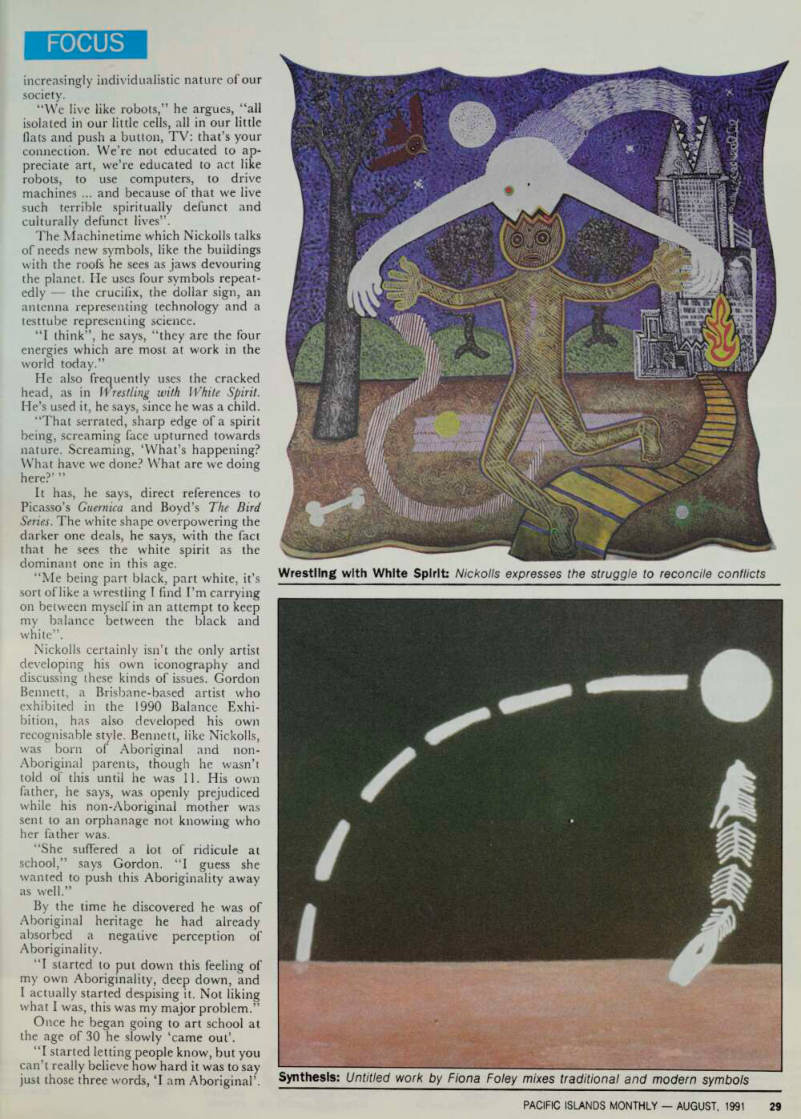


Wrestling with White Spirit
Aboriginal art reflects the search for a new identity. Liz Thompson reports
A LARGE canvas hangs on the wall, on it a brown male figure walks towards the viewer. His head is cracked and from it emerges a white form with arms and one eye. Its arms press down upon the
running brown figure with a heavy sense of oppression.
In the background a tall build ing, roof open like a mouth with serrated teeth, displays a dollar and crucifix symbol. A fire burns within it, a bird flies through the air.
The painting is called Wrestling with White Spirit and it is the work of artist Trevor Nickolls.
Nickolls and artist Rover Thomas were the first two Aborig inal artists to represent Australia at the Venice Biennale last year. This painting is typical of Nickolls’s work, recurring symbols become apparent and he pursues continu ing themes of his own personal struggles with a conflicting black and white heritage, and his broader view of the destruction of the environment.
His work, like many other con
temporary Aboriginal artists, is a far cry from what has most commonly been associated with contemporary Aborigi nal art over the last decade, the acrylic dot paintings of the Central Australian desert artists from Papunya.
The last two decades has seen an enormous increase in the production of contemporary Aboriginal art and a corresponding increase in public interest.
While the Central desert artists drew directly from traditional painting tra ditions, artists like Nickolls are develop ing new symbols and signs, new iconographies, to describe their own experiences. Often born and raised in
urban environments, artists like Nickolls are examining their lives in that context. Aboriginal culture, argues Nickolls, has evolved and art has evolved along with it.
His work, Wrestling with White Spirit reflects this. Nickolls’ catchphrase, “Dreamtime to Machinetime”, encapsulates his philosophy. Like many other artists he is acutely sensitive to the current environmental situ ation.
“In a lot of my paintings,” says Nickolls, “there’s birds because birds are the only thing we hear in this Machinetime.
Aboriginal society is based on its relationship with nature, and the white man has made a mockery of that”.
He is highly critical of the
Spiritual struggle: Gordon Bennett is one of the artists who reconciles Aboriginality and the White ethos in his art
No name: This work by Les Griggs has no title, reflecting the struggle for identity in a modern, multicultural world
increasingly individualistic nature of our society.
“We live like robots,” he argues, “all isolated in our little cells, all in our little flats and push a button, TV: that’s your connection. We’re not educated to ap preciate art, we’re educated to act like robots, to use computers, to drive machines ... and because of that we live such terrible spiritually defunct and culturally defunct lives”.
The Machinetime which Nickolls talks of needs new symbols, like the buildings with the roofs he sees as jaws devouring the planet. He uses four symbols repeat edly the crucifix, the dollar sign, an antenna representing technology and a testtube representing science.
“I think”, he says, “they are the four energies which are most at work in the
world today.”
He also frequently uses the cracked head, as in Wrestling with White Spirit.
He’s used it, he says, since he was a child.
“That serrated, sharp edge of a spirit being, screaming face upturned towards
nature. Screaming, ‘What’s happening?
What have we done? What are we doing here?’ ”
It has, he says, direct references to Picasso’s Guernica and Boyd’s The Bird Series. The white shape overpowering the darker one deals, he says, with the fact that he sees the white spirit as the dominant one in this age.
“Me being part black, part white, it’s sort of like a wrestling I find I’m carrying on between myself in an attempt to keep my balance between the black and white”.
Nickolls certainly isn’t the only artist developing his own iconography and discussing these kinds of issues. Gordon Bennett, a Brisbane-based artist who exhibited in the 1990 Balance Exhi bition, has also developed his own recognisable style. Bennett, like Nickolls, was born of Aboriginal and non- Aboriginal parents, though he wasn’t told of this until he was 11. His own father, he says, was openly prejudiced while his non-Aboriginal mother was sent to an orphanage not knowing who her father was.
“She suffered a lot of ridicule at school,” says Gordon. “I guess she wanted to push this Aboriginality away as well.”
By the time he discovered he was of
Aboriginal heritage he had already
absorbed a negative perception of
Aboriginality.
“I started to put down this feeling of my own Aboriginality, deep down, and I actually started despising it. Not liking what I was, this was my major problem.”
Once he began going to art school at the age of 30 he slowly ‘came out’.
“I started letting people know, but you can’t really believe how hard it was to say just those three words, T am Aboriginal’.
Wrestling with White Spirit: Nickolls expresses the struggle to reconcile conflicts
Synthesis: Untitled work by Fiona Foley mixes traditional and modern symbols
It does affect you, people look at you differently.”
As a result Bennett is interested in looking at how people build up percep tions through his work.
A highly intellectual painter, he has developed his own complex system of symbols, often using children’s building blocks to spell out words in his images and a system of what look like Rennaisance perspective arches. In one painting the words, “Abo, Boong, Koon, Darkie, Heathen, Nigger” appear next to a figure hung from a roof. This painting, he says, is about the conditioning process of being categorised by these words.
“They have a lot of derogatory associations attached to them,” he says.
He points to language as central to how we construct our view of the world.
“The experience of these particular words,” he says, “of writing them up there, was very cathartic, so much so that I burst into tears as soon as I’d done them.”
Bennett questions the elements of our society which he believes are seen as natural. Nothing, he insists, is ‘God
given’.
He questions ideas of progress, ideas of mechanisation and modernism, “the idea of commercial profit and short-term gain and generation of wealth,” these con cerns reflect in many respects those of Nickolls while visually their work is quite different.
“I’m interested in how meaning can be manipulated using images, how myth ologies are built around the idea of the
Comfort in kind: Bronwyn Bancroft’s ‘Grandma Loves Me This I know' represents an Aboriginal perspective on life, love and security
New mediums: Traditional designs on silk by Tiwi Designs near Darwin
Artist at work: Bronwyn Bancroft makes a contemporary statement by applying traditional imagery to clothing and turning it into an saleable, artistic expression
bush in Western painting. For instance Hans Heysen romanticised the Austra lian bush men and farmers and made them into heroic figures but these same heroic figures were marauding around the countryside killing off whole tribes of my ancestors and then going to church on Sunday and praying.”
Bennett is fascinated with these con tradictions. He plays on the notions of false harmony, he says, by using con struction of receding arches designed to ‘construct’ a perspective, to convey the idea of a construction of a belief system.
Coming from a slightly different angle
in terms of his experience, but using a similar idea of signs and symbols is Melbourne-based artist Les Griggs.
Griggs’s work often depicts syringes,
nooses, handcuffs, prison bars inter
spersed with didgeridoos, boomerangs,
cross hatching and often umber, ochre colour schemes.
Griggs has spent most of his life in in-
New direction: Les Griggs spent most of his life in institutions but discovered a paintbrush was a better weapon than his fists
The old, and the new: Mosquito Man coil pot made by Thancoupie draws on the traditional and contemporary motifs as well as methods in art
stitutions and examines this experience through his work. He also looks at the environmental situation.
One work, called Dreaming in the Wrong Place, shows a bush animal, depicted in
traditional cross-hatching technique
walking across a crazy maze of black
strips of highway.
“Painting,” says Griggs, “helped me
to get rid of the anger and resentment that I had inside me. It was a way to open a valve and release it without getting violent. I got really violent growing up and I got bored with that.”
Griggs was let out of prison early to paint a mural and hasn’t been back since. Unlike the occasions on which he’d been let out, he had something which he
says he actually enjoyed.
“It gave me something to do,” he says, “it gave me a different direction to start fighting from. Rather than using my fists or clubs or guns or anything like that, I found I could fight with a paintbrush just as well and just as effectively and hit more people in the eye at the same time.”
Griggs examines his own plight but he is extremely concerned with those indi viduals who remain inside institutions.
He has a committed belief this is not the right way to deal with Aboriginal people trying to adapt to a new kind of
community and society.
There are still many contemporary artists who do draw quite directly from traditional imagery, for example Banduk Marika.
Based in Yirrkalla in the Northern Territory, Marika is a well-recognised artist and a member of the council at the National Gallery. She, unlike Nickolls, Bennett and Griggs, was born and grew up in her tribal homeland. Her father was a traditional painter and, through him, she has access to many traditional designs from her area, depicting tra ditional hunting grounds and tribal stories.
Nevertheless, the use of them has to be carefully monitored by guardians and custodians of particular images and she is fastidious about the mixing of colours, emphatic that each one has to be exactly right, to fit in with traditional demands.
Some of the elders, she says, find it hard to adapt to their designs being presented in these new forms but she believes that, just as it is important for Aboriginal culture to develop new lan guages to describe new experiences in the evolution of culture, it is important to use new mediums to maintain and transmit traditional designs and images.
Tiwi Designs also use traditional imagery on a range of new mediums.
Established on Bathurst Island, a one hour flight from Darwin, Tiwi Designs is the name of an Aboriginal fabric design
company. Starting off with silk screen, they now work with pottery, batik and
hand-painted silks.
Their fabrics incorporate designs
taken from traditional storytelling and legends of the Tiwi people and have proved to be a successful financial venture as well as a celebration and continuation of the people’s culture.
The work of both these individual artists and the Tiwi Design company is highly accomplished. Their creativity is a step in the continuing process of the evolution of culture.
“There has been a myth created by the anthropologists that traditional art was a static thing, but it wasn’t it was a
continuing, evolving thing, the same as
Western art.”
The work of artists like Nickolls,
Bennett, Griggs, Marika Tiwi Designs is proof that this process continues; that art is used, as it has always been, to examine social situations and experiences. This art work is a sensitive and thought provoking look at contemporary circum stances.
It not only looks at environmental and world issues but at the difficulties r ° wi . n ? , U P , in , a countr y A where Abongmahty has been negated As art work stren B* h L ells . * nd People tell their own Itories1 tories thr ? u 8 h U ’,. lt ,s ralsln B the consciousness of Australian society as to the position and strength of the Aborig inal community, Xhis community did not cease with diminishing traditional dances and sand paint i ngs; s it survived an d finds ex pression today in a growing and increas ingly powerful art movement. □
Paint and paper: Barrett's 'Warrior' gouache and collage on recycled paper
Advertisements & other items, pp. 30-33 (2 items)
But Toyota’s innovation goes beyond providing luxury
pm The new Toyota brand mark. Three ellipses forming a “T” which stand for our customer, our commitment to the satisfaction of that customer through our product and for our spirit of creativity.
It’s not often that you hear descriptions like rugged or rable combined with refined and elegant. But then ere’s never been a vehicle quite like the new Toyota Land uiser Station Wagon. The unrivalled legend of off-road lability is now unsurpassed in comfort and sophistication well. Attention to detail is found everywhere, from the e trim to the instrument panel to the graceful lines of its terior. Even in places you can’t see, like the heavy-duty Ider frame and suspension design that add to the superb
oiry-car ride.
But Toyota’s innovation goes beyond providing luxury d durability. The new Land Cruiser Station Wagon, and of our cars, are designed to create a harmony between * and driver, and to provide you with the ultimate
ving experience.
The new Toyota Land Cruiser Station Wagon. Think of as much more than a spacious luxury sedan with fourleel drive. ■ ft * . v
RIBUTORS/DEALERS
CAN SAMOA BURNS PHILP (S.S.) CO. LTD. PH 633-4281 & MICRONESIA ATKINS KROLL, INC. PH 646-1876/9 DLK ISLANDS BORRY’S PTY LTD. PH 2114
MON ISLANDS MENDANA MOTORS PH 22884
WJ VANUATU MOTORS PH 2341
COOK ISLANDS PACIFIC MOTORS LTD. PH 20796
KIRIBATI TARAWA MOTORS PH 21090
PAPUA NEW GUINEA ELA MOTORS PH 217036
TAHITI NIPPON AUTOMOTO PH 429819
WESTERN SAMOA BURNS PHILP (S.S.) CO. LTD. PH 20800
FIJI ASCO MOTORS!
NEW CALEDONIA S.I.A.P.
SAIPAN MICROL CORPO'
TONGA BURNS PHILP Q
.r-4
Cruiser
• i § 11 .vj
ativitl
: 2! i L-. ss>: wmmm : m * A m *H 312666 >H 282848 >H 234-5911 'H 23673
<Jg) TOYOTA
Focus
Cover Story
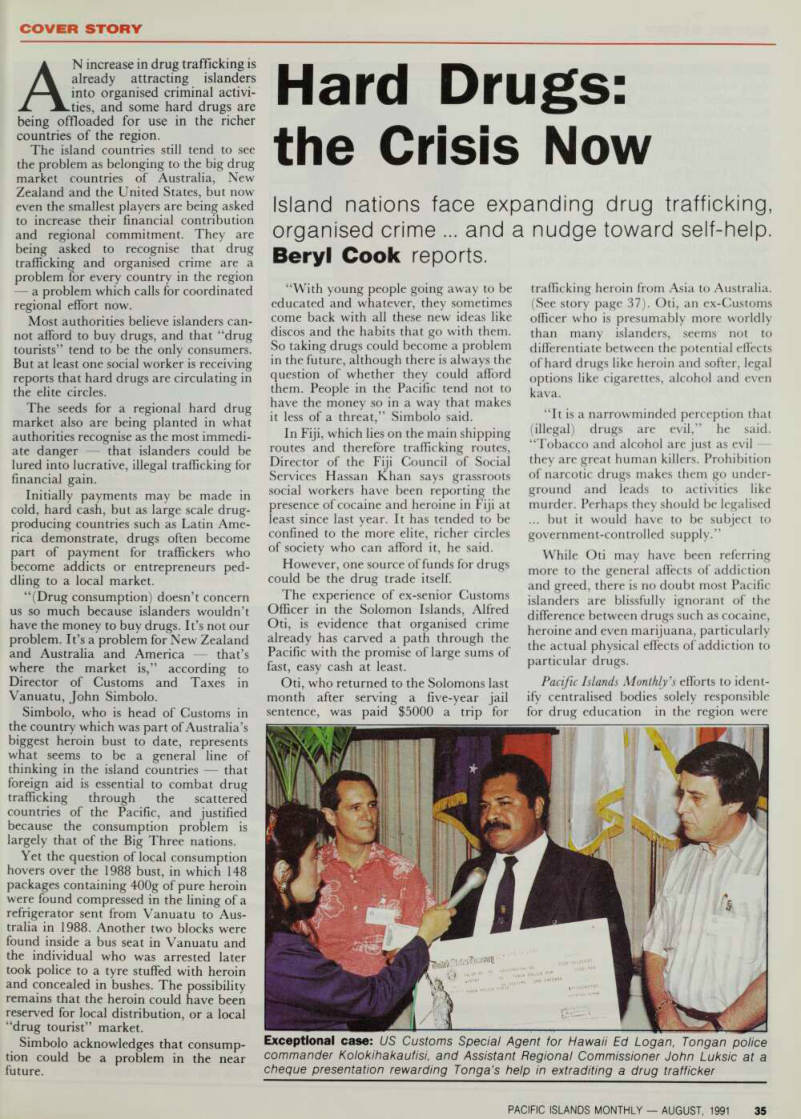
AN increase in drug trafficking is already attracting islanders into organised criminal activi ties, and some hard drugs are being offloaded for use in the richer countries of the region.
The island countries still tend to see the problem as belonging to the big drug market countries of Australia, New Zealand and the United States, but now even the smallest players are being asked to increase their financial contribution and regional commitment. They are being asked to recognise that drug trafficking and organised crime are a problem for every country in the region a problem which calls for coordinated regional effort now.
Most authorities believe islanders can not afford to buy drugs, and that “drug tourists” tend to be the only consumers.
But at least one social worker is receiving reports that hard drugs are circulating in the elite circles.
The seeds for a regional hard drug market also are being planted in what authorities recognise as the most immedi ate danger that islanders could be lured into lucrative, illegal trafficking for financial gain.
Initially payments may be made in cold, hard cash, but as large scale drug producing countries such as Latin Ame rica demonstrate, drugs often become part of payment for traffickers who become addicts or entrepreneurs ped dling to a local market.
“(Drug consumption) doesn’t concern us so much because islanders wouldn’t have the money to buy drugs. It’s not our problem. It’s a problem for New Zealand and Australia and America that’s where the market is,” according to Director of Customs and Taxes in Vanuatu, John Simbolo.
Simbolo, who is head of Customs in the country which was part of Australia’s biggest heroin bust to date, represents what seems to be a general line of thinking in the island countries that foreign aid is essential to combat drug
trafficking through the scattered
countries of the Pacific, and justified because the consumption problem is largely that of the Big Three nations.
Yet the question of local consumption hovers over the 1988 bust, in which 148 packages containing 400 g of pure heroin were found compressed in the lining of a refrigerator sent from Vanuatu to Aus tralia in 1988. Another two blocks were found inside a bus seat in Vanuatu and the individual who was arrested later took police to a tyre stuffed with heroin and concealed in bushes. The possibility remains that the heroin could have been reserved for local distribution, or a local “drug tourist” market.
Simbolo acknowledges that consump tion could be a problem in the near future.
Hard Drugs:
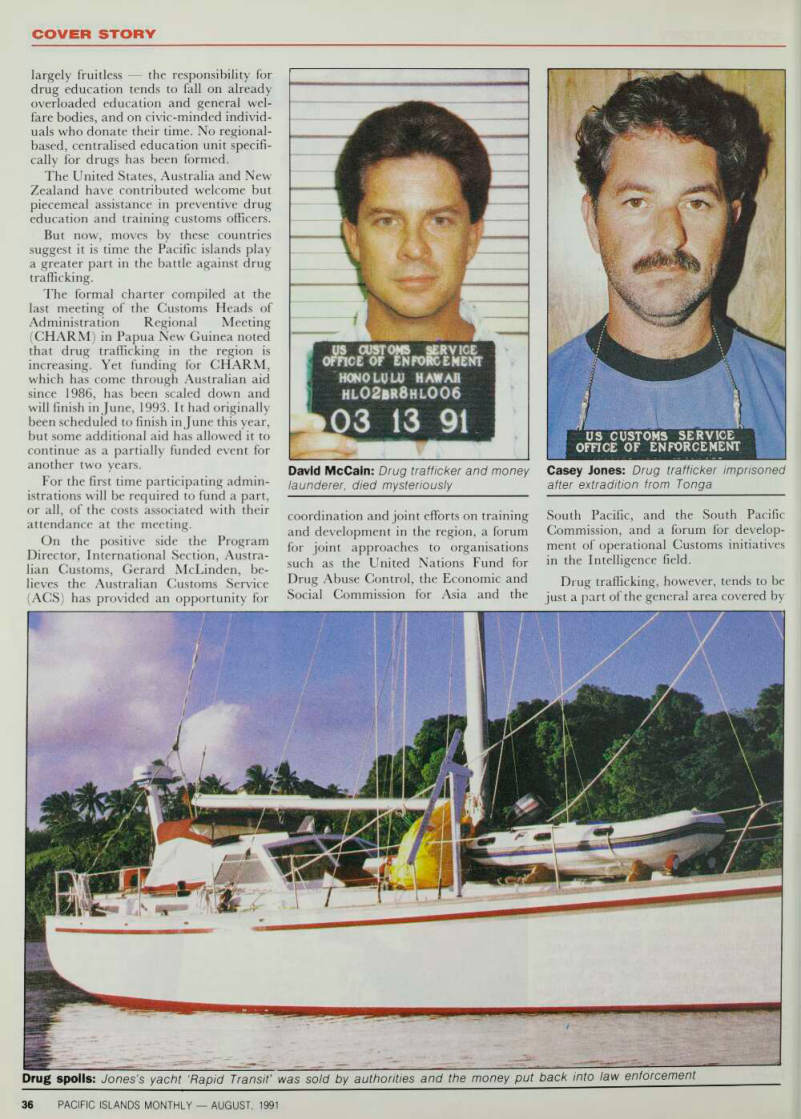
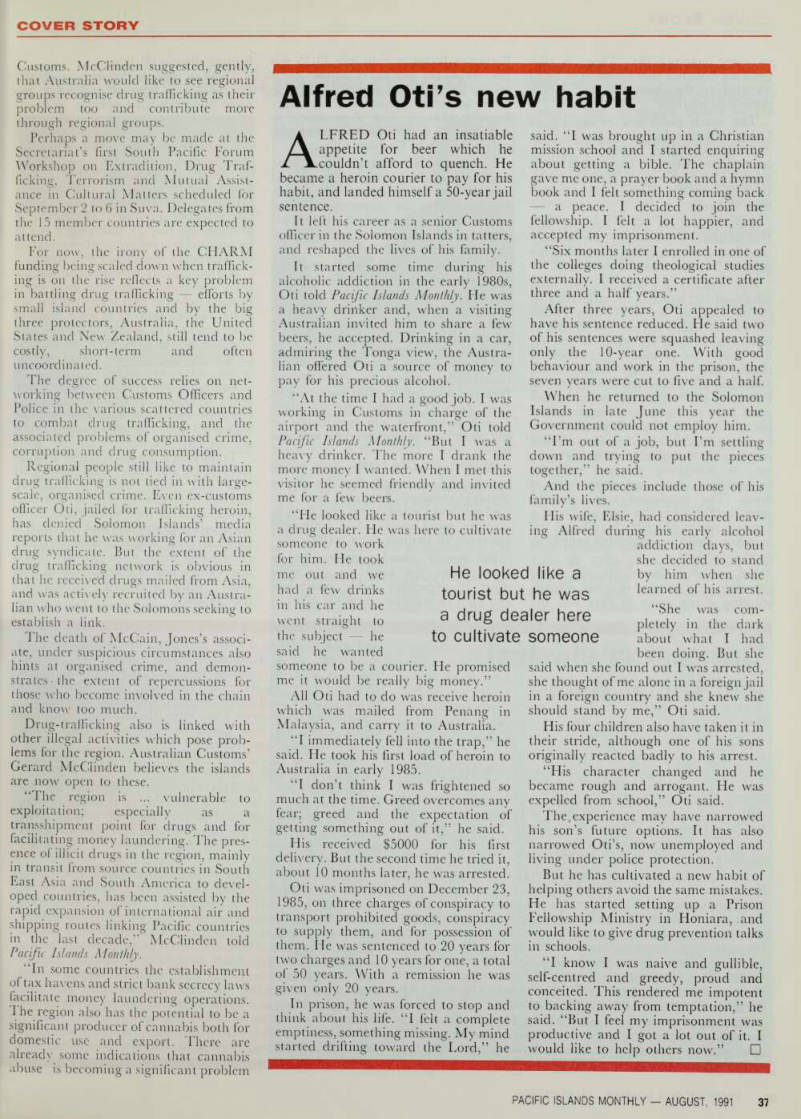
the Crisis Now
Island nations face expanding drug trafficking, organised crime ... and a nudge toward self-help.
Beryl Cook reports.
“With young people going away to be educated and whatever, they sometimes come back with all these new ideas like discos and the habits that go with them.
So taking drugs could become a problem in the future, although there is always the question of whether they could afford them. People in the Pacific tend not to have the money so in a way that makes it less of a threat,” Simbolo said.
In Fiji, which lies on the main shipping routes and therefore trafficking routes, Director of the Fiji Council of Social Services Hassan Khan says grassroots social workers have been reporting the presence of cocaine and heroine in Fiji at least since last year. It has tended to be confined to the more elite, richer circles of society who can afford it, he said.
However, one source of funds for drugs could be the drug trade itself.
The experience of ex-senior Customs Officer in the Solomon Islands, Alfred Oti, is evidence that organised crime already has carved a path through the Pacific with the promise of large sums of fast, easy cash at least, Oti, who returned to the Solomons last month after serving a five-year jail sentence, was paid S5OOO a trip for
trafficking heroin from Asia to Australia. (See story page 37). Oti, an ex-Customs officer who is presumably more worldly than many islanders, seems not to differentiate between the potential effects of hard drugs like heroin and softer, legal options like cigarettes, alcohol and even kava.
“It is a narrowminded perception that (illegal) drugs are evil,” he said.
“Tobacco and alcohol are just as evil they are great human killers. Prohibition of narcotic drugs makes them go under ground and leads to activities like murder. Perhaps they should be legalised ... but it would have to be subject to
government-controlled supply.”
While Oti may have been referring more to the general affects of addiction and greed, there is no doubt most Pacific islanders are blissfully ignorant of the difference between drugs such as cocaine, heroine and even marijuana, particularly the actual physical effects of addiction to
particular drugs.
Pacific Islands Monthly’s efforts to ident ify centralised bodies solely responsible for drug education in the region were
Exceptional case: US Customs Special Agent for Hawaii Ed Logan, Tongan police commander Kolokihakaufisi, and Assistant Regional Commissioner John Luksic at a cheque presentation rewarding Tonga’s help in extraditing a drug trafficker
largely fruitless the responsibility for drug education tends to fall on already overloaded education and general wel fare bodies, and on civic-minded individ uals who donate their time. No regional based, centralised education unit specifi cally for drugs has been formed.
The United States, Australia and New Zealand have contributed welcome but piecemeal assistance in preventive drug education and training customs officers.
But now, moves by these countries suggest it is time the Pacific islands play a greater part in the battle against drug trafficking.
The formal charter compiled at the last meeting of the Customs Heads of Administration Regional Meeting (CHARM) in Papua New Guinea noted that drug trafficking in the region is increasing. Yet funding for CHARM, which has come through Australian aid since 1986, has been scaled down and will finish in June, 1993. It had originally been scheduled to finish in June this year, but some additional aid has allowed it to continue as a partially funded event for another two years.
For the first time participating admin istrations will be required to fund a part, or all, of the costs associated with their attendance at the meeting.
On the positive side the Program Director, International Section, Austra lian Customs, Gerard McLinden, be lieves the Australian Customs Service (ACS) has provided an opportunity for
coordination and joint efforts on training and development in the region, a forum for joint approaches to organisations such as the United Nations Fund for Drug Abuse Control, the Economic and Social Commission for Asia and the
South Pacific, and the South Pacific Commission, and a forum for develop ment of operational Customs initiatives in the Intelligence field.
Drug trafficking, however, tends to be just a part of the general area covered by
David McCain: Drug trafficker and money launderer, died mysteriously
Casey Jones: Drug trafficker imprisoned after extradition from Tonga
Drug spoils: Jones’s yacht ‘Rapid Transit’ was sold by authorities and the money put back into law enforcement
Customs. McClindcn suggested, gently, that Australia would like to see regional groups recognise drug trafficking as their problem too and contribute more through regional groups.
Perhaps a move may be made at the Secretariat’s first South Pacific Forum Workshop on Extradition, Drug Traf ficking, Terrorism and Mutual Assist ance in Cultural Matters scheduled for September 2 to 6 in Suva. Delegates from the 15 member countries are expected to attend.
For now, the irony of the CFIARM funding being scaled down when traffick ing is on the rise reflects a key problem in battling drug trafficking efforts by small island countries and by the big three protectors, Australia, the United States and New Zealand, still tend to be costly, short-term and often uncoordinated.
The degree of success relies on net working between Customs Officers and Police in the various scattered countries to combat drug trafficking, and the associated problems of organised crime,
corruption and drug consumption.
Regional people still like to maintain drug trafficking is not tied in with large scale, organised crime. Even ex-customs officer Oti, jailed for trafficking heroin, has denied Solomon Islands’ media reports that he was working for an Asian drug syndicate. But the extent of the drug trafficking network is obvious in that he received drugs mailed from Asia, and was actively recruited by an Austra lian who went to the Solomons seeking to establish a link.
The death of McCain, Jones’s associ ate, under suspicious circumstances also hints at organised crime, and demon strates- the extent of repercussions for those who become involved in the chain and know too much.
Drug-trafficking also is linked with other illegal activities which pose prob lems for the region. Australian Customs’
Gerard McClinden believes the islands are now open to these.
“The region is ... vulnerable to exploitation; especially as a transshipment point for drugs and for facilitating money laundering. The pres ence of illicit drugs in the region, mainly in transit from source countries in South East Asia and South America to devel oped countries, has been assisted by the rapid expansion of international air and shipping routes linking Pacific countries in the last decade,” McClinden told Pacific Islands Monthly.
“In some countries the establishment of tax havens and strict bank secrecy laws facilitate money laundering operations.
The region also has the potential to be a significant producer of cannabis both for domestic use and export. There are already some indications that cannabis abuse is becoming a significant problem
Alfred Oti’s new habit
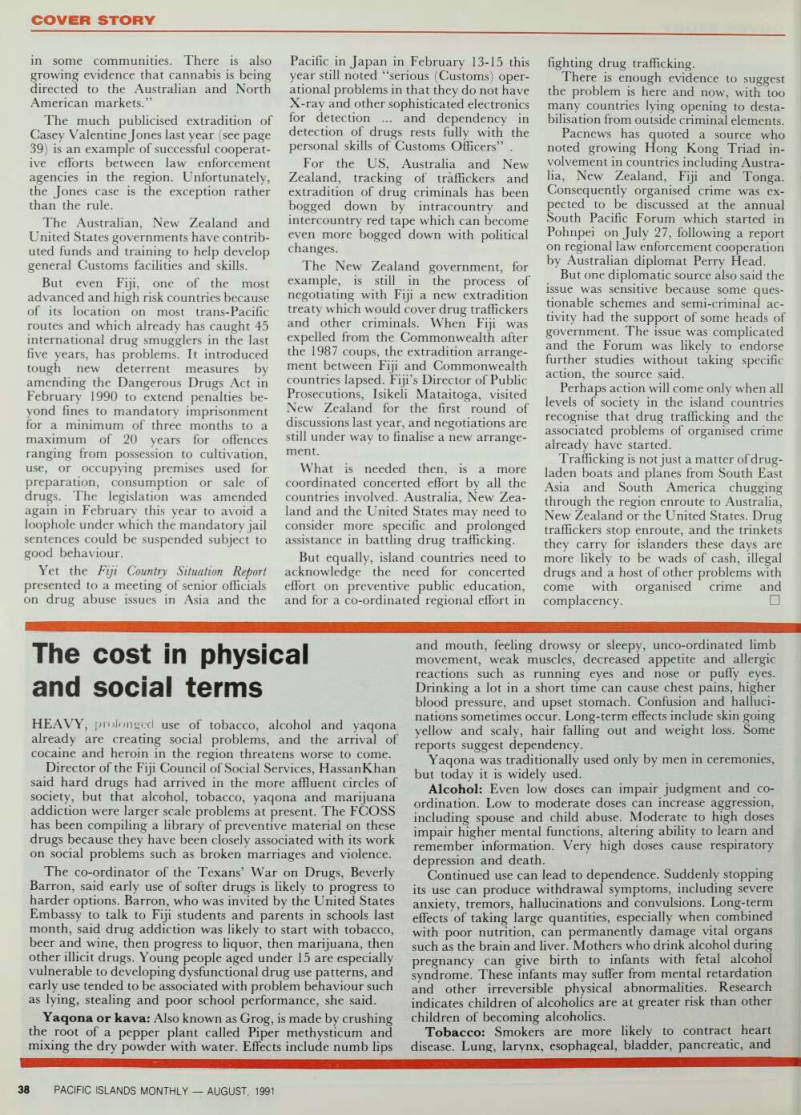
ALFRED Oti had an insatiable appetite for beer which he couldn’t afford to quench. He became a heroin courier to pay for his habit, and landed himself a 50-year jail sentence.
It left his career as a senior Customs officer in the Solomon Islands in tatters, and reshaped the lives of his family.
It started some time during his alcoholic addiction in the early 1980 s, Oti told Pacific Islands Monthly. He was a heavy drinker and, when a visiting Australian invited him to share a few beers, he accepted. Drinking in a car, admiring the Tonga view, the Austra lian offered Oti a source of money to pay for his precious alcohol.
“At the time I had a good job. I was working in Customs in charge of the airport and the waterfront,” Oti told Pacific Islands Monthly. “But I was a heavy drinker. The more I drank the more money I wanted. When I met this visitor he seemed friendly and invited me for a few beers.
“He looked like a tourist but he was a drug dealer. He was here to cultivate
someone to work for him. He took me out and we had a few drinks in his car and he went straight to the subject he said he wanted
someone to be a courier. He promised me it would be really big money.”
All Oti had to do was receive heroin which was mailed from Penang in Malaysia, and carry it to Australia.
“I immediately fell into the trap,” he said. He took his first load of heroin to Australia in early 1985.
“I don’t think I was frightened so much at the time. Greed overcomes any fear; greed and the expectation of getting something out of it,” he said.
His received $5OOO for his first delivery. But the second time he tried it, about 10 months later, he was arrested.
Oti was imprisoned on December 23, 1985, on three charges of conspiracy to transport prohibited goods, conspiracy to supply them, and for possession of them. He was sentenced to 20 years for two charges and 10 years for one, a total of 50 years. With a remission he was given only 20 years.
In prison, he was forced to stop and think about his life. “I felt a complete emptiness, something missing. My mind started drifting toward the Lord,” he
He looked like a tourist but he was a drug dealer here to cultivate someone
said. “I was brought up in a Christian mission school and I started enquiring about getting a bible. The chaplain gave me one, a prayer book and a hymn book and I felt something coming back a peace. I decided to join the fellowship. I felt a lot happier, and
accepted my imprisonment.
“Six months later I enrolled in one of the colleges doing theological studies externally. I received a certificate after three and a half years.”
After three years, Oti appealed to have his sentence reduced. He said two of his sentences were squashed leaving only the 10-year one. With good behaviour and work in the prison, the seven years were cut to five and a half.
When he returned to the Solomon Islands in late June this year the Government could not employ him.
“I’m out of a job, but I’m settling down and trying to put the pieces together,” he said.
And the pieces include those of his family’s lives.
His wife, Elsie, had considered leav
ing Alfred during his early alcohol
addiction days, but she decided to stand by him when she learned of his arrest.
“She was com pletely in the dark about what I had been doing. But she
said when she found out I was arrested, she thought of me alone in a foreign jail in a foreign country and she knew she should stand by me,” Oti said.
His four children also have taken it in their stride, although one of his sons originally reacted badly to his arrest.
“His character changed and he became rough and arrogant. He was expelled from school,” Oti said.
The.experience may have narrowed his son’s future options. It has also narrowed Oti’s, now unemployed and
living under police protection.
But he has cultivated a new habit of helping others avoid the same mistakes.
He has started setting up a Prison Fellowship Ministry in Honiara, and would like to give drug prevention talks in schools.
“I know I was naive and gullible, self-centred and greedy, proud and conceited. This rendered me impotent to backing away from temptation,” he said. “But I feel my imprisonment was productive and I got a lot out of it. I would like to help others now.” □
in some communities. There is also growing evidence that cannabis is being directed to the Australian and North American markets.”
The much publicised extradition of Casey Valentine Jones last year (see page 39) is an example of successful cooperative efforts between law enforcement agencies in the region. Unfortunately, the Jones case is the exception rather than the rule.
The Australian, New Zealand and United States governments have contributed funds and training to help develop general Customs facilities and skills.
But even Fiji one of the most advanced and high risk countries because of its location on most trans-Pacif.c routes and which already has cautrht 45 international drug smugglers in the las. five years, has problems I, introduced tough new deterrent measures by amending the Dangerous Drugs Act in February 1990 to extend penllties beyond fines to mandatory imprisonment for a minimum of three months To
maxLZ of 20 (ean Tor
ranging from possession to cultivation, use, or occupying premises used for preparation, consumption or sale of drugs. The legislation was amended again in February this year to avoid a loophole under which the mandatory jail sentences could be suspended subject to good behaviour.
Yet the Fiji Country Situation Report presented to a meeting of senior officials on drug abuse issues in Asia and the
Pacific in Japan in February 13-15 this year still noted “serious (Customs) operational problems in that they do not have X-ray and other sophisticated electronics f° r detection ... and dependency in detection of drugs rests fully with the personal skills of Customs Officers” .
For the US, Australia and New Zealand, tracking of traffickers and extradition of drug criminals has been bogged down by intracountry and intercountry red tape which can become even more bogged down with political changes.
The New Zealand government, for example, is still in the process of negotiating with Fiji a new extradition treaty which would cover drug traffickers and other criminals. When Fiji was expelled from the Commonwealth after the 1987 coups, the extradition arrangement between Fiji and Commonwealth countries lapsed. Fiji’s Director of Public Prosecutions, Isikeli Mataitoga, visited New Zealand for the first round of discussions last year, and negotiations are still under wayl finalise a new arrangement What is needed then, is a more coordinated concerted effort by all the countries involved. Australia, New Zealand and the United States may need to consider more specific and prolonged
assistance m battling drug trafficking.
But e q Ua hy 5 island countries need to acknowledge the need for concerted effort on preventive public education, and for a co-ordinated regional effort in
fighting drug trafficking,
There is enough evidence to suggest the problem is here and now, with too many countries lying opening to desta bilisation from outside criminal elements.
Pacnews has quoted a source who noted growing Hong Kong Triad in volvement in countries including Austra- New Zealand, Fiji and Tonga, Consequently organised crime was ex pected to be discussed at the annual South Pacific Forum which started in Pohnpei on July 27, following a report on regional law enforcement cooperation by Australian diplomat Perry Head. . But one diplomatic source also said the
tionabl^scSme^and^emTcrkninafac
Tl PP° 1 ° some heads ol an ° h “' wkhou takinT snecTfc * u “on « takmg SpeClflC Perhaos action will come onlv when all he TsLnd coumrie es ? S °c let^i m the , . cou iJ tn « s reco S. nlse , that drug trafficking and the
StvTtirTed or§am
Trafficking is not just a matter of drug laden boats and planes from South East Asia anc j Smith America chugging through the region enroute to Australia, New Zealand or the United States Drug traffickers stop enroute, and the trinkets t hey carry for islanders these days are more likely to be wads of cash, illegal drugs and a host of other problems with come with organised crime and complacency. □
and social terms
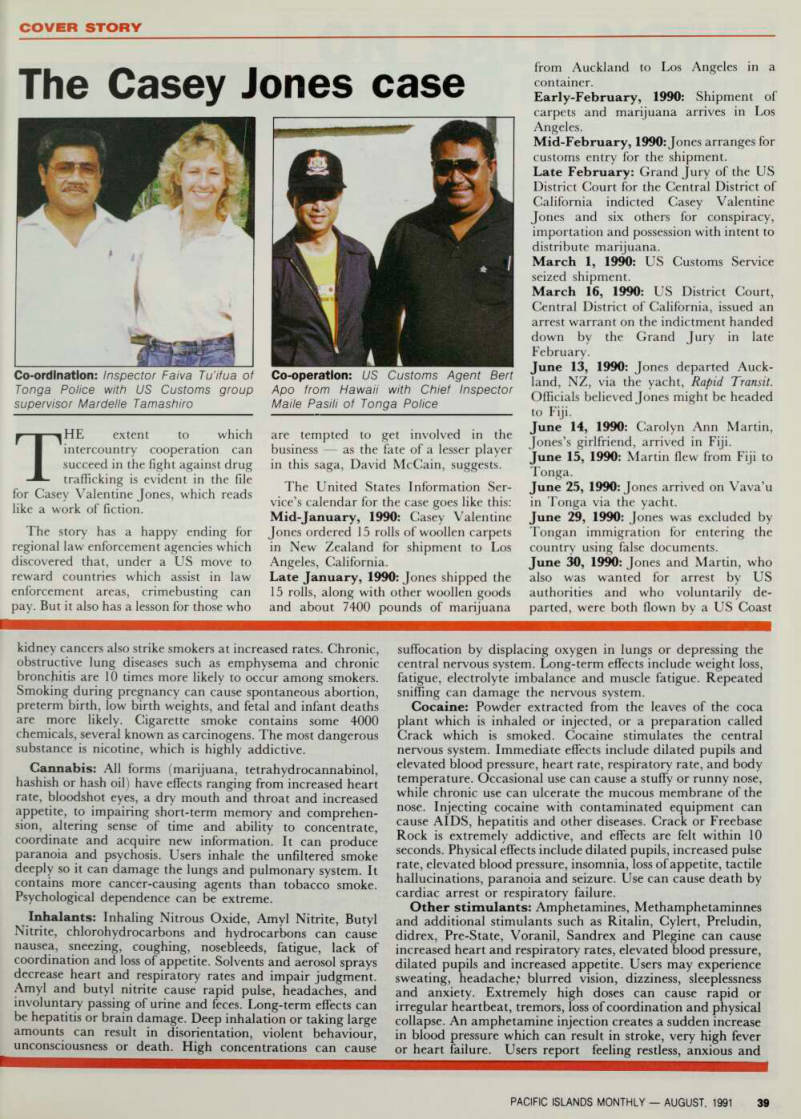
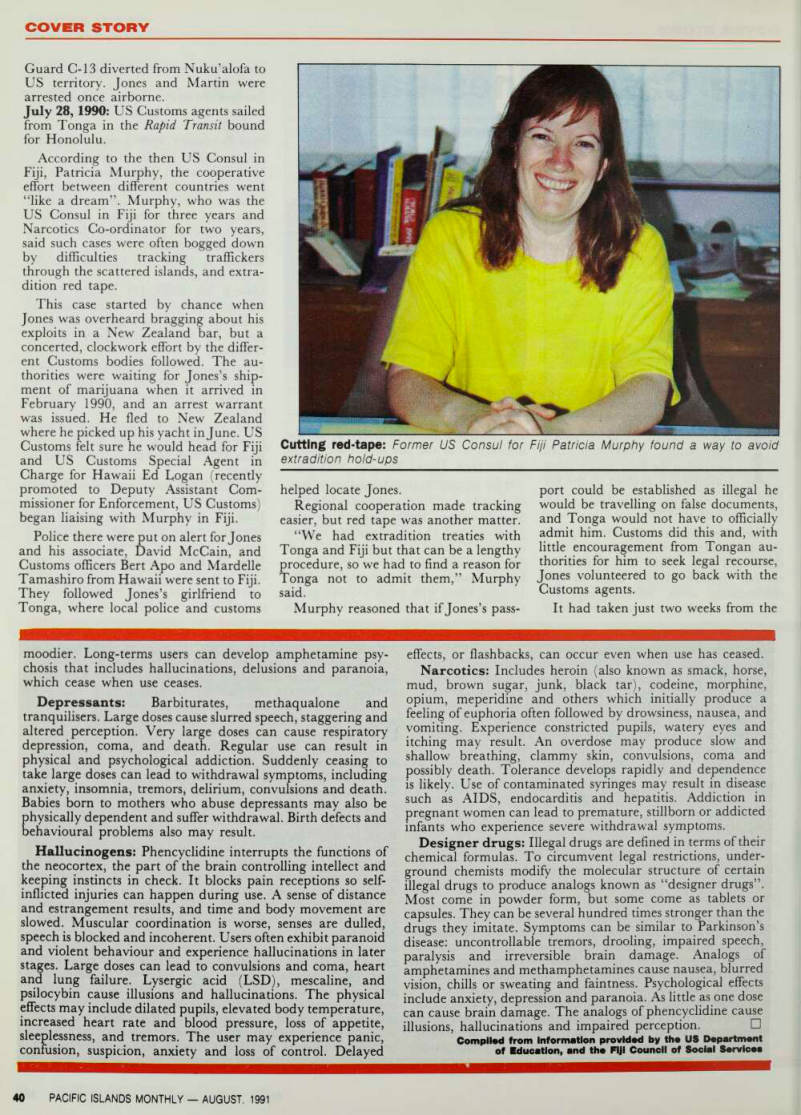
The cost in physical and social terms
HEAVY, prolonged use of tobacco, alcohol and yaqona already are creating social problems, and the arrival of cocaine and heroin in the region threatens worse to come.
Director of the Fiji Council of Social Services, HassanKhan said hard drugs had arrived in the more affluent circles of society, but that alcohol, tobacco, yaqona and marijuana addiction were larger scale problems at present. The FCOSS has been compiling a library of preventive material on these drugs because they have been closely associated with its work on social problems such as broken marriages and violence.
The co-ordinator of the Texans’ War on Drugs, Beverly Barron, said early use of softer drugs is likely to progress to harder options. Barron, who was invited by the United States Embassy to talk to Fiji students and parents in schools last month, said drug addiction was likely to start with tobacco, beer and wine, then progress to liquor, then marijuana, then other illicit drugs. Young people aged under 15 are especially vulnerable to developing dysfunctional drug use patterns, and early use tended to be associated with problem behaviour such as lying, stealing and poor school performance, she said.
Yaqona or kava: Also known as Grog, is made by crushing the root of a pepper plant called Piper methysticum and mixing the dry powder with water. Effects include numb lips
and mouth, feeling drowsy or sleepy, unco-ordinated limb movement, weak muscles, decreased appetite and allergic reactions such as running eyes and nose or puffy eyes.
Drinking a lot in a short time can cause chest pains, higher blood pressure, and upset stomach. Confusion and halluci nations sometimes occur. Long-term effects include skin going yellow and scaly, hair falling out and weight loss. Some reports suggest dependency.
Yaqona was traditionally used only by men in ceremonies, but today it is widely used.
Alcohol: Even low doses can impair judgment and co ordination. Low to moderate doses can increase aggression, including spouse and child abuse. Moderate to high doses impair higher mental functions, altering ability to learn and remember information. Very high doses cause respiratory depression and death.
Continued use can lead to dependence. Suddenly stopping its use can produce withdrawal symptoms, including severe anxiety, tremors, hallucinations and convulsions. Long-term effects of taking large quantities, especially when combined with poor nutrition, can permanently damage vital organs such as the brain and liver. Mothers who drink alcohol during pregnancy can give birth to infants with fetal alcohol syndrome. These infants may suffer from mental retardation and other irreversible physical abnormalities. Research indicates children of alcoholics are at greater risk than other children of becoming alcoholics.
Tobacco: Smokers are more likely to contract heart disease. Lung, larynx, esophageal, bladder, pancreatic, and
kidney cancers also strike smokers at increased rates. Chronic, obstructive lung diseases such as emphysema and chronic bronchitis are 10 times more likely to occur among smokers.
Smoking during pregnancy can cause spontaneous abortion, preterm birth, low birth weights, and fetal and infant deaths are more likely. Cigarette smoke contains some 4000 chemicals, several known as carcinogens. The most dangerous substance is nicotine, which is highly addictive.
Cannabis: All forms (marijuana, tetrahydrocannabinol, hashish or hash oil) have effects ranging from increased heart rate, bloodshot eyes, a dry mouth and throat and increased appetite, to impairing short-term memory and comprehen sion, altering sense of time and ability to concentrate, coordinate and acquire new information. It can produce paranoia and psychosis. Users inhale the unfiltered smoke deeply so it can damage the lungs and pulmonary system. It contains more cancer-causing agents than tobacco smoke.
Psychological dependence can be extreme.
Inhalants: Inhaling Nitrous Oxide, Amyl Nitrite, Butyl Nitrite, chlorohydrocarbons and hydrocarbons can cause nausea, sneezing, coughing, nosebleeds, fatigue, lack of coordination and loss of appetite. Solvents and aerosol sprays decrease heart and respiratory rates and impair judgment.
Amyl and butyl nitrite cause rapid pulse, headaches, and involuntaiy passing of urine and feces. Long-term effects can be hepatitis or brain damage. Deep inhalation or taking large amounts can result in disorientation, violent behaviour, unconsciousness or death. High concentrations can cause
suffocation by displacing oxygen in lungs or depressing the central nervous system. Long-term effects include weight loss, fatigue, electrolyte imbalance and muscle fatigue. Repeated sniffing can damage the nervous system.
Cocaine: Powder extracted from the leaves of the coca plant which is inhaled or injected, or a preparation called Crack which is smoked. Cocaine stimulates the central nervous system. Immediate effects include dilated pupils and elevated blood pressure, heart rate, respiratory rate, and body temperature. Occasional use can cause a stuffy or runny nose, while chronic use can ulcerate the mucous membrane of the nose. Injecting cocaine with contaminated equipment can cause AIDS, hepatitis and other diseases. Crack or Freebase Rock is extremely addictive, and effects are felt within 10 seconds. Physical effects include dilated pupils, increased pulse rate, elevated blood pressure, insomnia, loss of appetite, tactile hallucinations, paranoia and seizure. Use can cause death by cardiac arrest or respiratory failure.
Other stimulants: Amphetamines, Methamphetaminnes
and additional stimulants such as Ritalin, Cylert, Preludin, didrex, Pre-State, Voranil, Sandrex and Plegine can cause increased heart and respiratory rates, elevated blood pressure, dilated pupils and increased appetite. Users may experience sweating, headache,' blurred vision, dizziness, sleeplessness and anxiety. Extremely high doses can cause rapid or irregular heartbeat, tremors, loss of coordination and physical collapse. An amphetamine injection creates a sudden increase in blood pressure which can result in stroke, very high fever or heart failure. Users report feeling restless, anxious and
moodier. Long-terms users can develop amphetamine psy chosis that includes hallucinations, delusions and paranoia, which cease when use ceases.
Depressants: Barbiturates, methaqualone and tranquilisers. Large doses cause slurred speech, staggering and altered perception. Very large doses can cause respiratory depression, coma, and death. Regular use can result in physical and psychological addiction. Suddenly ceasing to take large doses can lead to withdrawal symptoms, including anxiety, insomnia, tremors, delirium, convulsions and death.
Babies born to mothers who abuse depressants may also be physically dependent and suffer withdrawal. Birth defects and behavioural problems also may result.
Hallucinogens: Phencyclidine interrupts the functions of
the neocortex, the part of the brain controlling intellect and keeping instincts in check. It blocks pain receptions so self inflicted injuries can happen during use. A sense of distance and estrangement results, and time and body movement are slowed. Muscular coordination is worse, senses are dulled, speech is blocked and incoherent. Users often exhibit paranoid and violent behaviour and experience hallucinations in later stages. Large doses can lead to convulsions and coma, heart and lung failure. Lysergic acid (LSD), mescaline, and psilocybin cause illusions and hallucinations. The physical effects may include dilated pupils, elevated body temperature, increased heart rate and blood pressure, loss of appetite, sleeplessness, and tremors. The user may experience panic, confusion, suspicion, anxiety and loss of control. Delayed
effects, or flashbacks, can occur even when use has ceased.
Narcotics: Includes heroin (also known as smack, horse, mud, brown sugar, junk, black tar), codeine, morphine, opium, meperidine and others which initially produce a feeling of euphoria often followed by drowsiness, nausea, and vomiting. Experience constricted pupils, watery eyes and itching may result. An overdose may produce slow and shallow breathing, clammy skin, convulsions, coma and possibly death. Tolerance develops rapidly and dependence is likely. Use of contaminated syringes may result in disease such as AIDS, endocarditis and hepatitis. Addiction in pregnant women can lead to premature, stillborn or addicted infants who experience severe withdrawal symptoms.
Designer drugs: Illegal drugs are defined in terms of their chemical formulas. To circumvent legal restrictions, under ground chemists modify the molecular structure of certain illegal drugs to produce analogs known as “designer drugs”.
Most come in powder form, but some come as tablets or capsules. They can be several hundred times stronger than the drugs they imitate. Symptoms can be similar to Parkinson’s disease: uncontrollable tremors, drooling, impaired speech, paralysis and irreversible brain damage. Analogs of amphetamines and methamphetamines cause nausea, blurred vision, chills or sweating and faintness. Psychological effects include anxiety, depression and paranoia. As little as one dose can cause brain damage. The analogs of phencyclidine cause illusions, hallucinations and impaired perception. □ Compiled from information provided by the US Department of Education, and the FIJI Council of Social Services
The Casey Jones case
THE extent to which intercountry cooperation can succeed in the fight against drug trafficking is evident in the file for Casey Valentine Jones, which reads like a work of fiction.
The story has a happy ending for regional law enforcement agencies which discovered that, under a US move to reward countries which assist in law enforcement areas, crimebusting can pay. But it also has a lesson for those who
are tempted to get involved in the business as the fate of a lesser player in this saga, David McCain, suggests.
The United States Information Ser vice’s calendar for the case goes like this: Mid-January, 1990: Casey Valentine Jones ordered 15 rolls of woollen carpets in New Zealand for shipment to Los
Angeles, California.
Late January, 1990: Jones shipped the 15 rolls, along with other woollen goods and about 7400 pounds of marijuana
from Auckland to Los Angeles in a container.
Early-February, 1990: Shipment of carpets and marijuana arrives in Los Angeles.
Mid-February, 1990: Jones arranges for customs entry for the shipment.
Late February: Grand Jury of the US District Court for the Central District of California indicted Casey Valentine Jones and six others for conspiracy, importation and possession with intent to distribute marijuana.
March 1, 1990: US Customs Service
seized shipment.
March 16, 1990: US District Court, Central District of California, issued an arrest warrant on the indictment handed down by the Grand Jury in late February.
June 13, 1990: Jones departed Auck land, NZ, via the yacht, Rapid Transit.
Officials believed Jones might be headed to Fiji.
June 14, 1990: Carolyn Ann Martin, Jones’s girlfriend, arrived in Fiji.
June 15, 1990: Martin flew from Fiji to
Tonga.
June 25, 1990: Jones arrived on Vava’u in Tonga via the yacht.
June 29, 1990: Jones was excluded by
Tongan immigration for entering the
country using false documents.
June 30, 1990: Jones and Martin, who also was wanted for arrest by US authorities and who voluntarily de parted, were both flown by a US Coast
Co-ordination: Inspector Faiva Tu’ifua of Tonga Police with US Customs group supervisor Mardelle Tamashiro
Co-operation: US Customs Agent Bert Apo from Hawaii with Chief Inspector Maile Pasili of Tonga Police
Guard C-13 diverted from Nuku’alofa to US territory. Jones and Martin were arrested once airborne.
July 28, 1990: US Customs agents sailed from Tonga in the Rapid Transit bound for Honolulu.
According to the then US Consul in Fiji, Patricia Murphy, the cooperative effort between different countries went “like a dream”. Murphy, who was the US Consul in Fiji for three years and Narcotics Co-ordinator for two years, said such cases were often bogged down by difficulties tracking traffickers through the scattered islands, and extra dition red tape.
This case started by chance when Jones was overheard bragging about his exploits in a New Zealand bar, but a concerted, clockwork effort by the differ ent Customs bodies followed. The au thorities were waiting for Jones’s ship ment of marijuana when it arrived in February 1990, and an arrest warrant was issued. He fled to New Zealand where he picked up his yacht in June. US Customs felt sure he would head for Fiji and US Customs Special Agent in Charge for Hawaii Ed Logan (recently promoted to Deputy Assistant Com missioner for Enforcement, US Customs) began liaising with Murphy in Fiji.
Police there were put on alert for Jones and his associate, David McCain, and Customs officers Bert Apo and Mardelle Tamashiro from Hawaii were sent to Fiji.
They followed Jones’s girlfriend to Tonga, where local police and customs
helped locate Jones.
Regional cooperation made tracking easier, but red tape was another matter.
“We had extradition treaties with Tonga and Fiji but that can be a lengthy procedure, so we had to find a reason for Tonga not to admit them,” Murphy said.
Murphy reasoned that if Jones’s pass
port could be established as illegal he would be travelling on false documents, and Tonga would not have to officially admit him. Customs did this and, with little encouragement from Tongan au thorities for him to seek legal recourse, Jones volunteered to go back with the Customs agents.
It had taken just two weeks from the
Cutting red-tape: Former US Consul for Fiji Patricia Murphy found a way to avoid extradition hold-ups
time Jones left New Zealand to when he was on the way back to the US with the Customs Agents.
The happy tale doesn’t end there. US Customs came up with an asset-sharing arrangement which means that, in effect, crimebusting now pays for regional countries.
US legislation was recently extended to allow overseas law enforcement agencies which have helped the US, to share in the proceeds when assets bought with illegal funds are sold. The proceeds are channelled back into law enforce ment in the recipient countries.
Under this arrangement Jones’s yacht was sold and the Tonga police received a U 55104,560 cash cheque in May for helping US Customs apprehend Jones.
In all, asset-sharing cheques totalling $723,670 were presented to State, local and Tonga police forces at the seventh annual US Customs Enforcement Con ference at the East-West Center.
A $500,000 cheque was accepted by Hawaii County Chief of Police Victor Vierra, one for $lOO,OOO by Lieutenant Governnor Ben Cayetano on behalf of the office of Attorney General Warren Price, and $19,150 by Maui County Police Chief Howard Tagomori.
The cheque for the Maui County Police represented a portion of the currency seized from two Chinese busi ness investors who attempted to illegally smuggle currency from Taiwan into Hawaii through the Honolulu Interna tional Airport. The Maui Police were instrumental in identifying associates and previous investments made by the money smugglers, and both defendants later entered guilty pleas with the US Attorney’s Office.
The cheques for the Big Island police and the State of Hawaii Marine Patrol were for critical assistance in seizing an 82-foot luxury yacht, Aarosand.
The Aarosand was seized by Customs agents at Kailua, Kona in March 1988, when the agents discovereed $ 140,000 in undeclared currency hidden in the vessel’s floor safe, just prior to its departure for the South Pacific.
The yacht’s owner, David W.
McCain, had been the subject of a
longstanding Customs investigation into
his alleged drug smuggling activities and was one of Jones’s associates. McCain was indicted for the currency smuggling attempt, but became an international
fugitive.
He was captured at the Mexican border late last year and was convicted in Hawaii District Court for currency smuggling. While waiting to report to Federal Prison, his body was discovered in a house in Kaneohe under as yet unexplained circumstances. His death is still under investigation, □
Advertisements & other items, p. 41 (2 items)
Cover Story
R On Sale
through your PIM
NOW
Bookshop
«sr>r Jk 1 . m ** vniiwn map!
OS THE S
nanoc
ISIRND*
jii a i - 1 □ Pacific Islands Year Book □ Fiji Handbook, Business & Travel □ The Journal of William Lockerby □ Map of Fiji □ Map of the Pacific □ Twin Journey □ Rotuma, A Patch of Green □ Plantation to Politics □ Fiji History □ Fiji Book of Running □ Suva Guide Book □ Ra Boto (illustrated colour book) □ Noqu Siqovi Islreli Guide
SUBSCRIBE
NOW?
PACIFIC
SLANDS
Yes, send me Pacific Islands Monthly . Now. □ Here Is a cheque/money order □ Debit my credit card, Indicated below □ Visa □ Master Card Expiry Date Card Number Name .Signature Address_ Post to: Pacific Islands Monthly, PO Box 1167, Suva, FIJI. OR Fax: (679) 303809
Just gorgeous!
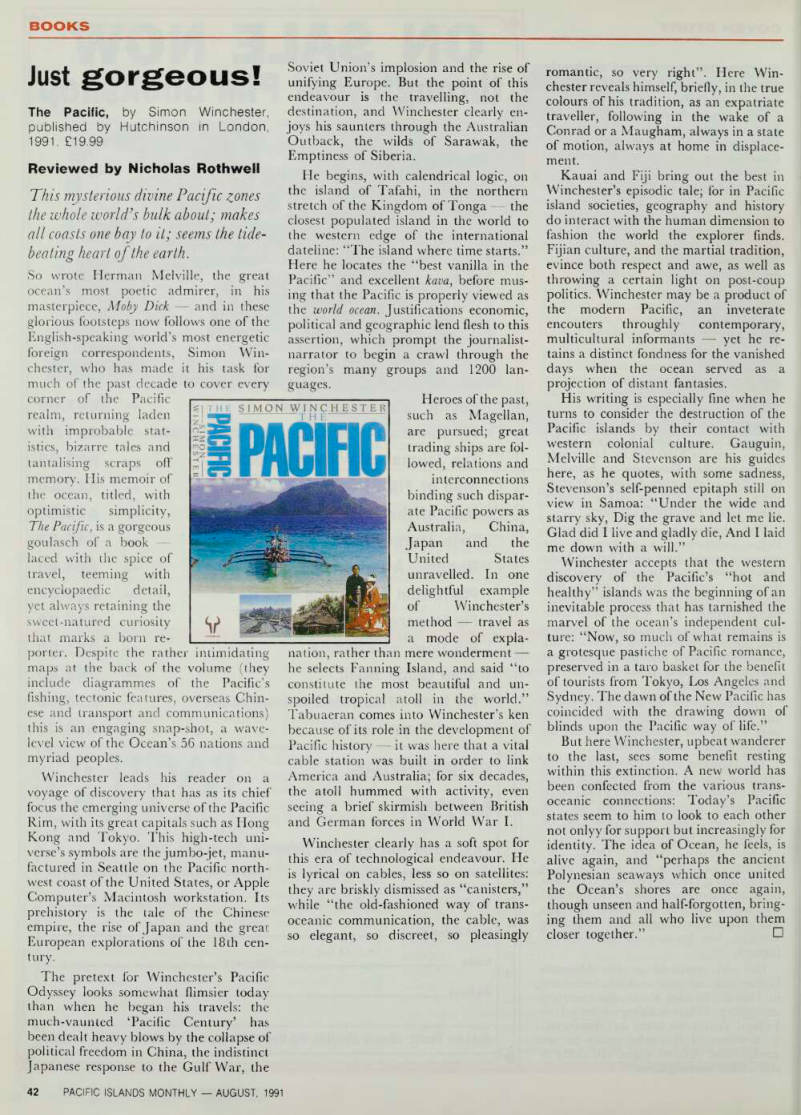
The Pacific, by Simon Winchester, published by Hutchinson in London, 1991. £19.99 Reviewed by Nicholas Rothwell This mysterious divine Pacific zones the whole world’s bulk about; makes all coasts one bay to it; seems the tide beating heart of the earth.
So wrote Herman Melville, the great ocean’s most poetic admirer, in his masterpiece, Moby Dick and in these glorious footsteps now follows one of the English-speaking world’s most energetic foreign correspondents, Simon Win chester, who has made it his task for much of the past decade to cover every
corner of the Pacific realm, returning laden with improbable stat istics, bizarre tales and tantalising scraps of!' memory. His memoir of the ocean, titled, with optimistic simplicity, The Pacific, is a gorgeous goulasch of a book laced with the spice of travel, teeming with encyclopaedic detail, yet always retaining the sweet-natured curiosity that marks a born re
porter. Despite the rather intimidating maps at the back of the volume (they include diagrammes of the Pacific’s fishing, tectonic features, overseas Chin ese and transport and communications) this is an engaging snap-shot, a wave level view of the Ocean’s 56 nations and
myriad peoples.
Winchester leads his reader on a voyage of discovery that has as its chief focus the emerging universe of the Pacific Rim, with its great capitals such as Hong
Kong and Tokyo. This high-tech uni
verse’s symbols are the jumbo-jet, manu factured in Seattle on the Pacific north west coast of the United States, or Apple Computer’s Macintosh workstation. Its prehistory is the tale of the Chinese empire, the rise of Japan and the great; European explorations of the 18th cen tury.
The pretext for Winchester’s Pacific Odyssey looks somewhat flimsier today than when he began his travels: the much-vaunted ‘Pacific Century’ has been dealt heavy blows by the collapse of political freedom in China, the indistinct Japanese response to the Gulf War, the
Soviet Union’s implosion and the rise of unifying Europe. But the point of this endeavour is the travelling, not the destination, and Winchester clearly en joys his saunters through the Australian Outback, the wilds of Sarawak, the Emptiness of Siberia.
He begins, with calendrical logic, on the island of Tafahi, in the northern stretch of the Kingdom of Tonga the closest populated island in the world to the western edge of the international dateline: “The island where time starts.”
Here he locates the “best vanilla in the Pacific” and excellent kava, before mus ing that the Pacific is properly viewed as the world ocean. Justifications economic, political and geographic lend flesh to this assertion, which prompt the journalist narrator to begin a crawl through the region’s many groups and 1200 lan guages.
Heroes of the past, such as Magellan, are pursued; great trading ships are fol lowed, relations and interconnections binding such dispar ate Pacific powers as Australia, China, Japan and the United States unravelled. In one delightful example of Winchester’s method travel as a mode of expla
nation, rather than mere wonderment he selects Fanning Island, and said “to constitute the most beautiful and un spoiled tropical atoll in the world.”
Tabuaeran comes into Winchester’s ken because of its role in the development of Pacific history it was here that a vital cable station was built in order to link America and Australia; for six decades, the atoll hummed with activity, even seeing a brief skirmish between British and German forces in World War I.
Winchester clearly has a soft spot for this era of technological endeavour. He is lyrical on cables, less so on satellites: they are briskly dismissed as “canisters,” while “the old-fashioned way of trans oceanic communication, the cable, was so elegant, so discreet, so pleasingly
romantic, so very right”. Here Win chester reveals himself, briefly, in the true colours of his tradition, as an expatriate traveller, following in the wake of a Conrad or a Maugham, always in a state of motion, always at home in displace ment.
Kauai and Fiji bring out the best in Winchester’s episodic tale; for in Pacific island societies, geography and history do interact with the human dimension to fashion the world the explorer finds.
Fijian culture, and the martial tradition, evince both respect and awe, as well as throwing a certain light on post-coup politics. Winchester may be a product of the modern Pacific, an inveterate encouters throughly contemporary, multicultural informants yet he re tains a distinct fondness for the vanished days when the ocean served as a projection of distant fantasies.
His writing is especially fine when he turns to consider the destruction of the Pacific islands by their contact with western colonial culture. Gauguin, Melville and Stevenson are his guides here, as he quotes, with some sadness, Stevenson’s self-penned epitaph still on view in Samoa: “Under the wide and starry sky, Dig the grave and let me lie.
Glad did I live and gladly die, And I laid me down with a will.”
Winchester accepts that the western discovery of the Pacific’s “hot and healthy” islands was the beginning of an inevitable process that has tarnished the marvel of the ocean’s independent cul ture: “Now, so much of what remains is a grotesque pastiche of Pacific romance, preserved in a taro basket for the benefit of tourists from Tokyo, Los Angeles and Sydney. The dawn of the New Pacific has coincided with the drawing down of blinds upon the Pacific way of life.”
But here Winchester, upbeat wanderer to the last, sees some benefit resting within this extinction. A new world has been confected from the various trans oceanic connections: Today’s Pacific states seem to him to look to each other not onlyy for support but increasingly for identity. The idea of Ocean, he feels, is alive again, and “perhaps the ancient Polynesian seaways which once united the Ocean’s shores are once again, though unseen and half-forgotten, bring ing them and all who live upon them closer together.” □
Pacific
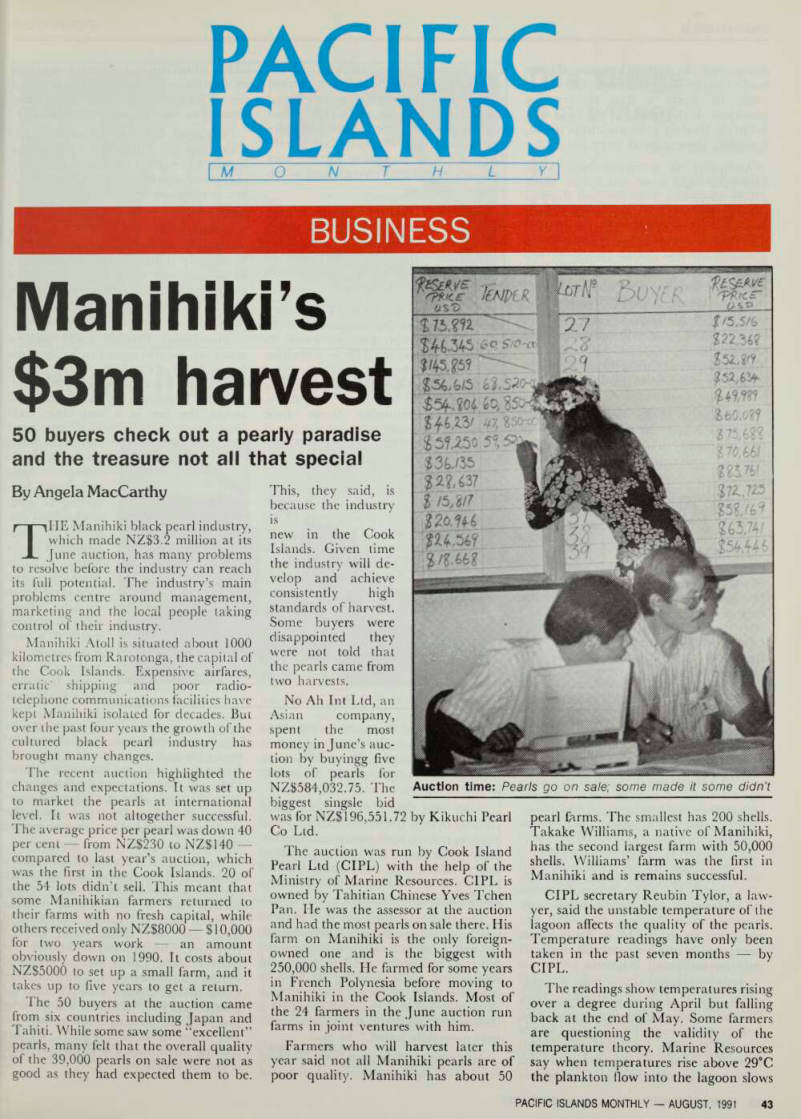
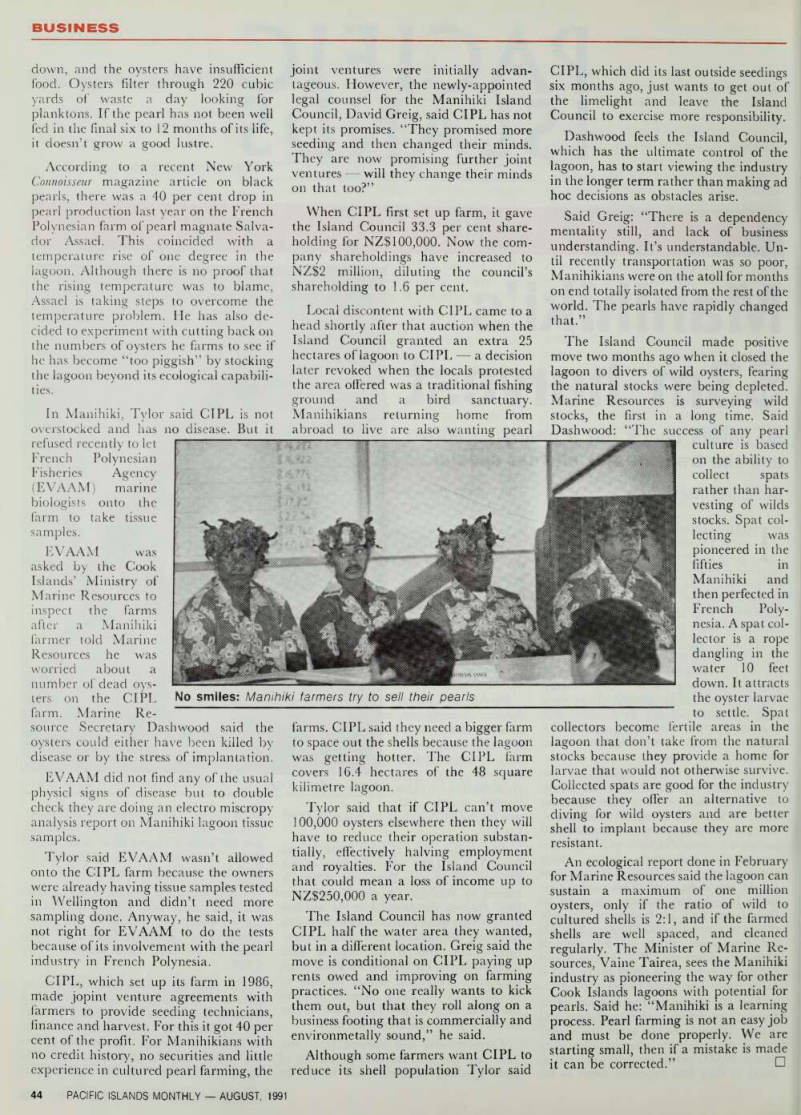
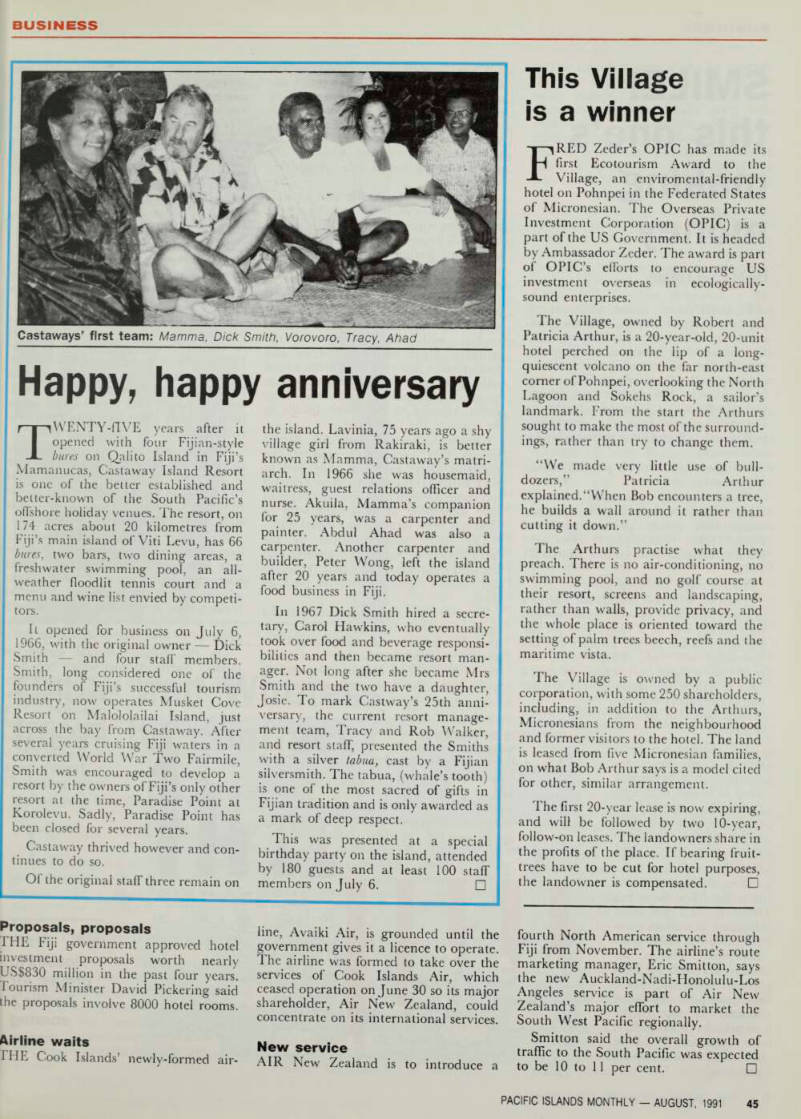
Islands
Monthly
Business
Manihiki’s $3m harvest
50 buyers check out a pearly paradise and the treasure not all that special
By Angela MacCarthy
THE Manihiki black pearl industry,
which made NZ$3.2 million at its June auction, has many problems to resolve before the industry can reach its full potential. The industry’s main problems centre around management,
marketing and the local people taking
control of their industry.
Manihiki Atoll is situated about 1000 kilometres from Rarotonga, the capital of the Cook Islands. Expensive airfares, erratic’ shipping and poor radio telephone communications facilities have kept Manihiki isolated for decades. But over the past four years the growth of the cultured black pearl industry has brought many changes.
The recent auction highlighted the changes and expectations. It was set up to market the pearls at international level. It was not altogether successful.
The average price per pearl was down 40 per cent from NZ$23O to NZ$l4O compared to last year’s auction, which was the first in the Cook Islands. 20 of the 54 lots didn’t sell. This meant that some Manihikian farmers returned to their farms with no fresh capital, while others received only NZ$BOOO $ 10,000 for two years work an amount obviously down on 1990. It costs about NZ$5OOO to set up a small farm, and it takes up to five years to get a return.
The 50 buyers at the auction came from six countries including Japan and Tahiti. While some saw some “excellent” pearls, many felt that the overall quality of the 39,000 pearls on sale were not as good as they had expected them to be.
This, they said, is because the industry is new in the Cook Islands. Given time the industry will de velop and achieve
consistently high
standards of harvest.
Some buyers were
disappointed they
were not told that the pearls came from two harvests.
No Ah Int Ltd, an Asian company, spent the most money in June’s auc
tion by buyingg five
lots of pearls for NZ5584,032.75. The
biggest singsle bid
was for NZ5196,551.72 by Kikuchi Pearl Co Ltd.
The auction was run by Cook Island Pearl Ltd (CIPL) with the help of the Ministry of Marine Resources. CIPL is owned by Tahitian Chinese Yves Tchen Pan. He was the assessor at the auction and had the most pearls on sale there. His farm on Manihiki is the only foreign owned one and is the biggest with 250,000 shells. He farmed for some years in French Polynesia before moving to Manihiki in the Cook Islands. Most of the 24 farmers in the June auction run farms in joint ventures with him.
Farmers who will harvest later this year said not all Manihiki pearls are of poor quality. Manihiki has about 50
pearl farms. The smallest has 200 shells.
Takake Williams, a native of Manihiki, has the second largest farm with 50,000 shells. Williams’ farm was the first in Manihiki and is remains successful.
CIPL secretary Reubin Tylor, a law yer, said the unstable temperature of the lagoon affects the quality of the pearls.
Temperature readings have only been taken in the past seven months by
Cipl.
The readings show temperatures rising over a degree during April but falling back at the end of May. Some farmers are questioning the validity of the temperature theory. Marine Resources say when temperatures rise above 29°C the plankton How into the lagoon slows
Auction time: Pearls go on sale; some made it some didn't
down, and the oysters have insufficient food. Oysters filter through 220 cubic yards of waste a day looking for planktons. If the pearl has not been well fed in the final six to 12 months of its life, it doesn’t grow a good lustre.
According to a recent New York Connoisseur magazine article on black pearls, there was a 40 per cent drop in pearl production last year on the French Polynesian farm of pearl magnate Salva dor Assael. This coincided with a temperature rise of one degree in the lagoon. Although there is no proof that the rising temperature was to blame, Assael is taking steps to overcome the temperature problem. He has also de cided to experiment with cutting back on the numbers of oysters he farms to see if he has become “too piggish” by stocking the lagoon beyond its ecological capabili ties.
In Manihiki, Tylor said CIPL is not overstocked and has no disease. But it
refused recently to let French Polynesian Fisheries Agency (EVAAM) marine biologists onto the farm to take tissue
samples.
EVAAM was asked by the Cook Islands’ Ministry of Marine Resources to inspect the farms after a Manihiki farmer told Marine Resources he was worried about a number of dead oys ters on the CIPL farm. Marine Re
source Secretary Dashwood said the oysters could either have been killed by disease or by the stress of implantation.
EVAAM did not find any of the usual physicl signs of disease but to double check they are doing an electro miscropy analysis report on Manihiki lagoon tissue
samples.
Tylor said EVAAM wasn’t allowed onto the Cl PL farm because the owners were already having tissue samples tested in Wellington and didn’t need more sampling done. Anyway, he said, it was not right for EVAAM to do the tests because of its involvement with the pearl
industry in French Polynesia.
CIPL, which set up its farm in 1986, made jopint venture agreements with farmers to provide seeding technicians, finance and harvest. For this it got 40 per cent of the profit. For Manihikians with no credit history, no securities and little
experience in cultured pearl farming, the
joint ventures were initially advan tageous. However, the newly-appointed legal counsel for the Manihiki Island Council, David Greig, said CIPL has not kept its promises. “They promised more seeding and then changed their minds.
They are now promising further joint ventures will they change their minds on that too?”
When CIPL first set up farm, it gave the Island Council 33.3 per cent share holding for NZS 100,000. Now the com pany shareholdings have increased to NZS2 million, diluting the council’s shareholding to 1.6 per cent.
Local discontent with CIPL came to a head shortly after that auction when the Island Council granted an extra 25 hectares of lagoon to CIPL a decision later revoked when the locals protested the area offered was a traditional fishing ground and a bird sanctuary.
Manihikians returning home from abroad to live are also wanting pearl
farms. CIPL said they need a bigger farm to space out the shells because the lagoon was getting hotter. The CIPL farm covers 16.4 hectares of the 48 square
kilimetre lagoon.
Tylor said that if CIPL can’t move 100,000 oysters elsewhere then they will have to reduce their operation substan tially, effectively halving employment and royalties. For the Island Council that could mean a loss of income up to NZ5250,000 a year.
The Island Council has now granted CIPL half the water area they wanted, but in a different location. Greig said the move is conditional on CIPL paying up rents owed and improving on farming practices. “No one really wants to kick them out, but that they roll along on a business footing that is commercially and environmetally sound,” he said.
Although some farmers want CIPL to reduce its shell population Tylor said
CIPL, which did its last outside seedings six months ago, just wants to get out of the limelight and leave the Island Council to exercise more responsibility.
Dashwood feels the Island Council, which has the ultimate control of the lagoon, has to start viewing the industry in the longer term rather than making ad hoc decisions as obstacles arise.
Said Greig: “There is a dependency mentality still, and lack of business understanding. It’s understandable. Un til recently transportation was so poor, Manihikians were on the atoll for months on end totally isolated from the rest of the
world. The pearls have rapidly changed
that.”
The Island Council made positive move two months ago when it closed the lagoon to divers of wild oysters, fearing the natural stocks were being depleted.
Marine Resources is surveying wild stocks, the first in a long time. Said Dashwood: “The success of any pearl
culture is based on the ability to collect spats rather than har vesting of wilds stocks. Spat col
lecting was
pioneered in the fifties in Manihiki and then perfected in French Poly nesia. A spat col lector is a rope dangling in the water 10 feet down. It attracts the oyster larvae to settle. Spat
collectors become fertile areas in the lagoon that don’t take from the natural stocks because they provide a home for larvae that would not otherwise survive.
Collected spats are good for the industry because they offer an alternative to diving for wild oysters and are better shell to implant because they are more resistant.
An ecological report done in February for Marine Resources said the lagoon can sustain a maximum of one million oysters, only if the ratio of wild to cultured shells is 2:1, and if the farmed shells are well spaced, and cleaned regularly. The Minister of Marine Re sources, Vaine Tairea, sees the Manihiki industry as pioneering the way for other Cook Islands lagoons with potential for pearls. Said he: “Manihiki is a learning process. Pearl farming is not an easy job and must be done properly. We are starting small, then if a mistake is made it can be corrected.” □
No smiles: Manihiki farmers try to sell their pearls
Proposals, proposals THE Fiji government approved hotel investment proposals worth nearly US$B3O million in the past four years.
Tourism Minister David Pickering said the proposals involve 8000 hotel rooms.
Airline waits THE Cook Islands’ newly-formed air
line, Avaiki Air, is grounded until the government gives it a licence to operate.
The airline was formed to take over the services of Cook Islands Air, which ceased operation on June 30 so its major shareholder, Air New Zealand, could concentrate on its international services.
New service AIR New Zealand is to introduce a
fourth North American service through Fiji from November. The airline’s route marketing manager, Eric Smitton, says the new Auckland-Nadi-Honolulu-Los Angeles service is part of Air New Zealand’s major effort to market the South West Pacific regionally.
Smitton said the overall growth of traffic to the South Pacific was expected to be 10 to 11 per cent. □
Happy, happy anniversary
TWENTY-fIVE years after it opened with four Fijian-style bures on Qalito Island in Fiji’s Mamanucas, Castaway Island Resort is one of the better established and better-known of the South Pacific’s offshore holiday venues. The resort, on 174 acres about 20 kilometres from Fiji’s main island of Viti Levu, has 66 bures , two bars, two dining areas, a freshwater swimming pool, an all weather floodlit tennis court and a menu and wine list envied by competi tors.
It opened for business on July 6, 1966, with the original owner Dick Smith and four staff members.
Smith, long considered one of the founders of Fiji’s successful tourism industry, now operates Musket Cove Resort on Malololailai Island, just across the bay from Castaway. After several years cruising Fiji waters in a converted World War two Fairmile, Smith was encouraged to develop a resort by the owners of Fiji’s only other resort at the time, Paradise Point at Korolevu. Sadly, Paradise Point has been closed for several years.
Castaway thrived however and con tinues to do so.
Of the original staff three remain on
the island. Lavinia, 75 years ago a shy village girl from Rakiraki, is better known as Mamma, Castaway’s matri arch. In 1966 she was housemaid, waitress, guest relations officer and nurse. Akuila, Mamma’s companion for 25 years, was a carpenter and painter. Abdul Ahad was also a carpenter. Another carpenter and builder, Peter Wong, left the island after 20 years and today operates a food business in Fiji.
In 1967 Dick Smith hired a secre tary, Carol Hawkins, who eventually took over food and beverage responsi bilities and then became resort man ager. Not long after she became Mrs Smith and the two have a daughter, Josie. To mark Castway’s 25th anni versary, the current resort manage ment team, Tracy and Rob Walker, and resort staff, presented the Smiths with a silver tabiia, cast by a Fijian silversmith. The tabua, (whale’s tooth) is one of the most sacred of gifts in Fijian tradition and is only awarded as a mark of deep respect.
This was presented at a special birthday party on the island, attended by 180 guests and at least 100 staff members on July 6. □
Castaways’ first team: Mamma, Dick Smith, Vorovoro, Tracy, Ahad
This Village
is a winner
FRED Zeder’s OPIC has made its first Ecotourism Award to the Village, an enviromental-friendly hotel on Pohnpei in the Federated States of Micronesian. The Overseas Private Investment Corporation (OPIC) is a part of the US Government. It is headed by Ambassador Zeder. The award is part of OPIC’s efforts to encourage US investment overseas in ecologically sound enterprises.
The Village, owned by Robert and Patricia Arthur, is a 20-year-old, 20-unit hotel perched on the lip of a long quiescent volcano on the far north-east corner of Pohnpei, overlooking the North Lagoon and Sokehs Rock, a sailor’s landmark. From the start the Arthurs sought to make the most of the surround ings, rather than try to change them.
“We made very little use of bull dozers,” Patricia Arthur explained.“ When Bob encounters a tree, he builds a wall around it rather than cutting it down.”
The Arthurs practise what they preach. There is no air-conditioning, no swimming pool, and no golf course at their resort, screens and landscaping, rather than walls, provide privacy, and the whole place is oriented toward the setting of palm trees beech, reefs and the maritime vista.
The Village is owned by a public corporation, with some 250 shareholders, including, in addition to the Arthurs, Micronesians from the neighbourhood and former visitors to the hotel. The land is leased from five Micronesian families, on what Bob Arthur says is a model cited for other, similar arrangement.
The first 20-year lease is now expiring, and will be followed by two 10-year, follow-on leases. The landowners share in the profits of the place. If bearing fruit trees have to be cut for hotel purposes, the landowner is compensated. □
making
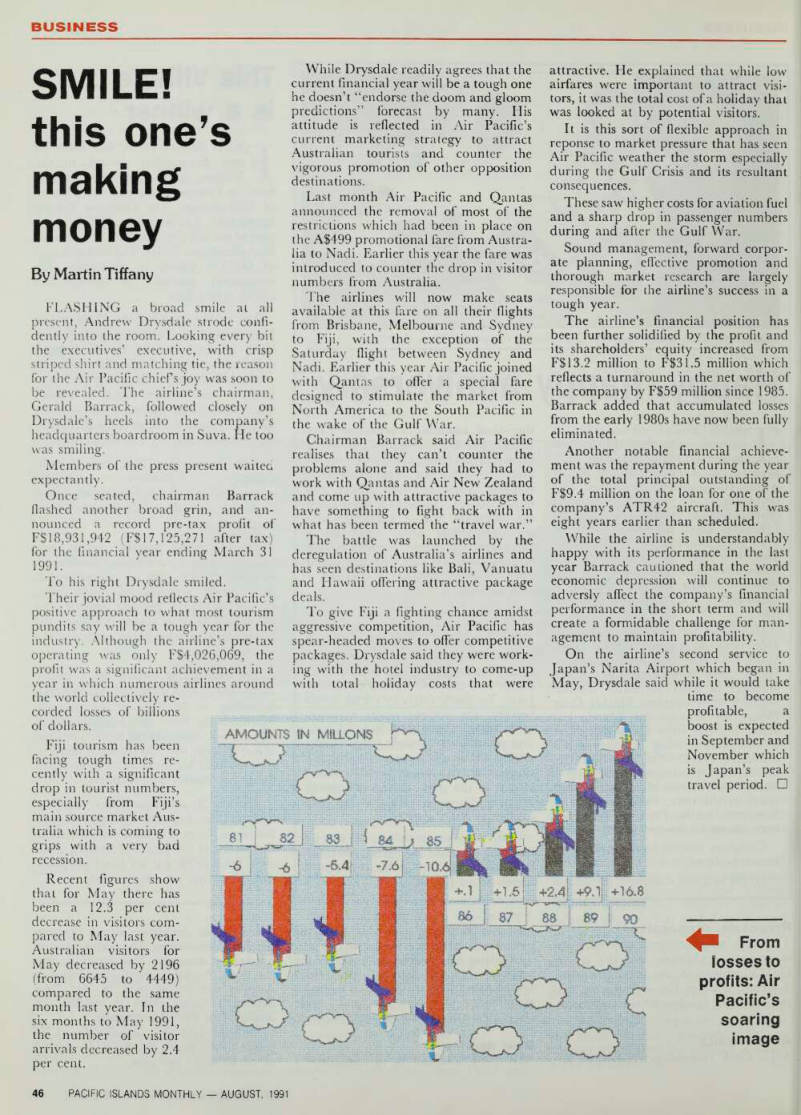
Smile!
this one’s making money
By Martin Tiffany
FLASHING a broad smile at all present, Andrew Drysdale strode confi dently into the room. Looking every bit the executives’ executive, with crisp striped shirt and matching tie, the reason for the Air Pacific chiefs joy was soon to be revealed. The airline’s chairman, Gerald Barrack, followed closely on Drysdale’s heels into the company’s headquarters boardroom in Suva. He too
was smiling.
Members of the press present waiteo
expectantly.
Once seated, chairman Barrack flashed another broad grin, and an nounced a record pre-tax profit of F$ 18,931,942 (F 517,125,271 after tax) for the financial year ending March 31 1991.
To his right Drysdale smiled.
Their jovial mood reflects Air Pacific’s positive approach to what most tourism pundits say will be a tough year for the industry. Although the airline’s pre-tax operating was only F 54,026,069, the profit was a significant achievement in a year in which numerous airlines around
the world collectively re corded losses of billions of dollars.
Fiji tourism has been facing tough times re cently with a significant drop in tourist numbers,
especially from Fiji’s
main source market Aus tralia which is coming to grips with a very bad recession.
Recent figures show that for May there has been a 12.3 per cent decrease in visitors com pared to May last year.
Australian visitors for
May decreased by 2196
(from 6645 to 4449) compared to the same month last year. In the six months to May 1991, the number of visitor arrivals decreased by 2.4 per cent.
While Drysdale readily agrees that the current financial year will be a tough one he doesn’t “endorse the doom and gloom predictions” forecast by many. His attitude is reflected in Air Pacific’s current marketing strategy to attract Australian tourists and counter the vigorous promotion of other opposition destinations.
Last month Air Pacific and Qantas announced the removal of most of the restrictions which had been in place on the A 5499 promotional fare from Austra lia to Nadi. Earlier this year the fare was introduced to counter the drop in visitor numbers from Australia.
The airlines will now make seats available at this fare on all their flights from Brisbane, Melbourne and Sydney to Fiji, with the exception of the Saturday flight between Sydney and Nadi. Earlier this year Air Pacific joined with Qantas to offer a special fare designed to stimulate the market from North America to the South Pacific in the wake of the Gulf W ar.
Chairman Barrack said Air Pacific realises that they can’t counter the problems alone and said they had to work with Qantas and Air New Zealand and come up with attractive packages to have something to fight back with in what has been termed the “travel war.”
The battle was launched by the deregulation of Australia’s airlines and has seen destinations like Bali, Vanuatu and Hawaii offering attractive package deals.
To give Fiji a fighting chance amidst aggressive competition, Air Pacific has spear-headed moves to offer competitive packages. Drysdale said they were work ing with the hotel industry to come-up with total holiday costs that were
attractive. He explained that while low airfares were important to attract visi tors, it was the total cost of a holiday that was looked at by potential visitors.
It is this sort of flexible approach in reponse to market pressure that has seen Air Pacific weather the storm especially during the Gulf Crisis and its resultant consequences.
These saw higher costs for aviation fuel and a sharp drop in passenger numbers during and after the Gulf War.
Sound management, forward corpor ate planning, effective promotion and thorough market research are largely responsible for the airline’s success in a tough year.
The airline’s financial position has been further solidified by the profit and its shareholders’ equity increased from F3U3.2 million to F 531.5 million which reflects a turnaround in the net worth of the company by FSS9 million since 1985.
Barrack added that accumulated losses from the early 1980 s have now been fully eliminated.
Another notable financial achieve ment was the repayment during the year of the total principal outstanding of F 59.4 million on the loan for one of the company’s ATR42 aircraft. This was eight years earlier than scheduled.
While the airline is understandably happy with its performance in the last year Barrack cautioned that the world economic depression will continue to adversly affect the company’s financial performance in the short term and will create a formidable challenge for man agement to maintain profitability.
On the airline’s second service to Japan’s Narita Airport which began in May, Drysdale said while it would take
time to become
profitable, a
boost is expected in September and November which
is Japan’s peak
travel period. □
From losses to profits: Air Pacific’s soaring image
Cable and Wireless


loses its contract
By Angela MacCarthy
The Cook Islands government has successfully forced Cable and Wireless out and taken control of all telecommunications systems in the country. In a shock legislation, The Government of Geoffrey Henry has terminated the contract of Cable and Wireles PLC Company four years early.
The company’s Cook Islands man ager, Mick Blackwell, said he was informed of the Bill the day before it passed into legislation, and ho is per turbed by the “indecent haste, lack of consultation and effect it will have on the investment reputation of the Cook Islands.”
Henry said the Cable and Wire less contract was terminated in or der for the devel opment of the Cook Islands inter-island tele communications system to proceed.
Cable and Wire less PLC’s con tract gave them exclusive rights to provide and oper ate an interna tional system for 15 years, renew able for further
five-year periods
by mutual con sent. It did not include the devel opment of local or inter-island sys tems.
Henry’s gov
ernment pledged
during the 1989 elections to de velop the inter island systems within the first three years of gov
ernment. They
are halfway
through their
third year and the inter-island sys tem remains out dated and un
changed.
Rarotonga has
local and interna tional telecom munications sys tems with demand for telephone con
nections outstripp
ing supply. In the
13 outer islands, which consist of under half of the Cook Islands population, only Aitutaki and Mitiaro have a local telephone exchange. Inter-island com munication is through Peacesat or the Post Office radio telephone system which breaks the voice signal so much that it is received garbled and difficult to under stand.
This is due to be changed by a new national telecommunications company, Telecom Cook Islands (TCI). TCI is to integrate the administration of the local and international systems by taking over Cable and Wireless and the Post Office.
It is to be financed by a USS 7.9 million loan granted by the Asian Development Bank (ADB) and the Export Credit Finance Organisation of Australia.
The loan has been given to upgrade facilities and communications on the outer islands. TCI say revenue from telecommunications should cover loan repayments. Other sources say that the national system can’t pay for itself that the international system is needed to subsidise it, and that is a major reason why the Cable and Wireless contract has been terminated.
TCI has been in the making for the past two years. When the Cook Islands Party became government in 1989, they discussed with Cable and Wireless the possibility of extending their services to cover national telecommunications.
Cable and Wireless presented a dis cussion document involving a joint venture with government, only to find that government had also put out a competitive tender for the task a tender that Telecom Network Interna tional (TNI) eventually won with a 40/60 joint venture bid.
TCI is the company resulting from that joint venture agreement with gov ernment. TNI, which is the international division of New Zealand Telecom, is owned by the American companies, Bell Atlantic and Americtech, and New Zealand companies, Freight ways Hold ings and Fay Richwaite. An Australian company, OTCI, which was involved with TNI in the original negotiation for Telecom Cook Islands, pulled out once they realised that Government intended to end the Cable and Wireless contract.
TNI signed a memorandum of under standing with government in 1989.
Shortly after, government asked Cable and Wireless to terminate their contract early. Cable and Wireless refused. “We told them then that we were not in the business of trading franchise but are in the business of telecommunications,” said Cable and Wireless Regional Direc tor, Peter Jackson. “We are a commer cial company so when our proposal for a national system was rejected we accepted that and we stated that we would continue to provide our service and improve it where we could.”
Prime Minister Henry said Cable and Wireless should have realised that if their tender didn’t win they would be out because the tender was for an integrated domestic and international system to be in place by 1993. Said he: “There was a clear understanding that I wanted the upgrading all finished by the end of 1993.
I wanted the outer islands to be able to watch on TV the 1992 Festival we’re
hosting.”
According to Henry, TNFs agreement was based on the condition that the Cable and Wireless franchise would end so that they could get on with the development. “They (TNI) said that if we wanted to deal with them, if we liked their terms of revenue and their tech nology then we had to take the steps
Going out: A Cable and Wireless technician at work In Rarotonga.
necessary to ensure they could get on with the job, said Henry.
Cable and Wireless said their contract did not have to be terminated in order for inter-island improvements to be done by TNI and the Post Office over the next four years. The company said interisland telecommunications were not covered by its franchise and other parties
were free to proceed in that area at any time.
The two parties have also clashed over royalty pay ments. They were orig inally set at 15 per cent with right of review every five years. Last year they were due for review and although both parties agreed on a maximum rise from 15 per cent to 22 per cent. But Government said its accountant, Arthur Anderson & Co., advised it to increase it to 75 per cent.
After lengthy debate gov ernment referred the mat
ter to arbitration. Royalties were not increased after the first five years of Cable and Wireless’s contract (1985) on the understanding that Cable and Wireless would introduce IDD (International Direct Dialling) and pro vide the necessary equipment into the local exchange. It did.
The two sides also have compensation payments to settle. The government will have to pay Cable and Wireless for their assets and loss of profits. Peter Jackson said that he believes the Prime Minister has been misinformed over the past efforts made by Cable and Wireless to help the development of inter-island communications. Jackson cannot see how Cable and Wireles’s early termin ation will benefit the Cook Islands.
“For government 1 can’t see the advan tage as they have to pay full compensatin for our loss of profits based on the significant investment we have made.
They get a business to run that needs capital, and we get our capital back,” said Jackson. “Telecommunications is expensive it is not profitable in the short term so we organise contracts of 15 20 years to ensure we receive our return which is made in the last years. To date we have not made our return, and we have invested more than we have taken so we need compensation for this.”
Government Opposition members are worried about the amount of compen sation and the expense of creating a new company to replace one that was doing; a satisfactory job. The business sector is worried about the quality of service the
new company will offer and fear that the government’s use of legislation to get rid and Wireless will affect the confldence of overseas investors.
Prime Minister Henry, however doesn’t believe the Cook Islands is going to be disadvantaged. He said that Cable and Wireless doesn’t have the technology he wants to bring his nation abreast of the
modern world outside He said telecom moaern won ° ou J He said telecommumcations for the Cook Islands should f° telephones and fax machines
an^d^TsvsteZ rlheTt ‘
j. ? d data s y stems for the Pacific re S lon * Said Henry: “I made up my mind that there is n 0 P° int in bein S able t 0 ,alk to * he world j fwe can’t talk to each other domestically or regionally. So what we
are looking at is upgrading so that we can link into planned regional connections.
TNI offers that. What we are going to establish here must be compatible with what is seen as ultimate in the region in the future. The Cable and Wireless proposal in 1989 didn’t take that into account and wouldn’t be compatible.”
“I don’t understand,” said Blackwell.
“Cable and Wireless is one of the leading telecommunica tions companies in the world. Only last year we wanted to move towards more modern transmission by introducing Intermediate Data Rate, without which the international service from here would have be come congested and de graded. Government told us they didn’t want us to bring it in. In the end we did bring it in, but government in sisted that it not be placed on the branch’s books. At the same time they say our technology isn’t good
enough?”
It is not clear why the Henry government did not adhere to the previous govern ment’s contract and wait out the last four years. The government said some Pacific leaders have sent letters of support.
Domestically people aren’t so enthusi astic. As compensation has to come out of government coffers, many wonder whether the rush is going to be worth all the anxiety and loss of money. □
Coming in: new telecom sign in the Cook Islands
Advertisements & other items, p. 48 (1 item)
( Aluminium Boat Builders )
INTERESTED IN A NEW BOAT?
m i
32 SPORTSFISHERMAN
4.5 m HYDRO-CAT
Dive Boats Game Boats Fishing Boats Coral Viewers Water Taxis
I ( QUALII YANDVALUE PLUSFROm7~) ,
FIJI CUSTOM CRAFT LIMITED
( ALUMINIUM BOAT BUILDERS )
WAILADA, LAMI P.O. BOX 1277, SUVA, FIJI PHONE: 361977, 361159, A/H: 450061 FAX: 351214
Lessons from the 80s
IN its first report focussing on the South Pacific, the World Bank has highlighted poor economic growth and criticised island states for
failing to foster enough private development.
The report, Toward Higher Growth in Pacific Island Economies: Lessons from the 1980 s, says South Pacific economies have been sluggish mainly because island governments lack ap propriate policies to stimulate productive private enterprise and attract foreign invest ment.
It examined six island nations Fiji, Vanuatu, Solomon Islands, Tonga, Western Samoa and Kiribati which are all members of the World Bank.
As a group, they had an average growth rate in real GNP of only 0.6 per cent per annum during 1980 88. At the same time, their
populations grew 2 per cent each year leading to a significant decline in per capita income. This disappointing economic performance was despite some record injections of foreign aid. It also sharply contrasts with the more than 5 per cent GNP growth in comparable island nations in the Caribbean and the nearly 7 per cent growth of the Indian Ocean islands of Maldives and Mauritius.
“Comparisons with the more dynamic island economies of the Caribbean and Indian Ocean indicates that among the (South Pacific island states), there has been an inability to stimulate private investment in productive sectors,” the reports says.
Circulating in government circles since earlier this year, the South Pacific report coincides with the release of a major international review by the World Bank of development throughout the Third World.
Both reports stress the theme that development can only be sustained by bolstering capitalism a reflection of the United States-backed policy of focussing more resources on private production and trade and encouraging the sale of state-owned businesses to corporations and individuals as the best way to alleviate global poverty.
“The key to resumption of sustained economic growth,” it says, is for governments to facilitate “the private sector’s search for profitable niches in domestic and world markets.”
Given the weak outlook for commodities, the Pacific Islands urgently need to develop new sources of growth.
So far, Fiji has been the most successful in diversifying its export base by reviving tourism in the wake of two military coups and expanding its manufactured exports. Tonga has also had some success diversifying its small export base.
But “no substantial export diversification or expansion has occurred elsewhere,” the report says.
Despite the Bank’s obvious disappointment with the region’s economic performance, it notes that the Pacific Islands have achieved “relatively high living standards in the face of many constraints.”
For instance, Fiji, Tonga and Western Samoa have life expectancy rates (66 70 years) near that for industrialised nations and higher than the average for Asian countries.
Those nations also enjoy high basic literacy rates, modern transport and communications and access to qualified medical staff.
The picture is not so rosy for the Melanesian nations, Vanuatu and Solomon Islands, where infant mortality rates are high and life expectancy low. A large part of their adult
population remains illiterate; only half the people have access to safe water and intestinal diseases and malaria are endemic.
But all nations enjoy “moderately high standards of living” with “quite high levels of income compared to other developing countries.”
In part, however, this is due to the medical and educational infrastructure established “dur ing the colonial period, rather than through recent economic development.”
As the biggest lender to the Third World, the World Bank has been under pressure from the US, its largest stockholder, to do more for private business.
Owned by 155 countries, its main goal is to increase production in poorer areas of the world.
The US administration believes that encourag ing private business is the best remedy.
The Bank’s emphasis on free markets has been protested by the Overseas Development Council, a private study group in Washington. “True development (is) ... improving the well being of men, women and children around the world, sustaining the environment on which rich and poor depend,” said John Sewell, president of the council.
The World Bank says island states need to continue their emphasis on building basic infrastructure and developing human resources through education and training. But it says development has been stunted by government policies that have been too inward-looking.
“In choosing key sectors, Governments have not been able to pick industries with bright futures. Protection from foreign competition has contributed to high-cost local economies unable to compete on the world marketplace. Investments in infrastructure (largely financed by foreign assistance) have not made a substantial contribution to growth,” it says.
“State enterprises have been a burden on public finances.
Growth of a dynamic private sector has been stifled by over regulation. Potential foreign investors have set up operations in other countries where the environment is more conducive to doing business.”
Among other things the report recommends “serving the rigid link between wages and the cost of living”, shifting toward more indirect taxation and selling off non-viable public enterprises.
It also suggests that aid donor should re-order their priorities including channeling some resources through the commercial financial system to stimulate the private sector.
“Further improvements in social indicators will depend upon what can be achieved in broad-based, more rapid growth,” the report says.
And such growth is possible. The World Bank says all six countries “have the potential for more rapid growth on a sustainable basis”. Solomon Islands and Vanuatu must first overcome pressing budget problems before they are able to better exploit their rich endowment of resources. As well, population growth is excessive.
But Fiji is already surging ahead. Tonga and Western Samoa both have the capacity for 3-4 per cent annual growth and “even Kiribati, with “fisheries resource and competent labour force, can attain enduring growth,” it says.
The report is based on a World Bank mission to the region in November 1989 with follow-up missions last year. □
Washington
Margot
O’Neill
America’s wasted millions
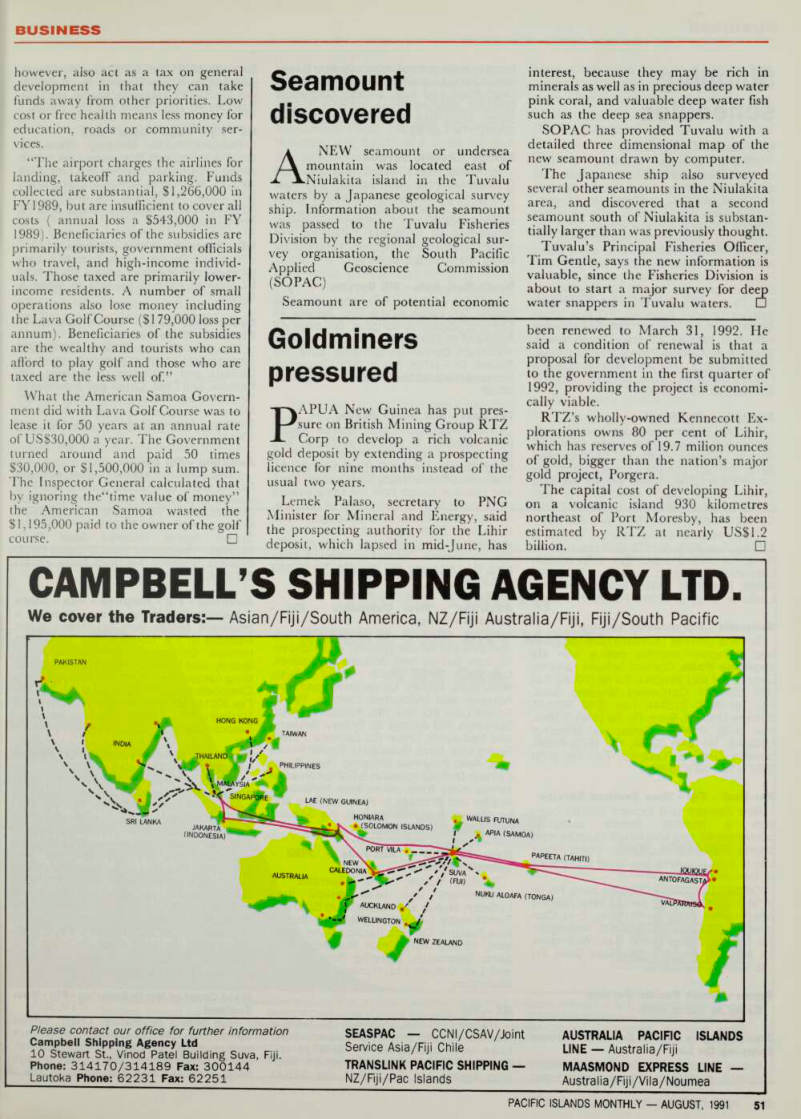
By David North
CLOSE to US$25O million dollars have been stolen, wasted or mis spent in the United States island territories, according to the Inspector General of the US Department of Interior.
In Guam, the government may lose US$25 million in tax revenues because it had not completed property appraisals promptly; it cannot locate $4.3 million in equipment; and it lost substantial funds by sloppy (and generous) payroll policies towards its elected officials and the bureaucrats in the school system.
In the Northern Marianas, “the Housing Authority borrowed $lO million to make an advance payment to a contractor who had been awarded a sole source (i.e Non-competitive) construc tion contract. The Housing Authority then borrowed funds from the contractor to pay interest on the $lO million borrowed. As a result $683,000 was paid in interest to finance the $lO million advance, and home buyers will need lessly pay an additional $4 million to $6 million to purchase homes because the construction contract was awarded sole source.”
The Northern Marianas also have experienced major short-falls in their electrical power and water accounts because they failed to collect for services to houses and to commercial establish ments.
In American Samoa the local government has “consistently underesti mated the amount of local revenues
collected and available for government operations in annual budget submissions to the US Congress,” and thus secured larger budget submissions than the Inspector General thought appropriate.
The Inspector General was critical of the Department of Interior’s Office of Terri torial and International Affairs (OTIA) for failing to show “progress...in resolv
ing long-standing problems in the man
agement of each territorial government.”
According to the Inspector General, Samoa’s tax collection system is so casual that it did not even collect income taxes from 21 of the 65 federal employees identified as working in Samoa; this is clearly a visible population from whom collection should be easy.
The Pohnpei State of Federated States of Micronesia purchased $120,700 worth of utility poles and related equip ment; the request for proposal specified that the stuff had to be delivered to Pohnpei. The winning vendor, however, knew that he could ship his material free on a barge heading to Pohnpei from the State of Washington, and was able to underbid his competitors who figured in shipping costs. Had Pohnpei informed all bidders about the free shipping oppor
tunity, the utility equipment could have
been purchased for considerably less money.
In the Marshalls, the Kwajalein
Atoll Development Authority (KADA)
was granted $3.4 million for a construc tion project by the US Government. In accepting the funds, KADA agreed to a 1.5 per cent limitation on administration.
KADA then spent more than $187,000 over the limit of 1.5 per cent ($51,414),
including $144,112 on its board of directors.
In Palau, the auditors had a field day. The General Accounting Office (GAO), the investigating arm of the Congress, found a treasure-trove of conflicts of interest, wasteful procure ment practices, the conning of overseas contractors to build roads that the island could not pay for, and much more. A good example, at the top government structure, was the question of who owned the house occupied by then President Lazarus Salii.
The Republic of Palau, the GAO said, on one hand acted as if the house was owned by an individual landlord ( rent was paid to that person) but on the other the government acted as though it owned the house, making $90,000 worth of improvements to it. To further gall the auditor, they could not determine from Palau’s incomplete property records who had title to the place.
The auditors do not just find theft and waste, they also encounter fiscal policies which favour one segment of the popu lation over the public as a whole. For example, in its description of the tangled finances and often clumsy management of the American Samoa Government, a report by the world-wide consulting firm, Louis Berger International Inc, said: “In brief, subsidies (of consumer services) increase use of the service thereby increasing the government’s losses, encourages waste and misuse of the service, and are finally, only con trolled by rationing. Not until the government charges its actual costs or runs out of funds will the cycle be halted.
“Failing to cover the cost of a service is considered a ... gift to anyone using the service and a tax on anyone who does not or cannot use the service. Subsidies,
however, also act as a tax on general development in that they can take funds away from other priorities. Low cost or free health means less money for education, roads or community ser vices.
“The airport charges the airlines for landing, takeoff and parking. Funds collected are substantial, S 1,266,000 in FY1989, but are insufficient to cover all costs ( annual loss a 5543,000 in FY 1989). Beneficiaries of the subsidies are primarily tourists, government officials who travel, and high-income individ uals. Those taxed are primarily lower income residents. A number of small operations also lose money including the Lava Golf Course (SI 79,000 loss per annum). Beneficiaries of the subsidies are the wealthy and tourists who can afford to play golf and those who are taxed are the less well of.”
What the American Samoa Govern ment did with Lava Golf Course was to lease it for 50 years at an annual rate of USS3O,OOO a year. The Government turned around and paid 50 times 530,000, or 51,500,000 in a lump sum.
The Inspector General calculated that by ignoring the“time value of money” the American Samoa wasted the 51,195,000 paid to the owner of the golf course. □
The Samoan telephone with the right connections
SUPPOSE that you were in the telephone business and were exploring new market. You have been told that, since the car phones are expensive, that you need a market with a million or so people before you could set up a profitable system. You know that most customers are businessmen calling from cars on long trips or stuck in urban traffic jams. You had a study showing that purchasers of car phones had average annual incomes of about USS3O,OOO to
Ussso,Ooo.
Would you start such a business in American Samoa, with its 35,000 people, its 15 miles of roads, and with a total, at the time, of 212 families with income over U 5525,000? Not likely.
The Director of Communications for American Samoa decided to start up a
car phone business for the American Samoa Government, though it was clear to others that the venture would be a certain money-loser for American Samoa’s telephone system. All this is in a Flash Report filed by the Inspector General of the United States Department of Interior a couple of years ago.
The proposed cellular phone system caused the Inspector General’s staff to look into previous purchases made in this field. It found that in an earlier period, fiscal years 1985 and 1986, the American Samoa Government’s Director of Com munications had made 13 purchases of communications equipment, worth U 55298,325 from a firm owned by his wife and three sons. The Director of Communications refused to buy tele phone sets which met the American
Samoa Government’s Procurement Office’s standards, and cost USsl7 each less than the family-favoured prooduct.
The Inspector General gave the audited organisation an opportunity to reply; it did not. The Inspector General extended the response time by a month; still it did not reply. Then the Inspector General sent his Flash Report indicat ing a serious level of Inspector General concern to the then Governor.
Despite the Inspector General’s criti cism the Director of Communications was not fired for conflict of interest and the cellular phone system was installed.
The phone system, however, became useful when Cyclone Ofa struck Ameri can Samoa in February last year and extensively damaged communication links. O
discovered
Seamount discovered
ANEW seamount or undersea mountain was located east of Niulakita island in the Tuvalu waters by a Japanese geological survey ship. Information about the seamount was passed to the Tuvalu Fisheries Division by the regional geological sur vey organisation, the South Pacific Applied Geoscience Commission
(Sopac)
Seamount are of potential economic
interest, because they may be rich in minerals as well as in precious deep water pink coral, and valuable deep water fish such as the deep sea snappers.
SOPAC has provided Tuvalu with a detailed three dimensional map of the new seamount drawn by computer.
The Japanese ship also surveyed
several other seamounts in the Niulakita area, and discovered that a second seamount south of Niulakita is substan
tially larger than was previously thought.
Tuvalu’s Principal Fisheries Officer, Tim Gentle, says the new information is valuable, since the Fisheries Division is about to start a major survey for deep water snappers in Tuvalu waters. □
pressured
Goldminers pressured
PAPUA New Guinea has put pres sure on British Mining Group RTZ Corp to develop a rich volcanic gold deposit by extending a prospecting licence for nine months instead of the usual two years.
Lemek Palaso, secretary to PNG Minister for Mineral and Energy, said the prospecting authority for the Lihir deposit, which lapsed in mid-June, has
been renewed to March 31, 1992. He said a condition of renewal is that a proposal for development be submitted to the government in the first quarter of 1992, providing the project is economi cally viable.
RTZ’s wholly-owned Kennecott Ex plorations owns 80 per cent of Lihir, which has reserves of 19.7 milion ounces of gold, bigger than the nation’s major gold project, Porgera.
The capital cost of developing Lihir, on a volcanic island 930 kilometres northeast of Port Moresby, has been estimated by RTZ at nearly USSI.2 billion. □
Advertisements & other items, p. 51 (1 item)
Campbell’S Shipping Agency Ltd.
W© cover the Traders:— Asian/Fiji/South America, NZ/Fiji Australia/Fiji, Fiji/South Pacific
INDIA
1$
HONG KONG
• ” TAIWAN
y . PHILIPPINES
\ THAILAND /
S . / PH
SINGAPrwr I X
SRI LANKA
LAE (NEW GUINEA)
HONIARA
(SOLOMON ISLANDS)
WALLIS FUTUNA
APIA (SAMOA)
PAPEETA (TAHITI)
NUKU ALOAFA (TONGA)
ANTOFAGASTA
Please contact our office for further information Campbell Shipping Agency Ltd 10 Stewart St., Vinod Patel Building Suva, Fiji.
Phone: 314170/314189 Fax: 300144 Lautoka Phone: 62231 Fax: 62251
SEASPAC CCNI/CSAV/Joint
Service Asia/Fiji Chile
TRANSLINK PACIFIC SHIPPING
NZ/Fiji/Pac Islands
AUSTRALIA PACIFIC ISLANDS
LINE Australia/Fiji
MAASMOND EXPRESS LINE
Australia/Fiji/Vila/Noumea
Shipping
schedules
New Zealand - Fiji direct Sofrana Unilines operates a fully containerised/breakbulk service every 21 days from Auckland, Tauranga, Lyttleton to Suva and Lautoka. Loading every 21 days, ro/ro service, containers - reefer. Contact Sofrana Unilines, Sofrana House, 101 Cus toms Street, Auckland, PO Box 3614, Fax (09) 393874, Ph (09) 773279, Tlx NZ 2313. Direct toll free line 0800 659-922, Contact Alan Foote. Sofrana Shipping Agencies, PO Box 921 Wellington, Tel (04) 725 661, Fax (04) 725 749, Tlx NZ 4769 Contact Steve Brannigan.
Sofrana Unilines Agencies, PO Box 22046 Christchurch, tel (03) 667 180, Fax (03) 668 868, TLX NZ4769, Contact Tony Newell.
Carpenters Shipping, Private Mail Bag, Suva, Fiji, Tel (679) 312244, Fax (679) 301572, Tlx FJ 2199. Sofrana Unilines, Suva, Fiji, Tel (679) 315645, Fax (679) 300057.
Australia - Fiji direct Sofrana Unilines operates a ro/ro con tainer service every three weeks from Mel bourne, Sydney, Brisbane, Lautoka and Suva. Contact Sofrana Unilines (Aust) Pty Ltd, PO Box Q 136, Queen Victoria Building, Sydney, NSW 2000, Australia, Tel (02) 2648944, Fax (02) 2676547, Tlx (71) A 170090, Contact Andrew McLachlin, Sam Attaway.
Carpenters Shipping, Suva, Tel (679) 312244, Fax (679) 301572. Sofrana Unilines Suva, Tel (679) 315 645, Fax (679) 300057.
Carpenters Shipping, Lautoka, Tel (679) 63988, Fax (679) 64896. Sofrana Unilines, Lautoka Tel (679) 62921, Fax (679) 64896.
Australia - Fiji monthly service Sofrana Unilines (Australia) Pty Ltd oper ates a regular monthly service with MV Capitaine Wallis Contact Sofrana Unilines, Sydney, Tel (02) 2648944, Tlx AA170090, Fax (02) 267-6547. Carpenters Shipping, Suva, Fiji. Tel (679) 312244, Fax (679) 301572, Sofrana Unilines, Suva, Fiji Tel (679) 315645, Fax (679) 300057. Carpenters Shipping, Lautoka, Tel (679) 63988, Fax (679) 64896.
Sofrana Unilines, Lautoka, Fiji, Tel (679) 62921, Fax (679) 64896.
Far-East - Fiji - New Zealand Service New Zealand Unit Express (NZUE) oper ates a monthly service accepting containerised and break-bulk cargoes from Manila, Keelung, Kaoshiung, Hong Kong, Lae to Suva, Lautoka (via Suva) and thence to New Zealand ports.
Contact Carpenters Shipping Suva, Fiji, tel (679) 312244, fax (679) 301572. New Zealand Unit Express, Maritime Building, 2-10 Cus toms House Quay, PO Box 890, Wellington.
Tel 727865, Cables Enzue Man, Wellington, Tlx NZ31340 Nedlnz or Nedlloyd Swire Pty Ltd, Sydney, Tel 20522.
Japan - South Pacific Service Same as Burns Philp Japan - South Pacific Service - Kyowa Shipping Co Ltd Kyowa Shipping, Shipping Co Ltd provides a monthly containerised service from Hong
Kong to main ports of Japan, Saipan, Guam, Island ports, Lautoka, Suva via Nukualofa to Pago Pago and Apia. Contact Carpenters Shipping, Neptune House, 3/4 floor, Tofuaa Street, Walu Bay, Suva. Tel 312244, Fax 301572, Tlx FJ2199.
Europe - Pacific Service Nedlloydd offers cargo services from Continental Ports to Papeete, Fiji, New Caledonia and Doniambo on slot helis with Bank line. Contact Nedlloyd (Aust) Pty Ltd, Spring Street, Sydney, Tel 273801. Carpenters Shipping, Suva, tel 312244, Tlx FJ2199, Fax 301572. Carpenters Shipping, Lautoka, Tel 63988, Tlx FJ5215, Fax 64896.
South East Asia - Fiji Service Nedlloyd Lines (NZEAS) Service operates regular fast cargo service from Jakarta, Pt Keelang, Singapore, Bangkok, Surubaya via Auckland to Suva and Lautoka.
Contact Carpenters Shipping, Suva, Tel 312244, Tlx FJ2199, Fax 301572. Carpenters Shipping, Lautoka Tel 63988, Tlx FJ5215, Fax 63988 Far East - Mid South Pacific China Navigations New Guinea Pacific Line operates a regular container and breakbulk heavy lift service from Hong Kong, Taiwan, Manila, Singapore, Malaysia, Thailand to Port Moresby, Lae, Rabaul, Kieta and Honiara. Cargo from the same eastern ports to the South Pacific Ports of Noumea, Santo, Vila, Papeete, Pagopago, Apia, Nukualofa, Rarotonga and Tarawa will be shipped via Japan or Busan on the monthly Bali Hai Service. Contact Steamships Ship ping, Port Moresby, PO Box 634, Tel 220283 or 220289.
Australia - New Caledonia - Fiji - Samoas - Tonga Pacific Forum Line operates a fully containerised service (general, reefer and ro ro) from Sydney and Brisbane to Noumea, Lautoka, Suva, Apia, Pago Pago, Nukualofa, Sydney. Cargo centralised from Adelaide and Melbourne. Contact: Pacific Forum Line, PO Box 796, Auckland; Union Bulkships, 333 George St, Sydney, Brisbane and Melbourne: Union Co, Lautoka: Pacific Forum Line, Suva, Nukualofa; Pacific Forum Line, Apia; Polynesia Shipping, Pago Pago.
Sofrano Unilines operates a Roßo/container service every three weeks from Melbourne, Sydney and Brisbane to Noumea, Suva and Lautoka with transhipment to the Samoas and Tonga.
New Zealand - Australia - PNG - Solomon Islands Pacific Forum Line operates a containerised and ro-ro service from Lyttleton, Napier and Auckland to Brisbane, Port Moresby, Lae, Honiara, Brisbane then to New Zealand. Contact: Pacific Forum, Auck land, Christchurch; Union Bulkships, Bris bane; Steamships Shipping Port Moresby and Lae Sullivan Ltd, Honiara; Seabridge, Wellington.
NZ - Fiji Translink Pacific Shipping sail twice a month to Fiji, with Polynesian Link and Coral Links which operate out of Tauranga and Auckland. Fiji Agents are: Campbells Ship ping Agency Ltd, Ph 314189 Fax 300144
Suva: Ph 62231 Fax 62251 Lautoka. Auck land Agents: McKay Shipping Ph (9) 390229 Fax (9) 303293. Tauranga Agents, seatrade agencies Ph (75) 754989 Fax (75) 758380.
NZ - Fiji - Pago - Apia - Nuk Translink Pacific Shipping operate a monthly sailing with Polynesian Link, which carries Dry Container, reefers and breakbulk cargoes. NZ Agents McKay Shipping Ship ping AKLD Ph 390229, Fax 3032931. Fiji Agents Campbells Shipping Agency & ltd Ph 314189 Fax 300144 NZ - Noumea - Wallis - Futuna Translink Pacific Agency operate a con tainer Breakbulk service once a month from NZ through Fiji and Noumea to Wallis & Futuna.
South East Asia - Fiji - Noumea - Papeete - Chile Service "Seaspac" A joint Chilean CCNI/CSAU Service offers a regular monthly sailing from Djakarta and Singapore to Noumea, Fiji, Papeete, and Chile. Cargo also federated to Singapore from Korea, Hong Kong, Taiwan, Malaysia, Bangkok. Fiji Agents; Campbells Shipping Agency Ltd, ph. 314189, Fax 300144.
Australia - Fiji Service Chief container services under Australia Pacific Island Line Unitize Sofrano and PFL vessels to provide a twice monthly, service from Australia. Fiji Agents Campbells Shippings Agency ltd Ph 314189 Fax 300144.
System Agents Nedlloyd Swire Ph(2) 2512699. Melbourne Yarra Shipping Ph (3) 6936300. Brisbane, Medlloyd Swire, ph (7) 8321551.
Australia - Fiji - Noumea - Vila - Santa Marsmond Express Lines operate a breakbulk service from Goodwood Island Australia to Fiji, Noumea, Vila Santo and Honiara. Continuous receiving depots in Sydney and Brisbane enable this vessel to bring cargoes from these parts. Fiji Agents Campbells Shipping Agency Ltd, ph. 314189, Fax 300144. Brisbane Agents Shippings & Marketing Ph (7) 2628082. Sydney Agents Seabord Agencies (2) 3172325.
Australia - New Caledonia - Fiji - Hawaii • North America ACT Pace Pacific (ACTA Shipping) oper ates a fully containerised/break bulk service every 17-20 from Melbourne, Sydney, Bris bane to Noumea, Suva and Lautoka. The vessels continue on to the West Coast of North America calling Honolulu at frequent intervals. Ships are ACT and ACT 12.
Contacts: ACTA Pty Ltd, Sydney Ph 2869666, Tx 121369, Fx 2869610. ACTA Pty Ltd, Melbourne Ph 6112000, Tx 30949, Fx 6293055. ACTA Pty Ltd, Brisbane Ph 2213116 m Tx 40719, Fx 2298143. SATO, Noumea Ph 281122, Tx 3163, Fx 278532.
Burns Philp Shipping, Suva Ph 311777, Tx 2168, Fx 301127; Burns Philp Shipping, Lautoka Ph 60777, Tx 5146, Fx 65850.
West Coast of North America - Fiji - New Zealand Blue Star Line Pacific Coast Service operates a fully containerised/break bulk service every 23 days from Vancouver, Seattle, San Francisco, Los Angeles to Pago Pago, Suva and New Zealand ports. The
vessels continue to call Suva on the Northbound voyage from New Zealand every fortnight to pick up Fiji exports such as garments, fresh ginger, etc. for Hawaii and West Coast of North Ame rica ports. Blue Star Line also provides a through service to East Coast to North America. Ships are Wellington Star, Southland Star and California Star.
Contacts: Blue Star Line, San Francisco Ph 9282026. Tx 184925, Fx 6730355; Blue Star Line, Vancouver Ph 6817300, Tx 0451326, Fx 6835797; Interocean Steam ship Corp, Seattle Ph 6829820, Tx 321101, Fx 3437421; Blue Star Line, Los Angeles Ph 5970454, Tx 408564, Fx 5978710. New Zealand Line, Wellington, Ph 739029, Tx 3583, Fx 4992468; New Zealand Line, Auckland Ph 390965, Tx 2556, Fx 3032039; Burns Philp Shipping, Suva Ph 311777, Tx 2168, Fx 301127; Burns Philp Shipping, Lautoka Ph 60777, Tx 5146, Fx 65850.
Japan - South Pacific Service Bali Hai Line a joint service of China Navigation, Mitsui OSK Line and NYK Line operates a fully containerised/
break bulk service from Korea, Japan to South Pacific ports on a monthly helis serving ports of Pusan, Kobe, Nagoya, Yokogama, Tarawa, Lautoka, Suva, Apia, Pago Pago, Papeete, Nukualofa, Noumea, Vila, Santo. The ships are also fully specialised to carry vehicles on Ro/ Ro helis. Ships are Coral Islander and Pacific Islander. Contacts: John Swire & Sons, Tokyo Ph 32309220, Tx 22248, Fx 3239288; Nippon Yusen Kaisha, Tokyo Ph 3284516. Tx 22236. Fx 32846332; Mtsul OSK Lines, Tokyo Ph 35877086, Tx 22266, Fx 35877732; Burns Philp Ship ping, Suva (C/lslander) Ph 311777, Tx 2168, Fx 301127; Carpenters Shipping, Suva (P/lslander) Ph 312244, Tx 2199, Fx 301572, Burns Philp Shipping, Lautoka Ph 60777, Tx 5146, Fx 65850; Carpenters Shipping Ph 63988, Tx 5215. Fx 64896.
Europe - South Pacific Service Bank Line Limited operates a monthly service from United Kingdom, Europe to South Pacific ports. Vessels are fully equiped to carry containers, break bulk cargo and have deep tank facilities to carry bulk liquid such as oil, etc. The
service operates from Hull, Rotterdam, Hamburg, Dunkirk, Le Havre, Papeete, Apia, Suva, Lautoka, Noumea, Vila, Santo, Honiara, Papua New Guinea Group, Singapore and back to Europe/ Continent. Ships: Forthbank, Ivybank, Clydebank, Moraybank. Contacts; Bank Line, London Ph 2650808, Tx 887392, Fx 4814784. Bank Line, Lae Ph 421235, Tx 44265, Fx 422925; Bank Line, Sydney. Ph 9063173, Tx 24063, Fx 9061430; Burns Philp Shipping, Suva Ph 311777, Tx 2168, Fx 301127; Burns Philp Shipping, Lautoka Ph 60777, Tx 5146, Fx 65850.
Australia - Vanuatu - Fiji Sitmar Cruises operates a year round cruise programme for Sydney to Vanu atu, Fiji. The programme also includes a number of calls to a number of islands such as Dravuni, Yasawa-i-Rara, Ro tuma, Mystery Island, etc.
Contact: Sitmar Cruises, Sydney Ph 2560111, Tx 20712, Fx 2560101; Burns Philp Shipping, Suva Ph 311777, Tx 2168, Fx 301127; Burns Philp Shipping, Lautoka Ph 60777, Tx 5146, Fx 65850. D
Advertisements & other items, p. 53 (1 item)
Bali
TONGA
KIRIBATI
VANUATU
COOK ISLAND
SOLOMON ISLANDS
NEW CALEDONIA
U.S. SAMOA
WESTERN SAMOA
FRENCH POLYNESIA
JAPAN . KOREA
YOU’LL FIND IT,
WHERE THE SKY MEETS
THE SEA
RORO. CONTAINER i
B.BULK SHIPPING
BALI
HAI
AGENTS
and
PHONE
SUVA:Burns Philp(B P) 311777 Carpenter Shipping (C S) 312244 LAUTOKA:B P 60777 C S 63988 APtArB P 22611 PAGOPAGO Polynesia Shipping Services Ltd 633-1211 PAPEETErCompagnie Maritime Polynesienne 42 84.02 HOUMEArEtablissements Ballande 687-283384 P23 ° MOW,ARA:SuM ivans (Solomon Islands) Ltd 21645 TARAWA.Shipping Corporation of Kribok 26196 NUKUALOFA:BP 21500 BUSANrfor general cargo Young Chang Shipping Co , Ltd 753-0451 for vehicle Pan Continental Shipping Co , Ltd 778-7680 Soyang Shipping Co, Ltd 752-7755 JAPAH.for general cargo Swire 03-230-9245 for vehicle NYK Lines 03-284-5506 Mitsui O S.K 03-587-7123
The Niue alternative

There’s one cheap option: move the community to Auckland
THE News for Niue has not been good. First, the New Zealand Government announced that aid was being cut, then the company which has been planning to prospect for minerals on the island ran into trouble with the Australian Stock Exchange and had its shares suspended a problem which could throw a question mark over its plans. There was some good news: the rebuilt government hotel was about to open, but overall the indications are that employment opportunities will shrink once again and more people will have to face moving to New Zealand.
At the harshest level of financial evaluation, the cheapest option of the New Zealand Government would be move most of the Niueans to Auckland and give them resettlement grants, per haps preserving just enough of a com munity on the island to service the small tourist industry. At the moment, aid is running at about US$3OOO per person still living on Niue. But it is a solution which is both politically unrealistic in the late 20th century and would also be opposed by a large section of Niue’s population (both among the 2300 on the island and the 10,000 Niueans living in
New Zealand).
It is true that the country had had a bad run. First there was a severe drought, then came Cyclone Ofa and disruptions to the island’s air links when Air Nauru was grounded. An earlier hurricane had destroyed the most prom ising export industry: coconut cream which had contributed nearly NZ5450,000 (U 55270,000) a year to Niue’s export trade. South Pacific Trade Commissioner Bill McCabe said it was the best coconut cream produced in the world. More important, the factory provided a cash income for farmers and
paid a reasonable price for their produce, After the hurricane wiped out most of the trees, the factory tried unsuccessfully to continue on with imported coconuts, The advent of Niue Airlines now chartering a Boeing 737 from Air Nauru, has at least restored regular and accept able ser vices to Alofi. The aircraft can a i so takee out fresh fruit and vegetables f or sale in the Auckland markets, and Niue does not have the same guarantine problems in New Zealand which face the f u u y independent island states. But mor e important the airline will bring in tourists. As Pacific Islands Monthly recently reported, the airline company is P art °f a consortium planning to build a second hotel on the island, But there are signs that the airline is making heavy weather of the Auckland- Alofi route. It ran only one flight in June, and has announced that from July the service will continue at fortnightly fre quency. Bargain fares are also being offered for old people and children, is so f ar i n t o a vicious circle: no tourists are going to spend two weeks on Niue. Nor, said Bill McCabe, would many want even a week there; there is only one tiny beach, some diving and few evening diversions. He argues that the islands needs twice-weekly connections, Niue Airlines is looking to extend services to Nadi, which would allow tourists to include Niue as part ofa Pacific holiday package but, again, frequency is the
key (especially for Japanese tourists, who
like to be on the move). Routes which included links to Rarotonga and Western Samoa would improve the situation even further.
Another part of the vicious circle is that it will not be until the second hotel is built that there will be enough accommodation for a 737-load of tour
ists. And the aircraft will have to run near full if the company is to be able to offer cheap enough airfares to compete with other destinations. Air Nauru, when it operated Auckland-Alofi-Nadi, could never fill its aircraft after it returned to flying last year, Niue was one of the routes abandoned in order to save money.
Apart from tourism and some fresh produce exports, Niue has few options.
Manufacturing, except on a cottage craft or small factory (like clothing) level is not feasible. The island is not in the main tuna fishing waters, although it does receive some money under the multilaterial fishing treaty with the United States. Also, its lack of a harbour rules out the stationing of fishing boats there.
Meanwhile, turmoil surrounds a com pany which had planned to drill for uranium on Niue. The Sydney-based Roycol Ltd was intending to spend Asl million (U 55755,000) on an exploration programme there, which would involve the sinking of eight holes to a depth of about 600 metres to test targets. But Roycol has run foul of the Australian Stock Exchange which suspended the company’s shares over the fact that it had not obtained shareholder approval for the purchase of two New Zealand mineral sands companies. With battles going on to dump various directors, the Niue project remains in abeyance.
Even if drilling goes ahead, the plan is acknowledged to be a high-risk one and something on which the Niueans cannot place too much hope.
The recording of extremely high
gamma radiation levels (60 times higher than generally found in Australia) had given rise to the belief that uranium may lie under the surface of Niue. Roycol was also encouraged by the fact that the soil cover on Niue contained trace elements of mercury, gold, silver, bismuth and chromium.
An engineer’s report on the project said that, if initial work provides enough evidence to offer encouragement, a full
assessment to establish the size of the reserves would cost between Ass million and AS 10 million.
The more immediate problem con fronting the government of Sir Robert Rex is that of laying off people from the public payroll which, with 600 em ployees (about a quarter of the island’s entire population or 80 per cent of the paid work force), had partially disguised the fact that there is not enough work on Niue to provide jobs in private employ ment.
In 1989 the then Labour administra tion in Wellington urged Rex to stop using aid money to prop up the public service and channel more into develop ment projects, a plea that went largely unheeded in Alofi. There was a Niue Concerted Action Plan which, between 1988 and 1990, was to have seen some of the aid funds spent on agriculture,
forestry, fisheries and tourism, but there is little to show for it. A report in 1988 by the New Zealand Audit Office said that the Niuean Government had been negligent in its use of public money.
Now the Bolger Government has cut aid and this will force Rex to act. More to the point, it will probably force a few hundred more Niueans to act in terms of packing up and moving to New Zealand as the island’s labour market shrinks even further.
In the end, Niue is too small to be a viable economic entity. Development projects can offer only marginal improve ments. The island will continue to be a responsibility of Wellington.
But there is little patience there these days with what are seen as unnecessary or indulgent uses for scarce funds. Niue can expect a few chill economic winds in the coming years. □
Advertisements & other items, p. 54 (1 item)
Carpenters
ARE YOU LOOKING FOR “RELIANCE SUPPLIER#OR
CONSTRUCTION TRADE”
RECORD AND FIJI’S BIGGEST SUPPLIER/EXPORTER TO
Roofing, Timber, Tiles, All types of Boards, Tools, Structural Steel, Pain -conditioners, Switchgear, Wire Ropes, Wire Products, Ships Fittings, Surv IT
CARPENTERS
BUILDERS MERCHANTS
BRANCHES:- LAUTOKA
PH: 61440, 60189. 60888, 63076
FAX: 60955, 60494
HEAD OFFICE:
46 MATUA ST,
WALU BAY, SUVA
G.P.O. BOX 48,
SUVA, FIJI.
PHONE: 313155
FAX: (679) 300694/302655
TELEX: FJ2457 BMD
NADI
PH: 71723
FAX: 70883
SIGATOKA
PH; 50520
FAX: 50672
LABASA
PH: 81656, 83399
FAX: 83071
HE IN
TRY
IF WE DO
NOT
STOCK
IT WE LL
GET
IT o
E STOP SUPPLII
CONSTRUCTION
INDUSTRY "
ONE
TO
The deregulator goes home
TONGA’S first Reserve Bank Governor, Queenslander Alan Gee, is returning to Australia after laying the foundations for change in the island kingdom’s economy. Gee, who held the job for two years, was a keen deregulator.
“With a lot of measures you don’t get an immediate big bang effect where suddenly everything is improving,” he said. “What you are doing is laying the foundations for gradual improvements.”
Further deregulatory options in the pipeline include lifting a ceiling on interest rates and introduction of more banking competition.
The Reserve Bank joined the bank of
Tonga and the Tongan Development
Bank.
Said Gee: “For any country, it is better to have market forces setting prices, and interest is a price.”
Before becoming governor of the reserve bank in 1989, Gee had been an adviser to the Tongan finance ministry.
He lived in Fiji for 30 years, where he capped his career there as Deputy Governor of the Reserve Bank of Fiji. He returns to Australia to settle on a 14-acre (5.7 hectare) property 50 kilometres north of Brisbane.
Tongan Siosius ’Utoikamanu, a graduate of universities in New Zealand and Britain, has been appointed as the new Tongan Reserve Bank Governor. □
Advertisements & other items, p. 55 (2 items)
Business
Bright Future
Stake Your
Claim In A
Tahiti Publications Touristiques, the 10-year-old publishing company of the Tahiti Beach Press, is preparing to launch an exciting and promising development programme. This is your chance to stake a claim in the bright future of that development programme and of such a beautiful place as Tahiti. There are 1504 new shares of Tahiti Publications Touristiques stock ready to be sold immediately at U 55137.5 per share (local tax included). Purchases are limited to a minimum of 50 shares per investor.
Your investment will help finance the launching of an all new monthly magazine devoted to Tahiti and Her Islands and aimed at Tahiti lovers and dreamers around the world. Tahiti Beach Press’ publishing company plans to capitalise on its excellent journalistic reputation, its experienced personnnel team, its proven record of financial success and its leading and unchallenged market position.
All that’s missing is you, one of our new partners in the promising publishing future that lies ahead. Stake your claim in that future. Today.
Call Gerard Warti, one of Tahiti Beach Press’ publishing company’s two owning partners, on telephone (689) 426850 to learn more. Or fill out the coupon as a potentially interested new stockholder and receive by mail further information and a stock purchase application form.
Yes, I am interested in becoming a Tahiti Publications Touristiques stockholder with the purchase of shares (minimum 50 at U 55137.5 each) for a total investment of US$ Date Signature Name Occupation Address Tel Tahiti Publications Touristiques, B.P. 887, Papeete, Tahiti.
Domalco kitchenwares are always
dressed for all occasion.
Manufacturers of: * Aluminium Utensils and other household items * Aluminium products for commercial purposes Also specialised In METAL SPINNING and
DEEP DRAWING
DOMALCO LIMITED
Manufacturers and Exporters 11 Navoli Rd., Varadoli.
P.O. Box 87, Ba Fax: (679) 670089 Phone: Ba: (679) 670082 After Hours (679) 670144 Cable Dullu For any above requirements contact us at
am Rent A Car
THE WORLD’S NO. 1
WHERE QUALITY AND SAFETY COUNT.
To drive the roads of Fiji is to experience some of the most beautiful scenery of the South Pacific, especially with Hertz.
For Nadi Airport 72146 Suva 383150,383411,383677 Telex: 2237, Fax: 370212 With Hertz you get more than Just a car. /A Reservations Phone.
Finding the right sheep
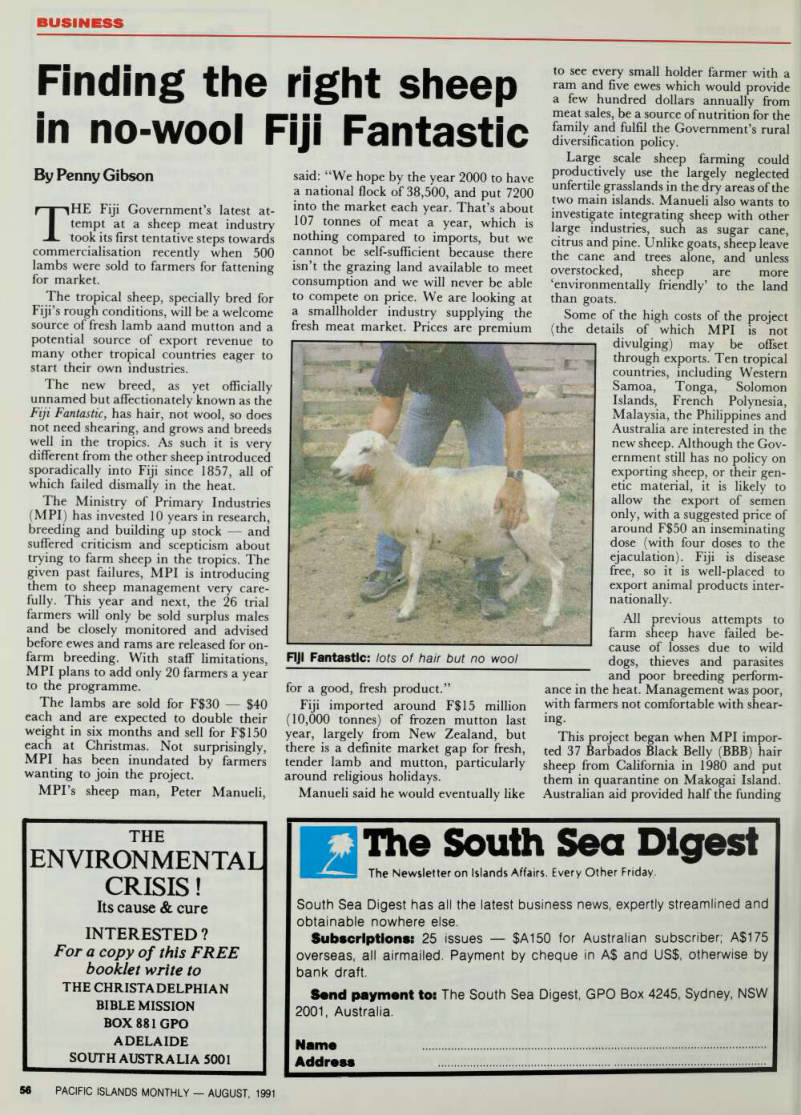
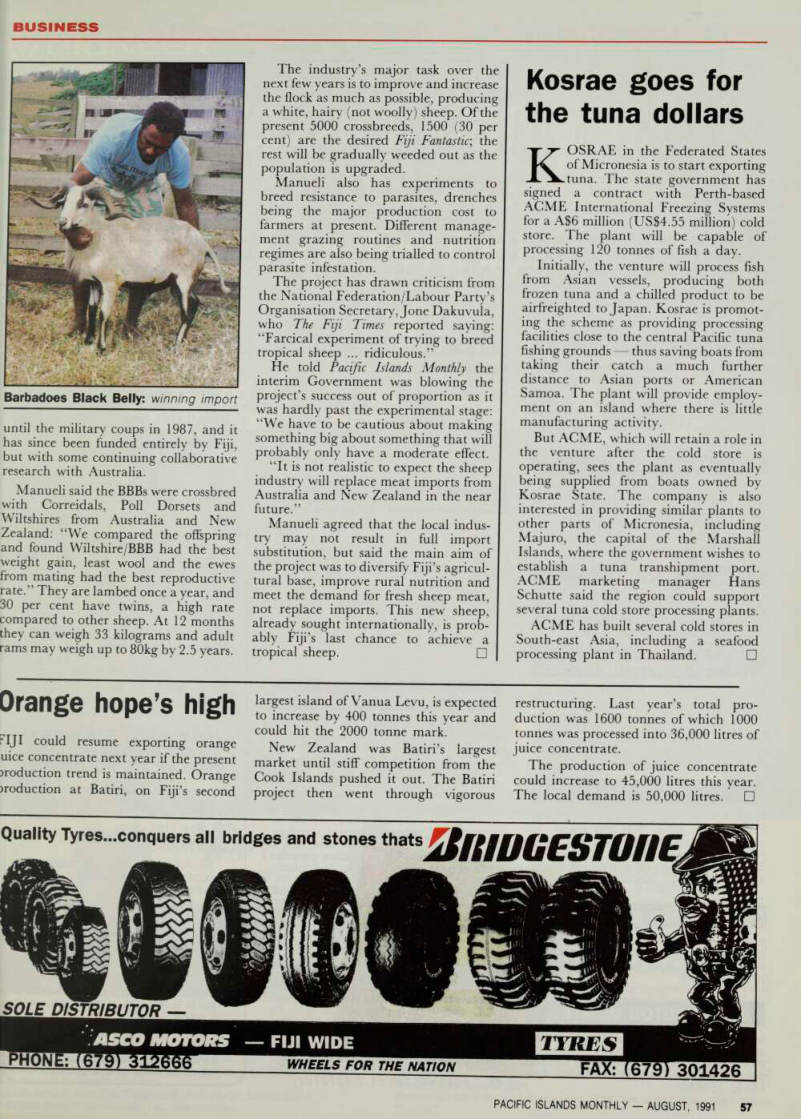
in no-wool Fiji Fantastic
By Penny Gibson
THE Fiji Government’s latest at tempt at a sheep meat industry took its first tentative steps towards commercialisation recently when 500 lambs were sold to farmers for fattening for market.
The tropical sheep, specially bred for
Fiji’s rough conditions, will be a welcome source of fresh lamb aand mutton and a potential source of export revenue to many other tropical countries eager to start their own industries.
The new breed, as yet officially unnamed but affectionately known as the Fiji Fantastic, has hair, not wool, so does not need shearing, and grows and breeds well in the tropics. As such it is very different from the other sheep introduced sporadically into Fiji since 1857, all of which failed dismally in the heat.
The Ministry of Primary Industries (MPI) has invested 10 years in research, breeding and building up stock and suffered criticism and scepticism about trying to farm sheep in the tropics. The given past failures, MPI is introducing them to sheep management very care fully. This year and next, the 26 trial farmers will only be sold surplus males and be closely monitored and advised before ewes and rams are released for on farm breeding. With staff limitations, MPI plans to add only 20 farmers a year to the programme.
The lambs are sold for Fs3o S4O each and are expected to double their weight in six months and sell for FSISO each at Christmas. Not surprisingly, MPI has been inundated by farmers
wanting to join the project.
MPl’s sheep man, Peter Manueli,
said: “We hope by the year 2000 to have a national flock of 38,500, and put 7200 into the market each year. That’s about 107 tonnes of meat a year, which is
nothing compared to imports, but we
cannot be self-sufficient because there isn’t the grazing land available to meet consumption and we will never be able to compete on price. We are looking at a smallholder industry supplying the fresh meat market. Prices are premium
for a good, fresh product.”
Fiji imported around Fsls million (10,000 tonnes) of frozen mutton last year, largely from New Zealand, but there is a definite market gap for fresh, tender lamb and mutton, particularly around religious holidays.
Manueli said he would eventually like
to see every small holder farmer with a ram and five ewes which would provide a few hundred dollars annually from meat sales, be a source of nutrition for the family and fulfil the Government’s rural
diversification policy.
Large scale sheep farming could
productively use the largely neglected unfertile grasslands in the dry areas of the two main islands. Manueli also wants to
investigate integrating sheep with other
large industries, such as sugar cane, citrus and pine. Unlike goats, sheep leave the cane and trees alone, and unless overstocked, sheep are more ‘environmentally friendly’ to the land than goats.
Some of the high costs of the project (the details of which MPI is not
divulging) may be offset through exports. Ten tropical countries, including Western Samoa, Tonga, Solomon Islands, French Polynesia, Malaysia, the Philippines and Australia are interested in the new sheep. Although the Gov ernment still has no policy on exporting sheep, or their gen etic material, it is likely to allow the export of semen only, with a suggested price of around Fsso an inseminating dose (with four doses to the ejaculation). Fiji is disease free, so it is well-placed to export animal products inter nationally.
All previous attempts to farm sheep have failed be cause of losses due to wild dogs, thieves and parasites and poor breeding perform
ance in the heat. Management was poor, with farmers not comfortable with shear ing.
This project began when MPI impor
ted 37 Barbados Black Belly (BBB) hair sheep from California in 1980 and put them in quarantine on Makogai Island.
Australian aid provided half the funding
FIJI Fantastic: lots of hair but no wool
until the military coups in 1987, and it has since been funded entirely by Fiji, but with some continuing collaborative research with Australia.
Manueli said the BBBs were crossbred with Correidals, Poll Dorsets and Wiltshires from Australia and New Zealand: “We compared the offspring and found Wiltshire/888 had the best weight gain, least wool and the ewes from mating had the best reproductive rate.” They are lambed once a year, and 30 per cent have twins, a high rate compared to other sheep. At 12 months they can weigh 33 kilograms and adult rams may weigh up to 80kg by 2.5 years.
The industry’s major task over the next few years is to improve and increase the flock as much as possible, producing a white, hairy (not woolly) sheep. Of the present 5000 crossbreeds, 1500 (30 per cent) are the desired Fiji Fantastic, the rest will be gradually weeded out as the population is upgraded.
Manueli also has experiments to breed resistance to parasites, drenches being the major production cost to farmers at present. Different manage ment grazing routines and nutrition regimes are also being trialled to control parasite infestation.
The project has drawn criticism from the National Federation/Labour Party’s
Organisation Secretary, Jone Dakuvula,
who The Fiji Times reported saying; “Farcical experiment of trying to breed tropical sheep ... ridiculous.”
He told Pacific Islands Monthly the interim Government was blowing the project’s success out of proportion as it was hardly past the experimental stage: “We have to be cautious about making
something big about something that will
probably only have a moderate effect.
“It is not realistic to expect the sheep industry will replace meat imports from Australia and New Zealand in the near future.”
Manueli agreed that the local indus try may not result in full import substitution, but said the main aim of the project was to diversify Fiji’s agricul tural base, improve rural nutrition and meet the demand for fresh sheep meat,
not replace imports. This new sheep,
already sought internationally, is prob
ably Fiji’s last chance to achieve a
tropical sheep. □
Barbadoes Black Belly: winning import
Advertisements & other items, p. 56 (1 item)
EThe South Sea Digest
The Newsletter on Islands Affairs. Every Other Friday.
South Sea Digest has all the latest business news, expertly streamlined and obtainable nowhere else.
Subscriptions: 25 issues SAISO for Australian subscriber; Asl7s overseas, all airmailed. Payment by cheque in A$ and US$, otherwise by bank draft.
Send payment to: The South Sea Digest, GPO Box 4245, Sydney, NSW 2001, Australia.
Name Address
THE
ENVIRONMENTAL
CRISIS!
Its cause & cure
INTERESTED ?
For a copy of this FREE booklet write to
THE CHRISTA DELPHIAN
BIBLE MISSION
BOX 881 GPO
ADELAIDE
SOUTH AUSTRALIA 5001
Kosrae goes for
the tuna dollars
KOSRAE in the Federated States of Micronesia is to start exporting tuna. The state government has signed a contract with Perth-based ACME International Freezing Systems for a As 6 million (U 554.55 million) cold store. The plant will be capable of processing 120 tonnes of fish a day.
Initially, the venture will process fish from Asian vessels, producing both frozen tuna and a chilled product to be airfreighted to Japan. Kosrae is promot ing the scheme as providing processing facilities close to the central Pacific tuna fishing grounds thus saving boats from taking their catch a much further distance to Asian ports or American Samoa. The plant will provide employ ment on an island where there is little
manufacturing activity.
But ACME, which will retain a role in the venture after the cold store is
operating, sees the plant as eventually
being supplied from boats owned by Kosrae State. The company is also interested in providing similar plants to other parts of Micronesia, including Majuro, the capital of the Marshall Islands, where the government wishes to establish a tuna transhipment port.
ACME marketing manager Hans Schutte said the region could support several tuna cold store processing plants.
ACME has built several cold stores in South-east Asia, including a seafood processing plant in Thailand. □
Orange hope’s high
FIJI could resume exporting orange uice concentrate next year if the present reduction trend is maintained. Orange reduction at Batiri, on Fiji’s second
largest island of Vanua Levu, is expected to increase by 400 tonnes this year and could hit the 2000 tonne mark.
New Zealand was Batiri’s largest market until stiff competition from the Cook Islands pushed it out. The Batiri project then went through vigorous
restructuring. Last year’s total pro duction was 1600 tonnes of which 1000 tonnes was processed into 36,000 litres of juice concentrate.
The production of juice concentrate could increase to 45,000 litres this year.
The local demand is 50,000 litres. □
Advertisements & other items, pp. 57-60 (1 item)
Jmuuestuue
Quality Tyres...conquers all bridges and stones thats
FIJI WIDE
TYRES
FAX:
J 12666
WHEELS FOR THE NATION
301426
SOLE DISTRIBUTOR
PACIFIC^
ISLANDS )
Y I jj MfIRK€T PlflCg/
For the benefit of our readers who would like to place a small classified advertisement in our magazine, Market Place will assist you in selling personal items, accommodation, real estate, boating or a service ... in fact anything you would like to sell to our over 50,000 readers.
Market Place Advertising Rates are structured to allow you to place as many advertisements as you wish, economically.
COMMERCIAL PRINTING
Top quality four colour printing, brochures, posters, packaging, product labels, fabric labels, billboards, books, magazines, stickers, books. Export quality. Contact Fiji’s most experienced Commercial Printers. FIJI TIMES COMMER- CIAL PRINTING, P.O. Box 1167, Suva. Fiji.
Phone: 304111 Fax. 301521.
HOUSING DEVELOPMENT
25 UNIT Townhouse development on 2.65 acres of prime ocean front property in American Samoa. Property includes commercial-sized swimming pool and ample grounds. Price on application. For further details contact OLE P.O. Box 1048 or fax (684) 699-1441.
REAL ESTATE
Profitable bungalow resort on stunning white sand beach. French Polynesia. $2.65 million USD Estates, resorts and opportunities throughout the Pacific; PACIFIC
ISLAND INVESTMENTS (808) 883-8000
fax: 883-8838
WANTED
ISLANDS (large and small, lease or fee) for individual and corporate buyers. Contact:
Karen Jeffery, PACIFIC ISLAND INVESTMENTS
(808) 883-8000/FAX: 883-8838.
“SCRAP METAL”
Tall ingots operate from Brisbane, Australia and make frequent visits to the Pacific islands, as they have done for twenty-five years. We are buyers of Copper, Brass, Aluminium, Lead, Cable etc. Inspection for big lots no problem. Telephone 61 7 8922033. Fax 61 7 8922077.
SHELLS
Magnificent and comprehensive collection of exotic shells, some 300,000 pieces includes accumulation suited to craft industry.
Price on application. Contact W. Welch 22 Bimbadeen Drive, Loganholme, Australia 4129 or Ring 617 2098856.
OPTICIANS AND OPTOMETR
Spectacles, Contact Lenses, Sungla See JEKISHAN & JEKISHAN, Epworth He G.P.O. Box 285, Suva, Fiji. Ph 311002 (679) 411898. 1
DISTRIBUTOR WANTED
Manufacturer of Ball point pens and dispc able Gas Lighters.
Please contact JNJ CORPORATION (FIJI) LTL G.P.O. Box 285, Suva, Fiji. Ph 39400 Fax (679) 411898.
SELF ADHESIVE LABELS
FORUM LABELS (FIJI) LTD
P.O. Box 1167, Suva., Fiji. Phone:3o4lll We print self-adhesive labels in rolls, multi-coloured labels with hot foil, and die cut to shape, tickets and tags in rolls. We also supply labelling machines and fabric labels.
DISTRIBUTERS WANTED
Franchise are available, in the Pacific Islands region to persons or companies interested in distributing a new patented inflatable snorkeler float. Suits all ages, and makes snorkeling an effortless pleasure. Ideal for tourist resorts, snorkel tours operators, island cruises and dive shops. For further information please contact Australian Snorkeler Float Pty. Ltd., P.O. Box 1072 Townsville, Queensland, Australia, 4810 Phone (077) 212109 Fax (077) 211420.
PUMP DISTRIBUTORS WANTED
Excellent profit available. As a Pacific Pump Dealer you would have access to some of the' world’s finest agricultural and industrial pump products. The product range includes:-
HIGH PRESSURE WASHERS SUBMERS-
IBLES Tsurumi Toyo PRESSURE SYSTEMS Espa GEAR PUMPS Viking Gorman Rupp PISTON PUMPS Cat TRASH Gorman Rupp OP GENERATORS. We provide sales literature, lists and a nables generous Pacific Products, torship details:-
PACIFIC PUMP
T, RYDALMERE,
PHONE (02)
184 full technical discru ia iws & Knives. \to 84” for is from 3” to
id. Bi-metal
j . idnner Knives, ..«co, Profile Knives & Heads. . ici'iKY BROS SAWS SYDNEY, AUSTRALIA. PH 61 2 6275486 FAX 61 2 6272707.
PACIFIC
SLANDS
I MONTH L n
MRRK€T PLRC6 CRN UJORK
WONDCRS FOR VOU ...
Promote your business, or service, sell your household
items, cars or heavy machinery
etc.
ONLY AUSSI PER WORD.
NO COMPANY LOGO. NO
DISPLAY. NO BOLD TYPE.
Just forward your Advertisement together with payment to: PACIFIC ISLANDS MONTHLY “Market Place”, P.O. Box 1167, Suva, Fiji.
CONDITIONS:
1. All Advertisements are subject to acceptance and approval of publisher. 2. Advertisements are published as space permits: we cannot guarantee date of insertion. 3. All advertisements must be prepaid and should be typed or printed clearly. 4. Deadline for receipt of advertisements is the 10th of the month prior to issue.
5. PACIFIC ISLANDS MONTHLY
assumes no responsibility for any service other than publishing paid advertisements in this section.
fl!) PIONEER
The Art of Entertainment
Stylish and Compact
In today's active society, a compact and modular Hi-Fi component stereo system is the perfect answer to home entertainment. The Contempo series gives you all you could ask for in both convenience and sound quality, as well as a stylish design that complements your living space.
Hi-Fi Compact System
C In -.pile of its > onifi.it I design. Contempo is |iatL ed with .1 variety of high-lech lealures that prod ute high-quality sound in almost ant listening s pate. Con tempo's spetiallt engineered function s compensate lor the loss of sound presence in I hniled spaces. As a result. Contempo sound is c risp and clear, no mailer nhere you are in the r •torn. VVhal s more, Pioneer Smart Operation c apabililies make the Contempo system simple to use. A touch ol the START/SET button and I he system delivers quality hi li sound. Various £ onlempo models n ill suit almost ant taste stilh a choice of Single, Twin and Multi-play ( D capabilities. And all ol the £ onlempo in odels employ 1 -Bit DEC (ETircct tinear Con version) technology lor evlremely high qu alily sound. Add to this an ASES (Auto Sy nchronired Editing System) provided on I he Double Auto-Reverse Cassette Deck th at lets you program Contempo to automat ically create professional-sounding casselt e recordings. All of this makes Contempo I he ideal personal entertainment system. In spile of its compact design. Contempo is p acked with a variety of high-tech features that produce high-quality sound in almos t any listening space. C onlempo s specia lly engineered functions compensate lor the loss of sound presence in limited sp aces. As a result, Contempo sound is cr isp and clear, no matter where vou are in the room. What's more. Pioneer Sm art Operation capabilities make the C onlempo system simple to use. A touch of I he SEART/SEt button and the system delis ers quality hi-fi sound. Various Contempo models still suit almost any taste with a c hoice of Single. Twin and Multi-play CD capabilities. And all of the Contempo models employ I -Bit DEC (Direct I i near Conversion) technology for e vlremelv high-quality sound. Add to this an ASES (Auto Synchronic ed Editing System) provided on I he Double Aulu-Reverse C asse He Deck that lets you progr am Contempo to automat ically creat professionalsounding cassette recor dings. All of this makes Contempo the ideal pe rsonal entertainment sy stem. In spile of its co
nrpact design. Conlemp
o is packed with a variet y of high-tech features that produce high-quality sound in almost any listening space. Coni empo's specially engineered fundi ons compensate for the loss of sou nd presence in limited spaces. As a result, Contempo sound is crisp an d clear, no matter where you are in the room , What's mure. Pioneer Smart Opeialiun capa bililies make the Contempo system simple to u se. A touch of the SEARI/SET button and the system delivers quality hi-fi sound. Various Conte ntpo models will suit almost any taste with a cho ice of Single, Twin and Multi-play CD capabilities And all of the Contempo models employ I -Hit D EC (Direct Linear Conversion) technology for evtr finely high-quality sound. Add to this an ASES (A ulu Synchronized Editing System) provided on I he Double Auto-Reverse Cassette Deck that let s vou program Contempo to automatically ere ate professional-sounding cassette recordings.
All of this makes- Contempt i the ideal personal e nlerlainment system. In spite of its compact des ign, Contempo is packed with a variety of high-l ech features that pioduce high qualify sound in almost any listening space. Contempo s specially engineered functions compensate for the loss of sound presence in limited spates. As a re suit, Contempo sound is crisp and clear, no matter where you are in the room.
What s more. Pioneer Smart Opera tion capabilities make the Cimle mpo system simple to use. A I ouch of the START/SEI b ullon and the system
delivers quality
hi-fi sound.
Various Co i A X-P77 305 W
(PMPO)
lllUiM mm will suit almost any taste with a choice of Singl e, twin and Multi-play CD capabilities. And all of the ( onlempo models employ 1 Bit DEE (Oi reel linear I onversiun) technology for evliem ely high quality sound Add to this an ASES (A uln Synchronized Editing System) proyided o n the Double Auto-Reverse Cassette Deck th at lets you program ( onlempo to automatic ally create piofessional-sounding cassette r ec or clings. All of this makes Contempo the ideal personal entertainment system. In sp ile of its compact design, C onlempo is pa eked with a variety of high-tech features that produce high-quality sound in aim osl any listening space. Contempo'» sp eciallv engineered functions cumpensa le for the loss of sound presence in lim iled spaces. As a result, ('onlempo sou nd is crisp and clear, no matter where you ate in the room. What s more. Pion eer Smart Operation capabilities make I he Contempo system simple to use. In s pile of its compact design, Contempo is pack ed yvilh a variety of high-tech fea lutes that produce high-quality sound i n almost any listening space. Conlemp o s specially engineered functions com pensale for the loss of sound presence in limited spaces. As a result, ('ante mpo sound is crisp and clear, no ma
: °r further information, please contact:
Australia: Pioneer Electronics Australia Pty. Ltd. (Incorporated in Victoria), 178- 84 Boundary Road, Braeside Victoria 3195 Tel: 580-9911 : iji Islands: Brijlal & Company, G.P.O. Box No. 362, Suva, Fiji Islands Tel: 22258 Jew Zealand: Monaco Corporation Ltd., 41 Poland Road, Glenfield, Auckland
Jew Zealand Tel: (09)444-9144
Jorfolk Island: Burnt Pine Traders Ltd., P.O. Box 21, Norfolk Island Vanuatu: Burns Philp (Vanuatu) Ltd., Vila, Vanuatu ■ 305 W (PMPO) ■ Digital sound field
processor ■ L.P.S. (Listening Point
Selector) ■ One-touch KARAOKE (Vocal
Cancel) ■ Sound jog dial for sound image
control and S.F.C. effect ■ Auto
Synchronized Editing System (A.S.E.S.)
ready ■ P.Bass (Power Bass)
* X-P55/X-PSSM (305 W PMPO), X-P33 (21OW PMPO) and i X-Pll (200 W PMPO) Contempo models are also available.
Nauru Island: Jacob Enterprises, P.O. Box N 0.4, Republic of Nauru Tahiti: Tahiti Hi-Fi, P.O. Box 848, Papeete, Tahiti New Caledonia: Menard Pacifique Sari, B.P. 3899, Noumea, New Caledonia
Tel: 27-62-23
American Samoa: Transpac Corporation, P.O. Box 1477, Pago Pago American
Samoa 96799 Tel: 633-5224
Rarotonga: South Seas International Ltd., P.O. Box 49, Rarotonga Cook Islands
Tel: 2327
RAC
Designed to be Driven. ! m PS m i */ ksail m U
MITSUBISHI
MOTORS
Proven in Every Comer of the World.
Stylish elegance and luxurious detail are the first things you’ll notice about the new Galant. So you might be surprised to learn that Galants have driven to victory in more than 10 major rally raid events — from the snowy slopes of Sweden, to the African savannah. And you’ll be pleased to know that the same performance features keeping those rally cars competitive on the course are also what make your Galant one of the best performance saloons on the road today.
For years, Mitsubishi engineers have known that motorsports are an ideal place for testing new and improved technologies.
The hard, fast driving required to win a rally strains every part of a car—generating pressures that exceed the demands of normal driving. Here, as drivers push their cars to the limit, the rigidity and strength of new space-age constructions can be checked and proven reliable.
The new Galant’s advanced triplelink torsion axle rear suspension is a good example. It is the result of many small yet critical refinements, ultimately designed to grip the road for safer, more comfortable control when changing lanes and cornering.
The severe demands of international motorsport competition: just further proof of how far Mitsubishi will go to build the best cars for you.
(o 2 9 AUG 1991 J|
MITSUBISHI CSRLHNT
AMERICAN SAMOA: MORRIS SCANLAN SERVICE INC P.O. Box 367, Pago Pago. Tel 633 5520/AUSTRALIA: MITSUBISHI MOTORS AUSTRALIA LTD. Box 1284, South Road, Clovelly Park, South Australia 5042, Tel (08) 275-7223/FIJI; NIVIS MOTOR & MACHINERY CO., LTD. G.P.O. Box 150. Suva, Tel. 383411/FRENCH POLYNESIA (TAHITI): ETS-BREDIN FRERES ET FILS P.O. Box 21, Papeete, Tahiti, Tel. 4-202 58/NEW CALEDONIA: SOCIETE D IMPORTATION D'AUTO DU PACIFIQUE SUD S.A. B.P. 438 Rond Point du Pacifique, Noumea, Tel. 274144/NEW ZEALAND; MITSUBISHI MOTORS NEW ZEALAND LTD. Todd Park, Heriot Drive, Private Bag. Porirua, Tel. 370-109/ NORFOLK ISLAND; BORRYS LTD. P.O. Box 169, Norfolk Island. Tel. 2114/PAPUA NEW GUINEA; TOBA PTY. LTD. P.O. Box 503, Port Moresby, Tel. 21 7874/SOLOMON ISLANDS: HARVEST PACIFIC LTD. G.P.O. Box 88, Honiara.
Guadalcanal, Tel 30128/TONGA: SITANI MAPI CO., LTD. P.O. Box 83. Nuku’ALOFA, Tel. 21 044/VANUATU: SOCOMETRA B P. 06 Route de Lagon, Port-Vila, Tel. 2314/WESTERN SAMOA: A.M. MACDONALD HOLDINGS LTD.
P.O. Box 576, Apia, Tel 22022/SAIPAN/POHNPEI/MAJURO/KOSRAE/TRUK/YAP/BELAU: MICRONESIAN MOTORS, INC. 997 South Mamne Drive, Tamuning, Guam 96911, Tel 646-6827