Pacific
Islands
Monthly
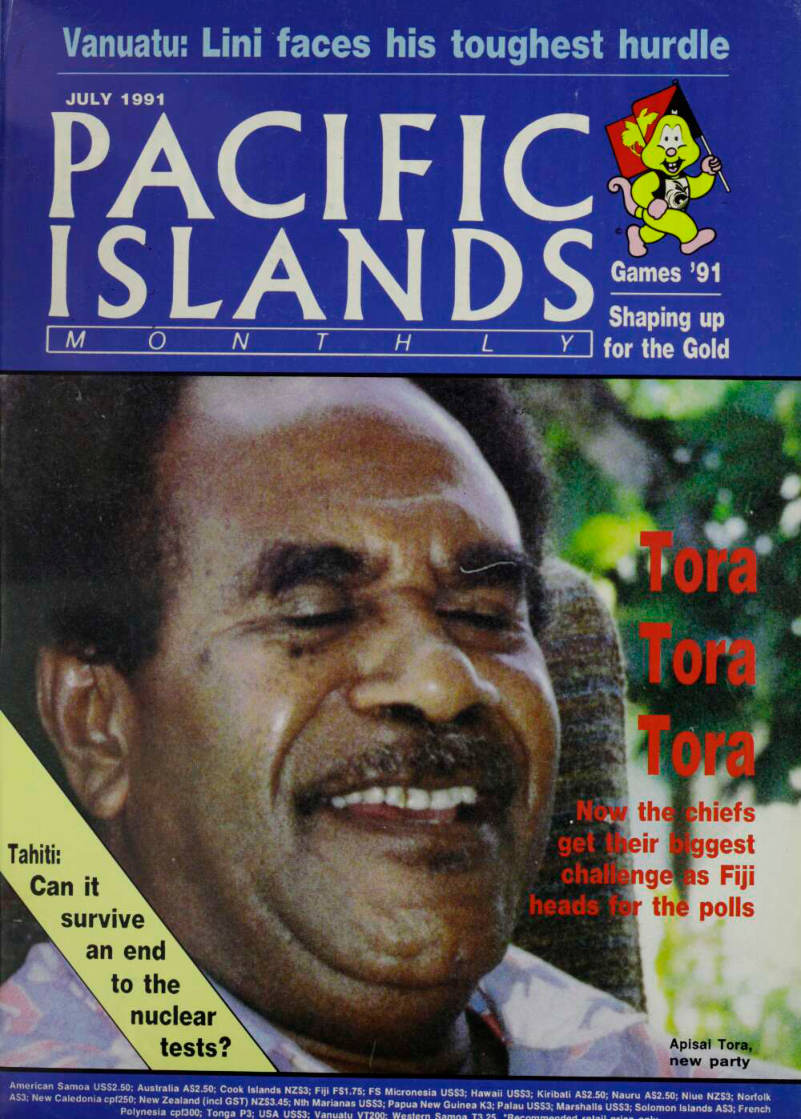
Vanuatu: Uni faces his toughest hurdle
July 1991
Games ’9l Shaping up for the Gold
I l ■png* «• v|sj
th Jphiefs
aiJSßltteir iggest jaJE| igefis Fiji the polls
MI0«—I. USS 3; Hawaii USS 3; Klriba.i A 52.50; Nauru A 52.50; Niue N2S3; Norfolk P Z ( !T GST * NZS3 45; N,h Mananas US$3; Papua New Guinea K 3; Palau USS 3; Marshalls USS 3; Solomon Islands AS3- French Polynesia cpf3oo; Tonga P 3; USA US$3; Vanuatu VT2OO: Western Samoa ts 9* ‘RprnmrwonHoH rntiil mv.aa
Advertisements & other items, p. 2 (1 item)
clarior
CMX23O
STEREO CASSETTE DECK
WITH FM-STEREO/MW TUNER
& CD CHANGER CONTROL
CMX23O the trend-setting in-car sound player offered by Clarion, that front runner in the car audio field. Visit new sound frontiers witf amazing CMX23O, a masterpiece in human engineering. /r / // 7 , / / ''' '/ /:■ • ‘Wr / / . '; ■ & / s% / zr .
M w /
clarior
For further information Australia: AWA Distribution Limited Dept. 112-118 Talavera Road North Ryde NSW 2113 / New Zealand; AWA New Zealand Limited, P.O. Box 50-248, Porirua / Fiji Islands. Bmf & Co., Ltd., G.P.O. Box 362, Suva Tahiti: HI FI., VAIRAATOA. Avenue Chef Vairaatoa B.P 1128, Papeete / New Caledonia: Caldis, 8.P.M1, Noumea Cedex / Guam: Micropac Aim Inc., PC. Box 3478, Agana, Guam 96910, U.S.A. Tel; 472-8091, Cable Code: HIFI AUDIO AGANA / Vanuatu: The Sound Centre, PO. Box 434, Vila / Cook Islands: South SiB
Pacific
Islands
Monthly
V 01.61 N 0.7
The News Magazine
July 1991
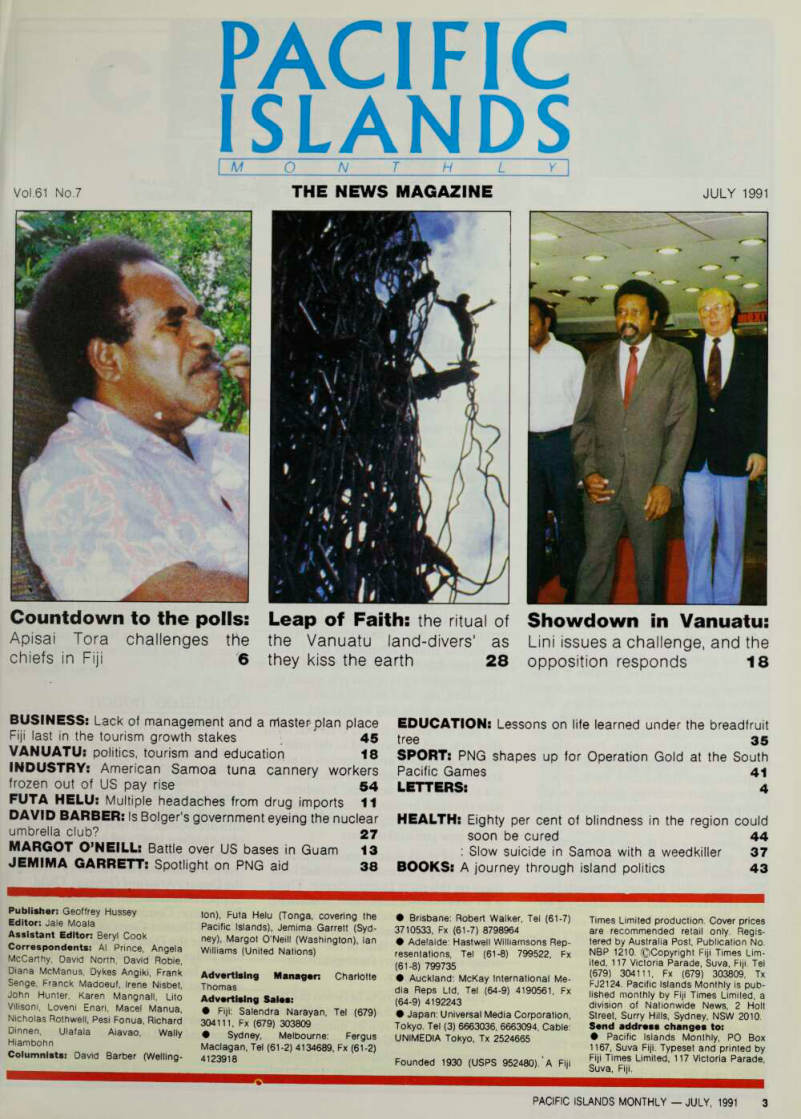
Countdown to the polls: Apisai Tora challenges the chiefs in Fiji 6
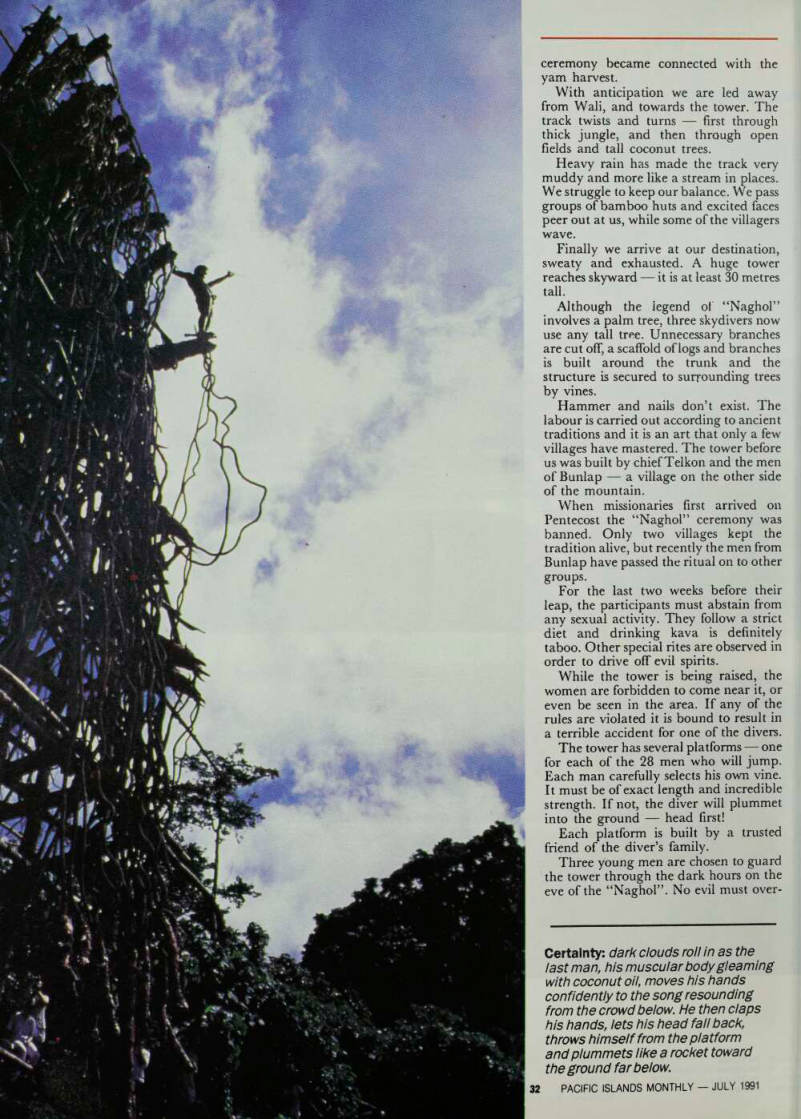
Leap of Faith: the ritual of the Vanuatu land-divers’ as they kiss the earth 28
Showdown in Vanuatu: Lini issues a challenge, and the opposition responds 18
BUSINESS: Lack of management and a masterplan place Fiji last in the tourism growth stakes 46 VANUATU: politics, tourism and education 18 INDUSTRY; American Samoa tuna cannery workers frozen out of US pay rise 54 FUTA HELU: Multiple headaches from drug imports 11 DAVID BARBER: Is Bolger's government eyeing the nuclear umbrella club? 27 MARGOT O’NEILL: Battle over US bases in Guam 13 JEMIMA GARRETT: Spotlight on PNG aid 38
EDUCATION: Lessons on life learned under the breadfruit tree 35 SPORT: PNG shapes up for Operation Gold at the South Pacific Games 41
Letters: 4
HEALTH: Eighty per cent of blindness in the region could soon be cured 44 : Slow suicide in Samoa with a weedkiller 37 BOOKS: A journey through island politics 43
Publisher: Geoffrey Hussey Editor: Jale Moala Assistant Editor: Beryl Cook Correspondents: Al Prince, Angela McCarthy, David North, David Robie, Diana McManus. Dykes Angiki. Frank Senge, Franck Madoeuf, Irene Nisbet, John Hunter, Karen Mangnall, Lito Vilisoni, Loveni Enari, Macel Manua, Nicholas Rothwell, Pesi Fonua, Richard Dinnen, Ulafala Aiavao, Wally Hiambohn Columnists: David Barber (Welling
ton), Futa Helu (Tonga, covering the Pacific Islands). Jemima Garrett (Syd ney), Margot O’Neill (Washington), lan Williams (United Nations) Advertising Manager. Charlotte Thomas Advertising Sales: • Fiji; Salendra Narayan, Tel (679) 304111. Fx (679) 303809 • Sydney, Melbourne: Fergus Maclagan. Tel (61-2) 4134689, Fx (61-2) 4123918
• Brisbane; Robert Walker, Tel (61-7) 3710533, Fx (61-7) 8798964 • Adelaide: Hastwell Williamsons Representations, Tel (61-8) 799522, Fx (61-8) 799735 • Auckland: McKay International Me- A'lcinre-, >f Te 64 ’ 4 9056 ’ Fx (64-9) 4192243 • Japan: Universal Media Corporation, Tokyo. Tel (3) 6663036, 6663094, Cable: UNIMEDIA Tokyo, Tx 2524665 Founded 1930 (USPS 952480).'A Fiji
Times Limited production. Cover prices are recommended retail only. Regis tered by Australia Post, Publication No.
NBP 1210. ©Copyright Fiji Times Lim ited, 117 Victoria Parade, Suva, Fiji. Tel
fir I*
FJ2124. Pacific Islands Monthly is pub lished monthly by Fiji Times Limited, a division of Nationwide News, 2 Holt Street, Surry Hills. Sydney, NSW 2010.
Send address changes to: • Pacific Islands Monthly, PO Box 1167, Suva Fiji. Typeset and printed by Limited, 117 Victoria Parade,
western judgement
Letters
Western values,
JACK Johnson’s criticism of Nauru, ‘Don’t Cry for Nauru’ [PIM May, 1991) is an example of Western value systems being used to judge a Polynesian culture.
Mr Johnson fails to recognise that newly independent Nauru makes decisions and judgements based on their own moral, religious and cultural norms. His deported friends likely shared his lack of cultural sensitivity.
The judgement that his expat friends were unreasonably fired because of their attempts to run public services efficiently speaks to a lack of understanding of the proper role for expat administrators.
Professional administrators should have studied the 1940 Friedrich-Finer debates to understand the public official/public administrator dichotomy. Perhaps a review of this academic material would be appropriate for expat administrators in Nauru.
Mr Johnson is not the only Westerner who uses foreign values and norms to condemn South Pacific countries.
However, better trained administrators and greater cultural understanding are more desirable goals.
Charles J. Sellens Auki, Solomon Islands
Nauru challenge
Your article in April’s PIM on Nauru, ‘Preparing to tackle the tough times ahead’ by Robin Bromby, makes the statement that Nauru had to pay so much cash for “run down equipment
when they took over the operation on
independence”.
This statement I presume refers to the state of plant and equipment handed over by the British Phosphate Commissioners (BPD) to the Nauru
Phosphate Corporation (NPC). If this is
correct then I would strongly challenge this, for it can only be not only totally incorrect but total rubbish.
I say this since I was there at the time, so I know. The BPC was not the sort of company that specialised in “run down equipment”. Also, I have since worked for several mining companies and I can safely say that the BPC and its staff was as professional an outfit as you would get anywhere, one that did not hand over
clapped out plant and equipment.
I also worked for the NPC for one term after this, and it was noted at the time that the same care and attention to plant and equipment lavished by the BPC was not allowed by its successor. Nowhere near the same amounts of money was lavished on this, this not being allowed by the new political masters.
In fact I think that it would be true to say that very little money at all has been spent on this since Independence. There is no preventative maintenance allowed.
It is crisis management in sense, since nothing is repaired till it actually fails. This is not the fault of the designated managers for they are not really the managers.
The main differences between the two companies were as follows: the BPC was
a mining company run by mining
engineers. The NPC is a mining company run by politicians. Certainly managers are appointed, but their hands
are severely tied compared to the BPC days. In fact they are only there to take the blame if one of the politicians makes a major mistake. At least this was the way the company was run for most of the De Roburt years.
If the plant and equipment is now falling to bits then it is not because of its condition on handover but, I suggest, as a result of what has happened to it since as a direct result of political direction.
Everyone who has worked on the island knows this, and no amount of blaming managers, nationalities, Australia or the Man in the Moon (in Nauru’s case the Woman in the Moon) will alter this.
Former Phosphateer
‘Outdated’ notion
of Guam lawyers
IN his March, 1991 article on Guam’s attempt to legislate abortion, Mr North naively refers to Anita Arriola as being “dne of Guam’s few female lawyers”. In truth, of Guam’s 200 lawyers, over one fifth are women. Of that number, some of the highest legal and judicial positions are held by female attorneys including, but not limited to, the Attorney General; the Deputy Attorney General, Child Support Enforcement Division; Chief Prosecutor; Counsel for the Governor; Clerk of District Court of Guam; two law clerks for the District Court of Guam, and Judge of the Superior Court of Guam. Indeed, approximately half of the attorneys for the Government of Guam are.
Thank you for correcting this misplaced (and outdated) assumption.
Klemm, Blair, Sterling & Johnson A Professional Corporation
Advertisements & other items, pp. 4-5 (2 items)
/
R ATU
Se VSR P*
With Us
It’s our birthday this August
So take these special offers. Now.
15 magazines for the price of 12 32 magazines for the price of 24 This offer ends on August 31 No other news magazine covers the Pacific like we do. We’ve been around now for 61 years.
SUBSCRIBE
NOW!
Yes, send me Pacific Islands Monthly. Now.
Please lick one box only □ 15 months for the price of 12 □ 32months for the price of 24 LJ Here is a cheque/money order □ Debit my credit card, indicated below D Visa □ Master Card Expiry Date - - Card Number Name - Address Signature Post to; Pacific Islands Monthly, PO Box 1167, Suva, Fiji. OR fax: (679) 303809
Tora Tora Tora
Fiji
A senior Cabinet Minister challenges the chiefs’ right to contest next year’s elections
By Jale Moala
A WALK with Apisai Tora on a Sunday morning is a six-and-half-hour trip of torture. He said it’s two miles, when you finish it’s about 10. From 8.30 am to 3pm you walk. For the visitor, the only consolation is that the walk makes Tora talk. “This way it’s easy, you relax.” And so Tora, the man many fear as a political renegade, opened up his mind and spilled out his heart.
“Fiji,” he said, “needs to change. We can’t hold back the clock and return our people to the past when we are just a few steps *away from the 21st century. The future is up ahead.”
Tora is the Minister for Infrastructure and Public Utilities in the interim government. He has become unpopular in Cabinet after launching and becoming president of a new party, the All National Congress (ANC), to contest Fiji’s first post-coup general election next year. The ANC, a multiracial organis ation, is now the biggest threat to the
Fijian Political Party (FPP) which is being sponsored by the Great Council of Chiefs to win all 37 Fijian seats in the
new parliament.
Tora walked out of his village and stopped on the dusty road to pick up a sugarcane flower. “Look around you the cane is flowering. Do you know what that means? It means they are sweetest ... they are crying out to be cut. But what are we doing? We are spoiling everything simply because we are not talking to each other,” meaning the sugarcane harvest boycott by the National Farmers’ Union.
A few kilometres farther on he looked up at the sun: “It’s not very good today, there’s no heat. I like it when it’s hot, when you can feel the heat on your face ... feel the fumes coming up from the ground and soak into you you can eat it.”
Then remembering his visitor he returned to the subject: “The leadership of the next parliament (in Fiji) is an interesting question. Who will be the leader? That’s what everybody’s wanting to know. And that’s where my party comes in. We want to have a say.”
Up and down a hill he walked to the foot of the legendary mountain called the Sleeping Giant: “Now we climb. This is the nice bit.” And so Tora walked up the mountain from where his ancestors viewed the valley below nearly 3000 years ago on their crosscountry trip eastwards. “Now you hear so much about the Great Council of Chiefs and their Fijian Political Party. They are saying it will unite the Fijian people. But I say, rubbish!
“The Great Council of Chiefs is a respectable and honoured institution.
They should be above everything else, just making sure everything’s in order.
That’s the way it was until 1987 when Sitiveni Rabuka staged his military coups. Rabuka summoned the Great Council of Chiefs and they endorsed his actions. At that very moment they lost the trust of the non-Fijians in this country. Now they want a political party.
“What do they want a political party for? What if the FPP loses one seat, or two or three or loses the province altogether, or two provinces which is possible? Do you know what that will
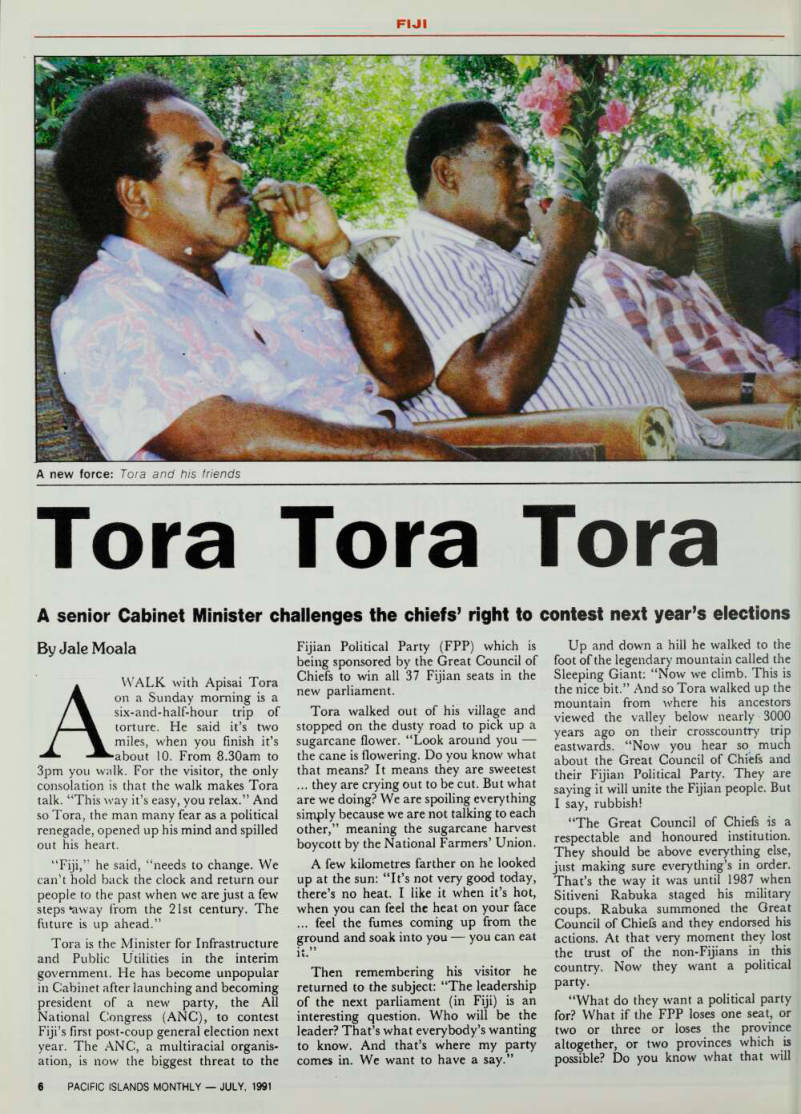
A new force: Tora and his friends
mean? It will be a vote of no confidence in the Great Council of Chiefs. They will end up losing their credibility, they’ll lose their authority and they’ll lose the people they say they want to unite. Why are they trying to take us back to the past, anyway?
“Politics is a risky business, my friend, and if it’s a risk for the chiefs, why take it?”
Guavas were rippening on the trees.
Tora picked some. “We’ve lost so much on this mountain,” he said. “We used to have losts of fruits here mandarins, breadfruits, all kinds of fruits. Forests.
Now someone’s got a grazing lease and the goats are turning this mountain into a desert. If I had my way we’ll stop all grazing leases on the mountains. We’ve got to look after our environment. In fact we should make the environment a major policy of the ANC government.”
The ANC (with no link the African National Congress) was launched at Tora’s village of Natalau on the outskirts of Nadi town on June 22 “to cater for all nationals in Fiji”. Many of those at the launching belonged to the defunct Al liance Party which ruled post independence Fiji under Ratu Sir Kami sese Mara.
Question: is the ANC a rejig of the Alliance? “No way,” said Mick Beddoes who spearheaded the formation of the ANC and once a member of the Alliance inner circle. “We took great care when drawing up the constitution to weed out any likeness of the Alliance. This is a new party. This is a new direction in Fiji
politics.” ANC officials must resign when they contest national or municipal elec tions. This, said Beddoes, makes those in parliament answerable to the party. In most other political parties, like it was in the Alliance, party officials retain their positions while in parliament.
Question: How strong will the ANC be in next year’s polls? “Let me paint you a scenario,” said Tora.
“Supposing the ANC wins three provincial seats in Ba which is possible and two seats in Ra which is possible one in Serua/Namosi, that’s six seats. Suppose we also win the western Fijian urban seat, that’s seven. We’ll win the General Electors’ seat in the west, that’s eight. Sakeasi Butadroka (of the Fijian Nationalist Party) will win his seat in Rewa and you know that the Alliance government lost to Labour the Fijian seat in Suva in 1987. You know that the Labour will be strong in Suva. Now let’s suppose the FPP loses at least 10 Fijian seats and they are left with 27. The Indians always block vote so the Na tional Federation Party will win all 27 Indian seats. Interesting. What I’m saying is that we, the ANC, could end up holding the balance of power next year.”
Walking was getting a bit tough and the road up the mountain seemed like never ending. The sun was climbing higher. It was hot. Tora was in good shape. Wearing blue jeans and a shirt with blue and white stripes, he continued to walk with ease, gathering dust on his Korean-made Reebok walking shoes. A
small white towel was bound Chinese style around his head. “Don’t force yourself,” he told his visitor, then chanting “cha cha cha cha ...” he trotted up the mountain to the next turn, and waited. There was no shade.
Question: Why is Tora so confident of his support in the western provinces of the main island of Viti Levu? It boils down to the region’s attempt to form a Western Confederacy, (see box, page 7) The Western Confederacy issue is a uniting force in the western regions of Viti Levu where much of the country’s resources are: gold, tourism, pine, the main international airport, and sugar.
“You really can’t blame the people in this part for wanting a Western Confed eracy,” Tora said. “They know that their land provides the major portion of the wealth that runs this country and so rightly they desire to have a greater say in how that wealth is distributed. They were hurt when the Great Council of Chiefs did not even listen to them.”
Does this mean that a vote for the ANC by people in the west is a vote for the Western Confederacy? “Right!”
From the top of the mountain, Tora looked at the green valley below with its flowering sugarcane and small farm houses. The whole Nadi area was displayed before him in one spectacular panorama. Tora shook his head, his eyes closing into that familiar squint, and said: “You look at this and begin to wonder why we are fighting.” There was no answer from the Sleeping Giant. Only silence.
Tora, 57, is a leader. He is the chief of Natalau, a nice little village of a little fewer than 300 people. The village is one of the better developed in the sugarcane belt and there his people treat him with much respect. Tora has a powerful influence in his Province of Ba.
His initiative in the launching of the ANC has attracted much anger in Cabinet where some of his colleagues regard him as a renegade. Yet few people in Cabinet would match his loyalty to the Prime Minister, Ratu Sir Kamisese.
“I’ve known Ratu Sir Kamisese Mara longer than many Ministers in Govern ment,” he said. “My allegiance to him was sealed in the traditional way in the presence of my people, my chiefs and my spiritual ancestors.”
On the 25th of last month Electoral Commission chairman Qoriniasi Bale said Fiji’s first post-coup general election could be as early as February or March next year. This has given Tora’s ANC a jump start over most parties chasing a place in the new parliament.
The National Federation Party/Fiji Labour Party Coalition is still without a leader following the resignation of Adi Kuini Bavadra, This is expected to be decided this month.
The Fijian Political Party will launch
its constitution in October, barely enough time to preach its gospel. The Ministry of Fijian Affairs has been trying to influence people at village level to pay to be members. Last report: not very successful.
TT , r ... , . vvtvt i Urban Fijians opposed to FPP have formed a Council of Commons hat is monitoring the build-up to the election to ensure that parties opposed to FPP do not field rival candidates against FPP m
Fijian constituencies.
Next year’s general election will be a test for the Great Council of Chiefs and its survival as an institution for the indigenous people. If they lose then they become the endangered species of Fiji’s
new order.
Back home, Tora sipped coconut juice and listened to a Fijian couple asking for advice. Earlier in the morning he had attended to two Indians. One was a youth needing work and the other an elderly mother whose house had burnt dowl / and whose son she said died after b - arrested and rdeased by the ,• ® p uke , his everyday h e’s in the vU , .. said a villager. “Sometimes he sees three, four people here before breakfast ... all kinds of problems, all kinds of people.” This shows that down in the west Tora is serious business, Those who regard him lightly in the east better take note. D
The top 3
The indigenous Fijian population are divided into three confederacies, mainly the result of tribal wars and which exist today as domains or matanitu of powerful paramount chiefs, Kubuna: Ruled by the Vunivalu. The position is vacant after the death of former Governor-General Ratu Sir George Cako bau. It covers roughly the northern parts of Viti Levu, and the Lomaiviti Group.
Burebasaga: Ruled by the Roko Tui Dreketi, Adi Lady Lala, the wife of Prime Minister Ratu Sir Kamisese Mara. It covers roughly the southern parts of Viti Levu and the southern islands of Fiji.
Tovata: Ruled by the Roko Tui Cakau, President Ratu- Sir Penaia Ganilau. It covers Vanua Levu, Taveuni and the Lau Group. Ratu Sir Kamisese, the paramount chief of Lau, enjoys the same influence as Ratu Sir Penaia.
Viti Levu’s Western Provinces want to break away from Kubuna and Burebasaga and form a fourth confederacy. □
Advertisements & other items, p. 7 (1 item)
Three
MILLION
KIWIS
AT YOUR FINGERTIPS
And so too is a potential market of 3.2 million New Zealanders.
As a Forum Island nation, exploration and development of new markets can be a difficult and frustrating exercise.
Now, through the establishment in New Zealand of the South Pacific Trade Office, you have direct access to a variety of services that are specifically geared to assist you in the export and promotion of South Pacific products into New Zealand.
Services include market research, marketing plans, identification of potential customers, office facilities, product displays, participation in trade fairs, and secondments.
For further details contact...
SOUTH PACIFIC
TRADE OFFICE
Jetset Centre, 44 Emily Place, PO. Box 774, Auckland 1. New Zealand.
Phone (09) 802-0465. Fax (09) 776-642.
Telex SPTO NZ68328.
Madison 373
Who’s in for the race
Here are the political parties likely to be constesting next year’s first post-coup
general elections in Fiji:
Fiji Labour Party It was founded by the Fiji Trades Union Congress in 1985 as a reaction to a government-imposed wage freeze. Labour is yet unsure whether it will contest next year’s first post-coup general election. It totally rejects the new constitudon promul gated on July 25 last year National Federation Party It began as an association for canefarmers in the late 19505. Like Labour it continues to be part of the Coalition, totally rejects the new consdtudon and b still unsure of its participation in next year’s election.
Vasu i Taukei A general electors’ party based in western Viti Levu to cater only for those of Fijian descent. Now a move is being made to include South Pacific islanders who are Fiji citizens.
The party does not yet have a constitution.
General Voters Party It was launched in Suva on December 5 last year and will win more support than Vasu I Taukei. The party is prepared “to enter into alliances with other political parties or organisations.” It is chasing the five general electors’ seats in parliament.
Fijian Political Party This party belongs to the Great Council of Chiefs and was launched in June last year in Suva. It will win most of the 37 seats allocated to Fijians in the new parliament.
It will launch it constitution in October.
Fiji Indian Liberal Party Launched on March 23 as a “moderate progressive” Indian party. The launching at Rakiraki in western Viti Levu, was low key. The Liberals want long-term leases for cane farmers, 40 per cent of government jobs reserved for Indians and a Fs2 million
scholarship scheme for poor Indian students. It is seeking a link with the Fijian Political Party.
NFP splinter group This is the Muslim faction of the National Federation Party which broke away under the leadership ofSiddiq Koya, a prominent lawyer, chairman of the Sugar Cane Growers’ Council and former Leader of Opposition. This group is silent. But it will pounce if the Coalition decides to boycott the election.
The Western United Front This was the creation of Ratu Osea Gavidi, a chief from the Nadroga Province in western Viti Levu. WUF was the result of a bitter dispute with the Alliance govern ment over the proposed structure of, and participation in, the pine industry. Ratu Osea now has a close bond with the paramount chief of Nadroga and is ex pected to swing behind the All National Congress next year.
Fijian Nationalist Party Its leader, Sakeasi Butadroka is strongly anti-Ratu Sir Kambese Mara and once called for the expulsion of Indians from Fiji.
He has strong support in eastern Viti Levu and has been trying to win support from the Methodist Church.
Fijian Conservative Party A breakaway from the Fijian Nationalist Party. Its leader, Isireli Vuibau, was once Butadroka’s closest lieutenants. Recendy he and Butadroka have been discussing the election.
All National Congress Launched in Nadi last month, this party means serious business and is expected to beat the odds next year. Its president is Utilities and Infracture Minister Apisai Tora. The party will gain strong Fijian support in western Viti Levu. □
Growing, growing,
growing . . .
By Beryl Cook
EVENTS in Fiji in the last month have highlighted the Interim Gov ernment’s commitment to pursuing sustained economic growth at all costs, and raised the question of just how big a role traditional loyalties will have to play in shaping the face of Fiji’s political and economy future.
The introduction of two economy decrees by the Interim Government on May 29 gave the message loud and clear that sustained economic growth would be sought come hell or high water.
And hell or high water may be an appropriate analogy.
Critics, especially trade union ists, see the introduction of the The Sugar Industry Special Pro tection Decree and the Protection of the National Economy Decree 1991 as foundations for an un democratic hell “draconian” measures imposed on residents by an authoritarian regime. Sup porters of the interim government believe it is a “we mean business” message to refloat the economy on troubled international waters stirred up by the 1987 coups.
Whether hell or high water, there will be casualties along the way.
The unions have been the first hit. The sugar industry decree, an amendment to the Sugar Industry Act, was introduced in response to the sugar industry crisis the dispute over a third cane payment had disrupted the start of the crushing season, and farmers had
boycotted harvesting. The decree
includes tough penalties, with
anyone deemed to be interfering
with the “orderly planting or growing or harvesting of sugar cane” facing a fine of Fslo,ooo of a 14-year jail term or both.
The national economy decree extends similar protection to tourism, the Fiji
Electricity Authority, civil aviation,
copra, mining and oil (exploration and exploitation), the transport industry and telecommunication with the same penal ties, and a FSSOOO fme or seven years jail for inciting or encouraging someone else to offend. Directors, officers and officials of body corporates, trade unions, indus trial associations or any other organis ation can be held liable.
The government introduced the de crees after the harvest boycott and a 14-week strike by Vatukoula gold miners. Introducing them was a hard nosed economic decision, designed to provide stability for employees and business operators in Fiji, and for international investors who can provide the impetus for long-term growth.
The interim government’s general policy is to move Fiji from an inward oriented economy protected by import licences and high tariff barriers to an outward-oriented economy, looking for expanding and profitable markets over-
seas. The idea is to make Fiji more competitive with better quality products and business operations, and to lift its international status bringing it closer to promising trade and investment mar kets in Europe and Asia.
According to critics, such a plan will put greater distance between the “haves” and the “have nots”, making long-term casualties out of the poor. With domestic rents rising, the newly established Public Rental Board selling off up to 71 per cent of low-cost rental properties formerly held by the Housing Authority, and a Value Added Tax (VAT) expected to
bump up prices, critics say the prospects for Fiji’s poor are dim.
But the message delivered by Minister for Finance and Economic Planning Josevata Kamikamica at the Fiji Insti tute of Accountants Congress at The Warwick on May 31 to June 2 basically maintained that moves such as the VAT would be in the long-term, broader interests of all people in Fiji.
He told delegates taxation links the market economy of private trading and government in its aim of providing services to the people of Fiji. The market economy of private trading was “the engineroom of the whole system. Unless it works efficiently, we do not generate adequate employment and incomes. Nor do we generate the surpluses that can be taxed for communal purposes.”
He said VAT should be seen as part of •the larger tax system, alongside a progressive income tax which would make the overall picture more equitable.
The potential effects of VAT on the poor and unemployed seems to have passed over the heads of many in Fiji, particularly the poor and rural dwellers who, proceeding with the everyday business of growing dalo for subsistence, probably have always assumed they have little to lose in the complex world of high finance. Some groups and individuals concerned with social welfare have decried the effects the VAT will have on the poor.
The Government has not yet ad dressed the issue, maintaining it is staying “open to public suggestions” until July 31. But there are indications that at least some government members place the plight of the poor lower on the list of priorities than the overall objecdve of growth.
Trade and Commerce Minister Berenado Vunibobo stressed efforts to break the overreliance on sugar and tourism. Sugar had been disrupted by industrial unrest and he suggested sugar refining and processing could be desir able developments. Tourism had proved susceptible to the global economic cli mate and the fashions of tourist desti nationsv Finance Minister Kamikamica said growth would be achieved in manufac turing and associated service industries such as financial and professional ser vices, and through measures such as the decrees which would protect the “stab ility” of economic growth.
He also stressed labour market reform.
Wage guidelines will cease to operate with the lifting of the Wages Order at the end of this month, the legal requirement covering deduction of union contri butions from wages should be removed, trade unions should not enjoy privileged protection when they disobey the law, and union leaders should not be able to force rank and file members to support
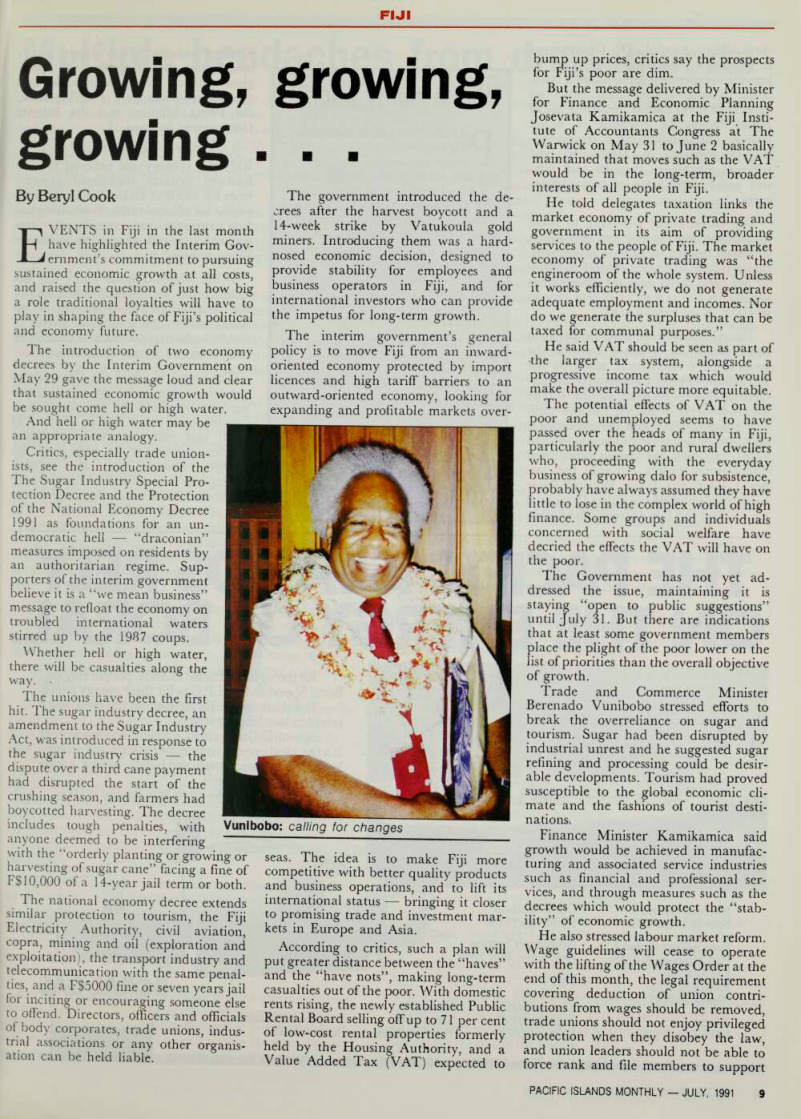
Vunibobo: calling for changes
their actions, he said. The Government is looking at amending legislation to
provide independent supervision of trade
union ballots, setting time limits on validity of strike ballots, requiring use of postal ballots in elections of union leaders, and establishing a strong me diation capacity in arbitration and tribunal machinery through staff who will assist negotiators of wage agree ments.
The Government is hoping to boost investment, both public and private. A sustained upturn in private investment, taking it from 6 per cent of GDP to about 12 per cent, could help the government achieve its aim of 4 to 5 per cent growth in GDP, Kamikamica said.
This aim may have been thwarted to some extent by a shock call for the government’s resignation, made by the Fiji Military Forces Commander, Major- General Sitiveni Rabuka, on June 6. The Major-General, whoi led the two mili tary coups in 1987, said the government was “out of touch” with the people, had failed to solve the sugar crisis, and disenchanted people Fiji with the pro posed VAT, the Fijian Political Party being sponsored by the Great Council of Chiefs, and the two decrees. The unions
followed with vociferous support in the media, but the Major-General apolo gised publicly and traditionally and reconfirmed his support of the President, the Prime Minister and the Interim Government on June 12.
According to The Fiji Times (June 13), Rabuka’s apology was believed to have followed extreme traditional pressure from his chiefs of Cakaudrove and from within his officers’ ranks, “indicating just how strongly and significantly tra ditional ties and allegations dominate
Fijian politics”.
If the Major-General really has de cided to put his personal beliefs and/or his political ambitions second to his obligations to the traditional system of chiefly authority, the lesson is unlikely to be lost on the people themselves.
The extent to which the Government can rely on this traditional allegiance to support its vision of the future will become clear when ethnic Fijians, at least, cast votes in the long-awaited election. Success at the polls may also depend, however, on the public’s willingness to support a longer-term economic vision which lies only at the end of a tough road to reform. □
Who’s really poor?
PART of the problem of achiev ing economic growth is motiv ating the people to boost the size and standard of business, invest ment and trade, according to Trade and Commerce Minister, Berenado Vunibobo. Discussing his govern ment’s policies to achieve sustained economic growth, he said difficult decisions always had to be made, while encouraging locals to improve their products and services, become internationally competitive, and make the economy stronger.
He believes much of the opposition to Fiji’s proposed Value Added Tax (VAT) is based on different percep tions of poverty. Different definitions of poverty exist in different corners of the globe, along with a tendency for those who have not travelled to take what they have for granted. “One of the most difficult things would be to define what is poverty in Fiji, how do you define it, what are the criteria?”
Vunibobo asked. □
Advertisements & other items, p. 10 (1 item)
The Pacific Islands Rely
ON THE ENERGY OF BORAL
« « • -•'Ww - f Cook Islands Rarotonga 24460 All through the Pacific Islands, people rely on Boral Speed-E-Gas LP Gas for their energy needs.
Boral has terminals throughout the area, and is proud to be a leading supplier.
Speed-E-Gas is clean, efficient and low in cost.
It’s the ideal energy source for cooking and water heating in homes, motels and hotels, and for a wide range of industrial uses.
So call Boral. We have the energy you're looking for.
Norfolk Island Norfolk Island 2419 Papua New Guinea Port Moresby 214248 Lae 422574 Rabaul 921225 Wewak 862125 Tonga Nukualofa 21388 American Samoa Pago Pago 699 2948 Fiji Suva 24035 Lautoka 60088 Sigatoka 50578 Labasa 82973 Vanuatu Santo 455 Port Vila 2046
BORAL GAS
Solomon Islands Honiara 21833 Boral Gas Limited, Bth Floor, IBM House, 168 Kent St., Sydney, NSW 2000. Tel: (02) 278512.
Multiple headaches from drug imports
A FRIEND of mine has theorised that if a drug is exported from its home turf to an entirely new community, and provided it was not chemically synthesised (Like LSD or heroin), then it will certainly be responsible for massive headaches in terms of social, psychological and legal problems.
A society, therefore, must be allowed to develop cultural reins with which to bridle the monsters in the substance. The times span required, however, is a matter of centuries, not years!
This is exemplified in the use of hashish and marijuana in the USA where whole segments of the whole population suffer from both physical and psychological ills through their use whereas in Morocco, Lebanon and other Middle Eastern communities they are daily fare, especially for adult males.
Closer to home the kava (or yaqona) has wrecked such havoc among the aborigines of the Northern Territory, and to a lesser extent in Western Australia, that state governments moved in to look at what threatened to become a national problem.
Missionaries a Tongan and a Fijian are blamed as being responsible for introducing kava to the Northern Territory in the early eighties in a bid to reduce domestic violence in aboriginal settlements.
Kava is a depressant. It created additional difficulties. The aborigines mixed thick kava with spirits, wines and other ingredients so much that partakers in the resultant beverage became somnolent for up to three times the length of a normal rest.
The women folk were delighted because the level of wife beating dropped dramatically and wives were usually ready with some of the punch to administer to their husbands when they but bestirred from a long sleep. The men soon showed symptoms of illnesses that were totally unknown to them heretofore.
In a wider context, however, the idea is also illustrated by the impact alcohol has had on the Pacific Islands, the correlation of alochol to certain categories of crime is well established and truly alarming.
It is absolutely so in Papua New Guinea where currently about 7 5 per cent of serious crime and nearly 50 per cent of overall crime and offences are alcohol-related. Similar proportions hold for the rest of the Pacific though absolute rates are generally lower At any event, the rate of alcohol-related road accidents has an average of approximateiy 90 per cent for the islands.
The psychological problem of the islanders was not helped by the original criminalisation of drugs especially alcohol in all the island groups. When it was recognised that the situation may be partly relieved by easing out the liquor licensing regulations, alcohol became just another commodity and people spoke of it as selling like lemani (lemonade), that is, without a liquor permit.
But the wheel has come full circle in some island countries such as Fiji and Samoa, Recognition of rising crimes and offences rates has caused the authorities to put the liquor strictures back into place. Tonga is now in the second phase
— free access — but may revert back to square one.
In Papua New Guinea and the Solomons to some extent, the public bars bulge with boozing humanity six nights of the week, not to mention the thousands of parties in private homes and apartment houses in all the cities and major towns every weekend.
Tonga projects the same image at weekends and public holidays. On Sundays priests across the Pacific condemn alcoholism from the pulpit, but the governments, like Napoleon, regard it as lucrative sin.
With the exception of only a few, most Pacific islands have breweries of their own. Here they have been assisted by European companies.
Samoa has her Vailima, a German recipe that is also used for the PNG Swan and SP Laeer.
Tonga has Royal, a malted beer with a Swedish formula.
The Taska ofVanuatu is based on the same prescription though it comes in three different proofs. And of course Fiji Beer is an old veteran and has the distinction of being the favourite of many Pacific Islanders.
Before the breweries went into operation between 2.5 and 7 per cent ifisland import bills was accounted for by foreign beer, mainly New Zealand steinlager and Australia Foster.
Since the opening of the local breweries, however, beer import has been cut quite appreciably, in some cases as much as 70 per cent. At the same time consumption of the home brew caused national intakes to soar to at least three times former levels.
The imports of spirits and other liquors and foreign beer despite the initial fall have maintained substantial increases, doubling every three years for most islands.
Talking of drug-use as having a cultural dimension points to another thought. Most Pacific peoples are by nature excitable and show-offs, though not in a derogatory sense.
Their culture makes them open, friendly, and perfectly available.
Therefore they stand in no great need of alcohol or drugs that heighten emotions or tend to excite. One has only to observe the way they go on in public celebrations and festivals to realise that they are as they themselves say “drugged by heaven” i.e. highstrung by nature.
In other words, kava and beetlenut suit them perfectly.
Incidentally, Latin peoples all over the world would be well advised to take kava from time to time, though peoples who are already depressed by nature the English, for example should always keep away from the stuff.
Still, from a historical perspective, the impact of alcohol in the islands, considerable as it has been, has not become the major concern of national governments. We haven’t seen anything yet really, except reversing Jesus’ first miracle we convert in the opposition direction.
It will be with the more potent drugs that the islanders would be required to show their mettle. Yet I suspect that if that happens they would again reverse Marx’s idea and make opium the religion of the people. □
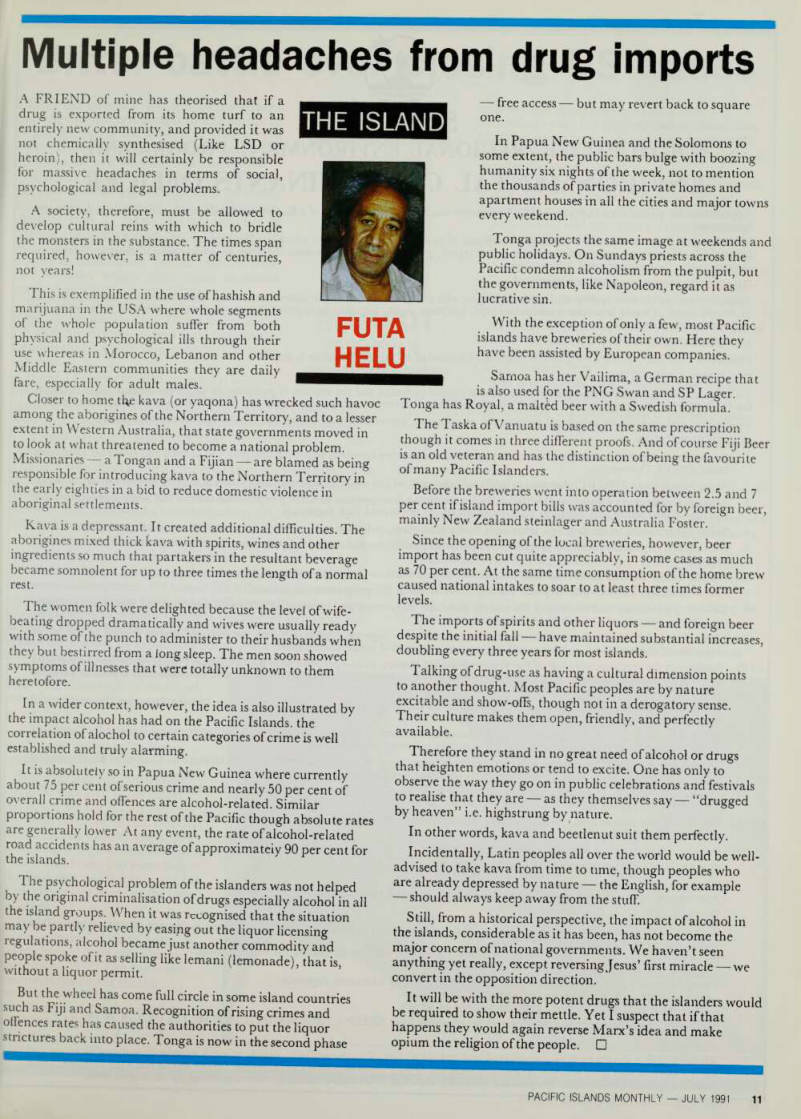
The Island
Futa
Helu
Advertisements & other items, p. 12 (1 item)
Sprep
(2D
SOUTH PACIFIC REGIONAL ENVIRONMENT PROGRAMME
ENVIRONMENTAL CONTAMINANTS OFFICER
Applications are invited from nationals of SPREP member countries for the position of a Environmental Contaminants Officer in the SPREP Secretariat.
SPREP is an intergovernmental organisation composed of twenty-seven countries as members. The primary objectives of the organisation include co-ordinating environmental activities in the region, providing, advising member countries on environmental issues and acting as clearing house for environmental information.
QUALIFICATIONS AND EXPERIENCE
Applicants should have an appropriate university degree with postgraduate training in environment waste management and marine pollution or related fields or lower academic qualification with sufficient depth, breadth, managerial and practical experience on a broad range of environmental issues.
LANGUAGE
Fluency in oral and written ENGLISH is essential. Knowledge of French language is desirable.
POSITION OBJECTIVES
To assist member governments to prevent, reduce and control pollution and the impacts of pollution on their environment, (thus fulfilling, for those member governments who are party to the ‘SPREP’ Convention, obligations under the ‘SPREP’ Convention and its Protocols).
To develop and co-ordinate a regional programme of pollution, prevention, monitoring and control and waste management.
JOB DESCRIPTION
1. Co-ordinate obligations and institutional arrangements for member countries regarding dumping and banned and restricted substances under SPREP Convention. 2. Assist Parlies to the SPREP Convention to fulfill pollution control and waste management obligations of the Convention and its Protocols. 3. Assist governments in formulating legislation and institutional arrangements pertaining to pollution control and waste management and identify infrastructure and technical back-up necessary to implement such legislation. 4. Assist governments to develop and implement waste prevention, reduction and recycling programmes and waste management plans. 5. Develop and implement a training programme in pollution monitoring and control, waste management and in the safe use of environment contaminants. 6. Provide query/response service for SPREP member governments on pollution and waste issues. 7. Co-ordinate and assist in planning and seeking funds to fulfill the programme objectives. 8. Develop, co-ordinate and implement the marine pollution monitoring and control (SPREP-POL) and land and freshwater pollution control components of SPREP Work Programme. 9. Liaise with universities and institutions in the region and other regional organisations on research and studies relating to the use of environment contaminants, pollution monitoring and control and waste management. 10. Implement the recommendations of the SPREP Pesticide Report, in co-operation with the SPC Plant Protection Officer, to maintain a South Pacific pesticide data base and to provide information as required on human health and environmental aspects of pesticide use. 11. Liaise with the International Maritime Organisation on the implications and applications of the London Dumping Convention and other conventions in the South Pacific region. 12 Liaise with the Pacific Basin Hazardous Waste Research Consortium and maintain links with the International Register for Potentially Toxic Chemicals (IRPTC) and keep SPREP members informed of its listings. 13 Co-ordinate with WHO and national public health departments in the application of the WHO Strategy on Control ol Environmental Health Hazards as they relate to environmental contaminants and waste management. 14. Liaise with the US. Environmental Protection Agency’s waste management and pollution control programmes in the U.S. Pacific Territories, for application to other island countries, as appropriate. 15. Liaise with the International Atomic Energy Agency (lAEA) on monitoring the use, disposal and clean-up of radioactive materials in the South Pacific region. 16. Perform other duties as required by Director of SPREP.
TERMS AND CONDITIONS OF APPOINTMENT
Tenure Appointment of the above position will be for three years in the first instance.
Remuneration An attractive remuneration package will be paid to the appointee, depending on qualification and experience. Starting salary will be within the range CFP 341 280 to CFP 436, 320.
An appointee who is recruited from outside New Caledonia will also be eligible for the following: - passage and freight allowance; - establishment grant, housing allowance, child allowance and education assistance; - exemption from income tax on his or her remuneration; - home leave passage after every eighteen months of service.
Further information about the position can be obtained from SPREP - Telephone: (687) 26 20 00. Fax (687) 26 38 18.
Applications All applications should be fully documented and include a copy of birth certificate, details ol work experience and qualifications and the names of at least three referees. Applications marked SPREP Environmental Contaminants Officer should reach the Director, South Pacific Regional Environment Programme (SPREP), B.P. D 5, NOUMEA CEDEX, New Caledonia by 16 August 1991.
Bitter battle over closing US bases
DESPITE virtually unanimous agreement that the US defence budget should shrink to reflect the end of the Cold War, members of congress are locked in a bitter parochial battle to starve off cuts in their own back yard.
The aim is to reduce American forces by 25 per cent by 1995. But when Defence Secretary Dick Cheney announced that the Pentagon plans to close 31 major military facilities as part of the cost-cutting drive, congressmen and women swarmed over media micro phones to passionately defend bases on their turf — bases which often mean economic
survival to adjoining townships.
But amid the clamour was a lone voice from the Pacific island of Guam begging the US administration to close a local base on the grounds that it would help promote economic survival.
'While Cheney rebuffed emotional appeals from other congressmen to keep their bases
open and observed tartly that no bases would be closed if they were up to Congress, Guam’s representative Ben Blaz fumed.
“I think to myself‘Somebody‘s not reading my mail,’ ” Blaz said.
Blaz, a Republican and a former Marine Corps general, and Guam s Governor, Joseph Ada, want the Defence Department to evacuate the island’s 2200-acre Argana naval Air Station so it can be used to expand a commercial airport and diversify the local economy.
“We’re not seeking to expand the airport simply to accommodate more tourists,” Blaz said.
“We have here a golden opportunity to make a pitch for economic development. We would like to be able to erect maintenance facilities, food service facilities and a wide range of support services to allow Guam to become an airhub for the estern Pacific. Right now the territory’s economy is heavily reliant on tourism. By expanding our account base, we will be able to assure healthy growth well into the next country.”
The Navy considers the base, located in the middle of the island, too valuable to military operations in the Pacific.
“The Navy mission remains unchanged in Guam,” a Navy spokesman said.
Blaz says Argana’s operation could be relocated to the larger Andersen Air Force Base on the northern tip of the island. But that would cost up to 5230 million, according to a government report.
And it could take 100 years before the Pentagon could recoup the loss from savings by merging the two facilities.
It is a.stark contrast to the US administration’s plan to begin saving money from other bases closures by 1997. The Pentagon estimates the cost of closing recommended bases at 55.7 billion over five years. But it would also save 56.5 billion in operating costs over the same period.
Guam is a self-governing US
territory but about one-third ofits land is controlled by the US administration. More than 22,000 military personnel and their dependants live on Guam, accounting for nearly one-fourth of the island’s population.
Blaz, who is a non-voting delegate to Congress, says the island’s repeated requests to reclaim Argana are also rooted in history and emotion.
As a 15-year-old boy, Blaz was forced to help clear the fields to build the airport for Japanese forces that occupied the island in World War II.
Argana “has tremendous emotional significance for us. We built it with our bare hands. It truly belongs to the people of Guam because we paid for it with our sweat and blood,” he said.
Recently Argana was removed from a hit-list of bases slated for closure by an independant commission which is due to report to President
George Bush in July.
Blaz says he remains optimistic. The initial
inclusion of Guam on the hit-list at least gave Argana national attention. Until then, Blaz concedes it had been tough to even get a hearing from the Navy and the US administration.
The problem with a little fry like me is there arc not too many people listening.”
The chairman of the Defence base Realignment and Closure Commision, James Courier, echoed similar sentiments.
“The Navy has basically stiff-armed the island. (Argana) was put on the list to create a signal that we want them (the Navy) to sit down and negotiate,” Courier said.
Now Blaz says he has had discussions at the highest levels of the Navy and Air Force and there have been no objections to the idea of consolidating Argana with Andersen.
Guam is even willing to consider compensating the Navy for the cost of relocating the base.
There is a desire on both sides-to see it happen. It’s the logical thing to do. The question under consideration is how soon and who will foot the bill.” n
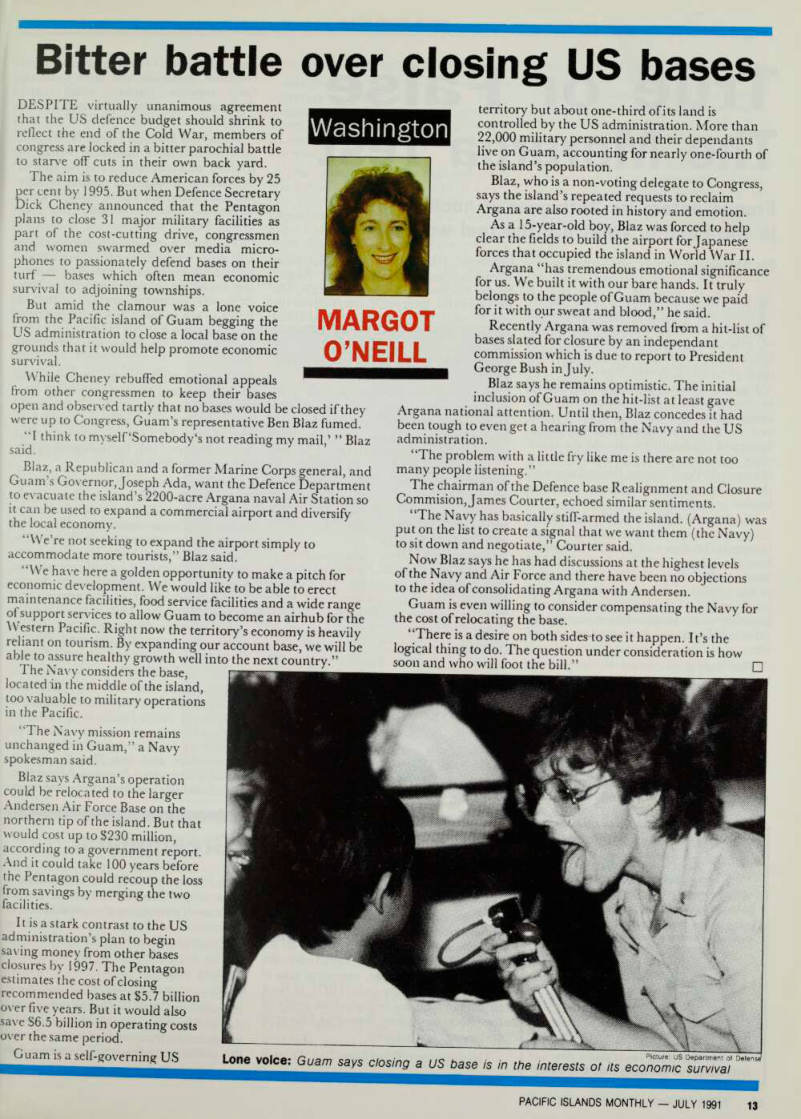
Picture: US Department of Defense Lone voice: Guam says closing a US base Is in the Interests ot Its economic survival
Washington
Margot
O’Neill
True or False

The Region
True or False The Moruroa Test
France enters its 25th year of nuclear testing in the Pacific. What are the real worries?
By Al Prince
JULY 2 marks France’s 25th year of nuclear testing in French Polynesia, a date that has become one of the most controversial and unpopular yearly anniversaries in the South Pacific since the end of World War 11.
France’s quarter century membership in the world’s nuclear arms club has earned it an ever-lasting, controversial and not always honorable chapter in the history of the South Pacific. At the same time, that history has produced its share of contradictions among the countries in the region opposing the French tests the louder.
The French nuclear testing since 1966 in a remote area of the sprawling French Overseas Territory of French Polynesia has also played a key role in Tahiti’s history, affecting just about every aspect of life in these islands, converting what was previously a sleepy South Pacific paradise with a third world economy into a French boutique of the modern way of life.
The testing so completely turned the local economy upside down, according to one recent French study, that the “perverse” results prohibit Tahiti’s Ter ritorial Government from surviving economically from one year to the next without massive injections of French State subsidies.
Meanwhile, France’s nuclear testing programme has produced an almost
love-hate relationship with an over whelming majority of former Anglo- Saxon colonies in the South Pacific. On the one hand, bourgeois consumers in the region continue to love buying just about anything that is French from wines and cheese to perfumes and jewellery, not forgetting expensive vacations to Tahiti and Her Islands.
However, the historic year of 1985 produced two dramatic events that darkly coloured Paris’ diplomatic rela tions with South Pacific countries, both individually and collectively. The first event was the July 10 sinking in Auckland Harbour of the Greenpeace vessel Rainbow Warrior after mines planted by French government secret agents had exploded, killing a crew member.
Sixteen days later, eight countries at the 16th South Pacific Forum meeting in the Cook Islands signed the South Pacific Nuclear Free Zone Treaty, more com monly known as the Rarotonga Treaty.
But with the treaty’s sixth anniversary coming up on July 26, the only nuclear powers that have signed the treaty’s
protocols, banning nuclear testing in the
region, have been the Soviet Union and China. France, The United States and the United Kingdom have yet to sign the protocols, each for very different reasons.
One of the major contradictions that has occurred during the past 25 years of French nuclear testing has been the up and down relationship between France
and the South Pacific’s two biggest countries, Australia and New Zealand, the region’s most vocal and diplomatically active opponents of the tests.
While the Canberra and Wellington governments have had long periods of strained relations with Paris because of the nuclear testing, the passing of time has gradually led up to today’s good diplomatic relations despite the con tinued French testing.
The two most obvious explanations are basic economics and France’s stub born determination to continue its test ing regardless of any opposition. New Zealand’s economic reality is that it needs to sell its lamb and dairy products and Australia has lots of uranium to sell to France for its many nuclear power
plants.
Other South Pacific governments, like that of Fiji and the self-governing New Zealand dependency of the Cook Islands, have become very willingly enticed in recent years by France’s generous offers of development aid, technological exper tise and low-interest loans.
But France’s previous negative image in the South Pacific was not due entirely to its nuclear testing in French Polynesia.
Other key factors were its handling of an independence movement in New Cale donia, also a French Overseas Territory, and its self-admitted lack of communica tions with the predominantly Anglo- Saxon government of the region. Still another factor has been a much weaker independence movement in Tahiti, which, by constantly opposing the nu clear tests, has picked up anti-French support in the region.
And it was not until late 1986 that France finally began doing something to improve its South Pacific image after 20 years of testing and support at home for those tests by four governments (three conservative and one liberal). French Socialist President Francois Mitterrand has faithfully respected conservative
President Charles de Gaulle’s famous force de frappe (independent nuclear arsenal) policy into his second seven-year term since 1981. But it was not until France’s unique “cohabitation” exper iment in 1986 that it began softening its stone-walling approach to the nuclear tests.
The first sign of that change occurred at 26th South Pacific Commission confer ence in Tahiti in November 1986.
President Mitterrand’s conservative Prime Minister, Jacques Chirac, sent emissaries to that conference with the obvious goal of enticing the commission, with its 40-year history of doing things the Pacific Way, into considering a new
French Way in the region.
There has never been a unanimous, or even a concensus, opinion coming out of the collective in terpretation of reports compiled by various ex perts on the effect of nu clear testing in French Polynesia. Some reports tend to tilt in favour of the French claim that 25 years of nuclear testing have not caused any health or envir onmental damage for the 200,000 people now living in French Polynesia.
But individual interpret ations of those reports, par ticularly by the interna tional environmental or
ganisation Greenpeace,
strongly refute the French claim. Greenpeace, has earned a reputation over the years for consistently criticising the French tests.
The obvious question to day, for critics and sup porters alike, is how much longer will nuclear tests continue? The best answer appears to be that the day when tests are no longer
held may be getting closer each year.
But that raises perhaps an even more alarming question for Tahiti. What happens to its false, but rich, economy when France eventually decides to halt its nuclear testing programme in French Polynesia?
That question directly and indirectly concerned the nine experts sent to Tahiti last year by the Association of French Physicians for the Prevention of Nuclear War. Called the Feuilhade Mission after team leader Dr Frank Feuilhade, a lecturer on cancer, its report described the 1964 construction of the French nuclear testing facilities at Moruroa as having been an event that “turned the economy of French Polynesia upside
down. French Polynesia is now directly concerned by the (world) politics of nuclear dissuasion. Totally concerned from now on by the nuclear armament disarmament process, the Polynesian economy and community lives as if in suspension between a dream and a nightmare in which the development experienced has no irreversible charac teristic and remains dependent on the inequalities and susidies of the Centre d’Experimentation Nucleaire (CEP) and more generally in the aid of the French State.”
The Feuilhade report estimates that the direct cost of a single underground nuclear test at Moruroa is about 10 million French francs, or about US$1.8 million. French Polynesia has a gross national product of US$7830 per inhabi tant, according to the report. That puts the territory slightly ahead of New Zealand (US$7290), way ahead of Fiji (US$1820) and comfortably ahead of French Overseas Departments and Ter ritories, with the exception of New
Caledonia (US$8300).
But distribution of the level of devel opment is irregular, high revenues co existing with unemployment rate of 40 per cent among young people. The national (territorial) . budget is com pletely unbalanced ... Traditional econ omic activities, such as agriculture and fishing, are in recession and development is mainly observed in the tertiary sector.
But what the Feuilhade Mission report appears to be just as equally concerned about is what will happen to Tahiti when France eventually decides to halt its nuclear testing programme. “What will this economy, which is essentially ‘per verse,’ become when the test centre is closed down, as demanded by interna
tional public opinion, the Polynesians
and our association?
“Can the population tolerate the disintegration of its sanitary and econ omic systems? This shows the urgent necessity for ensuring the development of an alternative economic system in Poly nesia.”
The Tahitian dilemma: nuclear test or go broke
Safe? no way, says Greenpeace
THE ecological organisation
Greanpeace said radioactive elements were leaking from French underground nuclear testing sites in French Polynesia, and called for an independent probe. It called on the European Commission, executive arm of the European Community (EC), to back its demand for an independent study of the effects of nuclear testing at Moruroa and Fangataufa atolls.
Greanpeace official Jean-Luc Thierry
said; “The tests and the concealment must stop. The environmental conse quences of damage to the coral atolls (of Moruroa and Fangatau) and marine environment from France’s nuclear tests are far too serious to be hidden behind military secrecy.
Greanpeace said plankton samples it co u ectec j j n December in the ocean near the testing area contained cesium-134, w hich results from nuclear testing. It said this indicated radioactive contamination
from the testing site. But the organisation said it had been unable to obtain final proof because the French military had barred access to its military exclusion zone around Moruroa, and had arrested
five Greanpeace researchers venturing
inside it.
"Greanpeace is concerned that radioac tivity may already be leaking from the French underground nuclear tests at Moruroa and Fangataufa, despite official French assurances that no leakage wall occur for hundreds of years/ it said.
It said the European Atomic Energy Community (Euratom), the EC’s nu
clear energy arm, had the legal right to demand French cooperation in an inde pendent investigation, and should en force this right. Greanpeace also released a copy of a letter to French Prime Minister Edith Crcsson, signed by 15 scientists, calling for an independent probe of what it called a “potentially grave environmental threat".
The scientists, from France, Britain, Germany, the United States, Japan, New Zealand and Fiji, rejected a recent French offer of an investigation by scientists at nuclear institutions because they said it lacked independence. □
Advertisements & other items, pp. 14-15 (2 items)
atm
Rent A Car
THE WORLD’S NO. 1
WHERE QUALITY AND SAFETY COUNT.
To drive the roads of Fiji is to experience some of the most beautiful scenery of the South Pacific, especially with Hertz.
For Reservations Phone; Nadi Airport 72146 Suva 383150,383411,383677 Telex; 2237, Fax: 370212 With Hertz you get more than Just a car.
Domalco Limited
Domalco kitchenwares are always
dressed for all occasion.
Manufacturers of: * Aluminium Utensils and other household items * Aluminium products for commercial purposes Also specialised In METAL SPINNING and
DOMALCO LIMITED
Manufacturers and Exporters 11 Navoli Rd., Varadoli.
P.O. Box 87, Ba Fax: (679) 670089 Phone: Ba: (679) 670082 After Hours (679) 670144 Cable Dullu
DEEP DRAWING
For any above requirements contact us at
Eye on the nuclear umbrella club
I MAKE no apology for returning to the question of French nuclear testing in the South Pacific for the second consecutive month. It is, after all, one of the key issues that unites all the Pacific nations; one in which New Zealand has, through the Rainbow Warrior bombing, a direct and sad national involvement and after 25 years it shows no sign of going away.
But I do so with some puzzlement. What is Jim Bolger’s National government up to?
Three weeks after the now-ousted French Prime Minister Michel Rocard had visited these shores to make personal atonement for the Rainbow Warrior affair, the New Zealand government made a curious change in policy.
It decided to abandon the former practice of making a formal protest after each and every test and instead issued a statement of
condemnation only once a year — at the start of each test series.
Bolger, who had said all the right things to Rocard during his visit, reaffirming New Zealand’s opposition to the tests, played dow r n the move.
He said it was not a policy change but a procedural one; the government had not retreated “one iota” from its position and the move had nothing to do with Rocard’s visit.
Well, in the absence of any explanation as to exactly why he was making this change — be it one of procedure or policy one has to treat all that with some incredulity. It cannot be, for instance, that drafting the statements imposed too huge a workload on the bureaucracy or the cost of the paper involved added an unbearable burden to the country’s budgetary
problems.
It has to be admitted that New Zealand’s constant stream of protests over the years had not persuaded the French to stop testing in the Pacific. But it should be recalled that it was united Pacific opposition, led by New Zealand sending a protest frigate to the test zone in 1973 and the joint New Zealand-Australian case at the International Court of Justice the following year, that had forced the French underground.
And New Zealand’s unilateral action unilateral in that Australia is continuing to make its protest after every test can only weaken the united front of opposition to French nuclear testing in the Pacific that the two major regional powers have spearheaded for a quarter of a century.
If Bolger maintained the move did not indicate any dilution of New Zealand’s opposition the French, who being fond of diplomatic niceties had always been sensitive to the constant stream of criticism, certainly did not see it that way.
A Paris Foreign Ministry official was quick to hail the decision as showing that New Zealand now realised the tests were not as dangerous as it had previously thought. He linked the change to Rocard’s visit, saying relations between the two countries had now improved and hinted that French scientists had satisfied the New Zealand government as to the harmlessness of the tests.
The government’s Public Advisory Committee on
Disarmament and Arms Control immediately urged Bolger to ensure that a condemnation of the French tests be included in the communique of this month’s South Pacific Forum meeting in Pohnpei, Federated States of Micronesia. There was no specific reference to the tests in last year’s communique at Vanuatu, an omission which French diplomats were quick to seize on as having a significance that did not exist.
I understand that despite the recent policy change, New Zealand will readily support a reference to French testing this year if heads of state want it, though Bolger is unlikely to take the lead in pushing for its inclusion.
The only explanation for the move to what will now be seen as token opposition to the tests is the government’s desire to improve the dialogue with France now that the Rainbow Warrior affair has been laid to rest.
What concerns many, given the National government’s simultaneous wish to improve relations with the United States and Britain, is the nagging thought that it could also indicate a softening of New Zealand’s anti-nuclear stance.
Bolger and his Foreign Minister Don McKinnon, who has personal convictions driving him to seek a restoration of defence and security ties with the US, would strenuously deny this. Both have insisted they have no plans to repeal or significantly amend the former Labour government’s anti-nuclear legislation in “the forseeable future”.
But McKinnon makes no secret of his intention to try to turn public opinion around to accept the need for restoration of defence links with the Americans. He has advocated a full return to traditionally close defence and security ties with the US and Britain which were disrupted by the anti-nuclear policy.
Barring an unforeseen change in American policy, this will inevitably mean nuclear ship visits.
This much was made clear when McKinnon visited Washington in May. While he went with the aim of improving the political relationship, senior administration officials made it clear that all the warm feelings in the world would not restore the defence and security relationship while the anti-nuclear legislation remains on the statute books.
Most New Zealanders would probably be happy to renew those traditional defence ties as long as the dedication to keep the South Pacific nuclear-free remains undiluted. And the government has not produced any evidence that New Zealand is disadvantaged in any way by its exclusion from the nuclear umbrella club.
Closer ties with France and the US are all part of what Bolger and McKinnon call their government’s drive for a “new internationalism”. One can only hope that this vision which includes restoring traditional links with Europe and South Africa and building new relations with Asia is not to be pursued at the expense of the early commitment McKinnon ma.de on taking office to consolidating New Zealand’s rightful place at home in the South Pacific. □
Wellington
David
Barber
Advertisements & other items, p. 17 (1 item)
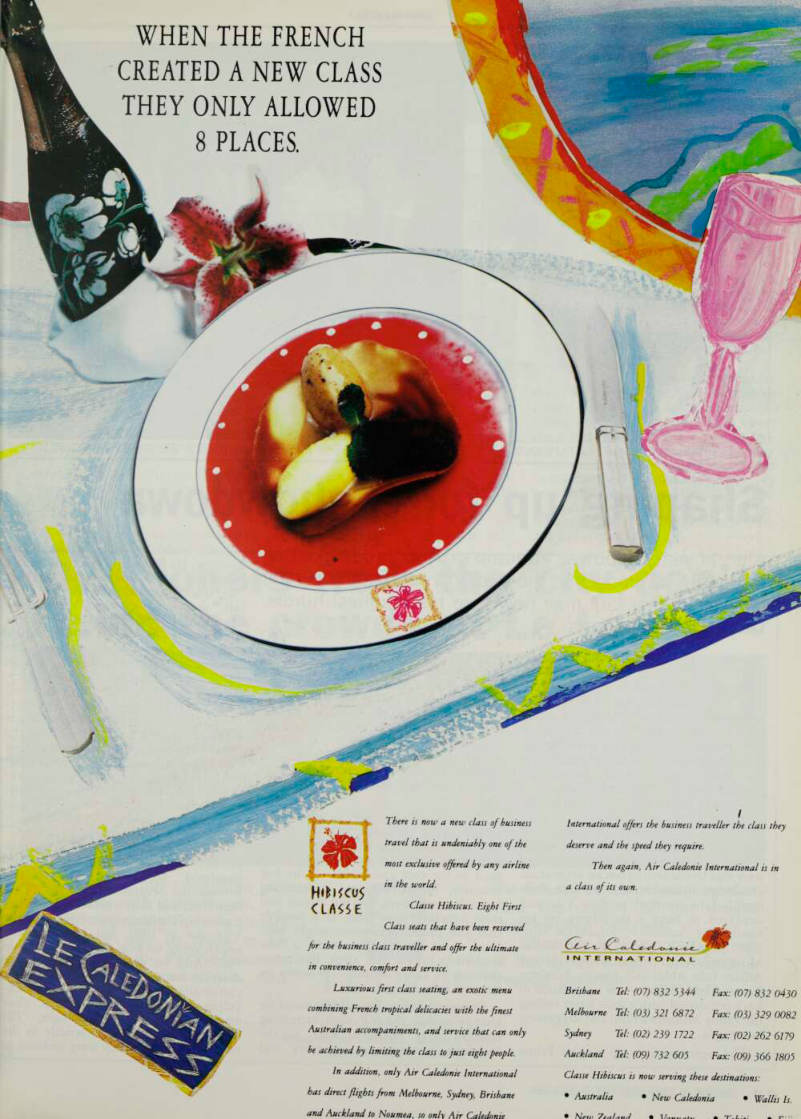
When The French
CREATED A NEW CLASS
THEY ONLY ALLOWED
8 PLACES.
' * m < J
■MkcuJ
CLAUSE
m nf-'-s There is now a new class of business travel that is undeniably one of the most exclusive offered by any airline in the world.
Classe Hibiscus. Eight First Class seats that have been reserved for the business class traveller and offer the ultimate in convenience, comfort and service.
Luxurious first class seating, an exotic menu combining French tropical delicacies with the finest Australian accompaniments, and service that can only be achieved by limiting the class to just eight people.
In addition, only Air Caledonie International has direct flights from Melbourne, Sydney, Brisbane International offers the business traveller the class they deserve and the speed they require.
Then again, Air Caledonie International is in a class of its own.
IM lERIMAT lONAL
Brisbane Tel: (07) 832 3344 Fax: (07) 832 043 Melbourne Tel: (03) 321 6872 Fax: (03) 329 008 Sydney Tel: (02) 239 1722 Fax: (02) 262 617< Auckland Tel: (09) 732 603 Fax: (09) 366 180.
Classe Hibiscus is now serving these destinations: • Australia • New Caledonia • Wallis Is. and Auckland to Noumea, so only Air Caledonie • NpiJJ stlsun/J •
Shaping up for a showdown
Vanuatu
After 11 years of power, Vanuatu’s ruling Vanua'aku Pali is deeply divided over the nation’s leadership. Prime Minister Walter Lini may now face his toughest hurdle.
David Robie reports.
EVER since the April congress of Vanuatu’s ruling Van ua’aku on Aneityum Island, Prime Minister Father Walter Hadye Lini has been smarting.
Even though a vote on the leadership issue had been deferred by a reasonably decisive margin, the extent of opposition and. even open lobbying against him rankled with the Prime Minister.
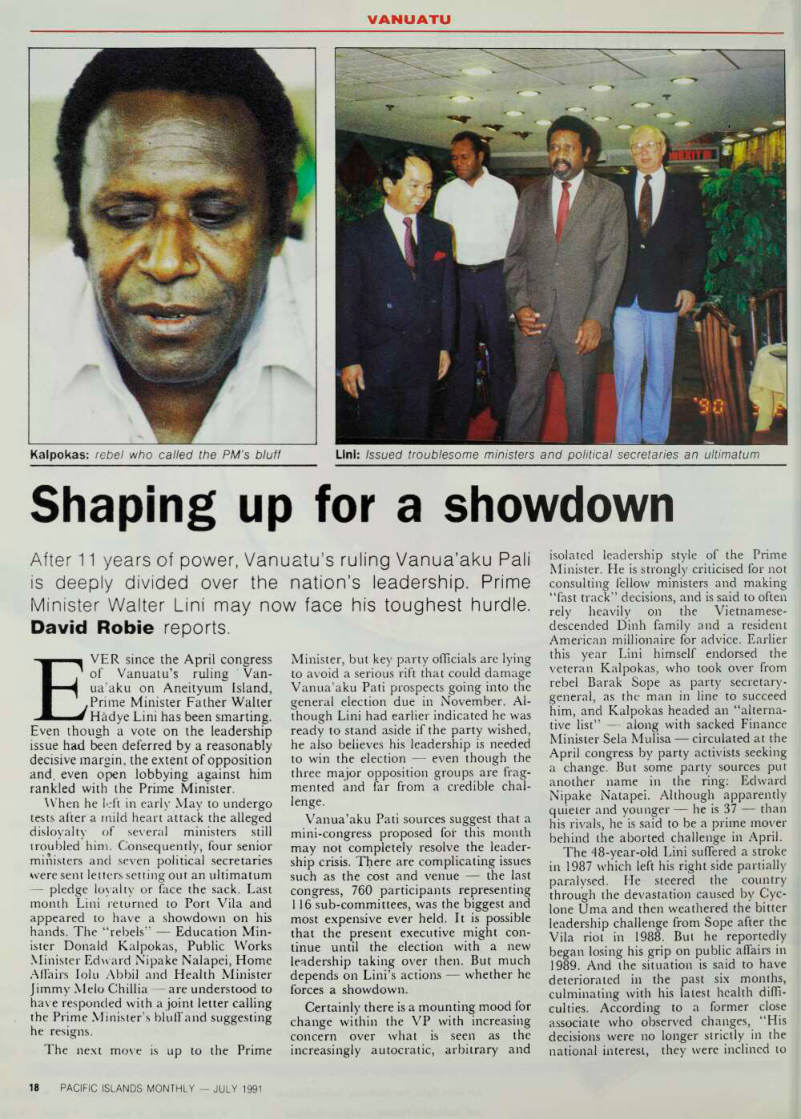
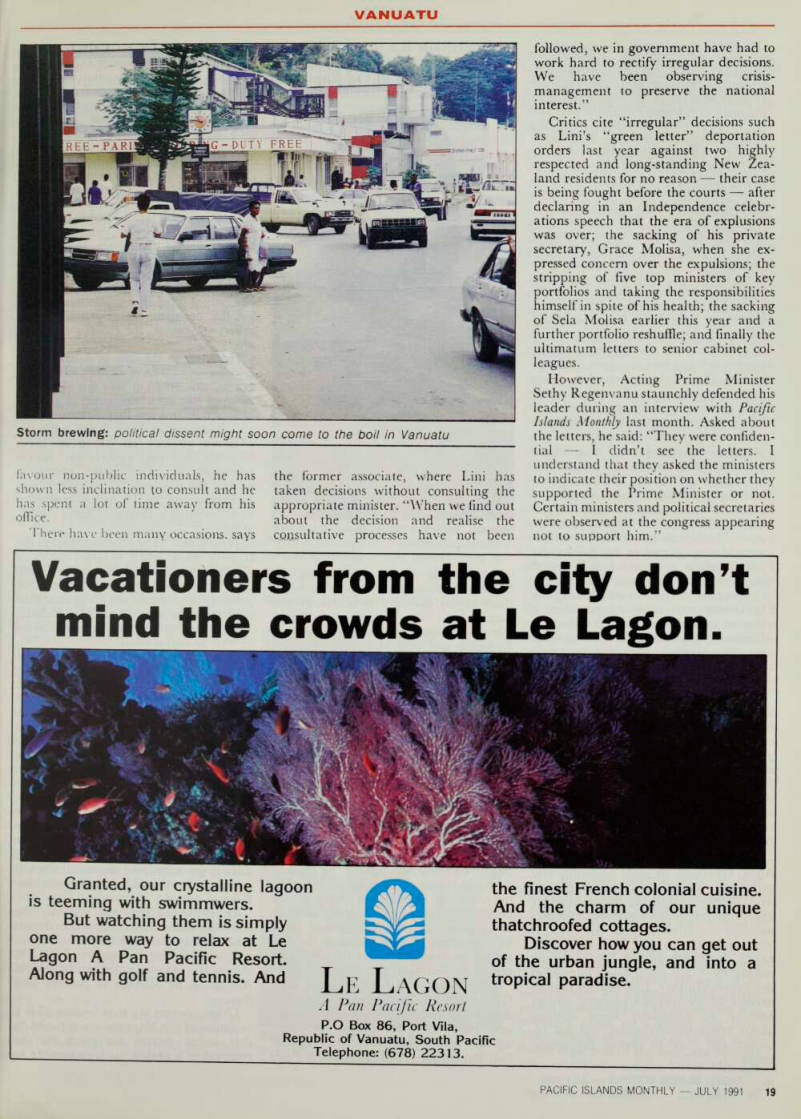
When he left in early May to undergo tests after a mild heart attack the alleged disloyalty of several ministers still troubled him. Consequently, four senior ministers and seven political secretaries were sent letters setting out an ultimatum pledge loyalty or face the sack. Last month Lini returned to Port Vila and appeared to have a showdown on his hands. The “rebels” Education Min ister Donald Kalpokas, Public Works Minister Edward Nipake Nalapei, Home Affairs loin Abbil and Health Minister jimmy Melo Chillia are understood to have responded with a joint letter calling the Prime Minister’s bluffand suggesting
he resigns.
The next move is up to the Prime
Minister, but key party officials are lying to avoid a serious rift that could damage Vanua’aku Pati prospects going into the general election due in November. Al though Lini had earlier indicated he was ready to stand aside if the party wished, he also believes his leadership is needed to win the election - even though the three major opposition groups are frag and far fr ° m a credlble chal *
lenge.
Vanua’aku Pati sources suggest that a mini-congress proposed for this month may not completely resolve the leader ship crisis. There are complicating issues such as the cost and venue the last
congress, 760 participants representing
116 sub-committees, was the biggest and most expensive ever held. It is possible that the present executive might con tinue until the election with a new leadership taking over then. But much depends on Lini’s actions whether he forces a showdown.
Certainly there is a mounting mood for change within the VP with increasing concern over what is seen as the increasingly autocratic, arbitrary and
isolated leadership style of the Prime Minister. He is strongly criticised for not consulting fellow ministers and making “fast track” decisions, and is said to often rely heavily on the Vietnamese descended Dinh family and a resident American millionaire for advice. Earlier this year Lini himself endorsed the veteran Kalpokas, who took over from rebel Barak Sope as party secretary general, as the man in line to succeed him, and Kalpokas headed an “alterna tive list” along with sacked Finance Minister Sela Mulisa circulated at the April congress by party activists seeking a change. But some party sources put another name in the ring: Edward
Nipake Natapei. Although apparently
quieter and younger he is 37 than his rivals, he is said to be a prime mover behind the aborted challenge in April.
The 48-year-old Lini suffered a stroke in 1987 which left his right side partially paralysed. He steered the country through the devastation caused by Cyc lone Uma and then weathered the bitter
leadership challenge from Sope after the
Vila riot in 1988. But he reportedly began losing his grip on public affairs in 1989. And the situation is said to have deteriorated in the past six months, culminating with his latest health diffi culties. According to a former close associate who observed changes, “His decisions were no longer strictly in the national interest, they were inclined to
Kalpokas: rebel who called the PM's bluff
Lini: Issued troublesome ministers and political secretaries an ultimatum
lav oui non-public individuals, he has shown less inclination to consult and he has spent a lot of time away from his °^ ce There have been many occasions, says
the former associate, where Lain has taken decisions without consulting the appropriate minister. “When we find out about the decision and realise the consultative processes have not been
followed, we in government have had to work hard to rectify irregular decisions.
We have been observing crisis management to preserve the national interest.”
Critics cite “irregular” decisions such as Lini’s “green letter” deportation orders last year against two highly respected and long-standing New Zea land residents for no reason their case is being fought before the courts after declaring in an Independence celebr ations speech that the era of explusions was over; the sacking of his private secretary, Grace Molisa, when she ex pressed concern over the expulsions; the stripping of five top ministers of key portfolios and taking the responsibilities himself in spite of his health; the sacking of Sela Molisa earlier this year and a further portfolio reshuffle; and finally the ultimatum letters to senior cabinet col
leagues.
However, Acting Prime Minister Sethy Regenvanu staunchly defended his leader during an interview with Pacific Islands Monthly last month. Asked about the letters, he said; “They were confiden tial I didn’t see the letters. I understand that they asked the ministers to indicate their position on whether they supported the Prime Minister or not.
Certain ministers and political secretaries were observed at the congress appearing not to support him.”
Storm brewing: political dissent might soon come to the boil in Vanuatu
He added it was a difficult situation for ministers who also belonged to the 300-member executive council. “I hope the Prime Minister and the ministers will sit down together and discuss their views.”
Regarded as among the handful of ministers still backing their leader, Regenvanu admitted that Lini had been handicapped by his health. “He does not have as much time for his work now, not as much time for consultation as minis ters want,” he said. “His condition has some effect on their access to consulta tion. Some ministers are reluctant to trouble him. An executive council meet ing set to discuss the mini-congress was postponed when Lini delayed his return to Vila until shortly before the Melanesian Spearhead Group meeting on Espiritu Santo last month.
Regenvanu said many factors needed studying before a mini-congress could go ahead. “We have to consider many things whether we can finance another congress, it is very expensive, and whether delegates would support it by attending in sufficient numbers.”
Kalkot Mataskelekele, the only Vanua’aku Pati member in private law practice, Is regarded as a key influence in maintaining unity. When elected to Parliament in the last election in 1987, he was frequently cited as a potential future leader. Married to one ofLini’s younger sisters, Hanson, he saved the day for the Prime Minister in April when he found that constitutionally a new party execu tive could not be elected until after June 23. (Under party rules, the president is endorsed as prime minister). A reflective, self-effacing man, Mataskelekele answers with a hint of embarrassment when asked about his role in maintaining party
unity.
“Unity? I don’t see it that way. I’ve always had the view that if you have a back bone to pick, you bring out in the open. You don’t leave it in your back pocket, hidden away. It hasn’t always made me popular in the party. Some times I have asked the hard questions that should be asked. The trouble at the moment is that not enough questions are being raised in the open. Too many things are being s said behind backs.”
During the parliamentary session in April, according to some accounts, you could have almost heard a pin drop when Mataskelekele asked the Prime Minister about the role of his American telecom munications advisor, Jack Scantlin. It was a question that had been repeatedly raised in private among Lini’s cabinet colleagues but never asked directly of the Prime Minister. Lini replied that he needed the services of a personal adviser because he personally knew nothing about telecommunications, but his re sponse did little to silence the specu lation.
Mataskelekele is a strong believer in consensus style decision-making, one of the great strengths of the Vanua’aku Pati, and he has little time for Western-
style lobbying. However, lobbying has begun in the party and is now probably there to stay. Along with others, he was
surprised at the degree of lobbying
during the April congress in support of Kalpokas and Sela Molisa.
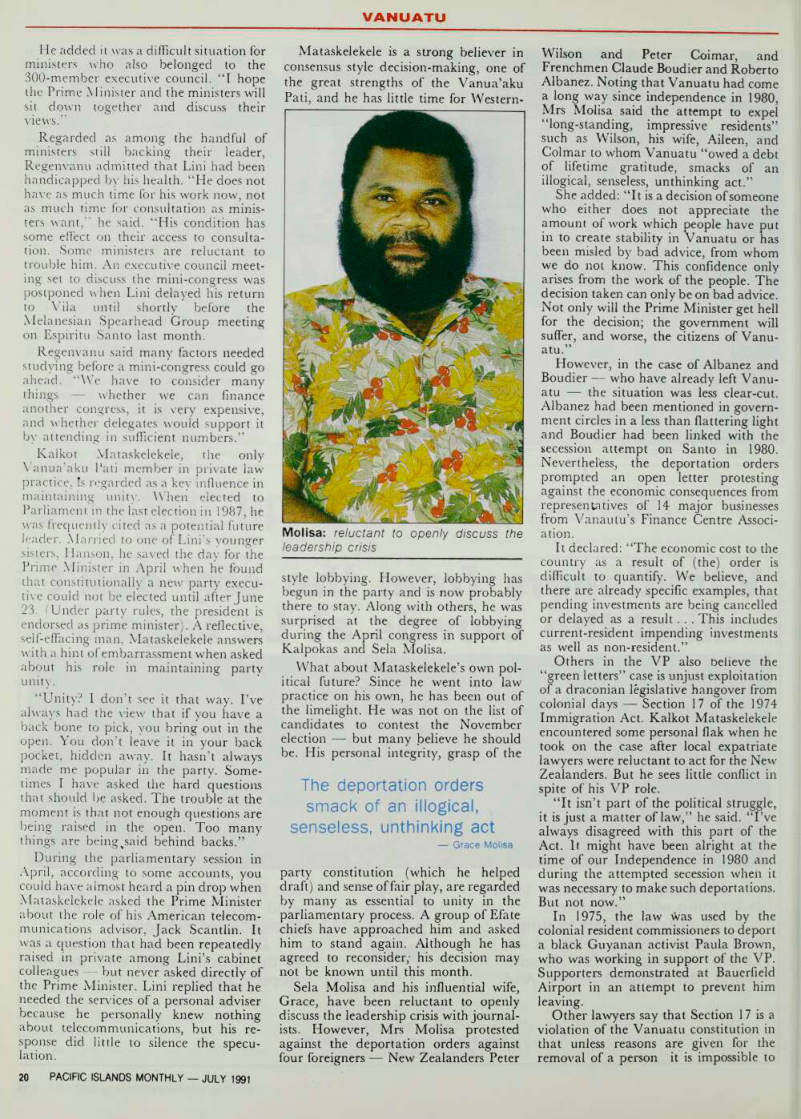
What about Mataskelekele’s own pol itical future? Since he went into law practice on his own, he has been out of the limelight. He was not on the list of candidates to contest the November election but many believe he should be. His personal integrity, grasp of the The deportation orders smack of an illogical,
senseless, unthinking act
Grace Molisa party constitution (which he helped draft) and sense of fair play, are regarded by many as essential to unity in the parliamentary process. A group of Efate chiefs have approached him and asked him to stand again. Although he has agreed to reconsider,- his decision may not be known until this month.
Sela Molisa and his influential wife, Grace, have been reluctant to openly discuss the leadership crisis with journal ists. However, Mrs Molisa protested
against the deportation orders against
four foreigners New Zealanders Peter
Wilson and Peter Coimar, and Frenchmen Claude Boudier and Roberto Albanez. Noting that Vanuatu had come a long way since independence in 1980, Mrs Molisa said the attempt to expel
“long-standing, impressive residents”
such as Wilson, his wife, Aileen, and Colmar to whom Vanuatu “owed a debt of lifetime gratitude, smacks of an
illogical, senseless, unthinking act.”
She added: “It is a decision of someone who either does not appreciate the amount of work which people have put in to create stability in Vanuatu or has been misled by bad advice, from whom we do not know. This confidence only arises from the work of the people. The decision taken can only be on bad advice.
Not only will the Prime Minister get hell for the decision; the government will suffer, and worse, the citizens of Vanu atu.”
However, in the case of Albanez and Boudier who have already left Vanu atu the situation was less clear-cut.
Albanez had been mentioned in govern ment circles in a less than flattering light and Boudier had been linked with the secession attempt on Santo in 1980.
Nevertheless, the deportation orders prompted an open letter protesting against the economic consequences from representatives of 14 major businesses from Vanautu’s Finance Centre Associ ation.
It declared: “The economic cost to the country as a result of (the) order is difficult to quantify. We believe, and there are already specific examples, that pending investments are being cancelled or delayed as a result. . . This includes current-resident impending investments as well as non-resident.”
Others in the VP also believe the “green letters” case is unjust exploitation of a draconian legislative hangover from colonial days Section 17 of the 1974 Immigration Act. Kalkot Mataskelekele encountered some personal flak when he took on the case after local expatriate lawyers were reluctant to act for the New Zealanders. But he sees little conflict in spite of his VP role.
“It isn’t part of the political struggle, it is just a matter of law,” he said. “I’ve always disagreed with this part of the Act. It might have been alright at the time of our Independence in 1980 and during the attempted secession when it was necessary to make such deportations.
But not now.”
In 1975, the law was used by the colonial resident commissioners to deport a black Guyanan activist Paula Brown, who was working in support of the VP.
Supporters demonstrated at Bauerfield Airport in an attempt to prevent him
leaving.
Other lawyers say that Section 17 is a violation of the Vanuatu constitution in that unless reasons are given for the removal of a person it is impossible to
Molisa: reluctant to openly discuss the leadership crisis
be given a fair hearing, and that it prevents the, action being challenged in court contran to constitutional right.
According to leading New Zealand civil rights barrister Patrick Finnigan who is representing Colmar and Wilson. “We accept the need for an order-for-removal power. But we say it should be exercised only in circumstances and in a form which permits the deportee to know the reasons why the order-for-removal power is exercised, and be afforded a right of appeal or review. The whole thrust of administrative law these days is to take away from governments and officials the right to exercise power without being subject to review on the basis of natural justice, in terms of what is known as the Anisminic principle (named after a case in Britain) particularly when people’s rights and freedoms are at stake.”
Finnigan flew to Vanuatu at the request of Colmar, Wilson and their solicitors last October during which time.an interim restraining order was imposed by the Supreme Court on Lini as Immigration Minister, prohibiting the deportation of the two New Zealanders pending a full court hearing. Following Finnigairs return to New Zealand, he was declared persona non grata by
principal immigration officer Gordon
Haines. Airlines flying to Vanuatu were also said to have been instructed not to allow Finnigan to travel to the country without a work permit.
Asked about this, Finnigan told Pacific Islands Monthly that he had not been officially notified of this action against him. When Finnigan originally applied for a temporary permit for legal practice to assist Mataskelekele conduct the deportation case, he was turned down.
However, following submissions and a lull hearing, Acting Chief Justice Edwin Goldsborough issued a temporary prac tice certificate to Finnigan.
Peter and AHeen Wilson, now in their 50s, arrived in Vanuatu in 1971. A builder, Peter Wilson has built up a successful construction business, Wilco Modular, in partnership with another New Zealander, Roger Ovens (who is not being deported). They employ about 80 ni-Vanuatu. Peter Colmar left New Zealand for Vanuatu when he was aged 17. In two decades he has created a commercial "empire including cattle farms, abattoirs, cocoa and coffee plan tations and processing plants on Espiritu Santo. He employs about 500 ni- Vanuatu. Colmar’s ni-Vanuatu wife is Madeleine Valale and he was recently honoured with a chiefly title, Molwitamata.
The Wilsons and Peter Colmer were given “no-reasons’ deportation orders last September 24 with one month to leave the country and a threat that they could be detained and expelled after that date. An interim injuction was granted
against the order by the Supreme Court on October 26. On November 6, the Prime Minister withdrew the deport ation letter while the Attorney-General, Silas Hakwa, moved the court to revoke the interim restraint. On November 13 another “green letter” was issued this time closer to the form prescribed under the Act. Six days later, Justice Goldsborough granted a further interim restraining order.
Meanwhile, in developments in New Zealand, a protest letter was recently sent to External Affairs Minister Don It’s time we looked at government and who is in whose pocket Opposition newsletter McKinnon, saying that although an “eye for an eye” approach was not advanced, “It seems unjust that the Prime Minister of Vanuatu can seek benefits from New Zealand his children’s education, free medical check-ups for himself and aid for Vanuatu; yet behave dishonourably to wards New Zealand citizens; longstand ing residents of Vanuatu, through these no-reasons deportations.”
Lini was quoted in the now-defunct Vanuatu news magazine Pacific Islands Profile as having said it was usual practice in any Commonwealth country not to give reasons for a deportation order (a claim rejected by some Commonwealth lawyers), and that the VP had endorsed
his decisions. He reportedly said the government had the right to refuse residency permits or to deport anyone “if it considers they arc a threat to security that their continued presence in Vanuatu will create problems”.
Although no official reasons have been given, it is widely thought in Vila that the deportations could be because of a perceived business threat by Colmar and Wilson to the Dinh family. On past occasions the two New Zealanders have found themselves competing with the Dinhs in business, tendering for land and business opportunities. Said one lawyer, “The associations of Prime Minister Lini with the Dinhs are not difficult to observe; the strong feeling is that Lini may have been influenced by the Viet namese family. This seems the only logical reason for the issue of the deportation letters.”
A recent issue of Fridom Mo Jastis (Freedom and Justice), newsletter of Barak Sope’s opposition Melanesian
Prokresif Pati, published a three-page
critique of the Vanua’aku Pad’s perform ance over the past decade. It made
allegations of bribery and corruption in
the Lini government and declared it was time to end this. It was also critical of Dinh Van Than, Rene Ah Pow and other influential businessmen. “It’s time we looked into government affairs and see who is in whose pocket.”
According to a former government advisor, Father Lini used to be highly regarded as a leader of integrity and example. “But now things have changed.
He stands head and shoulders above the other cabinet ministers in his under standing of the relationship between political power and business. He is probably a man ahead of his time; he discovered ways to fast track decisions and cut the red tape he can get things done quickly, whereas most of the other cabinet ministers are tied down by the
heavy machinery of bureaucratic
decision-making that we inherited from the British and French colonial system.
Barak Sope was another minister with a fine appreciation of this power relation
ship.
“I’m not saying this is how things should be done. Once everything used to be decided with full consultation with the grassroots. Now that is no longer the case. But the positive side is that important things can be done quickly.”
Examples of such “fast track” action are said to be Air Vanuatu and Vanautu T elecommunications.
Many officers believe Lini relies too heavily on the influence of his business advisers, some of whom are said to be underwriting his continued hold on the
prime ministership. The opposition will
probably move as a group this time.
They realise the mistakes of the past: Barak Sope moved too soon, the Molisas were sacrificed and the Prime Minister
Boulekone: ombudsman needed to make government accountable
is too powerful unless the opposition move together.
The consensus processes of the past have been steadily eroded in the past three years. The change started with Barak Sope when he sent some of his supporters to Libya for training without endorsement from the party executive.
Neither the party nor the cabinet challenged him then and the door was opened to doing things without party endorsement. “In the old days, the Prime Minister hardly did anything without consulting his colleagues and the grassroots,” said a party official. “Now there is hardly ever any consultation.”
Opposition Leader Vincent Boulekone is scathing about the “undemocratic” government but he is also under no illusions about other opposition pardes.
“I’d like to see Walter Lini step down,” he told Pacific Islands Monthly . “But I don’t think he will ever resign, unless his illness forces him to. The leadership problem is here in Vila alone. People in many of the islands still want him to lead in Tanna, Malekula and practically Pentecost.” (Like the Prime Minister Boulekone comes from Pentecost).
“But if there is a change, I don’t worry about who the next leader is. The only right man is whoever will accept to cooperate with us and understand our
policy.
“With six seats, the opposition Tan Union is dwarfed by the Vanua’aku Pad’s 40 seats. They gained the seats in byelections in 1988 after 18 Union Moderate Parties members and Sope with four other VP rebels boycotted Parliament for three successive sittings.
Yet Boulakone believes that his party could be in an even stronger posidon after the election, possibly holding the balance of power.
He has a deep distrust of Sope and the MPP. “I’m under no illusions in the unlikely event that they ever get into power they wouldn’t have any more respect for democracy or freedom of the
press than the present government. As MP and secretary-general of the VP, Barak Sope sacked me from Parliament in a gross denial of democratic rights.
Sope and Jimmy Simon signed a motion to expel me from Parliament in 1986 after I’d twice failed to seek leave when I had been ill for some time. I still quesdon the leadership of the MPP about democracy. I question the VP. I don’t want the Union of Moderate Parties to follow the same line.”
Boulekone, a year younger than Lini, is vice-chairperson of the constitutional review committee established last year.
But, admits Boulekone, he is less con cerned with changing the constitution than changing its application. The constitution provides for an ombudsman,
It won't matter much, in the end we will still be the government — Sethy Regenvanu
yet the government has never appointed one.
“Why? Because the government is afraid of an ombudsman. An ombudsman’s duty is to put things right, to make government accountable and to deliver justice to ordinary people.”
Boulekone believes that if an ombudsman was in office now, some of what he regards as the more blatant abuses of power would end. Among other feedback that has emerged from submis sions heard by the commission: • “No genuine land reform. After independence, Parliament approved na tional land reforms. But until now they have not been fully carried out the custom owner has no rights on his own land. • “The constitution needs to include legal recognition of customary rights and
organisations, such as the Malfatumauri (National Council of Chiefs). They need to be recognised as the authentic power recognised and defended by the constitution, Parliament, judiciary and the people. Since 1980 this hasn’t happened. I want to see this in law. We need to recognise the justice system in our custom this is custom, this is our culture.”
Boulekone is also critical of the lopsided composition of the commission two thirds of the 31 members are Vanua’aku Pati members. Acting Prime Minister Sethy Regenvanu disagrees. He considers the composition a wide rep resentation of chiefs, churches, women and the parties. Some of the changes he anticipates are that the head of state, largely ceremonial at present, would like more executive power, the parliamentary term should be extended from four to five years; and women need a more visible place in the political structure. Another idea is to expand Parliament from 46 members to 56 an increase easily absorbed in the impressive new red roofbd Parliament Buildings under con struction on a hill overlooking Port Vila harbour. (The old chamber was so cramped that some MPs had to sit in the visitors’ seats.) The UMP has kept a fairly low profile.
A recent 21-point manifesto adopted by the party provoked an incredulous re sponse from critics when one clause advocated opening the country to a foreign military base. Even with their allies, Sope’s MPP, they are not regarded as a serious challenge by the VP.
“Certainly not, if we had an election this month we’d win,” said Regenvanu.
“There is no reason for it to change later in the year. The MP are working really hard to make an impact in the elections.
They are determined to win some seals.
I don’t know where and in what constituencies, but in the end it won’t make much difference. We will still be the government.” □
Advertisements & other items, pp. 19-24 (1 item)
Vacationers from the city don’t
mind the crowds at Le Lagon.
Granted, our crystalline lagoon
is teeming with swimmwers.
But watching them is simply one more way to relax at Le Lagon A Pan Pacific Resort.
Along with golf and tennis. And the finest French colonial cuisine.
And the charm of our unique thatchroofed cottages.
Discover how you can get out of the urban jungle, and into a
Le Lagon tr °P ical paradise.
A Pan Pacific Resort P.O Box 86, Port Vila, Republic of Vanuatu, South Pacific Telephone: (678) 22313.
ADVENTURE FOR ALL AGES
Si ies Whatever your brand of adventure, Vanuatu will not disappoint you.
You could witness the unforgettable Pentecost Jump, walk to the edge of an active volcano, dive the ‘President Coolidge’ or witness ancient tribal ceremon- Or you might experience enough adventure travelling by boat back to your hotel in the middle of the night, flying to an outer island an a small aircraft or simply shopping at the local markets. Whatever your brand adventure, Vanuatu has it all for you.
See your travel agents, airline or write to or call.
VANUATU
NATIONAL TOURISM OFFICE
n
KUMUL HIGHWAY
INTERNATIONAL BUILDING
P 0 BOX 209
PORT VILA
VANUATU
TELE: 22685/22515
FAX: 23889
149467v2
HOTEL ROSSI
The oldest, most respected hotel ana restaurant in Port Vila and the only hotel built during colonial times with beautiful views directly over the harbour. Our Terrace and dining room offers the best views of Vila’s sunsets over the bay. The Rossi’s Terrace Breakfasts, Lunches and Dining Room Dinners carry a reputation for offering some of the best seafood and grills in Vanuatu. We specialise in functions and catering for any number of people and parties and we can even arrange take away items from our menu for you!
BUDGET ACCOMMODATION!
PO Box 11- Tel 22528- Fax (678) 22938
THINK OF GOODIES
at Olympic Court
BEFORE YOU EXCHANGE YOUR MONEY
We give the best rates buy We hold notes in US$, AUDS,
NZ$, CFP, FJ$, SIDS, YEN, GBD
Phone 23445 PO Box 932 Port Vila Vanuatu.
Air Vanuatu Business Class
It’s Paradise to Paradise.
mm
iiwl
i m mm ■> ' V • WH 4 r u A ■s>< m m m ft m t r ilSll Welcome to paradise aboard Air Vanuatu Business Class. Where you’ll the finest wines, food and service in the region. Our in-flight service is well matched by our on-time performance. Whatever your South Pacific destination, it’s paradise flying Air Vanuatu Business Class.
Head Office: Port Vila (678) 23848. Santo (678) 36429, Sydney (02) 223 8333, Melbourne (03) 417 3977, Brisbane (07) 221 0395, Auckland (09) 73 3435, Nadi/Suva (679) 314 666, Noumea (687) 28 6677.
AIR VANUATU
HARVIE/AIR 0321
Safe bet on tourism
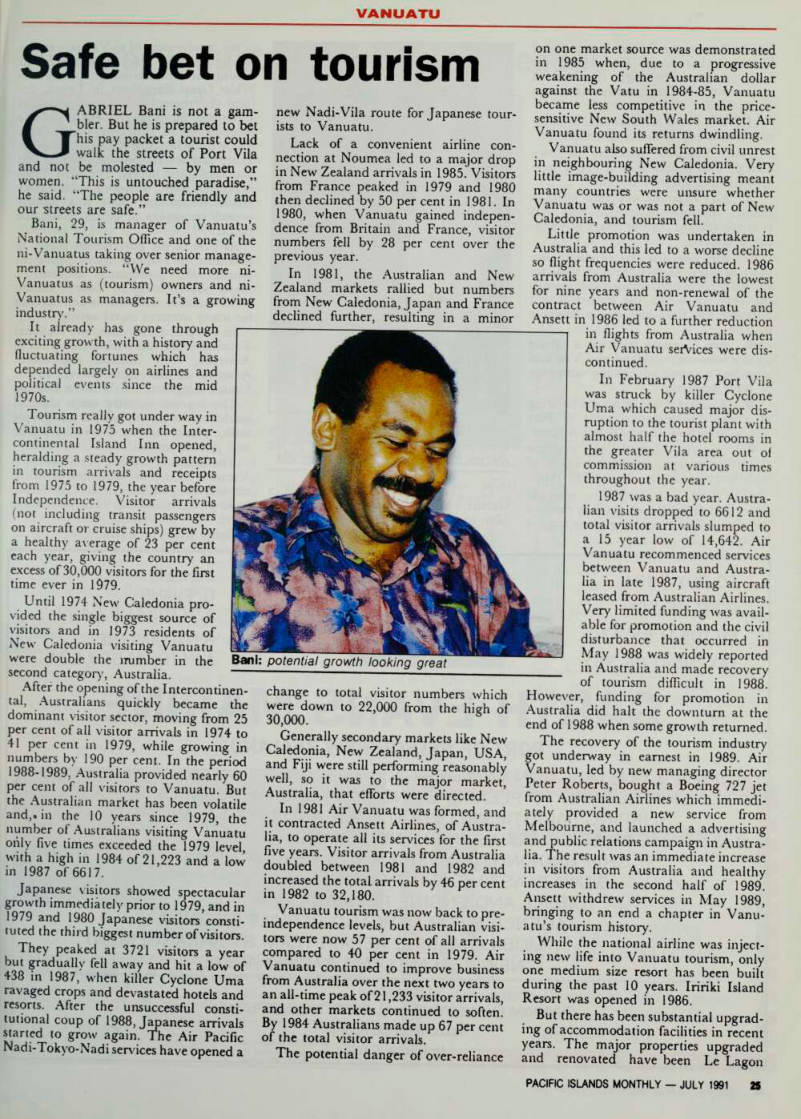
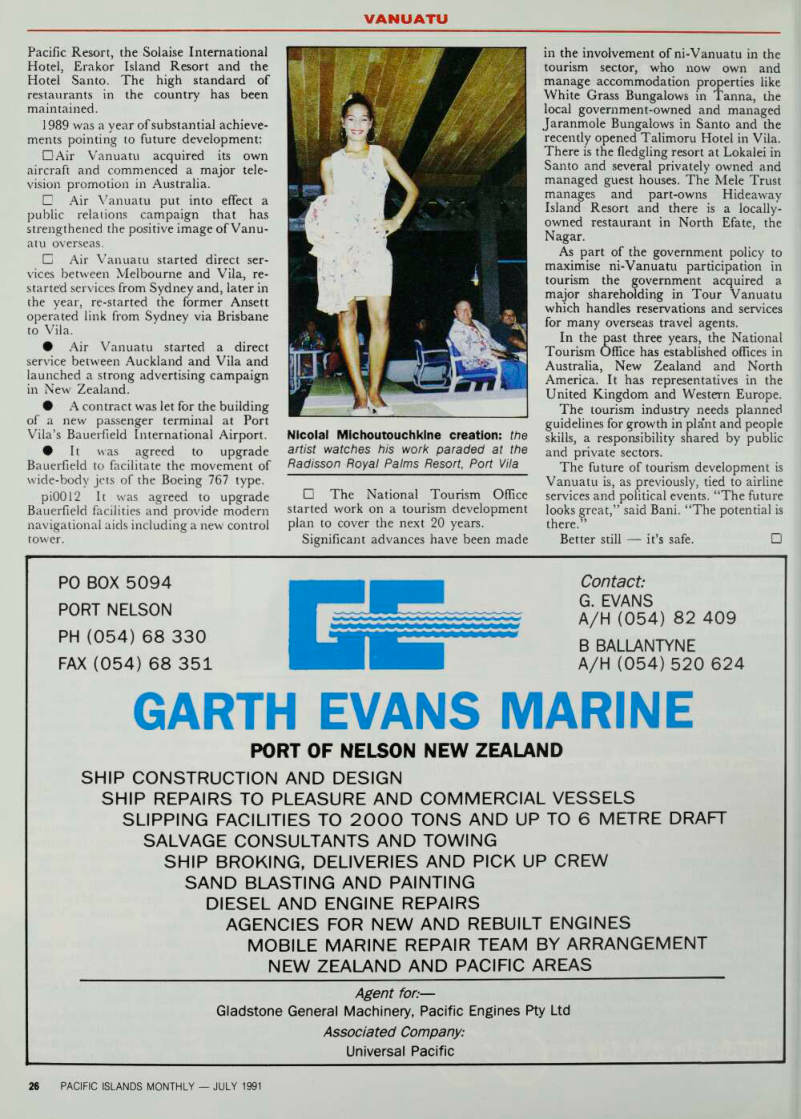
GABRIEL Bani is not a gam bler. But he is prepared to bet his pay packet a tourist could walk the streets of Port Vila and not be molested by men or women. “This is untouched paradise,” he said. “The people are friendly and our streets are safe.”
Bani, 29, is manager of Vanuatu’s National Tourism Office and one of the ni-Vanuatus taking over senior manage ment positions. “We need more ni- Vanuatus as (tourism) owners and ni- Vanuatus as managers. It’s a growing industry.”
It already has gone through exciting growth, with a history and fluctuating fortunes which has depended largely on airlines and political events since the mid 19705.
Tourism really got under way in Vanuatu in 1975 when the Inter continental Island Inn opened, heralding a steady growth pattern in tourism arrivals and receipts from 1975 to 1979, the year before Independence. Visitor arrivals (not including transit passengers on aircraft or cruise ships) grew by a healthy average of 23 per cent each year, giving the country an excess of 30,000 visitors for the first time ever in 1979.
Until 1974 New Caledonia pro vided the single biggest source of visitors and in 1973 residents of New Caledonia visiting Vanuatu were double the irumber in the second category, Australia.
After the opening of the Intercontinen tal, Australians quickly became the dominant visitor sector, moving from 25 per cent of all visitor arrivals in 1974 to 41 per cent in 1979, while growing in numbers by 190 per cent. In the period 1988-1989. Australia provided nearly 60 per cent of all visitors to Vanuatu. But the Australian market has been volatile and,, in the 10 years since 1979, the number of Australians visiting Vanuatu only five times exceeded the 1979 level with a high in 1984 of 21,223 and a low in 1987 of 6617.
Japanese visitors showed spectacular growth immediately prior to 1979, and in 1979 and 1980 Japanese visitors consti tuted the third biggest number of visitors.
They peaked at 3721 visitors a year but gradually fell away and hit a low of 438 in 1987, when killer Cyclone Uma ravaged crops and devastated hotels and resorts. After the unsuccessful consti tutional coup of 1988, Japanese arrivals started to grow again. The Air Pacific Nadi-Tokyo-Nadi sendees have opened a
new Nadi-Vila route for Japanese tour ists to Vanuatu.
Lack of a convenient airline con nection at Noumea led to a major drop in New Zealand arrivals in 1985. Visitors from France peaked in 1979 and 1980 then declined by 50 per cent in 1981. In 1980, when Vanuatu gained indepen dence from Britain and France, visitor numbers fell by 28 per cent over the previous year.
In 1981, the Australian and New Zealand markets rallied but numbers from New Caledonia, Japan and France declined further, resulting in a minor
change to total visitor numbers which were down to 22,000 from the high of 30,000. 5 Generally secondary markets like New Caledonia, New Zealand, Japan, USA, and Fiji were still performing reasonably well, so it was to the major market, Australia, that efforts were directed.
In 1981 Air Vanuatu was formed, and it contracted Ansett Airlines, of Austra lia, to operate all its sendees for the first five years. Visitor arrivals from Australia doubled between 1981 and 1982 and increased the total arrivals by 46 per cent in 1982 to 32,180.
Vanuatu tourism was now back to pre independence levels, but Australian visi tors were now 57 per cent of all arrivals compared to 40 per cent in 1979. Air Vanuatu continued to improve business from Australia over the next two years to an all-time peak 0f21,233 visitor arrivals, and other markets continued to soften.
By 1984 Australians made up 67 per cent of the total visitor arrivals.
The potential danger of over-reliance
on one market source was demonstrated in 1985 when, due to a progressive weakening of the Australian dollar against the Vatu in 1984-85, Vanuatu became less competitive in the price sensitive New South Wales market. Air Vanuatu found its returns dwindling.
Vanuatu also suffered from civil unrest in neighbouring New Caledonia. Very
little image-building advertising meant
many countries were unsure whether Vanuatu was or was not a part of New Caledonia, and tourism fell.
Little promotion was undertaken in Australia and this led to a worse decline so flight frequencies were reduced. 1986 arrivals from Australia were the lowest for nine years and non-renewal of the contract between Air Vanuatu and Ansett in 1986 led to a further reduction
in flights from Australia when Air Vanuatu services were dis continued.
In February 1987 Port Vila was struck by killer Cyclone Uma which caused major dis ruption to the tourist plant with almost half the hotel rooms in the greater Vila area out of commission at various times throughout the year. 1987 was a bad year. Austra lian visits dropped to 6612 and total visitor arrivals slumped to a 15 year low of 14,642. Air Vanuatu recommenced services between Vanuatu and Austra lia in late 1987, using aircraft leased from Australian Airlines.
Very limited funding was avail able for promotion and the civil disturbance that occurred in May 1988 was widely reported in Australia and made recovery of tourism difficult in 1988.
However, funding for promotion in Australia did halt the downturn at the end of 1988 when some growth returned.
The recovery of the tourism industry got underway in earnest in 1989. Air Vanuatu, led by new managing director Peter Roberts, bought a Boeing 727 jet from Australian Airlines which immedi ately provided a new service from Melbourne, and launched a advertising and public relations campaign in Austra lia. The result was an immediate increase in visitors from Australia and healthy increases in the second half of 1989.
Ansett withdrew services in May 1989, bringing to an end a chapter in Vanu atu’s tourism history.
While the national airline was inject ing new life into Vanuatu tourism, only one medium size resort has been built during the past 10 years. Iririki Island Resort was opened in 1986.
But there has been substantial upgrad ing of accommodation facilities in recent years. The major properties upgraded and renovated have been Le Lagon
Bani: potential growth looking great
Pacific Resort, the Solaise International Hotel, Erakor Island Resort and the Hotel Santo. The high standard of restaurants in the country has been maintained. 1989 was a year of substantial achieve ments pointing to future development; □ Air Vanuatu acquired its own aircraft and commenced a major tele vision promotion in Australia.
C Air Vanuatu put into effect a public relations campaign that has strengthened the positive image of Vanu atu overseas.
G Air Vanuatu started direct ser vices between Melbourne and Vila, re started services from Sydney and, later in the year, re-started the former Ansett operated link from Sydney via Brisbane to Vila. • Air Vanuatu started a direct service between Auckland and Vila and launched a strong advertising campaign in New Zealand. • A contract was let for the building of a new passenger terminal at Port Vila’s Bauerfield International Airport. • It was agreed to upgrade Bauerfield to facilitate the movement of wide-body jets of the Boeing 767 type. piOO 12 It was agreed to upgrade Bauerfield facilities and provide modern navigational aids including a new control rower.
□ The National Tourism Office started work on a tourism development plan to cover the next 20 years.
Significant advances have been made
in the involvement of ni-Vanuatu in the tourism sector, who now own and manage accommodation properties like White Grass Bungalows in Tanna, the local government-owned and managed Jaranmole Bungalows in Santo and the recently opened Talimoru Hotel in Vila.
There is the fledgling resort at Lokalei in Santo and several privately owned and managed guest houses. The Mele Trust manages and part-owns Hideaway Island Resort and there is a locally owned restaurant in North Efate, the
Nagar.
As part of the government policy to maximise ni-Vanuatu participation in tourism the government acquired a major shareholding in Tour Vanuatu which handles reservations and services for many overseas travel agents.
In the past three years, the National Tourism Office has established offices in Australia, New Zealand and North America. It has representatives in the United Kingdom and Western Europe.
The tourism industry needs planned guidelines for growth in pla'nt and people skills, a responsibility shared by public and private sectors.
The future of tourism development is Vanuatu is, as previously, tied to airline services and political events. “The future looks great,” said Bani. “The potential is there.”
Better still it’s safe. □
Nicolai Michoutouchkine creation: the artist watches his work paraded at the Radisson Royal Palms Resort, Port Vila
Advertisements & other items, p. 26 (1 item)
Garth Evans Marine
PO BOX 5094
PORT NELSON
PH (054) 68 330
FAX (054) 68 351
Contact:
G. EVANS
A/H (054) 82 409
B BALLANTYNE
A/H(054)520 624
GARTH EVANS MARINE
SHIP CONSTRUCTION AND DESIGN
SHIP REPAIRS TO PLEASURE AND COMMERCIAL VESSELS SLIPPING FACILITIES TO 2000 TONS AND UP TO 6 METRE DRAFT
SALVAGE CONSULTANTS AND TOWING
SHIP BROKING, DELIVERIES AND PICK UP CREW
SAND BLASTING AND PAINTING
DIESEL AND ENGINE REPAIRS
AGENCIES FOR NEW AND REBUILT ENGINES
MOBILE MARINE REPAIR TEAM BY ARRANGEMENT
NEW ZEALAND AND PACIFIC AREAS
Agent for: — Gladstone General Machinery, Pacific Engines Pty Ltd Associated Company: Universal Pacific
PORT OF NELSON NEW ZEALAND
Plan for industry turbulence needed
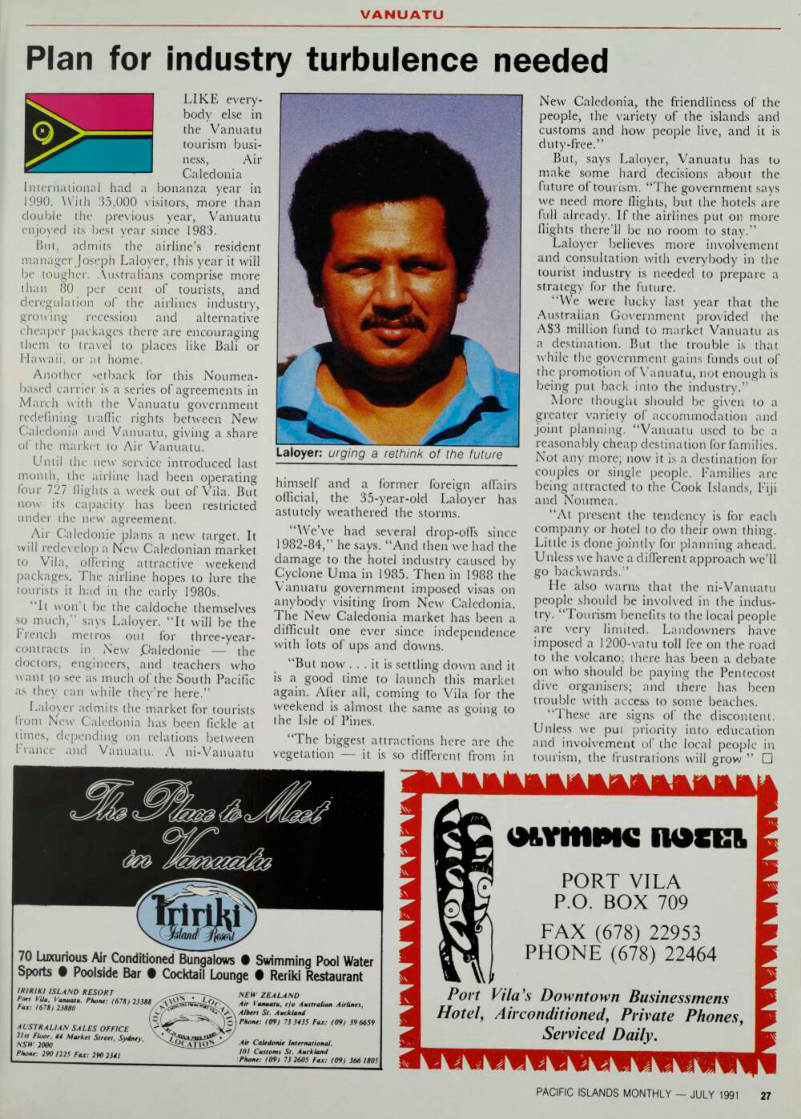
LIKE every body else in the Vanuatu tourism busi ness, Air Caledonia
International had a bonanza year in 1990. With 35,000 visitors, more than double the previous year, Vanuatu enjoyed its best year since 1983, But, admits the airline’s resident manager Joseph Laloyer, this year it will be tougher. Australians comprise more than 80 per cent of tourists, and deregulation of the airlines industry, growing recession and alternative
cheaper packages there are encouraging
them to travel to places like Bali or Hawaii, or at home.
Another setback for this Noumea based carrier is a series of agreements in March with the Vanuatu government redefining traffic rights between New Caledonia and Vanuatu, giving a share of the market to Air Vanuatu.
Until the new service introduced last month, the airline had been operating four 727 flights a week out of Vila. But now its capacity has been restricted under the new agreement.
Air Caledonie plans a new target. It will redevelop a New Caledonian market to Vila, offering attractive weekend packages. The airline hopes to lure the tourists it had in the early 1980 s.
“It won't be the caldoche themselves so much,” says Laloyer. “It will be the French metros out for three-year contracts in New .Oaledonie the doctors, engineers, and teachers who want to see as much of the South Pacific as they can while they’re here.”
Laloyer admits the market for tourists from New Caledonia has been fickle at times, depending on relations between France and Vanuatu. A ni-Vanuatu
himself and a former foreign affairs official, the 35-year-old Laloyer has astutely weathered the storms.
“We’ve had several drop-offs since 1982-84,” he says. “And then we had the damage to the hotel industry caused by Cyclone Uma in 1985. Then in 1988 the Vanuatu government imposed visas on anybody visiting from New Caledonia.
The New Caledonia market has been a difficult one ever since independence with lots of ups and downs.
“But now ... it is settling down and it is a good time to launch this market again. After all, coming to Vila for the weekend is almost the same as going to the Isle of Pines.
“The biggest attractions here are the vegetation — it is so different from in
New Caledonia, the friendliness of the people, the variety of the islands and customs and how people live, and it is
duty-free.”
But, says Laloyer, Vanuatu has to make some hard decisions about the future of tourism. “The government says we need more flights, but the hotels are full already. If the airlines put on more flights there’ll be no room to stay.”
Laloyer believes more involvement and consultation with everybody in the tourist industry is needed to prepare a strategy for the future.
“We were lucky last year that the Australian Government provided the ASS million fund to market Vanuatu as a destination. But the trouble is that while the government gains funds out of the promotion of Vanuatu, not enough is being put back into the industry.”
More thought should be given to a greater variety of accommodation and joint planning. “Vanuatu used to be a reasonably cheap destination for families.
Not any more; now it is a destination for couples or single people. Families are being attracted to the Cook Islands, Fiji and Noumea.
“At present the tendency is for each company or hotel to do their own thing.
Little is done jointly for planning ahead.
Unless we have a different approach we’ll go backwards.”
He also warns that the ni-Vanuatu people should be involved in the indus try. “Tourism benefits to the local people are very limited. Landowners have imposed a 1200-vatu toll fee on the road to the volcano; there has been a debate on who should be paying the Pentecost dive organisers; and there has been trouble with access to some beaches, “These are signs of the discontent.
Unless we put priority into education and involvement of the local people in tourism, the frustrations will grow ” □
Laloyer: urging a rethink of the future
Advertisements & other items, p. 27 (1 item)
omttmc nocra
m 0. 70 Luxurious Air Conditioned Bungalows • Swimming Pool Water Sports • Poolside Bar • Cocktail Lounge • Reriki Restaurant
IRIRIKI ISLAND RESORT
Port yud. Vanuatu. Phone: (678) 23388 Fax: (678} 23880 ,
AUSTRALIAN SALES OFFICE \
Tin Floor. 44 Market Street, Sydney
NSH’2OOO
Phone: 290 1225 Fax: 290 2341
NEH ZEALAND
Air Vanuatu, c/o Australian Airlines, ■'y*\ Albert St. Auckland ) Cj Phone: (09) 73 3435 Fax: (09) 396659 Air CaJedonie International. 101 Customs St. Auckland Phone: (09) 73 2605 Fax: (09) 366 1805
omttmc nocra
PORT VILA
P.O. BOX 709
FAX (678) 22953
PHONE (678) 22464
Port Vila’s Downtown Businessmens
Hotel, Airconditioned,Private Phones,
Serviced Daily.
Leap

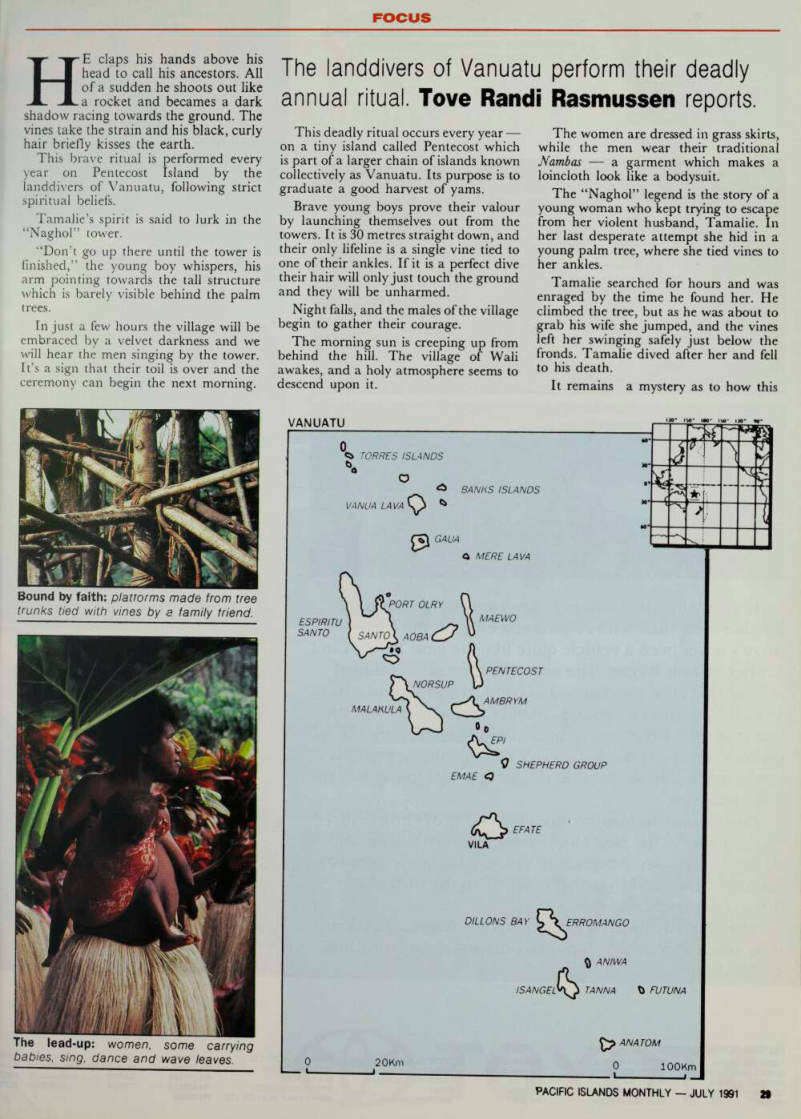


of Faith
Pictures: Terje Engo A Pentecost landdiver performs the ritual dive, supported only by vines tied to his ankles. If the spirits are pleased, he will stop falling just as his hair touches the ground, signalling a fine yam yield for the year ahead.
Focus
HE claps his hands above his head to call his ancestors. All of a sudden he shoots out like a rocket and becames a dark shadow racing towards the ground. The vines take the strain and his black, curly hair briefly kisses the earth.
This brave ritual is performed every year on Pentecost Island by the landdivers of Vanuatu, following strict spiritual beliefs.
Tamalie’s spirit is said to lurk in the
“Naghol” tower.
“Don’t go up there until the tower is finished,” the young boy whispers, his arm pointing towards the tall structure which is barely visible behind the palm trees.
In just a few hours the village will be embraced by a velvet darkness and we will hear the men singing by the tower.
It’s a sign that their toil is over and the ceremony can begin the next morning.
The landdivers of Vanuatu perform their deadly annual ritual. Tove Randi Rasmussen reports
This deadly ritual occurs every year on a tiny island called Pentecost which is part of a larger chain of islands known collectively as Vanuatu. Its purpose is to graduate a good harvest of yams.
Brave young boys prove their valour by launching themselves out from the towers. It is 30 metres straight down, and their only lifeline is a single vine tied to one of their ankles. If it is a perfect dive their hair will only just touch the ground and they will be unharmed.
Night falls, and the males of the village begin to gather their courage.
The morning sun is creeping up from behind the hill. The village of Wali awakes, and a holy atmosphere seems to descend upon it.
The women are dressed in grass skirts, while the men wear their traditional Mambas a garment which makes a loincloth look like a bodysuit, Xhe .< Naghor le g e nd is the story of a young woman who kept trying to escape from her violent husband, Tamalie. In her last desperate attempt she hid in a young palm tree, where she tied vines to her ankles.
Tamalie searched for hours and was enraged by the time he found her He climbed the tree, but as he was about to grab his wife she jumped, and the vines er swinging safely just below the fronds. Tamalie dived after her and fell to his death.
It remains a mystery as to how this
Bound by faith: platforms made from tree trunks tied with vines by a family friend.
The lead-up: women, some carrying babies, sing, dance and wave leaves.
ceremony became connected with the yam harvest.
With anticipation we are led away from Wali, and towards the tower. The track twists and turns first through thick jungle, and then through open fields and tall coconut trees.
Heavy rain has made the track very muddy and more like a stream in places.
We struggle to keep our balance. We pass groups of bamboo huts and excited faces peer out at us, while some of the villagers wave.
Finally we arrive at our destination, sweaty and exhausted. A huge tower reaches skyward it is at least 30 metres tall.
Although the legend of “Naghol” involves a palm tree, three skydivers now use any tall tree. Unnecessary branches are cut off, a scaffold of logs and branches is built around the trunk and the structure is secured to surrounding trees
by vines.
Hammer and nails don’t exist. The labour is carried out according to ancient traditions and it is an art that only a few villages have mastered. The tower before us was built by chief Telkon and the men of Bunlap a village on the other side of the mountain.
When missionaries first arrived on Pentecost the “Naghol” ceremony was
banned. Only two villages kept the
tradition alive, but recently the men from Bunlap have passed the ritual on to other groups.
For the last two weeks before their leap, the participants must abstain from any sexual activity. They follow a strict diet and drinking kava is definitely taboo. Other special rites are observed in order to drive off evil spirits.
While the tower is being raised, the women are forbidden to come near it, or even be seen in the area. If any of the rules are violated it is bound to result in a terrible accident for one of the divers.
The tower has several platforms one for each of the 28 men who will jump.
Each man carefully selects his own vine.
It must be of exact length and incredible strength. If not, the diver will plummet into the ground head first!
Each platform is built by a trusted friend of the diver’s family.
Three young men are chosen to guard the tower through the dark hours on the eve of the “Naghol”. No evil must over
Certainty: dark clouds roll in as the last man, his muscular body gleaming with coconut oil, moves his hands confidently to the song resounding from the crowd below. He then claps his hands, lets his head fall back, throws himself from the platform and plummets like a rocket toward the ground far below.
come the platforms.
The ceremony begins when the men atop the tower begin singing and danc ing. Soon the women below join in. They are delightful to watch perfumed leaves draped over bare breasts, flowers in their hair. They wave colourful kroton leaves while their grass skirts flick around
their legs.
A seven year old climbs to his platform while the singing and dancing intensifies.
The women from the boy’s family hold their arms in a cradle position while they dance, to signify that they have raised him from an infant.
As the boy inches out onto the platform the women begin a loud, high pitched whistle. Everyone focuses their concentration on the boy.
It is his first dive. His actions are uncertain. He grips some vines which hang from above, and his toes dig into the edge of the platform. He lifts his trembling arms out from his sides, as if to feel the air.
The crowd urge him on. They are
singing the song he has chosen.
The boy grows braver and begins to wave his arms to the rhythm. He yells wildly and drops a green leaf to the ground to ward off any demons which might still be haunting the tower.
He claps his hands above his head to call his ancestors. Letting himself fall forward, he pushes off when he is almost horizontal, and his hands come up to cover his face.
He falls earthward. The vine tightens and stretches. The platform collapses!
The crowd fails silent as two men run to the boy’s aid. They cut the vines from his ankles with a machete. He is okay, and whoops with pride as he stretches his arms upward in triumph. His first dive is a success.
Every year someone is either killed or seriously injured, but more often than
Tied to ritual: all that saves a landdiver from death is the vines connecting his feet to the platform, and his faith in the goodwill o f the spirits.
Spiritual support: women below the platform wave colourful leaves while their grass skirts flick around their legs.
not they succeed. The old men with more than 20 dives behind them ensure that
everything is done correctly. They rely
on their spirits to tell them if there is any
danger.
The drama is heightened as dark clouds roll in. Tropical downpours are interspersed with patches of brilliant sunshine, but the deluge doesn’t dampen the enthusiasm of the dancers.
Taro leaves become umbrellas and the wet, shining bodies continue with their rhythmic movements. The tension rises as the jumpers go higher. By the time the last diver reaches his platform the crowd is in an ecstatic state a frenzy of song, dance and whistling.
The last man enjoys the attention. He has done this before and takes his time, moving his hands confidently to the song.
His muscular body, covered in coconut oil, gleams when the sun flickers onto it.
He claps his hands and lets his head fall back. His hands cover his face.
Concentrate now. He shoots out like a rocket and becomes a dark shadow racing towards the ground. The vine takes the strain and his black, curly hair briefly kisses the earth.
A perfect dive!
The crowd is overjoyed. There will be plenty of yams this year. And the last man has proven that he is the bravest of the brave. □
Young and brave: a boy makes his first jump from a platform which collapsed just as the vine tightened.
Encouragement: men beat the ground with sticks, sing, chant and whistle.
Advertisements & other items, pp. 30-33 (2 items)
luxury-car ride.
The new Toyota brand mark. Three ellipses forming a “T” which stand for our customer, our commitment to the satisfaction of that customer through our product and for our spirit of creativity.
I It’s not often that you hear descriptions like rugged or durable combined with refined and elegant. But then there’s never been a vehicle quite like the new Toyota Land Cruiser Station Wagon. The unrivalled legend of off-road reliability is now unsurpassed in comfort and sophistication as well. Attention to detail is found everywhere, from the fine trim to the instrument panel to the graceful lines of its exterior. Even in places you can’t see, like the heavy-duty ladder frame and suspension design that add to the superb
But Toyota’s innovation goes beyond providing luxury and durability. The new Land Cruiser Station Wagon, and all of our cars, are designed to create a harmony between car and driver, and to provide you with the ultimate
driving experience.
The new Toyota Land Cruiser Station Wagon. Think of it as much more than a spacious luxury sedan with fourwheel drive.
H m M ■ i ft 1 **■ •
DISTRIBUTORS/DEALERS
AMERICAN SAMOA BURNS PHILP (S.S.) CO. LTD. PH 633-4281 GUAM & MICRONESIA ATKINS KROLL, INC. PH 646-1876/9 NORFOLK ISLANDS BORRY'S PTY LTD. PH 2114
SOLOMON ISLANDS MENDANA MOTORS PH 22884
VANUATU VANUATU MOTORS PH 2341
COOK ISLANDS PACIFIC MOTORS LTD. PH 20796
KIRIBATI TARAWA MOTORS PH 21090
PAPUA NEW GUINEA ELA MOTORS PH 217036
TAHITI NIPPON AUTOMOTO PH 429819
WESTERN SAMOA BURNS PHILP (S.S.) CO. LTD. PH 20800
FIJI ASCO (
NEW CALEDONIA 5.1.A.P.5
SAIPAN MICROD
TONGA BURNSI
<SB> TOYOTA
Focus
Lessons on life and death
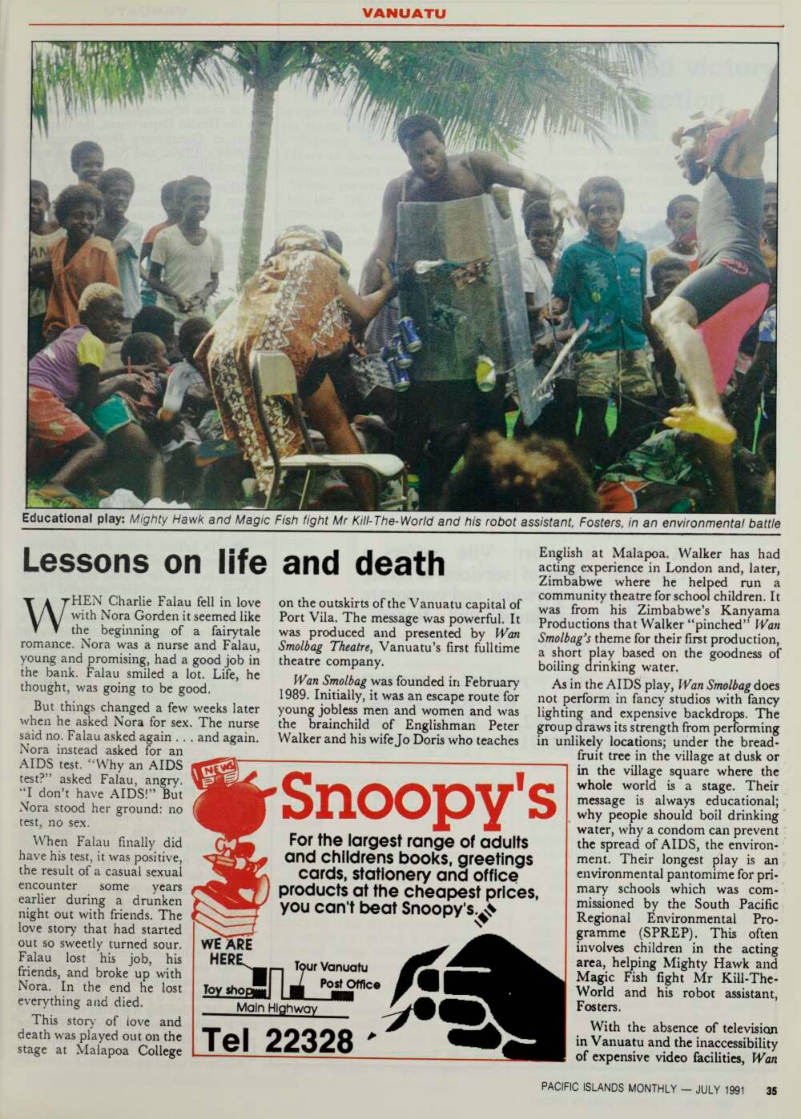
Vanuatu
WHEN Charlie Falau fell in love with Nora Gorden it seemed like the beginning of a fairytale romance. Nora was a nurse and Falau, young and promising, had a good job in the bank. Falau smiled a lot. Life, he thought, was going to be good.
But things changed a few weeks later when he asked Nora for sex. The nurse said no. Falau asked again . . . and again.
Nora instead asked for an
AIDS test. “Why an AIDS test?” asked Falau, angry.
“I don’t have AIDS!” But Nora stood her ground: no test, no sex.
When Falau finally did have his test, it was positive, the result of a casual sexual encounter some years earlier during a drunken night out with friends. The love story that had started out so sweetly turned sour.
Falau lost his job, his friends, and broke up with Nora. In the end he lost everything and died.
This story- of love and death was played out on the
stage at Malapoa College
on the outskirts of the Vanuatu capital of Port Vila. The message was powerful. It was produced and presented by Wan Smolbag Theatre , Vanuatu’s first fulltime theatre company.
Wan Smolbag was founded in February 1989. Initially, it was an escape route for young jobless men and women and was the brainchild of Englishman Peter Walker and his wife Jo Doris who teaches
English at Malapoa. Walker has had acting experience in London and, later, Zimbabwe where he helped run a community theatre for school children. It was from his Zimbabwe’s Kanyama Productions that Walker “pinched” Wan Smolbag’s theme for their first production, a short play based on the goodness of
boiling drinking water.
As in the AIDS play, Wan Smolbag does not perform in fancy studios with fancy lighting and expensive backdrops. The group draws its strength from performing in unlikely locations; under the bread
fruit tree in the village at dusk or in the village square where the whole world is a stage. Their message is always educational; why people should boil drinking water, why a condom can prevent the spread of AIDS, the environ ment, Their longest play is an environmental pantomime for pri mary schools which was com missioned by the South Pacific Regional Environmental Pro gramme (SPREP). This often involves children in the acting area, helping Mighty Hawk and Magic Fish fight Mr Kill-The- World and his robot assistant, Fosters.
With the absence of television in Vanuatu and the inaccessibility of expensive video facilities, Wan
Educational play: Mighty Hawk and Magic Fish fight Mr Kill-The-World and his robot assistant, Fosters, in an environmental battle
Smolbag plays a key role in the country’s visual education programme. Its im mediate objectives are to bring import ant issues to the attention of villagers and to act as an educational back-up service for the Health Department, the Depart ment of Community Development & Women’s Affairs, and Non-Govemment
Organisations,
“Wan Smolbag is not just a performance group,” said Walker, actor and group leader. “We also teach drama and the result is three or four drama groups in Abrym,” one of the bigger islands north of the capital Port Vila. Their biggest project now involves working on a cultural history play on Vanuatu to cover blackbirding, the history of plan tations which thrived before indepen dence in 1980, and traditional dances.
The five fulltime members of the group share a diverse background and joined to Wan Smolbag after having aimlessly wandered from job to job. The cast: • Charlie Falau is in his early 20s and is from the island of Ambrym. Falau did secondary education in Fiji and returned to Vanuatu to work for the Tagabe Agricultural Centre on the main island of Efate, taking blood samples from cows and bulls. He joined Wan Smolbag as a part-time and stayed on fulltime. • Jo Jeffred is also from Ambrym.
He attended University of the South Pacific in Suva for a year and left after failing his exam. He attended Futa Helu’s Atenisi Institute in Tonga and joined Wan Smolbag fulltime. He does a lot of the administration work and was in Melbourne recently for two months on the Beyond Borders cultural programme. • Pirre Lict is a francophone halfcaste who trained as an electrician but ended up not being able to keep a job. He joined Wan Smolbag in 1989 and is the group’s one-man band. • Nora Gorden is the only woman in the group and perhaps the most powerful performer. She is originally from Pangu village on the main island of Efate and speaks French and English fluently. She was born into an Anglophone family and leamt French enough to teach it at high school. She had no permanent work until joining Wan Smolbag last August.
All the members of the group work fulltime. Their salaries are paid by the Australian Community Aid Abroad. The World Health Organisation gives 54000 a year for works on AIDS and other sexually transmitted diseases. SPREP gave $3OOO for a play on environmental issues. Wan Smolbag is seeking sponsorship for a regional tour this year. With the power of their message they would be a hit abroad. □
Advertisements & other items, pp. 35-36 (1 item)
Snoopy's
WEARS
HER
For the largest range of adults and childrens books, greetings cards, stationery and office products at the cheapest prices, you can't beat Snoopy's.^ r Vanuatu Post Office Toy sho Main Highway
Tel 22328
Peat Marwick
As a member of the world’s largest accounting and consulting firm, KPMG Peat Marwick in Vanuatu provides its clients with the highest quality service and advice available.
KPMG in Port Vila offers a complete range of services covering all aspects of personal and corporate business, investment and finance.
Contact the resident partner: Bill Hawkes, KPMG House, P.O. Box 212, Port Vila.
Phone (678) 22091 Fax (678) 23665.
Slow suicides in Samoa
By Ulafala Aiavao
WESTERN Samoan officials trying to combat the country’s high suicide rate want to revive a suicide awareness programme and limit access to the weedkiller paraquat.
Paraquat is the most popular suicide method in Western Samoa, and one of the most agonising, with some taking several days or more than a week to die.
Since the first paraquat suicide was recorded here in 1973 more than 277 Samoans have died by paraquat alone.
Last year Western Samoa (popu lation 160,000) listed 27 suicides, 19 of them by paraquat. Medical statistician Vili Ropati told a seminar in Apia in May that statistics in past years may be under-reported because data from rural medical centres was incomplete. Nurses in charge of' district centres often list of paraquat poisoning as renal failure, because they are only required to list the final diagnosis.
The worst year for suicide statistics
was in 1981 when au thorities recorded 49, (including 39 by para quat). The rate of suicide for young males aged 15 to 24 years was three times higher than the same group in the next highest country.
The suicide rate, and number, has declined since the 1981 high but “It is still too high. ' said Dr David Parkinson, the World Health Organisation (WHO) resident representative in Apia.
Officials are; aware that the high suicide rate is not reflected in the large Samoan communities overseas, but there are no easy answers to explain why. Attention is now being shifted to preventive programmes.
Dr John Bowles, a WHO consultant at the seminar who worked in Western Samoa in 1981 to 1984, has suggested better controls on access to paraquat.
Agriculture officials have resisted calls for a ban on paraquat, widely used as a weed control method by farmers. The Agriculture Department argues that removing paraquat only makes a poten tial suicide seek another method.
Dr Bowles told the seminar that this is not necessarily the case. He said that in England in the 1970 s a popular suicide method was to stick one’s head in a gas oven. The fuel suppliers switched from coal gas to North Sea gas which Dr Bowles said had no carbon monoxide. There was no jump in suicide
It sometimes expresses anger, isolation or a need to escape
by other methods, when the fuel switch was made.
“Western Samoa is the second country to show this,” said Dr Bowles.
Statistics support him at the moment.
When paraquat suicides declined after the 1981 high, there was no appreciable rise in suicide by other methods such as hanging, shooting and
poisoning. Nobody knows how long this
will last.
Suicide prevention programmes will face obstacles. Samoan culture frowns on young people who ask questions of their elders. This causes problems for programmes aimed at encouraging people to seek outside help when they are under great stress. Another problem is that publicity about suicide deaths is sometimes blamed for “copycat” suicides.
Officials know that nearly half those who take paraquat actually survived because they spat out the tiny amount they held in their mouths, or because the liquid was in a very diluted form. But they prefer to leave this fact out of the prevention programmes as it is easy to
miscalculate what con stitutes a fatal dose.
Increasing stress on Samoans has been blamed on various fac tors, including rapid
social changes,
breakup of extended family units via mi
gration, inability to communicate problems. . . even a three-month public servant’s strike in 1981.
The senior nurse in charge of the WS Health Department’s psychiatric ser vice, Sister lokapeta Enoka, listed several categories for those who use, or try to use, suicide as a means of communicating. For some, suicide is a means of expressing emotions of anger or loneliness. Others use it to gain attention or escape marital, financial or social situations.
Some fieldworkers worry that a few potential suiciders view suicide as an acceptable way to resolve a conflict. The theory here is that Western Samoa’s devout Christianity may, by perverse logic, lead a troubled person to view Christ’s sacrifice for the world’s sins as an example i.e. taking a burden with them and being admired for it. The theory fails to explain why such a person ignores the strong opposition of any church to suicide.
Survivors of suicide attempts often say they did not really want to die. The challenge is to convince the small group with suicidal tendencies they can seek help from friends or support groups. □
Shortlived victory
after election
THE man who defeated Western Samoa’s former Opposition Leader Tuiatua Tufua Tamasese in the April 5 general election has himself lost his seat after a court case.
The Supreme Court ruled on June 12 that the election of Mananuo Salale was void, following hearings into a petition filed by two voters who alleged caffes of bribery and treating in the Anoamaa Sasae electorate.
Moananu, a retired postal supervisor, had been an MP for less than five weeks (the MPs were sworn in on May 7).
Chief Justice Anthony Ryan upheld the first part of the petition calling for Moananu’s election to be void. But the CJ rejected a separate section which had asked the former Opposition Leader to be immediately declared the rightful holder of the seat.
Instead, the Supreme Court ordered a
by-election.
The case was the second election petition to be heard by the court, but the first to involve a reversal of the April general election result.
An earlier petition hearing, filed by the former Speaker of the house who also lost his seat to a newcomer, was dismissed for lack of evidence. □
GST widened for broader tax base
broader tax base
THE Western Samoan government is to expand a 10 per cent Goods and Sales Tax to include professionals, some forms of insurance, and tourist support services. GST is currently applied only to a small number of items in hotels and restaurants.
The change takes effect on July 1. The professional classes that will be affected include law, valuation, consultant engin eering, surveying, pharmacists, in surance, medicine, dentistry, architec ture, auditing and accounting.
Finance Minister Tuilaepa Sailele said in his budget statement tabled on June 6 that government wanted to widen the tax base, to ease the burden on salary/ wage earners and companies. There are plans to introduce a universal consump tion tax early next year which will cover all sectors of the economy. In his budget, Tuilaepa said total planned expenditure would be at a record W5T222.59 million for the fiscal year starting July 1.
Balance of payments were expected to show a reduced surplus during the fiscal year. Manufacturing and tourism would receive the closest attention, he said. □
Inquiry turns spotlight on PNG aid
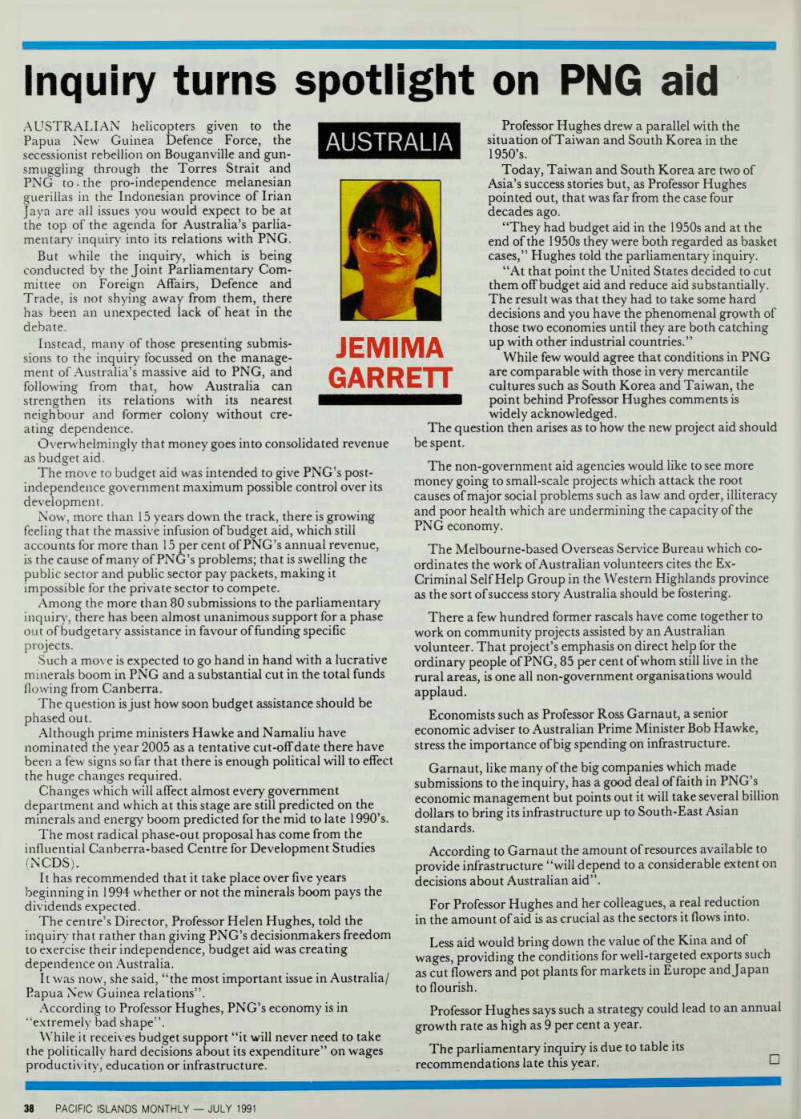
AUSTRALIAN helicopters given to the Papua New Guinea Defence Force, the secessionist rebellion on Bouganville and gun smuggling through the Torres Strait and PNG to - the pro-independence melanesian guerillas in the Indonesian province of Irian Jaya are all issues you would expect to be at the top of the agenda for Australia’s parlia mentary inquiry 7 into its relations with PNG.
But while the inquiry, which is being conducted by the Joint Parliamentary Com mittee on Foreign Affairs, Defence and Trade, is not shying away from them, there has been an unexpected lack of heat in the debate.
Instead, many of those presenting submis sions to the inquiry 7 focussed on the manage ment of Australia’s massive aid to PNG, and following from that, how Australia can strengthen its relations with its nearest neighbour and former colony without cre ating dependence.
Overwhelmingly that money goes into consolidated revenue as budget aid.
The move to budget aid was intended to give PNG’s post independence government maximum possible control over its
development.
Now, more than 15 years down the track, there is growing feeling that the massive infusion of budget aid, which still accounts for more than 15 per cent of PNG’s annual revenue, is the cause of many of PNG’s problems; that is swelling the public sector and public sector pay packets, making it impossible for the private sector to compete.
Among the more than 80 submissions to the parliamentary inquiry, there has been almost unanimous support for a phase out of budgetary assistance in favour of funding specific projects.
Such a move is expected to go hand in hand with a lucrative minerals boom in PNG and a substantial cut in the total funds flowing from Canberra.
The question is just how soon budget assistance should be
phased out.
Although prime ministers Hawke and Namaliu have nominated the year 2005 as a tentative cut-offdate there have been a few signs so far that there is enough political will to effect
the huge changes required.
Changes which will affect almost every government department and which at this stage are still predicted on the minerals and energy boom predicted for the mid to late 1990’5.
The most radical phase-out proposal has come from the influential Canberra-based Centre for Development Studies
(Ncds).
It has recommended that it take place over five years beginning in 1994 whether or not the minerals boom pays the
dividends expected.
The centre’s Director, Professor Helen Hughes, told the inquiry that rather than giving PNG’s decisionmakers freedom to exercise their independence, budget aid was creating dependence on Australia.
It was now, she said, “the most important issue in Australia/ Papua New Guinea relations”.
According to Professor Hughes, PNG’s economy is in “extremely bad shape”.
While it receives budget support “it will never need to take the politically hard decisions about its expenditure” on wages productivity, education or infrastructure.
Professor Hughes drew a parallel with the situation of Taiwan and South Korea in the 1950’5.
Today, Taiwan and South Korea are two of Asia’s success stories but, as Professor Hughes pointed out, that was far from the case four decades ago.
“They had budget aid in the 1950 s and at the end of the 1950 s they were both regarded as basket
cases,” Hughes told the parliamentary inquiry.
“At that point the United States decided to cut them offbudget aid and reduce aid substantially.
The result was that they had to take some hard decisions and you have the phenomenal growth of those two economies until they are both catching up with other industrial countries.”
While few would agree that conditions in PNG are comparable with those in very mercantile cultures such as South Korea and Taiwan, the point behind Professor Hughes comments is widely acknowledged.
The question then arises as to how the new project aid should be spent.
The non-government aid agencies would like to see more money going to small-scale projects which attack the root causes of major social problems such as law and order, illiteracy and poor health which are undermining the capacity of the PNG economy.
The Melbourne-based Overseas Service Bureau which co ordinates the work of Australian volunteers cites the Ex- Criminal Self Help Group in the Western Highlands province as the sort of success story Australia should be fostering.
There a few hundred former rascals have come together to work on community projects assisted by an Australian volunteer. That project’s emphasis on direct help for the ordinary people of PNG, 85 per cent of whom still live in the rural areas, is one all non-government organisations would
applaud.
Economists such as Professor Ross Garnaut, a senior economic adviser to Australian Prime Minister Bob Hawke, stress the importance of big spending on infrastructure.
Gamaut, like many of the big companies which made submissions to the inquiry, has a good deal of faith in PNG’s economic management but points out it will take several billion dollars to bring its infrastructure up to South-East Asian standards.
According to Garnaut the amount of resources available to provide infrastructure “will depend to a considerable extent on decisions about Australian aid”.
For Professor Hughes and her colleagues, a real reduction in the amount of aid is as crucial as the sectors it flows into.
Less aid would bring down the value of the Kina and of wages, providing the conditions for well-targeted exports such as cut flowers and pot plants for markets in Europe and Japan to flourish.
Professor Hughes says such a strategy could lead to an annual growth rate as high as 9 per cent a year.
The parliamentary inquiry is due to table its recommendations late this year.
Australia
Jemima
Garrett
Missing by a mile
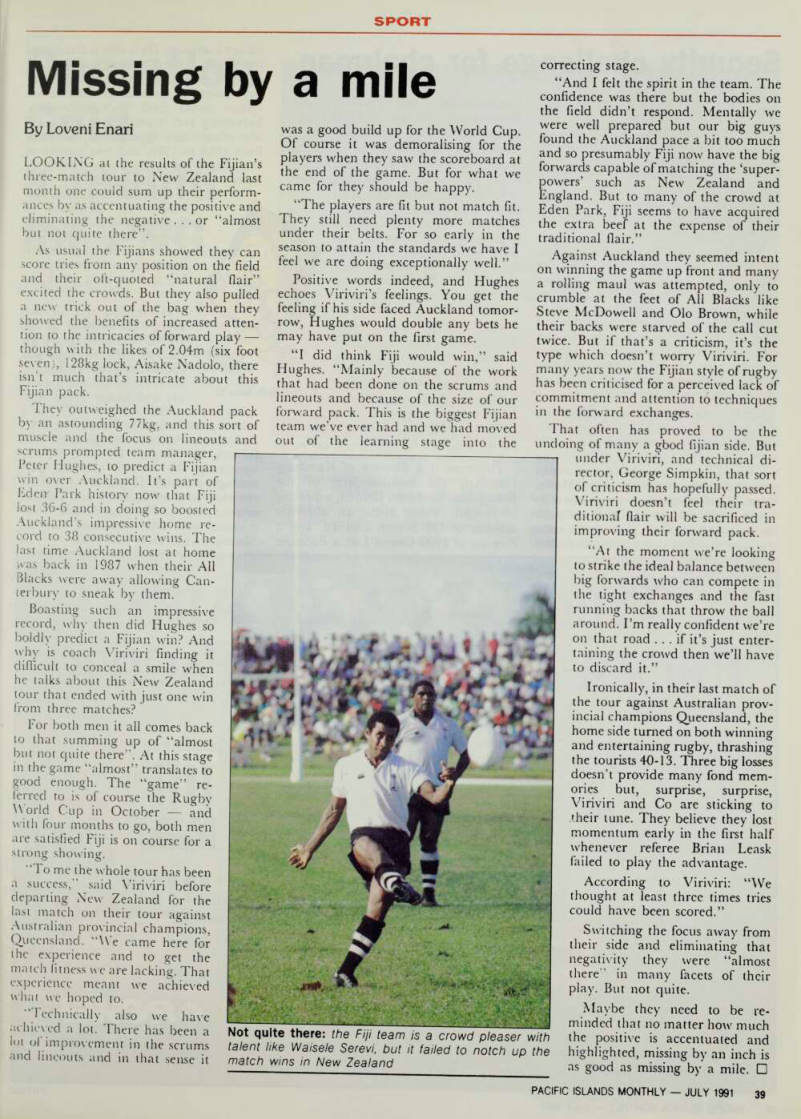
Sport
By Loveni Enari
LOOKING at the results of the Fijian’s three-match tour to New Zealand last month one could sum up their perform ances by as accentuating the positive and eliminating the negative ... or “almost but not quite there”.
As usual the Fijians showed they can score tries from any position on the field and their oft-quoted “natural flair” excited the crowds. But they also pulled anew trick out of the bag when they showed the benefits of increased atten tion to the intricacies of forward play though with the likes of 2.04 m (six foot seven), 128 kg lock, Aisake Nadolo, there isn't much that’s intricate about this
Fijian pack.
They outweighed the Auckland pack by an astounding 77kg, and this sort of muscle and the focus on lineouts and
scrums prompted team manager, Peter Hughes, to predict a Fijian win over Auckland. It’s part of Eden' Park history now that Fiji lost 36-6 and in doing so boosted Auckland’s impressive home re cord to 38 consecutive wins. The last time Auckland lost at home was back in 1987 when their All Blacks were away allowing Can terbury to sneak by them.
Boasting such an impressive
record, why then did Hughes so boldly predict a Fijian win? And why is coach Viriviri finding it difficult to conceal a smile when he talks about this New Zealand tour that ended with just one win from three matches?
For both men it all comes back to that summing up of “almost but not quite there . At this stage in the game “almost” translates to good enough. The “game” re ferred to is of course the Rugby World Cup in October and with four months to go, both men are satisfied Fiji is on course for a
strong showing.
“To me the whole tour has been n success, said Viriviri before departing New Zealand for the last match on their tour against Australian provincial champions, Queensland. “We came here for ihe experience and to get the natch fitness we are lacking. That experience meant we achieved a hat we hoped to.
“Technically also we have ichieyed a lot. There has been a ot of improvement in the scrums md lineouts and in that sense it
was a good build up for the World Cup.
Of course it was demoralising for the players when they saw the scoreboard at the end of the game. But for what we came for they should be happy.
“The players are fit but not match fit.
They still need plenty more matches under their belts. For so early in the season to attain the standards we have I feel we are doing exceptionally well.”
Positive words indeed, and Hughes echoes Viriviri’s feelings. You get the feeling if his side faced Auckland tomor row, Hughes would double any bets he may have put on the first game.
“I did think Fiji would win,” said Hughes. “Mainly because of the work that had been done on the scrums and lineouts and because of the size of our forward pack. This is the biggest Fijian team we’ve ever had and we had moved out of the learning stage into the
correcting stage.
“And I felt the spirit in the team. The confidence was there but the bodies on the field didn’t respond. Mentally we were well prepared but our big guys found the Auckland pace a bit too much and so presumably Fiji now have the big
forwards capable of matching the ‘super
powers’ such as New Zealand and England. But to many of the crowd at Eden Park, Fiji seems to have acquired the extra beef at the expense of their traditional flair.”
Against Auckland they seemed intent on winning the game up front and many a rolling maul was attempted, only to crumble at the feet of All Blacks like Steve McDowell and 010 Brown, while their backs were starved of the call cut twice. But if that’s a criticism, it’s the type which doesn’t worry Viriviri. For many years now the Fijian style of rugby has been criticised for a perceived lack of commitment and attention to techniques in the forward exchanges.
That often has proved to be the undoing of many a gbod fijian side. But
under Viriviri, and technical di rector, George Simpkin, that sort of criticism has hopefully passed.
Viriviri doesn’t feel their tra ditional flair will be sacrificed in improving their forward pack.
“At the moment we’re looking to strike the ideal balance between big forwards who can compete in the tight exchanges and the fast running backs that throw the ball around. I’m really confident we’re on that road ... if it’s just enter taining the crowd then we’ll have to discard it.”
Ironically, in their last match of the tour against Australian prov
incial champions Queensland, the
home side turned on both winning and entertaining rugby, thrashing the tourists 40-13. Three big losses doesn’t provide many fond mem ories but, surprise, surprise, Viriviri and Co are sticking to their tune. They believe they lost momentum early in the first half whenever referee Brian Leask failed to play the advantage.
According to Viriviri: “We thought at least three times tries could have been scored.”
Switching the focus away from their side and eliminating that negativity they were “almost there'’ in many facets of their play. But not quite.
Maybe they need to be re minded that no matter how much the positive is accentuated and highlighted, missing by an inch is as good as missing by a mile. □
Not quite there: the Fiji team is a crowd pleaser with talent like Waisele Serevi, but it failed to notch up the match wins in New Zealand
Security challenge for chairman

WHEN high profile former poli tician, Sir Anthony Siaguru, left Papua New Guinea last June to take up his new job as Deputy Secretary General of the Commonwealth Seretariat in London, he left the South Pacific Games Foundation without a chairman.
The Foundation chose a quiet chicken farmer and banana grower to replace Sir Anthony: Bart Philemon.
Philemon, 45, has been with the Foundation since April, 1989. When he became chairman in June, 1990, his first major dilemma was time. Much of the work seemed to be lacking with a
controversy surrounding awarding of
tenders and contracts for the Games village in Port Moresby. His second priority was to ensure th~ different sporting bodies trained hard to ensure the host country was champions.
But the challenge was made bigger by publicity given to PNG’s crime problem.
Several countries demanded guarantees that their teams would be safe, and he was forced to set up a security committee and ask the government for an additional K 1 million for security arrangements. It was granted and a campaign to convince participating countries their teams were guaranteed safety at the games and their
accommodation sites. Finally, in April Philemon said all that could be done to ensure safety had been done and re turned his attention to the venues and teams, with 14 sub-committees and about 1500 workers working full time.
In 1980, Philemon, who comes from Bulibum in Morobe province, was chairman of the organising committee of the third South Pacific Festival of Arts staged in Papua New Guinea with 1700 participants from all over the Pacific, Aus tralia and New Zealand.
From 1982 to 1986, Philemon was chairman of the National Airline Commission at a time when Air Niugini made a record loss of K 7 million. With his appointment KLM was brought in on a
control management basis resulting in a record profit of K 4 million in 1985.
Philemon is a director of Kambang Holdings, the business arm of the Evangelical Lutheran Church, a director of Niugini Table Birds, an alternate director of Oil Search Limited, and a director of PNG Gravel Ltd, a Butibum
village company. He is also a director of the Fresh Fruit Development Corpor ation, funded by the New Zealand government to establish an information system about fresh fruit cultivation, harvesting and marketing in PNG. He was educated in Queensland, Australia from 1958 to 1965, and was captain of the undefeated rugby union team at St Peter’s Lutheran College in 1964.
In 1966, Philemon at tended the University of Papua New Guinea while training to take part in the 2nd South Pacific Games.
But he injured himself play ing and couldn’t make the team.
He studied arts for two years, then .worked at the UPNG Administration from 1968 to 1973, when he was appointed services manager.
In 1973, he left the univer sity and joined Trans Aus tralian Airlines (TTA) as a
sales representative. In November, TAA and Ansett Airlines amalgamated and formed Air Niugini. In 1975, he was 3ppointed the second n3tiori3l port manager in Mount Hagen. That year, he returned to Port Moresby and became secretary to the National Airline Corn mission, and later Assistant General Manager until he left in 1980. □
South Pacific Games '91
Advertisements & other items, p. 40 (1 item)
Products Of The Pacific
The Natural Dairy
Rewa Dairy produce a wide variety of natural dairy products that are good for you, and can service all areas of the Pacific.
Rewa Dairy not only have the ability to produce U.H.T. milk, but they also have the latest Technology to pack almost any liquid into Tetrapak cartons. So if you need more information on Rewa Dairy's range of natural dairy products or their packaging capabilities contact: Rewa Co-Operative Dairy Company Limited, P.O. Box 3678, Samabula, Suva, Fiji. Tel: 381288.
Tlx: FJ 2182. Fax: 301590.
INSTANT INSTANT
Zl
NONFAT
SKIM
MILK
2 Litres I rnmszj I
■ , - STBAWBERRr
' -V' v' ; '•OQHUftr , , v - • : .• " •• « g ‘ i *v-* py W" y. *"JTy '¥ 7 . *y.. v v 4: •• MM , 4 ... ... m* 1 ™
FLWFUMfVR j
J'OWDER
HjMMlfc SOOg NET WEIGHT
Mill
t nwFunovßi m,m p
FUN FLAVOUR
CHOCOLATE
11
1 LITRE
m I i 11 FltflVVß ‘ ■■■ *;Z:
sirfin
Fumm Z riJiWVR "
RHVWBP MNniHf-
BUTTER.
•:v: ■ m r * 'f fLS w±
mm ■■■: ku i
is* ■ £ ” m mm
IHJ FJO22
Operation
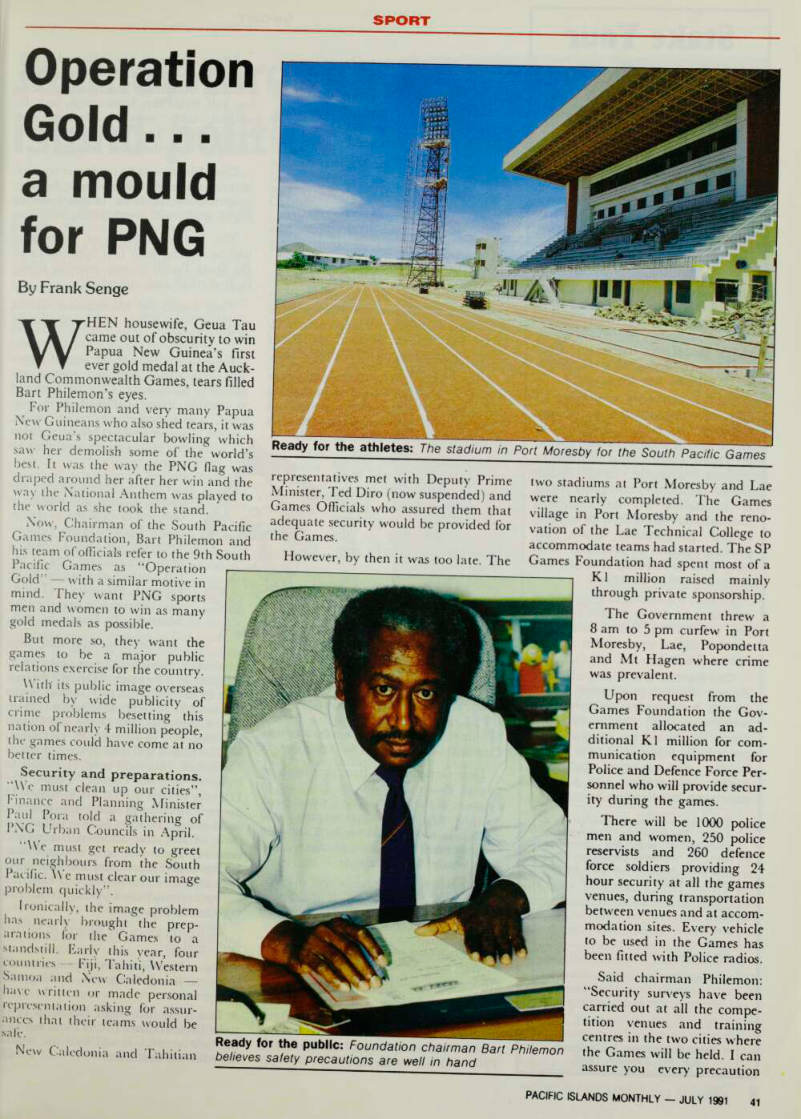
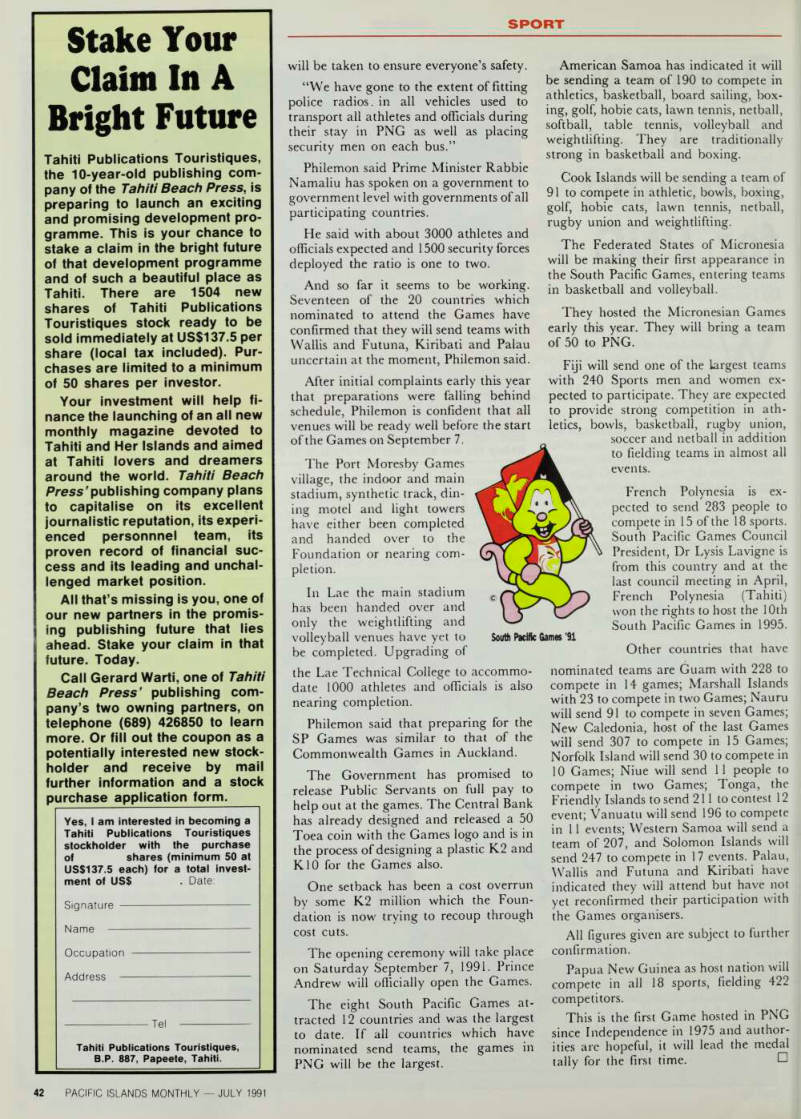
G0ld ... a mould for PNG
By Frank Senge
WHEN housewife, Geua Tau came out of obscurity to win Papua New Guinea’s first ever gold medal at the Auck land Commonwealth Games, tears filled Bart Philemon’s eyes.
For Philemon and very many Papua New Guineans who also shed tears, it was not Geua’s spectacular bowling which saw her demolish some of world’s best. It was the way the PNG flag was draped around her after her win and the way the National Anthem was played to the world as she took the stand.
Now, Chairman of the South Pacific Games Foundation, Bart Philemon and his team of officials refer to the 9th South
Pacific Games as “Operation Gold’ with a similar motive in mind. They want PNG sports men and women to win as many gold medals as possible.
But more so, they want the games to be a major public relations exercise for the country.
W ith' its public image overseas trained by wide publicity of crime problems besetting this nation of nearly 4 million people, the games could have come at no better times.
Security and preparations.
“We must clean up our cities”, 1 inance and Planning Minister Paul Pora told a gathering of PNG Urban Councils in April.
“VVe must get ready to greet our neighbours from the South I acific. AVe must clear our image
problem quickly”.
Ironically, the image problem has nearly brought the prep arations lor the Games to a standstill. Larly this year, four countries Fiji, Tahiti, Western Samoa and New Caledonia ha\c written or made personal representation asking lor assur ances that their teams would be sale.
New Caledonia and Tahitian
representatives met with Deputy Prime Minister, Ted Diro (now suspended) and Games Officials who assured them that adequate security would be provided for the Games.
However, by then it was too late. The
two stadiums at Port Moresby and Lae were nearly completed. The Games village in Port Moresby and the reno vation of the Lae Technical College to accommodate teams had started. The SP Games Foundation had spent most of a
K 1 million raised mainly
through private sponsorship.
The Government threw a 8 am to 5 pm curfew in Port
Moresby, Lae, Popondetta
and Mt Hagen where crime was prevalent.
Upon request from the Games Foundation the Gov ernment allocated an ad ditional K 1 million for com munication equipment for Police and Defence Force Per sonnel who will provide secur ity during the games.
There will be 1000 police men and women, 250 police reservists and 260 defence force soldiers providing 24 hour security at all the games venues, during transportation between venues and at accom modation sites. Every vehicle to be used in the Games has been fitted with Police radios.
Said chairman Philemon: “Security surveys have been carried out at all the compe tition venues and training centres in the two cities where the Games will be held. I can assure you every precaution
Ready for the public: Foundation chairman Bart Philemon believes safety precautions are well in hand
Ready for the athletes: The stadium in Port Moresby for the South Pacific Games
will be taken to ensure everyone’s safety.
“We have gone to the extent of fitting police radios, in all vehicles used to transport all athletes and officials during their stay in PNG as well as placing security men on each bus.”
Philemon said Prime Minister Rabbie Namaliu has spoken on a government to government level with governments of all
participating countries.
He said with about 3000 athletes and officials expected and 1500 security forces deployed the ratio is one to two.
And so far it seems to be working.
Seventeen of the 20 countries which nominated to attend the Games have confirmed that they will send teams with Wallis and Futuna, Kiribati and Palau uncertain at the moment, Philemon said.
After initial complaints early this year that preparations were falling behind schedule, Philemon is confident that all venues will be ready well before the start
of the Games on September 7.
The Port Moresby Games village, the indoor and main stadium, synthetic track, din ing motel and light towers have either been completed and handed over to the Foundation or nearing com
pletion.
In Lae the main stadium has been handed over and only the weightlifting and volleyball venues have yet to be completed. Upgrading of
the Lae Technical College to accommo date 1000 athletes and officials is also
nearing completion.
Philemon said that preparing for the SP Games was similar to that of the Commonwealth Games in Auckland.
The Government has promised to release Public Servants on full pay to help out at the games. The Central Bank has already designed and released a 50 Toea coin with the Games logo and is in the process of designing a plastic K 2 and KlO for the Games also.
One setback has been a cost overrun by some K 2 million which the Foun dation is now trying to recoup through cost cuts.
The opening ceremony will take place on Saturday September 7, 1991. Prince Andrew will officially open the Games.
The eight South Pacific Games at tracted 12 countries and was the largest to date. If all countries which have nominated send teams, the games in PNG will be the largest.
American Samoa has indicated it will be sending a team of 190 to compete in athletics, basketball, board sailing, box ing, golf, hobie cats, lawn tennis, netball, softball, table tennis, volleyball and weightlifting. They are traditionally strong in basketball and boxing.
Cook Islands will be sending a team of 91 to compete in athletic, bowls, boxing, golf, hobie cats, lawn tennis, netball,
rugby union and weightlifting.
The Federated States of Micronesia will be making their first appearance in the South Pacific Games, entering teams in basketball and volleyball.
They hosted the Micronesian Games early this year. They will bring a team of 50 to PNG.
Fiji will send one of the largest teams with 240 Sports men and women ex pected to participate. They are expected to provide strong competition in ath letics, bowls, basketball, rugby union,
soccer and netball in addition to fielding teams in almost all events.
French Polynesia is ex pected to send 283 people to compete in 15 of the 18 sports.
South Pacific Games Council President, Dr Lysis Lavigne is from this country and at the last council meeting in April,
French Polynesia (Tahiti)
won the rights to host the 10th South Pacific Games in 1995.
Other countries that have
nominated teams are Guam with 228 to compete in 14 games; Marshall Islands with 23 to compete in two Games; Nauru will send 91 to compete in seven Games; New Caledonia, host of the last Games will send 307 to compete in 15 Games; Norfolk Island will send 30 to compete in 10 Games; Niue will send 11 people to compete in two Games; Tonga, the Friendly Islands to send 211 to contest 12 event; Vanuatu will send 196 to compete in 11 events; Western Samoa will send a team of 207, and Solomon Islands will send 247 to compete in 17 events. Palau, Wallis and Futuna and Kiribati have indicated they will attend but have not yet reconfirmed their participation with the Games organisers.
All figures given are subject to further confirmation.
Papua New Guinea as host nation will compete in all 18 sports, fielding 422
competitors.
This is the first Game hosted in PNG since Independence in 1975 and author ities arc hopeful, it will lead the medal tally for the first time.
South Pacific Games '91
Advertisements & other items, p. 42 (1 item)
Bright Future
Stake Your
Claim In A
Tahiti Publications Touristiques, the 10-year-old publishing company of the Tahiti Beach Press, is preparing to launch an exciting and promising development programme. This is your chance to stake a claim in the bright future of that development programme and of such a beautiful place as Tahiti. There are 1504 new shares of Tahiti Publications Touristiques stock ready to be sold immediately at U 55137.5 per share (local tax included). Purchases are limited to a minimum of 50 shares per investor.
Your investment will help finance the launching of an all new monthly magazine devoted to Tahiti and Her Islands and aimed at Tahiti lovers and dreamers around the world. Tahiti Beach Press’ publishing company plans to capitalise on its excellent journalistic reputation, its experienced personnnel team, its proven record of financial success and its leading and unchallenged market position.
All that’s missing is you, one of our new partners in the promising publishing future that lies ahead. Stake your claim in that future. Today.
Call Gerard Warti, one of Tahiti Beach Press’ publishing company’s two owning partners, on telephone (689) 426850 to learn more. Or fill out the coupon as a potentially interested new stockholder and receive by mail further information and a stock purchase application form.
Yes, I am interested in becoming a Tahiti Publications Touristiques stockholder with the purchase of shares (minimum 50 at U 55137.5 each) for a total investment of US$ . Date: Signature Name Occupation Address Tel Tahiti Publications Touristiques, B.P. 887, Papeete, Tahiti.
Journey through
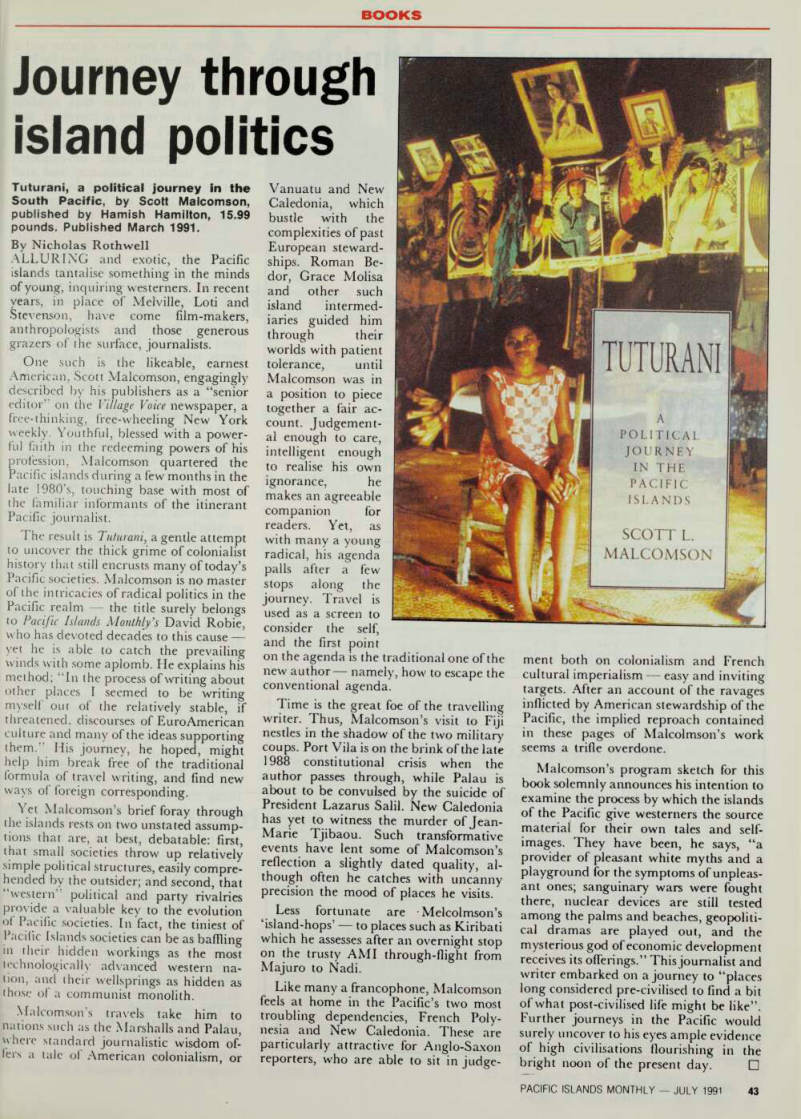
Books
Journey through island politics
Tuturani, a political journey in the South Pacific, by Scott Malcomson, published by Hamish Hamilton, 15.99 pounds. Published March 1991.
By Nicholas Rothwell ALLURING and exotic, the Pacific islands tantalise something in the minds of young, inquiring westerners. In recent years, in place of Melville, Loti and Stevenson, have come film-makers, anthropologists and those generous grazers of the surface, journalists.
One such is the likeable, earnest American, Scott Malcomson, engagingly described by his publishers as a “senior editor’ on the Village Voice newspaper, a
free-thinking, free-wheeling New York
weekly. Youthful, blessed with a power ful faith in the redeeming powers of his profession, Malcomson quartered the Pacific islands during a few months in the late I9Bo’s, touching base with most of the familiar informants of the itinerant Pacific journalist.
The result is Tnturani , a gentle attempt to uncover the thick grime of colonialist history that still encrusts many of today’s Pacific societies. Malcomson is no master of the intricacies of radical politics in the Pacific realm the title surely belongs to Pacific Islands Monthly's David Robie, who has devoted decades to this cause yet he is able to catch the prevailing winds with some aplomb. He explains his method; “In the process of writing about other places I seemed to be writing myself our of the relatively stable, if threatened, discourses of EuroAmerican culture and many of the ideas supporting
them.’’ His journey, he hoped, might
help him break free of the traditional formula of travel writing, and find new
ways of foreign corresponding.
\ et Malcomson’s brief foray through the islands rests on two unstated assump tions that are, at best, debatable: first, that small societies throw up relatively simple political structures, easily compre hended by the outsider; and second, that “western” political and party rivalries provide a valuable key to the evolution of Pacific societies. In fact, the tiniest of Pacific Islands societies can be as baffling in their hidden workings as the most technologically advanced western na tion, and their wellsprings as hidden as those ol a communist monolith.
Malcomson’s travels take him to nations such as the Marshalls and Palau, where standard journalistic wisdom of fers a talc of American colonialism, or
Vanuatu and New Caledonia, which bustle with the complexities of past
European steward
ships. Roman Be dor, Grace Molisa and other such island intermed iaries guided him through their worlds with patient tolerance, until Malcomson was in a position to piece together a fair ac count. Judgement al enough to care, intelligent enough to realise his own
ignorance, he
makes an agreeable companion for readers. Yet, as with many a young radical, his agenda palls after a few stops along the journey. Travel is used as a screen to consider the self, and the first point
on the agenda is the traditional one of the new author — namely, how to escape the conventional agenda.
Time is the great foe of the travelling writer. Thus, Malcomson’s visit to Fiji nestles in the shadow of the two military coups. Port Vila is on the brink of the late 1988 constitutional crisis when the author passes through, while Palau is about to be convulsed by the suicide of President Lazarus Salil. New Caledonia has yet to witness the murder of Jean- Marie Tjibaou. Such transformative events have lent some of Malcomson’s reflection a slightly dated quality, al though often he catches with uncanny precision the mood of places he visits.
Less fortunate are Melcolmson’s ‘island-hops’ to places such as Kiribati which he assesses after an overnight stop on the trusty AMI through-flight from Majuro to Nadi.
Like many a francophone, Malcomson feels at home in the Pacific’s two most troubling dependencies, French Poly nesia and New Caledonia. These are particularly attractive for Anglo-Saxon reporters, who are able to sit in judge-
ment both on colonialism and French cultural imperialism easy and inviting targets. After an account of the ravages inflicted by American stewardship of the Pacific, the implied reproach contained * n these pages of Malcolmson’s work seems a trifle overdone. \ii>, , - , .
Malcomson s program sketch for this b °° k S ° le ,T nly his intention to T b >’. whlch ,be lslands
R' T' At
materlal ,h . °'™ ‘ a *f and self lmag*s - T J? e Y hav< - been, he says, a Pf ovlder Peasant white myths and a P la Yground for ,he symptoms of unplcas a"‘ ones; san g u ‘ nar y war s were fought there, nuclear devices are still tested among the palms and beaches, geopoliti- C al dramas are played out, and the mys , er ious god of economic development receivcs its offerings,” This journalist and writer embarked on a journey to “places long considered pre-civilised to find a bit of what post-civilised life might be like”, Further journeys in the Pacific would surely uncover to his eyes ample evidence of high civilisations flourishing in the bright noon of the present day. □
Opening our eyes to blindness
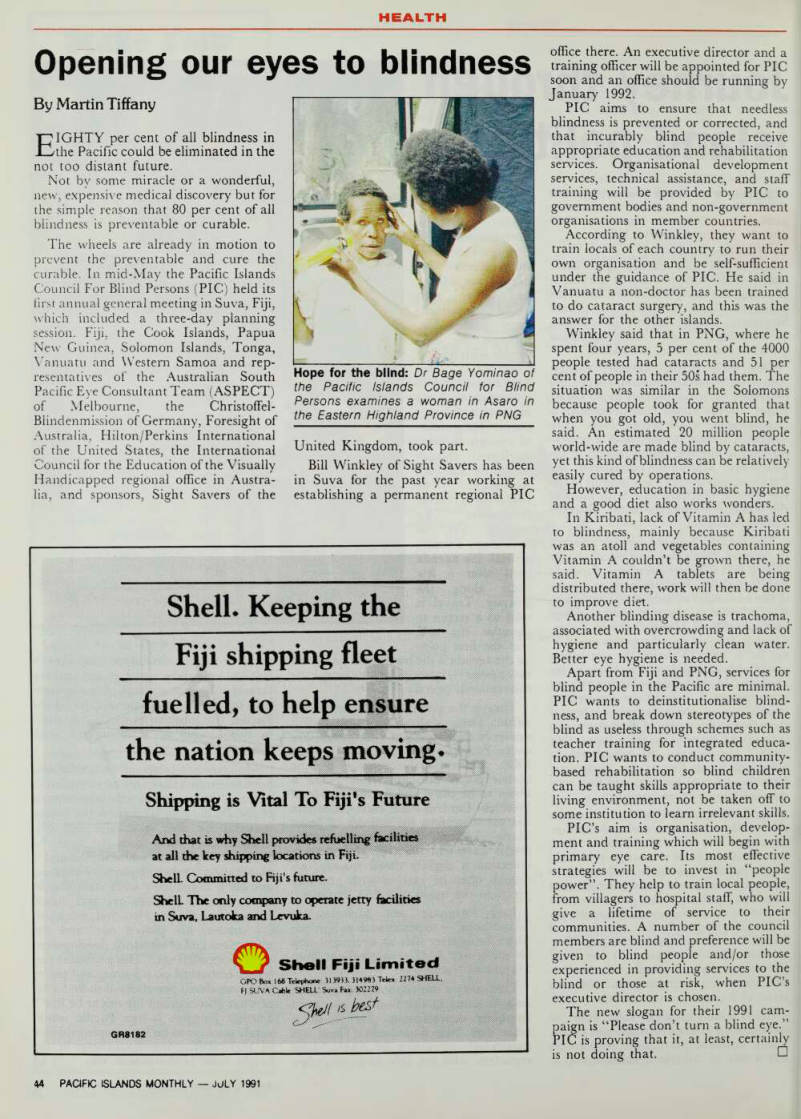
Health
By Martin Tiffany
EIGHTY per cent of all blindness in the Pacific could be eliminated in the not too distant future.
Not by some miracle or a wonderful, new, expensive medical discovery but for the simple reason that 80 per cent of all blindness is preventable or curable.
The wheels are already in motion to prevent the preventable and cure the curable. In mid-May the Pacific Islands Council For Blind Persons (PIC) held its first annual general meeting in Suva, Fiji, which included a three-day planning session. Fiji, the Cook Islands, Papua New Guinea, Solomon Islands, Tonga, Vanuatu and Western Samoa and rep resentatives of the Australian South Pacific Eye Consultant Team (ASPECT) of Melbourne, the Christoffel- Blindenmission of Germany, Foresight of Australia, Hilton/Perkins International of the United States, the International Council for the Education of the Visually Handicapped regional office in Austra lia, and sponsors, Sight Savers of the
United Kingdom, took part.
Bill Winkley of Sight Savers has been in Suva for the past year working at establishing a permanent regional PIC
office there. An executive director and a training officer will be appointed for PIC soon and an office should be running by
January 1992.
PIC aims to ensure that needless blindness is prevented or corrected, and that incurably blind people receive appropriate education and rehabilitation
services. Organisational development
services, technical assistance, and staff training will be provided by PIC to government bodies and non-government organisations in member countries.
According to Winkley, they want to train locals of each country to run their own organisation and be self-sufficient under the guidance of PIC. He said in Vanuatu a non-doctor has been trained to do cataract surgery, and this was the answer for the other islands.
Winkley said that in PNG, where he spent four years, 5 per cent of the 4000 people tested had cataracts and 51 per cent of people in their 50s had them. The situation was similar in the Solomons because people took for granted that when you got old, you went blind, he said. An estimated 20 million people world-wide are made blind by cataracts, yet this kind ofblindness can be relatively
easily cured by operations.
However, education in basic hygiene and a good diet also works wonders.
In Kiribati, lack of Vitamin A has led to blindness, mainly because Kiribati was an atoll and vegetables containing Vitamin A couldn’t be grown there, he said. Vitamin A tablets are being distributed there, work will then be done to improve diet.
Another blinding disease is trachoma, associated with overcrowding and lack of hygiene and particularly clean water.
Better eye hygiene is needed.
Apart from Fiji and PNG, services for blind people in the Pacific are minimal.
PIC wants to deinstitutionalise blind ness, and break down stereotypes of the blind as useless through schemes such as teacher training for integrated educa tion. PIC wants to conduct community based rehabilitation so blind children can be taught skills appropriate to their living environment, not be taken off to some institution to learn irrelevant skills.
PlC’s aim is organisation, develop ment and training which will begin with primary eye care. Its most effective strategies will be to invest in “people power”. They help to train local people, from villagers to hospital staff, who will give a lifetime of service to their communities. A number of the council members are blind and preference will be given to blind people and/or those experienced in providing services to the blind or those at risk, when PlC’s executive director is chosen.
The new slogan for their 1991 cam paign is “Please don’t turn a blind eye.”
PIC is proving that it, at least, certainly is not doing that. □
Hope for the blind: Dr Bage Yominao of the Pacific Islands Council for Blind Persons examines a woman in Asaro in the Eastern Highland Province in PNG
Advertisements & other items, p. 44 (1 item)
Fiji shipping fleet
Shell. Keeping the
fuelled, to help ensure
the nation keeps moving.
Shipping is Vital To Fiji's Future
And that is why Shell provides refuelling facilities at all the key shipping locations in Fiji.
Shell Committed to Fiji’s future.
Shell The only company to operate jetty facilities in Suva, Lautoka and Lcvuka.
Shell Fiji Limited GK) Box 168 Telephone 31 3933. 314983 Tele* 2274 SHELL, f J SUVA Cable SHELL' Suva Fax 302279
GRBIB2
Pacific
Islands
Monthly
Business
No plan, little growth
By Beryl Cook
THE good news for everyone is: the recession may be over later this year. The bad news for Fiji is: lack of a tourism master plan has led to unfocussed, knee-jerk reaction to crises; failure to manage the effects of tourism on the environment; and a lower percentage visitor arrival growth than any other country in the region for the decade to 1986.
One of Europe’s leading tourism industry economists and consultants, Esmond Devas, said at the Fiji Tourism Convention on June 13-15 that virtually all the major economies would pick up in 1992 and tourist demand would start to regain strength. The eight recessions since World War II had lasted an average of II months and a maximum of J 6 months, suggesting "we might reason ably expect to see firm signs of resumed growt sometime this year, he said.
Chairman and chief executive of Blue Lagoon Cruises and Tapa Tours, David Wilson, said Fiji’s “uncoordinated knee jerk solutions even when the crisis was predictable months before”, had demon strated its lack of a vision and plan.
Wilson said Fiji had recorded the lowest percentage visitor arrival growth in the whole region for the decade to 1986. In that period its visitor arrivals grew by 49 per cent from 170,000 to 258.000 but percentage increases for other countries were: Australia, up by 153 per cent from 563,000 to 1.43 million; New Zealand up by 89 per cent from 389,000 to 733,000; Indonesia up by 80 per cent from 456,000 to 825,000; Singapore up by 111 per cent from 1.506.000 to 3,191,000; Malaysia up by 65 per cent from 638,000 to 1,053,000; Western Samoa up by 55 per cent from 29,435 to 45,567; Tahiti up by 76 per cent from 91,475 to 161,238; Cook Islands up by 114 per cent from 14,584 to 31,246.
The industry had “drifted along year after year without a definitive plan”.
Instead Government, the national car rier Air Pacific, and the tourism plant through industry associations should identify the type of tourism Fiji wanted, and a short and long-term plan for tourism. A precise strategy and a cohes ive and effective industry framework for management, control and guidance of tourism basics in any commercial
organisation, were needed. A fully com mercially accountable Statutory Corpor ation, perhaps known as the Fiji Tourism Authority, could be established by Gov ernment, and the private sector could act as its mentor with a single, strong Fiji National Tourism Association.
President of Pacific Asia Travel Assocation and General Manager of the New Zealand Tourist and Publicity Department, Neil Plimmer, said each countr)' needed a tourism vision for help regional cooperation. He suggested over seas joint marketing efforts particularly in more distant markets such as Europe and North America, rather than Singa pore, New Zealand and Australia.
Jean-Michel Cousteau, executive vice president and director of the Cousteau Society and son of ocean explorer Jacques, urged Pacific island nations to develop tourism management plans and legislation to protect the environment.
Tourism had become one of the world’s largest industries, employing 56 million people with receipts expected to reach $3 trillion by 1996, he said.
But developers and tourists were often ignorant of how to enjoy natural re sources such as the reef and mangroves without damaging or destroying them.
“Some places and things we are loving to death,” he said. “It’s time to begin to manage our love.” □
Expo effort could boost trade
REGIONAL sponsorship of the
South Pacific Village at World Expo 92 in Spain will pay off in increased tourism and trade, according to coordmators of the venture.
A promotions team for Fiji-based Pacific Discoveries Limited (PD) said the number of Australian visitors to Fiji reached a record high during the 1988 Brisbane Expo. The number of visitors to the Expo village is expected to double from 1988 to 2 million, between April 20 and October 12 next vear xr • .. « t>t'\ t j n Managing director for PD Ltd, Peter Colton, said a Business Visitors Program
to promote trade would be included, effectively providing a South Pacific Trade Commission, About $6.5 million is needed to build, transport, set up, staff and run tra ditional buildings. The EC has donated $2.2 million, and the Spanish Expo committee has contributed 51.2 million, Individual country contributions includ big business sponsorships are provision adY estimated at: Papua New Guinea US$l.2 million; Fiji US$900,000; Kiri bati US$5O,OOO; Solomons $US200,000; Tonga USS 100,000; Tuvalu USSSO,OOO; Vanuatu USS 200,000; Western Samoa;
Uss2Oo,Ooo. □
for television
Nauru tuned in for television
A TELEVISION service for the Re public of Nauru began broadcasting on May 31.
The Nauru Government has signed a contract with Television New Zealand Limited to supply television equip ment, technical expertise and pro grammes to establish and operate the new television service. Nauru will become the third Pacific nation state to receive television after the Cook Islands and Niue. The TVNZ Pacific Service also started a programme service to the Chatham Islands in May. □
No welcome for Filipino vets
Business
By David North
A CERTAIN type of potential tourist, regarded favorably by the US Supreme Court, has upset some Chamorro organisations.
The visitors would be elderly Filipino males coming to Guam to apply for US citizenship on the grounds that they fought with US forces in the Philippines during World War 11.
Congress decided right after World War II to grant citizenship to aliens who fought with the US in the war. Most of the vets had- enlisted formally in the US armed forces, most applied on the Mainland, and their cases were handled quickly by the US Immigration and Naturalization Service (INS).
But most Filipinos did not fall into this category. They had served with guerilla units, or with more formal entities, but
their records were lost as the Japanese crushed the American Army on Bataan.
INS, facing tough decisions about scores of thousands of potential applicants,
defined eligibility narrowly, and fought
the matter in court literally for decades.
Recently INS lost when the Supreme Court decided to extend citizenship to those who had survived; a) the war, and b) the last 46 years.
INS was told to start processing naturalisation applications by the Su preme Court, but administrative details were left to them. INS has resisted the Filipino vets’ program for nearly half a century and has no interest in handling applications in the Philippines. It would maximise the number of applicants, and it would have to least quadruple the size of its tiny staff there.
The closest full-scale INS office is in Agana, Guam. Any new or old US citizen, or permanent resident alien can live in Guam. The Chamorro nationalists are worried that Mainland control of immigration may make them a minority in their own land. INS has shown some willingness to adjust regulations to give Guam some decision-making powers, but has resisted statutory changes.
If the US Government decided to process the Filipino vet’s applications on Guam many might stay, the activitists concluded. The average age of applicants is probably 70 so naturalisation will be instant (no five years waiting) and the
newly-naturalised, full-fledged US citi
zens will be able to petition INS immediately to bring spouses, then children and grandchildren into the US.
The Chamorro organisations suspect the immigrants’ favorite part of the US will be Guam, so they have objected. Tne resolution should be interesting. □
Boost for can crushers
can crushers
A NEW Zealand-made aluminium can crusher was delivered recently to Ma juro by American environmentalists for use by a local recycling operation.
The bright red can-crusher, a small model designed for inland use, was made by Lion Nathan Company, the New Zealand brewers known for their Steinlager beer. They decided that since their principal product is delivered in aluminium cans it would be appropriate for them to help the recycling. The machine costs about NZSSOOO to S6OOO.
The machine was brought to the island by Greenpeace’s Rainbow Warrior. Frank Cabrai, who works on recycling in Majuro, said the new machine would do a better job of smashing empties than the current system using student workers, who often have to resort to crushing cans with their feet.
Advertisements & other items, p. 46 (1 item)
V Vacancy
forum secretariat
DIRECTOR, ENERGY DIVISION
Applications are invited from suitably qualified and experienced persons, who must be nationals of a member state of the South Pacific Forum*, for a new position of Director, Energy Division, in the Forum Secretariat.
The Forum Secretariat was established in 1973 by the South Pacific Forum to encourage economic and political cooperation between its member states, and between those states and the more industrialized countries. Under the control of a Secretary General, the Secretariat undertakes a regional work programme covering economic development, legal and political services and the civil aviation, energy, maritime, telecommunications and trade sectors. The Secretariat also has significant responsibilities with regard to AGP/ EC regional projects funded under Lome Conventions.
The Energy Division aims to assist Forum Island Countries improve their capabilities to plan and manage their energy sectors. Consisting of three sections Petroleum, Electric Power and Special Projects (including renewable technologies) - the Division administers a range of activities in the energy sector. It assists in coordinating the activities of other organisations active in regional energy programmes, convenes the annual Regional Energy Meeting, provides technical advice and training services and gathers and disseminates energy information and statistics to member countries.
The Director will be responsible to the Secretary General, through the Deputy Secretary General (Work Programme), for the efficient operation of the Division and the effective implementation of its projects. More specifically, the Director will assist with formulating regional policy initiatives, identifying regional projects, drafting funding proposals, liaising with officials of member countries and with other energy-related agencies, arranging consultancies, organising regional seminars, workshops and other training activities and representing the Secretariat at regional and international meetings dealing with energy matters. In the course of these activities, the appointee will be required to undertake periodic duty travel.
Applicants should have proven ability to manage successfully a regional technical assistance programme and to direct the work of a team of specialists. Experience in administering energy-related, or similar, technical programmes in developing countries would be highly regarded as would relevant tertiary qualifications, probably in economics, engineering or science. Preference will be given to applicants with a demonstrated appreciation of the economic, social and political aspirations of the Forum’s region.
The appointment will carry an attractive remuneration package, payable in Fiji dollars.
For non-Fiji citizens this is tax-free and includes housing or a housing allowance and education and child allowances where eligible. Other benefits include payments in lieu of superannuation, and medical, life and travel insurance coverage. The appointee will be based at the Secretariat’s Headquarters in Suva. The appointment will be for three years initially, and is renewable by mutual agreement.
Applications close on 31 July 1991. They should contain full information on education and career backgrounds and should give names, addresses and telephone numbers of at least three referees with whom the applicant has been associated professionally.
Applications should be addressed to: The Secretary General Forum Secretariat GPO Box 856, Suva, FIJI Telephone 312600 Telex 2229FJ Fax 302204 Further information is available on request to Mrs Lailun Khan, Administration Officer, on 312600 Extension 219 * Member states of the South Pacific Forum: Australia, Cook Islands, Federated States of Micronesia, Fiji, Kiribati, Nauru, New Zealand, Niue, Papua New Guinea, Republic of the Marshall Islands, Solomon Islands, Tonga, Tuvalu, Vanatu and Western Samoa.
Savai’i still

under threat
By Ian Williams
A YEAR after Cyclone Ofa, the water supply system on Savai’i, Samoa’s biggest island, is still under repair. The United Nations Development Pro gramme has contributed US$3OO,OOO for water pipes and equipment to help reconstruct the 15-kilometre network of pipes to 22 villages in the Western and Northern parts of the island. Almost 10,000 people have been left without regular water supplies since the wind and waves tore through the island.
In Tuvalu, UNDP has also contrib uted US$3OO,OOO for rebuilding 65 houses on the island of Vaitapu destroyed by Ofda. Most of the families were still living under canvas since the usual local materials, coconut and pandanus, were also destroyed by Ofa.
UNDP will provide the materials, and the Tuvalu government skilled carpenters to help the homeless build “cyclone-proofed” new homes, using structural timber frameworks, rockfill floors and corrugated roofs. Most of Tuvalu is less than four metres above sea level, making a repetition of the disaster very likely.
Indeed in April, the UN Secretary General released a report requested by the General Assembly on the possible effects of sea level rise on island states.
The South Pacific was, he said, com prised of over 3000 isolated islands divided between 24 political entities, including 14 Pacific Island States “which would be severely or profoundly impac ted by even low to medium projected levels of global change ... such islands and island nations are threatened with damage to coastlines and groundwater sources by rising sea levels, or even with total destruction should sea levels rise by more than one metre, or should waves and storm surges increase as expected from intensified cyclone activity”.
The Reporrt continued, “Although the population of the region is relatively small in absolute teerms, numbering approximately 5 million, the cultural diversity is enormous (one third of the world's languages are spoken in Melan esia). The social, political and economic integrity and physical and biological environments of more than 800 separate human cultures will be threatened”, if people were forced to move as “environ mental refugees”.
“Cultural identity, an extremely im portant concern in the Pacific islands, is difficult to maintain in migrant com munities”, he concluded. □
Advertisements & other items, p. 47 (1 item)
Q§ Samsung
STAY WITH FIBRE GLASS EXPERTS
YAMAHA
Manufacturers of Yamaha Fibre Glass Boat Repairs of all Fibre Glass products.
For further information contact-
SAFEWAY MARINE (FIJI) LTD.
ELIZA STREET, WALU BAY, SUVA.
PO BOX 1365, SUVA. PHONE 315306 FAX (679) 411820.
q§ SAMSUNG
The World’s Latest
PRODUCTS FOR PEOPLE WITH MORE
SENSE THAN MONEY
Available at Burns Philp Home Centres throughout Fiji and selected Duty Free Dealers.
SOLE DISTRIBUTORS:
To own a, Samsung TV Screen, Samsung Vide Deck and Samsung Remote Control Unit!
Tbat'a Great!
That makes the Samsung Combinatior the most inexpensive of its kind.
Go for the best view.
Should be ideal for your home!
SAMSUNG
CORRIE & COMPANY
HEAD OFFICE G.P.O. BOX 45, SUVA TLX: FJ2166 CABLES: 'CORRICO' SUV TELEPHONE: 386777 BANKERS: WESTPAC, SUVA (FAX: (679) 370010 BRANCH OFFICE: 161 VITOGO PARADE P.O. BOX 83, LAUTOKA CABLES'
CORRICO LAUTOKA TELEPHONE: 60137
Fijian executives buy out AWA
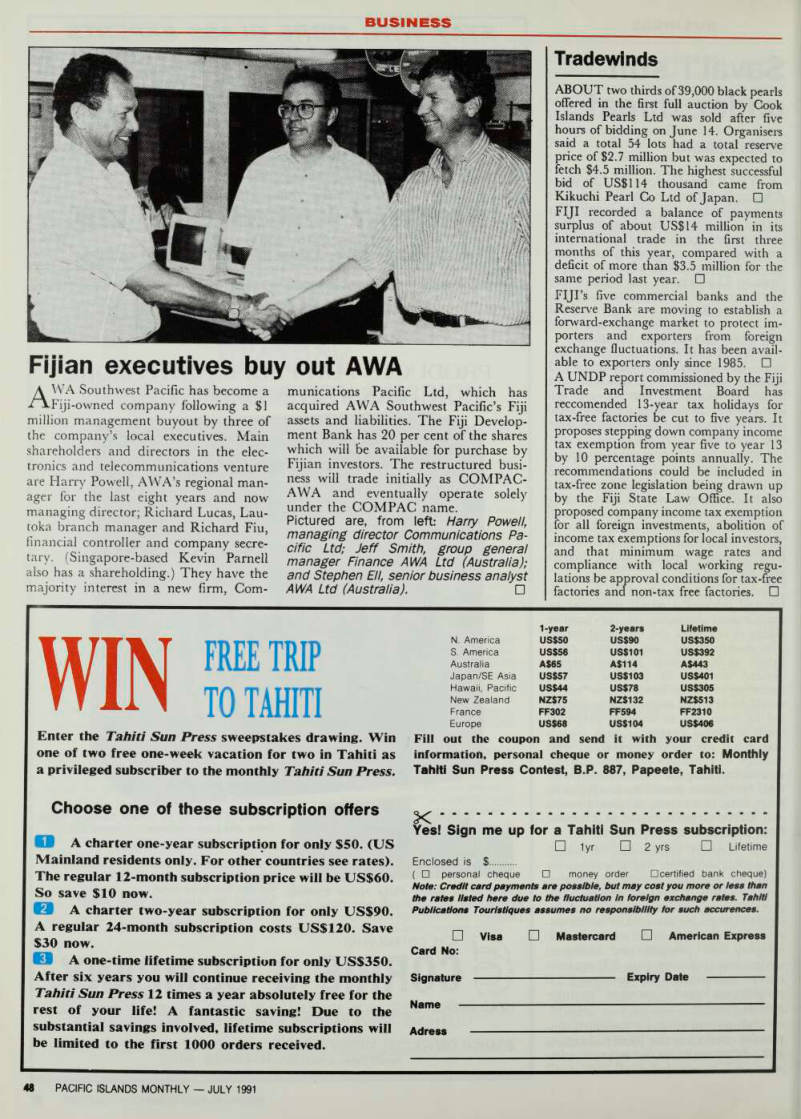
AVVA Southwest Pacific has become a Fiji-owned company following a $1 million management buyout by three of the company’s local executives. Main shareholders and directors in the elec tronics and telecommunications venture are Harry Powell, AWA’s regional man ager for the last eight years and now managing director; Richard Lucas, Lau toka branch manager and Richard Fiu, financial controller and company secre tary. (Singapore-based Kevin Parnell also has a shareholding.) They have the majority interest in a new firm, Com
munications Pacific Ltd, which has acquired AWA Southwest Pacific’s Fiji assets and liabilities. The Fiji Develop ment Bank has 20 per cent of the shares which will be available for purchase by Fijian investors. The restructured busi ness wiU trade initially as COMPAC AWA and eventually operate solely JJ? 1 * Jj l6 COMPAQ name. ’ managing director Communications Pa cjfjc Jeff group general manager Finance AWA Ltd (Australia); and Stephen EH, senior business analyst AWA Ltd (Australia). □
Tradewinds
ABOUT two thirds of 39,000 black pearls offered in the first full auction by Cook Islands Pearls Ltd was sold after five hours of bidding on June 14. Organisers said a total 54 lots had a total reserve price of $2.7 million but was expected to fetch $4,5 million. The highest successful bid of US$ll4 thousand came from Kikuchi Pearl Co Ltd of Japan. □ FIJI recorded a balance of payments surplus of about US$l4 million in its international trade in the first three months of this year, compared with a deficit of more than $3.5 million for the same period last year. □ Fiji’s five commercial banks and the Reserve Bank are moving to establish a forward-exchange market to protect im porters and exporters from foreign exchange fluctuations. It has been avail able to exporters only since 1985. □ A UNDP report commissioned by the Fiji Trade and Investment Board has reccomended 13-year tax holidays for tax-free factories be cut to five years. It proposes stepping down company income tax exemption from year five to year 13 by 10 percentage points annually. The recommendations could be included in tax-free zone legislation being drawn up by the Fiji State Law Office. It also proposed company income tax exemption for all foreign investments, abolition of income tax exemptions for local investors, and that minimum wage rates and compliance with local working regu lations be approval conditions for tax-free factories and non-tax free factories. □
Advertisements & other items, p. 48 (1 item)
To Tahiti
Fill out the coupon and send it with your credit card information, personal cheque or money order to: Monthly Tahiti Sun Press Contest, B.P. 887, Papeete, Tahiti.
Yes! Sign me up for a Tahiti Sun Press subscription: □ Iyr □ 2 yrs □ Lifetime Enclosed is $ ( □ personal cheque □ money order Dcertified bank cheque) Note: Credit card payments are possible, but may cost you more or less than the rates listed here due to the fluctuation In foreign exchange rates. Tahiti Publications Tourlstlques assumes no responsibility tor such accurences. □ Visa □ Mastercard □ American Express Card No: Signature Expiry Date Name Adress
WIN
FREE TRIP
TO TAHITI
Enter the Tahiti Sun Press sweepstakes drawing. Win one of two free one-week vacation for two in Tahiti as a privileged subscriber to the monthly Tahiti Sun Press.
Choose one of these subscription offers O A charter one-year subscription for only $5O. (US Mainland residents only. For other countries see rates).
The regular 12-month subscription price will be US$6O.
So save $lO now.
B A charter two-year subscription for only US$9O.
A regular 24-month subscription costs US$l2O. Save $3O now.
B A one-time lifetime subscription for only US$35O.
After six years you will continue receiving the monthly Tahiti Sun Press 12 times a year absolutely free for the rest of your life! A fantastic saving! Due to the substantial savings involved, lifetime subscriptions will be limited to the first 1000 orders received.
Canadian tax changes lure new service

CANADIAN tax law changes were a big factor in the headquarters there of a new shipping service to the South Pacific from West Coast North America.
The tax changes were meant to lure big Hong Kong fleet owners to move head offices to Vancouver before Beijing takes over the British colony in 1997.
The changes mean that Canadian based shipowners will no longer be taxed on their offshore operations.
South Pacific Inter Line Ltd is provid ing the new service. The company is owned by the Swedish-based Gotland
shipping group.
This is Gotland’s first operational venture in the Pacific. Melin said Gotland had chosen the name Swedish Pacific Line [PIM, March 1991) but then found someone else had registered rights to it.
The group is also interested in setting up a cruise ferry sendee between the Seattle-Vancouver area and Alaska, he said.
And it is building five 25,000-
deadweight ton ships in Indonesia.
CA S ° uth Pacific Inter Line will operate a 50-day round trip schedule originating in Vancouver and calling at Seattle/ Tacoma, Coos Bay, San Francisco and Los Ageles/Long Beach on the west coast, an <* Papeete (Tahiti), Pago Pago (American Samoa), Apia (Western Samoa), Nukualofa (Tonga), Noumea (New Caledonia) and Lae (Papua New Guinea) in the South Pacific Islands.
Service for the new shipping line will be provided by the MV TS Adventure , a 17 000 tone state-of-the-art multi-
service seLusta n.nl box Toe
service, sen sustaining, oox type Japanese-bmld ship, launched m Japan m January. The new vessel is designed to cai T y “{T a " d refrigerated containers as 35 breakbu ' k and heav V lift car S oes - She registered in Panama.
The Bahamas-based company, South Pacific Inter Line, is owned by the Gotland Gr <™P of Sweden which has served the shipping industry and other ! r 0 a^p ° rtation sectors in Eur ,°P e si ? ce 1865. South Pacific Inter Line is opening its Vancouver office as a result of the newly introduced amendment to the
Canadian income tax legislation.
The Gotland was established in British Columbia as Gotland Invest Corpor ation in September 1990, at which time Mr S taffa £ .Mclin was appointed its present. BnUsh Columbia was selected J?y Gotland because of its exceptional tu £e PP te _?f ial as u a class city in the Pacific Rim. The establishment of the International Commercial Arbitration Centre and the presence of Asian financial institutions also contributed to Gotland’s interest in Vancouver.
Tnhn Rnw u ptt Kac J ohn Bowkett, who has been in the t PI T g Itr P o ‘ 3 -n yearSi has been appointed Vice-President of Operations for South Pacific Inter Line Ltd.
Hanse Shippine Agency Inc. of San
Franco has Teen nlmedlhe Managing
Agent for Sou(h Pacific InterL f ne . s American operation, with Sunrise Ship ping Agency, Inc. as Agent for the Pacific Northwest, and Farman Shipping for ana a - The Gotland Group has selected the Hong Bank of Canada as principal corporate bank for its Pacific Rim operations. □
Advertisements & other items, pp. 49-50 (2 items)
Shipping
Campbell’S Shipping Agency Ltd.
We cover the Traders:— Asian/Fiji/South America, NZ/Fiji Australia/Fiji, Fiji/South Pacific
PAKISTAN
HONG KONG
TAIWAN
INDIA
HAILAN
PHILIPPINES
u
LAE (NEW GUINEA)
HONIARA
ISLANDS)
SRI LANKA
WALUS FUTUNA
JAKARTA
f INDONESIA)
APIA (SAMOA)
I
PORT
VILA
NEWN
CALEDONIA
SUVA
AUSTRALIA
IFU)
T r / / ✓ / / /
f AUCKLAND / f
WELUNGTON
& NEW ZEALAND
PAPEETA (TAHITI)
NUKU ALOAfA (TONGA)
- IOUIOUF.
ANIOFAGASTAA#
/ Please contact our office for further information
Campbell Shipping Agency Ltd
10 Stewart St., Vinod Patel Building Suva, Fiji.
Phone: 314170/314189 Fax: 300144 Lautoka Phone: 62231 Fax: 62251
SEASPAC CCNI/CSAV/Joint
Service Asia/Fiji Chile
TRANSLINK PACIFIC SHIPPING
NZ/Fiji/Pac Islands
AUSTRALIA PACIFIC ISLANDS
LINE Australia/Fiji
MAASMOND EXPRESS LINE
Australia/Fiji/Vila/Noumea
BANK LINE and
COLUMBUS LINE
24 day service to
Europe.
Need we say more...
G The Joint Service Partners offer facilities for shipment of: Containers (FCL/LCL) and Break-bulk Cargo plus feefer space and deeptanks for carriage of vegetable oils and other liquid bulk cargo.
Carriers also accept heavy lifts, overlength and cumbersome parcels.
Ports of Service: Loading; Papeete, Apia, Suva, Lautoka, Noumea, Port Vila, Santo, Honiara, Port Moresby, Lae, Madang, Kimbe, Rabaul, Kieta, Darwin. For: Rotterdam, Antwerp, Hamburg, Hull, Dunkirk. Le Havre.
Additional ports on enquiry.
Please contact our regional offices for further information: The Bank Line P.O. Box 2225 Lae, Papua New Guinea Phone; 422 988/Fax: 422 925 Telex: 44265 The South Pacific Specialists for over 75 years
Schedules

Shipping
New Zealand - Fiji direct Sofrana Unilines operates a fully containerised/breakbulk sendee every 21 days from Auckland, Tauranga, Lyttleton to Suva and Lautoka. Loading even 21 days, ro/ro sendee, containers reefer. Contact Sofrana Unilines, Sofrana House, 101 Customs Street, Auckland, PO Box 3614, Fax (09) 393874, Ph (09) 773279, Tlx NZ 2313.
Direct toll free line 0800 659-922, Contact Alan Foote. Sofrana Shipping Agencies, PO Box 921 Wellington, Tel (04) 725 661, Fax (04) 725 749, Tlx NZ 4769 Contact Steve Brannigan. Sofrana Unilines Agencies, PO Box 22046 Christ church, tel (03) 667 180, Fax (03) 668 868, TLX NZ4769, Contact Tony Newell. Carpenters Shipping, Private Mail Bag, Suva, Fiji, Tel (679) 312244, Fax (679) 301572, Tlx FJ 2199. Sofrana Unilines, Suva, Fiji, Tel (679) 315645, Fax (679) 300057.
Australia - Fiji direct Sofrana Unilines operates a ro/ro container sendee every three weeks from Melbourne, Sydney, Brisbane, Lautoka and Suva. Contact Sofrana Unilines (Aust) Pty Ltd, PO Box Q 136, Queen Victoria Building, Sydney, NSW 2000, Australia. Tel (02) 2648944, Fax (02) 2676547, Tlx (71) A 170090, Contact Andrew McLachlin, Sam Attaway.
Carpenters Shipping, Suva, Tel (679) 312244, Fax (679) 301572. Sofrana Unilines Suva, Tel (679) 315 645, Fax (679) 300057. Carpenters Shipping, Lautoka, Tel (679) 63988, Fax (679) 64896. Sofrana Unilines, Lautoka Tel (679) 62921, Fax (679) 64896.
Australia - Fiji monthly service Sofrana Unilines (Australia) Pty Ltd operates a regular monthly service with MV Capitaine Wallis. Contact Sofrana Unilines, Sydney, Tel (02) 2648944, Tlx AA170090, Fax (02) 267-6547.
Carpenters Shipping, Suva, Fiji, Tel (679) 312244, Fax (679) 301572, Sofrana Unilines, Suva, Fiji Tel (679) 315645, Fax (679) 300057. Carpenters Shipping, Lautoka, Tel (679) 63988, Fax (679) 64896. Sofrana Unilines, Lautoka, Fiji, Tel (679) 62921, Fax (679) 64896.
Far-East - Fiji - New Zealand Ser vice New Zealand Unit Express (NZUE) operates a monthly service accepting containerised and break-bulk cargoes
from Manila, Keelung, Kaoshiung,
Hong Kong, Lae to Suva, Lautoka (via Suva) and thence to New Zealand ports.
Contact Carpenters Shipping Suva, Fiji, tel (679) 312244, fax (679) 301572. New Zealand Unit Express, Maritime Build ing, 2-10 Customs House Quay, PO Box
890, Wellington. Tel 727865, Cables Enzue Man, Wellington, Tlx NZ31340 Nedlnz or Nedlloyd Swire Pty Ltd, Sydney, Tel 20522.
Japan - South Pacific Service Same as Bums Philp Japan - South Pacific Service - Kyowa Shipping Co Ltd Kyowa Shipping, Shipping Co Ltd provides a monthly containerised service from Hong Kong to main ports of Japan, Saipan, Guam, Island ports, Lautoka, Suva via Nukualofa to Pago Pago and Apia. Contact Carpenters Shipping, Neptune House, 3/4 floor, Tofuaa Street, Walu Bay, Suva. Tel 312244, Fax 301572, Tlx FJ2199.
Europe - Pacific Service Nedlloydd offers cargo services from Continental Ports to Papeete, Fiji, New Caledonia and Doniambo on slot basis with Bank line. Contact Nedlloyd (Aust) Pty Ltd, Spring Street, Sydney, Tel 273801. Carpenters Shipping, Suva, tel 312244, Tlx FJ2199, Fax 301572.
Carpenters Shipping, Lautoka, Tel 63988, Tlx FJ5215, Fax 64896.
South East Asia - Fiji Service Nedlloyd Lines (NZEAS) Service op erates regular fast cargo service from Jakarta, Pt Keelang, Singapore, Bang
kok, Surubaya via Auckland to Suva and
Lautoka. Contact Carpenters Shipping,
Suva, Tel 312244, Tlx FJ2199, Fax
301572. Carpenters Shipping, Lautoka
Tel 63988, Tlx FJ5215, Fax 63988 Far East - Mid South Pacific China Navigations New Guinea Pa cific Line operates a regular container and breakbulk heavy lift service from Hong Kong, Taiwan, Manila, Singa pore, Malaysia, Thailand to Port Moresby, Lae, Rabaul, Kieta and Honi ara. Cargo from the same eastern ports to the South Pacific Ports of Noumea, Santo, Vila, Papeete, Pagopago, Apia, Nukualofa, Rarotonga and Tarawa will be shipped via Japan or Busan on the monthly Bali Hai Service. Contact
Steamships Shipping, Port Moresby, PO
Box 634, Tel 220283 or 220289.
Australia - New Caledonia - FIJI - Samoas - Tonga Pacific Forum Line operates a fully containerised service (general, reefer and ro-ro) from Sydney and Brisbane to Noumea, Lautoka, Suva, Apia, Pago Pago, Nukualofa, Sydney. Cargo cen tralised from Adelaide and Melbourne.
Contact: Pacific Forum Line, PO Box 796, Auckland; Union Bulkships, 333 George St, Sydney, Brisbane and Mel bourne; Union Co, Lautoka; Pacific Forum Line, Suva, Nuku’alofa; Pacific Forum Line, Apia; Polynesia Shipping,
Pago Pago. Sofrano Utiilincs operates a Roßo/containcr service every three weeks from Melbourne, Sydney and Brisbane to Noumea, Suva and Lautoka with transhipment to the Samoas and Tonga.
New Zealand - Australia - PNG - Solomon Islands Pacific Forum Line operates a containerised and ro-ro service from Lyttlcton, Napier and Auckland to Brisbane, Port Moresby, Lac, Honiara, Brisbane then to New Zealand.
Contact: Pacific Forum, Auckland, Christ church; Union Bulkships, Brisbane; Steam ships Shipping Port Moresby and Lac Sullivan Ltd, Honiara; Scabridgc, Welling ton.
NZ - Fiji Translink Pacific Shipping sail twice a month to Fiji, with Polynesian Link and Coral Links which operate out of Tauranga and Auckland. Fiji Agents arc: Campbells Ship ping Agency Ltd, Ph 314189 Fax 300144 Suva; Ph 62231 Fax 62251 Lautoka. Auck land Agents: McKay Shipping Ph (9) 390229 Fax (9) 303293. Tauranga Agents, scatradc agencies Ph (75) Fax ‘(75) 758380.
NZ - Fiji - Pago - Apia - Nuk Translink Pacific Shipping operate a monthly sailing with Polynesian Link, which carries Dry Container, reefers and brcakbulk cargoes. NZ Agents McKay Shipping Ship ping AKLD Ph 390229, Fax 3032931. Fiji Agents Campbells Shipping Agency & ltd Ph 314189 Fax 300144 NZ - Noumea - Wallis - Futuna Transiiuk Pacific Agency operate a con tainer Brcakbulk service once a month from NZ through Fiji and Noumea to Wallis & Futuna.
South East Asia - Fiji - Noumea - Papeete - Chile Service “Scaspac” A joint Chilean CCNI/CSAU Service offers, a regular monthly sailing from Djakarta and Singapore to Noumea, Fiji, Papeete, and Chile. Cargo also federated to Singapore from Korea, Hong Kong, Taiwan, Malaysia, Bangkok. Fiji Agents: Campbells Shipping Agency Ltd, ph. 314189, Fax 300144.
Australia - Fiji Service Chief container services under Australia Pacific Island Line Unitize Sofrano and PFL vessels to provide a twice monthly, service from Australia. Fiji Agents Campbells Shippings Agency ltd Ph 314189 Fax 300144.
System Agents Ncdlloyd Swire Ph(2) 2512699. Melbourne Yarra Shipping Ph (3) 6936.300. Brisbane, Mcdlloyd Swire, ph (7) 8321551.
Australia - Fiji - Noumea - Vila - Santa Marsmond Express Lines operate a brcakbulk service from Goodwood Island Australia to Fiji, Noumea, Vila Santo and Honiara. Continuous receiving depots in Sydney and Brisbane enable this vessel to bring cargoes from these parts. Fiji Agents Campbells Shipping Agency Ltd, ph. 314189, Fax 300144. Brisbane Agents— Shippings & Marketing Ph (7) 2628082. Sydney Agente Scabord Agencies (2) 3172325.
Australia - New Caledonia - Fiji - Hawaii - North America ACT Pace Pacific (ACTA Shipping) oper ates a fully containcriscd/brcak bulk service every 17-20 from Melbourne, Sydney, Bris bane to Noumea, Suva and Lautoka. The vessels continue on to the West Coast of North America calling Honolulu at frequent inter vals. Ships arc ACT and ACT 12. Contacts;
ACTA Pty Ltd, Sydney Ph 2869666, Tx 121369, Fx 2869610. ACTA Pty Ltd, Mel bourne Ph 6112000, Tx 30949, Fx 6293055.
ACTA Pty Ltd, Brisbane Ph 2213116 m Tx 40719, Fx 2298143. SATO, Noumea Ph 281122, Tx 3163, Fx 278532. Burns Philp Shipping, Suva Ph 311777, Tx 2168, Fx 301127; Bums Philp Shipping, Lautoka Ph 60777, Tx 5146, Fx 65850.
West Coast of North America - FIJI - New Zealand Blue Star Line Pacific Coast Service operates a fully containcriscd/brcak bulk service every 23 days from Vancouver, Seattle, San Francisco, Los Angeles to Pago Pago, Suva and New Zealand ports. The vessels continue to call Suva on the Northbound voyage from New Zealand every fortnight to pick up Fiji exports such as garments, fresh ginger, etc. for Hawaii and West Coast of North America ports. Blue Star Line also provides a through service to East Coast to North America. Ships arc Welling ton Star, Southland Star and California Star.
Contacts: Blue Star Line, San Francisco Ph 9282026, Tx 184925, Fx 6730355; Blue Star Line, Vancouver Ph 6817300, Tx 0451326, Fx 6835797; Intcroccan Steamship Corp, Seattle Ph 6829820, Tx 321101, Fx 3437421; Blue Star Line, Los Angeles Ph 5970454, Tx 408564, Fx 5978710. New Zealand Line, Wellington, Ph 739029, Tx 3583, Fx 4992468; New Zealand Line, Auckland Ph 390965, Tx 2556, Fx 3032039; Burns Philp Shipping, Suva Ph 31 1777, Tx 2168, Fx 301127; Bums Philp Shipping, Lautoka Ph 60777, Tx 5146, Fx 65850.
Japan - South Pacific Service Bali Hai Line a joint service of China Navigation, Mitsui OSK Line and NYK Line operates a fully containcriscd/brcak bulk service from Korea, Japan to South Pacific ports on a monthly basis serving ports of Pusan, Kobe, Nagoya, Yokogama, Tarawa,
Lautoka, Suva, Apia, Pago Pago, Papeete,
Nukualofa, Noumea, Vila, Santo. The ships arc also fully specialised to carry vehicles on Ro/Ro basis. Ships arc Coral Islander and Pacific Islander. Contacts: John Swire & Sons, Tokyo Ph 32309220, Tx 22248, Fx 3239288; Nippon Yuscn Kaisha, Tokyo Ph 3284516, Tx 22236, Fx 32846332; Mtsul OSK Lines, Tokyo Ph 35877086, Tx 22266, Fx 35877732; Bums Philp Shipping, Suva (C/Islandcr) Ph 311777, Tx 2168, Fx 301127; Carpenters Shipping, Suva (P/Islandcr) Ph 312244, Tx 2199, Fx 301572; Bums Philp Shipping, Lautoka Ph 60777, Tx 5146, Fx 65850; Carpenters Shipping Ph 63988, Tx 5215, Fx 64896.
Europe - South Pacific Service Bank Line Limited operates a monthly service from United Kingdom, Europe to South Pacific ports. Vessels arc fully equiped to carry containers, break bulk cargo and have deep tank facilities to carry bulk liquid such as oil, etc. The service operates from Hull, Rotterdam, Hamburg, Dunkirk, Lc Havre, Papeete, Apia, Suva, Lautoka, Nou mea, Vila, Santo, Honiara, Papua New Guinea Group, Singapore and back to Europc/Contincnt. Ships: Forthbank, Ivybank, Clydebank, Moraybank. Contacts: Bank Line, London Ph 2650808, Tx 887392, Fx 4814784, Bank Line, Lac Ph 421235, Tx 44265, Fx 422925; Bank Line, Sydney, Ph 9063173, Tx 24063, Fx 9061430; Bums Philp Shipping, Suva Ph 31 1777, Tx 2168, Fx 301127; Bums Philp Shipping, Lautoka Ph 60777, Tx 5146, Fx 65850.
Australia - Vanuatu - FIJI Sitmar Cruises operates a year round cruise programme for Sydney to Vanuatu, Fiji. The programme also includes a number of calls to a number of islands such as Dravuni, Yasawa i-Rara, Rotuma, Mystery Island, etc. Con tact: Sitmar Cruises, Sydney Ph 2560111, Tx 20712, Fx 2560101; Burns Philp Shipping, Suva Ph 311777, Tx 2168, Fx 301127; Bums Philp Shipping, Lautoka Ph 60777, Tx 5146, Fx 65850. □
Advertisements & other items, pp. 51-53 (1 item)
Co., Ltd.
KYOWA
KYOWA
SHIPPING
CO., LTD.
Liner Service
FROM OJAPAN
OKOREA
OTAIWAN
O THAILAND
to Paciffic Islands
OHONG KONG
OSINGAPORE
OPHILIPPINES
O MALAYSIA
OINDONESIA
TO OSAIPAN
OFEDERATEDSTATES
OF MICRONESIA
OMARSHAL ISLANDS
©AMERICAN SAMOA
ONEW CALEDONIA
O FIJI
OGUAM
OYAP
OPALAU
O WESTERN SAMOA
OSOLOMON ISLANDS
OVANUATU
OPAPUA NEW GUINEA
HEAD OFFICE
6th Floor. Kikushima Bldg 2-3, Hamamatsucho 2-chome, Minato-ku Tokyo 105 Jaoan Phone; 03(437)2885 (Rep ) Cables; "MARIQUEEN" Tokyo Telex: 242-4651 Kyowa J
OSAKA OFFICE
Dai San Fuji Bldg , 3-13, Itachibon 1-chome, Osaka 550 Phone: 06(533)5821 (Rep ) Cables; MARIQUEEN" Osaka Telex: 525-6271 Ss.osa J
We’ve been around...
tV-\i
2 X * V' \w F V m
and arou
nd around.
We’ve delivered apples and pears, grapes, onions and meat. We’ve carried canned and dried fruit, mineral water and wine, wool and hides.
We’ve transported boats, bells, and beer, computer parts and car parts.
We’ve shipped all matter of goods, all over the world.
For over 20 years, ACTA has led the shipping industry in the carriage of both perishable and general cargo to and from Australian shores.
And because ACTA services some of the longest trade routes in the world, we employ only the most advanced shipping methods, and have in fact, pioneered many of them.
We also offer complete land services, including rail transport; and a range of special cargo services from advice on packing to information on overseas markets.
When you ship, ship with someone who knows their way around.
Ship with ACTA.
ACTA PTY. LIMITED ACTA HOUSE 447 Kent St Sydney N.S.W. 2000 Phone (02) 286 9666 Fax: 286 9600 Telex: 121369 ACT 002 R
INTERESTED IN A NEW BOAT?
ml Mai
4.5 m HYDRO-CAT 32 SPORTSFISHERMAN
Dive Boats Game Boats Fishing Boats Coral Viewers Water Taxis ■C QUALITY AND VALUE PLUS FROM: - >
FIJI CUSTOM CRAFT LIMITED
I ALUiWMUM BOAT
WAILADA, LAMI
PHONE: 361977, 361159, A/H: 450061
P.O. BOX 1277, SUVA, FIJI
FAX: 351214
Wages of
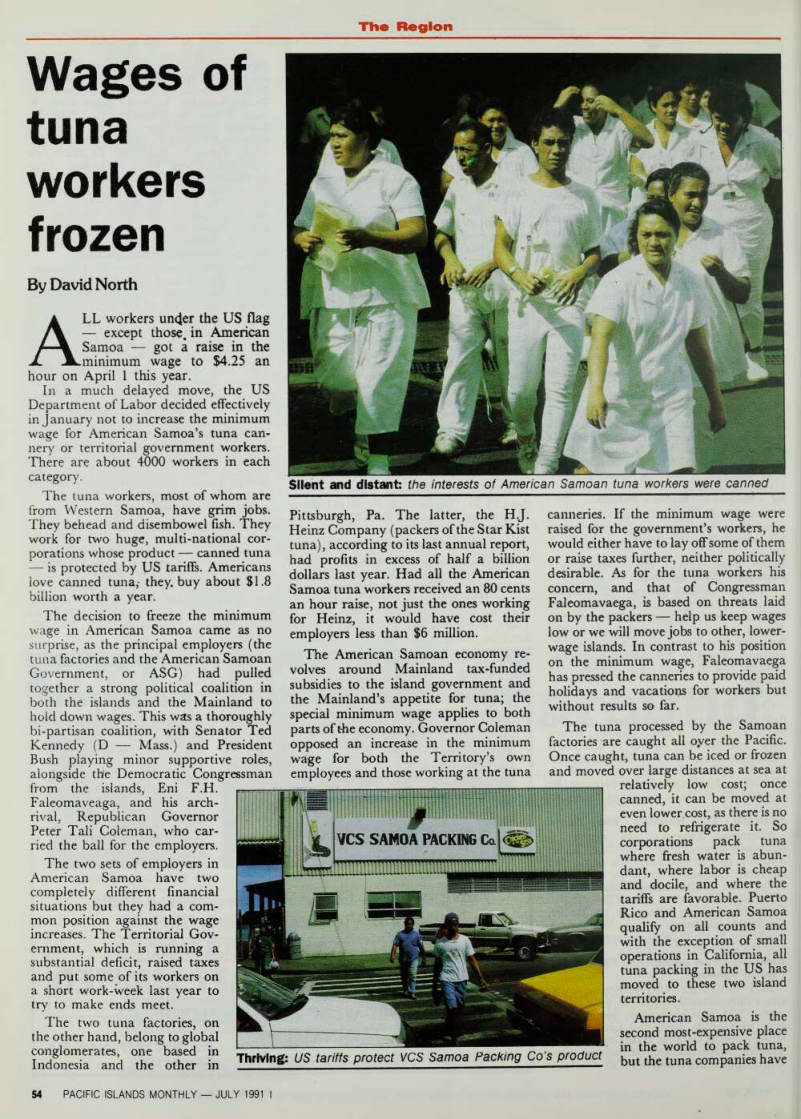

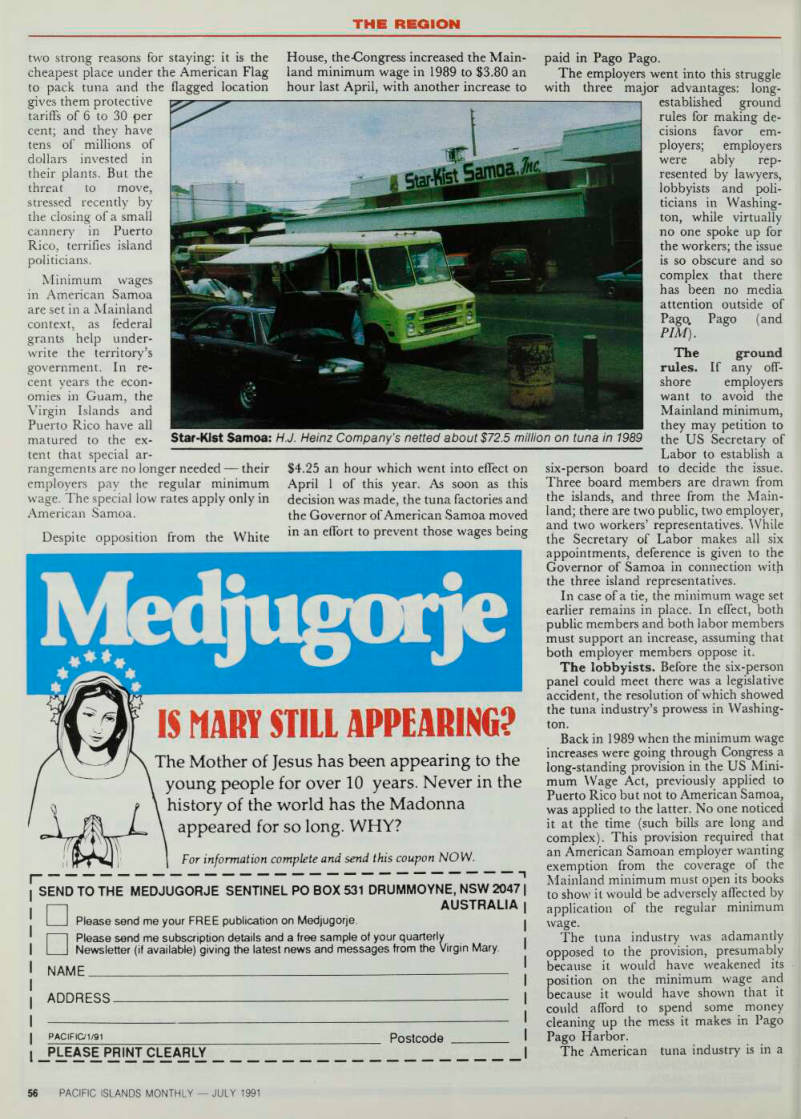
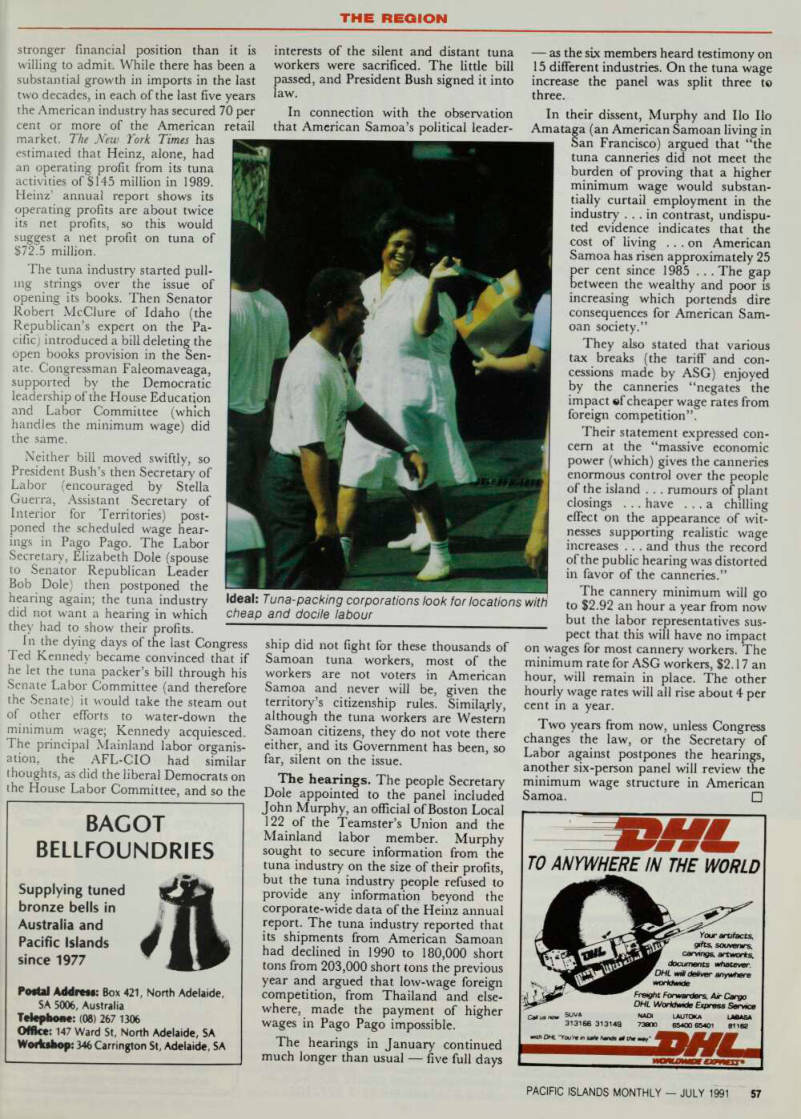
The Region
Wages of tuna workers frozen
By David North
ALL workers un4er the US flag except those, in American Samoa got a raise in the minimum wage to $4.25 an hour on April 1 this year.
In a much delayed move, the US Department of Labor decided effectively in January not to increase the minimum wage for American Samoa’s tuna can nery or territorial government workers.
There are about 4000 workers in each category.
The tuna workers, most of whom are from Western Samoa, have grim jobs.
They behead and disembowel fish. They work for two huge, multi-national cor porations whose product canned tuna - is protected by US tariffs. Americans love canned tuna,- they, buy about $l.B billion worth a year.
The decision to freeze the minimum wage in American Samoa came as no surprise, as the principal employers (the tuna factories and the American Samoan Government, or ASG) had pulled together a strong political coalition in both the islands and the Mainland to hold down wages. This was a thoroughly bi-partisan coalition, with Senator Ted Kennedy (D Mass.) and President Bush playing minor supportive roles, alongside the Democratic Congressman
from the islands, Eni F.H.
Faleomaveaga, and his arch rival, Republican Governor Peter Tali Coleman, who car ried the ball for the employers.
The two sets of employers in American Samoa have two completely different financial situations but they had a com mon position against the wage increases. The Territorial Gov ernment, which is running a substantial deficit, raised taxes and put some of its workers on a short work-week last year to try to make ends meet.
The two tuna factories, on the other hand, belong to global conglomerates, one based in Indonesia and the other in
Pittsburgh, Pa. The latter, the H.J.
Heinz Company (packers of the Star Kist tuna), according to its last annual report, had profits in excess of half a billion dollars last year. Had all the American Samoa tuna workers received an 80 cents an hour raise, not just the ones working for Heinz, it would have cost their employers less than $6 million.
The American Samoan economy re volves around Mainland tax-funded subsidies to the island government and the Mainland’s appetite for tuna; the special minimum wage applies to both parts of the economy. Governor Coleman opposed an increase in the minimum wage for both the Territory’s own employees and those working at the tuna
canneries. If the minimum wage were raised for the government’s workers, he would either have to lay off some of them or raise taxes further, neither politically desirable. As for the tuna workers his concern, and that of Congressman Faleomavaega, is based on threats laid on by the packers help us keep wages low or we will move jobs to other, lower wage islands. In contrast to his position on the minimum wage, Faleomavaega has pressed the canneries to provide paid holidays and vacations for workers but without results so far.
The tuna processed by the Samoan factories are caught all oyer the Pacific.
Once caught, tuna can be iced or frozen and moved over large distances at sea at
relatively low cost; once canned, it can be moved at even lower cost, as there is no need to refrigerate it. So
corporations pack tuna
where fresh water is abun dant, where labor is cheap and docile, and where the tariffs are favorable. Puerto Rico and American Samoa qualify on all counts and with the exception of small operations in California, all tuna packing in the US has moved to these two island territories.
American Samoa is the second most-expensive place in the world to pack tuna, but the tuna companies have
Silent and distant: the interests of American Samoan tuna workers were canned
Thriving: US tariffs protect VCS Samoa Packing Co's product
tw'O strong reasons for staying: it is the
cheapest place under the American Flag
to pack tuna and the flagged location
gives them protective tariffs of 6 to 30 per cent; and they have tens of millions of dollars invested in their plants. But the threat to move, stressed recently by the closing of a small cannery in Puerto Rico, terrifies island politicians.
Minimum wages in American Samoa are set in a Mainland context, as federal grants help under write the territory’s government. In re cent years the econ omies in Guam, the Virgin Islands and Puerto Rico have all matured to the ex tent that special ar
rangements are no longer needed their employers pay the regular minimum wage. The special low rates apply only in American Samoa.
Despite opposition from the White
House, the-Congress increased the Mainland minimum wage in 1989 to 53.80 an hour last April, with another increase to
54.25 an hour which went into effect on April 1 of this year. As soon as this decision was made, the tuna factories and the Governor of American Samoa moved in an effort to prevent those wages being
paid in Pago Pago.
The employers went into this struggle with three major advantages: long
established ground rules for making de cisions favor em ployers; employers were ably rep resented by lawyers, lobbyists and poli ticians in Washing ton, while virtually no one spoke up for the workers; the issue is so obscure and so complex that there has been no media attention outside of Pago, Pago (and
Pim).
The ground rules. If any off shore employers want to avoid the Mainland minimum, they may petition to the US Secretary of Labor to establish a
six-person board to decide the issue.
Three board members are drawn from the islands, and three from the Main land; there are two public, two employer, and two workers’ representatives. While the Secretary of Labor makes all six appointments, deference is given to the Governor of Samoa in connection with the three island representatives.
In case of a tie, the minimum wage set earlier remains in place. In effect, both public members and both labor members must support an increase, assuming that both employer members oppose it.
The lobbyists. Before the six-person panel could meet there was a legislative accident, the resolution of which showed the tuna industry’s prowess in Washing ton.
Back in 1989 when the minimum wage
increases were going through Congress a
long-standing provision in the US Mini mum Wage Act, previously applied to Puerto Rico but not to American Samoa, was applied to the latter. No one noticed it at the time (such bills are long and
complex). This provision required that
an American Samoan employer wanting exemption from the coverage of the Mainland minimum must open its books to show it would be adversely affected by application of the regular minimum wage.
The tuna industry was adamantly
opposed to the provision, presumably
because it would have weakened its position on the minimum wage and because it would have shown that it could afford to spend some money cleaning up the mess it makes in Pago Pago Harbor.
The American tuna industry is in a
Star-Kist Samoa: H.J. Heinz Company’s netted about $72.5 million on tuna in 1989
stronger financial position than it is willing to admit. While there has been a substantial growth in imports in the last two decades, in each of the last five years the American industry has secured 70 per cent or more of the American retail
market. The Mew York Times has estimated that Heinz, alone, had an operating profit from its tuna activities of $145 million in 1989.
Heinz’ annual report shows its operating profits are about twice its net profits, so this would suggest a net profit on tuna of $72.5 million.
The tuna industry started pull ing strings over the issue of opening its books. Then Senator Robert McClure of Idaho (the Republican’s expert on the Pa cific) introduced a bill deleting the open books provision in the Sen
ate. Congressman Faleomaveaga,
supported by the Democratic leadership of the House Education and Labor Committee (which handles the minimum wage) did the same.
Neither bill moved swiftly, so President Bush’s then Secretary of Labor (encouraged by Stella Guerra, Assistant Secretary of Interior for Territories) post poned the scheduled wage hear ings in Pago Pago. The Labor Secretary’, Elizabeth Dole (spouse to Senator Republican Leader Bob Dole) then postponed the hearing again; the tuna industry did not want a hearing in which they had to show their profits.
In the dying days of the last Congress Ted Kennedy became convinced that if he let the tuna packer’s bill through his Senate Labor Committee (and therefore the Senate) it would take the steam out of other efforts to water-down the minimum wage; Kennedy acquiesced.
The principal Mainland labor organis ation, the AFL-CIO had similar thoughts, as did the liberal Democrats on the House Labor Committee, and so the
interests of the silent and distant tuna workers were sacrificed. The little bill passed, and President Bush signed it into law.
In connection with the observation that American Samoa’s political leader-
ship did not fight for these thousands of Samoan tuna workers, most of the workers are not voters in American Samoa and never will be, given the
territory’s citizenship rules. Similarly,
although the tuna workers are Western Samoan citizens, they do not vote there either, and its Government has been, so far, silent on the issue.
The hearings. The people Secretary Dole appointed to the panel included John Murphy, an official of Boston Local 122 of the Teamster’s Union and the Mainland labor member. Murphy sought to secure information from the tuna industry on the size of their profits, but the tuna industry people refused to provide any information beyond the corporate-wide data of the Heinz annual report. The tuna industry reported that its shipments from American Samoan had declined in 1990 to 180,000 short tons from 203,000 short tons the previous year and argued that low-wage foreign competition, from Thailand and else where, made the payment of higher wages in Pago Pago impossible.
The hearings in January continued much longer than usual five full days
as the six members heard testimony on 15 different industries. On the tuna wage increase the panel was split three to three.
In their dissent, Murphy and 110 110 Amataga (an American Samoan living in
San Francisco) argued that “the tuna canneries did not meet the burden of proving that a higher minimum wage would substan tially curtail employment in the industry ... in contrast, undispu ted evidence indicates that the cost of living ... on American Samoa has risen approximately 25 per cent since 1985 . . . The gap between the wealthy and poor is increasing which portends dire consequences for American Sam oan society.”
They also stated that various tax breaks (the tariff and con cessions made by ASG) enjoyed by the canneries “negates the impact of cheaper wage rates from
foreign competition”.
Their statement expressed con cern at the “massive economic power (which) gives the canneries enormous control over the people of the island , . . rumours of plant closings . .. have ... a chilling effect on the appearance of wit nesses supporting realistic wage increases . . . and thus the record of the public hearing was distorted in favor of the canneries.”
The cannery minimum will go to 52.92 an hour a year from now but the labor representatives sus pect that this will have no impact
on wages for most cannery workers. The minimum rate for ASG workers, 52.17 an hour, will remain in place. The other hourly wage rates will all rise about 4 per cent in a year.
Two years from now, unless Congress changes the law, or the Secretary of Labor against postpones the hearings, another six-person panel will review the minimum wage structure in American Samoa. □
Ideal: Tuna-packing corporations look for locations with cheap and docile labour
Advertisements & other items, pp. 55-60 (1 item)
sapac
South Pacific Applied Geoscience Commission
Director and Deputy Director Positions
Applications are invited from nationals of SOPAC member countries for the following senior positions in the Technical Secretariat of SOPAC, based in Suva, Fiji: (1) Director : for a three year appointment from January, 1992 (2) Deputy Director for a three year appointment from 1 January, 1992
SOPAC
SOPAC is an inter-governmental organisation comprising fourteen South Pacific countries as members*. Its primary objectives is to assist its member countries in the identification and assessment of the marine mineral and other nonliving resource potential of the offshore areas within their Exclusive Economic Zones, in the management of development in their coastal areas, and in the training of their nationals in all relevant areas within the SOPAC Work Programme.
TECHNICAL SECRETARIAT
The Technical Secretariat is the executive arm of SOPAC. The Director is responsible to the Governing Council of SOPAC for the overall management and operation of the Technical Secretariat. The Deputy Director is responsible to the Director for managing the SOPAC Technical Work Programme.
The SOPAC Technical Work Programme is reviewed and formulated by the member countries during their Annual Session each year.
The staff establishment of the Technical Secretariat is currently 50 people of which more than half are professional technical staff recruited internationally.
QUALIFICATIONS
Applicants for both positions should have a sound understanding of the Pacific Islands region and should be capable of developing effective relations with the member countries of SOPAC and with other Governments and organisations providing funding, technical and scientific support to SOPAC.
In addition, the following specific requirements will also apply: Director: Applicants should have a high degree of ability and extensive experience at a senior level in administration and management; a proven record of successful team leadership; and demonstrable negotiating and communication skills. Extensive experience in dealing with Pacific Island Governments and with donor sources would be a considerable advantage.
Deputy Director: Applicants should have a degree in one of the Earth Sciences with team leadership and management experience in addition to technical experience in their area of expertise. Work experience in the SOPAC region, familiarity with current marine geoscience programmes in the South Pacific, and a proven ability to work with member country nationals would be an advantage.
Remuneration An attractive salary will be offered, depending on the successful applicant’s qualifications and experience.. The overall remuneration and other terms and conditions of employment for professional officers in SOPAC will apply. These are comparable to that of similar senior positions in other South Pacific regional organisations.
An appointee who is not a citizen or permanent resident of Fiji may be granted full diplomatic privileges by the Government of Fiji. b 3 Appointment The Governing Council of SOPAC will decide appointments to the above positions during its Annual Session in early October 1991. J The appointment for each position will be for a 3-year contract. In the third year of a tenure, the post will be advertised to allow the Governing Council of SOPAC to award a new three-year contract from the end of the current contract. An incumbent will be eligible for a further three year contract.
The current incumbent Director will complete his second three-year contract on 12 January 1992.
The current incumbent Deputy Director will complete his first three-year contract on 31 December 1991.
Documentation All applications should be fully documented and include details of work experience and qualifications and the names or at least three referees. Applications, to be marked “Director Application” or “Deputy Director Application”, as appropriate should be addressed to the Chairman of SOPAC and should reach the following address by 31 July 1991: SOPAC Technical Secretariat Private Mail Bag Suva, Fiji information on the above positions may be obtained from Mr Umar Farook, Finance and Administration Controller, Techical Secretariat on Telephone 381-377 or Fax 370-040. riIAM e MAD^ C COOK ISLANDS ’ FEDERATED STATES OF MICRONESIA, FIJI, KIRIBATI, WESTERN A SAMOA L SWNDS ’ NEW ZEALAND ’ papua n EW GUINEA, SOLOMON ISLANDS, TONGA, TUVALU, VANUATU
Medjugorje
1$ NARY STILL APPEARING?
The Mother of Jesus has been appearing to the young people for over 10 years. Never in the history of the world has the Madonna appeared for so long. WHY? ■ IS For information complete and send this coupon NOW.
I"sEND TO THE MEDJUGORJE SENTINEL PO BOX 531 DRUMMOYNE, NSW 2047
—| AUSTRALIA
I I Please send me your FREE publication on Medjugorje. □ Please send me subscription details and a free sample of your quarterly Newsletter (if available) giving the latest news and messages from the virgin Mary.
• NAME
ADDRESS
PACIFIC/1/91
PLEASE PRINT CLEARLY
Postcode
BACOT
BELLFOUNDRIES
Supplying tuned
bronze bells in Australia and Pacific Islands since 1977 Portal Address: Box 421, North Adelaide, SA 5006, Australia Telephone: (08) 267 1306 Office: 147 Ward St, North Adelaide, SA WoHahop: 346 Carrington St, Adelaide, SA
TO ANYWHERE IN THE WORLD
Your artifacts, gifts, souvenirs.
W carvings, artworks, f documents whatever.
DHL wtH deliver anywhere worldwide Freight Forwarders. Air Cargo DHL Worldwide Express Service
SUVA
313166 313149
MATW
LAUTOKA
CM 7^flm 65400 65401 mth DHL You're m safe hands at the wa\
PACIFIC
ISLANDS
IMONT H L Y \
market piflce
For the benefit of our readers who would like to place a small classified advertisement in our magazine, Market Place will assist you in selling personal items, accommodation, real estate, boating or a service ... in fact anything you would like to sell to our over 50,000 readers.
Market Place Advertising Rates are structured to allow you to place as many advertisements as you wish, economically.
COMMERCIAL PRINTING
Top quality four colour printing, brochures, posters, packaging, product labels, fabric labels, billboards, books, magazines, stickers, books. Export quality. Contact Fiji’s most experienced Commercial Printers. FIJI TIMES COMMER- CIAL PRINTING, P.O. Box 1167, Suva. Fiji.
Phone: 304111 Fax. 301521.
(PACIFIC
ISLANDS
I M 0 N T H L Y~\
MRRHCT PLRC€ CRN UJORK
WONDCRS FOR VOU ...
Promote your business, or service, sell your household items, cars or heavy machinery etc.
ONLY AUSSI PER WORD.
NO COMPANY LOGO. NO
DISPLAY. NO BOLD TYPE.
Just forward your Advertisement together with payment to: PACIFIC ISLANDS MONTHLY “Market Place ", P.O. Box 1167, Suva, Fiji.
CONDITIONS:
1. All Advertisements are subject to acceptance and approval of publisher. 2. Advertisements are published as space permits: we cannot guarantee date of insertion. 3. All advertisements must be prepaid and should be typed or printed clearly. 4. Deadline for receipt of advertisements is the 10th of the month prior to issue.
5. PACIFIC ISLANDS MONTHLY
assumes no responsibility for any service other than publishing paid L advertisements in this section.
“SCRAP METAL”
Tall ingots operate from Brisbane, Australia and make frequent visits to the Pacific islands, as they have done for twenty-five years. We are buyers of Copper, Brass, Aluminium, Lead, Cable etc. Inspection for big lots no problem. Telephone 61 7 8922035. Fax 61 7 8922077.
DISTRIBUTERS WANTED
Franchise are available, in the Pacific Islands region to persons or companies interested in distributing a new patented inflatable snorkeler float. Suits all ages, and makes snorkeling an effortless pleasure. Ideal for tourist resorts, snorkel tours operators, island cruises and dive shops. For further information please contact Australian Snorkeler Float Pty. Ltd., P.O. Box 1072 Townsville, Queensland, Australia, 4810 Phone (077) 212109 Fax (077) 211420.
PUMP DISTRIBUTORS WANTED
Excellent profit available. As a Pacific Pump Dealer you would have access to some of the world’s finest agricultural and industrial pump products. The product range includes:-
HIGH PRESSURE WASHERS SUBMERS-
IBLES Tsurumi Toyo PRESSURE SYSTEMS Espa GEAR PUMPS Viking Gorman Rupp PISTON PUMPS Cat TRASH Gorman Rupp OP GENERATORS. We provide sales literature, full technical support, price lists and a discount structure which enables generous profit margins when selling Pacific Products.
Phone or Fax for full distributorship details:-
THE MARKETING MANAGER, PACIFIC PUMP
COMPANY, 2 SOUTH STREET, RYDALMERE,
NSW, 2116, NSW AUSTRALIA, PHONE (02)
638 5600 FAX (02) 684 2184
SAWS & KNIVES
Sales & service of all types of Saws & Knives.
T.C.T. circularsaws from 4” to 84” for Timber, Steel & Plastic. Bandsaws from 3” to 14” in swaged or stellite tipped. Bi-metal bandsaws, H.S.S. Saws, Planner Knives, Machine Knives, Profile Knives & Heads.
HENRY BROS SAWS SYDNEY, AUSTRALIA. PH
61 2 6275486 FAX 61 2 6272707.
USED JAPANESE VEHICLES
Buy direct from Japan and save" any make, model, year, Truck, Cars, Tractors, Buses, motorbikes, all Shipping, and Documentation arranged. Contact Trust Company Ltd. Kobac Bid 3F 3 2 26, Nishiki Nakaku Nagoya, 460 Japan, Phone 052 —953 —5602, Fax 052—953—5634.
SELF ADHESIVE LABELS
FORUM LABELS (FIJI) LTD
P.O. Box 1167, Suva.. Fiji. Phone: 304111 We print self-adhesive labels in rolls, multi-coloured labels with hot foil, and die cut to shape, tickets and tags in rolls. We also supply labelling machines and fabric labels.
VANUATU FARM
Cattle/Small crop ranch situated on main island of Efate 33km, from capital Port Vila on main road. 68 hectares including 4 bedroom residence overlooking permanent freshwater creek. Extensively equipped workshops and machinery also included. Price on application. For further details contact W, Welch, 22 Bimbadeen Drive, Loganholme, Australia 4129 or Ring 617 2098856.
SHELLS
Magnificent and comprehensive collection of exotic shells, some 300,000 pieces includes accumulation suited to craft industry.
Price on application. Contact W. Welch 22 Bimbadeen Drive, Loganholme, Australia 4129 or Ring 617 2098856.
OPTICIANS AND OPTOMETRISTS
Spectacles, Contact Lenses, Sunglasses.
See JEKISHAN & JEKISHAN, Epworth House, G.P.O. Box 285, Suva, Fiji. Ph 311002 Fax (679) 411898.
DISTRIBUTOR WANTED
Manufacturer of Ball point pens and disposable Gas Lighters.
Please contact JNJ CORPORATION (FUI) LTD, G.P.O. Box 285, Suva, Fiji. Ph 39400 Fax (679) 411898.
0 PIONEER
The Art of Entertainment
In today's active society, a compact and modular Hi-Fi component stereo system is the perfect answer to home entertainment. The Contempo series gives you all you could ask for in both convenience and sound quality, as well as a stylish design that complements your living space. $ j
Hi-Fi Compact System
In spile of its compact design, Contempo is pack ed with a variety of high-tech features that prod uce high-quality sound in almost any listening s pace. Cnnlempo's specially engineered function s compensate for the loss of sound presence in I imiled spaces. As a result, Cnnlempo sound is c risp and clear, no matter where you are in the r oom. What's more. Pioneer Smart Operation c apabililies make the Cnnlempo system simple to use. A touch of the START/SET button and I he system delivers quality hi-fi sound. Various Contempo models will suit almost any taste with a choice of Single, Twin and Multi-play CD capabilities. And all of the Cnnlempo m odels employ 1-Bil DIC (Direct linear Con version) technology for extremely high-qu ality sound. Add to this an ASES (Auto Sy nchroni/ed Editing System) provided on I he Double Aulo-Reverse Cassette Deck Ih at lets you program Contempo to automat •rally create professional-sounding cassell e recordings. All of this makes Contempo I he ideal personal entertainment system. In spile of its compact design, Cnnlempo is p acked with a variety of high-tech features that produce high-quality sound in almos I any listening space. Cunlempn's specia lly engineered functions compensate for the loss of sound presence in limited sp aces. As a result, Cnnlempo sound is cr isp and clear, no matter where you are in the room. What’s more. Pioneer Sm art Operation capabilities make the C onlempo system simple to use. A touch of I he START/SET button and the system deliv ers quality hi-fi sound. Various Cnnlempo models will suit almost any taste with a c hoice of Single, Twin and Multi-play CD capabilities. And all of the C nnlempo models employ I-Bit DEC (Direct li near Conversion) technology for e xlremely high-quality sound. Add to this an ASES (Auto Synchronic ed Editing System) provided on I he Double Aulo-Reverse Casse lie Deck that lets you progr am Cnnlempo to automat
really creat professional-
sounding cassette recor dings. All of this makes Contempo the ideal personal entertainment sy stem. In spile of its co
mpacl design, Conlemp
nis packed with a varicl y of high-tech features that produce high-quality sound in almost any listening space. Cunt enipo's specially engineered functi ons compensate for the loss of sou nd presence in limited spaces. As a result, Contempo sound is crisp an ( X-P77 305 W
(PMPO)
d clear, no matter where you are in the room . What's more. Pioneer Smart Operation capa bililies make the Cnnlempo system simple to u se. A touch of the START/SET button and the sy stem delivers quality hi-fi sound. Various Conte mpo models will suit almost anv taste with a cho ice of Single, Twin and Multi play CD capabilities And all of the Contempo models employ I -Bit D EC (Direct linear Conversion) technology (or exlr emely high-quality sound. Add to this an ASES (A ulo Synchronized Editing System) provided on I be Double Aulo-Reverse Cassette Deck that let s you program Contempo to automatically ere
ale professional-sounding cassette recordings.
All of this makey Contempo the ideal personal e nlerlainmenl system. In spile of its compact des ign. Contempt) is parked with a variety of high-l erh features that produce high-quality sound in almost any listening spare. C ontempo’s specially engineered functions compensate for the loss of sound presence in limited spares. As a re suit. Contempt) sound is crisp and clear, no matter where you are in the room.
What's more, Pioneer Smart Opera lion capabilities make the Conte mpo system simple to use. A t ouch of the START/SET b ulton and the system delivers quality hi-fi sound.
Various Co ntempo models t i will suit almost any taste with a choice of Singl e, Twin and Multi-play CD capabilities. And all of the Contempt) models employ I-Bit DIC (Di red linear Conversion) technology for extreni ely high-quality sound. Add to this an ASES (A ulo Synchronized Editing System) provided o n the Double Aulo-Reverse Cassette Deck Ih at lets you program Conlempo to automatic ally create professional-sounding cassette r ecordings. All of this makes Contempo the ideal personal entertainment system. In sp ile of its compact design, Conlemptt is pa eked with a variety of high-tech features that produce high-quality sound in aim osl any listening space. Contempn’s sp ecially engineered functions compensa le for the loss of sound presence in lim iled spaces. As a result, Contempt) sou nd is crisp and clear, no matter where you are in the room. What's more, Pion eer Smart Operation capabilities make I he ( onlempo system simple to use. In s pile of its compact design, Contempo is pack ed with a variety of high-tech fea
lures that produce high-quality sound i
n almost any listening space. Conlemp o’s specially engineered functions com pensale for the loss of sound presence in limited spaces. As a result, Conte mpo sound is crisp and clear, no ma
■or further information, please contact:
St D ralia L Pioneer Electronics Australia Pty. Ltd. (Incorporated in Victoria), 178- 184 Boundary Road, Braeside Victoria 3195 Tel; 580-9911 •iji Islands: Brijlal & Company, G.P.O. Box No. 362, Suva, Fiji Islands TeL 22258 Jew Zea and: Monaco Corporation Ltd., 41 Poland Road, Glenfield, Auckland
Jew Zealand Tel; (09)444-9144
Norfolk Island: Burnt Pine Traders Ltd., P.O. Box 21, Norfolk Island Vanuatu: Burns Philp (Vanuatu) Ltd., Vila, Vanuatu ■ 305 W (PMPO) ■ Digital sound field
processor ■ L.P.S. (Listening Point
Selector) ■ One-touch KARAOKE (Vocal
Cancel) ■ Sound jog dial for sound image
control and S.F.C. effect ■ Auto
Synchronized Editing System (A.S.E.S.)
ready ■ P.Bass (Power Bass)
* X-P55/X-PSSM (305 W PMPO), X-P33 (210 W PMPO) and X-Pll (200 W PMPO) Contempo models are also available.
Nauru Island: Jacob Enterprises, P.O. Box N 0.4, Republic of Nauru Tahiti: Tahiti Hi-Fi, P.O. Box 848, Papeete, Tahiti New Caledonia: Menard Pacifique Sari, B.P, 3899, Noumea, New Caledonia
Tel: 27-62-23
Sa™oa%7MTeN : 63X n 5224 CC ° rP ° ra,i ° n ' P °' ’ Pa9 ° Pa9 °' Amarica "
Pa l ro o t ° n 7 ga: South Seas International Ltd., P.O. Box 49, Rarotonga, Cook Islands I Gl. /
Designed to be Driven. - ■ » ■ «
MITSUBISHI
MOTORS
Proven in Every Comer of the World.
Stylish elegance and luxurious detail are the first things you’ll notice about the new Galant. So you might be surprised to learn that Galants have driven to victory in more than 10 major rally raid events — from the snowy slopes of Sweden, to the African savannah. And you’ll be pleased to know that the same performance features keeping those rally cars competitive on the course are also what make your Galant one of the best performance saloons on the road today.
For years, Mitsubishi engineers have known that motorsports are an ideal place for testing new and improved technologies.
The hard, fast driving required to win a rally strains every part of a car —generating pressures that exceed the demands of normal driving. Here, as drivers push their cars to the limit, the rigidity and strength of new space-age constructions can be checked and proven reliable.
The new Galant’s advanced triplelink torsion axle rear suspension is a good example. It is the result of many small yet critical refinements, ultimately designed to grip the road for safer, more comfortable control when changing lanes and cornering.
The severe demands of international motorsport competition: just further proof of how far Mitsubishi will go to build the best cars for you.
MITSUBISHI GRLfINT
AMERICAN SAMOA; MORRIS SCANLAN SERVICE INC. P.O. Box 367, Pago Pago, Tel 633 5520/AUSTRALIA: MITSUBISHI MOTORS AUSTRALIA LTD. Box 1284, South Road, Clovelly Park , ( ) 275-7223/FIJI: NIVIS MOTOR & MACHINERY CO., LTD. G.P.O Box 150, Suva, Tel. 383411/FRENCH POLYNESIA (TAHITI): ETS-BREDIN FRERES ET FILS P.O Box 21. Papeete, Tahiti, Tel. 4-202 58/NEW CALEDONIA. SOC D'IMPORTATION D’AUTO DU PACIFIQUE SUD S.A. B P 438 Rond Pointdu Paciflque, Noumea, Tel. 274144/NEW ZEALAND; MITSUBISHI MOTORS NEW ZEALAND LTD. Todd Park, Henot Driv^ Private Bag, Porirua, e. NORFOLK ISLAND: BORRYS LTD. P.O Box 169, Norfolk Island Tel 2114/PAPUA NEW GUINEA; TOBA PTY LTD. P.O Box 503, Port Moresby. Tel. 21 7874/SOLOMON ISLANDS: HARVEST PACIFIC Lm GP.O Honiara, Guadalcanal, Tel, 30128/TONGA: SITANI MAPI CO.. LTD. P.O. Box 83, Nuku'ALOFA, Tel. 21 044/VANUATU: SOCOMETRA B.P, 06 Route de Lagon, Port-Vila. Tel. 2314/WESTERN SAMOA: A.M. MACDONALD HOLDINGS LIU.
P O Box 576 Apia Tel 22022/SAIPAN/POHNPEI/MAJURO/KOSRAE/TRUK/YAP/BELAU; MICRONESIAN MOTORS, INC. 997 South Manine Drive, Tamuning, Guam 96911, Tel. 646-6827