Advertisements & other items, pp. 1-2 (2 items)
-JnEal
PACIFIC
ISLANDS
MONTHLY
JUNE 1991
Ml
-JnEal
t
The Mitterrand Years
The Gaston Flosse Plan
RUGBY
Samoans win three on World Cup trail
Is Palau closer to independence?
r SM; H,W,ii Uss3; Kiriba,i AS2 ' 5O; N,uru AS2 - 50; Ni “* N «* Nortou, cp f3oo•300• Ton a a P3^m sa^Ugc** •u! . uTonn K 3; Palau USS 3: Marsha,ls USS 3; Solomon Islands AS3; French Polynesia cpf3oo, Tonga P 3, USA USS 3; Vanuatu VT2OO; Western Samoa T 3.25. ‘Recommended retail price only
The Possibilities Are Endless.
CASIO
And With More New IC Cards, The Applications Keep Expanding.
IC CARD SYSTEM
A flat-key version SF-9000 is also available
i'f&s'gll K
e^?~4 Sll
SION
NEW!
ES-630
Coming soon!
NEW
ES-650
Coming soon!
ES-100 ES-105 ES-110 ES-630 Casio Power Spreadsheet by Lucid® 3-D** • 3-D linking of any cell • Direct information transfer between the SF-9500 and PC using the FA-100 • 8 built-in templates • Large 64K8 memory ES-600 ES-610 ES-620 ES-800 Compatible with IBM PCs Using the interface unit, you can link the SF-9500 with an IBM PC* You can then use your PC’s keyboard to input data. Or store data on floppy disks and make hard copies on your printer. Also the SFD TOOL-B (MF-4000) is available for even wider use with IBM personal computers.
Easy, Portable Printout of Stored Data With the optional CP-9 Copy Pen, you can print SF-9500 data into a notebook. Or use the CP-9 as a compact copier to transfer data from any text onto almost any kind of paper.
ES-650 Powerful Scientific • Easy-to-use Function Menu system • Wide range of scientific functions include integration, statistics, and Base-n calculation • Large-capacity program memory • Formula memory function A Variety of IC Cards for Extended Applicability ■ ES-100 64K8 RAM card with memory backup ■ ES-105 128 KB RAM card with memory backup ■ ES-110 256K8 RAM card with memory backup ■ ES-600*** Spelling checker and Thesaurus dictionary ■ ES-610*** Spelling checker with financial and legal terms ■ ES-620*** Spelling checker with medical terms ■ ES-800 Travel Conversations (Spanish-English) ■ Multi-Language Translator and English Dictionary IC cards will soon be available. *IBM is a registered trademark of IBM Corporation. Use limited to certain models. Refer to catalogs and other materials for list of applicable personal computers.
"Lucid® 3-D Is a registered trademark of PCSG, Inc. •"International Correct Spell system, Electronic Thesaurus, Right Word Usage Alert and Abbreviation Expander developed by Houghton Mifflin Company, publishers of The American Heritage Dictionary and Roget's II: The New Thesaurus.
AUSTRALIA MOBEX PTY. LTD.
UNIT 1, GIBBES STREET
CHATSWOOD N.S.W. 2067
FIJI ISLANDS BRULAL & CO., LTD.
G.P.O. BOX NO. 362
SUVA, FIJI ISLANDS
NEW CALEDONIA BRECKWOLDT SARL
8P2369 NOUMEA
NEW CALEDONIA
MENARD PACIFIQUE
10 RUE JEAN JAURES
8P3899 NOUMEA, NEW CALEDONIA
NEW ZEALAND MONACO CORP. LTD.
41 POLAND ROAD, GLENFIELD
AUCKLAND, NEW ZEALAND
NORFOLK ISLANDS: BURNT PINE TRADERS LTD.
R0.80X21, NORFOLK ISLANDS
PAPUA NEW GUINEA SENGCO NIUGINI PTY. LTD.
RO. BOX 1886, BOROKU
PAPUA NEW GUINEA
TAHITI MAISON AUROSE
30, RUE COLLETTE
PAPEETE. TAHITI
VANUATU: FUNG KUEI
P.0.80X51, PORT VILA
VANUATU
CASIO COMPUTER CO., LTD.
Tokyo, Japan
Pacific
Islands
Monthly
Voi 61 No 5
The News Magazine
June 1991
Tourism Report
ISSUES: The Year of the Big Deal: a look at the state of tourism in the region, the problems, the strategies and future markets 18 Island airlines’ new task: tourism targets set by the island nations for the next decade have given regional airlines a whole new challenge 23 Ecotourism: a trend that could decide the long-term fate of tourism 19 OPPORTUNITIES: Cultural cure for high-cost holidays: and a golden opportunity for small businesses 21 Potential for SP cruising; a new PATA study looks at the prospects for cruise operators in the region 20 GROWTH; Fiji’s ‘Biggies’ on the backburner: multi-million dollar develop ments on hold 25. Where the growth is taking place; Nadi, and the islands 35, EIE on schedule 3-7 Cook Islands: New Zealand aid is decreasing, putting pressure on tourism 38 OVERSEAS VIEWS: Settling our fate from afar; Japanese and US politicians, businesses and media swing the pendulum on SP tourism 27. How US travel agents view trips to our islands 29 INNOVATIONS: News for watersports wallflowers: a product for non swimmers who want to snorkel 40
Focus;
Western Samoa; friendly, unique but filthy 37
Tidbits;
Solomons; setting a tourism target 45 Niue: landing rights for Fiji negotiated 23 Tonga: a name change and a international service for the national airline 45
The Region
Tahiti: Flosse on tourism and the future Palau: independence signals, and a push toward change - Q Elections: new faces in FSM, uncertainty in Kiribati corruption alleged in Western Samoa, 17 New Zealand: The French return
Letters 4 Jemima Garrett: Australia 5 David Barber: New Zealand 6 Futa Helu; The islands 7 Margot O’Neill: Washington 8 Business: Promise in PNG mines Fiji stepping stone to a tax haven 41 Shipping: Travel by Tongan ferry 46 Sport: Samoan Rugby shakes off the ‘bad boy’ tag 50 Books: testimonies of nuclear times 55 People: PNG’s Tsiamalili 57
Ed«l!t h Tl G M 0,, ; ey HUSS6y
afsT.rrcfl o
Assistant Editor: Beryl Cook Correspondents: Al Prince, Angela McCarthy, David North, David Robie, Diana McManus. Dykes Angiki, Frank Senge, Franck Madeouf, lan Williams Irene Nisbet, John Hunter, Karen Sambohn A ' aVa °' Wa " y
Busin... Correspondent: Robin Brotnby Columnists: David Barber (Wellington), Futa Helu (Tonga, cover ing the islands), Jemima Garrett (Syd neV). Margot O’Neill (Washington) Advertising Manager: Charlotte Thomas 1 V °£ isl " 9 SaleB: Tel (61 * 2) 4134689 - Fx «»-2)
• Brisbane: Robert Walker, Tel (61-7) 3710533, Fx (61-7) 8798964 • Adelaide: Hastwell Williamsons Representations, Tel (61-8) 799522 • Japan: Universal Media Corpor ation, Tokyo. Tel (3) 6663036, 6663094, Cable: UNIMEDIA Tokyo, Tx 2524665 • Auckland: McKay International Media Reps Ltd, Tel (64-9) 4190561 Fx (64-9) 4192243 Founded 1930 (USPS 952480). A Fiji Times Limited production. Cover prices are recommended retail only. Regis tered by Australia Post, Publication No.
Nbp 1210,
© Copyright Fiji Times Limited, 117 Victoria Parade, Suva, Fiji. Tel (679) 304111, Fx (679) 303809, Tx FJ2124 Pacific Islands Monthly is published monthly by Fiji Times Limited, a division of Nationwide News, 2 Holt Street, Surry Hills, Sydney. NSW 2010, Send address changes to: • Pacific Islands Monthly, PO Box 1167, Suva Fiji.
Typeset and printed by Fiji Times Limited, 117 Victoria Parade, Suva, Fiji.
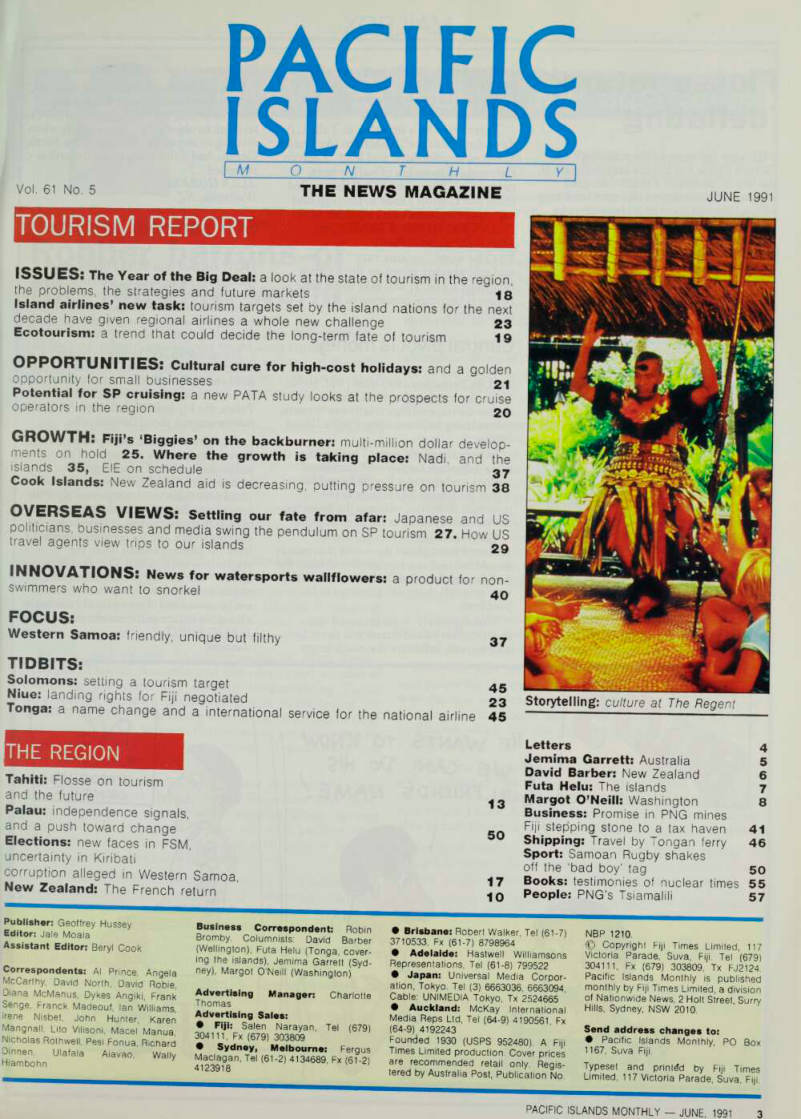
Storytelling: culture at The Regent
'deflating’
Mailbox
Flosse return 'deflating’
THE very sad news of the comeback of Gaston Flosse has left me very deflated. If the Maohi people of French-occupied Polynesia have allowed this man back into office, they will have only themselves to blame.
Flosse is a foremost member of that
depressing cacotocracy (government by
the worst people) of elitist “demis” who lord over Tahitian politics like spoiled royalty. In my opinion, both their vision and prime agenda is strongly questionable. The outer extents of their vision seems to be simply to beg France for more money, and their prime agenda seems to be the maintenance of their ridiculously out of place European lifestyles in what is essentially a third world Tahiti.
These “pseudo-Tahitian” elites consistently betray the trust of the vast majority, the “Kaina”, by keeping them in the dark. They insist that the only key to prosperity is to cling to France for eternity, with all the radiation induced cancer and growing AIDS cases (the highest in the Pacific Basin) that such a policy entails. Their battle cry is “Autonomy”, while the sad fact is, as long as France pulls the purse strings, autonomy, in any form, is a cruel joke.
It is so sad. These “demis”, which are supposed to be Tahiti’s best educated, and potentially best equipped to find a successful path to a prosperous
independence, are the very one’s that preach Maohi defeatism that only Europeans can succeed, and Maohi’s can’t make it on their own.
There must be a new day in Tahiti. A day when “sincere” Tahitians like Oscar Temaru step forward and lead “Eastern”
Polynesia into an era of native-born prosperity. Then we can tell the spoiled elites like Gaston Flosse to shut-up and sup their Croissants and sip their Moet.
Ivan Vernon Me Kinney Jnr,
Friends of Polynesia!Pacific PS. The word “cacotocracy’’ is a new and still obscure terms on the English language scene. It will take some time before it becomes common in all dictionaries.
Central pivot is money
YOUR December 1990 issue (Vol. 60 No. 12) indicated that there has been some earlier correspondence relative to Western values being imposed upon Pacific Island States.
In very simplistic terms I believe that the main difference between a “European” outlook and that of a Pacific Island State is that the former has money as the principal objective, whereas the latter has the extended family as the central pivot.
Until such time as recognition is achieved throughout the world that money should be used as a commodity to assist the well-being of the family (and not the other way around) there will continue to be problems.
Unfortunately, isolated, small and independent Island States will never be able to truly influence the much larger
“European” type outlook/systems.
Unity of the Pacific Island States could, on the other hand, be a significant step towards forcing the “European” outlook to re-think its objectives ... particularly when relating to any aspect relative to the Pacific Ocean. And if this unity could be further extended ...?
Alan Hornsby
Wellington , N£
Still ‘paranoid’, still late
HOW curious that Mike Forster, trade spokesman of the interim government off Bougainville, should be so concerned (PIM April 1991) about my report oftheNFlP conference which he was not even at. And almost six months after the event!
He mentions my “failing to report” a Bougainville resolution. This was just one 0f46 resolutions passed at that conference.
In any case my article was actually about Palau, the Fiji issue and divisions within the movement not about Bougainville.
It might have been more productive, Mr Forster, to question why some of the paranoid local conference organisers were so determined to effectively gag journalists, (And why there was no representative for republican Bougainville there.) I was one of only three journalists at Pawarenga for the conference and we were all excluded from the plenary session when the resolutions were passed. Organisers sending out an “official” list of resolutions almost one month after the conference is of little use to new media. I stand by my comment about the failure of the movement.
David Robie
Auckland
Advertisements & other items, p. 4 (1 item)
u
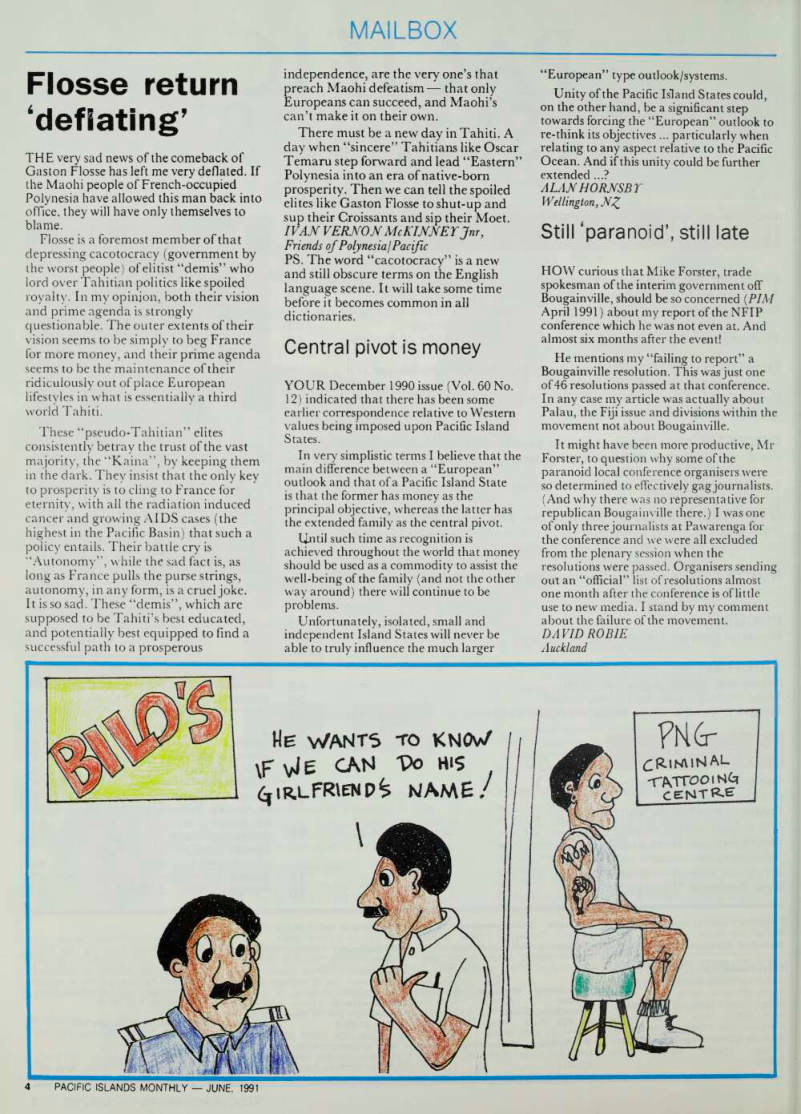
He WANTS to KNOW
\FvJe CAN Po Hi?
NAME/
FK£r
CRlNUNAL
-TATTOOING
CEKT^
Jemima Garrett
the australian
Robber barrens of the logging world
PAPUA New Guinea’s Barnett Inquiry into corruption in the logging industry produced a world-class report.
It is also the one and only detailed account of the often secretive operations of the large logging companies which operate throughout Asia and which, increasingly, are moving into the Pacific Islands.
On corporate operations in PNG’s New Ireland province Justice Barnett said: ‘lt would be fair to say, of some of the companies, that they are now roaming the countryside with the self-assurance of robber barons; bribing politicians and leaders, creating social disharmony and ignoring laws in order to gain access to, and rip out, and export the last remnants of the province’s valuable timber.
These companies are fooling the landowners and making use of corrupt, gullible, and unthinking politicians. It downgrades Papua New Guinea’s sovereign status that such rapacious foreign exploitation has been allowed to continue with such devastating effects to the social and physical environment, and with so few positive benefits.”
By the end of the Inquiry companies from Japan, Malaysia, Taiwan, Australia and elsewhere stood accused of corrupting politicians and officials, circumventing Papua New Guinea tax laws, undervaluing and misdeclaring the species of logs they were taking and failing to live up to their commitments to landowners. Barnett found not one company investigated had a satisfactory record of performing the conditions of its operation.
At the same time landowners became increasingly angry about environmental destruction. Big companies were clear felling forests and leaving water supplies silted up and undrinkable. In some cases villages and food gardens were bulldozed while promised amenities such as "new houses, churches and schools failed to materialise.
It’ B a familiar story in many areas which have suffered the predations of large industrial logging companies. And one w hich needs to be tackled now if the forests, with their valuable and uniques species, are to survive into the future.
Papua New Guinea provides an object lesson in just how difficult it can be to bring these companies to heel.
Despite a two-year moratorium on logging intended to give the government time to take stock of the country’s remaining forest resources and the 67 million Kina donated tC> u* u ® an^’s PNG Tropical Forests Action Plan (which was designed to protect the forests), logging continues apace. \ ast tracts ol iorest have been exempted from the
moratorium. In many cases companies criticised by Barnett are returning continuing their operations unchanged.
It is now becoming clear these giant corporations are simply too big and too powerful for small national governments.
The continuing abuses by logging companies have prompted landowner protests and blockades. PNG’s Na tional Alliance of Non-Government Organisations, a body which includes all major national environment and develop ment groups and the Melanesian Council of Churches has re-iterated its call for a ban on all export logging.
In many quarters there is a now growing feeling that only alternative forms of timber cutting and alternative uses of the forest are likely to save the resource and ensure its future economic benefits accrue to landowners and national governments.
One very promising alternative is the Walkabout sawmill, a small mill which can be carried into the forest by four men.
Its success lies in the fact that it can be owned and controlled by landowners themselves and, because it requires no roads or heavy machinery, it avoids what is usually the most damaging part of tropical forestry.
Other commercial alternatives to large scale industrial Joggmg include farming of rattan palms followed by production and export of rattan furniture, fruit and nut farming or tourism all activities which can go hand in hand with the highly selective Walkabout-style timber cutting.
Although alternative uses of the forest have been shown to be cost effective, enormous political clout will be needed to control the logging companies.
Most are part of huge Asian conglomerates with profits and power far in excess of individual small island nations. As was the case with the Asian driftnet fishing fleet, the job of bringing them to book may be best handled by a regional institution which has the backing of the 15 Nation South Pacific Forum.
Just as the Forum Fisheries Agency under Philipp Muller’s able leadership was able to save the albacore tuna from extinction so a regional body like the Noumea-based SPREP (the South Pacific Regional Environment Program) may be able to halt the destruction by industrial logging companies.
Regional institutions of this sort have the advantage of being less vulnerable to corruption and more able to exert a level of diplomatic pressure which cannot be ignored.
Any moves by island nations are likely to find support within the wealthy timber importing countries.
Western governments are facing increasing domestic pressure to take action to stop the devastation of tropical forests.
This month, for instance, Australia will consider a ban on the import of tropical timber which has not been sustainably produced.
If adopted this may require significant changes in Fiji and Solomon Islands. It would also open up lucrative new markets for the more than 300 Walkabout producers cutting their own logs in PNG. n
Wellington
David Barber
Nuclear tests strike a psychological blow
PEOPLE in New Zealand and the Pacific have been asking the question for years: If the French nuclear tests are as safe as they say, why not conduct them in France?
The answer has always beeen pretty obvious the reason is political but no French leader until Prime Minister Michel Rocard has been prepared to admit it. The tests were safe, he repeated during his historic visit to New Zealand at the end of April “there is not the slightest danger”.
But the problem was people perceived that they were not.
There was especially a psychological problem for people who lived in the vicinity of nuclear tests, he said.
There were virtually no people living for 500 miles around Moruroa Atoll, so testing in the Pacific didn’t matter. The implication was that millions lived around the Massif Central, so testing in France would matter, even if a majority of the French favour an independent force de frappe .
For “psychological” read “political”. Rocard was saying while the majority of French voters were content to have their nuclear weapons tested far away in Pacific waters, it would be politically unacceptable to test them at home.
Safety, or harmlessness, it seems, is measured electorally in terms of the number of miles between the majority of your voters and a nuclear testing site. A fair enough argument, I guess, if you’re a politician, and just bad luck if you were born in, or choose to live in, an unpopulated area like the Pacific.
Unpopulated? Undeveloped? A South Seas paradise even?
What an ideal place to test weapons of mass destruction! You can test to your heart’s content and not run the risk of being thrown out of office, a risk you would run if you tried to test the cursed things things Rocard said were so awful that even heads of state and their generals were scared to use them in your own constituency.
One had to admire the Prime Minister’s honesty, and one could even follow his argument in favour of nuclear weapons as a means of keeping the peace. Previous wars had been started because people were not afraid of the weapons used to wage war, he said.
But Rocard moved onto trickier ground at a press conference when he began to question New Zealand’s anti nuclear stance.
“Now the fact that from such a friendly warm country like New Zealand ... a moral country ... should emerge the idea that we should get rid of the one weapon which we’re so scared of that we don’t use it, in order to fall back on the weapons that we’re used to, and therefore we use, is quite honestly such a weird idea that I have difficulty in
understanding it.”
(To be fair to the Prime Minister, “weird”, with its impolite hint of craziness, was his interpreter’s word. The milder “strange”, or “curious”, would have been a more accurate translation.) Now he was entitled to justify his country’s adherence to the principle of nuclear deterrence, and had, in fact, been invited to do so.
But I for one doubt the propriety of his questioning New Zealand’s anti-nuclear policy a policy adopted by one party in government, endorsed by the people and reaffirmed by another party in government.
It is a policy that may seem strange or curious to others with a vested interest in the question, but one that is not at all strange or curious to those who believe in it, and that happens to be most New Zealanders.
As New Zealand’s Prime Minister Jim Bolger responded: “If France wishes to maintain an independent nuclear deterrent, we can’t prevent that.”
But, he went on, reverting to where w r e began: “We would much prefer that the tests were carried out on mainland France raather than in Pacific territories of France.”
The two Prime Minister inevitably had to agree to disagree on the issue, and the visit, the first by a French Prime Minister to New Zealand, was conducted in a spirit of remarkable bonhomie.
It was essentially a pilgrimage of atonement, allowing the French leader to formally apologise for the Rainbow Warrior bombing at the scene of the crime and to sign a friendship agreement, turning the page on a sad chapter in history.
But Rocard and the French in general left behind a sense that they are puzzled why New Zealanders continually refer to the Rainbow Warrior and nuclear testing. Rocard asked more than once why questioners could not talk about other issues on which the two nations agreed.
It seems that the French cannot understand the depth of feeling in New Zealand and the Pacific.
They do not appear to appreciate that it will take a long time for memories of the Rainbow Warrior to die in New Zealand, and a long time for Pacific people to forget the testing, when and if it stops, because they simply do not believe that they are safe.
As New Zealand’s Labour Party leader Mike Moore said: “The relationship will never be absolutely normal while France continues nuclear testing in the South Pacific.”
One of Rocard’s main reasons for coming here was to declare France’s continuing interest in the Pacific, to lay claim to a regional role for the Republic and its territories in the 21st century when the Asia-Pacific Rim will come into its own, and to assure the peoples of the region of French
goodwill.
There would be no better way of improving relations with the region and removing suspicion of French intentions than by stopping the tests or moving them to France.
One could even say that, from a Pacific perspective, there even exist some good psychological and political reasons for doing so. □
the islands

Futa Held
Diaspora of Pacific Islanders
THE most recent large-scale movement of people in the Pacific has been a diaspora ofislanders. The causes have been connected with die search for greener fields, economically speaking, but nor through conquests or being led away to captivity. However, it is not as simple as it sounds. The phenomenon is the culmination of a long process initially set in motion by missionaries. Since that early period the islanders have been undergoing a transformation slow at first but lately becoming a terrifying rush from communalist-minded people to more individualistic persons.
The lure of high consumption and physicality in developed, industrial societies like Australia, New Zealand and the United States has been a sucking force on island populations. But we must not be blind to economic and cultural conditions in the islands that are unconsciously felt and which drive people to migrate. So there is a push-pull effect holding between island countries and industrialised countries. On top of this there are the immigration policies of the same countries that are designed to skim off the better educated and trained islanders despite their hypocritical message to the islands that they must do everything to stem the brain drain!
One of the earliest mass transport of people from the islands onto the bigger, affluent neighbours was the result of blackbirding in Papua New Guinea, Solomons, Vanuatu and New Caledonia for slaves to work in the canefieldsof Queensland. Their descendants now live in communities dispersed throughout Queensland and northeast New South Wales.
One of them, from the Fatnowna family (ofSolomon Islands origin), has published a history of how his ancestors and other members down to his own generation, fared in their adopted country. Jemima Garrett, in her May comment, says Canberra recently set up ATSIC giving Aborigines and Torres Straits wide powers in terms of land and other citizenship rights. The policy, says Garrett, leaves out South Pacific islanders — by which she means, I suspect, the Papua New Guineans, Solomon Islanders, but excluding other South Sea islanders like Fijians and Polynesians wlio now are banded together to form ASSIUC. Even if this first group of‘South Pacific' islanders are rehabilitated in the manner required, the other segment of Pacific peoples in Australia — Fijians, Tongans, Samoans, Maoris, Cook Islanders, etc would still be unaccounted for.
Apart from the forced removal of people from their island homelands, the recent exodus to metropolitan centres has causes unrelated to any military invasions like those behind the Jewish case whether through being led away by invaders or following in their wake. According to the migrants themselves they go in search of a better economic station or educational opportunities for their children. But it is also a fact that sociocultural contexts in the islands are not entirely serene, that they prod people along to leave for overseas.
The ‘global economy’ did not exist for the islands until well after the Second World War. Before that island economies were solely dependant on export earnings from cash crops like copra and banana.
These resources were, and are, extremely unreliable and created no economic momentum on which any kind of progress can be founded. Next thing, the islanders.believed they discovered a “river of money” flowing between North America and Australia and New Zealand but missing the islands or worming through them on its way to its destination. „ Therefore, they reasoned, migrating to these countries would enable them to tap part of the river for resources. Then the mass movement in those countries started, small at first
and travelling light, but increasing consistently to its peak in the late 60s and early 70s. The situation now is that there are islander communities some sizable, some mere pockets all over New Zealand and Australia, in California, Texas,-in and around Salt Lake City, New York and Philadelphia, in Miami, and British Columbia, Canada and many other places.
There the islanders live as third or fourth class citizens, employed in the most menial of jobs those that the people of those countries would not take and very largely ignored by the governments of their
adopted countries. They are
looked down upon, quietly discriminated against, exploited in national celebrations as exhibitionist, cultural freaks, and referred
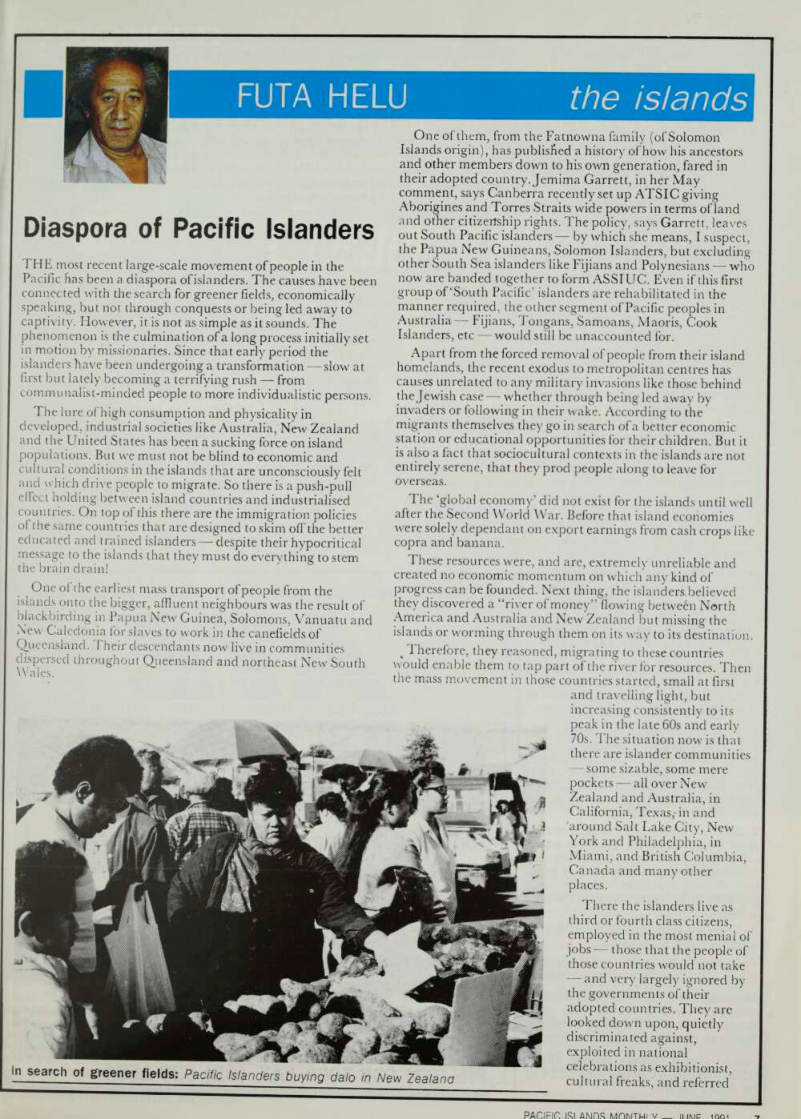
In search of greener fields: Pacific Islanders buying dalo in New Zealand
to as ‘coconuts’. Yet the islanders, especially the Polynesians, arc oblivious to this treatment.
However, the full fury of the animus usually levelled against Jews is avoided in the case of islanders mainly because they arc believed to possess very low IQs and do not represent a commercial or economic threat to the people of those countries. But at the same time their cultures are being dramatically changed or simply eroded by mere contact with stronger cultures abroad. Island cultures are weak because they are based on the morality of cooperation and friendliness that is so out of place in a dog eat dog environment. The church is the only institution that provides a context for the propagation and preservation of island culture.
And yet the churches batten on the meagre economic means of the islanders. Through annual donations, church appeals, cathedral development projects, and whatnot, they do not permit the poor migrants to become economically
independent.
The island migrants are a persecuted lot. In the social field they are encircled by hostile cultures. In the economic domain they are exploited by the churches. So far as I can see the only way for them to function with some measure of dignity is to give up their own cultures and adopt those of their new homes cultures that are based on individualism, thrift, acquisitiveness and independence. But they don’t have options, really. Environment and experience shall see that they embrace just those values.
The Pacific diaspora is quite extensive and its effect on island economies very significant. Though agricultural export could have been much higher, some island states are only able to stay economically afloat because of remittances from islanders who live abroad. Resources generated economically are miserable compared to foreign aid and remittances. All major development projects in the islands are aid-funded and at least 60 per cent of domestic
consumption expenditure in some countries is paid for by remittances.
There are more Niueans in New Zealand than Niue. The position in the Cooks is similar. Same for Samoans though their distribution is wider, with American Samoans concentrating in the United States (there are Samoans in Congress) and Western Samoans massing in New Zealand (it is predicted that a Samoan will be Prime Minister of that country within the next 20 years or so). The number of Tongans who live outside Tonga is close to that of Tongans who are still at home.
The Fijians were somewhat slow to join the exodus but since the coups more people have left Fiji for overseas. One can imagine the size of the capital transfers that such numbers can effect via different means. It is a source for lucrative business and ‘secondary’ (we must not say ‘parasitic’) commercial institutions like banks have already moved into
place.
The phase of the Return is already making an uncertain start. Many islanders go back home every year but only temporarily. They attend national celebrations, festivals and church conferences. They are regaled in feasts paid for by money they remitted to their feast-making relatives a case of earnings made in another country and consumed in another. But a few return for longer or for good.
These ‘Sephardic’ islanders set up businesses (most fail for lack of experience since they worked overseas only as factory hands) and some stand for parliament (here their failure is more pronounced because they are mostly with the wrong educational background and the electorate does not regard former factory hands as ideal material for parliamentary' work).
I believe, however, these shortcomings will soon be corrected and a real confrontation between them and the ‘Askenatzen’ who never left the home reefs will become normal fare. □
Advertisements & other items, pp. 7-9 (3 items)
7
PACIFIC, ISI AMDS MDMTMI V 111 MC iqoi
Pacific Islands Month! Y .Lijnf Iqqi
Offers Required
FOR SALE:
Tyler Refrigeration Supermarket Display Equipment. Used, but in excellent working condition. 1 and 2 manufactured by Macalpine Prestcold in New Zealand. 1. 36ft (3 x 3.6 m) Tyler model Afic frozen food display cabinets complete with 3 x 440 volt 3 phase compressors and automatic defrost equipment. All in first class working condition. Can be used together as at present, or separated into 3 individual units. 2. 24ft (2 x 3.6 m) Tyler model Arsh cold shelf display cabinets complete with 2 x 440 volt 3 phase compressors and automatic defrost equipment. In excellent working condition. Can be used together as at present or separated into 2 individual units. 3. 1 freezer room size 16ft x 12ft x 7ft complete with compressor. 4. 1 cool room/freezer room size 14ft x 12ft x Bft complete with compressor.
All units are available for immediate shipment to any Pacific Port. Both rooms in excellent working condition.
They can be dismantled for shipment.
Please Phone Tarawa, Kiribati (686) 21090 Or 21041 Or Fax (686) 21451 for future details.
AUSTRAL/LICS TRANSPORT EQUIPMENT
A Division of Bowater Tutt Ind. Pty Ltd (Inc in Vic) We are Australia’s largest Hydraulics Company.
Pumps, Motors, Valves, Cylinders, Truck Hoists, PTO/Pumps, Truck Cranes, Etc.
Top quality equipment at competitive prices.
If you are interested in becoming a partner with our firm, please contact:
MARK BOYLE
AUSTRALIAN HYDRAULICS COMPANY
2 SOUTH STREET
RYDALMERE NSW 2116
AUSTRALIA
PH: (02) 638-5000 FAX: (02) 638-1584
HD PIONEER
The Art of Entertainment
Stylish sjjjiJ Compact
In today's active society, a compact and modular Hi-Fi component stereo system is the perfect answer to home entertainment. The Contempo series gives you all you could ask for in both convenience and sound quality, as well as a stylish design that complements your living space.
Hi-Fi Compact System
in.» In spite of its compact design, Contempo is pack ed with a variety of high-tech features that prod uce high-quality sound in almost any listening s pace. Contempo'* specially engineered function s compensate for the loss of sound presence in I imited spaces. As a result, Contempo sound is c risp and clear, no matter where you are in the r oom. What's more. Pioneer Smart Operation c apabililies make the Contempo system simple to use. A touch of the START/SET button and I he system delivers quality hi-fi sound. Various Contempo models will suit almost anv taste with a choice erf Single, Twin and Multi-play CD capabilities. And all of the Contempo m odels employ 1-Bil DEC (Direct Linear Con version) technology for extremely high-qu ality sound. Add to this an ASES (Auto Sy nchroni/ed Editing System) provided on I he Double Auto-Reverse Cassette Deck th at lets you program Contempo to automat •rally create professional-sounding cassetl e recordings. All of this makes Contempo t he ideal personal entertainment system In spile of its compact design, Contempo is p at ked with a variety of high-tech features that produce bigh-qualifv sound in almos I any listening space. Contempo' sspecia lly engineered functions compensate for the lews of sound presence in limited sp aces. As a result, Contempo sound is cr isp and clear, no matter where you are in the room. What s more. Pioneer Sin art Operation capabilities make the C ontempo system simple to use. A touch of I he START/SET button and the sy stem delis ers quality hi-fi sound. Various Contempo models will suit almost any taste with a c hoice of Single, Twin and Multi-play CD capabilities. And all of the Contempo models employ 1 -Bit DEC (Direct li near Conversion) technology for e
xtremely high-quality sound. Add
to this an ASES (Auto Synchroni/
ed Editing System) provided on I
he Double Auto-Reverse Casse tte Deck that lets you progr am Contempo to automat ically creal professionalsounding cassette recor dings. All of this makes Contempo the ideal pe rsonal entertainment sy stem. In spite of its co
mpacl design, Contemp
ois packed with a variet y of high-tech features that produce high-quality sound in almost any listening space. Coni empo' s specially engineered functi ons compensate for the loss of sou nd presence in limited spaces. As a result, Contempo sound is crisp an d clear, no matter where you are in the room . What s more. Pioneer Smart Operation cap a bililies make the Contempo system simple to u se. A touch of the START/SET button and the sv stem delivers quality hi-fi sound. Various Conte mpo models will suit almost anv taste with a cho ice of Single, Twin and Multi-play CD capabilities And all of the Contempo models employ 1 -Bit D EC (Direct Linear Conversion) technology for evlr emely high-quality sound. Add to this an ASES (A ulo Synchronized Editing System) provided on f he Double Auto-Reverse Cassette Deck that let s you program Contempo to automatically ere
ate professional-sounding cassette recordings.
All of this makes Contempo the ideal personal e nterlainment -system. In spite of its compact des ign, Contempo is packed with a variety of high-l ech features that produce high-quality sound in almost any listening space. Contempo 's specially engineered functions compensate for the loss of sound presence in limited spaces. As a re suit, Contempo sound is crisp and clear, no matter where you are in the room.
What's more. Pioneer Smart Opera tion capabilities make the Conte mpo system simple to use. A t ouch of the START/SET b utton and the system
delivers quality
hi-fi sound.
Various Co nlempo models X-P77 305 W
(PMPO)
t i will suit almost anv taste with a choice of Singl e. Twin and Mulli-plav CD capabilities. And all of the Contempo models employ t-Bil DEC (Di rect Linear Conversion) technology for evtrem elv high-quality sound. Add to this an ASES (A ulo Synchronized Editing Syslemi provided o n the Double Auto-Reverse Cassette Deck th at lets you program Contempo to automatic ally create professional-sounding cassette r ecordings. All of this makes Contempo the ideal personal entertainment system. In sp ite of its compact design, Contempo is pa eked with a variety of high-tech features that produce high-quality sound in aim ost anv listening space. Contempo ssp eciallv engineered functions compensa te for the loss of sound presence in lim iled spaces. As a result, Contempo sou nd is crisp and clear, no matter where you are in the room. What s more, Pion
eer Smart Operation capabilities make t
he Contempo system simple to use. In s pile of its compact design, Contempo is pack ed with a variety of high-tech fea lures that produce high-quality sound i n almost anv listening space. Contemp o’s specially engineered functions com pensate for the loss of sound presence in limited spaces. As a result, Conte mpo sound is crisp and clear, no ma
For further information, please contact:
St D ralia i P ' o ?f er Electronics Australia Pty. Ltd. (Incorporated in Victoria) 178- 184 Boundary Road, Braeside Victoria 3195 Tel: 580-9911 Fiji Islands: Brijlal & Company, G.P.O. Box No. 362, Suva, Fiji Islands Tel: 22258 New Zea and: Monaco Corporation Ltd., 41 Poland Road, Glenfield, Auckland,
New Zealand Tel: (09)444-9144
Norfolk Island: Burnt Pine Traders Ltd., P.O. Box 21, Norfolk Island Vanuatu: Burns Philp (Vanuatu) Ltd., Vila, Vanuatu ■ 305 W (PMPO) ■ Digital sound field
processor ■ L.P.S. (Listening Point
Selector) ■ One-touch KARAOKE (Vocal
Cancel) ■ Sound jog dial for sound image
control and S.F.C. effect ■ Auto
Synchronized Editing System (A.S.E.S.)
ready ■ P.Bass (Power Bass)
* X-P55/X-PSSM (305 W PMPO), X-P33 (210 W PMPO) and X-Pll (200 W PMPO) Contempo models are also available.
Nauru Island: Jacob Enterprises, P.O. Box N 0.4, Republic of Nauru Tahiti: Tahiti Hi-Fi, P.O. Box 848, Papeete, Tahiti New Caledonia: Menard Pacifique Sari, B.P. 3899, Noumea, New Caledonia
Tel: 27-62-23
American Samoa: Transpac Corporation, P.O. Box 1477, Paqo Paqo American
Samoa 96799 Tel: 633-5224 9 ’
Rarotonge: South Seas International Ltd., P.O. Box 49, Rarotonga, Cook Iqjands
I ©I I
Return of the French
The Region
Ten years of Mitterand highlighted by Rocard’s reconciliation tour. Nicolas Rothwell reports from Paris.
AS President Francois Mitter rand celebrates a decade in power this month, politicians and diplomats in Paris re viewed the tumultuous changes in France’s Pacific policies during his first 10 years in power a period that included the Rainbow Warrior bomb ing, the killing on Ouvea in New Caledonia, and repeated political struggles in French Polynesia.
Mitterrand’s Prime Minister, Michael Rocard, resigned on May 15 and was replaced by Edith Cresson, but not before making a path-breaking “visit of reconciliation” to New Zealand at the end of April. The visit was a neat piece of symbolic timing, designed to repair relations between Paris and the govern ment in Wellington. Rocard’s journey was welcomed by New Zealand officials, who invited the then French Prime Minister to pay a visit to Akaroa, the village where French pioneers first dis embarked on New' Zealand soil in 1840.
For Rocard, wdio had been trying to build up a powder base as a potential
successor to Mitterrand, the Pacific is a special area of concern — the scene of his first great triumph in office, the Matignon Accords that paved the way
for peace in New Caledonia.
French commentators regard relations between Paris and Wellington as definitively restored, after the virtual break-down caused by the Rainbow warrior bombing by French agents in July 1985. Rocard went as. far as any French minister could conceivably go in
making a veiled public apology during
his visit, when he declared that “errors were made in the past”.
For the Prime Minister, who was not in office at the time of the affair, this was a simple concession to make. A certain doubt still surrounds Mitterand’s con nection with the affair; at the time, and ever since, he has denied any knowledge of the bombing, while responsibility was shouldered by the Minister of Defence of the day, Mr Charles Hernu. Rocard found his New Zealand hosts eager to accept his amends, and put relations between the two countries back on a smooth footing; but in France, there has been rather less rejoicing. Ordinary public opinion has never shown much remorse over the Rainbow Warrior affair, which was widely viewed as an operation mounted to protect France’s national security interests by warding Greenpeace’s protest vessel away from
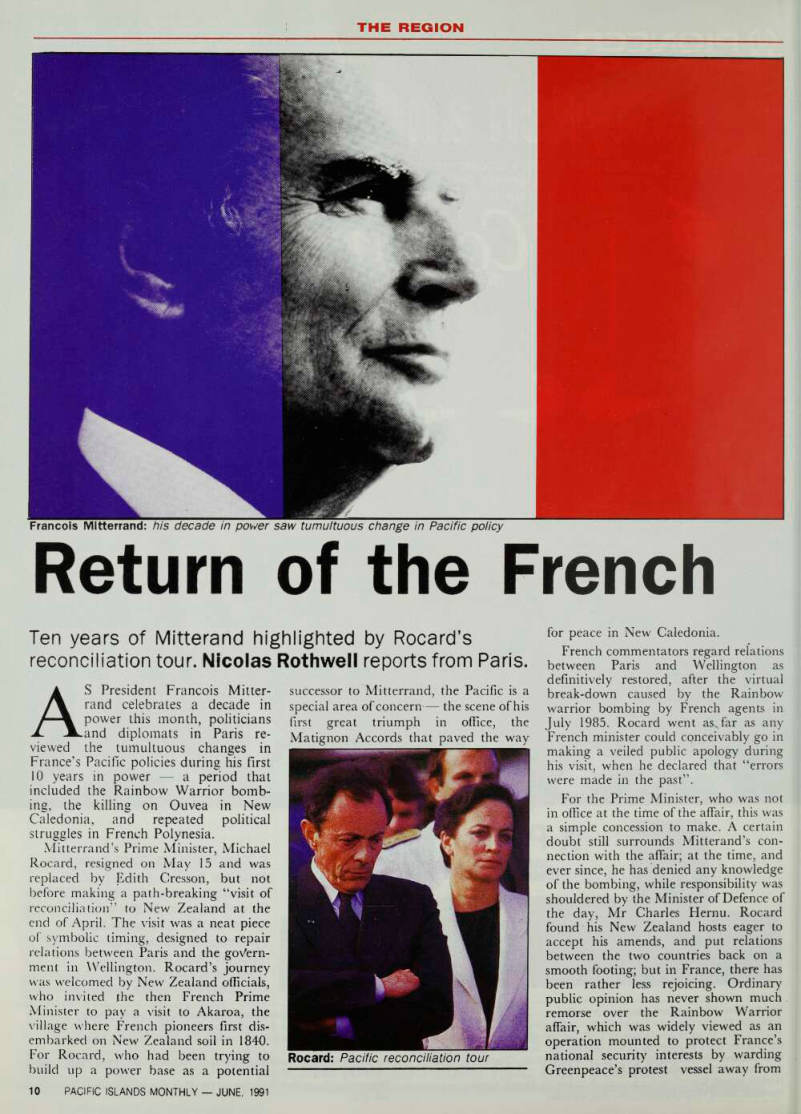
Francois Mitterrand: his decade in power saw tumultuous change in Pacific policy
Rocard: Pacific reconciliation tour
the nuclear test site at Moruroa. Conser vative critics of the Government were less than impressed by Rocard’s attempt to improve relations with Wellington: an editorial in the establishment newspaper, Le Figaro, caustically described Rocard as a “well-known masochist’ and ventured that if he was going to conduct himself in such an embarrassing manner while representing France overseas, he should resign. Rocard’s New Zealand hosts may be glad to have heard words of con trition, however measured, from a Paris official, but they remain less than happy with France’s continued nuclear testing in the Pacific. New Zealand’s Prime Minister, Jim Bolger, may have said that the two countries had agreed to disagree, and that “France and New Zealand must work more together to promote regional stability and development” but when France detonated its first warhead of the testing season under Moruroa barely a week after Rocard left Wellington, the reaction was one of predictable anger.
Rocard had made no attempt to hide the fact that France would continue its nuclear test programme which he stressed “posed no special danger either for New Zealand or for nearer islands”.
But the French decision to go ahead with testing gave a sharp indication that Paris still places its military program ahead of the sensitivities of its Pacific neighbours.
France’s Pacific policies also are un dergoing an intriguing evolution in its colonies. \\ hen President Mitterrand contested the 1988 elections against the
conservative candidate Jacques Chirac,
who was then Prime Minister, the status of New Caledonia was one of the key issues. On the eve of voting, Chirac ordered the storming of the Kanak militants on Ouvea in the Loyalty Islands an operation that failed to win him sufficient votes to dethrone his rival.
Since then, the prospects for the territory have oscillated, with the killing of Kanak leader Jean-Marie Tjibaou marking the low point on the journey towards greater autonomy and eventual independence.
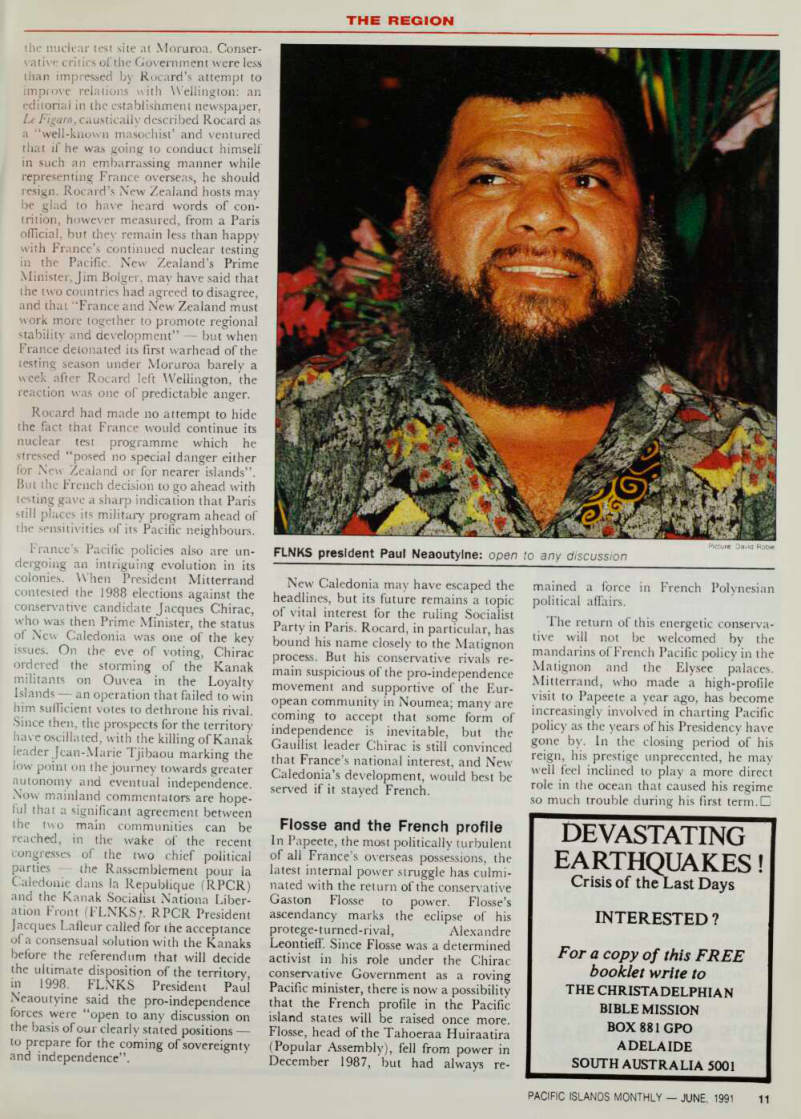
Now mainland commentators are hope ful that a significant agreement between the two main communities can be reached, in the wake of the recent congresses of the two chief political parties the Rassemblement pour la Caledonie dans la Republique (RPCR) and the Kanak Socialist Nationa Liber ation Front (i'LNKS;. RPCR President Jacques Lafleur called for the acceptance of a consensual solution with the Kanaks before the referendum that will decide the ultimate disposition of the territory in 1998. FLNKS President Paul
Neaoutyine said the pro-independence
forces were “open to any discussion on the basis of our clearly stated positions to prepare for the coming of sovereignty
and independence”.
New Caledonia may have escaped the headlines, but its future remains a topic of vital interest for the ruling Socialist Party in Paris. Rocard, in particular, has bound his name closely to the Matignon process. But his conservative rivals re main suspicious of the pro-independence movement and supportive of the Eur opean community in Noumea; many are coming to accept that some form of independence is inevitable, but the Gaullist leader Chirac is still convinced that France’s national interest, and New Caledonia’s development, would best be served if it stayed French.
Flosse and the French profile In Papeete, the most politically turbulent of all France’s overseas possessions, the latest internal power struggle has culmi nated with the return of the conservative Gaston Flosse to power. Flosse’s ascendancy marks the eclipse of his protege-turned-rival, Alexandre Leontieff. Since Flosse was a determined activist in his role under the Chirac conservative Government as a roving Pacific minister, there is now a possibility that the French profile in the Pacific island states will be raised once more.
Flosse, head of the Tahoeraa Huiraatira (Popular Assembly), fell from power in December 1987, but had always re
mained a force in French Polynesian
political affairs,
r , . • Thc " turn of , thls energetic conserva tlve ' vl .“ n ?‘ be , welcomed b X tbe " lanc lanns of I rench Pacific policy in the M atl g n °n and the Elysee palaces, Mitterrand, who made a high-profile VlSlt to . a P e ? te a e . a f a £° 5 bas >eco f ne involved in charting Pacific P ohc y as th e years of.his Presidency have gone b >/ In the closin § P eriod of his reign L pr , estlge unpreccntcd, he may , 1 . , mchned 10 P la ? a more direct ro e 111 tbe ocean th at caused his regime so much trouble during his first term.D
Picture David Robie FLNKS president Paul Neaoutyine: open to any discussion
Advertisements & other items, p. 11 (1 item)
Earthquakes!
DEVASTATING
Crisis of the Last Days
INTERESTED ?
For a copy of FREE booklet write to
THE CHRISTA DELPHIAN
BIBLE MISSION
BOX 881 GPO
ADELAIDE
SOUTH AUSTRALIA 5001
Superministry, super plans
By Al Prince
HOW to tackle Tahiti’s strug
gling and complex tourism
industry has been a major preoccupation of Gaston Flosse since he returned to power on April 4 as Territorial Government President, following the March 17 gen eral election.
As evidence of that concern, Flosse is the first president not to appoint govern ment cabinet ministers in charge of tourism and airline transportation.
Instead, he has created a sort of “superministry” at the presidency, which includes a few expert advisers like Alec Ata, who headed up Tahiti’s first tourist i board for many years then served as tourism minister in the late 19705.
Ironically, the optimistic goals of doubling Tahiti’s 1982 hotel capacity and yearly tourist volume began with the first of two Flosse governments, when Alexandre Leontieff was his tourism minister. The goals remained the same during Flosse governments from 1982-1987 and continued after Flosse resigned as president in February 1987.
Those goals continued after Leontieff bolted from Flosse’s party in November 1987, forced Flosse’s successor and loyal supporter Jacques Teuira to resign, and formed his own government, which lasted three years and four months before being defeated at the polls on March 17.
Thus, all that has changed over the past nine years has been the deadline for achieving 4000 hotel rooms and 200,000 tourists yearly in four to five years.
When reminded of that history, Flosse smiled and nodded his head affirmatively during an interview on May 16 with Pacific Islands Monthly. “We’ve come up with so many figures,” he said. “I don’t have any figures to give you.” He later agreed that 1500 quality rooms are
needed, although he did not fix a deadline.
He said the Government had been meeting with investors who had been told that, regardless of previous delays in government authorisations or any lack of push by the Leontieff government to realise tourism development projects, the Flosse government is ready to move quickly. One of the first things that will be done, he said, will be to improve Tahiti’s Investment Code without increased government financial aid but still assuring investors exactly how much government aid they will get.
Flosse claimed that under the Leontieff government investors were promised aid of up to 30 per cent of their investment,
The optimistic goals of doubling hotel capacity are the same as 1982
only to discover after final decisions that the amount was 12-15 per cent. “I don’t think things should be promised that aren’t kept,” Flosse said. He said Invest ment Code improvements would be presented to the Territorial Assembly for approval by the end of May or early June.
Listing his priorities for hotel develop
ment, Flosse first mentioned a two-phase, S3O-million expansion project to convert the 202-room Tahiti Beachcomber Parkroyal into a 322-room hotel in 18 months, making it the second largest hotel in the Territory after the 350-room Club Mediterranee village on Moorea.
Tahiti Beachcomber General Manager Philippe Brovelli later confirmed that this 120-room expansion project would start when the green light came from the
owner, Japanese investor Harunori Takahashi, the head of EIE Interna tional and the biggest Japanese hotel owner in the Territory.
Next on Flosse’s list was the $6-million renovation of the 200-room Hyatt Re gency Tahiti. The new Hyatt, also a Takahashi property, is destined to be Tahiti’s most deluxe hotel.
Massimo lanni, Hyatt’s general man ager, later confirmed that 75 renovated rooms, including the chain’s Regency Club, will be inaugurated on July 1.
Another 25 renovated rooms will be ready by September 1, with the final 100 ready by the end of this year, lanni said.
Work also will begin in mid-June, one to two months behind schedule, on the Territory’s first theme park recreation area opposite the hotel entrance. Spread over 43,057 square feet of land, it will be a sort of Fantasy Island on land overlooking the ocean. Completion date is by next January 1.
A third Takahashi-owned hotel, the 150-room Moorea Beachcomber Parkroyal, will finish most of a SI 1-million renovation and upgrade by mid-July.
The most controversial project on Flosse’s list is a SI 00-million, 250-room Sheraton Hotel and 18-hole golf course next to Oponohu Bay on Tahiti’s sister island of Moorea. This project was first proposed in December 1988 by Mitsuhiro Nishikawa, president of JIN Architectural Planners, Inc., of Tokyo, and president and board chairman of DOH Company, Ltd, of Tokyo.
Nishikawa apparently received the necessary authorisations from the Leontieff government last year, but work has been delayed by citizens groups on Moorea opposing the golf course planned for agricultural land leased from the Territorial Government.
Flosse said he had already met separ-
ately .with Nishikawa and some of the opposition groups at his presidential offices, and he and government members planned to go to Moorea on May 30 to “regulate this problem” so work could start.
Flosse s verbal list did not include an even more controversial Japanese project Advance Pacific Developments’ pro posal for a SI-billion tourist resort community with about 2000 rentable hotel, condominium and villa rooms, and a shopping centre on the privately owned atoll ofTupai, eight miles north northwest of Bora Bora. It would be the Territory s first self-contained public tourist resort community attracting a potential 160,000 tourists yearly with only a 75 per cent room occupancy rate. 1 his has been indefinitely delayed due to opposition from citizens groups on Bora Bora, A court order was needed last Near to evict squatters protesting the project on the atoll, nearly all of which is reportedly owned by Marcel Lejeune, one of Tahiti s first “notaires”, or solicitors.
Another delayed project is a SIO-million championship golf course next to the airport on Moorea, planned b\ California-based Bali Hai Corp., which owns three hotels and operates a fourth in french Polynesia. The Corp. announced last August plans to build the golf course, renovate the 63-room Moorea Bali Hai and reopen the 44-room Hotel Bali Hai on Huahine, which closed in November 1988 due to a labor dispute. Those plans were to be financed by new capital raised though American investors in the Bali Hai Corp.
But additional negotiations with poten tial Japanese investors since 1989 have yet to produce an agreement.
Flosse’s verbal list of projects also included an SBO-million, 440-room Hotel Meridien for what is known as the Rivnac property in Tahiti’s west coast Commune of Punaaui and a 2-300 room hotel by a Japanese group for the Tahiti Village property ne\t to the Meridien site. Meridien is also reportedly looking for investment to finance the construc tion of individual hotels on the islands of Moorea and Bora Bora.
Several hotel renovation and other expansion projects also are under way.
The biggest is a 535-million, 150-room new Club Mediterranee village on Bora Bora.
Although Tahiti may end up with Sheraton and Meridien, it also needs more chains, such as Hilton and Marriot, so that competition will increase promo tion, Flosse said. He also agreed that Tahiti would need to train more of its own people for hotel jobs. He said his Council of Ministers voted on May 15 to transfer an existing hotel training school to a new and bigger site with a capacity for 500 local students and 100 students from the South Pacific, but he also would look at training people overseas.
Besides hotel development, Flosse has been looking at increasing international airline service. He agrees that more hotels have to be built to attract more airlines, but he is attacking both prob lems simultaneously. He indicated a high priority was a US carrier serving Tahiti from the US mainland. Tahiti has not had such a carrier since Continental Airlines pulled out in October 1989 after
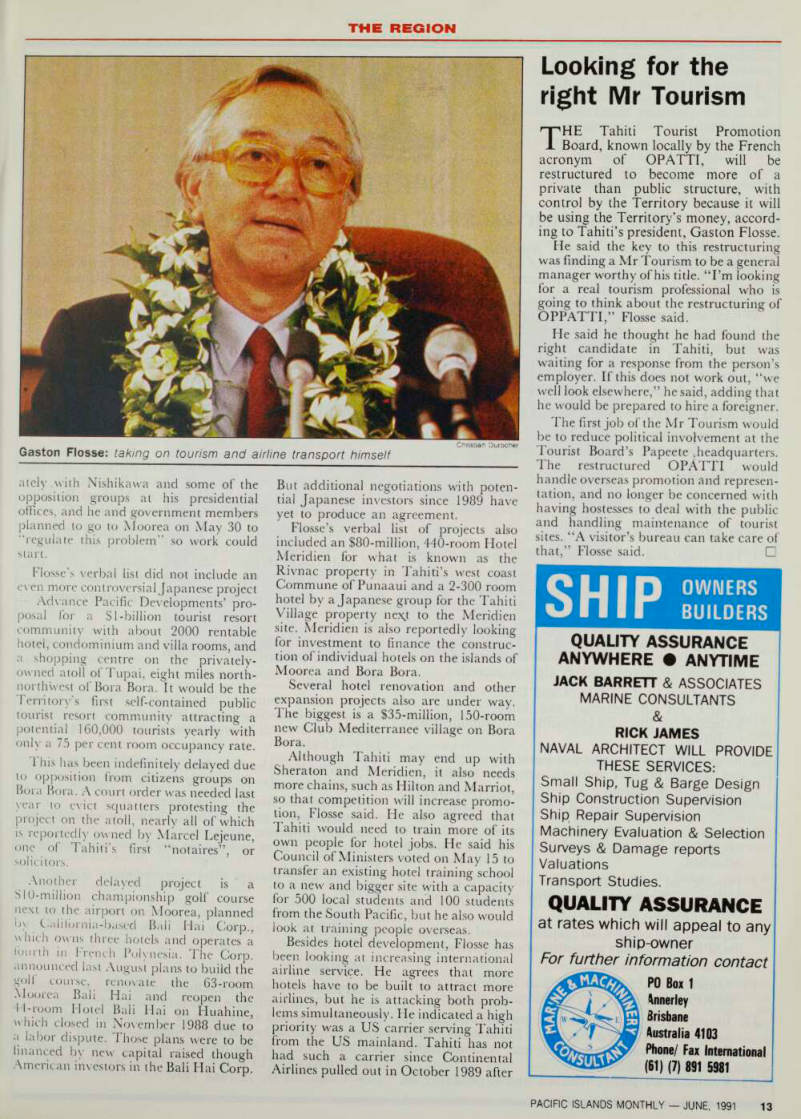
Christian Durocher Gaston Flosse: taking on tourism and airline transport himself
Advertisements & other items, p. 12 (1 item)
Ed’S Cocktail Bar
MARTINTAR NADI
Let ED’S Cocktail Bar give you a taste of the local nite life:- * Good Music; * Budget Priced Cocktails; * Happy Hours Daily 6 Bpm; * Tequila Nights; * Live Entertainments*
PHONE 790373 FOR MORE DETAILS
ED’S COCKTAIL BAR
a rea/tadte oft/ie Fijian T/ip/it/
TRANSMISSION HOUSE SEEKS ACTIVE DISTRIBUTORS
Gibson Battle is Australia’s largest independent power transmission house.
The product line includes; * Pulton Chains * GB Series 80 chains
* Cyclodrive gearboxes
* Leroy Somer shaft mounts * Cosmic Linear actuators * Shinko worm boxes and screw jacks Plus many more product lines.
Discount are generous and offer 24 hour service on ex stock lines.
If you are interested in working with Gisbon Battle, contact Nigel Ayres, Gibson Battle & Company, 2 South Street, Rydalmere. N.5.W2116 Australia with details of your company.
Looking for the right Mr Tourism
right Mr Tourism
THE Tahiti Tourist Promotion Board, known locally by the French acronym of OPATTI, will be restructured to become more of a private than public structure, with control by the Territory because it will be using the Territory’s money, accord ing to Tahiti’s president, Gaston Flosse, He said the key to this restructuring was finding a Mr Tourism to be a general manager worthy of his title. “I’m looking for a real tourism professional who is going to think about the restructuring of OPPATTI,” Flosse said.
He said he thought he had found the right candidate in Tahiti, but was waiting for a response from the person’s employer. If this does not work out, “we well look elsewhere,” he said, adding that he would be prepared to hire a foreigner.
The first job of the Mr Tourism would be to reduce political involvement at the Tourist Board’s Papeete The restructured OPATTI would handle overseas promotion and represen tation, and no longer be concerned with having hostesses to deal with the public and handling maintenance of tourist sites. “A visitor’s bureau can take care of that,” Flosse said. □
Advertisements & other items, pp. 13-14 (1 item)
Quality Assurance
OWNERS
BUILDERS
ANYWHERE • ANYTIME
JACK BARRETT & ASSOCIATES
MARINE CONSULTANTS
RICK JAMES
NAVAL ARCHITECT WILL PROVIDE
THESE SERVICES;
Small Ship, Tug & Barge Design Ship Construction Supervision Ship Repair Supervision Machinery Evaluation & Selection Surveys & Damage reports Valuations Transport Studies.
QUALITY ASSURANCE
at rates which will appeal to any ship-owner For further information contact & Australia 4103 Phone/ Fax International (61) (7) 891 5981 PO Box 1 Annerley Brisbane
(3D
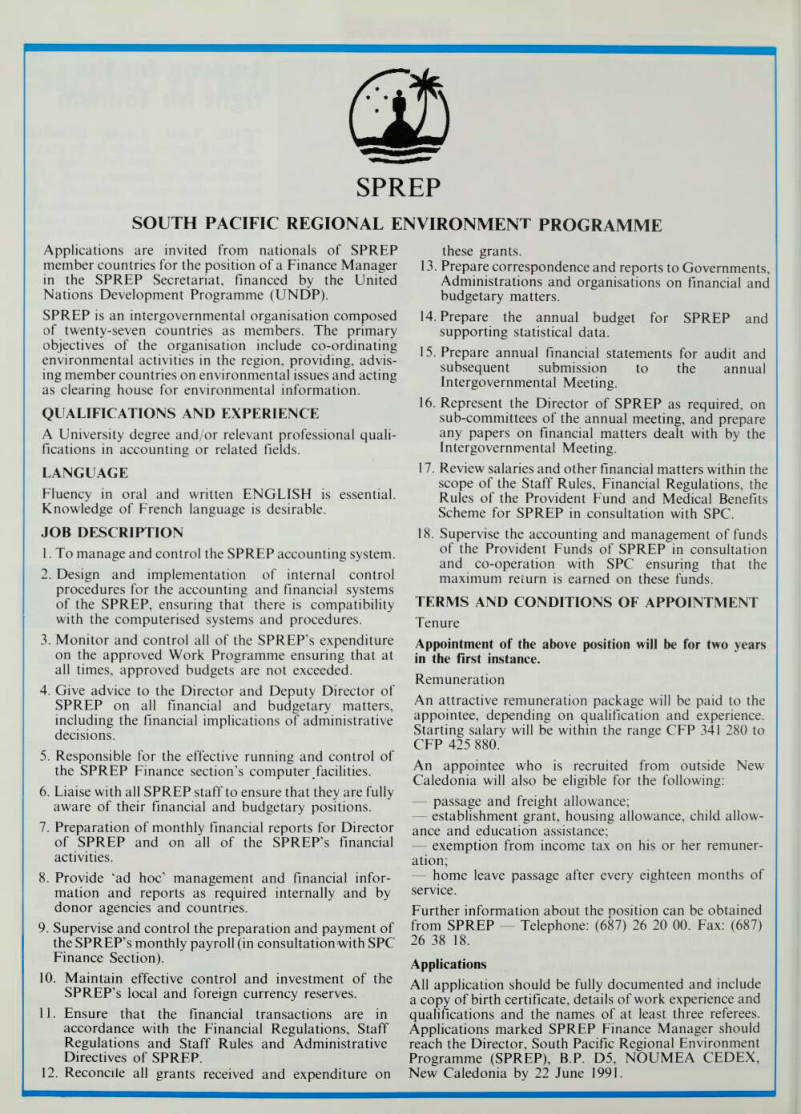
SPREP
SOUTH PACIFIC REGIONAL ENVIRONMENT PROGRAMME
Applications are invited from nationals of SPREP member countries for the position of a Finance Manager in the SPREP Secretariat, financed by the United Nations Development Programme (UNDP).
SPREP is an intergovernmental organisation composed of twenty-seven countries as members. The primary objectives of the organisation include co-ordinating environmental activities in the region, providing, advising member countries on environmental issues and acting as clearing house for environmental information.
QUALIFICATIONS AND EXPERIENCE
A University degree and/or relevant professional qualifications in accounting or related fields.
LANGUAGE
Fluency in oral and written ENGLISH is essential.
Knowledge of French language is desirable.
JOB DESCRIPTION
1. To manage and control the SPREP accounting system. 2. Design and implementation of internal control procedures for the accounting and financial systems of the SPREP, ensuring that there is compatibility with the computerised systems and procedures. 3. Monitor and control all of the SPREP’s expenditure on the approved Work Programme ensuring that at all times, approved budgets are not exceeded. 4. Give advice to the Director and Deputy Director of SPREP on all financial and budgetary matters, including the financial implications of administrative decisions. 5. Responsible for the effective running and control of the SPREP Finance section’s computer facilities. 6. Liaise with all SPREP staff to ensure that they are fully aware of their financial and budgetary positions. 7. Preparation of monthly financial reports for Director of SPREP and on all of the SPREP’s financial activities. 8. Provide ‘ad hoc’ management and financial information and reports as required internally and by donor agencies and countries. 9. Supervise and control the preparation and payment of the SPREP’s monthly payroll (in consultation with SPC Finance Section). 10. Maintain effective control and investment of the SPREP’s local and foreign currency reserves. 11. Ensure that the financial transactions are in accordance with the Financial Regulations, Staff Regulations and Staff Rules and Administrative Directives of SPREP. 12. Reconcile all grants received and expenditure on these grants. 13. Prepare correspondence and reports to Governments, Administrations and organisations on financial and
budgetary matters.
14. Prepare the annual budget for SPREP and supporting statistical data. 15. Prepare annual financial statements for audit and subsequent submission to the annual Intergovernmental Meeting. 16. Represent the Director of SPREP as required, on sub-committees of the annual meeting, and prepare any papers on financial matters dealt with by the
Intergovernmental Meeting.
17. Review salaries and other financial matters within the scope of the Staff Rules, Financial Regulations, the Rules of the Provident Fund and Medical Benefits Scheme for SPREP in consultation with SPC. 18. Supervise the accounting and management of funds of the Provident Funds of SPREP in consultation and co-operation with SPC ensuring that the maximum return is earned on these funds.
TERMS AND CONDITIONS OF APPOINTMENT
Tenure Appointment of the above position will be for two years in the first instance.
Remuneration An attractive remuneration package will be paid to the appointee, depending on qualification and experience.
Starting salary will be within the range CEP 341 280 to
CEP 425 880.
An appointee who is recruited from outside New Caledonia will also be eligible for the following: passage and freight allowance; establishment grant, housing allowance, child allowance and education assistance; exemption from income tax on his or her remuneration; home leave passage after every eighteen months of service.
Further information about the position can be obtained from SPREP Telephone: (687) 26 20 00. Fax: (687) 26 38 18.
Applications All application should be fully documented and include a copy of birth certificate, details of work experience and qualifications and the names of at least three referees.
Applications marked SPREP Finance Manager should reach the Director, South Pacific Regional Environment Programme (SPREP), B.P. D 5, NOUMEA CEDEX, New Caledonia by 22 June 1991.
Still trouble with tourism
TAHITI’S 30-year-old tourism de velopment history has been high lighted by almost never enough hotel rooms, international airline seats, tourists and money for overseas promo tion. And the Tahiti Tourist Board has been increasingly criticised by industry officials for being too politically oriented and not up to. overseeing or guiding French Polynesia’s biggest single private industry.
But a new problem has emerged in the
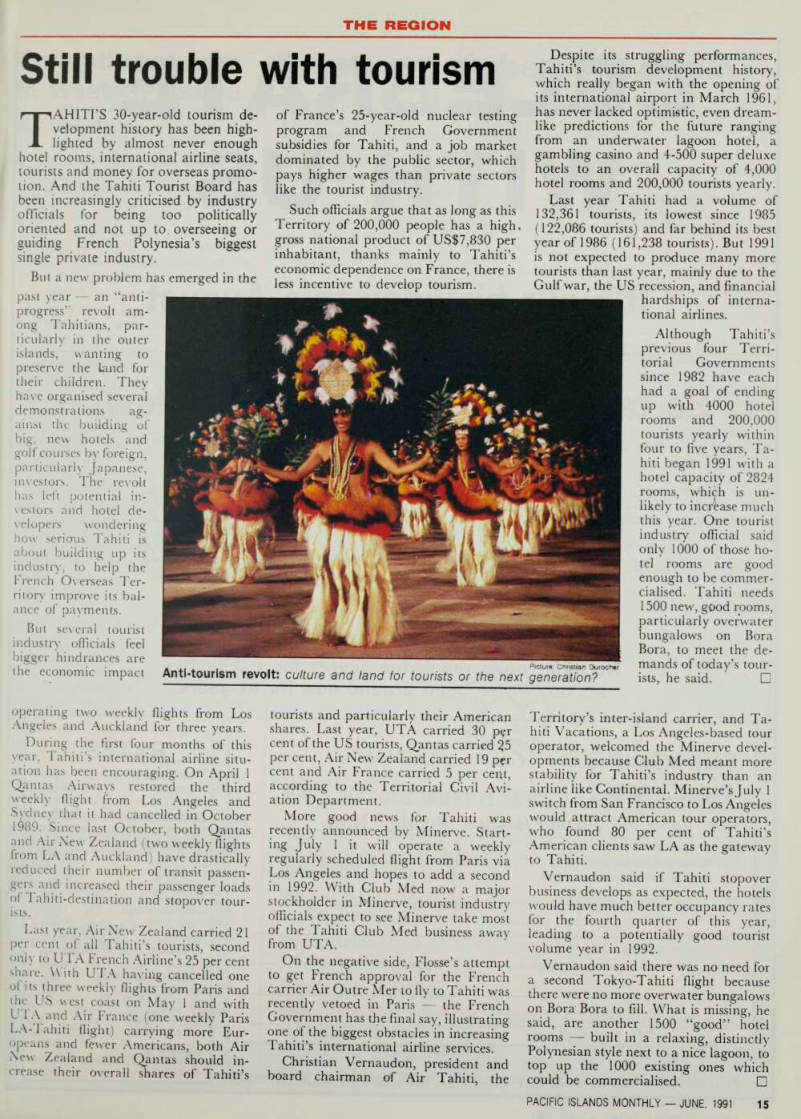
past year — an “anti progress’ ‘ revolt am ong Tahitians, par ticularly in the outer islands, wanting to preserve the land for their children. They have organised several demonstrations ag ainst the building of big, new hotels and golf courses by foreign, pa r tic u 1 ar 1 y Ja pan ese, investors. The revolt has left potential in vestors and hotel de
velopers wondering
how serious Tahiti is about building up its
industry, to help the
French Overseas Ter ritory improve its bal ance of payments.
But several tourist industry officials feel bigger hindrances are the economic impact
operating two weekly flights from Los Angeles and Auckland for three years.
During the first four months of this year, Tahiti’s international airline situ ation has been encouraging. On April 1 Qantas Airways restored the third weekly flight from Los Angeles and Sydney that it had cancelled in October 1989. Since last October, both Qantas and Air New Zealand (two weekly flights from LA and Auckland) have drastically reduced their number of transit passen gers and increased their passenger loads of Tahiti-destination and stopover tour ists.
Last year, Air New Zealand carried 21 per cent of all Tahiti’s tourists, second only to UIA French Airline’s 25 per cent share. With UTA having cancelled one ofits three weekly flights from Paris and ilie US west coast on May 1 and with UIA and Air France (one weekly Paris LA-Tahiti flight) carrying more Eur opeans and fewer Americans, both Air New Zealand and Qantas should in crease their overall shares of Tahiti’s
of France’s 25-year-old nuclear testing program and French Government subsidies for Tahiti, and a job market dominated by the public sector, which pay s higher wages than private sectors like the tourist industry. c ouch officials argue that as long as this Territory of 200,000 people has a high, gross national product of U 557,830 per inhabitant, thanks mainly to Tahiti’s econ . omic dependence on France, there is * less incentive to develop tourism.
tourists and particularly their American shares. Last year, UTA carried 30 cent of the US tourists, Qantas carried 25 per cent, Air New Zealand carried 19 per cent and Air France carried 5 per cent, according to the Territorial Civil Avi
ation Department.
More good news for Tahiti was recently announced by Minerve. Start ing July 1 it will operate a weekly regularly scheduled flight from Paris via Los Angeles and hopes to add a second in 1992. With Club Med now a major stockholder in Minerve, tourist industry officials expect to see Minerve take most of the Tahiti Club Med business away from UTA.
On the negative side, Flosse’s attempt to get French approval for the French carrier Air Outre Mer to fly to Tahiti was recently vetoed in Paris the French Government has the final say, illustrating one of the biggest obstacles in increasing Tahiti’s international airline services.
Christian Vernaudon, president and board chairman of Air Tahiti, the
Despite its struggling performances. its international airport in March 1961, has never lacked optimistic, even dream hke predictions for the future ranging rom ? n underwater lagoon hotel, a g am blmg casino and 4-500 super deluxe £otc s to an ° f 4 ’ 0 , 00 hotel rooms and 200,000 tourists yearly, Last year Tahiti had a volume of 132,361 tourists, its lowest since 1985 (122,086 tourists) and far behind its best year of 1986 (161,238 tourists). But 1991 is not expected to produce many more tourists than last year, mainly due to the Gulf war, the US recession, and financial
hardships of interna tional airlines.
Although Tahiti’s
previous four Terri torial Governments since 1982 have each had a goal of ending up with 4000 hotel rooms and 200,000 tourists yearly within four to five years, Ta hiti began 1991 with a hotel capacity of 2824 rooms, which is un likely to increase much this year. One tourist industry official said only 1000 of those ho tel rooms are good enough to be commer cialised. Tahiti needs 1500 new, good rooms,
particularly overwater
bungalows on Bora Bora, to meet the de mands of today’s tour ists, he said. □
Territory’s inter-island carrier, and Ta hiti Vacations, a Los Angeles-based tour operator, welcomed the Minerve devel opments because Club Med meant more stability for Tahiti’s industry than an airline like Continental. Minerve’s July 1 switch from San Francisco to Los Angeles would attract American tour operators, who found 80 per cent of Tahiti’s American clients saw LA as the gateway to Tahiti.
Vernaudon said if Tahiti stopover business develops as expected, the hotels would have much better occupancy rates for the fourth quarter of this year, leading to a potentially good tourist volume year in 1992.
Vernaudon said there was no need for a second Tokyo-Tahiti flight because there were no more overwater bungalows on Bora Bora to fill. What is missing, he said, are another 1500 “good” hotel rooms built in a relaxing, distinctly Polynesian style next to a nice lagoon, to top up the 1000 existing ones which could be commercialised. □
Picture: Christian Durocher Anti-tourism revolt: culture and land for tourists or the next generation?
Advertisements & other items, p. 16 (1 item)
Celebrate
WITH US
It’s our birthday this August
So take these special offers. Now.
15 magazines for the price of 12 32 magazines for the price of 24 This offer ends on August 31 No other news magazine covers the Pacific like we do. We’ve been around now for 61 years.
Post to; Pacific Islands Monthly, PO Box 1167, Suva, Fiji. OR fax: (679) 303809
SUBSCRIBE
NOW!
Yes, send me Pacific Islands Monthly. Now.
Please tick one box only O 15 months for the price of 12 CD 32months for the price of 24 L_j Here is a cheque/money order CH Debit my credit card, indicated below C] Visa L] Master Card Expiry Date Card Number Name Signature Address
Corruption claims
in Western Samoa
By Ulafala Aiavao
ELECTION petitions have been filed against 11 Western Samoan mem bers of Parliament who were elected in the country’s general elections on April 5.
They allege that corrupt or illegal practices on behalf of the 1 1 MP’s materially affected the result to the extent that the petitioners should have won instead.
Many of the allegations concern illegal distribution of food, drinks or money during a pre-election ban on such activity. Other claims are that some voters who cast ballots were not qualified to do so.
In one case, it is alleged that several hundred voter identity cards were col lected and kept as an act of bribery, which interfered with the independence oi voters. All voters had to present an official identity card before they were issued with a ballot paper.) More unusual allegations included claims that a small number of people cast v otes in the names of other voters, who, on election day, were either dead or overseas. Hearings in the Supreme Court begin in mid-May, and take priority over other court business. □
New faces for FSM
ON May II Bailey Olter of Pohnpei was elected to be the third FSM President and Jacob Nena of Kosrae the fourth \ ice President by the National Congress from among its four at-large members. Olter, 59, replaces John R.
Haglelgam of Yap who served one term beginning in 1987, after Olter, now FSM President. The 7th FSM Congress, meet ing on the first day of its First Regular Session, also elected Jack Fritz of Chuuk to serve as its Speaker. □
Tabai top of the polls again
Elections
I EREMIA Tabai kept the pundits
guessing last month when popular support returned him to parliament for the fourth time in a row. His re clection on May 8 most likely meant that he, as Kiribati’s founding President, had chosen to remain in his resource-poor republic for the next four years at least.
That may have dashed speculation he
was seeking well-paid jobs in regional
organisations available outside Kiribati.
One popular belief was that Tabai was seeking to be the next secretary general of the Forum Secretariat, currently held by former Tuvalu Deputy Prime Minis ter Henry’ Naisali. Naisali’s term expires at the end of the year and the job has been advertised. A candidate will be named at the Forum meeting in Ponape next month. In another interesting turn of events, the University of the South Pacific Council in Suva last month elected Tabai pro chancellor and chair man, effective from the first of this month. He replaces Naisali who held the positions for two terms from 1985.
Tabai is also coming to the end of his reign as President, a position he has held since independence on July 12, 1979.
Having served the maximum three terms allowed under the constitution, Tabai is expected to use his influence to push his friend Teatao Teannaki into the presi dency when the presidential national election is held on July 3. Both were re elected with ease and Tabai continues to
command majority support in parlia ment after last month’s two rounds of general elections.
The number of registered voters in creased by six per cent, indicating increased awareness of the importance of voting. The previous general elections in 1982 and 1987 recorded 70.3 per cent and 70 per cent respectively, total voters registered.
The election week (first round May 8 was highlighted by articles and an editorial in the Catholic monthly maga zine 7V Itoi m K iribati. The lead editorial suggested members of the Catholic church vote for a person of Catholic religion. The editor, Father Raymon Durrhcimer, said this would be appropri ate and right since there are more Catholic members than Protestants, in Kiribati. He bluntly criticised Tabai's government for not accepting funding application by one of the Catholic s institutes, calling for more shares for the catholic mission.
The Secretary for Home Affairs and Decentralisation (who looks after re ligion;. replied to the editorial over Radio Kiribati, expressing government feeling that it didn't want the Catholic magazine carrying misleading reports.
The former Minister for Education.
Ataraoti Bwebweniburc and Tckinaiti Kaiteie, the former Minister for the Line and Phoenix groups, were both defeated, and 13 former MPs lost their seats. C
Advertisements & other items, p. 17 (2 items)
X
YY
MANUKAU POLYTECHNIC
HAVE YOU GOT WHAT IT TAKES TO BE A JOURNALIST?
Mcinukau Polytechnic in Auckland has trained most of the Pacific Island journalists working in New Zealand, and many who work in the Pacific re taking applications now for the next intake of the raciiic Islands Journalism course.
Applications close on 31 October, and the course begins in rebruary 1992.
For details write to: The Secretary. Pacific Islands Journalism Course Manukau Polytechnic, P O Box 61-066, Otara Auckland, New Zealand.
Dhl It!
HOW ON EARTH AM I GOING TO TAKE
ALL THIS HOME ?
DHL has years of experience carefully packing and shipping Fiji’s outstanding works of art directly to your home doorstep.
Our reputation has been built on caring for your valuables Don't take chances, phone us we re here to help.
Just call DHL we ll do the rest
SUVA
313166 313149 WOOLOWKX express
Deal

Special
Tourism Report
The year of the Big Deal
By Beryl Cook
THE South Pacific must start wheeling and dealing hard in the high-flying world of tourism, to keep hold of the wings of tourism. The econ
omic downturn in major source countries for Pacific tourism and agggressive price cutting overseas has forced us to accept that this year will be, without question, The Year of the Big Deal.
Fiji hotels (widely accepted as tourism leaders for the South Pacific) are already feeling the pinch, with occupancy rates as low as 18 per cent in recent months.
Fiji Hotels Association (FHA) chief executive Kevin Mutton made it clear the worst is yet to come, when he advised the Government at the May Economic Summit that the association had revised its earlier 5 per cent estimate for the 1991 downturn, to 30 per cent.
“The message is quite clear: ‘We have to get off our bums and do something urgently or we will really be in trouble’,”
Mutton told Pacific Islands Monthly.
Individual hotels started dabbling in deals such as “Pay six nights and stay seven” months ago, and Air Pacific launched special fares such as SlO per year of age for accompanying children flying from Australia. The special airfares brought hotel occupancy rates up during March, but they plunged once the fares stopped. The hotels have been keen to blame airfares, while Air Pacific has diplomatically declined from point ing out that our range of accommodation and meal prices are higher than competi tors in Asia, Bali and Hawaii. Help from airlines throughout the region may be
limited they have all been hard hit (see article on page 23) and Air Pacific has been granted fare rises of up to 15 per cent from May 15 on most international destinations to cover expected rising costs. (Australian and New Zealand fares were not expected to be affected.) For now, a joint strategy has been adopted following an emergency meeting of Fiji’s hoteliers, airline officials, the Society of Fiji Tavel Agents and the Tourism Council of the South Pacific (TCSP) in Suva on May 15. Air Pacific has introduced a return airfare of 5499 from Australia (undercutting standard low-season economy fares by up to 5343), which is effective from June 7 until December (excluding school holidays ex- Sydney and Melbourne but not Bris bane) and available only with accommo dation packages. Hotels have added “Pay five days stay seven” and “Pay 10 days, stay 14” to make up packages they say could save an Australian couple about 44 per cent. Whether this will be enough remains to be seen.
The region has the natural attractions and reputation, and key players such as the TCSP will be marketing this aggressively. According to TCSP direc tor and chairman of the Fiji Tourism Convention Planning Committee, Malakai Gucake: “Emphasis will be on increasing the South Pacific’s awareness of new markets, and adding emphasis to traditional markets.”
Trade shows in the United States, Australia and London will be targeted.
Organisers of the Tourism Convention at the Sheraton from June 13-15 also have added marketing heavies to the list of speakers, including European tourism industry economist and marketing con sultant Esmond Devas, and Wilf Barker Australian Marketing Man of the Year 1985, former marketing director for Australia’s Nine and TEN networks, and former chairman of the Federation of Australian Television Stations, the Aus tralian Media Council, and the Advertis ing Industry Association.
Sales and Marketing Director for The Fiji Visitors Bureau, Bill Whiting, also
Cost-cutting competition: tourists want more than pretty smiles and swaying palms
believes it is time to face the harsh realities of the challenges ahead.
No-one was likely to be lulled by the record results for 1990, he said. (The number of visitors reached a record 278,996 an 11 per cent increase from 1989 to 1990; and gross earnings from tourism had been estimated provisionally at a record 5335.9 million compared with 5295.5 million in 1989).
Whiting said the biggest challenge for
Fiji (and therefore the region) would be the Australian market.
“The situation there right now is the most competitive, the most difficult that we’ve faced for many many years. The recession is tough, the competition is tough,” Whiting said. “We’ve got a good product and they’re still interested in it.
But everybody there is asking ‘What’s the deal to Fiji? What’s the fare?’, because the whole market is being motivated by deals. Whether you want to go to Melbourne or London and return, it’s all got a special deal attached to it. The whole market is deal-orientated and we have to be conscious of that.”
Whiting said overall performance for the next 12 months would be affected by the Australian crisis, and “how long we l*, , ; O see this crazy pricing going on”
Airline deals could be crucial.
“Some of those airlines must be really hurting, having to live with higher fuel prices, but they are offering incredible deals. I think we can compete with what is being offered in Australia, but a lot depends on how the airlines handle their fare structures,” Whiting said.
The South Pacific is facing the re cession in Australia, increased domestic competition in Australia through de regulation of internal airlines, and com petitive pricing by Australian resorts.
“On top of that, in terms of (Austra lian) outbound tourists, we have an excess of capacity on the Australia/ United States route,” Whiting said.
A ou have the northwest coming on soon with another four to five flights a week, so there is stiff competition.
“Similarly, Bali in the last year or 18 months have added about 8000 hotel rooms and you have competitive price
marketing there.”
Hawaii, Bali and Thailand are cost cutting e.g. Hawaii offered return fare and five nights accommodation for 5799.
Whiting said Fiji depended on Austra
lia for about 36 per cent of its visitors, but Australians stay longer so they represent about 47 per cent of Fiji’s tourisiti income.
“If we have a problem in Australia,
Fiji tourism has a prob lem,” he said. “We have to be competitive, we have to be able to hang in there, we have to accept that for some months we may have to live with lower yields from that market until it recovers, and until we decrease our dependence on that mar ket. What deals we can offer will directly affect how well we do.”
Other markets Whiting said the Bureau would look at new mar kets and expanding exist ing ones, while ensuring not too much ground was lost with Australia.
The US market held up better last year than the Bureau expected, and enormous potential had been identified in the United Kingdom and
Europe.
“Our UK/Europe ar rivals last year were in excess 0f40,000. We have to work on developing
those markets. We haven’t done much on them in the past and one of our targets from the Bureau’s point of view is to put more effort into increasing the business there, and decreasing our dependence on the short haul market from Australia.”
New Zealand: The Bureau is expect ing about the same from New Zealand as 1990, despite a tough economic climate.
Canada: Despite the fact Canadian Airlines is no longer senicing the route, the Bureau views the airline’s seat share arrangement with Qantas as evidence of
its commitment to Fiji. The Bureau also is finalising a 12 month-marketing pro gram with them, and has just opened an office there. Despite economic problems, (Canada was introducing a General Sales Tax on January 1), Canada should perform reasonably well in the next 12 months.
United States: Americans have
slowly started travel ling again after the Gulf crisis, but the impact is hard to read.
Australia in particu lar is pitching hard in North America, so the Bureau is maximising marketing there by
linking Fiji to Austra
lia and New Zealand with a campaign theme: ‘On his way to Australia, God created
Fiji.’
“If we can market Fiji as an essential part of a visit to the South Pacific we stand to
grow,” Whiting said.
Europe: * Con sidered extremely promising. The unifi cation of Germany in creased the potential market for three or four years time.
Scandinavia and the United Kingdom are sources, and Switzer land and Italy are growing. The Bureau
would like air links improved, but the potential is promising. Joint marketing with Australia and New Zealand is being used, and the Bureau is also using Tourism Council of the South Pacific representatives in London and Munich for Europe and the United Kingdom.
Between them they cover all of Europe.
Japan; Air Pacific started its second service on April 25, and the Bureau is expecting significant growth despite a slow start. Whiting said possible air links with Taiwan and South Korea rep resented medium-term potential. □
Mutton: worse to come
Gucake: push for marketing
Ecotourism
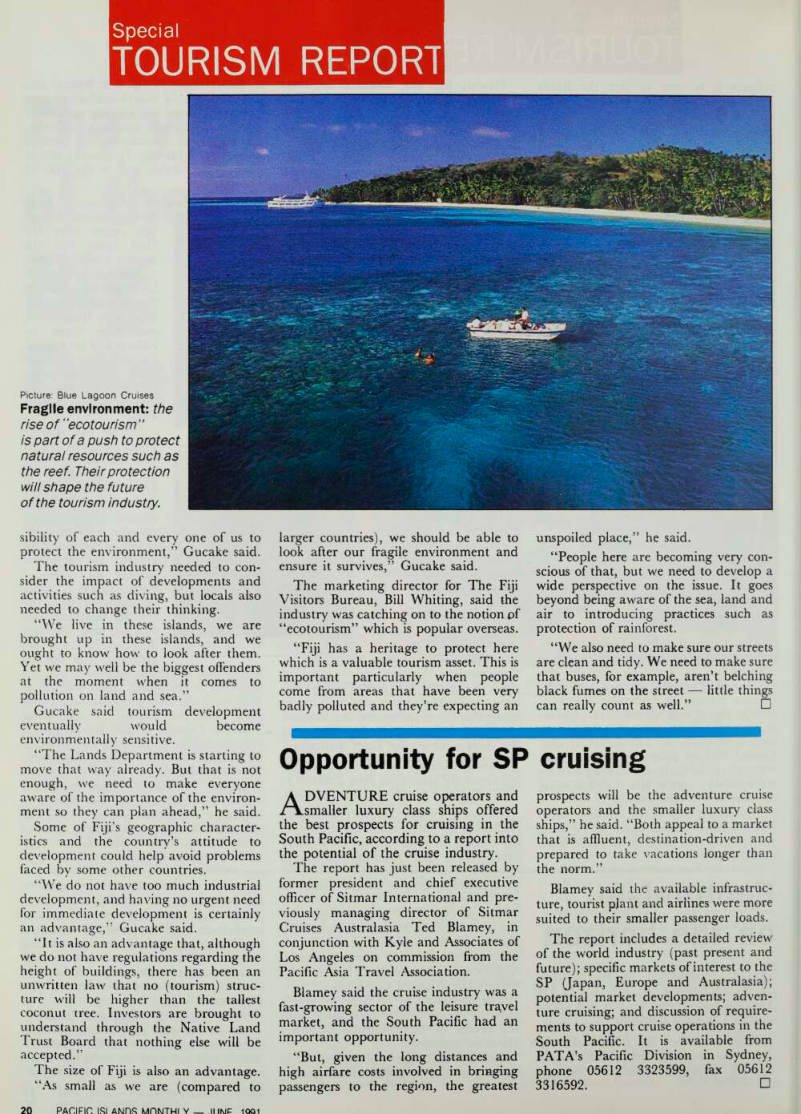
on the horizon
THE introduction of an environ mental , aspect to the 1991 Fiji Tourism Convention reflects this year’s theme, The New Horizon.
Tourism bodies are being asked to adjust the extent of their vision; to look beyond short-term considerations and
plan ahead to protect natural resources for the future.
The director of the Tourism Council of the South Pacific, Malakai Gucake, said one of the key speakers at this year’s convention would be vice-president of Science and Education for The Cousteau Society, Dr Richard C. Murphy.
The invitation to Dr Murphy was a move by the convention committee to lift the profile of environmental consider ations in tourism.
Gucake said the industry had to develop an understanding of how protec
tion of the environment now was protec tion of a long-term tourism industry.
Fiji was renowned for its natural attractions, and the demand for these was increasing, he said. But many locals still did not seem to be aware of the need to protect the environment, and many investors did not seem to understand the importance of it.
“It is crucial to a long-term industry.
If we do not take care of our environ ment, our natural attractions, then we simply will not have an industry. If we want a future in tourism it is the respon-
sibility of each and every one of us to protect the environment,” Gucake said.
The tourism industry needed to con sider the impact of developments and activities such as diving, but locals also needed to change their thinking.
“We live in these islands, we are brought up in these islands, and we ought to know how to look after them.
Yet we may well be the biggest offenders at the moment when it comes to pollution on land and sea.”
Gucake said tourism development eventually would become
environmentally sensitive.
“The Lands Department is starting to move that way already. But that is not enough, we need to make everyone aware of the importance of the environ ment so they can plan ahead,” he said.
Some of Fiji’s geographic character istics and the country’s attitude to
development could help avoid problems
faced by some other countries.
“We do not have too much industrial development, and having no urgent need for immediate development is certainly an advantage,” Gucake said.
“It is also an advantage that, although we do not have regulations regarding the height of buildings, there has been an unwritten law that no (tourism) struc ture will be higher than the tallest coconut tree. Investors are brought to understand through the Native Land Trust Board that nothing else will be accepted.”
The size of Fiji is also an advantage.
“As small as we are (compared to
larger countries), we should be able to look after our fragile environment and ensure it survives,” Gucake said.
The marketing director for The Fiji Visitors Bureau, Bill Whiting, said the industry was catching on to the notion pf “ecotourism” which is popular overseas.
“Fiji has a heritage to protect here which is a valuable tourism asset. This is important particularly when people come from areas that have been very badly polluted and they’re expecting an
unspoiled place,” he said.
“People here are becoming very con scious of that, but we need to develop a wide perspective on the issue. It goes beyond being aware of the sea, land and air to introducing practices such as protection of rainforest.
“We also need to make sure our streets are clean and tidy. We need to make sure that buses, for example, aren’t belching black fumes on the street little things can really count as well.” □
Picture: Blue Lagoon Cruises Fragile environment: the rise of “ecotourism” is part of a push to protect natural resources such as the reef. Their protection will shape the future of the tourism industry.
Opportunity for SP cruising
A DVENTURE cruise operators and /\smaller luxury class ships offered the best prospects for cruising in the South Pacific, according to a report into the potential of the cruise industry.
The report has Just been released by former president and chief executive officer of Sitmar International and previously managing director of Sitmar Cruises Australasia Ted Blarney, in conjunction with Kyle and Associates of Los Angeles on commission from the Pacific Asia Travel Association. t*, , . A . r Blame X sald the c ™' s f; mdust y was a fast jS rowm g se . ct " of ' he p •**“! (^ vei f nar ket, and the bouth racitic had an important opportunity.
“But, given the long distances and high airfare costs involved in bringing passengers to the region, the greatest
prospects will be the adventure cruise operators and the smaller luxury class ships,” he said. “Both appeal to a market that is affluent, destination-driven and prepared to take vacations longer than the norm.”
Blarney said the available infrastruc tourist ]am and a i r ii nes were more suited tQ their sma n er passenger loads, The report includes a detailed review °f the world industry (past present and future); specific markets of interest to the SP (Japan, Europe and Australasia);
potential market developments; adven
tore cruising; and discussion of require ments to support cruise operations in the South Pacific. It is available from PATA’s Pacific Division in Sydney, phone 05612 3323599, fax 05612 3316592. O
Advertisements & other items, p. 20 (1 item)
Tourism Report
20
Special
PACIFIC ISI AMDS MONTH! Y II IMP IQQI
Cultural cure for high-cost holidays
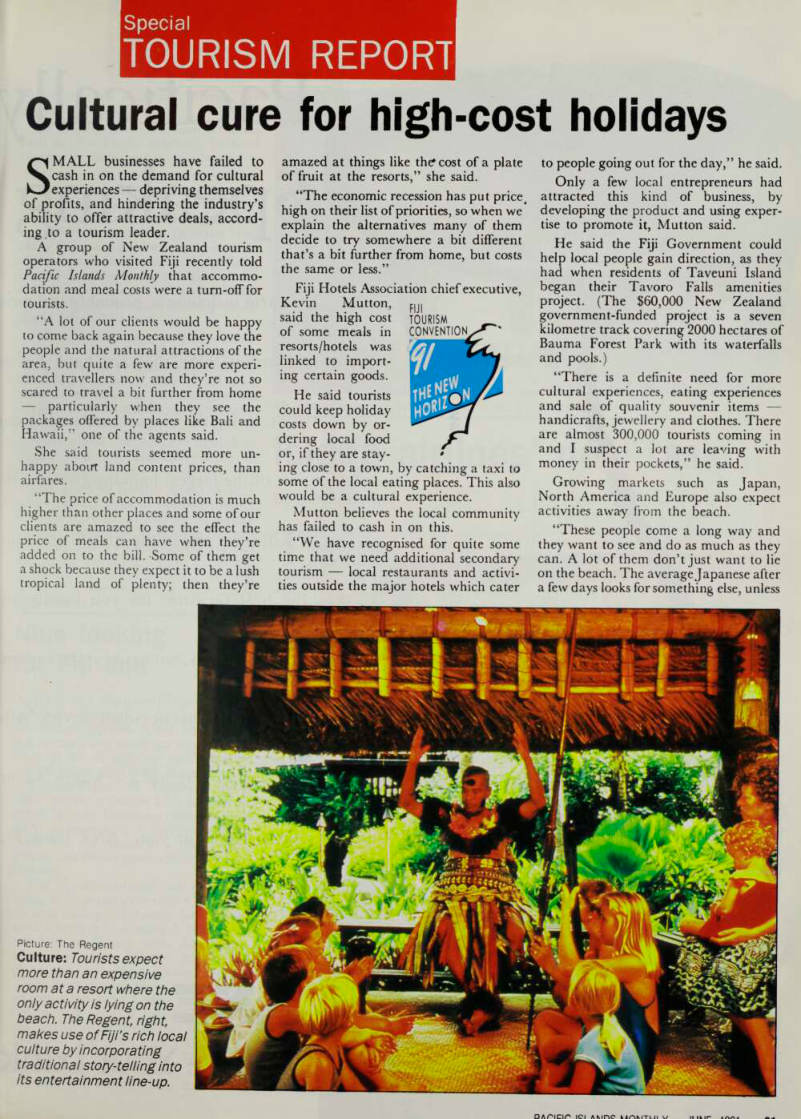
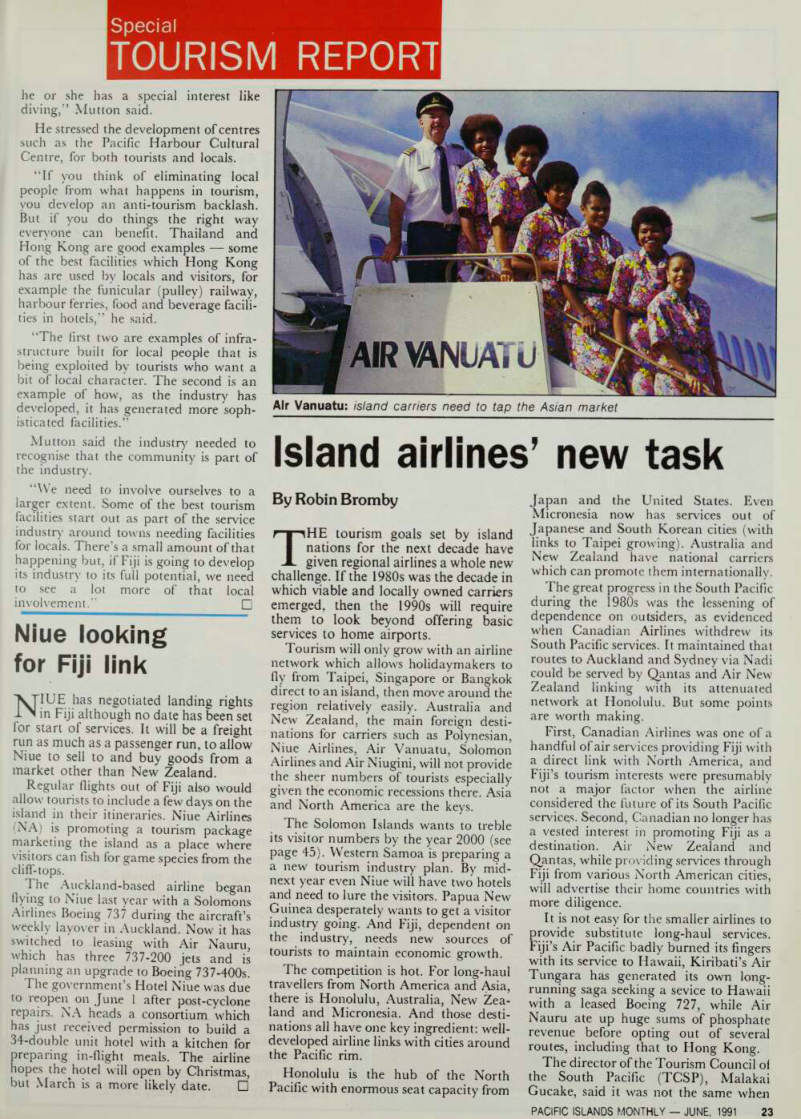
SMALL businesses have failed to cash in on the demand for cultural experiences depriving themselves of profits, and hindering the industry’s ability to offer attractive deals, accord ing to a tourism leader.
A group of New Zealand tourism operators who visited Fiji recently told Pacific Islands Monthly that accommo dation and meal costs were a turn-off for tourists.
“A lot of our clients would be happy to come back again because they love the people and the natural attractions of the area, but quite a few r are more experi enced travellers now and they’re not so scared to travel a bit further from home particularly when they see the packages offered by places like Bali and Hawaii,” one of the agents said.
She said tourists seemed more un happy about land content prices, than airfares.
“The price of accommodation is much higher than other places and some of our clients are amazed to see the effect the price of meals can have when they’re added on to the bill. Some of them get a shock because they expect it to be a lush tropical land of plenty; then they’re
amazed at things like thef cost of a plate of fruit at the resorts,” she said.
“The economic recession has put price, high on their list of priorities, so when we explain the alternatives many of them decide to try somewhere a bit different that’s a bit further from home, but costs the same or less.”
Fiji Hotels Association chief executive,
Kevin Mutton, said the high cost of some meals in resorts/hotels was linked to import ing certain goods.
He said tourists could keep holiday costs down by or dering local food or, if they are stay-
ing close to a town, by catching a taxi to some of the local eating places. This also would be a cultural experience.
Mutton believes the local community has failed to cash in on this.
“We have recognised for quite some time that we need additional secondary tourism local restaurants and activi ties outside the major hotels which cater
to people going out for the day,” he said.
Only a few local entrepreneurs had attracted this kind of business, by developing the product and using exper tise to promote it, Mutton said.
He said the Fiji Government could help local people gain direction, as they had when residents of Taveuni Island began their Tavoro Falls amenities project. (The $60,000 New Zealand government-funded project is a seven kilometre track covering 2000 hectares of Bauma Forest Park with its waterfalls and pools.) “There is a definite need for more cultural experiences, eating experiences and sale of quality souvenir items handicrafts, jewellery and clothes. There are almost 300,000 tourists coming in and I suspect a lot are leaving with money in their pockets,” he said.
Growing markets such as Japan, North America and Europe also expect activities away from the beach.
“These people come a long way and they want to see and do as much as they can. A lot of them don’t just want to lie on the beach. The averagejapanese after a few days looks for something else, unless
Picture: The Regent Culture: Tourists expect more than an expensive room at a resort where the only activity is lying on the beach. The Regent , right, makes use of Fiji’s rich local culture by incorporating traditional story-telling into its entertainment line-up.
he or she has a special interest like diving,” Mutton said.
He stressed the development of centres such as the Pacific Harbour Cultural Centre, for both tourists and locals.
“If you think of eliminating local people from what happens in tourism, you develop an anti-tourism backlash.
But if you do things the right way everyone can benefit. Thailand and
Hong Kong are good examples some
of the best facilities which Hong Kong has are used by locals and visitors, for
example the funicular (pulley) railway,
harbour ferries, food and beverage facili ties in hotels,” he said.
“The first two are examples of infra structure built for local people that is being exploited by tourists who want a bit of local character. The second is an example of how, as the industry has developed, it has generated more soph isticated facilities.”
Mutton said the industry needed to recognise that the community is part of
the industry.
“We need to involve ourselves to a larger extent. Some of the best tourism facilities start out as part of the sendee industry around towns needing facilities for locals. There’s a small amount of that happening but, if Fiji is going to develop its industry to its full potential, we need to see a lot more of that local involvement.” □
Advertisements & other items, pp. 21-22 (2 items)
Special
TOURISM REPORT
Pacifically
A warm welcome is probably the most! important thing that any bank has to offer. Being the biggest bank in Fiji and part of the largest banking group in the Pacific may give us the edge in providing the best facilities for you locally and internationally, but never at the expense of our individual personal service. Afte all, that is why we are where we are today. Here for you, ANZ Bank Fiji.
Your bank.
Fiji-Your bank
Niue looking
for Fiji link
NIUE has negotiated landing rights
in Fiji although no date has been set for start of services. It will be a freight run as much as a passenger run, to allow Niue to sell to and buy goods from a market other than New Zealand.
Regular flights out of Fiji also would allow tourists to include a few days on the island in their itineraries. Niue Airlines (NA) is promoting a tourism package marketing the island as a place where visitors can fish for game species from the cliff- tops.
The Auckland-based airline began flying to Niue last year with a Solomons Airlines Boeing 737 during the aircraft’s weekly layover in Auckland. Now it has switched to leasing with Air Nauru, which has three 737-200 jets and is planning an upgrade to Boeing 737-400 s.
The government’s Hotel Niue was due to reopen on June 1 after post-cyclone repairs. NA heads a consortium which has just received permission to build a 34-double unit hotel with a kitchen for preparing in-flight meals. The airline hopes the hotel will open by Christmas, but March is a more likely date. □
Island airlines’ new task
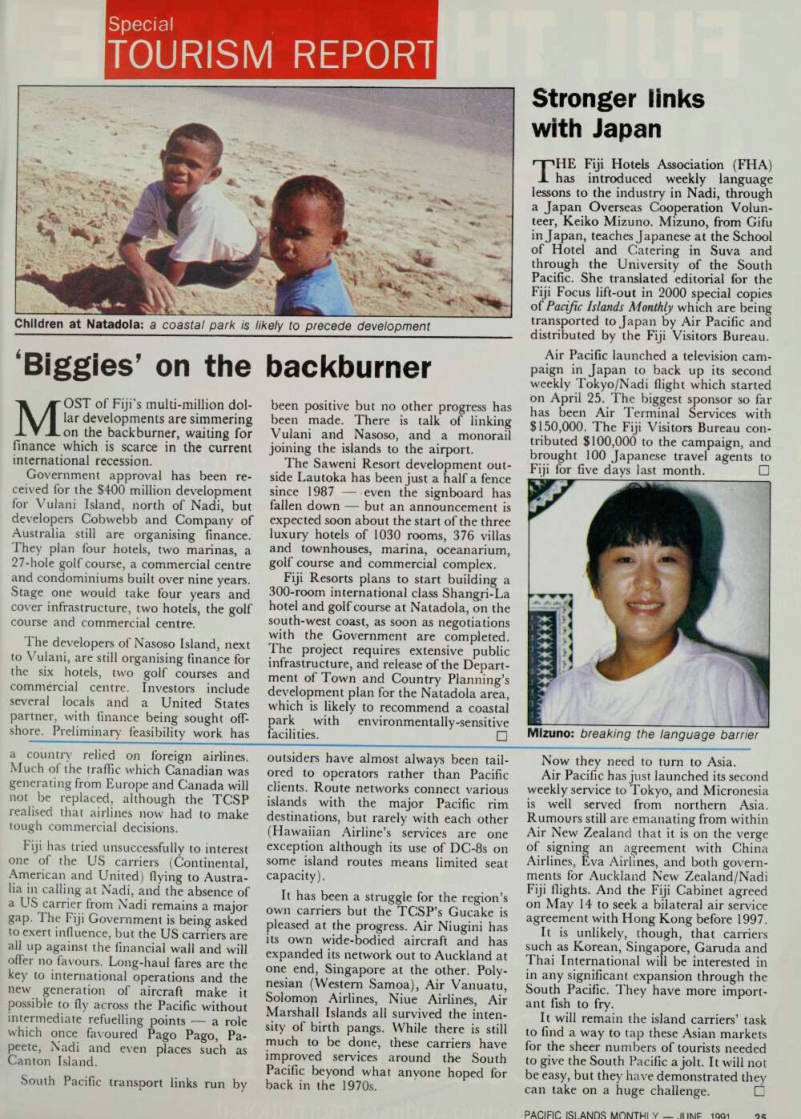
By Robin Bromby
THE tourism goals set by island nations for the next decade have given regional airlines a whole new challenge. If the 1980 s was the decade in which viable and locally owned carriers emerged, then the 1990 s will require them to look beyond offering basic services to home airports.
Tourism will only grow with an airline network which allows holidaymakers to
fly from Taipei, Singapore or Bangkok
direct to an island, then move around the region relatively easily. Australia and New Zealand, the main foreign desti nations for carriers such as Polynesian, Niue Airlines, Air Vanuatu, Solomon Airlines and Air Niugini, will not provide the sheer numbers of tourists especially given the economic recessions there. Asia and North America are the keys.
The Solomon Islands wants to treble its visitor numbers by the year 2000 (see page 45). Western Samoa is preparing a a new tourism industry plan. By mid next year even Niue will have two hotels and need to lure the visitors. Papua New Guinea desperately wants to get a visitor industry going. And Fiji, dependent on the industry, needs new sources of tourists to maintain economic growth.
The competition is hot. For long-haul travellers from North America and Asia, there is Honolulu, Australia, New Zea land and Micronesia. And those desti nations all have one key ingredient: well developed airline links with cities around the Pacific rim.
Honolulu is the hub of the North Pacific with enormous seat capacity from
Japan and the United States. Even Micronesia now has services out of Japanese and South Korean cities (with links to Taipei growing). Australia and New Zealand have national carriers which can promote them internationally.
The great progress in the South Pacific during the 1980 s was the lessening of dependence on outsiders, as evidenced when Canadian Airlines withdrew its South Pacific services. It maintained that routes to Auckland and Sydney via Nadi could be served by Qantas and Air New Zealand linking with its attenuated network at Honolulu. But some points are worth making.
First, Canadian Airlines was one of a handful of air services providing Fiji with a direct link with North America, and Fiji’s tourism interests were presumably not a major factor when the airline considered the future of its South Pacific services. Second, Canadian no longer has a vested interest in promoting Fiji as a destination. Air New Zealand and
Qantas, while providing services through
Fiji from various North American cities, will advertise their home countries with
more diligence.
It is not easy for the smaller airlines to provide substitute long-haul services.
Fiji’s Air Pacific badly burned its fingers with its service to Hawaii, Kiribati’s Air Tungara has generated its own long running saga seeking a sevice to Hawaii with a leased Boeing 727, while Air Nauru ate up huge sums of phosphate revenue before opting out of several
routes, including that to Hong Kong.
The director of the Tourism Council ol the South Pacific (TCSP), Malakai Gucake, said it was not the same when
Air Vanuatu: island carriers need to tap the Asian market
a country relied on foreign airlines.
Much of the traffic which Canadian was generating from Europe and Canada will not be replaced, although the TCSP realised that airlines now had to make tough commercial decisions.
Fiji has tried unsuccessfully to interest one of the US carriers (Continental, American and United) flying to Austra lia in calling at Nadi, and the absence of a US carrier from Nadi remains a major gap. The Fiji Government is being asked to exert influence, but the US carriers are all up against the financial wall and will offer no favours. Long-haul fares are the key to international operations and the new generation of aircraft make it possible to fly across the Pacific without intermediate refuelling points ■ — a role which once favoured Pago Pago, Pa peete, Nadi and even places such as Canton Island.
South Pacific transport links run by
outsiders have almost always been tail ored to operators rather than Pacific clients. Route networks connect various islands with the major Pacific rim destinations, but rarely with each other (Hawaiian Airline’s services are one exception although its use of DC-8s on some island routes means limited seat
capacity).
It has been a struggle for the region’s own carriers but the TCSP’s Gucake is pleased at the progress. Air Niugini has its own wide-bodied aircraft and has expanded its network out to Auckland at one end, Singapore at the other. Poly nesian (Western Samoa), Air Vanuatu, Solomon Airlines, Niue Airlines, Air Marshall Islands all survived the inten sity of birth pangs. While there is still much to be done, these carriers have improved services around the South Pacific beyond what anyone hoped for back in the 19705.
Now they need to turn to Asia, Air Pacific has just launched its second weekly service to Tokyo, and Micronesia is well served from northern Asia.
Rumours still are emanating from within Air New Zealand that it is on the verge of signing an agreement with China Airlines, Eva Airlines, and both govern ments for Auckland New Zealand/Nadi Fiji %•>!. And the Fiji Cabinet agreed on May 14 to seek a bllateral alr service a S reemelU with Hon S Kong before 1997.
I( is unlikely, though, that carriers such as Korean, Singapore, Garuda and Thai International till be interested in in any significant expansion through the South plcific. They have more import ant fish to fr T It will remain the island carriers’ task to find a way to tap these Asian markets for the sheer numbers of tourists needed to give the South Pacific a jolt. It will not
Advertisements & other items, p. 24 (1 item)
Wteste
Hotel Kilai?o7usitala
% r# 'it «a«3* int
SSSiS
ill
SllJti
JtSj? /n the very heart of Polynesia lie the beautiful islands of Western Samoa. Here you will discover the Hotel Kitano Tusitala.
Service is legendary and the cuisine superb whether you are dining in the elegance of Stevensons Restaurant or poolside on the
Apaula Terrace.
Guestrooms are international standard with air-conditioning and full private facilities.
And there is a full range of services for the business traveller.
The Hotel Kitano Tusitala has nightly entertainment plus many other attractions. All in a breathtaking tropical garden setting.
For details contact your Travel Agent, Business Travel Co-ordinator, Polynesian Airlines or the Hotel Kitano Tusitala.
PO Box 101 Apia, Western Samoa.
Phone (685) 21122 Fax (685) 23652.
'Biggies’ on the backburner
MOST of Fiji’s multi-million dollar developments are simmering on the backburner, waiting for finance which is scarce in the current international recession.
Government approval has been received for the $4OO million development for Vulani Island, north of Nadi, but developers Cobwebb and Company of Australia still are organising finance, They plan four hotels, two marinas, a 27-hole golf course, a commercial centre and condominiums built over nine years.
Stage one would take four years and cover infrastructure, two hotels, the golf course and commercial centre.
T i . , rxT r i j V f NaSOS ° r ’T' o V ulan , are st.ll organising finance for the six hotels, two golf courses and commercial centre. Investors include several locals and a United States partner, with finance being sought offshore. Preliminary feasibility work has
been positive but no other progress has been made. There is talk of linking Vulani and Nasoso, and a monorail joining the islands to the airport, The Saweni Resort development out side Lautoka has been just a half a fence since 1987 even the signboard has fallen down but an announcement is expected soon about the start of the three luxury hotels of 1030 rooms, 376 villas an d townhouses, marina, oceanarium, g°lf course and commercial complex, Fiji Resorts plans to start building a 300-room international class Shangri-La hotel an d golf course at Natadola, on the south-west coast, as soon as negotiations with toe Government are completed.
The P r °J ect squires extensive public infrastructure, and release of the Depart ment of Town and Country Planning’s development plan for the Natadola area, which is likely to recommend a coastal park with environmentally-sensitive facilities. □
Children at Natadola: a coastal park is likely to precede development
Stronger links
with Japan
THE Fiji Hotels Association (FHA) has introduced weekly language lessons to the industry in Nadi, through a Japan Overseas Cooperation Volun teer, Keiko Mizuno. Mizuno, from Gifu in Japan, teaches Japanese at the School of Hotel and Catering in Suva and through the University of the South Pacific. She translated editorial for the Fiji Focus lift-out in 2000 special copies of Pacific Islands Monthly which are being transported to Japan by Air Pacific and distributed by the Fiji Visitors Bureau.
Air Pacific launched a television cam paign in Japan to back up its second weekly Tokyo/Nadi flight which started on April 25. The biggest sponsor so far has been Air Terminal Services with 5150,000. The Fiji Visitors Bureau con tributed SIOO,OOO to the campaign, and brought 100 Japanese travel agents to Fiji for five days last month. □
Mizuno: breaking the language barrier
Advertisements & other items, pp. 25-26 (2 items)
Tourism Report
25
PACIFIC ISLANDS MONTH! Y .11 IMF IQQI
Special
TOURISM REPORT
Fiji, The Centre
OF OUR WORLD.
v ... - *;j .
Wm&M -
Canadk
Canadian’s
ORIENT
fOKYO
NAGOYA
HONG KONG
BANGKOK
TAIPEI
VANCOUVER
ALL OF
CANADA
>Zu
EUROPE
COPENHAGEN
MANCHESTER
NDON
flpateav.-j-.
PARIS
FRANKFURT
MUNICH
MILAN
WM m
HONOLULU
SAh FRANCISC
LOS ANGELES
sm
FIJI
■ ;v
YDNEY
v D I . $ I\
Canadian’s
AMERICA
LIMA
SANTIAGO
imm i ' .. “ For reservations
BUENOS AIRES
RIO DE JANEIRO
information see your travel agent or call 311844, Suva or 72400, Nadi. ,v Ijfc'V-^
C anarlian Airlines International
Settling our fate from afar
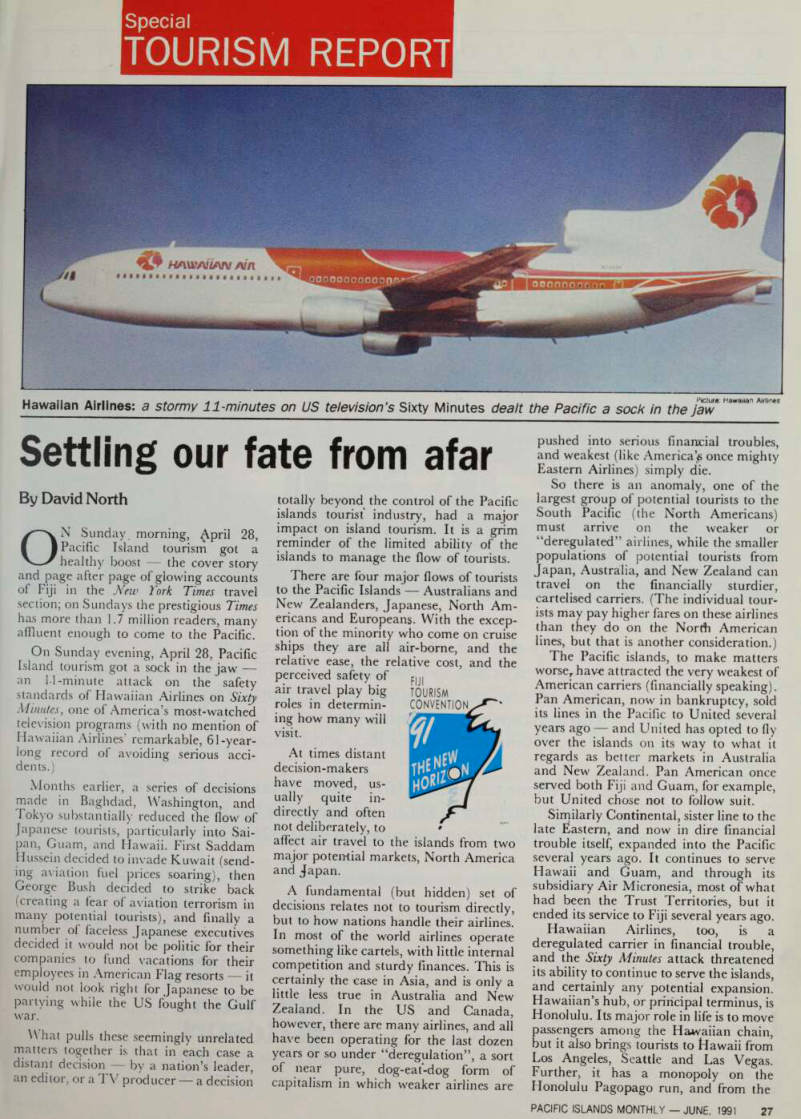
By David North
ON Sunday morning, April 28, Pacific Island tourism got a healthy boost the cover story and page after page of glowing accounts of Fiji in the New York Times travel section; on Sundays the prestigious Times has more than 1.7 million readers, many affluent enough to come to the Pacific.
On Sunday evening, April 28, Pacific Island tourism got a sock in the jaw an 1-1-minute attack on the safety standards of Hawaiian Airlines on Sixty Minutes , one of America’s most-watched television programs (with no mention of Hawaiian Airlines remarkable, 61-year long record of avoiding serious acci dents.) Months earlier, a series of decisions made in Baghdad, Washington, and Tokyo substantially reduced the flow of Japanese tourists, particularly into Sai pan, Guam, and Hawaii. First Saddam Hussein decided to invade Kuwait (send ing aviation fuel prices soaring), then George Bush decided to strike back (creating a fear of aviation terrorism in many potential tourists), and finally a number of faceless Japanese executives decided it would not be politic for their companies to fund vacations for their employees in American Flag resorts it would not look right for Japanese to be partying while the US fought the Gulf war.
A\ hat pulls these seemingly unrelated matters together is that in each case a distant decision by a nation’s leader, an editor, or a TV producer a decision
totally beyond the control of the Pacific islands tourist industry, had a major impact on island tourism. It is a grim reminder of the limited ability of the islands to manage the flow of tourists.
There are four major flows of tourists to the Pacific Islands Australians and New Zealanders, Japanese, North Am ericans and Europeans. With the excep tion of the minority who come on cruise ships they are all air-borne, and the relative ease, the relative cost, and the
perceived safety of air travel play big roles in determin ing how many will visit.
At times distant decision-makers have moved, us ually quite in directly and often not deliberately, to
affect air travel to the islands from two major potential markets, North America
and Japan.
A fundamental (but hidden) set of decisions relates not to tourism directly, but to how nations handle their airlines.
In most of the world airlines operate something like cartels, with little internal competition and sturdy finances. This is certainly the x:ase in Asia, and is only a little less true in Australia and New Zealand. In the US and Canada, however, there are many airlines, and all have been operating for the last dozen years or so under “deregulation”, a sort of near pure, dog-eaf-dog form of capitalism in which weaker airlines are
pushed into serious financial troubles, and weakest (like America's once mighty Eastern Airlines) simply die.
So there is an anomaly, one of the largest group of potential tourists to the South Pacific (the North Americans) must arrive on the weaker or “deregulated” airlines, while the smaller populations of potential tourists from Japan, Australia, and New Zealand can travel on the financially sturdier, cartelised carriers. (The individual tour ists may pay higher fares on these airlines than they do on the North American lines, but that is another consideration.) The Pacific islands, to make matters worse, have attracted the very weakest of American carriers (financially speaking).
Pan American, now in bankruptcy, sold its lines in the Pacific to United several years ago and United has opted to fly over the islands on its way to what it regards as better markets in Australia and New Zealand. Pan American once served both Fiji and Guam, for example, but United chose not to follow suit.
Similarly Continental, sister line to the late Eastern, and now in dire financial trouble itself, expanded into the Pacific several years ago. It continues to serve Hawaii and Guam, and through its subsidiary Air Micronesia, most of what had been the Trust Territories, but it ended its service to Fiji several years ago.
Hawaiian Airlines, too, is a deregulated carrier in financial trouble, and the Sixty Minutes attack threatened its ability to continue to serve the islands, and certainly any potential expansion.
Hawaiian’s hub, or principal terminus, is Honolulu. Its major role in life is to move passengers among the Hawaiian chain, but it also brings tourists to Hawaii from Los Angeles, Seattle and Las Vegas.
Further, it has a monopoly on the Honolulu Pagopago run, and from the
Picture: Hawaiian Airlines Hawaiian Airlines: a stormy 11-minutes on US television's Sixty Minutes dealt the Pacific a sock in the Jaw
latter base it also serves Western Samoa and Tonga. Another route is Honolulu-
Papeete-Rai^itonga.
Until about a year ago, Hawaii Airlines was thinking of moving into the Honolulu-Nadi run; had it done so, it would have filled a gap — that of a North America-based airline flying that run.
Pan-Am had served that route, Conti nental dropped out about three years ago, and, in April, Canadian Pacific did the same. Qantas and Air New Zealand fly from the US (via Honolulu) to Fiji. (Air Tungara has confirmed plaits to inaugurate a route linking Honolulu, Christmas Island and Tarawa in Kiri bati, and Nadi Fiji from May 23.) If any one or' two of the four since departed airlines were still active on the Honolulu-Nadi route it would not only bring more tourists to Fiji, it would help other nations as well. As Donald Panza, regional manager for Fiji’s Pacific Air in Los Angeles put it, “the typical South Pacific tourist is multidestinational he wants to see more than one country.”
Further, all four of these lines have or had active networks of local agents, terminals, and advertising programs in North America much more so than Qantas and Air New Zealand all capable of helping promote Pacific islands tourism.
But the Sixty Minutes producers were not thinking of the interests of Pacific Island tourism when they decided to rip into the Hawaiian Airlines’ safety record. They had what they thought was* a good expose, and they aired it.
Ed Bradley, a familiar television face and voice, and wheelhorse for this program, opened by speaking of the various promotions, such as frequent flyer pro grams, now being offered by US airlines, and then got to his point.
“...the question persists, if they’re giving away all this free sendee are they cutting back on maintenance to pay for it? The airlines say no. They brag about how well they maintain their planes.
“Hawaiian Airlines, however, would have a tough time bragging about how it maintained its planes)’
Bradley then said that two American government agencies had “blackballed”
Hawaiian Airlines last year the
Defence Department, regarding flying
troops, and the General Service Admin istration, regarding flights by civil ser vants.
He then did on-camera interviews with a retired Federal Aviation Administra tion (FAA; supervising inspector, and a former Hawaiian Airlines mechanic. The mechanic ( now an employee of Hawaii an s arch-rival, Aloha Airways, a factor not mentioned on the air) said that he had found a defective part of a landing gear, and his supervisor had told him to
ignore. it, just change the tyre. The incident was reported to FAA which took its time to check on it and the aircraft, according to Bradley, flew for several months with the questionable part.
Bradley also noted that both the airline and the Department of Defence, which had barred the use of the airline for troop movements, had refused to be interviewed on camera by Sixty Minutes, knowing, I suspect, that this is usually a pretty brutal process. . r TT .. .
According to Hawaiian Airlines, what
Sixty Minutes did not mention were the
following:
« The mechanic, Tom Sealy was with HA only briefly and was talking about an event more than three years ago; Since then the airline has come under new management (John Ueberroth is the CEO), and new policies; « That it spends dose sloo mil|ion a yea r on maintenance; m tv r t-i Defence Department has long since reversed its position on the safety of the airline, and has awarded the
line a $57 million contract to fly troops to and from the Persian Gulf; • and that no other American airline, perhaps none in the world, has flown 61 years without a fatality or accident.
Some people who know the airline well defended it, including Don Brugman, Manager of Air Marshall Islands (AMI) in Majuro, who saw it as a media ratings ploy. But not everyone who knows Hawaiian Airlines loves it some of those who use it in the monopoly situation, the Honolulu-Pagopago route, are highly critical of line’s treatment of passengers. There is a series of complaints about delays, lack of communication, and similar matters not safety.
Hawaiian Air has been having severe financial problems. Its last annual financial report showed a $l2l million loss on sales of $341 million — reportedly the greatest annual financial loss of any Hawaii-based corporation in the history of the state. If it follows South Pacific International Airlines to the great hanger in the sky it will be due to heavy losses, not Sixty Minutes.
Under its new leadership, Hawaiian Airlines has renegotiated much of its debt and its plane-leasing arrangements. It dropped its Honolulu-Guam route, where it'was head to head with Conti nental, and it got out of the Alaska- Hawaii route which it had pioneered, but which did not prove profitable. It also picked up the $57 million charter deal to fly American troops to and from the Persian Gulf. Its first quarter earn ings this calendar year will not show a profit, but they will show a remarkable improvement over the $26 million loss in the first quarter of 1990.
The open system of deregulation of US airlines has led to weaker airlines serving fewer islands. Meanwhile a quite differ ent economic and political environment, Japan’s closed system, also led to fewer tourists for the islands. In both cases distant decisionmakers, largely unwit tingly, undermined island tourism.
The tourist industries in Guam, Sai-
pan, and Hawaii hope the reduced flow ofjapanese tourists during the Gulf War was short-term. It was, however, severe.
The Guam Visitors Bureau reported 32,000 cancellations in April and worried the figure would reach 42,000 in May.
Some major islands do not see that many arrivals in a year. Fiji’s best month in the last two years was August, 1990, when 27,823 tourists arrived, The Government of Guam announced that the April decline in arrivals meant that the Territorial Treasury lost $2.2 million in gross receipts taxes, while the tourist industry itself lost untold more, Meanwhile, Hawaii suffered as well (though it has a much more significant flow of tourists from the US mainland), In February its flow of tourists was down 20 per cent from the previous year, mostly due to Japanese defections.
Hawaii’s Governor, John D. Waihee m (D), went to see the Japanese ambassador in Washington while the other governors conferred with Bush Administration officials during the an nual Governor’s meeting in Washington, Waihee’s message to Ambassador Ryohei Murata was the sharp decline in Japan ese tourists was, unwittingly, meshed
with Saddam Hussein’s efforts to undermine the US economy. Guam’s Governor, Joseph Ada (R), flew to Japan in March to make the same point.
In addition to dis covering some walking room on Waikiki Beach, observers noted two in teresting aspects of Japanese tourism in this connection: First, Japanese tour ists are much more valu able financially. Ha waii’s State Economist,
Gregory Pai, calculated that the average
Japanese tourist spends (US) $5BO per
day in Hawaii, about four-and-a-half times as much as a Mainland American.
Secondly, Japanese tourists often ar rive in bunches because their employer is footing the bill. Several years ago routinely pro-business Japanese tax pol
icy was adjusted to give Japanese
corporations tax-breaks when they fi nanced employees’ vacations. This con centrated decisionmaking power with a small group of corporate executives. The reduction in the flow of Japanese tourists to the US resorts was thus caused both by individual fears of Iraqi-caused ter rorism and corporate decisions that it was not good form to send one’s firm’s employees off to vacation while Ameri cans fought a war.
On a more positive note, the big New York Times spread lavished affection on Fiji, particularly its outer islands. Head lines, photos and text carried the same tone, as three American women wrote four long stories about “Fiji’s Easygoing Ways,” “Wakaya: A Retreat Far Away From It All,” “Taking a Cruise in the Lazy Land of Blue Lagoon,” and “At Home on a Remote Island,” an account of a visit to Ono Island, just off the tip of Kadavu Island. (These were news stories by freelance journalists, not puff pieces by tourism publicists.) The coverage included some criticisms such as tiny roaches, musty towels, and coffee that “was barely more than hot brown water” on a Blue Lagoon Cruise but the writer still enjoyed herself.
Lots of writers want to tell of their travels, particularly in The Times , so there is no lack of copy; but somebody in charge, on New York’s West 43rd Street, allocate the space to Fiji on April 28. It was only the wildest of coincidences that some other media executive in the CBS headquarters a mile or so away, decided that Sunday, April 28, was the day to attack Hawaiian Airlines. □
John Ueberroth: airline president
Ed Bradley: Sixty Minutes presenter
Advertisements & other items, p. 28 (1 item)
Fiji Resort
A SPECIAL TOUCH OF PARADISE
1 Nowhere else in the South Pacific compares with the unspoiled beauty and tranquillity of the Fiji Islands.
Now Fiji’s newest and most luxurious resort beckons you to escape to the paradise playground featured in “Runaway with The Rich and Famous’’
Phone us direct on (679) 71 777 or fax on (679) 780171 or 71818, or call Sheraton’s toll-free USA Reservations number on (800) 325 3535. .tT “A*
Sheraton
Fiji Resort
The hospitality people of i|ir|l Ball FIJ 0040
Harder to get there than before
IT’S hard to get people to the islands.
“And it is harder now than it used to be,” according to Mary Peters, an experienced American travel agent.
Ms Peters, whose Washington-area firm, Friendly Travel, concentrates on overseas bookings, ticked off a number of highly specific problems when I raised the question of air travel from the East Coast of the US to the Pacific Islands.
“First, there is the question of fre quency of flights; if something goes wrong out there, your client probably has to wait a whole day, or maybe two days, before continuing his travek “Then there is the question of time zones and schedule changes, something you find out half-way through the client’s trip, that there has been a change that will screw up all the rest of the legs of the trip. And, the way the schedules are set, you usually have to spend the night in a
(Honolulu) hotel halfway there.
“Finally, we do not have direct access to many of the island airlines’ reservation data, and we can not be sure whether we really have a seat or not.”
The last reference is to the computer system which is the heart of every travel agent’s life. Ms Peters uses the United Airlines system, to which most American airlines are connected.
As we talked over the phone she worked on an itinerary I had taken a couple of years ago, flying Canadian Pacific from Washington to overnight in Toronto, then to Honolulu and Fiji. My question was, could this still be done, since Canadian Pacific had left Nadi?
The basic computer system, to which the airlines concerned were not con nected, seemed to indicate that I could
fly Toronto-Vancouver-Honolulu-Nadi.
But it did not indicate that I would have to get off the Canadian airline in Honolulu and transfer to either Qantas or Air New Zealand. It showed there was one stop between Vancouver and Nadi, but it would not tell us where that stop was, or when it landed and took off.
She said that the difficulty in booking space sometimes suggested that more flights might be in order. She used the computer to check out availability of Qantas and Air New Zealand flights to Fiji on several days in mid-June not routinely a high traffic season and found on several flights that no economy seats were available, and on others the lowest fares were all gone. (These flights might have been heavily booked because of the International Lions Convention in Brisbane about then.) The Fiji Embassy in Washington told me earlier that one often had to book a month in advance, during the northern winter, to get an economy seat.
Ms Peters and I talked about Guam, which for decades was served by Pan-Am and was used as a hub to send people off to other islands. “But now it is hard to get there directly,” she said.
She returned to her computer and showed me that its immediate reaction to a client wanting to go to Guam was to suggest a flight via Norita (in Japan).
This is out of the way geographically and involves a five-hour layover there. Upon closer examination the computer reluc tantly admitted that there is a Continen tal flight to Guam out of Honolulu at 1 pm every day, but no flight from the East Coast of the US arrives early enough in Hawaii to connect.
We did not get into the greater difficulties of arranging flights to Kiri bati, Tonga and the Cooks from the East Coast, but she did mention that three airlines (Qantas, Air New Zealand, and Air France) offer several non-stop, eight hour flights from Los Angeles or San Francisco to Papeete.
The other opportunity was a surprise on Sundays and Fridays a Lanchile 707 takes off from Santiago and flies to Easter Island, refuels, goes on the Papeete, then returns to Chile. From Papeete, the traveller can use Air France connections which serve Boro Boro, and Noumea in New Caledonia. □
Advertisements & other items, pp. 29-34 (2 items)
Special
TOURISM REPORT
driving experience.
The new Toyota brand mark. Three ellipses forming a “T” which stand for our customer, our commitment to the satisfaction of that customer through our product and for our spirit of creativity.
It’s not often that you hear descriptions like rugged or durable combined with refined and elegant. But then there’s never been a vehicle quite like the new Toyota Land Cruiser Station Wagon. The unrivalled legend of off-road reliability is now unsurpassed in comfort and sophistication as well. Attention to detail is found everywhere, from the fine trim to the instrument panel to the graceful lines of its exterior. Even in places you can’t see, like the heavy-duty ladder frame and suspension design that add to the superb
luxury-car ride.
But Toyota’s innovation goes beyond providing luxury and durability. The new Land Cruiser Station Wagon, and all of our cars, are designed to create a harmony between car and driver, and to provide you with the ultimate
driving experience.
The new Toyota Land Cruiser Station Wagon. Think of it as much more than a spacious luxury sedan with four-
wheel drive.
. Yi - *: - ¥ ... - 3
DISTRIBUTORS/DEALERS
AMERICAN SAMOA BURNS PHILP (S.S;) CO. LTD. PH 633-4281 GUAM & MICRONESIA ATKINS KROLL, INC. PH 646-1876/9 NORFOLK ISLANDS BORRY’S PTY LTD. PH 2114
SOLOMON ISLANDS MENDANA MOTORS PH 22884
VANUATU VANUATU MOTORS PH 2341
COOK ISLANDS PACIFIC MOTORS LTD. PH 20796
KIRIBATI TARAWA MOTORS PH 21090
PAPUA NEW GUINEA ELA MOTORS PH 217036
TAHITI NIPPON AUTOMOTO PH 429819
WESTERN SAMOA BURNS PHILP (S.S.) CO. LTD. PH 20800
FIJI
NEW CALEDONIA
SAIPAN
TONGA
ASCOI<
S.I.A.P. «
MICF
BURNS 3 .
:roc
RNS 3
® TOYOTA
What's your pleasure?
* m -me A Fiji "Fling”? ora touch of leisure?
1 bucan enjoy it all at
Beachcomber or Treasure.
Come to the Islands where Fiji weaves its special kind of magic. Beachcomber and Treasure. Two islands. Two magically different kinds of atmosphere.
Both tropical gems in jewelled seas. Both Fiji's favourite Suns.
Treasure our Treasure: When you’re work-weary and ready to let the waters of paradise wash over you and refresh the spirit, you’ll treasure our Treasure. Treasure Island. Fifteen acres of tropical hideaway. Exclusive, elegant. With 68 private accommodation ‘bures’ dotted around the island merely a few steps from the dazzling white sandy beach and sparkling crystal blue waters. With committed service you’d expect from a first class resort. Fill your days in many different leisurely ways.
Swim. Fish. Dive. Ski. Snorkel. Explore neighbouring islands, or simply soak up the sunshine. Then feed the spirit and your healthy appetite with our superb food <Sc cellar before you live it up with a traditional cabaret, entertained by our island string band. Tbu’ll have wonderful memories of Treasure to treasure forever for a very reasonable cost. Come Soon.
We’re waiting. a c
TREftSSIRE
JSLftRD
Beautiful barefooted Beachcomber:
Come on. Kick off your shoes, drape yourself in a piece of paradise and enjoy everything we’ve got to offer. Just wear a smile. At Beachcomber, the love of a good time, great company in a casual atmosphere and a flair for enjoying life as it comes, is all you’ll need to take home a holiday to remember. On Beachcomber, informality is a way of life. And you can choose how informal you want to be. From informal 32 bed, dormitory-style thatched “bure” accommodation island style to semi-private lodges, or your own private bure. There’s heaps to do during the day and plenty of fun under the stars too.
And you can have the time of your life for very little money when you choose to become a ’’Beachcomber” for your holiday pleasure.
Book Soon and hurry over.
Life calls.
ISLANDS IN THE SUN, FIJI
P.O. BOX 364 LAUTOKA, FIJI.
Phone: 61 500 OH
THE ORIGINS OF FIJI'S TOURISTS
487 c 207 c 167 87
AUSTRAL! A/NZ JAPAN N
AMERCA
EUROPE
Based on statistics from the Fiji Visitors Bureau for calendar 1990.
"Other places ’, mostly the islands, constitute the other 8 per cent.
TOKYO
IliC rainbow
ection.
HONIARA
co
V LA
NAD
O
BRISBANE
SYDNEY
APIA
TONGA
AUCKLAND
MELBOURNE
N° matter where you want to fly in the Pacific, Air Pacific can take you there on a rainbow. Our fleet of ATR-42’s, 747 and our new widebodied 767 offer the ultimate in comfort and service. Fly with us soon. Contact Air Pacific or your travel agent now. ir mi? pacii it
4IRPAO
FIJI'S INTERNATIONAL AIRLINE
Growth in Nadi
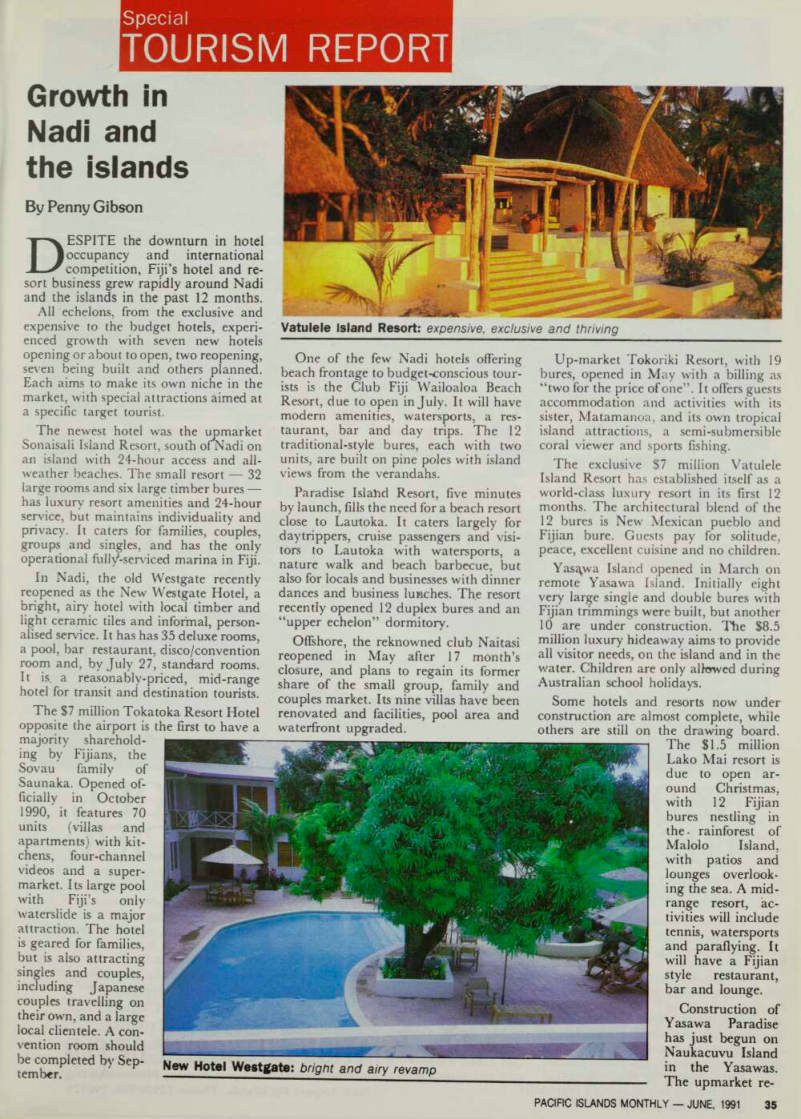

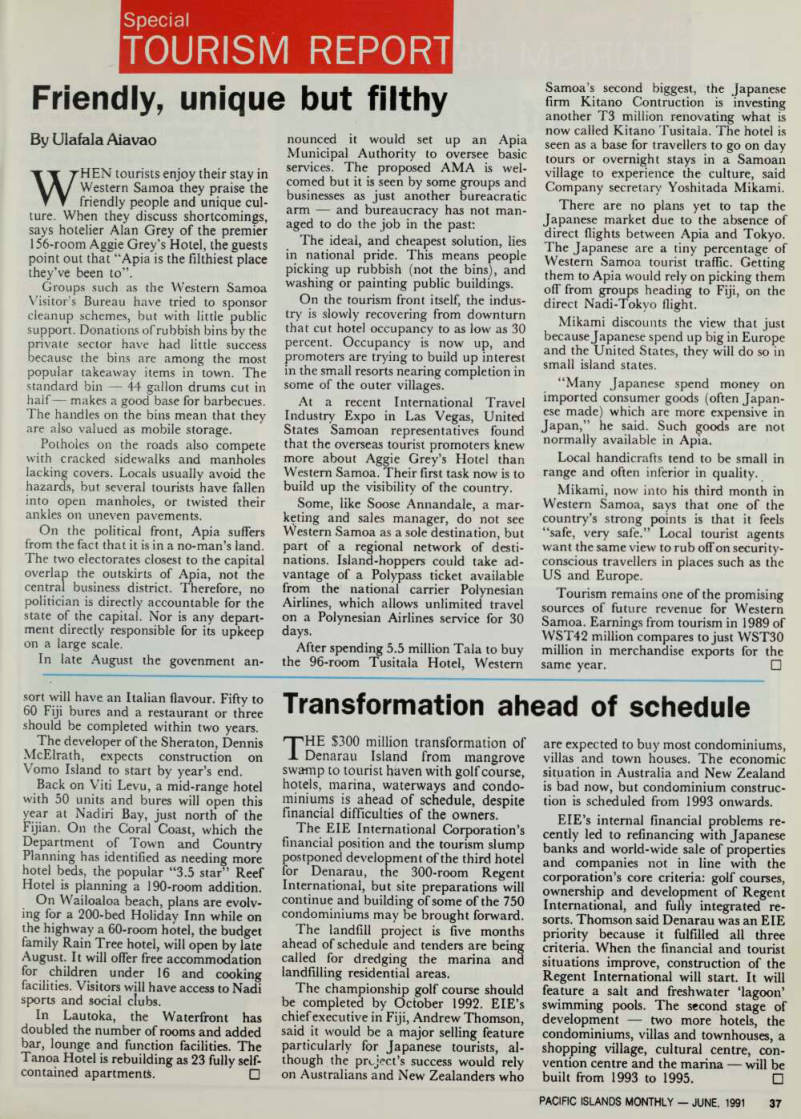
Nadi and the islands
By Fenny Gibson
DESPITE the downturn in hotel occupancy and international competition, Fiji’s hotel and re sort business grew rapidly around Nadi and the islands in the past 12 months.
All echelons, from the exclusive and expensive to the budget hotels, experi enced growth with seven new hotels opening or about to open, two reopening, seven being built and others planned.
Each aims to make its own niche in the market, with special attractions aimed at a specific target tourist.
The newest hotel was the upmarket Sonaisali Island Resort, south ofNadi on an island with 24-hour access and all weather beaches. The small resort 32 large rooms and six large timber bures has luxury resort amenities and 24-hour service, but maintains individuality and privacy. It caters for families, couples, groups and singles, and has the only operational fully*-serviced marina in Fiji.
In Nadi, the old Westgate recently reopened as the New Westgate Hotel, a bright, airy hotel with local timber and light ceramic tiles and informal, person alised service. It has has 35 deluxe rooms, a pool, bar restaurant, disco/convention room and, by July 27, standard rooms.
It is a reasonably-priced, mid-range hotel for transit and destination tourists.
The $7 million Tokatoka Resort Hotel opposite the airport is the first to have a
majority sharehold ing by Fijians, the Sovau family of Saunaka. Opened of ficially in October 1990, it features 70 units (villas and apartments) with kit chens, four-channel videos and a super market. Its large pool with Fiji's only waterslide is a major attraction. The hotel is geared for families, but is also attracting singles and couples, including Japanese couples travelling on their own, and a large local clientele. A con vention room should be completed by Sep tember.
One of the few Nadi hotels offering beach frontage to budget-conscious tour ists is the Club Fiji Wailoaloa Beach Resort, due to open in July. It will have modern amenities, watersports, a res taurant, bar and day trips. The 12 traditional-style bures, each with two units, are built on pine poles with island views from the verandahs.
Paradise Islahd Resort, five minutes by launch, fills the need for a beach resort close to Lautoka. It caters largely for daytrippers, cruise passengers and visi tors to Lautoka with watersports, a nature walk and beach barbecue, but also for locals and businesses with dinner dances and business lunches. The resort recently opened 12 duplex bures and an
“upper echelon” dormitory.
Offshore, the reknowned club Naitasi reopened in May after 17 month’s closure, and plans to regain its former share of the small group, family and couples market. Its nine villas have been renovated and facilities, pool area and
waterfront upgraded.
Up-market Tokoriki Resort, with 19 bures, opened in May with a billing as “two for the price of one”. It offers guests accommodation and activities with its sister, Matamanoa, and its own tropical island attractions, a semi-submersible coral viewer and sports fishing.
The exclusive S 7 million Vatulele Island Resort has established itself as a world-class luxury resort in its first 12 months. The architectural blend of the 12 bures is New Mexican pueblo and Fijian bure. Guests pay for solitude, peace, excellent cuisine and no children.
Yasawa Island opened in March on remote Yasawa Island. Initially eight very large single and double bures with Fijian trimmings were built, but another 10 are under construction. The $8.5 million luxury hideaway aims to provide all visitor needs, on the island and in the v/ater. Children are only allowed during Australian school holidays.
Some hotels and resorts now under construction are almost complete, while others are still on the drawing board.
The $1.5 million Lako Mai resort is due to open ar ound Christmas, with 12 Fijian bures nestling in the - rainforest of Malolo Island, with patios and lounges overlook ing the sea. A mid range resort, ac tivities will include tennis, watersports and paraflying. It will have a Fijian style restaurant, bar and lounge.
Construction of Yasawa Paradise
has just begun on
Naukacuvu Island in the Yasawas.
The upmarket re
New Hotel Westgate: bright and airy revamp
Vatulele Island Resort: expensive, exclusive and thriving
sort will have an Italian flavour. Fifty to 60 Fiji bures and a restaurant or three should be completed within two years.
The developer of the Sheraton, Dennis McElrath, expects construction on Vomo Island to start by year’s end.
Back on Viti Levu, a mid-range hotel with 50 units and bures will open this year at Nadiri Bay, just north of the Fijian. On the Coral Coast, which the Department of Town and Country Planning has identified as needing more hotel beds, the popular “3.5 star” Reef Hotel is planning a 190-room addition.
On Wailoaloa beach, plans are evolv ing for a 200-bed Holiday Inn while on the highway a 60-room hotel, the budget family Rain Tree hotel, will open by late August. It will offer free accommodation for children under 16 and cooking facilities. Visitors will have access to Nadi sports and social clubs.
In Lautoka, the Waterfront has doubled the number of rooms and added bar, lounge and function facilities. The Tanoa Hotel is rebuilding as 23 fully self contained apartments. □
Advertisements & other items, pp. 35-36 (2 items)
Special
TOURISM REPORT
Nadi International Airport,
ms>. 3m * m
WC Mb
i W * m s iti n ygri
fL=I2Q
’ii £VO -'raa
MBMI
M -v„ »»* 2W
NADI INTERNATIONAL AIRPORT,
THE HUB OF THE SOUTH PACIFIC
We are called the hub of the South Pacific Islands, located in Fiji.
Equipped to service the world’s most advanced passenger aircraft, the Boeing 747-400.
Or any of the many scheduled international carriers that utilize our services.
It is a reponsibility that we take very seriously.
That is why we have recently spent over $l2 million upgrading and expanding our facilities; preparing for the future, today.
To find out more about the gateway of Pacific Islands, Nadi International Airport, send for our free brochure. * For as the region’s largest and most modern airport, we have become the gateway to the South Pacific Island.. CIVIL AVIATION AUTHORITY OF FIJI Providing complete passenger . gen£ j and freight facilities both regionally and internationally.
Free Brochure, Nadi International Airport, Private Mail Bag, Nadi Airport, Fiji Islands. Phone: 72500 Fax: 790325 GR7948
Friendly, unique but filthy
By Ulafala Aiavao
WHEN tourists enjoy their stay in Western Samoa they praise the friendly people and unique cul ture. When they discuss shortcomings, says hotelier Alan Grey of the premier 156-room Aggie Grey’s Hotel, the guests point out that “Apia is the filthiest place they’ve been to”.
Groups such as the Western Samoa Visitor’s Bureau have tried to sponsor cleanup schemes, but with little public support. Donations of rubbish bins by the private sector have had little success because the bins are among the most popular takeaway items in town. The standard bin 44 gallon drums cut in half — makes a good base for barbecues.
The handles on the bins mean that they are also valued as mobile storage.
Potholes on the roads also compete with cracked sidewalks and manholes lacking covers. Locals usually avoid the hazards, but several tourists have fallen into open manholes, or twisted their ankles on uneven pavements.
On the political front, Apia suffers from the fact that it is in a no-man’s land.
The two electorates closest to the capital overlap the outskirts of Apia, not the central business district. Therefore, no politician is directly accountable for the state of the capital. Nor is any depart ment directly responsible for its upkeep on a large scale.
In late August the govenment an
nounced it would set up an Apia Municipal Authority to oversee basic services. The proposed AMA is wel comed but it is seen by some groups and businesses as just another bureacratic arm and bureaucracy has not man aged to do the job in the past; The ideal, and cheapest solution, lies in national pride. This means people picking up rubbish (not the bins), and washing or painting public buildings.
On the tourism front itself, the indus try is slowly recovering from downturn that cut hotel occupancy to as low as 30 percent. Occupancy is now up, and promoters are trying to build up interest in the small resorts nearing completion in some of the outer villages.
At a recent International Travel
Industry Expo in Las Vegas, United
States Samoan representatives found that the overseas tourist promoters knew more about Aggie Grey’s Hotel than Western Samoa. Their first task now is to build up the visibility of the country.
Some, like Soose Annandale, a mar keting and sales manager, do not see Western Samoa as a sole destination, but part of a regional network of desti nations. Island-hoppers could take ad vantage of a Polypass ticket available from the national carrier Polynesian Airlines, which allows unlimited travel on a Polynesian Airlines service for 30 days.
After spending 5.5 million Tala to buy the 96-room Tusitala Hotel, Western
Samoa’s second biggest, the Japanese firm Kitano Contruction is investing another T 3 million renovating what is now called Kitano Tusitala. The hotel is seen as a base for travellers to go on day tours or overnight stays in a Samoan village to experience the culture, said Company secretary Yoshitada Mikami.
There are no plans yet to tap the Japanese market due to the absence of direct flights between Apia and Tokyo.
The Japanese are a tiny percentage of Western Samoa tourist traffic. Getting them to Apia would rely on picking them off from groups heading to Fiji, on the direct Nadi-Tokyo flight.
Mikami discounts the view that just because Japanese spend up big in Europe and the United States, they will do so in small island states.
“Many Japanese spend money on imported consumer goods (often Japan ese made) which are more expensive in Japan,” he said. Such goods are not normally available in Apia.
Local handicrafts tend to be small in range and often inferior in quality.
Mikami, now into his third month in Western Samoa, says that one of the country’s strong points is that it feels “safe, very safe.” Local tourist agents want the same view to rub off on security conscious travellers in places such as the US and Europe.
Tourism remains one of the promising sources of future revenue for Western Samoa. Earnings from tourism in 1989 of WST42 million compares to just WST3O million in merchandise exports for the same year. □
Transformation ahead of schedule
THE $3OO million transformation of Denarau Island from mangrove swamp to tourist haven with golf course, hotels, marina, waterways and condo miniums is ahead of schedule, despite financial difficulties of the owners.
The EIE International Corporation’s financial position and the tourism slump postponed development of the third hotel for Denarau, tne 300-room Regent International, but site preparations will continue and building of some of the 750 condominiums may be brought forward.
The landfill project is five months ahead of schedule and tenders are being called for dredging the marina and landfilling residential areas.
The championship golf course should be completed by October 1992. ElE’s chief executive in Fiji, Andrew Thomson, said it would be a major selling feature particularly for Japanese tourists, al though the project’s success would rely on Australians and New Zealanders who
are expected to buy most condominiums, villas and town houses. The economic situation in Australia and New Zealand is bad now, but condominium construc tion is scheduled from 1993 onwards.
ElE’s internal financial problems re
cently led to refinancing with Japanese
banks and world-wide sale of properties and companies not in line with the corporation’s core criteria: golf courses,
ownership and development of Regent
International, and fully integrated re sorts. Thomson said Denarau was an EIE priority because it fulfilled all three criteria. When the financial and tourist situations improve, construction of the Regent International will start. It will feature a salt and freshwater ‘lagoon’ swimming pools. The second stage of development two more hotels, the condominiums, villas and townhouses, a shopping village, cultural centre, con vention centre and the marina will be built from 1993 to 1995. □
The State of tourism
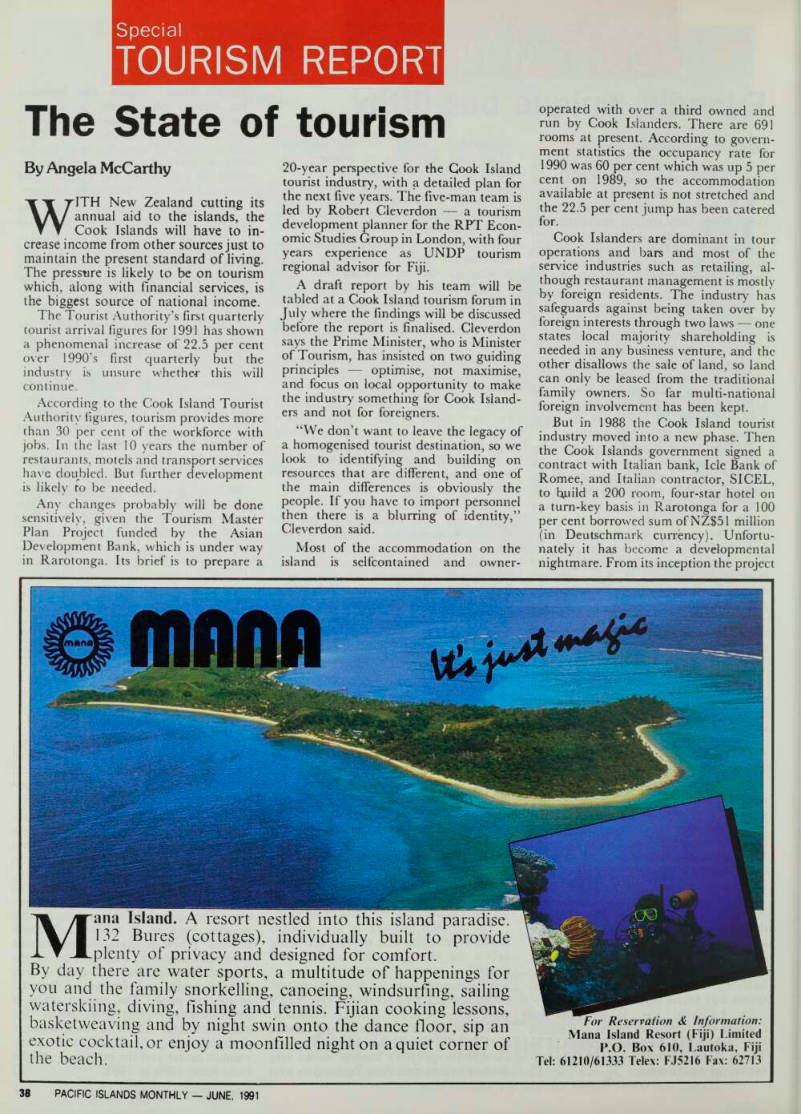
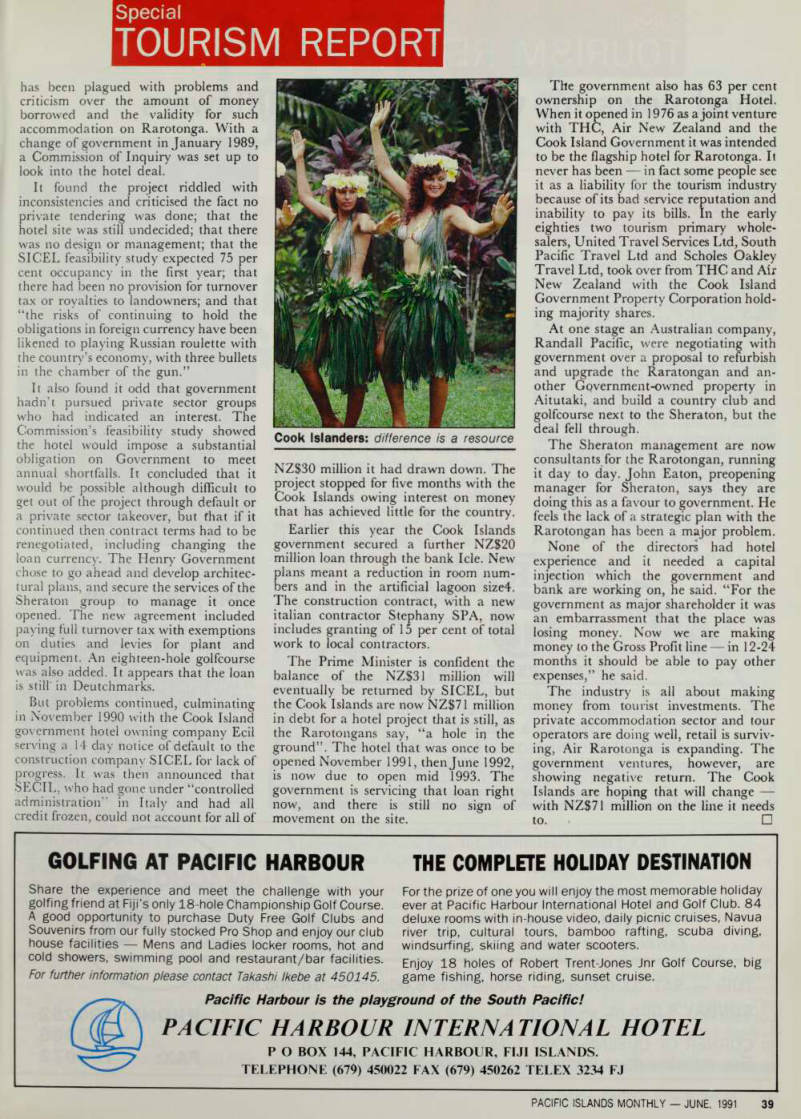
By Angela McCarthy
WITH New Zealand cutting its annual aid to the islands, the Cook Islands will have to in crease income from other sources just to maintain the present standard of living.
The pressure is likely to be on tourism which, along with financial services, is the biggest source of national income.
The Tourist Authority’s first quarterly tourist arrival figures for 1991 has shown a phenomenal increase of 22.5 per cent over 1990’s first quarterly but the industry is unsure whether this will continue.
According to the Cook Island Tourist Authority figures, tourism provides more than 30 per cent of the workforce with jobs. In the last 10 years the number of restaurants, motels and transport services have doubled. But further development is likely to be needed.
Any changes probably will be done sensitively, given the Tourism Master Plan Project funded by the Asian Development Bank, which is under way in Rarotonga. Its brief is to prepare a
20-year perspective for the Cook Island tourist industry, with a detailed plan for the next five years. The five-man team is led by Robert Cleverdon a tourism development planner for the RPT Econ omic Studies Group in London, with four years experience as UNDP tourism
regional advisor for Fiji.
A draft report by his team will be tabled at a Cook Island tourism forum in July where the findings will be discussed before the report is finalised. Cleverdon says the Prime Minister, who is Minister of Tourism, has insisted on two guiding principles optimise, not maximise, and focus on local opportunity to make the industry something for Cook Island ers and not for foreigners.
“We don’t want to leave the legacy of a homogenised tourist destination, so we look to identifying and building on resources that are different, and one of the main differences is obviously the people. If you have to import personnel then there is a blurring of identity,”
Cleverdon said.
Most of the accommodation on the island is selfcontained and owner
operated with over a third owned and run by Cook Islanders. There are 691 rooms at present. According to govern ment statistics the occupancy rate for 1990 was 60 per cent which was up 5 per cent on 1989, so the accommodation available at present is not stretched and the 22.5 per cent jump has been catered for.
Cook Islanders are dominant in tour operations and bars and most of the service industries such as retailing, al though restaurant management is mostly by foreign residents. The industry has safeguards against being taken over by foreign interests through two laws one states local majority shareholding is needed in any business venture, and the other disallows the sale of land, so land can only be leased from the traditional family owners. So far multi-national foreign involvement has been kept.
But in 1988 the Cook Island tourist industry moved into a new phase. Then the Cook Islands government signed a contract with Italian bank, Icle Bank of Romee, and Italian contractor, SICEL, to build a 200 room, four-star hotel on a turn-key basis in Rarotonga for a 100 per cent borrowed sum ofNZSSI million (in Deutschmark currency). Unfortu nately it has become a developmental nightmare. From its inception the project
has been plagued with problems and criticism over the amount of money borrowed and the validity for such accommodation on Rarotonga. With a change of government in January 1989, a Commission of Inquiry was set up to look into the hotel deal.
It found the project riddled with inconsistencies and criticised the fact no private tendering was done; that the hotel site was still undecided; that there was no design or management; that the
SICEL feasibility study expected 75 per
cent occupancy in the first year; that there had been no provision for turnover tax or royalties to landowners; and that “the risks of continuing to hold the obligations in foreign currency have been likened to playing Russian roulette with the country’s economy, with three bullets in the chamber of the gun.”
It also found it odd that government hadn’t pursued private sector groups who had indicated an interest. The Commission’s feasibility study showed the hotel would impose a substantial obligation on Government to meet annual shortfalls. It concluded that it would be possible although difficult to get out of the project through default or a private sector takeover, but that if it continued then contract terms had to be
renegotiated, including changing the
loan currency. The Henry' Government chose to go ahead and develop architec tural plans, and secure the services of the Sheraton group to manage it once opened. The new agreement included paying full turnover tax with exemptions on duties and levies for plant and
equipment. An eighteen-hole golfcourse
was also added. It appears that the loan is still in Deutchmarks.
But problems continued, culminating in November 1990 with the Cook Island government hotel owning company Ecil serving a 14 day notice of default to the construction company SICEL for lack of progress. It was then announced that SECIL, who had gone under “controlled administration” in Italy and had all credit frozen, could not account for all of
NZ$3O million it had drawn down. The project stopped for five months with the Cook Islands owing interest on money that has achieved little for the country.
Earlier this year the Cook Islands government secured a further NZ$2O million loan through the bank Icle. New plans meant a reduction in room num bers and in the artificial lagoon size 4.
The construction contract, with a new italian contractor Stephany SPA, now includes granting of 15 per cent of total work to local contractors.
The Prime Minister is confident the balance of the NZ$3l million will eventually be returned by SICEL, but the Cook Islands are now NZ$7l million in debt for a hotel project that is still, as the Rarotongans say, “a hole iq the ground”. The hotel that was once to be opened November 1991, then June 1992, is now due to open mid 1993. The government is servicing that loan right now, and there is still no sign of movement on the site.
The government also has 63 per cent ownership on the Rarotonga Hotel.
When it opened in 1976 as a joint venture with THC, Air New Zealand and the Cook Island Government it was intended to be the flagship hotel for Rarotonga. It never has been in fact some people see it as a liability for the tourism industry because of its bad service reputation and inability to pay its bills. In the early eighties two tourism primary whole salers, United Travel Services Ltd, South Pacific Travel Ltd and Scholes Oakley Travel Ltd, took over from THC and Air New Zealand with the Cook Island
Government Property Corporation hold
ing majority shares.
At one stage an Australian company, Randall Pacific, were negotiating with government over a proposal to refurbish and upgrade the Raratongan and an other Government-owned property in Aitutaki, and build a country club and golfcourse next to the Sheraton, but the deal fell through.
The Sheraton management are now consultants for the Rarotongan, running it day to day. John Eaton, preopening manager for Sheraton, says they are doing this as a favour to government. He feels the lack of a strategic plan with the Rarotongan has been a major problem.
None of the directors had hotel experience and it needed a capital injection which the government and bank are working on, he said. “For the government as major shareholder it was an embarrassment that the place was losing money. Now we are making money to the Gross Profit line in 12-24 months it should be able to pay other expenses,” he said.
The industry is all about making money from tourist investments. The private accommodation sector and tour operators are doing well, retail is surviv ing, Air Rarotonga is expanding. The government ventures, however, are showing negative return. The Cook Islands are hoping that will change with NZ$7l million on the line it needs to. □
Cook Islanders: difference is a resource
Advertisements & other items, pp. 38-39 (1 item)
i :
Mana Island. A resort nestled into this island paradise. 132 Bures (cottages), individually built to provide plenty of privacy and designed for comfort.
By day there are water sports, a multitude of happenings for you and the family snorkelling, canoeing, windsurfing, sailing waterskiing, diving, fishing and tennis. Fijian cooking lessons, basketweaving and by night swin onto the dance floor, sip an exotic cocktail, or enjoy a moonfilled night on a quiet corner of the beach.
Tel: For Reservation & Information: Mana Island Resort (Fiji) Limited P.O. Box 610, Lautoka, Fiji 61210/61333 Telex: FJ5216 Fax: 62713
GOLFING AT PACIFIC HARBOUR THE COMPLETE HOLIDAY DESTINATION Share the experience and meet the challenge with your golfing friend at Fiji’s only 18-hole Championship Golf Course.
A good opportunity to purchase Duty Free Golf Clubs and Souvenirs from our fully stocked Pro Shop and enjoy our club house facilities Mens and Ladies locker rooms, hot and cold showers, swimming pool and restaurant/bar facilities.
For further information please contact Takashi Ikebe at 450145.
For the prize of one you will enjoy the most memorable holiday ever at Pacific Harbour International Hotel and Golf Club. 84 deluxe rooms with in-house video, daily picnic cruises, Navua river trip, cultural tours, bamboo rafting, scuba diving, windsurfing, skiing and water scooters.
Enjoy 18 holes of Robert Trent-Jones Jnr Golf Course, big game fishing, horse riding, sunset cruise.
Pacific Harbour is the playground of the South Pacific!
PACIFIC HARBOUR INTERNATIONAL HOTEL
P O BOX 144, PACIFIC HARBOUR, FIJI ISLANDS.
TELEPHONE (679) 450022 FAX (679) 450262 TELEX 3234 FJ
Good news for watersports wallflowers
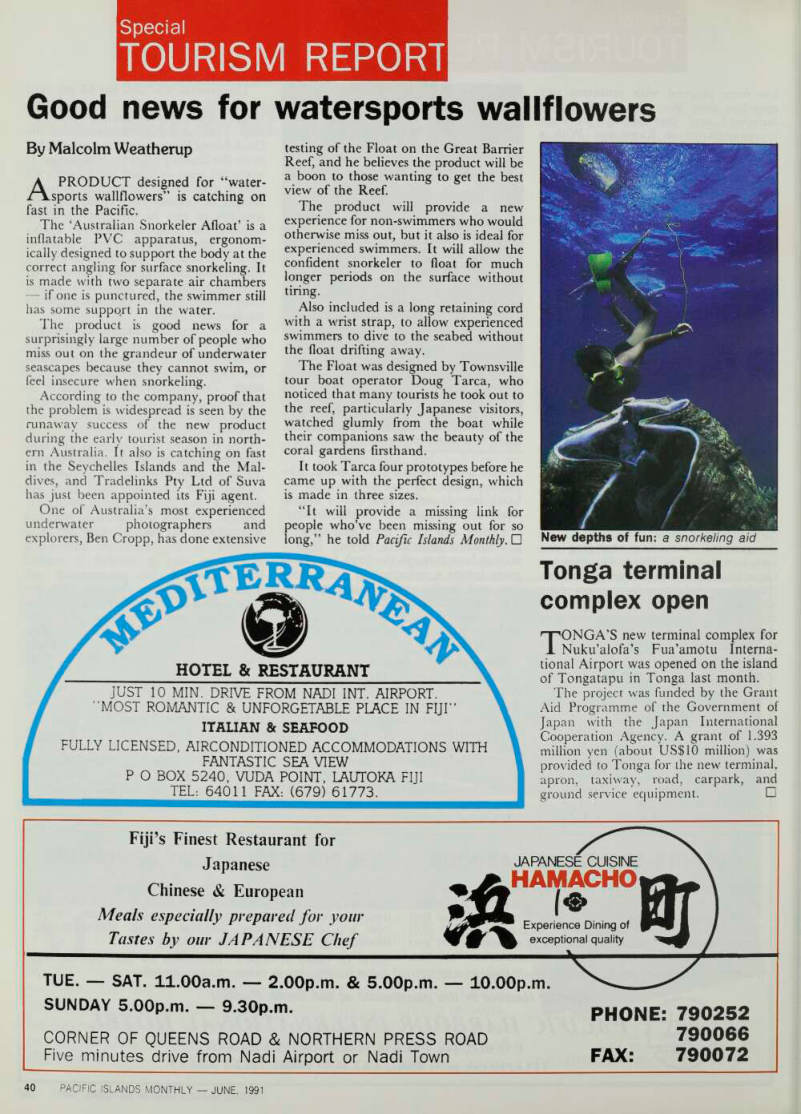
By Malcolm Weatherup
A PRODUCT designed for “water sports wallflowers’’ is catching on fast in the Pacific.
The ‘Australian Snorkeler Afloat’ is a inflatable PVC apparatus, ergonom ically designed to support the body at the correct angling for surface snorkeling. It is made with two separate air chambers if one is punctured, the swimmer still has some support in the water.
The product is good news for a surprisingly large number of people who miss out on the grandeur of underwater seascapes because they cannot swim, or feel insecure when snorkeling.
According to the company, proof that the problem is widespread is seen by the runaway success of the new product during the early tourist season in north ern Australia. It also is catching on fast in the Seychelles Islands and the Mal dives, and Trad clinks Pty Ltd of Suva has just been appointed its Fiji agent.
One of Australia’s most experienced underwater photographers and explorers, Ben Cropp, has done extensive
testing of the Float on the Great Barrier Reef, and he believes the product will be those wanting to get the best vle ™ Th ? product will provide a new experience for non-swimmers who would otherwise miss out, but it also is ideal for experienced swimmers. It will allow the confident snorkeler to float for much *png er periods on the surface without tinn g* Also included is a long retaining cord wi ? h a wrist st r a P> to all ow experienced swimmers to dive to the seabed without oat drifting away, The Float was designed by Townsville tour boat operator Doug Tarca, who noticed that many tourists he took out to the reef, particularly Japanese visitors, watched glumly from the boat while their companions saw the beauty of the coral gardens firsthand, It took Tarca four prototypes before he came up with the perfect design, which is made in three sizes.
“It will provide a missing link for people who’ve been missing out for so long,” he told Pacific Islands Monthly. □
Tonga terminal
complex open
TONGA’S new terminal complex for Nuku’alofa’s Fua’amotu Interna tional Airport was opened on the island of Tongatapu in Tonga last month.
The project was funded by the Grant Aid Programme of the Government of japan with the Japan International Cooperation Agency. A grant of 1.393 million yen (about USSIO million) was provided to Tonga for the new terminal, apron, taxiway, road, carpark, and ground service equipment. □
New depths of fun: a snorkeling aid
Advertisements & other items, p. 40 (2 items)
Special
TOURISM REPORT
Hamacho
HOTEL & RESTAURANT
'<P JUST 10 MIN. DRIVE FROM NADI INT. AIRPORT.
"MOST ROMANTIC & UNFORGETABLE PLACE IN FIJI"
ITALIAN & SEAFOOD
FULLY LICENSED, AIRCONDITIONED ACCOMMODATIONS WITH
FANTASTIC SEA VIEW
P O BOX 5240, VUDA POINT, LAUTOKA FIJI
TEL: 64011 FAX: (679) 61773,
Fiji’s Finest Restaurant for Japanese Chinese & European Meals especially prepared for your Tastes by our JAPANESE Chef m TUE. SAT. 11.00a.m. 2.00p.m. & 5.00p.m. 10.00p.m.
SUNDAY 5.00p.m. 9.30p.m.
JAPANESE CUISINE
HAMACHO
!♦ Experience Dining of exceptional quality CORNER OF QUEENS ROAD & NORTHERN PRESS ROAD Five minutes drive from Nadi Airport or Nadi Town
PHONE: 790252
790066
FAX: 790072
Pacific

Islands
Month Ly
Business
Promising signs from PNG mines
Three big players in the mining game are optimistic about the future
PAPUA New Guinea’s giant Porgera Gold Mine is on schedule despite an extra K 6 million (U 556.32 million) in electricity costs after a landowner dispute delayed power supplies.
The Porgera joint venture partners had been counting on power supplies from the Hides gas field, 70 km away, to be flowing by September when stage 2 of the mine will be commissioned.
But while the power station’s first stage and cross-country transmission lines will be finished in July the land dispute has delayed completion of the nearby gas field and the Bkm pipeline to the power station. The dispute, in which various clans are claiming the right to revenues from the gas field, is now subject to a Papua New Guinea government enquiry.
Two dual fuel generators originally destined for Hides will be taken to Porgera and run on diesel to allow stage two to stay on schedule. The cost of transporting the equipment and the margin between gas and diesel costs will run to K 6 million by next January.
This cost is likely to run beyond that as the new schedule for connection of gas to the Plides power station is no more certain than some time in the first half of 1992.
Otherwise Porgera (Placer Pacific Ltd, Highlands Gold Ltd and Renison Gold fields Consolidated Ltd each have 30 per cent, with the PNG govemmment hold ing 10 per cent) is running to plan. The project’s general manager, Vic Botts, said that all parts of the mine were either on or ahead of schedule.
“That s an achievement in Papua New Guinea,” he said.
The mill is exceeding design capacity by almost 20 per cent. The project’s March quarterly report said 162,369 tonnes of ore was milled in the three months to produce 224,804 ounces of gold. Average head grade was 65.6 grams per tonne. ui c r Porgera now has 15 megawatts of ,• , 6 . , u . 5 ni d.esel-generated power but more will be needed m September to supply the new pressure oxidation plant which will take gold recoveries from the present 70 per cent to more than 90 per cent. The two additional generators being installed will deliver another 13.4 megawatts.
When completed Hides (BP Develop ment Operating Co Pty Ltd 95 per cent, Oil Search Ltd 5 per cent) will produce
64 megawatts enough power to meet Porgera’s needs when the mine reaches its full production capacity. Half of the Bkm gas pipeline between the field and power station has now been completed.
Work at Hides has also been delayed by particularly bad weather.
Revenues due to the local landowners are being held in trust until the Land Titles Commission decides which are the
rightful claimants.
The problem began several months ago when two rival clan groups claimed the Hides joint venture had not settled compensation issues and each claimed they were the sole and rightful recipients.
There were charges against BP of divide and-rule tactics and that some local people had made marks on agreements without knowing what they were signing.
The Porgera mine will meet its aim of producing 900,000 ounces a year even with the power problems. The oxidation plant will, apart from lifting recovery from new ore, also be used on rock already milled and stockpiled and which still contains some gold. Average grade figures for the March quarter were lower than planned because the mill processed almost 1800 tonnes of ore per day instead of its 1500-tonne design maximum. This meant that lower grade ore had to be processed earlier than expected.
The new concentrator capacity will
maintain total gold production after September even as lower grade ore is produced from the underground mine.
Porgera’s open pit operations are due to begin in early 1993.
Increasing production from the Porgera mine gave PNG Explorer Highlands Gold Ltd a heady start to the year. Unaudited net profit for the 16 weeks to April 7 was K 8.25 million, bringing net profit for the first 40 weeks of the financial year to K 18.77 million based on total sales of 140,900 ounces of gold and 105,000 ounces of silver.
Mine production income was supple mented by interest on money left over from the share float in late 1989 when parent MIM Holdings Ltd sold 35 per cent of the company to the public.
Highlands’ report said the company received an average price of SUS 396 per ounce of gold and SUS4.O4 per ounce of silver over the 40-week period.
The company has a 30 per cent interest in the huge Porgera mine in PNG’s Enga province. Porgera’s contri bution to Highlands’ earnings for the 40 weeks was K 27.3 million before tax.
Highlands paid K 54.1 million in Porgera calls for the 40 weeks and debt at April 7 totalled K 89.6 million.
But despite impressive assay results in some drill intercepts for the Uramit prospect (known as Wild Dog) on East New Britain, little continuity was obtained. Exploration is continuing on Mali after outcrops revealed assays of gold, copper, silver and barium. Signs on Manus island in New Ireland province also have been encouraging, where gold was visible after panning. □
CRA excited over Wafi copper find
Australian mining giant cra Ltd appears to have found another significant copper deposit in Papua New Guinea.
CRA, whose subsidiary Bougainville
Copper Ltd lost control of the vast Panguna copper mine, has announced an exciting discovery on its Wafi prospect, about 65km from Lae.
Three drill holes have intersected unusually large widths and high grades of porphyry copper. In the next few months surface work will try to delineate the extent of the deposit, and preliminary metallurgy testing on the ore has begun.
The announcement came just a month after CRA bought back the 45 per cent interest in Wafi it had previously sold to Elders Resources Ltd.
Mineralisation has been found in huge columns in the three drill holes with assays still to come in from a fourth this latter one is suspected to be separ ated by a fault from the others and lie outside the main ore zone. The assays from the first three holes included impressive grades: one was 76 metres averaging 2.28 per cent copper. The indications so far suggest an ore body 400 metres by 500 metres going to a depth of 400 metres. □
Oil Search reaffirms belief in PNG
ONE of the largest resources inves tors in Papua New Guinea has reaffirmed its belief in the future of the country, despite the gloomy political outlook in view of the protrac ted Bougainville situation.
The recently issued annual report of Oil Search Ltd, which has spent several decades exploring Papua New Guinea for oil, said the Kutubu oil project has proven reserves currently assessed at around 200 million barrels. This rep resents an approximate 50 per cent increase over the figure quoted in last year’s report, and is up 20 million barrels on the figure of just two months earlier.
Oil Search said the company saw it as increasingly desirable to cement the bonds between itself and Papua New Guinea. This was helped by the share issue to local investors in late 1990.
The report said ongoing feasibility studies at Kutubu continued to fine-tune development plans so that the initial production rate will be raised from an estimated less than 100,000 barrels a day to about 130,000 barrels a day.
The project will cost about US$75O million to develop. Planned production now dwarfs any of the Australian discoveries of recent years.
By the end of January the joint ventures had committed about SUS3OO million to the project with some 600 workers, of which about 60 per cent are Southern Highlands employees. The crude will be piped 265 kilometres to a
marine terminal in the Gulf of Papua with international sales expected to start in the second half of next year, oil Search also reported some good neW s, and problems, with its Hides gas project which is expected to provide 10 million cubic feet of gas a day for a power station to provide electricity for the p org era gold mine. Recent drill tests indicated the Hides field would produce about 300 barrels a day of condensate as against earlier expectations of 20 barrels a day. Some surface facilities have had to be redesigned to cope with storage of the condensate. Construction of the Hides project should be completed by the end of the year. By then the Porgera joint venture should have built its power station and associated transmission lines.
During 990 QU Search was a partner in 15 well drillings in its Highlands acreage. With the confirmation of re serves in the Kutubu project, the corn pany’s attention is now swinging back to PPL 101, a neighbouring permit area which contains the Juha gas condensate discovery and several untested prospects.
One of these untested areas, P’nyang, was chosen for drilling in 1990.
The annual report said the well was encouraging: gas and condensate were discovered, and were similar in compo sition to the gas caps of the Kutubu oil fields. The report said the quality of Toro and other reservoirs in P’nyang was as good as Kutubu. A follow up well was due to be drilled toward mid-1991. □
Healthy surplus
through Trust Fund
TUVALU’S Trust Fund is forecast to stand at A 537.4 million (U 5529.3 million) by the end of the country’s fiscal year on September 30. The fund was established by donations from Britain, New Zealand and Australia to under write Tuvalu’s recurring budget deficit.
The investments made from it are managed by Westpac Bank.
The Trust Fund Advisory Commit tee’s spokesman, New Zealand represen tative Brian Bell, said the Fund will provide a healthy surplus for distribution this year to the Tuvalu Government.
Under the existing formula ASI.S million will be released. The advisory committee said it had recommended that the government fund the balance of the budget shortfall this year by overdraft from the National Bank of Tuvalu, and try to reduce this overdraft to A 5500,000.
It said the government should be aiming at a budget surplus by 1995 by increasing spending only in line with inflation. □
Advertisements & other items, p. 42 (1 item)
( Aluminium Boat Builders )
INTERESTED IN A NEW BOAT?
, - - ■Mat
4.5 m HYDRO-CAT
32 SPORTSFISHERMAN
Dive Boats Game Boats Fishing Boats
Coral Viewers Water Taxis
< QUALITY AND VALUE PLUS FRdMr_}
FIJI CUSTOM CRAFT LIMITED
( ALUMINIUM BOAT BUILDERS )
WAILADA, LA Ml
PHONE: 361977, 361159, A/H: 450061
P.O. BOX 1277, SUVA, FIJI
FAX: 351214
Stepping-stone to a tax haven
FIJI is to become a intermediary for nationals of other countries who wish to indirectly use the Vanuatu tax haven. A new trust company, the Trustee Corporation of Fiji Ltd, is now being set up to acquire the Fiji business of the Burns Philp Trustee Company, the Australian parent of which is being
liquidated.
The owners of the new company are two Port Vila-based trust companies, Pacific International Trust Co Ltd (PITCO) and the Melanesian Interna tional Trust Co Ltd (MELITCO). The latter partner was originally established as a joint venture by three banks
operating in Vafin atu Barclays, Hong
Kong Shanghai and the ANZ but is now controlled by PITCO.
The main task of the new Fijian company is to service customers of the Burns Philp operation, which was the oldest private sector trustee operation in that country and the largest trustee company after the government trustee. It will provide customers with drawing up and administration of wills. The new
owners plan to introduce other financial services through the Fiji company.
But the Vanuatu owners say that Fiji will prove to be a very useful stepping stone for international company and trust structures when these are linked to financial arrangements in non-tax or low-tax jurisdictions. What this means is that companies and individuals will be able to use the Vanuatu tax haven indirectly. They will be able to open an account in Fiji, which is considered to be on the “white” list with tax authorities in places such as Australia and New Zealand, and have that business re directed to Vanuatu which is on the so called “black” list.
It was reliably reported in late 1988 that the interim government in Suva was investigating setting up its own offshore legisladon, but financial observers said at the time that potential investors would be unwilling to entrust their funds to a country which had undergone military coups. □
Opposition to VAT proposal
FIJI Government plans to introduce the value-added tax (VAT) and change labour laws came under attack at the National Economic Summit in Suva last month.
Opposition centres around claims that the new tax would hit the poor, particu larly in the outer islands, and that abolition of the Wages Council was likely to lead to worker exploitation.
Finance Ministerjosevata Kamikami ca announced exemptions to the VAT, including all farming income, all unpro cessed foods, housing rents, financial services, businesses which turnover less than FS 10,000 (USS67IO), public trans port by bus, all agricultural land and exports. The tax will apply to sales to tourists, all imports, municipal rates, purchases by government departments, management and advisory sendees and barter arrangements.
But there was considerable pressure from those attending the Summit that the Government should not go ahead with the tax. One speaker complained that the people in rural areas would suffer most from a 10 per cent increase in the price of consumer goods, and that those in outer islands already were paying extra to receive goods shipped from Suva.
Church social worker and author of a report on poverty, Fr Kevin Barr, said after the summit that low income earners
down to those who receive welfare assistance would be most adversely affected by VAT and would “continue their gradual decline into deeper pov erty”. But the Government’s proposal to raise the tax threshold should be of some benefit to low-income earners, he said.
Opponents of the proposed tax have complained that the Government has not specified the amount by which income tax would be lowered to compensate for the shift to more indirect taxation.
Taxation Commissioner Tui Mailekai told the conference that the public had until July 31 to make submissions on the VAT plan the tax comes into effect in mid-1992.
A communique issued after the sum mit said it was recognised that the VAT had significant long-term economic and social advantages. It added that the Government would take measures to protect disadvantaged people.
Both welfare and business speakers argued for the retention of the Wages Council. Businessman Robert Lee said the present wages system allowed for negotiations and the free movement of labour. Meanwhile, the Fiji Trades Union Congress said it would fight any government attempts to strip the union movement of its rights. The FTUC was reacting to Government proposals to change labour laws. □
hits small
Drop in albacore hits small economies
NUMBERS of adult albacore avail able in South Pacific waters are falling and the Forum Fisheries Agency (FFA) is blaming the dep redations of Asian driftnet operations.
The director of the Solomon Islands based FFA, Philip Muller, said the economies of the small states in Oceania were suffering, particularly that of American Samoa which has two large tuna canneries. His remarks followed news of poor catches.
Muller said the South Pacific was now beginihg to witness the reper cussions of the massive driftnet fishing effort which had started with the rapid expansion of Japanese and Taiwanese driftnet fleets in 1987. The removal of large quantities of young albacore from surface waters by driftnets was now being felt through a reduction in numbers of adult albacore available to deepwater longline fishery.
He criticised the distant water fishing nations involved in driftnetting for their reluctance to provide accurate infor mation to South Pacific officials on the sizes of their catches by this method which the FFA estimates to have been worth 25,000 tonnes in 1989.
The agency believed its estimates to be conservative because the figures did not include those albacore which es caped the nets but died as a result of being temporarily trapped.
Muller said the South Pacific countries remained committed to a total ban on driftnet fishing despite experiments undertaken by some Asian boats to reduce the by-catch of other fish species, marine mammals, turtles and sea birds. These methods had not been proven to be effective. □
Advertisements & other items, pp. 43-44 (1 item)
Pump Distributors Wanted
EXCELLENT PROFIT AVAILABLE
As a Pacific Pump Dealer you would have access to some of the world’s finest agricultural and industrial pump prducts.
The product range includes:-
HIGH PRESSURE WASHERS
SUBMERSIBLES Tsurumi Toyo
PRESSURE SYSTEMS Espa
GEAR PUMPS Viking Gorman Rupp
PISTON PUMPS Cat
TRASH Gorman Rupp OP
GENERATORS
We provide sales literature, full technical support, price lists and a discount structure which enables generous profit margins when selling Pacific Products.
Phone or Fax for full distributorship details— The Marketing Manager Pacific Pump company 2 South Street Rydalmere, NSW, 2iifi
NSW AUSTRALIA
Phone (02) 638 5600 Fax (02) 684 2184
FOR SALE
FIJI: WHOLESALE/
RETAIL BUTCHERY
AND SMALLGOODS
MANUFACTURER
Waterfront location in Fiji’s 2nd largest port, Lautoka, adjacent to Nadi International airport.
Servicing majority of Fiji’s Tourist Hotels, including Airline Catering facility, Shipping and Supermarkets. The very modern Meat Processing Plant covers an area of 2150 sq metres with 600 cu metres of chiller and Freezer space, 360 sq metres of airconditioned factory/processing boning floor/in addition to Smoke House pickling room, cooking section floor and mezzanine storage areas, staff room and ablutions -, 3 x 20 cu metre Freezertainers in yard.
Staff of 50. 2 Retail outlets in Lautoka, 1 at Nadi.
Refrigerated delivery service throughout Fiji’s main island.
Very substantial turnover in local, imported and processed meats and has enormous potential for expansion locally and export into south Pacific Territories.
Opportunity for outright purchase or Joint Venture with major resort and primary producer.
Enquiries to:
MEAT PLANT.
PO Box 364. Lautoka Fiji.
Fax:(679)64496
Vanuatu push for local input
VANUATU will be encouraging more short-term, cash producing projects in the future.
The country’s Finance Minister, Sethy Regenvanu, said 100 many past develop ment projects had not lived up to their expectations. The government was con cerned about the level of loan charges, which had more than doubled since 1988 to reach Vt 427 million (US$3.Bl mil lion). That figure does not include loans for education projects, Parliament, Tele com, the Development Bank, agricul tural extensions and the Santo port projects on which repayments were not yet due.
Regenvanu said the country had to encourage more local participation in the economy. The opening of the new Commercial Bank of Vanuatu this year would be a step in that direction. By bringing more into the cash economy, the Government could increase customs revenue without raising tariffs and also provide more social benefits. Revenue from customs duties and business licences totalled Vt42o million in 1990.
The minister said in Parliament he would be concentrating economic policy in foreign earnings within Vanuatu (especially from tourism), foreign earn ings from exports, and creation of jobs.
Government reserves stood at about VtGOO million between 1980 and 1985, but the collapse of tourism in 1986 and
three cyclones almost eliminated these.
Regenvanu said a balanced budget would continue to be a high priority. The Government would be seeking new income sources, improving existing rev enue collections, spending only when revenue was available, enforcing strong financial control and limiting new loans.
The country still faced the problems of an inadequate infrastructure, a very small industrial base, over-dependence on copra for rural cash income and a lack of skilled manpower.
But tourism had recovered and the Finance Centre was making an import ant economic contribution. Gross dom estic product was now growing at about five per cent a year, inflation was down from 16 per cent to about six per cent, commercial banks loans were up 23 per cent last year and domestic savings had grown by 10 per cent in each of the past tw : o years. Regenavanua added that the balance of payments had been in surplus for 1989 annd 1990, while the decision to base the vatu on a secret basket of currencies had hailed speculation in the currency and made it more stable.
The minister said the subsidies being given to the Vanuatu Commodity Mar keting Board V 1970 million last year could not be maintained. “Clearly the Government needs to give serious atten tion to this problem,” he said. □
Inflation outlook
for Tonga poor
TONGA’S inflation outlook is poor because the full impact of higher petroleum prices caused by the Gulf Crisis have not fully worked their way into the Consumer Price Index (CPI), according to the quarterly survey by the National Reserve Bank of Tonga.
Power charges were increased by 38 per cent at the start of January, and lagged indirect responses to previous price increases are still working their way through. The rise in port and service taxes will further stimulate inflation.
The inflation rate reached 15 per cent by the end of 1990 and the report said this was Tonga’s most pressing economic and financial problem with the imported component of domestic prices playing a major role. The imported component of the CPI totals 55 per cent of all consumer goods and services. This was exacerbated in the December quar ter of 1990 by a weaker Pa’anga.
The bank is predicting that landed
costs of petroleum products will remain high in the first months of 1991 despite the slump in global oil prices (the rise in crude prices in August did not reflect in the landed cost of petroleum in Tonga until well into the December quarter).
Electricity and transport prices will rise in response to higher oil costs. Most of the landed cost increase from the December quarter had not worked its way through to the CPI in that period.
“This ... means that the rapid growth in the CPI to date has not yet reflected much of the increase in imported oil prices,” the bulletin said. “It also means that continued high inflation is in prospect through the first half of 1991.”
Increased government duties involve the change from a specific to an ad valorem tax for collecting customs duties on petroleum prices, which has meant taxes will continue to rise with any further increases in the landed cost. The higher port and service charges intro duced in the 1990-91 budget will also contribute to the costs of imports.
The bank said the heaviest inflation bursts (in 1987-88 and 1990-91) followed major upward adjustments in civil ser vice pay scales. □
tourism target
Trade Winds
Solomons set tourism target
AVERAGE annual growth of 22 per cent has been outlined in a new Solomon Islands tourism development plan. It targets 24.600 arrivals in 1995 and 72,100 in the year 2000. The plan said this would mean gross foreign earnings from tourism of SIS 140 million (U 5553.4 million) in 1995.
Tourism Minister Victor Ngele later said more than 50,000 tourists a year could be expected after the Henderson Airfield upgrading.
Tuvalu
Runway survey finished A SURVEY for the upgrading of Funafuti runway has been completed.
Mcconnell Dowell (Fiji) Ltd reported to the Tuvalu Government that the 1 700-metrc runway needed the top soil stripped off, and material and a coat of lar seal laid. The company is one of three bidding for the contract. The upgrading is expected to take six months.
Tonga
Set for international flight TONGA’S national airline is to expand its route network with the start of its first regular international service, which will operate between Auckland and Nuku’alofa from July 1. The King of Tonga has approved a name change for the former Friendly Island Airways, which will now be known as Royal Tonga Airlines. It will fly direct every Monday With a Boeing 737-200 leased from Solomon Airlines.
New squash exporter bid TAI Agency Services Is seeking an export licence to become Tonga’s fourth squash exporting company. Tai claims it could sell 5000 tonnes of pumpkin squash to the Japanese company, Marubeni ad ditional to Tonga’s quota in Japan.
Niue
Aid cut threatens jobs ABOUT 150 government employees in Niue face the sack following the New Zealand government’s decision to reduce its aid to the island. The plan, which follows attempts to get Niue to tackle the bloated size of the public service, will cut NZSI million (U 55595,000) off the annual NZSIO million. NZ Premier Sir Robert Rex said his administration was top-heavy (600 out of a population of 2300 are on the government payroll) but that it needed time to resolve the problem so the fragile economy was not damaged. He said New Zealand had not considered Niue’s run of bad luck severe drought, Cyclone Ofa and disrup
tions to air links with New Zealand.
Micronesia
FSM Bank upgrading THE Federated States of Micronesia Development Bank will receive a grant of USS 153,000 from the Asian Develop ment Bank to help it upgrade. This will include preparation of a corporate plan and review of the FSM Bank’s lending operations, structure and branch net work, and staff training. It needs to expand its loan portfolio to match increasing funds from national and state governments.
Papua New Guinea
Landowners In boat venture LANDOWNERS in West New Britain have set up a company which will operate three log boats. The first vessel, MV Volka, is expected to be delivered from Japan in late May. The company, West New Britain Landowners Trust Co Pty Ltd, was established by 12 land owner groups after they realised they were missing out on benefits from logs being harvested by expatriate com panies. An agreement has been signed with a Greek shipping company for operation of the vessels.
Airbus leased to Bulgaria AIR Niugini has dry-leased its second A3lO airbus for two years to a new private Bulgarian carrier, Jes Air, at K 530,000 a month (U 55538,600). The aircraft will operate between Sofia and Singapore, New York and Ottawa, after it has been returned to France for a new paint job. Air Niugini leased the aircraft because it has adequate capacity.
Power charges rise Electricity consumers in Papua New Guinea are paying an additional 6.1 per cent for power. The electricity com mission had applied to the price control ler for the increase citing inflation, the devaluation of the kina, law and order problems and the Bougainville crisis.
Retail group collapses UNIVERSAL Trading Group has asked its bankers to appoint receivers, with company chairman Robert Bolling blaming the severe economic downturn in Papua New Guinea, internal account ing problems and weak commodity prices. The group is one of the largest merchandise chains in the country, and includes the well-known Sullivans Pty Ltd and the Prima smallgoods brand. Its
activities are spread through the High
lands and Northern provinces.
The company had lost money through its plantation investments on Bougain ville, but Bolling said Universal still had positive shareholders’ funds. It was planned that the group would continue
trading, with the receivers looking at ways to reconstruct the company and extract it from current financial prob lems. The receivers were appointed by the Papua New Guinea Banking Corpor ation,
Kiribati
NZ funds seaweed project NEW Zealand foreign aid is to back a commercial seaweed farming venture in Kiribati, A study by the New Zealand Ministry of External Relations and T rade concluded that seaweed was one of the most appropriate money earners for the region. It uses naturally available resources such as sticks and coconut fibre ropes to suspend the weed. The project is also set up with minimal capital.
A Danish company is reported to have agreed to buy all the seaweed Kiribati can produce. More than 10 islands in the Kiribati group have been designated as suitable for seaweed farming.
Fiji
Malaysian finance company move MALAYSIA’S largest public-owned fi nance company, Malaysia Borneo Fi nance Holdings Berhad, is to open an office in Suva once Reserve Bank of Fiji approval has been gained. The company has entered a joint venture with the National Bank of Fiji to offer merchant bank services in Fiji, but the regional office will operate separately from the joint venture. The company has assets in the South Pacific worth about US$2B million and is also looking to open an office in Port Vila.
Phone boost for Fiji FIJI’S telecommunications system is to get a FSIIB million (U 5579.2 million) modernisation injection over the next five years. Automatic exchanges will be converted with digital radio links and fibre optic cable systems. Extensions and upgrading of the underground cable network will link a further 23,000 customers to the telephone system. About F 52.2 million will also be spent on improving the postal system. □
Advertisements & other items, p. 45 (1 item)
Limit
Rent A Car
THE WORLD S NO. 1
WHERE QUALITY AND SAFETY COUNT.
To drive the roads of Fiji is to experience somr of the most beautiful scenery of the South Pacific, especially with Hertz.
For Reservations Phone: Nadi Airport 72146 Suva 383150,383411,383677 Telex: 2237, Fax: 370212 With Hertz you get more than Just a car.
Traps and trappings on
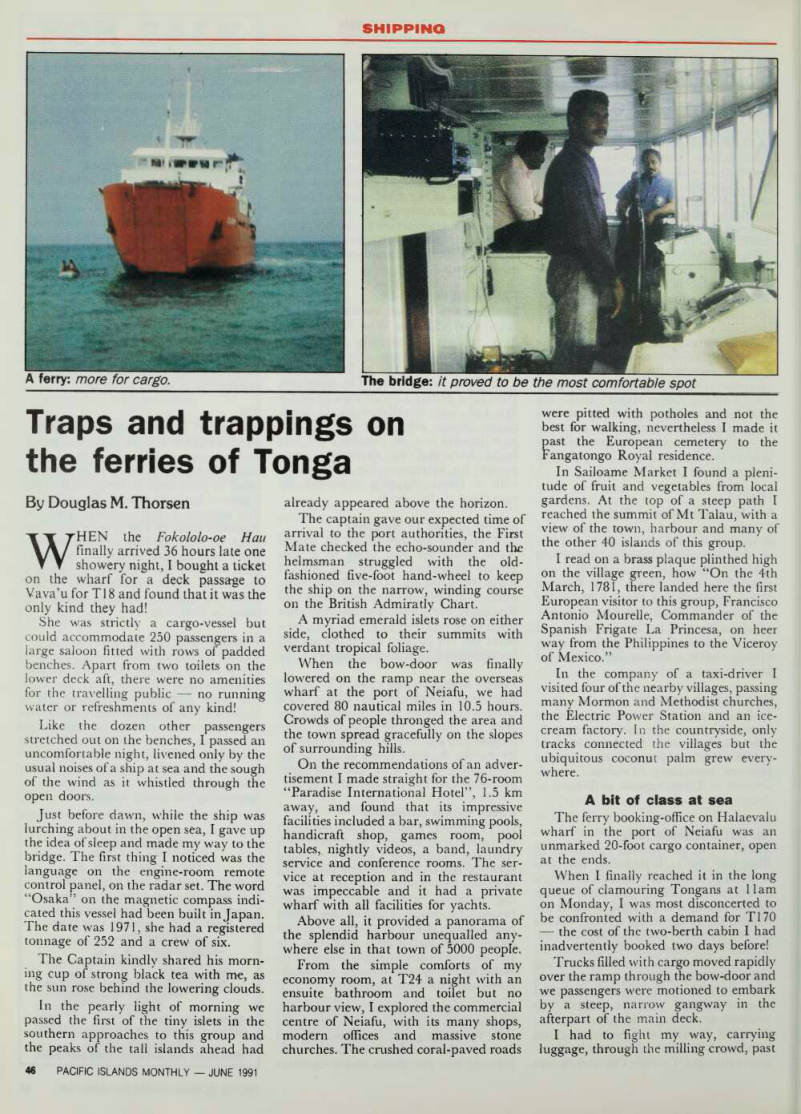
Shipping
Traps and trappings on the ferries of Tonga
By Douglas M. Thorsen
WHEN the Fokololo-oe Hau finally arrived 36 hours late one showery night, I bought a ticket on the wharf for a deck passage to Vava’u for Tl B and found that it was the only kind they had!
She was strictly a cargo-vessel but could accommodate 250 passengers in a large saloon fitted with rows of padded benches. Apart from two toilets on the lower deck aft, there were no amenities
for the travelling public no running
water or refreshments of any kind!
Like the dozen other passengers stretched out on the benches, I passed an uncomfortable night, livened only by the usual noises of a ship at sea and the sough of the wind as it whistled through the open doors.
Just before dawn, while the ship was lurching about in the open sCa, I gave up the idea of sleep and made my way to the bridge. The first thing I noticed was the language on the engine-room remote control panel, on the radar set. The word “Osaka” on the magnetic compass indi cated this vessel had been built in Japan.
The date was 1971, she had a registered tonnage of 252 and a crew of six.
The Captain kindly shared his morn ing cup of strong black tea with me, as the sun rose behind the lowering clouds.
In the pearly light of morning we passed the first of the tiny islets in the southern approaches to this group and the peaks of the tall islands ahead had
already appeared above the horizon.
The captain gave our expected time of arrival to the port authorities, the First Mate checked the echo-sounder and the helmsman struggled with the old fashioned five-foot hand-wheel to keep the ship on the narrow, winding course on the British Admiratly Chart.
A myriad emerald islets rose on either side, clothed to their summits with
verdant tropical foliage.
When the bow-door was finally lowered on the ramp near the overseas wharf at the port of Neiafu, we had covered 80 nautical miles in 10.5 hours.
Crowds of people thronged the area and the town spread gracefully on the slopes of surrounding hills.
On the recommendations of an adver tisement I made straight for the 76-room “Paradise International Hotel”, 1.5 km away, and found that its impressive facilities included a bar, swimming pools, handicraft shop, games room, pool tables, nightly videos, a band, laundry service and conference rooms. The ser vice at reception and in the restaurant was impeccable and it had a private wharf with all facilities for yachts.
Above all, it provided a panorama of the splendid harbour unequalled any where else in that town of 5000 people.
From the simple comforts of my economy room, at T 24 a night with an ensuite bathroom and toilet but no harbour view, I explored the commercial centre of Neiafu, with its many shops, modern offices and massive stone churches. The crushed coral-paved roads
were pitted with potholes and not the best for walking, nevertheless I made it past the European cemetery to the
Fangatongo Royal residence.
In Sailoame Market I found a pleni tude of fruit and vegetables from local gardens. At the top of a steep path I reached the summit of Mt Talau, with a view of the town, harbour and many of the other 40 islands of this group.
I read on a brass plaque plinthed high on the village green, how “On the 4th March, 1781, there landed here the first European visitor to this group, Francisco Antonio Mourelle, Commander of the Spanish Frigate La Princesa, on heer way from the Philippines to the Viceroy of Mexico.”
In the company of a taxi-driver I visited four of the nearby villages, passing many Mormon and Methodist churches, the Electric Power Station and an ice
cream factory. In the countryside, only
tracks connected the villages but the übiquitous coconut palm grew every where.
A bit of class at sea The ferry booking-office on Halaevalu wharf in the port of Neiafu was an unmarked 20-foot cargo container, open at the ends.
When I finally reached it in the long queue of clamouring Tongans at 11am on Monday, I was most disconcerted to be confronted with a demand for Tl7O the cost of the two-berth cabin I had inadvertently booked two days before!
Trucks filled with cargo moved rapidly over the ramp through the bow-door and we passengers were motioned to embark by a steep, narrow gangway in the afterpart of the main deck.
I had to fight my way, carrying
luggage, through the milling crowd, past
A ferry: more for cargo.
The bridge: it proved to be the most comfortable spot
people coming down, to find a few square feet of space on deck not already occupied by groups of men, women and children with mats, bundles, bags and boxes of provisions. According to a framed “Schedule of Fares”, they had paid T 42 per adult, T3l per student, and T2l per child.
The stewards wore no uniform and it was some time before I found one who spoke English. He led me down a companion-way into a central alleyway on the lower deck and indicated the aftermost of four cabins opening off it, Each cabin measured about 12 by eight feet and was fitted with a fixed metal table, a padded seat, a metal locker and an electric fan. Doors from the corridor led to a canteen, a galley, and two tiled bathroom-toilets.
Forward was a mess-room with tables and benches, leading to a long compart ment on both sides filled with small tables, all occupied at T 74 each.
While the Stewardess was making up my lower bunk I noticed that the other cabins were occupied by families of seven, eight and 10 people, all with young children. With a good book the afternoon passed peacefully, but when I went up on deck I found about 500 men, women and children camped out on their mats under makeshift awnings between mooring-bollards, engine-room casings and hatch-coamings on the boat-deck, and the upper deck.
The canteen did a brisk trade in Sao
crackers, tea, coffee, milk in packets, beer and softdrinks, and cigarettes, Between five and seven pm the long, low islands of the Ha’apai group came in sight close by on both sides, and soon afterwards a full Tongan meal was served to the cabin passengers, Ventilation below deck was adequate, but when a boisterous sea burst into my cabin through the open port-hole I had to close it for an hour or so.
Apart from the customary noises of a ship at sea, there was the sound of music from overhead speakers, the hum of conversation from the mess-room, the continuous shuffle of feet descending the companion-way to use the toilets, and the throbbing of the propeller-shaft six feet under our deck, By five o’clock next morning we had
passed through the encircling reefs north
of Tongatapu,' and half an hour after berthing at Queen Salote wharf all the other passengers had disembarked.
That ship carried two well-equipped 50-person life-boats, six 20-person life rafts, and the bridge was fitted with all the latest navigational aids like an auto pilot, radar, engine-room controls, short-wave radio and a full set of charts, certificate of registry showed she had been built in Bremen in 1981, had a gross tonnage of 707, a crew of 23 and was certified to carry 350 passengers, If and when I make another trip to the Kingdom of Tonga I will surely travel in this one. □
Shipping schedules
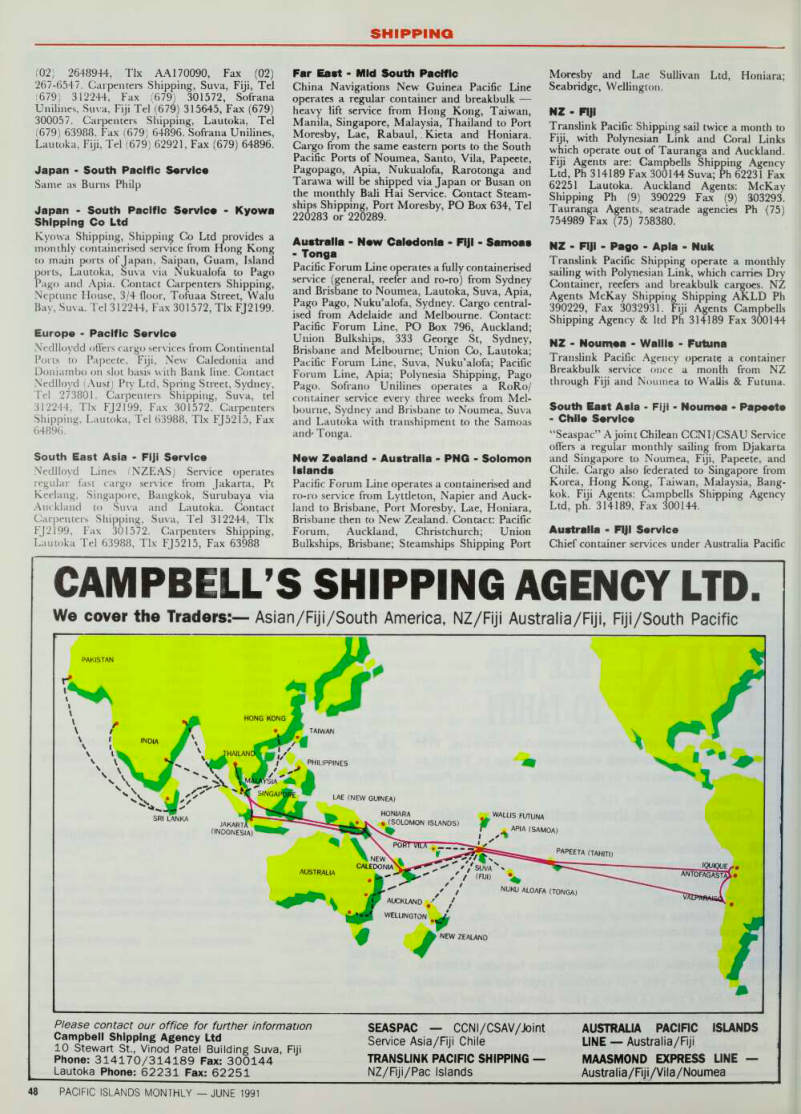
New Zealand - FIJI direct Sofrana Unilines operates a fully containerised/breakbulk service every 21 days from Auckland, Tauranga, Lytdeton to Suva and Lautoka. Loading every 21 days, ro/ro service, containers - reefer. Contact Sofrana Unilines, Sofrana House, 101 Customs Street, Auckland, PO Box 3614, Fax (09) 393874, Ph (09) 773279, Tlx NZ 2313. Direct toll free line 0800 659-922, Contact Alan Foote. Sofrana Shipping Agencies, PO Box 921 Wellington, Tel (04) 725 661, Fax (04) 725 749, Tlx NZ 4769 Contact Steve Brannigan. Sofrana Unilines Agencies, PO Box 22046 Christchurch, tel (03) 667 180, Fax (03) 668 868, TLX NZ4769,
Contact Tony Newell. Carpenters Shipping,
Private Mail Bag, Suva, Fiji, Tel (679) 312244, Fax (679) 301572, Tlx FJ 2199. Sofrana Unilincs, Suva, Fiji, Tel (679) 315645, Fax (679) 300057.
Australia - FIJI direct Sofrana Unilines operates a ro/ro container service every three weeks from Melbourne, Sydney, Brisbane, Lautoka and Suva. Contact Sofrana Unilines (Aust) Pty Ltd, PO Box Q 136.
Queen Victoria Building, Sydney, NSW 2000,
Australia. Tel (02) 2648944, Fax (02) 2676547, Tlx (71) A 170090. Contact Andrew McLachlin, Sam Attaway.
Carpenters Shipping, Suva, Tel (679) 312244, Fax (679) 301572. Sofrana Unilines Suva, Tel (679) 315 645, Fax (679) 300057. Carpenters Shipping, Lautoka, Tel (679) 63988, Fax (679) 64896. Sofrana Unilincs, Lautoka Tel (679) 62921, Fax (679) 64896.
Australia - Fiji monthly service Sofrana Unilincs (Australia) Pty Ltd operates a regular monthly service with MV Capitaine Wallis. Contact Sofrana Unilines, Sydney, Tel
(02) 2648944, Tlx AA170090, Fax (02) 267-6547. Carpenters Shipping, Suva, Fiji, Tel 679) 312244, Fax ;679) 301572, Sofrana Unilines, Suva, Fiji Tel (679) 315645, Fax (679) 3 r°™? k aS‘T'“fr rS 7Q ifffv Td 6 mrl*a 9 FHi F Lautoka, Fiji, Tel (679) 62921, Fax (679) 64896. ._„ . .
Japan - South Pacific Service Same as Burns Philp Japan - South Pacific Service - Kyowa Shipping Co Ltd Kyowa Shipping, Shipping Co Ltd provides a monthly containerised service from Hong Kong to main ports of Japan, Saipan, Guam, Island ports, Lautoka, Suv a via Nukualofa to Pago Pago and Apia. Contact Carpenters Shipping, Neptune House, 3/4 floor, Tofuaa Street, Walu Bay. Suva. Tel 312244, Fax 301572, Tlx FJ2199. ... .
Europe - Pacific Service Nedlloydd offers cargo services from Continental Ports to Papeete, Fiji, New Caledonia and Doniambo on slot basis with Bank line. Contact Nedlloyd (Aust) Pty Ltd, Spring Street, Sydney, Tel 273801. Carpenters Shipping, Suva, tel 312244, Tlx FJ2199, Fax 301572. Carpenters Shipping, Lautoka, Tel 63988, Tlx FJ5215, Fax 64896 South East Asia - FIJI Service Nedlloyd Lines fNZEAS) Service operates regular fast cargo service from Jakarta, Pt Keelang, Singapore, Bangkok, Surubaya via Auckland to Suva and Lautoka. Contact Carpenters Shipping, Suva, Tel 312244, Tlx FJ2199, Fax 301572. Carpenters Shipping, Lautoka Tel 63988, Tlx FJ5215, Fax 63988
Far East - Mid South Pacific China Navigations New Guinea Pacific Line operates a regular container and breakbulk heavy lift service from Hong Kong, Taiwan, “ anil ?' Singapore, Malaysia, Thailand to Port Rabaul - Klcta and Honiara.
Cargo from the same eastern ports to the South Pacific Ports of Noumea, Santo Vila, Papeete, Pagopago, Apia, Nukualofa, Rarotonga and Tarawa wiU be shipped via Japan or Busan on the monthly Bah Hat Service. Contact. Steao^nooo hipP io^o?Q rt Morcsb y» PO Box 634 ’ Tel 220283 or 220289 - Austra|la . Naw Caledonia - FIJI - Samoa, j onaa n . r * r . T . , Pacific Forum Lane operates a fully containcnsed scmce (general, reefer and ro-ro) from Sydney Brisbane to ll P ea ’ Lautoka, Suva, Apia,
Pago Pago, Nukualofa Sydney. Cargo central-
ised from Adelaide and Melbourne Contact: Pacific Forum Line, PO Box 796, Auckland;
Union Bulkships, 333 George St, Sydney,
Brisbane and Melbourne; Union Co, Lautoka; Pacific Forum Line, Suva, Nukualofa; Pacific Forum Line, Apia; Polynesia Shipping, Pago Pago. Sofrano Unilines operates a Roßo/ container service every three weeks from Mel bourne, Sydney and Brisbane to Noumea. Suva and Lautoka with transhipment to the Samoas and a Tonga.
New Zealand - Australia - PNG - Solomon Islands Pacific Forum Line operates a containerised and ro-ro service from Lytdeton, Napier and Auckland to Brisbane, Port Moresby, Lae, Honiara, Brisbane then to New Zealand. Contact; Pacific Forum, Auckland, Christchurch; Union
Bulkships, Brisbane; Steamships Shipping Port
Moresby and Lae Sullivan Ltd, Honiara;
Seabridge, Wellington.
NZ - Fiji Translink Pacific Shipping sail twice a month to Fiji, with Polynesian Link and Coral Links which operate out of Tauranga and Auckland.
Fiji Agents are: Campbells Shipping Agency
Ltd, Ph 314189 Fax 300144 Suva; Ph 62231 Fax 62251 Lautoka. Auckland Agents: McKay Shipping Ph (9) 390229 Fax (9) 303293.
Tauranga Agents, seatrade agencies Ph {75)
754989 Fax (75) 758380.
NZ - FIJI - Pago - Apia - Nuk Translink Pacific Shipping operate a monthly sailing with Polynesian Link, which carries Dry Container, reefers and breakbulk cargoes. NZ
Agents McKay Shipping Shipping AKLD Ph
390229, Fax 3032931. Fiji Agents Campbells Shipping Agency & ltd Ph 314189 Fax 300144 NZ - Noumea - Wallis - Futuna Translink Pacific Agency operate a container Breakbulk service once a month from NZ through Fiji and Noumea to Wallis & Futuna.
South East Asia - Fiji - Noumea - Papeete - Chile Service “Seaspac” A joint Chilean CCNI/CSAU Service offers a regular monthly sailing from Djakarta and Singapore to Noumea, Fiji, Papeete, and Chile. Cargo also federated to Singapore from
Korea, Hong Kong, Taiwan, Malaysia, Bang
kok. Fiji Agents: Campbells Shipping Agency'
Ltd, ph. 314189, Fax 300144.
Australia - Fiji Service Chief container services under Australia Pacific
Island Line Unitize Sofrano and PFL vessels to provide a twice monthly, service from Australia.
Fiji Agents Campbells Shippings Agency ltd
Ph 314189 Fax 300144. System Agents Nedlloyd Swire Ph(2; 2512699. Melbourne Yarra
Shipping Ph (3) 6936300. Brisbane, Medlloyd
Swire, ph (7) 8321551.
Australia - Fiji - Noumea - Vila - Santa Marsmond Express Lines operate a breakbulk service from Goodwood Island Australia to Fiji, Noumea, Vila Santo and Honiara. Continuous receiving depots in Sydney and Brisbane enable this vessel to bring cargoes from these parts. Fiji
Agents Campbells Shipping Agency Ltd, ph.
314189. Fax 300144. Brisbane Agents Ship pings & Marketing Ph (7) 2628082. Sydney Agents Scabord Agencies (2) 3172325.
Australia - New Caledonia - FIJI - Hawaii - North America ACT Pace Pacific (ACTA Shipping) operates a fully containerised/break bulk service every 17-20 from Melbourne, Sydney, Brisbane to Noumea. Suva and Lautoka. The vessels con tinue on to the West Coast of North America calling Honolulu at frequent intervals. Ships are ACT and ACT 12. Contacts: ACTA Pty Ltd, Sydney Ph 2869666, Tx 121369, Fx 2869610.
ACTA Ptv Ltd, Melbourne Ph 6112000, Tx 30949, Fx 6293055. ACTA Pty Ltd, Brisbane Ph 2213116 m Tx 40719. Fx 2298143. SATO, Noumea Ph 281122, Tx 3163, Fx 278532. Bums Philp Shipping. Suva Ph 311777, Tx 2168, Fx 301 127; Burns Philp Shipping, Lautoka Ph 60777, Tx 5146, Fx 65850.
West Coast of North America - Fiji - New Zealand
Blue Star Line Pacific Coast Service operates a fully containerised/break bulk service every 23 days from Vancouver, Seattle, San Francisco, Los Angeles to Pago Pago, Suva and New Zealand ports. The vessels continue to call Suva on the Northbound voyage from New Zealand every fortnight to pick up Fiji exports such as garments, fresh ginger, etc. for Hawaii and West Coast of North America ports. Blue Star Line also provides a through service to East Coast to North America, Ships arc Wellington Star, Southland Star and California Star. Contacts: Blue Star Line, San Francisco Ph 9282026, Tx 184925, Fx 6730355; Blue Star Line, Vancouver Ph 6817300, Tx 0451326, Fx 6835797; Interocean Steamship Corp, Scatde Ph 6829820, Tx 321101, Fx 3437421; Blue Star Line, Los Angeles Ph 5970454, Tx 408564, Fx 5978710.
New Zealand Line, Wellington, Ph 739029, Tx 3583, Fx 4992468; New Zealand Line, Auckland Ph 390965, Tx 2556, Fx 3032039; Bums Philp Shipping, Suva Ph 311777, Tx 2168, Fx 301127; Burns Philp Shipping, Lautoka Ph 60777, Tx 5146, Fx 65850.
Japan - South Pacific Sarvlco Bali Hai Line a joint service of China Navigation, Mitsui OSK Line and NYK Line operates a fully containerised/brcak bulk service from Korea, Japan to South Pacific ports on a monthly basis serving ports of Pusan, Kobe, Nagoya, Yokogama, Tarawa, Lautoka, Suva,
Apia, Pago Pago, Papeete, Nuku’alofa, Noumea,
Vila, Santo. The ships are also fully specialised to carry vehicles on Ro/Ro basis. Ships arc Coral Islander and Pacific Islander. Contacts: John Swire & Sons, Tokyo Ph 32309220, Tx 22248, Fx 3239288; Nippon Yuscn Kaisha, Tokyo Ph 3284516, Tx 22236, Fx 32846332; Mtsul OSK Lines, Tokyo Ph 35877086, Tx 22266, Fx
35877732; Bums Philp Shipping, Suva (C/Islander) Ph 311777, Tx 2168, Ex 301127; Carpenters Shipping, Suva (P/lslander) Ph 312244, Tx 2199, Fx 301572; Burns Philp Shipping, Lautoka Ph 60777, Tx 5146, Fx 65850; Carpenters Shipping Ph 63988, Tx 5215, Fx 64896.
Europe - South Pacific Service Bank Line Limited operates a monthly service from United Kingdom. Europe to South Pacific ports. Vessels arc fully equipped to cany containers, break bulk cargo and have deep tank facilities to carry bulk liquid such as oil, etc. The service operates from Hull, Rotterdam, Hamburg, Dunkirk, Lc Havre, Papeete, Apia, Suva, Lautoka, Noumea, Vila, Santo, Honiara, Papua New Guinea Group, Singapore and back to Europc/Continent. Ships: Forthbank, Ivybank, Clydebank, Moraybank. Contacts: Bank Line, London Ph 2650808, Tx 887392, Fx 4814784, Bank Line, Lac Ph 421235, Tx 44265, Fx 422925; Bank Line, Sydney, Ph 9063173, Tx 24063, Fx 9061430; Bums Philp Shipping, Suva Ph 31 1777, Tx 2168. Fx 301127; Burns Philp Shipping, Lautoka Ph 60777, Tx 5146, Fx 65850.
Australia - Vanuatu - FIJI Sitmar Cruises operates a year round cruise programme for Sydney to Vanuatu, Fiji. The programme also includes a number of calls to a number of islands such as Dravuni, Yasawa-i- Rara, Rotuuia, Mystery Island, etc.
Contact; Sitmar Cruises, Sydney Ph 2560111, Tx 20712, Fx 2560101; Bums Philp Shipping, Suva Ph 311777, Tx 2168, Fx 301127; Bums Philp Shipping, Lautoka Ph 60777, Tx 5146, Fx 65850. □
Advertisements & other items, pp. 47-49 (2 items)
Free Trip
Fill out the coupon and send it with your credit card information, personal cheque or money order to: Monthly Tahiti Sun Press Contest, B.P. 887, Papeete, Tahiti.
X Yes! Sign me up for a Tahiti Sun Press subscription: □ Iyr □ 2 yrs □ Lifetime Enclosed is $ ( □ personal cheque □ money order Uncertified bank cheque) Note: Credit card payments are possible, but may cost you more or less than the rates listed here due to the fluctuation in foreign exchange rates. Tahiti Publications Touristiques assumes no responsibility for such accurences.
G Visa G Mastercard G American Express Card No; Signature Expiry Date Name Adress
WIN
FREE TRIP
TO TAHITI
Enter the Tahiti Sun Press sweepstakes drawing. Win one of two free one-week vacation for two in Tahiti as a privileged subscriber to the monthly Tahiti Sun Press.
Choose one of these subscription offers KB A charter one-year subscription for only $5O. (US Mainland residents only. For other countries see rates).
The regular 12-month subscription price will be US$6O.
So save $lO now.
Q A charter two-year subscription for only US$9O.
A regular 24-month subscription costs US$l2O. Save $3O now.
O A one-time lifetime subscription for only US$35O.
After six years you will continue receiving the monthly Tahiti Sun Press 12 times a year absolutely free for the rest of your life! A fantastic saving! Due to the substantial savings involved, lifetime subscriptions will be limited to the first 1000 orders received.
CAMPBELL’S SHIPPING AGENCY LTD
We cover the Traders: — Asian/Fiji/South America, NZ/Fiji Australia/Fiji, Fiji/South Pacific
HONG KONG
TAIWAN
INDIA
» / I I ** \
HAILAN
U 1 / s N /
SRI LANKA
PAPEETA (TAHITI)
NEW
IQUIQUE
CALEDONIA
AUSTRALIA
ANTOFAGASTA^#
AUCKLAND J f
WELLINGTON U*
NEW ZEALAND
Please contact our office for further information Campbell Shipping Agency Ltd 10 Stewart St., Vinod Patel Building Suva, Fiji Phone: 314170/314189 Fax: 300144 Lautoka Phone: 62231 Fax: 62251
SEASPAC CCNI/CSAV/Joint
Service Asia/Fiji Chile
TRANSLINK PACIFIC SHIPPING
NZ/Fiji/Pac Islands
AUSTRALIA PACIFIC ISLANDS
LINE Australia/Fiji
MAASMOND EXPRESS LINE
Austra lia/Rji/Vila/Nou mea
TONGA
KIRIBATI
VANUATU
COOK ISLAND
SOLOMON ISLANDS
NEW CALEDONIA
U.S. SAMOA
WESTERN SAMOA
FRENCH POLYNESIA
JAPAN . KOREA
YOU’LL FIND IT,
WHERE THE SKY MEETS
THE SEA
RORO. CONTAINER i
B.BULK SHIPPING
BALI
AGENTS
and
PHONE
SUVA:Burns Philp(B P) 311777 Carpenter Shipping (C.S) 312244 LAUTOKArB P 60777 C S 63988 APIA:B P 22611 PAGOPAGO Polynesia rT P J n o 9 ." e I V,CeS Ltd 633 1211 PAPEETE:Compagnie Maritime Polynesienne 42 84 02 NOUHEAiEtablissements Ballande 687-283384 NUKUALOFA B P^np B P ,ARA:Su,li '' ans < So,om O" Wands) Ltd 21645 TARAWA:Shipping Corporation of Kiribati 26195 Co LW ’ 77fl r Bn ! r i “o 9 -? 9 Cha ° 9 Shippi " 9 Co . Ltd 753-0451 for vehicle Pan Continental Shipping Co. Ltd 778-7680 Soyang Shipping Co.. Ltd 752-7755 JAPANrfor general cargo Swire 03-230-9245 for vehicle NYK Lines 03-284-6506 Mitsui O.S.K 03-587-7123
Shipping
Palau pushed gently toward change
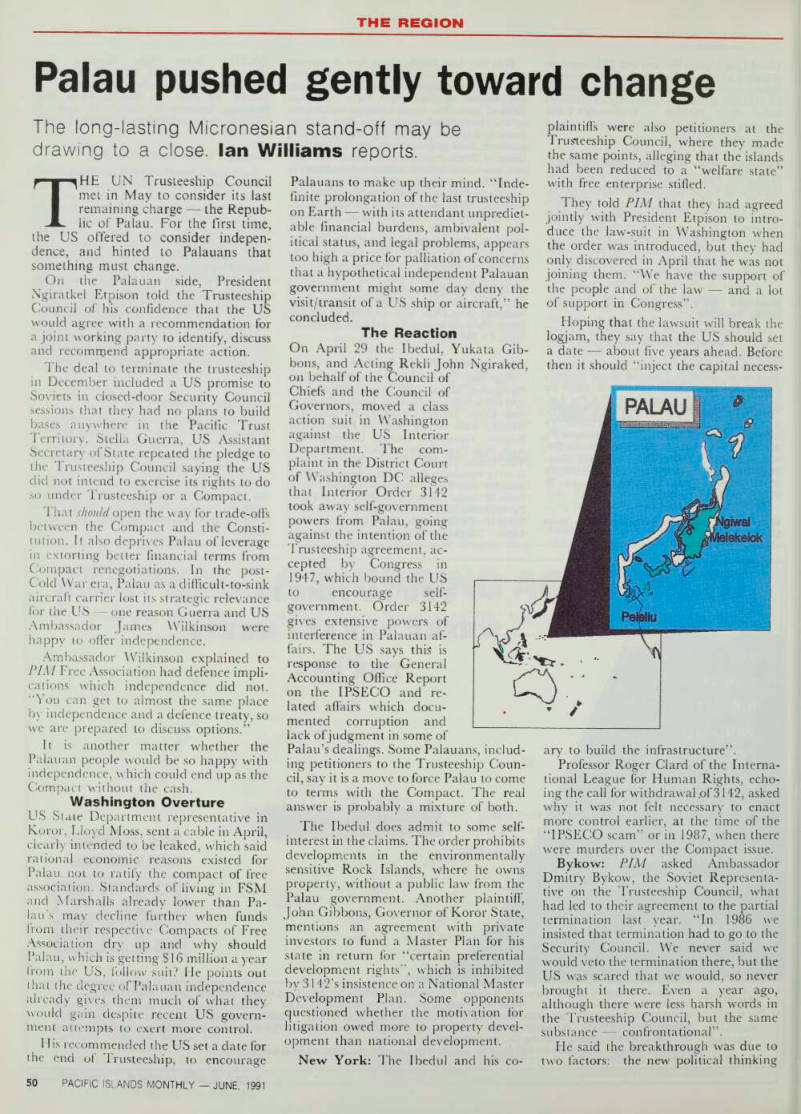
The Region
The long-lasting Micronesian stand-off may be drawing to a close. lan Williams reports.
THE UN Trusteeship Council met in May to consider its last remaining charge the Repub lic of Palau. For the first time, the US offered to consider indepen dence, and hinted to Palauans that something must change.
On the Palauan side, President Ngiratkel Etpison told the Trusteeship Council of his confidence that the US would agree with a recommendation for a joint working party to identify, discuss and recomrxiend appropriate action.
The deal to terminate the trusteeship in December included a US promise to Soviets in closed-door Security Council sessions that they had no plans to build bases anywhere in the Pacific Trust Territory. Stella Guerra, US Assistant Secretary of State repeated the pledge to the Trusteeship Council saying the US did not intend to exercise its rights to do so under Trusteeship or a Compact.
That should open the way for trade-offs between the Compact and the Consti tution. It also deprives Palau of leverage in extorting better financial terms from Compact renegotiations. In the post- Cold War era, Palau as a difficult-to-sink aircraft carrier lost its strategic relevance for the US one reason Guerra and US Ambassador James Wilkinson were happy to offer independence.
Ambassador Wilkinson explained to PIM Free Association had defence impli cations which independence did not.
“You can get to almost the same place by independence and a defence treaty, so we are prepared to discuss options.”
It is another matter whether the Palauan people would be so happy with independence, which could end up as the Compact without the cash.
Washington Overture US State Department representative in Koror, Lloyd Moss, sent a cable in April, clearly intended to be leaked, which said rational economic reasons existed for Palau not to ratify the compact of free association. Standards of living in FSM and Marshalls already lower than Pa lau s may decline further when funds from their respective Compacts of Free Association dry up and why should Palau, which is getting Sl6 million a year from the US, follow suit? He points out that the degree of Palauan independence already gives them much of what they would gain despite recent US govern ment attempts to exert more control.
His recommended the US set a date for the end of Trusteeship, to encourage
Palauans to make up their mind. “Inde finite prolongation of the last trusteeship on Earth with its attendant unpredict able financial burdens, ambivalent pol itical status, and legal problems, appears too high a price for palliation of concerns that a hypothetical independent Palauan government might some day deny the visit/transit of a US ship or aircraft,” he concluded.
The Reaction On April 29 the Ibedul, Yukata Gib bons, and Acting Rekli John Ngiraked,
on behalf of the Council of Chiefs and the Council of Governors, moved a class action suit in Washington against the US Interior Department. The com plaint in the District Court
of Washington DC alleges
that Interior Order 3142 took away self-government powers from Palau, going against the intention of the Trusteeship agreement, ac
cepted by Congress in
1947, which bound the US to encourage self government. Order 3142 gives extensive powers of interference in Palauan af fairs. The US says this is response to the General
Accounting Office Report
on the IPSECO and re lated affairs which docu mented corruption and lack of judgment in some of
Palau’s dealings. Some Palauans, includ
ing petitioners to the Trusteeship Coun
cil, say it is a move to force Palau to come to terms with the Compact. The real answer is probably a mixture of both.
The Ibedul does admit to some self interest in the claims. The order prohibits
developments in the environmentally
sensitive Rock Islands, where he owns property, without a public law from the Palau government. Another plaintiff, John Gibbons, Governor of Koror State, mentions an agreement with private investors to fund a Master Plan for his state in return for “certain preferential development rights", which is inhibited by 3142’s insistence on a National Master Development Plan. Some opponents questioned whether the motivation for litigation owed more to property devel opment than national development.
New York: The Ibedul and his co
plaintiffs were also petitioners at the Trusteeship Council, where they made the same points, alleging that the islands had been reduced to a “welfare state” with free enterprise stifled.
They told PIM that they had agreed jointly with President Etpison to intro duce the law-suit in Washington when the order was introduced, but they had only discovered in April that he was not joining them. “We have the support of the people and of the law and a lot of support in Congress”.
Hoping that the lawsuit will break the logjam, they say that the US should set a date about five years ahead. Before then it should “inject the capital necess-
ary to build the infrastructure”.
Professor Roger Clard of the Interna tional League for Human Rights, echo ing the call for withdrawal .of 3142, asked why it was not felt necessary to enact more control earlier, at the time of the “IPSECO scam” or in 1987, when there were murders over the Compact issue.
Bykow; PIM asked Ambassador
Dmitry Bykow, the Soviet Representa
tive on the Trusteeship Council, what had led to their agreement to the partial termination last year. “In 1986 we insisted that termination had to go to the Security Council. We never said we would veto the termination there, but the US was scared that we would, so never brought it there. Even a year ago, although there were less harsh words in the Trusteeship Council, but the same substance confrontational”.
He said the breakthrough was due to two factors: the new political thinking
after the Cold War and, in December, US advice that it did not intend to build future bases in the Pacific Territory.
Did they have any preference between Free Association and independence?
“The emphasis on free choice has been stressed, even in the Security Council, I but it is for them to argue over terms. But the new situation makes it easier to take into account the will of the people ... It is also, I think, the first lime it has been suggested that independence is an op tion.”
What about the rumours of a unilat eral termination of trusteeship? “Ter mination is of course for the Security Council that’s what the deadlock was between ’B6 and ; 90.”
Uherbelau: Victor Uherbelau, Foreign Minister of Palau, explained that when Free Association was devel oped back in 1969 it was modelled on New Zealand’s relationship with Cook Islands and Niue, but with the addition of control of foreign relations excluding defence and security.
He cannot understand the logjam over the Nuclear or the land-use provisions.
“They have always told us that there is no future intention of using the land, but they want the option. It’s so ephemeral.”
And he does not necessarily accept Moss’s contention that the Compact is a less eligible option than the current status. He suggested that it was better to have 15 years assured funding than the present situation in which, “so far we have to beg Washington ever)’ year to lobby for finance, so what Lloyd Moss said was premature, a value judgment.”
What did he think of the threats to terminate? “You can’t just terminate the trusteeship or you’d create a void, a vacuum . . . (but) during the talks at the State Department two weeks ago they spoke of five or six years from now. We do have to have a target date on which to work.”
As he told the Trusteeship Council, agreement was in reach if the US could agree to take the defence aspects of the Compact into a separate treaty, and ensure that that treaty had no nuclear options. If Free Association failed, the only viable option was independence. “If mutually agreed terms means conditional independence, then that’s no different from the Compact of Free Association. 1 erritorial and Commonwealth status are ruled out because of the lack of control over citizenship and hence
land ownership.”
W hat about the IPESCO debt, where the bankers are just waiting for the C ompact Funds to pay off their claims?
“W'e wanted a deal that would make u all self-financing. And we said the Compact funds would not be used as collateral for the loan. If. . . the project was self financing like they said, then why did they need collateral?” □
Reshaping the role of women
PALAU’S 15,000 people have a Federation of 16 states, with a bicameral legislature, the OEK (Olbiil Era Kelulau). The Council of Chiefs represent traditional govern ment, at least in an advisory capacity.
But one very powerful aspect of tra ditional power is not so well represented Palauan women.
Traditionally, chiefs were chosen by women on the basis of descent from the female line, and they could be sacked by them. So, has the power of Palauan women been eroded in the Constitution
adopted in 1979? Pacific Islands Monthly
posed the question to two Palauan women in New York for the UN
Trusteeship Council.
In February, Sandra Pierantozzi, Pa lau’s Minister for Administration, was the second woman appointed to the cabinet after 10 years as Clerk to the Senate. She explained that women’s power was traditionally behind the scenes, with the highest ranking woman deciding who the chief will be.
“On traditional things we still have that power, so I don’t see that the constitution takes power from them. In fact it opens the door for women.”
The constitution allows women to speak out without subservience to the Bilung, or highest ranking woman “so many educated women welcome the democracy.” It also allows women to hold office in their own right, instead of through male nominees, and she would like to see more women take office, as they have in Guam.
She thinks the US directive 3142 taking power back is a means of putting pressure on Palau over the Compact. But it might misfire, like the leaked Cable
sent by State Department staffer Lloyd
Moss advocating the US unilaterally set a date to terminate trusteeship. “The cable admits that the Compact is no good, so there is no reason why they should push it down our throats,” she
explains.
So how does she see the consti tutional impasse resolving itself?
“If the nuclear provisions are taken out of the Compact, then there’s no need to amend the constitution. On the other hand maybe we should also amend the constitution but a lot of Palauans are very protective of it.”
Meikam Weers, a Palauan who now lives in San Francisco, is a poet not a politician. She writes in English and Palauan, and was addressing the Trusteeship Council on behalf of the Otil A Beluad, (Anchor of Our Land) organisation. She thinks the 1979 consti tution, although it united many people on the nuclear issue, divided traditional society based on consensus within the clans and villages, bound together by a web of alliances.
“Instead of clan, family and village, it’s now money and votes. The impetus is no longer the accountability of the people, but of the rich”. She also believes women should participate more, but in a political as well as traditional way through a Council of Women.
She told PIM, Palau could combine the old and new cultures and provide a sophisticated model for the world.
It is a prospect which may not appeal to the United States, where Nancy Reagan’s power behind the throne was not seen as a unmitigated blessing. But then, the prospect of more Pacific islands with the obduracy of Palau is not likely to please the White House either. □
By Ian Williams
Advertisements & other items, p. 51 (1 item)
The South Sea Digest
The Newsletter on Islands Affairs. Every Other Friday South Sea Digest has all the latest business news, expertly streamlined and obtainable nowhere else.
Subscriptions: 25 issues SAISO for Australian subscriber; Asl7s overseas, all airmailed. Payment by cheque in A$ and US$, otherwise by bank draft.
Send payment to: The South Sea Digest, GPO Box 4245, Sydney, NSW 2001, Australia.
Name Address
High chiefs take court action
By David North
THERE is a new ingredient in the
ongoing relationship struggle be
tween Washington and Palau a lawsuit filed againsnhe US Government by Palau’s traditional paramount chief, Ibedul Yutaka Gibbons.
The Ibedul was joined in the court action by other high chiefs in Palau, and by the Council of State Governors, but not by either the President or the national legislature (see story this page).
The suit was filed against US Secre tary of Interior, Manuel Lujan, and Assistant Secretary for Territorial and Island Affairs, Stella Guerra, in the US District Court for the District of Colum bia (the location of the Interior offices.) The suit seeks to undo decades of Mainland policies, and change a variety of island and Mainland governmental practices. Its objectives include: • termination of United Nations Trusteeship on terms accepted by Palau; • expenditure of unspecified amounts of Mainland money to restore Palau’s infrastructure to the level it was during the height of Japanese activity; • partial or total repeal of the recent order of the Secretary of Interior, which limited the extent of Palauan self government.
Co-signing the lawsuit were John Ngiraked, Acting Reklai and vice chair man of the Palau Council of Chiefs, John Gibbons, the Governor of the State of Koror (and chairman of the Palau
Governors Conference), Moses Uludong,
Governor of the Stale of Ngchesar (and secretary of the Governors Conference), the Palau Council of Chiefs and the Palau Conference of Governors.
While island-based suits against Wash ington are usually futile, this one raises two interesting sets of issues post-war destruction of roads and buildings by the US Army, and imposition by the US Government, or its toleration of, “the welfare state, massive government em
ployment and corruption.”
On the first the Ibedul’s press kit states: “During the Japanese occupation of Palau there were 95 miles of paved roads in Palau. After World War II these roads were destroyed by US forces. In 1991 there are only nine miles of paved roads in Palau.”
Similarly: “prior to 1947 there were more than 950 reinforced concrete build ings in the capital city, Koror. Under the administration of the United States these buildings were dynamited and bull dozed. Today most structures in Koror are constructed of corrugated tin.”
The Idebul’s colleagues say the US military wanted to destroy remnants of
Japan, and install good, US-built roads and buildings; but destruction took place and reconstruction did not.
The press kit continues: “Prior to 1947 Palau had a water system capable of meeting the needs of all its people and an electrical generating system capable of providing dependable power to the inhabitants of major villages. Today few villages including the capital city Koror, have dependable water and electrical services.”
The IbeduPs colleagues said that Palau’s new, controversial, and not-yet paid-for electrical generating system serves only about two-thirds of the population (those in and near Koror) and is not totally reliable.
The IbeduPs press statement also recalled that “prior to the Second World War Palau had a diverse economy with a thriving private sector .. . between 1924 and 1936 Palau was a net exporting country of agricultural and manufac tured goods . . . [but] today the mainstay of the Palauan economy is a bloated, inefficient and unproductive bureauc racy fueled by US tax dollars. It is a false economy based on government em
ployees.”
The lawsuit, and accompanying docu ments and statements, speak sharply of Mainland policies which are not con ducive to self-government. Last year’s secretarial order, limiting the power of
the Palauan government to pass legis lation and spend money, is regarded by the Ibedul as yet another effort “to put pressure on the people of Palau” to accept the Compact (with its contro versial provisions about storage of US nuclear weapons on the islands.) The Ibedul stressed his continuing support of the island state’s constitution which apparently would need to be amended were the Compact approved.
Without stating his (apparently nega tive) feelings on the Compact, the Ibedul said he wanted his people to make up their own mind and, later, that he wanted them to have sufficient education to discuss the alternatives.
At no point in the proceedings did anyone raise the issue of the supermajority three-quarters ap proval which has stalled US-Palau relations. There have been seven referenda, and the proposed Compact has always secured a heavy majority, but never three-quarters of the vote. No-one has moved to amend the island consti tution to eliminate the need for a three quarters vote, and the self-imposed stalemate continues.
Oral arguments before the not-yet chosen US District Court judge will not take place for months. There are the likely appeals, so a final decision may not be reached for years. After conferring with allies and potential allies in the
Congress, the Ibedul planned to spend
some time in New York, carrying his case to the United Nations Trusteeship Coun cil, before returning to Palau. G
The Ibedul’s anomolous role
“FORGIVE my ignorance of the intricacies of your government, but would not your suit be stronger if it were joined by the President of Palau?”
This question, asked by a puzzled Associate Press (AP) reporter at the Ibedul’s press conference, underlined some of the handicaps in the lawsuit filed by Palau’s traditional chief, Yuytaka Gibbons, and his visit to Washington.
The IbeduPs efforts on behalf of his countrymen were dogged with obstacles, some self-imposed.
The first problem, identified by the AP writer, was the clearly-visible split within the island’s Establishment. The tra ditional chiefs and the governors of the island states (there are 16 of them for a
population of 15,000 people) joined the
Ibedul, but neither the Federal legis lature (the OEK) nor President Ngiratkel Epison were signatories to the suit. (The Ibedul answer to the AP reporter was simply that “the traditional leaders are very powerful in our country”.) A second problem was the afore
mentioned intricate leadership structure.
A traditional leader who is not the elective leader but who does play a role in politics is a difficult proposition for American minds, (The Ibedul was once mayor of Korore, and is important in the politics of the island territory.) The third problem was a lack of clarity in the suit itself — it seeks a termination of the Trusteeship under terms accept able to Palau, but sets neither those terms nor a date. Similarly, it seeks funds from Washington but does not specify an amount.
Another problem was a lack of plan ning. Copies of the all-important court filing were not available at the time of the IbeduPs press conference. And, though the IbeduPs party had been hoping for a member of Congress to join the suit as a plaintiff, none had signed on by the time the suit was filed on April 29.
The final problem was the IbeduPs decision to conduct his contacts with the press through an interpreter, despite having spent six years studying in Guam, and as a soldier in the US army. □
Tackling the ‘bad boy’ tag
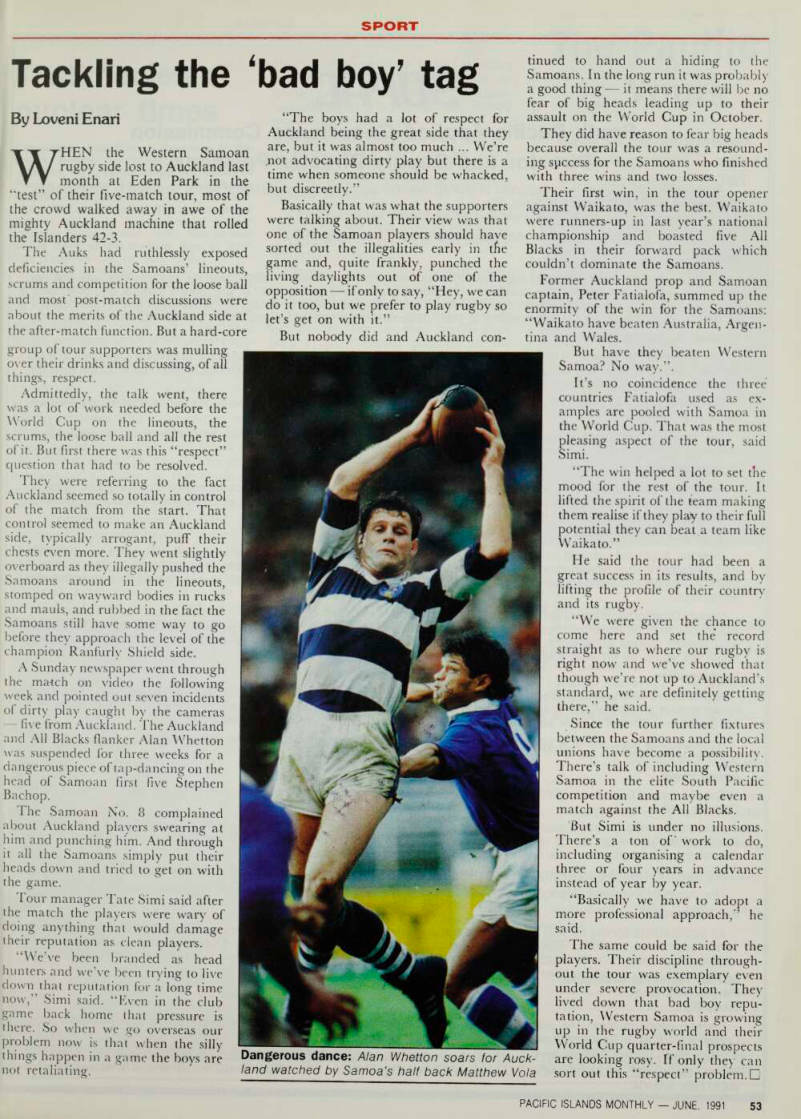
Sport
By Loveni Enari
WHEN the Western Samoan rugby side lost to Auckland last month at Eden Park in the “test” of their five-match tour, most of the crowd walked away in awe of the mighty Auckland machine that rolled the Islanders 42-3.
The Auks had ruthlessly exposed deficiencies in the Samoans’ lineouts, scrums and competition for the loose ball and most' post-match discussions were about the merits of the Auckland side at the after-match function. But a hard-core
group of tour supporters was mulling over their drinks and discussing, of all things, respect.
Admittedly, the talk went, there was a lot of work needed before the World Cup on the lineouts, the scrums, the loose ball and all the rest of it. But first there was this “respect” question that had to be resolved.
They were referring to the fact Auckland seemed so totally in control of the match from the start. That control seemed to make an Auckland side, typically arrogant, puff their chests even more. They went slightly overboard as they illegally pushed the Samoans around in the lineouts, stomped on wayward bodies in rucks and mauls, and rubbed in the fact the Samoans still have some way to go before they approach the level of the
champion Ranfurly Shield side.
A Sunday newspaper went through the ma-tch on video the following week and pointed out seven incidents of dirty play caught by the cameras five from Auckland. The Auckland and All Blacks flanker Alan Whetton was suspended for three weeks for a dangerous piece of tap-dancing on the head of Samoan first five Stephen
Bachop.
The Samoan No. 8 complained about Auckland players swearing at him and punching him. And through it all the Samoans simply put their heads down and tried to get on with the game.
Tour manager Tate Simi said after the match the players were wary’ of
doing anything that would damage
their reputation as clean players.
“We’ve been branded as head hunters and we’ve been trying to live down that reputation for a long time now,” Simi said. “Even in the club game back home that pressure is there. So when we go overseas our problem now is that when the silly things happen in a game the boy's are not retaliating.
“The boys had a lot of respect for Auckland being the great side that they are, but it was almost too much ... We’re .not advocating dirty play but there is a time when someone should be whacked, but discreetly.”
Basically that was what the supporters were talking about. Their view was that one of the Samoan players should have sorted out the illegalities early in tfie
game and, quite frankly, punched the
living daylights out of one of the opposition if only to say, “Hey, we can do it too, but we prefer to play rugby so let’s get on with it.”
But nobody did and Auckland con-
tinued to hand out a hiding to the Samoans. In the long run it was probably a good thing — it means there will be no fear of big heads leading up to their assault on the World Cup in October.
They did have reason to fear big heads because overall the tour was a resound ing spccess for the Samoans who finished with three wins and two losses.
Their first win, in the tour opener against Waikato, was the best. Waikato were runners-up in last year’s national championship and boasted five All Blacks in their forward pack which couldn’t dominate the Samoans.
Former Auckland prop and Samoan captain, Peter Fatialofa, summed up the enormity of the win for the Samoans: “Waikato have beaten Australia, Argen tina and Wales.
But have they beaten Western Samoa? No way.”.
It’s no coincidence the three countries Fatialofa used as ex amples are pooled with Samoa in the World Cup. That was the most pleasing aspect of the tour, said Simi.
“The win helped a lot to set the mood for the rest of the tour. It lifted the spirit of the team making them realise if they play to their full potential they can beat a team like Waikato.”
He said the tour had been a great success in its results, and by lifting the profile of their country and its rugby.
“We were given the chance to come here and set the record straight as to where our rugby is right now and we’ve showed that though we’re not up to Auckland’s standard, we are definitely getting there,” he said.
Since the tour further fixtures between the Samoans and the local unions have become a possibility.
There’s talk of including Western Samoa in the elite South Pacific competition and maybe even a match against the All Blacks.
But Simi is under no illusions.
There’s a ton of work to do,
including organising a calendar
three or four years in advance instead of year by year.
“Basically we have to adopt a more professional approach,” he said.
The same could be said for the
players. Their discipline through
out the tour was exemplary even under severe provocation. They lived down that bad boy repu tation, Western Samoa is growing up in the rugby world and their World Cup quarter-final prospects are looking rosy. If only the) can sort out this “respect” problem.□
Dangerous dance: Alan Whetton soars for Auck land watched by Samoa's half back Matthew Vola
Advertisements & other items, p. 54 (1 item)
sopac
South Pacific Applied Geoscience Commission
Director and Deputy Director Positions
Applications are invited from nationals of SOPAC member countries for the following senior positions in the Technical Secretariat of SOPAC, based in Suva, Fiji: I (1) Director : for a three year appointment from January, 1992 (2) Deputy Director for a three year appointment from 1 January, 1992
SOPAC
SOPAC is an inter-governmental organisation comprising fourteen South Pacific countries as members*. Its primary objectives is to assist its member countries in the identification and assessment of the marine mineral and other nonliving resource potential of the offshore areas within their Exclusive Economic Zones, in the management of development in their coastal areas, and in the training of their nationals in all relevant areas within the SOPAC Work Programme.
TECHNICAL SECRETARIAT
The Technical Secretariat is the executive arm of SOPAC. The Director is responsible to the Governing Council of SOPAC for the overall management and operation of the Technical Secretariat. The Deputy Director is responsible to the Director for managing the SOPAC Technical Work Programme.
The SOPAC Technical Work Programme is reviewed and formulated by the member countries during their Annual Session each year.
The staff establishment of the Technical Secretariat is currently 50 people of which more than half are professional technical staff recruited internationally.
QUALIFICATIONS
Applicants for both positions should have a sound understanding of the Pacific Islands region and should be capable of developing effective relations with the member countries of SOPAC and with other Governments and organisations providing funding, technical and scientific support to SOPAC.
In addition, the following specific requirements will also apply: Director: Applicants should have a high degree of ability and extensive experience at a senior level in administration and management; a proven record of successful team leadership; and demonstrable negotiating and communication skills. Extensive experience in dealing with Pacific Island Governments and with donor sources would be a considerable advantage.
Deputy Director: Applicants should have a degree in one of the Earth Sciences with team leadership and management experience in addition to technical experience in their area of expertise. Work experience in the SOPAC region, familiarity with current marine geoscience programmes in the South Pacific, and a proven ability to work with member country nationals would be an advantage.
Remuneration An attractive salary will be offered, depending on the successful applicant’s qualifications and experience.. The overall remuneration and other terms and conditions of employment for professional officers in SOPAC will apply. These are comparable to that of similar senior positions in other South Pacific regional organisations.
An appointee who is not a citizen or permanent resident of Fiji may be granted full diplomatic privileges by the Government of Fiji.
Appointment The Governing Council of SOPAC will decide appointments to the above positions during its Annual Session in early October 1991.
The appointment for each position will be for a 3-year contract. In the third year of a tenure, the post will be advertised to allow the Governing Council of SOPAC to award a new three-year contract from the end of the current contract. An incumbent will be eligible for a further three year contract.
The current incumbent Director will complete his second three-year contract on 12 January 1992.
The current incumbent Deputy Director will complete his first three-year contract on 31 December 1991.
Documentation All applications should be fully documented and include details of work experience and qualifications and the names of at least three referees. Applications, to be marked “Director Application” or “Deputy Director Application”, as appropriate should be addressed to the Chairman of SOPAC and should reach the following address by 31 July 1991: SOPAC Technical Secretariat Private Mail Bag Suva, FIJI Further information on the above positions may be obtained from Mr Umar Farook, Finance and Administration Controller, Techical Secretariat on Telephone 381-377 or Fax 370-040. * Member countries of SOPAC are AUSTRALIA, COOK ISLANDS, FEDERATED STATES OF MICRONESIA, FIJI, KIRIBATI, GUAM, MARSHALL ISLANDS, NEW ZEALAND, PAPUA NEW GUINEA, SOLOMON ISLANDS, TONGA, TUVALU, VANUATU,
WESTERN SAMOA.
Testimonies of
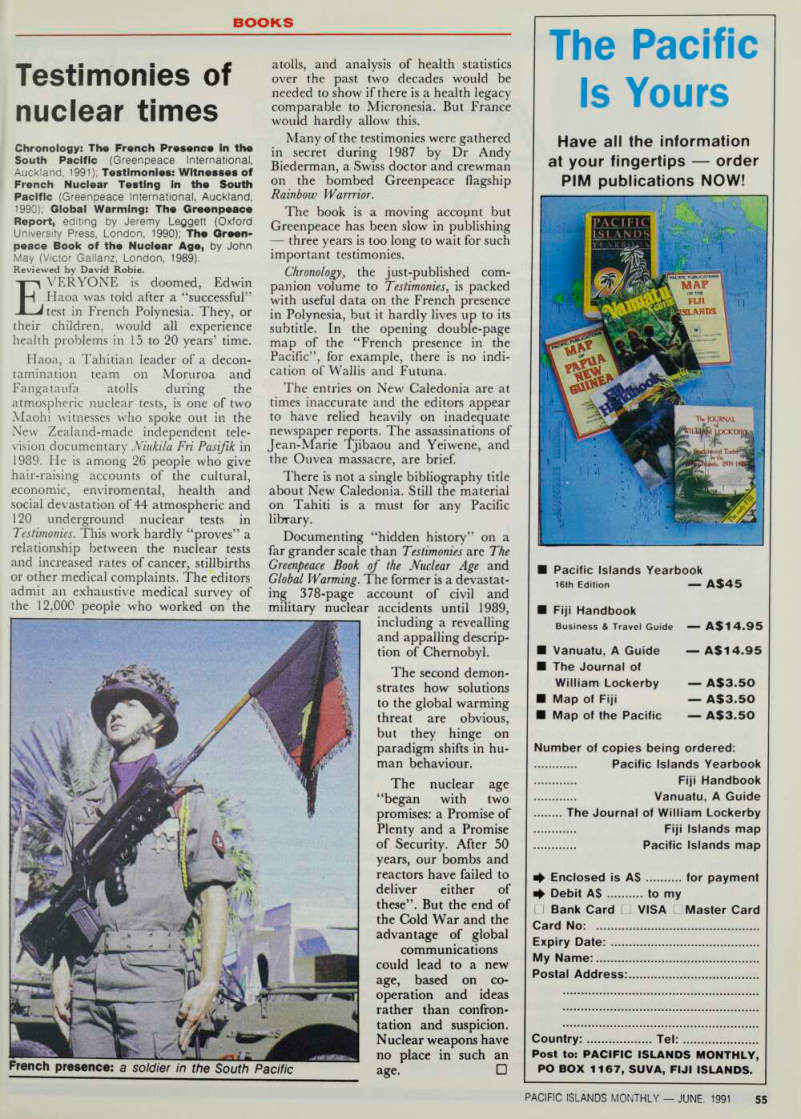
Books
Testimonies of nuclear times
Chronology: The French Presence in the South Pacific (Greenpeace International, Auckland, 1991): Testimonies: Witnesses of French Nuclear Testing in the South Pacific (Greenpeace International, Auckland, 1990): Global Warming: The Greenpeace Report, editing by Jeremy Leggett (Oxford University Press, London, 1990); The Green peace Book of the Nuclear Age, by John May (Victor Gallanz, London, 1989).
Reviewed by David Robie.
EVERYONE is doomed, Edwin Haoa was told after a “successful” test in French Polynesia. They, or their children, would all experience health problems in 15 to 20 years’ time.
Haoa, a Tahitian leader of a decon tamination team on Moruroa and Fangataufa atolls during the atmospheric nuclear tests, is one of two Maohi witnesses who spoke out in the New Zealand-made independent tele vision documentary Nitikila Fri Pasifik in 1989. He is among 26 people who give hair-raising accounts of the cultural, economic, enviromental, health and social devastation of 44 atmospheric and 120 underground nuclear tests in Testimonies. This work hardly “proves” a relationship between the nuclear tests and increased rates of cancer, stillbirths or other medical complaints. The editors admit an exhaustive medical survey of the 12,000 people who worked on the
atolls, and analysis of health statistics over the past two decades would be needed to show if there is a health legacy comparable to Micronesia. But France would hardly allow this.
Many of the testimonies were gathered in secret during 1987 by Dr Andy Biederman, a Swiss doctor and crewman on the bombed Greenpeace flagship Rainbow Warrrior.
The book is a moving accoynt but Greenpeace has been slow in publishing three years is too long to wait for such
important testimonies.
Chronology, the just-published com
panion volume to Testimonies , is packed with useful data on the French presence in Polynesia, but it hardly lives up to its subtitle. In the opening double-page map of the “French presence in the Pacific”, for example, there is no indi cation of Wallis and Futuna.
The entries on New Caledonia are at times inaccurate and the editors appear to have relied heavily on inadequate newspaper reports. The assassinations of Jean-Marie Tjibaou and Yeiwene, and the Ouvea massacre, are brief.
There is not a single bibliography title about New Caledonia. Still the material on Tahiti is a must for any Pacific library.
Documenting “hidden history” on a far grander scale than Testimonies are The Greenpeace Book of the Nuclear Age and Global Warming. The former is a devastat ing 378-page account of civil and military nuclear accidents until 1989,
including a revealling and appalling descrip tion of Chernobyl.
The second demon strates how solutions to the global warming threat are obvious, but they hinge on paradigm shifts in hu man behaviour.
The nuclear age “began with two promises: a Promise of Plenty and a Promise of Security. After 50 years, our bombs and reactors have failed to deliver either of these”. But the end of the Cold War and the advantage of global communications could lead to a new age, based on co operation and ideas rather than confron tation and suspicion.
Nuclear weapons have no place in such an age. □
French presence: a soldier in the South Pacific
Advertisements & other items, pp. 55-56 (1 item)
The Pacific
Is Yours
Have all the information
at your fingertips order
PIM publications NOW!
PACIFIC
MAF
FIJI
SL/VNDS
w cm
TV JOURNAL
ILU^^CKER^
I'#.--I ■ Pacific Islands Yearbook 16th Edition As4s ■ Fiji Handbook Business & Travel Guide Asl 4.95 ■ Vanuatu, A Guide ■ The Journal of William Lockerby ■ Map of Fiji ■ Map of the Pacific Asl 4.95 A 53.50 A 53.50 A 53.50 Number of copies being ordered: Pacific Islands Yearbook Fiji Handbook Vanuatu, A Guide The Journal of William Lockerby Fiji Islands map Pacific Islands map Enclosed is AS for payment Debit AS to my Bank Card [ I VISA □ Master Card Card No: Expiry Date: My Name: Postal Address:
Country: Tel:
Post to: PACIFIC ISLANDS MONTHLY,
PO BOX 1167, SUVA, FIJI ISLANDS.
P3i r
flil
m Applications are invited for the following positions with the South Pacific Forum Fisheries Agency (FFA); 1. Computer Services Manager; 2. Finance/Administration Officer; 3. Manager, Multilateral Fisheries Treaty; 4. Senior Analyst Programmer; and 5. Fisheries Development Officer. (All the positions should become vacant in 1992, the first 3 in January, the fourth in April and the last one in July).
The Agency was established to encourage regional cooperation in fisheries development and management among independent South Pacific States. It is based in Honiara in the Solomon Islands, has a small professional staff with economic, legal, computer and technical fisheries expertise and serves the 16 South Pacific member nations.
1. Computer Services Manager
Applicants should have appropriate academic/technical qualifications and experience in developing and managing statistical data acquisition and processing systems. As tuna constitutes the major marine resources of the region, fisheries (particularly tuna) resources/industry related experience would be an advantage.
The Manager, who is responsible for the effective use of FFA’s computer and communication facilities is expected to advise member countries on optimum computer systems to satisfy the needs of their fisheries sectors. 2. Finance Administration Officer Applicants should have appropriate academic/technical qualifications in business administration or have formal qualifications in accountancy. Several years of experience in government or international agency service is desirable, but relevant private industry experience will qualify.
Duties entail assisting management with administrative work concerned with staff conditions of work and service, supervision of administrative work staff, management of Agency accounts including financial commitments and budgetary organisation, and all other general administrative work involved in the day to day running of the Agency.
Applicants should have sound working knowledge of computers including experience with a computerised accounting package. 3. Manager, Multilateral Fisheries Treaty The Manager is responsible for the administration of the Multilateral Fisheries Treaty with the United States Government, which provides for the regulation of US tuna fishing vessels in the South Pacific.
The position carries a high degree of responsibility as the Manager will be extensively involved in contact with various agencies in FFA Member Governments (includ ing fisheries, legal, surveillance and finance agencies), with US Government and with fishing operators.
The appointee should have a sound administrative experience and an understanding of South Pacific fisheries development. Experience in the regulation of foreign fishing vessels would be an advantage.
4. Senior Analyst Programmer
Applicants should have appropriate academic/technical qualifications and experience in developing and managing statistical data acquisition and processing systems. The SAP assists the Computer Services Manager in the design, development and maintenance of fisheries-oriented ADP systems and equipment. Experience with UNIX and Oracle computer systems would also be an advantage. 5. Fisheries Development Officer Applicants should have extensive and sound background in fisheries with detailed knowledge of South Pacific tuna fisheries. Post graduate qualifications in a fisheries related discipline is an advantage. Experience in the establishment and development of fisheries in developing countries also is an advantage.
Essential Requirements for all positions Applicants should have: • an ability to work as part of a small inter-disciplinary team and to supervise consultants; • an ability to work without detailed direction, and to meet project deadlines under difficult circumstances; • willingness to undertake considerable international travel; • personal qualities of leadership, initiative, resourcesfulness and sensitivity. • administrative abilities to manage staff and to supervise short term consultancies. • administrative ability to manage staff and to supervise consultants.
Full details including duty statements, terms and conditions of employment, and qualifications required for each position are available on request.
The appointees will be based in Honiara but may be required to travel widely especially in the South Pacific region. A tax free salary at a regional level applies, with transportation, housing, child and education allowances, recreation leave and superannuation provisions.
Applicants should detail education and employment background with particulars of three referees with whom the applicant has been associated in a professional capacity and should address all applications which close on Wednesday 31 July 1991 and enquiries to The Director, Forum Fisheries Agency P.O. Box 629, HONIARA, Solomon Islands
Keeping
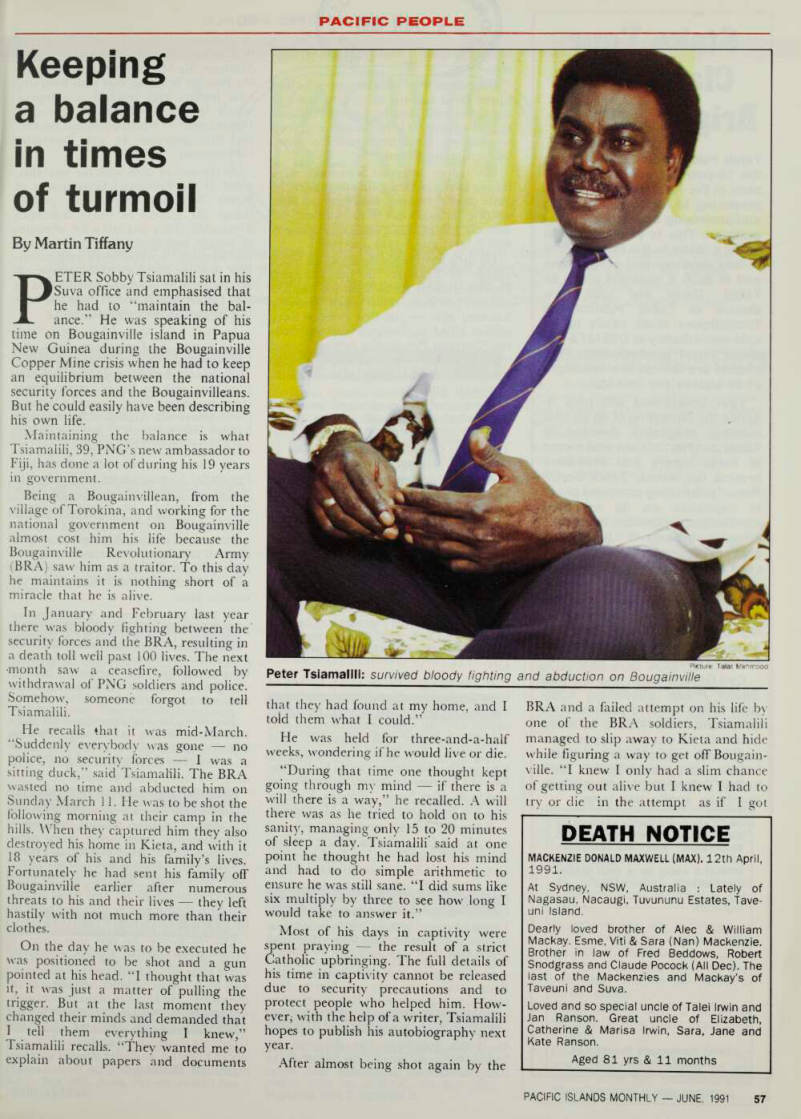
Pacific People
Keeping a balance in times of turmoil
By Martin Tiffany
PETER Sobby Tsiamalili sat in his Suva office and emphasised that he had to “maintain the bal ance.” He was speaking of his time on Bougainville island in Papua New Guinea during the Bougainville Copper Mine crisis when he had to keep an equilibrium between the national security forces and the Bougainvilleans.
But he could easily have been describing his own life.
Maintaining the balance is what Tsiamalili, 39, PNG’s new ambassador to Fiji, has done a lot of during his 19 years in government.
Being a Bougainvillean, from the village of Torokina, and working for the national government on Bougainville almost cost him his life because the
Bougainville Revolutionary Army
(BRA) saw him as a traitor. To this day he maintains it is nothing short of a miracle that he is alive.
In January and February last year there was bloody fighting between the security forces and the BRA, resulting in a death toll well past 100 lives. The next -month saw a ceasefire, followed by withdrawal of PNG soldiers and police.
Somehow, someone forgot to tell Tsiamalili.
He recalls that it was mid-March.
“Suddenly everybody was gone no police, no security forces I was a sitting duck,” said'Tsiamalili. The BRA wasted no time and abducted him on Sunday March 11. He was to be shot the following morning at their camp in the hills. When they captured him they also destroyed his home in Kieta, and with it 18 years of his and his family’s lives.
Fortunately he had sent his family off Bougainville earlier after numerous threats to his and their lives they left hastily with not much more than their clothes.
On the day he was to be executed he was positioned to be shot and a gun pointed at his head. “I thought that was it, it was just a matter of pulling the trigger. But at the last moment they changed their minds and demanded that I tell them everything I knew,”
Tsiamalili recalls. “They wanted me to explain about papers and documents
that they had found at my home, and I told them what I could.”
He was held for three-and-a-half weeks, wondering if he would live or die.
“During that time one thought kept
going through my mind if there is a will there is a way,” he recalled. A will there was as he tried to hold on to his sanity, managing only 15 to 20 minutes of sleep a day. Tsiamalili said at one point he thought he had lost his mind and had to do simple arithmetic to ensure he was still sane. “I did sums like six multiply by three to see how long I would take to answer it.”
Most of his days in captivity were spent praying the result of a strict Catholic upbringing. The full details of his time in captivity cannot be released due to security precautions and to protect people who helped him. Howwith the help of a writer, Tsiamalili
hopes to publish his autobiography next
year.
After almost being shot again by the
BRA and a failed attempt on his life by one of the BRA soldiers, Tsiamalili managed to slip away to Kieta and hide while figuring a way to get off Bougain ville. “I knew I only had a slim chance of getting out alive but I knew I had to try or die in the attempt as if I got
Picture: Talat Mehmood Peter Tsiamalili: survived bloody fighting and abduction on Bougainville
I woulcH;be killed any way His rations were running out he had sipped from a bottle of tomato sauce k> sustain himself; and he found it difficult to find anyone to help because everyone was scared. He almost gave up hope, before finding someone.
His helper wrapped Tsiamalili in a fishing neat and tarpaulin and, under the guise of going fishing, took him to a boat waiting six miles out of the harbour. “I owe my life to two guys - a jungle guy and a l:>oat guy,” said Tsiamalili.
He then went to his family at his wife’s village of Bakubari in the Northern Province, where he thought his troubles would be over. But again trouble haunted him the first defence force soldier killed on Bougainville was from the Northern Province, a rumour spread that Tsiamalili was collaborating with the BRA and a gang was hired to assasinate him.
But one of the gang members was a close relative of his wife and he looked upon Tsiamalili as a brother-in-law.
Tsiamalili was alerted and managed to talk with the gang and sort things out.
Another incident occured during the Bougainville crisis when he was beaten and almost killed by the security forces because they thought he was a traitor.
He admits he would have liked to stay in his wife’s village for the rest of his life and forget about the troubles of the world, but duty called and he went to Port Moresby to join the Prime Minister’s Department. With more security prob lems in Port Moresby he was sent to New York as PNG’s United Nations represen tative to cover the 45th cession of the UN.
In December 1990 he was surprised to learn he had been appointed Ambassa dor to Fiji. Surprised because he didn’t expect such an appointment so soon and because he was still physically and mentally winding down. But he took the post with confidence and is looking forward to the challenge. From Fiji he also looks after Nauru, Tuvalu, Kiribati and the Federated States,of Micronesia.
Tyamalili’s career in government started as a Cadet Patrol Officer looking after government functions in the district at a station in East New Britain in 1971.
He served in,, other stations and at headquarters as Special Fields Projects Officer and Acting District Officer Lands. From 1973 to 1975 he took a diploma in public administration and graduated with distinctions.
He then went to his birthplace the Bougainville province of North Sol omons, as a government liaison officer to monitor the situation because there was talk of secession from PNG. A Republic of North Solomons was declared on September 1, 1975, 15 days before PNG independence on September 16.
A delegation led by the then Prime Minister, Sir Michael Somare, currently the Foreign Minister, met with Bougain ville leaders and reached a comprise which led to the birth of Provincial Government North Solomons became the first province to get Provincial Government.
At the end of 1976 with the establish ment of the Provincial Government of North Solomons there were certain things the leaders of North Solomons demanded. They put out a list of names of people instrumental in carrying out the national Government’s responsibil ities and they wanted these people off Bougainville Tsimalili’s name was on that list. He was forced to leave his home but he vowed he would be back, In 1977 he furthered his studies with a Diploma in Commerce from the University of PNG. After graduating in 1978 he held various positions in the provinces and at headquarters before
studying Urban Planning and Develop
ment under an AIDAB scholarship in Sydney. He returned to become Princi pal Government Liaison Officer.
At that time the post of Deputy Provincial Commissioner of North Sol omons became vacant and the Adminis trative Secretary in North Solomons offered Tsiamalili the job.
He turned down a high position with the national Government and w r as in the North Solomons before they knew he was. His transfer was formalised six months later.
In 1985 he took over as Administrative Secretary of Department of North Sol omons and held that position until his narrow escape from Bougainville in 1990.
Despite all that has happened he still vows he will return.“lt is my home, I will return,” he explains simply.
For now, he and his wife Ruth and their four children are settling well into Fiji. Tsiamalili says it is the first place after the New York appointment where they can have peace of mind.
PNG, Tsiamalili feels, can learn a lot from cottage industries in Fiji'and Fiji can offer experience, because small scale industries will benefit the large rural community in PNG. Self-help and rural development programmes are one of his pet “ after-hours ” interests and he talks with enthusiasm about how rural people can help themselves they just need to be shown how.
On the future, he says that after 19 years in government he would Ikie to retire after this appointment to go home, and be a simple villager helping out in the village. He also has plans to continue his studies and do his Masters in Public Administration. In 1984 he did Post Graduate studies in Manchester Univer sity in England, studying Rural Develop ment and Planning. □
Death Notice
Mackenzie Donald Maxwell (Max). 12Th April,
1991.
At Sydney, NSW, Australia : Lately of Nagasau, Nacaugi, Tuvununu Estates, Tave uni Island.
Dearly loved brother of Alec & William Mackay. Esme, Viti & Sara (Nan) Mackenzie.
Brother in law of Fred Beddows, Robert Snodgrass and Claude Pocock (All Dec). The last of the Mackenzies and Mackay's of Taveuni and Suva.
Loved and so special uncle of Talei Irwin and Jan Ranson. Great uncle of Elizabeth, Catherine & Marisa Irwin, Sara, Jane and Kate Ranson.
Aged 81 yrs & 11 months
Advertisements & other items, pp. 58-60 (1 item)
Bright Future
Stake Your
Claim In A
Tahiti Publications Touristiques, the 10-year-old publishing company of the Tahiti Beach Press , is preparing to launch an exciting and promising development programme. This is your chance to stake a claim in the bright future of that development programme and of such a beautiful place as Tahiti. There are 1504 new shares of Tahiti Publications Touristiques stock ready to be sold immediately at U 55137.5 per share (local tax included). Purchases are limited to a minimum of 50 shares per investor.
Your investment will help finance the launching of an all new monthly magazine devoted to Tahiti and Her Islands and aimed at Tahiti lovers and dreamers around the world. Tahiti Beach Press 'publishing company plans to capitalise on its excellent journalistic reputation, its experienced personnnel team, its proven record of financial success and its leading and unchallenged market position.
All that’s missing is you, one of our new partners in the promising publishing future that lies ahead. Stake your claim in that future. Today.
Call Gerard Warti, one of Tahiti Beach Press’ publishing company’s two owning partners, on telephone (689) 426850 to learn more. Or fill out the coupon as a potentially interested new stockholder and receive by mail further information and a stock purchase application form.
Yes, I am interested in becoming a Tahiti Publications Touristiques stockholder with the purchase of shares (minimum 50 at U 55137.5 each) for a total investment of US$ Date Signature Name Occupation Address Tel Tahiti Publications Touristiques, B.P. 887, Papeete, Tahiti.
ACIFI
ISLANDS
Q N T H L
fiRKCT PlfiC n
For the benefit of our readers who would like to place a small classified advertisement In our magazine, Market Place will assist you in selling personal items, accommodation, real estate, boating or a service ... in fact anything you would like to sell to our over 50,000 readers.
Market Place Advertising Rates are structured to allow you to place as many advertisements as you wish, economically.
USED JAPANESE VEHICLES
Buy direct from Japan and save" any make, model, year, Truck, Cars, Tractors, Buses, motorbikes, all Shipping, and Documentation arranged. Contact Trust Company Ltd. Kobac Bid 3F 3 2 26, Nishiki Nakaku Nagoya, 460 Japan, Phone 052 —953 —5602, Fax 052—953—5634.
SELF ADHESIVE LABELS
FORUM LABELS (FIJI) LTD
P.O. Box 1167, Suva., Fiji. Phone:3o4lll We print self-adhesive labels in rolls, multi-coloured labels with hot foil, and die cut to shape, tickets and tags in rolls. We also supply labelling machines and fabric labels
VANUATU FARM
Cattle/Small crop ranch situated on main island of Efate 33km, from capital Port Vila on main road. 68 hectares including 4 bedroom residence overlooking permanent freshwater creek. Extensively equipped workshops and machinery also included. Price on application. For further details contact W.
Welch, 22 Bimbadeen Drive, Loganholme, Australia 4129 or Ring 617 2098856
SHELLS
Magnificent and comprehensive collection of exotic shells, some 300,000 pieces includes accumulation suited to craft industry.
Price on application. Contact W. Welch 22 Bimbadeen Drive, Loganholme, Australia 4129 or Ring 617 2098856.
OPTICIANS AND OPTOMETRISTS
Spectacles, Contact Lenses, Sunglasses.
See JEKISHAN & JEKISHAN, Epworth House, G.P.O. Box 285, Suva, Fiji. Ph 311002 Fax (679) 411898.
DISTRIBUTOR WANTED
Manufacturer of Ball point pens and disposable Gas Lighters.
Please contact JNJ CORPORATION (FUI) LTD, G.P.O. Box 285, Suva, Fiji. Ph 39400 Fax (679) 411898.
“SCRAP METAL”
Tall ingots operate from Brisbane, Australia and make frequent visits to the Pacific Islands, as they have done for twenty-five years. We are buyers of Copper, Brass, Aluminium, Lead, Cable etc. Inspection for big lots no problem. Telephone 61 7 8922033. Fax 61 7 8922077.
DISTRIBUTERS WANTED
Franchise are available, in the Pacific Islands region to persons or companies interested in distributing a new patented inflatable snorkeler float. Suits all ages, and makes snorkeling an effortless pleasure. Ideal for tourist resorts, snorkel tours operators, island cruises and dive shops. For further information please contact Australian Snorkeler Float Pty. Ltd., P.O. Box 1072 Townsville, Queensland, Australia, 4810 Phone (077) 212109 Fax (077) 211420.
TECHNICAL TRAINING
Full-time Government Accredited Courses in Tourism, Hospitality, Business Accounting, Computing and Hairdressing begin each January and July at the Townsville College of Technical and Further Education.
Enquiries: Ms Avis Sohn, Overseas Student Co-ordinator, Townsville College of Tafe, PMB 1 Hermit Park, Townsville 4812 Australia.
Telephone: + 61 77 718211, Facsimile: + 61 77 718268.
OVERSEAS FUNDING
Unlimited overseas funding for any National Government and private company’s viable projects. No front fees. Send proposal to Pan Asia Management Consultants Center Box 4295, BOROKO. NCD, Papua New Guinea.
CORRESPONDENCE
Sincere, eligible Australian gentlemen wish to correspond with Pacific ladies, all ages/ races. Free registration. For full details, please write to: ASIAPAC, PO BOX 231, Maylands 6052, AUSTRALIA.
COMMERCIAL PRINTING
Top quality four colour printing, brochures, posters, packaging, product labels, fabric labels, billboards, books, magazines, stickers, books. Export quality. Contact Fiji’s most experienced Commercial Printers. FIJI TIMES COMMER- CIAL PRINTING. P.O. Box 1167. Suva. Fiji.
Phone: 304111 Fax. 301521.
PACIFIC
S LANDS
[month l y~1
MRRKCT PLRC€ CRN UJORK
WONDCRS FOR VOU ...
Promote your business, or service, sell your household
items, cars or heavy machinery
etc.
ONLY AUS$1 PER WORD.
NO COMPANY LOGO. NO
DISPLAY. NO BOLD TYPE.
Just forward your Advertisement together with payment to: PACIFIC ISLANDS MONTHLY "Market Place”, P.O. Box 1167, Suva, Fiji.
CONDITIONS:
1. All Advertisements are subject to acceptance and approval of publisher. 2. Advertisements are published as space permits: we cannot guarantee date of insertion. 3. All advertisements must be prepaid and should be typed or printed clearly. 4. Deadline for receipt of advertisements is the 10th of the month prior to issue.
5. PACIFIC ISLANDS MONTHLY
assumes no responsibility for any service other than publishing paid advertisements, in this section.
An Eye to Total Safety.
w mb m m r For Mitsubishi Motors both passive and active safety have equal importance, and rather than being added ingredients, are guide-lines that every component, system and stage of design must follow.
This approach to total safety involves exhaustive and innovative research methods, particularly into the physical reactions of motorists to various driving situations.
In designing the Galant, for example, Mitsubishi’s engineers mapped what drivers looked at while cornering. They found that drivers of some cars had much narrower fields of vision, indicating a high level of tension due to poor vehicle handling.
By comparison, their tests with the Galant and its integrated drive system, Dynamic-4 showed that with better handling, wider ■ Vision tracking shows how the Galant’s superior handling results in lower driver tension indicated by a wider field of vision. fields of vision indicated lower levels of tension in the driver.
Using advanced technology to define and attain safety standards is further evidence of Mitsubishi’s guiding principle of answering the needs and preferences of today’s drivers an on-going philosophy of putting technology to work for you.
MITSUBISHI QRLRNT
A
MITSUBISHI
MOTORS
AMERICAN SAMOA: PACIFIC MARKETING INC. P.O. Box 698, Pago Pago, Tel 699-91 40/AUSTRALIA: MITSUBISHI MOTORS AUSTRALIA LTD. Box 1284, South Road, Clovelly Park, South Australia 5042, Tel. [08) 275-7297/ ' FIJI: NIVIS MOTOR & MACHINERY CO., LTD. G.P.O. Box 150, Suva, Tel. 38341 1 /FRENCH POLYNESIA (TAHITI): SOPADEP S.A. P.O. Box 1617, Papeete, Tahiti, Tel. 4-202-58/NEW CALEDONIA; SOCIETE DTMPORTATION I D AUTO DU PACIFIQUE SUD S.A. B.P. 438 Rond Point du Pacifique, Noumea, Tel. 274144/NEW ZEALAND: MITSUBISHI MOTORS NEW ZEALAND LTD. Private Bag, Porirua, Tel. 370-109/NORFOLK ISLAND: BORRYS !
PTY. LTD. PO. Box 169, Norfolk Island, Tel. 2114/PAPUA NEW GUINEA: TOBA PTY. LTD. P.O Box 503, Port Moresby, Tel. 21-7874/SOLOMON ISLANDS: HARVEST PACIFIC LTD. G.P.O. Box 823, Honiara, Guadalcanal, , Tel. 30128/TONGA; SITANI MAPI CO., LTD. P.O. Box 83, Nuku ALOFA, Tel. 24-044/VANUATU: SOCOMETRA B.P. 06 Route de Lagon, Port-Vila, Tel. 2314/WESTERN SAMOA: MOTOR DISTRIBUTORS LTD. P.O. Box 576, Apia, Tel. 20957/SAIPAN/POHNPEI/MAJURO/KOSRAE/TRUK/YAP/BELAU: MICRONESIAN MOTORS, INC. 997 South Marine Drive, Tamuning, Guam 96911, Tel. 646-6827