Advertisements & other items, pp. 1-3 (2 items)
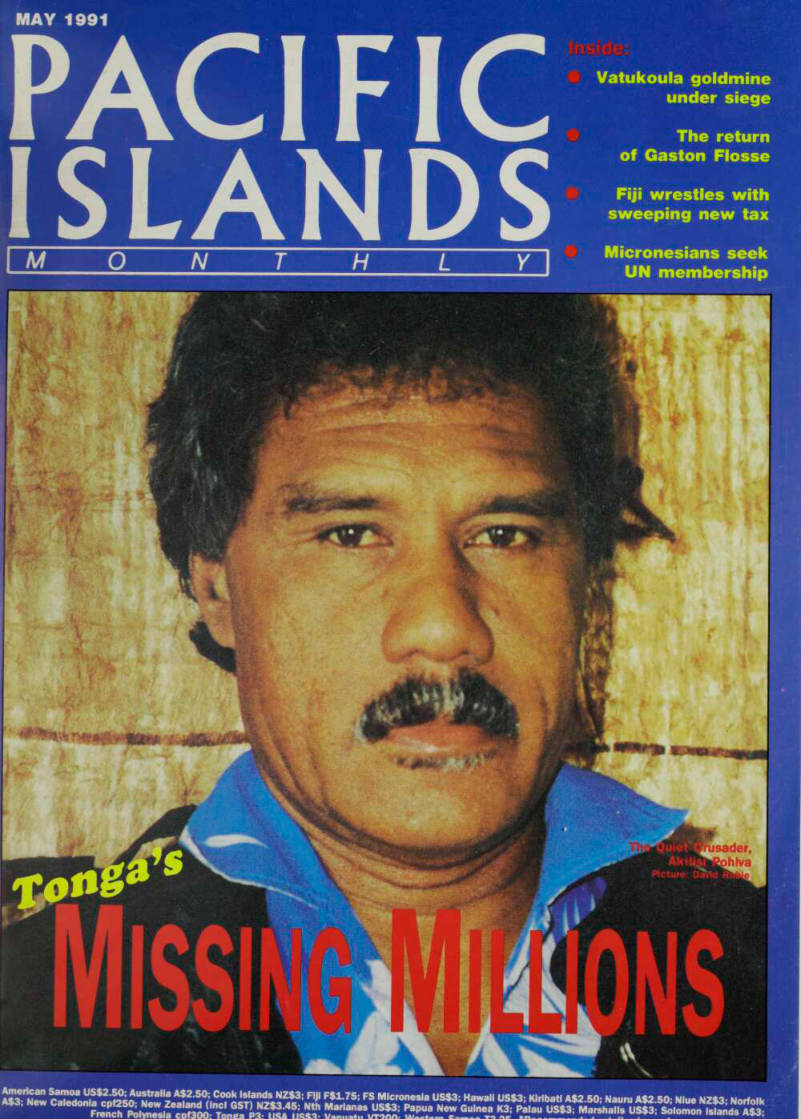
Pacific
ISLANDS
MONTHLY
MAY 1991
Vatukoula goldmine under siege The return of Gaston Flosse Fiji wrestles with sweeping new tax Micronesians seek UN membership
K vUbb
rt
A dancer expresses herself with her body. As she moves and
turns, she forgets everything we feel what she feels as she creates a new reality with each step. Just as movement is the reflection of a dancer’s dream, so an engine is the reflection of an engineer’s. Since 1967, the power and smoothness of a car with
i rotary engine has been one expression of Mazda’s new way of hinking its realisation, the result of many years’ hard work, he conquest of many difficulties. It is a thing of beauty to be
experienced only through Mazda.
On the road to civilization.
Mailbox
Don’t cry for Nauru
AFTER reading Irene Nisbet’s report on Nauru {PIM March, 1991), I would guess that the Nauru government would refuse her a visa next time. Her article documents accurately the real story of life on Nauru, just as many journalists before her have done. But the Nauruans learn no lessons. They only react defensively by steadily
sacking those well-meaning expats
foolish enough to try and help the Nauruans improve their lot.
Many of my friends have been deported. Often the reason was trivial, perhaps the result of genuine attempts to run the education, health or public service more efficiently. An inebriated politician could take a dislike to you, and a reason to cancel your contract concocted. Sometimes a tapped phone call to an overseas relative would be sufficient reason for you to pack your
bags. In 1989, the Australian High Commissioner was declared persona non grata because the High Commissioner dared to report her misgivings of safety aspects of Air Nauru, to her government in Canberra.
The Australian Government made a token protest, much to the dismay of the Australian expatriates on Nauru. The costs involved in the continuous round of hiring and firing of expats is substantial, but ignored by the chief secretary and the politicians.
Your readers should not waste tears on the people of Nauru, and the demise of their beer-sodden atoll. The Nauru shamelessly exploit island workers from the Solomons, Phillipines, Kiribati and Tuvalu and make them live under atrocious conditions on peanut wages.
The hundreds of millions of dollars squandered on fuel for empty boeings, or on countless round-the-world jaunts could better have been spent on improving living conditions for expat Pacific Islanders, on proper water supplies, a modern education system, and decent hospital facilities. Better
still, phosphate profits should have been spent on land repair, yet not a cent was used for that vital purpose.
Nauru could have become an island
paradise, given the right leadership.
Instead, a 50 per cent absenteeism in
the schools, cheaply bought, doubtfully
qualified Indian medical staff, a rat infested, government-owned supermarket and hotel, and, sadly, the many headstones of hundreds of Nauruan youth dead of alcohol-related disasters, paint the true picture of Nauru 1991.
After independence, the politicians of Nauru sank the phosphate profits, and their islands future, into the bottomless
pit of flag-waving aircraft, rusty ships,
and doubtful investments.
Even if the Nauruans finally win reparations money in the world court, one doubts if it will be spent on land rehabilitation. More likely it will go on lawyers’ fees, more Boeings and tons more twisties from Suva, to go with the Fosters. No, don’t cry for Nauru.
Jack Johnson Cheshire, England
Advertisements & other items, p. 4 (1 item)
Why do people read
Pacific Islands Monthly?
BECAUSE:
• It provides the most compre-
hensive coverage of the Pacific
Islands
• It provides accurate and
indepth information on events
that shape the region
• It employs a news network
that spans the South Pacific and
beyond
• It employs local journalists
who live in the countries they
cover • It has been for 62 years the most authoritative commentator
on Pacific Islands affairs.
1 It is the next best thing to
being there in person
SUBSCRIBE NOW
Yes, send me Pacific Islands Monthly.
Please tick one box only: EH Here is a cheque/money order ED Debit my credit card, indicated below EH Visa □ Master Card Card number Expiry Signature Name Adress
YOUR RATES
American Samoa US$45 Australia As3o Canada US4S Cook Islands As 46 Fiji Fs24 French Polynesia US$45 Guam US$45 Hawaii * US$45 Kiribati As 46 FS Micronesia US$35 Marshall Islands US$35 Nauru As 42 New Caledonia US$32 New Zealand As 42 Niue As 46 Norfolk As 42 Northern Marianas US36 Papua New Guinea As 42 Palau USs3sql Solomon Islands As 46 Tonga As 46 Tuvalu SA46 United Kingdom £2B United States Mainland US$45 Vanuatu As4s Western Samoa A5O Elsewhere As 63 Post to: Pacific Islands Monthly, Subscriptions Dept, PO Box 1167, Suva Fiji. OR FAX TO: (679) 303809
the islands
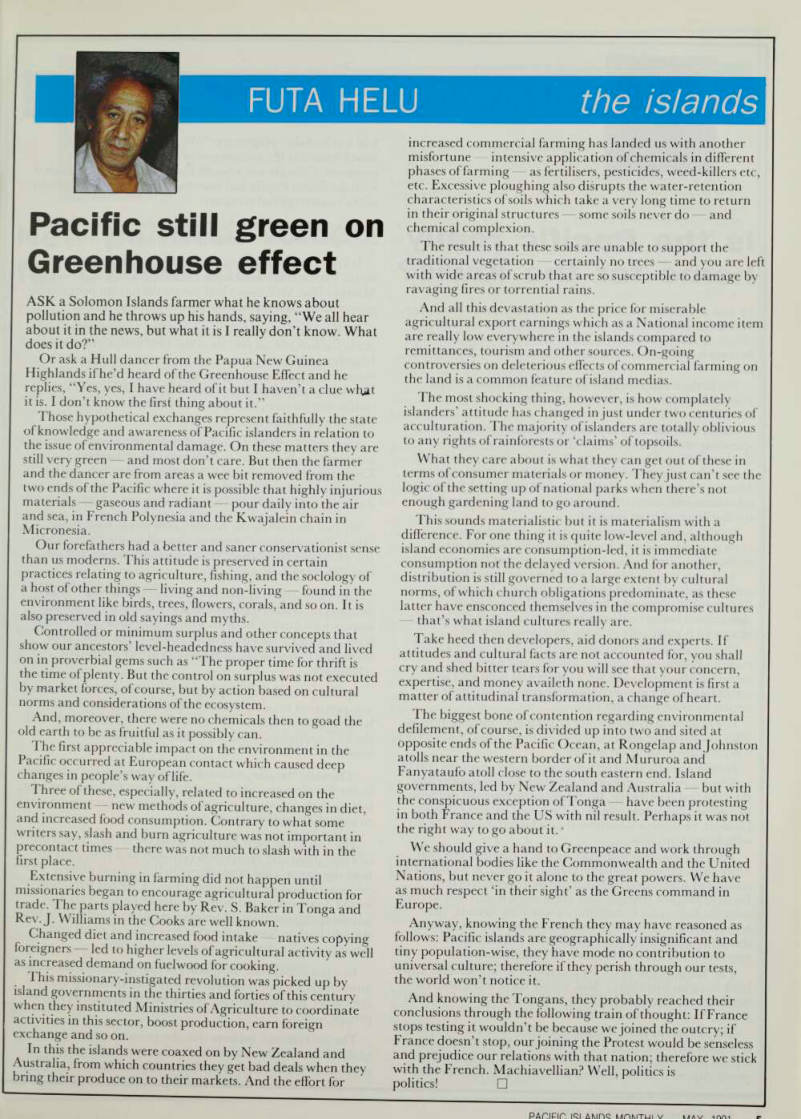
Futa Helu
Pacific still green on Greenhouse effect
ASK a Solomon Islands farmer what he knows about pollution and he throws up his hands, saying, “We all hear about it in the news, but what it is I really don’t know. What does it do?”
Or ask a Hull dancer from the Papua New Guinea Highlands if he’d heard of the Greenhouse Effect and he replies, “Yes, yes, I have heard of it but I haven’t a clue what it is. I don’t know the first thing about it.”
Those hypothetical exchanges represent faithfully the state ofknowledge and awareness of Pacific islanders in relation to the issue of environmental damage. On these matters they are still very green and most don’t care. But then the farmer and the dancer are from areas a wee bit removed from the two ends of the Pacific where it is possible that highly injurious materials gaseous and radiant pour daily into the air and sea, in French Polynesia and the Kwajalein chain in Micronesia.
Our forefathers had a better and saner conservationist sense than us moderns. This attitude is preserved in certain practices relating to agriculture, fishing, and the sociology of a host of other things living and non-living found in the environment like birds, trees, flowers, corals, and so on. It is also preserved in old sayings and myths.
Controlled or minimum surplus and other concepts that show our ancestors’ level-headedness have survived and lived on in proverbial gems such as “The proper time for thrift is the time of plenty. But the control on surplus was not executed by market forces, of course, but by action based on cultural norms and considerations of the ecosystem.
And, moreover, there were no chemicals then to goad the old earth to be as fruitful as it possibly can.
The first appreciable impact on the environment in the Pacific occurred at European contact which caused deep changes in people’s way of life.
Three of these, especially, related to increased on the environment new methods of agriculture, changes in diet, and increased food consumption. Contrary to what some writers say, slash and burn agriculture was not important in precontact times there was not much to slash with in the first place.
Extensive burning in farming did not happen until missionaries began to encourage agricultural production for trade. The parts played here by Rev. S. Baker in Tonga and Rev. J. Williams in the Cooks are well known.
Changed diet and increased food intake natives copying foreigners led to higher levels of agricultural activity as well as increased demand on fuelwood for cooking.
This missionary-instigated revolution was picked up by island governments in the thirties and forties of this century when they instituted Ministries of Agriculture to coordinate activities in this sector, boost production, earn foreign exchange and so on.
In this the islands were coaxed on by New Zealand and Australia, from which countries they get bad deals when they bring their produce on to their markets. And the effort for
increased commercial farming has landed us with another misfortune intensive application of chemicals in different phases of farming as fertilisers, pesticides, weed-killers etc, etc. Excessive ploughing also disrupts the water-retention characteristics of soils which take a very long time to return in their original structures some soils never do and chemical complexion.
The result is that these soils are unable to support the traditional vegetation certainly no trees and you are left with wide areas of scrub that are so susceptible to damage by ravaging fires or torrential rains.
And all this devastation as the price for miserable agricultural export earnings which as a National income item are really low everywhere in the islands compared to remittances, tourism and other sources. On-going controversies on deleterious effects of commercial farming on the land is a common feature of island medias.
The most shocking thing, however, is how complately islanders’ attitude has changed in just under two centuries of acculturation. The majority ofislanders are totally oblivious to any rights of rainforests or ‘claims’ of topsoils.
What they care about is what they can get out of these in terms of consumer materials or money. They just can’t see the logic of the setting up of national parks when there’s not enough gardening land to go around.
This sounds materialistic but it is materialism with a difference. For one thing it is quite low-level and, although island economies are consumption-led, it is immediate consumption not the delayed version. And for another, distribution is still governed to a large extent by cultural norms, of which church obligations predominate, as these latter have ensconced themselves in the compromise cultures that’s what island cultures really are.
Take heed then developers, aid donors and experts. If attitudes and cultural facts are not accounted for, you shall cry and shed bitter tears for you will see that your concern, expertise, and money availeth none. Development is first a matter of attitudinal transformation, a change of heart.
The biggest bone of contention regarding environmental defilement, of course, is divided up into two and sited at opposite ends of the Pacific Ocean, at Rongelap and Johnston atolls near the western border of it and Mururoa and Fanyataufo atoll close to the south eastern end. Island governments, led by New Zealand and Australia but with the conspicuous exception of Tonga - have been protesting in both France and the US with nil result. Perhaps it was not the right way to go about it.
We should give a hand to Greenpeace and work through international bodies like the Commonwealth and the United Nations, but never go it alone to the great powers. We have as much respect ‘in their sight’ as the Greens command in
Europe.
Anyway, knowing the French they may have reasoned as follows: Pacific islands are geographically insignificant and tiny population-wise, they have mode no contribution to universal culture; therefore if they perish through our tests, the world won’t notice it.
And knowing the Tongans, they probably reached their conclusions through the following train of thought: If France stops testing it wouldn’t be because we joined the outcry; if France doesn’t stop, our joining the Protest would be senseless and prejudice our relations with that nation; therefore we stick with the French. Machiavellian? Well, politics is politics! □
Advertisements & other items, p. 5 (1 item)
5
PAHIFin I.QI AMHQ MOMTUI V mav
Wellington
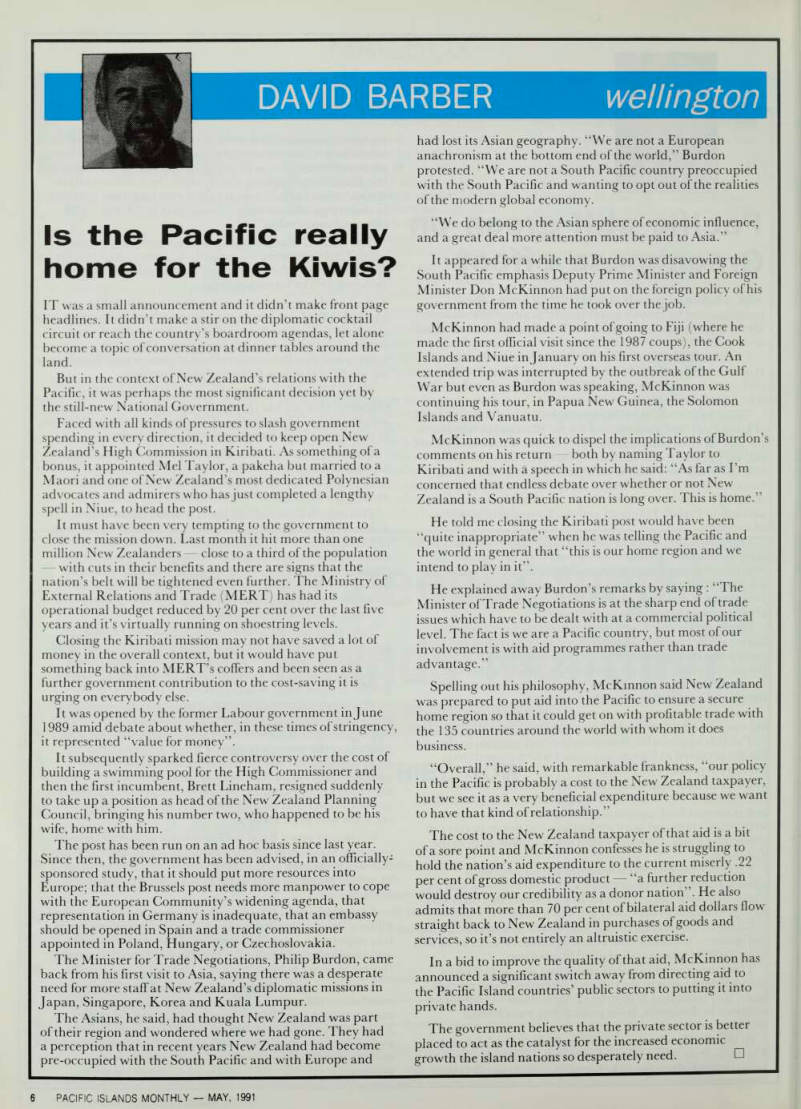
David Barber
Is the Pacific really home for the Kiwis?
IT was a small announcement and it didn’t make front page headlines. It didn’t make a stir on the diplomatic cocktail circuit or reach the country’s boardroom agendas, let alone become a topic of conversation at dinner tables around the land.
But in the context of New Zealand’s relations with the Pacific, it was perhaps the most significant decision yet by the still-new National Government.
Faced with all kinds of pressures to slash government spending in every direction, it decided to keep open New Zealand’s High Commission in Kiribati. As something of a bonus, it appointed Mel Taylor, a pakeha but married to a Maori and one of New Zealand’s most dedicated Polynesian advocates and admirers who has just completed a lengthy spell in Niue, to head the post.
It must have been very tempting to the government to close the mission down. Last month it hit more than one million New Zealanders close to a third of the population with cuts in their benefits and there are signs that the nation’s belt will be tightened even further. The Ministry of External Relations and Trade (MERT) has had its operational budget reduced by 20 per cent over the last five years and it’s virtually running on shoestring levels.
Closing the Kiribati mission may not have saved a lot of money in the overall context, but it would have put something back into MERT’s coffers and been seen as a further government contribution to the cost-saving it is urging on everybody else.
It was opened by the former Labour government in June 1989 amid debate about whether, in these times of stringency, it represented “value for money”.
It subsequently sparked fierce controversy over the cost of building a swimming pool for the High Commissioner and then the first incumbent, Brett Lineham, resigned suddenly to take up a position as head of the New Zealand Planning Council, bringing his number two, who happened to be his wife, home with him.
The post has been run on an ad hoc basis since last year.
Since then, the government has been advised, in an officially sponsored study, that it should put more resources into Europe; that the Brussels post needs more manpower to cope with the European Community’s widening agenda, that representation in Germany is inadequate, that an embassy should be opened in Spain and a trade commissioner appointed in Poland, Hungary, or Czechoslovakia.
The Minister for Trade Negotiations, Philip Burdon, came back from his first visit to Asia, saying there was a desperate need for more staff at New Zealand’s diplomatic missions in Japan, Singapore, Korea and Kuala Lumpur.
The Asians, he said, had thought New Zealand was part of their region and wondered where we had gone. They had a perception that in recent years New Zealand had become pre-occupied with the South Pacific and with Europe and
had lost its Asian geography. “We are not a European anachronism at the bottom end of the world,” Burdon protested. “We are not a South Pacific country preoccupied with the South Pacific and wanting to opt out of the realities of the modern global economy.
“We do belong to the Asian sphere of economic influence, and a great deal more attention must be paid to Asia.”
It appeared for a while that Burdon was disavowing the South Pacific emphasis Deputy Prime Minister and Foreign Minister Don McKinnon had put on the foreign policy of his government from the time he took over the job.
McKinnon had made a point of going to Fiji (where he made the first official visit since the 1987 coups), the Cook Islands and Niue in January on his first overseas tour. An extended trip was interrupted by the outbreak of the Gulf War but even as Burdon was speaking, McKinnon was continuing his tour, in Papua New Guinea, the Solomon Islands and Vanuatu.
McKinnon was quick to dispel the implications of Burdon’s comments on his return both by naming Taylor to Kiribati and with a speech in which he said; “As far as Fm concerned that endless debate over whether or not New Zealand is a South Pacific nation is long over. This is home.”
He told me closing the Kiribati post would have been “quite inappropriate” when he was telling the Pacific and the world in general that “this is our home region and we intend to play in it”.
He explained away Burdon’s remarks by saying : “The Minister of Trade Negotiations is at the sharp end of trade issues which have to be dealt with at a commercial political level. The fact is we are a Pacific country, but most of our involvement is with aid programmes rather than trade
advantage.”
Spelling out his philosophy, McKinnon said New Zealand was prepared to put aid into the Pacific to ensure a secure home region so that it could get on with profitable trade with the 135 countries around the world with whom it does business.
“Overall,” he said, with remarkable frankness, “our policy in the Pacific is probably a cost to the New Zealand taxpayer, but we see it as a very beneficial expenditure because we want to have that kind of relationship.”
The cost to the New Zealand taxpayer of that aid is a bit of a sore point and McKinnon confesses he is struggling to hold the nation’s aid expenditure to the current miserly .22 per cent of gross domestic product “a further reduction would destroy our credibility as a donor nation’ . He also admits that more than 70 per cent of bilateral aid dollars flow straight back to New Zealand in purchases of goods and services, so it’s not entirely an altruistic exercise.
In a bid to improve the quality of that aid, McKinnon has announced a significant switch away from directing aid to the Pacific Island countries’ public sectors to putting it into
private hands.
The government believes that the private sector is better placed to act as the catalyst for the increased economic growth the island nations so desperately need. □
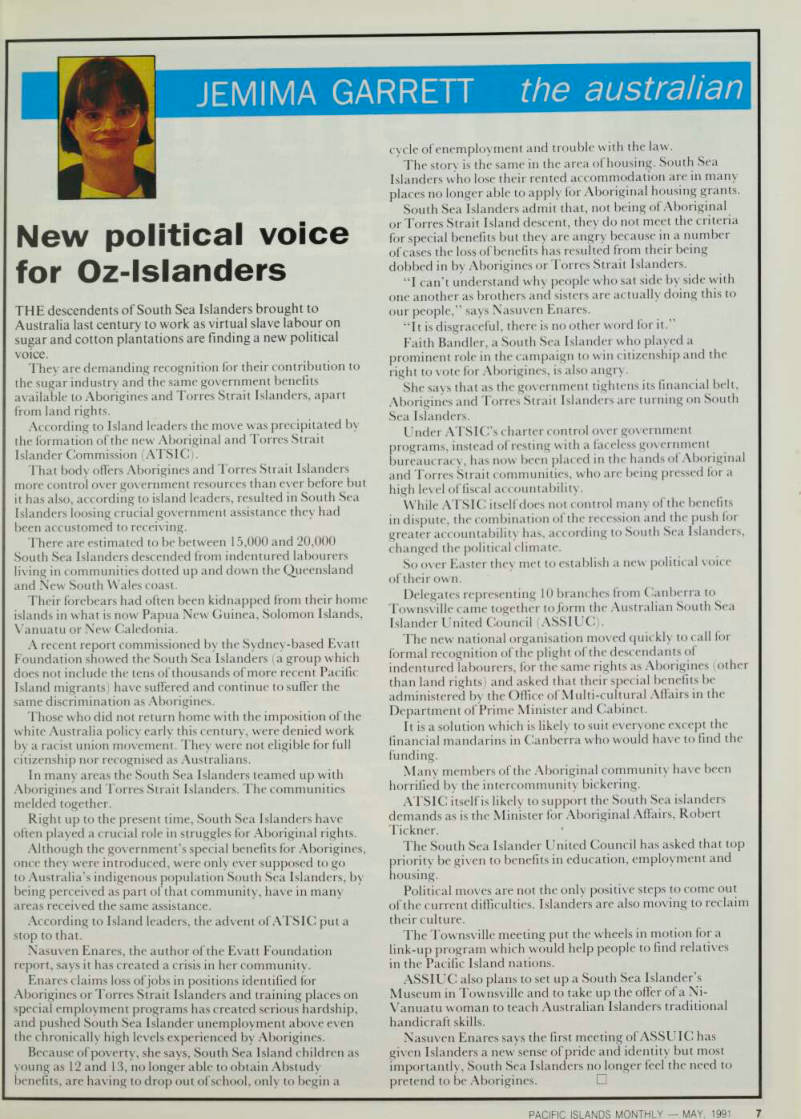
Jemima Garrett
the australian
New political voice for Oz-Islanders
THE descendents of South Sea Islanders brought to Australia last century to work as virtual slave labour on sugar and cotton plantations are finding a new political voice.
They are demanding recognition for their contribution to the sugar industry and the same government benefits available to Aborigines and Torres Strait Islanders, apart from land rights.
According to Island leaders the move was precipitated by the formation of the new Aboriginal and Torres Strait Islander Commission (ATSIC).
That body offers Aborigines and Torres Strait Islanders more control over government resources than ever before but it has also, according to island leaders, resulted in South Sea Islanders loosing crucial government assistance they had been accustomed to receiving.
There are estimated to be between 15,000 and 20,000 South Sea Islanders descended from indentured labourers living in communities dotted up and down the Queensland and New South Wales coast.
Their forebears had often been kidnapped from their home islands in what is now Papua New Guinea, Solomon Islands, Vanuatu or New Caledonia.
A recent report commissioned by the Sydney-based Evatt Foundation showed the South Sea Islanders (a group which does not include the tens of thousands of more recent Pacific Island migrants) have suffered and continue to suffer the same discrimination as Aborigines.
Those who did not return home with the imposition of the white Australia policy early this century, were denied work by a racist union movement. They were not eligible for full citizenship nor recognised as Australians.
In many areas the South Sea Islanders teamed up with Aborigines and Torres Strait Islanders. The communities melded together.
Right up to the present time, South Sea Islanders have often played a crucial role in struggles for Aboriginal rights.
Although the government’s special benefits for Aborigines, once they were introduced, were only ever supposed to go to Australia’s indigenous population South Sea Islanders, by being perceived as part of that community, have in many areas received the same assistance.
According to Island leaders, the advent of ATSIC put a stop to that.
Nasuven Enares, the author of the Evatt Foundation report, says it has created a crisis in her community.
Enares claims loss of jobs in positions identified for Aborigines or Torres Strait Islanders and training places on special employment programs has created serious hardship, and pushed South Sea Islander unemployment above even the chronically high levels experienced by Aborigines.
Because of poverty, she says, South Sea Island children as young as 12 and 13, no longer able to obtain Abstudy benefits, are having to drop out of school, only to begin a
cycle of enemployment and trouble with the law.
The story is the same in the area of housing. South Sea Islanders who lose their rented accommodation are in many places no longer able to apply for Aboriginal housing grants.
South Sea Islanders admit that, not being of Aboriginal or Torres Strait Island descent, they do not meet the criteria for special benefits but they are angry because in a number of cases the loss of benefits has resulted from their being dobbed in by Aborigines or Torres Strait Islanders.
“I can’t understand why people who sat side by side with one another as brothers and sisters are actually doing this to our people,” says Nasuven Enares.
“It is disgraceful, there is no other word for it.
Faith Handler, a South Sea Islander who played a prominent role in the campaign to win citizenship and the right to vote for Aborigines, is also angry.
She says that as the government tightens its financial belt, Aborigines and Torres Strait Islanders are turning on South Sea Islanders.
Under ATSIC’s charter control over government programs, instead of resting with a faceless government bureaucracy, has now been placed in the hands of Aboriginal and Torres Strait communities, who are being pressed for a high level of fiscal accountability.
While ATSIC itself does not control many of the benefits in dispute, the combination of the recession and the push for greater accountability has, according to South Sea Islanders, changed the political climate.
So over Easter they met to establish a new political voice of their own.
Delegates representing 10 branches from Canberra to Townsville came together to form the Australian South Sea Islander United Council (ASSIUC).
The new national organisation mov ed quickly to call for formal recognition of the plight of the descendants of indentured labourers, for the same rights as Aborigines (other than land rights) and asked that their special benefits be administered by the Office of Multi-cultural Affairs in the Department of Prime Minister and Cabinet.
It is a solution which is likely to suit everyone except the financial mandarins in Canberra who would have to find the funding.
Many members of the Aboriginal community have been horrified by the intercommunity bickering.
ATSIC itselfis likely to support the South Sea islanders demands as is the Minister for Aboriginal Affairs, Robert Tickner.
The South Sea Islander United Council has asked that top priority be given to benefits in education, employment and housing.
Political moves are not the only positive steps to come out of the current difficulties. Islanders are also moving to reclaim their culture.
The Townsville meeting put the wheels in motion for a link-up program which would help people to find relatives in the Pacific Island nations.
ASSIUC also plans to set up a South Sea Islander’s Museum in Townsville and to take up the offer of a Ni- Vanuatu woman to teach Australian Islanders traditional handicraft skills.
Nasuven Enares says the first meeting of ASSUIC has given Islanders a new sense of pride and identity but most importantly, South Sea Islanders no longer feel the need to pretend to be Aborigines. □
Margot Oneill
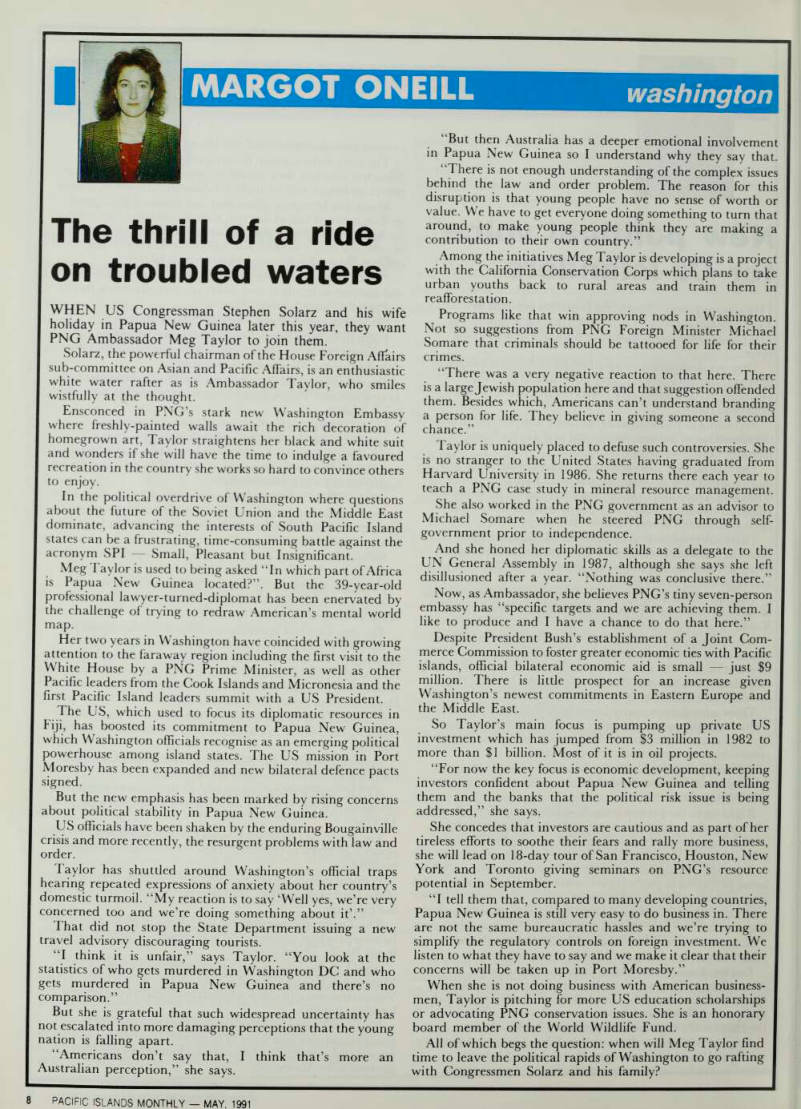
Washington
The thrill of a ride on troubled waters
WHEN US Congressman Stephen Solarz and his wife holiday in Papua New Guinea later this year, they want PNG Ambassador Meg Taylor to join them.
Solarz, the powerful chairman of the House Foreign Affairs sub-committee on Asian and Pacific Affairs, is an enthusiastic white water rafter as is Ambassador Taylor, who smiles
wistfully at the thought.
Ensconced in PNG’s stark new Washington Embassy where freshly-painted walls await the rich decoration of homegrown art, Taylor straightens her black and white suit and wonders if she will have the time to indulge a favoured recreation in the country she works so hard to convince others
to enjoy.
In the political overdrive of Washington where questions about the future of the Soviet Union and the Middle East dominate, advancing the interests of South Pacific Island states can be a frustrating, time-consuming battle against the acronym SPI Small, Pleasant but Insignificant.
Meg Taylor is used to being asked “In which part of Africa is Papua New Guinea located?”. But the 39-year-old professional lawyer-turned-diplomat has been enervated by the challenge of trying to redraw American’s mental world map.
Her two years in Washington have coincided with growing attention to the faraway region including the first visit to the White House by a PNG Prime Minister, as well as other Pacific leaders from the Cook Islands and Micronesia and the first Pacific Island leaders summit with a US President.
The US, which used to focus its diplomatic resources in Fiji, has boosted its commitment to Papua New Guinea, which Washington officials recognise as an emerging political powerhouse among island states. The US mission in Port Moresby has been expanded and new bilateral defence pacts signed.
But the new emphasis has been marked by rising concerns about political stability in Papua New Guinea.
US officials have been shaken by the enduring Bougainville crisis and more recently, the resurgent problems with law and order.
Taylor has shuttled around Washington’s official traps hearing repeated expressions of anxiety about her country’s domestic turmoil. “My reaction is to say ‘Well yes, we’re very concerned too and we’re doing something about it’.”
That did not stop the State Department issuing a new travel advisory discouraging tourists.
“I think it is unfair,” says Taylor. “You look at the statistics of who gets murdered in Washington DC and who gets murdered in Papua New Guinea and there’s no comparison.”
But she is grateful that such widespread uncertainty has not escalated into more damaging perceptions that the young nation is falling apart.
“Americans don’t say that, I think that’s more an Australian perception,” she says.
But then Australia has a deeper emotional involvement in Papua New Guinea so I understand why they say that.
“There is not enough understanding of the complex issues behind the law and order problem. The reason for this disruption is that young people have no sense of worth or value. We have to get everyone doing something to turn that around, to make young people think they are making a contribution to their own country.”
Among the initiatives Meg Taylor is developing is a project with the California Conservation Corps which plans to take urban youths back to rural areas and train them in reafforestation.
Programs like that win approving nods in Washington.
Not so suggestions from PNG Foreign Minister Michael Somare that criminals should be tattooed for life for their crimes.
“There was a very negative reaction to that here. There is a largejewish population here and that suggestion offended them. Besides which, Americans can’t understand branding a person for life. They believe in giving someone a second chance.”
Taylor is uniquely placed to defuse such controversies. She is no stranger to the United States having graduated from Harvard University in 1986. She returns there each year to teach a PNG case study in mineral resource management.
She also worked in the PNG government as an advisor to Michael Somare when he steered PNG through self government prior to independence.
And she honed her diplomatic skills as a delegate to the UN General Assembly in 1987, although she says she left disillusioned after a year. “Nothing was conclusive there.”
Now, as Ambassador, she believes PNG’s tiny seven-person embassy has “specific targets and we are achieving them. I like to produce and I have a chance to do that here.”
Despite President Bush’s establishment of a Joint Com merce Commission to foster greater economic ties with Pacific islands, official bilateral economic aid is small —just S 9 million. There is little prospect for an increase given Washington’s newest commitments in Eastern Europe and the Middle East.
So Taylor’s main focus is pumping up private US investment which has jumped from S 3 million in 1982 to more than SI billion. Most of it is in oil projects.
“For now the key focus is economic development, keeping investors confident about Papua New Guinea and telling them and the banks that the political risk issue is being addressed,” she says.
She concedes that investors are cautious and as part of her tireless efforts to soothe their fears and rally more business, she will lead on 18-day tour of San Francisco, Houston, New York and Toronto giving seminars on PNG’s resource potential in September.
“I tell them that, compared to many developing countries, Papua New Guinea is still very easy to do business in. There are not the same bureaucratic hassles and we’re trying to simplify the regulatory controls on foreign investment. We listen to what they have to say and we make it clear that their concerns will be taken up in Port Moresby.”
When she is not doing business with American business men, Taylor is pitching for more US education scholarships or advocating PNG conservation issues. She is an honorary board member of the World Wildlife Fund.
All of which begs the question: when will Meg Taylor find time to leave the political rapids of Washington to go rafting with Congressmen Solarz and his family?
Advertisements & other items, pp. 9-10 (2 items)
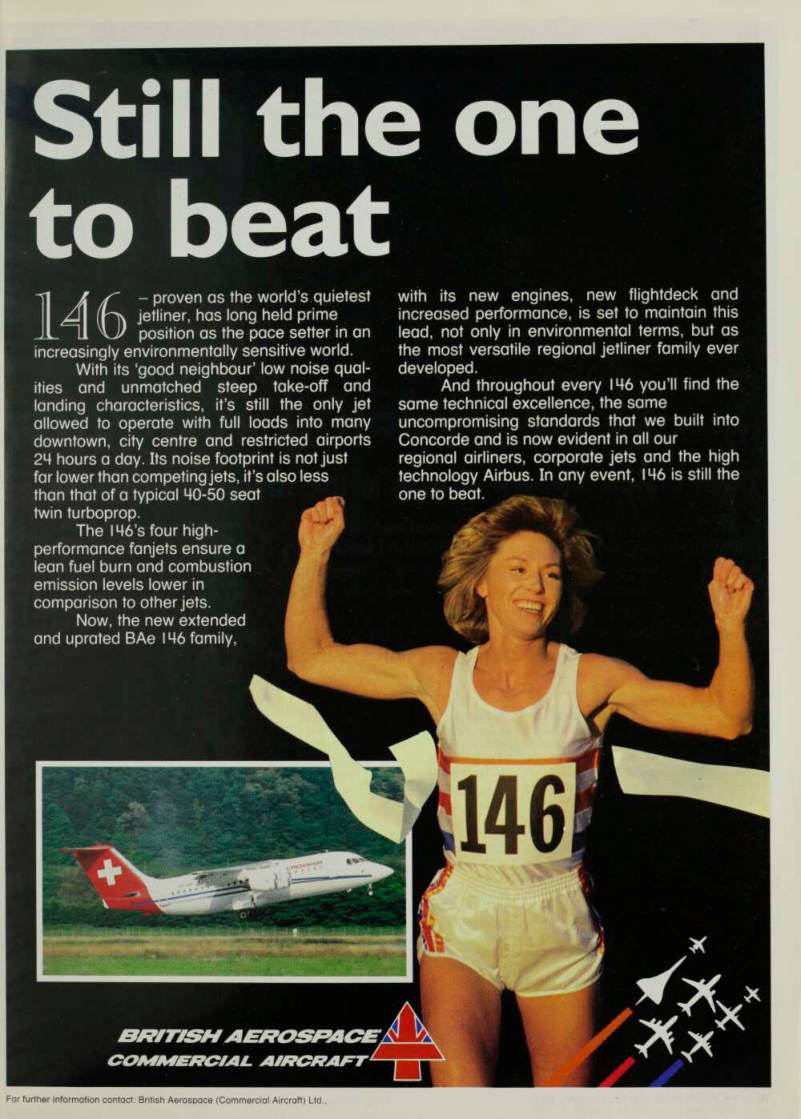
Still the one
to beat
146 - proven as the world’s quietest jetliner, has long held prime position as the pace setter in an increasingly environmentally sensitive world.
With its ‘good neighbour’ low noise qualities and unmatched steep take-off and landing characteristics, it’s still the only jet allowed to operate with full loads into many downtown, city centre and restricted airports 24 hours a day. Its noise footprint is not just far lower than competing jets, it’s also less than that of a typical 40-50 seat twin turboprop.
The I46’s four highperformance fanjets ensure a lean fuel burn and combustion emission levels lower in comparison to other jets.
Now, the new extended and uprated BAe 146 family, with its new engines, new flightdeck and increased performance, is set to maintain this lead, not only in environmental terms, but as the most versatile regional jetliner family ever developed.
And throughout every 146 you’ll find the same technical excellence, the same uncompromising standards that we built into Concorde and is now evident in all our regional airliners, corporate jets and the high technology Airbus. In any event, 146 is still the one to beat. sit -St * m X X X Xx LJ
COMMERCIAL AIRCRAFT
For further information contact: British Aerospace (Commercial Aircraft) Ltd.
The Region
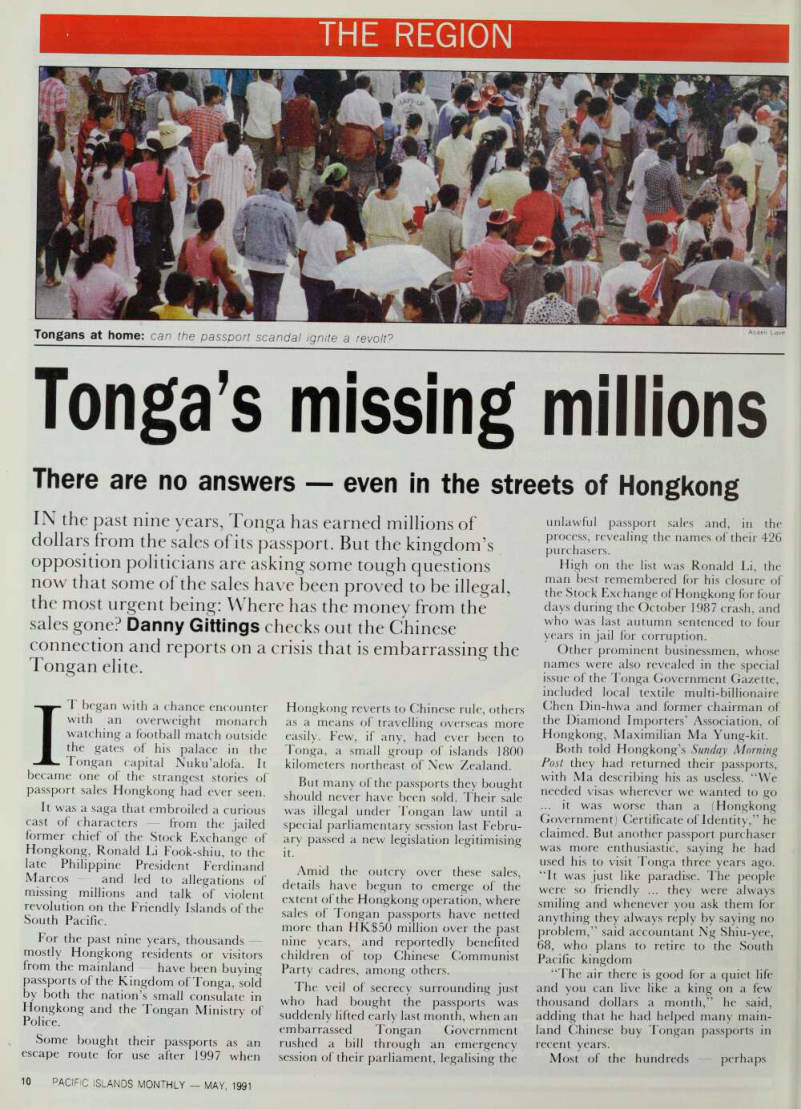
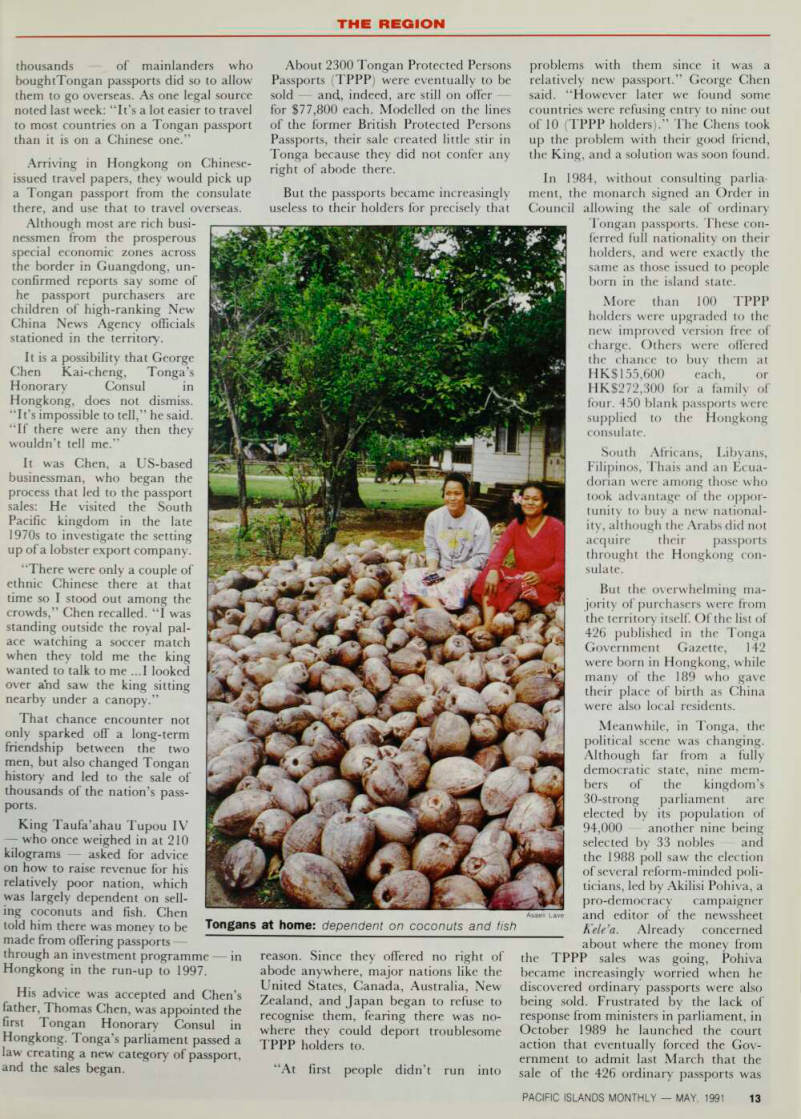
Tongans at home: can the passport scandal ignite a revolt?
Tonga’s missing millions
There are no answers - even in the streets of Hongkong
IN the past nine years, Tonga has earned millions of dollars from the sales of its passport. But the kingdom’s opposition politicians are asking some tough questions now that some of the sales have been proved to be illegal, the most urgent being: Where has the money from the sales gone? Danny Gittings checks out the Chinese connection and reports on a crisis that is embarrassing the
Tongan elite.
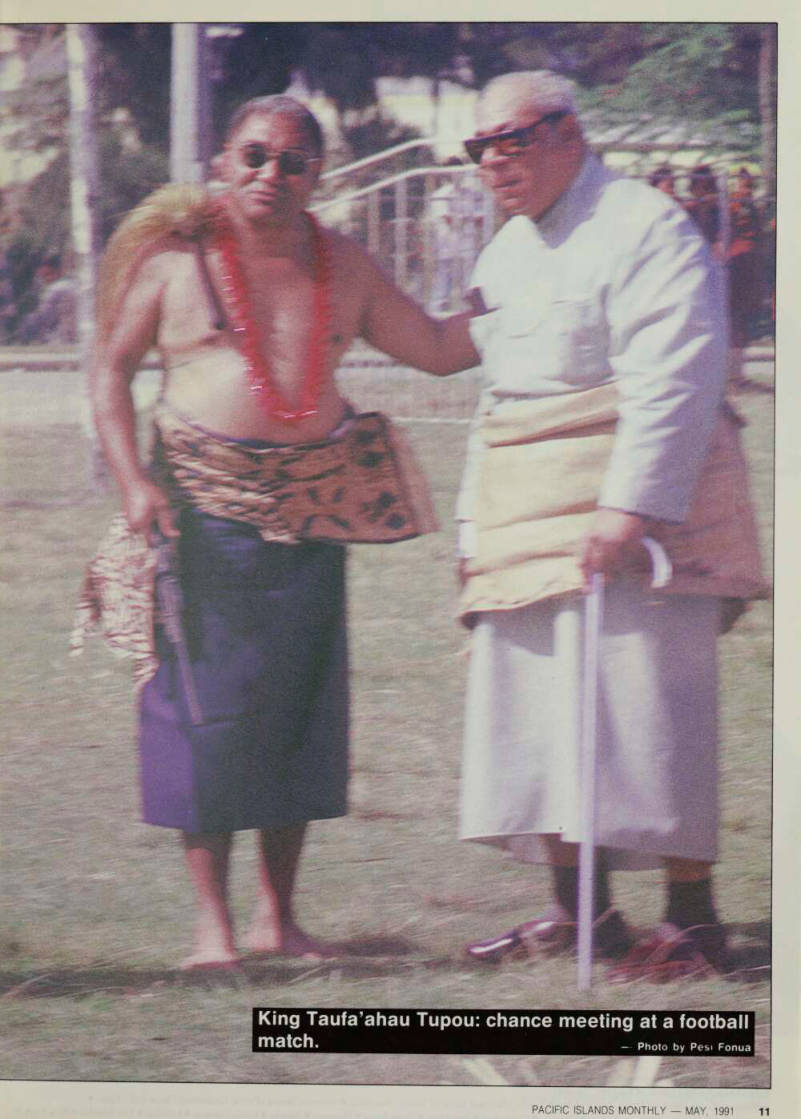
IT began with a chance encounter with an overweight monarch watching a football match outside the gates of his palace in the Tongan capital Nukualofa. It became one of the strangest stories of passport sales Hongkong had ever seen.
It was a saga that embroiled a curious cast of characters from the jailed former chief of the Stock Exchange of Hongkong, Ronald Li Fook-shiu, to the late Philippine President Ferdinand Marcos and led to allegations of missing millions and talk of violent revolution on the Friendly Islands of the South Pacific.
For the past nine years, thousands mostly Hongkong residents or visitors from the mainland have been buying passports of the Kingdom of Tonga, sold by both the nation’s small consulate in Hongkong and the Tongan Ministry of Police.
Some bought their passports as an escape route for use after 1997 when
Hongkong reverts to Chinese rule, others as a means of travelling overseas more easily. Few, if any, had ever been to Tonga, a small group of islands 1800 kilometers northeast of New Zealand.
But many of the passports they bought should never have been sold. Their sale was illegal under Tongan law until a special parliamentary session last Febru ary passed a new legislation legitimising it.
Amid the outcry over these sales, details have begun to emerge of the extent of the Hongkong operation, where sales of Tongan passports have netted more than HK$5O million over the past nine years, and reportedly benefited children of top Chinese Communist Party cadres, among others.
The veil of secrecy surrounding just who had bought the passports was suddenly lifted early last month, when an embarrassed Tongan Government rushed a bill through an emergency session of their parliament, legalising the
unlawful passport sales and, in the process, revealing the names of their 426 purchasers.
High on the list was Ronald Li, the man best remembered for his closure of the Stock Exchange of Hongkong for four days during the October 1987 crash, and who was last autumn sentenced to four years in jail for corruption.
Other prominent businessmen, whose names were also revealed in the special issue of the Tonga Government Gazette, included local textile multi-billionaire Chen Din-hwa and former chairman of the Diamond Importers’ Association, of
Hongkong, Maximilian Ma Yung-kit.
Both told Hongkong’s Sunday Morning Post they had returned their passports, with Ma describing his as useless. “We needed visas wherever we wanted to go ... it was worse than a (Hongkong Government) Certificate of Identity,” he claimed. But another passport purchaser was more enthusiastic, saying he had used his to visit Tonga three years ago.
“It was just like paradise. The people were so friendly ... they were always smiling and whenever you ask them for anything they always reply by saying no problem,” said accountant Ng Shiu-yee, 68, who plans to retire to the South
Pacific kingdom
“The air there is good for a quiet life and you can live like a king on a few thousand dollars a month,” he said, adding that he had helped many main land Chinese buy Tongan passports in recent years.
Most of the hundreds perhaps
King Taufa'ahau Tupou: chance meeting at a football match. -Photo by Pesi Fonua
thousands of mainlanders who bought Tongan passports did so to allow them to go overseas. As one legal source noted last week; “It’s a lot easier to travel to most countries on a Tongan passport than it is on a Chinese one.”
TT . .
Arriving in Hongkong on Chineseissued travel papers, they would pick up a Tongan passport from the consulate there, and use that to travel overseas.
Although most are rich busi nessmen from the prosperous special economic zones across the border in Guangdong, un confirmed reports say some of he passport purchasers are children of high-ranking New China News Agency officials stationed in the territory.
It is a possibility that George Chen Kai-cheng, Tonga’s Honorary Consul in Hongkong, does not dismiss.
“It’s impossible to tell,” he said.
“If there were any then they wouldn’t tell me.”
It was Chen, a US-based businessman, who began the process that led to the passport sales: He visited the South Pacific kingdom in the late
1970 s to investigate the setting
up of a lobster export company.
“There were only a couple of ethnic Chinese there at that time so I stood out among the crowds,” Chen recalled. “I was standing outside the royal pal ace watching a soccer match when they told me the king wanted to talk to me ...I looked over and saw the king sitting nearby under a canopy.”
That chance encounter not only sparked off a long-term friendship between the two men, but also changed Tongan history and led to the sale of thousands of the nation’s pass ports.
King Taufa’ahau Tupou IV
who once weighed in at 210 kilograms asked for advice on how to raise revenue for his relatively poor nation, which was largely dependent on sell ing coconuts and fish. Chen told him there was money to be made from offering passports
through an investment programme in Hongkong in the run-up to 1997.
His advice was accepted and Chen’s father, Thomas Chen, was appointed the first Tongan Honorary Consul in Hongkong. Tonga’s parliament passed a law creating a new category of passport, and the sales began.
About 2300 Tongan Protected Persons Passports (TPPP) were eventually to be sold and,, indeed, are still on offer for $77,800 each. Modelled on the lines of the former British Protected Persons Passports, their sale created little stir in Tonga because they did not confer any ■ h( of abode there But the passports became increasingly useless to their holders for precisely that
reason. Since they offered no right of abode anywhere, major nations like the United States, Canada, Australia, New Zealand, and Japan began to refuse to recognise them, fearing there was no where they could deport troublesome TPPP holders to.
“At first people didn’t run into
problems with them since it was a relatively new passport.” George Chen said. “However later we found some countries were refusing entry to nine out of 10 (TPPP holders).” The Chens took up the problem with their good friend, the King, and a solution was soon found.
In 1984, without consulting parlia ment, the monarch signed an Order in Council allowing the sale of ordinary
Tongan passports. These con ferred full nationality on their holders, and were exactly the same as those issued to people born in the island state.
More than 100 TPPP holders were upgraded to the new improved version free of charge. Others were offered the chance to buy them at HK5155,600 each, or HK5272,300 for a family of four. 450 blank passports were supplied to the Hongkong consulate.
South Africans, Libyans, Filipinos, Thais and an Ecua dorian were among those who took advantage of the oppor tunity to buy a new national ity, although the Arabs did not acquire their passports throught the Hongkong con sulate.
But the overwhelming ma jority of purchasers were from the territory itself. Of the list of 426 published in the Tonga Government Gazette, 142 were born in Hongkong, while many of the 189 who gave their place of birth as China were also local residents.
Meanwhile, in Tonga, the political scene was changing.
Although far from a fully democratic state, nine mem bers of the kingdom’s 30-strong parliament are elected by its population of 94,000 another nine being selected by 33 nobles and the 1988 poll saw the election of several reform-minded poli ticians, led by Akilisi Pohiva, a
pro-democracy campaigner
and editor of the newssheet Kele’a. Already concerned about where the money from
the TPPP sales was going, Pohiva became increasingly worried when he discovered ordinary passports were also being sold. Frustrated by the lack of response from ministers in parliament, in October 1989 he launched the court action that eventually forced the Gov ernment to admit last March that the sale of the 426 ordinary passports was
Asaell Lave Tongans at home: dependent on coconuts and fish
unlawful, causing a constitutional crisis in the South Pacific kingdom.
Pohiva leader of the unofficial opposition Peoples’ Party in the legis lature admits he has used the issue to further his group’s campaign for demo cratic reforms. “We have been able to demonstrate not only to His Majesty but to the public that we have been trying to do the right thing,” he said. “We have been successful in this very important case and we think we have the support and approval of the majority of the
population.”
Buoyed by an unprecedented 2000-strong street protest against the government’s handling of the passport issue, Pohiva has warned that unless the king gives up his political powers and becomes a constitutional monarch along the lines of. England’s Queen Elizabeth revolution may follow.
“We are trying to achieve our case in a peaceful way but if this turns out to be a failure the only alternative is to revolt,” he said.
Tongan sources said the king had faced sustained criticism in recent weeks over the passport scandal, with much public concern still fo ‘As f3f 3s cused on what had . happened to the pro- I know not ceeds from the sales, a single Tonga’s Justice Minis penny has fe !\ Tev ‘ ta Tu p ou . told parliament the sales had raised on luxury HKJ233 million in all.
C3pc 311 H Of this, about HK$55 £ million had been yachts or for raised through the any other sales in Hongkong and misuse' deposited in the Ton gan Trust Fund at the Bank of America in San Francisco, Chen said.
“All our accounts have been audited, the money we received fully accounted for, and paid into a fund whose sole purpose is to help the people of Tonga, Chen said. The consul said the money from the fund had only been used for social purposes such as cyclone relief, and starting an airline that doubles as a flying doctor service.
“As far as I know not a single penny has been used to buy luxury cars and yachts or for any other misuse.”
Opposition politicians say the govern ment has refused to release audited accounts of the later sales. “We still have no idea how much money Tonga col lected (from the passport sales) and where the money is,” Pohiva said.
And they plan to raise the issue of the missing millions when parliament resumes this month, a move that seems certain to ensure that the curious saga of the sale of Tongan passports will con tinue to cause controversy. □
Advertisements & other items, p. 12 (1 item)
Pacific Island
m '■i \
Who can you
bank on to help
serve 11 key
Pacific Island
markets?
The South Pacific is a vast area of ocean covering almost 8 million square miles.
It’s also an area which is rich in potential.
But how do you tap this potential? Through Westpac.
This part of the world has been home to us for almost 90 years now, and our presence is a strong one. With representation in 11 Pacific Island countries, we service every major developing business market in the region.
We see our role as one of being closely involved in the development of the Pacific. Not only through multi-nationals and major companies, but also small local business people and entrepreneurs.
Westpac is here to serve your banking needs.
And that’s a service you can bank on, all over the South Pacific. *4 ft 3" : ll# You can bank on Westpac Pacific Branches: Cook Islands • Fiji • French Polynesia • New Caledonia • Niue • Solomon Islands • Vanuatu • Subsidiary: Kiribati (Bank of Kiribati., Tarawa) Affiliates: Tonga (Bank of Tonga, Nuku’alofa) • Tuvalu (National Bank of Tuvalu, Funafuti) • Western Samoa (Pacific Commercial Bank Ltd., Apia) • International Representation: Beijing • Chicago • Columbus • Frankfurt • Hong Kong • Houston • Jakarta • Kuala Lumpur • London • Los Angeles • New York
The quiet
crusader
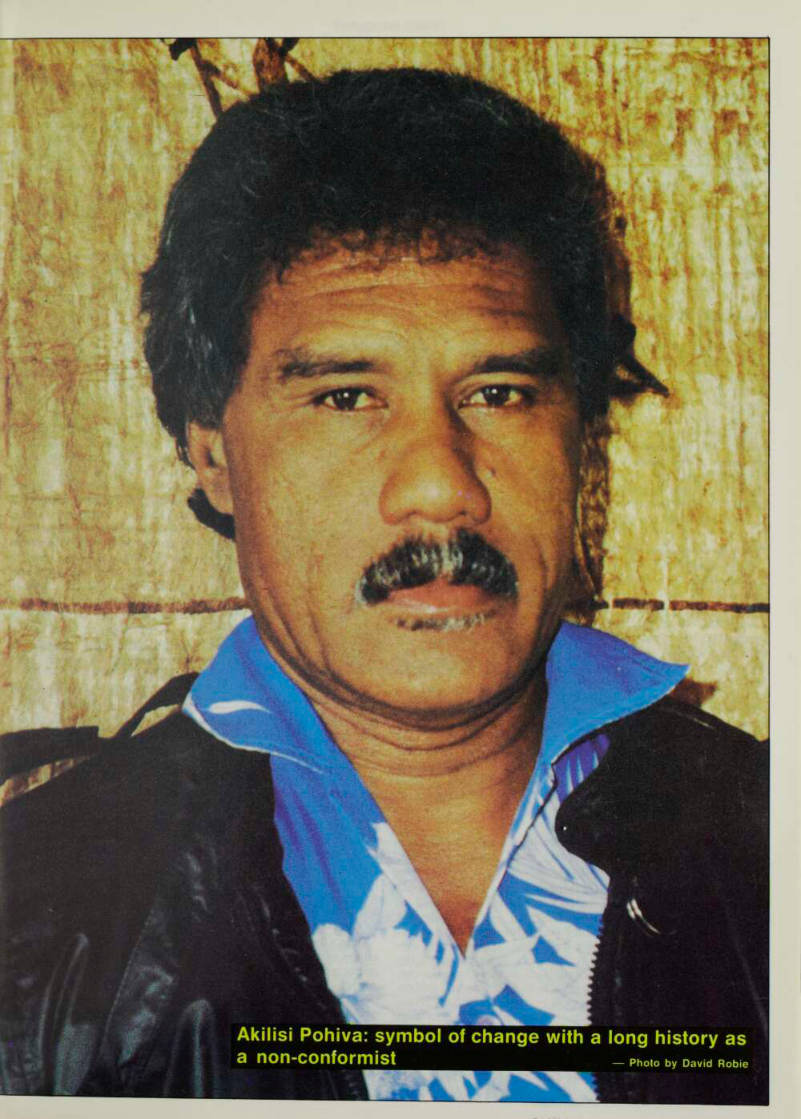
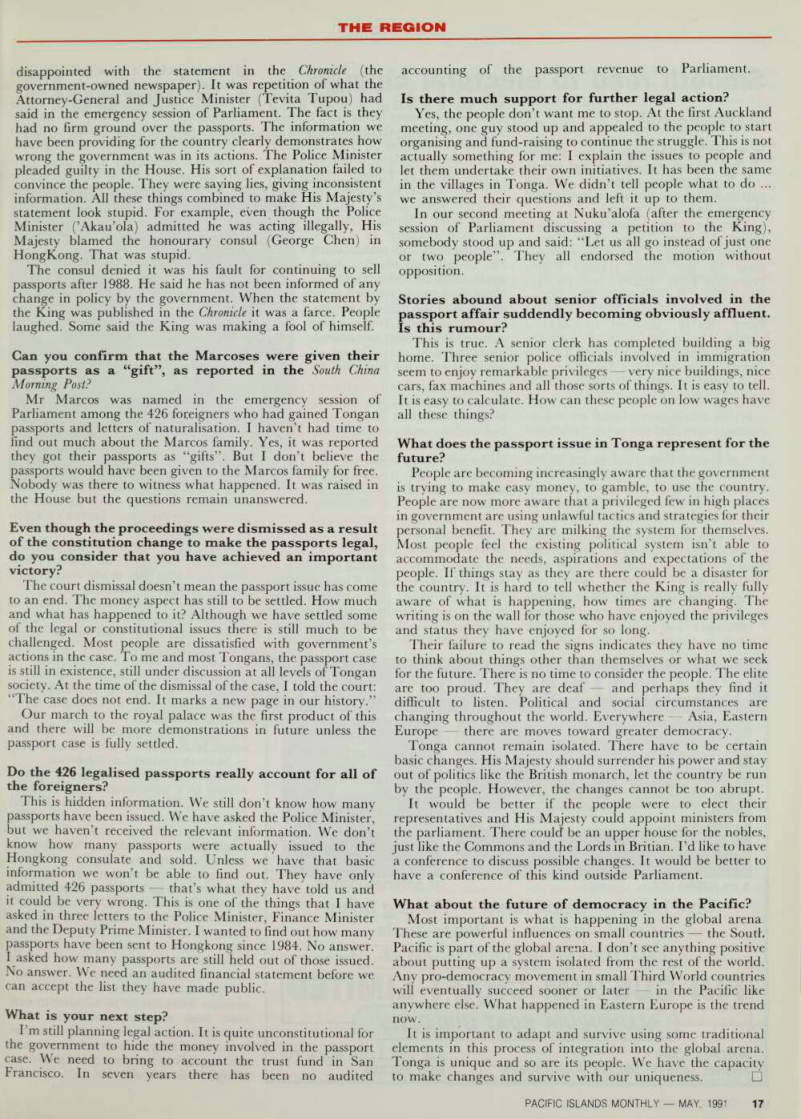
AKALISI Pohiva is a quietly-spoken, yet imposing figure.
His measured oratory, dogged research and uncompromis ing crusade against corruption and lawbreaking have become the scourge of Tonga’s political and social establishment.
He is at the Centre of the reformist movement seeking better accountability from the government and a more democratic parliamentary system.
The 49-year-old former schoolteacher from Ha’apai has a long history as a non-conformist, although he rejects most of the over-the-top accusations levelled at him such as “terrorist”, according to Police Minister ‘Akau’ola, or “Marxist” as King Taufau’ahau Tupou IV once claimed in a television interview.
As People’s Representative No 1 for Tongatapu, Pohiva insists changes must come to make the government more accountable and less feudal. But he stresses his commitment to peaceful change. He is undaunted by the upheaval his political challenges are
unleashing.
In an historic legal victory over the government by a commoner in 1988, he was awarded T 529,000 in damages plus costs for unfair dismissal and denial of free speech. He had been sacked over hosting a controversial radio programme which aired sensitive issues. Since then the commoner MP and the newsletter Kele’a (conch shell) which he co-edits with parliamentary colleague Viliami Fukofuka have become a symbol of change.
At times, debate in the Legislative Assembly has become rather heated. On one occasion last October, members were told to go outside and “cool off”. The Speaker, Fusitu’a, followed Pohiva and called out: “I’ll kill you! What are you and how can a person like you
challenge me?”
The controversial passport case has triggered a “domino” fear in the kingdom cabinet ministers don’t quite know what will fall next. More than two and a half years ago, Pohiva resolved to take on an
unprecedented struggle to challenge the government
and expose the illegality of the Tonga passport sales to
foreigners.
It took a year for him to convince his legal counsel, New Zealand civil rights lawyer Dr Rodney Harrison and Tongan-born Nalesoni Tupou, that he had a case worth fighting. Then it took another year to finally get it before the Tongan Supreme Court. Panicked by the crisis, the government hastily convened an emergency session of Parliament in February and legalised passport sales to 426 foreigners by changing the constitution.
But the moral victory belongs to Pohiva.
Recently visiting New Zealand to speak to Tongans
Akilisi Pohiva: symbol of change with a long history as a non-conformist - Photo by David Robie
who enthusiastically support the parliamentarian’s cause, Pohiva talked to Pacific Islands Monthly’s David Robie in Auckland.
How did people respond to your unprecedented opening public meeting in Auckland which heard you and fellow people’s representative Laki Niu speak?
This was the first ever political gathering of this kind in New Zealand, just as it has become a new phenomenon in Tonga I was surprised that so many people were already well acquainted with the issues. Many of them had read the Times of Tonga which has published a lot of articles and writings about the situation in Tonga. Before we started, I talked with several people about the events. They were quite understanding and they had good background. Most responded positively to what we told them.
What sort of questions were you asked?
The kinds of questions we got showed clearly that most people are unhappy with what has been going on in Tonga over the last few years the aberrations of the Tongan government. They know a lot about the motives behind the actions of His Majesty and the ministers. They understand the corruption and the scandals and all sorts of evils that are taking place. These are the sorts of things I could tell from the meeting.
What is troubling the people?
They wonder what is going to happen if the government is not prepared to accommodate the concerns and requests of the people and their parliamentary representatives. There is a feeling that participation and accommo dation is very close to the end. We are trying to use the consti tutional provisions and laws to settle things. But what is going to
happen if these piecemeal steps come to a halt? I told them: “We must use all the constitutional provisions and make sure of the rights of the people to remedy the situation”. Assuming His Majesty and the ministers put off change, then disaster will follow. In the end it will be the people who will decide the final step for themselves. I advised them to work together in cooperation to make sure the country is safe.
Why has the Tongan government taken such arbitrary action in turning your passport case junior counsel, Nalesoni Tupou, into a virtual exile?
The government can do anything it wants, but the people will be very upset with any unjust act. Most Tongans will be angry with what they have done to Nalesoni it is a deliberate move by the government to isolate me from my legal counsel.
The government shouldn’t have done that. It won’t stop me.
Nothing will stop me. I’ll continue to challenge the government. And I’ll go on calling legal counsel to assist me.
This has been a deliberate attempt to discourage and isolate me. They haven’t done anything to my senior counsel, (New Zealander) Dr Rodney Harrison. If they think they can stop legal counsel coming to Tonga then they’re making a big mistake. They’re making the people angry.
Does the Tongan government fear you?
I think so. What they have been doing over the last few months reflects this. They fear being forced into being accountable. The emergency meeting of Parliament (in February) was a deliberate attempt by the government to escape its responsibilities. Their panic change to the consti tution is another indication of the failure of the government to face up to a better solution, or a compromise over what they have done. They will continue to make more mistakes in the future.
The Minister of Police, ‘Akau’ola, should have resigned over this scandal and probably the Finance Minister, Cecil Cocker, as well.
Do you have any concern for your own personal safety?
I still feel free and I still feel safe. My experience in challinging the government and in my court cases has taught me that I have nothing to fear. The growing support I have
from many Tongans, even senior people, has encouraged me to struggle on. Many senior people in government leak highly confidential information to us this shows a lot of high level support. We have a lot of encouragement from the
Churches and respected people
in Tonga, like Futa Helu of ‘Atenesi. The last demonstra tion (in March) against the action taken by His Majesty and his government, supported by (Roman Catholic) Bishop Patelisio Finau and Free Wes leyan moderator Dr ‘Amanaki Havea, was a big vote of confidence. All these things combine to make His Majesty fear the movement and the rising power of the people.
As an ally, how crucial is the Church in your cru sade?
Our people are highly re spectful of the Church. Power
in Tonga is slowly transferring from the nobles to the Churches and the elected representatives. The two Church leaders supported the demonstration, not because we asked them to.
We have an informal association to discuss strategy, but they came out on their own initiative. They understand the situation in our country. They see their responsibility as supporting what
is just and good.
I have a feeling that His Majesty and his ministers think that I and my colleagues use the Church leaders as political tools in the pro-democracy movement. This is not correct. We have regularly provided Bishop Finau and Dr Havea with information; it is our responsiblity as people’s representatives to provide information to key people in our society. We never ask them to take part we just told them about the march to the palace. They said it was a good move and joined in, The Church in Tonga plays a very significant role in the affairs of the nation. Their leaders are influential and highly respected. Tonga is very religious, almost everybody goes to church. What the leaders say is accepted and respected. Now they are the most respected leaders in Tonga. They are in the new middle class group, a high status in the Church as well as in social and political heirarchy.
How did the King respond to the petition?
We’ve had no formal reply from his Majesty. We are
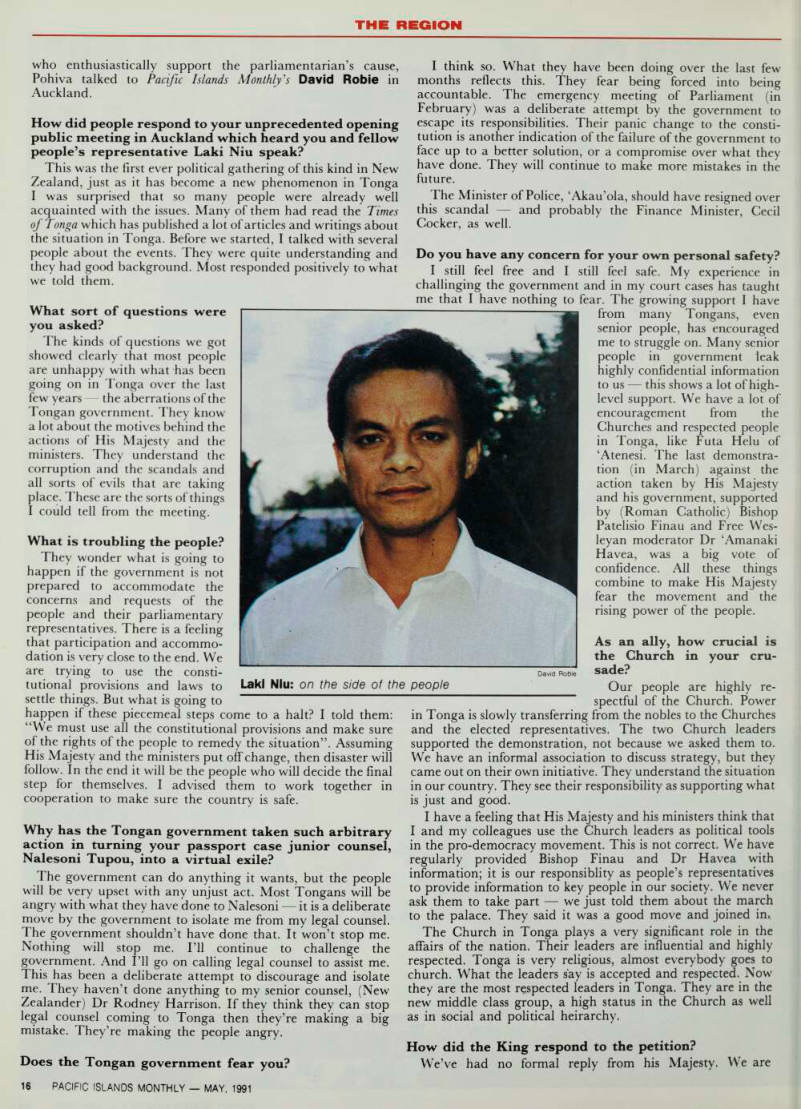
David Robie Lakl Niu: on the side of the people
disappointed with the statement in the Chronicle (the government-owned newspaper). It was repetition of what the Attorney-General and Justice Minister (Tevita Tupou) had said in the emergency session of Parliament. The fact is they had no firm ground over the passports. The information we have been providing for the country clearly demonstrates how wrong the government was in its actions. The Police Minister pleaded guilty in the House. His sort of explanation failed to convince the people. They were saying lies, giving inconsistent information. All these things combined to make His Majesty’s statement look stupid. For example, even though the Police Minister (’Akau’ola) admitted he was acting illegally, His Majesty blamed the honourary consul (George Chen) in
Hong Kong. That was stupid.
The consul denied it was his fault for continuing to sell passports after 1988. He said he has not been informed of any change in policy by the government. When the statement by the King was published in the Chronicle it was a farce. People laughed. Some said the King was making a fool of himself.
Can you confirm that the Marcoses were given their passports as a “gift”, as reported in the South China Morning Post?
Mr Marcos was named in the emergency session of Parliament among the 426 foreigners who had gained Tongan passports and letters of naturalisation. I haven’t had time to find out much about the Marcos family. Yes, it was reported they got their passports as “gifts”. But I don’t believe the passports would have been given to the Marcos family for free.
Nobody was there to witness what happened. It was raised in the House but the questions remain unanswered.
Even though the proceedings were dismissed as a result of the constitution change to make the passports legal, do you consider that you have achieved an important victory?
The court dismissal doesn’t mean the passport issue has come to an end. The money aspect has still to be settled. How much and what has happened to it? Although we have settled some of the legal or constitutional issues there is still much to be challenged. Most people are dissatisfied with government’s actions in the case. To me and most Tongans, the passport case is still in existence, still under discussion at all levels of Tongan society. At the time of the dismissal of the case, I told the court: “The case does not end. It marks a new page in our history.”
Our march to the royal palace was the first product of this and there will be more demonstrations in future unless the passport case is fully settled.
Do the 426 legalised passports really account for all of
the foreigners?
This is hidden information. We still don’t know how many passports have been issued. We have asked the Police Minister, but we haven’t received the relevant information. We don’t know how many passports were actually issued to the Hongkong consulate and sold. Unless we have that basic information we won’t be able to find out. They have only admitted 426 passports that’s what they have told us and it could be very wrong. This is one of the things that I have asked in three letters to the Police Minister, Finance Minister and the Deputy Prime Minister. I wanted to find out how many passports have been sent to Hongkong since 1984. No answer.
I asked how many passports are still held out of those issued.
No answer. We need an audited financial statement before we can accept the list they have made public.
What is your next step?
I’m still planning legal action. It is quite unconstitutional for the government to hide the money involved in the passport case. We need to bring to account the trust fund in San Francisco. In seven years there has been no audited
accounting of the passport revenue to Parliament.
Is there much support for further legal action?
Yes, the people don’t want me to stop. At the first Auckland meeting, one guy stood up and appealed to the people to start organising and fund-raising to continue the struggle. This is not actually something for me: I explain the issues to people and let them undertake their own initiatives. It has been the same in the villages in Tonga. We didn’t tell people what to do ... we answered their questions and left it up to them.
In our second meeting at Nuku’alofa (after the emergency session of Parliament discussing a petition to the King), somebody stood up and said: “Let us all go instead of just one or two people”. They all endorsed the motion without opposition.
Stories abound about senior officials involved in the passport affair suddendly becoming obviously affluent.
Is this rumour?
This is true. A senior clerk has completed building a big home. Three senior police officials involved in immigration seem to enjoy remarkable privileges very nice buildings, nice cars, fax machines and all those sorts of things. It is easy to tell.
It is easy to calculate. How can these people on low wages have all these things?
What does the passport issue in Tonga represent for the future?
People are becoming increasingly aware that the government is trying to make easy money, to gamble, to use the country.
People are now more aware that a privileged few in high places in government are using unlawful tactics and strategies for their personal benefit. They are milking the system for themselves.
Most people feel the existing political system isn’t able to accommodate the needs, aspirations and expectations of the people. If things stay as they are there could be a disaster for the country. It is hard to tell whether the King is really fully aware of what is happening, how times are changing. The writing is on the wall for those who have enjoyed the privileges and status they have enjoyed for so long.
Their failure to read the signs indicates they have no time to think about things other than themselves or what we seek for the future. There is no time to consider the people. The elite are too proud. They are deaf and perhaps they find it difficult to listen. Political and social circumstances are changing throughout the world. Everywhere Asia, Eastern Europe there are moves toward greater democracy.
Tonga cannot remain isolated. There have to be certain basic changes. His Majesty should surrender his power and stay out of politics like the British monarch, let the country be run by the people. However, the changes cannot be too abrupt.
It would be better if the people were to elect their representatives and His Majesty could appoint ministers from the parliament. There could be an upper house for the nobles, just like the Commons and the Lords in Britian. I’d like to have a conference to discuss possible changes. It would be better to have a conference of this kind outside Parliament.
What about the future of democracy in the Pacific?
Most important is what is happening in the global arena These are powerful influences on small countries the South Pacific is part of the global arena. I don’t see anything positive about putting up a system isolated from the rest of the world.
Any pro-democracy movement in small Third World countries will eventually succeed sooner or later in the Pacific like anywhere else. What happened in Eastern Europe is the trend now.
It is important to adapt and survive using some traditional elements in this process of integration into the global arena.
Tonga is unique and so are its people. We have the capacity to make changes and survive with our uniqueness. □
Advertisements & other items, p. 14 (1 item)
The Region
Smooth road to electoral change
Elections
By Ulafala Aiavao
WESTERN Samoa’s first univer sal suffrage election last month progressed peacefully, and all parties now hope transition in electoral changes will be the same.
After the April 5 election, caretaker Prime Minister Tofilau Eti Alesana claimed 26 seats in the 47-seat Parlia ment for the ruling Human Rights Protection Party (HRPP), and the sup port of two Independents. The Oppo sition Samoa National Development Party (SNDP) declined to claim a number, being pre-occupied with the apparent defeat of their leader, Tuiatua Tupua Tamasese, by a newcomer, re tired postal supervisor Moananu Salale, holding a margin of just 27 votes.
Initial results were based on a pro visional count that did not include some 6000 of the 56,000 registered voters by way of Special Votes or absentee ballots.
In the final week of April, the official recount was completed. It confirmed the defeat of Tuiatua Tupua, the Deputy Speaker and one Cabinet Minister.
One provisional result was overturned - the defeat of an Opposition member by a government candidate, who won when absentee ballots were tallied.
Cabinet has advised the Head of State to call a meeting of Parliament on May 7. Parliament has up to 45 days after the election to meet and, since defections
have been common in the past, Samoan voters do not trust the numbers until the House meets to vote on rival contenders for Speaker, and later, Prime Minister.
The defeat of Tuiatua Tupua t may
help the SNDP by placing the deputy, Vaai Kolone, at the SNDP helm. Tuiatua Tupua has lost four elections in a row,
angering and and embarrassing
his council of chiefs. (Votes against him are believed to have come from people opposed to his adoption of the title of Tui-atua, as well as from voters newly enfranchised under an amend ment last year that allowed all adults to vote, not just chiefs.) Caretaker Prime Minister Tofilau Eti Alesana, who has won his fourth election in a row, is looking for a replacement. He has said that this will be his last term. (If he does leave before the next election in 1994, it will end the longest career of a Samoan poli tician, dating back to 1957 when he first entered Parliament and helped draft the Constitution for Independence in 1962.)
Tofilau also faces the task of picking an eight-member Cabinet. There are more contenders than places, which puts pressure on incumbent Ministers. The last time Tofilau dropped Cabinet mem bers, after the 1985 election, the snubbed
Ministers backed a mass defection that collapsed the government.
Among the front runners for Cabinet is one of the two female MP’s half the voters are now women and many feel it is time their contribution was recognised.
Election candidates have seven days after the recount to file what locals are
calling “the mother of all electoral petitions”. Transfer of the election battle from the ballot box to the courts could
further change the winning line-up.
But all parties are looking forward to peaceful change. At present the candi dates for 45 of the 47 seats must be chiefs, but Tofilau expects that to change “within the current generation”. It would then be easier to phase out the two seats set aside for those of non-Samoan ancestry. He still is interested in a bicameral chamber perhaps one by universal suffrage appointment, with an upper house selected and run according to Samoan custom i.e. consensus.
Recent electoral reform is partly related to a government plan to intro duce compulsory education for the first nine years of school with new voting rights for 21 year olds, Tofilau is emphasising knowledge of “the import ance of that responsibility”.
Politicians and voters also want to make it easier for a party to claim victory or concede defeat on election night. MP’s could become more reliable if they feared losing their seats for defecting from the party with which they have signed up.
Reformists suggest the absentee ballots be cast about a week before election day.
Opposition MP’s also have lobbied for overseas Samoans to be allowed to cast votes from overseas, considering their contribution via remittances to the economy. The government is concerned this may allow overseas communities to swing election results. □
Apelu Aiavao
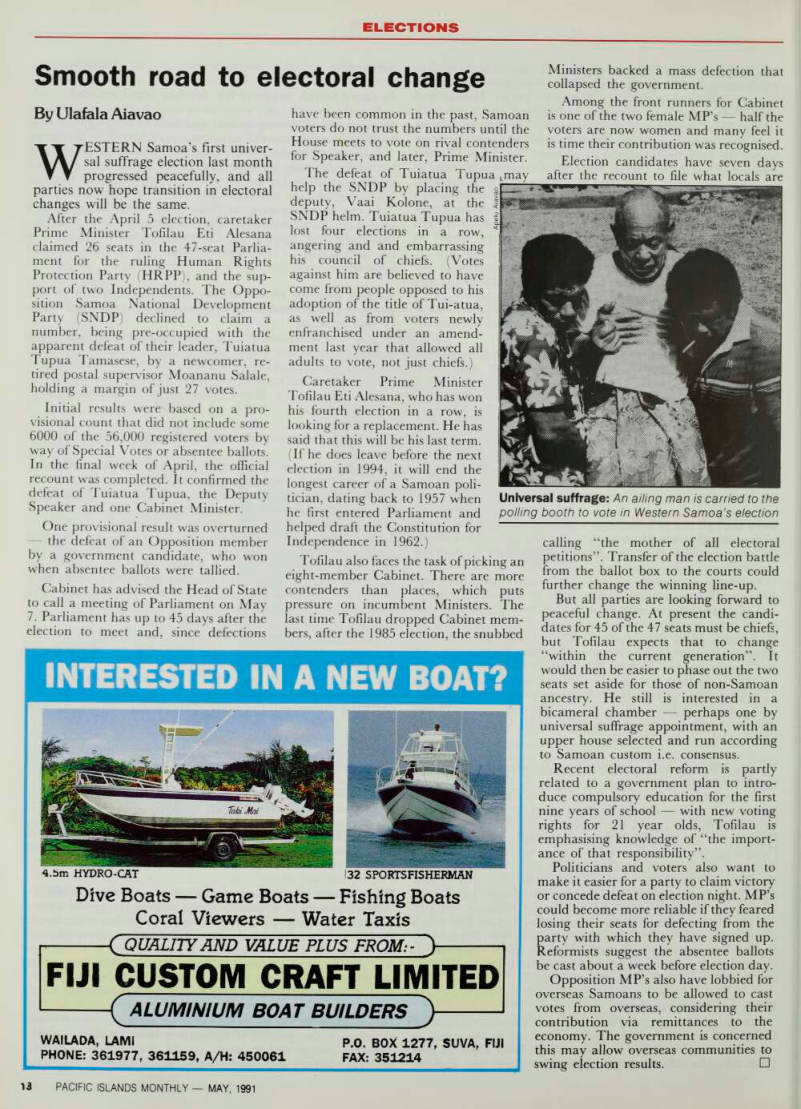
Universal suffrage: An ailing man is carried to the polling booth to vote in Western Samoa's election
Advertisements & other items, p. 18 (1 item)
( Aluminium Boat Builders )
INTERESTED IN A NEW BOAT?
*s—: * I R
4.5 m HYDRO-CAT
32 SPORTSFISHERMAN
Dive Boats Game Boats Fishing Boats Coral Viewers Water Taxis
( QUALITY AND VALUE PLUS
FIJI CUSTOM CRAFT LIMITED
( ALUMINIUM BOAT BUILDERS )
WAILADA, LAMI p.O. BOX 1277, SUVA, FIJI PHONE: 361977, 361159, A/H: 450061 FAX; 351214
Flosse’s inheritance
Talk of huge debts threatens relations with Paris
By Al Prince
THE first month of Gaston Flosse’s return to political power as head of a new majority coalition govern ment was dominated by a running debate with leaders of the previous Territorial Government over Tahiti’s
financial solvency.
The debate focused squarely on the size of a debt that the Flosse government claimed it inherited on April 5 from the
previous govern ment of Alexandre Leontieff, whose majority coalition of the past three years was de feated in the March 17 general election for all 41 seats in the Terri torial Assembly.
Flosse’s party, the big winner in that legislative election with a surprising 18 seats, formed a
majority coalition
government with the five seats won by the party of Emile Vernaudon, who became Terri torial Assembly president. Follow ing the election, the Flosse-
Vernaudon coalition picked up another two votes for a comfortable 25-seat majority in the parliamentary-style legis lative body.
Describing the financial situation of this French Overseas Territory of 200,000 people as a catastrophy, Flosse and Vernaudon announced a rigorous plan of government cost-cutting. And Flosse immediately initiated an historic audit by the pretigious international certified public accounting firm of Arthur Andersen to determine not only the size of Tahiti’s governmental debt, but also its biggest causes, including whether the Leontieff government could be accused of mismanagement.
No official debt figure had been announced by the end of April. But Flosse and Vernaudon had announced publicly on separate occasions that the debt totalled 50 billion French Pacific
francs (about US$5OO million). Flosse later claimed the debt totalled around 60 billion francs, which, he said, represented 15.86 per cent of the Territory’s tax revenues.
However, when the debate over Ta hiti’s debt was originally touched off in Paris on March 21 during a French National Assembly session, an opposition deputy indicated that the French State may have fixed Tahiti’s debt at 700 million French francs, which is worth
about US$l27 million.
In Tahiti, while members of the former Leontieff government have never denied pub licly that a debt exists, they had not announced an amount. How ever, in a pub lished press com
munique they
claimed they had found a similar financial situation when the Leontieff govern ment took office in December 1987. At the time,
the communique
added, there was not even enough money to finance an outside audit.
The potential wide-ranging ramifications of the debt debate not only threatened Tahiti’s future relations with the French State, but, by pure coincidence, appeared to give Tahiti an unusually important, if not deciding, vote in the future of French socialist Prime Minister Michal Rocard’s
minority coalition.
Overshadowed in all this was another continuing debate over Tahiti’s econ omic situation, the Flosse government’s overall programme for the next five years and the eventual outcome of two court cases against Flosse initiated by the Leontieff government. If Flosse ends up losing either one of those cases, the first of which is expected to be decided in Paris in May or June, he could end up losing the right to hold office for several years or indefinitely.
Meanwhile, Flosse and Vernaudon returned to Tahiti on April 27 after
having made their first courtesy calls on several French Government officials in Paris. But the one important person they were unable to see was French Socialist President Francois Mitterrand. The of ficial reason was that Mitterrand’s busy schedule did not allow time for such a visit. The speculation was that the French President may have preferred to await the outcome of the Tahiti audit before meeting with Flosse and Vernaudon.
Such speculation highlights the special relationships that exist between poli ticians in Tahiti and politicians in the French capital. Flosse has traditionally been a loyal supporter ofjacques Chirac, the mayor of Paris and one of the main opposition leaders in the French Na tional Assembly. When Socialist Presi dent Mitterrand chose right wing party leader Chirac as French Prime Minister in 1986 following the right’s victory in legislative elections, Chirac appointed Flosse “secretaire-d’etat” (under minister) for South Pacific problems.
Although Flosse only had that post until 1988 when Chirac was defeated by Mitterrand in the French presidential election, it was the first, and only, time a Tahitian politician had been appointed to a French Government post.
Vernaudon, one of Tahiti’s two depu ties in the French National Assembly since defeating Flosse in 1988, has voted with and against Prime Minister Rocard’s socialist-communist majority coalition. Former Territorial Govern ment President Leontieff, Tahiti’s second National Assembly deputy, has voted with the Rocard coalition since 1988 when Leontieff was re-elected deputy.
However, Leontieff, a key cabinet minister in Flosse Territorial Govern ments from 1982-1987, bolted Flosse’s party, staged a sort of mini-coup de’etat’ and formed a majority coalition that ran Tahiti’s government for three years and four months (December 1987-April 1991).
With that history, it is not difficult to understand why President Mitterrand and the Prime Minister Rocard would undoubtedly have preferred to see Leontieffs majority coalition return to power following the March 17 Tahiti election. And that almost occurred when, immediately after that election, Vernaudon was prepared to commit his five Territorial Assembly seats to the 14 controlled by Leontieff and previous Assembly President Jean Juventin.
But that would have created a co alition of only 19 seats, two short of a majority for Leontiff and Juventin. And without any defections from the 18 seats controlled by Flosse, the four remaining seats controlled by Oscar Temaru’s independence party would have been put in the disproportionately powerful pos
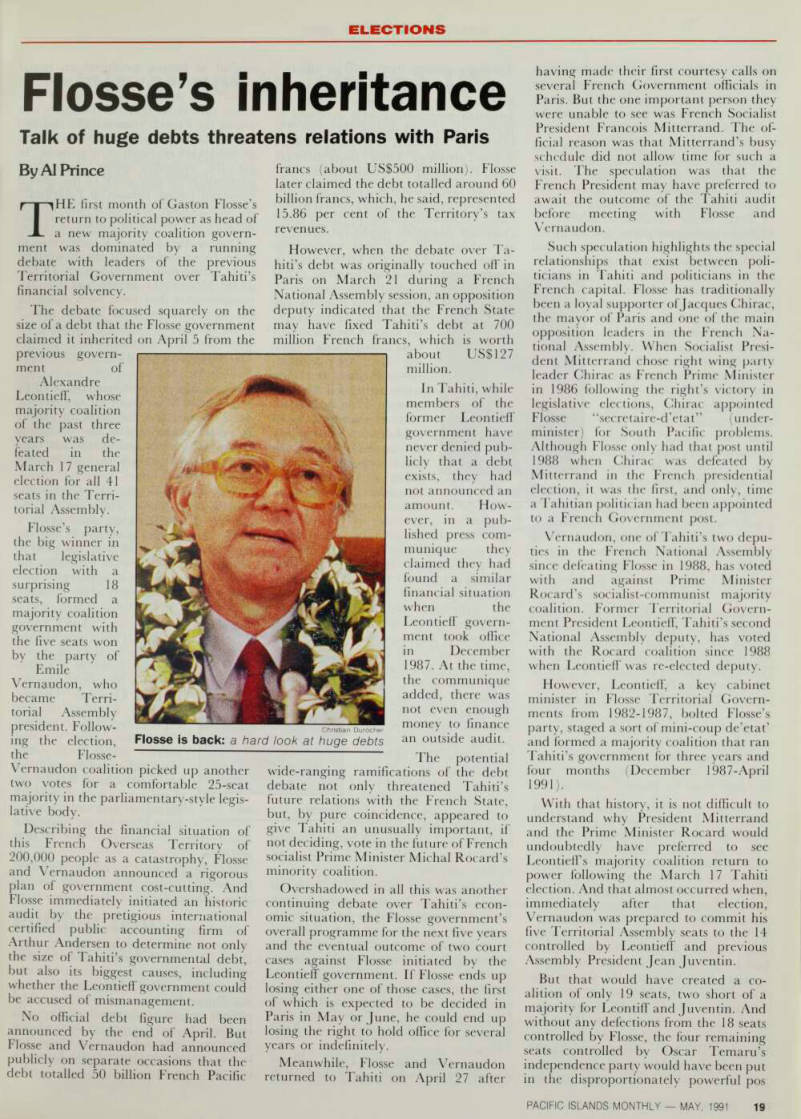
Christian Durocher Flosse is back: a hard look at huge debts
ition of either keeping the Lconticff- Juventin coalition in power, simply by never voting or casting blank ballots, or forcing that coalition out of power by voting with Flossc’s party.
Yet on March 21, the day Flosse and Vcrnaudon announced a detailed major ity coalition agreement for running Tahiti’s government over the next five years, there were some startling news out of Paris. Serge Charles, a member of Chirac’s opposition party, got up in the French National Assembly and accused the Rocard government of having en
gaged in “transactions” with the still incumbent Leontieff government aimed at erasing or cancelling Tahiti’s terri torial and communal debts for an amount of 700 million French francs, according to an Agence France-Presse report published in Tahiti.
Charles not only asked the Rocard government to con firm “the reality” of such discussions, but also called on the government to clarify whether such a measure in Tahiti’s favour “is en visioned regardless of which
government is formed” or whether the offer “is linked to the renewal of the present (Leontieff) government with a coalition of minority parties (that of Leontieff and Juventin) contrary to nature.”
No one from the Rocard government responded to Deputy Charle’s comments during the National Assembly session.
Six days later the office of Louis Le Pensec, the French Government’s Minis ter of Overseas Departments and Terri
tories (DOM-TOM), acknowledged,
without comment, having received a request from Vernaudon for the State to defer or annul Tahiti’s debt. This request has been registered, as is normally done with any deputy’s request, a com munique from Le Pensec’s office stated.
Flosse, meanwhile, had lots to say about the French State’s alleged at tempts to help the Leontieff government return to power despite the former majority coalition’s weak performance in the March 17 elections. Criticising the role of the French High Commissioner in Tahiti, Jean Montpezat, and State officials in Paris for “direct intervention” in “a purely local affair,” Flosse called such alleged actions “inadmissable.”
And Flosse added: “It’s not the role of the High Commissioner, it’s not the role of the DOM-TOM Minister, or even the President of the Republic to intervene and try to alter the elections. That we cannot tolerate.” Flosse told the State during an RFO-TV interview in Tahiti on the night of March 21 “to occupy itself with State affairs and let the
Torritory occupy itself with its affairs.”
As for the Rocard government’s al leged offer to cancel Tahiti’s debt if the Leontieff government were returned to power, Flosse said during the same TV interview: “There is only one Polynesia in this Territory ... I don’t think there are
good Polynesians and bad Polynesians.”
What later became clear, after the Paris trip by Flosse and Vernaudon, was that Vcrnaudon’s vote in the French National Assembly would be linked to the amount of aid and cooperation Tahiti received from the French State in
handling its debt. That undoubtedly became a concern for a politically beleagured Prime Minis ter Rocard, who was kept busy in later April count ing his majority coalition votes in order to decide what legislation his gov ernment could propose without risking a vote of confidence constantly threatened by the French
right opposition in its
effort to bring about a dissolution of the Na tional Assembly.
A recent experience by Vernaudon illustrates the importance of his single vote these days in the National Assembly.
In a published letter to Assembly President Laurent Fabius, Vernaudon
strongly protested what
he indicated was a fraudulent use of his vote on April 8. Although he said he was not in Paris on that day and had not authorised any other deputy to vote for him, Vernaudon said he was surprised to discover that his vote had been cast in favour of a piece of legis lation that the National
Assembly adopted by a
one-vote majority.
Vernaudon added in his letter that “this type of
incident has reoccurred several times since” he had withdrawn his proxy from
another deputy.
During a press conference in Tahiti on April 29 after having returned from Paris, Vernaudon said he had given his proxy for a vote in the National Assembly that same day, a vote that ended up being postponed. Vernaudon equated his proxy with the good recep tion he and Flosse received among State officials in Paris. Vernaudon described his proxy decision as a “small gesture,” but only for that particular day (April 29).
Upon returning to Tahiti, Flosse described their overall visit to the French
capital as having produced an initial
positive contact. While still in Paris, Flosse said during one of several tele vision interviews that the Territory was asking the French State to defer Tahiti’s debt. That would permit the Territory to devote its tax revenues to investment “to get the economy going again and particularly to give work to the several thousand jobless persons in Polynesia,” he said. Flosse said there are 16,000
unemployed people in Tahiti.
During the same TV interview in Paris, Flosse said that the official word he and Vernaudon received from DOM TOM Minister Le Pensec was that “all commitments that have been made by the State will be kept. This is good,”
Flosse added, “but this is perhaps not quite enough because to really get the Territory going again the State will have to help us.
Flosse said he and Vernaudon told Le Pensec that “if we don’t arrive together, the Territory and the State, in getting
Polynesia going again, in rebuilding
Polynesia, we risk going towards skid dings and, who knows, perhaps towards
independence.”
Five days later, during a similar TV inter iew in Paris, Flosse raised the spectre of independence once again, a tactic that Tahiti government officials have used on and off over the past 30 years each time they want more than the French government is apparently pre
pared to give at the moment.
Thus, when a Paris RFO TV journalist asked if Tahiti risked having a riot like the one that occured in down town Papeete in October 1987, or the riots like the French Overseas Depart ment of Reunion recently
experienced, Flosse replied;
“You know, this is what we’re saying, President Vernaudon and myself, to all our interlocutors. Really, the Territory is in a disturbing situation, and only a com mon effort by the State and
the Territory” can get it out of that situation.
If nothing is done, he added, the worst fear would be increasing power among those seeking Tahiti’s independence from France.
While in Paris, Vernaudon and Flosse discussed Tahiti’s debt problem with Prime Minister Rocard, as they did with all the other State officials they met with.
Flosse told an RFO-TV journalist that the Prime Minister asked them to be patient and await the results of the audit in order to have a precise idea of the Territory’s financial situation. Flosse said he was completely satisfied with Rocard’s comment. D
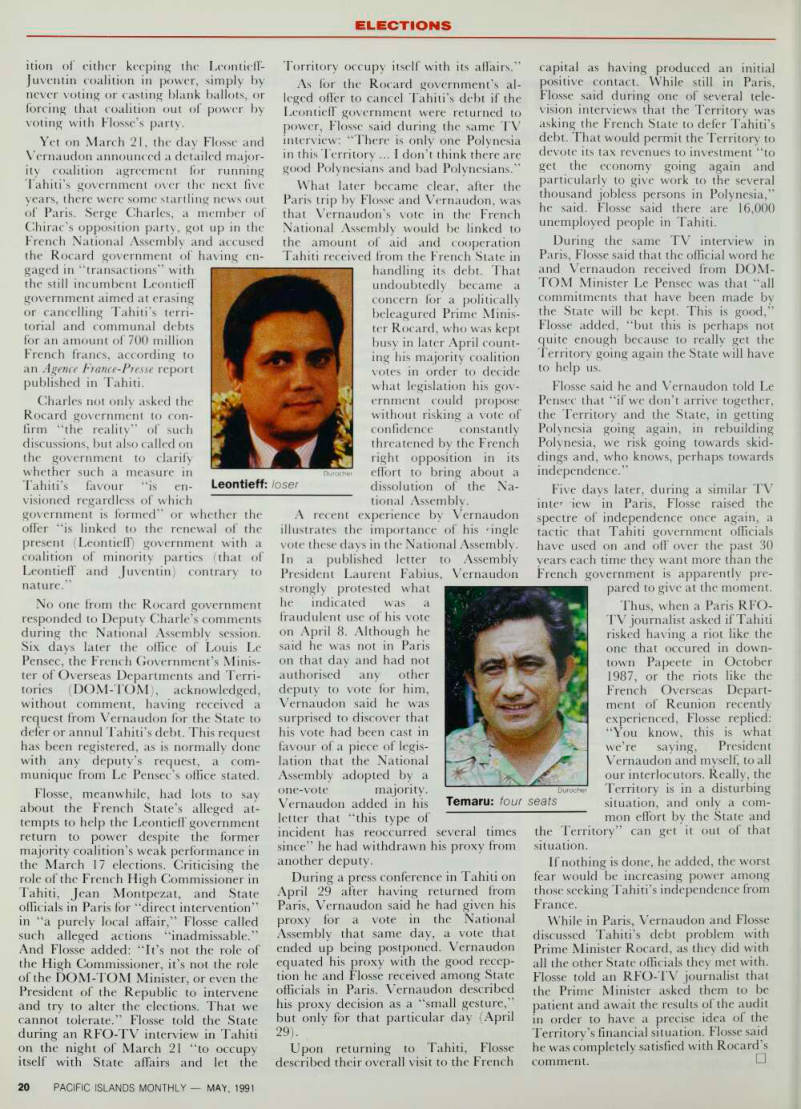
Durocher Leontieff: loser
Durocher Temaru: four seats
To join or not to join the UN
The United Nations
By Ian Williams
(United Nations correspondent) AT the beginning of March, the Washington Ambassadors of the Federated States of Micronesia (FSM) and Marshalls were in New York talking to people at the United Nations (UN). Pacific diplomats there told Pacific Islands Monthly that the two recent ex- UN Trusteeship territories were explor ing the possibilities of renewing their relationship with the UN this time as members.
The Marshall Island Embassy in Washington said the visit was simply to “thank the diplomats who had sup ported us,” in lifting their trusteeship last December. “We haven’t got instructions from our government on UN member ship it’s too early to consider.”
More forthcoming was FSM Am bassador Jesse B Marehalau, who said the New York visit was a “process of consultation and explanation nothing concrete. We’re waiting for feedback from the people we met, what obstacles there might be, what requirements we need to satisfy, and of course the cost and benefits of membership”.
He does not anticipate any problems but admits, “We’ll have to move cau tiously and it’s up to our capitals to decide.” The timetable depends on a series of exploratory talks with the Permanent Five members of the Security Council, each of whom have the poten tial to block the application.
A US spokesperson confirmed their support for the application to PIM, and that should go a long way to persuade the others in the light of the present balance of power. Meetings with Beijing have garnered Chinese approval for the deal helped no doubt by the two states’ acuity in not upgrading their extensive trading links with Taiwan into diplomatic ties.
Representatives of the FSM and The Marshalls have met French diplomats who have also indicated that there would be no objections from that quarter.
Preliminary approaches to the British are on hold as the United Kingdom
mission to the UN awaits instructions from London. The British are unhappy about the restrictions on sovereignty
imposed by the Compacts of Free
Association between the former Trust territories and the US, but on balance, it is felt that London would not want to
spoil the post Gulf “special relationship”
with the US over a matter in which Britain has no direct interest.
So far the Pacific emissaries have not yet discussed the issue with the USSR, but Moscow’s co-operation in ending the Trusteeship last December after years of intransigence, augurs well for Soviet acquiescence. And as one UN staffer pointed out, two Soviet Republics, Ukraine and Byelorussia, have had separate UN membership since the
beginning of the United Nations. Whatever sover eignty the FSM and Mar shalls have, has to be more than the two Soviet republics had when Stalin pushed their member ship!
Originally, there was consideration of rushing
membership through in a Special Gen eral Assembly Session in May, but now it seems that the two feel it best to cover all the bases first, and to wait until the regular session in September. Their votes will be welcomed by the other South Pacific Forum countries which have been vigorously pushing their case. Since the South Pacific Forum is meeting in the FSM in July, there will be ample opportunity to hammer out a common approach in the unlikely event of the
application meeting problems.
In the current state of world affairs, a US endorsement of their application would go a long way. The State Department is believed to be deciding on the issue shortly, but is presently sym pathetic to the idea of an application so that they can lease directly with agencies like UNDP and UNICEF.
But is the cost a deterrent to small states? The minimum membership con-
tribution is 0.01 per cent of the UN budget, minus a figure which reflects a rebate of the UN staff assessment, a form of internal income tax on international civil servants. Currently that leaves about $U592,000 to find, plus an additional percentage for UN peacekeep ing operations, which in the case of Least Developed Countries would be a mini mum of 10 per cent, so that minimum dues are just over $lOO,OOO.
In return, Least Developed Countries are allowed the cost of travel for up to five delegates from their capitals to New York. However, the accommodation, wining and dining of their delegation is their own responsibility, as is the pro vision of office space and facilities. To assist that, there is a sort of micro-states’ co-operative on 44th St and First Avenue in New York. It houses the offices of nine small Commonwealth States, Belize, Dominica, Gambia, Grenada, Maldives,
St Lucia, Seychelles, the Solomon Islands, and Samoa.
Nusi Moala, its adminis trative head, a Samoan who was former ambassador for the Solomons, explains that the idea began with the Australians assisting the Pa cific island states back in
1983, but later they were joined by Canada, New Zealand and the UK to fund the premises through the Common wealth Secretariat.
“A lot of ambassadors told us that before, they had spent more time arguing with their landlords than anything else”, said Moala. In the offices they share a researcher, typist/receptionist, and the services of Moala and his assistant, all funded by the Commonwealth.
“We still have a vacancy for a less developed Commonwealth state,” he says in a welcomine tone, pointing to Kiribati, Tonga, Tuvalu and Nauru as possibilities. None of them have joined the UN, but so far the promise of a free office has not been able to overcome the commendable restraint of small nations for whom the minimum cost of around $U5250,000, even with a free office, represents an enormous chunk of their national budget. □
Putting pep
into SPREP
ON the environmental front, UNDP and UNEP are putting $2.5 million into strengthening the South Pacific Regional Environment Programme, al lowing it to recruit extra staff and boost its programmes in the region.
The aim is to give SPREP indepen
dence to carry out its work effectively a move which hopefully will be con firmed by the Ministerial meeting in Tahiti later this year. The NZ govern ment and NZ Greenpeace will be funding a high-profile information office for SPREP. The programme would allow it to carry out Environmental Impact Assessments for developments such as tourism, forestry and mining to avoid ecological disasters. It would also allow seven small states, Tuvalu, Nauru,
Tokelay, Niue, Palau, Kiribati and Western Samoa to develop National
Environment Management Strategies.
The programme should boost SPREPS’s ability to deal with Environ ment Contamination and pollution con trol. Its action plan adopted in Rarotonga in 1982 identified marine pollution as one of the region’s major problems, but SPREP has not yet been able to respond to requests for assistance on such problems. □
Vanuatu opens bases
in Harlem, New York
ON April 6, the Harlem Little League had its inaugural parade for the opening of the Baseball season.
Last year’s champions, The Diplo mats, undefeated last season, won their first game, 12 to 4. The Diplomats have more to distinguish them they are the only team sponsored by a UN Mission, Vanuatu’s.
“We started last year,” Vanuatu Ambassador Robert Van Lierop told PIM. “We do it because we’re a part of the community ours is the only mission in Harlem and we have to give back to the community. It’s consistent with Vanuatu’s support for the principles of the World Children’s Summit last year and we’re proud to be the only country sponsoring a team.”
Iris Rayford, a New York District Attorney who is President of the Little League, confirmed that out of more than 100 teams, the Diplomats were the only ones with diplomatic support, although she pointed out that major corporations in New York helped finance some of the 100 plus teams of 9 to 13 year olds in the game. □
New look aid strategy for Pacific
AT the beginning of June, the United Nations Development Programme, which coordinates UN aid activities, is hosting an aid summit meeting in Noumea to thrash out the details of the next five years’ aid strategy for the region. Timed to follow the South Pacific Commission AGM, the meeting will bring together donor agencies and governments, officers of 15 South Pacific Nations, regional organis ations, and the French territorial gov ernments, to discuss means of making aid strategy more relevant to the distinc tive nature of the region’s island.
The UNDP officer responsible, Natsuki Hiratsuka, explained to PIM that UNDP wanted the gathering to be more “recipient-driven” than in the past, and it was hoped that the governments would play a much more active role in working out what they felt was needed and appropriate. He said that UNDP was suggesting four main themes for future aid programmes in the region. • Poverty Alleviation and Human Development. “There is serious poverty in the region, especially in the remote islands,” he said, and so UNDP wants to concentrate on education, health, and
supporting small enterprises and organ isations, which could be the most appro priate forms of economic activity for the islands. • Environment and Natural Re sources, which is clearly of major import ance to the region. • Economic and Financial Manage ment and Reform. “Our approach may be slightly different from the World Bank’s we would like more emphasis on Human Development,” Hiratsuka says. UNDP is suggesting concentrating aid programmes on policy and manage
ment training.
“We would possibly advocate more strategic planning, more appropriate to small islands”, he says. “We want a roundtable approach in which the gov ernments themselves do more prioritising of their development plans”. • Interregional Cooperation in sec tors such as transport, telecommunica tions and measures for better prepared ness against disasters.
In the light of recent warnings from international bodies about the dangers of aid dependency for South Pacific islands, there is some serious talking to be done.
Recipient countries will be expected to sing for their supper! □
Advertisements & other items, p. 22 (1 item)
The Racific Islands Rely
ON THE ENERGY OF BORAL.
■ i J % forr All through the Pacific Islands, people rely on Boral Speed-E-Gas LP Gas for their energy needs.
Boral has terminals throughout the area, and is proud to be a leading supplier.
Speed-E-Gas is clean, efficient and low in cost.
It’s the ideal energy source for cooking and water heating in homes, motels and hotels, and for a wide range of industrial uses.
So call Boral. We have the energy you're looking for. -V*- * Cook Islands Rarotonga 24460 Norfolk Island Norfolk Island 2419 Papua New Guinea Port Moresby 214248 Lae 42 2574 Rabaul 921225 Wewak 862125 Tonga Nukualofa 21388 American Samoa Pago Pago 699 2948 Fiji Suva 24035 Lautoka 60088 Sigatoka 50578 Labasa 82973 Vanuatu Santo 455 Port Vila 2046
BORAL GAS
Solomon Islands Honiara 21833 Boral Gas Limited, Bth Floor, IBM House, 168 Kent St., Sydney, NSW 2000. Tel: (02) 278512.
rippling Pacific
Gulf War still rippling Pacific
FIJI, along with 34 other countries, is contributing a contingent to UNIKOM, the 1,440 Strong- United Nations Iraq Kuwait Observation Mission which will police the boundary between the two countries.
The force will cost the UN 5123 million for the first year, and Secretary General Javier Perez De Cuellar took the opportunity to remind members of their outstanding bills (See March PIM) for existing operations, saying that UNIKOM’s success depended on pay ment. Looming behind his diplomatic prose was a hint that the USA, a major player in the Gulf War, was still half a billion dollars in arrears to the UN.
Iraqi chemicals for Johnson?
SECURITY Council Resolution 687, which set down terms for ending the war, calls for the Iraqis to hand over their chemical and biological weapons, to be destroyed, removed or rendered harmless “taking into account the requirements of public safety”. Several South Pacific Ambassadors are concerned whose
public safety? Ambassador Renagi
Renagi Lohia of Papua New Gunea told PIM, “I have heard in Washington that there is discussion of using the Johnston Atoll site for disposal of weapons out of Iraq. The South Pacific Forum has a clear position on this. I was with our Prime Minister Rabbie Namaliu last year when President Bush spoke on it, so I know that any use of the island beyond what was agreed would cause trouble with South Pacific governments”.
Other South Pacific Forum diplomats also feel that President Bush had given them clear assurances at the Hawaii Summit last October that the detoxification facility on Johnston Island would not be used after its current task of destroying US chemical weapons.
They are supporting PNG’s approaches.
“But,” Lohia added, “Without legis lation, we are still worried that there may be an attempt to use Johnson Island.”
Beijing boost for Somare
THE campaign to get Sir Michael Somare as the first Pacific Island Presi dent of the UN General Assembly, is still on course. By now the Asian group of states would normally have met to decide on a consensus candidate for the position, which is their “turn” this year. As revealed in PIM (February) Somare has attracted overwhelming support within the Asian group, and this April China’s 3 rime Minister Li Peng publicly pledged Beijing’s support for him during a visit by
PNG Premier Namaliu. In contrast, the other candidates, from Yemen and Cyprus, would not, or could not, tell PIM of any definite supporters they had in the Asian group.
The main delay is that Cyprus is threatening to disrupt the UN’s tradition of consensus, by insisting on a vote in the General Assembly, where it hopes its candidate will gain support from the Non-Aligned Movement. However, PNG’s Ambassador Lohia, acting as campaign manager for Somare, told PIM, that support for Somare already had been received from Uganda, cur rently the Chairman of the Organisation for Afican Unity, from Dominica and other Commonwealth Carribean na tions, and from Latin America.
Vanuatu plays host A delegation of “Parliamentarians for East Timor” met UN Secretary General Perez De Cuellar in New York on March 25. Led by Lord Avebury, a member of the British House of Lords, the del egation included members of the parlia ments of Japan, Netherlands, Portugal,
and Australia. The or ganisation has 200 mem bers in 15 countries around the world. Vanu atu MP Hilda Lini was unable to attend as she wished, but the Vanuatu mission compensated for her absence by sponsor ing a press conference at the United Nations.
The delegation sought assurances from Perez De Cuellar that the UN resolutions on East Timor would be treated with the same seriousness as those involving Kuwait. While not going that far, the Secretary General assured them that the resolutions were indeed still in force.
Lord Avebury told PIM “We told him we welcomed the new active policy of the UN in relation to violations of the Charter”.
His response: “On the whole I was extremely pleased. I didn’t expect him to say that the discussions between Portugal and Indonesia were under the framework of the Resolutions ... but he told us that his doors were always open to members of the East Timorese Community. That has to be alliance between FRETILIN and the UDT who between them received over 90 per cent of the popular vote in the only free elections ever held in East Timor.”
When asked what progress was re ported in the Secretary General’s dis cussions on the issue, Lord Avebury told PIM that he referred to the proposed visit of Portuguese parliamentarians to East Timor which had been under discussion for four years.
“It is not a lot to show for nine years work by the Secretary General,”
Avebury commented.
Garrie Gibson, the Australian Federal Member who recently visited East Timor, said that the country “still bore the strong stamp of being occupied”, that there were no signs of economic develop ment, water supply was critically low, and malaria mosquito infestation was
widespread.
Asked by PIM for comment on the US State Department’s ambigous stand, recognising the annexation but not that there had been a legitimate act of self determination, Lord Avebury stressed that 400 US congressmen had supported resolutions on East Timor but that parliamentarians did not always have full control of their administrations.
Similarily, when invited to comment on the unanimous South Pacific Forum support for the independence of New Caledonia and the fact that only Vanu atu supported the East Timorese, Lord Avebury diplomatically refused to specu late on the motives of Forum members, but pointed out that Indonesia had a great deal of clout in trading and
political power not just in the region, but in Europe, the United States and Japan.
That, he said, was a fact that could not be neglected in establishing why particular countries had voted in favour of Indonesia in the General Assembly. Indeed, some East Timor supporters
saw signs of Indonesian influence in the UN’s record of the Press Conference. The first version omitted some details including PlM’s questions which were, after protests, reinstated in a revised and reissued version.
More for NGOs A SIGNIFICANT part of the environ mental aid budget for the South Pacific is earmarked for strengthening non
government organisations (NGOs).
UNDP’s Pacific Region is providing 5150,000 support for a regional meeting of the Pacific Island Association of NGOs (PIANGO), probably in Pagopago, Am erican Samoa, in September. PIANGO is the joint product of the Foundation of Peoples of*the South Pacific and the Commonwealth Foundation, who had been working separately on networking the region’s voluntary organisations. In 1987 they set up a steering committee which has since been working on getting NGOs together at national and sub regional level. The four-day meeting later this year should encourage mutu ally supportive networking a key UNDP concept which could enhance its Environment and Women in Develop ment themes. □
Advertisements & other items, p. 24 (1 item)
Focus
Norman Douglas
Main street Kaunakakai. A frontier feeling.
The friendly island that
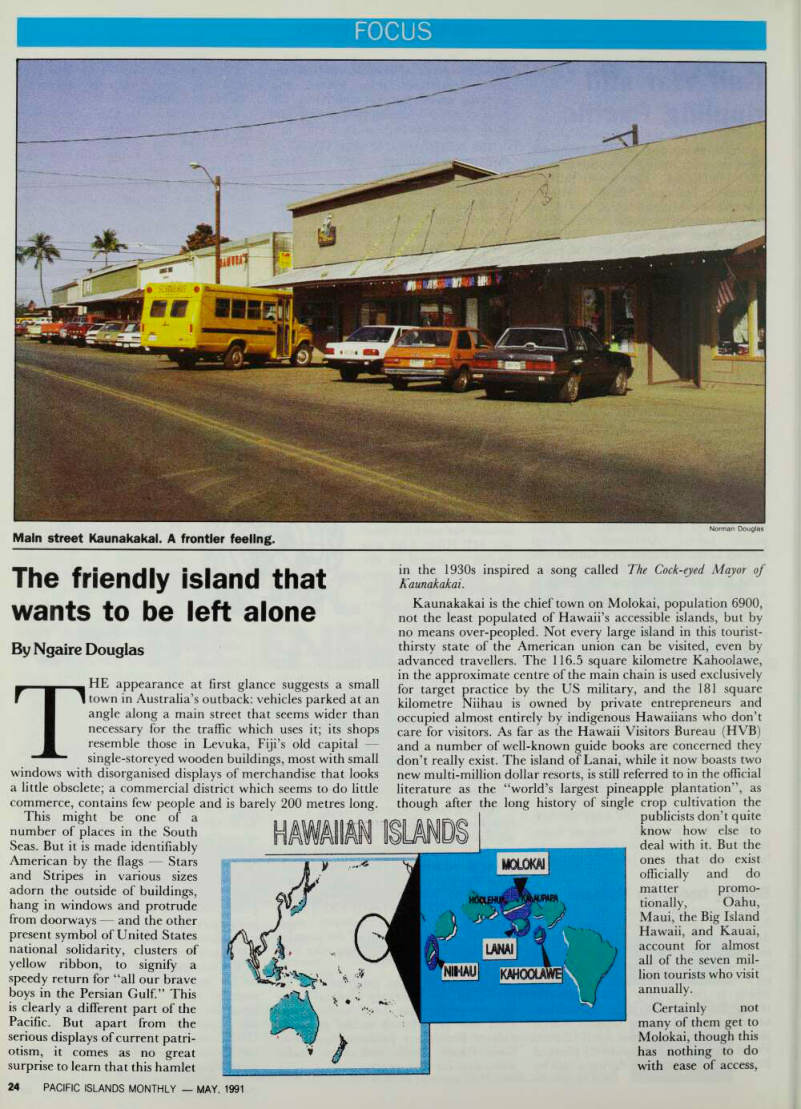
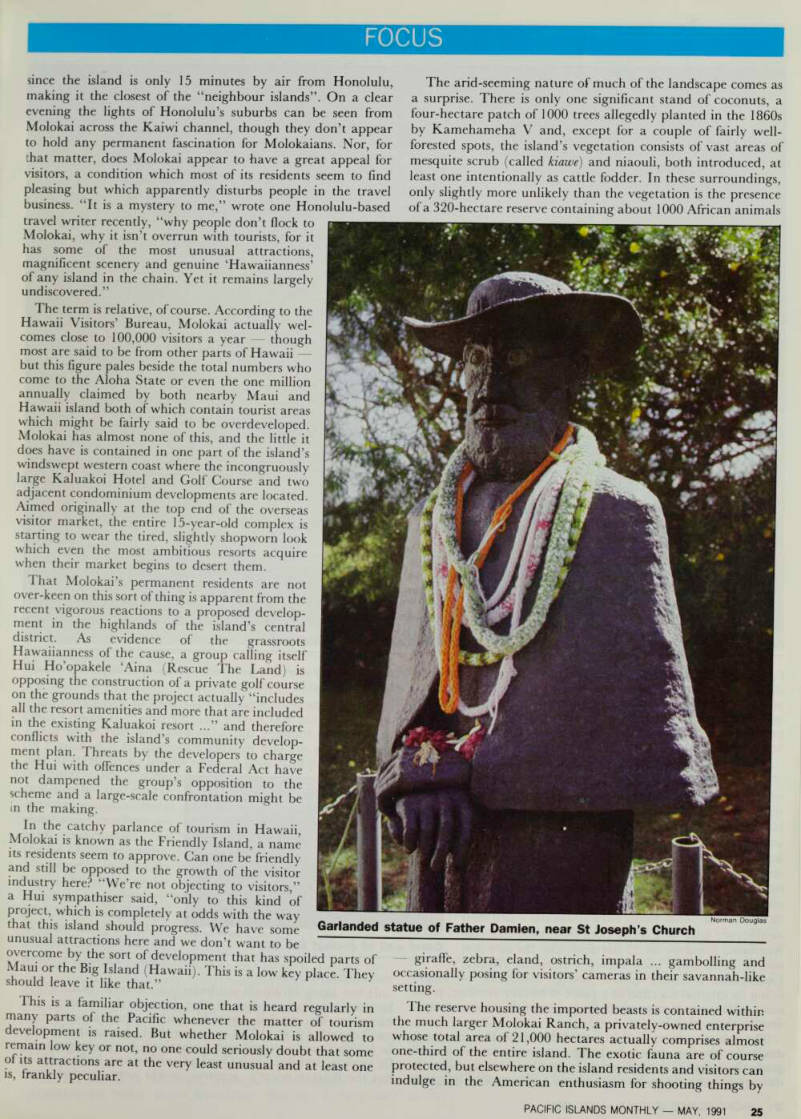
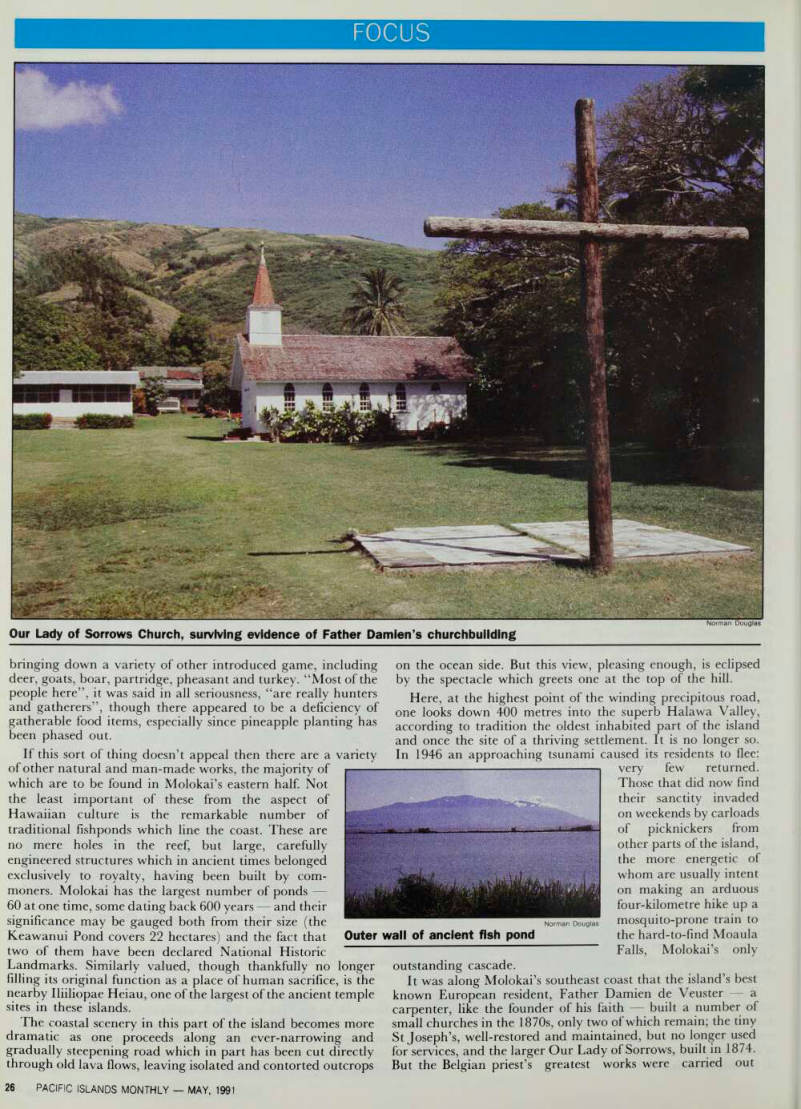
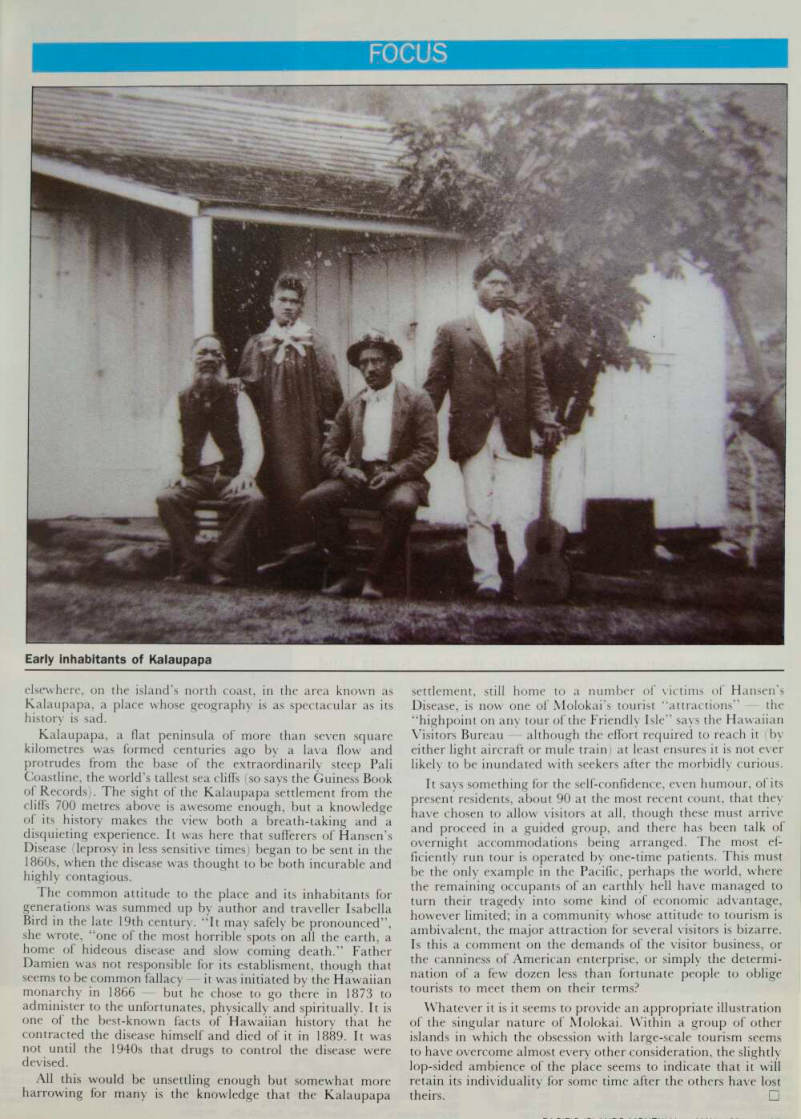
wants to be left alone
By Ngaire Douglas
THE appearance at first glance suggests a small town in Australia’s outback: vehicles parked at an angle along a main street that seems wider than necessary for the traffic which uses it; its shops resemble those in Levuka, Fiji’s old capital single-storeyed wooden buildings, most with small windows with disorganised displays of merchandise that looks a little obsolete; a commercial district which seems to do little commerce, contains few people and is barely 200 metres long.
This might be one of a number of places in the South Seas. But it is made identifiably American by the flags Stars and Stripes in various sizes adorn the outside of buildings, hang in windows and protrude from doorways and the other present symbol of United States national solidarity, clusters of yellow ribbon, to signify a speedy return for “all our brave boys in the Persian Gulf.” This is clearly a different part of the Pacific. But apart from the serious displays of current patri otism, it comes as no great surprise to learn that this hamlet
in the 1930 s inspired a song called The Cock-eyed Mayor oj Kaunakakai.
Kaunakakai is the chief town on Molokai, population 6900, not the least populated of Hawaii’s accessible islands, but by no means over-peopled. Not every large island in this tourist thirsty state of the American union can be visited, even by advanced travellers. The 116.5 square kilometre Kahoolawe, in the approximate centre of the main chain is used exclusively for target practice by the US military, and the 181 square kilometre Niihau is owned by private entrepreneurs and occupied almost entirely by indigenous Hawaiians who don’t care for visitors. As far as the Hawaii Visitors Bureau (HVB) and a number of well-known guide books are concerned they don’t really exist. The island of Lanai, while it now boasts two new multi-million dollar resorts, is still referred to in the official literature as the “world’s largest pineapple plantation”, as though after the long history of single crop cultivation the
publicists don’t quite know how else to deal with it. But the ones that do exist officially and do matter promo tionally, Oahu, Maui, the Big Island Hawaii, and Kauai, account for almost all of the seven mil lion tourists who visit annually.
Certainly not many of them get to Molokai, though this has nothing to do with ease of access,
since the island is only 15 minutes by air from Honolulu, making it the closest of the “neighbour islands”. On a clear evening the lights of Honolulu’s suburbs can be seen from Molokai across the Kaiwi channel, though they don’t appear to hold any permanent fascination for Molokaians. Nor, for that matter, does Molokai appear to have a great appeal for visitors, a condition which most of its residents seem to find pleasing but which apparently disturbs people in the travel business. “It is a mystery to me,” wrote one Honolulu-based
travel writer recently, “why people don’t flock to Molokai, why it isn’t overrun with tourists, for it has some of the most unusual attractions, magnificent scenery and genuine ‘Hawaiianness’ of any island in the chain. Yet it remains largely undiscovered.”
The term is relative, of course. According to the Hawaii Visitors’ Bureau, Molokai actually wel comes close to 100,000 visitors a year though most are said to be from other parts of Hawaii but this figure pales beside the total numbers who come to the Aloha State or even the one million annually claimed by both nearby Maui and Hawaii island both of which contain tourist areas which might be fairly said to be overdeveloped.
Molokai has almost none of this, and the little it does have is contained in one part of the island’s windswept western coast where the incongruously large Kaluakoi Hotel and Golf Course and two adjacent condominium developments are located.
Aimed originally at the top end of the overseas visitor market, the entire 15-year-old complex is starting to wear the tired, slightly shopworn look which even the most ambitious resorts acquire when their market begins to desert them.
That Molokai’s permanent residents are not over-keen on this sort of thing is apparent from the recent vigorous reactions to a proposed develop ment in the highlands of the island’s central district. As evidence of the grassroots Hawaiianness of the cause, a group calling itself Hui Ho’opakele ‘Aina (Rescue The Land) is opposing the construction of a private golf course on the grounds that the project actually “includes all the resort amenities and more that are included in the existing Kaluakoi resort ...” and therefore conflicts with the island’s community develop ment plan. Threats by the developers to charge the Hui with offences under a Federal Act have not dampened the group’s opposition to the scheme and a large-scale confrontation might be in the making.
In the catchy parlance of tourism in Hawaii, Molokai is known as the Friendly Island, a name its residents seem to approve. Can one be friendly and still be opposed to the growth of the visitor industry here? “We’re not objecting to visitors,” a Hui sympathiser said, “only to this kind of project, which is completely at odds with the way that this island should progress. We have some unusual attractions here and we don’t want to be
overcome by the sort of development that has spoiled parts of Maui or the Big Island (Hawaii). This is a low key place. They should leave it like that.”
This is a familiar objection, one that is heard regularly in many parts of the Pacific whenever the matter of tourism development is raised. But whether Molokai is allowed to remam low key or not, no one could seriously doubt that some °r S attract^ons are at the very least unusual and at least one is, Irankly peculiar.
The arid-seeming nature of much of the landscape comes as a surprise. There is only one significant stand of coconuts, a four-hectare patch of 1000 trees allegedly planted in the 1860 s by Kamehameha V and, except for a couple of fairly well forested spots, the island’s vegetation consists of vast areas of mesquite scrub (called kiawe) and niaouli, both introduced, at least one intentionally as cattle fodder. In these surroundings, only slightly more unlikely than the vegetation is the presence of a 320-hectare reserve containing about 1000 African animals
- giraffe, zebra, eland, ostrich, impala ... gambolling and occasionally posing for visitors’ cameras in their savannah-like setting.
The reserve housing the imported beasts is contained within the much larger Molokai Ranch, a privately-owned enterprise whose total area of 21,000 hectares actually comprises almost one-third of the entire island. The exotic fauna are of course protected, but elsewhere on the island residents and visitors can indulge in the American enthusiasm for shooting things by
Norman Douglas Garlanded statue of Father Damien, near St Joseph’s Church
bringing down a variety of other introduced game, including deer, goats, boar, partridge, pheasant and turkey. “Most of the people here”, it was said in all seriousness, “are really hunters and gatherers”, though there appeared to be a deficiency of gatherable food items, especially since pineapple planting has been phased out.
If this sort of thing doesn’t appeal then there are a variety
of other natural and man-made works, the majority of which are to be found in Molokai’s eastern half. Not the least important of these from the aspect of Hawaiian culture is the remarkable number of traditional fishponds which line the coast. These are no mere holes in the reef, but large, carefully engineered structures which in ancient times belonged exclusively to royalty, having been built by com moners. Molokai has the largest number of ponds 60 at one time, some dating back 600 years and their significance may be gauged both from their size (the Keawanui Pond covers 22 hectares) and the fact that two of them have been declared National Historic
Landmarks. Similarly valued, though thankfully no longer filling its original function as a place of human sacrifice, is the nearby Iliiliopae Heiau, one of the largest of the ancient temple sites in these islands.
The coastal scenery in this part of the island becomes more dramatic as one proceeds along an ever-narrowing and gradually steepening road which in part has been cut directly through old lava flows, leaving isolated and contorted outcrops
on the ocean side. But this view, pleasing enough, is eclipsed by the spectacle which greets one at the top of the hill.
Here, at the highest point of the winding precipitous road, one looks down 400 metres into the superb Halawa Valley, according to tradition the oldest inhabited part of the island and once the site of a thriving settlement. It is no longer so.
In 1946 an approaching tsunami caused its residents to flee:
very few returned.
Those that did now find their sanctity invaded on weekends by carloads of picknickers from other parts of the island, the more energetic of whom are usually intent on making an arduous four-kilometre hike up a mosquito-prone train to the hard-to-find Moaula Falls, Molokai’s only
outstanding cascade.
It was along Molokai’s southeast coast that the island’s best known European resident, Father Damien de Veuster a carpenter, like the founder of his faith built a number of small churches in the 1870 s, only two of which remain; the tiny St Joseph’s, well-restored and maintained, but no longer used for services, and the larger Our Lady of Sorrows, built in 1874.
But the Belgian priest’s greatest works were carried out
Our Lady of Sorrows Church, surviving evidence of Father Damien’s churchbuilding
Norman Douglas Outer wall of ancient fish pond
elsewhere, on the island’s north coast, in the area known as Kalaupapa, a place whose geography is as spectacular as its history is sad.
Kalaupapa, a flat peninsula of more than seven square kilometres was formed centuries ago by a lava flow and protrudes from the base of the extraordinarily steep Pali Coastline, the world’s tallest sea cliffs (so says the Guiness Book of Records). The sight of the Kalaupapa settlement from the cliffs 700 metres above is awesome enough, but a knowledge of its history makes the view both a breath-taking and a disquieting experience. It was here that sufferers of Hansen’s Disease (leprosy in less sensitive times) began to be sent in the 1860 s, when the disease was thought to be both incurable and highly contagious.
The common attitude to the place and its inhabitants for generations was summed up by author and traveller Isabella Bird in the late 19th century. “It may safely be pronounced”, she wrote, “one of the most horrible spots on all the earth, a home of hideous disease and slow coming death.” Father Damien was not responsible for its establisment, though that seems to be common fallacy it was initiated by the Hawaiian monarchy in 1866 but he chose to go there in 1873 to administer to the unfortunates, physically and spiritually. It is one of the best-known facts of Hawaiian history that he contracted the disease himself and died of it in 1889. It was not until the 1940 s that drugs to control the disease were devised.
All this would be unsettling enough but somewhat more harrowing for many is the knowledge that the Kalaupapa
settlement, still home to a number of victims of Hansen's Disease, is now one of Molokai’s tourist “attractions” the “highpoint on any tour of the Friendly Isle” says the Hawaiian Visitors Bureau although the effort required to reach it (by either light aircraft or mule train) at least ensures it is not ever likely to be inundated with seekers after the morbidly curious.
It says something for the self-confidence, even humour, of its present residents, about 90 at the most recent count, that they have chosen to allow visitors at all, though these must arrive and proceed in a guided group, and there has been talk of overnight accommodations being arranged. The most ef ficiently run tour is operated by one-time patients. This must be the only example in the Pacific, perhaps the world, where the remaining occupants of an earthly hell have managed to turn their tragedy into some kind of economic advantage, however limited; in a community whose attitude to tourism is ambivalent, the major attraction for several visitors is bizarre.
Is this a comment on the demands of the visitor business, or the canniness of American enterprise, or simply the determi nation of a few dozen less than fortunate people to oblige tourists to meet them on their terms?
Whatever it is it seems to provide an appropriate illustration of the singular nature of Molokai. Within a group of other islands in which the obsession with large-scale tourism seems to have overcome almost every other consideration, the slightly lop-sided ambience of the place seems to indicate that it will retain its individuality for some time after the others have lost theirs. □
Early inhabitants of Kalaupapa
Advertisements & other items, pp. 25-29 (4 items)
Focus
Focus
Focus
luxury-car ride.
The new Toyota brand mark. Three ellipses forming a “T” which stand for our customer, our commitment to the satisfaction of that customer through our product and for our spirit of creativity.
It’s not often that you hear descriptions like rugged or durable combined with refined and elegant. But then there’s never been a vehicle quite like the new Toyota Land Cruiser Station Wagon. The unrivalled legend of off-road reliability is now unsurpassed in comfort and sophistication as well. Attention to detail is found everywhere, from the fine trim to the instrument panel to the graceful lines of its exterior. Even in places you can’t see, like the heavy-duty ladder frame and suspension design that add to the superb
But Toyota’s innovation goes beyond providing luxury and durability. The new Land Cruiser Station Wagon, and all of our cars, are designed to create a harmony between car and driver, and to provide you with the ultimate
driving experience. *
The new Toyota Land Cruiser Station Wagon. Think of it as much more than a spacious luxury sedan with fourwheel drive. •r l; i * .
I* .'1 I m •*st' , -■?.
E
DISTRIBUTORS/DEALERS
AMERICAN SAMOA BURNS PHILP (S.S.) CO. LTD. PH 633-4281 3UAM & MICRONESIA ATKINS KROLL, INC. PH 646-1876/9 JORFOLK ISLANDS BORRY’S PTY LTD. PH 2114
50L0M0N ISLANDS MENDANA MOTORS PH 22884
VANUATU VANUATU MOTORS PH 2341
COOK ISLANDS PACIFIC MOTORS LTD. PH 20796
KIRIBATI TARAWA MOTORS PH 21090
PAPUA NEW GUINEA ELA MOTORS PH 217036
TAHITI NIPPON AUTOMOTO PH 429819
WESTERN SAMOA BURNS PHILP (S.S.) CO. LTD. PH 20800
FIJI ASCO MO‘o
NEW CALEDONIA S.I.A.P.
SAIPAN \ . MICROL CO
TONGA BURNS PHH C
■ TF O j 1« I % . I K . f % "f ' U L 7^2-; % HW 3 RE a
rfS
PH 312666 PH 282848 PH 234-5911 PH 2367^
<&> TOYOTA
Pacific
Islands
Monthly
Business
Time to change tune
By Ulafale Aiavao
EVENING prayers have ended and the Bible is packed away as another ritual begins. Across Western Samoa (population 160,000) all ears are tuned to the national radio as the long list is read out of people who have received money transfers from overseas.
Money orders, foreign cash, bank drafts and other private transfers pumped a record SWS92 million into the local economy last year, equal to half the government budget. Major recipients were churches, businesses and individ uals.
The record figure disguises a troubling trend remittances are levelling off.
The SWS92 million was boosted by sympathy payments after a cyclone in February 1990. Without the cyclone, total payments would have been below the 1989 remittances level of SWSB6 million.
A decline in remittances over the next five years is forecast by the Central Bank’s deputy manager for research, Sefo Bourne. "Forty-three per cent of remit tances are from New Zealand and that economy is not doing so well at this time,” he said.
Cuts in welfare benefits by the New
Zealand government will have an effect as Samoans on the dole send some of it back to the islands.
Any hiccup in payments from Sam oans overseas concerns local officials because the other two legs propping up the Samoan economy, agriculture and foreign aid, are 1) also in decline, and 2) out of Western Samoa’s control.
Exports, never high, dropped from SWS3B million in 1985 to just SWS2O
The legs which propped up the Samoan economy are in decline
million last year. Imports are nine times the value of exports. The Central Bank estimates that 60 per cent of remittances is spent on imported goods while 40 per cent goes on local products).
Foreign aid levels (SWS3S million last year) are declining if one-off project fluctuations are discounted. Unless over seas commodity prices improve to en courage exports, the government will eat into its foreign reserves of SWSIS3 million, enough for eight months of imports, and impose stricter controls on spending.
What everyone wants to avoid is what happened 10 years ago when Samoans had 30 per cent inflation, no foreign reserves, and food shortages. The aus terity measures imposed then included quotas on money outflow, a move that
crippled many businesses importing
goods, and which scared away overseas suppliers who feared they would never get paid. The belt tightening led to a
crippling three-month strike by public
servants in 1981 which helped topple the then government at the 1982 elections.
Officials doubt whether such austerity measures will be needed unless economic conditions deteriorate seriously. All agree
however that agricultural production
must be boosted, and that new schemes such as tourism be given more priority.
Some say they would welcome a declining foreign aid and remittances level, as it would presumably force more people to farm Samoa’s rich system and the shortage of able-bodied manpower in many villages due to migration to the
capital, Apia, or overseas.
And tourism is still viewed with suspicion by conservative minds who fear its effects on Samoan culture a la Hawaii.
As one tourism official describes it, “People want tourist dollars without the tourists. It doesn’t work that way.”
Working out which way to prop up the economy is something that will test the ingenuity of whoever wins power at the
April elections.
Phone competition
on line for NZ
NEW Zealand is to have telecom munications competition this year under the first interconnection agree ment in the world to be negotiated without a third party regulator.
The newly privatised Telecom New Zealand has agreed to allow Clear Communications Ltd access to its local network and by mid-1991 it is expected that 82 per cent of telephones in the
country will have a choice of domestic and international services.
The NZ Commerce Act, which regu
lates privatisation, specifically prohibits
Telecom NZ from using its dominant position to thwart competitors. The national carrier was sold by the govern ment to a US-dominated consortium last year for 5U52.55 million, while Clear is owned by Bell Canada International, MCI Communications of the US, and two New Zealand shareholders, Todd Corporation and the state-owned Tele vision New Zealand. TVNZ became Clear’s first customer in February when
it signed up to use the new network for its domestic operations.
Clear’s Chief Executive George Newton said his company was aiming at lines similar to Mercury in Britain. It will offer toll (long distance) bypass and private line services, including Centrex which will allow commercial subscribers a central office switch solution and replace their PABX. To use Clear’s toll service, customers must register as users.
They then use their existing connection and access Clear by the prefix 050.
The company is planning to compete with Telecom NZ both on price and response time. D
Bankbills strike a sour note
By Geoff Spencer
THE export of Australia’s revolution
ary “long-lasting” plastic bankbill
technology has hit an embarrassing snag, with ink rubbing off thousands of notes made for Western Samoa within a few weeks of release.
The producers, Note Printing Austra lia, a Melbourne division of the Reserve Bank, said the cause had been identified and the entire issue of the two-tala note would be reprinted free of charge.
Singapore and Western Samoa are the only overseas countries to have bought the new-tech currency.
Note Printing’s general manager,
Robert Larkin, said the cause of the Samoan problem had been identified and would be solved, and he did not believe it would adversely affect future exports to other markets.
He declined to say how much the reprint would cost or how many “bad” notes had been printed, although sources in Apia said more than a million had been ordered.
The two-tala note was made by a similar process to Australia’s bicenten nial plastic $lO note.
It was issued late last year in honour of half a century of public service by Western Samoa’s revered Head of State, Malietoa Tanumafili 11. This dates from 1940 when the Head of State received the paramount title of Malietoa.
Unfortunately, the worst affected area
of the note has been the royal leader’s
portrait.
‘We wanted to have a special (bank note for the Head of State) and of course
the special turn ed out to be not
as high quality as
he had antici pated,” said Fi nance Minister
Tuilaepa Sailele.
The minister said Note Prin ters had been
“flabbergasted”
when informed.
The two-tala note is the lowest and most traded denomination in Western Samoa.
As such, its old paper version used to wear out
quickly.
Disappointed
officials at the Central Bank of
Samoa, which is responsible for currency circulation, said the plastic notes were being withdrawn.
Paper notes would be re-released until a new batch from Melbourne was ready.
The Banks’ Assistant Manager for Administration, Puipui Leaula Tenari, said some people had deliberately tried
to deface the new currency in a bid to
disprove its reputation.
“They used erasers, left the money out in rain, rubbed it in the ground . . . All sort of things,” he said.
However, later it was discovered that printing chemistry was primarily to blame: a pigment used in the ink had not
bound cor rectly.
Meanwhile, the bank has had more luck with the re lease of two 50-tala and 100-tala cur rency notes in February.
Both are on cotton fibre paper and
were designed
and printed
by De La Rue and Co Ltd of the United Kingdom. Se curity features include water marks, a se curity thread
and multicolour inks. The Central Bank says a silver sheen on the lower front border is a new security feature which does not reproduce on a colour copier or scanner.
The front of each note features the Head of State, Malietoa Tanumafili 11, while local scenes are depicted on the reverse. □
Success: The ink on these commemorative notes made of cotton fibre paper did not run
Tokyo plant for Japan
A subsidiary of the Tokyo-based Yazaki Corporation plans to set up a plant in Western Samoa to assemble automotive electric wiring for export.
Yazaki will employ between 250 and 350 Samoans in a leased factory which will be upgraded with SWSI.S million. A further SWS2.3 million will be spent on equipment, while a further WS$3 million will be spent in Western Samoa on wages, overheads and freight.
In return, the government has granted the company a 10-year holiday on ncome tax and 10 years duty free mports of equipment. The components or the automotive wiring will come uainly from Australia, be assembled in Western Samoa, and be re-exported.
Samoan Officials actively pursued the Yazaki company which was said to be tonsidering Tonga and Fiji before sign ng up the Samoan government.
Western Samoa promoted its political
stability, cheap labour force and the lack of a language barrier as the trainers would be Samoans from New Zealand.
Pilot production is expected to start in May. □
Aid boost
WESTERN Samoa has signed an aid agreement with the European Commun ity for ECU 10.5 million, equivalent to 5W533.3 million. The five-year package falls under the EC’s LOME IV pro gramme. The Samoan government says it will spend most of the assistance on rehabilitating the infrastructure in outer villages after last year’s cyclone.
In a separate programme, Western Samoa will receive ECU 1.3 million (SWS4.3 million) to make up for a loss in export earnings from coconut oil, oil cake and cocoa. The stabilisation scheme, or STABEX, has provided over ECU 11 million to Western Samoa between 1985 and 1989. □
Fiji’s pledge
to investors
THE Fiji Government has moved to stress that it will honour all prom ised incentives to foreign investors.
It has taken press advertising in New Zealand to counter publicity given to a leaked report compiled for it which stated scores of foreign firms were worried the administration was re neging on promises made in 1988 including a 13-year tax holiday, cheap electricity and freedom to bring in specialised expatriate staff. The report said the latter had not been allowed, and drew attention to investors’ con cern about limits on garment industry working hours. The Fiji Trade and Commerce Ministry favours relaxation of restrictions on female workers em ployed after Bpm to help meet transport deadlines. The report also suggested companies be allowed to apply for lifting of Sunday work bans. □
steals headlines

Raid at PNG mine steals headlines
FOR mining giant CRA Ltd, things
continue to go badly in Papua New Guinea (PNG).
The chance of its subsidiary, Bougain ville Copper Ltd (BCL), regaining con trol of the Panguna Mine closed since May 1989 is starting to look bleak, with the company beginning to acknowledge that a sale is possible, while a local
politician has now drawn the spotlight on the Mt Kare project by leading an armed raid on that mine. Surprisingly, the company appears not to have lost heart it h a s just bought out a minority interest in its Wafi gold prospect near Lae.
The Mt Kare raid took the headlines when Provincial MP Joseph Yalia led a seven-man armed gang on to the Mt Kare site in Enga province. They tied up the crew operating the processing plant and advanced on the main camp with drawn guns. They demanded the Mt
Kare Alluvial Mining Pty Ltd joint venture (operated by CRA with the loca landowners holding a 49 per cent share) build a road through mountains into the village of Paiela. Two of the people involved were later arrested and a search was mounted in the jungle for the others.
Yalia was charged with property damage and extortion and released on bail. Loca landowner groups publicly disassociatec themselves from the raid but did support the company funding develop ment projects including the road to Paiela.
Mt Kare is a comparatively small mine and will be producing more than 25,000 ounces of gold a year, through the company’s two dredges on the site.
Work resumed at Mt Kare after a week, but the incident will not help the country’s international reputation.
The latest Bougainville development
was more complex. Foreign Affairs Minister Sir Michael Somare said he had an offer from American financier Jay Pritzker who was prepared to offer CRA SUS7OO million for its 53.6 per cent stake in BCL. He was reportedly prepared to stake another SUS3SO million to rehab ilitate the BCL’s Panguna copper mine on Bougainville, and help the PNG government fund health services on the island once it regains control.
For his investment, Pritzker (who controls the Hyatt Hotel chain) would take a 51 per cent stake in the copper mine, 30 per cent would go to the landowners and the remaining 19 per cent to the government in Port Moresby.
Observers have been curious that the offers have been made via Somare.
Pritzker himself has made no public comment.
CRA’s position is that it has met with Pritzker but nothing has occurred to change its position that it is not seeking to sell its investment, but that if a change of ownership is the final impediment to a political resolution of the Bougainville crisis, then CRA would be prepared to consider selling provided it was adequately compensated and the interests of other BCL shareholders safeguarded. But it would have these discussions with the PNG government, not a third party.
The whole business is premature, it seems, as the PNG government still seems a long way from being able to have any influence on events on Bougainville island. A senior minister has argued that the government should wait several months before holding a further round of talks with Bougainville’s secessionist rebels. Provincial Affairs Minister Father John Momis said priority should be given to restoring goods and services to the rebel-held island, about 1000 km north east of Port Moresby.
Prime Minister Rabbie Namalii in late February sent a letter to rebel leaders
Sam Kauona and Francis Ona request ing an urgent round of talks to settle a number of disputes plaguing the Honiara Peace Declaration signed on January 23.
Kauona and Ona have both rejected the declaration as not addressing key issues such as secession. Momis said that if peace talks were held now, the rebels would renew their demand for secession, and Port Moresby would reject it, leaving them as far apart as ever.
Meanwhile, CRA has reached agree ment with Elders Resources Ltd to purchase the latter’s 45 per cent share in the Wafi gold project in the Morobe province, 50km southwest of Lae. CRA originally held 100 per cent of the venture, but sold down a share to Elders in 1988. CRA said relatively high grade and potentially economic porphyry cop per mineralisation was discovered at the Wafi prospect late last year. □
Advertisements & other items, p. 32 (1 item)
«8 Samsung
The World's Latest
PRODUCTS FOR PEOPLE WITH MORE
SENSE THAN MONEY
I To own a Samsung TV Screen, Samsung Video Deck and Samsung Remote Control Unit!
That’a Great!
That makes the Samsung Combination the most inexpensive of its kind.
Available at Burns Philp Home Centres Go for the best view. throughout Fiji and selected Duty Free Should be ideal for your home!
Dealers.
SOLE DISTRIBUTORS.
«8
SAMSUNG
CORRIE & COMPANY
HEAD OFFICE G.P.O. BOX 45, SUVA TLX; FJ2166 CABLES: ‘CORRICO’ SUV/ TELEPHONE: 386777 BANKERS; WESTPAC, SUVA (FAX: (679) 370010 BRANCH OFFICE: 161 VITOGO PARADE P.O. BOX 83, LAUTOKA CABLES
“CORRICO” LAUTOKA TELEPHONE: 60137
Vanuatu mine
may be back in business
A MANGANESE mine in Vanuatu, closed since 1976, may be brought into production again. The Forari Mine on Efate is believed to still contain two million tonnes of ore, mostly high grade.
Perth-based Portman Mining Ltd will control 95 per cent of the venture and the original owner, Le Manganese de Vate (LMV), will have the rest. If the mine goes ahead, Portman will pay LMV SUS2.S million out of manganese sales to cover mineral leases, port facilities and other infrastructure.
Forari Mine was worked for nearly 30 years by LMV. It was heavily capitalised for the scale of the mining, and became uneconomic in the mid-1970s with a fall in the world price.
Portman’s first task will be to rehab ilitate the mine workings, install equip ment and restore the wharf at Metensa Bay from where the manganese is shipped. Portman sees Vanuatu as a complementary source to its existing manganese mine in Western Australia. It will be cheaper to mine in many respects: the Australian operation entails hauling the manganese 386 km by road to the port, but Metensa Bay is just 20km from the Vanuatu mine site. The deposit is also reasonably accessible the ore body is flat and tabular and not too deep.
The total deposit in Vanuatu is not huge, but manganese is a high value alloy used in steel-making. LMV managed to mine 30,000 tonnes of ore a year, but Portman would propose a production level of about 100,000 tonnes. The manganese will be sold to Japan, South Korea, Taiwan and China. □
Aid may ease PNG tension
By Robin Bromby
. „» t a xr v-'i . .
PAPUA New Guinea ms to receive < an m i
c„ js 3 ,i pjsjs
from the European Community and Japan money which is expected to help create a substantial number of new
jobs throughout the country.
The new aid deals come against a background of growing government alarm about the rapidly deteriorating unemployment and crime crises which now afflict the country.
The European Community is making
available another kIOO million in sup port grants which will be used to fund small-scale rural industries as well as training and tertiary education for Papua New Guinea students.
Part of the money (k 39 million) is in the form of a soft loan from the European Investment Bank which will be used to back small business ventures and development of the new industrial centres at Lae and Port Moresby. The remaining k6l million in EC grants will go towards funding the government’s structural adjustment programme. After signing the agreements with EC rep resentatives, Foreign Minister Sir Michael Somare said the money would be used to support human resources
development, development of rural
areas, mini hydro schemes, solar energy and national parks.
Roads and agriculture in Papua New Guinea will be boosted by a huge loan negotiated with a Japanese institution.
The Japanese government-owned Over seas Economic Co-operation Fund will put up klo9 million, a decision which
was greeted by Prime Minister Rabble Namaliu as a sign there was still international confidence in his country’s econ Repayments are scheduled to A begin in the year 2000 and would be a-—»>»"■ About k 67 million will be spent on continuing the trans-island highway project, and will finance 75 per cent of the cost of the Berema-Malalaua and Aseki-Latep sections. Another k 23 mil hon will be used to build the Mumeng- Wau and Rigo-Kwikila roads, while the Kl 9 million will be provided as a contribution to the government’s agn cultural adjustment pro- Bram8 ramm r e and wlll cover im P ort P a V ments for farm equipment, Somewhat unusually for Japanese loan funds, the money is untied, which will allow Papua New Guinea contrac tors to bid for much of the work. The 25 per cent of the reading work which will have to be paid by the government m Port Moresby is already provided for in the 1991 budget. Namaliu said he expected road works to start at the earliest possible time, The influx of more than k2OO million comes at a time when Namaliu himself has joined the chorus of voices raising the alarm about Papua New Guinea’s
growing unemployment problem. Ad
dressing a recent meeting of government leaders and officials, the Prime Minister sa id the country was facing social and political catastrophe because of the
“ever-increasing pool of unemployed”.
He said Papua New Guinea could not go on turning out thousands of school leavers who had little prospect of finding jobs, and no hope of playing a useful and productive role in society. □
New coconut processing factories
TWO new coconut processing factor ies have been proposed for Papua New Guinea and the Solomon Islands.
Kanare Coconut Products Pty Ltd, of Madang, is now seeking a k 3 million (SUSS.OS million) guarantee from the Papua New Guinea government so that it may build a plant to produce coconut cooking oil for both domestic and export markets. The company plans to estab lish the factory at Bapukar Plantation, 58km north of Madang, and it proposes to provide local coconut growers with a guaranteed price. Within three years, Kanare hopes it will extend its pro duction to include coconut oil soap, margarine and dripping.
This is the second mill plan to be raised this year: an MP for Madang is
seeking World Bank backing for a factory also to be located in the area.
A Solomon Islands Government team has been touring coconut factories in Asia before finalising its decision on a new policy. The government wants to set up a factory by mid-1992 to manufacture coconut cream, desiccated coconut, coconut peat and oils. This will be additional to the existing Lever Solomons Ltd coconut oil factory in Yandina.
Transport is a problem in the Sol omons, and the state marketing organ isation has already indicated it may have to buy new vessels to collect coconuts from the various islands. These would also be available to collect other
agricultural produce. □
Little growth in short-term vision
FIGURES released by the Stat istics Office in Port Vila show that the Vanuatu economy grew by less than one per cent a year in the period 1985-89, largely due to the pincer effects of cyclones and falling world commodity prices (especially for copra).
This latter is further reflected in the part agriculture plays in the economy its share of Gross Domestic Product (GDP) dropped from 25 per cent in 1985 to 21 per cent in 1989, again primarily the result of falling copra receipts. The economy picked up in 1989 to record a GDP growth of 4.5 per cent, and in the past few years the industrial sector has been the fastest growing it grew at 14 per cent in 1988 and 10 per cent in 1989. Construction
and manufacturing showed significant
gains. But the mainstay of the Vanuatu economy continues to be the services sector, which now accounts for 66 per cent of activity.
The Statistics Office figures reveal that the income disparity between indigenous people and expatriates con tinued to widen: in the 1988-89 year, the former’s incomes rose 1.3 per cent in real terms, the latter 13.1 per cent.
In the agriculture sector, the main increases in Gross Added Value (GVA) occurred in cocoa and forest products.
There were also increases in coffee and subsistence farming, the latter due to kava becoming an important cash earner for Vanuatu farmers. Copra the country’s main export experi enced a reduction in output from 29,559 tonnes in 1988 to 24,905 tonnes in 1989, a situation exacerbated by the fall in world prices from SUS39B a tonne to
Sus34B.
Manufacturing’s rise was largely
helped by rising beef production and
higher export of shell products such as greensnail and trochus buttons and blanks. High value veneer timber ex ports are also responsible for improve ments in the industrial sector.
Hotels, restaurants, transport, storage and communications did well with the recovery of the tourism industry (visitor numbers were up from 17,544 in 1988 to 23,863 in 1989).
Meanwhile, Vanuatu’s acting Direc tor of Finance, Terry Fisher, warned a recent meeting in Port Vila that the country would not reach full economic independence if it allowed itself to be dominated by borrowed money. Al though his views were personal ones and not government policy, Fisher’s advice will carry considerable weight in Vanu atu.
He said the country’s main problem was the prevalence of short-term think ing, and each year the government faced the situation where spending exceeded revenue.
“This means brave decisions on whether or not to borrow money from outside the fund the services of the country have to be taken by the government,” he said.
If money had to be borrowed, then it was best spent on projects which generated revenue. While Vanuatu had been restrained in borrowing, loan charges now already swallowed 10 per cent of government spending his personal view being that this is as high as it should be allowed to go. Many African countries were now so deeply in debt that they could never achieve financial self-sufficiency. And as more money was taken up paying off loans, social unrest was generated. Vanuatu, however, still had the capability of
achieving financial self-sufficiency, and
this was targeted for 1995 in the third National Development Plan. □
Second commercial
oil field for PNG?
A SUBSTANTIAL oil discovery has been made in the Papuan Fold belt in Papua New Guinea.
Early tests on a wildcat well, southeast Gobe 1 in PPL 56, showed a daily flow of 3600 barrels a day. The area in which the oil was found was part of a geological trend which contains the rich lagifu and Hedinia fields further to the north west.
Apart from the impressive flow rate, the discovery is important because it is the first significant oil find outside the neighbouring PPL 100 lease since the late 19505, and is a major petroleum find by a group not including a large multinational oil company.
The companies involved in what could become Papua New Guinea’s second commercial field are the Australian junior explorer Command Petroleum NL (20 per cent, an operator), MIM Hold ings Ltd (15 per cent), Base Resources Ltd (7 per cent), Nomenco PNG Oil Co (5 per cent), Mountains West Explo ration Inc (2.5 per cent) and a Japanese consortium, Southern Highlands Pet roleum Co Ltd, with 50.5 per cent.
The companies are hoping that suf ficient reserves will be proved up to allow production to begin in late 1992, al though more drilling will be needed before reserves figures can be estimated.
However, it appears certain that south east Gobe will contain at least tens of millions of barrels. Early development of the field is possible only because of infrastructure being developed for the Kutuba oil field in PPL 100, as the new discovery is less than 20km from the proposed pipeline. The southeast Gobe structure extends into PPL 100 where the US multinational Chevron Oil is leading the development consortium. The Kutubu consortium probably will drill their own section of the structure and may arrange a joint venture. □
Export market could snap up clams
ANEW Hawaiian study has found considerable potential for expand ing giant clam aquaculture in the South Pacific islands.
The report, compiled for the Centre for Tropical and Subtropical Aquacul ture under a US Department of Agricul ture grant, said that natural stocks of the family tridacnidea had been depleted by over-harvesting. But advances in culture techniques had made expansion of giant clam farming possible, the main problem being lack of marketing information.
The report found markets for giant clams as food in Okinawa, Taiwan,
Australia and within the Pacific islands; and some demand for clams as aquarium species in Japan, Australia and the US, and as seedstock and broodstock within the South Pacific.
The report said that clam aquaculture could provide the mini-states of the South Pacific with food, employment and foreign exchange via export. Pilot clam farming operations already operate in American Samoa, the Federated States of Micronesia, the Marshall Islands and the Solomon Islands, and large-scale commercial farming by the end of the decade was possible.
The authors of the report conducted surveys among seafood brokers in Japan, Taiwan, Hong Kong, Australia and the US, who estimate the food market in Okinawa could absorb up to 500 tonnes of giant clams in-shell primarily for sashimi and sushi dishes. In Taiwan a market existed for fresh or frozen giant clam adductor muscles, although the demand was for muscles from clams under five years old. The market poten tial was estimated at 240 tonnes per year,
but the feasibility of producing large
clam muscles at competitive prices needed to be studied. Australian seafood buyers indicated that pacific islanders living there provided an identifiable market for clam meat, and suggested it also be promoted in the US. □
The driftnets are back
TAIWANESE fishing boats are again using the environmentally cata strophic driftnets in the South Pacific, and one New Zealand company has withdrawn its boats from the area because it said the nets pose a danger to them. Two vessels belonging to one of New Zealand’s largest deep sea fishing companies, Skeggs Seafoods Ltd, have been ordered out of the area south of Tahiti because they face capsizing if propellers are caught in the nets.
Skeggs’ tuna fleet manager, Gary Levy, said two United States boats recently were caught in the nets and crew members had to dive beneath the hulls to cut the vessels free.
Japan has bowed to pressure to ban the nets, which can be up to 55km in length, and Taiwan had seemed close to following suit. But Levy said his crews were “astounded” to encounter a fleet of 12 Taiwanese boats in the middle of the night at latitude 41, all with driftnets out for albacore tuna.
The disclosure is sure to provoke South Pacific island nations several of which have diplomatic ties with Taipei to take steps to ensure that the Taiwanese conform with the United Nations resol ution which bans the practice from July 1 this year.
But they will be even more disturbed by the fact that Skeggs’ boats have been catching large quantities of driftnet damaged tuna. This will confirm their fears that many fish and birds caught in the nets suffer injury or slow deaths. The damaged tuna caught by the New Zealand vessels were heavily scarred and in generally bad condition. The Gom pany’s vessels carry 75 tonnes of fish when fully loaded. Levy said up to 5 tonnes of that could consist of net damaged tuna. .Both New Zealand and US skippers reportedly claim that Taiwanese boats are deliberately endangering other vessels in the grounds by shooting nets in their Paths. f Lev y said ‘he two boats were wltbdrawn for their safety and to avoid confrontations wlth the Taiwanese Driftnettmg is extremely disliked be cause it is so efficient that it reduces the overall T stocks i not J ust the tar Set f,sh s P L ecles - A r f P ° rt fr ° m Amencan Samoa wh?r|tw<? tuna ca " nerles operate, said bouth Korean longhne vessels are cutting short their season in the South Pacific because of the poor catches some boats are down to half their normal daily haul. South Korea’s consul in Pago Pago said many of his country’s boats
had also been discouraged by falling
prices for albacore. □
ANZ Bank hit by PNG crises
EVEN the banks are finding it tough going in Papua New Guinea. ANZ banking group (PNG) Ltd has released its annual report, which shows a loss after tax and extraordinaries for the year to September 30 of k 5.67 million (SUSS.7B million), compared with a profit of k 2.36 million the previous year.
This included write-offs associated with the purchase last July at a time when PNG’s economy was rapidly deteriorat ing of Niugini International Bank Ltd for k 4.5 million.
Chairman Doug Watson said the bank had faced the economic recession in Papua New Guinea, as well as restricted lending growth, higher security costs and increased numbers of non-performing loans. Papua New Guinea also had been hit by the Bougainville mine closure, falling agricultural commodity prices and lower production levels.
“The law and order situation ... if not reversed, could become a major barrier to new foreign investment,” said Watson.
“All these factors have combined to confront the government with its biggest crisis since independence.”
The bank made a pre-tax profit of
k 1.76 million, but against this there were abnormals 0fk3.75 million and extraord inary items of k 5.93 million. Of the total bad debts of k 4.04 million, the Arawa branch on Bougainville island accounted for 53.72 million of the sum written off.
Debt provisions were increased from k 917,430 to k 6.98 million.
The acquisition costs and other extra ordinary items associated with the pur chase of Niugini International Bank had all been included in the year’s accounts, Watson said. The acquisition had in creased the lending portfolio from k 123 million to k 161 million but profitability had been hit by the considerably higher incidence of non-performing loans.
Watson said the gulf crisis, which had led to higher fuel prices, would have a direct flow-on effect to already troubled businesses and private borrowers.
The Papua New Guinea Bank’s inter national operations showed strong growth, helped by the capital inflows for oil and mineral developments. But ANZ was expecting thai competition in this sector would become tighter as other banks sought greater shares of these inflows, he said. □
Advertisements & other items, p. 35 (1 item)
Three
MILLION
KIWIS
AT YOUR FINGERTIPS
cosmopolitan New Zealanders.
As a Forum Island nation, exploration and development of new markets can be a difficult and frustrating exercise.
Now, through the establishment in New Zealand of the South Pacific Trade Office, you have direct access to a variety of services that are specifically geared to assist you in the export and promotion of South Pacific products into New Zealand.
Services include market research, marketing plans, identification of potential customers, office facilities, product displays, participation in trade fairs, and secondments.
For further details contact...
SOUTH PACIFIC
TRADE OFFICE
Jetset Centre. 44 Emily Place.
RO. Box 774, Auckland 1. New Zealand.
Phone (09) 802-0465, Fax (09) 776-642, Telex SPTO NZ63328. nd so too is a potential market of 3.2 million Madison 3734
Preparing to tackle VAT
By Brian Murphy
INTRODUCTION of Fiji’s Value Added Tax (VAT) on July 1 next year will represent the most far reaching change in taxation in Fiji, and will require considerable advance plan ning by all suppliers or traders of goods and services if they are to be ready to cope with the new tax system from July 1, 1992.
Draft legislation is expected to be made available at the May Economic Summit, legislation is expected to be enacted in September, and registration of businesses is expected to start in Novem ber.
The day that more than 100,000 businesses become unpaid indirect tax collectors for the first time is not one they will look forward to, particularly when the full realisation takes place that they will be expected to furnish regular information concerning income and ex penditure to the Inland Revenue De partment.
Some existing (sales) taxpayers will be concerned well before the changeover with how sales of their highly taxed goods will be affected during the run up period by anticipation of a sudden drop in tax rates on July 1 next year.
This is a problem that will need to be addressed without delay if serious distor tions in trading patterns are to be avoided.
Conversely, if food is to be taxed, hoarding of food prior to the change could develop into a monumental prob lem.
A changeover problem likely to con cern the revenue authorities as much as taxpayers is the likely requirement for retailers to claim back sales tax paid on stock on hand at June'3o, 1991.
Customs already are concerned that retailers will regard this as an oppor tunity not to be missed to take their
revenge at being saddled with the goods and services tax.
What is VAT?
VAT is a tax on domestic consumption, which will apply to all production and imports with minimum exemptions, at an expected rate of 10 per cent. Some items such as commodity exports will be “zero rated”, so that export goods are free from taxes on inputs.
Every business will be affected especi ally in relation to invoicing and report ing. Very few business transactions carried out in Fiji will not be liable, and exceptions will mainly be due to non
registration of business people supplying
goods or services.
VAT is a tax on domestic consumption
which will replace existing major indirect
taxes (customs duty, excise duty, miscel laneous services and hotel turnover tax).
Specific excises on luxury items (al coholic drinks and tobacco products) will remain.
Exemption
Exemption from VAT would apply to all farming income, businesses with a turn over of less than SIO,OOO, financial services, domestic rents, non-processed foods (such as fruit, vegetables, live animals, raw fish, and meat and food grains in their natural state) and unpro cessed farm produce, public transport and buses, second hand goods (unless sold by dealers).
Exempted sectors will not qualify for a rebate on VAT paid on inputs. The
supplier and importer (“registered per
sons”) are liable to pay VAT. However, all VAT paid by registered people is recoverable, because those who ultimately bear VAT are the final consumers. If supply of goods or services is not in the course of a person’s business, such as where a lawyer (registered for VAT) had a garage sale at his home, then supplies are not liable for VAT.
How does it work?
VAT is essentially added to every charge made by a trader or supplier of services (“outputs”). Because he may claim back VAT charged to him (“inputs”), in theory the trader only pays over (on a periodical basis) tax on the “value added” by him. In the short term, this theory does not work in practice. For one thing, much of the value added may be represented by an increase in trading stock on which tax is not payable until it is sold: conversely, comparatively more tax will be paid when stocks are run down. For another, the value added by inputs such as plant extend over a long
period. As goods (services are usually only taxed once) progress through the various stages of manufacture and distri bution, the government gradually ac cumulates the tax on those goods accord ing to the stage they have reached. By the time the goods are sold at retail, tax on the whole of the retail price will have accrued. It will be evident that VAT on the imported component of goods must be collected, and it is. VAT is paid, at the same time as any duty, on the landed price of materials or finished goods.
VAT affects overhead expenses which, by their nature, are spread over pro duction. A typical business will incur a variety of costs including such things as
plant and equipment purchases, factory
repairs, vehicle running expenses, print ing and stationery and legal and ac counting fees. All of these costs (it is proposed) will carry VAT and all of the VAT may be claimed back by a trader who himself charges VAT. This system has distinct advantages over the sales tax system for exporters; under that system sales tax on overhead costs has to be recovered in the price of goods sold for export.
VAT is never borne on goods sold exclusively to other registered traders or suppliers of services. So there is little
point in manufacturers (or importers) of
industrial plant, for example, making a
case for exemption of their goods, other than for the universal reason of “un necessary” administrative burden.
Small business Where a small business supplies services or makes goods itself, it will tend to be at an advantage if it is not registered.
This is because it incurs relatively small amounts of input VAT and its all-up prices will be cheaper to domestic customers by up to the full amount of the VAT it would otherwise have to charge on its sales.
Why charge VAT?
Apart from the cash flow advantages to the government of taxing right from the start of the chain, the government takes the (probably correct) view that the best time to capture goods and services for taxing is when they are supplied by “reliable” taxpayers. Once the initial transaction is noted, the authorities are in a position to trace the goods forwards.
Collection of the VAT would be carried out by both the Customs and Inland Revenue Departments. It is expected to yield 6 per cent of Gross Domestic Product. □ * Brian Murphy has a Bachelor of Business and a Master of Economics. He is Partner in Charge of Private Business and Taxation Services for KPMG Peat Marwick Chartered Accountants, Suva.
Advertisements & other items, p. 36 (1 item)
Pump Distributors Wanted
EXCELLENT PROFIT AVAILABLE
As a Pacific Pump Dealeryou would have access to some of the world’s finest agricultural and industrial pump prducts.
The product range includes:-
HIGH PRESSURE WASHERS
SUBMERSIBLES Tsurumi Toyo
PRESSURE SYSTEMS Espa
GEAR PUMPS Viking Gorman Rupp
PISTON PUMPS Cat
TRASH Gorman Rupp OP
GENERATORS
We provide sales literature, full technical support, price lists and a discount structure which enables generous profit margins when selling Pacific Products.
Phone or Fax for full distributorship details— The Marketing Manager Pacific Pump company 2 South Street Rydalmere, NSW, 2116
NSW AUSTRALIA
Phone (02) 638 5600 Fax (02) 684 2184
CANADIAN-OWNED National
Trade Winds
Solomons cannery study under way
Fisheries Development Co (NFD) of the Solomon Islands is now conduct ing a feasibility study into building a fish cannery at Tulagi.
This follows the rapid increase of activity under the new owners, with two new boats having arrived from Cairns the Solomon Searcher will be used for scouting ahead of the fleet while the Tulagi Express will operate a cargo service between NFD’s headquarters at Tulagi and Honiara.
Meanwhile, foreign interests now also control another Solomon Island com pany, the fish processing and export business of Melanesian Traders Ltd. The company will retain a 20 per cent interest in the new entity, Island Fisheries Ltd, a company controlled by Japanese and Australian interests. The operation packs reef fish fillets for the domestic and export markets.
Brewery in progress FOUNDATION work on the planned Solomon Breweries Ltd plant at Ranadi has been finished and the managers, Brauhaus International, is still hoping the first beer will be on sale by the end of the year. The brewery is costing SSI3I million (SUS 11.97 million).
Falling exports hit A DEFICIT in Solomon Islands balance of payments 0f55125.4 million (SUS9.BI million) was recorded in the December 1990 quarter, a considerable rise from the SSI 16.1 million deficit from the previous quarter. The Central Bank of Solomon Islands said it was due to the widening of the trade gap.
Export earnings dropped five per cent on the previous quarter to 55147.8 million, with lower earnings from fish, timber and cocoa. But receipts from copra and palm products improved as a result of increased volumes and improved prices.
Import payments rose 14 per cent to 55161.5 million, with oil payments surg ing by 52 per cent due to the Gulf crisis.
External reserves declined by 5514.4 million to 55142.9 million.
Industrial corporation AIMED at deepening the country’s capital market, the Solomon Islands Government has enacted legislation to set up an industrial development corpor ation. Finance Minister Columbus Abe said the corporation would act as a catalyst to private sector investments. It will make special efforts to reach rela tively new classes of local entrepreneurs
in the country, and assist in developing export-oriented and tourism projects.
Fiji
FFI bailed out FINANCIALLY troubled Fiji Forest Industries is to receive a SFI million ($U5675,000) package to help it keep going, with the money being put up by the Fiji Development Bank and FFFs parent, Westralian forest industries.
FFFs operations came to a standstill in early March after its main creditor, the ANZ Bank, withdrew its financial sup port. It has been reported in Fiji that FFI owes a total SF2S million to its creditors.
China to buy more sugar CHINESE vice foreign minister Liu Huajiu said in Suva that his country will raise the amount of sugar it buys from Fiji by 10,000 tonnes to 55,000 tonnes a year. China will also negotiate a price higher than the prevailing world price (which was US9c a pound at the time of the announcement). Liu said the in creased quota was a sign of growing relations between the two countries.
Samoa
Eluding the fruit-fly WeSTERN Samoa will be seeking per mission to export green bananas to New Zealand. The government in Apia sees this as a way of averting the danger of fruit-fly infestation (a much greater threat in ripe fruit). Tighter quarantine rules in New Zealand have badly affected fruit shipments from various South Pacific islands. Samoa planned to send a trial shipment of green bananas in late March.
Tonga
Wave power revived NORWEGIAN firm Kvaerner Brug A/S is to make a second attempt to undertake an experimental wave-power project in Tonga. An earlier plant did not work properly and an energy consultant en gaged for the work was killed inside the silo. The company will this time use a different type of silo to determine whether a full-scale plant would be feasible in Tonga.
Tuvalu
Shark export hopes TWO New Zealand businessmen have been in Tuvalu investigating whether shark products can be exported, particu larly dried shark fins and processed shark skin, to Asia. The scheme, if it goes ahead, will depend upon encouraging local people to process shark products but the scheme is ideally suited to Tuvalu in that processing requires simple meth
ods and can be carried out at the village level.
Micronesia
Agriculture study ASIAN Development Bank is providing 5U5450,000 to allow an assessment of agricultural potential in the Federated States of Micronesia. It is part of the FSM Government’s policy to diversify the economy away from its reliance on the public sector. The agriculture sector,
though poorly developed, already in
volves almost every family on a full- or part-time basis and produces 60 per cent of the food consumed and 40 per cent of exports. Under the terms of the ADB grant, consultants will look at land resources, farm size, tenure arrange ments, manpower and technical assist ance.
Vanuatu
Rural phone service RURAL areas of Vanuatu will get free public telephone services following inter vention by Prime Minister and Minister for Telecommunications, Father Walter Lini. Father Lini recently expressed concern over charges for phone services to rural areas and advised the Telecom munications Authority to come up with a system of free services for public phones, including those in schools, hos pitals, aid stations and local government council offices. The Authority said the provision of free rural telephone services was scheduled to start from May 4.
Fish centre opens A EUROPEAN Community funded fishing training centre has been opened near Vanuatu’s second largest town, Luganville on Espirito Santo. Costing VTI24 million (SUS 1.11 million), the centre includes a boat and equipment repair workshop, training centre, class rooms and accommodation. Courses are being offered to ni-Vanuatu interested in taking full- or part-time. The centre is also equipped with a range of boats from motor- boats to outrigger canoes.
Papua New Guinea
Loan from China CHINA has granted Papua New Guinea a SUS 10 million interest-free loan.
Visiting Prime Minister Rabbie Namaliu said in Beijing the loan was earmarked for buying equipment and supplies for Chinese-sponsored develop ment projects. The two sides also signed an investment promotion and protection agreement, to explore opportunities tc enhance trade and investment in pri mary and secondary produce including coffee, cocoa, timber, fisheries, copper concentrates and textiles. □
Taking tourism out of Apia
Travel & Tourism
IN Western Samoa, the Tourism Council of the South Pacific (TCSP) has been working with European Community funds to help villagers develop a starting block for tourism
outside Apia.
\ ii i the complex, to be known as the Vavau Village Hotel, will consist of six sleeping Tale” (traditional Samoan i -ij- ■ , , , buildings with columns) and a reception area. It will be located about 45 minutes drive from Apia.
According to Jan-B Bjarnson, project economist with the TCSP, the small, middle range accommodation complex would offer an alternative to tourists, who in the past had been unable to find accommodation outside Apia.
The village resort will be better than budget accommodation, but cheaper than major hotels in Apia. It will also be one of the few resorts to incorporate the [ale, or traditional style of building using timber pillars.
The project has been designed to test the concept of a village owning and operating a tourist accommodation facility. According to Bjarnason, the village had to show its commitment to the idea by contributing 5W595,000 up front, through a bank loan. The village
has provided the land, and one-third of the project cost of about SWS4OO,OOO.
T ... . , i ’ , Vl , a^f rs . W 1 J° irou g ai > es an P™ Vl ? § entertain " lent for guats. 1 he landowners will receive about 30 to n . r D . *° H °V m ° f ne >',L But the benefits already have surfaced m expert ence and skills, and construction work ’
Twelve villagers also attended the TCSP’s annual training courses in Apia in November and December last year, where they were instructed m front office operations, restaurant and bar service, housekeeping and other relevant skills at basic > intermediate and supervisory level, Bjarnason said the idea was to train the trainers. The TCSP also will provide operational guidelines and a promo tional brochure, Bjarnason said, Construction on the village complex started in September last year, and the f ma j training by the team is scheduled for
August. Completion has been delayed
because of delays in shipping of imported materials, and construction. The site also had to be changed from the village of Lotofaga to Vavau, after the people there decided they did not want their ancestral beachfront taken up by the scheme. □
Ten-year plan
for tourism in Western Samoa
A TEAM of specialists is scheduled to visit Western Samoa this month to prepare a 10-year tourism development plan for the country.
The team, mostly from the Suva based Tourism Council of the South Pacific, will look at the country’s attractions, hold discussions with in dustry and government, collect infor mation and make recommendations about tourism directions and action.
The team will include a tourism economist, a financial analyst, a mar
keting specialist, an environmental
specialist, a social/cultural specialist
and a forcasting specialist.
A draft for the 10-year National Tourism Development Plan is ex pected to be ready by the beginning of August, depending on government response.
The last 10-year tourism develop ment plan was prepared by the United Nations Development Programme and the World Tourism Organisation to cover 1984 to 1993. The new plan will cover 1992 to 2001. □
Taipei flight
Set to sign up Taipei flight
AIR New Zealand is believed to be on the verge of signing an agreement with Taiwan for Auckland/Nadi (Fiji)/ Taipei flights. The New Zealand Gov ernment, Air New Zealand, the Republic of China, China Airlines and Eva Airlines are believed to be negotiating the flight details.
The tourism industry is keen to link up with the economically attractive Tai wan, but negotiations have been sensitive in view of relations with China. The 15-nation South Pacific Forum also has been considering including Taiwan and China as dialogue partners, but China has been lobbying for Taiwan’s ex clusion. This was a key part of the invitational visit to China by Fiji’s president, Ratu Sir Penaia Ganilau, last month. China is objecting that the Fiji Government agreed to a one-China policy when it set up diplomatic relations with Beijing in 1975.
Tuvalu hotel boost TAIWAN is selecting its construction team to build a new 16-room hotel in Tuvalu. According to project economist
for the Tourism Council of the South Pacific, Jan-B Bjarnason, it has been designed mainly for the locals, but with rooms which could be a basis for tourism
expansion. The European Community
funded the design and tender process. An 1987 estimate costed the middle-range hotel at SAUS2 million.
Vanuatu boom A TOURISM boom in Vanuatu has led the Royal Radison Palms Resort to plan a 100-room extension, just 12 months after opening early last year. The extension will cost SUS6.S million. The 165-room resort has had a record 75 per cent occupancy recently, while the two other major hotels in Port Vila, Le Lagon and The Iririki are also enjoying boom times. The Iririki is also planning an extension.
Courting Japan
THE chairman of The Forum and Vanuatu’s Prime Minister, Father Walter Lini, has asked Japanese Prime Minister Toshiki Kaifu to encourage Japan to play a bigger role in the region’s tourism and trade promotion. Father Fini asked for assistance in establishing a South Pacific Trade and Tourism Office in Tokyo, and for consideration of funding to develop tourism in the region.
He expected two groups of Japanese businessmen to visit Vanuatu in April, one to consider charter flights.
Seat-sharing deal
VANUATU’S national carrier, Air Vanuatu, has signed a seat-sharing agreement with New Caledonia’s Air Caledonie International. Under the agreement, Air Vanuatu will buy 10 seats on Air Caledonie’s four flights a week from Noumea and Port Vila.
Niu motels earmarked THE NIU Government has set aside 5U5450,000 to boost its private sector, including SUS3OO,OOO earmarked for construction of motels. Emphasis has been placed on a reliable, regular air service to boost the visitor industry, and efforts arc being made to increase development money from the French, Chinese and American governments.
Facelift for Naigani FIJI’S Mystery Island (Naigani) has been bought by Jim and Lavinia Ah Koy. A 51.5 million program has been started, including 40 new single and double occupancy bures to boost existing multi-family share bures, a swimming pool using a fresh water spring and a
jogging track and gymnasium.
'the Big One’
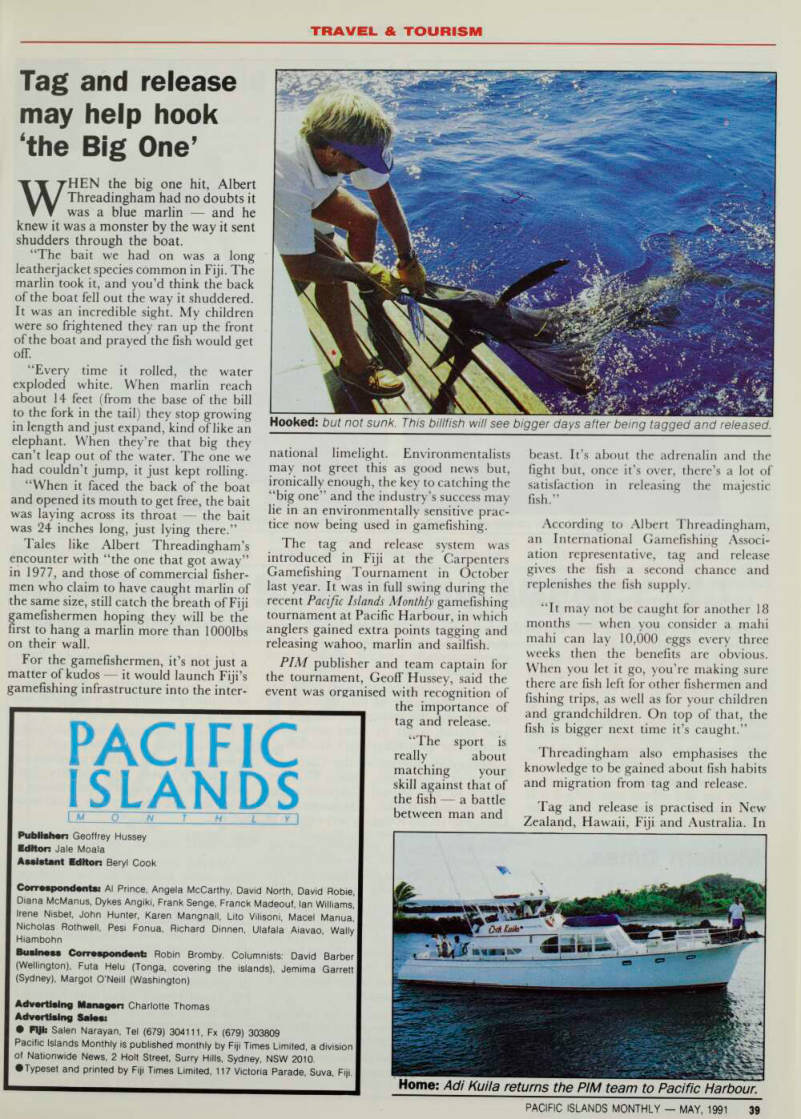
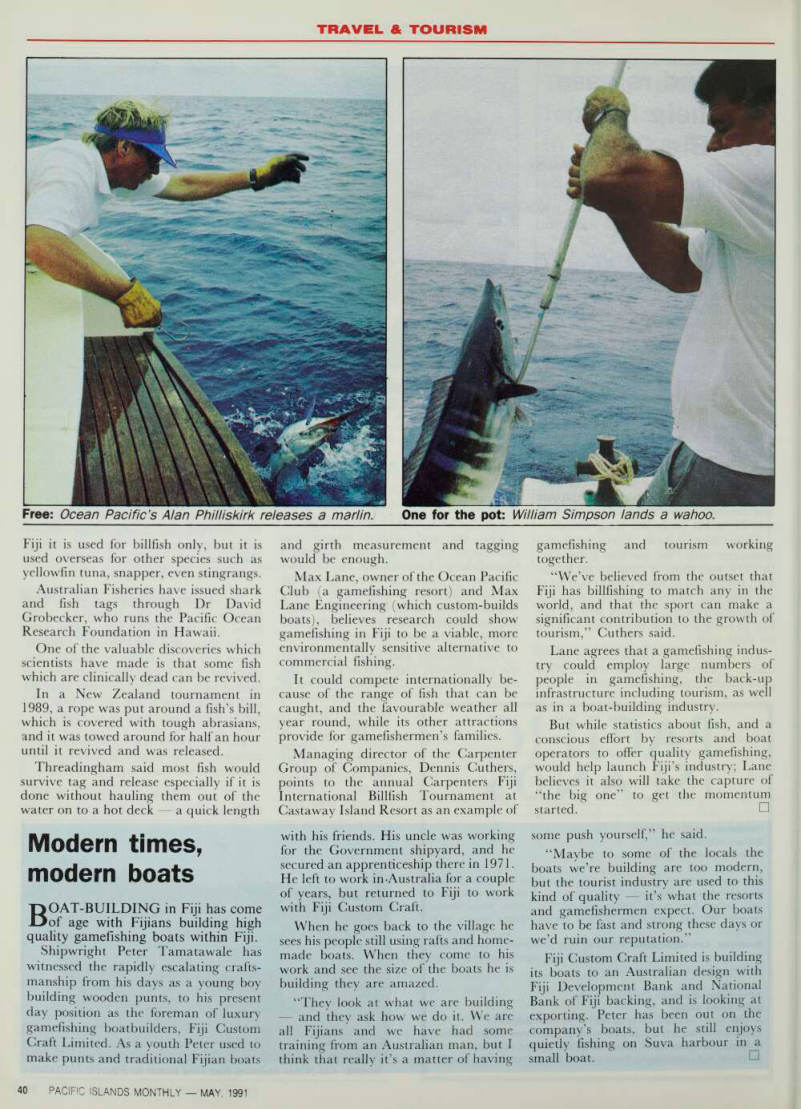
Tag and release may help hook 'the Big One’
WHEN the big one hit, Albert Threadingham had no doubts it was a blue marlin and he knew it was a monster by the way it sent shudders through the boat.
“The bait we had on was a long leatherjacket species common in Fiji. The marlin took it, and you’d think the back of the boat fell out the way it shuddered.
It was an incredible sight. My children were so frightened they ran up the front of the boat and prayed the fish would get off.
“Every time it rolled, the water exploded white. When marlin reach about 14 feet (from the base of the bill to the fork in the tail) they stop growing in length and just expand, kind of like an
elephant. When they’re that big they
can’t leap out of the water. The one we had couldn’t jump, it just kept rolling.
“When it faced the back of the boat and opened its mouth to get free, the bait was laying across its throat the bait was 24 inches long, just lying there.”
Tales like Albert Threadingham’s encounter with “the one that got away” in 1977, and those of commercial fisher men who claim to have caught marlin of the same size, still catch the breath of Fiji gamefishermen hoping they will be the first to hang a marlin more than lOOOlbs on their wall.
For the gamefishermen, it’s not just a matter of kudos it would launch Fiji’s gamefishing infrastructure into the inter-
national limelight. Environmentalists may not greet this as good news but, ironically enough, the key to catching the “big one” and the industry’s success may lie in an environmentally sensitive prac tice now being used in gamefishing.
The tag and release system was introduced in Fiji at the Carpenters Gamefishing Tournament in October last year. It was in full swing during the
recent Pacific Islands Monthly gamefishing
tournament at Pacific Harbour, in which anglers gained extra points tagging and releasing wahoo, marlin and sailfish.
PIM publisher and team captain for the tournament, Geoff Hussey, said the event was organised with recognition of
the importance of tag and release.
“The sport is
really about
matching your
skill against that of the fish a battle between man and
beast. It’s about the adrenalin and the fight but, once it’s over, there’s a lot of satisfaction in releasing the majestic fish.”
According to Albert Threadingham,
an International Gamefishing Associ ation representative, tag and release gives the fish a second chance and
replenishes the fish supply.
“It may not be caught for another 18 months when you consider a mahi mahi can lay 10,000 eggs every three weeks then the benefits are obvious.
When you let it go, you’re making sure there are fish left for other fishermen and fishing trips, as well as for your children and grandchildren. On top of that, the fish is bigger next time it’s caught.”
Threadingham also emphasises the knowledge to be gained about fish habits and migration from tag and release.
Tag and release is practised in New Zealand, Hawaii, Fiji and Australia. In
Hooked: but not sunk. This billfish will see bigger days after being tagged and released.
Home: Adi Kuita returns the PIM team to Pacific Harbour.
Fiji it is used for billfish only, but it is used overseas for other species such as yellowfin tuna, snapper, even stingrangs.
Australian Fisheries have issued shark and fish tags through Dr David Grobecker, who runs the Pacific Ocean Research Foundation in Hawaii.
One of the valuable discoveries which scientists have made is that some fish which are clinically dead can be revived.
In a New Zealand tournament in 1989, a rope was put around a fish’s bill, which is covered with tough abrasians, and it was towed around for half an hour until it revived and was released.
Threadingham said most fish would survive tag and release especially if it is done without hauling them out of the water on to a hot deck a quick length
and girth measurement and tagging would be enough.
Max Lane, owner of the Ocean Pacific Club (a gamefishing resort) and Max Lane Engineering (which custom-builds boats), believes research could show gamefishing in Fiji to be a viable, more environmentally sensitive alternative to commercial fishing.
It could compete internationally be cause of the range of fish that can be caught, and the favourable weather all year round, while its other attractions provide for gamefishermen’s families.
Managing director of the Carpenter Group of Companies, Dennis Cuthers, points to the annual Carpenters Fiji International Billfish Tournament at Castaway Island Resort as an example of
gamefishing and tourism working together.
“We’ve believed from the outset that Fiji has billfishing to match any in the world, and that the sport can make a significant contribution to the growth of tourism,” Cuthers said.
Lane agrees that a gamefishing indus try could employ large numbers of people in gamefishing, the back-up infrastructure including tourism, as well as in a boat-building industry.
But while statistics about fish, and a conscious effort by resorts and boat operators to offer quality gamefishing, would help launch Fiji’s industry; Lane believes it also will take the capture of “the big one” to get the momentum started. EH
Free: Ocean Pacific’s Alan Philliskirk releases a marlin.
One for the pot: William Simpson lands a wahoo.
Pacific
Islands
Monthly
Publisher: Geoffrey Hussey Editor: Jale Moala Assistant Editor: Beryl Cook Correspondents: Al Prince, Angela McCarthy, David North, David Robie, Diana McManus, Dykes Angiki, Frank Senge, Franck Madeouf, lan Williams, Irene Nisbet. John Hunter, Karen Mangnall, Lito Vilisoni, Macel Manua, Nicholas Rothwell, Pesi Fonua, Richard Dinnen, Ulafala Aiavao, Wally Hiambohn Business Correspondent: Robin Bromby. Columnists: David Barber (Wellington), Futa Helu (Tonga, covering the islands), Jemima Garrett (Sydney). Margot O'Neill (Washington) Advertising Manager: Charlotte Thomas Advertising Sales: • FIJI: Salen Narayan, Tel (679) 304111, Fx (679) 303809 Pacific Islands Monthly is published monthly by Fiji Times Limited, a division of Nationwide News. 2 Holt Street, Surry Hills, Sydney, NSW 2010. •Typeset and printed by Fiji Times Limited, 117 Victoria Parade, Suva, Fiji.
Modern times,
modern boats
BOAT-BUILDING in Fiji has come of age with Fijians building high quality gamefishing boats within Fiji.
Shipwright Peter Tamatawale has witnessed the rapidly escalating crafts manship from his days as a young boy building wooden punts, to his present day position as the foreman of luxury gamefishing boatbuilders, Fiji Custom Craft Limited. As a youth Peter used to make punts and traditional Fijian boats
with his friends. His uncle was working for the Government shipyard, and he secured an apprenticeship there in 1971.
He left to work in-Australia for a couple of years, but returned to Fiji to work with Fiji Custom Craft.
When he goes back to the village he sees his people still using rafts and home made boats. When they come to his work and see the size of the boats he is building they are amazed.
“They look at what we are building and they ask how we do it. We are all Fijians and we have had some training from an Australian man, but I think that really it’s a matter of having
some push yourself,” he said.
“Maybe to some of the locals the boats we’re building are too modern, but the tourist industry are used to this kind of quality it’s what the resorts and gamefishermen expect. Our boats have to be fast and strong these days or we’d ruin our reputation.”
Fiji Custom Craft Limited is building its boats to an Australian design with Fiji Development Bank and National Bank of Fiji backing, and is looking at exporting. Peter has been out on the company’s boats, but he still enjoys quietly fishing on Suva harbour in a small boat.
Streamlining old boat designs
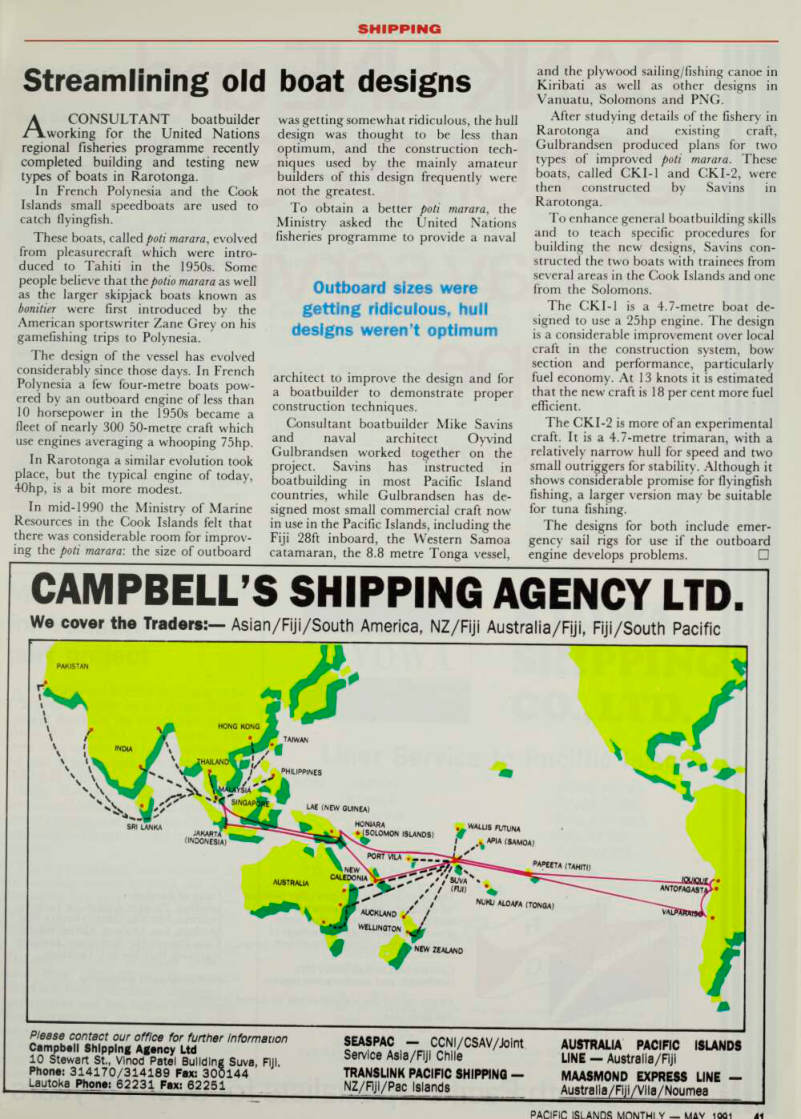
Shipping
A CONSULTANT boatbuilder working for the United Nations regional fisheries programme recently completed building and testing new types of boats in Rarotonga.
In French Polynesia and the Cook Islands small speedboats are used to
catch flyingfish.
These boats, called poti marara , evolved from pleasurecraft which were intro duced to Tahiti in the 19505. Some people believe that the potio marara as well as the larger skipjack boats known as bonitier were first introduced by the American sportswriter Zane Grey on his gamefishing trips to Polynesia.
The design of the vessel has evolved considerably since those days. In French Polynesia a few four-metre boats pow ered by an outboard engine of less than 10 horsepower in the 1950 s became a fleet of nearly 300 50-metre craft which
use engines averaging a whooping 75hp.
In Rarotonga a similar evolution took place, but the typical engine of today, 40hp, is a bit more modest.
In mid-1990 the Ministry of Marine Resources in the Cook Islands felt that there was considerable room for improv ing the poti marara: the size of outboard
was getting somewhat ridiculous, the hull design was thought to be less than optimum, and the construction tech niques used by the mainly amateur builders of this design frequently were not the greatest.
To obtain a better poti marara , the Ministry asked the United Nations fisheries programme to provide a naval
Outboard sizes were getting ridiculous, hull designs weren’t optimum
architect to improve the design and for a boatbuilder to demonstrate proper
construction techniques.
Consultant boatbuilder Mike Savins and naval architect Oyvind Gulbrandsen worked together on the project. Savins has instructed in boatbuilding in most Pacific Island countries, while Gulbrandsen has de signed most small commercial craft now in use in the Pacific Islands, including the Fiji 28ft inboard, the Western Samoa catamaran, the 8.8 metre Tonga vessel,
and the plywood sailing/fishing canoe in Kiribati as well as other designs in Vanuatu, Solomons and PNG.
After studying details of the fishery in Rarotonga and existing craft, Gulbrandsen produced plans for two types of improved poti marara. These boats, called CKI-1 and CKI-2, were then constructed by Savins in
Rarotonga.
To enhance general boatbuilding skills and to teach specific procedures for building the new designs, Savins con structed the two boats with trainees from several areas in the Cook Islands and one from the Solomons.
The CKI-1 is a 4.7-metre boat de signed to use a 25hp engine. The design is a considerable improvement over local craft in the construction system, bow
section and performance, particularly
fuel economy. At 13 knots it is estimated that the new craft is 18 per cent more fuel efficient.
The CKI-2 is more of an experimental craft. It is a 4.7-metre trimaran, with a relatively narrow hull for speed and two
small outriggers for stability. Although it
shows considerable promise for flyingfish fishing, a larger version may be suitable for tuna fishing.
The designs for both include emer gency sail rigs for use if the outboard
engine develops problems. □
Advertisements & other items, pp. 41-42 (2 items)
Campbell's Shipping Agency Ltd.
We cover the Traders:— Asian/Fiji/South America, NZ/Fiji Australia/Fiji, Fiji/South Pacific
=AKI5 T AN
HONG KONG
TAIWAN
INDIA
HAJLAN
I V \
, / , PHILIPPINES
IGAPW LAE (NEW GUINEA)
\ \ I :A
SIN
FUTUNA
• (SOLOMON ISLANDS) 4
SRI LANKA
JAKARTA
(INDONESIA)
f (SAMOA)
Siaaaa- PAPEETA (TAHITI 1
NOW) ALOAFA (TONGA)
• NEW >
CALEDONIA
SUVA
AUSTRALIA
•W '
\ W AUCKLAND / f
* **y WELLINGTON
antofagasta>*
(FIJI)
NEW ZEALAND
Please contact our office for further Information
Campbell Shipping Agency Ltd
10 Stewart St. ( Vlnod Patel Building Suva, FIJI.
Phone: 314170/314189 Fax: 300144 Lautoka Phone: 62231 Fax: 62251
SEASPAC - CCNI/CSAV/Joint
Service Asia/Fiji Chile
TRANSLINK PACIFIC SHIPPING
NZ/Fiji/Pac Islands
AUSTRALIA PACIFIC (SUNOS
LINE Australia/Fiji
MAASMOND EXPRESS LINE
Australia/Fiji/Vi la/Noumea
Europe.
BANK LINE and
COLUMBUS LINE
24 day service to
Europe.
Need we say more...
G The Joint Service Partners offer facilities for shipment of: Containers (FCL/LCL) and Break-bulk Cargo plus reefer space and deeptanks for carriage of vegetable oils and other liquid bulk cargo.
Carriers also accept heavy lifts, overlength and cumbersome parcels.
Ports of Service; Loading; Papeete, Apia, Suva, Lautoka, Noumea, Port Vila, Santo, Honiara, Port Moresby, Lae, Madang, Kimbe, Rabaul, Kieta, Darwin. For: Rotterdam, Antwerp, Hamburg, Hull, Dunkirk, Le Havre.
Additional ports on enquiry.
Please contact our regional offices for further information: The Bank Line P.O. Box 2225 Lae, Papua New Guinea Phone; 422 988/Fax: 422 925 Telex: 44265 The South Pacific Specialists for over 75 years
Shipping Schedules
New Zealand - Fiji direct Sofrana Unilines operates a fully containerised/breakbulk service every 21 days from Auckland, Tauranga, Lyttleton to Suva and Lautoka. Loading every 21 days, ro/ro service, containers - reefer.
Contact Sofrana Unilines, Sofrana House, 101 Customs Street, Auckland, PO Box 3614, Fax (09) 393874, Ph (09) 773279, Tlx NZ 2313. Direct toll free line 0800 659-922, Contact Alan Foote. Sofrana Shipping Agencies, PO Box 921 Welling ton, Tel (04) 725 661, Fax (04) 725 749, Tlx NZ 4769 Contact Steve Brannigan.
Sofrana Unilines Agencies, PO Box 22046 Christchurch, tel (03) 667 180, Fax (03) 668 868, TLX NZ4769, Contact Tony Newell. Carpenters Shipping, Private Mail Bag, Suva, Fiji, Tel (679) 312244, Fax (679) 301572, Tlx FJ 2199. Sofrana Unilines, Suva, Fiji, Tel (679) 315645, Fax (679) 300057.
Australia - Fiji direct Sofrana Unilines operates a ro/ro con tainer service every three weeks from Melbourne, Sydney, Brisbane, Lautoka and Suva. Contact Sofrana Unilines (Aust) Pty Ltd, PO Box Q 136, Queen Victoria Building, Sydney, NSW 2000, Australia.
Tel (02) 2648944, Fax (02) 2676547, Tlx (71) A 170090, Contact Andrew
McLachlin, Sam Attaway. Carpenters Shipping, Suva, Tel (679) 312244, Fax (679) 301572. Sofrana Unilines Suva, Tel (679) 315 645, Fax (679) 300057.
Carpenters Shipping, Lautoka, Tel (679) 63988, Fax (679) 64896. Sofrana Unilines, Lautoka Tel (679) 62921, Fax (679) 64896.
Australia - Fiji monthly service Sofrana Unilines (Australia) Pty Ltd operates a regular monthly service with MV Capitaine Wallis. Contact Sofrana Unilines, Sydney, Tel (02) 2648944, Tlx AA170090, Fax (02) 267-6547. Carpenters Shipping, Suva, Fiji, Tel (679) 312244, Fax (679) 301572, Sofrana Unilines, Suva, Fiji Tel (679) 315645, Fax (679) 300057.
Carpenters Shipping, Lautoka, Tel (679) 63988, Fax (679) 64896. Sofrana Unilines, Lautoka, Fiji, Tel (679) 62921, Fax (679) 64896.
Far-East - Fiji - New Zealand Service New Zealand Unit Express (NZUE) operates a monthly service accepting containerised and break-bulk cargoes from Manila, Keelung, Kaoshiung, Hong Kong, Lae to Suva, Lautoka (via Suva) and thence to New Zealand ports. Contact Carpenters Shipping Suva, Fiji, tel (679) 312244, fax (679) 301572. New Zealand Unit Express, Maritime Building, 2-10 Customs House Quay, PO Box 890, Wellington. Tel 727865, Cables Enzue Man, Wellington, Tlx NZ31340 Nedlnz or Nedlloyd Swire Pty Ltd, Sydney, Tel
20522.
Japan - South Pacific Service Same as Burns Philp Japan - South Pacific Service - Kyowa Shipping Co Ltd Kyowa Shipping, Shipping Co Ltd provides a monthly containerised service from Hong Kong to main ports of Japan, Saipan, Guam, Island ports, Lautoka, Suva via Nukualofa to Pago Pago and
Apia. Contact Carpenters Shipping,
Neptune House, 3/4 floor, Tofuaa Street, Walu Bay, Suva. Tel 312244, Fax 301572, Tlx FJ2199.
Europe - Pacific Service Nedlloydd offers cargo services from Continental Ports to Papeete, Fiji, New Caledonia and Doniambo on slot basis with Bank line. Contact Nedlloyd (Aust)Pty Ltd, Spring Street, Sydney, Tel 273801. Carpenters Shipping, Suva, tel 312244, Tlx FJ2199, Fax 301572.
Carpenters Shipping, Lautoka, Tel
63988, Tlx FJ5215, Fax 64896.
South East Asia - Fiji Service Nedlloyd Lines (NZEAS) Service op erates regular fast cargo service from
Jakarta, Pt Keelang, Singapore, Bang
kok, Surubaya via Auckland to Suva and Lautoka.
Contact Carpenters Shipping, Suva, Tel 312244, Tlx FJ2199, Fax 301572.
Carpenters Shipping, Lautoka Tel 63988, Tlx FJ5215, Fax 63988 Far East - Mid South Pacific China Navigations New Guinea Pacific Line operates a regular container and breakbulk heavy lift service from Hong Kong, Taiwan, Manila, Singapore, Malay sia, Thailand to Port Moresby, Lae, Rabaul, Kieta and Honiara. Cargo from the same eastern ports to the South Pacific Ports of Noumea, Santo, Vila, Papeete, Pagopago, Apia, Nukualofa, Rarotonga and Tarawa will be shipped via Japan or Busan on the monthly Bali Hai Service.
Contact Steamships Shipping, Port Moresby, PO Box 634, Tel 220283 or 220289.
Australia - New Caledonia - Fiji - Samoas - Tonga Pacific Forum Line operates a fully containerised service (general, reefer and ro-ro) from Sydney and Brisbane to Noumea, Lautoka, Suva, Apia, Pago Pago, Nuku’alofa, Sydney. Cargo centralised from Adelaide and Melbourne. Contact: Pacific Forum Line, PO Box 796, Auck land; Union Bulkships, 333 George St, Sydney, Brisbane and Melbourne; Union Co, Lautoka; Pacific Forum Line, Suva, Nuku’alofa; Pacific Forum Line, Apia; Polynesia Shipping, Pago Pago. Sofrano Unilines operates a Roro/container service every three weeks from Melbourne, Sydney and Brisbane to Noumea, Suva and Lautoka with transhipment to the Samoas and Tonga.
New Zealand - Australia - PNG - Solomon Islands Pacific Forum Line operates a containerised and ro-ro service from Lyttleton, Napier and Auckland to Bris bane, Port Moresby, Lae, Honiara, Bris bane then to New Zealand. Contact: Pacific Forum, Auckland, Christchurch;
Union Bulkships, Brisbane; Steamships
Shipping Port Moresby and Lae Sullivan Ltd, Honiara; Seabridge, Wellington.
NZ - Fiji Translink Pacific Shipping sail twice a month to Fiji, with Polynesian Link and Coral Links which operate out ofTauranga and Auckland. Fiji Agents are: Campbells Shipping Agency Ltd, Ph 314189 Fax 300144 Suva; Ph 62231 Fax 62251 Lau toka. Auckland Agents: McKay Shipping Ph (9) 390229 Fax (9) 303293. Tauranga Agents, seatrade agencies Ph (75) 754989 Fax (75) 758380.
NZ - Fiji - Pago - Apia - Nuk Translink Pacific Shipping operate a monthly sailing with Polynesian Link, which carries Dry Container, reefers and breakbulk cargoes. NZ Agents McKay Shipping Shipping AKLD Ph 390229, Fax 3032931. Fiji Agents Campbells Shipping Agency & ltd Ph 314189 Fax 300144 NZ - Noumea - Wallis - Futuna
Translink Pacific Agency operate a con tainer Breakbulk service once a month from NZ through Fiji and Noumea to Wallis & Futuna.
South East Asia - Fiji - Noumea - Papeete - Chile Service “Seaspac” A joint Chilean CCNI/CSAU Service offers a regular monthly sailing from Djakarta and Singapore to Noumea, Fiji, Papeete, and Chile. Cargo also federated to Singapore from Korea, Hong Kong, Taiwan, Malaysia, Bangkok. Fiji Agents: Campbells Shipping Agency Ltd, ph. 314189, Fax 300144.
Australia - Fiji Service Chief container services under Australia Pacific Island Line Unitize Sofrano and PFL vessels to provide a twice monthly, service from Australia. Fiji Agents Campbells Shippings Agency ltd Ph 314189 Fax 300144. System Agents Nedlloyd Swire Ph(2) 2512699. Mel bourne Yarra Shipping Ph (3) 6936300.
Brisbane, Medlloyd Swire, ph (7) 8321551.
Australia - Fiji - Noumea - Vila - Santa Marsmond Express Lines operate a breakbulk service from Goodwood Island Australia to Fiji, Noumea, Vila Santo and Honiara. Continuous receiving depots in Sydney and Brisbane enable this vessel to bring cargoes from these parts. Fiji Agents Campbells Shipping Agency Ltd, ph. 314189, Fax 300144. Brisbane Agents Shippings & Marketing Ph (7) 2628082.
Sydney Agents Seabord Agencies (2) 3172325.
Australia - New Caledonia - Fiji - Hawaii - North America ACT Pace Pacific (ACTA Shipping) operates a fully containerised/break bulk service every 17-20 from Melbourne, Syd ney, Brisbane to Noumea, Suva and Lautoka. The vessels continue on to the West Coast of North America calling Honolulu at frequent intervals. Ships are ACT and ACT 12. Contacts: ACTA Pty Ltd, Sydney Ph 2869666, Tx 121369, Fx 2869610. ACTA Pty Ltd, Melbourne Ph
6112000, Tx 30949, Fx 6293055. Acta
Pty Ltd, Brisbane Ph 2213116 m Tx 40719, Fx 2298143. SATO, Noumea Ph 281122, Tx 3163, Fx 278532. Burns Philp Shipping, Suva Ph 31 1777, Tx 2168, Fx 301127; Burns Philp Shipping, Lautoka Ph 60777, Tx 5146, Fx 65850.
West Coast of North America - Fiji - New Zealand Blue Star Line Pacific Coast Service operates a fully containerised/break bulk service every 23 days from Vancouver, Seattle, San Francisco, Los Angeles to Pago Pago, Suva and New Zealand ports. The vessels continue to call Suva on the Northbound voyage from New Zealand every fortnight to pick up Fiji exports such as garments, fresh ginger, etc. for Hawaii and West Coast of North America ports.
Blue Star Line also provides a through service to East Coast to North America.
Ships are Wellington Star, Southland Star
and California Star. Contacts: Blue Star Line, San Francisco Ph 9282026, Tx 184925, Fx 6730355; Blue Star Line, Vancouver Ph 6817300, Tx 0451326, Fx
6835797; Interocean Steamship Corp,
Seattle Ph 6829820, Tx 321101, Fx 3437421; Blue Star Line, Los Angeles Ph 5970454, Tx 408564, Fx 5978710. New Zealand Line, Wellington, Ph 739029, Tx 3583, Fx 4992468; New Zealand Line, Auckland Ph 390965, Tx 2556, Fx 3032039; Burns Philp Shipping, Suva Ph 31 1777, Tx 2168, Fx 301127; Burns Philp Shipping, Lautoka Ph 60777, Tx 5146, Fx 65850.
Japan - South Pacific Service Bali Hai Line a joint service of China Navigation, Mitsui OSK Line and NYK Line operates a fully containerised/break bulk service from Korea, Japan to South Pacific ports on a monthly basis serving ports of Pusan, Kobe, Nagoya, Yokogama, Tarawa, Lautoka, Suva, Apia, Pago Pago, Papeete, Nuku’alofa, Noumea, Vila, Santo.
The ships are also fully specialised to carry vehicles on Ro/Ro basis. Ships are Coral Islander and Pacific Islander. Contacts: John Swire & Sons, Tokyo Ph 32309220, Tx 22248, Fx 3239288; Nippon Yusen Kaisha, Tokyo Ph 3284516, Tx 22236, Fx 32846332; Mtsul OSK Lines, Tokyo Ph 35877086, Tx 22266, Fx 35877732; Burns Philp Shipping, Suva (C/Islander) Ph 31 1777, Tx 2168, Fx 301127; Carpenters Shipping, Suva (P/Islander) Ph 312244, Tx 2199, Fx 301572; Burns Philp Shipping, Lautoka Ph 60777, Tx 5146, Fx 65850; Carpenters Shipping Ph 63988, Tx 5215, Fx 64896.
Europe - South Pacific Service Bank Line Limited operates a monthly service from United Kingdom, Europe to South Pacific ports. Vessels are fully equiped to carry containers, break bulk cargo and have deep tank facilities to carry bulk liquid such as oil, etc. The service operates from Hull, Rotterdam, Hamburg, Dunkirk, Le Havre, Papeete, Apia, Suva, Lautoka, Noumea, Vila, Santo, Honiara, Papua New Guinea Group, Singapore and back to Europe/Continent. Ships: Forthbank, Ivybank, Clydebank, Moraybank. Contacts; Bank Line, London Ph 2650808, Tx 887392, Fx 4814784, Bank Line, Lae Ph 421235, Tx 44265, Fx 422925; Bank Line, Sydney, Ph 9063173, Tx 24063, Fx 9061430; Burns Philp Shipping, Suva Ph 31 1777, Tx 2168, Fx 301127; Burns Philp Shipping, Lautoka Ph 60777, Tx 5146, Fx 65850.
Australia - Vanuatu - Fiji Sitmar Cruises operates a year round cruise programme for Sydney to Vanuatu, Fiji. The programme also includes a number of calls to a number of islands such as Dravuni, Yasawa-i-Rara, Rotuma, Mys tery Island, etc.
Contact: Sitmar Cruises, Sydney Ph 2560111, Tx 20712, Fx 2560101; Burns Philp Shipping, Suva Ph 31 1777, Tx 2168, Fx 301127; Burns Philp Shipping, Lautoka Ph 60777, Tx 5146, Fx 65850. □
port project
More ADB funds for Vanuatu port project
AN additional SUS 3.4 million is to be made available by the Asian Devel opment Bank for the completion of the Santo Port project in Vanuatu. The extra loan money will meet increases in the cost of the project, now estimated at 5U510.53 million.
Santo Port, which handles about 80 per cent of Vanuatu’s exports and 30 per cent of imports, is to get a new 130-metre earthquake-resistant wharf and other facilities.
The supplementary loan will cover the cost overrun caused by weak soil strata discovered last year, and piles are now having to be drilled deeper than orig inally planned.
The new wharf has high priority under Vanuatu’s Second National Develop ment Plan (1987-1991). The present wharf has been extensively damaged by earthquakes and has begun to collapse.
The replacement structure will allow overseas ships to handle cargo more economically and efficiently, with the removal of lighterage costs allowing shorter port calls. □
Advertisements & other items, p. 43 (1 item)
ktowaj shipping
KYOWA
CO., LTD.
Liner Service
FROM OJAPAN
OKOREA
OTAIWAN
OTHAILAND
to Paciffic Islands
OHONG KONG
OSINGAPORE
OPHILIPPINES
O MALAYSIA
OINDONESIA
TO OSAIPAN
OFEDERATED STATES
OF MICRONESIA
OMARSHAL ISLANDS
©AMERICAN SAMOA
ONEW CALEDONIA
O FIJI
OGUAM
OYAP
OPALAU
O WESTERN SAMOA
OSOLOMON ISLANDS
OVANUATU
OPAPUA NEW GUINEA
HEAD OFFICE
6th Floor , Kikushima Bldg 2-3, Hamamatsucho 2-chome. M,nato-ku Tokyo 105 Japan Phone: 03(437)2885 (Rep ) Cables: MARIQUEEN Tokyo Telex; 242-4651 Kyowa J
OSAKA OFFICE
Dai San Fuji Bldg, 3-13. Itachibon 1-chome, Osaka 550.
Phone: 06(533)5821 (Rep ) Cables; MARIQUEEN" Osaka Telex: 525-6271 Ssiosa J
dolphin-free rule
Vanuatu hit by dolphin-free rule
WHILE America’s love affair with the dolphin has generally been helpful to Pacific Island nations, pushing tuna fishing into the Western Pacific which earns fees for those nations, Vanuatu was the loser in a recent US decision regarding two of its tunaboats.
US law discourages tunaboats from following their traditional practice in the Eastern Tropical Pacific, that of locating dolphin on the surface of the sea, and then seining tuna beneath them. The purse seiners typically kill dolphin in this process, though recently industry efforts have reduced the number of kills.
Late in March, Washington decided that the two Vanuatu-owned fishing boats, on the Pacific Coast of South America and working the Eastern Trop ical Pacific, could no longer sell their catch in the American market, because the Vanuatu boats endangered the dolphin. It was a follow-up to a similar decision, taken for similar reasons, aimed at the much larger Mexico-based tuna fleet which works the same waters.
The decision is more likely to have long-term adverse impacts on Vanuatu than short-term ones. Currently, the major US tuna packers refuse to buy tuna caught “on dolphin” as part of their
enviromentally-influenced marketing
campaign selling only “dolphin safe” tuna, so the catch of the Vanautu boats was not headed to the US anyway.
In the future, however, things could get more serious. The ban on direct
imports of dolphin-endangered tuna
from Vanuatu is just the first step in the process. The second, automatic step takes place 90 days later (it is scheduled for late
June); this is the ban on all tuna US imports from intermediary countries that buy and process tuna from Vanuatu. If Vanuatu, for example, is selling tuna to Thailand, for example all imports of Thai tuna would be terminated, or more likely Thailand’s packing houses would stop buying tuna from Vanuatu. The third and final step, not an automatic one, could come six months later or in late September at the earliest. This would be a total US ban on any fish products from Vanuatu.
Vanuatu has a cameo role in this controversy; the principal players are the United States and Mexico. American enviromentalists are pressing the reluc tant Bush Administration to take the pro dolphin position while many voices in Mexico are complaining about American “economic imperialism.” It is a classic First World-Third World struggle over an enviromental issue. The whole squabble threatens to torpedo free trade talks between the two North American
neighbours.
By David North, Washington
Niue aid cut New Zealand is cutting its annual aid to Niue by NZ$5OO,OOO, Foreign Affairs Minister Don McKinnon said last month. Niue, a self-governing New Zealand dependency, currently receives NZ$lO million in aid each year. “The clear message is that every New Zealand dollar has to be spent as effectively and efficiently as possible,” McKinnon said.
The cut will take effect in the next financial year which begins in July. □ Another China visit Fiji President Ratu Sir Penaia Ganilau visited china last month from the 22nd to the 29th. He was invited by his Chinese
counterpart Yang Shangkun.
China is sparing no effort to develop relations with the small countries of the Pacific, where the rival nationalist gov ernment in Taiwan has important links.
The Prime Minister of Papua New Guinea, Rabbie Namaliu, visited there earlier last month. In March, the President of the Marshall Islands, Amata Kabua, visited Beijing. □ Kiribati Minister dies A senior Kiribati Cabinet Minister Babera Kirata died at his home here overnight after complaining of chest pains. He was 53. He had been Home Affairs and Decentralisation Minister.
His death came less than a month before parliamentary elections on May 8.
Kirata had been an MP for the island of Onotoa since 1978. During his parlia mentary career he held several minis
terial portfolios including communica
tions, works, natural resources develop ment and energy. He is survived by his wife and three children.
Kirata was among several ministers considered as possible successors to current head of state leremia Tabai who is to step down at presidential elections due in mid-June. □ Oceans under probe UNESCO is studying the oceans to aid climate forecasts and save billions of dollars in damage from weather disasters.
Satellites, ships and buoys will gather data t>n the link between seas and freak weather conditions.
By early next century, GOOS could be providing real-time computer data in tended to give early warning of such phenomena as the shifting El Nino current in the Pacific Ocean. El Nino, which sends warm water into the Eastern Pacific every few years, upsets weather patterns over half the world. □
Pacific Week attracts more support
PLANS for South Pacific Week at Auckland in October are likely to result in support from three major regional organisations. The South Pacific Commission hopes to participate in the trade fair, according to its Secretary General, Atanraoi Baiteke. Pacific Fo rum Line has offered support to govern ments and organisations which want to ship exhibits and products to the event.
At Auckland, the Director of the South Pacific Trade Office, Steve Houlihan, has prepared a proposal for the involve ment of all 13 Forum Island Countries.
The theme of South Pacific Week is the promotion of growth and development.
The Pacific Forum Line operates vital shipping services to most of the indepen dent Forum Island Countries and was set
up primarily to assist economic develop ment within the region.
As a token of its support towards regional broadcasting, Radio New Zea land has offered to establish an on-site studio for all members of the Pacific Islands Broadcasting Association (PIBA). New Zealand’s Community Newspapers Association hopes to estab lish a similar facility for the print media from the South Pacific.
New Zealand Prime Minister Jim Bolger has lent his support and said: “Support and co-operation among Pa cific countries are key ingredients in the recipe for prosperity. Matters of mutual interest such as trade, tourism and climatic change should be discussed regularly by regional policy makers. I am
pleased South Pacific Week is being staged in Auckland because New Zea land can’t afford to be left out of the Asia Pacific communication network.”
South Pacific Week co-ordinator Roy Vaughan is pleased with the way other territories are rallying to support the event.” The Australian and French embassies in Wellington have indicated that they will have cultural groups.
Pacific Islands News Association (PINA) is using its own network of members to make this an effective promotion.”
The (French) Pacifique Press Com munication correspondent in Suva, Pat rick Schlouch, has become a key liaison point for French Pacific media involve ment and Fred Radewagen, the Director of the American Samoan Government office in Washington, has been cranking up involvement from the American territories. □
Advertisements & other items, pp. 46-47 (2 items)
Isa Lei Hotel
SALE BY MORTGAGEE
1 * Written offers are invited for purchase of the Isa Lei Resort, located in Marine Drive, Lami (about 3 Miles west of the Suva GPO).
THE RESORT
* The hotel is located on an elevated terraced site overlooking downtown Suva and the sea beyond. * The property is comprised in 2 titles: Native Lease No. 12956 and Crown Lease No. 4884, covering an area of over 6 V 2 acres. * The resort contains 46 completely refurbished rooms with a central amenity block containing a large ballroom and a mezannine floor complete with a bar and cloakroom at each level. * There are two conference rooms, a fully carpeted wine room on the “turtle head” top floor, various terraces at each level, a turtle-shaped swimming pool and usual amenities pertaining to a resort of this nature. * Each suite enjoys a sea view and a view of downtown Suva and the surrounding hills.
CONDITIONS
* offers close on 31 May, 1991 at 4.00 pm * Any or the highest tender will not be necessarily accepted. * The property is presently unoccupied but special arrangements will need to be made for inspection and possession. * Sale is subject to a formal contract being entered into. * Any sale shall be subject to the prior consent of the Director of Lands and Native Land Trust Board. * Where the purchaser is an overseas resident, the consent of the Minister for Lands will be required. * Tenders must be addressed to the undersigned solicitors.
For further details relating to this advertisement, please contact Subhas Parshotam.
PARSHOTAM & CO
Solicitors GPO Box 131
SUVA.
Ph: 314-844 Fax: 300-681
Issues
Reid and the strikers: a test of endurance
Yashwant Gounder
End of the cold war
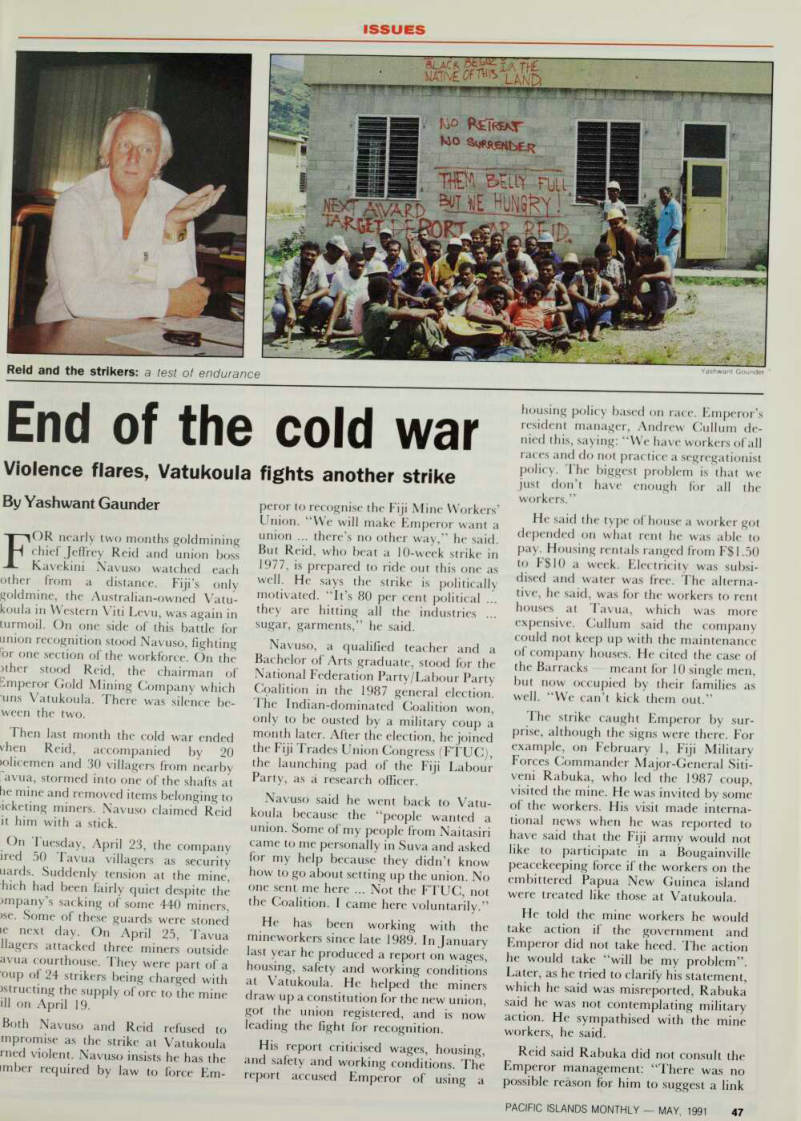
Violence flares, Vatukoula fights another strike
By Yashwant Gaunder
FOR nearly two months goldmining chief Jeffrey Reid and union boss Kavekini Navuso watched each other from a distance. Fiji’s only goldmine, the Australian-owned Vatu koula in Western Viti Levu, was again in turmoil. On one side of this battle for union recognition stood Navuso, fighting or one section of the workforce. On the uther stood Reid, the chairman of
Smperor Gold Mining Company which
uns Vatukoula. There was silence be ween the two.
Then last month the cold war ended vdien Reid, accompanied by 20 lolicemen and 30 villagers from nearby avua, stormed into one of the shafts at he mine and removed items belonging to icketing miners. Navuso claimed Reid it him with a stick.
On Tuesday, April 23, the company ired 50 Tavua villagers as security uards. Suddenly tension at the mine, hich had been fairly quiet despite the )mpany’s sacking of some 440 miners, )se. Some of these guards were stoned ie next day. On April 25, Tavua Hagers attacked three miners outside avua courthouse. They were part of a oup of 24 strikers being charged with istructing the supply of ore to the mine ill on April 19.
Both Navuso and Reid refused to mpromise as the strike at Vatukoula med violent. Navuso insists he has the imber required by law to force Em
peror to recognise the Fiji Mine Workers’
Union. “We will make Emperor want a union ... there’s no other way,” he said.
But Reid, who beat a 10-week strike in 1977, is prepared to ride out this one as well. He says the strike is politically motivated, it’s 80 per cent political ... they are hitting all the industries sugar, garments,” he said.
Navuso, a qualified teacher and a Bachelor of Arts graduate, stood for the National Federation Party/Labour Party Coalition in the 1987 general election.
The Indian-dominated Coalition won, only to be ousted by a military coup a month later. After the election, he joined the Fiji Trades Union Congress (FTUC), the launching pad of the Fiji Labour Party, as a research officer.
Navuso said he went back to Vatu koula because the “people wanted a union. Some of my people from Naitasiri came to me personally in Suva and asked for my help because they didn’t know how to go about setting up the union. No one sent me here ... Not the FTUC, not the Coalition. I came here voluntarily.”
He has been working with the mineworkers since late 1989. In January last year he produced a report on wages,
housing, safety and working conditions
at Vatukoula. He helped the miners draw up a constitution for the new union, got the union registered, and is now leading the fight for recognition.
His report criticised wages, housing, and safety and working conditions. The report accused Emperor of using a
housing policy based on race. Emperor’s
resident manager, Andrew Cullum de nied this, saying: “We have workers ofall races and do not practice a segregationist policy. The biggest problem is that we just don’t have enough for all the workers.”
He said the type of house a worker got depended on what rent he was able to pay. Housing rentals ranged from E 51.50 to FSIO a week. Electricity was subsi dised and water was free. The alterna tive, he said, was for the workers to rent houses at Tavua, which was more expensive. Cullum said the company could not keep up with the maintenance of company houses. He cited the case of the Barracks meant for 10 single men, but now occupied by their families as well. “We can’t kick them out.”
The strike caught Emperor by sur prise, although the signs were there. For
example, on February 1, Fiji Military
Forces Commander Major-General Siti veni Rabuka, who led the 1987 coup, visited the mine. He was invited by some of the workers. His visit made interna tional news when he was reported to have said that the Fiji army would not like to participate in a Bougainville peacekeeping force if the workers on the embittered Papua New Guinea island were treated like those at Vatukoula.
He told the mine workers he would take action if the government and Emperor did not take heed. The action he would take “will be my problem”.
Later, as he tried to clarify his statement, which he said was misreported, Rabuka said he was not contemplating military action. He sympathised with the mine workers, he said.
Reid said Rabuka did not consult the Emperor management: “There was no possible reason for him to suggest a link
between Vatukoula and the Bougain ville situation. His statement wasn’t conducive to the people’s, the com pany’s or Fiji’s image abroad.”
Vatukoula had another visitor four days before the strike when it saw the general secretary of the Brussels-based International Miners Federation, Peter Michalzik. He called on Emperor to recognise the union and start negotiat ing housing, wages and safety con ditions.
“Sometimes mining companies in developing countries claim they are unable to provide the same conditions and wages like developed countries,” he said. “But a Papua New Guinea com pany which I have just visited is paying
very good wages and providing good
conditions for its workers.”
Has the union enough members to force the company to recognise it?
According to the union’s membership register, the union had 727 members (to April 19). The union said more than 650 are on strike; only those in essential services are working.
Emperor disputes the union member ship. Out of 1234 people it employs (up to February 28), the company says only 440, who were sacked last month, went on strike. The workforce of 1234 com prises 79 in the geology department, 478 in mining, 154 in metallurgy, 422 in engineering, and 101 in administration.
These did not include the 128 contract workers, some of them joined the strikers.
Why wasn’t the company recognising the union? Cullum said unions were “counter-productive”. He added: “It has been some 13 years since the last industrial action; those have been peace ful times so why should we submit to standover tactics by the union?”
Cullum said the company does not want to re-employ all the workers.
“Gold prices have been at their lowest for a while and we have to be selective in who we re-employ,” he said. “We have had a policy of not replacing those who leave for one year now. People here are aware of that. It’s no secret.”
Emperor has announced a profit of F 54.6 million for the first half of the current financial year.
Cullum agreed that some conditions at the mine were harsh but he pointed out that the company was doing its best to improve them. On wages, he said the workers were paid on a bonus system used in the mining industry all over the world: “The incentive is that the more you do, the more you get.” He said under the system, miners earned be tween Fssooo-522,000 a year. Fifty miners earned FS 10,000, good by local standards. The average wage was F 58,200. The top miner last year got F 522,000. He is also on strike. □
$60m debt demand
Palau wins time on $60m debt demand
By Ian Williams
(United Nations correspondent) PALAU does not have to pay a British bank consortium USS6O million. Or at least, not just yet. A US Federal Appeal Court ruling on February 5 overturns an earlier judgment against it for US$45 million,
plus interest.
If the banks want to proceed with the case, it must be in a New York State Court, where Wayne Cross, Palau’s attorney has every hope of success. New York jurors are not renowned for their love of big financial institutions. “I think that the country obviously believes it was defrauded, and this gives us an oppor tunity to present the facts. I look forward to presenting the case to a jury. We’ve never said we’d refuse to pay. The deal was that the banks would be paid from profits and if there are any, we’ll be happy to do so,” he told Pacific Islands Monthly in New York. Much less happy was Richard Halerow, Chairman of Morgan Grenfell Trade Finance, the lead bank in the consortium. “We’re absolutely flabbergasted,” he told PIM
Advertisements & other items, pp. 48-49 (1 item)
Sprep
SOUTH PACIFIC REGIONAL ENVIRONMENT PROGRAMME
Applications are invited from nationals of SPREP member countries for the position of an Information and Publication Officer in the SPREP Secretariat, financed by the Government of New Zealand.
SPREP is an intergovernmental organisation composed of twenty-seven countries as members. The primary objectives of the organisation include co-ordinating environmental activities in the region, providing, advising member countries on environmental issues and acting as clearing house for environmental information.
QUALIFICATIONS AND EXPERIENCE
A tertiary qualification probably in journalism. Experience in the areas of communications, and of environment and conservation. Knowledge of the political varieties and the sensitivities of different cultures within the South Pacific region.
LANGUAGE
Fluency in oral and written ENGLISH is essential. Knowledge of French language is desirable.
JOB DESCRIPTION
Duties include: • To develop a communications strategy to co-ordinate promotion, information, publishing and other communications tasks for SPREP. • Co-ordinate the preparation (including editing and design) of the newsletter which is circulated to regional departments of conservation and organisations as well as member governments and administrations. • Prepare press releases for important issues and events which involve SPREP. • Prepare a summary of events and issues for distribution throughout the region. • Liaise with other organisations on videos and radio
programmes being produced which might be of interest to SPREP. • Continue to use of the SPREP logo and design on all documents and
publications produced within the organisation.
• Oversee the printing of SPREP documents and production of other information resources. • Develop a catalogue of all SPREP publications. • Act as an information clearing house for regional and international reports
and publications.
• Update and maintain a current bibliography, list of resources and consultants’ register.
TERMS AND CONDITIONS OF APPOINTMENT
Tenure Appointment of the above position will be for three years in the first instance.
Remuneration An attractive remuneration package will be paid to the appointee, depending on qualification and experience. Starting salary will be within the range CEP 237,600 to CFP 291,600 per month.
An appointee who is recruited from outside New Caledonia will also be eligible for the following: passage and freight allowance; establishment grant, housing allowance, child allowance and education assistance; exemption from income tax on his or her remuneration; home leave passage after every eighteen months of service.
Further information about the position can be obtained from SPREP Telephone: (687) 26200. Fax: (687) 263818.
Applications All applications should be fully documented and include a copy of birth certificate, details of work experience and qualifications and the name of at least three referees. Applications marked Information and Publications reach the Director, South Pacific Regional Environment Programme (SPREP).
B.P. D 5, NOUMEA CEDEX, New Caledonia by 15 June, 1991.
SOPfJC
South Pacific Applied Geoscience Commission
Director and Deputy Director Positions
SO^AC it based^n n Suva al ßji- f S ° PAC member countries for the following senior positions in the Technical (1) Director : for a three year appointment from January, 1992 (2) Deputy Director for a three year appointment from 1 January, 1992
SOPAC
AC iS a * n inter -g°v ernm ental organisation comprising fourteen South Pacific countries as members*. Its primary objectives is to assist its member countries in the identification and assessment of the marine mineral and other nonntlfpifrnaTtai^rp 11118 0 °.! fs, ™ re area s within their Exclusive Economic Zones, in the management of development in their coastal areas, and in the training of their nationals in all relevant areas within the SOPAC Work Programme
TECHNICAL SECRETARIAT
JISJZSSS*' Secretaria l is t . he executive arm of SOPAC. The Director is responsible to the Governing Council of SOPAC for managing Progfamme" 03 ' SeCre,ariat ™ 6 ° ePUty D ' reCt ° r iS responsible ,0 the Dil6Ctol ealh e ytar PAC Technical Work Programme is reviewed and formulated by the member countries during their Annual Session rM^ted^ntem^io^Nyi 03 * SeCret3ri3t * CUrrent ' y 50 people ° f which more than half are Professional
QUALIFICATIONS
H PPli ? antS for „ both Positions should have a sound understanding of the Pacific Islands region and should be caoable prov^ng^undU^^TOhnteal'and^lenbfic^^^rt^SOPAC SOPAC 3nd Wi,h ° ,her Govemments a " d organisations In addition, the following specific requirements will also apply: anri'ma t naoom P iL C t antS ShoUld hav6 , a < high degree of abilit V and extensive experience at a senior level in administration skiNs ExtentsPvnpri’Znr 6 " T? ° f 163,11 leadersh 'P: and demonstrable negotiating and communication advantage expenence ln dealmg with Pacific Island Governments and with donor sources would be a considerable exSe D il e fd°d^fn P nt C ?r'L S hP r ld have a degre6 in one of the Earth Sciences with team leadership and management wXcument marine experience in their area of expertise. Work experience in the SOPAC region, familiarity U all e womd a be%fXntage ProgrammeS the S ° Uth Pacific ' and a proven abilit V ** "*h nfember coon# Remuneration remuneration 1 other'temT^and d condh?nn^nf , o the SUCCe^ S f Ul app l icant ' s Qualifications and experience,. The overall comparable to that SS SSZSJS™ """ “ Go^rn a m P nt nt o e f e Fiji h 0 iS not 3 ° itiZen ° r permanent resida "‘ of HI may be granted full diplomatic privileges by the Appointment octobe? 0 199 lI g C ° UnCil ° f S ° PAC Wi " d6Cide a PP° intments to the above positions during its Annual Session in early to allowt ln tbe th , ird ye , ar of 3 tenure ’ the P° st wiM be advertised incumbent will be ef|ibte fora contract y63r C ° ntr3Ct fr ° m the end ° f the Current contract - An The current incumbent Director will complete his second three-year contract on 12 January 1992.
The current incumbent Deputy Director will complete his first three-year contract on 31 December 1991 Documentation ofZtTZlTeZees* ° f A wod< e *P e " e "ceand qualifications and the names appropriate to Z^airman P eputy Dir6Ctor A PP |icati °"". as lO me unairman of SOPAC and should reach the following address by 31 July 1991- SOPAC Technical Secretariat Private Mail Bag Suva, FIJI o°r b, Fax ne 37 f OT40 Mr F3rook ' Rnance aPd Admipistrab PP
GUAMI^A^S^ALLh^WND^NEw'zWLAN^'IMPUA^NEwh^UPyF^^nmIxnM^Ic ° F MICRONESIA ’ KIRIBATI.
WESTERN SAMOA. ZEALAND, PAPUA NEW GUINEA, SOLOMON ISLANDS, TONGA, TUVALU, VANUATU,
from London. “Illogical is not a strong
enough word. It is counter-logical. It could not have happened under the legal system of any other civilised jurisdiction.
We wanted it held in the state court.
They got it removed to the Federal court, where we won. Now, five years later, it is back to the court we wanted orig inally.” But he adds: “TBere is no question of the banks dropping the case now.”
But as the debt grows with interest, even if the banks were to win, how could the consortium ever get the Palauans to pay a dept which is already over twice the Republic’s prospective annual in come? “The Compact money, in due course,” Halerow answered, referring to the anticipated United States grants if and when Palau accepts the Compact of Free Association with the US and terminates its trusteeship.
The case has indeed seen a seeming reversal of views by the parties. Orig inally, in 1986, Palau’s lawyers had argued successfully in the state court that the Republic had “de facto” sovereignty so, under US Federal Law, the case should be heard in the Federal Courts without a jury. There, explains Cross, the judge ruled in 1988 that there had indeed been fraud and misrepresentation in the contracts in question, but that there was some evidence that the now deceased
Palauan President Remeliik had been warned of this in a telex from the US Department of the Interior. So Palau was ordered to pay the money plus accumu lated interest, and, pending appeal, lodge a bond for about half the amount.
At the appeal stage, the positions were reversed. The banks, happy with the verdict, had now reconciled themselves to Palau’s sovereignty, while Palau argued that, although in 1986 it had
‘After eleven plebiscites, the republic of Palau concedes its lack of sovereignty.
We are constrained to agree’
appeared to be heading for sover eignty, the refer endum later that year, and the Palau
Supreme Court
verdict on the Compact with the US, had put the whole process in re verse.
The Appeals Court ruled that “subject to the con trol of its internal and external affairs
by the United States, deficient in all the major attributes of statehood, its Com pact of Free Association remaining unapproved after seven plebiscites, the Republic of Palau concedes its lack of sovereignty. We are constrained to
agree.” □
The scandalous road to power
By Ian Williams
(United Nations correspondent) THE Republic of Palau is a federation of 16 states spread across 200 islands. When not busy with internal constitutional wrangles it has also been engaged in a David and Goliath battle with the United States, using referenda instead of slingshots.
The US has made it clear that future aid for the impoverished archipelago de pends on the 14,000 Palauans accepting the proposed Compact of Free Associ ation.
On numerous occasions, most re cently February 6 last year, Palauans failed to provide a sufficient majority to do so. In December last year, the UN Security Council’s lifting of the Trusteeship on Federated States of Micronesia, Marianas and Marshalls left Palau as the last surviving UN trusteeship. Palau’s 1978 Constitution (adopted by a 92 per cent vote) forbids the “use, testing storage or disposal of harmful substances such as nuclear, chemical, gas or biological weapons.” A 75 per cent majority in a plebiscite is needed to amend that rule.
However, the fledgling republic is
totally dependent on the US for money.
In 1980, Washington offered a Compact which would underwrite Palau’s expen ditures, if it accepted nuclear weapons, and if the Palau government undertook to make available whatever land the US needed within 60 days of being asked.
Introducing nuclear weapons into Palau was, the US told the UN in 1983, “necessary if the United States is to meet its responsibilities for the defence of Palau.”
There are other pressures. The prom ise of great expectations after the Compact brought in a flood of carpet baggers. A British company, IPSECO International Power Systems, owned by one Gordon Mochrie, persuaded the Palauan government that they needed a power station, and that finance would be available for a 16 Megawatt power station costing USS2S million on the
strength of the forthcoming Compact
funds. More to the point, the project was sold on the basis that it would be self financing.
Liberal payments to those Palauan leaders who knew better soon dispersed merely factual objections that’ the project would never pay for itself; that is exceeded all possible power needs of
the republic, and was beyond the means of Palau to pay. To smooth things over, Mochrie flew Palau’s Compact nego tiator Lazarus Salii to Washington where a US official agreed to send the British government a note verbale , indicating that when the Compact took effect, Palau would have over US$2B million to meet the IPSECO tab.
Within two weeks of another failed referendum in 1983, Palau’s first presi dent, Haruo I Remeliik, signed the contract to borrow U 5532.5 million for the power station. The loan was guaran teed by a consortium of British banks, Morgan Guaranty Trust, Morgan Grenfell, the Bank of Tokyo, The Bank of Scotland and Orion Royal Bank Ltd.
US$5 million went to IPSECO for its good offices in arranging the finance. At least U 55450,000 of the money was immediately recycled in sweeteners to Palauan collaborators including Salii, who got at least US$2OO,OOO.
Remeliik was shot dead in 1985 by parties unknown he had apparently decided against another referendum after two defeats. Salii was elected in his place, and tried four more times, equally unsuccessfully, to get 75 per cent in referenda to amend the constitution.
Salii continued the spending spree.
Contracts were let for roads, airports, even a plan for a new capital. For
example, in 1986, he tried to have Palau, with an annual income of US$3l million, float a bond issue of $398 million with underwriters, who would have gained five per cent commission.
Instead they were arrested. The Palauan Senate read about the bond issue in the press. The same year, IPSECO went bankrupt.
In 1988, as the corruption charges surfaced, Salii allegedly committed suicide. The Palauans, with no Compact income and a totally uneconomic power station defaulted on the loan. In 1988 the consortium won its first US court action against the Palau Government for US$45 million. IPSECO’s Gordon Mochire seems to have weathered the bankruptcy of his business rather well, and was last heard of living comfortably in the Home Counties not far from London, Palau’s future is still unresolved.
Palauans, said one UN official who has dealt with them, seem to delight in litigation. The opposition to the Com pact is fuelled by a complex of motives ranging from genuine anti-nuclear sen timent, land claims, dissatisfaction with its financial terms and local power struggles. If the banks were successful in their claim, it would encumber an independent Palau with crippling debts, which the republic’s stunted economy is in no position to pay. □
Advertisements & other items, pp. 50-52 (1 item)
S P Re P
SOUTH PACIFIC REGIONAL ENVIRONMENT PROGRAMME
and implementation. 7 Assist in drafting and reviewing of EIA legislation. 8 Liaise with other regional and appropriate international organisations and institutions in matters relating to EIA. 9 Develop the application of EIA as a tool for implementing National Conservation Strategies. 10 Perform other duties as required by the Director of SPREP.
TERMS AND CONDITIONS OF APPOINTMENT
Tenure Appointment of the above position will be for three years in the first instance.
Remuneration An attractive remuneration package will be paid to the appointee, depending on qualification and experience. Starting salary will be within the range CEP 341 280 to CEP 436 320.
An appointee who is recruited from outside New Caledonia will also be eligible for the following: passage and freight allowance; establishment grant, housing allowance, child allowance and education assistance; exemption from income tax on his or her remuneration; home leave passage after every eighteen months of service.
Further information about the position can be obtained from SPREP Telephone; (687) 262000. Fax: (687) 263818.
Applications All application should be fully documented and include a copy of birth certificate, details of work experience and qualifications and the names of at least three referees. Applications marked EIA Officer should reach the Director, South Pacific Regional Environment Programme (SPREP), BP. D 5, NOUMEA CEDEX, New Caledonia by 31 May, 1991.
Applications are invited from nationals of SPREP member countries for the position of an Environmental Impact Assessment Officer in the SPREP Secretariat, financed by the United Nations Development Programme (UNDP).
SPREP is an intergovernmental organisation composed of twenty-seven countries as members. The primary objectives of the organisation include co-ordinating environmental activities in the region, providing, advising member countries on environmental issues and acting as clearing house for environmental information.
QUALIFICATIONS AND EXPERIENCE
A University degree and/or relevant tertiary qualification.
LANGUAGE
Fluency in oral and written ENGLISH is essential. Knowledge of French language is desirable.
JOB DESCRIPTION
• To develop and co-ordinate a regional programme on Environmental Impact Assessment (EIA). • To advise the SPREP member governments on the EIA related activities. • To encourage SPREP member governments to use EIA to plan economic development in an ecologically sustainable manner. 1 Develop, co-ordinate and implement a regional programme to strengthen EIA capability in SPREP member governments. 2 Plan and undertake in-country, sub-regional and regional EIA training activities to assist with the strengthening of government capabilities. 3 Develop proposals and seek funding for the regional programme to strengthen EIA capabilities in the South Pacific region. 4 Provide when appropriate, the governments with an independent review of ElAs conducted by developers or outside consulting firms. 5 Develop an EIA task team of experts to provide advice or conduct EIAs of major development projects in the region. 6 Advise governments on legislative, administrative procedures for EIA development
SPR E P
SOUTH PACIFIC REGIONAL ENVIRONMENT PROGRAMME
Applications are invited from nationals SPREP member countries for the position of a Deputy Director in the SPREP Secretariat, financed by the Government of New Zealand.
SPREP is an intergovernmental organisation composed of twenty-seven countries as members. The primary objectives of the organisation include co-ordinating environmental activities in the region, providing, advising member countries on environmental issues and acting as clearing house for environmental information.
QUALIFICATIONS AND EXPERIENCE
A tertiary qualification in relevant field. Relevant management and analytical skills, knowledge of conservationand environmental matters within the South Pacific. Maturity of judgement in a range of administrative, financial and management and development related activities. Personal qualities include good communication, facilitation, leadership and interpersonal skills and ability to work in a cross cultural situation with people for whom English is a second
language.
Fluency in oral and written ENGLISH is essential. Knowledge of French language is desirable.
JOB DESCRIPTION
Duties include; Contribute to the formulation of operational objectives for SPREP and assist their translation into a work programme.
Assist in the development of SPREP’s Action Plan and supervise its
implementation.
Facilitate a systematic approach to fundraising activities to obtain the level of assistance required by SPREP to achieve its objectives.
Develop project documents for the Action Plan and SPREP's operational objectives for consideration by regional and international funding agencies.
Provide progress reports, including financial statements, for the activities within the programme as required by the Director of SPREP, donors and member governments and administrations of SPREP.
Ensure that conferences and meetings are organised, including those necessary to implement the Action Plan, and attend these and other events on behalf of SPREP as required.
Represent SPREP as the Director when necessary.
Seek contributions from potential donors and negotiate with existing donors over level of funding necessary to implement the projects and programmes under SPREP’s umbrella.
Review, with the Director, the terms of reference including the key duties and responsibilities for ail SPREP positions.
Co-ordinate and supervise the implementation of the Action Plan and annual
programme objectives.
The structure and staffing requirements of SPREP are adequate to achieve the organisation’s objectives.
TERMS AND CONDITIONS OF APPOINTMENT
Tenure Appointment of the above position will be for three years in the first instance.
Remuneration An attractive remuneration package will be paid to the appointee, depending on qualification and experience.
An appointee who is recruited from outside New Caledonia will also be eligible for the following: passage and freight allowance; establishment grant, housing allowance, child allowance and education assistance; exemption from income tax on his or her remuneration home leave passage after every eighteen months of service.
Further information about the position can be obtained from SPREP Telephone: (687) 262000. Fax: (687) 263818.
Applications All application should be fully documented and include a copy of birth certificate, details of work experience and qualifications and the names of at least three referees. Applications marked Deputy Director should reach the director. South Pacific Regional Environment Programme (SPREP). 8.P.D5. NOUMEA CEDEX, New Caledonia by 15 June, 1991.
The Pacific
Is Yours
Have all the information
at your fingertips order
PIM publications NOW!
maf
FIJI
SLANDS
I**
The JOURNAL
■ Pacific Islands Yearbook 16th Edition A 545 ■ Fiji Handbook Business & Travel Guide A 514.95 ■ Vanuatu, A Guide ■ The Journal of William Lockerby ■ Map of Fiji ■ Map of the Pacific A 514.95 A 53.50 A 53.50 A 53.50 Number of copies being ordered: Pacific Islands Yearbook Fiji Handbook Vanuatu, A Guide The Journal of William Lockerby Fiji Islands map Pacific Islands map Enclosed is A$ for payment Debit A$ to my □ Bank Card □ VISA DMaster Card Card No: Expiry Date: My Name: Postal Address: Country: Tel:
Post to: PACIFIC ISLANDS MONTHLY,
PO BOX 1167, SUVA, FIJI ISLANDS.
Galumalemana Alfred
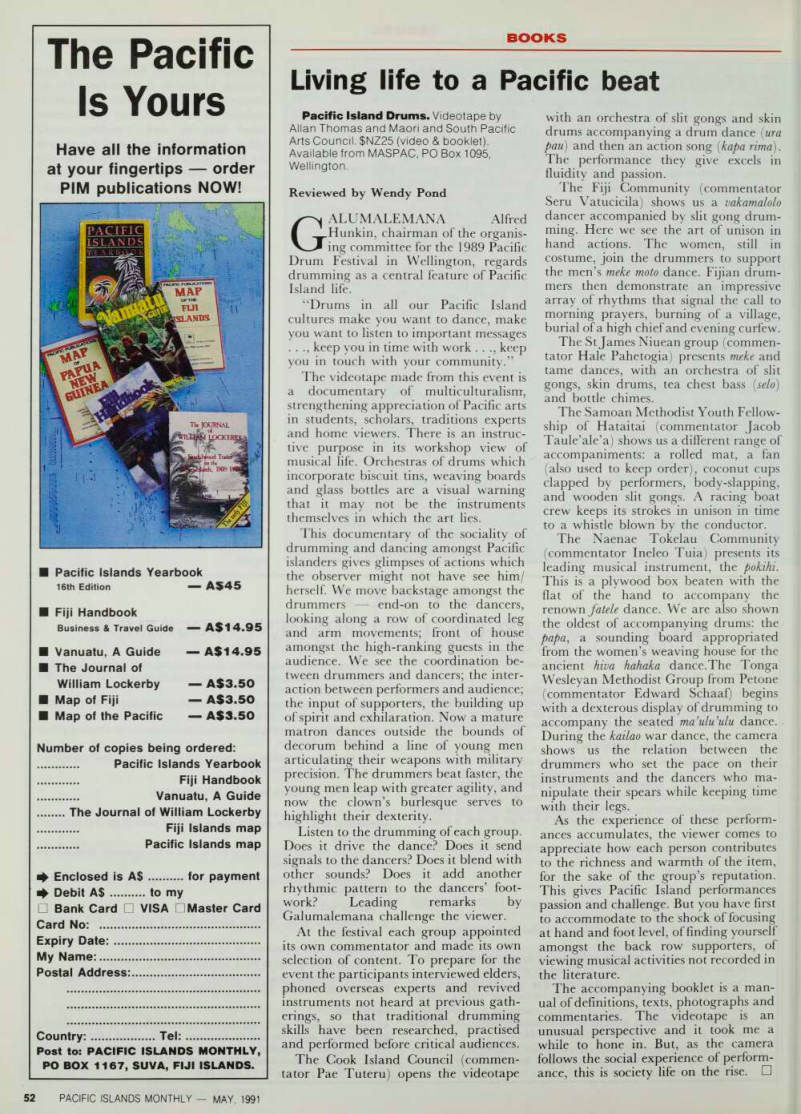
Books
Living life to a Pacific beat
Pacific Island Drums. Videotape by Allan Thomas and Maori and South Pacific Arts Council. SNZ2S (video & booklet).
Available from MASPAC, PO Box 1095, Wellington.
Reviewed by Wendy Pond
Galumalemana Alfred
Hunkin, chairman of the organis ing committee for the 1989 Pacific Drum Festival in Wellington, regards drumming as a central feature of Pacific Island life.
“Drums in all our Pacific Island cultures make you want to dance, make you want to listen to important messages . . keep you in time with work . . keep you in touch with your community.”
The videotape made from this event is a documentary of multiculturalism, strengthening appreciation of Pacific arts in students, scholars, traditions experts and home viewers. There is an instruc tive purpose in its workshop view of musical life. Orchestras of drums which incorporate biscuit tins, weaving boards and glass bottles are a visual warning that it may not be the instruments themselves in which the art lies.
This documentary of the sociality of drumming and dancing amongst Pacific islanders gives glimpses of actions which the observer might not have see him/ herself. We move backstage amongst the drummers end-on to the dancers, looking along a row of coordinated leg and arm movements; front of house amongst the high-ranking guests in the audience. We see the coordination be tween drummers and dancers; the inter action between performers and audience; the input of supporters, the building up of spirit and exhilaration. Now a mature matron dances outside the bounds of decorum behind a line of young men articulating their weapons with military precision. The drummers beat faster, the young men leap with greater agility, and now the clown’s burlesque serves to highlight their dexterity.
Listen to the drumming of each group.
Does it drive the dance? Does it send signals to the dancers? Does it blend with other sounds? Does it add another rhythmic pattern to the dancers’ foot work? Leading remarks by Galumalemana challenge the viewer.
At the festival each group appointed its own commentator and made its own selection of content. To prepare for the event the participants interviewed elders, phoned overseas experts and revived instruments not heard at previous gath erings, so that traditional drumming skills have been researched, practised and performed before critical audiences.
The Cook Island Council (commen tator Pae Tuteru) opens the videotape
with an orchestra of slit gongs and skin drums accompanying a drum dance ( ura pan) and then an action song [kapa rima).
The performance they give excels in
fluidity and passion.
The Fiji Community (commentator
Seru Vatucicila) shows us a vakamalolo dancer accompanied by slit gong drum ming. Here we see the art of unison in hand actions. The women, still in costume, join the drummers to support the men’s meke moto dance. Fijian drum mers then demonstrate an impressive array of rhythms that signal the call to
morning prayers, burning of a village,
burial of a high chief and evening curfew.
The St James Niuean group (commen tator Hale Pahetogia) presents meke and tame dances, with an orchestra of slit gongs, skin drums, tea chest bass ( selo ) and bottle chimes.
The Samoan Methodist Youth Fellow
ship of Hataitai (commentator Jacob
Taule’ale’a) shows us a different range of accompaniments: a rolled mat, a fan (also used to keep order), coconut cups
clapped by performers, body-slapping,
and wooden slit gongs. A racing boat crew keeps its strokes in unison in time to a whistle blown by the conductor.
The Naenae Tokelau Community (commentator Ineleo Tuia) presents its leading musical instrument, the pokihi.
This is a plywood box beaten with the flat of the hand to accompany the renown fatele dance. We are also shown the oldest of accompanying drums: the
papa , a sounding board appropriated
from the women’s weaving house for the ancient hiva hahaka dance. The Tonga Wesleyan Methodist Group from Petone
(commentator Edward Schaaf) begins
with a dexterous display of drumming to accompany the seated ma’ulu’ulu dance.
During the kailao war dance, the camera shows us the relation between the drummers who set the pace on their instruments and the dancers who ma nipulate their spears while keeping time with their legs.
As the experience of these perform ances accumulates, the viewer comes to appreciate how each person contributes to the richness and warmth of the item, for the sake of the group’s reputation.
This gives Pacific Island performances passion and challenge. But you have first to accommodate to the shock of focusing at hand and foot level, of finding yourself amongst the back row supporters, of viewing musical activities not recorded in the literature.
The accompanying booklet is a man ual of definitions, texts, photographs and commentaries. The videotape is an unusual perspective and it took me a while to hone in. But, as the camera follows the social experience of perform ance, this is society life on the rise. □
Wakening the Maori dreams
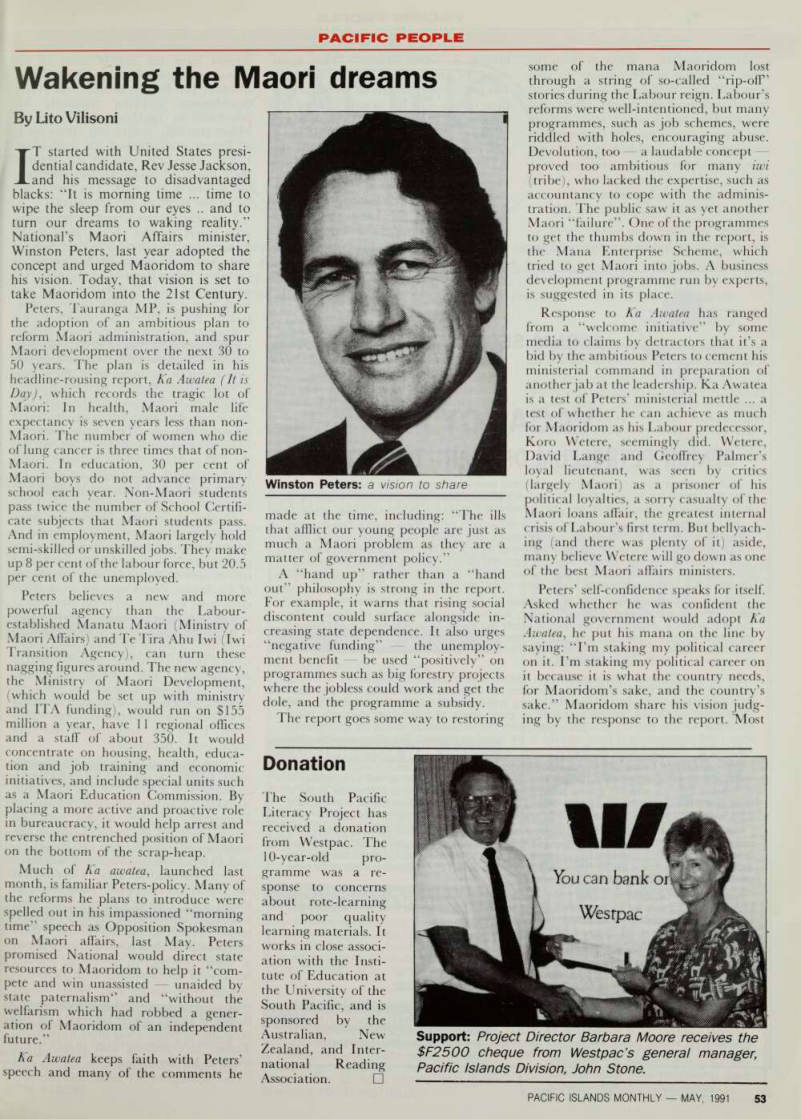
Pacific People
By Lito Vilisoni
IT started with United States presi dential candidate, Rev Jesse Jackson, and his message to disadvantaged blacks; “It is morning time ... time to wipe the sleep from our eyes .. and to turn our dreams to waking reality.”
National’s Maori Affairs minister, Winston Peters, last year adopted the concept and urged Maoridom to share his vision. Today, that vision is set to take Maoridom into the 21st Century.
Peters, Tauranga MP, is pushing for the adoption of an ambitious plan to reform Maori administration, and spur Maori development over the next 30 to 50 years. The plan is detailed in his headline-rousing report, Ka Awatea (It is Day), which records the tragic lot of Maori: In health, Maori male life expectancy is seven years less than non- Maori. The number of women who die of lung cancer is three times that of non- Maori. In education, 30 per cent of Maori boys do not advance primary school each year. Non-Maori students pass twice the number of School Certifi cate subjects that Maori students pass.
And in employment, Maori largely hold semi-skilled or unskilled jobs. They make up 8 per cent of the labour force, but 20.5 per cent of the unemployed.
Peters believes a new and more powerful agency than the Labour established Manatu Maori (Ministry of Maori Affairs) and Te Tira Ahu Iwi (Iwi Transition Agency), can turn these nagging figures around. The new agency, the Ministry of Maori Development, (which would be set up with ministry and ITA funding), would run on $155 million a year, have 11 regional offices and a staff of about 350. It would concentrate on housing, health, educa tion and job training and economic initiatives, and include special units such as a Maori Education Commission. By placing a more active and proactive role in bureaucracy, it would help arrest and reverse the entrenched position of Maori on the bottom of the scrap-heap.
Much of Ka awatea , launched last month, is familiar Peters-policy. Many of the reforms he plans to introduce were spelled out in his impassioned “morning time” speech as Opposition Spokesman on Maori affairs, last May. Peters promised National would direct state resources to Maoridom to help it “com pete and win unassisted unaided by state paternalism 0 and “without the welfarism which had robbed a gener ation of Maoridom of an independent future.”
Ka Awatea keeps faith with Peters’ speech and many of the comments he
made at the time, including: “The ills that afflict our young people are just as much a Maori problem as they are a matter of government policy.”
A “hand up” rather than a “hand out” philosophy is strong in the report.
For example, it warns that rising social discontent could surface alongside in creasing state dependence. It also urges
“negative funding” the unemploy
ment benefit be used “positively” on
programmes such as big forestry projects
where the jobless could work and get the dole, and the programme a subsidy.
The report goes some way to restoring
some of the mana Maoridom lost through a string of so-called “rip-off” stories during the Labour reign. Labour’s reforms were well-intentioned, but many programmes, such as job schemes, were riddled with holes, encouraging abuse.
Devolution, too a laudable concept proved too ambitious for many iwi (tribe), who lacked the expertise, such as accountancy to cope with the adminis tration. The public saw it as yet another Maori “failure”. One of the programmes to get the thumbs down in the report, is the Mana Enterprise Scheme, which tried to get Maori into jobs. A business development programme run by experts, is suggested in its place.
Response to Ka Awatea has ranged from a “welcome initiative” by some media to claims by detractors that it’s a bid by the ambitious Peters to cement his ministerial command in preparation of another jab at the leadership. Ka Awatea is a test of Peters’ ministerial mettle ... a test of whether he can achieve as much for Maoridom as his Labour predecessor, Koro Wetere, seemingly did. Wetere, David Lange and Geoffrey Palmer’s loyal lieutenant, was seen by critics (largely Maori) as a prisoner of his political loyalties, a sorry casualty of the Maori loans affair, the greatest internal crisis of Labour’s first term. But bellyach ing (and there was plenty of it) aside, many believe Wetere will go down as one of the best Maori affairs ministers.
Peters’ self-confidence speaks for itself.
Asked whether he was confident the National government would adopt Ka Awatea , he put his mana on the line by saying: “I’m staking my political career on it. I’m staking my political career on it because it is what the country needs, for Maoridom’s sake, and the country’s sake.” Maoridom share his vision judg ing by the response to the report. "Most
Winston Peters: a vision to share
of the 250 leaders many of them the most influential in the country who were called to Wellington for the grand launch, endorsed the report, albeit cau tiously. Two said it was a start, a third had reservations about the future role of iwi, and a fourth paid homage to Peters: “He’s one of the bravest politicians since Ngata ... He will stick his neck out for Maoridom.” (The legendary Ngata was one of the country’s first Maori MP’s.) Peters’ courage has never been in doubt, even to Maori activists who see
him as a “white Maori”. What many want to know is if he can turn the 100-page report and its 68 recommenda tions from a wish list to policy. They also want to see if Ka Awatea can push Maori interests centre stage as national inter ests. But the big question for many is, has Peters the political skills and standing with his colleagues to pull it off?
Most of Peters’ colleagues see him as self-serving, but he’s not without allies.
One of his staunchest is former prime minister, Sir Rob Muldoon. But Peters
doesn’t have the ear of most of his colleagues, especially that of Kiwi Prime
Minister Jim Bolger. Bolger finds Peters
troublesome, disliking especially his
penchant for speaking outside of his Maori portfolio. Bolger and others see it as Peters undermining his leadership.
Peters, who rates well in the opinion polls, has tilted his hat at the leadership, but is fond of quipping “I’m happy just being the member for Tauranga.”
Last year, Bolger demoted the media sexy Peters for the second time in 13 months after his decidedly risky behav iour during the hustle for Kiwi votes in October. Peters questioned the party’s 0 - 2 per cent by 1993 inflation target one week into a very wobbly election cam paign. Soon after, he criticised his
colleagues election performances, includ
ing Bolger’s and was silenced only with threats of exclusion from Cabinet. Peters won a seat in the inner circle (he’s gone from number eight to 17) despite Bolger’s misgivings, largely because the latter had no choice. As Peters later said, he was a must for the job. Many in mainstream Maoridom wanted Bolger, but having the PM as Maori Affairs minister would have signalled a stronger support for Maori issues than National was perhaps prepared to commit itself to at that stage.
In the six months Peters has been Maori Affairs minister, he’s continued to be outspoken and at times critical of the government. But last month, he scored one of his biggest coups with the release of Ka Awatea. Peters won the scorn of his colleagues when he delivered the radical report to Cabinet only after he had sold it to Maoridom. He then proceeded to treat the document as government policy despite Bolger’s coolness, and dismissal of Ka Awatea as just another ministerial report, and the opinion of only its authors. When he was accused of trying to stitch up the Government Peters said: “Am I to be condemned for my
openhanded democracy?”
Peters seeming disloyalty has encour aged some to think he’ll become a casualty. Yet, many believe he’s got what it takes to be an effective leader for Maoridom. As he showed with Ka Awatea, he’s got the skills to survive the rumble and tumble. For, as Bolger and Peters know, National will have to tread carefully to avoid a backlash if the report isn’t adopted. Maoridom, in limbo since Labour’s demise, has been waiting a government show of commit ment. The relationship could prove troubled if Ka Awatea is dumped without a sound reason or, as some believe, because of the hostilities with Peters.
Last year, critics said Peters would make a poor minister because he wasn’t fluent in Maori. Peters retorted that the language of politics was more important.
Today, he’s proving that there’s some truth in his argument. □
Donation
The South Pacific Literacy Project has received a donation from Westpac. The 10-year-old pro gramme was a re sponse to concerns
about rote-learning
and poor quality learning materials. It works in close associ ation with the Insti tute of Education at the University of the South Pacific, and is sponsored by the Australian, New Zealand, and Inter
national Reading
Association. □
Support: Project Director Barbara Moore receives the $F2500 cheque from Westpac’s general manager , Pacific Islands Division , John Stone.
Advertisements & other items, pp. 54-56 (1 item)
Vacancy
FORUM SECRETARIAT
V
SENIOR PETROLEUM OFFICER - OPERATIONS
Applications are invited from suitably qualified and experienced persons, who must be citizens of a member state of the South Pacific Forum* for the position of Senior Petroleum Officer Operations, in the Regional Petroleum Unit of the Forum Secretariat.
The Forum Secretariat was established in 1973 by the South Pacific Forum to encourage economic and political cooperation between its member states, and between those states and the more industrialised countries. Under the control of a Secretary General, the Secretariat undertakes a regional work programme covering economic services, legal and political services and the energy, trade, transport and telecommunications sectors. The Secretariat also has significant responsibilities with regard to ACP/EC regional projects funded under Lome Conventions.
The Regional Petroleum Unit (RPU) was established to provide specialist assistance to member governments to improve existing petroleum supply and pricing arrangements on an on-going basis.
The RPU assists in ensuring that the costs of supply and marketing arrangements in and between member countries are minimised. It also aims at harmonising the relationship between Governments and the oil companies represented in the South Pacific region, and at reducing the dependence of governments on short term consultancies.
The duties of the Senior Petroleum Officer Operations will include, but not be limited to, working alongside the Senior Petroleum Officer Economics and Statistics, in establishing a comprehensive data base of petroleum supply and demand, pricing, operations, storage, shipping, etc in the islands.
Other duties will include, but not be limited to, giving advice on construction standards, island installation for both ground and aviation fuels quality control procedures and on the environmental impact and consequences of these activities in the island environment. The officer will work under the direction of the Manager, Regional petroleum Unit.
Applicants should have relevant tertiary qualifications in economics, science or engineering with a minimum of 5 years experience in the petroleum industry or a related field as well as experience in oil industry logistics, shipping and/or onshore operations. He/She must also have the ability to manage and relate to people from a wide range of backgrounds, to train Forum Island personnel, have good written and oral communications skills and be willing to travel throughout the region.
This appointment will carry an attractive remuneration package, payable in Fiji dollars. For non-Fiji citizens this is tax free and includes housing or housing allowance, education and child allowances.
Other benefits include superannuation payments and medical, life and travel insurance coverage. The appointee will be based at the Secretariat Headquarters in Suva, Fiji. Appointment would be for three years initially, renewable by mutual agreement.
Applications, which close on 30 May 1991, should contain full information of education and career background and should list names, addresses and telephone numbers of at least three referees with whom the applicant has been associated in a professional capacity.
Applications should be addressed to: The Secretary General Forum Secretariat GPO Box 856, Suva, Fiji Telephone: 312600 Telex: 2229FJ Fax: 302204/301102 Further information is available on request and all enquiries should be made to Mrs Lailun Khan, Administration Officer on 312600 Ext 219.
Member countries are of the South Pacific Forum: Australia, Cook Islands, Federated States of Micronesia, Fiji, Kiribati, Nauru, New Zealand, Niue, Papua New Guinea, Republic of Marshall Islands, Solomon Islands, Tonga, Tuvalu, Vanuatu and Western Samoa. m089v3
ACIFI
ISLANDS
I MON T H L
MflRKCT PLRC
For the benefit of our readers who would like to place a small classified advertisement in our magazine, Market Place will assist you in selling personal items, accommodation, real estate, boating or a service ... in fact anything you would like to sell to our over 50,000 readers.
Market Place Advertising Rates are structured to allow you to place as many advertisements as you wish, economically.
SCRAP METAL
Good prices paid for your clean scrap Aluminium, Brass, Copper, Lead, etc. Contact Nonferral Pty. Ltd. 23 Davis Rd. Wetherill Park NSW 2164 Australia. Fax 61 2 604 1304 for prompt reply. Our Company is a long established and leading metals buyer and smelter. Telephone 61 2 604 8855.
SELF ADHESIVE LABELS
FORUM LABELS (FIJI) LTD
P.O. Box 1167, Suva., Fiji. Phone:3o4lll We print self-adhesive labels in rolls, multi-coloured labels with hot foil, and die cut to shape, tickets and tags in rolls. We also supply labelling machines and fabric labels.
CAREER
A pilot career? “Becoming a pilot in the 1990'5” has full details training, civil, air force, jobs, airlines, helicopter! Send NZ523.45 to aviation professionals, Box 28051, 6A Benson Rd, Remuera, Auckland, NZ. Phone/Fax (64-9) 5221330, Cheque, Visa, Bankcard.
MARINE DIESEL SPARES NE
Very large range for older Gardiner, Ruston- Hornsby, Mirrlees, Dorman, Paxman, Crossley, Perkins, Hercules, Meadows, Sulzer, English Electric, Southern Cross, Foden and more. Write for stockist:- K
COOMBER, P.O. Box 589, BURWOOD 2134
AUSTRALIA 61 2 736 2449
OPTICIANS AND OPTOMETRISTS
Spectacles, Contact Lenses, Sunglasses.
See JEKISHAN & JEKISHAN, Epworth House, G.P.O. Box 285, Suva, Fiji. Ph 311002 Fax (679) 411898.
DISTRIBUTOR WANTED
Manufacturer of Ball point pens and disposable Gas Lighters.
Please contact JNJ CORPORATION (FIJI) LTD, G.P.O. Box 285, Suva, Fiji. Ph 39400 Fax (679) 411898.
PACIFIC INVESTMENTS
Personal and corporate real estate marketing and acquisitions: estates, resorts, islands, business opportunities, ventures and adventures throughout the Pacific.
Contact: Karen Jeffery, PO Box 399, Kamuela, Hawaii, USA 96743 (808) 883-8000 or Fax: (808) 883-8838
RECONDITIONED VEHICLES
Reconditioned Vehicles, Tyres, Engines, Auto Parts, Machinery, Fruits, Spices, Garments or any other products from Japan, Australia, Taiwan, India, and Sri Lanka. Salaka Enterprises P.O. Box 1243. St. Kilda South, Viet. 3182, Australia. Fax: (613) 5372897
MAGAZINE
Philatelics/Penpals magazine being published in Fiji for worldwide distribution. For your names/addresses printed write for details to: The Editor, Box 6508, Nasinu, Fiji.
DISTRIBUTOR WANTED
Manufacturer of a line of spray aerosol products that speed production in the garment factory: Silicone Spray, Spot Lifter, Pattern Adhesive, Emery Sharpening Stone Wheel Cleaner, Fusing Machine Cleaner, etc.
Write Sprayway, Inc., Addison, IL
60101-4468, FAX 1 (708) 543-7797.
OVERSEAS FUNDING
Unlimited overseas funding for any National Government and private company’s viable projects. No front fees. Send proposal to Pan Asia Management Consultants Center Box 4295, BOROKO, NCD, Papua New Guinea.
CORRESPONDENCE
Sincere, eligible Australian gentlemen wish to correspond with Pacific ladies, all ages/ races. Free registration. For full details, please write to: ASIAPAC, PO BOX 231, Maylands 6052, AUSTRALIA.
COMMERCIAL PRINTING
Top quality four colour printing, brochures, posters, packaging, product labels, fabric labels, billboards, books, magazines, stickers, books. Export guali- -IContact Fiji’s most experienced Commercial Printers. FIJI TIMES COMMER- CIAL PRINTING, P.O. Box 1167, Suva. Fiji.
Phone: 304111 Fax. 301521.
[PACIFIC!
ISLANDS
I MON T H L T~l
MRRKCT PLACE CRN WORK
WONDERS FOR VOU ...
Promote your business, or service, sell your household items, cars or heavy machinery etc.
ONLY AUSSI PER WORD.
NO COMPANY LOGO. NO
DISPLAY. NO BOLD TYPE.
Just forward your Advertisement together with payment to: PACIFIC ISLANDS MONTHLY “Market Place”, P.O. Box 1167, Suva, Fiji.
CONDITIONS:
1. All Advertisements are subject to acceptance and approval of publisher. 2. Advertisements are published as space permits; we cannot guarantee date of insertion. 3. All advertisements must be prepaid and should be typod or printed clearly. 4. Deadline for receipt of advertisements is the 10th of the month prior to issue.
5. PACIFIC ISLANDS MONTHLY
assumes no responsibility for any service other than publishing paid advertisements in this section.
An Eye to Total Safety.
i “ R ■ ■ For Mitsubishi Motors both passive and active safety have equal importance, and rather than being added ingredients, are guide-lines that every component, system and stage of design must follow.
This approach to total safety involves exhaustive and innovative research methods, particularly into the physical reactions of motorists to various driving situations.
In designing the Galant, for example, Mitsubishi’s engineers mapped what drivers looked at while cornering. They found that drivers of some cars had much narrower fields of vision, indicating a high level of tension due to poor vehicle handling.
By comparison, their tests with the Galant and its integrated drive system, Dynamic-4 showed that with better handling, wider ¥ revision tracking shows how the Galant’s superior handling results in lower driver tension indicated by a wider field of vision. fields of vision indicated lower levels of tension in the driver.
Using advanced technology to define and attain safety standards is further evidence of Mitsubishi’s guiding principle of answering the needs and preferences of today’s drivers an on-going philosophy of putting technology to work for you.
MITSUBISHI GRLHNT
A
MITSUBISHI
MOTORS
SAMOA; PACIFIC MARKETING INC P.O. Box 698, Pago Pago, Tel. 699-9140/AUSTRALIA: MITSUBISHI MOTORS AUSTRALIA LTD. Box 1284 r South Road, Clovelly Park, South Australia 5042, Tel (08) 275-7297/ n-Ai iTrt n MOTOR & MACHINERY CO., LTD, G.P.O. Box 150, Suva, Tel. 383411 /FRENCH POLYNESIA (TAHITI);SOPADEPS.A. P.O. Box 1617, Papeete, Tahiti, Tel. 4-202-58/NEW CALEDONIA: SOCIETE DTMPORTATION P AUTO °u PACIFIQUE SUD S.A. B.P. 438 Rond Point du Pacifique, Noumea, Tel 274144/NEW ZEALAND: MITSUBISHI MOTORS NEW ZEALAND LTD. Private Bag, Porirua, Tel. 370-109/NORFOLK ISLAND: BORRYS TiS/inurl! 169'I 69 ' Norfoll< lsland ' Tel - 2114/PAPUA NEW GUINEA: TOBA PTY. LTD. P.O. Box 503, Port Moresby, Tel 21-7874/SOLOMON ISLANDS: HARVEST PACIFIC LTD. G.P.O. Box 823, Honiara, Guadalcanal, x 7 oJr? NGA: SITANI MA FI CO,, LTD. P.O. Box 83, Nuku’ALOFA, Tel. 24-044/VANUATU: SOCOMETRA B.P. 06 Route de Lagon, Port-Vila, Tel. 2314/WESTERN SAMOA: MOTOR DISTRIBUTORS LTD. P.O. Box 576, Apia, Tel. 20957/SAIPA . /POHNPEI/MAJURO/KOSRAE/TRUK/YAP/BELAU; MICRONESIAN MOTORS, INC. 997 South Marine Drive, Tamuning, Guam 96911, Tel. 646-6827