Pacific
Islands
Monthly
April 1991
The Region
LUlbOillb. the-
Tahiti
dfjd
Opinion
ďfgj
Media
dfgj
Focus
dfgj
i-'’ W * «-■
Jk m
Hk I si fe lr : yAMS ip : HSi||i3K H \. |§ig|g|| "' T s ~£X~£ja&. ?5-« JHSSB " ■ Wj I
American Samoa USS2.SO: Australia A 52.50; Cook Islands NZS3; Fiji F 51.75; FS Micronesia USS 3; Hawaii USS 3; Kiribati A 52.50; Nauru A 52.50; Niue NZS3; Norfolk AS3: New Caledonia cpf2so: New Zealand (incl GST) NZ53.45; Nth Marianas USS 3; Papua New Guinea K 3; Palau USS 3; Marshalls USS 3; Solomon Islands AS3; French Polynesia cpf3oo; Tonga P 3; USA USS 3; Vanuatu VT2OO; Western Samoa T 3.25. ‘Recommended retail price only
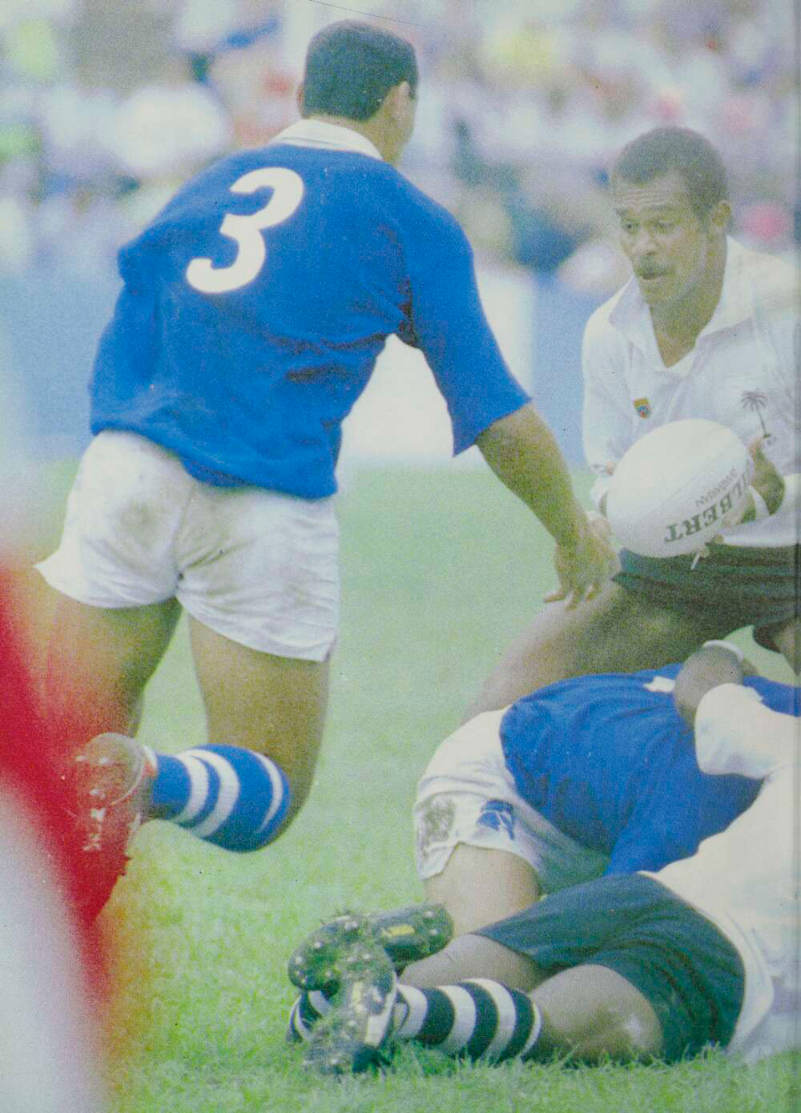
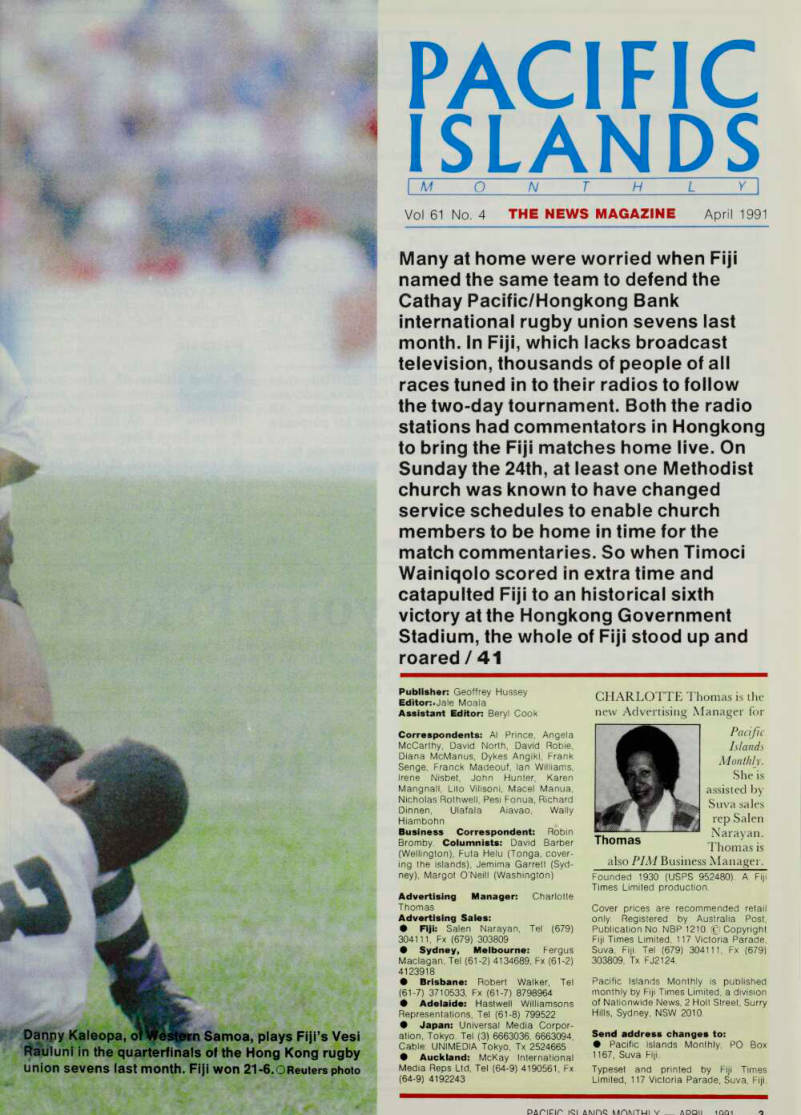
Danny Kaleopa, of Western Samoa, plays Fiji’s Vesi Rauluni in the quarterfinals of the Hong Kong rugby union sevens last month. Fiji won 21-6. Reuters photo
Pacific
Islands
Monthly
Vol 61 No, 4
The News Magazine
April 1991
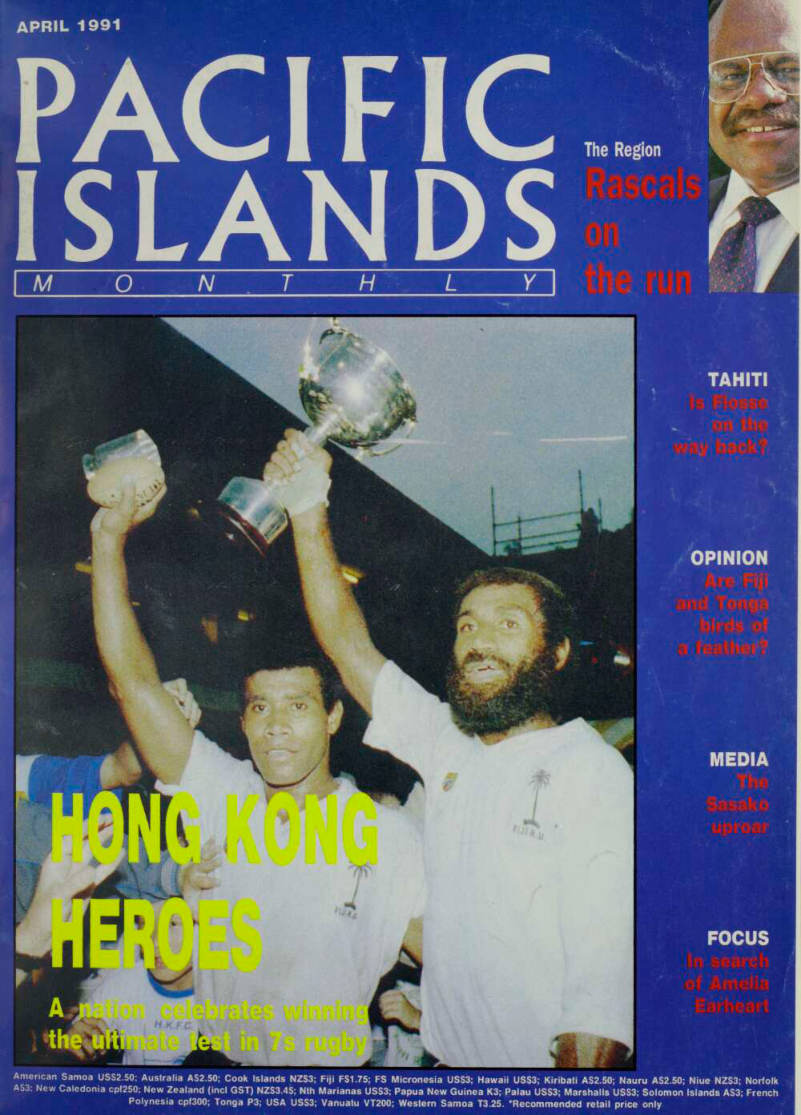
Many at home were worried when Fiji named the same team to defend the Cathay Pacific/Hongkong Bank international rugby union sevens last month. In Fiji, which lacks broadcast television, thousands of people of all races tuned in to their radios to follow the two-day tournament. Both the radio stations had commentators in Hongkong to bring the Fiji matches home live. On Sunday the 24th, at least one Methodist church was known to have changed service schedules to enable church members to be home in time for the match commentaries. So when Timoci Wainiqolo scored in extra time and catapulted Fiji to an historical sixth victory at the Hongkong Government Stadium, the whole of Fiji stood up and roared / 41
Publisher: Geoffrey Hussey Editor:. Jale Moala Assistant Editor: Beryl Cook Correspondents: Al Prince, Angela McCarthy, David North, David Robie, Diana McManus, Dykes Angiki, Frank Senge, Franck Madeouf, lan Williams, Irene Nisbet, John Hunter, Karen Mangnall, Lito Vilisoni, Macel Manua, Nicholas Rothwell, Pesi Fonua, Richard Dinnen, Ulafala Aiavao, Wally Hiambohn Business Correspondent: Robin Bromby. Columnists: David Barber (Wellington), Futa Helu (Tonga, cover ing the islands), Jemima Garrett (Syd ney), Margot O'Neill (Washington) Advertising Manager: Charlotte Thomas Advertising Sales: • Fiji: Salen Narayan, Tel (679) 304111, Fx (679) 303809 • Sydney, Melbourne: Fergus Maclagan, Tel (61-2) 4134689, Fx (61-2) 4123918 • Brisbane: Robert Walker, Tel (61-7) 3710533, Fx (61-7) 8798964 • Adelaide: Hastwell Williamsons Representations, Tel (61-8) 799522 • Japan: Universal Media Corpor ation, Tokyo. Tel (3) 6663036, 6663094, Cable; UNIMEDIA Tokyo, Tx 2524665 • Auckland: McKay International Media Reps Ltd, Tel (64-9) 4190561, Fx (64-9) 4192243
CHARLOTTE Thomas is the new Advertising Manager for
Pacific Islands Monthly.
She is assisted by Suva sales rep Salen Narayan.
Thomas is
also PIM Business Manager.
Founded 1930 (USPS 952480) A Fiji Times Limited production.
Cover prices are recommended retail only. Registered by Australia Post, Publication No. NBP 1210. (£} Copyright Fiji Times Limited, 117 Victoria Parade, Suva, Fiji. Tel (679) 304111, Fx (679)
303809, Tx Fj2124,
Pacific Islands Monthly is published monthly by Fiji Times Limited, a division of Nationwide News, 2 Holt Street, Surry Hills, Sydney, NSW 2010, Send address changes to: • Pacific Islands Monthly, PO Box 1167, Suva Fiji.
Typeset and printed by Fiji Times Limited, 117 Victoria Parade, Suva, Fiji,
Thomas
Advertisements & other items, p. 3 (1 item)
3
PAPIPir IQI AMnC MHMTUI V ADQII IQQI
Bougainville response
Letters
I REFER to David Robie’s article on the NFIP conference (PIM Dec 1990).
In the article, Mr Robie refers to the “Failure of the movement to squarely face the issues of Bougainville and Fiji in the past.” This was the only reference to Bougainville in his report. I find it difficult to understand that Mr Robie, a well-known supporter of Independence movements and the rights of Pacific people, failed to report on the NFIP resolutions passed at the conference which specifically refer to Bougainville, a copy of which I enclose.
Based on the conference’s observation of the situation the conference urged: “L That all government soldiers, policemen and naval patrol boats be removed from the military zone in Bougainville and outer islands. 2. That all official Government block ades be removed to allow food, medicine, and other services to return to Bougain ville and relief organisations be allowed access to the people of Bougainville. 3. That the second round of peace talks should resume as soon as possible. 4. That Australian and New Zealand
assistance be used only for peace pur poses.”
Mike Forster
Trade Spokesman Interim Government Republic of Bougainville
Philatelic Adviser
WE were delighted to see a reference to the assignment of Mr Piyasena Kulatilaka for the Government of Tu valu in the December 1990 issue of the Pacific Islands Monthly. We wish, however,
Letters To The Editor Must
include writer’s full name, address and home telephone number. All letters may be edited for purposes of clarity or space.
Letters should be addressed to: Pacific islands Monthly PO Box 1167 Suva Fiji islands OR Fax: (679) 303809
to point out that Mr Kulatilaka was assigned to the Government of Tuvalu as a Philatelic Marketing and Management Adviser by the Export Market Develop ment Division of the Commonwealth Fund for Technical Co-operation. We shall appreciate if in any future issue of your publication, a reference is made to this aspect appropriately. I enclose in this context, a copy of the “Guidelines to Technical Assistance Procedures for the
Export Market Development Pro
gramme”.
P.P. Kanthan
Assisi. Director, Export Market Development Div., Commonwealth Fund for Technical Co-operation
Penpals
• Allan Hillier, 37. Likes: travelling,
reading, short-story writing, swimming
and wildlife photography. Address: Box 188, Daw Park, SA 5041, Australia. • Kate Love Biney. Address: PO Box 1249, Cape Coast, Ghana, West Africa. • Francis Ewool, 21. Likes: Exchang ing gifts and photos. Address: PO Box 1142, Cape Coast, Ghana, West Africa. • Bernard Arthur, 18. Likes: Basket ball, going to movies, listening to music.
Address: PO Box 1282, Cape Coast, Ghana, West Africa.
Advertisements & other items, p. 4 (1 item)
dfgj
Remember your Friend
Tliere are times in your life when you feel your friends have been missing out on something good. Now’s your chance to do something about it and share with them one of the good things you have. Buy your friend a p tion to Pacific Islands Monthly and let him or her join you and the thousands of other people worldwide who are kept informed of the latest political, social and cultural changes taking place in the Pacific.
PACIFIC
SLANDS
1 ** O N T H I T~) Please send my friend Pacific Islands Monthly for one year (12 issues).
I enclose my cheque for $ (made payable to Pacific Islands Monthly) or debit $ to my; □ Bankcard □ Visacard □ Mastercard Card No: I 1 I I I I I I I I I I I I I I Expiry Date
NAME
SIGNATURE
MY FRIEND’S NAME
MY FRIEND’S ADDRESS
CITY COUNTRY
Wellington notes
David Barber
Perceptions a barrier for islanders overseas
“BECAUSE we share the same geographical environment, and because many Pacific Island people have made New Zealand their home, does not mean that, through some magical process of osmosis, New Zealand understands and knows the region.”
That comment, which tends to state what is obvious to those who take a close interest in New Zealand-Pacific relations, was made in the report of the former Labour government’s South Pacific policy review group, published last year.
A recent survey illustrated that the point is equally true for New Zealander’s perceptions of those people from the islands of the Pacific who have made this country their home.
Sadly, it showed that prejudices and stereotyping which hinder the progress and development of an estimated 135,00-160,000 Pacific people in New Zealand continue to exist.
The survey was conducted by the Pacific Island Employment Development Board, an organisation established, according to its mission statement, to provide island people “with increased opportunities to attain autonomy, self determination and economic security”.
It is clear that a key route to this aim is a substantial increase in the number of Pacific people actively participating in the New Zealand economy. It was equally clear to the board that there were certain barriers to the entry of those people into the business community. The survey was conducted to try to identify those barriers.
The results came as something of a shock to the board.
They revealed that while Chinese and Indian immigrants were widely perceived as being good business people, those who had come from the islands of the Pacific were regarded as being “too laid back ... too happy-go-lucky”, or “not on the ball.”
And this, despite the evidence of many Pacific Island people who have succeeded in business in their adopted country. As Pacific Island Affairs Minister Bill Birch has said: “For many years now the Pacific Island communities in New Zealand have contributed greatly, as with other communities, to the economic and social development of this country.”
Some people who responded to the survey said they wouldn’t go into a shop run by Pacific Island people because they thought it would be badly managed.
Others said they wouldn’t buy anything from a food shop run by Pacific people because they thought what they sold wouldn’t be fit to eat.
As Birch said: “It is certainly wrong to think that anyone from one cultural group has more or less business acumen than another. Furthermore, with many Pacific Island business role models that we have in this country, such a belief could not be further away from the truth.”
One problem is the apparent unwillingness of banks and other financial institutions to lend capital to Pacific Island
Wellington notes
business people. One told the survey: “I can tell they are not interested as soon as they see me walking through the door.”
The board commissioned the survey to find out exactly what it is up against in trying to change these negative attitudes. It deduced that it had a dual dilemma, based around the central fact that there is simply no traditional pattern of Pacific Island people in business. It is certainly true that the people who developed trade and commerce in the
islands were predominantly European.
So, on the one hand, Europeans are not accustomed to dealing with people of the Pacific in a business situation, and on the other, Pacific people do not see themselves as having commercial savvy or expertise.
Thus, there is a need not only to change New Zealander’s negative attitudes, but to change the island people’s perceptions of themselves.
Since its establishment in 1985, the Pacific Island Employment Development Board has advanced loans totalling more than S 5 million to 140 enterprises founded or being expanded by Pacific Island people. It is a credit to the board’s cautiousness and insistence on closely monitoring the use of its loan money that only a handful of these projects have failed.
But the board acknowledges that there is much more to be done to achieve its aim of developing a strong economic base for Pacific Island people in New Zealand. So it is now moving towards a more pro-active position in which it will develop its own business projects, get them up and running and then hand them over to approved people.
The first of these is now being planned, and it will use some of the lessons learned in the business survey. Details are still under wraps, but it will be a small retail chain of three shops in the Auckland area.
The board has looked at how to overcome the perceived lack of professionalism that came through in the survey Results.
One solution is to make it a franchise operation so that the products sold and the staff training are of a clearly defined, consistent standard. The staff will wear uniforms and the shops will be decorated in the same way; they will pool advertising and distribution costs.
These are tactics tried and tested by major international chains like McDonald’s and Kentucky Fried Chicken.
Significantly, the shops will not be directed solely at Pacific Island customers, but will aim at having wide appeal to all New Zealanders.
It is a brave experiment, devised to get a handful of Pacific Island business people looking visibly successful in a non ethnic environment, in the hope that this will help change
public attitudes.
The board is also stepping up ancillary activities such as business workshops and skills training. It is actively promoting the 700 different scholarships and grants that are available to young Pacific people every year, showing them by means of a glossy magazine called Achievers that youngsters just like them can succeed in a wide range of fields.
Api Rongo-Raea, a Cook Islander who heads the Ministry of Pacific Island Affairs, says education must be the main vehicle for the economic development of the people for whom he has responsibility.
It is only education, he says, that can make Pacific people “smarter” and give them the confidence they need to deal with a system that is inherently alien.
“The more a Pacific Island person knows about the system and knows his way around it, the less likely he or she is to suffer discrimination.” □
Margot Oneill
Civility creeps into US relations with NZ
THE White House press corps was momentarily bewildered.
Their rapid fire questioning on the Persian Gulfcrisis paused as President George Bush pondered the role of a little known former US ally which had swung behind Washington’s war effort New Zealand.
It was the second time that New Zealand, which became the darling of the left-wing when it banned nuclear warships in 1984, had supported American military intervention since its acrimonious rift with Washington.
Previously it backed the controversial 1989 US invasion of Panama. Several months later, New Zealand’s then Foreign Minister Mike Moore was given a face to face meeting with Secretary of State, James Baker, ending a diplomatic embargo.
This time George Bush accepted a phone call from NZ Prime Minister Jim Bolger who hoorayed the US-led military victory against Iraq the first such personal contact between the W hite House and the Bee Hive in seven years.
The conservative Government in Wellington had been “very supportive of the (anti-Iraq) coalition,” Mr Bush told the White House press conference, “and we’re not going to forget that. We’re very pleased with that”.
W r hile vital differences of opinion remained over New Zealand’s anti-nuclear ships policy the “American people have never waivered in their affection for the people of New Zealand.” (This was also a favourite theme regarding Iraq the US never had an argument with the people of Iraq, Mr Bush often said.) Now the governments are learning to be nice to each other again. Gone is the bitterness and anger which characterised Washington’s outlook when David Lange dominated
Wellington.
At a recent congressional hearing, US administration officials said they hopeed that the Gulf war would make New Zealanders realise that security alliances were more important then anti-nuclear legislation. They said they were “hopeful” that the legislation would be.
“We don’t know to what degree these developments and New Zealand’s contribution to the Gulf... have led to a change in direction helpful to collective security within New Zealand,” said Richard Solomon, the assistant Secretary of State. “But we note in a number of countries in the region, Japan for example, there has been remarkable evolution of public opinion during the Gulf conflict,” Mr Solomon said.
“We do see the new (Bolger) government trying to undertake certain efforts to work with the New Zealand public to emphasis the value and importance to New Zealand of collective security.”
New Zealand’s new Ambassador to Washington, Denis McLean, has also sounded more upbeat about relations. He has said that he believes some kind of compromise can be found and that New Zealand must seize the initiative.
“Ifyou look at the Pacific in those terms (ofcompeting
Washington
nationalism and regional imbalances) you realise it is not all that much different from the Gulf. There are forces there (in the Pacific region) that could get out of control,” Mr McLean has said.
But lest you begin to imagine a racing trans-Pacific heartbeat, senior US officials say they do not foresee a substantial improvement in relations unless New Zealand reverses its anti-nuclear stance.
The stakes are still the same for Washington. If it accommodates Wellington’s independent defence posture, then it believes it will face similar demands from other more important NATO allies which have “gone mushy” on nuclear deterrence, as one western diplomat put it.
And the conservative government in New Zealand remains officially committed to the policy. Prime Minister Bolger recently said US warships would be welcomed at the 50th birthday of the New Zealand Navy as long as the ships were not nuclear.
The new buzzword is “civility.” Even though the two nations had maintained close co-operation on a range of non security issues including drift-net fishing and trade, Government ministers at all levels can now talk to each other.
New Zealand no longer endures a parish status in Washington a status some New Zealand officials had complained gave them less access than some of the world’s most notorious dictators.
The same year that the United States cut offits security ties with New Zealand, CIA officials were meeting secretly with Saddam Hussein’s government to provide it with classified intelligence to help it in its war against Iran.
Many Asian nations with less than democratic governments enjoy more privileges with the American military than New Zealand.
Not surprisingly, resentments are still harboured on both sides. Some American officials have been heard to complain that the Moore-Baker meeting last year had been badly handled, allowing New Zealand’s then Labour Government to claim a dramatic breakthrough which the Americans
quickly denied.
Former Prime Minister David Lange lashed out at Mr Bolger for his telephone call to George Bush, saying it should have been reverse charges and predicting that the new government would “ooze back” into accepting nuclear weapons.
Mr Lange also harangued Wellington’s new ambassador in Washington who had been his former defence secretary.
Mr McLean’s appointment was a signal that New Zealand is “determined to do everything it can to win favour with the United States,” Mr Lange said.
“Denis McLean will be the highest paid shoeshine boy in the world.”
The irony is that while New Zealand pines to improve its security relationship with the United States, the two nations have a better trade relationship than Australia, which remains a close American military ally.
Recently another Australian trade delegation trekked to Washington pleading for better treatment and warning that continuing export subsidies to American farmers w ere hurting Australian farmers. At the same time a New Zealand diplomat in Washington said his nation’s trade relations with Washington were “excellent”. □
the islands
Futa Helu
A run on constitutions
EVENTS in Tonga over the last few weeks seem to show that the government of that country has been converted to the belief, now common in the Pacific, that there is a cure-all for worrisome political snags, viz tinkering with the existing constitutions. But there is a broad variation in the aims, methods, and extent to which different island states manipulate basic law.
Governor Coleman, of American Samoa (Samoan America?), has recently announced his desire to have their constitution revised, a document he helped draft some 30 or so years ago. No very clear reasons were articulated as to this desire but it might be linked to the present debacle over aid money earmarked for the construction of indoor sports and all-purpose halls, but were re-designated in Pago for different purposes. It may also be a sign of some unconscious urge to change. Yet although the details of such constitutional revision cannot now be determined, we can be sure of two things. It cannot provide fora more self-determining community since the American Samoans are one of the few peoples I know who are happy that they are not self governing. And they have a point which is brought home now, quite insistently, by the situation in teeny-weeny Pacific states whose independence can only be fully understood in terms of the extent of their economic dependency. The other certainty is further entrenchment of the mickey mouse aspect of American culture in the South Seas.
The vagaries of constitution in the Trust Territories (or is there only one?) are both common knowledge and quite notorious. Here we have a unique example of two nations carrying out a tug-of-war on the same governing charter, though they are vastly different in size and power, like a gigantic cat contending with a frail and diminutive mouse.
From 1979 onwards the people of the T.T. have endeavoured to erect constitutional foundations for their sovereignty and statehood. At the same time the US, employing every means in her hands referenda, compact of associations, treaty, anti-judiciary politics— has tried to hang on to power and influence in the Micronesian archipelagos.
The most famous cases, however, of availing governments with the constitutional therapy either to consolidate “political advantages” gained through exercise offeree or simply to pull government out of a very awkward tight spot have transpired in Fiji and Tonga. In both instances the ultimate aim is the maintenance of a group hegemony over the hoi polloi, though manifestly, the programmes were contrived in different ways. In the case of Fiji, a constitution based on race considerations was promulgated essentially, it seems, to prevent a coming together of different racial segments of the population on the basis of class. It is therefore a constitution that is inherently hostile to social integration, the most logical and trouble-free approach to the problems of a multiracial society such as Fiji. This is all the more
the islands
important because the fate of the new constitution will depend largely on the numerical behaviour of the populations of different races of Fiji.
As for Tonga, changes to her constitution were effected by a special parliamentary session in February this year.
According to the Minister ofjustice, the special session was called to implement the changes and pass new legislation to legitimise the naturalisation 0f426 orientals (Hong Kongese, Taiwanese, Filipinos, etc.) who had bought Naturalisation passports a few years back but on an unconstitutional basis.
He also stated that government was.being impelled by “humanitarian reasons” emphasising that the Hong Kongese would be stateless if Tonga did not lend a helping hand, though nothing was said about the other orientals.
But the special session was still suspect because the case of the illegal passport sales — the matter had been taken to court by People’s Representative ’Akilisi Pohiva was to be heard on the Friday of the very week the special session was sitting.
In fact, the new legislation which repealed the constitution clauses that clashed with the sales was passed on Wednesday and became law through Royal assent by signature on Thursday. People questioned the real motives for pushing the changes at such a breakneck speed. And their most immediate result was; those responsible (a noble and a Minister of the crown, among them) for years of illegal sales got away scot free in the nick of time! The people showed their disapproval by marching down in strength to the palace office and deposited two petitions there, one to repeal the new laws and one to dismiss the Minister of Police from office.
Now, just a few days ago the Japanese multinational Yazaki corporation announced it has chosen Western Samoa as the site for its island operations primarily because of Western Samoa’s political stability, though the spokesman averred, both Tonga and Fiji had tried to woo the company. It is amazing how quickly people perceive Fiji and Tonga as birds of a feather only because they both tampered with their constitutions in such outlandish fashion, to say the least. Still Samoa may be just a latecomer, that she is just a little bit down the road. Be that as it may, the opening promises heaps for Samoa’s economy. She must maintain the image and make hay while the sun shines. But what comes out in all this is that constitutional manipulation is the favourite stick with which to whip obstinate political problems. Consider the cases Tonga, Fiji, US versus Micronesia, American Samoan (perhaps changes involving governor’s powers), both Western Samoa and Papua New Guinea are ripe for it, etc different ways to skin a cat. Chacun a son gout.
The idea of constitutional adaptation as the panacea for political bottlenecks is not without cultural ancestry in the South Seas. Respect for, and even awe of, the law have always been high. In Samoa, for instance, the most revered professions have traditionally been law and the clergy. This custom has resulted in a lot of self-hate on the part of children who fail to measure up to these parental standards. And above law, of course, stand the constitutions with even more fetish attach to them. The recent events in Fiji and Tonga indicate there is something even more fundamental than basic law and this something is: the will of the strong. But the will of the strong can only be made good if the variety and clash of interests between the social groups are neutralised, that is, if society becomes “classless”. Otherwise law will always settle down to what it really is: an expression of the balance offerees in the community. □
Jemima Garret
Facing the future after the War
FEARS that the world’s preoccupation with the Gulf War and its aftermath might relegate the Pacific to a forgotten backwater are likely to be unfoundered. In fact, in almost every way, the Pacific has come out of the conflict more easily than other regions and nations.
Developing countries which export labour to the middle east: the Phillipines, Sri Lanka, India and Bangladesh for instance, have remittances. The thousands of refugees who returned home after the invasion of Kuwait were forced to leave behind all their assets. Many more remained in Iraq and Kuwait. \\ hile those in Kuwait may have some hope of taking part in the massive post-war reconstruction programme, those in Iraq continue to face a bleak future. Others likely to suffer the effects of the war in silence are those in famine striken
countries in Africa. While the world’s media attention has been focussing on the Gulf another catastrophe has been growing in
Ethiopia, Eritirea
and other countries in sub- Saharan Africa.
Those in the west who usually put their hands in their pockets are
suffering from
what aid agencies
call compassion
fatigue. Many
countries’ emergency aid funds, usually kept for this sort of problem, have been used on
refugees from
Iraq. Australia committed more than a AS4 million from its emergency relief fund. By contrast, life in the South Pacific is quiet and comfortable.
Innocent men and women and children have not lost their lives or experienced the
the austra
unprecedented bombing seen in Iraq. And the South Pacific has not lost any of its aid funding. Nor is it likely to, according to Australian aid officials.
In fact, despite the preoccupation with the Gulf, the United States has demonstrated its continuing firm commitment to expanding its links with the Pacific. During a swing through the region last month, a senior State Department official, Jon Huntsman, said Washington wants to see its Joint Commercial Commission (announced by President Bush at the US/Pacific Summit last year) running as soon as possible.
VV hile at this stage details of how the Commission will function are yet to be worked out, it is clear the initiative holds the potential to boost trade and investment and significantly raise the profile of the Pacific Islands with officials in the US capital.
In fact, trade is another area in which the Pacific has emerged from the Gulf War relatively unscathed. For countries which had big markets in Iraq the war has been a disaster. For some, like Sri Lanka, which sold a fifth of its major export tea to Iraq, lost trade came on top of other Gulf-induced economic problems.
For others, like Australia, the United States’ decision to sell subsidised wheat to nations suffering from Gulf War fallout has exacerbated difficulties in an industry already suffering from the loss of key contracts in Iraq and from earlier US subsidy schemes which lowered international prices.
For the Pacific Islands the challenge is not to find its place in the New World Order that is already secure. The challenge is to make the most of economic initiatives such as Wasington’s Joint Commercial Commission. Low prices for agricultural products, increasing competition in manufacturing and the push by crucial neighbours like Australia and New Zealand to lower their tariffs are all going to have far more impact in the long term that the Gulfwar.
A case in point is the industry statement, announced by Australia’s Prime Minister, Bob Hawke. Many Pacific island countries have launched now flourishing garment manufacturing industries under the protection of SPARTECA, a preferential trade agreement with Australia and New Zealand which gives almost free access to those markets.
Although it has been known for some time that Australia’s efforts to wind back its huge tariff barriers would diminish the gains to be made from SPARTECA, the industry statement has accelerated that process. From March 1992, quotas on the entry of textiles, clothing and footwear will be abolished three years earlier than originally planned.
In addition, tarrifs will be progressively reduced. By the year 2000 import duty on textiles will drop from the current 55 per cent to 25 per cent and on footwear from 45 per cent to 15 per cent. At the moment, island garment manufacturers enjoy their own special quotas and almost duty free access to Australia. Almost half of Fiji’s garment exports, now worth just under FSI6O million a year, come to Australia. The story is the same for other island nations launching into garment export for the first time.
Once the quota and tarrifcuts take effect the advantages now conferred by SPARTECA will be severely reduced. New markets in Australia and outside, new quality products able to resist competition and more cost effective production will be needed to cushion the blow. The changes should also prompt island nations to diversify. With similar tariff reductions foreshadowed in New Zealand, the economic road ahead will not be easy. □
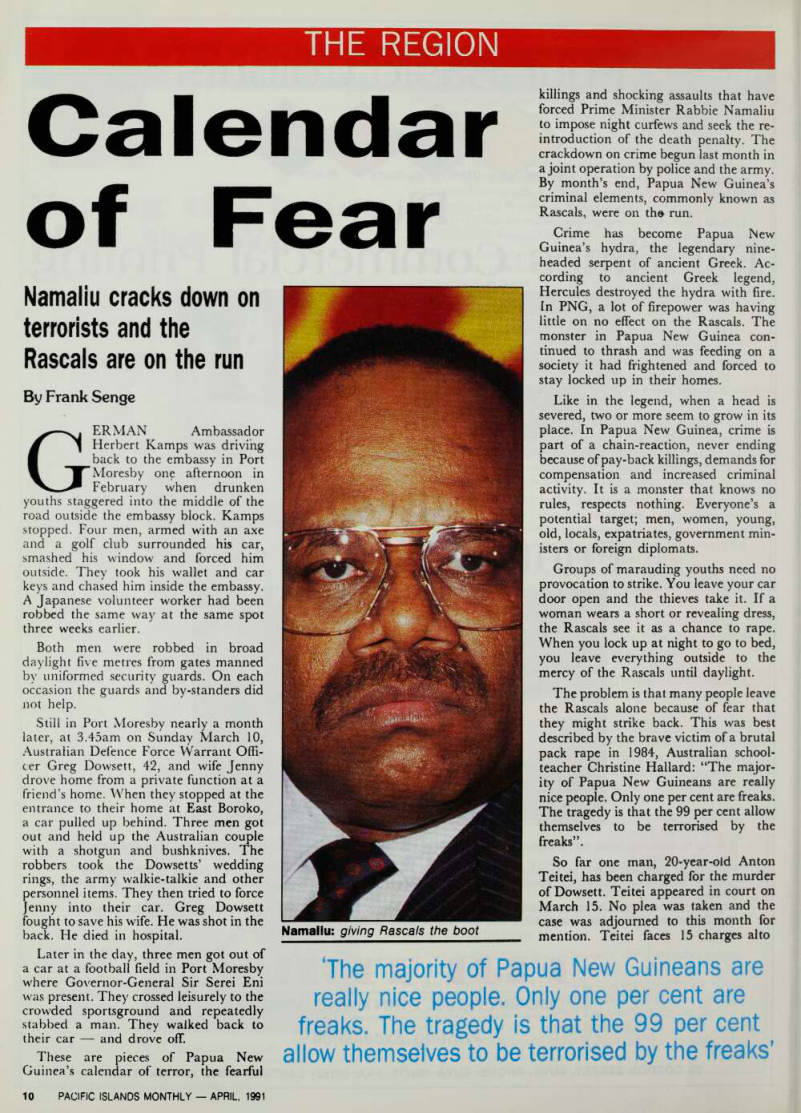
Australian Embassy Bob Hawke: new trade rules
Advertisements & other items, p. 9 (1 item)
Printing Excellence
Four Basic Colours
YELLOW CYAN BLACK
Plus
Fiji Times Commercial Printing
LTTHROne
am 111
Equals
Printing Excellence
A ' It is quite amazing what our experienced master printers, with the latest in printing technology, can produce from four basic colours.
Full colour packaging and food labels that look good enough to eat; award winning full colour brochures and posters; magazines, calendars, books, stickers, fabric labels and billboards with pictures that leap right out of the printed pages. y^rP roduct export-quality, high impact four colour printing, then you should be talking to us first.
You II find our prices very competitive and our paper stock quite extensive.
FIJI TIMES
COMMERCIAL PRINTING DIVISION
Printing Excellence
20 GORDON STREET, SUVA. PHONE: SUVA 304111. FAX: 301521 LAUTOKA 60352. LABASA 81644.
GERMAN Ambassador
The Region
Calendar of Fear
Namaliu cracks down on terrorists and the Rascals are on the run
By Frank Senge
GERMAN Ambassador
Herbert Kamps was driving back to the embassy in Port Moresby one afternoon in February when drunken youths staggered into the middle of the road outside the embassy block. Kamps stopped. Four men, armed with an axe and a golf club surrounded his car, smashed his window and forced him outside. They took his wallet and car keys and chased him inside the embassy.
A Japanese volunteer worker had been robbed the same way at the same spot three weeks earlier.
Both men were robbed in broad daylight five metres from gates manned by uniformed security guards. On each occasion the guards and by-standers did
not help.
Still in Port Moresby nearly a month later, at 3.45 am on Sunday March 10, Australian Defence Force Warrant Offi cer Greg Dowsett, 42, and wife Jenny drove home from a private function at a friend’s home. When they stopped at the entrance to their home at East Boroko, a car pulled up behind. Three men got out and held up the Australian couple with a shotgun and bushknives. The robbers took the Dowsetts’ wedding rings, the army walkie-talkie and other personnel items. They then tried to force jenny into their car. Greg Dowsett fought to save his wife. He was shot in the back. He died in hospital.
Later in the day, three men got out of a car at a football field in Port Moresby where Governor-General Sir Serei Eni was present. They crossed leisurely to the crowded sportsground and repeatedly stabbed a man. They walked back to their car and drove oflf.
These are pieces of Papua New Guinea’s calendar of terror, the fearful
killings and shocking assaults that have forced Prime Minister Rabbie Namaliu to impose night curfews and seek the re introduction of the death penalty. The crackdown on crime begun last month in a joint operation by police and the army.
By month’s end, Papua New Guinea’s criminal elements, commonly known as Rascals, were on th& run.
Crime has become Papua New Guinea’s hydra, the legendary nine headed serpent of ancient Greek. Ac cording to ancient Greek legend, Hercules destroyed the hydra with fire.
In PNG, a lot of firepower was having little on no effect on the Rascals. The monster in Papua New Guinea con tinued to thrash and was feeding on a society it had frightened and forced to stay locked up in their homes.
Like in the legend, when a head is severed, two or more seem to grow in its place. In Papua New Guinea, crime is part of a chain-reaction, never ending because of pay-back killings, demands for compensation and increased criminal activity. It is a monster that knows no rules, respects nothing. Everyone’s a potential target; men, women, young, old, locals, expatriates, government min isters or foreign diplomats.
Groups of marauding youths need no provocation to strike. You leave your car door open and the thieves take it. If a woman wears a short or revealing dress, the Rascals see it as a chance to rape.
When you lock up at night to go to bed, you leave everything outside to the mercy of the Rascals until daylight.
The problem is that many people leave the Rascals alone because of fear that they might strike back. This was best described by the brave victim of a brutal pack rape in 1984, Australian school teacher Christine Hallard: “The major ity of Papua New Guineans are really nice people. Only one per cent are freaks.
The tragedy is that the 99 per cent allow themselves to be terrorised by the freaks”.
So far one man, 20-year-old Anton Teitei, has been charged for the murder of Dowsett. Teitei appeared in court on March 15. No plea was taken and the case was adjourned to this month for mention. Teitei faces 15 charges alto
‘The majority of Papua New Guineans are really nice people. Only one per cent are freaks. The tragedy is that the 99 per cent allow themselves to be terrorised by the freaks’
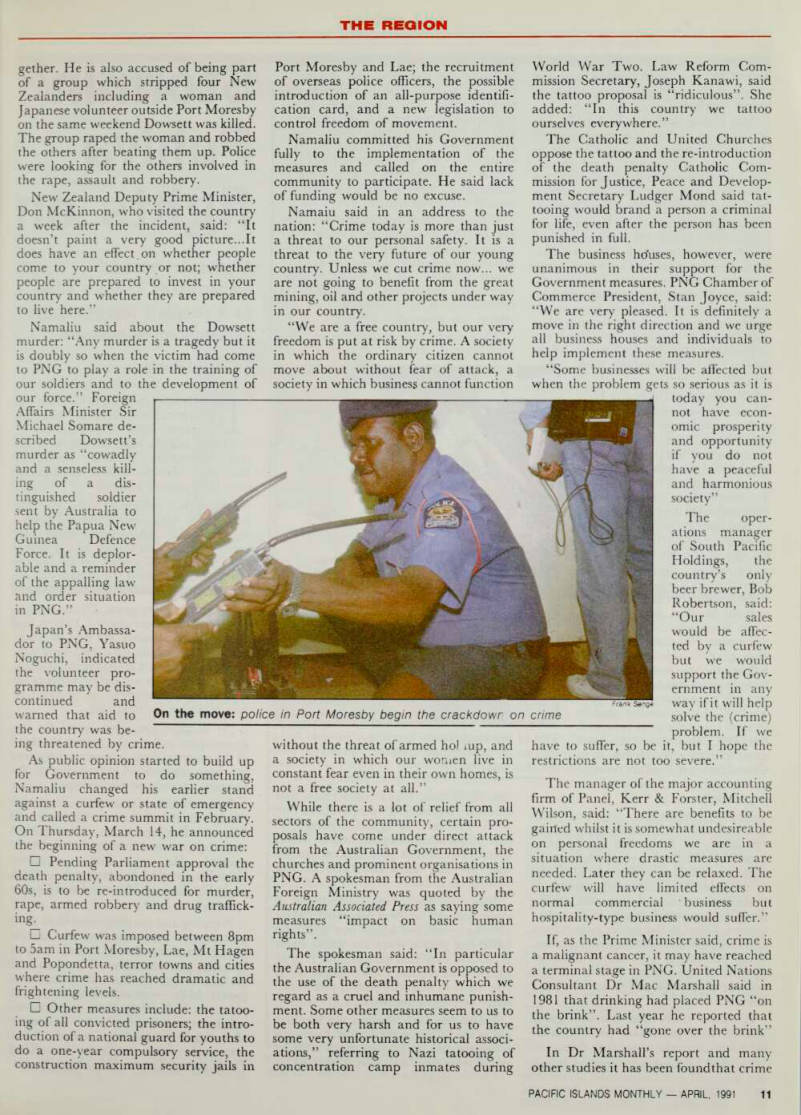
Namaliu: giving Rascals the boot
gether. He is also accused of being part of a group which stripped four New Zealanders including a woman and Japanese volunteer outside Port Moresby on the same weekend Dowsett was killed.
The group raped the woman and robbed the others after beating them up. Police were looking for the others involved in the rape, assault and robbery.
New Zealand Deputy Prime Minister, Don McKinnon, who visited the country a week after the incident, said: “It
doesn’t paint a very good picture...lt
does have an effect.on whether people come to your country or not; whether people are prepared to invest in your country and whether they are prepared to live here.”
Namaliu said about the Dowsett murder: “Any murder is a tragedy but it is doubly so when the victim had come to PNG to play a role in the training of our soldiers and to the development of
our force.” Foreign Affairs Minister Sir Michael Somare de scribed Dowsett’s murder as “cowadly and a senseless kill ing of a dis
tinguished soldier
sent by Australia to
help the Papua New
Guinea Defence Force. It is deplor able and a reminder of the appalling law and order situation in PNG.”
Japan’s Ambassa
dor to PNG, Yasuo
Noguchi, indicated
the volunteer pro gramme may be dis continued and warned that aid to the country was be-
ing threatened by crime.
As public opinion started to build up for Government to do something, Namaliu changed his earlier stand against a curfew or state of emergency and called a crime summit in February.
On Thursday, March 14, he announced the beginning of a new war on crime: □ Pending Parliament approval the death penalty, abondoned in the early 60s, is to be re-introduced for murder, rape, armed robbery and drug traffick ing. □ Curfew was imposed between Bpm to sam in Port Moresby, Lae, Mt Hagen and Popondetta, terror towns and cities where crime has reached dramatic and
frightening levels.
□ Other measures include: the tatoo ing of all convicted prisoners; the intro duction of a national guard for youths to do a one-year compulsory service, the construction maximum security jails in
Port Moresby and Lae; the recruitment of overseas police officers, the possible introduction of an all-purpose identifi cation card, and a new legislation to control freedom of movement.
Namaliu committed his Government fully to the implementation of the measures and called on the entire community to participate. He said lack of funding would be no excuse.
Namaiu said in an address to the nation: “Crime today is more than just a threat to our personal safety. It is a threat to the very future of our young country. Unless we cut crime now... we are not going to benefit from the great mining, oil and other projects under way in our country.
“We are a free country, but our very freedom is put at risk by crime. A society in which the ordinary citizen cannot move about without fear of attack, a society in which business cannot function
without the threat of armed ho) tup, and a society in which our women live in constant fear even in their own homes, is not a free society at all.”
While there is a lot of relief from all sectors of the community, certain pro posals have come under direct attack from the Australian Government, the churches and prominent organisations in PNG. A spokesman from the Australian
Foreign Ministry was quoted by the
Australian Associated Press as saying some measures “impact on basic human
rights”.
The spokesman said: “In particular the Australian Government is opposed to the use of the death penalty which we regard as a cruel and inhumane punish ment. Some other measures seem to us to be both very harsh and for us to have some very unfortunate historical associ ations,” referring to Nazi tatooing of concentration camp inmates during
World War Two. Law Reform Com mission Secretary, Joseph Kanawi, said the tattoo proposal is “ridiculous”. She added: “In this country we tattoo
ourselves everywhere.”
The Catholic and United Churches oppose the tattoo and the re-introduction of the death penalty Catholic Com mission for Justice, Peace and Develop ment Secretary Ludger Mond said tat tooing would brand a person a criminal f° r life, even after the person has been punished in full.
The business hduses, however, were unanimous in their support for the Government measures. PNG Chamber of Commerce President, Stan Joyce, said: “We are very pleased. It is definitely a move in the right direction and we urge a ll business houses and individuals to help implement these measures, “Some businesses will be affected but when the problem gets so serious as it is
today you can not have econ omic prosperity
and opportunity
if you do not have a peaceful and harmonious
society”
The oper ations manager of South Pacific Holdings, the country’s only beer brewer, Bob Robertson, said: “Our sales would be affec ted by a curfew but we would support the Gov ernment in any way if it will help solve the (crime) problem. If we
have to suffer, so be it, but I hope the restrictions are not too severe.”
The manager of the major accounting firm of Panel, Kerr & Forster, Mitchell Wilson, said: “There are benefits to be gained whilst it is somewhat undesireable on personal freedoms we are in a situation where drastic measures are needed. Later they can be relaxed. The curfew will have limited effects on normal commercial business but hospitality-type business would suffer.”
If, as the Prime Minister said, crime is a malignant cancer, it may have reached a terminal stage in PNG. United Nations Consultant Dr Mac Marshall said in 1981 that drinking had placed PNG “on the brink”. Last year he reported that the country had “gone over the brink”
In Dr Marshall’s report and many other studies it has been foundthat crime
Frank Senge On the move: police in Port Moresby begin the crackdown on crime
is directly linked to the abuse of alcohol.
Tribal fighting, wife beating and the many road accidents have all been linked to alcohol.
The National Narcotics Bureau has now pointed to the widespread growing and use of marijuana, known locally as Spark Brus, as another social -threat.
The bureau reported that coffee and tea growers in the highlands are growing marijuana to supplement their income.
The constitution of Papua New Guinea tried to provide an answer to the country’s crime problem: “Integral Hu man Development”. The constitution declares “our first goal to be for every person to be dynamically involved in the process of freeing himself from every form of dominatin or oppression so that each man or woman will have the opportunity to develop as a whole
person in relationship with others.”
The dilemma for Papua New Guinea is trying to educate three million people who live mostly in isolation in their villages. The communities are separated by jungles and mountains and their only allegiance is to their tribes.
To teach them to love their enemies as their neighbours and to love their neighbours as their brothers is like telling a fish to get out of the water.
Australian academic K.
Gannicott, in a research done for the Australian Centre for Devel opment Studies, found that re turns from education in PNG was so low “because the educa tion system is internally inef ficient: the output it produces from primary graduates onward is both expensive and of poor quality”. Other similar middle income countries were surveyed, but PNG was found to have spent a higher proportion of its Gross National Product on edu cating only a minority of the
population.
Retired diplomat, Sir Paulius Matane, said in a 1986 report on the Philosophy of Education that parents expected children to get jobs and return money to the family. This, he said, was a “misguided” attitude and contributed to disillusioned school drop-outs leaving the village in search of jobs in the urban centres. Flaws in the justice system have also contributed to the increase in crime.
While the courts have stayed indepen dent, they have found it hard to cope because of incompetent police officers or lawyers.
A recent study said criminal gangs worked with politicians and business men who actively supported them.
In 1984, a committee studied Papua
New Guinea’s law and order problem.
It found the justice system unable to cope and warned that the situation was deteriorating. The committee urged that crime be treated as a part of society and not something grafted onto society.
It suggested that any effort to erase crime has to be community-based.
Tribal fights, the report said, were in themselves a form of conflict resolution, even if a little ancient.
United Nations consultant, Sri Lan kan J.P.Delgoda, confirmed some of the views when he studied the correctional system. He reported that he did not find “even a single” of the basic require ments of a jail system. “With all these difficiencies it is a miracle that the system has survived,” he said.
Then there is corruption. Long left unhampered, mainly because it lacks
specific victims, white collar crime had
reached frightening proportions by
1983. The late Sir Ignatius Kilage, as first Chief Ombudsman, wrote in his annual report that year that corruption was “swirling murk and PNG already knee deep in it.”
Like one youth said recently at a crime summit in Port Moresby: “Why are you concerned about one thief who killed one person when the leader steals K 200.000 easy and starves 100. It is so unfair. The leaders even outsteal us. If you want to stop the youth, you better stop the bigger criminal.”
Police have say Rascals are heading out of the towns under curfew. Everyone is hoping that the current crackdown by the Government will keep them out.D
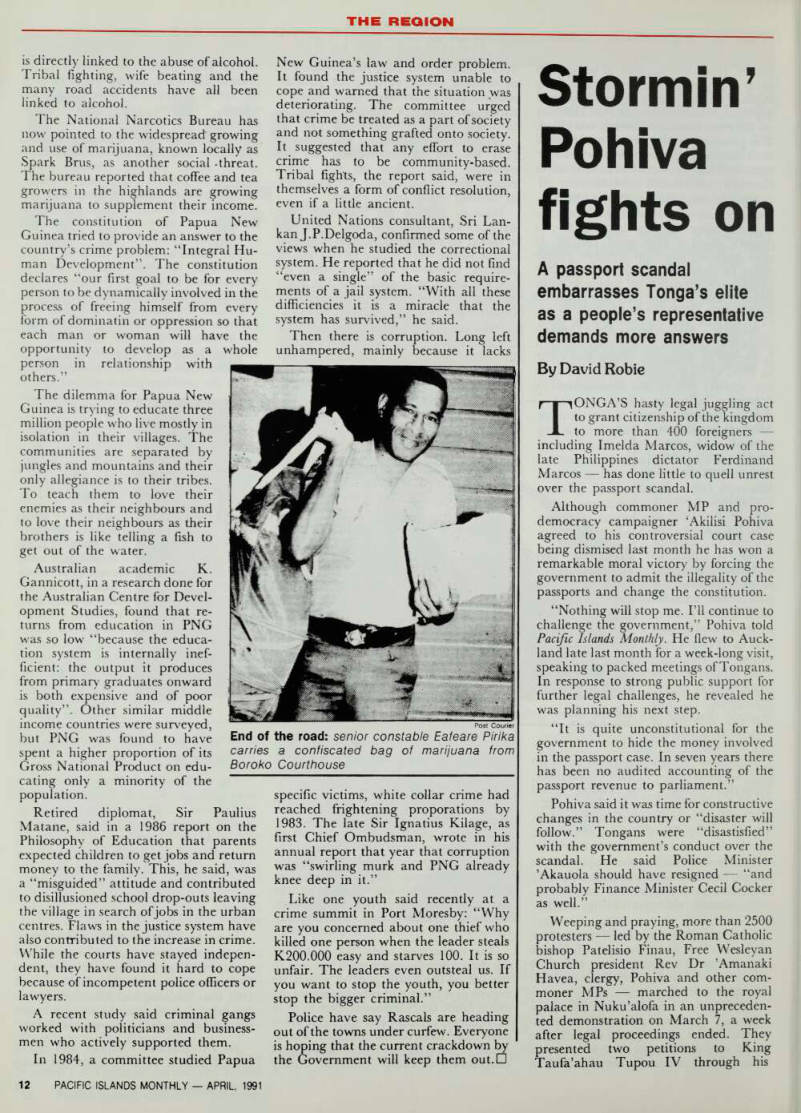
Post Courier End of the road: senior constable Eafeare Pirika carries a confiscated bag of marijuana from Boroko Courthouse
fights on
Stormin’
Pohiva fights on
A passport scandal embarrasses Tonga’s elite as a people’s representative demands more answers
By David Robie
TONGA’S hasty legal juggling act to grant citizenship of the kingdom to more than 400 foreigners including Imelda Marcos, widow of the late Philippines dictator Ferdinand Marcos has done little to quell unrest over the passport scandal.
Although commoner MP and pro democracy campaigner £ Akilisi Pohiva agreed to his controversial court case being dismised last month he has won a remarkable moral victory by forcing the government to admit the illegality of the passports and change the constitution, “Nothing will stop me. I’ll continue to challenge the government,” Pohiva told Pacific Islands Monthly. He flew to Auck land late last month for a week-long visit, speaking to packed meetings of Tongans.
In response to strong public support for further legal challenges, he revealed he was planning his next step.
“It is quite unconstitutional for the government to hide the money involved in the passport case. In seven years there has been no audited accounting of the passport revenue to parliament.”
Pohiva said it was time for constructive changes in the country or “disaster will follow.” Tongans were “disastisfied” with the government’s conduct over the scandal. He said Police Minister ’Akauola should have resigned “and probably Finance Minister Cecil Cocker as well.”
Weeping and praying, more than 2500 protesters led by the Roman Catholic bishop Patelisio Finau, Free Wesleyan Church president Rev Dr ’Amanaki Havea, clergy, Pohiva and other com moner MPs marched to the royal palace in Nuku’alofa in an unpreceden ted demonstration on March 7, a week after legal proceedings ended. They presented two petitions to King Taufa’ahau Tupou IV through his
private secretary. The King was urged to cancel citizenship of the 426 foreigners and dismiss the Police Minister, ’Akau’ola, who has accepted responsibil ity for the illegal sales of naturalisation certificates and passports. ’Akau’ola had told an emergency session of the Legislative Assembly in mid-February: “I take the blame ... it is my fault. We acknowledge that things have been done illegally and we need to correct them.” He admitted that his police department, which is also in charge of immigration, was responsible after the commoner MPs challenged the government’s urgent legislation to amend the constitution.
“Whether things were done deliberately or not ... I accept full responsibility for what has gone wrong ...
If I am to be dismissed from my job, that is up to His Majesty.”
Pohiva told Pacific Islands Monthly the Tongan protestors who had petitioned the King had not received a formal reply.
He described a royal statement cited in the government-run newspaper, Tonga Chronicle , as “disappointing” and a
repetition of ‘unconvincing expla
nations” given by cabinet ministers to Parliament.
According to the Chronicle , the King
said the Kingdoom could not afford the expense of cancelling the passports. He said changing foreign exchange rates for the Tongan pa’anga, plus possible law suits by pasport holders, meant that paying out refunds and declaring ie documents null and void would be U i heavy a burden for the country.
He also said none of the forr.gners were living in Tonga and mr si were unlikely to ever do so. About the demand for the resignation of the Police Minister, the King said it was up to Parliament to amend legislation and to impeach min isters.
Most of the foreigners involved in the passport scandal are Asians. They in clude 189 mainland-born Chinese, 152 Hong Kong Chinese, nine Macau Chin ese, nine Thais, nine Burmeese, eight Singaporeans, four Filipinos and two Indonesians. One of the ethnic Chinese is Sam Wong, a Filipino-bom business man who reportedly plans to build a multimillion-dollar business complex in the capital, Nuku’alofa.
Exiled Imelda Marcos is the best known foreigner to have got a passport and the Philippines government has announced it would reject any passport application from her. This follows reports that she intends to file an application at
the Philippine consulate in New York.
Mrs Marcos, 61, fled into exile with her deposed husband when the people power revolt in the Philippines installed Corazon Aquino’s government in Febru ary 1986. Ferdinand Marcos died in Hawaii in 1989.
The South China Morning Post reported a claim that Mrs Marcos and her son, Ferdinand Martin, 33, her granddaugh ter Aimee, 13, had been given their passports as a “gift” by the kingdom.
“I don’t believe the passports would have been given to the Marcos family for free,” said Pohiva. “Nobody was there to witness what happened. It was raised in the House but the questions remain unanswered.”
Other nationalities listed in the Gov ernment gazette as having gained Ton gan passports include Americans, Libyans, South Africans and a Palestinian businessman, Touflc Barakeb, with five of his relatives scat tered from Israel to Dubai.
The former Hong Kong Stock Exchange chief, Ronald Li, who is serving a four-year jail term for bribery, and textile billionaire Chen Din-hwa are
also reportedly listed among the legal passport holders. According to the Morning Post, the combined assets of the two men are estimated to be worth more than US$l billion ‘‘equivalent to several decades of Tonga’s GDP.” ’Atenisi Institute’s Professor Futa Helu, one of Tonga’s few influential educators and a Pacific Islands Monthly columnist, condemned the government for changing a part of the 1875 constitution which had been drafted to protect the country and its people from a foreign takeover.
“The government chooses to save ministers rather than to uphold the constitutional clause that protects Tongans from foreigners,” he said. “It is trying to justify the deliberate constitutional abuse by some ministers who,
previously questioned by the
people’s representatives, fail to ad mit they are wrong.” Professor Helu added there was no way the government could cover up its law breaking.
In an editorial, the Times of Tonga said: “The consitution is never a sacred document that cannot be changed or amended, but the reason behind the amend ment is something that is hard to find in any civilised society.”
Under the illegal passports scheme, which has been operating since 1983, two kinds of Tongan passport have been for sale to foreigners: the Tonga Protected Person Passport and the Tongan Passport (issued to those who become naturalised). The “pro tected person” passport was cre ated in 1983 as primarily a travel document for non-Tongans who
had difficulties travelling beyond
their own national boundaries. It sold for US$lO,OOO. However, as this document did not give the holder automatic right of residence in Tonga and a visa was needed, a
growing number of countries includ ing Australia and New Zealand did not recognise it.
Further legislation was introduced in 1984 to deal with this problem. The King was given power to grant naturalisation to any foreigner of “good character on humanitarian grounds.” The naturalis ation fee was US$2O,OOO, but additional fees could take it up to around U 5537,000 (although the actual passport was only US$lO).
Commoner MPs and their lawyers exposed the scheme and challenged it as unconstitutional.
In 1988, ’Akau’ola admitted that the 1984 legislation was unconstitutional because it violated Section 29 of the constitution which requires residency of at least five years before naturalisation.
The 1984 Act was then repealed by the 1988 Nationality Act.
It is uncertain how many foreigners have been naturalised or how much money has been made from the scam, as these figures have not been revealed in Parliament but it is believed that considerably more than the 426 people named in the Government Gazette may have acquired passports.
“They have only admitted 426 pass ports that’s what they have told us and it could be very wrong,” said Pohiva. “This is one of the things that I have asked in three letters to the Police Minister, Finance Minister and the Deputy Prime Minister.
“I wanted to find out how many passports have been sent to Hong Kong since 1984. No answer. I asked how
many passports are still held out of those issued. No answer.
“We need an audited financial state ment before we can accept that list they have made public.”
Tonga’s Consul in Hong Kong, George Chen, who succeeded his father, Tom Chen, in 1989, told Matangi Tonga news magazine about how the scheme works. Opened in 1981, the consulate was said by Attorney-General Tevita Tupou to have issued all but three of the
purported naturalisations.
According to the magazine, the Chens and South Pacific Sea Land Air Ltd secured a 30-year lease on the volcanic island of Fonualei, in the northern Vava’u group. Through this “leasehold operation” foreign nationals could buy Tongan passports. By last year about 900
of the 20-year leases on Tongan land had been sold to foreigners.
Chan told Matangi Tonga a passport applicant needed to qualify first under the leasehold scheme before applying for protected person status or naturalisation as a Tongan.
Chen reportedly said his consulate had issued about 900 protected person pass ports and 84 certificates of naturalisation.
He added that about US$5 million had been received and this had been invested in the Tonga Trust Fund account with the Bank of America, San Francisco.
However, people’s representatives esti
mate the total is more likely at least $7 million; on a New Zealand television programme last year the King men tioned $2O million.
In August 1989, Pohiva and his legal
counsel, Auckland lawyers Dr Rodney Harrison and Nalesoni Tupou, filed their lawsuit against the kingdom and the Police Minister, claiming the passports should be declared ivalid because the sales were unconstitutional and illegal.
After lengthy legal proceed
ings and arguments for more than a year, the case was finally about to go before the Supreme Court. Chief Justice Geoffrey Martin had been due on Febru ary 22 to set a date for an open
hearing.
However, four days earlier, on February 18, the government suddenly called an emergency session of Parliament in an attempt to legalise its passport practices over the previous seven years. This was only the third time that an emergency session had ever been called for Parlia ment which usually meets between May and December.
Earlier times were in 1914 at the start of the First World War and in 1982 in the wake of the
devastation from Cyclone Isaac.
Under the constitution, Tonga’s 30-seat Parliament has 10 cabinet mem bers plus two governors appointed by the King, nine members voted for by the 33 nobles, and nine people’s representatives elected by voters from Tonga’s 100,000 commoners.
Parliament was bitterly divided be tween the cabinet and the nobles who supported the passport legislation and seven of the commoner MPs who argued it would be damaging for Tonga to amend the constitution to legalise a mistake. Pohiva and his colleagues also argued that Parliament should allow the court to pass its final ruling before any
further legislation was adopted.
Attorney-General Tupou insisted that the government was mainly concerned
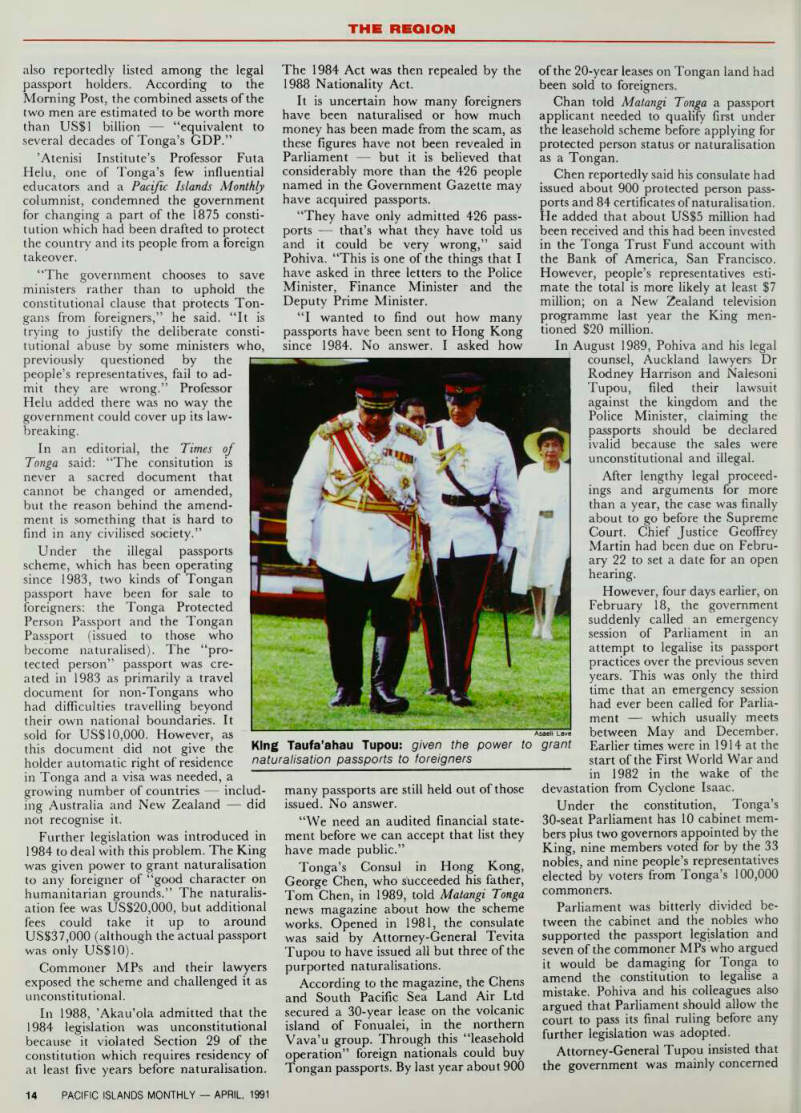
Asaeli Lave King Taufa’ahau Tupou: given the power to grant naturalisation passports to foreigners
with the fate of the 426 foreigners who had bought their passports in “good faith”. He also warned of the conse quences for the kingdom if the passports were not made legal.
“In addition to the inevitable return of all money paid for these naturalisation and passports (plus accrued interest),”
Attorney-General Tevita Tupou said: “The country is exposed to very substan tial claims for damages, which could be catastrophic if, for example, earlier nationalities have been relinquished ... or annulled.”
Pohiva declared that the government was passing laws which would legalise what had been done illegally. He added: “This is totally unnacceptable in any civilised society.”
Viliami Afeaki, the people’s represen tative from Ha’apai, said: “Imagine our constitution which has stood for more than 100 years being amended to accommodate the illegal acts of govern ment.”
Pohiva eventually stormed out of Parliament after distributing a letter
saying the government was withholding important information from the debate.
Tongatapu’s two other people’s rep resentatives, Laki Niu and Viliami Fukofuka, also later walked out after failing to pass amendments trying to block the legislative changes which were adopted by a 15-4 vote.
When the passports case was dismissed by the Supreme Court on March 1, Chief Justice Martin awarded Pohiva NZ523,500 in court costs. Pohiva told the court his legal advice from senior counsel Dr Harrison was that now the consti tudon had been changed it was no longer
possible to successfully press proceedings.
However, he added that “the position I have taken on behalf of the people ... has been vindicated by the statements of the Attorney-General to Parliament ac knowledging that what was done by the defendants was unconstitutional.
“With the passage of amending legis lation,” he added, “I believe that the issue has ceased to be one appropriately to be determined by the courts. But the case does not end. It marks a new page in our history.” □
Pohiva’s lawyer harassed
ONE of Tonga’s passport case lawyers, Natesoni Tupou, says he is being harassed and “punished” by Tongan authorities, who last month barred him from entering his homeland without a special permit.
He claims the moves against him are part of a plan to “cut off legal assistance and advice” to Tongan pro-democracy
campaigner ’Akilisi Pohiva after he forced the govern ment to change the consti tution in an attempt to legitimise illegal passports sold to hundreds of foreigners.
“They’re uncertain about what is going to happen next with court action,” said Tupou, who lives in New Zealand. “They are shocked that they have been forced to admit that what we have argued for two-and-a-half years is the state of the law.
“He said he would become the “first Tongan in exile,” adding that the “sad state of affairs” in the country could lead to instability.
On March 22, Tupou
received a letter from Tongan Police Minister ’Akau’ola confirming the ban and claiming that on previous visits to Tonga “you have practised law without obtaining prior permission.” The minis ter’s letter was sent on the same day as Pohiva arrived in Auckland for a week long visit to speak to the Tongan community about the passport scandal.
Tongan-born Tupou, 40, has held a New Zealand passport since 1967. When he arrived in Tonga on March 9 for a week long unrelated court case, he was held at Fua’amotu airport by an immigration official “awaiting instructions.”
Tupou called police Chief Superin tendent ’Eleni ’Aho and was questioned about whether he would see people’s representative Pohiva and whether he was doing any legal work for him.
Believing that he might be about to be arrested or deported, Tupou alerted the NZ High Commission and appealed to Chief Justice Geoffrey Martin for a habeas
corpus hearing.
After the judge granted a hearing, Tupou left the airport with a visitor’s permit enabling him to stay “two days 15 1/2 hours.” He needed two further extensions in his passport for the week.
People’s representative Laki Niu, also a lawyer, described the action taken
against Tupou as unprecedented. “Why
is (’Akau’ola) doing this?” Niu asked.
“Why isn’t this being applied to foreign lawyers such as Dr Harrison, Frank Hogan, Clive Edwards and Fiji’s Tevita Fa. Fijian lawyers, New Zealand law yers, Australian lawyers even Ameri can lawyers have come to Tonga.
None of these people have been given a letter like this, that I know of.” □
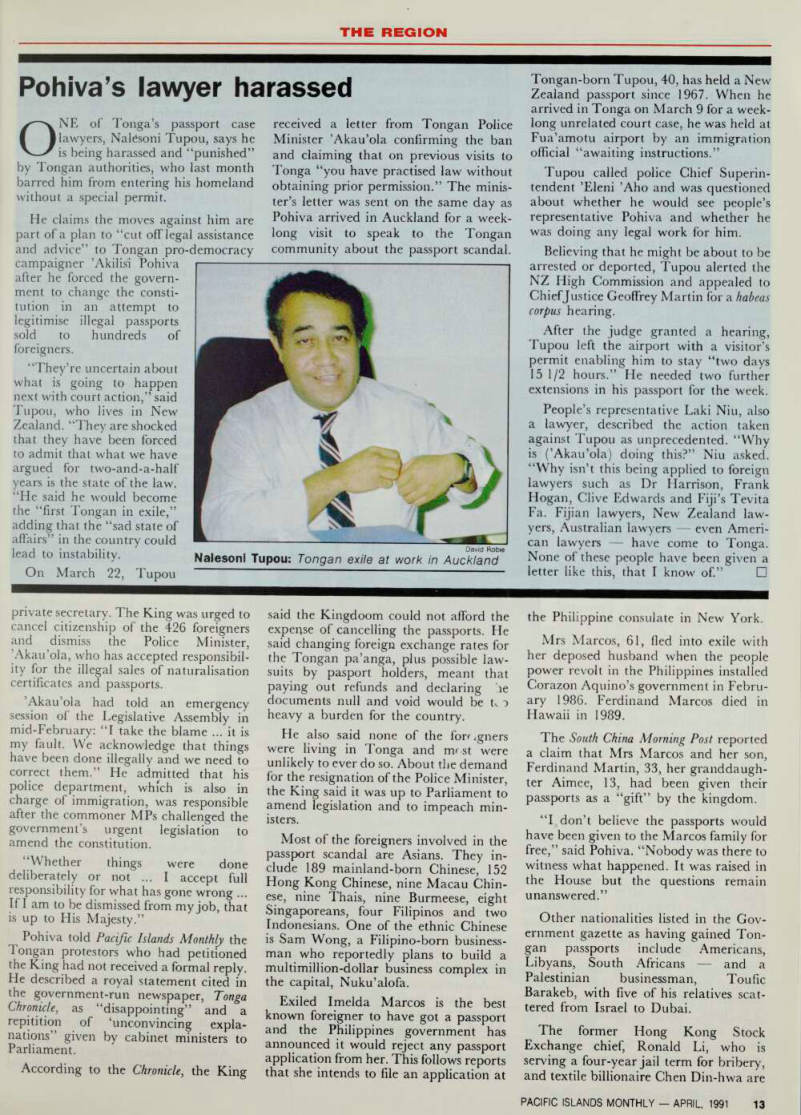
David Robie Nalesoni Tupou: Tongan exile at work in Auckland
The law changes
THREE bills were introduced in Tonga’s Parliament during the emergency session which began on February 18. Amending the consti tution, the Nationality Act and the Passport Act, they were passed after four days of debate. Part of the amended section of the constitution, 29A (1), now says; “It shall be lawful for the King and the Legislative Assembly to enact specific laws declaring any persons, whether or not they have ever resided in Tonga, to be or to have become naturalised subjects of Tonga from any date. All persons who are declared to be naturalised subjects of Tonga by any such legislation shall have, and shall be deemed to have had from the effective dates of their naturalisations, the same rights and privileges as other
foreigners becoming naturalised sub
jects of Tonga by the grant to them of certificates of naturalisation.” □
job, but the media
Sasako gets the job, but the media is threatened again
WHAT do Fiji and Papua New Guinea have in common? Politi cal problems that are affecting their dealings with the media. Last month, the governments of both countries engaged in assaults on the media that attracted widespread atten tion locally and abroad. • In Papua New Guinea, the gov ernment of Prime Minister Rabbie Namaliu, still facing a secessionist move ment on the copper-rich island of
Bougainville, criticised the appointment
of Alfred Sasako as information officer for the Forum Secretariat. Why? Sasako, a Solomon Islander working in Brisbane for Australian Associated Press, was black banned by PNG after he entered Bou gainville by canoe from the Solomon Islands on Christmas Day. Sasako’s reports of the secessionist movement on the island received international cover age.
Papua New Guinea condemned
Sasako’s appointment. Foreign Minister
Sir Michael Somare said his government was not consulted about the appoint ment and warned he would slap Sasako’s face if they met. He said if he had his way he would deny Sasako visa if he wanted to enter PNG, even on Forum Secretariat business.
Papua New Guinea argued that be
cause it contributed to the funding of the Forum Secretariat it must have some say in the appointment of its staff.
Sasako, 37, arrives in Suva this month with his wife, Rose, and their three children. He starts work on the 22nd. He believes that “like a storm, (the dispute with Papua New Guinea) will blow over”, adding: “I think we’ll settle it the
Melanesian way.”
• In Fiji, there was uproar when
Informadon Minister Ratu Inoke Kubuabola walked into a Radio Fiji studio on March 18 and took a news item from a reader moments before it was to have been read during the 7am news bulletin. The news item dealt with the installation of a television receiving dish outside government buildings in Suva for use by his ministry.
Ratu Inoke said the news item was incorrect and he went into the studio
(reportedly in his jogging outfit) after getting the
approval of Radio Fiji
News Editor George Williams. He said he tried and failed to contact Radio Fiji General Man ager Epeli Kacimaiwai.
His action was immedi
ately criticised by the
leader of the opposition National Federation Party / Fiji Labour Party Coalition, Adi Kuini Bavadra. Adi Kuini said Ratu Inoke’s raid on state-run Radio Fiji un dermined the station’s in dependence. She called on Radio Fiji to enforce its right to be an indepen dent public news service.
She added; “It seems that whenever Ratu Inoke disagrees with any news item, even if it is factually correct, he calls it distorted and
irresponsisble
journalism.” □
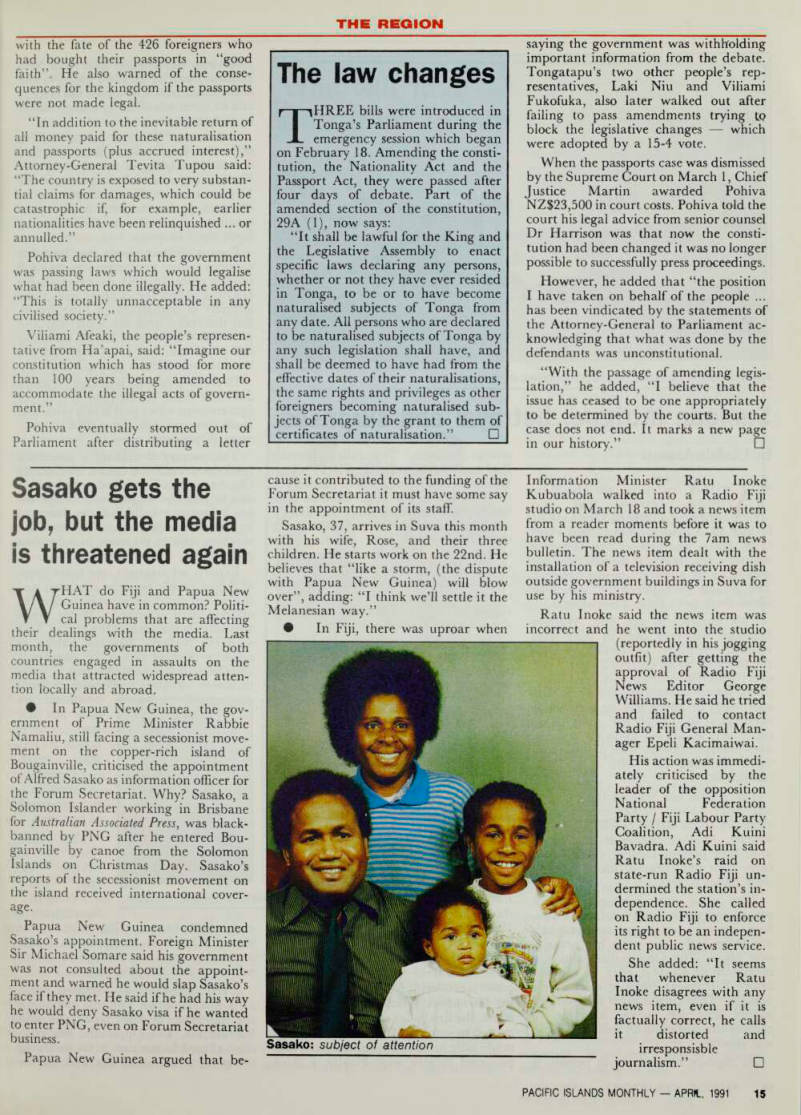
Sasako: subject of attention
Samoan intrigue, betrayal and surprises
Elections
By Ulafala Aiavao
WHEN Samoans talk about in trigue, betrayal and jaw gripping surprises, they look no further than their elections, held every three years. In three of the last four elections, the incoming government has won office by a margin of just one seat.
The busiest year politically was 1982 when there were three governments.
This month, on the fifth, Western Samoans will take part in their most historic vote yet an election open for the first time to all citizens 21 years and over. Universal suffrage has been intro duced for all 47 seats in Parliament, but only rnatai or chiefs will be elegible as candidates in 45 of the seats. Two constituencies are set aside for those of non-Samoan ancestry who practise uni versal suffrage for both voters and candidates.
The reform has boosted the electoral roll from about 20,000 mostly male chiefs, to about 60,000 of whom half are females. Another change is that voters must now present identity cards which carry their photographs before they get their ballot papers.
Even after votes are cast and a provisional result comes out mid-April, Samoans may not know until late this month or early May who has actually won office. The Constitution allows a maximum of 45 days after an election before Parliament meets to elect a new Speaker, That period gives the political parties time for intense lobbying to capture the minimum 24 seats needed to win power.
To capture in spirit or in person, is
serious business. The ruling Human
Rights Protection Party (HRPP) kept
their members inside a fenced property in the lead-up to the 1982 election. The fences have come down, but HRPP candidates now sign contracts to make them think twice about defecting. The leader of the Opposition Samoan Na
tional Development Party (SNDP),
Tupua Tamasese, criticises the idea of contracts, saying SNDP relies on a supporter’s word of honour, “and if he doesn’t keep it, good riddance.”
The SNDP is still bitter about a curucial defection after the 1988 elections on the night before Parliament had to meet to elect a Speaker. A grateful
HRPP wel comed the defector with a
prayer meeting
and gave the first-time MP a Cabinet port folio, for giving them the one seat majority they needed.
The suspense didn’t end there.
Electoral pet itions after the
1988 elections changed the numbers held by the HRPP and the SNDP until both parties held the same number of seats 23 and there was a tie in the 47th constituency with two rivals each receiv ing 146 ballots. When the matter went to court, the first judge withdrew as he was related to another MP. The second judge made little headway as neither party was prepared to give way. Finally, a third
judge who was brought over from New Zealand awarded an extra ballot to one of the candidates who joined the HRPP, and let them win office by a single ballot in his constituency.
Both major political parties believe such close results are unlikely in future due to the tripling of the electoral roll.
Wider margins are also expected in the 47 constituencies. Nearly 25 per cent of the past parliament was made up of members who had won their seats by fewer than 10 votes.
Even so, history shows that landslide victories cannot guarantee a party a full term in office. In 1985, for example, the HRPP finished the election with three quarters of parliament in their hands.
But defections over the leadership and personality differences forced the party out of government when they did not have the numbers to pass a budget.
Depending on who is talking, Western Samoa is either on the road to recovery (government view) or it is in a crisis that needs new policies and a new govern
ment (Opposition view).
The country is making a comeback from the devastation caused by Cyclone Ofa a year ago. Local food are maturing and in plentiful supply, and foreign aid has helped to rebuild facilities damaged by Ofa. Yet despite some of the most far reaching reforms yet made by a Samoan government, old problems remain.
Exports are stagnant, the brain drain of skilled people overseas continues and the lack of natural resources hinders the options for development. Water short ages still plague parts of the capital Apia with the National Hospital having to cancel treatment except for emergency cases because the occasional lack of water threatens hygiene. Consumers and
businesses are only just get
ting over
power failures that inter rupted
supplies
through much
of last year.
The new riddle is: “What do
Iraq and
Western Samoa have in
common?” Answer: “Big holes in the roads.” That is an exaggeration. Roads are being repaired through a multi million dollar aid programme.
SNDP leader Tupua Tamasese wants an Anti-Corruption Tribunal to monitor the integrity of the politicians and bureaucrats. The Opposition has criti cised alleged favouritism in the awarding of government contracts and in the
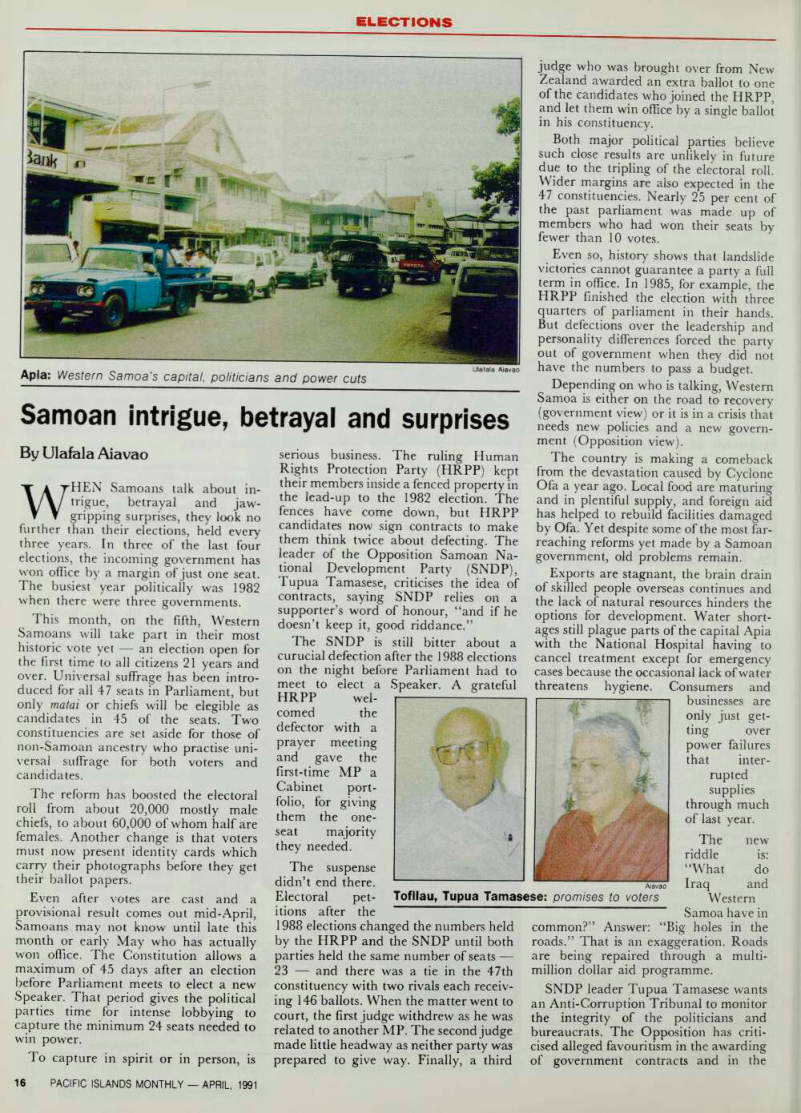
Ulafala Aiavao Apia: Western Samoa's capital, politicians and power cuts
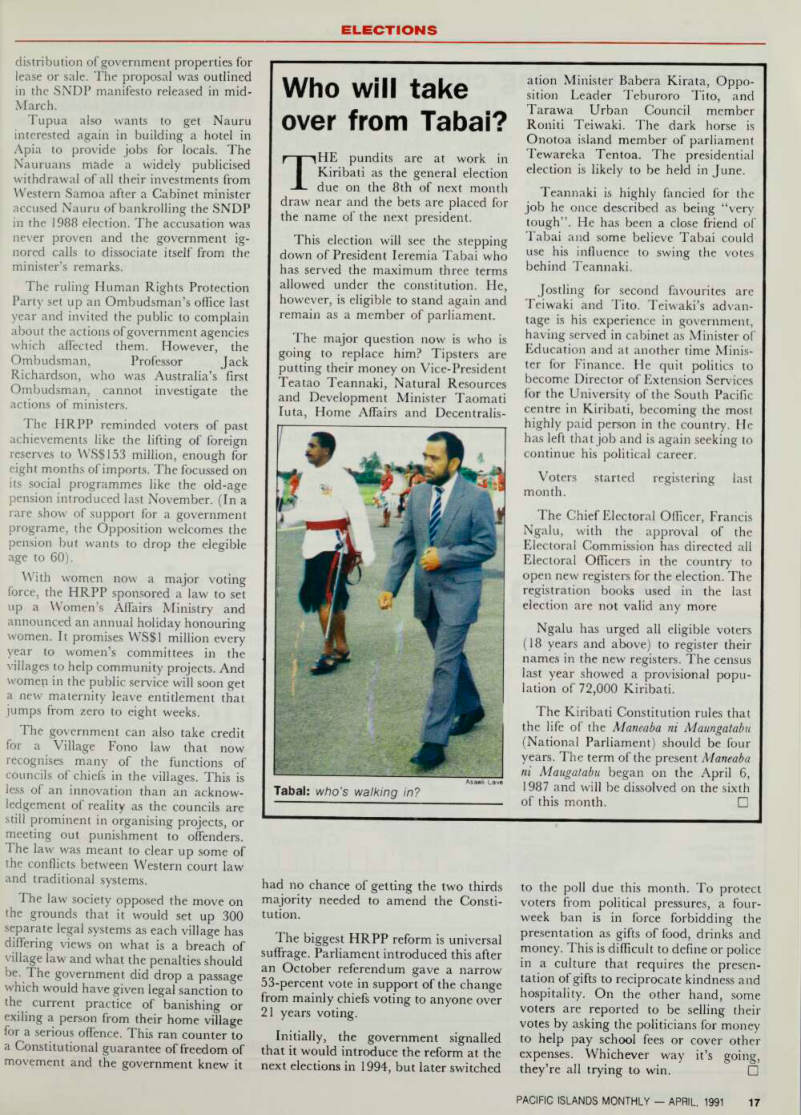
Aiavao Tofilau, Tupua Tamasese: promises to voters
distribution of government properties for lease or sale. The proposal was outlined in the SNDP manifesto released in mid- March.
Tupua also wants to get Nauru interested again in building a hotel in Apia to provide jobs for locals. The Nauruans made a widely publicised withdrawal of all their investments from Western Samoa after a Cabinet minister accused Nauru of bankrolling the SNDP in the 1988 election. The accusation was never proven and the government ig nored calls to dissociate itself from the minister’s remarks.
The ruling Human Rights Protection Party set up an Ombudsman’s office last year and invited the public to complain about the actions of government agencies which affected them. However, the Ombudsman, Professor Jack Richardson, who was Australia’s first Ombudsman, cannot investigate the actions of ministers.
The HRPP reminded voters of past achievements like the lifting of foreign reserves to WSSIS3 million, enough for eight months of imports. The focussed on its social programmes like the old-age pension introduced last November. (In a rare show' of support for a government programe, the Opposition welcomes the pension but wants to drop the elegible age to 60).
With women now a major voting force, the HRPP sponsored a law to set up a Women’s Affairs Ministry and announced an annual holiday honouring women. It promises WSSI million every year to women’s committees in the villages to help community projects. And women in the public service will soon get a new' maternity leave entitlement that jumps from zero to eight weeks.
The government can also take credit for a Village Fono law that now recognises many of the functions of councils of chiefs in the villages. This is less of an innovation than an acknow ledgement of reality as the councils are still prominent in organising projects, or meeting out punishment to offenders.
The law' was meant to clear up some of the conflicts between Western court law and traditional systems.
The law society opposed the move on the grounds that it w'ould set up 300 separate legal systems as each village has differing views on w'hat is a breach of village law and what the penalties should be. The government did drop a passage which would have given legal sanction to the current practice of "banishing or exiling a person from their home village for a serious offence. This ran counter to a Constitutional guarantee of freedom of movement and the government knew it
had no chance of getting the two thirds majority needed to amend the Constitution.
The biggest HRPP reform is universal suffrage. Parliament introduced this after an October referendum gave a narrow 53-percent vote in support of the change from mainly chiefs voting to anyone over 21 years voting.
Initially, the government signalled
that it would introduce the reform at the next elections in 1994, but later switched
to the poll due this month. To protect voters from political pressures, a four week ban is in force forbidding the presentation as gifts of food, drinks and money. This is difficult to define or police in a culture that requires the presen tation of gifts to reciprocate kindness and hospitality. On the other hand, some voters are reported to be selling their votes by asking the politicians for money to help pay school fees or cover other expenses. Whichever way it’s going, they’re all trying to win. □
Who will take
over from Tabai?
THE pundits are at work in Kiribati as the general election due on the Bth of next month draw near and the bets are placed for the name of the next president.
This election will see the stepping down of President leremia Tabai who has served the maximum three terms allowed under the constitution. He, however, is eligible to stand again and remain as a member of parliament.
The major question now is who is
going to replace him? Tipsters are
putting their money on Vice-President Teatao Teannaki, Natural Resources and Development Minister Taomati luta, Home Affairs and Decentralis-
ation Minister Babera Kirata, Oppo sition Leader Teburoro Tito, and Tarawa Urban Council member Roniti Teiwaki. The dark horse is Onotoa island member of parliament Tewareka Tentoa. The presidential election is likely to be held in June.
Teannaki is highly fancied for the job he once described as being “very tough”. He has been a close friend of Tabai and some believe Tabai could use his influence to swing the votes behind Teannaki.
Jostling for second favourites are Teiwaki and Tito. Teiwaki’s advan tage is his experience in government, having served in cabinet as Minister of Education and at another time Minis ter for Finance. He quit politics to become Director of Extension Services for the University of the South Pacific centre in Kiribati, becoming the most highly paid person in the country. He has left that job and is again seeking to continue his political career.
Voters started registering last month.
The Chief Electoral Officer, Francis Ngalu, with the approval of the Electoral Commission has directed all Electoral Officers in the country to open new registers for the election. The registration books used in the last election are not valid any more Ngalu has urged all eligible voters (18 years and above) to register their names in the new registers. The census last year showed a provisional popu lation of 72,000 Kiribati.
The Kiribati Constitution rules that the life of the Mancaba ni Maungatabu (National Parliament) should be four years. The term of the present Maneaba ni Maugatabu began on the April 6, 1987 and will be dissolved on the sixth of this month. □
Asaeli Lave Tabai: who's walking in?
Flosse in surprising comeback
By Al Prince
GASTON Flosse’s opposition politi
cal party showed surprising strength in French Polynesia’s March 17 Territorial Assembly election by capturing 18 of the lagislative body’s 41 seats. This was a major comeback for Flosses party, which was ousted from power in December 1987 after having controlled French Polynesia’s Territorial Government since March 1982.
In the March 17 election, Flosse’s , , r c par >noon y pro i e rom a . per cen union among e , 6 regis tered voters in this French Overseas Terntoty, but also from a hoped for c ange m government indicated by 55 per cent of the voters. As a result of that change sought by voters, a pre-election alliance formed between the political parties headed by incumbent Territorial r* * y, A A 1 , Government President Alexandre Leontieff and Territorial Assembly Presi dent Jean Juventin won a disappointing SCa Leontieff was a key member of Flosse s governments from 1982 -1987.
The biggest defeat suffered on March 17 by one of the former Leontieff majority coalition parties involved the moderate independence party headed by Jacqui Drollet. That party lost all three of its Territorial Assembly seats.
Partially benefiting from that defeat was the hard core independence party of Oscar Temaru. After having won its first two seats in the 1986 Territorial As sembly election, Temaru’s party doubled that score on March 17 by capturing four seats.
The remaining five seats in the latest election were won by Emile Vemaudon, who had only one seat going into the election. Vemaudon, like Leontieff, is one of French Polynesia’s two deputies in the French National Assembly in Paris.
The March 17 election involved a record number of 57 lists of candidates, compared to 41 in 1986.
Following the latest election, Flosse repeated a political strategy that back fired on him in 1982 by forming a coalition of 23 seats with former bitter adversary Vemaudon. The Flosse-
Vemaudon coalition in 1982 lasted only 110 days.
But two post-election surprises were orchestrated by the new opposition group headed by Leontieff and Juventin.
During an election of the Territorial Assembly’s new president on March 28, that opposition group voted with the majority coalition for Vemaudon, giving him a record 37 votes. The four remain ing votes were cast for Temaru, the only other candidate.
The second post-election surprise oc curred on March 30 when the Leontieff- Juventin opposition group and Temaru’s party boycotted a Territorial Assembly session called to elect a new Territorial Government President. The assembly lacked the required three-fifths quorum (25 occupied seats) when one of two members who had switched from the opposition to the majority coalition after the March 17 election did not show up.
With only 24 members present, newly elected Territorial Assembly President Vemaudon was forced to reschedule the election of a Territorial Government President until April 4, when only a simple majority of members present would be required.
The expected candidates were Flosse, Leontieff and Temaru. □
Advertisements & other items, p. 18 (1 item)
dfgj
Remember your Friend
There are times in your life when you feel your friends have been missing out on something good. Now’s your chance to do something about it and share with them one of the good things you have. Buy your friend a subscription to Pacific Islands Monthly and let him or her join you and the thousands of other people worldwide who are kept informed of the latest political, social and cultural changes taking place in the Pacific.
PACIFIC
ISLANDS
IUOHT H I V ]
Please send my friend Pacific Islands Monthly for one year (12 issues).
I enclose my cheque for $ (made payable to Pacific Islands Monthly) or debit $ to my: □ Bankcard □ Visacard □ Mastercard Card No; I I I I I I I I I I I I I I I I Expiry Date
NAME
SIGNATURE,
MY FRIEND’S NAME
MY FRIEND’S ADDRESS
CITY
COUNTRY
Haglelgam battles for a second term
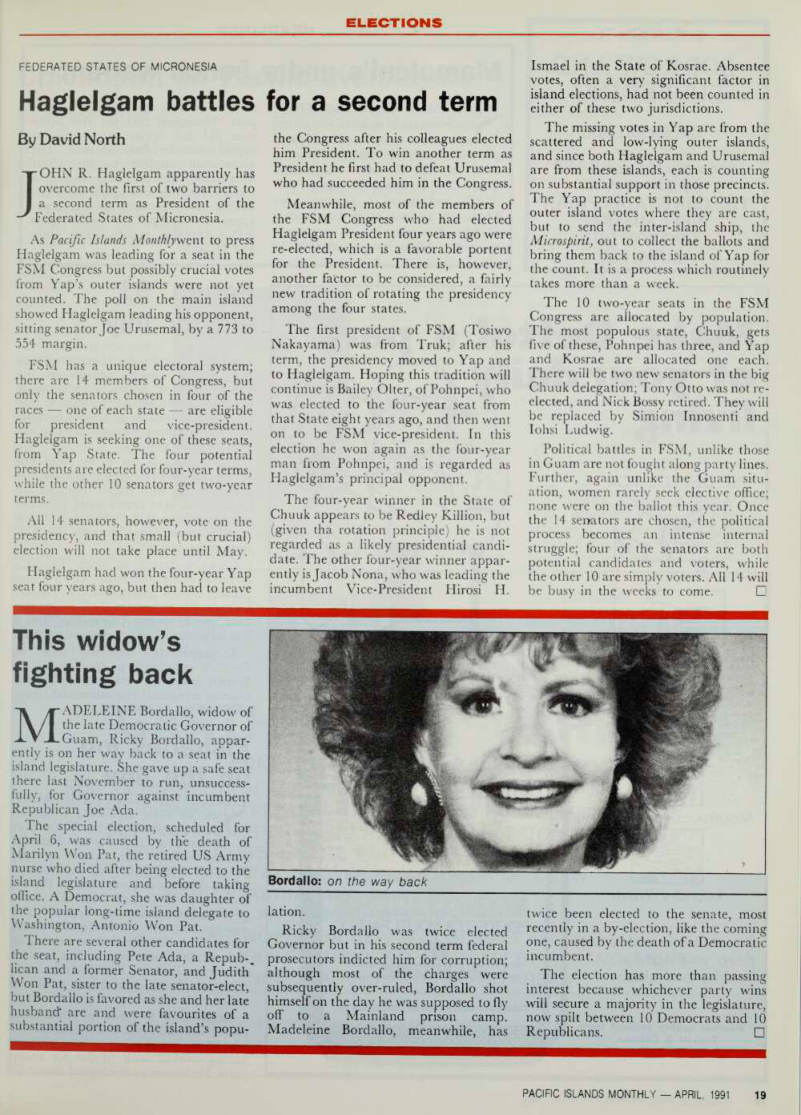
Federated States Of Micronesia
By David North
JOHN R. Hagielgam apparently has
overcome the first of two barriers to a second term as President of the federated States of Micronesia.
As Pacific Islands Monthlywent to press Hagielgam was leading for a seat in the FSM Congress but possibly crucial votes from Yap’s outer islands were not yet counted. The poll on the main island show-ed Hagielgam leading his opponent, sitting senator Joe Urusemal, by a 773 to 554 margin.
FSM has a unique electoral system; there are 14 members of Congress, but only the senators chosen in four of the races one of each state are eligible for president and vice-president.
Hagielgam is seeking one of these seats, from Yap State. The four potential presidents are elected for four-year terms, while the other 10 senators get two-year terms.
All 14 senators, however, vote on the presidency, and that small (but crucial) election will not take place until May.
Hagielgam had won the four-year Yap
seat four years ago, but then had to leave
the Congress after his colleagues elected him President. To win another term as President he first had to defeat Urusemal who had succeeded him in the Congress.
Meanwhile, most of the members of the FSM Congress who had elected Hagielgam President four years ago were re-elected, which is a favorable portent for the President. There is, however, another factor to be considered, a fairly new tradition of rotating the presidency among the four states.
The first president of FSM (Tosiwo Nakayama) was from Truk; after his term, the presidency moved to Yap and to Hagielgam. Hoping this tradition will continue is Bailey Olter, of Pohnpei, who was elected to the four-year seat from that State eight years ago, and then went on to be FSM vice-president. In this election he won again as the four-year man from Pohnpei, and is regarded as
Haglelgam’s principal opponent.
The four-year winner in the State of Chuuk appears to be Redley Killion, but (given tha rotation principle) he is not regarded as a likely presidential candi date. The other four-year winner appar ently is Jacob Nona, who was leading the incumbent Vice-President Hirosi H.
Ismael in the State of Kosrae. Absentee votes, often a very significant factor in island elections, had not been counted in either of these two jurisdictions.
The missing votes in Yap are from the scattered and low-lying outer islands, and since both Hagielgam and Urusemal are from these islands, each is counting on substantial support in those precincts.
The Yap practice is not to count the outer island votes where they are cast, but to send the inter-island ship, the Microspirit, out to collect the ballots and bring them back to the island of Yap for the count. It is a process which routinely takes more than a week.
The 10 two-year seats in the FSM Congress are allocated by population.
The most populous state, Chuuk, gets five of these, Pohnpei has three, and Yap and Kosrae are allocated one each.
There will be two new senators in the big Chuuk delegation; Tony Otto was not re elected, and Nick Bossy retired. They will be replaced by Simion Innosenti and
lohsi Ludwig.
Political battles in FSM, unlike those in Guam are not fought along party lines.
Further, again unlike the Guam situ ation, women rarely seek elective office; none were on the ballot this year. Once the 14 senators are chosen, the political process becomes an intense internal struggle; four of the senators are both potential candidates and voters, while the other 10 are simply voters. All 14 will be busy in the weeks to come. □
fighting back
This widow’s fighting back
MADELEINE Bordalio, widow of the late Democratic Governor of Guam, Ricky Bordalio, appar ently is on her way back to a seat in the island legislature. She gave up a safe seat there last November to run, unsuccess fully, for Governor against incumbent Republican Joe Ada.
The special election, scheduled for April 6, was caused by the death of Marilyn Won Pat, the retired US Army nurse who died after being elected to the island legislature and before taking office. A Democrat, she was daughter of the popular long-time island delegate to Washington, Antonio Won Pat.
There are several other candidates for the seat, including Pete Ada, a Repub-, lican and a former Senator, and Judith' Won Pat, sister to the late senator-elect, but Bordalio is favored as she and her late husband* are and were favourites of a substantial portion of the island’s popu-
lation.
Ricky Bordalio was twice elected Governor but in his second term federal prosecutors indicted him for corruption; although most of the charges were subsequently over-ruled, Bordalio shot himself on the day he was supposed to fly off to a Mainland prison camp.
Madeleine Bordalio, meanwhile, has
twice been elected to the senate, most recently in a by-election, like the coming one, caused by the death of a Democratic incumbent.
The election has more than passing interest because whichever party wins will secure a majority in the legislature, now spilt between 10 Democrats and 10 Republicans. □
Bordallo: on the way back
Mamaloni’s under bench warrant

SOLOMON Islands Prime Minis ter Solomon Mamaloni was issued a bench warrant on the 25th of last month after he failed to appear that day in Honiara Magistrates Court. The National Provident Fund (NPF) had issued a summons for Mamaloni and two other shareholders of Fotu Fibreglass Co to appear in court for failing to pay 515783 in
contributions to the national pension plan. Mamaloni and the two other men did not appear and gave no explanation for their absence. The prosecution applied to the Chief Magistrate, Michael Lodge, to issue a warrant for their arrest. Bail was set at SISSOO each, pending another court appearance on April 2. Fotu Fibreglass makes fibreglass canoes, water tanks and furniture. □
set for July
Forum ’91 set for July
THE date for the 15-nation South Pacific Forum summit in the Federated States of Micronesia (FSM) has been brought forward to July 22-August 2 because of clashes in dates for other regional meetings later in the year, officials said.
The agenda is yet to be fixed but regional issues like expanding trade and economic ties with Asean countries are expected to take centre-stage. Another important issue is the admission of new post-Forum dialogue partners like Tai wan and Germany.
China is trying to block Taiwan’s inclusion in the conference, which brings Japan, United States, Britain, France, Canada, China and, for the first time this year, the European Community into a special session to debate regional matters.
Environmental concerns such as France’s continued nuclear testing in French Polynesia and the implement ation of a regional environmental treaty are expected to be raised. □
Fisheries job
on the line
SOLOMON Islands Foreign Minis
ter Sir Peter Kenilorea is one of three people shortlisted for the post of Director of the Forum Fisheries Agency (FFA). The others are the Director of SOPAC Jioji Kotobalavu (Fiji), FFA development officer Peniasi Kunatuba (Fiji) and Kiribati senior government official Ata Teaotai. The new appointment will be decided at the Forum Fisheries Committee meeting in New Zealand next month. The term of the current Director, Phillip Muller, ends this year. He will be retained as adviser to his replacement.
Kotobalavu has had a remarkable record with SOPAC. But it’s Kunatuba who knows the agency and its work best, having worked with Muller for many years. He is seen as the logical choice. □
Advertisements & other items, p. 20 (1 item)
Dettol
SOLUTION TO
SORROW AND
SUFFERING
INTERESTED ?
For a copy of this FREE booklet write to
THE CHRISTA DELPHIAN
BIBLE MISSION
GPO BOX 1012
SUVA, FUI
Make Dettol a Dart
of your daily
living > a*
USE DETTOL FOR —.
Cuts, Abrasions, Grazes I \ Insect Stings or Bites Bathing To a- Mouthwash anc Gargle Laundry Wash Buy a bottle today and Keep your family healthy and clean Another quality product from Reckitt & Colman &
Dettol
PROTECTS YOUR FAMILY
BY APPOINTMENT TO HEP MAJESTY QUEEN ELIZABETH I
MANUFACTURERS Of ANTISEPTICS
PECKfTT 4 COLMAN PHARMACEUTICAL DIVISION. HULL
250 ml CONTAINS. CHLOftCKYLENOL AA% W/V; ETHANOL 15.8* V/V
Crackdown on Pacific overstayers
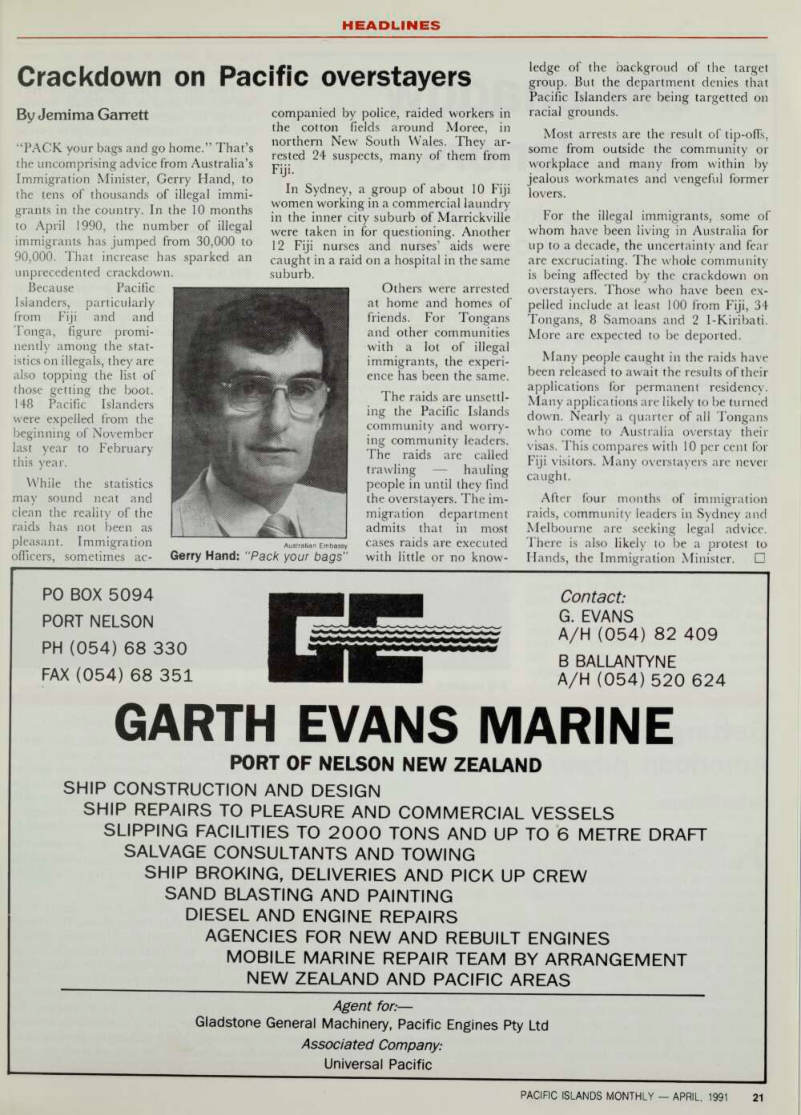
By Jemima Garrett
“PACK your bags and go home.” That’s the uncomprising advice from Australia’s Immigration Minister, Gerry Hand, to the tens of thousands of illegal immi grants in the country. In the 10 months to April 1990, the number of illegal immigrants has jumped from 30,000 to 90,000. That increase has sparked an unprecedented crackdown.
Because Pacific Islanders, particularly from Fiji and and
Tonga, figure promi
nently among the stat istics on illegals, they are also topping the list of those getting the boot. 148 Pacific Islanders were expelled from the beginning of November last year to February this year.
While the statistics may sound neat and clean the reality of the raids has not been as
pleasant. Immigration
officers, sometimes ac-
companied by police, raided workers in the cotton fields around Moree, in northern New South Wales. They ar rested 24 suspects, many of them from
Fiji.
In Sydney, a group of about 10 Fiji women working in a commercial laundry in the inner city suburb of Marrickville were taken in for questioning. Another 12 Fiji nurses and nurses’ aids were caught in a raid on a hospital in the same suburb.
Others were arrested at home and homes of friends. For Tongans and other communities with a lot of illegal immigrants, the experi ence has been the same.
The raids are unsettl ing the Pacific Islands community and worry ing community leaders.
The raids are called
trawling hauling
people in until they find the overstayers. The im
migration department
admits that in most cases raids are executed with little or no know
ledge of the backgroud of the target group. But the department denies that Pacific Islanders are being targetted on racial grounds.
Most arrests are the result of tip-offs, some from outside the community or workplace and many from within by jealous workmates and vengeful former lovers.
For the illegal immigrants, some of whom have been living in Australia for up to a decade, the uncertainty and fear are excruciating. The whole community is being affected by the crackdown on overstayers. Those who have been ex pelled include at least 100 from Fiji, 34 Tongans, 8 Samoans and 2 I-Kiribati.
More are expected to be deported.
Many people caught in the raids have been released to await the results of their
applications for permanent residency.
Many applications are likely to be turned down. Nearly a quarter of all Tongans who come to Australia overstay their visas. This compares with 10 per cent for Fiji visitors. Many overstayers are never caught.
After four months of immigration raids, community leaders in Sydney and Melbourne are seeking legal advice.
There is also likely to be a protest to Hands, the Immigration Minister. □
Australian Embassy Gerry Hand: “Pack your bags”
Advertisements & other items, p. 21 (1 item)
Garth Evans Marine
PO BOX 5094
PORT NELSON
PH (054) 68 330
FAX (054) 68 351
Contact:
G. EVANS
A/H (054) 82 409
B BALLANTYNE
A/H (054)520 624
GARTH EVANS MARINE
PORT OF NELSON NEW ZEALAND
SHIP CONSTRUCTION AND DESIGN
SHIP REPAIRS TO PLEASURE AND COMMERCIAL VESSELS SLIPPING FACILITIES TO 2000 TONS AND UP TO 6 METRE DRAFT
SALVAGE CONSULTANTS AND TOWING
SHIP BROKING, DELIVERIES AND PICK UP CREW
SAND BLASTING AND PAINTING
DIESEL AND ENGINE REPAIRS
AGENCIES FOR NEW AND REBUILT ENGINES
MOBILE MARINE REPAIR TEAM BY ARRANGEMENT
NEW ZEALAND AND PACIFIC AREAS
Agent for: — Gladstone General Machinery, Pacific Engines Pty Ltd Associated Company: Universal Pacific
In the shadow
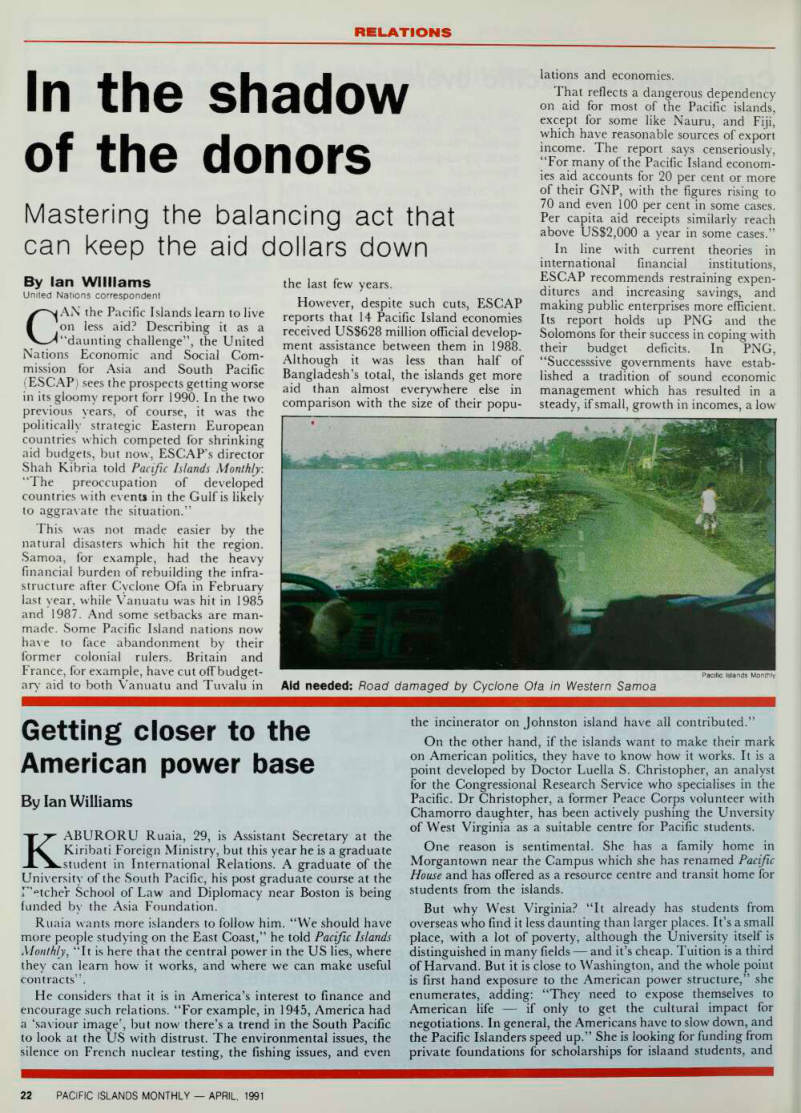
of the donors
Mastering the balancing act that can keep the aid dollars down
By Ian Williams
United Nations correspondent CAN the Pacific Islands leam to live on less aid? Describing it as a “daunting challenge”, the United Nations Economic and Social Com mission for Asia and South Pacific (ESCAP) sees the prospects getting worse in its gloomy report forr 1990. In the two previous years, of course, it was the
politically strategic Eastern European
countries which competed for shrinking aid budgets, but now, ESCAP’s director Shah Kibria told Pacific Islands Monthly ; “The preoccupation of developed countries with events in the Gulf is likely to aggravate the situation.”
This was not made easier by the natural disasters which hit the region.
Samoa, for example, had the heavy financial burden of rebuilding the infra structure after Cyclone Ofa in February last year, while Vanuatu was hit in 1985 and 1987. And some setbacks are man made. Some Pacific Island nations now have to face abandonment by their former colonial rulers. Britain and France, for example, have cut offbudget ary aid to both Vanuatu and Tuvalu in
the last few years.
However, despite such cuts, ESCAP reports that 14 Pacific Island economies received US$62B million official develop ment assistance between them in 1988.
Although it was less than half of Bangladesh’s total, the islands get more aid than almost everywhere else in comparison with the size of their popu
lations and economies.
That reflects a dangerous dependency on aid for most of the Pacific islands, except for some like Nauru, and Fiji, which have reasonable sources of export income. The report says censeriously, “For many of the Pacific Island econom ies aid accounts for 20 per cent or more of their GNP, with the figures rising to 70 and even 100 per cent in some cases.
Per capita aid receipts similarly reach above USS2,OOO a year in some cases.”
In line with current theories in international financial institutions, ESCAP recommends restraining expen ditures and increasing savings, and
making public enterprises more efficient.
Its report holds up PNG and the Solomons for their success in coping with their budget deficits. In PNG, “Successsive governments have estab lished a tradition of sound economic management which has resulted in a steady, if small, growth in incomes, a low
Pacific Islands Monthly Aid needed: Road damaged by Cyclone Ofa in Western Samoa
rates of inflation, a stable monetary environment and a sustained level of debt service,” ESCAP says. In the Solomon Islands, the overall budget deficit had “almost tripled between 1985 and 1987” but “some improvements were made in 1988 and 1989.”
In Vanuatu, the government has not balanced its budget, albeit by severely tightening, budgets for sectors like educa tion and health, and by domestic bor
rowing.
But its call for “appropriate financial policies, ... measures for widening and deepening of sound financial markets, institutions and instruments may encour age household savings”, may not be appropriate for some of the smaller nations. In 1987, Kiribati and Palau each depended on aid for 109 per cent of their government expenditure.
And in many Pacific countries, the government sector plays a disproportionately large role in the economies. The island governments have had to cope with providing essential services for a fast growing population, which has been developing the habit of urban living. To finance it, they have had to reply on economies which are small and isolated and which have narrow output and export bases.
The report concludes by calling for forpns of aid which contribute towards self reliance. ESCAP adds: “The cur rently known resource base of many Pacific Islands is so limited that aid dependency will be a long term reality, notwithstanding the efforts' already un dertaken or planned.” But the bad news is that “The Pacific Island economies
should prepare themselves for a further reduction in ODA” (Overseas Development Assistance).
In a s i m ij ar ve i n , the United Nations
Development Programme, which has
commitments of some SSO million in aid in its current cycle, it trying to make its programmes more sensitive to the recipients’ needs. It has regular roundtable talks between a government and its donors, and this is holding for Tonga, Tuvalu and the Marshalls. “For these meetings, countries are supposed to
present their development programmes and investment proposals to the donors like UNDP, the World Bank and Asian Development Bank and individual donor countries. This year we are putting more effort to make these meetings part of the indigenous government’s efforts to co ordinate its plans,” a UNDP official told Pacific Islands Monthly , making it less of a donor driven effort than in the past. But it leaves the question unanswered can the islands give up aid without painful economic withdrawal symptoms? □
Getting closer to the American power base
American power base
By Ian Williams
KABURORU Ruaia, 29, is Assistant Secretary at the Kiribati Foreign Ministry, but this year he is a graduate student in International Relations, A graduate of the University of the South Pacific, his post graduate course at the F’etcher School of Law and Diplomacy near Boston is being funded by the Asia Foundation.
Ruaia wants more islanders to follow him. “We should have more people studying on the East Coast,” he told Pacific Islands Monthly , “It is here that the central power in the US lies, where they can learn how it works, and where we can make useful contracts”.
He considers that it is in America’s interest to finance and encourage such relations. “For example, in 1945, America had a ‘saviour image’, but now there’s a trend in the South Pacific to look at the US with distrust. The environmental issues, the silence on French nuclear testing, the fishing issues, and even
the incinerator on Johnston island have all contributed.”
On the other hand, if the islands want to make their mark on American politics, they have to know how it works. It is a point developed by Doctor Luella S. Christopher, an analyst for the Congressional Research Service who specialises in the Pacific. Dr Christopher, a former Peace Corps volunteer with Chamorro daughter, has been actively pushing the Unversity of West Virginia as a suitable centre for Pacific students.
One reason is sentimental. She has a family home in Morgantown near the Campus which she has renamed Pacific House and has offered as a resource centre and transit home for students from the islands.
But why West Virginia? “It already has students from overseas who find it less daunting than larger places. It’s a small place, with a lot of poverty, although the University itself is distinguished in many fields and it’s cheap. Tuition is a third of Harvand. But it is close to Washington, and the whole point is first hand exposure to the American power structure,” she enumerates, adding; “They need to expose themselves to American life if only to get the cultural impact for negotiations. In general, the Americans have to slow down, and the Pacific Islanders speed up.” She is looking for funding from private foundations for scholarships for islaand students, and
already has an enquiry, via the Peace Corps, from an interested
applicant in Tonga.
Ruaia has visited the campus and admits “the place is very good. The size may help to tone down the culture shock. It’s small, and so is the town. And that’s what people at home like.
The undergraduate courses in subjects like economics, accountancy, and computing woud be useful.” Christopher has hopes that the US government may also get involved in funding following President Bush’s pledge last year in Honolulu to step up human resource exchanges between the regions.
She has been lobbying successfully with the Pacific diplomatic com munity in Washington and hopes that the initiative will soon take off.
Dr Prentiss de Jesus, of the US Department of Agriculture’s Inter national Institute for Development, has a different approach to the problem. Rather than bring students to America, his Interna tional Institute for Development is taking American training to the
islands. A conference in February in Washington DC, launched
Pacific people ‘need to expose themselves to American life ... In general, the Americans have to slow down and the Pacific Islanders speed up’
PITI, the Pacific Islands Training Initiative, which will begin training programmes in American Samoa, the Marshall Islands, Pohnpei and Guam by the end of March, with Saipan and Palau to follow by the end of the year. Congress’s General Accountingg Office report on the Palau financial scandals was “probably the prime mover,” in starting PITI, he admits.
De Jesus has already been on a pre-assesment tour to find out what training is needed. “We are concentrating on government employees, with a mandate to look at management needs like accounting, auditing and budgeting. The agricul
tural input is in USDA’s name only.
De Jesus’s section is a self-finacing agenccy paid for from user fees, so he has hopes that the training schemes will be expanded beyond the Ameri can sphere of influence to places like Tonga, and Western Samoa, funded if necessary by bodies like the World Bank and UNDP.
The courses will be initially run by mainlanders, but stress the “training of trainers”, so “Our aim is to train
ourselves out of business”, he finishes on an upbeat note. □
problems solved
Nomuka's water problems solved
c r i tt • !
ENGINEERS from the United States Army have installed two desalination units on Nomuka Isla " d J on ?, a ' ™ e r u l nits can produce 5000 gallons of fresh water a d f>' , f ive gallons for each of the island s 1000 residents.
Nomuka is on the southern end of the Ha’apai Group, 90 miles north of the main island Tongatapu. It “has a long history of problems with water,” said Lt. Col Fetu’utolu Tupou, Com mander of the Tongan Defence Ser vice. “Residents rely on catching and storing rainwater throughout the year, and this new fresh water system will supplement seasonal water shortages when rainfall is scarce.” ■n. t to r j j • • r t to The US-funded project is part of US
Army Pactfics (USARPAC) Ex
panded Relations Program which sup
ports military cooperation and projects with allies in the Pacific and Indian Ocean region.
The project, paid for by US aid, cost
Ussbo,Ooo.
The system is the first Reverse Osmosis Processing Unit (ROPU) in Tonga.
“One gallon of diesel fuel will produce 500 gallons of fresh water,” said technician C. Desai. “A similar solar powered system is unfortunately still far, far too expensive for most uses.”
The water units will be monitored and operated by the Nomuka residents.
Said the chief carpenter and mason, Sgt Wendel Flowers. “They brought coral from another island and we’d wade out to the ship. The heavy sacks would push us under, but we just kept walking to shore.”
The people of Nomuka prepared lunch every day. “Delicious!” laughed Corley. “Last night they brought us a complete roast pig for a ‘snack’ and this morning someone walked up with a boiled lobster for breakfast!” Water production is expected to begin this month □
In search of Amelia Earhart
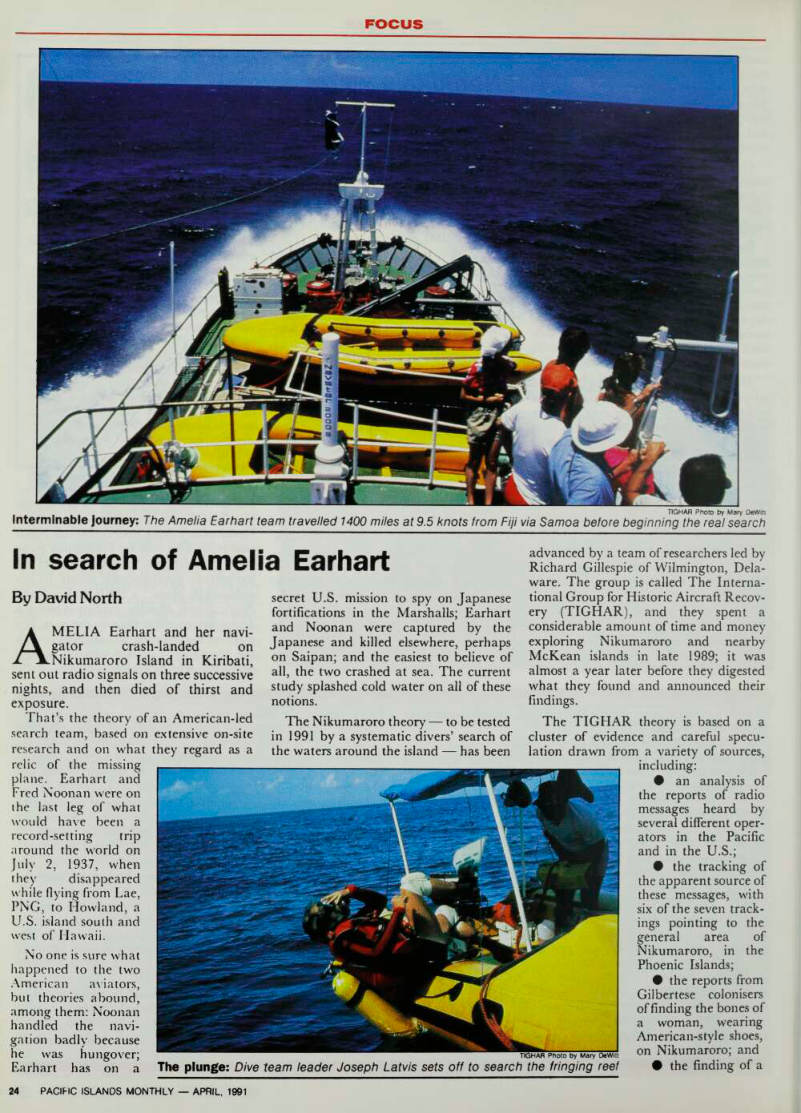
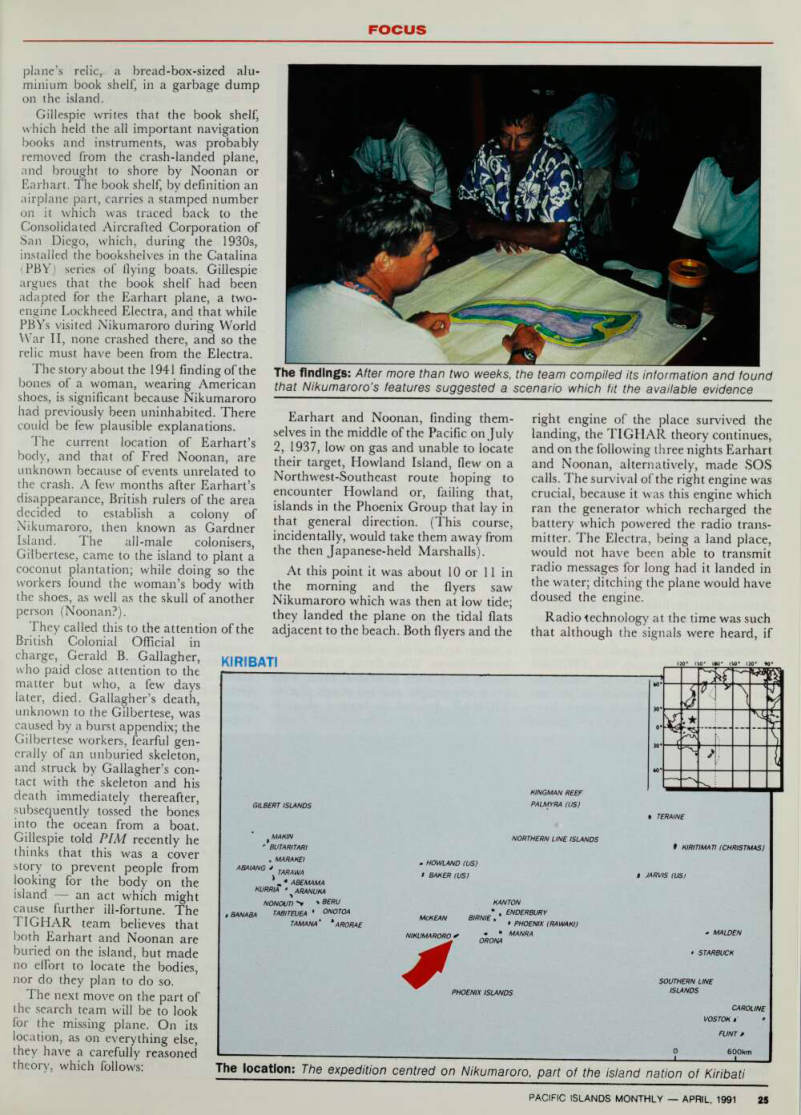
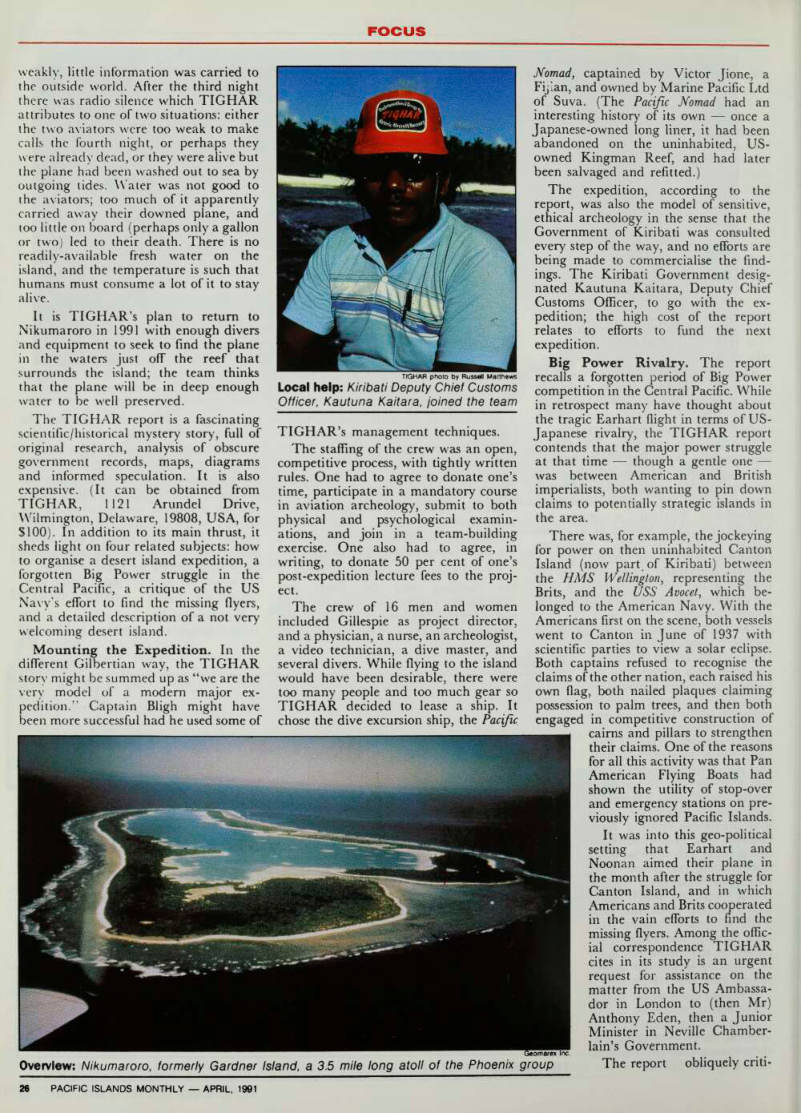
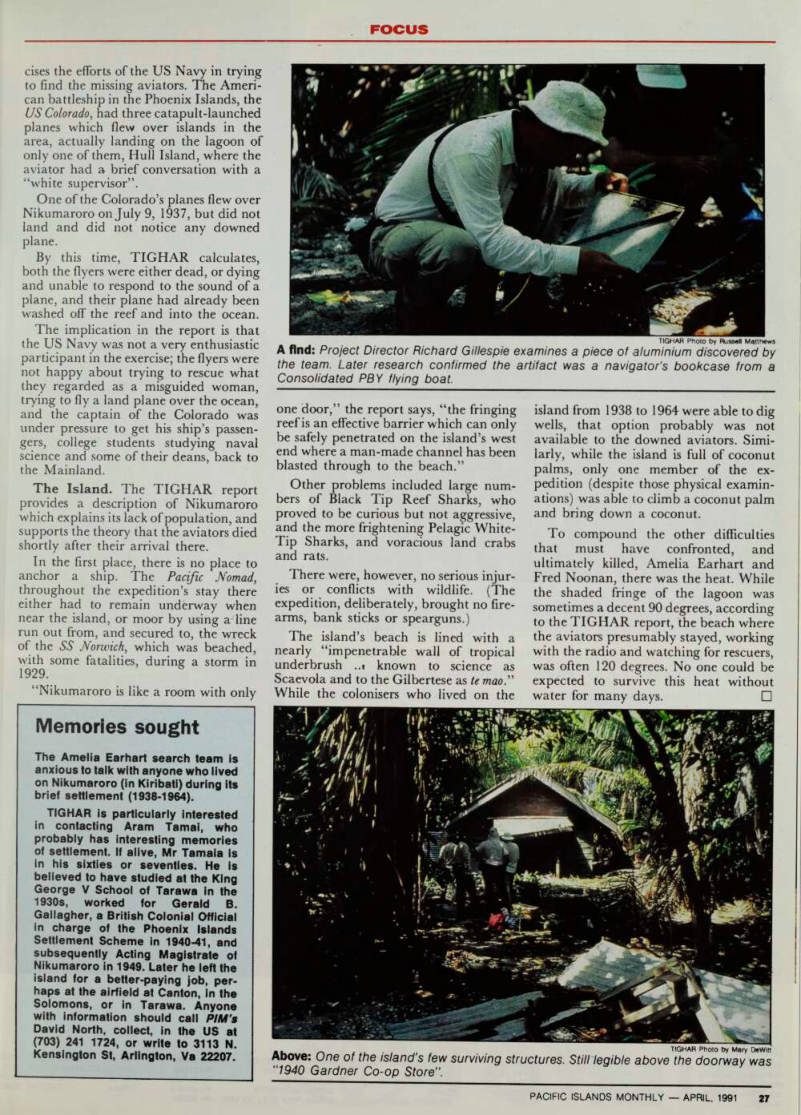
Focus
By David North
AMELIA Earhart and her navi gator crash-landed on Nikumaroro Island in Kiribati, sent out radio signals on three successive nights, and then died of thirst and exposure.
That’s the theory of an American-led search team, based on extensive on-site research and on what they regard as a
relic of the missing plane. Earhart and Fred Noonan were on the last leg of what would have been a
record-setting trip
around the world on July 2, 1937, when
they disappeared
w hile flying from Lae, PNG, to Howland, a U.S. island south and west of Hawaii.
No one is sure what happened to the two American aviators, but theories abound, among them: Noonan handled the navi gation badly because he was hungover; Earhart has on a
secret U.S. mission to spy on Japanese fortifications in the Marshalls; Earhart and Noonan were captured by the Japanese and killed elsewhere, perhaps on Saipan; and the easiest to believe of all, the two crashed at sea. The current study splashed cold water on all of these notions.
The Nikumaroro theory to be tested in 1991 by a systematic divers’ search of the waters around the island has been
advanced by a team of researchers led by Richard Gillespie of Wilmington, Dela ware. The group is called The Interna tional Group for Historic Aircraft Recov ery (TIGHAR), and they spent a considerable amount of time and money exploring Nikumaroro and nearby McKean islands in late 1989; it was almost a year later before they digested what they found and announced their
findings.
The TIGHAR theory is based on a cluster of evidence and careful specu lation drawn from a variety of sources,
including:
• an analysis of the reports of radio messages heard by several different oper ators in the Pacific and in the U.S.; • the tracking of the apparent source of these messages, with six of the seven track ings pointing to the general area of Nikumaroro, in the Phoenic Islands; • the reports from Gilbertese colonisers of finding the bones of a woman, wearing American-style shoes, on Nikumaroro; and • the finding of a
TIGHAR Photo by Mary DeWitr Interminable Journey: The Amelia Earhart team travelled 1400 miles at 9.5 knots from Fiji via Samoa before beginning the real search
TIGHAR Photo by Mary DeWitr The plunge: Dive team leader Joseph Latvis sets off to search the fringing reef
plane’s relic, a bread-box-sized alu minium book shelf, in a garbage dump on the island.
Gillespie writes that the book shelf, which held the all important navigation books and instruments, was probably removed from the crash-landed plane, and brought to shore by Noonan or Earhart. The book shelf, by definition an airplane part, carries a stamped number on it which was traced back to the Consolidated Aircrafted Corporation of San Diego, which, during the 19305, installed the bookshelves in the Catalina (PBY) series of flying boats. Gillespie argues that the book shelf had been adapted for the Earhart plane, a two engine Lockheed Electra, and that while PBYs visited Nikumaroro during World War 11, none crashed there, and so the relic must have been from the Electra.
The story about the 1941 finding of the bones of a woman, wearing American shoes, is significant because Nikumaroro had previously been uninhabited. There could be few plausible explanations.
The current location of Earhart’s body, and that of Fred Noonan, are unknown because of events unrelated to the crash. A few months after Earhart’s disappearance, British rulers of the area decided to establish a colony of Nikumaroro, then known as Gardner Island. The all-male colonisers, Gilbertese, came to the island to plant a coconut plantation; while doing so the workers found the woman’s body with the shoes, as well as the skull of another
person (Noonan?).
They called this to the attention of the British Colonial Official in
charge, Gerald B. Gallagher, who paid close attention to the matter but who, a few days later, died. Gallagher’s death, unknown to the Gilbertese, was caused by a burst appendix; the Gilbertese workers, fearful gen erally of an unburied skeleton, and struck by Gallagher’s con tact with the skeleton and his death immediately thereafter, subsequently tossed the bones into the ocean from a boat.
Gillespie told PIM recently he thinks that this was a cover story to prevent people from looking for the body on the island an act which might cause further ill-fortune. The TIGHAR team believes that both Earhart and Noonan are buried on the island, but made no effort to locate the bodies, nor do they plan to do so.
The next move on the part of the search team will be to look for the missing plane. On its location, as on everything else, they have a carefully reasoned theory, which follows:
Earhart and Noonan, finding them selves in the middle of the Pacific on July 2, 1937, low on gas and unable to locate their target, Howland Island, flew on a Northwest-Southeast route hoping to encounter Howland or, failing that, islands in the Phoenix Group that lay in that general direction. (This course, incidentally, would take them away from the then Japanese-held Marshalls).
At this point it was about 10 or 11 in the morning and the flyers saw Nikumaroro which was then at low tide; they landed the plane on the tidal flats adjacent to the beach. Both flyers and the
right engine of the place survived the landing, the TIGHAR theory continues, and on the following three nights Earhart and Noonan, alternatively, made SOS calls. The survival of the right engine was crucial, because it was this engine which ran the generator which recharged the battery which powered the radio trans mitter. The Electra, being a land place, would not have been able to transmit radio messages for long had it landed in the water; ditching the plane would have doused the engine.
Radio technology at the time was such that although the signals were heard, if
The findings: After more than two weeks, the team compiled its information and found that Nikumaroro’s features suggested a scenario which fit the available evidence
The location: The expedition centred on Nikumaroro, part of the island nation of Kiribati
Kiribati
weakly, little information was carried to the outside world. After the third night there was radio silence which TIGHAR attributes to one of two situations: either the two aviators were too weak to make calls the fourth night, or perhaps they were already dead, or they were alive but the plane had been washed out to sea by outgoing tides. Water was not good to the aviators; too much of it apparently carried away their downed plane, and too little on board (perhaps only a gallon or two) led to their death. There is no readily-available fresh water on the island, and the temperature is such that humans must consume a lot of it to stay alive.
It is TIGHAR’s plan to return to Nikumaroro in 1991 with enough divers and equipment to seek to find the plane in the waters just off the reef that surrounds the island; the team thinks that the plane will be in deep enough water to be well preserved.
The TIGHAR report is a fascinating scientific/historical mystery story, full of original research, analysis of obscure government records, maps, diagrams and informed speculation. It is also expensive. (It can be obtained from TIGHAR, 1121 Arundel Drive, Wilmington, Delaware, 19808, USA, for SI00). In addition to its main thrust, it sheds light on four related subjects; how to organise a desert island expedition, a forgotten Big Power struggle in the Central Pacific, a critique of the US Navy's effort to find the missing flyers, and a detailed description of a not very welcoming desert island.
Mounting the Expedition. In the different Gilbertian way, the TIGHAR story might be summed up as “we are the very model of a modern major ex
pedition.’* Captain Bligh might have
been more successful had he used some of
TIGHAR’s management techniques.
The staffing of the crew was an open, competitive process, with dghdy written rules. One had to agree to donate one’s time, participate in a mandatory course in aviation archeology, submit to both physical and psychological examin ations, and join in a team-building exercise. One also had to agree, in writing, to donate 50 per cent of one’s post-expedition lecture fees to the proj ect.
The crew of 16 men and women included Gillespie as project director, and a physician, a nurse, an archeologist, a video technician, a dive master, and several divers. While flying to the island would have been desirable, there were too many people and too much gear so TIGHAR decided to lease a ship. It chose the dive excursion ship, the Pacific
Nomad, captained by Victor Jione, a Fijian, and owned by Marine Pacific Ltd of Suva. (The Pacific Nomad had an interesting history of its own once a Japanese-owned long liner, it had been abandoned on the uninhabited, US owned Kingman Reef, and had later been salvaged and refitted.) The expedition, according to the report, was also the model of sensitive, ethical archeology in the sense that the Government of Kiribati was consulted every step of the way, and no efforts are being made to commercialise the find ings. The Kiribati Government desig nated Kautuna Kaitara, Deputy Chief Customs Officer, to go with the ex pedition; the high cost of the report relates to efforts to fund the next
expedition.
Big Power Rivalry. The report recalls a forgotten period of Big Power competition in the Central Pacific. While in retrospect many have thought about the tragic Earhart flight in terms of US- Japanese rivalry, the TIGHAR report contends that the major power struggle at that time though a gentle one was between American and British imperialists, both wanting to pin down claims to potentially strategic islands in the area.
There was, for example, the jockeying for power on then uninhabited Canton Island (now part of Kiribati) between the HMS Wellington , representing the Brits, and the USS Avocet , which be longed to the American Navy. With the Americans first on the scene, both vessels went to Canton in June of 1937 with scientific parties to view a solar eclipse.
Both captains refused to recognise the claims of the other nation, each raised his own flag, both nailed plaques claiming possession to palm trees, and then both engaged in competitive construction of
cairns and pillars to strengthen their claims. One of the reasons for all this activity was that Pan American Flying Boats had shown the utility of stop-over and emergency stations on pre viously ignored Pacific Islands.
It was into this geo-poliucal setting that Earhart and Noonan aimed their plane in the month after the struggle for Canton Island, and in which Americans and Brits cooperated in the vain efforts to find the missing flyers. Among the offic ial correspondence TIGHAR cites in its study is an urgent request for assistance on the matter from the US Ambassa dor in London to (then Mr) Anthony Eden, then a Junior Minister in Neville Chamber lain’s Government.
The report obliquely criti
Overview: Nikumaroro, formerly Gardner Island, a 3.5 mile long atoll of the Phoenix group
TIGHAR photo by Rossell Matthews Local help: Kiribati Deputy Chief Customs Officer, Kautuna Kaitara, joined the team
Geomarex Inc.
cises the efforts of the US Navy in trying to find the missing aviators. The Ameri can battleship in the Phoenix Islands, the US Colorado , had three catapult-launched planes which flew over islands in the area, actually landing on the lagoon of only one of them, Hull Island, where the aviator had a brief conversation with a “white supervisor”.
One of the Colorado’s planes flew over Nikumaroro on July 9, 1937, but did not land and did not notice any downed plane.
By this time, TIGHAR calculates, both the flyers were either dead, or dying and unable to respond to the sound of a plane, and their plane had already been washed off the reef and into the ocean.
The implication in the report is that the US Navy was not a very enthusiastic participant in the exercise; the flyers were not happy about trying to rescue what they regarded as a misguided woman, trying to fly a land plane over the ocean, and the captain of the Colorado was under pressure to get his ship’s passen gers, college students studying naval science and some of their deans, back to the Mainland.
The Island. The TIGHAR report provides a description of Nikumaroro which explains its lack of population, and supports the theory that the aviators died shortly after their arrival there.
In the first place, there is no place to anchor a ship. The Pacific Nomad, throughout the expedition’s stay there either had to remain underway when near the island, or moor by using a line run out from, and secured to, the wreck of the SS Norwich , which was beached, with some fatalities, during a storm in 1929.
“Nikumaroro is like a room with only
one door,” the report says, “the fringing reef is an effective barrier which can only be safely penetrated on the island’s west end where a man-made channel has been blasted through to the beach.”
Other problems included large num bers of Black Tip Reef Sharks, who proved to be curious but not aggressive, and the more frightening Pelagic White- Tip Sharks, and voracious land crabs and rats.
There were, however, no serious injur ies or conflicts with wildlife. (The expedition, deliberately, brought no fire arms, bank sticks or spearguns.) The island’s beach is lined with a
nearly “impenetrable wall of tropical
underbrush ..» known to science as Scaevola and to the Gilbertese as te mao”
While the colonisers who lived on the
island from 1938 to 1964 were able to dig wells, that option probably was not available to the downed aviators. Simi larly, while the island is full of coconut palms, only one member of the ex
pedition (despite those physical examin
ations) was able to climb a coconut palm and bring down a coconut.
To compound the other difficulties that must have confronted, and ultimately killed, Amelia Earhart and Fred Noonan, there was the heat. While the shaded fringe of the lagoon was sometimes a decent 90 degrees, according to the TIGHAR report, the beach where the aviators presumably stayed, working with the radio and watching for rescuers, was often 120 degrees. No one could be expected to survive this heat without water for many days. □
TIGHAR Photo by Russell Matthews A find: Project Director Richard Gillespie examines a piece of aluminium discovered by the team. Later research confirmed the artifact was a navigator’s bookcase from a Consolidated PBY flying boat.
TIGHAR Photo by Mary DeWitt Above: One of the island's few surviving structures. Still legible above the doorway was "1940 Gardner Co-op Store”.
Advertisements & other items, p. 24 (1 item)
24
PACING ISLANDS MONTHLY APRIL. 1991
Memories sought
The Amelia Earhart search team is anxious to talk with anyone who lived on Nikumaroro (in Kiribati) during its brief settlement (1938-1964).
TIGHAR is particularly interested in contacting Aram Tamai, who probably has interesting memories of settlement. If alive, Mr Tamaia is in his sixties or seventies. He is believed to have studied at the King George V School of Tarawa In the 19305, worked for Gerald B.
Gallagher, a British Colonial Official in charge of the Phoenix islands Settlement Scheme in 1940-41, and subsequently Acting Magistrate of Nikumaroro in 1949. Later he left the island for a better-paying job, per haps at the airfield at Canton, in the Solomons, or in Tarawa. Anyone with information should call PlM’s David North, collect, in the US at (703) 241 1724, or write to 3113 N.
Kensington St, Arlington, Va 22207.
Advertisements & other items, pp. 28-29 (1 item)
luxury-car ride.
pi The new Toyota brand mark. Three ellipses forming a “T” which stand for our customer, our commitment to the satisfaction of that customer through our product and for our spirit of creativity.
Pelt’s not often that you hear descriptions like rugged or durable combined with refined and elegant. But then there’s never been a vehicle quite like the new Toyota Land Cruiser Station Wagon. The unrivalled legend of off-road reliability is now unsurpassed in comfort and sophistication as well. Attention to detail is found everywhere, from the fine trim to the instrument panel to the graceful lines of its exterior. Even in places you can’t see, like the heavy-duty ladder frame and suspension design that add to the superb
But Toyota’s innovation goes beyond providing luxury and durability. The new Land Cruiser Station Wagon, and all of our cars, are designed to create a harmony between car and driver, and to provide you with the ultimate
driving experience.
The new Toyota Land Cruiser Station Wagon. Think of it as much more than a spacious luxury sedan with fourwheel drive. ■ 3 mm m . i 'a A M
DISTRIBUTORS/DEALERS
AMERICAN SAMOA BURNS PHILP (S.S.) CO. LTD. PH 633-4281 GUAM & MICRONESIA ATKINS KROLL, INC. PH 646-1876/9 NORFOLK ISLANDS BORRY'S PTY LTD. PH 2114
SOLOMON ISLANDS MENDANA MOTORS PH 22884
VANUATU VANUATU MOTORS PH 2341
COOK ISLANDS PACIFIC MOTORS LTD. PH 20796
KIRIBATI TARAWA MOTORS PH 21090
PAPUA NEW GUINEA ELA MOTORS PH 217036
TAHITI NIPPON AUTOMOTO PH 429819
WESTERN SAMOA BURNS PHILP (S.S.) CO. LTD. PH 20800
FIJI ASCO MK
NEW CALEDONIA S.I.A.P.
SAIPAN MICROL.
TONGA BURNS P
m «!I 1 * I * , /* •gf-rZ
creativit
m a □ L~ r i SS a* 5# PH 312666 PH 282848 PH 234-5911
-TD. PH 23673
® TOYOTA
Pacific
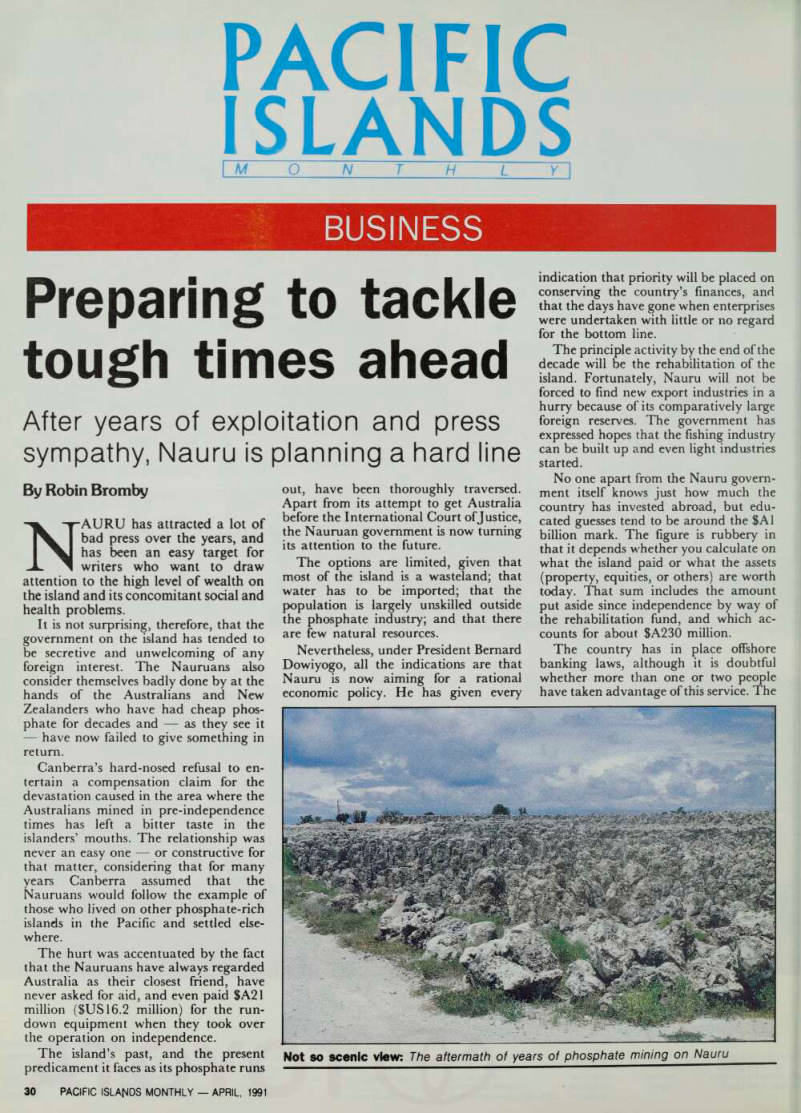
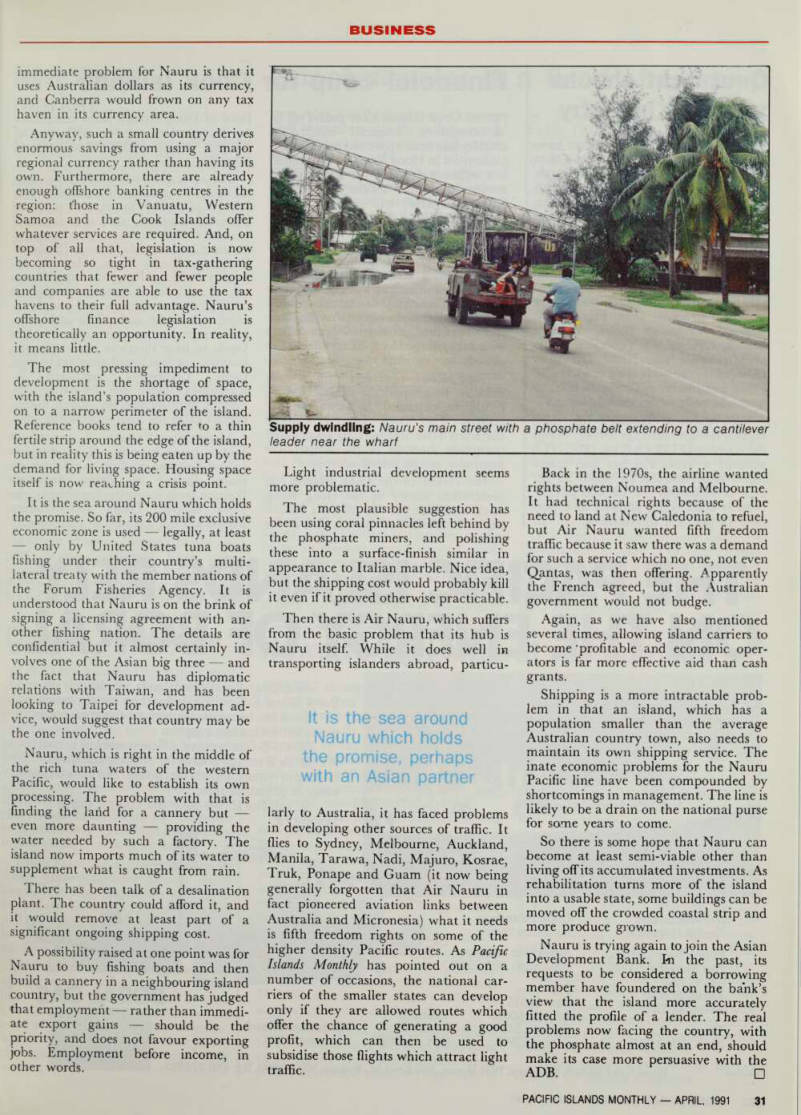
Islands
Monthly
Business
Preparing to tackle tough times ahead
After years of exploitation and press sympathy, Nauru is planning a hard line
By Robin Bromby
NAURU has attracted a lot of bad press over the years, and has been an easy target for writers who want to draw attention to the high level of wealth on the island and its concomitant social and
health problems.
It is not surprising, therefore, that the government on the island has tended to be secretive and unwelcoming of any foreign interest. The Nauruans also consider themselves badly done by at the hands of the Australians and New Zealanders who have had cheap phos phate for decades and as they see it have now failed to give something in return.
Canberra’s hard-nosed refusal to en tertain a compensation claim for the devastation caused in the area where the Australians mined in pre-independence times has left a bitter taste in the islanders’ mouths. The relationship was never an easy one or constructive for that matter, considering that for many years Canberra assumed that the Nauruans would follow the example of those who lived on other phosphate-rich islands in the Pacific and settled else where.
The hurt was accentuated by the fact that the Nauruans have always regarded Australia as their closest friend, have never asked for aid, and even paid SA2I million (SUSI 6.2 million) for the run down equipment when they took over the operation on independence.
The island’s past, and the present predicament it faces as its phosphate runs
out, have been thoroughly traversed.
Apart from its attempt to get Australia before the International Court of Justice, the Nauruan government is now turning its attention to the future.
The options are limited, given that most of the island is a wasteland; that water has to be imported; that the population is largely unskilled outside the phosphate industry; and that there are few natural resources.
Nevertheless, under President Bernard Dowiyogo, all the indications are that Nauru is now aiming for a rational economic policy. He has given every
indication that priority will be placed on conserving the country’s finances, and that the days have gone when enterprises were undertaken with little or no regard for the bottom line.
The principle activity by the end of the decade will be the rehabilitation of the island. Fortunately, Nauru will not be forced to find new export industries in a hurry because of its comparatively large foreign reserves. The government has expressed hopes that the fishing industry can be built up and even light industries started.
No one apart from the Nauru govern ment itself knows just how much the country has invested abroad, but edu cated guesses tend to be around the SAI billion mark. The figure is rubbery in that it depends whether you calculate on what the island paid or what the assets (property, equities, or others) are worth today. That sum includes the amount put aside since independence by way of the rehabilitation fund, and which ac counts for about SA23O million.
The country has in place offshore banking laws, although it is doubtful whether more than one or two people have taken advantage of this service. The
Not so scenic view: The aftermath of years of phosphate mining on Nauru
immediate problem for Nauru is that it uses Australian dollars as its currency, and Canberra would frown on any tax haven in its currency area.
Anyway, such a small country derives enormous savings from using a major regional currency rather than having its own. Furthermore, there are already enough offshore banking centres in the region: those in Vanuatu, Western Samoa and the Cook Islands offer whatever services are required. And, on top of all that, legislation is now
becoming so tight in tax-gathering
countries that fewer and fewer people and companies are able to use the tax havens to their full advantage. Nauru’s offshore finance legislation is
theoretically an opportunity. In reality,
it means little.
The most pressing impediment to development is the shortage of space, with the island’s population compressed on to a narrow perimeter of the island.
Reference books tend to refer to a thin fertile strip around the edge of the island, but in reality this is being eaten up by the demand for living space. Housing space itself is now reaching a crisis point.
It is the sea around Nauru which holds the promise. So far, its 200 mile exclusive economic zone is used - legally, at least only by United States tuna boats fishing under their country’s multi lateral treaty with the member nations of the Forum Fisheries Agency. It is understood that Nauru is on the brink of signing a licensing agreement with an other fishing nation. The details are confidential but it almost certainly in volves one of the Asian big three and the fact that Nauru has diplomatic relations with Taiwan, and has been
looking to Taipei for development ad
vice, would suggest that country may be the one involved.
Nauru, which is right in the middle of the rich tuna waters of the western Pacific, would like to establish its own processing. The problem with that is finding the land for a cannery but even more daunting providing the water needed by such a factory. The island now imports much of its water to supplement what is caught from rain.
There has been talk of a desalination plant. The country could afford it, and it would remove at least part of a
significant ongoing shipping cost.
A possibility raised at one point was for Nauru to buy fishing boats and then build a cannery in a neighbouring island country, but the government has judged that employment rather than immedi ate export gains should be the priority, and does not favour exporting jobs. Employment before income, in other words.
Light industrial development seems
more problematic.
The most plausible suggestion has been using coral pinnacles left behind by the phosphate miners, and polishing these into a surface-finish similar in appearance to Italian marble. Nice idea, but the shipping cost would probably kill it even if it proved otherwise practicable.
Then there is Air Nauru, which suffers from the basic problem that its hub is Nauru itself. While it does well in transporting islanders abroad, particu-
It is the sea around Nauru which holds the promise, perhaps with an Asian partner
larly to Australia, it has faced problems in developing other sources of traffic. It flies to Sydney, Melbourne, Auckland, Manila, Tarawa, Nadi, Majuro, Kosrae, Truk, Ponape and Guam (it now being generally forgotten that Air Nauru in fact pioneered aviation links between Australia and Micronesia) what it needs is fifth freedom rights on some of the higher density Pacific routes. As Pacific Islands Monthly has pointed out on a number of occasions, the national car riers of the smaller states can develop only if they are allowed routes which offer the chance of generating a good profit, which can then be used to subsidise those flights which attract light traffic.
Back in the 19705, the airline wanted rights between Noumea and Melbourne.
It had technical rights because of the need to land at New Caledonia to refuel, but Air Nauru wanted fifth freedom traffic because it saw there was a demand for such a service which no one, not even
Qantas, was then offering. Apparently
the French agreed, but the Australian government would not budge.
Again, as we have also mentioned several times, allowing island carriers to become 'profitable and economic oper ators is far more effective aid than cash grants.
Shipping is a more intractable prob lem in that an island, which has a population smaller than the average Australian country town, also needs to maintain its own shipping service. The inate economic problems for the Nauru Pacific line have been compounded by shortcomings in management. The line is likely to be a drain on the national purse for some years to come.
So there is some hope that Nauru can become at least semi-viable other than living off its accumulated investments. As rehabilitation turns more of the island into a usable state, some buildings can be moved off the crowded coastal strip and more produce grown.
Nauru is trying again to join the Asian Development Bank. I*n the past, its requests to be considered a borrowing member have foundered on the bank’s view that the island more accurately fitted the profile of a lender. The real problems now facing the country, with the phosphate almost at an end, should make its case more persuasive with the
Adb. □
Supply dwindling: Nauru’s main street with a phosphate belt extending to a cantilever leader near the wharf
garment industry
Quota cut shocks garment industry
FIJI’S garment manufacturers have reacted in shock to the news that Australia is to halve the country’s quota this year. The Fiji Trade and Investment Board (FTIB) had been inundated with inquiries from worried manufacturers.
Australia has indicated it will cut Fiji’s quota in order to provide in creased opportunities for other Forum nations under the Sparteca trade agree ment. Bids for increased quotas are expected to come from Papua New Guinea, Vanuatu, Tonga, Western Samoa, Kiribati, the Federated States of Micronesia and Niue. The news followed on the heels of an unsuccessful Fijian Submission to Canberra that the quota actually be increased.
Fiji’s garment industry (its third biggest foreign exchange earner) brings the country 5F159.4 million (SUSIII.6 million) a year. Fiji has had quota rights into Australia for about 33 per cent of its output (or 109,000 pieces).
Now it faces being allowed to export only 15 per cent to Australia. □
Financial coup for Cook Islands
THE Cook Islands have pulled off an astonishing financial coup: the country has been approved by securities authorities in Hong Kong as an alterna tive offshore domicile for locally listed companies. That means that Hong Kong companies will now be able to incorporate in Rarotonga for tax reasons or in preparation for the handover of Hong Kong to China in 1997 and still work within the colony’s stock exchange laws.
Only two other tax havens, Bermuda and the Cayman Islands, have been approved. Bermuda has proved the more popular of the Carribean offshore centres with many large Hong Kong companies already having their domicile there.
Hong Kong observers said it was unlikely that approval of tax havens would be extended to other offshore centres. The Cook Islands will be extremely attractive to Hong Kong listed companies because of its comparative proximity to the British colony.
The review of the Cook Islands was undertaken jointly by the Hong Kong stock exchange and the colony’s Securi ties and Futures Commission. About one
third of Hong Kong’s listed companies
are incorporated overseas with most of the new services opting for an overseas domicile.
The agreement was reached between the Hong Kong authorities and the Cook Islands Monetary Board. But much of the credit is apparently due to the chief executive of the dominant trust company in the Cooks Mr Trevor Clarke of European Pacific Trust. He told re porters in Hong Kong that the islands offered a democratic system underpinned by English common law and a sophisti cated companies code. This code does not require companies registered in the Cooks to have directors resident in the country, nor that board meetings be held
there. Companies registered in
Rarotonga under the legislation are exempt from income tax, stamp duties, capital gains tax and withholding tax.
Meanwhile, Vanuatu is one of 20 centres being investigated by Britain’s Inland Revenue in efforts to cut down on share dealing by British nationals through these countries. Suprisingly, the Cook Islands, Tonga and Western Samoa are not included in the probe. □
Advertisements & other items, p. 32 (1 item)
The Pacific Islands Rely
ON THE ENERGY OF BORAL
% ■ mmmm 2 j;V- ■> .<*; * t
ifi?
m«« All through the Pacific Islands, people rely on Boral Speed-E-Gas LP Gas for their energy needs.
Boral has terminals throughout the area, and is proud to be a leading supplier.
Speed-E-Gas is clean, efficient and low in cost.
It’s the ideal energy source for cooking and water heating in homes, motels and hotels, and for a wide range of industrial uses.
So call Boral. We have the energy you’re looking for.
Norfolk Island Norfolk Island 2419 Papua New Guinea Port Moresby 214248 Lae 422574 Rabaul 921225 Wewak 862125 Tonga Nukualofa 21388 Cook Islands Rarotonga 24460 American Samoa Pago Pago 699 2948 Fiji Suva 24035 Lautoka 60088 Sigatoka 50578 Labasa 82973 m
BORAL GAS
Vanuatu Santo 455 Port Vila 2046 Solomon Islands Honiara 21833 Boral Gas Limited, Bth Floor, IBM House, 168 Kent St., Sydney, NSW 2000. Tel: (02) 278512.
market
New copra market
COPRA producers on Christmas Island in Kiribati have found a new, if temporary, market for their copra. Five containers worth about USs3's,ooo were shipped to Samoa Coconut Products Ltd at Apia in early February and a second shipment was planned for March.
The coconut mill, which is owned by the Western Samoa Government, has been short of raw material since Cyclone Ofa destroyed large local coconut plantations last year. The local production will not resume until this month, hence the shipments. The company also made unsuccessful approaches to suppliers in Vanuatu.
Samoa Coconut Products produces coconut oil and copra cake for export to New Zealand, the Netherlands, Britain and Australia. Last year it took over the duties of the Copra Board, which was closed down as a cost-cutting move, and now has responsibility for buying the copra crop. The Govern ment also removed subsidies on copra production.
Coconuts, along with cocoa and taro, constitute Western Samoa’s major ex port items. Plantations have been upgraded since 1970, and the Govern ment’s plan has been to process more before they leave the country. □
Fishing stalemate
JUST a few months after Papua New Guinea pulled the plug on fishing negotiations, Palau has now failed to reach a new agreement with Japan.
Palau wanted the fee in a lump sum to aid financial planning, while Japan held out for payment per vessel or per voyage. Palau also insisted on terms agreed to by members of the Forum Fisheries Agency (FFA), for example that boats using members’ exclusive economic zones report high seas catches to aid resource management.
Palau Maritime Authority chairman Yukio Shmull said the country could lose licence fees and possibly aid: it had been made clear that Japanese aid was tied to fishing rights. Shmull said Palau had offered to extend the agreement for six months to allow talks to continue.
FFA director Philipp Muller said the agency would support Palau. It has been trying to persuade Japan to enter a multilateral agreement which would :over all the members’ economic zones, Dut so far Tokyo has stuck to its policy 3f negotiating separately with each :ountry. □
Latest disaster is a flood of money
BANKS in Western Samoa have got themselves into the rather unusual bind of having too much money
on deposit.
So much cash flooded into the country by way of remittances following Cyclone Ofa that there are simply not enough borrowers to absorb it. The country’s two trading banks are losing money on much of the cash which is now being deposited.
Both the Bank of Western Samoa and the Pacific Commercial Bank are re quired to deposit surplus funds with the Central Bank. The problem is that the Central Bank pays six per cent interest on the money; but the Government sets interest rates for the commercial banks and insists they pay 10.5 per cent on term deposits lodged for more than 12 months, (most of the bank’s term deposits fall into that category). The result is that the banks are subsidising the Central Bank.
The general manager of the Pacific Commercial Bank, Michael Halloran, told Pacific Islands Monthly that his bank had possibly as much as SWSIS million (5U56.63 million) in deposits excess to its lending needs. He said the flow of remittances had been strong: over two weeks last October, a monitor of the inflow to Western Samoa showed remit tances from relatives abroad was running 70 per cent higher than at the same time the previous year. All up, about SWS92 million was remitted back to the country
by Western Samoans living abroad during 1990. The banks were “embar rassed” at the amount of money being deposited, said Halloran.
Pacific Commercial is still accepting some term deposits, but it clearly prefers customers who place money in cheque acounts or lower yield savings accounts.
Halloran said the bank has had an active lending programme to meet demands for reconstruction and development after the cyclone’s destruction.
The Central Bank last year raised interest on term deposits by 1.5 per cent.
The lowest rate on these is 7.5 per cent even those customers not putting their money on deposit for 12 months are being paid more than the commercial banks are getting from the Central Bank.
The issue is complicated by the fact that the Central Bank wants people to save and that is why it increased rates the commercial banks have to pay. If that money is spent, the fear is that Western Samoa will experience rampant infladon as an increasing pool of money chases a diminishing supply of goods, goods which can only be supplied by importing more.
The Central Bank has now asked the Government to allow it to issue Central Bank Securities as a means of soaking up all the excess liquidity in the country. At the moment the bank cannot deal directly with the public. □
Hawaii’s agricultural record dims
FALLS in sugar and pineapple pro duction over the last two years have taken the shine off Hawaii’s agricultural performance. But the overall picture was improved by the emergence of coffee as the state’s fastest growing export crop and with another record production year in macadamia nuts. Guava also reached a new high.
A new report from the Bank of Hawaii said the state’s two leading crops showed flat to negative production and sales in 1989, with indications that 1990 sugar production could be up about two per cent following the 17 per cent decline in total processed tonnage of the past three years. The bank is expecting total 1990 sugar income to reach SUS 349 million.
But it predicts that total processed pineapple revenues appear likely to drop for the third successive year to less than SUSIB6 million, with industry indicators suggesting further declines ahead.
While harvested coffee area increased by only 100 acres to a total of 2400 acres in the 1990-91 year, the total area under plantations rose a massive 77 per cent to
5300 acres, the largest expansion on record. This reflects the conversion of former sugar growing areas on the island of Kauai, and the company involved hopes to eventually have 5000 acres under coffee.
Last season, for the first time in 100 years, coffee was harvested on Kauai and the report from the Bank of Hawaii said that the state’s production will rise sharply in coming years as the trees mature. The 1989-90 Hawaiian crop was up 60 per cent to 1.45 million kilograms, although it is expected to fall back to 1.22 million kilograms in the current season due to poor weather affecting the Big (Hawaii) Island Kona crop. It is the fastest growing of Hawaii’s export crops, and in 1989-90 total state revenue from it rose by 89 per cent to SUSI2.S million.
Macadamia production in 1989-90 reached 24.5 million kilograms, up more than 10 per cent. Guava production now stands at 9.4 million kilograms primarily as a result of 48 per cent more bearing acreage on Hawaii Island.
Banana output was down by six per cent to 3.4 million kilograms. □
fisheries net
PNG tightens the fisheries net
PAPUA New Guinea is to close all its archipelagic waters to non national vessels and will review all agreements with foreign companies currently permitted to fish in its exclusive economic zone. Fisheries Minister Akoka said the policy changes were aimed at localising the industry and forcing foreign operators to invest in on-shore facilities.
Doi said he has told the fisheries and marine resources department in Port Moresby to review the licensing policy on deep-water tuna boats. He said his policy was aimed at developing a viable local fishing industry, and benefitting people living in maritime provinces who would have access to the ocean.
Doi wants foreign companies to go into partnership with the local people, or invest in a domestic-based tuna processing industry. If they work within these guidelines they will receive tax exemptions on all fishing gear and fuel, and reductions in export taxes on all fish products.
Doi regards as a disgrace that Papua
New Guinea imports K 7 million
(SUS7.IB million) worth of fresh fish a year as well as canned fish. He said foreign investors needed to be shown that his country was serious about establishing its own tuna industry. □
Electricity boost
Electricity supply on Tonga’s
four main islands is to be upgraded using a SUS 7.3 million loan from the Asian Development Bank (ADB).
Generating capacity and distribution systems on Tongatapu, Vava’u, Ha’apai and ‘Eua will be improved to meet present and future demand. An additional 5.2 megawatts will be added to Tonga’s power output which the ADB estimates will alleviate shortfalls until 1996.
The loan will be used to build an extension to Papua power station in Tongatapu and install two diesel gen erators each of 2000 kilowatt capacity.
Vava’u will get two 300 kw units, a powerhouse, fuel tanks, and rehabili tation of its existing substation, while Ha’apai and ‘Eua will each acquire two 150 kw generators. The distribution system on each island will be improved with upgrading of circuits.
The ADB will provide an additional grant of U 55365,000 to cover a tariff study and to strengthen the insti tutional and financial capacity of the Tonga Electric Power Board. □
Potential for excitement in PNG finds
TWO potentially exciting explo
ration discoveries in Papua New Guinea have been announced re cently. Gold, copper and zinc has been found in the extreme northwest of New Guinea, while a well located north of the Kutubu field in Southern Highlands Province has shown promising signs of
hydrocarbons.
News of the minerals find came from one of the smaller resources companies listed on the Australian Stock Exchange, Carpenter’s Investment Trading Co Ltd.
Its announcement said that its licence area 699 A appeared to be “a significant new area of base and precious metals”.
The 97 sq km lease is set in the extreme north-west of the country in the Beswani Mountains near the Irian Jaya border, about 50 km south of Vanimo and 200 km north of the Ok Tedi mine.
Early sampling of outcrops had pointed to an extensive area of at least 25 sq km of volcanic rocks.
Geologists took 430 samples from 382 sites. Of the key sites, an outcrop north of Mt Mokofiang is made up of copper sulphides with minor gold, silver and zinc. Copper values ranged up to 24.5 per cent while gold values rose to 2.2 grams per tonne, with one outcrop
recording 26g/t.
An area to the south of this outcrop was found to be rich in zinc with values ranging from three to 21 per cent, with
traces also of copper, gold and silver.
Oil Search Ltd reported that its SE Mananda IX well in the Southern Highlands showed positive signs of hy drocarbon content. If it proves to contain recoverable quantities, the find will extend the size of the Kutubu oil project, which now includes the lagifu, Hedinia ad Agogo fields.
The hydrocarbons were recorded at between 1750 metres and 2109 metres.
Stock market reaction to the announce ment was marked, with Oil Search shares
rising in price.
Meanwhile, one of the smaller players in Papua New Guinea oil exploration has managed to raise more capital in the Australian equity market. Mosaic Oil NL now has another SAI.4 million (SUSI.O9 million). Part of the capital raising will finance its share of a well on the promising Langia prospect (PPL94), an easily-accessed area south of the Kutubu field.
PPL94 is managed by Mosaic’s joint
venture partner, Royal Dutch Shell, which has carried out seismic exploration over 1300 sq km the most extensive data programme undertaken in Papua New Guinea. Shell has 90 per cent of the prospect, Mosaic 10 per cent.
Mosaic has succeeded in fundraising at a time when Australian investors are
generally unsympathetic to highly specu
lative issues. □
Provident Funds respond to change
PROVIDENT Funds needed to bal ance their roles of responding to immediate challenges and working toward long-term goals, according to Fiji’s Finance Minister Josevata Kami kamica.
Addressing world delegates at the twelfth meeting of the International Social Security Association in Suva, Kamikamica said the Fiji National Provident Fund (FNPF) was the single largest source of long-term funds for the country, with the amount of savings it mobilised fast approaching $1 billion.
He said that infrastructure, public utilities and housing schemes had been boosted, and funds through the Fiji Development Bank had helped industrial and commercial development.
However, “urgent current needs” in the form of members’ desire to buy housing had led to interim partial withdrawals before retirement. The Fund’s original goal (to provide for the workers’ old age) needed to be re emphasised, he said.
In a paper he later presented to the
seminar, FNPF General Manager and Chief Executive, Lionel Yee, said that Provident Fund investments had, on the macro level, improved infrastructure through better roads and communica tions, more jobs through hotel develop ments, and better medical facilities through government development loans.
On the micro level, members’ housing had been improved by availability of long-term finance at affordable rates.
“This aspect alone must stand out as one of the most important social devel opment programs where provident funds operate,” Mr Yee’s report said.
Mr Kamikamica said FNPF was looking at effective use of public relations to promote effective services to members and employers, and a separate voluntary system for domestic workers on a differ ent basis. It would also do comprehensive studies on the possibility of extending the pension choice to women who have withdrawn on marriage and who con tinue to work for long periods with the intention to work till the retirement age, he said.
fish treaty
Trade Winds
New Korean fish treaty
A SOUTH Korean operation, Deep sea Fishing Company, has renewed its annual fishing agreement with Kiri bati. The company will be entitled to operate. 110 vessels in the country’s exclusive economic zone in return for SUSI million. Deepsea catches about 6000 tonnes of fish annually in Kiribati waters, mainly yellowfin and big eye tuna for the sushimi market. It will be required to pay SUS 10,000 for a license for each additional vessel.
Tonga
Aid money for cattle TONGAN smallholders will be able to acquire more cattle through a SUS 2 million loan from the International Fund for Agricultural Bank, made through the Tonga Development Bank. Money will be available to farmers on ’Eua, Niuafo’ou and Niuatoputapu for cattle
importing and agricultural development.
Exchange rate changes TONGA’S Pa’anga, the local currency unit, will be valued against foreign currencies by a new method. The National Reserve Bank of Tonga has announced it will no longer be linked to the Australian dollar, but subject to a daily rate based on a basket of currencies from Tonga’s major trading partners.
Tonga will no longer be affected so strongly by Australian developments where the currency has long been considered over-valued due to high domestic interest rates.
Inflation up again STATISTICS for the 12 months to January reveal that Tonga’s inflation rate continues to climb, and now stands at an annualised rate of 16.3 per cent.
Again much of the rise comes from the transport sector which was hit by higher fuel costs after the invasion of Kuwait.
Papua New Guinea
Cocoa firm makes payment TOWARMARI Pty Ltd, a cocoa com pany in east New Britain, has made its first loan repayment to. the Papua New Guinea Agriculture Bank a move seen as heartening in an industry beset with troubles. The company, which has been developing its crop for five years, handed over K 32,000. It farms hybrid cocoa strains on a 130 ha plantation, and the company is owned by local villagers.
New coffee body mooted AGRICULTURE and Livestock Minis ter Tom Pais is to seek parliamentary
support for a new coffee industry corpor ation. Legislation has already been drafted. The new body would absorb tasks now undertaken by the Coffee Development Agency, Coffee Industry Board and the Coffee Research Institute.
Coconut factory proposed COPRA producer and MP for Bogia, Timothy Ward, is trying to gain support for the establishment of a new coconut factory in Papua New Guinea, and which would produce powdered and liquid coconut milk. Ward runs a 3000 hectare coconut plantation and said it was difficult to find a market for his crop.
He said a processing plant would restore some confidence to the depressed coconut sector. Consultants are working on a feasibility plan.
Wharf to be upgraded AITAPE wharf in the West Sepik province is to be upgraded at a cost of KBOO,OO ($US816,000). The wharf needed repairs to keep it safe, but also is expected to be more heavily used once the Mai-tadji Highway is completed.
Fiji
Cocoa production boost FIJI’S Department of Agriculture has announced it intends to promote cocoa development, with emphasis both on increasing production and lifting quality.
Its strategy is to include instructing growers on cocoa husbandry, enforce world cocoa grading standards, build better cocoa dryers, improve roads in growing areas to make it easier to transport the crop, and train advisors.
Fiji has 3371 ha under cocoa this year, compared with 3173 ha in 1989. Exports last year totalled 465 tonnes of beans.
Programmes similar to those being applied to cocoa, will also be applied to ginger. Last year Fiji exported 1800 tonnes of matured ginger worth about SF2 million (SUSI.3S million).
New help for ventures THE Fiji Development Bank has launched the equity window scheme, aimed at increasing Fijian participation in commerce and industry. The project will enable the bank to invest in new and existing business ventures on behalf of Fijians and will • have a SFS million (SUS3.3B million) government grant to back the scheme. Priority sectors have been named as manufacturing, forestry, agro-industry, tourism or enterprises
producing important consumer or capi
tal goods or services.
Pakistan bank opens THE Habib Bank of Pakistan has opened its office in Suva, a move which has been welcomed locally as providing another source of development finance. The
president of the new Fiji branch, Maq 800 l Ahmed Soomro, said the Habib Bank would provide loans to farmers, but would also be looking to offer competi tive rates for financing trade and other sectors. It was reported that 1200 people opened accounts on the branch’s first day of business.
Fishermen to be controlled FISHERMEN who use dynamite in Fijian waters may find themselves facing stiff fines once the Ministry of Primary Industry completes its review of the Fisheries Act. The fishing authorities have been concerned about the increas ing use of dynamite to kill fish because of the long-term damage that can be done to the environment. The government believes that existing penalties are failing to be a deterrent.
Tuvalu
Energy team visits A TEAM of energy experts has been in Tuvalu studying petroleum and elec tricity needs and the operations of the Tuvalu electricity authority corporation.
The team, part of the World Bank’s Pacific regional energy assessment pro gramme, also discussed the prospects for exploiting new and renewable energy sources as well as supplying power to the outer islands.
Solomon Islands
Fish company sale queried SOLOMON Islands’ auditor general has raised questions about the sale by the government of the National Fisheries Development company to the Canadian company, British Columbia Packers. The auditor-general’s annual report indi cated that advice on valuation of the company, especially its tuna resource, should have been sought from the Honiara-based Forum Fisheries Agency.
The report criticised the fact that there was no proper valuation made. □
Advertisements & other items, p. 35 (2 items)
35
FTOFie ISLANDS MONTHLY APRIL, 1991
Bacot
BELLFOUNDRIES
Supplying tuned bronze bells in Australia and Pacific Islands since 1977 Portal Address: Box 421, North Adelaide, SA 5006, Australia Telephone: (08) 267 1306 Office: 147 Ward St, North Adelaide, SA Workshop: 346 Carrington St, Adelaide, SA •a
SP identity
Travel
Promoting the SP identity
THE South Pacific will gain a stronger regional identity through joint New Zealand, Australia, Fiji and Tahiti
marketing activities.
A working committee has been estab lished in Los Angeles to look at closer tourism marketing cooperation, follow ing a meeting in Los Angeles attended by representatives of South Pacific National Tourist offices and major airlines serving
the region.
General Manager of the New Zealand Tourism Department Neil Plimmer said the aim w r as not to lessen individual marketing efforts, but to combine some resources of countries and airlines to better establish a “Destination South Pacific” in the minds of American travel agents and potential travellers.
North American view NORTH American retail travel agents only associated the South Pacific with Australia, New Zealand, Fiji and Tahiti, according to a Tourism Council of the South Pacific report based on survey work.
The survey found that the Cook Islands had improved the most in terms of recognition from the North American travel trade, with 14 per cent in
comparison with previous studies. Papua
New Guinea had a 10 per cent improve ment, Western Samoa eight per cent, Tonga seven, Solomon Islands six, and American Samoa five per cent.
Kiribati and Niue were associated with the South Pacific by less than three per cent of the travel agents. In terms of how r familiar the North American retail travel agents were with individual TCSP countries, they were “extremely” fam iliar with Tahiti 94 per cent, Fiji 93
per cent, Cook Islands 67, PNG 62 per cent, American Samoa 58 per cent, Solomon Islands and Tonga 50 per cent, Western Samoa 47, Vanuatu 23, Tuvalu 15 and Kiribati and Niue 12 per cent.
Special fare AIR Pacific has joined with Qantas to offer a special fare designed to stimulate the market from North America to the South Pacific in the wake of the Gulf War. The “Goodbye Fares” allow Am ericans who fly to Australia or New
Zealand from Los Angeles during April
to July to do so for SUSB99 round trip.
From Hawaii the fare will be $599.
Air Pacific’s Managing Director and Chief Executive Officer Andrew Drysdale said Air Pacific carried 16,000 Americans to Fiji from Australia, New Zealand and the Pacific Islands. Al though the airline does not fly to North America, its marketing there and links to other Pacific destinations meant it car ried almost 25 per cent of Americans who travelled to Fiji ; he said.
Polynesian push THE Pacific Asia Travel Association (PATA) has formed a Polynesian chap ter consisting of the Cook Islands, Tonga, American and Western Samoa, and French Polynesia.
Vice president, Pacific Division of PATA, lan Kennedy, said the islands of Micronesia had formed a chapter several years ago, and its success had inspired Tahiti to seek a similar format. He said that a chapter would combine the efforts of all members.
“As a collective group they will have more clout when they approach PATA for help in areas such as marketing. We can afford to do certain things for a group that we couldn’t do for an individual body,” he told Pacific Islands Monthly.
Solomons tax THE current financial situation in the Solomon Islands has led to the introduc tion of a departure tax of SSI2O for international flights. According to a Government statement the need to tighten up expenditure and improve revenue collection meant only excep tional cases would be considered for exemption from the tax.
The statement said sporting organis ations and churches will not necessarily be exempt. Top politicians, ministers, Members of Parliament, Diplomats, EEC Delegates, aircraft cabin crew, children under two years of age, transit passengers staying less than eight hours
and destitute passengers with the Minis ter’s approval are exempt.
Airport expansion More than 50,000 tourists are expected to visit the Solomon Islands each year after completion of the Henderson Air port major expansion and upgrading project. In the past, tourist numbers have averaged 10,000.
The airport project starts in July/ August and will include a new airport terminal, apron and carpark. Once the construction is completed, the airfield will be able to handle two 737 aircraft at any one time.
Funding for the project will come as part of the SUS 29 million provided under the EEC Lome four program for Solomon Islands. Tourism and Civil Aviation Minister, Victor Ngele, said the total airport development would cost about SUS2O million. He said Japan had also been approached for funding of other components of the airport develop ment.
Globalism prediction THE continuing refusal by governments worldwide to meet and agree to common licensing and certification requirements has been criticised by the director general of International Airlines Travel Association (lATA).
Speaking at a Association of South Pacific (ASPA) meeting in Noumea, Gunter Eser also predicted a continued increase in globalism and other alliances made “irresistable” with shared costs of marketing, maintenance and aircraft and fuel purchase.
He said according to lATA calcu lations, the international scheduled ser vices of lATA members lost at least SUS 2 million as a result of the Gulf War.
Recovery would be “painful” and “re tracted”, he said.
Nauru orders new jets AIR Nauru has ordered two new Boeing 737-400 aircraft which are scheduled for delivery in 1993. They will replace the existing 737-200 s. The aircraft will be built by Boeing to Australian Airlines’ specifications following an agreement under which that carrier will provide maintenance and engineering for the new fleet.
Air Nauru now flies to New Zealand, Micronesia, Fiji, Honiara and Manila.
The carrier will be reorganising its services to attract more people to use Nauru as a transit stopover between Micronesia and Australia and New Zealand.
Advertisements & other items, p. 36 (1 item)
Pump Distributors Wanted
EXCELLENT PROFIT AVAILABLE
Asa Pacific Pump Dealeryou would have access to some of the world’s finest agricultural and industrial pump prducts.
The product range includes:-
HIGH PRESSURE WASHERS
SUBMERSIBLES Tsurumi Toyo
PRESSURE SYSTEMS Espa
GEAR PUMPS Viking Gorman Rupp
PISTON PUMPS Cat
TRASH Gorman Rupp OP
GENERATORS
We provide sales literature, full technical support, price lists and a discount structure which enables generous profit margins when selling Pacific Products.
Phone or Fax for full distributorship details— The Marketing Manager Pacific Pump company 2 South Street Rydalmere, NSW, 2116
NSW AUSTRALIA
Phone (02) 638 5600 Fax (02) 684 2184
Disappointment with the Solomons
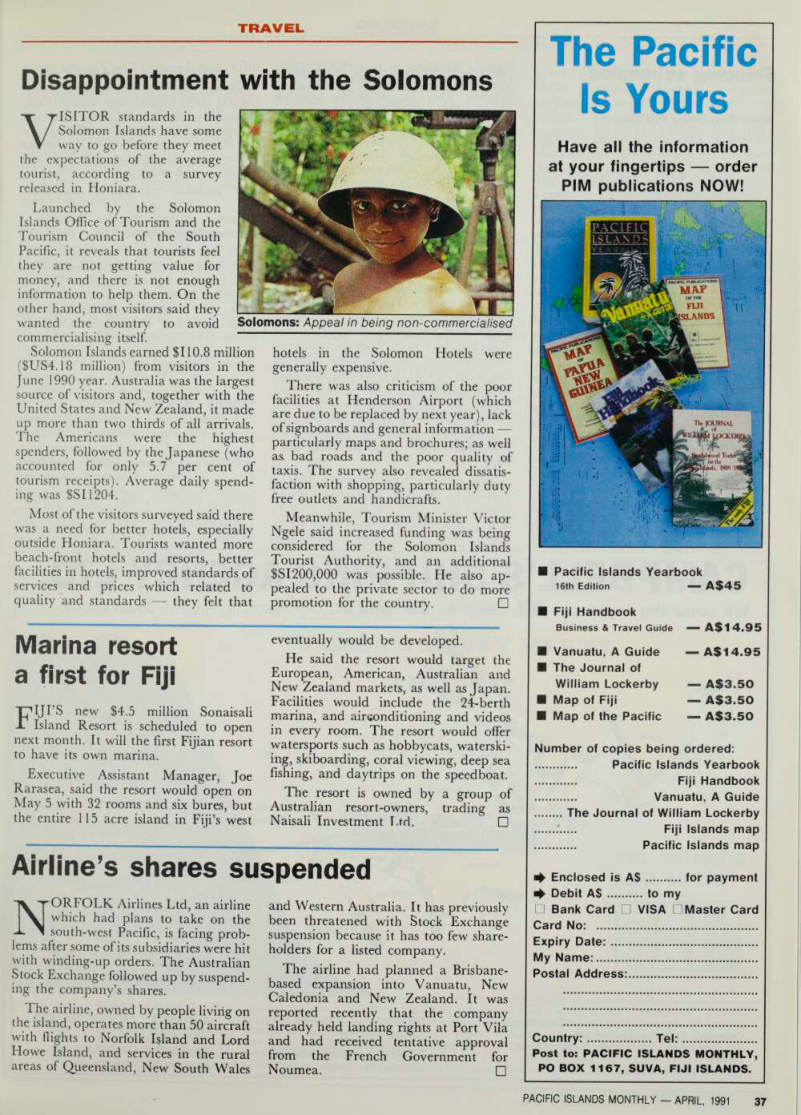
VISITOR standards in the Solomon Islands have some way to go before they meet the expectations of the average tourist, according to a survey released in Honiara.
Launched by the Solomon Islands Office of Tourism and the Tourism Council of the South Pacific, it reveals that tourists feel they are not getting value for money, and there is not enough information to help them. On the other hand, most visitors said they wanted the country to avoid commercialising itself.
Solomon Islands earned SI 10.8 million (SUS4.IB million) from visitors in the June 1990 year, Australia was the largest source of visitors and, together with the United States and New Zealand, it made up more than two thirds of all arrivals.
The Americans were the highest spenders, followed by the Japanese (who accounted for only 5.7 per cent of tourism receipts). Average daily spend ing was SSI 1204.
Most of the visitors surveyed said there was a need for better hotels, especially outside Honiara. Tourists wanted more beach-front hotels and resorts, better facilities in hotels, improved standards of services and prices which related to quality and standards they felt that
hotels in the Solomon Hotels were generally expensive.
There was also criticism of the poor facilities at Henderson Airport (which are due to be replaced by next year), lack of signboards and general information particularly maps and brochures; as well as bad roads and the poor quality of taxis. The survey also revealed dissatis faction with shopping, particularly duty free outlets and handicrafts.
Meanwhile, Tourism Minister Victor
Ngele said increased funding was being
considered for the Solomon Islands Tourist Authority, and an additional 551200,000 was possible. He also ap pealed to the private sector to do more promotion for the country. □
Solomons: Appeal in being non-commercialised
Marina resort
a first for Fiji
F ttt , c ... . ... 0 t i j 1 35 w . 5 T ll i l °i n i S° naisa k Island Resort is scheduled to open next month. It will the first Fijian resort to have its own marina.
Executive Assistant Manager, Joe
Rarasea, said the resort would open on May 5 with 32 rooms and six bures, but the entire 115 acre island in Fiji’s west
eventually would be developed.
He said the resort would target the European, American, Australian and New Zealand markets, as well as Japan.
Facilities would include the 24-berth marina, and airconditioning and videos [ n every room. The resort would offer watersports such as hobbycats, waterski
ing, skiboarding, coral viewing, deep sea
Fishing, and daytrips on the speedboat.
The resort is owned by a group of Australian resort-owners, trading as Naisali Investment Ltd. □
Airline’s shares suspended
NORFOLK Airlines Ltd, an airline which had plans to take on the south-west Pacific, is facing prob lems after some of its subsidiaries were hit with winding-up orders. The Australian Stock Exchange followed up by suspend ing the company’s shares.
The airline, owned by people living on the island, operates more than 50 aircraft with flights to Norfolk Island and Lord Howe Island, and services in the rural areas of Queensland, New South Wales
and Western Australia. It has previously been threatened with Stock Exchange suspension because it has too few share holders for a listed company.
The airline had planned a Brisbane based expansion into Vanuatu, New Caledonia and New Zealand. It was reported recently that the company already held landing rights at Port Vila and had received tentative approval from the French Government for Noumea. □
Advertisements & other items, p. 37 (2 items)
Travel
The Pacific
Is Yours
Have all the information at your fingertips order PIM publications NOW!
TV
MAF
FIJI
STANDS
The JOURNAL
U^JpCK
tad Trade the f(«k 180H1 ■ Pacific Islands Yearbook 16th Edition As4s ■ Fiji Handbook Business & Travel Guide A 514.95 ■ Vanuatu, A Guide ■ The Journal of William Lockerby ■ Map of Fiji ■ Map of the Pacific A$ 1 4.95 A 53.50 A 53.50 A 53.50 Number of copies being ordered: Pacific Islands Yearbook Fiji Handbook Vanuatu, A Guide The Journal of William Lockerby Fiji Islands map Pacific Islands map Enclosed is A$ for payment Debit A$ to my □ Bank Card □ VISA DMaster Card Card No: Expiry Date: My Name: Postal Address: Country: Tel:
Post to: PACIFIC ISLANDS MONTHLY,
PO BOX 1167, SUVA, FIJI ISLANDS.
Shipping schedules
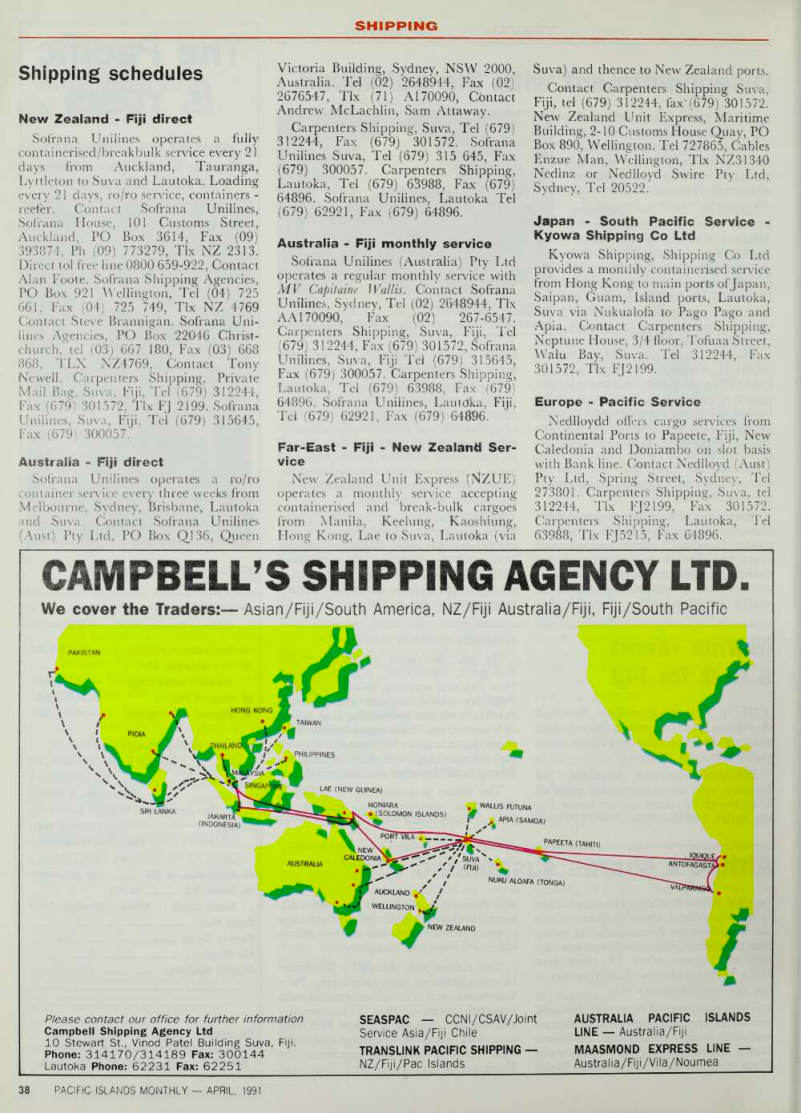
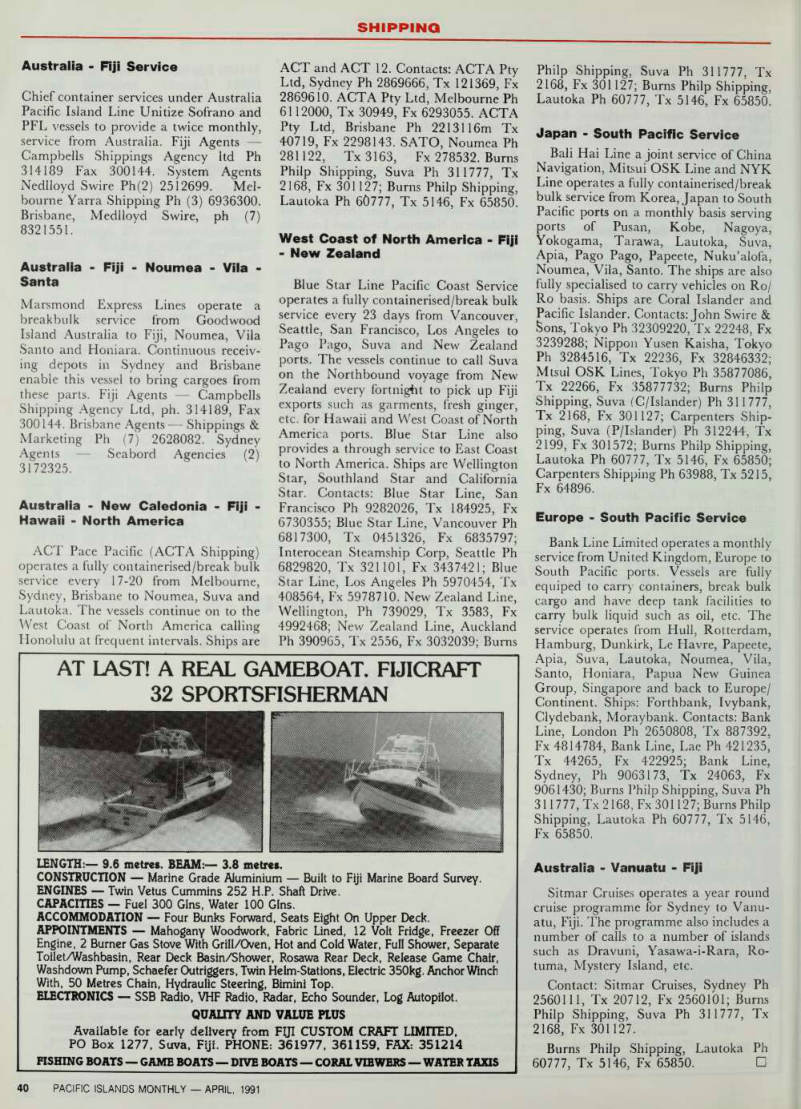
Shipping
New Zealand - Fiji direct cr ... „ Sofrana Umhnes operates a fully containerised/breakbulk service every 2 days ftom Auckland Tauranga, Lyttleton to Suva and Lautoka. Loading every 21 days, ro/ro service, containers reefer. Contact Sofrana Umhnes, Sofrana House, 101 Customs Street, Auckland, PO Box 3614, Fax (09) 393874. Ph (09) 773279, Tlx NZ 2313.
Direct tol free line 0800 659-922, Contact Al-.n Foote Sofrana Shmoini? Agencies Alan i oote. son ana snipping Agencies, PO Box 921 Wellington, Tel (04) 725 661, Fax (04; 725 749, Tlx NZ 4769 Contact Steve Brannigan. Sofrana Uni lines Agencies, PO Box 22046 Christ church, tel (03) 667 180, Fax (03) 668 868. TLX NZ4769, Contact Tony
Newell. Carpenters Shipping. Private
Mail Bag, Suva, Fiji, Tel (679) 312244, Fax (679) 301572, Tlx FJ 2199. Sofrana Unilines, Suva, Fiji. Tel (679) 315645, Fax (679) 300057.
Australia - Fiji direct Sofrana Unilines operates a ro/ro container service every three weeks from Melbourne, Sydney, Brisbane, Lautoka and Suva. Contact Sofrana Unilines (Aust) Pty Ltd, PO Box QJ36, Queen
Victoria Building, Sydney, NSW 2000, Australia, Tel (02) 2648944 Fax (02) 2676547, The (71) A 170090 Contact Mc “ n : Sa ™ Carpenters Shipping, Suva, Tel (679) 312244, Fax (679) 301572. Sofrana Unilines Suva, Tel (679) 315 645, Fax (679) 300057. Carpenters Shipping, Lautoka, Tel (679) 65988, Fax (679) 54396. Sofrana Unilines, Lautoka Tel (679) 62921, Fax (679) 64896.
AllQfrr p;:: corui , a A “ stra " a - F " monlh * ® eru ce Sofrana Umhnes I Australia) Pty Ltd operates a regular monthly service with i & i ContactSofrana Unilines, Sydney, Tel (02) 2648944, Tlx AA170090, Fax (02) 267-6547.
Carpenters Shipping, Suva Fiji, Tel (679) 312244, Fax (679) 301572, Sofrana Unilines, Suva, Fiji Tel (679) 315645, Fax (679) 300057. Carpenters Shipping, Lautoka, Tel (679) 63988, Fax (679) 64896. Sofrana Unilines, Lautdka, Fiji, (679) 62921, Fax (679) 64896.
Far-East - Fiji - New Zealand Service New Zealand Unit Express (NZUE) operates a monthly service accepting containerised and break-bulk cargoes from Manila, Keelung, Kaoshiung, Hong Kong, Lae to Suva, Lautoka (via
Suva) and thence to New Zealand ports.
Contact Carpenters Shipping Suva, Fiji, tel (679) 312244, fax* (679) 301572!
New Zealand Unit Express, Maritime Building, 2-10 Customs House Quay, PO Box 890, Wellington. Tel 727865, Cables Enzue Man, Wellington, Tlx NZ31340 Nedlnz or Nedlloyd Swire Pty Ltd, Sydney, Tel 20522.
Japan - South Pacific Service - Kyowa Shipping Co Ltd Kyowa Shipping, Shipping Co Ltd provides a monthly containerised service from Hong Kong to main ports of Japan, Saipan, Guam, Island ports, Lautoka, Suva via Nukualofa to Pago Pago and Apia. Contact Carpenters Shipping, Neptune House, 3/4 floor, Tofuaa Street, Walu Bay, Suva. Tel 312244, Fax 301572, Tlx FJ2199.
Europe - Pacific Service Nedlloydd offers cargo services from Continental Ports to Papeete, Fiji, New Caledonia and Doniambo on slot basis with Bank line. Contact Nedlloyd (Aust) Pty Ltd, Spring Street, Sydney, Tel 273801. Carpenters Shipping, Suva, tel 312244, Tlx FJ2199, Fax 301572.
Carpenters Shipping, Lautoka, Tel 63988, Tlx FJ5215, Fax 64896.
South East Asia - Fiji Service Nedlloyd Lines (NZEAS) Service oper ates regular fast cargo service from
Jakarta, Pt Keelang, Singapore, Bang
kok, Surubaya via Auckland to Suva and Lautoka.
Contact Carpenters Shipping, Suva, Tel 312244, Tlx FJ2199, Fax 301572.
Carpenters Shipping, Lautoka Tel
63988, Tlx FJ5215, Fax 63988 Far East - Mid South Pacific China Navigations New Guinea Pacific Line operates a regular container and breakbulk heavy lift service from
Hong Kong, Taiwan, Manila, Singa
pore, Malaysia, Thailand to Port Moresby, Lae, Rabaul, Kieta and Honi ara. Cargo from the same eastern ports to the South Pacific Ports of Noumea, Santo, Vila, Papeete, Pagopago, Apia, Nukualofa, Rarotonga and Tarawa will be shipped via Japan or Busan on the monthly Bali Hai Service. Contact
Steamships Shipping, Port Moresby, PO
Box 634, Tel 220283 or 220289.
Australia - New Caledonia - Fiji - Samoas - Tonga Pacific Forum Line operates a fully containerised service (general, reefer and ro-ro) from Sydney and Brisbane to Noumea, Lautoka, Suva, Apia, Pago
Pago, Nukualofa, Sydney. Cargo cen tralised from Adelaide and Melbourne.
Contact: Pacific Forum Line, PO Box 796, Auckland; Union Bulkships, 333 George St, Sydney, Brisbane and Mel bourne; Union Go, Lautoka; Pacific Forum Line, Suva, Nukualofa; Pacific Forum Line, Apia; Polynesia Shipping, Pago Pago. Sofrano Unilines operates a Roßo/container service every three weeks from Melbourne, Sydney and Brisbane to Noumea, Suva and Lautoka with transhipment to the Samoas and Tonga.
New Zealand - Australia - PNG - Solomon Islands Pacific Forum Line operates a containerised and ro-ro service from Lyttleton, Napier and Auckland to Brisbane, Port Moresby, Lae, Honiara, Brisbane then to New Zealand. Contact: Pacific Forum, Auckland, Christchurch;
Union Bulkships, Brisbane; Steamships
Shipping Port Moresby and Lae Sullivan
Ltd, Honiara; Seabridge, Wellington.
Nz - Fiji
Translink Pacific Shipping sail twice a month to Fiji, with Polynesian Link and Coral Links which operate out of Tau ranga and Auckland. Fiji Agents are: Campbells Shipping Agency Ltd, Ph
314189 Fax 300144 Suva; Ph 62231 Fax 62251 Lautoka. Auckland Agents: McKay Shipping Ph (9) 390229 Fax (9) 303293. Tauranga Agents, seatrade agencies Ph (75) 754989 Fax (75) 758380.
NZ - FIJI - Pago - Apia - Nuk XransHnk Pacific Shinning onerate a ira ™ nK racinc snipping operate a m ° n ‘ hly salll "« w ' th P°ly"«'an L*nk
Shjpping AKU fJ£
Fax 3032931. Fiji Agents Campbells Shipping Agency & ltd Ph 314189 Fax 300144 ' N 2 - Noumea - Wallis - Futuna Translink Pacific Agency operate a container Breakbulk service once a month from NZ through Fiji and Noumea to Wallis & Futuna mi p nnnntn ChIU P *** Xe " Ch,,a Smrwlc “Seaspac” A joint Chilean CCNI/CSAU Service offers a regular monthly sailing from Dj akarta and Singapore to Nou mea, Fiji, Papeete, and Chile. Cargo also federated to Singapore from Korea Hong Kong, Taiwan, Malaysia, Bang’ kok. Fiji Agents: Campbells Shipping Agency Ltd, ph. 314189, Fax 300144.
Australia - Fiji Service Chief container services under Australia Pacific Island Line Unidze Sofrano and PFL vessels to provide a twice monthly, service from Australia. Fiji Agents Campbells Shippings Agency ltd Ph 314189 Fax 300144. System Agents Nedlloyd Swire Ph{2) 2512699. Mel bourne Yarra Shipping Ph (3) 6936300.
Brisbane, Medlloyd Swire, ph (7) 8321551.
Australia - Fiji - Noumea - Vila - Santa Marsmond Express Lines operate a breakbulk sendee from Goodwood Island Australia to Fiji, Noumea, Vila Santo and Honiara. Continuous receiv ing depots in Sydney and Brisbane enable this vessel to bring cargoes from these parts. Fiji Agents Campbells Shipping Agency Ltd, ph. 314189, Fax 300144. Brisbane Agents — Shippings & Marketing Ph (7) 2628082. Sydney Agents Seabord Agencies (2) 3172325.
Australia - New Caledonia - Fiji - Hawaii - North America ACT Pace Pacific (ACTA Shipping) operates a fully containerised/break bulk service every 17-20 from Melbourne, Sydney, Brisbane to Noumea, Suva and Lautoka. The vessels continue on to the West Coast of North America calling Honolulu at frequent intervals. Ships are
ACT and ACT 12. Contacts: ACTA Pty Ltd, Sydney Ph 2869666, Tx 121369, Fx 2869610. ACTA Pty Ltd, Melbourne Ph
6112000, Tx 30949, Fx 6293055. Acta
Pty Ltd, Brisbane Ph 2213116 m Tx 40719, Fx 2298143. SATO, Noumea Ph 281122, Tx 3163, Fx 278532. Bums Philp Shipping, Suva Ph 311777, Tx 2168, Fx 301127; Burns Philp Shipping, Lautoka Ph 60777, Tx 5146, Fx 65850.
West Coast of North America - Fiji - New Zealand Blue Star Line Pacific Coast Service operates a fully containerised/break bulk service every 23 days from Vancouver, Seattle, San Francisco, Los Angeles to Pago Pago, Suva and New Zealand ports. The vessels continue to call Suva on the Northbound voyage from New Zealand every fortnight to pick up Fiji exports such as garments, fresh ginger, etc. for Hawaii and West Coast of North America ports. Blue Star Line also provides a through service to East Coast to North America. Ships are Wellington Star, Southland Star and California Star. Contacts: Blue Star Line, San Francisco Ph 9282026, Tx 184925, Fx 6730355; Blue Star Line, Vancouver Ph 6817300, Tx 0451326, Fx 6835797; Interocean Steamship Corp, Seattle Ph 6829820, Tx 321101, Fx 3437421; Blue Star Line, Los Angeles Ph 5970454, Tx 408564, Fx 5978710. New Zealand Line, Wellington, Ph 739029, Tx 3583, Fx 4992468; New Zealand Line, Auckland Ph 390965, Tx 2556, Fx 3032039; Bums
Philp Shipping, Suva Ph 311777, Tx 2168, Fx 301127; Bums Philp Shipping, Lautoka Ph 60777, Tx 5146, Fx 65850.
Japan - South Pacific Service Bali Hai Line a joint service of China Navigation, Mitsui OSK Line and NYK Line operates a fully containerised/break bulk service from Korea, Japan to South Pacific ports on a monthly basis serving ports of Pusan, Kobe, Nagoya, Yokogama, Tarawa, Lautoka, Suva, Apia, Pago Pago, Papeete, Nukualofa, Noumea, Vila, Santo. The ships are also fully specialised to carry vehicles on Ro/ Ro basis. Ships are Coral Islander and Pacific Islander. Contacts: John Swire & Sons, Tokyo Ph 32309220, Tx 22248, Fx 3239288; Nippon Yusen Kaisha, Tokyo Ph 3284516, Tx 22236, Fx 32846332; Mtsul OSK Lines, Tokyo Ph 35877086, Tx 22266, Fx 35877732; Bums Philp Shipping, Suva (C/Islander) Ph 311777, Tx 2168, Fx 301127; Carpenters Ship ping, Suva (P/Islander) Ph 312244, Tx 2199, Fx 301572; Burns Philp Shipping, Lautoka Ph 60777, Tx 5146, Fx 65850; Carpenters Shipping Ph 63988, Tx 5215, Fx 64896.
Europe - South Pacific Service Bank Line Limited operates a monthly service from United Kingdom, Europe to South Pacific ports. Vessels are fully equiped to carry containers, break bulk cargo and have deep tank facilities to carry bulk liquid such as oil, etc. The service operates from Hull, Rotterdam, Hamburg, Dunkirk, Le Havre, Papeete, Apia, Suva, Lautoka, Noumea, Vila, Santo, Honiara, Papua New Guinea
Group, Singapore and back to Europe/
Continent. Ships: Forthbank, Ivybank, Clydebank, Moraybank. Contacts: Bank Line, London Ph 2650808, Tx 887392, Fx 4814784, Bank Line, Lae Ph 421235, Tx 44265, Fx 422925; Bank Line, Sydney, Ph 9063173, Tx 24063, Fx 9061430; Burns Philp Shipping, Suva Ph 311777, Tx 2168, Fx 301127; Burns Philp Shipping, Lautoka Ph 60777, Tx 5146, Fx 65850.
Australia - Vanuatu - Fiji Sitmar Cruises operates a year round cruise programme for Sydney to Vanu atu, Fiji. The programme also includes a number of calls to a number of islands such as Dravuni, Yasawa-i-Rara, Ro tuma, Mystery Island, etc.
Contact: Sitmar Cruises, Sydney Ph 2560111, Tx 20712, Fx 2560101; Burns Philp Shipping, Suva Ph 31 1777, Tx 2168, Fx 301127.
Burns Philp Shipping, Lautoka Ph 60777, Tx 5146, Fx 65850. □
Advertisements & other items, pp. 38-40 (1 item)
Campbell’S Shipping Agency Ltd.
We cover the Traders: — Asian/Fiji/South America, NZ/Fiji Australia/Fiji, Fiji/South Pacific * * \ r
INDIA
■ \ \ 1 it *. s V\ ✓ ✓ ' s
- WALLIS FUTUNA
r APIA (SAMOA)
PORT
VILA
PAPEETA (TAHITI)
NEW >
CALEDONIA
antofagastaV*
/ / (FIJI)
W AUCKLAND S /
WELLINGTON
M NEW ZEALAND
/ Please contact our office for further information Campbell Shipping Agency Ltd 10 Stewart St., Vinod Patel Building Suva, Fiji.
Phone: 314170/314189 Fax: 300144 Lautoka Phone: 62231 Fax: 62251
SEASPAC CCNI/CSAV/Joint
Service Asia/Fiji Chile
TRANSLINK PACIFIC SHIPPING
NZ/Fiji/Pac Islands
AUSTRALIA PACIFIC ISLANDS
LINE Australia/Fiji
MAASMOND EXPRESS LINE
Australia/Fiji/Vila/Noumea
FIJI
TONGA
KIRIBATI
VANUATU
COOK ISLAND
SOLOMON ISLANDS
NEW CALEDONIA
U.S. SAMOA
WESTERN SAMOA
FRENCH POLYNESIA
JAPAN . KOREA
YOU’LL FIND IT,
WHERE THE SKY MEETS
THE SEA
RORO. CONTAINER &
B.BULK SHIPPING
BALI
l I f j
AGENTS
and
PHONE
Ph 'lp(B P) 31111777 Carpenter Shipping (C S) 31 2244 LAUTOKA:B P 60777 C S 63988 APIA:B P 22611 PAGOPAGO Polynesia .Tf :C ° mP T, e Man r e 4284 82 NOUMEA:Etablissements Ballande 687 283384 NUKUALOFA-6 P 2?50C euSAN?r r „.„^ U V r s l S v ° lomo "'»'»"<») Ltd 21646 TARAWArShipping Corporation ol Kiribati 26195 Co . 7 C 52^7755° C ° ' LW 753 ° 4s ' '° f P *" C °“' JAPANdor general cargo Swire 03-230-9245 lor vehicle NYK Lines 03-284-5506 Mitsui O S K 03-587-7123
AT LAST! A REAL GAMEBOAT. FIJICRAFT
32 SPORTSFISHERMAN
v*' LENGTH:— 9.6 metres. BEAM:— 3.8 metres.
CONSTRUCTION Marine Grade Aluminium Built to Fiji Marine Board Survey.
ENGINES Twin Vetus Cummins 252 H.P. Shaft Drive.
CAPACITIES Fuel 300 Gins, Water 100 Gins.
ACCOMMODATION Four Bunks Forward, Seats Eight On Upper Deck.
APPOINTMENTS Mahogany Woodwork, Fabric Lined, 12 Volt Fridge, Freezer Off Engine, 2 Burner Gas Stove With Grill/Oven, Hot and Cold Water, Full Shower, Separate Toilet/Washbasin, Rear Deck Basin/Shower, Rosawa Rear Deck, Release Game Chair, Washdown Pump, Schaefer Outriggers, Twin Helm-Stations, Electric 350 kg. Anchor Winch With, 50 Metres Chain, Hydraulic Steering, Bimini Top.
ELECTRONICS SSB Radio, VHF Radio, Radar, Echo Sounder, Log Autopilot.
QUALITY AND VALUE PLUS
Available for early delivery from FIJI CUSTOM CRAFT LIMITED, PO Box 1277, Suva. Fiji. PHONE: 361977. 361159, FAX: 351214 FISHING BOATS GAME BOATS DIVE BOATS CORAL VIEWERS WATER TAXIS
Amazing Fijians
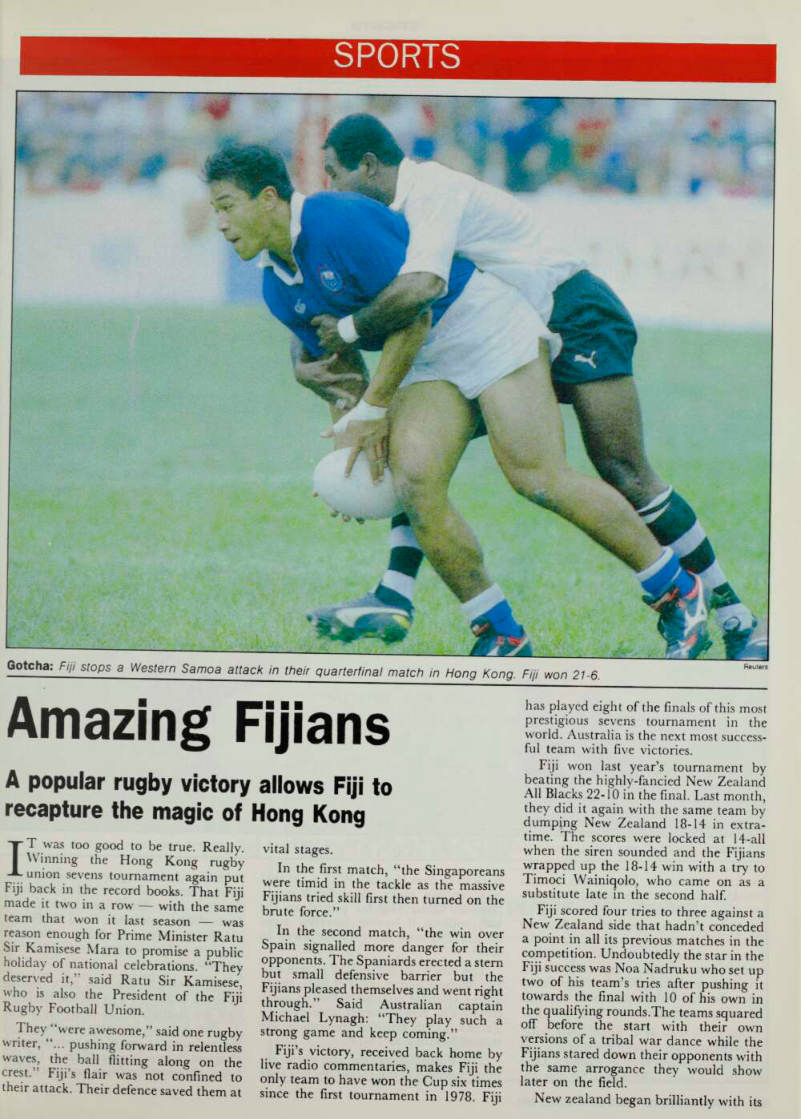
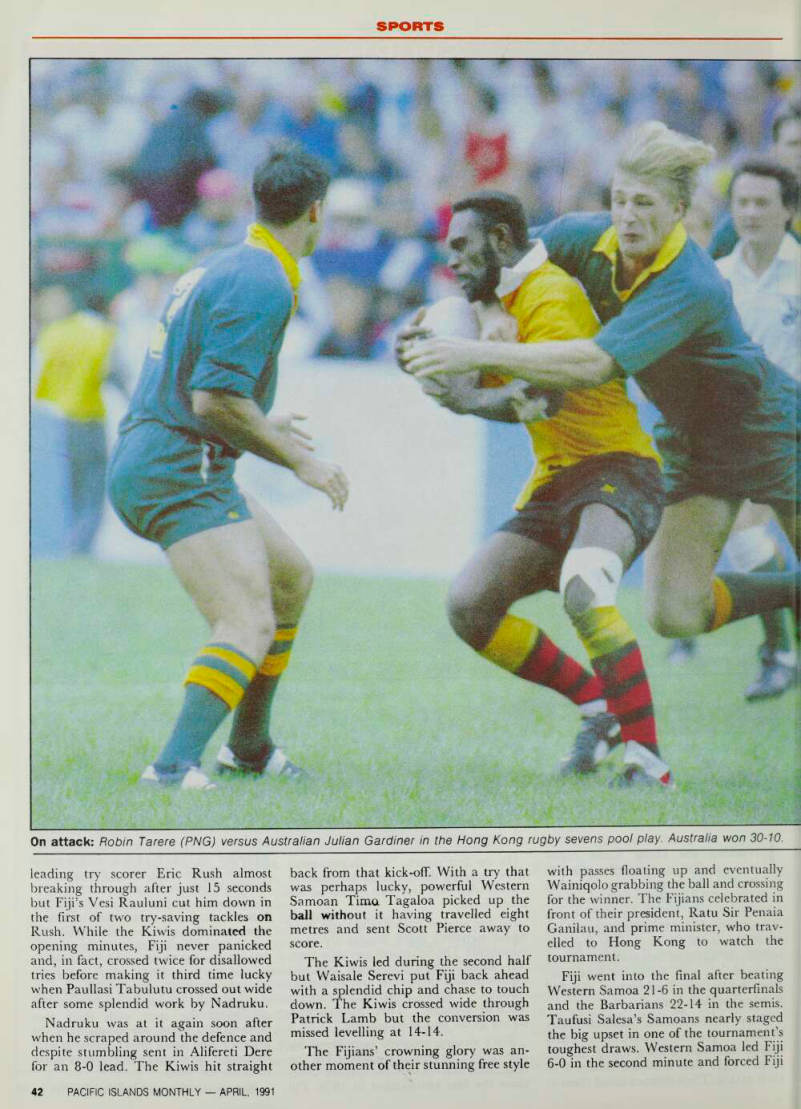

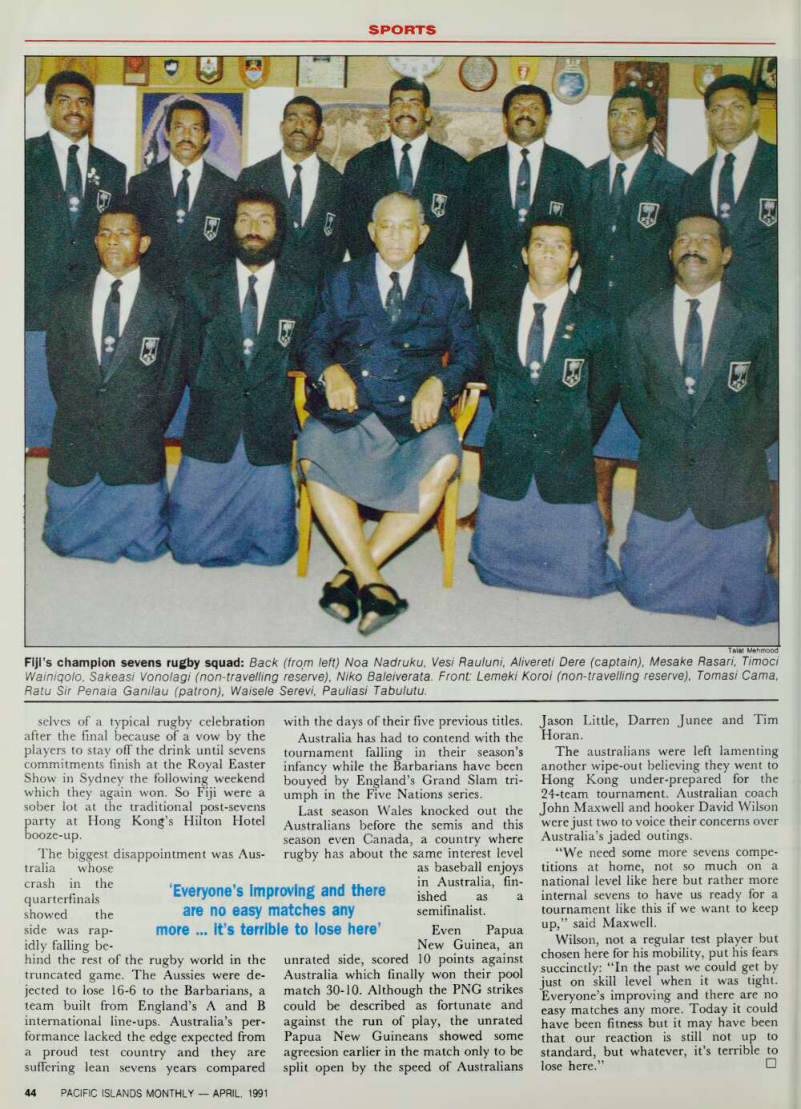
Sports
A popular rugby victory allows Fiji to recapture the magic of Hong Kong
IT u,.c j. u . n- * Winn I no- th u° be rue ' Real jY- • g e ong Ron g rugby Fiii I T !? 5 tournament again put tknt , in me same
reason enough' foi Prime I SteTßatu
Sir Kamisese Mara to promise a public holiday of national celebrations. “They deserved ,t” said Ratu Sir Kamisese, who is also the President of the Fiji Rugby Football Union.
They were awesome,” said one rugby writer, “... pushing forward in relentless waves, the ball flitting along on the crest ” Fiii’s flair wiicL g on the their attart Tb A f t 0 their attack. Their defence saved them at
. vital stages.
In the first match “the Singaporeans were timid in h tackle asthe mSve brute force. s ln the se "°" d match > “ the win over
smati u
i ? bU ‘ • t 5 e ” Said 'T T Wen ‘
S3' “pTay
strong game and keep coming.” r * • . . „ , , , 1* FI T s victor y> received back home by live radio commentaries, makes Fiji the onl y team to have won the Cup six times since the first tournament in 1978. Fiji
has played eight of the finals of this most prestigious sevens tournament in the world. Australia is the next most success ful team with five victories.
Fiji won last year’s tournament by beating the highly-fancied New Zealand All Blacks 22-10 in the final. Last month, they did it again with the same team by dumping New Zealand 18-14 in extra time. The scores were locked at 14-all when the siren sounded and the Fijians wrapped up the 18-14 win with a try to Timoci Wainiqolo, who came on as a substitute late in the second half.
Fiji scored four tries to three against a New Zealand side that hadn’t conceded a point in all its previous matches in the competition. Undoubtedly the star in the Fiji success was Noa Nadruku who set up two of his team’s tries after pushing it towards the final with 10 of his own in the qualifying rounds. The teams squared off before the start with their own versions of a tribal war dance while the Fijians stared down their opponents with the same arrogance they would show later on the field.
New Zealand began brilliantly with its
Reuters Gotcha: Fiji stops a Western Samoa attack in their quarterfinal match in Hong Kong. Fiji won 21-6.
leading try scorer Eric Rush almost breaking through after just 15 seconds but Fiji’s Vesi Rauluni cut him down in the first of tw r o try-saving tackles on Rush. While the Kiwis dominated the opening minutes, Fiji never panicked and, in fact, crossed twice for disallowed tries before making it third time lucky when Paullasi Tabulutu crossed out wide after some splendid work by Nadruku.
Nadruku was at it again soon after when he scraped around “the defence and despite stumbling sent in Alifereti Dere for an 8-0 lead. The Kiwis hit straight
back from that kick-off. With a try that
was perhaps lucky, powerful Western
Samoan Tima Tagaloa picked up the ball without it having travelled eight metres and sent Scott Pierce away to score.
The Kiwis led during the second half but Waisale Serevi put Fiji back ahead with a splendid chip and chase to touch down. The Kiwis crossed wide through Patrick Lamb but the conversion was missed levelling at 14-14.
The Fijians’ crowning glory was another moment of their stunning free style
with passes floating up and eventually Wainiqolo grabbing the ball and crossing for the winner. The Fijians celebrated in front of their president, Ratu Sir Penaia Ganilau, and prime minister, w'ho trav elled to Hong Kong to watch the tournament.
Fiji went into the final after beating Western Samoa 21-6 in the quarterfinals anc j the Barbarians 22-14 in the semis.
Taufusi Salesa’s Samoans nearly staged the big upset in one of the tournament’s toughest draws. Western Samoa led riji 6-0 in the second minute and forced Fiji
On attack: Robin Tarere (PNG) versus Australian Julian Gardiner in the Hong Kong rugby sevens pool play. Australia won 30-10.
into making some desparate tackles, especially on their own goalline. But just before halftime, Serevi set up the backline from his own goal with Nadruku selling a dummy on the 25-metre mark, ran 40 metres and sent Tomasi Cama running inside for the line.
Ratu Sir Kamisese joined the crowd in a standing ovation. Fiji scored two more converted tries and a penalty to finish off the Samoans 21-6. Western Samoa reached the quarters after beating Tonga 16-6 and Malaysia 38-0 in pool play.
Tonga beat Malaysia 38-0.
But champions Fiji deprived them
Reuters
selves of a typical rugby celebration after the final because of a vow by the players to stay off the drink until sevens commitments finish at the Royal Easter Show in Sydney the following weekend which they again won. So Fiji were a sober lot at the traditional post-sevens party at Hong Kong’s Hilton Hotel
booze-up.
The biggest disappointment was Aus
tralia whose crash in the quarterfinals showed the side was rap idly falling be
‘Everyone’s improving and there are no easy matches any more ... it’s terrible to lose here’
hind the rest of the rugby world in the truncated game. The Aussies were de jected to lose 16-6 to the Barbarians, a team built from England’s A and B international line-ups. Australia’s per formance lacked the edge expected from a proud test country and they are suffering lean sevens years compared
with the days of their five previous titles.
Australia has had to contend with the tournament falling in their season’s infancy while the Barbarians have been bouyed by England’s Grand Slam tri umph in the Five Nations series.
Last season Wales knocked out the Australians before the semis and this season even Canada, a country where rugby has about the same interest level
as baseball enjoys in Australia, fin ished as a semifmalist.
Even Papua New Guinea, an
unrated side, scored 10 points against Australia which finally won their pool match 30-10. Although the PNG strikes could be described as fortunate and against the run of play, the unrated Papua New Guineans showed some agreesion earlier in the match only to be split open by the speed of Australians
Jason Little, Darren Junee and Tim Horan.
The australians were left lamenting another wipe-out believing they went to Hong Kong under-prepared for the 24-team tournament. Australian coach John Maxwell and hooker David Wilson were just two to voice their concerns over
Australia’s jaded outings.
“We need some more sevens compe titions at home, not so much on a national level like here but rather more internal sevens to have us ready for a tournament like this if we want to keep up,” said Maxwell.
Wilson, not a regular test player but chosen here for his mobility, put his fears succinctly: “In the past we could get by just on skill level when it was tight.
Everyone’s improving and there are no easy matches any more. Today it could have been fitness but it may have been that our reaction is still not up to standard, but whatever, it’s terrible to lose here.”
Talat Mehmood Fiji’s champion sevens rugby squad: Back (from left) Noa Nadruku, Vesi Rauluni, Alivereti Dere (captain), Mesake Rasari, Timoci Wainiqolo, Sakeasi Vonolagi (non-travelling reserve), Niko Baleiverata. Front: Lemeki Korol (non-travelling reserve). Tomasi Cama, Ratu Sir Penaia Ganilau (patron), Waisele Serevi, Pauliasi Tabulutu.
Drug tests for Cup
RUGBY union players from Fiji
and Western Samoa face drug tests for the first time when tests will be used randomly for those taking part in the World Cup this year. 160 compulsory tests will be made from August 1 until the tournament begins in Britain on October 3. After each match a further two randomly selected players will be tested from each team. If a player tests positive, he will be banned from the
tournament and no replacement will be allowed for the team. Any further disciplinary action would be the respon sibility of the player’s own union.
“Rugby union has not experienced any of the drug-related issues that have affected other sports,” said World Cup organising committe chairman Russ Thomas. “However, we need to safe guard the future of rugby union as a bastion of sportsmanlike behaviour. In short, we intend to make sure rugby stays clean.” The testing programme has been approved by the World Cup’s medical advisory committee. □
Advertisements & other items, p. 43 (1 item)
Pim Bookshop
April issue specials for overseas orders only Order by Mail
THIS MONTH
and get it cheaper Your special prices this month
Weaving a sense of future
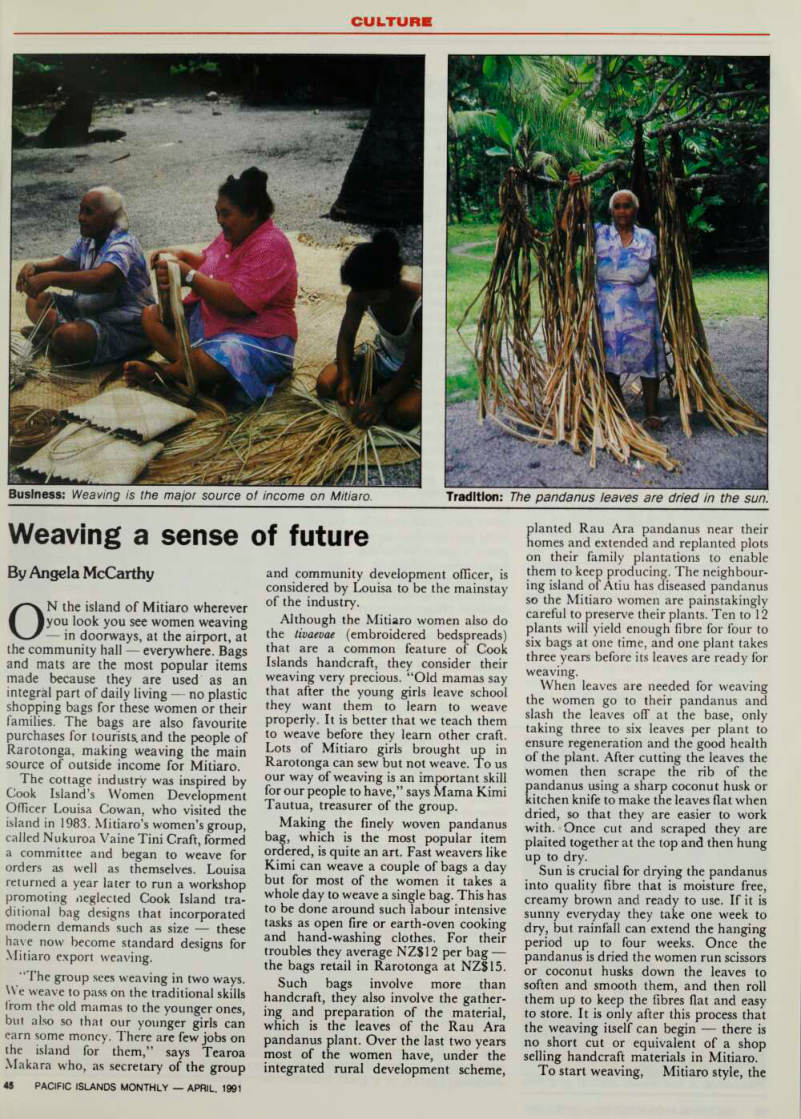
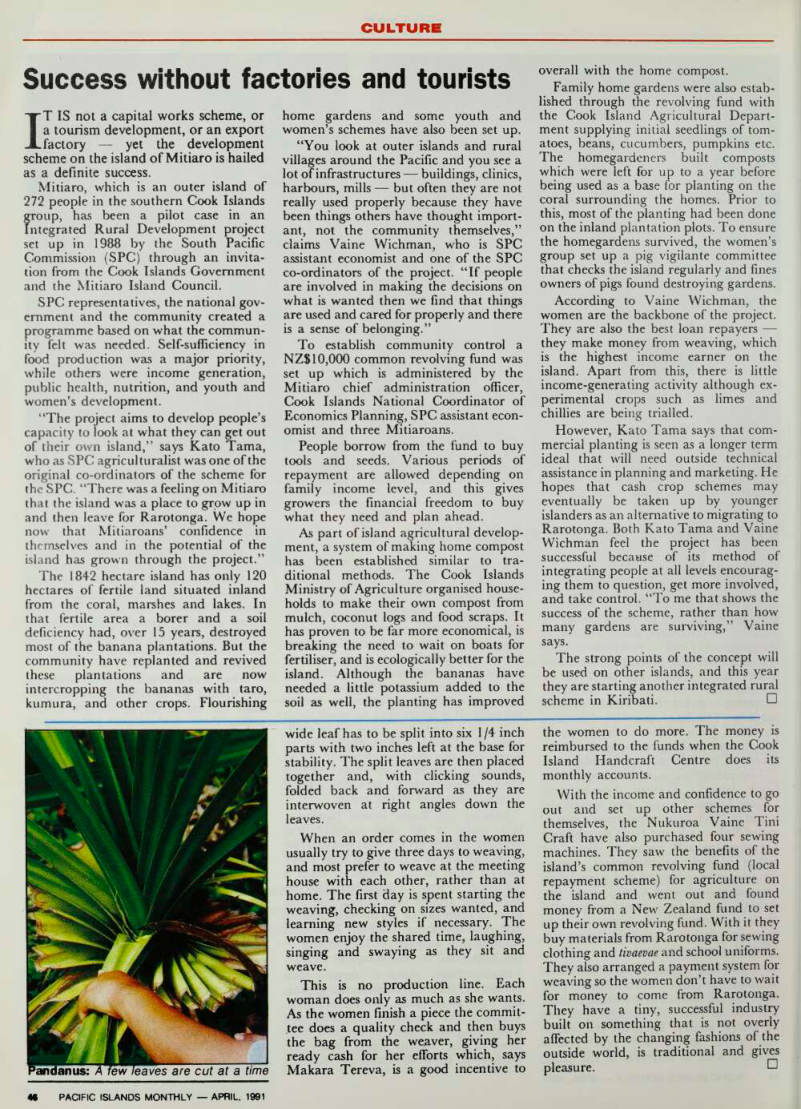
Culture
By Angela McCarthy
ON the island of Mitiaro wherever you look you see women weaving in doorways, at the airport, at the community hall everywhere. Bags and mats are the most popular items made because they are used as an integral part of daily living no plastic shopping bags for these women or their families. The bags are also favourite purchases for tourists, and the people of Rarotonga, making weaving the main source of outside income for Mitiaro.
The cottage industry was inspired by Cook Island’s Women Development Officer Louisa Cowan, who visited the island in 1983. Mitiaro’s women’s group, called Nukuroa Vaine Tini Craft, formed a committee and began to weave for orders as well as themselves. Louisa returned a year later to run a workshop promoting neglected Cook Island tra ditional bag designs that incorporated modern demands such as size these have now become standard designs for Mitiaro export weaving.
“ fihe group sees weaving in two ways.
We weave to pass on the traditional skills from the old mamas to the younger ones, but also so that our younger girls can earn some money. There are few jobs on the island for them,” says Tearoa Makara who, as secretary of the group
and community development officer, is considered by Louisa to be the mainstay of the industry.
Although the Mitiaro women also do the tivaevoe (embroidered bedspreads) that are a common feature of Cook Islands handcraft, they consider their weaving very precious. “Old mamas say that after the young girls leave school they wan, .hem tolearn ,o weave P r °P"ly- It » better that we teach them to weave before they leam other craft.
Lots of Mitiaro girls brought up in Rarotonga can sew but not weave. To us our way of weaving is an important skill for our people to hale,” says Mama Kimi T r t * urer lautua ’ treasur y of the § rou P- Making the finely woven pandanus bag, which is the most popular item ordered, is quite an art. Fast weavers like Kimi can weave a couple of bags a day for most of the women it takes a whole day to weave a single bag. This has to , done ar oimd such labour intensive 1 j S ? s °P en or earth-oven cooking f n , , and " w ashmg clothes. For their troubles they average NZ$l2 per bag the bagS retai ‘ m , Rarotonga at NZSIS ' Such bags involve more than handcraft, they also involve the gather mg an d preparation of the material, which is the leaves of the Rau Ara pandanus plant. Over the last two years most of the women have, under the integrated rural development scheme,
planted Rau Ara pandanus near their homes and extended and replanted plots on their family plantations to enable them to keep producing. The neighbour ing island of Atiu has diseased pandanus so the Mitiaro women are painstakingly careful to preserve their plants. Ten to 12 plants will yield enough fibre for four to six bags at one time, and one plant takes three years before its leaves are ready for
weaving.
When leaves are needed for weaving the women go to their pandanus and slash the leaves off at the base, only taking three to six leaves per plant to ensure regeneration and the good health of the plant. After cutting the leaves the women then scrape the rib of the pandanus using a sharp coconut husk or kitchen knife to make the leaves flat when dried, so that they are easier to work with. Once cut and scraped they are plaited together at the top and then hung up to dry.
Sun is crucial for drying the pandanus into quality fibre that is moisture free, creamy brown and ready to use. If it is sunny everyday they take one week to dry, but rainfall can extend the hanging period up to four weeks. Once the pandanus is dried the women run scissors or coconut husks down the leaves to soften and smooth them, and then roll them up to keep the fibres flat and easy to store. It is only after this process that the weaving itself can begin there is no short cut or equivalent of a shop selling handcraft materials in Mitiaro.
To start weaving, Mitiaro style, the
Business: Weaving is the major source of income on Mitiaro.
Tradition: The pandanus leaves are dried in the sun.
wide leaf has to be split into six 1/4 inch parts with two inches left at the base for stability. The split leaves are then placed together and, with clicking sounds, folded back and forward as they are interwoven at right angles down the leaves.
When an order comes in the women usually try to give three days to weaving, and most prefer to weave at the meeting house with each other, rather than at home. The first day is spent starting the weaving, checking on sizes wanted, and learning new styles if necessary. The women enjoy the shared time, laughing, singing and swaying as they sit and weave.
This is no production line. Each woman does only as much as she wants.
As the women finish a piece the commit tee does a quality check and then buys the bag from the weaver, giving her ready cash for her efforts which, says Makara Tereva, is a good incentive to
the women to do more. The money is reimbursed to the funds when the Cook Island Handcraft Centre does its
monthly accounts.
With the income and confidence to go out and set up other schemes for themselves, the Nukuroa Vaine Tini Craft have also purchased four sewing machines. They saw the benefits of the island’s common revolving fund (local repayment scheme) for agriculture on the island and went out and found money from a New Zealand fund to set up their own revolving fund. With it they buy materials from Rarotonga for sewing clothing and tivaevae and school uniforms.
They also arranged a payment system for weaving so the women don’t have to wait for money to come from Rarotonga.
They have a tiny, successful industry built on something that is not overly affected by the changing fashions of the outside world, is traditional and gives
pleasure.
Pandanus: A few leaves are cut at a time
Success without factories and tourists
IT IS not a capital works scheme, or a tourism development, or an export factory yet the development scheme on the island of Mitiaro is hailed as a definite success.
Mitiaro, which is an outer island of 272 people in the southern Cook Islands froup, has been a pilot case in an
ntegrated Rural Development project
set up in 1988 by the South Pacific Commission (SPC) through an invita tion from the Cook Islands Government and the Mitiaro Island Council.
SPC representatives, the national gov ernment and the community created a programme based on what the commun ity felt was needed. Self-sufficiency in
food production was a major priority,
while others were income generation, public health, nutrition, and youth and women’s development.
“The project aims to develop people’s
capacity to look at what they can get out of their own island,” says Kato Tama, who as SPC agriculturalist was one of the original co-ordinators of the scheme for the SPC. “There was a feeling on Mitiaro that the island was a place to grow up in and then leave for Rarotonga. We hope now that Mitiaroans’ confidence in themselves and in the potential of the island has grown through the project.”
The 1842 hectare island has only 120 hectares of fertile land situated inland from the coral, marshes and lakes. In that fertile area a borer and a soil deficiency had, over 15 years, destroyed most of the banana plantations. But the community have replanted and revived these plantations and are now intercropping the bananas with taro, kumura, and other crops. Flourishing
home gardens and some youth and women’s schemes have also been set up.
“You look at outer islands and rural villages around the Pacific and you see a lot of infrastructures buildings, clinics, harbours, mills but often they are not
really used properly because they have
been things others have thought import
ant, not the community themselves,” claims Vaine Wichman, who is SPC assistant economist and one of the SPC co-ordinators of the project. “If people are involved in making the decisions on what is wanted then we find that things are used and cared for properly and there is a sense of belonging.”
To establish community control a NZ$lO,OOO common revolving fund was set up which is administered by the Mitiaro chief administration officer, Cook Islands National Coordinator of Economics Planning, SPC assistant econ omist and three Mitiaroans.
People borrow from the fund to buy tools and seeds. Various periods of repayment are allowed depending on family income level, and this gives growers the financial freedom to buy what they need and plan ahead.
As part of island agricultural develop ment, a system of making home compost has been established similar to tra ditional methods. The Cook Islands Ministry of Agriculture organised house holds to make their own compost from mulch, coconut logs and food scraps. It has proven to be far more economical, is breaking the need to wait on boats for fertiliser, and is ecologically better for the island. Although the bananas have needed a little potassium added to the soil as well, the planting has improved
overall with the home compost.
Family home gardens were also estab lished through the revolving fund with the Cook Island Agricultural Depart ment supplying initial seedlings of tom atoes, beans, cucumbers, pumpkins etc.
The homegardeners built composts which were left for up to a year before being used as a base for planting on the coral surrounding the homes. Prior to this, most of the planting had been done on the inland plantation plots. To ensure the homegardens survived, the women’s group set up a pig vigilante committee that checks the island regularly and fines owners of pigs found destroying gardens.
According to Vaine Wichman, the women are the backbone of the project.
They are also the best loan repayers they make money from weaving, which is the highest income earner on the island. Apart from this, there is little
income-generating activity although ex
perimental crops such as limes and chillies are being trialled.
However, Kato Tama says that com mercial planting is seen as a longer term ideal that will need outside technical assistance in planning and marketing. He hopes that cash crop schemes may eventually be taken up by younger islanders as an alternative to migrating to Rarotonga, Both Kato Tama and Vaine Wichman feel the project has been successful because of its method of integrating people at all levels encourag ing them to question, get more involved, and take control. “To me that shows the success of the scheme, rather than how many gardens are surviving,” Vaine says.
The strong points of the concept will be used on other islands, and this year they are starting another integrated rural scheme in Kiribati. □
A pattern for Pacific success
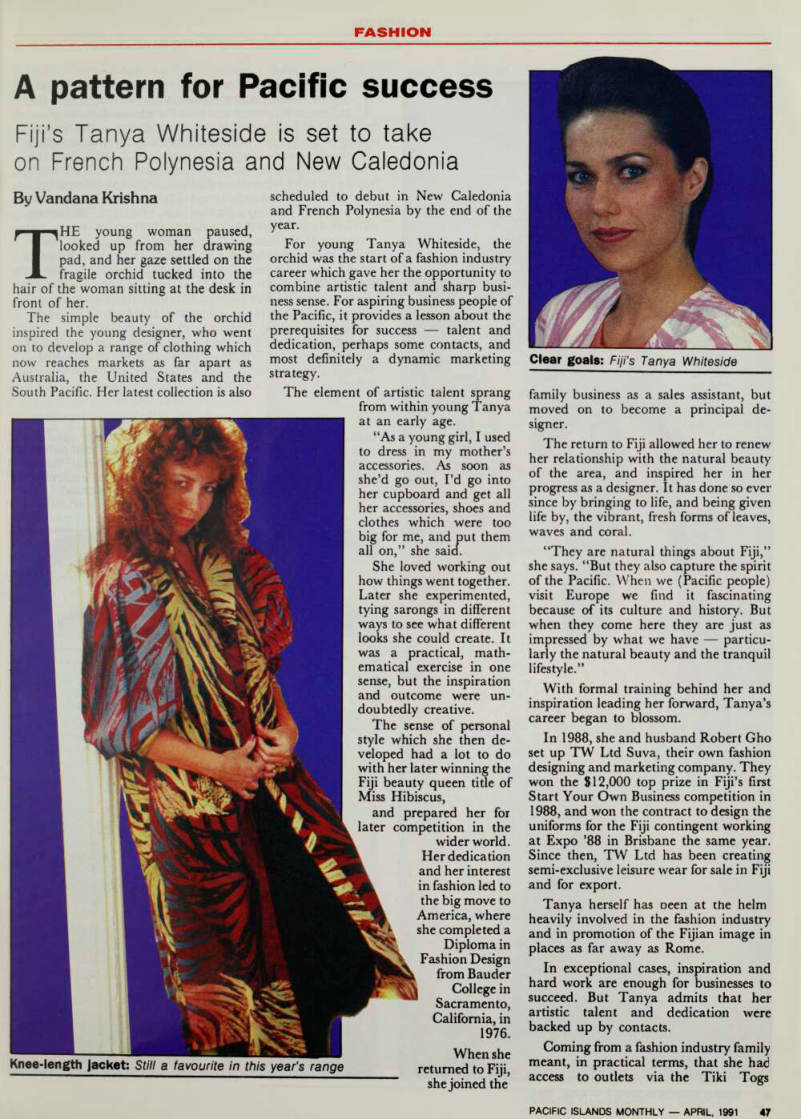
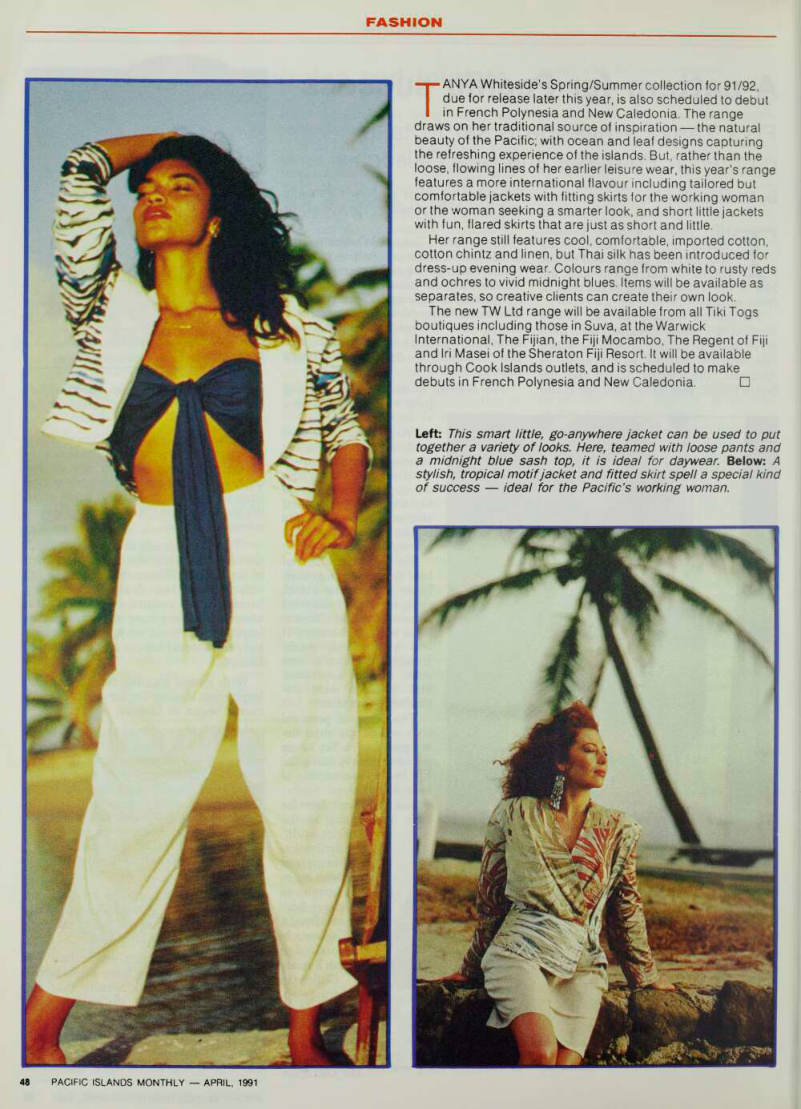
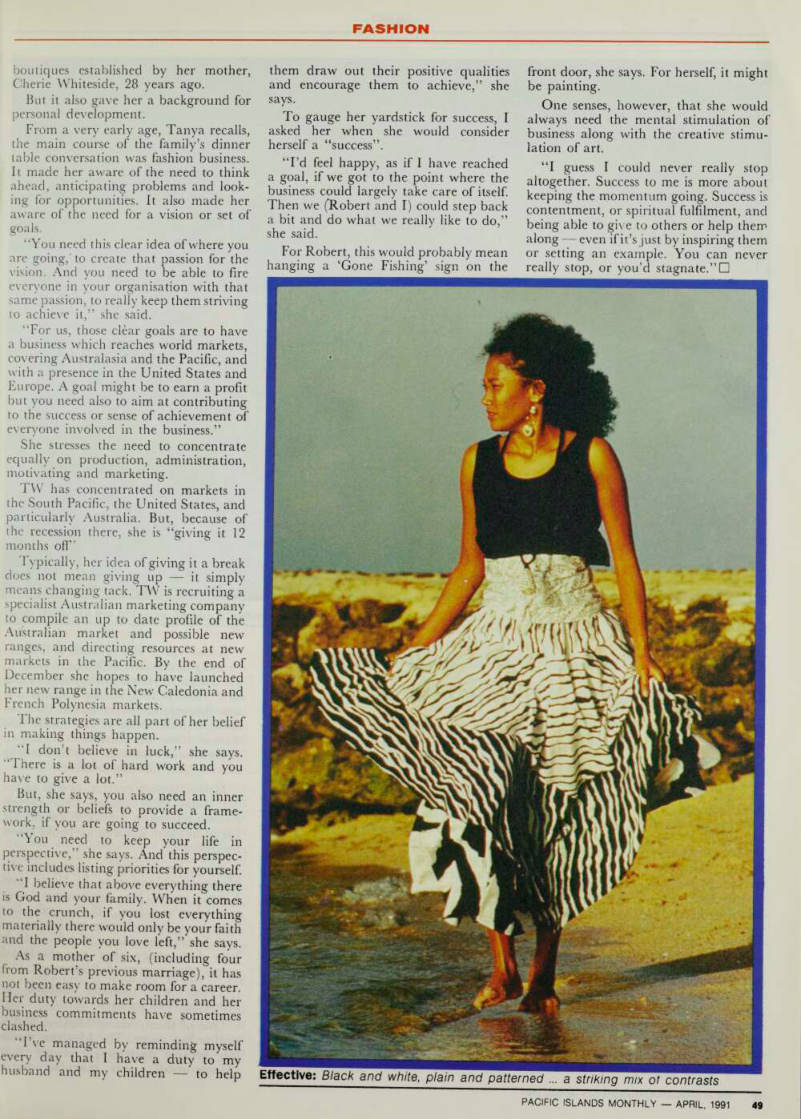
Fashion
Fiji’s Tanya Whiteside is set to take on French Polynesia and New Caledonia
By Vandana Krishna
THE young woman paused, looked up from her drawing pad, and her gaze settled on the fragile orchid tucked into the hair of the woman sitting at the desk in front of her.
The simple beauty of the orchid inspired the young designer, who went on to develop a range of clothing which now reaches markets as far apart as Australia, the United States and the South Pacific. Her latest collection is also
scheduled to debut in New Caledonia and French Polynesia by the end of the year.
For young Tanya Whiteside, the orchid was the start of a fashion industry career which gave her the opportunity to combine ardstic talent and sharp busi ness sense. For aspiring business people of the Pacific, it provides a lesson about the prerequisites for success talent and dedication, perhaps some contacts, and most definitely a dynamic marketing strategy.
The element of artistic talent sprang
from within young Tanya at an early age.
“As a young girl, I used to dress in my mother’s accessories. As soon as she’d go out, I’d go into her cupboard and get all her accessories, shoes and clothes which were too big for me, and put them all on,” she said.
She loved working out how things went together.
Later she experimented, tying sarongs in different ways to see what different looks she could create. It was a practical, math ematical exercise in one sense, but the inspiration and outcome were un
doubtedly creative.
The sense of personal style which she then de veloped had a lot to do with her later winning the Fiji beauty queen title of Miss Hibiscus, and prepared her for later competition in the wider world.
Her dedication and her interest in fashion led to the big move to America, where she completed a Diploma in Fashion Design from Bauder j College in Sacramento, California, in 1976.
When she returned to Fiji, she joined the
family business as a sales assistant, but moved on to become a principal de
signer.
The return to Fiji allowed her to renew her relationship with the natural beauty of the area, and inspired her in her progress as a designer. It has done so ever since by bringing to life, and being given life by, the vibrant, fresh forms of leaves, waves and coral.
“They are natural things about Fiji,” she says. “But they also capture the spirit of the Pacific. When we (Pacific people) visit Europe we find it fascinating because of its culture and history. But when they come here they are just as impressed by what we have particu larly the natural beauty and the tranquil lifestyle.”
With formal training behind her and inspiration leading her forward, Tanya’s career began to blossom.
In 1988, she and husband Robert Gho set up TW Ltd Suva, their own fashion designing and marketing company. They won the 512,000 top prize in Fiji’s first Start Your Own Business competition in 1988, and won the contract to design the uniforms for the Fiji contingent working at Expo ’BB in Brisbane the same year.
Since then, TW Ltd has been creating semi-exclusive leisure wear for sale in Fiji and for export.
Tanya herself has oeen at the helm heavily involved in the fashion industry and in promotion of the Fijian image in places as far away as Rome.
In exceptional cases, inspiration and hard work are enough for businesses to succeed. But Tanya admits that her artistic talent and dedication were backed up by contacts.
Coming from a fashion industry family
meant, in practical terms, that she had access to outlets via the Tiki Togs
Knee-length Jacket: Still a favourite in this year’s range
Clear goals: Fiji's Tanya Whiteside
TANYA Whiteside’s Spring/Summer collection for 91/92, due for release later this year, is also scheduled to debut in French Polynesia and New Caledonia. The range draws on her traditional source of inspiration the natural beauty of the Pacific; with ocean and leaf designs capturing the refreshing experience of the islands. But, rather than the loose, flowing lines of her earlier leisure wear, this year’s range features a more international flavour including tailored but comfortable jackets with fitting skirts for the working woman or the woman seeking a smarter look, and short little jackets with fun, flared skirts that are just as short and little.
Her range still features cool, comfortable, imported cotton, cotton chintz and linen, but Thai silk has been introduced for dress-up evening wear. Colours range from white to rusty reds and ochres to vivid midnight blues. Items will be available as separates, so creative clients can create their own look.
The new TW Ltd range will be available from all Tiki Togs boutiques including those in Suva, at the Warwick International, The Fijian, the Fiji Mocambo, The Regent of Fiji and Iri Masei of the Sheraton Fiji Resort. It will be available through Cook Islands outlets, and is scheduled to make debuts in French Polynesia and New Caledonia. □
Left: This smart little, go-anywhere jacket can be used to put together a variety of looks. Here, teamed with loose pants and a midnight blue sash top, it is ideal for daywear. Below: A stylish, tropical motif jacket and fitted skirt spell a special kind of success - ideal for the Pacific’s working woman.
boutiques established by her mother, Cherie Whiteside, 28 years ago.
But it also gave her a background for
personal development.
From a very early age, Tanya recalls, the main course of the family’s dinner table conversation was fashion business.
It made her aware of the need to think ahead, anticipating problems and look ing for opportunities. It also made her aware of the need for a vision or set of goals.
“You need this clear idea of where you are going,' to create that passion for the vision. And you need to be able to fire everyone in your organisation with that same passion, to really keep them striving to achieve it,” she said.
“For us, those clear goals are to have a business which reaches world markets, covering Australasia and the Pacific, and with a presence in the United States and Europe. A goal might be to earn a profit but you need also to aim at contributing to the success or sense of achievement of everyone involved in the business.”
She stresses the need to concentrate equally on production, administration, motivating and marketing.
TW has concentrated on markets in the South Pacific, the United States, and particularly Australia. But, because of the recession there, she is “giving it 12 months off Typically, her idea of giving it a break does not mean giving up it simply means changing tack. TW is recruiting a specialist Australian marketing company to compile an up to date profile of the Australian market and possible new ranges, and directing resources at new markets in the Pacific. By the end of December she hopes to have launched her new range in the New Caledonia and French Polynesia markets.
The strategies are all part of her belief
in making things happen.
“I don’t believe in luck,” she says.
“ There is a lot of hard work and you have to give a lot.”
But, she says, you also need an inner strength or beliefs to provide a frame work. if you are going to succeed.
“You need to keep your life in perspective,’ she says. And this perspec tive includes listing priorities for yourself.
“I believe that above everything there is God and your family. When it comes to the crunch, if you lost everything materially there would only be your faith and the people you love left,” she says.
As a mother of six, (including four from Robert’s previous marriage), it has not been easy to make room for a career.
Her duty towards her children and her business commitments have sometimes clashed. 1 ve managed by reminding myself every day that 1 have a duty to my husband and my children to help
them draw out their positive qualities and encourage them to achieve,” she says.
To gauge her yardstick for success, I asked her when she would consider herself a “success”. < Td feel happy, as if j have reached a goa j if we got to th DO : t u th Z • ’ 1 to , P° nt wft( i r . e tJ je business could largely take care of itself.
Then we ( Robert and I} could st back bit and do what wp rpallv Hl-p £ ” a blt a *j d do what we reall Y llke to do ’ f t? k m u ui . For Robe £ thls '£ ou '. d P, robab| y mean han S m § a Gone Flshln S SI S" 011 the
front door, she says. For herself, it might
be painting.
one senses, however, that she would always need the mental stimuladon of business along with the creative stimu lation of art 1 f u uess c 1 coulcl neve . r reali Y to P altogether. Success to me is more about keeoimr the momentum aoin<r Sucres k
contemmentorsoirituafSm^tTnd
contentment, or spmtual lullilment, and being able to give to others or help them along —even if it s just by inspiring them or setting an example. You can never really stop, or you’d stagnate.”□
Effective: Black and white, plain and patterned ... a striking mix ot contrasts
Paradise found in the paintings
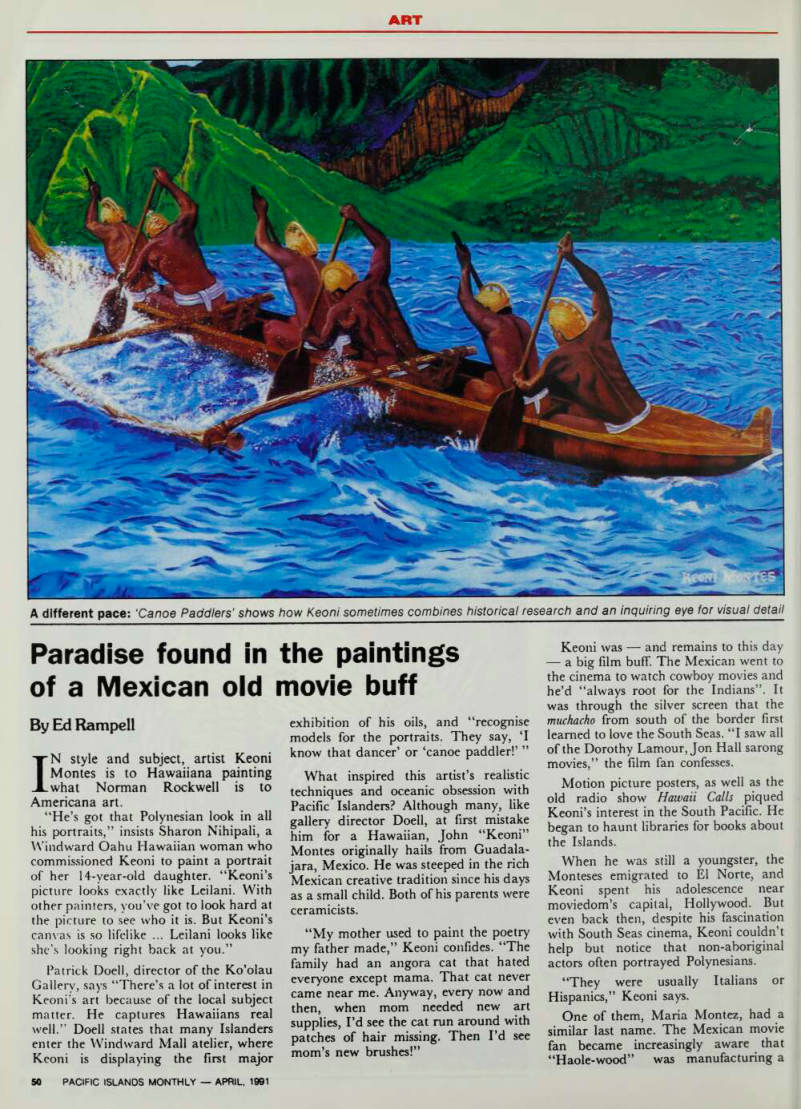
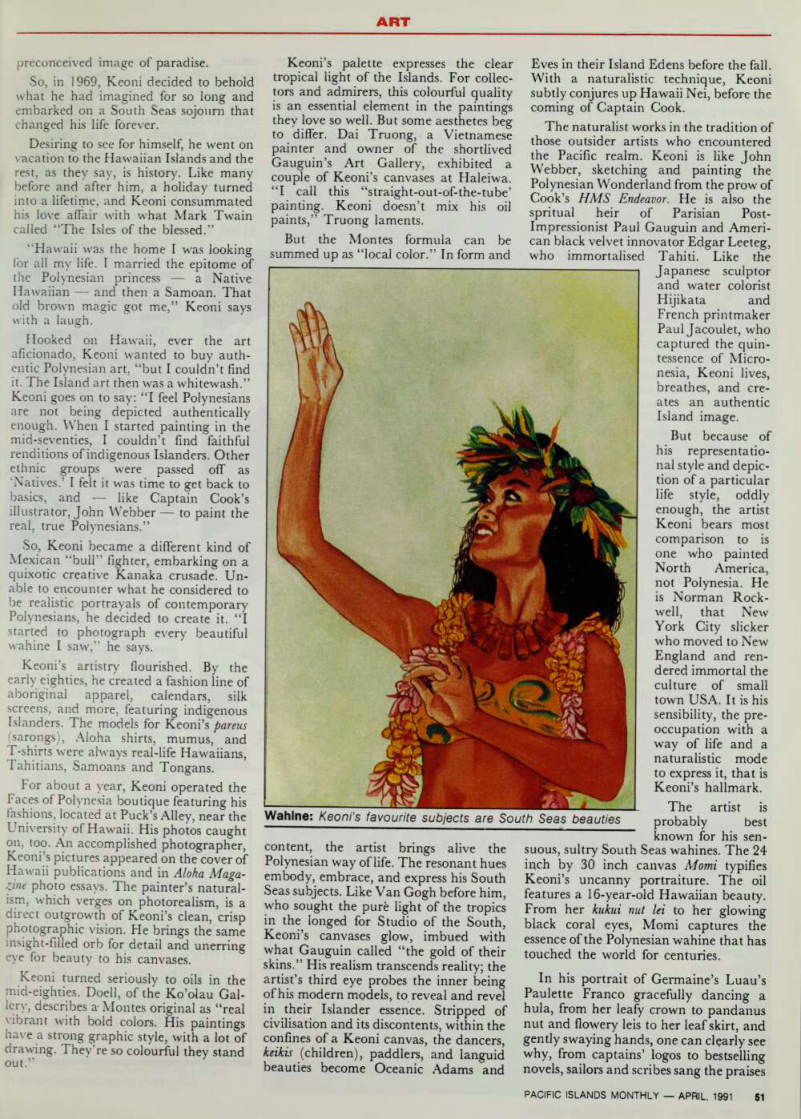
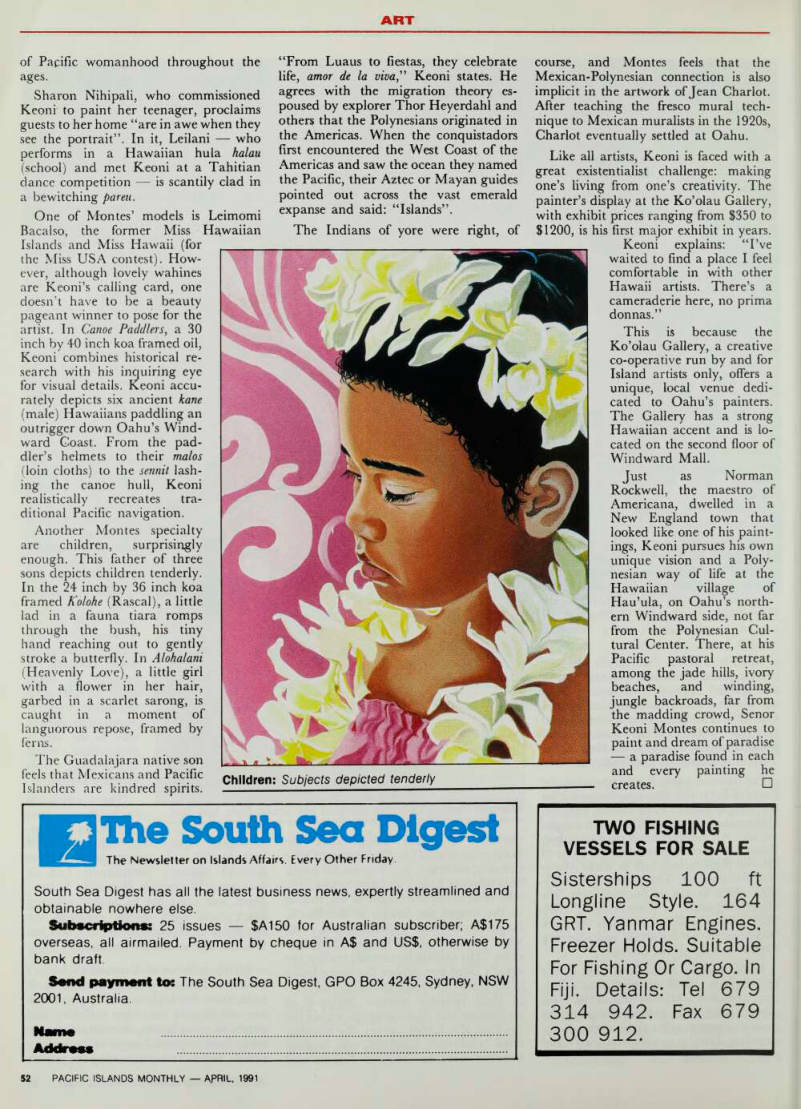
Art
Paradise found in the paintings of a Mexican old movie buff
By Ed Rampell
IN style and subject, artist Keoni
Montes is to Hawaiiana painting what Norman Rockwell is to Americana art.
“He’s got that Polynesian look in all his portraits,” insists Sharon Nihipali, a Windward Oahu Hawaiian woman who commissioned Keoni to paint a portrait of her 14-year-old daughter. “Keoni’s picture looks exactly like Leilani. With other painters, you’ve got to look hard at the picture to see who it is. But Keoni’s canvas is so lifelike ... Leilani looks like
she’s looking right back at you.”
Patrick Doell, director of the Ko’olau Gallery, says “There’s a lot of interest in Keoni’s art because of the local subject matter. He captures Hawaiians real well.” Doell states that many Islanders enter the Windward Mall atelier, where Keoni is displaying the first major
exhibition of his oils, and “recognise models for the portraits. They say, T know that dancer’ or ‘canoe paddler!’ ”
What inspired this artist’s realistic techniques and oceanic obsession with Pacific Islanders? Although many, like gallery director Doell, at first mistake him for a Hawaiian, John “Keoni”
Montes originally hails from Guadala jara, Mexico. He was steeped in the rich Mexican creative tradition since his days as a small child. Both of his parents were ceramicists.
“My mother used to paint the poetry my father made,” Keoni confides. “The family had an angora cat that hated everyone except mama. That cat never came near me. Anyway, every now and then, when mom needed new art supplies, I’d see the cat run around with patches of hair missing. Then I’d see mom’s new brushes!”
Keoni was and remains to this day a big film buff. The Mexican went to the cinema to watch cowboy movies and he’d “always root for the Indians”. It was through the silver screen that the muchacho from south of the border first learned to love the South Seas. “I saw all of the Dorothy Lamour, Jon Hall sarong movies,” the film fan confesses.
Motion picture posters, as well as the old radio show Hawaii Calls piqued Keoni’s interest in the South Pacific. He began to haunt libraries for books about the Islands.
When he was still a youngster, the Monteses emigrated to El Norte, and Keoni spent his adolescence near moviedom’s capital, Hollywood. But even back then, despite his fascination with South Seas cinema, Keoni couldn’t help but notice that non-aboriginal
actors often portrayed Polynesians.
“They were usually Italians or Hispanics,” Keoni says.
One of them, Maria Montez, had a similar last name. The Mexican movie fan became increasingly aware that “Haole-wood” was manufacturing a
A different pace: 'Canoe Peddlers’ shows how Keoni sometimes combines historical research and an inquiring eye for visual detail
preconceived image of paradise.
So, in 1969, Keoni decided to behold what he had imagined for so long and embarked on a South Seas sojourn that changed his life forever.
Desiring to see for himself, he went on vacation to the Hawaiian Islands and the rest, as they say, is history. Like many before and after him, a holiday turned into a lifetime, and Keoni consummated his love affair with what Mark Twain called “The Isles of the blessed.”
“Hawaii was the home I w r as looking for all my life. I married the epitome of the Polynesian princess a Native Hawaiian and then a Samoan. That old brown magic got me,” Keoni says with a laugh.
Hooked on Hawaii, ever the art aficionado, Keoni wanted to buy auth entic Polynesian art, “but I couldn’t find it. The Island art then was a whitewash.”
Keoni goes on to say: “I feel Polynesians
are not being depicted authentically
enough. When I started painting in the mid-seventies, I couldn’t find faithful renditions of indigenous Islanders. Other ethnic groups were passed off as ‘Natives.’ I felt it was time to get back to basics, and like Captain Cook’s illustrator, John Webber to paint the real, true Polynesians.”
So, Keoni became a different kind of Mexican “bull” fighter, embarking on a quixotic creative Kanaka crusade. Un able to encounter what he considered to be realistic portrayals of contemporary Polynesians, he decided to create it. “I started to photograph every beautiful wahine I saw,” he says.
Keoni’s artistry flourished. By the early eighties, he created a fashion line of aboriginal apparel, calendars, silk screens, and more, featuring indigenous Islanders. The models for Keoni’s parens (sarongs), Aloha shirts, mumus, and T-shirts were always real-life Hawaiians,
Tahitians, Samoans and Tongans.
For about a year, Keoni operated the
Faces of Polynesia boutique featuring his
fashions, located at Puck’s Alley, near the University of Hawaii. His photos caught on, too. An accomplished photographer, Keoni’s pictures appeared on the cover of Hawaii publications and in Aloha Maga zine photo essays. The painter’s natural ism, which verges on photorealism, is a direct outgrowth of Keoni’s clean, crisp photographic vision. He brings the same insight-filled orb for detail and unerring eye for beauty to his canvases.
Keoni turned seriously to oils in the mid-eighties. Doell, of the Ko’olau Gal lery, describes a- Montes original as “real vibrant with bold colors. His paintings have a strong graphic style, with a lot of drawing. They’re so colourful they stand out.”
Keoni’s palette expresses the clear tropical light of the Islands. For collec tors and admirers, this colourful quality is an essential element in the paintings they love so well. But some aesthetes beg to differ. Dai Truong, a Vietnamese painter and owner of the shortlived Gauguin’s Art Gallery, exhibited a couple of Keoni’s canvases at Haleiwa.
“I call this “straight-out-of-the-tube’ painting. Keoni doesn’t mix his oil
paints,” Truong laments.
But the Montes formula can be summed up as “local color.” In form and
content, the artist brings alive the Polynesian way of life. The resonant hues embody, embrace, and express his South Seas subjects. Like Van Gogh before him, who sought the pure light of the tropics in the longed for Studio of the South, Keoni s canvases glow, imbued with what Gauguin called “the gold of their skins.” His realism transcends reality; the artist’s third eye probes the inner being of his modern models, to reveal and revel in their Islander essence. Stripped of civilisation and its discontents, within the confines of a Keoni canvas, the dancers, keikis (children), paddlers, and languid beauties become Oceanic Adams and
Eves in their Island Edens before the fall.
With a naturalistic technique, Keoni subtly conjures up Hawaii Nei, before the coming of Captain Cook.
The naturalist works in the tradition of those outsider artists who encountered the Pacific realm. Keoni is like John Webber, sketching and painting the Polynesian Wonderland from the prow of Cook’s HMS Endeavor. He is also the spritual heir of Parisian Post- Impressionist Paul Gauguin and Ameri can black velvet innovator Edgar Leeteg, who immortalised Tahid. Like the
Japanese sculptor and water colorist Hijikata and
French printmaker
Paul Jacoulet, who captured the quin tessence of Micro nesia, Keoni lives, breathes, and cre ates an authentic Island image.
But because of his representado nal style and depic tion of a particular life style, oddly enough, the artist Keoni bears most comparison to is one who painted North America, not Polynesia. He is Norman Rock well, that New York City slicker who moved to New England and ren dered immortal the culture of small town USA. It is his sensibility, the pre occupation with a way of life and a naturalistic mode to express it, that is Keoni’s hallmark.
The artist is probably best known for his sen
suous, sultry South Seas wahines. The 24 inch by 30 inch canvas Momi typifies Keoni’s uncanny portraiture. The oil features a 16-year-old Hawaiian beauty, From her kukui nut lei to her glowing black coral eyes, Momi captures the essence of the Polynesian wahine that has touched the world for centuries, In Bis portrait of Germaine’s Luau’s Paulette Franco gracefully dancing a hula, from her leafy crown to pandanus nut and flowery leis to her leaf skirt, and gently swaying hands, one can clearly see why, from captains’ logos to bestselling novels, sailors and scribes sang the praises
Wahine: Keoni’s favourite subjects are South Seas beauties
of Pacific womanhood throughout the ages.
Sharon Nihipali, who commissioned Keoni to paint her teenager, proclaims guests to her home “are in awe when they see the portrait”. In it, Leilani who performs in a Hawaiian hula halau (school) and met Keoni at a Tahitian dance competition is scantily clad in a bewitching pareu.
One of Montes’ models is Leimomi Bacalso, the former Miss Hawaiian
Islands and Miss Hawaii (for the Miss USA contest). How ever, although lovely wahines are Keoni’s calling card, one doesn’t have to be a beauty pageant winner to pose for the artist. In Canoe Paddlers , a 30 inch by 40 inch koa framed oil, Keoni combines historical re search with his inquiring eye for visual details. Keoni accu rately depicts six ancient kane (male) Hawaiians paddling an outrigger down Oahu’s Wind ward Coast. From the pad dler’s helmets to their males (loin cloths) to the sennit lash ing the canoe hull, Keoni realistically recreates tra ditional Pacific navigation.
Another Montes specialty are children, surprisingly enough. This father of three
sons depicts children tenderly.
In the 24 inch by 36 inch koa framed Kolohe (Rascal), a little lad in a fauna tiara romps through the bush, his tiny hand reaching out to gently stroke a butterfly. In Alohalani (Heavenly Love), a little girl with a flower in her hair, garbed in a scarlet sarong, is caught in a moment of languorous repose, framed by ferns.
The Guadalajara native son feels that Mexicans and Pacific Islanders are kindred spirits.
“From Luaus to fiestas, they celebrate life, amor de la viva” Keoni states. He agrees with the migration theory es
poused by explorer Thor Heyerdahl and
others that the Polynesians originated in the Americas. When the conquistadors first encountered the West Coast of the Americas and saw the ocean they named the Pacific, their Aztec or Mayan guides pointed out across the vast emerald expanse and said: “Islands”.
The Indians of yore were right, of
course, and Montes feels that the Mexican-Polynesian connection is also implicit in the artwork of Jean Chariot.
After teaching the fresco mural tech nique to Mexican moralists in the 19205, Chariot eventually settled at Oahu.
Like all artists, Keoni is faced with a great existentialist challenge: making one’s living from one’s creativity. The painter’s display at the Ko’olau Gallery, with exhibit prices ranging from $350 to $l2OO, is his first major exhibit in years.
Keoni explains: “I’ve waited to find a place I feel comfortable in with other Hawaii artists. There’s a cameraderie here, no prima donnas.”
This is because the Ko’olau Gallery, a creative co-operative run by and for Island artists only, offers a unique, local venue dedi cated to Oahu’s painters.
The Gallery has a strong Hawaiian accent and is lo cated on the second floor of Windward Mall.
Just as Norman Rockwell, the maestro of Americana, dwelled in a New England town that looked like one of his paint ings, Keoni pursues his own unique vision and a Poly nesian way of life at the Hawaiian village of Hau’ula, on Oahu’s north ern Windward side, not far from the Polynesian Cul tural Center. There, at his Pacific pastoral retreat, among the jade hills, ivory beaches, and winding, jungle backroads, far from the madding crowd, Senor Keoni Montes continues to paint and dream of paradise a paradise found in each and every painting he creates. □
Children: Subjects depicted tenderly
Advertisements & other items, p. 52 (1 item)
The South Sea Digest
2L
The Newsletter on Islands Affairs. Every Other Friday South Sea Digest has all the latest business news, expertly streamlined and obtainable nowhere else.
Subscriptions: 25 issues SAISO for Australian subscriber; Asl7s overseas, all airmailed. Payment by cheque in A$ and US$, otherwise by bank draft.
Send payment to: The South Sea Digest, GPO Box 4245, Sydney, NSW 2001, Australia.
Name Address
TWO FISHING
VESSELS FOR SALE
Sisterships 100 ft Longline Style. 164 GRT. Yanmar Engines.
Freezer Holds. Suitable For Fishing Or Cargo. In Fiji. Details: Tel 679 314 942. Fax 679 300 912.
The Bishop
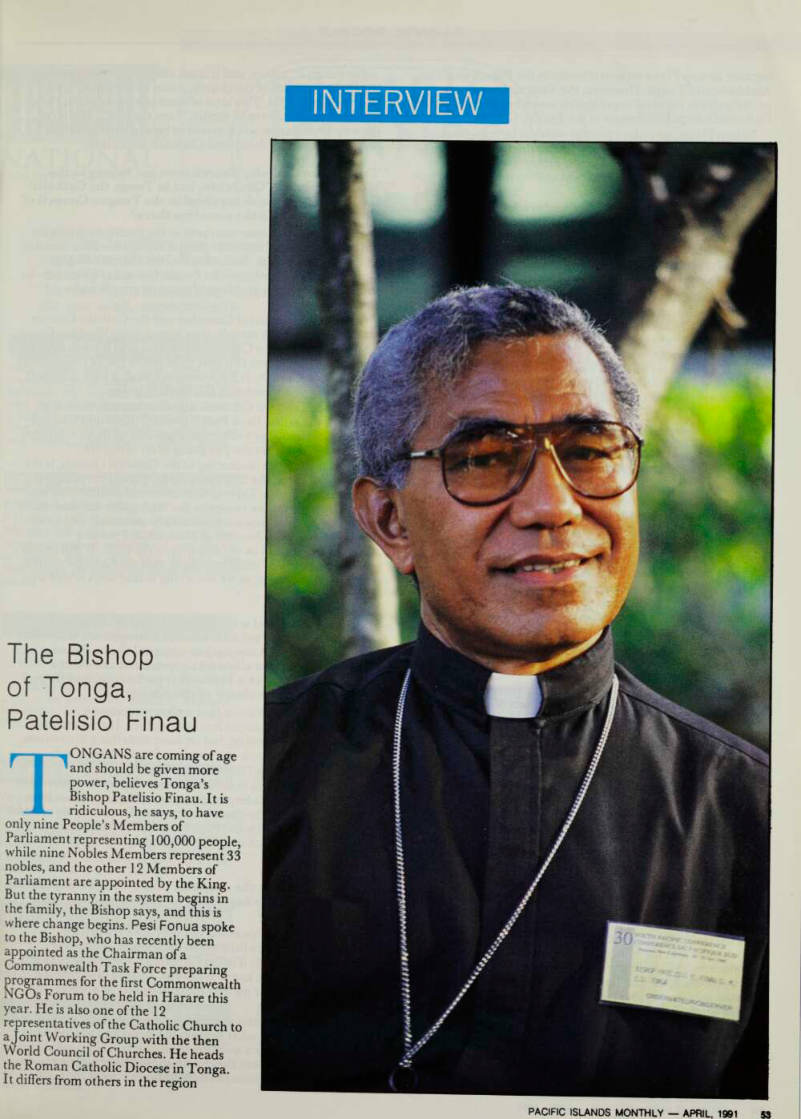
Interview
The Bishop of Tonga, Patelisio Finau
TONGANS are coming of age and should be given more power, believes Tonga’s Bishop Patelisio Finau. It is ridiculous, he says, to have only nine People’s Members of Parliament representing 100,000 people, while nine Nobles Members represent 33 nobles, and the other 12 Members of Parliament are appointed by the King.
But the tyranny in the system begins in the family, the Bishop says, and this is where change begins. Pesi Fonua spoke to the Bishop, who has recently been appointed as the Chairman of a Commonwealth Task Force preparing programmes for the first Commonwealth NGOs Forum to be held in Harare this year. He is also one of the 12 representatives of the Catholic Church to a Joint Working Group with the then World Council of Churches. He heads the Roman Catholic Diocese in Tonga.
It differs from others in the region
because Bishop Finau reports directly to the Pope who is the Archbishop of Tonga. However, the Tongan Diocese also participates in regional organisation and is represented at the Catholic Bishops Conference of the Pacific, CEPAC.
Bishop Finau, an ardent pacifist who has been outspoken about injustices he sees in Tonga, has clashed with King Tauga’ahau Tupou IV and Crown Prince Tupouto’a, who have accused him of being a marxist and an agent of the Pope.
Last April a group of New Zealanders were in Tonga, predicting that a coup would take place. They said they were inspired to come here after reading a comment you made in New Zealand about how Tonga was on the verge of a civil uprising, unless a drastic political change takes place. Did you make such a remark?
No, I do not think I gave people a cause to fear that there will be a revolution in Tonga. I think our people are very patient, and Christianity has something to do with it, Revolution in the heart, yes please, we want that; but as for violence, I do not believe in it. I never advocate it. In my honest opinion, I do not see physical violence. I suppose because I am a pacifist. If I am told to go to war, I won’t go. I think it is a certain attitude you reach after following the Lord.
You have publicly expressed concern about the well being of the poor and the oppressed. Do you notice any change in the attitude of the people in power toward these less fortunate members of the community?
I am sorry, but for me some of those in power are using their power unwisely, just to show off that they have the power. I would say though that the people are better informed on what is going on; I think it is their right to know. But then letting out this kind of information means there is a danger of physical violence. However, that is not a good reason either for people not to be informed or to keep them in ignorance.
On the other hand the churches should step up their teaching of non-violence. I know some theologians believe in violence, but that is were we part company. I see it as something like this: say in our family unit, are we going to give young people responsibility or are they going to be physically adults but only infants as far as exercising any power? He will do what he is told, he has no contribution in decision making.
Our people are coming of age and they should be given more power. Our system now with nine Members of Parliament, representing 100,000 people, and nine Nobles Representatives representing 33 nobles, and 12 MPs appointed by the King is just ridiculous. One day our grandchildren will laugh at how foolish we are. I mean, I just laugh at us now. If our King and nobles were palamgis we would not let this happen, we have been fooled by the fact that they are Tongans, our own people.
The King has labelled you as a Marxist. What do you think sparked off such a remark?
It could be that he was wrongly informed, but I am surprised that he believed it. He took a cheap type of approach. It has been done in so many countries and once a church person speaks out against the government they say, that he is a communist but, of course, today it does not work because communism is finished. It is like what a South American Bishop said, that when he gives food to the poor they call him a saint but when he asks the hungry why are they poor, they call him a communist. We have to be concerned about the root causes of the problems, not just bandaging wounds ... I consider myself a person who is very loyal to the people of Tonga and its King.
I think we can have a very beautiful system, if they work for service, but when they use their power not to serve the people but to get all the good things of life then that is wrong.
Is there a particular area in our culture where you see the Tongan culture and the teaching of Christ clash?
For example, power, and it is not only in government, but it is in the structure of the church, down to the village level, and the family level. This kind of domineering attitude, there is no consultation, even in family, T am the boss’. This is not the way Christian power is meant to be and there is a clash between our cultural way and Christian leadership.
The Roman Catholic Church does not belong to the World Council of Churches, but in Tonga the Catholic Church is very much involved in the Tongan Council of Churches. What is the situation there?
In Tonga and in most countries in the Pacific each diocese is a member of local national groups. We are always a member of any of these groups. In the Pacific, the Catholic Bishop Conference is a member of the Pacific Council of Churches. So in the Pacific we are members of national groups and a
provincial group.
The World Council of Churches and the Catholic Church work together. For example, they have a Joint Working Group, 12 members from the Catholic Church and 12 from the WCC, and I have been asked this year to be one of the 12 representing the Catholic Church. It is a seven-year term. I have accepted it and I will be a member of this working group.
The WCC and the CC work together, but still there is a technical difficulty. Pope Paul VI visited the World Council of Churches in Geneva some years ago and while he was there he asked, “And what are you going to do with Peter?”
Because the Pope, according to the Catholic Church, is the successor of Peter, the first aposde who was in charge of the church after Christ. There is an ecumenical difficulty because other churches do not recognise the Pope as the successor of Peter. The other thing is a question of numbers, if we join the Pacific Council of Churches as Dioceses and not as a Conference, we will be the majority in the PCC. It will be too overwhelming, and some may think that the Catholic church is trying to take over, so we are trying to find ways where we can work together...
You were involved with the First Pacific Regional Seminar of the World Methodist Evangelism Institute, January 8-18. Is it not rather unusual that a Roman Catholic Bishop is allowed to speak not once but a number of times in a Methodist gathering, and do you see this as a drive closer to church unity?
I interpreted it to mean that we have a common understanding, we do not fear one another. 11 does not mean that we share everything, but we have something in common, the gospel. The Bible is our treasure. It is sad that other churches do not want to work together.
Some people think that they can have a perfect church here on Earth, and that is impossible, only in heaven will we have a perfect church. The church on earth suffered because of sinful members whether it is the Pope or members, but that does not mean that the church is wrong, it is people that make false witness.
Do you think that the majority of the Tongan population over the years are beginning to understand the bible better?
They read the bible more, but they are very private Christians, with very little social conscience. We are very backward on that, as if being Christian is something between me and God, for me to get to heaven. Instead of something which is relevant for me and the community as a whole, the
people of Tonga.
The popular quotation which has been wrongly interpreted is, to give to Caesar what belongs to Caesar and to God what belongs to God. It is a question of paying tax. Now, what they are trying to say is that the church should have nothing to do with politics. It is a funny interpretation. □
Advertisements & other items, pp. 55-56 (1 item)
Pacific
mr
NATIONAL
LIBRARY OF AUSTRALIA
ACIFI
ISLANDS
Ql flfiK€T PLfIC n
For the benefit of our readers who would like to place a small classified advertisement in our magazine, Market Place will assist you in selling personal items, accommodation, real estate boating or a service ... in fact anything you would like to sell to our over 50,000 readers.
Market Place Advertising Rates are structured to allow you to place as many advertisements as you wish, economically.
SCRAP METAL
Good prices paid for your clean scrap Aluminium, Brass, Copper, Lead, etc. Contact Nonferral Pty. Ltd. 23 Davis Rd. Wetherill Park NSW 2164 Australia. Fax 61 2 604 1304 for prompt reply. Our Company is a long established and leading metals buyer and smelter. Telephone 61 2 604 8855.
SELF ADHESIVE LABELS
FORUM LABELS (FIJI) LTD
P.O. Box 1167, Suva., Fiji. Phone;3o4lll We print self-adhesive labels In rolls, multi-coloured labels with hot foil, and die cut to shape, tickets and tags in rolls. We also supply labelling machines and fabric labels.
CAREER
A pilot career? “Becoming a pilot in the 1990 s ’ has full details training, civil, air force, jobs, airlines, helicopter! Send NZ523.45 to aviation professionals, Box 28051, 6A Benson Rd, Remuera, Auckland, NZ. Phone/Fax (64-9) 5221330, Cheque, Visa, Bankcard.
MARINE DIESEL SPARES
Very large range for older Gardiner, Ruston- Hornsby, Mirrlees, Dorman, Paxman, Crossley, Perkins, Hercules, Meadows, Sulzer, English Electric, Southern Cross, Foden and more. Write for stockist:- K
P.O. Box 589, BURWOOD 2134
AUSTRALIA 61 2 736 2449
OPTICIANS AND OPTOMETRISTS
Spectacles, Contact Lenses, Sunglasses. & JEKISHAN, Epworth House, '679) 411898. SUVa ' Ph 311002 Fax
DISTRIBUTOR WANTED
nu l ac * urer P 0 pens and dispos able Gas Lighters. please contact JNJ CORPORATION (FUI) LTD Suva ’ F] l l Ph 394 °0 679) 411898.
“DISTRIBUTORS WANTED”
Franchise are available, in the Pacific Islands region to persons or companies interested in distributing a new patented inflatable snorkeler float. Suits all ages, makes snorkeling an effortless pleasure. Ideal for tourist resorts, snorkel tour operators, island cruises and dive shops. For further information please contact Snorkeler Fun Float Pty. Ltd., P.O. Box 1072 Townville, Queensland Australia, 4810., Phone (077) 212109 Fax(o77) 211420”
DISTRIBUTORS °SOUGHT
Computor furniture manufacturer seeking energetic distributors keen to exploit the potential of their range of quality products throughout the Australiasia Pacific Region.
Please contact: Woodraft Sales, Australia Fax: 61—9— 332-8105
IMMIGRATION
Applications for immigration to U.S.A. Canada, Australia, New Zealand, EEC, prepared by ex-immigration officer established in business since 1985. CWWAD P.O. Box 282 Mawson, Canberra, A.C.T. 2607, Australia Fax; 61-06-2865252’
DISTRIBUTOR WANTED
Manufacturer of a line of spray aerosol products that speed production in the garment factory: Silicone Spray, Spot Lifter, Pattern Adhesive, Emery Sharpening Stone Wheel Cleaner, Fusing Machine Cleaner, etc.
Write Sprayway, Inc., Addison, IL
60101-4468, FAX 1 (708) 543-7797.
OVERSEAS FUNDING
Unlimited overseas funding for any National Government and private company's viable projects. No front fees. Send proposal to Pan Asia Management Consultants Center Box 4295, BOROKO, NCD, Papua New Guinea.
CORRESPONDENCE
Sincere eligible Australian gentlemen wish to correspond with Pacific ladies, all ages/ races. Free registration. For full details, please write to: ASIAPAC, PO BOX 231 Maylands 6052, AUSTRALIA.
COMMERCIAL PRINTING
Top quality four colour printing, brochures, posters, packaging, product labels, fabric labels, billboards, books, magazines, stickers, books. Export quality. Contact Fiji’s most experienced Commercial Printers. FIJI TIMES COMMER- CIAL PRINTING, P.O. Box 1167. Suva. Fiji.
Phone; 304111 Fax. 301521.
PACIFIC
ISLANDS
Df 0 A/ T H L Y 1
MRRKCT PLflC€ CRN UJORK
WONDCRS FOR VOU ...
Promote your business, or service, sell your household
items, cars or heavy machinery
etc.
ONLY AUSSI PER WORD.
NO COMPANY LOGO. NO
DISPLAY. NO BOLD TYPE.
Just forward your Advertisement together with payment to: PACIFIC ISLANDS MONTHLY "Market Place”, P.O. Box 1167, Suva. Fiji.
CONDITIONS:
1. All Advertisements are subject to acceptance and approval of publisher. 2. Advertisements are published as space permits; we cannot guarantee date of insertion. 3. All advertisements must be prepaid and should be typed or printed clearly. 4. Deadline for receipt of advertisements is the 10th of the month prior to issue.
5. PACIFIC ISLANDS MONTHLY
assumes no responsibility for any service other than publishing paid advertisements in this section.
An Eye to Total Safety.
EiAHj
■/: m 4/ - I® For Mitsubishi Motors both passive and active safety have equal importance, and rather than being added ingredients, are guide-lines that every component, system and stage of design must follow.
This approach to total safety involves exhaustive and innovative research methods, particularly into the physical reactions of motorists to various driving situations.
In designing the Galant, for example, Mitsubishi’s engineers mapped what drivers looked at while cornering. They found that drivers of some cars had much narrower fields of vision, indicating a high level of tension due to poor vehicle handling.
By comparison, their tests with the Galant and its integrated drive system, Dynamic-4 showed that with better handling, wider .
Vision tracking shows how the Galant's superior handling results in lower driver tension indicated by a wider field of vision, fields of vision indicated lowe r levels of tension in the driver.
Using advanced technology to define and attain safety standards is further evidence of Mitsubishi’s guiding principle of answering the needs and preferences of today’s drivers an on-going philosophy of putting technology to work for you.
A
MITSUBISHI
MOTORS
MITSUBISHI GRLRNT
AMERICAN SAMOA; PACIFIC MARKETING INC. P.O. Box 698, Pago Pago, Tel. 699-9140/AUSTRALIA: MITSUBISHI MOTORS AUSTRALIA LTD. Box 1284, South Road, Clovelly Park, South Australia 5042, Tel (08] 275-7297/ FIJI: NIVIS MOTOR & MACHINERY CO., LTD. G.P.O. Box 150, Suva, Tel 383411 / FRENCH POLYNESIA (TAHITI): SOPADEP S.A. P.O. Box 1617, Papeete, Tahiti, Tel. 4-202-58/NEW CALEDONIA: SOCIETE D IMPORTATION D'AUTO DU PACIFIQUE SUD S.A. B.P. 438 Rond Point du Pacifique, Noumea, Tel. 274144/NEW ZEALAND: MITSUBISHI MOTORS NEW ZEALAND LTD. Private Bag, Porirua, Tel. 370-109/NORFOLK ISLAND: BORRYS PTY. LTD. PO Box 169, Norfolk Island, Tel. 2114/PAPUA NEW GUINEA: TOBA PTY LTD. P.O. Box 503, Port Moresby, Tel. 21-7874/SOLOMON ISLANDS: HARVEST PACIFIC LTD. G.PO. Box 823, Honiara, Guadalcanal, Tel. 30128/TONGA: SITANI MAFI CO., LTD. P.O. Box 83, Nuku ALOFA, Tel. 24-044/VANUATU: SOCOMETRAB P. 06 Route de Lagon, Port-Vila, Tel. 2314/WESTERN SAMOA: MOTOR DISTRIBUTORS LTD. P.O. Box 576, Apia, Tel. 20957/SAIPAN/POHNPEI/MAJURO/KOSRAE/TRUK/YAP/BELAU: MICRONESIAN MOTORS, INC. 997 South Marine Drive. Tamuning, Guam 96911, Tel. 646-6827