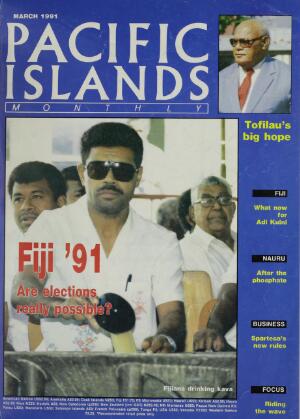
Fiji ’9l’
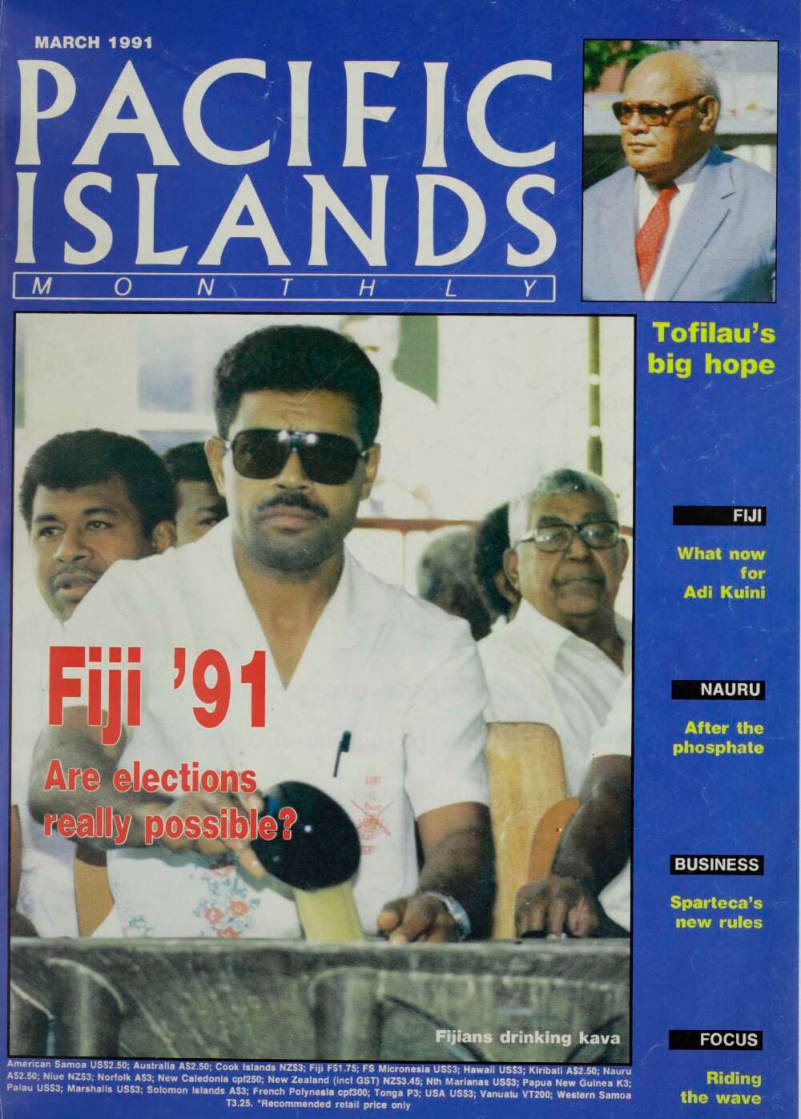
Pacific
Islands
Monthly
March 1991
Fiji ’9l’
AreMections „
Fijians drinking kava
Tofilau’s
big hope
Fiji
What now for Adi Kuini
Nauru
After the phosphate
Business
Sparteca’s new rules
Focus
Riding the wave
Sa^« U t $ !; 5 ?: A “ “ ; Cook l • l ‘ nd • NZM; T, » FSl ' 7 * » Micronesia USS 3; Hawaii US$3; Kiribati AS2JO; Nauru Pafau ussi ufhnnccf, ?** Caledon “ cp,250; New Zealand (incl GST) NZ53,45; Nth Marianas US$3; Papua New Guinea K 3; Palau USS 3, Marshalls USS 3; Solomon Islands AS3; French Polynesia cpf3oo; Tonga P 3; USA US$3; Vanuatu VT2OO; Western Samoa 13.25. ‘Recommended retail price only i
Advertisements & other items, pp. 2-3 (1 item)
What inspired that rebellious young poet called Rimbaud? What
drove him to reach into the innermost part of his soul in search of the undiscovered? It allowed him to take words that already existed and yet express himself in a completely new way. Some
creators are brave enough to realise their dreams without compromise. It is men like this who created the MX-5 in 1989.
By ignoring the rules they are constantly reshaping the future.
Even now they are realising a new dream. They work for Mazda.
On the road to civilization.
Pacific
Islands
Monthly
Vol. 61 No. 3
Voice Of The Pacific
March 1991
Cover Stories
FIJI ELECTIONS: Will they really be held this year? A look at the procedures and challenges faced by the organizers and the parties. THE COALITION: Is it time they went their separate ways? 10. ADI KUINI: Her vows to her Australian fiance Clive Speed ... and to the Coalition. 15
FOCUS: World Champion windsurfer Tony Philps wants to go for gold at the Barcelona Olympics. 43. A look at some top surfing spots through Ed Lovell’s lens. 44.
THE REGION: Nauru - A look at life and the future for a place where time and the phosphate are running out. 1 9.
SPECIAL REPORT: It’s the nervous ’9os, and the Pacific must move quickly to smoothe out problems in the aid process. 17 TOURISM: Does Fiji have a drawcard to offset the tourism downturn? 46 BUSINESS: Suffering or spin-offs ahead?
Robin Bromby looks at the Pacific’s future in the light of the Gulf War. 30 : A flaw in the Sparteca agreement comes to
light with changes to quotas, threatening Fiji’s garment industry. 38 : Hawaii’s solution to developers’ drain on the environment impact fees. 32 SHIPPING: News and schedules. 39 ENVIRONMENT: Tonga’s giant clam sanctuaries are a success. 25 : The Pacific islands voice is heard at a major climate convention. 54
for everyone!
PIM is the magazine for everyone!
Publisher: Geoffrey Hussey Editor: Jale Moala Assistant Editor: Beryl Cook Correspondents: Al Prince.
Angela McCarthy. David North, David Robie, Diana McManus.
Dykes Angiki, Frank Senge, Franc Madoeuf, Irene Nisbet, John Hunter. Karen Mangnall, Lito Vilisoni, Macel Manua, Nicholas Rothwell, Pesi Fonua, Richard Dinnen, Ulafala Aiavao, Wally Hiambohn Business Correspondent: Robin Bromby Columnists: David Bar ber (Wellington), Futa Helu (Tonga, covering the Pacific Islands).
Jemima Garrett (Sydney). Margot O’Neill (Washington) Advertising Manager: Lionel Heffernan Advertising Sales: • Fiji: Salendra Narayan, Tel (679) 304111, Fx (679) 303809 • Sydney. Melbourne: Fergus Maclagan, Tel (61-2) 4134689. Fx (61-2) 4123918 • Brisbane: Robert Walker, Tel (61-7) 3710533 • Adelaide: Hastwell Williamsons Representations. Tel (61-8) 799522 • Japan: Universal Media Corpor ation. Tokyo. Tel (3) 6663036. 6663094, Cable: UNIMEDIA Tokyo.
Tx 2524665 Founded 1930 (USPS 952480). A Fiji Times Limited production.
Cover prices are recommended retail only. Registered by Australia Post, Publication No. NBP 1210. © Copyright Fiji Times Limited. 117 Victoria Parade. Suva. Fiji. Tel (679) 304111. Fx (679) 303809. Tx FJ2124.
Pacific Islands Monthly is pub lished monthly by Fiji Times Lim ited, a division of Nationwide News. 2 Holt Street, Surry Hills. Sydney,
Nsw 2010.
Send address changes to: • Pacific Islands Monthly. PO Box 1167, Suva Fiji. Typeset and printed by Fiji Times Limited, 117 Victoria Parade, Suva, Fiji.
Letters
Court clarifies rape approach
TWO of the matters raised by Ms Peni Moore of the Women’s Rights Movement in the article “Fighting the Battle Against Rape” (January issue) need to be clarified.
First, Ms Moore was wrong in thinking that the Chiefjustice could direct that all rape cases be heard in the High Court rather than in the Magistrates’ Courts as well as at present.
To take away the jurisdiction of Magistrates’ Courts to hear rape cases would need a change in the law.
The Chiefjustice sees much merit in a change of the law to exclude Magistrates’ Courts from dealing with rape cases. Their involvement has not been a great success. Prior to 1974 all rape cases used to be dealt with only by the Supreme Court (now the High Court). It was in 1974 that the
Magistrates’ Courts were given
jurisdiction to hear rape cases. It may well be that a return to the pre-1974 position is call for. However, that is a matter for the government.
Second, Ms Moore complained about the withdrawal of the earlier guidelines on rape sentencing. This was done for technical reasons. The law gives
Magistrates’ Courts complete discretion
in their sentencing of rape cases. Such discretion is subject only to the constraints set by the ambit of their lawful powers. The earlier guidelines were inappropriate in that they could be construed as impinging upon the
exercise by Magistrates of their judicial
discretion. Therefore the guidelines had to be withdrawn.
Sekove Naqiolevu
Chief Registrar,
High Court of Fiji Free Jimmy Stevens!
TEN years after the independence of Vanuatu, former Nagriamel leader Jimmy Stevens, who must now be a very old man, is still in prison. To me, this runs counter to common decency and is a breach ofhuman rights. Jimmy Stevens is one of the few people in the ex-New Hebrides to have actually paid for his political convictions with his blood and his liberty; the blood of his son, shot down by the New Guinea soldiers called in to put down what is now known as the Santo Rebellion, and 10 long years of imprisonment.
As a descendant of both the European
planters of the ex-New Hebrides and the Melanesian people of those same islands, I feel duty bound to express my indignation at this state of affairs, which does no honour to those responsible for it. Freejimmy Stevens, and let us have more liberty and less pettiness in the Pacific countries and in the world.
Ronald Corlette Theui
Paris, France Review was ‘unfair’
IN her review of my recent book, Blood on their Banner: Nationalist Struggles in the South Pacific {PIMBooks, November), Sandra Tarte well highlighted the key themes and issues. It was a generous and favourable commentary.
It was unfortunate that it was marred by many typographical errors (as in the headline “Of martyrs and nationalism”) and misspellings (as in Bloi Machoro twice becoming “Marchoro”). More importantly, however, the review contained several distortions which need to be corrected. I’ll confine myself to just two of these.
First, Ms Tarte unfairly
misrepresented my perspective on
women in nationalist struggles. Perhaps she has a point about not enough being said about women (although this has far more to do with the theme of another publishing project that I have in progress and the fact that other books have concentrated on a woman’s
perspective).
The three examples of what Ms Tarte purports to be my “women’s perspective” are selectively cited out of context or (in one case) misquoted. The “self-confessed liar and heroin user” (my actual words, p. 164) in the Remelik assassination case was necessarily described this way because her
“inherently incredible” (the appeal
judge’s judgement) testimony led to
three men being wrongfully convicted of murder (they were later acquitted); the sexual inclination description about the French spy was crucial to explaining her
LETTERS TO THE EDITOR must include writer’s full name, address and home telephone number. All letters may be edited for purposes of clarity or space.
Letters should be addressed to: Pacific Islands Monthly PO Box 1167 Suva Fiji Islands OR Fax: (679) 303809
infiltration strategy and success; and the cited women interviewers of Rabuka accepted the propaganda without any critical analysis.
Does the fact that I gave “jaundiced” descriptions of many men in the book somehow suggest a certain perspective on men? Really.
Ms Tarte makes no mention of the timing or publishing history of the book, which is vital when considering the Bougainville crisis and economic implications for the region. The book was written before the present crisis began in November 1988 (apart from some brief factual changes to the typeset in May 1989).
Blood on their Banner was first translated into Swedish and published as a hardcover edition in Scandinavia in mid-1989. Editions followed in Britain, United States and then Australia. It is
shortly being published in the
Philippines, and French and German language editions (including sections on
Bougainville) are also being planned.
David Robie
Auckland Correction: key part of Fabian Hutchinson’s review of Missionary Lives published in January’s PIM was left out due to lack of space. The omitted section is as follows: ‘The Pacific history ‘group portrait’ approach was pioneered by Dr Niel Gunson: his Messengers of Grace (1978) analysed the backgrounds of EVvangelical missionaries in the South Seas and the importance they gave to ‘converting’ and ‘civilising’. ...It is necessary to note an unfortunate tendency that this reviewer has noticed in some recent Pacific histories: selective referencing that fails to acknowledge fellow scholars’ work on the same subjects and sources.
Readers of PNG history may be surprised to find no acknowledgement, in ch. 5, of Dr David Wetherell’s writings, specifically in discussion of Anglicans’ cultural attitudes ... (pp 112-113) ... full referencing is essential to respect the interest of readers.
Finally, what of the wider context of colonial Papua? ... mission differences among themselves with the traders, and with officials, over policies such as polygamy (and), prohibition, are thoroughly discussed.’
No happy mix, just
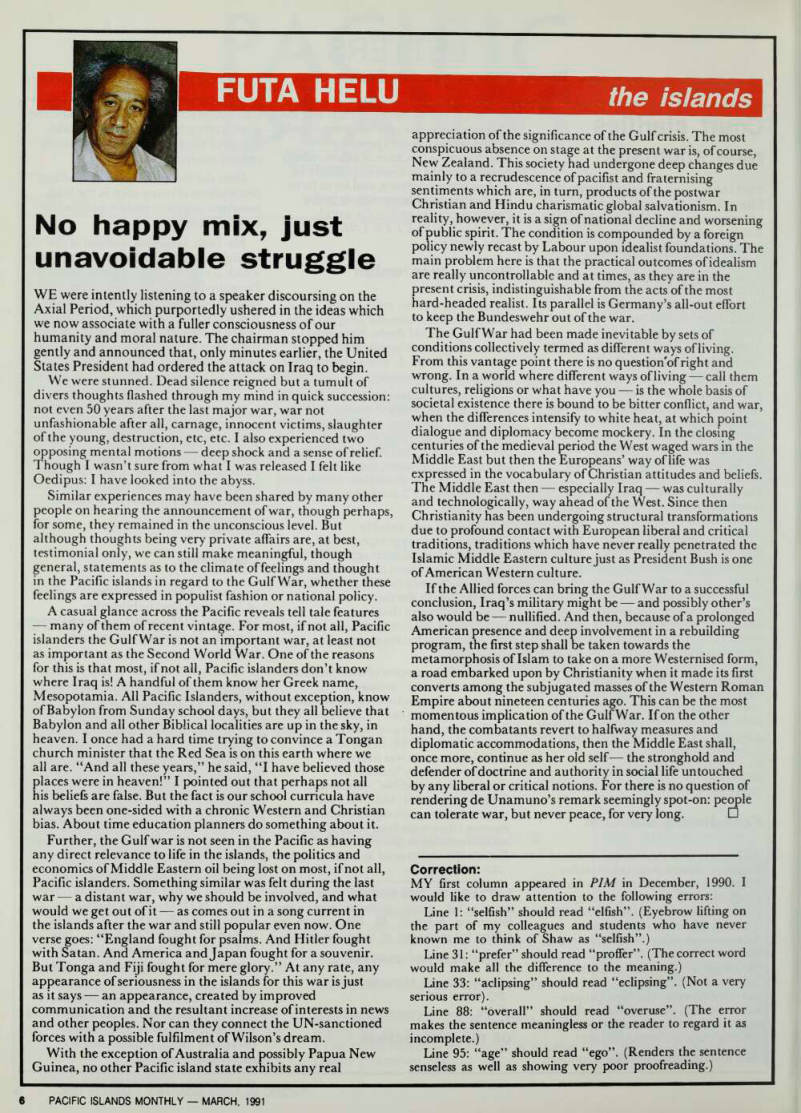
Futa Helu
No happy mix, just unavoidable struggle
the islands
WE were intently listening to a speaker discoursing on the Axial Period, which purportedly ushered in the ideas which we now associate with a fuller consciousness of our humanity and moral nature. The chairman stopped him gently and announced that, only minutes earlier, the United States President had ordered the attack on Iraq to begin.
We were stunned. Dead silence reigned but a tumult of divers thoughts flashed through my mind in quick succession: not even 50 years after the last major war, war not unfashionable after all, carnage, innocent victims, slaughter of the young, destruction, etc, etc. I also experienced two opposing mental motions deep shock and a sense of relief.
Though I wasn’t sure from what I was released I felt like Oedipus: I have looked into the abyss.
Similar experiences may have been shared by many other people on hearing the announcement of war, though perhaps, for some, they remained in the unconscious level. But although thoughts being very private affairs are, at best, testimonial only, we can still make meaningful, though general, statements as to the climate offeelings and thought in the Pacific islands in regard to the Gulf War, whether these feelings are expressed in populist fashion or national policy.
A casual glance across the Pacific reveals tell tale features many of them of recent vintage. For most, if not all, Pacific islanders the Gulf War is not an important war, at least not as important as the Second World War. One of the reasons for this is that most, if not all, Pacific islanders don’t know where Iraq is! A handful of them know her Greek name, Mesopotamia. All Pacific Islanders, without exception, know of Babylon from Sunday school days, but they all believe that Babylon and all other Biblical localities are up in the sky, in heaven. I once had a hard time trying to convince a Tongan church minister that the Red Sea is on this earth where we all are. “And all these years,” he said, “I have believed those places were in heaven!” I pointed out that perhaps not all his beliefs are false. But the fact is our school curricula have always been one-sided with a chronic Western and Christian bias. About time education planners do something about it.
Further, the Gulf war is not seen in the Pacific as having any direct relevance to life in the islands, the politics and economics of Middle Eastern oil being lost on most, if not all, Pacific islanders. Something similar was felt during the last war a distant war, why we should be involved, and what would we get out of it as comes out in a song current in the islands after the war and still popular even now. One verse goes: “England fought for psalms. And Hitler fought with Satan. And America and Japan fought for a souvenir.
But Tonga and Fiji fought for mere glory.” At any rate, any appearance of seriousness in the islands for this war is just as it says an appearance, created by improved communication and the resultant increase of interests in news and other peoples. Nor can they connect the UN-sanctioned forces with a possible fulfilment of Wilson’s dream.
With the exception of Australia and possibly Papua New Guinea, no other Pacific island state exhibits any real
appreciation of the significance of the Gulf crisis. The most conspicuous absence on stage at the present war is, of course, New Zealand. This society had undergone deep changes due mainly to a recrudescence of pacifist and fraternising sentiments which are, in turn, products of the postwar Christian and Hindu charismatic global salvationism. In reality, however, it is a sign of national decline and worsening of public spirit. The condition is compounded by a foreign policy newly recast by Labour upon idealist foundations. The main problem here is that the practical outcomes of idealism are really uncontrollable and at times, as they are in the present crisis, indistinguishable from the acts of the most hard-headed realist. Its parallel is Germany’s all-out effort to keep the Bundeswehr out of the war.
The Gulf War had been made inevitable by sets of conditions collectively termed as different ways of living.
From this vantage point there is no question of right and wrong. In a world where different ways of living call them cultures, religions or what have you is the whole basis of societal existence there is bound to be bitter conflict, and war, when the differences intensify to white heat, at which point dialogue and diplomacy become mockery. In the closing centuries of the medieval period the West waged wars in the Middle East but then the Europeans’ way of life was expressed in the vocabulary of Christian attitudes and beliefs.
The Middle East then especially Iraq was culturally and technologically, way ahead of the West. Since then Christianity has been undergoing structural transformations due to profound contact with European liberal and critical traditions, traditions which have never really penetrated the Islamic Middle Eastern culture just as President Bush is one of American Western culture.
If the Allied forces can bring the Gulf War to a successful conclusion, Iraq’s military might be and possibly other’s also would be nullified. And then, because of a prolonged American presence and deep involvement in a rebuilding program, the first step shall be taken towards the metamorphosis of Islam to take on a more Westernised form, a road embarked upon by Christianity when it made its first converts among the subjugated masses of the Western Roman Empire about nineteen centuries ago. This can be the most momentous implication of the Gulf War. If on the other hand, the combatants revert to halfway measures and diplomatic accommodations, then the Middle East shall, once more, continue as her old self — the stronghold and defender of doctrine and authority in social life untouched by any liberal or critical notions. For there is no question of rendering de Unamuno’s remark seemingly spot-on: people can tolerate war, but never peace, for very long. □
Correction: MY first column appeared in PIM in December, 1990. I would like to draw attention to the following errors: Line 1; “selfish” should read “elfish”. (Eyebrow lifting on the part of my colleagues and students who have never known me to think of Shaw as “selfish”.) Line 31: “prefer” should read “proffer”. (The correct word would make all the difference to the meaning.) Line 33: “aclipsing” should read “eclipsing”. (Not a very serious error).
Line 88: “overall” should read “overuse”. (The error makes the sentence meaningless or the reader to regard it as incomplete.) Line 95: “age” should read “ego”. (Renders the sentence senseless as well as showing very poor proofreading.)
Washington
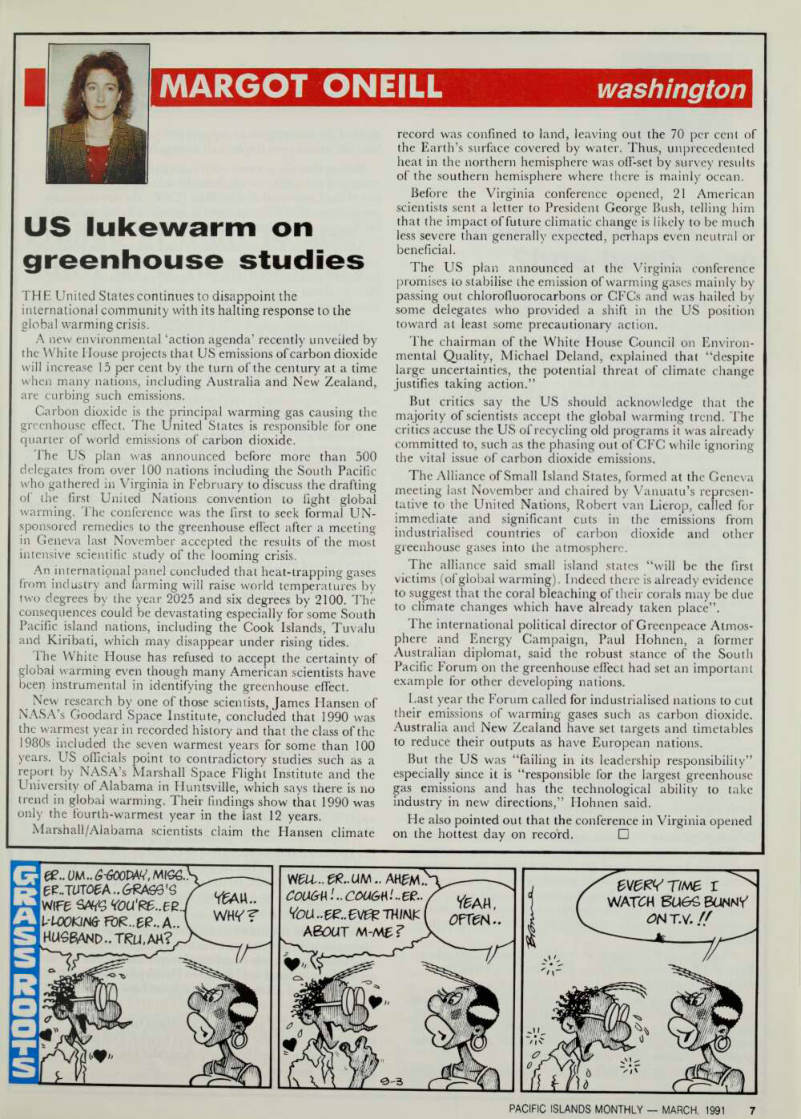
Margot Oneill
US lukewarm on greenhouse studies
THE United States continues to disappoint the international community with its halting response to the global warming crisis.
A new environmental ‘action agenda’ recently unveiled by the White House projects that US emissions of carbon dioxide will increase 15 per cent by the turn of the century at a time when many nations, including Australia and New Zealand, are curbing such emissions.
Carbon dioxide is the principal warming gas causing the greenhouse effect. The United States is responsible for one quarter of world emissions of carbon dioxide.
The US plan was announced before more than 500 delegates from over 100 nations including the South Pacific who gathered in Virginia in February to discuss the drafting of the first United Nations convention to fight global warming. The conference was the first to seek formal UN sponsored remedies to the greenhouse effect after a meeting in Geneva last November accepted the results of the most intensive scientific study of the looming crisis.
An international panel concluded that heat-trapping gases from industry and farming will raise world temperatures by two degrees by the year 2025 and six degrees by 2100. The consequences could be devastating especially for some South Pacific island nations, including the Cook Islands, Tuvalu and Kiribati, which may disappear under rising tides.
The White House has refused to accept the certainty of global warming even though many American scientists have been instrumental in identifying the greenhouse effect.
New research by one of those scientists, James Hansen of NASA’s Goodard Space Institute, concluded that 1990 was the warmest year in recorded history and that the class of the 1980 s included the seven warmest years for some than 100 years. US officials point to contradictory studies such as a report by NASA’s Marshall Space Flight Institute and the University of Alabama in Huntsville, which says there is no trend in global warming. Their findings show that 1990 was only the fourth-warmest year in the last 12 years.
Marshall/Alabama scientists claim the Hansen climate
record was confined to land, leaving out the 70 per cent of the Earth’s surface covered by water. Thus, unprecedented heat in the northern hemisphere was olf-set by survey results of the southern hemisphere where there is mainly ocean.
Before the Virginia conference opened, 21 American scientists sent a letter to President George Bush, telling him that the impact of future climatic change is likely to be much less severe than generally expected, perhaps even neutral or beneficial.
The US plan announced at the Virginia conference promises to stabilise the emission of warming gases mainly by passing out chlorofluorocarbons or CFCs and was hailed by some delegates who provided a shift in the US position toward at least some precautionary action.
The chairman of the White House Council on Environ mental Quality, Michael Deland, explained that “despite large uncertainties, the potential threat of climate change
justifies taking action.”
But critics say the US should acknowledge that the majority of scientists accept the global warming trend. The critics accuse the US of recycling old programs it was already committed to, such as the phasing out of CFG while ignoring the vital issue of carbon dioxide emissions.
The Alliance of Small Island States, formed at the Geneva meeting last November and chaired by Vanuatu’s represen tative to the United Nations, Robert van Lierop, called for immediate and significant cuts in the emissions from industrialised countries of carbon dioxide and other greenhouse gases into the atmosphere.
The alliance said small island states “will be the first victims (ofglobal warming). Indeed there is already evidence to suggest that the coral bleaching of their corals may be due to climate changes which have already taken place”.
The international political director of Greenpeace Atmos phere and Energy Campaign, Paul Hohnen, a former Australian diplomat, said the robust stance of the South Pacific Forum on the greenhouse effect had set an important example for other developing nations.
Last year the Forum called for industrialised nations to cut their emissions of warming gases such as carbon dioxide.
Australia and New Zealand have set targets and timetables to reduce their outputs as have European nations.
But the US was “failing in its leadership responsibility” especially since it is “responsible for the largest greenhouse gas emissions and has the technological ability to take industry in new directions,” Hohnen said.
He also pointed out that the conference in Virginia opened on the hottest day on record. □
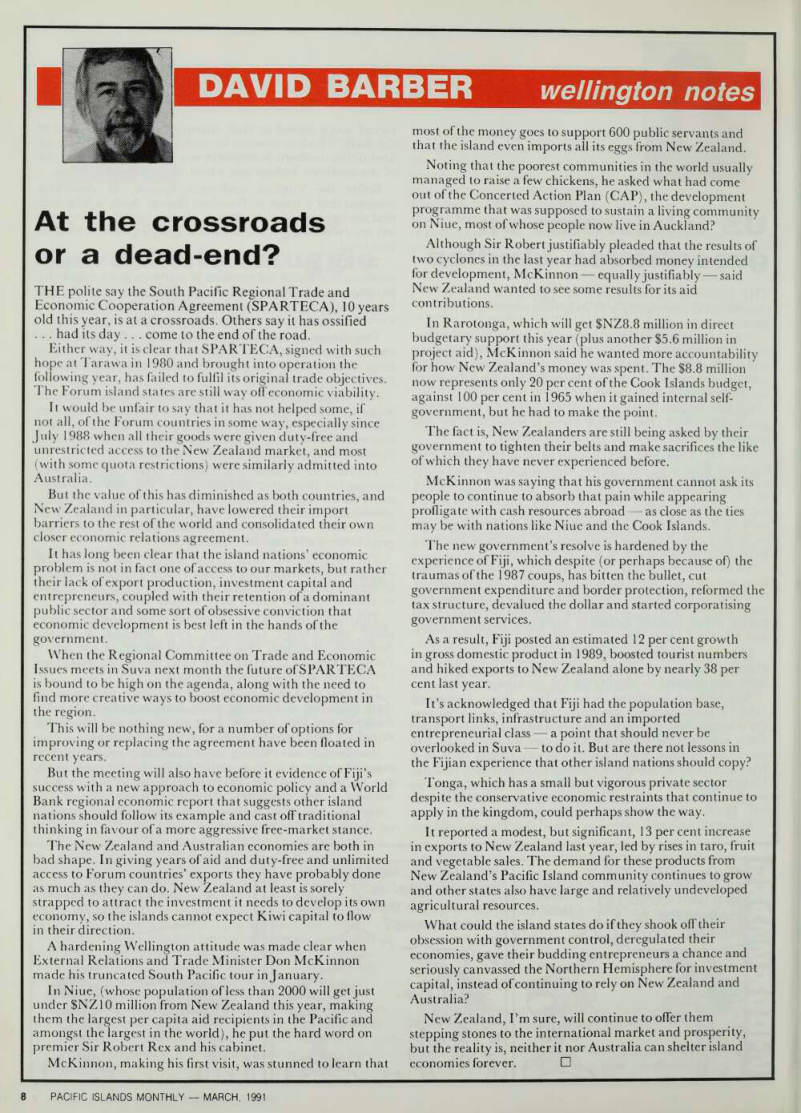
David Barber
At the crossroads or a dead-end?
Wellington notes
THE polite say the South Pacific Regional Trade and Economic Cooperation Agreement (SPARTECA), 10 years old this year, is at a crossroads. Others say it has ossified . . . had its day .. . come to the end of the road.
Either way, it is clear that SPARTECA, signed with such hope at Tarawa in 1980 and brought into operation the following year, has failed to fulfil its original trade objectives.
The Forum island states are still way off economic viability. 11 would be unfair to say that it has not helped some, if not all, of the Forum countries in some way, especially since July 1988 when all their goods were given duty-free and unrestricted access to the New Zealand market, and most (with some quota restrictions) were similarly admitted into Australia.
But the value of this has diminished as both countries, and New Zealand in particular, have lowered their import barriers to the rest of the world and consolidated their own closer economic relations agreement.
It has long been clear that the island nations’ economic problem is not in fact one of access to our markets, but rather their lack of export production, investment capital and entrepreneurs, coupled with their retention of a dominant public sector and some sort of obsessive conviction that economic development is best left in the hands of the government.
When the Regional Committee on Trade and Economic Issues meets in Suva next month the future ofSPARTECA is bound to be high on the agenda, along with the need to find more creative ways to boost economic development in
the region.
This will be nothing new, for a number of options for improving or replacing the agreement have been floated in recent years.
But the meeting will also have before it evidence of Fiji’s success with a new approach to economic policy and a World Bank regional economic report that suggests other island nations should follow its example and cast off traditional thinking in favour of a more aggressive free-market stance.
The New Zealand and Australian economies are both in bad shape. I n giving years of aid and duty-free and unlimited access to Forum countries’ exports they have probably done as much as they can do. New Zealand at least is sorely strapped to attract the investment it needs to develop its own economy, so the islands cannot expect Kiwi capital to flow in their direction.
A hardening Wellington attitude was made clear when External Relations and Trade Minister Don McKinnon made his truncated South Pacific tour injanuary.
In Niue, (whose population of less than 2000 will get just under SNZ 10 million from New Zealand this year, making them the largest per capita aid recipients in the Pacific and amongst the largest in the world), he put the hard word on premier Sir Robert Rex and his cabinet.
McKinnon, making his first visit, was stunned to learn that
most of the money goes to support 600 public servants and that the island even imports all its eggs from New Zealand.
Noting that the poorest communities in the world usually managed to raise a few chickens, he asked what had come out of the Concerted Action Plan (CAP), the development programme that was supposed to sustain a living community on Niue, most of whose people now live in Auckland?
Although Sir Robert justifiably pleaded that the results of two cyclones in the last year had absorbed money intended for development, McKinnon equally justifiably said New Zealand wanted to see some results for its aid contributions.
In Rarotonga, which will get SNZB.B million in direct budgetary support this year (plus another $5.6 million in project aid), McKinnon said he wanted more accountability for how New Zealand’s money was spent. The $B.B million now represents only 20 per cent of the Cook Islands budget, against 100 per cent in 1965 when it gained internal self government, but he had to make the point.
The fact is, New Zealanders are still being asked by their government to tighten their belts and make sacrifices the like of which they have never experienced before.
McKinnon was saying that his government cannot ask its people to continue to absorb that pain while appearing profligate with cash resources abroad as close as the ties may be with nations like Niue and the Cook Islands.
The new government’s resolve is hardened by the experience of Fiji, which despite (or perhaps because of) the traumas of the 1987 coups, has bitten the bullet, cut government expenditure and border protection, reformed the tax structure, devalued the dollar and started corporatising government services.
As a result, Fiji posted an estimated 12 per cent growth in gross domestic product in 1989, boosted tourist numbers and hiked exports to New Zealand alone by nearly 38 per cent last year.
It’s acknowledged that Fiji had the population base, transport links, infrastructure and an imported entrepreneurial class a point that should never be overlooked in Suva to do it. But are there not lessons in the Fijian experience that other island nations should copy?
Tonga, which has a small but vigorous private sector despite the conservative economic restraints that continue to apply in the kingdom, could perhaps show the way.
It reported a modest, but significant, 13 per cent increase in exports to New Zealand last year, led by rises in taro, fruit and vegetable sales. The demand for these products from New Zealand’s Pacific Island community continues to grow and other states also have large and relatively undeveloped agricultural resources.
What could the island states do if they shook off their obsession with government control, deregulated their economies, gave their budding entrepreneurs a chance and seriously canvassed the Northern Hemisphere for investment capital, instead of continuing to rely on New Zealand and Australia?
New Zealand, I’m sure, will continue to offer them stepping stones to the international market and prosperity, but the reality is, neither it nor Australia can shelter island economies forever. □
the austra
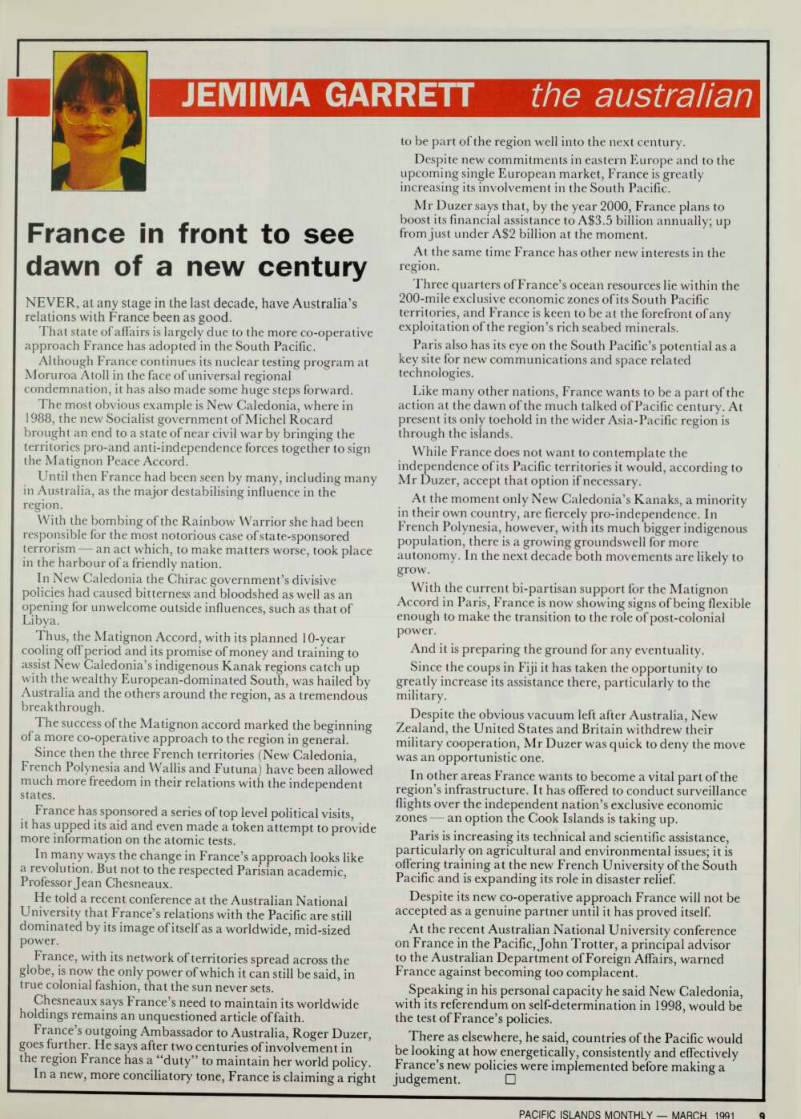
Jemima Garrett
France in front to see dawn of a new century
NEVER, at any stage in the last decade, have Australia’s relations with France been as good.
That state of affairs is largely due to the more co-operative approach France has adopted in the South Pacific.
Although France continues its nuclear testing program at Moruroa Atoll in the face of universal regional condemnation, it has also made some huge steps forward.
The most obvious example is New Caledonia, where in 1988, the new Socialist government of Michel Rocard brought an end to a state of near civil war by bringing the territories pro-and anti-independence forces together to sign the Matignon Peace Accord.
Until then France had been seen by many, including many in Australia, as the major destabilising influence in the
region.
With the bombing of the Rainbow Warrior she had been responsible for the most notorious case of state-sponsored terrorism an act which, to make matters worse, took place in the harbour of a friendly nation.
In New Caledonia the Chirac government’s divisive policies had caused bitterness and bloodshed as well as an opening for unwelcome outside influences, such as that of
Libya.
Thus, the Matignon Accord, with its planned 10-year cooling off period and its promise of money and training to assist New Caledonia’s indigenous Kanak regions catch up with the wealthy European-dominated South, was hailed by Australia and the others around the region, as a tremendous
breakthrough.
The success of the Matignon accord marked the beginning of a more co-operative approach to the region in general.
Since then the three French territories (New Caledonia, French Polynesia and Wallis and Futuna) have been allowed much more freedom in their relations with the independent states.
France has sponsored a series of top level political visits, it has upped its aid and even made a token attempt to provide more information on the atomic tests.
In many ways the change in France’s approach looks like a revolution. But not to the respected Parisian academic, Professor Jean Chesneaux.
He told a recent conference at the Australian National University that France’s relations with the Pacific are still dominated by its image of itself as a worldwide, mid-sized power.
France, with its network of territories spread across the globe, is now the only power of which it can still be said, in true colonial fashion, that the sun never sets.
Chesneaux says France’s need to maintain its worldwide holdings remains an unquestioned article offaith.
France’s outgoing Ambassador to Australia, Roger Duzer, goes further. He says after two centuries of involvement in the region France has a “duty” to maintain her world policy.
In a new, more conciliatory tone, France is claiming a right
to be part of the region well into the next century.
Despite new commitments in eastern Europe and to the upcoming single European market, France is greatly increasing its involvement in the South Pacific.
Mr Duzer says that, by the year 2000, France plans to boost its financial assistance to A 53.5 billion annually; up from just under As 2 billion at the moment.
At the same time France has other new interests in the region.
Three quarters ofFrance’s ocean resources lie within the 200-mile exclusive economic zones of its South Pacific territories, and France is keen to be at the forefront of any exploitation of the region’s rich seabed minerals.
Paris also has its eye on the South Pacific’s potential as a key site for new communications and space related
technologies.
Like many other nations, France wants to be a part of the action at the dawn of the much talked of Pacific century. At present its only toehold in the wider Asia-Pacific region is through the islands.
While France does not want to contemplate the independence of its Pacific territories it would, according to Mr Duzer, accept that option if necessary.
At the moment only New Caledonia’s Kanaks, a minority in their own country, are fiercely pro-independence. In French Polynesia, however, with its much bigger indigenous population, there is a growing groundswell for more autonomy. In the next decade both movements are likely to grow.
With the current bi-partisan support for the Matignon Accord in Paris, France is now showing signs of being flexible enough to make the transition to the role of post-colonial power.
And it is preparing the ground for any eventuality.
Since the coups in Fiji it has taken the opportunity to greatly increase its assistance there, particularly to the
military.
Despite the obvious vacuum left after Australia, New Zealand, the United States and Britain withdrew their military cooperation, Mr Duzer was quick to deny the move was an opportunistic one.
In other areas France wants to become a vital part of the region’s infrastructure. It has offered to conduct surveillance flights over the independent nation’s exclusive economic zones an option the Cook Islands is taking up.
Paris is increasing its technical and scientific assistance, particularly on agricultural and environmental issues; it is offering training at the new French University of the South Pacific and is expanding its role in disaster relief.
Despite its new co-operative approach France will not be accepted as a genuine partner until it has proved itself.
At the recent Australian National University conference on France in the Pacific, John Trotter, a principal advisor to the Australian Department of Foreign Affairs, warned
France against becoming too complacent.
Speaking in his personal capacity he said New Caledonia, with its referendum on self-determination in 1998, would be the test ofFrance’s policies.
There as elsewhere, he said, countries of the Pacific would be looking at how energetically, consistently and effectively France’s new policies were implemented before making a
judgement. □
Fiji ’91

Cover Stories
It is the game of possibles and impossibles as time runs short on the election deadline
By Jale Moala
THE calendar on the wall showed February in its last two days. John Apted, into his second cup of black tea with no sugar, didn’t seem to notice. He was lighting another cigarette and talking about his job as Fiji’s new Supervisor of Elections. The calendar said he was two months into a 12-month deadline - and running out of time.
Apted’s appointment in January this year pointed Fiji more in the direction of its first post-coup general election. Every one’s trying to guess when the election will be held. Interim Prime Minister
Ratu Sir Kamisese Mara and the President, Ratu Sir Penaia Ganilau, have said that the election will be this year. Many, like Dr Balwant Singh Rakha, the outspoken president of the Indian-dominated National Federation Party, do not believe that. “I doubt it very much,” he said. “There are no boundaries, there is nothing. But then, politics is a game of pissibles and
impossibles.”
Rakha’s comment underscores the
difficulties facing the 27-year-old Apted
as he takes up the toughest job in the Fiji civil service. He started work on Febru ary 21 and by the end of the month he was still moving in equipment and setting up office. What sort of deadline
has he got? “It’s a constitutional timeframe,” he said, “the writ of election should be issued by January 1992 (at the latest) 18 months from the date of the promulgation of the new constitution (on July 25, 1990).”
Apted, who comes from one of Fiji’s prominent sporting families, knows he is into a different ball game. On paper, .he is well qualified for the job. He acquired a Bachelor of Law degree from Auckland University in 1985. In 1989 he did post graduate studies at Fletcher School, Boston, the United States’ oldest foreign affairs school which has had students like US Ambassador to the United Nations Thomas Pickering. There Apted did a master in international law and diplo macy. Last year he was at Harvard Law School, on an Asia Foundation grant, and acquired a Master in Law. He has been in the civil service for six years and was closely involved at secretariat level with post-coup constitutional reviews. “I am familiar with the terms of compro mise involved,” he said. He was sitting behind an old desk below a poster of Ratu Sir Kamisese meeting US President George Bush. He didn’t seem to fit the picture. With his baby face, he looked too young and vulnerable for a job that is always going to lawyers but which really needs an experienced administrator. But Apted was confident: “It’s a challenge.”
Help for Apted has come from the Native Lands and Fisheries Commission at the Ministry of Fijian Affairs. The Commission has been updating its Fijian Registry (Vola ni Kawa Bula) which lists every indigenous Fijian according to his or her clan or land-owning units ( yavusa).
Last year the Commission visited each yavusa and updated the Vola ni Kawa Bula.
It expects to have a provisional Fijian roll by June or July which will again be taken to individual yavusa for inspection.
When approved, the roll will be given to the Supervisor of Elections for adoption as the Fijian electoral roll.
While the commission’s work will give Apted some breathing space, it will not solve his problems. Basically he is starting from nothing. The election he is prepar ing for will have new rules, new boundaries and new voters. The compli cations of rural and urban Fijian regis trations will have to be solved. The General Electors’ roll has been largely expanded by the inclusion of Pacific Islanders who used to vote on the Fijian roll but who now do not qualify as indigenous Fijians under the new consti tution.
Apted said he is starting all over again.
And many people are saying he will not be able to hold the election this year because of that. For the 1982 general election, for example, when many things were in place, it took Suva lawyer Peter Howard the most part of three years to have it ready. “Voter registration is the biggest job,” Apted said. “We have more voters now.” Towards the end of Febru ary he was just getting started by asking the Bureau of Statistics for projected
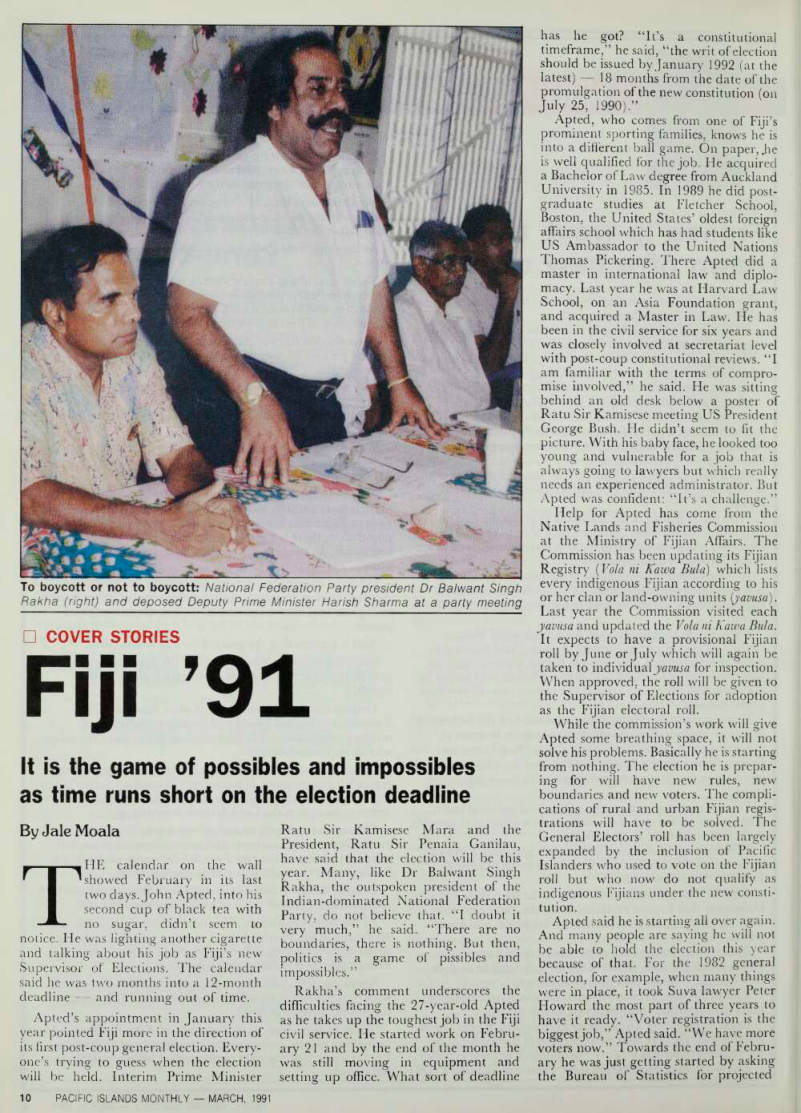
To boycott or not to boycott: National Federation Party president Dr Balwant Singh Rakha (right) and deposed Deputy Prime Minister Parish Sharma at a party meeting
1991 population figures to help the Boundaries Commission determine pro visional boundaries. With 10 months to go, he was quickly running out of time.
“It’ll take a good part of this year to finalise the boundaries,” said Howard, now of the Suva-based Howards law firm. “Registration alone in 1982 took about three months.”
The basic process in volves first the drawing up of provisional boundaries which must try as much as possible to evenly distrib ute the voters. This work by the Boundaries Com mission will take several months. Only after the boundaries have been agreed upon can the regis tration of voters begin.
This will again take more months by a large workforce, possibily con sisting of school teachers and university students, going from house to house throughout the country.
The registration books will have to be made available for public scru
tiny. Only after that can the writ of election be issued.
The election will take nearly a week.
Its timing is important. It is “logistic reality”, said Apted, for it to be held during the school holidays, when the schools are free for use as polling and counting stations, and the teachers are available to work as election officials.
This year there hasn’t been enough work done for the election to be held either in the first term school holiday in May or the second term holiday in August.
Christmas is out because too many people will be travelling in the country.
Many people are betting on the election being held next year. Some say it’ll be May 1992, five years after the
ousted Coalition gov ernment of Dr Timoci Bavadra came into power, and some say it’ll be later in the year, probably August 1992.
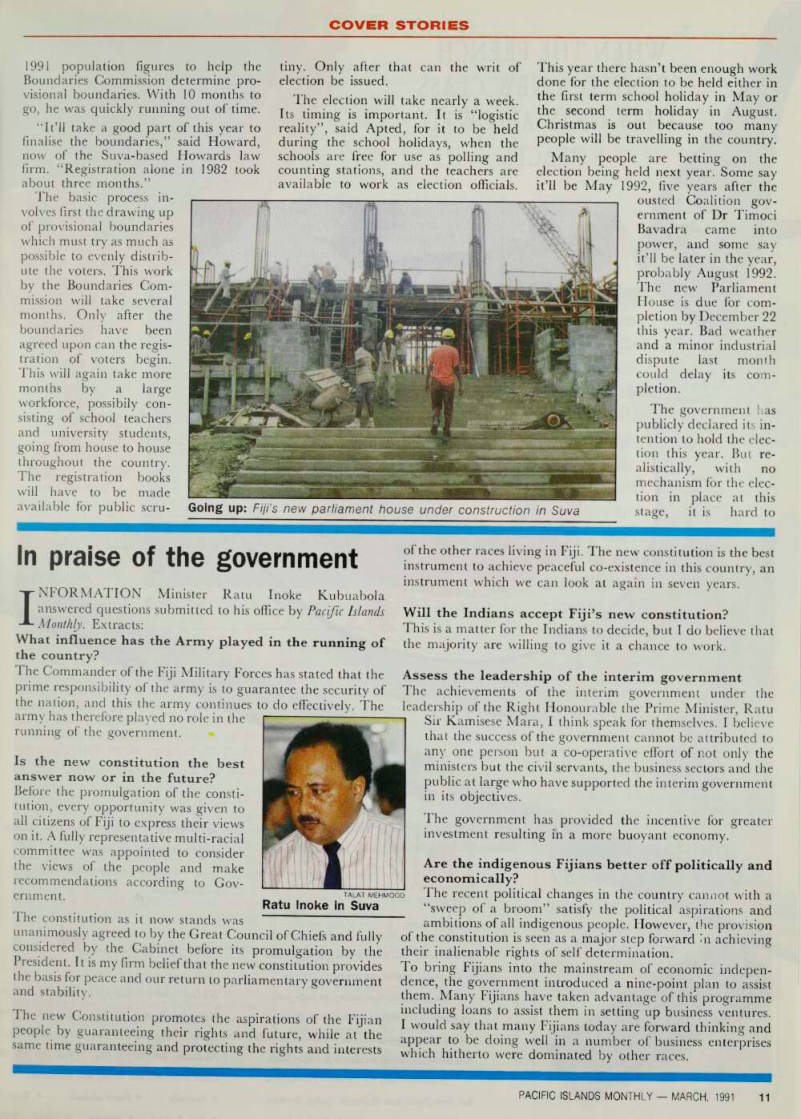
The new Parliament House is due for com
pletion by December 22
this year. Bad weather and a minor industrial dispute last month could delay its com pletion.
The government lias publicly declared its in tention to hold the elec tion this year. But re alistically, with no mechanism for the elec tion in place at this stage, it is hard to
Going up: Fiji's new parliament house under construction in Suva
believe that it is possible this year. Some observers see it wise to delay a political confrontation, like the election, in the hope that time will heal the wounds of the 1987 military coups. While the government insists things are normal in Fiji, Information Minister Ratu Inoke Kubuabola told Pacific Islands Monthly the country’s political problems cannot be said to have all been solved. “No country in the world has solved its political problems,” he said. “Every country has its own problems and I would say that the Interim Govern ment’s objectives in returning the
country to parlia mentary govern ment and econ omic recovery should be achieved by the end of the year.”
One major issue in this election is the decision by the National Feder
ation Party-Fiji
Labour Party Co alition, whose month-old gov ernment was over thrown in 1987, not to participate as a protest against the new constitution. The constitution, said a book titled A Fraud on the Nation produced by the
Coalition and released on February 28, is racist and unnecessarily weighted in favour of the indigenous Fijians. The Coalition will follow up A Fraud on the Nation with the production of an alterna tive constitution. But its decision not to participate in the election seems to be causing a split in the ranks of the party.
The Labour Party is behind the move for a boycott, seeing participation as an acceptance of the new constitution. The voice of dissent is coming from some members of the National Federation Party (NFP) who want to take part in the election to avoid having the 27 Indian seats taken up by “any Tom, Dick and Harry”. There was even a suggestion for the NFP to break away from the Coalition and concentrate on being an Indian party fighting for the 27 Indian seats in parliament and concen trating on Indian welfare. “The marjority of the Indians feel that way,” said Rakha. “It is natural for a person to look after his house first before looking after his village. NFP has always been an Indian party and although we’ve tried to give it a multiracial identity, it didn’t work.”
Rakha said the decision to boycott or not to boycott should be made by the people who support the parties and not by the party leaders: “If the people want us to contest then we contest. We shouldn’t give a ready-made idea to the people.” The final decision will be made after the NFP convention in May and the Labour convention in July.
The question that is being asked is why should the NFP remain in the Coalition.
While the Coalition was necessary in 1987 to topple the ruling Alliance Party of Ratu Sir Kamisese, Rakha sees little good in it for the NFP in a post-coup
election where numerical dominance is guaranteed for
the indigenous
Fijians. Asked
if there is a
possibility of
the Coalition
breaking up,
Rakha said; “If it doesn’t serve the inter est of the people then it can be poss ible.” But he pointed out
that contesting
the election on party lines still provides an
advantage for
the Coalition, especially with
Labour’s strong support in the urban areas.
Labour Party spokesman Tupeni
Baba, a senior lecturer at the University of the South Pacific in Suva, contends that the Coalition has very strong
chances of gaining parliamentary
marjority should it decide to contest the election. Said he: “We will pick up the 27 Indian seats, we will split the General Electors, we will win the urban Fijian seats and we will pick up one or two or
three provincial Fijian seats. But there is no guarantee that we can bring about a change in the constitution even if we hold the majority in parliament.” There is also no guarantee they will produce the prime minister, who must have the support of the majority of the Fijian members.
The Coalition’s uniting force is its total rejection of the new constitution. Apart from that there are few similarities between the two parties that comprise it.
The NFP began as an association for canefarmers in the late 1950 s and early 19605. By 1963 it has evolved into a full
‘lt’s natural for a person to look after his house first before looking after his village.
NFP has always been an Indian party . We’ve tried to give a multiracial identity, it didn’t work’
political party, led by A.D. Patel, an accomplished and
eloquent lawyer
who came to Fiji from his home of Gujerat in India.
Patel identified ef fectively with the aspirations and insecurities of a
majority of Fiji’s
Indian people.
Patel died in 1969 and the NFP has never been able to find an other leader with his appeal and wis dom. The party,
always dominated
by Indians, experi
enced its first split in late 1977. It broke up into
Flower and Dove factions, and saw the emergence of the leadership of Lautoka lawyer Jai Ram Reddy who headed NFP Flower. Reddy’s finest hour was in 1987 when he became the influential force behind the triumph of the Coalition.
Now, his war machine is in tatters and he remains mostly behind the limelight.
Labour was formed in the bosom of trade unionism, a reaction in 1985 by the Fiji Trades Union Congress to a government-imposed wage freeze. They
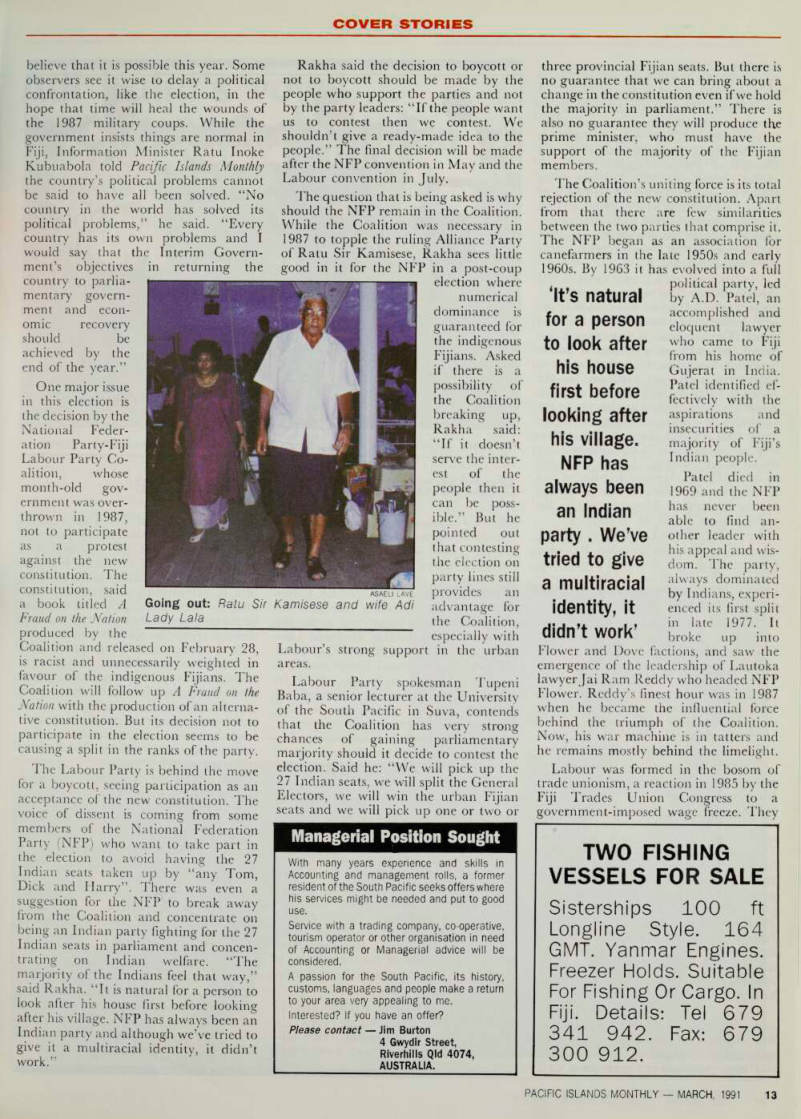
Asaeli Lave
Going out: Ratu Sir Kamisese and wife Adi Lady Lala
call themselves social democrats and won appeal in the urban centres where the problems of unemployment and poverty were present. The party has lost some key members since the coup: general secre tary Krishna Datt resigned and is working as general secretary of the Council of Pacific Teachers Organis ations; former cabinet minister Joeli Kalou has joined the Suva City Council; Labour’s first Lord Mayor of Suva, Bob Kumar has migrated to Australia; former cabinet minister Jo Nacola has rejoined the civil service as a government secon dary school teacher.
Leadership is now a new crisis facing the Coalition. The announcement by party leader Adi Kuini Bavadra that she will marry again next month shocked many. The new man is Australian Clive Speed (see p!5) who became a public figure in Fiji when he helped chart a controversial election platform for the Alliance Party in 1982. Rakha said Adi Kuini’s private life is of no concern to the Coalition. But Baba, who engineered the move that led Adi Kuini to the leader ship, is dismayed. “Clive Speed is a major image problem,” he said. “She has to decide that marrying Clive Speed and holding the leadership of the party will not be in conflict. Many people in the party believe it will be in conflict.”
Nevertheless, the Coalition is meeting regularly to revive its branches. Baba has been meeting with potential Fijian can didates. The Coalition, while currently having an election boycott policy, is still preparing to fight the election.
And the interim government? The new rules give it an advantage over the Coalition. There has been talk of a Fijian party, supported by the Great Council of Chiefs in the hope of continuing to unite the indigenous Fijians. But there have been criticism on the attempt to involve the chiefs in politics which some say will lower the dignity of the chiefly system and abuse the authority of the chiefs.
The Fijian party also seems to be encountering a leadership crisis. Ratu Sir Kamisese has said he will not be available for this election. That has left the leadership position wide open, giving speculators a chance to make some bets.
The top contender is Deputy Prime Minister Josevata Kamikamica, who has always seemed a reluctant participant in politics. From here on it’s a guessing game: Education Minister Filipe Bole, Trade Minister Beranado Vunibobo, Infrastructure and Public Utilities Min ister Apisai Tora, etc, etc. Army Com mander Major-General Sitiveni Rabuka remains the dark horse, but the odds are heavily stacked against him.
It is easier to look outside the current administration for a new prime minister.
But that is another story. For now the spotlight is on Apted. The betting has started election or no election. □
In praise of the government
INFORMATION Minister Ratu Inoke Kubuabola answered questions submitted to his office by Pacific Islands Monthly. Extracts: What influence has the Army played in the running of the country?
The Commander of the Fiji Military Forces has stated that the prime responsibility of the army is to guarantee the security of the nation, and this the army continues to do effectively. The
army has therefore played no role in the running of the government.
Is the new constitution the best answer now or in the future?
Before the promulgation of the consti tution, every opportunity was given to all citizens of Fiji to express their views on it. A fully representative multi-racial committee was appointed to consider the views of the people and make recommendations according to Gov ernment.
The constitution as it now stands was
unanimously agreed to by the Great Council of Chiefs and fully considered by the Cabinet before its promulgation by the Piesident. It is my firm belief that the new constitution provides the basis for peace and our return to parliamentary government and stability.
The new Constitution promotes the aspirations of the Fijian people by guaranteeing their rights and future, while at the same time guaranteeing and protecting the rights and interests
of the other races living in Fiji. The new constitution is the best instrument to achieve peaceful co-existence in this country, an instrument which we can look at again in seven years.
Will the Indians accept Fiji’s new constitution?
This is a matter for the Indians to decide, but I do believe that the majority are willing to give it a chance to work.
Assess the leadership of the interim government The achievements of the interim government under the leadership of the Right Honourable the Prime Minister, Ratu
Sir Kamisese Mara, I think speak for themselves. I believe that the success of the government cannot be attributed to any one person but a co-operative effort of not only the ministers but the civil servants, the business sectors and the public at large who have supported the interim government in its objectives.
The government has provided the incentive for greater investment resulting in a more buoyant economy.
Are the indigenous Fijians better off politically and
economically?
The recent political changes in the country cannot with a “sweep of a broom” satisfy the political aspirations and ambitions of all indigenous people. However, the provision
of the constitution is seen as a major step forward in achieving their inalienable rights of self determination.
To bring Fijians into the mainstream of economic indepen dence, the government introduced a nine-point plan to assist them. Many Fijians have taken advantage of this programme including loans to assist them in setting up business ventures.
I would say that many Fijians today are forward thinking and appear to be doing well in a number of business enterprises which hitherto were dominated by other races.
Talat Mehmood
Ratu Inoke in Suva
Advertisements & other items, pp. 12-13 (1 item)
8 Places.
WHEN THE FRENCH
CREATED A NEW CLASS
THEY ONLY ALLOWED
8 PLACES.
. v
Ail
r A & A ■ V- J / •*-tr
■WKCOS
CLAUSE
if' 9 There is now a new class of business travel that is undeniably one of the most exclusive offered by any airline in the world.
Classe Hibiscus. Eight First Class seats that have been reserved for the business class traveller and offer the ultimate in convenience, comfort and service.
Luxurious first class seating, an exotic menu combining French tropical delicacies with the finest Australian accompaniments, and service that can only he achieved by limiting the class to just eight people.
In addition, only Air Caledonie International has direct flights from Melbourne, Sydney, Brisbane International offers the business traveller the class they deserve and the speed they require.
Then again, Air Caledonie International is in a class of its own.
INTERNATIONAL
I A ...LI I \T..
Brisbane Tel: (07) 832 3344 Fax: (07) 832 0430 < Melbourne Tel: (03) 321 6872 Fax: (03) 329 0082 < Sydney Tel: (02) 239 1722 Fax: (02) 262 6179 Auckland Tel: (09) 732 603 Fax: (09) 366 1803 < Classe Hibiscus is now serving these destinations: • /Australia • New Caledonia • Wallis Is. 7psilsinsi • \lsinuatu • Tahiti * Fill
Managerial Position Sought
With many years experience and skills in Accounting and management rolls, a former resident of the South Pacific seeks offers where his services might be needed and put to good use.
Service with a trading company, co-operative, tourism operator or other organisation in need of Accounting or Managerial advice will be considered.
A passion for the South Pacific, its history, customs, languages and people make a return to your area very appealing to me.
Interested? If you have an offer?
Please contact Jim Burton 4 Gwydir Street, Riverhills Qld 4074,
AUSTRALIA.
TWO FISHING
VESSELS FOR SALE
Sisterships 100 ft Longline Style. 164 GMT. Yanmar Engines.
Freezer Holds. Suitable For Fishing Or Cargo. In Fiji. Details: Tel 679 341 942. Fax: 679 300 912.
Rabuka’s army of the future
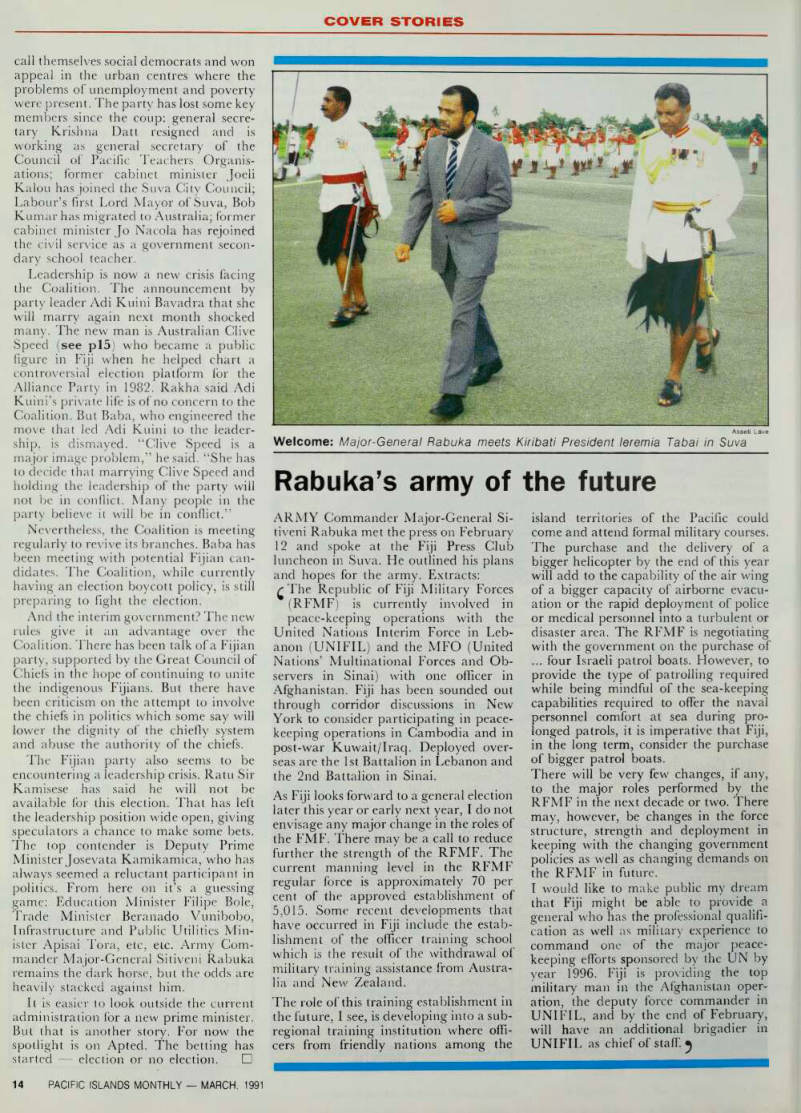
ARMY Commander Major-General Si tiveni Rabuka met the press on February 12 and spoke at the Fiji Press Club luncheon in Suva. He outlined his plans and hopes for the army. Extracts: q The Republic of Fiji Military Forces (RFMF) is currently involved in
peace-keeping operations with the
United Nations Interim Force in Leb anon (UNIFIL) and the MFO (United Nations’ Multinational Forces and Ob servers in Sinai) with one officer in Afghanistan. Fiji has been sounded out through corridor discussions in New York to consider participating in peace keeping operations in Cambodia and in post-war Kuwait/Iraq. Deployed over seas are the Ist Battalion in Lebanon and the 2nd Battalion in Sinai.
As Fiji looks forward to a general election later this year or early next year, I do not envisage any major change in the roles of the FMF. There may be a call to reduce further the strength of the RFMF. The current manning level in the RFMF regular force is approximately 70 per cent of the approved establishment of 5,015. Some recent developments that have occurred in Fiji include the estab lishment of the officer training school which is the result of the withdrawal of military training assistance from Austra lia and New Zealand.
The role of this training establishment in the future, I see, is developing into a sub regional training institution where offi cers from friendly nations among the
island territories of the Pacific could come and attend formal military courses.
The purchase and the delivery of a bigger helicopter by the end of this year will add to the capability of the air wing of a bigger capacity of airborne evacu ation or the rapid deployment of police or medical personnel into a turbulent or disaster area. The RFMF is negotiating with the government on the purchase of ... four Israeli patrol boats. However, to provide the type of patrolling required while being mindful of the sea-keeping capabilities required to offer the naval personnel comfort at sea during pro longed patrols, it is imperative that Fiji, in the long term, consider the purchase of bigger patrol boats.
There will be very few changes, if any, to the major roles performed by the RFMF in the next decade or two. There may, however, be changes in the force structure, strength and deployment in keeping with the changing government policies as well as changing demands on the RFMF in future.
I would like to make public my dream that Fiji might be able to provide a
general who has the professional qualifi
cation as well as military experience to command one of the major peace keeping efforts sponsored by the UN by year 1996. Fiji is providing the top military man in the Afghanistan oper ation, the deputy force commander in UNIFIL, and by the end of February, will have an additional brigadier in UNIFIL as chief of staff.
Asaeli Lave Welcome: Major-General Rabuka meets Kiribati President leremia Tabai in Suva
to Clive and Coalition
Adi Kuini’s vows ... to Clive and Coalition
Marriage is only one part of the party leader’s plans for the next three years
IN a way it was a bombshell. So perhaps it was fitting that the surprise announcement by Adi Kuini Bavadra that she will marry Australian lobbyist Clive Speed shared the front page of The Fiji Times with the outbreak of the Gulf War, “A few people are disturbed about it,” admitted the 41-year-old head of Fiji’s deposed Coalition.
“But friends and members of the party generally feel that I have been through a traumatic experience in the last three years and that I deserve a bit of
happiness.
“They are being very understanding about it and very human to the extent that they are not even worried about the political implications of my marrying Nevertheless those implications could be crucial to the Coalition.
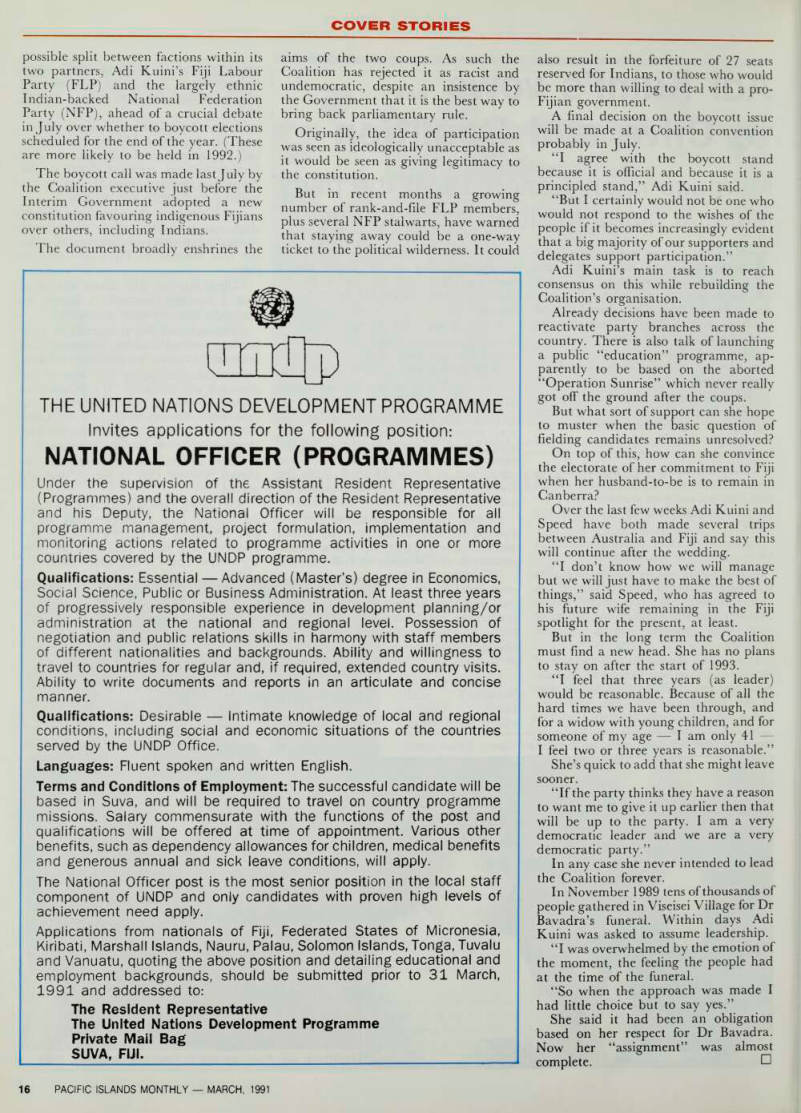
Barely a year ago she was made leader following the death from cancer of her then husband, Fiji’s last elected Prime Minister and the number one victim of two 1987 military coups, Timoci Bavadra.
Dubbed by the media as a “widow of democracy”, she was likened to Benazir Bhutto of Pakistan and Corazon Aquino of the Philippines, who also had been thrust into politics by tragedy.
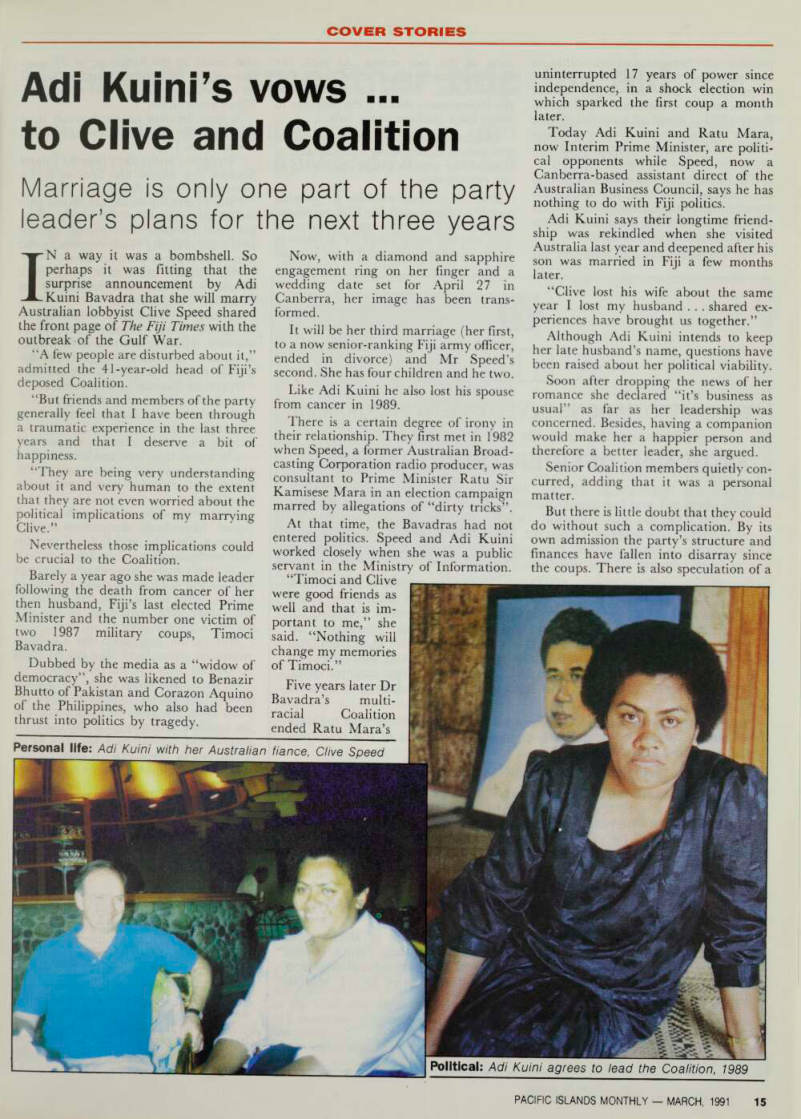
Now, with a diamond and sapphire engagement ring on her finger and a wedding date set for April 27 in Canberra, her image has been trans formed.
It will be her third marriage (her first, to a now senior-ranking Fiji army officer, ended in divorce) and Mr Speed’s second. She has four children and he two.
Like Adi Kuini he also lost his spouse from cancer in 1989.
There is a certain degree of irony in their relationship. They first met in 1982 when Speed, a former Australian Broad
casting Corporation radio producer, was
consultant to Prime Minister Ratu Sir Kamisese Mara in an election campaign
marred by allegations of “dirty tricks”.
At that time, the Bavadras had not entered politics. Speed and Adi Kuini worked closely when she was a public servant in the Ministry of Information.
“Timoci and Clive were good friends as well and that is im portant to me,” she said. “Nothing will change my memories of Timoci.”
Five years later Dr Bavadra’s multi racial Coalition ended Ratu Mara’s
uninterrupted 17 years of power since independence, in a shock election win which sparked the first coup a month later.
Today Adi Kuini and Ratu Mara, now Interim Prime Minister, are politi cal opponents while Speed, now a Canberra-based assistant direct of the Australian Business Council, says he has nothing to do with Fiji politics.
Adi Kuini says their longtime friend ship was rekindled when she visited Australia last year and deepened after his son was married in Fiji a few months later.
“Clive lost his wife about the same year I lost my husband . . . shared ex periences have brought us together.”
Although Adi Kuini intends to keep her late husband’s name, questions have been raised about her political viability.
Soon after dropping the news of her romance she declared “it’s business as usual” as far as her leadership was concerned. Besides, having a companion would make her a happier person and therefore a better leader, she argued.
Senior Coalition members quietly con curred, adding that it was a personal matter.
But there is little doubt that they could do without such a complication. By its own admission the party’s structure and finances have fallen into disarray since the coups. There is also speculation of a
Personal life: Adi Kuini with her Australian fiance, Clive Speed
Political: Adi Kuini agrees to lead the Coalition, 1989
possible split between factions within its two partners, Adi Kuini’s Fiji Labour Party (FLP) and the largely ethnic Indian-backed National Federation Party (NFP), ahead of a crucial debate in July over whether to boycott elections scheduled for the end of the year, (These are more likely to be held in 1992.) The boycott call was made last July by the Coalition executive just before the Interim Government adopted a new constitution favouring indigenous Fijians over others, including Indians.
The document broadly enshrines the
aims of the two coups. As such the Coalition has rejected it as racist and undemocratic, despite an insistence by the Government that it is the best way to bring back parliamentary rule.
Originally, the idea of participation was seen as ideologically unacceptable as it would be seen as giving legitimacy to the constitution.
But in recent months a growing number of rank-and-file FLP members, plus several NFP stalwarts, have warned that staying away could be a one-way ticket to the political wilderness. It could
also result in the forfeiture of 27 seats reserved for Indians, to those who would be more than willing to deal with a pro-
Fijian government.
A final decision on the boycott issue will be made at a Coalition convention probably in July.
“I agree with the boycott stand because it is official and because it is a principled stand,” Adi Kuini said.
“But I certainly would not be one who would not respond to the wishes of the people if it becomes increasingly evident that a big majority of our supporters and delegates support participation.”
Adi Kuini’s main task is to reach consensus on this while rebuilding the
Coalition’s organisation.
Already decisions have been made to reactivate party branches across the country. There is also talk of launching a public “education” programme, ap parently to be based on the aborted “Operation Sunrise” which never really got off the ground after the coups.
But what sort of support can she hope to muster when the basic question of fielding candidates remains unresolved?
On top of this, how can she convince the electorate of her commitment to Fiji when her husband-to-be is to remain in Canberra?
Over the last few weeks Adi Kuini and Speed have both made several trips between Australia and Fiji and say this will continue after the wedding.
“I don’t know how we will manage but we will just have to make the best of things,” said Speed, who has agreed to his future wife remaining in the Fiji spotlight for the present, at least.
But in the long term the Coalition must find a new head. She has no plans to stay on after the start of 1993.
“I feel that three years (as leader) would be reasonable. Because of all the hard times we have been through, and for a widow with young children, and for someone of my age I am only 41 I feel two or three years is reasonable.”
She’s quick to add that she might leave sooner.
“If the party thinks they have a reason to want me to give it up earlier then that will be up to the party. I am a very democratic leader and we are a very
democratic party.”
In any case she never intended to lead the Coalition forever.
In November 1989 tens of thousands of people gathered in Viseisei Village for Dr Bavadra’s funeral. Within days Adi Kuini was asked to assume leadership.
“I was overwhelmed by the emotion of the moment, the feeling the people had at the time of the funeral.
“So when the approach was made I had little choice but to say yes.”
She said it had been an obligation based on her respect for Dr Bavadra.
Now her “assignment” was almost complete. D
Advertisements & other items, p. 16 (1 item)
National Officer (Programmes)
THE UNITED NATIONS DEVELOPMENT PROGRAMME
Invites applications for the following position:
Under the supervision of the Assistant Resident Representative (Programmes) and the overall direction of the Resident Representative and his Deputy, the National Officer will be responsible for all programme management, project formulation, implementation and monitoring actions related to programme activities in one or more countries covered by the UNDP programme.
Qualifications: Essential Advanced (Master’s) degree in Economics, Social Science, Public or Business Administration. At least three years of progressively responsible experience in development planning/or administration at the national and regional level. Possession of negotiation and public relations skills in harmony with staff members of different nationalities and backgrounds. Ability and willingness to travel to countries for regular and, if required, extended country visits.
Ability to write documents and reports in an articulate and concise manner.
Qualifications: Desirable Intimate knowledge of local and regional conditions, including social and economic situations of the countries served by the UNDP Office.
Languages: Fluent spoken and written English.
Terms and Conditions of Employment: The successful candidate will be based in Suva, and will be required to travel on country programme missions. Salary commensurate with the functions of the post and qualifications will be offered at time of appointment. Various other benefits, such as dependency allowances for children, medical benefits and generous annual and sick leave conditions, will apply.
The National Officer post is the most senior position in the local staff component of UNDP and only candidates with proven high levels of achievement need apply.
Applications from nationals of Fiji, Federated States of Micronesia, Kiribati, Marshall Islands, Nauru, Palau, Solomon Islands, Tonga, Tuvalu and Vanuatu, quoting the above position and detailing educational and employment backgrounds, should be submitted prior to 31 March, 1991 and addressed to: The Resident Representative The United Nations Development Programme Private Mail Bag
SUVA, FIJI.
Seeking a smoother ride for aid
The Region
In the nervous '9os, the Pacific must iron out bumps in the supply and use of aid
MORE foreign aid dollars per person are being poured in the South Pacific than any other part of the developing world.
Yet economic growth in island countries has fluctuated wildly from year to year, and struggled to keep pace with
steadily increasing populations.
Somewhere, somehow, something has gone seriously wrong in the aid and
development game.
Faced with this, the South Pacific Forum Secretariat convened an unprece dented gathering of officials from island governments, donor countries and aid organisations at its Suva headquarters last month.
Dubbed simply as the “Pacific Island Countries-Donors Meeting”, it took three days to tackle the fundamental problem of how the millions spent could be used more efficiently, and so reap a greater developmental reward.
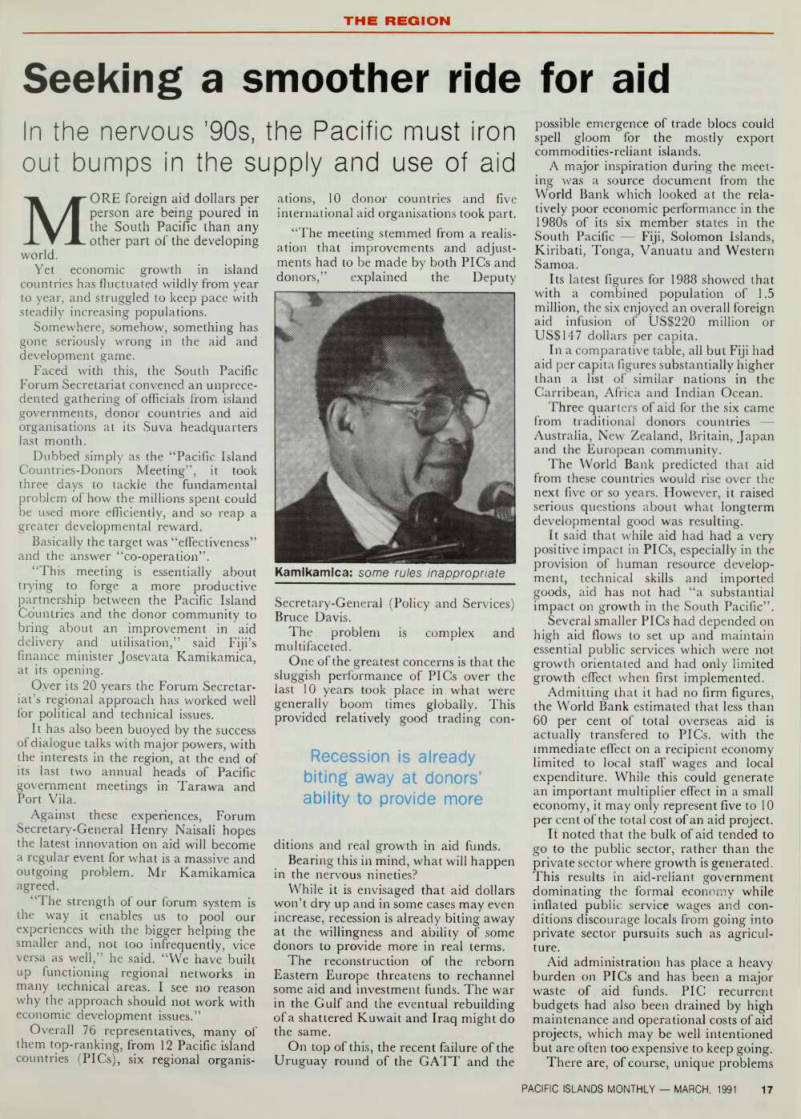
Basically the target was “effectiveness” and the answer “co-operation”, “This meeting is essentially about trying to forge a more productive partnership between the Pacific Island Countries and the donor community to bring about an improvement in aid delivery and utilisation,” said Fiji’s finance minister Josevata Kamikamica, at its opening.
Oyer its 20 years the Forum Secretar iat’s regional approach has worked well for political and technical issues.
It has also been buoyed by the success of dialogue talks with major powers, with the interests in the region, at the end of its last two annual heads of Pacific government meetings in Tarawa and Port Vila.
Against these experiences, Forum
Secretary-General Henry Naisali hopes
the latest innovation on aid will become a regular event for what is a massive and outgoing problem. Mr Kamikamica agreed.
“The strength of our forum system is the way it enables us to pool our
experiences with the bigger helping the
smaller and, not too infrequently, vice versa as well,” he said. “We have built up functioning regional networks in many technical areas. I see no reason why the approach should not work with economic development issues.”
Overall 76 representatives, many of them top-ranking, from 12 Pacific island countries (PICs), six regional organis
ations, 10 donor countries and five international aid organisations took part.
“The meeting stemmed from a realis ation that improvements and adjust ments had to be made by both PICs and donors,” explained the Deputy
Secretary-General (Policy and Services)
Bruce Davis.
The problem is complex and multifaceted.
One of the greatest concerns is that the sluggish performance of PICs over the last 10 years took place in what were generally boom times globally. This
provided relatively good trading con-
Recession is already biting away at donors’ ability to provide more
ditions and real growth in aid funds.
Bearing this in mind, what will happen in the nervous nineties?
While it is envisaged that aid dollars won’t dry up and in some cases may even increase, recession is already biting away at the willingness and ability of some donors to provide more in real terms.
The reconstruction of the reborn Eastern Europe threatens to rechannel some aid and investment funds. The war in the Gulf and the eventual rebuilding of a shattered Kuwait and Iraq might do the same.
On top of this, the recent failure of the Uruguay round of the GATT and the
possible emergence of trade blocs could spell gloom for the mostly export commodities-reliant islands.
A major inspiration during the meet
ing was a source document from the World Bank which looked at the rela tively poor economic performance in the 1980 s of its six member states in the South Pacific Fiji, Solomon Islands, Kiribati, Tonga, Vanuatu and Western Samoa.
Its latest figures for 1988 showed that with a combined population of 1.5 million, the six enjoyed an overall foreign aid infusion of USS22O million or USSI47 dollars per capita.
In a comparative table, all but Fiji had aid per capita figures substantially higher than a list of similar nations in the Carribean, Africa and Indian Ocean.
Three quarters of aid for the six came from traditional donors countries - Australia, New Zealand, Britain, Japan
and the European community.
The World Bank predicted that aid from these countries would rise over the next five or so years. However, it raised serious questions about what longterm
developmental good was resulting.
It said that while aid had had a very positive impact in PICs, especially in the provision of human resource develop ment, technical skills and imported goods, aid has not had “a substantial impact on growth in the South Pacific”.
Several smaller PICs had depended on high aid flows to set up and maintain essential public services which were not growth orientated and had only limited growth effect when first implemented.
Admitting that it had no firm figures, the World Bank estimated that less than 60 per cent of total overseas aid is actually transfered to PICs. with the immediate effect on a recipient economy limited to local staff wages and local expenditure. While this could generate an important multiplier effect in a small economy, it may only represent five to 10 per cent of the total cost of an aid project.
It noted that the bulk of aid tended to go to the public sector, rather than the private sector where growth is generated.
This results in aid-reliant government dominating the formal economy while inflated public service wages and con ditions discourage locals from going into private sector pursuits such as agricul ture.
Aid administration has place a heavy burden on PICs and has been a major waste of aid funds. PIC recurrent budgets had also been drained by high maintenance and operational costs of aid projects, which may be well intentioned but are often too expensive to keep going.
There are, of course, unique problems
Kamikamica: some rules inappropriate
in the Pacific isolation between islands and the rest of the world; diseconomies of scale of tiny popu lations and local markets; lack of manpower, skills and natural resources and vulnerability to natural disasters.
But, according to the World Bank and last month’s meeting, much of the solution lies in a more strategic ap proach. Traditionally many PICs have produced comprehensive five-year plans often little more than shopping lists aimed at donors. The consensus now is that this should be replaced by the development of sound Macro- Economic policies followed by detailed planning in key economic sectors, to produce private and public investment projects more likely to succeed.
Last month’s meeting agreed that this could only be achieved if donors and PICs co-ordinated their efforts via regular consultation. There are so many donor organisations now active in the region, they must talk more.
A major topic for such consultation will be how to foster the private sector.
It is often seen as the engine for growth, so the Secretariat would work more closely with PICs and donors on this.
A major breakthrough at the meet ing was that donors saw the need to help PICs cope with the aid planning.
Officials noted that for years consult ants had come to an island country and laid down a plan which was often accepted without hard questions on its
suitability or viability.
“Consultants come in, set up a project and walk out,” said secretariat
economic development director Garry
Wiseman. “Often the project then falls apart or becomes a drain on tiny
recurrent budgets.”
Because of the small nature of some PICs, existing regional organisations could play a major cost-effective role in areas including transport and com munications and marine resources. But such regional programs should be
driven by national priorities.
Mr Kamikamica bemoaned the lack of expertise in PICs and said many rules and regulations imposed by foreign donors for aid should be relaxed.
“To apply the same rules to a project costing a few thousand dollars on a remote Pacific atoll to one costing millions in China, is absurd and wasteful,” he said. “It is an old criticism that many donors find it difficult to get to grips with the micronature of the South Pacific.”
Most PICs are former colonies with relatively few years of independence and, with new found sovereignty, they want a greater say. If they are eased into the driver’s seat with the help of donors, the road to economic growth may not be so bumpy. □
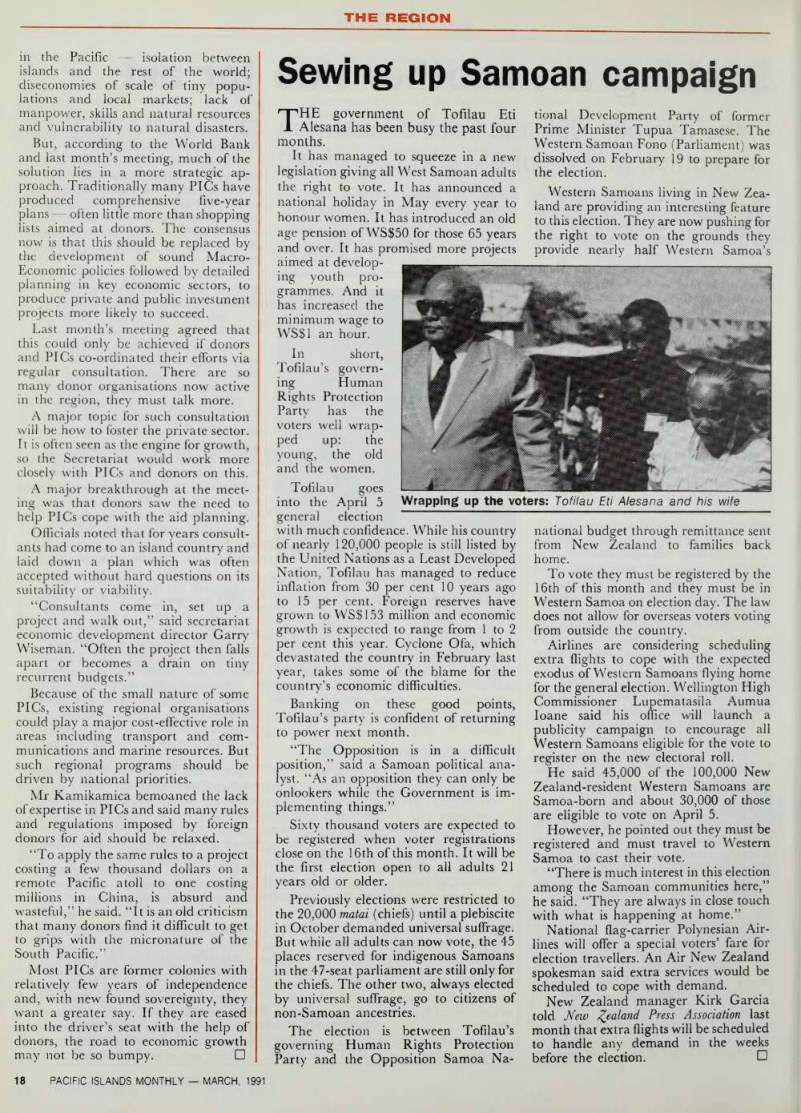
Sewing up Samoan campaign
THE government of Tofilau Eti Alesana has been busy the past four months.
It has managed to squeeze in a new legislation giving all West Samoan adults the right to vote. It has announced a national holiday in May every year to honour women. It has introduced an old age pension of WS$5O for those 65 years and over. It has promised more projects
aimed at develop
ing youth pro
grammes. And it has increased the minimum wage to WSSI an hour.
In short, Tofilau’s govern ing Human Rights Protection Party has the voters well wrap ped up: the young, the old and the women.
Tofilau goes into the April 5 general election
with much confidence. While his country of nearly 120,000 people is still listed by the United Nations as a Least Developed Nation, Tofilau has managed to reduce inflation from 30 per cent 10 years ago to 15 per cent. Foreign reserves have grown to WSSIS3 million and economic growth is expected to range from 1 to 2 per cent this year. Cyclone Ofa, which devastated the country in February last year, takes some of the blame for the country’s economic difficulties.
Banking on these good points, Tofilau’s party is confident of returning to power next month.
“The Opposition is in a difficult position,” said a Samoan political ana lyst. “As an opposition they can only be onlookers while the Government is im
plementing things.”
Sixty thousand voters are expected to be registered when voter registrations close on the 16th of this month. It will be the first election open to all adults 21 years old or older.
Previously elections were restricted to the 20,000 malai (chiefs) until a plebiscite in October demanded universal suffrage.
But while all adults can now vote, the 45 places reserved for indigenous Samoans in the 47-seat parliament are still only for the chiefs. The other two, always elected by universal suffrage, go to citizens of non-Samoan ancestries.
The election is between Tofilau’s
governing Human Rights Protection
Party and the Opposition Samoa Na
tional Development Party of former Prime Minister Tupua Tamasese. The Western Samoan Fono (Parliament) was dissolved on February 19 to prepare for the election.
Western Samoans living in New Zea land are providing an interesting feature to this election. They are now pushing for the right to vote on the grounds they provide nearly half Western Samoa’s
national budget through remittance sent from New Zealand to families back home.
To vote they must be registered by the 16th of this month and they must be in Western Samoa on election day. The law does not allow for overseas voters voting from outside the country.
Airlines are considering scheduling extra flights to cope with the expected exodus of Western Samoans flying home for the general election. Wellington High Commissioner Lupematasila Aumua loane said his office will launch a publicity campaign to encourage all Western Samoans eligible for the vote to register on the new electoral roll.
He said 45,000 of the 100,000 New Zealand-resident Western Samoans are Samoa-born and about 30,000 of those are eligible to vote on April 5.
However, he pointed out they must be registered and must travel to Western Samoa to cast their vote.
“There is much interest in this election among the Samoan communities here,” he said. “They are always in close touch with what is happening at home.”
National flag-carrier Polynesian Air
lines will offer a special voters’ fare for election travellers. An Air New Zealand spokesman said extra services would be scheduled to cope with demand.
New Zealand manager Kirk Garcia told New Zealand Press Association last month that extra flights will be scheduled to handle any demand in the weeks before the election. □
Wrapping up the voters: Tofilau Eti Alesana and his wife
Where the phosphate and time
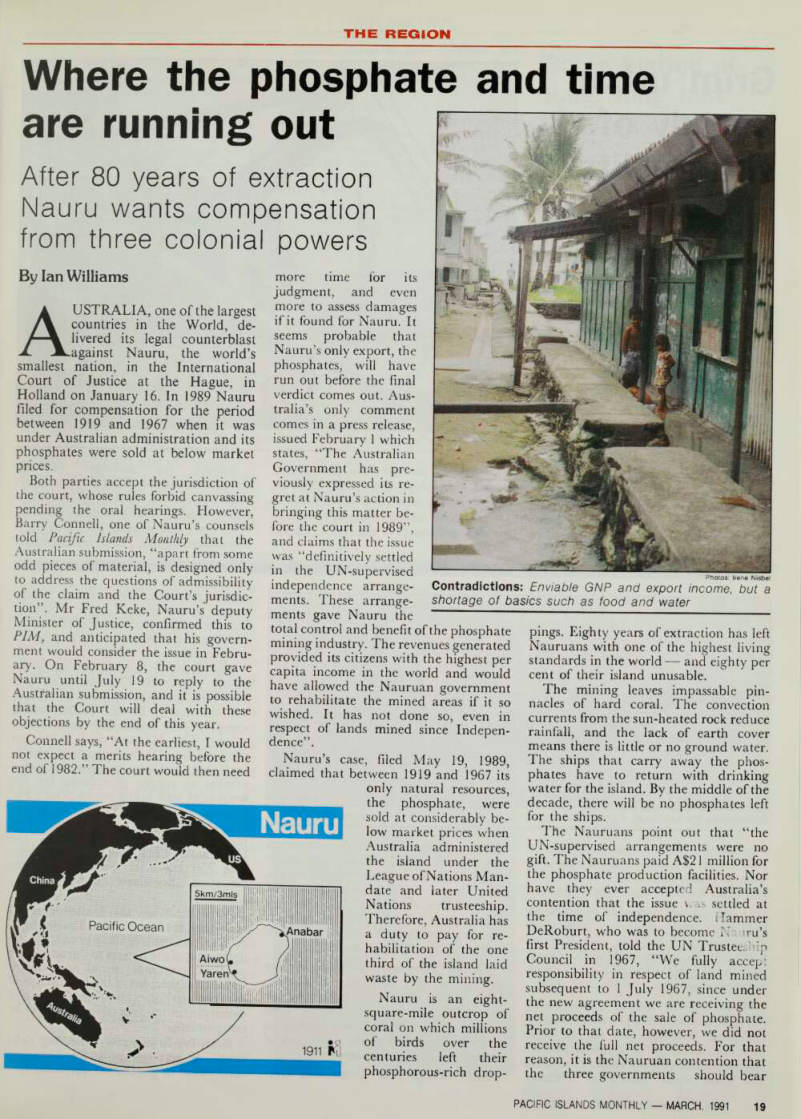
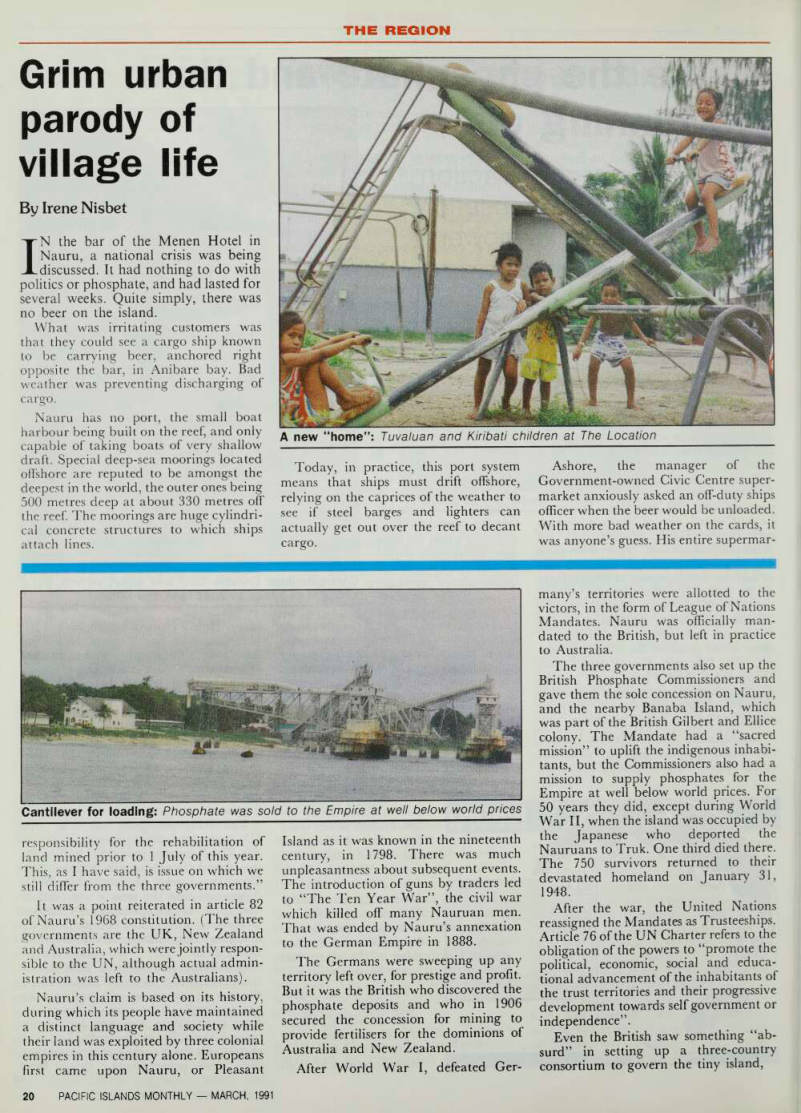
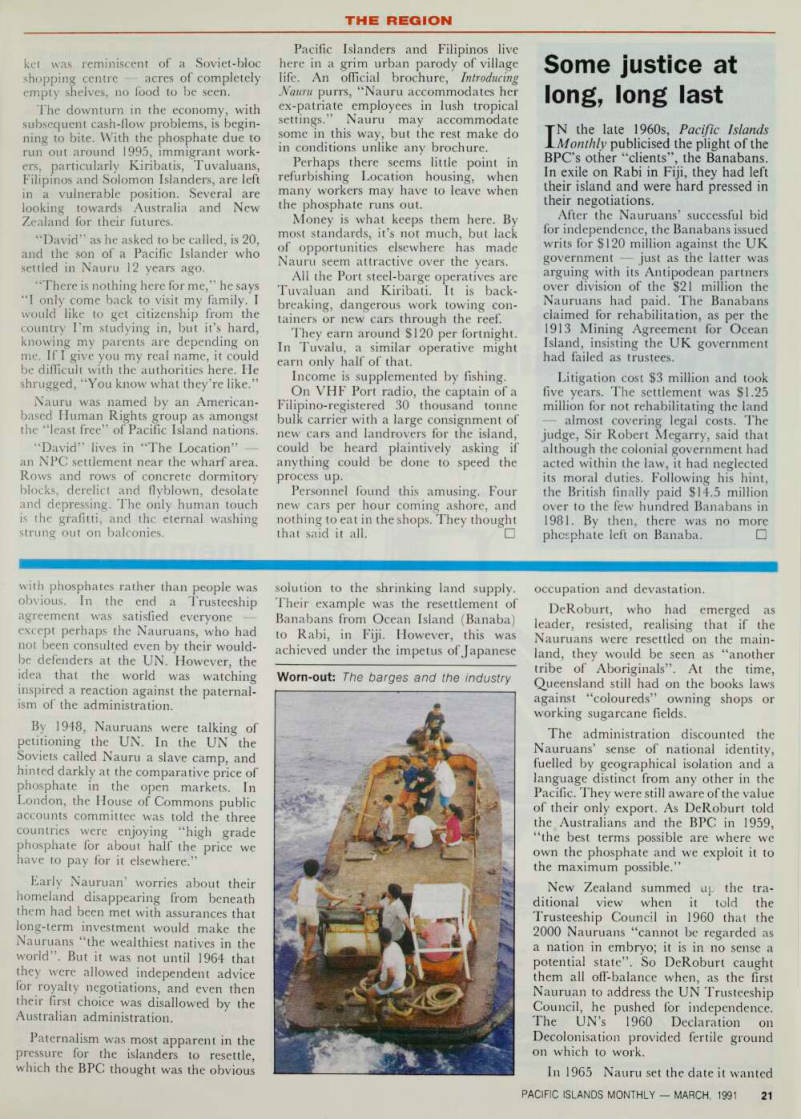

are running out
After 80 years of extraction Nauru wants compensation from three colonial powers
By Ian Williams
AUSTRALIA, one of the largest countries in the World, de livered its legal counterblast against Nauru, the world’s smallest nation, in the International Court of Justice at the Hague, in Holland on January 16. In 1989 Nauru filed for compensation for the period between 1919 and 1967 when it was under Australian administration and its phosphates were sold at below market prices.
Both parties accept the jurisdiction of the court, whose rules forbid canvassing pending the oral hearings. However, Barry Connell, one of Nauru’s counsels told Pacific Islands Monthly that the Australian submission, “apart from some odd pieces of material, is designed only to address the questions of admissibility of the claim and the Court’s jurisdic tion”. Mr Fred Keke, Nauru’s deputy Minister of Justice, confirmed this to PIM, and anticipated that his govern ment would consider the issue in Febru ary. On February 8, the court gave Nauru until July 19 to reply to the Australian submission, and it is possible that the Court will deal with these objections by the end of this year.
Connell says, “At the earliest, I would not expect a merits hearing before the end of 1982.” The court would then need
more time for its judgment, and even more to assess damages if it found for Nauru. It seems probable that Nauru’s only export, the phosphates, will have run out before the final verdict comes out. Aus tralia’s only comment comes in a press release, issued February 1 which states, “The Australian Government has pre viously expressed its re gret at Nauru’s action in bringing this matter be fore the court in 1989”, and claims that the issue was “definitively settled in the UN-supervised
independence arrange
ments. These arrange ments gave Nauru the
total control and benefit of the phosphate mining industry. The revenues generated provided its citizens with the highest per capita income in the world and would have allowed the Nauruan government to rehabilitate the mined areas if it so wished. It has not done so, even in respect of lands mined since Indepen dence’’.
Nauru’s case, filed May 19, 1989, claimed that between 1919 and 1967 its
only natural resources, the phosphate, were sold at considerably be low market prices when Australia administered the island under the League of Nations Man date and later United Nations trusteeship.
Therefore, Australia has a duty to pay for re habilitation of the one third of the island laid waste by the mining.
Nauru is an eight square-mile outcrop of coral on which millions of birds over the centuries left their
phosphorous-rich drop-
pings. Eighty years of extraction has left Nauruans with one of the highest living standards in the world and eighty per cent of their island unusable.
The mining leaves impassable pin nacles of hard coral. The convection currents from the sun-heated rock reduce rainfall, and the lack of earth cover means there is little or no ground water.
The ships that carry away the phos phates have to return with drinking water for the island. By the middle of the decade, there will be no phosphates left for the ships.
The Nauruans point out that “the UN-supervised arrangements were no gift. The Nauruans paid AS2I million for the phosphate production facilities. Nor have they ever accepted Australia’s contention that the issue \. as settled at the time of independence, slammer Deßoburt, who was to become N :ru’s first President, told the UN Trustee, ip Council in 1967, “We fully accep: responsibility in respect of land mined subsequent to 1 July 1967, since under the new agreement we are receiving the net proceeds of the sale of phosphate.
Prior to that date, however, we did not receive the full net proceeds. For that reason, it is the Nauruan contention that the three governments should bear
Photos: Irene Nisbet Contradictions; Enviable GNP and export income, but a shortage of basics such as food and water
responsibility for the rehabilitation of land mined prior to 1 July of this year.
This, as I have said, is issue on which we still differ from the three governments.”
It was a point reiterated in article 82 of Nauru’s 1968 constitution. (The three governments are the UK, New Zealand and Australia, which were jointly respon sible to the UN, although actual admin istration was left to the Australians).
Nauru’s claim is based on its history, during which its people have maintained a distinct language and society while their land was exploited by three colonial empires in this century alone. Europeans first came upon Nauru, or Pleasant
Island as it was known in the nineteenth century, in 1798. There was much unpleasantness about subsequent events.
The introduction of guns by traders led to “The Ten Year War”, the civil war which killed off many Nauruan men.
That was ended by Nauru’s annexation to the German Empire in 1888.
The Germans were sweeping up any territory left over, for prestige and profit.
But it was the British who discovered the phosphate deposits and who in 1906 secured the concession for mining to provide fertilisers for the dominions of Australia and New Zealand.
After World War I, defeated Ger
many’s territories were allotted to the victors, in the form of League of Nations Mandates. Nauru was officially man dated to the British, but left in practice to Australia.
The three governments also set up the British Phosphate Commissioners and gave them the sole concession on Nauru, and the nearby Banaba Island, which was part of the British Gilbert and Ellice colony. The Mandate had a “sacred mission” to uplift the indigenous inhabi tants, but the Commissioners also had a mission to supply phosphates for the Empire at well below world prices. For 50 years they did, except during World War 11, when the island was occupied by the Japanese who deported the Nauruans to Truk. One third died there.
The 750 survivors returned to their devastated homeland on January 31, 1948.
After the war, the United Nations reassigned the Mandates as Trusteeships.
Article 76 of the UN Charter refers to the obligation of the powers to “promote the political, economic, social and educa tional advancement of the inhabitants of the trust territories and their progressive development towards self government or
independence”.
Even the British saw something “ab surd” in setting up a three-country consortium to govern the tiny island,
Cantilever for loading: Phosphate was sold to the Empire at well below world prices
with phosphates rather than people was obvious. In the end a Trusteeship agreement was satisfied everyone except perhaps the Nauruans, who had not been consulted even by their would be defenders at the UN. However, the idea that the world was watching inspired a reaction against the paternal ism of the administration.
By 1948, Nauruans were talking of petitioning the UN. In the UN the Soviets called Nauru a slave camp, and hinted darkly at the comparative price of phosphate in the open markets. In London, the House of Commons public accounts committee was told the three
countries were enjoying “high grade
phosphate for about half the price we have to pay for it elsewhere.”
Early Nauruan’ worries about their homeland disappearing from beneath them had been met with assurances that long-term investment would make the Nauruans “the wealthiest natives in the world”. But it was not until 1964 that they were allowed independent advice for royalty negotiations, and even then their first choice was disallowed by the Australian administration.
Paternalism was most apparent in the pressure for the islanders to resettle, which the BPC thought was the obvious
solution to the shrinking land supply.
Their example was the resettlement of Banabans from Ocean Island (Banaba) to Rabi, in Fiji. However, this was achieved under the impetus of Japanese
occupation and devastation, Deßoburt, who had emerged as leader, resisted, realising that if the Nauruans were resettled on the main land, they would be seen as “another tribe of Aboriginals”. At the time, Queensland still had on the books laws against “coloureds” owning shops or working sugarcane fields.
The administration discounted the Nauruans’ sense of national identity, fuelled by geographical isolation and a language distinct from any other in the Pacific. They were still aware of the value of their only export. As Deßoburt told the Australians and the BPC in 1959, “the best terms possible are where we own the phosphate and we exploit it to the maximum possible.”
New Zealand summed the tra ditional view when it told the Trusteeship Council in 1960 that the 2000 Nauruans “cannot be regarded as a nation in embryo; it is in no sense a potential state”. So Deßoburt caught them all off-balance when, as the first Nauruan to address the UN Trusteeship Council, he pushed for independence.
The UN’s 1960 Declaration on Decolonisation provided fertile ground on which to work.
In 1965 Nauru set the date it wanted
Worn-out: The barges and the industry
independence as January 31, 1968, the anniversary of their return from Truk in 1946. In addition, having ruled out offers of resettlement which did not give them sovereignty, they demanded that the three governments should rehabilitate the mined-out land.
Australia fought a rearguard action to maintain a hand in the phosphate business but, in the end, it was agreed that Nauru would pay $2l million to buy out BPC’s operations on its territory.
Similarly, Australia’s attempts to retain responsibility for defence foundered on
their inability to do so during WWII.
On January 31, 1968, the Republic of Nauru became the world’s smallest nation and one of its richest, since it now owned the phosphates.
It negotiated special membership of the Commonwealth, and is a member of the South Pacific Forum and other regional bodies. And it acceded to the International Court of Justice.
In 1985, when the Nauruans heard the international assets of the BPC were to be wound up, it whetted their appetite for parity with the Banabans, not least
because much of it represented their S2l million payment. They determined to restate their demand for rehabilitation.
In 1987, the Nauru government estab lished a Commission to study the prob lem of rehabilitation, to which the Australian government refused to give evidence. Based upon its findings, the Republic initiated proceedings in the International Court of Justice in 1989.
By then there were more consider ations than simply righting a historic wrong. Nauru’s financial future was no longer as secure as it had appeared earlier, and the deadline for serious rehabilitation was approaching, as the last of the phosphates were extracted.
Nauru maintains that it has a trust fund to reclaim the land affected by mining since 1967, but that the project needs a comprehensive plan for the whole island.
Roger Clark, Professor of Interna tional Law at Rutgers University told PIM, “I think the Nauruans have a reasonable shot it’s certainly an arguable case. If they win, the precedent has interesting possibilities for other Trust territories like Palau, which has always held that US has not functioned under the UN Character.” □
parody of
Grim urban parody of village life
By Irene Nisbet
IN the bar of the Menen Hotel in Nauru, a national crisis was being discussed. It had nothing to do with politics or phosphate, and had lasted for several weeks. Quite simply, there was no beer on the island.
What was irritating customers was that they could see a cargo ship known to be carrying beer, anchored right opposite the bar, in Anibare bay. Bad weather was preventing discharging of cargo.
Nauru has no port, the small boat harbour being built on the reef, and only capable of taking boats of very shallow draft. Special deep-sea moorings located offshore are reputed to be amongst the deepest in the world, the outer ones being 500 metres deep at about 330 metres off the reef. The moorings are huge cylindri cal concrete structures to which ships attach lines.
Today, in practice, this port system means that ships must drift offshore, relying on the caprices of the weather to see if steel barges and lighters can actually get out over the reef to decant cargo.
Ashore, the manager of the Government-owned Civic Centre super market anxiously asked an off-duty ships officer when the beer would be unloaded.
With more bad weather on the cards, it was anyone’s guess. His entire supermar
A new “home”: Tuvaluan and Kiribati children at The Location
ket was reminiscent of a Soviet-bloc shopping centre acres of completely empty shelves, no food to be seen.
The downturn in the economy, with subsequent cash-flow problems, is begin ning to bite. With the phosphate due to run out around 1995, immigrant work ers, particularly Kiribatis, Tuvaluans, Filipinos and Solomon Islanders, are left in a vulnerable position. Several are looking towards Australia and New Zealand for their futures.
“David” as he asked to be called, is 20, and the son of a Pacific Islander who settled in Nauru 12 years ago.
“There is nothing here for me,” he says “I only come back to visit my family. I would like to get citizenship from the country I’m studying in, but it’s hard, knowing my parents are depending on me. If I give you my real name, it could be difficult with the authorities here. He shrugged, “You know what they’re like.”
Nauru was named by an American based Human Rights group as amongst the “least free” of Pacific Island nations.
“David” lives in “The Location” an NPC settlement near the wharf area.
Rows and rows of concrete dormitory blocks, derelict and flyblown, desolate and depressing. The only human touch is the graffiti, and the eternal washing strung out on balconies.
Pacific Islanders and Filipinos live here in a grim urban parody of village life. An official brochure, Introducing Nauru purrs, “Nauru accommodates her ex-patriate employees in lush tropical settings.” Nauru may accommodate some in this way, but the rest make do in conditions unlike any brochure.
Perhaps there seems little point in refurbishing Location housing, when many workers may have to leave when the phosphate runs out.
Money is what keeps them here. By most standards, it’s not much, but lack of opportunities elsewhere has made Nauru seem attractive over the years.
All the Port steel-barge operatives are Tuvaluan and Kiribati. It is back breaking, dangerous work towing con tainers or new cars through the reef.
They earn around SI2O per fortnight.
In Tuvalu, a similar operative might earn only half of that.
Income is supplemented by fishing.
On VHF Port radio, the captain of a Filipino-registered 30 thousand tonne bulk carrier with a large consignment of new cars and landrovers for the island, could be heard plaintively asking if anything could be done to speed the process up.
Personnel found this amusing. Four new cars per hour coming ashore, and nothing to eat in the shops. They thought that said it all. □
long, long last
Some justice at long, long last
IN the late 19605, Pacific Islands Monthly publicised the plight of the BPC’s other “clients”, the Banabans.
In exile on Rabi in Fiji, they had left their island and were hard pressed in their negotiations.
After the Nauruans’ successful bid for independence, the Banabans issued writs for SI2O million against the UK government just as the latter was arguing with its Antipodean partners over division of the S2l million the Nauruans had paid. The Banabans claimed for rehabilitation, as per the 1913 Mining Agreement for Ocean Island, insisting the UK government had failed as trustees.
Litigation cost S 3 million and took five years. The settlement was SL2S million for not rehabilitating the land - almost covering legal costs. The judge, Sir Robert Megarry, said that although the colonial government had acted within the law, it had neglected its moral duties. Following his hint, the British finally paid 514.5 million over to the few hundred Banabans in 1981. By then, there was no more phosphate left on Banaba. □
unemployed
Affluent but unemployed
ON one level, Nauru is a reductio ad absurdum of the modem conception of a nation state. Less than 6000 people clinging to the fringes of a coral island, driven from the uplands by phosphate mining, and threatened by the rising oceans as a result of global warming.
Yet it has an export income and GNP which is the envy of many larger nations. With its massive overseas in vestments, it almost looks like Kuwait
under Iraqi occupation a banking
system without a territory.
Its reserves would not cover the cost both of reclaiming territory, and main taining the Nauruans with one of the highest living standards in the world. In addition, the government has been spending heavily.
Air Nauru has lost hundreds of millions of dollars, and the Nauru Pacific shipping line probably lost even more.
The national debt and the Island’s trust funds have been coverging while govern ment spending has often outstripped income.
Even if their pursuit of the claim against Australia for restitution is suc cessful, it is unlikely to solve the social and economic problems of such lop-sided development where being a citizen is a passport to unemployed affluence. □
Advertisements & other items, p. 22 (1 item)
Dettol
Make Dettol a part
of your daily
living
USE DETTOL FOR
Cuts. Abrasions, Grazes Tq Insect Stings or Bites & / 1 Kk Bathing l/l.
Dettol
Gargle Laundry Wash
ANTISEPTIC
S PROTECTS YOUR FAMILY
BY APPOINTMENT TO HER MAJESTY QUEEN ELIZABETH I
MANUFACTURERS Of ANTISEPTICS
REOOTT t COCMAN PHARMACEUTICAL DIVISION. MUU
250 ml CONTAINS: CHLORCDCYLENOL 4J* W/V; ETHANOL 15.8* V/V Mouthwash anc SI Buy a bottle today and Keep your family healthy and clean Another quality product from Reckitt & Colmon
Reverberations from anti-abortion law
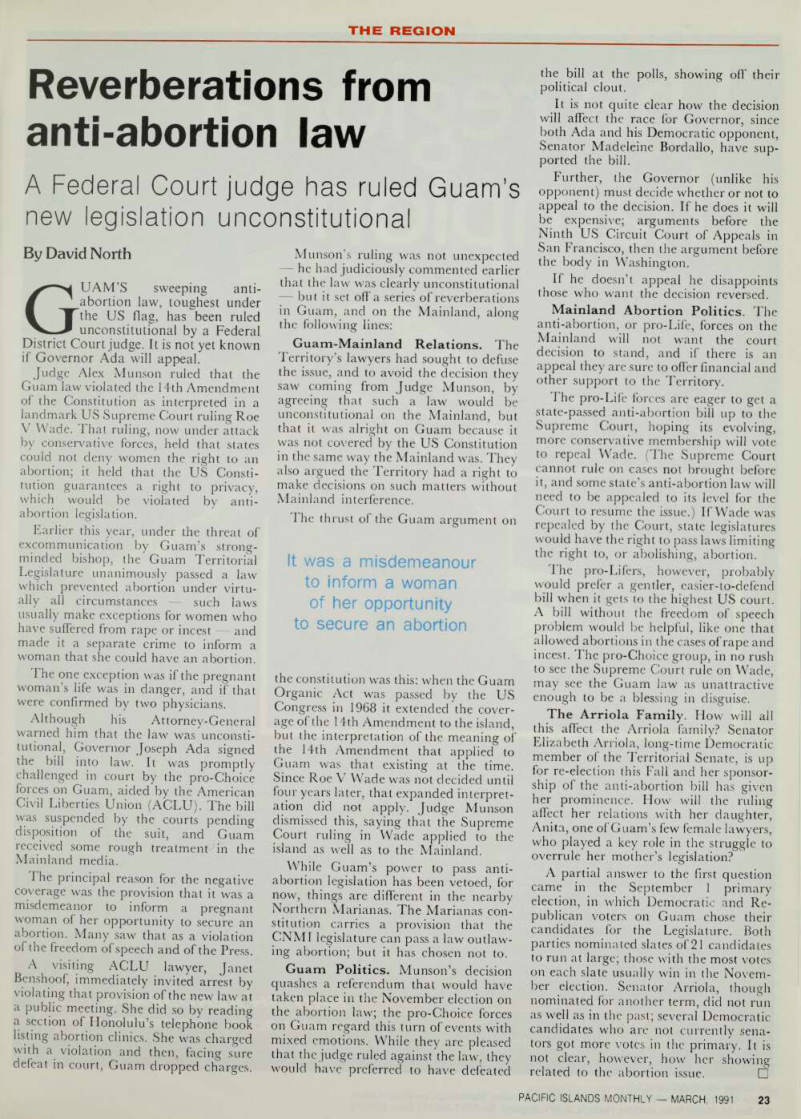
anti-abortion law
A Federal Court judge has ruled Guam’s new legislation unconstitutional
By David North
GUAM’S sweeping anti abortion law, toughest under the US flag, has been ruled unconstitutional by a Federal District Court judge. It is not yet known if Governor Ada will appeal.
Judge Alex Munson ruled that the Guam law violated the 14th Amendment of the Constitution as interpreted in a landmark US Supreme Court ruling Roe V Wade. That ruling, now under attack by conservative forces, held that states could not deny women the right to an abortion; it held that the US Consti tution guarantees a right to privacy, which would be violated by anti abortion legislation.
Earlier this year, under the threat of excommunication by Guam’s strong minded bishop, the Guam Territorial Legislature unanimously passed a law which prevented abortion under virtu ally all circumstances such laws usually make exceptions for women who have suffered from rape or incest and made it a separate crime to inform a woman that she could have an abortion.
The one exception was if the pregnant woman’s life was in danger, and if that were confirmed by two physicians.
Although his Attorney-General warned him that the law was unconsti tutional, Governor Joseph Ada signed the bill into law. It was promptly challenged in court by the pro-Choice forces on Guam, aided by the American Civil Liberties Union (ACLU). The bill was suspended by the courts pending disposition of the suit, and Guam received some rough treatment in the Mainland media.
The principal reason for the negative coverage was the provision that it was a misdemeanor to inform a pregnant woman of her opportunity to secure an abortion. Many saw that as a violation of the freedom of speech and of the Press.
A visiting ACLU lawyer, Janet Benshoof, immediately invited arrest by violating that provision of the new law at a public meeting. She did so by reading a section of Honolulu’s telephone book listing abortion clinics. She was charged with a violation and then, facing sure defeat in court, Guam dropped charges.
Munson’s ruling was not unexpected he had judiciously commented earlier that the law was clearly unconstitutional but it set off a series of reverberations in Guam, and on the Mainland, along the following lines: Guam-Mainland Relations. The Territory’s lawyers had sought to defuse the issue, and to avoid the decision they saw coming from Judge Munson, by agreeing that such a law would be unconstitutional on the Mainland, but that it was alright on Guam because it was not covered by the US Constitution in the same way the Mainland was. They also argued the Territory had a right to make decisions on such matters without Mainland interference.
The thrust of the Guam argument on
It was a misdemeanour to inform a woman of her opportunity to secure an abortion
the constitution was this: when the Guam Organic Act was passed by the US Congress in 1968 it extended the cover age of the 14th Amendment to the island, but the interpretation of the meaning of the 14th Amendment that applied to Guam was that existing at the time.
Since Roe V Wade was not decided until four years later, that expanded interpret ation did not apply. Judge Munson dismissed this, saying that the Supreme Court ruling in Wade applied to the island as well as to the Mainland.
While Guam’s power to pass anti abortion legislation has been vetoed, for now, things are different in the nearby Northern Marianas. The Marianas con stitution carries a provision that the CNMI legislature can pass a law outlaw ing abortion; but it has chosen not to.
Guam Politics. Munson’s decision quashes a referendum that would have taken place in the November election on the abortion law; the pro-Choice forces on Guam regard this turn of events with mixed emotions. While they are pleased that the judge ruled against the law, they would have preferred to have defeated
the bill at the polls, showing off their political clout.
It is not quite clear how the decision will affect the race for Governor, since both Ada and his Democratic opponent, Senator Madeleine Bordallo, have sup ported the bill.
Further, the Governor (unlike his opponent) must decide whether or not to appeal to the decision. If he does it will be expensive; arguments before the Ninth US Circuit Court of Appeals in San Francisco, then the argument before
the body in Washington.
If he doesn’t appeal he disappoints those who want the decision reversed.
Mainland Abortion Politics. The anti-abortion, or pro-Life, forces on the Mainland will not want the court decision to stand, and if there is an appeal they arc sure to offer financial and other support to the Territory.
The pro-Life forces are eager to get a state-passed anti-abortion bill up to the
Supreme Court, hoping its evolving,
more conservative membership will vote to repeal Wade. (The Supreme Court cannot rule on cases not brought before it, and some state’s anti-abortion law will need to be appealed to its level for the Court to resume the issue.) If Wade was repealed by the Court, state legislatures would have the right to pass laws limiting the right to, or abolishing, abortion.
The pro-Lifers, however, probably would prefer a gentler, easier-to-defend bill when it gets to the highest US court.
A bill without the freedom of speech problem would be helpful, like one that allowed abortions in the cases of rape and incest. The pro-Choice group, in no rush to see the Supreme Court rule on Wade, may see the Guam law as unattractive enough to be a blessing in disguise.
The Arriola Family. How will all this affect the Arriola family? Senator Elizabeth Arriola, long-time Democratic member of the Territorial Senate, is up for re-election this Fall and her sponsor ship of the anti-abortion bill has given her prominence. How will the ruling affect her relations with her daughter, Anita, one of Guam’s few female lawyers, who played a key role in the struggle to overrule her mother’s legislation?
A partial answer to the first question came in the September 1 primary election, in which Democratic and Re publican voters on Guam chose their candidates for the Legislature. Both parties nominated slates of 21 candidates to run at large; those with the most votes on each slate usually win in the Novem ber election. Senator Arriola, though nominated for another term, did not run as well as in the past; several Democratic candidates who arc not currently sena tors got more votes in the primary. It is not clear, however, how her showing related to the abortion issue. □
Advertisements & other items, p. 24 (1 item)
The regional
m > .
V sr In the US, there’s a new breed of airline that’s been building business from the market opportunities opened up by deregulation.
Operators demanded a new breed of regional aircraft.
And in the British Aerospace 146, they got it.
They found an 85-100 seat jetliner that can take any sector of any regional route in its stride, from Orange County in the West, across the Rockies to Aspen, and all the way to the busy urban airways of the East Coast.
They discovered that the world’s quietest jetliner can slip in and out of cities without waking the neighbours.
They learned that the 146’s wide, spacious interior quickly found favour with a generation of passengers who had grown up with the intercontinental jets.
And they proved that its short-field capability opens the way to airports that once were closed to jet operations.
No wonderthe 146 is the US national champion.
And with almost 30 operators flying the 146 throughout five continents, it is rapidly becoming the world champion as well.
J3l, ATP 146 - regional champions
COMMERCIAL. AIRCRAFT
For further information contact: British Aerospace (Commercial Aircraft) Ltd., Airlines Division, Marketing Operations Centre, RO. Box 81, Manor Road, Hatfield, Herts ALIO 9PL, England. Tel: 0707-268123 Telex: 826876
Turning the tide for clams
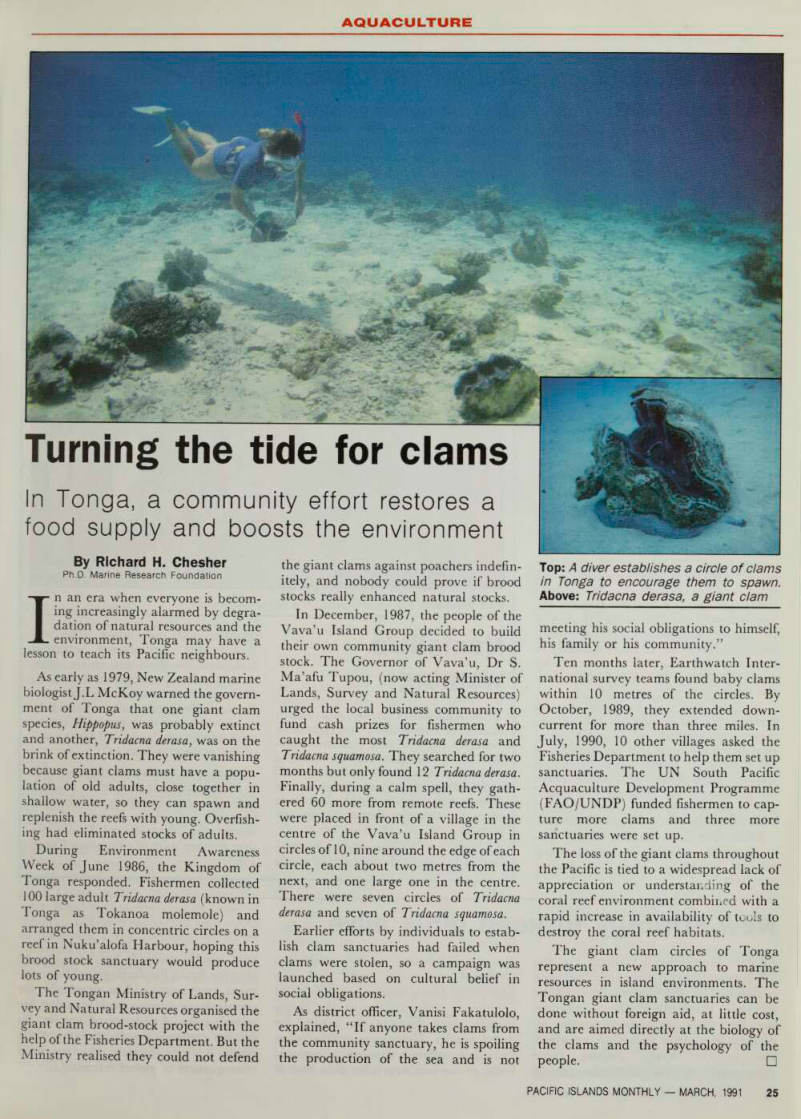
Aquaculture
In Tonga, a community effort restores a food supply and boosts the environment
By Richard H. Chesher
Ph D. Marine Research Foundation In an era when everyone is becom ing increasingly alarmed by degra dation of natural resources and the environment, Tonga may have a lesson to teach its Pacific neighbours.
As early as 1979, New Zealand marine biologist J.L McKoy warned the govern ment of Tonga that one giant clam species, Hippopus, was probably extinct and another, Tridacna derasa, was on the brink of extinction. They were vanishing because giant clams must have a popu lation of old adults, close together in shallow water, so they can spawn and replenish the reefs with young. Overfish ing had eliminated stocks of adults.
During Environment Awareness Week of June 1986, the Kingdom of Tonga responded. Fishermen collected 100 large adult Tridacna derasa (known in Tonga as Tokanoa molemole) and arranged them in concentric circles on a reef in Nuku’alofa Harbour, hoping this brood stock sanctuary would produce lots of young.
The Tongan Ministry of Lands, Sur vey and Natural Resources organised the giant clam brood-stock project with the help of the Fisheries Department. But the Ministry realised they could not defend
the giant clams against poachers indefin itely, and nobody could prove if brood stocks really enhanced natural stocks.
In December, 1987, the people of the Vava’u Island Group decided to build their own community giant clam brood stock. The Governor of Vava’u, Dr S.
Ma’afu Tupou, (now acting Minister of Lands, Survey and Natural Resources) urged the local business community to fund cash prizes for fishermen who caught the most Tridacna derasa and Tridacna squamosa. They searched for two months but only found 12 Tridacna derasa.
Finally, during a calm spell, they gath ered 60 more from remote reefs. These were placed in front of a village in the centre of the Vava’u Island Group in circles of 10, nine around the edge of each circle, each about two metres from the next, and one large one in the centre.
There were seven circles of Tridacna derasa and seven of Tridacna squamosa.
Earlier efforts by individuals to estab lish clam sanctuaries had failed when clams were stolen, so a campaign was launched based on cultural belief in
social obligations.
As district officer, Vanisi Fakatulolo, explained, “If anyone takes clams from the community sanctuary, he is spoiling the production of the sea and is not
meeting his social obligations to himself, his famil Y or his community.”
Ten months later, Earth watch Inter national survey teams found baby clams within 10 metres of the circles. By October, 1989, they extended down current for more than three miles. In July, 1990, 10 other villages asked the Fisheries Department to help them set up sanctuaries. The UN South Pacific
Acquaculture Development Programme
(FAO/UNDP) funded fishermen to cap ture more clams and three more sanctuaries were set up.
The loss of the giant clams throughout the Pacific is tied to a widespread lack of appreciation or understanding of the coral reef environment combined with a rapid increase in availability of tools to destroy the coral reef habitats, The giant clam circles of Tonga represent a new approach to marine resources in island environments. The Tongan giant clam sanctuaries can be done without foreign aid, at little cost, and are aimed directly at the biology of the clams and the psychology of the people. □
Top: A diver establishes a circle of clams in Tonga to encourage them to spawn.
Above: Tridacna derasa, a giant clam
Toma wins
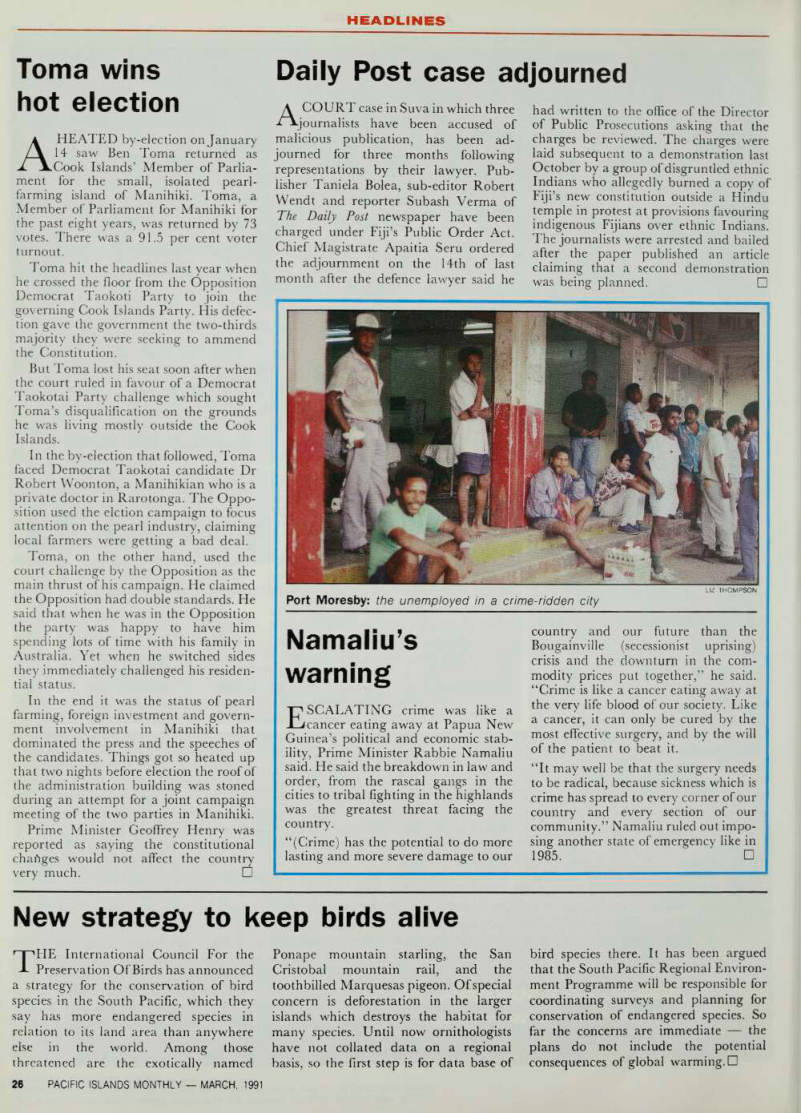
hot election
A HEATED by-election on January 14 saw Ben Toma returned as Cook Islands’ Member of Parlia ment for the small, isolated pearl farming island of Manihiki. Toma, a Member of Parliament for Manihiki for the past eight years, was returned by 73 votes. There was a 91.5 per cent voter turnout.
Toma hit the headlines last year when he crossed the floor from the Opposition Democrat Taokoti Party to join the governing Cook Islands Party. His defec tion gave the government the two-thirds majority they were seeking to ammend the Constitution.
But Toma lost his seat soon after when the court ruled in favour of a Democrat Taokotai Party challenge which sought Toma’s disqualification on the grounds he was living mostly outside the Cook Islands.
In the by-election that followed, Toma faced Democrat Taokotai candidate Dr Robert Woonton, a Manihikian who is a private doctor in Rarotonga. The Oppo sition used the elction campaign to focus attention on the pearl industry, claiming local farmers were getting a bad deal.
Toma, on the other hand, used the court challenge by the Opposition as the main thrust of his campaign. He claimed the Opposition had double standards. He said that when he was in the Opposition the party was happy to have him spending lots of time with his family in Australia. Yet when he switched sides
they immediately challenged his residen
tial status.
In the end it was the status of pearl farming, foreign investment and govern ment involvement in Manihiki that dominated the press and the speeches of the candidates. Things got so heated up that two nights before election the roof of the administration building was stoned during an attempt for a joint campaign meeting of the two parties in Manihiki.
Prime Minister Geoffrey Henry was reported as saying the constitutional changes would not affect the country very much. □
Daily Post case adjourned
Headlines
A COURT case in Suva in which three journalists have been accused of malicious publication, has been ad journed for three months following representations by their lawyer. Pub lisher Taniela Bolea, sub-editor Robert Wendt and reporter Subash Verma of The Daily Post newspaper have been charged under Fiji’s Public Order Act.
Chief Magistrate Apaitia Seru ordered the adjournment on the 14th of last month after the defence lawyer said he
had written to the office of the Director of Public Prosecutions asking that the charges be reviewed. The charges were laid subsequent to a demonstration last October by a group of disgruntled ethnic Indians who allegedly burned a copy of Fiji’s new constitution outside a Hindu temple in protest at provisions favouring indigenous Fijians over ethnic Indians.
The journalists were arrested and bailed after the paper published an article claiming that a second demonstration was being planned. □
warning
Namaliu's warning
ESCALATING crime was like a cancer eating away at Papua New Guinea’s political and economic stab ility, Prime Minister Rabbie Namaliu said. He said the breakdown in law and order, from the rascal gangs in the cities to tribal fighting in the highlands was the greatest threat facing the country.
“(Crime) has the potential to do more lasting and more severe damage to our
country and our future than the Bougainville (secessionist uprising) crisis and the downturn in the com modity prices put together,” he said.
“Crime is like a cancer eating away at the very life blood of our society. Like a cancer, it can only be cured by the most effective surgery, and by the will of the patient to beat it.
“It may well be that the surgery needs to be radical, because sickness which is crime has spread to every corner of our country and every section of our community.” Namaliu ruled out impo sing another state of emergency like in 1985. □
Liz Thompson
Port Moresby: the unemployed in a crime-ridden city
New strategy to keep birds alive
THE International Council For the Preservation Of Birds has announced a strategy for the conservation of bird species in the South Pacific, which they say has more endangered species in relation to its land area than anywhere else in the world. Among those threatened are the exotically named
Ponape mountain starling, the San Cristobal mountain rail, and the toothbilled Marquesas pigeon. Of special concern is deforestation in the larger islands which destroys the habitat for many species. Until now ornithologists have not collated data on a regional basis, so the first step is for data base of
bird species there. It has been argued that the South Pacific Regional Environ ment Programme will be responsible for coordinating surveys and planning for conservation of endangered species. So far the concerns are immediate the plans do not include the potential consequences of global warming. □
Unifil cash crisis Going beyond news gathering
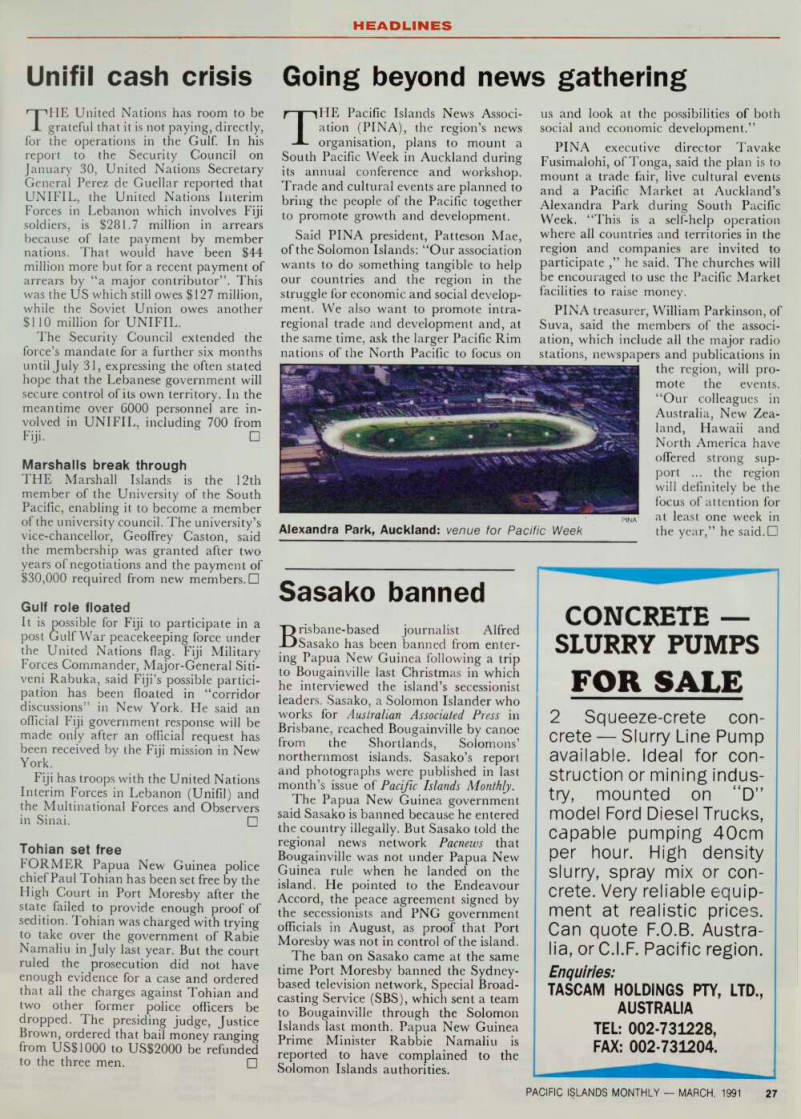
THE United Nations has room to be grateful that it is not paying, directly, for the operations in the Gulf. In his report to the Security Council on January 30, United Nations Secretary General Perez de Guellar reported that UNIFIL, the United Nations Interim Forces in Lebanon which involves Fiji soldiers, is $281.7 million in arrears because of late payment by member nations. That would have been $44 million more but for a recent payment of arrears by “a major contributor”. This was the US which still owes $127 million, while the Soviet Union owes another $llO million for UNIFIL.
The Security Council extended the force’s mandate for a further six months until July 31, expressing the often stated hope that the Lebanese government will secure control of its own territory. In the meantime over 6000 personnel are in volved in UNIFIL, including 700 from Fiji. □ Marshalls break through THE Marshall Islands is the 12th member of the University of the South Pacific, enabling it to become a member of the university council. The university’s
vice-chancellor, Geoffrey Gaston, said
the membership was granted after two years of negotiations and the payment of $30,000 required from new members. □ Gulf role floated It is possible for Fiji to participate in a post Gulf War peacekeeping force under
the United Nations flag. Fiji Military
Forces Commander, Major-General Siti
veni Rabuka, said Fiji’s possible partici
pation has been floated in “corridor discussions” in New York. He said an official Fiji government response will be made only after an official request has been received by the Fiji mission in New York.
Fiji has troops with the United Nations Interim Forces in Lebanon (Unifil) and the Multinational Forces and Observers in Sinai. □ Tohlan set free FORMER Papua New Guinea police chief Paul Tohian has been set free by the High Court in Port Moresby after the state failed to provide enough proof of sedition. Tohian was charged with trying to take over the government of Rabie Namaliu in July last year. But the court ruled the prosecution did not have enough evidence for a case and ordered that all the charges against Tohian and two other former police officers be
dropped. The presiding judge, Justice
Brown, ordered that bail money ranging from US$lOOO to US$2OOO be refunded to the three men. □
THE Pacific Islands News Associ ation (PINA), the region’s news organisation plans to mount a South Pacific Week m Auckland during its annual conference and workshop.
Trade and cultural events are planned to bring the people of the Pacific together to promote growth and development.
Said PINA president, Patteson Mae, of the Solomon Islands; “Our association wants to do something tangible to help our countries and the region in the struggle for economic and social develop ment. We also want to promote intra regional trade and development and, at the same time, ask the larger Pacific Rim nations of the North Pacific to focus on
us and look at the possibilities of both social and economic development.”
PINA executive director Tavake Fusimalohi, of Tonga, said the plan is to mount a trade fair, live cultural events and a Pacific Market at Auckland’s Alexandra Park during South Pacific Week. “This is a self-help operation where all countries and territories in the region and companies are invited to participate ,” he said. The churches will be encouraged to use the Pacific Market facilities to raise money.
PINA treasurer, William Parkinson, of Suva, said the members of the associ ation, which include all the major radio stations, newspapers and publications in
the region, will pro mote the events.
“Our colleagues in Australia, New Zea land, Hawaii and North America have offered strong sup port ... the region will definitely be the focus of attention for at least one week in the year,” he said.D
Pina
Alexandra Park, Auckland: venue for Pacific Week
Sasako banned
Brisbane-based journalist Alfred Sasako has been banned from enter ing Papua New Guinea following a trip to Bougainville last Christmas in which he interviewed the island’s secessionist leaders. Sasako, a Solomon Islander who works for Australian Associated Press in Brisbane, reached Bougainville by canoe from the Shortlands, Solomons’ northernmost islands. Sasako’s report and photographs were published in last month’s issue of Pacific Islands Monthly.
The Papua New Guinea government said Sasako is banned because he entered the country illegally. But Sasako told the regional news network Pacnews that Bougainville was not under Papua New Guinea rule when he landed on the island. He pointed to the Endeavour Accord, the peace agreement signed by the secessionists and PNG government officials in August, as proof that Port Moresby was not in control of the island.
The ban on Sasako came at the same time Port Moresby banned the Sydney based television network, Special Broad casting Service (SBS), which sent a team to Bougainville through the Solomon Islands last month. Papua New Guinea Prime Minister Rabbie Namaliu is reported to have complained to the Solomon Islands authorities.
Advertisements & other items, pp. 27-30 (2 items)
For Sale
CONCRETE
SLURRY PUMPS
2 Squeeze-crete concrete Slurry Line Pump available. Ideal for construction or mining industry, mounted on “D” model Ford Diesel Trucks, capable pumping 40cm per hour. High density slurry, spray mix or concrete. Very reliable equipment at realistic prices.
Can quote F. 0.8. Australia, orC.I.F. Pacific region.
Enquiries:
TASCAM HOLDINGS PTY, LTD.,
AUSTRALIA
TEL: 002-731228,
FAX: 002-731204.
The new Toyota brand mark. Three ellipses forming a “T” which stand for our customer, our commitment to the satisfaction of that customer through our product and for our spirit of creativity.
IS It’s not often that you hear descriptions like rugged or durable combined with refined and elegant. But then there’s never been a vehicle quite like the new Toyota Land Cruiser Station Wagon. The unrivalled legend of off-road reliability is now unsurpassed in comfort and sophistication as well. Attention to detail is found everywhere, from the fine trim to the instrument panel to the graceful lines of its exterior. Even in places you can’t see, like the heavy-duty ladder frame and suspension design that add to the superb
luxury-car ride.
But Toyota’s innovation goes beyond providing luxury and durability. The new Land Cruiser Station Wagon, and all of our cars, are designed to create a harmony between car and driver, and to provide you with the ultimate
driving experience.
The new Toyota Land Cruiser Station Wagon. Think of it as much more than a spacious luxury sedan with fourwheel drive.
Maps
DISTRIBUTORS/DEALERS
AMERICAN SAMOA BURNS PHILP (S.S.) CO. LTD. PH 633-4281 GUAM & MICRONESIA ATKINS KROLL, INC. PH 646-1876/9 NORFOLK ISLANDS BORRY'S PTY LTD. PH 2114
SOLOMON ISLANDS MENDANA MOTORS PH 22884
VANUATU VANUATU MOTORS PH 2341
COOK ISLANDS PACIFIC MOTORS LTD. PH 20796
KIRIBATI TARAWA MOTORS PH 21090
PAPUA NEW GUINEA ELA MOTORS PH 217036
TAHITI NIPPON AUTOMOTO PH 429819
WESTERN SAMOA BURNS PHILP (S.S.) CO. LTD. PH 20800
FIJI ASCO MOI
NEW CALEDONIA S.I.A.P.
SAIPAN MICROL 0
TONGA BURNS PR
* * IT) i a □ 234^ ss PH 312666 PH 282848 PH 234-5911
LTD. PH 23673
® TOYOTA
Pacific
ISLANDS
MONTHLY
BUSINESS
Guam: No Japanese to greet
Fiji’s Air Pacific: Will be lucky to break even
Suffering or spin-offs ahead?
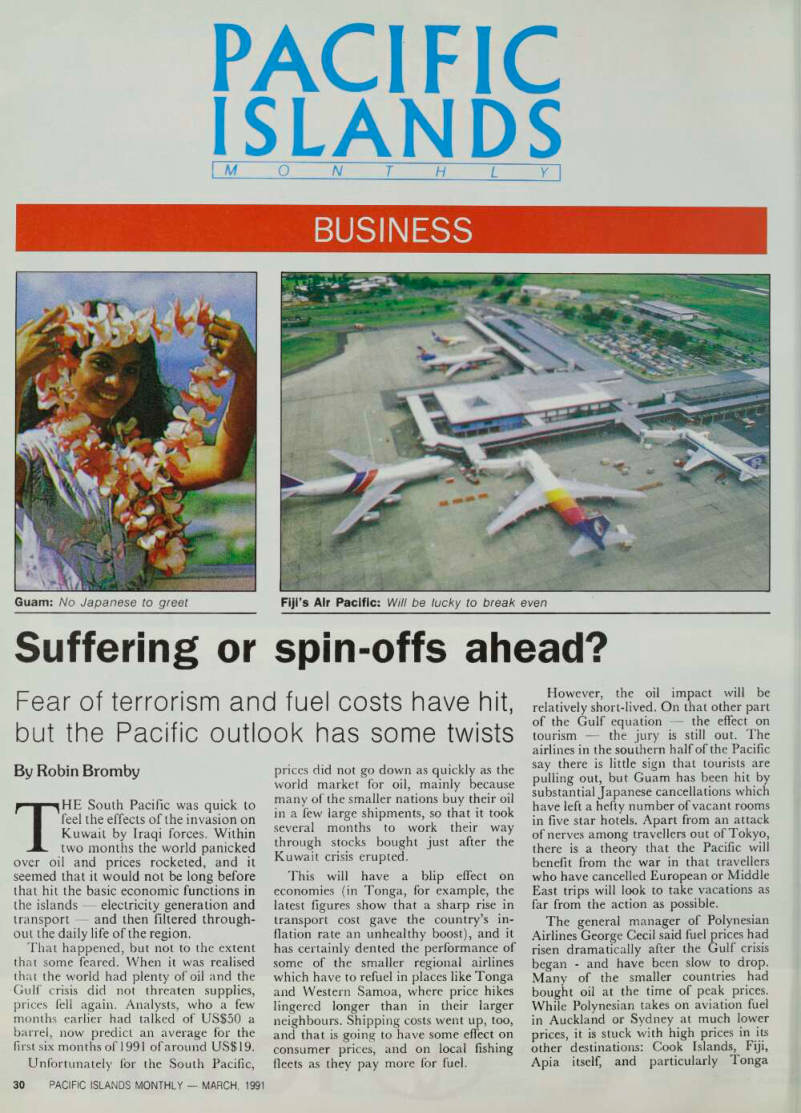
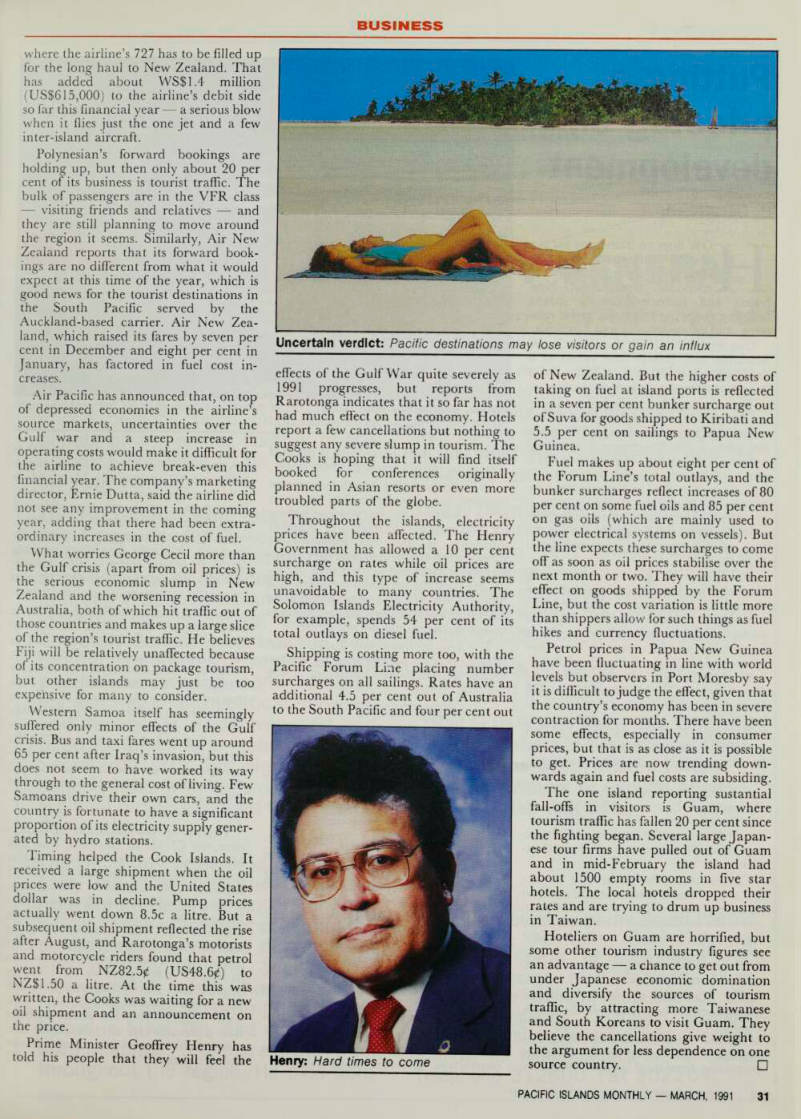
Fear of terrorism and fuel costs have hit, ■ . . i r-\ • r • ii II , . , but the Pacific outlook has some twists
By Robin Bromby
THE South Pacific was quick to feel the effects of the invision on Kuwait by Iraqi forces. Within two months the world panicked over oil and prices rocketed, and it seemed that it would not be long before that hit the basic economic functions in the islands electricity generation and transport and then filtered through out the daily life of the region.
That happened, but not to the extent that some feared. When it was realised that the world had plenty of oil and the Gulf crisis did not threaten supplies, prices fell again. Analysts, who a few months earlier had talked of US$5O a barrel, now predict an average for the first six months of 1991 of around US$l9.
Unfortunately for the South Pacific,
r#u v , 1 .1 • -i manyof he Sma ' ler na ‘ lOnS bay t ,be ' r 01 ‘ 1,1 a fe , W lar g" shl P mems > f ‘ hat “ took s f veral , mon ! hs , to « ork the i r way ‘ hrou B h s !° cks bou jj ht J ust after ,he uwait cnsis erupted.
This will have a blip effect on economies (in Tonga, for example, the latest figures show that a sharp rise in transport cost gave the country’s inflation rate an unhealthy boost), and it has certainly dented the performance of some of the smaller regional airlines which have to refuel in places like Tonga and Western Samoa, where price hikes lingered longer than in their larger neighbours. Shipping costs went up, too, and that is going to have some effect on consumer prices, and on local fishing fleets as they pay more for fuel.
However, the oil impact will be relatively short-lived. On that other part of the Gulf equation the effect on tourism the jury is still out. The airlines in the southern half of the Pacific say there is little sign that tourists are pulling out, but Guam has been hit by substantial Japanese cancellations which have left a hefty number of vacant rooms in five star hotels. Apart from an attack of nerves among travellers out of Tokyo, there is a theory that the Pacific will benefit from the war in that travellers who have cancelled European or Middle East trips will look to take vacations as far from the action as possible.
The general manager of Polynesian Airlines George Cecil said fuel prices had risen dramatically after the Gulf crisis began - and have been slow to drop.
Many of the smaller countries had bought oil at the time of peak prices.
While Polynesian takes on aviation fuel in Auckland or Sydney at much lower prices, it is stuck with high prices in its other destinations: Cook Islands, Fiji, Apia itself, and particularly Tonga
where the airline’s 727 has to be filled up for the long haul to New Zealand. That has added about WSSI.4 million (U 55615,000) to the airline’s debit side so far this financial year a serious blow when it flies just the one jet and a few inter-island aircraft.
Polynesian’s forward bookings are holding up, but then only about 20 per cent of its business is tourist traffic. The bulk of passengers are in the VFR class visiting friends and relatives - and they are still planning to move around the region it seems. Similarly, Air New Zealand reports that its forward book ings are no different from what it would expect at this time of the year, which is good news for the tourist destinations in the South Pacific served by the Auckland-based carrier. Air New Zea land, which raised its fares by seven per cent in December and eight per cent in January, has factored in fuel cost in creases.
Air Pacific has announced that, on top of depressed economies in the airline’s source markets, uncertainties over the Gulf war and a steep increase in operating costs would make it difficult for the airline to achieve break-even this financial year. The company’s marketing director, Ernie Dutta, said the airline did not see any improvement in the coming year, adding that there had been extra ordinary increases in the cost of fuel.
What worries George Cecil more than the Gulf crisis (apart from oil prices) is the serious economic slump in New Zealand and the worsening recession in Australia, both of which hit traffic out of those countries and makes up a large slice of the region’s tourist traffic. He believes Fiji will be relatively unaffected because of its concentration on package tourism, but other islands may just be too expensive for many to consider.
Western Samoa itself has seemingly suffered only minor effects of the Gulf crisis. Bus and taxi fares went up around 65 per cent after Iraq’s invasion, but this does not seem to have worked its way through to the general cost of living. Few Samoans drive their own cars, and the country is fortunate to have a significant proportion of its electricity supply gener
ated by hydro stations.
Timing helped the Cook Islands. It received a large shipment when the oil prices were low and the United States dollar was in decline. Pump prices actually went down 8.5 c a litre. But a subsequent oil shipment reflected the rise after August, and Rarotonga’s motorists and motorcycle riders found that petrol went from NZ82.50 (U 548.60) to NZSI.SO a litre. At the time this was written, the Cooks was waiting for a new oil shipment and an announcement on
the price.
Prime Minister Geoffrey Henry has told his people that they will feel the
effects of the Gulf War quite severely as 1991 progresses, but reports from Rarotonga indicates that it so far has not had much effect on the economy. Hotels report a few cancellations but nothing to suggest any severe slump in tourism. The Cooks is hoping that it will find itself booked for conferences originally planned in Asian resorts or even more troubled parts of the globe.
Throughout the islands, electricity
prices have been affected. The Henry Government has allowed a 10 per cent surcharge on rates while oil prices are high, and this type of increase seems unavoidable to many countries. The
Solomon Islands Electricity Authority,
for example, spends 54 per cent of its total outlays on diesel fuel.
Shipping is costing more too, with the Pacific Forum Line placing number surcharges on all sailings. Rates have an additional 4.5 per cent out of Australia to the South Pacific and four per cent out
of New Zealand. But the higher costs of taking on fuel at island ports is reflected in a seven per cent bunker surcharge out of Suva for goods shipped to Kiribati and 5.5 per cent on sailings to Papua New Guinea.
Fuel makes up about eight per cent of the Forum Line’s total outlays, and the bunker surcharges reflect increases of 80 per cent on some fuel oils and 85 per cent on gas oils (which are mainly used to power electrical systems on vessels). But the line expects these surcharges to come off as soon as oil prices stabilise over the next month or two. They will have their effect on goods shipped by the Forum Line, but the cost variation is little more than shippers allow for such things as fuel hikes and currency fluctuations.
Petrol prices in Papua New Guinea have been fluctuating in line with world levels but observers in Port Moresby say it is difficult to judge the effect, given that the country’s economy has been in severe contraction for months. There have been some effects, especially in consumer prices, but that is as close as it is possible to get. Prices are now trending down wards again and fuel costs are subsiding.
The one island reporting sustantial fall-offs in visitors is Guam, where tourism traffic has fallen 20 per cent since the fighting began. Several large Japan ese tour firms have pulled out of Guam and in mid-February the island had about 1500 empty rooms in five star hotels. The local hotels dropped their rates and are trying to drum up business in Taiwan.
Hoteliers on Guam are horrified, but some other tourism industry figures see an advantage a chance to get out from under Japanese economic domination and diversify the sources of tourism traffic, by attracting more Taiwanese and South Koreans to visit Guam. They believe the cancellations give weight to the argument for less dependence on one source country. □
Henry: Hard times to come
Uncertain verdict: Pacific destinations may lose visitors or gain an influx
Putting a pricetag
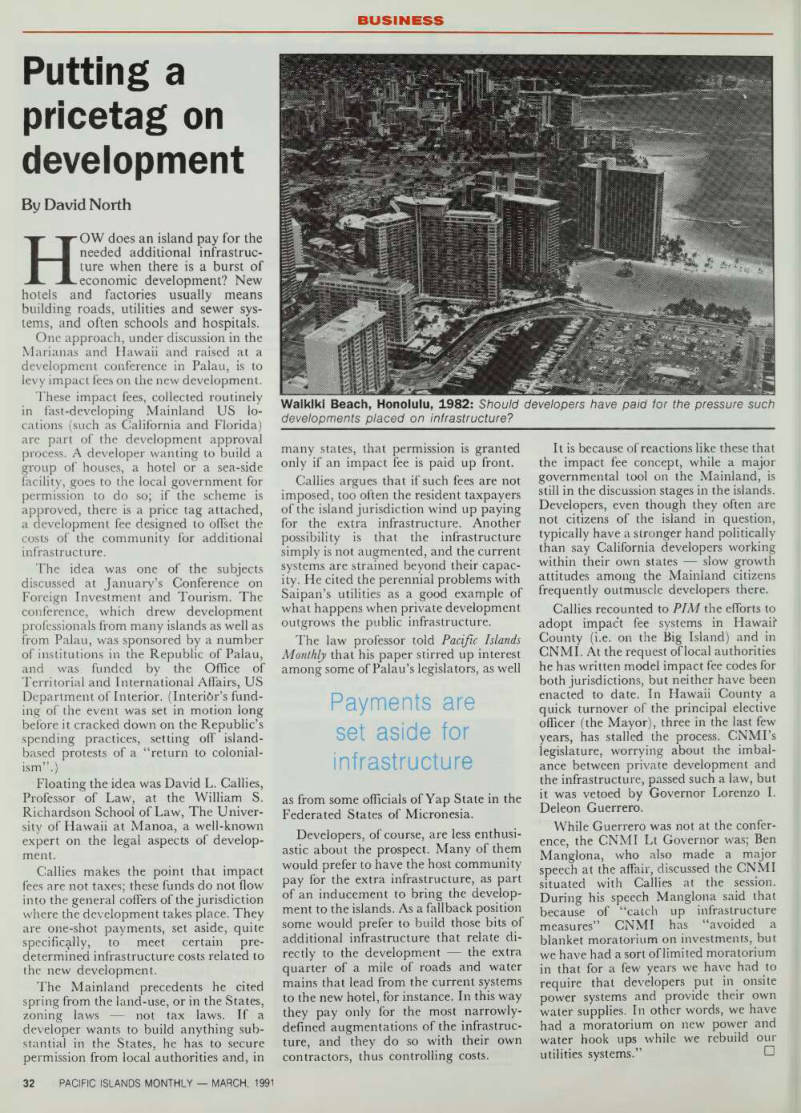
pricetag on development
By David North
HOW does an island pay for the needed additional infrastruc ture when there is a burst of economic development? New hotels and factories usually means building roads, utilities and sewer sys tems, and often schools and hospitals.
One approach, under discussion in the Marianas and Hawaii and raised at a development conference in Palau, is to levy impact fees on the new development.
These impact fees, collected routinely in fast-developing Mainland US lo cations (such as California and Florida) are part of the development approval process. A developer wanting to build a group of houses, a hotel or a sea-side facility, goes to the local government for permission to do so; if the scheme is approved, there is a price tag attached, a development fee designed to offset the costs of the community for additional infrastructure.
The idea was one of the subjects discussed at January’s Conference on Foreign Investment and Tourism. The conference, which drew development professionals from many islands as well as from Palau, was sponsored by a number of institutions in the Republic of Palau, and was funded by the Office of Territorial and International Affairs, US Department of Interior. (Interior’s fund ing of the event was set in motion long before it cracked down on the Republic’s spending practices, setting off island based protests of a “return to colonial ism”.) Floating the idea was David L. Callies, Professor of Law, at the William S.
Richardson School of Law, The Univer sity of Hawaii at Manoa, a well-known expert on the legal aspects of develop ment.
Callies makes the point that impact fees are not taxes; these funds do not flow into the general coffers of the jurisdiction
where the development takes place. They
are one-shot payments, set aside, quite specifically, to meet certain pre determined infrastructure costs related to the new development.
The Mainland precedents he cited spring from the land-use, or in the States, zoning laws not tax laws. If a developer wants to build anything sub stantial in the States, he has to secure permission from local authorities and, in
many states, that permission is granted only if an impact fee is paid up front.
Callies argues that if such fees are not imposed, too often the resident taxpayers of the island jurisdiction wind up paying for the extra infrastructure. Another possibility is that the infrastructure simply is not augmented, and the current systems are strained beyond their capac ity. He cited the perennial problems with Saipan’s utilities as a good example of what happens when private development outgrows the public infrastructure.
The law professor told Pacific Islands Monthly that his paper stirred up interest among some of Palau’s legislators, as well
Payments are set aside for infrastructure
as from some officials of Yap State in the Federated States of Micronesia.
Developers, of course, are less enthusi astic about the prospect. Many of them would prefer to have the host community pay for the extra infrastructure, as part of an inducement to bring the develop ment to the islands. As a fallback position some would prefer to build those bits of additional infrastructure that relate di rectly to the development the extra quarter of a mile of roads and water mains that lead from the current systems to the new hotel, for instance. In this way they pay only for the most narrowly defined augmentations of the infrastruc ture, and they do so with their own contractors, thus controlling costs.
It is because of reactions like these that the impact fee concept, while a major governmental tool on the Mainland, is still in the discussion stages in the islands.
Developers, even though they often are not citizens of the island in question, typically have a stronger hand politically than say California developers working within their own states slow growth attitudes among the Mainland citizens
frequently outmuscle developers there.
Callies recounted to PIM the efforts to adopt impact fee systems in County (i.e. on the Big Island) and in CNMI. At the request of local authorities he has written model impact fee codes for both jurisdictions, but neither have been enacted to date. In Hawaii County a quick turnover of the principal elective officer (the Mayor), three in the last few years, has stalled the process. CNMI’s legislature, worrying about the imbal ance between private development and the infrastructure, passed such a law, but it was vetoed by Governor Lorenzo I.
Deleon Guerrero.
While Guerrero was not at the confer ence, the CNMI Lt Governor was; Ben Manglona, who also made a major speech at the affair, discussed the CNMI situated with Callies at the session.
During his speech Manglona said that because of “catch up infrastructure measures” CNMI has “avoided a blanket moratorium on investments, but we have had a sort of limited moratorium in that for a few years we have had to require that developers put in onsite power systems and provide their own water supplies. In other words, we have had a moratorium on new power and water hook ups while we rebuild our utilities systems.” D
Waikiki Beach, Honolulu, 1982: Should developers have paid for the pressure such developments placed on infrastructure?
Advertisements & other items, p. 33 (1 item)
Vacancy Secretary General
SOUTH PACIFIC FORUM
SECRETARIAT
The post of Secretary General of the South Pacific Forum Secretariat will become vacant towards the end of 1991 and applications are invited from suitably qualified and experienced persons (who must be nationals of a member country of the Forum*) who wish to be considered for appointment.
The Secretariat was established by the Forum in 1973 to encourage closer economic and political cooperation between its member states and between those states and the more industrialised countries. Under the Secretary General’s control, the Secretariat undertakes a regional work programme covering economic development, legal and political services, and the energy, trade, transport and telecommunications sectors. The Secretariat also has significant responsibilities with regard to ACP/EC regional projects funded under Lome Conventions.
The Secretary General is required to carry out directives and mandates from Forum Heads of Government on a wide range of matters affecting the political and economic development and security of the region. The incumbent is also Chief Executive Officer of the Secretariat, which is based in Suva, Fiji, and which has a staff of some 70 officers drawn from throughout the region. He also acts as Secretary to the Forum and to its various councils and committees.
Applicants must demonstrate proven and substantial experience in regional affairs at the highest level, as well as the executive ability required to manage the Secretariat and its programmes.
This is the most senior position in the Forum’s network of regional organisations and only those with the required high-level background and experience should apply. The appointment itself will be made by the 22nd South Pacific Forum in July 1991.
Applications close on 3 May 1991, and should be addressed to: Hon Fr Dr Walter Hadye Uni, CBE, MR Prime Minister of Vanuatu and Chair man of the South Pacific Forum C/- Department of Foreign Affairs Private Mail Bag 051 Port Vila Vanuatu ♦Member countries of the South Pacific Forum are: Australia, Cook Islands, Federated States of Micronesia, Fiji, Kiribati, Nauru, New Zealand, Niue, Papua New Guinea, Republic of the Marshall Islands, Solomon Islands, Tonga, Tuvalu, Vanuatu and Western Samoa. Its headquarters are in Suva, Telephone 312600, Fax 302204.
Oil refinery finance sought

TONGA is to seek overseas finance to build an oil refinery aimed at reducing costs of importing fuel and exporting refined petroleum product to other island nations including Western Samoa, New Caledonia and French Polynesia.
King Taufa’ahau Tupou IV an-
nounced the project after meeting with an Iranian entrepreneur, Houssain MoustofTi, and two United States engin eers. The cost is estimated at TlO million (USSB.3 million) and earnings have been projected at T 5500,000 a day.
It is proposed that crude oil would be fr ° m Arab ‘ a ’
Economic
boost for Banabans
BANABAN islanders have been largely overlooked by the Kiribati central government since phos phate mining ceased on the island in 1979, but at last their appeals for some economic development have been heard in Tarawa. A team from the ministry of natural resources development has been on the Island (also known as Ocean Island) and will now try to help the 400 remaining Banabans lift themselves above a merely subsistence way of life.
Most of the islanders left Banaba after World War 11, during which they had experienced a horrific three years under Japanese occupation, and the royalties earned were used to buy Rabi Island in the Fiji group for them. The possibility had been raised two years ago that phosphate mining could be resumed, given that the deposits had not been completely worked out. But the interest of the Australian company which inves tigated the idea evaporated when it was found the equipment was far beyond
repair.
Last year another Australian company proposed that Banaba be used as a dump for industrial waste shipped from Eur ope. The Kiribati Government was reported to have shown interest in the suggestion but there has been no further word on the scheme.
Banaba is about 10km in circumfer ence and lies 400 km west of the main Gilbert group. Phosphate was discovered there in 1900.
The persistence of the parliamentary member for Banaba finally stirred the government to send a team to the island in the first weeks of 1991, and they will be recommending ways to stimulate
fisheries and agricultural activity.
The waters around Banaba are a largely untapped resource and the area is rich in skipjack tuna. The remaining islanders have done little fishing and when the ministry team arrived they found a shortage of even lines and hooks they ended up selling AS7OO (USSSSO) worth of these basic fishing items. The Ministry of Natural Re sources Development believes that an export fishing industry could eventually be established on Banaba, although the immediate task will be to get the islanders catching enough for their own needs.
Providing food for the local people will be the first priority but the long term view is that Banaba could eventually export pork, poultry, fruit and vegetables to Tarawa. □
Advertisements & other items, p. 34 (1 item)
Sg Samsung
The World’s Latest
PRODUCTS FOR PEOPLE WITH MORE
SENSE THAN MONEY
m Available at Burns Philp Home Centres throughout Fiji and selected Duty Free Dealers.
SOLE DISTRIBUTORS:
To own a Samsung TV Screen, Samsung Video Deck and Samsung Remote Control Unit!
That’a Great!
That makes the Samsung Combination the most inexpensive of its kind.
Go for the best view.
Should be ideal for your home!
SAMSUNG
CORRIE & COMPANY
HEAD OFFICE G.P.O. BOX 45, SUVA TLX: FJ2166 CABLES: ‘CORRICO' SUVA.
TELEPHONE: 386777 BANKERS; WESTPAC, SUVA (FAX: (679) 370010 BRANCH OFFICE: 161 VITOGO PARADE P.O. BOX 83, LAUTOKA CABLES:
“CORRICO” LAUTOKA TELEPHONE: 60137
New signs of promise on Niue
A SYDNEY exploration com pany is now raising money to undertake a search for uranium on Niue, where ex tremely high gamma radiation levels have raised hopes of a significant discovery. Roycol Ltd had put together a $2 million share and options issue.
The company’s chief executive, Eric Alexander, said uranium was the pri mary target but there were also hopes of finding polymetallic deposits because soil cover on the 260 sq km island contained trace amounts of mercury, gold, silver, bismuth and chromium.
Roycol has gained exploration rights over the entire island through a deal with Avian Mining Pty Ltd. Avian set out in 1969 to explore the south and central Pacific region, principally for phosphate.
But because background radioactivity levels in Niue were up to 60 times higher than generally found in Australia, Avian’s managing director, John Barrie, thought this might be due to late stage volcanic activity in the underlying seamount.
“This concept has made Niue island a prime exploration target for uranium, precious metals and associated base metals,” according to a summary of the Niue minerals project.
“Soil analysis have produced a massive mercury anomaly indicative of hydro thermal activity and epithermal mineral isation.”
An independent geologist’s report de scribed the Niue venture as unusual because the island “is not in one of the two major geological environments continental plates and subduction zones where we are accustomed to exploring for and finding deposits of minerals other than in sular phosphate rock and baux ite.”
While lack of knowledge about miner alisation in oceanic plates creates uncer tainty about the likely financial risks involved, it is possible that opportunities “to explore for polymetallic deposits in oceanic plates are waiting to be taken and the more obviously attractive targets such as Niue are relatively unexplored”.
A previous drilling programme be tween 1975 and 1980 utilised a small rig that was unable to penetrate a 300 metre thick layer of limestone in order to reach the exploration target.
The new programme will involve the drilling of eight holes to a depth of about 600 metres to test targets near the contact between the atoll complex and the underlying seamount complex.
D , , .
Barne a respected exploration geol ogist who remains a consultant to Roycol, believes any discovery on Niue will be of a substantial size because the volcanic barrier to the underlying yol canic activity provided good conditions for enrichment of gold, silver and other meta^s *
Geological work over the years has pinpointed the site of a caldera and Barrie has drawn parallels with gold discoveries at the Emperor Mine in Fiji and the Lihir gold deposit in Papua New Guinea.
An ore body similar to one at the emperor mine, he says, “would be located at or near the rim of either of the three volcanic features where they are cut by major structural features rep resented by air-photo lineaments.” □
Advertisements & other items, p. 35 (1 item)
Vacancy Environment Officer
South Pacific
Forum Secretariat
Applications are invited from suitably qualified and experienced persons, who must be nationals of a member country* of the South Pacific Forum,for the position of Environment Officer, The Forum Secretariat was established in 1973 by the South Pacific Forum to encourage economic and political cooperation between its member states, and between those states and the more industrialised countries. Under the control of a Secretary General, the Secretariat undertakes a regional work programme covering economic development, legal and political services and the energy, tourism, trade, transport and telecommunications sectors. The Secretariat also has significant responsibilities with regard to ACP/EC regional projects funded under Lome Conventions. jThe Environment Officer will be required to liaise with international organisations and BPREP, prepare policy position papers, including economic, legal and political analysis on environmental issues affecting the region; and provide advice to Forum Island Countries and the Secretariat on the effect of macro and micro economic policies on environment and resource values and on policies which can enhance ecologically sustainable development.
Applicants should have appropriate qualifications in a relevant field with proven interest in environmental studies and at least 5 years relevant experience at a senior level. Applicants who have an understanding of the cultural sensitivities of the region, and of the political, legal and economic factors affecting its development, will be most favourably regarded.
This appointment will carry an attractive remuneration package, payable in Fiji dollars. For non-Fiji citizens this is tax free and includes housing or housing allowance, education and child allowances. Other benefits include superannuation payments and medical, life and travel insurance coverage. The appointee will be based at the Secretariat’s Headquarters in Suva, Fiji. Appointment would be for three years initially, renewable by mutual agreement Applications, which close on 15 April 1991, should contain full information on education and career background and should list names, addresses and telephone numbers of at least three referees with whom the applicant has been associated in a professional capacity.
Applications should be addressed to: The Secretary General Forum Secretariat GPO Box 856, Suva, FIJI Telephone: 312600 Telex: 2229FJ Fax: 302204/301102 Further information is available on request and all enquiries should be made to Mrs Lailun Khan, Administration Officer on 312600 Ext. 219. *Member countries are: Australia, Cook Islands, Federated States of Micronesia, Fiji Kiribati, Nauru, New Zealand, Niue, Papua New Guinea, Republic of the Marshall Islands’
Solomon Islands, Tonga, Tuvalu, Vanuatu and Western Samoa.
PNG gas project obstructed
LANDOWNER problems are again causing trouble in Papua New Guinea, and this time it is the Hides gas project in the Southern Highlands province which is affected.
The Hides gas project is vital because it will be providing electricity power for the advanced stages of the giant Porgera mine, 70km away. The Kutubu oil pipeline is also subject to a landowner compensation claim, but this is con sidered minor by comparison.
The timing is terrible, given that the seeming resolution of the Bougainville rebellion has given the country much needed positive headlines. The chances of the Panguna copper mine on that island being opened in the next year or two remain remote, but at least it is now possible to begin conjecturing. Interna tional financiers have been very sceptical about loaning money to Papua New Guinea mining or oil projects since the Bougainville rebellion hit the world headlines, and the massive Lihir gold project has been experiencing trouble
raising finance.
Some observers in Port Moresby now fear that the problems with landowners could, by holding up Hides, put Porgera behind schedule and Porgera is vital not just for the mining companies involved, but for the revenue-starved Papua New Guinea government. Hides is 95 per cent owned by British Petroleum with the remaining share held by Oil Search Ltd.
A landowner group calling itself the Kigira Kihowako Association (KKA) said it would not allow Hides to go ahead until compensation and other matters are settled. The situation is even more complex because several groups are disputing ownership of the gas field area.
KKA accuses the companies of a divide and rule policy, offering compensation to some landowners and not to others. It said no study had been done to ascertain the rightful owners of the land over which the power line will run. Some landowners will be demanding payments of K 20,000 (U 5520,400) for the erection
of power pylons on their land.
Another group, the Hides-Porgera Power Transmission Line Landowners Association, has claimed that illiterate villagers claiming ownership of land along the power line route had made their marks on agreements without knowing what they were doing. The latest demands concerning the 261 km pipeline linking the Kutubu oil field and ocean loading terminal in the gulf of Papua are more annoying than a serious threat to the project, although the incident cannot help but further dent Papua New Guinea’s image. The Kikori Landowners Development Association which is recognised as a legitimate representative of landowners is now claiming K 35 million from the project developer, Chevron Niugini Pty Ltd, which is equivalent to 10 per cent of the cost of the pipeline.
Meanwhile, business people in Mt Hagen and other highlands areas claim commercial activity is grinding to a halt because of lawlessness. Reports indicate the towns are being roamed by criminal gangs up to 40 strong and that rape is a frequent occurance. □
Advertisements & other items, p. 36 (1 item)
The Pacific Islands Rely
ON THE ENERGY OF BORAL
mm. $ *tu-. "W. vs* . ■ * All through the Pacific Islands, people rely on Boral Speed-E-Gas LP Gas for their energy needs.
Boral has terminals throughout the area, and is proud to be a leading supplier.
Speed-E-Gas is clean, efficient and low in cost.
It’s the ideal energy source for cooking and water heating in homes, motels and hotels, and for a wide range of industrial uses.
So call Boral. We have the energy you’re looking for.
Norfolk Island Norfolk Island 2419 Papua New Guinea Port Moresby 214248 Lae 42 2574 Rabaul 921225 Wewak 86 2125 Tonga Nukualofa 21388 m Cook Islands Rarotonga 24460 American Samoa Pago Pago 699 2948 Fiji Suva 24035 Lautoka 60088 Sigatoka 50578 Labasa 82973 Vanuatu Santo 455 Port Vila 2046
BORAL GAS
Solomon Islands Honiara 21833 Boral Gas Limited, Bth Floor, IBM House, 168 Kent St., Sydney, NSW 2000. Tel: (02) 278512.
Samoa satellite
Trade Winds
Samoa satellite link advanced
WESTERN Samoa is to get a more advanced satellite link under a
regional telecommunication project fi
nanced by the European Community.
The country gets the lion share of the project: US$3.3 million.
Solomon Islands will receive U 55937,000, Tonga US$9ll,OOO and Kiribati U 55334,000.
Ministers oppose brewery GOVERNMENT plans to encourage the construction of a brewery in Ameri can Samoa have as in other South Pacific countries met with church opposition. Ministers have testified to the territory’s House of Representatives that a brewery would encourage beer con sumption and strain family life in American Samoa. The House hearing was called to hear evidence on whether the brewery should be granted a tax exemption for the initial five-year period.
Company law to be revised TUVALU’S Finance and Commerce Minister Alesana Kleis Seluka has an nounced that the Government is revising the country’s company legislation to attract local and foreign investors. The administration wants to see the private
sector expand to help increase employ
ment. The Government will especially favour joint ventures between Tuvalu and foreign companies.
It has also decided to upgrade the Business Development Advisory Bureau to full development bank status.
Fisheries training scheme TWO fishermen from each island are to be offered places in a United Nations
Development Programme training
scheme just finalised with the Govern ment on Funafuti. The UN agency is also arranging for a master boatbuilder to spend three months in Tuvalu working with the country’s boat industry.
Copra bounty increased
BOUNTIES paid to copra growers rose from KBB per tonne to K9O per tonne in February, but the Papua New Guinea Copra Marketing Board gave no expla nation why this decision had been taken.
The bounty was dropped from Kll5 a tonne in December with the Govern ment’s downward adjustments of assist
ance to copra producers. The board is also encouraging producers on Buka Island to resume shipments to Rabaul now the Bouganville rebellion has ended.
Inflation hits new high INFLATION in Tonga hit 13.9 per cent in November, according to figures re leased by the Statics Department. Trans portation prices rose 4.1 per cent (which probably reflects increased fuel prices associated with the invasion of Kuwait three months previously), while house hold goods rose 2.1 per cent and footwear by 1.8 per cent.
New rice strain A NEW strain of rice which can yield up to 5 tonnes per hectare and matures in 130 days has been developed by the Fiji Primary Industries and Co-operatives Ministry. The new variety, named Nuinui, is suited to wetland farming, and even those dryland areas with high levels of soil moisture. It was developed under a 10 year research programme.
TAB on Panguna RE-OPENING the Panguna copper mine on Bouganville Island could cost up to K 350 million (US$357 million), according to its owner Bouganville Mining Ltd (BCL). But this is only an estimate. The company has no firm idea of just how much damage has been done
to the buildings and plant either by the Bouganville rebels or the elements.
BCL reported a loss for the year to December 31 of K 34.1 million, although the company said there may have no further write-downs in the future.
Bank hires consultants THE National Bank of Fiji has engaged consultants to help prepare it for corporatisation, which means that it will operate as a semi-independent organis ation required to operate profitably. The bank wants the consultants to devise a capital and salary structure, and also plan manpower needs and lending pol icy. The National Marketing Authority and Fiji Broadcasting Commission are also to be corporatised.
Bank’s profit up again
THE National Bank of Solomon Islands has declared an after-tax profit for 1990 of SIS 1.5 million (U 55599,000), an increase of nearly 16 per cent on the previous year. Foreign exchange turn over increased by 12.5 per cent and contributed strongly to the bank’s overall result. During the year NBSI joined an international global payments system for the issue of drafts. The bank, as a result of its expansionary policy in recent years, now has three branches in Honiara, and offices at Auki, Gizo, Noro and Kirakira as well as 48 agencies and its floating bank, the vessel MV NBSI. □
Advertisements & other items, p. 37 (1 item)
32 Sportsfisherman
AT LAST! A REAL GAMEBOAT. FIJICRAFT
■r~- LENGTH;— 9.6 metres. BEAM:— 3.8 metres.
CONSTRUCTION Marine Grade Aluminium Built to Fiji Marine Board Survey.
ENGINES Twin Vetus Cummins 252 H.P. Shaft Drive.
CAPACITIES Fuel 300 Gins, Water 100 Gins.
ACCOMMODATION Four Bunks Forward, Seats Eight On Upper Deck.
APPOINTMENTS Mahogany Woodwork, Fabric Lined, 12 Volt Fridge, Freezer Off Engine, 2 Burner Gas Stove With Grill/Oven, Hot and Cold Water, Full Shower, Separate Toilet/Washbasin, Rear Deck Basin/Shower, Rosawa Rear Deck, Release Game Chair, Washdown Pump, Schaefer Outriggers, Twin Helm-Stations, Electric 350 kg. Anchor Winch With, 50 Metres Chain, Hydraulic Steering, Bimini Top.
ELECTRONICS SSB Radio, VHF Radio, Radar, Echo Sounder, Log Autopilot.
QUALITY AND VALUE PLUS
Available for early delivery from FUI CUSTOM CRAFT LIMITED, Wailada, Land.
PHONE: 361977, 361159. A/H 450061, FAX: 351214 FISHING BOATS GAME BOATS DIVE BOATS CORAL VIEWERS WATER TAXIS
unravel garment industry
Sparteca flaw that could unravel garment industry
A move on export quotas by Australia deals a second crushing blow to Fiji
THE basic flaw in the Sparteca Agreement, under which the South Pacific island nations have almost free access to the Australian and New Zealand trade markets, has long been suspected and now looks to be exposed. The Fiji Trade and Investment Board (FTIB) has revealed that it has been told by Australia that its garment export quotas into that country will be reduced to allow the other island states, including Tonga and Western Samoa, greater access.
Fiji has done especially well under Sparteca: helped by its tax free zone scheme, many Australian and New Zealand garment manufacturers have been attracted to set up in Fiji, importing their raw material cheaply and manufac turing with cheap labour. Tonga has, to a lesser extent, managed to get a small industrial base established by offering the ease of access to Australia and New Zealand.
The basic flaw has been that the agreement only works if the island nation has something to export, which means that countries such as Tuvalu, Kiribati, the Cook Islands or Vaunatu have benefitted only marginally from Sparteca. But while it is possible to find fault with Sparteca, no one had ever come up with anything better.
The Australian move on garment quotas is bound to cause waves within the region. While Australia and New Zealand offer duty free access for goods, Australia has imposed quotas on a small number of imports even under Sparteca to protect vulnerable industries, garment
manufacturing being one of them. These will be gradually eliminated, but that will cause another problem: reducing the Pacific’s market advantage over other Third World exporters.
The FTIB’s statement indicates that Fiji’s quota is to be reduced susbtantially, and that it is concerned the move results from demands from other island countries.
“And given that the quota is shared by all Forum island countries, including Papua New Guinea, an increase to
The flaw has been that the plan only works if an island nation has something to export
Tonga or Western Samoa will be offset by a reduction in someone else’s share,” it said.
FTIB officials are concerned about the precedent the move sets; this is especially significant in that Fiji has by far the largest share of the quota about 100,000 pieces exported to Australia last year came from factories in that country.
FTIB director Ratu Isoa Gavidi said the decision to reduce the quota would be a blow to Fiji’s industry, which was already experiencing a fall in demand from Australian buyers due to the recession.
The director of the South Pacific Trade Office in Auckland, Steve
Houlihan, agrees that Sparteca has not achieved what it set out to do give the kick-start to all the island economies by offering them preferential market access even though it was designed with the best of intentions. This has resulted from a good deal of frustration around the region, apart from Fiji.
The island leaders put a great deal of faith in Sparteca, said Houlihan. “But what do you put in its place?” he said.
Tinkering with the rules-of-origin clauses to allow greater non-Forum content would not really solve the problem of those countries with only a few export items.
Kiribati, for example, faced an uphill battle to find new economic activities.
And the Sparteca deal would be even less effective in years to come as Australia and New Zealand lowered their tariff walls to all comers, allowing cheap Asian goods to flood in.
Houlihan argues that the island na tions have to look further afield for investment now that both Australia and New Zealand are in the economic doldrums. The newly industrialising countries of East Asia would be possible sources of seed money and investment.
But he said that the island states have to lift their own game. They must take a positive attitude toward foreign invest ment and “do some soul-searching”. Too many potential foreign investors gave up when faced with demoralising red tape and bureaucratic delays in dealing with South Pacific governments.
The Sydney-based South Pacific Trade Commissioner, Bill McCabe, also felt that it was time some of the countries “took a good, hard look at themselves”.
New legislation should be introduced to smooth the way for foreign investment, and immigration laws properly codified so that expatriates and their families know where they stand. McCabe said most countries in the region had systems which just forced people to give up, although Fiji, Tonga and Western Samoa all had made great strides to improving their systems. □
EC funds to revive
Tanna coffee
EUROPEAN Community funds will
be used to build a coffee processing factory on the island of Tanna which will initially meet the needs of the country’s tourism industry, but which will eventually export roasted coffee.
In 1939 the then Anglo-french condo minium of New Hebrides produced 932 tonnes of coffee, but production has rarely exceeded 100 tonnes a year since
then. On Tanna, the main coffee grow ing area of Vanuatu, large areas of trees have been left to grow wild.
The new factory is expected to restore the island’s industry and will be aiming at a capacity of about 30 tonnes a year.
It will cost VT14.3 million (USS 130,950) and the funds will be channeled through the Tourism Council of the South Pacific, which is an EC-financed organisation.
Almost all the coffee consumed in the country is sold through cafes or hotels, which explains the tourism-bias of the venture. The factory will be operated by the Tanna Coffee Development Com
pany (TCDC), which still owns a large plantation on the island. Since the company’s inception in 1984 there has been considerable planting of new areas on Tanna, and much of this will come into production next year. The factory is
expected to be completed in September.
But the venture will also rely on Arabica beans from smallholders. In the past, the TCDC has been unable to offer much by way of incentives to local farmers when it received as little as VTI3O per kilo of green beans exported itself. But it expects to earn sufficient from roast coffee sales to allow a better payment in the future. □
Advertisements & other items, p. 39 (1 item)
WeVe been around...
M f i V S ism * "Urn r r % i«S \ A £ mf
and arou
nd around
We ve delivered apples and pears, grapes, onions and meat. We’ve carried canned and dried fruit, mineral water and wine, wool and hides.
We ve transported boats, bells, and beer, computer parts and car parts.
We ve shipped all matter of goods, all over the world.
For over 20 years, ACTA has led the shipping industry in the carriage of both perishable and general cargo to and from Australian shores.
And because ACTA services some of the longest trade routes in the world, we employ only the most advanced shipping methods, and have in fact, pioneered many of them.
We also offer complete land services, including rail transport; and a range of special cargo services from advice on packing to information on overseas markets.
When you ship, ship with someone who knows their way around.
Ship with ACTA.
ACTA PTY. LIMITED ACTA HOUSE 447 Kent St Sydney N.S.W. 2000 Phone (02) 286 9666 Fax: 286 9600 Telex: 121369
ACT 002 R
Swedish line
enters Pacific
ANEW shipping line will serve the South Pacific and the West Coast of North America.
The Swedish Pacific Line will provide one trip every seven weeks or so, serving Papeete, Pago Pago, Apia, Noumea, Lae and various West Coast ports between Los Angeles and Vancouver.
The company plans to charter a vessel for the service, and to start operations by March.
A multi-purpose vessel will be used, so that it can handle both brcakbulk and heavy lift cargo. Swedish Pacific expects to move consumer goods in containers to the South Pacific and bring back nickel and coffee.
One news account said that the line would carry cocoa from the islands; perhaps it meant copra and other
coconut-based products.
Swedish Pacific is owned by a firm specialising in roll-on, roll-off ships and ferries in the European trade, Gotland Invest Corp. of Vancouver; Gotland, in turn, is a creation of the Swedish firm, Rederiakriebolaget Gotland, whose
headquarters are in Gotland, an island in the Baltic Sea.
Hanse Shipping Agency of San Fran cisco is the managing agent for the new line. □
New rules in Cooks
INTER-ISLAND shipping in the Cook Islands will be open to all companies wanting to enter the trade, but the Government has also set down stipu lations about regularity of service and standards of vessels.
Shipping services within the country, especially to the distant northern group, have been a continuing headache in recent years.
Now internal operators will be re quired to make a minimum number of trips to outer islands; for example, a shipping company must make eight trips a year to northern islands of Manihiki and Penrhyn, and four trips a year to the southern group island of Mitiaro.
Each vessel in the inter-island service will have to meet standards of deck and cabin accomodation and carry full insurance. □
Shipping schedules

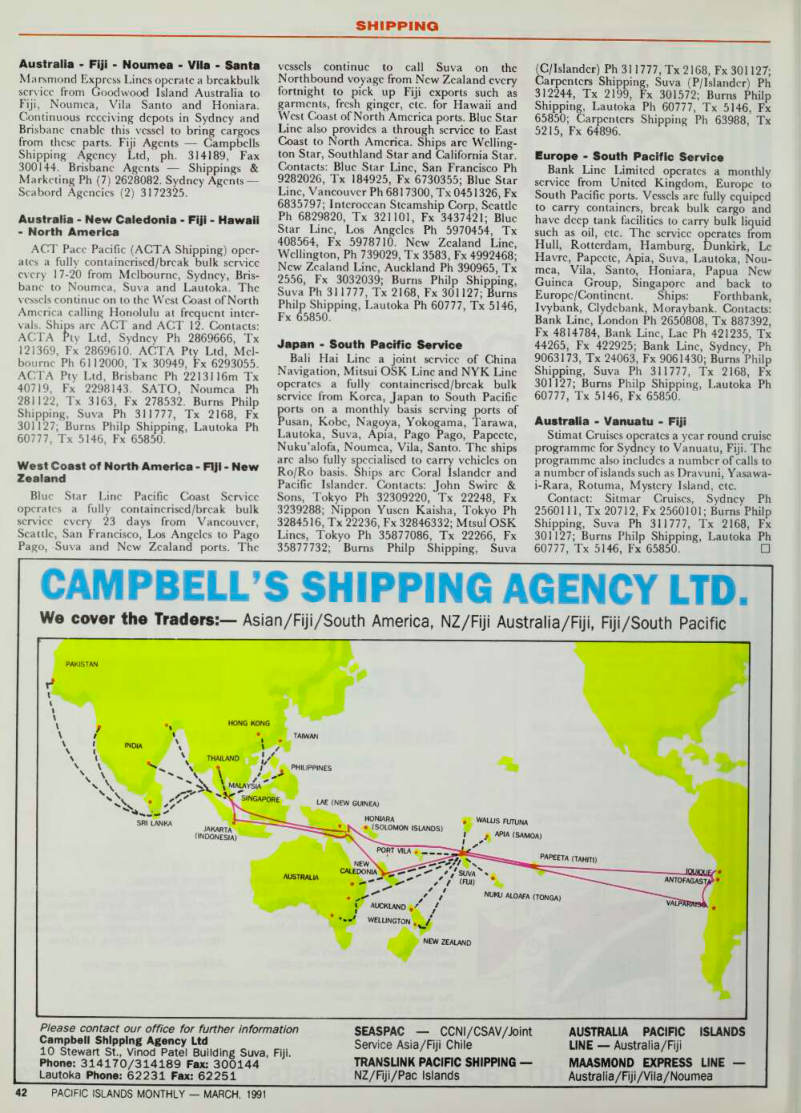
Australia - New Caledonia - Fiji - Samoas - Tonga Pacific Forum Line operates a fully containerised service (general, reefer and ro ro) from Sydney and Brisbane to Noumea, Lautoka, Suva, Apia, Pago Pago, Nukualofa, Sydney. Cargo centralised from Adelaide and Melbourne. Contact: Pacific Forum Line, PO Box 796, Auckland; Union Bulkships, 333 George St, Sydney, Brisbane and Melbourne; Union Co, Lautoka; Pacific Forum Line, Suva, Nuku’alofa; Pacific Forum Line, Apia; Polynesia Shipping, Pago Pago. Sofrano Unilincs operates a Roßo/containcr service every three weeks from Melbourne, Sydney and Brisbane to Noumea, Suva and Lautoka with transhipment to the Samoas and Tonga.
New Zealand - Australia - PNG - Solomon Islands Pacific Forum Line operates a containerised and ro-ro service from Lyttlcton, Napier and Auckland to Brisbane, Port Moresby, Lac, Honiara, Brisbane then to New Zealand. Contact: Pacific Forum, Auck land, Christchurch; Union Bulkships, Bris bane; Steamships Shipping Port Moresby and Lac Sullivan Ltd, Honiara; Scabridgc, Wel lington.
NZ - Fiji Translink Pacific Shipping sail twice a month to Fiji, with Polynesian Link and Coral Links which operate out of Tauranga and Auckland. Fiji Agents arc: Campbells Ship ping Agency Ltd, Ph 314189 Fax 300144 Suva; Ph 62231 Fax 62251 Lautoka. Auck land Agents: McKay Shipping Ph (9) 390229 Fax (9) 303293. Tauranga Agents, scatradc agencies Ph (75) 754989 Fax' (75) 758380.
NZ - Fiji - Pago - Apia - Nuk Translink Pacific Shipping operate a monthly sailing with Polynesian Link, which carries Dry Container, reefers and brcakbulk cargoes. NZ Agents McKay Shipping Ship ping AKLD Ph 390229, Fax 3032931. Fiji Agents Campbells Shipping Agency & ltd Ph 314189 Fax 300144 NZ - Noumea - Wallis - Futuna Translink Pacific Agency operate a con tainer Brcakbulk service once a month from NZ through Fiji and Noumea to Wallis & Futuna.
South East Asia - Fiji - Noumea - Papeete - Chile Service “Scaspac” A joint Chilean CCNI/CSAU Service offers a regular monthly sailing from Djakarta and Singapore to Noumea, Fiji, Papeete, and Chile. Cargo also federated to Singapore from Korea, Hong Kong, Taiwan, Malaysia, Bangkok. Fiji Agents: Campbells Shipping Agency Ltd, ph. 314189, Fax 300144.
Australia - Fiji Service Chief container services under Australia Pacific Island Line Unitize Sofrano and PFL vessels to provide a twice monthly, service from Australia. Fiji Agents Campbells Shippings Agency ltd Ph 314189 Fax 300144.
System Agents Ncdlloyd Swire Ph(2) 2512699. Melbourne Yarra Shipping Ph (3) 6936300. Brisbane, Mcdlloyd Swire, ph (7) 8321551.
Australia - Fiji - Noumea - Vila - Santa Marsmond Express Lines operate a brcakbulk service from Goodwood Island Australia to Fiji, Noumea, Vila Santo and Honiara.
Continuous receiving depots in Sydney and Brisbane enable this vessel to bring cargoes from these parts. Fiji Agents Campbells Shipping Agency Ltd/ ph. 314189, Fax 300144. Brisbane Agents Shippings & Marketing Ph (7) 2628082. Sydney Agents Scabord Agencies (2) 3172325.
Australia - New Caledonia - Fiji - Hawaii - North America ACT Pace Pacific (ACTA Shipping) oper ates a fully containcriscd/brcak bulk service every 17-20 from Melbourne, Sydney, Bris bane to Noumea, Suva and Lautoka. The vessels continue on to the West Coast of North America calling Honolulu at frequent inter vals. Ships arc ACT and ACT 12. Contacts; ACTA Pty Ltd, Sydney Ph 2869666, Tx 121369, Fx 2869610. ACTA Pty Ltd, Mel bourne Ph 6112000, Tx 30949, Fx 6293055.
ACTA Pty Ltd, Brisbane Ph 2213116 m Tx 40719, Fx 2298143. SATO, Noumea Ph 281122, Tx 3163, Fx 278532. Burns Philp Shipping, Suva Ph 311777, Tx 2168, Fx 301127; Burns Philp Shipping, Lautoka Ph 60777, Tx 5146, Fx 65850.
West Coast of North America - Fiji - New Zealand Blue Star Line Pacific Coast Service operates a fully containcriscd/brcak bulk service every 23 days from Vancouver, Seattle, San Francisco, Los Angeles to Pago Pago, Suva and New Zealand ports. The
vessels continue to call Suva on the Northbound voyage from New Zealand every fortnight to pick up Fiji exports such as garments, fresh ginger, etc. for Hawaii and West Coast of North America ports. Blue Star Line also provides a through service to East Coast to North America. Ships arc Welling ton Star, Southland Star and California Star.
Contacts: Blue Star Line, San Francisco Ph 9282026, Tx 184925, Fx 6730355; Blue Star Line, Vancouver Ph 6817300, Tx 0451326, Fx 6835797; Intcroccan Steamship Corp, Seattle Ph 6829820, Tx 321101, Fx 3437421; Blue Star Line, Los Angeles Ph 5970454, Tx 408564, Fx 5978710. New Zealand Line, Wellington, Ph 739029, Tx 3583, Fx 4992468; New Zealand Line, Auckland Ph 390965, Tx 2556, Fx 3032039; Burns Philp Shipping, Suva Ph 31 1777, Tx 2168, Fx 301127; Burns Philp Shipping, Lautoka Ph 60777, Tx 5146, Fx 65850.
Japan - South Pacific Service Bali Hai Line a joint service of China Navigation, Mitsui OSK Line and NYK Line operates a fully containcriscd/brcak bulk service from Korea, Japan to South Pacific ports on a monthly basis serving ports of Pusan, Kobe, Nagoya, Yokogama, Tarawa,
Lautoka, Suva, Apia, Pago Pago, Papeete,
Nuku’alofa, Noumea, Vila, Santo. The ships arc also fully specialised to carry vehicles on Ro/Ro basis. Ships arc Coral Islander and Pacific Islander. Contacts: John Swire & Sons, Tokyo Ph 32309220, Tx 22248, Fx 3239288; Nippon Yusen Kaisha, Tokyo Ph 3284516, Tx 22236, Fx 32846332; Mtsul OSK Lines, Tokyo Ph 35877086, Tx 22266, Fx 35877732; Burns Philp Shipping, Suva
(C/Islandcr) Ph 31 1777, Tx 2168, Fx 301127;
Carpenters Shipping, Suva (P/Islandcr) Ph
312244, Tx 2199, Fx 301572; Burns Philp Shipping, Lautoka Ph 60777, Tx 5146, Fx 65850; Carpenters Shipping Ph 63988, Tx 5215, Fx 64896.
Europe - South Pacific Service Bank Line Limited operates a monthly service from United Kingdom, Europe to South Pacific ports. Vessels arc fully equiped to carry containers, break bulk cargo and have deep tank facilities to carry bulk liquid such as oil, etc. The service operates from Hull, Rotterdam, Hamburg, Dunkirk, Lc Havre, Papeete, Apia, Lautoka, Nou mea, Vila, Santo, Honiara, Papua New Guinea Group, Singapore and back to
Europc/Contincnt. Ships: Forthbank,
Ivybank, Clydebank, Moraybank. Contacts: Bank Line, London Ph 2650808, Tx 887392, Fx 4814784, Bank Line, Lac Ph 421235, Tx 44265, Fx 422925; Bank Line, Sydney, Ph 9063173, Tx 24063, Fx 9061430; Burns Philp Shipping, Suva Ph 31 1777, Tx 2168, Fx 301127; Burns Philp Shipping, Lautoka Ph 60777, Tx 5146, Fx 65850.
Australia - Vanuatu - Fiji Stimat Cruises operates a year round cruise programme for Sydney to Vanuatu, Fiji. The programme also includes a number of calls to a number of islands such as Dravuni, Yasawa i-Rara, Rotuma, Mystery Island, etc.
Contact; Sitmar Cruises, Sydney Ph 2560111, Tx 20712, Fx 2560101; Burns Philp Shipping, Suva Ph 31 1777, Tx 2168, Fx 301127; Burns Philp Shipping, Lautoka Ph 60777, Tx 5146, Fx 65850. □
Advertisements & other items, pp. 40-42 (2 items)
Co., Ltd.
KYOWA
KYOWA SHIPPING
Liner Service to Paciffic Islands
FROM OJAPAN
OKOREA
OTAIWAN
THAILAND
TO OSAIPAN
OFEDERATED STATES
OF MICRONESIA
OMARSHAL ISLANDS
©AMERICAN SAMOA
ONEW CALEDONIA
O FIJI
OHONG KONG
OSINGAPORE
©PHILIPPINES
©MALAYSIA
INDONESIA
©GUAM
©YAP
©PALAU
©WESTERN SAMOA
©SOLOMON ISLANDS
©VANUATU
©PAPUA NEW GUINEA
HEAD OFFICE
6th Floor , Kikushima Bldg 2-3. Hamamatsucho 2-chome Minato-ku, Tokyo 105, Japan Phone; 03(437)2885 (Rep ) Cables: MARIQUEEN Tokyo Telex: 242-4651 Kyowa J
OSAKA OFFICE
Dai San Fuji Bldg 3-13, Itachibon 1-chome, Osaka 550.
Phone: 06(533)5821 (Rep ) Cables: MARIQUEEN" Osaka Telex; 525-6271 Ssiosa J
Europe.
BANK LINE and
COLUMBUS LINE
24 day service to
Europe.
Need we say more...
G The Joint Service Partners offer facilities for shipment of: Containers (FCiyLCL) and Break-bulk Cargo plus reefer space and deeptanks for carriage of vegetable oils and other liquid bulk cargo.
Carriers also accept heavy lifts, overlength and cumbersome parcels.
Ports of Service: Loading; Papeete, Apia, Suva, Lautoka, Noumea, Port Vila, Santo, Honiara, Port Moresby, Lae, Madang, Kimbe, Rabaul, Kieta, Darwin. For: Rotterdam, Antwerp, Hamburg, Hull, Dunkirk, Le Havre.
Additional ports on enquiry.
Please contact our regional offices for further information: The Bank Line P.O. Box 2225 Lae, Papua New Guinea Phone: 422 988/Fax: 422 925 Telex: 44265 The South Pacific Specialists for over 75 years
CAMPBELL’S SHIPPING AGENCY LTD.
We cover the Traders:— Asian/Fiji/South America, NZ/Fiji Australia/Fiji, Fiji/South Pacific / \ I s L \ I \\
TAIWAN
J/
I * , PHILIPPINES
t
" \ MALAYSIA "
VJ \ SINGAPORE
THAILAND
LAE (NEW GUINEA)
WALLIS FUTUNA
APIA (SAMOA)
HONIARA
* (SOLOMON ISLANDS)
JAKARTA
(INDONESIA)
PORT
VILA
PAPEETA (TAHITI)
NEW
i sums*
SUVA
AUSTRALIA
ANTOFAGASTA* *
(FIJI)
CALEDONIA '
AUCKLAND /
* WELUNGTON , /
NUKU ALOAFA (TONGA)
NEW ZEALAND
Please contact our office for further information
Campbell Shipping Agency Ltd
10 Stewart St., Vinod Patel Building Suva, Fiji.
Phone: 314170/314189 Fax: 300144 Lautoka Phone: 62231 Fax; 62251
SEASPAC CCNI/CSAV/Joint
Service Asia/Fiji Chile
TRANSLINK PACIFIC SHIPPING
NZ/Rji/Pac Islands
AUSTRALIA PACIFIC ISLANDS
LINE Australia/Fiji
MAASMOND EXPRESS LINE
Australia/Fiji/Vila/Noumea
Champ seeks help
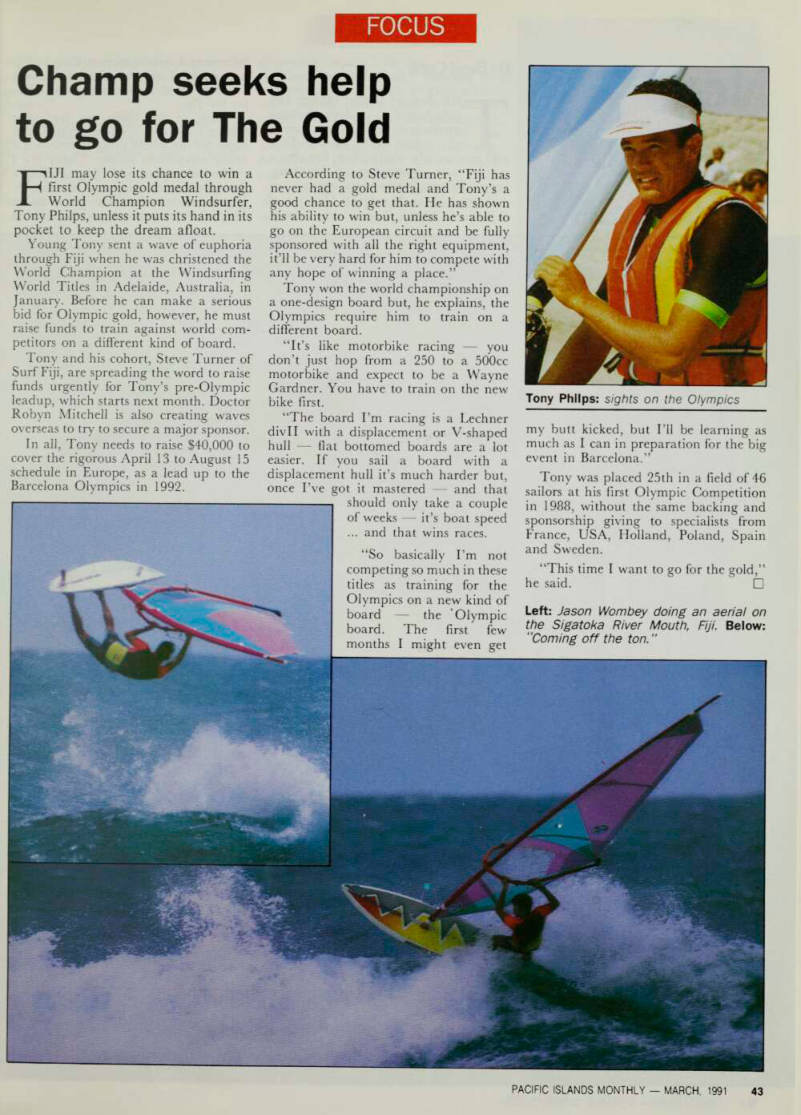
to go for The Gold
FIJI may lose its chance to win a first Olympic gold medal through World Champion Windsurfer, Tony Philps, unless it puts its hand in its pocket to keep the dream afloat.
Young Tony sent a wave of euphoria through Fiji when he was christened the World Champion at the Windsurfing World Titles in Adelaide, Australia, in January. Before he can make a serious bid for Olympic gold, however, he must raise funds to train against world com petitors on a different kind of board.
Tony and his cohort, Steve Turner of Surf Fiji, are spreading the word to raise funds urgently for Tony’s pre-Olympic leadup, which starts next month. Doctor Robyn Mitchell is also creating waves overseas to try to secure a major sponsor.
In all, Tony needs to raise $40,000 to cover the rigorous April 13 to August 15 schedule in Europe, as a lead up to the Barcelona Olympics in 1992.
According to Steve Turner, “Fiji has never had a gold medal and Tony’s a good chance to get that. He has shown his ability to win but, unless he’s able to go on the European circuit and be fully sponsored with all the right equipment, it’ll be very hard for him to compete with any hope of winning a place.”
Tony won the world championship on a one-design board but, he explains, the Olympics require him to train on a different board.
“It’s like motorbike racing you don’t just hop from a 250 to a 500 cc motorbike and expect to be a Wayne Gardner. You have to train on the new bike first.
“The board I’m racing is a Lechner divll with a displacement or V-shaped hull flat bottomed boards are a lot easier. If you sail a board with a displacement hull it’s much harder but, once I’ve got it mastered and that
should only take a couple of weeks it’s boat speed ... and that wins races.
“So basically I’m not competing so much in these titles as training for the Olympics on a new kind of board the Olympic board. The first few months I might even get
my butt kicked, but I’ll be learning as much as I can in preparation for the big event in Barcelona.”
Tony was placed 25th in a field of 46 sailors at his first Olympic Competition in 1988, without the same backing and sponsorship giving to specialists from France, USA, Holland, Poland, Spain and Sweden.
“This time I want to go for the gold,” he said. □
Tony Philps: sights on the Olympics
Left: Jason Wombey doing an aerial on the Sigatoka River Mouth, Fiji. Below: “Coming off the ton.”
Advertisements & other items, p. 43 (1 item)
Focus
wave of
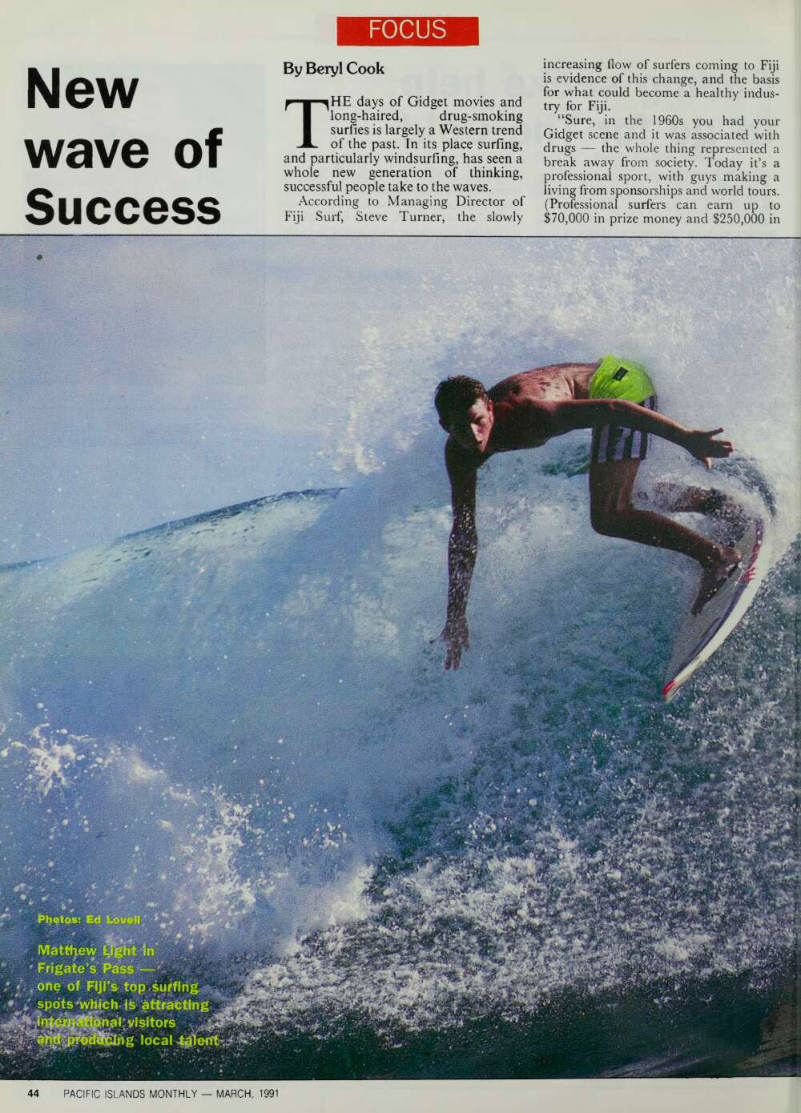
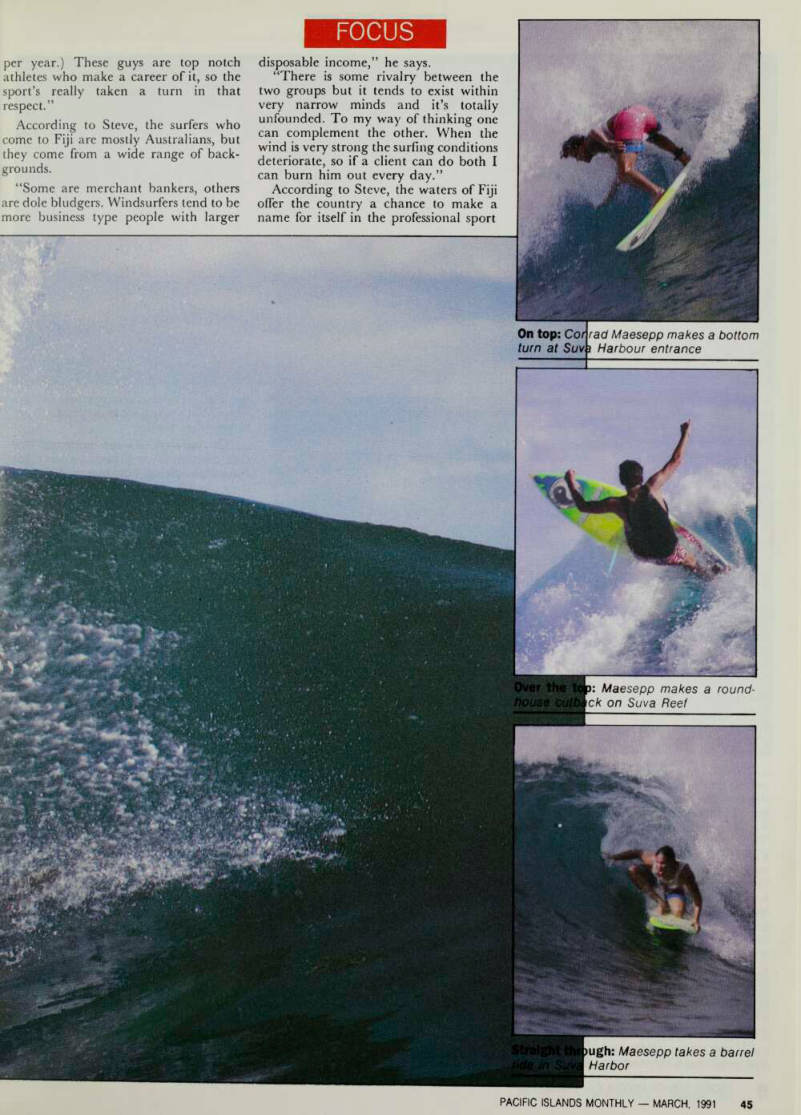
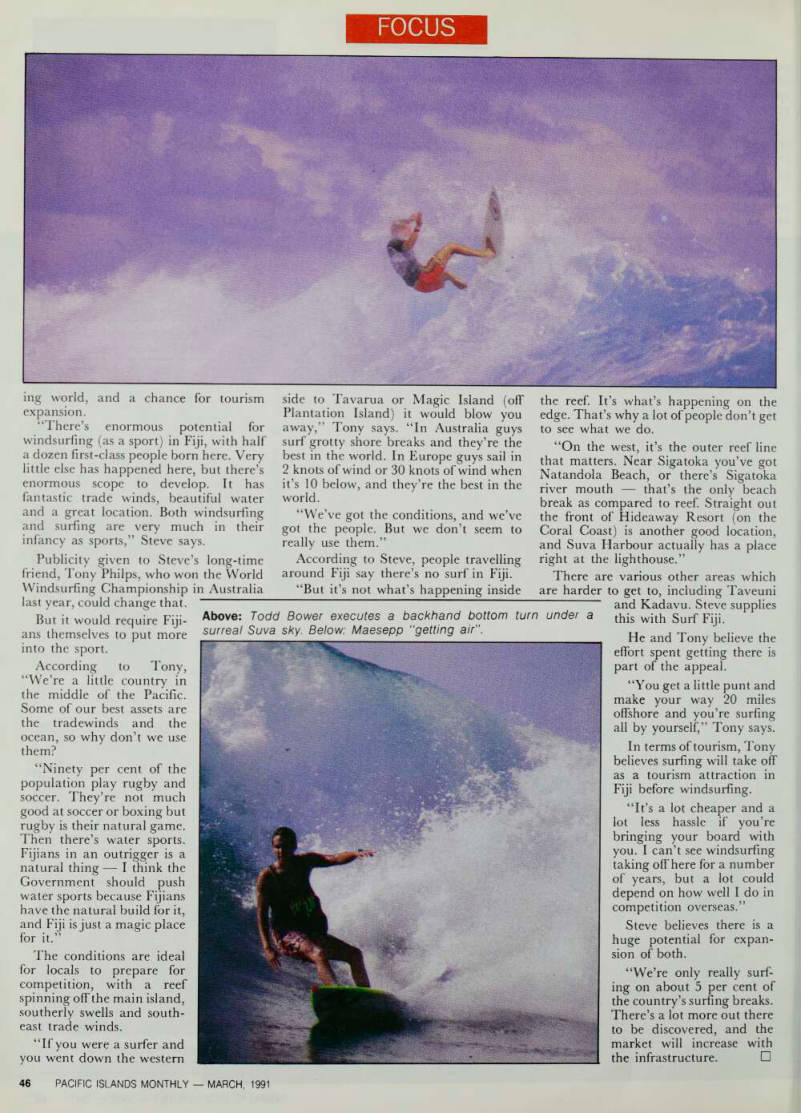
New wave of Success
By Beryl Cook
THE days of Gidget movies and long-haired, drug-smoking surfies is largely a Western trend of the past. In its place surfing, and particularly windsurfing, has seen a whole new generation of thinking, successful people take to the waves.
According to Managing Director of Fiji Surf, Steve Turner, the slowly
increasing flow of surfers coming to Fiji is evidence of this change, and the basis for what could become a healthy indus try f or pm “Sure, in the 1960 s you had your Gidget scene and it was associated with drugs the whole thing represented a break away from society. Today it’s a professional sport, with guys making a living from sponsorships and world tours. (Professional surfers can earn up to $70,000 in prize money and $250,000 in
Photos: Ed Lovell Matthew Light in Frigate's Pass one of Fiji's top surfing spots which is attracting international visitors and producing local talent
per year.) These guys are top notch athletes who make a career of it, so the sport’s really taken a turn in that
respect.”
According to Steve, the surfers who come to Fiji are mostly Australians, but they come from a wide range of back
grounds.
“Some are merchant bankers, others are dole bludgers. Windsurfers tend to be more business type people with larger
disposable income,” he says.
“There is some rivalry between the two groups but it tends to exist within very narrow minds and it’s totally unfounded. To my way of thinking one can complement the other. When the wind is very strong the surfing conditions deteriorate, so if a client can do both I can burn him out every day.”
According to Steve, the waters of Fiji offer the country a chance to make a name for itself in the professional sport
On top: Corrad Maesepp makes a bottom turn at Suv a Harbour entrance
Over the top: Maesepp makes a round house cutback on Suva Reef
Straight through: Maesepp takes a barrel ride in Suva Harbor
ing world, and a chance for tourism expansion.
“There’s enormous potential for windsurfing (as a sport) in Fiji, with half a dozen first-class people born here. Very little else has happened here, but there’s enormous scope to develop. It has fantastic trade winds, beautiful water and a great location. Both windsurfing and surfing are very much in their infancy as sports,” Steve says.
Publicity given to Steve’s long-time friend, Tony Philps, who won the World
Windsurfing Championship in Australia
last year, could change that.
But it would require Fiji ans themselves to put more into the sport.
According to Tony,
“We’re a little country in the middle of the Pacific.
Some of our best assets are the tradewinds and the ocean, so why don’t we use them?
“Ninety per cent of the
population play rugby and
soccer. They’re not much good at soccer or boxing but rugby is their natural game.
Then there’s water sports.
Fijians in an outrigger is a natural thing I think the Government should push water sports because Fijians have the natural build for it, and Fiji is just a magic place for it.”
The conditions are ideal for locals to prepare for competition, with a reef spinning off the main island, southerly swells and south east trade winds.
“If you were a surfer and you went down the western
side to Tavarua or Magic Island (off Plantation Island) it would blow you away,” Tony says. “In Australia guys surf grotty shore breaks and they’re the best in the world. In Europe guys sail in 2 knots of wind or 30 knots of wind when it’s 10 below, and they’re the best in the world.
“We’ve got the conditions, and we’ve got the people. But we don’t seem to really use them.”
According to Steve, people travelling around Fiji say there’s no surf in Fiji.
“But it’s not what’s happening inside
the reef. It’s what’s happening on the edge. That’s why a lot of people don’t get to see what we do.
“Q n the west, it’s the outer reef line that matters . Near Sigatoka youVe got Natandola Beach, or there’s Sigatoka river mouth that’s the only beach break as compared to reef. Straight out the front of Hideaway Resort (on the Coral Coast) is another good location, and Suva Harbour actually has a place
right at the lighthouse.”
There are various other areas which are harder to get to, including Taveuni
and Kadavu. Steve supplies this with Surf Fiji.
He and Tony believe the effort spent getting there is part of the appeal.
“You get a little punt and make your way 20 miles offshore and you’re surfing
all by yourself,” Tony says.
In terms of tourism, Tony believes surfing will take off as a tourism attraction in
Fiji before windsurfing.
“It’s a lot cheaper and a lot less hassle if you’re bringing your board with you. I can’t see windsurfing taking off here for a number of years, but a lot could depend on how well I do in
competition overseas.”
Steve believes there is a
huge potential for expan
sion of both.
“We’re only really surf ing on about 5 per cent of
the country’s surfing breaks.
There’s a lot more out there to be discovered, and the market will increase with the infrastructure. □
Above: Todd Bower executes a backhand bottom turn under a surreal Suva sky. Below: Maesepp “getting air".
Advertisements & other items, pp. 44-48 (3 items)
Focus
Focus
for the
TRAVEL & TOURISM
Drawcard for the downturn?
Fiji may hold the ticket to offset the tourism decline
By Beryl Cook
AIR PACIFIC’S second Japan/Fiji
flight may offset the expected drop of about 5 per cent in Fiji visitor arrivals this year, and make Japan the number two source of tour ists.
According to Fiji Visitors Bureau Marketing Services Manager Fasiu Jione, the second flight, scheduled to start on April 25, could boost the annual figure for Japanese visitors to 1 7,000. But Air Pacific’s acting chief executive Stephen Brown says the figure could go as high as 30,000 and place Japan as the number two source of arrivals.
“Our estimate is that Australian arrivals may drop to 90,000,” Brown said. “New Zealand may drop a bit to about 25,000 to 30,000. The US may hold its own at 25 to 30,000, and Japan could rise to 30,000.” (This could make Japan the second biggest source of
arrivals.)
Both services will be provided by Air Pacific’s 430-seat 747 200 series, and Air Pacific expects to carry 26,000 (80 per cent) of the arrivals.
According to Jione, the second Japan flight could offset the drop which the Visitors Bureau feared would result from the Gulf Crisis (if it proves short-lived), economic downturn overseas, and airline deregulation in Australia. Visitors to Fiji last year totalled 275,000, and the figure originally forecast for this year as part of a three-year target was 290,000.
He said the second Air Pacific Fiji/ Japan flight could make the difference.
“If we can get our campaigns right we may look at making up the shortfall from the Japanese market. It could be that we will be within our 5 per cent forecast
drop.”
In 1987, after the political crisis, Japan Airlines pulled out of Fiji and Air New Zealand cancelled its flights temporarily for six to 12 months.
As a result, virtually no seats out of Japan were on offer. When Air Pacific
introduced its first Japan/Fiji flight, the arrival figures rose from 3000 in 1988 to 14,000 in 1989.
Jione said the Japanese market offered even more potential.
“Last year more than 10 million Japanese travelled out of their country on holiday, so you see the type of scope there is ” he said. a.. a . , At present Australia is still the number a ac one market, and a ma or provider of * . u ’ , , J T. tourists. But the number of Australian • • r , , . , visitors is likely to drop. , 7 We were looking at 90,000 to 100,000 from Australia, Jione said. “But we are being realistic now in recognising that we 90000 <A e non ” hat figUre dr ° P ,0
yu,UUU-JS,UUU.
Cost competition is a major factor,
since airline deregulation in Australia.
“One of our biggest promotional arguments used to be that it is so expensive to get around Australia, that you could come here and see something totall y diff erent for the same or less,”
J lone said “ But al P resent 1 believe the dea^s being offered are as low as a standby fare of $35 from Melbourne to the Gold Coast, so how can you compete w. 1 r >, Wlth thatr We are lorecasting an overall j rc . r . , drop of 5 per cent of arrivals at best, aa , ’ we might record the same number, T - & 0 lr , .
Jione said the Gulf War and the economic downturn in Australia could also affect the number of Australian visitors “Wemay be off target (on our original estimates) because of the Gulf Crisis; it’s hitting worldwide. We’ve also taken into
New face of Fiji tourism: Japanese arrivals could make the difference.
account the economic trends in Austra lia. Canada is also going through a recession, and even the United States is
introducing some tough economic
measures,” he said.
Jione said Fiji’s biggest problem in boosting Japanese arrivals would be in supplying the type of hotel the Japanese wanted.
“In the lower end of the market we have enough rooms. We need to see an expansion in the middle to upper range so we can cater for the groups who offer the most potential the Australian family market and the Japanese, who are only after top-class.”
Jione said the room situation needed attention within one to five years.
“We are just about at capacity. With the second (Japan) flight we will be there. Already in the Australian school holidays there is a bit of a fight for rooms and once the upper range of rooms are full, Fiji is considered full.”
Jione said the EIE project on Denarau should provide another 300 rooms. The
Natandola project was also looking at starting this year on 2.5 miles of beach on the western side.
“Given that the Government and developers are ironing out problems such as infrastructure, providing water and roads, it will take three to five years. It will come in phases, but the plan is that when it is finished, it will have about 2000 rooms.”
The success of Fiji’s bid to increase its share of the Japanese market will also
depend heavily on marketing.
Jione said the Bureau’s efforts were limited by a 52.5 million worldwide budget for promotions. However, the Bureau is working in conjunction with Air Pacific and the airline is expected to start a television campaign in Japan.
Details of the flight had also missed being included in wholesalers’ April to October brochures. “But it is featured in the October to December ones, so we should start seeing changes then.” □
Jione: Aware of the challenges
SP tourism
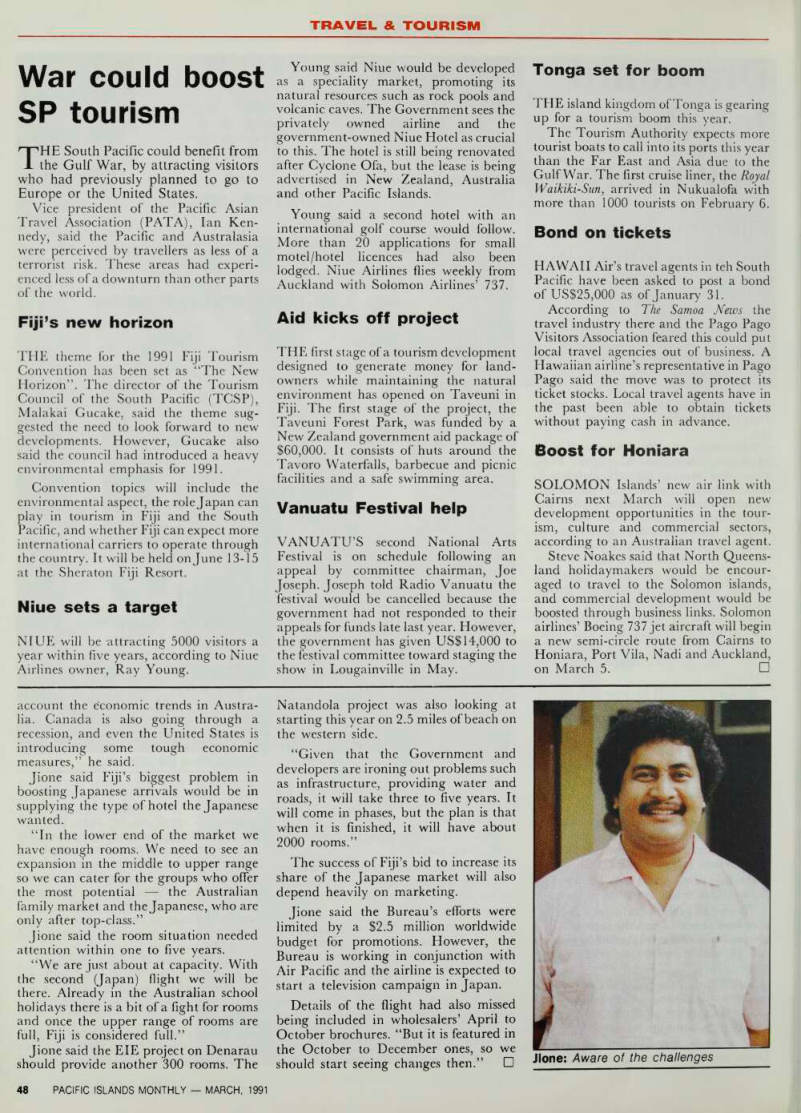
War could boost SP tourism
THE South Pacific could benefit from the Gulf War, by attracting visitors who had previously planned to go to Europe or the United States.
Vice president of the Pacific Asian Travel Association (PATA), lan Ken nedy, said the Pacific and Australasia were perceived by travellers as less of a terrorist risk. These areas had experi enced less ofa downturn than other parts of the world.
Fiji’s new horizon THE theme for the 1991 Fiji Tourism Convention has been set as “The New Horizon”. The director of the Tourism Council of the South Pacific (TCSP), Malakai Gucake, said the theme sug gested the need to look forward to new developments. However, Gucake also said the council had introduced a heavy environmental emphasis for 1991.
Convention topics will include the environmental aspect, the role Japan can play in tourism in Fiji and the South Pacific, and whether Fiji can expect more international carriers to operate through the country. It will be held onjune 13-15 at the Sheraton Fiji Resort.
Niue sets a target NIUE will be attracting 5000 visitors a year within five years, according to Niue Airlines owner, Ray Young.
Young said Niue would be developed as a speciality market, promoting its natural resources such as rock pools and volcanic caves. The Government sees the privately owned airline and the government-owned Niue Hotel as crucial to this. The hotel is still being renovated after Cyclone Ofa, but the lease is being advertised in New Zealand, Australia and other Pacific Islands.
Young said a second hotel with an international golf course would follow.
More than 20 applications for small motel/hotel licences had also been lodged. Niue Airlines flies weekly from Auckland with Solomon Airlines’ 737.
Aid kicks off project THE first stage of a tourism development designed to generate money for land owners while maintaining the natural environment has opened on Taveuni in Fiji. The first stage of the project, the Taveuni Forest Park, was funded by a New Zealand government aid package of 560,000. It consists of huts around the Tavoro Waterfalls, barbecue and picnic facilities and a safe swimming area.
Vanuatu Festival help VANUATU’S second National Arts Festival is on schedule following an appeal by committee chairman, Joe Joseph. Joseph told Radio Vanuatu the festival would be cancelled because the government had not responded to their appeals for funds late last year. However, the government has given USS 14,000 to the festival committee toward staging the show in Lougainville in May.
Tonga set for boom THE island kingdom of Tonga is gearing up for a tourism boom this year.
The Tourism Authority expects more tourist boats to call into its ports this year than the Far East and Asia due to the Gulf War. The first cruise liner, the Royal Waikiki-Sun, arrived in Nukualofa with more than 1000 tourists on February 6.
Bond on tickets HAWAII Air’s travel agents in teh South Pacific have been asked to post a bond of U 5525,000 as of January 31.
According to The Samoa News the travel industry there and the Pago Pago Visitors Association feared this could put local travel agencies out of business. A Hawaiian airline’s representative in Pago Pago said the move was to protect its ticket stocks. Local travel agents have in the past been able to obtain tickets without paying cash in advance.
Boost for Honiara SOLOMON Islands’ new air link with Cairns next March will open new development opportunities in the tour ism, culture and commercial sectors, according to an Australian travel agent.
Steve Noakes said that North Queens land holidaymakers would be encour aged to travel to the Solomon islands, and commercial development would be boosted through business links. Solomon airlines’ Boeing 737 jet aircraft will begin a new semi-circle route from Cairns to Honiara, Port Vila, Nadi and Auckland, on March 5. □
Tackling the growth dilemma
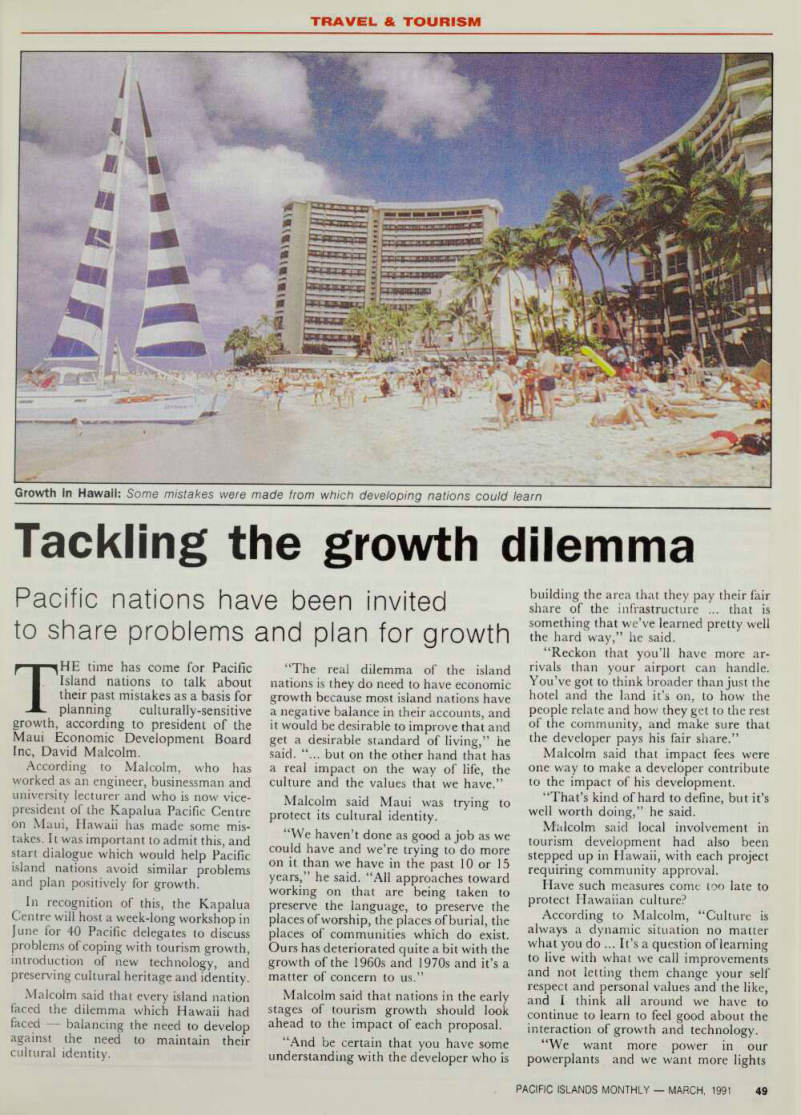
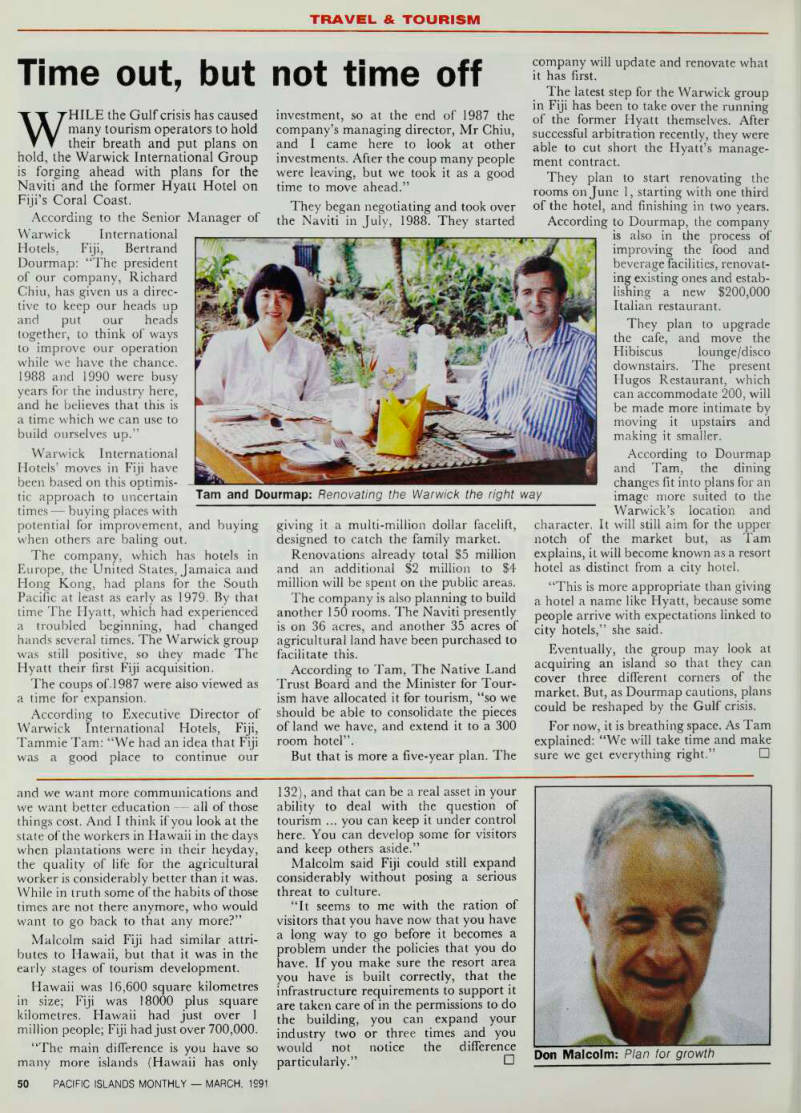
Pacific nations have been invited to share problems and plan for growth
THE time has come for Pacific Island nations to talk about their past mistakes as a basis for planning culturally-sensitive growth, according to president of the Maui Economic Development Board Inc, David Malcolm.
According to Malcolm, who has worked as an engineer, businessman and university lecturer and who is now vice president of the Kapalua Pacific Centre on Maui, Hawaii has made some mis takes. It was important to admit this, and start dialogue which would help Pacific island nations avoid similar problems and plan positively for growth.
In recognition of this, the Kapalua Centre will host a week-long workshop in June for 40 Pacific delegates to discuss problems of coping with tourism growth, introduction of new technology, and preserving cultural heritage and identity.
Malcolm said that every island nation faced the dilemma which Hawaii had faced balancing the need to develop against the need to maintain their
cultural identity.
“The real dilemma of the island nations is they do need to have economic growth because most island nations have a negative balance in their accounts, and it would be desirable to improve that and get a desirable standard of living,” he said. “... but on the other hand that has a real impact on the way of life, the culture and the values that we have.”
Malcolm said Maui was trying to protect its cultural identity.
“We haven’t done as good a job as we could have and we’re trying to do more on it than we have in the past 10 or 15 years,” he said. “All approaches toward working on that are being taken to preserve the language, to preserve the places of worship, the places of burial, the places of communities which do exist.
Ours has deteriorated quite a bit with the growth of the 1960 s and 1970 s and it’s a matter of concern to us.”
Malcolm said that nations in the early stages of tourism growth should look ahead to the impact of each proposal.
“And be certain that you have some understanding with the developer who is
building the area that they pay their fair share of the infrastructure ... that is something that we’ve learned pretty well the hard way,” he said.
“Reckon that you’ll have more ar rivals than your airport can handle.
You’ve got to think broader than just the hotel and the land it’s on, to how the people relate and how they get to the rest of the community, and make sure that the developer pays his fair share.”
Malcolm said that impact fees were one way to make a developer contribute to the impact of his development.
“That’s kind of hard to define, but it’s well worth doing,” he said.
Malcolm said local involvement in tourism development had also been stepped up in Hawaii, with each project
requiring community approval.
Have such measures come too late to protect Hawaiian culture?
According to Malcolm, “Culture is always a dynamic situation no matter what you do ... It’s a question oflearning to live with what we call improvements and not letting them change your self respect and personal values and the like, and I think all around we have to continue to learn to feel good about the interaction of growth and technology.
“We want more power in our powerplants and we want more lights
Growth In Hawaii: Some mistakes were made from which developing nations could learn
and we want more communications and we want better education all of those things cost. And I think if you look at the state of the workers in Hawaii in the days when plantations were in their heyday, the quality of life for the agricultural worker is considerably better than it was.
While in truth some of the habits of those times are not there anymore, who would want to go back to that any more?”
Malcolm said Fiji had similar attri butes to Hawaii, but that it was in the early stages of tourism development.
Hawaii was 16,600 square kilometres in size; Fiji was 18000 plus square kilometres. Hawaii had just over 1 million people; Fiji had just over 700,000.
“The main difference is you have so many more islands (Hawaii has only
132), and that can be a real asset in your ability to deal with the question of tourism ... you can keep it under control here. You can develop some for visitors and keep others aside.”
Malcolm said Fiji could still expand considerably without posing a serious threat to culture.
“It seems to me with the ration of visitors that you have now that you have a long way to go before it becomes a problem under the policies that you do have. If you make sure the resort area you have is built correctly, that the infrastructure requirements to support it are taken care of in the permissions to do the building, you can expand your industry two or three times and you would not notice the difference
particularly.” □
Don Malcolm; Plan for growth
Time out, but not time off
WHILE the Gulf crisis has caused many tourism operators to hold their breath and put plans on hold, the Warwick International Group is forging ahead with plans for the Naviti and the former Hyatt Hotel on Fiji’s Coral Coast.
According to the Senior Manager of
Warwick International Hotels, Fiji, Bertrand
Dourmap: “The president
of our company, Richard Chiu, has given us a direc tive to keep our heads up and put our heads together, to think of ways
to improve our operation
while we have the chance. 1988 and 1990 were busy years for the industry here, and he believes that this is a time which we can use to build ourselves up.”
Warwick International Hotels’ moves in Fiji have been based on this optimis tic approach to uncertain times buying places with
potential for improvement, and buying
when others are baling out.
The company, which has hotels in Europe, the United States, Jamaica and Hong Kong, had plans for the South Pacific at least as early as 1979. By that time The Hyatt, which had experienced a troubled beginning, had changed hands several times. The Warwick group was still positive, so they made The Hyatt their first Fiji acquisition.
The coups of. 1987 were also viewed as a time for expansion.
According to Executive Director of Warwick International Hotels, Fiji, Tammie Tam: “We had an idea that Fiji was a good place to continue our
investment, so at the end of 1987 the company’s managing director, Mr Chiu, and I came here to look at other investments. After the coup many people were leaving, but we took it as a good time to move ahead.”
They began negotiating and took over the Naviti in July, 1988. They started
giving it a multi-million dollar facelift, designed to catch the family market.
Renovations already total $5 million and an additional S 2 million to $4 million will be spent on the public areas.
The company is also planning to build another 150 rooms. The Naviti presently is on 36 acres, and another 35 acres of agricultural land have been purchased to facilitate this.
According to Tam, The Native Land Trust Board and the Minister for Tour ism have allocated it for tourism, “so we should be able to consolidate the pieces of land we have, and extend it to a 300 room hotel”.
But that is more a five-year plan. The
company will update and renovate what it has first.
The latest step for the Warwick group in Fiji has been to take over the running of the former Hyatt themselves. After successful arbitration recently, they were able to cut short the Hyatt’s manage ment contract.
They plan to start renovating the
rooms on June 1, starting with one third of the hotel, and finishing in two years.
According to Dourmap, the company
is also in the process of improving the food and beverage facilities, renovat ing existing ones and estab lishing a new 5200,000 Italian restaurant.
They plan to upgrade the cafe, and move the Hibiscus lounge/disco downstairs. The present Hugos Restaurant, which can accommodate 200, will be made more intimate by moving it upstairs and making it smaller.
According to Dourmap and Tam, the dining changes fit into plans for an image more suited to the Warwick’s location and
character. It will still aim for the upper notch of the market but, as Tam explains, it will become known as a resort hotel as distinct from a city hotel.
“This is more appropriate than giving a hotel a name like Hyatt, because some people arrive with expectations linked to city hotels,” she said.
Eventually, the group may look at acquiring an island so that they can cover three different corners of the market. But, as Dourmap cautions, plans could be reshaped by the Gulf crisis.
For now, it is breathing space. As Tam explained: “We will take time and make sure we get everything right.” □
Tam and Dourmap: Renovating the Warwick the right way
Two diplomats
Pacific People
assaulted
PHILIPPINE Ambassador to Papua New Guinea, Rudolfo Diaz, was treated for minor injuries after being attacked by four men with knives at a horse-race track about 15 kilometres outside Port Moresby, the PNG capital.
Papua New Guinea’s head of police, Ila Geno, ordered security increased for all foreign diplomats following the as-
Artists in court
TWO of Vanuatu’s most famous artists, Nicolai Michoutouchkin and Madame Suzanne Bastien, appeared in the Senior Magistrate’s Court on Janu
ary 15.
The former
was charged
with assaulting Madame Bast ien, occasion ing an injury Contrary to Section 107 (b) Penal Code Act CAP 135.
Senior Mag istrate Dawn Barcinski was told that on July 27, 1990,
Madame Suzanne Camille Bastien, the 69-year-old French neighbour of Michoutouchkin, was awakened in the early hours of the morning by the sound of extremely loud military music coming from Michoutouchkin’s house.
She said she had tried to attract his attention by shouting but without suc cess. She had then picked up some stones and thrown them into Michoutouchkin’s house. They landed very near to where Michoutouchkin’s friend, Pilioko, was working. Michoutouchkin said he was very angry and concerned for his friend Pilioko because he only had one eye, and he was worried if he was hit by a stone he could lose the other eye.
Michoutouchkin denied assaulting his elderly neighbour but the Senior Magis trate found him guilty and fined him VT 10,000, Plus VT 3,000 Costs.
Senior Magistrate Dawn Barcinski told both Michoutouchkin and Madam Bastien that this was not the way for adults to behave, and that to prevent such recurrences she would bind both of them over to keep the peace for 12 months in the sum of VT 15,000.
Both Michoutouchkin and Madam Bastien must be of good behaviour for 12 months. If not, they will each loose VT 15,000. □
sault, which came hours after prime minister Rabbie Namaliu opened a week-long summit on combating the country’s growing crime problem. □
New Commissioner
ALAIN Christnacht has been appointed the new High Corrimissioner of the Republic in New Caledonia.
Christnacht, 43, was Secretary General of the Caledonian Territory from 19980 to 1982. Six years later he became private secretary of Louis le Penser, the
French Minister for Overseas Territories.
Christnacht replaces Bernard Grasset, 56, who was appointed in Noumea a few days after the signing of the Matignon Peace Accord in June 1988. □
Development head
SITIVENI (Steven) Halapua has been appointed director of the East-West Center’s Pacific Islands Development Program (PIDP) by the Standing Devel opment Committee of the Pacific Islands Conference of Leaders, after serving as interim director for a year. □
Fined: Michoutouchkin
Advertisements & other items, p. 51 (1 item)
National Finance Officer
THE UNITED NATIONS DEVELOPMENT PROGRAMME
Invites applications for the following position:
Under the supervision of the Assistant Resident Representative (Administration) and the general supervision of the Resident Representative and his Deputy, the National Officer will be responsible for the organisation and supervision of the day-to-day operations of the Finance Section.
Qualifications: * Master’s degree in Accounting/Administration and Management or a member of an Institute of Chartered Accountants. * At least five years experience in the accounting field. * Several years experience in a computerized environment. Familiarity with the use of P.C.’s in a local area network (LAN) configuration knowledge of P.C. software such as Lotus 1-2-3, D-Base and Framework. * Ability to work in harmony with staff members of different nationalities and background.
Languages: Fluent spoken and written English.
Terms and Conditions of Employment: The successful candidate will be based in Suva. Salary commensurate with the functions of the post and qualifications will be offered at time of appointment. Various other benefits, such as dependency allowances for children, medical benefits and generous annual and sick leave conditions, will apply.
The National Officer post is the most senior position in the local staff component of UNDP and only candidates with proven high levels of achievement need apply.
Applications from nationals of Fiji, Federated States of Micronesia, Kiribati, Marshall Islands, Nauru, Palau, Solomon Islands, Tonga, Tuvalu and Vanuatu, quoting the above position and detailing educational and employment backgrounds, should be submitted prior to 31 March 1991 and addressed to: The Resident Representative The United Nations Development Programme Private Mail Bag
SUVA, FIJI.
Working on
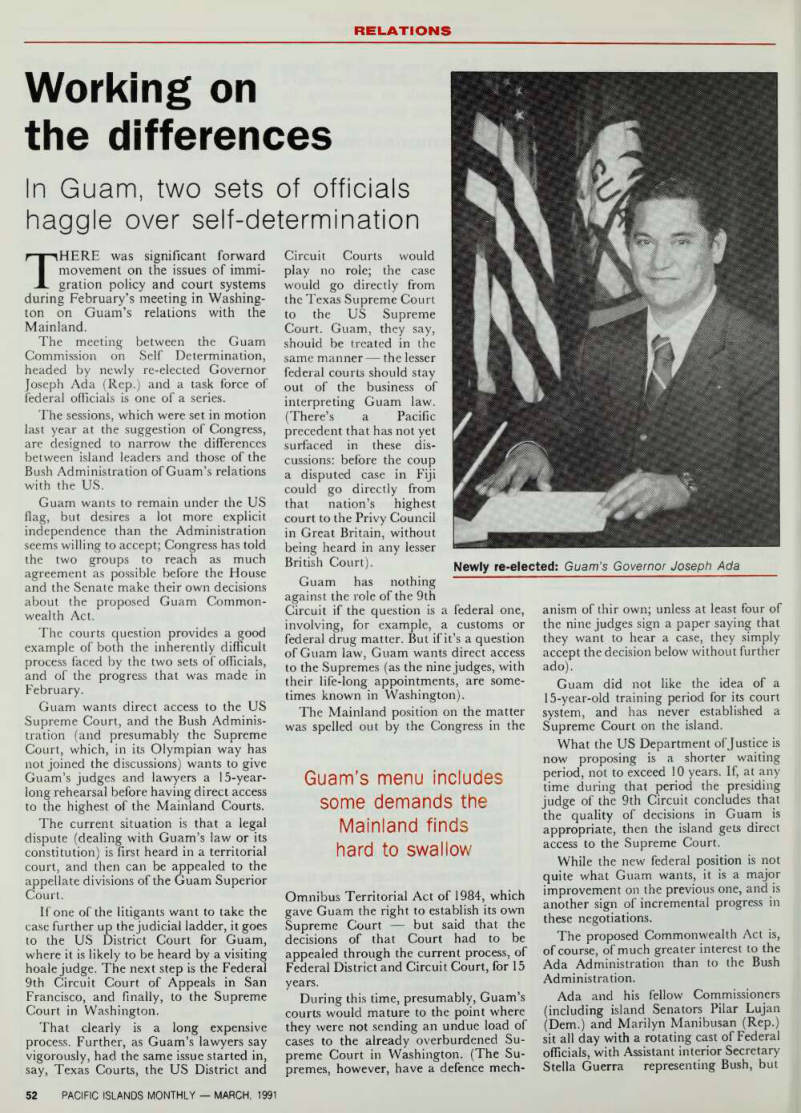
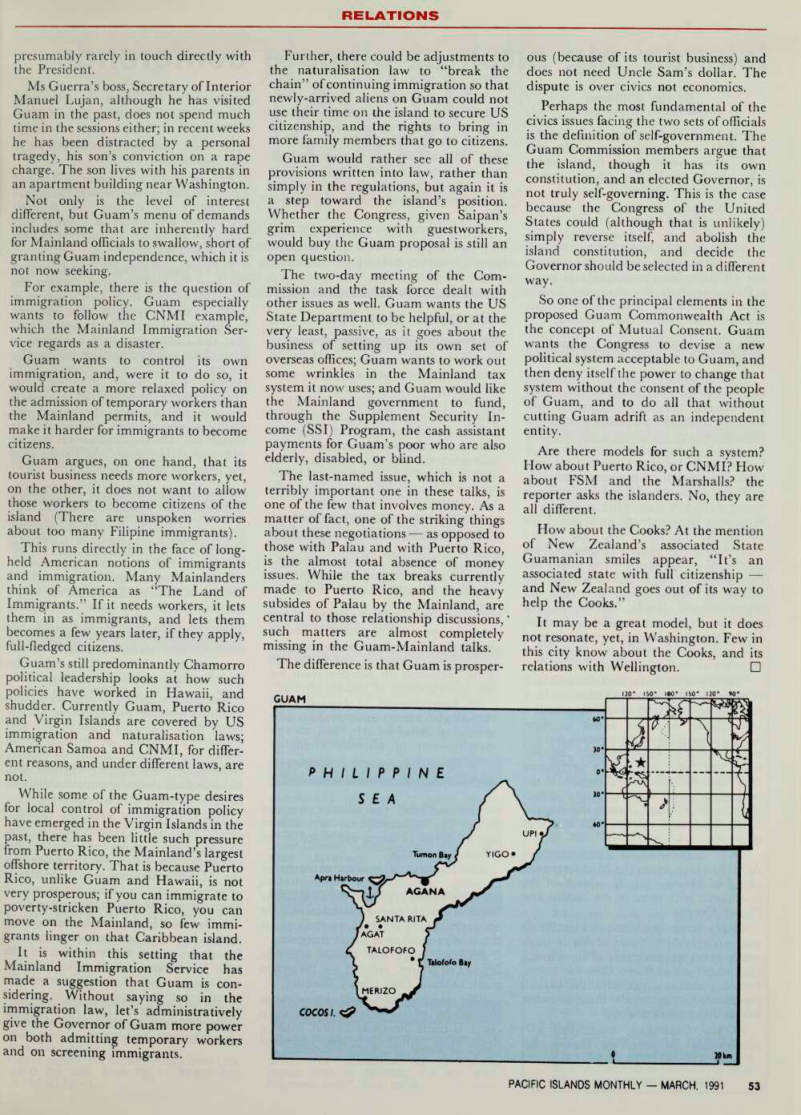
Relations
Working on the differences
In Guam, two sets of officials haggle over self-determination
THERE was significant forward
movement on the issues of immi gration policy and court systems during February’s meeting in Washing ton on Guam’s relations with the Mainland.
The meeting between the Guam Commission on Self Determination, headed by newly re-elected Governor Joseph Ada (Rep.) and a task force of federal officials is one of a series.
The sessions, which were set in motion last year at the suggestion of Congress, are designed to narrow the differences between island leaders and those of the Bush Administration of Guam’s relations with the US.
Guam wants to remain under the US flag, but desires a lot more explicit independence than the Administration seems willing to accept; Congress has told the two groups to reach as much agreement as possible before the House and the Senate make their own decisions about the proposed Guam Common wealth Act.
The courts question provides a good
example of both the inherently difficult process faced by the two sets of officials, and of the progress that was made in February.
Guam wants direct access to the US Supreme Court, and the Bush Adminis
tration (and presumably the Supreme
Court, which, in its Olympian way has not joined the discussions) wants to give Guam’s judges and lawyers a 15-year long rehearsal before having direct access to the highest of the Mainland Courts.
The current situation is that a legal dispute (dealing with Guam’s law or its constitution) is first heard in a territorial court, and then can be appealed to the appellate divisions of the Guam Superior Court.
If one of the litigants want to take the case further up the judicial ladder, it goes to the US District Court for Guam, where it is likely to be heard by a visiting hoale judge. The next step is the Federal 9th Circuit Court of Appeals in San Francisco, and finally, to the Supreme Court in Washington.
That clearly is a long expensive process. Further, as Guam’s lawyers say vigorously, had the same issue started in, say, Texas Courts, the US District and
Circuit Courts would play no role; the case would go directly from the Texas Supreme Court to the US Supreme Court. Guam, they say, should be treated in the same manner the lesser federal courts should stay out of the business of interpreting Guam law. (There’s a Pacific precedent that has not yet surfaced in these dis cussions: before the coup a disputed case in Fiji could go directly from that nation’s highest court to the Privy Council in Great Britain, without being heard in any lesser British Court).
Guam has nothing against the role of the 9th
Circuit if the question is a federal one, involving, for example, a customs or federal drug matter. But if it’s a question of Guam law, Guam wants direct access to the Supremes (as the nine judges, with their life-long appointments, are some times known in Washington).
The Mainland position on the matter was spelled out by the Congress in the
Guam’s menu includes some demands the Mainland finds hard to swallow
Omnibus Territorial Act of 1984, which gave Guam the right to establish its own Supreme Court but said that the decisions of that Court had to be appealed through the current process, of Federal District and Circuit Court, for 15 years.
During this time, presumably, Guam’s courts would mature to the point where they were not sending an undue load of cases to the already overburdened Su preme Court in Washington. (The Su premes, however, have a defence mech-
anism of thir own; unless at least four of the nine judges sign a paper saying that they want to hear a case, they simply accept the decision below without further ado).
Guam did not like the idea of a 15-year-old training period for its court system, and has never established a Supreme Court on the island.
What the US Department of Justice is now proposing is a shorter waiting period, not to exceed 10 years. If, at any
time during that period the presiding
judge of the 9th Circuit concludes that the quality of decisions in Guam is appropriate, then the island gets direct access to the Supreme Court.
While the new federal position is not quite what Guam wants, it is a major improvement on the previous one, and is another sign of incremental progress in
these negotiations.
The proposed Commonwealth Act is, of course, of much greater interest to the Ada Administration than to the Bush Administration.
Ada and his fellow Commissioners (including island Senators Pilar Lujan (Dem.) and Marilyn Manibusan (Rep.) sit all day with a rotating cast of Federal officials, with Assistant interior Secretary Stella Guerra representing Bush, but
Newly re-elected: Guam's Governor Joseph Ada
presumably rarely in touch directly with the President.
Ms Guerra’s boss, Secretary of Interior Manuel Lujan, although he has visited Guam in the past, does not spend much time in the sessions either; in recent weeks he has been distracted by a personal tragedy, his son’s conviction on a rape charge. The son lives with his parents in an apartment building near Washington.
Not only is the level of interest different, but Guam’s menu of demands includes some that are inherently hard for Mainland officials to swallow, short of granting Guam independence, which it is not now seeking.
For example, there is the question of immigration policy. Guam especially wants to follow the CNMI example, which the Mainland Immigration Ser vice regards as a disaster.
Guam wants to control its own immigration, and, were it to do so, it would create a more relaxed policy on the admission of temporary workers than the Mainland permits, and it would make it harder for immigrants to become citizens.
Guam argues, on one hand, that its tourist business needs more workers, yet, on the other, it does not want to allow those workers to become citizens of the island (There are unspoken worries about too many Filipine immigrants).
This runs directly in the face of long held American notions of immigrants
and immigration. Many Mainlanders
think of America as “The Land of Immigrants.” If it needs workers, it lets them in as immigrants, and lets them becomes a few years later, if they apply,
full-fledged citizens.
Guam’s still predominantly Chamorro political leadership looks at how such policies have worked in Hawaii, and shudder. Currently Guam, Puerto Rico and Virgin Islands are covered by US immigration and naturalisation laws; American Samoa and CNMI, for differ ent reasons, and under different laws, are not.
While some of the Guam-type desires for local control of immigration policy have emerged in the Virgin Islands in the past, there has been little such pressure from Puerto Rico, the Mainland’s largest offshore territory. That is because Puerto Rico, unlike Guam and Hawaii, is not very prosperous; if you can immigrate to poverty-stricken Puerto Rico, you can move on the Mainland, so few immi grants linger on that Caribbean island.
It is within this setting that the Mainland Immigration Service has made a suggestion that Guam is con sidering. Without saying so in the
immigration law, let’s administratively
give the Governor of Guam more power on both admitting temporary workers
and on screening immigrants.
Further, there could be adjustments to the naturalisation law to “break the chain” of continuing immigration so that newly-arrived aliens on Guam could not use their time on the island to secure US citizenship, and the rights to bring in more family members that go to citizens.
Guam would rather see all of these provisions written into law, rather than simply in the regulations, but again it is a step toward the island’s position.
Whether the Congress, given Saipan’s grim experience with guestworkers, would buy the Guam proposal is still an
open question.
The two-day meeting of the Com mission and the task force dealt with other issues as well. Guam wants the US State Department to be helpful, or at the very least, passive, as it goes about the business of setting up its own set of overseas offices; Guam wants to work out some wrinkles in the Mainland tax system it now uses; and Guam would like the Mainland government to fund,
through the Supplement Security In
come (SSI) Program, the cash assistant payments for Guam’s poor who are also elderly, disabled, or blind.
The last-named issue, which is not a terribly important one in these talks, is one of the few that involves money. As a matter of fact, one of the striking things about these negotiations as opposed to those with Palau and with Puerto Rico, is the almost total absence of money issues. While the tax breaks currently made to Puerto Rico, and the heavy subsides of Palau by the Mainland, are central to those relationship discussions, * such matters are almost completely missing in the Guam-Mainland talks.
The difference is that Guam is prosper
ous (because of its tourist business) and does not need Uncle Sam’s dollar. The dispute is over civics not economics, r> , , r , , „ . . ? erha P s tbe mos ‘ fundamental of the civics issues facing the two sets of officials definition of self-government. The Guam Commission members argue that the is and , hough it has f ts own constitution> ancl a S n elected Governor, is no , trul S elf.g o verning. This is the cse because the Congresf of the United , uu 5 . ... , .
S,ate , s could (altho^ h that UHhkely) S, " l P l >' reverse ‘. tself > an J d abol ‘ sh tbe island constitution, and decide the Governor should deselected in a different way So one of the principal elements in the proposed Guam Commonwealth Act is the concept of Mutual Consent. Guam wants the Congress to devise a new political system acceptable to Guam, and then deny itself the power to change that system without the consent of the people of Guam, and to do all that without cutting Guam adrift as an independent entity.
Are there ™dels such a system?
How about Puerto Rico, or CNMI? How about FSM and the Marshalls? the reporter asks the islanders. No, they are a u different.
How about the Cooks? At the mention of New Zealand’s associated State Guamanian smiles appear, “It’s an associated state with full citizenship an d New Zealand goes out of its way to help the Cooks.”
I, may be a gre at model, but it does not resonate, yet, in Washington. Few in thu city know ? about , he Cooks, and its relations with Wellington. □
Islands ' big pitch at climate conference
Environment
By Ian Williams
United Nations correspondent PACIFIC Islanders were among the few people happy with the first session of the international body negotiating a new conven tion on climate change.
As initiators of the newly formed Alliance of Small Island States (AOSIS), they made sure the countries most immediately affected by Global Warm ing were not overclouded by the wafts of hot air from less threatened and more polluting nations. But then, the Pacific needs some good news since studies indicate that nations like Tokelau, Tu valu and Kiribati would disappear completely with a one metre rise in sea levels.
The “Intergovernmental Negotiating
Committee for a Framework Convention on Climate Change”, held on the outskirts of Washington DC, follows the Second World Conference on Climate Change held in Geneva last year. It is hoped that by June next year the Committee will have prepared a suitable draft convention on Global Warming in time for the UN conference on Environ ment and Development in Brazil, June 1992.
As the 10-day session finished late on
February 14, unhappy participants in
cluded scientists and NGO’s who felt the committee spent too much time on
organisational details, and developing
and non-aligned nations who disliked the US insistence on vagueness over terms of reference, and resistance to concepts like transfers of technology and finance.
“Some people had a monumental lack of realism. They expected there to be a draft treaty ready by now!” suggested a UN official, who did admit to some disappointment that the meeting did not
move beyond organisational details.
However, there was also a realisation that small differences of direction at the beginning could lead to major conse quences in the end, hence the dogged battle now over matters like terms of reference.
The acknowledged success was AOSIS, which unites the Mediterranean island of Malta, and the islands of the Caribbean with those of the Indian and Pacific Oceans.
“They were much more identifiable and recognisable and of course there was a great appreciation of how much they have to lose,” one observer noted.
Forming almost a quarter of the nations represented, they made their presence felt in an organised way.
AOSIS Chairman, Vanuatu’s UN ambassador Robert Van Lierop, de
scribed it to Pacific Islands Monthly as “An ad-hoc alliance, which grew out of our common concern on this issue at the Second World Climate Conference last year.” He said the two dozen members, “must ensure that our agenda is taken into account our small size sometimes makes people forget what we are talking about.”
AOSIS was able to marshal scientific and legal support which the individual states could not have afforded
themselves.“ With the alliance, we can divide up responsibilities, and ensure that all of our concerns are raised in the
different meetings.”
AOSIS faces a serious problem in
ensuring continuity of representation
over the coming 16 months of intricate negotiations. Many of its members are countries whose budgets are strained by the cost of sending a single delegate.
Professor W Jackson Davies, scientific adviser to Nauru, pointed out there was more at stake than simply flooding.
“No one has paid much attention to the effects of temperature change on coral. It could bleach and kill it, causing dead reefs. And of course increased
temperatures will affect the frequency and severity of cyclones and tropical storms.”
He adds, “because of the threat, we’re very highly motivated!”
As Kiribati delegate Nakibae Teuatabo told the conference, the failure to include commitment to reduced greenhouse gas emissions “would cer tainly fail to ensure the survival of low lying island states”.
Fiji’s delegate, Finau A. Mara, stressed the need for the countries causing the emissions to assist those who were not to make the necessary adjustment. Pointing to Fiji’s record in reafforestation, he said that the Pacific had been subjected to some of the worst forms of exploitation nuclear testing, chemical weapon incin eration, toxic waste dumping and driftnet fishing. Although not covered by the convention, they diminished the ability of the region’s environment to sustain life. The implication was that, as with greenhouse gases, the Pacific paid the price for others’ affluence.
Fiji Wendt, Samoa’s delegate, con sidered the promises of financial aid to developing countries, and reiterated the theme that promises of money would be in vain if those nations were the first to become extinct.
The conclusions reached late on the last day of the session reflected the tough
battles fought by the developing
countries and AOSIS. It set up two working groups, one to consider the scientific and technical aspects of the proposed convention and the other the broader legal and social aspects.
Concessions gained by the developing
countries included an unequivocal state ment that “Funding mechanisms and means for transfer of technology to developing countries, as well as matters concerning international scientific and technological co-operation should be an integral element in the negotiations.”
The UN General Assembly had de cided that the Committee’s Bureau should have representatives of each of the
five major UN geographical regions, but
the AOSIS’s presence was such that it secured a promise of consultation and at least informal representation.
By the end of the session around 51.5 million had also been pledged to the fund for ensuring the representation of the least developed and small island countries through the next three sessions scheduled to take place in Nairobi or Geneva. Altogether, it is a promising start which will help the low-lying islands maintain their high profile. □
Six point plan for
the environment
1) Immediate and significant cuts in- the emissions from industrialised countries of carbon dioxide and other greenhouse gases into the atmosphere. 2) A preventive approach based on
the precautionary principle which
mandates the global community take action now, even in the face of some scientific uncertainty as to the rate
and degree of global warming;
3) New and equitable funding mechanisms which recognise the need to compensate low-lying, coastal and small vulnerable island countries, some of whose very existence is placed at risk by the consequences of climate
change;
4) The expeditious and equitable transfer of environmentally sound
technologies;
5) Applications of the “polluter
pays” principle on compensation for
the consequences of climate change; 6) Commitment to binding and meaningful energy conservation and efficiency requirements, and to the development of alternative energy sources. □
Advertisements & other items, pp. 55-56 (1 item)
Pacific
ACIFI
ISLANDS
Q~ N T H L Y fiRK€T PLfiC€
For the benefit of our readers who would like to place a small classified advertisement in our magazine, Market Place will assist you in selling personal items, accommodation, real estate, boating or a service ... in fact anything you would like to sell to our over 50,000 readers.
Market Place Advertising Rates are structured to allow you to place as many advertisements as you wish, economically.
“DISTRIBUTORS WANTED”
Franchise are available, in the Pacific Islands region to persons or companies interested in distributing a new patented inflatable snorkeler float. Suits all ages, makes snorkeling an effortless pleasure. Ideal for tourist resorts, snorkel tour operators, island cruises and dive shops. For further information please contact Snorkeler Fun Float Pty. Ltd., P.O. Box 1072 Townville, Queensland Australia, 4810., Phone (077) 212109 Fax (077) 211420”
DISTRIBUTORS SOUGHT
Computer furniture manufacturer seeking energetic distributors keen to exploit the potential of their range of quality products throughout the Australiasia Pacific Region.
Please contact; Woodraft Sales, Australia Fax: 61—9— 332-8105
IMMIGRATION
Applications for immigration to U.S.A. Canada, Australia, New Zealand, EEC, prepared by ex-immigration officer established in business since 1985. CWWAD P.O. Box 282, Mawson, Canberra, A.C.T. 2607, Australia.
Fax: 61-06-2865252’
DISTRIBUTOR WANTED
Manufacturer of a line of spray aerosol products that speed production in the garment factory: Silicone Spray, Spot Lifter, Pattern Adhesive, Emery Sharpening Stone Wheel Cleaner, Fusing Machine Cleaner, etc.
Write Sprayway, Inc., Addison, IL
60101-4468, FAX 1 (708) 543-7797.
OVERSEAS FUNDING
Unlimited overseas funding for any National Government and private company's viable projects. No front fees. Send proposal to Pan Asia Management Consultants Center Box 4295, BOROKO, NCD, Papua New Guinea.
CORRESPONDENCE
Sincere, eligible Australian gentlemen wish to correspond with Pacific ladies, all ages/ races. Free registration. For full details, please write to: ASIAPAC, PO BOX 231, Maylands 6052, AUSTRALIA.
COAAAAERCIAL PRINTING
Top quality four colour printing, brochures, posters, packaging, product labels, fabric labels, billboards, books, magazines, stickers, books. Export quality. Contact Fiji’s most experienced Commercial Printers. FIJI TIMES COMMER- CIAL PRINTING. P.O. Box 1167, Suva. Fiji.
Phone: 304111 Fax. 301521.
SELF ADHESIVE LABELS
FORUM LABELS (FIJI) LTD
P.O. Box 1167, Suva., Fiji. Phone: 304111 We print self-adhesive labels in rolls, multi-coloured labels with hot foil, and die cut to shape, tickets and tags in rolls. We also supply labelling machines and fabric labels.
CAREER
A pilot career? “Becoming a pilot in the 1990’5” has full details training, civil, air force,' jobs, airlines, helicopter! Send NZ523.45 to aviation professionals, Box 28051, 6A Benson Rd, Remuera, Auckland, NZ. Phone/Fax (64-9) 5221330, Cheque, Visa, Bankcard.
MARINE DIESEL SPARES NE
Very large range for older Gardiner, Ruston- Hornsby, Mirrlees, Dorman, Paxman, Crossley, Perkins, Hercules, Meadows, Sulzer, English Electric, Southern Cross, Foden and more. Write for stockist:- K.
COOMBER, P.O. Box 589, BURWOOD 2134,
AUSTRALIA 61 2 736 2449.
OPTICIANS AND OPTOMETRISTS
Spectacles, Contact Lenses, Sunglasses.
See JEKISHAN & JEKISHAN, Epworth House, G.P.O. Box 285, Suva, Fiji. Ph 311002 Fax (679) 411898.
DISTRIBUTOR WANTED
Manufacturer of Ball point pens and disposable Gas Lighters.
Please contact JNJ CORPORATION (FUI) LTD, G.P.O. Box 285, Suva, Fiji. Ph 39400 Fax (679) 411898.
JEEP TIRES
Jeep Tires * Heavy duty military surplus, 6ply nylon, 700 x 16LW on rims. US $25.00ea or five/US$lOO.OO. Quantity discount available. On Maui, Hawaii 808-572-0462
IMMIGRATION
Migrate to Australia with our expert assistance. Businessmen/skilled people/teachers/professionals send details in confidence. CKP AUSTRALIA, Box 2252, Canberra ACT 2601, Australia.
PACIFIC
SLANDS
I'm o n t h l ~y~ I MflflK€T PlflCC CRN WORK
WON OCRS FOR VOU ...
Promote your business, or service, sell your household
items, cars or heavy machinery
etc.
ONLY AUS$1 PER WORD.
NO COMPANY LOGO. NO
DISPLAY. NO BOLD TYPE.
Just forward your Advertisement together with payment to: PACIFIC ISLANDS MONTHLY “Market Place".
P.O. Box 1167, Suva. Fiji.
CONDITIONS:
1/ All Advertisements are subject to acceptance and approval of publisher. 2. Advertisements are published as space permits; we cannot guarantee date of insertion. 3. All advertisements must be prepaid and should be typed or printed clearly. 4. Deadline for receipt of advertisements is the 10th of the month prior to issue.
5. PACIFIC ISLANDS MONTHLY
assumes no responsibility for any service other than publishing paid advertisements in this section.
An Eye to Total Safety
m mama ■ * mm.
For Mitsubishi Motors both passive and active safety have equal importance, and rather than being added ingredients, are guide-lines that every component, system and stage of design must follow.
This approach to total safety involves exhaustive and innovative research methods, particularly into the physical reactions of motorists to various driving situations.
In designing the Galant, for example, Mitsubishi’s engineers mapped what drivers looked at while cornering. They found that drivers of some cars had much narrower fields of vision, indicating a high level of tension due to poor vehicle handling.
By comparison, their tests with the Galant and its integrated drive system, Dynamic-4 showed, that with better handling, wider Vision tracking shows how the Galant’s superior handling results in lower driver tension indicated by a wider field of vision. fields of vision indicated lower levels of tension in the driver.
Using advanced technology to define and attain safety standards is further evidence of Mitsubishi’s guiding principle of answering the needs and preferences of today’s drivers an on-going philosophy of putting technology to work for you.
MITSUBISHI GRLRNT
A
MITSUBISHI
MOTORS
AMERICAN SAMOA: PACIFIC MARKETING INC. P.O. Box 698, Pago Pago, Tel 699-9140/AUSTRALIA: MITSUBISHI MOTORS AUSTRALIA LTD Box 1284, South Road, Clovelly Park, South Australia 5042, Tel (08) 275-7297/ FIJI: NIVIS MOTOR & MACHINERY CO., LTD. G.P.O. Box 150, Suva, Tel. 38341 1 /FRENCH POLYNESIA (TAHITI): SOPADEPS.A. P.O. Box 1617, Papeete, Tahiti, Tel. 4-202-58/NEW CALEDONIA: SOCIETE D'IMPORTATION D'AUTO DU PACIFIQUE SUD S.A. B P 438 Rond Point du Pacifique, Noumea, Tel. 274144/NEW ZEALAND; MITSUBISHI MOTORS NEW ZEALAND LTD. Private Bag, Porirua, Tel, 370-109/NORFOLK ISLAND; BORRYS PTY. LTD. P.O. Box 169, Norfolk Island, Tel 2114/PAPUA NEW GUINEA; TOBA PTY. LTD. P.O. Box 503, Port Moresby, Tel. 21-7874/SOLOMON ISLANDS: HARVEST PACIFIC LTD. G.P.O. Box 823, Honiara, Guadalcanal, Tel 30128/TONGA: SITANI MAPI CO., LTD. P.O. Box 83, Nuku’ALOFA, Tel. 24-044/VANUATU; SOCOMETRA B.P. 06 Route de Lagon, Port-Vila, Tel. 2314/WESTERN SAMOA; MOTOR DISTRIBUTORS LTD. P.O. Box 576, Apia, Tel. 20957/SAIPAN/POHNPEI/MAJURO/KOSRAE/TRUK/YAP/BELAU: MICRONESIAN MOTORS, INC. 997 South Marine Drive, Tamuning, Guam 96911, Tel. 646-6827