Advertisements & other items, pp. 1-2 (2 items)
line |
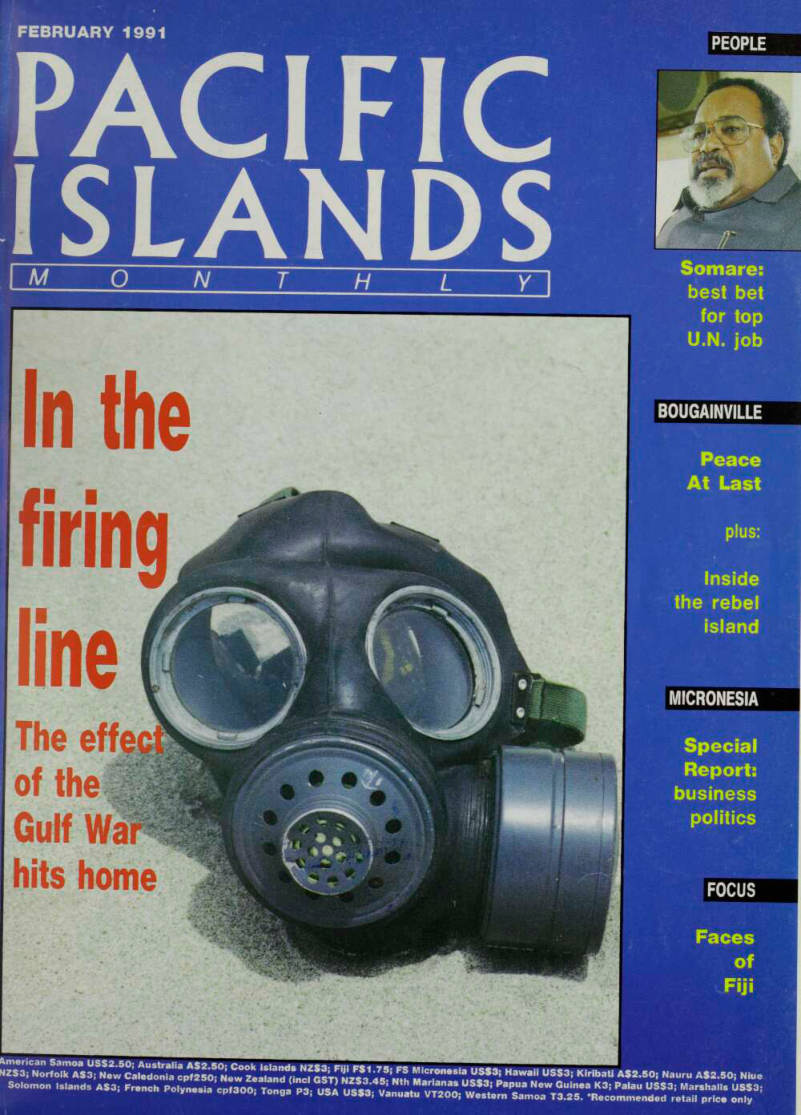
PACIFIC
ISLANDS
MONTHLY
FEBRUARY 1991
In the
firing
line
The effec\ of the Gulf WaPa hits home
PEOPLE
Somare: best bet for top U.N. job
BOUGAINVILLE
Peace At Last plus: Inside the rebel island
MICRONESIA
Special Report: business politics
FOCUS
Faces of Fiji
Micronesia US$3; H.w,„ US S3i K. rib a« A 52.50, Nauru A 52.50, N,ue Solomon lalanO, A S3i F re„c h ’o P ,3o^i%'^
Abe Endless.
incniMimunts
Ss&i
wl*
EZHZZHZEQa
S 100
1C CARD SYSTEM
A flat-key version SF-9000 is also available
• Unlimited Memory Capacity
Each optional ES-100 RAM card provides an additional 64K8 of external storagejwith memory
backup.
• Expanded Application Software
■ ES-600* Spelling checker and Thesaurus dictionary ■ ES-610* Spelling checker with financial and legal terms ■ ES-620* Spelling checker with medical terms ■ ES-630** Casio Power Spreadsheet by Lucid® 3-D (available soon) ■ ES-800 Travel Conversations English-Spanish (available soon) Many more 1C cards will soon be available.
• Compatible with IBM PCs
Using the interface unit, you can link the SF-9500 with an IBM PC*** SFD TOOL-B (MF-4000) is also available for even wider use with IBM personal computers.
• Wide Range of Database Software
Database software are floppy disks storing special information for the SF-9500. Four Databases software varieties are currently available, with more to follow. They are: MF-10, MF-11, MFand MF-13, all are loaded with business and travel information for the world’s major cities. • Easy, Portable Printout of Stored Data With the optional CP-9 Copy Pen, you can print SF- -9500 data into a notebook. Or use the CP-9 as a compact copier to transfer data from any text onto almost any kind of paper.
Copy Pen CP-9 ► * International Correct Spell system, Electronic Thesaurus, Right Word Usage Alert and Abbreviation Expander developed by Houghton Mifflin Company, publishers of the The American Heritage Dictionary and Rogel’s U: The New Thesaurus. *“ Lucid® 3-D is a registered trademark of PCSG, Inc.
'** IBM is a registered trademark of IBM Corporation. Use limited to certain models. Refer to catalogs and other materials for list of applicable personal computers.
AUSTRALIA MOBEX PTY. LTD.
UNIT 1, GIBBES STREET
CHATSWOOD N S W. 2067
FIJI ISLANDS BRULAL & CO., LTD.
G.PO. BOX N 0.362
SUVA, FIJI ISLANDS
CALEDONIA BRECKWOLDT SARL
8P2369 NOUMEA
NEW CALEDONIA
MENARD PACIFIQUE
10 RUE JEAN JAURES
8P3899 NOUMEA, NEW CALEDONIA
NEW ZEALAND MONACO CORP. LTD.
41 POLAND ROAD, GLENFIELD
AUCKLAND, NEW ZEALAND
NORFOLK ISLANDS BURNT PINE TRADERS LTD.
P.0.80X21, NORFOLK ISLANDS
PAPUA NEW GUINEA SENGCO NIUGINI PTY. LTD.
PO. BOX 1886, BOROKU
PAPUA NEW GUINEA
TAHITI MAISON AUROSE
30, RUE COLLETTE
PAPEETE, TAHITI
VANUATU FUNG KUEI
P.0.80X51, PORT VILA
VANUATU
CASIO COMPUTER CO., LTD.
Tokyo, Japan
Pacific
Islands
Monthly
Vol 61 No. 2
Voice Of The Pacific
February 1991
Cover
Special
Focus
Cover Stories:
□ In the Firing Line: Our men in the Gulf, Sinai and Lebanon. 2s : The wives at home. 24
The Region:
□ Inside Bougainville. In the struggle for freedom, supplies have been running out and women and children have been dying. A special report by Alfred Sasako, first journalist to enter Bougainville since the blockade eight months ago. 1 9 Lj Operation Sumare: Despite Bougainville, strong Asian support is tipped to put Sir Michael Somare in the top United Nations job. 22 SPECIAL REPORT: Free at Last! The United Nations Security Council has moved to cut US colonial ties with three Pacific Trust Territories. But reactions have been mixed. 10 BUSINESS: Six Pacific Island nations have received good grades in the World Bank’s report card on the relative standings of world nations. 33 TRAVEL: Forty years later, yellowing files reveal a possible blemish on Qantas’ glowing record. 39 SPORT; Despite the budget blow out from the Third Melanesian Cup, soccer pundits claim the gains were worth it. Samisoni Kakaivalu reports. 45 FOCUS: Artist Helen Averley looks at a secret that slumbers south of Viti Levu in Fiji. 26 BOOKS: Jane Dibblin’s book looks at the high human price paid in the Marshall Islands for US nuclear testing. 48
Publisher; Geoffrey Hussey Editor: Jale Moala Assistant Editor: Beryl Cook Correspondents: Al Prince, Angela McCarthy, David North, David Robie, Diana McManus, Dykes Angiki, Frank Senge Franc Madeouf, Irene Nisbet, John Hunter, Karen Mangnall, Lito Vilisoni, Macel Manua, Nicholas Rothwell, Pesi Fonua, Richard Dinnen, Ulafala Aiavao, Wally Hiambohn Business Correspondent: Robin
Bromby. Columnists: David Barber (Wellington), Futa Helu (Tonga), iemima Garrett (Sydney), Margot v N 'Neill (Washington) Advertising Manager: Lionel Heffernan Advertising Sales: • Fiji: Salendra Narayan, Tel (679) 304111, Fx (679) 303809 • Sydney, Melbourne: Fergus Maclagan, Tel (61-2) 4134689, Fx (61-2) 4123918 • Brisbane; Robert Walker, Tel (61-7)
3710533 • Adelaide: Hastwell Williamsons Rep resentations, Tel (61-8) 799522 • Japan: Universal Media Corporation, Tokyo, Tel (3) 6663036, 6663094, Cable: UNIMEDIA Tokyo, Tx 2524665 Founded 1930 (USPS 952480). A Fiji Times Limited production.
Cover prices are recommended retail only. Registered by Australia Post, Publication No. NBP 1210. © Copyright
Fiji Times Limited, 117 Victoria Parade, Suva, Fiji. Tel (679) 304111, Fx (679)
303809, Tx Fj2124.
Pacific Islands Monthly is published monthly by Fiji Times Limited, a division of Nationwide News, 2 Holt Street, Surry Hills, Sydney, NSW 2010.
Send address changes to: • Pacific Islands Monthly, PO Box 1167, Suva Fiji.
Typeset and printed by Fiji Times Limited, 117 Victoria Parade, Suva, Fiji.
Letters
Radio New Zealand replies
RADIO New Zealand In ternational’s shortwave service to the Pacific is providing a vital service and efforts are continuously being made to improve it.
The recent report of difficulties in Pacific Islands Monthly was distorted and groundless.
Radio New Zealand has made no secret that there have been teething difficulties with the new 100 kilowatt transmitter and that, in the first year of operation, some budgetary and operational matters are still being worked through with the Ministry.
The unidentified author of the published report infers that Radio New Zealand International is on the point of collapse and that is totally irresponsible and incorrect. RNZ and MERT (Ministry of External Relations and Trade) confirm their commitment to maintaining and developing Radio New Zealand International’s services because of the important role it plays in giving New Zealand a louder and clearer voice in the Pacific.
There is no disagreement about the
funding and operational arrangements for the service and officials are simply
working constructively together to
develop the most appropriate structure which meets the particular needs of a very new shortwave service. To suggest otherwise is grossly misleading and misrepresents the considerable efforts of both the Ministry of External Relations and Trade and Radio New Zealand.
We deplore the fact that Pacific Islands
Letters To The Editor Must
include writer's full name, address and home telephone number. All letters may be edited for purposes of clarity or space.
Letters should be addressed to: lslands Monthly PO Box 1167 Suva Fiji Islands OR Fax: (679) 303809
Monthly has published an article whose author is unidentified, which does not source its information, and for which comment from either RNZ or MERT was not sought.
Radio New Zealand International has been broadcasting since late January and, despite losses of transmission, its news, sport and programming have been warmly received in the Pacific and around the world. Around the South Pacific, RNZI news broadcasts in 14 Pacific languages are regularly relayed by radio stations in the region and programmes are recorded by broadcasters from Papua New Guinea to French Polynesia and Hawaii.
In short, and despite teething problems, Radio New Zealand International is already accomplishing its role effectively and reaching a range of audiences which had not heard New Zealand’s voice.
GK Ansell,
New Zealand Secretary of External Relations and Trade.
Beverley A Wakem, Ch ief Executive’
Radio New Zealand Limited
Advertisements & other items, p. 4 (1 item)
sdfdfd
Remember your Friend
There arc times in your life when you feel your friends have been missing out on something good. Now’s your chance to do something about it and share with them one of the good things you have. Buy your friend a subscription to Pacific Islands Monthly and let him or her join you and the thousands of other people worldwide who arc kept informed of the latest political, social and cultural changes taking place in the Pacific.
PACIFIC
SLANDS
|~M ON T H L
Please send my friend Pacific Islands Monthly for one year (12 issues).
I enclose my chequ ? for $ (made payable to Pacific Islands Monthly) or debit $ to my: □ Bankcard □ Visacard □ Mastercard Card No: I I I I I I I I I I I I I I I [Expiry Date
NAME
SIGNATURE
MY FRIEND'S NAME
MY FRIEND’S ADDRESS
CITY COUNTRY
Futa Helu
Tonga and the chosen ones
the islands
TONGA is unique in the Pacific. She is the sole survivor of the many South Seas kingdoms, all of them swallowed by that colossal wave of imperialism which swept across the Pacific in the 17th and 18th centuries. By conservative dating, she has had a continuous kingly line since the 10th century AD.
And spared of the traumatic experience of being colonised, in the strict sense of the term, by a great power, her people do not have the Caucasian-phobia and inferiority complex witnessed everywhere else in Oceania especially in Micronesia and north-western Melanesia at least not to the same irrational and ridiculous degree. If anything, Tongans really look down on, and even pity, the white man.
That is why Tongans and Europeans get on very well they both feel sure of being the greatest guys on earth.
This is a mentality I call feudal, i.e., when at home and amongst his fellows, such a person usually cuts a pathetic, grovelling, cringing little chap, but when among foreigners and in other lands, he becomes lordly and supercilious. It is understandable in Tongans but surprising in Europeans who, one would think, should have shaken it off a long time ago.
It must be one of those things that joins the blood. Given time though, it is an unconscious, socially-induced penchant for revenge on an unknown (and unknowable) target.
During those long centuries when Tongan society was evolving towards its classic form, it also was becoming rigidly heirarchical. And although there are many different groupings and sub-groupings in Tongan society, we can be
justinect irom a purely political point of view, i.e., from the power struggle point of view in dividing society here into the chiefly and the commoner classes. Further, political intrigue being the normal occupation of chiefly classes, they saw to it that commoners learnt well to know their place.
This was achieved not merely by the use of superior physical force, but also by an evolving body of religious and social psychology. The chiefly classes’ success here was so complete that most commoners today really feel in themselves a passion to be pushed around (and even abused) by a chief or
chiefs. To them it would constitute the rarest ofhonours and give significance to their lives. This accepted submissiveness is really a socialised and time-honoured wretchedness which underlies every aspect of the traditional Tongan character.
But as all things shall be made new,” many things were changing in Tonga. In fact, it’s only recently that they’ve been discovered to be changing. First, the missionaries and a minor group of chiefs began to work together, in the first two decades of last century, for their mutual benefit. Their coalition brought a revolution which swept away the old polity and established Tonga as a sovereign nation along
modern lines. Yet, important “feudalist” traditions similar to vassalage and fealty persisted and modified the modernist (capitalist) undisturbed enjoyment of private property, for instance impact of the changes.
The important result, however, was the devolution of power on to the church new monarch alliance. The monarchy, legally a constitutional one, became, in practice, well-nigh absolute, albeit beneficient, finding an ideal locus behind a bulwark of feudalist nobility. And the church (in this case, the Wesleyan) has been the major influence on government policy. But the proportion of power held by each party has never been in doubt the church holds the lion’s share.
Let us mention some of the major factors contributing to the new Tonga; the opening up ofTonga to the outside world and vice versa with the concomitant implications of migration, the fastly expanding cash sector and corresponding shrinking subsistance sector in the economy, a growing educated elite group, and the emergence of a middle class made up substantially by a salaried class of very highly paid government officials. The growing divergence between monarchy, aristocracy on one side and the churches on the other, in certain areas of policy and other matters of public concern is probably not a cause of the change but a manifestation of it. But it is still replete with significance from a historical point of view since modern Tonga was only possible through an alliance between chiefs and church. To say it in a clumsy pun: the chiefs cannot burn their boat, for in Tonga, the ship ofstate was the church.
And there is also the matter of structural changes sponsored and pushed by young representatives of the people in our parliament. Their style of politics is white man’s (New Zealand, Australian, British) as opposed to Tonga parliamentry behaviour where a commoner is bound by Tongan custom to go along with whatever the chiefs and authorities say. These young MPs, however, would like to see a more democratic situation in parliament in particular and government in general, though they forcefully stress they would never want to see the monarchy go.
But one cannot help but believe in the genius of a people that has
managed to remain unimpaired
and serene admist all the anguish and terrifying ordeals that other Oceanic communities had to go
through. It is a truly unique
history. Moreover, Tonga
compared superbly favorably
with other Pacific islands in matters of free speech and general human rights. For example, one wonders how a Samoan parliament would react to a vitriolic ‘Akilisi Pohiva in their Fate Fono we know he wouldn’t
last one minute in the Fiji parliament. And yet, I also believe that the whole destiny of this ‘chosen race’ now rests with how the authorities fmetune the changes, the new attitudes, and the new demands of the people.
It might come as a surprise to Tongans that ‘chosen’ or not, they too have, like other ‘chosen races’ of history, to go through natural (as opposed to idealised) steps in their evolution, that in history also there is no such thing as a free lunch. Most important of all, we must heed two particular lessons of history which are: we cannot do what we like, and, we do not know what we are doing. □
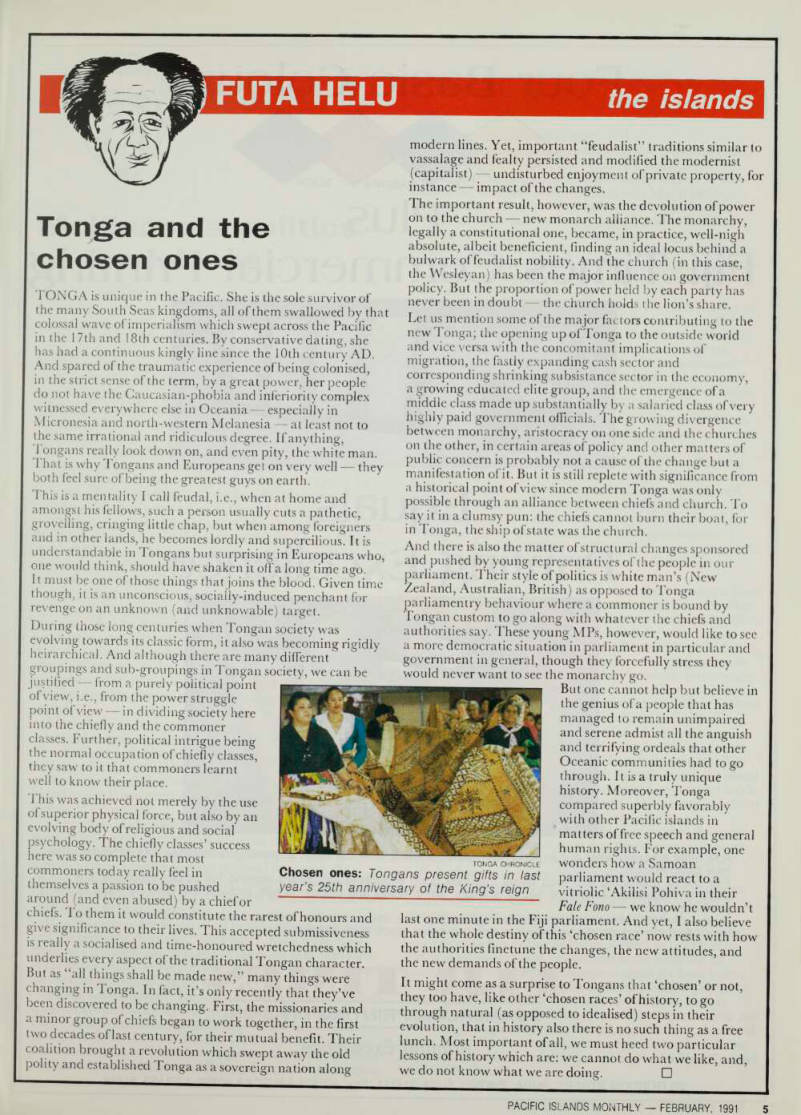
Tonga Chronicle
Chosen ones: Tongans present gifts in last year's 25th anniversary of the King's reign
Advertisements & other items, p. 6 (1 item)
Equals
Four Basic Colours
CYAN
BLACK
YELLOW
MAGENTA
Plus
Fiji Times Commercial Printing
umHßone as ill! 11l *
Equals
Printing Excellence
' m It is quite amazing what our experienced master printers, with the latest in printing technology, can produce from four basic colours.
Full colour packaging and food labels that look good enough to eat; award winning full colour brochures and posters: magazines, calendars, books, stickers, fabric labels and billboards with pictures that leap right out of the printed pages.
If your product requires export-quality, high impact four colour printing, then you should be talking to us first.
You’ll find our prices very competitive and our paper stock quite extensive.
FIJI TIMES
COMMERCIAL PRINTING DIVISION
Printing Excellence
20 GORDON STREET, SUVA. PHONE: SUVA 314111. Fax: 301521 LAUTOKA 60352. LABASA 81644.
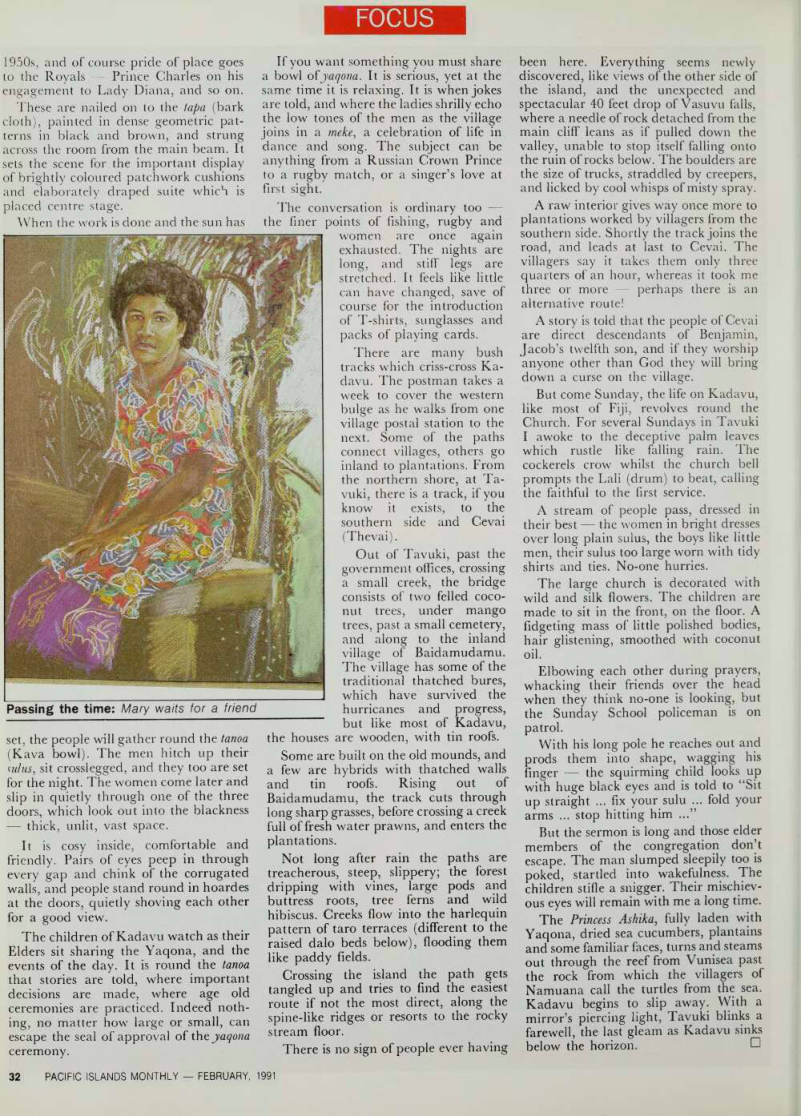
McKinnon’s politics
David Barber
McKinnon’s politics of the islands
Wellington notes
THE decision of New Zealand’s new Minister of External Relations and Trade, Don McKinnon, to drop his visiting card in the South Pacific before travelling anywhere else was a welcome one. With the exception of Russell Marshall, his predecessors have never used their physical presence to pay the region the attention it deserved given the geographical reality of New Zealand’s location.
For years, foreign ministers and other New Zealand politicians showed a marked preference for hot-footing it to London and other European centres a preference that paid only lip service to their oft-repeated claim that New Zealand was a Pacific nation. It may be early days to deduce that this is all about to change, but at least the readiness of McKinnon, who is also Deputy Prime Minister, to give up part of his January holiday to visit four Pacific island states and New Caledonia was a step in the right direction.
The fact that he decided to take Defence Minister Warren Cooper and the Associate Minister of Pacific Island Affairs, Roger McClay, with him was added evidence that New Zealanders may be ready to take the region it often cavalierly refers to as its “backyard” a bit more seriously.
One can only say that it’s about time.
When Fiji’s Prime Minister Ratu Sir Kamisese Mara complained in Malaysia late last year that Pacific Island states were tired of being neglected by New Zealand and Australia, it was clear that he was still rankled by criticism of the military coups. But nevertheless there was more than an element of truth in his accusations of “benign neglect” and advantage-taking by the two developed countries of the region.
Most observers accept that in developing shipping, air services, banking, tourism and what was often one-way trade, New Zealand and Australia had the best of the relationship with the island states. While New Zealand, particularly, did make a major contribution in terms of educating the Pacific island’s elite, it was never a true partnership. The attitude remained avuncular.
The politicians headed for Europe, the island’s governments were often not consulted on major international issues that concerned them as much as anyone else, the diplomats didn’t bother to learn the local language, the traders took but rarely gave and the tourists concentrated in beach resorts that offered the comforts of home, different only in that they were sun-blessed.
None of them made much effort to understand the countries and the people in their own “backyard”. Even when New Zealand s demography changed to the point that one in five of the population was Polynesian, thinking remained centred on the opposite side of the globe.
Things have changed. There is a Maori renaissance (which admittedly still has a long way to go) and the growing Polynesian population is making its presence felt. There has been a revolution in New Zealand schools (which ironically could be set back by McKinnon’s government) and children are learning about Maori and Polynesian culture to a degree
that their parents do not comprehend.
There is a growing consciousness of who New Zealanders are and where they are. New Zealand’s young are more culturally sensitive than their mothers and fathers they have to be, they are in daily contact with Maori and Polynesians to an extent their elders never experienced.
This consciousness has been slow to manifest itself in a number of key areas. The universities have lagged, and despite the long overdue establishment of centres for Pacific Island studies in Auckland and Christchurch, there is still no Pacific Island language faculty in the former, the largest
Polynesian city in the entire region.
The business community has not seen it fit or necessary to make the sort of endowments that established Australia’s Research School of Pacific Studies in Canberra. The media has, with one or two exceptions, failed to encourage the development of Pacific expertise among its reporters and commentators. Meetings of the South Pacific Forum are junkets for Wellington’s Parliamentary Press Gallery rather than one of the year’s outstanding news events.
There is much ambivalence about New Zealand’s South Pacific consciousness, which has been aggravated by events of recent years.
The Fiji coups posed a major problem for New Zealand policymakers, one they have not yet adequately dealt with.
McKinnon made a move to restore relations when he met Ratu Sir Kamisese in Auckland, a meeting followed up by the inclusion of Suva in his Pacific itinerary. But his refusal to restore military assistance, while olfering to resume maritime surveillance flights, reflects the continuing concern of many New Zealanders about the coups and the new constitution.
Similarly, New Caledonia has long posed a dilemma. How far should New Zealand go in supporting the Kanaks, when such a stand could cost it dearly in terms of trade with France and the rest of the European Community?
But it is becoming harder for New Zealand to avoid facing up to these and other issues, especially with a perception in Wellington and the island states that Australia, increasingly seeing itself as a world middle power, has other preoccupations. This gives, the argument goes, New Zealand all the more reason to adopt a positive role in the Pacific if only it can clearly identify what that role should be.
Wellington bureaucrats made it clear, in briefing papers for the new government, that they feared regional stability could still be upset by the economic struggle facing the island states. They warned that overall trade and investment levels had to be enough to head off economic decline into instability such as had been seen in Africa and elsewhere.
McKinnon is aware that New Zealand’s aid to the region has dropped to a pathetic level, but the economic situation at home is so bad he will not get more money to lift this. He will also have to can proposals to open new diplomatic missions in French Polynesia and Hawaii, moves that were seen as vital to maintain New Zealand’s influence and
understanding of developments in the region.
McKinnon may have been unwise to dismiss the former government’s South Pacific Policy Review as lightly as he did, suggesting it should be confined to the archives. Its sweeping and numerous recommendations my have been a bit over the top, but it contains a wealth of information and the way the review team was received by Pacific leaders showed they welcomed the study as evidence that at least one of the major regional powers was prepared to stop, listen and learn. His own ministerial debut tour shows that he has not rejected that course and that has to be good for New Zealand and for the Pacific. □
Margot Oneill
A new world disorder looms
SOME members of Washington’s Army of International analysts are warning that the future of the American-led western security axis, which has sheltered the South Pacific since World War 11, could be recast by the outcome of the war in the Persian Gulf.
While not a popular view, there are several scenarios including the worst-case possibility that the war could transform President George Bush’s vision of a “new world order” into international disorder undermining future
American leadership.
Even if the United States and its 28 allies in the Gulf, including Australia and New Zealand, score a relatively
quick military victory over Iraq, a post war crisis looms that could cripple hopes
for stability.
The political and economic fallout will ravage the region and linger ambiguously throughout the rest of the Third World which again witnessed many of the richest nations rally to protect the status quo.
Washington
The White House argues that, by overturning Iraq’s savage occupation of Kuwait and obliterating Saddam Hussein’s regime, it will deter future international aggression.
It believes the anti-Iraq coalition is vivid evidence of how governments can co-operate in the wake of the Cold War, uniting countries as disparate as the Soviet Union, Egypt, Canada, Syria and New Zealand, while also elevating the role of the United Nations.
This is the basis for President Bush’s “new world order” first promulgated when the Soviet block collapsed and the world was briefly gripped by euphoric relief.
While its nascent diplomatic potential is now engulfed by war, the conflict has enabled New Zealand’s conservative government to improve its standing in Washington.
It could return the South Pacific to the backwaters
Keen to heal the trans-Pacific rift over its anti-nuclear policies, Wellington has sent medical staff and three transport planes to support allied troops.
After New Zealand last supported US military action by backing the 1989 invasion of Panama in the United Nations, its then Foreign Minister, Michael Moore, was taken out of the US State Department’s deep freeze and given a face-to face meeting with Secretary of State, James Baker.
While resisting the early American preference for ground troops, Australia quickly dispatched two frigates and a supply ship. It has now also sent mine clearance and medical teams and is utilising the Narrungar communications installation in South Australia.
The fate of the tiny desert shiekdom of Kuwait could have remained as remote to the South Pacific as civil war in Eritrea if its major export had been carrots.
But it is oil. And the United States has staked its reputation as the world’s only superpower on Kuwait’s liberation.
While most experts predict a US military victory, the possibility of failure raises concerns about an exhausted US unable to act as effectively on the world scene.
Such an outcome would inevitably weaken American public resolve for foreign military commitments especially in the wake of Vietnam, and could necessitate a more
prominent regional role by Australia
and New Zealand.
More likely is that the post-war fallout could skew American priorities.
Even without on-going low level conflicts or threats requiring a continuing US military presence in the Middle East, the need to reconstruct Kuwait and Iraq and compensate
neighbouring countries such as Jordan will spur a political and financial preoccupation with the region.
Diplomats in Washington fear that American aid to the South Pacific could be affected at a time of burgeoning economic problems which will be exacerbated if oil prices soar.
South Pacific nations have enjoyed unprecedented access at the White House under the Bush administration which convened the first ever conference of island leaders addressed by a President last year. While diplomats believe the war is likely to have little impact on American military support for the region, it could return South Pacific interests to the backwaters of US foreign policy priorities from which they only recently emerged. □
Consumer panic
not necessary
FOOD and petrol supplies are un likely to be affected by the Gulf War, unless the crisis continues for a lengthy period, according to two key groups.
A spokesman for Morris Hedstrom said that supplies had not been affected by the crisis and there was no need for customers to stockpile.
The General Manager for Shell South Pacific, Joe Mar, said swings in the price
of crude oil had not been dramatic.
In July the price was $23 per barrel.
Three days after Iraq’s invasion of Kuwait on August 3, the price went up to $3O per barrel. In September and October it went up to $44 per barrel, but by the first week in January it had dropped back to $25. It then rose to $3O just before the deadline of January 15.
By January 16, when the Allied Forces looked like walking over Iraq, the price collapsed back to $22 per barrel and dropped to $l9 then $lB per barrel.
“It is impossible to make predictions the price of crude oil is as volatile as the situation in the Middle East,” Mar
said. “However, there is no need to panic. The price hasn’t even hit $5O so far. In the early 1980 s it went up as high as $5O per barrel with OPEC’s restricted quota.”
He said there was enough oil in the system to cover a short-term war, of up to two months.
“The only danger would be if the war was a long, drawn-out one; or if the Saudi Arabian oilfields were destroyed.
If the war is drawn out, there is still the capacity to produce and the fluctuation would probably only be by a narrow
margin.” D
Advertisements & other items, p. 9 (1 item)
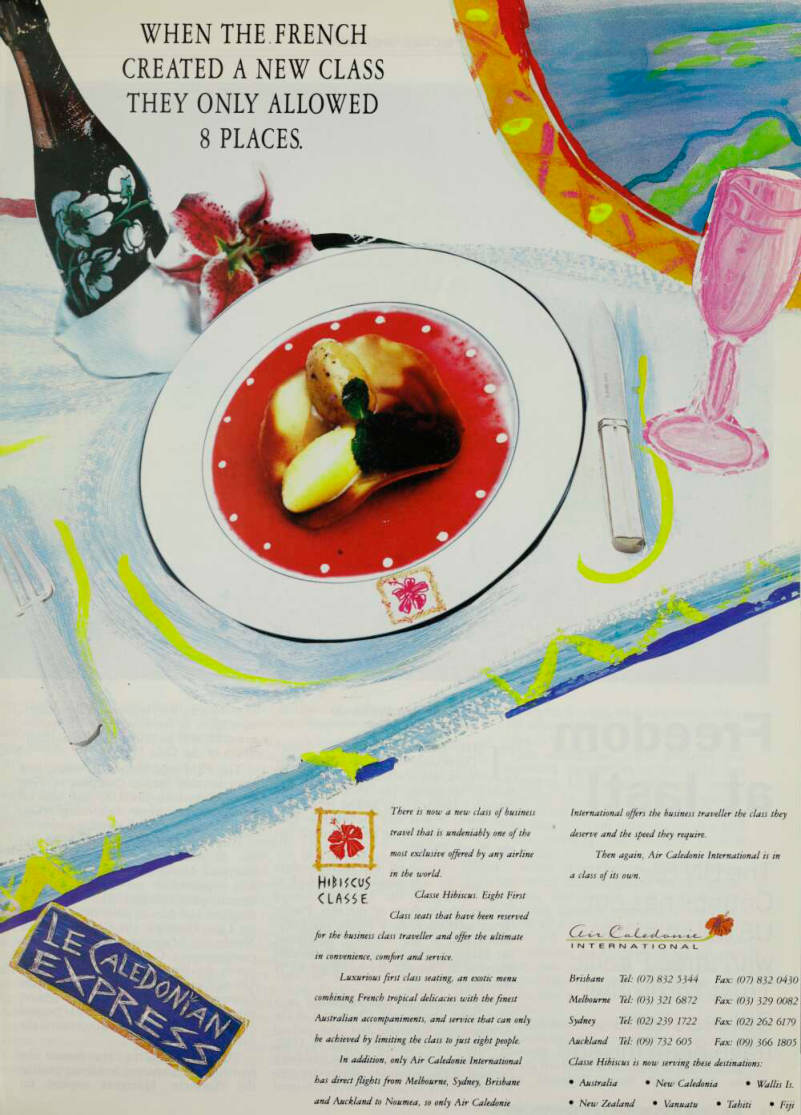
Created A New Class
WHEN THE FRENCH
THEY ONLY ALLOWED
8 PLACES.
M K mm 's. * Im .y
N'h<cus
CLAUSE
•? s TAere « wow class of business travel that is undeniably one of the most exclusive offered by any airline in the world.
Classe Hibiscus. Eight First Class seats that have been reserved for the business class traveller and offer the ultimate in convenience, comfort and service.
Luxurious first class seating, an exotic menu combining French tropical delicacies with the finest Australian accompaniments, and service that can only be achieved by limiting the class to just eight people.
In addition, only Air Caledonie International has direct flights from Melbourne, Sydney, Brisbane and Auckland to Noumea, so only Air Caledonie International offers the business traveller the class they deserve and the speed they require.
Then again, Air Caledonie International is in a class of its own. *
INTERNATIONAL
Brisbane Tel: (07) 832 3344 Fax: (07) 832 0430 Melbourne Tel: (03) 321 6872 Fax: (03) 329 0082 Sydney Tel: (02) 239 1722 Fax: (02) 262 6179 Auckland Tel: (09) 732 603 Fax: (09) 366 1803 Classe Hibiscus is now serving these destinations: • Australia • New Caledonia • Wallis Is. • New Zealand • Vanuatu • Tahiti • Fiji
Freedom
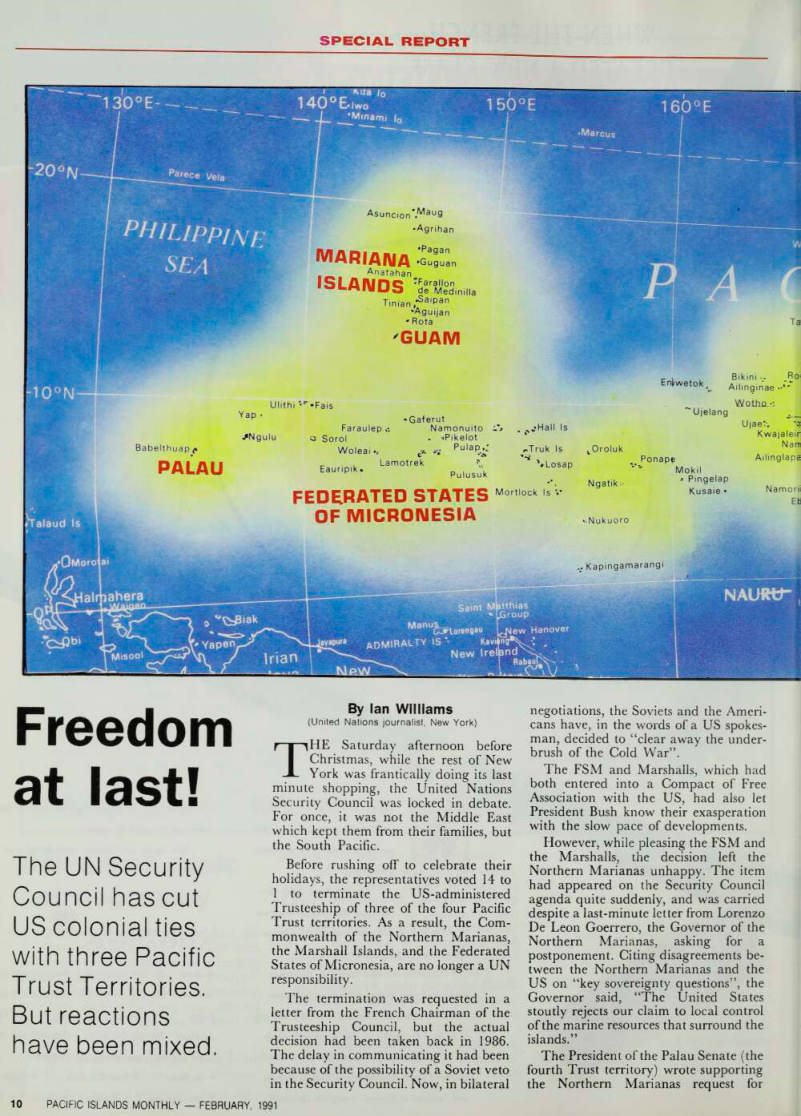
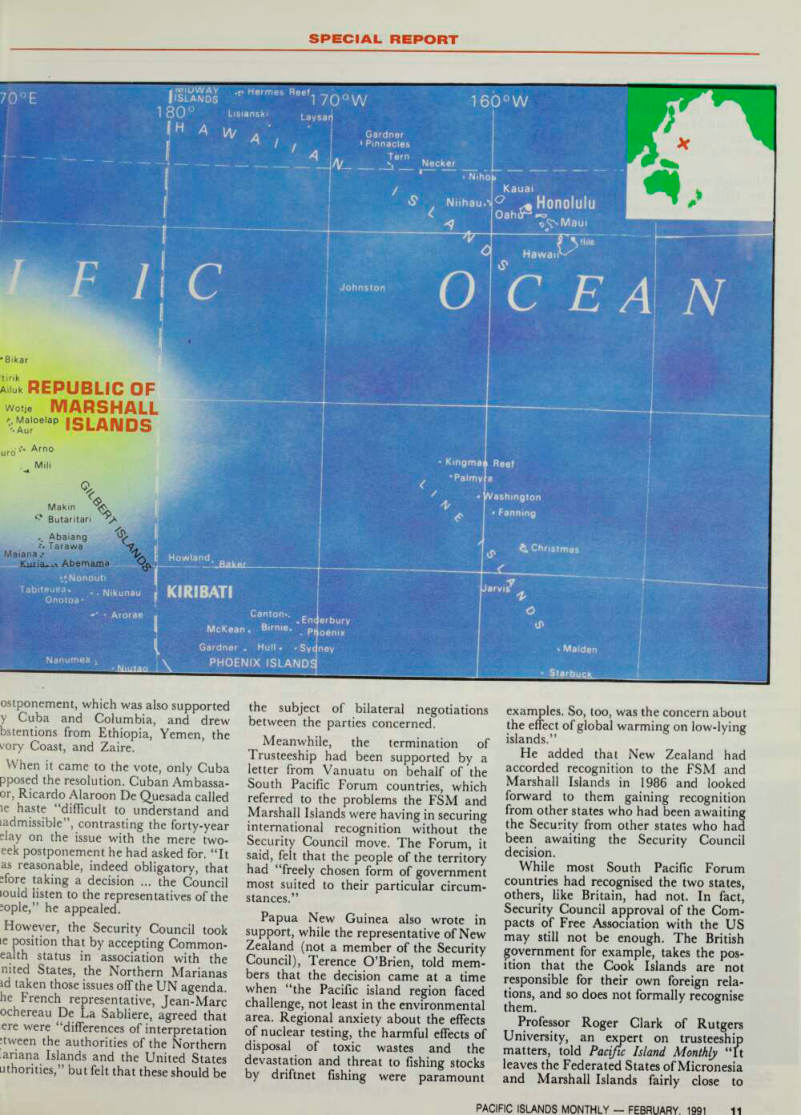
Special Report
Freedom at last!
The UN Security Council has cut US colonial ties with three Pacific Trust Territories.
But reactions have been mixed.
By Ian Williams
(United Nations journalist, New York)
THE Saturday afternoon before
Christmas, while the rest of New York was frantically doing its last minute shopping, the United Nations Security Council was locked in debate.
For once, it was not the Middle East which kept them from their families, but the South Pacific.
Before rushing off to celebrate their holidays, the representatives voted 14 to 1 to terminate the US-administered Trusteeship of three of the four Pacific Trust territories. As a result, the Com monwealth of the Northern Marianas, the Marshall Islands, and the Federated States of Micronesia, are no longer a UN responsibility.
The termination was requested in a letter from the French Chairman of the Trusteeship Council, but the actual decision had been taken back in 1986.
The delay in communicating it had been because of the possibility of a Soviet veto in the Security Council. Now, in bilateral
negotiations, the Soviets and the Ameri cans have, in the words of a US spokes man, decided to “clear away the under brush of the Cold War”.
The FSM and Marshalls, which had both entered into a Compact of Free Association with the US, had also let President Bush know their exasperation with the slow pace of developments.
However, while pleasing the FSM and the Marshalls, the decision left the Northern Marianas unhappy. The item had appeared on the Security Council agenda quite suddenly, and was carried despite a last-minute letter from Lorenzo De Leon Goerrero, the Governor of the Northern Marianas, asking for a postponement. Citing disagreements be tween the Northern Marianas and the US on “key sovereignty questions”, the Governor said, “The United States stoutly rejects our claim to local control of the marine resources that surround the islands.”
The President of the Palau Senate (the fourth Trust territory) wrote supporting the Northern Marianas request for
ostponement, which was also supported y Cuba and Columbia, and drew bstentions from Ethiopia, Yemen, the yory Coast, and Zaire.
When it came to the vote, only Cuba pposed the resolution. Cuban Ambassa or, Ricardo Alaroon De Quesada called le haste “difficult to understand and
(admissible”, contrasting the forty-year
elay on the issue with the mere two eek postponement he had asked for. “It as reasonable, indeed obligatory, that “fore taking a decision ... the Council lould listen to the representatives of the "ople,” he appealed.
However, the Security Council took ie position that by accepting Common ealth status in association with the nited States, the Northern Marianas id taken those issues off the UN agenda, he French representative, Jean-Marc ochereau De La Sabliere, agreed that ere were “differences of interpretation “tween the authorities of the Northern ariana Islands and the United States uthorities,” but felt that these should be
the subject of bilateral negotiations between the parties concerned.
Meanwhile, the termination of Trusteeship had been supported by a letter from Vanuatu on behalf of the South Pacific Forum countries, which referred to the problems the FSM and Marshall Islands were having in securing international recognition without the Security Council move. The Forum, it said, felt that the people of the territory had “freely chosen form of government most suited to their particular circum stances.”
Papua New Guinea also wrote in support, while the representative of New Zealand (not a member of the Security Council), Terence O’Brien, told mem bers that the decision came at a time when “the Pacific island region faced challenge, not least in the environmental area. Regional anxiety about the effects of nuclear testing, the harmful effects of disposal of toxic wastes and the devastation and threat to fishing stocks by driftnet fishing were paramount
examples. So, too, was the concern about the effect of global warming on low-lying islands.”
He added that New Zealand had accorded recognition to the FSM and Marshall Islands in 1986 and looked forward to them gaining recognition from other states who had been awaiting the Security from other states who had been awaiting the Security Council decision.
While most South Pacific Forum countries had recognised the two states, others, like Britain, had not. In fact, Security Council approval of the Com pacts of Free Association with the US may still not be enough. The British government for example, takes the pos ition that the Cook Islands are not responsible for their own foreign rela tions, and so does not formally recognise them.
Professor Roger Clark of Rutgers University, an expert on trusteeship matters, told Pacific Island Monthly “It leaves the Federated States of Micronesia and Marshall Islands fairly close to
independence, but less so than the Cook islands. The US decides what is defence related.” But, he added, “It really leaves the Northern Marianas in a bad position.
They are subject to US law, but have no votes for the US Congress and Washing ton.”
Although they chose their relationship in the 19705, Professor Clark feels that they are now beginning to realise the drawbacks. His conclusion was that the issue of sovereignty was not a black and white one. The EC, for example, limited the sovereignty of its member states in many ways, but that did not inhibit recognition of European states.
Perhaps more tangibly, the termin ation frees the two states to seek trade, aid and credit agreements inter nationally. It is believed that one special problem was they previously had to pay for expensive US health care, but can now look elsewhere.
It remains to be seen whether the two new nations will apply for membership of the United Nations. Presently, only seven of the 15 South Pacific Forum nations are full members of the UN. Some of the smaller states are more deterred by the cost of membership than questions of sovereignty. The minimum cost of mem bership is around 5250,000 a year, between membership fees and the costs of maintaining an office.
Now, the one Pacific state with a hot line to the UN is Palau. The partial termination of the Pacific Trusteeship leaves Palau as the only remaining part of the 11 Trusteeships established after World War 11. Ironically, as an Ameri can diplomat confided, it also leaves the United States, itself born in revolt against colonialism, as the last admitted colonial power. □
Taxes and tourism on top
By David North
IN Guam and Micronesia, the initials “TT” used to stand for the Trust Territory of the Pacific Islands the US administered, United Nations trusteeship of the Northern Marianas, Caroline and Marshall islands.
For business investors and entrepren eurs looking for opportunities in the islands today, “TT” stands for taxes and tourism, the two major sources of revenue and economic development po tential in the region. The flows of tax dollars from the US Federal government and tourist yen from the Japanese private sector also are symbolic of the major policy decision driving the region’s official foreign investment strategy the professed desire of Micronesian leaders to reduce the islands’ heavy dependence on US financial assistance, while fostering private sector growth through foreign investment and creation of industries in which the islands have some relative
advantage.
Japanese-funded tourism development
has shown one viable route, which in Guam and the Northern Marianas has led an unprecedented private sector expansion, spinning off robust construc tion and service sector growth. Commer cial fisheries and other marine resource projects also have generated significant revenue, and show future promise, es pecially in the case of the Federated
States of Micro nesia, whose Ex clusive Economic Zone exceeds 1 million square
miles. Light
manufacturing and specialty agriculture also are attracting considerable in vestment. Import, wholesaling and retailing, which had been the pre vious pillars of the islands’ private sectors, have shown consider able development in response to the tourism-led boom in the Marianas and the Compact funded growth of the Freely Associ ated States.
The flow of US
tax dollars takes several forms, including direct government-to-government oper ational and capital improvement grants, Federal health and welfare programs, as well as defence spending in Guam and the Marshalls (Kwajalein Missile Test Site). Because most of this funding, currently estimated at about Sl2 billion annually for the region Guam, the Northern Marianas, the Federated States of Micronesia, the Marshalls and Palau is funnelled through the island governments, it has come in for consider able criticism.
Meanwhile, many sources inside the US government, such as the Con gressional watchdog agency The General Accounting Office say that island governments (particularly Palau) have squandered Federal dollars through corruption and mismanagement.
Under the Compacts of Free Associ ation with the Marshall Islands and the Federated States of Micronesia, there fore, the aid formula calls for declining US assistance over the 15 years pact. US and Micronesian leaders look to the private sector, and foreign investment looms increasingly important. There are incentives for foreign companies and joint ventures with local investors includ ing some tax holidays, special access to
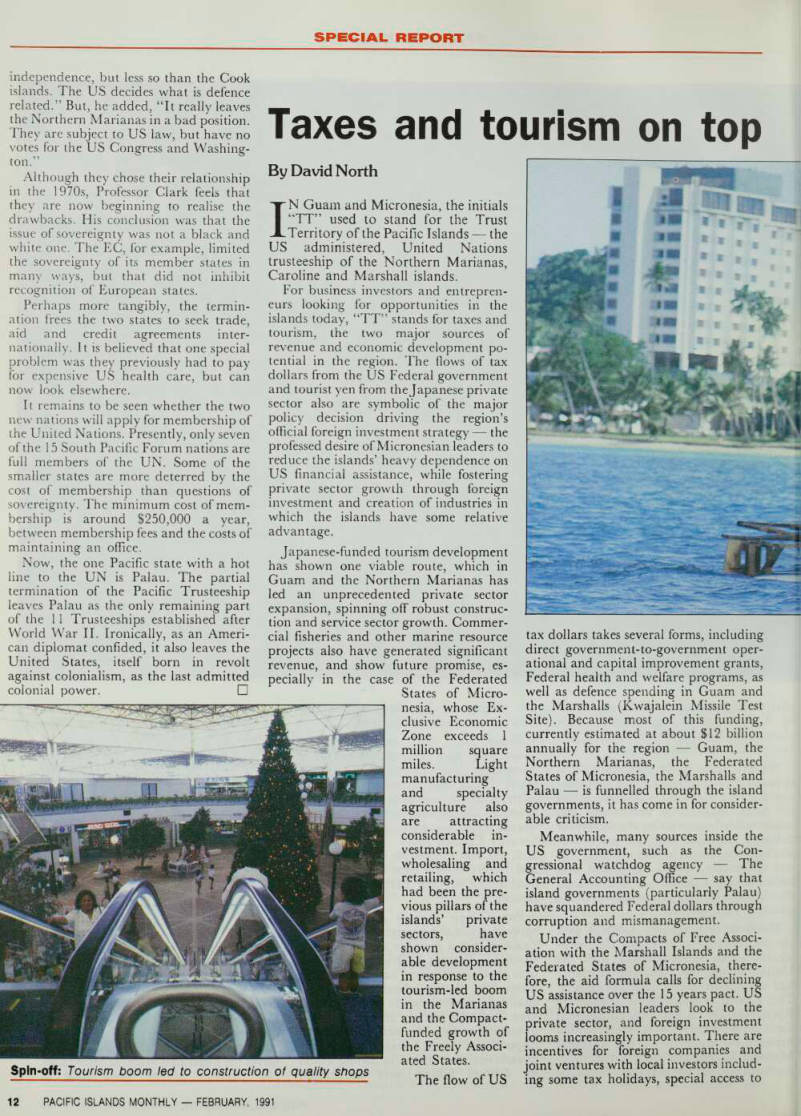
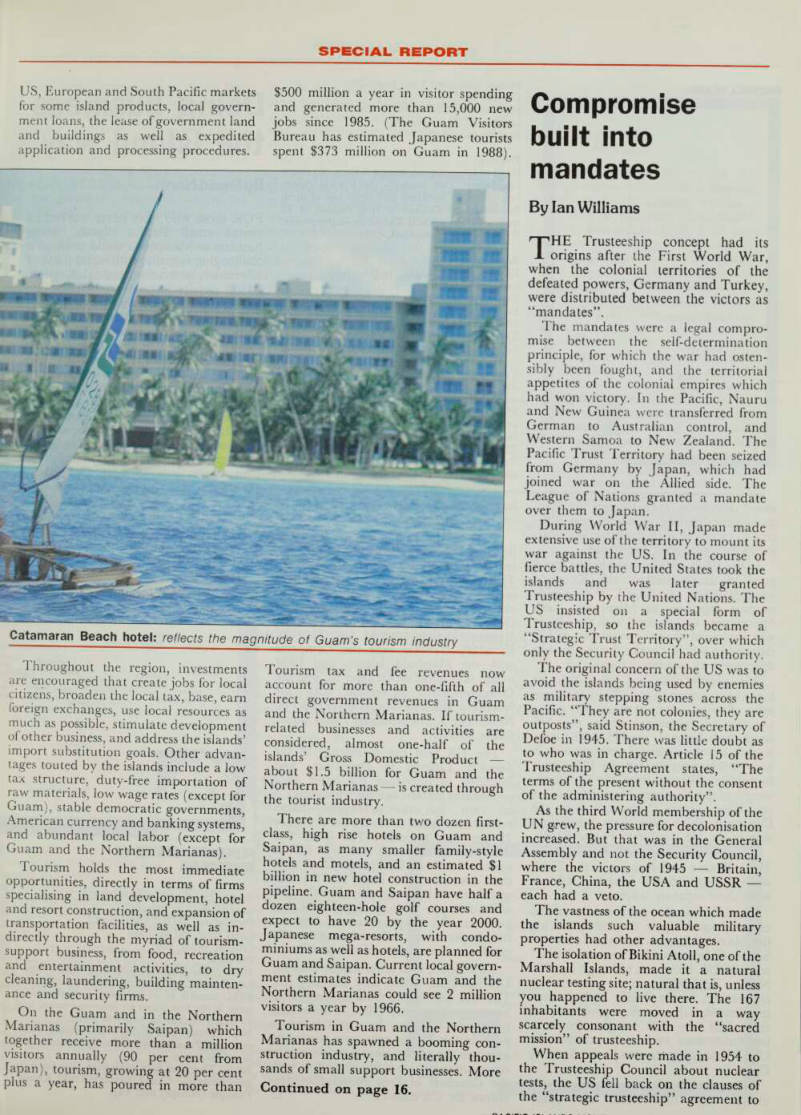
Spin-off: Tourism boom led to construction of quality shops
US, European and South Pacific markets for some island products, local government loans, the lease of government land and buildings as well as expedited application and processing procedures.
Throughout the region, investments are encouraged that create jobs for local citizens, broaden the local tax, base, earn loreign exchanges, use ocal resources as P ° SSlb e ’ S ‘T U is te d T‘ o, ? me J l l I 0 baind addr ess the Blands’ r T h ° tl ; er , adv l an afstn.rnl y H t f include a low at materials’ lot tlte "?P°, rtatlon ° f r.ttf t ki’ j ge - ateS (except for Guam), stable democratic governments, American currency and banking systems, and abundant local labor (except for Guam and the Northern Marianas).
Tourism holds the most immediate opportunities, directly in terms of firms specialising in land development hotel and resort construction, and expansion of transportation facilities, as well as indirectly through the myriad of tourismsupport business, from food, recreation and entertainment activities, to dry
cleaning, laundering, building’ mainten-
ance and security firms On the Guam and in the Northern
Marianas (primarily Saipan) which
together receive more than a million visitors annually (90 per cent from Japan), tourism, growing at 20 per cent plus a year, has poured in more than
$5OO million a year in visitor spending and generated more than 15,000 new jobs since 1985. (The Guam Visitors Bureau has estimated Japanese tourists spent $373 million on Guam in 1988).
Tourism tax and fee revenues now account for more than one-fifth of all direct government revenues in Guam and the Northern Marianas. If tourism related businesses and activities are considered, almost one-half of the islands’ Gross Domestic Product about Jl-5 billion for Guam and the Northern Marianas - is created through 'he tourist industry. 7 f here are more than tv/o dozen first c^ass) high rise hotels on Guam and Saipan, as many smaller family-style uui^ S and mot J ls ’ f nd an estimated $1 • ~n m new hotel construction m the Guam and Saipan have half a d ° ZCn ei ghteen-hole golf courses and x P ect to have 20 by the year 2000.
J a P anese mega-resorts, with condo ™mmms as well as hotels, are planned for Guam ar^ d Saipan. Current local govern ment estimate s indicate Guam and the Northern Marianas could see 2 million vWto ". a yCar by 1966 ' Tourism in Guam and the Northern Marianas has spawned a booming con struction industry, and literally thou of small support businesses. More
Continued on page 16.
Catamaran Beach hotel: reflects the magnitude of Guam's tourism industry
than a dozen major Japanese, South Korean and US construction companies have established a long-term presence, and some like a Mainland Chinese firm bring in their own laborers.
Roads, water and sewer construction to
keep up with the tourism ex pansion, as well as office build ing, defence-related construc tion and residential develop ment have added to the de mand for all types of construc tion firms and building material
suppliers.
Tourism-led growth is not without its problems. Guam’s labor market is tight (officially 1.2 per cent unemployment), and US immigration regu lations limit importation of alien laborers to “temporary
positions.” This is good for the island’s workers, but tough on employers.
Most of the 3000 new jobs created on Guam this year are permanent, hotel service industry positions. Hence Guam Labor Department leaders and private labor contractors are attempting to recruit US citizens in American Samoa, California, and even along the East Coast, using state labor banks. Citizens of the Freely Associated States, who have
rights under the Compacts to freely
immigrate and work in the United States, also are actively recruited and workers from the Federated States of Micronesia are currently filling most of the service-sector positions being created on Guam. That in-migration has taxed Guam’s social infrastructure, and led to some misunderstandings in inter-island relations.
The Northern Marianas, which con trols its own immigration, has had fewer problems getting alien laborers, but suffers from the other extreme too many foreign workers and muted charges of low wages and sweatshop conditions.
More than half the Northern Mari-
anas total population (currently esti mated at about 45,000) are non-resident aliens, who cannot, under current law, become citizens. Most of those were brought in to work in Saipan’s textile
assembly plants, but expected tourism
growth in the future will exacerbate the labor demand.
Last year the island of Tinian, which has received little of the tourism growth
Saipan has experienced, approved casino
gambling in a controversial referendum.
Japanese land speculators immediately descended on the island creating an additional 31 Chamorro millionaires, almost overnight. Large scale Japanese gaming hotels are now on the drawing boards and could be operating within two years.
This pressure has sent land prices on
Guam and in the Northern Marianas into the stratosphere. Prime beach front property in Turnon Bay Guam’s Waikiki goes for S2OOO a square meter. Middle class Guamanians cannot afford to buy or even build homes.
Moreover, road, power, water and sewer expansion have not kept pace with development and the governments of Guam and the Northern Marianas are
developing voluntary and non-voluntary
means for developers to pay the cost of infrastructure develop ment that benefits them.
These difficulties have spawned some anti development activity but the opposition appears to be frag mented and has not caused any significant movement toward
growth-limiting legislation,
though it has shifted some of the tax holiday incentives toward
joint enterprises with local
businesses.
Tourism growth in the Fed
crated States of Micronesia, the Mar shalls, and Palau has been considerably more modest. Fewer then 100,000 Japan esc visit these three states annually, but the islands are actively encouraging the development of a visitor industry, Though the major islands have enviable natural resources in picturesque sea
beSs ‘world class dSaSrt
““e fne or C
first . c i ass hotels, and the FSM, Mar shalls, and Palau combined include the high cost of air transportation, and the jack of necessary road, power and water mfrastructure to support large-scale ho
tel development.
Construction in the Freely Associated
Sta(es similarly
remains rather small scale. During the late 1970’s and early 1980’s, US-funded infrastructure con
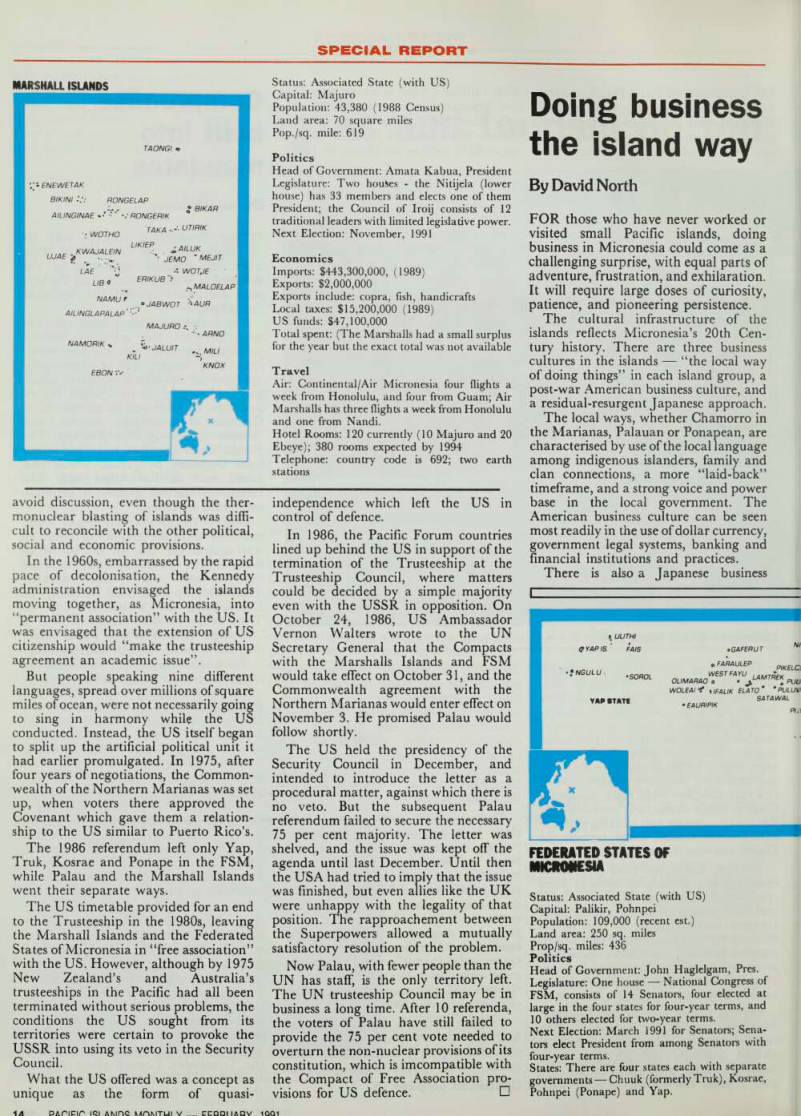
Palau power plant: growth demands such support facilities
struction activities in the FSM, the Marshalls and Palau drew some South Pacific firms such as New Zealand’s Downey-Fletcher — as well as Japanese and Korean companies. But the con tracts have been sporadic and are
winding down.
Tourism in Micronesia offers a unique opportunity for companies wishing to tap into a slice of the Japanese market in a largely favourable overseas venue. But there also are unique obstacles.
Unless foreign companies learn to accept certain business practices, they may find it impossible to reach these affluent Japanese travellers. A minor example on Guam is the unofficial “tourist head tax”. Some local Guam retailers have bitterly complained for years that Japanese tour companies won’t bring visitors to their stores unless the tour operators receive a fee. It usually takes the form of a percentage of whatever amount the tourists spend at the store. While patently illegal in the view of some, it is regarded by many Asians as merely another cost of doing business, like a finder’s fee.
The presence of organised Japanese crime the Yakusa wherever Japanese tourism flourishes, also causes concern. Specialising in prostitution, illegal gambling, narcotics and extortion, the Yakusa pose major problems for law enforcement, religious, government and business leaders.
Beyond tourism, the next most attract ive area for investors appears to be commercial fishing, in-shore marine re sources, aquaculture, ship servicing and transhipment. All the islands have been experiencing moderate increases in the area, but the Federated States of Micro nesia appears to be winning the lion’s share of Exclusive Economic Zone fishing fee revenue. The FSM and Papua New Guinea are receiving most several
million annually from the $lO million a year the US government pays to the South Pacific Forum Fishery Association for American tuna boats to fish in their EEZ’s. East Asian long-line boats and fishing federations also negotiate group and individual licensing, at a few million a year, to fish for yellow fin, big eye, skipjack and bluefin tuna in the FSM’s rich waters.
These revenues are expected to stead ily increase in the next decade as environmentalists’ pressure forces US and Asian boats from the Eastern Pacific, where dolphin swim with tuna, to the southwestern Pacific, where dolphins do not co-migrate with tuna. While Palau and the Marshalls gross less than a million annually in zone licensing fees, (Palau received about $600,000 in Japanese and US fishing boat fees in 1989) their share may increase as the westward push intensifies.
While Guam and the Northern Mari anas, as US jurisdictions, are presently unable to levy licensing fees for the zones around their islands, the regional tuna fishery has created a healthy transhipment industry for the Marianas.
Top quality tuna destined for the sashimi restaurants and bars of metropolitan Japan are offloaded at island ports and air freighted to Tokyo and Osaka. In Guam the business is averaging about 8000 metric tons a year, generating 300 jobs and about $1 million in salaries and purchases. Similar, but smaller oper ations, are working in the FSM and Palau.
US tuna boats unload their catch into freezer ships in the Northern Marianas, from where they are carried to US canneries in American Samoa and Puerto Rico. Some cold storage plant and associated port development has sprung up in the Western Marianas to
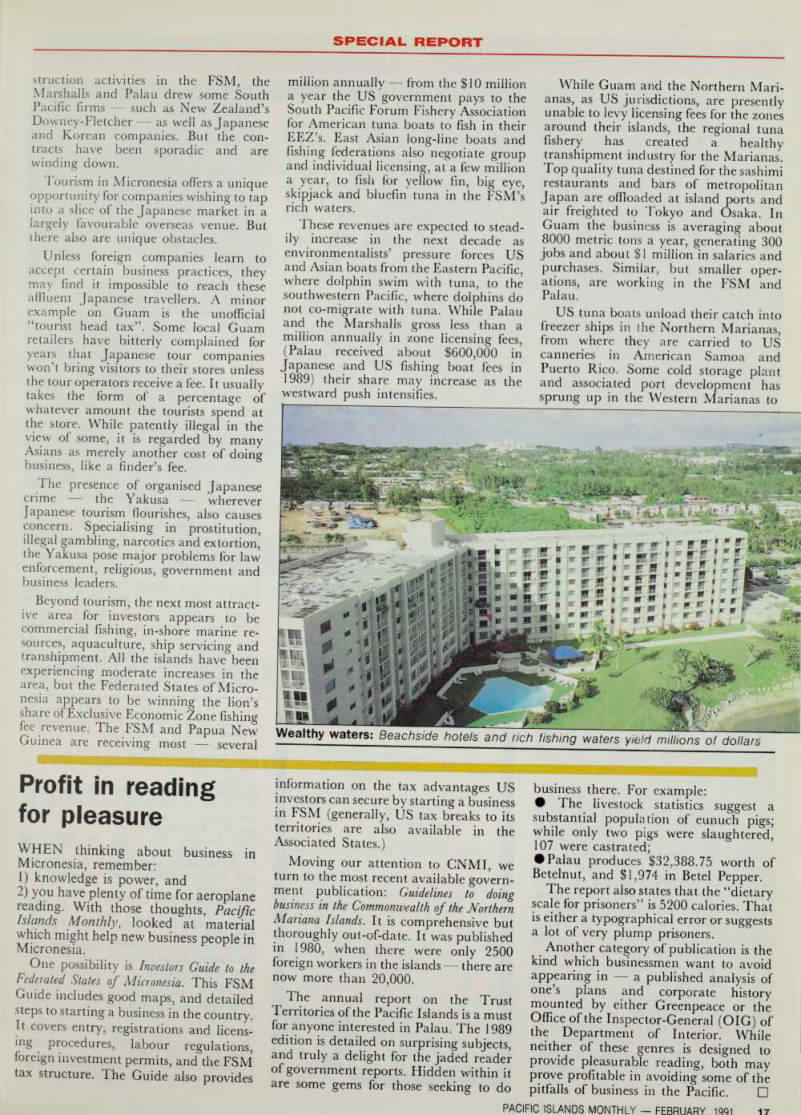
Wealthy waters: Beachside hotels and rich fishing waters yield millions of dollars
meet this need and Guam’s Apra Har bour is providing ship chandlering ser vices to the US tuna fleet. The Marshalls is seeking Federal assistance for the construction of a tuna processing plant and the FSM also is undertaking fish
handling and processing projects.
The Compacts of Free Association grant special quotas to the FSM and the Marshalls, allowing duty-free export of processed tuna to the US market.
Aquaculture and mariculture develop ment remains small scale and largely at the experimental and demonstration level. The Micronesian Mariculture Demonstration Center in Palau has domesticated the giant clam and ex ported seed clams throughout the islands.
The low-technology, labor-intensive pro cedure suits the traditional cultures and underutilised coral reefs and flats.
The islands special trade access to markets in the US, Australia and New Zealand provide a key advantage for light manufacturing projects. Under the Headnote 3(a) program certain manu factured articles in Guam, the Northern Marianas and the Freely Associated States can be exported to the US market duty- and quota-free. In Saipan and Guam this has taken the form of garment assembly plants, 26 in the Northern Marianas, two on Guam and one in Yap State of the FSM. These take pre-cut pieces and sew them together, add finishing processes and package the garments. If a minimum percentage (30 per cent for most items, 51 per cent for import-sensitive articles) are “substan tially transformed’’ the goods can qualify for US entry.
The major drawback is that in most of these enterprises except for Guam’s, workers are brought in with the plant and pre-cut pieces, so local labor is not utilised or developed. Moreover, as these industries become competitive with US textile makers, they generate a backlash move to cap island production quotas or deny duty-free status.
The islands also benefit from preferen tial trade Status under the Generalized System of Preferences as well as the South Pacific Regional Trade and Economic Cooperation Agreement. Products ex ported under the latter pact have preferential access to Australia and New Zealand, while the former agreement provides access to European markets.
A major policy goal of the Freely Associated States is to reduce the amount
of imported food, leading to significant
incentive programs that will reduce the annual tonnage of beef, chicken, rice, coffee, and beer that come in primarily from the US and Japan.
Though the islands present formidable challenges, they offer opportunities for companies with a long-term outlook, willing to get in early and develop gradually. □
Compromise
built into mandates
By Ian Williams
THE Trusteeship concept had its origins after the First World War, when the colonial territories of the defeated powers, Germany and Turkey, were distributed between the victors as “mandates”.
The mandates were a legal compro mise between the self-determination principle, for which the war had osten sibly been fought, and the territorial appetites of the colonial empires which had won victory. In the Pacific, Nauru and New Guinea were transferred from German to Australian control, and Western Samoa to New Zealand. The Pacific Trust Territory had been seized from Germany by Japan, which had joined war on the Allied side. The League of Nations granted a mandate over them to Japan.
During World War 11, Japan made extensive use of the territory to mount its war against the US. In the course of fierce battles, the United States took the islands and was later granted Trusteeship by the United Nations. The US insisted on a special form of Trusteeship, so the islands became a “Strategic Trust Territory”, over which only the Security Council had authority.
The original concern of the US was to avoid the islands being used by enemies as military stepping stones across the Pacific. “They are not colonies, they are outposts”, said Stinson, the Secretary of Defoe in 1945. There was little doubt as to who was in charge. Article 15 of the Trusteeship Agreement states, “The terms of the present without the consent
of the administering authority”.
As the third World membership of the UN grew, the pressure for decolonisation increased. But that was in the General Assembly and not the Security Council, where the victors of 1945 Britain, France, China, the USA and USSR each had a veto.
The vastness of the ocean which made the islands such valuable military properties had other advantages.
The isolation of Bikini Atoll, one of the Marshall Islands, made it a natural nuclear testing site; natural that is, unless you happened to live there. The 167 inhabitants were moved in a way scarcely consonant with the “sacred mission” of trusteeship.
When appeals were made in 1954 to the Trusteeship Council about nuclear tests, the US fell back on the clauses of the “strategic trusteeship” agreement to
avoid discussion, even though the ther monuclear blasting of islands was diffi cult to reconcile with the other political, social and economic provisions.
In the 19605, embarrassed by the rapid pace of decolonisation, the Kennedy administration envisaged the islands moving together, as Micronesia, into “permanent association” with the US. It was envisaged that the extension of US citizenship would “make the trusteeship agreement an academic issue”.
But people speaking nine different languages, spread over millions of square miles of ocean, were not necessarily going to sing in harmony while the US conducted. Instead, the US itself began to split up the artificial political unit it had earlier promulgated. In 1975, after four years of negotiations, the Common wealth of the Northern Marianas was set up, when voters there approved the Covenant which gave them a relation ship to the US similar to Puerto Rico’s.
The 1986 referendum left only Yap, Truk, Kosrae and Ponape in the FSM, while Palau and the Marshall Islands went their separate ways.
The US timetable provided for an end to the Trusteeship in the 1980 s, leaving the Marshall Islands and the Federated States of Micronesia in “free association” with the US. However, although by 1975 New Zealand’s and Australia’s trusteeships in the Pacific had all been terminated without serious problems, the conditions the US sought from its territories were certain to provoke the USSR into using its veto in the Security Council.
What the US offered was a concept as unique as the form of quasi
independence which left the US in control of defence.
In 1986, the Pacific Forum countries lined up behind the US in support of the termination of the Trusteeship at the Trusteeship Council, where matters could be decided by a simple majority even with the USSR in opposition. On October 24, 1986, US Ambassador Vernon Walters wrote to the UN Secretary General that the Compacts with the Marshalls Islands and FSM would take effect on October 31, and the Commonwealth agreement with the Northern Marianas would enter effect on November 3. He promised Palau would follow shortly.
The US held the presidency of the Security Council in December, and intended to introduce the letter as a procedural matter, against which there is no veto. But the subsequent Palau referendum failed to secure the necessary 75 per cent majority. The letter was shelved, and the issue was kept off the agenda until last December. Until then the USA had tried to imply that the issue was finished, but even allies like the UK were unhappy with the legality of that position. The rapproachement between the Superpowers allowed a mutually satisfactory resolution of the problem.
Now Palau, with fewer people than the UN has staff, is the only territory left.
The UN trusteeship Council may be in business a long time. After 10 referenda, the voters of Palau have still failed to provide the 75 per cent vote needed to overturn the non-nuclear provisions of its constitution, which is imcompatible with the Compact of Free Association pro visions for US defence. □
Advertisements & other items, p. 13 (1 item)
Special Report
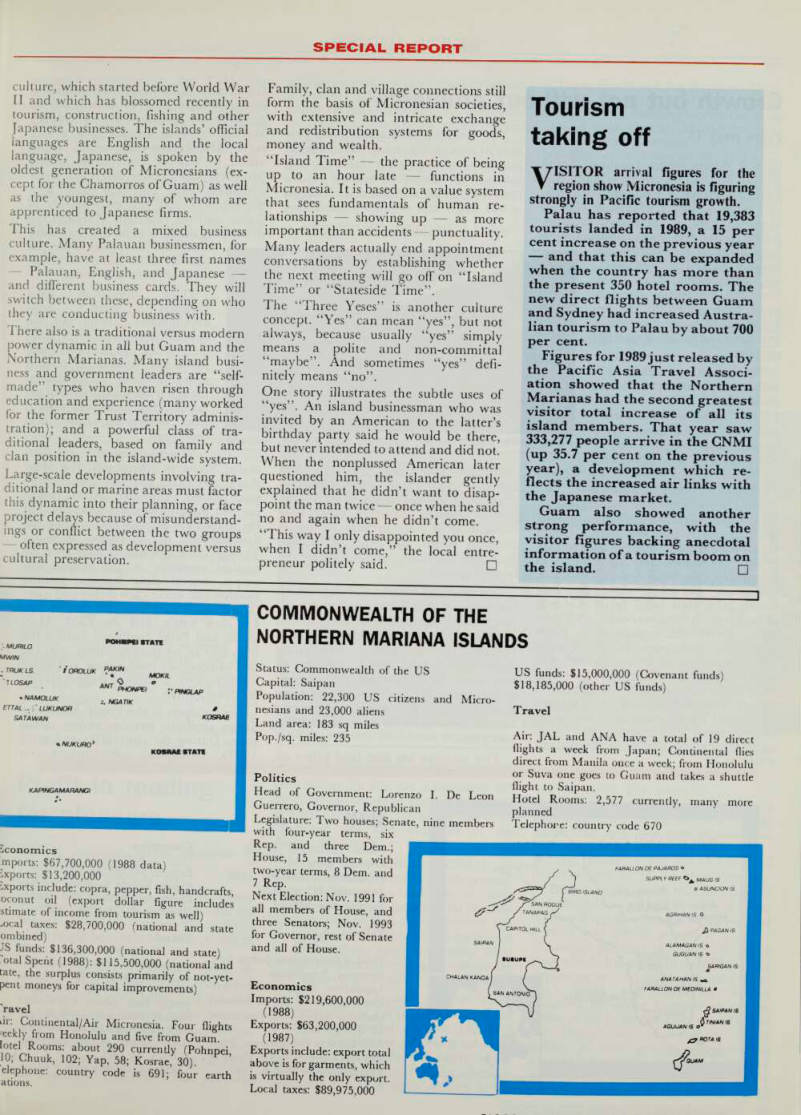
Marshall Islands
Status: Associated State (with US)
Capital; Majuro
Population: 43,380 (1988 Census)
Land area: 70 square miles Pop./sq. mile: 619 Politics Head of Government: Amata Kabua, President Legislature: Two houses - the Nitijela (lower house) has 33 members and elects one of them President; the Council of Iroij consists of 12 traditional leaders with limited legislative power.
Next Election: November, 1991 Economics Imports: $443,300,000, (1989)
Exports: $2,000,000
Exports include: copra, fish, handicrafts Local taxes: $15,200,000 (1989) US funds: $47,100,000 Total spent: (The Marshalls had a small surplus for the year but the exact total was not available Travel Air: Continental/Air Micronesia four flights a week from Honolulu, and four from Guam; Air Marshalls has three flights a week from Honolulu and one from Nandi.
Hotel Rooms: 120 currently (10 Majuro and 20 Ebeye); 380 rooms expected by 1994 Telephone: country code is 692; two earth stations
Doing business
the island way
By David North
FOR those who have never worked or visited small Pacific islands, doing business in Micronesia could come as a challenging surprise, with equal parts of adventure, frustration, and exhilaration.
It will require large doses of curiosity, patience, and pioneering persistence.
The cultural infrastructure of the islands reflects Micronesia’s 20th Cen tury history. There are three business cultures in the islands “the local way of doing things” in each island group, a post-war American business culture, and a residual-resurgent Japanese approach.
The local ways, whether Chamorro in the Marianas, Palauan or Ponapean, are characterised by use of the local language among indigenous islanders, family and clan connections, a more “laid-back” timeframe, and a strong voice and power base in the local government. The American business culture can be seen most readily in the use of dollar currency, government legal systems, banking and financial institutions and practices.
There is also a Japanese business
culture, which started before World War II and which has blossomed recently in tourism, construction, fishing and other Japanese businesses. The islands’ official languages are English and the local language, Japanese, is spoken by the oldest generation of Micronesians (ex cept for the Chamorros of Guam) as well as the youngest, many of whom are apprenticed to Japanese firms.
This has created a mixed business culture. Many Palauan businessmen, for example, have at least three first names - Palauan, English, and Japanese and different business cards. They will switch between these, depending on who they are conducting business with.
There also is a traditional versus modern power dynamic in all but Guam and the Northern Marianas. Many island busi ness and government leaders are “self made” types who haven risen through education and experience (many worked for the former Trust Territory adminis tration); and a powerful class of tra ditional leaders, based on family and clan position in the island-wide system.
Large-scale developments involving tra ditional land or marine areas must factor this dynamic into their planning, or face project delays because of misunderstand ings or conflict between the two groups often expressed as development versus cultural preservation.
Family, clan and village connections still form the basis of Micronesian societies, with extensive and intricate exchange and redistribution systems for goods, money and wealth.
“Island Time” the practice of being up to an hour late functions in Micronesia. It is based on a value system that sees fundamentals of human re lationships showing up as more important than accidents punctuality.
Many leaders actually end appointment conversations by establishing whether the next meeting will go off on “Island Time” or “Stateside Time”.
The “Three Yeses” is another culture concept. “Yes” can mean “yes”, but not always, because usually “yes” simply means a polite and non-committal “maybe”. And sometimes “yes” defi nitely means “no”.
One story illustrates the subtle uses of “yes”. An island businessman who was invited by an American to the latter’s birthday party said he would be there, but never intended to attend and did not.
When the nonplussed American later questioned him, the islander gently explained that he didn’t want to disap point the man twice once when he said no and again when he didn’t come.
“This way I only disappointed you once, when I didn’t come,” the local entre preneur politely said. □
Federated States Of
Micronesia
Status: Associated State (with US) Capital: Palikir, Pohnpei Population: 109,000 (recent est.) Land area: 250 sq. miles Prop/sq. miles: 436 Politics Head of Government: John Haglelgam, Pres.
Legislature: One house National Congress of FSM, consists of 14 Senators, four elected at large in the four states for four-year terms, and 10 others elected for two-year terms.
Next Election: March 1991 for Senators; Sena tors elect President from among Senators with four-year terms.
States: There are four states each with separate governments Chuuk (formerly Truk), Kosrae, Pohnpei (Ponape) and Yap.
Commonwealth Of The
Northern Mariana Islands
Economics mports: $67,700,000 (1988 data) Exports: $13,200,000 exports include: copra, pepper, fish, handcrafts, oconut oil (export dollar figure includes stimate of income from tourism as well) -■oca! taxes: $28,700,000 (national and state ombined) JS funds: $136,300,000 (national and state) otal Spent (1988): $115,500,000 (national and tate, the surplus consists primarily of not-yet pent moneys for capital improvements) ’ravel L ir: Continental/Air Micronesia. Four flights ; cek Jy fr° m Honolulu and five from Guam n te l^ 00 . ms: about 290 (Pohnpei, 10; Chuuk, 102; Yap, 58; Kosrae, 30). elephone: country code is 691; four earth ations.
Status: Commonwealth of the US Capital: Saipan Population: 22,300 US citizens and Micro nesians and 23,000 aliens Land area: 183 sq miles Pop./sq. miles: 235 Politics Head of Government: Lorenzo I. De Leon Guerrero, Governor, Republican Legislature: Two houses; Senate, nine members with four-year terms, six
Rep. and three Dem.; House, 15 members with two-year terms, 8 Dem. and
7 Rep.
Next Election: Nov. 1991 for all members of House, and three Senators; Nov. 1993 for Governor, rest of Senate and all of House.
Economics Imports: $219,600,000 (1988) Exports: $63,200,000 (1987) Exports include: export total above is for garments, which is virtually the only export.
Local taxes: $89,975,000
US funds: $15,000,000 (Covenant funds) $18,185,000 (other US funds) Travel Air: JAL and ANA have a total of 19 direct flights a week from Japan; Continental flies direct from Manila once a week; from Honolulu or Suva one goes to Guam and takes a shuttle flight to Saipan.
Hotel Rooms: 2,577 currently, many more planned Telephone: country code 670
Advertisements & other items, p. 14 (1 item)
Special Report
14
PAPICir ICI AMRC MAMTUI V CCPDI lADV IQQI
taking off
Tourism taking off
VISITOR arrival figures for the region show Micronesia is figuring strongly in Pacific tourism growth.
Palau has reported that 19,383 tourists landed in 1989, a 15 per cent increase on the previous year and that this can be expanded when the country has more than the present 350 hotel rooms. The new direct flights between Guam and Sydney had increased Austra lian tourism to Palau by about 700 per cent.
Figures for 1989 just released by the Pacific Asia Travel Associ ation showed that the Northern Marianas had the second greatest visitor total increase of all its island members. That year saw 333,277 people arrive in the CNMI (up 35.7 per cent on the previous year), a development which re flects the increased air links with the Japanese market.
Guam also showed another strong performance, with the
visitor figures backing anecdotal
information of a tourism boom on the island. □
Guam
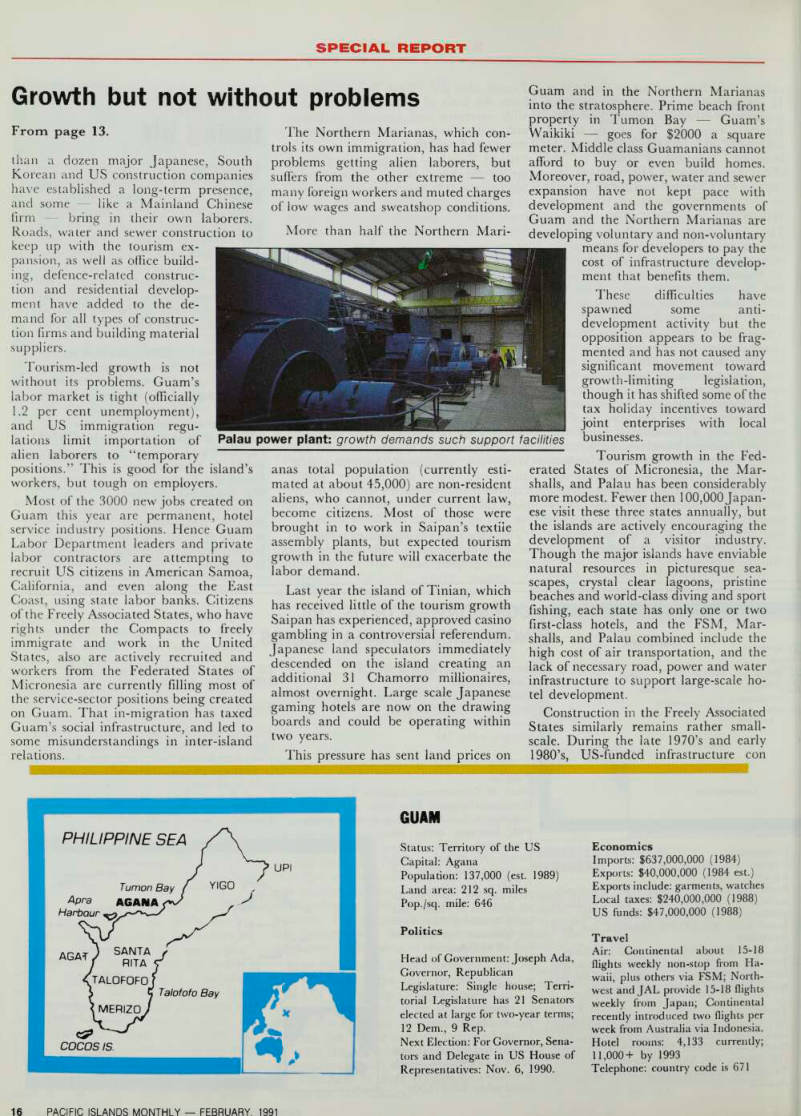
Status: Territory of the US
Capital; Agana
Population: 137,000 (est. 1989) Land area: 212 sq. miles Pop./sq. mile: 646 Politics Head of Government: Joseph Ada,
Governor, Republican
Legislature: Single house; Terri
torial Legislature has 21 Senators elected at large for two-year terms; 12 Dem., 9 Rep.
Next Election: For Governor, Sena tors and Delegate in US House of Representatives: Nov. 6, 1990.
Economics Imports: $637,000,000 (1984) Exports: $40,000,000 (1984 est.) Exports include: garments, watches Local taxes: $240,000,000 (1988) US funds: $47,000,000 (1988) Travel Air: Continental about 15-18 flights weekly non-stop from Ha waii, plus others via FSM; North west and JAL provide 15-18 flights weekly from Japan; Continental recently introduced two flights per week from Australia via Indonesia.
Hotel rooms: 4,133 currently; 11,000+ by 1993 Telephone: country code is 671
Advertisements & other items, p. 16 (1 item)
Growth but not without problems
16
PACIFIC ISLANDS MONTHLY FEBRUARY. 1991
SPECIAL REPORT
From page 13.
Growth but not without problems
for pleasure
Profit in reading for pleasure
WHEN thinking about business in Micronesia, remember: 1) knowledge is power, and 2) you have plenty of time for aeroplane reading. With those thoughts, Pacific Islands Monthly, looked at material which might help new business people in Micronesia.
One possibility is Investors Guide to the Federated States of Micronesia. This FSM Guide includes good maps, and detailed steps to starting a business in the country.
It covers entry, registrations and licens ing procedures, labour regulations, foreign investment permits, and the FSM tax structure. The Guide also provides
information on the tax advantages US investors can secure by starting a business in FSM (generally, US tax breaks to its territories are also available in the
Associated States.)
Moving our attention to CNMI, we turn to the most recent available govern ment publication: Guidelines to doing business in the Commonwealth of the Northern Mariana Islands. It is comprehensive but thoroughly out-of-date. It was published in 1980, when there were only 2500 foreign workers in the islands there are now more than 20,000.
The annual report on the Trust Territories of the Pacific Islands is a must for anyone interested in Palau. The 1989 edition is detailed on surprising subjects, and truly a delight for the jaded reader of government reports. Hidden within it are some gems for those seeking to do
business there. For example: • The livestock statistics suggest a substantial population of eunuch pigs; while only two pigs were slaughtered, 107 were castrated; • Palau produces $32,388.75 worth of Betelnut, and $1,974 in Betel Pepper.
The report also states that the “dietary scale for prisoners” is 5200 calories. That is either a typographical error or suggests a lot of very plump prisoners.
Another category of publication is the kind which businessmen want to avoid appearing in a published analysis of one’s plans and corporate history mounted by either Greenpeace or the Office of the Inspector-General (OIG) of the Department of Interior. While neither of these genres is designed to provide pleasurable reading, both may prove profitable in avoiding some of the pitfalls of business in the Pacific. □
Trouble strikes thrice in the same place
CLOSE on the heels of Super typhoon Mike, which struck Pa lau on November 10-11 with winds to 45mph, Supertyphoons Owen and Russ slashed through Micronesia in November and December, leaving close to 10,000 residents homeless, and wiping out 90 per cent of subsistence crops.
Packing sustained winds of 125 mph, Owen rolled over the FSM outer islands of Chuuk and Yap on November 27.
Chuuk officials estimated 4500 residents were left homeless on the 13 hardest-hit islands Murilo, Ruo, Nomwin, Fananu, Piserach, Punlap and Tamatan in Chuuk State and Satawal, Faraulap, Lamotrek, Elato, Ifalok, and Woleiai in Yap State. No deaths or serious injuries were reported.
Emergency food, water and medical supplies from Moen, capital of Chuuk State, were shipped to the Hall Islands in early December, and the Chuuk State Legislature appropriated $350,000 in initial emergency funds. Private religious groups collected several thousand dol lars. President John Hagelgam and US President George Bush issued a Federal disaster declaration, freeing up US grants and loans for emergency housing, compensation for lost property, and reconstruction funds.
The Freely Associated States are eligible for Federal programs, including disaster relief assistance. Damage assess ments continued into January.
While that relief effort was underway,
Supertyphoon Russ, carrying sustained
winds of close to 150 mph, was bearing down on Guam. It veered to the west,
with its eye passing about 35 miles south of Guam between Sam and Gam Decem ber 21, bringing sustained winds of 1 OOmph at its peak. The Southern half of the island received the brunt of the storm. Flooding from heavy rains and tidal surges in the south washed out roads, unearthed cemeteries, and under mined concrete structures. Miraculously, no deaths or serious injuries were re ported.
Following yet another disaster declar ation by Bush the third for Micronesia in two months FEMA officials called for more support staff and swung into action on Guam with housing grants and low-interest rebuilding loans. Mean while, the American Red Cross was dishing several thousand meals a day to the 2000 Southern homeless temporarily sheltered at 12 public schools.
The US Department of the Interior provided $200,000 in emergency funding to top the State Department’s regional disaster stockpile on Guam for items
including plastic sheeting, blankets, and
water containers. Because of the consecu tive storms, the State Department stock pile had run low by year’s end, and had to be replenished from the US mainland.
By January, the homeless had been relocated to other housing with Red Cross picking up the first month’s rent.
FEMA will pay the rent of those who qualify, until the 2500 families in need have had a chance to get back on their feet. Guam business also suffered con siderable damage, totalling more than $3O million, based on an initial assess ment from 180 island firms. □
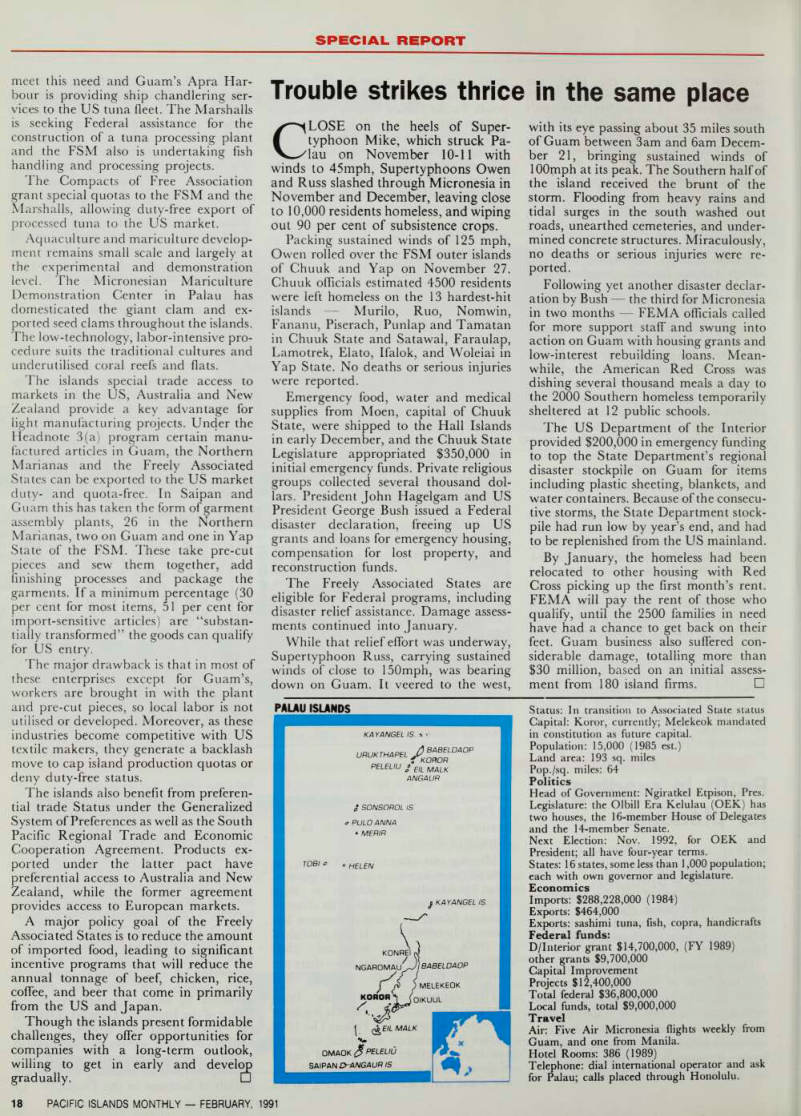
Palau Islands
Status: In transition to Associated State status Capital: Koror, currently; Mclekeok mandated in constitution as future capital.
Population; 15,000 (1985 est.)
Land area: 193 sq. miles Pop./sq. miles: 64 Politics Head of Government; Ngiratkel Etpison, Pres.
Legislature: the Olbill Era Kelulau (OEK) has two houses, the 16-member House of Delegates and the 14-member Senate.
Next Election: Nov. 1992, for OEK and President; all have four-year terms.
States: 16 states, some less than 1,000 population; each with own governor and legislature.
Economics Imports: 5288,228,000 (1984)
Exports: $464,000
Exports: sashimi tuna, fish, copra, handicrafts Federal funds: D/Interior grant $14,700,000, (FY 1989) other grants $9,700,000
Capital Improvement
Projects $12,400,000
Total federal $36,800,000 Local funds, total $9,000,000 Travel Air: Five Air Micronesia flights weekly from Guam, and one from Manila.
Hotel Rooms: 386 (1989) Telephone: dial international operator and ask for Palau; calls placed through Honolulu.
Inside Bougainville
The Region
Papua New Guinea
Io 4. ■ I , .
I Here IS no turnino DOCK, S 3 VS Frsnc S .. ■' Ona as supplies run out and doctors watch women and children die
By Alfred Sasako
(First outside journalist to enter Bougainville since the blockade eight months aqo) 9 ' ELIAS Walu was born on De cember 22 last vear three davs hefnrp pL; ctmoo , a eight months into a maritime and communications blockade on Bougainville. Walu was born in a truck in the caoital Arawa while th* .ruck wen t from blouse h'ouse'ln search of a doctor. When they finally found a doctor, it was too late- the babv was already born, his umblical cord cut with a razor blade. Three days later I arrived • R 1 arrived B ° Uga,nV,lle and became the
outside journalist to interview resistance leader Francis Ona.
A . .
According to Bougamvillean doctors
ic . l ? a ? l C ’ aruai ’ a Paediatrician, and Cyril Imako, Walu’s survival chances were nil. nm' 0 b .| ockade of Bougainville (about 12°° kllometres north-east of Port Moresby) b Y the Pa pua New Guinea Government meant that essential medi “Pi"** had not been able to get in. ! hls m . eant tbat some 6000 babies born rf tbe jsl a nd between October 1989 and E ? ec *j mber . last Y ear were never immu disLs f gams ? common Y et preventable diseases such as measles, whooping cough, diptheria, polio, tetanus, mJmp!
and Hepatitis B.
Dr Garui and Dr Imako agree that the children’s chances of surviving an epi demic in the next 18 months were nil. If we are to rate their chances of survival, it will be a 100 per cent mortality, they said, adding that while the picture was gloomy, it was real. There have been 200 malaria-related deaths in Bougainville in the period of the embargo, an increase of 182 per cent on 1989 figures. Cases of tuberculosis, leprosy and yaws or tropical ulcers have increased by up to 20 per cent. Chronic drug-dependent patients like those suffering from diabetes, hyper tensions and asthma are in trouble.
Dr Garuai and Dr Imako say there will be a lot of deaths in the 30-40 age group as the situation deteriorates: “We have had no basic life-saving drugs such as pencillin and other antibiotics since July last year. The health situation is very critical. The cases we have reported are those that came to our notice. We have no reason to doubt that the situation has worsened.”
Attempts to get medical supplies into Bougainville have failed because Papua New Guinea Prime Minister Rabbie Namaliu insists that all humanitarian aid go through Port Moresby. And the Port Moresby administration has rejected an
Alfred Sasako For Aap
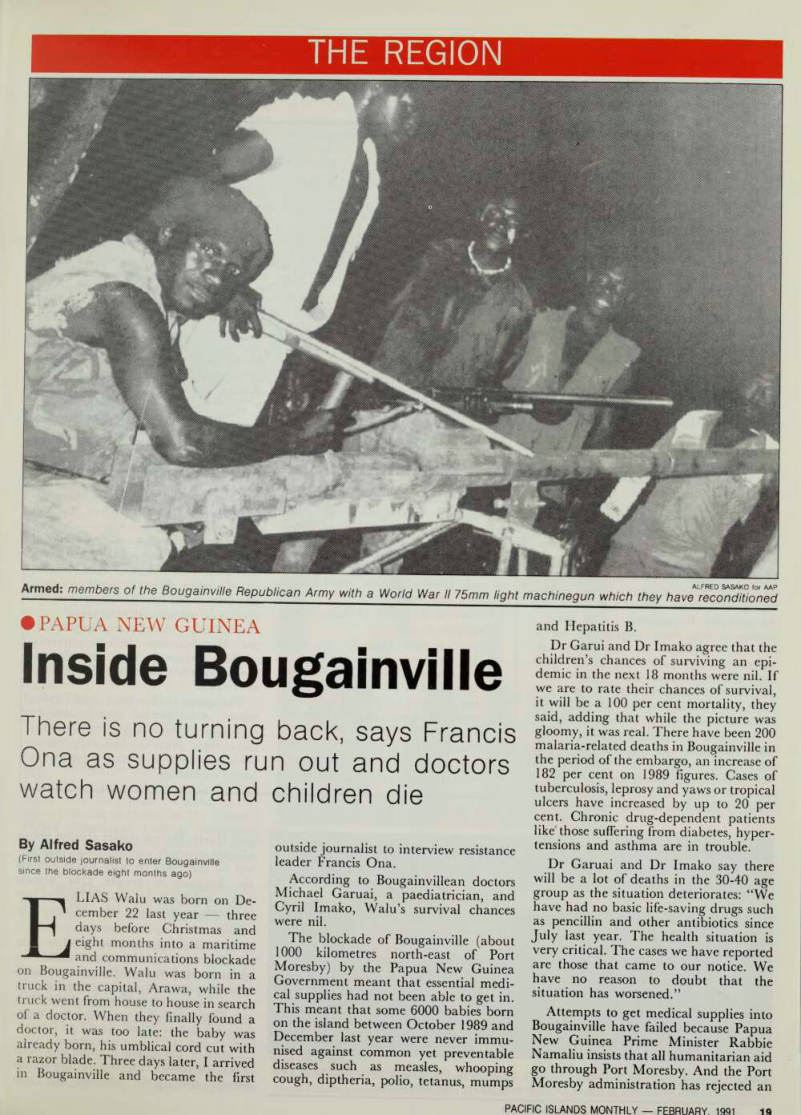
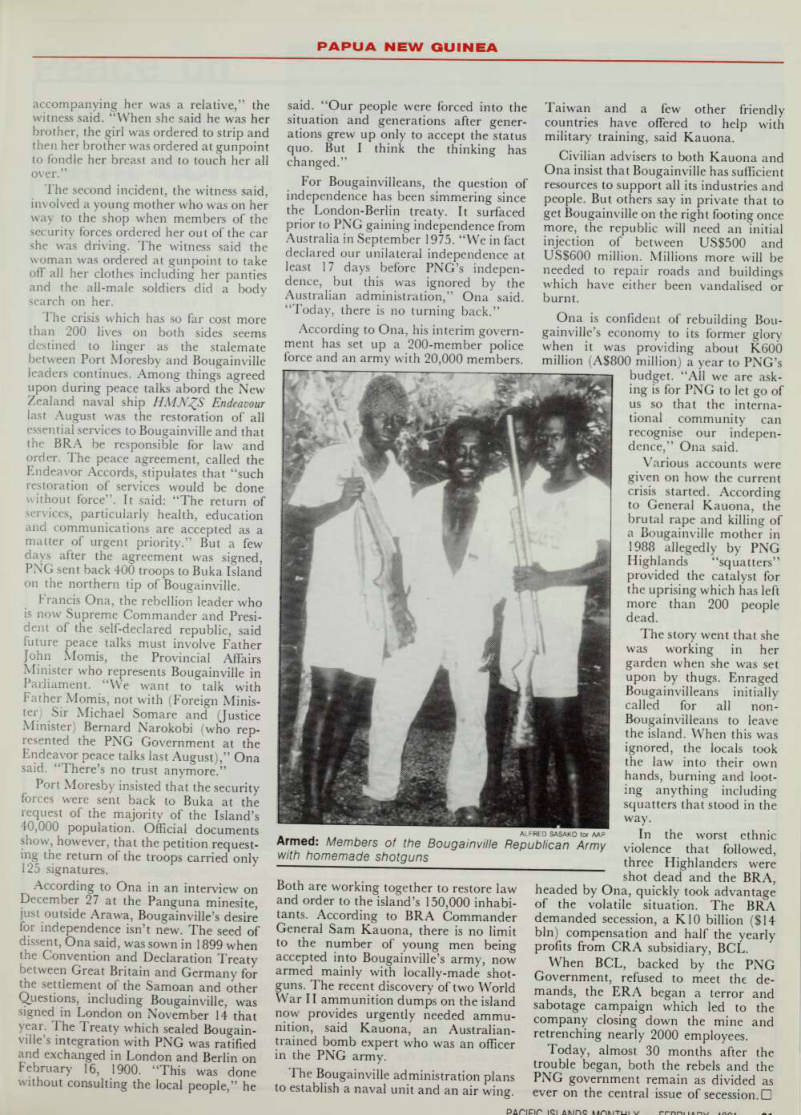
Armed: members of the Bougainville Republican Army with a World War II 75 light machinegun which they have reconditioned
attempt by Solomon Islands Foreign Minister Sir Peter Kenilorea to person ally mediate in the crisis.
The two and a half year-old crisis is turning Arawa, once the seat of the provincial government headed by Joseph Kabul as premier, into a ghost town.
There is no electricity, no medicine, no healthcare and no fuel. Few people are seen. Once home to an estimated 30,000 people including 8000 white expatriates, the town is now nearly deserted. Its streets are empty and houses are covered in overgrown bushes.
The crisis has forced local public servants to return home to their villages.
Contract officers who worked for the now closed Bougainville Copper Ltd have returned to their countries.
Surprisingly, more than a dozen expatriates from New Zealand, Austra lia, Holland and the Philippines have decided to ride out the trouble.
Many are businessmen, others were once employees of the Bougainville Copper Ltd (BCL). They form part of the small community that still endures the hardships in Kieta and Arawa. “I have nowhere else to go,” said business man Ross Noone, of New Zealand, who still lives at Arawa. “I have lived here for the last 20 years and all my assets are here. I have little else elsewhere.”
Another New Zealander, Richard Harty, is married to a Bougainvillean and he has made Bougainville his home.
He and Noonen spoke highly of the Bougainville Republican Army (BRA), saying it has been responsible for a “drastic reduction in crime and (an increase in) law and order control over the last two years. We have little problems moving around town. The BRA have contained the law and order situation here and it is a credit to them.”
Both men say that for members of the BRA to handle the situation as well as they do is something that the people of Bougainville should be proud of. “I can’t say the same thing about the PNG security forces when they were here,”
THE secessionist movement on the island of Bougainville is serious about staying away from Papua New Guinea. A draft has been drawn up on the form of government they will adopt and a sample passport has been printed. Here’s how the rebel leaders see their new republic: Country: Republic of Bougainville Capital: Arawa Government: Initially, members will be appointed and not elected to all four tiers of government headed by a president at the national level. A decision is yet to be made on whether the president should be elected by the people or by members.
Area: 8730 sq km (3371 sq miles) Population: 140,000 to 150,000
Climate: tropical
Religion: Catholic, United Church, Seventh-Day Adventists and a small number of others Language:English will be the official language. Tok Pisin will also be in use.
Resources: copper, gold, cocoa, copra, coffee and tea. Some uranium has been found but the landowners are said to be against its extraction Currency: initially, leaders prefer to use the Solomon Islands currency (dollars and cents) until such time as the nation’s own currency is fully
developed.
Passport: pocket-sized, dark blue in colour. A sample has been produced.
Army: 20,000 plus a 200-member police force. Plans are under way for an air wing and a naval unit to patrol the island’s coastline. □
said Harty. Horror stories abound about alleged atrocities and brutalities commit ted by the PNG security forces against the Bougainville people. One witness who asked not to be identified told of two incidents in Arawa in late 1989 or early 1990: A 13 year-old-girl and her brother were on their way to visit their mother in hospital when the public bus they were travelling in was stopped at a roadblock set up by the PNG Defence Force. The passengers were ordered out for body searches.
“I was in the queue waiting my turn when the soldier carrying out the search asked the girl whether the boy
Alfred Sasako For Aap
Closed: Arawa General Hospital, the only hospital at the Bougainville capital Arawa. remains closed while the number of sick and dying rise everyday
accompanying her was a relative,” the witness said. “When she said he was her brother, the girl was ordered to strip and then her brother was ordered at gunpoint to fondle her breast and to touch her all over.”
The second incident, the witness said, involved a young mother who was on her way to the shop when members of the security forces ordered her out of the car she was driving. The witness said the woman was ordered at gunpoint to take off all her clothes including her panties and the all-male soldiers did a body search on her.
The crisis which has so far cost more than 200 lives on both sides seems destined to linger as the stalemate between Port Moresby and Bougainville leaders continues. Among things agreed upon during peace talks abord the New Zealand naval ship Endeavour last August was the restoration of all essential services to Bougainville and that the BRA be responsible for law and order. The peace agreement, called the Endeavor Accords, stipulates that “such restoration of services would be done without force”. It said: “The return of services, particularly health, education and communications are accepted as a matter of urgent priority.” But a few days after the agreement was signed, PNG sent back 400 troops to Buka Island on the northern tip of Bougainville.
Francis Ona, the rebellion leader who is now Supreme Commander and Presi dent of the self-declared republic, said future peace talks must involve Father John Momis, the Provincial Affairs Minister who represents Bougainville in Parliament. “We want to talk with Father Momis, not with (Foreign Minis ter) Sir Michael Somare and (Justice Minister) Bernard Narokobi (who rep resented the PNG Government at the Endeavor peace talks last August),” Ona said. “There’s no trust anymore.”
Port Moresby insisted that the security forces were sent back to Buka at the request of the majority of the Island’s 40,000 population. Official documents show, however, that the petition request ing the return of the troops carried only
125 signatures.
According to Ona in an interview on December 27 at the Panguna minesite, just outside Arawa, Bougainville’s desire for independence isn’t new. The seed of dissent, Ona said, was sown in 1899 when the Convention and Declaration Treaty between Great Britain and Germany for the settlement of the Samoan and other
Questions, including Bougainville, was
signed in London on November 14 that year. The Treaty which sealed Bougain ville’s integration with PNG was ratified and exchanged in London and Berlin on February 16, 1900. “This was done without consulting the local people,” he
said. “Our people were forced into the situation and generations after gener ations grew up only to accept the status quo. But I think the thinking has
changed.”
For Bougainvilleans, the question of independence has been simmering since the London-Berlin treaty. It surfaced prior to PNG gaining independence from Australia in September 1975. “We in fact declared our unilateral independence at least 17 days before PNG’s indepen dence, but this was ignored by the Australian administration,” Ona said.
“Today, there is no turning back.”
According to Ona, his interim govern ment has set up a 200-member police force and an army with 20,000 members.
Both are working together to restore law and order to the island’s 150,000 inhabi tants. According to BRA Commander General Sam Kauona, there is no limit to the number of young men being accepted into Bougainville’s army, now armed mainly with locally-made shot guns. The recent discovery of two World War II ammunition dumps on the island now provides urgently needed ammu nition, said Kauona, an Australian trained bomb expert who was an officer in the PNG army.
The Bougainville administration plans
to establish a naval unit and an air wing.
Taiwan and a few other friendly countries have offered to help with
military training, said Kauona.
Civilian advisers to both Kauona and Ona insist that Bougainville has sufficient resources to support all its industries and people. But others say in private that to get Bougainville on the right footing once more, the republic will need an initial injection of between USSSOO and USS6OO million. Millions more will be needed to repair roads and buildings which have either been vandalised or burnt.
Ona is confident of rebuilding Bou gainville’s economy to its former glory when it was providing about K6OO million (ASBOO million) a year to PNG’s
budget. “All we are ask ing is for PNG to let go of us so that the interna tional community can recognise our indepen dence,” Ona said.
Various accounts were given on how the current crisis started. According to General Kauona, the brutal rape and killing of a Bougainville mother in 1988 allegedly by PNG Highlands “squatters” provided the catalyst for the uprising which has left more than 200 people dead.
The story went that she was working in her garden when she was set
upon by thugs. Enraged
Bougainvilleans initially called for all non- Bougainvilleans to leave the island. When this was ignored, the locals took the law into their own hands, burning and loot ing anything including squatters that stood in the way.
In the worst ethnic violence that followed, three Highlanders were shot dead and the BRA,
headed by Ona, quickly took advantage of the volatile situation. The BRA demanded secession, a KlO billion (SI4 bln) compensation and half the yearly profits from CRA subsidiary, BCL.
When BCL, backed by the PNG Government, refused to meet the de mands, the ERA began a terror and sabotage campaign which led to the company closing down the mine and retrenching nearly 2000 employees.
Today, almost 30 months after the trouble began, both the rebels and the PNG government remain as divided as ever on the central issue of secession. □
Alfred Sasako For Aap
Armed: Members of the Bougainville Republican Army with homemade shotguns
Advertisements & other items, p. 21 (1 item)
PAPIPir ICI AMne MAM TUI V CCOrniAnu
PAPUA NEW GUINEA
Operation Somare
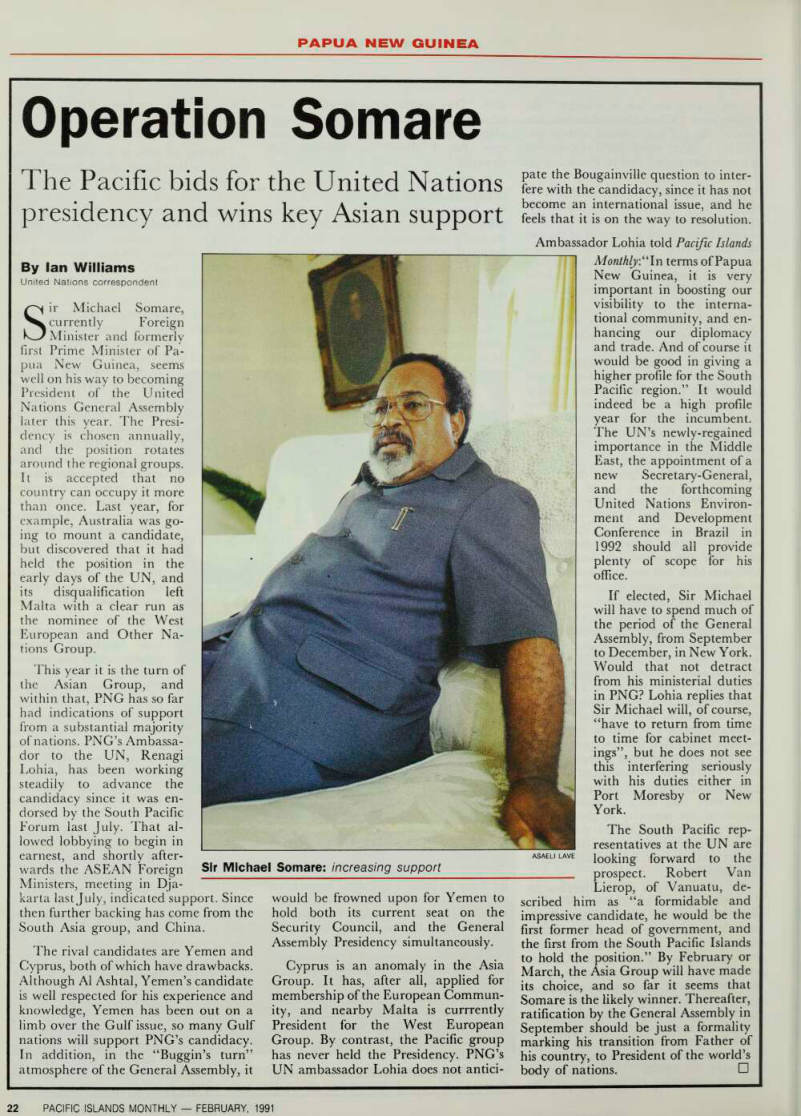
The Pacific bids for the United Nations presidency and wins key Asian support
By Ian Williams
United Nations correspondent Sir Michael Somare,
currently Foreign
Minister and formerly first Prime Minister of Pa pua New Guinea, seems well on his way to becoming President of the United Nations General Assembly later this year. The Presi dency is chosen annually, and the position rotates around the regional groups.
It is accepted that no country can occupy it more than once. Last year, for example, Australia was go ing to mount a candidate, but discovered that it had held the position in the early days of the UN, and its disqualification left Malta with a clear run as the nominee of the West European and Other Na
tions Group.
This year it is the turn of the Asian Group, and within that, PNG has so far had indications of support from a substantial majority of nations. PNG’s Ambassa dor to the UN, Renagi Lohia, has been working steadily to advance the candidacy since it was en dorsed by the South Pacific Forum last July. That al lowed lobbying to begin in earnest, and shortly after wards the ASEAN Foreign Ministers, meeting in Dja
karta last July, indicated support. Since then further backing has come from the South Asia group, and China.
The rival candidates are Yemen and Cyprus, both of which have drawbacks.
Although A 1 Ashtal, Yemen’s candidate is well respected for his experience and knowledge, Yemen has been out on a limb over the Gulf issue, so many Gulf nations will support PNG’s candidacy.
In addition, in the “Buggin’s turn” atmosphere of the General Assembly, it
would be frowned upon for Yemen to hold both its current seat on the Security Council, and the General Assembly Presidency simultaneously.
Cyprus is an anomaly in the Asia Group. It has, after all, applied for membership of the European Commun
ity, and nearby Malta is currrently
President for the West European Group. By contrast, the Pacific group has never held the Presidency. PNG’s UN ambassador Lohia does not antici
pate the Bougainville question to inter fere with the candidacy, since it has not become an international issue, and he feels that it is on the way to resolution.
Ambassador Lohia told Pacific Islands
Monthly:“ln terms of Papua New Guinea, it is very
important in boosting our
visibility to the interna tional community, and en
hancing our diplomacy
and trade. And of course it would be good in giving a higher profile for the South Pacific region.” It would indeed be a high profile year for the incumbent.
The UN’s newly-regained importance in the Middle East, the appointment of a
new Secretary-General,
and the forthcoming United Nations Environ ment and Development Conference in Brazil in 1992 should all provide plenty of scope for his office.
If elected, Sir Michael will have to spend much of the period of the General
Assembly, from September
to December, in New York.
Would that not detract from his ministerial duties in PNG? Lohia replies that Sir Michael will, of course, “have to return from time to time for cabinet meet ings”, but he does not see this interfering seriously with his duties either in Port Moresby or New York.
The South Pacific rep resentatives at the UN are looking forward to the prospect. Robert Van Lierop, of Vanuatu, de
scribed him as “a formidable and impressive candidate, he would be the first former head of government, and the first from the South Pacific Islands to hold the position.” By February or March, the Asia Group will have made its choice, and so far it seems that Somare is the likely winner. Thereafter, ratification by the General Assembly in
September should be just a formality
marking his transition from Father of his country, to President of the world’s body of nations. □
Sir Michael Somare: increasing support
paper but
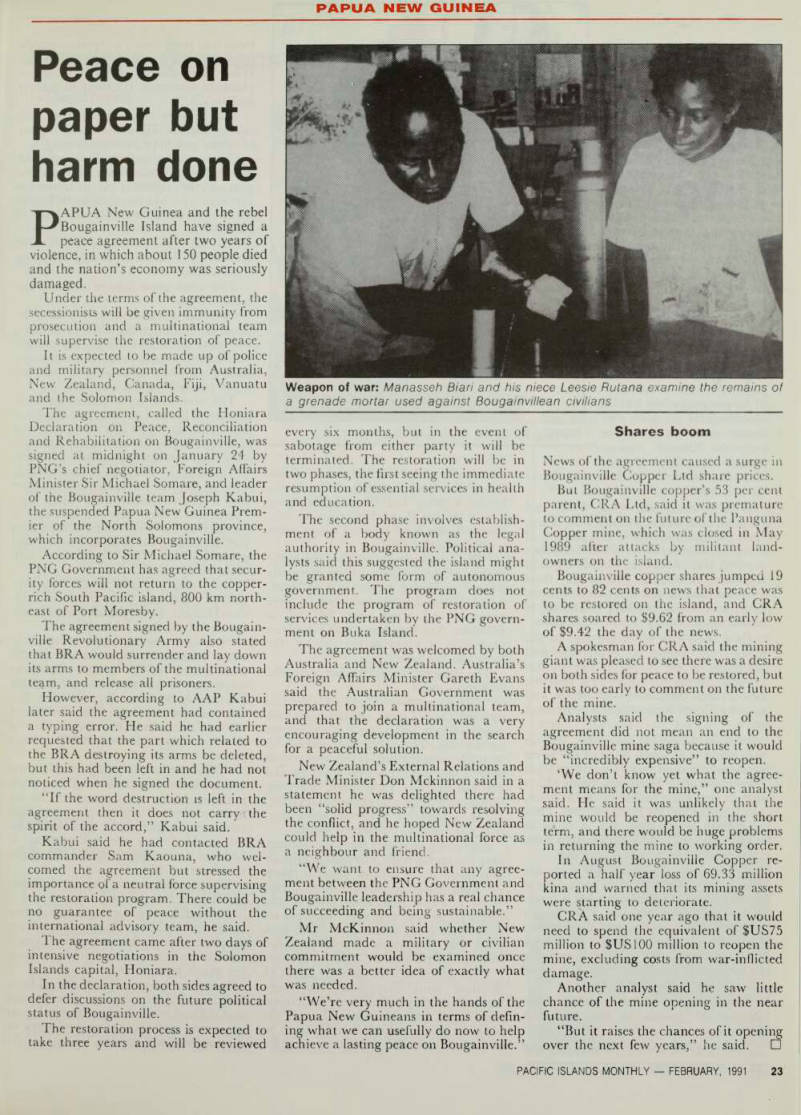
Peace on paper but harm done
PAPUA New Guinea and the rebel Bougainville Island have signed a peace agreement after two years of violence, in which about 150 people died and the nation’s economy was seriously
damaged.
Under the terms of the agreement, the secessionists will be given immunity from prosecution and a multinational team will supervise the restoration of peace.
It is expected to be made up of police and military personnel from Australia, New Zealand, Canada, Fiji, Vanuatu and the Solomon Islands.
The agreement, called the Honiara Declaration on Peace, Reconciliation and Rehabilitation on Bougainville, was signed at midnight on January 24 by PNG’s chief negotiator, Foreign Affairs Minister Sir Michael Somare, and leader of the Bougainville team Joseph Kabui, the suspended Papua New Guinea Prem ier of the North Solomons province,
which incorporates Bougainville.
According to Sir Michael Somare, the PNG Government has agreed that secur ity forces will not return to the copper rich South Pacific island, 800 km north east of Port Moresby.
The agreement signed by the Bougain ville Revolutionary Army also stated that BRA would surrender and lay down its arms to members of the multinational team, and release all prisoners.
However, according to AAP Kabui later said the agreement had contained a typing error. He said he had earlier requested that the part which related to the BRA destroying its arms be deleted, but this had been left in and he had not noticed when he signed the document.
“If the word destruction is left in the agreement then it does not carry the spirit of the accord,” Kabui said.
Kabui said he had contacted BRA commander Sam Kaouna, who wel comed the agreement but stressed the importance of a neutral force supervising the restoration program. There could be no guarantee of peace without the international advisory team, he said.
The agreement came after two days of intensive negotiations in the Solomon Islands capital, Honiara.
In the declaration, both sides agreed to defer discussions on the future political status of Bougainville.
The restoration process is expected to take three years and will be reviewed
every six months, but in the event of sabotage from either party it will be terminated. The restoration will be in two phases, the first seeing the immediate resumption of essential services in health and education.
The second phase involves establish ment of a body known as the legal authority in Bougainville. Political ana lysts said this suggested the island might be granted some form of autonomous government. The program does not include the program of restoration of sendees undertaken by the PNG govern ment on Buka Island.
The agreement was welcomed by both Australia and New Zealand. Australia’s Foreign Affairs Minister Gareth Evans said the Australian Government was prepared to join a multinational team, and that the declaration was a very encouraging development in the search for a peaceful solution.
New Zealand’s External Relations and Trade Minister Don Mckinnon said in a statement he was delighted there had been “solid progress” towards resolving the conflict, and he hoped New Zealand could help in the multinational force as a neighbour and friend.
“We want to ensure that any agree ment between the PNG Government and Bougainville leadership has a real chance of succeeding and being sustainable.”
Mr McKinnon said whether New Zealand made a military or civilian commitment would be examined once there was a better idea of exactly what was needed.
“We’re very much in the hands of the Papua New Guineans in terms of defin ing what we can usefully do now to help achieve a lasting peace on Bougainville.”
Shares boom News of the agreement caused a surge in Bougainville Copper Ltd share prices.
But Bougainville copper’s 53 per cent parent, CRA Ltd, said it was premature to comment on the future of the Panguna Copper mine, which was closed in May 1989 after attacks by militant land owners on the island.
Bougainville copper shares jumped 19 cents to 82 cents on news that peace was to be restored on the island, and CRA shares soared to S9.62 from an early low of S9.42 the day of the news.
A spokesman for CRA said the mining giant was pleased to see there was a desire on both sides for peace to be restored, but it was too early to comment on the future of the mine.
Analysts said the signing of the agreement did not mean an end to the Bougainville mine saga because it would be “incredibly expensive” to reopen. ‘We don’t know yet what the agree ment means for the mine,” one analyst said. He said it was unlikely that the mine would be reopened in the short term, and there would be huge problems in returning the mine to working order.
In August Bougainville Copper re ported a half year loss of 69.33 million kina and warned that its mining assets were starting to deteriorate.
CRA said one year ago that it would need to spend the equivalent of SUS75 million to SUS100 million to reopen the mine, excluding costs from war-inflicted damage.
Another analyst said he saw little chance of the mine opening in the near future.
“But it raises the chances of it opening over the next few years,” he said. □
Weapon of war: Manasseh Biari and his niece Leesie Rutana examine the remains of a grenade mortar used against Bougainvillean civilians
firing
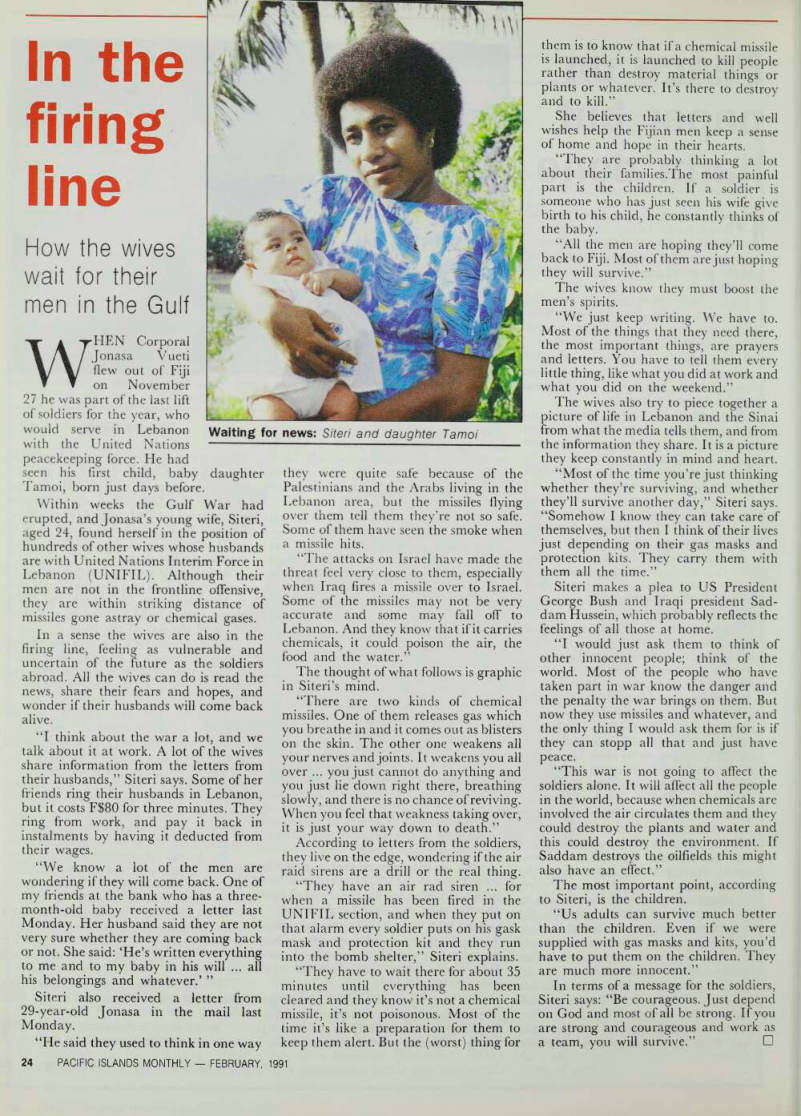
In the firing line
How the wives
wait for their
men in the Gulf
WHEN Corporal
Jonasa Vueti flew out of Fiji on November 27 he was part of the last lift of soldiers for the year, who would serve in Lebanon with the United Nations peacekeeping force. He had
seen his first child, baby daughter Tamoi, born just days before.
Within weeks the Gulf War had erupted, and Jonasa’s young wife, Siteri, aged 24, found herself in the position of hundreds of other wives whose husbands are with United Nations Interim Force in
Lebanon (UNIFIL). Although their
men are not in the frontline offensive, they are within striking distance of missiles gone astray or chemical gases.
In a sense the wives are also in the firing line, feeling as vulnerable and uncertain of the future as the soldiers abroad. All the wives can do is read the news, share their fears and hopes, and wonder if their husbands will come back aFve t<T .. i u u , , 1I think about the war a lot and we talk about it at work. A lot of the wives sharc mformaoon from the letters from their husbands. Siteri says. Some of her friends ring their husbands in Lebanon, but it costs FMO for three minutes. They ring from work, and pay it back in thSr wa"es V " g eir wages.
We know a lot of the men are wondering if they will come back. One of my ftj en ds at the bank who has a threemonth-old baby received a letter last Monday. Her husband said they are not very sure whether they are coming back or not. She said: He s written everything to me and to my baby in his will ... all his belongings and whatever.
Siteri also received a letter from 29-year-old Jonasa in the mail last
Monday.
“He said they used to think in one way
they were quite safe because of the Palestinians and the Arabs living in the Lebanon area, but the missiles flying over them tell them they’re not so safe.
Some of them have seen the smoke when a missile hits.
“The attacks on Israel have made the threat feel very close to them, especially when Iraq fires a missile over to Israel.
Some of the missiles may not be very accurate and some may fall off to Lebanon. And they know that if it carries chemicals, it could poison the air, the food and the water.”
The thought of what follows is graphic in Siteri’s mind.
“There are two kinds of chemical missiles. One of them releases gas which you breathe in and it comes out as blisters on the skin. The other one weakens all your nerves and joints. It weakens you all over ... you just cannot do anything and you just lie down right there, breathing slowly, and there is no chance of reviving.
When you feel that weakness taking over, it is just your way down to death.”
According to letters from the soldiers, they live on the edge, wondering if the air raid sirens are a drill or the real thing.
“They have an air rad siren ... for when a missile has been fired in the UNI FI L section, and when they put on that alarm every soldier puts on his gask mask and protection kit and they run into the bomb shelter,” Siteri explains.
“They have to wait there for about 35 minutes until everything has been cleared and they know it’s not a chemical missile, it’s not poisonous. Most of the time it’s like a preparation for them to keep them alert. But the (worst) thing for
them is to know that if a chemical missile is launched, it is launched to kill people rather than destroy material things or plants or whatever. It’s there to destroy and to kill.”
She believes that letters and well wishes help the Fijian men keep a sense of home and hope in their hearts.
“They are probably thinking a lot about their families. The most painful part is the children. If a soldier is someone who has just seen his wife give birth to his child, he constantly thinks of
the baby.
“All the men are hoping they’ll come back to Fiji. Most of them are just hoping they will survive.”
The wives know they must boost the men’s spirits.
“We just keep writing. We have to.
Most of the things that they need there, the most important things, are prayers and letters. You have to tell them every little thing, like what you did at work and what you did on the weekend.”
The wives also try to piece together a picture of life in Lebanon and the Sinai from what the media tells them, and from the information they share. It is a picture they keep constantly in mind and heart.
“Most of the time you’re just thinking whether they’re surviving, and whether they’ll survive another day,” Sited says.
“Somehow I know they can take care of themselves, but then I think of their lives just depending on their gas masks and protection kits. They carry them with them all the time.”
Sited makes a plea to US President George Bush and Iraqi president Sad dam Hussein, which probably reflects the feelings of all those at home.
“I would just ask them to think of other innocent people; think of the world. Most of the people who have taken part in war know the danger and the penalty the war brings on them. But now they use missiles and whatever, and the only thing I would ask them for is if they can stopp all that and just have peace.
“This war is not going to affect the soldiers alone. It will affect all the people in the world, because when chemicals are involved the air circulates them and they could destroy the plants and water and this could destroy the environment. If Saddam destroys the oilfields this might also have an effect.”
The most important point, according to Siteri, is the children.
“Us adults can survive much better than the children. Even if we were supplied with gas masks and kits, you’d have to put them on the children. They are much more innocent.”
In terms of a message for the soldiers, Siteri says: “Be courageous. Just depend on God and most of all be strong. If you are strong and courageous and work as a team, you will survive.” □
Waiting for news: Siteri and daughter Tamoi
American Samoans doing the most
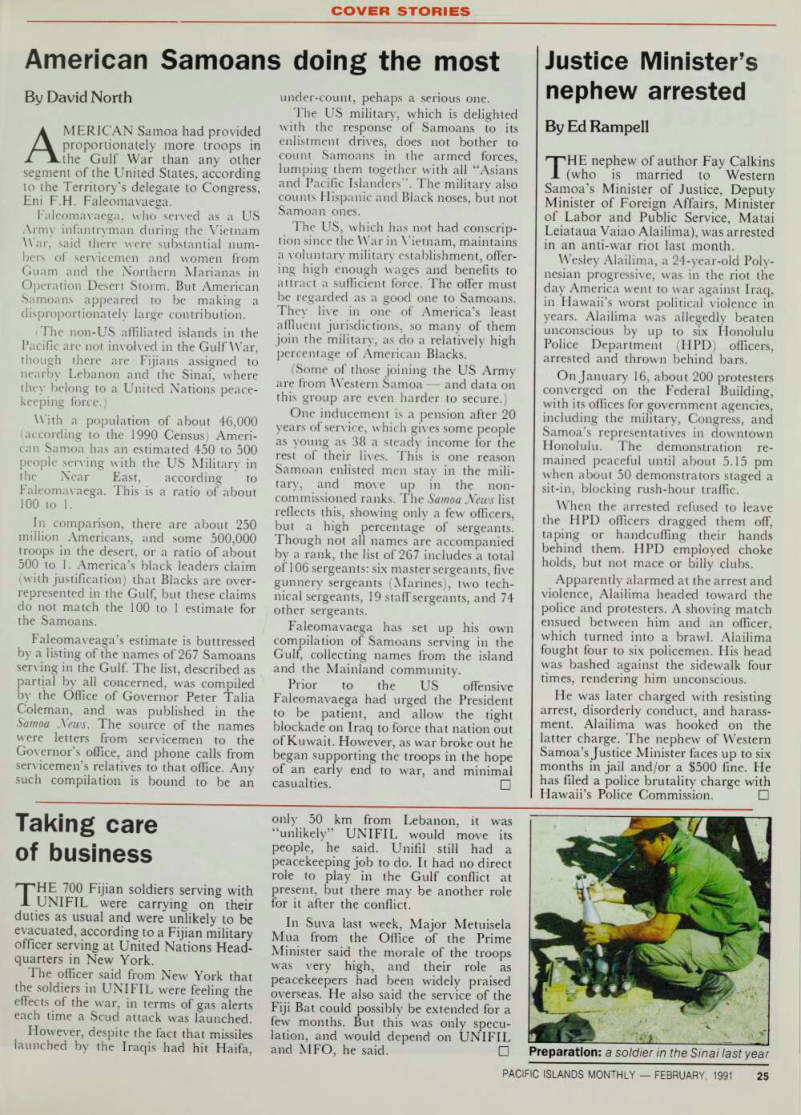
By David North
AMERICAN Samoa had provided proportionately more troops in the Gulf War than any other segment of the United States, according to the Territory’s delegate to Congress, Eni F.H. Faleomavaega.
Faleomavaega, who served as a US Army infantryman during the Vietnam War, said there were substantial num bers of servicemen and women from Guam and the Northern Marianas in Operation Desert Storm. But American Samoans appeared to be making a
disproportionately large contribution.
The non-US affiliated islands in the Pacific are not involved in the Gulf War,
though there are Fijians assigned to
nearby Lebanon and the Sinai, where they belong to a United Nations peace
keeping force.)
With a population of about 46,000 (according to the 1990 Census) Ameri can Samoa has an estimated 450 to 500 people serving with the US Military in the Near East, according to Faleomavaega. This is a ratio of about 100 to 1.
In comparison, there are about 250 million Americans, and some 500,000 troops in the desert, or a ratio of about 500 to 1. America’s black leaders claim (with justification) that Blacks are over represented in the Gulf, but these claims do not match the 100 to 1 estimate for the Samoans.
Faleomaveaga’s estimate is buttressed by a listing of the names of 267 Samoans serving in the Gulf. The list, described as partial by all concerned, was compiled by the Office of Governor Peter Talia Coleman, and was published in the Samoa News. The source of the names were letters from servicemen to the Governor’s office, and phone calls from servicemen’s relatives to that office. Any such compilation is bound to be an
under-count, pehaps a serious one.
The US military, which is delighted with the response of Samoans to its enlistment drives, does not bother to count Samoans in the armed forces, lumping them together with all “Asians and Pacific Islanders”. The military also counts Hispanic and Black noses, but not Samoan ones.
The US, which has not had conscrip tion since the War in Vietnam, maintains a voluntary military establishment, offer ing high enough wages and benefits to attract a sufficient force. The offer must be regarded as a good one to Samoans.
They live in one of America’s least affluent jurisdictions, so many of them join the military, as do a relatively high percentage of American Blacks. (Some of those joining the US Army are from Western Samoa and data on this group are even harder to secure.) One inducement is a pension after 20 years of service, which gives some people as young as 38 a steady income for the rest of their lives. This is one reason Samoan enlisted men stay in the mili tary, and move up in the non commissioned ranks. The Samoa News list reflects this, showing only a few officers, but a high percentage of sergeants.
Though not all names are accompanied by a rank, the list of 267 includes a total of 106 sergeants: six master sergeants, five gunnery sergeants (Marines), two tech nical sergeants, 19 staff sergeants, and 74 other sergeants.
Faleomavaega has set up his own compilation of Samoans serving in the Gulf, collecting names from the island and the Mainland community.
Prior to the US offensive Faleomavaega had urged the President to be patient, and allow the tight blockade on Iraq to force that nation out of Kuwait. However, as war broke out he began supporting the troops in the hope of an early end to war, and minimal casualties. □
nephew arrested
Justice Minister’s nephew arrested
By Ed Rampell
THE nephew of author Fay Calkins (who is married to Western Samoa’s Minister of Justice, Deputy Minister of Foreign Affairs, Minister of Labor and Public Service, Matai Leiataua Vaiao Alailima), was arrested in an anti-war riot last month.
Wesley Alailima, a 24-year-old Poly nesian progressive, was in the riot the day America went to war against Iraq, in Hawaii’s worst political violence in years. Alailima was allegedly beaten unconscious by up to six Honolulu Police Department (HPD) officers, arrested and thrown behind bars.
On January 16, about 200 protesters converged on the Federal Building, with its offices for government agencies, including the military, Congress, and Samoa’s representatives in downtown Honolulu. The demonstration re mained peaceful until about 5.15 pm when about 50 demonstrators staged a sit-in, blocking rush-hour traffic.
When the arrested refused to leave the HPD officers dragged them off, taping or handcuffing their hands behind them. HPD employed choke holds, but not mace or billy clubs.
Apparently alarmed at the arrest and violence, Alailima headed toward the police and protesters. A shoving match ensued between him and an officer, which turned into a brawl. Alailima fought four to six policemen. His head was bashed against the sidewalk four times, rendering him unconscious.
He was later charged with resisting arrest, disorderly conduct, and harass ment. Alailima was hooked on the latter charge. The nephew of Western Samoa’s Justice Minister faces up to six months in jail and/or a S5OO fine. He has filed a police brutality charge with Hawaii’s Police Commission. □
Taking care
of business
THE 700 Fijian soldiers serving with UNIFIL were carrying on their duties as usual and were unlikely to be evacuated, according to a Fijian military officer serving at United Nations Head quarters in New York.
The officer said from New York that the soldiers in UNIFIL were feeling the effects of the war, in terms of gas alerts each time a Scud attack was launched.
However, despite the fact that missiles launched by the Iraqis had hit Haifa,
only 50 km from Lebanon, it was “unlikely” UNIFIL would move its people, he said. Unifil still had a peacekeeping job to do. It had no direct role to play in the Gulf conflict at present, but there may be another role for it after the conflict.
In Suva last week, Major Metuisela Mua from the Office Of the Prime Minister said the morale of the troops was very high> and their role ‘ as
peacekeepers had been widely praised
overseas. He also said the service of the Fiji Bat could possibly be extended for a f ew months. But this was only specu lation, and would depend on UNIFIL and MFO, he said. □
Preparation: a soldier in the Sinai last year
Where a
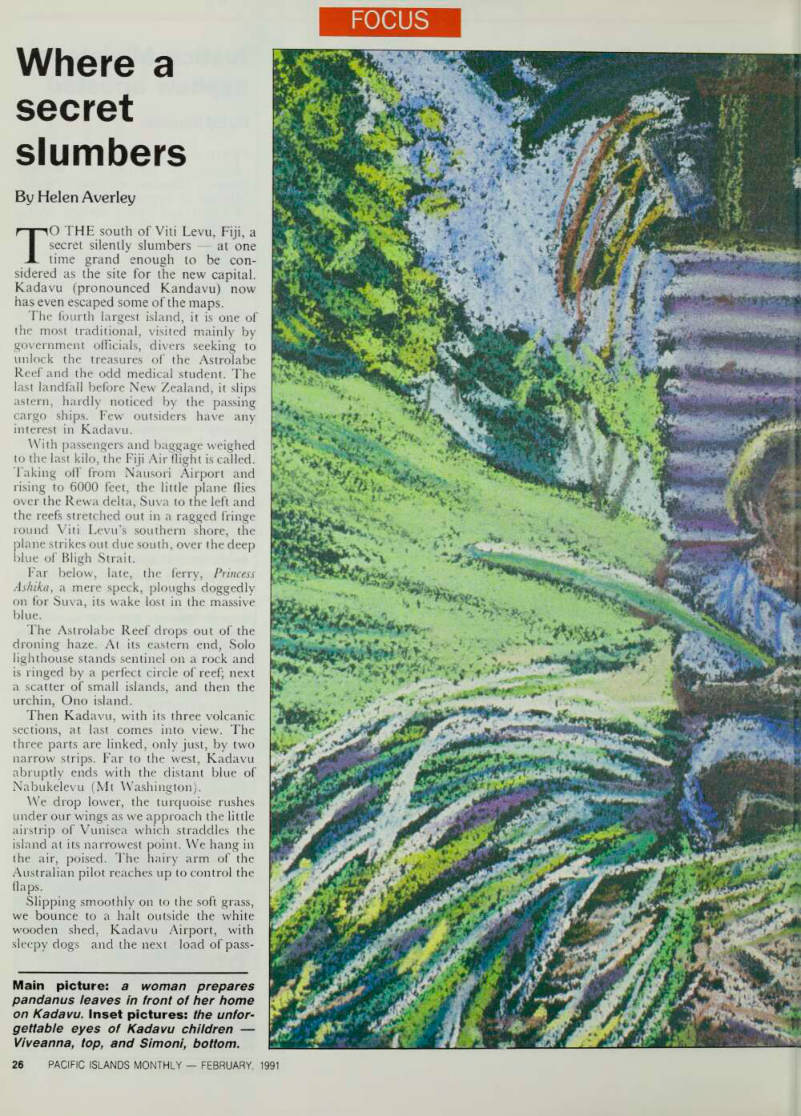


Focus
Where a secret slumbers
By Helen Averley
TO THE south of Viti Levu, Fiji, a secret silently slumbers at one time grand enough to be con sidered as the site for the new capital.
Kadavu (pronounced Kandavu) now has even escaped some of the maps.
The fourth largest island, it is one of the most traditional, visited mainly by government officials, divers seeking to unlock the treasures of the Astrolabe Reef and the odd medical student. The last landfall before New Zealand, it slips astern, hardly noticed by the passing cargo ships. Few outsiders have any interest in Kadavu.
With passengers and baggage weighed to the last kilo, the Fiji Air flight is called.
Taking off from Nausori Airport and rising to 6000 feet, the little plane flies over the Rewa delta, Suva to the left and the reefs stretched out in a ragged fringe round Viti Levu’s southern shore, the plane strikes out due south, over the deep blue of Bligh Strait.
Far below, late, the ferry, Princess
Ashika, a mere speck, ploughs doggedly
on for Suva, its wake lost in the massive blue.
The Astrolabe Reef drops out of the droning haze. At its eastern end, Solo lighthouse stands sentinel on a rock and is ringed by a perfect circle of reef; next a scatter of small islands, and then the urchin, Ono island.
Then Kadavu, with its three volcanic sections, at last comes into view. The three parts are linked, only just, by two narrow strips. Far to the west, Kadavu abruptly ends with the distant blue of Nabukelevu (Mt Washington).
We drop lower, the turquoise rushes under our wings as we approach the little airstrip of Vunisea which straddles the island at its narrowest point. We hang in the air, poised. The hairy arm of the Australian pilot reaches up to control the flaps.
Slipping smoothly on to the soft grass, we bounce to a halt outside the white wooden shed, Kadavu Airport, with sleepy dogs and the next load of pass-
Main picture: a woman prepares pandanus leaves in front of her home on Kadavu. Inset pictures: the unfor gettable eyes of Kadavu children- Viveanna, top, and Simoni, bottom.
engers waiting beside a stack of luggage.
Everyone helps unload while chickens return to their scratching on the strip.
Matai drives one of the dozen or so trucks on Kadavu. In his brilliant green shirt he clashes violently with the new red
truck. He has driven all his life, in the Malaysian campaign, and now for the government office at Tavuki, his broad feet are splayed across the pedals.
The dirt road to Tavuki rises out of Vunisea. It snakes, a pink scar cut deep
into the verdant, steep hills, and we catch glimpses of Nabukelevu and snatches of the sea to the sound of Ron Pickering singing You drive me crazy. We slip down towards the seven villages of Tavuki district.
How is it that, knowing Ka davu so well from maps, that in her three dimensions she should so surprise and overwhelm me it is thrilling and it is indeed hilly.
The hills are old, wild, and some razor sharp, yet meeting the people of Kadavu you find them warm and hospitable, unhurried by it all, as they get on with life.
Their villages dotted along the coast, nestled between forest and sea, on the few flat pieces of land; at times having to resort to
gentler slopes as the lapping
waters forced them to abandon the shore.
Life goes on here much as it must always have done. When
the tide is out the people fish; when it is light, and food needs to be harvested someone is sent to the plantations, where Dalo (Taro), Cassava and Yaqona (Kava) are grown.
When a mat is wanted for a gift or for personal use, the business of mat making seems to incorporate the whole village.
Often village greens are littered with
drying pandanus leaves, blanched.
When dry, a man may help prepare the leaves, rolling them ready for his wife to weave.
A woman lifts down her almost completed mat from the rafters, where it is stored alongside fishing spears, planks, other mats and the occasional children’s tricycle. She has just finished weaving a mat to cover the bed, fringed with bright nylon wool.
But this new one is for the floor, and is not so fine. The wooden walls are painted a United Nations blue; a special deal must have been done on this particular batch of paint as it is found everywhere in the Pacific, but it is a perfect background to the pictures of sons in uniform as part of peace-keeping forces for the United Nations.
They hang alongside other family
portraits, depictions of the Last Supper,
a painting of a Sunderland flying boat, part of the New Zealand navy in the
The Chief: Ratu Aca, Daviqele, Kadavu
Tradition lives on at Kadavu: Ralure weaves mats as her mother, and as her mother's mother, had done
Relaxing: Ateca takes a break from her day's work
Serious: the level gaze of an elder commands respect
Questioning: a Kadavu woman scrutinises the artist
Patient: Kataloni sits, motionless, for her portrait
19505, and of course pride of place goes to the Royals Prince Charles on his engagement to Lady Diana, and so on.
These are nailed on to the tapa (bark cloth), painted in dense geometric pat terns in black and brown, and strung across the room from the main beam. It sets the scene for the important display of brightly coloured patchwork cushions and elaborately draped suite which is placed centre stage.
When the work is done and the sun has
set, the people will gather round the tanoa (Kava bowl). The men hitch up their mlus, sit crosslegged, and they too are set for the night. The women come later and slip in quietly through one of the three doors, which look out into the blackness thick, unlit, vast space.
It is cosy inside, comfortable and friendly. Pairs of eyes peep in through every gap and chink of the corrugated walls, and people stand round in hoardes at the doors, quietly shoving each other for a good view. , ... j „ , . u .
J h£ children of Kadavu watch as their Elders sit sharing the Yaqona, and the events of the day. It is round the tanoa that stories are told, where important decisions are made, where age old ceremonies are practiced. Indeed nothing, no matter how large or small, can escape the seal of approval of th t yaqona ceremony.
If you want something you must share a bowl o {yaqona. It is serious, yet at the same time it is relaxing. It is when jokes are told, and where the ladies shrilly echo the low tones of the men as the village joins in a meke, a celebration of life in dance and song. The subject can be anything from a Russian Crown Prince to a rugby match, or a singer’s love at
first sight.
The conversation is ordinary too the finer points of fishing, rugby and
women are once again exhausted. The nights are long, and stiff legs are stretched. It feels like little can have changed, save of course for the introduction of T-shirts, sunglasses and packs of playing cards.
There are many bush tracks which criss-cross Ka davu. The postman takes a week to cover the western bulge as he walks from one village postal station to the next. Some of the paths connect villages, others go inland to plantations. From the northern shore, at Ta vuki, there is a track, if you know it exists, to the southern side and Cevai (Thevai).
Out of Tavuki, past the government offices, crossing a small creek, the bridge consists of two felled coco nut trees, under mango trees, past a small cemetery, and along to the inland village of Baidamudamu.
The village has some of the traditional thatched bures, which have survived the hurricanes and progress, but like most of Kadavu,
the houses are wooden, with tin roofs.
Some are built on the old mounds, and a f ew are hybrids with thatched walls anc i tin roofs. Rising out of Baidamudamu, the track cuts through long sharp grasses, before crossing a creek full of fresh water prawns, and enters the
plantations,
Not long after rain the paths are treacherous, steep, slippery; the forest
dripping with vines, large pods and
buttress roots, tree ferns and wild hibiscus. Creeks flow into the harlequin pattern of taro terraces (different to the da|o beds below) nood; them , ;ke dd fie|ds r . , Crossing the island the path gets tangled up and tries to find the easiest route if not the most direct, along the spine-hke ridges or resorts to the rocky stream floor.
There is no sign of people ever having
been here. Everything seems newly discovered, like views of the other side of the island, and the unexpected and spectacular 40 feet drop of Vasuvu falls, where a needle of rock detached from the main cliff leans as if pulled down the valley, unable to stop itself falling onto the ruin of rocks below. The boulders are the size of trucks, straddled by creepers, and licked by cool whisps of misty spray.
A raw interior gives way once more to plantations worked by villagers from the southern side. Shortly the track joins the road, and leads at last to Cevai. The villagers say it takes them only three quarters of an hour, whereas it took me three or more perhaps there is an alternative route!
A story is told that the people of Cevai are direct descendants of Benjamin, Jacob’s twelfth son, and if they worship anyone other than God they will bring down a curse on the village.
But come Sunday, the life on Kadavu, like most of Fiji, revolves round the Church. For several Sundays in Tavuki I awoke to the deceptive palm leaves which rustle like falling rain. The cockerels crow whilst the church bell prompts the Lali (drum) to beat, calling the faithful to the first service.
A stream of people pass, dressed in their best the women in bright dresses over long plain sulus, the boys like little men, their sulus too large worn with tidy shirts and ties. No-one hurries.
The large church is decorated with wild and silk flowers. The children are made to sit in the front, on the floor. A fidgeting mass of little polished bodies, hair glistening, smoothed with coconut oil.
Elbowing each other during prayers, whacking their friends over the head when they think no-one is looking, but the Sunday School policeman is on
patrol.
With his long pole he reaches out and
prods them into shape, wagging his
finger the squirming child looks up with huge black eyes and is told to “Sit up straight ... fix your sulu ... fold your arms ... stop hitting him ...”
But the sermon is long and those elder members of the congregation donh escape. The man slumped sleepily too is poked, startled into wakefulness. The children stifle a snigger. Their mischiev ous eyes will remain with me a long time.
The Princess Ashika , fully laden with Yaqona, dried sea cucumbers, plantains and some familiar faces, turns and steams out through the reef from Vunisea past the rock from which the villagers of Namuana call the turtles from the sea.
Kadavu begins to slip away. With a mirror’s piercing light, Tavuki blinks a farewell, the last gleam as Kadavu sinks below the horizon.
Passing the time: Mary waits for a friend
Advertisements & other items, pp. 27-30 (3 items)
Focus
luxury-car ride.
m The new Toyota brand mark. Three ellipses forming a “T” which stand for our customer, our commitment to the satisfaction of that customer through our product and for our spirit of creativity. n & It’s not often that you hear descriptions like rugged or durable combined with refined and elegant. But then there’s never been a vehicle quite like the new Toyota Land Cruiser Station Wagon. The unrivalled legend of off-road reliability is now unsurpassed in comfort and sophistication as well. Attention to detail is found everywhere, from the fine trim to the instrument panel to the graceful lines of its exterior. Even in places you can’t see, like the heavy-duty ladder frame and suspension design that add to the superb
But Toyota’s innovation goes beyond providing luxury and durability. The new Land Cruiser Station Wagon, and all of our cars, are designed to create a harmony between car and driver, and to provide you with the ultimate
driving experience.
The new Toyota Land Cruiser Station Wagon. Think of it as much more than a spacious luxury sedan with fourwheel drive.
B ■ e W
SIK
DISTRIBUTORS/DEALERS
AMERICAN SAMOA BURNS PHILP (S.S.) CO. LTD. PH 633-4281 GUAM & MICRONESIA ATKINS KROLL, INC. PH 646-1876/9 NORFOLK ISLANDS BORRY’S PTY LTD. PH 2114
SOLOMON ISLANDS MENDANA MOTORS PH 22884
VANUATU VANUATU MOTORS PH 2341
COOK ISLANDS PACIFIC MOTORS LTD. PH 20796
KIRIBATI TARAWA MOTORS PH 21090
PAPUA NEW GUINEA ELA MOTORS PH 217036
TAHITI NIPPON AUTOMOTO PH 429819
WESTERN SAMOA BURNS PHILP (S.S.) CO. LTD. PH 20800
FIJI ASCO I (
NEW CALEDONIA S.I.A.P. c
SAIPAN MICROO
TONGA BURNSBI
35 I
Cruiser S
* • . u
Mmole
m r.
A m * i L— / ar; SI « PH 312666 PH 282848
3N PH 234-591 •
A) LTD. PH 23673
Cg> TOYOTA
Focus
Pacific
Islands
Monthly
Business
Gold star from World Bank
By Robin Bromby
SIX Pacific Island nations have received high marks in the World Bank’s report card on the relative standings of the nations of the world.
The recent report covers external debt.
Within two heavy volumes ominously entitled World Debt Tables: 1990-91 , the diligent reader can find that none of the six island nations fall into the World Bank’s category of “severely indebted countries” or even in the “moderately indebted” category.
Fiji, Papua New Guinea, the Sol omons, Tonga, Vanuatu and Western Samoa fall in the best category — “other
developing nations.”
The World Bank calculates the ratio of total debt to total value of a year’s worth of exports. To take a grim example,
Madagascar has
an export-debt ra tio of 785.5 per cent; if all of Mad agascar’s exports were devoted to the repayment of external debt, it would take eight years to break even. In happy contrast, the most
recent debt ratios of the South Pacific nations range from 31.7 per cent for Vanuatu up to 163.7 per cent for Western Samoa (see table). The reason why Western Samoa’s ratio climbed so swiftly between 1988 and 1989 was not a sudden increase in the nation’s external debt, it was because that nation’s exports fell sharply, by almost 50 per cent, in 1989, dipping to about $45 million the lowest total in seven years.
Although Vanuatu’s debt-ratio is low by world standards, it is climbing sharply as it borrows to improve its infrastructure and to expand its export capacity. Fiji, with a somewhat more mature economy (and a good year in 1989) appears in the graph to have had a declining debt burden.
The World Bank classifies Third World nations into low and middle
income categories, with the breaking point being a gross national product (GNP) per capital of SSBO. The Sol omons dropped into the low-income category in 1989, while Vanuatu crossed the SSBO mark in the other direction, joining the middle-income nations. The other four South Pacific nations were in the middle-income bracket in both 1988 and 1989.
The World Bank report provides four pages of detailed, historical financial data on each of the six South Pacific nations, and on scores of others. What the report does not do, however, is to cover any of the financial activity in the other South Pacific jurisdictions. There is no data on either Nauru’s GNP, said to be one of the highest in the world, nor on her overseas investments; similarly there is nothing on the heavy subsidies that Paris and Washington direct towards many of their island territories. Finally, there is nothing on the creative financing of Palau (which has yet to pay a cent for one of the finest, most expensive oower
plants in the islands) nor on the election-time gen erosity of Guam’s politi-cians, who choose to give money to tax payers (and vo ters) rather than pay off its external debts. □
Nation Total Debt Export-Debt 1988 1989 (1980), in USS Ratio* 1987 W. Samoa $74,000,000 119.3% 93.5% 163.7%
Png
$2,496,000,000 158.5% 130.5% 161.5% Solomons Tonga $101,800,000 $45,200,000 110.3% 93.3% 89.2% 86.2% 93.7% Fiji Vanuatu $398,200,000 $31,800,000 84.6% 71.1% 27.2% 31.7% 50.3% * ratio of 100 means total external debt equals one year's exports. Source: World Bank
Top PNG banks
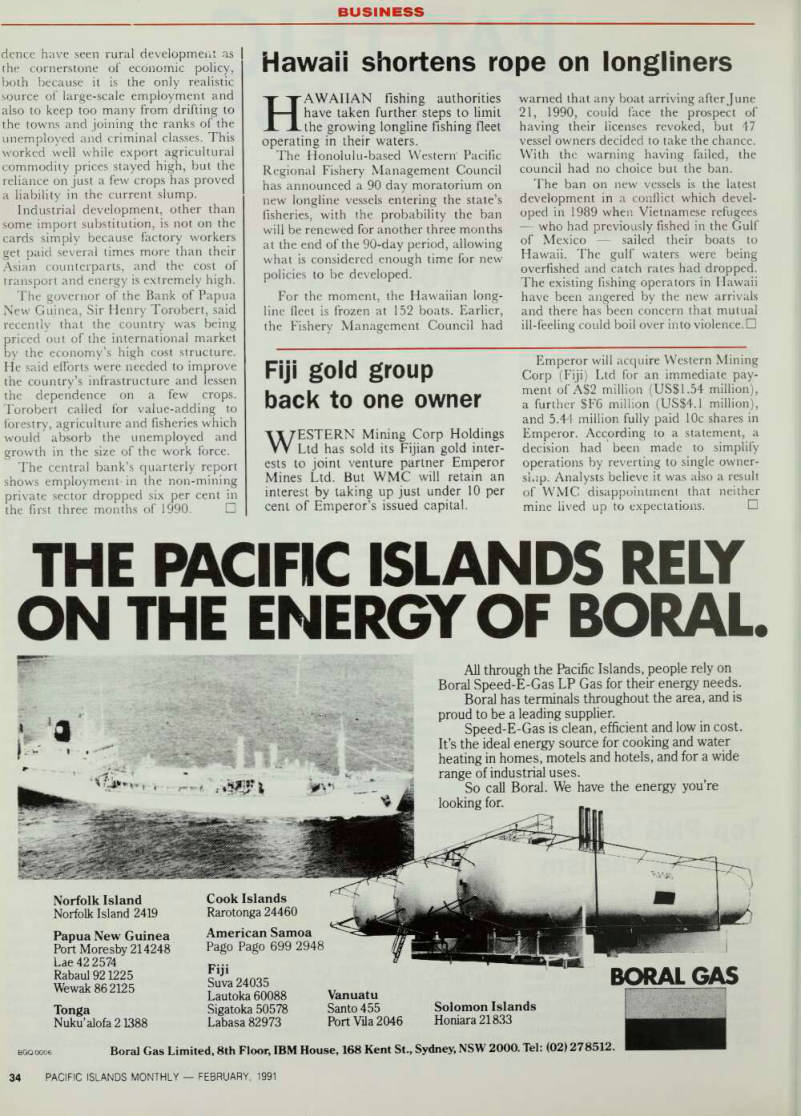
push for realism
BANKING leaders in Papua New Guinea are trying to inject an element of realism into the country’s economic decisionmaking. Two of the country’s top bankers, representing both the central bank and the largest trading bank, have criticised basic econ omic strategies, particularly the kina devaluation and the country’s high wage structure which makes it uncompetitive with other Third World nations.
The more forthright was the managing director of the nationally-owned trading bank, the Papua New Guinea Banking Corporation, Sir Mekere Morauta, who said publicly what many business people and officials in Port Moresby have been thinking for some time: that last year’s 10 per cent devaluation of the kina was a bad mistake. The devaluation, intended to help producers of coffee, cocoa, palm oil and copra - all suffering a decline in world prices - in fact did more harm than good as more prices of all imported good shots up. The benefits it brought were soon undermined by further drops in world crop prices.
PNG relies heavily on imports for much of its daily supplies, including food, clothing and fuel. Morauta said the currency adjustment, instead of restrict ing imports, forced prices up by more than 40 per cent in many cases.
“In theory, prices should have gone up by 10 per cent, but people used the devaluation as an excuse to make more money.” He said small wage earners were hard hit. “It nearly killed them.”
Mortauta said Papua New Guinea was too dependent on imported food to make price increases bearable, and the country had to become more self-sufficient.
Successive governments since indepen
deuce have seen rural development as the cornerstone of economic policy, both because it is the only realistic source of large-scale employment and also to keep too many from drifting to the towns and joining the ranks of the unemployed and criminal classes. This worked well while export agricultural commodity prices stayed high, but the reliance on just a few crops has proved a liability in the current slump.
Industrial development, other than some import substitution, is not on the cards simply because factory workers get paid several times more than their Asian counterparts, and the cost of transport and energy is extremely high.
The governor of the Bank of Papua New Guinea, Sir Henry Torobert, said recently that the country was being priced out of the international market by the economy’s high cost structure.
He said efforts were needed to improve the country’s infrastructure and lessen the dependence on a few crops.
Torobert called for value-adding to forestry, agriculture and fisheries which would absorb the unemployed and growth in the size of the work force.
The central bank’s quarterly report shows employment- in the non-mining private sector dropped six per cent in the first three months of 1990. □
Hawaii shortens rope on longliners
HAWAIIAN fishing authorities have taken further steps to limit
the growing longline fishing fleet
operating in their waters.
The Honolulu-based Western Pacific Regional Fishery Management Council has announced a 90 day moratorium on new longline vessels entering the state’s fisheries, with the probability the ban will be renewed for another three months at the end of the 90-day period, allowing what is considered enough time for new policies to be developed. r r For the moment, the Hawaiian longline fleet is frozen at 152 boats. Earlier, the Fishery Management Council had
warned that any boat arriving after June 21, 1990, could face the prospect of having their licenses revoked, but 47 vessel owners decided to take the chance.
With the warning having failed, the council had no choice but the ban.
The ban on new vessels is the latest development in a conflict which devel oped in 1989 when Vietnamese refugees who had previously fished in the Gulf Mexico sailed their boats to Hawaii. The gulf waters were being 2, v l erfished and " a,ch rates had . d ™PP ed : 1 he existing fishing operators in Hawaii have been angered by the new arrivals and there has been concern that mutual ill-feeling could boil over into violence. □
Fiji gold group
back to one owner
WESTERN Mining Corp Holdings Ltd has sold its Fijian gold inter ests to joint venture partner Emperor Mines Ltd. But WMC will retain an interest by taking up just under 10 per cent of Emperor’s issued capital.
Emperor will acquire Western Mining Corp (Fiji) Ltd for an immediate pay ment of AS2 million (USSI.S4 million), a further SF6 million (USS4.I million), and 5.44 million fully paid 10c shares in Emperor. According to a statement, a decision had been made to simplify operations by reverting to single owner ship. Analysts believe it was also a result of WMC disappointment that neither mine lived up to expectations. □
Advertisements & other items, p. 34 (1 item)
The Pacific Islands Rely
ON THE ENERGY OF BORAL
•• • - ■' .. s * * y%*> c All through the Pacific Islands, people rely on Boral Speed-E-Gas LP Gas for their energy needs.
Boral has terminals throughout the area, and is
proud to be a leading supplier.
Speed-E-Gas is clean, efficient and low in cost.
It’s the ideal energy source for cooking and water heating in homes, motels and hotels, and for a wide range of industrial uses.
So call Boral. We have the energy you’re
looking for.
Cook Islands Rarotonga 24460 Norfolk Island Norfolk Island 2419 Papua New Guinea Port Moresby 214248 Lae 422574 Rabaul 921225 Wewak 862125 Tonga Nukualofa 21388 American Samoa Pago Pago 699 2948 Fiji Suva 24035 Lautoka 60088 Sigatoka 50578 Labasa 82973
BORAL GAS
Vanuatu Santo 455 Port Vila 2046 Solomon Islands Honiara 21833 Boral Gas Limited, Bth Floor, IBM House, 168 Kent St., Sydney, NSW 2000, Tel: (02) 278512.
the ttW
Sugar season left with bitter taste
IT was not a happy 1990 in the Fiji sugar industry. The sugar crushing season in Fiji has been beset with problems. And, since sugar is the key industry in the country, any problems there mean repercussions throughout the economy.
Award problems aroused the most bitter of feelings m the industry with accusations that FSC got the better of the deal The bad feelings exacerbated when S n U s fJ Can< - Gr ° wer f Council lost an "r a A !°" < xu e V e new
b farmers
b°yc°tted FSC and held together even with the forecast of a a- "*>”«' Ine crushing season was, because of the boycott and the drawn-out negotiations which ended it, two months late in getting started. This ’was compounded af severa^of^he 0 FSC• pr( ?f > !f ms
Following farm?
„ r c s • it • , ° r
the ttW
Australia for repairs. n r Gang disputes were next when the cutting and crushing got under way, with much of the problem attributed to the corporations attempt to rationalise and reduce the number of harvesting gangs, There were frequent technical breakdowns at Lautoka and Rarawai mills, and the farmers started to get anxious about the prospect of cane being left still standing after the mill crushing season finished. Farmers complained that the mills were operating at far less than the problems. y Th P n tK P FQP J U r 1 Ihen the FSC announced the fact that world sugar prices had fallen and that the high forecast price mentioned earlier m the season could not be justified, meaning that the third cane payment of H,L S ri eaSOn WOU , d C j nS^ ra ]? ly re " duced or even eliminated. The farmers
countered with the accusation that the mill problems had reduced the sugar yield from the cane crushed, More recent reports have not been encouraging. Labasa Mill reported in early January that, at one stage, crushing had fallen by 40 per cent due to poor cane supply, much of the problem being due to rain and boggy fields. Some Ba farmers resorted to sledges to get their cane out of the fields to the nearest road The lateness of the crushing season meant that man v fieldworkers had gone home for and the New Year before harvesti was c 0 let and many were late returning. At one stage transport. Gangs complained that the wagons were not left at the places they were most needed, \/f;n u c t 0 to the mills, also complainfng that the
Muu 'T* “ T
cause too much of the cane was stale bv : h c C “T U t re ? Ch h ed thC CrUShi "S P‘ a "“ . (Ca " e has lts sugar content early m the season.) The late harvesting has implications for the following season in that ratoon, or re-growth, for 1991 will be reduced because of the necessarily shorter growing period, meaning lower sugar yield.
Labasa Mill was due to close on January 10, but just days before this deadline the National Farmers Union called for an extension to February 15 saying that there was still 150,000 tonnes of cane to be harvested in the mill’s catchment area th Ga "e burning reached an all-time high tbls season, with one mill reporting that at one stage 91 per cent of all cane received had been burned. Burning is normal later in the harvesting season because of the heat and the hornets infesting the cane fields. Some farmers burned more because they feared not having their cane to the mill before the crushing season ended. □
development
UNDP to aid in Kiribati development
KIRIBATI has signed an agreement under which the United Nations Development Programme (UNDP) will assist in the economic advancement of the country’s Line and Phoenix islands groups. These islands string out to the east of the main Gilberts groups and have been hampered by their small population and distance from the administrative and commercial centre.
Kiribati has aimed to resettle the islands and encourage economic devel opment, and the government’s Minis try of Line and Phoenix Group, based on Christmas (Kiritimati) Island, was formed to manage and co-ordinate development in the two island groups.
The two-year project, which is helped by finance from the UNDP and New Zealand, aims to upgrade the ministry’s development unit, and draft an outer
island plan.
The Line islands are broken into a northern group (Teraina, Tabuaeran and Kiritimati) and the southern (Maldern, Starbuck, Vostok, Caroline and Flint). Several of the islands were dug for guano last century, otherwise the main economic activity has been copra production.
Kirimati’s future lies largely with tourism; it is already favoured by fishermen, mainly from Hawaii and travelling on charter flights. A sched uled jet service calling there en route between Tarawa and Honolulu will open the island to general tourist traffic.
The Kiribati Government wants to turn Kirimati into the country’s second economic centre.
There are also resort plans for Flint.
The Phoenix group consists of eight scattered islands: Kanton or Canton, Enderbury, McKean, Birnie, Phoenix, Nikumaroro, Orona and Manra.
Kanton’s airport once used as a refuelling stop by trans Pacific flights in pre-jet days has recently been upgraded to serve as an emergency strip for two engined jets flying between Kirimati and Tarawa. □
Fiji exports
to NZ booming
NEW Zealand and Fiji may still have political and diplomatic differences to settle, but trade between the two countries is booming.
Figures released by the Ministry of External Relations and Trade in Wel lington show that Fiji exports to New
Zealand totalled NZ5126.6 million (US$93.l million) in the year to June 1990. This is a significant climb back following the dislocation caused by the military coups in Suva; in the year to June 1988, Fiji exported only NZ$lB million worth of goods to its southern neighbour. The largest single component of the latest figures is clothing, which reflected the extraodinary growth of garment factories in Fiji’s tax-free zones.
The balance of trade is still in New
Zealand’s favour, but at NZ$l47 million there is little difference.
Meanwhile, the Bureau of Statistics in Suva has reported that Fiji showed a balance of payments surplus of F 548.4 million (U 5533.4 million) for the nine months to last September, compared to a deficit of F 533.7 million for the same period in 1989. Earnings from sugar, unrefined gold, fish, timber, garments, molasses and coconut oil accounted for 73 per cent of total export receipts. □
Advertisements & other items, p. 35 (1 item)
Business
35
PAPICIf' ICI AMHC UAMTUI V rrnnmnw . -
Tonga inflation
outlook not promising
THE National Reserve Bank of Tonga’s latest bulletin reports that inflation was a worrying development during the September 1990 quarter.
Previously, creeping consumer price
index (CPI) inflation had been of concern, but year-on-year changes in the CPI accelerated sharply during the
September quarter.
The central bank said that compared with a year earlier, inflation had risen from 4.9 per cent in December 1989 to 5.3 per cent in the March 1990 quarter, then jumped to 9.9 per cent and 13 per
cent respectively during the July and
August 1990. Most of the rapid price increase in August 1990 reflected the direct and indirect impacts of higher government duties on a wide range of imported consumer goods, according to the bulletin. The July figures also
reflected sharply higher labour charges
in the services sector, which the bank said could be attributed to a large increase in civil service pay rates.
The immediate outlook was not promising, the bank said. The recent strengthening of the Australian dollar (many of Tonga’s imports come from Australia) was unlikely to last and the
full effect of higher petroleum products
prices arising from the Gulf crisis had not worked its way into the CPI by the September quarter. The bank said its studies suggested direct costs of higher fuel prices could add about 0.4 per cent to CPI totals, but that indirect effect would range between one and 1.5 per cent. □
Solomons fisheries
upgrade under way
BRITISH Colombia Packers (BCP) has begun the long and expensive task of upgrading the Solomon Islands’
National Fisheries Development Com pany (NFD), which it bought from the Honiara government last year. NFD had run up substantial losses under state control, and its 10-pole line vessels had been laid up during the protracted sale negotiations.
The NFD’s largest boat, the Solomon Premier , has been repaired and up graded in Taiwan at a cost of USS7OO,OOO. Another vessel, Solomon Harvester , is back at sea. Work is also in progress to improve the Tulagi cold storage and ice making plant. □
Marshall Islands set for Saabs
THE Republic of the Marshall Islands has placed an order for two Saab 2000 jetprops and taken options on two further aircraft.
The aircraft will be operated by the country’s national carrier, Air Marshall Islands, with the first aircraft scheduled for delivery in early-1994. The Republic of the Marshall Islands is the first Asia- Pacific customer to place a firm order for Saab Aircraft’s sixth customer in the region.
The aircraft will be used to upgrade services on Air Marshall Island’s mid- Pacific route network which spans an area equivalent in size to Western Europe. The high speed Saab 2000 will initially operate on the principal dom estic trunk routes linking Majuro and Kwajalein, as well as international ser vices to Kiribati, Tuvalu and Fiji. The 58 seat aircraft will replace smaller, older turboprops and bring flight time savings of over three hours each way between Mujaro and Nadi. Passengers will also enjoy greater cabin comfort and en hanced quality of services on these long routes, typical in the Pacific.
In a statement, Mr Amata Kabua, President of the Marshall Islands said, “As a country that only established independent nation status a few years ago, the 1990 s represent a crucial phase in building up the economic strength and self-sufficiency of the Marshall Islands.
The Saab 2000’s unique combination of speed and capacity is perfect for our market requirements and will form a firm foundation for a regional transport infrastructure in the central Pacific region.”
Air Marshall Islands currently oper ates a mixed fleet of jet and turboprop equipment. A Douglas DC-8 operates direct services from Majuro and Kwajalein to Honolulu and Fiji, while an older 44 seat turboprop performs all other international services and domestic trunk routes. Two unpressurised 19-seat turboprops provide services to over 20 island destinations within the country.
Mr Jelf Marsh, President of Saab Aircraft International, said “Air Marshall Island’s long thin sectors re quiring high speed service, but unable to support the economics of a small jet, represent the type of market for which the Saab 2000 was designed. We are delighted to welcome another customer who recognises the common sense of
combining jet performance with
turboprop economy.”
Total orders and options for the Saab 2000 now stand at 189, with first delivery of the type scheduled for the second half of 1993. The Saab 2000 and Saab 340
family of regional airliners are produced
by Saab Aircraft Division of Saab-Scania at their facilities in Linkoping Sweden. □
Malaysian oil plan fuels criticism
FIJI’S controversial decision to import oil from Malaysia has drawn criticism from the three oil companies operating in the country.
Shell, Mobil and BP have expressed concern that the oil is of inferior quality and will cause environmental problems.
The companies also said the range of oil products available in Fiji will be reduced under the new system.
Shell Fiji Ltd has already warned its customers of the possible problems and extra expenses involved in using Malay sian oil, and Fiji bus operators have indicated the higher operating costs could mean fare hikes.
However, a consultant to the Fiji
National Petroleum Company (FNPC),
Akuila Savu, said the oil company statements were self-serving and that they were condemning the new system even before it had begun to operate. The FNPC was formed by the government to import the oil, and shipments from
Malaysia will begin in April. Energy
Minister David Pickering also denied the new oil would be inferior.
Shell and Mobil based their remarks on technical assessments carried out on the new oil. Their findings were that diesel fuel brought in by the FNPC will have a higher sulphur content than fuel now available in Fiji, so it could cause extra wear on engines and higher exhaust emissions. The companies also assert that the new oil is heavier and will require extra modification.
Shell general manager Joe Mar said the project did not stand up to economic scrutiny. While none of the companies had been given financial details of FNPC’s proposed operations, the short comings were easily discernable, he said.
Mobil Oil general manager Geoff Zippel said the health implications of the high sulphur content should prevent the diesel fuel being used by vehicles.
The crude oil will be refined by Esso Singapore. Pickering said the refined products available from the FNPC would be within the range of specifications issued by the government. Following criticism, the new group has also under taken to supply all products currently available in Fiji. □
Solomons power

Trade Winds
Bank loan boosts Solomons power
A LOAN of US$4.7 million has been granted by the Asian Development Bank to help the Solomon Islands Electricity Authority expand the capac ity of its Lungga diesel power station by an additional four megawatts to help meet increasing demand in Honiara.
The loan is for 40 years and is interest free.
Vanuatu
Copra falls again LOW export prices have forced the Vanuatu Commodities Marketing Board to cut the price paid to copra growers from February. The new' price for hot air and sun-dried copra wall be US$l36 a tonne, a fall of US$45. The new price for smoked copra is US$9l per tonne.
Kiribati
KIRIBATI S state-owned fisheries com pany, Mautari Ltd, has closed and its employees have been laid off. Radio Kiribati reported that 1990 had been one of the company’s w'orst years, with a total catch of just 600 tonnes (compared to more than 2000 tonnes in 1989). The closure came shortly after Mautari signed an agreement to w'ork together with the now' Canadian-owned National Fisheries Development Company in the Solomon Islands. Mautari made a loss of more than $1.5 million (US$l.2 million) in 1990. The Kiribati Government is reported to have refused a loan guaran tee-of US$3BO,OOO to enable it to stay in business until the season opens in May.
Phosphate project dropped PLANS by a Melbourne company to resume phosphate mining on Banaba (also knowm as Ocean Island) in Kiribati have foundered on the question of machinery. Roche Brothers, which had devised a profit-sharing scheme with the
Kiribati Government and the island’s former residents, found that it could not undertake the project because the ma chinery left on the island proved imposs ible to restore and that was a crucial part of the plan. The Government on Tarawa had already approved resump tion of mining on Banaba and Tuta.
Niue
Audit reveals slack RENTS were not effectively collected on properties leased by the American Samoa Government, and lessee accounts had been allowed to fall in arrears to the tune of US$2BO,OOO in 1989, according to an audit report from the US Interior Department. It criticised the territory’s ineffective collection procedures, lack of penalty payments and failure to enforce lease terms. It also said government property w'as underinsured and leased with inappropriate rental fees.
Freighter misses Apia A US freight company, ABR Express, had planned to include Apia in its DC -8 air cargo sendee out of American Samoa, but the initial flight in December had to be cancelled because there was not enough cargo to cover the costs. An ABR spokesman said the company had originally believed there would be 857
sacks of taro and some fish to be picked up for the Honolulu and Los Angeles markets. The company was hoping that a second attempt to call at Western Samoa would prove more successful.
New aircraft wanted POLYNESIAN Airlines is looking to acquire a new Boeing 757, to replace its ageing 727-200 tri-jet but a decision to re-equip will be taken only if the current economic problems in New Zealand and Australia do not affect passenger loads. Polynesian is now oper ating a trans-Tasman service between Auckland and Sydney as part of its flights from Apia, and also flies into Brisbane.
Micronesia
FSM Bond issue MEDIUM term bonds, with maturity ranging from nine months to 12 years, are to be issued by Merrill Lynch Capital Markets in an effort to raise US$3OO million for projects in the Federated States of Micronesia. Repayment of the bonds will be made out of cash grants the FSM receives under its compact with the United States. The FSM Economic
Development Authority has already
made its first grant under the bond issue US$5.l million for a fish processing
plant in Pohnpei. □
Advertisements & other items, p. 37 (2 items)
PAPIPIP IQI AMnC MnMTUI V rrnni i a nv
Styrobilt
Manufacturers & Builders of Export Housing for the Pacific Region mil ii i Manufactured in Fiji by
HARTWELL LTD
WAILADA INDUSTRIAL ESTATE
P.O. Box 13766 Suva Tel; 362-928, Fax (679) 351151
The Coming
NEW WORLD
ORDER
INTERESTED ?
For a copy of FREE booklet write to
THE CHRISTA DELPHIAN
BIBLE MISSION
GPO BOX 1012
SUVA, FIJI
gamefishermen
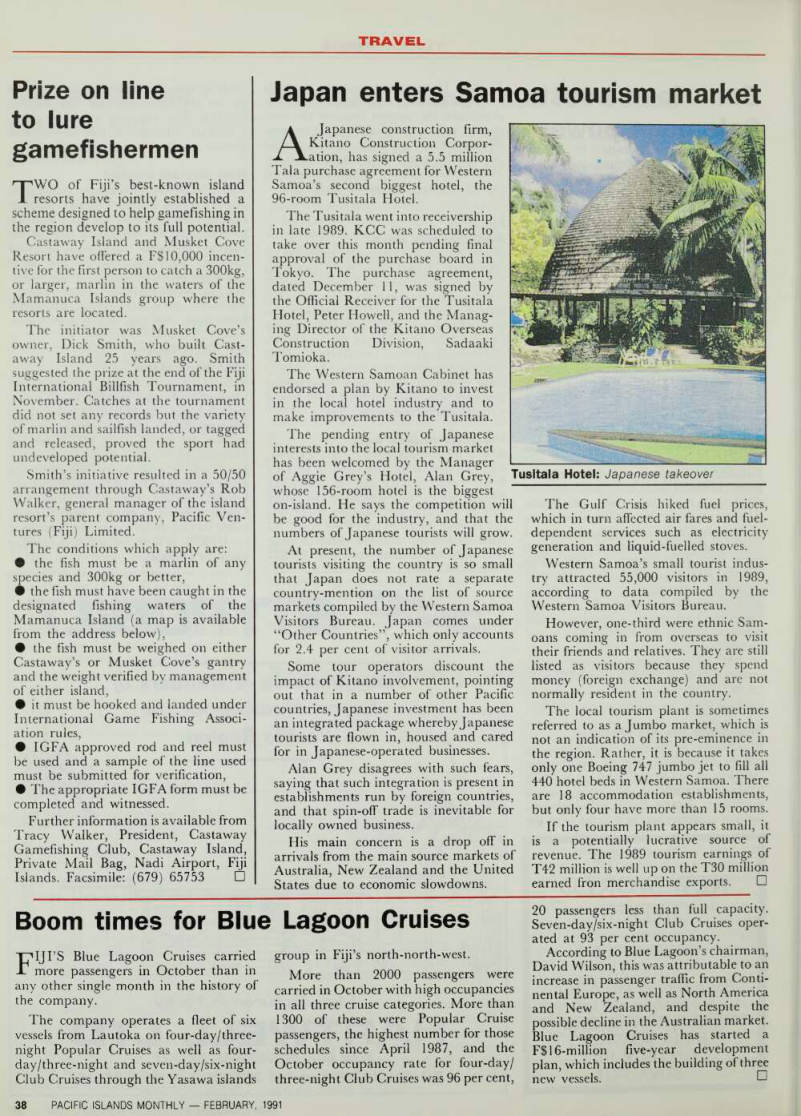
Travel
Prize on line to lure gamefishermen
TWO of Fiji’s best-known island resorts have jointly established a
scheme designed to help gamefishing in
the region develop to its full potential.
Castaway Island and Musket Cove Resort have offered a FS 10,000 incen tive for the first person to catch a 300 kg, or larger, marlin in the waters of the Mamanuca Islands group where the resorts are located.
The initiator was Musket Cove’s owner, Dick Smith, who built Cast away Island 25 years ago. Smith suggested the prize at the end of the Fiji International Billfish Tournament, in November. Catches at the tournament did not set any records but the variety of marlin and sailfish landed, or tagged and released, proved the sport had undeveloped potential.
Smith’s initiative resulted in a 50/50 arrangement through Castaway’s Rob Walker, general manager of the island resort’s parent company, Pacific Ven tures (Fiji) Limited.
The conditions which apply are: • the fish must be a marlin of any
species and 300 kg or better,
• the fish must have been caught in the designated fishing waters of the Mamanuca Island (a map is available from the address below), the fish must be weighed on either Castaway’s or Musket Cove’s gantry and the weight verified by management of either island, • it must be hooked and landed under International Game Fishing Associ ation rules, • IGFA approved rod and reel must be used and a sample of the line used must be submitted for verification, • The appropriate IGFA form must be completed and witnessed.
Further information is available from Tracy Walker, President, Castaway Gamefishing Club, Castaway Island,
Private Mail Bag, Nadi Airport, Fiji
Islands. Facsimile: (679) 65753 □
Japan enters Samoa tourism market
A Japanese construction firm, Kitano Construction Corpor ation, has signed a 5.5 million Tala purchase agreement for Western Samoa’s second biggest hotel, the 96-room Tusitala Hotel.
The Tusitala went into receivership in late 1989. KCC was scheduled to take over this month pending final approval of the purchase board in
Tokyo. The purchase agreement,
dated December 11, was signed by the Official Receiver for the Tusitala Hotel, Peter Howell, and the Manag ing Director of the Kitano Overseas Construction Division, Sadaaki Tomioka.
The Western Samoan Cabinet has endorsed a plan by Kitano to invest in the local hotel industry and to make improvements to the Tusitala.
The pending entry of Japanese interests into the local tourism market has been welcomed by the Manager
of Aggie Grey’s Hotel, Alan Grey,
whose 156-room hotel is the biggest
on-island. He says the competition will be good for the industry, and that the numbers of Japanese tourists will grow.
At present, the number of Japanese tourists visiting the country is so small that Japan does not rate a separate country-mention on the list of source markets compiled by the Western Samoa Visitors Bureau. Japan comes under “Other Countries”, which only accounts for 2.4 per cent of visitor arrivals.
Some tour operators discount the impact of Kitano involvement, pointing out that in a number of other Pacific countries, Japanese investment has been
an integrated package whereby Japanese
tourists are flown in, housed and cared for in Japanese-operated businesses.
Alan Grey disagrees with such fears, saying that such integration is present in establishments run by foreign countries, and that spin-off trade is inevitable for locally owned business.
His main concern is a drop off in arrivals from the main source markets of Australia, New Zealand and the United States due to economic slowdowns.
The Gulf Crisis hiked fuel prices, which in turn affected air fares and fuel dependent services such as electricity
generation and liquid-fuelled stoves.
Western Samoa’s small tourist indus try attracted 55,000 visitors in 1989,
according to data compiled by the
Western Samoa Visitors Bureau.
However, one-third were ethnic Sam oans coming in from overseas to visit their friends and relatives. They are still listed as visitors because they spend money (foreign exchange) and are not normally resident in the country.
The local tourism plant is sometimes referred to as a Jumbo market, which is not an indication of its pre-eminence in the region. Rather, it is because it takes only one Boeing 747 jumbo jet to fill all 440 hotel beds in Western Samoa. There are 18 accommodation establishments, but only four have more than 15 rooms.
If the tourism plant appears small, it is a potentially lucrative source of revenue. The 1989 tourism earnings of T 42 million is well up on the T3O million earned fron merchandise exports. □
Tusitala Hotel: Japanese takeover
Boom times for Blue Lagoon Cruises
FIJI’S Blue Lagoon Cruises carried more passengers in October than in any other single month in the history of the company.
The company operates a fleet of six vessels from Lautoka on four-day/three night Popular Cruises as well as four
day/three-night and seven-day/six-night
Club Cruises through the Yasawa islands
group in Fiji’s north-north-west.
More than 2000 passengers were carried in October with high occupancies in all three cruise categories. More than 1300 of these were Popular Cruise passengers, the highest number for those schedules since April 1987, and the October occupancy rate for four-day/ three-night Club Cruises was 96 per cent,
20 passengers less than full capacity.
Seven-day/six-night Club Cruises oper ated at 93 per cent occupancy, According to Blue Lagoon s chairman, David Wilson, this was attributable to an increase in p assen ger traffic from Conti nental Europe) as well as North America and New Zealand, and despite the possible decline in the Australian market, gj ue Lagoon Cruises has started a FS 16-million five-year development plan, which includes the building of three new vessels. D
Shadow over Qantas safety record?
YELLOWING files in the bowels of the Supreme Court have re vealed what the waters off Papua New Guinea have long kept secret a possible blemish on Qantas’ safety record.
On July 16, 1951, a Qantas Dehavilland DHA3 Drover, registration number VH-EBQ crashed into the sea near Lae on PNG’s north-central coast.
The pilot and all six passengers were killed.
According to a Qantas spokesman, the airline’s “perfect” safety record relates to the jet age, from about 1958 on. Even so, the crash of VH-EBQ is among the records of PNG’s Supreme Court, then the supreme court of the territory of Papua and New Guinea, before PNG gained independence in 1975.
The body of one of the passengers, Frances Daisy Tindall, was never re covered from the crash. A little over a year later, on August 8, 1952, Supreme Court Judge Justice Ralph Gore granted a motion declaring her dead so her estate could be wound up.
According to affidavits relied on by the Judge, VH-EBQ was scheduled to fly from Wau to Lae via Bulolo. (Bulolo and Wau were gold towns).
The pilot was John William Spiers, and Frances Tindall’s fellow passengers included the Right Reverend Stephen Appelhaus and Helen Jean Connor.
The plane left Wau in the morning and arrived at Bulolo, about 20 kilo metres further north, where it picked up another passenger, Kenneth Charles Macdonald, and departed for Lae, about 75 km to the north-north-east.
According to Qantas records, VH EBQ went down about 6.4 km south of the Markham River and about 1.6 km offshore in the waters of the Huon Gulf.
The cause of the crash was recorded as being a “loss of control resulting from structural failure of the central propeller
during flight”.
Qantas records reveal little else about
VH-EBQ. Qantas bought the single
propeller DHA3 Drover on September 13, 1950, and operated it until July 16, 1951.
Frances Tindall was employed by Qantas Empire Airways Ltd as a clerk on 10 pounds per week at the airline’s Lae office. She came from Binnia Street, Coolah, a small town about 80 km north
west of Coonabarabran in central north New South Wales.
She was a dutiful daughter, according to her father Herbert Tindall, who was informed of the crash that day by the local police sergeant, William Howie Woods.
“Frances had kept regular contact with me and I regularly received letters from her,” he said in his alfadavit.
“Occasionally, Frances forwarded a small sum of money for the use of her mother. The letters ceased in Lily, 1951.” □
Advertisements & other items, p. 39 (1 item)
Appointment Of A Professional Staff
TOURISM COUNCIL OF THE SOUTH PACIFIC
Applications are invited for the position of Head, Division of Planning and Development of the Tourism Council of the South Pacific, an intergovernmental organisation of thirteen island countries of the Pacific.
The mam objectives of the Council are to promote, co-ordinate, plan and implement projects and activities designed to strengthen regional cooperation in tourism development and optimise the contribution of tourism socio-economic development of the member countries Most funding is currently provided by the Pacific Regional Tourism Co^mur^tyHjE^cf^ mme (PRTDP) financed b V the European Economic Tne Head of Planning and Development Division is responsible to the Director for planning, organising and executing the planning and development work programme of the Council, including: • economic and physical planning and development; • product development studies and projects; • conservation and protection of natural and cultural environment; • advice and assistance to member countries on planning and development; 5 • all other planning and development activities. rr'CD P * St a S stdcted t 0 nationals of the member countries of the iCbP . Applications should have qualifications and experience m P iinn Pri f^ te !?J he p s st and a record of achievement in tourism in the region at middle and senior level.
Those interested in the appointment are advised to obtain a copy of further particulars ava'labie from the Director at the TCSP Secretariat tinne 6 315211-, Fax (679) 301995, before applying. Applicao?thrl1 C U f mg 8 det u ailed curriculum vitae and names and addresses of three referees with whom the applicants have been associated with in a professional capacity must be submitted by 28th February 1991 1° th e Director, Tourism Council of the South Pacific, PO Box 13119’
Suva, Fiji. Enve opes should be marked “Professional Staff Application”' as possibl| SfU candldate is ex P ected to take up his position as soon r'^t n i lb i er !: Ou P- ,n f s of the Tourism Council of the South Pacific are American Samoa
PUMP DISTRIBUTORS WANTED
EXCELLENT PROFIT AVAILABLE
As a Pacific Pump Dealer you would have access to or the world’s finest agricultural and industrial prducts. some pump The product range includes-
— HIGH PRESSURE WASHERS
SUBMERSIBLES - Tsurumi - Toyo
PRESSURE SYSTEMS Espa
= S? - Gom,a " Rupp TRASH Gorman Rudd OP
GENERATORS
! ales literature - full technical support, price 2f ml a fl n lSC ° h Unt structure which enables generous profit margins when selling Pacific Products.
Phone or Fax for full distributorship details— The Marketing Manager Pacific Pump company 2 South Street Rydalmere, NSW, 2116
NSW AUSTRALIA
Phone (02) 638 5600 Fax (02) 684
Minefield of adventure found
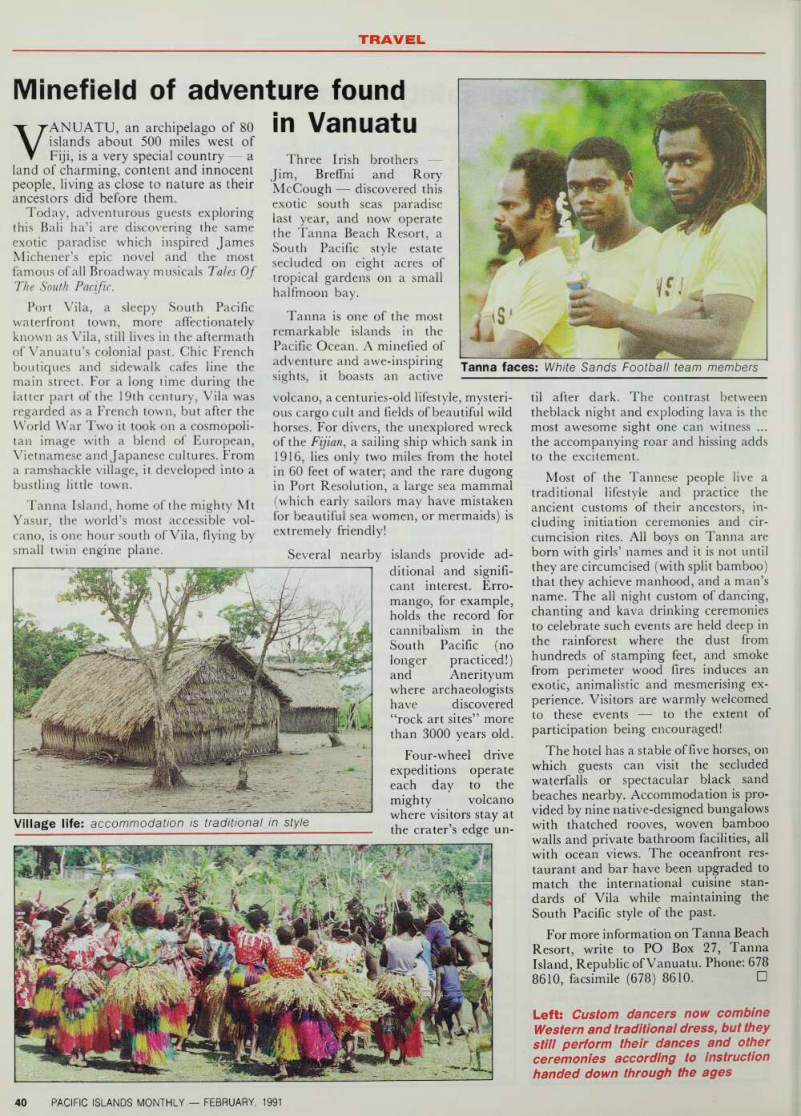
in Vanuatu
VANUATU, an archipelago of 80 islands about 500 miles west of Fiji, is a very special country a land of charming, content and innocent people, living as close to nature as their ancestors did before them.
Today, adventurous guests exploring this Bali ha’i are discovering the same exotic paradise which inspired James Michener’s epic novel and the most famous of all Broadway musicals Tales Of The South Pacific.
Port Vila, a sleepy South Pacific waterfront town, more affectionately known as Vila, still lives in the aftermath of Vanuatu’s colonial past. Chic French boutiques and sidewalk cafes line the main street. For a long time during the latter part of the 19th century, Vila was regarded as a French town, but after the World War Two it took on a cosmopoli tan image with a blend of European, Vietnamese and Japanese cultures. From a ramshackle village, it developed into a bustling little town.
Tanna Island, home of the mighty Mt Yasur, the world’s most accessible vol cano, is one hour south of Vila, flying by
small twin engine plane.
Three Irish brothers ji m Breffni and Rory McCough discovered this exotic south seas dise |as( and now operate , he Tanna Beach Resort a South p acific st le estate sec|uded on eight acres of tropical gardens on a sma ll halfmoon bay. _. . anna is one o t e most L emarkable lslands .
Paclfic ° cean - A mmefied of adventure and awe-inspiring s 'S hts > 11 boas,s an act,ve
volcano, a centuries-old lifestyle, mysteri ous cargo cult and fields of beautiful wild horses. For divers, the unexplored wreck of the Fijian , a sailing ship which sank in 1916, lies only two miles from the hotel in 60 feet of water; and the rare dugong in Port Resolution, a large sea mammal (which early sailors may have mistaken for beautiful sea women, or mermaids) is extremely friendly!
Several nearby islands provide ad
ditional and signifi cant interest. Erro mango, for example, holds the record for cannibalism in the South Pacific (no
longer practiced!)
and Anerityum where archaeologists have discovered “rock art sites” more than 3000 years old.
Four-wheel drive expeditions operate each day to the mighty volcano where visitors stay at the crater’s edge un-
til after dark. The contrast between theblack night and exploding lava is the most awesome sight one can witness ... the accompanying roar and hissing adds to the excitement.
Most of the Tannese people live a traditional lifestyle and practice the ancient customs of their ancestors, in cluding initiation ceremonies and cir cumcision rites. All boys on Tanna are born with girls’ names and it is not until they are circumcised (with split bamboo) that they achieve manhood, and a man’s name. The all night custom of dancing, chanting and kava drinking ceremonies to celebrate such events are held deep in the rainforest where the dust from hundreds of stamping feet, and smoke from perimeter wood fires induces an exotic, animalistic and mesmerising ex perience. Visitors are warmly welcomed to these events to the extent of participation being encouraged!
The hotel has a stable of five horses, on which guests can visit the secluded waterfalls or spectacular black sand beaches nearby. Accommodation is pro vided by nine native-designed bungalows with thatched rooves, woven bamboo walls and private bathroom facilities, all with ocean views. The oceanfront res taurant and bar have been upgraded to match the international cuisine stan dards of Vila while maintaining the South Pacific style of the past.
For more information on Tanna Beach Resort, write to PO Box 27, Tanna Island, Republic of Vanuatu. Phone: 678 8610, facsimile (678) 8610. □
Village life: accommodation is traditional in style
Tanna faces: White Sands Football team members
Left: Custom dancers now combine Western and traditional dress, but they still perform their dances and other ceremonies according to instruction handed down through the ages
Opportunities opened for exporters
BLUE Star Line is pleased to announce more shipping oppor tunities for exporters to North America in 1991.
Additional to the 1990 shipping opportunities, Blue Star Line has decided to schedule 19 extra northbound calls in 1991 to West Coast North American Ports. The vessels will be the Wellington Star, Southland Star, and the California Star.
From the West Coast, transhipment services will then distribute containers of cargo to East Coast North American destinations. These services provide the best transit times.
Mr Tilley, General Manager of Blue Star Line’s Pacific Services in San Francisco, said that he was impressed with the accelerated growth in Fiji exports in 1990.
“Blue Star Line has a long tradition in getting Fiji exports to their markets. For over 27 years, we carried PAFCO’s products to their numerous markets in Canada and the United States.
“We have been the traditional carriers of Fiji’s green and processed ginger to American and Canadian buyers.
“Blue Star Line vessels also carry Fiji’s quality veneers to the West Coast. We
anticipate that when export timbers come on stream, we will be in a position to offer our service.
“More recently, we have seen a dramatic growth in the export of gar ments from this newly established manu
facturing industry.”
Mr Tilley said he also sees an opportunity in carrying frozen fish from Suva to American markets. Blue Star Line vessels will call every 17 days.
In Suva, commenting on Mr Tilley’s statements, the local agent for Blue Star Line, Francis Hong-Tiy of Burns Philp Shipping, said that he was delighted with the steps taken to increase Fiji export calls. These calls are being inaugurated at an opportune time when confidence in Fiji’s ability to produce and compete in highly competitive markets has been established.
Blue Star Line’s management has always had a serious interest in the development of the growth of the Fiji Islands. In 1988, the registered two of their vessels in Fiji. These vessels, the Wellington Star and the Southland Star have Fijian crews and officers.
In concluding, Mr Hong-Tiy said that one of the special features of Blue Star
Line service was its reliability. This was what exporters required to fine tune production schedules in order to meet export dead lines, and Blue Star Line was dedicated to continuing to provide this high level of quality service to their customers, he said. □ Calendar dates THESE are the in-port dates for the two biggest cruise ships to visit the South Pacific in the near future.
The Queen Elizabeth 2 will be in Lae on February 14. The QE2, with its 1,864 passengers, schedules its visits from 8 am through 6 pm. The Canberra , with 1,641 passengers, will be in Suva, February 11; Yasawa, February 12; and Rabaul, February 23. Port hours for the Canberra are 7:3oam - 7pm in Suva and Bam - 6pm in the other two stops.
Solomons price hike PASSENGERS travelling on govern ment vessels in the Solomon Islands are paying more. The Government says the increase of 25 per cent is to catch up on the rising price of marine fuel. The SIBC says private shipping companies in the country have also increased their fares for the same reason. □
Advertisements & other items, p. 41 (2 items)
Shipping
Tonga
KIRIBATI
VANUATU
COOK ISLAND
SOLOMON ISLANDS
NEW CALEDONIA
U.S. SAMOA
WESTERN SAMOA
FRENCH POLYNESIA
JAPAN . KOREA
YOU’LL FIND IT,
WHERE THE SKY MEETS
THE SEA
RORO. CONTAINER &
B.BULK SHIPPING
- T *
AGENTS
and
PHONE
Shippfng Serves Ltd 633 1 PAPECTE rZ ’m , “ U , TOKAB P 60777 0 S 63986 APIA:B p 2261' PAGOPAGO ,Polynes,a VILA B P 2456 SANTO-B P 230 HON^na Tu T',* ,' me Pol V"esienne 42 84 02 NOUMEAiEtablissements Ballande 687-283384 NUKUALOFA B (Solomon Islands) Lid 21645 TAPAWA:Shipping Corporation ol Kiribati 26195 Co. Lid 776-7680 Soyang Shipp,ng Co .Lid 752 7755° Un9 9 PP '" 9 C ° ' LW 753 ' 045 ’ '° r v eh «tle Pan Continental Shipping JAPAN,(or general cargo Swire 03-230-9245 (or vehicle NYK Lines 03-284-5506 Mitsui OS K 03-587-7123
Airports put on terrorist alert
terrorist alert
Headlines
SECURITY at airports throughout the Pacific has been stepped up in fear of terrorist attacks by Iraqi sym pathisers. Fiji’s Nadi International air port was placed on red alert on January 18 because of a bomb scare aboard a Canadian Airline flight out of Australia.
The aircraft landed safely and, after a thorough check of passengers and bag gage, departed for Honolulu one hour behind schedule.
Help sought for drug war NEW Zealand has sought the help of Pacific island countries to end drug
trafficking in the region.
This follows an international report, based on a United Nations survey, which claimed that New Zealand is a drugs
transhipment point. According to a New
Zealand newspaper, Dominion , the gov ernment plans to have a drug liaison officer based in Bangkok. Project Cook, a system to trace the movement of small boats between Australia, America, New Zealand and other Pacific countries also will be upgraded.
Government officials said the key was to force Pacific Rim neighbours to co operate in sharing intelligence.
Freedom survey A SURVEY by Freedom House, an
international human rights organisation
based in the United States, has revealed that the Solomon Islands and Tuvalu are the two most free independent island states in the South Pacific. The survey also rates Kiribati, Nauru, Western Samoa, Papua New Guinea and Vanu atu as free. It says civil rights in Papua New Guinea is declining, while Tonga has recorded an improvement in its
political rights.
Freedom House says of the nine independent island nations in the South Pacific, Fiji is the least free with almost no political freedom.
Fiji gears for election THE tempo of political activity in Fiji is gathering momentum in anticipation of proposed elections later this year.
The Government has appointed a high-powered committee, made up of six government ministers, to set up the
machiner)" for a Fijian political party.
The committee includes Minister for Fijian Affairs, Lt Col. Navuisarai, Filipe Bole (Education), Berenado Vunibobo
(Trade and Commerce), Ratu William Toganivalu (Land and Minerals),
Apeisa Kurisagila (Health) and Major-
General Sitiveni Rabuka. The Nadi branch of the Ruling Alliance Party also formed a new party in January which it said aimed at fostering the interests of all ethnic groups in Fiji.
Kanaks oppose immigration ANTI-INDEPENDENCE leader in New Caledonia, Jacques Lafleur, has called for more immigration from Eur ope and France to boost the French Territory’s economy.
Mr Lafleur said the move was needed to achieve economic growth, however Kanak leaders opposed the idea. They believe France should discourage more outsiders moving in, because New Cale donia is back on the UN decolonisation list.
Solomons sends athletes The Solomon Islands has sent five of its top young athletes to a “Youth of the World” sports tournament in Paris, France. They are sprinter Joseph Onika, marathon runner Philip Aitai, weight lifter Leslie Ata, lawn tennis player Lency Tenai, and heavy weight boxer John Tebauba. The sports tournament, which runs until February 10, is organ ised by the French Olympic Committee as a prelude to the Albertville Winter Olympics in 1992.
Johnston permit extended THE US Army received government approval to continue to destroy weapons containing nerve gas and mustard gas agents at Johnston Atoll. A temporary permit, which expired in December, has been extended for another 180 days.
Meanwhile, the US Army awaits Environmental Protection Agency action on its request to make permanent modifications to the Johnson Atoll Chemical Agent Disposal System facility,
incorporating design and operational
improvements.
A group of seven Soviet military and civilian chemical weapons experts also visited the JACADS last month, to be familiarised with US chemical weapons.
Refinery for Tonga?
NEGOTIATIONS are under way for an oil to be set up in Tonga by the end of 1992. The multi-million dollar project has interests from Saudi Arabia and American businessmen. Radio Tonga said the project was still in the initial stages of negotiations and would
be financed by Tonga. The idea is to refine oil in the kingdom and sell it to neighbouring Pacific countries.
PNG farmers fight fishermen FOREIGN fishermen operating in coastal waters of Papua New Guinea have been warned to stay clear of traditional fishing grounds. The warning was sounded by the Secretary of the Department of Gulf province in Papua, following the sighting of a number of
foreign fishing trawlers just off Kukipi
near Kerema. Coastal villagers have attempted to board a number of trawlers, and have threatened to take the law into their own hands if necessary.
Malaysia to help PNG army ARMY officers from the Papua New Guinea Defence Force will receive mili tary training in Malaysia. The Malay sian Government gave the undertaking during the signing of a Memorandum of Understanding on defence co-operation between the two countries. The Malay sian Defence ministry said its experience, particularly in counter-insurgency, will help PNG solve some of its insurgency
problems.
Matai titles held up FULL registration of two-thousand new Matai titles in Western Samoa is being held back by the Lands and Titles Court to allow the court to investigate the new titles. The decision means they are not fully recognised by the court and by
village councils.
Tuvalu cuts spending TUVALU’S Government has signalled it is making efforts to cut spending, but members of Parliament have been criti cal of what they see as inadequate cost controls. The recent budget debate ended with the House approving the Government’s plan to borrow ASI mil lion (U 55770,000) from the National Bank of Tuvalu to help cover its revenue shortfall, which it had proposed to avoid imposing higher taxes and duties.
Among the belt-tightening measures is an agreement whereby Airlines of the Marshall Islands will meet wages costs of local airport staff who handle its aircraft, passengers and freight when the airlines call at Funafuti. Foreign shipping com panies will also be required to meet the costs of Tuvaluan seamen travelling to join their vessels at foreign ports. □
Putting Maori into official mouths
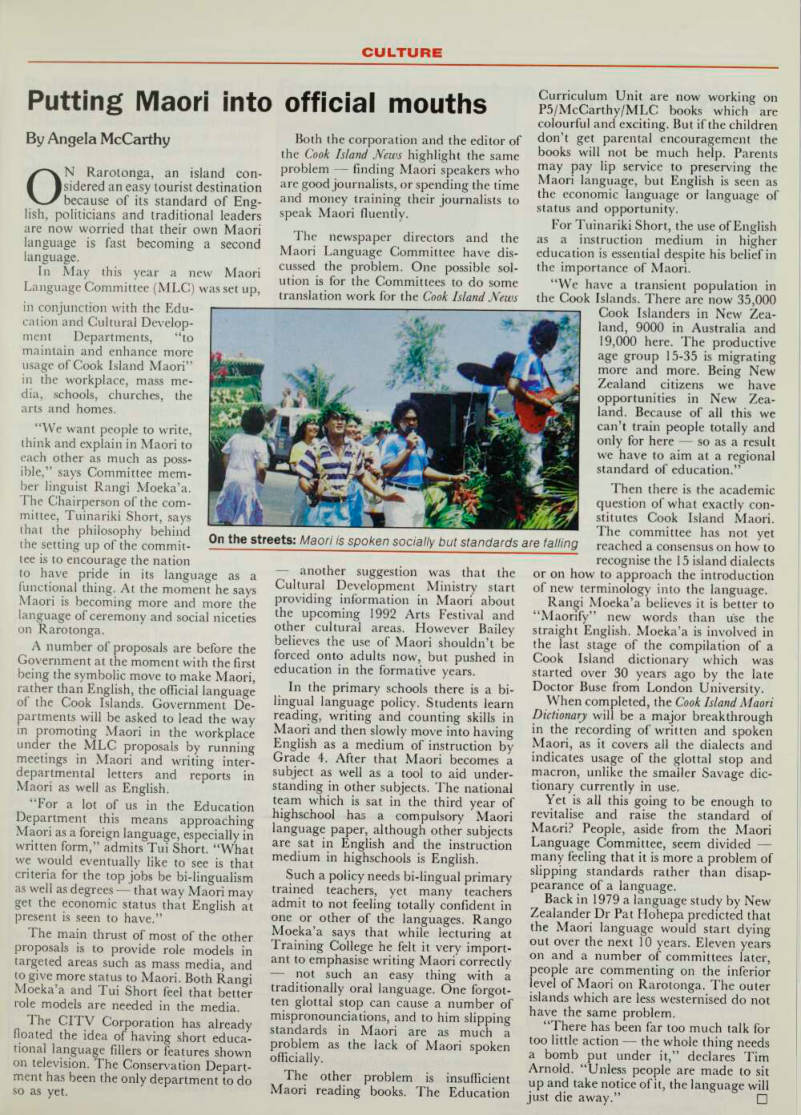
Culture
By Angela McCarthy
ON Rarotonga, an island con sidered an easy tourist destination because of its standard of Eng lish, politicians and traditional leaders are now worried that their own Maori language is fast becoming a second language.
In May this year a new Maori Language Committee (MLC) was set up,
in conjunction with the Edu cation and Cultural Develop ment Departments, “to maintain and enhance more usage of Cook Island Maori” in the workplace, mass me dia, schools, churches, the arts and homes.
“We want people to write, think and explain in Maori to each other as much as poss ible,” says Committee mem
ber linguist Rangi Moeka’a.
The Chairperson of the com mittee, Tuinariki Short, says that the philosophy behind the setting up of the commit tee is to encourage the nation
to have pride in its language as a functional thing. At the moment he says Maori is becoming more and more the language of ceremony and social niceties
on Rarotonga.
A number of proposals are before the Government at the moment with the first being the symbolic move to make Maori, rather than English, the official language of the Cook Islands. Government De partments will be asked to lead the way in promoting Maori in the workplace under the MLC proposals by running meetings in Maori and writing inter departmental letters and reports in Maori as well as English.
For a lot of us in the Education
Department this means approaching
Maori as a foreign language, especially in written form,” admits Tui Short. “What we would eventually like to see is that criteria for the top jobs be bi-lingualism as well as degrees that way Maori may get the economic status that English at present is seen to have.”
The main thrust of most of the other proposals is to provide role models in targeted areas such as mass media, and to give more status to Maori. Both Rangi Moeka’a and Tui Short feel that better role models are needed in the media.
The CITY Corporation has already floated the idea of having short educa tional language fillers or features shown on television. The Conservation Depart ment has been the only department to do so as yet.
Both the corporation and the editor of the Cook Island Hews highlight the same problem finding Maori speakers who are good journalists, or spending the time and money training their journalists to speak Maori fluently.
The newspaper directors and the Maori Language Committee have dis cussed the problem. One possible sol ution is for the Committees to do some translation work for the Cook Island News
another suggestion was that the
Cultural Development Ministry start
providing information in Maori about the upcoming 1992 Arts Festival and other cultural areas. However Bailey believes the use of Maori shouldn’t be forced onto adults now, but pushed in education in the formative years.
In the primary schools there is a bi lingual language policy. Students learn reading, writing and counting skills in Maori and then slowly move into having English as a medium of instruction by Grade 4. After that Maori becomes a subject as well as a tool to aid under standing in other subjects. The national team which is sat in the third year of highschool has a compulsory Maori language paper, although other subjects are sat in English and the instruction medium in highschools is English.
Such a policy needs bi-lingual primary trained teachers, yet many teachers admit to not feeling totally confident in one or other of the languages. Rango Moeka’a says that while lecturing at Training College he felt it very import ant to emphasise writing Maori correctly not such an easy thing with a
traditionally oral language. One forgot
ten glottal stop can cause a number of mispronounciations, and to him slipping standards in Maori are as much a problem as the lack of Maori spoken
officially.
The other problem is insufficient Maori reading books. The Education
Curriculum Unit are now working on P5/McCarthy/MLC books which are colourful and exciting. But if the children don’t get parental encouragement the books will not be much help. Parents may pay lip service to preserving the Maori language, but English is seen as the economic language or language of status and opportunity.
For Tuinariki Short, the use of English as a instruction medium in higher education is essential despite his belief in the importance of Maori.
“We have a transient population in the Cook Islands. There are now 35,000
Cook Islanders in New Zea land, 9000 in Australia and 19,000 here. The productive age group 15-35 is migrating more and more. Being New Zealand citizens we have opportunities in New Zea land. Because of all this we can’t train people totally and only for here so as a result we have to aim at a regional standard of education.”
Then there is the academic question of what exactly con stitutes Cook Island Maori.
The committee has not yet reached a consensus on how to recognise the 15 island dialects
or on how to approach the introduction of new terminology into the language.
Rangi Moeka’a believes it is better to “Maorify” new words than use the straight English. Moeka’a is involved in the last stage of the compilation of a Cook Island dictionary which was started over 30 years ago by the late Doctor Buse from London University.
When completed, the Cook Island Maori Dictionary will be a major breakthrough in the recording of written and spoken Maori, as it covers all the dialects and indicates usage of the glottal stop and macron, unlike the smailer Savage dic tionary currently in use.
Yet is all this going to be enough to revitalise and raise the standard of Maori? People, aside from the Maori Language Committee, seem divided many feeling that it is more a problem of slipping standards rather than disap pearance of a language.
Back in 1979 a language study by New Zealander Dr Pat Hohepa predicted that the Maori language would start dying out over the next 10 years. Eleven years on and a number of committees later, people are commenting on the inferior level of Maori on Rarotonga. The outer islands which are less westernised do not have the same problem.
“There has been far too much talk for too little action the whole thing needs a bomb put under it,” declares Tim Arnold. “Unless people are made to sit up and take notice of it, the language will just die away.” □
On the streets: Maori is spoken socially but standards are falling
contempt charges
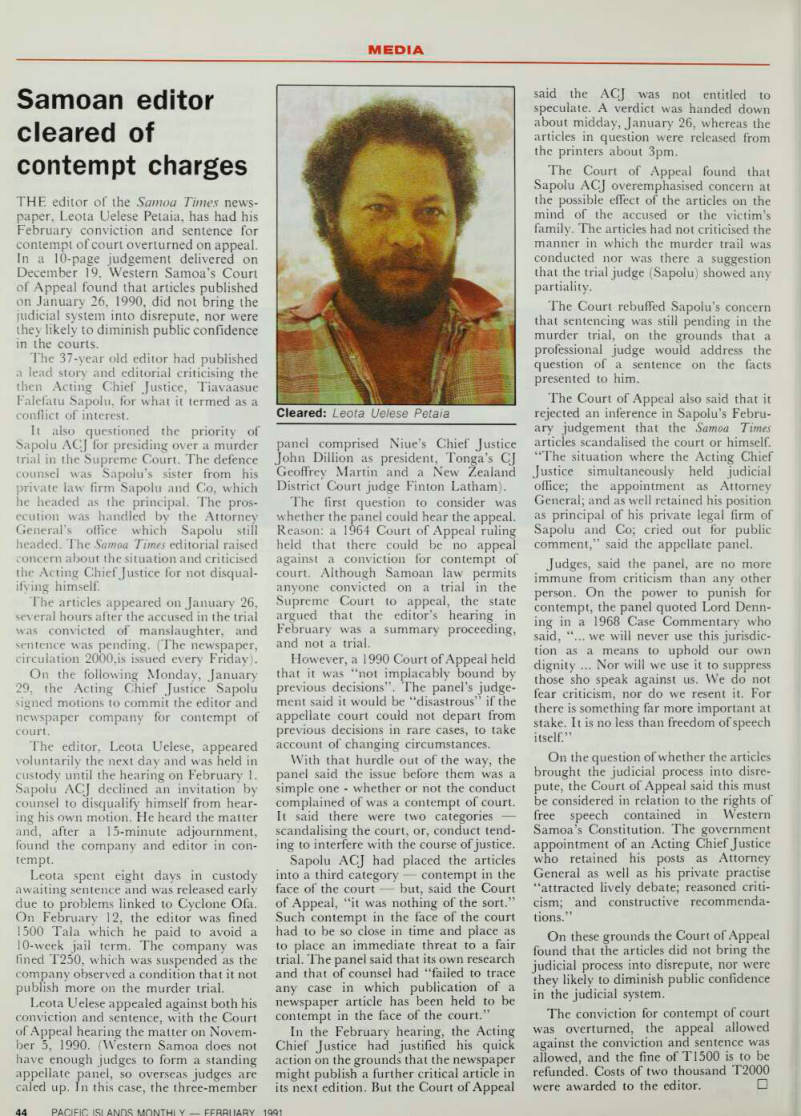
Media
Samoan editor cleared of contempt charges
THE editor of the Samoa Times news paper, Leota Uelese Petaia, has had his February conviction and sentence for contempt of court overturned on appeal.
In a 10-page judgement delivered on December 19, Western Samoa’s Court of Appeal found that articles published on January 26, 1990, did not bring the judicial system into disrepute, nor were they likely to diminish public confidence in the courts.
The 37-year old editor had published a lead story and editorial criticising the then Acting Chief Justice, Tiavaasue Falefatu Sapolu, for what it termed as a conflict of interest.
It also questioned the priority of Sapolu ACJ for presiding over a murder trial in the Supreme Court. The defence counsel was Sapolu’s sister from his private law firm Sapolu and Co, which he headed as the principal. The pros ecution was handled by the Attorney General’s office which Sapolu still headed. The Samoa Times editorial raised concern about the situation and criticised the Acting Chief Justice for not disqual
ifying himself.
The articles appeared on January 26, several hours after the accused in the trial was convicted of manslaughter, and sentence was pending. (The newspaper, circulation 2000,is issued every Friday).
On the following Monday, January 29, the Acting Chief Justice Sapolu signed motions to commit the editor and newspaper company for contempt of court.
The editor, Leota Uelese, appeared voluntarily the next day and was held in custody until the hearing on February 1.
Sapolu ACJ declined an invitation by counsel to disqualify himself from hear ing his own motion. He heard the matter and, after a 15-minute adjournment, found the company and editor in con tempt.
Leota spent eight days in custody awaiting sentence and was released early due to problems linked to Cyclone Ofa.
On February 12, the editor was fined 1500 Tala which he paid to avoid a 10-week jail term. The company was fined T 250, which was suspended as the company observed a condition that it not publish more on the murder trial.
Leota Uelese appealed against both his conviction and sentence, with the Court of Appeal hearing the matter on Novem ber 5, 1990. (Western Samoa does not have enough judges to form a standing appellate panel, so overseas judges are caled up. In this case, the three-member
panel comprised Niue’s Chief Justice
John Dillion as president, Tonga’s CJ
Geoffrey Martin and a New Zealand District Court judge Finton Latham).
The first question to consider was whether the panel could hear the appeal.
Reason: a 1964 Court of Appeal ruling held that there could be no appeal against a conviction for contempt of court. Although Samoan law permits anyone convicted on a trial in the Supreme Court to appeal, the state argued that the editor’s hearing in February was a summary proceeding, and not a trial.
However, a 1990 Court of Appeal held that it was “not implacably bound by previous decisions”. The panel’s judge ment said it would be “disastrous” if the appellate court could not depart from previous decisions in rare cases, to take account of changing circumstances.
With that hurdle out of the way, the panel said the issue before them was a simple one - whether or not the conduct complained of was a contempt of court.
It said there were two categories scandalising the court, or, conduct tend ing to interfere with the course of justice.
Sapolu ACJ had placed the articles into a third category contempt in the face of the court but, said the Court of Appeal, “it was nothing of the sort.”
Such contempt in the face of the court had to be so close in time and place as to place an immediate threat to a fair trial. The panel said that its own research and that of counsel had “failed to trace any case in which publication of a newspaper article has been held to be contempt in the face of the court.”
In the February hearing, the Acting Chief Justice had justified his quick action on the grounds that the newspaper might publish a further critical article in its next edition. But the Court of Appeal
said the ACJ was not entitled to speculate. A verdict was handed down about midday, January 26, whereas the articles in question were released from the printers about 3pm.
The Court of Appeal found that Sapolu ACJ overemphasised concern at the possible effect of the articles on the mind of the accused or the victim’s family. The articles had not criticised the manner in which the murder trail was conducted nor was there a suggestion that the trial judge (Sapolu) showed any partiality.
The Court rebuffed Sapolu’s concern that sentencing was still pending in the murder trial, on the grounds that a professional judge would address the question of a sentence on the facts presented to him.
The Court of Appeal also said that it rejected an inference in Sapolu’s Febru ary judgement that the Samoa Times articles scandalised the court or himself.
“The situation where the Acting Chief Justice simultaneously held judicial office; the appointment as Attorney General; and as well retained his position as principal of his private legal firm of Sapolu and Co; cried out for public comment,” said the appellate panel.
Judges, said the panel, are no more immune from criticism than any other person. On the power to punish for contempt, the panel quoted Lord Denn ing in a 1968 Case Commentary who said, “... we will never use this jurisdic tion as a means to uphold our own dignity ... Nor will we use it to suppress those sho speak against us. We do not fear criticism, nor do we resent it. For there is something far more important at stake. It is no less than freedom of speech itself.”
On the question of whether the articles brought the judicial process into disre pute, the Court of Appeal said this must be considered in relation to the rights of free speech contained in Western Samoa’s Constitution. The government appointment of an Acting Chief Justice who retained his posts as Attorney General as well as his private practise “attracted lively debate; reasoned criti cism; and constructive recommenda tions.”
On these grounds the Court of Appeal found that the articles did not bring the judicial process into disrepute, nor were they likely to diminish public confidence in the judicial system.
The conviction for contempt of court was overturned, the appeal allowed against the conviction and sentence was allowed, and the fine of Tl5OO is to be refunded. Costs of two thousand T2OOO were awarded to the editor.
Cleared: Leota Uelese Petaia
Advertisements & other items, p. 44 (1 item)
44
PACIFIC ISLANDS MONTHI Y FFRRUARY 1991
Solomons in form
Movies
Solomons in form for SP Games
SOLOMONS stepped up their prep aration for the South Pacific Games, winning all their bouts on a one-programme tour of Fiji last month. 1989 Mini Games bronze medallists Inoke Siope and Charlie Bonas won unanimous decisions, and proved to be a lot smarter as they head for the South Pacific Games.
Light-welterweight Siope outclassed
a younger Anasa Cama while Bonas had too much power for Richard Abel.
Welterweight Greazley Makana won
a split points decision over Onisimo Roqica.
Bantamweight Lindley Taka did not fight because the organisers could not find a suitable opponent for him.
A second round of bouts was also cancelled because Fiji could not find boxers fit enough to tackle the visitors.
Solomons team manager Ho Ming Long said they had an unbeaten record against Papua New Guinea boxers lately and had expected to win all their fights in Fiji too. □
Budget blow-out meets the mark
By Samisoni Kakaivalu
WHEN the Ligue De Nouvelle Caledonie De Football, New Caledonia’s governing soccer body, lost over 3 million francs hosting the Third Melanesian Cup last Novem ber, not many eyebrows were raised.
The organisers had expected to lose money. They were aware of that when they asked, at a meeting of team officials in Suva in 1989, to be hosts.
They had been bid ding hard to have the games played at the Stade De Magenta since the first Melanesian Cup at the Lawsom Tama stadium in Honiara in 1988.
The motive behind their earnest bid was seen by some as having a more political overtone than sports. The native Kan aks want to identify themselves with the Mel-
Big shots: New Caledonia's Roger Mouriner shows the form of one of the South Pacific's winning soccer teams.
Such teams were given a surprise by Vanuatu's success
anesian group in the South Pacific and love to see fellow Melanesians come to play soccer, apart from it providing an ideal chance to get to know each other.
Guy Elmour, vice president of the New Caledonian soccer, said after the tourna ment that the loss did not worry them much. He hinted that, after all, the government had salvaged them out of similar situations in the past.
The Ligue De Nouvelle Caledonie became the first host not to make money out of the three-year-old championship.
Solomons soccer president Alan Boso, one of the founders of the Cup, said the initial aims had been to: • consolidate the support of the Melanesian soccer playing countries in the Oceania Football Confederation, • financially assist host countries in funding soccer development in their countries.
While the first aim had been achieved overwhelmingly, the second was not. It did not, however, cool the enthusiasm to carry on with the championship.
In fact, Vanuatu and Solomons are bidding wildly to host the 1992 tourna ment after teams officials decided to skip 1991 because of the South Pacific Games in Papua New Guinea.
Boso said the Solomons almost did not make it to the Noumea tournament because the government withdrew an undertaking to help them out on their airfares. Boso said an 11th hour appeal to the business community in Honiara received an overwhelming response.
He said there was still much sympathy with the plight of the Melanesian countries playing soccer in this part of the world, as New Zealand and Australia preferred to look elsewhere for top competition and promotion of the sport.
The yawning disparity in the develop ment of the game between the island nations and the two bigger soccer countries was a matter of great concern.
When not much help was forthcoming, Boso and others thought up the Melanesian Cup. He said it had been time to stand up and do something which
would be constructive and positive.
“We had to form a united front and at the same time have regular contacts on the soccer field to consolidate our cause and position,” he said.
He said a stronger voice and influence in Oceania now meant that FIFA would value their presence more and channel aid on equal terms with the two big countries.
Boso said that, in the Solomons, money raised and donated towards soccer devel opment had been used to the fullest. He said youth soccer development was so extensive that he was looking at a Pacific champion team coming out of Honiara in five years.
New Caledonia, while not a member of FIFA, has been receiving extensive help, financial and otherwise, from mother France. Papua New Guinea, which missed the 1988 games because of financial problems, finished last in Nou mea but had shown marked improve ment in their game since the 1989 Cup in Suva.
Indications are that the hosts, PNG, will be no pushover when they play in front of their home crowd during the South Pacific Games later this year.
Vanuatu, the best success story at the Noumea tournament, exhibited the ben efits of soccer development in young men.
They surprised everyone, especially “big shots” Fiji, Solomons and New Caledonia, when they deprived them of victory, as had been the case in the two
previous tournaments.
Coach Terry O’Donnell was optimis tic about the future of the team and said Vanuatu were looking forward to de fending the Cup at Port Vila in 1992.
Boso said the performance of the Melanesian countries during the South Pacific Games in Lae should reflect how much they had benefited from the Cup.
It had offered more national compe titions, and exposed and elevated them to new standards of the game in the region.
Boso said the three million francs they lost in New Caledonia was nothing compared to the immense benefit they reaped of that tournament. U
Advertisements & other items, p. 45 (1 item)
Garth Evans Marine
PO BOX 5094
PORT NELSON
PH (054) 68 330
FAX (054) 68 351
B BALLANTYNE
A/H (054)520 624 Contact:
G. EVANS
A/H (054) 82 409
GARTH EVANS MARINE
PORT OF NELSON NEW ZEALAND
SHIP CONSTRUCTION AND DESIGN
SHIP REPAIRS TO PLEASURE AND COMMERCIAL VESSELS SLIPPING FACILITIES TO 2000 TONS AND UP TO 6 METRE DRAFT
SALVAGE CONSULTANTS AND TOWING
SHIP BROKING, DELIVERIES AND PICK UP CREW
SAND BLASTING AND PAINTING
DIESEL AND ENGINE REPAIRS
AGENCIES FOR NEW AND REBUILT ENGINES
MOBILE MARINE REPAIR TEAM BY ARRANGEMENT
NEW ZEALAND AND PACIFIC AREAS
Agent for: — Gladstone General Machinery, Pacific Engines Pty Ltd Associated Company: Universal Pacific
keeps top spot
New Caledonia keeps top spot in table tennis
SOUTH Pacific table tennis cham pions New Caledonia cruised comfortably to good wins during a short tour of Fiji this month.
The tour, sponsored by their govern ment, was part of their preparation and build up to the 1991 South Pacific Games in Papua New Guinea later this year.
They won 5-0 against a Fiji B Selection team, beat a Fiji Invitation team then edged out a Fiji Selection team 5-4 in their final show.
Coach/manager Remy Quinne said
they were satisfied with the level of competition they received and hoped to invite Fiji for a few games in Noumea in July.
“We are happy with the outcome of this tour. We realise that the Fiji Table Tennis Association is very poor and we appreciate the trouble they took in making us feel comfortable here,” he said in Suva after the tournament.
The Fiji table tennis body, which is currently on an intensive campaign to revive the sport, are conducting regular meetings as part of their buildup to the
Spg.
They had been promised assistance by the government in promoting the game among youth.
Fiji vs New Caledonia results: Stephane Morriseau (NC) beat Tony Ho 21-18, 21-16; Dr Balram Sainath (Fiji) beat Remy Quinne 23-21, 21-16; Oliver Quack beat Norman Joe 21-13, 23-25, 21-19; Tony Ho beat Quinne 12-21, 21-11, 21-18; Morriseau beat Joe 21-12, 15-21, 22-20; Dr Sainath beat Quack 21-16, 22-20; Joe beat Quinne 21-17, 24-22; Quack beat Ho 21-10, 21-11, 21-9; Morriseau beat Sainath 21-4, 15-21, 21-15. □
on Games security
PNG reassurance on Games security
PAPUA New Guinea has again re assured Pacific Islands countries of the security arrangements at the South Pacific Games in Port Moresby and Lae in September next year.
Leader of a two-member team from the Papua New Guinea South Pacific Games, Andrew Waho, said on a tour of the Pacific that despite the country’s law and order problems, athletes attending the games will be well protected.
Waho said all participating countries are worried about the security of their athletes. He said the games villages will be guarded 24 hours a day by soldiers and police officers. All venues in Port Moresby and Lae will be guarded during
competition. Security will be provided
by 1200 police officers and 500 soldiers.
Cooks want expatriates THE Cook Islands Rugby Union have decided to invite New Zealand-based Cook Islands players to join the national squad for international matches. The move follows a decision to accept an invitation for the national team to play
in a sevens tournament in Apia next month. The tournament is being organ ised by Apia’s Marist Club which will pay all the expenses for the Cook Islands team. □ Olympic bid FRENCH Polynesia is seeking member ship of the International Olympic Com mittee (IOC). Sports Minister Napoleon Spitz said that although French Poly nesia is a French territory, it now has five national sports federations, qualifying it for an application to join the lOC. He said he has been encouraged by lOC president Juan Antonio Samaranch. □
Philatelic first with NZ show
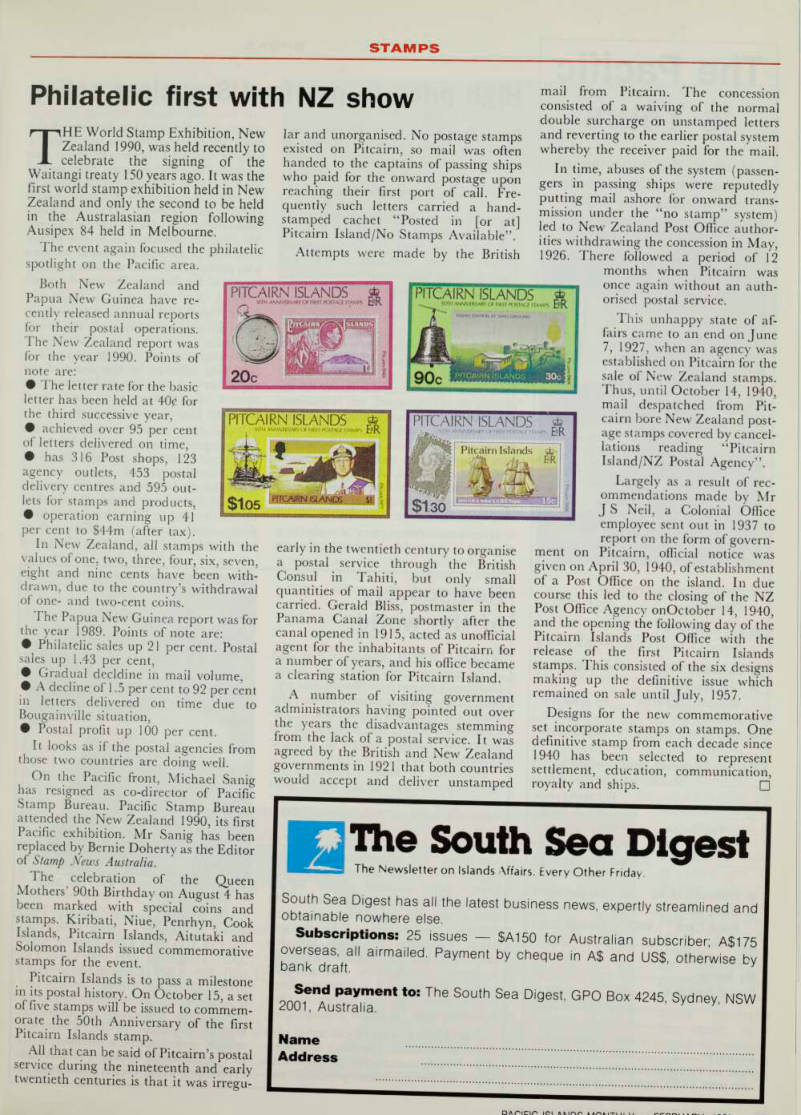
Stamps
THE World Stamp Exhibition, New Zealand 1990, was held recently to celebrate the signing of the Waitangi treaty 150 years ago. It was the first world stamp exhibition held in New Zealand and only the second to be held in the Australasian region following Ausipex 84 held in Melbourne.
The event again focused the philatelic spotlight on the Pacific area.
Both New Zealand and Papua New Guinea have re cently released annual reports for their postal operations.
The New Zealand report was for the year 1990. Points of note are: • The letter rate for the basic letter has been held at for the third successive year, • achieved over 95 per cent of letters delivered on time, • has 316 Post shops, 123 agency outlets, 453 postal delivery centres and 595 out lets for stamps and products, • operation earning up 41 per cent to S44m (after tax).
In New Zealand, all stamps with the values of one, two, three, four, six, seven, eight and nine cents have been with drawn, due to the country’s withdrawal of one- and two-cent coins.
The Papua New Guinea report was for the year 1989. Points of note are: • Philatelic sales up 21 per cent. Postal sales up 1.43 per cent, • Gradual decldine in mail volume, • A decline of 1.5 per cent to 92 per cent in letters delivered on time due to
Bougainville situation,
• Postal profit up 100 per cent.
It looks as if the postal agencies from those two countries are doing well.
On the Pacific front, Michael Sanig has resigned as co-director of Pacific Stamp Bureau. Pacific Stamp Bureau attended the New Zealand 1990, its first Pacific exhibition. Mr Sanig has been replaced by Bernie Doherty as the Editor of Stamp News Australia.
The celebration of the Queen Mothers’ 90th Birthday on August 4 has been marked with special coins and stamps. Kiribati, Niue, Penrhyn, Cook Islands, Pitcairn Islands, Aitutaki and Solomon Islands issued commemorative stamps for the event.
Pitcairn Islands is to pass a milestone in its postal history. On October 15, a set of five stamps will be issued to commem orate the 50th Anniversary of the first Pitcairn Islands stamp.
All that can be said of Pitcairn’s postal service during the nineteenth and early twentieth centuries is that it was irregu
lar and unorganised. No postage stamps existed on Pitcairn, so mail was often handed to the captains of passing ships who paid for the onward postage upon reaching their first port of call. Fre quently such letters carried a hand stamped cachet “Posted in [or at] Pitcairn Island/No Stamps Available”.
Attempts were made by the British
early in the twentieth century to organise a postal service through the British Consul in Tahiti, but only small quantities of mail appear to have been carried. Gerald Bliss, postmaster in the Panama Canal Zone shortly after the canal opened in 1915, acted as unofficial agent for the inhabitants of Pitcairn for a number of years, and his office became a clearing station for Pitcairn Island.
A number of visiting government administrators having pointed out over the years the disadvantages stemming from the lack of a postal service. It was agreed by the British and New Zealand governments in 1921 that both countries would accept and deliver unstamped
mail from Pitcairn. The concession consisted of a waiving of the normal double surcharge on unstamped letters and reverting to the earlier postal system whereby the receiver paid for the mail.
In time, abuses of the system (passen gers in passing ships were reputedly putting mail ashore for onward trans mission under the “no stamp” system) led to New Zealand Post Office author ities withdrawing the concession in May, 1926. There followed a period of 12
months when Pitcairn was once again without an auth orised postal service.
This unhappy state of af fairs came to an end on June 7, 1927, when an agency was established on Pitcairn for the sale of New Zealand stamps.
Thus, until October 14, 1940, mail despatched from Pit cairn bore New Zealand post age stamps covered by cancel lations reading “Pitcairn
Island/NZ Postal Agency”.
Largely as a result of rec ommendations made by Mr J S Neil, a Colonial Office employee sent out in 1937 to report on the form of govern
ment on Pitcairn, official notice was given on April 30, 1940, of establishment of a Post Office on the island. In due course this led to the closing of the NZ Post Office Agency onOctober 14, 1940, and the opening the following day of the Pitcairn Islands Post Office with the release of the first Pitcairn Islands stamps. This consisted of the six designs making up the definitive issue which remained on sale until July, 1957.
Designs for the new commemorative set incorporate stamps on stamps. One definitive stamp from each decade since 1940 has been selected to represent settlement, education, communication, royalty and ships. □
Advertisements & other items, pp. 47-48 (1 item)
The South Sea Digest
The Newsletter on Islands Affairs. Every Other Friday.
South Sea Digest has all the latest business news, expertly streamlined and obtainable nowhere else.
Subscriptions: 25 issues SAISO for Australian subscriber; Asl7s overseas, all airmailed. Payment by cheque in A$ and US$, otherwise by bank draft. 1 on ®f nd payment to: The South Sea Digest, GPO Box 4245, Sydney NSW 2001, Australia.
Name Address
The Pacific
Is Yours
Have all the information
at your fingertips order
PIM publications NOW!
PACIFIC
ISLANDS
MAP
I >, \ Of TWE
I I
TV JOURNAL
UXX
■ Pacific Islands Yearbook 16th Edition “ As4s ■ Fiji Handbook Business & Travel Guide Asl 4.95 ■ Vanuatu, A Guide ■ The Journal of William Lockerby ■ Map of Fiji ■ Map of the Pacific Asl 4.95 A 53.50 A 53.50 A 53.50 Number of copies being ordered: Pacific Islands Yearbook Fiji Handbook Vanuatu, A Guide The Journal of William Lockerby Fiji Islands map Pacific Islands map Enclosed is A$ for payment * Debit AS to my Bank Card VISA Master Card Card No: Expiry Date: My Name; Postal Address: Country: Tel;
Post to: PACIFIC ISLANDS MONTHLY,
PO BOX 1167, SUVA, FIJI ISLANDS.
High price to pay for US nuclear policy
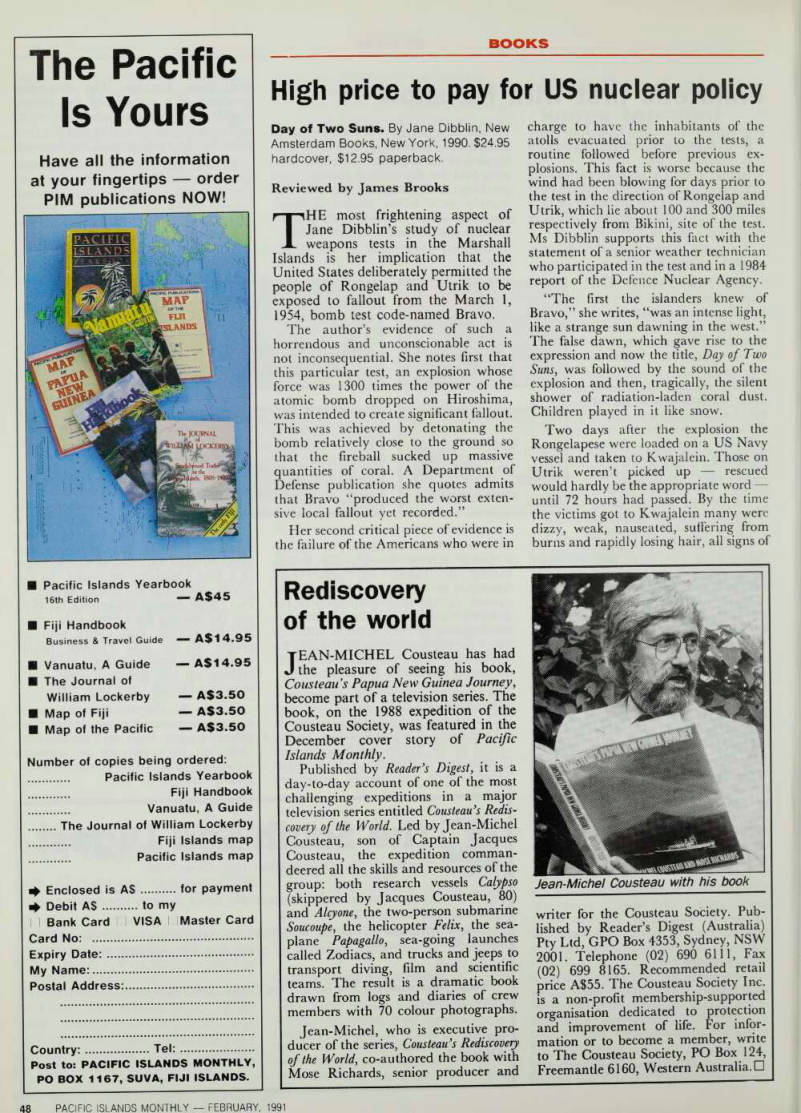
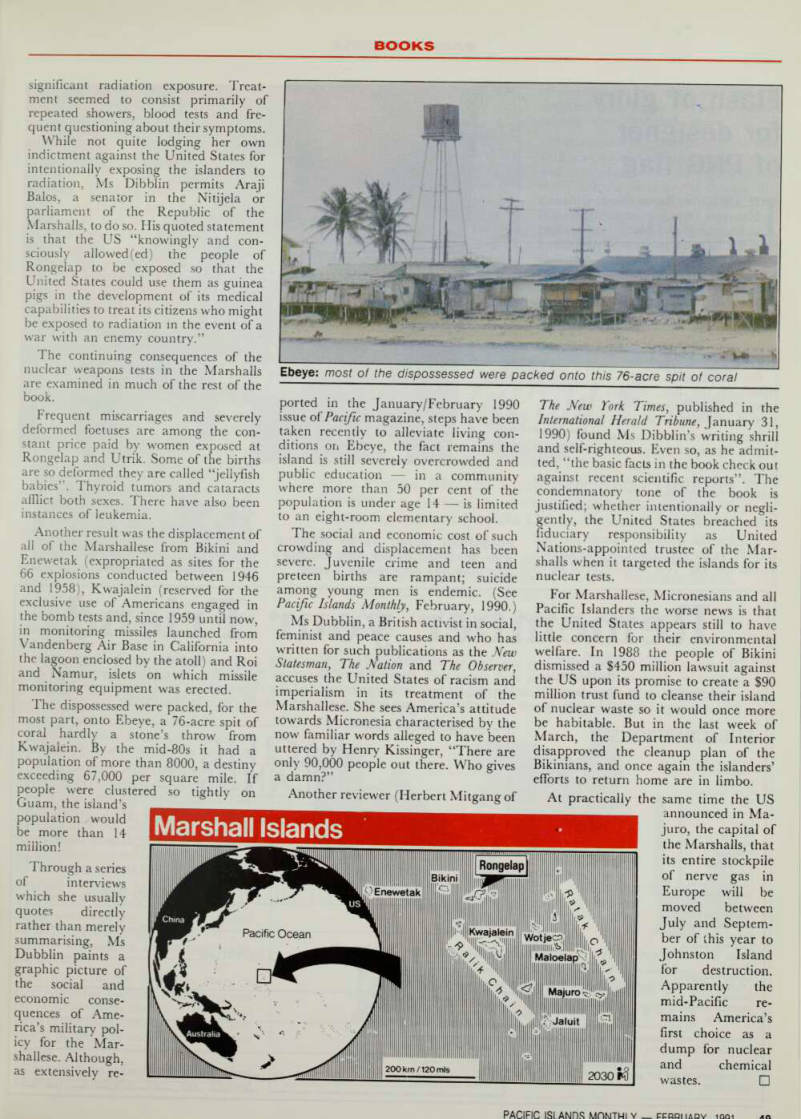
Books
Day of Two Suns. By Jane Dibblin. New Amsterdam Books. New York, 1990. $24.95 hardcover, $12.95 paperback.
Reviewed by James Brooks THE most frightening aspect of Jane Dibblin’s study of nuclear weapons tests in the Marshall Islands is her implication that the United States deliberately permitted the people of Rongelap and Utrik to be exposed to fallout from the March 1, 1954, bomb test code-named Bravo.
The author’s evidence of such a horrendous and unconscionable act is not inconsequential. She notes first that this particular test, an explosion whose force was 1300 times the power of the atomic bomb dropped on Hiroshima, was intended to create significant fallout.
This was achieved by detonating the bomb relatively close to the ground so that the fireball sucked up massive quantities of coral. A Department of Defense publication she quotes admits that Bravo “produced the worst extensive local fallout yet recorded.”
Her second critical piece of evidence is the failure of the Americans who were in
charge to have the inhabitants of the atolls evacuated prior to the tests, a routine followed before previous ex plosions. This fact is worse because the w u ind had been blowing for days prior to the test in the direction ot Rongelap and Utrik, which lie about 100 and 300 miles respectively from B.kmt, site of the test, Ms Dibblin supports this fact with the statement of a senior weather technician who participated in the test and in a 1984 re P or * of the Defence Nuclear A ? enc >'' “The first the islanders knew of Bravo,” she writes, “was an intense light, like a strange sun dawning in the west.”
The false dawn, which gave rise to the expression and now the title, Day of Two Suns, was followed by the sound of the explosion and then, tragically, the silent shower of radiation-laden coral dust, Children played in it like snow.
Two days after the explosion the Rongelapese were loaded on a US Navy vessel and taken to Kwajalein. Those on Utrik weren’t picked up rescued would hardly be the appropriate word un til 72 hours had passed. By the time the victims got to Kwajalein many were dizzy, weak, nauseated, suffering from burns and rapidly losing hair, all signs of
significant radiation exposure. Treat ment seemed to consist primarily of repeated showers, blood tests and fre quent questioning about their symptoms.
While not quite lodging her own indictment against the United States for intentionally exposing the islanders to radiation, Ms Dibblin permits Araji Balos, a senator in the Nitijela or parliament of the Republic of the Marshalls, to do so. His quoted statement is that the US “knowingly and con sciously allowed (ed) the people of Rongelap to be exposed so that the United States could use them as guinea pigs in the development of its medical capabilities to treat its citizens who might be exposed to radiation in the event of a war with an enemy country.”
The continuing consequences of the nuclear weapons tests in the Marshalls are examined in much of the rest of the book.
Frequent miscarriages and severely
deformed foetuses are among the con stant price paid by women exposed at Rongelap and Utrik. Some of the births are so deformed they are called “jellyfish babies”. Thyroid tumors and cataracts afflict both sexes. There have also been instances of leukemia.
Another result was the displacement of all of the Marshallese from Bikini and Enewetak (expropriated as sites for the 66 explosions conducted between 1946 and 1958), Kwajalein (reserved for the exclusive use of Americans engaged in the bomb tests and, since 1959 until now, in monitoring missiles launched from Vandenberg Air Base in California into the lagoon enclosed by the atoll) and Roi and Namur, islets on which missile
monitoring equipment was erected.
The dispossessed were packed, for the most part, onto Ebeye, a 76-acre spit of coral hardly a stone’s throw from Kwajalein. By the mid-80s it had a population of more than 8000, a destiny exceeding 67,000 per square mile. If people were clustered so tightly on
Guam, the island’s population would be more than 14 million!
Through a series of interviews which she usually
quotes directly
rather than merely summarising, Ms Dubblin paints a graphic picture of the social and economic conse quences of Ame rica’s military pol icy for the Mar
shallese. Although,
as extensively re-
ported in the January/February 1990 issue of Pacific magazine, steps have been taken recently to alleviate living con ditions on Ebeye, the fact remains the island is still severely overcrowded and public education in a community where more than 50 per cent of the population is under age 14 is limited to an eight-room elementary school.
The social and economic cost of such crowding and displacement has been severe. Juvenile crime and teen and preteen births are rampant; suicide among young men is endemic. (See Pacific Islands Monthly , February, 1990.) Ms Dubblin, a British activist in social, feminist and peace causes and who has written for such publications as the New Statesman, The Nation and The Observer, accuses the United States of racism and imperialism in its treatment of the Marshallese. She sees America’s attitude towards Micronesia characterised by the now familiar words alleged to have been
uttered by Henry Kissinger, “There are
only 90,000 people out there. Who gives a damn?”
Another reviewer (Herbert Mitgang of
The New York Times , published in the International Herald Tribune, January 31, 1990) found Ms Dibblin’s writing shrill and self-righteous. Even so, as he admit ted, “the basic facts in the book check out against recent scientific reports”. The condemnatory tone of the book is justified; whether intentionally or negli gently, the United States breached its
fiduciary responsibility as United
Nations-appointed trustee of the Mar shalls when it targeted the islands for its nuclear tests.
For Marshallese, Micronesians and all Pacific Islanders the worse news is that the United States appears still to have little concern for their environmental welfare. In 1988 the people of Bikini dismissed a $450 million lawsuit against the US upon its promise to create a $9O million trust fund to cleanse their island of nuclear waste so it would once more be habitable. But in the last week of March, the Department of Interior disapproved the cleanup plan of the Bikinians, and once again the islanders’ efforts to return home are in limbo.
At practically the same time the US
announced in Ma juro, the capital of the Marshalls, that its entire stockpile of nerve gas in Europe will be moved between July and Septem ber of this year to Johnston Island for destruction.
Apparently the
mid-Paciflc re mains America’s first choice as a dump for nuclear and chemical wastes. □
Ebeye: most of the dispossessed were packed onto this 76-acre spit of coral
Rediscovery
of the world
JEAN-MICHEL Cousteau has had the pleasure of seeing his book, Cousteau’s Papua New Guinea Journey, become part of a television series. The book, on the 1988 expedition of the Cousteau Society, was featured in the December cover story of Pacific Islands Monthly.
Published by Reader's Digest, it is a day-to-day account of one of the most challenging expeditions in a major television series entitled Cousteau's Redis covery of the World. Led by Jean-Michel Cousteau, son of Captain Jacques Cousteau, the expedition comman deered all the skills and resources of the group: both research vessels Calypso (skippered by Jacques Cousteau, 80) and Alcyone , the two-person submarine Soucoupe , the helicopter Felix , the sea plane Papagallo , sea-going launches called Zodiacs, and trucks and jeeps to transport diving, film and scientific teams. The result is a dramatic book drawn from logs and diaries of crew members with 70 colour photographs.
Jean-Michel, who is executive pro ducer of the series, Cousteau's Rediscovery of the World , co-authored the book with Mose Richards, senior producer and
writer for the Cousteau Society. Pub lished by Reader’s Digest (Australia) Pty Ltd, GPO Box 4353, Sydney, NSW 2001. Telephone (02) 690 6111, Fax (02) 699 8165. Recommended retail price AS55. The Cousteau Society Inc.
is a non-profit membership-supported
organisation dedicated to protection
and improvement of life. For infor mation or to become a member, write to The Cousteau Society, PO Box 124, Freeman tie 6160, Western Australia. □
Jean-Michel Cousteau with his book
Advertisements & other items, p. 49 (1 item)
Books
49
PACIFIC ISLANDS MONTHI Y pprri iadv iqqi
for designer
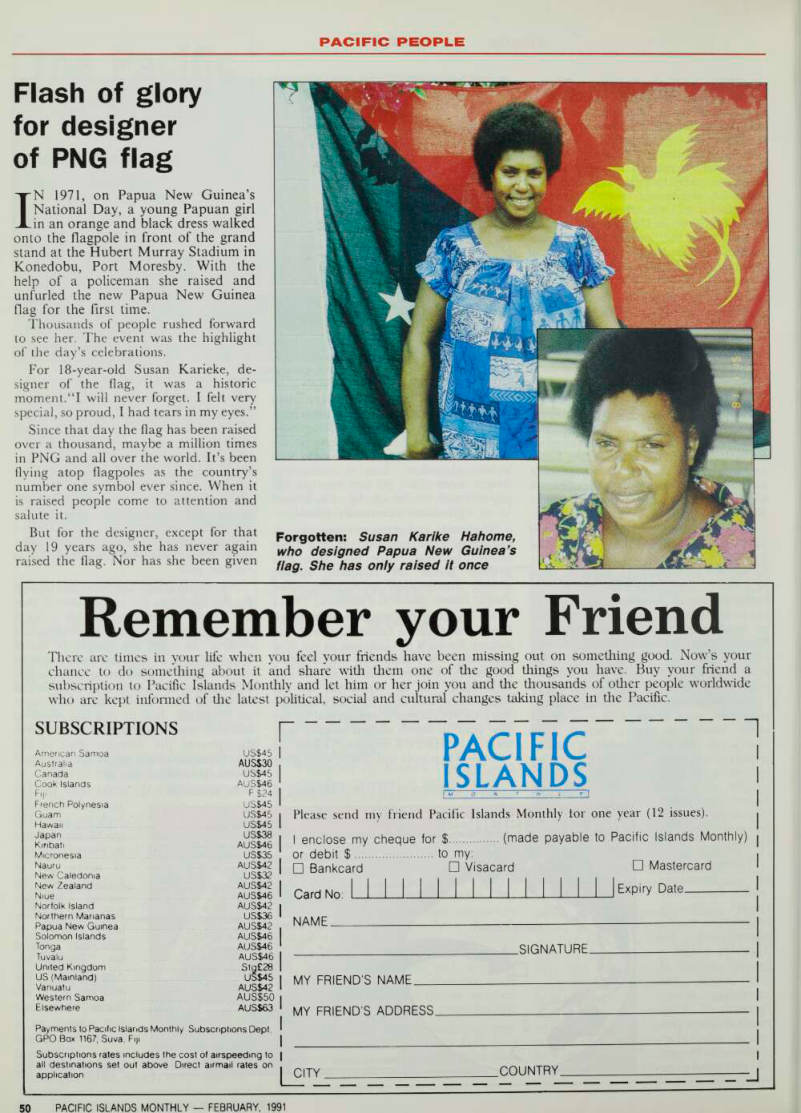

Pacific People
Flash of glory for designer of PNG flag
IN 1971, on Papua New Guinea’s National Day, a young Papuan girl in an orange and black dress walked onto the flagpole in front of the grand stand at the Hubert Murray Stadium in Konedobu, Port Moresby. With the help of a policeman she raised and unfurled the new Papua New Guinea flag for the first time.
Thousands of people rushed forward to see her. The event was the highlight of the day’s celebrations.
For 18-year-old Susan Karieke, de signer of the flag, it was a historic moment.“l will never forget. I felt very special, so proud, I had tears in my eyes.”
Since that day the flag has been raised over a thousand, maybe a million times in PNG and all over the world. It’s been
flying atop flagpoles as the country’s
number one symbol ever since. When it is raised people come to attention and salute it.
But for the designer, except for that day 19 years ago, she has never again raised the flag. Nor has she been given
Forgotten: Susan Karike Hahome, who designed Papua New Guinea’s flag. She has only raised it once
the respect which has been awarded to the symbol which she dreamed up.
She has never been part of the country’s official independence celebr ations, except in 1985 when she was invited to the flagraising ceremony and awarded the independence medal.
Tearfully she recollects: “I thought I would raise the flag but I did not. I had tears in my eyes as I watched the girl guides and the army marching up with the flag and raising it. I felt really insignificant, left out, forgotten.”
Except for that day, she says: “Every independence day I put my head down and cry.”
But hopefully this may soon change.
The Gordons Catholic Mamas Associ ation of which Susan is a member and the National Council of Women, after hear ing her story, will be submitting her name for this year’s Queen’s honours list.
They will also ask that as long as she is still living and in Port Moresby, she raises the flag at every official indepen dence flagraising ceremony in Port Moresby. And where she cannot do so, her children will take her place.
Susan, now 35, is from Meii village in the Gulf province. Her father was of the Elema people, a people well known for their art, especially the striking carved and painted boards which represent the spirit of clan heroes.
At the age of 12 Susan went to the newly opened school at the Catholic Mission, Araimiri. But she didn’t like it and left after one year.
Then, however, Sr Joseph Mary, a
teaching and nursing Sister, arrived at
Araimiri. She found Susan living aimlessly and started to teach her to cook and sew, and draw and paint. From the beginning Susan showed talent and was encouraged to concentrate on painting.
Her creations were inspired by the memories of the spirit boards of the Gulf.
The boards were kept by a much feared witch doctor. They were held in great awe and only men were permitted to see them. But the aging witchdoctor made an exception in Susan’s case, because her father looked after him.
When Sr Joseph Mary transferred to Yule Island, Bereina, 100 miles away, Susan went with her. There she worked as a nursing aide to Sr Joseph Mary at the mission hospital. In her spare time,
she painted.
In some of her drawings there is evidence of her Catholic upbringing and the influence of the church the face in some of her work becomes that of Christ and a jagged line becomes a crown of thorns.
Her works have been exhibited in Port Moresby, Australia and the United
States. Many have been sold.
So how was the flag born? In 1970 the House of Assembly launched a flag
designing competition. It suggested
paradise, the southern cross, and yellow and green.
When Sr Joseph Mary told Susan to enter the competition Susan refused. She didn’t think she could do it. “But Sr Joseph Mary insisted and told me, you do it and God will help you.”
So Susan streaked a diagonal line across a piece of paper, putting the bird
of paradise on the right side and the southern cross on the left, and chose the colours white, red and yellow, She chose white to represent the lime with which New Guilleai ’ s chew betelnut and red and yellow to represent the many colours of beautiful flowers that grow in PNG’s tropical climate. “We could tell it was a good one right away,” said Sr Joseph Mary in an interview in 1970. And sure enough it was accepted by the House of Assembly as the new flag for PNG. □
Advertisements & other items, pp. 50-51 (2 items)
dfdfdfdf
Remember your Friend
There are times in your life when you feel your friends have been missing out on something good. Now’s your chance to do something about it "and share with them one of the good things you have. Buy your friend a subscription to Pacific Islands Monthly and let him or her join you and the thousands of other people worldwide who arc kept informed of the latest political, social and cultural changes taking place in the Pacific.
PACIFIC
SLANDS
)~M~ O N T H L Y Please send my friend Pacific Islands Monthly tor one year (12 issues).
I enclose my cheque for $ (made payable to Pacific Islands Monthly) or debit $ to my; □ Bankcard □ Visacard □ Mastercard Card No: I I I I I I I I I I I I I I I I Ex P ir V Date
NAME
SIGNATURE
MY FRIEND'S NAME
MY FRIEND'S ADDRESS
CITY
*gs
AJAX PUMPS
PTY LTD
FORRERS
PUMPS
Ajax Pumps Pty Ltd which incorporates FORRERS PUMPS are pleased to announce the appointment of Clyde Equipment Pacific Ltd as their sole Distributor for Fiji and the Region.
This appointment strengthens Clydes commitment to meeting the pumping needs of Hotels, Manufacturers, Contractors, Consulting Engineers and Public Utilities.
With Ajax and Ferrers, Clyde are now able to offer Pumps for;
Air Conditioning
Refrigeration Heating and Ventilation
Water Supply
Pressure Boosting Fire Protection Irrigation Sewerage and Plumbing Dewatering Enquiries welcomed and handled with promptness
(PACIFIC)
HEAD OFFICE:
VIRIA ROAD, VATUWAQA
SUVA, FUI
TELEPHONE: 386000
TELEX; 2346 CLYPAC FJ
FAX: 370431 (679)
P 0 BOX 1068, SUVA
LAUTOKA BRANCH;
NEDE STREET
PHONE 63477,63343
P.O. BOX 785, LAUTOKA
FAX: 63153
Pacific People
51
PAP.IFIP IQI AMOC MHMTUI V CCDDI iadv inni
Interview
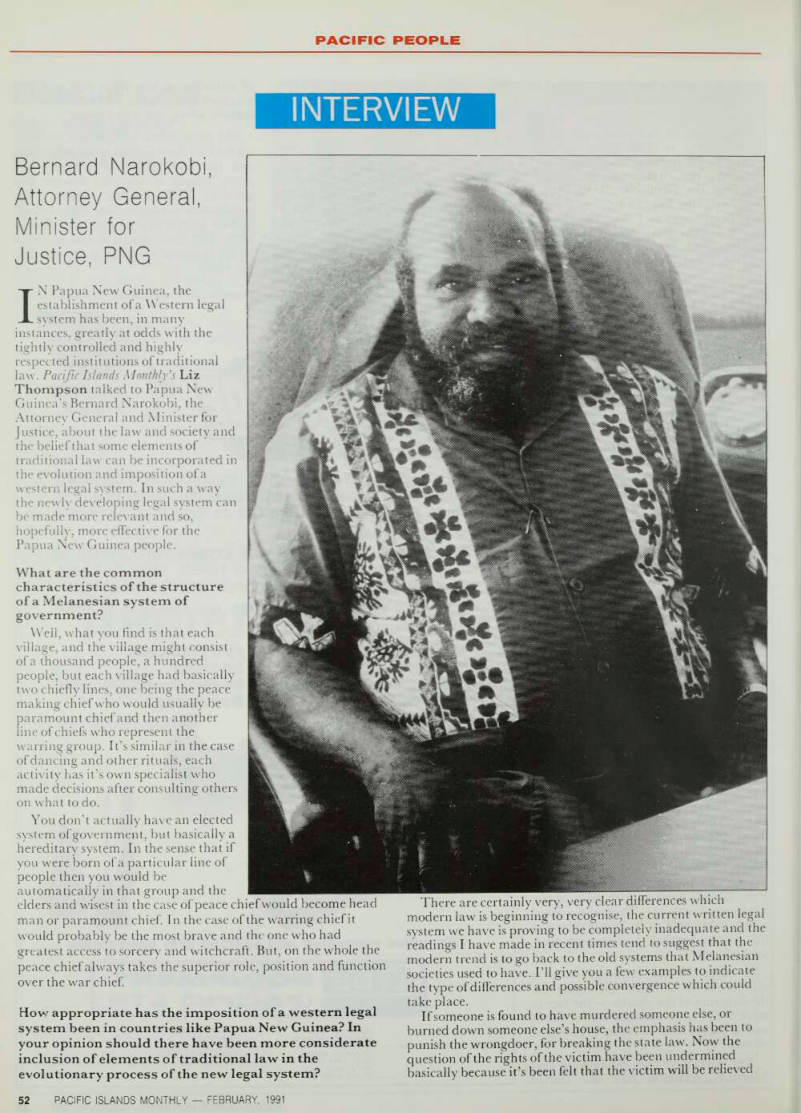
Bernard Narokobi,
Attorney General,
Minister for
Justice, PNG
IN Papua New Guinea, the establishment of a Western legal system has been, in many instances, greatly at odds with the
tightly controlled and highly
respected institutions of traditional law. Pacific Islands Monthly's Liz Thompson talked to Papua New Guinea’s Bernard Narokobi, the Attorney General and Minister for Justice, about the law and society and the belief that some elements of traditional law can be incorporated in the evolution and imposition of a western legal system. In such a way the newly developing legal system can be made more relevant and so, hopefully, more effective for the Papua New Guinea people.
What are the common characteristics of the structure of a Melanesian system of
government?
Well, what you find is that each village, and the village might consist of a thousand people, a hundred people, but each village had basically two chiefly lines, one being the peace making chief who would usually be paramount chief and then another line of chiefs who represent the warring group. It’s similar in the case of dancing and other rituals, each activity has it’s own specialist who made decisions after consulting others on what to do.
You don’t actually have an elected system of government, but basically a hereditary system. In the sense that if you were born of a particular line of people then you would be automatically in that group and the
elders and wisest in the case of peace chief would become head man or paramount chief. In the case of the warring chief it would probably be the most brave and the one who had greatest access to sorcery and witchcraft. But, on the whole the peace chief always takes the superior role, position and function over the war chief.
How appropriate has the imposition of a western legal system been in countries like Papua New Guinea? In your opinion should there have been more considerate inclusion of elements of traditional law in the evolutionary process of the new legal system?
There are certainly very, very clear differences which modern law is beginning to recognise, the current written legal system we have is proving to be completely inadequate and the readings I have made in recent times tend to suggest that the modern trend is to go back to the old systems that Melanesian societies used to have. I’ll give you a few examples to indicate the type of differences and possible convergence which could take place.
If someone is found to have murdered someone else, or burned down someone else’s house, the emphasis has been to punish the wrongdoer, for breaking the state law. Now the question of the rights of the victim have been undermined basically because it’s been felt that the victim will be relieved
when the offender is imprisoned. In this way the victim is not really taken into consideration at all, whereas you find in old traditional law, the victim is the paramount consideration.
In fact, so much so that traditionally the wrong-doing is responded to with murder, or great damage being inflicted on the offender and his line of people. I have often felt that the system we have inherited is wrong because the offender goes to jail, he is well protected, behind bars. His freedom is deprived but in the village he could face death, even for a petty stealing offence. Because he is locked away he cannot do anything to amend and make good what wrong he has done.
Instead the state provides security for him, feeds him, houses him, and in some ways he comes out quite relieved because he’s been protected whilst time’s been given to others to forget the wrong.
How can you use traditional law, based on compensation of the victim, to produce a more appropriate legal system now?
I feel we should now move and we are moving into a system where if an offender is convicted of a
criminal offence, that court, in the overall process of doing justice, takes into account the victim’s plight and situation. For instance, if the state is feeding this person for three meals a day, perhaps one meal could be denied that person and some form of payment made to assist the victim.
Alternatively he could be engaged to produce things which could be sold, money could be raised to pay to assist the victim, or, in a completely safe situation where the prisoner is harmless, he could be supervised, if he committed arson and burnt down someones’ house, he could be supervised in assisting to rebuild the victim’s property.
Obviously with traditional law there were traditional communal methods of enforcement, people took responsibility for their own area, they administered payback or regulated their own people.
What effect has the institutionalisation of the law enforcement bodies had on the community?
The increased professionalisation of police and law
enforcement agencies has effectively disempowered and
disposessed the people of their right, their duty also, to be engaged in law enforcement. Issues like self defence, the right to defend your property have really become subservient, subverted The people have become apathetic, disinterested.
I hey tend to wait for the police to come and protect them and provide security, when in fact, traditionally every man has the right to defend himself against any invasion of his person or his property. I think we should relook at the role and the function of the police force in the community and the powers ot the people, of the citizen in terms of his self defence, ought to be better defined. The power of the police in relation to the general law and order situation, has disempowered the people. \ here 15 of ' c ourse a great need for specialised police but I think the community and the individual ought to have their role re emphasised.
What about the imposition of the idea of a national identity, a nation, obviously very alien to a country
made up of over 700, autonomous clan groups? What kind of effect does this have?
The entire concept of the country, the idea of the nation state, is an act of violence and really an act of hostility against native village independence and village autonomy. You have 700 or 800 language groups with over 2000 villages, each having it’s own autonomous existence, then you have superimposed on it a legal entity called Papua New Guinea.
This is one of the basic factors we have to grapple with. \ ou find today the demands for land compensation, the secessionist movements, they are caught up in this clash. A fundamental clash between village pride, independence, autonomy, on which you have superimposed a nation with legal, political machines and police to actually control and
dispossess and disempower the people.
So this is one of the basic roots we have, one of the basic conflicts. So the struggle, throughout the process of nation building, national development, is a struggle to strike a balance and compromise the social order as a small unit and it’s economic, social, ecological order, against a much wider
national and international
superimposition.
How do you resolve the notion of local landowner ownership and the state in instances in which the state wants to mine what is below the ground, or fish in particular waters. How do you reconcile this ownership with the idea of national development?
Well, for instance, the water the question of water, who actually owns the water which flows through the river or sits in a lake. The traditional attitudes are that the landowners don’t own, but they actually control, the waters. Then you have the state coming down with state legislation, like the Water Resources Act of 1983, declaring that all water is owned by the state. You have minerals, the question of gold, oil, copper, and so on. They might be thousands of
metres down under the ground, but to get there you have to go through the top soil. To extract it you have to destroy very wide and large areas of land and the village or the group that claims that it owns the area has complete dominion over whatever might be under ft. Then the state comes down with it’s mineral legislation, saying the state owns all minerals. The Law Reform Commission has been trying to resolve some of these fundamental conflicts.
I think we have to make a commitment, either we allow the present law to continue and that is to say that traditional landowners are to be dispossessed, that they have no rights other than to be paid just compensation for the destruction of their land and resources, or in the alternative, to make a change to the mining legislations and allow the owners of the land to actually own the minerals. However the state would still have the licensing authorities so that the agreements between the developer and the landowners benefit everyone fairly.
The developer is entitled to fair returns to his investment and his technology, similarly the state representing all the people is also entitled to a fair return and the landowners whose resources are to be exploited, a proper evaluation of that resource ought to be made and be recognised as their equity m the whole process of development. □
Guam deadlock
ARISING star in Guam’s Democratic Party, Senator-elect Marilyn Won Pat, died before she could take office, apparently from natural causes. Her death has created, among other things, a series of complications in Guam politics.
Ms Won was swept into the Territorial Legislature in November, while several sitting members were defeated. As a result of the voting, the Democrats continued to hold the Legislature by the narrowest of margins, 11-10. Ms Pat’s death created a deadlocked Legislature, with each party holding 10 seats.
The question of how to fill the seat is a murky area, since Guam has no precedent for filling such vacancies. One solution would be a special election, as Guam does when sitting senators die.
In that case, Senator Madeleine Bordallo would be a logical candidate for return to the Legislature. Another option would be to give the seat to the losing candidate with the most votes defeated Senator Ted Nelson, another Democrat. □
Advertisements & other items, pp. 53-56 (2 items)
Pacific People
53
PACIFIC ISLANDS MONTHI Y ffrri iadv 1001
Pacific
ISLANDS
IMQNT H L Y \
MflfiK€T PlfiCe
For the benefit of our readers who would like to place a small classified advertisement in our magazine, Market Place will assist you in selling personal items, accommodation, real estate, boating or a service ... in fact anything you would like to sell to our over 50,000 readers.
Market Place Advertising Rates are structured to allow you to place as many advertisements as you wish, economically.
CORRESPONDENCE
Sincere, eligible Australian gentlemen wish to correspond with Pacific ladies, all ages/ races. Free registration. For full details, please write to: ASIAPAC, PO BOX 231, Maylands 6052, AUSTRALIA.
OVERSEAS FUNDING
Unlimited overseas funding for any National Government and private company’s viable projects. No front fees. Send proposal to Pan Asia Management Consultants Center Box 4295, BOROKO, NCD, Papua New Guinea.
DISTRIBUTOR WANTED
Manufacturer of a line of spray aerosol products that speed production in the garment factory; Silicone Spray, Spot Lifter, Pattern Adhesive, Emery Sharpening Stone Wheel Cleaner, Fusing Machine Cleaner, etc.
Write Sprayway, Inc., Addison, IL
60101-4468, FAX 1 (708) 543-7797.
TRUCK MECHANIC
32 year old with 12 years experience in Europe and New Zealand, seeks job on one of Pacific Islands. C.V. & references available.
Eric Willers, Flat 3/36A Harman St., Christchurch, New Zealand, Tel (03) 3385629.
IMMIGRATION
Applications for immigration to U.S.A. Canada, Australia, New Zealand, EEC, prepared by ex-immigration officer established in business since 1985. CWWAD P.O. Box 282, Mawson, Canberra, A.C.T. 2607, Australia.
Fax: 61-06-2865252'
CAREER
A pilot career? “Becoming a pilot in the 1990’5” has full details training, civil, air force, jobs, airlines, helicopter! Send NZ523.45 to aviation professionals, Box 28051, 6A Benson Rd, Remuera, Auckland, NZ. Phone/Fax (64-9) 5221330, Cheque, Visa, Bankcard.
SELF ADHESIVE LABEL!
FORUM LABELS (FIJI) LTD
P.O. Box 1167, Suva., Fiji. Phone:3o4lll We print self-adhesive labels in rolls, multi-coloured labels with hot foil, and die cut to shape, tickets and tags in rolls. We also supply labelling machines and fabric labels.
[COMMERCIAL PRINTING
Top quality four colour printing, brochures, posters, packaging, product labels, fabric labels, billboards, books, magazines, stickers, books. Export quality. Contact Fiji’s most experienced Commercial Printers. FIJI TIMES COMMER- CIAL PRINTING, P C. Box 1167, Suva. Fiji.
Phone; 304111 Fax. 301521.
NTIQUE BOOKS, MAPS &
PRINTS
Antique Books, Maps & Prints of Pacific Islands. Free list available of items for sale.
Colin Hinchcliffe. 12 Queens Staith Mews.
York U.K.
SHIP FOR SALE
120’ x 24’ x 8’ Ship, Ex-Australian navy ocean going water lighter. Twin screw.
Approx. 200 tons capacity. Suit Island Trader, Tanker, Mothership. Not in survey.
SAUD 90000. Ph. Sydney 61-2-6292413, Fax 61-2-6272707.
PORTATSLE SAWMILLS
Tractor powered sawmills to convert coconut trees or hardwood into domestic use or export timber. Enquiries Ph. Sydney 61-2-629413, Fax 61-2-6272707, 13 Roseberry Road, Kellyville 2153, NSW,
AUSTRALIA.
IMMIGRATION
Migrate to Australia with our expert assistance. Businessmen/skilled people/teachers/professionals send details in confidence. CKP AUSTRALIA, Box 2252, Canberra ACT 2601, Australia.
JEEP TIRES
Jeep Tires * Heavy duty military surplus, 6ply nylon, 700 x 16LW on rims. US $25.00ea or five/US$lOO.OO. Quantity discount available. On Maui, Hawaii 808-572-0462
PACIFIC
SLANDS
{MONTH L Y~ l
MRRK€T PLflC€ CAN WORK
WOND6RS FOR VOU ...
Promote your business, or service, sell your household items, cars or heavy machinery etc.
ONLY AUSSI PER WORD.
NO COMPANY LOGO. NO
DISPLAY. NO BOLD TYPE.
Just forward your Advertisement together with payment to: PACIFIC ISLANDS MONTHLY “Market Place", P.O. Box 1167, Suva, Fiji.
CONDITIONS:
1/ All Advertisements are subject to acceptance and approval of publisher. 2. Advertisements are published as space permits; we cannot guarantee date of insertion. 3. All advertisements must be prepaid and should be typed or printed clearly. 4. Deadline for receipt of advertisements is the 10th of the month prior to issue.
5. PACIFIC ISLANDS MONTHLY
assumes no responsibility for any service other than publishing paid advertisements in this section.
CMX23O
STEREO CASSETTE DECK
WITH FM-STEREO/NIW TUNER
& CD CHANGER CONTROL
/ CMX23O the trend-setting in-car sound player offered by Clarion, that frontrunner in the car audio field. Visit new sound frontiers with the amazing CMX23O, a masterpiece in human
engineering.
V vV / / £ / / o N A o
clarion
NS T Tp'iS AWA New Zealand Limi,ed ' P 0 Bo * s °- 24 ' * Islands: Brlj, Inc., RO. Box 3478, Agana Guam 96910 USA Ter 472 8091 rahlp AiminapamwV NeW Caledonia: Caldis ’ B P M - Noumea Cedex / Guam; Micropac Aud “ p oV«. jz “■ Box «• viia ' caok ■—= •- *
An Eye to Total Safety.
r O/f For Mitsubishi Motors and active safety have equal and rather than being added are guide-lines that every and stage of design must follow.
This approach to total safety involves exhaustive and innovative research methods, particularly into the physical reactions of motorists to various driving situations.
In designing the Galant, for example, Mitsubishi’s engineers mapped what drivers looked at while cornering. They found that drivers of some cars had much narrower fields of vision, indicating a high level of tension due to poor vehicle handling.
By comparison, their tests with the Galant and its integrated drive system, Dynamic-4 showed that with better handling, wider • -4 Vision tracking shows how the Galant’s superior handling results in lower driver tension indicated by a wider field of vision. fields of vision indicated lower levels of tension in the driver.
Using advanced technology to define and attain safety standards is further evidence of Mitsubishi’s guiding principle of answering the needs and preferences of today’s drivers an on-going philosophy of putting technology to work for you.
MITSUBISHI QHLHNT
A
MITSUBISHI
MOTORS
AMERICAN SAMOA: PACIFIC MARKETING INC. P.O. Box 698, Pago Pago, Tel 699-9140/AUSTRALIA: MITSUBISHI MOTORS AUSTRALIA LTD. Box 1284, South Road, Clovelly Park, South Australia 5042, Tel (08) 275-7297/ FIJI: NIVIS MOTOR & MACHINERY CO., LTD. G.P.O. Box 150, Suva, Tel 38341 1 /FRENCH POLYNESIA (TAHITI): SOPADEP S.A. P.O. Box 1617, Papeete, Tahiti, Tel 4-202-58/NEW CALEDONIA; SOCIETE DTMPORTATION D’AUTO DU PACIFIQUE SUD S.A. B.P 438 Rond Point du Pacifique, Noumea. Tel. 274144/NEW ZEALAND: MITSUBISHI MOTORS NEW ZEALAND LTD. Private Bag, Porirua, Tel. 370-109/NORFOLK ISLAND: BORRYS PTY. LTD. PO Box 169, Norfolk Island, Tel. 2114/PAPUA NEW GUINEA: TOBA PTY. LTD. P.O. Box 503, Port Moresby, Tel. 21-7874/SOLOMON ISLANDS; HARVEST PACIFIC LTD. G.P.O. Box 823, Honiara, Guadalcanal.
Tel 30128/TONGA; SITANI MAFI CO., LTD. P.O, Box 83, Nuku ALOFA, Tel. 24-044/VANUATU; SOCOMETRA B.P. 06 Route de Lagon, Port-Vila, Tel. 2314/WESTERN SAMOA: MOTOR DISTRIBUTORS LTD. P.O. Box 576, Apia, Tel. 20957/SAIPAN/POHNPEI/MAJURO/KOSRAE/TRUK/YAP/BELAU: MICRONESIAN MOTORS, INC. 997 South Marine Drive, Tamuning, Guam 96911, Tel. 646-6827