Pacific

Islands
Monthly
January 1991
violent homes of paradise Living up to ’91
Women
Of
The Year
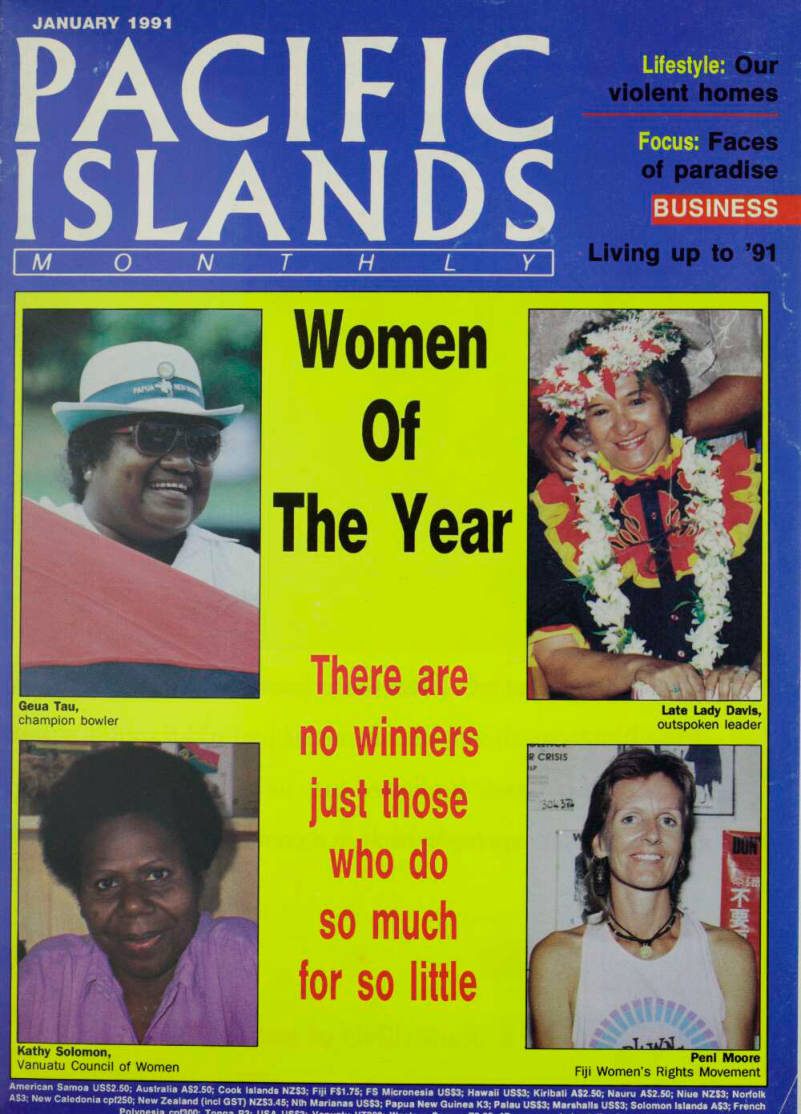
There are no winners just those who do so much for so little
A.tt* p*"*?® USs2 „ s c°n us,r ® lia AS2 - s °; Cook Islands NZS3; Fiji F 51.75; FS Micronesia US$3; Hawaii USS 3; Kiribati A 52.50; Nauru A 52.50; Niue NZ$3; Norfolk ma cpf2so; New Zealand (mcl GST) NZ53.45; Nth Marianas USS 3; Papua New Guinea K 3; Palau US$3; Marshalls US$3; Solomon Islands As 3; French Po IvnPQia Tnnna DQ. IIC A I ICCO. iitaaa.
Geua Tau, champion bowler
Kathy Solomon, Vanuatu Council of Women
Late Lady Davis, outspoken leader
Peni Moore Fiji Women’s Rights Movement
Pacific Women of the Year
Cover; Women hold up half the sky, or so the saying goes. For many women in developing nations, including most of the Pacific, the burden is wide and heavy, and recognition is scant. In profiling Women of the Year, Pacific Islands Monthly looks at 10 different women and women’s groups, who have succeeded in spite of the ob stacles. The chosen 10 range from politicians and lobbyists to welfare workers, sportswomen and the cour ageous women of Bougainville. /II
Advertisements & other items, pp. 2-4 (1 item)
What inspired that rebellious young poet called Rimbaud? What
drove him to reach into the innermost part of his soul in search of the undiscovered? It allowed him to take words that already existed and yet express himself in a completely new way. Some
creators are brave enough to realise their dreams without compromise. It is men like this who created the MX-5 in 1989.
By ignoring the rules they are constantly reshaping the future.
Even now they are realising a new dream. They work for Mazda.
On the road to civilization.
Fuels and lubricants.
Plastics. Chemicals. Bitumen.
Aviation Services. Bunkering.
Shell has penetrated even more of the Pacific to widen its network of offices, terminals and
Network Shell
now servicing
even more
of the Pacific.
distributors as well as service stations.
Now you can re-assess your source of supply, because Shell quality and value is close at hand, with the service to back it up.
REGIONAL OFFICES: GLAM 6"1 4"- 4350. Also servicing Marshall Islands (Majuro), Northern Marianas (Saipan), Palau. |I 679 313 033. Also servicing Tonga, Cook Islands. American Samoa. Western Samoa • PAPUA NEW GUINEA 675 228 700. Also servicing Solomon Islands.
NEW CALEDONIA 68" 285 "20. Also servicing Tahiti. Vanuatu.
Pacific
Islands
Monthly
Vol 61 No.l
Voice Of The Pacific
January 1991
Interview
JON Jonassen: The Cook Islands’ new Ministry of Cultural Development, known locally as Tauranga Vanaga, is
aiming to promote indigenous language,
customs, traditions and practices. The secretary of the new Ministry, Jon Jonassen, spoke to Pacific Islands Monthly about its work, future directions, and the 1992 Pacific Arts Festival. / 51. ■ LIFESTYLE; A new study published by the Hawaii-based Institute for Poly nesian Studies reveals the violence be hind closed Pacific doors. Sometimes, domestic violence against women is sanctioned by cultural and social prac tices. Karen Mangnall reports. / 17
FOCUS: Irish artist/illustrator Helen Averley recently visited French Poly-
nesia, and re corded her im pressions of two special islands Huahine Nui and Huahine Iti. The result is a refreshing look at some precious glimpses of the
artist’s Polynes
ian experience, presented through her own words and pictures. / 24
Business
1990 was not so bad for the Pacific as a whole, given the problems faced by other economies. But still the end of the year marked the end of the road for some industries. The future fortunes of Pacific nations will be sharply divided between those who have economic potential, and those who do not. / 31 ■ SHIPPING: The cruise ship business is looking better for the South Pacific.
Pacific Island Monthly's analysis of the semi-annual, comprehensive tabulation of cruise ship schedules world-wide, shows a doubling of South Pacific listings. / 41 ■ MOVIES: A new film looks at one Samoans’ inner search and outer re
bellion, providing a perceptive, moving,
and powerful interpretation of the im pact of colonialism on a South Pacific society. / 45 ■ COMMENT: Hot on the heels of controversy over United States plans to destroy chemical weapons on Johnston Atoll, environmental groups and the state of Hawaii are protesting a scheme to test fire missiles across the Pacific for ‘Star Wars’ research. The US Army wants to begin launching new rockets for the Strategic Defense Initiative next year from the Kauai Test Facility in Hawaii.
Margot O’Neill reports. / 10
Publisher: Geoffrey Hussey Editor: Jale Moala Correspondents: Al Prince, Angela McCarthy, David North, David Robie, Diana McManus. Dykes Angiki, Frank Senge, Franc Madoeuf, Irene Nisbet, John Hunter, Karen Mangnall, Lito Vilisoni, Macel Manua, Nicholas Rothwell, Pesi Fonua, Richard Dinnen, Ulafala Aiavao, Wally Hiambohn Business Correspondent: Robin
Bromby Columnists: David Barber (Wellington), Futa Helu (Tonga, cover ing the Pacific Islands), Jemima Garrett (Sydney), Margot O'Neill (Washington) Advertising Manager Lionel Heffernan Advertising Sales: • Fiji: Salen Narayan, Tel (679) 304111 Fx (679) 303809 • Sydney, Melbourne; Fergus Maclagan, Tel (61-2) 4134689, Fx (61-2) 4123918 • Brisbane: Robert Walker, Tel (61-7)
3710533 • Adelaide: Hastwell Williamsons Representations, Tel (61-8) 799522 • Japan: Universal Media Corporation, Tokyo. Tel (3) 6663036, 6663094, Cable: UNIMEDIA Tokyo, Tx 2524665 Founded 1930 (USPS 952480). A Fiji Times Limited production, Cover prices are recommended retail only. Registered by Australia Post, Publication No NBP 1210. © Copyright Fiji Times Limited, 117 Victoria Parade,
Suva, Fiji. Tel (679) 304111, Fx (679)
303809 Tx Fj2124
Pacific Islands Monthly is published monthly by Fiji Times Limited, a division of Nationwide News, 2 Holt Street, Surry Hills, Sydney, NSW 2010.
S«nd addra „ chang „ to . • Pacific Islands Monthly, PO Box 11fi7 q nv/ pm ' J Typeset and printed by Fiji Times Limited, 117 Victoria Parade, Suva, Fiji.
Advertisements & other items, p. 6 (1 item)
Europe.
BANK UNE and
COLUMBUS LINE
24 day service to
Europe.
Need we say more...
G The Joint Service Partners offer facilities for shipment of: Containers (FCL/LCL) and Break-bulk Cargo plus reefer space and deeptanks for carriage of vegetable oils and other liquid bulk cargo.
Carriers also accept heavy lifts, overlength and cumbersome parcels Please contact our regional offices for further information: The Bank Line P.O. Box 2225 Lae, Papua New Guinea Phone; 422 988/Fax.- 422 925 Telex: 44265 Ports of Service; Loading: Papeete, Apia, Suva, Lautoka, Noumea, Port Vila, Santo, Honiara, Port Moresby, Lae, Madang, Kimbe, Rabaul, Kieta, Darwin. For: Rotterdam, Antwerp, Hamburg, Hull, Dunkirk, Le Havre.
Additional ports on enquiry.
The South Pacific Specialists for over 75 years
Comment
Old wine in new bottles
IT was understood from the first instalment of this column that we would go on to look a little closer at some Pacific states in this and following pieces. With a little more detail in my remarks, I can only deal with one or two at a time.
Here I treat Papua New Guinea and
Fiji. And banish any thought that this column furnishes the last word on the situations under discussion. Nothing can be further from the truth. It may have nothing of consequence to say about them. It merely represents a very personal point of view. The most I hope to achieve is to provide a fresh angle from which to regard oqr
subjects.
I said that one of the most serious problems faced by PNG is the immense socio-economic gulf which divides the numerically insignificant urban elites from the rural multitudes. At any rate the condition underlines almost all her
other complaints. And it is important to realise that the relative pulls of these two segments of the population, in social and political terms, have remained much the same since early
missionary days.
PNG is not unique in this regard for many other countries, most notably in Africa and even in parts of Asia, possess the same features. But PNG is the outstanding example in our corner of the globe. In her case, however, only a miracle could quickly close the gap between Honolulu-like communities of Konedobu and downtown Lae, and the stone-age cultures of the highland vastnesses. Therefore the situation could have been helped only by an optimal system of education. This is so because such a situation calls for leaders with breadth of vision and much wisdom and in PNG society and culture only education can provide these. This is the type of leader that has been lacking in PNG ever since it became independent.
It has always been the practice of colonists not only to follow hard behind the pioneering missionaries and set up their institutions after the latter have opened up the unknown territories, but they also follow them in the type of school systems they introduce and maintain. These have always been practical and relevant. In its elementary levels this system is nothing but education for submissiveness. Such education may be supportive of a subsistence economy and the preservation of peace in rural settlements. But it is the very type of education which most conspicuously fails to help people when they are at the interface between different economic systems during times of rapid social and political changes. It is at this interface also that brutal values (greed, naked egotism, etc) predominate, and these are not foreign to PNG at this stage of her development.
We cannot blame the people of PNG for present ills for they were not equipped to have foreseen, and much less to forestall, them. Culpability must be seen in the politics and actions of her former colonial masters. Had they instituted a truly formal type of education, PNG would have found it smoother sailing nowadays. Instead she was given a system based on principles of relevance and economic application. The result has been the production of leaders who may be good in tit-for-tat sparring in diplomatic and political games but lack the
largeness of view that can grasp the present and future in one unified vision and therefore c an save the situation. Usually a propeetive leader in a eolony is taken lor a tour ol the c ities of the colonising eountry where he is feted and made to fi'el important and also grateful to the colonists. His educ ation is then considered complemented and complete. However, PNG must c hange her educ ational system and opt for one that is more responsive to her special needs, the aentest of which is the production of leaders of sanity and understanding. The forces of modernisation are catching up with peoples' lives and they shall wreak havoc if not tempered by the sobering effect of the right kind of education.
Let’s turn to Fiji. Here we find a different situation. Unlike PNG the cult of leadership, hierarchical social structure, traditional diplomacy, politicised soc ial relationships, have always been basic to Fijian society, which is culturally more Polynesian than Melanesian. Therefore when the British went to Fiji they found they could not go direc t to the populace but through a chiefly class. This arrangement was welcome to the colonists since they could use* this buffer c lass in whatever way they wanted and was cjuite a saving in terms of man-hours of unnecessary headache. But it deprived them of two things: firsthand knowledge of the commoner classes and the opportunity to be of more benefit to them. At the 1 same time the Fijian chiefs, especially the Eastern Fiji one's, manipulated the policies and sentiments of the colonial masters to their ow n advantage. However, their practice, too, cut both ways. T hey basked in the sunshine of the colonists' support for so long that when the British implemented policies that were later to spawn deleterious complications thev did not recognise them lor what they were.
When the outlines of the problems began to loom large the' Fijian chiefs looked aw ay from them and trusted that any inconveniences involved would be borne mainly by the* lower social orders. Thus the opportunity to bypass muc h of the present day conflicts was missed, and it was only when this traditionally chiefly influence rec eived such thorough trouncing in legitimate democratic process that the chiefs deemed it time to do something. And they over-reacted.
I say over-reacted because the aims of their exertion cannot be consummated. The reason for this circumstance are many but two stand out. Firstly, the use of force to administer a political-legal solution to this Fijian problem is far too out of date. All things required to be eradicated are too far gone.
Secondly, the world of today is such that it will not allow this eventuality, and not only because the metropolitan powers are opposed to the spirit of this reaction. The only solution that could have worked in the circumstances is a socio-eultural one but that is an abysmally difficult one and has been consistently but unwisely avoided. We can understand aspects of the Fijian argument and the general desire for Fijians to appropriate political power. Unfortunately the writing on the wall says no.
What we see then in many Pacific islands are malignant outgrowths of ancient mistakes. They cannot be resolved overnight and they retard the functioning of new economic and political forms adopted by Pacific states. Likewise these old mistakes can erupt again and again like a second, third, etc. fermentation. They arc endemic to all the Pacific communites. We need a lot of wakeful restraint and sagacity.
Finally in case the reader gets me wrong. My remarks here are a clear case of being wise after the event. Yet I do not consider that a serious drawback since our age is the age of wisdom after the event. □
The Islands
Futa Helu
Peacekeeping or sabre rattling
sabre rattling
THE suggestion that the South Pacific nations establish a regional peacekeeping force has been around for a decade; since PNG’s Kumul force helped smooth Vanuatu’s transition to independence from British-French rule by putting down the separatist rebellion on the island of Santo.
While the possibility of a peacekeeping force has often been raised in the context of security problems facing the island nations, it has never met enthusiasm from crucial regional bodies such as the South Pacific Forum.
Despite that, Canberra-based
Pacific Security Expert, Greg Fry, says
the formation of a regional force is likely - that recent events such as the Bougainville crisis, the 1988 riot in Vanuatu and the Fiji coups opened the door to the formation of an ad hoc regional force to deal with specific crisis. Not only is a collective force a strong possibility according to Fry but,
he warns, it would most likely be formed under emergency conditions with little time for forethought.
Before that takes place, he says, there are a number of serious questions which need answering. For example, who is to determine whether intervention is justified and on what criteria? What groups will it assist or disadvantage? If the action is to protect the interests of a ‘legitimate government’, who is to decide whether the government is legitimate?
For Australia, likely to be the main actor in such a force, the questions are all the more urgent.
The sort of regional force Pacific governments are likely to be talking about in the 1990 s is a very different proposition from the traditional idea of a ‘peacekeeping force’.
Peacekeeping forces set up by the United Nations are neutral, invited in by both sides usually to supervise an agreement. In Namibia, for instance, the UN peacekeeping force oversaw the withdrawal ofSouth African forces and it acted as an impartial observer, verifying the fairness of the new nation’s first elections.
In the South Pacific, a regional force would most likely be deployed against one group of a nation’s citizens without their permission. Urban riots, seccessionist or separatist movements, military uprisings and major law and order problems such as rascal gangs, all have their beginnings in the people’s perceptions of the fairness with which wealth and power is being shared out by their elected representatives.
In Bougainville and in Vanuatu in 1988, Australian military assistance came at the request of the government for use against its own disenchanted citizens. In Bougainville, as Fry points out, the military solution has not only been effective but is likely to exacerbate tensions.
If an ad hoc regional force were to be set up it would most likely compromise Australia’s Operational Deployment Force, the New Zealand Ready Reaction Force and the Papua New Guinea Defence Force. It might also involve police or para-military units from other island nations.
Australia, with by far the biggest forces, would most likely play a leadership role an experience without historical precedent.
So far the Australian government's thinking on the possibility of regional intervention has been developed with little community debate and has been almost entirely dominated by a defence establishment which, under former Defence Minister Kim Beasley, was widely perceived as being all too anxious to play a role. Although the new Defence Minister, Senator Robert Ray, does not seem to have the same schoolboy fascination with military hardware, policy is unlikely to change.
Since the Fiji coups, the Bougainville crisis and the Vanuatu riot, Paul Dibb, the architect of Australia’s new ‘self reliance’ defence policy, has described the situation where Australia is approached for assistance by a democratically elected South Pacific government as “the dilemma for Australian defence policy”.
In Australia the move away from its earlier focus on “forward defence” in favour of self-reliance has increased the focus on the South Pacific. Those changes have come at a time when, in international defence circles, the security problems of micro-states are being scrutinised anew.
Greg Fry says that since the 1983 crisis in Grenada, there has been a shift in perception which has, at its worst, characterised micro-states, with which their own particular security problems, not just as “potentially unstable” but so “dangerous” to Western interests. The over-reaction to fishing deals with the Soviet Union and the Libya scare spring to mind as examples of where this thinking leads.
While Australia sees direct military intervention as a last resort it has admitted that if Australian forces are to be
deployed overseas, in the short to medium term the South Pacific is the most likly site.
Fry argues that there is another factor pushing Australia to positively
“manage” security issues,
rather than merely debate them. *This is a perception in Washington and London that Australia has not lived up to its security responsibilities in
the region.
Australia has already been asked to help a national government with internal problems twice in the past two
years. Despite the moral questions, it has been quick to send arms and advisers. In their joint white paper of 1989, the minsters of foreign affairs and defence pointed out that it would be preferable to involve other nations in any direct intervention.
The legitimacy of a multi-country force, or even a regional force endorsed by the South Pacific Forum, is more difficult to question than a single force from the region’s big power.
For all Pacific countries, those likely to be seeking assistance or those involved in the intervention, whether in a central role or not, there are questions crying out for an answer. □
Sydney
Jemima
Garrett
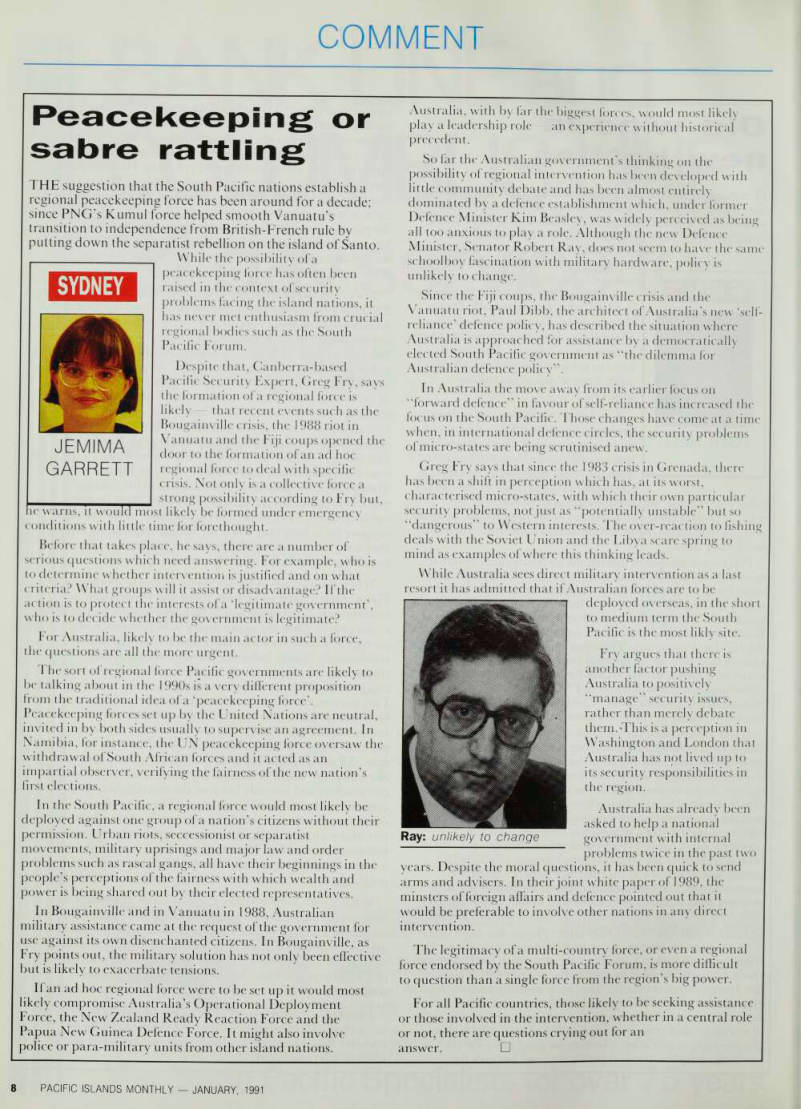
Ray: unlikely to change
Waking up from
a nuclear dream
WHEN New Zealand’s new National government and the United States talk about restoring a security relationship, it’s a bit like Pollyanna meeting Rip Van Winkle.
Prime Minister Jim Bolger and his senior colleagues have all the qualities of Pollyanna, defined by Webster’s Dictionary as “a blindly or overly optimistic person”, when they prattle gaily about mending the traditional ties fractured by the former Labour
government’s anti-nuclear policy.
And their friends in Washington (for they are understandably more friendly to Mr Bolger & Co than they were to David Lange) appear to have been asleep for at least the last six and a half years when they talk confidently about New Zealand reversing the same
policy.
In these early days of the new
National administration, with both parties bent on being all sweetness and light to each other, we cannot yet call it a stand off — as was certainly the case during Labour’s reign. But it’s not difficult to see that it will head in that direction unless a bit ofcommonsense is applied before too long. And it has to be said there is not much sign of that at present.
The heart of the matter, of course, is the United States’ neither-confirm-nor-deny policy on the presence of nuclear weapons on visiting ships.
It was this policy that prompted the Lange government to enshrine its anti-nuclear stance in legislation. It did not demand that the Americans break thir policy by guaranteeing that a ship coming to New Zealand was not nuclear-armed, but it required the Prime Minister to be satisfied that was the case. The US, inevitably, saw that as being effectively the
same thing.
The Americans (and the British), mad as they were at not
being able to twist New Zealand’s arm, took comfort from the fact that the National
Party bitterly opposed the policy
and was pledged to reverse it.
Politics being the business it is, it was inevitable that National would return to power at some time and the problem would be over.
But in March last year, facing a general election it never dreamed of winning as easily as it did, National suddenly did a U-turn, saying it would maintain the legislation and continue to ban nuclear ships
from New Zealand ports. The decision recognised the domestic political reality the majority of New Zealanders, unhappy though they might be about their exclusion from the Anzus defence pact, just didn’t want nuclear ships in their ports. National’s policy, which made it look pro-nuclear, was an electoral liability.
The Americans were stunned, but amazingly and this is where they confirmed that they had slipped into Rip Van Winkle mode seemed to miss the point. When national was elected, the White House, State Department and Congressional leaders woke up and started talking excitedly about a restoration of ties when New Zealand changed its
policy and accepted the neither-confirm-nor-deny principle.
The Americans’ response not only showed little respect for the New Zealand public’s overwhelming support of the anti nuclear policy, but gave Bolger no more credit for sincerity and steadfastness than they gave Lange in years of pressuring him to see things their way.
The American ambassador to Wellington even suggested a anew that New Zealand could adopt the Japanese and Scandinavian blind-eye positions of accepting ships on the assumption that they are nuclear-free.
What all the American responses overlooked was the fact that any move which even hinted at a backdown of the anti nuclear stance would rouse the country to a frenzy of protest not seen since the South African Springbok rugby team toured here in 1981 and nobody wants to see that happen again, particularly a government which already has an indigestible mix of economic recession and unemployment on its plate.
It would also set back any efforts to repair the New Zealand-United States relationship for years.
There is one common thread in all the American responses as there has been since this whole business began and it is one that disturbs the most ardent New Zealand fans of the United States. That is that any move to improve the relationship must come from New Zealand; that while a comprise is clearly needed, the American position is the only one that is unnegotiable.
In his recent book, Nuclear Free — The New Zealand way , David Lange insists that he believed initially an accommodation could be found that would reflect both countries’ positions. But he says he had to give up.
He warned Bolger that ifhe wants a military relationship with the United States, he will have to accept the shelter of the nuclear umbrella. And he added that this was no longer an option for any New Zealand government. “A nuclear-free New Zealand is beyond the power of any politician ever to influence.
“There is now engrained in the New Zealand public a
conviction that New Zealand was right to deny access to nuclear ships and right to stand aside from the nuclear arms race.”
Lange is almost certainly right, and Bolger almost certainly knows it, which is why he changed National’s long standing policy.
His Deputy Prime Minister, Don McKinnon, who resigned in protest as National’s defence spokesman when the policy was changed but now has to deal with the US as an anti-nuclear Foreign Minister, also knows it,
but is still bent on finding a solution. The best hope lies in the end of the Cold War and a gradual lessening of reliance on nuclear deterrence, but it will take time. What is clear is that a continuing stand-offbetween traditional friends and allies is in nobody’s interests. But don’t hold your breath for a Pollyanna-Rip van Winkle wedding. □
Wellington
David
Barber
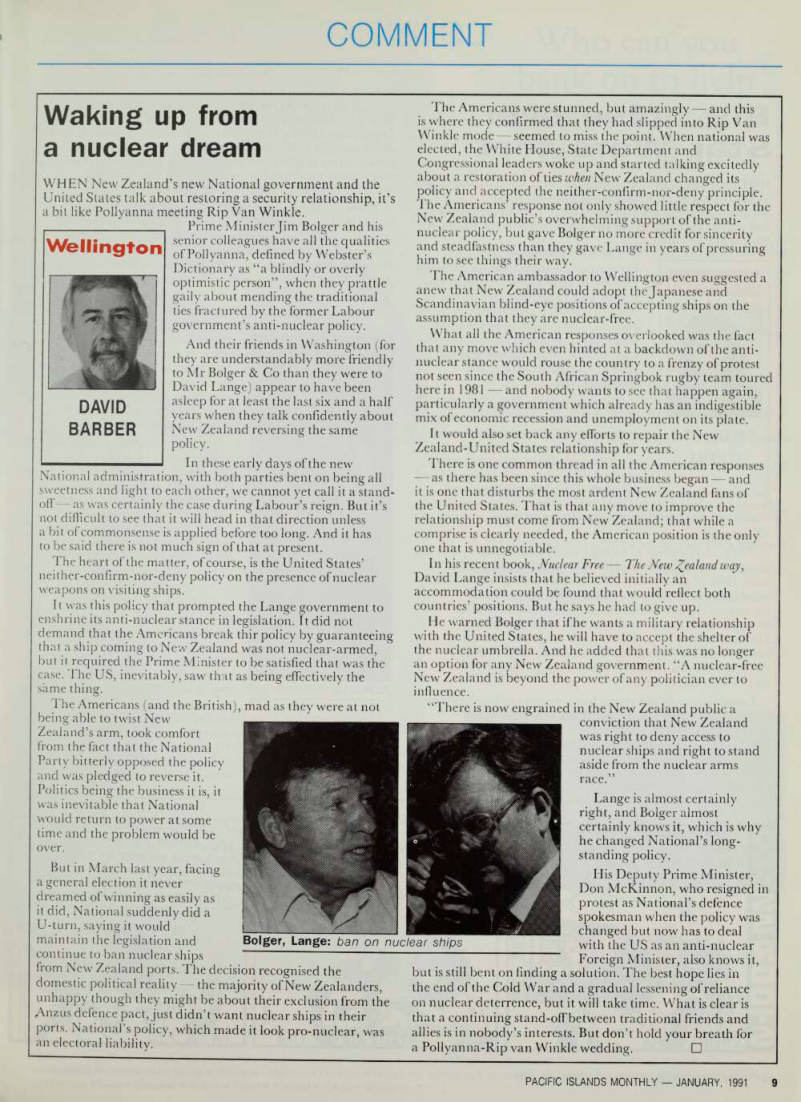
Bolger, Lange: ban on nuclear ships
Big noise over Star Wars test
Star Wars test
HOT on the heels of the controversy over United States plans to destroy chemical weapons on Johnston Atoll, environmental groups and the State of Hawaii are protesting new military scheme to test fire missiles across the Pacific for ‘Star Wars’ research.
The US Army wants to begin launching new rockets for the Strategic Defense Initiative next year from the Kauai Test Facility located on the western edge of Kauai Island, in Hawaii. The missiles to be tested are reportedly larger and more dangerous than those fired previously and will land at Kwajalein Atoll in the Marshall Islands.
The State of Hawaii and the Sierra Club environment group have taken legal action to try and delay the tests until a full environmental impact study is conducted. Their concerns include the use of 20-year-old Polaris solid fuel boosters. They cite a September 6
accident at Edwards Air Base in California when part of a Titan 4 rocket burst into flames and forced the evacuation of 1200 people.
The transportation of highly toxic fuels on narrow, winding roads between Nawiliwili Harbour and the Kauai test site more than 30 miles away has also upset state officials. “We are dealing here with a situation involving extremely dangerous chemicals and old propellants that could be transported to Kauai by ocean, unloaded at Nuwiliwili Harbour, carried over Kauai’s roadways and ultimately blasted into the atmosphere over Kauai,” said Hawaii’s Attorney General, Warren Price, when he filed the state’s lawsuit against the tests.
Congressmen from Hawaii have introduced legislation in Washington to try to force the Army to conduct a full environmental inquiry. The tests “could have a devastating effect on the people of Kauai and its pristine environment,” said Senator Daniel Akaka. Akaka said a 1988 government safety assessment of the Kauai Test Facility acknowledge the potential for an in-flight missile to fail over land.
It is imperative that the (US) Administration understand how upset the people of Kauai are that their concerns have been ignored by the Department of Defence,” he said. Known as the Garden Island, environmentalists are anxious to preserve rare wildfire and vegetation on Kauai with numerous endangered species in the area of the test site including waterfowl in a state refuge not far from the launch site.
There are also native Hawaiian burials in the Nohili Dones where the launches would take place. But the Army has not consulted with historic preservation officials and some fear important archaeological sites could be disrupted. The Sierra Club has also raised the impact of the rocket launches on adjacent parklands such as the closing of nearby shoreline for two weeks.
Other criticisms include the effects of the fuel Freon, a chloroflurocarbon which damages the Earth’s protective
ozone layer, and the possibility of acid rain from leftover rocket fuel.
The Army supports the findings of an earlier, smaller-scale assessment which concluded that the environmental consequences would be insignificant.
The July assessment conceded that the liquid fuels to be used “are highly toxic and injurious to humans, if a spill or leak occurs” but that special safety precautions would prevent such accidents.
“It’s a missile test facility that has been there for a number of years, firing other types of missiles. The impact can be mitigated,” an Army spokesman has said.
But “economic difficulties, social dislocations and ethnic tensions will still offer the potential for outside meddling,” it says.
“Sources of instability do exist, to varying degrees, throughout the region and this could become an
increasing problem.”
Prepared by the State Department earlier this year, the report says US objectives in the region include increasing port visits by the US Navy to island countries, promoting democracy, strengthening diplomatic relations and encouraging governments friendly to the United States. □
Washinton
Margot
O’Neill
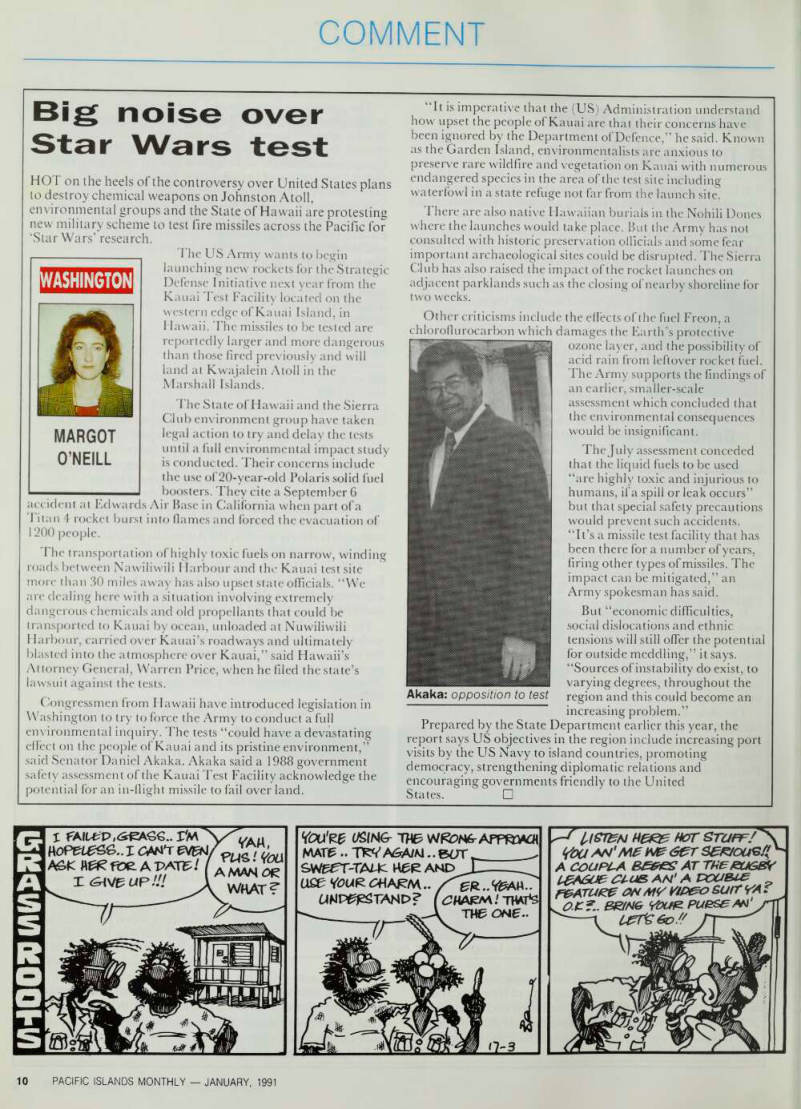
Akaka: opposition to test
Advertisements & other items, p. 11 (1 item)
Pacific Island
y ■ A
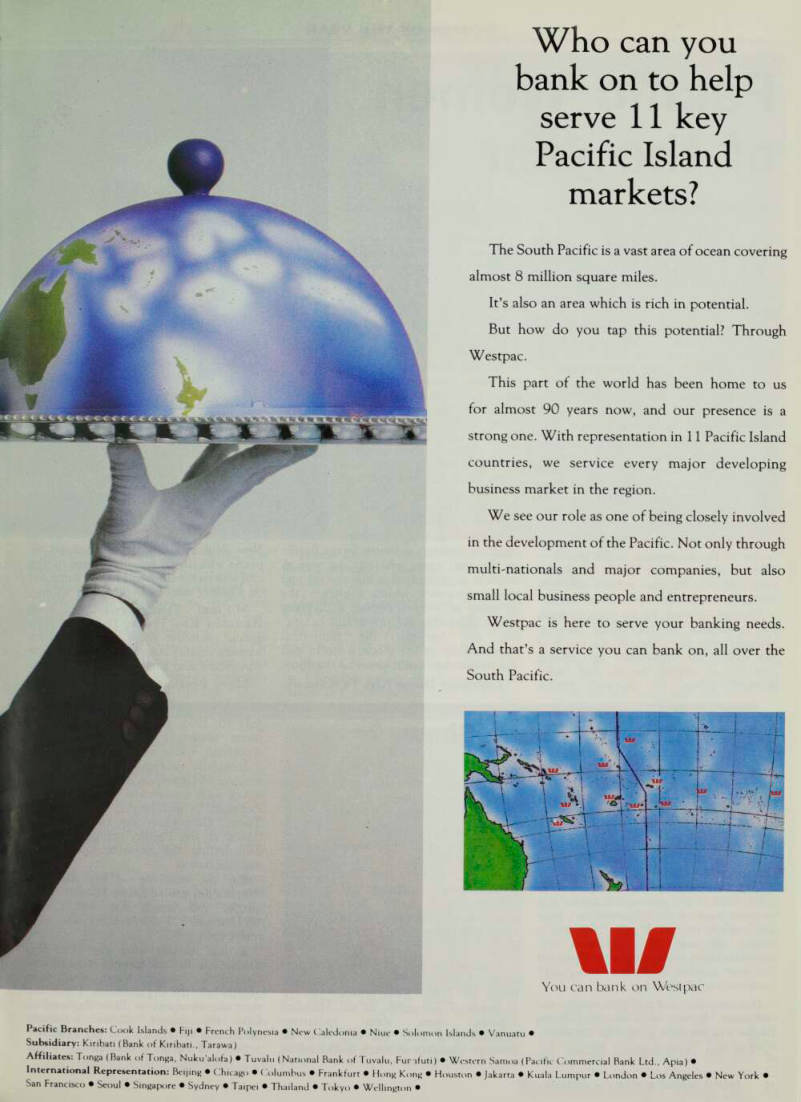
Who can you
bank on to help
serve 11 key
Pacific Island
markets?
The South Pacific is a vast area of ocean covering almost 8 million square miles.
It’s also an area which is rich in potential.
But how do you tap this potential? Through Westpac.
This part of the world has been home to us for almost 90 years now, and our presence is a strong one. With representation in 11 Pacific Island countries, we service every major developing business market in the region.
We see our role as one of being closely involved in the development of the Pacific. Not only through multi-nationals and major companies, but also small local business people and entrepreneurs.
Westpac is here to serve your banking needs.
And that’s a service you can bank on, all over the South Pacific. ii# w ll# You can bank on Westpac Pacific Branches: Cook Islands • Fiji • French Polynesia • New Caledonia • Niue • Solomon Islands • Vanuatu • Subsidiary: Kiribati (Bank of Kiribati., Tarawa) Affiliates: Tonga (Bank of Tonga, Nukualofa) • Tuvalu (National Bank of Tuvalu. Funafuti) • Western Samoa (Pacific Commercial Bank Ltd., Apia) • International Representation: Beijing • Chicago • Columbus • Frankfurt • Flong Kong • Houston • Jakarta • Kuala Lumpur • London • Los Angeles • New York • San Francisco • Seoul • Singapore • Sydney • Taipei • Thailand • Tokyo • Wellington •
Pacific Women
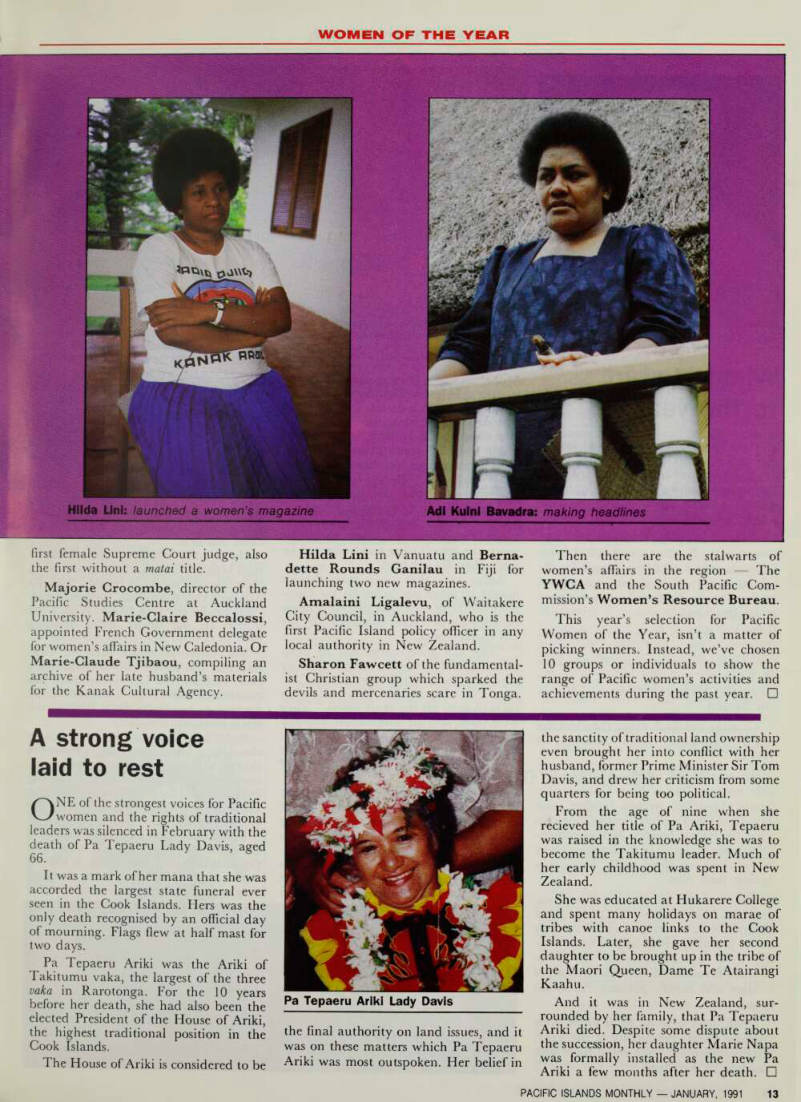
Women Of The Year
Pacific Women of the year
By Karen Mangnall
WOMEN hold up half the sky, or so the saying goes. For many women in developing nations, including most of the Pacific, the burden is wide and heavy, and recognition is scant.
One of the problems is that much of what women do is “invisible”. It is difficult for women to burst into the media spotlight. With the exception of newsworthy political figures such as Adi Kuini Bavadra, women feature rarely on their own and even less frequently as “talking heads” quoted as experts.
Pacific women are only just beginning to break into areas such as business, government, and the professions.
Usually, it’s only once they stamp their mark in these fields of endeavour, as individuals, that they rate any recog nition.
This year, PIM is devoting its annual review to Pacific women, in the plural “Pacific Women of the Year”. It’s not an easy task. Not because women don’t do enough, but because they do so much.
Women in most Pacific nations form the backbone of traditional society.
Women raise the children, do much of the labour for subsistence agriculture, and act as unpaid health and social workers. Often, it’s women’s groups
which form to organise small
development projects.
Frequently, women’s groups cut across otherwise trenchant political and racial divisions.
In the midst of Fiji’s crisis in 1987, one senior Fijian chief cast her eyes skyward and passed the opinion that if the women were in charge, none of it would have happened.
Women are equal partners, and some would say more than equal partners, in the struggle for greater economic develop ment in their own countries.
Yet they also struggle to assert their rights within domestic structures which often hold them back traditionally, and continue to do so in different ways as Western models of behaviour are adopted.
So, when looking across the
range of women’s activities in the Pacific in the past year, what do we see? A mixture of individual achievements and group successes which illustrate the diversity of Women’s roles; a diversity which illustrates the precarious balanc ing act between the individual opportunities of the modern world and the threat that world poses to tradition.
Remember Dame Kiri Te Kanawa,
New Zealand’s famed international so prano who finally returned home to sing and was stunned when 140,000 came out on a balmy summer night to pay tribute.
Mililani Trask and her sister Haunani Kay-Trask, Hawaiian indi genous activists in a country which hasbeen doubly colonised by the haole Americans and then Japanese.
Mary Beetham, American Samoa’s
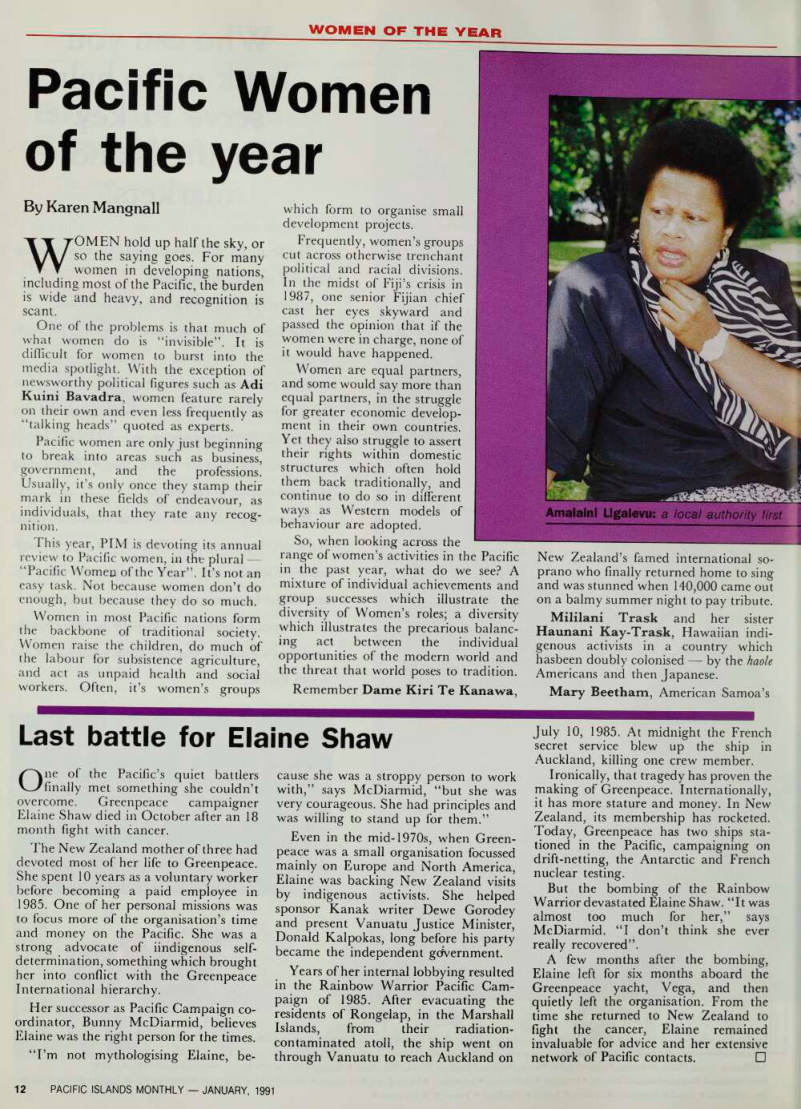
Amalaini Ligalevu: a local authority first
first female Supreme Court judge, also the first without a matai title.
Majorie Crocombe, director of the Pacific Studies Centre at Auckland University. Marie-Claire Beccalossi, appointed French Government delegate for women’s affairs in New Caledonia. Or Marie-Glaude Tjibaou, compiling an archive of her late husband’s materials for the Kanak Cultural Agency.
Hilda Lini in Vanuatu and Berna dette Rounds Ganilau in Fiji for
launching two new magazines.
Amalaini Ligalevu, of Waitakere City Council, in Auckland, who is the first Pacific Island policy officer in any local authority in New Zealand.
Sharon Fawcett of the fundamental ist Christian group which sparked the devils and mercenaries scare in Tonga.
Then there are the stalwarts of women’s affairs in the region The YWCA and the South Pacific Com mission’s Women’s Resource Bureau.
This year’s selection for Pacific Women of the Year, isn’t a matter of picking winners. Instead, we’ve chosen 10 groups or individuals to show the range of Pacific women’s activities and achievements during the past year. □
Hilda Lini: launched a women’s magazine
Adi Kuinl Bavadra: making headlines
Last battle for Elaine Shaw
One of the Pacific’s quiet battlers finally met something she couldn’t
overcome. Greenpeace campaigner
Elaine Shaw died in October after an 18 month fight with cancer, The New Zealand mother of three had devoted most of her life to Greenpeace, She spent 10 years as a voluntary worker U°/ e b )eCO T! ng a paid em P lo y ee in 1985. One of her personal missions was to focus more of the organisation’s time and money on the Pacific. She was a strong advocate of iindigenous selfdetermination, something which brought her into conflict with the Greenpeace
International hierarchy.
tt D r o • nrHinator Rimnv ampaign coo dmator, Bunny McDiarmid believes aine was e rig person or the times.
“I’m not mythologising Elaine, be-
cause she was a stroppy person to work with,” says McDiarmid, “but she was very courageous. She had principles and was willing to stand up for them.”
Even in (he mid . |97o when Green . peace was a small organi ation focussed mainly on Europe and North America, Elaine was backing New Zealand visits by indigenous activists. She helped sponsor Kanak writer Dewe Gorodey a nd present Vanuatu Justice Minister, Donald Kalpokas, long before his party
became the independent government.
. . . ears °f her internal lobbying resulted in jhe Rainbow Warrior Pacific Cam paign of 1985. After evacuating the residents of Rongelap, in the Marshall Is ands> from 5 Vheir radiation contaminated atoll, the ship went on through Vanuatu to reach Auckland on
Auckland, killing one crew member.
Ironically, that tragedy has proven the
making of Greenpeace. Internationally,
it has more stature and money. In New Zealand, its membership has rocketed,
Today, Greenpeace has two ships sta
'‘°"e “. the f , PaC /' < ;’ “tnpa.gnmg on drlf ' net ln g> the Antarctic and French nu « lear J estl "g -w • b °™ b ' n g ? f d ? e Ral " bow Warrior devastated Elaine Shaw. ; It was
“TbU/ThJnUh, Til
M ,P d ' i„ dont thlnk she ever rea y recovere .
A lew months alter the bombing, Elaine left for six months aboard the
Greenpeace yacht, Vega, and then
quietly left the organisation. From the time she returned to New Zealand to fight the cancer, Elaine remained invaluable for advice and her extensive network of Pacific contacts. □
A strong voice
laid to rest
ONE of the strongest voices for Pacific women and the rights of traditional leaders was silenced in February with the death of Pa Tepaeru Lady Davis, aged 66.
It was a mark of her mana that she was accorded the largest state funeral ever seen in the Cook Islands. Hers was the only death recognised by an official day of mourning. Flags flew at half mast for two days.
Pa Tepaeru Ariki was the Ariki of Takitumu vaka, the largest of the three vaka in Rarotonga. For the 10 years before her death, she had also been the elected President of the House of Ariki, the highest traditional position in the Cook Islands.
The House of Ariki is considered to be
the final authority on land issues, and it was on these matters which Pa Tepaeru Ariki was most outspoken. Her belief in
the sanctity of traditional land ownership even brought her into conflict with her husband, former Prime Minister Sir Tom Davis, and drew her criticism from some quarters for being too political.
From the age of nine when she recieved her title of Pa Ariki, Tepaeru was raised in the knowledge she was to become the Takitumu leader. Much of her early childhood was spent in New Zealand.
She was educated at Hukarere College and spent many holidays on marae of tribes with canoe links to the Cook Islands. Later, she gave her second daughter to be brought up in the tribe of the Maori Queen, Dame Te Atairangi Kaahu.
And it was in New Zealand, sur rounded by her family, that Pa Tepaeru Ariki died. Despite some dispute about the succession, her daughter Marie Napa was formally installed as the new Pa Ariki a few months after her death. □
Pa Tepaeru Ariki Lady Davis
Winning start
to the year
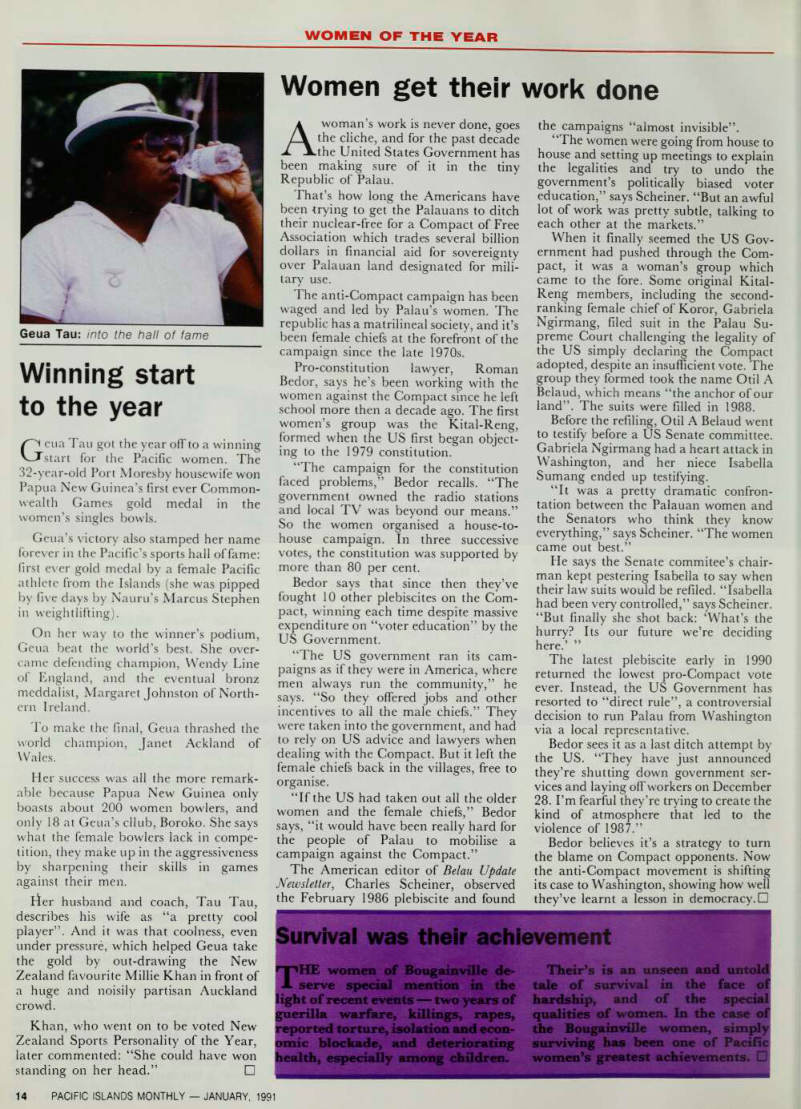
Geua Tau got the year off to a winning start for the Pacific women. The 32-year-old Port Moresby housewife won Papua New Guinea’s first ever Common wealth Games gold medal in the women’s singles bowls.
Geua’s victory also stamped her name forever in the Pacific’s sports hall of fame: first ever gold medal by a female Pacific athlete from the Islands (she was pipped by five days by Nauru’s Marcus Stephen
in weightlifting).
On her way to the winner’s podium, Geua beat the world’s best. She over came defending champion, Wendy Line of England, and the eventual bronz meddalist, Margaret Johnston of North ern Ireland.
To make the final, Geua thrashed the world champion, Janet Ackland of Wales.
Her success was all the more remark able because Papua New Guinea only boasts about 200 women bowlers, and only 18 at Geua’s cllub, Boroko. She says what the female bowlers lack in compe tition, they make up in the aggressiveness by sharpening their skills in games against their men. bier husband and coach, Tau Tau, describes his wife as “a pretty cool player”. And it was that coolness, even under pressure, which helped Geua take the gold by out-drawing the New Zealand favourite Millie Khan in front of a huge and noisily partisan Auckland crowd.
Khan, who went on to be voted New Zealand Sports Personality of the Year, later commented: “She could have won standing on her head.” □
Geua Tau: into the hall of fame
Women get their work done
A woman’s work is never done, goes the cliche, and for the past decade the United States Government has been making sure of it in the tiny Republic of Palau.
That’s how long the Americans have been trying to get the Palauans to ditch their nuclear-free for a Compact of Free Association which trades several billion dollars in financial aid for sovereignty over Palauan land designated for mili tary use.
The anti-Compact campaign has been waged and led by Palau’s women. The republic has a matrilineal society, and it’s been female chiefs at the forefront of the campaign since the late 19705.
Pro-constitution lawyer, Roman Bedor, says he’s been working with the women against the Compact since he left school more then a decade ago. The first women’s group was the Kital-Reng, formed when the US first began object ing to the 1979 constitution.
“The campaign for the constitution faced problems,” Bedor recalls. “The government owned the radio stations and local TV was beyond our means.”
So the women organised a house-to house campaign. In three successive votes, the constitution was supported by more than 80 per cent.
Bedor says that since then they’ve fought 10 other plebiscites on the Com pact, winning each time despite massive expenditure on “voter education” by the US Government.
“The US government ran its cam paigns as if they were in America, where men always run the community,” he says. “So they offered jobs and other incentives to all the male chiefs.” They were taken into the government, and had to rely on US advice and lawyers when dealing with the Compact. But it left the female chiefs back in the villages, free to organise.
“If the US had taken out all the older women and the female chiefs,” Bedor says, “it would have been really hard for the people of Palau to mobilise a campaign against the Compact.”
The American editor of Belau Update Newsletter , Charles Scheiner, observed the February 1986 plebiscite and found
the campaigns “almost invisible”.
“The women were going from house to house and setting up meetings to explain the legalities and try to undo the government’s politically biased voter education,” says Scheiner. “But an awful lot of work was pretty subtle, talking to each other at the markets.”
When it finally seemed the US Gov ernment had pushed through the Com pact, it was a woman’s group which came to the fore. Some original Kital- Reng members, including the second ranking female chief of Koror, Gabriela Ngirmang, filed suit in the Palau Su preme Court challenging the legality of
the US simply declaring the Compact
adopted, despite an insufficient vote. The group they formed took the name Otil A Belaud, which means “the anchor of our land”. The suits were filled in 1988.
Before the refiling, Otil A Belaud went to testify before a US Senate committee.
Gabriela Ngirmang had a heart attack in Washington, and her niece Isabella
Sumang ended up testifying.
“It was a pretty dramatic confron tation between the Palauan women and the Senators who think they know everything,” says Scheiner. “The women came out best.”
He says the Senate commitee’s chair man kept pestering Isabella to say when their law suits would be refilled. “Isabella had been very controlled,” says Scheiner.
“But finally she shot back: ‘What’s the hurry? Its our future we’re deciding here.’ ”
The latest plebiscite early in 1990 returned the lowest pro-Compact vote ever. Instead, the US Government has resorted to “direct rule”, a controversial decision to run Palau from Washington via a local representative.
Bedor sees it as a last ditch attempt by the US. “They have just announced they’re shutting down government ser vices and laying off workers on December 28. I’m fearful they’re trying to create the kind of atmosphere that led to the violence of 1987.”
Bedor believes it’s a strategy to turn the blame on Compact opponents. Now the anti-Compact movement is shifting its case to Washington, showing how well they’ve learnt a lesson in democracy. □
Survival was their achievement
r FHE women of Bougainville de- X serve special mention in the light of recent events two years of guerilla warfare, killings, rapes, reported torture, isolation and econ omic blockade, and deteriorating health, especially among children.
Their’s is an unseen and untold tale of survival in the face of hardship, and of the special qualities of women. In the case of the Bougainville women, simply surviving has been one of Pacific women’s greatest achievements. □
Not just a rib, but the backbone
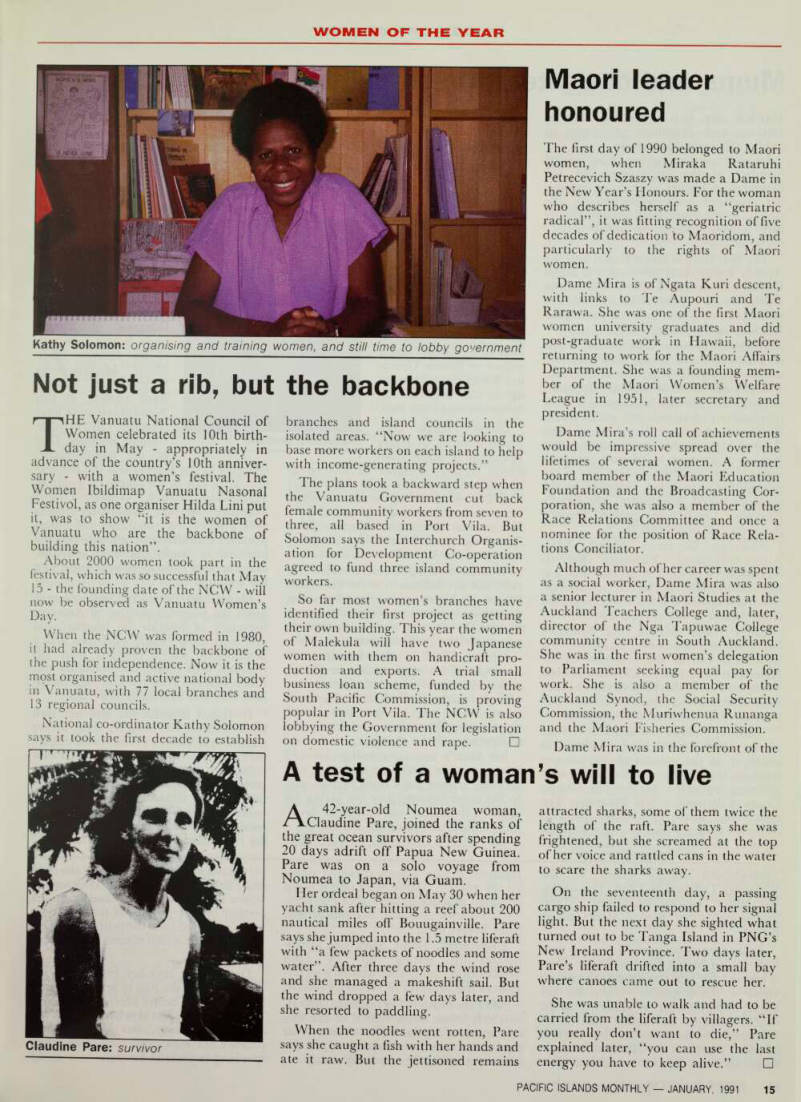
THE Vanuatu National Council of Women celebrated its 10th birth day in May - appropriately in advance of the country’s 10th anniver sary - with a women’s festival. The Women Ibildimap Vanuatu Nasonal Festivol, as one organiser Hilda Lini put it, was to show “it is the women of Vanuatu who are the backbone of building this nation”.
About 2000 women took part in the festival, which was so successful that May 15 - the founding date of the NCW - will now be observed as Vanuatu Women’s Day.
When the NCW was formed in 1980, it had already proven the backbone of the push for independence. Now it is the most organised and active national body in Vanuatu, with 77 local branches and 13 regional councils.
National co-ordinator Kathy Solomon says it took the first decade to establish
branches and island councils in the isolated areas. “Now we are looking to base more workers on each island to help
with income-generating projects.”
The plans took a backward step when the Vanuatu Government cut back female community workers from seven to three, all based in Port Vila. But Solomon says the Interchurch Organis
ation for Development Co-operation
agreed to fund three island community workers.
So far most women’s branches have identified their first project as getting their own building. This year the women of Malekula will have two Japanese women with them on handicraft pro duction and exports. A trial small business loan scheme, funded by the South Pacific Commission, is proving popular in Port Vila. The NCW is also lobbying the Government for legislation on domestic violence and rape. □
Kathy Solomon: organising and training women, and still time to lobby government
Maori leader
honoured
The first day of 1990 belonged to Maori women, when Miraka Rataruhi Petrecevich Szaszy was made a Dame in the New Year’s Honours. For the woman who describes herself as a “geriatric radical”, it was fitting recognition of five decades of dedication to Maoridom, and particularly to the rights of Maori women.
Dame Mira is of Ngata Kuri descent, with links to Te Aupouri and Te Rarawa. She was one of the first Maori women university graduates and did post-graduate work in Hawaii, before returning to work for the Maori Affairs Department. She was a founding mem ber of the Maori Women’s Welfare League in 1951, later secretary and president.
Dame Mira’s roll call of achievements would be impressive spread over the lifetimes of several women. A former board member of the Maori Education Foundation and the Broadcasting Cor poration, she was also a member of the Race Relations Committee and once a nominee for the position of Race Rela tions Conciliator.
Although much of her career was spent as a social worker, Dame Mira was also a senior lecturer in Maori Studies at the Auckland Teachers College and, later, director of the Nga Tapuwae College community centre in South Auckland.
She was in the first women’s delegation to Parliament seeking equal pay for work. She is also a member of the Auckland Synod, the Social Security
Commission, the Muriwhenua Runanga
and the Maori Fisheries Commission.
Dame Mira was in the forefront of the
Muriwhenua fishing claim to the Waitangi Tribunal in 1988. The north ern tribes’ victory established Maori fishing rights and, now, a Maori fishing industry.
Among many younger Maori, particu larly young Maori women, Dame Mira is revered for her empathy with radical views if not tactics and for her public campaign for speaking rights for Maori women on marae. She once described the marae as the “last bastion of male supremacy”. Her public chal lenge to the validity of claims that
tradition denies women speaking rights on the marae —Dame Mira says it is not common practice in the rest of Polynesia has drawn criticism, not suprisingly, from Maori men.
Undeterred, Dame Mira was instrumental in setting up Te Ohu Whakatupu, the Maori women’s secretariat of the Ministry of Women’s Affairs.
After the death of her husband, Albert, in 1984, Dame Mira retired to the tiny settlement of Ngataki. But her search for peace and quiet was short-lived, as she came out of the Treaty of Waitangi.
“I have settled on the belief,” she once said, “that the Treaty of Waitangi is where I may find the spirituality that is needed by our people. If that treaty is truly honoured then the people will have their dignity and self-esteem as a race re established.”
Dame Mira says her feelings on the Treaty meant she had to search her soul long and hard before accepting the New Year’s Honour. She says her title can “lie idle” if necessary, but hopes it will provide her with extra credibility when speaking in Pakeha forums. □
A test of a woman’s will to live
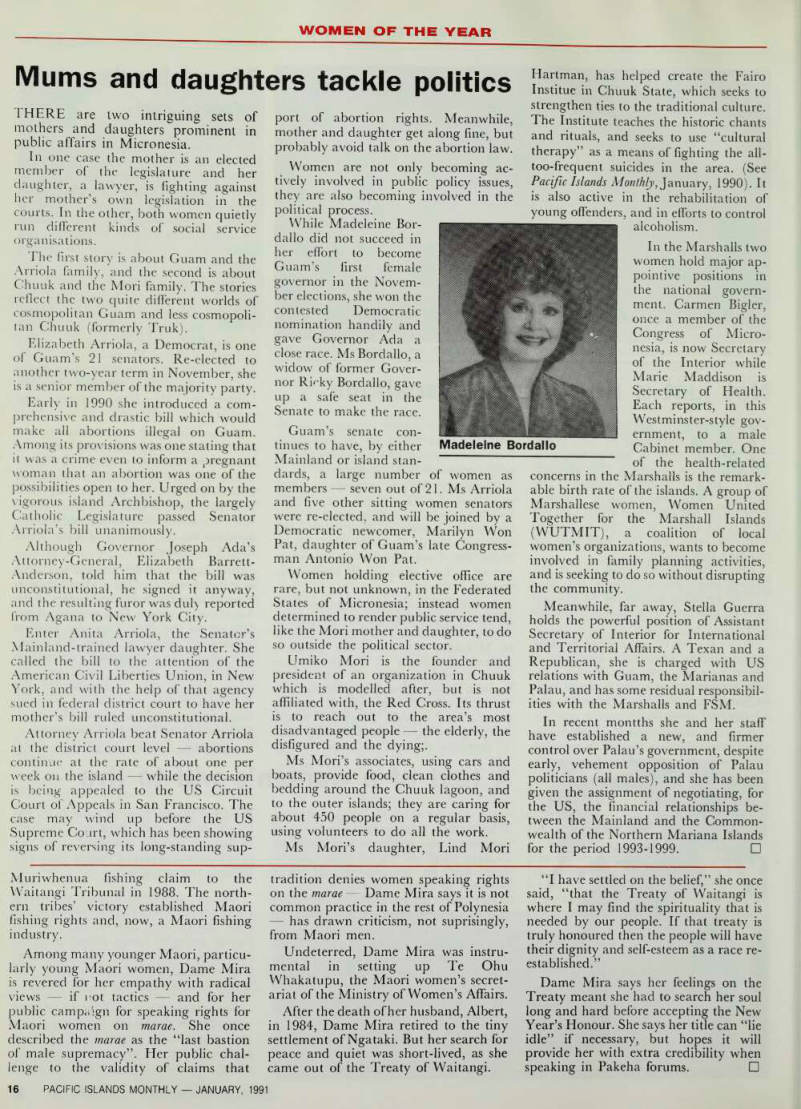
A 42-year-old Noumea woman, Claudine Pare, joined the ranks of the great ocean survivors after spending 20 days adrift off Papua New Guinea.
Pare was on a solo voyage from Noumea to Japan, via Guam.
Her ordeal began on May 30 when her yacht sank after hitting a reef about 200 nautical miles off Bouugainville. Pare says she jumped into the 1.5 metre liferaft with “a few packets of noodles and some water”. After three days the wind rose and she managed a makeshift sail. But the wind dropped a few days later, and she resorted to paddling.
When the noodles went rotten, Pare says she caught a fish with her hands and ate it raw. But the jettisoned remains
attracted sharks, some of them twice the length of the raft. Pare says she was frightened, but she screamed at the top of her voice and rattled cans in the water to scare the sharks away.
On the seventeenth day, a passing cargo ship failed to respond to her signal light. But the next day she sighted what turned out to be Tanga Island in PNG’s New Ireland Province. Two days later, Fare’s liferaft drifted into a small bay where canoes came out to rescue her.
She was unable to walk and had to be carried from the liferaft by villagers. “If you really don’t want to die,” Pare explained later, “you can use the last energy you have to keep alive.” □
Claudine Pare: survivor
Mums and daughters tackle politics
THERE are two intriguing sets of mothers and daughters prominent in public affairs in Micronesia.
In one case the mother is an elected member of the legislature and her daughter, a lawyer, is fighting against her mother’s own legislation in the courts. In the other, both women quietly run different kinds of social service organisations.
The first story is about Guam and the Arriola family, and the second is about Chuuk and the Mori family. The stories reflect the two quite different worlds of cosmopolitan Guam and less cosmopoli
tan Chuuk (formerly Truk).
Elizabeth Arriola, a Democrat, is one of Guam’s 21 senators. Re-elected to another two-year term in November, she is a senior member of the majority party.
Early in 1990 she introduced a com prehensive and drastic bill which would make all abortions illegal on Guam.
Among its provisions was one stating that it was a crime even to inform a pregnant woman that an abortion was one of the possibilities open to her. Urged on by the vigorous island Archbishop, the largely
Catholic Legislature passed Senator
Arriola’s bill unanimously.
Although Governor Joseph Ada’s
Attorney-General, Elizabeth Barrett- Andcrson, told him that the bill was unconstitutional, he signed it anyway, and the resulting furor was duly reported from Agana to New York City.
Enter Anita Arriola, the Senator’s Mainland-trained lawyer daughter. She called the bill to the attention of the American Civil Liberties Union, in New York, and with the help of that agency sued in federal district court to have her mother’s bill ruled unconstitutional.
Attorney Arriola beat Senator Arriola at the district court level abortions continue at the rate of about one per week on the island while the decision is being appealed to the US Circuit Court of Appeals in San Francisco. The case may wind up before the US Supreme Court, which has been showing signs of reversing its long-standing sup
port of abortion rights. Meanwhile, mother and daughter get along fine, but probably avoid talk on the abortion law.
Women are not only becoming ac tively involved in public policy issues, they are also becoming involved in the
political process.
While Madeleine Bor dallo did not succeed in her effort to become Guam’s first female governor in the Novem ber elections, she won the contested Democratic nomination handily and gave Governor Ada a close race. Ms Bordallo, a widow of former Gover nor Bordallo, gave up a safe seat in the Senate to make the race.
Guam’s senate con tinues to have, by either Mainland or island stan
dards, a large number of women as members seven out of 21. Ms Arriola and five other sitting women senators were re-elected, and will be joined by a Democratic newcomer, Marilyn Won Pat, daughter of Guam’s late Congress man Antonio Won Pat.
Women holding elective office are rare, but not unknown, in the Federated States of Micronesia; instead women determined to render public service tend, like the Mori mother and daughter, to do so outside the political sector.
Umiko Mori is the founder and president of an organization in Chuuk which is modelled after, but is not affiliated with, the Red Cross. Its thrust is to reach out to the area’s most disadvantaged people the elderly, the disfigured and the dying;.
Ms Mori’s associates, using cars and boats, provide food, clean clothes and bedding around the Chuuk lagoon, and to the outer islands; they are caring for about 450 people on a regular basis, using volunteers to do all the work.
Ms Mori’s daughter, Lind Mori
Hartman, has helped create the Fairo Institue in Chuuk State, which seeks to strengthen ties to the traditional culture.
The Institute teaches the historic chants and rituals, and seeks to use “cultural therapy” as a means of fighting the all too-frequent suicides in the area. (See Pacific Islands Monthly, January, 1990). It is also active in the rehabilitation of young offenders, and in efforts to control
alcoholism.
In the Marshalls two women hold major ap pointive positions in the national govern ment. Carmen Bigler, once a member of the Congress of Micro nesia, is now Secretary of the Interior while Marie Maddison is Secretary of Health.
Each reports, in this
Westminster-style gov
ernment, to a male Cabinet member. One of the health-related
concerns in the Marshalls is the remark able birth rate of the islands. A group of Marshallese women, Women United Together for the Marshall Islands (WUTMIT), a coalition of local women’s organizations, wants to become involved in family planning activities, and is seeking to do so without disrupting the community.
Meanwhile, far away, Stella Guerra holds the powerful position of Assistant Secretary of Interior for International and Territorial Affairs. A Texan and a Republican, she is charged with US relations with Guam, the Marianas and Palau, and has some residual responsibil ities with the Marshalls and FSM.
In recent montths she and her staff have established a new, and firmer control over Palau’s government, despite early, vehement opposition of Palau politicians (all males), and she has been given the assignment of negotiating, for the US, the financial relationships be tween the Mainland and the Common wealth of the Northern Mariana Islands for the period 1993-1999. □
Madeleine Bordallo
domestic violence
Door opened on domestic violence
A new study looks into Pacific attitudes and customs which hurt women and hold them back
By Robin Bromby
Anthropologists have
rarely tackled the subject of domestic violence, so a new study just published by the Hawaii-based Institute for Polynesian Studies breaks new ground with a penetrating account of just what goes on behind closed doors in Pacific societies.
The study ranges far beyond Poly nesia, and, in fact, focuses more on Melanesian and Micronesian practices.
But the disturbing theme which runs through the studies is that many Pacific societies consider a certain level of family violence to be normal and acceptable.
Yet some are relatively free of such problems, as is the case between the Wapc people of Papua New' Guinea.
Where it does occur, its origins and reasons vary widely, from the suppression of women in Indian-Fijian households to the encouragement of violence as a means of social control among some parts of the Marshall Islands.
In Kiribati, nose-biting is a form of
sexual mutilation practised traditionally
upon Tungaru women. A paper by David E. Lewis of the University of California, San Francisco, explains that a woman in the Gilbert Islands, who, continually provoking her husband by what w'as considered immodest behav iour, would be subject to an escalating series of punishments with the full backing of custom. Beatings would be the first stage, but the final recourse for the husband would be to take his wife into the bush and bite off her nose.
But this destruction of attractiveness -■ regarded as the ultimate sanction was probably inflicted only rarely, ac cording to Lew'is. It is likely the threat of such action was sufficient to ensure that most Tungaru women conformed.
Actual violence is much more frequent in Indian-Fijian society. Shireen Lateef, from the University of Melbourne, re ports that violence is accepted by that
community as part of being female; (he control of women by the use of the danda (stick) is seldom seriously questioned by male or female Indian-Fijians.
The Indian population of Fiji tend to reflect the values of the male-dominated North Indian Hindu family pattern, with
the ideology of purdan remaining deeply
imbedded. Women must know (heir place in Indian households. If they go out to work as increasing numbers do it must be into approved types of employment, such as being clerks or typists.
Violence pervades the lives of the young women, said Lateef. Generally, the unmarried women were beaten for jeopardising the honour of the family by not sticking to the guidelines of purdan , while married women were hit for not
demonstrating the required deference
towards husbands and for failing to adequately perform their wifely duties.
The violence takes the form of a range of acts, from a slap, then pushing, kicking, punching, belting or hitting with a stick.
The most common and consistently used form is slapping the face. Often women are pushed against walls, their heads slammed against the w'all or objects are thrown at them.
Lateef reports case studies of teenage girls being beaten for talking to boys, or married women being hit or questioning their husbands even in one case, where the couple had a superficially
Western-style modern relationship w4iere
the wife mixed freely, drank and smoked.
Pauline McKenzie Aucoin, of the University of Toronto, studied domestic life among the ethnic Fijians in Ba Province. Physical punishment is a daily part of children’s lives there, especially for children over five years of age when their parents expect the offspring to perform chores around the house.
Boys tend to be punished for what is considered unmasculine behaviour and as a means off reinforcing the male’s social role in adulthood, whereas girls get into trouble more often for neglecting
their household work.
As they get older, the punishment is concentrated on the teenage girls or young married women often with the brother taking the role as dispenser. Yet Aucoin found that marital violence was
generally disapproved of in Fijian so
ciety, and the women felt they had a right to argue without being hit by their husbands.
Men also generally disapprove of their fellow male villagers who resort to violence in the home. Some wives, if badly beaten, will return to their kin and then her brothers will threaten to beat up the man who had injured their sister.
Reconciliation at this stage will re quire the husband to atone for actions, and offer gifts to the wife’s family. The use of violence in marital disputes by husband against wife is seen as a
contemptible act in Fijian society as
observed by Aucoin, and one that can cause a serious breach between individ uals and the clans of which they are part.
In Palau, people maintain that dom estic violence was practically unknown before the territory came under Japanese rule between 1914 and 1944. But its incidence has increased markedly in the last few generations, with alcohol playing a key role.
Karen L Nero of the University of California, Irvine, found that cases disproportionately involve young, edu cated elite couples. A..d wife beating is on the increase despite the fact that historically Palauan women have had a strong voice in economic and political decisionmaking. Most contemporary cases of marital violence involve success ful, well-educated young men and women who hold good jobs in govern ment or the private sector. The one common factor is drunkenness.
Nero found evidence that the Japanese use of corporal punishment introduced a new level of violence into Palauan life, and that it was only during the Japanese administration that Palau men began drinking on a serious level.
Giving credence to this is a study undertaken in Palau by Germans in the 1880 s which recorded that there were penalties imposed on men who hurt their wives. Conversely, beer ran out on Palau and Yap in September last year and for a week the hospitals were nearly empty.
She also attributes part of the problem to the general level of stress on Palau: the
splitting of families on political questions
during the several plebiscites over the territory’s relationship with the United States, and the internal political violence and assassinations. On top of that, the educated and employed young Palauans
face great pressure to support their extended families even though living in a nuclear household themselves and when they are trying to save for a house or a child’s education.
On the Ujelang and Enewetak, the westernmost of the Marshall Islands, Laurence Marshall Carucci of Montana State University found that violence was deeply anchored in local patterns of child rearing and socialisation.
Children are teased into violence by male adults, taught to throw paving stones and as the boys grow older they are encouraged to take up wrestling, fighting with fists and clubs and throwing large rocks. Women believe in the acquisition of magical skills which they feel can help enact revenge on others.
Carucci described the Marshallese ideal of the male as one who travels around winning physical battles with males, and sexual battles with females.
Marriage is often seen as a form of entrapment of the warrior, a feeling which can spill over into violence when alcohol is added to the question.
But there is the other side to the story.
Jill Nash from the State University College in Buffalo, New York state, was able to study the Nagovisi people on the island of Bougainville, in the North Solomons Province of Papua New Guinea. She found that physical violence
happened only infrequently between
spouses it was rare, in fact. She found that arguing husbands and wives were more likely to take out their anger by means of destroying property.
The study showed that the Nagovisi differed from many other societies in that physical violence between married people was neither common nor tacitly condoned. They also have provision for redress when it does occur, and the community has a system of fines; a partner may seek financial compensation from his or her spouse.
Nash said the Nagovisi seemed to take pride in their ability to control the expression of emotion. People were concerned about having their outbursts mocked as a form of gossipy entertain ment.
William E. Mitchell, of the University of Vermont, found tht the Wape people of Papua New Guinea’s West Sepik Province experienced little domestic viol ence. Wape men do not beat their wives, which is especially fascinating as wife beating is such an accepted custom in most parts of Papua New Guinea.
As with the Nagovisi, the Wape place great importance on keeping emotions under control, and Mitchell reports that he himself was reproved for telling children in a loud voice to get off the verandah of the house in which he was staying. Aggressive acts are ignored: an enraged toddler is just left to scream on
the ground, or the Wape will just turn and walk away whei/told off by an outsider. Y A larcrp mn of • i
C °o X!
ancestoral spirits can visit illness and bad luck on family enemies and arguments are often followed by conciliatory rituals which include an appeal to the spirits not to punish the other party. Unlike many
other Papua New (Linea peopL the
Wape family life involves the man in child care. There is also a near absence of alcohol among these people.
Bu ‘ while ‘hese examples of non violence exist, wife beating continues to be prevalent in the South Pacific the
study concludes,
T X Nt
the ZmderedXtween
1979 and 1982 were killed by their husbands. The rate of wife beating varies as high as 100 per cent in Western Highlands Province, but less than half that rate in West New Britain.
. The reason why anthropologists have
ignored domestic violence is their general view that the people of the Pacific hold different values from those of the Eur opean or North American, and there is a reluctance to sit in judgement (especi ally since domestic violence is so common in their own societies). Now, at least, the subject is out in the open and can at least be discussed. □
Advertisements & other items, p. 18 (1 item)
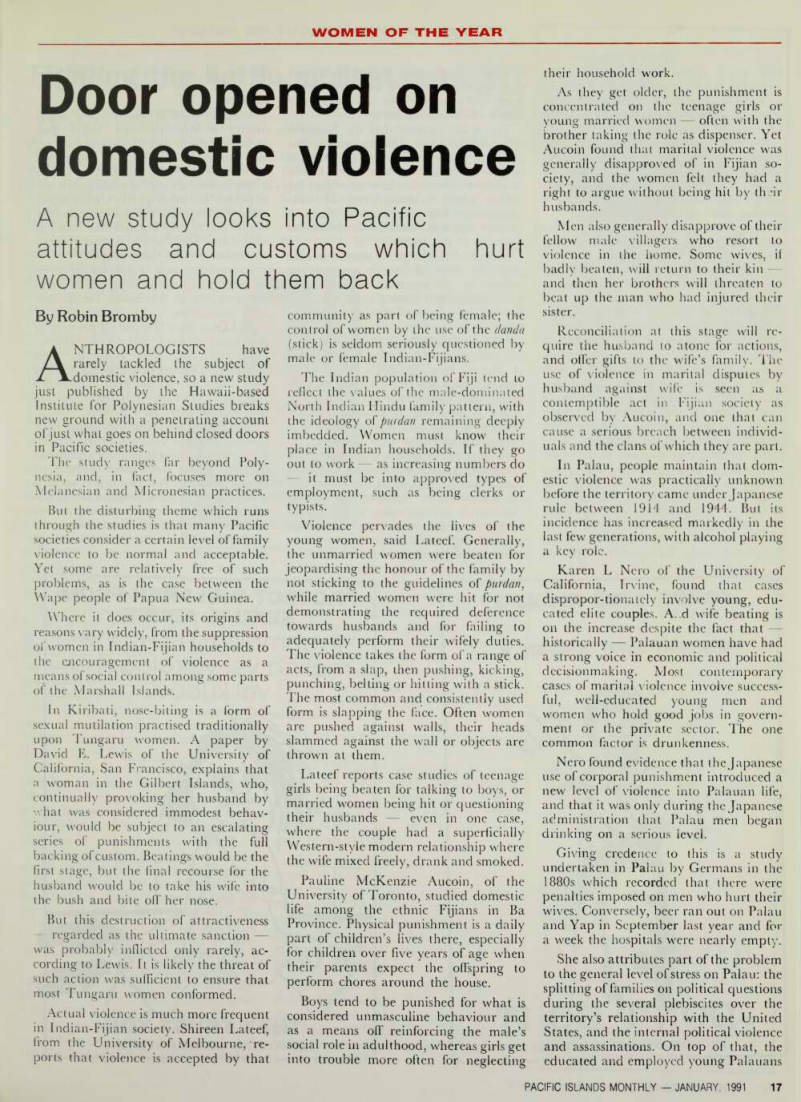
Don’T Do It
FORCE LINE IS RAPE
■'ikH'Jlfcft STrHlrchN
FIJI WOMEN'S RIGHTS MOVEMENT
BOX 14194, SUVA, FIJI. PH: 313156 -
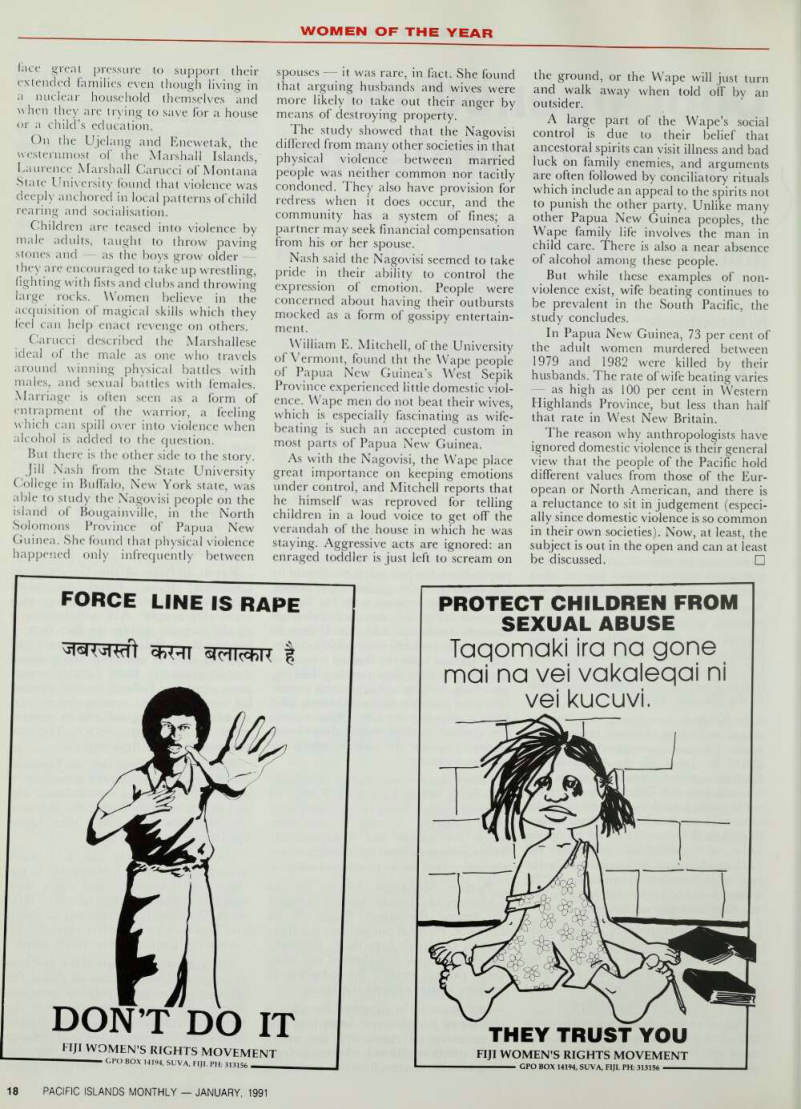
PROTECT CHILDREN FROM
SEXUAL ABUSE
Taqomaki ira na gone mai na vei vakaleqai ni vei kucuvi.
THEY TRUST YOU
FIJI WOMEN'S RIGHTS MOVEMENT
—— GPO BOX 14194, SUVA, FIJI. PH: 313156
Fighting the battle against rape
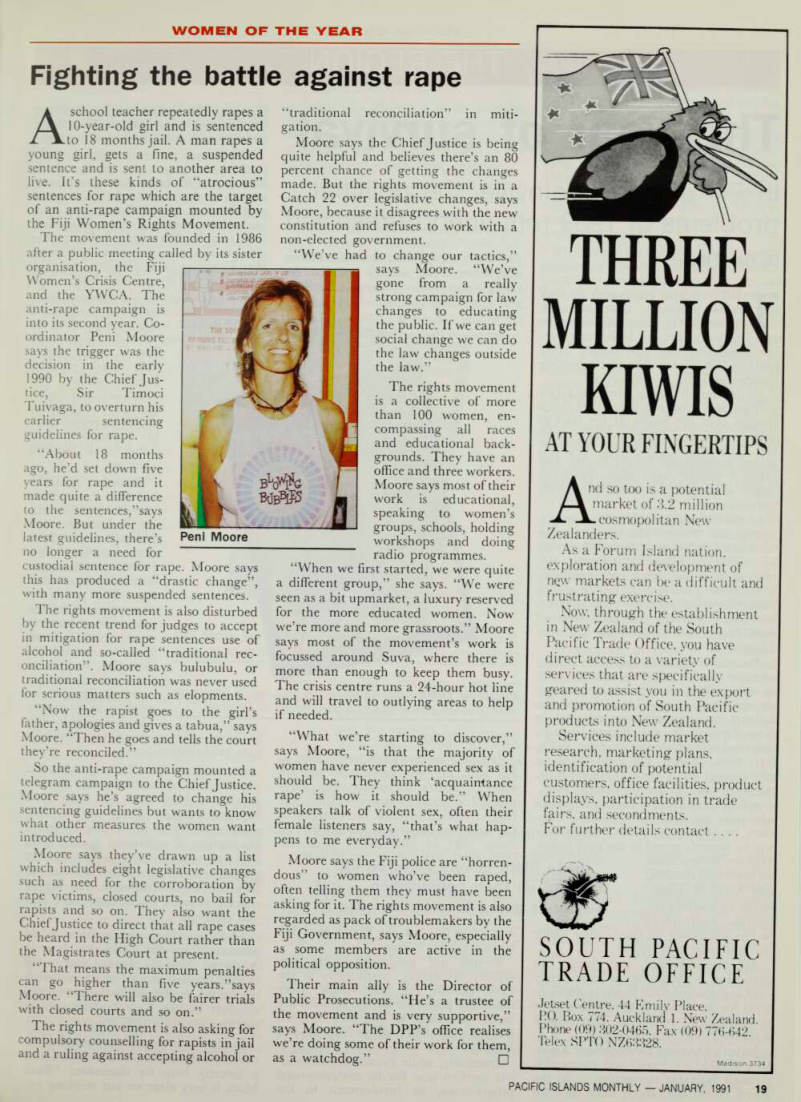
A school teacher repeatedly rapes a 10-year-old girl and is sentenced to 18 months jail. A man rapes a young girl, gets a fine, a suspended sentence and is sent to another area to live. It’s these kinds of “atrocious” sentences for rape which are the target of an anti-rape campaign mounted by the Fiji Women’s Rights Movement.
The movement was founded in 1986 after a public meeting called by its sister
organisation, the Fiji Women’s Crisis Centre, and the YWCA. The anti-rape campaign is into its second year. Co ordinator Peni Moore says the trigger was the decision in the early 1990 by the Chief Jus tice, Sir Timoci Tuivaga, to overturn his earlier sentencing guidelines for rape.
“About 18 months ago, he’d set down five years for rape and it made quite a difference to the sentences,’’says Moore. But under the latest guidelines, there’s no longer a need for
custodial sentence for rape. Moore says this has produced a “drastic change”, with many more suspended sentences.
The rights movement is also disturbed by the recent trend for judges to accept in mitigation for rape sentences use of alcohol and so-called “traditional rec onciliation”. Moore says bulubulu, or traditional reconciliation was never used for serious matters such as elopments.
“Now the rapist goes to the girl’s father, apologies and gives a tabua,” says Moore. “Then he goes and tells the court
they’re reconciled.”
So the anti-rape campaign mounted a telegram campaign to the Chief Justice.
Moore says he’s agreed to change his sentencing guidelines but wants to know what other measures the women want introduced.
Moore says they’ve drawn up a list which includes eight legislative changes such as need for the corroboration by rape victims, closed courts, no bail for rapists and so on. They also want the Chief Justice to direct that all rape cases be heard in the High Court rather than the Magistrates Court at present.
“That means the maximum penalties can go higher than five years.’’says Moore. “There will also be fairer trials with closed courts and so on.”
The rights movement is also asking for compulsory counselling for rapists in jail and a ruling against accepting alcohol or
“traditional reconciliation” in miti
gation.
Moore says the Chief Justice is being quite helpful and believes there’s an 80 percent chance of getting the changes made. But the rights movement is in a Catch 22 over legislative changes, says Moore, because it disagrees with the new constitution and refuses to work with a non-elected government, “We’ve had to change our tactics,”
says Moore. “We’ve gone from a really strong campaign for law
changes to educating
the public. If we can get social change we can do the law changes outside the law.”
The rights movement is a collective of more than 100 women, en compassing all races and educational back grounds. They have an office and three workers.
Moore says most of their work is educational, speaking to women’s groups, schools, holding
workshops and doing
radio programmes.
“When we first started, we were quite a different group,” she says. “We were seen as a bit upmarket, a luxury reserved for the more educated women. Now we’re more and more grassroots.” Moore says most of the movement’s work is focussed around Suva, where there is more than enough to keep them busy.
The crisis centre runs a 24-hour hot line and will travel to outlying areas to help if needed.
“What we’re starting to discover,” says Moore, “is that the majority of women have never experienced sex as it should be. They think ‘acquaintance rape’ is how it should be.” When speakers talk of violent sex, often their female listeners say, “that’s what hap pens to me everyday.”
Moore says the Fiji police are “horren dous” to women who’ve been raped, often telling them they must have been asking for it. The rights movement is also regarded as pack of troublemakers by the
Fiji Government, says Moore, especially
as some members are active in the political opposition.
Their main ally is the Director of Public Prosecutions. “He’s a trustee of the movement and is very supportive,” says Moore. “The DPP’s office realises we’re doing some of their work for them, as a watchdog.” □
Peni Moore
Advertisements & other items, p. 19 (1 item)
Kiwis
THREE
MILLION
AT YOUR FINGERTIPS
cosmopolitan New Zealanders.
As a Forum Island nation, exploration and development of new markets can be a difficult and frustrating exercise.
Now. through the establishment in New Zealand of the South Pacific Trade Office, you have direct access to a variety of services that are specifically geared to assist you in the export and promotion of South Pacific products into New Zealand.
Services include market research, marketing plans, identification of potential customers, office facilities, product displays, participation in trade fairs, and secondments.
For further details contact...
SOUTH PACIFIC
TRADE OFFICE
Jetset Centre. 44 Emily Place.
PO. Box 774. Auckland 1. New Zealand Phone (09) 802-0465, Fax (09) 776-642 Telex SPTO NZ68828. nd so too is a potential market of 8.2 million
The year of survival
The Region
In Fiji and Bougainville, the political problems of 1989 remained unresolved
By David Robie
THE New Year began with the Gulf crisis perilously close to war.
“Aftershocks” from the economic and political upheavals in Eastern Eur ope continued unabated during 1990, and the debt burden strangled a growing number of Third World nations.
IN the South Pacific, the two major political and economic issues that cast a shadow over the region at the start of 1990 Fiji and Bougainville were still there at the beginning of 1991, posing uncertainties for the future. And
political debate raged about the legit
imacy of democratic integrity of other governments.
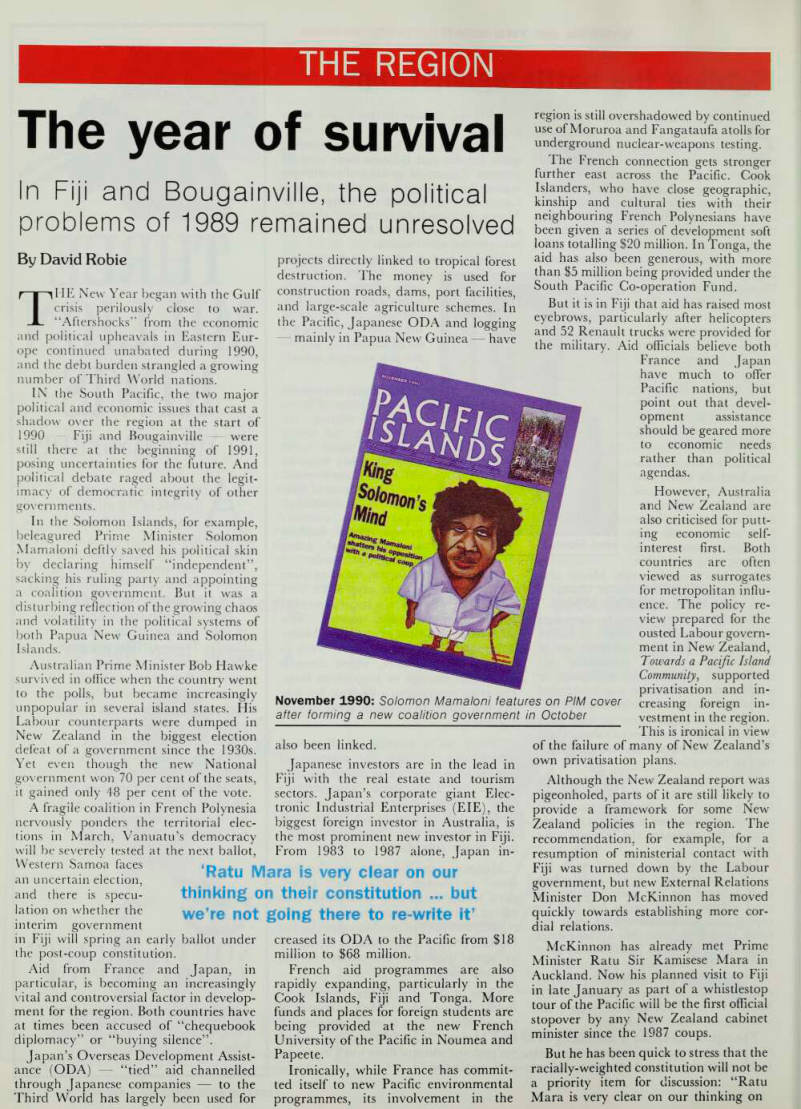
In the Solomon Islands, for example, beleagured Prime Minister Solomon Mamaloni deftly saved his political skin
by declaring himself “independent”,
sacking his ruling party and appointing
a coalition government. But it was a disturbing reflection of the growing chaos and volatility in the political systems of both Papua New Guinea and Solomon Islands.
Australian Prime Minister Bob Hawke survived in office when the country went to the polls, but became increasingly unpopular in several island states. His Labour counterparts were dumped in New Zealand in the biggest election defeat of a government since the 19305.
Yet even though the new National government won 70 per cent of the seats, it gained only 48 per cent of the vote.
A fragile coalition in French Polynesia nervously ponders the territorial elec tions in March, Vanuatu’s democracy will be severely tested at the next ballot,
Western Samoa faces an uncertain election, and there is specu lation on whether the interim government
in Fiji will spring an early ballot under the post-coup constitution.
Aid from France and Japan, in particular, is becoming an increasingly vital and controversial factor in develop ment for the region. Both countries have at times been accused of “chequebook
diplomacy” or “buying silence”.
Japan’s Overseas Development Assist
ance (ODA) “tied” aid channelled through Japanese companies to the Third World has largely been used for
projects directly linked to tropical forest destruction. The money is used for construction roads, dams, port facilities, and large-scale agriculture schemes. In the Pacific, Japanese ODA and logging mainly in Papua New Guinea have
also been linked.
Japanese investors are in the lead in Fiji with the real estate and tourism sectors. Japan’s corporate giant Elec tronic Industrial Enterprises (EIE), the biggest foreign investor in Australia, is the most prominent new investor in Fiji.
From 1983 to 1987 alone, Japan in-
Ratu Mara is very clear on our thinking on their constitution ... but we’re not going there to re-write it’
creased its ODA to the Pacific from SIB million to S6B million.
French aid programmes are also rapidly expanding, particularly in the Cook Islands, Fiji and Tonga. More funds and places for foreign students are being provided at the new French University of the Pacific in Noumea and Papeete.
Ironically, while France has commit ted itself to new Pacific environmental programmes, its involvement in the
region is still overshadowed by continued use of Moruroa and Fangataufa atolls for
underground nuclear-weapons testing.
The French connection gets stronger further east across the Pacific. Cook Islanders, who have close geographic, kinship and cultural ties with their neighbouring French Polynesians have been given a series of development soft loans totalling S2O million. In Tonga, the aid has also been generous, with more than S 5 million being provided under the South Pacific Co-operation Fund.
But it is in Fiji that aid has raised most eyebrows, particularly after helicopters and 52 Renault trucks were provided for the military. Aid officials believe both
France and Japan have much to offer Pacific nations, but point out that devel opment assistance should be geared more to economic needs rather than political agendas.
However, Australia and New Zealand are also criticised for putt ing economic self interest first. Both countries are often viewed as surrogates for metropolitan influ ence. The policy re view prepared for the ousted Labour govern ment in New Zealand, Towards a Pacific Island Community , supported privatisation and in creasing foreign in vestment in the region.
This is ironical in view
of the failure of many of New Zealand’s own privatisation plans.
Although the New Zealand report was pigeonholed, parts of it are still likely to provide a framework for some New Zealand policies in the region. The recommendation, for example, for a resumption of ministerial contact with Fiji was turned down by the Labour government, but new External Relations Minister Don McKinnon has moved quickly towards establishing more cor dial relations.
McKinnon has already met Prime Minister Ratu Sir Kamisese Mara in Auckland. Now his planned visit to Fiji in late January as part of a whistlestop tour of the Pacific will be the first official stopover by any New Zealand cabinet minister since the 1987 coups.
But he has been quick to stress that the racially-weighted constitution will not be a priority item for discussion: “Ratu Mara is very clear on our thinking on
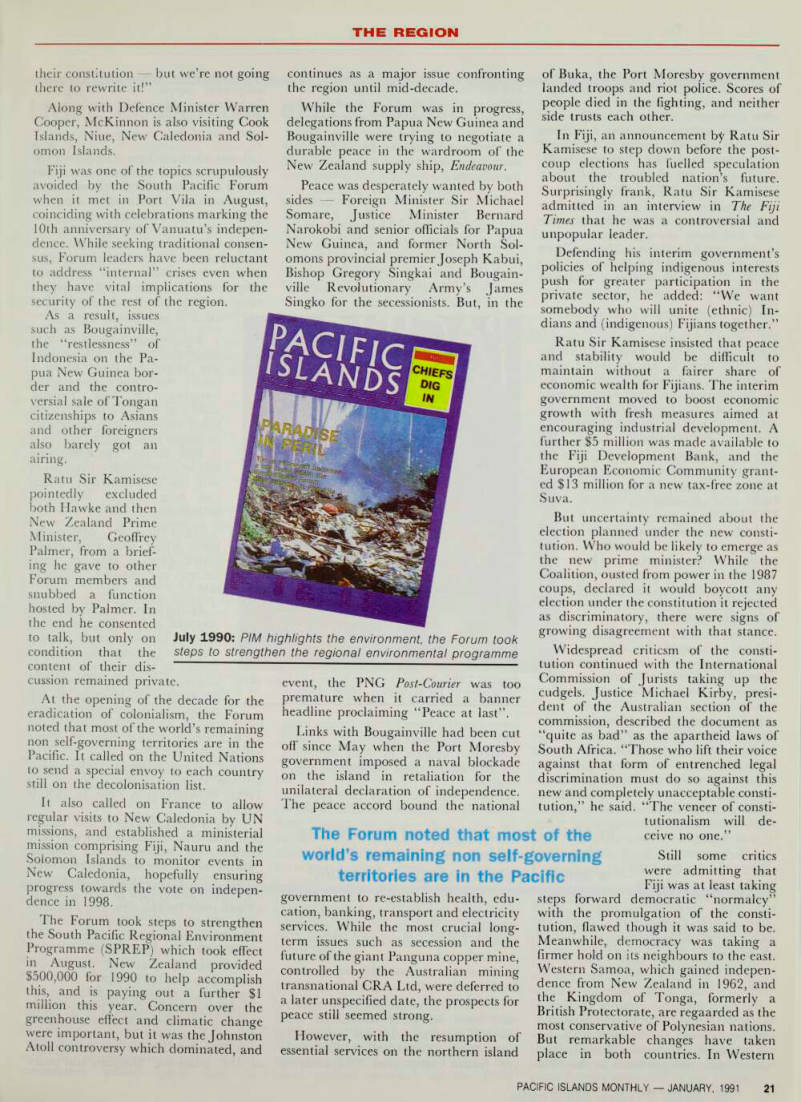
November 1990: Solomon Mamaloni features on PIM cover after forming a new coalition government in October
their constitution but we’re not going there to rewrite it!”
Along with Defence Minister Warren Cooper, McKinnon is also visiting Cook Islands, Niue, New Caledonia and Sol omon Islands.
Fiji was one of the topics scrupulously avoided by the South Pacific Forum when it met in Port Vila in August, coinciding with celebrations marking the 10th anniversary of Vanuatu’s indepen dence. While seeking traditional consen sus, Forum leaders have been reluctant to address “internal” crises even when they have vital implications for the security of the rest of the region.
As a result, issues such as Bougainville, the “restlessness” of Indonesia on the Pa pua New Guinea bor der and the contro versial sale of Tongan citizenships to Asians and other foreigners also barely got an
airing.
Ratu Sir Kamisese
pointedly excluded
both Hawke and then New Zealand Prime
Minister, Geoffrey
Palmer, from a brief ing he gave to other Forum members and snubbed a function hosted by Palmer. In the end he consented to talk, but only on condition that the content of their dis
cussion remained private.
At the opening of the decade for the eradication of colonialism, the Forum noted that most of the world’s remaining non self-governing territories are in the Pacific. It called on the United Nations to send a special envoy to each country still on the decolonisation list.
It also called on France to allow regular visits to New Caledonia by UN missions, and established a ministerial mission comprising Fiji, Nauru and the Solomon Islands to monitor events in
New Caledonia, hopefully ensuring
progress towards the vote on indepen dence in 1998.
The Forum took steps to strengthen the South Pacific Regional Environment Programme (SPREP) which took effect in August. New Zealand provided $500,000 for 1990 to help accomplish this, and is paying out a further $1 million this year. Concern over the greenhouse effect and climatic change were important, but it was the Johnston Atoll controversy which dominated, and
continues as a major issue confronting the region until mid-decade.
While the Forum was in progress, delegations from Papua New Guinea and Bougainville were trying to negotiate a durable peace in the wardroom of the New Zealand supply ship, Endeavour.
Peace was desperately wanted by both sides Foreign Minister Sir Michael Somare, Justice Minister Bernard Narokobi and senior officials for Papua New Guinea, and former North Sol omons provincial premier Joseph Kabui,
Bishop Gregory Singkai and Bougain
ville Revolutionary Army’s James Singko for the secessionists. But, in the
event, the PNG Post-Courier was too premature when it carried a banner headline proclaiming “Peace at last”.
Links with Bougainville had been cut off since May when the Port Moresby government imposed a naval blockade on the island in retaliation for the unilateral declaration of independence.
The peace accord bound the national
The Forum noted that most of the world’s remaining non self-governing territories are in the Pacific
government to re-establish health, edu cation, banking, transport and electricity services. While the most crucial long term issues such as secession and the future of the giant Panguna copper mine, controlled by the Australian mining transnational CRA Ltd, were deferred to a later unspecified date, the prospects for peace still seemed strong.
However, with the resumption of essential services on the northern island
of Buka, the Port Moresby government landed troops and riot police. Scores of people died in the fighting, and neither side trusts each other.
In Fiji, an announcement by Ratu Sir Kamisese to step down before the post coup elections has fuelled speculation about the troubled nation’s future.
Surprisingly frank, Ratu Sir Kamisese admitted in an interview in The Fiji Times that he was a controversial and
unpopular leader.
Defending his interim government’s policies of helping indigenous interests push for greater participation in the private sector, he added: “We want somebody who will unite (ethnic) In dians and (indigenous) Fijians together.”
Ratu Sir Kamisese insisted that peace and stability would be difficult to maintain without a fairer share of economic wealth for Fijians. The interim government moved to boost economic growth with fresh measures aimed at
encouraging industrial development. A
further S 5 million was made available to the Fiji Development Bank, and the
European Economic Community grant
ed Sl3 million for anew tax-free zone at Suva.
But uncertainty remained about the election planned under the new consti tution. Who would be likely to emerge as the new prime minister? While the Coalition, ousted from power in the 1987 coups, declared it would boycott any election under the constitution it rejected as discriminatory, there were signs of growing disagreement with that stance.
Widespread criticsm of the consti tution continued with the International Commission of Jurists taking up the cudgels. Justice Michael Kirby, presi dent of the Australian section of the commission, described the document as “quite as bad” as the apartheid laws of South Africa. “Those who lift their voice against that form of entrenched legal discrimination must do so against this new and completely unacceptable consti tution,” he said. “The veneer of consti
tutionalism will de ceive no one.”
Still some critics were admitting that Fiji was at least taking
steps forward democratic “normalcy” with the promulgation of the consti tution, flawed though it was said to be.
Meanwhile, democracy was taking a firmer hold on its neighbours to the east.
Western Samoa, which gained indepen dence from New Zealand in 1962, and the Kingdom of Tonga, formerly a British Protectorate, are regaarded as the most conservative of Polynesian nations.
But remarkable changes have taken place in both countries. In Western
July 1990: PIM highlights the environment, the Forum took steps to strengthen the regional environmental programme
Samoa, a referendum forced by growing pressure has endorsed universal suffrage.
Until the promulgation of anew law after the historic referendum in October, voting in general elections has been restricted to the matai (traditional titlcholders or chiefs). But the mush rooming number of chiefs and titles in recent years has eroded the system.
Although only chiefs can still stand for election to the Fono (parliament), the vote has been extended to men and women aged 21 and over. Almost 53 per cent of voters supported the change, but 60 per cent voted against a proposed upper house of parliament for customary groups.
In Tonga, reformist commoner MP and news-sheet editor ‘Akilisi Pohiva is continuing to combat mounting pressure to silence him in his quest "for open
government and public accountability.
He has filed a lawsuit over accusations of corruption and unconstitutional prac tises in the sale of Tongan passports to
foreigners, mainly Asians.
Auckland-based lawyer Nalesoni Tupou believes the case could change the history of Tonga. He is confident the result will eventually lead to open government.
Pohiva caused an uproar in August when he called for replacement of the
parliamentary Speaker, 75-year-old
Malupo, a nobles representative. One noble threatened Pohiva during the angry debate, which was later struck off the parliamentary minutes.
Pohiva accused the Speaker of allow ing to overspend by 35 per cent.
Appointed by the King, Taufa’ahau Tupou IV, in 1987, Malupo rejected the accusation and said he had been trying to trim costs.
In New Caledonia the election of Paul Neaoutyine as president of the Kanak Socialist National Liberation Front (FLNKS) ended a 10-month period of limbo for the Kanak nationalists. Once the righthand man of Jean-Marie Tjibaou in the former Nothern Region
administration, perhaps
it was fitting that he should succeed the as sassinated leader to head the umbrella
Kanak independence movement.
Neaoutyine, of Palika, has the charisma and respect to heal the rifts between the dominant Caledonian Union, and the smaller partners in the FLNKS which have persisted since the 1989 assassin ations.
But he is under no illusions about the Matignon Accords. He is sceptical about whether France’s development aid pour ing into New Caledonia will really help Kanaks gain independence in the 1998
referendum. Neaoutyine remains vigil
ant for the need to change tactics: “I know some see me as a revolutionary.
I’m not renouncing my convictions, nor my militant past. But today I am obliged to represent all of the FLNKS ... We tailor our strategy to the circumstances of the struggle.”
On a remote marae in the picturesque inlet of Pawarenga, of New Zealand’s Nothland, more than 130 delegates from indigenous and people’s movements in 25 Asia-Pacific countries gathered in No vember to ponder the 19905. Campaign ing for a “Nuclear —free and indepen dent Pacific”, the delegates considered
issues ranging from foreign militry bases and “development aggression” against indigenous peoples, to waste dumping, the greenhouse effect and human rights violations.
Founded in Fiji in 1975, the Nuclear
‘ln 1940 (New Zealanders) knew where they were going, which gave them a sense of great energy and destiny’
Free and Independent Pacific (NFIP) movement’s original sights were on establishing a nuclear-free zone which evolved into the Rarotonga Treaty and curbing foreign military control. In recent years it has adopted a more hardline “indigenous agenda”.
However, through this sixth confer ence most delegates considered that being indigenous did not necessarily mean being oppressed all the time. Said one Kanak campaigner: “Exploitation
and oppression can come from the indigenous people.” And a Japanese Catholic nun, Sister Yasuko Shimuzu, added: “There are indigenous who are oppressors of their own people or tribe.”
It was on the debate on Fiji that the indigenous agenda made the strongest impact after fierce discussions a resolution was passed condemning the “racist, divisive and authoritarian” post coup constitution. “The debate on the indigenous issue,” said Rita Baua, of the Phillippines, “will go on as long as there are no sincere efforts on the part of the indigenous people’s leaders themselves to study the real political-economic situ
ation in present-day societies.”
New Zealand’s much vaunted sesquicentenary celebration year was judged by many to be a failure. According to one leading historian, Dr Jock Phillips, author of A Man’s Country , 1990 failed because New Zealanders no longer knew what to celebrate in their society. The celebration was an embarrassment compared with the 1940 centenary, which had been one of unabashed enthusiasm.
“In 1940 (New Zealanders) knew where they were going, which gave a sense of great
energy and destiny,” Phillips
said.
At the time, New Zealanders accepted a broad consensus of values. They believed, for ex ample, in a romantic image of Maoris as pioneers and warriors happily progressing towards total integration; a worship of the
pioneer spirit; confidence in ma terial progress; and an acceptance of the nuclear family with “mum at home looking after the kids”.
What has really become striking now, believes Phillips, is the focus on the Treaty of Waitangi in 1990. In 1940 it wasn’t.
“This is an expression of how signifi cant the Maori perspective on New Zealand has become,” says Phillips.
“Today we have a much more diverse society with very distinctive groups the radical Maori view of New Zealand, a small-town Pakeha view and a middle class liberal view. They have very different voices and a very different vision of what New Zealand should be.”
This was the year that the Labour government finally collapsed and was dumped in a devastating defeat in the October general election. Prime Minister Jim Bolger became the nation’s fourth leader in 14 months. When Labour had been elected in 1984 it had the support of the unionists, faminists and peace
August 1990: Major-General Sitiveni Rabuka says he wants to be Fiji’s next prime minister
movement. At the time, then Prime Minister David Lange gave the im pression that he would bring an Australian-style accord and that econ omic policy would be based on co operation, not decree.
However, by the following year the rot had set in. It became apparent that the government was controlled by a “far right cabal of bureaucrats and business men ’, as one commentator put it. As the corporation policy gave way to
privatisation, and the hugely profitable Telecom, forests and other national assets were rapidly sold off, government popu larity plunged.
It is an ironical footnote that as New Zealand’s economic orthodoxy has spread to other Pacific nations, and while New Zealand trade unions are being weakened with new legislation, unions in Fiji and Papua New Guinea are gaining strength. Since Lawrence Titimur be came general secretary of the PNG
Trade Union Congress in 1987 its membership has soared to 100,000. And the Fiji Unions have been flexing their labour muscles under the leadership of
Fiji Trades Union Congress general
secretary Mahendra Chaudry, garment workers unionist Emma Druavesi, and others.
Perhaps, along with ‘Akilisi Pohiva and Paul Neaoutyine, these are the people to keep an eye on in the future as
development directions increasingly be
come fiercely contested in the Pacific. □
Living in someone else’s rubbish
WHEN a Greenpeace environ mental team entered a second time into the 12-mile exclusion zone around France’s nuclear test site at Moruroa Atoll just a fortnight before Christmas the fireworks began. Taking plankton samples right under the noses of French authorities was just too much.
An earlier investigation team the day before had been detained and then released without charge. But this time, on December 11, hooded French com mandos arrested the five environ mentalists including American scien tist Norm Buske who alleged in a recent controversial report that radioactive waste leaking from each test could reach the sea in six years.
The team, towing a plankton net at four knots, was stopped by a French military inflatable boat carrying 11 commandos. After being held in their boat for 40 minutes, the Greenpeace team were ordered on board the French warship Rem.
After being detained for three days on Moruroa, they were flown to Papeete where officials in the French High Commission told them charges had been dropped and they were free to go.
Arrested were: Alain Connan, 57, president of Greenpeace France; Buske, 47; Martin Gotje, 41, a Dutch-born New Zealand resident; Tanya Popp, 24, a New Zealander; and Gaston Bernardino, 35, of French Polynesia.
Buske, Gotje and Popp were deported on a flight to Los Angeles. Later, back in New Zealand, veteran protester Gotje told newspapers he was “alarmed” at the development taking place on Moruroa at a time when France was supposed to be scaling down its nuclear testing pro gramme. He described buildings and laboratories under construction and ex tensive equipment including four
barge-mounted drilling rigs.
On board the new Rainbow Warrior off Moruroa, nuclear tests campaigner Stephanie Mills said traces of radioactive
caesium-134 and cobalt-60 found outside the 12-mile zone the previous week had underscored the urgent need for exhaus tive checking of the environment at Moruroa, The events off Moruroa demonstarted that the nuclear testing programme was still just as big an environmental concern for South Pacific countries in 1990 as it had been for more than two decades. But during the year mounting controversy over United States plans for the destruc-
tion of chemical weapons on Johnston Atoll became an even bigger issue.
After a vigorous day-long debate on the issue at the South Pacific Forum, a consensus was reached by Pacific leaders; chemical weapons already on Johnston Atoll should be burnt there, but no further stocks should be brought to the atoll. The following month, the US launched a public relations campaign
with Pacific leaders and news media.
More than 70 media representatives attended a tour of the atoll in October.
Yet surprisingly none of the three major US television networks were represented.
Countries of the Pacific region face environmental problems in the 1990 s far more extensive and more serious than ever before. Many of the potentially most damaging problems are caused by the activities of countries outside the region.
Problems of ozone depletion, climate change, hazardous waste dumping and driftnet fishing fall into this category.
According to a regional report, more
than 60 per cent of Pacific island states have significant problems over soil erosion. More than half of these are concerned about the environmental impact of the ex traction of construction materials such as sand and gravel - and 30 per cent have had major mining
activity.
Water shortages and pollution
affect 60 per cent of the countries.
Deforestation troubles 70 per cent of the countries and two thirds have problems of en dangered species and nature con servation.
More than half the countries face conflicts over land tenure and use. Waste disposal is virtu ally a universal prroblem 90 per cent have problems disposing
liquid wastes without causing
pollution, and 60 per cent cannot find satisfactory ways of getting rid of solid wastes. Toxic chemi cals such as pesticides to which small islands are particularly vulnerable are another major
worry. And more than 60 per cent of governments are concerned about their population growth. “The postcard view of the South Pacific visualises coral sand beaches, palm trrees, clear water and clean air the possibility that the area might be polluted is seldom considered,” says Vili Fuavao, the director of the South Pacific Regional Environmental Programme (SPREP). □
October 1990: A new study challenges French claims that nuclear tests at Moruroa are safe
Advertisements & other items, p. 23 (1 item)
23
PACIFIC ISI AMDS MOIMTHI V IANIIIARY IQQI
THE REGION
pearls of
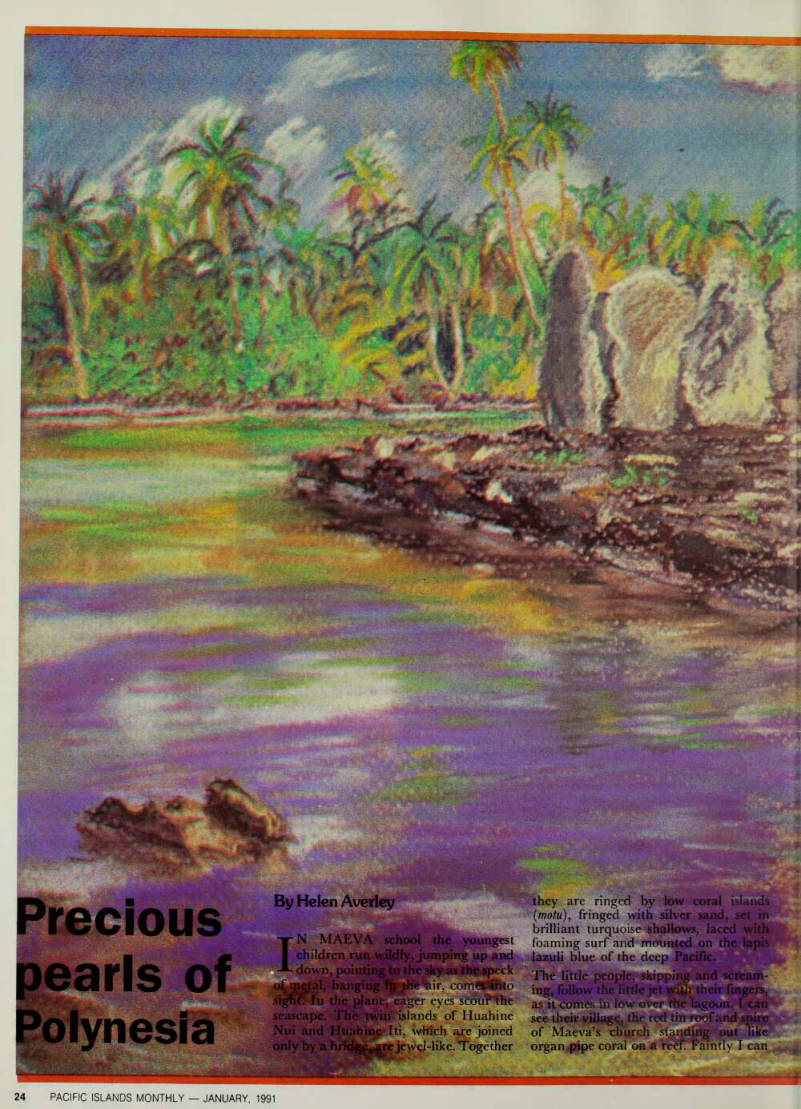
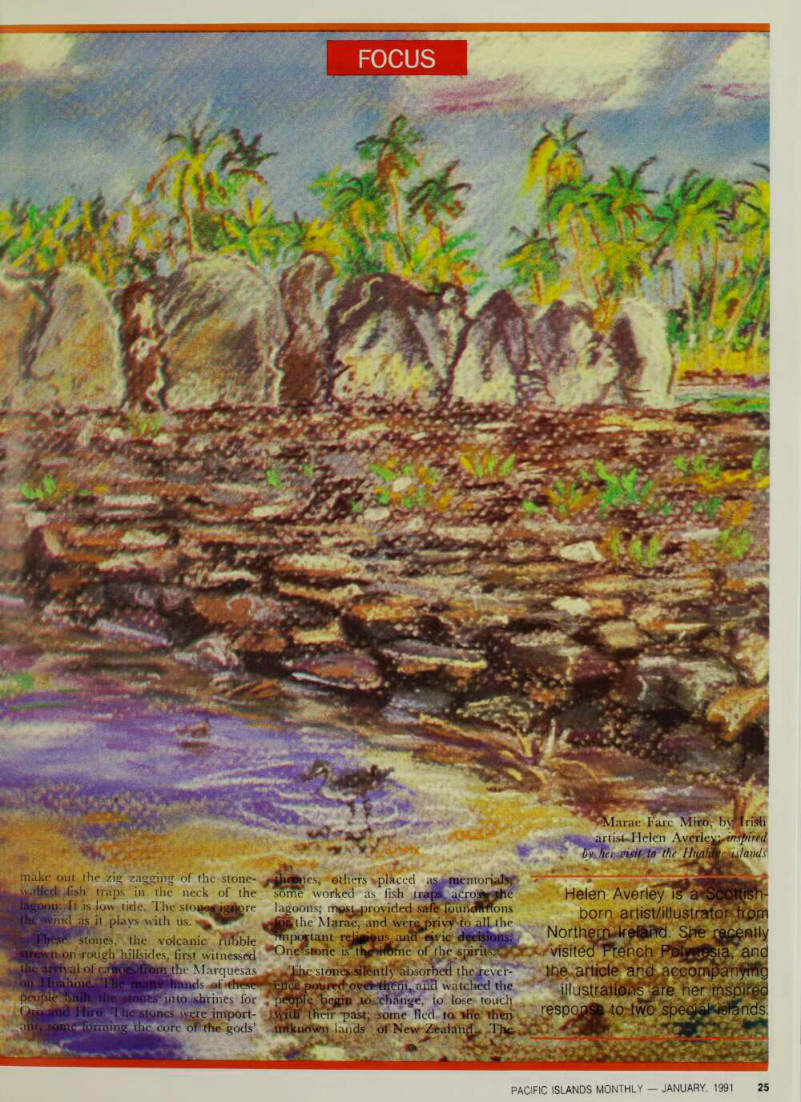
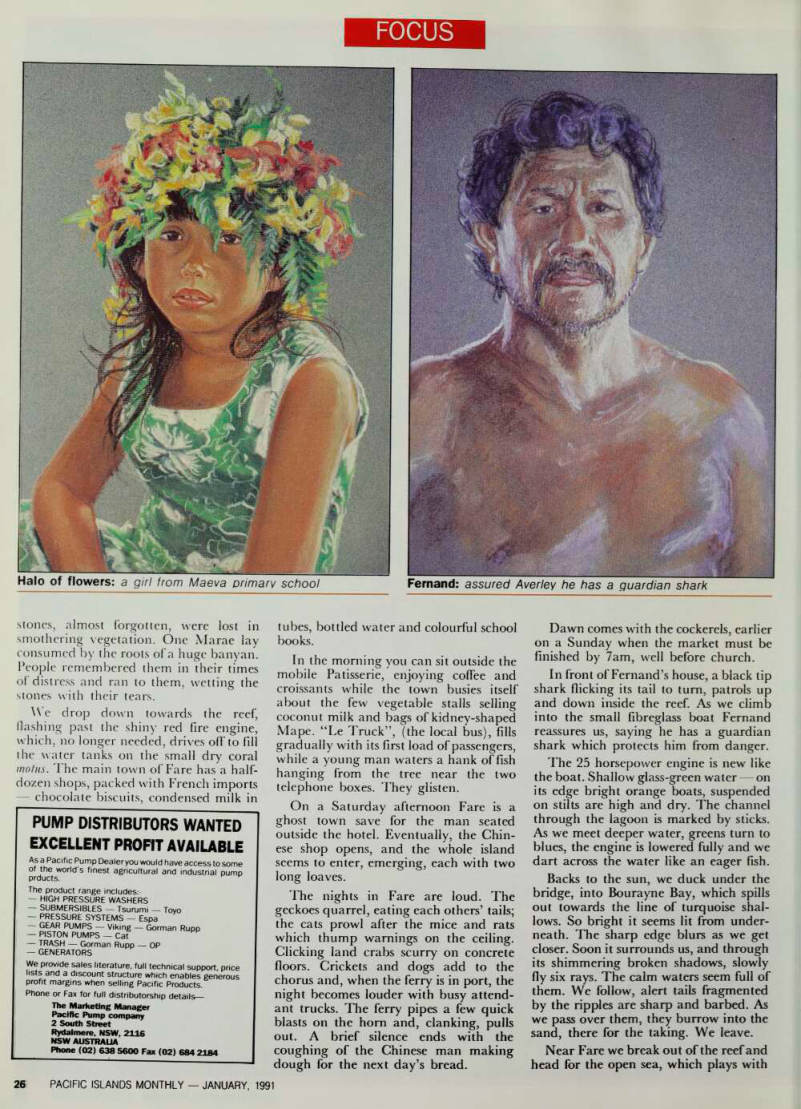
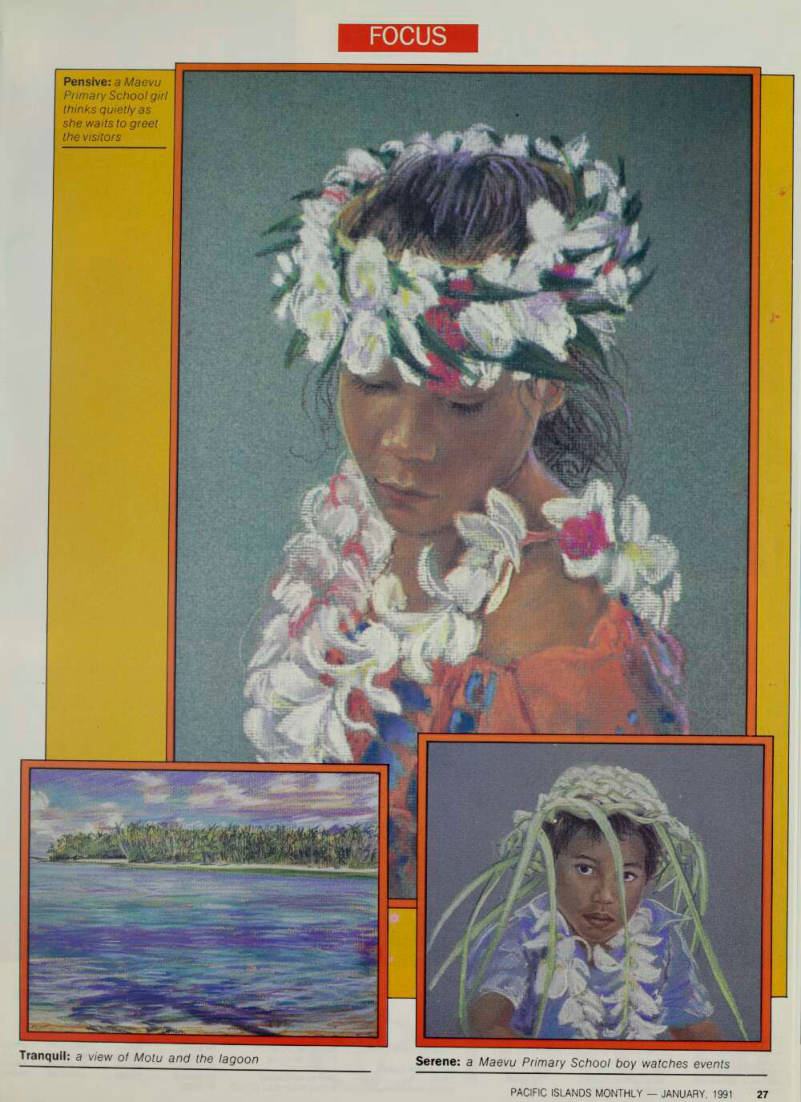
Precious pearls of Polynesia
By Helen Averley
IN MAEVA school the youngest sight. In the plane, eager eyes scoaHhe seascape. The twin islands of Huahine Nui and Huahine Iti, which are joined only by a bridgeware jewel-like. Together
they are ringed by low coral islands {motu), fringed with silver sand, set in brilliant turquoise shallows, laced with foaming surf and mounted on the lapis lazuli blue of the deep Pacific.
The little people, skipping and scream as it comes in low over the lagoon. I can see their village, themed tinroof and spire organ pipe coral on a reef. Faintly I can §
make oul the zig sagging of the stone walled (ish traps in the neck of the Jpgoon. It is low tide. The
js.it plays with us.
*f ; JPhesc stones, the volcanic rubble on rough hillsides, first witnessed the arrival ol canoes from the Marquesas on Huahine. The inafflthands of these people Motfilt the stones into shrines for ( and Hiro. The stones were importof the gods’
f others vplaccd memorial some worked as fish traps. acrojir#!e lagoons; safe Marae, and wenyprivy-to <j}l the rd|p«us ancl eivic decisions. neurone is of the smr®/, * **' '£bf lstones slently%bsorbed poured apS watched the , p«*sfsle "begin to.change, to lose touch \yilff their "past; some fled ta the then urtknown of New Zealand- TJ^
Helen Averley is born artlst/lllustrator frpm
NorthejxuketerW.
visiteoTl'ench the article and r illustrations are her inspired
respoiafl| to two spe^^K^nds.
Marae Fare Miro, by Irish artist Helen Averley: inspired by her visit to the Huahine islands
stones, almost forgotten, were lost in smothering vegetation. One Marae lay consumed by the roots of a huge banyan.
People remembered them in their times of distress and ran to them, wetting the stones with their tears.
W c drop down towards the reef, flashing past the shiny red fire engine, which, no longer needed, drives off to fill the water tanks on the small dry coral mo/ns. The main town of Fare has a half dozen shops, packed with French imports chocolate biscuits, condensed milk in
tubes, bottled water and colourful school books.
In the morning you can sit outside the mobile Patisserie, enjoying coffee and croissants while the town busies itself about the few vegetable stalls selling coconut milk and bags of kidney-shaped Mape. “Le Truck”, (the local bus), fills gradually with its first load of passengers, while a young man waters a hank offish hanging from the tree near the two telephone boxes. They glisten.
On a Saturday afternoon Fare is a ghost town save for the man seated outside the hotel. Eventually, the Chin ese shop opens, and the whole island seems to enter, emerging, each with two long loaves.
The nights in Fare are loud. The geckoes quarrel, eating each others’ tails; the cats prowl after the mice and rats
which thump warnings on the ceiling.
Clicking land crabs scurry on concrete floors. Crickets and dogs add to the chorus and, when the ferry is in port, the night becomes louder with busy attend ant trucks. The ferry pipes a few quick blasts on the horn and, clanking, pulls out. A brief silence ends with the coughing of the Chinese man making dough for the next day’s bread.
Dawn comes with the cockerels, earlier on a Sunday when the market must be finished by 7am, well before church.
In front of Fernand’s house, a black tip shark flicking its tail to turn, patrols up and down inside the reef. As we climb into the small fibreglass boat Fernand reassures us, saying he has a guardian shark which protects him from danger.
The 25 horsepower engine is new like the boat. Shallow glass-green water on its edge bright orange boats, suspended on stilts are high and dry. The channel through the lagoon is marked by sticks.
As we meet deeper water, greens turn to blues, the engine is lowered fully and we dart across the water like an eager fish.
Backs to the sun, we duck under the bridge, into Bourayne Bay, which spills out towards the line of turquoise shal lows. So bright it seems lit from under neath. The sharp edge blurs as we get closer. Soon it surrounds us, and through its shimmering broken shadows, slowly fly six rays. The calm waters seem full of them. We follow, alert tails fragmented by the ripples are sharp and barbed. As we pass over them, they burrow into the sand, there for the taking. We leave.
Near Fare we break out of the reef and head for the open sea, which plays with
Halo of flowers: a girl from Maeva primary school
Fernand: assured Averley he has a guardian shark
Pensive: a Maevu Primary School girl thinks quietly as she waits to greet the visitors
Tranquil: a view of Motu and the lagoon
Serene: a Maevu Primary School boy watches events
our little boat. 1 he hull crashes down on the harsh slate-grey face of the waves as they come towards us.
Turned towards the shore they show their other face, benign and blue. They push on to quench long beaches, which scream white like bleached bones. They ever reach them. Desperately they dash themselves against the reef, and echo white against the backdrop of dark hills.
We shock whole squadrons of flying fish out of the water, the tail-end-charlies forever trying to catch the flock. A brief glimpse of green as a turtle takes a sip of air and dives. We arc joined by a school of dolphins, who come to tease us, to play hide and seek in the waves, like silent film stars in (he distance. We catch up, but they are fickle. We’re left, our necks straining after them.
We turn full circle, the little boat surfs.
The huge wall of water racing behind pushes us into the lagoon, "and the soothing, sedate calm waters rest us.
It is the “International Day of the 1 ourist”, and the Maeva primary school has been preparing to entertain the tourists from one of the posh hotels. The children sit on the edge of their seats,
waiting.
Unsuspectingly, while looking for the path to the ancient stones, we catch a glimpse of little heads wearing flower tiaras. We take a second look, and are beckoned to by a teacher. As we enter,
a cascade of flower fairies pour out of the classroom jumping around. Pushed back into the classroom, singing, they watch as the two tourists pass. We stare back.
In the assembly hall, the youngest children break free from the mat they’ve been tidily sitting on. Flowers every where. They catch the drone of another plane coming on the wind. They begin to rush about pointing to the sky.
Gradually the hall fills, the children growing in size, as each class swells the bouquet. We sit on the benches and watch.
Magic. The excitement is wild and brims over. The children are uncontain able and run like confetti caught in a
whirlwind. Singing, laughing, blowing
whistles on plucked petals, grinning at our cameras. There is no sign of their other guests, and before it gets too much for them they are calmed down, their pareus fixed by the teachers, and like a flock of birds of paradise the children settle and adjust themselves.
They begin to sing, just for us.
Breathless six year olds, mouthing exageratedly, the older girls fiddling with each others’ hair, the boys throwing up clouds of petals. The older ones dance, the girls shaking their hips, whilst the boys clap their knees together.
Suddenly it is over, and our appreci ation seems all too inadequate. The children then place flowers over our heads, a tidal wave engulfs us, thousands of flowers. A heady bouquet of frangipangi, tiare de Tahiti, mingled with wild basil and fern, we’re almost drowned in blossom. The children disap pear, and in their wake, as a receding tide leaves shells, they leave petals precious as pearls. □
Sylviane: a study by Averley
Advertisements & other items, pp. 25-30 (2 items)
Focus
Pump Distributors Wanted
EXCELLENT PROFIT AVAILABLE
As a Pacific Pump Dealer you would have access to some of the world s finest agricultural and industrial pump prducts. K The product range includes:
HIGH PRESSURE WASHERS
SUBMERSIBLES Tsurumi Toyo
PRESSURE SYSTEMS Espa
GEAR PUMPS Viking Gorman Rupp
PISTON PUMPS Cat
TRASH Gorman Rupp OP
GENERATORS
We provide sales literature, full technical support price lists and a discount structure which enables generous profit margins when selling Pacific Products.
Phone or Fax for full distributorship details— The Marketing Manager Pacific Pump company 2 South Street Rydalmere, NSW, 2lifi
NSW AUSTRALIA
Phone (02) 638 5600 Fax (02) 684 2184
The new Toyota brand mark. Three ellipses forming a “T” which stand for our customer, our commitment to the satisfaction of that customer through our product and for our spirit of creativity.
It’s not often that you hear descriptions like rugged or durable combined with refined and elegant. But then there’s never been a vehicle quite like the new Toyota Land Cruiser Station Wagon. The unrivalled legend of off-road reliability is now unsurpassed in comfort and sophistication as well. Attention to detail is found everywhere, from the fine trim to the instrument panel to the graceful lines of its exterior. Even in places you can’t see, like the heavy-duty ladder frame and suspension design that add to the superb
luxury-car ride.
But Toyota’s innovation goes beyond providing luxury and durability. The new Land Cruiser Station Wagon, and all of our cars, are designed to create a harmony between car and driver, and to provide you with the ultimate
driving experience.
The new Toyota Land Cruiser Station Wagon. Think of it as much more than a spacious luxury sedan with four-
wheel drive.
■ - - Mm.
V
DISTRIBUTORS/DEALERS
AMERICAN SAMOA BURNS PHILP (S.S.) CO. LTD. PH 633-4281 GUAM & MICRONESIA ATKINS KROLL, INC. PH 646-1876/9 NORFOLK ISLANDS BORRY'S PTY LTD. PH 2114
SOLOMON ISLANDS MENDANA MOTORS PH 22884
VANUATU VANUATU MOTORS PH 2341
COOK ISLANDS PACIFIC MOTORS LTD. PH 20796
KIRIBATI TARAWA MOTORS PH 21090
PAPUA NEW GUINEA ELA MOTORS PH 217036
TAHITI NIPPON AUTOMOTO PH 429819
WESTERN SAMOA BURNS PHILP (S.S.) CO. LTD. PH 20800
FIJI
NEW CALEDONIA
SAIPAN
TONGA
ASCO MO
S.I.A.P.
MICROL O
BURNS PH C
* *2 ; j- □ 0 «r » >• -'I ' O o , * V I ui . 1 '•
irv
■V ■P9 i*.
'V * $- WM i -» II N w m* I >-\} • > V > ♦V. f£.r!7((s) •: u 9 * <fi> A ■ t ., vm
lON PH 234-5911
GA) LTD, PH 23673
&> TOYOTA
Remember your Friend
There are times in your life when you feel your friends have been missing out on something good. Now’s your chance to do something about it and share with them one of the good things you have. Buy your friend a subscription to Pacific Islands Monthly and let him or her join you and the thousands of other people worldwide wiio arc kept informed of the latest political, social and cultural changes taking place in the Pacific.
hjhgkjh
PACIFIC
SLANDS
1m o n t h l yQ Please send my friend Pacific Islands Monthly for one year (12 issues).
I enclose my cheque for $ (made payable to Pacific Islands Monthly) or debit $ to my: □ Bankcard □ Visacard □ Mastercard Card No: I I I I I I I I I I I I I I I liExpiry Date
NAME
SIGNATURE
MY FRIEND'S NAME
MY FRIEND’S ADDRESS
CITY COUNTRY
Pacific
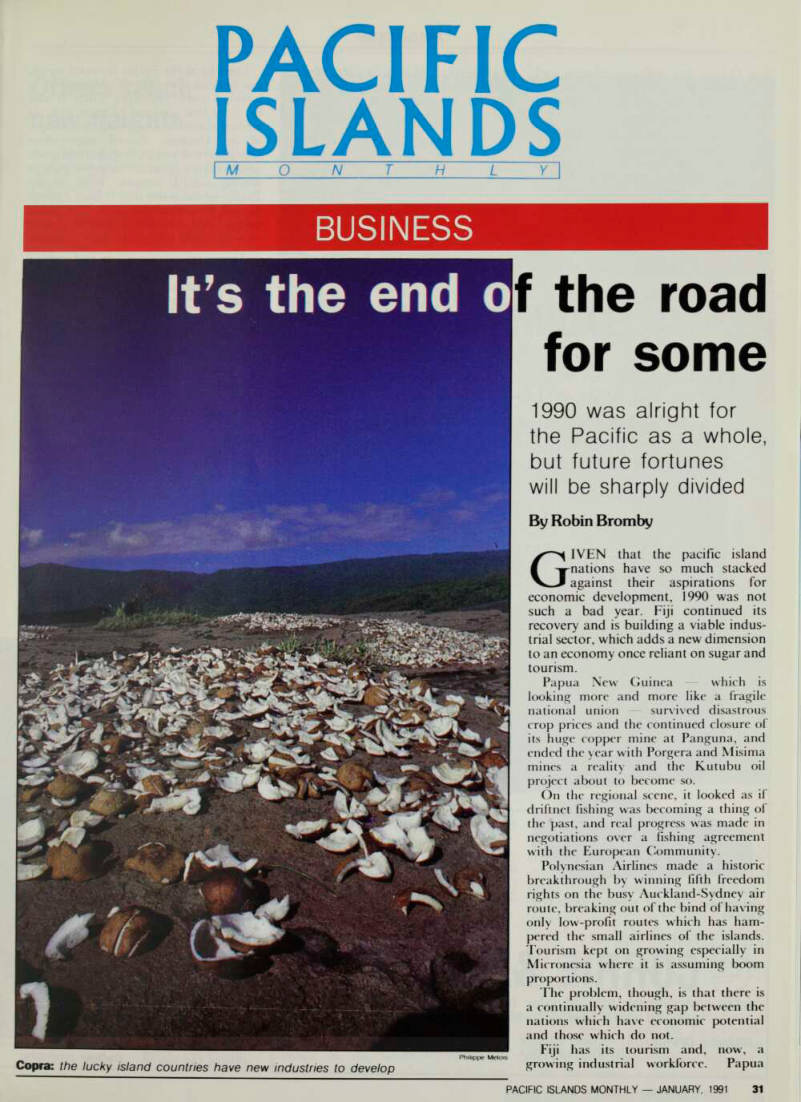

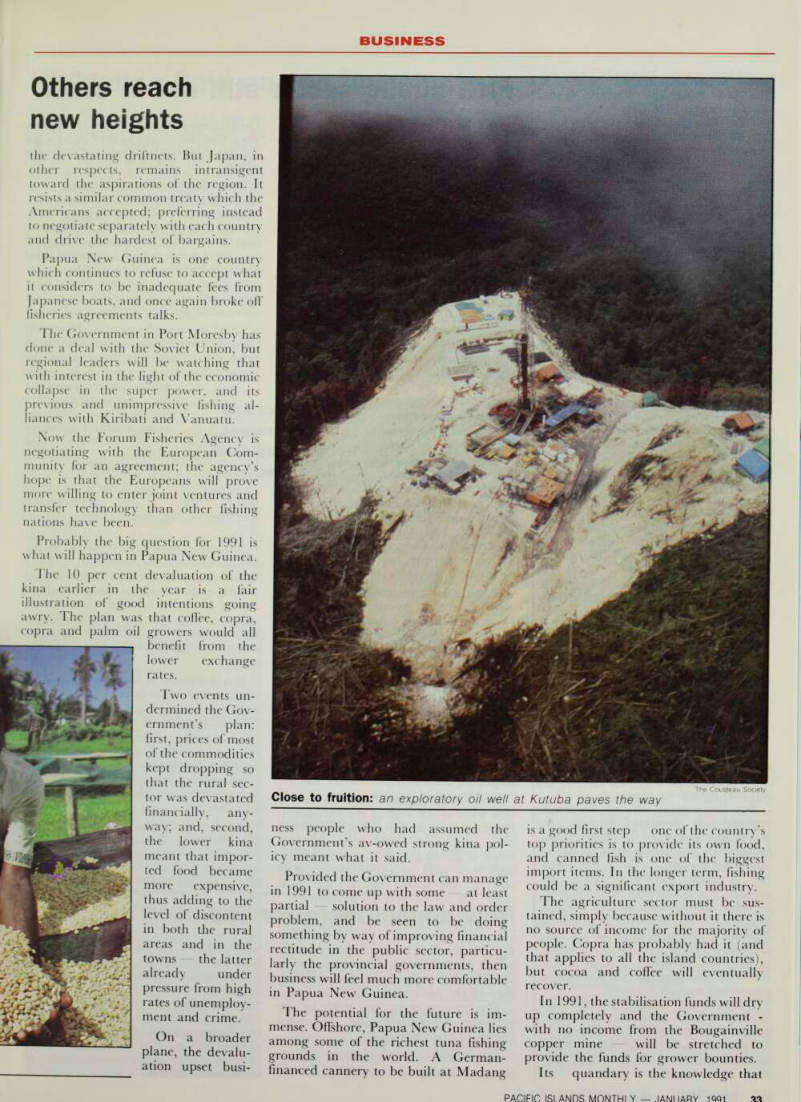
Islands
Monthly
Business
It's the end to the road for some
1990 was alright for the Pacific as a whole, but future fortunes will be sharply divided
By Robin Bromby
GIVEN that the pacific island nations have so much stacked against their aspirations for economic development, 1990 was not such a bad year. Fiji continued its recovery and is building a viable indus trial sector, which adds a new dimension to an economy once reliant on sugar and tourism.
Papua New Guinea which is looking more and more like a fragile national union survived disastrous crop prices and the continued closure of its huge copper mine at Panguna, and ended the year with Porgera and Misima mines a reality and the Kutubu oil project about to become so.
On the regional scene, it looked as if driftnet fishing was becoming a thing of the past, and real progress was made in negotiations over a fishing agreement with the European Community.
Polynesian Airlines made a historic breakthrough by winning fifth freedom rights on the busy Auckland-Sydney air route, breaking out of the bind of having only low-profit routes which has ham pered the small airlines of the islands.
Tourism kept on growing especially in Micronesia where it is assuming boom proportions.
The problem, though, is that there is a continually widening gap between the nations which have economic potential and those which do not.
Fiji has its tourism and, now, a growing industrial workforce. Papua
Philippe Metois Copra: the lucky island countries have new industries to develop
New Guinea has sufficient mineral and oil wealth to outweigh the doubts generated by law and order problems and unreliable politicians.
Then there are the medium-sized (in South Pacific terms) states, which muddle through. Tonga has a handful of small industries now exporting, and has managed to attract Asian investment.
Hie Solomon Islands has a growing fishing industry and considerable timber resources. Vanuatu and the Cook Islands have financial centres and tourism.
But for the others, economic develop-
ment seems as illusory as ever. Western Samoa has its own financial centre, but little else happened of economic signifi cance in 1990 (apart from Cyclone Ofa which caused extensive damage). Kiri ath Niue and Tuvalu are no less dependent on aid.
The countries which are spread over vast areas of ocean also sufFer from expensive internal transport. Kiribati aild the Cook Islands will be helped by a new telecommunications system, but essentia i infrastructure will continue to be contingent upon foreign aid.
Looking at the Pacific in world terms, the outlook for 1991 is clouded by a looming world recession. There is also the very real prospect of more difficult trading conditions following the collapse of the Uruguay Round negotiations which were aimed at freeing world trade and breaking down protectionist policies among GATT nations. Most of the Pacific island states find it hard enough to sell their products as it is: either a world trade recession or greater protec tionism would just add to their problems.
More particularly, a very real worry is that the state of the Australian and New Zealand economies the dominant trade partners for most of the Pacific islands. New Zealand is, for all intents and purposes, engulfed in a fully-fledged depression with nil growth. Australia is not so badly off, but its recession and rate of business failure will ensure a flat economy for most of 1991, perhaps even beyond. The effects of economic slump in those two countries will cause a ripple effect through the islands.
Fiji’s booming garment industry is
heavily dependent on exports to Austra lia and New Zealand. Pacific companies exporting to those countries will also have to reckon in 1991 with the determination both in Wellington and Canberra to reduce their tariff barriers across the board, a move which will lessen the advantage the Forum states have under existing treaties which often give them duty- and quota-free entry to Australia and New Zealand.
One valuable resource common to the
South Pacific re gion is the ocean and its living wealth.
There is no question that the region has made
significant steps
toward reaping a greater reward from fisheries, but there is still a long way to go. The United States tuna fleet seems to have come to terms with its (reluctant) commitment to pay fees to the states in whose ex clusive economic zones they fish, and the Asian dis tant water fishing
nations (Japan,
South Korea and Taiwan) have bowed to pressure against the use of
Philippe Metois Coffee: promising
Advertisements & other items, p. 32 (1 item)
Sg Samsung
The World’s Latest
PRODUCTS FOR PEOPLE WITH MORE
SENSE THAN MONEY
8i Available at Burns Philp Home Centres throughout Fiji and selected Duty Free Dealers.
SOLE DISTRIBUTORS:
To own a Samsung TV Screen, Samsung Video Deck and Samsung Remote Control Unit!
That \i Great!
That makes the Samsung Combination the most inexpensive of its kind.
Go for the best view.
Should be ideal for your home!
SAMSUNG
CORRIB & COMPANY
HEAD OFFICE G.P.O. BOX 45. SUVA TLX; FJ2166 CABLES: ‘CORRICO’ SUVA.
TELEPHONE: 386777 BANKERS: WESTPAC, SUVA (FAX: (679) 370010 BRANCH OFFICE: 161 VITOGO PARADE P.O. BOX 83, LAUTOKA CABLES:
“CORRICO” LAUTOKA TELEPHONE; 60137
new heights
Others reach new heights
the devastating driftnets. But Japan, in other respects, remains intransigent toward the aspirations of the region. It resists a similar common treaty which the Americans accepted; preferring instead to negotiate separately with each country and drive the hardest of bargains.
Papua New Guinea is one country which continues to refuse to accept what it considers to be inadequate fees from Japanese boats, and once again broke off fisheries agreements talks.
The Government in Port Moresby has done a deal with the Soviet Union, but regional leaders will be watching that with interest in the light of the economic collapse in the super power, and its previous and unimpressive fishing al liances with Kiribati and Vanuatu.
Now the Forum Fisheries Agency is negotiating with the European Com munity for an agreement; the agency’s hope is that the Europeans will prove more willing to enter joint ventures and transfer technology than other fishing nations have been.
Probably the big question for 1991 is what will happen in Papua New Guinea.
The 10 per cent devaluation of the kina earlier in the year is a fair illustration of good intentions going awry. The plan was that coffee, copra, copra and palm oil growers would all
benefit from the
lower exchange
rates.
Tvv o events un dermined the Gov ernment’s plan: first, prices of most of the commodities kept dropping so that the rural sec tor was devastated
financially, any
way; and, second, the lower kina meant that impor ted food became more expensive, thus adding to the level of discontent in both the rural areas and in the towns the latter
already under
pressure from high rates of unemploy ment and crime.
On a broader plane, the devalu ation upset busi-
ness people who had assumed the Government’s av-owed strong kina pol icy meant what it said.
Provided the Government can manage in 1991 to come up with some at least partial solution to the law and order problem, and be seen to be doing something by way of improving financial rectitude in the public sector, particu larly the provincial governments, then business will feel much more comfortable in Papua New Guinea.
The potential for the future is im mense. Offshore, Papua New Guinea lies among some of the richest tuna fishing grounds in the world. A German financed cannery to be built at Madang
is a good first step one of the country’s top priorities is to provide its own food, and canned fish is one of the biggest import items. In the longer term, fishing could be a significant export industry.
The agriculture sector must be sus tained, simply because without it there is no source of income for the majority of people. Copra has probably had it (and that applies to all the island countries), but cocoa and coffee will eventually recover.
In 1991, the stabilisation funds will dry up completely and the Government with no income from the Bougainville copper mine will be stretched to provide the funds for grower bounties.
Its quandary is the knowledge that
The Cousteau Society Close to fruition: an exploratory oil well at Kutuba paves the way
financial hardship in the rural areas is the last thing the country needs; already, in parts of East New Britain, some cocoa plantations have been hard hit by criminal harassment. Further, the country has made some real progress in improving coffee and cocoa strains and this will have been worth while only if it leads to greater economic benefit.
But it is mining and oil which hold out the greatest promise. The Porgera and Misima mines are now producing, but there are mines such as Lihir yet to come. Wells are being drilled right along the Papua Fold, and there is every chance that Kutubu is the beginning of Papua New Guinea’s oil story.
For Fiji, the most likely advances during 1991 will be in the Govern ment’s plan to widen the industrial base. The garment industry has been a great success (except in terms of labour relations), but the country’s hopes for a more dynamic economy rely on attract ing a wider range of manufacturing to its tax-free zones.
A continuing effort to build more quality accommodation and arrange better air services will be needed throughout the region. Aviation took some important leaps forward during 1990 the Polynesian Airlines trans- Tasman coup; the Airlines of the Marshall Islands flew a chartered Hawaiian Airlines DC-8 and Kiribati’s Air Tungaru an Aloha 737, while Solomon Airlines became the proud operator of its own Boeing 737 ( which it leased once a day to Niue Airlines, thus providing that small territory with a regular air link to Auckland, at last).
Air Pacific acquired its first 767 and signed a landing rights agreement with Malaysia, signalling its new thrust into the Asian markets. Air Niugini, despite having to close down a domestic subsidiary and losing money on some routes, made a success of its Port Moresby-Singapore service. Air Vanu atu also spread its wings.
But the vulnerability of the small regional was illustrated through Air Raratonga. It entered the international business by chartering seats to Auck land with Hawaiian’s DC-8. But when the Honolulu carrier withdrew its aircraft, Air Raratonga was left high and dry. It then tried to find another aircraft, but was thwarted by Air New Zealand’s announcement of an ad ditional weekly service out of Auckland to the Cook Islands a move which removed any hope of Air Rarotonga generating enough business.
Fisheries and tourism are the two avenues which offer real economic growth to all the nations of the area. It can therefore be expected that 1991 will see much greater efforts to try and reap some of the benefits of these. □
Advertisements & other items, p. 33 (1 item)
33
PACIFIC ISLANDS MDNTHI Y JANUARY IQQI
BUSINESS
PNG public sector still not in order
PUBLIC sector financial control in Papua New Guinea continues to come under scrutiny, but there is also some progress being made to tighten up the system.
Serious management problems in the superannuation sector are being ad dressed, but it is a sign of the distance left to travel that Papua New Guineans have recently been told that more than 30 Government-owned companies do not have their financial records in order.
The acting Auditor General, Lobe Geno, reported to Parliament that in the 1989 financial year 35 companies, subsidiaries of statutory corporations, had not presented their financial state ments for the 1987 and 1988 years.
Geno’s list included some major organis ations: National Provi dent Fund, National
Broadcasting Com
mission, Defence Force Retirement Benefits Fund, Public Officers’
Neglect and carelessness cause problems for teachers
Superannuation Fund and the Papua New Guinea Retirement Benefits Fund these had their 1988 audits in progress. The University of Papua New Guinea currently had its books being audited for the years 1986-88.
Those who had not submitted their 1988 financial records included the Forest Industries Council, the National
Investment and Development Authority
and the Fish Marketing Authority.
Geno also found that the finance committee and managing director of the Investment Corporation of Papua New Guinea had given out more money than it was permitted to, under their em powering legislation. The finance com mittee had authority to authorise invest ments up to K 2 million, and the managing director up to K 500,000.
The acting Auditor General reported that some senior staff of the Investment Corporation were provided with terms and conditions outside the specified terms in the Act, that long service leave had been paid to expatriate contract officers, one senior official was paid
entertainment expenses above his allow ance, and cars owned by the Corporation did not carry the required type of licence
plates.
The Government itself also came under fire. The Teaching Service Con ciliation and Arbitration Tribunal said, when delivering a wage claim decision, that the National Government had failed to control prices in both urban and rural areas. It had heard evidence that price controlled basic consumer items were being sold in rural areas for up to four times their price-controlled retail value.
“The same evidence also shows that the same neglect and careless attitudes of price control agencies are causing the same difficulties for teachers in urban
areas, thus compounding and aggravating further the high cost structure/ wage restraint dilemma of our economy,” said tribunal chairman Alphmclcdy Joel.
In all, the tribunal was
highly critical of the Government’s handling of the wages-prices relation
ship.
But there have been changes at the Public Officers’ Superannuation Fund following the expression of concern and public criticism about how members’ money was being handled. Contributors will now be able to obtain cheaper housing loans, a medical and insurance scheme, and day care centres for working mothers.
Board director Kuama Ariku said the fund had temporarily postponed its Kl 7 million Waigani shopping centre and the K 2.4 million Dagua prawn farm project in East Sepic Province. Instead, the board had opted for the establishment of a child minding centre, a play school and restaurant in Waigani to cater for the large numbers of public sen, ants who are its members.
The prawn farm investment had been shelved when it was found that the Australian principals had not delivered on earlier undertakings. The fund had lost about K 100,000 on the venture. □
New appointment for Thomsen
SAMUEL B. Thomsen, until recently the United States Representative in the Marshalls, has been elected Presi dent of the Micronesia Institute.
The announcement was made by the organization’s founder and chairman, Patricia Luce Chapman.
The Micronesia Institute is a non profit, Washington-based organisation
which serves as an independent link between the island communitiees and developmental, education and charitable resources. It covers FSM, Guam, Kiri bati, the Marshalls, the Northern Mari anas, and Palau. Its programs include the encouragement of local chambers of commerce, medical training, aid to libraries, and the encouragement of traditional cultures. □
Highlands Gold on top but cautious
HIGHLANDS Gold Ltd has reassured shareholders that no further significant borrowings would be needed for the Porgera venture, but at the same time directors have warned about the sharply deteriorating law and order situation in Papua New Guinea.
The good news dominated for the Papua New Guinea miner and explorer when it held its annual general meeting recently. The company had announced two months previously that the June 1990 year had seen a maiden profit, but has now revealed its profit for the September quarter was about K. 2 million (USS2.I2 million), with interest earned being the prime source of profits.
Chairman Norman Fussell told shareholders at the meeting that gold was being produced at Porgera for an extraordinarily low USS6S an ounce. At the Wild Dog prospect in the East New f 'cash s[niDD C d ‘TT'R ' aS ' HrT a cash-strapped City Resources Ltd, Highlands reported that drilling results revealed outcroppings with significant (Told rnntpnf ° Highlands was floated to acquire all the Papua New Guinea operations of MIM Holdings Ltd, with the parent still holding a 65 per cent stake. The Porgera mine in the Papua New Guinea highlands is the centrepiece of its activities.
Highlands Gold has 30 per cent of the project, as does Renison Goldfields Consolidated Ltd and Placer Pacific Ltd, with the Papua New Guinea Govern ment holding the other 10 per cent.
Fussell told the company’s annual meeting that directors were concerned about the declining state of law and order in the country. He said it was essential that the government in Port Moresby continued to address the prob lem and maintain the political will to act.
“The continual political manouevrj ng) w ;,h threats of votes of no confi denre is indeed a concern to rhe board ”
Fuss e |l said ’
Paniia Npw Guinea was on the befits of new resource developments Porgera, the Hides gas field and the Kutubu oil project - and about to host the South Pacific Games, both of which should galvanise the country.
“The outside world is watching and seeking reassurance that the country can surmount its problems and prosper,” said Fussell While Highlands Gold could not affect the course of events in Papua New Guinea, it could formulate strategies to minimise their effects. “We must be able to live and work in the country,” he said.
The closure of the Bougainville Cop per Mine had significant repercussions in
the world’s financial centres, and Papua New Guinea had to work to re-establish its reputation, he said.
Fussell also told shareholders that revenue from the Porgera gold mine is now almost covering the company’s spending obligations on the project. This meant that only minor further borrowing would be required until other mine developments go ahead.
Total borrowings of the company have reached K 81.6 million, and Highlands expects that only minor further borrow ing will be necessary while Porgera Construction and development stay on schedule.
“I should also point out that, with K 84.2 million in cash, Highlands Gold has effectively no net debt, an enviable position for a company that has just helped to fund one of the world’s largest gold mines,” said Fussell.
Highlands had hedged about half its share of the first two years of production from Porgera about 234,000 ounces at a net selling price of SUS42S an ounce, compared with a gold price on the day of the annual meeting of USS3B7 an ounce.
The company plans to spend 4.5 million kina on exploration in the current financial year. Further work is planned at the Wild Dog prospect to outline the mineable resource, and further acquisitions in Papua New Guinea are planned. The company currently has 30 properties 22 of which Highlands was the operator. □
resurfaces
Pollution row resurfaces
CONTROVERSY about pollution from the Ok Tedi mine in the Papua New Guinea highlands has surfaced again.
The Wilderness Society’s Dr Kevin Vang said at a recent world conser vation union meeting in Perth that waste debouching from the Fly River into the Gulf of Papua could be more harmful than previously thought. He said it was possible to measure the impact of the toxic copper waste on the Great Barrier Reef off Queensland and the Torres Strait islands.
But the co-ordinator of the Austra lian Government’s Torres Strait Base Line Study, Dr David Lawrence, has disputed this, saying there was insuf ficient scientific information and in tensive sampling to back up Vang’s assertions.
Estimates were that the Ok Tedi mine would add another 42 million tonnes annually during its peak pro duction, and only two per cent might enter the Torres Strait area. □
Kutuba oil project set to start
CONSTRUCTION of the Kutubu oil project in Papua New Guinea is expected to start early in 1991, following the granting of a development licence by the government in Port Moresby.
Three oil Fields lagifu, Hedinia and Agogo will be developed in Papua New Guinea’s southern highlands, about 550 km north-west of the capital. The development will also involve construetion of a 170 km pipeline through rugged terrain to the coast, and a further 90 km of subsea pipeline to a marine loading terminal in the gulf of Papua.
Partners in the venture are the Papua New Guinea Government (22.5 per cent), Ampol Exploration Ltd (16.4 per cent), BP petroleum (9.7 per cent), BP and Chevron (19.4 per cent each), Japan Papua New Guinea Exploration Ltd (4.8 per cent) and Oil Search Ltd (7.8 per cent). BP Australia Ltd announced that the joint venture partners in the project have spent about USS2SO million on exploration and appraisal activity and expect to spend a further USS9OO million on development.
The company’s general manager for exploration and production, Jay Smith, said during the peak output period the
Kutubu project was expected to produce
more than 100,000 barrels of oil a day.
“Kutubu is a major milestone in the development of Papua New Guinea as it will provide an important export oppor tunity for the country,” he said, noting that the approval comes close on the heels of another government all-clear Papua New Guinea’s first petroleum development licence for the Hides gas project, where BP has a 95 per cent stake.
Smith said that “Papua New Guinea has an exciting oil and gas development potential, but this will only be realised if the government and the community recognise the risks undertaken by com panies such as BP, Chevron and the joint
venture partners in bringing large proj
ects like these to fruition.”
In a separate statement, the general manager of Ampol Exploration, Peter Power, said the company’s output would double to about 40,000 barrels a day when the oil field comes onstream in late 1992. □
Polynesian phosphate plans boosted
P T AXTC „ . . . i mi P e , Phosphate in French Polynesia have been given a boost with the announcement from Tahiti that the project has been placed high on a list of economic priorities by the French-ruled Territory.
The most powerful local figure in Tahiti, the President of the French
Polynesian legislative assembly,
A lex and re Leontieff, said now that France was easing its control the territory would be looking to closer economic links with Australia and New Zealand.
TT . . , . .
Me listed phosphate mining as one of the projects which would be given top priority. ... 1 he phosphate project joint venture, Gie Raro Moana, has plans to mine a large area of Mataiva atoll, 300 km north of Tahiti. The partners in the joint venture company are Newmont Australia Ltd (49.5 per cent), Bureau de
Recherches Geologiques et’Minieres (26
per cent, the project managers), and Commco Ltd (24.5 per cent).
Newmont acquired its stake in its recent takeover of the Australian company originally involved in the scheme.
Australmin holdings ltd, but the venture
has been the subject of long and drawn
out negotiations.
Mataiva atoll is estimated to contain 20 million tonnes of phosphate, with assays higher than those found at the other two main sources in the region, Nauru and Banaba island. Banaba produced 25 million tonnes before it closed, while Nauru will eventually pass the 100 million tonne mark. Mataiva atoll is 10km by 6km, and the mine will involve excavating a large area of the enclosed and picturesque lagoon.
Phosphate from Mataiva, apart from generally higher grades, also has another advantage over other sources it has a slightly lower cadmium content. . .
Gadmium is considered one of the m °re polluting, non-degradable mineral elements. The deposit does have a s,i S htl Y hi g h calcite content but this is g enerall Y acceptable to Australian and New Zealand manufacturers.
The indication of encouragement from Papeete:is especially significant at a time w [ len Na ,ru 18 moving into the closing P hase of lts °'™ P hos P hate Newmont’s managing director, John
Quinn, said that he welcomed the indication that the project had been given enhanced priority. He said the scheme was a suitable replacement for Nauru as a source of phosphate in the region.
Before it was taken over, Australmin was pressing hard for the project to be approved. There was support from the territorial government in Papeete, and a taxation convention and mining con cession had been approved by the partners.
Australmin reported last year that final approval rested with the residents of Mataiva.
The phosphate mine is important to French Polynesia as it tries to cut the apron strings with Paris. The territory had a merchandise trade deficit in 1989 of CFPBI.4 billion.
A recent report from the bank of Hawaii said that, though an abrupt change in the French government’s role was not expected in the near future, the territory’s need to sustain itself on a more economically independent basis was still
an important challenge in the coming
years.
The report included mineral resources on the list of areas with good export growth potential. □
Advertisements & other items, p. 36 (1 item)
Fyran • Parkercraft
Exported & Serviced dy: Export Department, Ullrich Aluminium Co., P.O. Box 22244, Otahuhu, Auckland, New Zealand.
Ph: (9) 2763789 Fax: (9) 2763342 Tlx: NZ 2572 New Zealand's leading range of 8' 18' Aluminium boats, designed and manufactured in New Zealand by Creative Leisure Products, are now available throughout the Pacific region.
For strong, light, safe, and super low maintenance all purpose boats, call us now.
FVran
Fiji harvests
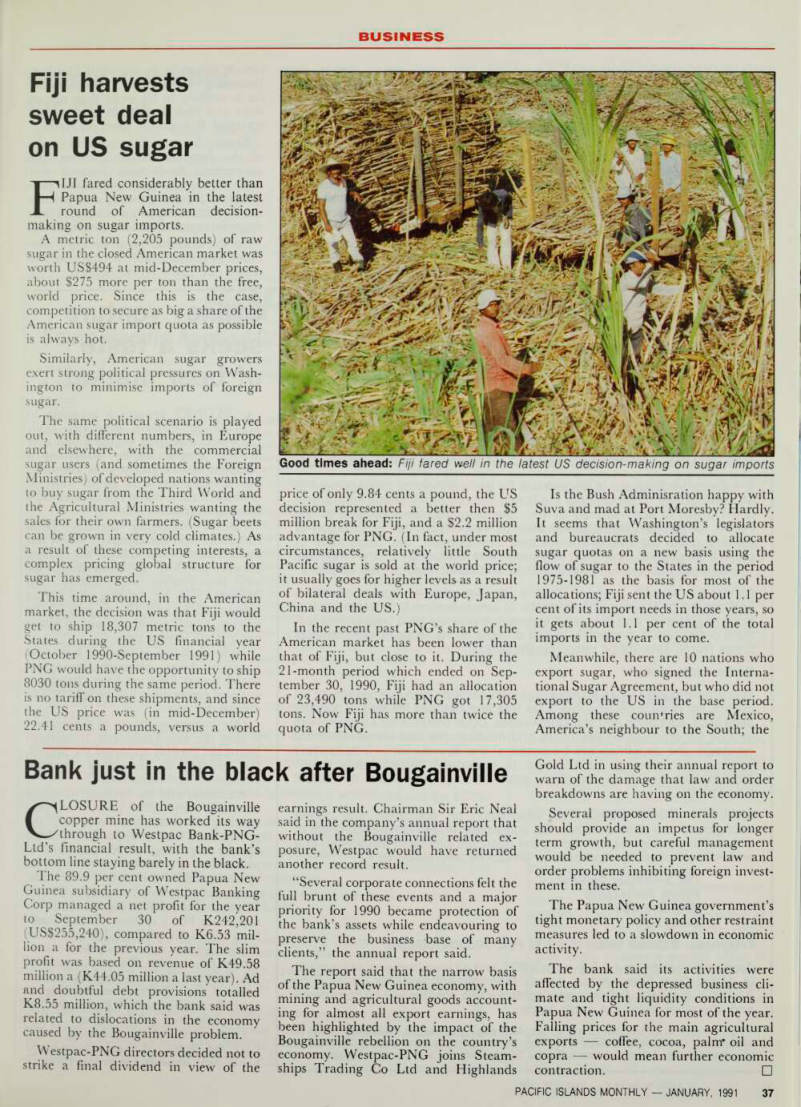
sweet deal on US sugar
FIJI fared considerably better than Papua New Guinea in the latest round of American decision
making on sugar imports.
A metric ton (2,205 pounds) of raw sugar in the closed American market was worth US$494 at mid-December prices, about $275 more per ton than the free, world price. Since this is the case, competition to secure as big a share of the American sugar import quota as possible is always hot.
Similarly, American sugar growers exert strong political pressures on Wash ington to minimise imports of foreign sugar.
The same political scenario is played out, with different numbers, in Europe and elsewhere, with the commercial sugar users (and sometimes the Foreign
Ministries) of developed nations wanting
to buy sugar from the Third World and the Agricultural Ministries wanting the sales for their own farmers. (Sugar beets can be grown in very cold climates.) As a result of these competing interests, a complex pricing global structure for sugar has emerged.
This time around, in the American market, the decision was that Fiji would get to ship 18,307 metric tons to the States during the US financial year (October 1990-September 1991) while PNG would have the opportunity to ship 8030 tons during the same period. There is no tariff on these shipments, and since the US price was (in mid-December) 22.41 cents a pounds, versus a world
price of only 9.84 cents a pound, the US decision represented a better then $5 million break for Fiji, and a $2.2 million advantage for PNG. (In fact, undermost circumstances, relatively little South Pacific sugar is sold at the world price; it usually goes for higher levels as a result of bilateral deals with Europe, Japan, China and the US O In the recent past PNG’s share of the American market has been lower than that of Fiji, but close to it. During the 21-month period which ended on September 30, 1990, Fiji had an allocation of 23,490 tons while PNG got 17,305 tons. Now Fiji has more than twice the quota of PNG.
Is the Bush Adminisration happy with Suva and mad at Port Moresby? Hardly, It seems that Washington’s legislators and bureaucrats decided to allocate sugar quotas on a new basis using the flow of sugar to the States in the period 1975-1981 as the basis for most of the allocations; Fiji sent the US about 1.1 per cent of its im P ort needs in those years, so S ets about 1.1 per cent of the total imports in the year to come.
Meanwhile, there are 10 nations who export sugar, who signed the Interna tional Sugar Agreement, but who did not export to the US in the base period, Among these counties are Mexico, America’s neighbour to the South; the
Good times ahead: Fiji fared well in the latest US decision-making on sugar imports
sorely troubled island of Haiti; and PNG.
The US State Department did not want these nations left out of the action, and set aside 80,300 metric tons for these 10 nations. Since it does not make economic sense to ship less than a boatload of sugar, these 10 nations are, in the eyes of Washington sugar people, the “boatload countries.” (A freighter can carry more than 8,030 tons of sugar, but this is the size of a boatload as defined
through governmental compromises.)
The new US sugar programme con tains another provision which might be useful to South Pacific sugar exporters.
Until this year, sugar quotas were absolute. From now on there will be an additional feature to the system sugar exporters can ship to the US if they are willing to pay a 16-cent a pound tariff.
Thus, if a 17-cent gap shows up between US and world prices, it would make sense for exporters to start shipping to the American market. (It costs about a penny a pound to ship and unload raw sugar.) The current price gap is about 12.5 cents.
A gloomy note: a serious crop failure, which would open the market wider to
South Pacific imports, is unlikely. Sugar
cane is grown in six scattered locations (including Hawaii), and a natural disas ter is unlikely to hit more than one of these at a time; further, sugar beets are scattered through the lower 48 states.
Finally, because of the political power of the American sugar growers, the government funds basic research and extensive technical assistance pro grammes for the growers, and permits the Florida cane growers to bring in low wage, foreign workers for manual labour.
So the domestic sugar industry con tinues to produce more product, and to crowd out Third World imports. □
Bank just in the black after Bougainville
°h
?hrT*V
through to Westpac Bank-PNG- Ltd’s financial result, with the bank’s bottom line staying barely in the black.
The 89.9 per cent owned Papua New Guinea subsidiary of Westpac Banking Corp managed a net profit for the year ° «o=fo"^ er 30 , of K 242,201 (Uoszss,Z4U), compared to K 6.53 million a for the previous year. The slim million and doubtful 'debt provisions 7 totaled K 8.55 million, which the bank said was related to dislocations in the economy caused by the Bougainville problem. r W estpac-PNG directors decided not to strike a final dividend in view of the
earnings result. Chairman Sir Eric Neal said in the company s annual report that without the Bougainville related ex posure, Westpac would have returned another record result.
Several corporate connections felt the full brunt of t ' llese events and a major priority for 1990 became protection of the bank’s assets while endeavouring to preserve the business base of many clients,” the annual report said.
The report said that the narrow basis of .'b e Pa Pu a New Guinea economy, with mmi r ng T* § oods account fo,r. “£*“*• al * ex PP rt .earnings has £een H 1? , 1 8 h,ed ft the lna P act of ,h , e Bougainville rebellion on the country s
economy. Westpac-PNG joins Steam
ships Trading Co Ltd and Highlands
warn of the damage that law and order breakdowns are having on the economy.
Several proposed minerals projects should pro ; ide F an impetus for longer , u . . ri s , but careful management wo , uld be needed to prevent law and fnlesT f ° re ‘ gn mVeS ‘' ’ l " tneSe ’ . I he Pa P ua New Guinea government s tight monetary policy and other restraint measures led to a slowdown in economic
activity.
The bank said its activities were affected by the depressed business cli mate and tight liquidity conditions in Papua New Guinea for most of the year Falhng P nces *? r ,he ma m agricultural exports conee, cocoa, palm* oil and copra would mean further economic contraction. □
Sydney venture
seeks a taste of beer market
A SYDNEY venture is planning to take on Carlton Breweries (Fiji) Ltd’s near monopoly on the Fijian beer market. Austral Pacific Marketing is behind a new company to be known as Fiji Brewing Co Ltd, which aims to establish a niche market in the country’s
brewing market.
Austral Managing Director Jason Alexander said the company would not tackle Carlton head to head: the existing brewery just had too much muscle for any price-cutting war. Rather, Fiji Brewing will be looking to attract between eight and 10 per cent of the market, which would amount to about one million litres a year.
Its product line will include lager and premium beers, although no actual brand names have yet been chosen - a national competition will be held for this during the year.
One interesting aspect of the venture is that the Fiji Trade and Investment Board has not only approved the project, but granted it unspecified financial concessions and incentives.
Alexander said the brewery would be exporting some of its production after building its domestic base, but the government has not apparently insisted on the exporting of 95 per cent of production a condition for companies operating under the tax-free zone rules.
Austral plans to take between 20 and 30 per cent of Fiji Brewing, and raise the remaining F 52.3 million (US$l.94 mil lion) within the country. The plan is for the local shares to be available for over the-counter trading. Twenty per cent of the shares in the new brewery will be reserved for Fiji residents wanting to apply for small parcels. It is planned that most of the staff will be Fijian.
Carlton has held its monopoly in Fiji since the closure of the Lautoka-based South Seas Brewing Co in the 19705. D
Advertisements & other items, p. 38 (1 item)
V Vacancy
FORUM SECRETARIAT
Applications are invited from suitably qualified and experienced persons who are citizens of a member country* of the South Pacific Forum, for the following position with the Forum Secretariat:
EXECUTIVE ENGINEER, TELECOMMUNICATIONS DIVISION
The Executive Engineer is responsible for the engineering management of all development projects under the Forum Telecommunications Programme (FTP) which is administered by the Telecommunications Division of the Forum Secretariat. He/She will also be responsible for preparation of forward plans for telecommunications development, the preparation of project proposals, and the assembly and updating of the Regional Telecommunications Funding Schedule and associated project dossiers.
Applicants should have a degree or diploma in Communications, Engineering or Science with evidence of specialisation in telecommunications engineering and extensive experience working for a telecommunications organisation, preferably in one or most of the relevant technological areas (rural, satellite or radio transmission).
General Information This appointment carries an attractive remuneration package payable in Fiji dollars. For non-Fiji citizens this is tax free and includes housing or housing allowance, education and child allowances. Other benefits for all employees include superannuation payments and medical, life and travel insurance coverage. The appointee will be based at the Secretariat’s Headquarters in Suva, Fiji, but will be required to undertake periodic duty travel.
Appointment would be for three years initially, renewable by mutual agreement.
Applicants should provide full information on education and career background and should list names, addresses, and telephone numbers of at least three referees with whom the applicant has been associated in a professional capacity. Applications should be addressed to: The Secretary General Forum Secretariat GPO Box 856 Suva, Fiji Telephone: 312600 Telex: 2229 FJ Fax: 302204/301102 Applications close on 15 February, 1991 and all enquiries should be made to Mrs Lailun Khan, Acting Head, Management Services Division on 313600, Ext. 263. Previous applicants for this position will be considered and, therefore, need not apply again. * Forum Secretariat Member countries are: Australia, Cook Islands, Federated States of Micronesia, Fiji, Kiribati, Nauru, Niue, New Zealand, Papua New Guinea, Republic of Marshall Islands, Solomon Islands, Tonga, Tuvalu, Vanuatu and Western Samoa.
for power
Trade Winds
Ocean currents for power
A POWER station using differing ocean temperatures is being investi gated for the Cook Islands. A consultant to the country’s ministry of planning and economic development said a 1.5 mega watt plant could be built for about NZ$32 million (US$2O million) and significantly reduce the country’s energy costs by lessening dependence on impor ted oil. The method under investigation
relies on the considerable differences in ocean temperatures at various depths, with the varying water sources being used to vaporise and condense ammonia, which in turn drives a turbine.
Kerosene prices leap Prices of kerosene in the Cook Islands have been hard hit by the Middle East crisis, and the fuel leapt by 50 per cent in price in just one week recently — from NZ7Oc a litre to NZ$l.O5 a litre. The South Pacific has been hit since oil prices rose after the invasion of Kuwait.
Samoa
Inflation worries in Apia Western Samoa’s inflation rate has leapt from 4.2 per cent to 16.1 per cent in a year, those being the respective figures for the September 1989 and September 1990 quarters. Pacific Commercial Bank said the main cause is the influx of large amounts of money for cyclone relief and its use to buy imported foods to replace crops lost in the storms. Remittances from Samoans abroad also increased by about 30 per cent. The general manager of the Bank of Western Samoa, Bob de Courtney, said the rate could go as high as 18 per cent higher than any other South Pacific island nation.
Papua New Guinea
Fisheries talks collapse Negotiations between Papua New Guinea and Japan over a fisheries agreement have been suspended for the fifth time. The problem is that the two countries can get nowhere near an agreement on catch payments. Papua New Guinea wanted six per cent of the value of each catch, but Japan offered only four per cent. The previous fishing agreement was terminated in 1987 in a battle over fees.
State spending to fall Government spending is falling, accord ing to the Bank of Papua New Guinea.
The central bank said expenditure would be down by 5.6 per cent in real terms over the three years. Bank governor Sir Henry Torobert said there had been a sharp decline in spending for goods and services which required clear prioritisation within government depart ments.
Inflation keeps rising Papua New Guinea’s inflation rate increased to 8.1 per cent in the third quarter of 1990, and is expected to reach double figures in the three months ending December. This compares with an average rate in 1989 of 4.4 per cent.
The major causes were higher food and transport costs resulting from the devalu ation of the kina.
Fiji
Fiji clinches Japan sale Fiji has acquired a third long term sugar contract with a Japanese company agreeing to take US$36 million worth of the product over the next three years.
The agreement will open the way for Fijian sugar to enter a market which it has not penetrated in any major way previously. Fiji’s two main sugar cus tomers are the European community and
Malaysia.
Tax free zone limits Tax free zones may not be needed in Fiji within 15 to 20 years if the economy
continues to become more stable, the Permanant Secretary for Trade and Commerce, Nelson Delailomaloma, said at a recent conference in Suva. In the meantime, policies which have allowed the garment industry to grow could mean that other types of industries could be attracted by tax-free status which Fiji allows for export-oriented industries.
NZ bid for Fiji TV TELEVISION New Zealand appears to be trying to get a jump on its competitors by offering Fiji a six-month free trial television service. The company is one of five on the short list compiled by the Fiji
Government to provide a national cover age once.a decision is made to introduce medium. The New Zealand offer is f° r trial to cover only Viti Levu, but TVNZ is reported to want an exclusive contract to follow the trial period, Changes to tax Fiji is to have a value added tax (vat) from July 1992, and it will constitute part th? government’s plan to change the taxation system. This was announced in
FS6I2 million Fiji budget by Finance
Minister Josevata Kamikamica. The new
tax will replace various indirect imposts, including customs and excise duties, hotel turnover tax and other miscel laneous taxes. But taxes on alcohol and tobacco products will remain.
The new vat of 10 per cent will apply to all local production and imports, and cover all businesses apart from a few such as farming, companies with a turnover of less than F$ 10,000 (US$7OOO) a year, domestic rents, non-processed fruits, veg etables, meat and public transport.
New Caledonia
Plans to build thermal station International tenders are to be called for a 24 megawatt oil-fired thermal power station to be built in New Caledonia.
The station is to be located in Nord province, about 300 km north of Nou mea. Two generators, each of 12 mw, are to be installed on a 12ha site, together with three tanks each capable of holding 10,000 tonnes of oil. The estimated cost of the project is US$57 million, and the work is due for completion in late 1992.
Tuvalu
Lagoon runway feasible Tuvalu’s government has received a preliminary study which shows that it is feasible to build a new runway on Funafuti incorporating a raised platform running into the island’s lagoon. The study, undertaken by two French avi ation experts from New Caledonia, was aimed at developing a plan for a new airport capable of taking Boeing 737 jets.
Tuvalu’s current airstrip is suitable only for prop or turbo-prop smaller airliners.
It is unlikely the government will make any decision on the proposal in the near future due to the enormous cost.
Micronesia
Aid for Marshalls fishery Fisheries resources in the Marshall Islands are to be assessed under an Asian Development Bank technical assistance grant of US$lOO,OOO. The money will be used to prepare the first phase of the fisheries development project, which is designed to meet the government’s devel opment goals to increase employment and incomes and reduce imports. The project will aim at providing improved fishing gear and vessels, infrastructure and marketing services with eventual expansion of private sector fishing.
More Guam air links Rapidly expanding air services through out Micronesia will grow still further now that Philippine Airlines has begun operating between Manila and Guam twice a week, using a 240-seater airbus 300. Meanwhile, Continental Air Micro nesia has started up its planned Guam- Seoul service. O
Advertisements & other items, pp. 39-40 (1 item)
Soprc
South Pacific Applied Geoscience Commission
Applications are invited from nationals of SOPAC member countries for the postion of Finance and Administration Controller in the SOPAC Technical Secretariat, located in Suva, Fiji.
SOPAC
SOPAC is an inter-governmental organisation comprising fourteen South Pacific countries as members*. Its main objective is to assist its member countries in the identification and assessment of the marine mineral and other non-living resource potential of their offshore areas within their respective national Exclusive Economic Zones, in the planning and management of development in their coastal areas, and in the training of their nationals in all relevant areas within the SOPAC Work Programme.
The SOPAC Technical Secretariat currently has a staff establishment of 50 people and SOPAC has a staff establishment of 50 people and SOPAC has an annual budget of between Fslo million each year.
The Finance and Administration Controller is responsible to the Director of the Technical Secretariat for the accounting and financial management functions, and for the general administration, of the SOPAC Technical Secretariat. Duties will include the preparation and management of the SOPAC Budget, the preparation of requests and financial reports to donor sources, the costing of work programme requests and the submission of regular financial reports to the member countries.
This is a senior management position and applicants must have a proven record and extensive experience at a high level in financial and general management.
Relevant professional or tertiary qualifications, familiarity with accrual accounting and proficiency in appropriate computer skills are pre-requisites.
Appointment Appointment to this position will be made by the Director of the Technical The Finance and Administration Controller is in the professional staff category and the appointment will be by contract. The contract period will be for 3 years in each instance including a 6 months probationary period on first appointment.
Remuneration An attractive remuneration package will be offered in accordance with the SOPAC terms and conditions of employment.
Starting salary will be within the range of F 534,869 to $43,600 depending on qualifications, experience and prevailing salary levels in country of recruitment.
Sint 11 appointee fr ° m outside Fiji, salary will be supplemented by an establishment fusing allowance, child allowance and education assistance, and remuneration will be exempted from Fiji income tax.
Details of general terms and conditions of employment may be obtained from Mrs Nazmeen Whippy on 381-377 or fax 370-040.
Application All applications should be fully documented qualifications and experience, and the names of and include relevant details three referees. of Administration Controller Application”, Suva d Fijf addressed t 0 the director, SOPAC Technical Secretariat, Private Mail Bag, The deadline for applications is Thursday 31 January 1991. *.,. SOPAC member countries are: Australia, Cook Islands, Fiji, Federated States of U H m T Kiribat ' f N f w Zealand, Marshall Islands, Papua New Guinea, Solomon Islands, Tonga, Tuvalu, Vanuatu, Western Samoa.
POSITION OPENING
Family Planning Project Officer
Applications are invited for the position of Project Officer with the South Pacific Alliance for Family Health (SPAFH), a non-governmental agency working to improve family planning programmes throughout the South Pacific region.
The position requires a person with a university degree (equivalent of a bachelor’s degree) in a relevant area, such as medicine, nursing/midwifery, public health, or education, and 3 to 5 years of experience in the family planning field. Applicants must be citizens of the SPAFH member countries (the Cook Islands, Fiji, Kiribati, Niue, Papua New Guinea, the Solomon Islands, Tonga, Tuvalu, Vanuatu and Western Samoa).
The position carries a high level of responsibility for project development, implementation, and evaluation, proposal writing (for funding purposes), and providing technical assistance to various family planning groups. The position requires expertise in at least two of the following areas; 1) family planning service delivery, (i.e., logistics, clinic management) 2) family planning information, education, and communications projects, 3) family planning promotion and social marketing, 4) training of family planning workers, 5) population policy formation and analysis, 6) project management and/or proposal writing. Demonstrated familiarity with regional family planning agencies and issues is desirable. The position requires some travel.
The position is based in Nukualofa, Tonga and the initial contract will be for three years and is renewable. Benefits include a tax free salary of US$l5,OOO to $lB,OOO per year depending upon experience, a housing allowance of U 553,600 per year, health insurance, and a relocation allowance.
Interested persons should submit: 1) a resume (curriculum vita) containing details of their education and past employment and experience, current address, telephone, FAX, and/or telex numbers, 2) a list of three professional references (with current address, telephone, FAX, and telex numbers for the references), 3. a writing sample (a short report or paper written solely by the applicant), if possible The closing date for applicantions is January 20,1991. Faxing a cover letter expressing interest (and providing a contact address and FAX/phone numbers) is recommended due to heavy holiday mail and resulting mail delays. Please submit applications to: The Secretary General Telephone: (676) 22-722
SPAFH FAX: (676) 24-047
P.O. Box 729 Telex: 6622 CW ADMT6 Nukualofa Kingdom of Tonga South Pacific
Cruise ships make a comeback
THE cruise ship business is looking better for the South Pacific. Pacific Island Monthly’s analysis of the semi annual, comprehensive tabulation of cruise ship schedules world-wide, pub lished by the New York Times shows a doubling of South Pacific listings, com pared to the last two Times tabulations.
Excluding both the cruise activity in the Hawaiian islands and the expanding business in the sub-antarctic areas of the South Pacific (more about this later), the October 28 Times listed 20 ships as visiting the islands of the South Pacific.
This compared to nine such listings in February, 1990, and 11 notations in October, 1989.
Among the new listings are: A Trans-Pacific passage, with stops in Pago Pago, Suva and Lae, by the massive Qtieen Elizabeth 2; 9 Calls upon a whole string of rarely visited islands in FSM and PNG by Linblad’s newly-launched Frontier Spirit ; and 9 The arrival of a third Soviet cruise ship in South Pacific waters, the Fyodor
Dostoyevsk.
In general terms the cruise business is expanding rapidly, and the South Pacific gets relatively little of it, but that portion appears to be growing.
Estimates for the number of North Americans alone going on cruises of three or more days, somewhere in the world, shows a climb from half a million in 1970, to 3.3 million in 1989 and 3.6 million in 1990. The business is expected to keep growing, with more ships and more passengers. To some extent this is fueled by a combination of demographics, economics and politics in the First World. More people live longer, retire earlier, and have more in the way of public and private pensions than ever before in these nations, and that’s good for the cruise business.
The South Pacific, however, is distant from most First World population centers, and it is easier, less expensive and quicker to do one’s cruising in the Mediterranean or the Carribean than in the South Pacific. So while the Times most recent cruise issued showed 20 South Pacific listings, the world-wide total was 184; the proportion with at least one stop in the South Pacific was thus about 11 per cent, compared to about 3 per cent six months earlier, but still most cruises go elsewhere. The most recent tally was for travel during the northern hemisphere winter, from the beginning of November to the end of
February.
When a cruise ship arrives in port it does wonders for the local economy; let’s assume a modest S4O per tourist for taxis, drinks, lunch and shopping. This would
create a one-shot 575,000 jolt to the service economy of any port visited by the 1,864-passenger QE2, or 56,500 when the Frontier Spirit came to town. Cruise ship tourism means that nobody has to invest in hotel rooms, or airport expan sions, to accommodate the extra business but it does jam the restaurants at lunchtime when the ship is in port.
Perhaps the best-known of the new comer ships to the Pacific, after the Qe2 , is the 1050-passenger Achille Lauro\ it secured its fame in a grim way off the coast of Egypt when, a couple of years ago, Palestinian terrorists killed one of its American passengers. The victim, par tially crippled, was thrown overboard, wheelchair and all by the gang. The Achille Lauro, as a consequence, spends less time in Middle Eastern waters these days. It will be based in Sydney for a while, and will visit Noumea, Isle of Pines (both in New Caledonia) as well as the Australian islands of Norfolk and Lord Howe.
The most interesting of the newcomers is the Frontier Spirit. The ship is owned by the Linblad organisation (the Rolls Royce of the business), it is designed to be sensitive to environmental issues, and it visits truly out-of-the way places. The
ship, launched in Kobe in June, 1990, made its maiden voyage in November.
Among its state-of-the-art features are its
waste-disposal systems: the departing
bilge water is filtered through an oil separator so that no oil is discharged.
Further, non-biodegradable waste is frozen at sea for processing and disposal once it returns to port.
On its maiden voyage, the Frontier Spirit was scheduled to sail from Guam to Rabaul stopping at Chuuk and such oft neglected FSM islands as Lamotrek, Puluwat, Satawan, and Kapingamar angi. After Rabual, despite the civil disturbances, it was scheduled to call at Bougainville, the only cruise ship listed with such plans. Then it was to go through the Solomons, again stopping at islands not listed for others (such as Choisel and Malaita) before heading via Vanuatu to New Zealand. Along the way it planned to visit two of New Zealand’s remote and inaccessible Kermadec Islands (Raoul and Macauley.) fFour types of cruise ship Would-be passengers have four types of cruise ships to choose from in the South Pacific.
There are the round-the-world ships, such as the QE2, the Canberra , the SagaJjord and the Royal Viking Sun , all of which will pass through the area. There are also two Soviet ships, the
Azerbaydzhan, returning again this
year, and the newcomer, the Fyodor
Dostoyevsky.
Then there are seven ships which are based in the South Pacific, and which sail waters close to their home ports. The Melanesian Explorer and Discoverer work the coastal and river waters of Papua New Guinea, while sail- and enginepowered Wing Song does a series of weeklong tours from its Tahiti base. Similarly, though not listed by the Times , the Pairs tar works the waters of Fiji and Vanuatu, and there are three ships that serve the Galagapos Islands.
Another specialised category is the ships, like the Frontier Spirit , which travel to out-of-the way places, including uninhabited islands. Included in this grouping is the World Discoverer which will start one of its voyages in Port Moresby this season. It, or its sister ship, Society Explorer , will visit Pitcairn, and uninhabited Dulcie and Henderson, later in the year.
Finally there are the six traditional cruise ships usually making two-to-three tours of some of the more traditional ports. These include the Belorussiya (an
other Russian ship), the Vistafjord, the Royal Viking Sky, the Pacific Princess and the Sea Princess, and the Ac hill e Lauro.
Islands Visited. Fiji and French Polynesia are the favorites of the cruise
ship managers. Excluding the ships based
in a particular location, eight cruise ships will call in Fiji and Mystery Island, with the Sea Princess paying the only record visit to Rotuma.
Tahiti, Bora Bora, and Moorea are frequently visited, with French Polynesia drawing seven ships. Kona, Nuku Hiva and Rangiroa are scheduled for single visits.
Papua New Guinea will be visited by six ships, with most of them calling at Port Moresby. Lae is only visited by the Qf2 , while Rabaul gets a couple of visitors, and Kavieng and Bougainville are on the Frontier Spirit schedule.
Tonga is also on the list for six ships, with most calling at Nukualofa, but the Frontier Spirit will also stop at Ata and the Fyodor Dostoyevsky at Vava’u, American Samoa perhaps because many of the passengers are American draws five visits to Pago Pago, while Western Samoa get only one call, from the Royal Viking Sky. Vanuatu and New Caledonia will each play host to four ships, with several of them stopping at Isle of Pines.
The Solomons, in addition to the multiple stops for the Frontier Spirit, draws only one other listed ship, the Belorussiya.
There are single notations of visits to Guam, to the Cooks (Raratonga), and to Kiribati (Christmas Island) and of the previously-mentioned calls in FSM.
Among the independent nations of the South Pacific, only Nauru and Tuvalu failed to make the listings. While the Time’s tabulation is clearly not complete, it is at least a good sample of the cruise schedules.
One of the recent trends in cruise ship scheduling is to take passengers to Far South Pacific islands where there are no resident populations. Both World Dis coverer and Frontier Spirit will spend much of this cruising season the Antarctic summer visiting remote islands in that area. These include the Snares, Auck land Island, Campbell Island, and Balleny Islands. The World Explorer will call also upon a chilly but inhabited place, New Zealand’s Chatham Islands, on its cruise to Antarctica.
Costs. There is a wide range in costs, which are usually quoted per person (assuming double occupancy) and in US dollars; flying to and from the cruise ship is often included. The round-the-world trip on the QE2 comes in a wide range of prices from 522,935 to 539,744. Two weeks on the Pacific Princess, going from Tahiti to Sydney, is about SB,OOO. Three to-seven night trips on the Melanesian Explorer and the Melanesian Discoverer come to about S3OO a night. □
Advertisements & other items, pp. 41-42 (1 item)
1H Co., Ltd.
KYOWA
KYOWA j SHIPPING
Liner Service to Paciffic Islands
FROM OJAPAN
CKOREA
OTAIWAN
THAILAND
TO OSAIPAN
OFEDERATED STATES
OF MICRONESIA
OMARSHAL ISLANDS
©AMERICAN SAMOA
ONEW CALEDONIA
OFIJI
OHONG KONG
OSINGAPORE
OPHILIPPINES
6 MALAYSIA
©INDONESIA
©GUAM
©YAP
©PALAU
©WESTERN SAMOA
©SOLOMON ISLANDS
©VANUATU
©PAPUA NEW GUINEA
HEAD OFFICE
6th Floor. Kikushima Bldg 2-3, Hamamatsucho 2-chome Mmato-ku, Tokyo 105. Japan Phone; 03(437)2885 (Rep ) Cables: MARIQUEEN Tokyo Telex: 242-4651 Kyowa J
OSAKA OFFICE
Dai San Fuji Bldg. 3-13. Itachibon 1-chome, Osaka 550.
Phone: 06(533)5821 (Rep ) Cables: MARIQUEEN" Osaka Telex: 525-6271 Ssiosa J,
SOPHC
South Pacific Applied Geoscience Commission
Applications are invited from nationals of EC and Pacific ACP countries for the position of a nn£f, „T c Co -° rdlna ‘ or the SOPAC Technical Secretariat, financed by the European Community, European Development Fund. M an inter-governmental organisation composed of fourteen South Pacific countries as M m t ary ° bje K Ct,VeS ° f the or g anisation are survey the inshore, nearshore and offshore areas of its member countries, to identify the marine mineral and other non-livine studi J p r rpnd t t ont,a W t thm the ' r . Exclusive Economic Zones, to undertake coastal management fpphnL. c ♦ ,n P[° vl 2 ir, g trainin S t 0 Pacific ls,and nationals in all relevant areas. The Technical Secretariat is the Executive arm of SOPAC and is located in Suva, Fiji.
QUALIFICATIONS AND EXPERIENCE
..ASd n J Versit y degree and/or relevant tertiary qualification. At least 10 years of extensive r: k^f. P f nenCe J n th 6 mana §ement of aid programmes, especially administration, including ft f and execution of contracts, financial accounting and reporting. Experience with advantage 5 WOU dbe an advanta S e - A background in the geo-sciences should also be an
LANGUAGE
Fluency in oral and written ENGLISH is essential.
JOB DESCRIPTION
(a) the administration and management of the EEC supported component of the SOPAC Work Programme, i.e. (i) !',?£ the annual work programme and budget for the "Technical Assistance to SOPAC component of the Pacific Regional Marine Resources Programme funded under Lome III; preparing documentation related to the tendering for and purchasing of major items of equipment; other administrative matters relating to the implementation of the Technical Assistance to SOPAC component; preparing documentation related to regular reporting on the programme’s progresspreparing dossiers for application for assistance to SOPAC under Lome IV. in the preparation of documentation relating to the formulation, planning and SJSI?E!l n P tlon of the SOPAC Work Programme as a whole, including the preparation of SOPAC S long term conceptual Work Programme, the annual SOPAC Work Plan, and approaches to aid sources for programme support; any other programme co-ordination task, as required.
TERMS AND CONDITIONS OF APPOINTMENT
Tenure Appointment to the above position will be 3 years in the first instance.
Remuneration An attractive remuneration package will be paid to the appointee, depending on qualification and experience. Starting salary will be within the range F 526,160 to $32,700.
An appointee who is not a national of Fiji and who is recruited from outside Fiji will also be eligible for the following: passage and freight allowance; establishment grant, housing allowance, child allowance and education assistance; exemption from Fiji income tax on his or her remuneration; home leave passage after every second year of service.
FAY U ?7 6r information about the Position can be obtained from SOPAC Telephone 381-377, • AX 370-040.
Applications All applications should be fully documented and include a copy of birth certificate, details of work experience and qualifications and the names of at least three referees. Applications marked PROGRAMME CO-ORDINATOR should reach the Director, South Pacific Applied Geoscience Commission (SOPAC), Private Mail Bag, Mead Road, Fiji, by 15 February 1991. (ii) (iii) (iv) (v) (b) (c)
state of
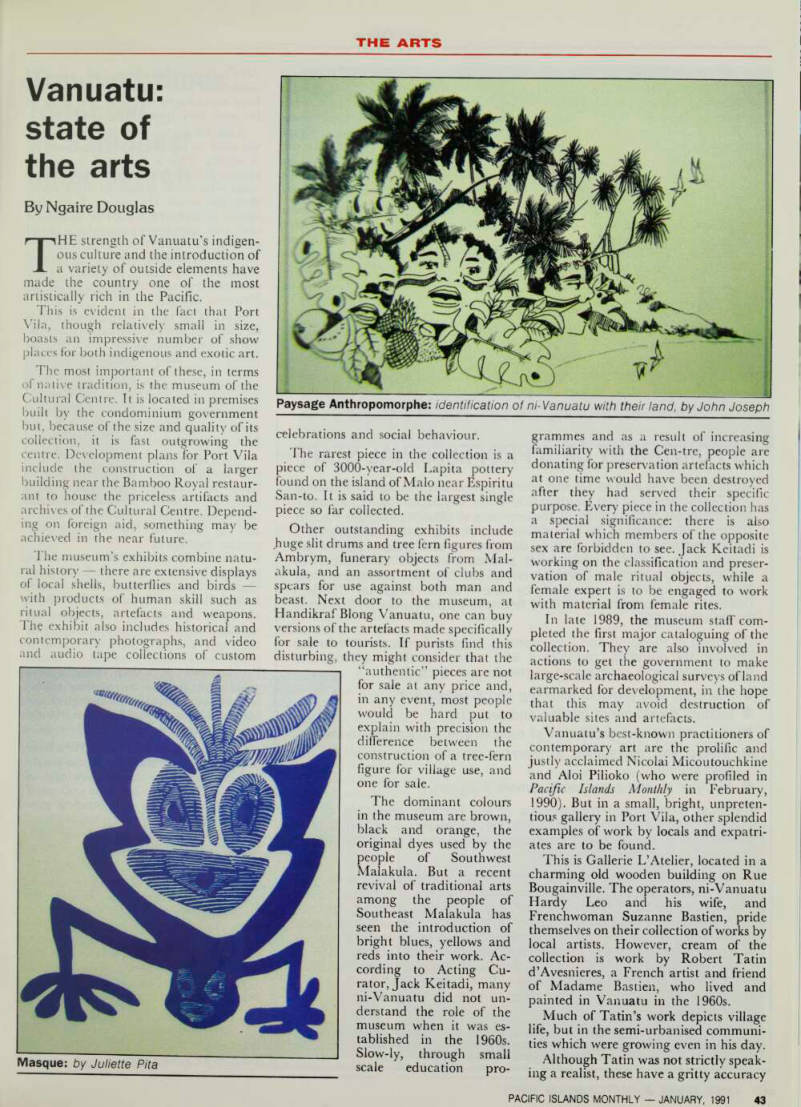
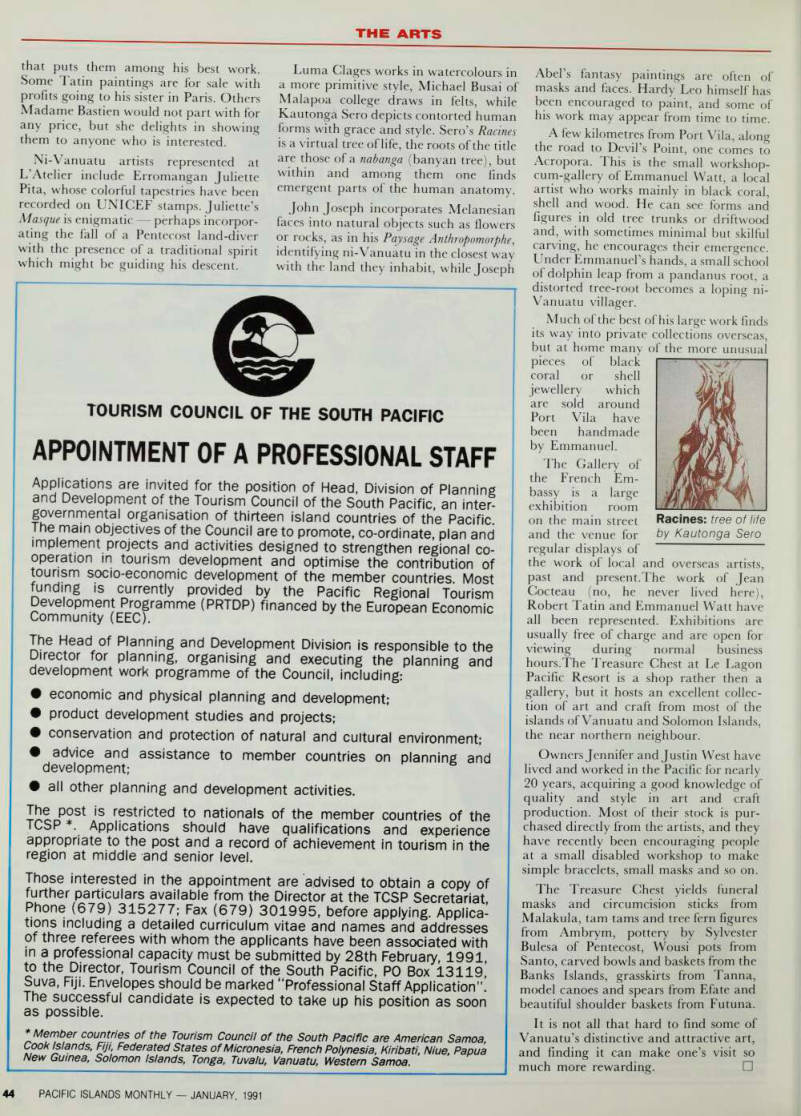
The Arts
Vanuatu: state of the arts
By Ngaire Douglas
THE strength of Vanuatu’s indigen ous culture and the introduction of a variety of outside elements have made the country one of the most artistically rich in the Pacific.
This is evident in the fact that Port Vila, though relatively small in size, boasts an impressive number of show places for both indigenous and exotic art.
The most important of these, in terms of native tradition, is the museum of the Cultural Centre. It is located in premises built by the condominium government but, because of the size and quality of its collection, it is fast outgrowing the centre. Development plans for Port Vila include the construction of a larger building near the Bamboo Royal restaur ant to house the priceless artifacts and archives of the Cultural Centre. Depend ing on foreign aid, something may be achieved in the near future.
The museum’s exhibits combine natu ral history there are extensive displays of local shells, butterflies and birds with products of human skill such as ritual objects, artefacts and weapons.
The exhibit also includes historical and contemporary photographs, and video and audio tape collections of custom
celebrations and social behaviour.
The rarest piece in the collection is a
piece of 3000-year-old Lapita pottery
found on the island of Malo near Espiritu San-to. It is said to be the largest single piece so far collected.
Other outstanding exhibits include huge slit drums and tree fern figures from Ambrym, funerary objects from Mal akula, and an assortment of clubs and spears for use against both man and beast. Next door to the museum, at Handikraf Blong Vanuatu, one can buy versions of the artefacts made specifically for sale to tourists. If purists find this disturbing, they might consider that the
“authentic” pieces are not for sale at any price and, in any event, most people would be hard put to explain with precision the difference between the construction of a tree-fern figure for village use, and one for sale.
The dominant colours in the museum are brown, black and orange, the original dyes used by the people of Southwest Malakula. But a recent revival of traditional arts among the people of Southeast Malakula has seen the introduction of bright blues, yellows and reds into their work. Ac cording to Acting Cu rator, Jack Keitadi, many ni-Vanuatu did not un derstand the role of the museum when it was es tablished in the 19605.
Slow-ly, through small scale education pro
grammes and as a result of increasing familiarity with the Cen-tre, people are donating for preservation artefacts which at one time would have been destroyed after they had served their specific purpose. Every piece in the collection has a special significance: there is also material which members of the opposite sex are forbidden to see. Jack Keitadi is working on the classification and preser vation of male ritual objects, while a female expert is to be engaged to work with material from female rites.
In late 1989, the museum staff com pleted the first major cataloguing of the collection. They are also involved in actions to get the government to make large-scale archaeological surveys of land earmarked for development, in the hope that this may avoid destruction of valuable sites and artefacts.
Vanuatu’s best-known practitioners of contemporary art are the prolific and justly acclaimed Nicolai Micoutouchkine and Aloi Pilioko (who were profiled in Pacific Islands Monthly in February, 1990). But in a small, bright, unpreten tious gallery in Port Vila, other splendid examples of work by locals and expatri ates are to be found.
This is Gallerie L’Atelier, located in a charming old wooden building on Rue Bougainville. The operators, ni-Vanuatu Hardy Leo and his wife, and Frenchwoman Suzanne Bastien, pride themselves on their collection of works by local artists. However, cream of the collection is work by Robert Tatin d’Avesnieres, a French artist and friend of Madame Bastien, who lived and painted in Vanuatu in the 19605.
Much of Tatin’s work depicts village life, but in the semi-urbanised communi ties which were growing even in his day.
Although Tatin was not strictly speak ing a realist, these have a gritty accuracy
Masque: by Juliette Pita
Paysage Anthropomorphe: identification of ni-Vanuatu with their land, by John Joseph
that puts them among his best work.
Some Tatin paintings are for sale with profits going to his sister in Paris. Others Madame Bastien would not part with for any price, but she delights in showing them to anyone who is interested.
Ni-Vanuatu artists represented at L’Atelier include Erromangan Juliette Pita, whose colorful tapestries have been recorded on UNICEF stamps. Juliette’s Masque is enigmatic perhaps incorpor ating the fall of a Pentecost land-diver with the presence of a traditional spirit which might be guiding his descent.
Luma Clages works in watercolours in a more primitive style, Michael Busai of Malapoa college draws in felts, while Kautonga Sero depicts contorted human forms with grace and style. Sero’s Racines is a virtual tree of life, the roots of the title are those of a nabanga (banyan tree), but within and among them one finds emergent parts of the human anatomy.
John Joseph incorporates Melanesian faces into natural objects such as flowers or rocks, as in his Paysage Anthropomorphe, identifying ni-Vanuatu in the closest way with the land they inhabit, while Joseph
Abel’s fantasy paintings are often of masks and faces. Hardy Leo himself has been encouraged to paint, and some of his work may appear from time to time.
A few kilometres from Port Vila, along the road to Devil’s Point, one comes to Acropora. This is the small workshop cum-gallery of Emmanuel Watt, a local artist who works mainly in black coral, shell and wood. He can see forms and figures in old tree trunks or driftwood and, with sometimes minimal but skilful carving, he encourages their emergence.
Under Emmanuel’s hands, a small school of dolphin leap from a pandanus root, a distorted tree-root becomes a loping ni- Vanuatu villager.
Much of the best of his large work finds its way into private collections overseas, but at home many of the more unusual
pieces of black coral or shell
jewellery which
are sold around Port Vila have been handmade by Emmanuel.
The Gallery of the French Em bassy is a large exhibition room on the main street and the venue for
regular displays of the work of local and overseas artists, past and present. The work of Jean Cocteau (no, he never lived here), Robert Tatin and Emmanuel Watt have all been represented. Exhibitions are usually free of charge and are open for viewing during normal business hours. The Treasure Chest at Le Lagon Pacific Resort is a shop rather then a gallery, but it hosts an excellent collec tion of art and craft from most of the islands of Vanuatu and Solomon Islands, the near northern neighbour.
Owners Jennifer and Justin West have lived and worked in the Pacific for nearly 20 years, acquiring a good knowledge of quality and style in art and craft production. Most of their stock is pur chased directly from the artists, and they have recently been encouraging people at a small disabled workshop to make simple bracelets, small masks and so on.
The Treasure Chest yields funeral masks and circumcision sticks from Malakula, tarn tarns and tree fern figures from Ambrym, pottery by Sylvester Bulesa of Pentecost, Wousi pots from Santo, carved bowls and baskets from the Banks Islands, grasskirts from Tanna, model canoes and spears from Efate and beautiful shoulder baskets from Futuna.
It is not all that hard to find some of Vanuatu’s distinctive and attractive art, and finding it can make one’s visit so much more rewarding. □
Racines: tree of life by Kautonga Sero
Advertisements & other items, p. 44 (1 item)
Appointment Of A Professional Staff
TOURISM COUNCIL OF THE SOUTH PACIFIC
Applic a ti° ns are invited for the position of Head, Division of Planning and Development of the Tourism Council of the South Pacific, an intergovernmental organisation of thirteen island countries of the Pacific.
The main objectives of the Council are to promote, co-ordinate, plan and implement projects and activities designed to strengthen regional cooperation in tourism development and optimise the contribution of tourism socio-economic development of the member countries Most funding is currently provided by the Pacific Regional Tourism Development Programme (PRTDP) financed by the European Economic
Community (EEC).
The Head of Planning and Development Division is responsible to the Director for planning, organising and executing the planning and development work programme of the Council, including: • economic and physical planning and development; • product development studies and projects; • conservation and protection of natural and cultural environment; • advice and assistance to member countries on planning and development; • all other planning and development activities.
J£orP* st is restr . icted t 0 nationals of the member countries of the TCSP . Applications should have qualifications and experience appropriate to the post and a record of achievement in tourism in the region at middle and senior level.
Those interested in the appointment are advised to obtain a copy of further particulars available from the Director at the TCSP Secretariat Phone (679) 315277; Fax (679) 301995, before applying. Applications including a detailed curriculum vitae and names and addresses of three referees with whom the applicants have been associated with in a professional capacity must be submitted by 28th February, 1991, to the Director, Tourism Council of the South Pacific, PC Box 13119’
Suva, Fiji. Envelopes should be marked “Professional Staff Application”!
The successful candidate is expected to take up his position as soon as possible. • Member countries of the Tourism Council of the South Pacific are American Samoa, Cook Islands, Fiji, Federated States of Micronesia, French Polynesia, Kiribati, Niue, Papua New Guinea, Solomon Islands, Tonga, Tuvalu, Vanuatu, Western Samoa.
Troubled times
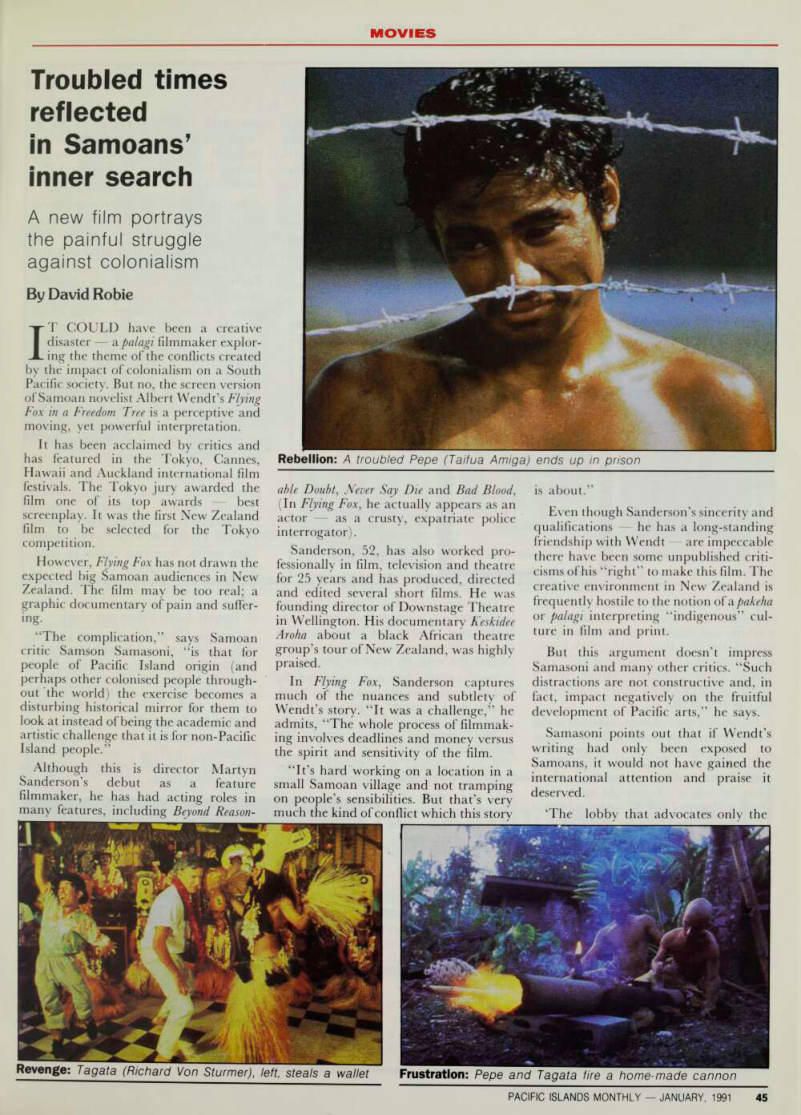
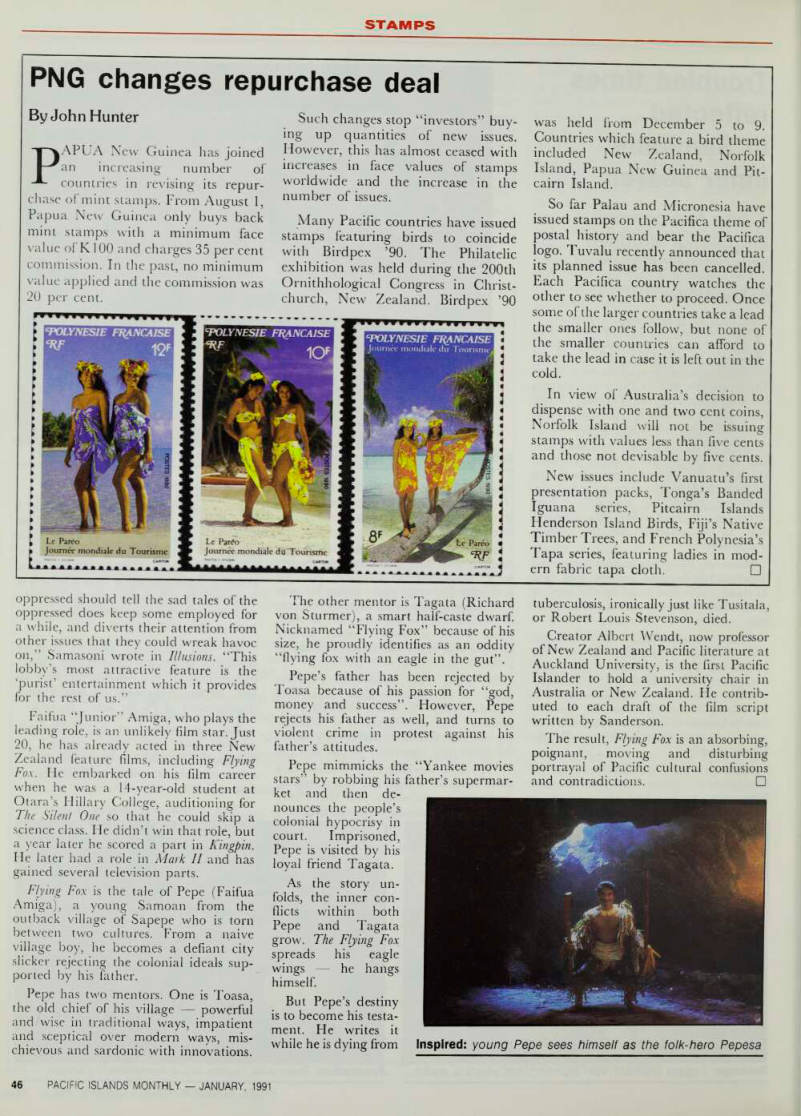
Movies
Troubled times reflected in Samoans’ inner search
A new film portrays the painful struggle against colonialism
By David Robie
IT COULD have been a creative disaster a palagi filmmaker explor ing the theme of the conflicts created by the impact of colonialism on a South Pacific society. But no, the screen version of Samoan novelist Albert Wendt’s Flying Fox in a Freedom Tree is a perceptive and
moving, yet powerful interpretation.
It has been acclaimed by critics and has featured in the Tokyo, Cannes, Hawaii and Auckland international film festivals. The Tokyo jury awarded the film one of its top awards best screenplay. It was the first New Zealand film to be selected for the Tokyo competition.
However, Flying Fox has not drawn the expected big Samoan audiences in New Zealand. The film may be too real; a graphic documentary of pain and suffer
ing.
“The complication,” says Samoan critic Samson Samasoni, “is that for people of Pacific Island origin (and perhaps other colonised people through out the world) the exercise becomes a disturbing historical mirror for them to look at instead of being the academic and artistic challenge that it is for non-Pacific Island people.”
Although this is director Martyn Sanderson’s debut as a feature filmmaker, he has had acting roles in many features, including Beyond Reason-
able Doubt , Never Say Die and Bad Blood , (In Flying Fox , he actually appears as an actor as a crusty, expatriate police interrogator).
Sanderson, 52, has also worked pro fessionally in film, television and theatre for 25 years and has produced, directed and edited several short films. He was founding director of Downstage Theatre in Wellington. His documentary Keskidee Aroha about a black African theatre group’s tour of New Zealand, was highly praised.
In Flying Fox , Sanderson captures much of the nuances and subtlety of Wendt’s story. “It was a challenge,” he admits, “The whole process of filmmak ing involves deadlines and money versus the spirit and sensitivity of the film.
“It’s hard working on a location in a small Samoan village and not tramping on people’s sensibilities. But that’s very much the kind of conflict which this story
is about.”
Even though Sanderson’s sincerity and qualifications he has a long-standing friendship with Wendt are impeccable there have been some unpublished criti cisms ofhis “right” to make this film. The creative environment in New Zealand is frequently hostile to the notion of a pakeha or palagi interpreting “indigenous” cul ture in film and print.
But this argument doesn’t impress Samasoni and many other critics. “Such distractions are not constructive and, in fact, impact negatively on the fruitful development of Pacific arts,” he says.
Samasoni points out that if Wendt’s writing had only been exposed to Samoans, it would not have gained the international attention and praise it deserved. ‘The lobby that advocates only the
Revenge: Tagata (Richard Von Sturmer), left, steals a wallet
Frustration: Pepe and Tagata fire a home-made cannon
Rebellion: A troubled Pepe (Taifua Amiga) ends up in prison
oppressed should tell the sad tales of the oppressed does keep some employed for a while, and diverts their attention from other issues that they could wreak havoc on,” Samasoni wrote in Illusions. “This lobby’s most attractive feature is the ‘purist’ entertainment which it provides for the rest of us.”
Faifua “Junior” Amiga, who plays the leading role, is an unlikely film star. Just 20, he has already acted in three New Zealand feature films, including Flying Fox. He embarked on his film career when he was a 14-year-old student at
Otara’s Hillary College, auditioning for
The Silent One so that he could skip a science class. He didn’t win that role, but a year later he scored a part in Kingpin.
He later had a role in Mark II and has gained several television parts.
Flying Fox is the tale of Pepe (Faifua Amiga), a young Samoan from the outback village of Sapepe who is torn between two cultures. From a naive village boy, he becomes a defiant city slicker rejecting the colonial ideals sup ported by his father.
Pepe has two mentors. One is Toasa, the old chief of his village powerful and wise in traditional ways, impatient and sceptical over modern ways, mis chievous and sardonic with innovations.
The other mentor is Tagata (Richard von Sturmer), a smart half-caste dwarf.
Nicknamed “Flying Fox” because of his size, he proudly identifies as an oddity “flying fox with an eagle in the gut”.
Pepe’s father has been rejected by Toasa because of his passion for “god, money and success”. However, Pepe rejects his father as well, and turns to violent crime in protest against his father’s attitudes.
Pepe mimmicks the “Yankee movies stars” by robbing his father’s supermar
ket and then de nounces the people’s colonial hypocrisy in
court. Imprisoned,
Pepe is visited by his
loyal friend Tagata.
As the story un folds, the inner con flicts within both Pepe and Tagata grow. The Flying Fox
spreads his eagle
wings he hangs himself.
But Pepe’s destiny is to become his testa ment. He writes it while he is dying from
tuberculosis, ironically just like Tusitala, or Robert Louis Stevenson, died.
Creator Albert Wendt, now professor of New Zealand and Pacific literature at Auckland University, is the first Pacific Islander to hold a university chair in Australia or New Zealand. He contrib uted to each draft of the film script written by Sanderson.
The result, Flying Fox is an absorbing,
poignant, moving and disturbing
portrayal of Pacific cultural confusions and contradictions. □
Inspired: young Pepe sees himself as the folk-hero Pepesa
PNG changes repurchase deal
By John Hunter
PAPUA New Guinea has joined an increasing number of countries in revising its repur chase of mint stamps. From August 1, Papua New Guinea only buys back mint stamps with a minimum face value of KlOO and charges 35 per cent commission. In the past, no minimum value applied and the commission was 20 per cent.
Such changes stop “investors” buying up quantities of new issues.
However, this has almost ceased with increases in face values of stamps worldwide and the increase in the numbcr of lssues ' Many Pacific countries have issued stamps featuring birds to coincide with Birdpex ’9O. The Philatelic exhibition was held during the 200th
Ornithhological Congress in Christ-
church, New Zealand. Birdpex ’9O
was held from December 5 to 9.
Countries which feature a bird theme included New Zealand, Norfolk Island, Papua New Guinea and Pit cairn Island.
So far Palau and Micronesia have issued stamps on the Pacifica theme of postal history and bear the Pacifica logo. Tuvalu recently announced that its planned issue has been cancelled.
Each Pacifica country watches the other to see whether to proceed. Once some of the larger countries take a lead the smaller ones follow, but none of the smaller countries can afford to take the lead in case it is left out in the cold.
In view of Australia’s decision to dispense with one and two cent coins, Norfolk Island will not be issuing stamps with values less than five cents and those not devisable by five cents.
New issues include Vanuatu’s first presentation packs, Tonga’s Banded Iguana series, Pitcairn Islands Henderson Island Birds, Fiji’s Native Timber Trees, and French Polynesia’s Tapa series, featuring ladies in mod ern fabric tapa cloth. □
Advertisements & other items, p. 47 (1 item)
Books
Duke of York Islanders with, in the background, the Samoan missionary and Steve, dressed as his wife
Hidden missionaries at work behind the scenes
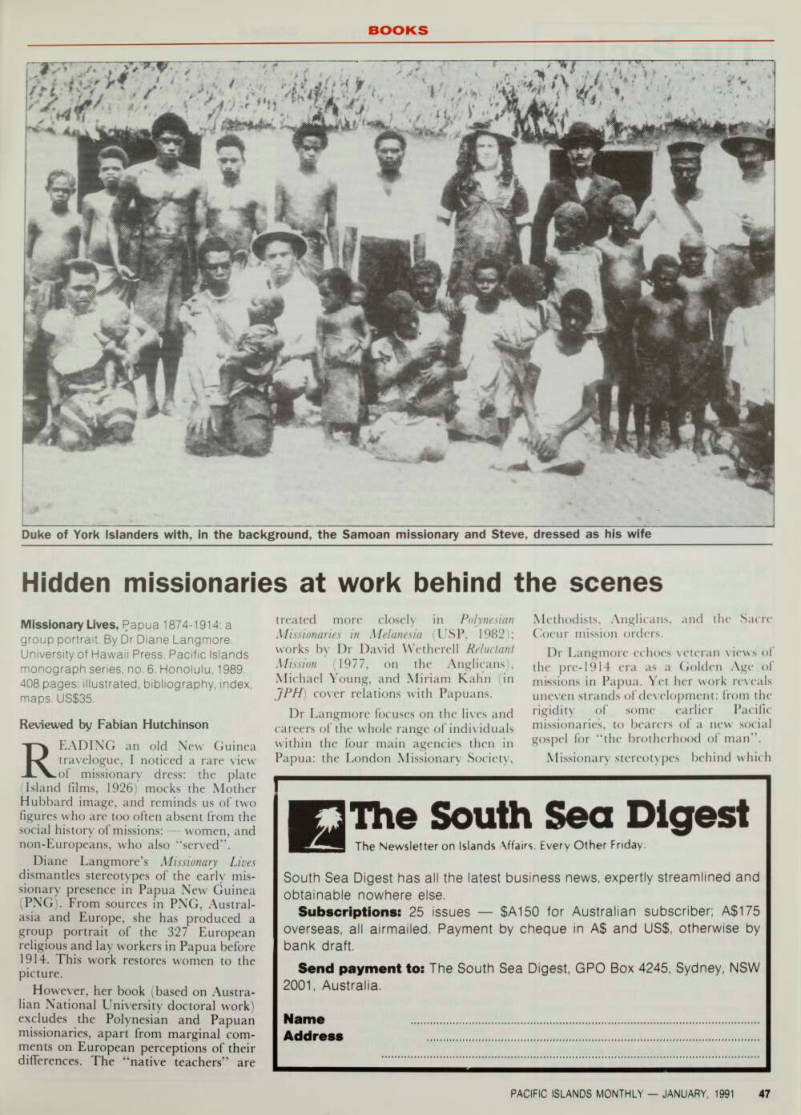
Missionary Lives, Papua 1874-1914: a group portrait. By Dr Diane Langmore.
University of Hawaii Press. Pacific Islands monograph series, no. 6. Honolulu, 1989. 408 pages: illustrated, bibliography, index, maps. US$35.
Reviewed by Fabian Hutchinson READING an old New Guinea travelogue, I noticed a rare view of missionary dress: the plate Island films, 1926) mocks the Mother Hubbard image, and reminds us of two figures who are too often absent from the social history of missions: women, and non-Europeans, who also “served”.
Diane Langmore’s Missionary Lives
dismantles stereotypes of the early mis sionary presence in Papua New Guinea (PNG). From sources in PNG, Austral asia and Europe, she has produced a group portrait of the 327 European religious and lay workers in Papua before 1914. This work restores women to the
picture.
However, her book (based on Austra lian National University doctoral work) excludes the Polynesian and Papuan missionaries, apart from marginal com ments on European perceptions of their differences. The “native teachers” are
treated more closely in Polynesian Missionaries in Melanesia (USP, 1982); works by Dr David Wetherell Reluctant Mission (1977, on the Anglicans), Michael Young, and Miriam Kahn (in JPH) cover relations with Papuans, Dr Langmore focuses on the lives and careers of the whole range of individuals within the four main agencies then in Papua: the London Missionary Society,
Methodists, Anglicans, and the Sacre Coeur mission orders.
Dr Langmore echoes veteran views of the pre-1914 era as a Golden Age of missions in Papua. Yet her work reveals uneven strands of development: from the rigidity of some earlier Pacific missionaries, to bearers of a new social gospel for “the brotherhood of man”.
Missionary stereotypes behind which
she seeks the real actors were listed, as late as 1955, by James McAuley: the hero rescuing the heathen; the champion of native rights; the prude; the imperialistic exploiter; the religious bigot; and the
anti-native-religion fanatic.
Dr Langmore surveys the missionaries’ social backgrounds, and tries to construct “ideal types” for each of the four missions: but in all, “they were fairly typical products of their class and
generation, distinguished ... by their common con viction of a particular call from god" (p. 31). An other attempt to identify “ideal types” (p. 262) is based on career styles: mystic, administrator, humanitarian, romantic.
The book broadly fol lows the stages in a mis sionary life, from back ground, training, and embarkation; into mis sion community, life styles, recreation; roles and self images; the place
of women; perception of the Papuan (problematic for cultural historians); on to wider contexts of Missions.
Motives (closely scrutinised in candi dates' papers) varied: concern for the “perishing heathen”; more liberal later 19th Century soteriology; romance of foreign service; personal sanctity.
Courses later added Comparative Re ligion, but “almost no-one was prepared specifically for the missionfield” (p. 63).
Chapter 7 covers the women’s impact, and the stresses under which they worked; only the LMS did not appoint women to Papua in this period (but did permit wives). Some SC nuns took a “fourth vow” of lifelong mission. Their “bush” life, rough, but without fears of violation, is vividly described.
In Preaching, Teaching, Knocking around
(Ch. 6, echoing her 1974 biography Tamale ) we meet James Chalmers dis avowing the home image of black-coated bible-bashers, at Exeter Hall. But his freer style of field work soon became exceptional.
Consolidation of evangelical work took primacy. Tensions with the non- European catechists are briefly observed: LMS and AWMS perceptions of native teachers as “bullying” in using the Old Testament, seem specious (p. 146, 153-4).
Worth more analysis are selective re sponses to a “new cosmology” by Papuan cultures, that so baffled the missionaries (p. 147). While all the missions kept up village teaching, the author shows that the missionaries turned more towards settlement (translation, industrial train ing, administration) roles, and their contact with their flocks tended to lessen (p. 162).
Dr Langmore views anthropology as
‘crucial’ in giving missionaries a “con ceptual framework” (p. Ill), but at its most “diffuse” (p. 113) this was just a discovery that Papuans were religious!
The influence of Fraser and Tylor “opened shuttered minds” (p. 114). But historians of religion will want to know how the new shutters (cultural evolutionism, acceptable levels of re ligion) worked in certain settings.
Among diverse impressions of “ ‘sav
ages” ... with redeeming traits”, and texts from ethnology to “cannibal” tales, we may find cases of dissonance: the same Saville who produced a study of the Mailu (p. 112), wrote “laws” (p. 129) for keeping mis sion/native distance and discipline. Attitudes or ideas of paternalism, monogenism or racial de generacy partly explain this. But the colonial pos ition of privilege allowed the missionary a very
wide range of choice.
In Papuan contexts, this made for new answers to the old question about “civilising or converting”. Various mis sions took particular approaches to exchanging cultural traits.
Dr Langmore defends the Papua missionaries from charges of iconoclasm
made by later anthropologists. Did they
destroy traditional culture, substituting
their own values? Her useful but brief account of attitudes to polygamy and other customs leaves room for further inquiry. As her astute observation on “paternalism” suggests, “a relationship ... could be exploited by both sides” (p. 130). So could customs.
It is also ironic, in Langmore’s view, that the Papuans often simply did not perceive the distinction between missionaries and officials. The claim that Papuans often used missionaries as me diators, or “exploited the differences”
(p. 230), deserves documenting.
Dr Langmore’s work displaces stereo types, yet readers need not acccept a composite conclusion that the missionaries were mediators between two cultures (p. 240). That they were “the main agents of European culture” (p.xi) is more apposite.
The work is clearly written, well illustrated, and a useful addition to PNG
history. Its extensive biographical
appendices, providing materials for further references, enhance its value.
Fabian Hutchinson is a Melbourne research archivist and author of reference guides to the region: Pacific Archives in Australia: finding the sources, 1990, and Guide to historical sources of Missionary activities in the Pacific Islands in British institutions, 1985: (microfiche, pub. by Past Papers, PO Box 218, Carlton South PO, Vic. 3053, Australia). □
Advertisements & other items, pp. 47-48 (1 item)
Hie South Sea Digest
£
The Newsletter on Islands Affairs. Every Other Friday.
South Sea Digest has all the latest business news, expertly streamlined and obtainable nowhere else.
Subscriptions: 25 issues SAISO for Australian subscriber: Asl7s overseas, all airmailed. Payment by cheque in A$ and US$, otherwise by bank draft.
Send payment to: The South Sea Digest, GPO Box 4245, Sydney, NSW 2001, Australia.
Name Address
The Pacific
Is Yours
Have all the information
at your fingertips order PIM publications NOW!
MAP
FIJI
SLANDS
JOURNAL
■ Pacific Islands Yearbook 16th Edition As4s ■ Fiji Handbook Business & Travel Guide Asl 4.95 ■ Vanuatu, A Guide ■ The Journal of William Lockerby ■ Map of Fiji ■ Map of the Pacific A 514.95 A 53.50 A 53.50 A 53.50 Number of copies being ordered: Pacific Islands Yearbook Fiji Handbook Vanuatu, A Guide The Journal of William Lockerby Fiji Islands map Pacific Islands map Enclosed is AS for payment Debit AS to my Bank Card VISA Master Card Card No: Expiry Date: My Name: Postal Address: Country: Tel;
Post to: PACIFIC ISLANDS MONTHLY,
PO BOX 1167, SUVA, FIJI ISLANDS.
a path
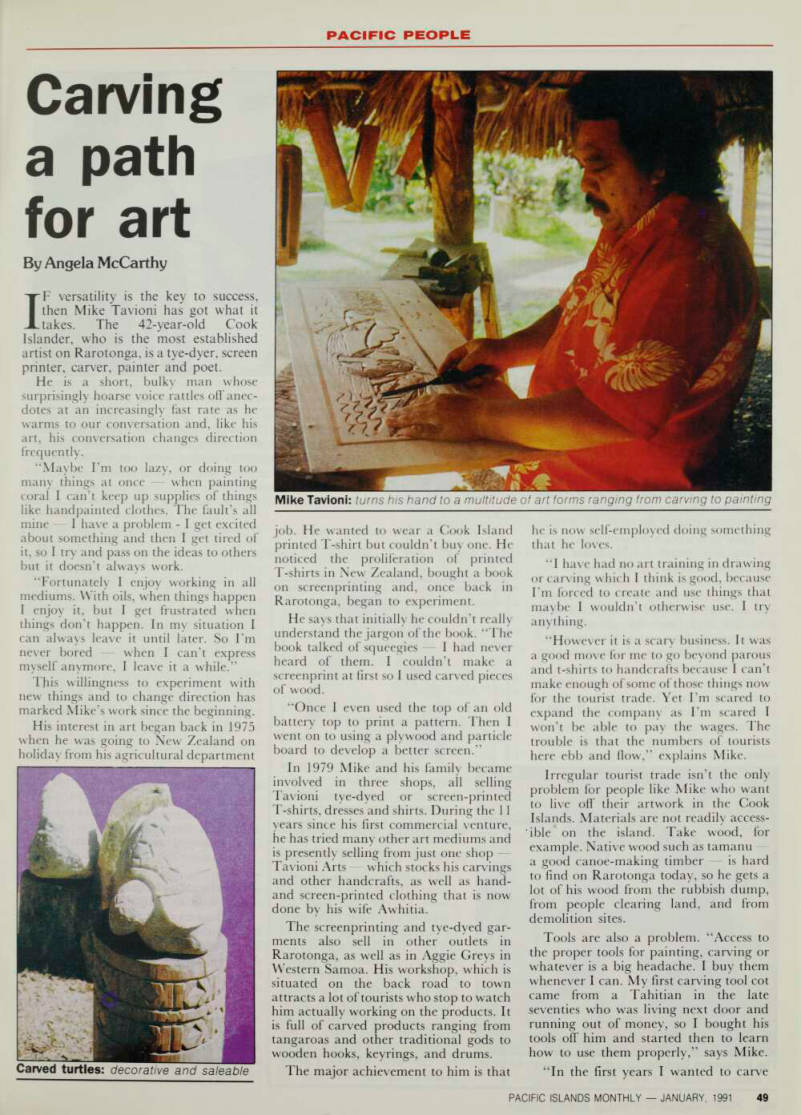
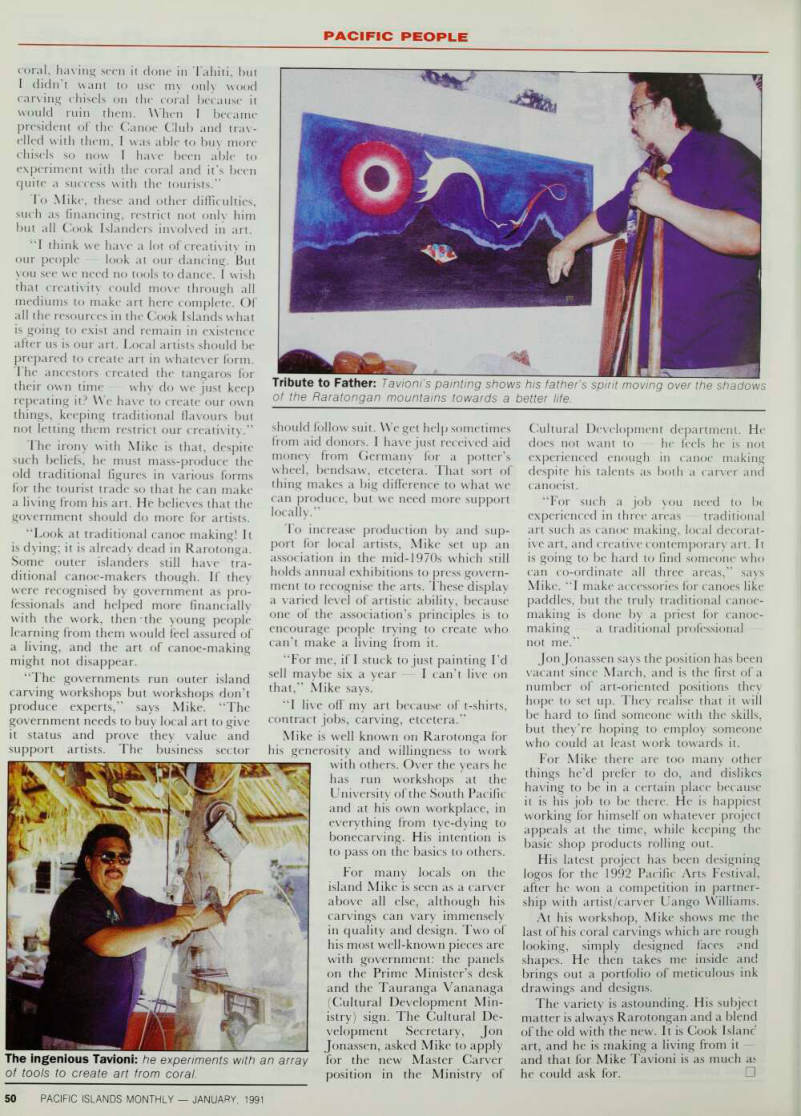
Pacific People
Carving a path for art
By Angela McCarthy
IF versatility is the key to success, then Mike Tavioni has got what it takes. The 42-year-old Cook Islander, who is the most established artist on Rarotonga, is a tye-dyer, screen printer, carver, painter and poet.
He is a short, bulky man whose surprisingly hoarse voice rattles off anec dotes at an increasingly fast rate as he warms to our conversation and, like his art, his conversation changes direction
frequently.
“Maybe I’m too lazy, or doing too many things at once when painting coral I can’t keep up supplies of things like handpainted clothes. The fault’s all mine I have a problem - I get excited about something and then I get tired of it, so I try and pass on the ideas to others but it doesn’t always work.
“Fortunately I enjoy working in all mediums. With oils, when things happen I enjoy it, but I get frustrated when things don’t happen. In my situation I can always leave it until later. So I’m never bored when I can’t express myself anymore, I leave it a while.”
This willingness to experiment with new things and to change direction has marked Mike’s work since the beginning.
His interest in art began back in 1975 when he was going to New Zealand on holiday from his agricultural department
job. He wanted to wear a Cook Island printed T-shirt but couldn’t buy one. He noticed the proliferation of printed T-shirts in New Zealand, bought a book on screenprinting and, once back in Rarotonga, began to experiment.
He says that initially he couldn’t really understand the jargon of the book. “The book talked of squeegies I had never heard of them. I couldn’t make a screenprint at first so I used carved pieces of wood.
“Once I even used the top of an old battery top to print a pattern. Then I went on to using a plywood and particle board to develop a better screen.”
In 1979 Mike and his family became involved in three shops, all selling Tavioni tye-dyed or screen-printed T-shirts, dresses and shirts. During the 11 years since his first commercial venture, he has tried many other art mediums and is presently selling from just one shop Tavioni Arts which stocks his carvings and other handcrafts, as well as hand and screen-printed clothing that is now done by his wife Awhitia.
The screenprinting and tye-dyed gar ments also sell in other outlets in Rarotonga, as well as in Aggie Greys in Western Samoa. His workshop, which is situated on the back road to town attracts a lot of tourists who stop to watch him actually working on the products. It is full of carved products ranging from tangaroas and other traditional gods to wooden hooks, keyrings, and drums.
The major achievement to him is that
he is now self-employed doing something
that he loves.
“I have had no art training in drawing or carving which I think is good, because I'm forced to create and use things that maybe I wouldn’t otherwise use. I try
anything.
“However it is a scary business. It was a good move for me to go beyond parous and t-shirts to handcrafts because I can’t make enough of some of those things now for the tourist trade. Yet I'm scared to expand the company as I’m scared I won’t be able to pay the wages. The trouble is that the numbers of tourists here ebb and flow,” explains Mike.
Irregular tourist trade isn’t the only problem for people like Mike who want to live off their artwork in the Cook Islands. Materials are not readily access ible on the island. Take wood, for example. Native wood such as tamanu a good canoe-making timber is hard to find on Rarotonga today, so he gets a lot of his wood from the rubbish dump, from people clearing land, and from demolition sites.
Tools are also a problem. “Access to the proper tools for painting, carving or whatever is a big headache. I buy them whenever I can. My first carving tool cot came from a Tahitian in the late seventies who was living next door and running out of money, so I bought his tools off him and started then to learn how to use them properly,” says Mike.
“In the first years I wanted to carve
Carved turtles: decorative and saleable
Mike Tavioni: turns his hand to a multitude of art forms ranging from carving to painting
coral, having seen it done in Tahiti, but I didn't want to use my only wood carving chisels on the coral because it would ruin them. When I became president of the Canoe Club and trav elled with them, I was able to buy more chisels so now I have been able to experiment with the coral and it’s been quite a success with the tourists.”
To Mike, these and other difficulties, such as financing, restrict not only him but all Cook Islanders involved in art.
“I think we have a lot of creativity in our people look at our dancing. But you see we need no tools to dance. I wish that creativity could move through all mediums to make art here complete. Of all the resources in the Cook Islands what is going to exist and remain in existence after us is our art. Local artists should be prepared to create art in whatever form.
The ancestors created the tangaros for their own time - why do we just keep repeating it? We have to create our own things, keeping traditional flavours but not letting them restrict our creativity,”
The irony with Mike is that, despite such beliefs, he must mass-produce the old traditional figures in various forms for the tourist trade so that he can make a living from his art. He believes that the government should do more for artists.
“Look at traditional canoe making! It is dying; it is already dead in Rarotonga.
Some outer islanders still have tra ditional canoe-makers though. If they were recognised by government as pro fessionals and helped more financially with the work, then the young people learning from them would feel assured of a living, and the art of canoe-making might not disappear.
“The governments run outer island carving workshops but workshops don’t produce experts,” says Mike. “The government needs to buy local art to give it status and prove they value and support artists. The business sector
should follow suit. We get help sometimes from aid donors. I have just received aid money from Germany for a potter’s wheel, bendsaw, etcetera. That sort of thing makes a big difference to what we can produce, but we need more support
locally.”
To increase production by and sup port for local artists, Mike set up an association in the mid-1970s which still holds annual exhibitions to press govern ment to recognise the arts. These display a varied level of artistic ability, because one of the association’s principles is to encourage people trying to create who can’t make a living from it.
“For me, if I stuck to just painting I’d sell maybe six a year - I can’t live on that,” Mike says.
“I live off my art because of t-shirts,
contract jobs, carving, etcetera.”
Mike is well known on Rarotonga for his generosity and willingness to work
with others. Over the years he has run workshops at the University of the South Pacific and at his own workplace, in
everything from tye-dying to
bonecarving. His intention is to pass on the basics to others.
For many locals on the island Mike is seen as a carver above all else, although his carvings can vary immensely in quality and design. Two of his most well-known pieces are with government: the panels on the Prime Minister’s desk and the Tauranga Vananaga (Cultural Development Min istry) sign. The Cultural De velopment Secretary, Jon Jonassen, asked Mike to apply for the new Master Carver position in the Ministry of
Cultural Development department. He
does not want to he feels he is not
experienced enough in canoe making
despite his talents as both a carver and canoeist.
“For such a job you need to be experienced in three areas traditional art such as canoe making, local decorat ive art, and creative contemporary art. It is going to be hard to find someone who can co-ordinate all three areas,” says Mike. “I make accessories for canoes like paddles, but the truly traditional canoe making is done by a priest for canoe
making a traditional professional
not me.”
Jon Jonassen says the position has been vacant since March, and is the first of a number of art-oriented positions they hope to set up. They realise that it will be hard to find someone with the skills, but they’re hoping to employ someone who could at least work towards it.
For Mike there are too many other things he’d prefer to do, and dislikes having to be in a certain place because it is his job to be there. He is happiest working for himself on whatever project appeals at the time, while keeping the basic shop products rolling out.
His latest project has been designing logos for the 1992 Pacific Arts Festival, after he won a competition in partner ship with artist/carver Uango Williams.
At his workshop, Mike shows me the last of his coral carvings which are rough
looking, simply designed faces and
shapes. He then takes me inside and brings out a portfolio of meticulous ink drawings and designs.
The variety is astounding. His subject matter is always Rarotongan and a blend of the old with the new. It is Cook Island art, and he is making a living from it and that for Mike Tavioni is as much as he could ask for. □
The ingenious Tavioni: he experiments with an array of tools to create art from coral.
Tribute to Father: Tavioni’s painting shows his father’s spirit moving over the shadows of the Raratongan mountains towards a better life.
cultural development body
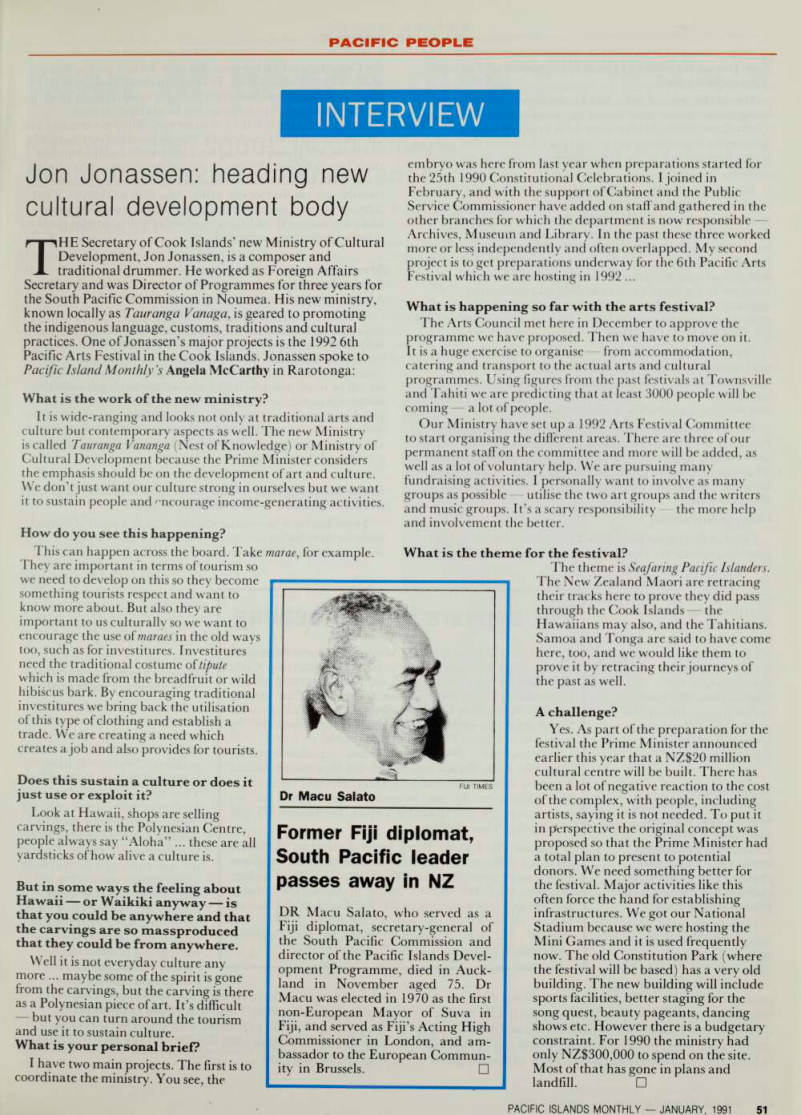
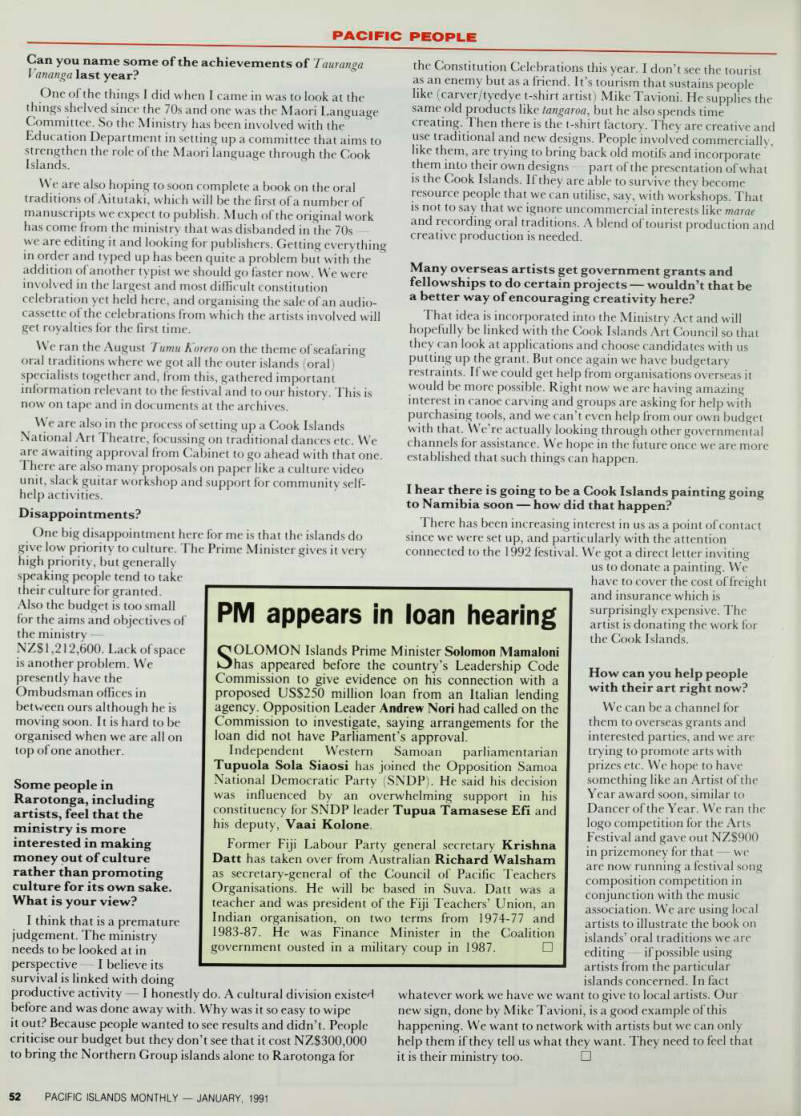
Interview
Jon Jonassen: heading new
THE Secretary of Cook Islands’ new Ministry of Cultural Development, Jon Jonassen, is a composer and traditional drummer. He worked as Foreign Affairs Secretary and was Director of Programmes for three years for the South Pacific Commission in Noumea. His new ministry, known locally as Tauranga Vanaga, is geared to promoting the indigenous language, customs, traditions and cultural practices. One of Jonassen’s major projects is the 1992 6th Pacific Arts Festival in the Cook Islands. Jonassen spoke to Pacific Island Monthly’s Angela McCarthy in Rarotonga: What is the work of the new ministry?
It is wide-ranging and looks not only at traditional arts and culture but contemporary aspects as well. The new Ministry is called Tauranga Vananga (Nest of Knowledge) or Ministry of Cultural Development because the Prime Minister considers the emphasis should be on the development of art and culture.
We don’t just want our culture strong in ourselves but we want it to sustain people and 'mcourage income-generating activities.
How do you see this happening?
This can happen across the board. Take marae , for example.
They are important in terms of tourism so
we need to develop on this so they become something tourists respect and want to know more about. But also they are important to us culturally so we want to encourage the use of maraes in the old ways too, such as for investitures. Investitures need the traditional costume of tipute which is made from the breadfruit or wild hibiscus bark. By encouraging traditional investitures we bring back the utilisation of this type of clothing and establish a trade. We are creating a need which creates a job and also provides for tourists.
Does this sustain a culture or does it just use or exploit it?
Look at Hawaii, shops are selling carvings, there is the Polynesian Centre, people always say “Aloha” ... these are all yardsticks of how alive a culture is.
But in some ways the feeling about Hawaii or Waikiki anyway is that you could be anywhere and that the carvings are so massproduced that they could be from anywhere.
Well it is not everyday culture any more ... maybe some of the spirit is gone from the carvings, but the carving is there as a Polynesian piece of art. It’s difficult but you can turn around the tourism and use it to sustain culture.
What is your personal brief?
I have two main projects. The first is to coordinate the ministry. You see, the
embryo was here from last year when preparations started for the 25th 1990 Constitutional Celebrations. I joined in February, and with the support of Cabinet and the Public Service Commissioner have added on staff and gathered in the other branches for which the department is now responsible Archives, Museum and Library. In the past these three worked more or less independently and often overlapped. My second project is to get preparations underway for the 6th Pacific Arts Festival which we are hosting in 1992 ...
What is happening so far with the arts festival?
The Arts Council met here in December to approve the programme we have proposed. Then we have to move on it.
It is a huge exercise to organise from accommodation, catering and transport to the actual arts and cultural programmes. Using figures from the past festivals at Townsville and Tahiti we are predicting that at least 3000 people will be coming a lot of people.
Our Ministry have set up a 1992 Arts Festival Committee to start organising the different areas. There are three of our permanent staff on the committee and more will be added, as well as a lot of voluntary help. We are pursuing many fundraising activities. I personally want to involve as many groups as possible utilise the two art groups and the writers and music groups. It's a scary responsibility the more help and involvement the better.
What is the theme for the festival?
The theme is Seafaring Pacific Islanders.
The New Zealand Maori are retracing their tracks here to prove they did pass through the Cook Islands the Hawaiians may also, and the Tahitians.
Samoa and Tonga are said to have come here, too, and we would like them to prove it by retracing their journeys of the past as well.
A challenge?
Yes. As part of the preparation for the festival the Prime Minister announced earlier this year that a NZS2O million cultural centre will be built. There has been a lot of negative reaction to the cost of the complex, with people, including artists, saying it is not needed. To put it in perspective the original concept was proposed so that the Prime Minister had a total plan to present to potential donors. We need something better for the festival. Major activities like this often force the hand for establishing infrastructures. We got our National Stadium because we were hosting the Mini Games and it is used frequently now. The old Constitution Park (where the festival will be based) has a very old building. The new building will include sports facilities, better staging for the song quest, beauty pageants, dancing shows etc. However there is a budgetary constraint. For 1990 the ministry had only NZ$3OO,OOO to spend on the site.
Most of that has gone in plans and landfill. □
Can you name some of the achievements of Tauranga Vananga last year?
One of the things I did when I came in was to look at the things shelved since the 70s and one was the Maori Language Committee. So the Ministry has been involved with the Education Department in setting up a committee that aims to strengthen the role of the Maori language through the Cook Islands.
We are also hoping to soon complete a book on the oral traditions of Aitutaki, which will be the first of a number of manuscripts we expect to publish. Much of the original work has come from the ministry that was disbanded in the 70s we are editing it and looking for publishers. Getting everything in order and typed up has been quite a problem but with the addition of another typist we should go faster now. We were involved in the largest and most difficult constitution celebration yet held here, and organising the sale of an audio cassette of the celebrations from which the artists involved will get royalties for the first time.
We ran the August Tumu Korero on the theme of seafaring oral traditions where we got all the outer islands (oral) specialists together and, from this, gathered important information relevant to the festival and to our history. This is now on tape and in documents at the archives.
We are also in the process of setting up a Cook Islands National Art Theatre, focussing on traditional dances etc. We are awaiting approval from Cabinet to go ahead with that one.
There are also many proposals on paper like a culture video unit, slack guitar workshop and support for community self
help activities.
Disappointments?
One big disappointment here for me is that the islands do give low priority to culture. The Prime Minister gives it very
high priority, but generally speaking people tend to take their culture for granted.
Also the budget is too small for the aims and objectives of the ministry NZ51,212,600. Lack of space is another problem. We presently have the Ombudsman offices in between ours although he is moving soon. It is hard to be organised when we are all on top of one another.
Some people in
Rarotonga, including
artists, feel that the ministry is more interested in making money out of culture rather than promoting culture for its own sake.
What is your view?
I think that is a premature
judgement. The ministry
needs to be looked at in perspective I believe its survival is linked with doing
productive activity I honestly do. A cultural division existed before and was done away with. Why was it so easy to wipe it out? Because people wanted to see results and didn’t. People criticise our budget but they don’t see that it cost NZ$3OO,OOO to bring the Northern Group islands alone to Rarotonga for
the Constitution Celebrations this year. I don’t see the tourist as an enemy but as a friend. It’s tourism that sustains people like (carver/tyedye t-shirt artist) Mike Tavioni. He supplies the same old products like tangaroa, but he also spends time creating. Then there is the t-shirt factory. They are creative and use traditional and new designs. People involved commercially, like them, are trying to bring back old motifs and incorporate ' them into their own designs part of the presentation of what is the Cook Islands. If they are able to survive they become resource people that we can utilise, say, with workshops. That is not to say that we ignore uncommercial interests like marae and recording oral traditions. A blend of tourist production and creative production is needed.
Many overseas artists get government grants and fellowships to do certain projects wouldn’t that be a better way of encouraging creativity here?
That idea is incorporated into the Ministry Act and will hopefully be linked with the Cook Islands Art Council so that they can look at applications and choose candidates with us putting up the grant. But once again we have budgetary restraints. If we could get help from organisations overseas it would be more possible. Right now we are having amazing interest in canoe carving and groups are asking for help with purchasing tools, and we can’t even help from our own budget with that. We’re actually looking through other governmental channels for assistance. We hope in the future once we are more established that such things can happen.
I hear there is going to be a Cook Islands painting going to Namibia soon how did that happen?
There has been increasing interest in us as a point of contact since we were set up, and particularly with the attention connected to the 1992 festival. We got a direct letter inviting
us to donate a painting. We have to cover the cost of freight and insurance which is surprisingly expensive. The artist is donating the work for the Cook Islands.
How can you help people with their art right now?
We can be a channel for them to overseas grants and interested parties, and we are trying to promote arts with prizes etc. We hope to have something like an Artist of the Year award soon, similar to Dancer of the Year. We ran the logo competition for the Arts Festival and gave out NZS9OO in prizemoney for that we are now running a festival song
composition competition in
conjunction with the music association. We are using local artists to illustrate the book on islands’ oral traditions we are
editing if possible using
artists from the particular islands concerned. In fact
whatever work we have we want to give to local artists. Our new sign, done by Mike Tavioni, is a good example of this happening. We want to network with artists but we can only help them if they tell us what they want. They need to feel that it is their ministry too. □
Former Fiji diplomat,
South Pacific leader passes away in NZ
DR Macu Salato, who served as a Fiji diplomat, secretary-general of the South Pacific Commission and director of the Pacific Islands Devel opment Programme, died in Auck land in November aged 75. Dr Macu was elected in 1970 as the first non-European Mayor of Suva in Fiji, and served as Fiji’s Acting High Commissioner in London, and am bassador to the European Commun ity in Brussels. □
Fiji Times
Dr Macu Salato
PM appears in loan hearing
SOLOMON Islands Prime Minister Solomon Mamaloni has appeared before the country’s Leadership Code Commission to give evidence on his connection with a proposed US$25O million loan from an Italian lending agency. Opposition Leader Andrew Nori had called on the Commission to investigate, saying arrangements for the loan did not have Parliament’s approval.
Independent Western Samoan parliamentarian Tupuola Sola Siaosi has joined the Opposition Samoa National Democratic Party (SNDP). He said his decision was influenced by an overwhelming support in his constituency for SNDP leader Tupua Tamasese Efi and his deputy, Vaai Kolone.
Former Fiji Labour Party general secretary Krishna Datt has taken over from Australian Richard Walsham as secretary-general of the Council of Pacific Teachers Organisations. He will be based in Suva. Datt was a teacher and was president of the Fiji Teachers’ Union, an Indian organisation, on two terms from 1974-77 and 1983-87. He was Finance Minister in the Coalition government ousted in a military coup in 1987. □
Man of peace dies
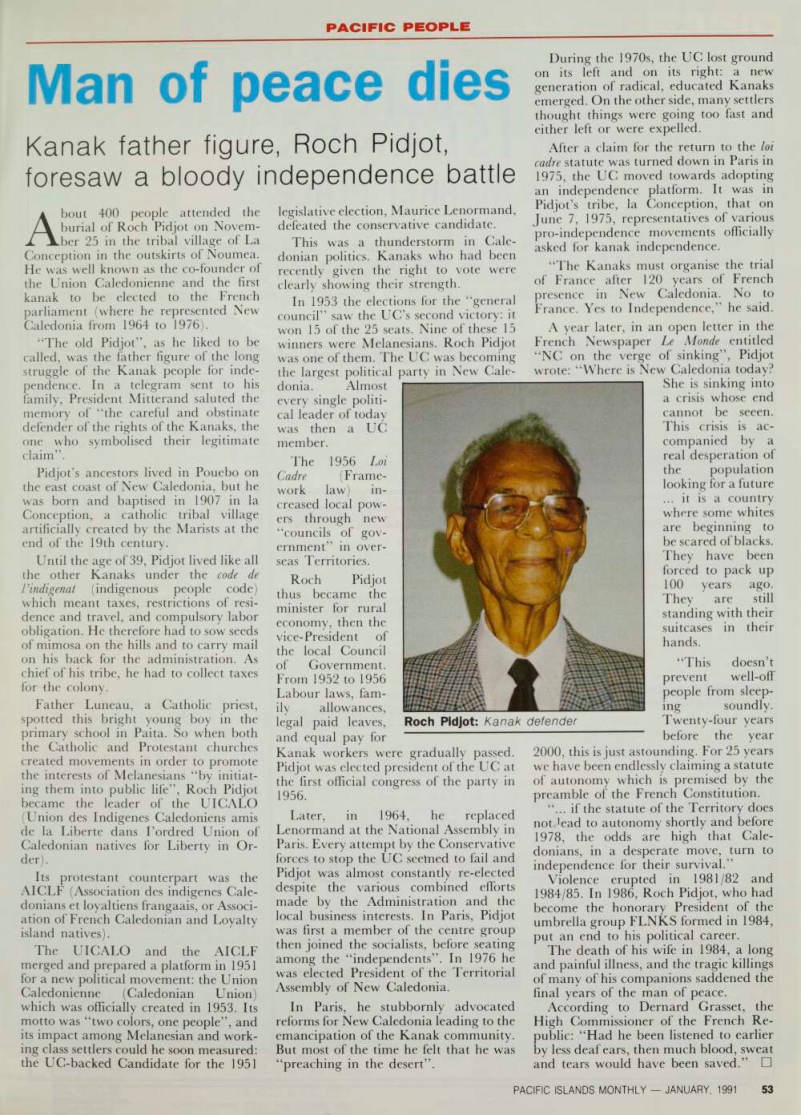
Kanak father figure, Roch Pidjot, foresaw a bloody independence battle
About 400 people attended the burial of Roch Pidjot on Novem ber 25 in the tribal village of La Conception in the outskirts of Noumea.
He was well known as the co-founder of the Union Caledonienne and the first kanak to be elected to the French parliament (where he represented New Caledonia from 1964 to 1976).
“The old Pidjot”, as he liked to be called, was the father figure of the long struggle of the Kanak people for inde pendence. In a telegram sent to his family, President Mitterand saluted the memory of “the careful and obstinate defender of the rights of the Kanaks, the one who symbolised their legitimate claim”.
Pidjot’s ancestors lived in Pouebo on the east coast of New Caledonia, but he was born and baptised in 1907 in la Conception, a catholic tribal village artificially created by the Marists at the end of the 19th century.
Until the age of 39, Pidjot lived like all the other Kanaks under the code de
Vindigenat (indigenous people code)
which meant taxes, restrictions of resi dence and travel, and compulsory labor obligation. He therefore had to sow seeds of mimosa on the hills and to carry mail on his back for the administration. As chief of his tribe, he had to collect taxes for the colony.
Father Luneau, a Catholic priest, spotted this bright young boy in the primary school in Paita. So when both the Catholic and Protestant churches created movements in order to promote the interests of Melanesians “by initiat ing them into public life”, Roch Pidjot became the leader of the UICALO (Union des Indigenes Caledoniens amis de la Liberte dans I’ordred Union of Caledonian natives for Liberty in Or der).
Its protestant counterpart was the AICLF (Association des indigenes Cale donians et loyaltiens frangaais, or Associ ation of French Caledonian and Loyalty
island natives).
The UICALO and the AICLF merged and prepared a platform in 1951 for a new political movement: the Union Caledonienne (Caledonian Union) which was officially created in 1953. Its motto was “two colors, one people”, and its impact among Melanesian and work ing class settlers could he soon measured: the UC-backed Candidate for the 1951
legislative election, Maurice Lenormand, defeated the conservative candidate.
This was a thunderstorm in Cale donian politics. Kanaks who had been recently given the right to vote were clearly showing their strength.
In 1953 the elections for the “general council” saw the UC’s second victory: it won 15 of the 25 seats. Nine of these 15 winners were Melanesians. Roch Pidjot was one of them. The UC was becoming the largest political party in New Cale
donia. Almost every single politi cal leader of today was then a UC member.
The 1956 Loi Cadre (Frame work law) in creased local pow ers through new “councils of gov ernment” in over seas Territories.
Roch Pidjot thus became the minister for rural economy, then the vice-President of the local Council of Government.
From 1952 to 1956 Labour laws, fam ily allowances, legal paid leaves, and equal pay for
Kanak workers were gradually passed.
Pidjot was elected president of the UC at the first official congress of the party in 1956.
Later, in 1964, he replaced Lenormand at the National Assembly in Paris. Every attempt by the Conservative forces to stop the UC seehied to fail and Pidjot was almost constantly re-elected despite the various combined efforts made by the Administration and the local business interests. In Paris, Pidjot was first a member of the centre group then joined the socialists, before seating among the “independents”. In 1976 he was elected President of the Territorial Assembly of New Caledonia.
In Paris, he stubbornly advocated reforms for New Caledonia leading to the emancipation of the Kanak community.
But most of the time he felt that he was “preaching in the desert”.
During the 19705, the UC lost ground on its left and on its right: a new generation of radical, educated Kanaks emerged. On the other side, many settlers thought things were going too fast and either left or were expelled.
After a claim for the return to the loi cadre statute was turned down in Paris in 1975, the UC moved towards adopting an independence platform. It was in Pidjot’s tribe, la Conception, that on June 7, 1975, representatives of various pro-independence movements officially asked for kanak independence.
“The Kanaks must organise the trial of France after 120 years of French presence in New Caledonia. No to France. Yes to Independence,” he said.
A year later, in an open letter in the French Newspaper Le Monde entitled “NC on the verge of sinking”, Pidjot wrote: “Where is New Caledonia today?
She is sinking into a crisis whose end cannot be seeen.
This crisis is ac companied by a real desperation of
the population
looking for a future ... it is a country where some whites are beginning to be scared of blacks.
They have been forced to pack up 100 years ago.
They are still standing with their suitcases in their hands.
“This doesn’t prevent well-off people from sleep ing soundly.
Twenty-four years before the year
2000, this is just astounding. For 25 years we have been endlessly claiming a statute of autonomy which is premised by the preamble of the French Constitution. if the statute of the Territory does to autonomy shortly and before 1978, the odds are high that Cale donians, in a desperate move, turn to independence for their survival.”
Violence erupted in 1981/82 and 1984/85. In 1986, Roch Pidjot, who had become the honorary President of the umbrella group FLNKS formed in 1984, put an end to his political career.
The death of his wife in 1984, a long and painful illness, and the tragic killings of many of his companions saddened the final years of the man of peace.
According to Bernard Grasset, the High Commissioner of the French Re public: “Had he been listened to earlier by less deaf ears, then much blood, sweat and tears would have been saved.” □
Roch Pidjot: Kanak defender
Advertisements & other items, pp. 54-56 (1 item)
Pacific
SLANDS
Q N j H L —7~|
MflfiK€T PLfiCe
mmLTmrM W ° M "•? 10 pl ‘ ce • sma " olassHied advMlxmonl In our 2?;s s%zs,?° Ks are s ' rucw,M '° *"° w ,o as
CORRESPONDENCE
Sincere, eligible Australian gentlemen wish to correspond with Pacific ladies, all ages/ races. Free registration. For full details please write to: ASIAPAC, PO BOX 231 Maylands 6052, AUSTRALIA.
OVERSEAS FUNDING
Unlimited overseas funding for any National Government and private company’s viable projects. No front fees. Send proposal to Pan Asia Management Consultants Center Box 4295, BOROKO, NCD, Papua New Guinea.
DISTRIBUTOR WANTED
Manufacturer of a line of spray aerosol products that speed production in the garment factory: Silicone Spray, Spot Lifter, Pattern Adhesive, Emery Sharpening Stone Wheel Cleaner, Fusing Machine Cleaner, etc Wnte Sprayway, Inc., Addison, IL
60101-4468, FAX 1 (708) 543-7797
TRUCK MECHANIC
32 year old with 12 years experience in Europe and New Zealand, seeks job on one of Pacific Islands. C.V. & references available.
Eric Willers, Flat 3/36A Harman St., Christchurch, New Zealand, Tel (03) 3385629.
AGENTS/DISTRIBUTORS
WANTED
Qualified Agents/Distributors wanted for small primary and rechargeable batteries.
Products available include Alkaline, Carbonzinc, Mercury, Silver, Lithium, NiCad, Gel-Cell and Lead-Acid. Please contact Pacific Power Products, P.O. Box 2756, Redmond, WA98073 USA. Phone 206-881-0564 Telex 212495 PACPP UR
HYDRAULICS
Distributors wanted for all areas outside Fiji for our hydraulic fittings and hose. Send for our Company profile. Quality products at very competitive prices.
Hydraulink Fluid Connectors Limited PO Box 12 826, Penrose, Auckland, NZ. Ph: 64 9 643 787 Fax: 64 9 645 865
COMMERCIAL PRIIMTIMC
Top quality four colour printing, brochures, posters, packaging, product labels, fabric labels, billboards, books, magazines, stickers, books. Export quality. Contact Fiji’s most experienced Commercial Printers. FIJI TIMES COMMER- CIAL PRINTING, P.O. Box 1167, Suva. Fiji Phone; 304111 Fax. 301521.
ANTIQUE BOOKS, MAPS &
PRINTS
Antique Books, Maps & Prints of Pacific Islands. Free list available of items for sale.
Colin Hinchcliffe. 12 Queens Staith Mews.
York U.K.
HYDRAULIC EQUIPMENT
Comprehensive range of competitively priced pumps, motors, cylinders and valves. Agents for Sauer-Sundstrand hydrostatics.
Australian Hydraulics Company, PO Box 227, Rydalmere NSW 2116, Australia, Fax: 61-2-638.0544.
SCRAP METAL
Good prices paid for your clean scrap Aluminium, Brass, Copper, Lead, etc Contact Nonferral Pty. Ltd. 23 Davis Rd Wetherill Park NSW 2164 Australia. Fax 61 2 604 1304 for prompt reply. Our Company is a long established and leading metal buyer and smelter. Telephone 61 2 604 8855.
IMMIGRATION
Migrate to Australia with our expert assistance. Businessmen/skilled people/teachers/professionals send details in confidence. CKP AUSTRALIA, Box 2252, Canberra ACT 2601, Australia.
JEEP TIRES
Jeep Tires * Heavy duty military surplus, 6ply nylon, 700 x 16LW on rims. US $25.00ea or five/US$lOO.OO. Quantity discount available. On Maui, Hawaii 808-572-0462
SELF ADHESIVE LABELS
FORUM LABELS (FIJI) LTD
P.O. Box 1167, Suva., Fiji, Phone:3o4lll We print self-adhesive labels in rolls, multi-coloured labels with hot foil, and die cut to shape, tickets and tags in rolls. We also supply labelling machines and fabric labels.
PACIFIC
ISLANDS
« O A/ T H i. in
MRRKCT PlflCC CRN WORK
UJONDCRS FOR VOU ...
Promote your business, or service, sell your household
items, cars or heavy machinery
etc.
ONLY AUSSI PER WORD.
NO COMPANY LOGO. NO
DISPLAY. NO BOLD TYPE.
Just forward your Advertisement together with payment to: PACIFIC ISLANDS MONTHLY “Market Place”, P.O. Box 1167, Suva, Fiji.
CONDITIONS:
1/ All Advertisements are subject to acceptance and approval of publisher. 2. Advertisements are published as space permits; we cannot guarantee date of insertion. 3. All advertisements must be prepaid and should be typed or printed clearly. 4. Deadline for receipt of advertisements is the 10th of the month prior to issue.
5. PACIFIC ISLANDS MONTHLY
assumes no responsibility for any service other than publishing paid advertisements in this section.
THE POSSIBILITIES
ARE ENDLESS.
■ '■«* w i \rr^ hc STMiun, * naic inc \
I I I I
iM-lLV.i'i
IC CARD SYSTEM
A flat-key version SF-9000 is also available
• Unlimited Memory Capacity
Each optional ES-100 RAM card provides an additional 64K8 of external storage|with memory
backup.
• Expanded Application Software
■ ES-600* Spelling checker and Thesaurus dictionary ■ ES-610* Spelling checker with financial and legal terms ■ ES-620* Spelling checker with medical terms ■ ES-630** Casio Power Spreadsheet by Lucid® 3-D (available soon) ■ ES-800 Travel Conversations English-Spanish (available soon) Many more IC cards will soon be available.
• Compatible with IBM PCs
Using the interface unit, you can link the SF-9500 with an IBM PCr* SFD TOOL-B (MF-4000) is also available for even wider use with IBM personal computers.
• Wide Range of Database Software
Database software are floppy disks storing special information for the SF-9500. Four Database software varieties are currently available, with more to follow. They are: MF-10, MF-11, MF-12 and MF-13, all are loaded with business and travel information for the world’s major cities. • Easy, Portable Printout of Stored Data With the optional CP-9 Copy Pen, you can print SF- -9500 data into a notebook. Or use the CP-9 as a compact copier to transfer data from any text onto almost any kind of paper.
Copy Pen CP-9 ► International Correct Spell system, Electronic Thesaurus, Right Word Usage Alert and Abbreviation Expander developed by Houghton Mifflin Company, publishers of the The American Heritage Dictionary and Roget’s I Lucid«3-D is a registered trademark of PCSG, Inc. £_ : The New Thesaurus.
IBM is a registered trademark of IBM Corporation. Use limited to certain models. Refer to catalogs jnd other materials for list of applicable personal computers.
AUSTRALIA MOBEX PTY. LTD.
UNIT 1, GIBBES STREET
CHATSWOOD N.S.W. 2067
FUI ISLANDS BRULAL & CO., LTD.
G.P.O. BOX NO, 362
SUVA, FUI ISLANDS
BRECKWOLDT SARL
8P2369 NOUMEA
CALEDONIA:
MENARD PACiFiQUE
10 RUE JEAN JAURES
8P3899 NOUMEA. NEW CALEDONIA
NEW ZEALAND MONACO CORP. LTD.
41 POLAND ROAD, GLENFIELD
AUCKLAND, NEW ZEALAND
NORFOLK ISLANDS BURNT PINE TRADERS LTD.
P.0.80X21. NORFOLK ISLANDS
PAPUA NEW GUINEA
SENG CO NtUGINI PTY. LTD.
PO. BOX 1886, BOROKU
PAPUA NEW GUINEA
MAI SON AUROSE
30, RUE COLLETTE
PAPEETE, TAHITI
FUNG KUEI
P0.80X51, PORT VILA
CASIO COMPUTER CO., LTD.
Tokyo, Japan
An Eye to Total Safety.
ilii
s I * m & For Mitsubishi Motors both passive and active safety have equal importance, and rather than being added ingredients, are guide-lines that every component, system and stage of design must follow.
This approach to total safety involves exhaustive and innovative research methods, particularly into the physical reactions of motorists to various driving situations.
In designing the Galant, for example, Mitsubishi’s engineers mapped what drivers looked at while cornering. They found that drivers of some cars had much narrower fields of vision, indicating a high level of tension due to poor vehicle handling.
By comparison, their tests with the Galant and its integrated drive system, Dynamic-4 showed that with better handling, wider U a,v Q.
' o* fy rL 'V % * Vl Vision tracking shows how the Galant's superior handling results in lower driver tension indicated by a wider field of vision. fields of vision indicated lower levels of tension in the driver.
Using advanced technology to define and attain safety standards is further evidence of Mitsubishi’s guiding principle of answering the needs and preferences of today’s drivers —an on-going philosophy of putting technology to work for you.
A
MITSUBISHI
MOTORS
MITSUBISHI QHLHNT
699-9140/AUSTRALIA: MITSUBISHI MOTORS AUSTRALIA LTD, Box 1284, South Road, Clovelly Park, South Australia 5042, Tel. (08) 275-7297/ y AUTODU R T f 38341 Vf"!? 0 ” POLYNESIA SOPADEP S.A. P.O. Box 1617, Papeete, Tahiti, Tel, 4-202-58/NEW CALEDONIA: SOCIETE D'IMPORTATION »I^LTO D pO A Box l 1^ E IslantT 4 ZEA n LAND: MITSUBISHI MOTORS NEW ZEALAND LTD. Private Bag, Porirua, Tel. 370-109/NORFOLK ISLAND: BORRYS (el 30128/TONGA- SITANI MARCo’ nffr B ° X 5 ° 3, Port Moresby ' Tel 21-7874/SOLOMON ISLANDS: HARVEST PACIFIC LTD, G.P.O Box 823, Honiara, Guadalcanal, \p\a Tel 20957/SAIPAN/POHNPEUMA T JURrVK^RAP^Tmit L /vrD/I B ci^ 24 ;, 0 ' VANUATU: SOCOMETRA B P. 06 Route de Lagon, Port-Vila, Tel. 2314/WESTERN SAMOA: MOTOR DISTRIBUTORS LTD. P.O, Box 576, P ' /SAIP a N/POHNPEI/MAJURO/KOSRAE/TRUK/YAP/BELAU: MICRONESIAN MOTORS. INC. 997 South Marine Drive, Tamuning, Guam 96911, Tel. 646-6827