Pacific
Islands
Monthly
December 1990
Attack on the Condom Culture The spirit of Kanak lives again
Business
Vanuatu reviews tax haven laws
A ■ *
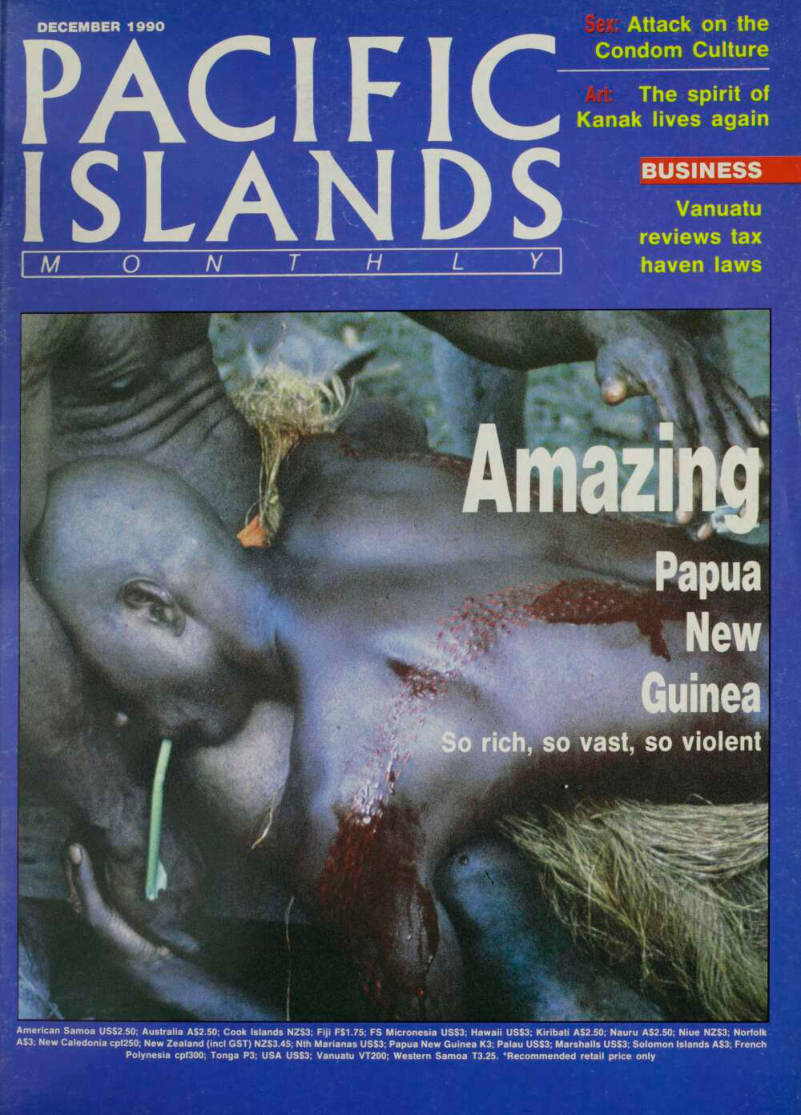
Amaanj
Papua So rich, so vast, so violent
American Samoa USS2.SO; Australia A 52.50; Cook Islands NZ$3; Fiji F 51.75; FS Micronesia US$3; Hawaii US$3; Kiribati A 52.50; Nauru A 52.50; Niue NZ$3; Norfolk As 3; New Caledonia cpf2so; New Zealand (incl GST) NZ53.45; Nth Marianas US$3; Papua New Guinea K 3; Palau US$3; Marshalls US$3; Solomon Islands As 3; French Polynesia cpfSOO; Tonga P 3; USA US$3; Vanuatu VT2OO; Western Samoa T 3.25. 'Recommended retail price only
Advertisements & other items, pp. 2-4 (1 item)
-mm
o % % V 7, P/ 4s % "
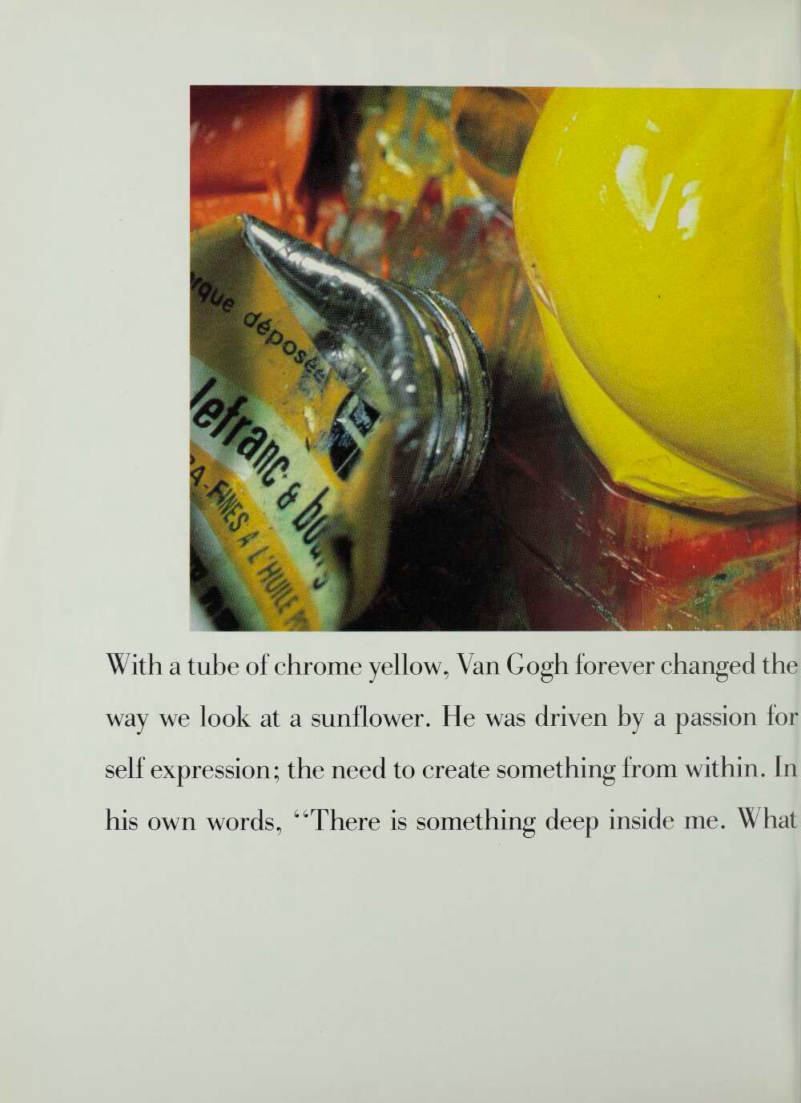
With a tube of chrome yellow, Van Gogh forever changed the way we look at a sunflower. He was driven by a passion for self expression; the need to create something from within. In his own words, 4 ‘There is something deep inside me. What
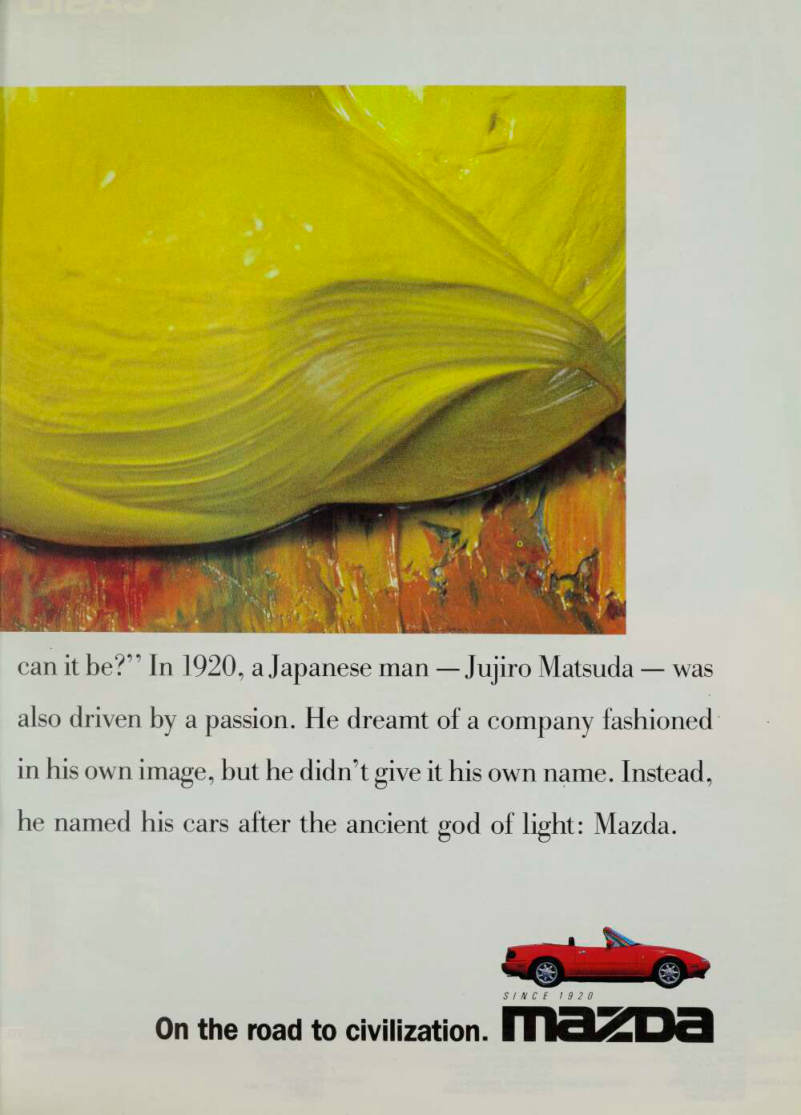
can it be?” In 1920, a Japanese man Jujiro Matsuda was also driven by a passion. He dreamt of a company fashioned in his own image, but he didn’t give it his own name. Instead, he named his cars after the ancient god of light: Mazda.
SINCE 1920
On the road to civilization. IH3ZD3
me ruooHMUiico
ARE ENDLESS.
tr wrSsit?
m. MUSIC IMC.
■a
II f I
mb
CARD
mm.
1C CARD SYSTEM
A flat-key version SF-9000 is also available
• Unlimited Memory Capacity
Each optional ES-100 RAM card provides an additional 64K8 of external storagejwith memory
backup.
• Expanded Application Software
■ ES-600* Spelling checker and Thesaurus dictionary ■ ES-610* Spelling checker with financial and legal terms ■ ES-620* Spelling checker with medical terms ■ ES-630** Casio Power Spreadsheet by Lucid® 3-D (available soon) ■ ES-800 Travel Conversations English-Spanish (available soon) Many more IC cards will soon be available.
•Compatible with IBM PCs
Using the interface unit, you can link the SF-9500 with an IBM PCf** SFD TOOL-B (MF-4000) is also available for even wider use with IBM personal computers. * International Correct Spell system, Electronic Thesaurus, Right Word Usage Alert and Abbreviation Expander developed by Houghton Mifflin Company, publishers of the The American Heritage Dictionary and Roget’a 0: ** Luckte3-D is a registered trademark of PCSG, Inc. *" is a registered trademark of IBM Corporation. Use limited to certain models. Refer to catalogs and other materials for list of applicable personal computers.
•Wide Range of Database Software
Database software are floppy disks storing special information for the SF-9500. Four Database software varieties are currently available, with more to follow. They are: MF-10, MF-11, MF-12 and MF-13, all are loaded with business and travel information for the world’s major cities.
•Easy, Portable Printout of Stored Data
With the optional CP-9 Copy Pen, you can print SF- -9500 data into a notebook. Or use the CP-9 as a compact copier to transfer data from any text onto almost any kind of paper.
Copy Pen CP-9 ► V £
AUSTRALIA MOBEX PTY. LTD.
UNIT 1, GIBBES STREET
CHATSWOOD N S W. 2067
FUI ISLANDS: BRULAL & CO.,LTD.
G.P.O. BOX NO 362
SUVA, FUI ISLANDS
W CALEDONIA BRECKWOLDT SARL
8P2369 NOUMEA
NEW CALEDONIA
MENARD PACtFIQUE
10 RUE JEAN JAURES
8P3899 NOUMEA, NEW CALEDONIA
NEW ZEALAND MONACO CORP. LTD.
41 POLAND ROAD, GLENFIELD
AUCKLAND, NEW ZEALAND
NORFOLK ISLANDS BURNT PINE TRADERS LTD.
P0.80X21, NORFOLK ISLANDS
PAPUA NEW GUINEA
SENGCO NfUGINI PTY. LTD.
RO BOX 1886, BOROKU
PAPUA NEW GUINEA
MAISON AUROSE
30, RUE COLLETTE
PAPEETE, TAHITI
FUNG KUEI
P0.80X51, PORT VILA
VANUATU
CASIO COMPUTER CO., LTD.
Tokyo, Japan
Pacific
Islands
Monthly
Vol 60. N 0.12
Voice Of The Pacific
December 1990
Interview
VILI Fuavao: When the chief execu tives of the major regional organis ations sit down at their next joint meeting, they will be welcoming a new meember to their ranks. He is Dr Vili Fuavao, the first Director of the South Pacific Regional Environment Pro gramme who spoke to Pacific Islands Monthly about the past, the present and the future. / 51 ■ HEALTH: We all thought condoms were good for the health until Tongan Bishop Patelisio Finau came along and condemned condoms as “lethal rubbish ”. Why? / 13 ■ COMMENT: Pacific Islands philos opher Futa Helu joins Pacific Islands Monthly this month as a columnist. The
56-year Helu, the founder of Tonga’s Atenisi Institute in Nuku’alofa, will provide indepen dent commentaries on issues covering the region. He de
scribes him,sel;f as a liberal with no political affiliation and whose education system is based on “classical traditional ist principles”. His institute, which encourages free thought, has students from other Pacific Islands and Europe.
Welcome Futa. / 7
The Region
ISSUES: A decision on thee future home of the Pacific’s oldest and largest regional organisation has been defereed for another year, frustrating the plans of New Caledonian authorities who want the South Pacific Commission land in Noumea for tourist development. From Noumea, Geoff Adlide reports on the SPC headquarters saga /II ■
BEHAVIOUR: From the Highlands
of Papua New Guinea to the streets of New York, drug pushers are talking about New Guinea Gold, a high-grade marijuana now hitting the market.
From Port Moresby, Frank Senge reports on what’s blooming on the coffee-growing district / 21 ■ RELATIONS: As Fiji celebrates its fourth post-coup Christmas, the
country’s political leadership begins to
see little need in returning to the Commonwealth. In Kuala Lumpur, Prime Minister Ratu Sir Kamisese Mara renews old relations and says why the Commonwealth now takes a backseat. Special report / 17
Publish*!-: Geoffrey Hussey Editor: Jale Moala A| Phnce, Angela McCarthy, David North, David Robie, Diana McManus, Dykes Angiki, Frank Senge, Frank Madoeuf, Irene Nisbet, John Hunter, Karen Mangnall, Lito Vilisoni, Macel Manua, Nicholas Rothwell, Pesi Fonua, Richard Dinnen, Ulafala Aiavao, Wally Hiambohn Business Correspondent: Robin Bromby. Columnists: David Barber
(Wellington), Jemima Garrett (Sydney) Adv , rtWn , M.nagor: Lionel Heffernan Advertising Sales • Fiji: Peter Prasad, Tel (679) 304111, Fx (679) 303809 • Sydney, Melbourne: Fergus Maclagan, Tel (61-2) 4134689, Fx (61-2) 4123918 • Brisbane: Robert Walker, Tel (61-7) 3710533
• Adelaide: Hastwell Williamsons Rep resentations, Tel (61-8)799522 •Japan: Universal Media Corporation, Tokyo. Tel(3) 6663036, 6663094, Cable: UNIMEDIA Tokyo, Tx 2524665 Founded 1930 (USPS 952480). A Fiji Times Limited production.
Cover prices are recommended retail only. Registered by Australia Post, Pub lication No. NBPI2IO. © Copyright Fiji Times Limited, 177 Victoria Parade,
Suva, Fiji. Tel (679) 304111, Fx (679)
303809, Tx Fj2124.
Pacific Islands Monthly is published monthly by Fiji Times Limited, a division of Nationwide News, 2 Holt Street, Surry Hills. Sydney, NSW 2010.
Send address changes to: • Pacific Islands Monthly, PO Box 1167, Suva, Fiji.
Typeset and printed by Fiji Times Lim ited, 117 Victoria Parade, Suva, Fiji.
Amazing
country
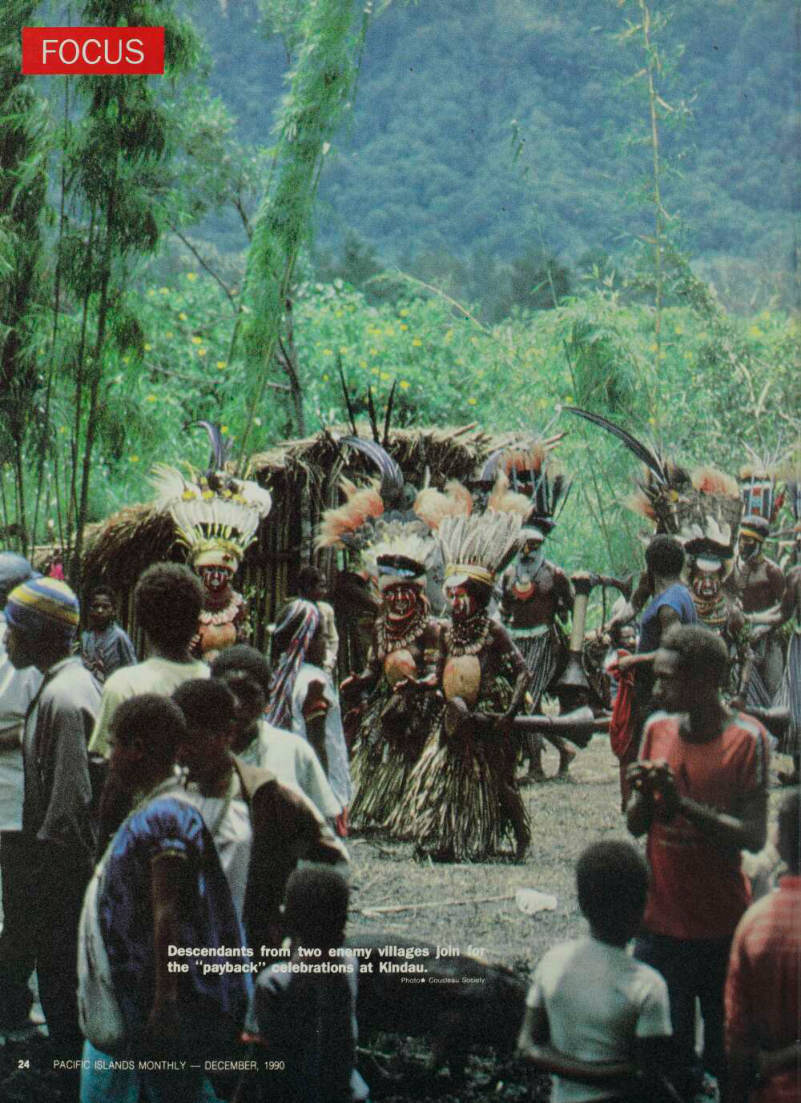
Cover: Amidst the turmoil of her political problems, Papua New Guinea constinues to boast an amazing cultural heritage. A new book re leased by the Cousteau Society illus trates a rarely seen side of the country.
Letters
Good coverage
I READ a borrowed copy of the July 1990 issue of Pacific Islands Monthly featuring the environment in the Pacific.
I read it on the plane back to Honolulu from American Samoa and was very impressed by your coverage of the horrendous state of the environment in parts of the Pacific.
I am working on marine conservation video tapes for the Pacific and I must admit my first recent trip there was quite shocking; I walked around in a state of disbelief seeing trash piled so high in the downtown local river that sometimes you can’t even see the water.
Much of this trash, which of course is non-biodegradable aluminium cans, styrofoam and plastic, is then washed out to sea when it rains and wrecks havoc on marine life.
While recycling might be a partial
solution (difficult apparently because of the limited market at this time and, of course, shipping costs) it makes sense to not allow this trash on the islands in the
first place.
Thank you again for your excellent issue. While the reporting of the extent of the problems was depressing it was heartening to see that others are concerned with the possible ruination of these lovely islands and discussion of possible solutions.
Sheila Laffey
Honolulu
Wrong Job
I WAS surprised to read in your Headlines report “Farewell to Bussiek” ( PIM , September 1990) that Wolfgang Holler has taken my job.
You meant to say that Wolfgang is the new Pacbroad coordinator, and I wish him well in helping to develop the radio service of the Pacific.
Meanwhile, I continue to be UNESCO Pacjourn coordinator, helping to develop the print media of the Pacific.
Peter Henshall
Port Moresby
Wrong quotes IN your September 1990 cover story, “A new direction Vanuatu changes course a decade later”, (pp. 18) a paragraph of my own narrative was mistakenly attributed to Grace Molisa, former private secretary to Prime Minister Walter Lini. The paragraph was: “Ever since the missionaries, Westerners have been trying to whiten ni-Vanuatu traditions. And for as long, the ni-Vanuatu have been subverting and adapting Western values to regenerate their own. The missionaries gave us cargo cults. Today the churches try to stamp out sorcercers, traditional healers in town with Europeans as patients, and are breaking ancestor stones as heathen.”
The paragraph was mistakenly enclosed in quotation marks at the typsetting stage. Grace Molisa did not make any similar statements to me during our interview for this cover article.
Earlier in the same issue, a question and answer in the South Pacific Forum cover interview with President leremia Tabai, “The 90s” (pp. 17), were incorrectly matched after several intervening questions and answers were deleted at some stage during production. The relevant questions and answers should have read: Q; There’s a body of opinion in Rim
Governments, development
organisations and among some regional academics that the Pacific nations will never break aid dependency and achieve any real measure of self sufficiency. Do you agree?
A: When I started off in Government I never believed that we would never make it, I read reports saying we are going to depend on aid until the end of the world. We are determined we don’t want to be in a dependent position. We want to be able to live within our means.
In Kiribati we don’t have many resources, just fishersies and tourism. We try to manage our existing resources like the reserve fund. In 1986, we told the UK we don’t want any more budgetary aid. That is an expression of how we’re very keen to be independent.
Kiribati has subsistence and cash economies. We will try to develop the subsistence economy and make it easier.
Affluent subsistence, we call it.
Q; One European diplomat to the
region recently expressed the opinion
that the Pacific nations must allow themselves to become the local stepping stone for Europe’s technological and scientific expansion into the Asian markets, or else suffer the economic
slump of post-independence Africa.
A: I hope he’s wrong. South Pacific countries follow the Western economic model which is vey much into commerce and private enterprise. In Africa, it’s more a socialist model where everything is run by the Government. They have real dictators there. We have more of a chance of success. You have to look at how long it took the developed countries, with resources, to get where they have. How long it took Europe to create the Common Market.
Karen Mangnall
Auckland
Advertisements & other items, p. 6 (1 item)
Electronic Image
VIDEO HEAD SPECIALISTS
ELECTRONIC IMAGE
83 Moala Street, P.O. Box 3636, Samabula, Suva, Fiji.
Telephone: 385027, Fax: 370206
aw *2* v % ' 4' Cylinder Head Assembly Fit Electronic Image video heads for clearer, brighter picture quality
Comment
Pacific Reborn
IT was G.B Shaw in his usual, selfish manner, who quipped, “The Americans are the only people who managed to pass from barbarism to decadence without being civilised in between”. In a comparable way Pacific communities are now being born into the post-modern, post-industrial world without being modernised first.
Post-modernism with its emphasis on complexity and cluttering, and post-industrialism’s on service and intellectual commodity are increasingly firming up a purchase on the lifestyles of Pacific peoples. One could ask whether this is a healthy sign or not or what caused this shunted (stunted?) growth. One of the important factors that produced this condition, was the presence of two types of colonists: a political and
an ideological one. Their combined influence implanted in Pacific peoples a quiescent and apathetic attitude to things, and reverence for the white man, who may not be emulated, and his paraphernalia the latter-day slogan “The Pacific Way” is an unconscious and neurotic reaction to this mentality. It was inevitable that the chance for smooth and gradual changes would be missed. Therefore the problem for the Pacific was to make the best of this circumstance.
All births are agonising and attended by lethal problems. Up to now gurus of development economists and sociologists diagnosing our condition, have always prescribed an economic panacea for all our ills, the same “solution” they prefer in other parts of the Third World. But, alas, here in the Pacific sociopolitical issues are fastly aclipsing the economic ones, a fact that must be worrying the “experts” and their theories!
The social struggle is not for subsistence or survival but between different ways of life, for which people would gladly sacrifice their subsistence and their lives. The people of Oceania are discovering new depths in old terms like liberty, rights, basic justice etc terms that have lain so long under the stifling bulk of convention and traditionalism, and about which talk in the past have by and large, merely window-dressing. The rediscovery of the Pacific by the outside world, and the impact of numerically growing educated elites are at the root of this
amazing outcome.
Everywhere in the island world things are stirring and bristling with difficulties. With Papua New Guinea problems seem to be insuperable. Those inherent in her relations with ruthless, and more powerful, neighbours are daunting enough.
And her inheritance has also been an unbridgeable chasm economic and sociocultural between small pockets of power wieldersin Moresby, Lae, and Goroka, and the untutored rural myriads. Therein lurk elemental
tensions, which, when conditions are favourable, will explode with titanic violence. Bougainville is paradigmatic. Vanuatu has something of the same problem but life there seems to have been reduced to wrangles between rival cults of personalities to the neglect of more useful avocations.
The situation in Tonga is both grave and bright. For the first time in her history we are seeing the emergence of a “parliamentary opposition”. This is provided by young MPs who model their political work on that of their counterparts in Australia and New Zealand i.e. critical monitoring of what the government is up to. They are not always understood as such and their motives are interpreted by their enemies in preposterous terms. Add to this the spectre of the ancient alliance between church and state beginning to show fissures with the two allies drifting apart.
Fiji, for her part, is embroiled in old social and racial problems and attempting belatedly to apply solutions that can only work if the clock is put back by about a century. Of the larger Pacific communities, Samoa is the only one that is not experiencing new internal strain. She shows no nationwide disaffection and can be the most conservative Polynesian community. Yet the Samoan system may be host to deep-seated and chronic stresses which are cultural and localised in nature.
In view of any impact ofchanges now taking place all around her, Samoa may be hugging a veritable timebomb.
The metropolitan powers currently most conspicuous in the Pacific are themselves far from being problem-free or models ofdiscernment or sensitivity. For example, everything Australia does smacks of the novice and is reflected in an overall of the cost-benefit principle. Socially and economically she is being transformed by a tug-of-war between American and Japanese models. And the economic horizon of New Zealand has been consistently deteriorating, and there seems to be no end in sight. For New Zealand some form ofdependancy would be hard to avoid.
France, with her awesome age, still insists in isolating everybody except reactionary elements who hope to benefit by Gallic alms. And the US, now diplomatically a fish out of water since recent events in the Eastern Bloc, is her same arrogant, callous self, with the Pacific, still her lake, and now {pace Johnston Island?) her dump to boot. Finallyjapan. She has natural integrity, the paragon of commercial astuteness, and has mountains of resources for aid, but, my God, she needs more of a historical sense and a cure for experiential myopia. □
The Islands
Futa Held
Alien question
NEW Zealand was founded by immigrants, starting with the Maori who came here in their long canoes from fabled Hawaiki more than a thousand years ago. European migrants poured in over the last century and a half to enlarge the cultural and ethnic base of the country.
The pace of immigration stepped up after the Second World War with waves of British and Dutch settlers, and in recent years there has been a steady trickle of other newcomers, many like the Maori from Polynesia and others from Asia. In Auckland and Wellington now, Thai, Malaysian and Cambodian restaurants vie for business with Italian trattoria, Greek tavernas and the rash of Chinese eating houses founded by earlier arrivals.
But New Zealand’s population remains small, at under 3.4 million, and despite persistent suggestions over the years that it should be greater in the interests of expanding the economy, successive governments have maintained a cautious approach.
A positive and dynamic immigration policy, like that Australia has exercised for many years, is a nettle New Zealand politicians have refused to grasp. Although they have spawned a constant stream of reviews and White Papers on the subject, immigration has remained at conservative levels. This has worried many business people, particularly in the face ofa dramatic outflow of New Zealanders in recent years.
Thousands of young and skilled people —just the types the country needs to stay have fled an uncertain economy to seek a better life, particularly in Australia. Over the last three years, even allowing for new immigrants, there has been a net loss of
about 14,000 a year.
A year or so ago, a so called Top Tier group of
executives representing
employers, retailers,
manufacturers, farmers and the tourist industry called on the government to open the doors to 100,000 immigrants a year about four times the existing level. They said New Zealand needed this substantial injection of new blood, bringing skills and the enthusiasm and
dedication to creating a new life, to kick-start the ailing economy and thereby stop the flood of our best young people overseas. They said the newcomers would not only pump some vitality into the nation, but would create a demand for new goods and services that would create jobs. The suggestion, coupled with some other studies which said New Zealand could not only sustain a population offive million but needed it, drew
a predictable reaction, coming, as it did, at a time when unemployment was heading for levels not reached since the Great Depression. The dole queues have lengthened since then and are still growing. But New Zealand has just elected a new government that is committed to looking again at the immigration issue with the aim of“providing positive policies as building blocks for a growing New Zealand economy and to enhance the quality of community life”.
The National government has not spelled out any targets. 11 has not said how many immigrants it wants or what size population it is aiming at. But it has promised “a more flexible system”, scrapping the traditional occupational priority list and “a new streamlined set ofcriteria”. It has also not spelled out its attitude to immigrants from the Pacific Islands, who currently number about 4000 a year. National’s policy statements offer little hope of opening the door to more of those islanders who understandably have a strong desire to move to a country which offers more economic opportunity than their homelands.
In fact, by stating that the policy will emphasise the skills of potential immigrants and their ability to bring substantial sums of capital into New Zealand, it implies that Pacific Islanders will not get much ofa look in under the new “flexible” system. National, has however, guaranteed that existing quota commitments, such as those applied to Western Samoa, will remain, as will the family reunification policy which admits immigrants from countries like Tonga and Fiji. People from the Cook Islands, Niue and Tokelau have free access, as New Zealand citizens.
Tuvalu has been pressing New Zealand to liberalise immigration for its people, at present limited to a small work scheme admitting 20 workers a year. Apart from that, there is no great pressure from the island nations to substantially expand access. There is a dilemma here, of course. For several countries, particularly Western Samoa and Tonga, money sent
home by their migrant communities in New Zealand is a significant factor in their economies. But making it easier for islanders to come here would not necessarily help if it encourages more of their skilled workers to leave at the expense oflocal growth and development.
The new government will have to work through its new policy carefully.
While it says it will draw migrants from all around the world, it cannot expand
immigration significantly without due
regard to the existing make-up of the population, which is nearly 20 per cent Polynesian. And the Maori people, who
have had little or no input into past immigration policies, are increasingly demanding their say. As the ill-fated 1988 Royal Commission on Social Policy commented: “Since 1840 there has never been an occasion when immigration policies here, both in word and practice, effectively reflected the equality of all races. Nor do they appear to have had any regard to the principles of the T reaty ofWaitangi.” □
Wellington
David Barber
The Evans blast
LAST month Australia’s Foreign Minister, Senator Gareth Evans, made his fourth tour of the Pacific but did not visit Fiji. Fiji’s Prime Minister, Ratu Sir Kamisese Mara, had told him he was not welcome.
At issue was one sentence in Evans’ speech to the United Nations General As sembly in October and com ments he made during a visit to India four months ago.
Evans had told the United
Nations Fiji’s racially
weighted post-coup consti tution would build “new and
far-reaching racially dis
criminatory principles into
the Fijian political system”.
It was a strong statement
to a distinguished audience of world leaders. Ratu Sir Kamisese, who left a cordial meeting with Australia’s Prime Minister at the South Pacific Forum in Vanuatu satisfied a softening of Australia’s policy was in the wind, was angered.
In an interview shortly afterwards, Ratu Sir Kamisese accused Evans of opposing improved relations between Australia and Fiji and highlighted the differences made by Hawke and Evans, saying their views on Fiji “appeared quite divergent”.
The differences arose over comments made by Hawke after his Forum meeting with Ratu Sir Kamisese. The Australian Prime Minister had, for the first time, publicly urged the ousted Coalition party in Fiji to abandon their boycott of elections. He also made it clear Australia’s relations with Fiji would be reviewed in the light of the continuing progress back to constitutional rule and the extent to which the military forces exercised influence over the government.
Hawke’s statements were the most conciliatry since the 1987 coups and appeared to mark a subtle, but significant, change in Australia’s stand. In particular, they appeared to abandon Australia’s oft repeated position that it would not normalise relations until Fiji had a constitution “broadly acceptable to all communities”. Now the new constitution has been promulgated, Ratu Sir Kamisese wants to see the issue removed from the international stage.
Within Australia, however, there is still strong pressure on the government not to modify its stand. Only recently, Justice Michael Kirby, one of Australia’s most senior and respected judges, condemned the post-coup constitution, saying the government would not be answerable to the governed (ethnic- Indian or Fijian) and that the document provided a means by which Fiji could be ruled in perpetuity by a small group of chiefs and their associates.
Judge Kirby’s comments were not prompted by opposition to indigenous rights. On the contrary, he is a man who has spoken out in favour of special measures to assist indigenous people. Rather his comments were based on a desire to see harmony in Fiji and on the belief that once the rights of one,
or a number of groups, are severely curtailed, the seeds for future unrest and instability will have been sown.
Even though the Australian media may have tired of reporting the twists and turns of Fiji politics, interest and concern continue to be registered by groups representing ‘middle Australia’, such as Amnesty International. Amnesty was particularly distressed by the charges of sedition layed against seven ethnic Indians alleged to have been involved in a symbolic burning of the new consstitution, and has said if the protestors or the three journalists, charged in a related incident with malicious publication, are convited, they will be regarded as prisoners of conscience.
Many Australians find it simply absurd that people taking part in a peaceful protest could face such severe charges. That the five soldiers resposibsle for kidnapping and torturing one of the protestors can be let off with a fine confirm the view in many minds that there are serious problems with the Fiji
justice system.
Within Evans’ ruling Labor Party, feeling is also strong.
Just last month a nationwide appeal to Labor Party branches and trade unions, for Fiji’s ousted Coalition, saw some unions give contributions six times more than what they had been asked. Despite Hawke’s comments in Port Vila, the accommodation hoped for by Ratu Sir Kamisese has not eventuated. Evans and the Foreign Affairs Department insist there have never been any inconsistencies between comments made by Hawke and his Foreign Minister, merely that there has been a slightly different emphasis on the same unchanged seven-point policy statement. If anything, Ratu Sir Kamisese’s reaction, coming as it did at the same time as the kidnapping and sedition charges is only likely to harden the Australian government’s resolve at least in the short term.
Evans has made it clear he believes Fiji cannot expect to be immune from criticism. In New Zealand late last month, he went further and stressed Australia’s duty to take a stand in favour ofhuman rights. “You can’t go around making pronouncements about South Africa and China ... and then sit on your hands ... when you have a very difficult human rights situation in your own region,” he said.
But despite his tough response, Evans is also facing pressure
to take the pragmatic road and, if not restore normal relations, at least ease back on his criticism.
That pressure is coming, not just from businesspeople and some diplomats, but increasingly from the Liberal-National Party Opposition which is now edging ahead of the government in opinion polls for the first time in years. Whatever the political
complexion ot me government in Canberra, however, it will face a dilemma over its stand over Fiji. No politicall party has yet backed the restoration of full relations and all agree that the constitution severly discriminates against Indo-Fijians and against indigenous Fijians living in the urban areas.
Essentially, the difference between the parties is still one of style rather than content. □
Sydney
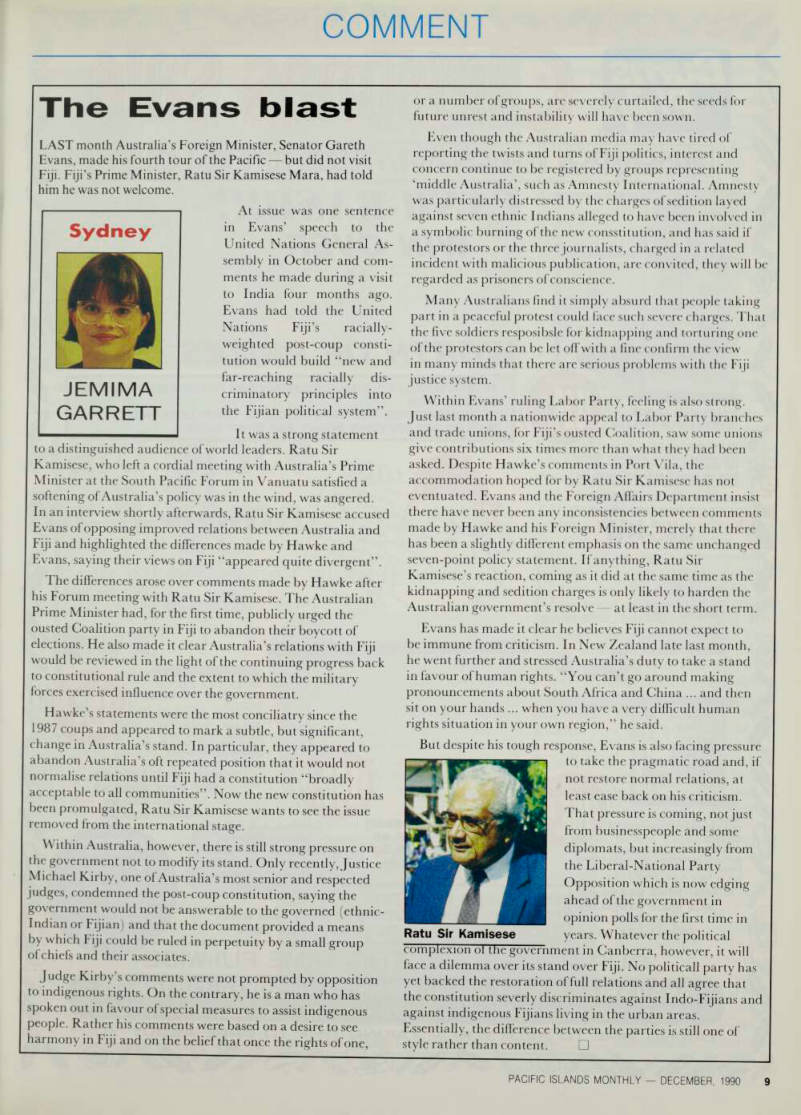
Jemima
Garrett
Ratu Sir Kamisese
Advertisements & other items, p. 10 (1 item)
Philp
9b
Bums
Q 0 Q
REFRIGERATOR/FREEZER FIJI’S NO.l SELLER
t \ u 15® %
SHACKLOCK 2 DOOR
REFRIGERATOR/FREEZER
cash-bash :::
WIN OVER
MAXIMUM
3
MONTHS
INTEREST :>
FREE
BENEFITS^
WORTH OF PRIZES
TOYOTA COROLLA 1.3 MANUAL SEDAN CAR RETAIL VALUE $25,000.
$20,000 CASH
RETURN TRIP FOR ONE NADI/HONOLULU/DISNEYLAND/NADI
PLUS $l,OOO SPENDING MONEY AND MANY MORE.
FEATURES: Automatic Defrost (Refrigerator Section), Adjustable Shelves, Tall Bottle Storage, Fruit & Vegetable Bin Removable Egg Container, Capacity 172 Litres, Left or Right Hand Opening Doors
NORMAL PRICE $695.00-
SALE PRICE $648.00
SAVE $47.00
WEEKLY $7.02
<tx m
Mx % < m -I I
mm? i
SHACKLOCK 2-DOOR ,
REFRIGERATOR/FREEZER tf §
SC33ST I
FEATURES: Automatic Defrost 'I (Refrigerator Section), Full Adjustable Shelves, Butter Conditioner, Tall Bottle Storage, Capacity 333 Litres, Left or Right Hand Opening Doors
NORMAL PRICE $985.00
SALE PRICE $925.00
SAVE $60.00
WEEKLY $10.02
SHACKLOCK CHEST \1
FREEZER SHSIOS
NORMAL PRICE $1050.00
SALE PRICE $950.00
SAVE $lOO.OO
WEEKLY $10.29
I Weekly Draws of $lOO cash. Plus $3OOO cash on Christmas Eve in British Paints Promotion i
SHACKLOCK 2-DOOR
REFRIGERATOR/FREEZER
SC3BOB
FEATURES: Automatic Defrost (Refrigerator Section), Adjustable Shelves, Butter/Conditioner.Capadty 378 Litres, Left or Right Hand Opening Doors
NORMAL PRICE $1150.00
SALE PRICE $1050.00
SAVE $lOO.OO
WEEKLY $11.38
CONDITIONS OF ENTRY
Fill in Entry Form on purchase of every item worth $15.00 from any Burns Philp Homecentre Store
OUR PRICES ARE THE SAME FIJI-WIDE
AVAILABLE ON EASY CREDIT TERMS TO APPROVED CUSTOMERS • SUVA • LAUTOKA • NADI • BA • RAKIRAKI • LABASA • SIGATOKA and now in TAVUA
TAKING TIME TO HELP VOU
TAKING TIME TO CARE ABOUT VOU
Hard place
The Region
Hard place for a home
Debate over Noumea alternative delays decision on SPC site
By Geoff Adlide
SIXTEEN years ago a consultant engineer warned the South Pacific Commission that its home was rot ten. Termites were entrenched in the timber of the World War Two former United States military base. Numerous reports have since confirmed the need for a new SPC headquarters. The Noumea fire brigade said the wood was so dry and hollow that a fire would mean certain devastation.
“One day soon we may literally find the roof falling in on our heads,”
Secretary-General Atanraoi Baiteke told the conference. Also, the staff had outgrown the offices. He said new programmes scheduled to start in the next few months may be hampered by the lack of office space.
For over a decade the question for the 27-member countries of the SPC has not been whether to rebuild, but how to pay for it. But now a new question has emerged one laced with delicate
political undercurrents: where to build?
Late last year SPC staff read in the local newspaper of a new development plan for the Noumea beachfront suburb of Anse Vata. The land which has been the SPC’s home for over 40 years was earmarked for tourist development by New Caledonia’s Southern Provincial Government. The Southern Province is controlled by Jacques Lafleur’s predominantly European anti independence party, the RPCR.
Although the SPC has legal title to the land, and it could choose to stay put, the pressure to move is resented by some island countries. The French Govern ment keen to keep the prestigious regional organisation within its domain is caught in the middle. Only two years ago Paris announced a new diplomatic campaign to make friends in the Pacific and integrate its territories into the region. In June this year, the SPC Secretary-General visited Paris at the Government’s invitation the first such invitation to be extended to the
Spc.
“I know that some of you have had serious misgivings about the proposed move from the present site, thinking perhaps: ‘We are being driven out of our homes, which means that we have become undesirable in the village’,”
French High Commissioner Bernard Grasset told the Conference delegates on the opening day. “This is not the case, I hasten to assure you.” Grasset said he was trying to effect a balance between the economic development of the terri tory and the needs of the SPC.
Despite Grasset’s plea, images of rejection surfaced several times during the six-hour Conference debate. Most delegates said it was their government’s preference to rebuild on the present Anse Vata site. And they resented the fact that a French and New Caledonian offer to partly fund reconstruction was con ditional on the SPC vacating Anse Vata.
“Most un-Pacific,” was how the Ameri can Samoan delegate described the offer.
The Marshall Islands representative, Foreign Affairs Undersecretary Mack Kaminaga, likened the SPC head quarters to a big canoe. “One of our brothers is telling us to get off the canoe,” he said. “He’s not asking us, he’s telling us.” Kaminaga said that the Pacific Islands people have long been pushed around. “We have to stand firm together as Pacific Islanders. Although it’s coming
from a Pacific brother, he doesn’t sound like a Pacific brother.”
“I do not ask people to leave the canoe,” re sponded New Caledonian
representative, Jacques
lekawe, “but to move to another, better canoe.”
The Municipality of Nou mea has offered an alterna tive site in a nearby suburb, coincidentaly called Re
Geoff Adlide
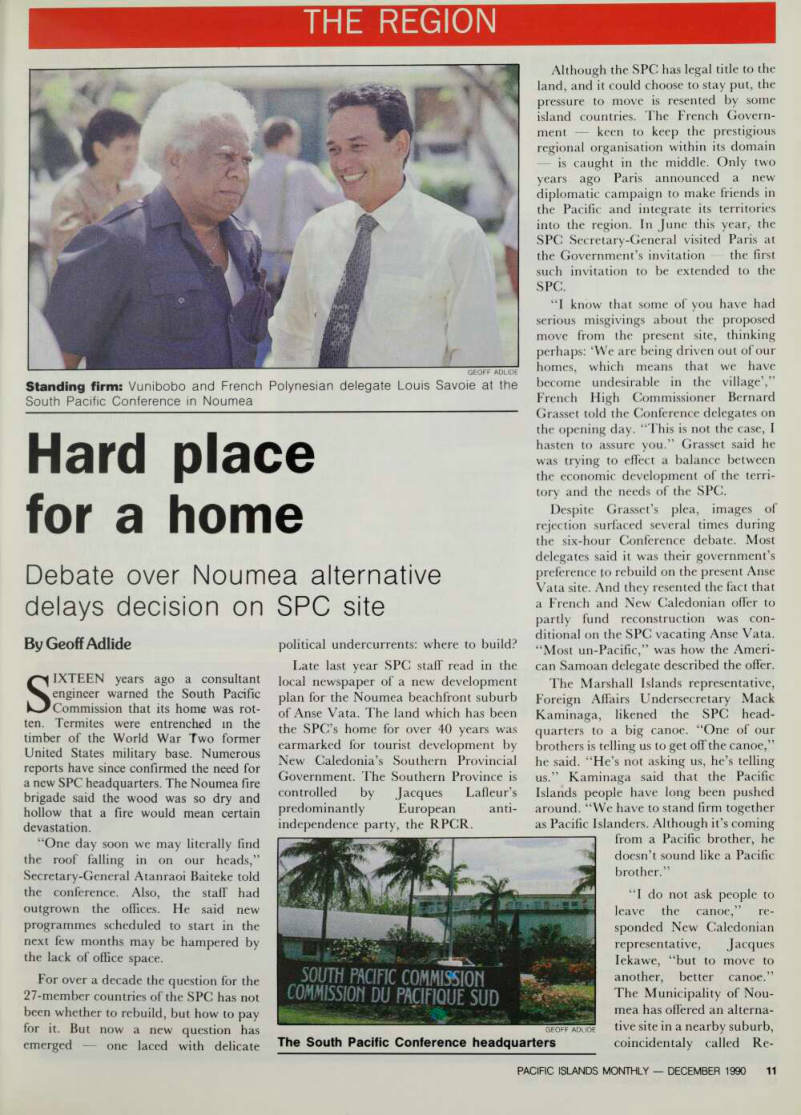
Standing firm: Vunibobo and French Polynesian delegate Louis Savoie at the South Pacific Conference in Noumea
Geoff Adlide
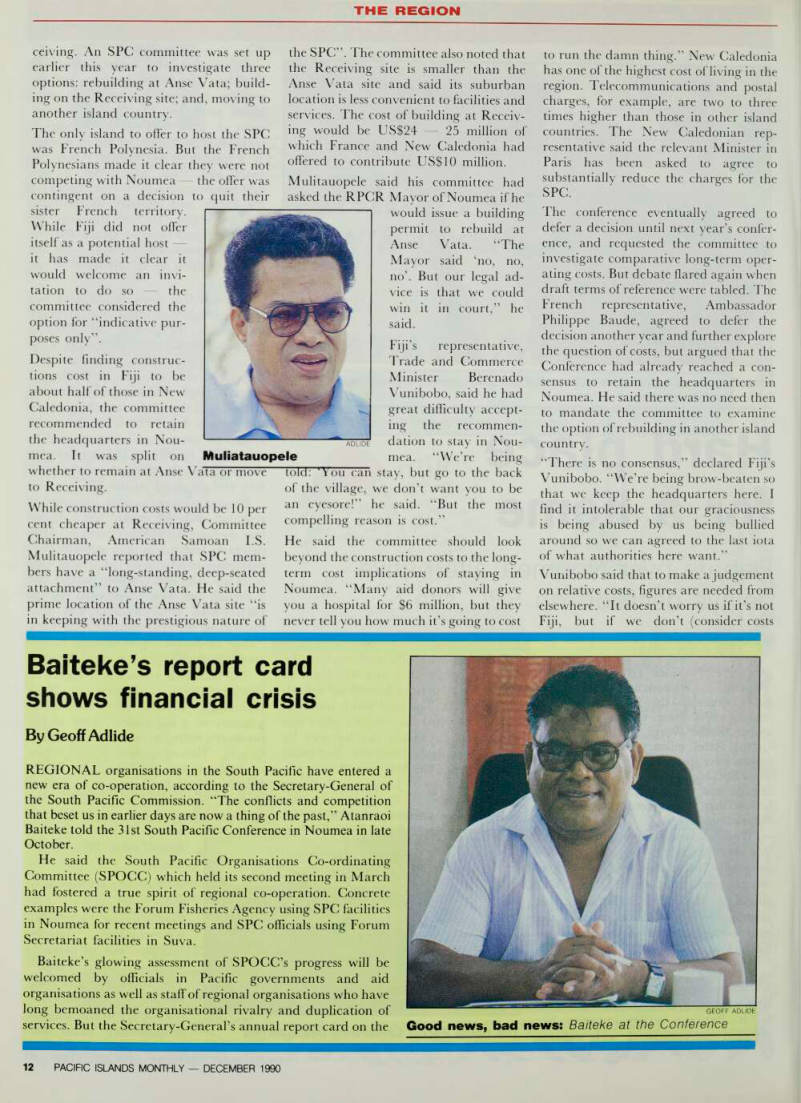
The South Pacific Conference headquarters
ceiving. An SPC committee was set up earlier this year to investigate three options: rebuilding at Anse Vata; building on the Receiving site; and, moving to another island country.
The only island to offer to host the SPC was French Polynesia. But the French Polynesians made it clear they were not competing with Noumea the offer was contingent on a decision to quit their
sister French territory.
While Fiji did not offer itself as a potential host it has made it clear it would welcome an invi tation to do so the committee considered the option for “indicative pur poses only”.
Despite finding construc
tions cost in Fiji to be about half of those in New Caledonia, the committee recommended to retain the headquarters in Nou mea. It was split on
whether to remain at Anse Vata or move
to Receiving.
While construction costs would be 10 per cent cheaper at Receiving, Committee Chairman, American Samoan I.S.
Mulitauopele reported that SPC mem bers have a “long-standing, deep-seated attachment” to Anse Vata. He said the prime location of the Anse Vata site “is in keeping with the prestigious nature of
the SPC”. The committee also noted that the Receiving site is smaller than the Anse Vata site and said its suburban location is less convenient to facilities and services. The cost of building at Receiv in § would be USS 24 25 million of which France and New Caledonia had offered to contribute US$lO million.
Mulitauopele said his committee had asked the RPCR Mayor of Noumea if he
would issue a building permit to rebuild at Anse Vata. “The Mayor said ‘no, no, no’. But our legal ad vice is that we could win it in court,” he said.
Fiji’s representative, Trade and Commerce Minister Berenado Vunibobo, said he had great difficulty accept ing the recommen dation to stay in Nou mea. “We’re being
told: ’You can stay, but go to the back of the village, we don’t want you to be an eyesore!” he said. “But the most compelling reason is cost.”
He said the committee should look beyond the construction costs to the long term cost implications of staying in Noumea. “Many aid donors will give you a hospital for S 6 million, but they never tell you how much it’s going to cost
to run the damn thing.” New Caledonia has one of the highest cost of living in the region. Telecommunications and postal charges, for example, are two to three times higher than those in other island countries. The New Caledonian rep resentative said the relevant Minister in Paris has been asked to agree to substantially reduce the charges for the
Spc.
The conference eventually agreed to defer a decision until next year’s confer ence, and requested the committee to
investigate comparative long-term oper
ating costs. But debate flared again when draft terms of reference were tabled. The French representative, Ambassador Philippe Baude, agreed to defer the decision another year and further explore the question of costs, but argued that the Conference had already reached a con sensus to retain the headquarters in Noumea. He said there was no need then to mandate the committee to examine the option of rebuilding in another island country.
“There is no consensus,” declared Fiji’s Vunibobo. “We’re being brow-beaten so that we keep the headquarters here. I find it intolerable that our graciousness is being abused by us being bullied around so we can agreed to the last iota of what authorities here want.”
Vunibobo said that to make a judgement on relative costs, figures are needed from elsewhere. “It doesn’t worry us if it’s not Fiji, but if we don’t (consider costs
Adlide
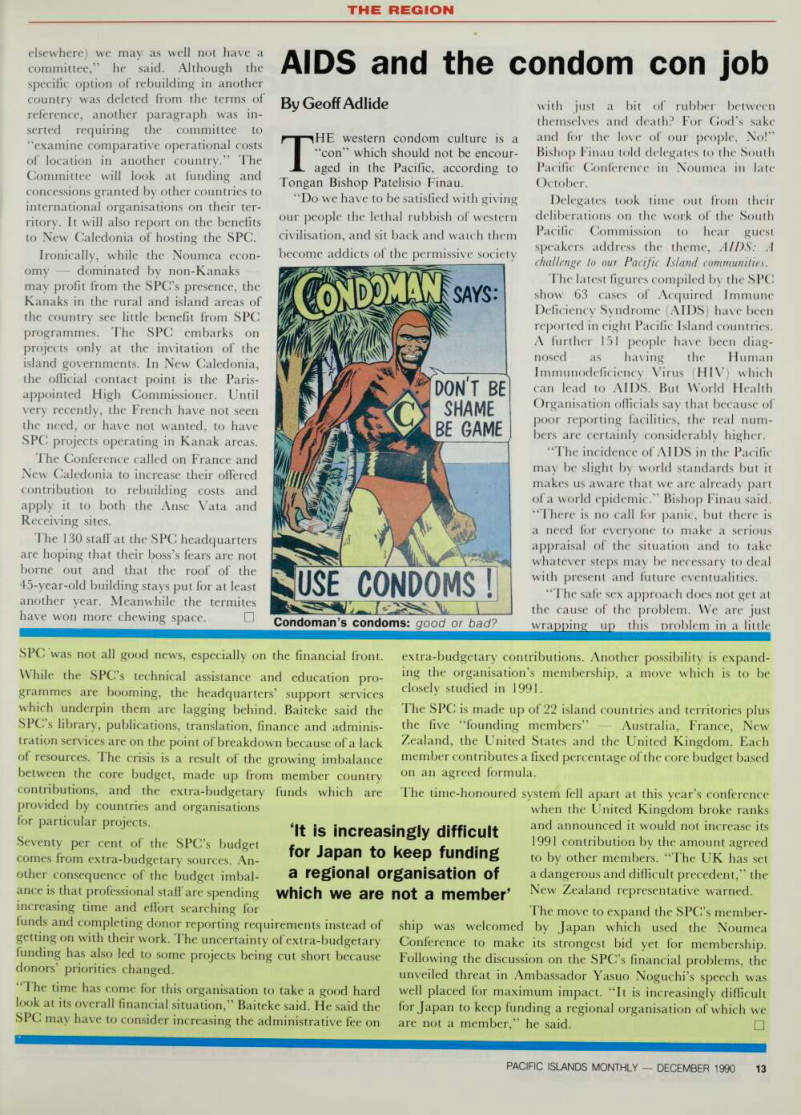
Muliatauopele
elsewhere) we may as well not have a committee,” he said. Although the specific option of rebuilding in another country was deleted from the terms of reference, another paragraph was in serted requiring the committee to “examine comparative operational costs of location in another country.” The Committee will look at funding and concessions granted by other countries to international organisations on their ter ritory. It will also report on the benefits to New Caledonia of hosting the SPC.
Ironically, while the Noumea econ omy dominated by non-Kanaks may profit from the SPC’s presence, the Kanaks in the rural and island areas of the country see little benefit from SPC programmes. The SPC embarks on projects only at the invitation of the island governments. In New Caledonia, the official contact point is the Paris appointed High Commissioner. Until very recently, the French have not seen the need, or have not wanted, to have SPC projects operating in Kanak areas.
The Conference called on France and New Caledonia to increase their offered contribution to rebuilding costs and apply it to both the Anse Vata and
Receiving sites.
The 130 staff at the SPC headquarters are hoping that their boss’s fears are not borne out and that the roof of the 45-year-old building stays put for at least another year. Meanwhile the termites have won more chewing space. □
Baiteke’s report card
shows financial crisis
By Geoff Adlide
REGIONAL organisations in the South Pacific have entered a new era of co-operation, according to the Secretary-General of the South Pacific Commission. “The conflicts and competition that beset us in earlier days are now a thing of the past,” Atanraoi Baiteke told the 31st South Pacific Conference in Noumea in late October.
He said the South Pacific Organisations Co-ordinating Committee (SPOCC) which held its second meeting in March had fostered a true spirit of regional co-operation. Concrete examples were the Forum Fisheries Agency using SPC facilities in Noumea for recent meetings and SPC officials using Forum Secretariat facilities in Suva.
Baiteke’s glowing assessment of SPOCC’s progress will be welcomed by officials in Pacific governments and aid organisations as well as staff of regional organisations who have long bemoaned the organisational rivalry and duplication of services. But the Secretary-General’s annual report card on the
Geoff Adlide
Good news, bad news: Baiteke at the Conference
SPC was not all good news, especially on the financial front.
While the SPC’s technical assistance and education pro grammes are booming, the headquarters’ support services which underpin them are lagging behind. Baiteke said the SPC’s library, publications, translation, finance and adminis tration services are on the point of breakdown because of a lack of resources. The crisis is a result of the growing imbalance between the core budget, made up from member country contributions, and the extra-budgetary funds which are
provided by countries and organisations for particular projects.
Seventy per cent of the SPC’s budget comes from extra-budgetary sources. An other consequence of the budget imbal ance is that professional staff are spending increasing time and effort searching for
funds and completing donor reporting requirements instead of getting on with their work. The uncertainty of extra-budgetary funding has also led to some projects being cut short because donors’ priorities changed.
The time has come for this organisation to take a good hard look at its overall financial situation,” Baiteke said. He said the SPC may have to consider increasing the administrative fee on
extra-budgetary contributions. Another possibility is expand ing the organisation’s membership, a move which is to be closely studied in 1991.
The SPC is made up of 22 island countries and territories plus the five “founding members” Australia, France, New Zealand, the United States and the United Kingdom. Each member contributes a fixed percentage of the core budget based on an agreed formula.
The time-honoured system fell apart at this year’s conference
‘lt is increasingly difficult for Japan to keep funding a regional organisation of which we are not a member’
when the United Kingdom broke ranks and announced it would not increase its 1991 contribution by the amount agreed to by other members. “The UK has set a dangerous and difficult precedent,” the New Zealand representative warned.
The move to expand the SPC’s member
ship was welcomed by Japan which used the Noumea Conference to make its strongest bid yet for membership.
Following the discussion on the SPC’s financial problems, the unveiled threat in Ambassador Yasuo Noguchi’s speech was well placed for maximum impact. “It is increasingly difficult for Japan to keep funding a regional organisation of which we are not a member,” he said. □
AIDS and the condom con job
By Geoff Adlide
THE western condom culture is a “con” which should not be encour aged in the Pacific, according to Tongan Bishop Patelisio Finau.
“Do we have to be satisfied with giving our people the lethal rubbish of western civilisation, and sit back and watch them become addicts of the permissive society
with just a bit of rubber between themselves and death? For God’s sake and for the love of our people, No!”
Bishop Finau told delegates to the South Pacific Conference in Noumea in late October.
Delegates took time out from their deliberations on the work of the South Pacific Commission to hear guest speakers address the theme, AIDS: A challenge to our Pacific Island communities.
The latest figures compiled by the SPC show 63 cases of Acquired Immune Deficiency Syndrome (AIDS) have been reported in eight Pacific Island countries.
A further 151 people have been diag nosed as having the Human Immunodeficiency Virus (HIV) which can lead to AIDS. But World Health Organisation officials say that because of poor reporting facilities, the real num bers are certainly considerably higher.
“The incidence of AIDS in the Pacific may be slight by world standards but it makes us aware that we are already part of a world epidemic.” Bishop Finau said.
“There is no call for panic, but there is a need for everyone to make a serious appraisal of the situation and to take whatever steps may be necessary to deal with present and future eventualities.
“The safe sex approach does not get at the cause of the problem. We are just wrapping up this problem in a little
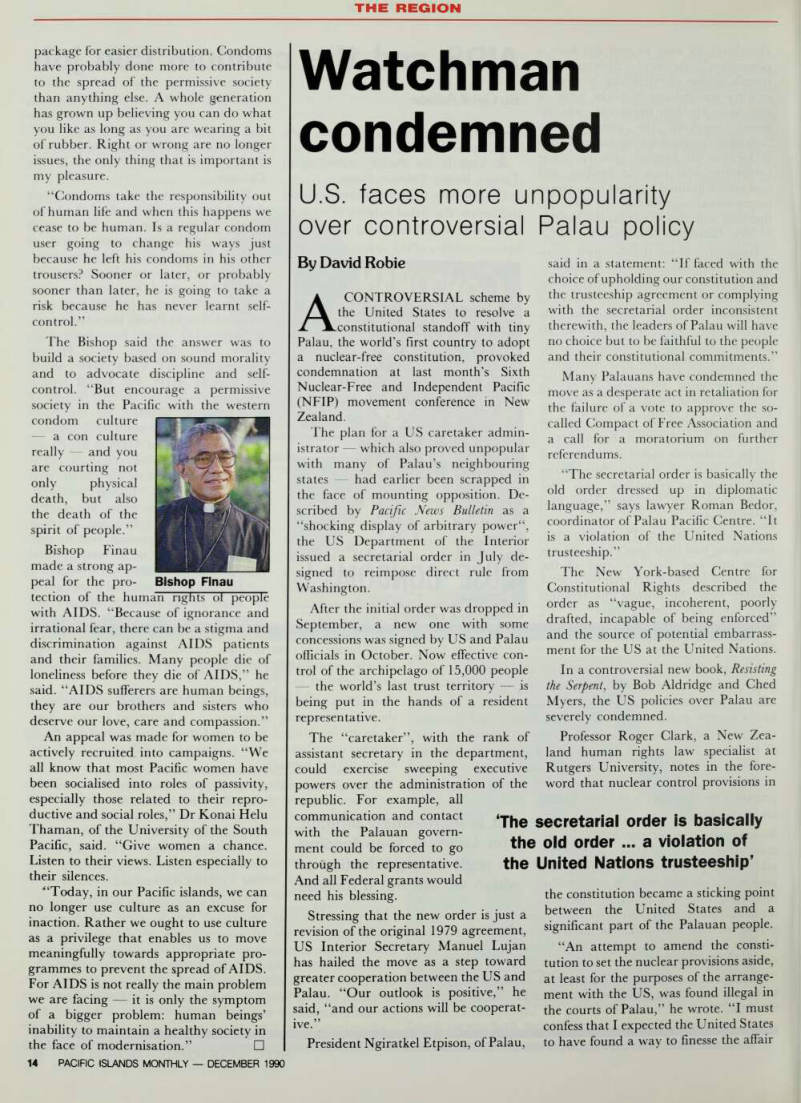
Condoman’s condoms: good or bad?
package for easier distribution. Condoms have probably done more to contribute to the spread of the permissive society than anything else. A whole generation has grown up believing you can do what you like as long as you are wearing a bit of rubber. Right or wrong are no longer issues, the only thing that is important is
my pleasure.
“Condoms take the responsibility out of human life and when this happens we cease to be human. Is a regular condom user going to change his ways just because he left his condoms in his other trousers? Sooner or later, or probably sooner than later, he is going to take a risk because he has never learnt self control.”
The Bishop said the answer was to build a society based on sound morality and to advocate discipline and self control. “But encourage a permissive society in the Pacific with the western
condom culture a con culture really and you are courting not
only physical
death, but also the death of the spirit of people.”
Bishop Finau
made a strong ap peal for the pro-
tection of the human rights ol people with AIDS. “Because of ignorance and irrational fear, there can be a stigma and discrimination against AIDS patients and their families. Many people die of loneliness before they die of AIDS,” he said. “AIDS sufferers are human beings, they are our brothers and sisters who deserve our love, care and compassion.”
An appeal was made for women to be actively recruited into campaigns. “We all know that most Pacific women have been socialised into roles of passivity, especially those related to their repro ductive and social roles,” Dr Konai Helu Thaman, of the University of the South Pacific, said. “Give women a chance.
Listen to their views. Listen especially to their silences.
'“Today, in our Pacific islands, we can no longer use culture as an excuse for inaction. Rather we ought to use culture as a privilege that enables us to move
meaningfully towards appropriate pro
grammes to prevent the spread of AIDS.
For AIDS is not really the main problem we are facing it is only the symptom of a bigger problem: human beings’ inability to maintain a healthy society in the face of modernisation.” □
Bishop Finau
condemned
Watchman condemned U.S. faces more unpopularity over controversial Palau policy
By David Robie
A CONTROVERSIAL scheme by the United States to resolve a constitutional standoff with tiny Palau, the world’s first country to adopt a nuclear-free constitution, provoked condemnation at last month’s Sixth Nuclear-Free and Independent Pacific (NFIP) movement conference in New Zealand.
The plan for a US caretaker admin istrator which also proved unpopular with many of Palau’s neighbouring states had earlier been scrapped in the face of mounting opposition. De scribed by Pacific News Bulletin as a “shocking display of arbitrary power“, the US Department of the Interior issued a secretarial order in July de signed to reimpose direct rule from
Washington.
After the initial order was dropped in September, a new one with some concessions was signed by US and Palau officials in October. Now effective con trol of the archipelago of 15,000 people the world’s last trust territory js being put in the hands of a resident
representative.
The “caretaker”, with the rank of assistant secretary in the department, could exercise sweeping executive powers over the administration of the
republic. For example, all communication and contact with the Palauan govern ment could be forced to go
through the representative.
And all Federal grants would
need his blessing.
Stressing that the new order is just a revision of the original 1979 agreement, US Interior Secretary Manuel Lujan has hailed the move as a step toward greater cooperation between the US and Palau. “Our outlook is positive,” he said, “and our actions will be cooperat ive.”
President Ngiratkel Etpison, of Palau,
said in a statement: “If faced with the choice of upholding our constitution and the trusteeship agreement or complying with the secretarial order inconsistent therewith, the leaders of Palau will have no choice but to be faithful to the people and their constitutional commitments.”
Many Palauans have condemned the move as a desperate act in retaliation for the failure of a vote to approve the so called Compact of Free Association and a call for a moratorium on further referendums.
“The secretarial order is basically the old order dressed up in diplomatic language,” says lawyer Roman Bedor, coordinator of Palau Pacific Centre. “It is a violation of the United Nations trusteeship.”
The New York-based Centre for Constitutional Rights described the order as “vague, incoherent, poorly drafted, incapable of being enforced” and the source of potential embarrass ment for the US at the United Nations.
In a controversial new book, Resisting the Serpent , by Bob Aldridge and Ched Myers, the US policies over Palau are severely condemned.
Professor Roger Clark, a New Zea land human rights law specialist at Rutgers University, notes in the fore word that nuclear control provisions in
‘The secretarial order is basically the old order ... a violation of the United Nations trusteeship’
the constitution became a sticking point between the United States and a significant part of the Palauan people.
“An attempt to amend the consti tution to set the nuclear provisions aside, at least for the purposes of the arrange ment with the US, was found illegal in the courts of Palau,” he wrote. “I must confess that I expected the United States to have found a way to finesse the affair
at least a decade ago, but it has not. The result is a standoff with the trusteeship still in force, but the nuclear-free consti tution also still intact.”
The Palau standoff was just one of many sovereignty issues discussed by 154 delegates from 26 Pacific and Asian nations and territories at the Sixth Nuclear-Free and Independent Pacific movement conference at Pawarenga in Northland from the Ist to the Bth of last month.
Delegations comprised a mixture of the region’s liberation movements, peace and land rights activists, clergy, women’s rights campaigners and parliamen tarians. They came from East Timor to French Polynesia, and the Philippines to New Zealand.
At the last conference, in Manila in 1987, delegates concentrated on the three Pacific “flashpoints” of Palau, Kanaky- New Caledonia and Fiji. However, this time Fiji and other sensitive indigenous and ethnicity issues including the future of the NFIP movement itself dominated.
Part of the conference was divided into
indigenous and non-indigenous caucuses.
Most of the sessions were barred to news media in an atmosphere of excessive secrecy that has been widely criticised by a number of delegates.
The movement, founded in Fiji 15 years ago, has nurtured many of the South Pacific’s current political and religious leaders, including Vanuatu Prime Minister Father Walter Lini and President leremia Tabai, of Kiribati. But since the 1983 conference in Port Vila, the movement has been deeply split over ethnic issues.
A recent letter by the movement’s “founding mothers” circulated among NFIP members condemned the prevail ing “indigenous agenda” which was said to be dividing and weakening the movement. Some members of the movement regard the Auckland-based Pacific Concerns Resource Centre as too dominated by one Maori activist group and want it moved to a South Pacific island nation.
The letter criticised the “failure of the
movement to raise the awareness of Pacific Islands peoples themselves (over) the People’s Charter of 1975.” It said the indigenous agenda prevented a “clear and accurate analysis of events in the islands”, such as the situation in Fiji after the two coups of 1987.
“We believe the indigenous issues are important,” said the letter’s 18 signatories. “However, the current in terpretation of these, and the way they are presented are divisive and destruc tive. Conflict between the indigenous and non-indigenous are not the issues of Pacific islanders . . . We have become the victims of this conflict.”
Fiji’s Amelia Rokotuivuna, coordi nator of the First NFIP conference, says: “Indigenousness of ethnicity is not the issue for most Pacific Islanders. It is rather justice that has been denied us by our own indigenous leaders and some aspects of our traditional systems.”
According to Pastor Elmo Manapat, the Philippines-Japan representative on the NFIP steering committee: “The indigenous issue isn’t the real issue of the Pacific. It is the issue of the English speaking indigenous people who cannot speak their own tongue fluently and have to resort to English to express their grievances. And they have the gall to tell us what to do!”
Manapat, like many other delegates, believe the real issues are perceived differently in each Pacific country. But mostly they are linked to economic independence and liberation struggles.
A greater emphasis on local develop ment through the eight regions that make up the NFIP movement and other proposals have been put forward to restructure the movement to strengthen the Pacific struggle for independence, against militarism and for more equi table development. Hilda Halkyard-
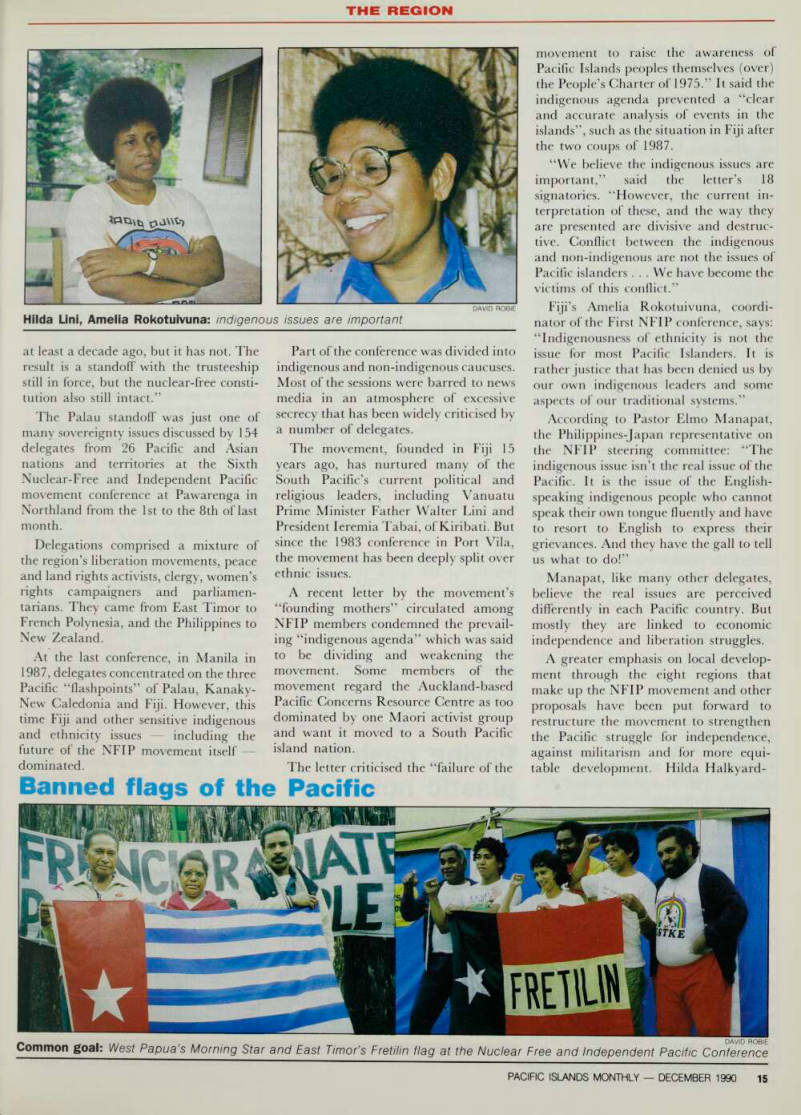
David Robie
Hilda Lini, Amelia Rokotuivuna: indigenous issues are important
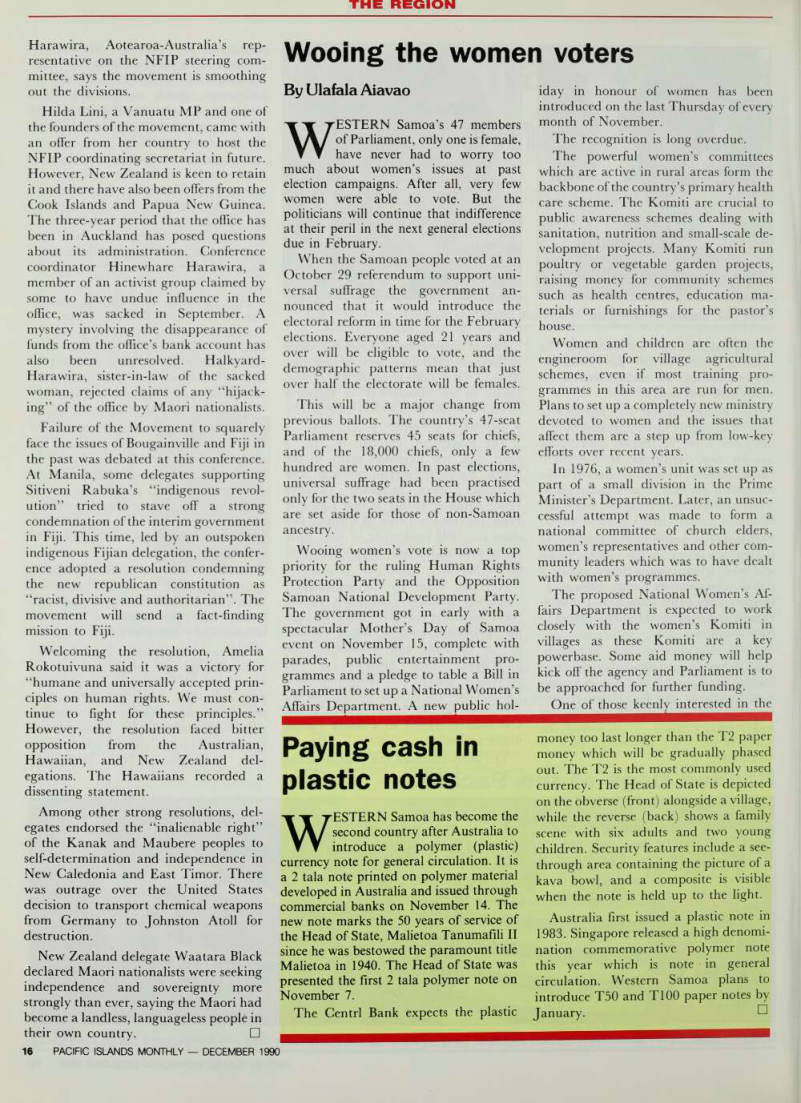
Banned flags of the Pacific
David Robie
Common goal: West Papua’s Morning Star and East Timor's Fretilin flag at the Nuclear Free and Independent Pacific Conference
Harawira, Aotearoa-Australia’s rep resentative on the NFIP steering com mittee, says the movement is smoothing out the divisions.
Hilda Lini, a Vanuatu MP and one of the founders of the movement, came with an offer from her country to host the NFIP coordinating secretariat in future.
However, New Zealand is keen to retain it and there have also been offers from the Cook Islands and Papua New Guinea.
The three-year period that the office has been in Auckland has posed questions about its administration. Conference coordinator Hinewhare Harawira, a member of an activist group claimed by some to have undue influence in the office, was sacked in September. A mystery involving the disappearance of funds from the office’s bank account has also been unresolved. Halkyard- Harawira, sister-in-law of the sacked woman, rejected claims of any “hijack ing” of the office by Maori nationalists.
Failure of the Movement to squarely face the issues of Bougainville and Fiji in the past was debated at this conference.
At Manila, some delegates supporting Sitiveni Rabuka’s “indigenous revol ution” tried to stave off a strong condemnation of the interim government in Fiji, This time, led by an outspoken indigenous Fijian delegation, the confer ence adopted a resolution condemning the new republican constitution as “racist, divisive and authoritarian”. The movement will send a fact-finding mission to Fiji.
Welcoming the resolution, Amelia Rokotuivuna said it was a victory for “humane and universally accepted prin ciples on human rights. We must con tinue to fight for these principles.”
However, the resolution faced bitter opposition from the Australian, Hawaiian, and New Zealand del egations. The Hawaiians recorded a
dissenting statement.
Among other strong resolutions, del egates endorsed the “inalienable right” of the Kanak and Maubere peoples to self-determination and independence in New Caledonia and East Timor. There was outrage over the United States decision to transport chemical weapons from Germany to Johnston Atoll for destruction.
New Zealand delegate Waatara Black declared Maori nationalists were seeking independence and sovereignty more strongly than ever, saying the Maori had become a landless, languageless people in their own country. □
plastic notes
Paying cash in plastic notes
WESTERN Samoa has become the second country after Australia to introduce a polymer (plastic) currency note for general circulation. It is a 2 tala note printed on polymer material developed in Australia and issued through commercial banks on November 14. The new note marks the 50 years of service of the Head of State, Malietoa Tanumafili II since he was bestowed the paramount title Malietoa in 1940. The Head of State was presented the first 2 tala polymer note on November 7.
The Centrl Bank expects the plastic
money too last longer than the T 2 paper money which will be gradually phased out. The T 2 is the most commonly used currency. The Head of State is depicted on the obverse (front) alongside a village, while the reverse (back) shows a family scene with six adults and two young children. Security features include a see through area containing the picture of a kava bowl, and a composite is visible when the note is held up to the light.
Australia first issued a plastic note in 1983. Singapore released a high denomi nation commemorative polymer note this year which is note in general circulation. Western Samoa plans to introduce T5O and TlOO paper notes by January.
Wooing the women voters
By Ulafala Aiavao
WESTERN Samoa’s 47 members of Parliament, only one is female, have never had to worry too much about women’s issues at past election campaigns. After all, very few women were able to vote. But the politicians will continue that indifference at their peril in the next general elections due in February.
When the Samoan people voted at an October 29 referendum to support uni versal suffrage the government an nounced that it would introduce the electoral reform in time for the February elections. Everyone aged 21 years and over will be eligible to vote, and the demographic patterns mean that just over half the electorate will be females.
This will be a major change from previous ballots. The country’s 47-seat Parliament reserves 45 seats for chiefs, and of the 18,000 chiefs, only a few hundred are women. In past elections, universal suffrage had been practised only for the two seats in the House which are set aside for those of non-Samoan ancestry.
Wooing women’s vote is now a top priority for the ruling Human Rights Protection Party and the Opposition Samoan National Development Party.
The government got in early with a spectacular Mother’s Day of Samoa event on November 15, complete with parades, public entertainment pro grammes and a pledge to table a Bill in Parliament to set up a National Women’s Affairs Department. A new public hol
iday in honour of women has been introduced on the last Thursday of every month of November.
The recognition is long overdue.
The powerful women’s committees which are active in rural areas form the backbone of the country’s primary health care scheme. The Komiti are crucial to public awareness schemes dealing with sanitation, nutrition and small-scale de velopment projects. Many Komiti run poultry or vegetable garden projects, raising money for community schemes such as health centres, education ma terials or furnishings for the pastor’s house.
Women and children are often the engineroom for village agricultural schemes, even if most training pro grammes in this area are run for men.
Plans to set up a completely new ministry devoted to women and the issues that affect them are a step up from low-key efforts over recent years.
In 1976, a women’s unit was set up as part of a small division in the Prime Minister’s Department. Later, an unsuc cessful attempt was made to form a national committee of church elders, women’s representatives and other com munity leaders which was to have dealt with women’s programmes.
The proposed National Women’s Af fairs Department is expected to work closely with the women’s Komiti in villages as these Komiti are a key powerbase. Some aid money will help kick off the agency and Parliament is to be approached for further funding.
One of those keenly interested in the
issue is a youth affairs officer, Bernie Pereira, who has long been involved in women’s programmes. She sees the elections in February as a challenge.
“There is a need to make women aware of their rights, and the potential they have in selecting the leaders of the country,” she said. Bernie acknowledges the power of women’s Komiti in the villages but also notes that they have often been left out of the actual decision making process.
There are more women in the public service than men, and the number of female role models is slowly expanding.
Many are in middle management and a
few are heading government depart ments. “There is one female MP at present and there is room for more.
There is definitely a sense of unity among women, a lot of potential, it’s just a matter of convincing and of educating,” said Bernie.
The issues she sees as important cover health, employment, education and domestic violence. “Women have been the tillers of the land as far as the Samoan context is concerned because women and children who don’t go to school work on the plantations,” she said. “Women and young people are usually the marginalised sector of the society.” □
Commonwealth? there’s
no rush, says Ratu Mara
AFTER being kicked out of the Commonwealth in 1987, Fiji is now not too eager to re-enter the organisation. “There is no urgency for Fiji to enter an organisation which kicked us out for no reason said Prime Minister Ratu Sir Kamisese Mara whose interim administration has led Fiji into economic boom three years after two military coups. The 70-year-old leader pointed out that Fiji had been able to survive “surprisingly well” without the commonwea l t h.
“I don’t think that the initiative (for re-entry) will come from Fiji,” Ratu Sir Kasmisese said at a press conference at
the end of a six-day official visit to Mal aysia. The Com
monwealth question
was among topics discussed with Mal aysian Premier Mahathir Mohamad, who chaired the Com monwealth Summit in Kuala Lumpur last year.
Fiji was expelled from the Common wealth at the Com monwealth Heads of Government meet ing in Vancouver in 1987 after the Fiji army ousted the
month-old, Indian-dominated govern ment of Dr Timoci Bavadra at gunpoint in May of the same year. Malaysia was one of the countries which tried to prevent Fiji’s expulsion from the group
ing of former British colonies.
The coup also disrupted Fiji’s tra ditional lines of supplies, mainly from New Zealand and Australia, and forced the new republic to seek new markets in South-East Asia. Malaysia is being sought as an alternative source for food and equipment currently imported from Australia and New Zealand. Ratu Sir Kamisese said Malaysia possessed all the goods Fiji imported from the two countries. “The quality is just as good, if not better. It’s just the distance that is greater,” he said.
As a start, Fiji was keen on entering
into an agree ment with Mal aysia for the supply of 10,000 barrels of crude oil daily. Fiji of ficials have dis cussed with Malaysia’s state oil company, Petronas, a pro posal to import Malaysia’s
Tapis crude.
Fiji currently imports most of its oil needs from Australia.
Malaysia has raised its oil pro duction to
650,000 bpd currently from 590,000 bpd before the Iraqi invasion of Kuwait on August 2, following requests for imports by several countries, including Pakistan.
Ratu Sir Kamisese said Fiji also
hoped to open up shipping ties with Malaysia in addition to the air services agreement signed during the visit.
Fiji, which has given political domi nance to ethnic Fijians, wants to restructure its economy to ensure they gain a larger slice of the Pacific Islands’ economy, Ratu Sir Kamisese said. “I see the opportunity far better now in this constitution than in the previous consti tution,” he said.
Fiji promulgated its constitution last July, guaranteeing political dominance to ethnic Fijians who are assured of 37 of 70 seats in the new parliament.
General election is due next year.
Indigenous Fijians slightly outnumber ethnic indians in the 727,000 popu lation.
Said Ratu Sir Kamisese: “What we’ve seen here is that it is not only the constitution which will restructure the economy. Acts have to be followed and we will be able to do the objective,”. He said Fiji had not set any proportion of economic wealth that should go into the hands of ethnic Fijians, who own 83 per cent of the land but have only 10 per cent of the real wealth of the sugar
exporting country.
Asked if Fijians would eventually take over the Indian-dominated economy, Ratu Sir Kamisese said: “I think that is a good objective. Whether it will be realised is another matter.” But he said Fiji would like to follow in the footsteps of Malaysia which has similar racial,
political and economic problems.
Following riots between Malays and Chinese in May 1969, which left hun dreds dead, Malaysia introduced a 20-year new economic policy to give Malays a 30 per cent stake in the Chinese-dominated economy.
Politically-dominant Malays also re ceive priority in education and jobs.D
Delayed case
THE case of seven ethnic Indians, charged with sedition for burning a copy of Fiji’s new constitution, has been adjourned to December 7.
The seven set fire to a copy of the constitution, which favours indigen ous Fijians over other races, outside an Indian temple in Suva on October 18 the Hindu Festival of Lights.
One of the men, university lecturer Anirudh Singh, was kidnapped and tortured by five soldiers six days later.
The soldiers, who said they had been outraged by the burning, pleaded guilty to abduction and assault charges and were given suspended one-year jail sentences and fines. □
Advertisements & other items, p. 17 (1 item)
Pump Distributors Wanted
EXCELLENT PROFIT AVAILABLE
Asa Pacific Pump Dealeryou would have access to some of the world's finest agricultural and industrial pump prducts.
The product range includes:-
HIGH PRESSURE WASHERS
SUBMERSIBLES Tsurumi Toyo
PRESSURE SYSTEMS Espa
GEAR PUMPS Viking Gorman Rupp
PISTON PUMPS Cat
TRASH Gorman Rupp OP
GENERATORS
We provide sales literature, full technical support, price lists and a discount structure which enables generous profit margins when selling Pacific Products.
Phone or Fax for full distributorship details— The Marketing Manager Pacific Pump company 2 South Street Rydalmere, NSW, 2116
NSW AUSTRALIA
Phone (02) 638 5600 Fax (02) 684 2184
Read my Lips
President Bush makes new commitment in significant shift of US islands policy
By Jemima Garrett
LEADERS from 11 Pacific nations were welcomed to the first US- Pacific Islands summit with much fanfare. Overhead a Black Hawke military helicopter hovered. The hills surrounding the Honolulu-based East West Centre, where the summit took place, were swarm ing with security men and, to complete the all-American scene, at least one security officer could be seen nonchalantly talking into the sieve of his pinstriped suit.
At the John F. Kennedy Centre each Pacific leader was greeted by the strains of their national anthem and personally welcomed by US President George Bush.
With only two hours set aside for formal business the summit was probably the shortest in history. Despite that it provided an opportunity for some signifi cant steps to be made particularly on the economic front.
President Bush announced five new economic and educational initiatives, some of which were things island leaders have been wanting for a number of years.
These include: • a Joint Commercial Commission
with the Island nations to meet each year at senior government level to identify and address trade opportunities and concerns. • The Overseas Private Investment Corporation (OPIC) to establish an Asian-Pacific Growth Fund and an
Environmental Invest ment Fund, to assist private sector and natural resource de velopment. OPIC will also lead a mission of American investors to Pacific Islands countries in 1991. A plan to begin negotiations to extend the US-South Pacific
Regional Fisheries
Treaty. This initiative comes in responsse to the decision by many
large US tuna canning
companies to sell only
dolphin-free tuna (fish
that has not been
caught by methods
which also kill dol
phins). • the addition ofA.I.D. private sector assistance programmes to enhance agri cultural and marine resource develop ment. • three new educational exchange programmes, including progrmmes for cabinet and sub-cabinet level officials to visit the US, and the extension of the APEC Partnership for Education initiat ive to includde Island nations.
These initiatives were welcomed by the Pacific Islands leaders. Conference spokesman, Cook Islands Prime Minister Geoffrey Henry, said the leaders were particularly enthusiastic about the future and the promise of the Commercial Commission which, he said, had been widely perceived as a forum which could eventually create a venue for the regular ministerial or even Prime Ministerial contact the leaders had sought from the summit.
One of the biggest problems for the Pacific Islands, in the past, had been translating these sort of intiatives into on going productive investment. As with previous initiatives the proof of the pudding will be in the eating.
Probably the most significant gain from the summit was simply attention to Pacific Islands concerns at the highest level. Over the past decade relations between the United States and the Island nations have not been smooth sailing. In the early eighties, a dispute over the ownership of the region’s tuna was dubbed ‘the tuna wars’ after small island nations impouded US boats for poach ing. Washington responded by imposing trade sanctions.
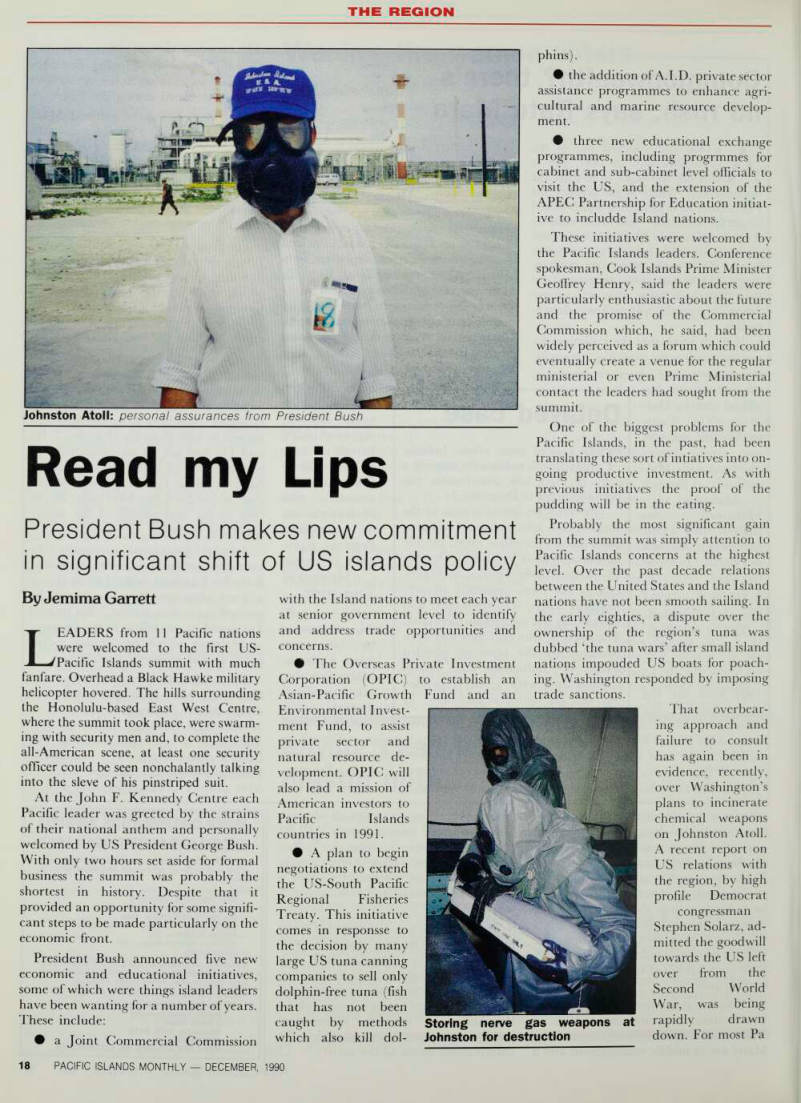
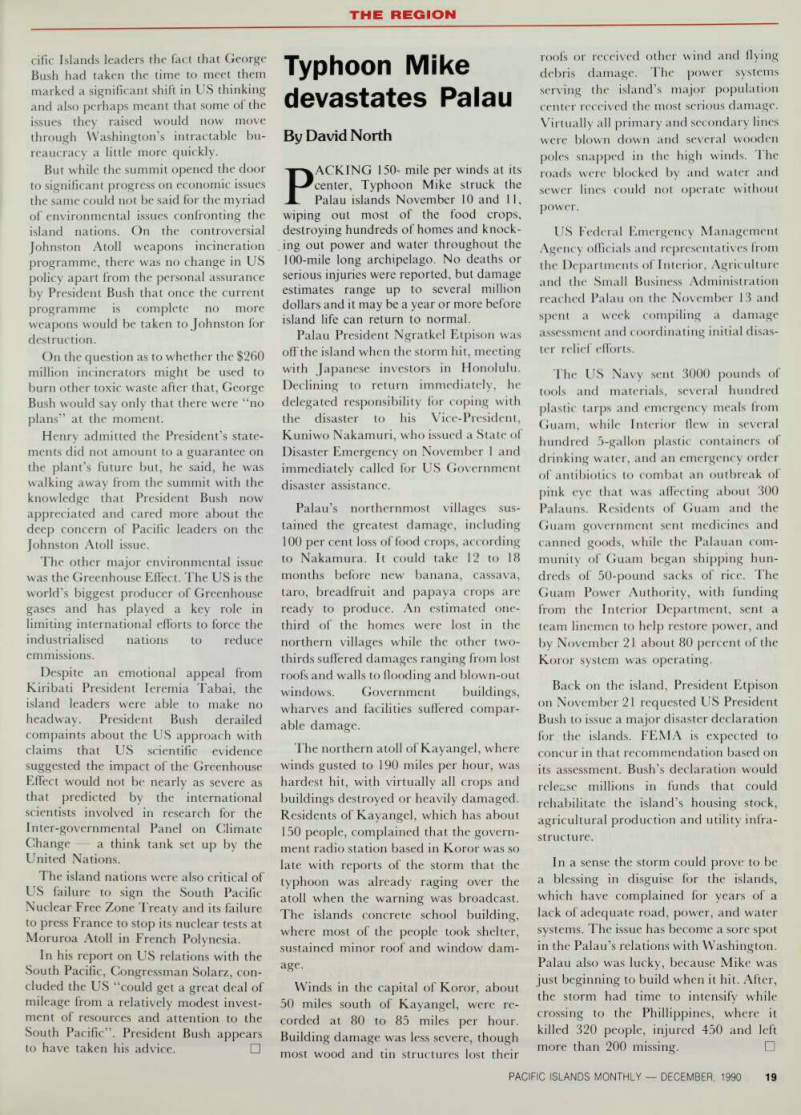
That overbear ing approach and failure to consult has again been in evidence, recently, over Washington’s plans to incinerate chemical weapons on Johnston Atoll.
A recent report on US relations with the region, by high
profile Democrat
congressman Stephen Solarz, ad mitted the goodwill towards the US left over from the Second World War, was being
rapidly drawn
down. For most Pa
Johnston Atoll: personal assurances from President Bush
Storing nerve gas weapons at Johnston for destruction
cific Islands leaders the fact that George Bush had taken the time to meet them marked a significant shift in US thinking and also perhaps meant that some of the issues they raised would now move
through Washington’s intractable bu
reaucracy a little more quickly.
But while the summit opened the door to significant progress on economic issues the same could not be said for the myriad of environmental issues confronting the island nations. On the controversial Johnston Atoll weapons incineration programme, there was no change in US policy apart from the personal assurance by President Bush that once the current programme is complete no more weapons would be taken to Johnston for destruction.
On the question as to whether the $260 million incinerators might be used to burn other toxic waste after that, George Bush would say only that there were “no plans” at the moment.
Henry admitted the President’s state ments did not amount to a guarantee on the plant’s future but, he said, he was walking away from the summit with the knowledge that President Bush now appreciated and cared more about the deep concern of Pacific leaders on the Johnston Atoll issue.
The other major environmental issue was the Greenhouse Effect. The US is the world’s biggest producer of Greenhouse gases and has played a key role in limiting international efforts to force the industrialised nations to reduce emmissions.
Despite an emotional appeal from Kiribati President leremia Tabai, the island leaders were able to make no headway. President Bush derailed compaints about the US approach with claims that US scientific evidence suggested the impact of the Greenhouse Effect would not be nearly as severe as that predicted by the international scientists involved in research for the Inter-governmental Panel on Climate Change a think tank set up by the United Nations.
The island nations were also critical of US failure to sign the South Pacific Nuclear Free Zone Treaty and its failure to press France to stop its nuclear tests at Moruroa Atoll in French Polynesia.
In his report on US relations with the South Pacific, Congressman Solarz, con cluded the US “could get a great deal of mileage from a relatively modest invest ment of resources and attention to the South Pacific”. President Bush appears to have taken his advice. □
Typhoon Mike
devastates Palau
By David North
PACKING 150- mile per winds at its center, Typhoon Mike struck the Palau islands November 10 and 11, wiping out most of the food crops, destroying hundreds of homes and knock ing out power and water throughout the 100-mile long archipelago. No deaths or serious injuries were reported, but damage estimates range up to several million dollars and it may be a year or more before island life can return to normal.
Palau President Ngratkel Etpison was off the island when the storm hit, meeting with Japanese investors in Honolulu.
Declining to return immediately, he
delegated responsibility for coping with
the disaster to his Vice-President, Kuniwo Nakamuri, who issued a State of Disaster Emergency on November 1 and immediately called for US Government disaster assistance.
Palau’s northernmost villages sus tained the greatest damage, including 100 per cent loss of food crops, according to Nakamura. It could take 12 to 18 months before new banana, cassava, taro, breadfruit and papaya crops are ready to produce. An estimated one third of the homes were lost in the northern villages while the other two thirds suffered damages ranging from lost roofs and walls to flooding and blown-out windows. Government buildings, wharves and facilities suffered compar
able damage.
The northern atoll ofKayangel, where winds gusted to 190 miles per hour, was hardest hit, with virtually all crops and buildings destroyed or heavily damaged.
Residents of Kayangel, which has about 150 people, complained that the govern ment radio station based in Koror was so late with reports of the storm that the
typhoon was already raging over the
atoll when the warning was broadcast.
The islands concrete school building, where most of the people took shelter, sustained minor roof and window dam age.
Winds in the capital of Koror, about 50 miles south of Kayangel, were re corded at 80 to 85 miles per hour.
Building damage was less severe, though most wood and tin structures lost their
roofs or received other wind and flying debris damage. The power systems serving the island’s major population center received the most serious damage.
Virtually all primary and secondary lines were blown down and several wooden poles snapped in the high winds. The roads were blocked by and water and sewer lines could not operate without power.
US Federal Emergency Management Agency officials and representatives from the Departments of Interior, Agriculture and the Small Business Administration reached Palau on the November 13 and spent a week compiling a damage assessment and coordinating initial disas ter relief efforts.
The US Navy sent 3000 pounds of tools and materials, several hundred plastic tarps and emergency meals from Guam, while Interior flew in several hundred 5-gallon plastic containers of drinking water, and an emergency order of antibiotics to combat an outbreak of pink eye that was affecting about 300 Palauns. Residents of Guam and the Guam government sent medicines and canned goods, while the Palauan com munity of Guam began shipping hun dreds of 50-pound sacks of rice. The Guam Power Authority, with funding from the Interior Department, sent a team linemen to help restore power, and by November 21 about 80 percent of the Koror system was operating.
Back on the island, President Etpison on November 21 requested US President Bush to issue a major disaster declaration for the islands. FEMA is expected to concur in that recommendation based on its assessment. Bush’s declaration would release millions in funds that could rehabilitate the island’s housing stock, agricultural production and utility infra structure.
In a sense the storm could prove to be a blessing in disguise for the islands, which have complained for years of a lack of adequate road, power, and water systems. The issue has become a sore spot in the Palau’s relations with Washington.
Palau also was lucky, because Mike was just beginning to build when it hit. After, the storm had time to intensify while crossing to the Phillippines, where it killed 320 people, injured 450 and left more than 200 missing. □
The new wave
The Gulf crisis increases the need for alternative energy sources
THE South Pacific Applied Geoscience Commission (SOPAC) is now interested in seeking Nor wegian sponsorship for ocean wave energy research in the Pacific Islands. SOPAC Director Jioji Kotobalavu, sought support for the move from Pacific delegations attending the Pacific Islands 2000 Marine Energy and Mineral Resources Conference in Suva last month.
Norway, a pioneer in using ocean
waves to provide energy, has established plants in Norway and other European countries, and has been researching the feasibility for Pacific countries.
Dr Michael Lawrence, Manager of the Regional Petroleum Unit of the Forum Secretariat, said the Pacific Islands could save approximately US$4O million per year, if they switched from 97 Octane Fuel to 92 Octane Fuel, In most Pacific Island countries, 97 Octane Fuel costs US9OO per gallon, while 92 Octane Fuel costs US77£ per gallon. Lawrence, how ever, pointed out that this does not apply for diesel fuel, which is used widely in the region.
The Forum countries use approximately 25,000 barrels of oil a day; Papua New Guinea and Fiji use 21,700 barrels, and the rest use 3300 barrels. Papua New Guinea is expected to begin exporting oil in the near future, but Fiji will have to continue importing oil. The octane switch might provide Fiji
with an opportunity to reduce the importation of oil.
SOPAC’s Deputy Director, Dr James Eade, said that Fiji, Tonga, Solomon Islands, and Vanuatu, all have the potential for oil and gas finds. In fact there have been several oil “seeps” of bio grade crude oil discovered in Tonga. Dr Eade said that multi-million dollar funded exploratory programmes to search out oil in the Pacific Islands region is currently being drafted. The results of
the programme find ings will decide future explorations.
One of the most promising methods of harnessing ocean en ergy is Ocean Thermal Energy Conversion (OTEC). This taps the large percentage of so lar energy absorbed by the ocean by using the water temperature dif ferences to drive elec tricity producing tur bines for approximately 5 to 10 megawatts of power roughly what is needed by most Pa cific Islands villages.
The process also pro duces fresh water
through condensation, chilled water for air conditioning units, water for plants, and nutrient-rich water for growing algae and fish farming.
Dr Thomas Daniel, Scientific Direc tor, National Energy Laboratory of Hawaii, said OTEC can produce hydro gen (through electrolysis) which is ex pected to be a major source of energy in the future. An OTEC plant could be in operation nine months after an order is received in Hawaii, said Dr Danaiel.
However, the Project Manager of the
United Nations Energy Development
Program, Dr Peter Johnston, differed from other ocean energy experts at the meeting. He said “that new ocean energy research techniques will not provide sufficient results for Pacific countries in the near future.” He said that Pacific nations do not have the infrastructure to start new technology products and do
not have enough people to success fully operate such
technologies. He
recommended that the Pacific conserve energy by reducing demand for gener ated electricity to meet their future energy needs.
The Cook Islands is installing solar power appliances on two northern islands with funding from Tahiti and France. Cooks Deputy Prime Min ister and Minister for Energy, Intio Akaruru, said his
Talat Mehmood
Kotobalavu: wave power
country’s outer islands electricity costs are far greater than in Rarotonga. The Cook Islands uses profits from the Rarotonga system to subsidise electrical costs in the outer islands.
“The earning capacity in some other islands is almost nil,” he said, adding that outer islands’ electrical systems are operating at increased cost. Last year Rarotonga managed to bring in $389,950 above costs, but the outer islands tallied a $1,239,750 loss.
Nauru’s Vinci Clodumar, Minister of Health and Education, said his nation spends of most of her energy extracting moisture from phosphate, from 20 per cent to 3 per cent, before it is sold.
Kiribati’s Minister for Natural Re source Development, Taomati luta, said their major economic resources include copra, salt, fish, and foreign aid. Copra is a declining industry; salt is not selling well; fish prices are controlled by the buyers and the national fishing company is losing money because of high costs.
Foreign aid is the only profitable “re source”. Kiribati has two aid policies; • aid requested must be for pro ductive projects; and • the project must be sustainable by Kiribati over the long term.
Western Samoa’s Finance Minister, Tuilaepa Sailele, said the Middle East crisis has made energy the highest priority in his country. His country is developing hydropower and will look further at solar possibilities. He warned: “Alternative energy sources could look relatively cheap, but without proper maintenance, over the long run they could turn out more costly.”
Brown Saua, Manager of the Invest ment Corporation of the Solomon Islands, said the oil crisis “is not really a supply problem; it’s a price problem.”
He noted that oil prices have gone up at the same time as the Solomon’s currency has been going down, making price increases extra steep. There has already been some fuel rationing in the Solomon Islands and the country is proceeding with plans to develop hydropower.
Federated States of Micronesia Sena tor, Jacob Nena, ofKosrae, said fuel costs have increased from $1.25 to $2.25 per gallon since the Gulf Crisis began. This affects the transportation of food and people throughout FSM, and greatly increases government costs. Nine 9 per cent of FSM’s electricity is from diesel generators, and the government bears most of the cost. There is interest in expanding hydropower, which supplies 10 per cent of the energy needs. □
Kicking the oil habit
“WE are once again in love with renewable energy,” said Admiral Ronald J. Hays, but “public indifference” might follow as soon as the current oil crisis subsides. However, Hays hopes that attention to renewable energy might stay.“We are beginning to realise that long-term environmental costs may negate the immediate low monetary cost of conventional fuels,” he said.
Hays is president of Pacific International Centre for High Technology Research (PICHTR) in Honolulu. He told the Pacific 2000: Marine Energy and Mineral Resources Conference in Suva that we can “kick the oil habit”. His alternatives are: • Biomass: “Biofuels technology can transform the energy found in plants and municiple wastes into transportation and
electricity-generating fuel.”
• Geothermal; “The heat of the earth” can provide “clean, reliable, cost-effective energy,” but “developments in science and technology are necessary before this resource can be tapped more fully.” • Solar: “Cost effective solar contributions to a building’s energy requirements can be increased from 40 per cent today to 80 per cent if we put our minds to it.” • Wind: Current well-placed wind turbines competitively produce electricity at about US$O.O9 per kilowatt hour. Better turbines are “on the horizon” that are more efficient and operate in areas with lower average wind speeds. • OTEC: Ocean Thermal Energy Conversion, which uses the temprature differences between the ocean’s surface and depths to drive electricity-producing turbines, is the “most promising of all” ocean energy resources. □
PNG finds a drug market in New York
By Frank Senge
NEW York drug traffickers refer to a certain brand of cannabis as New Guinea Gold. In the highlands of Papua New Guinea, the most probable source of that particular brand, where the temperate climate provides high quality marijuana, youngsters ask for Maria or Spak Brus (spark Tobacco). In Port Moresby, the capital of this resource-rich nation, law enforcement officers are mak ing major drug busts.
Eleven tonnes of New Guinea Gold was recently impounded in Hawaii, said PNG Police Minister Matias Ijape. He would not give details, saying investi gations were continuing. But his revel ations and subsequent big drug seizures in the country this year have heightened fear that Papua New Guinea has become a largescale exporter of marijuana. What is more worrying to law enforcement officers is the inadequate penalties cur rently available in the courts to deal with drug offences.
For example, on Monday, June 1, acting on a tip-off, officers of the drug squad watched 14 large plastic cylinders being off-loaded in Port Moresby from an Air Niugini flight from the Eastern Highlands township of Goroka. The cylinders were addressed to TNT air cargo and bearing ‘Urgent’ Talair (third level airline) tags. The cylinders were stored at the TNT shed at Port
Moresby’s Jackson Airport. The next day a TNT truck took the cargo to the Papuan Hotel where the bags were unloaded under the supervision of a white expatriate man.
Police placed a 24-hour watch on the hotel. On the evening of the third day, police burst into Room 44 and confis cated most of the cylinders. They found the rest of the cylinders in an adjacent room.
Police arrested and chaarged two expatriates; New Zealand South Islander, John Wilford Gibson, 44, and Australian Mario Collin Sebastian, 31, of Tinaroo, Queensland. Gibson was self employed and had been living in Goroka since 1969. Sebastian was found to be really Mario Sebastianelli, of a PNG mother and Australian father who kept his father’s citizenship.
The 14 cylinders contained 160 kilo grammes of dried marijuana leaves. The packaging indicated the leaves were for export nd police believed they had busted an international drug operation.
It is the biggest single drug haul is the country and police estimated the drug to be worth millions of dollars on the streets overseas.
Gibson was found guilty of possession of the drug and sentenced on October 29 to two years imprisosnment, the maxi mum penalty allowed under PNG Law.
In Malaysia, he would have been sentenced to death. Presiding magistrate
Post Courier
Caught: A policeman in Port Moresby shows a suitcase of marijuana that came down from Goroka
Arnold Joseph described the sentence as too lenient, but he pointed out he was bound by the law. He called for changes to the law to enable stiffer penalties for drug offences.
The court was told Gibson had obtained a new passport and could have been planning to leave the country.
Sebastian was yet to appear in court at the time of writing.
Other arrests suggest that the drug operation in Papua New Guinea, par ticularly for export, is established and extensive. In August, four Papua New Guineans, two men and two women, also from the Eastern Highlands, were ar rested while trying to airfreight a large bag containing 11 tightly packed bags of dried marijuana leaves. Police estimated each bag would cost nearly K 30,000 in PNG. But the packaging suggested they were for export.
On October 10, another Goroka man was jailed for a year for possessing nearly 50 kilograms of marijuana. On the same day, police reported that marijuana was being smuggled into the PNG/Indonesia border township of Wewak from the Papua New Guinea highlands. They confiscated 21 plastic bags of marijuana packed in a travelling bag when they searched passengers disembarking from a
ship.
Raids in the Eastern Highlands have found farms and more dried leaves ready for the market. This is coffee-growing country. But because world coffee prices have been diving, some farmers are growing marijuana as a side crop.
An Eastern Highlander, Gai Duwabane, said marijuana, which grows wild in the area, was used as a magical cure for sickness; the smoker would incant strange words and go into fits!
Today, Duwabane said, people are growing marijuana all over the place, even as an intercrop in vegetable gardens.
Marijuana is not only for export. High school students are also smoking it and the habit has been linked to the increase in the number of high school students being raped. And while the country basks in the celebrations for the recent boom in natural resources, the highlanders, reeling from diving world coffee prices, are rediscovering a different kind of gold. □
Tongans shut out,
one in two barred
ONE in every two Tongans wanting to travel to Australia were being refused holiday visas. And New Zealand had made things even harder by knocking back two in every three appli cations. A recent report quoted the Australian High Commission in Tonga as saying that of the 200 visa applications usually processed a month only one out of two were approved.
Australia and New Zealand have announced crackdowns to stop overstay ing by foreigners many of them from the Pacific. □
Japan's promise
JAPAN will continue to tackle environ
mental problems, including the
Greenhouse Effect, Prime Minister
Toshiki Kaifu said last month after meeting with South Pacific leaders. Kaifu made the statement at a joint meeting with President leremia Tabai, of Kiri bati, President John Haglelgam, of Feder ated States of Micro nesia, President Bernard Dowiyogo, of Nauru, and Prime Minister Bikenibeu Paeniu, of Tuvalu.
Kaifu said Japan in tended to expand its cooperation to contrib ute to the region’s peace and prosperity and assist island states hurt by the Gulf crisis according to the situ ation in each country.
The south pacific leaders were in Tokyo for the enthronement of Emperor Akihito. □
Lange's words
THE price of continued military co operation between Australia and New Zealand after the collapse of the ANZUS alliance was two frigates, according to a new book by former New Zealand Labour Prime Minister David Lange.
“They (the Australians) had us over a barrel,” Lange wrote in Nuclear Free - the New Zealand way ”
The United States ceased military
operations with New Zealand following New Zealand’s decision to bar US warships from its ports in 1985. Australia said it would continue to conduct separate military exercises with New Zealand and in return for this, Lange wrote, New Zealand agreed to buy Australian built frigates.
He said if there was no frigate deal Australia would have greatly reduced military co-operation and may even have put at risk the negotiations for an extension of the Closer Economic Re lations Treaty. It was a price Lange said he was prepared to take.
The decision never had the support of the Labour Party’s rank and file, and will cost New Zealand almost a billion dollars at a time when the country’s economy slips further into recession. The new National government has guaranteed the agreement but is expected to ask for a delay in payment instalments. Lange was Prime Minister from 1984 until his
resignation in Aug
ust last year. D 4 Swain's
dispute
SWAIN’S Island, known as Olohega in Tokelau lan guage, is the centre of a controversy between Tokelau, New Zealand, and the United States.
From the Tokelau point of view, Swain’s was given
away unfairly by
New Zealand to the United States territory of Ameri can Samoa in 1983. From the New Zealand, per spective, the treaty
recognising US authority over Swain’s was agreed to in exchange for the US dropping its claim over all Tokelau.
Some Tokelau officials claim that the terms of the 1983 Treaty of Tokehega
was unfairly explained to the political
leadership of Tokelau, many of whom did not speak English. Tokelau’s Direc tor of Agriculture and Fisheries, Foua Toloa, has been the most outspoken on the issue. Toloa said Tokelau will take the issue to the United Nations. He warned the 1700 people in Tokelau could “declare war on the US” which could involve a canoe invasion of Swain’s. □
Fishing hope
TOKELAU has opened its
first dried-fish processing factory on the atoll of Atafu. It makes use of two abun dant resources sunlight and the
highly-priced yellowfin tuna.
Kileva Fisheries was officially opened by the oldest woman on Atafu, 84-year-old Leuta Mamoe, on October 25. Atafu’s village council appoints families or indi viduals to fish on certain days to supply the processing centre which has a target of 1000 kilograms of fresh “wet” yellowfin a month. The dried fish will be sold in 50 gram and 100 gram packs which are shipped to Western Samoa each month for distribution to other markets. □
Advertisements & other items, pp. 23-24 (2 items)
WeVe been around
» x & \ V i* s w fp.
U m
and arou
nd around
We’ve delivered apples and pears, grapes, onions and meat. We’ve carried canned and dried fruit, mineral water and wine, wool and hides.
We’ve transported boats, bells, and beer, computer parts and car parts.
We’ve shipped all matter of goods, all over the world.
For over 20 years, ACTA has led the shipping industry in the carriage of both perishable and general cargo to and from Australian shores.
And because ACTA services some of the longest trade routes in the world, we employ only the most advanced shipping methods, and have in fact, pioneered many of them.
We also offer complete land services, including rail transport; and a range of special cargo services from advice on pacldng to information on overseas markets.
When you ship, ship with someone who knows their way around.
Ship with ACTA.
JaHaDT
ACTA PTY. LIMITED ACTA HOUSE 44 7 Kent St Sydney N.S.W. 2000 Phone (02) 9297100 Fax: 95554 78 Telex 121369 ACT 002
Focus
Descendants from two enemy villages Join for the " payback " celebrations at Kindau.
Photo Cousteau Society
Amazing
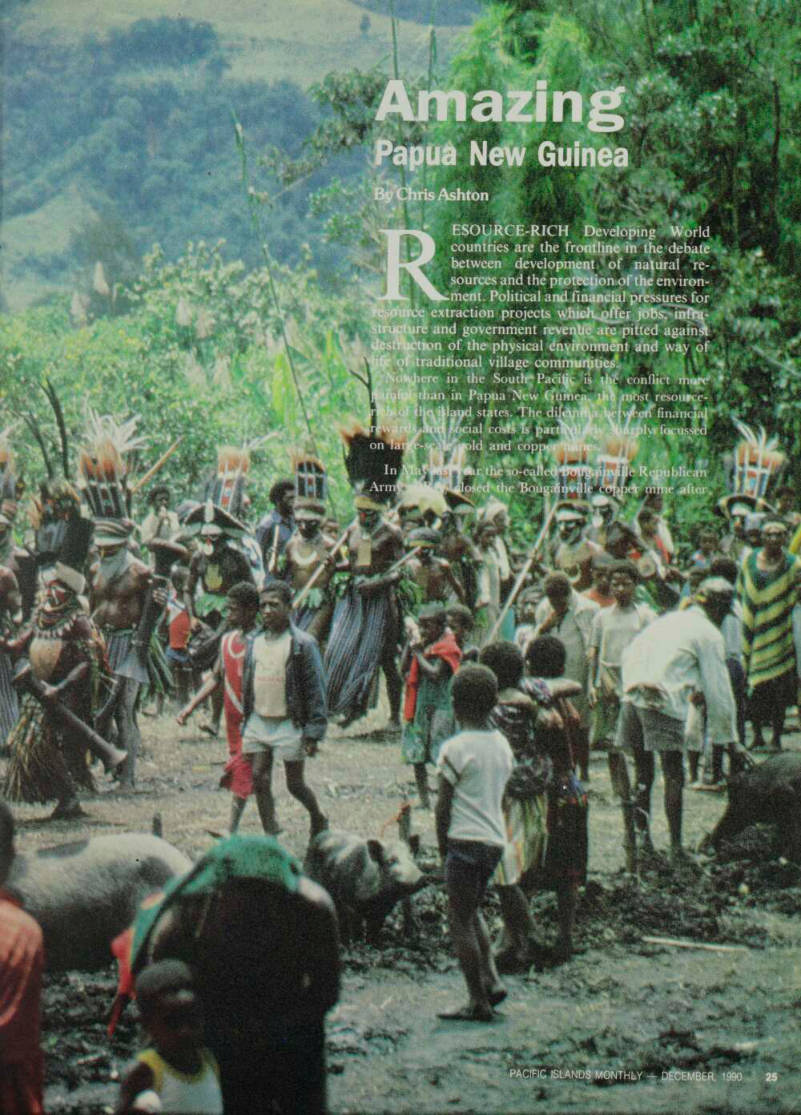
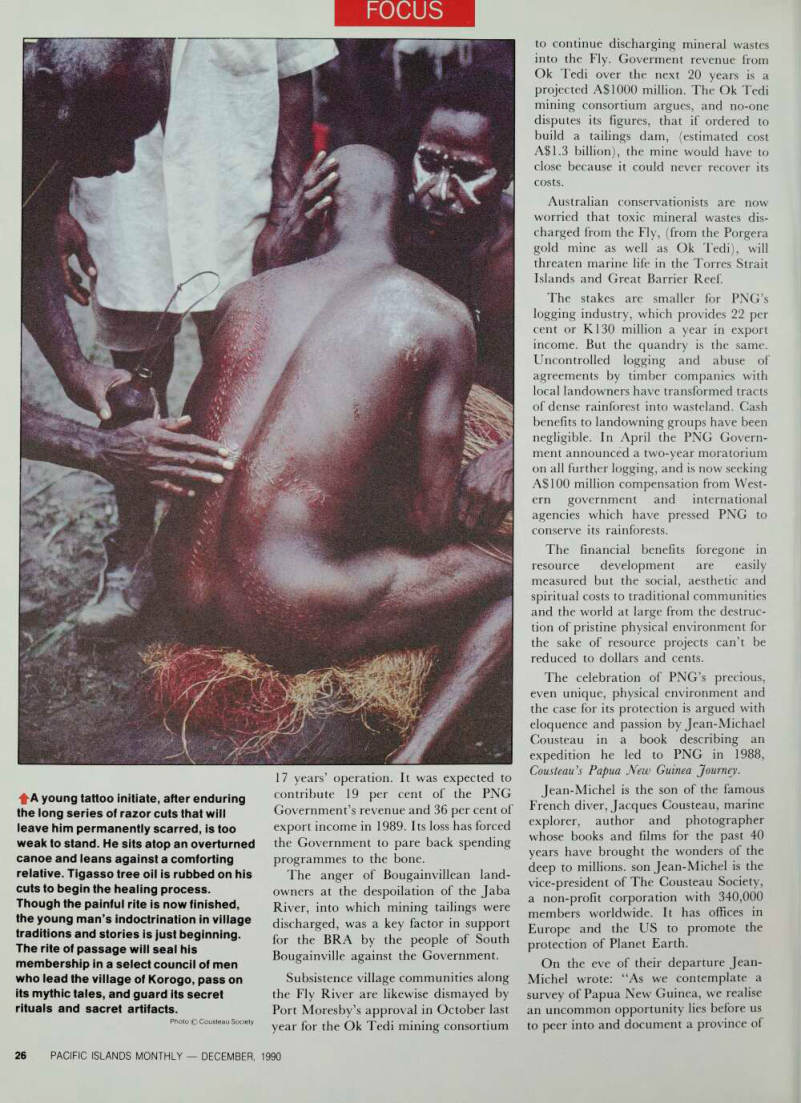
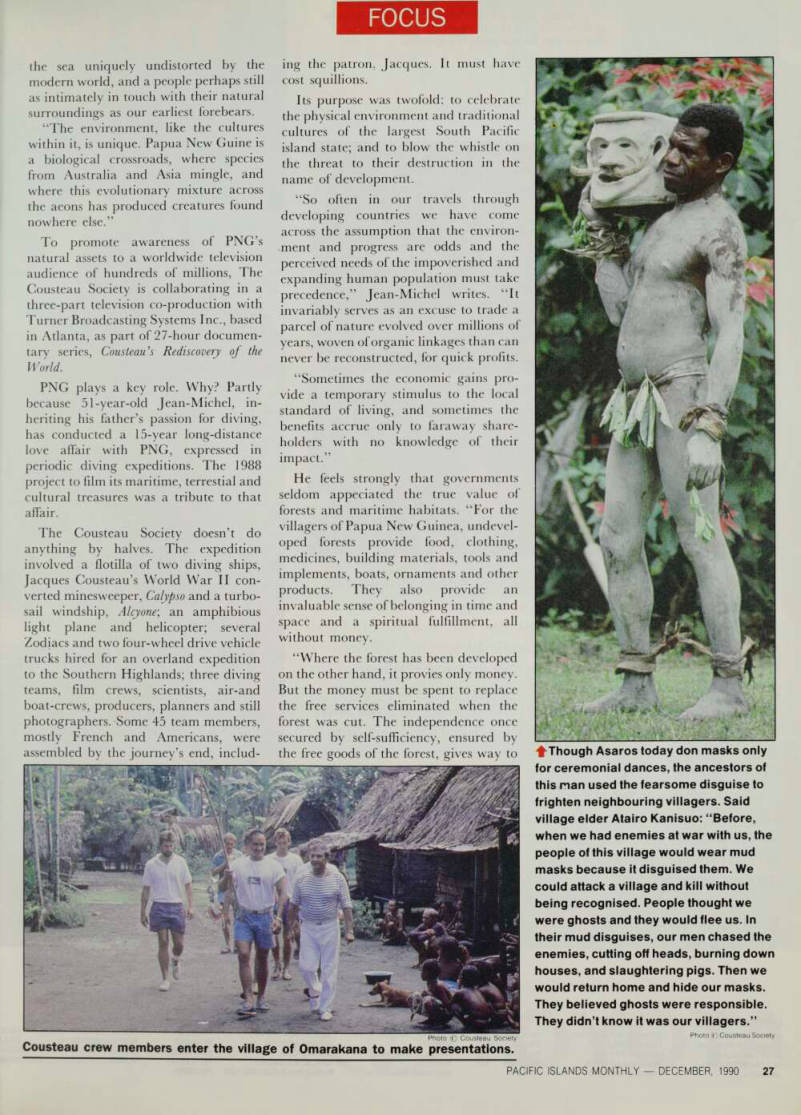
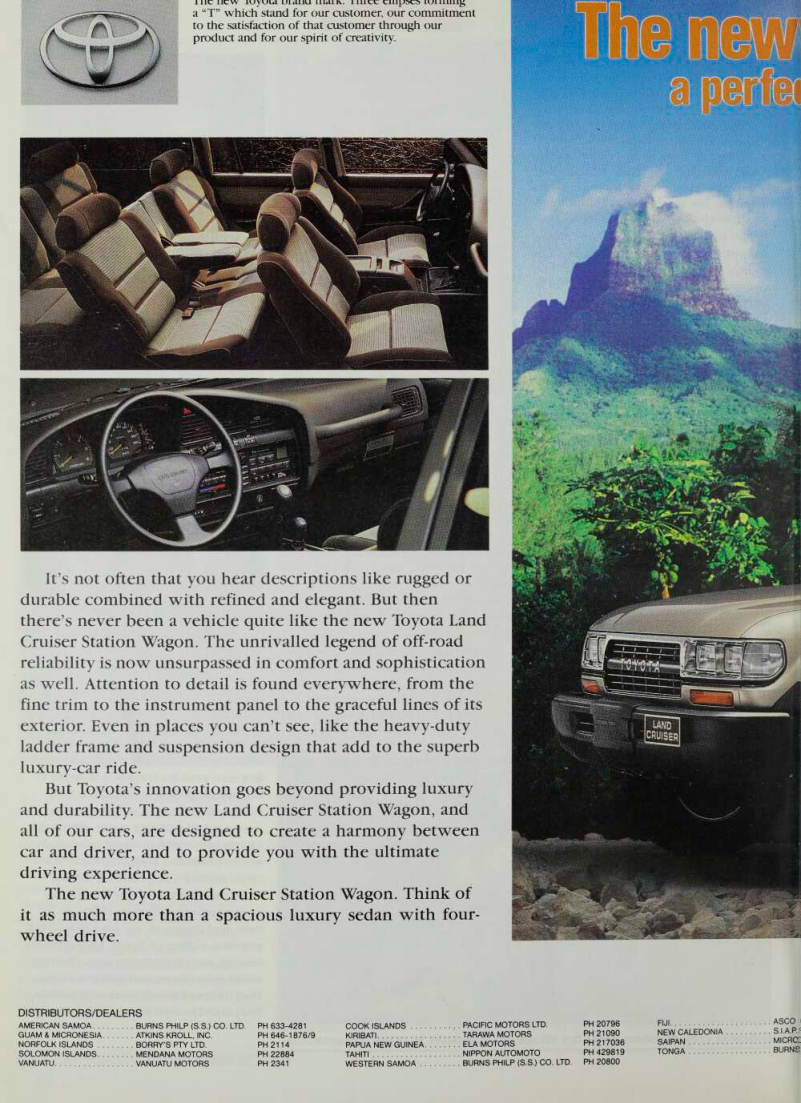
Papua New Guinea
BtfChris Ashton
ESOURCE-RICH Developing World r £M countries are the frontline in the debate between development of natural re sources and the protection of the environ- Political and financial pressures for extraction projects jbBs;Miifh|wernment revenue are pitted against ic physical dnvironment and way of il village com murti ties* 4 \ 1 ie South* PaciJ|£ is conflict apua New ffumca, the mbst resoupce states. The financja| il cosfS fs Ic^usscd
ecNtlje aft or J'
17 years’ operation. It was expected to contribute 19 per cent of the PNG Government’s revenue and 36 per cent of export income in 1989. Its loss has forced the Government to pare back spending programmes to the bone.
The anger of Bougainvillean land owners at the despoliation of the Jaba River, into which mining tailings were discharged, was a key factor in support for the BRA by the people of South Bougainville against the Government.
Subsistence village communities along the Fly River are likewise dismayed by Port Moresby’s approval in October last year for the Ok Tedi mining consortium
to continue discharging mineral wastes into the Fly, Goverment revenue from Ok Tedi over the next 20 years is a projected AS 1000 million. The Ok Tedi mining consortium argues, and no-one disputes its figures, that if ordered to build a tailings dam, (estimated cost AS 1.3 billion), the mine would have to close because it could never recover its costs.
Australian conservationists are now worried that toxic mineral wastes dis charged from the Fly, (from the Porgera gold mine as well as Ok Tedi), will threaten marine life in the Torres Strait Islands and Great Barrier Reef.
The stakes are smaller for PNG’s logging industry, which provides 22 per cent or Kl3O million a year in export income. But the quandry is the same.
Uncontrolled logging and abuse of agreements by timber companies with local landowners have transformed tracts of dense rainforest into wasteland. Cash benefits to landowning groups have been negligible. In April the PNG Govern ment announced a two-year moratorium on all further logging, and is now seeking AS 100 million compensation from West ern government and international agencies which have pressed PNG to conserve its rainforests.
The financial benefits foregone in resource development are easily measured but the social, aesthetic and spiritual costs to traditional communities and the world at large from the destruc tion of pristine physical environment for the sake of resource projects can’t be reduced to dollars and cents.
The celebration of PNG’s precious, even unique, physical environment and the case for its protection is argued with eloquence and passion by Jean-Michael Cousteau in a book describing an expedition he led to PNG in 1988, Cousteau's Papua New Guinea Journey.
Jean-Michel is the son of the famous French diver, Jacques Cousteau, marine
explorer, author and photographer
whose books and films for the past 40 years have brought the wonders of the deep to millions, son Jean-Michel is the vice-president of The Cousteau Society, a non-profit corporation with 340,000 members worldwide. It has offices in Europe and the US to promote the protection of Planet Earth.
On the eve of their departure Jean- Michel wrote: “As we contemplate a survey of Papua New Guinea, we realise an uncommon opportunity lies before us to peer into and document a province of
A young tattoo initiate, after enduring the long series of razor cuts that will leave him permanently scarred, is too weak to stand. He sits atop an overturned canoe and leans against a comforting relative. Tigasso tree oil is rubbed on his cuts to begin the healing process.
Though the painful rite is now finished, the young man’s indoctrination in village traditions and stories is just beginning.
The rite of passage will seal his membership in a select council of men who lead the village of Korogo, pass on its mythic tales, and guard its secret rituals and sacret artifacts.
Photo © Cousteau Society
the sea uniquely undistorted by the modern world, and a people perhaps still as intimately in touch with their natural surroundings as our earliest forebears.
“The environment, like the cultures within it, is unique. Papua New Guine is a biological crossroads, where species from Australia and Asia mingle, and where this evolutionary mixture across the aeons has produced creatures found nowhere else.”
To promote awareness of PNG’s natural assets to a worldwide television audience of hundreds of millions, The Cousteau Society is collaborating in a three-part television co-production with Turner Broadcasting Systems Inc., based in Atlanta, as part of 27-hour documen tary series, Cousteau's Rediscovery of the World.
PNG plays a key role. Why? Partly because 51-year-old Jean-Michel, in heriting his father’s passion for diving, has conducted a 15-year long-distance love affair with PNG, expressed in periodic diving expeditions. The 1988 project to film its maritime, terrestial and cultural treasures was a tribute to that affair.
The Cousteau Society doesn’t do anything by halves. The expedition involved a flotilla of two diving ships, Jacques Cousteau’s World War II con verted minesweeper, Calypso and a turbo sail windship, Alcyone ; an amphibious light plane and helicopter; several Zodiacs and two four-wheel drive vehicle trucks hired for an overland expedition to the Southern Highlands; three diving teams, film crews, scientists, air-and boat-crews, producers, planners and still photographers. Some 45 team members, mostly French and Americans, were assembled by the journey’s end, includ
ing the patron, Jacques. It must have cost squillions.
Its purpose was twofold: to celebrate the physical environment and traditional cultures of the largest South Pacific island state; and to blow the whistle on the threat to their destruction in the name of development.
“So often in our travels through developing countries we have come across the assumption that the environ ment and progress are odds and the perceived needs of the impoverished and expanding human population must take
precedence,” Jean-Michel writes. “It
invariably serves as an excuse to trade a parcel of nature evolved over millions of years, woven of organic linkages than can never be reconstructed, for quick profits.
“Sometimes the economic gains pro vide a temporary stimulus to the local standard of living, and sometimes the benefits accrue only to faraway share holders with no knowledge of their
impact.”
He feels strongly that governments seldom appeciated the true value of forests and maritime habitats. “For the villagers of Papua New Guinea, undevel
oped forests provide food, clothing,
medicines, building materials, tools and implements, boats, ornaments and other products. They also provide an invaluable sense of belonging in time and space and a spiritual fulfillment, all without money.
“Where the forest has been developed on the other hand, it provies only money.
But the money must be spent to replace the free services eliminated when the forest was cut. The independence once secured by self-sufficiency, ensured by the free goods of the forest, gives way to
Photo © Cousteau Society Cousteau crew members enter the village of Omarakana to make presentations.
Though Asaros today don masks only for ceremonial dances, the ancestors of this man used the fearsome disguise to frighten neighbouring villagers. Said village elder Atairo Kanisuo: “Before, when we had enemies at war with us, the people of this village would wear mud masks because it disguised them. We could attack a village and kill without being recognised. People thought we were ghosts and they would flee us. In their mud disguises, our men chased the enemies, cutting off heads, burning down houses, and slaughtering pigs. Then we would return home and hide our masks.
They believed ghosts were responsible.
They didn’t know it was our villagers."
Photo [?] Cousteau Society
a new dependence on the outside world as well as spiritual, economic and family disorientation.
“When efforts to improve a society lead to destruction of the envelope of nature that has long sustained it, the society is not helped but harmed. The only legitimate paths to progress lie in developments that combine economic
enhancement with environmetal preser vation. To think the two are separate issues is to ignore the human pre dicament: we lead our lives in a womb of nature, as dependent on the health of our eco sphere around us as an unborn infant on the nurturing system of its mother’s body.”
Cousteau is part of that Western
tradition, with philosopher Jean-Jacques
Rousseau, author Robert Louis Stevenson and artist Paul Gaughin before him, for whom tribal peoples, (especially in the South Sea Isles), represent the childlike innocence of all mankind before the Fall. In Rousseau’s words, are “Noble Savages” inhabiting tropical Gardens of Eden untainted by the woes of modern man.
“We are mazed by the villagers’ encyclopaedic knowledge of the sur rounding environment,” he writes.
“Every item necessary to survival, per haps even to happiness, can be drawn from land, forest or sea. Perhaps it takes village men longer to cross an ocean strait in an outrigger canoe propelleed by a pandanus sail than it takes us in our motor vessel. But the speed of such a trip may be irrelevant in a world ungoverned by clocks, unstressed by deadlines other
Bougainville's Panguna copper mine is one of the largest man-made holes in the world. The immense pit was excavated by four-storey high shovels that can scoop 22 tons of ore. The dump trucks at the bottom of the picture can haul 150 tons of rock. There’s no indication when the mine might re-open.
Photo © Cousteau Society
Photo Cousteau Society Huts of Rossel Islanders sit at the edge of a backwater rich in organic matter from adjacent rain-forest
Melpa wigmen in the village of Kindau begin the "payback" cer emony beating the tra ditionaldrums called kundus. Their head dresses are woven of buman hair supplied by village women. By cus tom, Melpa men are costumed to create a "dark" effect, Melpa women to achieve a "bright" effect.
than those imposed by nature by rhythms of daylight and dark, by the directions of the wind, by the pulse of the seasons.” Nostalgia for Paradise Lost is frequently voiced by the so-called en lightened urban middle-class of the Western world, but it carries its own quandry. Cousteau is the executive head of a multi-million dollar conservation group. Based in Los Angeles, he jets across the world making television films, promoting the Cousteau cause on the lecture circuit, and making brief forays, supported by space-age technology, to primeval forests and uncharted reefs to
record the spiritual bonds between tribal and modern man. His own drive to improve his lot beyond that of his forebears is no different from that of the Melanesian villager.
To his credit, he admits doubts. “I think of villagers we have met on this expedition, their lives embedded in a world romantically thought of as Para dise. Surely there is no more universal human fantasy than the idea of escaping to the carefree, sun-drenched, sea refreshed life of a tropical island in the South Seas. But the people who are born to this dream, who know little else of the
In baramba, children learn at an early age to travel and play In canoes, quickly becoming so adept they can paddle while standing. Unable to raise sufficient food in the surrounding swamps, Kambaramba has sustained itself over the years with a unique barter system. In exchange for goods from other villages, Kambaramba operates Several brothels. Photo © ousteau Society
planet and who have few opportunities to travel beyond neighbouring islands: Are they “happy”? Are they fulfilled? Or do they yearn to “escape” to a faster pace and a materially richer world?”
He doesn’t try to resolve the contradic tions, but his heart is in the right place.
If the book strikes the odd jarring note it is due rather to his co-author, Mose Richards, senior producer and script writer for the Cousteau Society and apparently recipient of a swag of TV awards.
Richards echoes Cousteau’s awe at PNG’s physical beauty; at the integrity of its village culture; and his dismay at the physical and spiritual encroachment of the modern world. But his blow-by blow account of the expedition, alternat ing with Cousteau’s reflections, reveals him finally as a product of Los Angeles, shaped by the motion picture capital of the world.
We follow the Cousteau team as it criss-crosses the country by ship, plane, chopper and 4WD vehicle filming com pensation and bride-price ceremonies, shark-callers, initiation rites, mining and logging projects. PNG serves as an exotic backdrop for Richard’s central drama: the human and logistical and challenges posed by the bountry, and the triumps over them by the Cousteau team, heroes
of an adventure yarn recounted in breathless present-tense prose from start to finish.
There are errors of detail. He puts the Islander Hotel in the Port Moresby suburb of Boroko instead of Gordon/ Hohola, and muddles the contributions of Mick Leahy’s brothers Jim, Dan and Pat -in pioneering coffee-growing in the Highlands.
The name Papua, he says, derives from the Dutch word for fuzzy-haired, a legacy of its 16th century explorers. No.
It’s Malay, from Orang Papuwah (fuzzy haired man), and was first attributed to the island of New Guinea in 1526 by the Portugeuse governor of the Moluccas.
The book of the expedition is well served by its 178 colour plates. Com pared with those of many other picture books celebrating this most photogenic of countries, the best of them stand up very well indeed.
For al Cousteau’s exhortations to Papua New Guineas not to do as he does, but to do as he says, his warning against the siren call of Western consumer culture cannot be dismissed: “The young nation has inherited a vast natural fortune and must now educate itself intensely in order to manage this wealth in the wisest way.
The riches could be squandered or lost to
outsiders, or they could be husbanded and invested to sustain the nation far into the future.
“There are two enormous challenges to anyone who would try to turn these re sources into cash. The first is simply to devise ways of
extracting massive quantities
of timber or sea-life without disrupting the fragile webs of nature they help to support.
“The other is to exploit the forests and fisheries in new ways without eliminating the traditional resources of people. To proceed with
rapid exploitation before
finding solutions to these problems is to jeopardise the environmental legacy of Papua New Guinea’s future generations.” □
Shark-calling can be a perilous of obtaining food if a fisherman is not careful. Violent struggle often ensue when a shark is caught in a fisherman’s hoop. To be certain his catch will not continue its battle when pulled into the small outrigger, the captor dispatches he creature with a hardwood club. On several Papua New Guinea islands, ishermen use coconut-shell rattles to attract (“call”) sharks and vine lassoes [? ] pull them in. Photo © Cousteau Society
Advertisements & other items, pp. 25-32 (4 items)
25
PACIFIC ISLANDS" MONTH LY DECEMBER, 1990
luxury-car ride.
111 c new njyuut uiaiiu maitv. i mtt iuiiiuiig a “T” which stand for our customer, our commitment to the satisfaction of that customer through our product and for our spirit of creativity.
It’s not often that you hear descriptions like rugged or durable combined with refined and elegant. But then there’s never been a vehicle quite like the new Toyota Land Cruiser Station Wagon. The unrivalled legend of off-road reliability is now unsurpassed in comfort and sophistication as well. Attention to detail is found everywhere, from the fine trim to the instrument panel to the graceful lines of its exterior. Even in places you can’t see, like the heavy-duty ladder frame and suspension design that add to the superb
But Toyota’s innovation goes beyond providing luxury and durability. The new Land Cruiser Station Wagon, and all of our cars, are designed to create a harmony between car and driver, and to provide you with the ultimate
driving experience.
The new Toyota Land Cruiser Station Wagon. Think of it as much more than a spacious luxury sedan with four-
wheel drive.
, A m r *.
DISTRIBUTORS/DEALERS
AMERICAN SAMOA BURNS PHILP (S.S.) CO. LTD. PH 633-4281 GUAM & MICRONESIA ATKINS KROLL, INC. PH 646-1876/9 NORFOLK ISLANDS BORRY’S PTY LTD. PH 2114
SOLOMON ISLANDS MENDANA MOTORS PH 22884
VANUATU VANUATU MOTORS PH 2341
COOK ISLANDS PACIFIC MOTORS LTD. PH 20796
KIRIBATI TARAWA MOTORS PH 21090
PAPUA NEW GUINEA ELA MOTORS PH 217036
TAHITI NIPPON AUTOMOTO PH 429819
WESTERN SAMOA BURNS PHILP (S.S.) CO. LTD. PH 20800
FIJI ASCO
NEW CALEDONIA 5.1.A.P.5
SAIPAN micro;
TONGA BURNS
* r. m i 2! a® % ■E3 X m S i ( PH 312666 PH 282848
NATION PH 234-5911
)NGA) LTD. PH 23673
® TOYOTA
Focus
Focus
Sports
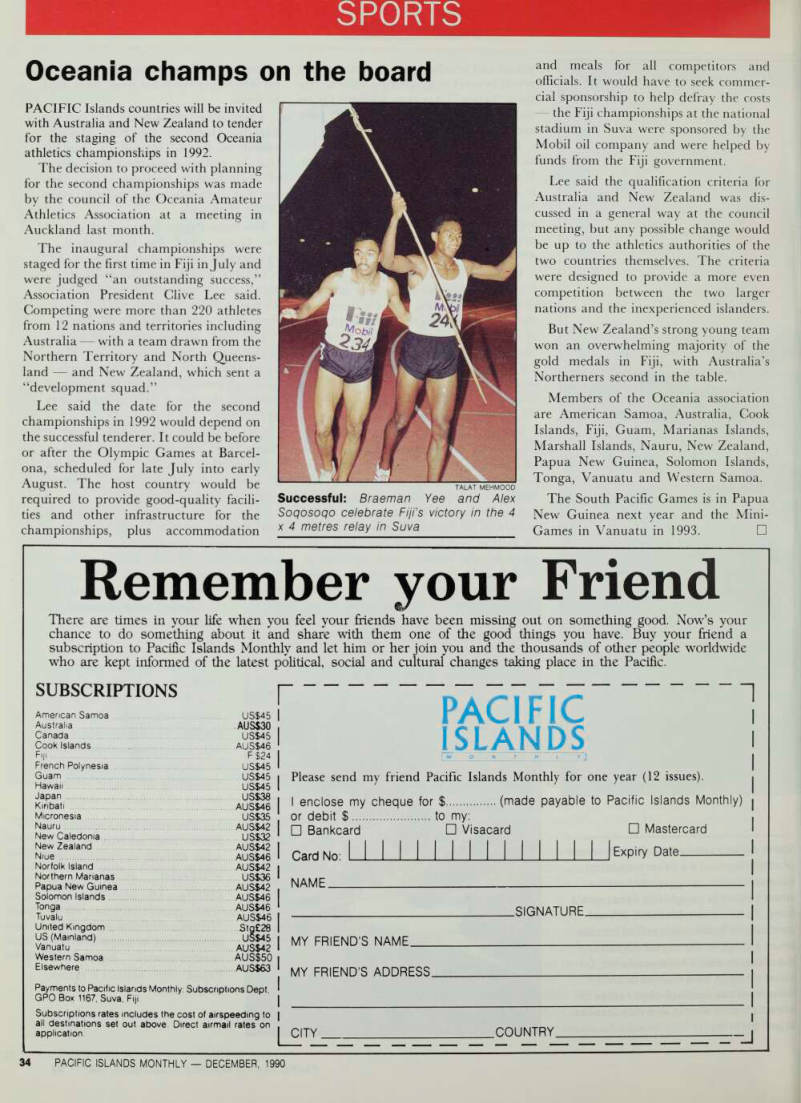
Oceania champs on the board
PACIFIC Islands countries will be invited with Australia and New Zealand to tender for the staging of the second Oceania athletics championships in 1992.
The decision to proceed with planning for the second championships was made by the council of the Oceania Amateur Athletics Association at a meeting in Auckland last month.
The inaugural championships were staged for the first time in Fiji in July and were judged “an outstanding success,”
Association President Clive Lee said.
Competing were more than 220 athletes from 12 nations and territories including Australia with a team drawn from the Northern Territory and North Queens land and New Zealand, which sent a
“development squad.”
Lee said the date for the second championships in 1992 would depend on the successful tenderer. It could be before or after the Olympic Games at Barcel ona, scheduled for late July into early August. The host country would be
required to provide good-quality facili
ties and other infrastructure for the championships, plus accommodation
and meals for all competitors and officials. It would have to seek commer cial sponsorship to help defray the costs the Fiji championships at the national stadium in Suva were sponsored by the Mobil oil company and were helped by funds from the Fiji government.
Lee said the qualification criteria for Australia and New Zealand was dis cussed in a general way at the council meeting, but any possible change would be up to the athletics authorities of the two countries themselves. The criteria were designed to provide a more even competition between the two larger nations and the inexperienced islanders.
But New Zealand’s strong young team won an overwhelming majority of the gold medals in Fiji, with Australia’s Northerners second in the table.
Members of the Oceania association are American Samoa, Australia, Cook Islands, Fiji, Guam, Marianas Islands, Marshall Islands, Nauru, New Zealand, Papua New Guinea, Solomon Islands, Tonga, Vanuatu and Western Samoa.
The South Pacific Games is in Papua New Guinea next year and the Mini- Games in Vanuatu in 1993. □
Talat Mehmood
Successful: Braeman Yee and Alex Soqosoqo celebrate Fiji’s victory in the 4 x 4 metres relay in Suva
Advertisements & other items, p. 34 (1 item)
sdfsfdsfsfdsfdsf
Remember your Friend
There are times in your life when you feel your friends have been missing out on something good. Now’s your chance to do something about it and share with them one of the good things you have. Buy your friend a subscription to Pacific Islands Monthly and let him or her join you and the thousands of other people worldwide who are kept informed of the latest political, social and cultural changes taking place in the Pacific.
PACIFIC
S LANDS
[m o /v r w l v] Please send my friend Pacific Islands Monthly for one year (12 issues).
I enclose my cheque for $ (made payable to Pacific Islands Monthly) or debit $ to my; □ Bankcard □ Visacard □ Mastercard Card No; I I I I I I I I I I I I I I I I Ex P ir V Date
NAME
SIGNATURE
MY FRIEND’S NAME
MY FRIEND’S ADDRESS
CITY
COUNTRY,
Pacific
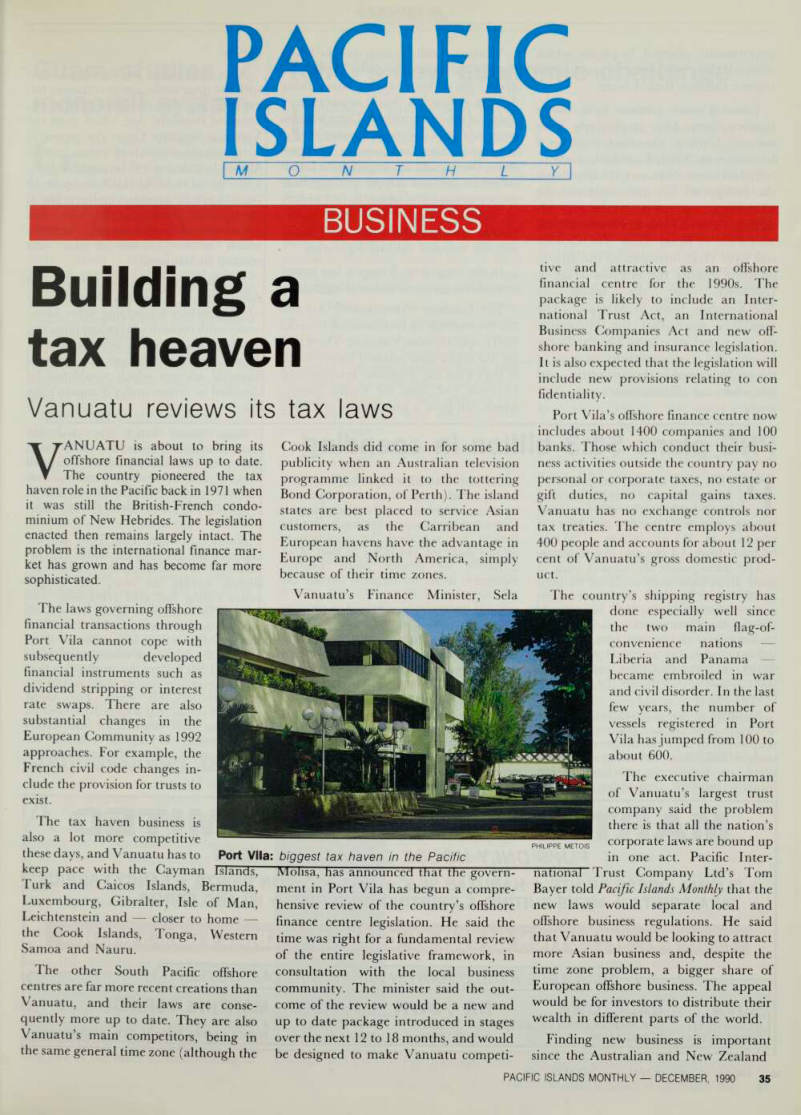
Islands
Monthly
Business
Building a tax heaven
Vanuatu reviews its tax laws
VANUATU is about to bring its offshore financial laws up to date.
The country pioneered the tax haven role in the Pacific back in 1971 when it was still the British-French condo minium of New Hebrides. The legislation enacted then remains largely intact. The problem is the international finance mar ket has grown and has become far more sophisticated.
The laws governing offshore financial transactions through Port Vila cannot cope with
subsequently developed
financial instruments such as dividend stripping or interest rate swaps. There are also substantial changes in the
European Community as 1992
approaches. For example, the French civil code changes in clude the provision for trusts to exist.
The tax haven business is also a lot more competitive these days, and Vanuatu has to
keep pace with the Cayman Islands, Turk and Caicos Islands, Bermuda, Luxembourg, Gibralter, Isle of Man, Leichtenstein and closer to home the Cook Islands, Tonga, Western Samoa and Nauru.
The other South Pacific offshore centres are far more recent creations than Vanuatu, and their laws are conse quently more up to date. They are also Vanuatu’s main competitors, being in the same general time zone (although the
Cook Islands did come in for some bad publicity when an Australian television programme linked it to the tottering Bond Corporation, of Perth), The island states are best placed to service Asian customers, as the Carribean and European havens have the advantage in Europe and North America, simply because of their time zones.
Vanuatu’s Finance Minister, Sela
Molisa, has announced that the govern ment in Port Vila has begun a compre hensive review of the country’s offshore finance centre legislation. He said the time was right for a fundamental review of the entire legislative framework, in consultation with the local business community. The minister said the out come of the review would be a new and up to date package introduced in stages over the next 12 to 18 months, and would be designed to make Vanuatu competi
tive and attractive as an offshore financial centre for the 19905. The package is likely to include an Inter national Trust Act, an International Business Companies Act and new off shore banking and insurance legislation.
It is also expected that the legislation will include new provisions relating to con fidentiality.
Port Vila’s offshore finance centre now includes about 1400 companies and 100 banks. Those which conduct their busi ness activities outside the country pay no personal or corporate taxes, no estate or gift duties, no capital gains taxes.
Vanuatu has no exchange controls nor tax treaties. The centre employs about 400 people and accounts for about 12 per cent of Vanuatu’s gross domestic prod uct.
The country’s shipping registry has
done especially well since the two main flag-of convenience nations Liberia and Panama became embroiled in war and civil disorder. In the last few years, the number of vessels registered in Port Vila has jumped from 100 to about 600.
The executive chairman of Vanuatu’s largest trust company said the problem there is that all the nation’s corporate laws are bound up in one act. Pacific Inter
national Trust Company Ltd’s Tom Bayer told Pacific Islands Monthly that the new laws would separate local and offshore business regulations. He said that Vanuatu would be looking to attract more Asian business and, despite the time zone problem, a bigger share of European offshore business. The appeal would be for investors to distribute their wealth in different parts of the world.
Finding new business is important since the Australian and New Zealand
Port Vila: biggest tax haven in the Pacific
Philippe Metois
governments plugged loopholes which allowed their nationals to pass some income through these havens.
Vanuatu now attracts most of its business from Asia, particularly from overseas Chinese who have established businesses in South-East Asia, particu larly Indonesia, Malaysia, Thailand and the Philippines. In these countries the Chinese are a political minority, al though a growing one as Chinese capital moves out of Hong Kong. The Chinese still have vivid memories of the attacks on them during the Sukarno years in Indonesia, and the moves to disenfranchise them in Malaysia. The possibility exists that the Philippines could descend into chaos. The Pacific tax havens offer a safe repository for some of the profits earned in these countries, and one where tax officials cannot poke their noses.
Vanuatu is still the largest of the South Pacific tax havens, and the decision to update the offshore banking laws is being done in realisation that it needs to keep ahead of the competition . There has also been talk that Fiji would enact similar tax haven laws, but progress has been slow., One significant impediment is that investors are not happy putting their money in countries which have a history of military coups. They like stable, elected governments which they know
will not suspend existing legislation.
In the meantime, Vanuatu has passed several new pieces of financial legislation.
The Lotteries (Amendment) Act sets out the controls on international lotteries which operate from Vanuatu. There is so far one major international lottery based in Port Vila: the company, International Lotteries Ltd, runs the Pacific lottery, which will have a grand prize of US$25
million.
After some severe publicity connected with the drug trade, the government has gazetted the Serious Offences (Confis cation of Proceeds) Act, which gives the Vanuatu Supreme Court the power to confiscate the proceeds of serious crimes.
Money laundering will be punishable by
a fine of up to US$2OO,OOO or up to 15 years in jail for an individual or a fine of up to US$l million in the case of a corporation. Crimes exempted are those which involve evasion of taxes not existing in Vanuatu.
A linked measure is the Mutual Assistance in Criminal Matters Act which provides for helping other Com monwealth countries in tracing property, obtaining evidence and locating persons.
Again, however, this does not apply to financial offences which would not be classified as crimes under Vanuatu’s tax laws. □
PNG plans $1.3 billion in spending
PAPUA New Guinea has produced a budget for 1991 which empha sises growth in the private, non mining sector. Overall spending is planned at K 1.31 billion (US$l.3B billion), down 3.4 per cent in real terms.
The main points are: import bans in some areas have been replaced by high tariffs, work permit fees have been reduced from K5OO to KlO (a real volte face for the Government), new payroll training levy of two per cent, boost to industry with the removal of import duties on manufacturing inputs, and cigarettes and spirits are to be more heavily taxed.
Nowhere is the unpredictable nature of Papua New Guinea politics apparent than in one of the main thrusts of the new budget. Politicians, including some min isters, are frequently attacking foreign business interests (remember that de
mand that all coffee exporting countries sell up, made under the previous govern ment, or a minister’s call earlier this year for widespread nationalisation?). But the budget has signalled the abolition of import duty on 344 items as part of an initiative to attract more wealthy foreigners to set up business outside the mining sector.
Some of the items affected previously attracted duty of 50 per cent now exempt are capital equipment for manu facturing, raw materials needed for processing, breeding stock, seeds, various chemicals and fertilisers, printing ma chinery and fishing vessels.
To help replace the lost income, the Government has imposed a three per cent manufacturers’ tax which will be applied on the retail value of goods produced locally. This tax is expected to raise Kl 2 million a year by 1992.
allowed to enter Papua New Guinea will have their bans lifted gradually, but will f^ so be subject to high tariffs. These include honey, toilet soap, vegetables, pork, matches, wooden doors, eggs,
poultry.
Finance Minister Paul Pora said he expected the prices of the major agricul ture exports to stabilise or even increase slightly during the year, with copper
prices falling but gold remaining con
stant. The budget is being viewed by analysts as more realistic than its prede cessor, when the Government went against the advice of officials and built into the 1990 Budget the assumption that the Bougainville copper mine would re open during this year. The latest measures signal that Papua New Guinea is moving more towards an open econ omy, looking to replace controls an imports with tariffs thus allowing the market forces to decide rather than
economic planners.
Advertisements & other items, p. 36 (1 item)
Martin Fabrics Limited
FIJI’S ONLY HOUSE OF FASHION WEAR
★ FLORAL DRESS PRINTS ★ HABUTAE SILK ★ 100% COTTON PRINTS ★ FANCY FABRICS ★ TAPA PRINTS ★ MENS SUITING & SHIRTING MATERIAL ★ ISLAND PRINTS LARGEST SELECTION IN FIJI OF CURTAIN FABRIC FROM SWEDEN
SUVA
63 USHER ST,
PHONE 312511
AVAILABLE AT ALL MARTIN FABRICS RETAIL OUTLET
NADI TOWN BA TOWN LAUTOKA
OPP. NAMOTOMOTO VILLAGE MAIN STREET BILA STREET PHONE 74880 PHONE ' 1880 PHONE 62599
MARTINS CORNER
4 MILES NABUA
PHONE 394166, 394155 FAX: (679) 411820
monorail system
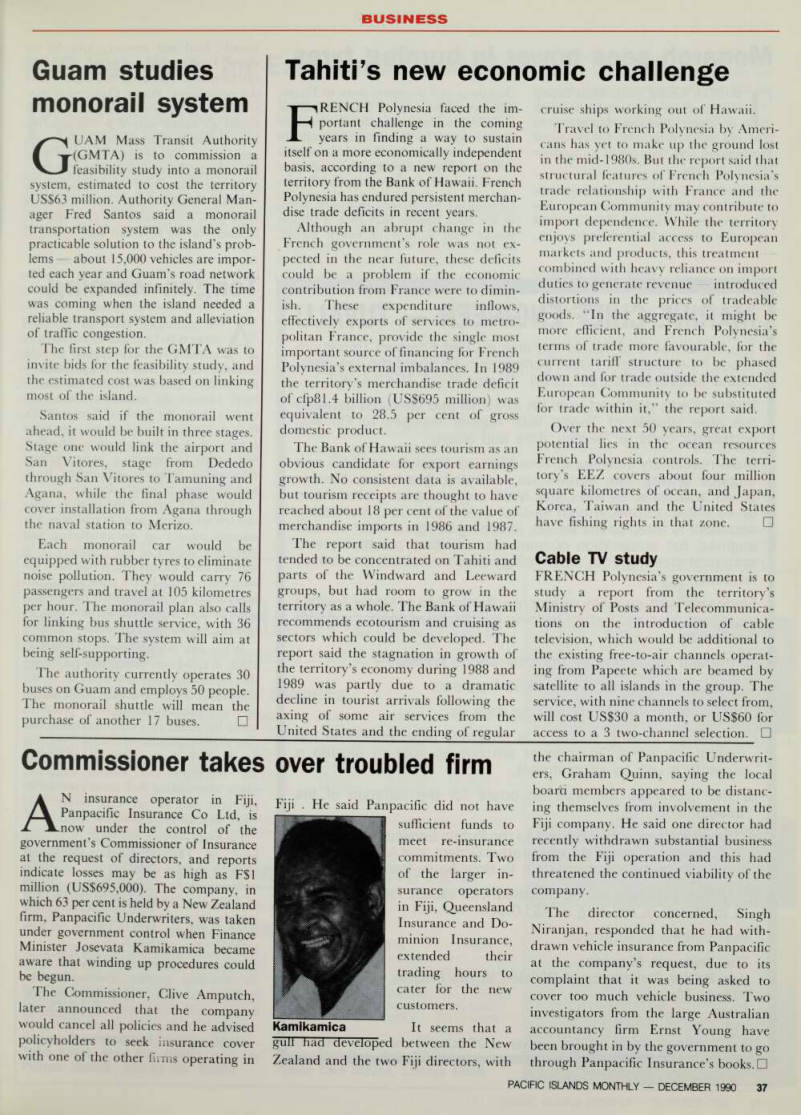
Guam studies monorail system
GUAM Mass Transit Authority (GMTA) is to commission a feasibility study into a monorail system, estimated to cost the territory US$63 million. Authority General Man ager Fred Santos said a monorail transportation system was the only practicable solution to the island’s prob lems about 15,000 vehicles are impor ted each year and Guam’s road network could be expanded infinitely. The time was coming when the island needed a reliable transport system and alleviation of traffic congestion.
The first step for the GMTA was to invite bids for the feasibility study, and the estimated cost was based on linking most of the island.
Santos said if the monorail went ahead, it would be built in three stages.
Stage one would link the airport and San Vitores, stage from Dededo through San Vitores to Tamuning and Agana, while the final phase would cover installation from Agana through the naval station to Merizo.
Each monorail car would be equipped with rubber tyres to eliminate noise pollution. They would carry 76 passengers and travel at 105 kilometres per hour. The monorail plan also calls for linking bus shuttle service, with 36 common stops. The system will aim at
being self-supporting.
The authority currently operates 30 buses on Guam and employs 50 people.
The monorail shuttle will mean the purchase of another 17 buses. □
Tahiti’s new economic challenge
FRENCH Polynesia faced the im portant challenge in the coming years in finding a way to sustain itself on a more economically independent basis, according to a new report on the territory from the Bank of Hawaii. French Polynesia has endured persistent merchan dise trade deficits in recent years.
Although an abrupt change in the French government’s role was not ex pected in the near future, these deficits could be a problem if the economic contribution from France were to dimin ish. These expenditure inflows, effectively exports of services to metro politan France, provide the single most important source of financing for French Polynesia’s external imbalances. In 1989 the territory’s merchandise trade deficit ofcfpBl.4 billion (US$695 million) was equivalent to 28.5 per cent of gross domestic product.
The Bank of Hawaii sees tourism as an obvious candidate for export earnings growth. No consistent data is available, but tourism receipts are thought to have reached about 18 per cent of the value of merchandise imports in 1986 and 1987.
The report said that tourism had tended to be concentrated on Tahiti and parts of the Windward and Leeward groups, but had room to grow in the territory as a whole. The Bank of Hawaii recommends ecotourism and cruising as sectors which could be developed. The report said the stagnation in growth of the territory’s economy during 1988 and 1989 was partly due to a dramatic decline in tourist arrivals following the axing of some air services from the United States and the ending of regular
cruise ships working out of Hawaii.
Travel to French Polynesia by Ameri cans has yet to make up the ground lost in the mid-1980s. But the report said that structural features of French Polynesia’s trade relationship with France and the European Community may contribute to import dependence. While the territory enjoys preferential access to European markets and products, this treatment combined with heavy reliance on import duties to generate revenue introduced distortions in the prices of tradeable goods. “In the aggregate, it might be more efficient, and French Polynesia’s terms of trade more favourable, for the current tariff structure to be phased down and for trade outside the extended European Community to be substituted for trade within it,” the report said.
Over the next 50 years, great export potential lies in the ocean resources French Polynesia controls. The terri tory’s EEZ covers about four million square kilometres of ocean, and Japan, Korea, Taiwan and the United States have fishing rights in that zone. □ Cable TV study FRENCH Polynesia’s government is to study a report from the territory’s Ministry of Posts and Telecommunica tions on the introduction of cable television, which would be additional to the existing free-to-air channels operat ing from Papeete which are beamed by satellite to all islands in the group. The service, with nine channels to select from, will cost USS3O a month, or US$6O for access to a 3 two-channel selection. □
Commissioner takes over troubled firm
AN insurance operator in Fiji, Panpacific Insurance Co Ltd, is now under the control of the government’s Commissioner of Insurance at the request of directors, and reports indicate losses may be as high as Fsl million (U 55695,000). The company, in which 63 per cent is held by a New Zealand firm, Panpacific Underwriters, was taken under government control when Finance Minister Josevata Kamikamica became aware that winding up procedures could be begun.
The Commissioner, Clive Amputch,
later announced that the company would cancel all policies and he advised policyholders to seek insurance cover with one of the other firms operating in
Fiji . He said Panpacific did not have
sufficient funds to meet re-insurance commitments. Two of the larger in surance operators in Fiji, Queensland Insurance and Do minion Insurance, extended their trading hours to cater for the new customers.
It seems that a
gull nad developed between the New Zealand and the two Fiji directors, with
the chairman of Panpacific Underwrit ers, Graham Quinn, saying the local board members appeared to be distanc ing themselves from involvement in the Fiji company. He said one director had recently withdrawn substantial business from the Fiji operation and this had threatened the continued viability of the company.
The director concerned, Singh Niranjan, responded that he had with drawn vehicle insurance from Panpacific at the company’s request, due to its complaint that it was being asked to cover too much vehicle business. Two investigators from the large Australian accountancy firm Ernst Young have been brought in by the government to go through Panpacific Insurance’s books. □
Kamikamica
Monarch sees power in burning tyres
TONGA’S King Taufa’ahau Tupou IV has come with another unusual economic initiative. He wants to buy old tyres from the US State of Washington and burn them to produce electric power.
He sees the cast-off tyres as the key to the country’s energy independence. The plan involves buying the 30 million old tyres now piled up in Washington state,
chip them and transport them to Tonga.
The estimated cost of T 532.46 million (U 5525.5 million) includes the price of
incinerators. As Washington produces
(or, more accurately, discards) up to five million old tyres a year, the incinerators would be assured of a regular fuel supply.
Greenpeace has already expressed alarm
at the idea, saying that such a project would send a stew of heavy metals,
arsenic, lead and mercury into the air above Tonga, much of which would be carcinogenic. The proposed suppliers of the equipment, Waste Conversion Sys tems Inc, of Denver, Colorado, said it would go ahead only if it was sure the best pollution control technology was used. Waste Conversion president Stan Abrams said his incinerators can produce economic electricity and they were environmentally safe. The machines burn at a temperature of 1370 degrees Celsius, leaving little but ash. □
Tongan warning
AN interesting piece of financial news is to be found in the recently released annual report of the National Reserve Bank of Tonga (NRBT).
In the third quarter of 1989, the central bank advised the country’s commercial trading bank, the Bank of Tonga (BoT), that it was concerned about the rapid expansion of domestic lending. The BoT was asked to restore a more prudent relationship between outstanding loans and liabilities, primarily deposits.
The NRBT advised the bank to carry this out selectively, so as to minimise any adverse impact on the producing and exporting sectors of the economy it was not these sectors which had been the recipients of the BoT’s additional lend ing; much of the additional money had gone by way of personal loans to finance housing, vehicles and consumer durables.
When the NRBT was established in 1989, it faced two immediate problems: the tightening liquidity squeeze at the BoT, and Tonga’s falling overseas re serves. “The origin of both problems could be traced to a common cause, the over rapid expansion of domestic lending by the BoT during 1987-88 and 1888, 89,” the report said. During these two years, outstanding BoT loans grew by 20 per cent and 43 per cent respectively while deposit growth was stagnant.
External reserves fell from their peak level of T 540.6 million (U 5531.61 million) in December 1987 to $33.9 million by June 1989. In the first quarter of 1990 the NRBT and BoT together introduced a scheme to provide tempor ary liquidity for pre and post-export lending. The scheme will only be im plemented in times of tight liquidity in the banking system. Previously, the central bank had stepped in to provide temporary liquidity to the Tonga Devel opment Bank to enable freight to be paid on large squash shipments to Japan at the end of 1989.
Advertisements & other items, p. 38 (1 item)
Marine Chief Engineer - Tuvalu
The Government of Tuvalu requires a Chief Engineer (minimum Grade II Certificate) to serve permanently on board the new interisland passenger/cargo vessel “Nivaga II” of 1043 D.W.T.
Nivaga II was delivered from UK in 1988 and operates between the nine islands of Tuvalu with regular voyages to Fiji and occasional calls to Tokelau, Apia and Nauru.
Main machinery consists of twin Mirrlees Blackstone ESL 6 and engines driving twin screws via reversing gearboxes. Electric power is supplied by two Lister JWSC engines driving alternators of 415 Volt 135 kw. A high level of automation and monitoring equiment is fitted to the vessel, including bridge control of main engines, full automation of main and auxiliary machinery and auto-pilot steering. Four small refrigerated containers are carried on deck.
Engineers with suitable experience are invited to apply for this important post and further training may be arranged for suitable applicants.
Terms and conditions for the post are as follows: — a. Salary scale: Level 6 A 56564 pa max b. Leave entitlement: 26 working days pa c. Housing: Housing shortage is presently experienced on the capital, therefore Government will not be able to provide a suitable house on appointment. d. The appointee will work on board for the duration of his assignment. e. The appointee will be subject to the Public Service Commission Regulations, General Administrative Orders and Administrative Instructions as may from time to time be in force. f. Medical facilities will be provided free except for preparation of dentures at the rate of Aslo.oo.
Applications in writing to: The Transpot Manager c/o British Development Division in the Pacific Private Mail Bag Suva
FIJI
Applications close 31 December, 1990.
PNG gas likely for East Asian markets
PAPUA new guinea could export liquefied natural gas (LNG) to East Asian markets, Minerals and Energy Minister Patterson lowa said.
He said the government was looking at the possibility of a gas gathering line which could take gas from a series of fields in the Highlands and Gulf prov inces to processing facilities on the Gulf of Papua coast.
It could follow parts of the route to be taken by the Kutubu oil export pipeline from the Southern Highlands to an offshore marine terminal in the Gulf of Papua. “More excitingly, it may be possible to convert the Kutubu crude oil pipeline to gas service after depletion of the Kutubu oil fields should there be no further oil discoveries warranting its continued use for oil,” lowa said in a statement.
“A throughput of the order of 300 million cubic feet of gas per day might be possible under such a scheme supporting the export of two million tonnes of LNG per year.” lowa said the recent surge in exploration indicated possible gas re serves of 17 trillion cubic feet.
PNG’s biggest known gas field is the
Hides structure in the Southern High lands, estimated to contain up to 2.9 trillion cubic feet of gas and 77 million barrels of condensate. Four gas fields have been discovered by drilling this year: P’nyang, Elevala and Tarim in the Western Province and Angore in the Southern Highlands, adding five trillion cubic feet to possible reserves.
Offshore, the Pandora Reef complex in the Gulf of Papua may contain up to 4.9 trillion cubic feet of recoverable gas, lowa said. Hides, 95 per cent owned by operator BP and five per cent by Oil Search, is expected to have its first commercial gas flow by the end of 1991 after constructiion of a gas processing plant and associated facilities at an estimated cost of more than K2O million.
However Hides’ only commitment so far is to supply a gas-driven power station to provide electricity for the second and more energy-intensive stage of the giant Porgera gold mine. The power station will take only a small portion of Hides reserves: 69 billion cubic feet over a
19-year period.
lowa said PNG would seek foreign investment to develop the gas reserves,
and to bring in technologies to help the country’s industrialisation and skills de velopment among its people. He said his department would begin a national proven petroleum reserves audit to assess and carefully define PNG’s gas reserves.
“This task will better determine the extent of proven versus possible reserves, providing more confidence to developers and more reliable data for the end-user in the east asian LNGmarkets,” he said. □ Export ban call TRADE and Industry Minister John Giheno wants all log and coffee exports banned in Papua New Guinea, with the government moving quickly to have both commodities processed in the country.
He said he had secured a loan from Germany of more than Kl 2 million (U 5512.73 million) to be channelled through the Central Bank for funding industrial projects. Germany is the
largest single buyer of Papua New
Guinea coffee, and Giheno said the government should buy a 50 per cent interest in a German coffee manufacturer and then get the company to set up a
large processing plant in Papua New
Guinea. □
Advertisements & other items, p. 39 (1 item)
Sofrana Unilines
The trusted name in shipping
AUSTRALIA FIJI DIRECT SERVICE
BRISBANE MELBOURNE SYDNEY NOUMEA
CAP! QUIROS VlO * 10-11/12 13-14/12 18-18/12 CART QUIROS Vll * 31/12-03/01 06-08/01/91 12-12/01 CAPT QUIROS Vl2 * 24-26/01 29-31/01 04-04/02 CAP! QUIROS Vl3 * 16-18/02 21-23/02 27-27/02 CAPT QUIROS Vl4 * 11-12/03 15-17/03 21-21/03 CAPT QUIROS Vl5 * 03-04/04 07-09/04 13-13/04
* CENTRALISED AT SYDNEY
LAUTOKA
20-20/12 14-15/01 06-07/02 01-02/03 24-25/03 16-17/04
SUVA
21-22/12 15-16/01 07-08/02 02-03/03 25-26/03 17-18/04 With swift efficient service you can trust the best way to ship to or from Australia and New Zealand is with Sofrana and Pacific Line Ltd.
NEW ZEALAND
AUCKLAND
TUI CAKAU 111 V 124 29-30 NOVEMBER TUI CAKAU 111 V 125 19-20 DECEMBER TUI CAKAU 111 V 126 10-11 JANUARY TUI CAKAU 111 V 127 31-01 JAN/FEB
TUI CAKAU 111 Vl2B 20-21 FEBRUARY
TUI CAKAU 111 V 129 12-13 MARCH
PACIFIC LIME LIMITED
CARGO SERVICE BETWEEN FIJI & NEW ZEALAND
FIJI DIRECT SERVICE
TAURANGA
06-06 DECEMBER
21-21 DECEMBER
17-17 JANUARY
05-05 FEBRUARY
27-27 FEBRUARY
16-16 MARCH
LYTTLETON
03-03 DECEMBER
14-14 JANUARY
24-24 FEBRUARY
SUVA
12-12 DECEMBER
27-27 DECEMBER
23-23 JANUARY
12-12 FEBRUARY
04-04 MARCH
23-23 MARCH
LAUTOKA
13-13 DECEMBER
28-28 DECEMBER
24-24 JANUARY
13-13 FEBRUARY
05-05 MARCH
24-24 MARCH
Owners Representative; Neptune House,
Tofua Street, Walu Bay, SUVA.
Phones: 304528 , 315645 Fax: 300057
Local Agent: Carpenters Shipping
Private Mail Bag, GPO SUVA Phone; Suva 302244, Lautoka 63988 rm y
carriers suffer still
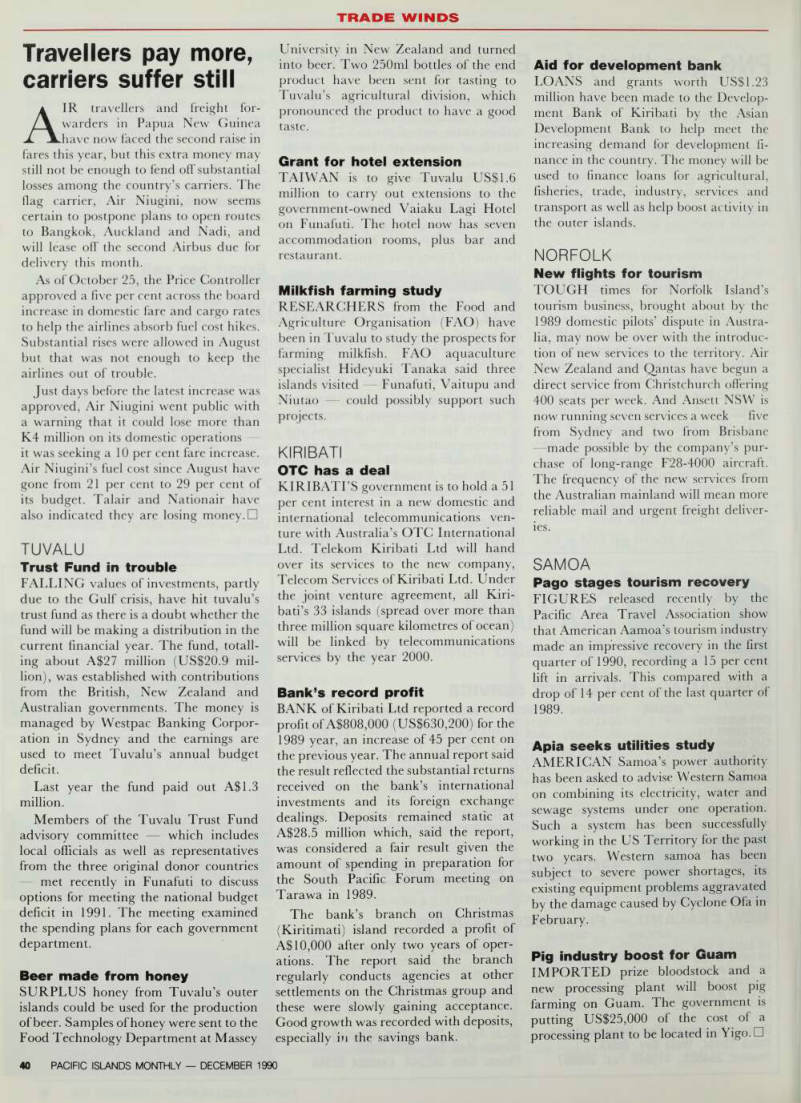
Trade Winds
Travellers pay more, carriers suffer still
AIR travellers and freight for warders in Papua New Guinea have now faced the second raise in fares this year, but this extra money may still not be enough to fend off substantial losses among the country’s carriers. The flag carrier, Air Niugini, now seems certain to postpone plans to open routes to Bangkok, Auckland and Nadi, and will lease off the second Airbus due for delivery this month.
As of October 25, the Price Controller approved a five per cent across the board increase in domestic fare and cargo rates to help the airlines absorb fuel cost hikes.
Substantial rises were allowed in August but that was not enough to keep the airlines out of trouble.
Just days before the latest increase was approved, Air Niugini went public with a warning that it could lose more than K 4 million on its domestic operations it was seeking a 10 per cent fare increase.
Air Niugini’s fuel cost since August have gone from 21 per cent to 29 per cent of its budget. Talair and Nationair have also indicated they are losing money. □
Tuvalu
Trust Fund in trouble FALLING values of investments, partly due to the Gulf crisis, have hit tuvalu’s trust fund as there is a doubt whether the fund will be making a distribution in the current financial year. The fund, totall ing about As 27 million (US$2O.9 mil lion), was established with contributions from the British, New Zealand and Australian governments. The money is managed by Westpac Banking Corpor ation in Sydney and the earnings are used to meet Tuvalu’s annual budget deficit.
Last year the fund paid out Asl.3 million.
Members of the Tuvalu Trust Fund advisory committee which includes local officials as well as representatives from the three original donor countries met recently in Funafuti to discuss options for meeting the national budget deficit in 1991. The meeting examined the spending plans for each government
department.
Beer made from honey SURPLUS honey from Tuvalu’s outer islands could be used for the production of beer. Samples of honey were sent to the Food Technology Department at Massey
University in New Zealand and turned into beer. Two 250 ml bottles of the end product have been sent for tasting to Tuvalu’s agricultural division, which pronounced the product to have a good taste.
Grant for hotel extension TAIWAN is to give Tuvalu US$l.6 million to carry out extensions to the government-owned Vaiaku Lagi Hotel on Funafuti. The hotel now has seven accommodation rooms, plus bar and restaurant.
Milkfish farming study RESEARCHERS from the Food and Agriculture Organisation (FAO) have been in Tuvalu to study the prospects for farming milkfish. FAO aquaculture specialist Hideyuki Tanaka said three islands visited Funafuti, Vaitupu and Niutao could possibly support such
projects.
Kiribati
OTC has a deal KIRIBATI’S government is to hold a 51 per cent interest in a new domestic and international telecommunications ven ture with Australia’s OTC International Ltd. Telekom Kiribati Ltd will hand over its services to the new company, Telecom Services of Kiribati Ltd. Under the joint venture agreement, all Kiri bati’s 33 islands (spread over more than three million square kilometres of ocean) will be linked by telecommunications services by the year 2000.
Bank’s record profit BANK of Kiribati Ltd reported a record profit of AsBoB,ooo (U 55630,200) for the 1989 year, an increase of 45 per cent on the previous year. The annual report said the result reflected the substantial returns received on the bank’s international investments and its foreign exchange dealings. Deposits remained static at A 528.5 million which, said the report, was considered a fair result given the amount of spending in preparation for the South Pacific Forum meeting on Tarawa in 1989.
The bank’s branch on Christmas (Kiritimati) island recorded a profit of A$ 10,000 after only two years of oper ations. The report said the branch regularly conducts agencies at other settlements on the Christmas group and these were slowly gaining acceptance.
Good growth was recorded with deposits, especially in the savings bank.
Aid for development bank LOANS and grants worth US$l.23 million have been made to the Develop ment Bank of Kiribati by the Asian Development Bank to help meet the increasing demand for development fi nance in the country. The money will be used to finance loans for agricultural, fisheries, trade, industry, services and transport as well as help boost activity in the outer islands.
Norfolk
New flights for tourism TOUGH times for Norfolk Island’s tourism business, brought about by the 1989 domestic pilots’ dispute in Austra lia, may now be over with the introduc tion of new services to the territory. Air New Zealand and Qantas have begun a direct service from Christchurch offering 400 seats per week. And Ansett NSW is now running seven services a week five from Sydney and two from Brisbane —made possible by the company’s pur chase of long-range F2B-4000 aircraft.
The frequency of the new services from the Australian mainland will mean more reliable mail and urgent freight deliver ies.
Samoa
Pago stages tourism recovery FIGURES released recently by the Pacific Area Travel Association show that American Aamoa’s tourism industry made an impressive recovery in the first quarter of 1990, recording a 15 per cent lift in arrivals. This compared with a drop of 14 per cent of the last quarter of 1989.
Apia seeks utilities study AMERICAN Samoa’s power authority has been asked to advise Western Samoa on combining its electricity, water and sewage systems under one operation.
Such a system has been successfully working in the US Territory for the past two years. Western samoa has been subject to severe power shortages, its
existing equipment problems aggravated
by the damage caused by Cyclone Ofa in February.
Pig industry boost for Guam IMPORTED prize bloodstock and a new processing plant will boost pig farming on Guam. The government is putting U 5525,000 of the cost of a processing plant to be located in Yigo. □
Steamships hit by poor freight rates
Shipping
UNECONOMIC freight rates are
making shipping in the Gulf of Papua unviable, directors of Steamships Trading Co Ltd complain in the company’s latest annual report.
They said that despite further rational isation of operations, its services are losing money due to the refusal of the Papua New Guinea Price Controller to approve increases in shipping charges during the past six years.
Steamships had restricted regular ser vices to the major ports of Daru and Kiunga, with services to other ports on a charter basis only. “It is regretted that Papua New Guineans living along the Papuan coast will be disadvantaged due to the instransigent attitude of the Price Controller,” the directors said.
One of Steamships’ subsidiaries in the Australia-Papua New Guinea service had a very difficult year. Papua New Guinea Shipping Corporation Pty Ltd participates in the Chief Container Service. The report said that, even with the casualties among opposition shipping lines, freight rates remained at unecon omic levels on this service. This subsidi ary also has a 25 per cent holding in Consort Express Lines, which runs a five
day service between the major ports of Papua New Guinea. Since the closure of the Bougainville mine, one of the four ships has been disposed of and schedules revised to reduce frequency between port calls to seven days. But Steamships
reported that stevedoring operations,
particularly in Lae, performed well due to the substantial volume of cargo for the Porgera gold mine.
The 50 per cent owned North Sol omons Stevedores Pty Ltd, which oper ated transport and wharf services on Bougainville, struggled on until the total withdrawal of shipping services out of Kieta in March. All major items of equipment have been redeployed to other ports.
Directors reported that Steamships
operations generally were affected by the devaluation of the Kina in January. This resulted in substantial increases in the costs of raw materials and finished goods.
“In many cases, these additional costs have not been recovered due to a complete lack of response from the Price Controller to requests for price increases on controlled products.”
Directors said the decision to devalue the currency signalled a move away from
the Government’s traditional strong kina policy. “It is considered that little has been achieved by this action,” the report said. “Potential investors would, for the first time, be concerned about Papua New Guinea’s ongoing economic stab ility.”
Directors said the company’s disap pointing performance in returning a pre tax profit of K 4.85 million (U 554.57 million) less than half of the previous year reflected the weaker trading conditions in the country. Several div isions had not responded adequately to the rapidly changing economic environ ment. As well as commenting on ship ping problems, the annual report singled out the hotels division which had been affected by curfews in some centres and renovations in others, high management staff turnover and inadequate controls.
Steamships directors said that Papua New Guinea was in its first recession since independence, a situation which had been brought about by a combination of the Bougainville crisis and the collapse in prices for coffee, cocoa and copra. They welcomed moves by the Government to stimulate the private sector by easing restrictions on foreign investment, to improve worker training and to reduce duty on some equipment. □
Advertisements & other items, p. 41 (1 item)
Bali
TONGA
KIRIBATI
VANUATU
COOK ISLAND
SOLOMON ISLANDS
NEW CALEDONIA
U.S. SAMOA
WESTERN SAMOA
FRENCH POLYNESIA
JAPAN . KOREA
YOU’LL FIND IT,
WHERE THE SKY MEETS
THE SEA
RORO. CONTAINER &
B.BULK SHIPPING
BALI
HAI SERVICE
AGENTS
and
PHONE
SUVA:Burns Philp(B P) 311 777 Carpenter Shipping (C S) 31 2244 LAUTOKA:B P 60777 C S 63988 APIA;B P 22611 PAGOPAGO :Polynesia Shipping Services Ltd 633-1211 PAPEETE:Compagnie Maritime Polynesienne 42 84 02 NOUMEA:Etablissements Ballande 687-283384 VILA:B P 2456 SANTO;B P 230 HONlARA;Sullivans (Solomon Islands) Ltd 21645 TARAWA:Shipping Corporation of Kiribati 26195 NUKUALOFA:B P 21500 BUSAN:for general cargo Young Chang Shipping Co , Ltd 753-0451 for vehicle Pan Continental Shipping Co , Ltd 778-7680 Soyang Shipping Co., Ltd 752-7755 JAPANdor general cargo Swire 03-230-9245 for vehicle NYK Lines 03-284-5506 Mitsui O S K 03-587-7123
Magic
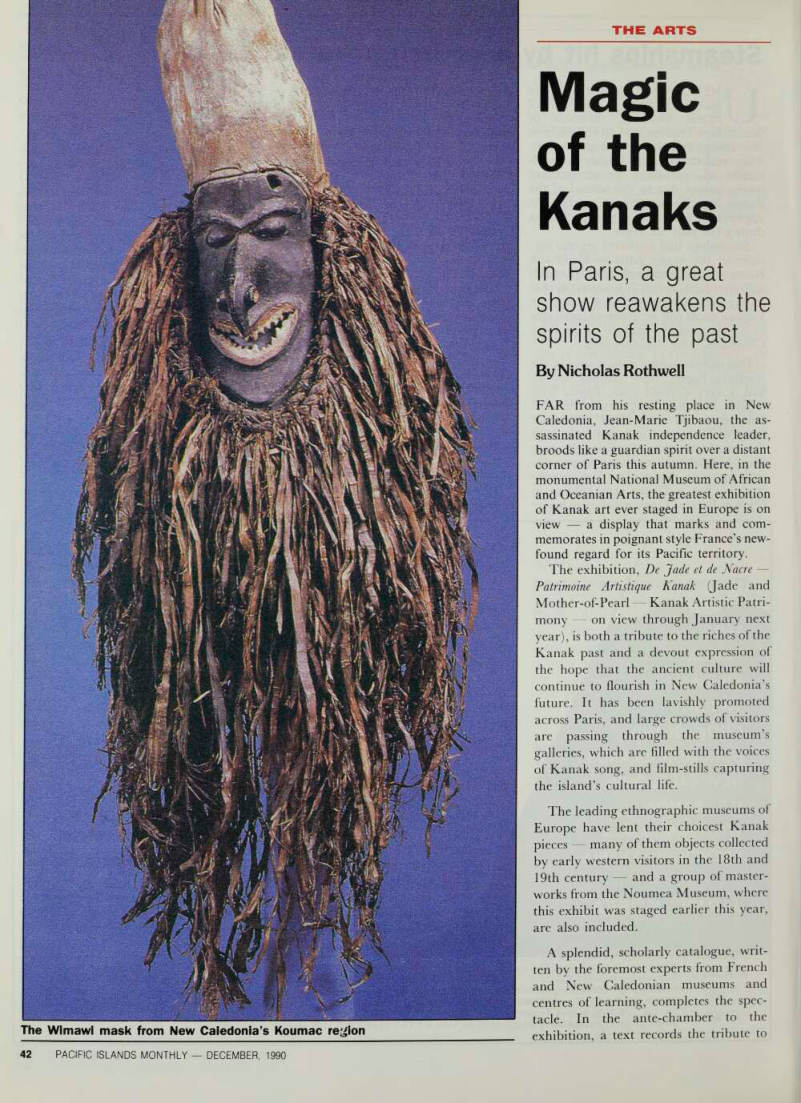
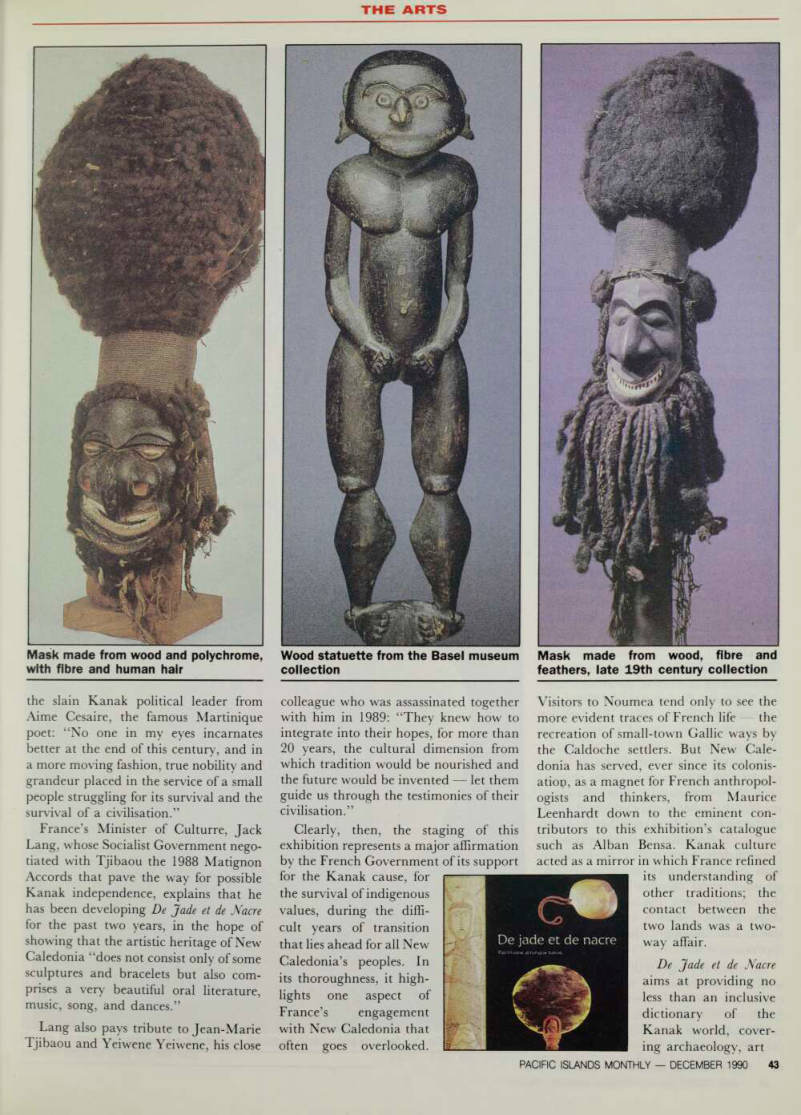
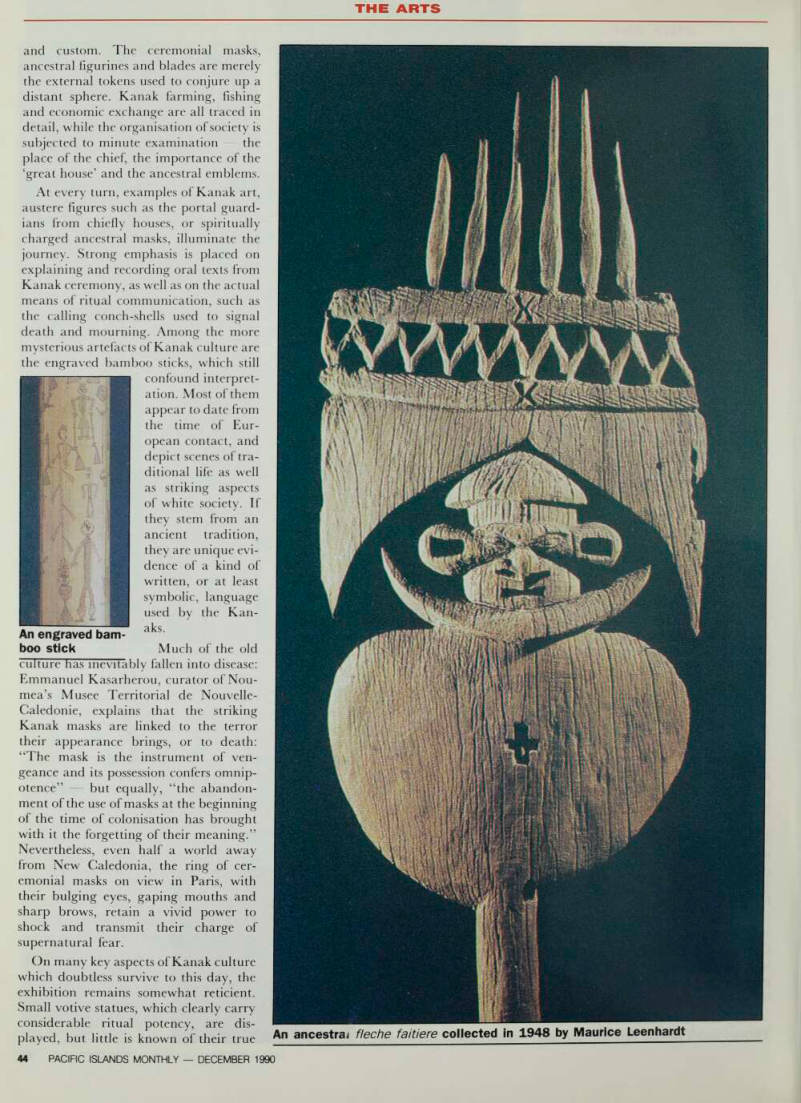
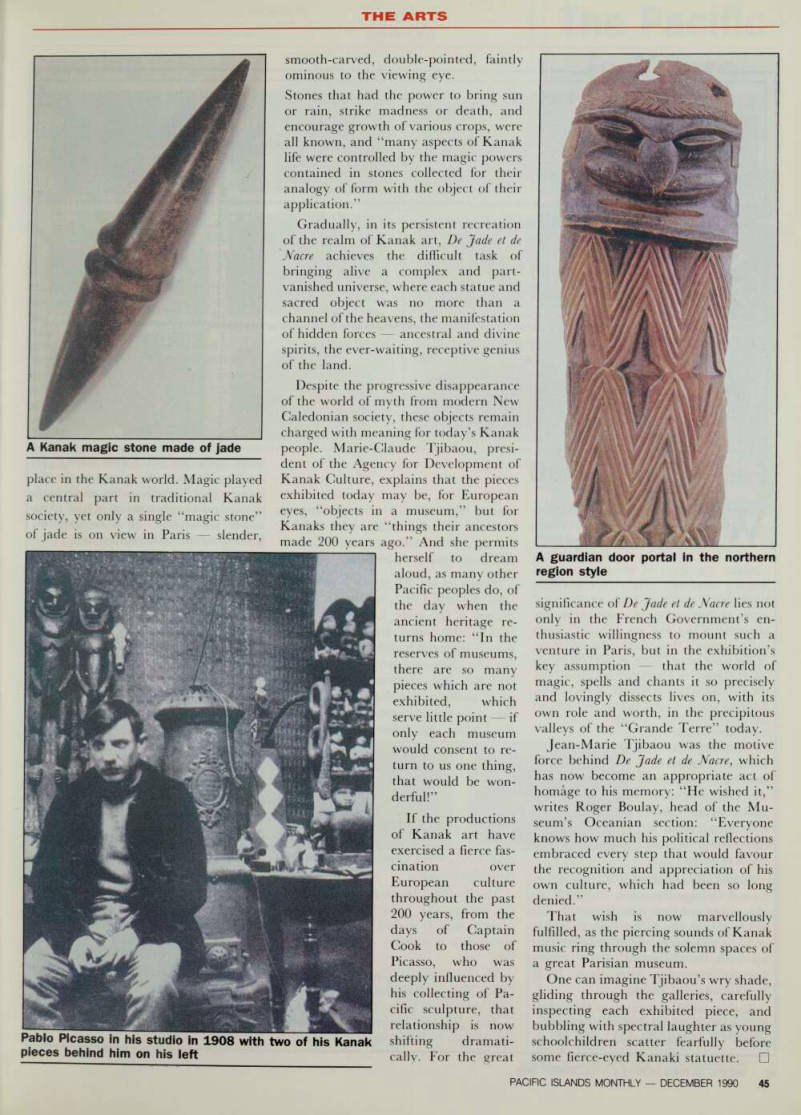
The Arts
Magic of the Kanaks
In Paris, a great show reawakens the spirits of the past
By Nicholas Rothwell
FAR from his resting place in New Caledonia, Jean-Marie Tjibaou, the as sassinated Kanak independence leader, broods like a guardian spirit over a distant corner of Paris this autumn. Here, in the monumental National Museum of African and Oceanian Arts, the greatest exhibition of Kanak art ever staged in Europe is on view a display that marks and com memorates in poignant style France’s new found regard for its Pacific territory.
The exhibition, De Jade et de Nacre Patrimoine Artistique Kanak (Jade and Mother-of-Pearl Kanak Artistic Patri mony on view through January next year), is both a tribute to the riches of the Kanak past and a devout expression of the hope that the ancient culture will continue to flourish in New Caledonia’s future. It has been lavishly promoted across Paris, and large crowds of visitors are passing through the museum’s galleries, which are filled with the voices of Kanak song, and film-stills capturing the island’s cultural life.
The leading ethnographic museums of Europe have lent their choicest Kanak pieces many of them objects collected by early western visitors in the 18th and 19th century and a group of master works from the Noumea Museum, where this exhibit was staged earlier this year, are also included.
A splendid, scholarly catalogue, writ ten by the foremost experts from French and New Caledonian museums and centres of learning, completes the spec tacle. In the ante-chamber to the exhibition, a text records the tribute to
The Wimawi mask from New Caledonia’s Koumac region
the slain Kanak political leader from Aime Cesaire, the famous Martinique poet: “No one in my eyes incarnates better at the end of this century, and in a more moving fashion, true nobility and grandeur placed in the service of a small people struggling for its survival and the survival of a civilisation.”
France’s Minister of Culturre, Jack Lang, whose Socialist Government nego tiated with Tjibaou the 1988 Matignon Accords that pave the way for possible Kanak independence, explains that he has been developing De Jade et de Nacre for the past two years, in the hope of showing that the artistic heritage of New Caledonia “does not consist only of some sculptures and bracelets but also com prises a very beautiful oral literature, music, song, and dances.”
Lang also pays tribute to Jean-Marie Tjibaou and Yeiwene Yeiwene, his close
colleague who was assassinated together with him in 1989: “They knew how to integrate into their hopes, for more than 20 years, the cultural dimension from which tradition would be nourished and the future would be invented let them guide us through the testimonies of their civilisation,”
Clearly, then, the staging of this exhibition represents a major affirmation by the French Government of its support
for the Kanak cause, for the survival of indigenous values, during the diffi cult years of transition that lies ahead for all New Caledonia’s peoples. In its thoroughness, it high lights one aspect of France’s engagement with New Caledonia that often goes overlooked.
Visitors to Noumea tend only to see the more evident traces of French life the recreation of small-town Gallic ways by the Caldoche settlers. But New Cale donia has served, ever since its colonis ation, as a magnet for French anthropol ogists and thinkers, from Maurice Leenhardt down to the eminent con tributors to this exhibition’s catalogue such as Alban Bensa. Kanak culture acted as a mirror in which France refined
its understanding of other traditions; the contact between the two lands was a two way affair.
De Jade et de Nacre aims at providing no less than an inclusive dictionary of the Kanak world, cover ing archaeology, art
Mask made from wood and polychrome, with fibre and human hair
Wood statuette from the Basel museum collection
Mask made from wood, fibre and feathers, late 19th century collection
and custom. The ceremonial masks, ancestral figurines and blades are merely the external tokens used to conjure up a distant sphere. Kanak farming, fishing and economic exchange are all traced in detail, while the organisation of society is subjected to minute examination the place of the chief, the importance of the ‘great house’ and the ancestral emblems.
At every turn, examples of Kanak art, austere figures such as the portal guard ians from chiefly houses, or spiritually charged ancestral masks, illuminate the journey. Strong emphasis is placed on explaining and recording oral texts from Kanak ceremony, as well as on the actual means of ritual communication, such as the calling conch-shells used to signal death and mourning. Among the more mysterious artefacts of Kanak culture are the engraved bamboo sticks, which still
confound interpret
ation. Most of them appear to date from the time of Eur opean contact, and depict scenes of tra ditional life as well as striking aspects of white society. If they stem from an ancient tradition, they are unique evi dence of a kind of written, or at least symbolic, language used by the Kan aks.
Much of the old
culture has inevitably fallen into disease: Emmanuel Kasarherou, curator of Nou mea’s Musee Territorial de Nouvelle- Caledonie, explains that the striking Kanak masks are linked to the terror their appearance brings, or to death: “The mask is the instrument of ven geance and its possession confers omnip otence” but equally, “the abandon ment of the use of masks at the beginning of the time of colonisation has brought with it the forgetting of their meaning.”
Nevertheless, even half a world away from New Caledonia, the ring of cer emonial masks on view in Paris, with their bulging eyes, gaping mouths and sharp brows, retain a vivid power to shock and transmit their charge of supernatural fear.
On many key aspects of Kanak culture which doubtless survive to this day, the exhibition remains somewhat reticient.
Small votive statues, which clearly carry considerable ritual potency, are dis played, but little is known of their true
An engraved bam boo stick
An ancestral fleche faitiere collected in 1948 by Maurice Leenhardt
place in the Kanak world. Magic played a central part in traditional Kanak society, yet only a single “magic stone” of jade is on view in Paris slender,
smooth-carved, double-pointed, faintly ominous to the viewing eye.
Stones that had the power to bring sun or rain, strike madness or death, and encourage growth of various crops, were all known, and “many aspects of Kanak life were controlled by the magic powers contained in stones collected for their analogy of form with the object of their application.”
Gradually, in its persistent recreation of the realm of Kanak art, De Jade et de Nacre achieves the difficult task of bringing alive a complex and part vanished universe, where each statue and sacred object was no more than a channel of the heavens, the manifestation of hidden forces ancestral and divine spirits, the ever-waiting, receptive genius of the land.
Despite the progressive disappearance
of the world of myth from modern New Caledonian society, these objects remain charged with meaning for today’s Kanak people. Marie-Claude Tjibaou, presi dent of the Agency for Development of Kanak Culture, explains that the pieces exhibited today may be, for European eyes, “objects in a museum,” but for Kanaks they are “things their ancestors made 200 years ago.” And she permits
herself to dream aloud, as many other Pacific peoples do, of the day when the ancient heritage re turns home: “In the reserves of museums, there are so many pieces which are not exhibited, which serve little point if only each museum would consent to re turn to us one thing, that would be won derful!”
If the productions of Kanak art have exercised a fierce fas cination over
European culture
throughout the past 200 years, from the days of Captain Cook to those of Picasso, who was deeply influenced by his collecting of Pa cific sculpture, that relationship is now
shifting dramati
cally. For the great
significance of De Jade et de Nacre lies not only in the French Government’s en thusiastic willingness to mount such a venture in Paris, but in the exhibition’s key assumption that the world of magic, spells and chants it so precisely and lovingly dissects lives on, with its own role and worth, in the precipitous valleys of the “Grande Terre” today.
Jean-Marie Tjibaou was the motive force behind De Jade et de Nacre, which has now become an appropriate act of homage to his memory: “He wished it,” writes Roger Boulay, head of the Mu seum’s Oceanian section: “Everyone knows how much his political reflections embraced every step that would favour the recognition and appreciation of his own culture, which had been so long denied.”
That wish is now marvellously fulfilled, as the piercing sounds of Kanak music ring through the solemn spaces of a great Parisian museum.
One can imagine Tjibaou’s wry shade, gliding through the galleries, carefully inspecting each exhibited piece, and bubbling with spectral laughter as young schoolchildren scatter fearfully before some fierce-eyed Kanaki statuette. □
A Kanak magic stone made of jade
Pablo Picasso in his studio in 1908 with two of his Kanak pieces behind him on his left
A guardian door portal in the northern region style
Fishing in Kiribati
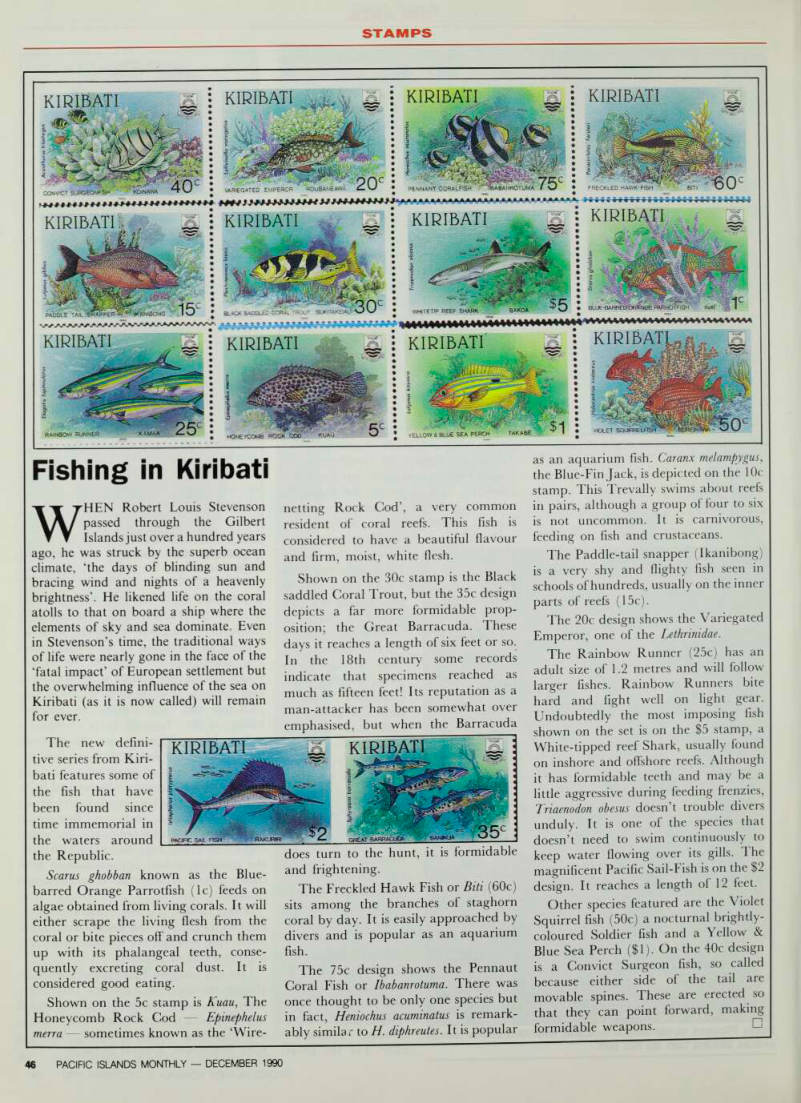
Stamps
WHEN Robert Louis Stevenson passed through the Gilbert Islands just over a hundred years ago, he was struck by the superb ocean climate, ‘the days of blinding sun and bracing wind and nights of a heavenly brightness’. He likened life on the coral atolls to that on board a ship where the elements of sky and sea dominate. Even in Stevenson’s time, the traditional ways of life were nearly gone in the face of the ‘fatal impact’ of European settlement but the overwhelming influence of the sea on Kiribati (as it is now called) will remain for ever.
The new defini tive series from Kiri bati features some of the fish that have been found since time immemorial in the waters around
the Republic.
Scarus ghobban known as the Blue barred Orange Parrotfish (1c) feeds on algae obtained from living corals. It will either scrape the living flesh from the coral or bite pieces off and crunch them up with its phalangeal teeth, conse quently excreting coral dust. It is considered good eating.
Shown on the 5c stamp is Kuau, The Honeycomb Rock Cod Epinephelus merra sometimes known as the ‘Wire
netting Rock Cod’, a very common resident of coral reefs. This fish is considered to have a beautiful flavour and firm, moist, white flesh.
Shown on the 30c stamp is the Black saddled Coral Trout, but the 35c design depicts a far more formidable prop osition; the Great Barracuda. These days it reaches a length of six feet or so.
In the 18th century some records indicate that specimens reached as much as fifteen feet! Its reputation as a man-attacker has been somewhat over emphasised, but when the Barracuda
does turn to the hunt, it is formidable
and frightening.
The Freckled Hawk Fish or Biti (60c) sits among the branches of staghorn coral by day. It is easily approached by divers and is popular as an aquarium fish.
The 75c design shows the Pennaut Coral Fish or Ibabanrotuma. There was once thought to be only one species but in fact, Heniochus acuminatus is remark ably similar to H. diphreutes. It is popular
as an aquarium fish. Caranx melampygus , the Blue-Fin Jack, is depicted on the 10c stamp. This Trevally swims about reefs in pairs, although a group of four to six is not uncommon. It is carnivorous, feeding on fish and crustaceans.
The Paddle-tail snapper (Ikanibong) is a very shy and flighty fish seen in schools of hundreds., usually on the inner parts of reefs (15c).
The 20c design shows the Variegated Emperor, one of the Lethrinidae.
The Rainbow Runner (25c) has an adult size of 1.2 metres and will follow larger fishes. Rainbow Runners bite hard and fight well on light gear.
Undoubtedly the most imposing fish shown on the set is on the $5 stamp, a White-tipped reef Shark, usually found on inshore and offshore reefs. Although it has formidable teeth and may be a little aggressive during feeding frenzies, Triaenodon obesus doesn’t trouble divers unduly. It is one of the species that doesn’t need to swim continuously to keep water flowing over its gills. The magnificent Pacific Sail-Fish is on the $2 design. It reaches a length of 12 feet.
Other species featured are the Violet Squirrel fish (50c) a nocturnal brightly coloured Soldier fish and a Yellow & Blue Sea Perch (SI). On the 40c design is a Convict Surgeon fish, so called because either side of the tail are movable spines. These are erected so that they can point forward, making formidable weapons.
Covering
Books
Covering the war
Pacific Microphone. By William J. Dunn, Texas A & M University Press. 1988. 399 pages. [ISBN 0-89096-339-8. U 5519.95.
Reviewed by Harvey Zane Helfand NEARLY one year before Ame rica’s entry into World War 11, CBS radio correspondent William J. Dunn was sent to the Far East to establish news reporting arrangements and seek information about the situation in Asia. Embarking on what he was told would be a “90-day assignment”. Dunn arrived in the Philippines then a US Commonwealth, by Pan American clipper via Midway, Wake and Guam in January 1941. Dunn’s work soon extended beyond three months, as he was sent to various destinations, assuring the presence of a CBS reporter on the scene when the anticipated war broke out. Pacific Micro phone is Dunn’s story of this assignment, which resulted in his being the first American radio journalist to cover the Pacific war from beginning to end.
Working first out of Manila, Dunn found the American residents there living “the good life” without apparent feelings of vulnerability: “Despite the thunder heads mounting to the north, the Manila of 1941 was truly the Pearl of the Orient, a city whose rising prosperity made even the thought of total war impossible for the average person to comprehend.”
It was here he first met Douglas MacArthur, who was then serving as a military adviser to Philippines President Manuel Quezon. This meeting marked the beginning of a friendship with MacArthur, who soon took command of the US Armed Forces in the Far East (USAFE), that placed Dunn in the trusted inner circle of the general’s command throughout the war. In fact, Dunn’s admiration, and sometimes de fence, of the soldier is so strong, that the book might have been subtitled “My Years with MacArthur”.
Overcoming difficult travel restric tions, Dunn managed to reach Hong Kong, Shanghai, Saigon, Rangoon, and even Tokyo in May and June of 1941 and enabled CBS to make the first broadcast report from Japan by a staff correspon dent, but, more importantly, it satisfied “my own curiosity concerning the capital of a nation I was certain would soon be at war with my own.”
With a Japanese offensive appearing
imminent, Dunn and his colleagues speculated that Singapore and the Phil ippines would be the likely targets, and they never “gave a thought to Hawaii and Pearl Harbor”. In December, when his military friends in Rangoon alerted him to the news of the attack, Dunn thought they were joking: “I was being taken in. I had been to Pearl Harbor and had been briefed on the impregnable defenses. I’d never swallow that one.”
Sobered by the realisation that he was now a war correspondent, rather than just a foreign correspondent, Dunn had to find out not only what was happening, but also a way to send a radio report to San Francisco. “I found myself seques tered in a colonial backwater of the infant Pacific war, minus a viable microphone and with little ‘newsworthy material’ to file by cable.” Though he had made some broadcasts, most facili ties were not equipped for reliable trans pacific communications.
With Guam captured and Japanese forces advancing on Hong Kong, the Malay Peninsula, and the Philippines, Dunn made his way to Batavia in the Netherlands East Indies: “I wanted a story to report and I found one. I wanted radio facilities to reach CBS and the American public, and the Dutch in Java gave me facilities as fine as could be found anywhere in 1941.” But by early March, Dunn, retreating from Japanese attacks, left Java in a hectic evacuation by ship for Australia. Before departing, he managed to radio the first report of the invasion to San Francisco which, even under the circumstances, left him elated: “To be the first, worldwide, with a story of this importance is the ambition of every correspondent-reporter.”
Arriving at Perth, Dunn learned that the only trans-Pacific broadcast facilities were located in Melbourne and Sydney.
In Melbourne, he re-established contact with CBS News and also had a reunion with MacArthur, who was establishing his headquarters there. When he saw Dunn he was surprised to see that the reporter had escaped from the Philip pines and offered: “ You stay with me, Dunn, and I’ll take you back to Manila.”
It was a promise he kept, although it required the better part of three years.
MacArthur’s authority was not quickly established, however, because of an interservice rivalry with the navy, about who should be in overall command in the Pacific. In Dunn’s words, Wash ington “spent more time trying to define his command than the enemy had taken to occupy both Hong Kong and
Manila.” After more than four weeks, a compromise was reached which divided the Pacific at longitude 159° east, giving MacArthur command of the Southwest Pacific Area (SWPA) to the west of this demarcation, and Admiral Chester W.
Nimitz command of the South Pacific Area to the east.
When MacArthur moved his head quarters to Brisbane to be closer to the combat zone, the press corps moved with
him to the north, but the radio reporters could only go as far as Sydney, where intercontinental transmission was available at the studio of Amalgamated Wireless of Australasia. La ments Dunn: “There we were anchored, and our easy access to unofficial . . . sources no
longer existed.”
As island fighting in the
Pacific intensified, interservice rivalry, says Dunn, caused MacArthur to be unjustly discredited. Limited by the number of troops under his command and not requested by the navy to assist in their campaign at Guadalcanal, re ports criticised the general for failing to come to the aid of the First Marines there. Dunn claims that the navy covered up the facts: “Obviously, a powerful element in the navy was not about to tell the beleagured Marines that the decision to abandon them came from one of their own. Just as obviously a whipping boy was called for, and Douglas MacArthur was there, just across the Coral Sea.”
Flying in a C-47 transport at treetop height over the Owen Stanley range, Dunn made his way to the combat zone in the Buna jungles of New Guinea, where he spent days “interviewing
dozens of Gls and officers, and filling a notebook with information that would prove useful when I got back to my microphone.” On Bougainville, from a makeshift tent studio, Dunn was able to send radio reports, thanks to the ingen uity of the sergeant in charge acting as “chief engineer, emcee, anchor man, and janitor” at “Radio Bougainville” who enabled the small station to send an acceptable voice signal over one thou-
sand miles to Noumea, where it was then relayed across the Pacific. Dunn’s most memor able moment came on October 20, 1944, when he was one of four correspon dents selected to accompany MacArthur on his famous
landing at Leyte. Philip
pines. It was Dunn, hugging his portable typewriter, who
waded ashore as part of a landing party of seven, led by MacArthur. And it was Dunn, standing on the beach in a downpour, who spoke into a hand-held microphone: "People of the Philippines, the next voice you hear will be that of Gen Douglas MacArthur.” This was followed by MacArthur’s stirring words: “People of the Philippines, I have returned. By the Grace of Almighty God our forces now stand again on Philip pines soil soil consecrated by the blood of our two people . .
Such historic events are described by Dunn in a personal and poignant way throughout the book. His thoroughness as a reporter combined with his eyewit ness viewpoint to convey both immedi acy and credibility. His informal writing style is embellished by many carefully captioned photographs and maps. □
Advertisements & other items, pp. 47-48 (1 item)
The Pacific
Is Yours
Have all the information
at your fingertips order
PIM publications NOW!
PACIFIC
MAF
FIJI
SLANDS
TV (OURNAL
. .#L U :* --i !' . ■ Pacific Islands Yearbook 16th Edition As4s ■ Fiji Handbook Business & Travel Guide A 514.95 ■ Vanuatu, A Guide ■ The Journal of William Lockerby
■ Map of Fiji
■ Map of the Pacific Asl 4.95 A 53.50 A 53.50 A 53.50 Number of copies being ordered: Pacific Islands Yearbook
Fiji Handbook
Vanuatu, A Guide The Journal of William Lockerby Fiji Islands map Pacific Islands map Enclosed is A$ for payment Debit A$ to my □ Bank Card □ VISA □ Master Card Card No:
Expiry Date:
My Name: Postal Address:
Country: Tel:
Post to: PACIFIC ISLANDS MONTHLY,
PO BOX 1167, SUVA, FIJI ISLANDS.
1
The South Sea Digest
The Newsletter on Islands Affairs. Every Other Friday.
South Sea Digest has all the latest business news, expertly streamlined and obtainable nowhere else.
Subscriptions: 25 issues SAISO for Australian subscriber; Asl7s overseas, all airmailed. Payment by cheque in A$ and US$, otherwise by bank draft.
Send payment to; The South Sea Digest, GPO Box 4245, Sydney, NSW 2001, Australia.
Name Address
Spies who
read papers
Prospects for Crisis Prediction: A South Pacific Case Study, By Ken Ross.
Canberra Papers on Strategy and De fence, No 65, Strategic & Defence Studies Centre, Australian National University.
Reviewed by David Robie WHO are the prospective readers, the author asks hesitantly in the foreword to this monograph on intelligence and the South Pacific? Indeed, he adds, are there any?
Well, the short answer for this particu lar work is likely to be very few. Perhaps a handful of academics and specialist bureaucrats might find parts of it useful.
But for any general reader determined enough to penetrate the tedium there are few insights. Ross is a South Pacific analyst with the New Zealand govern ment’s External Assessments Bureau (called the intelligence bureau until two years ago). He points out that his monograph has been reviewed to ensure that there was no inclusion of classified information. Why bother?
Mirch of the information contained in Prospects for Crisis Prediction is digested from news media coverage of contempor ary events and crises in the Pacific, particularly the Fiji military coups in 1987 and the abortive constitutional coup in Vanuatu the following year.
Some readers might be surprised at the extent to which intelligence assessments of this kind rely on media reports.
Even the monograph’s cover reflects this dependency. The photograph of ni- Vanuatu land protesters in the Port Vila riot in May 1988 is mine I was the
only foreign journalist present.
A theoretical context provided in the first half of the monograph is sifted from conservative views ranging from Wash ington commentator on the CIA, Robert Gates, to Australian security analyst David Hegarty. Nobody who has chal lenged the Pacific intelligence consensus such as Noam Chomsky, Ralph McGehee, Brian Toohey or Owen Wilkes is included.
The case study focuses on Vanuatu:
exploring the political dynamics during
the power struggle between Prime Min ister Father Walter Lini and Barak Sope, formerly secretary-general of the ruling Vanua’aku Pad, and examining various scenarious for potential upheaval co inciding with next year’s elections. □
Courage
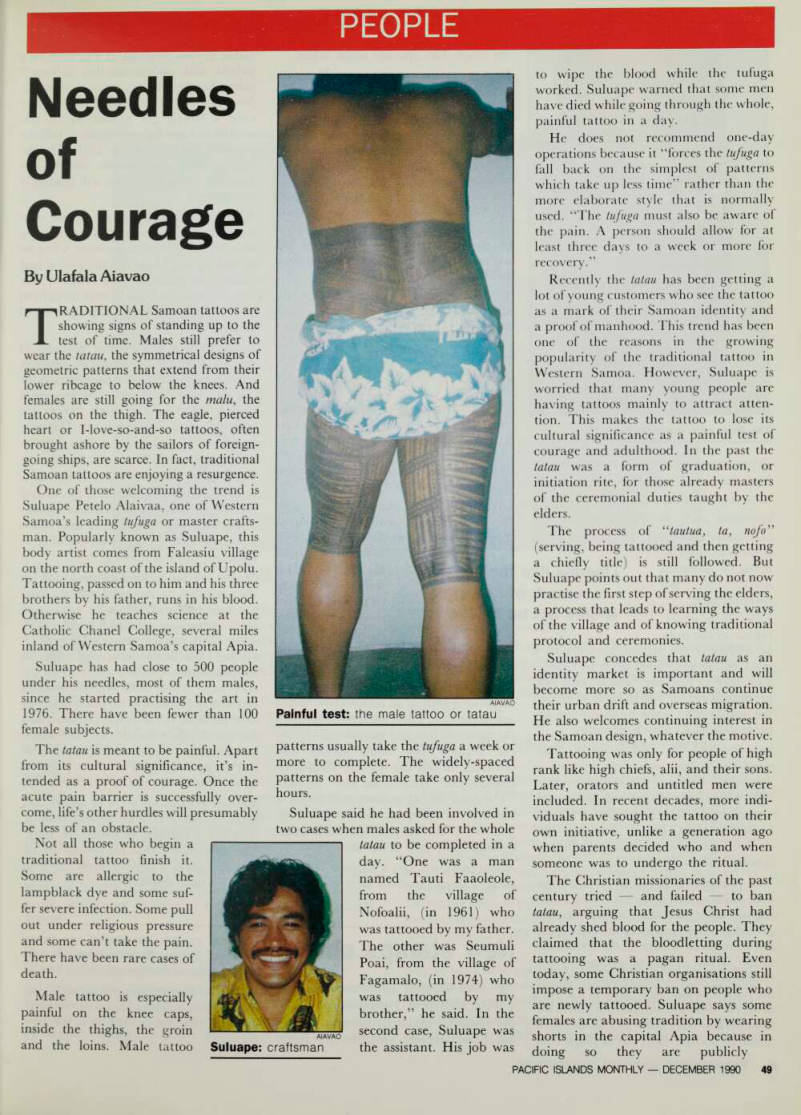
People
Needles of Courage
By Ulafala Aiavao
TRADITIONAL Samoan tattoos are showing signs of standing up to the test of time. Males still prefer to wear the tatau, the symmetrical designs of geometric patterns that extend from their lower ribcage to below the knees. And females are still going for the main, the tattoos on the thigh. The eagle, pierced heart or I-love-so-and-so tattoos, often brought ashore by the sailors of foreign going ships, are scarce. In fact, traditional Samoan tattoos are enjoying a resurgence.
One of those welcoming the trend is Suluape Petelo Alaivaa, one of Western Samoa’s leading tufuga or master crafts man. Popularly known as Suluape, this body artist comes from Faleasiu village on the north coast of the island of Upolu.
Tattooing, passed on to him and his three brothers by his father, runs in his blood.
Otherwise he teaches science at the Catholic Chanel College, several miles inland of Western Samoa’s capital Apia.
Suluape has had close to 500 people under his needles, most of them males, since he started practising the art in 1976. There have been fewer than 100
female subjects.
The tatau is meant to be painful. Apart from its cultural significance, it’s in tended as a proof of courage. Once the acute pain barrier is successfully over come, life’s other hurdles will presumably be less of an obstacle.
Not all those who begin a traditional tattoo finish it.
Some are allergic to the lampblack dye and some suf fer severe infection. Some pull out under religious pressure and some can’t take the pain.
There have been rare cases of death.
Male tattoo is especially painful on the knee caps, inside the thighs, the groin and the loins. Male tattoo
patterns usually take the tufuga a week or more to complete. The widely-spaced patterns on the female take only several hours.
Suluape said he had been involved in two cases when males asked for the whole
tatau to be completed in a day. “One was a man named Tauti Faaoleole, from the village of Nofoalii, (in 1961) who was tattooed by my father.
The other was Seumuli Poai, from the village of Fagamalo, (in 1974) who was tattooed by my brother,” he said. In the second case, Suluape was the assistant. His job was
to wipe the blood while the tufuga worked. Suluape warned that some men have died while going through the whole, painful tattoo in a day.
He does not recommend one-day operations because it “forces the tufuga to fall back on the simplest of patterns which take up less time” rather than the more elaborate style that is normally used. “The tufuga must also be aware of the pain. A person should allow for at least three days to a week or more for recovery.”
Recently the talau has been getting a lot of young customers who see the tattoo as a mark of their Samoan identity and a proof of manhood. This trend has been one of the reasons in the growing popularity of the traditional tattoo in Western Samoa. However, Suluape is worried that many young people are having tattoos mainly to attract atten tion. This makes the tattoo to lose its cultural significance as a painful test of courage and adulthood. In the past the tatau was a form of graduation, or initiation rite, for those already masters of the ceremonial duties taught by the elders.
The process of “tautua, ta, nofo” (serving, being tattooed and then getting a chiefly title) is still followed. But Suluape points out that many do not now practise the first step of serving the elders, a process that leads to learning the ways of the village and of knowing traditional protocol and ceremonies.
Suluape concedes that tatau as an identity market is important and will become more so as Samoans continue their urban drift and overseas migration.
He also welcomes continuing interest in the Samoan design, whatever the motive.
Tattooing was only for people of high rank like high chiefs, alii, and their sons.
Later, orators and untitled men were included. In recent decades, more indi viduals have sought the tattoo on their own initiative, unlike a generation ago when parents decided who and when someone was to undergo the ritual.
The Christian missionaries of the past century tried and failed to ban tatau , arguing that Jesus Christ had already shed blood for the people. They claimed that the bloodletting during tattooing was a pagan ritual. Even today, some Christian organisations still impose a temporary ban on people who are newly tattooed. Suluape says some females are abusing tradition by wearing shorts in the capital Apia because in doing so they are publicly
Aiavao
Suluape: craftsman
Aiavao
Painful test: the male tattoo or tatau
displaying their Samoan tattoos and legs
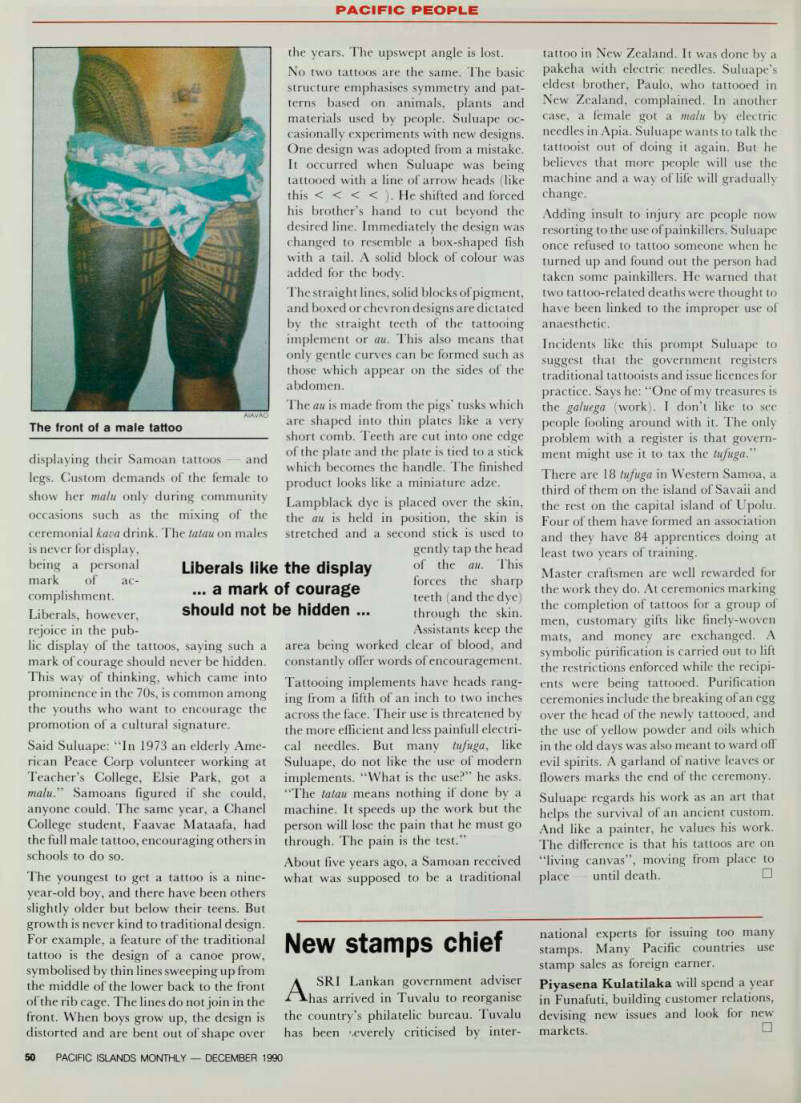
legs. Custom demands of the female to
show her malu only during community
occasions such as the mixing of the ceremonial kava drink. The tatau on males
is never for display, being a personal mark of ac complishment.
Liberals, however, rejoice in the pub
lic display of the tattoos, saying such a mark of courage should never be hidden.
This way of thinking, which came into prominence in the 70s, is common among the youths who want to encourage the promotion of a cultural signature.
Said Suluape: “In 1973 an elderly Ame rican Peace Corp volunteer working at Teacher’s College, Elsie Park, got a malu .” Samoans figured if she could, anyone could. The same year, a Chanel College student, Faavae Mataafa, had the full male tattoo, encouraging others in schools to do so.
The youngest to get a tattoo is a nine year-old boy, and there have been others slightly older but below their teens. But growth is never kind to traditional design.
For example, a feature of the traditional tattoo is the design of a canoe prow, symbolised by thin lines sweeping up from the middle of the lower back to the front of the rib cage. The lines do not join in the front. When boys grow up, the design is distorted and are bent out of shape over
the years. The upswept angle is lost.
No two tattoos are the same. The basic structure emphasises symmetry and pat terns based on animals, plants and
materials used by people. Suluape oc
casionally experiments with new designs.
One design was adopted from a mistake.
It occurred when Suluape was being tattooed with a line of arrow heads (like this <<<), He shifted and forced his brother’s hand to cut beyond the desired line. Immediately the design was changed to resemble a box-shaped fish with a tail. A solid block of colour was added for the body.
The straight lines, solid blocks of pigment, and boxed or chevron designs are dictated by the straight teeth of the tattooing implement or au. This also means that only gentle curves can be formed such as those which appear on the sides of the abdomen.
The au is made from the pigs’ tusks which are shaped into thin plates like a very short comb. Teeth are cut into one edge of the plate and the plate is tied to a stick which becomes the handle. The finished product looks like a miniature adze.
Lampblack dye is placed over the skin, the au is held in position, the skin is stretched and a second stick is used to
Liberals like the display a mark of courage 3 marK 0T c ° ura 8 e Should not be hidden ...
gently tap the head of the au. This forces the sharp teeth (and the dye) through the skin.
Assistants keep the
area being worked clear of blood, and constantly offer words of encouragement.
Tattooing implements have heads rang ing from a fifth of an inch to two inches across the face xheir use is threatened by the more efficient and less painfull electri cal needles. But many tufuga , like Suluape, do not like the use of modern implements. “What is the use?” he asks.
“The tatau means nothing if done by a machine. It speeds up the work but the person will lose the pain that he must go through. The pain is the test.”
About five years ago, a Samoan received what was supposed to be a traditional
tattoo in New Zealand. It was done by a pakeha with electric needles. Suluape’s eldest brother, Paulo, who tattooed in New Zealand, complained. In another case, a female got a malu by electric needles in Apia. Suluape wants to talk the tattooist out of doing it again. But he believes that more people will use the machine and a way of life will gradually
change.
Adding insult to injury are people now resorting to the use of painkillers. Suluape once refused to tattoo someone when he turned up and found out the person had taken some painkillers. He warned that two tattoo-related deaths were thought to have been linked to the improper use of anaesthetic.
Incidents like this prompt Suluape to suggest that the government registers traditional tattooists and issue licences for practice. Says he: “One of my treasures is the galuega (work). I don’t like to see people fooling around with it. The only problem with a register is that govern ment might use it to tax the tufuga .”
There are 18 tufuga in Western Samoa, a third of them on the island of Savaii and the rest on the capital island of Upolu.
Four of them have formed an association and they have 84 apprentices doing at least two years of training.
Master craftsmen are well rewarded for the work they do. At ceremonies marking the completion of tattoos for a group of men, customary gifts like finely-woven mats, and money are exchanged. A symbolic purification is carried out to lift the restrictions enforced while the recipi ents were being tattooed. Purification ceremonies include the breaking of an egg over the head of the newly tattooed, and the use of yellow powder and oils which in the old days was also meant to ward off evil spirits. A garland of native leaves or flowers marks the end of the ceremony.
Suluape regards his work as an art that helps the survival of an ancient custom.
And like a painter, he values his work.
The difference is that his tattoos are on “living canvas”, moving from place to place until death. □
Aiavao
The front of a male tattoo
New stamps chief
A SRI Lankan government adviser has arrived in Tuvalu to reorganise the country’s philatelic bureau. Tuvalu has been severely criticised by inter
national experts for issuing too many stamps. Many Pacific countries use stamp sales as foreign earner.
Piyasena Kulatilaka will spend a year in Funafuti, building customer relations, devising new issues and look for new markets.
Interview
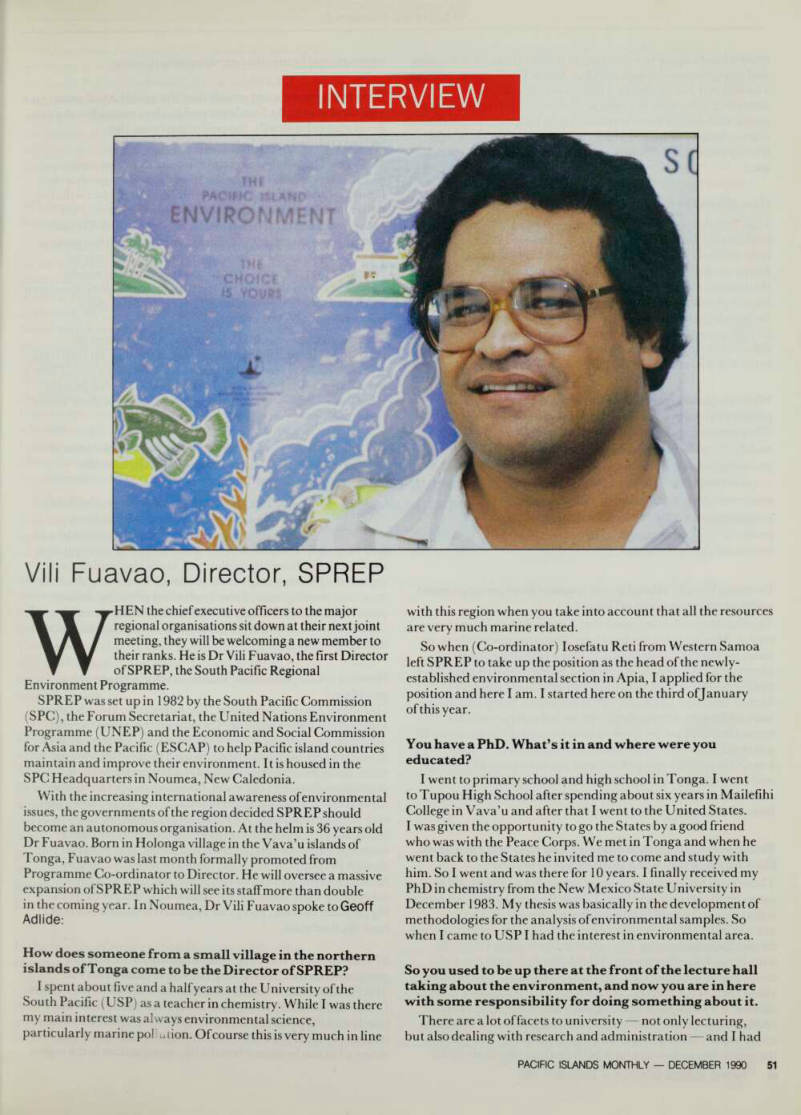
Vili Fuavao, Director, SPREP
WHEN the chief executive officers to the major regional organisations sit down at their next joint meeting, they will be welcoming a new member to their ranks. He is Dr Vili Fuavao, the first Director of SPREP, the South Pacific Regional Environment Programme.
SPREP was set up in 1982 by the South Pacific Commission (SPC), the Forum Secretariat, the United Nations Environment Programme (UNEP) and the Economic and Social Commission for Asia and the Pacific (ESCAP) to help Pacific island countries maintain and improve their environment. It is housed in the SPC Headquarters in Noumea, New Caledonia.
With the increasing international awareness ofenvironmental issues, the governments of the region decided SPREP should become an autonomous organisation. At the helm is 36 years old Dr Fuavao. Born in Holonga village in the Vava’u islands of Tonga, Fuavao was last month formally promoted from Programme Co-ordinator to Director. He will oversee a massive expansion of SPREP which will see its staff more than double in the coming year. I n Noumea, Dr Vili Fuavao spoke to Geoff Adlide: How does someone from a small village in the northern islands of Tonga come to be the Director of SPREP?
I spent about five and a halfyears at the University of the South Pacific (USP) as a teacher in chemistry. While I was there my main interest was always environmental science, particularly marine pol L *tion. Of course this is very much in line
with this region when you take into account that all the resources are very much marine related.
So when (Co-ordinator) losefatu Reti from Western Samoa left SPREP to take up the position as the head of the newly established environmental section in Apia, I applied for the position and here I am. I started here on the third ofjanuary of this year.
You have a PhD. What’s it in and where were you educated?
I went to primary school and high school in Tonga. I went to Tupou High School after spending about six years in Mailefihi College in Vava’u and after that I went to the United States.
I was given the opportunity to go the States by a good friend who was with the Peace Corps. We met in Tonga and when he went back to the States he invited me to come and study with him. So I went and was there for 10 years. I finally received my PhD in chemistry from the New Mexico State University in December 1983. My thesis was basically in the development of methodologies for the analysis ofenvironmental samples. So when I came to USPI had the interest in environmental area.
So you used to be up there at the front of the lecture hall taking about the environment, and now you are in here with some responsibility for doing something about it.
There are a lot of facets to university not only lecturing, but also dealing with research and administration and I had
Pacific People
quite a lot of experience speaking to the Forum and conferences and workshops and things like that. When I took up the position, I looked at it as a challenge. I feel quite lucky, and quite honoured, to be here at a time when the Pacific is beginning to realise that the environment is not something to be ignored, it is something to be looked at seriously if we are to manage our limited resources for the sake of the future inhabitants ofour area.
How green are Pacific island governments?
I can’t really speak for the countries, but I can say that if the interest they have shown in the programme (SPREP) is an indication ofhow ‘green’ or ‘ungreen’ the region is, I feel quite happy with the fact that they show a lot of interest. For example, the amount of projects and requests that my office has received is quite phenomenal. Obviously it’s a two-edged sword it means a lot of work for us but at the same time it shows there’s a lot of awareness out there among the governments. That’s also reflected in the way the environment has taken the fore not only in the Forum, but also in the South Pacific Conferences.
What requests have come in this year? What sort of projects are governments interested in?
The proposals sent to us by the countries vary widely, from climatic change and sea-level rise, to coastal management to conservation matters protected areas. There’s a lot of requests for awareness programmes like workshops, radio programmes and assistance with material production for environmental education to be used in school curriculums.
Do most Pacific island governments have environment units or environment officers?
That has been a development that is quite noticeable in the region. Most countries at least have an environment officer, or someone has the responsibility to look at the environmental aspects of all the development plans. Some countries have gone further and have their own unit, and some have gone even further and have a Ministry of Conservation. Some countries have an integrated approach with an inter-departmental committee with people from various sections of the government which takes on the evaluation of the environment. I think that’s a very, very good approach because the environment is a huge and integrated area. You need more than just an environmentalist to look at the environment, you need people from all areas of expertise.
You mentioned climatic change and the rising sea-level.
How much is that of an immediate problem?
There’s still a big debate... a lot of argument on the model to use to predict the sea-level rise. I think the problem for our region is that we can’t afford to be complacent about this. The uncertainties of the scientific community should not be an excuse for not doing something. It’s a reality. But to what extent the sea will rise is another matter. I think the small atoll countries in our region are quite right in taking it seriously. You’re talking about their very existence. It’s far more than just a piece ofland sinking, it’s whole cultures, languages and ways oflife. So the implications are not just from a land mass point of view, but the social impact ofit is going to be quite devastating. I’m glad that the region has woken up and is participating effectively in the
international forums that are discussing this issue.
But really there’s not much that the small Atoll countries can do about it. As I understand it, the reason for the sea level rise is basically the pollution from the industrialised world.
Well, yes. The point has been made quite clear that carbon dioxide is responsible for the sea-level rise and I hope that the industrialised nations take responsibility. But the fact is that we dynamite the reefs, we cut down our forests, we destroy the mangroves, and all of these things are inter-related. Climatic change is not caused by one specific thing. I think that perhaps we can slow it down by changing our ways. Obviously we recognise that the cause of all the carbon dioxide is mainly outside ofour control, but it’s worth pointing out that in our own small way we can do something There is also a lot more information to be gathered.
There is an argument that because you have these atolls surrounded by reef, maybe the growth of the reef can keep track with the sea-level rise. There’s a great debate about that. There’s a certain growth rate of coral. It’s definitely not a fast process, but ifit can keep up with the sea-level rise, perhaps there’s some hope. But I’m not an expert in sea-level rise.
‘Like the rest of the world we produce more waste than we know what to do with it’
What about your particular area of interest and research, marine
pollution?
I’m very much into marine production in the coastal areas: the pollution from agricultural practices the pesticides and
how they effect the quality of the water and eventually get into the food chain. Sewerage pollution is also a big problem in the region. And because, rightly so, countries are moving towards economic development, there’s industrial pollution. In some parts of the region the body of water surrounding the residential areas has been effected by the disposal of both domestic and non domestic waste.
Human waste, domestic waste why is that such a
problem?
One major cause is population. The population growth rate in some areas ifquite alarming. The other thing is there is great urbanisation movement people from rural areas moving to the urban area because ofjobs and the flavour oflife they see there. Some areas in this region have amongst the highest population density in the world. Of course most ofour urban areas are on the coast and this has magnified the problem. Our way oflife has changed. We are no longer based just on subsistence eating fish and dalo and when we go to the store and buy something it comes in a plastic bag. What do you do with the plastic which is not biodegradable? So our way of life has changed and as a consequence, like the rest of the world, we produce more waste than we know what to do with. It’s a big problem because, except for Papua New Guinea, we don’t have the land mass.
SPREP is the newest regional organisation, but the programme has been going for some time hasn’t it?
SPREP was set up in 1982 by four bodies the SPG, the Forum, UNEP and ESCAP. So we have always had the status of not purely an SPG programme, but one jointly sponsored by four bodies. I think SPREP is a symbol of regional co-operation. It shows what can be done when the big organisations in the region
work together. And now the decision of the last inter governmental meeting on SPREP, which has been endorsed by the South Pacific Conference, is to make SPREP an autonomous body housed here at the SPG but have as its sovereign body an inter-governmental meeting and still report to Conference and the Forum on an annual basis. To me, that’s a recognition by the governments that the programme must be strengthened to cope with the needs and the services expected of us.
What sort of changes can we expect now that SPREP has become autonomous?
Well I think there’s a danger of a new body like us being put up in the market to be the shopping list of someone else. I’m always ofthe view that I will do what the governments ask or direct us to do. There have been some new staff positions approved, but I don’t really see any change in our programmes.
We already have something like 11 components in our work programme that cover the whole spectrum of the environment.
What we have done is have one programme officer looking after three or four of those and of course that put a lot of strain on the officers. Now when we have the new staff, what we’ll do is have an environmental impact assessment officer, someone else who will simply look at marine pollution, and so on. In that way there’s a chance to go into things in depth, rather than have one officer skim the surface of three or four areas of
the environment.
SPREP is funded on voluntary contributions from the member countries and if they all paid up you’re talking about a sum less than half a million dollars which is not much. At the
moment we have four programme officers and two support staff and we barely get to the end of the year. The only reason we manage is because some countries contribute over and above their so-called voluntary contributions and that’s kept our heads above water. What we have been doing is spending a lot of our time fundraising for the projects, because the money that comes from the governments is basically for salaries and administration.
We are beginning to look out for staff paid by donor agencies and lending agencies. The fourth programme officer, who joined us (in Septeember), is fully funded for two and half years by the ADB (Asian Development Bank). UNDP (United Nations
Development Programme) is seriously considering providing
assistance to enable us to hire an environmental impact assessment officer and hopefully we’ll have that money early next year. New Zealand has indicated they will fund two positions. France and several other countries have indicated they will also assist, Greenpeace has said they will assist in strengthening our unit. So we’re beginning to expand our
funding base.
Is there a lot of money floating around for the environment?
Yes. There’s a lot of money going around, but there’s still a reluctance by the donors to recognise that it’s not enough to just give money for projects. In order to make sure the project is implemented effectively there’s also a need for administration.
So far, AIDAB (Australian International Development Assistance Bureau) has been very good to us; they’re more lenient and more open than most donors to requests to redirect some ofthe assistance to cover particular needs. I hope other donors take that position and don’t have a fixed direction because the bottom line is we have to be careful that our priorities are set by the member countries, not set by the donors.
One ofmy major tasks is to make sure that just because the donor’s money is there, we don’t deviate and become a donor driven organisation rather than an organisation that gets it direction and priorities from the island governments. I’ve always held the view that the governments know best what their needs are, and ifwe stick to that principle there shouldn’t be any conflict of interest with the donors.
Is there another possible conflict of interest? You mentioned that one of your main donors in France. Now one of the longest standing environmental issue in the region is the French nuclear testing programme in
French Polynesia.
There’s been a lot of things said about nuclear testing and a lot ofarguments. It’s been discussed at the highest level at the Forum Heads ofthe Government meetings. It’s not for SPREP to speak for the countries, to take a position. We have to tread very carefully and respect the sovereign
We have to tread very car efully, respect the 0 take their OWD Stand
right of countries to take their own stand.
Ifwe are requested to provide information we will provide it, but SPREP doesn’t take a position. We provide technical data and information for
governments to make up their own minds. The same thing happened with Johnston Atoll. When a government asked us, we provided all the information and let them make up their own mind.
Do you have a particular ambition for your time as SPREP Director, something you would like to achieve in your time here?
I have two more years before my time is up. The ambition I have is that I would like to leave this place realising that SPREP has increased its capacity to deal effectively with the needs of the region. At the same time it’s certainly not my wish to build a very bureaucratic organisation. I think the main strength of SPREP is that we are in touch with our governments on a regular basis. We have a maintain that line of communication.
I want to see the programme strengthened to a position where it has an identity that is well recognised internationally and, of course, regionally. Because when you have a status and identity then funds are easier to secure. I want SPREP to be authoritative. I want to work very closely with other institutions I have no illusion that I can head an organisation that will deal with every single aspect of the environment. That would be impossible and not cost-effective; but I hope that as SPREP increases its staff and strengthens its capabilities, we will be in a position to really co-ordinate the activities in the region and work very much in partnership with universities, non governmental organisations, and other regional and international organisations. If we have all these things, we will be looking at a very effective SPREP. □
Advertisements & other items, pp. 54-56 (1 item)
/Pacifi
( ISLAND
MON T H L
\MfiRK€T PlfiC * *
For the benefit of our readers who would like to place a small classified advertisement in our magazine , Market Place will assist you in selling personal items, accommodation, real estate, boating or a service ... in fact anything you would like to sell to our over 50,000 readers.
Market Place Advertising Rates are structured to allow you to place as many advertisements as you wish, economically.
EMPLOYMENT WANTED
Golf Course Superintendent/Construction Supervisor. Qualified Superintendent and Mechanical Engineer with over 20 years experience in construction and maintenance of golf courses, installation and operation of irrigation systems, turf management, agronomy, landscape architecture and complete knowledge of machinery. Member Australian Golf Course Superintendents Association. Excellent references. Write c/- P.O.
Box 677 Tewantin, Qld Australia 4565 or Phone Noosa (074) 49 8823.
DISTRIBUTORS/RETAILERS
WANTED
Required in all Pacific Island countries for the marketing of ASAKA Electronic Double Cassette Sing-along Karaoke Entertainment System. For details and brochures contact ASAKA Australia Pty Ltd 8 Hickory Place, St.
Clair, 2759, NSW, Australia Tel. (612) 670 2758 Fax. (612) 670 2758.
TRUCK MECHANIC
32 year old with 12 years experience in Europe and New Zealand, seeks job on one of Pacific Islands. C.V. & references available.
Eric Willers, Flat 3/36A Harman St., Christchurch, New Zealand, Tel (03) 3385629.
AGENTS/DISTRIBUTORS
WANTED
Qualified Agents/Distributors wanted for small primary and rechargeable batteries.
Products available include Alkaline, Carbonzinc, Mercury, Silver, Lithium, NiCad, Gel-Cell and Lead-Acid. Please contact Pacific Power Products, P.O. Box 2756, Redmond, WA 98073 USA. Phone 206-881-0564.
Telex 212495 PACPP UR
HYDRAULICS
Distributors wanted for all areas outside Fiji for our hydraulic fittings and hose. Send for our Company profile. Quality products at very competitive prices.
Hydraulink Fluid Connectors Limited PO Box 12 826, Penrose, Auckland, NZ. Ph: 64 9 643 787 Fax: 64 9 645 865
SELF ADHESIVE LABEL
FORUM LABELS (FIJI) LTD
P.O. Box 1167, Suva., Fiji. Phone: 304111 We print self-adhesive labels in rolls, multi-coloured labels with hot foil, and die cut to shape, tickets and tags in rolls. We also supply labelling machines and fabric labels.
COMMERCIAL PRINTING
Top quality four colour printing, brochures, posters, packaging, product labels, fabric labels, billboards, books, magazines, stickers, books. Export quality. Contact Fiji’s most experienced Commercial Printers. FIJI TIMES COMMER- CIAL PRINTING, P.O. Box 1167. Suva. Fiji.
Phone: 304111 Fax. 301521.
ANTIQUE BOOKS, MAPS &
PRINTS
Antique Books, Maps & Prints of Pacific Islands. Free list available of items for sale.
Colin Hinchcliffe. 12 Queens Staith Mews.
York U.K.
HYDRAULIC EQUIPMENT
Comprehensive range of competitively priced pumps, motors, cylinders and valves. Agents for Sauer-Sundstrand hydrostatics.
Australian Hydraulics Company, PO Box 227, Rydalmere NSW 2116, Australia, Fax: 61-2-638.0544.
SCRAP METAL
Good prices paid for your clean scrap Aluminium, Brass, Copper, Lead, etc.
Contact Nonferral Pty. Ltd. 23 Davis Rd.
Wetherill Park NSW 2164 Australia. Fax 61 2 604 1304 for prompt reply. Our Company is a long established and leading metal buyer and smelter. Telephone 61 2 604 8855,
IMMIGRATION
Migrate to Australia with our expert assistance. Businessmen/skilled people/teachers/professionals send details in confidence. CKP AUSTRALIA, Box 2252, Canberra ACT 2601, Australia.
JEEP TIRES
Jeep Tires ♦ Heavy duty military surplus, 6ply nylon, 700 x 16LW on rims. US $25.00ea or five/US$lOO.OO. Quantity discount available. On Maui, Hawaii 808-572-0462
PACIFIC
SLANDS
I M O N T H L Y~ I
MRRK€T PLRC€ CAN UJOAK
UiOND€RS FOR VOU ...
Promote your business, or service, sell your household items, cars or heavy machinery etc.
ONLY AUSSI PER WORD.
NO COMPANY LOGO. NO
DISPLAY. NO BOLD TYPE.
Just forward your Advertisement together with payment to: PACIFIC ISLANDS MONTHLY “Market Place", P.O. Box 1167, Suva, Fiji.
CONDITIONS:
1/ All Advertisements are subject to acceptance and approval of publisher. 2. Advertisements are published as space permits: we cannot guarantee date of insertion. 3. All advertisements must be prepaid and should be typed or printed clearly. 4. Deadline for receipt of advertisements is the 10th of the month prior to issue.
5. PACIFIC ISLANDS MONTHLY
assumes no responsibility for any service other than publishing paid advertisements in this section.
1352 I I' HU c v% • ,,;v x/ *
CMX23O
STEREO CASSETTE DECK
WITH FM-STEREO/MW TUNER
& CD CHANGER CONTROL
> / N m £ ✓ CMX23O the trend-setting in-car sound
player offered by Clarion, that front-
runner in the car audio field. Visit / new sound frontiers with the
amazing CMX23O,
a masterpiece in human
engineering. /
m / / j.
J, jp a 0> d j / & /- /- <r . // a.
clarion
or further information Australia: AWA Distribution Limited Dept. 112-118 Talavera Road North Ryde NSW 2113 /.New Zealand: AWA New Zealand Limited, P.O. Box 50-248, Porirua / Fiji Islands: Brijla & Co., Ltd., G.P.O. Box 362, Suva Tahiti: HI FI., VAIRAATOA. Avenue Chef Vairaatoa B.P 1128, Papeete / New Caledonia: Caldis, 8.P.M1, Noumea Cedex / Guam: Micropac Audic Inc., PO. Box 3478, Agana, Guam 96910, U.S.A. Tel: 472-8091, Cable Code: HIFI AUDIO AGANA / Vanuatu: The Sound Centre, PO. Box 434, Vila / Cook Islands: South Seas International Ltd., PO. Box 49, Rarotonga / Papua New Guinea: Hagemeyer (P.N.G.) Pty. Ltd., PO. Box 1428, Boroko, Port Moresby
Less W)rk, More Enjoyment.
(UK j ...
Tension can be a good thing in moderate amounts. In fact, for safe driving, it’s absolutely essential, translating as driver alertness. But just where does tension stop being alertness and become discomfort, and then fatigue?
Mitsubishi Motors, in designing the Galant, spent hours on that question, using the latest technology to measure drivers’ physical reactions to various aspects of driving. One such aspect is the way driving, particularly cornering and lane-changing, requires constant steering adjustments. This results in added stress for the driver. The Galant’s 4-wheel steering and Electronic Control Suspension take some of this pressure off the driver by actively controlling vehicle attitude. With less .work, the driver can High Tension 20 80 km/h s •i 40 10 20 30 Driver tension under cornering is measured by level of skin resistance. With ECS, higher skin resistance shows lower levels of tension in the driver. get more enjoyment from driving.
As far as Mitsubishi are concerned, human engineering is much more than a catchy phrase. It is a practical way to make cars more useful and more appealing to people.
MITSUBISHI GRLRNT
A
MITSUBISHI
MOTORS
AMERICAN SAMOA: MORRIS SCANLAN SERVICE INC. P.O Box 367, Pago Pago, Tel 633-5520/AUSTRALIA: MITSUBISHI MOTORS AUSTRALIA LTD Box 1284. South Road. Clovelly Park, South Australia 5042. Tel (081 275-7223/FIJI: NIVIS MOTOR & MACHINERY CO., LTD. G.P.O Box 150, Suva, Tel 38341 1 /FRENCH POLYNESIA (TAHITI); ETS-BREDIN FRERES ET FILS P.O. Box 21, Papeete, Tahiti, Tel 4-202-58/NEW CALEDONIA: SOCIETE D'IMPORTATION D AUTO DU PACIFIQUE SUDS.A, B P 438 Rond Point du Pacifique, Noumea, Tel 274144/NEW ZEALAND: MITSUBISHI MOTORS NEW ZEALAND LTD, Todd Park, Heriot Drive. Private Bag, Ponrua, Tel. 370-109/ NORFOLK ISLAND; BORRYS LTD, PO Box 169, Norfolk Island, Tel 2114/PAPUA NEW GUINEA: TOBA PTY LTD P.O. Box 503, Port Moresby, Tel 2 1-7874/SOLOMON ISLANDS: HARVEST PACIFIC LTD. G.P.O. Box 88 Honiara, Guadalcanal. Tel. 30128/TONGA: SITANI MAPI CO.. LTD. PO. Box 83, Nuku’ALOFA, Tel 21-044/VANUATU: SOCOMETRA B P. 06 Route de Lagon. Port-Vila, Tel. 2314/WESTERN SAMOA: A M. MACDONALD HOLDINGS LTD.
P.O, Box 576, Apia, Tel. 22022/SAIPAN/POHNPEI/MAJURO/KOSRAE/TRUK/YAP/BELAU: MICRONESIAN MOTORS, INC. 997 South Marine Drive. Tamuning. Guam 96911 Tel 646-6827